EP1704133B1 - Improved process for the production and purification of vi-ny l aromatic monomers - Google Patents
Improved process for the production and purification of vi-ny l aromatic monomers Download PDFInfo
- Publication number
- EP1704133B1 EP1704133B1 EP04803799A EP04803799A EP1704133B1 EP 1704133 B1 EP1704133 B1 EP 1704133B1 EP 04803799 A EP04803799 A EP 04803799A EP 04803799 A EP04803799 A EP 04803799A EP 1704133 B1 EP1704133 B1 EP 1704133B1
- Authority
- EP
- European Patent Office
- Prior art keywords
- stream
- section
- process according
- alkylation
- purification
- Prior art date
- Legal status (The legal status is an assumption and is not a legal conclusion. Google has not performed a legal analysis and makes no representation as to the accuracy of the status listed.)
- Expired - Lifetime
Links
Images
Classifications
-
- C—CHEMISTRY; METALLURGY
- C07—ORGANIC CHEMISTRY
- C07C—ACYCLIC OR CARBOCYCLIC COMPOUNDS
- C07C7/00—Purification; Separation; Use of additives
- C07C7/04—Purification; Separation; Use of additives by distillation
-
- C—CHEMISTRY; METALLURGY
- C07—ORGANIC CHEMISTRY
- C07C—ACYCLIC OR CARBOCYCLIC COMPOUNDS
- C07C2/00—Preparation of hydrocarbons from hydrocarbons containing a smaller number of carbon atoms
- C07C2/54—Preparation of hydrocarbons from hydrocarbons containing a smaller number of carbon atoms by addition of unsaturated hydrocarbons to saturated hydrocarbons or to hydrocarbons containing a six-membered aromatic ring with no unsaturation outside the aromatic ring
- C07C2/64—Addition to a carbon atom of a six-membered aromatic ring
- C07C2/66—Catalytic processes
-
- C—CHEMISTRY; METALLURGY
- C07—ORGANIC CHEMISTRY
- C07C—ACYCLIC OR CARBOCYCLIC COMPOUNDS
- C07C5/00—Preparation of hydrocarbons from hydrocarbons containing the same number of carbon atoms
- C07C5/32—Preparation of hydrocarbons from hydrocarbons containing the same number of carbon atoms by dehydrogenation with formation of free hydrogen
- C07C5/327—Formation of non-aromatic carbon-to-carbon double bonds only
- C07C5/333—Catalytic processes
- C07C5/3332—Catalytic processes with metal oxides or metal sulfides
Definitions
- the present invention relates to an improved process for the production and purification of vinyl aromatic monomers.
- the present invention relates to an improved process for the production and purification of vinyl aromatic monomers coming from the dehydrogenation of the corresponding alkylated products.
- the present invention relates to an improved process for the production and purification of styrene coming from the dehydrogenation of ethyl benzene.
- Vinyl aromatic monomers such as styrene
- plastic materials such as compact/crystalline polystyrene or expanded polystyrene.
- monomers are recovered from the liquid effluents coming from a dehydrogenation section by means of a series of fractionation columns operating in series, with respect to the flow of vinyl aromatic monomer.
- styrene there are generally three or four fractionation columns depending on the type of process.
- the liquid mixture of aromatic hydrocarbons coming from the dehydrogenation section is fed into the first column.
- a mixture of benzene and toluene is separated at the head, which forms a by-product of the production process of styrene, whereas a stream containing non-reacted ethyl benzene, styrene and high-boiling products is extracted from the bottom.
- the stream coming from the bottom of the first column is fed to a second column, where a stream containing non-reacted ethyl benzene is separated at the head and recycled to the dehydrogenation section, whereas a stream containing styrene together with high-boiling products is extracted from the bottom.
- the flow coming from the bottom of the second column is fed to a third column, where the styrene forming the end-product is removed at the head, whereas a stream consisting of styrene and high-boiling products is extracted from the bottom.
- styrene present in the stream leaving the bottom of the third purification column is still high, it is further treated in a fourth column, where said stream is fed, or else to a different apparatus, such as an evaporator.
- a stream rich in high-boiling products which forms the process residue is produced and removed from the latter part of the purification section, whether it be a distillation column or an evaporator.
- the product extracted from the head is fed to a second column where a mixture of benzene and toluene, which forms a by-product of the production process of styrene, is extracted from the head, whereas a stream containing non-reacted ethyl benzene is obtained at the bottom and is sent to the dehydrogenation unit.
- the stream coming from the bottom of the first column is fed to the third column, where purified styrene is extracted from the head, whereas a stream whose composition is similar to that described in the previous scheme, is obtained at the bottom, which, as it is still rich in styrene, is further treated to recover this with procedures similar to those described above.
- Vinyl aromatic monomers for example styrene, tend to polymerize if they are subjected to the action of heat and consequently, during distillation, they tend to form solid polymeric residues which can be deposited and block the equipment associated with the purification system.
- the Applicant has now found a new additive for preventing the premature polymerization of vinyl aromatic monomers, coming from the dehydrogenation of the corresponding alkylated products, particularly during the purification phase which, in the case of the use of nitroxide alone, strengthens its effect.
- this additive can substitute the retarding compound, when this is used in a combination with the nitroxide.
- This new additive comes from the alkylation section which precedes dehydrogenation and consists of heavy products, essentially polyalkyl benzenes, which are formed during the alkylation reaction and which are separated in a specific purification section. It has, in fact, been surprisingly found that the heavier stream coming from the bottom of the distillation section, downstream of the alkylation reactor, if fed to the purification section of the vinyl aromatic monomer, inhibits its premature polymerization. This result is not only unexpected but is also useful as it allows a greater recovery of the monomer from the styrene distillation residues.
- An object of the present invention therefore relates to an improved process for the production and purification of vinyl aromatic monomers which comprises:
- the aromatic hydrocarbon fed to the alkylation section can be selected from those having from 6 to 9 carbon atoms but it preferably consists of benzene.
- Another aromatic hydrocarbon which can be used in the process object of the present invention is, for example, toluene.
- the preferred aromatic hydrocarbon is benzene refinery grade with a purity higher than or equal to 95% by weight.
- the C 2 -C 3 olefinic stream for example ethylene or propylene, also refinery grade with a purity higher than or equal to 95% by weight, is fed to the alkylation reactor together with the aromatic hydrocarbon, fresh and, optionally, recycled.
- the two aromatic and olefinic streams are fed to the alkylation unit so as to have aromatic/olefin molar ratios which satisfy the requirements of current technologies, generally from 2 to 50, preferably from 3 to 10.
- the alkylation reaction is carried out with conventional catalytic systems, for example it can be carried out according to the method described in European patent 432,814 .
- Any alkylation reactor can be used in the process object of the present invention.
- fixed bed or fluid bed reactors carrier reactors, reactors operating with a slurry mixture and catalytic distillation reactors, can be used.
- the preferred alkylation catalysts can be aluminum trichloride or those selected from synthetic and natural porous crystalline solids based on silicon and aluminum, such as acid zeolites in which the silicon/aluminum atomic ratio ranges from 5/1 to 200/1.
- acid zeolites in which the silicon/aluminum atomic ratio ranges from 5/1 to 200/1.
- synthetic zeolites of the ZSM group in which the silicon/aluminum atomic ratio ranges from 20/1 to 200/1 such as ZSM-5 zeolite.
- the alkylation reaction can be carried out under temperature and pressure conditions which depend not only on the catalyst selected but also on the type of reactor and choice of reagents.
- the reaction temperature generally ranges from 50 to 450°C. More specifically, with zeolitic catalysts, for either fixed or mobile bed processes in gas phase, the temperature preferably ranges from 300 to 450°C or from 180 to 250°C for processes in liquid phase, whereas in the case of a catalytic distillation reactor, operating in mixed gas-liquid phase, the reaction temperature, varying along the catalytic bed, ranges from 140 to 350°C, preferably from 200 to 300°C. When reactors operating with a slurry mixture and an aluminum trichloride catalyst, are used, the temperature-ranges from 100 to 200°C.
- the pressure inside the alkylation reactor is maintained at values ranging from 0.3 to 6 MPa, preferably from 0.4 to 5 MPa.
- the aromatic stream leaving the alkylation reactor is treated with conventional means for recovering the reaction product from the non-converted reagents and reaction byproducts.
- the separation system preferably consists of a series of at least three distillation columns from which the non-reacted aromatic compound is recovered from the first, and recycled to the alkylation reactor and/or a transalkylation unit described below.
- the mono-alkyl substituted aromatic compound for example ethyl benzene
- the dialkylated aromatic products are recovered from the head of the third column and sent to the transalkylation unit
- the heavy products essentially consisting of polyalkylated products, tetralines and alkyl substituted diphenyl ethanes, which form the polymerization inhibitor additive, are recovered from the bottom and fed to the purification/separation section of the vinyl aromatic compound.
- the dialkylated aromatic compounds for example diethyl benzenes
- the transalkylation can take place in a specific reactor or in the same alkylation reactor.
- the transalkylation reactor when present, preferably consists of a reactor operating in slurry phase, when the catalyst is aluminum trichloride, or in a fixed bed reactor, functioning in liquid phase, in which a conventional zeolitic transalkylation catalyst is present, such as Y zeolite, beta zeolite or mordenite, preferably Y or beta zeolite.
- a conventional zeolitic transalkylation catalyst such as Y zeolite, beta zeolite or mordenite, preferably Y or beta zeolite.
- the transalkylation reaction can be carried out according to what is described in European patent 847,802 .
- the benzene/ethylene molar ratio calculated with respect to the total moles of benzene present as such and as diethyl benzene and the total moles of ethylene present as substituents in the diethyl benzenes, ranges from 2/1 to 18/1, preferably from 2.5/1 to 10/1.
- the temperature in the reactor is maintained at a value of 50 to 350°C, preferably from 130 to 290°C, whereas the pressure is maintained at 0.02 to 6 MPa, preferably from 0.4 to 5 MPa.
- the mono-alkylated aromatic product is fed to the catalytic dehydrogenation section which comprises one or more reactors operating with a fixed bed or fluid bed, preferably with a fixed bed.
- the dehydrogenation reaction with a fixed bed reactor takes place at a temperature ranging from 500 to 700°C, preferably from 550 to 650°C, at a pressure ranging from 0.02 to 0.15 MPa, in the presence of a catalyst based on iron oxide and potassium carbonate containing other metallic compounds in small quantities having the function of promoters.
- the dehydrogenation can take place, for example, with a fixed bed catalyst by feeding a mixture of ethyl benzene vapour and water vapour, in a water/ethyl benzene molar ratio ranging from 5 to 15, preferably from 6 to 12, onto a first reactor in which a partial conversion of ethyl benzene takes place.
- the reacted mixture leaving the first reactor is fed to a second reactor, after the temperature has been brought to the required value by means of a heat exchanger.
- the reaction mixture, in which the ethyl benzene is converted for at least 60%, is cooled and condensed before being sent to the purification section.
- the reaction product leaving the dehydrogenation phase is fed to a second purification/separation section for the recovery of the vinyl aromatic monomer, for example styrene.
- the purification section comprises at least one distillation column even if it is preferable to operate with three or four distillation columns connected in series with respect to the flow of the monomer to be purified.
- the heavy bottom product coming from the separation section of the alkylated product is also fed to the second purification/separation section in order to prevent the premature polymerization of the vinyl aromatic monomer and limit the consumption of polymerization inhibitor and/or retardant additives which are necessarily and conventionally used in this section.
- the feeding can be effected in any of the distillation columns, at any height thereof and, optionally, by premixing said heavy bottom product with any of the streams present in said second purification/separation section.
- the columns of the second purification/separation section can be selected from those which contain conventional trays or random and/or structured packing.
- the columns operate at a low pressure, generally ranging from 0.002 to 0.03 MPa.
- a small flow is also fed to the single columns, containing a substance which acts as polymerization inhibitor, for example (in the case of the purification and separation of styrene) 4-hydroxy-2,2,6,6-tetramethyl-piperidin-1-oxy, 2,2,6,6-tetra-methyl-piperidin-1-oxy, or any of the products described in US patent 4,670,131 , and in some cases also a further flow which contains a substance which acts as polymerization retardant, for example sulfur, t-butyl catechol or dinitrophenols and phenylene diamines described in US patent 4,466,905 .
- This means of operating limits the loss of vinyl aromatic monomer due to its polymerization which transforms it into a high-boiling product, subsequently eliminated as residue.
- the bottom product recovered at the bottom of the third or fourth distillation column consists of a stream rich in high-boiling products, of which a considerable quantity consists of vinyl aromatic polymer formed in the purification section itself as a result of the distillation process and can still contain a significant quantity of monomer.
- This stream is a waste product of the process which is generally sent for thermo-destruction.
- the bottom stream leaving the separation section of the alkylated products consisting of a mixture of polyalkylated aromatic hydrocarbons together with other heavy impurities, is fed to one of the distillation columns, preferably the first column.
- This stream not only acts as a diluent of the distillation column residues allowing a greater recovery of the monomer but also, surprisingly, as a polymerization retardant, contributing to redce the overall quantity of waste product of the entire process as well as allowing a reduction in the consumption of the substances which inhibit or retard polymerization.
- this stream essentially consists of high-boiling compounds, it flows through the residues of the distillation column of the second purification/separation section and is extracted from the bottom of the last column together with the residues associated with the dehydrogenation.
- the stream deriving from the bottom of said column in the process scheme object of the present invention, to be sent for thermo-destruction, is significantly reduced with respect to the sum of the two corresponding separated streams-deriving respectively from the purification section of the alkyl aromatic product and the vinyl aromatic monomer in the traditional processes of the known art.
- the solution containing the inhibitor is fed for about 18 hours in continuous, into a mechanically stirred jacketed reactor and maintained at a temperature of 95°C.
- the product leaves the reactor by means of a valve situated on the bottom.
- the feeding and discharge flow-rate are regulated so as to have a constant residence time inside the reactor equal to an hour.
- the system Before each test, the system is treated by nitrogen bubbling in order to eliminate the oxygen and the apparatus is maintained under a nitrogen seal for the whole duration of the test. At the end of 18 hours a sample of effluent corresponding to the stationary state of the system (so-called "zero time") is removed and the polymer content is determined (weight %).
- This determination is effected by turbidimetry if the concentration of the polymer is lower than 1000 ppm or by precipitation with ethanol for higher quantities.
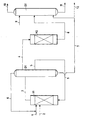
- R1 represents the alkylation reactor
- R2 is the dehydrogenation reactor
- D1 is the first separation section to recover the alkylated aromatic hydrocarbon
- D2 represents the second purification/separation section of the dehydrogenated product.
Landscapes
- Chemical & Material Sciences (AREA)
- Organic Chemistry (AREA)
- Chemical Kinetics & Catalysis (AREA)
- Engineering & Computer Science (AREA)
- Analytical Chemistry (AREA)
- Oil, Petroleum & Natural Gas (AREA)
- Water Supply & Treatment (AREA)
- Organic Low-Molecular-Weight Compounds And Preparation Thereof (AREA)
- Addition Polymer Or Copolymer, Post-Treatments, Or Chemical Modifications (AREA)
- Low-Molecular Organic Synthesis Reactions Using Catalysts (AREA)
Abstract
Description
- The present invention relates to an improved process for the production and purification of vinyl aromatic monomers.
- More specifically, the present invention relates to an improved process for the production and purification of vinyl aromatic monomers coming from the dehydrogenation of the corresponding alkylated products.
- Even more specifically, the present invention relates to an improved process for the production and purification of styrene coming from the dehydrogenation of ethyl benzene.
- Vinyl aromatic monomers, such as styrene, are particularly known for their use in the preparation of plastic materials, such as compact/crystalline polystyrene or expanded polystyrene. These monomers are recovered from the liquid effluents coming from a dehydrogenation section by means of a series of fractionation columns operating in series, with respect to the flow of vinyl aromatic monomer.
- In the case of styrene, there are generally three or four fractionation columns depending on the type of process. The liquid mixture of aromatic hydrocarbons coming from the dehydrogenation section is fed into the first column. In this column, a mixture of benzene and toluene is separated at the head, which forms a by-product of the production process of styrene, whereas a stream containing non-reacted ethyl benzene, styrene and high-boiling products is extracted from the bottom. The stream coming from the bottom of the first column is fed to a second column, where a stream containing non-reacted ethyl benzene is separated at the head and recycled to the dehydrogenation section, whereas a stream containing styrene together with high-boiling products is extracted from the bottom. The flow coming from the bottom of the second column is fed to a third column, where the styrene forming the end-product is removed at the head, whereas a stream consisting of styrene and high-boiling products is extracted from the bottom. As the concentration of styrene present in the stream leaving the bottom of the third purification column is still high, it is further treated in a fourth column, where said stream is fed, or else to a different apparatus, such as an evaporator. A stream rich in high-boiling products which forms the process residue (waste stream) is produced and removed from the latter part of the purification section, whether it be a distillation column or an evaporator.
- What is indicated above is one of the possible purification schemes of styrene. There is also a second scheme, based on three columns which is described hereafter. In this case the liquid hydrocarbon mixture is fed to the first column, where a mixture of benzene, toluene and ethyl benzene is separated at the top, whereas a stream containing styrene and high-boiling products is separated at the bottom. The product extracted from the head is fed to a second column where a mixture of benzene and toluene, which forms a by-product of the production process of styrene, is extracted from the head, whereas a stream containing non-reacted ethyl benzene is obtained at the bottom and is sent to the dehydrogenation unit. The stream coming from the bottom of the first column is fed to the third column, where purified styrene is extracted from the head, whereas a stream whose composition is similar to that described in the previous scheme, is obtained at the bottom, which, as it is still rich in styrene, is further treated to recover this with procedures similar to those described above.
- The residue (waste stream), produced with both schemes, contains significant quantities of heavy, viscous materials consisting of pitches and/or other polymeric products which are formed as a result of the processing process. Vinyl aromatic monomers, for example styrene, tend to polymerize if they are subjected to the action of heat and consequently, during distillation, they tend to form solid polymeric residues which can be deposited and block the equipment associated with the purification system. In order to avoid or reduce this phenomenon, the purification of styrene requires the use of polymerization retardants or inhibitors such as, for example, stable nitroxide radicals used alone or combined with polymerization retardants such as, for example, aromatic nitro-derivatives, as described in patents
US 4,670,131 ,5,254,760 and5,910,232 .US 3,408,265 discloses a process for the recovery of styrene from ethylbenzene by distillation. It is mentioned that a relatively non-volatile hydrocarbon oil, such as tetraethylbenzene, may be added to the distillation zone. - The Applicant has now found a new additive for preventing the premature polymerization of vinyl aromatic monomers, coming from the dehydrogenation of the corresponding alkylated products, particularly during the purification phase which, in the case of the use of nitroxide alone, strengthens its effect. Alternatively, this additive can substitute the retarding compound, when this is used in a combination with the nitroxide.
- This new additive comes from the alkylation section which precedes dehydrogenation and consists of heavy products, essentially polyalkyl benzenes, which are formed during the alkylation reaction and which are separated in a specific purification section. It has, in fact, been surprisingly found that the heavier stream coming from the bottom of the distillation section, downstream of the alkylation reactor, if fed to the purification section of the vinyl aromatic monomer, inhibits its premature polymerization. This result is not only unexpected but is also useful as it allows a greater recovery of the monomer from the styrene distillation residues.
- An object of the present invention therefore relates to an improved process for the production and purification of vinyl aromatic monomers which comprises:
- a) feeding a stream consisting of an aromatic hydrocarbon together with a stream essentially consisting of a C2-C3 olefin, to an alkylation section;
- b) feeding the reaction product coming from the alkylation section to a first separation section;
- c) discharging from the first separation section, a first stream consisting of non-reacted aromatic hydrocarbon which is recycled to the alkylation section, a second stream essentially consisting of a mono-alkylated aromatic hydrocarbon, a third stream essentially consisting of dialkylated aromatic hydrocarbons, sent to a transalkylation section, and a fourth stream essentially consisting of a mixture of polyalkylated aromatic hydrocarbons;
- d) feeding the second stream of step (c) to a dehydrogenation section;
- e) feeding the reaction product coming from the dehydrogenation section to a second purification/separation section, comprising at least one distillation column;
- f) feeding the fourth stream of step (c) to said at least one distillation column;
- g) discharging from the head of said at least one distillation column, a stream consisting of the vinyl aromatic monomer having a purity higher than 99.7% by weight.
- According to the present invention, the aromatic hydrocarbon fed to the alkylation section can be selected from those having from 6 to 9 carbon atoms but it preferably consists of benzene. Another aromatic hydrocarbon which can be used in the process object of the present invention is, for example, toluene.
- The preferred aromatic hydrocarbon is benzene refinery grade with a purity higher than or equal to 95% by weight.
- The C2-C3 olefinic stream, for example ethylene or propylene, also refinery grade with a purity higher than or equal to 95% by weight, is fed to the alkylation reactor together with the aromatic hydrocarbon, fresh and, optionally, recycled. The two aromatic and olefinic streams are fed to the alkylation unit so as to have aromatic/olefin molar ratios which satisfy the requirements of current technologies, generally from 2 to 50, preferably from 3 to 10.
- The alkylation reaction is carried out with conventional catalytic systems, for example it can be carried out according to the method described in European patent
432,814 - Any alkylation reactor can be used in the process object of the present invention. For example fixed bed or fluid bed reactors, carrier reactors, reactors operating with a slurry mixture and catalytic distillation reactors, can be used.
- The preferred alkylation catalysts can be aluminum trichloride or those selected from synthetic and natural porous crystalline solids based on silicon and aluminum, such as acid zeolites in which the silicon/aluminum atomic ratio ranges from 5/1 to 200/1. In particular, Y, beta, omega zeolites, mordenite and the crystalline porous solids MCM-22, MCM-36, MCM-49, are preferred. Alternatively, it is possible to use synthetic zeolites of the ZSM group in which the silicon/aluminum atomic ratio ranges from 20/1 to 200/1 such as ZSM-5 zeolite.
- The alkylation reaction can be carried out under temperature and pressure conditions which depend not only on the catalyst selected but also on the type of reactor and choice of reagents. In the case of the alkylation of benzene with ethylene, the reaction temperature generally ranges from 50 to 450°C. More specifically, with zeolitic catalysts, for either fixed or mobile bed processes in gas phase, the temperature preferably ranges from 300 to 450°C or from 180 to 250°C for processes in liquid phase, whereas in the case of a catalytic distillation reactor, operating in mixed gas-liquid phase, the reaction temperature, varying along the catalytic bed, ranges from 140 to 350°C, preferably from 200 to 300°C. When reactors operating with a slurry mixture and an aluminum trichloride catalyst, are used, the temperature-ranges from 100 to 200°C.
- The pressure inside the alkylation reactor is maintained at values ranging from 0.3 to 6 MPa, preferably from 0.4 to 5 MPa.
- The aromatic stream leaving the alkylation reactor is treated with conventional means for recovering the reaction product from the non-converted reagents and reaction byproducts. In particular, the separation system preferably consists of a series of at least three distillation columns from which the non-reacted aromatic compound is recovered from the first, and recycled to the alkylation reactor and/or a transalkylation unit described below. The mono-alkyl substituted aromatic compound, for example ethyl benzene, is recovered from the second distillation column and fed to the dehydrogenation unit, whereas the dialkylated aromatic products are recovered from the head of the third column and sent to the transalkylation unit, whereas the heavy products, essentially consisting of polyalkylated products, tetralines and alkyl substituted diphenyl ethanes, which form the polymerization inhibitor additive, are recovered from the bottom and fed to the purification/separation section of the vinyl aromatic compound.
- The dialkylated aromatic compounds, for example diethyl benzenes, can be fed to a transalkylation reactor for transalkylation with C6-C9 aromatic hydrocarbons, for example benzene, to produce the corresponding mono-alkyl substituted aromatic compounds, such as ethyl benzene, and increase the yield of the alkylation production.
- The transalkylation can take place in a specific reactor or in the same alkylation reactor.
- The transalkylation reactor, when present, preferably consists of a reactor operating in slurry phase, when the catalyst is aluminum trichloride, or in a fixed bed reactor, functioning in liquid phase, in which a conventional zeolitic transalkylation catalyst is present, such as Y zeolite, beta zeolite or mordenite, preferably Y or beta zeolite. The transalkylation reaction can be carried out according to what is described in European patent
847,802 - In the case of the transalkylation of diethyl benzene with benzene, the benzene/ethylene molar ratio, calculated with respect to the total moles of benzene present as such and as diethyl benzene and the total moles of ethylene present as substituents in the diethyl benzenes, ranges from 2/1 to 18/1, preferably from 2.5/1 to 10/1. The temperature in the reactor is maintained at a value of 50 to 350°C, preferably from 130 to 290°C, whereas the pressure is maintained at 0.02 to 6 MPa, preferably from 0.4 to 5 MPa.
- The mono-alkylated aromatic product is fed to the catalytic dehydrogenation section which comprises one or more reactors operating with a fixed bed or fluid bed, preferably with a fixed bed.
- The dehydrogenation reaction with a fixed bed reactor takes place at a temperature ranging from 500 to 700°C, preferably from 550 to 650°C, at a pressure ranging from 0.02 to 0.15 MPa, in the presence of a catalyst based on iron oxide and potassium carbonate containing other metallic compounds in small quantities having the function of promoters.
- In the case of the production process of styrene, the dehydrogenation can take place, for example, with a fixed bed catalyst by feeding a mixture of ethyl benzene vapour and water vapour, in a water/ethyl benzene molar ratio ranging from 5 to 15, preferably from 6 to 12, onto a first reactor in which a partial conversion of ethyl benzene takes place. The reacted mixture leaving the first reactor is fed to a second reactor, after the temperature has been brought to the required value by means of a heat exchanger. The reaction mixture, in which the ethyl benzene is converted for at least 60%, is cooled and condensed before being sent to the purification section. If required, at the outlet of the second reactor, it is possible to include a third reactor to increase the conversion of ethyl benzene up to and over 70%.
- The reaction product leaving the dehydrogenation phase is fed to a second purification/separation section for the recovery of the vinyl aromatic monomer, for example styrene. The purification section comprises at least one distillation column even if it is preferable to operate with three or four distillation columns connected in series with respect to the flow of the monomer to be purified.
- The heavy bottom product coming from the separation section of the alkylated product is also fed to the second purification/separation section in order to prevent the premature polymerization of the vinyl aromatic monomer and limit the consumption of polymerization inhibitor and/or retardant additives which are necessarily and conventionally used in this section. The feeding can be effected in any of the distillation columns, at any height thereof and, optionally, by premixing said heavy bottom product with any of the streams present in said second purification/separation section.
- In particular, the columns of the second purification/separation section can be selected from those which contain conventional trays or random and/or structured packing. In order to keep the internal temperatures as low as possible to prevent the thermal polymerization of the vinyl aromatic monomer, the columns operate at a low pressure, generally ranging from 0.002 to 0.03 MPa.
- In addition to the liquid mixture coming from the dehydrogenation section, a small flow is also fed to the single columns, containing a substance which acts as polymerization inhibitor, for example (in the case of the purification and separation of styrene) 4-hydroxy-2,2,6,6-tetramethyl-piperidin-1-oxy, 2,2,6,6-tetra-methyl-piperidin-1-oxy, or any of the products described in
US patent 4,670,131 , and in some cases also a further flow which contains a substance which acts as polymerization retardant, for example sulfur, t-butyl catechol or dinitrophenols and phenylene diamines described inUS patent 4,466,905 . This means of operating limits the loss of vinyl aromatic monomer due to its polymerization which transforms it into a high-boiling product, subsequently eliminated as residue. - The bottom product recovered at the bottom of the third or fourth distillation column consists of a stream rich in high-boiling products, of which a considerable quantity consists of vinyl aromatic polymer formed in the purification section itself as a result of the distillation process and can still contain a significant quantity of monomer. This stream is a waste product of the process which is generally sent for thermo-destruction.
- From what is specified above, it is therefore evident that one of the most important objectives of the purification process of vinyl aromatic monomers is to adopt solutions useful for minimizing the formation of polymer as much as possible, to improve the efficiency of the process by limiting the formation of waste product, and to avoid fouling phenomena associated therewith which can cause operating problems and the necessity for expensive maintenance.
- The bottom stream leaving the separation section of the alkylated products, consisting of a mixture of polyalkylated aromatic hydrocarbons together with other heavy impurities, is fed to one of the distillation columns, preferably the first column. This stream not only acts as a diluent of the distillation column residues allowing a greater recovery of the monomer but also, surprisingly, as a polymerization retardant, contributing to redce the overall quantity of waste product of the entire process as well as allowing a reduction in the consumption of the substances which inhibit or retard polymerization. As this stream essentially consists of high-boiling compounds, it flows through the residues of the distillation column of the second purification/separation section and is extracted from the bottom of the last column together with the residues associated with the dehydrogenation. For the above reasons, the stream deriving from the bottom of said column in the process scheme object of the present invention, to be sent for thermo-destruction, is significantly reduced with respect to the sum of the two corresponding separated streams-deriving respectively from the purification section of the alkyl aromatic product and the vinyl aromatic monomer in the traditional processes of the known art.
- An example is provided below which demonstrates the inhibiting effect, on the polymerization of styrene, of the bottom product coming from the purification unit of the synthesis section of ethyl benzene and an applicative example which uses a scheme illustrated in the enclosed figure.
- A first solution of inhibitor 4-HT (1-oxy-2,2,6,6-tetramethyl piperidin-4-ol) in styrene at a concentration of 5 ppm (test A) and a second solution in styrene of the same inhibitor at 5 ppm and 1.5% of polyethyl benzenes (PEB) coming from the bottom of the purification unit of a plant for the production of ethyl benzene (test B), are prepared in a feeding vessel. In both tests A and B, the solution containing the inhibitor is fed for about 18 hours in continuous, into a mechanically stirred jacketed reactor and maintained at a temperature of 95°C. The product leaves the reactor by means of a valve situated on the bottom. The feeding and discharge flow-rate are regulated so as to have a constant residence time inside the reactor equal to an hour.
- Before each test, the system is treated by nitrogen bubbling in order to eliminate the oxygen and the apparatus is maintained under a nitrogen seal for the whole duration of the test. At the end of 18 hours a sample of effluent corresponding to the stationary state of the system (so-called "zero time") is removed and the polymer content is determined (weight %).
- This determination is effected by turbidimetry if the concentration of the polymer is lower than 1000 ppm or by precipitation with ethanol for higher quantities.
- The feeding is then interrupted and the valve situated on the bottom of the reactor is contemporaneously intercepted, thus closing the system on itself (so-called shut off). Samples are taken from the reactor at pre-established times for an overall duration of the test of 7 hours, following the formation kinetics of the polymer in the presence of the residual inhibitor at that given temperature.
- The following table indicates the results of the most significant tests (polymer content in weight %), effected at a temperature of 95°C, which unequivocally show the retarding effect of the PEB.
Table 1 Shut off time
(min)Polystyrene %
(4-HT)
Test APolystyrene %
(4-HT + PEB)
Test B0 0 0 60 1.7 0.11 120 2.9 0.39 180 4.5 0.60 240 6.5 0.93 360 9.8 1.95 420 11.6 2.36 - Reference is made to the enclosed figure which represents a simplified scheme of a process on an industrial scale for the production and purification of styrene, and in which the main operating steps are exclusively indicated.
- In the scheme R1 represents the alkylation reactor, R2 is the dehydrogenation reactor, D1 is the first separation section to recover the alkylated aromatic hydrocarbon whereas D2 represents the second purification/separation section of the dehydrogenated product.
- The numbered streams and respective weight flow-rates are illustrated and explained in Table 2 below.
R1 = alkylation/transalkylation reactorTemperature 170°C Pressure 4.6 barA Benzene/ethylene weight ratio 7.4 R2 = dehydrogenation reactor Temperature 600°C Pressure 0.5 barA Table 2 (1) = Fresh benzene kg/h 19,000 (2) = ethylene kg/h 5,700 (3) = alkylated product kg/h 54,700 (6) = recycled benzene kg/h 23,000 (4) = ethyl benzene for dehydrogenation kg/h 32,000 (5) = recycled diethyl benzene kg/h 7,000 (7) = PEB fed to D2 kg/h 300 (12) = PEB fed to the torch kg/h 300 (8) = Dehydrogenated product kg/h 32,000 (9) = TEMPO kg/h 3.6 (10) = Styrene in the case of (7) kg/h 20,070 (10) = Styrene in the case of (12) kg/h 20,000 (11) = heavy products in the case of (7) kg/h 460 (11) = heavy products in the case of (12) kg/h 230 TEMPO = 1-oxy-2,2,6,6-tetramethyl piperidin-4-ol
Claims (13)
- An improved process for the production and purification of vinyl aromatic monomers which comprises:a) feeding a stream consisting of an aromatic hydrocarbon together with a stream essentially consisting of a C2-C3 olefin, to an alkylation section;b) feeding the reaction product coming from the alkylation section to a first separation section;c) discharging from the first separation section, a first stream consisting of non-reacted aromatic hydrocarbon, which is recycled to the alkylation section, a second stream essentially consisting of a mono-alkylated aromatic hydrocarbon, a third stream essentially consisting of dialkylated aromatic hydrocarbons, sent to a transalkylation section, and a fourth stream essentially consisting of a mixture of polyalkylated aromatic hydrocarbons;d) feeding the second stream of step (c) to a dehydrogenation section;e) feeding the reaction product coming from the dehydrogenation section to a second purification/separation section, comprising at least one distillation column;f) feeding the fourth stream of step (c) to said at least one distillation column;g) discharging from the head of said at least one distillation column, a stream consisting of the vinyl aromatic monomer having a purity higher than 99.7% by weight.
- The process according to claim 1, wherein the aromatic hydrocarbon fed to the alkylation section consists of benzene, refinery grade, whereas the olefinic stream consists of ethylene or propylene, refinery grade.
- The process according to claim 2, wherein the olefinic stream consists of ethylene.
- The process according to claim 1, 2 or 3, wherein the aromatic and olefinic streams are fed to the alkylation unit so as to have aromatic/olefin molar ratios ranging from 2 to 50.
- The process according to any of the previous claims, wherein the alkylation reaction takes place in the presence of catalysts selected from aluminum trichloride, synthetic and natural porous crystalline solids based on silicon and aluminum in which the silicon/aluminum atomic ratio ranges from 5/1 to 200/1 and synthetic zeolites of the ZSM group in which the silicon/aluminum atomic ratio ranges from 20/1 to 200/1.
- The process according to any of the previous claims, wherein the alkylation reaction is carried out at a temperature ranging from 50 to 450°C.
- The process according to claim 3, wherein the catalyst consists of aluminum trichloride and the temperature ranges from 100 to 200°C.
- The process according to any of the previous claims, wherein the alkylation reaction is carried out at a pressure ranging from 0.3 to 6 MPa.
- The process according to any of the previous claims, wherein the aromatic stream leaving the alkylation reactor is fed to a separation system consisting of a series of at least three distillation columns for the recovery of at least the mono-alkyl substituted aromatic compound, to be sent to the dehydrogenation unit, and a heavy bottom product essentially consisting of polyalkylated products, tetralines and alkyl substituted diphenyl ethanes.
- The process according to any of the previous claims, wherein the catalytic dehydrogenation reaction takes place in a fixed bed reactor, at a temperature ranging from 500 to 700°C, at a pressure ranging from 0.02 to 0.15 MPa, in the presence of a catalyst based on iron oxide and potassium carbonate.
- The process according to any of the previous claims, wherein the second purification/separation section comprises three or four distillation columns connected in series with respect to the flow of monomer to be purified.
- The process according to any of the previous claims, wherein the bottom stream leaving the separation section of alkylated products is sent to any of the distillation columns, at any height thereof and, optionally, by premixing said heavy bottom product with any of the streams present in said second purification/separation section.
- The process according to claim 12, wherein the bottom stream leaving the separation section of alkylated products is sent in the feeding to the first distillation column of the second purification/separation section.
Priority Applications (1)
| Application Number | Priority Date | Filing Date | Title |
|---|---|---|---|
| PL04803799T PL1704133T3 (en) | 2003-12-22 | 2004-12-13 | Improved process for the production and purification of vi-ny l aromatic monomers |
Applications Claiming Priority (2)
| Application Number | Priority Date | Filing Date | Title |
|---|---|---|---|
| IT002551A ITMI20032551A1 (en) | 2003-12-22 | 2003-12-22 | IMPROVED PROCEDURE FOR THE PRODUCTION AND PURIFICATION OF VINYLAROMATIC MONOMERS |
| PCT/EP2004/014166 WO2005063659A1 (en) | 2003-12-22 | 2004-12-13 | Improved process for the production and purification of vinyl aromatic monomers |
Publications (2)
| Publication Number | Publication Date |
|---|---|
| EP1704133A1 EP1704133A1 (en) | 2006-09-27 |
| EP1704133B1 true EP1704133B1 (en) | 2010-03-03 |
Family
ID=34717625
Family Applications (1)
| Application Number | Title | Priority Date | Filing Date |
|---|---|---|---|
| EP04803799A Expired - Lifetime EP1704133B1 (en) | 2003-12-22 | 2004-12-13 | Improved process for the production and purification of vi-ny l aromatic monomers |
Country Status (11)
| Country | Link |
|---|---|
| US (1) | US7393986B2 (en) |
| EP (1) | EP1704133B1 (en) |
| CN (1) | CN100465142C (en) |
| AT (1) | ATE459588T1 (en) |
| DE (1) | DE602004025851D1 (en) |
| EA (1) | EA009461B1 (en) |
| ES (1) | ES2342400T3 (en) |
| IT (1) | ITMI20032551A1 (en) |
| PL (1) | PL1704133T3 (en) |
| SA (1) | SA04250424B1 (en) |
| WO (1) | WO2005063659A1 (en) |
Families Citing this family (7)
| Publication number | Priority date | Publication date | Assignee | Title |
|---|---|---|---|---|
| ITMI20071952A1 (en) * | 2007-10-09 | 2009-04-10 | Polimeri Europa Spa | INTEGRATED PROCEDURE FOR THE PRODUCTION OF VINYLAROMATIC HYDROCARBONS |
| IT1392929B1 (en) | 2009-02-16 | 2012-04-02 | Polimeri Europa Spa | INTEGRATED PROCESS FOR THE PREPARATION OF ETHYLBENZENE AND CUMENE |
| IT1394721B1 (en) | 2009-06-10 | 2012-07-13 | Polimeri Europa Spa | PROCESS FOR THE ALKYLATION OF BENZENE WITH ETHANOL OR ETHANOL AND ETHYLENE MIXTURES |
| IT1397885B1 (en) | 2009-12-23 | 2013-02-04 | Polimeri Europa Spa | PROCESS FOR PREPARING ETHYLBENZENE. |
| US9266797B2 (en) * | 2013-02-12 | 2016-02-23 | Ecolab Usa Inc. | Online monitoring of polymerization inhibitors for control of undesirable polymerization |
| US9399622B2 (en) | 2013-12-03 | 2016-07-26 | Ecolab Usa Inc. | Nitroxide hydroxylamine and phenylenediamine combinations as polymerization inhibitors for ethylenically unsaturated monomer processes |
| EP3907210A1 (en) * | 2020-05-08 | 2021-11-10 | Sulzer Management AG | A process and apparatus for preparing a purified styrene composition from styrene containing feedstock |
Family Cites Families (2)
| Publication number | Priority date | Publication date | Assignee | Title |
|---|---|---|---|---|
| US3408265A (en) * | 1966-11-22 | 1968-10-29 | Universal Oil Prod Co | Recovery of styrene from ethyl benzene by a single column distillation with styrene vapor side draw |
| BE875237R (en) * | 1978-07-18 | 1979-07-16 | Cosden Technology | PROCESS FOR INHIBITING THE POLYMERIZATION OF EASILY POLYMERIZABLE VINYLAROMATIC COMPOUNDS |
-
2003
- 2003-12-22 IT IT002551A patent/ITMI20032551A1/en unknown
-
2004
- 2004-12-13 EA EA200601028A patent/EA009461B1/en unknown
- 2004-12-13 US US10/583,376 patent/US7393986B2/en not_active Expired - Lifetime
- 2004-12-13 DE DE602004025851T patent/DE602004025851D1/en not_active Expired - Lifetime
- 2004-12-13 AT AT04803799T patent/ATE459588T1/en not_active IP Right Cessation
- 2004-12-13 EP EP04803799A patent/EP1704133B1/en not_active Expired - Lifetime
- 2004-12-13 WO PCT/EP2004/014166 patent/WO2005063659A1/en not_active Ceased
- 2004-12-13 ES ES04803799T patent/ES2342400T3/en not_active Expired - Lifetime
- 2004-12-13 PL PL04803799T patent/PL1704133T3/en unknown
- 2004-12-13 CN CNB200480040390XA patent/CN100465142C/en not_active Expired - Lifetime
- 2004-12-20 SA SA04250424A patent/SA04250424B1/en unknown
Also Published As
| Publication number | Publication date |
|---|---|
| DE602004025851D1 (en) | 2010-04-15 |
| US20070142687A1 (en) | 2007-06-21 |
| PL1704133T3 (en) | 2010-08-31 |
| WO2005063659A1 (en) | 2005-07-14 |
| EA009461B1 (en) | 2007-12-28 |
| ES2342400T3 (en) | 2010-07-06 |
| EP1704133A1 (en) | 2006-09-27 |
| SA04250424B1 (en) | 2008-07-14 |
| ATE459588T1 (en) | 2010-03-15 |
| CN100465142C (en) | 2009-03-04 |
| EA200601028A1 (en) | 2006-12-29 |
| ITMI20032551A1 (en) | 2005-06-23 |
| US7393986B2 (en) | 2008-07-01 |
| CN1902151A (en) | 2007-01-24 |
Similar Documents
| Publication | Publication Date | Title |
|---|---|---|
| US8134036B2 (en) | Process for liquid phase alkylation | |
| JPH10511942A (en) | Continuous method for producing ethylbenzene using liquid-phase alkylation and gas-phase transalkylation reactions | |
| AU2004218011B2 (en) | Process for the production of alkylaromatics | |
| KR20100007842A (en) | Conversion of aromatic hydrocarbons | |
| US11691933B2 (en) | Processes and systems for converting benzene and/or toluene via methylation | |
| US7094940B2 (en) | Integrated process for the preparation of alkyl and alkenyl substituted aromatic compounds | |
| US7094939B1 (en) | Styrene process with recycle from dehydrogenation zone | |
| US7393986B2 (en) | Process for the production and purification of vinyl aromatic monomers | |
| US7728184B2 (en) | Process for the dehydrogenation of alkyl-aromatic hydrocarbons for the production of vinyl-aromatic monomers | |
| EP2205541B1 (en) | Integrated process for the production of vinyl aromatic hydrocarbons | |
| WO2017131862A1 (en) | Process for converting alkanes to para-xylene | |
| KR100683509B1 (en) | Process for the preparation of alkylaromatics using solid alkylation catalysts | |
| MX2008008393A (en) | Improved process for the dehydrogenation of alkyl-aromatic hydrocarbons for the production of vinyl-aromatic monomers | |
| HK1141510B (en) | Integrated process for the production of vinyl aromatic hydrocarbons |
Legal Events
| Date | Code | Title | Description |
|---|---|---|---|
| PUAI | Public reference made under article 153(3) epc to a published international application that has entered the european phase |
Free format text: ORIGINAL CODE: 0009012 |
|
| 17P | Request for examination filed |
Effective date: 20060615 |
|
| AK | Designated contracting states |
Kind code of ref document: A1 Designated state(s): AT BE BG CH CY CZ DE DK EE ES FI FR GB GR HU IE IS IT LI LT LU MC NL PL PT RO SE SI SK TR |
|
| DAX | Request for extension of the european patent (deleted) | ||
| GRAP | Despatch of communication of intention to grant a patent |
Free format text: ORIGINAL CODE: EPIDOSNIGR1 |
|
| RAP1 | Party data changed (applicant data changed or rights of an application transferred) |
Owner name: POLIMERI EUROPA S.P.A. |
|
| GRAS | Grant fee paid |
Free format text: ORIGINAL CODE: EPIDOSNIGR3 |
|
| GRAA | (expected) grant |
Free format text: ORIGINAL CODE: 0009210 |
|
| REG | Reference to a national code |
Ref country code: DE Ref legal event code: R081 Ref document number: 602004025851 Country of ref document: DE Owner name: POLIMERI EUROPA S.P.A., IT Free format text: FORMER OWNER: POLIMERI EUROPA S.P.A., BRINDISI, IT |
|
| AK | Designated contracting states |
Kind code of ref document: B1 Designated state(s): AT BE BG CH CY CZ DE DK EE ES FI FR GB GR HU IE IS IT LI LT LU MC NL PL PT RO SE SI SK TR |
|
| REG | Reference to a national code |
Ref country code: GB Ref legal event code: FG4D |
|
| REG | Reference to a national code |
Ref country code: CH Ref legal event code: EP |
|
| REG | Reference to a national code |
Ref country code: IE Ref legal event code: FG4D |
|
| REF | Corresponds to: |
Ref document number: 602004025851 Country of ref document: DE Date of ref document: 20100415 Kind code of ref document: P |
|
| REG | Reference to a national code |
Ref country code: DE Ref legal event code: R096 Ref document number: 602004025851 Country of ref document: DE Effective date: 20100415 |
|
| REG | Reference to a national code |
Ref country code: NL Ref legal event code: VDEP Effective date: 20100303 |
|
| REG | Reference to a national code |
Ref country code: ES Ref legal event code: FG2A Ref document number: 2342400 Country of ref document: ES Kind code of ref document: T3 |
|
| PG25 | Lapsed in a contracting state [announced via postgrant information from national office to epo] |
Ref country code: LT Free format text: LAPSE BECAUSE OF FAILURE TO SUBMIT A TRANSLATION OF THE DESCRIPTION OR TO PAY THE FEE WITHIN THE PRESCRIBED TIME-LIMIT Effective date: 20100303 |
|
| LTIE | Lt: invalidation of european patent or patent extension |
Effective date: 20100303 |
|
| PG25 | Lapsed in a contracting state [announced via postgrant information from national office to epo] |
Ref country code: SI Free format text: LAPSE BECAUSE OF FAILURE TO SUBMIT A TRANSLATION OF THE DESCRIPTION OR TO PAY THE FEE WITHIN THE PRESCRIBED TIME-LIMIT Effective date: 20100303 Ref country code: FI Free format text: LAPSE BECAUSE OF FAILURE TO SUBMIT A TRANSLATION OF THE DESCRIPTION OR TO PAY THE FEE WITHIN THE PRESCRIBED TIME-LIMIT Effective date: 20100303 Ref country code: AT Free format text: LAPSE BECAUSE OF FAILURE TO SUBMIT A TRANSLATION OF THE DESCRIPTION OR TO PAY THE FEE WITHIN THE PRESCRIBED TIME-LIMIT Effective date: 20100303 |
|
| REG | Reference to a national code |
Ref country code: PL Ref legal event code: T3 |
|
| REG | Reference to a national code |
Ref country code: HU Ref legal event code: AG4A Ref document number: E008238 Country of ref document: HU |
|
| PG25 | Lapsed in a contracting state [announced via postgrant information from national office to epo] |
Ref country code: NL Free format text: LAPSE BECAUSE OF FAILURE TO SUBMIT A TRANSLATION OF THE DESCRIPTION OR TO PAY THE FEE WITHIN THE PRESCRIBED TIME-LIMIT Effective date: 20100303 Ref country code: CY Free format text: LAPSE BECAUSE OF FAILURE TO SUBMIT A TRANSLATION OF THE DESCRIPTION OR TO PAY THE FEE WITHIN THE PRESCRIBED TIME-LIMIT Effective date: 20100303 Ref country code: SE Free format text: LAPSE BECAUSE OF FAILURE TO SUBMIT A TRANSLATION OF THE DESCRIPTION OR TO PAY THE FEE WITHIN THE PRESCRIBED TIME-LIMIT Effective date: 20100303 Ref country code: GR Free format text: LAPSE BECAUSE OF FAILURE TO SUBMIT A TRANSLATION OF THE DESCRIPTION OR TO PAY THE FEE WITHIN THE PRESCRIBED TIME-LIMIT Effective date: 20100604 Ref country code: RO Free format text: LAPSE BECAUSE OF FAILURE TO SUBMIT A TRANSLATION OF THE DESCRIPTION OR TO PAY THE FEE WITHIN THE PRESCRIBED TIME-LIMIT Effective date: 20100303 Ref country code: EE Free format text: LAPSE BECAUSE OF FAILURE TO SUBMIT A TRANSLATION OF THE DESCRIPTION OR TO PAY THE FEE WITHIN THE PRESCRIBED TIME-LIMIT Effective date: 20100303 |
|
| PG25 | Lapsed in a contracting state [announced via postgrant information from national office to epo] |
Ref country code: IS Free format text: LAPSE BECAUSE OF FAILURE TO SUBMIT A TRANSLATION OF THE DESCRIPTION OR TO PAY THE FEE WITHIN THE PRESCRIBED TIME-LIMIT Effective date: 20100703 Ref country code: BG Free format text: LAPSE BECAUSE OF FAILURE TO SUBMIT A TRANSLATION OF THE DESCRIPTION OR TO PAY THE FEE WITHIN THE PRESCRIBED TIME-LIMIT Effective date: 20100603 Ref country code: CZ Free format text: LAPSE BECAUSE OF FAILURE TO SUBMIT A TRANSLATION OF THE DESCRIPTION OR TO PAY THE FEE WITHIN THE PRESCRIBED TIME-LIMIT Effective date: 20100303 Ref country code: SK Free format text: LAPSE BECAUSE OF FAILURE TO SUBMIT A TRANSLATION OF THE DESCRIPTION OR TO PAY THE FEE WITHIN THE PRESCRIBED TIME-LIMIT Effective date: 20100303 |
|
| PLBE | No opposition filed within time limit |
Free format text: ORIGINAL CODE: 0009261 |
|
| STAA | Information on the status of an ep patent application or granted ep patent |
Free format text: STATUS: NO OPPOSITION FILED WITHIN TIME LIMIT |
|
| PG25 | Lapsed in a contracting state [announced via postgrant information from national office to epo] |
Ref country code: PT Free format text: LAPSE BECAUSE OF FAILURE TO SUBMIT A TRANSLATION OF THE DESCRIPTION OR TO PAY THE FEE WITHIN THE PRESCRIBED TIME-LIMIT Effective date: 20100705 Ref country code: DK Free format text: LAPSE BECAUSE OF FAILURE TO SUBMIT A TRANSLATION OF THE DESCRIPTION OR TO PAY THE FEE WITHIN THE PRESCRIBED TIME-LIMIT Effective date: 20100303 |
|
| 26N | No opposition filed |
Effective date: 20101206 |
|
| REG | Reference to a national code |
Ref country code: DE Ref legal event code: R097 Ref document number: 602004025851 Country of ref document: DE Effective date: 20101206 |
|
| PG25 | Lapsed in a contracting state [announced via postgrant information from national office to epo] |
Ref country code: IT Free format text: LAPSE BECAUSE OF FAILURE TO SUBMIT A TRANSLATION OF THE DESCRIPTION OR TO PAY THE FEE WITHIN THE PRESCRIBED TIME-LIMIT Effective date: 20100303 |
|
| PG25 | Lapsed in a contracting state [announced via postgrant information from national office to epo] |
Ref country code: MC Free format text: LAPSE BECAUSE OF NON-PAYMENT OF DUE FEES Effective date: 20101231 |
|
| REG | Reference to a national code |
Ref country code: CH Ref legal event code: PL |
|
| PG25 | Lapsed in a contracting state [announced via postgrant information from national office to epo] |
Ref country code: IE Free format text: LAPSE BECAUSE OF NON-PAYMENT OF DUE FEES Effective date: 20101213 Ref country code: CH Free format text: LAPSE BECAUSE OF NON-PAYMENT OF DUE FEES Effective date: 20101231 Ref country code: LI Free format text: LAPSE BECAUSE OF NON-PAYMENT OF DUE FEES Effective date: 20101231 |
|
| PG25 | Lapsed in a contracting state [announced via postgrant information from national office to epo] |
Ref country code: LU Free format text: LAPSE BECAUSE OF NON-PAYMENT OF DUE FEES Effective date: 20101213 |
|
| PG25 | Lapsed in a contracting state [announced via postgrant information from national office to epo] |
Ref country code: TR Free format text: LAPSE BECAUSE OF FAILURE TO SUBMIT A TRANSLATION OF THE DESCRIPTION OR TO PAY THE FEE WITHIN THE PRESCRIBED TIME-LIMIT Effective date: 20100303 |
|
| REG | Reference to a national code |
Ref country code: FR Ref legal event code: PLFP Year of fee payment: 12 |
|
| REG | Reference to a national code |
Ref country code: FR Ref legal event code: PLFP Year of fee payment: 13 |
|
| REG | Reference to a national code |
Ref country code: FR Ref legal event code: PLFP Year of fee payment: 14 |
|
| PGFP | Annual fee paid to national office [announced via postgrant information from national office to epo] |
Ref country code: GB Payment date: 20211227 Year of fee payment: 18 |
|
| P01 | Opt-out of the competence of the unified patent court (upc) registered |
Effective date: 20230515 |
|
| GBPC | Gb: european patent ceased through non-payment of renewal fee |
Effective date: 20221213 |
|
| PG25 | Lapsed in a contracting state [announced via postgrant information from national office to epo] |
Ref country code: GB Free format text: LAPSE BECAUSE OF NON-PAYMENT OF DUE FEES Effective date: 20221213 |
|
| PGFP | Annual fee paid to national office [announced via postgrant information from national office to epo] |
Ref country code: HU Payment date: 20231129 Year of fee payment: 20 Ref country code: FR Payment date: 20231227 Year of fee payment: 20 |
|
| PGFP | Annual fee paid to national office [announced via postgrant information from national office to epo] |
Ref country code: PL Payment date: 20231124 Year of fee payment: 20 Ref country code: BE Payment date: 20231227 Year of fee payment: 20 |
|
| PGFP | Annual fee paid to national office [announced via postgrant information from national office to epo] |
Ref country code: ES Payment date: 20240102 Year of fee payment: 20 |
|
| PGFP | Annual fee paid to national office [announced via postgrant information from national office to epo] |
Ref country code: DE Payment date: 20231229 Year of fee payment: 20 |
|
| REG | Reference to a national code |
Ref country code: DE Ref legal event code: R071 Ref document number: 602004025851 Country of ref document: DE |
|
| REG | Reference to a national code |
Ref country code: BE Ref legal event code: MK Effective date: 20241213 |
|
| REG | Reference to a national code |
Ref country code: ES Ref legal event code: FD2A Effective date: 20250102 |
|
| PG25 | Lapsed in a contracting state [announced via postgrant information from national office to epo] |
Ref country code: ES Free format text: LAPSE BECAUSE OF EXPIRATION OF PROTECTION Effective date: 20241214 |
|
| PG25 | Lapsed in a contracting state [announced via postgrant information from national office to epo] |
Ref country code: ES Free format text: LAPSE BECAUSE OF EXPIRATION OF PROTECTION Effective date: 20241214 |