EP1703457A2 - Electronic value exchange system and electronic value exchange method - Google Patents
Electronic value exchange system and electronic value exchange method Download PDFInfo
- Publication number
- EP1703457A2 EP1703457A2 EP06005524A EP06005524A EP1703457A2 EP 1703457 A2 EP1703457 A2 EP 1703457A2 EP 06005524 A EP06005524 A EP 06005524A EP 06005524 A EP06005524 A EP 06005524A EP 1703457 A2 EP1703457 A2 EP 1703457A2
- Authority
- EP
- European Patent Office
- Prior art keywords
- exchange
- message
- application program
- terminal
- offer
- Prior art date
- Legal status (The legal status is an assumption and is not a legal conclusion. Google has not performed a legal analysis and makes no representation as to the accuracy of the status listed.)
- Granted
Links
Images

Classifications
-
- G—PHYSICS
- G06—COMPUTING OR CALCULATING; COUNTING
- G06Q—INFORMATION AND COMMUNICATION TECHNOLOGY [ICT] SPECIALLY ADAPTED FOR ADMINISTRATIVE, COMMERCIAL, FINANCIAL, MANAGERIAL OR SUPERVISORY PURPOSES; SYSTEMS OR METHODS SPECIALLY ADAPTED FOR ADMINISTRATIVE, COMMERCIAL, FINANCIAL, MANAGERIAL OR SUPERVISORY PURPOSES, NOT OTHERWISE PROVIDED FOR
- G06Q20/00—Payment architectures, schemes or protocols
- G06Q20/04—Payment circuits
- G06Q20/06—Private payment circuits, e.g. involving electronic currency used among participants of a common payment scheme
-
- G—PHYSICS
- G06—COMPUTING OR CALCULATING; COUNTING
- G06Q—INFORMATION AND COMMUNICATION TECHNOLOGY [ICT] SPECIALLY ADAPTED FOR ADMINISTRATIVE, COMMERCIAL, FINANCIAL, MANAGERIAL OR SUPERVISORY PURPOSES; SYSTEMS OR METHODS SPECIALLY ADAPTED FOR ADMINISTRATIVE, COMMERCIAL, FINANCIAL, MANAGERIAL OR SUPERVISORY PURPOSES, NOT OTHERWISE PROVIDED FOR
- G06Q30/00—Commerce
- G06Q30/06—Buying, selling or leasing transactions
-
- G—PHYSICS
- G06—COMPUTING OR CALCULATING; COUNTING
- G06Q—INFORMATION AND COMMUNICATION TECHNOLOGY [ICT] SPECIALLY ADAPTED FOR ADMINISTRATIVE, COMMERCIAL, FINANCIAL, MANAGERIAL OR SUPERVISORY PURPOSES; SYSTEMS OR METHODS SPECIALLY ADAPTED FOR ADMINISTRATIVE, COMMERCIAL, FINANCIAL, MANAGERIAL OR SUPERVISORY PURPOSES, NOT OTHERWISE PROVIDED FOR
- G06Q20/00—Payment architectures, schemes or protocols
- G06Q20/22—Payment schemes or models
- G06Q20/26—Debit schemes, e.g. "pay now"
-
- G—PHYSICS
- G06—COMPUTING OR CALCULATING; COUNTING
- G06Q—INFORMATION AND COMMUNICATION TECHNOLOGY [ICT] SPECIALLY ADAPTED FOR ADMINISTRATIVE, COMMERCIAL, FINANCIAL, MANAGERIAL OR SUPERVISORY PURPOSES; SYSTEMS OR METHODS SPECIALLY ADAPTED FOR ADMINISTRATIVE, COMMERCIAL, FINANCIAL, MANAGERIAL OR SUPERVISORY PURPOSES, NOT OTHERWISE PROVIDED FOR
- G06Q50/00—Information and communication technology [ICT] specially adapted for implementation of business processes of specific business sectors, e.g. utilities or tourism
- G06Q50/50—Business processes related to the communications industry
-
- H—ELECTRICITY
- H04—ELECTRIC COMMUNICATION TECHNIQUE
- H04W—WIRELESS COMMUNICATION NETWORKS
- H04W4/00—Services specially adapted for wireless communication networks; Facilities therefor
- H04W4/12—Messaging; Mailboxes; Announcements
Definitions
- the present invention relates to a technology of exchanging electronic values between communication terminals.
- TRON The Real-time Operating system Nucleus
- IC Integrated Circuit
- e-TRON card a technology proposed is to perform direct transmission/reception of values between two IC cards, without intervention of an application program, on the occasion of exchanging electronic values such as electronic money or electronic coupons between terminals.
- An application of this technology to a system for charging an insufficient electronic value is an electronic value charge system to ensure high security and simplicity together, as disclosed in Patent Document 1 ( Japanese Patent Application Laid-Open No. 2003-337887 ).
- the above conventional technology is to directly perform the exchange of electronic values between the tamper-resistant IC cards. For this reason, the high security can be secured, while there is a problem of concern that the behavior on the IC card side cannot be always captured on the application program side. For example, since the IC card is a black box, the user of the terminal grasps the processing content through the application program. For this reason, the IC card cannot present necessary information to the user unless the application program is notified of a processing state.
- An object of the present invention is therefore to provide a technology applied to exchange of electronic values between 1C cards of terminal devices each provided with an application program outside the IC card and adapted to avoid the inconvenience due to the application program's incapability of recognizing the processing executed on the IC card side, interruption of communication between the IC cards, and so on.
- An electronic value exchange system is an electronic value exchange system for implementing an exchange of electronic values between a sender terminal and a receiver terminal, the electronic values being retained in IC cards of the respective terminals
- the sender terminal comprises: transmitting means for transmitting a message to offer the exchange of electronic values (exchange offer message), to the receiver terminal; notifying means for, when receiving a message for confirming the exchange (exchange confirmation message), transmitted by transmitting means of the receiver terminal, calling up a listener corresponding to the message and notifying an application program of an exchange content based on the listener; and exchange means for performing the exchange of electronic values with the receiver terminal when an acceptance from the application program is acquired for the exchange content notified of by the notifying means; and wherein the receiver terminal comprises: notifying means for, when receiving an exchange offer message transmitted from the sender terminal, calling up a listener corresponding to the message and notifying an application program of an offer content based on the listener; and transmitting means for transmitting an exchange confirmation message to the sender terminal when an acceptance from
- An electronic value exchange method comprises a transmission step wherein a sender terminal transmits a message to offer an exchange of electronic values, to a receiver terminal; a notification step wherein when the receiver terminal receives the exchange offer message transmitted in the transmission step, the receiver terminal calls up a listener corresponding to the message and notifies an application program of an offer content based on the listener; a transmission step wherein when an acceptance from the application program is acquired for the offer content notified of in the notification step, the receiver terminal transmits a message for confirming the exchange, to the sender terminal; a notification step wherein when the sender terminal receives the exchange confirmation message transmitted in the transmission step, the sender terminal calls up a listener corresponding to the message and notifies an application program of an exchange content based on the listener; and an exchange step wherein when an acceptance from the application program is acquired for the exchange content notified of in the notification step, the sender terminal performs the exchange of electronic values with the receiver terminal.
- the receiver terminal when the receiver terminal receives from the sender terminal an offer to exchange an electronic value retained in an IC card of the receiver terminal, for an electronic value in an IC card of the sender terminal, it notifies the application program of the receiver terminal of this offer.
- the application program returns an affirmative response to this offer content, based on manipulation by a user of the receiver terminal or the like, the receiver terminal requests the sender terminal to make confirmation of the exchange. Just as the receiver terminal did, the sender terminal notifies the application program of its own of this request.
- the sender terminal When the application program returns an affirmative response to this request content, based on manipulation by a user of the sender terminal or the like, the sender terminal then performs transmission of the electronic value to the receiver terminal.
- the receiver terminal also transmits the electronic value to complete the exchange of electronic values.
- the direct exchange transaction of electronic values between IC cards is executed in wait for the pennission/negation determination by the application programs loaded on the respective terminals.
- the present invention enables the application programs on the respective terminals involved in the exchange of electronic values, to recognize the processing executed between the IC cards.
- Fig. 1 is an illustration showing a configuration of an electronic value exchange system.
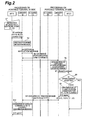
- Fig. 2 is the first half of a chart for explaining an operation of the electronic value exchange system.
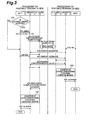
- Fig. 3 is the second half of a chart for explaining an operation of the electronic value exchange system.
- electronic value exchange system 100 comprises portable terminal 10 (corresponding to the sender terminal) and portable terminal 20 (corresponding to the receiver terminal).
- the portable terminals 10, 20 are, for example, cell phones or PDAs (Personal Digital Assistances), but may be any terminal equipment with a communication function, without any restrictions on function and use thereof.
- the portable terminal 10 and portable terminal 20 are configured so as to be able to transmit and receive electronic values via a short-range wireless communication line, using libraries owned by the respective terminals.
- the portable terminal 10 has application program 11, library 12 (corresponding to the transmitting means and notifying means), and IC card 13 (corresponding to the exchange means). These components are connected so as to be able to import and export signals from and to each other through a bus.
- the application program 11 (hereinafter referred to as "AP11") notifies the library 12 of this instruction. Furthermore, AP11 detects completion of an exchange of electronic values with input of "committed” from the library 12. At this time, the user of portable terminal 10 is notified of the completion of the exchange as occasion may demand.
- the library 12 With reception of "exchange" from AP11, the library 12 creates a message to instruct the IC card 13 to perform the exchange, and outputs the message to the IC card 13.
- the library 12 executes a listener corresponding thereto. For example, when receiving an exchange confirmation message transmitted from IC card 23, the library 12 notifies AP11 of an offer content based on a listener corresponding thereto. When an acceptance is acquired for the offer content, the library 12 outputs an exchange execution message to IC card 13 to instruct an exchange start of electronic values.
- the library 12 acquires an exchange completion message from IC card 13 in conjunction with completion of an exchange of electronic values, it executes a listener "notify AP11."
- An electronic value V1 as an object for an exchange is stored in the IC card 13.
- the IC card 13 is preferably constructed of a tamper-resistant device in terms of ensuring security, e.g., preventing falsification or reproduction of electronic value V1.
- the electronic value V1 is digitized data representing (or substantializing) some economic value and is equivalent, for example, to electronic money representing a monetary value, or to an electronic ticket (a book coupon, a commutation ticket, or the like) provided in a prepaid system.
- the IC card 13 With input of an exchange instruction message from the library 12, the IC card 13 transmits the message as an exchange offer message through the library 12 to the portable terminal 20. When receiving an exchange completion message from the IC card 23 through the libraries 22, 12, the IC card 13 outputs the exchange completion message to the library 12 of portable terminal 10.
- the IC card 13 When receiving the input of the exchange execution message from the library 12, the IC card 13 starts an exchange transaction of electronic values with a communication partner of IC card 23. This exchange transaction is directly carried out between the IC cards, without intervention of APs11, 21. Namely, the IC card 13 transmits the electronic value V1 stored inside, via libraries 12, 22 and a wireless line to the IC card 23. Similarly, the IC card 23 transmits an electronic value V2 via libraries 22, 12 and a wireless line to the IC card 13. The exchange is completed when the two IC cards receive the each other's electronic values.
- the portable terminal 20 also has a configuration similar to that of the portable terminal 10. Namely, the portable terminal 20 has application program 21, library 22 (corresponding to the notifying means and transmitting means), and IC card 23. These components are connected so as to be able to import and export signals from and to each other through a bus.
- the application program 21 presents an offer content to a user of portable terminal 20 in accordance with "offered” fed from the library 22.
- AP21 awaits a user's instruction operation and, with an instruction of acceptance, it confirms the electronic values V1, V2 satisfying conditions for exchange objects and then sends a reply of "agree.” Without acceptance instruction, "NG" is returned to the library 22.
- AP21 detects completion of an exchange of electronic values. At this time, the user of portable terminal 20 is notified of the completion of the exchange as occasion may demand.
- the library 22 executes a listener corresponding thereto. For example, when receiving an exchange offer message transmitted from IC card 13, the library 22 notifies AP21 of an offer content based on a listener corresponding thereto. With an acceptance for the offer content, the library 22 transmits an exchange confirmation message to the IC card 13, thereby encouraging the user of the portable terminal 10 to confirm a start of execution of the exchange transaction.
- the library 22 acquires an exchange completion message from 1C card 23 in conjunction with completion of the exchange of electronic values, it executes a corresponding listener "notify AP21.”
- the IC card 23 When receiving the exchange confirmation message from the library 22, the IC card 23 transfers the message to the IC card 13. On the occasion of performing the exchange of electronic values, the IC card 23 transmits the electronic value V2 via libraries 22, 12 and a wireless line to the IC card 13.
- AP11 instructs the library 12 to execute an exchange of electronic values, using API (Application Program Interface) (S2).
- a function to instruct the start of the exchange can be, for example, "exchange (ICC13, ICC23, ConditionData).”
- the exchange function has parameters of (source ID, destination ID, transmitted object data), and "ConditionData” as the transmitted object data contains at least a condition for electronic values V1, V2 that can be exchange objects.
- the library 12 receiving the exchange instruction, converts the API into a message to create a message [StartExchange] to instruct the IC card 23 to perform an exchange of electronic values (S3).
- the library 12 transfers this exchange instruction message to the IC card 13 designated as a destination (S4).
- the IC card 13 when receiving the exchange instruction message, transmits an exchange offer message having a condition for exchanged electronic values, "Condition,” as a parameter, to the library 22 of IC card 23 as a communication partner (S5).
- This exchange offer message is transmitted via library 12 and can be represented by "offer(Condition)."
- the library 22 on the portable terminal 20 side when detecting reception of the exchange offer message, acquires a listener "notify AP21" corresponding to the message (S6).
- the library 22 transfers "offered (Condition)" as an offer content to AP21 in accordance with the description of the listener read out at S6.
- AP21 receiving the offer content, determines whether the offer content is to be accepted, based on an instruction by the user B of the portable terminal 20 (S8).
- AP21 confirms the electronic values V1, V2 as exchange objects, which match the condition for V1, V2 in the aforementioned Condition. After the confirmation of the exchange objects, AP21 returns "agree” as an affirmative response to the library 22 (S10).
- the affirmative response contains at least IDs of IC cards 13, 23 to execute the exchange transaction, and IDs of the electronic values V1, V2 as exchange objects.
- the library 22 determines that the user B accepted the offer content, and transmits [AgreeExchange(V1,V2)] being a message for confirming the exchange of electronic values, via IC cards 23, 13 to the library 12 (S11).
- the library 12 of portable terminal 10 executes processes similar to the aforementioned steps S6, S7. Namely, the library 12 acquires a listener corresponding to the exchange confirmation message fed from the IC card 13 (S12). Then the library 12 transfers "agreed" as an exchange content to AP11 in accordance with the description of the listener (S13).
- AP11 determines the presence/absence of an acceptance for the exchange content, based on an instruction by the user A of portable terminal 10 (S 14).
- AP11 returns "confirm” as an affirmative response to the library 12 (S 15).
- This affirmative response contains at least the IDs of the IC cards 13, 23 to execute the exchange transaction, and the IDs of the electronic values V1, V2 determined as exchange objects, as at S10.
- the library 12 determines that the user A accepted the offer content, and outputs an exchange execution message [ConfirmExchange] to the IC card 13 (S16).
- the IC card 23 When the exchange transaction of electronic values at S17 is normally completed, i.e., when the IC card 23 acquires the electronic value V1, the IC card 23 transmits [Commit] as an exchange completion message through the libraries 22, 12 to the IC card 13 (S22). In the transmission of the exchange completion message, the portable terminal 20 also executes processes similar to the aforementioned steps S6, S7. Namely, when transmitting the exchange completion message, the library 22 acquires a listener "notify AP21" corresponding to the message (S23). The library 22 transfers "committed" to AP21 in accordance with the description of the above listener read out at S23 (S24). This allows AP21 to recognize that the exchange transaction of electronic values has normally been completed.
- the IC card 13 After receiving the exchange completion message [Commit] transmitted at S22, the IC card 13. outputs an exchange completion message [Committed] to the library 12 (S25). In the output operation of the exchange completion message, the portable terminal 10 also executes processes similar to the aforementioned steps S23,S24.
- the library 12 when receiving the input of the exchange completion message, acquires a listener "notify AP11" corresponding to the message (S26).
- the library 12 transfers "committed” to AP11 in accordance with the description of the above listener read out at S26.
- AP11 comes to recognize that the exchange of electronic values has normally been completed.
- the electronic value exchange system 100 described above has the operational effects described below.
- the library 22 on the receiver side notifies AP21 of the request content at every occurrence of an event.
- the direct exchange of electronic values between IC cards secures high security, but it is difficult for AP21 to grasp the processing between the IC cards in real time.
- the above-stated notification eliminates such concern.
- the portable terminal can be provided with the function of letting the library monitor messages arriving at the receiver IC card. Since the application program is notified of the result of this monitoring, the application program is able to always grasp the processing on the IC card side.
- the electronic value exchange system 100 not only the receiver portable terminal 20 but also the sender portable terminal 10 can be provided with the function of letting the library monitor messages arriving at the IC card. Since AP11 is also notified of the result of this monitoring, AP11 is able to always grasp the processing on the IC card 13 side. Furthermore, the exchange transaction of electronic values between IC cards 13, 23 is not normally completed without being accepted by both of the application programs 11, 21 of the portable terminals 10, 20. As a result, the exchange of electronic values is implemented under a higher security level.
- the sender library 12 also notifies AP11 of completion of the exchange when the exchange of electronic values is completed.
- the receiver library 22 also notifies AP21 of completion of the exchange when the exchange of electronic values is completed. Namely, both the application programs 11, 12 of the portable terminals 10, 20 having performed the exchange of electronic values can quickly recognize that the exchange has normally been completed, and, if one of the notifications is absent, they can determine that the exchange of electronic values has not normally been completed.
- Factors to cause a failure in normal completion of the exchange of electronic values include disconnection of a line due to reduction of communication resources, an instruction of interruption by the portable terminal, and so on.
- the portable terminal 10 or portable terminal 20 can establish a connection with a communication control device located outside the electronic value exchange system 100.
- the communication control device is operated and managed by TTP (Trusted Third Party) and makes a determination on whether the exchange transaction is to be aborted or continued.
- the electronic value exchange system 100 is able to asynchronously notify each application program of only necessary minimum information dependent on user's decisions, while maintaining confidentiality of processing in the IC card. This suppresses an increase in the processing load on the IC card.
- the present invention enables the system and method to avoid the inconvenience arising from the application program's incapability of recognizing the processing executed on the IC card side, interruption of communication between IC cards, and so on when the terminal devices having the application programs outside the IC cards exchange electronic values between the IC cards.
Landscapes
- Business, Economics & Management (AREA)
- Engineering & Computer Science (AREA)
- General Business, Economics & Management (AREA)
- Accounting & Taxation (AREA)
- Theoretical Computer Science (AREA)
- General Physics & Mathematics (AREA)
- Strategic Management (AREA)
- Physics & Mathematics (AREA)
- Marketing (AREA)
- Finance (AREA)
- Economics (AREA)
- General Health & Medical Sciences (AREA)
- Computer Networks & Wireless Communication (AREA)
- Signal Processing (AREA)
- Health & Medical Sciences (AREA)
- Development Economics (AREA)
- Human Resources & Organizations (AREA)
- Primary Health Care (AREA)
- Tourism & Hospitality (AREA)
- Mobile Radio Communication Systems (AREA)
- Financial Or Insurance-Related Operations Such As Payment And Settlement (AREA)
- Telephonic Communication Services (AREA)
Abstract
Description
- The present invention relates to a technology of exchanging electronic values between communication terminals.
- In recent years, the study on TRON (The Real-time Operating system Nucleus) is ongoing as a means for implementing a ubiquitous computing environment. Among others, for portable terminals incorporating an IC (Integrated Circuit) card such as an e-TRON card, a technology proposed is to perform direct transmission/reception of values between two IC cards, without intervention of an application program, on the occasion of exchanging electronic values such as electronic money or electronic coupons between terminals. An application of this technology to a system for charging an insufficient electronic value is an electronic value charge system to ensure high security and simplicity together, as disclosed in Patent Document 1 (
Japanese Patent Application Laid-Open No. 2003-337887 - However, the above conventional technology is to directly perform the exchange of electronic values between the tamper-resistant IC cards. For this reason, the high security can be secured, while there is a problem of concern that the behavior on the IC card side cannot be always captured on the application program side. For example, since the IC card is a black box, the user of the terminal grasps the processing content through the application program. For this reason, the IC card cannot present necessary information to the user unless the application program is notified of a processing state.
- An object of the present invention is therefore to provide a technology applied to exchange of electronic values between 1C cards of terminal devices each provided with an application program outside the IC card and adapted to avoid the inconvenience due to the application program's incapability of recognizing the processing executed on the IC card side, interruption of communication between the IC cards, and so on.
- An electronic value exchange system according to the present invention is an electronic value exchange system for implementing an exchange of electronic values between a sender terminal and a receiver terminal, the electronic values being retained in IC cards of the respective terminals, wherein the sender terminal comprises: transmitting means for transmitting a message to offer the exchange of electronic values (exchange offer message), to the receiver terminal; notifying means for, when receiving a message for confirming the exchange (exchange confirmation message), transmitted by transmitting means of the receiver terminal, calling up a listener corresponding to the message and notifying an application program of an exchange content based on the listener; and exchange means for performing the exchange of electronic values with the receiver terminal when an acceptance from the application program is acquired for the exchange content notified of by the notifying means; and wherein the receiver terminal comprises: notifying means for, when receiving an exchange offer message transmitted from the sender terminal, calling up a listener corresponding to the message and notifying an application program of an offer content based on the listener; and transmitting means for transmitting an exchange confirmation message to the sender terminal when an acceptance from the application program is acquired for the offer content notified of by the notifying means.
- An electronic value exchange method according to the present invention comprises a transmission step wherein a sender terminal transmits a message to offer an exchange of electronic values, to a receiver terminal; a notification step wherein when the receiver terminal receives the exchange offer message transmitted in the transmission step, the receiver terminal calls up a listener corresponding to the message and notifies an application program of an offer content based on the listener; a transmission step wherein when an acceptance from the application program is acquired for the offer content notified of in the notification step, the receiver terminal transmits a message for confirming the exchange, to the sender terminal; a notification step wherein when the sender terminal receives the exchange confirmation message transmitted in the transmission step, the sender terminal calls up a listener corresponding to the message and notifies an application program of an exchange content based on the listener; and an exchange step wherein when an acceptance from the application program is acquired for the exchange content notified of in the notification step, the sender terminal performs the exchange of electronic values with the receiver terminal.
- According to these aspects of the invention, when the receiver terminal receives from the sender terminal an offer to exchange an electronic value retained in an IC card of the receiver terminal, for an electronic value in an IC card of the sender terminal, it notifies the application program of the receiver terminal of this offer. When the application program returns an affirmative response to this offer content, based on manipulation by a user of the receiver terminal or the like, the receiver terminal requests the sender terminal to make confirmation of the exchange. Just as the receiver terminal did, the sender terminal notifies the application program of its own of this request. When the application program returns an affirmative response to this request content, based on manipulation by a user of the sender terminal or the like, the sender terminal then performs transmission of the electronic value to the receiver terminal. At the same time, the receiver terminal also transmits the electronic value to complete the exchange of electronic values. In this manner, the direct exchange transaction of electronic values between IC cards is executed in wait for the pennission/negation determination by the application programs loaded on the respective terminals. Namely, the present invention enables the application programs on the respective terminals involved in the exchange of electronic values, to recognize the processing executed between the IC cards.
- Fig. 1 is an illustration showing a configuration of an electronic value exchange system.
- Fig. 2 is the first half of a chart for explaining an operation of the electronic value exchange system.
- Fig. 3 is the second half of a chart for explaining an operation of the electronic value exchange system.
- An embodiment of the present invention will be described below with reference to the accompanying drawings presented for illustrative purposes only. First, a configuration of electronic
value exchange system 100 in the present embodiment will be described. As shown in Fig. 1, electronicvalue exchange system 100 comprises portable terminal 10 (corresponding to the sender terminal) and portable terminal 20 (corresponding to the receiver terminal). Theportable terminals portable terminal 10 andportable terminal 20 are configured so as to be able to transmit and receive electronic values via a short-range wireless communication line, using libraries owned by the respective terminals. - Subsequently, each of the components of the
portable terminal 10. will be described. Theportable terminal 10 hasapplication program 11, library 12 (corresponding to the transmitting means and notifying means), and IC card 13 (corresponding to the exchange means). These components are connected so as to be able to import and export signals from and to each other through a bus. - When a user of the
portable terminal 10 instructs an exchange of electronic values, the application program 11 (hereinafter referred to as "AP11") notifies thelibrary 12 of this instruction. Furthermore, AP11 detects completion of an exchange of electronic values with input of "committed" from thelibrary 12. At this time, the user ofportable terminal 10 is notified of the completion of the exchange as occasion may demand. - With reception of "exchange" from AP11, the
library 12 creates a message to instruct theIC card 13 to perform the exchange, and outputs the message to theIC card 13. When acquiring a message, thelibrary 12 executes a listener corresponding thereto. For example, when receiving an exchange confirmation message transmitted fromIC card 23, thelibrary 12 notifies AP11 of an offer content based on a listener corresponding thereto. When an acceptance is acquired for the offer content, thelibrary 12 outputs an exchange execution message toIC card 13 to instruct an exchange start of electronic values. When thelibrary 12 acquires an exchange completion message fromIC card 13 in conjunction with completion of an exchange of electronic values, it executes a listener "notify AP11." - An electronic value V1 as an object for an exchange is stored in the
IC card 13. TheIC card 13 is preferably constructed of a tamper-resistant device in terms of ensuring security, e.g., preventing falsification or reproduction of electronic value V1. The electronic value V1 is digitized data representing (or substantializing) some economic value and is equivalent, for example, to electronic money representing a monetary value, or to an electronic ticket (a book coupon, a commutation ticket, or the like) provided in a prepaid system. - With input of an exchange instruction message from the
library 12, theIC card 13 transmits the message as an exchange offer message through thelibrary 12 to theportable terminal 20. When receiving an exchange completion message from theIC card 23 through thelibraries IC card 13 outputs the exchange completion message to thelibrary 12 ofportable terminal 10. - When receiving the input of the exchange execution message from the
library 12, theIC card 13 starts an exchange transaction of electronic values with a communication partner ofIC card 23. This exchange transaction is directly carried out between the IC cards, without intervention of APs11, 21. Namely, theIC card 13 transmits the electronic value V1 stored inside, vialibraries IC card 23. Similarly, theIC card 23 transmits an electronic value V2 vialibraries IC card 13. The exchange is completed when the two IC cards receive the each other's electronic values. - The
portable terminal 20 also has a configuration similar to that of theportable terminal 10. Namely, theportable terminal 20 hasapplication program 21, library 22 (corresponding to the notifying means and transmitting means), andIC card 23. These components are connected so as to be able to import and export signals from and to each other through a bus. - The application program 21 (hereinafter referred to as "AP21") presents an offer content to a user of
portable terminal 20 in accordance with "offered" fed from thelibrary 22. AP21 awaits a user's instruction operation and, with an instruction of acceptance, it confirms the electronic values V1, V2 satisfying conditions for exchange objects and then sends a reply of "agree." Without acceptance instruction, "NG" is returned to thelibrary 22. With input of "committed" from thelibrary 22, AP21 detects completion of an exchange of electronic values. At this time, the user ofportable terminal 20 is notified of the completion of the exchange as occasion may demand. - When acquiring a message, the
library 22 executes a listener corresponding thereto. For example, when receiving an exchange offer message transmitted fromIC card 13, thelibrary 22 notifies AP21 of an offer content based on a listener corresponding thereto. With an acceptance for the offer content, thelibrary 22 transmits an exchange confirmation message to theIC card 13, thereby encouraging the user of theportable terminal 10 to confirm a start of execution of the exchange transaction. When thelibrary 22 acquires an exchange completion message from1C card 23 in conjunction with completion of the exchange of electronic values, it executes a corresponding listener "notify AP21." - When receiving the exchange confirmation message from the
library 22, theIC card 23 transfers the message to theIC card 13. On the occasion of performing the exchange of electronic values, theIC card 23 transmits the electronic value V2 vialibraries IC card 13. - Next, an operation of electronic
value exchange system 100 in the present embodiment and each of steps constituting an electronic value exchange method according to the present invention will be described with reference to Figs. 2 and 3. The description is based on the assumption that a situation in the present embodiment is that the users desire to exchange the electronic value V owned by the user A ofportable terminal 10, for the electronic value V2 owned by the user B of theportable terminal 20. - First, when receiving an instruction from the user A of portable terminal 10 (S1 in Fig. 2), AP11 instructs the
library 12 to execute an exchange of electronic values, using API (Application Program Interface) (S2). A function to instruct the start of the exchange can be, for example, "exchange (ICC13, ICC23, ConditionData)." The exchange function has parameters of (source ID, destination ID, transmitted object data), and "ConditionData" as the transmitted object data contains at least a condition for electronic values V1, V2 that can be exchange objects. - The
library 12, receiving the exchange instruction, converts the API into a message to create a message [StartExchange] to instruct theIC card 23 to perform an exchange of electronic values (S3). Thelibrary 12 transfers this exchange instruction message to theIC card 13 designated as a destination (S4). - The
IC card 13, when receiving the exchange instruction message, transmits an exchange offer message having a condition for exchanged electronic values, "Condition," as a parameter, to thelibrary 22 ofIC card 23 as a communication partner (S5). This exchange offer message is transmitted vialibrary 12 and can be represented by "offer(Condition)." - The
library 22 on theportable terminal 20 side, when detecting reception of the exchange offer message, acquires a listener "notify AP21" corresponding to the message (S6). At S7, thelibrary 22 transfers "offered (Condition)" as an offer content to AP21 in accordance with the description of the listener read out at S6. AP21, receiving the offer content, determines whether the offer content is to be accepted, based on an instruction by the user B of the portable terminal 20 (S8). - At S8, when the user B instructs an acceptance for the offer content (S8; YES), AP21 confirms the electronic values V1, V2 as exchange objects, which match the condition for V1, V2 in the aforementioned Condition. After the confirmation of the exchange objects, AP21 returns "agree" as an affirmative response to the library 22 (S10). The affirmative response contains at least IDs of
IC cards library 22 determines that the user B accepted the offer content, and transmits [AgreeExchange(V1,V2)] being a message for confirming the exchange of electronic values, viaIC cards - Thereafter, the
library 12 ofportable terminal 10 executes processes similar to the aforementioned steps S6, S7. Namely, thelibrary 12 acquires a listener corresponding to the exchange confirmation message fed from the IC card 13 (S12). Then thelibrary 12 transfers "agreed" as an exchange content to AP11 in accordance with the description of the listener (S13). - Referring next to Fig. 3, AP11 then determines the presence/absence of an acceptance for the exchange content, based on an instruction by the user A of portable terminal 10 (S 14). When the user A instructs an acceptance (S14; YES), AP11 returns "confirm" as an affirmative response to the library 12 (S 15). This affirmative response contains at least the IDs of the
IC cards library 12 determines that the user A accepted the offer content, and outputs an exchange execution message [ConfirmExchange] to the IC card 13 (S16). - When the
IC card 13 receives the exchange execution message [ConfirmExchange], the exchange of electronic values owned by the respective IC cards is started betweenIC card 13 and IC card 23 (S17). The transmission/reception process of electronic values at S17 is completed through the libraries, but not through the application programs (as sort of "directly"). This prevents a stealthy glance or falsification of electronic values and maintains a high security level. - When at S8 the user B rejects the exchange (S8; NO), AP21 returns "NG" as a negative response to library 22 (S18). The
library 22, receiving the negative response, notifieslibrary 12 of an error for the exchange offer message received at S5. TheIC card 13 receives the error message transferred from thelibrary 12, to detect the rejection of the exchange of electronic values (S 19). - Similarly, when at S14 the user A rejects the exchange (S14; NO), AP11 returns "NG" as a negative response to the library 12 (S20). The
library 12, receiving the negative response, notifies theIC card 23 of an error for the exchange confirmation message received at S11, through the library 22 (S21). This allows theIC card 23 to detect the rejection of the exchange of electronic values. - When the exchange transaction of electronic values at S17 is normally completed, i.e., when the
IC card 23 acquires the electronic value V1, theIC card 23 transmits [Commit] as an exchange completion message through thelibraries portable terminal 20 also executes processes similar to the aforementioned steps S6, S7. Namely, when transmitting the exchange completion message, thelibrary 22 acquires a listener "notify AP21" corresponding to the message (S23). Thelibrary 22 transfers "committed" to AP21 in accordance with the description of the above listener read out at S23 (S24). This allows AP21 to recognize that the exchange transaction of electronic values has normally been completed. - On the other hand, after receiving the exchange completion message [Commit] transmitted at S22, the
IC card 13. outputs an exchange completion message [Committed] to the library 12 (S25). In the output operation of the exchange completion message, theportable terminal 10 also executes processes similar to the aforementioned steps S23,S24. - Namely, the
library 12, when receiving the input of the exchange completion message, acquires a listener "notify AP11" corresponding to the message (S26). At S27 thelibrary 12 transfers "committed" to AP11 in accordance with the description of the above listener read out at S26. By the process of S27, AP11 comes to recognize that the exchange of electronic values has normally been completed. - The electronic
value exchange system 100 described above has the operational effects described below. First, thelibrary 22 on the receiver side notifies AP21 of the request content at every occurrence of an event. The direct exchange of electronic values between IC cards secures high security, but it is difficult for AP21 to grasp the processing between the IC cards in real time. In contrast to it, the above-stated notification eliminates such concern. Namely, the portable terminal can be provided with the function of letting the library monitor messages arriving at the receiver IC card. Since the application program is notified of the result of this monitoring, the application program is able to always grasp the processing on the IC card side. - In the electronic
value exchange system 100, not only the receiverportable terminal 20 but also the senderportable terminal 10 can be provided with the function of letting the library monitor messages arriving at the IC card. Since AP11 is also notified of the result of this monitoring, AP11 is able to always grasp the processing on theIC card 13 side. Furthermore, the exchange transaction of electronic values betweenIC cards application programs portable terminals - Second, the
sender library 12 also notifies AP11 of completion of the exchange when the exchange of electronic values is completed. In the same manner as this, thereceiver library 22 also notifies AP21 of completion of the exchange when the exchange of electronic values is completed. Namely, both theapplication programs portable terminals - Factors to cause a failure in normal completion of the exchange of electronic values include disconnection of a line due to reduction of communication resources, an instruction of interruption by the portable terminal, and so on. When the exchange transaction of electronic values is interrupted, the
portable terminal 10 or portable terminal 20 can establish a connection with a communication control device located outside the electronicvalue exchange system 100. The communication control device is operated and managed by TTP (Trusted Third Party) and makes a determination on whether the exchange transaction is to be aborted or continued. - Furthermore, the electronic
value exchange system 100 is able to asynchronously notify each application program of only necessary minimum information dependent on user's decisions, while maintaining confidentiality of processing in the IC card. This suppresses an increase in the processing load on the IC card. - The present invention enables the system and method to avoid the inconvenience arising from the application program's incapability of recognizing the processing executed on the IC card side, interruption of communication between IC cards, and so on when the terminal devices having the application programs outside the IC cards exchange electronic values between the IC cards.
Claims (2)
- An electronic value exchange system for implementing an exchange of electronic values between a sender terminal and a receiver terminal, the electronic values being retained in IC cards of the respective terminals,
wherein the sender terminal comprises:transmitting means for transmitting a message to offer the exchange of electronic values, to the receiver terminal;notifying means for, when receiving a message for confirming the exchange, transmitted by transmitting means of the receiver - terminal, calling up a listener corresponding to the message and notifying an application program of an exchange content based on the listener; andexchanging means for performing the exchange of electronic values with the receiver terminal when an acceptance from the application program is acquired for the exchange content notified of by the notifying means; andwherein the receiver terminal comprises:notifying means for, when receiving the exchange offer message transmitted from the sender terminal, calling up a listener corresponding to the message and notifying an application program of an offer content based on the listener; andtransmitting means for transmitting an exchange confirmation message to the sender terminal when an acceptance from the application program is acquired for the offer content notified of by the notifying means. - An electronic value exchange method comprising:a transmission step wherein a sender terminal transmits a message to offer an exchange of electronic values, to a receiver terminal;a notification step wherein when the receiver terminal receives the exchange offer message transmitted in the transmission step, the receiver terminal calls up a listener corresponding to the message and notifies an application program of an offer content based on the listener;a transmission step wherein when an acceptance from the application program is acquired for the offer content notified of in the notification step, the receiver terminal transmits a message for confirming the exchange, to the sender terminal;a notification step wherein when the sender terminal receives the exchange confirmation message transmitted in the transmission step, the sender terminal calls up a listener corresponding to the message and notifies an application program of an exchange content based on the listener; andan exchange step wherein when an acceptance from the application program is acquired for the exchange content notified of in the notification step, the sender terminal performs the exchange of electronic values with the receiver terminal.
Applications Claiming Priority (1)
| Application Number | Priority Date | Filing Date | Title |
|---|---|---|---|
| JP2005080443A JP2006260465A (en) | 2005-03-18 | 2005-03-18 | Electronic value exchange system and electronic value exchange method |
Publications (3)
| Publication Number | Publication Date |
|---|---|
| EP1703457A2 true EP1703457A2 (en) | 2006-09-20 |
| EP1703457A3 EP1703457A3 (en) | 2008-01-23 |
| EP1703457B1 EP1703457B1 (en) | 2009-06-24 |
Family
ID=36588848
Family Applications (1)
| Application Number | Title | Priority Date | Filing Date |
|---|---|---|---|
| EP06005524A Expired - Lifetime EP1703457B1 (en) | 2005-03-18 | 2006-03-17 | Electronic value exchange system and electronic value exchange method |
Country Status (6)
| Country | Link |
|---|---|
| US (1) | US7896236B2 (en) |
| EP (1) | EP1703457B1 (en) |
| JP (1) | JP2006260465A (en) |
| KR (1) | KR100786984B1 (en) |
| CN (1) | CN1835030A (en) |
| DE (1) | DE602006007398D1 (en) |
Cited By (1)
| Publication number | Priority date | Publication date | Assignee | Title |
|---|---|---|---|---|
| US8468094B2 (en) | 2004-04-21 | 2013-06-18 | Ntt Docomo, Inc. | Electronic value exchange system, mobile terminal, and electronic value exchange method |
Families Citing this family (4)
| Publication number | Priority date | Publication date | Assignee | Title |
|---|---|---|---|---|
| JP5338109B2 (en) * | 2008-03-31 | 2013-11-13 | 日本電気株式会社 | Electronic payment terminal for personal use, recommendation information generation system using the terminal, generation method, and generation program |
| WO2018163312A1 (en) * | 2017-03-08 | 2018-09-13 | 株式会社ミックナイン | Electronic wallet and computer program |
| AU2019351825A1 (en) | 2018-10-02 | 2021-04-15 | Capital One Services, Llc | Systems and methods for cryptographic authentication of contactless cards |
| US12495042B2 (en) | 2021-08-16 | 2025-12-09 | Capital One Services, Llc | Systems and methods for resetting an authentication counter |
Citations (1)
| Publication number | Priority date | Publication date | Assignee | Title |
|---|---|---|---|---|
| JP2003337887A (en) | 2002-05-20 | 2003-11-28 | Takeshi Sakamura | Communication terminal, server device, electronic value charging system, and electronic value charging method |
Family Cites Families (11)
| Publication number | Priority date | Publication date | Assignee | Title |
|---|---|---|---|---|
| US4454414A (en) * | 1982-06-16 | 1984-06-12 | Vericard Corporation | Funds transfer system using optically coupled, portable modules |
| US5453601A (en) | 1991-11-15 | 1995-09-26 | Citibank, N.A. | Electronic-monetary system |
| US5557518A (en) | 1994-04-28 | 1996-09-17 | Citibank, N.A. | Trusted agents for open electronic commerce |
| US5461217A (en) * | 1994-02-08 | 1995-10-24 | At&T Ipm Corp. | Secure money transfer techniques using smart cards |
| JP2001344537A (en) | 2000-05-31 | 2001-12-14 | Ntt Docomo Inc | Electronic value system, communication terminal and server |
| GB2409091B (en) * | 2001-04-06 | 2005-10-12 | Freedom Card Ltd | Payment system |
| EP1304670A1 (en) * | 2001-08-01 | 2003-04-23 | Siemens Aktiengesellschaft | Method of electronic payment for the use of transport means, its corresponding management method and its corresponding devices |
| KR100958229B1 (en) * | 2002-02-01 | 2010-05-17 | 파나소닉 주식회사 | Value information exchange system |
| JP2004013438A (en) * | 2002-06-05 | 2004-01-15 | Takeshi Sakamura | Electronic value data communication method, communication system, IC card, and mobile terminal |
| WO2003105040A1 (en) | 2002-06-10 | 2003-12-18 | 株式会社エヌ・ティ・ティ・ドコモ | Electronic value transfer device equipped with non-contact ic interface |
| JP2005309781A (en) | 2004-04-21 | 2005-11-04 | Ntt Docomo Inc | Electronic value exchange system and electronic value exchange method |
-
2005
- 2005-03-18 JP JP2005080443A patent/JP2006260465A/en active Pending
-
2006
- 2006-03-17 US US11/377,360 patent/US7896236B2/en not_active Expired - Fee Related
- 2006-03-17 DE DE602006007398T patent/DE602006007398D1/en not_active Expired - Lifetime
- 2006-03-17 KR KR1020060024887A patent/KR100786984B1/en not_active Expired - Fee Related
- 2006-03-17 EP EP06005524A patent/EP1703457B1/en not_active Expired - Lifetime
- 2006-03-20 CN CNA2006100648999A patent/CN1835030A/en active Pending
Patent Citations (1)
| Publication number | Priority date | Publication date | Assignee | Title |
|---|---|---|---|---|
| JP2003337887A (en) | 2002-05-20 | 2003-11-28 | Takeshi Sakamura | Communication terminal, server device, electronic value charging system, and electronic value charging method |
Cited By (1)
| Publication number | Priority date | Publication date | Assignee | Title |
|---|---|---|---|---|
| US8468094B2 (en) | 2004-04-21 | 2013-06-18 | Ntt Docomo, Inc. | Electronic value exchange system, mobile terminal, and electronic value exchange method |
Also Published As
| Publication number | Publication date |
|---|---|
| EP1703457A3 (en) | 2008-01-23 |
| KR100786984B1 (en) | 2007-12-18 |
| DE602006007398D1 (en) | 2009-08-06 |
| CN1835030A (en) | 2006-09-20 |
| KR20060101386A (en) | 2006-09-22 |
| EP1703457B1 (en) | 2009-06-24 |
| JP2006260465A (en) | 2006-09-28 |
| US7896236B2 (en) | 2011-03-01 |
| US20060208067A1 (en) | 2006-09-21 |
Similar Documents
| Publication | Publication Date | Title |
|---|---|---|
| RU2392739C2 (en) | Optimised coordination of parametres during radio frequency identification | |
| JP5645915B2 (en) | System and method for performing transactions using wireless devices | |
| KR101402960B1 (en) | System and method for preventing abuse urgent call using smart phone | |
| EP2352320A1 (en) | System and method for efficient transmission of data during team game in cpns environment, and cpns server, mobile communication terminal, and end-point terminal for same | |
| CN115550352B (en) | Remotely assisted business handling method, system, electronic device and storage medium | |
| EP1703457B1 (en) | Electronic value exchange system and electronic value exchange method | |
| JP4533906B2 (en) | Electronic value exchange system and electronic value exchange method | |
| US7263348B2 (en) | Portable telephone terminal device and a method for restricting pay service for using the terminal device | |
| CN101171866A (en) | Function lock information notification method and mobile communication terminal | |
| CA2993692C (en) | Multi-use near field communication front end on a point of sale system | |
| KR100813423B1 (en) | Electronic value exchange system, mobile terminal, and electronic value exchange method | |
| JP2014239348A (en) | Terminal device, and mobile communication system | |
| JP2010238158A (en) | User authentication system, user-authenticating auxiliary program and user authentication method | |
| EP2824626A1 (en) | Transaction system, transaction assistance device, and user device | |
| US20060019693A1 (en) | Method for effecting wireless communication between radio stations and device for carrying out the method | |
| CN116842970B (en) | Information processing method, device, equipment and storage medium | |
| CN109195142B (en) | NFC data transmission detection method of mobile terminal, mobile terminal and storage medium | |
| KR20170001456A (en) | A method for authenticating credit card settlement using smartphone | |
| JP2024011216A (en) | credit card system | |
| JP3077977U (en) | Multi-function independent control table device for mobile communication | |
| JP2003323589A (en) | Local device cooperation processing method, local device cooperation processing system, local device, local device cooperation processing program, program recording medium | |
| JP2008305097A (en) | Amount of money modification information transmission device, reader-writer, and amount of monetary modification information transmission method |
Legal Events
| Date | Code | Title | Description |
|---|---|---|---|
| PUAI | Public reference made under article 153(3) epc to a published international application that has entered the european phase |
Free format text: ORIGINAL CODE: 0009012 |
|
| 17P | Request for examination filed |
Effective date: 20060317 |
|
| AK | Designated contracting states |
Kind code of ref document: A2 Designated state(s): AT BE BG CH CY CZ DE DK EE ES FI FR GB GR HU IE IS IT LI LT LU LV MC NL PL PT RO SE SI SK TR |
|
| AX | Request for extension of the european patent |
Extension state: AL BA HR MK YU |
|
| PUAL | Search report despatched |
Free format text: ORIGINAL CODE: 0009013 |
|
| AK | Designated contracting states |
Kind code of ref document: A3 Designated state(s): AT BE BG CH CY CZ DE DK EE ES FI FR GB GR HU IE IS IT LI LT LU LV MC NL PL PT RO SE SI SK TR |
|
| AX | Request for extension of the european patent |
Extension state: AL BA HR MK YU |
|
| 17Q | First examination report despatched |
Effective date: 20080530 |
|
| AKX | Designation fees paid |
Designated state(s): DE GB |
|
| GRAP | Despatch of communication of intention to grant a patent |
Free format text: ORIGINAL CODE: EPIDOSNIGR1 |
|
| GRAS | Grant fee paid |
Free format text: ORIGINAL CODE: EPIDOSNIGR3 |
|
| GRAA | (expected) grant |
Free format text: ORIGINAL CODE: 0009210 |
|
| RIN1 | Information on inventor provided before grant (corrected) |
Inventor name: HONGO, SADAYUKI Inventor name: MORI, KENSAKU Inventor name: SAKAMURA, KEN Inventor name: TERADA, MASAYUKI Inventor name: KOSHIZUKA, NOBORU Inventor name: ISHII, KAZUHIKO |
|
| AK | Designated contracting states |
Kind code of ref document: B1 Designated state(s): DE GB |
|
| REG | Reference to a national code |
Ref country code: GB Ref legal event code: FG4D |
|
| REF | Corresponds to: |
Ref document number: 602006007398 Country of ref document: DE Date of ref document: 20090806 Kind code of ref document: P |
|
| PLBE | No opposition filed within time limit |
Free format text: ORIGINAL CODE: 0009261 |
|
| STAA | Information on the status of an ep patent application or granted ep patent |
Free format text: STATUS: NO OPPOSITION FILED WITHIN TIME LIMIT |
|
| 26N | No opposition filed |
Effective date: 20100325 |
|
| PGFP | Annual fee paid to national office [announced via postgrant information from national office to epo] |
Ref country code: GB Payment date: 20140312 Year of fee payment: 9 |
|
| PGFP | Annual fee paid to national office [announced via postgrant information from national office to epo] |
Ref country code: DE Payment date: 20140417 Year of fee payment: 9 |
|
| REG | Reference to a national code |
Ref country code: DE Ref legal event code: R119 Ref document number: 602006007398 Country of ref document: DE |
|
| GBPC | Gb: european patent ceased through non-payment of renewal fee |
Effective date: 20150317 |
|
| PG25 | Lapsed in a contracting state [announced via postgrant information from national office to epo] |
Ref country code: DE Free format text: LAPSE BECAUSE OF NON-PAYMENT OF DUE FEES Effective date: 20151001 Ref country code: GB Free format text: LAPSE BECAUSE OF NON-PAYMENT OF DUE FEES Effective date: 20150317 |