EP1702697A1 - Over-sealing - Google Patents
Over-sealing Download PDFInfo
- Publication number
- EP1702697A1 EP1702697A1 EP05102047A EP05102047A EP1702697A1 EP 1702697 A1 EP1702697 A1 EP 1702697A1 EP 05102047 A EP05102047 A EP 05102047A EP 05102047 A EP05102047 A EP 05102047A EP 1702697 A1 EP1702697 A1 EP 1702697A1
- Authority
- EP
- European Patent Office
- Prior art keywords
- tool
- collar
- sealant
- notch
- fastener head
- Prior art date
- Legal status (The legal status is an assumption and is not a legal conclusion. Google has not performed a legal analysis and makes no representation as to the accuracy of the status listed.)
- Withdrawn
Links
- 238000007789 sealing Methods 0.000 title abstract description 5
- 239000000565 sealant Substances 0.000 claims abstract description 19
- 239000007788 liquid Substances 0.000 claims abstract description 8
- 238000000034 method Methods 0.000 claims description 4
- 230000001154 acute effect Effects 0.000 claims description 2
- 239000000243 solution Substances 0.000 description 7
- 238000007664 blowing Methods 0.000 description 2
- 238000004140 cleaning Methods 0.000 description 2
- 230000007797 corrosion Effects 0.000 description 2
- 238000005260 corrosion Methods 0.000 description 2
- 230000001680 brushing effect Effects 0.000 description 1
- 150000001875 compounds Chemical class 0.000 description 1
- 230000000254 damaging effect Effects 0.000 description 1
- 238000005538 encapsulation Methods 0.000 description 1
- 230000002401 inhibitory effect Effects 0.000 description 1
- 239000006193 liquid solution Substances 0.000 description 1
- 230000007257 malfunction Effects 0.000 description 1
- 239000000463 material Substances 0.000 description 1
- 230000013011 mating Effects 0.000 description 1
- 230000000116 mitigating effect Effects 0.000 description 1
- 210000000056 organ Anatomy 0.000 description 1
- 229920001021 polysulfide Polymers 0.000 description 1
- 239000000344 soap Substances 0.000 description 1
- 239000008149 soap solution Substances 0.000 description 1
Images
Classifications
-
- B—PERFORMING OPERATIONS; TRANSPORTING
- B21—MECHANICAL METAL-WORKING WITHOUT ESSENTIALLY REMOVING MATERIAL; PUNCHING METAL
- B21J—FORGING; HAMMERING; PRESSING METAL; RIVETING; FORGE FURNACES
- B21J15/00—Riveting
- B21J15/38—Accessories for use in connection with riveting, e.g. pliers for upsetting; Hand tools for riveting
-
- B—PERFORMING OPERATIONS; TRANSPORTING
- B21—MECHANICAL METAL-WORKING WITHOUT ESSENTIALLY REMOVING MATERIAL; PUNCHING METAL
- B21J—FORGING; HAMMERING; PRESSING METAL; RIVETING; FORGE FURNACES
- B21J15/00—Riveting
- B21J15/10—Riveting machines
- B21J15/14—Riveting machines specially adapted for riveting specific articles, e.g. brake lining machines
- B21J15/142—Aerospace structures
Definitions
- This invention relates to the over-sealing of the heads of fasteners, particularly to the over-sealing of aircraft electrical bond rivets.
- rivets or fasteners To meet electrical earth bond requirements on aircraft, one in every 10 or so rivets or fasteners is an earth bonding point. This is so that minimum resistance is achieved between mating panels forming the outer surface of the aircraft, allowing any external current such as a lightning strike to pass freely through the aircraft and mitigating the damaging effects of electrical discharge. Once the correct low resistance is achieved the whole fastener (rivet or bolt) is covered, where they are visible on the surfaces of the panels, both head and tail, in a liquid rubber solution.
- This sealant is an electrically conductive corrosion inhibitive material, and it encloses the fastener earth point from the atmosphere, which otherwise could contact and corrode the joint.
- Corrosion increases electrical resistance; an increase in resistance would not allow unwanted current to pass freely and could result in serious electrical malfunctions within the aircraft. This is known as "over-sealing".
- PRC liquid rubber solution
- PRC-DeSoto International, Inc polysulphide rubber compound
- Conventional practice is to apply a liquid rubber solution referred to as "PRC” ("polysulphide rubber compound” - PRC is a trademark of PRC-DeSoto International, Inc) by hand; the solution is applied to the head of the rivet and the immediately surrounding area, so as to encapsulate the rivet head, using a wire, stick or brush. The solution is built up by swirling the solution over the rivet head to completely encapsulate it. This is a time-consuming and messy task, which often results in an untidy result.
- the present invention provides a tool for applying sealant to cover a fastener head on the surface of a workpiece, the tool comprising a cylindrical member having an internal diameter greater than the diameter of the fastener head, the member having a notch in its circumference and near to one end to form a collar.
- Such an arrangement provides a cheap and easy-to-use tool which saves time compared with conventional practice and which results in a far neater and more accurate job (accuracy being especially important in aerospace applications).
- the tool is used by immersing at least the collar in a liquid sealant long enough for the collar to pick up by the action of surface tension an amount of sealant, and placing the edge of the collar over and around the fastener head so as to deposit the sealant thereover. This is fast and produces reliable and neat, accurate encapsulation, enabling multiple rivet heads to be covered far more effectively than with known methods.
- At least a part of the notch adjacent the said end of the member is substantially parallel to the said end.
- the height of the collar relative to its circumference is preferably determined by several factors, such as the viscosity and surface tension of the sealant and the amount of sealant required, so as to ensure the rivet head is covered effectively.
- the tool is easily cleaned by brushing or wiping, and the notch assists in this process by allowing access to the inside of the collar.
- the side of the notch distant from the said end of the member is at an acute angle to the longitudinal axis of the cylindrical member. This creates a wide notch so as to facilitate easy cleaning of the tool.
- the central axis of the collar is at an angle to the longitudinal axis of the cylindrical member. This further facilitates cleaning, as it effectively "opens up" the notch if the member is bent somewhere along the length of the notch, it also enables the tool to access rivets which are in awkward, difficult to access, locations.
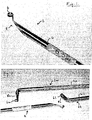
- the tool 2 shown in Figure 1 comprises a hollow cylindrical shank 4 and an annular collar section 6, which has been formed by cutting a notch 8 into the cylinder.
- the resulting structure has been bent so that the axes of the collar 6 and shank 4 are inclined.
- the tool is cheap and easy to fabricate from a cylinder of suitable diameter.
- Use of this tool is also very simple: the collar 6 is dipped into a liquid sealant solution (not shown) so that it "picks up” an amount of the sealant by surface tension (in much the same way that a child's bubble-blowing ring pick ups soap solution for blowing a soap bubble).
- the tool is then moved and the collar 6 placed over a rivet head (not shown, but which in aircraft applications is usually countersunk so as to be flush with the aircraft surface, but which could equally be rounded flat or pan-shaped).
- a rivet head not shown, but which in aircraft applications is usually countersunk so as to be flush with the aircraft surface, but which could equally be rounded flat or pan-shaped.
- Figure 2 illustrates the tool 2 of Figure 1 together with two other tools, 2 and 2b (in which equivalent elements to those of the tool 2 are identified by the suffixes "a" and "b").
- Tool 2a is similar to tool 2, but has been bent adjacent the end of the notch 8a distant from the collar 6a.
- Tool 2b has been bent at a point along the shank 4b, so that the notch 8b is substantially undistorted (and resembles the cut out position of a whistle, or organ pipe).
Landscapes
- Engineering & Computer Science (AREA)
- Mechanical Engineering (AREA)
- Insertion Pins And Rivets (AREA)
Abstract
A tool (2,2a,2b) for over-sealing rivet heads comprising an annular collar (6,6a,6b) formed by notching (8,8a,8b) the end of a cylinder (4,4a,4b) of appropriate diameter. The collar is dipped into the liquid sealant to pick up some and them placed over the rivet head to as to encapsulate it with liquid sealant, which then sets.
Description
- This invention relates to the over-sealing of the heads of fasteners, particularly to the over-sealing of aircraft electrical bond rivets.
- To meet electrical earth bond requirements on aircraft, one in every 10 or so rivets or fasteners is an earth bonding point. This is so that minimum resistance is achieved between mating panels forming the outer surface of the aircraft, allowing any external current such as a lightning strike to pass freely through the aircraft and mitigating the damaging effects of electrical discharge. Once the correct low resistance is achieved the whole fastener (rivet or bolt) is covered, where they are visible on the surfaces of the panels, both head and tail, in a liquid rubber solution. This sealant is an electrically conductive corrosion inhibitive material, and it encloses the fastener earth point from the atmosphere, which otherwise could contact and corrode the joint. Corrosion increases electrical resistance; an increase in resistance would not allow unwanted current to pass freely and could result in serious electrical malfunctions within the aircraft. This is known as "over-sealing". Conventional practice is to apply a liquid rubber solution referred to as "PRC" ("polysulphide rubber compound" - PRC is a trademark of PRC-DeSoto International, Inc) by hand; the solution is applied to the head of the rivet and the immediately surrounding area, so as to encapsulate the rivet head, using a wire, stick or brush. The solution is built up by swirling the solution over the rivet head to completely encapsulate it. This is a time-consuming and messy task, which often results in an untidy result.
- The present invention provides a tool for applying sealant to cover a fastener head on the surface of a workpiece, the tool comprising a cylindrical member having an internal diameter greater than the diameter of the fastener head, the member having a notch in its circumference and near to one end to form a collar.
- Such an arrangement provides a cheap and easy-to-use tool which saves time compared with conventional practice and which results in a far neater and more accurate job (accuracy being especially important in aerospace applications). The tool is used by immersing at least the collar in a liquid sealant long enough for the collar to pick up by the action of surface tension an amount of sealant, and placing the edge of the collar over and around the fastener head so as to deposit the sealant thereover. This is fast and produces reliable and neat, accurate encapsulation, enabling multiple rivet heads to be covered far more effectively than with known methods.
- Preferably, at least a part of the notch adjacent the said end of the member is substantially parallel to the said end. This creates an annular collar, so that in use a consistent amount of sealant is picked up and deposited over each rivet head. The height of the collar relative to its circumference is preferably determined by several factors, such as the viscosity and surface tension of the sealant and the amount of sealant required, so as to ensure the rivet head is covered effectively.
- Once the sealant has been deposited, the tool is easily cleaned by brushing or wiping, and the notch assists in this process by allowing access to the inside of the collar. Preferably the side of the notch distant from the said end of the member is at an acute angle to the longitudinal axis of the cylindrical member. This creates a wide notch so as to facilitate easy cleaning of the tool. Additionally or alternatively the central axis of the collar is at an angle to the longitudinal axis of the cylindrical member. This further facilitates cleaning, as it effectively "opens up" the notch if the member is bent somewhere along the length of the notch, it also enables the tool to access rivets which are in awkward, difficult to access, locations.
- The invention will now be described by way of example and with reference to the accompanying drawings, in which:
- Figure 1 shows an embodiment of a tool in accordance with the invention, and
- Figure 2 shows the tool of Figure 1 with other embodiments of the tool in accordance with the invention.
- The
tool 2 shown in Figure 1 comprises a hollow cylindrical shank 4 and an annular collar section 6, which has been formed by cutting anotch 8 into the cylinder. In addition, the resulting structure has been bent so that the axes of the collar 6 and shank 4 are inclined. The tool is cheap and easy to fabricate from a cylinder of suitable diameter. Use of this tool is also very simple: the collar 6 is dipped into a liquid sealant solution (not shown) so that it "picks up" an amount of the sealant by surface tension (in much the same way that a child's bubble-blowing ring pick ups soap solution for blowing a soap bubble). The tool is then moved and the collar 6 placed over a rivet head (not shown, but which in aircraft applications is usually countersunk so as to be flush with the aircraft surface, but which could equally be rounded flat or pan-shaped). As the collar 6 contacts the surface the liquid solution adheres to the surface and the rivet and, as thetool 2 is removed, is deposited there, neatly encapsulating the rivet. - Figure 2 illustrates the
tool 2 of Figure 1 together with two other tools, 2 and 2b (in which equivalent elements to those of thetool 2 are identified by the suffixes "a" and "b"). Tool 2a is similar totool 2, but has been bent adjacent the end of thenotch 8a distant from the collar 6a. Tool 2b has been bent at a point along the shank 4b, so that the notch 8b is substantially undistorted (and resembles the cut out position of a whistle, or organ pipe). - Although described in relation to the application of a sealant to fastener heads, it will be appreciated that principles of the present invention have other applications, where there is a requirement to encapsulate something with a liquid, setting solution, such as in certain medical applications.
Claims (6)
- A tool for applying sealant to cover a fastener head on the surface of a workpiece, the tool comprising a cylindrical member having an internal diameter greater than the diameter of the fastener head, the member having a notch in its circumference and near to one end to form a collar.
- A tool according to claim 1 wherein at least a part of the notch adjacent the said end of the member being substantially parallel to the said end.
- A tool according to Claim 1 or 2 wherein the side of the notch distant from the said end of the member is at an acute angle to the longitudinal axis of the cylindrical member.
- A tool according any of claims 1 to 3 wherein the central axis of the collar is at an angle to the longitudinal axis of the cylindrical member.
- A tool substantially as hereinbefore described and with reference to the accompanying drawing.
- A method of applying sealant to cover a fastener head on the surface of a workpiece using a tool according to any preceding claim, the method comprising immersing at least the collar in a liquid sealant long enough for the collar to pick up by the action of surface tension an amount of sealant, and placing the edge of the collar over and around the fastener head so as to deposit the sealant thereover.
Priority Applications (1)
| Application Number | Priority Date | Filing Date | Title |
|---|---|---|---|
| EP05102047A EP1702697A1 (en) | 2005-03-15 | 2005-03-15 | Over-sealing |
Applications Claiming Priority (1)
| Application Number | Priority Date | Filing Date | Title |
|---|---|---|---|
| EP05102047A EP1702697A1 (en) | 2005-03-15 | 2005-03-15 | Over-sealing |
Publications (1)
| Publication Number | Publication Date |
|---|---|
| EP1702697A1 true EP1702697A1 (en) | 2006-09-20 |
Family
ID=34938986
Family Applications (1)
| Application Number | Title | Priority Date | Filing Date |
|---|---|---|---|
| EP05102047A Withdrawn EP1702697A1 (en) | 2005-03-15 | 2005-03-15 | Over-sealing |
Country Status (1)
| Country | Link |
|---|---|
| EP (1) | EP1702697A1 (en) |
Citations (2)
| Publication number | Priority date | Publication date | Assignee | Title |
|---|---|---|---|---|
| EP1136259A2 (en) * | 2000-03-24 | 2001-09-26 | Nicolae Dr. Barsan | Applicator device for locally applying viscous or liquid materials in defined quantity |
| US6461458B1 (en) * | 1999-04-20 | 2002-10-08 | Bae Systems Plc | Method of sealing a panel to an aircraft structure |
-
2005
- 2005-03-15 EP EP05102047A patent/EP1702697A1/en not_active Withdrawn
Patent Citations (3)
| Publication number | Priority date | Publication date | Assignee | Title |
|---|---|---|---|---|
| US6461458B1 (en) * | 1999-04-20 | 2002-10-08 | Bae Systems Plc | Method of sealing a panel to an aircraft structure |
| US20030015278A1 (en) * | 1999-04-20 | 2003-01-23 | Bae Systems Plc | Method of sealing a panel to an aircraft structure |
| EP1136259A2 (en) * | 2000-03-24 | 2001-09-26 | Nicolae Dr. Barsan | Applicator device for locally applying viscous or liquid materials in defined quantity |
Similar Documents
| Publication | Publication Date | Title |
|---|---|---|
| ES2534585T3 (en) | Fixing devices with conformable sleeves | |
| EP1715985B1 (en) | Razor, and method for the production of such a razor | |
| EP3227969B1 (en) | Method for producing an electric connection part | |
| EP0432164A1 (en) | IMPROVEMENTS ON THE BOBBOW MOUNT. | |
| US9376217B2 (en) | Jig for forming sealant layer for lightning protection fastener, method for forming sealant layer for lightning protection fastener, lightning protection fastener, and wing of aircraft | |
| JP2012232660A (en) | Sealant applicator, and method for applying sealant and method for assembling aircraft using the sealant applicator | |
| CN110024225A (en) | For providing method, the purposes of interface forming device and the cold spray apparatus for shaping power transmission interface of conductive power transmission interface | |
| JP6814612B2 (en) | Vehicle grounding structure | |
| BR102013029942A2 (en) | bushings, appliances including bushings, and associated methods | |
| DE69805929T2 (en) | Method and device for selective plating of a blade | |
| DE102015110243A1 (en) | Battery cell housing, carrier and method for grouping a plurality of battery cell housings | |
| US4903884A (en) | Soldering apparatus | |
| EP2965783B1 (en) | Method for producing a pin for a feedthrough of an electromedical implant and a feedthrough | |
| JPH11504799A (en) | Stripper | |
| EP3001510B1 (en) | Plug | |
| DE102013201331B4 (en) | Electrical contact connection between two elements, method for forming such an electrical contact connection and element for such an electrical contact connection | |
| DE2844384C2 (en) | Earth connection point for painted sheet metal components | |
| DE102011011409A1 (en) | Connector for electrical system of motor car or wind-power plant, has contact part provided at distal end of connector, where connector is flattened in region of contact part and forms radially extending gap between walls of connector | |
| GB1598576A (en) | Aircraft static discharger | |
| EP0966061A3 (en) | Method for the electrical and mechanical connection of electrically conductive parts and device for carrying out this method | |
| EP2798922B1 (en) | Housing for receiving an electronic unit | |
| CN106481646B (en) | Coated Fasteners with Conformal Seals | |
| JP2000073190A (en) | Anticorrosion cap | |
| CN106996410B (en) | Grounding structure and grounding method of full-coating compressor | |
| DE19527639C1 (en) | Mudguard with embedded electrical conductors e.g for bicycles or mopeds |
Legal Events
| Date | Code | Title | Description |
|---|---|---|---|
| PUAI | Public reference made under article 153(3) epc to a published international application that has entered the european phase |
Free format text: ORIGINAL CODE: 0009012 |
|
| AK | Designated contracting states |
Kind code of ref document: A1 Designated state(s): AT BE BG CH CY CZ DE DK EE ES FI FR GB GR HU IE IS IT LI LT LU MC NL PL PT RO SE SI SK TR |
|
| AX | Request for extension of the european patent |
Extension state: AL BA HR LV MK YU |
|
| AKX | Designation fees paid | ||
| REG | Reference to a national code |
Ref country code: DE Ref legal event code: 8566 |
|
| STAA | Information on the status of an ep patent application or granted ep patent |
Free format text: STATUS: THE APPLICATION IS DEEMED TO BE WITHDRAWN |
|
| 18D | Application deemed to be withdrawn |
Effective date: 20070321 |