EP1699158A1 - A method for selection of the appropriate HARQ retransmission scheme for data transmission, a base station and a program therefor - Google Patents
A method for selection of the appropriate HARQ retransmission scheme for data transmission, a base station and a program therefor Download PDFInfo
- Publication number
- EP1699158A1 EP1699158A1 EP05290473A EP05290473A EP1699158A1 EP 1699158 A1 EP1699158 A1 EP 1699158A1 EP 05290473 A EP05290473 A EP 05290473A EP 05290473 A EP05290473 A EP 05290473A EP 1699158 A1 EP1699158 A1 EP 1699158A1
- Authority
- EP
- European Patent Office
- Prior art keywords
- retransmission scheme
- data transmission
- harq retransmission
- harq
- transport block
- Prior art date
- Legal status (The legal status is an assumption and is not a legal conclusion. Google has not performed a legal analysis and makes no representation as to the accuracy of the status listed.)
- Withdrawn
Links
- 230000005540 biological transmission Effects 0.000 title claims abstract description 52
- 238000000034 method Methods 0.000 title claims abstract description 16
- 238000004891 communication Methods 0.000 claims abstract description 9
- 101000741965 Homo sapiens Inactive tyrosine-protein kinase PRAG1 Proteins 0.000 description 3
- 102100038659 Inactive tyrosine-protein kinase PRAG1 Human genes 0.000 description 3
- 238000012937 correction Methods 0.000 description 2
- 125000004122 cyclic group Chemical group 0.000 description 2
- 108010003272 Hyaluronate lyase Proteins 0.000 description 1
- 230000003044 adaptive effect Effects 0.000 description 1
- 230000001427 coherent effect Effects 0.000 description 1
- 230000001419 dependent effect Effects 0.000 description 1
- 238000011161 development Methods 0.000 description 1
- 230000018109 developmental process Effects 0.000 description 1
- 238000005259 measurement Methods 0.000 description 1
- 230000010363 phase shift Effects 0.000 description 1
- 238000012545 processing Methods 0.000 description 1
- 230000003595 spectral effect Effects 0.000 description 1
Images
Classifications
-
- H—ELECTRICITY
- H04—ELECTRIC COMMUNICATION TECHNIQUE
- H04L—TRANSMISSION OF DIGITAL INFORMATION, e.g. TELEGRAPHIC COMMUNICATION
- H04L1/00—Arrangements for detecting or preventing errors in the information received
- H04L1/12—Arrangements for detecting or preventing errors in the information received by using return channel
- H04L1/16—Arrangements for detecting or preventing errors in the information received by using return channel in which the return channel carries supervisory signals, e.g. repetition request signals
- H04L1/18—Automatic repetition systems, e.g. Van Duuren systems
- H04L1/1867—Arrangements specially adapted for the transmitter end
- H04L1/1874—Buffer management
-
- H—ELECTRICITY
- H04—ELECTRIC COMMUNICATION TECHNIQUE
- H04L—TRANSMISSION OF DIGITAL INFORMATION, e.g. TELEGRAPHIC COMMUNICATION
- H04L1/00—Arrangements for detecting or preventing errors in the information received
- H04L1/0001—Systems modifying transmission characteristics according to link quality, e.g. power backoff
- H04L1/0006—Systems modifying transmission characteristics according to link quality, e.g. power backoff by adapting the transmission format
- H04L1/0007—Systems modifying transmission characteristics according to link quality, e.g. power backoff by adapting the transmission format by modifying the frame length
-
- H—ELECTRICITY
- H04—ELECTRIC COMMUNICATION TECHNIQUE
- H04L—TRANSMISSION OF DIGITAL INFORMATION, e.g. TELEGRAPHIC COMMUNICATION
- H04L1/00—Arrangements for detecting or preventing errors in the information received
- H04L1/0001—Systems modifying transmission characteristics according to link quality, e.g. power backoff
- H04L1/0009—Systems modifying transmission characteristics according to link quality, e.g. power backoff by adapting the channel coding
- H04L1/0013—Rate matching, e.g. puncturing or repetition of code symbols
-
- H—ELECTRICITY
- H04—ELECTRIC COMMUNICATION TECHNIQUE
- H04L—TRANSMISSION OF DIGITAL INFORMATION, e.g. TELEGRAPHIC COMMUNICATION
- H04L1/00—Arrangements for detecting or preventing errors in the information received
- H04L1/12—Arrangements for detecting or preventing errors in the information received by using return channel
- H04L1/16—Arrangements for detecting or preventing errors in the information received by using return channel in which the return channel carries supervisory signals, e.g. repetition request signals
- H04L1/18—Automatic repetition systems, e.g. Van Duuren systems
- H04L1/1812—Hybrid protocols; Hybrid automatic repeat request [HARQ]
- H04L1/1816—Hybrid protocols; Hybrid automatic repeat request [HARQ] with retransmission of the same, encoded, message
-
- H—ELECTRICITY
- H04—ELECTRIC COMMUNICATION TECHNIQUE
- H04L—TRANSMISSION OF DIGITAL INFORMATION, e.g. TELEGRAPHIC COMMUNICATION
- H04L1/00—Arrangements for detecting or preventing errors in the information received
- H04L1/12—Arrangements for detecting or preventing errors in the information received by using return channel
- H04L1/16—Arrangements for detecting or preventing errors in the information received by using return channel in which the return channel carries supervisory signals, e.g. repetition request signals
- H04L1/18—Automatic repetition systems, e.g. Van Duuren systems
- H04L1/1812—Hybrid protocols; Hybrid automatic repeat request [HARQ]
- H04L1/1819—Hybrid protocols; Hybrid automatic repeat request [HARQ] with retransmission of additional or different redundancy
-
- H—ELECTRICITY
- H04—ELECTRIC COMMUNICATION TECHNIQUE
- H04L—TRANSMISSION OF DIGITAL INFORMATION, e.g. TELEGRAPHIC COMMUNICATION
- H04L1/00—Arrangements for detecting or preventing errors in the information received
- H04L1/12—Arrangements for detecting or preventing errors in the information received by using return channel
- H04L1/16—Arrangements for detecting or preventing errors in the information received by using return channel in which the return channel carries supervisory signals, e.g. repetition request signals
- H04L1/18—Automatic repetition systems, e.g. Van Duuren systems
- H04L1/1825—Adaptation of specific ARQ protocol parameters according to transmission conditions
Definitions
- the invention relates to a method for selection of the appropriate Hybrid Automatic Repetition Request (HARQ) retransmission scheme for data transmission according to the preamble of claim 1, a base station according to the preamble of claim 8 and a program module according to the preamble of claim 10.
- HARQ Hybrid Automatic Repetition Request
- High Speed Downlink Packet Access is an extension of the Universal Mobile Telecommunications System (UMTS) standard to achieve higher spectral efficiency for packet data in downlink, i.e. from the base station to the mobile station.
- HSDPA uses adaptive modulation, coding and a packet scheduler located in the base station, called Node B in UMTS, to optimize throughput.
- the selection of an appropriate modulation and coding scheme by the Node B scheduler is done with the aid of a Channel Quality Indicator (CQI) reported by the terminals, called User Equipments (UEs) in UMTS.
- CQI Channel Quality Indicator
- HSDPA further uses a HARQ retransmission scheme on the physical layer in order to keep near zero the rate of costly retransmissions on higher layers like on the Radio Link Control (RLC) layer or on the Transmission Control Protocol (TCP) layer.
- the UE applies a Cyclic Redundancy Code (CRC) check for a received data packet, like e.g. a transport block, and acknowledges the result per ACK/NACK message to the Node B.
- CRC Cyclic Redundancy Code
- the Node B can choose to retransmit the transport block.
- the UE applies coherent soft combining of the retransmitted transport block with the initial transport block, in order to obtain best possible error rate performance.
- HSDPA allows for both Chase Combining and Incremental Redundancy as HARQ retransmission schemes.
- a retransmitted transport block contains exactly the same set of coded bits, i.e. the same puncturing pattern, as used for the initial transmission of the transport block.
- a retransmitted transport block may contain different coded bits, e.g. by using a different puncturing pattern, as used for the initial transmission of the transport block. Then during soft combining, with every retransmission additional parity bits are received by the UE, which in turn decrease the code rate, but also increase the error correction capability of the Error Correction Coding (ECC) scheme.
- ECC Error Correction Coding
- Chase Combining shall preferably be applied in case of good channel quality in order to achieve high peak data rates, and in case of poor channel quality, Incremental Redundancy is preferable due to improved error rate performance, i.e. data throughput for a given signal to noise and interference ratio.
- the object of the invention is to propose a method to react on changing transmission conditions during transmission in a base station in order to chose the appropriate HARQ retransmission scheme Chase Combining or Incremental Redundancy, or in general to chose either HARQ retransmission scheme A or HARQ retransmission scheme B, where we assume schemes A and B to be two retransmission schemes similar to the above described Chase Combining and Incremental Redundancy, i.e. scheme A e.g. always requires less HARQ buffer for a certain data rate and thus often enables higher peak data rate for a given HARQ buffer size, whereas scheme B e.g. has better error rate performance.
- the main idea of the invention is, that at least once, when the initial transmission or a retransmission of a transport block is prepared, a selection of the appropriate HARQ retransmission scheme is performed by means of at least one parameter that defines the data transmission like e.g. the radio resources (i.e. the available transmission power and the channels defined by frequency or code), the Channel Quality Indicator (CQI), the configured HARQ buffer, the UE capability, the so-called Transport Format Resource Combination (TFRC) set and/or the power offsets.
- the radio resources i.e. the available transmission power and the channels defined by frequency or code
- CQI Channel Quality Indicator
- TFRC Transport Format Resource Combination
- a selection function like e.g. the so-called TFRC selection function for a HARQ retransmission scheme A is executed in the base station and for a given parameter list comprising the above mentioned parameters that define the data transmission, the size of the transport block corresponding to the HARQ retransmission scheme A is determined.
- the minimum HARQ buffer size required for the alternative HARQ retransmission scheme B is determined by means of e.g. table look-up in case the correlation between the transport block size and the minimum HARQ buffer size required for the alternative HARQ retransmission scheme B has already been determined and stored prior to the beginning of the transmission.
- HARQ retransmission scheme B If the minimum HARQ buffer size required for the HARQ retransmission scheme B is bigger than the size of the configured HARQ buffer, i.e. the buffer-size that is available for retransmission, then HARQ retransmission scheme A is selected as retransmission scheme for the transport block. Otherwise HARQ retransmission scheme B will be selected as retransmission scheme for the transport block.
- a communication network in which the invention can be implemented comprises a base station for data transmission over said communication network and terminals.
- the base station is connected to the terminals through a wireline or wireless connection and the base station can be further connected by means of a core network to control devices and via gateways to devices like e.g. terminals or servers located in further networks like e.g. the Internet or a mobile or a fixed network. Additional base stations that can be comprised in the communication network may also be connected to each other and/or to said base station via the core network.
- the terminals are cell phones for UMTS that are capable of receiving HSDPA data.
- the base station comprises the functionality of a transceiver for sending data to and receiving data from a terminal and the core network. Furthermore, the base station comprises means for error handling like e.g. error coding or retransmission according to a HARQ retransmission scheme. According to the invention, the base station additionally comprises means for repeated selection of the appropriate HARQ retransmission scheme during data transmission by means of at least one parameter that defines the data transmission.
- the base station comprises means for selection of said appropriate HARQ retransmission scheme by means of determining the transport block size for said HARQ retransmission scheme using a selection function that depends on said at least one parameter that defines the data transmission.
- said selection function is the so-called Transport Format Resource Combination (TFRC) selection function.
- TFRC Transport Format Resource Combination
- the base station is a Node B for HSDPA in UMTS.
- the communication network is a UMTS network
- the base station therefor is a so-called Node B
- the terminals are so-called User Equipments (UE).
- UE User Equipments
- the HSDPA feature is implemented within the UMTS network, i.e. the Node B is capable of sending HSDPA data and the User Equipments are capable of receiving such HSDPA data.
- HSDPA allows for Chase Combining and Incremental Redundancy as HARQ retransmission schemes and these two schemes are implemented within the Node B and the User Equipments.
- the Node B transceiver baseband processing uses the following building blocks described in detail in 3GPP TS 25.212 standard.
- the first Rate Matching stage reduces by puncturing the coded transport block size to fit into the HARQ buffer.
- the second rate matching stage reduces by puncturing or increases by using repetition the coded block size to fit the physical channel resources given by spreading factor, number of codes and modulation scheme.
- the size of the HARQ buffer is configured in a semi-static way, i.e. the HARQ buffer size configured in Node B matches the HARQ buffer size that is available in the UE in order to perform the soft combining.
- the size of the HARQ buffer has to be considered in the scheduling decisions, i.e. the HARQ buffer size will pose a limit to the maximum possible transport block size that can be used for a packet transmission.
- the maximum transport block size i.e. the maximum peak data rate that can be transmitted is larger for Chase Combining than for Incremental Redundancy, or in other words, for a given transport block size, the minimum required HARQ buffer size for Chase Combining, i.e. HARQ retransmission scheme A is typically less than the minimum required HARQ buffer size for Incremental Redundancy, i.e. HARQ retransmission scheme B.
- an effective code rate (Reff) of 0.7 is used, which is a typical value obtained by puncturing a Turbo code with a rate of 1/3 as used for HSDPA.
- Incremental Redundancy there must be a possibility to change the effective puncturing pattern between packet transmissions. This is achieved by using a different puncturing in the second Rate Matching stage, i.e., the first Rate Matching stage must leave enough parity bits. In the extreme case, all parity bits are available in second Rate Matching stage and in this case the HARQ buffer size must be greater than or equal to 3 times the transport block size.
- Chase Combining shall preferably be applied in case of good channel quality in order to achieve high peak data rates, and in case of poor channel quality, Incremental Redundancy is preferable due to improved error rate performance.
- the radio resources power and codes
- the channel quality determined by the Channel Quality Indicator (CQI) the configured HARQ buffer size, which is often equal to the total UE soft buffer divided by the number of HARQ processes (typically a number between 2 and 6)
- the UE capability which determines the available soft buffer of the UE
- the power offsets like e.g. the Measurement Power Offset (MPO, cf. 3GPP TS 25.214) and the set of possible transport format resource combinations (TFRC) comprising the transport block size, the number of channelisation codes, the modulation scheme and the transmit power required to achieve a target error rate with the TFRC.
- MPO Measurement Power Offset
- TFRC transport format resource combinations
- At least one of said parameters that influence the choice of the optimum HARQ retransmission scheme is used to repeatedly select the appropriate HARQ retransmission scheme during data transmission. This can be done either before the initial transmission of a transport block, and/or before at least one retransmission of this transport block. The selection can be performed more often in case of fast changing conditions of the data transmission.
- TFRC selection function uses these parameters to select a suitable TFRC for an initial transmission or for a retransmission of a transport block using the same transport block size.
- the User Equipment requests retransmission of the transport block from the Node B e.g. by sending a NACK.
- the Transport Format Resource Combination (TFRC) selection function for the HARQ retransmission scheme Chase Combining is run in the Node B and the transport block size is obtained as a result of this selection for a given parameter list comprising radio resources, Channel Quality Indicator (CQI), configured HARQ buffer, UE capability, TFRC set, power offsets and the like.
- CQI Channel Quality Indicator
- the Transport Format Resource Combination (TFRC) selection function for the HARQ retransmission scheme Chase Combining is run in the Node B before at least one retransmission of the transport block to have the appropriate choice of the HARQ retransmission scheme even in case of fast changing conditions of the data transmission.
- TFRC Transport Format Resource Combination
- the minimum HARQ buffer size required for the alternative HARQ retransmission scheme Incremental Redundancy can be calculated by means of the above mentioned correlation between transport block size and the HARQ buffer size.
- the transport block size as obtained by the TFRC selection function for the HARQ retransmission scheme Chase Combining can be used in order to format or assemble the transport block. This is possible, as the first rate matching stage uses as inputs the transport block and the configured HARQ buffer size, i.e. the inputs for the first Rate Matching stage for Chase Combining and Incremental Redundancy are identical.
- the minimum HARQ buffer size required for the alternative HARQ retransmission scheme Incremental Redundancy is determined e.g. by table look-up which can be performed faster than a calculation of the minimum HARQ buffer size.
- the correlation between transport block size and the minimum HARQ buffer size for Incremental Redundancy has been calculated and stored in a table in the Node B before the beginning of the transmission.
- the HARQ retransmission scheme Incremental Redundancy is used to determine the transport block size by the TFRC selection function, and the minimum HARQ buffer size required for the alternative HARQ retransmission scheme Chase Combining is determined e.g. by table look-up analogue to the above described procedure.
- the selection rule in this example according to which the HARQ retransmission scheme for the retransmission is selected consists in, that if the minimum HARQ buffer size minHarqSize_B needed for the transmission and retransmission of a transport block with the HARQ retransmission scheme Incremental Redundancy is bigger than the configured HARQ buffer size, then the HARQ retransmission scheme Chase Combining is selected, otherwise the HARQ retransmission scheme Incremental Redundancy is selected. As mentioned above, this makes sense as Incremental Redundancy shows the better error performance compared with Chase Combining and shall therefore be used whenever there is enough configured HARQ buffer.
- the HARQ retransmission scheme selected in this manner is used for the retransmissions of the transport block TBS.
- the Transport Format Resource Combination TFRC with the index n comprises a transport block size TBS of 4664 bits.
- TBS transport block size
- the required minimum HARQ buffer size for Chase Combining minHarqSize_A and Incremental Redundancy min-HarqSize_B is determined.
- the size of the configured HARQ buffer in the example is 15000 bits, and as the minimum HARQ buffer size for Incremental Redundancy minHarqSize_B is 14076 bits and therefore smaller than the size of the configured HARQ buffer, Incremental Redundancy is selected as HARQ retransmission scheme.
- the minimum HARQ buffer size for Incremental Redundancy minHarqSize_B is 29778 bits and therefore bigger than the size of the configured HARQ buffer, so that Chase Combining is selected as HARQ retransmission scheme.
- Transport Format Resource Combination (TFRC) selection function is just an example for any kind of selection function that depends on at least one parameter that defines the data transmission for selection of the appropriate Hybrid Automatic Repetition Request (HARQ) retransmission scheme by means of determining the transport block size.
- HARQ Hybrid Automatic Repetition Request
- WLAN Wireless Local Area Network
- OFDM Orthogonal Frequency Division Multiplexing
Landscapes
- Engineering & Computer Science (AREA)
- Computer Networks & Wireless Communication (AREA)
- Signal Processing (AREA)
- Quality & Reliability (AREA)
- Mobile Radio Communication Systems (AREA)
- Detection And Prevention Of Errors In Transmission (AREA)
Abstract
Description
- The invention relates to a method for selection of the appropriate Hybrid Automatic Repetition Request (HARQ) retransmission scheme for data transmission according to the preamble of
claim 1, a base station according to the preamble of claim 8 and a program module according to the preamble of claim 10. - High Speed Downlink Packet Access (HSDPA) is an extension of the Universal Mobile Telecommunications System (UMTS) standard to achieve higher spectral efficiency for packet data in downlink, i.e. from the base station to the mobile station. HSDPA uses adaptive modulation, coding and a packet scheduler located in the base station, called Node B in UMTS, to optimize throughput. The selection of an appropriate modulation and coding scheme by the Node B scheduler is done with the aid of a Channel Quality Indicator (CQI) reported by the terminals, called User Equipments (UEs) in UMTS.
- HSDPA further uses a HARQ retransmission scheme on the physical layer in order to keep near zero the rate of costly retransmissions on higher layers like on the Radio Link Control (RLC) layer or on the Transmission Control Protocol (TCP) layer. The UE applies a Cyclic Redundancy Code (CRC) check for a received data packet, like e.g. a transport block, and acknowledges the result per ACK/NACK message to the Node B. After receiving a NACK for a transport block, the Node B can choose to retransmit the transport block. In such a case, the UE applies coherent soft combining of the retransmitted transport block with the initial transport block, in order to obtain best possible error rate performance.
- HSDPA allows for both Chase Combining and Incremental Redundancy as HARQ retransmission schemes.
- With Chase Combining, a retransmitted transport block contains exactly the same set of coded bits, i.e. the same puncturing pattern, as used for the initial transmission of the transport block.
- With Incremental Redundancy, a retransmitted transport block may contain different coded bits, e.g. by using a different puncturing pattern, as used for the initial transmission of the transport block. Then during soft combining, with every retransmission additional parity bits are received by the UE, which in turn decrease the code rate, but also increase the error correction capability of the Error Correction Coding (ECC) scheme.
- Chase Combining shall preferably be applied in case of good channel quality in order to achieve high peak data rates, and in case of poor channel quality, Incremental Redundancy is preferable due to improved error rate performance, i.e. data throughput for a given signal to noise and interference ratio.
- Nowadays, the choice which HARQ retransmission scheme is used is performed only at the beginning of a transmission and it is therefore not possible to react on changing transmission conditions during the transmission in order to achieve the appropriate choice of either a higher peak data rate or a better error rate performance.
- The object of the invention is to propose a method to react on changing transmission conditions during transmission in a base station in order to chose the appropriate HARQ retransmission scheme Chase Combining or Incremental Redundancy, or in general to chose either HARQ retransmission scheme A or HARQ retransmission scheme B, where we assume schemes A and B to be two retransmission schemes similar to the above described Chase Combining and Incremental Redundancy, i.e. scheme A e.g. always requires less HARQ buffer for a certain data rate and thus often enables higher peak data rate for a given HARQ buffer size, whereas scheme B e.g. has better error rate performance.
- This object is achieved by a method according to the teaching of
claim 1, a base station according to the teaching of claim 8 and a program module according to the teaching of claim 10. - The main idea of the invention is, that at least once, when the initial transmission or a retransmission of a transport block is prepared, a selection of the appropriate HARQ retransmission scheme is performed by means of at least one parameter that defines the data transmission like e.g. the radio resources (i.e. the available transmission power and the channels defined by frequency or code), the Channel Quality Indicator (CQI), the configured HARQ buffer, the UE capability, the so-called Transport Format Resource Combination (TFRC) set and/or the power offsets.
- In a more elaborate embodiment of the invention, a selection function like e.g. the so-called TFRC selection function for a HARQ retransmission scheme A is executed in the base station and for a given parameter list comprising the above mentioned parameters that define the data transmission, the size of the transport block corresponding to the HARQ retransmission scheme A is determined.
- Then for a given transport block size determined by means of the selection function for the HARQ retransmission scheme A, the minimum HARQ buffer size required for the alternative HARQ retransmission scheme B is determined by means of e.g. table look-up in case the correlation between the transport block size and the minimum HARQ buffer size required for the alternative HARQ retransmission scheme B has already been determined and stored prior to the beginning of the transmission.
- If the minimum HARQ buffer size required for the HARQ retransmission scheme B is bigger than the size of the configured HARQ buffer, i.e. the buffer-size that is available for retransmission, then HARQ retransmission scheme A is selected as retransmission scheme for the transport block. Otherwise HARQ retransmission scheme B will be selected as retransmission scheme for the transport block.
- Further developments of the invention can be gathered from the dependent claims and the following description.
- In the following the invention will be explained further making reference to the attached drawing.
- A communication network in which the invention can be implemented comprises a base station for data transmission over said communication network and terminals.
- The base station is connected to the terminals through a wireline or wireless connection and the base station can be further connected by means of a core network to control devices and via gateways to devices like e.g. terminals or servers located in further networks like e.g. the Internet or a mobile or a fixed network. Additional base stations that can be comprised in the communication network may also be connected to each other and/or to said base station via the core network.
- The terminals are customary terminals for mobile or fixed networks like cell phones for UMTS or ISDN telephones (ISDN = Integrated Services Digital Network).
- In a preferred embodiment, the terminals are cell phones for UMTS that are capable of receiving HSDPA data.
- The base station comprises the functionality of a transceiver for sending data to and receiving data from a terminal and the core network. Furthermore, the base station comprises means for error handling like e.g. error coding or retransmission according to a HARQ retransmission scheme. According to the invention, the base station additionally comprises means for repeated selection of the appropriate HARQ retransmission scheme during data transmission by means of at least one parameter that defines the data transmission.
- In a further embodiment, the base station comprises means for selection of said appropriate HARQ retransmission scheme by means of determining the transport block size for said HARQ retransmission scheme using a selection function that depends on said at least one parameter that defines the data transmission.
- In a further embodiment, said selection function is the so-called Transport Format Resource Combination (TFRC) selection function.
- In a preferred embodiment, the base station is a Node B for HSDPA in UMTS.
- In the following, by way of example the method according to the invention is described in detail making reference to fig. 1.
- In the example described below, the communication network is a UMTS network, the base station therefor is a so-called Node B and the terminals are so-called User Equipments (UE).
- The HSDPA feature is implemented within the UMTS network, i.e. the Node B is capable of sending HSDPA data and the User Equipments are capable of receiving such HSDPA data.
- As already described above, HSDPA allows for Chase Combining and Incremental Redundancy as HARQ retransmission schemes and these two schemes are implemented within the Node B and the User Equipments.
- With either of the two retransmission schemes, it is possible to adapt the number of codes, the modulation scheme, i.e. Quaternary Phase Shift Keying (QPSK) or 16 Quadrature Amplitude Modulation (16QAM), and the transmission power between retransmissions. It can be assumed that Incremental Redundancy will typically outperform Chase Combining in terms of error rate performance, whereas Chase Combining provides for higher peak data rates.
- To implement these HARQ retransmission schemes, the Node B transceiver baseband processing uses the following building blocks described in detail in 3GPP TS 25.212 standard. After applying Cyclic Redundancy Check (CRC) attachment and Turbo encoding with a fixed code rate of 1/3 to a transport block that has to be sent from the Node B to a User Equipment, the first Rate Matching stage reduces by puncturing the coded transport block size to fit into the HARQ buffer. The second rate matching stage reduces by puncturing or increases by using repetition the coded block size to fit the physical channel resources given by spreading factor, number of codes and modulation scheme. The size of the HARQ buffer is configured in a semi-static way, i.e. the HARQ buffer size configured in Node B matches the HARQ buffer size that is available in the UE in order to perform the soft combining.
- The size of the HARQ buffer has to be considered in the scheduling decisions, i.e. the HARQ buffer size will pose a limit to the maximum possible transport block size that can be used for a packet transmission. For a given HARQ buffer size, typically the maximum transport block size, i.e. the maximum peak data rate that can be transmitted is larger for Chase Combining than for Incremental Redundancy, or in other words, for a given transport block size, the minimum required HARQ buffer size for Chase Combining, i.e. HARQ retransmission scheme A is typically less than the minimum required HARQ buffer size for Incremental Redundancy, i.e. HARQ retransmission scheme B. In this example, we assume that an effective code rate (Reff) of 0.7 is used, which is a typical value obtained by puncturing a Turbo code with a rate of 1/3 as used for HSDPA.
- With Chase Combining, the code rate can be 0.7 after the first Rate Matching stage, and the second Rate Matching stage can be transparent. So, for a given transport block size, the HARQ buffer size must be greater than or equal to the quotient of the transport block size divided by the effective code rate which delivers as result 1.43 times the transport block size.
- With Incremental Redundancy, there must be a possibility to change the effective puncturing pattern between packet transmissions. This is achieved by using a different puncturing in the second Rate Matching stage, i.e., the first Rate Matching stage must leave enough parity bits. In the extreme case, all parity bits are available in second Rate Matching stage and in this case the HARQ buffer size must be greater than or equal to 3 times the transport block size.
- From this example, we can conclude that Chase Combining shall preferably be applied in case of good channel quality in order to achieve high peak data rates, and in case of poor channel quality, Incremental Redundancy is preferable due to improved error rate performance.
- There are many parameters that influence the choice of the optimum HARQ retransmission scheme like e.g. the radio resources (power and codes), the channel quality determined by the Channel Quality Indicator (CQI), the configured HARQ buffer size, which is often equal to the total UE soft buffer divided by the number of HARQ processes (typically a number between 2 and 6), the UE capability, which determines the available soft buffer of the UE, the power offsets like e.g. the Measurement Power Offset (MPO, cf. 3GPP TS 25.214) and the set of possible transport format resource combinations (TFRC) comprising the transport block size, the number of channelisation codes, the modulation scheme and the transmit power required to achieve a target error rate with the TFRC.
- In one embodiment of the invention, at least one of said parameters that influence the choice of the optimum HARQ retransmission scheme is used to repeatedly select the appropriate HARQ retransmission scheme during data transmission. This can be done either before the initial transmission of a transport block, and/or before at least one retransmission of this transport block. The selection can be performed more often in case of fast changing conditions of the data transmission.
- These parameters are also used by the so-called TFRC selection function to select a suitable TFRC for an initial transmission or for a retransmission of a transport block using the same transport block size.
- If an initial transmission of a transport block from the Node B to a User Equipment is erroneous, then the User Equipment requests retransmission of the transport block from the Node B e.g. by sending a NACK. Before the initial transmission of the transport block, the Transport Format Resource Combination (TFRC) selection function for the HARQ retransmission scheme Chase Combining is run in the Node B and the transport block size is obtained as a result of this selection for a given parameter list comprising radio resources, Channel Quality Indicator (CQI), configured HARQ buffer, UE capability, TFRC set, power offsets and the like.
- In another embodiment, the Transport Format Resource Combination (TFRC) selection function for the HARQ retransmission scheme Chase Combining is run in the Node B before at least one retransmission of the transport block to have the appropriate choice of the HARQ retransmission scheme even in case of fast changing conditions of the data transmission.
- The minimum HARQ buffer size required for the alternative HARQ retransmission scheme Incremental Redundancy can be calculated by means of the above mentioned correlation between transport block size and the HARQ buffer size.
- For both Chase Combining and Incremental Redundancy, the transport block size as obtained by the TFRC selection function for the HARQ retransmission scheme Chase Combining can be used in order to format or assemble the transport block. This is possible, as the first rate matching stage uses as inputs the transport block and the configured HARQ buffer size, i.e. the inputs for the first Rate Matching stage for Chase Combining and Incremental Redundancy are identical.
- In a preferred embodiment, for a given transport block size, the minimum HARQ buffer size required for the alternative HARQ retransmission scheme Incremental Redundancy is determined e.g. by table look-up which can be performed faster than a calculation of the minimum HARQ buffer size. For that purpose, the correlation between transport block size and the minimum HARQ buffer size for Incremental Redundancy has been calculated and stored in a table in the Node B before the beginning of the transmission.
- In another embodiment, the HARQ retransmission scheme Incremental Redundancy is used to determine the transport block size by the TFRC selection function, and the minimum HARQ buffer size required for the alternative HARQ retransmission scheme Chase Combining is determined e.g. by table look-up analogue to the above described procedure.
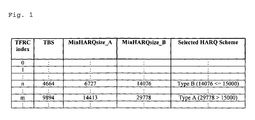
- In fig. 1, such a table indicating the correlation between transport block size and the minimum HARQ buffer size is depicted. In the first column, the index of the Transport Format Resource Combination TFRC is given, in the second column, the transport block size TBS in bits corresponding to the TFRC index is given, in the third column, the minimum HARQ buffer size minHarqSize_A in bits needed for the transmission and retransmission of a transport block with the HARQ retransmission scheme Chase Combining is given, in the fourth column, the minimum HARQ buffer size minHarqSize_B in bits needed for the transmission and retransmission of a transport block with the HARQ retransmission scheme Incremental Redundancy is given and in the fifth column, the HARQ retransmission scheme that is selected according to a selection rule that is described below is given.
- The selection rule in this example according to which the HARQ retransmission scheme for the retransmission is selected consists in, that if the minimum HARQ buffer size minHarqSize_B needed for the transmission and retransmission of a transport block with the HARQ retransmission scheme Incremental Redundancy is bigger than the configured HARQ buffer size, then the HARQ retransmission scheme Chase Combining is selected, otherwise the HARQ retransmission scheme Incremental Redundancy is selected. As mentioned above, this makes sense as Incremental Redundancy shows the better error performance compared with Chase Combining and shall therefore be used whenever there is enough configured HARQ buffer. The HARQ retransmission scheme selected in this manner is used for the retransmissions of the transport block TBS.
- In the example depicted in fig.1, the Transport Format Resource Combination TFRC with the index n comprises a transport block size TBS of 4664 bits. Out of the transport block size TBS, which is obtained by means of the TFRC selection function for Chase Combining, the required minimum HARQ buffer size for Chase Combining minHarqSize_A and Incremental Redundancy min-HarqSize_B is determined. The size of the configured HARQ buffer in the example is 15000 bits, and as the minimum HARQ buffer size for Incremental Redundancy minHarqSize_B is 14076 bits and therefore smaller than the size of the configured HARQ buffer, Incremental Redundancy is selected as HARQ retransmission scheme. However, in case of the Transport Format Resource Combination TFRC with the index m, the minimum HARQ buffer size for Incremental Redundancy minHarqSize_B is 29778 bits and therefore bigger than the size of the configured HARQ buffer, so that Chase Combining is selected as HARQ retransmission scheme.
- Of course, other selection rules according to which the HARQ retransmission scheme for the retransmission is selected by means of the transport block size are possible, like e.g. a simple comparison of the transport block size with a threshold value.
- The above mentioned Transport Format Resource Combination (TFRC) selection function is just an example for any kind of selection function that depends on at least one parameter that defines the data transmission for selection of the appropriate Hybrid Automatic Repetition Request (HARQ) retransmission scheme by means of determining the transport block size.
- The above mentioned HARQ retransmission schemes Chase Combining and Incremental Redundancy are also only examples for any kind of HARQ retransmission schemes that can be selected according to at least one parameter that defines the data transmission.
- The above described method for selection of the appropriate HARQ retransmission scheme is not restricted to UMTS systems, but can also be performed in other communication networks, like e.g. in WLAN networks (WLAN = Wireless Local Area Network) using OFDM transmission (OFDM = Orthogonal Frequency Division Multiplexing).
Claims (11)
- A method for selection of the appropriate HARQ (Hybrid Automatic Repetition Request) retransmission scheme within a base station for data transmission over a communication network to a terminal, characterized in, that said selection is performed repeatedly during data transmission by means of at least one parameter that defines the data transmission.
- A method according to claim 1, characterized in, that said appropriate HARQ retransmission scheme is selected by means of determining the transport block size (TBS) for said HARQ retransmission scheme using a selection function that depends on said at least one parameter that defines the data transmission.
- A method according to claim 2, characterized in, that said selection function is the Transport Format Resource Combination selection function.
- A method according to claim 2 or 3, characterized in, that the determined transport block size (TBS) for a first HARQ retransmission scheme is used to directly determine the required minimum HARQ buffer size for a second HARQ retransmission scheme (minHarqSize_B).
- A method according to claim 2 or 3, characterized in, that a first HARQ retransmission scheme is chosen for retransmission of the transport block if the determined minimum HARQ buffer size for a second HARQ retransmission scheme is bigger than the size of a preconfigured HARQ buffer, and if the determined minimum HARQ buffer size for the second HARQ retransmission scheme (minHarqSize_B) is smaller than the size of the preconfigured HARQ buffer, the second HARQ retransmission scheme is chosen for retransmission of the transport block.
- A method according to claim 1, characterized in, that said data transmission is accomplished by means of High Speed Downlink Packet Access used in Universal Mobile Telecommunication System.
- A method according to claim 4, characterized in, that said first HARQ retransmission scheme is Chase Combining and said second HARQ retransmission scheme is Incremental Redundancy.
- A base station for data transmission over a communication network to a terminal, characterized in, that the base station comprises means for repeated selection of the appropriate HARQ retransmission scheme during data transmission by means of at least one parameter that defines the data transmission.
- A base station according to claim 8, characterized in, that the base station comprises means for selection of said appropriate HARQ retransmission scheme by means of determining the transport block size for said HARQ retransmission scheme using a selection function that depends on said at least one parameter that defines the data transmission.
- A program module to be executed in a base station for selecting the appropriate HARQ retransmission scheme within a base station for data transmission over a communication network to a terminal, characterized in, that said selection is performed repeatedly during data transmission by means of at least one parameter that defines the data transmission.
- A program module according to claim 10, characterized in, that said appropriate HARQ retransmission scheme is selected by means of determining the transport block size for said HARQ retransmission scheme using a selection function that depends on said at least one parameter that defines the data transmission.
Priority Applications (4)
| Application Number | Priority Date | Filing Date | Title |
|---|---|---|---|
| EP05290473A EP1699158A1 (en) | 2005-03-02 | 2005-03-02 | A method for selection of the appropriate HARQ retransmission scheme for data transmission, a base station and a program therefor |
| JP2006036046A JP2006246457A (en) | 2005-03-02 | 2006-02-14 | Method for selecting an appropriate HARQ retransmission scheme for transmitting data, and base station and program module for such method |
| US11/356,140 US20060200722A1 (en) | 2005-03-02 | 2006-02-17 | Method for selection of the appropriate HARQ retransmission scheme for data transmission, a base station and a program module therefore |
| CNA2006100578286A CN1848721A (en) | 2005-03-02 | 2006-03-01 | A method for selection of the appropriate HARQ retransmission scheme for data transmission, a base station and a program therefor |
Applications Claiming Priority (1)
| Application Number | Priority Date | Filing Date | Title |
|---|---|---|---|
| EP05290473A EP1699158A1 (en) | 2005-03-02 | 2005-03-02 | A method for selection of the appropriate HARQ retransmission scheme for data transmission, a base station and a program therefor |
Publications (1)
| Publication Number | Publication Date |
|---|---|
| EP1699158A1 true EP1699158A1 (en) | 2006-09-06 |
Family
ID=34941981
Family Applications (1)
| Application Number | Title | Priority Date | Filing Date |
|---|---|---|---|
| EP05290473A Withdrawn EP1699158A1 (en) | 2005-03-02 | 2005-03-02 | A method for selection of the appropriate HARQ retransmission scheme for data transmission, a base station and a program therefor |
Country Status (4)
| Country | Link |
|---|---|
| US (1) | US20060200722A1 (en) |
| EP (1) | EP1699158A1 (en) |
| JP (1) | JP2006246457A (en) |
| CN (1) | CN1848721A (en) |
Cited By (4)
| Publication number | Priority date | Publication date | Assignee | Title |
|---|---|---|---|---|
| WO2009020413A1 (en) * | 2007-06-14 | 2009-02-12 | Telefonaktiebolaget Lm Ericsson (Publ) | Data block size management in a communication system utilizing hybrid automatic repeat requests with soft combining |
| US8885525B2 (en) | 2011-08-24 | 2014-11-11 | Industrial Technology Research Institute | Method and apparatus for soft buffer partitioning in time-division duplexing system |
| EP2395692A4 (en) * | 2009-03-25 | 2014-12-03 | Lg Electronics Inc | Apparatus and method for performing a harq in a multicarrier system |
| WO2018019498A1 (en) * | 2016-07-28 | 2018-02-01 | Nokia Solutions And Networks Oy | Mitigation of rate matching errors in a wireless network |
Families Citing this family (32)
| Publication number | Priority date | Publication date | Assignee | Title |
|---|---|---|---|---|
| JP2009522846A (en) * | 2005-12-30 | 2009-06-11 | テレフオンアクチーボラゲット エル エム エリクソン(パブル) | HARQ method and apparatus in wireless multi-carrier system |
| WO2007092245A2 (en) * | 2006-02-03 | 2007-08-16 | Interdigital Technology Corporation | Quality of service based resource determination and allocation apparatus and procedure in high speed packet access evolution and long term evolution systems |
| FI20065183A0 (en) * | 2006-03-20 | 2006-03-20 | Nokia Corp | Channel quality signaling |
| US7903614B2 (en) * | 2006-04-27 | 2011-03-08 | Interdigital Technology Corporation | Method and apparatus for selecting link adaptation parameters for CDMA-based wireless communication systems |
| KR100906332B1 (en) * | 2006-11-03 | 2009-07-06 | 삼성전자주식회사 | Apparatus and method for cooperative combined automatic retransmission scheme in broadband wireless communication system using repeater |
| WO2008091223A1 (en) * | 2007-01-25 | 2008-07-31 | Panasonic Corporation | A retransmission control technique |
| KR100962037B1 (en) * | 2007-03-14 | 2010-06-08 | 이노베이티브 소닉 리미티드 | Method and apparatus for setting transport block size in wireless communication system |
| KR101366332B1 (en) * | 2007-04-19 | 2014-02-21 | 엘지전자 주식회사 | A method of automatic repeat request(ARQ) in communication system |
| CN101316373A (en) * | 2007-05-30 | 2008-12-03 | 上海贝尔阿尔卡特股份有限公司 | Method and device for implementing automatic data package retransmission in wireless communication network |
| JP4793762B2 (en) * | 2007-07-05 | 2011-10-12 | 日本電気株式会社 | Program, TBS determination method, and TBS determination device |
| US20090031185A1 (en) * | 2007-07-23 | 2009-01-29 | Texas Instruments Incorporated | Hybrid arq systems and methods for packet-based networks |
| WO2009118595A2 (en) * | 2008-03-24 | 2009-10-01 | Nokia Corporation | Soft buffer memory configuration in a communication system |
| KR20120082416A (en) * | 2009-10-07 | 2012-07-23 | 톰슨 라이센싱 | An efficient application-layer automatic repeat request retransmission method for reliable real-time data streaming in networks |
| JP4917140B2 (en) * | 2009-10-08 | 2012-04-18 | 株式会社エヌ・ティ・ティ・ドコモ | Wireless communication system, wireless transmission device, and wireless reception device |
| JP5593693B2 (en) | 2009-12-28 | 2014-09-24 | 富士通株式会社 | Radio base station apparatus, radio communication method in radio base station apparatus, and radio communication system |
| CN103109485A (en) | 2010-01-28 | 2013-05-15 | 汤姆森特许公司 | Method and apparatus for making a retransmission decision |
| CN102237960A (en) * | 2010-04-30 | 2011-11-09 | 中兴通讯股份有限公司 | Method and system for allocating maximum number of soft channel bits available |
| CN101877870B (en) * | 2010-06-21 | 2015-05-20 | 中兴通讯股份有限公司 | Method and device for measuring deviant MPO (Maximum Power Output) configuration |
| DK2697922T3 (en) | 2011-04-13 | 2022-07-04 | Ericsson Telefon Ab L M | Procedure and device for soft buffer management based on user device categories in a communication network |
| US9629132B2 (en) * | 2011-10-12 | 2017-04-18 | Samsung Electronics Co., Ltd. | Method and device for transmitting reverse control signal in mobile communication system |
| CN102843227B (en) * | 2012-08-17 | 2015-08-12 | 大唐移动通信设备有限公司 | A kind of based on MAC layer repeating method and device |
| WO2015035558A1 (en) * | 2013-09-10 | 2015-03-19 | 华为技术有限公司 | Hybrid automatic repeat request method, apparatus, and system |
| WO2016008147A1 (en) * | 2014-07-18 | 2016-01-21 | Qualcomm Incorporated | Data throughput improvement in multi-sim devices |
| US20160227540A1 (en) * | 2015-01-30 | 2016-08-04 | Qualcomm Incorporated | Soft buffer management for enhanced carrier aggregation |
| US10728795B2 (en) * | 2015-10-21 | 2020-07-28 | Nokia Solutions And Networks Oy | Improving communication efficiency |
| WO2017156773A1 (en) | 2016-03-18 | 2017-09-21 | Qualcomm Incorporated | Hybrid automatic repeat request (harq) with polar coded transmissions |
| CN114244480B (en) * | 2016-05-13 | 2024-05-03 | 松下电器(美国)知识产权公司 | User equipment, base station and method of operating a transport protocol |
| WO2018028057A1 (en) * | 2016-08-09 | 2018-02-15 | 华为技术有限公司 | Data transmission method and communication apparatus |
| JPWO2018142601A1 (en) * | 2017-02-03 | 2019-11-21 | 富士通株式会社 | Wireless communication system, base station apparatus, terminal apparatus, and wireless communication method |
| US20190068333A1 (en) * | 2017-08-24 | 2019-02-28 | Qualcomm Incorporated | Determining Maximum Transport Block Size |
| JP7458839B2 (en) * | 2020-03-18 | 2024-04-01 | キヤノン株式会社 | Communication device, communication device control method, and program |
| US20240267171A1 (en) * | 2023-02-08 | 2024-08-08 | Qualcomm Incorporated | Orthogonal time frequency space index modulation using a selection of subblocks |
Citations (2)
| Publication number | Priority date | Publication date | Assignee | Title |
|---|---|---|---|---|
| EP1389848A1 (en) * | 2002-08-13 | 2004-02-18 | Matsushita Electric Industrial Co., Ltd. | Hybrid automatic repeat request protocol |
| US20050022097A1 (en) * | 2003-07-22 | 2005-01-27 | Jung-Fu Cheng | Adaptive hybrid ARQ algorithms |
Family Cites Families (16)
| Publication number | Priority date | Publication date | Assignee | Title |
|---|---|---|---|---|
| US4697281A (en) * | 1986-03-14 | 1987-09-29 | Spectrum Cellular Communications Corporation, Inc. | Cellular telephone data communication system and method |
| US4839891A (en) * | 1987-07-24 | 1989-06-13 | Nec Corporation | Method for controlling data flow |
| US5010553A (en) * | 1988-12-05 | 1991-04-23 | Compuquest, Inc. | High speed, error-free data transmission system and method |
| US5115436A (en) * | 1990-05-04 | 1992-05-19 | Bell Communications Research | Forward error correction code system |
| GB9206863D0 (en) * | 1992-03-27 | 1992-05-13 | British Telecomm | Apparatus for transmitting and receiving information blocks |
| JP2967897B2 (en) * | 1993-07-22 | 1999-10-25 | エヌ・ティ・ティ移動通信網株式会社 | Automatic retransmission request data transmission method |
| US5600663A (en) * | 1994-11-16 | 1997-02-04 | Lucent Technologies Inc. | Adaptive forward error correction system |
| US6501732B1 (en) * | 1999-02-25 | 2002-12-31 | 3Com Corporation | System and method for controlling data flow in a wireless network connection |
| US6519731B1 (en) * | 1999-10-22 | 2003-02-11 | Ericsson Inc. | Assuring sequence number availability in an adaptive hybrid-ARQ coding system |
| US6798842B2 (en) * | 2001-01-10 | 2004-09-28 | Asustek Computer Inc. | Retransmission range for a communications protocol |
| DE60107837D1 (en) * | 2001-08-16 | 2005-01-20 | Ericsson Telefon Ab L M | Stable algorithm for transmission mode selection in Hiperlan / 2 |
| US20030039226A1 (en) * | 2001-08-24 | 2003-02-27 | Kwak Joseph A. | Physical layer automatic repeat request (ARQ) |
| GB2386513B (en) * | 2002-02-07 | 2004-08-25 | Samsung Electronics Co Ltd | Apparatus and method for transmitting/receiving serving hs-scch set information in an hsdpa communication system |
| DE60202587T2 (en) * | 2002-02-15 | 2005-06-16 | Matsushita Electric Industrial Co., Ltd., Kadoma | Method for hybrid ARQ retransmission with reduced buffer memory requirement and corresponding receiver |
| JP4194091B2 (en) * | 2003-09-02 | 2008-12-10 | ソニー・エリクソン・モバイルコミュニケーションズ株式会社 | Wireless communication system and wireless communication apparatus |
| KR101023330B1 (en) * | 2003-11-05 | 2011-03-18 | 한국과학기술원 | Method of requesting complex automatic retransmission to guarantee quality of service in wireless communication system |
-
2005
- 2005-03-02 EP EP05290473A patent/EP1699158A1/en not_active Withdrawn
-
2006
- 2006-02-14 JP JP2006036046A patent/JP2006246457A/en not_active Withdrawn
- 2006-02-17 US US11/356,140 patent/US20060200722A1/en not_active Abandoned
- 2006-03-01 CN CNA2006100578286A patent/CN1848721A/en active Pending
Patent Citations (2)
| Publication number | Priority date | Publication date | Assignee | Title |
|---|---|---|---|---|
| EP1389848A1 (en) * | 2002-08-13 | 2004-02-18 | Matsushita Electric Industrial Co., Ltd. | Hybrid automatic repeat request protocol |
| US20050022097A1 (en) * | 2003-07-22 | 2005-01-27 | Jung-Fu Cheng | Adaptive hybrid ARQ algorithms |
Cited By (6)
| Publication number | Priority date | Publication date | Assignee | Title |
|---|---|---|---|---|
| WO2009020413A1 (en) * | 2007-06-14 | 2009-02-12 | Telefonaktiebolaget Lm Ericsson (Publ) | Data block size management in a communication system utilizing hybrid automatic repeat requests with soft combining |
| US8341484B2 (en) | 2007-06-14 | 2012-12-25 | Telefonaktiebolaget L M Ericsson (Publ) | Data block size management in a communication system utilizing hybrid automatic repeat requests with soft combining |
| EP2395692A4 (en) * | 2009-03-25 | 2014-12-03 | Lg Electronics Inc | Apparatus and method for performing a harq in a multicarrier system |
| US8885525B2 (en) | 2011-08-24 | 2014-11-11 | Industrial Technology Research Institute | Method and apparatus for soft buffer partitioning in time-division duplexing system |
| TWI483579B (en) * | 2011-08-24 | 2015-05-01 | Ind Tech Res Inst | Method and apparatus for soft buffer partitioning in time-division duplexing system |
| WO2018019498A1 (en) * | 2016-07-28 | 2018-02-01 | Nokia Solutions And Networks Oy | Mitigation of rate matching errors in a wireless network |
Also Published As
| Publication number | Publication date |
|---|---|
| JP2006246457A (en) | 2006-09-14 |
| US20060200722A1 (en) | 2006-09-07 |
| CN1848721A (en) | 2006-10-18 |
Similar Documents
| Publication | Publication Date | Title |
|---|---|---|
| US20060200722A1 (en) | Method for selection of the appropriate HARQ retransmission scheme for data transmission, a base station and a program module therefore | |
| EP1594247A2 (en) | Method and apparatus for determining rate matching parameters for a transport channel in a mobile telecommunication system | |
| US8179783B2 (en) | System and method of modulation and coding scheme adjustment for a LTE shared data channel | |
| AU758813B2 (en) | Transmitting packet data in mobile communications systems | |
| JP3561510B2 (en) | Base station apparatus and packet transmission method | |
| KR100715204B1 (en) | High speed common control channel communication device and method in broadband wireless communication system | |
| KR100494251B1 (en) | Arq transmission and reception methods and apparatus | |
| RU2274955C2 (en) | Method for improving signaling about size of data transporting block | |
| US7450611B2 (en) | Apparatus and method for transmitting and receiving TBS information in an HSDPA communication system | |
| KR100594021B1 (en) | Bit scrambling method and apparatus for packet transmission and reception in wireless communication system | |
| US20070168831A1 (en) | Reverse transmission apparatus and method for improving transmission throughput in a data communication system | |
| EP2259467B1 (en) | Terminal device and base station device | |
| EP1227603A1 (en) | Communication terminal apparatus, base station apparatus and radio communication method | |
| US20100220663A1 (en) | Communications system and method | |
| US7178089B1 (en) | Two stage date packet processing scheme | |
| KR20040008228A (en) | Optimization of MCS and multicode with TFCI signaling | |
| KR20050043302A (en) | Hybrid automatic repeat request method for supporting quality of service in wireless communication systems | |
| AU2001259993A1 (en) | Quality dependent data communication channel | |
| WO2001091407A1 (en) | Quality dependent data communication channel | |
| AU2002319919A1 (en) | Reverse transmission apparatus and method for improving transmission throughput in a data communication system | |
| US20060067229A1 (en) | Transmitting data in a wireless network | |
| EP1436933B1 (en) | Transmission method | |
| US7620872B2 (en) | Apparatus and method for selecting redundancy version | |
| KR20030046539A (en) | Apparatus for transferring channelization code allocation information in communication system using high speed downlink packet access scheme and method thereof | |
| KR20030071310A (en) | Method for Transmitting of Walsh code Information |
Legal Events
| Date | Code | Title | Description |
|---|---|---|---|
| PUAI | Public reference made under article 153(3) epc to a published international application that has entered the european phase |
Free format text: ORIGINAL CODE: 0009012 |
|
| AK | Designated contracting states |
Kind code of ref document: A1 Designated state(s): AT BE BG CH CY CZ DE DK EE ES FI FR GB GR HU IE IS IT LI LT LU MC NL PL PT RO SE SI SK TR |
|
| AX | Request for extension of the european patent |
Extension state: AL BA HR LV MK YU |
|
| 17P | Request for examination filed |
Effective date: 20061114 |
|
| GRAP | Despatch of communication of intention to grant a patent |
Free format text: ORIGINAL CODE: EPIDOSNIGR1 |
|
| AKX | Designation fees paid |
Designated state(s): AT BE BG CH CY CZ DE DK EE ES FI FR GB GR HU IE IS IT LI LT LU MC NL PL PT RO SE SI SK TR |
|
| STAA | Information on the status of an ep patent application or granted ep patent |
Free format text: STATUS: THE APPLICATION HAS BEEN WITHDRAWN |
|
| 18W | Application withdrawn |
Effective date: 20070619 |