EP1696209A2 - Guiding a drive path of a moving object in a navigation system - Google Patents
Guiding a drive path of a moving object in a navigation system Download PDFInfo
- Publication number
- EP1696209A2 EP1696209A2 EP06003142A EP06003142A EP1696209A2 EP 1696209 A2 EP1696209 A2 EP 1696209A2 EP 06003142 A EP06003142 A EP 06003142A EP 06003142 A EP06003142 A EP 06003142A EP 1696209 A2 EP1696209 A2 EP 1696209A2
- Authority
- EP
- European Patent Office
- Prior art keywords
- guide
- moving object
- turn
- control unit
- current position
- Prior art date
- Legal status (The legal status is an assumption and is not a legal conclusion. Google has not performed a legal analysis and makes no representation as to the accuracy of the status listed.)
- Granted
Links
Images


Classifications
-
- G—PHYSICS
- G08—SIGNALLING
- G08G—TRAFFIC CONTROL SYSTEMS
- G08G1/00—Traffic control systems for road vehicles
- G08G1/09—Arrangements for giving variable traffic instructions
- G08G1/0962—Arrangements for giving variable traffic instructions having an indicator mounted inside the vehicle, e.g. giving voice messages
- G08G1/0968—Systems involving transmission of navigation instructions to the vehicle
-
- G—PHYSICS
- G01—MEASURING; TESTING
- G01C—MEASURING DISTANCES, LEVELS OR BEARINGS; SURVEYING; NAVIGATION; GYROSCOPIC INSTRUMENTS; PHOTOGRAMMETRY OR VIDEOGRAMMETRY
- G01C21/00—Navigation; Navigational instruments not provided for in groups G01C1/00 - G01C19/00
- G01C21/26—Navigation; Navigational instruments not provided for in groups G01C1/00 - G01C19/00 specially adapted for navigation in a road network
- G01C21/34—Route searching; Route guidance
- G01C21/36—Input/output arrangements for on-board computers
- G01C21/3626—Details of the output of route guidance instructions
- G01C21/3632—Guidance using simplified or iconic instructions, e.g. using arrows
-
- G—PHYSICS
- G01—MEASURING; TESTING
- G01C—MEASURING DISTANCES, LEVELS OR BEARINGS; SURVEYING; NAVIGATION; GYROSCOPIC INSTRUMENTS; PHOTOGRAMMETRY OR VIDEOGRAMMETRY
- G01C21/00—Navigation; Navigational instruments not provided for in groups G01C1/00 - G01C19/00
- G01C21/26—Navigation; Navigational instruments not provided for in groups G01C1/00 - G01C19/00 specially adapted for navigation in a road network
- G01C21/34—Route searching; Route guidance
- G01C21/36—Input/output arrangements for on-board computers
Definitions
- This description relates to a navigation system and a method of guiding a moving object through a drive path within the navigation system.
- the navigation system detects a current position using navigation messages transmitted from a plurality of GPS (global positioning system) satellites and moving-object drive state detecting signals detected by a plurality of sensors provided to the corresponding moving object, such as a gyroscope, a speed sensor and the like. If a current position of the moving object is detected, the detected current position of the moving object is matched to map data. The current position of the moving object is displayed on a display unit together with a corresponding map.
- the navigation system provides the functionality of searching a drive path of a moving object from an origination to a destination using the map data and the functionality of guiding the drive path to enable the moving object to drive along the searched drive path.
- the navigation system searches prescribed guide targets in front of the moving object, such as an intersection, an underpass, an overpass, a highway entrance/exit and the like, when the moving object is driving along the searched drive path. If the moving object approaches the searched guide target within a prescribed distance, the navigation system guides the drive path via a voice signal and the like. The navigation system determines if the moving object deviates from the searched drive path and drives along another, different path. If deviation from the drive path is determined by the navigation system, the navigation system informs a user of the deviation from the drive path to enable the user to correctly maneuver the moving object along the proper drive path. Therefore, the navigation system searches for the proper drive path of the moving object and guides the moving object along the proper drive path so that the given road system can be efficientiy utilized.
- the navigation system detects a current position of the moving object and determines whether a guide target is located within a set distance in front of the drive path by taking the detected current position as a reference. If the guide target is located within the set distance, the navigation system indicates a drive direction for the moving object to take from the corresponding guide target, such as indicating a left turn, using a voice signal and a drive direction icon displayed on the display unit. In guiding the drive direction of the moving object using the guide voice signal and the drive direction icon, the navigation system can accurately guide the drive direction of the moving object if the guide targets located ahead of the moving object are separated from each other by relatively large distances.
- the typical navigation system has difficulty in determining where the guide target for guiding the drive direction is accurately located.
- the user may frequently deviate from the drive path by driving the moving object in the drive direction guided according to the location of an unguided target.
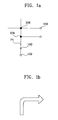
- a moving object 100 sequentially drives along links between nodes 102, 104 and 106, and then turns to the right at the node 106 as an intersection to drive on the link between the node 106 and a node 108.
- a navigation system determines whether the node 106, as a guide target of a drive path, is located within a set distance ahead of the moving object 100. In particular, the navigation system determines whether the moving object 100 has arrived at a guide point P1 to guide the drive path for the node 106 as the guide target.
- the navigation system guides a right turn at the node 106 using a voice signal.
- the navigation system also displays a drive direction icon for guiding the right turn, as shown in FIG. 1b, on a display unit. The user checks the drive direction icon displayed on the display unit and then turns the moving object 100 to the right at the node 106.
- the navigation system guides a right turn of the moving object 100 at the guide point P1 corresponding to a position behind the node 104 before the moving object 100 has arrived at the node 104 or 106.
- the user of the moving object 100 may be unable to correctly determine whether to make a right turn at the node 104 or at the node 106 using the guide voice signal and the drive direction icon displayed on the display unit only. Accordingly, the user of the moving object 100 fails to correctly turn the moving object 100 to the right at the node 106, but may make a right turn at the node 104 and thus deviate from the drive path.
- this description is directed to a method of guiding a drive path of a moving object in a navigation system that substantially obviates one or more problems due to limitations and disadvantages of the background art.
- a method of guiding a motor vehicle having a navigation system along a drive path includes determining a current position of the motor vehicle with a control unit of the navigation system and providing the drive path to a display unit based on the current position of the moving object.
- the method includes determining whether the motor vehicle has arrived at a complex guide point of a guide target, wherein the complex guide point includes a plurality of road interchanges within a predetermined distance of each other, the road interchanges each including a road direction angle within a common angular range.
- the method determines a first turn guide icon and a second turn guide icon for the guide target, wherein the first turn guide icon and the second turn guide icon collectively represent a suggested vehicle operation at the guide point and a drive direction at a position of the guide target from a plurality of previously stored turn guide icons.
- the determined turn guide icons are displayed sequentially relative to the drive path throughout the vehicle operation at the guide point on a display unit.
- Implementations of this aspect may include one or more of the following features.
- the common angular range is approximately 15°.
- the guide icons each differ in directional angle by approximately 5° or more.
- a method of guiding a moving object having a navigation system along a path includes determining a current position of the moving object with a control unit. The method includes determining whether the moving object has arrived at a guide point of a guide target and instructing the drive path based on the current position of the moving object. Upon arrival at the guide point, a first turn guide icon and a second turn guide icon are determined for the guide target, wherein the first turn guide icon and the second turn guide icon collectively represent a suggested vehicle operation at the guide point and a drive direction at a position of the guide target from a plurality of previously stored turn guide icons. The determined turn guide icons are sequentially displayed relative to the drive path throughout the vehicle operation at the guide point on a display unit.
- Implementations of this aspect may include one or more of the following features.
- hybrid navigation comprises receiving a navigation message with a GPS receiver and detecting a drive state detecting signal with a sensor unit.
- the detected current position of the moving object is matched to map data and the detected current position and map data are displayed on the display unit.
- the path is searched between an origination and destination of the moving object, wherein the guide target is located on the searched drive path.
- Searching the path includes inputting a search command to a command input unit.
- the origination of the moving object is a position detected by the control unit by hybrid navigation, wherein hybrid navigation comprises receiving a navigation message with a GPS receiver and detecting a drive state detecting signal with a sensor unit.
- Searching the drive path includes referencing previously stored map data with the control unit, wherein the previously stored map data is in a map data storage unit.
- the plurality of turn guide icons differ from one another with respect to a display angle per a preset angle interval.
- Determining the turn guide icons include determining turn guide icons having display angles within a range of an angle at which the moving object should be turned from the position of the guide target.
- Sequentially displaying includes determining a distance between a current position of the moving object and the position of the guide target, and sequentially displaying the turn guide icons according to the determined distance.
- the distance is determined between the current position and the position of the guide target.
- the current position of the moving object is determined with hybrid navigation by the control unit, wherein hybrid navigation includes receiving a navigation message with a GPS receiver and detecting a drive state detecting signal with a sensor unit.
- the guide point includes a complex guide point including a plurality of road interchanges within a predetermined distance of each other, the road interchanges each including a road direction angle within a common angular range.
- the common angular range is 15°.
- the first and the second icons differ in directional angle by approximately 5° or more.
- the moving object is a motor vehicle and the path is a driving path of the motor vehicle.
- a navigation system within a moving object for guiding the moving object along a drive path includes a satellite navigation system receiver, a sensor unit for detecting a driving direction and operating state of the moving object independently from the satellite navigation system receiver, a map data storage unit, a display unit, and a control unit.
- Implementations of this aspect may include one or more of the following features.
- the control unit is configured for determining whether the moving object has arrived at a guide point of a guide target for instructing the drive path based on the current position of the moving object and the driving direction and the operating state of the moving object.
- the control unit is configured for determining, upon arrival at the guide point, a first turn guide icon and a second turn guide icon for the guide target, wherein the first turn guide icon and the second turn guide icon collectively represent a suggested vehicle operation at the guide point and a drive direction at a position of the guide target from a plurality of previously stored turn guide icons within the map data storage unit.
- the control unit is configured for sequentially displaying the determined turn guide icons relative to the drive path throughout the vehicle operation at the guide point on the display unit.
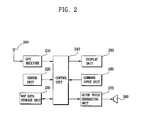
- FIG. 2 is a block diagram of a navigation system includes a GPS receiver 210 which receives navigation messages transmitted from a plurality of GPS satellites (not shown in the drawing).
- the GPS receiver 210 calculates and outputs a value of DOP (dilution of precision) indicating a degree of reliability of the received navigation message.
- the navigation system includes a sensor unit 220 and a map data storage unit 230.
- the sensor unit 220 may include a gyroscope for detecting a drive angle of the moving object, and various sensors, such as a speed sensor for detecting a drive speed of the moving object and the like, to detect an operating state of the moving object and to output a drive state detecting signal.
- the map data storage unit 230 stores map data for searching a drive path of the moving object and for guiding the drive path.
- the navigation system includes a control unit 240 for determining a current position of the moving object with hybrid navigation.
- the control unit 240 may be included within one or more of a central processing unit (CPU) or a computer system of the navigation system.
- the control unit, or other programmable logic device that provides instruction, logic, and mathematical processing in the navigation system may also be one or more of a CPU or computer system, e.g., including an arithmetic logic unit (ALU), which performs arithmetic and logical operations, and/or an individual control unit, which extracts instructions from a memory device, such as within the navigation system, and decodes and executes the instructions, e.g., calling on the ALU when necessary.
- ALU arithmetic logic unit
- control unit 240 may be configured for operating with hybrid navigation.
- Hybrid navigation includes using the navigation messages received by the GPS receiver 210 and the drive state detecting signal of the moving object detected by the sensor unit 220.
- the control unit 240 searches the drive path from an origination to a destination using the map data stored in the map data storage unit 230.
- the control unit 240 controls the determined current position of the moving object, by verifying the accuracy of the current position of the moving object and/or matching the current position to the map data for displaying a determined current position of the moving object.
- the control unit 240 guides the moving object to drive along the searched drive path by updating the determined current position of the moving object responsive to each new set of position data received through the navigation system, e.g., through the GPS receiver 210 and sensor unit 220 with hybrid navigation.
- the control unit 240 also determines a display position on the map where a road, highway or other landmark should be named.
- the navigation system includes a display unit 250 and a command input unit 260.
- the display unit 250 displays the map data, the current position of the moving object, the drive path of the moving object and the road name at the display position determined by the control unit 240.
- the command input unit 260 includes a plurality of function keys, generates an operation command according to user manipulation of a plurality of the function keys, and inputs the generated operation command to the control unit 240.
- a guide voice generating unit 270 generates a prescribed guide voice signal to guide a drive of the moving object according to a control of the control unit 240.
- the guide voice generating unit 270 outputs the generated guide voice signal to a speaker 280 to inform a user of the moving object of the drive path of the moving object.
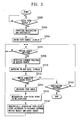
- control unit 240 determines whether a search command for a drive path is inputted by a user's manipulation of the command input unit 260 (S300). If the search command for the drive path is inputted, the control unit 240 receives an origination and destination of a moving object from the command input unit 260 (S302).
- the origination of the moving object can be set to a current position of the moving object determined by the control unit 240 using hybrid navigation that utilizes navigation messages received by the GPS receiver 210 and a drive state detecting signal of the moving object detected by the sensor unit 220.
- the control unit 240 receives a value of DOP calculated by the GPS receiver 210 having received the navigation messages. If the calculated value of the DOP is a reliable value, e.g., accuracy is within an acceptable range such as 20 feet or a probability of accuracy, as a result of the determination, the control unit 240 detects a current position of the moving object using the navigation messages received by the GPS receiver 210. If the value of DOP is not a reliable value, the control unit 240 detects a current position of the moving object using the drive state detecting signal of the moving object detected by the sensor unit 220 from a last position of the moving object detected using the reliable navigation message. Therefore, it is possible to set the origination of the moving object to the current position of the moving object detected by the hybrid navigation.
- a reliable value e.g., accuracy is within an acceptable range such as 20 feet or a probability of accuracy
- the control unit 240 searches a drive path of the moving object from the origination to the destination using map data stored in the map data storage unit 230.
- the control unit 240 determines whether the moving object is driving (S306). In doing so, a determination of the drive path of the moving object can be conducted using the moving state detecting signal of the moving object detected, for example, by the sensor unit 220 of a motor vehicle.
- the control unit 240 detects the current position of the moving object by the a hybrid navigation (S308).
- the control unit 240 matches the detected current position of the moving object to the map data and displays it on the display unit 250 to enable a user to confirm the current position (S310).
- control unit 240 determines whether the moving object has arrived at a drive direction guide point for instructing a drive direction of the moving object using the determined current position of the moving object (S312). Namely, it is determined whether a guide target, such as an intersection or the like, is located ahead of the moving object and it is determined whether the moving object has arrived at the guide point to instruct the drive path for the guide target.
- a guide target such as an intersection or the like
- the control unit 240 determines a turn angle at which the moving object will turn from the guide target (S314). Namely, the control unit 240 determines the angle of a link, on which the moving object will drive after passing through the guide target, by taking a current link on which the moving object is driving as a reference. If the guide target is a complex guide target, e.g., a first intersection that supports a right turn and a neighboring intersection that is located relatively close to the first intersection such as less than a few hundred feet, the turn angle of the moving object is updated throughout the vehicle's movement through a complex guide target.
- a complex guide target e.g., a first intersection that supports a right turn and a neighboring intersection that is located relatively close to the first intersection such as less than a few hundred feet
- the control unit 240 determines a plurality of turn guide icons to display according to the determined turn angle of the moving object (S316) during the moving object's travel through an area having a complex guide target.
- the control unit 240 then sequentially selects, according to a distance between the moving object and the guide target (S318), a plurality of the determined turn guide icons to display on the display unit 250.
- the interval of the determined turn guide icons may be predetermined for particularly confusing and known intersections and/or provided by the control unit 240 for an intersection that has not been previously designated as a complex intersection or guide target.
- FIGS. 4a through 4m A plurality of turn guide icons differing in display angle from each other by a predetermined angle, such as 15°, are shown in FIGS. 4a through 4m.
- the turn guide icons are prepared based on the physical attributes of the road and/or prepared and stored in advance, e.g., in the map data storage unit 230.
- a moving object 500 drives on a link between nodes 502, 504 and 506, turns to the right from the node 506 in a direction of 90°, and then drives on a link between the node 506 and a node 508.
- control unit 240 determines whether the moving object 50 drives to arrive at a guide point P11 for instructing a turn guide. If the moving object has arrived at the guide point P11, the control unit 240 determines an angle of the link located between the nodes 506 and 508 by taking the link between the nodes 502, 504 and 506 as a reference.
- the control unit 240 determines the turn guide icons shown in FIGS. 4a through 4m from a plurality of the turn guide icons.
- the control unit 240 keeps determining the distance between the moving object 500 and the node 502 and sequentially selects the determined turn guide icons shown in FIGS. 4a through 4m one by one to display on the display unit 250.
- the moving object 500 drives on a link between nodes 510 and 512 to turn to the left from the node 512 in a direction of a node 514. If so, by determining an angle of a link between the nodes 512 and 514 by taking a link between the nodes 510 and 512 as a reference in case the moving object 500 has arrived at a guide target point P12 for instructing a turn guide, the control unit 240 determines a plurality of the turn guide icons such as the icons shown in FIGS. 4a through 4g. The control unit 240 then keeps determining the distance between the moving object 500 and the node 512 and sequentially selects the determined turn guide icons shown in FIGS. 4a through 4g one by one to display on the display unit 250.
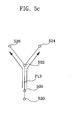
- the control unit 240 determines the turn guide icons shown in FIGS. 4g through 4j in case the moving object 500 has arrived at a guide target point P13, and then sequentially selects the determined turn guide icons shown in FIGS. 4g through 4j one by one to display on the display unit 250 according to the distance between the moving object and the node 520, such as while a motor vehicle is performing the turning operation.
- the control unit 240 determines the turn guide icons shown in FIGS. 4D through 4G in case the moving object 500 has arrived at the guide target point P13 and then sequentially selects the determined turn guide icons shown in FIGs. 4D to 4G one by one and displays each of the icons incrementally on the display unit 250 according to the distance between the moving object and the node 520.
- a plurality of the turn guide icons can be formed in various angles. For instance, a plurality of the turn guide icons are generated in advance, each 5° or 10° offset with respect to each other, and stored in the map data storage unit 230. If the moving object has not reached the guide point for instructing the turn guide as a result of the decision in the step S312, the control unit 240 determines whether the moving object has arrived at the destination (S320). If the moving object has not arrived at the destination, the control unit 240 goes back to the step S306 to detect a current position according to a drive of the moving object and repeats an operation of selecting the plurality of the turn guide icons to display on the display unit 250 in case the moving object has arrived at the guide point for instructing the turn in the drive path.
- the control unit 240 ends the drive path guide operation of the moving object.
- a plurality of the turn guide icons differing from one another in the display angle are generated in advance. If the moving object has arrived at the guide point of the guide target for instructing the drive direction, the turn guide icons belonging to the range of the angle at which the moving object is to turn are determined beforehand. The turning operation is reduced to a series of incrementally displayed turn guide icons as the motor vehicle maneuvers through a turning operation.
- the moving object has arrived at the guide target location, such as a complex guide target having multiple, similarly oriented or adjacent intersections or roads, the plurality of the selected turn guide icons are sequentially displayed.
- a user of a moving object such as a motor vehicle
- the user can accurately determine where or when to turn when approaching a confusing intersection presenting multiple and similar turning options, e.g., such as an intersection having more than one possible right turn, e.g., right turns offset with respect to each other by a specific angle. If a plurality of guide targets are located close to each other, the user can make a turn from an accurate location of the corresponding guide target to prevent the deviation from a drive path.
- a navigation system or method may guide a drive path of a moving object by providing a turning direction and angle of a moving object at an intersection.
- a navigation system or method may guide a drive path of a moving object by instructing a correct direction for a moving object to drive in the event that a pair of intersections are located close to each other.
Landscapes
- Engineering & Computer Science (AREA)
- Radar, Positioning & Navigation (AREA)
- Remote Sensing (AREA)
- Automation & Control Theory (AREA)
- Physics & Mathematics (AREA)
- General Physics & Mathematics (AREA)
- Navigation (AREA)
Abstract
Description
- This description relates to a navigation system and a method of guiding a moving object through a drive path within the navigation system.
- As the number of various moving objects, such as automotive vehicles and the like, have increased on roads and highways, traffic congestion and other stresses on infrastructure have also increased. Specifically, the number of vehicles is increasing considerably faster than the realized increase and improvements to the supporting infrastructure. Accordingly, navigations systems within vehicles and other moving objects provide a way of avoiding and/or reducing traffic congestion.
- The navigation system detects a current position using navigation messages transmitted from a plurality of GPS (global positioning system) satellites and moving-object drive state detecting signals detected by a plurality of sensors provided to the corresponding moving object, such as a gyroscope, a speed sensor and the like. If a current position of the moving object is detected, the detected current position of the moving object is matched to map data. The current position of the moving object is displayed on a display unit together with a corresponding map. The navigation system provides the functionality of searching a drive path of a moving object from an origination to a destination using the map data and the functionality of guiding the drive path to enable the moving object to drive along the searched drive path.
- The navigation system searches prescribed guide targets in front of the moving object, such as an intersection, an underpass, an overpass, a highway entrance/exit and the like, when the moving object is driving along the searched drive path. If the moving object approaches the searched guide target within a prescribed distance, the navigation system guides the drive path via a voice signal and the like.
The navigation system determines if the moving object deviates from the searched drive path and drives along another, different path. If deviation from the drive path is determined by the navigation system, the navigation system informs a user of the deviation from the drive path to enable the user to correctly maneuver the moving object along the proper drive path. Therefore, the navigation system searches for the proper drive path of the moving object and guides the moving object along the proper drive path so that the given road system can be efficientiy utilized. - The navigation system detects a current position of the moving object and determines whether a guide target is located within a set distance in front of the drive path by taking the detected current position as a reference. If the guide target is located within the set distance, the navigation system indicates a drive direction for the moving object to take from the corresponding guide target, such as indicating a left turn, using a voice signal and a drive direction icon displayed on the display unit. In guiding the drive direction of the moving object using the guide voice signal and the drive direction icon, the navigation system can accurately guide the drive direction of the moving object if the guide targets located ahead of the moving object are separated from each other by relatively large distances.
- However, if the guide targets located ahead of the moving object are considerably close to each other, the typical navigation system has difficulty in determining where the guide target for guiding the drive direction is accurately located. Hence, the user may frequently deviate from the drive path by driving the moving object in the drive direction guided according to the location of an unguided target.
- For instance, it is assumed that a
moving object 100, as shown in FIG. 1a, sequentially drives along links betweennodes node 106 as an intersection to drive on the link between thenode 106 and anode 108. A navigation system determines whether thenode 106, as a guide target of a drive path, is located within a set distance ahead of the movingobject 100. In particular, the navigation system determines whether themoving object 100 has arrived at a guide point P1 to guide the drive path for thenode 106 as the guide target. - If the
moving object 100 has arrived at the guide point P1, the navigation system guides a right turn at thenode 106 using a voice signal. The navigation system also displays a drive direction icon for guiding the right turn, as shown in FIG. 1b, on a display unit. The user checks the drive direction icon displayed on the display unit and then turns the movingobject 100 to the right at thenode 106. - However, where the two
nodes moving object 100 at the guide point P1 corresponding to a position behind thenode 104 before themoving object 100 has arrived at thenode moving object 100 may be unable to correctly determine whether to make a right turn at thenode 104 or at thenode 106 using the guide voice signal and the drive direction icon displayed on the display unit only. Accordingly, the user of themoving object 100 fails to correctly turn themoving object 100 to the right at thenode 106, but may make a right turn at thenode 104 and thus deviate from the drive path. - The Korean Patent Application No. 63322 filed in 2002 (Public Laid-Open No. 2004-34009), the entire contents of which are incorporated by reference herein, describe that a bent angle of a drive direction icon is adjusted to be displayed according to an angle of each link on which a moving object drives. Therefore, a user of the moving object driving on a current link can correctly check an angle of a next link, on which the moving object is to drive after passing through an intersection, e.g., using the bent angle of the drive direction icon.
- Accordingly, this description is directed to a method of guiding a drive path of a moving object in a navigation system that substantially obviates one or more problems due to limitations and disadvantages of the background art.
- In one general aspect, a method of guiding a motor vehicle having a navigation system along a drive path includes
determining a current position of the motor vehicle with a control unit of the navigation system and providing the drive path to a display unit based on the current position of the moving object. The method includes determining whether the motor vehicle has arrived at a complex guide point of a guide target, wherein the complex guide point includes a plurality of road interchanges within a predetermined distance of each other, the road interchanges each including a road direction angle within a common angular range. Upon arrival at the complex guide point, the method determines a first turn guide icon and a second turn guide icon for the guide target, wherein the first turn guide icon and the second turn guide icon collectively represent a suggested vehicle operation at the guide point and a drive direction at a position of the guide target from a plurality of previously stored turn guide icons. The determined turn guide icons are displayed sequentially relative to the drive path throughout the vehicle operation at the guide point on a display unit. - Implementations of this aspect may include one or more of the following features.
- The common angular range is approximately 15°. The guide icons each differ in directional angle by approximately 5° or more.
- In another general aspect, a method of guiding a moving object having a navigation system along a path includes determining a current position of the moving object with a control unit. The method includes determining whether the moving object has arrived at a guide point of a guide target and instructing the drive path based on the current position of the moving object. Upon arrival at the guide point, a first turn guide icon and a second turn guide icon are determined for the guide target, wherein the first turn guide icon and the second turn guide icon collectively represent a suggested vehicle operation at the guide point and a drive direction at a position of the guide target from a plurality of previously stored turn guide icons. The determined turn guide icons are sequentially displayed relative to the drive path throughout the vehicle operation at the guide point on a display unit.
- Implementations of this aspect may include one or more of the following features.
- The current position of the moving object is determined with hybrid navigation using the control unit, wherein hybrid navigation comprises receiving a navigation message with a GPS receiver and detecting a drive state detecting signal with a sensor unit.
- The detected current position of the moving object is matched to map data and the detected current position and map data are displayed on the display unit.
- The path is searched between an origination and destination of the moving object, wherein the guide target is located on the searched drive path. Searching the path includes inputting a search command to a command input unit.
- The origination of the moving object is a position detected by the control unit by hybrid navigation, wherein hybrid navigation comprises receiving a navigation message with a GPS receiver and detecting a drive state detecting signal with a sensor unit.
- Searching the drive path includes referencing previously stored map data with the control unit, wherein the previously stored map data is in a map data storage unit.
- The plurality of turn guide icons differ from one another with respect to a display angle per a preset angle interval.
- Determining the turn guide icons include determining turn guide icons having display angles within a range of an angle at which the moving object should be turned from the position of the guide target.
- Sequentially displaying includes determining a distance between a current position of the moving object and the position of the guide target, and sequentially displaying the turn guide icons according to the determined distance.
- The distance is determined between the current position and the position of the guide target. The current position of the moving object is determined with hybrid navigation by the control unit, wherein hybrid navigation includes receiving a navigation message with a GPS receiver and detecting a drive state detecting signal with a sensor unit.
- The guide point includes a complex guide point including a plurality of road interchanges within a predetermined distance of each other, the road interchanges each including a road direction angle within a common angular range.
- The common angular range is 15°. The first and the second icons differ in directional angle by approximately 5° or more.
- The moving object is a motor vehicle and the path is a driving path of the motor vehicle.
- In another general aspect, a navigation system within a moving object for guiding the moving object along a drive path includes a satellite navigation system receiver, a sensor unit for detecting a driving direction and operating state of the moving object independently from the satellite navigation system receiver, a map data storage unit, a display unit, and a control unit.
- Implementations of this aspect may include one or more of the following features.
- The control unit is configured for determining whether the moving object has arrived at a guide point of a guide target for instructing the drive path based on the current position of the moving object and the driving direction and the operating state of the moving object.
- The control unit is configured for determining, upon arrival at the guide point, a first turn guide icon and a second turn guide icon for the guide target, wherein the first turn guide icon and the second turn guide icon collectively represent a suggested vehicle operation at the guide point and a drive direction at a position of the guide target from a plurality of previously stored turn guide icons within the map data storage unit.
- The control unit is configured for sequentially displaying the determined turn guide icons relative to the drive path throughout the vehicle operation at the guide point on the display unit.
-
- FIGS. 1a and 1b are schematic views of an operation in which a navigation system provides a drive path for a moving object.
- FIG. 2 is a block diagram of a navigation system for guiding a moving object along a drive path.
- FIG. 3 is a flowchart of a method for guiding a moving object along a drive path.
- FIGS. 4a through 4m are exemplary diagrams of a plurality of turn guide icons for displayed on display unit of a navigation system.
- FIGS. 5a through 5c are schematic views of an operation in which a navigation system guides a moving object along a guide path.
- Reference will now be made in detail to various implementations, examples of which are illustrated in the accompanying drawings. The same reference numerals are often used in the drawings to refer to the same or like parts.
- Referring to FIG. 2 is a block diagram of a navigation system includes a
GPS receiver 210 which receives navigation messages transmitted from a plurality of GPS satellites (not shown in the drawing). TheGPS receiver 210 calculates and outputs a value of DOP (dilution of precision) indicating a degree of reliability of the received navigation message. The navigation system includes asensor unit 220 and a mapdata storage unit 230. Thesensor unit 220 may include a gyroscope for detecting a drive angle of the moving object, and various sensors, such as a speed sensor for detecting a drive speed of the moving object and the like, to detect an operating state of the moving object and to output a drive state detecting signal. The mapdata storage unit 230 stores map data for searching a drive path of the moving object and for guiding the drive path. - The navigation system includes a
control unit 240 for determining a current position of the moving object with hybrid navigation. Thecontrol unit 240 may be included within one or more of a central processing unit (CPU) or a computer system of the navigation system. The control unit, or other programmable logic device that provides instruction, logic, and mathematical processing in the navigation system may also be one or more of a CPU or computer system, e.g., including an arithmetic logic unit (ALU), which performs arithmetic and logical operations, and/or an individual control unit, which extracts instructions from a memory device, such as within the navigation system, and decodes and executes the instructions, e.g., calling on the ALU when necessary. - For example, the
control unit 240 may be configured for operating with hybrid navigation. Hybrid navigation includes using the navigation messages received by theGPS receiver 210 and the drive state detecting signal of the moving object detected by thesensor unit 220. Thecontrol unit 240 searches the drive path from an origination to a destination using the map data stored in the mapdata storage unit 230. Thecontrol unit 240 controls the determined current position of the moving object, by verifying the accuracy of the current position of the moving object and/or matching the current position to the map data for displaying a determined current position of the moving object. Thecontrol unit 240 guides the moving object to drive along the searched drive path by updating the determined current position of the moving object responsive to each new set of position data received through the navigation system, e.g., through theGPS receiver 210 andsensor unit 220 with hybrid navigation. Thecontrol unit 240 also determines a display position on the map where a road, highway or other landmark should be named. - The navigation system includes a
display unit 250 and acommand input unit 260. Thedisplay unit 250 displays the map data, the current position of the moving object, the drive path of the moving object and the road name at the display position determined by thecontrol unit 240. Thecommand input unit 260 includes a plurality of function keys, generates an operation command according to user manipulation of a plurality of the function keys, and inputs the generated operation command to thecontrol unit 240. - A guide
voice generating unit 270 generates a prescribed guide voice signal to guide a drive of the moving object according to a control of thecontrol unit 240. The guidevoice generating unit 270 outputs the generated guide voice signal to aspeaker 280 to inform a user of the moving object of the drive path of the moving object. - Referring to FIG. 3, the
control unit 240 determines whether a search command for a drive path is inputted by a user's manipulation of the command input unit 260 (S300). If the search command for the drive path is inputted, thecontrol unit 240 receives an origination and destination of a moving object from the command input unit 260 (S302). - In this case, the origination of the moving object can be set to a current position of the moving object determined by the
control unit 240 using hybrid navigation that utilizes navigation messages received by theGPS receiver 210 and a drive state detecting signal of the moving object detected by thesensor unit 220. - In hybrid navigation, the
control unit 240 receives a value of DOP calculated by theGPS receiver 210 having received the navigation messages. If the calculated value of the DOP is a reliable value, e.g., accuracy is within an acceptable range such as 20 feet or a probability of accuracy, as a result of the determination, thecontrol unit 240 detects a current position of the moving object using the navigation messages received by theGPS receiver 210. If the value of DOP is not a reliable value, thecontrol unit 240 detects a current position of the moving object using the drive state detecting signal of the moving object detected by thesensor unit 220 from a last position of the moving object detected using the reliable navigation message. Therefore, it is possible to set the origination of the moving object to the current position of the moving object detected by the hybrid navigation. - Once the origination and destination of the moving object are inputted, the
control unit 240 searches a drive path of the moving object from the origination to the destination using map data stored in the mapdata storage unit 230. Thecontrol unit 240 then determines whether the moving object is driving (S306). In doing so, a determination of the drive path of the moving object can be conducted using the moving state detecting signal of the moving object detected, for example, by thesensor unit 220 of a motor vehicle. - If the moving object is determined to be driving, the
control unit 240 detects the current position of the moving object by the a hybrid navigation (S308). Thecontrol unit 240 matches the detected current position of the moving object to the map data and displays it on thedisplay unit 250 to enable a user to confirm the current position (S310). - Under this circumstance, the
control unit 240 determines whether the moving object has arrived at a drive direction guide point for instructing a drive direction of the moving object using the determined current position of the moving object (S312). Namely, it is determined whether a guide target, such as an intersection or the like, is located ahead of the moving object and it is determined whether the moving object has arrived at the guide point to instruct the drive path for the guide target. - If the moving object has arrived at the guide point, the
control unit 240 determines a turn angle at which the moving object will turn from the guide target (S314). Namely, thecontrol unit 240 determines the angle of a link, on which the moving object will drive after passing through the guide target, by taking a current link on which the moving object is driving as a reference. If the guide target is a complex guide target, e.g., a first intersection that supports a right turn and a neighboring intersection that is located relatively close to the first intersection such as less than a few hundred feet, the turn angle of the moving object is updated throughout the vehicle's movement through a complex guide target. - For example, once the turn angle of the moving object is determined, the
control unit 240 determines a plurality of turn guide icons to display according to the determined turn angle of the moving object (S316) during the moving object's travel through an area having a complex guide target. Thecontrol unit 240 then sequentially selects, according to a distance between the moving object and the guide target (S318), a plurality of the determined turn guide icons to display on thedisplay unit 250. The interval of the determined turn guide icons may be predetermined for particularly confusing and known intersections and/or provided by thecontrol unit 240 for an intersection that has not been previously designated as a complex intersection or guide target. - A plurality of turn guide icons differing in display angle from each other by a predetermined angle, such as 15°, are shown in FIGS. 4a through 4m. The turn guide icons are prepared based on the physical attributes of the road and/or prepared and stored in advance, e.g., in the map
data storage unit 230. - For instance, it is assumed that a moving
object 500, as shown in FIG. 5a, drives on a link betweennodes node 506 in a direction of 90°, and then drives on a link between thenode 506 and anode 508. - If so, the
control unit 240 determines whether the moving object 50 drives to arrive at a guide point P11 for instructing a turn guide. If the moving object has arrived at the guide point P11, thecontrol unit 240 determines an angle of the link located between thenodes nodes - Once the angle is determined, the
control unit 240 determines the turn guide icons shown in FIGS. 4a through 4m from a plurality of the turn guide icons. Thecontrol unit 240 keeps determining the distance between the movingobject 500 and thenode 502 and sequentially selects the determined turn guide icons shown in FIGS. 4a through 4m one by one to display on thedisplay unit 250. - It is assumed that the moving
object 500, as shown in FIG. 5b, drives on a link betweennodes node 512 in a direction of anode 514. If so, by determining an angle of a link between thenodes nodes object 500 has arrived at a guide target point P12 for instructing a turn guide, thecontrol unit 240 determines a plurality of the turn guide icons such as the icons shown in FIGS. 4a through 4g. Thecontrol unit 240 then keeps determining the distance between the movingobject 500 and thenode 512 and sequentially selects the determined turn guide icons shown in FIGS. 4a through 4g one by one to display on thedisplay unit 250. - It is assumed that the moving
object 500, as shown in FIG. 5c, drives on a link betweennodes node 522 at about 45°. Thecontrol unit 240 determines the turn guide icons shown in FIGS. 4g through 4j in case the movingobject 500 has arrived at a guide target point P13, and then sequentially selects the determined turn guide icons shown in FIGS. 4g through 4j one by one to display on thedisplay unit 250 according to the distance between the moving object and thenode 520, such as while a motor vehicle is performing the turning operation. - It is assumed that the moving
object 500, as shown in FIG. 5c, drives on the link betweennodes node 522 at about 45°. If so, thecontrol unit 240 determines the turn guide icons shown in FIGS. 4D through 4G in case the movingobject 500 has arrived at the guide target point P13 and then sequentially selects the determined turn guide icons shown in FIGs. 4D to 4G one by one and displays each of the icons incrementally on thedisplay unit 250 according to the distance between the moving object and thenode 520. - In this case, a plurality of the turn guide icons can be formed in various angles. For instance, a plurality of the turn guide icons are generated in advance, each 5° or 10° offset with respect to each other, and stored in the map
data storage unit 230. If the moving object has not reached the guide point for instructing the turn guide as a result of the decision in the step S312, thecontrol unit 240 determines whether the moving object has arrived at the destination (S320). If the moving object has not arrived at the destination, thecontrol unit 240 goes back to the step S306 to detect a current position according to a drive of the moving object and repeats an operation of selecting the plurality of the turn guide icons to display on thedisplay unit 250 in case the moving object has arrived at the guide point for instructing the turn in the drive path. - If the moving object has arrived at the destination, the
control unit 240 ends the drive path guide operation of the moving object. As mentioned in the foregoing description, a plurality of the turn guide icons differing from one another in the display angle are generated in advance. If the moving object has arrived at the guide point of the guide target for instructing the drive direction, the turn guide icons belonging to the range of the angle at which the moving object is to turn are determined beforehand. The turning operation is reduced to a series of incrementally displayed turn guide icons as the motor vehicle maneuvers through a turning operation. - As the moving object has arrived at the guide target location, such as a complex guide target having multiple, similarly oriented or adjacent intersections or roads, the plurality of the selected turn guide icons are sequentially displayed.
- Accordingly, one or more of the foregoing implementations may include one or more of the following features. A user of a moving object, such as a motor vehicle, can accurately determine when to turn the vehicle when the vehicle approaches a guide target location, such as an intersection, with the aid of a plurality of turn guide icons sequentially displayed on a display unit throughout the turning sequence. Accordingly, the user can accurately determine where or when to turn when approaching a confusing intersection presenting multiple and similar turning options, e.g., such as an intersection having more than one possible right turn, e.g., right turns offset with respect to each other by a specific angle. If a plurality of guide targets are located close to each other, the user can make a turn from an accurate location of the corresponding guide target to prevent the deviation from a drive path.
- A navigation system or method may guide a drive path of a moving object by providing a turning direction and angle of a moving object at an intersection. A navigation system or method may guide a drive path of a moving object by instructing a correct direction for a moving object to drive in the event that a pair of intersections are located close to each other.
- It should be understood that the above-described implementations are not limited by any of the details of the foregoing description. Accordingly, other implementations are within the scope of the following claims.
Claims (19)
- A method of guiding a motor vehicle having a navigation system along a drive path, the method comprising:determining a current position of the motor vehicle with a control unit of the navigation system and providing the drive path to a display unit based on the current position of the moving object;determining whether the motor vehicle has arrived at a complex guide point of a guide target, wherein the complex guide point includes a plurality of road interchanges within a predetermined distance of each other, the road interchanges each including a road direction angle within a common angular range;determining upon arrival at the complex guide point, a first turn guide icon and a second turn guide icon for the guide target, wherein the first turn guide icon and the second turn guide icon collectively represent a suggested vehicle operation at the guide point and a drive direction at a position of the guide target from a plurality of previously stored turn guide icons; andsequentially displaying the determined turn guide icons relative to the drive path throughout the vehicle operation at the guide point on a display unit.
- The method of claim 1, wherein the common angular range is approximately 15°.
- The method of claim 1, wherein the guide icons each differ in directional angle by approximately 5° or more.
- A method of guiding a moving object having a navigation system along a path, the method comprising:determining a current position of the moving object with a control unit;determining whether the moving object has arrived at a guide point of a guide target and instructing the drive path based on the current position of the moving object;determining, upon arrival at the guide point, a first turn guide icon and a second turn guide icon for the guide target, wherein the first turn guide icon and the second turn guide icon collectively represent a suggested vehicle operation at the guide point and a drive direction at a position of the guide target from a plurality of previously stored turn guide icons; andsequentially displaying the determined turn guide icons relative to the drive path throughout the vehicle operation at the guide point on a display unit.
- The method of claim 4, wherein the current position of the moving object is determined with hybrid navigation using the control unit, wherein hybrid navigation comprises receiving a navigation message with a GPS receiver and detecting a drive state detecting signal with a sensor unit.
- The method of claim 4, further comprising:matching the detected current position of the moving object to map data; anddisplaying the detected current position and map data on the display unit.
- The method of claim 4, further comprising searching the path between an origination and destination of the moving object, wherein the guide target is located on the searched path.
- The method of claim 7, wherein searching the path comprises includes inputting a search command to a command input unit.
- The method of claim 7, wherein the origination of the moving object is a position detected by the control unit by hybrid navigation, wherein hybrid navigation comprises receiving a navigation message with a GPS receiver and detecting a drive state detecting signal with a sensor unit.
- The method of claim 7, wherein searching the path comprises referencing previously stored map data with the control unit, wherein the previously stored map data is in a map data storage unit.
- The method of claim 4, wherein the plurality of turn guide icons differ from one another with respect to a display angle per a preset angle interval.
- The method of claim 4, wherein determining the turn guide icons comprises determining turn guide icons having display angles within a range of an angle at which the moving object should be turned from the position of the guide target.
- The method of claim 4, wherein sequentially displaying comprises:determining a distance between a current position of the moving object andthe position of the guide target; andsequentially displaying the turn guide icons according to the determined distance.
- The method of claim 13, wherein determining the distance between the current position and the position of the guide target comprises determining the current position of the moving object with hybrid navigation by the control unit, wherein hybrid navigation comprises receiving a navigation message with a GPS receiver and detecting a drive state detecting signal with a sensor unit.
- The method of claim 4, wherein the guide point comprises a complex guide point including a plurality of road interchanges within a predetermined distance of each other, the road interchanges each including a road direction angle within a common angular range.
- The method of claim 4, wherein the common angular range is 15°.
- The method of claim 4, wherein the first and the second icons differ in directional angle by approximately 5° or more.
- The method of claim 4, wherein the moving object is a motor vehicle and the path is a driving path of the motor vehicle.
- A navigation system within a moving object for guiding the moving object along a drive path, the system comprising:a satellite navigation system receiver;a sensor unit for detecting a driving direction and operating state of the moving object independently from the satellite navigation system receiver;a map data storage unit;a display unit; anda control unit, wherein the control unit is configured for determining a current position of the moving object from data received from the satellite navigation system receiver;wherein the control unit is configured for determining whether the moving object has arrived at a guide point of a guide target for instructing the drive path based on the current position of the moving object and the driving direction and the operating state of the moving object;wherein the control unit is configured for determining, upon arrival at the guide point, a first turn guide icon and a second turn guide icon for the guide target, wherein the first turn guide icon and the second turn guide icon collectively represent a suggested vehicle operation at the guide point and a drive direction at a position of the guide target from a plurality of previously stored turn guide icons within the map data storage unit; andwherein the control unit is configured for sequentially displaying the determined turn guide icons relative to the drive path throughout the vehicle operation at the guide point on the display unit.
Applications Claiming Priority (1)
| Application Number | Priority Date | Filing Date | Title |
|---|---|---|---|
| KR1020050012859A KR101047719B1 (en) | 2005-02-16 | 2005-02-16 | Method and device for driving route guidance of moving object in navigation system |
Publications (3)
| Publication Number | Publication Date |
|---|---|
| EP1696209A2 true EP1696209A2 (en) | 2006-08-30 |
| EP1696209A3 EP1696209A3 (en) | 2011-12-07 |
| EP1696209B1 EP1696209B1 (en) | 2013-10-02 |
Family
ID=36659868
Family Applications (1)
| Application Number | Title | Priority Date | Filing Date |
|---|---|---|---|
| EP06003142.4A Expired - Lifetime EP1696209B1 (en) | 2005-02-16 | 2006-02-16 | Guiding a drive path of a moving object in a navigation system |
Country Status (4)
| Country | Link |
|---|---|
| US (1) | US7630832B2 (en) |
| EP (1) | EP1696209B1 (en) |
| KR (1) | KR101047719B1 (en) |
| CN (1) | CN1821719B (en) |
Cited By (1)
| Publication number | Priority date | Publication date | Assignee | Title |
|---|---|---|---|---|
| EP1780508A1 (en) * | 2005-10-31 | 2007-05-02 | Aisin AW., Ltd. | Route guidance system and route guidance method |
Families Citing this family (56)
| Publication number | Priority date | Publication date | Assignee | Title |
|---|---|---|---|---|
| US8892356B1 (en) * | 2003-06-19 | 2014-11-18 | Here Global B.V. | Method and system for representing traffic signals in a road network database |
| US9341485B1 (en) | 2003-06-19 | 2016-05-17 | Here Global B.V. | Method and apparatus for representing road intersections |
| JP4792866B2 (en) * | 2005-08-05 | 2011-10-12 | アイシン・エィ・ダブリュ株式会社 | Navigation system |
| JP4724043B2 (en) * | 2006-05-17 | 2011-07-13 | トヨタ自動車株式会社 | Object recognition device |
| JP2008009915A (en) * | 2006-06-30 | 2008-01-17 | Pioneer Electronic Corp | Road sign determination apparatus, method and program |
| US8335645B2 (en) * | 2007-03-28 | 2012-12-18 | Navitime Japan Co., Ltd. | Map display system, map display, and map display method |
| US7908082B2 (en) * | 2007-05-04 | 2011-03-15 | The Boeing Company | Methods and systems for displaying airport moving map information |
| KR100870091B1 (en) * | 2007-05-11 | 2008-11-25 | 팅크웨어(주) | Method and apparatus for judging rotation state using sensor |
| JP4366664B2 (en) * | 2007-06-29 | 2009-11-18 | アイシン・エィ・ダブリュ株式会社 | Own vehicle position recognition device and own vehicle position recognition program |
| CN101424535B (en) * | 2007-10-30 | 2012-05-30 | 武汉大学 | Vehicle positioning method and device in multi-layer road |
| KR100939925B1 (en) * | 2007-12-27 | 2010-02-04 | 팅크웨어(주) | Apparatus and method for displaying guiding symbol of intersection point of navigation system |
| US8346465B2 (en) * | 2008-02-26 | 2013-01-01 | Apline Electronics, Inc | Method and apparatus for determining and displaying meaningful cross street for navigation system |
| JP4656177B2 (en) * | 2008-04-14 | 2011-03-23 | トヨタ自動車株式会社 | Navigation device, operation unit display method |
| CN101290230B (en) * | 2008-04-14 | 2011-03-30 | 深圳市凯立德软件技术股份有限公司 | A navigation method for an intersection and a navigation system using the navigation method |
| CN101983316A (en) * | 2008-05-29 | 2011-03-02 | 通腾科技股份有限公司 | A navigation device and method for altering map information related to audible information |
| KR101013197B1 (en) * | 2008-06-13 | 2011-02-10 | (주)엠앤소프트 | Vehicle navigation device and its route guidance method |
| CN101373141B (en) * | 2008-10-16 | 2012-01-04 | 深圳市凯立德科技股份有限公司 | Navigation system and navigation method performing voice prompt on continuous node path section |
| CN101373142B (en) * | 2008-10-16 | 2012-01-04 | 深圳市凯立德欣软件技术有限公司 | Navigation system and accurate navigation method of road crossing |
| US20100228158A1 (en) * | 2009-03-05 | 2010-09-09 | Searete Llc, A Limited Liability Corporation Of The State Of Delaware | Postural information system and method including device level determining of subject advisory information based on subject status information and postural influencer status information |
| US20100228159A1 (en) * | 2009-03-05 | 2010-09-09 | Searete Llc, A Limited Liability Corporation Of The State Of Delaware | Postural information system and method |
| US20100228494A1 (en) * | 2009-03-05 | 2010-09-09 | Searete Llc, A Limited Liability Corporation Of The State Of Delaware | Postural information system and method including determining subject advisory information based on prior determined subject advisory information |
| US20100228495A1 (en) * | 2009-03-05 | 2010-09-09 | Searete Llc, A Limited Liability Corporation Of The State Of Delaware | Postural information system and method including determining subject advisory information based on prior determined subject advisory information |
| US20100228153A1 (en) * | 2009-03-05 | 2010-09-09 | Searete Llc, A Limited Liability Corporation Of The State Of Delaware | Postural information system and method |
| US20100225498A1 (en) * | 2009-03-05 | 2010-09-09 | Searete Llc, A Limited Liability Corporation | Postural information system and method |
| US20100225490A1 (en) * | 2009-03-05 | 2010-09-09 | Leuthardt Eric C | Postural information system and method including central determining of subject advisory information based on subject status information and postural influencer status information |
| US20100228487A1 (en) * | 2009-03-05 | 2010-09-09 | Searete Llc, A Limited Liability Corporation Of The State Of Delaware | Postural information system and method |
| US9024976B2 (en) * | 2009-03-05 | 2015-05-05 | The Invention Science Fund I, Llc | Postural information system and method |
| US20100228493A1 (en) * | 2009-03-05 | 2010-09-09 | Searete Llc, A Limited Liability Corporation Of The State Of Delaware | Postural information system and method including direction generation based on collection of subject advisory information |
| US20100228490A1 (en) * | 2009-03-05 | 2010-09-09 | Searete Llc, A Limited Liability Corporation Of The State Of Delaware | Postural information system and method |
| US20100228488A1 (en) * | 2009-03-05 | 2010-09-09 | Searete Llc, A Limited Liability Corporation Of The State Of Delaware | Postural information system and method |
| US20100225473A1 (en) * | 2009-03-05 | 2010-09-09 | Searete Llc, A Limited Liability Corporation Of The State Of Delaware | Postural information system and method |
| US20100228492A1 (en) * | 2009-03-05 | 2010-09-09 | Searete Llc, A Limited Liability Corporation Of State Of Delaware | Postural information system and method including direction generation based on collection of subject advisory information |
| US20100271200A1 (en) * | 2009-03-05 | 2010-10-28 | Searete Llc, A Limited Liability Corporation Of The State Of Delaware | Postural information system and method including determining response to subject advisory information |
| US20100225491A1 (en) * | 2009-03-05 | 2010-09-09 | Searete Llc, A Limited Liability Corporation Of The State Of Delaware | Postural information system and method |
| US20100225474A1 (en) * | 2009-03-05 | 2010-09-09 | Searete Llc, A Limited Liability Corporation Of The State Of Delaware | Postural information system and method |
| US20100228154A1 (en) * | 2009-03-05 | 2010-09-09 | Searete Llc, A Limited Liability Corporation Of The State Of Delaware | Postural information system and method including determining response to subject advisory information |
| US8838370B2 (en) * | 2009-03-09 | 2014-09-16 | Empire Technology Development Llc | Traffic flow model to provide traffic flow information |
| US8463537B2 (en) * | 2009-06-03 | 2013-06-11 | Motorola Solutions, Inc. | Navigating to a moving destination |
| US20110087425A1 (en) * | 2009-10-08 | 2011-04-14 | Telenav, Inc. | Navigation system with map compression and method of operation thereof |
| US9140573B2 (en) * | 2010-07-23 | 2015-09-22 | Google Inc. | Path finding in a map editor |
| CN102322868A (en) * | 2011-09-15 | 2012-01-18 | 鸿富锦精密工业(深圳)有限公司 | Vehicle navigation apparatus and vehicle navigation method |
| US9026367B2 (en) | 2012-06-27 | 2015-05-05 | Microsoft Technology Licensing, Llc | Dynamic destination navigation system |
| US10106172B2 (en) * | 2014-08-18 | 2018-10-23 | Ford Global Technologies, Llc | Shared vehicle system |
| US9909894B2 (en) | 2016-01-07 | 2018-03-06 | Here Global B.V. | Componentized junction models |
| WO2017127787A1 (en) * | 2016-01-23 | 2017-07-27 | Blustream Corporation | Intelligent power management for monitoring a movable object |
| US10234294B2 (en) | 2016-04-01 | 2019-03-19 | Here Global B.V. | Road geometry matching with componentized junction models |
| CN107402019A (en) * | 2016-05-19 | 2017-11-28 | 北京搜狗科技发展有限公司 | The method, apparatus and server of a kind of video navigation |
| CN108072375B (en) * | 2016-11-09 | 2020-01-10 | 腾讯科技(深圳)有限公司 | Information identification method in navigation and terminal |
| CN108106628B (en) * | 2016-11-25 | 2023-01-24 | 沈阳美行科技股份有限公司 | Method and device for generating guide prompt identifier |
| CN108646750B (en) * | 2018-06-08 | 2021-05-07 | 杭州电子科技大学 | A convenient factory AGV following method based on UWB non-base station |
| KR102664113B1 (en) * | 2018-11-16 | 2024-05-10 | 현대자동차주식회사 | Vehicle location estimation apparatus and method |
| KR102924246B1 (en) * | 2019-11-06 | 2026-02-10 | 엘지전자 주식회사 | Vehicle display device and control method thereof |
| CN111624636B (en) * | 2020-05-25 | 2023-06-20 | 腾讯科技(深圳)有限公司 | Data processing method, device, electronic device, and computer-readable medium |
| CN114184208B (en) * | 2021-12-06 | 2024-11-15 | 北京中交兴路信息科技有限公司 | Method, device, electronic device and medium for providing navigation route for vehicle |
| JP2024146279A (en) * | 2023-03-31 | 2024-10-15 | パナソニックオートモーティブシステムズ株式会社 | Display system and control method |
| CN118135833B (en) * | 2024-03-05 | 2026-04-07 | 北京欧尚聚创科技有限公司 | Intelligent logistics park management method, device, medium and product |
Citations (1)
| Publication number | Priority date | Publication date | Assignee | Title |
|---|---|---|---|---|
| KR20040034009A (en) | 2002-10-16 | 2004-04-28 | 엘지전자 주식회사 | guidance system at a crossing and the operating method |
Family Cites Families (51)
| Publication number | Priority date | Publication date | Assignee | Title |
|---|---|---|---|---|
| JP2618254B2 (en) * | 1988-02-15 | 1997-06-11 | 本田技研工業株式会社 | Travel route display device |
| US5206811A (en) * | 1989-11-10 | 1993-04-27 | Nissan Motor Company, Limited | Navigation system for automotive vehicle |
| US5654892A (en) * | 1991-10-18 | 1997-08-05 | Zexel Usa Corporation | Navigation system displaying forthcoming turns |
| JPH0634384A (en) * | 1992-07-16 | 1994-02-08 | Zexel Corp | Vehicular navigation device |
| US5410486A (en) * | 1992-07-20 | 1995-04-25 | Toyota Jidosha K.K. | Navigation system for guiding vehicle by voice |
| US5390122A (en) * | 1993-05-07 | 1995-02-14 | Lectron Products, Inc. | Method and apparatus for calibrating a vehicle compass system |
| US5512904A (en) * | 1994-06-13 | 1996-04-30 | Andrew Corporation | Method and apparatus of establishing a vehicle azimuth |
| US5525998A (en) * | 1994-08-01 | 1996-06-11 | Motorola, Inc. | Odometer assisted GPS navigation method |
| KR960705190A (en) * | 1994-08-08 | 1996-10-09 | 요트.게.아. 롤페즈 | A navigation device for a land vehicle with means for generating a multi-element anticipatory speech message, and a vehicle comprising such device |
| US5684940A (en) * | 1995-03-13 | 1997-11-04 | Rutgers, The States University Of New Jersey | Computer-implemented method and apparatus for automatically labeling area regions of maps using two-step label placing procedure and for curved labeling of point features |
| US5627547A (en) * | 1995-04-07 | 1997-05-06 | Delco Electronics Corporation | Mapless GPS navigation system in vehicle entertainment system |
| JP3545839B2 (en) * | 1995-06-09 | 2004-07-21 | 株式会社ザナヴィ・インフォマティクス | Current position calculation device |
| JP3448134B2 (en) * | 1995-08-25 | 2003-09-16 | アイシン・エィ・ダブリュ株式会社 | Vehicle navigation system |
| US5874905A (en) * | 1995-08-25 | 1999-02-23 | Aisin Aw Co., Ltd. | Navigation system for vehicles |
| KR960042490A (en) * | 1995-11-09 | 1996-12-21 | 모리 하루오 | Vehicle navigation device and recording medium therefor |
| KR100224326B1 (en) * | 1995-12-26 | 1999-10-15 | 모리 하루오 | Car navigation system |
| JPH09184737A (en) * | 1995-12-28 | 1997-07-15 | Mitsumi Electric Co Ltd | Navigation system |
| JPH09297030A (en) * | 1996-05-02 | 1997-11-18 | Pioneer Electron Corp | Method and device for calculating moving body position, and method and device for correcting moving body position |
| DE19711092A1 (en) * | 1997-03-17 | 1998-09-24 | Philips Patentverwaltung | Navigation system and method for outputting direction information from the navigation system |
| US6611753B1 (en) * | 1998-04-17 | 2003-08-26 | Magellan Dis, Inc. | 3-dimensional intersection display for vehicle navigation system |
| US6356840B2 (en) * | 1998-06-12 | 2002-03-12 | Mitsubishi Denki Kabushiki Kaisha | Navigation device with a three dimensional display |
| DE19906863A1 (en) * | 1999-02-18 | 2000-10-19 | Nokia Mobile Phones Ltd | Procedure for navigating an object |
| JP3412684B2 (en) * | 1999-03-01 | 2003-06-03 | アイシン・エィ・ダブリュ株式会社 | Navigation device and recording medium of the device |
| US6212471B1 (en) * | 1999-04-28 | 2001-04-03 | Lockheed Martin Corporation | Dynamic optimal sensor employment for searching an area |
| DE19944067A1 (en) * | 1999-09-14 | 2001-03-15 | Mannesmann Vdo Ag | Procedure for displaying primary and secondary information |
| US6510382B2 (en) * | 2000-01-26 | 2003-01-21 | Daimlerchrysler Ag | Method for obtaining precision road maps |
| JP3455153B2 (en) * | 2000-02-16 | 2003-10-14 | 松下電器産業株式会社 | Lane guidance display method at intersection, navigation device thereof, and recording medium |
| JP3967061B2 (en) * | 2000-03-28 | 2007-08-29 | アルパイン株式会社 | Navigation device |
| JP2001289654A (en) * | 2000-04-11 | 2001-10-19 | Equos Research Co Ltd | NAVIGATION DEVICE, NAVIGATION DEVICE CONTROL METHOD, AND RECORDING MEDIUM RECORDING ITS PROGRAM |
| JP2001304903A (en) * | 2000-04-27 | 2001-10-31 | Denso Corp | Branch guidance device |
| DE10037573B4 (en) * | 2000-08-02 | 2005-05-19 | Robert Bosch Gmbh | Navigation method in a motor vehicle |
| KR100353649B1 (en) * | 2000-08-18 | 2002-09-28 | 삼성전자 주식회사 | Navigation system using wireless communication network and route guidance method thereof |
| US6405107B1 (en) * | 2001-01-11 | 2002-06-11 | Gary Derman | Virtual instrument pilot: an improved method and system for navigation and control of fixed wing aircraft |
| US6728634B2 (en) * | 2001-01-29 | 2004-04-27 | Mitsubishi Denki Kabushiki Kaisha | Destination route guiding method |
| CN1258075C (en) * | 2001-02-14 | 2006-05-31 | 松下电器产业株式会社 | Vehiculor pilot system |
| KR100353652B1 (en) * | 2001-05-03 | 2002-09-28 | 삼성전자 주식회사 | Apparatus and method for guiding to drive into route in navigation system using portable terminal |
| US20030132860A1 (en) * | 2001-09-21 | 2003-07-17 | Honeywell International, Inc. | Interface for visual cueing and control for tactical flightpath management |
| DE10146744A1 (en) * | 2001-09-22 | 2003-04-17 | Bosch Gmbh Robert | Method and system for providing lane recommendations |
| KR100412720B1 (en) * | 2001-12-19 | 2003-12-31 | 현대자동차주식회사 | Navigation system for vehicles |
| US7327280B2 (en) * | 2002-08-15 | 2008-02-05 | California Institute Of Technology | Emergency vehicle traffic signal preemption system |
| US6771189B2 (en) * | 2002-07-17 | 2004-08-03 | Alpine Electronics, Inc. | Display method and apparatus for navigation system |
| US20040204831A1 (en) * | 2002-10-30 | 2004-10-14 | Denis Pochuev | System and method of locating a resource device from a wireless device |
| JP4098106B2 (en) * | 2003-01-29 | 2008-06-11 | 三菱電機株式会社 | Vehicle navigation system |
| JP2004286559A (en) * | 2003-03-20 | 2004-10-14 | Mitsubishi Electric Corp | Vehicle navigation system and route guidance method |
| US9341485B1 (en) * | 2003-06-19 | 2016-05-17 | Here Global B.V. | Method and apparatus for representing road intersections |
| KR100811232B1 (en) * | 2003-07-18 | 2008-03-07 | 엘지전자 주식회사 | Turn-by-turn navigation system and how to guide |
| US7054745B1 (en) * | 2003-09-03 | 2006-05-30 | Microsoft Corporation | Method and system for generating driving directions |
| KR100982058B1 (en) * | 2003-10-20 | 2010-09-13 | 엘지전자 주식회사 | How to manage map data of moving objects |
| JP4211620B2 (en) * | 2004-01-30 | 2009-01-21 | 株式会社デンソー | Car navigation system |
| US7353111B2 (en) * | 2004-05-14 | 2008-04-01 | Nissan Motor Co., Ltd. | Navigation system performing route guidance for vehicle |
| US20060085128A1 (en) * | 2004-10-15 | 2006-04-20 | Grafe V G | User-friendly directional device |
-
2005
- 2005-02-16 KR KR1020050012859A patent/KR101047719B1/en not_active Expired - Lifetime
-
2006
- 2006-02-16 EP EP06003142.4A patent/EP1696209B1/en not_active Expired - Lifetime
- 2006-02-16 US US11/276,170 patent/US7630832B2/en active Active
- 2006-02-16 CN CN200610008540XA patent/CN1821719B/en not_active Expired - Lifetime
Patent Citations (1)
| Publication number | Priority date | Publication date | Assignee | Title |
|---|---|---|---|---|
| KR20040034009A (en) | 2002-10-16 | 2004-04-28 | 엘지전자 주식회사 | guidance system at a crossing and the operating method |
Cited By (1)
| Publication number | Priority date | Publication date | Assignee | Title |
|---|---|---|---|---|
| EP1780508A1 (en) * | 2005-10-31 | 2007-05-02 | Aisin AW., Ltd. | Route guidance system and route guidance method |
Also Published As
| Publication number | Publication date |
|---|---|
| US7630832B2 (en) | 2009-12-08 |
| EP1696209B1 (en) | 2013-10-02 |
| CN1821719B (en) | 2012-02-29 |
| CN1821719A (en) | 2006-08-23 |
| EP1696209A3 (en) | 2011-12-07 |
| KR20060091614A (en) | 2006-08-21 |
| US20060195258A1 (en) | 2006-08-31 |
| KR101047719B1 (en) | 2011-07-08 |
Similar Documents
| Publication | Publication Date | Title |
|---|---|---|
| US7630832B2 (en) | Guiding a drive path of a moving object in a navigation system | |
| US6418373B1 (en) | Navigation system having travel path replacing function | |
| US7653484B2 (en) | Method for determining deviation of a mobile object in a navigation system from a travel route | |
| JP2015152346A (en) | Vehicle traveling position identification device and vehicle traveling position identification program | |
| KR20060091598A (en) | How to determine the display position of road name data | |
| US8190361B2 (en) | Navigation device and method using multi-route | |
| US20150160032A1 (en) | Vehicular navigation system | |
| EP1724555A2 (en) | Method for displaying information in a navigation system | |
| US20030158653A1 (en) | Navigation device, method therefor, program therefor, and recording medium with the same program recorded | |
| JP2009036651A (en) | Navigation device, navigation method, and navigation program | |
| JP2003207342A (en) | Map information updating device and system | |
| JP2914111B2 (en) | Route guidance device | |
| US7124025B2 (en) | Vehicular navigation device | |
| JP2002310696A (en) | Navigation device | |
| JP2006064661A (en) | Navigation device | |
| JP5574810B2 (en) | Navigation device and position correction method | |
| JPH08304101A (en) | Navigation device | |
| JPH0961181A (en) | Route guidance device for vehicles | |
| JP2001349738A (en) | Navigation system | |
| KR100743316B1 (en) | How to update the position indication of the moving object of the navigation system | |
| JP2006064672A (en) | Navigation device | |
| KR100667483B1 (en) | Map Matching Method of Navigation System | |
| JP2795206B2 (en) | Route guidance device | |
| JP2746168B2 (en) | Route guidance device | |
| KR100807519B1 (en) | How to navigate the summary system of navigation system |
Legal Events
| Date | Code | Title | Description |
|---|---|---|---|
| PUAI | Public reference made under article 153(3) epc to a published international application that has entered the european phase |
Free format text: ORIGINAL CODE: 0009012 |
|
| 17P | Request for examination filed |
Effective date: 20060216 |
|
| AK | Designated contracting states |
Kind code of ref document: A2 Designated state(s): AT BE BG CH CY CZ DE DK EE ES FI FR GB GR HU IE IS IT LI LT LU LV MC NL PL PT RO SE SI SK TR |
|
| AX | Request for extension of the european patent |
Extension state: AL BA HR MK YU |
|
| RAP1 | Party data changed (applicant data changed or rights of an application transferred) |
Owner name: LG ELECTRONICS INC. |
|
| PUAL | Search report despatched |
Free format text: ORIGINAL CODE: 0009013 |
|
| AK | Designated contracting states |
Kind code of ref document: A3 Designated state(s): AT BE BG CH CY CZ DE DK EE ES FI FR GB GR HU IE IS IT LI LT LU LV MC NL PL PT RO SE SI SK TR |
|
| AX | Request for extension of the european patent |
Extension state: AL BA HR MK YU |
|
| RIC1 | Information provided on ipc code assigned before grant |
Ipc: G01C 21/36 20060101ALI20111031BHEP Ipc: G01C 21/34 20060101AFI20111031BHEP |
|
| 17Q | First examination report despatched |
Effective date: 20120627 |
|
| AKX | Designation fees paid |
Designated state(s): AT BE BG CH CY CZ DE DK EE ES FI FR GB GR HU IE IS IT LI LT LU LV MC NL PL PT RO SE SI SK TR |
|
| GRAP | Despatch of communication of intention to grant a patent |
Free format text: ORIGINAL CODE: EPIDOSNIGR1 |
|
| INTG | Intention to grant announced |
Effective date: 20130425 |
|
| GRAS | Grant fee paid |
Free format text: ORIGINAL CODE: EPIDOSNIGR3 |
|
| GRAA | (expected) grant |
Free format text: ORIGINAL CODE: 0009210 |
|
| AK | Designated contracting states |
Kind code of ref document: B1 Designated state(s): AT BE BG CH CY CZ DE DK EE ES FI FR GB GR HU IE IS IT LI LT LU LV MC NL PL PT RO SE SI SK TR |
|
| REG | Reference to a national code |
Ref country code: GB Ref legal event code: FG4D |
|
| REG | Reference to a national code |
Ref country code: CH Ref legal event code: EP Ref country code: AT Ref legal event code: REF Ref document number: 634819 Country of ref document: AT Kind code of ref document: T Effective date: 20131015 |
|
| REG | Reference to a national code |
Ref country code: IE Ref legal event code: FG4D |
|
| REG | Reference to a national code |
Ref country code: DE Ref legal event code: R096 Ref document number: 602006038631 Country of ref document: DE Effective date: 20131128 |
|
| REG | Reference to a national code |
Ref country code: AT Ref legal event code: MK05 Ref document number: 634819 Country of ref document: AT Kind code of ref document: T Effective date: 20131002 |
|
| REG | Reference to a national code |
Ref country code: NL Ref legal event code: VDEP Effective date: 20131002 |
|
| PG25 | Lapsed in a contracting state [announced via postgrant information from national office to epo] |
Ref country code: SI Free format text: LAPSE BECAUSE OF FAILURE TO SUBMIT A TRANSLATION OF THE DESCRIPTION OR TO PAY THE FEE WITHIN THE PRESCRIBED TIME-LIMIT Effective date: 20131002 |
|
| REG | Reference to a national code |
Ref country code: LT Ref legal event code: MG4D |
|
| PG25 | Lapsed in a contracting state [announced via postgrant information from national office to epo] |
Ref country code: IS Free format text: LAPSE BECAUSE OF FAILURE TO SUBMIT A TRANSLATION OF THE DESCRIPTION OR TO PAY THE FEE WITHIN THE PRESCRIBED TIME-LIMIT Effective date: 20140202 Ref country code: SE Free format text: LAPSE BECAUSE OF FAILURE TO SUBMIT A TRANSLATION OF THE DESCRIPTION OR TO PAY THE FEE WITHIN THE PRESCRIBED TIME-LIMIT Effective date: 20131002 Ref country code: CZ Free format text: LAPSE BECAUSE OF FAILURE TO SUBMIT A TRANSLATION OF THE DESCRIPTION OR TO PAY THE FEE WITHIN THE PRESCRIBED TIME-LIMIT Effective date: 20131002 Ref country code: FI Free format text: LAPSE BECAUSE OF FAILURE TO SUBMIT A TRANSLATION OF THE DESCRIPTION OR TO PAY THE FEE WITHIN THE PRESCRIBED TIME-LIMIT Effective date: 20131002 Ref country code: LT Free format text: LAPSE BECAUSE OF FAILURE TO SUBMIT A TRANSLATION OF THE DESCRIPTION OR TO PAY THE FEE WITHIN THE PRESCRIBED TIME-LIMIT Effective date: 20131002 Ref country code: BE Free format text: LAPSE BECAUSE OF FAILURE TO SUBMIT A TRANSLATION OF THE DESCRIPTION OR TO PAY THE FEE WITHIN THE PRESCRIBED TIME-LIMIT Effective date: 20131002 Ref country code: NL Free format text: LAPSE BECAUSE OF FAILURE TO SUBMIT A TRANSLATION OF THE DESCRIPTION OR TO PAY THE FEE WITHIN THE PRESCRIBED TIME-LIMIT Effective date: 20131002 |
|
| PG25 | Lapsed in a contracting state [announced via postgrant information from national office to epo] |
Ref country code: PL Free format text: LAPSE BECAUSE OF FAILURE TO SUBMIT A TRANSLATION OF THE DESCRIPTION OR TO PAY THE FEE WITHIN THE PRESCRIBED TIME-LIMIT Effective date: 20131002 Ref country code: AT Free format text: LAPSE BECAUSE OF FAILURE TO SUBMIT A TRANSLATION OF THE DESCRIPTION OR TO PAY THE FEE WITHIN THE PRESCRIBED TIME-LIMIT Effective date: 20131002 Ref country code: LV Free format text: LAPSE BECAUSE OF FAILURE TO SUBMIT A TRANSLATION OF THE DESCRIPTION OR TO PAY THE FEE WITHIN THE PRESCRIBED TIME-LIMIT Effective date: 20131002 Ref country code: CY Free format text: LAPSE BECAUSE OF FAILURE TO SUBMIT A TRANSLATION OF THE DESCRIPTION OR TO PAY THE FEE WITHIN THE PRESCRIBED TIME-LIMIT Effective date: 20131002 Ref country code: ES Free format text: LAPSE BECAUSE OF FAILURE TO SUBMIT A TRANSLATION OF THE DESCRIPTION OR TO PAY THE FEE WITHIN THE PRESCRIBED TIME-LIMIT Effective date: 20131002 |
|
| PG25 | Lapsed in a contracting state [announced via postgrant information from national office to epo] |
Ref country code: PT Free format text: LAPSE BECAUSE OF FAILURE TO SUBMIT A TRANSLATION OF THE DESCRIPTION OR TO PAY THE FEE WITHIN THE PRESCRIBED TIME-LIMIT Effective date: 20140203 |
|
| REG | Reference to a national code |
Ref country code: DE Ref legal event code: R097 Ref document number: 602006038631 Country of ref document: DE |
|
| PG25 | Lapsed in a contracting state [announced via postgrant information from national office to epo] |
Ref country code: EE Free format text: LAPSE BECAUSE OF FAILURE TO SUBMIT A TRANSLATION OF THE DESCRIPTION OR TO PAY THE FEE WITHIN THE PRESCRIBED TIME-LIMIT Effective date: 20131002 |
|
| PLBE | No opposition filed within time limit |
Free format text: ORIGINAL CODE: 0009261 |
|
| STAA | Information on the status of an ep patent application or granted ep patent |
Free format text: STATUS: NO OPPOSITION FILED WITHIN TIME LIMIT |
|
| PG25 | Lapsed in a contracting state [announced via postgrant information from national office to epo] |
Ref country code: SK Free format text: LAPSE BECAUSE OF FAILURE TO SUBMIT A TRANSLATION OF THE DESCRIPTION OR TO PAY THE FEE WITHIN THE PRESCRIBED TIME-LIMIT Effective date: 20131002 Ref country code: RO Free format text: LAPSE BECAUSE OF FAILURE TO SUBMIT A TRANSLATION OF THE DESCRIPTION OR TO PAY THE FEE WITHIN THE PRESCRIBED TIME-LIMIT Effective date: 20131002 Ref country code: IT Free format text: LAPSE BECAUSE OF FAILURE TO SUBMIT A TRANSLATION OF THE DESCRIPTION OR TO PAY THE FEE WITHIN THE PRESCRIBED TIME-LIMIT Effective date: 20131002 |
|
| 26N | No opposition filed |
Effective date: 20140703 |
|
| PG25 | Lapsed in a contracting state [announced via postgrant information from national office to epo] |
Ref country code: MC Free format text: LAPSE BECAUSE OF FAILURE TO SUBMIT A TRANSLATION OF THE DESCRIPTION OR TO PAY THE FEE WITHIN THE PRESCRIBED TIME-LIMIT Effective date: 20131002 Ref country code: LU Free format text: LAPSE BECAUSE OF FAILURE TO SUBMIT A TRANSLATION OF THE DESCRIPTION OR TO PAY THE FEE WITHIN THE PRESCRIBED TIME-LIMIT Effective date: 20140216 Ref country code: DK Free format text: LAPSE BECAUSE OF FAILURE TO SUBMIT A TRANSLATION OF THE DESCRIPTION OR TO PAY THE FEE WITHIN THE PRESCRIBED TIME-LIMIT Effective date: 20131002 |
|
| REG | Reference to a national code |
Ref country code: CH Ref legal event code: PL |
|
| REG | Reference to a national code |
Ref country code: DE Ref legal event code: R097 Ref document number: 602006038631 Country of ref document: DE Effective date: 20140703 |
|
| PG25 | Lapsed in a contracting state [announced via postgrant information from national office to epo] |
Ref country code: CH Free format text: LAPSE BECAUSE OF NON-PAYMENT OF DUE FEES Effective date: 20140228 Ref country code: LI Free format text: LAPSE BECAUSE OF NON-PAYMENT OF DUE FEES Effective date: 20140228 |
|
| REG | Reference to a national code |
Ref country code: IE Ref legal event code: MM4A |
|
| PG25 | Lapsed in a contracting state [announced via postgrant information from national office to epo] |
Ref country code: IE Free format text: LAPSE BECAUSE OF NON-PAYMENT OF DUE FEES Effective date: 20140216 |
|
| REG | Reference to a national code |
Ref country code: FR Ref legal event code: PLFP Year of fee payment: 11 |
|
| PG25 | Lapsed in a contracting state [announced via postgrant information from national office to epo] |
Ref country code: BG Free format text: LAPSE BECAUSE OF FAILURE TO SUBMIT A TRANSLATION OF THE DESCRIPTION OR TO PAY THE FEE WITHIN THE PRESCRIBED TIME-LIMIT Effective date: 20131002 |
|
| PG25 | Lapsed in a contracting state [announced via postgrant information from national office to epo] |
Ref country code: GR Free format text: LAPSE BECAUSE OF FAILURE TO SUBMIT A TRANSLATION OF THE DESCRIPTION OR TO PAY THE FEE WITHIN THE PRESCRIBED TIME-LIMIT Effective date: 20140103 |
|
| PG25 | Lapsed in a contracting state [announced via postgrant information from national office to epo] |
Ref country code: HU Free format text: LAPSE BECAUSE OF FAILURE TO SUBMIT A TRANSLATION OF THE DESCRIPTION OR TO PAY THE FEE WITHIN THE PRESCRIBED TIME-LIMIT; INVALID AB INITIO Effective date: 20060216 Ref country code: TR Free format text: LAPSE BECAUSE OF FAILURE TO SUBMIT A TRANSLATION OF THE DESCRIPTION OR TO PAY THE FEE WITHIN THE PRESCRIBED TIME-LIMIT Effective date: 20131002 |
|
| REG | Reference to a national code |
Ref country code: FR Ref legal event code: PLFP Year of fee payment: 12 |
|
| REG | Reference to a national code |
Ref country code: FR Ref legal event code: PLFP Year of fee payment: 13 |
|
| PGFP | Annual fee paid to national office [announced via postgrant information from national office to epo] |
Ref country code: DE Payment date: 20250106 Year of fee payment: 20 |
|
| PGFP | Annual fee paid to national office [announced via postgrant information from national office to epo] |
Ref country code: FR Payment date: 20250107 Year of fee payment: 20 |
|
| PGFP | Annual fee paid to national office [announced via postgrant information from national office to epo] |
Ref country code: GB Payment date: 20250106 Year of fee payment: 20 |
|
| REG | Reference to a national code |
Ref country code: DE Ref legal event code: R071 Ref document number: 602006038631 Country of ref document: DE |
|
| REG | Reference to a national code |
Ref country code: GB Ref legal event code: PE20 Expiry date: 20260215 |