EP1695682A1 - Adapter for installing patients in the gynaecological position on any flat surface - Google Patents
Adapter for installing patients in the gynaecological position on any flat surface Download PDFInfo
- Publication number
- EP1695682A1 EP1695682A1 EP04818839A EP04818839A EP1695682A1 EP 1695682 A1 EP1695682 A1 EP 1695682A1 EP 04818839 A EP04818839 A EP 04818839A EP 04818839 A EP04818839 A EP 04818839A EP 1695682 A1 EP1695682 A1 EP 1695682A1
- Authority
- EP
- European Patent Office
- Prior art keywords
- patient
- arms
- gynaecological
- articulated
- adapter
- Prior art date
- Legal status (The legal status is an assumption and is not a legal conclusion. Google has not performed a legal analysis and makes no representation as to the accuracy of the status listed.)
- Withdrawn
Links
Images
Classifications
-
- A—HUMAN NECESSITIES
- A61—MEDICAL OR VETERINARY SCIENCE; HYGIENE
- A61G—TRANSPORT, PERSONAL CONVEYANCES OR ACCOMMODATION SPECIALLY ADAPTED FOR PATIENTS OR DISABLED PERSONS; OPERATING TABLES OR CHAIRS; CHAIRS FOR DENTISTRY; FUNERAL DEVICES
- A61G7/00—Beds specially adapted for nursing; Devices for lifting patients or disabled persons
- A61G7/05—Parts, details or accessories of beds
- A61G7/065—Rests specially adapted therefor
-
- A—HUMAN NECESSITIES
- A61—MEDICAL OR VETERINARY SCIENCE; HYGIENE
- A61G—TRANSPORT, PERSONAL CONVEYANCES OR ACCOMMODATION SPECIALLY ADAPTED FOR PATIENTS OR DISABLED PERSONS; OPERATING TABLES OR CHAIRS; CHAIRS FOR DENTISTRY; FUNERAL DEVICES
- A61G13/00—Operating tables; Auxiliary appliances therefor
- A61G13/0009—Obstetrical tables or delivery beds
Definitions
- the present invention refers to a device that allows a subject to adopt a gynaecological position on a flat surface, even though it lacks from firmness, just as a bed, improving the access to the genital zone of the patient in order to facilitate her gynaecological exploration.
- the characteristics of the present invention allow the possibility to develop a gynaecological exploration and/or intervention to a patient who lies on a surface that is not specific to carry out this kind of activities.
- gynaecological stretchers have a rigid surface, are usually heavy-weight and are provided with solid supports so the patient can place her lower extremities and keep them apart with commodity while the gynaecological examination is carried out.
- One of the main advantages of this invention is that its device can be placed on a flat surface, like a bed, even though it has a small size or it lacks from firmness, so the pelvis or the lower region of the patient's back can be placed on it. That way, the pelvis' weight makes a counterweight with the lower extremities of the patient leaning on the two adjustable extensions of the device, since it has, under its functional surface, a support, characteristic of a lever mechanism, that is responsible for raising the above-mentioned adjustable extensions with regard to the basic level.
- the invention meets advantages that stem from the fact that it distinguishes itself for its basic surface that, on the nearest side of the user's legs, has two articulated arms which are crowned by an extension on which the user can place the lower extremities.
- the invention has, under the basic surface and transversally, a piece developing the function of a support so that the whole can exert on the surface a lever-like effect.
- the basic surface of the invention is located under the posterior part of the patient placed in a back layout position, to the level of the pelvis and/or the posterior part of her back, with the articulate extensions set out in a way so that the patient can lean on them her lower extremities, which lean arched on them.
- the support set out transversally under the above-mentioned basic surface of the device remains in contact with the level on which de gynaecological adaptor is placed and fixed; normally the region of the bed close to its foot.
- the device's support allows on one hand, an inclined surface that provides an elevation of the patient's pelvis upwards and simultaneously, on the other hand, it creates a lever when the patient leans her legs on the device's extensions, which increases this ascent.
- the adaptor will be placed with its transversal support in parallel to the edge of the bed closer to its foot, so that the articulated arms and its respective extreme extensions stick out from the bed's surface, which will favour the fact that the paramedic who carries out the gynaecological exploration can be placed between the legs, opened and secured, of the patient.
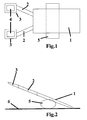
- Figure 1 shows a plan view of the device.
- Figure 2 represents a side view of the invention.
- the object of the present invention is distinguished by a basic surface (1) of quadrangular general configuration and that, as a preferential but not exclusive way of carrying out, can adopt a characteristic profile, preferably evocative of the cross section of a glass constituted by a small straight base from which two little symmetrical wings are defined since its surface extends to a narrow neck that, after a short section, expands in a more or less trapezial shape that, in each vertex of its largest side, is articulated with respective prismatic rectangular arms (2) although they could also be cylindrical or adopt another shape useful for its functionality, crowned by two quadrangular extensions (3) with an internal hole (4) or another mean used to fasten the patient's lower extremities.
- the invention incorporates transversally and under the basic surface (1) a part (5) that works as a support.
- the basic surface (1) of the invention is located under the posterior part of the patient placed in a back layout position, to the level of the pelvis and/or the posterior part of her back, with its articulated arms (2) oriented in a way so that its extensions (3) are set out in a manner so that the patient can lean on them her lower extremities, particularly fitting her heels on the internal holes (4) of these extensions (3) or on another mean for these ends.
- the support (5) located under the basic surface (1) of the device remains in contact with the level (6) on which the gynaecological adaptor used by the patient is placed and adjusted.
- the point of support (5) of the device allows an inclined plane with regard to the essential plane, which provides an elevation of the patient's pelvis upwards on one hand and, simultaneously on the other, makes a lever-like effect occurring when the patient leans her legs on the extensions (3) of the device positioning her heels on the holes (4), or on alternative fastening means that might substitute the holes, which increases this ascent.
Landscapes
- Health & Medical Sciences (AREA)
- Life Sciences & Earth Sciences (AREA)
- Animal Behavior & Ethology (AREA)
- General Health & Medical Sciences (AREA)
- Public Health (AREA)
- Veterinary Medicine (AREA)
- Gynecology & Obstetrics (AREA)
- Engineering & Computer Science (AREA)
- Biomedical Technology (AREA)
- Nursing (AREA)
- Orthopedics, Nursing, And Contraception (AREA)
- Accommodation For Nursing Or Treatment Tables (AREA)
Abstract
The invention relates to an adapter which is used to install a patient in the gynaecological position on any flat surface. The inventive adapter comprises a base surface which is articulated to two adjustable arms (2) at the area closest to the legs of the patient. The aforementioned adjustable arms (2) comprise a long, narrow structure and said arms can be folded down onto the base surface (1) in order to facilitate the transport thereof. Extension pieces (3) are provided at the ends of the arms opposite those that are articulated to the base surface, each of said extensions comprising an inner recess (4). An additional part (5) is disposed transversely beneath the base surface (1) close to the area in which the arms (2) are articulated thereto, said part (5) determining a point which can be used to form an inclined plane in relation to the main plane (6) on which it is positioned, such as to raise the pelvis of the patient.
Description
- As its own title describes, the present invention refers to a device that allows a subject to adopt a gynaecological position on a flat surface, even though it lacks from firmness, just as a bed, improving the access to the genital zone of the patient in order to facilitate her gynaecological exploration.
- The characteristics of the present invention allow the possibility to develop a gynaecological exploration and/or intervention to a patient who lies on a surface that is not specific to carry out this kind of activities.
- It is essential that the patient adopts the most optimal gynaecological position in order to reach an effective exploration. The above-mentioned position is difficult to reach unless a conventional stretcher arranged for this ends is used. The so-called gynaecological stretchers have a rigid surface, are usually heavy-weight and are provided with solid supports so the patient can place her lower extremities and keep them apart with commodity while the gynaecological examination is carried out.
- One of the main advantages of this invention is that its device can be placed on a flat surface, like a bed, even though it has a small size or it lacks from firmness, so the pelvis or the lower region of the patient's back can be placed on it. That way, the pelvis' weight makes a counterweight with the lower extremities of the patient leaning on the two adjustable extensions of the device, since it has, under its functional surface, a support, characteristic of a lever mechanism, that is responsible for raising the above-mentioned adjustable extensions with regard to the basic level. This, on one hand, facilitates a level inclined upwards which improves the view of the gynaecological explorer and, on the other hand, when the patient leans the weight of her legs on such extensions, which have some flexibility, it is achieved that the level of the pelvis rises even more allowing a better gynaecological view.
- Thus, using the present invention it becomes possible to perform a gynaecological exploration or intervention outside an specifically prepared medical centre provided with the suitable technical equipment, which can be attained by means of an adapter that has a small size and is easy to carry, which allows the paramedic a mean through which his patient can adopt the required gynaecological position in a suitable and easy way.
- As explanatory examples, where the reality of the discussed advantages of the present invention can be noticeable, we can think of hospital beds for patients who are not easy to carry due to their ill health; also patients who are at home and require an emergency visit or a gynaecological exploration once they have been discharged from hospital.
- Therefore, the invention meets advantages that stem from the fact that it distinguishes itself for its basic surface that, on the nearest side of the user's legs, has two articulated arms which are crowned by an extension on which the user can place the lower extremities.
- Furthermore, the invention has, under the basic surface and transversally, a piece developing the function of a support so that the whole can exert on the surface a lever-like effect.
- The basic surface of the invention is located under the posterior part of the patient placed in a back layout position, to the level of the pelvis and/or the posterior part of her back, with the articulate extensions set out in a way so that the patient can lean on them her lower extremities, which lean arched on them.
- The support set out transversally under the above-mentioned basic surface of the device remains in contact with the level on which de gynaecological adaptor is placed and fixed; normally the region of the bed close to its foot.
- Thus, when the patient lies down with the pelvis leaning on the basic surface of the invention with her legs on its extensions, the device's support allows on one hand, an inclined surface that provides an elevation of the patient's pelvis upwards and simultaneously, on the other hand, it creates a lever when the patient leans her legs on the device's extensions, which increases this ascent.
- In order to reach the described functional effect the adaptor will be placed with its transversal support in parallel to the edge of the bed closer to its foot, so that the articulated arms and its respective extreme extensions stick out from the bed's surface, which will favour the fact that the paramedic who carries out the gynaecological exploration can be placed between the legs, opened and secured, of the patient.
- For a better understanding of the described functionality of the present invention we have added some drawings with figures showing a preferential, but not restrictive, carrying out of the present invention.
- Figure 1 shows a plan view of the device.
- Figure 2 represents a side view of the invention.
- Through these figures, it can be noticeable that the object of the present invention is distinguished by a basic surface (1) of quadrangular general configuration and that, as a preferential but not exclusive way of carrying out, can adopt a characteristic profile, preferably evocative of the cross section of a glass constituted by a small straight base from which two little symmetrical wings are defined since its surface extends to a narrow neck that, after a short section, expands in a more or less trapezial shape that, in each vertex of its largest side, is articulated with respective prismatic rectangular arms (2) although they could also be cylindrical or adopt another shape useful for its functionality, crowned by two quadrangular extensions (3) with an internal hole (4) or another mean used to fasten the patient's lower extremities.
- Additionally, the invention incorporates transversally and under the basic surface (1) a part (5) that works as a support.
- The basic surface (1) of the invention is located under the posterior part of the patient placed in a back layout position, to the level of the pelvis and/or the posterior part of her back, with its articulated arms (2) oriented in a way so that its extensions (3) are set out in a manner so that the patient can lean on them her lower extremities, particularly fitting her heels on the internal holes (4) of these extensions (3) or on another mean for these ends.
- The support (5) located under the basic surface (1) of the device remains in contact with the level (6) on which the gynaecological adaptor used by the patient is placed and adjusted.
- That way, when the patient lies down with the pelvis leaning on the basic surface (1) of the invention, with her legs on its extensions (3) and her heels fitted on the internal holes (4), the point of support (5) of the device allows an inclined plane with regard to the essential plane, which provides an elevation of the patient's pelvis upwards on one hand and, simultaneously on the other, makes a lever-like effect occurring when the patient leans her legs on the extensions (3) of the device positioning her heels on the holes (4), or on alternative fastening means that might substitute the holes, which increases this ascent.
- All that have been described herein constitutes a loyal reflection of the present invention, taking into account that the above-described characteristics of the invention have been exposed in a wide and not limited sense, being indifferent and changing the circumstances of character merely formal, secondary or accessory which do not alter the essentiality claimed hereinafter.
Claims (1)
- Adapter for installing patients in the gynaecological position on any flat surface, characterised by its basic surface (1) with a general configuration of a plain narrow plate with a preferably quadrangular periphery, although it can also adopt other flattened designs, which is articulated, on the nearest area where the patient's legs are placed, by respective adjustable arms (2) foldable on the surface (1) to make easier its portability. The arms (2) adopt a narrow and elongated structure, while its ends opposite to its articulation with the surface (1) are crowned by an extension (3), each of which is provided with, preferably but not exclusively, an internal cut-out (4); having foreseen the transverse incorporation of a part (5), essentially with the shape of a roller, under the basic surface (1), which is placed close to the area where the arms (2) are articulated determining a point that allows an inclined level with regard to the essential surface (6) on which the above-mentioned component (5) of the adapter is placed, what allows the elevation of the patient's pelvis and, simultaneously, carries out a lever action when the user leans her legs on the extensions (3) of the device and her heels on the holes (4), or the alternative anchorage means that might substitute such holes, increasing that ascent.
Applications Claiming Priority (2)
| Application Number | Priority Date | Filing Date | Title |
|---|---|---|---|
| ES200302824A ES2244300B1 (en) | 2003-11-21 | 2003-11-21 | ADAPTER FOR GYNECOLOGICAL POSITION ON ANY FLAT. |
| PCT/ES2004/000520 WO2005048905A1 (en) | 2003-11-21 | 2004-11-19 | Adapter for installing patients in the gynaecological position on any flat surface |
Publications (1)
| Publication Number | Publication Date |
|---|---|
| EP1695682A1 true EP1695682A1 (en) | 2006-08-30 |
Family
ID=34610365
Family Applications (1)
| Application Number | Title | Priority Date | Filing Date |
|---|---|---|---|
| EP04818839A Withdrawn EP1695682A1 (en) | 2003-11-21 | 2004-11-19 | Adapter for installing patients in the gynaecological position on any flat surface |
Country Status (3)
| Country | Link |
|---|---|
| EP (1) | EP1695682A1 (en) |
| ES (1) | ES2244300B1 (en) |
| WO (1) | WO2005048905A1 (en) |
Family Cites Families (9)
| Publication number | Priority date | Publication date | Assignee | Title |
|---|---|---|---|---|
| FR993571A (en) * | 1949-06-25 | 1951-11-02 | Rech S Des Applic Mecaniques E | Simplified portable and foldable device for gynecological operations |
| US2978713A (en) * | 1959-12-16 | 1961-04-11 | Scalzitti Edward | Leg supporting apparatus |
| US3817512A (en) * | 1972-08-31 | 1974-06-18 | R Torrey | Genito-urinary examination device |
| US3907270A (en) * | 1974-12-17 | 1975-09-23 | Philomine A Ezzo | Portable examining unit with stirrups |
| US4185342A (en) * | 1978-06-16 | 1980-01-29 | Young Raymond E | Portable, adjustable backrest for beds and the like |
| DK0622042T3 (en) * | 1992-12-29 | 1996-03-18 | Schmidt & Lenhardt Gmbh & Co | Backrest for lifting device used in bathtub |
| US5913774A (en) * | 1997-10-16 | 1999-06-22 | Stryker Corporation | Hospital bed mattress with an adjustable firmness perineal end section |
| US6101652A (en) * | 1999-09-08 | 2000-08-15 | Matern, Jr.; Maximillian | Stirrups |
| AU2001289181A1 (en) * | 2000-09-01 | 2002-03-13 | Henry Ford Health System | Portable examination device |
-
2003
- 2003-11-21 ES ES200302824A patent/ES2244300B1/en not_active Expired - Fee Related
-
2004
- 2004-11-19 EP EP04818839A patent/EP1695682A1/en not_active Withdrawn
- 2004-11-19 WO PCT/ES2004/000520 patent/WO2005048905A1/en not_active Ceased
Non-Patent Citations (1)
| Title |
|---|
| See references of WO2005048905A1 * |
Also Published As
| Publication number | Publication date |
|---|---|
| WO2005048905A1 (en) | 2005-06-02 |
| ES2244300B1 (en) | 2007-09-16 |
| ES2244300A1 (en) | 2005-12-01 |
Similar Documents
| Publication | Publication Date | Title |
|---|---|---|
| US6945604B2 (en) | Lifting toilet chair | |
| US20100219668A1 (en) | Devices and Methods for Lift Assistance | |
| US6101652A (en) | Stirrups | |
| JP2002503996A (en) | Rigid seat of folding walker for the physically challenged | |
| JP2002085458A (en) | Stand-up body support device for wheelchair and wheelchair using the same | |
| US20210244584A1 (en) | Stand Assist Stool and Method | |
| US20200390627A1 (en) | Toilet with User Weight-Driven Seat Lift Profile | |
| US5852833A (en) | Toilet seat lifting device having his and her foot pedal | |
| KR20200009447A (en) | Assistive apparatus for patient movement | |
| CA2139890A1 (en) | Patient manipulating kit and method of coverting a hospital bed to a patient manipulating apparatus | |
| US4356578A (en) | Obstetrics bed | |
| JP2004236853A (en) | Examination table | |
| US4275714A (en) | Spinal positioning couch | |
| JP2005013674A (en) | Treatment bed | |
| US20060011228A1 (en) | Mobile Medical Support Device | |
| HUE025865T2 (en) | Stretching bank for health purposes | |
| US7793364B1 (en) | Wheelchair with enhanced toilet accessibility | |
| ITVI20110118A1 (en) | JOINTED STRUCTURE TO BE USED FOR THE CONSTRUCTION OF ARMCHAIRS, CHAIRS, SEATS, WHEELCHAIRS FOR DISABLED PEOPLE AND OTHER CONSIMABLE PRODUCTS. | |
| JP4289957B2 (en) | Shower folding chair | |
| US11350803B2 (en) | Toilet with user weight-driven seat lift profile | |
| JP2003164493A (en) | Comb bed device and comb bed system | |
| JP3819545B2 (en) | Chair-type simple toilet | |
| DK146353B (en) | DEVICE FOR TRANSFERING A PATIENT FROM A LOCATION TO A SITTING POSITION | |
| WO2003016642A1 (en) | Foot elevation system for toilet | |
| CN209172835U (en) | Electronic gynaecological examination chair |
Legal Events
| Date | Code | Title | Description |
|---|---|---|---|
| PUAI | Public reference made under article 153(3) epc to a published international application that has entered the european phase |
Free format text: ORIGINAL CODE: 0009012 |
|
| 17P | Request for examination filed |
Effective date: 20060614 |
|
| AK | Designated contracting states |
Kind code of ref document: A1 Designated state(s): AT BE BG CH CY CZ DE DK EE ES FI FR GB GR HU IE IS IT LI LU MC NL PL PT RO SE SI SK TR |
|
| DAX | Request for extension of the european patent (deleted) | ||
| GRAP | Despatch of communication of intention to grant a patent |
Free format text: ORIGINAL CODE: EPIDOSNIGR1 |
|
| STAA | Information on the status of an ep patent application or granted ep patent |
Free format text: STATUS: THE APPLICATION IS DEEMED TO BE WITHDRAWN |
|
| 18D | Application deemed to be withdrawn |
Effective date: 20090207 |