EP1693752A1 - Method for controlling a process resource access via a parent process - Google Patents
Method for controlling a process resource access via a parent process Download PDFInfo
- Publication number
- EP1693752A1 EP1693752A1 EP06300035A EP06300035A EP1693752A1 EP 1693752 A1 EP1693752 A1 EP 1693752A1 EP 06300035 A EP06300035 A EP 06300035A EP 06300035 A EP06300035 A EP 06300035A EP 1693752 A1 EP1693752 A1 EP 1693752A1
- Authority
- EP
- European Patent Office
- Prior art keywords
- access
- resource
- parent
- operating
- operating system
- Prior art date
- Legal status (The legal status is an assumption and is not a legal conclusion. Google has not performed a legal analysis and makes no representation as to the accuracy of the status listed.)
- Granted
Links
Images


Classifications
-
- G—PHYSICS
- G06—COMPUTING OR CALCULATING; COUNTING
- G06F—ELECTRIC DIGITAL DATA PROCESSING
- G06F9/00—Arrangements for program control, e.g. control units
- G06F9/06—Arrangements for program control, e.g. control units using stored programs, i.e. using an internal store of processing equipment to receive or retain programs
- G06F9/46—Multiprogramming arrangements
- G06F9/468—Specific access rights for resources, e.g. using capability register
Definitions
- the present invention relates to a system and method for executing a process on a microprocessor-enabled device.
- a microprocessor-enabled device such as a computer, a communication switch, a ABS control module in a car or a toaster
- An operating system is critical for controlling operation of a process and its requests for resources.
- Microsoft XP trade-mark of Microsoft Corporation
- Intel microprocessor such as a Pentium (trade-mark of Intel Corporation) microprocessor, as their central processing unit.
- a software "sandbox” is code which provides an isolation technique to define a restricted set of resources, in a "sandbox", for a target process. All resource requests made by the process are moderated by a security monitor which acts to verify and inspect the code before allowing it to be executed. Verification may involve using digital signatures on the code to check its provenance and byte-by-byte code inspection for security conformance, etc. Typically, the code in the process sandbox must be inspected for relevant design, implementation and configuration errors.
- Code checking is another technique. Code checking evaluates a process for design and implementation flaws. Specifically, each line of code of a process is checked, against template which identify configuration errors. It will be appreciated that the code checking may need to evaluate hundreds of thousands of lines of code before user configuration errors are considered.
- a hardware ring provides another protection technique.
- the ring which is commonly seen in operating system architectures, provides two modes of operation for a microprocessor.
- a first mode provides unrestricted access to a process to all resources controlled by the microprocessor.
- a second restricted mode provides a process with only certain access to certain resources.
- a hardware ring typically uses attributes of the user's process, such as user's name and the name of the process, to determine the level of access provided to the process.
- Operating systems work in conjunction with the modes to control access to resources.
- a security policy is encoded into the operating system and relies on run-time attributes of the user's process and the system resource being accessed to determine access rights.
- Hardware rings are not as flexible as software sandboxes, but typically offer a more secure implementation.
- the hardware ring ensures that the operating system code and data are not accessible by a user process.
- a method for controlling a request for a resource from a process operating on a microprocessor-enabled machine comprises regulating access of the process to the resource associated with the machine via a parent process when the process initiates the request to an operating system associated with the machine, the parent process operating outside of the operating system.
- the parent process may spawn the process.
- the request may initially be received by an access process in the operating system. Then, the access process may initiate a second request to the parent process to check whether the process has clearance to access the resource. Then, the parent process may provide a signal to the access process indicating whether the process has the clearance.
- the access process may deny the process access to the resource.
- the access process may conduct another access check within the operating system to determine whether the process can have access to the resource.
- an operating system application for controlling a request for a resource from a process operating on a microprocessor-enabled machine.
- the application comprises a process for regulating access of the process to the resource associated with the machine via a parent process when the process initiates the request to an operating system associated with the machine, the parent process operating outside of the operating system.
- the parent process may spawn the process.
- the request may be initially received by an access process in the operating system. Subsequently, the access process may initiate a second request to the parent process to check whether the process has clearance to access the resource. Subsequently, the parent process may provide a signal to the access process indicating whether the process has the clearance.
- the access process may deny the process access to the resource.
- the access process may conduct another access check within the operating system to determine whether the process can have access to the resource.
- Figure 1 is a block diagram of a computer system having access to a network
- Figure 2 is a block diagram of a prior art system providing a security system for the computer system of Fig. 1;
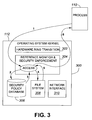
- Figure 3 is a block diagram of an operating system kernel associated with the computer system of Fig. 1;
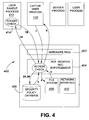
- Figure 4 is a block diagram of an embodiment of the invention operating with the operating system of Fig. 3.
- computer 100 is a microprocessor-enabled system providing an environment for execution of software and processes thereon.
- Computer 100 comprises microprocessor 102, RAM 104, hard-drive 106, input/output (I/O) port 108.
- processors 110 provide a set of executable software code which provides instructions for microprocessor 102 in its native code language.
- OS operating system
- OS 112 provides an interface for system calls for microprocessor 102 for processes 110.
- OS 112 also interacts with microcode 114 on microprocessor 102.
- Process 110 may be contained in file 118, which may be stored in other computers or data servers in network 116.
- computer 100 may receive file 118 from network 116 via I/O port 108 in one of two methods.
- software operating on computer 100 may actively identify and request file 118 from network 116.
- file 118 may be "pushed" to computer 100 via an external process operating from an element in network 116, causing file 118 to be downloaded into computer 100 without any initial request from computer 100. It will be appreciated that once file 118 is received by computer 100, it is installed as a process 110 into RAM 104.
- modules in sandbox 200 provide verification and inspection of code associated with process 110 before allowing execution of the code.
- code verification is conducted by checking of a digital signature on the code and byte-by-byte inspection of the code for security policy conformance.
- sandbox 200 provides security monitor module 202 and sandbox library module 204.
- sandbox 200 runs externally to process 110.
- the steps executed by sandbox 200 are as follows.
- a line of code in process 110 initiates a request to access a system resource of computer 100 (such as a file) and the request is sent to security monitor 202.
- security monitor 202 che cks privileges of process 110 with process 110 against a set of access privilege and receives a yes/no response.
- Access privileges may established based upon several facts, including: ownership of file, file location, user identity of process, privileges of process and others. It will be appreciated that other privileges may be defined.
- the calling process may require system management privileges to open the file.
- step (4) if access is allowed, the request is passed through sandbox library 204.
- sandbox library converts the request to an appropriate low level operating system call for operating system 112.
- the operating system call is the n provided to operating system kernel 112A and in step (6) the results of the call are returned to library 204, thereby fulfilling the access.
- the results of a system call on most operating systems will be an integer error status code (for instance, "0" for success and "-1" for failure).
- step (7) Side effects of a system call include: a changing of memory contents in passed in memory buffers, updates to the processes or a file's contents or status.
- sandbox library modifies the result code and changes any passed back memory buffers, etc. such that the captive process is isolated from the original system call return. Instead, the captive process would see a modified call return.
- step 7 is foregone.
- system 300 is shown existing within OS kernel 112A. Therein, several processes are provided to control access to resources, including hardware ring transition process 302, reference monitor and security enforcement (RMSE) process 304, security policy database 306, file system 308 and network interface process 310.
- RMSE reference monitor and security enforcement
- Hardware ring transition 302 controls access to the OS 112 and any protected resources.
- the processes 110 are in the restricted ring and the OS 112 is in the unrestricted ring.
- For a process to access the OS it must make a ring transition call (system call or gate) to a specific controlled entry point in the OS.
- the OS then validates the request before acting upon it.
- RMSE module 304 provides security enforcement for kernel 112. It controls access to file systems 308 associated with computer 302. Typically, a file access request from process 110 (not shown) is controlled by RMSE module 304. Steps executed involving RMSE module 304 for security enforcement comprise the following steps. In step (1), process 110 requests access to a resource, which is redirected by kernel 112 to RMSE module 304. All system calls are made by invoking a processor's "gate" call mechanism which varies by processor family, which then changes the ring and steps into kernel code at a kernel controlled entry point. Identifying which system call is being made is usually determined by a value present in a register at the time that the gate call was invoked.
- RMSE module 304 initiates a call to security policy database 306 to enable RMSE module 304 to determine whether the call is permissible.
- security policy database 306 is checked to determine whether the process can perform the requested system call with the specified parameters, e.g. "file open on /tmp/foo.txt". Typically, system calls are not executed here. However the security policy database 306 may use files or other external resources as sources of data input for the security lookup. If the process can be performed, then the process is allowed to be executed. An answer to the call is generated and is provided to RMSE module 304.
- step (4) if the answer allows access by the call, the call is passed to file system 308.
- file system 308 fulfills the call and provides it to RMSE module 304.
- step (6) the file is provided to process 110. It is notable that all file accesses by process 112 go through hardware ring transition 302. The above noted steps would be executed as follows for an exemplary system call:
- system 400 in kernel 112 which has similar features as to system 300 (Fig. 3).
- system 400 has several processes to control access to resources, including hardware ring transition process 402, RMSE process 404, security policy database 406, file system 408 and network interface process 410.
- System 400 also has user parent process 412 is provided which spawns captive user process 110.
- process 110 requests access to a resource, which is redirected by kernel 112 to RMSE module 304, similar to step (1) described earlier.
- step (2A) is performed where a check is made from RMSE module 304 to access check process 414 in user parent process 412. In the check, RMSE asks for permission from parent process.
- access check process 414 considers and generates a response.
- Access check process 404 may check for a series of initial accesses. If any one access fails, then user parent process 412 sends a message to captive user process 110 informing it that the request is deniedfailed. If all access requests are allowable, then access check process 414 sends a request to access check process 414 to RMSE module of the kernel 112.
- the parent process may check for security policy violations which are unknown to the operating system such as when the child process is parsing an email message it should not be attempting to modify a file, such as an operating system file. The majority of virus, worm and phishing attacks seen today are not violations of the operating system policy (user / file permissions).
- the request for resources may be handled in steps 2 to 6 as noted for system 300.
- typical restrictions on system calls can be processed as usual in steps (2) through (6).
- steps (2) through (6) will recognize this inappropriate call and block the access.
- the process in Fig. 3 may be a validation Step (5A) and Step (5B) which follows Step 5 before Step (6).
- Step (5A) the results of the system call may be validated and optionally modified by the parent and this modified result passed back to the OS in (5B) and then on to the child in (6).
- steps 1, 1A, 1B, and 2-6 are repeated.
- system 400 reduces or eliminates a need to perform a security inspection code performance before it is executed.
- user parent process 412 may spawn other captive processes 110. The repetition is that the parent can spawn a captive process per email to parse or web page to display. This repetition provides that each process does not interfer with the others by for instance stealing passwords from your bank login page.
- the relationship between a parent process 412 and a child process 110 is a tree whereby a parent may have many children and a child may itself be a parent of one or more of its own children. In this regard, user process 110 need not actually know that it has a parent process 412 associated with it. This facilitates localization of operation of each process.
Landscapes
- Engineering & Computer Science (AREA)
- Software Systems (AREA)
- Theoretical Computer Science (AREA)
- Physics & Mathematics (AREA)
- General Engineering & Computer Science (AREA)
- General Physics & Mathematics (AREA)
- Storage Device Security (AREA)
- Mobile Radio Communication Systems (AREA)
- Control By Computers (AREA)
Abstract
Description
- The present invention relates to a system and method for executing a process on a microprocessor-enabled device.
- In a microprocessor-enabled device, such as a computer, a communication switch, a ABS control module in a car or a toaster, often several separate processes may be active simultaneously that compete for operational cycles from the microprocessor and resources associated with the microprocessor. An operating system is critical for controlling operation of a process and its requests for resources. One exemplary operating system is Microsoft XP (trade-mark of Microsoft Corporation) which is frequently installed as an operating system on computers having an Intel microprocessor, such as a Pentium (trade-mark of Intel Corporation) microprocessor, as their central processing unit.
- It is useful to control operation of processes executing on the device to ensure that operation or failure of a given process either does not affect or a restricted effect on other processes operating on the device. For example, if one process has a fatal error, its demise preferably should not affect the other processes; it should gracefully wind down from the other processes. Also, execution of a process should not access files, data, memory or resources which it does not have authorization to access.
- It is also useful to control operation of such processes because their provenance may be questionable. With downloading of programs via the Internet being prevalent, it is possible that the downloaded program may contain malicious code or routines which may adversely affect either the computer, its data or other programs operating on the computer.
- Several prior art techniques and systems are available attempt to isolate operation of a process from other elements in such devices.
- For example, a software "sandbox" is code which provides an isolation technique to define a restricted set of resources, in a "sandbox", for a target process. All resource requests made by the process are moderated by a security monitor which acts to verify and inspect the code before allowing it to be executed. Verification may involve using digital signatures on the code to check its provenance and byte-by-byte code inspection for security conformance, etc. Typically, the code in the process sandbox must be inspected for relevant design, implementation and configuration errors.
- Code checking is another technique. Code checking evaluates a process for design and implementation flaws. Specifically, each line of code of a process is checked, against template which identify configuration errors. It will be appreciated that the code checking may need to evaluate hundreds of thousands of lines of code before user configuration errors are considered.
- A hardware ring provides another protection technique. The ring, which is commonly seen in operating system architectures, provides two modes of operation for a microprocessor. A first mode provides unrestricted access to a process to all resources controlled by the microprocessor. A second restricted mode provides a process with only certain access to certain resources. A hardware ring typically uses attributes of the user's process, such as user's name and the name of the process, to determine the level of access provided to the process. Operating systems work in conjunction with the modes to control access to resources. In many operating systems, a security policy is encoded into the operating system and relies on run-time attributes of the user's process and the system resource being accessed to determine access rights.
- Hardware rings are not as flexible as software sandboxes, but typically offer a more secure implementation. The hardware ring, ensures that the operating system code and data are not accessible by a user process.
- There is a need for a system and method of processing database operations which address deficiencies in the prior art.
- In a first aspect, a method for controlling a request for a resource from a process operating on a microprocessor-enabled machine is provided. The method comprises regulating access of the process to the resource associated with the machine via a parent process when the process initiates the request to an operating system associated with the machine, the parent process operating outside of the operating system.
- In the method, the parent process may spawn the process.
- In the method the request may initially be received by an access process in the operating system. Then, the access process may initiate a second request to the parent process to check whether the process has clearance to access the resource. Then, the parent process may provide a signal to the access process indicating whether the process has the clearance.
- In the method, if the parent process indicates that the process does not have the clearance, then the access process may deny the process access to the resource.
- In the method, if the parent process indicates that the process has the clearance, then the access process may conduct another access check within the operating system to determine whether the process can have access to the resource.
- In a second aspect, an operating system application for controlling a request for a resource from a process operating on a microprocessor-enabled machine is provided. The application comprises a process for regulating access of the process to the resource associated with the machine via a parent process when the process initiates the request to an operating system associated with the machine, the parent process operating outside of the operating system.
- In the operating system application, the parent process may spawn the process.
- In the operating system application, the request may be initially received by an access process in the operating system. Subsequently, the access process may initiate a second request to the parent process to check whether the process has clearance to access the resource. Subsequently, the parent process may provide a signal to the access process indicating whether the process has the clearance.
- In the operating system application, if the parent process indicates that the process does not have the clearance, then the access process may deny the process access to the resource.
- In the operating system application, if the parent process indicates that the process has the clearance, then the access process may conduct another access check within the operating system to determine whether the process can have access to the resource.
- In other aspects, various combinations of the above aspects may be provided in further sets and subsets.
- The foregoing and other aspects of the invention will become more apparent from the following description of specific embodiments thereof and the accompanying drawings which illustrate, by way of example only, the principles of the invention. In the drawings, where like elements feature like reference numerals (and wherein individual elements bear unique alphabetical suffixes):
- Figure 1 is a block diagram of a computer system having access to a network;
- Figure 2 is a block diagram of a prior art system providing a security system for the computer system of Fig. 1;
- Figure 3 is a block diagram of an operating system kernel associated with the computer system of Fig. 1; and
- Figure 4 is a block diagram of an embodiment of the invention operating with the operating system of Fig. 3.
- The description which follows, and the embodiments described therein, are provided by way of illustration of an example, or examples, of particular embodiments of the principles of the present invention. These examples are provided for the purposes of explanation, and not limitation, of those principles and of the invention. In the description, which follows, like parts are marked throughout the specification and the drawings with the same respective reference numerals.
- Referring to Figure 1,
computer 100 is a microprocessor-enabled system providing an environment for execution of software and processes thereon.Computer 100 comprisesmicroprocessor 102,RAM 104, hard-drive 106, input/output (I/O)port 108. As is common with other computer syste ms,computer system 100 hasprocesses 110 thereon which are loaded intoRAM 104.Processes 110 provide a set of executable software code which provides instructions formicroprocessor 102 in its native code language. When any one ofprocesses 110 requires low level access to resources of computer 100 (such as files stored in hard-drive 106 or access to other files stored in RAM 104) operating system (OS) 112 provides an interface for system calls formicroprocessor 102 forprocesses 110. Typically, OS 112 also interacts withmicrocode 114 onmicroprocessor 102. -
Process 110 may be contained infile 118, which may be stored in other computers or data servers innetwork 116. Generally,computer 100 may receive file 118 fromnetwork 116 via I/O port 108 in one of two methods. First, software operating oncomputer 100 may actively identify and request file 118 fromnetwork 116. Alternatively, file 118 may be "pushed" tocomputer 100 via an external process operating from an element innetwork 116, causingfile 118 to be downloaded intocomputer 100 without any initial request fromcomputer 100. It will be appreciated that oncefile 118 is received bycomputer 100, it is installed as aprocess 110 intoRAM 104. - Referring to Fig. 2,
sandbox 200 is shown operating in conjunction withprocess 110. Preferably, modules insandbox 200 provide verification and inspection of code associated withprocess 110 before allowing execution of the code. Generally, code verification is conducted by checking of a digital signature on the code and byte-by-byte inspection of the code for security policy conformance. - Therein,
sandbox 200 providessecurity monitor module 202 andsandbox library module 204. In operation,sandbox 200 runs externally to process 110. The steps executed bysandbox 200 are as follows. In step (1), a line of code inprocess 110 initiates a request to access a system resource of computer 100 (such as a file) and the request is sent tosecurity monitor 202. In steps (2) and (3)security monitor 202 che cks privileges ofprocess 110 withprocess 110 against a set of access privilege and receives a yes/no response. Access privileges may established based upon several facts, including: ownership of file, file location, user identity of process, privileges of process and others. It will be appreciated that other privileges may be defined. In the present embodiment for example, if the file is the system password file, then the calling process may require system management privileges to open the file. In step (4), if access is allowed, the request is passed throughsandbox library 204. Subsequently, in step (5), sandbox library converts the request to an appropriate low level operating system call foroperating system 112. The operating system call is the n provided to operating system kernel 112A and in step (6) the results of the call are returned tolibrary 204, thereby fulfilling the access. The results of a system call on most operating systems will be an integer error status code (for instance, "0" for success and "-1" for failure). Side effects of a system call include: a changing of memory contents in passed in memory buffers, updates to the processes or a file's contents or status. Thereafter, in step (7), sandbox library modifies the result code and changes any passed back memory buffers, etc. such that the captive process is isolated from the original system call return. Instead, the captive process would see a modified call return. In other embodiments,step 7 is foregone. - Referring to Fig. 3, relating to an embodiment,
system 300 is shown existing within OS kernel 112A. Therein, several processes are provided to control access to resources, including hardwarering transition process 302, reference monitor and security enforcement (RMSE)process 304,security policy database 306,file system 308 andnetwork interface process 310. -
Hardware ring transition 302 controls access to theOS 112 and any protected resources. Theprocesses 110 are in the restricted ring and theOS 112 is in the unrestricted ring. For a process to access the OS it must make a ring transition call (system call or gate) to a specific controlled entry point in the OS. The OS then validates the request before acting upon it. -
RMSE module 304 provides security enforcement forkernel 112. It controls access to filesystems 308 associated withcomputer 302. Typically, a file access request from process 110 (not shown) is controlled byRMSE module 304. Steps executed involvingRMSE module 304 for security enforcement comprise the following steps. In step (1),process 110 requests access to a resource, which is redirected bykernel 112 toRMSE module 304. All system calls are made by invoking a processor's "gate" call mechanism which varies by processor family, which then changes the ring and steps into kernel code at a kernel controlled entry point. Identifying which system call is being made is usually determined by a value present in a register at the time that the gate call was invoked. In step (2),RMSE module 304 initiates a call tosecurity policy database 306 to enableRMSE module 304 to determine whether the call is permissible. In step (3),security policy database 306 is checked to determine whether the process can perform the requested system call with the specified parameters, e.g. "file open on /tmp/foo.txt". Typically, system calls are not executed here. However thesecurity policy database 306 may use files or other external resources as sources of data input for the security lookup. If the process can be performed, then the process is allowed to be executed. An answer to the call is generated and is provided toRMSE module 304. This provides a ring transition which preferably ensures that the processes cannot bypass the steps by communicating or otherwise directly interacting with each other or something like a file which is protected by the OS. In step (4), if the answer allows access by the call, the call is passed to filesystem 308. In step (5)file system 308 fulfills the call and provides it toRMSE module 304. In step (6), the file is provided to process 110. It is notable that all file accesses byprocess 112 go throughhardware ring transition 302. The above noted steps would be executed as follows for an exemplary system call: - Step (1)
-
Process 110 makes a "file open" system call (ring transition). - Step (2)
- The RMSE module invokes code (SPDB 306) to check the security policy of the system; no system call as we are already in the kernel.
- Step (3)
- The SPDB checks whether the process can perform the requested system call with the specified parameters (for instance, file open on "/tmp/foo.txt"). There will normally be no system calls here although the SPDB may be using "files" or other external resources as sources of data inputs for the security lookup.
- Steps (4) to (6)
- No changes; no system calls as this is all usually internal to the kernel. Ring transition back to "user" ring from "kernel" ring at step (6).
- Referring to Fig. 4, an embodiment is provided in
system 400 inkernel 112 which has similar features as to system 300 (Fig. 3). For example,system 400 has several processes to control access to resources, including hardwarering transition process 402,RMSE process 404,security policy database 406,file system 408 andnetwork interface process 410.System 400 also has user parent process 412 is provided which spawnscaptive user process 110. As withsystem 302, insystem 400, in step (1),process 110 requests access to a resource, which is redirected bykernel 112 toRMSE module 304, similar to step (1) described earlier. Next, step (2A) is performed where a check is made fromRMSE module 304 to accesscheck process 414 in user parent process 412. In the check, RMSE asks for permission from parent process. In step (2B),access check process 414 considers and generates a response.Access check process 404 may check for a series of initial accesses. If any one access fails, then user parent process 412 sends a message tocaptive user process 110 informing it that the request is deniedfailed. If all access requests are allowable, then accesscheck process 414 sends a request to accesscheck process 414 to RMSE module of thekernel 112. The parent process may check for security policy violations which are unknown to the operating system such as when the child process is parsing an email message it should not be attempting to modify a file, such as an operating system file. The majority of virus, worm and phishing attacks seen today are not violations of the operating system policy (user / file permissions). Instead, they are frequently violations of common sense (email program modifying operating system, reading password file, etc.). This check in Fig. 4 differs from the check done for Fig. 3, as it is most likely constrained by common sense or design criteria associated with the purpose of the child process. - Subsequently the request for resources may be handled in
steps 2 to 6 as noted forsystem 300. For instance, typical restrictions on system calls can be processed as usual in steps (2) through (6). As an example, if the resource requests that a file be written to, when the file is marked as "read-only", then steps (2) through (6) will recognize this inappropriate call and block the access. There are similarities with the process in Fig. 3, except that the may be a validation Step (5A) and Step (5B) which followsStep 5 before Step (6). In particular, in Step (5A) the results of the system call may be validated and optionally modified by the parent and this modified result passed back to the OS in (5B) and then on to the child in (6). - On a subsequent request for a subsequent resource by the
captive user process 110,steps system 400 reduces or eliminates a need to perform a security inspection code performance before it is executed. It will be appreciated that user parent process 412 may spawn other captive processes 110. The repetition is that the parent can spawn a captive process per email to parse or web page to display. This repetition provides that each process does not interfer with the others by for instance stealing passwords from your bank login page. It will be appreciated that insystem 400, the relationship between a parent process 412 and achild process 110 is a tree whereby a parent may have many children and a child may itself be a parent of one or more of its own children. In this regard,user process 110 need not actually know that it has a parent process 412 associated with it. This facilitates localization of operation of each process. - It will be appreciated that the embodiment may be implemented in various system call routines, operation system applications, software programs and even as a hardwired circuit, using techniques known in the art.
- Although the invention has been described with reference to certain specific embodiments, various modifications thereof will be apparent to those skilled in the art without department from the scope of the invention as outlined in the claims appended hereto.
Claims (10)
- A method for controlling a request for a resource from a process operating on a microprocessor-enabled machine, the method comprising:regulating access of said process to said resource associated with said machine via a parent process when said process initiates said request to an operating system associated with said machine, said parent process operating outside of said operating system.
- The method for controlling a resource call for a process operating on a microprocessor-enabled machine, as claimed in claim 1, wherein:said parent process spawns said process.
- The method for controlling a resource call for a process operating on a microprocessor-enabled machine, as claimed in claim 2, wherein:said request is initially received by an access process in said operating system;then, said access process initiates a second request to said parent process to check whether said process has clearance to access said resource; andthen, said parent process provides a signal to said access process indicating whether said process has said clearance.
- The method for controlling a resource call for a process operating on a microprocessor-enabled machine, as claimed in claim 3, wherein, if said parent process indicates that said process does not have said clearance, then said access process denies said process access to said resource.
- The method for controlling a resource call for a process operating on a microprocessor-enabled machine, as claimed in claim 3, wherein, if said parent process indicates that said process has said clearance, then said access process conducts another access check within said operating system to determine whether said process can have access to said resource.
- An operating system application for controlling a request for a resource from a process operating on a microprocessor-enabled machine, the application comprising:a process for regulating access of said process to said resource associated with said machine via a parent process when said process initiates said reque st to an operating system associated with said machine, said parent process operating outside of said operating system.
- The operating system application for controlling a resource call for a process operating on a microprocessor -enabled machine as claimed in claim 6, wherein said parent process spawns said process.
- The operating system application for controlling a resource call for a process operating on a microprocessor-enabled machine as claimed in claim 7, wherein:said request is initially received by an access process in said operating system;then, said access process initiates a second request to said parent process to check whether said process has clearance to access said resource; andthen, said parent process provides a signal to said access process indicating whether said process has said clearance.
- The operating system application for controlling a resource call for a process operating on a microprocessor-enabled machine as claimed in claim 8, wherein, if said parent process indicates that said process does not have said clearance, then said access process denies said process access to said resource.
- The operating system application for controlling a resource call for a process operating on a microprocessor-enabled machine as claimed in claim 9, wherein, if said parent process indicates that said process has said clearance, then said access process conducts another access check within said operating system to determine whether said process can have access to said resource.
Applications Claiming Priority (1)
| Application Number | Priority Date | Filing Date | Title |
|---|---|---|---|
| US11/037,121 US20060174078A1 (en) | 2005-01-19 | 2005-01-19 | System and method for executing a process on a microprocessor-enabled device |
Publications (2)
| Publication Number | Publication Date |
|---|---|
| EP1693752A1 true EP1693752A1 (en) | 2006-08-23 |
| EP1693752B1 EP1693752B1 (en) | 2008-04-09 |
Family
ID=36129938
Family Applications (1)
| Application Number | Title | Priority Date | Filing Date |
|---|---|---|---|
| EP06300035A Expired - Lifetime EP1693752B1 (en) | 2005-01-19 | 2006-01-17 | Method for controlling a process resource access via a parent process |
Country Status (5)
| Country | Link |
|---|---|
| US (1) | US20060174078A1 (en) |
| EP (1) | EP1693752B1 (en) |
| CN (1) | CN100492300C (en) |
| AT (1) | ATE391954T1 (en) |
| DE (1) | DE602006000878T2 (en) |
Families Citing this family (13)
| Publication number | Priority date | Publication date | Assignee | Title |
|---|---|---|---|---|
| CN101872400B (en) * | 2009-04-24 | 2012-10-17 | 北京中天安泰信息科技有限公司 | Method for establishing computer information security protection capable of judging security of computer operation request according to associative relation of computing system operation request |
| US9262628B2 (en) * | 2009-09-11 | 2016-02-16 | Empire Technology Development Llc | Operating system sandbox |
| US20110191562A1 (en) * | 2010-02-02 | 2011-08-04 | Broadcom Corporation | Apparatus and method for partitioning, sandboxing and protecting external memories |
| US9524531B2 (en) * | 2011-05-09 | 2016-12-20 | Microsoft Technology Licensing, Llc | Extensibility features for electronic communications |
| US8973136B2 (en) * | 2011-08-02 | 2015-03-03 | Quick Heal Technologies Private Limited | System and method for protecting computer systems from malware attacks |
| CN103065098B (en) * | 2011-10-24 | 2018-01-19 | 联想(北京)有限公司 | Access method and electronic equipment |
| US8893222B2 (en) * | 2012-11-13 | 2014-11-18 | Auckland Uniservices Ltd. | Security system and method for the android operating system |
| US9727848B2 (en) * | 2013-04-29 | 2017-08-08 | Alex Bligh | Field programmable hierarchical cloud billing system |
| US9560053B2 (en) * | 2014-09-12 | 2017-01-31 | Verizon Patent And Licensing Inc. | Parental control management and enforcement based on hardware identifiers |
| WO2016118145A1 (en) * | 2015-01-22 | 2016-07-28 | Mcafee, Inc. | Detection of malicious invocation of application program interface calls |
| CN104715175A (en) * | 2015-03-23 | 2015-06-17 | 浪潮集团有限公司 | Computer system safety protection method and device |
| US9600682B2 (en) * | 2015-06-08 | 2017-03-21 | Accenture Global Services Limited | Mapping process changes |
| US10776520B2 (en) * | 2015-09-14 | 2020-09-15 | Northwestern University | System and method for proxy-based data access mechanism in enterprise mobility management |
Family Cites Families (2)
| Publication number | Priority date | Publication date | Assignee | Title |
|---|---|---|---|---|
| US5560008A (en) * | 1989-05-15 | 1996-09-24 | International Business Machines Corporation | Remote authentication and authorization in a distributed data processing system |
| US6167520A (en) * | 1996-11-08 | 2000-12-26 | Finjan Software, Inc. | System and method for protecting a client during runtime from hostile downloadables |
-
2005
- 2005-01-19 US US11/037,121 patent/US20060174078A1/en not_active Abandoned
-
2006
- 2006-01-17 EP EP06300035A patent/EP1693752B1/en not_active Expired - Lifetime
- 2006-01-17 DE DE602006000878T patent/DE602006000878T2/en not_active Expired - Lifetime
- 2006-01-17 AT AT06300035T patent/ATE391954T1/en not_active IP Right Cessation
- 2006-01-19 CN CNB2006100089595A patent/CN100492300C/en not_active Expired - Fee Related
Non-Patent Citations (4)
| Title |
|---|
| GARFINKEL T: "Traps and pitfalls: practical problems in system call interposition based security tools", NETWORK AND DISTRIBUTED SYSTEM SECURITY SYMPOSIUM, 6 February 2003 (2003-02-06), San Diego, CA, USA, pages 1 - 14, XP002377440, Retrieved from the Internet <URL:http://web.archive.org/web/20040228195150/http://www.stanford.edu/~talg/papers/traps/traps-ndss03.pdf> [retrieved on 20060419] * |
| GARFINKEL, T ET AL: "Ostia: A Delegating Architecture for Secure System Call Interposition", INTERNET ARTICLE, 4 December 2003 (2003-12-04), pages 1 - 15, XP002377439, Retrieved from the Internet <URL:http://web.archive.org/web/20031204014221/www.stanford.edu/~talg/papers/NDSS04/ostia-ndss04.pdf> [retrieved on 20060419] * |
| GOLDBERG I ET AL: "A secure environment for untrusted helper applications", PROCEEDINGS OF 6TH USENIX UNIX SECURITY SYMPOSIUM, 22 July 1996 (1996-07-22), pages 1 - 13, XP002377441, Retrieved from the Internet <URL:www.cs.berkeley.edu/~daw/papers/janus-usenix96.ps> [retrieved on 20060419] * |
| KURCHUK, A: "Recursive sandboxes: Extending Systrace to empower applications", INTERNET ARTICLE, 25 July 2004 (2004-07-25), pages 1 - 16, XP002377438, Retrieved from the Internet <URL:http://web.archive.org/web/20040725140723/http://nsl.cs.columbia.edu/projects/gridlock/systrace_extensions.pdf> [retrieved on 20060419] * |
Also Published As
| Publication number | Publication date |
|---|---|
| EP1693752B1 (en) | 2008-04-09 |
| CN1818876A (en) | 2006-08-16 |
| DE602006000878T2 (en) | 2009-06-04 |
| ATE391954T1 (en) | 2008-04-15 |
| CN100492300C (en) | 2009-05-27 |
| US20060174078A1 (en) | 2006-08-03 |
| DE602006000878D1 (en) | 2008-05-21 |
Similar Documents
| Publication | Publication Date | Title |
|---|---|---|
| US8161563B2 (en) | Running internet applications with low rights | |
| US9195823B1 (en) | System and method for intercepting process creation events | |
| US7085928B1 (en) | System and method for defending against malicious software | |
| CN101379479B (en) | software system with controlled access to objects | |
| EP2786545B1 (en) | Method and computer device to control software file downloads | |
| EP1693752B1 (en) | Method for controlling a process resource access via a parent process | |
| US7647629B2 (en) | Hosted code runtime protection | |
| US7076557B1 (en) | Applying a permission grant set to a call stack during runtime | |
| JP5069369B2 (en) | Integrated access authorization | |
| US7596694B1 (en) | System and method for safely executing downloaded code on a computer system | |
| EP4677464A1 (en) | File-system protection | |
| KR20060050768A (en) | Access authorization API | |
| US20050228770A1 (en) | Computer access control | |
| RU2405198C2 (en) | Integrated access authorisation | |
| Schmid et al. | Preventing the execution of unauthorized Win32 applications | |
| US12393671B2 (en) | Privilege metric for evaluating the security of a library | |
| HK1119321B (en) | Running internet applications with low rights |
Legal Events
| Date | Code | Title | Description |
|---|---|---|---|
| PUAI | Public reference made under article 153(3) epc to a published international application that has entered the european phase |
Free format text: ORIGINAL CODE: 0009012 |
|
| AK | Designated contracting states |
Kind code of ref document: A1 Designated state(s): AT BE BG CH CY CZ DE DK EE ES FI FR GB GR HU IE IS IT LI LT LU LV MC NL PL PT RO SE SI SK TR |
|
| AX | Request for extension of the european patent |
Extension state: AL BA HR MK YU |
|
| 17P | Request for examination filed |
Effective date: 20070223 |
|
| RAP1 | Party data changed (applicant data changed or rights of an application transferred) |
Owner name: ALCATEL LUCENT |
|
| 17Q | First examination report despatched |
Effective date: 20070321 |
|
| AKX | Designation fees paid |
Designated state(s): AT BE BG CH CY CZ DE DK EE ES FI FR GB GR HU IE IS IT LI LT LU LV MC NL PL PT RO SE SI SK TR |
|
| GRAP | Despatch of communication of intention to grant a patent |
Free format text: ORIGINAL CODE: EPIDOSNIGR1 |
|
| GRAS | Grant fee paid |
Free format text: ORIGINAL CODE: EPIDOSNIGR3 |
|
| GRAA | (expected) grant |
Free format text: ORIGINAL CODE: 0009210 |
|
| AK | Designated contracting states |
Kind code of ref document: B1 Designated state(s): AT BE BG CH CY CZ DE DK EE ES FI FR GB GR HU IE IS IT LI LT LU LV MC NL PL PT RO SE SI SK TR |
|
| REG | Reference to a national code |
Ref country code: GB Ref legal event code: FG4D |
|
| REG | Reference to a national code |
Ref country code: CH Ref legal event code: EP |
|
| REG | Reference to a national code |
Ref country code: IE Ref legal event code: FG4D |
|
| REF | Corresponds to: |
Ref document number: 602006000878 Country of ref document: DE Date of ref document: 20080521 Kind code of ref document: P |
|
| PG25 | Lapsed in a contracting state [announced via postgrant information from national office to epo] |
Ref country code: SI Free format text: LAPSE BECAUSE OF FAILURE TO SUBMIT A TRANSLATION OF THE DESCRIPTION OR TO PAY THE FEE WITHIN THE PRESCRIBED TIME-LIMIT Effective date: 20080409 |
|
| NLV1 | Nl: lapsed or annulled due to failure to fulfill the requirements of art. 29p and 29m of the patents act | ||
| PG25 | Lapsed in a contracting state [announced via postgrant information from national office to epo] |
Ref country code: ES Free format text: LAPSE BECAUSE OF FAILURE TO SUBMIT A TRANSLATION OF THE DESCRIPTION OR TO PAY THE FEE WITHIN THE PRESCRIBED TIME-LIMIT Effective date: 20080720 Ref country code: PT Free format text: LAPSE BECAUSE OF FAILURE TO SUBMIT A TRANSLATION OF THE DESCRIPTION OR TO PAY THE FEE WITHIN THE PRESCRIBED TIME-LIMIT Effective date: 20080911 Ref country code: NL Free format text: LAPSE BECAUSE OF FAILURE TO SUBMIT A TRANSLATION OF THE DESCRIPTION OR TO PAY THE FEE WITHIN THE PRESCRIBED TIME-LIMIT Effective date: 20080409 Ref country code: FI Free format text: LAPSE BECAUSE OF FAILURE TO SUBMIT A TRANSLATION OF THE DESCRIPTION OR TO PAY THE FEE WITHIN THE PRESCRIBED TIME-LIMIT Effective date: 20080409 Ref country code: BG Free format text: LAPSE BECAUSE OF FAILURE TO SUBMIT A TRANSLATION OF THE DESCRIPTION OR TO PAY THE FEE WITHIN THE PRESCRIBED TIME-LIMIT Effective date: 20080709 |
|
| PG25 | Lapsed in a contracting state [announced via postgrant information from national office to epo] |
Ref country code: LV Free format text: LAPSE BECAUSE OF FAILURE TO SUBMIT A TRANSLATION OF THE DESCRIPTION OR TO PAY THE FEE WITHIN THE PRESCRIBED TIME-LIMIT Effective date: 20080409 Ref country code: AT Free format text: LAPSE BECAUSE OF FAILURE TO SUBMIT A TRANSLATION OF THE DESCRIPTION OR TO PAY THE FEE WITHIN THE PRESCRIBED TIME-LIMIT Effective date: 20080409 Ref country code: PL Free format text: LAPSE BECAUSE OF FAILURE TO SUBMIT A TRANSLATION OF THE DESCRIPTION OR TO PAY THE FEE WITHIN THE PRESCRIBED TIME-LIMIT Effective date: 20080409 |
|
| PG25 | Lapsed in a contracting state [announced via postgrant information from national office to epo] |
Ref country code: IS Free format text: LAPSE BECAUSE OF FAILURE TO SUBMIT A TRANSLATION OF THE DESCRIPTION OR TO PAY THE FEE WITHIN THE PRESCRIBED TIME-LIMIT Effective date: 20080809 |
|
| EN | Fr: translation not filed | ||
| PG25 | Lapsed in a contracting state [announced via postgrant information from national office to epo] |
Ref country code: CZ Free format text: LAPSE BECAUSE OF FAILURE TO SUBMIT A TRANSLATION OF THE DESCRIPTION OR TO PAY THE FEE WITHIN THE PRESCRIBED TIME-LIMIT Effective date: 20080409 Ref country code: DK Free format text: LAPSE BECAUSE OF FAILURE TO SUBMIT A TRANSLATION OF THE DESCRIPTION OR TO PAY THE FEE WITHIN THE PRESCRIBED TIME-LIMIT Effective date: 20080409 Ref country code: LT Free format text: LAPSE BECAUSE OF FAILURE TO SUBMIT A TRANSLATION OF THE DESCRIPTION OR TO PAY THE FEE WITHIN THE PRESCRIBED TIME-LIMIT Effective date: 20080409 Ref country code: SE Free format text: LAPSE BECAUSE OF FAILURE TO SUBMIT A TRANSLATION OF THE DESCRIPTION OR TO PAY THE FEE WITHIN THE PRESCRIBED TIME-LIMIT Effective date: 20080709 |
|
| PLBE | No opposition filed within time limit |
Free format text: ORIGINAL CODE: 0009261 |
|
| STAA | Information on the status of an ep patent application or granted ep patent |
Free format text: STATUS: NO OPPOSITION FILED WITHIN TIME LIMIT |
|
| PG25 | Lapsed in a contracting state [announced via postgrant information from national office to epo] |
Ref country code: BE Free format text: LAPSE BECAUSE OF FAILURE TO SUBMIT A TRANSLATION OF THE DESCRIPTION OR TO PAY THE FEE WITHIN THE PRESCRIBED TIME-LIMIT Effective date: 20080409 Ref country code: SK Free format text: LAPSE BECAUSE OF FAILURE TO SUBMIT A TRANSLATION OF THE DESCRIPTION OR TO PAY THE FEE WITHIN THE PRESCRIBED TIME-LIMIT Effective date: 20080409 Ref country code: RO Free format text: LAPSE BECAUSE OF FAILURE TO SUBMIT A TRANSLATION OF THE DESCRIPTION OR TO PAY THE FEE WITHIN THE PRESCRIBED TIME-LIMIT Effective date: 20080409 |
|
| ET | Fr: translation filed | ||
| REG | Reference to a national code |
Ref country code: FR Ref legal event code: EERR Free format text: CORRECTION DE BOPI 09/05 - BREVETS EUROPEENS DONT LA TRADUCTION N A PAS ETE REMISE A L INPI. IL Y A LIEU DE SUPPRIMER : LA MENTION DE LA NON-REMISE. LA REMISE DE LA TRADUCTION EST PUBLIEE DANS LE PRESENT BOPI. |
|
| 26N | No opposition filed |
Effective date: 20090112 |
|
| PG25 | Lapsed in a contracting state [announced via postgrant information from national office to epo] |
Ref country code: EE Free format text: LAPSE BECAUSE OF FAILURE TO SUBMIT A TRANSLATION OF THE DESCRIPTION OR TO PAY THE FEE WITHIN THE PRESCRIBED TIME-LIMIT Effective date: 20080409 |
|
| PG25 | Lapsed in a contracting state [announced via postgrant information from national office to epo] |
Ref country code: MC Free format text: LAPSE BECAUSE OF NON-PAYMENT OF DUE FEES Effective date: 20090131 Ref country code: IT Free format text: LAPSE BECAUSE OF FAILURE TO SUBMIT A TRANSLATION OF THE DESCRIPTION OR TO PAY THE FEE WITHIN THE PRESCRIBED TIME-LIMIT Effective date: 20080409 |
|
| PG25 | Lapsed in a contracting state [announced via postgrant information from national office to epo] |
Ref country code: CY Free format text: LAPSE BECAUSE OF FAILURE TO SUBMIT A TRANSLATION OF THE DESCRIPTION OR TO PAY THE FEE WITHIN THE PRESCRIBED TIME-LIMIT Effective date: 20080409 |
|
| PG25 | Lapsed in a contracting state [announced via postgrant information from national office to epo] |
Ref country code: IE Free format text: LAPSE BECAUSE OF NON-PAYMENT OF DUE FEES Effective date: 20090119 |
|
| REG | Reference to a national code |
Ref country code: CH Ref legal event code: PL |
|
| PG25 | Lapsed in a contracting state [announced via postgrant information from national office to epo] |
Ref country code: LI Free format text: LAPSE BECAUSE OF NON-PAYMENT OF DUE FEES Effective date: 20100131 Ref country code: GR Free format text: LAPSE BECAUSE OF FAILURE TO SUBMIT A TRANSLATION OF THE DESCRIPTION OR TO PAY THE FEE WITHIN THE PRESCRIBED TIME-LIMIT Effective date: 20080710 Ref country code: CH Free format text: LAPSE BECAUSE OF NON-PAYMENT OF DUE FEES Effective date: 20100131 |
|
| PG25 | Lapsed in a contracting state [announced via postgrant information from national office to epo] |
Ref country code: LU Free format text: LAPSE BECAUSE OF NON-PAYMENT OF DUE FEES Effective date: 20090117 |
|
| PG25 | Lapsed in a contracting state [announced via postgrant information from national office to epo] |
Ref country code: HU Free format text: LAPSE BECAUSE OF FAILURE TO SUBMIT A TRANSLATION OF THE DESCRIPTION OR TO PAY THE FEE WITHIN THE PRESCRIBED TIME-LIMIT Effective date: 20081010 |
|
| PG25 | Lapsed in a contracting state [announced via postgrant information from national office to epo] |
Ref country code: TR Free format text: LAPSE BECAUSE OF FAILURE TO SUBMIT A TRANSLATION OF THE DESCRIPTION OR TO PAY THE FEE WITHIN THE PRESCRIBED TIME-LIMIT Effective date: 20080409 |
|
| REG | Reference to a national code |
Ref country code: FR Ref legal event code: GC Effective date: 20131018 |
|
| REG | Reference to a national code |
Ref country code: FR Ref legal event code: RG Effective date: 20141016 |
|
| REG | Reference to a national code |
Ref country code: FR Ref legal event code: PLFP Year of fee payment: 10 |
|
| REG | Reference to a national code |
Ref country code: FR Ref legal event code: CA Effective date: 20150521 |
|
| REG | Reference to a national code |
Ref country code: FR Ref legal event code: CA Effective date: 20150521 |
|
| REG | Reference to a national code |
Ref country code: FR Ref legal event code: PLFP Year of fee payment: 11 |
|
| PGFP | Annual fee paid to national office [announced via postgrant information from national office to epo] |
Ref country code: DE Payment date: 20160120 Year of fee payment: 11 |
|
| PGFP | Annual fee paid to national office [announced via postgrant information from national office to epo] |
Ref country code: GB Payment date: 20160120 Year of fee payment: 11 Ref country code: FR Payment date: 20160121 Year of fee payment: 11 |
|
| REG | Reference to a national code |
Ref country code: DE Ref legal event code: R119 Ref document number: 602006000878 Country of ref document: DE |
|
| GBPC | Gb: european patent ceased through non-payment of renewal fee |
Effective date: 20170117 |
|
| REG | Reference to a national code |
Ref country code: FR Ref legal event code: ST Effective date: 20170929 |
|
| PG25 | Lapsed in a contracting state [announced via postgrant information from national office to epo] |
Ref country code: FR Free format text: LAPSE BECAUSE OF NON-PAYMENT OF DUE FEES Effective date: 20170131 |
|
| PG25 | Lapsed in a contracting state [announced via postgrant information from national office to epo] |
Ref country code: DE Free format text: LAPSE BECAUSE OF NON-PAYMENT OF DUE FEES Effective date: 20170801 Ref country code: GB Free format text: LAPSE BECAUSE OF NON-PAYMENT OF DUE FEES Effective date: 20170117 |