EP1692137B1 - Process for the preparation of tubulin inhibitors - Google Patents
Process for the preparation of tubulin inhibitors Download PDFInfo
- Publication number
- EP1692137B1 EP1692137B1 EP04813203A EP04813203A EP1692137B1 EP 1692137 B1 EP1692137 B1 EP 1692137B1 EP 04813203 A EP04813203 A EP 04813203A EP 04813203 A EP04813203 A EP 04813203A EP 1692137 B1 EP1692137 B1 EP 1692137B1
- Authority
- EP
- European Patent Office
- Prior art keywords
- phenyl
- substituted
- process according
- dicarboxylic acid
- triazolopyrimidine
- Prior art date
- Legal status (The legal status is an assumption and is not a legal conclusion. Google has not performed a legal analysis and makes no representation as to the accuracy of the status listed.)
- Expired - Lifetime
Links
- 238000000034 method Methods 0.000 title claims abstract description 56
- 238000002360 preparation method Methods 0.000 title claims abstract description 15
- 239000003744 tubulin modulator Substances 0.000 title description 2
- -1 6-[(substituted) phenyl]-triazolopyrimidine dicarboxylic acid salt Chemical class 0.000 claims abstract description 61
- 150000003839 salts Chemical class 0.000 claims abstract description 22
- 125000006273 (C1-C3) alkyl group Chemical group 0.000 claims abstract description 17
- 125000004433 nitrogen atom Chemical group N* 0.000 claims abstract description 6
- 125000000623 heterocyclic group Chemical group 0.000 claims abstract description 3
- 229910052757 nitrogen Inorganic materials 0.000 claims abstract description 3
- 125000004430 oxygen atom Chemical group O* 0.000 claims abstract description 3
- 125000004434 sulfur atom Chemical group 0.000 claims abstract description 3
- XLYOFNOQVPJJNP-UHFFFAOYSA-N water Substances O XLYOFNOQVPJJNP-UHFFFAOYSA-N 0.000 claims description 48
- YXFVVABEGXRONW-UHFFFAOYSA-N Toluene Chemical compound CC1=CC=CC=C1 YXFVVABEGXRONW-UHFFFAOYSA-N 0.000 claims description 45
- WYURNTSHIVDZCO-UHFFFAOYSA-N Tetrahydrofuran Chemical compound C1CCOC1 WYURNTSHIVDZCO-UHFFFAOYSA-N 0.000 claims description 36
- HEMHJVSKTPXQMS-UHFFFAOYSA-M Sodium hydroxide Chemical group [OH-].[Na+] HEMHJVSKTPXQMS-UHFFFAOYSA-M 0.000 claims description 27
- ZMXDDKWLCZADIW-UHFFFAOYSA-N N,N-Dimethylformamide Chemical group CN(C)C=O ZMXDDKWLCZADIW-UHFFFAOYSA-N 0.000 claims description 24
- 150000001412 amines Chemical class 0.000 claims description 20
- XEKOWRVHYACXOJ-UHFFFAOYSA-N Ethyl acetate Chemical compound CCOC(C)=O XEKOWRVHYACXOJ-UHFFFAOYSA-N 0.000 claims description 18
- BZLVMXJERCGZMT-UHFFFAOYSA-N Methyl tert-butyl ether Chemical compound COC(C)(C)C BZLVMXJERCGZMT-UHFFFAOYSA-N 0.000 claims description 18
- 239000007787 solid Substances 0.000 claims description 18
- YLQBMQCUIZJEEH-UHFFFAOYSA-N tetrahydrofuran Natural products C=1C=COC=1 YLQBMQCUIZJEEH-UHFFFAOYSA-N 0.000 claims description 18
- KDYFGRWQOYBRFD-UHFFFAOYSA-N succinic acid Chemical compound OC(=O)CCC(O)=O KDYFGRWQOYBRFD-UHFFFAOYSA-N 0.000 claims description 17
- OFOBLEOULBTSOW-UHFFFAOYSA-N Propanedioic acid Natural products OC(=O)CC(O)=O OFOBLEOULBTSOW-UHFFFAOYSA-N 0.000 claims description 14
- 230000002140 halogenating effect Effects 0.000 claims description 14
- 238000010438 heat treatment Methods 0.000 claims description 14
- XHXFXVLFKHQFAL-UHFFFAOYSA-N phosphoryl trichloride Chemical group ClP(Cl)(Cl)=O XHXFXVLFKHQFAL-UHFFFAOYSA-N 0.000 claims description 11
- 238000001816 cooling Methods 0.000 claims description 10
- 239000002904 solvent Substances 0.000 claims description 10
- QXNVGIXVLWOKEQ-UHFFFAOYSA-N Disodium Chemical class [Na][Na] QXNVGIXVLWOKEQ-UHFFFAOYSA-N 0.000 claims description 9
- KLSJWNVTNUYHDU-UHFFFAOYSA-N Amitrole Chemical compound NC1=NC=NN1 KLSJWNVTNUYHDU-UHFFFAOYSA-N 0.000 claims description 8
- 150000008044 alkali metal hydroxides Chemical class 0.000 claims description 8
- VZCYOOQTPOCHFL-OWOJBTEDSA-N Fumaric acid Chemical compound OC(=O)\C=C\C(O)=O VZCYOOQTPOCHFL-OWOJBTEDSA-N 0.000 claims description 7
- 229910000102 alkali metal hydride Inorganic materials 0.000 claims description 7
- 150000008046 alkali metal hydrides Chemical class 0.000 claims description 7
- 239000000010 aprotic solvent Substances 0.000 claims description 7
- 239000003153 chemical reaction reagent Substances 0.000 claims description 7
- 239000001384 succinic acid Substances 0.000 claims description 7
- AVXURJPOCDRRFD-UHFFFAOYSA-N Hydroxylamine Chemical compound ON AVXURJPOCDRRFD-UHFFFAOYSA-N 0.000 claims description 6
- 238000010992 reflux Methods 0.000 claims description 6
- IMFACGCPASFAPR-UHFFFAOYSA-N tributylamine group Chemical group C(CCC)N(CCCC)CCCC IMFACGCPASFAPR-UHFFFAOYSA-N 0.000 claims description 6
- 239000012298 atmosphere Substances 0.000 claims description 5
- 239000002585 base Substances 0.000 claims description 5
- 238000001035 drying Methods 0.000 claims description 5
- 229920006395 saturated elastomer Polymers 0.000 claims description 5
- 125000005270 trialkylamine group Chemical group 0.000 claims description 5
- 238000007865 diluting Methods 0.000 claims description 4
- 239000007864 aqueous solution Substances 0.000 claims description 3
- 239000001530 fumaric acid Substances 0.000 claims description 3
- 125000002496 methyl group Chemical group [H]C([H])([H])* 0.000 claims description 3
- UXCDUFKZSUBXGM-UHFFFAOYSA-N phosphoric tribromide Chemical compound BrP(Br)(Br)=O UXCDUFKZSUBXGM-UHFFFAOYSA-N 0.000 claims description 3
- VZCYOOQTPOCHFL-UHFFFAOYSA-N trans-butenedioic acid Natural products OC(=O)C=CC(O)=O VZCYOOQTPOCHFL-UHFFFAOYSA-N 0.000 claims description 3
- 239000002253 acid Substances 0.000 claims description 2
- YFTHZRPMJXBUME-UHFFFAOYSA-N tripropylamine Chemical compound CCCN(CCC)CCC YFTHZRPMJXBUME-UHFFFAOYSA-N 0.000 claims description 2
- 125000000217 alkyl group Chemical group 0.000 abstract description 4
- 229910052799 carbon Inorganic materials 0.000 abstract description 3
- 229910052739 hydrogen Inorganic materials 0.000 abstract 1
- KFZMGEQAYNKOFK-UHFFFAOYSA-N Isopropanol Chemical compound CC(C)O KFZMGEQAYNKOFK-UHFFFAOYSA-N 0.000 description 24
- 239000000203 mixture Substances 0.000 description 24
- 239000000047 product Substances 0.000 description 17
- 150000001875 compounds Chemical class 0.000 description 11
- 238000004821 distillation Methods 0.000 description 10
- 238000004128 high performance liquid chromatography Methods 0.000 description 10
- 239000000243 solution Substances 0.000 description 10
- 206010028980 Neoplasm Diseases 0.000 description 8
- 0 *C(C(O*)=O)c(c(F)cc(F)c1)c1F Chemical compound *C(C(O*)=O)c(c(F)cc(F)c1)c1F 0.000 description 7
- 229910000104 sodium hydride Inorganic materials 0.000 description 7
- 239000003795 chemical substances by application Substances 0.000 description 6
- 239000011541 reaction mixture Substances 0.000 description 6
- MGSIJDCPNJZOHF-YFKPBYRVSA-N 5-chloro-6-(2,4,6-trifluorophenyl)-n-[(2s)-1,1,1-trifluoropropan-2-yl]-[1,2,4]triazolo[1,5-a]pyrimidin-7-amine Chemical compound ClC1=NC2=NC=NN2C(N[C@@H](C)C(F)(F)F)=C1C1=C(F)C=C(F)C=C1F MGSIJDCPNJZOHF-YFKPBYRVSA-N 0.000 description 5
- VWLLJGCBAIPGFR-UHFFFAOYSA-N 7-hydroxy-6-(2,4,6-trifluorophenyl)-1h-[1,2,4]triazolo[1,5-a]pyrimidin-5-one Chemical compound OC1=NC2=NC=NN2C(O)=C1C1=C(F)C=C(F)C=C1F VWLLJGCBAIPGFR-UHFFFAOYSA-N 0.000 description 5
- 201000011510 cancer Diseases 0.000 description 5
- 239000012265 solid product Substances 0.000 description 5
- SNMLKBMPULDPTA-REOHCLBHSA-N (2s)-1,1,1-trifluoropropan-2-amine Chemical compound C[C@H](N)C(F)(F)F SNMLKBMPULDPTA-REOHCLBHSA-N 0.000 description 4
- FRUHHVIOSKAPJF-UHFFFAOYSA-N 5,7-dichloro-6-(2,4,6-trifluorophenyl)-[1,2,4]triazolo[1,5-a]pyrimidine Chemical compound FC1=CC(F)=CC(F)=C1C1=C(Cl)N2N=CN=C2N=C1Cl FRUHHVIOSKAPJF-UHFFFAOYSA-N 0.000 description 4
- 102000029749 Microtubule Human genes 0.000 description 4
- 108091022875 Microtubule Proteins 0.000 description 4
- KEAYESYHFKHZAL-UHFFFAOYSA-N Sodium Chemical compound [Na] KEAYESYHFKHZAL-UHFFFAOYSA-N 0.000 description 4
- 230000015572 biosynthetic process Effects 0.000 description 4
- 150000001991 dicarboxylic acids Chemical class 0.000 description 4
- 229940079593 drug Drugs 0.000 description 4
- 239000003814 drug Substances 0.000 description 4
- 238000001914 filtration Methods 0.000 description 4
- 210000004688 microtubule Anatomy 0.000 description 4
- 239000012312 sodium hydride Substances 0.000 description 4
- 239000003039 volatile agent Substances 0.000 description 4
- KRGXWTOLFOPIKV-UHFFFAOYSA-N 3-(methylamino)propan-1-ol Chemical group CNCCCO KRGXWTOLFOPIKV-UHFFFAOYSA-N 0.000 description 3
- HBAQYPYDRFILMT-UHFFFAOYSA-N 8-[3-(1-cyclopropylpyrazol-4-yl)-1H-pyrazolo[4,3-d]pyrimidin-5-yl]-3-methyl-3,8-diazabicyclo[3.2.1]octan-2-one Chemical class C1(CC1)N1N=CC(=C1)C1=NNC2=C1N=C(N=C2)N1C2C(N(CC1CC2)C)=O HBAQYPYDRFILMT-UHFFFAOYSA-N 0.000 description 3
- YMWUJEATGCHHMB-UHFFFAOYSA-N Dichloromethane Chemical compound ClCCl YMWUJEATGCHHMB-UHFFFAOYSA-N 0.000 description 3
- 206010048723 Multiple-drug resistance Diseases 0.000 description 3
- 239000008346 aqueous phase Substances 0.000 description 3
- 125000004432 carbon atom Chemical group C* 0.000 description 3
- 239000012320 chlorinating reagent Substances 0.000 description 3
- 239000012043 crude product Substances 0.000 description 3
- 229940127089 cytotoxic agent Drugs 0.000 description 3
- 230000002401 inhibitory effect Effects 0.000 description 3
- 238000011275 oncology therapy Methods 0.000 description 3
- 239000002244 precipitate Substances 0.000 description 3
- 238000003756 stirring Methods 0.000 description 3
- 239000000725 suspension Substances 0.000 description 3
- ZUZPCOQWSYNWLU-VIFPVBQESA-N 5-chloro-6-[2,6-difluoro-4-[3-(methylamino)propoxy]phenyl]-n-[(2s)-1,1,1-trifluoropropan-2-yl]-[1,2,4]triazolo[1,5-a]pyrimidin-7-amine Chemical compound FC1=CC(OCCCNC)=CC(F)=C1C1=C(N[C@@H](C)C(F)(F)F)N2N=CN=C2N=C1Cl ZUZPCOQWSYNWLU-VIFPVBQESA-N 0.000 description 2
- 102100033350 ATP-dependent translocase ABCB1 Human genes 0.000 description 2
- 108010078791 Carrier Proteins Proteins 0.000 description 2
- LFQSCWFLJHTTHZ-UHFFFAOYSA-N Ethanol Chemical compound CCO LFQSCWFLJHTTHZ-UHFFFAOYSA-N 0.000 description 2
- 241000124008 Mammalia Species 0.000 description 2
- 108010047230 Member 1 Subfamily B ATP Binding Cassette Transporter Proteins 0.000 description 2
- 229930012538 Paclitaxel Natural products 0.000 description 2
- ZLMJMSJWJFRBEC-UHFFFAOYSA-N Potassium Chemical compound [K] ZLMJMSJWJFRBEC-UHFFFAOYSA-N 0.000 description 2
- PMZURENOXWZQFD-UHFFFAOYSA-L Sodium Sulfate Chemical compound [Na+].[Na+].[O-]S([O-])(=O)=O PMZURENOXWZQFD-UHFFFAOYSA-L 0.000 description 2
- HEDRZPFGACZZDS-MICDWDOJSA-N Trichloro(2H)methane Chemical compound [2H]C(Cl)(Cl)Cl HEDRZPFGACZZDS-MICDWDOJSA-N 0.000 description 2
- 230000001946 anti-microtubular Effects 0.000 description 2
- 239000002246 antineoplastic agent Substances 0.000 description 2
- 238000006243 chemical reaction Methods 0.000 description 2
- 239000002254 cytotoxic agent Substances 0.000 description 2
- 231100000599 cytotoxic agent Toxicity 0.000 description 2
- 150000004683 dihydrates Chemical class 0.000 description 2
- 230000000694 effects Effects 0.000 description 2
- 230000012010 growth Effects 0.000 description 2
- 239000003921 oil Substances 0.000 description 2
- 239000012074 organic phase Substances 0.000 description 2
- 229960001592 paclitaxel Drugs 0.000 description 2
- 125000001997 phenyl group Chemical group [H]C1=C([H])C([H])=C(*)C([H])=C1[H] 0.000 description 2
- KWYUFKZDYYNOTN-UHFFFAOYSA-M potassium hydroxide Inorganic materials [OH-].[K+] KWYUFKZDYYNOTN-UHFFFAOYSA-M 0.000 description 2
- 238000000746 purification Methods 0.000 description 2
- 229910052938 sodium sulfate Inorganic materials 0.000 description 2
- 238000003786 synthesis reaction Methods 0.000 description 2
- RCINICONZNJXQF-MZXODVADSA-N taxol Chemical compound O([C@@H]1[C@@]2(C[C@@H](C(C)=C(C2(C)C)[C@H](C([C@]2(C)[C@@H](O)C[C@H]3OC[C@]3([C@H]21)OC(C)=O)=O)OC(=O)C)OC(=O)[C@H](O)[C@@H](NC(=O)C=1C=CC=CC=1)C=1C=CC=CC=1)O)C(=O)C1=CC=CC=C1 RCINICONZNJXQF-MZXODVADSA-N 0.000 description 2
- 230000004614 tumor growth Effects 0.000 description 2
- MQLACMBJVPINKE-UHFFFAOYSA-N 10-[(3-hydroxy-4-methoxyphenyl)methylidene]anthracen-9-one Chemical compound C1=C(O)C(OC)=CC=C1C=C1C2=CC=CC=C2C(=O)C2=CC=CC=C21 MQLACMBJVPINKE-UHFFFAOYSA-N 0.000 description 1
- 238000005160 1H NMR spectroscopy Methods 0.000 description 1
- 206010059866 Drug resistance Diseases 0.000 description 1
- WHXSMMKQMYFTQS-UHFFFAOYSA-N Lithium Chemical compound [Li] WHXSMMKQMYFTQS-UHFFFAOYSA-N 0.000 description 1
- 239000007832 Na2SO4 Substances 0.000 description 1
- 229940123237 Taxane Drugs 0.000 description 1
- QOXCEADXSTZKHA-UHFFFAOYSA-N [1,2,4]triazolo[1,5-a]pyrimidin-7-amine Chemical compound NC1=CC=NC2=NC=NN12 QOXCEADXSTZKHA-UHFFFAOYSA-N 0.000 description 1
- 238000005576 amination reaction Methods 0.000 description 1
- 150000001414 amino alcohols Chemical class 0.000 description 1
- 230000001093 anti-cancer Effects 0.000 description 1
- 229940044684 anti-microtubule agent Drugs 0.000 description 1
- 239000003080 antimitotic agent Substances 0.000 description 1
- 230000006907 apoptotic process Effects 0.000 description 1
- KDYFGRWQOYBRFD-NUQCWPJISA-N butanedioic acid Chemical compound O[14C](=O)CC[14C](O)=O KDYFGRWQOYBRFD-NUQCWPJISA-N 0.000 description 1
- AZDOLIXTFBPILY-UHFFFAOYSA-N butanedioic acid;dihydrate Chemical compound O.O.OC(=O)CCC(O)=O AZDOLIXTFBPILY-UHFFFAOYSA-N 0.000 description 1
- 239000003560 cancer drug Substances 0.000 description 1
- 210000004027 cell Anatomy 0.000 description 1
- 210000000170 cell membrane Anatomy 0.000 description 1
- 230000004663 cell proliferation Effects 0.000 description 1
- 230000001413 cellular effect Effects 0.000 description 1
- 208000029742 colonic neoplasm Diseases 0.000 description 1
- 230000008878 coupling Effects 0.000 description 1
- 238000010168 coupling process Methods 0.000 description 1
- 238000005859 coupling reaction Methods 0.000 description 1
- RCJVRSBWZCNNQT-UHFFFAOYSA-N dichloridooxygen Chemical compound ClOCl RCJVRSBWZCNNQT-UHFFFAOYSA-N 0.000 description 1
- VCCISIBKCNTCLR-UHFFFAOYSA-N diethyl 2-(2,4,6-trifluorophenyl)propanedioate Chemical compound CCOC(=O)C(C(=O)OCC)C1=C(F)C=C(F)C=C1F VCCISIBKCNTCLR-UHFFFAOYSA-N 0.000 description 1
- DQYBDCGIPTYXML-UHFFFAOYSA-N ethoxyethane;hydrate Chemical compound O.CCOCC DQYBDCGIPTYXML-UHFFFAOYSA-N 0.000 description 1
- 238000002474 experimental method Methods 0.000 description 1
- 239000000706 filtrate Substances 0.000 description 1
- 239000000417 fungicide Substances 0.000 description 1
- 230000002452 interceptive effect Effects 0.000 description 1
- 229910000103 lithium hydride Inorganic materials 0.000 description 1
- 238000004519 manufacturing process Methods 0.000 description 1
- 230000007246 mechanism Effects 0.000 description 1
- 231100000782 microtubule inhibitor Toxicity 0.000 description 1
- 230000029115 microtubule polymerization Effects 0.000 description 1
- 239000002480 mineral oil Substances 0.000 description 1
- 235000010446 mineral oil Nutrition 0.000 description 1
- 230000000394 mitotic effect Effects 0.000 description 1
- SYSQUGFVNFXIIT-UHFFFAOYSA-N n-[4-(1,3-benzoxazol-2-yl)phenyl]-4-nitrobenzenesulfonamide Chemical class C1=CC([N+](=O)[O-])=CC=C1S(=O)(=O)NC1=CC=C(C=2OC3=CC=CC=C3N=2)C=C1 SYSQUGFVNFXIIT-UHFFFAOYSA-N 0.000 description 1
- 239000011591 potassium Substances 0.000 description 1
- 229910000105 potassium hydride Inorganic materials 0.000 description 1
- 125000002572 propoxy group Chemical group [*]OC([H])([H])C(C([H])([H])[H])([H])[H] 0.000 description 1
- 238000007363 ring formation reaction Methods 0.000 description 1
- 235000011152 sodium sulphate Nutrition 0.000 description 1
- 239000000758 substrate Substances 0.000 description 1
- 150000003890 succinate salts Chemical class 0.000 description 1
- DKPFODGZWDEEBT-QFIAKTPHSA-N taxane Chemical class C([C@]1(C)CCC[C@@H](C)[C@H]1C1)C[C@H]2[C@H](C)CC[C@@H]1C2(C)C DKPFODGZWDEEBT-QFIAKTPHSA-N 0.000 description 1
- YWBFPKPWMSWWEA-UHFFFAOYSA-O triazolopyrimidine Chemical class BrC1=CC=CC(C=2N=C3N=CN[N+]3=C(NCC=3C=CN=CC=3)C=2)=C1 YWBFPKPWMSWWEA-UHFFFAOYSA-O 0.000 description 1
- 238000002424 x-ray crystallography Methods 0.000 description 1
Classifications
-
- C—CHEMISTRY; METALLURGY
- C07—ORGANIC CHEMISTRY
- C07D—HETEROCYCLIC COMPOUNDS
- C07D487/00—Heterocyclic compounds containing nitrogen atoms as the only ring hetero atoms in the condensed system, not provided for by groups C07D451/00 - C07D477/00
- C07D487/02—Heterocyclic compounds containing nitrogen atoms as the only ring hetero atoms in the condensed system, not provided for by groups C07D451/00 - C07D477/00 in which the condensed system contains two hetero rings
- C07D487/04—Ortho-condensed systems
-
- A—HUMAN NECESSITIES
- A61—MEDICAL OR VETERINARY SCIENCE; HYGIENE
- A61P—SPECIFIC THERAPEUTIC ACTIVITY OF CHEMICAL COMPOUNDS OR MEDICINAL PREPARATIONS
- A61P35/00—Antineoplastic agents
-
- A—HUMAN NECESSITIES
- A61—MEDICAL OR VETERINARY SCIENCE; HYGIENE
- A61P—SPECIFIC THERAPEUTIC ACTIVITY OF CHEMICAL COMPOUNDS OR MEDICINAL PREPARATIONS
- A61P35/00—Antineoplastic agents
- A61P35/04—Antineoplastic agents specific for metastasis
-
- A—HUMAN NECESSITIES
- A61—MEDICAL OR VETERINARY SCIENCE; HYGIENE
- A61P—SPECIFIC THERAPEUTIC ACTIVITY OF CHEMICAL COMPOUNDS OR MEDICINAL PREPARATIONS
- A61P43/00—Drugs for specific purposes, not provided for in groups A61P1/00-A61P41/00
Definitions
- the present invention relates to a process for the preparation of triazolopyrimidine dicarboxylic acid salts which are tubulin inhibitors useful in the treatment of cancer.
- cytotoxic agents for use in cancer therapy.
- cytotoxic agents which inhibit or treat the growth of tumors which have an effect similar to paclitaxel and interfere with the process of microtubule formation.
- agents which accelerate tubulin polymerization and stabilize the assembled microtubules are still a need in the art for cytotoxic agents for use in cancer therapy.
- cytotoxic agents which inhibit or treat the growth of tumors which have an effect similar to paclitaxel and interfere with the process of microtubule formation.
- agents which accelerate tubulin polymerization and stabilize the assembled microtubules.
- Antimicrotubule drugs are a major category of anticancer agents (Rowinsky, E.K., and Tolcher, A.W. Antimicrotubule agents. In: V.T. Devita, Jr., S. Hellman, and S.A. Rosenberg (eds.), Cancer Principles and Practice, Ed. 6, pp. 431-452. Philadelphia: Lippincott Williams and Wilkins, 2001).
- Antimicrotubule drugs work by interfering with the function of cellular microtubules, particularly the mitotic spindle. The disruption of normal spindle function leads to apoptotic cell death.
- MDR multiple drug resistance
- WO 02/02563 A2 Described in WO 02/02563 A2 is the use of triazolopyrimidines having the structural formula in cancer therapy, and in particular as microtubule agents.
- the present invention provides a process for the preparation of a 6-[(substituted)phenyl]-triazolopyrimidine dicarboxylic acid salt and as a hydrated salt having the structural formula (I) wherein:
- a particular embodiment of the invention comprises an effective and efficient process for the preparation and purification of the succinate salt of [5-chloro-6-(2,4,6-trifluoro-phenyl)-[1,2,4]triazolo[1,5-a]pyrimidin-7-yl]-((1 S )-2,2,2-trifluoro-1-methyl-ethyl)-amine of formula (A) and especially as the dihydrated form (B).
- R 3 and R 4 are each independently H or C 1 -C 3 alkyl.
- R 3 is H and R 4 is methyl.
- the compounds prepared by the process of this invention may contain an asymmetric carbon atom and some of the compounds of this invention may contain one or more asymmetric centers and may thus give rise to stereoisomers, such as enantiomers and diastereomers.
- the stereoisomers of the instant invention are named according to the Cahn-Ingold-Prelog System. While shown without respect to stereochemistry in Formula (I), the present invention includes all the individual possible stereoisomers; as well as the racemic mixtures and other mixtures of R and S stereoisomers (scalemic mixtures which are mixtures of unequal amounts of enantiomers) and pharmaceutically acceptable salts thereof.
- the present invention encompasses all stereoisomers of the compounds whether free from other stereoisomers or admixed with other stereoisomers in any proportion and thus includes, for instance, racemic mixture of enantiomers as well as the diastereomeric mixture of isomers.
- the absolute configuration of any compound may be determined by conventional X-ray crystallography.
- alkyl means a straight or branched alkyl of 1 to 4 carbon atoms, preferably 1 to 3 carbon atoms.
- Halogenating agent means a brominating or chlorinating agent POX 3 wherein X is Br or Cl, preferably phosphorus oxybromide or phosphorus oxychloride.
- Aprotic solvent includes as a solvent N,N-dimethylformamide.
- Alkali metal hydride includes lithium, potassium or sodium hydride.
- alkali metal hydroxide includes potassium or sodium hydroxide, preferably about 50% aqueous sodium hydroxide.
- Trialkylamine base includes tributylamine and tripropylamine.
- Dicarboxylic acid means an acid of the formula where the dotted line is an optional bond.
- exemplary dicarboxylic acids include succinic acid and fumaric acid.
- the term hydrated salt means a dicarboxylic acid salt of Formula (I) or (II) with bound water, wherein up to five moles of water or a fraction of whole moles (ie 2.5 moles) may be bound, preferably two moles of water as the dihydrate.
- 2-(2,4,6-trifluoro-phenyl)-malonic acid diester 1 is reacted with 3-amino-1,2,4-triazole in a mole ratio of about 1:1 in the presence of a trialkylamine base, preferably tributylamine at a temperature range of about 130° to about 170°C, preferably at about 150° C for a time of about 1 to 6 h, preferably in the range of about 2 to about 3 h.
- the reaction mixture on cooling to about 130° C is taken into toluene and treated with at least 2 equivalents of alkali metal hydroxide, preferably sodium hydroxide as a solution and more preferred as a solution of about 50% aqueous sodium hydroxide, in a temperature range of about 10 °C to 50 °C and stirring for about 1 to 3 h preferably from about 20°C to about 30°C, preferably about 25°C, forming a solid.
- alkali metal hydroxide preferably sodium hydroxide as a solution and more preferred as a solution of about 50% aqueous sodium hydroxide
- a halogenating agent preferably a brominating or chlorinating agent POX 3 wherein X is Br or Cl, preferably phosphorus oxybromide or phosphorus oxychloride in a ratio of 2 - 8 mUg of disodium salt of 6-(2,4,6-trifluorophenyl)-[1,2,4]triazolo[1,5-a]pyrimidine-5.7-diol and heated to reflux for about 8 to about 24 h, preferably about 16 h.
- a halogenating agent preferably a brominating or chlorinating agent POX 3 wherein X is Br or Cl, preferably phosphorus oxybromide or phosphorus oxychloride in a ratio of 2 - 8 mUg of disodium salt of 6-(2,4,6-trifluorophenyl)-[1,2,4]triazolo[1,5-a]pyrimidine-5.7-diol and heated to reflux for about 8 to about 24 h,
- the volatiles are removed by distillation to a residue which is distilled with toluene at least two times to afford a residue.
- the residue is dissolved in a solvent selected from ethyl acetate, dichloromethane or toluene and poured into water while maintaining the temperature between about 5-15° C.
- the solvent is separated, washed with water then dried over sodium sulfate.
- the volatiles are removed by distillation to a residue which is dissolved in isopropyl alcohol and the volatiles again removed by distillation to provide a residue.
- the reaction mixture is poured into cold water of about 10-20°C wherein the volume ratio of DMF to water is about 1:1 to 1:5, preferably about 1:3. Following about 30 minutes of additional stirring the product is collected by filtration washed with water and dissolved in isopropyl alcohol, cooled to about 0°C over about an hour, stirred for about an additional hour, collected by filtration and dried to give amine 5.
- a suspension of alkali metal hydride preferably sodium hydride (60% in mineral oil) in anhydrous tetrahydrofuran is added amino alcohol HO-(CH 2 ) n -NR 3 R 4 6 dropwise over about 10 to about 40 °C preferably at ambient temperature for about 30 minutes wherein the ratio of tetrahydrofuran to aminoalcohol is about 6.5 mL THF/g aminoalcohol.
- a solution of amine 5 in tetrahydrofuran is added over about 10 to about 30 minutes, wherein the ratio of THF to amine is about 1 mL THF/g.
- the mixture is heated to about 55-60° C for about 12 to about 20 h, preferably about 16 h then cooled to about 0-6°C.
- water at about 5 to about 15 °C, preferably at about 10°C water in a ratio of about 10 mL water/ 1 g of amine.
- the volatiles are removed by distillation to afford a residue which is extracted with a solvent selected from t-butylmethyl ether (TBME), ethyl acetate and toluene and the aqueous phase separated.
- TBME t-butylmethyl ether
- Dicarboxylic acid preferably succinic acid (about 6.6 equivalents) is added to the separated aqueous solution and to the aqueous solution is further added a solvent selected from t-butylmethyl ether (TBME), ethyl acetate and toluene and the mixture cooled to about 0° to about 10°C, preferably about 3°C.
- TBME t-butylmethyl ether
- the solid precipitate is collected by filtration, washed with cold water then preferably TBME and the solid precipitate is dissolved at about 65° to about 80° in water and is crystallized from water, 10 ml water/g of solid precipitate to afford 6-[(substituted)phenyl]- triazolopyrimidine 7 as the pharmaceutically acceptable dicarboxylic acid salt, preferably the succinic acid salt.
- 6-[(substituted)phenyl]-triazolopyrimidine 7 as the pharmaceutically acceptable dicarboxylic acid salt preferably the succinic acid salt and more preferably as the anhydrous salt is treated with a saturated atmosphere of (80-100%) relative humidity of water the hydrated salt and in particular the dihydrated salt of 6-[(substituted)phenyl]-triazolopyrimidine] is formed.
- THF is removed by distillation to a residue.
- the residue is extracted with t -butylmethyl ether (TBME) and to the aqueous phase is added the dicarboxylic acid, in particular succinic acid (6.6 eq.) followed by the addition of TBME.
- TBME t -butylmethyl ether
- the mixture is cooled to about 3 ⁇ 3 °C and the resulting precipitated solid product is filtered, washed with cold water and TBME.
- the wet solid at about 65°C to about 80°C is dissolved in water and is crystallized to give pure compound in 78% yield and having >99% HPLC purity and an enantiomeric excess of >99% which is dried under vacuum at about 35°C to about 40°C to afford the anhydrous salt which is treated with a saturated water atmosphere to afford the hydrated salt.
- fumaric acid may optionally replace the succinic acid to form the fumarate salt.
- a mixture of 2-(2,4,6-trifluoro-phenyl)-malonic acid diethyl ester (400 g, 1.38 mol), 3-amino-1,2,4-triazole (122 g, 1.45 mol) and tributylamine (255 g, 1.38 mol) is heated to about 150 °C and stirred for about 2 h.
- the mixture is cooled to about 130 °C and the heating source is removed.
- Toluene (1600 mL) is then added over 30 min.
- the mixture is cooled to room temperature and sodium hydroxide solution (50%, 220 g, 2.76 mol) is added over about 15 min.
- the mixture is stirred for about 1 h from about 20°C to about 30°C.
- the crude product is dissolved into IPA (1000 mL) at 50 °C. Water (2000 mL) is added to precipitate the product over 30 min. The mixture is cooled to 0 °C over 1 h and stirred for 1 h at this temperature. The solid is filtered and dried at 65 °C/10 mmHg for 20 h to give a light yellow solid (204 g, 82%, 98% HPLC area purity and 99%ee).
- the mixture is heated to 60 °C and stirred for 16 h, then cooled to 0 - 6 °C.
- Cold water (1500 mL) is added dropwise while maintain the temperature between 10 ⁇ 3 °C.
- THF is removed by distillation.
- the reaction mixture is extracted with t -butylmethyl ether (TBME, 2x1000 mL) and to the separated aqueous phase is added in portions succinic acid (296 g, 2.51 mol) is added in portions and followed by addition of TBME (1000 mL).
- the mixture is cooled to 3 ⁇ 3 °C and stirred for 1 h.
- the crude solid product is filtered, washed with cold water (150 mL) and TBME (2x400 mL).
- the wet solid is dissolved into water (2000 mL) at about 75 °C.
- the solution is filtered at 60 - 70 °C and cooled to 0 °C over 1 h and stirred for 1 h at this temperature.
- the solid is filtered and dried at 35 °C/10 mmHg for 20 h to give a white solid in anhydrous form (175 g, 80%, >99% HPLC area purity and 99%ee).
- a small portion of the anhydrous compound is placed in a drying dish of 80% - 100% relative humidity at about 20°C to about 30°C for 24 h. It absorbed 5.8%wt of water and stopped. This dihydrate is stable at about 20°C to about 30°C and at 5% -100% relative humidity.
Landscapes
- Organic Chemistry (AREA)
- Chemical & Material Sciences (AREA)
- Health & Medical Sciences (AREA)
- General Health & Medical Sciences (AREA)
- Veterinary Medicine (AREA)
- Nuclear Medicine, Radiotherapy & Molecular Imaging (AREA)
- General Chemical & Material Sciences (AREA)
- Pharmacology & Pharmacy (AREA)
- Life Sciences & Earth Sciences (AREA)
- Animal Behavior & Ethology (AREA)
- Chemical Kinetics & Catalysis (AREA)
- Public Health (AREA)
- Medicinal Chemistry (AREA)
- Oncology (AREA)
- Engineering & Computer Science (AREA)
- Bioinformatics & Cheminformatics (AREA)
- Nitrogen Condensed Heterocyclic Rings (AREA)
- Pharmaceuticals Containing Other Organic And Inorganic Compounds (AREA)
- Nitrogen And Oxygen Or Sulfur-Condensed Heterocyclic Ring Systems (AREA)
- Steroid Compounds (AREA)
Abstract
Description
- The present invention relates to a process for the preparation of triazolopyrimidine dicarboxylic acid salts which are tubulin inhibitors useful in the treatment of cancer.
- There is still a need in the art for cytotoxic agents for use in cancer therapy. In particular, there is a need for cytotoxic agents which inhibit or treat the growth of tumors which have an effect similar to paclitaxel and interfere with the process of microtubule formation. Additionally, there is a need in the art for agents which accelerate tubulin polymerization and stabilize the assembled microtubules.
- Antimicrotubule drugs are a major category of anticancer agents (Rowinsky, E.K., and Tolcher, A.W. Antimicrotubule agents. In: V.T. Devita, Jr., S. Hellman, and S.A. Rosenberg (eds.), Cancer Principles and Practice, Ed. 6, pp. 431-452. Philadelphia: Lippincott Williams and Wilkins, 2001). Antimicrotubule drugs work by interfering with the function of cellular microtubules, particularly the mitotic spindle. The disruption of normal spindle function leads to apoptotic cell death.
- Many tumors are inherently resistant (e.g., colon tumors) or become resistant after multiple cycles of treatment, at least in part due to the expression of drug transporters located in cancer cell membranes that pump the drugs out of cells and thereby decrease their efficacy (Gottesman, M.M. Mechanisms of cancer drug resistance. Annu. Rev. Med., 53: 615-627, 2002). The best known of these transporters is P-glycoprotein. Accordingly, there is a need for new agents with taxane-like effects on microtubule polymerization that are not substrates of P-glycoprotein or other such pumps and that therefore will overcome this cause of taxane resistance in patients.
- It is an advantage to provide new compounds which provide a method of treating or inhibiting cell proliferation, neoplastic growth and malignant tumor growth in mammals by administering compounds which have paclitaxel like anticancer activity. It is an additional advantage to provide new compounds which provide a method for treating or inhibiting growth of cancerous tumors that express multiple drug resistance (MDR) or are resistant because of MDR. It is an additional advantage to provide new compounds which provide a method of treating or inhibiting the growth of cancerous tumors in a mammal with inherent or acquired resistance to chemotherapeutic agents and in particular antimitotic agents.
- Accordingly, while there is ongoing research for new clinical candidates there is also a search for new and improved methods of preparation of those selected clinical candidates.
- Described in WO 02/02563 A2 is the use of triazolopyrimidines having the structural formula

- Described in copending case Docket No. AM 101270, application number 60/505,544, filed September 24, 2003 is a series of 6-[(substituted)phenyl]-triazolopyrimidine compounds having the structural formula

- Often, a process which works in the laboratory is not practical for large-scale preparations. In particular, the reported synthesis of 5,7-dichloro-6-(substituted-phenyl)-[1,2,4]triazolo[1,5-a]pyrimidine prepared by cyclization of 2-(substituted-phenyl)-malonic acid diethyl ester with 1-amino-2,3,5-triazole is described in US 6,117,876 and further described in EP 0 770 615 A1 and EP 0 770 615 B1 where 6-(substituted-phenyl)-[1,2,4]triazolo[1,5-a]pyrimidine-5,7-diol is formed and chlorinated by reaction with phosphorus oxychloride to give 5,7-dichloro-6-(substituted-phenyl)-[1,2,4]triazolo[1,5-a]pyrimidine. While the described series of steps may be completed on a small scale in a single vessel, the addition of chlorinating reagent, phosphorous oxychloride at 130°C following removal of ethanol by distillation, is difficult to perform in large-scale preparations. Further the above described process is limited to small-scale synthesis because the resulting product as an oil is difficult to purify.
- US 5,986,135 and US 6,117,876 describe a method for the preparation of [5-chloro-6-(substituted-phenyl)-[1,2,4]triazolo[1,5-a]pyrimidin-7-yl]-((1S)-2,2,2-trifluoro-1-methyl-ethyl)-amine, through amination of 5,7-dichloro-6-(substituted-phenyl)-[1,2,4]triazolo[1,5-a]pyrimidine with (S)-2,2,2-trifluoro-1-methyl-ethylamine. The method however is not entirely satisfactory because an oily intermediate, which lacks a practical method of purification, is formed when preparing the 5,7-dichloro-6-(substituted-phenyl)-[1,2,4]triazolo[1,5-a]pyrimidine and further the subsequent reaction with (S)-2,2,2-trifluoro-1-methyl-ethylamine is performed.
- Clearly there is need to provide a new process for the preparation of 6-[(substituted)phenyl]-triazolopyrimidine compounds which overcomes the drawbacks of the prior art processes. In particular, there is a need for a process to prepare purified crystalline 6-[(substituted)phenyl]-triazolopyrimidine compounds.
- Further there is a need to provide a new process which in comparison with those described in the above mentioned art represents a significant advance over the art.
- In light of the usefulness of the triazolopyrimidine compounds in cancer therapy, there is a need to develop simpler and milder methods for their preparation.
- The present invention provides a process for the preparation of a 6-[(substituted)phenyl]-triazolopyrimidine dicarboxylic acid salt and as a hydrated salt having the structural formula (I)
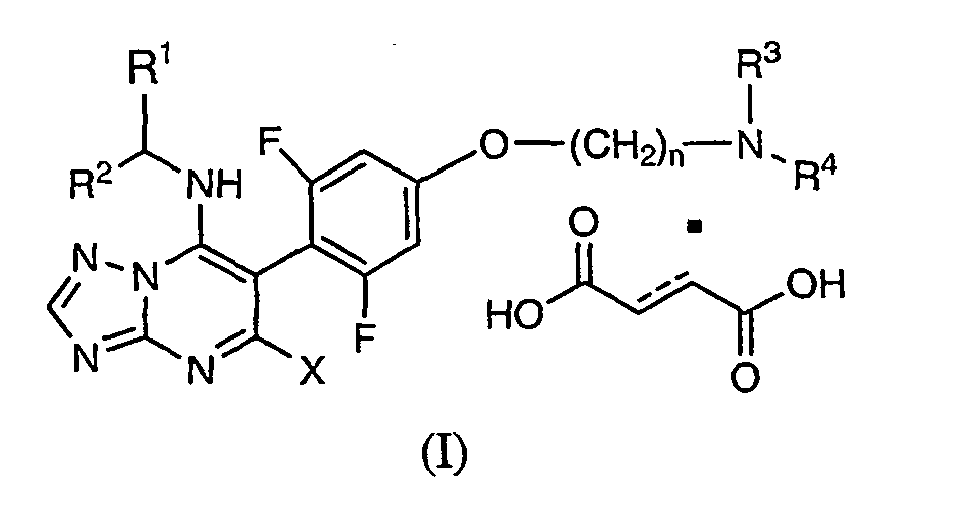
- R1 is CF3 or C2F5;
- R2 is H or C1-C3 alkyl;
- n is an integer of 2, 3, or 4;
- X is Cl or Br;
- R3 and R4 are each independently H or C1-C3 alkyl; or
- R3 and R4 when optionally taken together with the nitrogen atom to which each is attached form a 4 to 6 membered saturated heterocyclic ring having 1-2 nitrogen atoms and 0-1 oxygen atoms or 0-1 sulfur atoms, and optionally substituted with R5;
- R5 is C1-C3 alkyl;
- a. reacting a malonic acid ester of the formula


- b. halogenating the dimetal salt with a halogenating reagent POX3 where X is Br or Cl to obtain the halogenated product of the formula

- c. reacting the halogenated product with an amine


- d. reacting an alkali metal hydride with an aminoalcohol HO-(CH2)n-NR3R4 for about 30 minutes in tetrahydrofuran at about 10 to 40°C, adding the amine product and heating to about 55-60° C for about 12 to 20 h, to obtain the 6-[(substituted)phenyl]-triazolopyrimidine product

- e. reacting the 6-[(substituted)phenyl]-triazolopyrimidine product in water with a dicarboxylic acid of the formula


- f. crystallizing the 6-[(substituted)phenyl]- triazolopyrimidine dicarboxylic acid salt from water and collecting the 6-[(substituted)phenyl]-triazolopyrimidine dicarboxylic acid salt;
- g. forming the anhydrous 6-[(substituted)phenyl]-triazolopyrimidine dicarboxylic acid salt by drying the 6-[(substituted)phenyl]-triazolopyrimidine dicarboxylic acid salt; and
- h. treating the anhydrous 6-[(substituted)phenyl]- triazolopyrimidine dicarboxylic acid salt with water to obtain a 6-[(substituted)phenyl]-triazolopyrimidine dicarboxylic acid salt of formula (I) as a hydrated salt

- Especially preferred is a process for preparing a 6-[(substituted)phenyl]-triazolopyrimidine dicarboxylic acid salt and as a hydrated salt of formula (II)

- R1 is CF3 or C2F5;
- R2 is H or C1-C3 alkyl;
- n is an integer of 2, 3, or 4;
- X is Cl ;
- R3 and R4 are each independently H or C1-C3 alkyl;
- a. reacting a malonic acid ester of the formula


- b. halogenating the disodium salt with a halogenating reagent POX3 where X is Cl by heating to reflux for about 16 h to obtain the halogenated product of the formula

- c. reacting the halogenated product with an amine


- d. reacting an alkali metal hydride with an aminoalcohol HO-(CH2)n-NR3R4 for about 30 minutes in tetrahydrofuran at about 20-30°C, adding the amine product and heating to about 55-60° C for about 14-16 hours to obtain the 6-[(substituted)phenyl]- triazolopyrimidine product

- e. reacting the 6-[(substituted)phenyl]- triazolopyrimidine product in water with a dicarboxylic acid of the formula


- f. crystallizing the 6-[(substituted)phenyl]-triazolopyrimidine dicarboxylic acid salt from water and collecting the 6-[(substituted)phenyl]-triazolopyrimidine dicarboxylic acid salt;
- g. forming the anhydrous 6-[(substituted)phenyl]-triazolopyrimidine dicarboxylic acid salt by drying the 6-[(substituted)phenyl]-triazolopyrimidine dicarboxylic acid salt; and
- h. treating the anhydrous 6-[(substituted)phenyl]-triazolopyrimidine dicarboxylic acid salt with water in a saturated water atmosphere to obtain a 6-[(substituted)phenyl]-triazolopyrimidine dicarboxylic acid salt as a hydrated salt of formula (II)

- A particular embodiment of the invention
comprises an effective and efficient process for the preparation and purification of the succinate salt of [5-chloro-6-(2,4,6-trifluoro-phenyl)-[1,2,4]triazolo[1,5-a]pyrimidin-7-yl]-((1S)-2,2,2-trifluoro-1-methyl-ethyl)-amine of formula (A) and especially as the dihydrated form (B).
- In a further more preferred embodiment, R3 and R4 are each independently H or C1-C3 alkyl.
- In an additionally preferred embodiment, R3 is H and R4 is methyl.
- The compounds prepared by the process of this invention may contain an asymmetric carbon atom and some of the compounds of this invention may contain one or more asymmetric centers and may thus give rise to stereoisomers, such as enantiomers and diastereomers. The stereoisomers of the instant invention are named according to the Cahn-Ingold-Prelog System. While shown without respect to stereochemistry in Formula (I), the present invention includes all the individual possible stereoisomers; as well as the racemic mixtures and other mixtures of R and S stereoisomers (scalemic mixtures which are mixtures of unequal amounts of enantiomers) and pharmaceutically acceptable salts thereof. Included in the scope of the present invention are (R) and (S) isomers of compounds of general formula (I) having a chiral center and the racemates thereof. The present invention encompasses all stereoisomers of the compounds whether free from other stereoisomers or admixed with other stereoisomers in any proportion and thus includes, for instance, racemic mixture of enantiomers as well as the diastereomeric mixture of isomers. The absolute configuration of any compound may be determined by conventional X-ray crystallography.
- The term alkyl means a straight or branched alkyl of 1 to 4 carbon atoms, preferably 1 to 3 carbon atoms.
- Halogenating agent, means a brominating or chlorinating agent POX3 wherein X is Br or Cl, preferably phosphorus oxybromide or phosphorus oxychloride.
- Aprotic solvent includes as a solvent N,N-dimethylformamide.
- Alkali metal hydride includes lithium, potassium or sodium hydride.
- The term alkali metal hydroxide includes potassium or sodium hydroxide, preferably about 50% aqueous sodium hydroxide.
- Trialkylamine base includes tributylamine and tripropylamine.
- Dicarboxylic acid means an acid of the formula

The term hydrated salt means a dicarboxylic acid salt of Formula (I) or (II) with bound water, wherein up to five moles of water or a fraction of whole moles (ie 2.5 moles) may be bound, preferably two moles of water as the dihydrate. - In the new process for the preparation of 6-[(trisubstituted)phenyl]triazolopyrimidine compounds as described in Scheme 1, 2-(2,4,6-trifluoro-phenyl)-malonic acid diester 1 is reacted with 3-amino-1,2,4-triazole in a mole ratio of about 1:1 in the presence of a trialkylamine base, preferably tributylamine at a temperature range of about 130° to about 170°C, preferably at about 150° C for a time of about 1 to 6 h, preferably in the range of about 2 to about 3 h. The reaction mixture on cooling to about 130° C is taken into toluene and treated with at least 2 equivalents of alkali metal hydroxide, preferably sodium hydroxide as a solution and more preferred as a solution of about 50% aqueous sodium hydroxide, in a temperature range of about 10 °C to 50 °C and stirring for about 1 to 3 h preferably from about 20°C to about 30°C, preferably about 25°C, forming a solid. The resulting solid is filtered, washed with toluene and dried at about 80°C under vacuum to give disodium salt of 6-(2,4,6-trifluorophenyl)-[1,2,4]triazolo[1,5-a]pyrimidine-5.7-diol 2, in quantitative yield with a purity of >95% by high pressure liquid chromatography (HPLC).
- In the second step of the above process, to the isolated disodium salt of 6-(2,4,6-trifluorophenyl)-[1,2,4]triazolo[1,5-a]pyrimidine-5.7-diol 2 over a time of about 20 to about 60 minutes preferably about 30 minutes is added a halogenating agent, preferably a brominating or chlorinating agent POX3 wherein X is Br or Cl, preferably phosphorus oxybromide or phosphorus oxychloride in a ratio of 2 - 8 mUg of disodium salt of 6-(2,4,6-trifluorophenyl)-[1,2,4]triazolo[1,5-a]pyrimidine-5.7-diol and heated to reflux for about 8 to about 24 h, preferably about 16 h. The volatiles are removed by distillation to a residue which is distilled with toluene at least two times to afford a residue. The residue is dissolved in a solvent selected from ethyl acetate, dichloromethane or toluene and poured into water while maintaining the temperature between about 5-15° C. The solvent is separated, washed with water then dried over sodium sulfate. The volatiles are removed by distillation to a residue which is dissolved in isopropyl alcohol and the volatiles again removed by distillation to provide a residue. The residue is dissolved in isopropyl alcohol and heated to about 40 to 82°C, preferably about 60° C, filtered, cooled to about 0°C over about an hour, continued cooling for about an additional two hours and the product collected by filtration and dried further at about 45°C to give 5,7-dihalo-6-(2,4,6-trifluorophenyl)-[1,2,4]triazolo[1,5-a]-pyrimidine 3 in a purity of >95% as shown by high pressure liquid chromatography (HPLC). Preferably, when phorphorous oxychloride is the halogenating agent, 5,7-dichloro-6-(2,4,6-trifluorophenyl)-[1,2,4]triazolo[1,5-a]-pyrimidine is formed.
- In the third step of the process, to a solution of 5,7-dihalo-6-(2,4,6-trifluorophenyl)-[1,2,4]triazolo[1,5-a]-pyrimidine 3 in an aprotic solvent, preferably anhydrous N,N-dimethylformamide (DMF), wherein the ratio of 5,7-dihalo-6-(2,4,6-trifluorophenyl)-[1,2,4]triazolo[1,5-a]-pyrimidine to DMF is about 3-10 mL DMF/g, preferably 4 - 5 mUg, is added an amine R1R2CHNH2 4 where R1 and R2 are hereinbefore defined, wherein the mole ratio of 5,7-dihalo-6-(2,4,6-trifluorophenyl)-[1,2,4]triazolo[1,5-a]-pyrimidine 3 to R1R2CHNH2 4 is in the range of about 1:2 - 1:3, preferably 1:2.5, with stirring at about 20-30°C for about 24 to 48 h, preferably about 24 hours. The reaction mixture is poured into cold water of about 10-20°C wherein the volume ratio of DMF to water is about 1:1 to 1:5, preferably about 1:3. Following about 30 minutes of additional stirring the product is collected by filtration washed with water and dissolved in isopropyl alcohol, cooled to about 0°C over about an hour, stirred for about an additional hour, collected by filtration and dried to give amine 5. Preferably, 5,7-dichloro-6-(2,4,6-trifluorophenyl)-[1,2,4]triazolo[1,5-a]-pyrimidine in anhydrous N,N-dimethylformamide (DMF) is treated with preferred amine (S)-2,2,2-trifluoro-1-methyl-ethylamine at about 20-30°C for about 24 h and the reaction mixture is added slowly to cold water forming a precipitated solid product. The solid product is filtered, washed with water, and dried to give a crude product. The crude product is crystallized from a mixture of isopropyl alcohol (IPA) and water to give the product in 82% yield and having a 98% HPLC purity and an enantiomeric excess of >99%.
- In the fourth step of the process, to a suspension of alkali metal hydride preferably sodium hydride (60% in mineral oil) in anhydrous tetrahydrofuran is added amino alcohol HO-(CH2)n-NR3R4 6 dropwise over about 10 to about 40 °C preferably at ambient temperature for about 30 minutes wherein the ratio of tetrahydrofuran to aminoalcohol is about 6.5 mL THF/g aminoalcohol. A solution of amine 5 in tetrahydrofuran is added over about 10 to about 30 minutes, wherein the ratio of THF to amine is about 1 mL THF/g. The mixture is heated to about 55-60° C for about 12 to about 20 h, preferably about 16 h then cooled to about 0-6°C. To the reaction mixture is added water at about 5 to about 15 °C, preferably at about 10°C water in a ratio of about 10 mL water/ 1 g of amine. The volatiles are removed by distillation to afford a residue which is extracted with a solvent selected from t-butylmethyl ether (TBME), ethyl acetate and toluene and the aqueous phase separated. Dicarboxylic acid, preferably succinic acid (about 6.6 equivalents) is added to the separated aqueous solution and to the aqueous solution is further added a solvent selected from t-butylmethyl ether (TBME), ethyl acetate and toluene and the mixture cooled to about 0° to about 10°C, preferably about 3°C. The solid precipitate is collected by filtration, washed with cold water then preferably TBME and the solid precipitate is dissolved at about 65° to about 80° in water and is crystallized from water, 10 ml water/g of solid precipitate to afford 6-[(substituted)phenyl]- triazolopyrimidine 7 as the pharmaceutically acceptable dicarboxylic acid salt, preferably the succinic acid salt. When 6-[(substituted)phenyl]-triazolopyrimidine 7 as the pharmaceutically acceptable dicarboxylic acid salt, preferably the succinic acid salt and more preferably as the anhydrous salt is treated with a saturated atmosphere of (80-100%) relative humidity of water the hydrated salt and in particular the dihydrated salt of 6-[(substituted)phenyl]-triazolopyrimidine] is formed.

- Preferably, coupling of [5-chloro-6-(2,4,6-trifluoro-phenyl)-[1,2,4]triazolo[1,5-a]pyrimidin-7-yl]-((1S)-2,2,2-trifluoro-1-methyl-ethyl)-amine with 3-methylaminopropan-1-ol forms {5-Chloro-6-[2,6-difluoro-4-(3-methylamino-propoxy)-phenyl]-[1,2,4]triazolo[1,5-a]pyrimidin-7-yl}-((1S)-2,2,2-trifluoro-1-methyl-ethyl)-amine in the presence of alkali metal hydride, sodium hydride (NaH), in tetrahydrofuran (THF).
- In a typical experiment, to a suspension of sodium hydride (NaH) in THF is added dropwise 3-methylamino-propan-1-ol at ambient temperature and the mixture stirred for about 30 min. A solution of [5-Chloro-6-(2,4,6-trifluoro-phenyl)-[1,2,4]triazolo[1,5-a]pyrimidin-7-yl]-((1S)-2,2,2-trifluoro-1-methyl-ethyl)-amine in THF is slowly added. The mixture is heated to about 60 °C and stirred for about 20 h, then cooled to 0 °C. Water is added dropwise while maintaining the temperature at about 10 ± 3 °C. The THF is removed by distillation to a residue. The residue is extracted with t-butylmethyl ether (TBME) and to the aqueous phase is added the dicarboxylic acid, in particular succinic acid (6.6 eq.) followed by the addition of TBME. The mixture is cooled to about 3 ± 3 °C and the resulting precipitated solid product is filtered, washed with cold water and TBME. The wet solid at about 65°C to about 80°C is dissolved in water and is crystallized to give pure compound in 78% yield and having >99% HPLC purity and an enantiomeric excess of >99% which is dried under vacuum at about 35°C to about 40°C to afford the anhydrous salt which is treated with a saturated water atmosphere to afford the hydrated salt.
- Optionally, in the salt formation of {5-Chloro-6-[2,6-difluoro-4-(3-methylamino-propoxy)-phenyl]-[1,2,4]triazolo[1,5-a]pyrimidin-7-yl}-((1S)-2,2,2-trifluoro-1-methyl-ethyl)-amine with succinic acid, fumaric acid may optionally replace the succinic acid to form the fumarate salt.
- The following examples are presented to illustrate certain embodiments of the present invention, but should not be construed as limiting the scope of this invention.
- Disodium salt of 6-(2,4,6-trifluorophenyl)-[1,2,4]triazolo[1,5-a]pyrimidine-5.7-diol
- A mixture of 2-(2,4,6-trifluoro-phenyl)-malonic acid diethyl ester (400 g, 1.38 mol), 3-amino-1,2,4-triazole (122 g, 1.45 mol) and tributylamine (255 g, 1.38 mol) is heated to about 150 °C and stirred for about 2 h. The mixture is cooled to about 130 °C and the heating source is removed. Toluene (1600 mL) is then added over 30 min. The mixture is cooled to room temperature and sodium hydroxide solution (50%, 220 g, 2.76 mol) is added over about 15 min. The mixture is stirred for about 1 h from about 20°C to about 30°C. The solid is filtered and washed with toluene (2x600 mL) and dried at 80 °C/10mmHg for 40 h to give a white solid (470 g, 105%, >95%HPLC area purity), which is used directly in the next step.
- To phosphorus oxychloride (1900 mL) is added disodium salt of 6-(2,4,6-trifluorophenyl)-[1,2,4]triazolo[1,5-a]pyrimidine-5.7-diol (470 g, 1.38 mol) in portions over about 30 min. The mixture is heated to reflux for about 16 h. The solvent is removed by distillation to a residue and the residue distilled with toluene (2x500 mL). Then, the residue is dissolved into ethyl acetate (1000 mL) and the resulted mixture is poured into water (3000 g) while maintaining the temperature between 5 - 15 °C. The organic phase is separated. The combined organic phase is washed with water (1000 mL) and dried over Na2SO4. After most of the solvent is removed by distillation, IPA (2x 500 mL) is added and distillation continued to a residue. The residue is dissolved in IPA (2350 mL) and heated to about 60 °C. The mixture is filtered at 50 - 60 °C and the filtrate is cooled to about 0 °C over about 1 h and stirred for about another 2 h. The solid is filtered and dried at 45 °C/10 mmHg for 24 h to give a tan solid (243 g, 57%, 96% HPLC area purity).
- To a solution of 5,7-dichloro-6-(2,4,6-trifluorophenyl)-[1,2,4]triazolo[1,5-a]-pyrimidine (200 g, 0.627 mol) in anhydrous DMF (1000 mL) is added (S)-2,2,2-trifluoro-1-methyl-ethylamine (177 g, 1.57 mol). The solution is stirred from about 20°C to about 30°C for 24 h. The reaction mixture is added to cold water (3000 mL) slowly over 30 min. The mixture is stirred for 30 min at 10 - 20 °C. The solid product is filtered and washed with water (2x 500 mL). The crude product is dissolved into IPA (1000 mL) at 50 °C. Water (2000 mL) is added to precipitate the product over 30 min. The mixture is cooled to 0 °C over 1 h and stirred for 1 h at this temperature. The solid is filtered and dried at 65 °C/10 mmHg for 20 h to give a light yellow solid (204 g, 82%, 98% HPLC area purity and 99%ee).
- To a suspension of NaH (40.9 g, 1.02 mol, 60% in oil) in anhydrous THF (750 mL) is added 3-methylamino-propan-1-ol (115 g, 1.21 mol) at about 20-30°C dropwise over 30 min. The mixture is stirred for 30 min. Then, a solution of [5-chloro-6-(2,4,6-trifluoro-phenyl)-[1,2,4]triazolo[1,5-a]pyrimidin-7-yl]-((1S)-2,2,2-trifluoro-1-methyl-ethyl)-amine (150 g, 0.379 mol) in THF (150 mL) is added slowly over 15 min. The mixture is heated to 60 °C and stirred for 16 h, then cooled to 0 - 6 °C. Cold water (1500 mL) is added dropwise while maintain the temperature between 10 ± 3 °C. THF is removed by distillation. The reaction mixture is extracted with t-butylmethyl ether (TBME, 2x1000 mL) and to the separated aqueous phase is added in portions succinic acid (296 g, 2.51 mol) is added in portions and followed by addition of TBME (1000 mL). The mixture is cooled to 3 ± 3 °C and stirred for 1 h. The crude solid product is filtered, washed with cold water (150 mL) and TBME (2x400 mL). The wet solid is dissolved into water (2000 mL) at about 75 °C. The solution is filtered at 60 - 70 °C and cooled to 0 °C over 1 h and stirred for 1 h at this temperature. The solid is filtered and dried at 35 °C/10 mmHg for 20 h to give a white solid in anhydrous form (175 g, 80%, >99% HPLC area purity and 99%ee). A small portion of the anhydrous compound is placed in a drying dish of 80% - 100% relative humidity at about 20°C to about 30°C for 24 h. It absorbed 5.8%wt of water and stopped. This dihydrate is stable at about 20°C to about 30°C and at 5% -100% relative humidity. 1H NMR (CDCl3): δ 10.2 (bs, 1 H), 8.26 (s, 1 H), 6.80 (d, 2H, J = 10.5 Hz), 5.79 (m, 1 H), 4.13 (t, 2H, J = 6.3 Hz), 3.03 (t, 2H, J = 7.2 Hz), 2.57 (s, 3H), 2.35 (s, 4H), 2.07 (m, 2H), 1.27 (d, J = 6.0, 3H).
which process comprises:
Claims (26)
- A process for the preparation of a 6-[(substituted)phenyl]-triazolopyrimidine dicarboxylic acid salt and as a hydrated salt having the structural formula (I)
 R1 is CF3 or C2F5;R2 is H or C1-C3 alkyl;n is an integer of 2, 3, or 4;X is Cl or Br;R3 and R4 are each independently H or C1-C3 alkyl; orR3 and R4 when optionally taken together with the nitrogen atom to which each is attached form a 4 to 6 membered saturated heterocyclic ring having 1-2 nitrogen atoms and 0-1 oxygen atoms or 0-1 sulfur atoms, and optionally substituted with R5;R5 is C1-C3 alkyl; wherein the dotted line is an optional bond,which process comprises:a. reacting a malonic acid ester of the formula
 b. halogenating the dimetal salt with a halogenating reagent POX3 where X is Br or Cl to obtain the halogenated product of the formula
 c. reacting the halogenated product with an amine
 d. reacting an alkali metal hydride with an aminoalcohol HO-(CH2)n-NR3R4 for about 30 minutes in tetrahydrofuran at about 10 to 40°C, adding the amine product and heating to about 55-60° C for about 12 to 20 h, to obtain the 6-[(substituted)phenyl]-triazolopyrimidine product
 e. reacting the 6-[(substituted)phenyl]-triazolopyrimidine product in water with a dicarboxylic acid of the formula
 f. crystallizing the 6-[(substituted)phenyl]- triazolopyrimidine dicarboxylic acid salt from water and collecting the 6-[(substituted)phenyl]-triazolopyrimidine dicarboxylic acid salt;g. forming the anhydrous 6-[(substituted)phenyl]-triazolopyrimidine dicarboxylic acid salt by drying the 6-[(substituted)phenyl]-triazolopyrimidine dicarboxylic acid salt; andh. treating the anhydrous 6-[(substituted)phenyl]- triazolopyrimidine dicarboxylic acid salt with water to obtain a 6-[(substituted)phenyl]-triazolopyrimidine dicarboxylic acid salt of formula (I) as a hydrated salt
- A process according to claim 1 wherein the trialkylamine base is selected from tributylamine and tripropylamine.
- A process according to claim 1 or claim 2 wherein the mole ratio of malonic acid ester to 3-amino-1,2,4-triazole is about 1:1.
- A process according to any one of claims 1 to 3 wherein the alkali metal hydroxide is sodium hydroxide.
- A process according to claim 4 wherein the alkali metal hydroxide, sodium hydroxide is about a 50% aqueous solution.
- A process according to any one of claims 1 to 5 wherein the halogenating reagent is phosphorous oxychloride or phosphorous oxybromide.
- A process according to claim 6 wherein the halogenating reagent is phosphorous oxychloride.
- A process according to any one of claims 1 to 7 wherein the dicarboxylic acid is succinic acid or fumaric acid.
- A process according to claim 8 wherein the dicarboxylic acid is succinic acid.
- A process according to any one of claims 1 to 9 wherein the aprotic solvent is N,N-dimethylformamide.
- A process according to any one of claims 1 to 10 wherein R3 and R4 are each independently H or C1-C3 alkyl.
- A process according to claim 11 wherein R3 is H and R4 is methyl.
- A process according to any one of claims 1 to 12 wherein the heating in step a is at about 150°C for about 2 to 3 hours.
- A process according to any one of claims 1 to 13 wherein the halogenating reagent in step b is heated to reflux for about 8 to 24 hours.
- A process according to claim 14 wherein heating to reflux is for about 16 hours.
- A process according to any one of claims 1 to 15 wherein the heating in step d is for about 16 hours.
- A process according to any one of claims 1 to 16 wherein R1 is CF3 and R2 is methyl.
- A process according to any one of claims 1 to 17 wherein the amine in step c has the (S) configuration

- A process according to any one of claims 1 to 18 wherein the solvent in step e is t-butylmethyl ether.
- A process according to any one of claims 1 to 19 wherein in step h the treating with water is by a saturated water atmosphere.
- A process for the preparation of a 6-[(substituted)phenyl]-triazolopyrimidine dicarboxylic acid salt and as a hydrated salt of formula (II)
 R1 is CF3 or C2F5;R2 is H or C1-C3 alkyl;n is an integer of 2, 3, or 4;X is Cl ;R3 and R4 are each independently H or C1-C3 alkyl;wherein the dotted line is an optional bond,
which process comprisesa. reacting a malonic acid ester of the formula
 b. halogenating the disodium salt with a halogenating reagent POX3 where X is Cl by heating to reflux for about 16 h to obtain the halogenated product of the formula
 c. reacting the halogenated product with an amine
 d. reacting an alkali metal hydride with an aminoalcohol HO-(CH2)n-NR3R4 for about 30 minutes in tetrahydrofuran at ambient temperature, adding the amine product and heating to about 55-60° C for about 12-20 hours to obtain the 6-[(substituted)phenyl]- triazolopyrimidine product
 e. reacting the 6-[(substituted)phenyl]- triazolopyrimidine product in water with a dicarboxylic acid of the formula
 f. crystallizing the 6-[(substituted)phenyl]-triazolopyrimidine dicarboxylic acid salt from water and collecting the 6-[(substituted)phenyl]-triazolopyrimidine dicarboxylic acid salt;g. forming the anhydrous 6-[(substituted)phenyl]-triazolopyrimidine discarboxylic acid salt by drying the 6-[(substituted)phenyl]-triazolopyrimidine dicarboxylic acid salt; andh. treating the 6-[(substituted)phenyl]-triazolopyrimidine dicarboxylic acid salt with water in a saturated water atmosphere to obtain a 6-[(substituted)phenyl]-triazolopyrimidine dicarboxylic acid salt as a hydrated salt of formula (II)
- A process according to any one of claims 1 to 20 wherein

- A process according to any one of claims 1 to 20 wherein

- A process according to claim 21 wherein

- A process according to claim 21 wherein

- A process according to any one of claims 1 to 22 wherein the mole ratio of halogenated product to amine in step C is about 1:2 to about 1:3.
Priority Applications (1)
| Application Number | Priority Date | Filing Date | Title |
|---|---|---|---|
| PL04813203T PL1692137T3 (en) | 2003-12-08 | 2004-12-07 | Process for the preparation of tubulin inhibitors |
Applications Claiming Priority (2)
| Application Number | Priority Date | Filing Date | Title |
|---|---|---|---|
| US52793103P | 2003-12-08 | 2003-12-08 | |
| PCT/US2004/040854 WO2005056560A1 (en) | 2003-12-08 | 2004-12-07 | Process for the preparation of tubulin inhibitors |
Publications (2)
| Publication Number | Publication Date |
|---|---|
| EP1692137A1 EP1692137A1 (en) | 2006-08-23 |
| EP1692137B1 true EP1692137B1 (en) | 2007-03-07 |
Family
ID=34676796
Family Applications (1)
| Application Number | Title | Priority Date | Filing Date |
|---|---|---|---|
| EP04813203A Expired - Lifetime EP1692137B1 (en) | 2003-12-08 | 2004-12-07 | Process for the preparation of tubulin inhibitors |
Country Status (28)
| Country | Link |
|---|---|
| US (1) | US7396835B2 (en) |
| EP (1) | EP1692137B1 (en) |
| JP (1) | JP2007513185A (en) |
| KR (1) | KR20060094984A (en) |
| CN (1) | CN1890245A (en) |
| AR (1) | AR046939A1 (en) |
| AT (1) | ATE356128T1 (en) |
| AU (1) | AU2004297244A1 (en) |
| BR (1) | BRPI0417422A (en) |
| CA (1) | CA2546899A1 (en) |
| CO (1) | CO5700827A2 (en) |
| CR (1) | CR8435A (en) |
| DE (1) | DE602004005239T2 (en) |
| DK (1) | DK1692137T3 (en) |
| EC (1) | ECSP066606A (en) |
| ES (1) | ES2281850T3 (en) |
| GT (1) | GT200400248A (en) |
| IL (1) | IL175775A0 (en) |
| MY (1) | MY179926A (en) |
| NO (1) | NO20062492L (en) |
| NZ (1) | NZ547471A (en) |
| PA (1) | PA8619401A1 (en) |
| PE (1) | PE20050593A1 (en) |
| PL (1) | PL1692137T3 (en) |
| RU (1) | RU2006117023A (en) |
| TW (1) | TW200522963A (en) |
| WO (1) | WO2005056560A1 (en) |
| ZA (1) | ZA200604680B (en) |
Families Citing this family (8)
| Publication number | Priority date | Publication date | Assignee | Title |
|---|---|---|---|---|
| US6255309B1 (en) * | 1999-03-19 | 2001-07-03 | American Cyanomid Co. | Fungicidal trifluoromethylalkylamino-triazolopyrimidines |
| US7419982B2 (en) * | 2003-09-24 | 2008-09-02 | Wyeth Holdings Corporation | Crystalline forms of 5-chloro-6-{2,6-difluoro-4-[3-(methylamino)propoxy]phenyl}-N-[(1S)-2,2,2-trifluoro-1-methylethyl][1,2,4]triazolo[1,5-a]pyrimidin-7-amine salts |
| TW200800959A (en) | 2005-06-10 | 2008-01-01 | Wyeth Corp | Piperazine-piperidine antagonists and agonists of the 5-HT1a receptor |
| TW200808730A (en) * | 2006-06-09 | 2008-02-16 | Wyeth Corp | Process for synthesizing piperazine-piperidine compounds |
| BRPI0807458A2 (en) * | 2007-01-08 | 2014-06-03 | Basf Se | USE OF COMPOUNDS, AGENT, SEED, METHOD FOR COMBATING HARMFUL PHYTOPATHOGENIC FUNGI, AND, COMPOUND |
| US9649317B2 (en) | 2012-09-19 | 2017-05-16 | The Trustees Of The University Of Pennsylvania | Heterocyclic compounds and their use for the treatment of neurodegenerative tauopathies |
| EP3758696B1 (en) | 2018-03-02 | 2026-02-25 | The Trustees of the University of Pennsylvania | [1,2,4]triazolo[1,5-a]pyrimidine compounds and use in stabilizing microtubules |
| CN116178375B (en) * | 2023-02-24 | 2024-09-20 | 重庆文理学院 | Triazolopyrimidine compound and synthetic method and application thereof |
Family Cites Families (25)
| Publication number | Priority date | Publication date | Assignee | Title |
|---|---|---|---|---|
| TW224044B (en) | 1991-12-30 | 1994-05-21 | Shell Internat Res Schappej B V | |
| US5593996A (en) * | 1991-12-30 | 1997-01-14 | American Cyanamid Company | Triazolopyrimidine derivatives |
| JP2794510B2 (en) * | 1992-03-27 | 1998-09-10 | 富士写真フイルム株式会社 | Silver halide photographic material |
| IL108731A (en) * | 1993-03-04 | 1997-03-18 | Shell Int Research | 6, N-DISUBSTITUTED-£1, 2, 4| TRIAZOLO-£1, 5-a| PYRIMIDINE- 7-AMINE DERIVATIVES, THEIR PREPARATION AND THEIR USE AS FUNGICIDES |
| IL108747A (en) | 1993-03-04 | 1999-03-12 | Shell Int Research | Fungicidal compositions containing 6-substituted-5,7-dihalo-1,2,4-triazolo Ú1,5-a¾pyrimidine derivatives certain new such derivatives and their preparation |
| RU2147584C1 (en) * | 1995-10-27 | 2000-04-20 | Американ Цианамид Компани | Method of synthesis of dihaloidazolopyrimidines and method of synthesis of dihydroxyazolopyrimidines |
| US5817663A (en) | 1996-10-07 | 1998-10-06 | American Cyanamid Company | Pentafluorophenylazolopyrimidines |
| US5750766A (en) * | 1997-03-18 | 1998-05-12 | American Cyanamid Company | Process for the preparation of arylmalonates |
| DK0984919T3 (en) | 1997-03-18 | 2003-05-12 | Basf Ag | Process for the preparation of aryl malonates |
| US5948783A (en) * | 1997-04-14 | 1999-09-07 | American Cyanamid Company | Fungicidal trifluoromethylalkylamino-triazolopyrimidines |
| TW460476B (en) | 1997-04-14 | 2001-10-21 | American Cyanamid Co | Fungicidal trifluoromethylalkylamino-triazolopyrimidines |
| TWI252231B (en) | 1997-04-14 | 2006-04-01 | American Cyanamid Co | Fungicidal trifluorophenyl-triazolopyrimidines |
| US6117876A (en) * | 1997-04-14 | 2000-09-12 | American Cyanamid Company | Fungicidal trifluorophenyl-triazolopyrimidines |
| US5994360A (en) * | 1997-07-14 | 1999-11-30 | American Cyanamid Company | Fungicidal 5-alkyl-triazolopyrimidines |
| US5986153A (en) * | 1997-09-30 | 1999-11-16 | Phillips Petroleum Company | Olefin color stabilization |
| US6020338A (en) * | 1998-02-11 | 2000-02-01 | American Cyanamid Company | Fungicidal 7-alkyl-triazolopyrimidines |
| AU752669B2 (en) * | 1998-03-23 | 2002-09-26 | Basf Aktiengesellschaft | Fungicidal 6-(2-halo-4-alkoxyphenyl)-triazolopyrimidines |
| US5981534A (en) * | 1998-09-25 | 1999-11-09 | American Cyanamid Company | Fungicidal 6-(2,6-difluoro-4-alkoxyphenyl)-triazolopyrimidines |
| JP2000103790A (en) | 1998-09-25 | 2000-04-11 | American Cyanamid Co | Bactericidal and fungicidal trihalophenyl- triazopyrimidines |
| US6242451B1 (en) * | 1998-09-25 | 2001-06-05 | Klaus-Juergen Pees | Fungicidal trihalophenyl-triazolopyrimidines |
| US5986135A (en) | 1998-09-25 | 1999-11-16 | American Cyanamid Company | Fungicidal trifluoromethylalkylamino-triazolopyrimidines |
| US5985883A (en) * | 1998-09-25 | 1999-11-16 | American Cyanamid Company | Fungicidal trichlorophenyl-triazolopyrimidines |
| JP2004502691A (en) | 2000-06-30 | 2004-01-29 | ワイス | Substituted triazolopyrimidines as anticancer drugs |
| MXPA06003206A (en) * | 2003-09-24 | 2006-06-23 | Wyeth Corp | 6-[(substituted)phenyl]triazolopyrimidines as anticancer agents. |
| CN101193884A (en) * | 2005-06-13 | 2008-06-04 | 惠氏公司 | Tubulin inhibitor and its preparation method |
-
2004
- 2004-12-02 MY MYPI20044999A patent/MY179926A/en unknown
- 2004-12-03 GT GT200400248A patent/GT200400248A/en unknown
- 2004-12-03 TW TW093137287A patent/TW200522963A/en unknown
- 2004-12-07 PA PA20048619401A patent/PA8619401A1/en unknown
- 2004-12-07 AR ARP040104569A patent/AR046939A1/en not_active Application Discontinuation
- 2004-12-07 DE DE602004005239T patent/DE602004005239T2/en not_active Expired - Fee Related
- 2004-12-07 AU AU2004297244A patent/AU2004297244A1/en not_active Withdrawn
- 2004-12-07 PL PL04813203T patent/PL1692137T3/en unknown
- 2004-12-07 ES ES04813203T patent/ES2281850T3/en not_active Expired - Lifetime
- 2004-12-07 JP JP2006542867A patent/JP2007513185A/en not_active Withdrawn
- 2004-12-07 CA CA002546899A patent/CA2546899A1/en not_active Abandoned
- 2004-12-07 CN CNA2004800362897A patent/CN1890245A/en active Pending
- 2004-12-07 PE PE2004001201A patent/PE20050593A1/en not_active Application Discontinuation
- 2004-12-07 DK DK04813203T patent/DK1692137T3/en active
- 2004-12-07 EP EP04813203A patent/EP1692137B1/en not_active Expired - Lifetime
- 2004-12-07 BR BRPI0417422-4A patent/BRPI0417422A/en not_active IP Right Cessation
- 2004-12-07 KR KR1020067012134A patent/KR20060094984A/en not_active Withdrawn
- 2004-12-07 RU RU2006117023/04A patent/RU2006117023A/en not_active Application Discontinuation
- 2004-12-07 WO PCT/US2004/040854 patent/WO2005056560A1/en not_active Ceased
- 2004-12-07 NZ NZ547471A patent/NZ547471A/en unknown
- 2004-12-07 AT AT04813203T patent/ATE356128T1/en not_active IP Right Cessation
- 2004-12-08 US US11/007,839 patent/US7396835B2/en not_active Expired - Fee Related
-
2006
- 2006-05-18 IL IL175775A patent/IL175775A0/en unknown
- 2006-05-31 NO NO20062492A patent/NO20062492L/en not_active Application Discontinuation
- 2006-06-05 EC EC2006006606A patent/ECSP066606A/en unknown
- 2006-06-06 CR CR8435A patent/CR8435A/en not_active Application Discontinuation
- 2006-06-07 ZA ZA200604680A patent/ZA200604680B/en unknown
- 2006-06-08 CO CO06055468A patent/CO5700827A2/en not_active Application Discontinuation
Also Published As
| Publication number | Publication date |
|---|---|
| PA8619401A1 (en) | 2005-08-04 |
| NO20062492L (en) | 2006-07-03 |
| US20050124635A1 (en) | 2005-06-09 |
| GT200400248A (en) | 2005-09-14 |
| RU2006117023A (en) | 2008-01-20 |
| WO2005056560A1 (en) | 2005-06-23 |
| DE602004005239T2 (en) | 2007-12-20 |
| DK1692137T3 (en) | 2007-04-30 |
| ECSP066606A (en) | 2006-10-25 |
| KR20060094984A (en) | 2006-08-30 |
| US7396835B2 (en) | 2008-07-08 |
| BRPI0417422A (en) | 2007-03-13 |
| TW200522963A (en) | 2005-07-16 |
| AR046939A1 (en) | 2006-01-04 |
| ES2281850T3 (en) | 2007-10-01 |
| PL1692137T3 (en) | 2007-06-29 |
| ATE356128T1 (en) | 2007-03-15 |
| NZ547471A (en) | 2009-03-31 |
| IL175775A0 (en) | 2006-09-05 |
| CR8435A (en) | 2007-06-08 |
| EP1692137A1 (en) | 2006-08-23 |
| CN1890245A (en) | 2007-01-03 |
| CO5700827A2 (en) | 2006-11-30 |
| CA2546899A1 (en) | 2005-06-23 |
| PE20050593A1 (en) | 2005-09-27 |
| AU2004297244A1 (en) | 2005-06-23 |
| DE602004005239D1 (en) | 2007-04-19 |
| HK1090377A1 (en) | 2006-12-22 |
| JP2007513185A (en) | 2007-05-24 |
| ZA200604680B (en) | 2009-04-29 |
| MY179926A (en) | 2020-11-19 |
Similar Documents
| Publication | Publication Date | Title |
|---|---|---|
| US12325707B2 (en) | Process for preparing enantiomerically enriched JAK inhibitors | |
| CN111315747B (en) | Dihydropyrazolopyrimidine compounds and their preparation methods and uses | |
| FI109799B (en) | Process for the preparation of therapeutically useful 4- (substituted) -2,5-dialkyl-7- (di- or trisubstituted) -phenyl-7H-pyrrolo [2,3-d] pyrimidine derivatives | |
| JP7802770B2 (en) | Methods and intermediates for preparing JAK inhibitors | |
| HUT72640A (en) | 2-benzyl-polycyclic guanine derivatives, pharmaceutical compositions containing them and process for preparing them | |
| JP7744358B2 (en) | Compounds for treating or inhibiting relapse of acute myeloid leukemia | |
| BG65257B1 (en) | 2-phenyl substituted imidazotriazinones as phosphodiesterase inhibitors | |
| BG65866B1 (en) | Triazolo pyrimidine compounds | |
| EP3272738A2 (en) | Processes for preparing jak inhibitors and related intermediate compounds | |
| EP2456311A1 (en) | Substituted imidazotriazines | |
| CA3044796A1 (en) | Method for preparing 7h-pyrrolo[2,3-d]pyrimidine derivatives andd co-cryco-crystals thereof | |
| US7396835B2 (en) | Process for the preparation of tubulin inhibitors | |
| EP1680425A1 (en) | 6- [(substituted)phenyl] triazolopyrimidines as anticancer agents | |
| JP3714685B2 (en) | Hymenialdisine and its derivatives, methods for producing their synthetic intermediates, and synthetic intermediates thereof | |
| US20220213105A1 (en) | Process for preparing enantiomerically enriched jak inhibitors | |
| HK1090377B (en) | Process for the preparation of tubulin inhibitors | |
| EP3105232B1 (en) | Substituted triazolobenzodiazepines | |
| JP4278859B2 (en) | Method for producing oxaazaphosphorin-2-amine | |
| MXPA06006538A (en) | Process for the preparation of tubulin inhibitors | |
| JPH06122686A (en) | Method for optical resolution of racemic modification | |
| AU2006259663A1 (en) | Tubulin inhibitor and process for its preparation | |
| JP2023505771A (en) | Processes and intermediates for the preparation of compounds of formula (I) | |
| SK287190B6 (en) | Process for the preparation of 9-amino substituted 9,10-dihydropyrrolo [2,1-B][1,3]benzothiazepines |
Legal Events
| Date | Code | Title | Description |
|---|---|---|---|
| PUAI | Public reference made under article 153(3) epc to a published international application that has entered the european phase |
Free format text: ORIGINAL CODE: 0009012 |
|
| 17P | Request for examination filed |
Effective date: 20060519 |
|
| AK | Designated contracting states |
Kind code of ref document: A1 Designated state(s): AT BE BG CH CY CZ DE DK EE ES FI FR GB GR HU IE IS IT LI LT LU MC NL PL PT RO SE SI SK TR |
|
| AX | Request for extension of the european patent |
Extension state: AL BA HR LV MK YU |
|
| GRAP | Despatch of communication of intention to grant a patent |
Free format text: ORIGINAL CODE: EPIDOSNIGR1 |
|
| REG | Reference to a national code |
Ref country code: HK Ref legal event code: DE Ref document number: 1090377 Country of ref document: HK |
|
| GRAS | Grant fee paid |
Free format text: ORIGINAL CODE: EPIDOSNIGR3 |
|
| GRAA | (expected) grant |
Free format text: ORIGINAL CODE: 0009210 |
|
| AK | Designated contracting states |
Kind code of ref document: B1 Designated state(s): AT BE BG CH CY CZ DE DK EE ES FI FR GB GR HU IE IS IT LI LT LU MC NL PL PT RO SE SI SK TR |
|
| AX | Request for extension of the european patent |
Extension state: AL BA HR LV MK YU |
|
| PG25 | Lapsed in a contracting state [announced via postgrant information from national office to epo] |
Ref country code: BE Free format text: LAPSE BECAUSE OF FAILURE TO SUBMIT A TRANSLATION OF THE DESCRIPTION OR TO PAY THE FEE WITHIN THE PRESCRIBED TIME-LIMIT Effective date: 20070307 Ref country code: SI Free format text: LAPSE BECAUSE OF FAILURE TO SUBMIT A TRANSLATION OF THE DESCRIPTION OR TO PAY THE FEE WITHIN THE PRESCRIBED TIME-LIMIT Effective date: 20070307 Ref country code: AT Free format text: LAPSE BECAUSE OF FAILURE TO SUBMIT A TRANSLATION OF THE DESCRIPTION OR TO PAY THE FEE WITHIN THE PRESCRIBED TIME-LIMIT Effective date: 20070307 |
|
| REG | Reference to a national code |
Ref country code: GB Ref legal event code: FG4D |
|
| REG | Reference to a national code |
Ref country code: CH Ref legal event code: EP |
|
| REF | Corresponds to: |
Ref document number: 602004005239 Country of ref document: DE Date of ref document: 20070419 Kind code of ref document: P |
|
| REG | Reference to a national code |
Ref country code: DK Ref legal event code: T3 |
|
| REG | Reference to a national code |
Ref country code: IE Ref legal event code: FG4D |
|
| REG | Reference to a national code |
Ref country code: CH Ref legal event code: NV Representative=s name: E. BLUM & CO. AG PATENT- UND MARKENANWAELTE VSP |
|
| REG | Reference to a national code |
Ref country code: HK Ref legal event code: GR Ref document number: 1090377 Country of ref document: HK |
|
| REG | Reference to a national code |
Ref country code: SE Ref legal event code: TRGR |
|
| REG | Reference to a national code |
Ref country code: PL Ref legal event code: T3 |
|
| PG25 | Lapsed in a contracting state [announced via postgrant information from national office to epo] |
Ref country code: IS Free format text: LAPSE BECAUSE OF FAILURE TO SUBMIT A TRANSLATION OF THE DESCRIPTION OR TO PAY THE FEE WITHIN THE PRESCRIBED TIME-LIMIT Effective date: 20070707 |
|
| PG25 | Lapsed in a contracting state [announced via postgrant information from national office to epo] |
Ref country code: PT Free format text: LAPSE BECAUSE OF FAILURE TO SUBMIT A TRANSLATION OF THE DESCRIPTION OR TO PAY THE FEE WITHIN THE PRESCRIBED TIME-LIMIT Effective date: 20070807 |
|
| ET | Fr: translation filed | ||
| REG | Reference to a national code |
Ref country code: ES Ref legal event code: FG2A Ref document number: 2281850 Country of ref document: ES Kind code of ref document: T3 |
|
| PG25 | Lapsed in a contracting state [announced via postgrant information from national office to epo] |
Ref country code: SK Free format text: LAPSE BECAUSE OF FAILURE TO SUBMIT A TRANSLATION OF THE DESCRIPTION OR TO PAY THE FEE WITHIN THE PRESCRIBED TIME-LIMIT Effective date: 20070307 |
|
| PG25 | Lapsed in a contracting state [announced via postgrant information from national office to epo] |
Ref country code: RO Free format text: LAPSE BECAUSE OF FAILURE TO SUBMIT A TRANSLATION OF THE DESCRIPTION OR TO PAY THE FEE WITHIN THE PRESCRIBED TIME-LIMIT Effective date: 20070307 Ref country code: CZ Free format text: LAPSE BECAUSE OF FAILURE TO SUBMIT A TRANSLATION OF THE DESCRIPTION OR TO PAY THE FEE WITHIN THE PRESCRIBED TIME-LIMIT Effective date: 20070307 |
|
| PLBE | No opposition filed within time limit |
Free format text: ORIGINAL CODE: 0009261 |
|
| STAA | Information on the status of an ep patent application or granted ep patent |
Free format text: STATUS: NO OPPOSITION FILED WITHIN TIME LIMIT |
|
| 26N | No opposition filed |
Effective date: 20071210 |
|
| PG25 | Lapsed in a contracting state [announced via postgrant information from national office to epo] |
Ref country code: LT Free format text: LAPSE BECAUSE OF FAILURE TO SUBMIT A TRANSLATION OF THE DESCRIPTION OR TO PAY THE FEE WITHIN THE PRESCRIBED TIME-LIMIT Effective date: 20070307 |
|
| PG25 | Lapsed in a contracting state [announced via postgrant information from national office to epo] |
Ref country code: GR Free format text: LAPSE BECAUSE OF FAILURE TO SUBMIT A TRANSLATION OF THE DESCRIPTION OR TO PAY THE FEE WITHIN THE PRESCRIBED TIME-LIMIT Effective date: 20070608 |
|
| PG25 | Lapsed in a contracting state [announced via postgrant information from national office to epo] |
Ref country code: MC Free format text: LAPSE BECAUSE OF NON-PAYMENT OF DUE FEES Effective date: 20071231 |
|
| PGFP | Annual fee paid to national office [announced via postgrant information from national office to epo] |
Ref country code: PL Payment date: 20080922 Year of fee payment: 5 |
|
| PG25 | Lapsed in a contracting state [announced via postgrant information from national office to epo] |
Ref country code: EE Free format text: LAPSE BECAUSE OF FAILURE TO SUBMIT A TRANSLATION OF THE DESCRIPTION OR TO PAY THE FEE WITHIN THE PRESCRIBED TIME-LIMIT Effective date: 20070307 |
|
| PGFP | Annual fee paid to national office [announced via postgrant information from national office to epo] |
Ref country code: CH Payment date: 20081028 Year of fee payment: 5 Ref country code: DK Payment date: 20081112 Year of fee payment: 5 Ref country code: IE Payment date: 20081016 Year of fee payment: 5 Ref country code: LU Payment date: 20081021 Year of fee payment: 5 Ref country code: NL Payment date: 20081111 Year of fee payment: 5 |
|
| PGFP | Annual fee paid to national office [announced via postgrant information from national office to epo] |
Ref country code: ES Payment date: 20081222 Year of fee payment: 5 Ref country code: FI Payment date: 20081112 Year of fee payment: 5 |
|
| PGFP | Annual fee paid to national office [announced via postgrant information from national office to epo] |
Ref country code: IT Payment date: 20081217 Year of fee payment: 5 Ref country code: SE Payment date: 20081208 Year of fee payment: 5 |
|
| PGFP | Annual fee paid to national office [announced via postgrant information from national office to epo] |
Ref country code: FR Payment date: 20081205 Year of fee payment: 5 |
|
| PGFP | Annual fee paid to national office [announced via postgrant information from national office to epo] |
Ref country code: DE Payment date: 20081230 Year of fee payment: 5 |
|
| PGFP | Annual fee paid to national office [announced via postgrant information from national office to epo] |
Ref country code: GB Payment date: 20081110 Year of fee payment: 5 |
|
| PG25 | Lapsed in a contracting state [announced via postgrant information from national office to epo] |
Ref country code: CY Free format text: LAPSE BECAUSE OF FAILURE TO SUBMIT A TRANSLATION OF THE DESCRIPTION OR TO PAY THE FEE WITHIN THE PRESCRIBED TIME-LIMIT Effective date: 20070307 |
|
| PG25 | Lapsed in a contracting state [announced via postgrant information from national office to epo] |
Ref country code: BG Free format text: LAPSE BECAUSE OF FAILURE TO SUBMIT A TRANSLATION OF THE DESCRIPTION OR TO PAY THE FEE WITHIN THE PRESCRIBED TIME-LIMIT Effective date: 20070607 |
|
| PG25 | Lapsed in a contracting state [announced via postgrant information from national office to epo] |
Ref country code: TR Free format text: LAPSE BECAUSE OF FAILURE TO SUBMIT A TRANSLATION OF THE DESCRIPTION OR TO PAY THE FEE WITHIN THE PRESCRIBED TIME-LIMIT Effective date: 20070307 Ref country code: HU Free format text: LAPSE BECAUSE OF FAILURE TO SUBMIT A TRANSLATION OF THE DESCRIPTION OR TO PAY THE FEE WITHIN THE PRESCRIBED TIME-LIMIT Effective date: 20070908 |
|
| REG | Reference to a national code |
Ref country code: NL Ref legal event code: V1 Effective date: 20100701 |
|
| EUG | Se: european patent has lapsed | ||
| REG | Reference to a national code |
Ref country code: CH Ref legal event code: PL |
|
| REG | Reference to a national code |
Ref country code: DK Ref legal event code: EBP |
|
| GBPC | Gb: european patent ceased through non-payment of renewal fee |
Effective date: 20091207 |
|
| PG25 | Lapsed in a contracting state [announced via postgrant information from national office to epo] |
Ref country code: FI Free format text: LAPSE BECAUSE OF NON-PAYMENT OF DUE FEES Effective date: 20091207 |
|
| REG | Reference to a national code |
Ref country code: FR Ref legal event code: ST Effective date: 20100831 |
|
| PG25 | Lapsed in a contracting state [announced via postgrant information from national office to epo] |
Ref country code: NL Free format text: LAPSE BECAUSE OF NON-PAYMENT OF DUE FEES Effective date: 20100701 Ref country code: CH Free format text: LAPSE BECAUSE OF NON-PAYMENT OF DUE FEES Effective date: 20091231 Ref country code: FR Free format text: LAPSE BECAUSE OF NON-PAYMENT OF DUE FEES Effective date: 20091231 Ref country code: IE Free format text: LAPSE BECAUSE OF NON-PAYMENT OF DUE FEES Effective date: 20091207 Ref country code: LI Free format text: LAPSE BECAUSE OF NON-PAYMENT OF DUE FEES Effective date: 20091231 |
|
| PG25 | Lapsed in a contracting state [announced via postgrant information from national office to epo] |
Ref country code: DE Free format text: LAPSE BECAUSE OF NON-PAYMENT OF DUE FEES Effective date: 20100701 |
|
| PG25 | Lapsed in a contracting state [announced via postgrant information from national office to epo] |
Ref country code: GB Free format text: LAPSE BECAUSE OF NON-PAYMENT OF DUE FEES Effective date: 20091207 |
|
| PG25 | Lapsed in a contracting state [announced via postgrant information from national office to epo] |
Ref country code: DK Free format text: LAPSE BECAUSE OF NON-PAYMENT OF DUE FEES Effective date: 20100104 |
|
| REG | Reference to a national code |
Ref country code: ES Ref legal event code: FD2A Effective date: 20110328 |
|
| PG25 | Lapsed in a contracting state [announced via postgrant information from national office to epo] |
Ref country code: IT Free format text: LAPSE BECAUSE OF NON-PAYMENT OF DUE FEES Effective date: 20091207 |
|
| PG25 | Lapsed in a contracting state [announced via postgrant information from national office to epo] |
Ref country code: LU Free format text: LAPSE BECAUSE OF NON-PAYMENT OF DUE FEES Effective date: 20091207 |
|
| PG25 | Lapsed in a contracting state [announced via postgrant information from national office to epo] |
Ref country code: SE Free format text: LAPSE BECAUSE OF NON-PAYMENT OF DUE FEES Effective date: 20091208 Ref country code: PL Free format text: LAPSE BECAUSE OF NON-PAYMENT OF DUE FEES Effective date: 20091207 |
|
| REG | Reference to a national code |
Ref country code: PL Ref legal event code: LAPE |
|
| PG25 | Lapsed in a contracting state [announced via postgrant information from national office to epo] |
Ref country code: ES Free format text: LAPSE BECAUSE OF NON-PAYMENT OF DUE FEES Effective date: 20110315 |
|
| PG25 | Lapsed in a contracting state [announced via postgrant information from national office to epo] |
Ref country code: ES Free format text: LAPSE BECAUSE OF NON-PAYMENT OF DUE FEES Effective date: 20091208 |