EP1690459A1 - Ice skate boot - Google Patents
Ice skate boot Download PDFInfo
- Publication number
- EP1690459A1 EP1690459A1 EP05290335A EP05290335A EP1690459A1 EP 1690459 A1 EP1690459 A1 EP 1690459A1 EP 05290335 A EP05290335 A EP 05290335A EP 05290335 A EP05290335 A EP 05290335A EP 1690459 A1 EP1690459 A1 EP 1690459A1
- Authority
- EP
- European Patent Office
- Prior art keywords
- medial
- lateral
- ice skate
- portions
- skate boot
- Prior art date
- Legal status (The legal status is an assumption and is not a legal conclusion. Google has not performed a legal analysis and makes no representation as to the accuracy of the status listed.)
- Granted
Links
- 210000003371 toe Anatomy 0.000 claims abstract description 50
- 210000002683 foot Anatomy 0.000 claims abstract description 48
- 239000000463 material Substances 0.000 claims abstract description 28
- 210000003423 ankle Anatomy 0.000 claims abstract description 26
- 238000000034 method Methods 0.000 claims description 16
- 239000006260 foam Substances 0.000 claims description 14
- 238000003856 thermoforming Methods 0.000 claims description 9
- NJPPVKZQTLUDBO-UHFFFAOYSA-N novaluron Chemical compound C1=C(Cl)C(OC(F)(F)C(OC(F)(F)F)F)=CC=C1NC(=O)NC(=O)C1=C(F)C=CC=C1F NJPPVKZQTLUDBO-UHFFFAOYSA-N 0.000 claims description 8
- 238000004519 manufacturing process Methods 0.000 claims description 7
- 238000005520 cutting process Methods 0.000 claims description 2
- 239000004793 Polystyrene Substances 0.000 description 6
- 229920001778 nylon Polymers 0.000 description 5
- 229920003182 Surlyn® Polymers 0.000 description 4
- 239000000853 adhesive Substances 0.000 description 4
- 230000001070 adhesive effect Effects 0.000 description 4
- 239000004700 high-density polyethylene Substances 0.000 description 4
- 239000012528 membrane Substances 0.000 description 4
- -1 polyethylene Polymers 0.000 description 4
- 239000005035 Surlyn® Substances 0.000 description 3
- 239000011248 coating agent Substances 0.000 description 3
- 238000000576 coating method Methods 0.000 description 3
- 239000002131 composite material Substances 0.000 description 3
- 238000010276 construction Methods 0.000 description 3
- 239000005038 ethylene vinyl acetate Substances 0.000 description 3
- 229920001903 high density polyethylene Polymers 0.000 description 3
- 229920000728 polyester Polymers 0.000 description 3
- 239000004698 Polyethylene Substances 0.000 description 2
- 239000004743 Polypropylene Substances 0.000 description 2
- 239000004772 Sontara Substances 0.000 description 2
- 239000004744 fabric Substances 0.000 description 2
- 229920000573 polyethylene Polymers 0.000 description 2
- 229920001155 polypropylene Polymers 0.000 description 2
- 229920000742 Cotton Polymers 0.000 description 1
- JOYRKODLDBILNP-UHFFFAOYSA-N Ethyl urethane Chemical compound CCOC(N)=O JOYRKODLDBILNP-UHFFFAOYSA-N 0.000 description 1
- 239000004831 Hot glue Substances 0.000 description 1
- 239000004677 Nylon Substances 0.000 description 1
- 210000001361 achilles tendon Anatomy 0.000 description 1
- 210000000988 bone and bone Anatomy 0.000 description 1
- DQXBYHZEEUGOBF-UHFFFAOYSA-N but-3-enoic acid;ethene Chemical compound C=C.OC(=O)CC=C DQXBYHZEEUGOBF-UHFFFAOYSA-N 0.000 description 1
- 239000000835 fiber Substances 0.000 description 1
- 239000012530 fluid Substances 0.000 description 1
- 210000004744 fore-foot Anatomy 0.000 description 1
- 238000007757 hot melt coating Methods 0.000 description 1
- 238000002347 injection Methods 0.000 description 1
- 239000007924 injection Substances 0.000 description 1
- 239000004816 latex Substances 0.000 description 1
- 229920000126 latex Polymers 0.000 description 1
- 239000010985 leather Substances 0.000 description 1
- 239000007788 liquid Substances 0.000 description 1
- 238000012986 modification Methods 0.000 description 1
- 230000004048 modification Effects 0.000 description 1
- 229920001200 poly(ethylene-vinyl acetate) Polymers 0.000 description 1
- 229920006327 polystyrene foam Polymers 0.000 description 1
- 238000003825 pressing Methods 0.000 description 1
- 229920006395 saturated elastomer Polymers 0.000 description 1
- 239000007779 soft material Substances 0.000 description 1
- 239000004753 textile Substances 0.000 description 1
- 229920001169 thermoplastic Polymers 0.000 description 1
- 239000004416 thermosoftening plastic Substances 0.000 description 1
Images





Classifications
-
- A—HUMAN NECESSITIES
- A43—FOOTWEAR
- A43B—CHARACTERISTIC FEATURES OF FOOTWEAR; PARTS OF FOOTWEAR
- A43B5/00—Footwear for sporting purposes
- A43B5/16—Skating boots
- A43B5/1666—Skating boots characterised by the upper
- A43B5/1683—Skating boots characterised by the upper characterised by the lower part of the upper or by the shell
-
- A—HUMAN NECESSITIES
- A43—FOOTWEAR
- A43B—CHARACTERISTIC FEATURES OF FOOTWEAR; PARTS OF FOOTWEAR
- A43B5/00—Footwear for sporting purposes
- A43B5/16—Skating boots
- A43B5/1625—Skating boots made from materials with different rigidities
-
- A—HUMAN NECESSITIES
- A43—FOOTWEAR
- A43B—CHARACTERISTIC FEATURES OF FOOTWEAR; PARTS OF FOOTWEAR
- A43B5/00—Footwear for sporting purposes
- A43B5/16—Skating boots
- A43B5/1641—Skating boots characterised by the sole ; characterised by the attachment of the skate
-
- B—PERFORMING OPERATIONS; TRANSPORTING
- B29—WORKING OF PLASTICS; WORKING OF SUBSTANCES IN A PLASTIC STATE IN GENERAL
- B29D—PRODUCING PARTICULAR ARTICLES FROM PLASTICS OR FROM SUBSTANCES IN A PLASTIC STATE
- B29D35/00—Producing footwear
- B29D35/0054—Producing footwear by compression moulding, vulcanising or the like; Apparatus therefor
-
- B—PERFORMING OPERATIONS; TRANSPORTING
- B29—WORKING OF PLASTICS; WORKING OF SUBSTANCES IN A PLASTIC STATE IN GENERAL
- B29D—PRODUCING PARTICULAR ARTICLES FROM PLASTICS OR FROM SUBSTANCES IN A PLASTIC STATE
- B29D35/00—Producing footwear
- B29D35/12—Producing parts thereof, e.g. soles, heels, uppers, by a moulding technique
- B29D35/126—Uppers
Definitions
- the present invention relates to an ice skate boot comprising an outer shell made of thermoformable material.
- skate construction is to manufacture skates using lightweight components, and where possible to reduce the number of components. Accordingly, there is a need in the industry for a skate that is lighter and/or has less components than existing skates.
- the invention provides an ice skate boot for enclosing a human foot, the foot having a heel, an ankle with a medial malleolus and a lateral malleolus, a plantar surface, medial and lateral sides and toes.
- the ice skate boot comprises an outer shell made of thermoformable material and thermoformed such that said outer shell comprises: (a) a heel portion for receiving the heel of the foot; (b) an ankle portion for receiving the ankle; (c) medial and lateral side portions for facing the medial and lateral sides of the foot respectively; (d) medial and lateral toe portions for covering the toes of the foot ; and (e) a medial skirt portion extending downwardly from the medial side and toe portions and a lateral skirt portion extending downwardly from the lateral side and toe portions, the medial and lateral skirt portions comprising medial and lateral bottom portions for receiving an ice skate blade.
- the invention also relates to a method of manufacturing an ice skate boot for enclosing a human foot, the foot having a heel, an ankle with a medial malleolus and a lateral malleolus, a plantar surface, medial and lateral sides and toes.
- the method comprises: (a) providing a sheet of thermoformable material; (b) thermoforming the sheet of thermoformable material to form an outer shell that comprises: (i) a heel portion for receiving the heel of the foot; (ii) an ankle portion for receiving the ankle; (iii) medial and lateral side portions for facing the medial and lateral sides of the foot respectively; (iv) medial and lateral toe portion for covering the toes of the foot; and (v) a medial skirt portion extending downwardly from the medial side and toe portions and a lateral skirt portion extending downwardly from the lateral side and toe portion; and (c) folding the medial and lateral skirt portions for forming medial and lateral bottom portions for receiving an ice skate blade.
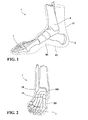
- Shown in Figures 1 and 2 is a typical right human foot F that includes toes T, a plantar surface PS, a medial side MS and a lateral side LS.
- the human foot includes a heel H, an Achilles tendon AT and an ankle A having a lateral malleolus LM and a medial malleolus MM, the lateral malleolus LM being at a lower position than the medial malleolus MM.
- an ice skate 1 that comprises a skate boot 10 and an ice skate blade 12.
- the skate boot 10 is suitable for enclosing the right human foot F and comprises an outer shell 14, a tongue 16, a rigid ankle support 18 (optional component), an inner lining 20 and a footbed 22.
- the outer shell 14 is made of a thermoformable material.
- thermoformable material refers to a material that is capable of softening when heated and of hardening again when cooled.
- thermoformable material comprises ethylene vinyl acetate (EVA) foam, polyethylene foam, polystyrene foam, polypropylene foam and thermoformable materials sold under the trade-marks MEGABIX® , SURLYN® , SONTARA® , FORM0500® , BYLON® , MOSOCA® and NYLON® 66.
- EVA ethylene vinyl acetate
- the inner lining 20 is glued or sewed to the inner surface of the outer shell 14.
- the inner lining 20 is made of a layer of soft material such as a sheet of polyester laminated with a layer of foam, or a layer of fabric made from 100% nylon fibers.
- the inner lining 20 comprises an inner surface that is adapted to contact the skin of heel H, ankle A, and medial and lateral sides MS, LS of the foot F in use.
- the footbed 22 has an upper surface 23 for receiving the plantar surface PS and a padding wall 25 that projects upwardly from the upper surface 23 for partially cupping the heel H and extending up to a medial line of the foot F.
- the footbed 22 provides an envelope for the foot F that is comfortable yet offers a supporting "bed" that maintains the foot F.
- the narrow bands 27 are secured to the outer shell 14.
- the narrow bands 27 are made of fabric, textile or leather.
- Apertures 29 are punched through the narrow bands 27, the outer shell 14 and the inner lining 20. Once punched, the apertures 29 are reinforced by metallic rivets 31 or any suitable means known in the art of footwear construction.
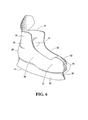
- the outer shell 14 is thermoformed such that it comprises a heel portion 24 for receiving the heel H, an ankle portion 26 for receiving the ankle A, medial and lateral side portions 28, 30 for facing the medial and lateral sides MS, LS of the foot F respectively, and medial and lateral toe portions 50, 51 for covering the toes T.
- the medial and lateral side portions 28, 30 extend forwardly from the heel portion 24 and ankle portion 26.
- the heel portion 24 is substantially cup shaped for following the contour of the heel H.
- the ankle portion 26 comprises a medial cup-shaped depression 32 for receiving the medial malleolus MM and a lateral cup-shaped depression 34 for receiving the lateral malleolus LM.
- the lateral cup-shaped depression 34 is located slightly lower than the medial cup-shaped depression 32, for conforming to the morphology of the foot F.
- the medial and lateral side portions 28, 30 and the medial and lateral toe portions 50, 51 comprise respective medial and lateral skirt portions 36, 38 that extend downwardly therefrom. Moreover, during the thermoforming process, the medial and lateral skirt portions 36, 38 are folded inwardly in order to form respective medial and lateral bottom portions 40, 42 for receiving the blade 12.
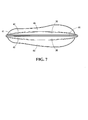
- the medial and lateral bottom portions 40, 42 may have medial and lateral bottom surface that form a bottom surface 41 on which the blade 12 may be affixed. It is understood that the blade 12 may be affixed to one of the bottom surface of the bottom portions 40, 42 if one of the bottom portions 40, 42 is longer than the other.
- the bottom portions 40, 42 may comprise a longitudinal slot (not shown) in which the blade 12 is received.
- the medial and lateral skirt portions 36, 38 may also be thermoformed such that they comprises respective medial and lateral sole portions 43, 45 for facing the plantar surface PS of the foot F.
- the medial and lateral bottom portions 40, 42 are joined together along a longitudinal line 44 and may be affixed together via any method known in the art, such as via stitching, thermal bonding, adhesive, piping, zipping or staples.
- the footbed 22 may sit upon the internal surfaces of the sole portions 43, 45 for covering the seam and/or gap where the two skirt portions 36, 38 meet.
- the outer shell 14 comprises respective medial and lateral frontward portions 46, 48 that are folded inwardly so as to form the medial and lateral toe portions 50, 51.
- the medial and lateral toe portions 50, 51 meet along the longitudinal line 44.
- one of the frontward portions 46, 48 can be longer than the other, such that when the two toe portions 50, 51 are joined together, they are not joined along the longitudinal line 44.
- the toe portions 50, 51 may be affixed together via any method known in the art, such as via stitching, thermal bonding, adhesive, piping, zipping or staples.
- the tongue 16 is affixed to the toe portions 50, 51 and extends upwardly and rearwardly from the toe portions 50, 51 for covering the forefoot of the foot F.
- the frontal edge of the tongue 16 can be sewn directly to the toe portions 50, 51 or can be fixed in an alternative manner known in the art.
- the outer shell 14 comprises a tongue portion that is integrally formed with one of the medial and lateral side portions 28, 30. As such, once thermoformed, the tongue portion extends upwardly from one of the toe portions 50, 51 in order to form a tongue that is integrally formed with the outer shell 14.
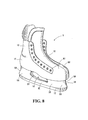
- Figures 8 to 11 show a second embodiment of the skate boot 10 in which a reference numeral designating an element of the first embodiment illustrated in Figures 3 to 7 designates the same element to facilitate the description.
- the skate boot 10 is identical to the one illustrated in Figures 3 and 4 to the exception that the medial and lateral skirt portions 36, 38 of the outer shell 14 have each an aperture 52 for reducing the weight of the skate boot 10.
- the medial and lateral skirt portions 36, 38 form a front pedestal 56, a rear pedestal 58 with a rear portion 59 and a bridge portion 60 interconnecting the front and rear pedestals 56, 58.
- the apertures 52 are located between the front and rear pedestals 56, 58 and above the bridge portion 60.
- the medial and lateral skirt portions 36, 38 are integrally formed at the rear portion 59 of the rear pedestal 58 and the bottom portions 40, 42 and the toe portions 50, 51 are affixed together along a longitudinal line 54.
- the medial and lateral bottom portions 40, 42 comprise medial and lateral bottom surfaces that form the bottom surface 41 on which the blade 12 may be affixed.
- the bottom portions 40, 42 may comprise a longitudinal slot (now shown) in which the blade 12 may be mounted.
- the medial and lateral skirt portions 36, 38 may also be thermoformed such that they comprise respective medial and lateral sole portions 64, 66 for facing the plantar surface PS of the foot F.
- Figure 12 and 13 show another embodiment of an outer shell 140 made of a thermoformable material and thermoformed such that it comprises an ankle portion 260 for receiving the ankle A, medial and lateral side portions 280, 300 for facing the medial and lateral sides MS, LS of the foot F respectively, and a toe cap 500 for covering the toes T.
- the toe cap 500 is integrally formed with the medial and lateral side portions 280, 300.
- the medial and lateral side portions 280, 300 and the toe cap 500 comprise respective medial and lateral skirt portions 360, 380 that extend downwardly therefrom. Moreover, during the thermoforming process, the medial and lateral skirt portions 360, 380 are folded inwardly in order to form respective medial and lateral bottom portions 400, 420 for receiving the blade 12.
- the medial and lateral bottom portions 400, 420 may have medial and lateral bottom surface that form a bottom surface on which the blade 12 may be affixed. It is understood that the blade 12 may be affixed to one of the bottom surface of the bottom portions 400, 420 if one of the bottom portions 400, 420 is longer than the other.
- the bottom portions 400, 420 may comprise a longitudinal slot (not shown) in which the blade 12 is received.
- the medial and lateral skirt portions 360, 380 may also be thermoformed such that they comprises respective medial and lateral sole portions for facing the plantar surface PS of the foot F.
- the medial and lateral bottom portions 400, 420 may be affixed together and the outer shell 140 may be completed by affixing together its rear portions.
- the first step in manufacturing the outer shell 14 is to die-cut a blank 90 from a sheet of material 92, the blank 90 having the profile of the outer shell 14.
- the blank 90 may include a plurality of projections 94 in the region close to the heel portion.
- the sheet of material 92 may be a composite sheet having a layer of thermoformable foam.
- thermoformable foam include ethylene vinyl acetate (EVA) foam, polyethylene foam and polypropylene foam. High density polyethylene (HDPE) 1300, 1100 and 0907 foams can also be used.
- the sheet may be made of thermoforming materials such as those sold under the trade-mark MEGABIX® (a core of extruded SURLYN® , a backing of SONTARA® and a hot melt coating; thickness of 0.95 mm), FORMO500® (non woven polyester with a core of extruded polyolefinic, stiffening layers of synthetic latex on each side and an ethylene vinyl acetate hot melt adhesive on one side; thickness of 1.50 mm), BYLON® (a nylon multifilament with a backing of black saturated needle punched polyester nonwoven and a face coating of non-fray urethane) and MOSOCA® (NYLON® 66 with a core of SURLYN® and a PU coating).
- MEGABIX® a core of extruded SURLYN® , a backing of SONTARA® and a hot melt coating
- FORMO500® non woven polyester with a core of extruded polyolefinic, stiffening layers
- the composite sheet may also be made of a first sheet of polyethylene high density (HDPE) foam; a second sheet of thermoplastic; and a third composite sheet made of a first layer of cotton, a second layer of surlyn fibers, a third layer of a mesh of nylon fibers and a coating. These sheets being laminated together before or during the thermoforming process of the outer shell.
- HDPE polyethylene high density
- the sheet of material 92 may include two or three layers, wherein the outer layer of the outer shell 14 is more rigid that its inner layer.
- a layer of thermoformable foam may be placed between the outer and inner layers.
- the second step in manufacturing the outer shell 14 is to thermoform the blank 90 into the three-dimensional shape of the outer shell 14 shown in Figure 6 or Figure 10.
- FIG. 14 Shown in Figure 14 is a non-limiting example of an apparatus 96 suitable for thermoforming the blank 90.
- the apparatus 96 comprises a supporting frame 98 having an outer shell traverse 100 and two pillars 102A and 102B.
- the two pillars 102A and 102B are joined together at mid-height by a ledge 104 that contains a control panel (not shown) with control buttons (not shown) for enabling an operator to control the apparatus 96.
- the ledge 104 surrounds a last 106 that is supported by a movable support 108.
- the movable support 108 is a hydraulic or pneumatic piston cylinder 110 that is movable up and down in a vertical direction, as indicated by arrow A. It should be understood that lasts 106 of different shapes and sizes can be installed on apparatus 96 in order to manufacture outer shells 14 of different shapes and sizes.
- the apparatus 96 further comprises a pair of clamps 112A, 112B that are mounted to the outer shell traverse 100 and positioned directly above last 106.
- Clamps 112A, 112B are adapted to open and close, as indicated by arrows B in order to clamp around the last 106.
- the clamps 112A, 112B comprise pressure pads 114 for receiving the shape 94 of thermoformable material.
- each of the clamps 112A, 112B comprises a bladder (not shown) having an inflated membrane and a fluid pressure delivery circuit (not shown) for causing the membrane to inflate, such that it is able to surround the last 106 during use.
- the blank 90 is placed on the last 106 and is accurately positioned and secured in place via the use of clips (not shown).
- the operator activates the apparatus 96 which causes the piston-cylinder 110, and therefore the last 106, to raise up between the two open clamps 112A, 112B.
- the piston-cylinder 110 reaches a set value and stops.
- the last 106 can remain stationary, and the clamps 112A, 112B can be connected to piston-cylinders for lowering the clamps 112A, 112B around the last 106.
- the clamps 112A, 112B begin to close thereby causing the pressure pads 114 to apply an initial pressure to the blank 90 positioned on the last 106.
- the bladders are then inflated by air or liquid injection, which forces the flexible membranes of the bladders to encircle the blank 90 around the last 106 and apply pressure thereto.
- the pressure within the bladders has reached a set value wherein the bladder membranes apply an even pressure to the thermoformable material, the pressure is maintained for a certain amount of time, and is then released.
- a pressure of between 200 Kpa and 830 Kpa is maintained around the last 106 for approximately 1 to 2 minutes.
- heat is also applied to the thermoformable material.
- the applied heat is generally between 120°C and 290°C, with the preferred temperature being approximately 230°C. Once heated, the thermoformable material becomes malleable and, as such, is able to acquire the three-dimensional shape applied to it by the last 106.
- the bladders 114 apply pressure and heat to the blank 90, they are able to press the thermoformable material around the last.
- the bladders 114 are adapted for applying a pressure on the medial and lateral skirt portions 36, 38 such that they are folded inwardly and joined together along the longitudinal line 44 (or 54) for forming the bottom portions 40, 42 that is adapted for receiving the blade 12.
- the bladders 114 may also apply a pressure on the medial and lateral skirt portions 36, 38 such that they form the respective medial and lateral sole portions 43, 45 (or 64, 66) for facing the plantar surface PS of the foot.
- the medial and lateral skirt portions 36, 38 are pushed together so as to form the bottom portions 40, 42 and the sole portions 43, 45 (or 64, 66).
- the bladders 114 may also be adapted for applying pressure on the frontward portions 46, 48 such that they are folded around the toe portion of the last 106 to form the toe portions 50, 51 for covering the toes T.
- the last 106 is lowered by the piston cylinder 110 to its original position.
- the medial and lateral bottom portions 40, 42 (or 400, 420) and toe portions 50, 51 may then be affixed together using a chosen one of the techniques described above, such as stitching, adhesive, piping, zipping, staples and thermal bonding.
- the ice skate blade 12 is mounted to the bottom portions 40, 42. More specifically, the ice blade 12 may be affixed to the bottom surface 41 or it may be inserted in a longitudinal groove formed in the bottom portions 40, 42 and then secured in place using any manner known in the art, such as screws, adhesive or any other attachment means known in the art.
Landscapes
- Engineering & Computer Science (AREA)
- Health & Medical Sciences (AREA)
- General Health & Medical Sciences (AREA)
- Physical Education & Sports Medicine (AREA)
- Mechanical Engineering (AREA)
- Chemical & Material Sciences (AREA)
- Materials Engineering (AREA)
- Footwear And Its Accessory, Manufacturing Method And Apparatuses (AREA)
Abstract
Description
- The present invention relates to an ice skate boot comprising an outer shell made of thermoformable material.
- The construction of ice skates has become quite complex over recent years. Existing skates often include multiple different components and multiple different materials in order to provide the performance and aesthetic needs of the players. As such, over recent years different manufacturing processes have been developed and new materials have been used.
- The most recent trend in skate construction is to manufacture skates using lightweight components, and where possible to reduce the number of components. Accordingly, there is a need in the industry for a skate that is lighter and/or has less components than existing skates.
- As embodied and broadly described herein, the invention provides an ice skate boot for enclosing a human foot, the foot having a heel, an ankle with a medial malleolus and a lateral malleolus, a plantar surface, medial and lateral sides and toes. The ice skate boot comprises an outer shell made of thermoformable material and thermoformed such that said outer shell comprises: (a) a heel portion for receiving the heel of the foot; (b) an ankle portion for receiving the ankle; (c) medial and lateral side portions for facing the medial and lateral sides of the foot respectively; (d) medial and lateral toe portions for covering the toes of the foot ; and (e) a medial skirt portion extending downwardly from the medial side and toe portions and a lateral skirt portion extending downwardly from the lateral side and toe portions, the medial and lateral skirt portions comprising medial and lateral bottom portions for receiving an ice skate blade..
- The invention also relates to a method of manufacturing an ice skate boot for enclosing a human foot, the foot having a heel, an ankle with a medial malleolus and a lateral malleolus, a plantar surface, medial and lateral sides and toes. The method comprises: (a) providing a sheet of thermoformable material; (b) thermoforming the sheet of thermoformable material to form an outer shell that comprises: (i) a heel portion for receiving the heel of the foot; (ii) an ankle portion for receiving the ankle; (iii) medial and lateral side portions for facing the medial and lateral sides of the foot respectively; (iv) medial and lateral toe portion for covering the toes of the foot; and (v) a medial skirt portion extending downwardly from the medial side and toe portions and a lateral skirt portion extending downwardly from the lateral side and toe portion; and (c) folding the medial and lateral skirt portions for forming medial and lateral bottom portions for receiving an ice skate blade.
- These and other aspects and features of the present invention will now become apparent to those of ordinary skill in the art upon review of the following description of specific embodiments of the invention in conjunction with the accompanying drawings.
- A detailed description of examples of embodiments of the present invention is provided hereinbelow with reference to the following drawings, in which:
- Figure 1 is a side view of a right human foot with the integument of the foot shown in stippled lines and the bones shown in solid lines;
- Figure 2 is a front view of the human foot of Figure 1;
- Figure 3 is a perspective view of a skate with an ice skate boot in accordance with a first embodiment of the present invention;
- Figure 4 is an exploded view of the ice skate of Figure 3;
- Figure 5 is a perspective view of the outer shell of the skate boot of Figures 3 and 4, wherein the outer shell is in a partial state of completion;
- Figure 6 is a perspective view of the outer shell of the skate of Figures 3 and 4;
- Figure 7 is a bottom view of the outer shell of Figure 6;
- Figure 8 is a perspective view of a skate with an ice skate boot in accordance with a second embodiment of the present invention;
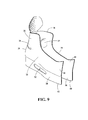
- Figure 9 is a perspective view of the outer shell of the skate of Figure 8, wherein the outer shell is in a partial state of completion;
- Figure 10 is a perspective view of the outer shell of the skate boot of Figure 8;
- Figure 11 is a bottom view of the outer shell of Figure 10;
- Figure 12 is a top, front perspective view of an outer shell in accordance with another embodiment of the invention, wherein the outer shell is in a partial state of completion;
- Figure 13 is a bottom, rear perspective view of the outer shell of Figure 12;
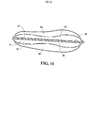
- Figure 14 shows a sheet of material with a profile of an outer shell; and
- Figure 15 shows a machine suitable for thermoforming an outer shell in accordance with the present invention.
- In the drawings, embodiments of the invention are illustrated by way of example. It is to be expressly understood that the description and drawings are only for the purposes of illustration and as an aid to understanding, and are not intended to be a definition of the limits of the invention.
- Shown in Figures 1 and 2 is a typical right human foot F that includes toes T, a plantar surface PS, a medial side MS and a lateral side LS. In addition, the human foot includes a heel H, an Achilles tendon AT and an ankle A having a lateral malleolus LM and a medial malleolus MM, the lateral malleolus LM being at a lower position than the medial malleolus MM.
- Shown in Figures 3 and 4 is an
ice skate 1 that comprises askate boot 10 and anice skate blade 12. Theskate boot 10 is suitable for enclosing the right human foot F and comprises anouter shell 14, atongue 16, a rigid ankle support 18 (optional component), aninner lining 20 and afootbed 22. Theouter shell 14 is made of a thermoformable material. As used herein, the expression "thermoformable material" refers to a material that is capable of softening when heated and of hardening again when cooled. Some non-limiting examples of different types of thermoformable material comprise ethylene vinyl acetate (EVA) foam, polyethylene foam, polystyrene foam, polypropylene foam and thermoformable materials sold under the trade-marks MEGABIX® , SURLYN® , SONTARA® , FORM0500® , BYLON® , MOSOCA® and NYLON® 66. - The
inner lining 20 is glued or sewed to the inner surface of theouter shell 14. Theinner lining 20 is made of a layer of soft material such as a sheet of polyester laminated with a layer of foam, or a layer of fabric made from 100% nylon fibers. Theinner lining 20 comprises an inner surface that is adapted to contact the skin of heel H, ankle A, and medial and lateral sides MS, LS of the foot F in use. - The
footbed 22 has anupper surface 23 for receiving the plantar surface PS and apadding wall 25 that projects upwardly from theupper surface 23 for partially cupping the heel H and extending up to a medial line of the foot F. Thefootbed 22 provides an envelope for the foot F that is comfortable yet offers a supporting "bed" that maintains the foot F. - Two
narrow bands 27 are secured to theouter shell 14. Thenarrow bands 27 are made of fabric, textile or leather.Apertures 29 are punched through thenarrow bands 27, theouter shell 14 and theinner lining 20. Once punched, theapertures 29 are reinforced bymetallic rivets 31 or any suitable means known in the art of footwear construction. - As shown in Figures 3 to 7, the
outer shell 14 is thermoformed such that it comprises aheel portion 24 for receiving the heel H, anankle portion 26 for receiving the ankle A, medial andlateral side portions lateral toe portions - The medial and
lateral side portions heel portion 24 andankle portion 26. Theheel portion 24 is substantially cup shaped for following the contour of the heel H. Theankle portion 26 comprises a medial cup-shaped depression 32 for receiving the medial malleolus MM and a lateral cup-shaped depression 34 for receiving the lateral malleolus LM. The lateral cup-shaped depression 34 is located slightly lower than the medial cup-shaped depression 32, for conforming to the morphology of the foot F. - The medial and
lateral side portions lateral toe portions lateral skirt portions lateral skirt portions lateral bottom portions blade 12. As best seen in Figure 7, the medial andlateral bottom portions bottom surface 41 on which theblade 12 may be affixed. It is understood that theblade 12 may be affixed to one of the bottom surface of thebottom portions bottom portions bottom portions blade 12 is received. - The medial and
lateral skirt portions sole portions lateral bottom portions longitudinal line 44 and may be affixed together via any method known in the art, such as via stitching, thermal bonding, adhesive, piping, zipping or staples. Thefootbed 22 may sit upon the internal surfaces of thesole portions skirt portions - As shown in Figure 5, in its partial state of completion, the
outer shell 14 comprises respective medial and lateralfrontward portions lateral toe portions lateral toe portions longitudinal line 44. However, in an alternative embodiment, one of thefrontward portions toe portions longitudinal line 44. Thetoe portions - The
tongue 16 is affixed to thetoe portions toe portions tongue 16 can be sewn directly to thetoe portions - In an alternative embodiment not shown in the figures, the
outer shell 14 comprises a tongue portion that is integrally formed with one of the medial andlateral side portions toe portions outer shell 14. - Figures 8 to 11 show a second embodiment of the
skate boot 10 in which a reference numeral designating an element of the first embodiment illustrated in Figures 3 to 7 designates the same element to facilitate the description. - In this second embodiment, the
skate boot 10 is identical to the one illustrated in Figures 3 and 4 to the exception that the medial andlateral skirt portions outer shell 14 have each anaperture 52 for reducing the weight of theskate boot 10. Moreover, the medial andlateral skirt portions front pedestal 56, arear pedestal 58 with arear portion 59 and abridge portion 60 interconnecting the front andrear pedestals apertures 52 are located between the front andrear pedestals bridge portion 60. The medial andlateral skirt portions rear portion 59 of therear pedestal 58 and thebottom portions toe portions longitudinal line 54. The medial and lateralbottom portions bottom surface 41 on which theblade 12 may be affixed. Alternatively, thebottom portions blade 12 may be mounted. As shown in Figure 11, the medial andlateral skirt portions sole portions - Figure 12 and 13 show another embodiment of an
outer shell 140 made of a thermoformable material and thermoformed such that it comprises anankle portion 260 for receiving the ankle A, medial andlateral side portions toe cap 500 for covering the toes T. Thetoe cap 500 is integrally formed with the medial andlateral side portions - The medial and
lateral side portions toe cap 500 comprise respective medial andlateral skirt portions lateral skirt portions bottom portions blade 12. The medial and lateralbottom portions blade 12 may be affixed. It is understood that theblade 12 may be affixed to one of the bottom surface of thebottom portions bottom portions bottom portions blade 12 is received. - The medial and
lateral skirt portions bottom portions outer shell 140 may be completed by affixing together its rear portions. - The method of forming the
outer shell 14 in accordance with the present invention will now be described herein below with reference to Figures 14 and 15. For the purposes of the present application, the method will be described with respect to theouter shell 14, but it should be appreciate that the method could have also been described with respect to theouter shell 140. - The first step in manufacturing the
outer shell 14 is to die-cut a blank 90 from a sheet ofmaterial 92, the blank 90 having the profile of theouter shell 14. Machines and methods for die-cutting shapes from sheets of material are known in the art, and as such will not be described in more detail herein. As shown in Figure 14, the blank 90 may include a plurality ofprojections 94 in the region close to the heel portion. - The sheet of
material 92 may be a composite sheet having a layer of thermoformable foam. Some non-limiting examples of different types of thermoformable foam include ethylene vinyl acetate (EVA) foam, polyethylene foam and polypropylene foam. High density polyethylene (HDPE) 1300, 1100 and 0907 foams can also be used. The sheet may be made of thermoforming materials such as those sold under the trade-mark MEGABIX® (a core of extruded SURLYN® , a backing of SONTARA® and a hot melt coating; thickness of 0.95 mm), FORMO500® (non woven polyester with a core of extruded polyolefinic, stiffening layers of synthetic latex on each side and an ethylene vinyl acetate hot melt adhesive on one side; thickness of 1.50 mm), BYLON® (a nylon multifilament with a backing of black saturated needle punched polyester nonwoven and a face coating of non-fray urethane) and MOSOCA® (NYLON® 66 with a core of SURLYN® and a PU coating). The composite sheet may also be made of a first sheet of polyethylene high density (HDPE) foam; a second sheet of thermoplastic; and a third composite sheet made of a first layer of cotton, a second layer of surlyn fibers, a third layer of a mesh of nylon fibers and a coating. These sheets being laminated together before or during the thermoforming process of the outer shell. - The sheet of
material 92 may include two or three layers, wherein the outer layer of theouter shell 14 is more rigid that its inner layer. A layer of thermoformable foam may be placed between the outer and inner layers. - The second step in manufacturing the
outer shell 14 is to thermoform the blank 90 into the three-dimensional shape of theouter shell 14 shown in Figure 6 or Figure 10. - Shown in Figure 14 is a non-limiting example of an
apparatus 96 suitable for thermoforming the blank 90. Theapparatus 96 comprises a supportingframe 98 having an outer shell traverse 100 and twopillars pillars ledge 104 that contains a control panel (not shown) with control buttons (not shown) for enabling an operator to control theapparatus 96. In the specific embodiment shown, theledge 104 surrounds a last 106 that is supported by amovable support 108. Themovable support 108 is a hydraulic orpneumatic piston cylinder 110 that is movable up and down in a vertical direction, as indicated by arrow A. It should be understood that lasts 106 of different shapes and sizes can be installed onapparatus 96 in order to manufactureouter shells 14 of different shapes and sizes. - The
apparatus 96 further comprises a pair ofclamps Clamps clamps pressure pads 114 for receiving theshape 94 of thermoformable material. In addition, each of the clamps 112A, 112B comprises a bladder (not shown) having an inflated membrane and a fluid pressure delivery circuit (not shown) for causing the membrane to inflate, such that it is able to surround the last 106 during use. - In operation, the blank 90 is placed on the last 106 and is accurately positioned and secured in place via the use of clips (not shown). Once the blank 90 is securely in place, the operator activates the
apparatus 96 which causes the piston-cylinder 110, and therefore the last 106, to raise up between the twoopen clamps pressure pads 114, the piston-cylinder 110 reaches a set value and stops. It should be understood that in an alternative embodiment, the last 106 can remain stationary, and theclamps clamps - Once the last 106 is positioned between clamps 112A, 112B, the
clamps pressure pads 114 to apply an initial pressure to the blank 90 positioned on the last 106. When the clamps 112A, 112B are completely closed, the bladders are then inflated by air or liquid injection, which forces the flexible membranes of the bladders to encircle the blank 90 around the last 106 and apply pressure thereto. Once the pressure within the bladders has reached a set value wherein the bladder membranes apply an even pressure to the thermoformable material, the pressure is maintained for a certain amount of time, and is then released. In a non-limiting embodiment, a pressure of between 200 Kpa and 830 Kpa is maintained around the last 106 for approximately 1 to 2 minutes. In addition to the pressure, heat is also applied to the thermoformable material. The applied heat is generally between 120°C and 290°C, with the preferred temperature being approximately 230°C. Once heated, the thermoformable material becomes malleable and, as such, is able to acquire the three-dimensional shape applied to it by the last 106. - When the
bladders 114 apply pressure and heat to the blank 90, they are able to press the thermoformable material around the last. For example, thebladders 114 are adapted for applying a pressure on the medial andlateral skirt portions bottom portions blade 12. Thebladders 114 may also apply a pressure on the medial andlateral skirt portions sole portions 43, 45 (or 64, 66) for facing the plantar surface PS of the foot. In other words, the medial andlateral skirt portions bottom portions sole portions 43, 45 (or 64, 66). The bladders 114 (or other bladders) may also be adapted for applying pressure on thefrontward portions toe portions - Once the
outer shell 14 has been thermoformed and molded into the final shape shown in Figure 6 or 10, the last 106 is lowered by thepiston cylinder 110 to its original position. The medial and lateralbottom portions 40, 42 (or 400, 420) andtoe portions - Once the
skate boot 10 has been assembled, theice skate blade 12 is mounted to thebottom portions ice blade 12 may be affixed to thebottom surface 41 or it may be inserted in a longitudinal groove formed in thebottom portions - The above description of the embodiments should not be interpreted in a limiting manner since other variations, modifications and refinements are possible within the spirit and scope of the present invention. The scope of the invention is defined in the appended claims and their equivalents.
Claims (34)
- An ice skate boot (10) for enclosing a human foot, the foot having a heel, an ankle with a medial malleolus and a lateral malleolus, a plantar surface, medial and lateral sides and toes, said ice skate boot (10) comprising an outer shell (14; 140) made of thermoformable material, said outer shell being thermoformed such that it comprises: a heel portion (24) for receiving the heel of the foot; an ankle portion (26; 260) for receiving the ankle; medial and lateral side portions (28, 30; 280, 300) for facing the medial and lateral sides of the foot respectively; and medial and lateral toe portions (50, 51; 500) for covering the toes of the foot; said skate boot being characterized in that said outer shell is thermoformed such that it comprises: a medial skirt portion (36; 360) extending downwardly from said medial side and toe portions and a lateral skirt portion (38; 380) extending downwardly from said lateral side and toe portions, said medial and lateral skirt portions comprising medial and lateral bottom portions (40, 42; 400, 420) for receiving an ice skate blade (12).
- An ice skate boot as defined in claim 1, wherein said medial and lateral bottom portions (40, 42; 400, 420) comprises medial and lateral bottom surfaces forming a bottom surface (41) on which the ice skate blade (12) is affixed.
- An ice skate boot as defined in claim 1, wherein said medial and lateral bottom portions (40, 42; 400, 420) comprises medial and lateral bottom surfaces, the ice skate blade (12) being affixed on one of said medial and lateral bottom surfaces.
- An ice skate boot as defined in claim 1, wherein said medial and lateral bottom portions (40, 42; 400, 420) define a longitudinal groove in which the ice skate blade (12) is received.
- An ice skate boot as defined in claim 1, wherein said medial and lateral bottom portions (40, 42; 400, 420) are affixed together.
- An ice skate boot as defined in claim 5, wherein said medial and lateral skirt portions (36, 38; 360, 380) are thermoformed such that they comprise respective medial and lateral sole portions (43, 45) for facing the plantar surface of the foot.
- An ice skate boot as defined in claim 6, wherein said medial and lateral bottom portions (40, 42; 400, 420) comprises medial and lateral bottom surfaces forming a bottom surface (41) on which the ice skate blade (12) is affixed.
- An ice skate boot as defined in claim 6, wherein said medial and lateral bottom portions (40, 42; 400, 420) comprises medial and lateral bottom surfaces, the ice skate blade (12) being affixed on one of said medial and lateral bottom surfaces.
- An ice skate boot as defined in claim 6, wherein said medial and lateral bottom portions (40, 42; 400, 420) define a longitudinal groove in which the ice skate blade is received.
- An ice skate boot as defined in claim 6, wherein each of said medial and lateral skirt portions (36, 38; 360, 380) comprises an aperture (52) for reducing the weight of said skate boot.
- An ice skate boot as defined in claim 10, wherein said medial and lateral skirt portions (36, 38; 360, 380) are thermoformed such that they comprise a front pedestal (56), a rear pedestal (58) and a bridge portion (60) interconnecting said front and rear pedestals (56, 58), said apertures (52) being located between said front and rear pedestals (56, 58) and above said bridge portion (60).
- An ice skate boot as defined in claim 11, wherein said medial and lateral bottom and toe portions are affixed together along a longitudinal line (44; 54).
- An ice skate boot as defined in claim 12, wherein said medial and lateral skirt portions (36, 38; 360, 380) are integrally formed together at a rear portion (59) of said rear pedestal (58).
- An ice skate boot as defined in claim 12, wherein said medial and lateral skirt portions (36, 38; 360, 380) are integrally formed together at a front portion of said front pedestal (56).
- An ice skate boot as defined in claim 6, wherein said medial and lateral toe portions are integrally formed together for forming an integrated toe cap (500).
- An ice skate boot as defined in claim 6, comprising a tongue (16) extending upwardly and rearwardly from said medial and lateral toe portions (50, 51).
- An ice skate boot as defined in claim 6, comprising a tongue that is integrally formed with one of said medial and lateral side portions (28, 30).
- An ice skate boot as defined in claim 15, comprising a tongue extending upwardly and rearwardly from said toe cap (500).
- An ice skate boot as defined in claim 18, wherein said tongue is integrally formed with one of said medial and lateral side portions (28,30; 280, 300).
- An ice skate boot as defined in claim 6, wherein said outer shell (14; 140) comprises an outer layer and an inner layer, said outer layer being more rigid than said inner layer.
- An ice skate boot as defined in claim 20, wherein said outer shell (14; 140) comprises a layer of thermoformable foam between said outer and inner layer.
- An ice skate boot as defined in claim 6, wherein said outer shell (14; 140) is made of layers of different grades of thermoformable foam.
- An ice skate boot as defined in claim 6, wherein said heel portion (24) is substantially cup shaped for following the contour of the heel of the foot.
- An ice skate boot as defined in claim 23, wherein said ankle portion (26; 260) comprises a cup-shaped lateral depression (34) for receiving the lateral malleolus and a cup-shaped medial depression (32) for receiving the medial malleolus.
- An ice skate boot as defined in claim 24, wherein said lateral cup-shaped depression (34) is below said medial cup-shaped depression (32).
- An ice skate boot as defined in claim 6, comprising an inner lining (20) affixed to an inner surface of said outer shell (14; 140), said inner lining comprising a surface intended for contact with the heel, ankle and medial and lateral sides of the foot.
- An ice skate boot as defined in claim 6, comprising a footbed (22) having an upper surface (23) facing the plantar surface of the foot and a wall (25) projecting upwardly from said upper surface, said wall partially cupping the heel and extending up to a medial line of the foot.
- A method of manufacturing an ice skate boot (10) for enclosing a human foot, the foot having a heel, an ankle with a medial malleolus and a lateral malleolus, a plantar surface, medial and lateral sides and toes, said method comprising: providing a sheet of thermoformable material (92); thermoforming said sheet of thermoformable material (92) to form an outer shell (14; 140) that comprises: a heel portion (24) for receiving the heel of the foot; an ankle portion (26; 260) for receiving the ankle; medial and lateral side portions (28, 30; 280, 300) for facing the medial and lateral sides of the foot respectively; and medial and lateral toe portions (50, 51; 500) for covering the toes of the foot; said method being characterized in (a) thermoforming said outer shell (14, 140) such that it comprises a medial skirt portion (36; 360) extending downwardly from said medial side and toe portions and a lateral skirt portion (38; 380) extending downwardly from said lateral side and toe portion; and (b) folding said medial and lateral skirt portions for forming medial and lateral bottom portions (40, 52; 400, 420) for receiving an ice skate blade (12).
- A method as defined in claim 28, comprising folding said medial and lateral skirt portions for forming medial and lateral sole portions for facing the plantar surface of the foot.
- A method as defined in claim 28 or 29, comprising affixing together said medial and lateral bottom portions for forming a bottom surface on which an ice skate blade is mountable.
- A method as defined in claim 28 or 29, comprising forming a longitudinal groove within said medial and lateral bottom portions for receiving an ice skate blade in said groove.
- A method as defined in any one of claims 28 to 31, comprising affixing an inner lining to an inner surface of said outer shell, said inner lining comprising a surface intended for contact with the heel, ankle and lateral and medial sides of the foot.
- A method as defined in any one of claims 28 to 32, comprising affixing a tongue to said medial and lateral toe portions.
- A method as defined in any one of claims 28 to 33, comprising die-cutting a blank (90) from said sheet of material (92), said blank (90) having the profile of the outer shell (14; 140).
Priority Applications (1)
| Application Number | Priority Date | Filing Date | Title |
|---|---|---|---|
| EP20050290335 EP1690459B1 (en) | 2005-02-15 | 2005-02-15 | Ice skate boot |
Applications Claiming Priority (1)
| Application Number | Priority Date | Filing Date | Title |
|---|---|---|---|
| EP20050290335 EP1690459B1 (en) | 2005-02-15 | 2005-02-15 | Ice skate boot |
Publications (2)
| Publication Number | Publication Date |
|---|---|
| EP1690459A1 true EP1690459A1 (en) | 2006-08-16 |
| EP1690459B1 EP1690459B1 (en) | 2008-04-16 |
Family
ID=34941949
Family Applications (1)
| Application Number | Title | Priority Date | Filing Date |
|---|---|---|---|
| EP20050290335 Expired - Lifetime EP1690459B1 (en) | 2005-02-15 | 2005-02-15 | Ice skate boot |
Country Status (1)
| Country | Link |
|---|---|
| EP (1) | EP1690459B1 (en) |
Citations (6)
| Publication number | Priority date | Publication date | Assignee | Title |
|---|---|---|---|---|
| FR2013165A1 (en) * | 1968-07-18 | 1970-03-27 | Botana Narodni Podnik | |
| US20010025439A1 (en) * | 1998-09-09 | 2001-10-04 | Karl Graf | Skate boot and getting up aid for such a skate boot |
| EP1384568A1 (en) * | 2002-07-26 | 2004-01-28 | Bauer Nike Hockey Inc. | Skate boot |
| EP1433505A1 (en) * | 2002-12-23 | 2004-06-30 | Rollerblade S.r.l. | Improved skate structure with one-piece frame |
| US20040226113A1 (en) * | 2000-04-28 | 2004-11-18 | Steve Wright | Method of making a skate boot |
| EP1518591A1 (en) * | 2003-09-29 | 2005-03-30 | Promiles | In-line roller or ice skate frame and skate comprising such a frame |
-
2005
- 2005-02-15 EP EP20050290335 patent/EP1690459B1/en not_active Expired - Lifetime
Patent Citations (6)
| Publication number | Priority date | Publication date | Assignee | Title |
|---|---|---|---|---|
| FR2013165A1 (en) * | 1968-07-18 | 1970-03-27 | Botana Narodni Podnik | |
| US20010025439A1 (en) * | 1998-09-09 | 2001-10-04 | Karl Graf | Skate boot and getting up aid for such a skate boot |
| US20040226113A1 (en) * | 2000-04-28 | 2004-11-18 | Steve Wright | Method of making a skate boot |
| EP1384568A1 (en) * | 2002-07-26 | 2004-01-28 | Bauer Nike Hockey Inc. | Skate boot |
| EP1433505A1 (en) * | 2002-12-23 | 2004-06-30 | Rollerblade S.r.l. | Improved skate structure with one-piece frame |
| EP1518591A1 (en) * | 2003-09-29 | 2005-03-30 | Promiles | In-line roller or ice skate frame and skate comprising such a frame |
Also Published As
| Publication number | Publication date |
|---|---|
| EP1690459B1 (en) | 2008-04-16 |
Similar Documents
| Publication | Publication Date | Title |
|---|---|---|
| US7712173B2 (en) | Method of manufacturing an ice skate | |
| US7451991B2 (en) | Ice skate boot | |
| US8109536B2 (en) | Goalie skate | |
| EP1582107B1 (en) | Sporting boot having an outer shell made of foam | |
| US11311080B2 (en) | Shoe with composite upper and foam element and method of making same | |
| US7875229B2 (en) | Method of making a skate boot | |
| EP3581362B1 (en) | Method of vacuum forming a footwear upper | |
| US20180000195A1 (en) | Thermoforming footwear method | |
| US20140283410A1 (en) | Molded Footwear Upper And Method Of Making Same | |
| US20120297642A1 (en) | Shoe with Composite Upper and Method of Making the Same | |
| CN108143051B (en) | Method for manufacturing a fully formed upper | |
| EP1595695B1 (en) | Skate boot | |
| EP2087803B1 (en) | Method of making a skate boot | |
| CA2496987C (en) | Ice skate boot | |
| CA2497026C (en) | Sporting boot | |
| EP1690459B1 (en) | Ice skate boot | |
| CA2750906C (en) | Goalie skate |
Legal Events
| Date | Code | Title | Description |
|---|---|---|---|
| PUAI | Public reference made under article 153(3) epc to a published international application that has entered the european phase |
Free format text: ORIGINAL CODE: 0009012 |
|
| AK | Designated contracting states |
Kind code of ref document: A1 Designated state(s): AT BE BG CH CY CZ DE DK EE ES FI FR GB GR HU IE IS IT LI LT LU MC NL PL PT RO SE SI SK TR |
|
| AX | Request for extension of the european patent |
Extension state: AL BA HR LV MK YU |
|
| 17P | Request for examination filed |
Effective date: 20061113 |
|
| AKX | Designation fees paid |
Designated state(s): CZ FI SE |
|
| REG | Reference to a national code |
Ref country code: DE Ref legal event code: 8566 |
|
| 17Q | First examination report despatched |
Effective date: 20070510 |
|
| GRAP | Despatch of communication of intention to grant a patent |
Free format text: ORIGINAL CODE: EPIDOSNIGR1 |
|
| GRAS | Grant fee paid |
Free format text: ORIGINAL CODE: EPIDOSNIGR3 |
|
| GRAA | (expected) grant |
Free format text: ORIGINAL CODE: 0009210 |
|
| AK | Designated contracting states |
Kind code of ref document: B1 Designated state(s): CZ FI SE |
|
| RAP2 | Party data changed (patent owner data changed or rights of a patent transferred) |
Owner name: NIKE BAUER HOCKEY INC. |
|
| RAP2 | Party data changed (patent owner data changed or rights of a patent transferred) |
Owner name: NIKE BAUER HOCKEY CORP. |
|
| RAP2 | Party data changed (patent owner data changed or rights of a patent transferred) |
Owner name: NIKE INTERNATIONAL LTD. |
|
| REG | Reference to a national code |
Ref country code: SE Ref legal event code: TRGR |
|
| PG25 | Lapsed in a contracting state [announced via postgrant information from national office to epo] |
Ref country code: FI Free format text: LAPSE BECAUSE OF FAILURE TO SUBMIT A TRANSLATION OF THE DESCRIPTION OR TO PAY THE FEE WITHIN THE PRESCRIBED TIME-LIMIT Effective date: 20080416 |
|
| PLBE | No opposition filed within time limit |
Free format text: ORIGINAL CODE: 0009261 |
|
| STAA | Information on the status of an ep patent application or granted ep patent |
Free format text: STATUS: NO OPPOSITION FILED WITHIN TIME LIMIT |
|
| 26N | No opposition filed |
Effective date: 20090119 |
|
| PGFP | Annual fee paid to national office [announced via postgrant information from national office to epo] |
Ref country code: CZ Payment date: 20160204 Year of fee payment: 12 |
|
| PG25 | Lapsed in a contracting state [announced via postgrant information from national office to epo] |
Ref country code: CZ Free format text: LAPSE BECAUSE OF NON-PAYMENT OF DUE FEES Effective date: 20170215 |
|
| P01 | Opt-out of the competence of the unified patent court (upc) registered |
Effective date: 20230606 |
|
| PGFP | Annual fee paid to national office [announced via postgrant information from national office to epo] |
Ref country code: SE Payment date: 20240130 Year of fee payment: 20 |
|
| REG | Reference to a national code |
Ref country code: SE Ref legal event code: EUG |