EP1689828B1 - Fire mitigation - Google Patents
Fire mitigation Download PDFInfo
- Publication number
- EP1689828B1 EP1689828B1 EP04798652A EP04798652A EP1689828B1 EP 1689828 B1 EP1689828 B1 EP 1689828B1 EP 04798652 A EP04798652 A EP 04798652A EP 04798652 A EP04798652 A EP 04798652A EP 1689828 B1 EP1689828 B1 EP 1689828B1
- Authority
- EP
- European Patent Office
- Prior art keywords
- water
- gel
- layer
- fire
- barrier
- Prior art date
- Legal status (The legal status is an assumption and is not a legal conclusion. Google has not performed a legal analysis and makes no representation as to the accuracy of the status listed.)
- Expired - Lifetime
Links
Images

Classifications
-
- B—PERFORMING OPERATIONS; TRANSPORTING
- B32—LAYERED PRODUCTS
- B32B—LAYERED PRODUCTS, i.e. PRODUCTS BUILT-UP OF STRATA OF FLAT OR NON-FLAT, e.g. CELLULAR OR HONEYCOMB, FORM
- B32B27/00—Layered products comprising a layer of synthetic resin
- B32B27/12—Layered products comprising a layer of synthetic resin next to a fibrous or filamentary layer
-
- A—HUMAN NECESSITIES
- A62—LIFE-SAVING; FIRE-FIGHTING
- A62D—CHEMICAL MEANS FOR EXTINGUISHING FIRES OR FOR COMBATING OR PROTECTING AGAINST HARMFUL CHEMICAL AGENTS; CHEMICAL MATERIALS FOR USE IN BREATHING APPARATUS
- A62D5/00—Composition of materials for coverings or clothing affording protection against harmful chemical agents
-
- B—PERFORMING OPERATIONS; TRANSPORTING
- B32—LAYERED PRODUCTS
- B32B—LAYERED PRODUCTS, i.e. PRODUCTS BUILT-UP OF STRATA OF FLAT OR NON-FLAT, e.g. CELLULAR OR HONEYCOMB, FORM
- B32B15/00—Layered products comprising a layer of metal
- B32B15/04—Layered products comprising a layer of metal comprising metal as the main or only constituent of a layer, which is next to another layer of the same or of a different material
- B32B15/08—Layered products comprising a layer of metal comprising metal as the main or only constituent of a layer, which is next to another layer of the same or of a different material of synthetic resin
-
- B—PERFORMING OPERATIONS; TRANSPORTING
- B32—LAYERED PRODUCTS
- B32B—LAYERED PRODUCTS, i.e. PRODUCTS BUILT-UP OF STRATA OF FLAT OR NON-FLAT, e.g. CELLULAR OR HONEYCOMB, FORM
- B32B27/00—Layered products comprising a layer of synthetic resin
- B32B27/06—Layered products comprising a layer of synthetic resin as the main or only constituent of a layer, which is next to another layer of the same or of a different material
- B32B27/08—Layered products comprising a layer of synthetic resin as the main or only constituent of a layer, which is next to another layer of the same or of a different material of synthetic resin
-
- F—MECHANICAL ENGINEERING; LIGHTING; HEATING; WEAPONS; BLASTING
- F42—AMMUNITION; BLASTING
- F42D—BLASTING
- F42D5/00—Safety arrangements
- F42D5/04—Rendering explosive charges harmless, e.g. destroying ammunition; Rendering detonation of explosive charges harmless
-
- F—MECHANICAL ENGINEERING; LIGHTING; HEATING; WEAPONS; BLASTING
- F42—AMMUNITION; BLASTING
- F42D—BLASTING
- F42D5/00—Safety arrangements
- F42D5/04—Rendering explosive charges harmless, e.g. destroying ammunition; Rendering detonation of explosive charges harmless
- F42D5/045—Detonation-wave absorbing or damping means
-
- A—HUMAN NECESSITIES
- A62—LIFE-SAVING; FIRE-FIGHTING
- A62C—FIRE-FIGHTING
- A62C2/00—Fire prevention or containment
- A62C2/06—Physical fire-barriers
-
- B—PERFORMING OPERATIONS; TRANSPORTING
- B32—LAYERED PRODUCTS
- B32B—LAYERED PRODUCTS, i.e. PRODUCTS BUILT-UP OF STRATA OF FLAT OR NON-FLAT, e.g. CELLULAR OR HONEYCOMB, FORM
- B32B2307/00—Properties of the layers or laminate
- B32B2307/30—Properties of the layers or laminate having particular thermal properties
- B32B2307/306—Resistant to heat
- B32B2307/3065—Flame resistant or retardant, fire resistant or retardant
-
- B—PERFORMING OPERATIONS; TRANSPORTING
- B32—LAYERED PRODUCTS
- B32B—LAYERED PRODUCTS, i.e. PRODUCTS BUILT-UP OF STRATA OF FLAT OR NON-FLAT, e.g. CELLULAR OR HONEYCOMB, FORM
- B32B2605/00—Vehicles
-
- Y—GENERAL TAGGING OF NEW TECHNOLOGICAL DEVELOPMENTS; GENERAL TAGGING OF CROSS-SECTIONAL TECHNOLOGIES SPANNING OVER SEVERAL SECTIONS OF THE IPC; TECHNICAL SUBJECTS COVERED BY FORMER USPC CROSS-REFERENCE ART COLLECTIONS [XRACs] AND DIGESTS
- Y10—TECHNICAL SUBJECTS COVERED BY FORMER USPC
- Y10S—TECHNICAL SUBJECTS COVERED BY FORMER USPC CROSS-REFERENCE ART COLLECTIONS [XRACs] AND DIGESTS
- Y10S428/00—Stock material or miscellaneous articles
- Y10S428/92—Fire or heat protection feature
-
- Y—GENERAL TAGGING OF NEW TECHNOLOGICAL DEVELOPMENTS; GENERAL TAGGING OF CROSS-SECTIONAL TECHNOLOGIES SPANNING OVER SEVERAL SECTIONS OF THE IPC; TECHNICAL SUBJECTS COVERED BY FORMER USPC CROSS-REFERENCE ART COLLECTIONS [XRACs] AND DIGESTS
- Y10—TECHNICAL SUBJECTS COVERED BY FORMER USPC
- Y10S—TECHNICAL SUBJECTS COVERED BY FORMER USPC CROSS-REFERENCE ART COLLECTIONS [XRACs] AND DIGESTS
- Y10S428/00—Stock material or miscellaneous articles
- Y10S428/92—Fire or heat protection feature
- Y10S428/921—Fire or flameproofing
-
- Y—GENERAL TAGGING OF NEW TECHNOLOGICAL DEVELOPMENTS; GENERAL TAGGING OF CROSS-SECTIONAL TECHNOLOGIES SPANNING OVER SEVERAL SECTIONS OF THE IPC; TECHNICAL SUBJECTS COVERED BY FORMER USPC CROSS-REFERENCE ART COLLECTIONS [XRACs] AND DIGESTS
- Y10—TECHNICAL SUBJECTS COVERED BY FORMER USPC
- Y10T—TECHNICAL SUBJECTS COVERED BY FORMER US CLASSIFICATION
- Y10T442/00—Fabric [woven, knitted, or nonwoven textile or cloth, etc.]
- Y10T442/20—Coated or impregnated woven, knit, or nonwoven fabric which is not [a] associated with another preformed layer or fiber layer or, [b] with respect to woven and knit, characterized, respectively, by a particular or differential weave or knit, wherein the coating or impregnation is neither a foamed material nor a free metal or alloy layer
- Y10T442/2615—Coating or impregnation is resistant to penetration by solid implements
-
- Y—GENERAL TAGGING OF NEW TECHNOLOGICAL DEVELOPMENTS; GENERAL TAGGING OF CROSS-SECTIONAL TECHNOLOGIES SPANNING OVER SEVERAL SECTIONS OF THE IPC; TECHNICAL SUBJECTS COVERED BY FORMER USPC CROSS-REFERENCE ART COLLECTIONS [XRACs] AND DIGESTS
- Y10—TECHNICAL SUBJECTS COVERED BY FORMER USPC
- Y10T—TECHNICAL SUBJECTS COVERED BY FORMER US CLASSIFICATION
- Y10T442/00—Fabric [woven, knitted, or nonwoven textile or cloth, etc.]
- Y10T442/20—Coated or impregnated woven, knit, or nonwoven fabric which is not [a] associated with another preformed layer or fiber layer or, [b] with respect to woven and knit, characterized, respectively, by a particular or differential weave or knit, wherein the coating or impregnation is neither a foamed material nor a free metal or alloy layer
- Y10T442/2615—Coating or impregnation is resistant to penetration by solid implements
- Y10T442/2623—Ballistic resistant
-
- Y—GENERAL TAGGING OF NEW TECHNOLOGICAL DEVELOPMENTS; GENERAL TAGGING OF CROSS-SECTIONAL TECHNOLOGIES SPANNING OVER SEVERAL SECTIONS OF THE IPC; TECHNICAL SUBJECTS COVERED BY FORMER USPC CROSS-REFERENCE ART COLLECTIONS [XRACs] AND DIGESTS
- Y10—TECHNICAL SUBJECTS COVERED BY FORMER USPC
- Y10T—TECHNICAL SUBJECTS COVERED BY FORMER US CLASSIFICATION
- Y10T442/00—Fabric [woven, knitted, or nonwoven textile or cloth, etc.]
- Y10T442/20—Coated or impregnated woven, knit, or nonwoven fabric which is not [a] associated with another preformed layer or fiber layer or, [b] with respect to woven and knit, characterized, respectively, by a particular or differential weave or knit, wherein the coating or impregnation is neither a foamed material nor a free metal or alloy layer
- Y10T442/2631—Coating or impregnation provides heat or fire protection
Definitions
- This invention relates to the use of a water gel material to protect an entity from the effects of fire and to methods of applying the material and to the material itself.
- the invention relates to the use of water gels to form a material which can prevent fires igniting and spreading after an explosion.
- water gels as fire retardants are well known.
- a hydrated sodium silicate i.e. water glass as a fire retardant material.
- a layer of gel which consists of a hydrogel comprising silicone dioxide, sodium oxide and the reaction product of an acid and sodium water glass is described.
- a variety of different polymers are suggested as being fire mitigants.
- Acrylamide appears to be the preferred choice. Acrylamides are also suggested in US 5124208 with a 2-hydroxy-3-methyacryloxypropyltrimethylammonium chloride being suggested in US 5223313 as a suitable component of a gel based fire protective layer.
- fire protection gels are employed as construction components in buildings, in particular in fire retardant glazing in which the gel is encased between two panes of glass.
- fire retardant materials are installed in buildings to prevent the spread of fire through a structure thus giving personnel more time to evacuate and giving the fire service more time to put out a fire.
- water gels in particular a gelatin water gel, can act not only to mitigate the effects of fire and prevent its spread but also to prevent fires igniting in the first place in view of their ability to withstand the pressure effects of an explosive blast and their ability to absorb heat.
- the water gels of the present invention have been surprisingly found to possess pressure mitigation properties, e.g. they can absorb the shockwave which results from an explosion. Moreover, the water gels can resist the fireball which results from an explosion thus providing a material ideally suited to protecting entities against the pressure and heat effects of explosions.
- Hydrosuppressor A somewhat similar system is sold under the trade name Hydrosuppressor.
- the system involves spraying the explosive or spraying the area in the vicinity of the explosive with water from various angles. Again however, this technique relies on the identification of an existence of a threat of an explosion prior to any explosion taking place. No material which can be affixed to a structure is therefore available.
- EP-A-0325069 describes a heat absorbent material made by dissolving gelatine in hot water with antibacterial and antifungal additives. This is then impregnated into a blanket to act as a heat resistant partition.
- US 4102807 discloses a water gel comprising a heat mouldable water and oil emulsion formed from a block copolymeric elastomer and an oil component. This can be used an insulator.
- US 6136216 describes an insulative composition prepared by agitating an aqueous mixture of an aerogel and gelatin.
- US 4331547 describes a thermal insulating foam made from a collagen protein.
- US 5225236 describes protective curtains to shield or protect an object against accidental exposure to radiation, electrical discharge, heat or flame.
- the curtains are made of a visco-elastic hydrophilic gel.
- WO 02/08139 describes a method of increasing the heat insulating capacity of a material such as a building component by adding into the product a water soluble crystallised compound, and an inorganic hydrogel. This mixture releases water to slow the progress of temperature elevation.
- US 4246146 describes a fire retardant coating prepared by dissolving a polyisocyanate prepolymer in a solution or slurry of fire retardant material.
- GB 1361504 discloses a fire extinguishing gel formed from water and gel forming agents.
- DE 3506132 describes a solid fire protection composition made using a water glass and an organic binder.
- the water glass is a silicon oxide/sodium oxide mix.
- the present inventors have surprisingly found that mixtures of water and gelatin (from hereon water gels) are particularly suitable for use as barriers to prevent damage caused by explosions. Moreover, in view of the inherent aqueous nature of the gel they also act to protect against fire.
- water gels can be formed into structures which can withstand significant over-pressures compared with materials currently used in buildings. Without wishing to be limited by theory, it is envisaged that the inherent elasticity of the water gel makes it an excellent material for absorbing the shockwave of an explosion. Moreover, the aqueous nature of the water gel ensures that it is also capable of resisting heat, flash and quenching flame thereby preventing fires igniting, a cause of much injury in the aftermath of an explosion.
- the water gels of the invention act synergistically to prevent fire ignition in the aftermath of an explosion. Surprisingly, in the presence of the water gel other materials are prevented from shredding in the initial explosion. This means that the other materials remain intact and can therefore act as fire retardants.
- the invention provides a method for preventing fires starting in the aftermath of an explosion comprising covering at least a part, e.g. at least 10%, preferably all of an entity in a barrier comprising gelatin and water wherein the concentration of gelatin in water is at least 3% w/w.
- the invention provides a multiple layer fire-retardant barrier comprising layers of gelatin and water having varying gel concentrations wherein the concentration of gelatin in water is at least 3% w/w and wherein said barrier additionally comprises a layer of metal, a polymer layer, a fabric, a fibreglass layer, a ceramic layer or a dilatant layer or mixtures of such layers.
- the invention provides a multiple layer fire-retardant barrier comprising layers of gelatin and water having varying gel concentrations as hereinbefore defined wherein the concentration of gel increases from outside of the barrier to the inside of the barrier.
- the water gels of the invention may protect entities against heat, flame and fire which result from explosions, e.g. by preventing fires igniting.
- entity anything which should be protected from fire, e.g. structures, organisms and the general physical environment.
- An organism is a living plant or animal, e.g. a human.
- structure is meant any inanimate object which could be protected from explosive damage such as buildings (temporary or permanent), industrial plant, civil infrastructure, vehicles, military equipment, computers etc.
- the water gels of the invention comprise an aqueous component. For this reason, they are capable of absorbing heat and dousing flame much more efficiently than other zero warning explosion mitigation materials.
- the water gel When exposed to heat, it is envisaged that the water gel may partially or completely melt thereby releasing water to help quench any fire and absorbing heat. Moreover, during an explosion, the water gel may first absorb the pressure effects of the explosive blast and heat associated therewith and subsequently melt to prevent associated fire damage.
- the water gel barriers of the invention may also help in the event of a conventional fire, particularly in a building in which the external structure is predominantly made from glass. During a fire in such a building, the metal frame of the building tends to expand and the windows can therefore fall out of their frames. The presence of a water gel will slow down any expansion of the building frame thereby allowing firefighters more time in which to control the fire.
- the water gels of the invention are more effective at mitigating the effects of fire at lower gel concentrations, i.e. higher water concentrations. However, the water gels are more effective at blast impulse mitigation at higher gel concentrations. It is therefore within the scope of the invention to provide a multilayer barrier comprising water gel layers having varying gel concentrations to provide barriers tailored to mitigate the effects of both fire and pressure.
- the water gels are able therefore to withstand a fireball and the pressure effects which result from an explosion so that the fire cannot penetrate the material. Outer portions of the gel may evaporate as steam but the internal layers delay the residence time of the flame to the extent that the materials behind the gel will be protected.
- water gel is meant a mixture of water and gelatin to form a solid elastomeric barrier.
- the gel should preferably be non-toxic and cheap to manufacture or isolate. It should exhibit elastomeric properties, have a high elastomeric modulus and a high ductility.
- the gelatin preferably has a molecular weight range of 20,000 to 300,000 D, e.g. 20,000 to 150,000 D and can be made from the hydrolysis of collagen.
- gelatin lies in the fact that it is not toxic. Many conventional fire retardant materials burn to yield toxic, i.e. poisonous by products. In sharp contrast, the gelatin water gel yields non-toxic by products as the water steams off. This means that the toxicity of fires in structures will be much less, thereby allowing additional escape times for individuals because the air quality during the growth of a fire will not deteriorate as quickly as it does when the toxic by products of fire retardants start to burn.
- Toxicity in a fire arises from two mechanisms a) the breakdown of the fuel into smaller molecules which have significant toxicity and b) the lack of oxygen available to the fire which results in high concentrations of carbon monoxide.
- the toxicity of the gel will be low compared to conventional retardants, which usually have components that yield very high toxicity when they eventually burn e.g. fluorine, chlorine, phosphorus and arsenic compounds.
- the mixture of water and gel should comprise at least 3% by weight of the gel, e.g. between 3% by weight and 40% by weight of gel, preferably at least 4% by weight gel, especially at least 5% by weight gel, e.g. in the range 7% by weight to 25% by weight gel, e.g. 8 to 15% wt.
- an outside layer may comprise 5% wt of the gel.
- An inner layer may therefore comprise 10% wt of the gel. The more aqueous layer is this able to withstand heat whilst the less aqueous layer absorbs the blast shockwave.
- Another property of the water gel is its stress relaxation, with values in the range 0.05 to 0.3 kPa being preferred. Higher stress relaxation values indicate an increased ability to withstand impulse pressure.
- the water gels of the invention should preferably have an elastic modulus in the range of 100 to 1000 kPa, preferably 120 to 900 kPa, more preferably 300 to 800 kPa, e.g. 700 to 800 kPa.
- the hot gel can be mixed with water in a mould and allowed to cool to form the water gel elastomeric barrier of the invention.
- the water used may be deionised or distilled if desired but this is not essential. Other sources of water such as tap water are also employable.
- the resulting mixture is suitable for use as a protective barrier.
- the water gels are inherently non-flammable, cheap and non-toxic making them very attractive building materials.
- the water gel mixture can be formed into sheets to provide protective barriers which mitigate the effects of fire and explosion.
- the thickness of a protective barrier or sheet may vary depending on the nature of the barrier, e.g. whether it is being used to protect windows, personnel, buildings etc. However, suitable thicknesses are in the range 0.1 cm to 1 m, e.g. 1.5 cm to 20 cm, preferably 2 cm to 10 cm.
- Suitable thicknesses for sheets to be used in building cladding are in the range of 10 to 100 mm preferably 10 to 20 mm. Where the material is used to cover windows suitable thickness is in the range of 10 to 50 mm. When the material is used in clothing suitable thickness is in the range of 10 to 15 mm.
- the water gels In order to protect the barrier material against degradation by, for example, bacteria or light it may be essential to mix the water gels with antibacterials (e.g. sodium azide) or proteinase inhibitors such as EDTA (e.g. at 5 mM concentration), detergents and/or antioxidants as additives in the water gel formulations.
- antibacterials e.g. sodium azide
- proteinase inhibitors such as EDTA (e.g. at 5 mM concentration)
- detergents and/or antioxidants e.g. at 5 mM concentration
- Other additives include colouring agents to produce a tinted product, emulsifiers, viscosity modifiers, organic additives (such as xanthum gum, starch), inorganic additives (such as sodium sulphate, calcium salts, magnesium sulphate, ammonium sulphate) can be employed.
- the water gel layer in the barrier of the invention should preferably comprise at least 50% by weight of water gel, more preferably at least 80% by weight, especially at least 95% by weight of water gel, e.g. 98%wt.
- the water gel layer should consist essentially of water and gel (i.e. incorporates only minor quantities of impurities or standard additives) or consists of water and gel.
- the water gel barrier of the invention is an insulator although it can comprise conductive materials if required. In the aftermath of an explosion, the fact that the material is an insulator may prevent electrical fires starting and may prevent electrocution of individuals and destruction of equipment.
- the barrier of the invention is preferably multilayered and comprises at least one water gel layer.
- Layers of water gel could be mixed with layers of other pressure mitigating materials or layers of fire retardant material to form composites. It has surprisingly been found that the combination of the water gel with certain other materials yields a multilayer material which provides synergistic fire and pressure reduction, i.e. the capacity of the multilayer material to withstand fire is greater than what is achieved using either material alone.
- a water gel layer or layers may be combined with a layer of metal (e.g. aluminium or steel), a ceramic layer, a polymer layer (e.g. a polyethylene, polypropylene or polycarbonate layer), a fabric layer (e.g. cotton layer), a fibreglass layer, or a dilatant layer (e.g. a polyethylene oxide layer or a silicone layer), or mixtures of such layers.
- metal e.g. aluminium or steel
- a ceramic layer e.g. a polyethylene, polypropylene or polycarbonate layer
- a fabric layer e.g. cotton layer
- a fibreglass layer e.g. a polyethylene oxide layer or a silicone layer
- dilatant layer e.g. a polyethylene oxide layer or a silicone layer
- a dilatant is a material which thickens upon applied shear stress, e.g. may turn solid upon applied shear stress and examples thereof are polyethylene oxides and silicones. Where a polyethylene oxide layer is employed this may be in the form of an at least 0.5 wt% aqueous mixture, e.g. at least 1% wt aqueous mixture.
- This forms a further aspect of the invention which therefore provides a fire retardant barrier comprising a water gel layer and a layer of metal, e.g. aluminium or steel, ceramic layers, a polymer layer (e.g. a polyethylene, polypropylene or polycarbonate layer), a fabric layer e.g. cotton layer, a fibreglass layer, or a dilatant layer e.g. a polyethylene oxide layer or a silicone layer, or mixtures of such layers.
- a fire retardant barrier comprising a water gel layer and a layer of metal, e.g. aluminium or steel, ceramic layers, a polymer layer (e.g. a polyethylene, polypropylene or polycarbonate layer), a fabric layer e.g. cotton layer, a fibreglass layer, or a dilatant layer e.g. a polyethylene oxide layer or a silicone layer, or mixtures of such layers.
- the multilayer barrier can comprise a plurality of gel layers and other material layers, e.g. as described in the Examples.
- additional layers can of course vary. Typically however, additional layers can be of the order of 1 mm to 10 cm in thickness, e.g. 1 mm to 10 mm.
- the fire resistance of, for example, a fabric layer such as cotton can therefore be greatly enhanced if there is a layer of gel behind and/or in front of the fabric
- a layer of gel behind and/or in front of the fabric For normal fire retardant materials the initial heat and residence time of a fireball would render such materials useless to prevent fire in the aftermath of an explosion.
- a 30 tonne propane fireball will last 12 seconds and be approximately 90 m in diameter. Most materials within 115 m of the explosion will ignite in this time and burns will be sustained up to 230 m away.
- the water gels of the invention can withstand such a fireball for 100-200 seconds i.e. sufficient to prevent a fire starting.
- a further advantage of the water gel is that it prevents the other material present from shredding. Typically, materials which are exposed to high pressure blast effects shred. The clothes of individuals caught in explosive blasts are very often seen shredded. This obviously exposes the skin to the heat of the explosion directly and gives rise to serious burns.
- the water gel of the invention protects against the pressure shockwave and thus prevents shred. A person in clothing comprising the water gels of the invention will not therefore have his clothing shredded and will not therefore receive severe burns to the unprotected flesh under the shredded clothing.
- the water gel layer wets (i.e. is in contact with) a layer which is exposed to the effects of an explosion.
- a fabric layer is outermost then directly beneath that layer should be a water gel layer.
- Such a multilayered composition could have important applications in the military and for the general public close to industrial sites such as chemical storage facilities, nuclear reactors or research laboratories or areas where transportation of hazardous materials occurs. Such compositions could be used in clothing to protect against, fire and explosion.
- the invention may also have applications in space. Vehicles re-entering the Earth's atmosphere become very hot. Whilst the ceramic tiles which coat such vehicles normally withstand such heat, if any damage occurs to the tiles a water gel layer beneath the tiles would help to absorb the heat and prevent fire. Moreover, the presence of a water gel under the ceramic tiles might make these more likely to withstand space debris contact. The impact of space debris on the tiles could be absorbed by the water gel layer preventing potential disaster. The recent shuttle explosion was caused by damage to ceramic tiles caused by a part detaching during take off The tiles failed on re-entry .
- the water gel can be formed into any suitable shape or form depending on the nature of the barrier desired.
- the water gels of the invention can be formulated into sheets using known techniques such as injection moulding or thermal cooling of the material. The width of the material will depend on the nature of the use. Thus, water gel sheets could be used as building cladding or formed into thin sheets for covering equipment such as computers.
- the protective water gel barrier When used as a protective layer over building cladding, it is most important that the lower part of the building is protected from the effects of a blast and subsequent fire.
- the protective water gel barrier may be adhered only to the lower part of a building, e.g. the bottom three floors since this is the area which suffers from the greatest blast impact from a ground based explosion.
- the protective water gel barrier may be continued inside the building on partitions or inside walls to strengthen the structural resistance to blast and prevent the spread of fire.
- the material may also be used as a protective surface across the whole façade of a building to protect against explosive pressures from very large explosions or from air-borne contaminants from an explosion.
- Water gels may also be formulated as protective blankets or clothing for personnel. Alternatively, very large sheets of water gel could be produced for covering critical environmental areas, e.g. reservoirs, or iconic targets. Temporary structures, in particular temporary military structures, may be covered with this material to mitigate the impact of explosions and fire on buildings equipment and personnel.
- the material for permanent or temporary fixing across doors, windows, on horizontal or vertical surfaces etc may be in rolls that can be cut to create barriers.
- the material may also be extrudable.
- the forming of the water gels into desired shapes can be achieved easily using known equipment, e.g. those used in the food industry to make jelly or those used in the pharmaceutical industry to make capsules.
- the material of the invention may also provide a barrier to chemical or biological contamination, e.g. as the result of a criminal attack or chemical leak. Explosions at a chemical factory or involving terrorism may involve leakage of chemicals or biological contaminants and the water gel materials of the invention may serve to provide a barrier to such leaks.
- the surface of the water gel material is inherently sticky and hence biological and chemical compounds may attach to the surface of the material thereby preventing further contamination taking place. Additionally the water gel material acts as a barrier that, unlike most open weave material, prevents biological materials under the size of 5 microns from passing through to the surface of a material below.
- the water gel material may also act as a barrier to alpha and beta particles of radiation that may be present in sources used in industry and in weapons used by the defence forces. Moreover, if a water gel layer was combined with, for example, a boron layer a broader range of radiological effects could be preventable. Thus, gamma radiation or neutrons could be absorbed by a water gel barrier comprising a boron layer.
- Water gel sheets also provide the added advantage that post contamination clean up is made much simpler. Since the chemical or biological agent may stick to or dissolve within the water gel, clean up can be effected simply by removing the water gel sheet from the structure in question.
- the material of the invention can be made transparent and hence does not affect the amount of light entering a building when used as a window protector or affect the external appearance of a building when used as a cladding. Transparency is enhanced when the pH of the material is less than 8.
- Fixing the material to a structure can be achieved using conventional techniques. For example, for window protection, the material may be adhered to the window surface (inside and/or outside) using known adhesives such as ceramic bonds or other bonding materials that adhere to wood, concrete or glass surfaces. These materials are readily available through suppliers to dentists for bonding of ceramic veneers to teeth, and in the construction industry for bonding materials together.
- the material could be placed in wall cavities, double glazing cavities, or roof space or secured to the outside of a building by adhesives or in a frame.
- the person skilled in the art can devise alternative methods of fixation.
- the gels may be acidic or basic giving rise to further options for fixation as well as further options for chemical or biological absorption and as a general absorber of pollutants.
- the water gels of the invention may also have particularly utility in the prevention of flash fires.
- a flash fire the flame is characterised by rapid burning.
- the flame temperature is normal but the emissivity of the flame is much higher than in a typical fire leading to higher radiant heat fluxes on material surfaces.
- the water gel of the invention would resist heat better than conventional fire retardant materials and hence is more effective at preventing ignition.
- the water gel would also work in oxygenated atmospheres where there is a fire (some ships). In such environments, much hotter flames exist and there is again increase in heat flux to surfaces.
- the water gels of the invention are therefore able to withstand flash fires as they are exceptional at absorbing heat.
- water gels might be employed in places were flash fires are possible, e.g.. in tunnels.
- the water gels are also particularly suitable for preventing arson where heat flux is unconventionally high. Materials treated with water gels are therefore better able to prevent ignition in arson attempts. Sheets of water gel material could therefore be used to cover tanks or sumps which contain flammable material. The gel thus provides a barrier to conventional ignition sources such as cigarettes, friction sparks, lighter fuels and electrical sparks.
- the water gels of the invention may serve to protect organisms against flame burns from secondary contract with hot object.
- a further advantage of the invention is that the material itself can be transported in solid form, e.g. powder form, and made up to the water gel when required.
- a potential difficulty with the water gels may be their weight but the fact that the material can be transported as a powder and made into the water gel only when required is a major advantage.
- Figure 1 shows the effects of sample thickness on smouldering and ignition times for water gel barriers of the invention.
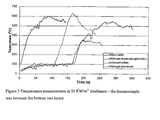
- Figures 2 and 3 show temperature measurements for the water gel samples
- a number of 100 mm x 100 mm gel samples were made in which a 10% gelatin water gel of 3 mm thickness was embedded between layers of cotton (1 mm) or cotton and aluminium foil (50 micron). A description of the samples is given in Table 1. The water gel was formed simply be mixing water and gelatin in the required amounts to form a 10% wt gelatin water gel.
- thermocouple was placed between the upper surface of cloth and the lower surface of the gel in the samples to measure the effect of heat transfer through the gel to the protected surface underneath.
- Table 1 Samples used in Cone Calorimeter tests Sample No Sample Mass Approx. Thickness 1 Double cloth layer 4 2 mm 2 Cloth layer - Gel - cloth layer 44 5 mm 3 Cloth layer - Gel - aluminium Layer 26 5 mm 4 Cloth layer - aluminium Layer- gel - cloth layer 36 5 mm
- thermocouple records where the temperature at the base of the main gel layer remained about 100°C until after the water had boiled away from the area of the thermocouple. This is shown in Figure 2 and 3 for irradiant heat fluxes of 20 kW/m 2 and 50 kW/m 2 respectively. Smouldering and ignition occurred after the temperature rose with ignition being consistent with a temperature of greater than 400°C. In Figure 2 , the reading for the thermocouple is too high as the pressure of the thermocouple between the two layers due to the method of mounting caused the top surface to lift. This problem was overcome for the other tests.
- Table 2 shows the time and peak heat release rate per unit area of the materials. The only samples where the heat release rate is significant is in the three samples that ignited. The onset of the peal occurs after the water has boiled away in those samples that have a gel layer. Table 2 Peak Heat Release.
- the gel would act as a protective layer to surfaces underneath as the requirement to boil off the water before the underlying surface could be heated to the ignition temperature would delay ignition proportional to the amount of water in the gel and the thickness of the gel layer.
- a 3mm thick protective layer of 10% gel in water would delay ignition by about 130s at a heat flux of 50 kW/m 2 based on the above data. This is a significant delay as this level of heat flux represents a fully involved fire. At this fire intensity most non fire retarded surfaces would ignite in under 10s, and even chemically fire retarded surfaces would ignite in under 50 s.
- Ignition usually involves lower heat or energy fluxes to surfaces than a fully involved fire.
- the tests undertaken at 20 kW/m 2 show that at this level ignition does not occur and only materials above the gel layer smoulder. The lowest fibre layer is protected until all gel material has boiled off. Smouldering does not occur for over 400 s for a 3mm protective layer of gel. The gel therefore prevents first ignition, as a considerable amount of energy has to be expended to boil off the water before ignition of the underlying surface occurs. Most common ignition sources do not have this amount of energy.
- the type of ignition sources involved with arson do have this type of energy but are unlikely to burn for more than 200 s if no other materials are ignited from an arson attempt. This is only half the time required to boil off a 3mm gel level.
- Gelatine gels have been shown to provide protection characteristics against fire by delaying heat transfer to underlying surfaces, delaying ignition of underlying surfaces and protecting underlying surfaces from the effects of a fully involved fire.
Landscapes
- Engineering & Computer Science (AREA)
- General Engineering & Computer Science (AREA)
- Chemical & Material Sciences (AREA)
- Toxicology (AREA)
- Materials Engineering (AREA)
- Health & Medical Sciences (AREA)
- Chemical Kinetics & Catalysis (AREA)
- General Chemical & Material Sciences (AREA)
- Business, Economics & Management (AREA)
- Emergency Management (AREA)
- General Health & Medical Sciences (AREA)
- Building Environments (AREA)
- Aiming, Guidance, Guns With A Light Source, Armor, Camouflage, And Targets (AREA)
- Colloid Chemistry (AREA)
- Transducers For Ultrasonic Waves (AREA)
- Surgical Instruments (AREA)
- Manufacture, Treatment Of Glass Fibers (AREA)
- Insulated Conductors (AREA)
- Inorganic Insulating Materials (AREA)
- Measuring Pulse, Heart Rate, Blood Pressure Or Blood Flow (AREA)
- Fire-Extinguishing Compositions (AREA)
- Laminated Bodies (AREA)
Abstract
Description
- This invention relates to the use of a water gel material to protect an entity from the effects of fire and to methods of applying the material and to the material itself. In particular, the invention relates to the use of water gels to form a material which can prevent fires igniting and spreading after an explosion.
- The use of water gels as fire retardants is well known. In
EP 875492 EP 192249 US 2003/0004247 a variety of different polymers are suggested as being fire mitigants. Acrylamide appears to be the preferred choice. Acrylamides are also suggested inUS 5124208 with a 2-hydroxy-3-methyacryloxypropyltrimethylammonium chloride being suggested inUS 5223313 as a suitable component of a gel based fire protective layer. - The majority of these fire protection gels are employed as construction components in buildings, in particular in fire retardant glazing in which the gel is encased between two panes of glass. These fire retardant materials are installed in buildings to prevent the spread of fire through a structure thus giving personnel more time to evacuate and giving the fire service more time to put out a fire.
- The inventors on this case have found however that water gels, in particular a gelatin water gel, can act not only to mitigate the effects of fire and prevent its spread but also to prevent fires igniting in the first place in view of their ability to withstand the pressure effects of an explosive blast and their ability to absorb heat.
- One of the normal consequences of an explosion is fire and conventional fire retardant materials do not prevent fires starting in the aftermath of an explosion. The materials may simply ignite due to the intense heat of an explosive fireball or they may also be damaged by the pressure wave of an explosion rendering them unable to function as fire retardants.
- The water gels of the present invention have been surprisingly found to possess pressure mitigation properties, e.g. they can absorb the shockwave which results from an explosion. Moreover, the water gels can resist the fireball which results from an explosion thus providing a material ideally suited to protecting entities against the pressure and heat effects of explosions.
- Since the mid 1990's there has been an increase in the use of explosives by criminal organisations against civilian and military targets throughout the World. Their use results in death, injury and destruction of property and buildings. Previously, mitigation of explosion relied upon intelligence and police detection to provide warning of impending attack but recent events make it clear that intelligence and police operations alone cannot be relied upon to prevent explosions. Moreover, some explosions are caused simply by accident, e.g. gas or chemical explosions, and it would be useful if the consequences of such accidental explosions could also be minimised.
- Conventional construction can give rise to buildings which will withstand many types of impact but it is still difficult to minimise the effects of explosions and in particular the fire associated therewith. Whilst there are a number of solutions to the problem of damage caused by the pressure effects of an explosion no material is currently available that is capable of dealing both with the pressure and heat effects of a zero warning explosion.
- There are a number of reports of conventional fire fighting foams being employed as pressure mitigants (Journal of Explosives Engineering, Vol 26, No.3, 1999). Such foams have the additional advantage of preventing fires often associated with explosions. However, the use of these foams requires that the explosive can be surrounded by the foam in a contained environment. Whilst this is possible when the source of an explosion is identified, where an explosion occurs without warning these foams cannot be used. Nor do these foams allow access to an explosive source by persons working to mitigate an accident or defuse a device controlled by criminals.
- A somewhat similar system is sold under the trade name Hydrosuppressor. The system involves spraying the explosive or spraying the area in the vicinity of the explosive with water from various angles. Again however, this technique relies on the identification of an existence of a threat of an explosion prior to any explosion taking place. No material which can be affixed to a structure is therefore available.
-
EP-A-0325069 describes a heat absorbent material made by dissolving gelatine in hot water with antibacterial and antifungal additives. This is then impregnated into a blanket to act as a heat resistant partition. -
US 4102807 discloses a water gel comprising a heat mouldable water and oil emulsion formed from a block copolymeric elastomer and an oil component. This can be used an insulator. -
US 6136216 describes an insulative composition prepared by agitating an aqueous mixture of an aerogel and gelatin. -
US 4331547 describes a thermal insulating foam made from a collagen protein. -
US 5225236 describes protective curtains to shield or protect an object against accidental exposure to radiation, electrical discharge, heat or flame. The curtains are made of a visco-elastic hydrophilic gel. -
WO 02/08139 -
US 4246146 describes a fire retardant coating prepared by dissolving a polyisocyanate prepolymer in a solution or slurry of fire retardant material. -
GB 1361504 -
DE 3506132 describes a solid fire protection composition made using a water glass and an organic binder. The water glass is a silicon oxide/sodium oxide mix. - The present inventors have surprisingly found that mixtures of water and gelatin (from hereon water gels) are particularly suitable for use as barriers to prevent damage caused by explosions. Moreover, in view of the inherent aqueous nature of the gel they also act to protect against fire. The inventors have surprisingly found that water gels can be formed into structures which can withstand significant over-pressures compared with materials currently used in buildings. Without wishing to be limited by theory, it is envisaged that the inherent elasticity of the water gel makes it an excellent material for absorbing the shockwave of an explosion. Moreover, the aqueous nature of the water gel ensures that it is also capable of resisting heat, flash and quenching flame thereby preventing fires igniting, a cause of much injury in the aftermath of an explosion.
- The particular requirements of resisting a fireball which results from an explosion are very different from conventional fire retardation. The critical factor with a fireball is preventing ignition whereas conventional fire retardation primarily concerns preventing fire spreading once ignition occurs.
- When combined with other materials, the water gels of the invention act synergistically to prevent fire ignition in the aftermath of an explosion. Surprisingly, in the presence of the water gel other materials are prevented from shredding in the initial explosion. This means that the other materials remain intact and can therefore act as fire retardants.
- Thus, viewed from one aspect the invention provides a method for preventing fires starting in the aftermath of an explosion comprising covering at least a part, e.g. at least 10%, preferably all of an entity in a barrier comprising gelatin and water wherein the concentration of gelatin in water is at least 3% w/w.
- Viewed from another aspect the invention provides a multiple layer fire-retardant barrier comprising layers of gelatin and water having varying gel concentrations wherein the concentration of gelatin in water is at least 3% w/w and wherein said barrier additionally comprises a layer of metal, a polymer layer, a fabric, a fibreglass layer, a ceramic layer or a dilatant layer or mixtures of such layers.
- Viewed from a still further aspect, the invention provides a multiple layer fire-retardant barrier comprising layers of gelatin and water having varying gel concentrations as hereinbefore defined wherein the concentration of gel increases from outside of the barrier to the inside of the barrier.
- By protecting a structure or organism from the effects of fire is meant, inter alia, preventing fires igniting and/or spreading. Thus, the water gels of the invention may protect entities against heat, flame and fire which result from explosions, e.g. by preventing fires igniting.
- By entity is meant anything which should be protected from fire, e.g. structures, organisms and the general physical environment. An organism is a living plant or animal, e.g. a human. By structure is meant any inanimate object which could be protected from explosive damage such as buildings (temporary or permanent), industrial plant, civil infrastructure, vehicles, military equipment, computers etc.
- By definition, the water gels of the invention comprise an aqueous component. For this reason, they are capable of absorbing heat and dousing flame much more efficiently than other zero warning explosion mitigation materials.
- When exposed to heat, it is envisaged that the water gel may partially or completely melt thereby releasing water to help quench any fire and absorbing heat. Moreover, during an explosion, the water gel may first absorb the pressure effects of the explosive blast and heat associated therewith and subsequently melt to prevent associated fire damage.
- The water gel barriers of the invention may also help in the event of a conventional fire, particularly in a building in which the external structure is predominantly made from glass. During a fire in such a building, the metal frame of the building tends to expand and the windows can therefore fall out of their frames. The presence of a water gel will slow down any expansion of the building frame thereby allowing firefighters more time in which to control the fire.
- The water gels of the invention are more effective at mitigating the effects of fire at lower gel concentrations, i.e. higher water concentrations. However, the water gels are more effective at blast impulse mitigation at higher gel concentrations. It is therefore within the scope of the invention to provide a multilayer barrier comprising water gel layers having varying gel concentrations to provide barriers tailored to mitigate the effects of both fire and pressure. The water gels are able therefore to withstand a fireball and the pressure effects which result from an explosion so that the fire cannot penetrate the material. Outer portions of the gel may evaporate as steam but the internal layers delay the residence time of the flame to the extent that the materials behind the gel will be protected.
- By water gel is meant a mixture of water and gelatin to form a solid elastomeric barrier. The gel should preferably be non-toxic and cheap to manufacture or isolate. It should exhibit elastomeric properties, have a high elastomeric modulus and a high ductility.
- The gelatin preferably has a molecular weight range of 20,000 to 300,000 D, e.g. 20,000 to 150,000 D and can be made from the hydrolysis of collagen.
- A further advantage of the use of gelatin lies in the fact that it is not toxic. Many conventional fire retardant materials burn to yield toxic, i.e. poisonous by products. In sharp contrast, the gelatin water gel yields non-toxic by products as the water steams off. This means that the toxicity of fires in structures will be much less, thereby allowing additional escape times for individuals because the air quality during the growth of a fire will not deteriorate as quickly as it does when the toxic by products of fire retardants start to burn.
- Toxicity in a fire arises from two mechanisms a) the breakdown of the fuel into smaller molecules which have significant toxicity and b) the lack of oxygen available to the fire which results in high concentrations of carbon monoxide.
- The toxicity of the gel will be low compared to conventional retardants, which usually have components that yield very high toxicity when they eventually burn e.g. fluorine, chlorine, phosphorus and arsenic compounds.
- This makes a gelatin water gel particularly suitable for use in confined spaces such as in buses, cars, ships and planes and in buildings where persons may be trapped. There is also a particular advantage in the environmental impact of this material under fire conditions as it will not add an excessively high toxic load to the environment when burning over large surface areas protected externally and internally by the material - for example, tanks on petrochemicals sites which may be engulfed in fire or ships in port when burning would not cause an additional toxic loading on the environment for emergency services and persons entrapped or escaping from these structures.
- The mixture of water and gel should comprise at least 3% by weight of the gel, e.g. between 3% by weight and 40% by weight of gel, preferably at least 4% by weight gel, especially at least 5% by weight gel, e.g. in the range 7% by weight to 25% by weight gel, e.g. 8 to 15% wt.
- As mentioned above, it is within the scope of the invention to employ a multilayered water gel where the gel becomes more concentrated from the outside in. Thus, an outside layer may comprise 5% wt of the gel. An inner layer may therefore comprise 10% wt of the gel. The more aqueous layer is this able to withstand heat whilst the less aqueous layer absorbs the blast shockwave.
- Another property of the water gel is its stress relaxation, with values in the range 0.05 to 0.3 kPa being preferred. Higher stress relaxation values indicate an increased ability to withstand impulse pressure.
- The water gels of the invention should preferably have an elastic modulus in the range of 100 to 1000 kPa, preferably 120 to 900 kPa, more preferably 300 to 800 kPa, e.g. 700 to 800 kPa.
- Mixing of the water and gel can be achieved by any convenient means, preferably with stirring or sonication to ensure complete mixing. Thus, the hot gel can be mixed with water in a mould and allowed to cool to form the water gel elastomeric barrier of the invention. The water used may be deionised or distilled if desired but this is not essential. Other sources of water such as tap water are also employable. The resulting mixture is suitable for use as a protective barrier.
- The water gels are inherently non-flammable, cheap and non-toxic making them very attractive building materials.
- The water gel mixture can be formed into sheets to provide protective barriers which mitigate the effects of fire and explosion. The thickness of a protective barrier or sheet may vary depending on the nature of the barrier, e.g. whether it is being used to protect windows, personnel, buildings etc. However, suitable thicknesses are in the range 0.1 cm to 1 m, e.g. 1.5 cm to 20 cm, preferably 2 cm to 10 cm.
- Suitable thicknesses for sheets to be used in building cladding are in the range of 10 to 100 mm preferably 10 to 20 mm. Where the material is used to cover windows suitable thickness is in the range of 10 to 50 mm. When the material is used in clothing suitable thickness is in the range of 10 to 15 mm.
- In order to protect the barrier material against degradation by, for example, bacteria or light it may be essential to mix the water gels with antibacterials (e.g. sodium azide) or proteinase inhibitors such as EDTA (e.g. at 5 mM concentration), detergents and/or antioxidants as additives in the water gel formulations. Other additives include colouring agents to produce a tinted product, emulsifiers, viscosity modifiers, organic additives (such as xanthum gum, starch), inorganic additives (such as sodium sulphate, calcium salts, magnesium sulphate, ammonium sulphate) can be employed.
- Thus, the water gel layer in the barrier of the invention should preferably comprise at least 50% by weight of water gel, more preferably at least 80% by weight, especially at least 95% by weight of water gel, e.g. 98%wt. Ideally, the water gel layer should consist essentially of water and gel (i.e. incorporates only minor quantities of impurities or standard additives) or consists of water and gel.
- In general, the water gel barrier of the invention is an insulator although it can comprise conductive materials if required. In the aftermath of an explosion, the fact that the material is an insulator may prevent electrical fires starting and may prevent electrocution of individuals and destruction of equipment.
- The barrier of the invention is preferably multilayered and comprises at least one water gel layer. Layers of water gel could be mixed with layers of other pressure mitigating materials or layers of fire retardant material to form composites. It has surprisingly been found that the combination of the water gel with certain other materials yields a multilayer material which provides synergistic fire and pressure reduction, i.e. the capacity of the multilayer material to withstand fire is greater than what is achieved using either material alone.
- Thus, a water gel layer or layers may be combined with a layer of metal (e.g. aluminium or steel), a ceramic layer, a polymer layer (e.g. a polyethylene, polypropylene or polycarbonate layer), a fabric layer (e.g. cotton layer), a fibreglass layer, or a dilatant layer (e.g. a polyethylene oxide layer or a silicone layer), or mixtures of such layers.
- A dilatant is a material which thickens upon applied shear stress, e.g. may turn solid upon applied shear stress and examples thereof are polyethylene oxides and silicones. Where a polyethylene oxide layer is employed this may be in the form of an at least 0.5 wt% aqueous mixture, e.g. at least 1% wt aqueous mixture.
- This forms a further aspect of the invention which therefore provides a fire retardant barrier comprising a water gel layer and a layer of metal, e.g. aluminium or steel, ceramic layers, a polymer layer (e.g. a polyethylene, polypropylene or polycarbonate layer), a fabric layer e.g. cotton layer, a fibreglass layer, or a dilatant layer e.g. a polyethylene oxide layer or a silicone layer, or mixtures of such layers.
- Preferably, the multilayer barrier can comprise a plurality of gel layers and other material layers, e.g. as described in the Examples.
- The thicknesses of the additional layers can of course vary. Typically however, additional layers can be of the order of 1 mm to 10 cm in thickness, e.g. 1 mm to 10 mm.
- The fire resistance of, for example, a fabric layer such as cotton can therefore be greatly enhanced if there is a layer of gel behind and/or in front of the fabric For normal fire retardant materials the initial heat and residence time of a fireball would render such materials useless to prevent fire in the aftermath of an explosion. For example, a 30 tonne propane fireball will last 12 seconds and be approximately 90 m in diameter. Most materials within 115 m of the explosion will ignite in this time and burns will be sustained up to 230 m away. The water gels of the invention can withstand such a fireball for 100-200 seconds i.e. sufficient to prevent a fire starting.
- A further advantage of the water gel is that it prevents the other material present from shredding. Typically, materials which are exposed to high pressure blast effects shred. The clothes of individuals caught in explosive blasts are very often seen shredded. This obviously exposes the skin to the heat of the explosion directly and gives rise to serious burns. The water gel of the invention protects against the pressure shockwave and thus prevents shred. A person in clothing comprising the water gels of the invention will not therefore have his clothing shredded and will not therefore receive severe burns to the unprotected flesh under the shredded clothing.
- In this regard, it is particularly preferred in the water gel layer wets (i.e. is in contact with) a layer which is exposed to the effects of an explosion. Thus, if a fabric layer is outermost then directly beneath that layer should be a water gel layer.
- Such a multilayered composition could have important applications in the military and for the general public close to industrial sites such as chemical storage facilities, nuclear reactors or research laboratories or areas where transportation of hazardous materials occurs. Such compositions could be used in clothing to protect against, fire and explosion.
- The invention may also have applications in space. Vehicles re-entering the Earth's atmosphere become very hot. Whilst the ceramic tiles which coat such vehicles normally withstand such heat, if any damage occurs to the tiles a water gel layer beneath the tiles would help to absorb the heat and prevent fire. Moreover, the presence of a water gel under the ceramic tiles might make these more likely to withstand space debris contact. The impact of space debris on the tiles could be absorbed by the water gel layer preventing potential disaster. The recent shuttle explosion was caused by damage to ceramic tiles caused by a part detaching during take off The tiles failed on re-entry .
- The water gel can be formed into any suitable shape or form depending on the nature of the barrier desired. The water gels of the invention can be formulated into sheets using known techniques such as injection moulding or thermal cooling of the material. The width of the material will depend on the nature of the use. Thus, water gel sheets could be used as building cladding or formed into thin sheets for covering equipment such as computers.
- When used as a protective layer over building cladding, it is most important that the lower part of the building is protected from the effects of a blast and subsequent fire. Thus, the protective water gel barrier may be adhered only to the lower part of a building, e.g. the bottom three floors since this is the area which suffers from the greatest blast impact from a ground based explosion. The protective water gel barrier may be continued inside the building on partitions or inside walls to strengthen the structural resistance to blast and prevent the spread of fire. The material may also be used as a protective surface across the whole façade of a building to protect against explosive pressures from very large explosions or from air-borne contaminants from an explosion.
- Water gels may also be formulated as protective blankets or clothing for personnel. Alternatively, very large sheets of water gel could be produced for covering critical environmental areas, e.g. reservoirs, or iconic targets. Temporary structures, in particular temporary military structures, may be covered with this material to mitigate the impact of explosions and fire on buildings equipment and personnel.
- For convenience, the material for permanent or temporary fixing across doors, windows, on horizontal or vertical surfaces etc may be in rolls that can be cut to create barriers. The material may also be extrudable.
- The forming of the water gels into desired shapes can be achieved easily using known equipment, e.g. those used in the food industry to make jelly or those used in the pharmaceutical industry to make capsules.
- The material of the invention may also provide a barrier to chemical or biological contamination, e.g. as the result of a criminal attack or chemical leak. Explosions at a chemical factory or involving terrorism may involve leakage of chemicals or biological contaminants and the water gel materials of the invention may serve to provide a barrier to such leaks. The surface of the water gel material is inherently sticky and hence biological and chemical compounds may attach to the surface of the material thereby preventing further contamination taking place. Additionally the water gel material acts as a barrier that, unlike most open weave material, prevents biological materials under the size of 5 microns from passing through to the surface of a material below.
- The water gel material may also act as a barrier to alpha and beta particles of radiation that may be present in sources used in industry and in weapons used by the defence forces. Moreover, if a water gel layer was combined with, for example, a boron layer a broader range of radiological effects could be preventable. Thus, gamma radiation or neutrons could be absorbed by a water gel barrier comprising a boron layer.
- Water gel sheets also provide the added advantage that post contamination clean up is made much simpler. Since the chemical or biological agent may stick to or dissolve within the water gel, clean up can be effected simply by removing the water gel sheet from the structure in question.
- In some applications there may be several layers to provide various protections from heat and blast with an optional top layer being a throw away contaminatable layer.
- It is a particular advantage of the material of the invention that it can be made transparent and hence does not affect the amount of light entering a building when used as a window protector or affect the external appearance of a building when used as a cladding. Transparency is enhanced when the pH of the material is less than 8. Fixing the material to a structure can be achieved using conventional techniques. For example, for window protection, the material may be adhered to the window surface (inside and/or outside) using known adhesives such as ceramic bonds or other bonding materials that adhere to wood, concrete or glass surfaces. These materials are readily available through suppliers to dentists for bonding of ceramic veneers to teeth, and in the construction industry for bonding materials together.
- It is particularly advantageous if the bond between the water gel sheets and the window is stronger than the fixing holding the window frame into the wall.
- Within clothing or where sheets are being bonded together to create large surface areas for protection the use of these industrial bonding agents may create seams that should be stronger than the water gel material and protect large surface areas from the pressure of being split at the seams.
- The material could be placed in wall cavities, double glazing cavities, or roof space or secured to the outside of a building by adhesives or in a frame. The person skilled in the art can devise alternative methods of fixation.
- Other forms of encapsulation of layers of the water gel material may involve vacuum sealing and the use of hydrostatic films as is known in the art. The gels may be acidic or basic giving rise to further options for fixation as well as further options for chemical or biological absorption and as a general absorber of pollutants.
- The water gels of the invention may also have particularly utility in the prevention of flash fires. In a flash fire the flame is characterised by rapid burning. The flame temperature is normal but the emissivity of the flame is much higher than in a typical fire leading to higher radiant heat fluxes on material surfaces. The water gel of the invention would resist heat better than conventional fire retardant materials and hence is more effective at preventing ignition. The water gel would also work in oxygenated atmospheres where there is a fire (some ships). In such environments, much hotter flames exist and there is again increase in heat flux to surfaces.
- The water gels of the invention are therefore able to withstand flash fires as they are exceptional at absorbing heat. Thus water gels might be employed in places were flash fires are possible, e.g.. in tunnels.
- The water gels are also particularly suitable for preventing arson where heat flux is unconventionally high. Materials treated with water gels are therefore better able to prevent ignition in arson attempts. Sheets of water gel material could therefore be used to cover tanks or sumps which contain flammable material. The gel thus provides a barrier to conventional ignition sources such as cigarettes, friction sparks, lighter fuels and electrical sparks.
- The water gels of the invention may serve to protect organisms against flame burns from secondary contract with hot object.
- A further advantage of the invention is that the material itself can be transported in solid form, e.g. powder form, and made up to the water gel when required. A potential difficulty with the water gels may be their weight but the fact that the material can be transported as a powder and made into the water gel only when required is a major advantage.
- The invention will now be further described with reference to the following non-limiting examples and
Figures 1 to 3 . -
Figure 1 shows the effects of sample thickness on smouldering and ignition times for water gel barriers of the invention.Figures 2 and3 show temperature measurements for the water gel samples - A number of gel samples with cotton fibre and aluminium foil embedded within them were tested on a cone calorimeter to establish their effectiveness in preventing ignition of the cotton fibre protected by gel layers. The results show that the gel delays the transfer of heat to any protected surface thereby delaying ignition. The delay is proportional to the water content of the gel for a given incident heat flux.
- A number of 100 mm x 100 mm gel samples were made in which a 10% gelatin water gel of 3 mm thickness was embedded between layers of cotton (1 mm) or cotton and aluminium foil (50 micron). A description of the samples is given in Table 1. The water gel was formed simply be mixing water and gelatin in the required amounts to form a 10% wt gelatin water gel.
- These samples were tested in a cone calorimeter at a constant heat flux of 20 kW/m2 and 50 kW/m2 respectively to determine the effect of gel on ignition times. The Cone Calorimeter subjects a sample test piece to a constant radiant heat flux for the duration of the test. The heat flux can be varied in successive tests and each tests give information about the ignition and heat soak characteristics of the material.
- In addition, a thermocouple was placed between the upper surface of cloth and the lower surface of the gel in the samples to measure the effect of heat transfer through the gel to the protected surface underneath.
Table 1 Samples used in Cone Calorimeter tests Sample No Sample Mass Approx. Thickness 1 Double cloth layer 4 2 mm 2 Cloth layer - Gel - cloth layer 44 5 mm 3 Cloth layer - Gel - aluminium Layer 26 5 mm 4 Cloth layer - aluminium Layer- gel - cloth layer 36 5 mm - The time to either smouldering or ignition as a function of mass of the sample is plotted in
Figure 1 . As the surface area of different samples is constant in different tests, this is equivalent to a variation as a function of sample thickness. Smouldering was indicated by browning of the top material layer, usually starting at the edge of the sample which was not well protected by the gel layer. Smouldering was only observed after boil off of the gel layer protecting the fabric. Ignition was indicated by an established flame on the surface of the sample and was observed to only occur after all the gel material had been boiled off in three tests at the higher irradiant heat flux. - A linear regression has been fitted to the data points in
Figure 1 . The linear trend appears to be a reasonable representation of the data. This trend differs from the curve expected with the majority of materials subjected to a constant heat flux. The curve that would normally be observed initially increases linearly in time as the thickness (and hence mass) increases from a thermally thin material to a thermally thick one. Once the thermally thick limit is reached the increase tends to an asymptotic value at large thickness. This limit is usually no more than a couple of centimetres for most materials. Such a typical response is also shown onFigure 1 as a comparison to the test results. - The linear behaviour of the gel samples is indicative of boiling off the water from the gel at 100°C. This is confirmed by the thermocouple records where the temperature at the base of the main gel layer remained about 100°C until after the water had boiled away from the area of the thermocouple. This is shown in
Figure 2 and3 for irradiant heat fluxes of 20 kW/m2 and 50 kW/m2 respectively. Smouldering and ignition occurred after the temperature rose with ignition being consistent with a temperature of greater than 400°C. InFigure 2 , the reading for the thermocouple is too high as the pressure of the thermocouple between the two layers due to the method of mounting caused the top surface to lift. This problem was overcome for the other tests. - Table 2 shows the time and peak heat release rate per unit area of the materials. The only samples where the heat release rate is significant is in the three samples that ignited. The onset of the peal occurs after the water has boiled away in those samples that have a gel layer.
Table 2 Peak Heat Release. Sample Configuration Irradiance
kW/m2Time of peak onset
sTime of peak maximum
sPeak heat Release Rate
KW/m2double cotton fabric 20 - - <2 double cotton fabric 20 150 320 8 Cotton Cloth - Gel - Cotton Cloth 20 0 15 2.7 Cotton Cloth - Gel - Aluminium Foil 20 480 540 18 Cotton Cloth - Aluminium foil - Gel - Cotton Cloth 20 240 245 0.07 double cotton fabric 50 25 112 Cotton Cloth - Aluminium - Gel - Cotton Cloth 50 165 185 72 Cotton Cloth - Gel - Cotton Cloth 50 220 285 15 Cotton Cloth - Gel - Aluminium Foil 50 150 165 64 - The results indicate that the gel would act as a protective layer to surfaces underneath as the requirement to boil off the water before the underlying surface could be heated to the ignition temperature would delay ignition proportional to the amount of water in the gel and the thickness of the gel layer. For example a 3mm thick protective layer of 10% gel in water would delay ignition by about 130s at a heat flux of 50 kW/m2 based on the above data. This is a significant delay as this level of heat flux represents a fully involved fire. At this fire intensity most non fire retarded surfaces would ignite in under 10s, and even chemically fire retarded surfaces would ignite in under 50 s.
- Ignition usually involves lower heat or energy fluxes to surfaces than a fully involved fire. The tests undertaken at 20 kW/m2 show that at this level ignition does not occur and only materials above the gel layer smoulder. The lowest fibre layer is protected until all gel material has boiled off. Smouldering does not occur for over 400 s for a 3mm protective layer of gel. The gel therefore prevents first ignition, as a considerable amount of energy has to be expended to boil off the water before ignition of the underlying surface occurs. Most common ignition sources do not have this amount of energy. The type of ignition sources involved with arson do have this type of energy but are unlikely to burn for more than 200 s if no other materials are ignited from an arson attempt. This is only half the time required to boil off a 3mm gel level.
- Gelatine gels have been shown to provide protection characteristics against fire by delaying heat transfer to underlying surfaces, delaying ignition of underlying surfaces and protecting underlying surfaces from the effects of a fully involved fire.
Claims (13)
- A method for preventing fires starting in the aftermath of an explosion comprising covering at least a part of an entity in a barrier comprising gelatin and water wherein the concentration of gelatin in water is at least 3% w/w.
- A method as claimed in claim 1 wherein the concentration of gel in water is in the range 5 to 40 wt%.
- A method as claimed in claim 2 wherein the concentration of gel in water is in the range 5 to 15 wt%.
- A method as claimed in any one of claims 1 to 3 wherein said barrier comprises multiple water gel layers.
- A method as claimed in claim 4 in which the concentration of gel increases from the outside water gel layer to the inner water gel layer.
- A method as claimed in any one of claims 1 to 5 wherein said barrier additionally comprises a layer of metal, a polymer layer, a fabric layer, a fibreglass layer, a ceramic layer or dilatant layer or mixtures of such layers.
- A method as claimed in any one of claims 1 to 6 wherein said entity is a structure, organism or the physical environment.
- A method as claimed in claim 7 wherein said structure or organism is a building, vehicle or human.
- A multiple layer fire-retardant barrier comprising layers of gelatin and water having varying gel concentrations wherein the concentration of gelatin in water is at least 3% w/w and wherein said barrier additionally comprises a layer of metal, a polymer layer, a fabric, a fibreglass layer, a ceramic layer or a dilatant layer or mixtures of such layers.
- A multiple layer fire-retardant barrier as claimed in claim 9 comprising layers of gelatin and water having varying gel concentrations wherein the concentration of gel increases from outside of the barrier to the inside of the barrier, the concentration of gelatin in water being at least 3% w/w.
- A fire-retardant material as claimed in claim 9 additionally comprising a cotton layer.
- A fire-retardant material as claimed in claim 11 additionally comprising a metal layer.
- Use of a barrier comprising gelatin and water to prevent fires starting in the aftermath of an explosion wherein the concentration of gelatin in water is at least 3% w/w.
Applications Claiming Priority (2)
| Application Number | Priority Date | Filing Date | Title |
|---|---|---|---|
| GB0327310A GB0327310D0 (en) | 2003-11-24 | 2003-11-24 | Pressure impulse mitigation |
| PCT/GB2004/004945 WO2005052088A1 (en) | 2003-11-24 | 2004-11-24 | Fire mitigation |
Publications (2)
| Publication Number | Publication Date |
|---|---|
| EP1689828A1 EP1689828A1 (en) | 2006-08-16 |
| EP1689828B1 true EP1689828B1 (en) | 2011-01-12 |
Family
ID=29764356
Family Applications (2)
| Application Number | Title | Priority Date | Filing Date |
|---|---|---|---|
| EP04798652A Expired - Lifetime EP1689828B1 (en) | 2003-11-24 | 2004-11-24 | Fire mitigation |
| EP04798657A Expired - Lifetime EP1690064B1 (en) | 2003-11-24 | 2004-11-24 | Pressure impulse mitigation |
Family Applications After (1)
| Application Number | Title | Priority Date | Filing Date |
|---|---|---|---|
| EP04798657A Expired - Lifetime EP1690064B1 (en) | 2003-11-24 | 2004-11-24 | Pressure impulse mitigation |
Country Status (8)
| Country | Link |
|---|---|
| US (2) | US7832324B2 (en) |
| EP (2) | EP1689828B1 (en) |
| AT (2) | ATE495231T1 (en) |
| AU (2) | AU2004293662B2 (en) |
| DE (2) | DE602004031043D1 (en) |
| ES (1) | ES2359566T3 (en) |
| GB (1) | GB0327310D0 (en) |
| WO (2) | WO2005052500A1 (en) |
Cited By (1)
| Publication number | Priority date | Publication date | Assignee | Title |
|---|---|---|---|---|
| CN107200671A (en) * | 2017-07-13 | 2017-09-26 | 安徽雷鸣科化股份有限公司 | A kind of equipment and its method of work that aqueous gels are prepared without solid-state ammonium nitrate |
Families Citing this family (21)
| Publication number | Priority date | Publication date | Assignee | Title |
|---|---|---|---|---|
| GB0327310D0 (en) * | 2003-11-24 | 2003-12-24 | Oztech Pty Ltd | Pressure impulse mitigation |
| WO2006114597A2 (en) * | 2005-04-28 | 2006-11-02 | Oztech Pty Ltd | Pressure impulse mitigation |
| GB0510490D0 (en) * | 2005-05-23 | 2005-06-29 | Oztech Pty Ltd | Pressure impulse mitigation |
| US9533523B2 (en) | 2006-05-31 | 2017-01-03 | Sicpa Holding Sa | Reflective features with co-planar elements and processes for making them |
| US7935647B2 (en) | 2006-12-15 | 2011-05-03 | E. I. Du Pont De Nemours And Company | Laminates of acid polysaccharide films |
| EP2101991A1 (en) * | 2006-12-15 | 2009-09-23 | E. I. Du Pont de Nemours and Company | Laminates of acid polysaccharide films |
| US8365649B1 (en) * | 2008-02-13 | 2013-02-05 | Andrews Mark D | Multi-layered composite belly plate and method of making and using |
| US20090293709A1 (en) * | 2008-05-27 | 2009-12-03 | Joynt Vernon P | Apparatus for defeating high energy projectiles |
| US7850865B1 (en) * | 2008-05-27 | 2010-12-14 | Sandia Corporation | Highly concentrated foam formulation for blast mitigation |
| US8573571B2 (en) | 2010-06-03 | 2013-11-05 | Battelle Energy Alliance, Llc | Dissipative structures and related methods |
| PL2648574T3 (en) | 2010-12-10 | 2016-05-31 | Skydex Tech Inc | Interdigitated cellular cushioning |
| US8381632B1 (en) * | 2011-02-07 | 2013-02-26 | The United States Of America As Represented By The Department Of Energy | Lightweight armor system |
| US8757280B2 (en) * | 2011-11-04 | 2014-06-24 | GelTech Solutions, Inc. | Method of extinguishing underground electrical fires |
| WO2016007429A1 (en) * | 2014-07-07 | 2016-01-14 | President And Fellows Of Harvard College | Fire retarding compositions |
| US20160021947A1 (en) * | 2014-07-28 | 2016-01-28 | David Dor-el | Protective garment for an individual that maintains his "cool" look while inconspicuously protecting him |
| US9943715B2 (en) * | 2014-10-15 | 2018-04-17 | GelTech Solutions, Inc. | Cellular telephone support bed for recharge |
| CN104610216B (en) * | 2015-01-31 | 2016-08-24 | 台州学院 | One prepares the method for 6H-benzo [C] benzopyrans compounds |
| US10563510B2 (en) | 2016-03-18 | 2020-02-18 | General Electric Company | System and method for in situ repair of gas turbine engines |
| US10843154B1 (en) | 2017-08-14 | 2020-11-24 | National Technology & Engineering Solutions Of Sandia, Llc | Blast mitigation foam concentrates and foams made therefrom |
| CN108031031A (en) * | 2018-01-22 | 2018-05-15 | 山东国泰科技有限公司 | A kind of method for making chemical powder be quickly dissolved in water |
| CN110630328B (en) * | 2019-08-19 | 2020-11-27 | 天地科技股份有限公司 | Method and system for measuring protective range of mining protective layer |
Family Cites Families (35)
| Publication number | Priority date | Publication date | Assignee | Title |
|---|---|---|---|---|
| US3398007A (en) | 1966-03-03 | 1968-08-20 | Army Usa | Ballistic recovery medium |
| SE358299B (en) | 1970-09-14 | 1973-07-30 | Handelsbolaget Under Fa Gelco | |
| BE793537A (en) | 1971-12-30 | 1973-06-29 | Dow Chemical Co | RADIATION ABSORBING SCREEN AND PROCESS FOR ITS MANUFACTURING |
| JPS51125442A (en) * | 1975-04-24 | 1976-11-01 | Nitto Electric Ind Co Ltd | A hydrous gel and a process for preparing it |
| US4246146A (en) * | 1979-03-09 | 1981-01-20 | W. R. Grace & Co. | Fire retardant coating system utilizing polyurethane hydrogel |
| US4331547A (en) | 1980-11-21 | 1982-05-25 | Stotts Everett J | Collagen protein thermal insulating foam and method |
| GB2100845A (en) | 1981-06-26 | 1983-01-06 | Banyaszati Fejlesztesi Intezet | Protective sheathing for blasting materials |
| DE3506132C2 (en) * | 1985-02-22 | 1994-06-30 | Brandschutz Indverband | Translucent solid-state fire protection compound |
| DE3506134A1 (en) | 1985-02-22 | 1986-08-28 | Flachglas AG, 8510 Fürth | GLASS COMPONENT WITH FIRE PROTECTION FILLING |
| GB8817547D0 (en) | 1988-07-22 | 1988-08-24 | Micropore International Ltd | Heat resistant containers |
| US4994317A (en) * | 1988-12-21 | 1991-02-19 | Springs Industries, Inc. | Flame durable fire barrier fabric |
| US5225236A (en) | 1989-06-28 | 1993-07-06 | Preston Keusch | Composite protective drapes |
| DE4001677C1 (en) | 1990-01-22 | 1991-03-14 | Vegla Vereinigte Glaswerke Gmbh, 5100 Aachen, De | |
| US5394786A (en) * | 1990-06-19 | 1995-03-07 | Suppression Systems Engineering Corp. | Acoustic/shock wave attenuating assembly |
| US5124208A (en) | 1990-06-28 | 1992-06-23 | Artistic Glass Products | Fire resistant windows |
| GB2262885A (en) | 1991-12-12 | 1993-07-07 | British Aerospace | Blast absorbing structure |
| JPH05254896A (en) | 1992-03-16 | 1993-10-05 | Central Glass Co Ltd | Sealing method for fire protection glass |
| US5569513A (en) | 1994-08-10 | 1996-10-29 | Armstrong World Industries, Inc. | Aerogel-in-foam thermal insulation and its preparation |
| US5496640A (en) | 1994-08-15 | 1996-03-05 | Artistic Glass Products Company | Fire resistant transparent laminates |
| GB2301122A (en) | 1995-05-24 | 1996-11-27 | Cyril Glass | Flame retardant compositions |
| DE19525263A1 (en) | 1995-07-11 | 1997-03-06 | Ver Glaswerke Gmbh | Fire-resistant glazing |
| DE19713156A1 (en) | 1997-03-27 | 1998-10-01 | Basf Ag | Elongated fire protection material |
| US6469129B1 (en) | 1999-04-26 | 2002-10-22 | Eastman Chemical Company | Process for crosslinked branched polyesters |
| US6234988B1 (en) | 1999-12-15 | 2001-05-22 | I-Tek, Inc. | Heel locking, energy absorbing, support and cushioning device |
| WO2002008139A2 (en) | 2000-07-14 | 2002-01-31 | Balmoral Technologies (Pty) Limited | Method of increasing the heat insulating capacity of a material |
| US6560787B2 (en) | 2000-08-31 | 2003-05-13 | Irma D. Mendoza | Safety helmet |
| JP2002248704A (en) | 2001-02-23 | 2002-09-03 | Nitto Denko Corp | Glass break prevention structure and plasma display device |
| US20030004247A1 (en) | 2001-05-04 | 2003-01-02 | Pascal Destandau | Fire resistant materials and methods for production |
| RU2205034C1 (en) | 2001-09-28 | 2003-05-27 | Биофарма Девелопмент Лтд. | Polyfunctional biocompatible hydrogel and method for its preparing |
| DE10237395B4 (en) | 2002-01-24 | 2012-12-20 | C. G. I. International Limited | Process for producing fire-resistant glazing and fire-resistant glazing |
| CN100486473C (en) | 2002-05-31 | 2009-05-13 | Csir公司 | Protective footwear |
| GB0226312D0 (en) | 2002-11-12 | 2002-12-18 | Cintec Int Ltd | A blast-absorbing device |
| EP1631300A4 (en) | 2003-06-04 | 2011-03-09 | Polymerix Corp | HIGH MOLECULAR WEIGHT POLYMERS, DEVICES AND METHOD FOR PRODUCTION AND USE |
| GB0327310D0 (en) | 2003-11-24 | 2003-12-24 | Oztech Pty Ltd | Pressure impulse mitigation |
| FI115796B (en) | 2004-04-14 | 2005-07-15 | Suojasauma Oy | Hollow shield structure for stopping flying bodies e.g. bullets, fragments, shock wave, includes compartments that accommodate absorbent materials which can be mixtures of gel and water |
-
2003
- 2003-11-24 GB GB0327310A patent/GB0327310D0/en not_active Ceased
-
2004
- 2004-11-24 US US10/579,923 patent/US7832324B2/en not_active Expired - Fee Related
- 2004-11-24 AU AU2004293662A patent/AU2004293662B2/en not_active Ceased
- 2004-11-24 US US10/580,402 patent/US7861637B2/en not_active Expired - Fee Related
- 2004-11-24 EP EP04798652A patent/EP1689828B1/en not_active Expired - Lifetime
- 2004-11-24 WO PCT/GB2004/004952 patent/WO2005052500A1/en not_active Ceased
- 2004-11-24 AT AT04798652T patent/ATE495231T1/en not_active IP Right Cessation
- 2004-11-24 DE DE200460031043 patent/DE602004031043D1/en not_active Expired - Lifetime
- 2004-11-24 AT AT04798657T patent/ATE445822T1/en not_active IP Right Cessation
- 2004-11-24 AU AU2004293659A patent/AU2004293659B2/en not_active Ceased
- 2004-11-24 DE DE200460023643 patent/DE602004023643D1/en not_active Expired - Lifetime
- 2004-11-24 WO PCT/GB2004/004945 patent/WO2005052088A1/en not_active Ceased
- 2004-11-24 EP EP04798657A patent/EP1690064B1/en not_active Expired - Lifetime
- 2004-11-24 ES ES04798652T patent/ES2359566T3/en not_active Expired - Lifetime
Non-Patent Citations (1)
| Title |
|---|
| Retrieved from the Internet <URL:http://allrecipes.com/Recipe/Seven-Layer-Gelatin-Salad/Detail.aspx> * |
Cited By (1)
| Publication number | Priority date | Publication date | Assignee | Title |
|---|---|---|---|---|
| CN107200671A (en) * | 2017-07-13 | 2017-09-26 | 安徽雷鸣科化股份有限公司 | A kind of equipment and its method of work that aqueous gels are prepared without solid-state ammonium nitrate |
Also Published As
| Publication number | Publication date |
|---|---|
| WO2005052088A1 (en) | 2005-06-09 |
| US7832324B2 (en) | 2010-11-16 |
| US20080229969A1 (en) | 2008-09-25 |
| EP1689828A1 (en) | 2006-08-16 |
| US7861637B2 (en) | 2011-01-04 |
| AU2004293662A1 (en) | 2005-06-09 |
| WO2005052500A1 (en) | 2005-06-09 |
| AU2004293659A1 (en) | 2005-06-09 |
| ATE495231T1 (en) | 2011-01-15 |
| AU2004293659B2 (en) | 2010-06-10 |
| US20070077835A1 (en) | 2007-04-05 |
| EP1690064A1 (en) | 2006-08-16 |
| ATE445822T1 (en) | 2009-10-15 |
| AU2004293662B2 (en) | 2010-03-25 |
| EP1690064B1 (en) | 2009-10-14 |
| DE602004031043D1 (en) | 2011-02-24 |
| ES2359566T3 (en) | 2011-05-24 |
| GB0327310D0 (en) | 2003-12-24 |
| DE602004023643D1 (en) | 2009-11-26 |
Similar Documents
| Publication | Publication Date | Title |
|---|---|---|
| US7832324B2 (en) | Fire mitigation | |
| EP2674198B1 (en) | Autonomous fire-fighting agent | |
| AU2005305380B2 (en) | Improved flame suppressant aerosol generant | |
| Bahrani et al. | Effects of natural weathering on the fire properties of intumescent fire‐retardant coatings | |
| US5948708A (en) | Vapor protection suit and fabric having flash fire resistance | |
| JPS6024063B2 (en) | fire resistant pane | |
| CN103753927A (en) | Fireproof structure | |
| US20170197392A1 (en) | Fire Retarding Compositions | |
| WO1999056830A9 (en) | Fire-extinguishing material on the basis of a polymeric composition | |
| McLean | Burns and military clothing | |
| RU109668U1 (en) | AUTONOMOUS FIRE EXTINGUISHING MEANS | |
| RU2616943C1 (en) | Self-supporting extinguishing media | |
| JP2622916B2 (en) | Asbestos scattering prevention treatment method | |
| Wu et al. | A review on fire-resistant glass with high rating | |
| DE3814751C2 (en) | System to reduce the risk of fire spread | |
| EP2314660A1 (en) | Composition protective against fire and use | |
| WO2011151649A1 (en) | A fire protective coating | |
| CN207575586U (en) | Fire in high buildings hedging exempts to escape lifesaving appliance | |
| Joshi et al. | Fire as a disaster: review of various prevention, protection and management techniques | |
| Eytan | Cost effective retrofit of structures against the effects of terrorist attacks–the Israeli experience | |
| CN214117990U (en) | Steel construction protective airtight door | |
| CN207363537U (en) | A kind of improved fire resistant doorsets | |
| Wilson et al. | Small-Scale Testing of Passive Fire Protection Systems for Structures on the Wildland-Urban Interface | |
| WO1998014530A1 (en) | Solid polyhalon impregnation of objects for fire-suppression | |
| JPH09255376A (en) | Laminated glass with excellent fire resistance and method for producing the same |
Legal Events
| Date | Code | Title | Description |
|---|---|---|---|
| PUAI | Public reference made under article 153(3) epc to a published international application that has entered the european phase |
Free format text: ORIGINAL CODE: 0009012 |
|
| 17P | Request for examination filed |
Effective date: 20060412 |
|
| AK | Designated contracting states |
Kind code of ref document: A1 Designated state(s): AT BE BG CH CY CZ DE DK EE ES FI FR GB GR HU IE IS IT LI LU MC NL PL PT RO SE SI SK TR |
|
| DAX | Request for extension of the european patent (deleted) | ||
| 17Q | First examination report despatched |
Effective date: 20070704 |
|
| RAP1 | Party data changed (applicant data changed or rights of an application transferred) |
Owner name: FLEXIBLAST PTY LIMITED AS TRUSTEE OF THE NEWTECH T |
|
| RIC1 | Information provided on ipc code assigned before grant |
Ipc: F42D 5/045 20060101ALN20090803BHEP Ipc: C09K 21/10 20060101AFI20090803BHEP Ipc: F42D 5/04 20060101ALN20090803BHEP Ipc: A62D 5/00 20060101ALN20090803BHEP Ipc: B32B 27/12 20060101ALN20090803BHEP |
|
| RAP1 | Party data changed (applicant data changed or rights of an application transferred) |
Owner name: FLEXIBLAST PTY LTD |
|
| GRAP | Despatch of communication of intention to grant a patent |
Free format text: ORIGINAL CODE: EPIDOSNIGR1 |
|
| RIC1 | Information provided on ipc code assigned before grant |
Ipc: F42D 5/04 20060101ALN20100604BHEP Ipc: B32B 27/12 20060101ALN20100604BHEP Ipc: F42D 5/045 20060101ALN20100604BHEP Ipc: A62D 5/00 20060101ALN20100604BHEP Ipc: C09K 21/10 20060101AFI20100604BHEP |
|
| GRAS | Grant fee paid |
Free format text: ORIGINAL CODE: EPIDOSNIGR3 |
|
| GRAA | (expected) grant |
Free format text: ORIGINAL CODE: 0009210 |
|
| AK | Designated contracting states |
Kind code of ref document: B1 Designated state(s): AT BE BG CH CY CZ DE DK EE ES FI FR GB GR HU IE IS IT LI LU MC NL PL PT RO SE SI SK TR |
|
| REG | Reference to a national code |
Ref country code: GB Ref legal event code: FG4D |
|
| REG | Reference to a national code |
Ref country code: CH Ref legal event code: EP |
|
| REG | Reference to a national code |
Ref country code: IE Ref legal event code: FG4D |
|
| REF | Corresponds to: |
Ref document number: 602004031043 Country of ref document: DE Date of ref document: 20110224 Kind code of ref document: P |
|
| REG | Reference to a national code |
Ref country code: DE Ref legal event code: R096 Ref document number: 602004031043 Country of ref document: DE Effective date: 20110224 |
|
| REG | Reference to a national code |
Ref country code: SE Ref legal event code: TRGR |
|
| REG | Reference to a national code |
Ref country code: NL Ref legal event code: T3 |
|
| REG | Reference to a national code |
Ref country code: ES Ref legal event code: FG2A Ref document number: 2359566 Country of ref document: ES Kind code of ref document: T3 Effective date: 20110524 |
|
| PG25 | Lapsed in a contracting state [announced via postgrant information from national office to epo] |
Ref country code: GR Free format text: LAPSE BECAUSE OF FAILURE TO SUBMIT A TRANSLATION OF THE DESCRIPTION OR TO PAY THE FEE WITHIN THE PRESCRIBED TIME-LIMIT Effective date: 20110413 Ref country code: IS Free format text: LAPSE BECAUSE OF FAILURE TO SUBMIT A TRANSLATION OF THE DESCRIPTION OR TO PAY THE FEE WITHIN THE PRESCRIBED TIME-LIMIT Effective date: 20110512 Ref country code: PT Free format text: LAPSE BECAUSE OF FAILURE TO SUBMIT A TRANSLATION OF THE DESCRIPTION OR TO PAY THE FEE WITHIN THE PRESCRIBED TIME-LIMIT Effective date: 20110512 |
|
| PG25 | Lapsed in a contracting state [announced via postgrant information from national office to epo] |
Ref country code: SI Free format text: LAPSE BECAUSE OF FAILURE TO SUBMIT A TRANSLATION OF THE DESCRIPTION OR TO PAY THE FEE WITHIN THE PRESCRIBED TIME-LIMIT Effective date: 20110112 Ref country code: CY Free format text: LAPSE BECAUSE OF FAILURE TO SUBMIT A TRANSLATION OF THE DESCRIPTION OR TO PAY THE FEE WITHIN THE PRESCRIBED TIME-LIMIT Effective date: 20110112 Ref country code: BG Free format text: LAPSE BECAUSE OF FAILURE TO SUBMIT A TRANSLATION OF THE DESCRIPTION OR TO PAY THE FEE WITHIN THE PRESCRIBED TIME-LIMIT Effective date: 20110412 Ref country code: BE Free format text: LAPSE BECAUSE OF FAILURE TO SUBMIT A TRANSLATION OF THE DESCRIPTION OR TO PAY THE FEE WITHIN THE PRESCRIBED TIME-LIMIT Effective date: 20110112 Ref country code: PL Free format text: LAPSE BECAUSE OF FAILURE TO SUBMIT A TRANSLATION OF THE DESCRIPTION OR TO PAY THE FEE WITHIN THE PRESCRIBED TIME-LIMIT Effective date: 20110112 Ref country code: AT Free format text: LAPSE BECAUSE OF FAILURE TO SUBMIT A TRANSLATION OF THE DESCRIPTION OR TO PAY THE FEE WITHIN THE PRESCRIBED TIME-LIMIT Effective date: 20110112 Ref country code: FI Free format text: LAPSE BECAUSE OF FAILURE TO SUBMIT A TRANSLATION OF THE DESCRIPTION OR TO PAY THE FEE WITHIN THE PRESCRIBED TIME-LIMIT Effective date: 20110112 |
|
| PG25 | Lapsed in a contracting state [announced via postgrant information from national office to epo] |
Ref country code: EE Free format text: LAPSE BECAUSE OF FAILURE TO SUBMIT A TRANSLATION OF THE DESCRIPTION OR TO PAY THE FEE WITHIN THE PRESCRIBED TIME-LIMIT Effective date: 20110112 Ref country code: DK Free format text: LAPSE BECAUSE OF FAILURE TO SUBMIT A TRANSLATION OF THE DESCRIPTION OR TO PAY THE FEE WITHIN THE PRESCRIBED TIME-LIMIT Effective date: 20110112 |
|
| PLBE | No opposition filed within time limit |
Free format text: ORIGINAL CODE: 0009261 |
|
| STAA | Information on the status of an ep patent application or granted ep patent |
Free format text: STATUS: NO OPPOSITION FILED WITHIN TIME LIMIT |
|
| PG25 | Lapsed in a contracting state [announced via postgrant information from national office to epo] |
Ref country code: RO Free format text: LAPSE BECAUSE OF FAILURE TO SUBMIT A TRANSLATION OF THE DESCRIPTION OR TO PAY THE FEE WITHIN THE PRESCRIBED TIME-LIMIT Effective date: 20110112 Ref country code: SK Free format text: LAPSE BECAUSE OF FAILURE TO SUBMIT A TRANSLATION OF THE DESCRIPTION OR TO PAY THE FEE WITHIN THE PRESCRIBED TIME-LIMIT Effective date: 20110112 |
|
| 26N | No opposition filed |
Effective date: 20111013 |
|
| REG | Reference to a national code |
Ref country code: DE Ref legal event code: R097 Ref document number: 602004031043 Country of ref document: DE Effective date: 20111013 |
|
| PG25 | Lapsed in a contracting state [announced via postgrant information from national office to epo] |
Ref country code: MC Free format text: LAPSE BECAUSE OF NON-PAYMENT OF DUE FEES Effective date: 20111130 |
|
| REG | Reference to a national code |
Ref country code: CH Ref legal event code: PL |
|
| PG25 | Lapsed in a contracting state [announced via postgrant information from national office to epo] |
Ref country code: LI Free format text: LAPSE BECAUSE OF NON-PAYMENT OF DUE FEES Effective date: 20111130 Ref country code: CH Free format text: LAPSE BECAUSE OF NON-PAYMENT OF DUE FEES Effective date: 20111130 |
|
| PGFP | Annual fee paid to national office [announced via postgrant information from national office to epo] |
Ref country code: CZ Payment date: 20121109 Year of fee payment: 9 Ref country code: IE Payment date: 20121109 Year of fee payment: 9 |
|
| PGFP | Annual fee paid to national office [announced via postgrant information from national office to epo] |
Ref country code: SE Payment date: 20121116 Year of fee payment: 9 Ref country code: ES Payment date: 20121115 Year of fee payment: 9 Ref country code: IT Payment date: 20121127 Year of fee payment: 9 |
|
| PGFP | Annual fee paid to national office [announced via postgrant information from national office to epo] |
Ref country code: NL Payment date: 20121129 Year of fee payment: 9 |
|
| PG25 | Lapsed in a contracting state [announced via postgrant information from national office to epo] |
Ref country code: LU Free format text: LAPSE BECAUSE OF NON-PAYMENT OF DUE FEES Effective date: 20111124 |
|
| PG25 | Lapsed in a contracting state [announced via postgrant information from national office to epo] |
Ref country code: TR Free format text: LAPSE BECAUSE OF FAILURE TO SUBMIT A TRANSLATION OF THE DESCRIPTION OR TO PAY THE FEE WITHIN THE PRESCRIBED TIME-LIMIT Effective date: 20110112 |
|
| PG25 | Lapsed in a contracting state [announced via postgrant information from national office to epo] |
Ref country code: HU Free format text: LAPSE BECAUSE OF FAILURE TO SUBMIT A TRANSLATION OF THE DESCRIPTION OR TO PAY THE FEE WITHIN THE PRESCRIBED TIME-LIMIT Effective date: 20110112 |
|
| REG | Reference to a national code |
Ref country code: NL Ref legal event code: V1 Effective date: 20140601 |
|
| REG | Reference to a national code |
Ref country code: SE Ref legal event code: EUG |
|
| REG | Reference to a national code |
Ref country code: IE Ref legal event code: MM4A |
|
| PG25 | Lapsed in a contracting state [announced via postgrant information from national office to epo] |
Ref country code: NL Free format text: LAPSE BECAUSE OF NON-PAYMENT OF DUE FEES Effective date: 20140601 Ref country code: SE Free format text: LAPSE BECAUSE OF NON-PAYMENT OF DUE FEES Effective date: 20131125 Ref country code: CZ Free format text: LAPSE BECAUSE OF NON-PAYMENT OF DUE FEES Effective date: 20131124 Ref country code: IT Free format text: LAPSE BECAUSE OF NON-PAYMENT OF DUE FEES Effective date: 20131124 |
|
| PG25 | Lapsed in a contracting state [announced via postgrant information from national office to epo] |
Ref country code: IE Free format text: LAPSE BECAUSE OF NON-PAYMENT OF DUE FEES Effective date: 20131124 |
|
| REG | Reference to a national code |
Ref country code: ES Ref legal event code: FD2A Effective date: 20150529 |
|
| PG25 | Lapsed in a contracting state [announced via postgrant information from national office to epo] |
Ref country code: ES Free format text: LAPSE BECAUSE OF NON-PAYMENT OF DUE FEES Effective date: 20131125 |
|
| REG | Reference to a national code |
Ref country code: FR Ref legal event code: PLFP Year of fee payment: 12 |
|
| REG | Reference to a national code |
Ref country code: FR Ref legal event code: PLFP Year of fee payment: 13 |
|
| REG | Reference to a national code |
Ref country code: FR Ref legal event code: PLFP Year of fee payment: 14 |
|
| PGFP | Annual fee paid to national office [announced via postgrant information from national office to epo] |
Ref country code: FR Payment date: 20171116 Year of fee payment: 14 Ref country code: DE Payment date: 20171121 Year of fee payment: 14 |
|
| PGFP | Annual fee paid to national office [announced via postgrant information from national office to epo] |
Ref country code: GB Payment date: 20171116 Year of fee payment: 14 |
|
| REG | Reference to a national code |
Ref country code: DE Ref legal event code: R119 Ref document number: 602004031043 Country of ref document: DE |
|
| GBPC | Gb: european patent ceased through non-payment of renewal fee |
Effective date: 20181124 |
|
| PG25 | Lapsed in a contracting state [announced via postgrant information from national office to epo] |
Ref country code: FR Free format text: LAPSE BECAUSE OF NON-PAYMENT OF DUE FEES Effective date: 20181130 Ref country code: DE Free format text: LAPSE BECAUSE OF NON-PAYMENT OF DUE FEES Effective date: 20190601 |
|
| PG25 | Lapsed in a contracting state [announced via postgrant information from national office to epo] |
Ref country code: GB Free format text: LAPSE BECAUSE OF NON-PAYMENT OF DUE FEES Effective date: 20181124 |