EP1689395B1 - Vinca derivatives - Google Patents
Vinca derivatives Download PDFInfo
- Publication number
- EP1689395B1 EP1689395B1 EP04813012.4A EP04813012A EP1689395B1 EP 1689395 B1 EP1689395 B1 EP 1689395B1 EP 04813012 A EP04813012 A EP 04813012A EP 1689395 B1 EP1689395 B1 EP 1689395B1
- Authority
- EP
- European Patent Office
- Prior art keywords
- compound
- mmol
- vinblastine
- esi
- trifluoroacetate
- Prior art date
- Legal status (The legal status is an assumption and is not a legal conclusion. Google has not performed a legal analysis and makes no representation as to the accuracy of the status listed.)
- Expired - Lifetime
Links
- 241000863480 Vinca Species 0.000 title description 12
- 238000002360 preparation method Methods 0.000 claims description 109
- 150000001875 compounds Chemical class 0.000 claims description 104
- CYPYTURSJDMMMP-WVCUSYJESA-N (1e,4e)-1,5-diphenylpenta-1,4-dien-3-one;palladium Chemical compound [Pd].[Pd].C=1C=CC=CC=1\C=C\C(=O)\C=C\C1=CC=CC=C1.C=1C=CC=CC=1\C=C\C(=O)\C=C\C1=CC=CC=C1.C=1C=CC=CC=1\C=C\C(=O)\C=C\C1=CC=CC=C1 CYPYTURSJDMMMP-WVCUSYJESA-N 0.000 claims description 63
- 238000000034 method Methods 0.000 claims description 42
- NXQGGXCHGDYOHB-UHFFFAOYSA-L cyclopenta-1,4-dien-1-yl(diphenyl)phosphane;dichloropalladium;iron(2+) Chemical compound [Fe+2].Cl[Pd]Cl.[CH-]1C=CC(P(C=2C=CC=CC=2)C=2C=CC=CC=2)=C1.[CH-]1C=CC(P(C=2C=CC=CC=2)C=2C=CC=CC=2)=C1 NXQGGXCHGDYOHB-UHFFFAOYSA-L 0.000 claims description 21
- LQZMLBORDGWNPD-UHFFFAOYSA-N N-iodosuccinimide Chemical compound IN1C(=O)CCC1=O LQZMLBORDGWNPD-UHFFFAOYSA-N 0.000 claims description 18
- YNHIGQDRGKUECZ-UHFFFAOYSA-L bis(triphenylphosphine)palladium(ii) dichloride Chemical compound [Cl-].[Cl-].[Pd+2].C1=CC=CC=C1P(C=1C=CC=CC=1)C1=CC=CC=C1.C1=CC=CC=C1P(C=1C=CC=CC=1)C1=CC=CC=C1 YNHIGQDRGKUECZ-UHFFFAOYSA-L 0.000 claims description 18
- 230000008569 process Effects 0.000 claims description 18
- 206010028980 Neoplasm Diseases 0.000 claims description 17
- 201000011510 cancer Diseases 0.000 claims description 12
- 238000011282 treatment Methods 0.000 claims description 12
- NFHFRUOZVGFOOS-UHFFFAOYSA-N palladium;triphenylphosphane Chemical compound [Pd].C1=CC=CC=C1P(C=1C=CC=CC=1)C1=CC=CC=C1.C1=CC=CC=C1P(C=1C=CC=CC=1)C1=CC=CC=C1.C1=CC=CC=C1P(C=1C=CC=CC=1)C1=CC=CC=C1.C1=CC=CC=C1P(C=1C=CC=CC=1)C1=CC=CC=C1 NFHFRUOZVGFOOS-UHFFFAOYSA-N 0.000 claims description 11
- 239000008194 pharmaceutical composition Substances 0.000 claims description 10
- 125000000217 alkyl group Chemical group 0.000 claims description 9
- PCLIMKBDDGJMGD-UHFFFAOYSA-N N-bromosuccinimide Chemical compound BrN1C(=O)CCC1=O PCLIMKBDDGJMGD-UHFFFAOYSA-N 0.000 claims description 8
- 239000001257 hydrogen Substances 0.000 claims description 8
- 229910052739 hydrogen Inorganic materials 0.000 claims description 8
- 230000004663 cell proliferation Effects 0.000 claims description 7
- 208000037265 diseases, disorders, signs and symptoms Diseases 0.000 claims description 7
- 125000002485 formyl group Chemical group [H]C(*)=O 0.000 claims description 7
- 125000004435 hydrogen atom Chemical group [H]* 0.000 claims description 6
- 239000007858 starting material Substances 0.000 claims description 6
- KDLHZDBZIXYQEI-UHFFFAOYSA-N Palladium Chemical compound [Pd] KDLHZDBZIXYQEI-UHFFFAOYSA-N 0.000 claims description 5
- 229910052736 halogen Inorganic materials 0.000 claims description 5
- 150000002367 halogens Chemical class 0.000 claims description 5
- 239000000546 pharmaceutical excipient Substances 0.000 claims description 5
- 206010025323 Lymphomas Diseases 0.000 claims description 4
- 125000002777 acetyl group Chemical group [H]C([H])([H])C(*)=O 0.000 claims description 4
- 239000003153 chemical reaction reagent Substances 0.000 claims description 4
- 239000003795 chemical substances by application Substances 0.000 claims description 4
- 201000010099 disease Diseases 0.000 claims description 4
- 230000002401 inhibitory effect Effects 0.000 claims description 4
- YJVFFLUZDVXJQI-UHFFFAOYSA-L palladium(ii) acetate Chemical compound [Pd+2].CC([O-])=O.CC([O-])=O YJVFFLUZDVXJQI-UHFFFAOYSA-L 0.000 claims description 4
- 208000030507 AIDS Diseases 0.000 claims description 3
- 208000024827 Alzheimer disease Diseases 0.000 claims description 3
- 208000023275 Autoimmune disease Diseases 0.000 claims description 3
- 208000035143 Bacterial infection Diseases 0.000 claims description 3
- 201000009030 Carcinoma Diseases 0.000 claims description 3
- 201000004624 Dermatitis Diseases 0.000 claims description 3
- 208000005599 HTLV-I Infections Diseases 0.000 claims description 3
- 208000017604 Hodgkin disease Diseases 0.000 claims description 3
- 208000010747 Hodgkins lymphoma Diseases 0.000 claims description 3
- 241000701085 Human alphaherpesvirus 3 Species 0.000 claims description 3
- 241000701044 Human gammaherpesvirus 4 Species 0.000 claims description 3
- 241000701806 Human papillomavirus Species 0.000 claims description 3
- 206010020751 Hypersensitivity Diseases 0.000 claims description 3
- 206010061218 Inflammation Diseases 0.000 claims description 3
- 201000004681 Psoriasis Diseases 0.000 claims description 3
- 208000025747 Rheumatic disease Diseases 0.000 claims description 3
- 208000021386 Sjogren Syndrome Diseases 0.000 claims description 3
- 208000036142 Viral infection Diseases 0.000 claims description 3
- 208000026935 allergic disease Diseases 0.000 claims description 3
- 230000007815 allergy Effects 0.000 claims description 3
- 206010003246 arthritis Diseases 0.000 claims description 3
- 208000006673 asthma Diseases 0.000 claims description 3
- 208000010668 atopic eczema Diseases 0.000 claims description 3
- 208000022362 bacterial infectious disease Diseases 0.000 claims description 3
- 239000003054 catalyst Substances 0.000 claims description 3
- 206010012601 diabetes mellitus Diseases 0.000 claims description 3
- 208000019622 heart disease Diseases 0.000 claims description 3
- 230000004054 inflammatory process Effects 0.000 claims description 3
- 206010025135 lupus erythematosus Diseases 0.000 claims description 3
- 201000004792 malaria Diseases 0.000 claims description 3
- 230000001613 neoplastic effect Effects 0.000 claims description 3
- 206010039073 rheumatoid arthritis Diseases 0.000 claims description 3
- 230000009385 viral infection Effects 0.000 claims description 3
- 229940124531 pharmaceutical excipient Drugs 0.000 claims description 2
- 239000000126 substance Substances 0.000 claims 13
- QZRGKCOWNLSUDK-UHFFFAOYSA-N Iodochlorine Chemical compound ICl QZRGKCOWNLSUDK-UHFFFAOYSA-N 0.000 claims 2
- 230000002140 halogenating effect Effects 0.000 claims 2
- 150000002431 hydrogen Chemical group 0.000 claims 2
- 125000002496 methyl group Chemical group [H]C([H])([H])* 0.000 claims 2
- 229910052763 palladium Inorganic materials 0.000 claims 2
- 229960003048 vinblastine Drugs 0.000 description 237
- JXLYSJRDGCGARV-WWYNWVTFSA-N Vinblastine Natural products O=C(O[C@H]1[C@](O)(C(=O)OC)[C@@H]2N(C)c3c(cc(c(OC)c3)[C@]3(C(=O)OC)c4[nH]c5c(c4CCN4C[C@](O)(CC)C[C@H](C3)C4)cccc5)[C@@]32[C@H]2[C@@]1(CC)C=CCN2CC3)C JXLYSJRDGCGARV-WWYNWVTFSA-N 0.000 description 230
- JXLYSJRDGCGARV-XQKSVPLYSA-N vincaleukoblastine Chemical compound C([C@@H](C[C@]1(C(=O)OC)C=2C(=CC3=C([C@]45[C@H]([C@@]([C@H](OC(C)=O)[C@]6(CC)C=CCN([C@H]56)CC4)(O)C(=O)OC)N3C)C=2)OC)C[C@@](C2)(O)CC)N2CCC2=C1NC1=CC=CC=C21 JXLYSJRDGCGARV-XQKSVPLYSA-N 0.000 description 228
- YMWUJEATGCHHMB-UHFFFAOYSA-N Dichloromethane Chemical compound ClCCl YMWUJEATGCHHMB-UHFFFAOYSA-N 0.000 description 222
- WEVYAHXRMPXWCK-UHFFFAOYSA-N Acetonitrile Chemical compound CC#N WEVYAHXRMPXWCK-UHFFFAOYSA-N 0.000 description 174
- DTQVDTLACAAQTR-UHFFFAOYSA-N Trifluoroacetic acid Chemical class OC(=O)C(F)(F)F DTQVDTLACAAQTR-UHFFFAOYSA-N 0.000 description 146
- OKKJLVBELUTLKV-MZCSYVLQSA-N Deuterated methanol Chemical compound [2H]OC([2H])([2H])[2H] OKKJLVBELUTLKV-MZCSYVLQSA-N 0.000 description 136
- OKKJLVBELUTLKV-UHFFFAOYSA-N Methanol Chemical compound OC OKKJLVBELUTLKV-UHFFFAOYSA-N 0.000 description 125
- XEKOWRVHYACXOJ-UHFFFAOYSA-N Ethyl acetate Chemical compound CCOC(C)=O XEKOWRVHYACXOJ-UHFFFAOYSA-N 0.000 description 120
- DTQVDTLACAAQTR-UHFFFAOYSA-M Trifluoroacetate Chemical compound [O-]C(=O)C(F)(F)F DTQVDTLACAAQTR-UHFFFAOYSA-M 0.000 description 106
- 239000000243 solution Substances 0.000 description 106
- 239000011541 reaction mixture Substances 0.000 description 101
- XLYOFNOQVPJJNP-UHFFFAOYSA-N water Substances O XLYOFNOQVPJJNP-UHFFFAOYSA-N 0.000 description 99
- 238000005160 1H NMR spectroscopy Methods 0.000 description 98
- XKRFYHLGVUSROY-UHFFFAOYSA-N Argon Chemical compound [Ar] XKRFYHLGVUSROY-UHFFFAOYSA-N 0.000 description 98
- 238000002330 electrospray ionisation mass spectrometry Methods 0.000 description 97
- 239000000203 mixture Substances 0.000 description 95
- 229910001868 water Inorganic materials 0.000 description 93
- UIIMBOGNXHQVGW-UHFFFAOYSA-M Sodium bicarbonate Chemical compound [Na+].OC([O-])=O UIIMBOGNXHQVGW-UHFFFAOYSA-M 0.000 description 92
- ZMANZCXQSJIPKH-UHFFFAOYSA-N Triethylamine Chemical compound CCN(CC)CC ZMANZCXQSJIPKH-UHFFFAOYSA-N 0.000 description 89
- VYPSYNLAJGMNEJ-UHFFFAOYSA-N Silicium dioxide Chemical compound O=[Si]=O VYPSYNLAJGMNEJ-UHFFFAOYSA-N 0.000 description 88
- YXFVVABEGXRONW-UHFFFAOYSA-N Toluene Chemical compound CC1=CC=CC=C1 YXFVVABEGXRONW-UHFFFAOYSA-N 0.000 description 72
- WYURNTSHIVDZCO-UHFFFAOYSA-N Tetrahydrofuran Chemical compound C1CCOC1 WYURNTSHIVDZCO-UHFFFAOYSA-N 0.000 description 68
- 238000004366 reverse phase liquid chromatography Methods 0.000 description 60
- 235000019439 ethyl acetate Nutrition 0.000 description 52
- 229920006395 saturated elastomer Polymers 0.000 description 50
- 229910052786 argon Inorganic materials 0.000 description 49
- 229960004528 vincristine Drugs 0.000 description 49
- OGWKCGZFUXNPDA-UHFFFAOYSA-N vincristine Natural products C1C(CC)(O)CC(CC2(C(=O)OC)C=3C(=CC4=C(C56C(C(C(OC(C)=O)C7(CC)C=CCN(C67)CC5)(O)C(=O)OC)N4C=O)C=3)OC)CN1CCC1=C2NC2=CC=CC=C12 OGWKCGZFUXNPDA-UHFFFAOYSA-N 0.000 description 49
- PMZURENOXWZQFD-UHFFFAOYSA-L Sodium Sulfate Chemical compound [Na+].[Na+].[O-]S([O-])(=O)=O PMZURENOXWZQFD-UHFFFAOYSA-L 0.000 description 48
- 229910052938 sodium sulfate Inorganic materials 0.000 description 48
- 239000007787 solid Substances 0.000 description 47
- 239000012267 brine Substances 0.000 description 46
- HPALAKNZSZLMCH-UHFFFAOYSA-M sodium;chloride;hydrate Chemical compound O.[Na+].[Cl-] HPALAKNZSZLMCH-UHFFFAOYSA-M 0.000 description 46
- OGWKCGZFUXNPDA-XQKSVPLYSA-N vincristine Chemical compound C([N@]1C[C@@H](C[C@]2(C(=O)OC)C=3C(=CC4=C([C@]56[C@H]([C@@]([C@H](OC(C)=O)[C@]7(CC)C=CCN([C@H]67)CC5)(O)C(=O)OC)N4C=O)C=3)OC)C[C@@](C1)(O)CC)CC1=C2NC2=CC=CC=C12 OGWKCGZFUXNPDA-XQKSVPLYSA-N 0.000 description 46
- 229910000030 sodium bicarbonate Inorganic materials 0.000 description 45
- 239000007832 Na2SO4 Substances 0.000 description 42
- CSNNHWWHGAXBCP-UHFFFAOYSA-L Magnesium sulfate Chemical compound [Mg+2].[O-][S+2]([O-])([O-])[O-] CSNNHWWHGAXBCP-UHFFFAOYSA-L 0.000 description 40
- QDNNIDFXSSXFPU-BUCYGOEWSA-N 12'-iodovinblastine Chemical compound C([C@@H](C[C@]1(C(=O)OC)C=2C(=CC3=C([C@]45[C@H]([C@@]([C@H](OC(C)=O)[C@]6(CC)C=CCN([C@H]56)CC4)(O)C(=O)OC)N3C)C=2)OC)C[C@@](C2)(O)CC)N2CCC2=C1NC1=C(I)C=CC=C21 QDNNIDFXSSXFPU-BUCYGOEWSA-N 0.000 description 39
- 210000004027 cell Anatomy 0.000 description 39
- 238000006243 chemical reaction Methods 0.000 description 37
- SECXISVLQFMRJM-UHFFFAOYSA-N N-Methylpyrrolidone Chemical compound CN1CCCC1=O SECXISVLQFMRJM-UHFFFAOYSA-N 0.000 description 34
- 238000000746 purification Methods 0.000 description 34
- 239000000377 silicon dioxide Substances 0.000 description 33
- HEDRZPFGACZZDS-MICDWDOJSA-N Trichloro(2H)methane Chemical compound [2H]C(Cl)(Cl)Cl HEDRZPFGACZZDS-MICDWDOJSA-N 0.000 description 30
- IJGRMHOSHXDMSA-UHFFFAOYSA-N Atomic nitrogen Chemical compound N#N IJGRMHOSHXDMSA-UHFFFAOYSA-N 0.000 description 28
- HEDRZPFGACZZDS-UHFFFAOYSA-N Chloroform Chemical compound ClC(Cl)Cl HEDRZPFGACZZDS-UHFFFAOYSA-N 0.000 description 24
- 230000009036 growth inhibition Effects 0.000 description 24
- FPGGTKZVZWFYPV-UHFFFAOYSA-M tetrabutylammonium fluoride Chemical compound [F-].CCCC[N+](CCCC)(CCCC)CCCC FPGGTKZVZWFYPV-UHFFFAOYSA-M 0.000 description 22
- 239000000284 extract Substances 0.000 description 21
- 230000002829 reductive effect Effects 0.000 description 21
- KZPYGQFFRCFCPP-UHFFFAOYSA-N 1,1'-bis(diphenylphosphino)ferrocene Chemical compound [Fe+2].C1=CC=C[C-]1P(C=1C=CC=CC=1)C1=CC=CC=C1.C1=CC=C[C-]1P(C=1C=CC=CC=1)C1=CC=CC=C1 KZPYGQFFRCFCPP-UHFFFAOYSA-N 0.000 description 20
- 102000029749 Microtubule Human genes 0.000 description 20
- 108091022875 Microtubule Proteins 0.000 description 20
- 229910052943 magnesium sulfate Inorganic materials 0.000 description 20
- 210000004688 microtubule Anatomy 0.000 description 20
- 239000012044 organic layer Substances 0.000 description 20
- 150000003839 salts Chemical class 0.000 description 19
- VHUUQVKOLVNVRT-UHFFFAOYSA-N Ammonium hydroxide Chemical compound [NH4+].[OH-] VHUUQVKOLVNVRT-UHFFFAOYSA-N 0.000 description 18
- 239000005909 Kieselgur Substances 0.000 description 18
- 102000004243 Tubulin Human genes 0.000 description 18
- 108090000704 Tubulin Proteins 0.000 description 18
- 239000000843 powder Substances 0.000 description 18
- 238000012360 testing method Methods 0.000 description 17
- 238000003818 flash chromatography Methods 0.000 description 16
- 238000003756 stirring Methods 0.000 description 16
- UHOVQNZJYSORNB-UHFFFAOYSA-N Benzene Chemical compound C1=CC=CC=C1 UHOVQNZJYSORNB-UHFFFAOYSA-N 0.000 description 15
- 229940122803 Vinca alkaloid Drugs 0.000 description 15
- 238000004108 freeze drying Methods 0.000 description 15
- 0 CC[C@@](*)(C*(C1)CC2)C[C@@]1C[C@](*)(c1cc([C@]3([C@]4(*)[C@](CC)([C@@](*)[C@@]5(O)OCC)C=CC*4CC3)[C@]5(*3C)I)c3cc1OC)C(C)=C2c1c(C)ccc(C=CC(*)O)c1 Chemical compound CC[C@@](*)(C*(C1)CC2)C[C@@]1C[C@](*)(c1cc([C@]3([C@]4(*)[C@](CC)([C@@](*)[C@@]5(O)OCC)C=CC*4CC3)[C@]5(*3C)I)c3cc1OC)C(C)=C2c1c(C)ccc(C=CC(*)O)c1 0.000 description 14
- 229910052757 nitrogen Inorganic materials 0.000 description 14
- RYHBNJHYFVUHQT-UHFFFAOYSA-N 1,4-Dioxane Chemical compound C1COCCO1 RYHBNJHYFVUHQT-UHFFFAOYSA-N 0.000 description 13
- 239000000908 ammonium hydroxide Substances 0.000 description 13
- -1 cyano, amino Chemical group 0.000 description 13
- IAZDPXIOMUYVGZ-WFGJKAKNSA-N Dimethyl sulfoxide Chemical compound [2H]C([2H])([2H])S(=O)C([2H])([2H])[2H] IAZDPXIOMUYVGZ-WFGJKAKNSA-N 0.000 description 12
- 239000012300 argon atmosphere Substances 0.000 description 11
- 238000001816 cooling Methods 0.000 description 11
- 238000010183 spectrum analysis Methods 0.000 description 11
- AHVYPIQETPWLSZ-UHFFFAOYSA-N N-methyl-pyrrolidine Natural products CN1CC=CC1 AHVYPIQETPWLSZ-UHFFFAOYSA-N 0.000 description 10
- 230000011278 mitosis Effects 0.000 description 10
- MFRIHAYPQRLWNB-UHFFFAOYSA-N sodium tert-butoxide Chemical compound [Na+].CC(C)(C)[O-] MFRIHAYPQRLWNB-UHFFFAOYSA-N 0.000 description 10
- 239000002904 solvent Substances 0.000 description 10
- QTBSBXVTEAMEQO-UHFFFAOYSA-N Acetic acid Chemical compound CC(O)=O QTBSBXVTEAMEQO-UHFFFAOYSA-N 0.000 description 9
- NLXLAEXVIDQMFP-UHFFFAOYSA-N Ammonia chloride Chemical compound [NH4+].[Cl-] NLXLAEXVIDQMFP-UHFFFAOYSA-N 0.000 description 9
- 239000002253 acid Substances 0.000 description 9
- 210000004072 lung Anatomy 0.000 description 9
- OKKJLVBELUTLKV-VMNATFBRSA-N methanol-d1 Chemical compound [2H]OC OKKJLVBELUTLKV-VMNATFBRSA-N 0.000 description 9
- 238000010926 purge Methods 0.000 description 9
- UGOMMVLRQDMAQQ-UHFFFAOYSA-N xphos Chemical group CC(C)C1=CC(C(C)C)=CC(C(C)C)=C1C1=CC=CC=C1P(C1CCCCC1)C1CCCCC1 UGOMMVLRQDMAQQ-UHFFFAOYSA-N 0.000 description 9
- 238000004440 column chromatography Methods 0.000 description 8
- DNJIEGIFACGWOD-UHFFFAOYSA-N ethanethiol Chemical compound CCS DNJIEGIFACGWOD-UHFFFAOYSA-N 0.000 description 8
- 238000000605 extraction Methods 0.000 description 8
- 208000032839 leukemia Diseases 0.000 description 8
- 201000001441 melanoma Diseases 0.000 description 8
- 238000012746 preparative thin layer chromatography Methods 0.000 description 8
- JZAMOHWJXUFOJJ-BUCYGOEWSA-N 12'-bromovinblastine Chemical compound C([C@@H](C[C@]1(C(=O)OC)C=2C(=CC3=C([C@]45[C@H]([C@@]([C@H](OC(C)=O)[C@]6(CC)C=CCN([C@H]56)CC4)(O)C(=O)OC)N3C)C=2)OC)C[C@@](C2)(O)CC)N2CCC2=C1NC1=C(Br)C=CC=C21 JZAMOHWJXUFOJJ-BUCYGOEWSA-N 0.000 description 7
- 210000000481 breast Anatomy 0.000 description 7
- FJDQFPXHSGXQBY-UHFFFAOYSA-L caesium carbonate Chemical compound [Cs+].[Cs+].[O-]C([O-])=O FJDQFPXHSGXQBY-UHFFFAOYSA-L 0.000 description 7
- 210000001072 colon Anatomy 0.000 description 7
- 239000011521 glass Substances 0.000 description 7
- 230000012010 growth Effects 0.000 description 7
- 238000004128 high performance liquid chromatography Methods 0.000 description 7
- VLKZOEOYAKHREP-UHFFFAOYSA-N n-Hexane Chemical compound CCCCCC VLKZOEOYAKHREP-UHFFFAOYSA-N 0.000 description 7
- CSCPPACGZOOCGX-UHFFFAOYSA-N Acetone Chemical compound CC(C)=O CSCPPACGZOOCGX-UHFFFAOYSA-N 0.000 description 6
- 229910021595 Copper(I) iodide Inorganic materials 0.000 description 6
- RTZKZFJDLAIYFH-UHFFFAOYSA-N Diethyl ether Chemical compound CCOCC RTZKZFJDLAIYFH-UHFFFAOYSA-N 0.000 description 6
- BWGNESOTFCXPMA-UHFFFAOYSA-N Dihydrogen disulfide Chemical compound SS BWGNESOTFCXPMA-UHFFFAOYSA-N 0.000 description 6
- PEDCQBHIVMGVHV-UHFFFAOYSA-N Glycerine Chemical compound OCC(O)CO PEDCQBHIVMGVHV-UHFFFAOYSA-N 0.000 description 6
- LSDPWZHWYPCBBB-UHFFFAOYSA-N Methanethiol Chemical compound SC LSDPWZHWYPCBBB-UHFFFAOYSA-N 0.000 description 6
- BAVYZALUXZFZLV-UHFFFAOYSA-N Methylamine Chemical compound NC BAVYZALUXZFZLV-UHFFFAOYSA-N 0.000 description 6
- NQRYJNQNLNOLGT-UHFFFAOYSA-N Piperidine Chemical compound C1CCNCC1 NQRYJNQNLNOLGT-UHFFFAOYSA-N 0.000 description 6
- DNIAPMSPPWPWGF-UHFFFAOYSA-N Propylene glycol Chemical compound CC(O)CO DNIAPMSPPWPWGF-UHFFFAOYSA-N 0.000 description 6
- 210000000349 chromosome Anatomy 0.000 description 6
- LSXDOTMGLUJQCM-UHFFFAOYSA-M copper(i) iodide Chemical compound I[Cu] LSXDOTMGLUJQCM-UHFFFAOYSA-M 0.000 description 6
- 239000000706 filtrate Substances 0.000 description 6
- 239000010410 layer Substances 0.000 description 6
- 230000002611 ovarian Effects 0.000 description 6
- BWHMMNNQKKPAPP-UHFFFAOYSA-L potassium carbonate Chemical compound [K+].[K+].[O-]C([O-])=O BWHMMNNQKKPAPP-UHFFFAOYSA-L 0.000 description 6
- 235000017557 sodium bicarbonate Nutrition 0.000 description 6
- 235000011152 sodium sulphate Nutrition 0.000 description 6
- RIOQSEWOXXDEQQ-UHFFFAOYSA-N triphenylphosphine Chemical compound C1=CC=CC=C1P(C=1C=CC=CC=1)C1=CC=CC=C1 RIOQSEWOXXDEQQ-UHFFFAOYSA-N 0.000 description 6
- GBABOYUKABKIAF-GHYRFKGUSA-N vinorelbine Chemical compound C1N(CC=2C3=CC=CC=C3NC=22)CC(CC)=C[C@H]1C[C@]2(C(=O)OC)C1=CC([C@]23[C@H]([C@]([C@H](OC(C)=O)[C@]4(CC)C=CCN([C@H]34)CC2)(O)C(=O)OC)N2C)=C2C=C1OC GBABOYUKABKIAF-GHYRFKGUSA-N 0.000 description 6
- 229960002066 vinorelbine Drugs 0.000 description 6
- LFQSCWFLJHTTHZ-UHFFFAOYSA-N Ethanol Chemical compound CCO LFQSCWFLJHTTHZ-UHFFFAOYSA-N 0.000 description 5
- 230000010337 G2 phase Effects 0.000 description 5
- VEXZGXHMUGYJMC-UHFFFAOYSA-N Hydrochloric acid Chemical compound Cl VEXZGXHMUGYJMC-UHFFFAOYSA-N 0.000 description 5
- 125000003342 alkenyl group Chemical group 0.000 description 5
- 125000000304 alkynyl group Chemical group 0.000 description 5
- 125000003118 aryl group Chemical group 0.000 description 5
- 229940079593 drug Drugs 0.000 description 5
- 239000003814 drug Substances 0.000 description 5
- 125000000623 heterocyclic group Chemical group 0.000 description 5
- 239000003112 inhibitor Substances 0.000 description 5
- 239000000463 material Substances 0.000 description 5
- NMDYYWFGPIMTKO-HBVLKOHWSA-N vinflunine Chemical compound C([C@@](C1=C(C2=CC=CC=C2N1)C1)(C2=C(OC)C=C3N(C)[C@@H]4[C@@]5(C3=C2)CCN2CC=C[C@]([C@@H]52)([C@H]([C@]4(O)C(=O)OC)OC(C)=O)CC)C(=O)OC)[C@H]2C[C@@H](C(C)(F)F)CN1C2 NMDYYWFGPIMTKO-HBVLKOHWSA-N 0.000 description 5
- 229960000922 vinflunine Drugs 0.000 description 5
- UGFAIRIUMAVXCW-UHFFFAOYSA-N Carbon monoxide Chemical compound [O+]#[C-] UGFAIRIUMAVXCW-UHFFFAOYSA-N 0.000 description 4
- JGFZNNIVVJXRND-UHFFFAOYSA-N N,N-Diisopropylethylamine (DIPEA) Chemical compound CCN(C(C)C)C(C)C JGFZNNIVVJXRND-UHFFFAOYSA-N 0.000 description 4
- NBIIXXVUZAFLBC-UHFFFAOYSA-N Phosphoric acid Chemical compound OP(O)(O)=O NBIIXXVUZAFLBC-UHFFFAOYSA-N 0.000 description 4
- 150000007513 acids Chemical class 0.000 description 4
- 239000002246 antineoplastic agent Substances 0.000 description 4
- 239000002585 base Substances 0.000 description 4
- 229910000024 caesium carbonate Inorganic materials 0.000 description 4
- 229910002091 carbon monoxide Inorganic materials 0.000 description 4
- 238000004587 chromatography analysis Methods 0.000 description 4
- 125000004177 diethyl group Chemical group [H]C([H])([H])C([H])([H])* 0.000 description 4
- 239000012458 free base Substances 0.000 description 4
- 239000007788 liquid Substances 0.000 description 4
- KWGKDLIKAYFUFQ-UHFFFAOYSA-M lithium chloride Chemical compound [Li+].[Cl-] KWGKDLIKAYFUFQ-UHFFFAOYSA-M 0.000 description 4
- BDAGIHXWWSANSR-UHFFFAOYSA-N methanoic acid Natural products OC=O BDAGIHXWWSANSR-UHFFFAOYSA-N 0.000 description 4
- PIBWKRNGBLPSSY-UHFFFAOYSA-L palladium(II) chloride Chemical compound Cl[Pd]Cl PIBWKRNGBLPSSY-UHFFFAOYSA-L 0.000 description 4
- HXITXNWTGFUOAU-UHFFFAOYSA-N phenylboronic acid Chemical compound OB(O)C1=CC=CC=C1 HXITXNWTGFUOAU-UHFFFAOYSA-N 0.000 description 4
- 239000000741 silica gel Substances 0.000 description 4
- 229910002027 silica gel Inorganic materials 0.000 description 4
- GEHJYWRUCIMESM-UHFFFAOYSA-L sodium sulfite Chemical compound [Na+].[Na+].[O-]S([O-])=O GEHJYWRUCIMESM-UHFFFAOYSA-L 0.000 description 4
- MCILZGJGLFRYOH-AGJHSZMPSA-N 12'-iodoanhydrovinblastine Chemical compound C([C@@H](C[C@]1(C(=O)OC)C=2C(=CC3=C([C@]45[C@H]([C@@]([C@H](OC(C)=O)[C@]6(CC)C=CCN([C@H]56)CC4)(O)C(=O)OC)N3C)C=2)OC)C=C(C2)CC)N2CCC2=C1NC1=C(I)C=CC=C21 MCILZGJGLFRYOH-AGJHSZMPSA-N 0.000 description 3
- IOOMXAQUNPWDLL-UHFFFAOYSA-N 2-[6-(diethylamino)-3-(diethyliminiumyl)-3h-xanthen-9-yl]-5-sulfobenzene-1-sulfonate Chemical compound C=12C=CC(=[N+](CC)CC)C=C2OC2=CC(N(CC)CC)=CC=C2C=1C1=CC=C(S(O)(=O)=O)C=C1S([O-])(=O)=O IOOMXAQUNPWDLL-UHFFFAOYSA-N 0.000 description 3
- 206010006187 Breast cancer Diseases 0.000 description 3
- 208000026310 Breast neoplasm Diseases 0.000 description 3
- FEWJPZIEWOKRBE-JCYAYHJZSA-N Dextrotartaric acid Chemical compound OC(=O)[C@H](O)[C@@H](O)C(O)=O FEWJPZIEWOKRBE-JCYAYHJZSA-N 0.000 description 3
- RWRDLPDLKQPQOW-UHFFFAOYSA-N Pyrrolidine Chemical compound C1CCNC1 RWRDLPDLKQPQOW-UHFFFAOYSA-N 0.000 description 3
- UIIMBOGNXHQVGW-DEQYMQKBSA-M Sodium bicarbonate-14C Chemical compound [Na+].O[14C]([O-])=O UIIMBOGNXHQVGW-DEQYMQKBSA-M 0.000 description 3
- HEMHJVSKTPXQMS-UHFFFAOYSA-M Sodium hydroxide Chemical compound [OH-].[Na+] HEMHJVSKTPXQMS-UHFFFAOYSA-M 0.000 description 3
- 239000000443 aerosol Substances 0.000 description 3
- 150000001412 amines Chemical class 0.000 description 3
- 239000012298 atmosphere Substances 0.000 description 3
- QAOWNCQODCNURD-UHFFFAOYSA-M bisulphate group Chemical group S([O-])(O)(=O)=O QAOWNCQODCNURD-UHFFFAOYSA-M 0.000 description 3
- 239000002775 capsule Substances 0.000 description 3
- 230000001472 cytotoxic effect Effects 0.000 description 3
- HQWPLXHWEZZGKY-UHFFFAOYSA-N diethylzinc Chemical compound CC[Zn]CC HQWPLXHWEZZGKY-UHFFFAOYSA-N 0.000 description 3
- 239000006185 dispersion Substances 0.000 description 3
- 230000000694 effects Effects 0.000 description 3
- 125000004705 ethylthio group Chemical group C(C)S* 0.000 description 3
- 238000011010 flushing procedure Methods 0.000 description 3
- 239000007789 gas Substances 0.000 description 3
- 239000005457 ice water Substances 0.000 description 3
- 239000012535 impurity Substances 0.000 description 3
- 239000002032 methanolic fraction Substances 0.000 description 3
- 210000005170 neoplastic cell Anatomy 0.000 description 3
- 239000003921 oil Substances 0.000 description 3
- 235000019198 oils Nutrition 0.000 description 3
- 229920001223 polyethylene glycol Polymers 0.000 description 3
- 229910000027 potassium carbonate Inorganic materials 0.000 description 3
- 230000003389 potentiating effect Effects 0.000 description 3
- 238000010992 reflux Methods 0.000 description 3
- 238000004904 shortening Methods 0.000 description 3
- VOAAEKKFGLPLLU-UHFFFAOYSA-N (4-methoxyphenyl)boronic acid Chemical compound COC1=CC=C(B(O)O)C=C1 VOAAEKKFGLPLLU-UHFFFAOYSA-N 0.000 description 2
- AVFZOVWCLRSYKC-UHFFFAOYSA-N 1-methylpyrrolidine Chemical compound CN1CCCC1 AVFZOVWCLRSYKC-UHFFFAOYSA-N 0.000 description 2
- USCSRAJGJYMJFZ-UHFFFAOYSA-N 3-methyl-1-butyne Chemical compound CC(C)C#C USCSRAJGJYMJFZ-UHFFFAOYSA-N 0.000 description 2
- OSWFIVFLDKOXQC-UHFFFAOYSA-N 4-(3-methoxyphenyl)aniline Chemical compound COC1=CC=CC(C=2C=CC(N)=CC=2)=C1 OSWFIVFLDKOXQC-UHFFFAOYSA-N 0.000 description 2
- PAYRUJLWNCNPSJ-UHFFFAOYSA-N Aniline Chemical compound NC1=CC=CC=C1 PAYRUJLWNCNPSJ-UHFFFAOYSA-N 0.000 description 2
- 229920002261 Corn starch Polymers 0.000 description 2
- UEXCJVNBTNXOEH-UHFFFAOYSA-N Ethynylbenzene Chemical group C#CC1=CC=CC=C1 UEXCJVNBTNXOEH-UHFFFAOYSA-N 0.000 description 2
- KRHYYFGTRYWZRS-UHFFFAOYSA-N Fluorane Chemical compound F KRHYYFGTRYWZRS-UHFFFAOYSA-N 0.000 description 2
- 239000007821 HATU Substances 0.000 description 2
- WTDHULULXKLSOZ-UHFFFAOYSA-N Hydroxylamine hydrochloride Chemical compound Cl.ON WTDHULULXKLSOZ-UHFFFAOYSA-N 0.000 description 2
- FEWJPZIEWOKRBE-JCYAYHJZSA-L L-tartrate(2-) Chemical compound [O-]C(=O)[C@H](O)[C@@H](O)C([O-])=O FEWJPZIEWOKRBE-JCYAYHJZSA-L 0.000 description 2
- 241000124008 Mammalia Species 0.000 description 2
- YNAVUWVOSKDBBP-UHFFFAOYSA-N Morpholine Chemical compound C1COCCN1 YNAVUWVOSKDBBP-UHFFFAOYSA-N 0.000 description 2
- AFBPFSWMIHJQDM-UHFFFAOYSA-N N-methylaniline Chemical compound CNC1=CC=CC=C1 AFBPFSWMIHJQDM-UHFFFAOYSA-N 0.000 description 2
- 239000002202 Polyethylene glycol Substances 0.000 description 2
- ATUOYWHBWRKTHZ-UHFFFAOYSA-N Propane Chemical compound CCC ATUOYWHBWRKTHZ-UHFFFAOYSA-N 0.000 description 2
- JUJWROOIHBZHMG-UHFFFAOYSA-N Pyridine Chemical compound C1=CC=NC=C1 JUJWROOIHBZHMG-UHFFFAOYSA-N 0.000 description 2
- 206010041067 Small cell lung cancer Diseases 0.000 description 2
- DWAQJAXMDSEUJJ-UHFFFAOYSA-M Sodium bisulfite Chemical compound [Na+].OS([O-])=O DWAQJAXMDSEUJJ-UHFFFAOYSA-M 0.000 description 2
- QAOWNCQODCNURD-UHFFFAOYSA-N Sulfuric acid Chemical compound OS(O)(=O)=O QAOWNCQODCNURD-UHFFFAOYSA-N 0.000 description 2
- 238000002835 absorbance Methods 0.000 description 2
- 230000004913 activation Effects 0.000 description 2
- 125000002252 acyl group Chemical group 0.000 description 2
- 239000002671 adjuvant Substances 0.000 description 2
- 229910052784 alkaline earth metal Inorganic materials 0.000 description 2
- 230000001093 anti-cancer Effects 0.000 description 2
- 230000006907 apoptotic process Effects 0.000 description 2
- 239000007864 aqueous solution Substances 0.000 description 2
- 238000003556 assay Methods 0.000 description 2
- 208000036815 beta tubulin Diseases 0.000 description 2
- 230000015572 biosynthetic process Effects 0.000 description 2
- 230000005587 bubbling Effects 0.000 description 2
- 230000025084 cell cycle arrest Effects 0.000 description 2
- 230000010261 cell growth Effects 0.000 description 2
- 230000001413 cellular effect Effects 0.000 description 2
- 230000004700 cellular uptake Effects 0.000 description 2
- 239000008120 corn starch Substances 0.000 description 2
- 239000013078 crystal Substances 0.000 description 2
- 231100000433 cytotoxic Toxicity 0.000 description 2
- 230000003013 cytotoxicity Effects 0.000 description 2
- 231100000135 cytotoxicity Toxicity 0.000 description 2
- 230000001419 dependent effect Effects 0.000 description 2
- 238000010790 dilution Methods 0.000 description 2
- 239000012895 dilution Substances 0.000 description 2
- AXAZMDOAUQTMOW-UHFFFAOYSA-N dimethylzinc Chemical compound C[Zn]C AXAZMDOAUQTMOW-UHFFFAOYSA-N 0.000 description 2
- 235000019253 formic acid Nutrition 0.000 description 2
- 238000010438 heat treatment Methods 0.000 description 2
- VKYKSIONXSXAKP-UHFFFAOYSA-N hexamethylenetetramine Chemical compound C1N(C2)CN3CN1CN2C3 VKYKSIONXSXAKP-UHFFFAOYSA-N 0.000 description 2
- 125000000717 hydrazino group Chemical group [H]N([*])N([H])[H] 0.000 description 2
- 230000001976 improved effect Effects 0.000 description 2
- 238000000338 in vitro Methods 0.000 description 2
- 238000001727 in vivo Methods 0.000 description 2
- NNPPMTNAJDCUHE-UHFFFAOYSA-N isobutane Chemical compound CC(C)C NNPPMTNAJDCUHE-UHFFFAOYSA-N 0.000 description 2
- HQKMJHAJHXVSDF-UHFFFAOYSA-L magnesium stearate Chemical compound [Mg+2].CCCCCCCCCCCCCCCCCC([O-])=O.CCCCCCCCCCCCCCCCCC([O-])=O HQKMJHAJHXVSDF-UHFFFAOYSA-L 0.000 description 2
- 229910052751 metal Inorganic materials 0.000 description 2
- 239000002184 metal Substances 0.000 description 2
- 150000002739 metals Chemical class 0.000 description 2
- JJKOFRAGANXXBA-KOPZUOMRSA-N methyl (13S,17S)-17-ethyl-13-[(1'R,4S,9'R,11'R)-12'-ethyl-11'-hydroxy-5'-methoxy-8'-methyl-5-oxospiro[1,3-dioxolane-4,10'-8,16-diazapentacyclo[10.6.1.01,9.02,7.016,19]nonadeca-2,4,6,13-tetraene]-4'-yl]-17-hydroxy-1,11-diazatetracyclo[13.3.1.04,12.05,10]nonadeca-4(12),5,7,9-tetraene-13-carboxylate Chemical class O([C@]12[C@H](O)C3(CC)C=CCN4CC[C@@]5(C34)[C@H]1N(C)C1=C5C=C(C(=C1)OC)[C@]1(C(=O)OC)C3=C(C4=CC=CC=C4N3)CCN3CC(C1)C[C@@](C3)(O)CC)COC2=O JJKOFRAGANXXBA-KOPZUOMRSA-N 0.000 description 2
- 244000005700 microbiome Species 0.000 description 2
- 230000008880 microtubule cytoskeleton organization Effects 0.000 description 2
- 230000036456 mitotic arrest Effects 0.000 description 2
- 230000000394 mitotic effect Effects 0.000 description 2
- 231100000189 neurotoxic Toxicity 0.000 description 2
- 230000002887 neurotoxic effect Effects 0.000 description 2
- 231100000252 nontoxic Toxicity 0.000 description 2
- 230000003000 nontoxic effect Effects 0.000 description 2
- 230000003287 optical effect Effects 0.000 description 2
- 230000000144 pharmacologic effect Effects 0.000 description 2
- 229920000642 polymer Polymers 0.000 description 2
- 230000035755 proliferation Effects 0.000 description 2
- SUVIGLJNEAMWEG-UHFFFAOYSA-N propane-1-thiol Chemical compound CCCS SUVIGLJNEAMWEG-UHFFFAOYSA-N 0.000 description 2
- 239000003380 propellant Substances 0.000 description 2
- 210000002307 prostate Anatomy 0.000 description 2
- 230000010076 replication Effects 0.000 description 2
- 208000000587 small cell lung carcinoma Diseases 0.000 description 2
- 235000010265 sodium sulphite Nutrition 0.000 description 2
- 230000020347 spindle assembly Effects 0.000 description 2
- 238000003860 storage Methods 0.000 description 2
- 239000000725 suspension Substances 0.000 description 2
- 239000008399 tap water Substances 0.000 description 2
- 235000020679 tap water Nutrition 0.000 description 2
- 230000001225 therapeutic effect Effects 0.000 description 2
- FYSNRJHAOHDILO-UHFFFAOYSA-N thionyl chloride Chemical compound ClS(Cl)=O FYSNRJHAOHDILO-UHFFFAOYSA-N 0.000 description 2
- 231100000419 toxicity Toxicity 0.000 description 2
- 230000001988 toxicity Effects 0.000 description 2
- DBGVGMSCBYYSLD-UHFFFAOYSA-N tributylstannane Chemical compound CCCC[SnH](CCCC)CCCC DBGVGMSCBYYSLD-UHFFFAOYSA-N 0.000 description 2
- 210000004881 tumor cell Anatomy 0.000 description 2
- KDQAABAKXDWYSZ-PNYVAJAMSA-N vinblastine sulfate Chemical compound OS(O)(=O)=O.C([C@H](C[C@]1(C(=O)OC)C=2C(=CC3=C([C@]45[C@H]([C@@]([C@H](OC(C)=O)[C@]6(CC)C=CCN([C@H]56)CC4)(O)C(=O)OC)N3C)C=2)OC)C[C@@](C2)(O)CC)N2CCC2=C1NC1=CC=CC=C21 KDQAABAKXDWYSZ-PNYVAJAMSA-N 0.000 description 2
- 229960004982 vinblastine sulfate Drugs 0.000 description 2
- VNDYJBBGRKZCSX-UHFFFAOYSA-L zinc bromide Chemical compound Br[Zn]Br VNDYJBBGRKZCSX-UHFFFAOYSA-L 0.000 description 2
- GTLDTDOJJJZVBW-UHFFFAOYSA-N zinc cyanide Chemical compound [Zn+2].N#[C-].N#[C-] GTLDTDOJJJZVBW-UHFFFAOYSA-N 0.000 description 2
- DGVVWUTYPXICAM-UHFFFAOYSA-N β‐Mercaptoethanol Chemical compound OCCS DGVVWUTYPXICAM-UHFFFAOYSA-N 0.000 description 2
- WWFIIZLHSNBNTC-UHFFFAOYSA-N (2-chlorophenyl)methanethiol Chemical compound SCC1=CC=CC=C1Cl WWFIIZLHSNBNTC-UHFFFAOYSA-N 0.000 description 1
- UMJTYEUXQGJEIZ-UHFFFAOYSA-N (2-fluorophenyl)methanethiol Chemical compound FC1=CC=CC=C1CS UMJTYEUXQGJEIZ-UHFFFAOYSA-N 0.000 description 1
- GHYOCDFICYLMRF-UTIIJYGPSA-N (2S,3R)-N-[(2S)-3-(cyclopenten-1-yl)-1-[(2R)-2-methyloxiran-2-yl]-1-oxopropan-2-yl]-3-hydroxy-3-(4-methoxyphenyl)-2-[[(2S)-2-[(2-morpholin-4-ylacetyl)amino]propanoyl]amino]propanamide Chemical compound C1(=CCCC1)C[C@@H](C(=O)[C@@]1(OC1)C)NC([C@H]([C@@H](C1=CC=C(C=C1)OC)O)NC([C@H](C)NC(CN1CCOCC1)=O)=O)=O GHYOCDFICYLMRF-UTIIJYGPSA-N 0.000 description 1
- KNXQDJCZSVHEIW-UHFFFAOYSA-N (3-fluorophenyl)boronic acid Chemical compound OB(O)C1=CC=CC(F)=C1 KNXQDJCZSVHEIW-UHFFFAOYSA-N 0.000 description 1
- WFWQWTPAPNEOFE-UHFFFAOYSA-N (3-hydroxyphenyl)boronic acid Chemical compound OB(O)C1=CC=CC(O)=C1 WFWQWTPAPNEOFE-UHFFFAOYSA-N 0.000 description 1
- NLLGFYPSWCMUIV-UHFFFAOYSA-N (3-methoxyphenyl)boronic acid Chemical compound COC1=CC=CC(B(O)O)=C1 NLLGFYPSWCMUIV-UHFFFAOYSA-N 0.000 description 1
- WSLDOOZREJYCGB-UHFFFAOYSA-N 1,2-Dichloroethane Chemical compound ClCCCl WSLDOOZREJYCGB-UHFFFAOYSA-N 0.000 description 1
- OCJBOOLMMGQPQU-UHFFFAOYSA-N 1,4-dichlorobenzene Chemical class ClC1=CC=C(Cl)C=C1 OCJBOOLMMGQPQU-UHFFFAOYSA-N 0.000 description 1
- KPWDGTGXUYRARH-UHFFFAOYSA-N 2,2,2-trichloroethanol Chemical compound OCC(Cl)(Cl)Cl KPWDGTGXUYRARH-UHFFFAOYSA-N 0.000 description 1
- HCSBTDBGTNZOAB-UHFFFAOYSA-N 2,3-dinitrobenzoic acid Chemical class OC(=O)C1=CC=CC([N+]([O-])=O)=C1[N+]([O-])=O HCSBTDBGTNZOAB-UHFFFAOYSA-N 0.000 description 1
- PWOBDMNCYMQTCE-UHFFFAOYSA-N 2-chlorobenzenethiol Chemical compound SC1=CC=CC=C1Cl PWOBDMNCYMQTCE-UHFFFAOYSA-N 0.000 description 1
- IKCLCGXPQILATA-UHFFFAOYSA-N 2-chlorobenzoic acid Chemical class OC(=O)C1=CC=CC=C1Cl IKCLCGXPQILATA-UHFFFAOYSA-N 0.000 description 1
- WTLUQUPRKDCBHG-UHFFFAOYSA-N 2-methylsulfanylisoindole-1,3-dione Chemical compound C1=CC=C2C(=O)N(SC)C(=O)C2=C1 WTLUQUPRKDCBHG-UHFFFAOYSA-N 0.000 description 1
- FJOXVWJOCNVDDI-UHFFFAOYSA-N 2-pyrrolidin-1-ylethanethiol Chemical compound SCCN1CCCC1 FJOXVWJOCNVDDI-UHFFFAOYSA-N 0.000 description 1
- VMKYTRPNOVFCGZ-UHFFFAOYSA-N 2-sulfanylphenol Chemical compound OC1=CC=CC=C1S VMKYTRPNOVFCGZ-UHFFFAOYSA-N 0.000 description 1
- FFRFGVHNKJYNOV-DOVUUNBWSA-N 3',4'-Anhydrovinblastine Chemical compound C([C@@H](C[C@]1(C(=O)OC)C=2C(=CC3=C([C@]45[C@H]([C@@]([C@H](OC(C)=O)[C@]6(CC)C=CCN([C@H]56)CC4)(O)C(=O)OC)N3C)C=2)OC)C=C(C2)CC)N2CCC2=C1NC1=CC=CC=C21 FFRFGVHNKJYNOV-DOVUUNBWSA-N 0.000 description 1
- BMYNFMYTOJXKLE-UHFFFAOYSA-N 3-azaniumyl-2-hydroxypropanoate Chemical compound NCC(O)C(O)=O BMYNFMYTOJXKLE-UHFFFAOYSA-N 0.000 description 1
- DOFIAZGYBIBEGI-UHFFFAOYSA-N 3-sulfanylphenol Chemical compound OC1=CC=CC(S)=C1 DOFIAZGYBIBEGI-UHFFFAOYSA-N 0.000 description 1
- SHLSSLVZXJBVHE-UHFFFAOYSA-N 3-sulfanylpropan-1-ol Chemical compound OCCCS SHLSSLVZXJBVHE-UHFFFAOYSA-N 0.000 description 1
- LBUNNMJLXWQQBY-UHFFFAOYSA-N 4-fluorophenylboronic acid Chemical compound OB(O)C1=CC=C(F)C=C1 LBUNNMJLXWQQBY-UHFFFAOYSA-N 0.000 description 1
- NEJMTSWXTZREOC-UHFFFAOYSA-N 4-sulfanylbutan-1-ol Chemical compound OCCCCS NEJMTSWXTZREOC-UHFFFAOYSA-N 0.000 description 1
- ODGIMMLDVSWADK-UHFFFAOYSA-N 4-trifluoromethylaniline Chemical compound NC1=CC=C(C(F)(F)F)C=C1 ODGIMMLDVSWADK-UHFFFAOYSA-N 0.000 description 1
- XKVUYEYANWFIJX-UHFFFAOYSA-N 5-methyl-1h-pyrazole Chemical compound CC1=CC=NN1 XKVUYEYANWFIJX-UHFFFAOYSA-N 0.000 description 1
- NLHHRLWOUZZQLW-UHFFFAOYSA-N Acrylonitrile Chemical compound C=CC#N NLHHRLWOUZZQLW-UHFFFAOYSA-N 0.000 description 1
- 208000009746 Adult T-Cell Leukemia-Lymphoma Diseases 0.000 description 1
- GUBGYTABKSRVRQ-XLOQQCSPSA-N Alpha-Lactose Chemical compound O[C@@H]1[C@@H](O)[C@@H](O)[C@@H](CO)O[C@H]1O[C@@H]1[C@@H](CO)O[C@H](O)[C@H](O)[C@H]1O GUBGYTABKSRVRQ-XLOQQCSPSA-N 0.000 description 1
- 241000416162 Astragalus gummifer Species 0.000 description 1
- 206010003571 Astrocytoma Diseases 0.000 description 1
- 241000894006 Bacteria Species 0.000 description 1
- OYPRJOBELJOOCE-UHFFFAOYSA-N Calcium Chemical compound [Ca] OYPRJOBELJOOCE-UHFFFAOYSA-N 0.000 description 1
- 239000004215 Carbon black (E152) Substances 0.000 description 1
- OCUCCJIRFHNWBP-IYEMJOQQSA-L Copper gluconate Chemical class [Cu+2].OC[C@@H](O)[C@@H](O)[C@H](O)[C@@H](O)C([O-])=O.OC[C@@H](O)[C@@H](O)[C@H](O)[C@@H](O)C([O-])=O OCUCCJIRFHNWBP-IYEMJOQQSA-L 0.000 description 1
- 230000005778 DNA damage Effects 0.000 description 1
- 231100000277 DNA damage Toxicity 0.000 description 1
- 230000004543 DNA replication Effects 0.000 description 1
- 235000019739 Dicalciumphosphate Nutrition 0.000 description 1
- XBPCUCUWBYBCDP-UHFFFAOYSA-N Dicyclohexylamine Chemical compound C1CCCCC1NC1CCCCC1 XBPCUCUWBYBCDP-UHFFFAOYSA-N 0.000 description 1
- JIGUQPWFLRLWPJ-UHFFFAOYSA-N Ethyl acrylate Chemical compound CCOC(=O)C=C JIGUQPWFLRLWPJ-UHFFFAOYSA-N 0.000 description 1
- 241000233866 Fungi Species 0.000 description 1
- 108010010803 Gelatin Proteins 0.000 description 1
- WQZGKKKJIJFFOK-GASJEMHNSA-N Glucose Natural products OC[C@H]1OC(O)[C@H](O)[C@@H](O)[C@@H]1O WQZGKKKJIJFFOK-GASJEMHNSA-N 0.000 description 1
- SXRSQZLOMIGNAQ-UHFFFAOYSA-N Glutaraldehyde Chemical compound O=CCCCC=O SXRSQZLOMIGNAQ-UHFFFAOYSA-N 0.000 description 1
- 208000002250 Hematologic Neoplasms Diseases 0.000 description 1
- DGAQECJNVWCQMB-PUAWFVPOSA-M Ilexoside XXIX Chemical compound C[C@@H]1CC[C@@]2(CC[C@@]3(C(=CC[C@H]4[C@]3(CC[C@@H]5[C@@]4(CC[C@@H](C5(C)C)OS(=O)(=O)[O-])C)C)[C@@H]2[C@]1(C)O)C)C(=O)O[C@H]6[C@@H]([C@H]([C@@H]([C@H](O6)CO)O)O)O.[Na+] DGAQECJNVWCQMB-PUAWFVPOSA-M 0.000 description 1
- 102100020870 La-related protein 6 Human genes 0.000 description 1
- 108050008265 La-related protein 6 Proteins 0.000 description 1
- GUBGYTABKSRVRQ-QKKXKWKRSA-N Lactose Natural products OC[C@H]1O[C@@H](O[C@H]2[C@H](O)[C@@H](O)C(O)O[C@@H]2CO)[C@H](O)[C@@H](O)[C@H]1O GUBGYTABKSRVRQ-QKKXKWKRSA-N 0.000 description 1
- 235000010643 Leucaena leucocephala Nutrition 0.000 description 1
- 240000007472 Leucaena leucocephala Species 0.000 description 1
- 239000000232 Lipid Bilayer Substances 0.000 description 1
- FYYHWMGAXLPEAU-UHFFFAOYSA-N Magnesium Chemical compound [Mg] FYYHWMGAXLPEAU-UHFFFAOYSA-N 0.000 description 1
- 241001465754 Metazoa Species 0.000 description 1
- 239000012359 Methanesulfonyl chloride Substances 0.000 description 1
- AXFZADXWLMXITO-UHFFFAOYSA-N N-acetylcysteamine Chemical compound CC(=O)NCCS AXFZADXWLMXITO-UHFFFAOYSA-N 0.000 description 1
- MBBZMMPHUWSWHV-BDVNFPICSA-N N-methylglucamine Chemical compound CNC[C@H](O)[C@@H](O)[C@H](O)[C@H](O)CO MBBZMMPHUWSWHV-BDVNFPICSA-N 0.000 description 1
- GRYLNZFGIOXLOG-UHFFFAOYSA-N Nitric acid Chemical compound O[N+]([O-])=O GRYLNZFGIOXLOG-UHFFFAOYSA-N 0.000 description 1
- 206010033128 Ovarian cancer Diseases 0.000 description 1
- 206010061535 Ovarian neoplasm Diseases 0.000 description 1
- 229910019142 PO4 Inorganic materials 0.000 description 1
- 229930012538 Paclitaxel Natural products 0.000 description 1
- 235000019483 Peanut oil Nutrition 0.000 description 1
- 239000004698 Polyethylene Substances 0.000 description 1
- ZLMJMSJWJFRBEC-UHFFFAOYSA-N Potassium Chemical compound [K] ZLMJMSJWJFRBEC-UHFFFAOYSA-N 0.000 description 1
- XBDQKXXYIPTUBI-UHFFFAOYSA-N Propionic acid Chemical class CCC(O)=O XBDQKXXYIPTUBI-UHFFFAOYSA-N 0.000 description 1
- 206010060862 Prostate cancer Diseases 0.000 description 1
- 208000000236 Prostatic Neoplasms Diseases 0.000 description 1
- 230000018199 S phase Effects 0.000 description 1
- 229910006074 SO2NH2 Inorganic materials 0.000 description 1
- 206010039491 Sarcoma Diseases 0.000 description 1
- 229920001800 Shellac Polymers 0.000 description 1
- VMHLLURERBWHNL-UHFFFAOYSA-M Sodium acetate Chemical compound [Na+].CC([O-])=O VMHLLURERBWHNL-UHFFFAOYSA-M 0.000 description 1
- FAPWRFPIFSIZLT-UHFFFAOYSA-M Sodium chloride Chemical compound [Na+].[Cl-] FAPWRFPIFSIZLT-UHFFFAOYSA-M 0.000 description 1
- CZMRCDWAGMRECN-UGDNZRGBSA-N Sucrose Chemical compound O[C@H]1[C@H](O)[C@@H](CO)O[C@@]1(CO)O[C@@H]1[C@H](O)[C@@H](O)[C@H](O)[C@@H](CO)O1 CZMRCDWAGMRECN-UGDNZRGBSA-N 0.000 description 1
- 229930006000 Sucrose Natural products 0.000 description 1
- LSNNMFCWUKXFEE-UHFFFAOYSA-N Sulfurous acid Chemical class OS(O)=O LSNNMFCWUKXFEE-UHFFFAOYSA-N 0.000 description 1
- 206010042971 T-cell lymphoma Diseases 0.000 description 1
- 208000027585 T-cell non-Hodgkin lymphoma Diseases 0.000 description 1
- 208000024313 Testicular Neoplasms Diseases 0.000 description 1
- 206010057644 Testis cancer Diseases 0.000 description 1
- 229920001615 Tragacanth Polymers 0.000 description 1
- 239000007983 Tris buffer Substances 0.000 description 1
- KYIKRXIYLAGAKQ-UHFFFAOYSA-N abcn Chemical compound C1CCCCC1(C#N)N=NC1(C#N)CCCCC1 KYIKRXIYLAGAKQ-UHFFFAOYSA-N 0.000 description 1
- 230000002159 abnormal effect Effects 0.000 description 1
- 150000001242 acetic acid derivatives Chemical class 0.000 description 1
- 230000002378 acidificating effect Effects 0.000 description 1
- 230000009471 action Effects 0.000 description 1
- 230000003213 activating effect Effects 0.000 description 1
- 239000008186 active pharmaceutical agent Substances 0.000 description 1
- 239000000783 alginic acid Substances 0.000 description 1
- 235000010443 alginic acid Nutrition 0.000 description 1
- 229920000615 alginic acid Polymers 0.000 description 1
- 229960001126 alginic acid Drugs 0.000 description 1
- 150000004781 alginic acids Chemical class 0.000 description 1
- 125000001931 aliphatic group Chemical group 0.000 description 1
- 239000003513 alkali Substances 0.000 description 1
- 150000001342 alkaline earth metals Chemical class 0.000 description 1
- HSFWRNGVRCDJHI-UHFFFAOYSA-N alpha-acetylene Natural products C#C HSFWRNGVRCDJHI-UHFFFAOYSA-N 0.000 description 1
- 229910000147 aluminium phosphate Inorganic materials 0.000 description 1
- 150000001413 amino acids Chemical class 0.000 description 1
- 235000019270 ammonium chloride Nutrition 0.000 description 1
- 230000031016 anaphase Effects 0.000 description 1
- 229950001104 anhydrovinblastine Drugs 0.000 description 1
- 230000001028 anti-proliverative effect Effects 0.000 description 1
- 229940034982 antineoplastic agent Drugs 0.000 description 1
- 229940041181 antineoplastic drug Drugs 0.000 description 1
- 239000008346 aqueous phase Substances 0.000 description 1
- 238000010936 aqueous wash Methods 0.000 description 1
- 159000000032 aromatic acids Chemical class 0.000 description 1
- 125000004429 atom Chemical group 0.000 description 1
- 230000002238 attenuated effect Effects 0.000 description 1
- HONIICLYMWZJFZ-UHFFFAOYSA-N azetidine Chemical compound C1CNC1 HONIICLYMWZJFZ-UHFFFAOYSA-N 0.000 description 1
- 150000007514 bases Chemical class 0.000 description 1
- SRSXLGNVWSONIS-UHFFFAOYSA-N benzenesulfonic acid Chemical class OS(=O)(=O)C1=CC=CC=C1 SRSXLGNVWSONIS-UHFFFAOYSA-N 0.000 description 1
- 150000001558 benzoic acid derivatives Chemical class 0.000 description 1
- 239000011230 binding agent Substances 0.000 description 1
- 238000004166 bioassay Methods 0.000 description 1
- 230000033228 biological regulation Effects 0.000 description 1
- 230000037396 body weight Effects 0.000 description 1
- 201000008275 breast carcinoma Diseases 0.000 description 1
- 150000001649 bromium compounds Chemical class 0.000 description 1
- 239000001273 butane Substances 0.000 description 1
- ILAJWURWJKXJPW-UHFFFAOYSA-N butanedioic acid;octanedioic acid Chemical class OC(=O)CCC(O)=O.OC(=O)CCCCCCC(O)=O ILAJWURWJKXJPW-UHFFFAOYSA-N 0.000 description 1
- 229910052791 calcium Inorganic materials 0.000 description 1
- 239000011575 calcium Substances 0.000 description 1
- 239000001506 calcium phosphate Substances 0.000 description 1
- 125000003917 carbamoyl group Chemical group [H]N([H])C(*)=O 0.000 description 1
- 239000000969 carrier Substances 0.000 description 1
- 150000001768 cations Chemical class 0.000 description 1
- 230000030833 cell death Effects 0.000 description 1
- 230000033077 cellular process Effects 0.000 description 1
- 208000019065 cervical carcinoma Diseases 0.000 description 1
- 150000001805 chlorine compounds Chemical class 0.000 description 1
- AVPBPSOSZLWRDN-UHFFFAOYSA-M chloropalladium(1+);methanidylbenzene;triphenylphosphane Chemical compound [Pd+]Cl.[CH2-]C1=CC=CC=C1.C1=CC=CC=C1P(C=1C=CC=CC=1)C1=CC=CC=C1.C1=CC=CC=C1P(C=1C=CC=CC=1)C1=CC=CC=C1 AVPBPSOSZLWRDN-UHFFFAOYSA-M 0.000 description 1
- VDANGULDQQJODZ-UHFFFAOYSA-N chloroprocaine Chemical compound CCN(CC)CCOC(=O)C1=CC=C(N)C=C1Cl VDANGULDQQJODZ-UHFFFAOYSA-N 0.000 description 1
- 229960002023 chloroprocaine Drugs 0.000 description 1
- OEYIOHPDSNJKLS-UHFFFAOYSA-N choline Chemical compound C[N+](C)(C)CCO OEYIOHPDSNJKLS-UHFFFAOYSA-N 0.000 description 1
- 229960001231 choline Drugs 0.000 description 1
- 231100000244 chromosomal damage Toxicity 0.000 description 1
- 150000001860 citric acid derivatives Chemical class 0.000 description 1
- 238000000576 coating method Methods 0.000 description 1
- 229940125797 compound 12 Drugs 0.000 description 1
- 229940125898 compound 5 Drugs 0.000 description 1
- 230000008878 coupling Effects 0.000 description 1
- 238000010168 coupling process Methods 0.000 description 1
- 238000005859 coupling reaction Methods 0.000 description 1
- 229940127089 cytotoxic agent Drugs 0.000 description 1
- 230000006378 damage Effects 0.000 description 1
- 239000008367 deionised water Substances 0.000 description 1
- 229910021641 deionized water Inorganic materials 0.000 description 1
- 238000001212 derivatisation Methods 0.000 description 1
- 239000008121 dextrose Substances 0.000 description 1
- NEFBYIFKOOEVPA-UHFFFAOYSA-K dicalcium phosphate Chemical compound [Ca+2].[Ca+2].[O-]P([O-])([O-])=O NEFBYIFKOOEVPA-UHFFFAOYSA-K 0.000 description 1
- 229940038472 dicalcium phosphate Drugs 0.000 description 1
- 229910000390 dicalcium phosphate Inorganic materials 0.000 description 1
- 150000001991 dicarboxylic acids Chemical class 0.000 description 1
- ZBCBWPMODOFKDW-UHFFFAOYSA-N diethanolamine Chemical compound OCCNCCO ZBCBWPMODOFKDW-UHFFFAOYSA-N 0.000 description 1
- 229940043237 diethanolamine Drugs 0.000 description 1
- XHFGWHUWQXTGAT-UHFFFAOYSA-N dimethylamine hydrochloride Natural products CNC(C)C XHFGWHUWQXTGAT-UHFFFAOYSA-N 0.000 description 1
- IQDGSYLLQPDQDV-UHFFFAOYSA-N dimethylazanium;chloride Chemical compound Cl.CNC IQDGSYLLQPDQDV-UHFFFAOYSA-N 0.000 description 1
- SXZIXHOMFPUIRK-UHFFFAOYSA-N diphenylmethanimine Chemical compound C=1C=CC=CC=1C(=N)C1=CC=CC=C1 SXZIXHOMFPUIRK-UHFFFAOYSA-N 0.000 description 1
- 235000011180 diphosphates Nutrition 0.000 description 1
- 239000002612 dispersion medium Substances 0.000 description 1
- 239000012153 distilled water Substances 0.000 description 1
- 238000009826 distribution Methods 0.000 description 1
- 239000003937 drug carrier Substances 0.000 description 1
- 238000009509 drug development Methods 0.000 description 1
- 238000002474 experimental method Methods 0.000 description 1
- 239000010685 fatty oil Substances 0.000 description 1
- KTWOOEGAPBSYNW-UHFFFAOYSA-N ferrocene Chemical compound [Fe+2].C=1C=C[CH-]C=1.C=1C=C[CH-]C=1 KTWOOEGAPBSYNW-UHFFFAOYSA-N 0.000 description 1
- 238000001914 filtration Methods 0.000 description 1
- 239000012530 fluid Substances 0.000 description 1
- 125000001207 fluorophenyl group Chemical group 0.000 description 1
- 239000006260 foam Substances 0.000 description 1
- 239000011888 foil Substances 0.000 description 1
- 235000003599 food sweetener Nutrition 0.000 description 1
- VZCYOOQTPOCHFL-OWOJBTEDSA-L fumarate(2-) Chemical class [O-]C(=O)\C=C\C([O-])=O VZCYOOQTPOCHFL-OWOJBTEDSA-L 0.000 description 1
- 229920000159 gelatin Polymers 0.000 description 1
- 239000008273 gelatin Substances 0.000 description 1
- 235000019322 gelatine Nutrition 0.000 description 1
- 235000011852 gelatine desserts Nutrition 0.000 description 1
- 150000002334 glycols Chemical class 0.000 description 1
- 239000007887 hard shell capsule Substances 0.000 description 1
- JTHNLKXLWOXOQK-UHFFFAOYSA-N hex-1-en-3-one Chemical compound CCCC(=O)C=C JTHNLKXLWOXOQK-UHFFFAOYSA-N 0.000 description 1
- 239000004312 hexamethylene tetramine Substances 0.000 description 1
- 235000010299 hexamethylene tetramine Nutrition 0.000 description 1
- 229930195733 hydrocarbon Natural products 0.000 description 1
- 150000002430 hydrocarbons Chemical class 0.000 description 1
- XMBWDFGMSWQBCA-UHFFFAOYSA-N hydrogen iodide Chemical compound I XMBWDFGMSWQBCA-UHFFFAOYSA-N 0.000 description 1
- 229940071870 hydroiodic acid Drugs 0.000 description 1
- 125000002887 hydroxy group Chemical group [H]O* 0.000 description 1
- 239000003701 inert diluent Substances 0.000 description 1
- 230000005764 inhibitory process Effects 0.000 description 1
- 230000000977 initiatory effect Effects 0.000 description 1
- 150000004694 iodide salts Chemical class 0.000 description 1
- 238000004255 ion exchange chromatography Methods 0.000 description 1
- 239000001282 iso-butane Substances 0.000 description 1
- KQNPFQTWMSNSAP-UHFFFAOYSA-N isobutyric acid Chemical class CC(C)C(O)=O KQNPFQTWMSNSAP-UHFFFAOYSA-N 0.000 description 1
- JJWLVOIRVHMVIS-UHFFFAOYSA-N isopropylamine Chemical compound CC(C)N JJWLVOIRVHMVIS-UHFFFAOYSA-N 0.000 description 1
- 210000002415 kinetochore Anatomy 0.000 description 1
- 150000003893 lactate salts Chemical class 0.000 description 1
- 239000008101 lactose Substances 0.000 description 1
- 239000000314 lubricant Substances 0.000 description 1
- 229910052749 magnesium Inorganic materials 0.000 description 1
- 239000011777 magnesium Substances 0.000 description 1
- 235000019359 magnesium stearate Nutrition 0.000 description 1
- 235000019341 magnesium sulphate Nutrition 0.000 description 1
- QBNOPZJAURRQCE-UHFFFAOYSA-M magnesium;prop-1-yne;bromide Chemical compound [Mg+2].[Br-].CC#[C-] QBNOPZJAURRQCE-UHFFFAOYSA-M 0.000 description 1
- 150000002688 maleic acid derivatives Chemical class 0.000 description 1
- 150000004701 malic acid derivatives Chemical class 0.000 description 1
- 150000002690 malonic acid derivatives Chemical class 0.000 description 1
- 210000004962 mammalian cell Anatomy 0.000 description 1
- 238000004519 manufacturing process Methods 0.000 description 1
- 238000001819 mass spectrum Methods 0.000 description 1
- NRVFDGZJTPCULU-UHFFFAOYSA-N meda Chemical compound Cl.CN(C)CCS NRVFDGZJTPCULU-UHFFFAOYSA-N 0.000 description 1
- 230000001404 mediated effect Effects 0.000 description 1
- 239000012528 membrane Substances 0.000 description 1
- 210000004379 membrane Anatomy 0.000 description 1
- 230000031864 metaphase Effects 0.000 description 1
- 125000005341 metaphosphate group Chemical group 0.000 description 1
- AFVFQIVMOAPDHO-UHFFFAOYSA-M methanesulfonate group Chemical class CS(=O)(=O)[O-] AFVFQIVMOAPDHO-UHFFFAOYSA-M 0.000 description 1
- QARBMVPHQWIHKH-UHFFFAOYSA-N methanesulfonyl chloride Chemical compound CS(Cl)(=O)=O QARBMVPHQWIHKH-UHFFFAOYSA-N 0.000 description 1
- LDTLDBDUBGAEDT-UHFFFAOYSA-N methyl 3-sulfanylpropanoate Chemical compound COC(=O)CCS LDTLDBDUBGAEDT-UHFFFAOYSA-N 0.000 description 1
- QPJVMBTYPHYUOC-UHFFFAOYSA-N methyl benzoate Chemical class COC(=O)C1=CC=CC=C1 QPJVMBTYPHYUOC-UHFFFAOYSA-N 0.000 description 1
- 230000025090 microtubule depolymerization Effects 0.000 description 1
- 239000002480 mineral oil Substances 0.000 description 1
- 235000010446 mineral oil Nutrition 0.000 description 1
- 150000007522 mineralic acids Chemical class 0.000 description 1
- 210000000479 mitotic spindle apparatus Anatomy 0.000 description 1
- 210000004400 mucous membrane Anatomy 0.000 description 1
- ACTNHJDHMQSOGL-UHFFFAOYSA-N n',n'-dibenzylethane-1,2-diamine Chemical compound C=1C=CC=CC=1CN(CCN)CC1=CC=CC=C1 ACTNHJDHMQSOGL-UHFFFAOYSA-N 0.000 description 1
- DILRJUIACXKSQE-UHFFFAOYSA-N n',n'-dimethylethane-1,2-diamine Chemical compound CN(C)CCN DILRJUIACXKSQE-UHFFFAOYSA-N 0.000 description 1
- ILBIXZPOMJFOJP-UHFFFAOYSA-N n,n-dimethylprop-2-yn-1-amine Chemical compound CN(C)CC#C ILBIXZPOMJFOJP-UHFFFAOYSA-N 0.000 description 1
- IJDNQMDRQITEOD-UHFFFAOYSA-N n-butane Chemical compound CCCC IJDNQMDRQITEOD-UHFFFAOYSA-N 0.000 description 1
- OFBQJSOFQDEBGM-UHFFFAOYSA-N n-pentane Natural products CCCCC OFBQJSOFQDEBGM-UHFFFAOYSA-N 0.000 description 1
- 239000006199 nebulizer Substances 0.000 description 1
- 150000002823 nitrates Chemical class 0.000 description 1
- 229910017604 nitric acid Inorganic materials 0.000 description 1
- 208000002154 non-small cell lung carcinoma Diseases 0.000 description 1
- WWZKQHOCKIZLMA-UHFFFAOYSA-M octanoate Chemical class CCCCCCCC([O-])=O WWZKQHOCKIZLMA-UHFFFAOYSA-M 0.000 description 1
- 150000007524 organic acids Chemical class 0.000 description 1
- 235000005985 organic acids Nutrition 0.000 description 1
- 150000003891 oxalate salts Chemical class 0.000 description 1
- BHAAPTBBJKJZER-UHFFFAOYSA-N p-anisidine Chemical compound COC1=CC=C(N)C=C1 BHAAPTBBJKJZER-UHFFFAOYSA-N 0.000 description 1
- 229960001592 paclitaxel Drugs 0.000 description 1
- 230000037361 pathway Effects 0.000 description 1
- 239000000312 peanut oil Substances 0.000 description 1
- PNJWIWWMYCMZRO-UHFFFAOYSA-N pent‐4‐en‐2‐one Natural products CC(=O)CC=C PNJWIWWMYCMZRO-UHFFFAOYSA-N 0.000 description 1
- WLJVXDMOQOGPHL-UHFFFAOYSA-N phenylacetic acid Chemical class OC(=O)CC1=CC=CC=C1 WLJVXDMOQOGPHL-UHFFFAOYSA-N 0.000 description 1
- 235000021317 phosphate Nutrition 0.000 description 1
- 150000003013 phosphoric acid derivatives Chemical class 0.000 description 1
- 125000005498 phthalate group Chemical class 0.000 description 1
- 239000004033 plastic Substances 0.000 description 1
- 229920003023 plastic Polymers 0.000 description 1
- 229920005862 polyol Polymers 0.000 description 1
- 150000003077 polyols Chemical class 0.000 description 1
- 229910052700 potassium Inorganic materials 0.000 description 1
- 239000011591 potassium Substances 0.000 description 1
- XAEFZNCEHLXOMS-UHFFFAOYSA-M potassium benzoate Chemical compound [K+].[O-]C(=O)C1=CC=CC=C1 XAEFZNCEHLXOMS-UHFFFAOYSA-M 0.000 description 1
- 229920001592 potato starch Polymers 0.000 description 1
- 239000003755 preservative agent Substances 0.000 description 1
- 230000002335 preservative effect Effects 0.000 description 1
- MFDFERRIHVXMIY-UHFFFAOYSA-N procaine Chemical compound CCN(CC)CCOC(=O)C1=CC=C(N)C=C1 MFDFERRIHVXMIY-UHFFFAOYSA-N 0.000 description 1
- 229960004919 procaine Drugs 0.000 description 1
- 239000000047 product Substances 0.000 description 1
- 239000001294 propane Substances 0.000 description 1
- 238000000425 proton nuclear magnetic resonance spectrum Methods 0.000 description 1
- ABMYEXAYWZJVOV-UHFFFAOYSA-N pyridin-3-ylboronic acid Chemical compound OB(O)C1=CC=CN=C1 ABMYEXAYWZJVOV-UHFFFAOYSA-N 0.000 description 1
- UMJSCPRVCHMLSP-UHFFFAOYSA-N pyridine Natural products COC1=CC=CN=C1 UMJSCPRVCHMLSP-UHFFFAOYSA-N 0.000 description 1
- YLHJACXHRQQNQR-UHFFFAOYSA-N pyridine;2,4,6-tris(ethenyl)-1,3,5,2,4,6-trioxatriborinane Chemical compound C1=CC=NC=C1.C=CB1OB(C=C)OB(C=C)O1 YLHJACXHRQQNQR-UHFFFAOYSA-N 0.000 description 1
- 238000010791 quenching Methods 0.000 description 1
- 230000005855 radiation Effects 0.000 description 1
- 230000008439 repair process Effects 0.000 description 1
- 230000000717 retained effect Effects 0.000 description 1
- CVHZOJJKTDOEJC-UHFFFAOYSA-N saccharin Chemical compound C1=CC=C2C(=O)NS(=O)(=O)C2=C1 CVHZOJJKTDOEJC-UHFFFAOYSA-N 0.000 description 1
- 229940081974 saccharin Drugs 0.000 description 1
- 235000019204 saccharin Nutrition 0.000 description 1
- 239000000901 saccharin and its Na,K and Ca salt Substances 0.000 description 1
- 239000012047 saturated solution Substances 0.000 description 1
- 238000012216 screening Methods 0.000 description 1
- CXMXRPHRNRROMY-UHFFFAOYSA-N sebacic acid Chemical class OC(=O)CCCCCCCCC(O)=O CXMXRPHRNRROMY-UHFFFAOYSA-N 0.000 description 1
- 238000005204 segregation Methods 0.000 description 1
- 230000035945 sensitivity Effects 0.000 description 1
- 239000004208 shellac Substances 0.000 description 1
- ZLGIYFNHBLSMPS-ATJNOEHPSA-N shellac Chemical compound OCCCCCC(O)C(O)CCCCCCCC(O)=O.C1C23[C@H](C(O)=O)CCC2[C@](C)(CO)[C@@H]1C(C(O)=O)=C[C@@H]3O ZLGIYFNHBLSMPS-ATJNOEHPSA-N 0.000 description 1
- 229940113147 shellac Drugs 0.000 description 1
- 235000013874 shellac Nutrition 0.000 description 1
- 239000011734 sodium Substances 0.000 description 1
- 229910052708 sodium Inorganic materials 0.000 description 1
- 239000011780 sodium chloride Substances 0.000 description 1
- 239000012321 sodium triacetoxyborohydride Substances 0.000 description 1
- 239000007886 soft shell capsule Substances 0.000 description 1
- 238000000638 solvent extraction Methods 0.000 description 1
- 235000012424 soybean oil Nutrition 0.000 description 1
- 239000003549 soybean oil Substances 0.000 description 1
- 238000004611 spectroscopical analysis Methods 0.000 description 1
- 238000010561 standard procedure Methods 0.000 description 1
- 239000005720 sucrose Substances 0.000 description 1
- LSNNMFCWUKXFEE-UHFFFAOYSA-L sulfite Chemical class [O-]S([O-])=O LSNNMFCWUKXFEE-UHFFFAOYSA-L 0.000 description 1
- 125000000565 sulfonamide group Chemical group 0.000 description 1
- 150000003467 sulfuric acid derivatives Chemical class 0.000 description 1
- 239000003765 sweetening agent Substances 0.000 description 1
- 238000003786 synthesis reaction Methods 0.000 description 1
- 239000006188 syrup Substances 0.000 description 1
- 235000020357 syrup Nutrition 0.000 description 1
- 150000003892 tartrate salts Chemical class 0.000 description 1
- RCINICONZNJXQF-MZXODVADSA-N taxol Chemical compound O([C@@H]1[C@@]2(C[C@@H](C(C)=C(C2(C)C)[C@H](C([C@]2(C)[C@@H](O)C[C@H]3OC[C@]3([C@H]21)OC(C)=O)=O)OC(=O)C)OC(=O)[C@H](O)[C@@H](NC(=O)C=1C=CC=CC=1)C=1C=CC=CC=1)O)C(=O)C1=CC=CC=C1 RCINICONZNJXQF-MZXODVADSA-N 0.000 description 1
- ISIJQEHRDSCQIU-UHFFFAOYSA-N tert-butyl 2,7-diazaspiro[4.5]decane-7-carboxylate Chemical compound C1N(C(=O)OC(C)(C)C)CCCC11CNCC1 ISIJQEHRDSCQIU-UHFFFAOYSA-N 0.000 description 1
- YXIMCNGUIIEJMO-UHFFFAOYSA-N tert-butyl 2-sulfanylacetate Chemical compound CC(C)(C)OC(=O)CS YXIMCNGUIIEJMO-UHFFFAOYSA-N 0.000 description 1
- ISXSCDLOGDJUNJ-UHFFFAOYSA-N tert-butyl prop-2-enoate Chemical compound CC(C)(C)OC(=O)C=C ISXSCDLOGDJUNJ-UHFFFAOYSA-N 0.000 description 1
- 125000001981 tert-butyldimethylsilyl group Chemical group [H]C([H])([H])[Si]([H])(C([H])([H])[H])[*]C(C([H])([H])[H])(C([H])([H])[H])C([H])([H])[H] 0.000 description 1
- 238000010998 test method Methods 0.000 description 1
- 201000003120 testicular cancer Diseases 0.000 description 1
- YLQBMQCUIZJEEH-UHFFFAOYSA-N tetrahydrofuran Natural products C=1C=COC=1 YLQBMQCUIZJEEH-UHFFFAOYSA-N 0.000 description 1
- CZDYPVPMEAXLPK-UHFFFAOYSA-N tetramethylsilane Chemical compound C[Si](C)(C)C CZDYPVPMEAXLPK-UHFFFAOYSA-N 0.000 description 1
- 238000004809 thin layer chromatography Methods 0.000 description 1
- 125000004001 thioalkyl group Chemical group 0.000 description 1
- 150000003568 thioethers Chemical class 0.000 description 1
- 125000003396 thiol group Chemical group [H]S* 0.000 description 1
- 150000003573 thiols Chemical class 0.000 description 1
- QNMBSXGYAQZCTN-UHFFFAOYSA-N thiophen-3-ylboronic acid Chemical compound OB(O)C=1C=CSC=1 QNMBSXGYAQZCTN-UHFFFAOYSA-N 0.000 description 1
- LBLYYCQCTBFVLH-UHFFFAOYSA-M toluenesulfonate group Chemical group C=1(C(=CC=CC1)S(=O)(=O)[O-])C LBLYYCQCTBFVLH-UHFFFAOYSA-M 0.000 description 1
- ILJSQTXMGCGYMG-UHFFFAOYSA-N triacetic acid Chemical class CC(=O)CC(=O)CC(O)=O ILJSQTXMGCGYMG-UHFFFAOYSA-N 0.000 description 1
- CWMFRHBXRUITQE-UHFFFAOYSA-N trimethylsilylacetylene Chemical group C[Si](C)(C)C#C CWMFRHBXRUITQE-UHFFFAOYSA-N 0.000 description 1
- LENZDBCJOHFCAS-UHFFFAOYSA-N tris Chemical compound OCC(N)(CO)CO LENZDBCJOHFCAS-UHFFFAOYSA-N 0.000 description 1
- 239000003744 tubulin modulator Substances 0.000 description 1
- 230000005740 tumor formation Effects 0.000 description 1
- 208000029729 tumor suppressor gene on chromosome 11 Diseases 0.000 description 1
- 235000015112 vegetable and seed oil Nutrition 0.000 description 1
- 239000008158 vegetable oil Substances 0.000 description 1
- 235000013311 vegetables Nutrition 0.000 description 1
- AQTQHPDCURKLKT-JKDPCDLQSA-N vincristine sulfate Chemical compound OS(O)(=O)=O.C([C@@H](C[C@]1(C(=O)OC)C=2C(=CC3=C([C@]45[C@H]([C@@]([C@H](OC(C)=O)[C@]6(CC)C=CCN([C@H]56)CC4)(O)C(=O)OC)N3C=O)C=2)OC)C[C@@](C2)(O)CC)N2CCC2=C1NC1=CC=CC=C21 AQTQHPDCURKLKT-JKDPCDLQSA-N 0.000 description 1
- 229960002110 vincristine sulfate Drugs 0.000 description 1
- 238000005406 washing Methods 0.000 description 1
- 229940102001 zinc bromide Drugs 0.000 description 1
- YORIBCPQDAVKHG-UHFFFAOYSA-M zinc;2h-1,3-thiazol-2-ide;bromide Chemical compound Br[Zn+].C1=CS[C-]=N1 YORIBCPQDAVKHG-UHFFFAOYSA-M 0.000 description 1
Classifications
-
- C—CHEMISTRY; METALLURGY
- C07—ORGANIC CHEMISTRY
- C07D—HETEROCYCLIC COMPOUNDS
- C07D519/00—Heterocyclic compounds containing more than one system of two or more relevant hetero rings condensed among themselves or condensed with a common carbocyclic ring system not provided for in groups C07D453/00 or C07D455/00
- C07D519/04—Dimeric indole alkaloids, e.g. vincaleucoblastine
-
- A—HUMAN NECESSITIES
- A61—MEDICAL OR VETERINARY SCIENCE; HYGIENE
- A61P—SPECIFIC THERAPEUTIC ACTIVITY OF CHEMICAL COMPOUNDS OR MEDICINAL PREPARATIONS
- A61P11/00—Drugs for disorders of the respiratory system
- A61P11/06—Antiasthmatics
-
- A—HUMAN NECESSITIES
- A61—MEDICAL OR VETERINARY SCIENCE; HYGIENE
- A61P—SPECIFIC THERAPEUTIC ACTIVITY OF CHEMICAL COMPOUNDS OR MEDICINAL PREPARATIONS
- A61P17/00—Drugs for dermatological disorders
-
- A—HUMAN NECESSITIES
- A61—MEDICAL OR VETERINARY SCIENCE; HYGIENE
- A61P—SPECIFIC THERAPEUTIC ACTIVITY OF CHEMICAL COMPOUNDS OR MEDICINAL PREPARATIONS
- A61P17/00—Drugs for dermatological disorders
- A61P17/06—Antipsoriatics
-
- A—HUMAN NECESSITIES
- A61—MEDICAL OR VETERINARY SCIENCE; HYGIENE
- A61P—SPECIFIC THERAPEUTIC ACTIVITY OF CHEMICAL COMPOUNDS OR MEDICINAL PREPARATIONS
- A61P19/00—Drugs for skeletal disorders
- A61P19/02—Drugs for skeletal disorders for joint disorders, e.g. arthritis, arthrosis
-
- A—HUMAN NECESSITIES
- A61—MEDICAL OR VETERINARY SCIENCE; HYGIENE
- A61P—SPECIFIC THERAPEUTIC ACTIVITY OF CHEMICAL COMPOUNDS OR MEDICINAL PREPARATIONS
- A61P25/00—Drugs for disorders of the nervous system
- A61P25/28—Drugs for disorders of the nervous system for treating neurodegenerative disorders of the central nervous system, e.g. nootropic agents, cognition enhancers, drugs for treating Alzheimer's disease or other forms of dementia
-
- A—HUMAN NECESSITIES
- A61—MEDICAL OR VETERINARY SCIENCE; HYGIENE
- A61P—SPECIFIC THERAPEUTIC ACTIVITY OF CHEMICAL COMPOUNDS OR MEDICINAL PREPARATIONS
- A61P27/00—Drugs for disorders of the senses
- A61P27/02—Ophthalmic agents
-
- A—HUMAN NECESSITIES
- A61—MEDICAL OR VETERINARY SCIENCE; HYGIENE
- A61P—SPECIFIC THERAPEUTIC ACTIVITY OF CHEMICAL COMPOUNDS OR MEDICINAL PREPARATIONS
- A61P29/00—Non-central analgesic, antipyretic or antiinflammatory agents, e.g. antirheumatic agents; Non-steroidal antiinflammatory drugs [NSAID]
-
- A—HUMAN NECESSITIES
- A61—MEDICAL OR VETERINARY SCIENCE; HYGIENE
- A61P—SPECIFIC THERAPEUTIC ACTIVITY OF CHEMICAL COMPOUNDS OR MEDICINAL PREPARATIONS
- A61P3/00—Drugs for disorders of the metabolism
- A61P3/08—Drugs for disorders of the metabolism for glucose homeostasis
- A61P3/10—Drugs for disorders of the metabolism for glucose homeostasis for hyperglycaemia, e.g. antidiabetics
-
- A—HUMAN NECESSITIES
- A61—MEDICAL OR VETERINARY SCIENCE; HYGIENE
- A61P—SPECIFIC THERAPEUTIC ACTIVITY OF CHEMICAL COMPOUNDS OR MEDICINAL PREPARATIONS
- A61P31/00—Antiinfectives, i.e. antibiotics, antiseptics, chemotherapeutics
- A61P31/04—Antibacterial agents
-
- A—HUMAN NECESSITIES
- A61—MEDICAL OR VETERINARY SCIENCE; HYGIENE
- A61P—SPECIFIC THERAPEUTIC ACTIVITY OF CHEMICAL COMPOUNDS OR MEDICINAL PREPARATIONS
- A61P31/00—Antiinfectives, i.e. antibiotics, antiseptics, chemotherapeutics
- A61P31/12—Antivirals
-
- A—HUMAN NECESSITIES
- A61—MEDICAL OR VETERINARY SCIENCE; HYGIENE
- A61P—SPECIFIC THERAPEUTIC ACTIVITY OF CHEMICAL COMPOUNDS OR MEDICINAL PREPARATIONS
- A61P31/00—Antiinfectives, i.e. antibiotics, antiseptics, chemotherapeutics
- A61P31/12—Antivirals
- A61P31/14—Antivirals for RNA viruses
- A61P31/18—Antivirals for RNA viruses for HIV
-
- A—HUMAN NECESSITIES
- A61—MEDICAL OR VETERINARY SCIENCE; HYGIENE
- A61P—SPECIFIC THERAPEUTIC ACTIVITY OF CHEMICAL COMPOUNDS OR MEDICINAL PREPARATIONS
- A61P31/00—Antiinfectives, i.e. antibiotics, antiseptics, chemotherapeutics
- A61P31/12—Antivirals
- A61P31/20—Antivirals for DNA viruses
- A61P31/22—Antivirals for DNA viruses for herpes viruses
-
- A—HUMAN NECESSITIES
- A61—MEDICAL OR VETERINARY SCIENCE; HYGIENE
- A61P—SPECIFIC THERAPEUTIC ACTIVITY OF CHEMICAL COMPOUNDS OR MEDICINAL PREPARATIONS
- A61P33/00—Antiparasitic agents
- A61P33/02—Antiprotozoals, e.g. for leishmaniasis, trichomoniasis, toxoplasmosis
- A61P33/06—Antimalarials
-
- A—HUMAN NECESSITIES
- A61—MEDICAL OR VETERINARY SCIENCE; HYGIENE
- A61P—SPECIFIC THERAPEUTIC ACTIVITY OF CHEMICAL COMPOUNDS OR MEDICINAL PREPARATIONS
- A61P35/00—Antineoplastic agents
-
- A—HUMAN NECESSITIES
- A61—MEDICAL OR VETERINARY SCIENCE; HYGIENE
- A61P—SPECIFIC THERAPEUTIC ACTIVITY OF CHEMICAL COMPOUNDS OR MEDICINAL PREPARATIONS
- A61P35/00—Antineoplastic agents
- A61P35/02—Antineoplastic agents specific for leukemia
-
- A—HUMAN NECESSITIES
- A61—MEDICAL OR VETERINARY SCIENCE; HYGIENE
- A61P—SPECIFIC THERAPEUTIC ACTIVITY OF CHEMICAL COMPOUNDS OR MEDICINAL PREPARATIONS
- A61P37/00—Drugs for immunological or allergic disorders
-
- A—HUMAN NECESSITIES
- A61—MEDICAL OR VETERINARY SCIENCE; HYGIENE
- A61P—SPECIFIC THERAPEUTIC ACTIVITY OF CHEMICAL COMPOUNDS OR MEDICINAL PREPARATIONS
- A61P37/00—Drugs for immunological or allergic disorders
- A61P37/08—Antiallergic agents
-
- A—HUMAN NECESSITIES
- A61—MEDICAL OR VETERINARY SCIENCE; HYGIENE
- A61P—SPECIFIC THERAPEUTIC ACTIVITY OF CHEMICAL COMPOUNDS OR MEDICINAL PREPARATIONS
- A61P9/00—Drugs for disorders of the cardiovascular system
Definitions
- the present invention relates to derivatives of the vinca alkaloids which are potent inhibitors of cellular mitosis and proliferation, as well as pharmaceutical compositions, preparation processes, and methods of use for treatment of various conditions.
- cancer cells In a process known as mitosis, cancer cells, like all mammalian cells, multiply through replication and segregation of the original chromosomes. Following DNA replication in the S phase, the cells progress in the G2 phase. During the G2 phase, cells continue to increase in mass and prepare for mitosis. If chromosome damage is present in the G2 phase, the affected cell responds by activating the G2 phase checkpoint, which prevents progression into mitosis. In the absence of DNA damage or following repair of damage, the G2 phase cells then enter the M phase in which the identical pairs of chromosomes are separated and transported to opposite ends of the cell. The cell then undergoes division into two identical daughter cells.
- the cell utilizes the mitotic spindle apparatus to separate and pull apart the chromosomes.
- This apparatus in part, consists of a network of microtubules that form during the first stage of mitosis.
- Microtubules are hollow tubes that are formed by the assembly of tubulin heterodimers from alpha- and beta-tubulin. The assembly of tubulin into microtubules is a dynamic process with tubulin molecules being constantly added and subtracted from each end.
- vinca compounds are known to be inhibitors of mitosis and cellular proliferation.
- the antiproliferative activity of the vinca alkaloid class of drugs has been shown to be due to their ability to bind tubulin. Assembly of tubulin into microtubules is essential for mitosis and the binding of the vincas to tubulin leads to cell cycle arrest in M phase and subsequently to apoptosis.
- these compounds interfere with the dynamics of microtubule formation. At higher concentrations, they cause microtubule disassembly, and at still higher concentrations, the formation of tubulin paracrystals.
- the anti-cancer activity of vinca alkaloids is generally believed to result from a disruption of microtubules resulting in mitotic arrest.
- cytotoxicity of vinca alkaloids also has been demonstrated in non-mitotic cells. Considering the role of microtubules in many cellular processes, the cytotoxic action of vinca alkaloids may involve contributions from inhibition of non-mitotic microtubule-dependent processes.
- Cytotoxicity may also be a consequence of changes in membrane structure resulting from the partitioning of vinca alkaloids into the lipid bilayer.
- tubulin into microtubules is a complex process involving dynamic instability (i.e. the switching between periods of slow growth and rapid shortening at both ends of the microtubule), and treadmilling (i.e. the addition of tubulin to one end of the microtubule occurring at the same rate as loss of tubulin from the other).
- Low concentrations of vinca alkaloids have been shown to bind to the ends of the microtubules and suppress both microtubule instability and treadmilling during the metaphase stage of mitosis.
- vinca alkaloids have been shown to stabilize microtubule plus ends and destabilize microtubule minus ends. Although the spindle is retained under these conditions, there is frequently abnormal alignment of condensed chromosomes.
- tubulin Although there is a common binding site for the vinca alkaloids on tubulin, the members of this class do behave differently.
- the relative overall affinities for ⁇ -tubulin binding are vincristine > vinblastine > vinorelbine > vinflunine, but there is no significant difference in the affinity of all four drugs for tubulin heterodimers.
- the discrepancy has primarily been explained by differences in the affinities of vinca-bound heterodimers for spiral polymers and the binding of drug to unliganded polymers. For example, tubulin spirals induced by vinflunine are significantly smaller than those induced by vinorelbine.
- vinca alkaloids also differ in their effects on microtubule dynamics.
- Vinflunine and vinorelbine suppress dynamic instability through: slowing the microtubule growth rate, increasing the mean duration of a growth event and reducing the duration of shortening.
- vinblastine reduces the rate of shortening and increases the percentage of time the microtubules spend in the attenuated state.
- Vinblastine, vinorelbine, and vinflunine all suppress treadmilling, with vinblastine displaying the greatest potency.
- vinca derivatives fall into the general class of cytotoxic anti-cancer agents and, as such, suffer from the same problem as all cytotoxics - i.e., toxicity.
- Vincristine and vinblastine are neurotoxic.
- Vinorelbine which is structurally very similar to vinblastine and vincristine and is only slightly less potent, is less neurotoxic. This changes in toxicity cannot be explained by examination of the binding affinity of these compounds for tubulin alone. It has been postulated to arise from an increase in sensitivity to changes in microtubule dynamics in tumor cells and, as described above, these compounds have been shown to have subtly different effects. It could also arise from changes in cellular uptake of the drug.
- Vinflunine is not very potent in vitro yet is active in vivo, and this has been attributed to its superior cellular uptake. There are also quite significant differences in the profile of efficacy of vinca alkaloids. Vincristine has found wide use in the treatment of hematologic malignancies including leukemias and lymphomas. It is also widely used in pediatric solid tumors and, in the past, in small cell lung cancer. Vinblastine is an important component of the combination regimen that is curative for testicular cancer. Vinorelbine is quite different and has found use mainly in breast cancer and non-small cell lung cancer.
- the present invention is directed to achieving these objectives.
- the present invention relates to compounds according to claim 1.
- Another aspect of the present invention relates to a process for preparation of the compounds of claim 1 according to the method of claims 15 or 20.
- the present invention also relates to a pharmaceutical composition of matter comprising the compound of claim 1 and one or more pharmaceutical excipients.
- the present invention also relates to a compound of claim 1 for use in inhibiting cell proliferation.
- the present invention also relates to a compound of claim 1 for use in the treatment of cancer, such as solid tumors, carcinomas, lymphomas, cancer diseases, Hodgkin's Disease, and neoplastic diseases.
- cancer such as solid tumors, carcinomas, lymphomas, cancer diseases, Hodgkin's Disease, and neoplastic diseases.
- the present invention also relates to a compound of claim 1 for use in the treatment of a condition selected from the group consisting of bacterial infection, allergy, heart disease, AIDS, Human T-lymphotropic virus 1 infection, Human herpesvirus 3, Human herpesvirus 4, Human papillomavirus, diabetes mellitus, rheumatoid arthritis, Alzheimer's Disease, inflammation, arthritis, asthma, malaria, autoimmune disease, eczema, Lupus erythematosus, psoriasis, rheumatic diseases, Sjogren's syndrome, and viral infection.
- a condition selected from the group consisting of bacterial infection, allergy, heart disease, AIDS, Human T-lymphotropic virus 1 infection, Human herpesvirus 3, Human herpesvirus 4, Human papillomavirus, diabetes mellitus, rheumatoid arthritis, Alzheimer's Disease, inflammation, arthritis, asthma, malaria, autoimmune disease, eczema, Lupus erythematosus
- the present invention relates to novel derivatives of the vinca alkaloids, corresponding pharmaceutical compositions, preparation processes, and methods of use for treatment of various diseases.
- novel compounds of the vinca family of compounds of the present invention include derivatives of vincristine, vinblastine, anhydrovinblastine, and anhydrovincristine, etc.
- such derivative compounds are represented by the compounds of claim 1.
- a complex can be formed which includes 2 structures of Formula (I) joined together at their R 1 groups, where each R 1 is -S-.
- a synthetic scheme for preparing compounds of Formula (I) is shown in Scheme 1 below.
- a vinca alkaloid is treated with either N-bromosuccinimide or N-iodosuccinimide to introduce halogens in the 12' and 13'-positions.
- Pd-mediated coupling is then used to introduce other functionality at these position.
- This methodology can be used to introduce alkyl, alkenyl, alkynyl, aryl, heterocyclyl, acyl, cyano, amino, and formyl groups and to form sulphides. Each of these groups can then be subjected to further derivatization following standard methods of organic synthesis.
- catalysts such as palladium chloride, palladium acetate, tris(dibenzylideneacetone)palladium(0), tetrakis(triphenylphosphine)palladium(0), dichlorobis(triphenylphosphine)palladium(II), benzylchlorobis(triphenylphosphine)palladium(II), or [1,1'-bis(diphenylphosphino)ferrocene]dichloropalladium(II).
- the compounds of the present invention are useful in inhibiting cellular proliferation in a mammal by administering to such mammal an effective amount of compound(s) of the present invention.
- vinca compound derivatives are useful as antineoplastic agents. More particularly, the compounds of the present invention are useful for inhibiting the growth of neoplastic cells, causing cell death of neoplastic cells, and eradicating neoplastic cells.
- the compounds of the present invention are, therefore, useful for treating solid tumors, (e.g., sarcomas), carcinomas, (e.g., astrocytomas), lymphomas, (e.g., adult T-cell lymphoma), different cancer disease types, (e.g., prostate cancer, breast cancer, small cell lung cancer, ovarian cancer), Hodgkin's Disease, and other neoplastic disease states (e.g., leukemias, particularly adult T-cell leukemias).
- solid tumors e.g., sarcomas
- carcinomas e.g., astrocytomas
- lymphomas e.g., adult T-cell lymphoma
- different cancer disease types e.g., prostate cancer, breast cancer, small cell lung cancer, ovarian cancer
- Hodgkin's Disease e.g., leukemias, particularly adult T-cell leukemias.
- vinca compounds are known to be tubulin inhibitors
- the compounds of the present invention would also be expected to be useful in treating the following conditions: bacterial infection; allergy; heart disease; AIDS; Human T-lymphotropic virus 1 infection; Human herpesvirus 3; Human herpesvirus 4; Human papillomavirus; diabetes mellitus; rheumatoid arthritis; Alzheimer's Disease; inflammation; arthritis; asthma; malaria; autoimmune disease; eczema; Lupus erythematosus; psoriasis; rheumatic diseases; Sjogren's syndrome; and viral infection.
- vinca derivative compounds of the present invention can be administered alone, as indicated above, or utilized as biologically active components in pharmaceutical compositions with suitable pharmaceutically acceptable carriers, adjuvants and/or excipients.
- compositions in accordance with the present invention, and/or corresponding compositions can be introduced via different administration routes, which include orally, parenterally, intravenously, intraperitoneally, by intranasal instillation, or by application to mucous membranes, such as, that of the nose, throat, and bronchial tubes.
- the active compounds of the present invention may be orally administered, for example, with an inert diluent, or with an assimilable edible carrier, or they may be enclosed in hard or soft shell capsules, or they may be compressed into tablets.
- the quantity of the compound administered will vary depending on the patient and the mode of administration and can be any effective amount.
- the quantity of the compound administered may vary over a wide range to provide in a unit dosage an effective amount of from about 0.01 to 20 mg/kg of body weight of the patient per day to achieve the desired effect.
- the amount of active compound in such therapeutically useful compositions is such that a suitable dosage will be obtained.
- Preferred compositions according to the present invention are prepared so that an oral dosage unit contains between about 1 and 250 mg of active compound.
- these active compounds may be incorporated with excipients and used in the form of tablets, capsules, elixirs, suspensions, syrups, and the like.
- Such compositions and preparations should contain at least 0.1% of active compound.
- the percentage of the compound in these compositions may, of course, be varied and may conveniently be between about 2% to about 60% of the weight of the unit.
- the tablets, capsules, and the like may also contain a binder such as gum tragacanth, acacia, corn starch, or gelatin; excipients such as dicalcium phosphate; a disintegrating agent such as corn starch, potato starch, alginic acid; a lubricant such as magnesium stearate; and a sweetening agent such as sucrose, lactose, or saccharin.
- a binder such as gum tragacanth, acacia, corn starch, or gelatin
- excipients such as dicalcium phosphate
- a disintegrating agent such as corn starch, potato starch, alginic acid
- a lubricant such as magnesium stearate
- a sweetening agent such as sucrose, lactose, or saccharin.
- a liquid carrier such as a fatty oil.
- tablets may be coated with shellac, sugar, or both.
- active compounds and/or pharmaceutical compositions may also be administered parenterally. Solutions of these active compounds and/or compositions can be prepared in water. Dispersions can also be prepared in glycerol, liquid polyethylene glycols, and mixtures thereof in oils.
- Illustrative oils are those of animal, vegetable, or synthetic origin, for example, peanut oil, soybean oil, or mineral oil.
- water, saline, aqueous dextrose and related sugar solution, and glycols such as, propylene glycol or polyethylene glycol are preferred liquid carriers, particularly for injectable solutions. Under ordinary conditions of storage and use, these preparations contain a preservative to prevent the growth of microorganisms.
- the pharmaceutical forms suitable for injectable use include sterile aqueous solutions or dispersions and sterile powders for the extemporaneous preparation of sterile injectable solutions or dispersions.
- the pharmaceutical form of the present invention must be sterile and must be fluid to the extent that easy syringability exists. It must be stable under the conditions of manufacture and storage and must be preserved against the contaminating action of microorganisms, such as bacteria and fungi.
- the carrier can be a solvent or dispersion medium containing, for example, water, ethanol, polyol (e.g., glycerol, propylene glycol, and liquid polyethylene glycol), suitable mixtures thereof, and vegetable oils.
- the compounds and/or pharmaceutical compositions of the present invention may also be administered directly to the airways in the form of an aerosol.
- the compounds of the present invention in solution or suspension may be packaged in a pressurized aerosol container together with suitable propellants, for example, hydrocarbon propellants like propane, butane, or isobutane with conventional adjuvants.
- suitable propellants for example, hydrocarbon propellants like propane, butane, or isobutane with conventional adjuvants.
- suitable propellants for example, hydrocarbon propellants like propane, butane, or isobutane with conventional adjuvants.
- the materials of the present invention also may be administered in a non-pressurized form such as in a nebulizer or atomizer.
- Some of the compounds of the present invention can be in the form of pharmaceutically acceptable acid-addition and/or base salts. All of these forms of salts are within the scope of the present invention.
- Pharmaceutically acceptable acid addition salts of the compounds of the present invention include salts derived from nontoxic inorganic acids, such as hydrochloric acid, nitric acid, phosphoric acid, sulfuric acid, hydrobromic acid, hydroiodic acid, hydrofluoric acid, phosphorous acid, and the like, as well as the salts derived from nontoxic organic acids, such as aliphatic mono- and dicarboxylic acids, phenyl-substituted alkanoic acids, hydroxy alkanoic acids, alkanedioic acids, aromatic acids, aliphatic and aromatic sulfonic acids, etc.
- nontoxic inorganic acids such as hydrochloric acid, nitric acid, phosphoric acid, sulfuric acid, hydrobromic acid, hydroiodic acid, hydrofluoric acid, phosphorous acid, and the like
- nontoxic organic acids such as aliphatic mono- and dicarboxylic acids, phenyl-substituted alkanoic acids, hydroxy al
- Such salts thus include sulfates, pyrosulfates, bisulfates, sulfites, bisulfites, nitrates, phosphates, monohydrogenphosphates, dihydrogenphosphates, metaphosphates, pyrophosphates, chlorides, bromides, iodides, acetates, trifluoroacetates, propionates, caprylates, isobutyrates, oxalates, malonates, succinate suberates, sebacates, fumarates, maleates, mandelates, benzoates, chlorobenzoates, methylbenzoates, dinitrobenzoates, phthalates, benzenesulfonates, toluenesulfonates, phenylacetates, citrates, lactates, malates, tartrates, methanesulfonates, and the like.
- salts of amino acids such as arginates, gluconates, and galacturonates (see, for example, Berge S.M. et al., "Pharmaceutical Salts," Journal of Pharmaceutical Science, 66:1-19 (1997 ).
- the acid addition salts of said basic compounds are prepared by contacting the free base forms with a sufficient amount of the desired acid to produce the salt in the conventional manner.
- Pharmaceutically acceptable base addition salts are formed with metals or amines, such as alkali and alkaline earth metals or organic amines.
- metals used as cations are sodium, potassium, magnesium, calcium, and the like.
- suitable amines are N,N-dibenzylethylenediamine, chloroprocaine, choline, diethanolamine, dicyclohexylamine, ethylenedianline, N-methylglucamine, and procaine (see, for example, Berge S.M. et al., "Pharmaceutical Salts", Journal of Pharmaceutical Science, 66:1-19 (1997 )).
- the base addition salts of the acidic compounds are prepared by contacting the free acid form with a sufficient amount of the desired base to produce the salt in the conventional manner.
- Certain of the compounds of the present invention can exist in unsolvated forms as well as solvated forms, including hydrated forms.
- the solvated forms, including hydrated forms are equivalent to unsolvated forms and are intended to be encompassed within the scope of the present invention.
- the present invention can be used in conjunction with other known cancer treatments, including other chemotherapeutic agents and radiation.
- N-iodosuccinimide (254 mg, 1.13 mmol) in trifluoroacetic acid/methylene chloride (1 : 1, 16 mL) was cooled to approximately 0 °C in an ice-water jacketed addition funnel then added dropwise to vinblastine hydrogensulfate (1.08 g, 1.19 mmol) in trifluoroacetic acid/methylene chloride (1:1, 32 mL) at -15 °C. The temperature was monitored by an internal thermometer and maintained at -15 ⁇ 3 °C during the course of the addition (45 min).
- reaction mixture was stirred 10 min then poured carefully into a rapidly stirring mixture of 10 % sodium sulfite/satd sodium hydrogencarbonate/chlorofonn (1 : 2 : 2, 200 mL). Solid sodium hydrogencarbonate was then added in small portions until gas evolution stopped. The solution was then extracted with chloroform (3 ⁇ 50 mL) and the combined organic extracts were washed with 10% sodium sulfite (50 mL) and brine (50 mL) and dried over magnesium sulfate.
- the trifluoroacetate of 12'-(4-methoxyphenyl)vincristine was prepared from 12'-bromovincristine and 4-methoxyphenyl boronic acid following the procedure described in Example 5. Purification by reversed phase chromatography (C18, acetonitrile/water, 0.05% trifluoroacetic acid) gave 12'-(4-methoxyphenyl)vincristine trifluoroacetate (135 mg, 87%).
- 12'-(4-Methoxyphenyl)vinblastine was prepared from 12'-bromovinblastine and 4-methoxyphenyl boronic acid following the procedure described in Example 5 (39 mg, 26%).
- 12'-(4-Fluorophenyl)vinblastine was prepared from 12'-bromovinblastine and 4-fluorophenyl boronic acid following the procedure described in Example 5 (63 mg, 43%).
- 12'-(3-Pyridyl)vinblastine was prepared from 12'-bromovinblastine and 3-pyridyl boronic acid following the procedure described in Example 5 (26 mg, 16%).
- 12'-(3-Thienyl)vinblastine was prepared from 12'-bromovinblastine and 3-thienyl boronic acid by following the procedure described in Example 5 and then converted to the free base by treatment with ammonium hydroxide (45 mg, 23%).
- reaction mixture was heated at 45 °C for 45 min then quenched by the addition of saturated aqueous NaHCO 3 (5 mL). After extraction with chloroform (3 ⁇ 8 mL) the combined organic extracts were washed with brine (5 mL), dried over MgSO 4 , and evaporated to dryness in vacuo.
- 12'-iodovinblastine (52.8 mg, 0.057 mmol), copper(I) iodide (1.6 mg, 0.0086 mmol), dichlorobis(triphenylphosphine)palladium(II) (4.0 mg, 0.0057 mmol), toluene (1.2 mL), and triethylamine (0.8 mL) were combined in a resealable glass test tube and argon was bubbled through the solution for 10 min.
- 1-Dimethylamino-2-propyne (36.7 ⁇ L, 0.33 mmol) was added, the test tube sealed, and the mixture was heated at 55 °C for 1.5 h.
- 12'-iodovincristine 200 mg, 0.210 mmol
- 1,1'-bis(diphenylphosphino)ferrocene 47 mg, 0.085 mmol
- tris(dibenzylideneacetone)dipalladium(0) 21 mg, 0.023 mmol
- triethylamine 0.050 mL, 0.36 mmol
- methyl 3-mercaptopropionate 0.050 mL, 0.45 mmol
- the aqueous layer was extracted with methylene chloride (2 ⁇ 10 mL), and the combined organic layers were dried (Na 2 SO 4 ) and evaporated to dryness in vacuo.
- the residue was dissolved in ethyl acetate (50 mL), washed with water (3 ⁇ 20 mL) and brine (20 mL), dried over Na 2 SO 4 and evaporated to dryness in vacuo.
- reaction mixture was diluted with water and extracted with CH 2 Cl 2 (2 ⁇ 20 mL). The combined organics were washed with H 2 O and brine, and then dried (MgSO 4 ). Purification by preparative TLC (silica, 92.5:7.5 CH 2 Cl 2 /CH 3 OH) gave an orange solid. The solid was further purified by prep-TLC (silica gel, CH 3 OH/acetone, 4:1) to afford 12'-[2-(acetylamino)ethylsulfanyl]vinblastine as off-white solid (19 mg, 50%). The solid was dissolved in CH 2 Cl 2 (1 mL) and treated with a drop of trifluroacetic acid.
- the reaction mixture was heated to 50 °C, and stirred as a solution of tri- n -butyltin hydride (18 ⁇ l, 0.068 mmol) in deoxygenated THF (0.5 mL) was slowly added over 30 minutes (syringe pump). After the addition was complete, the mixture was stirred another 15 minutes at 50. °C, and then the reaction's porgress was checked by ESI mass spectral analysis. Starting material was observed by ESI MS therefore another 8 ⁇ l of tri- n -butyltin hydride in deoxygenated THF (0.5 mL) was added over 15 min. After 30 min, no starting material remained by ESI mass.
- the reaction mixture was cool to room temperature, diluted with diethyl ether (75 mL), and washed with 1 N HCl (3 x 25 mL). The combined aqueous washes were back-extracted with diethyl ether (25 mL). The acidic water layer was partially neutralized with saturated aqueous NaHCO 3 (10 mL), and the resulting turbid mixture was extracted with EtOAc (3 ⁇ 25 mL). The combined organic extracts were dried (Na 2 SO 4 ) and concentrated.
- Carbon monoxide was bubbled through a solution of 12'-iodovinblastine (81 mg, 0.086 mmol), triethylamine (87 mg, 0.86 mmol) and bis(triphenylphosphine)palladium(II) dichloride (12 mg, 0.017 mmol) in a mixture of DMF/methanol (3 mL, 1:1) for 5 min.
- the reaction mixture was heated at 50 °C for 14 h under one atmosphere of carbon monoxide (balloon).
- Carbon monoxide was bubbled through a solution of 12'-iodovinblastine (53 mg, 0.057 mmol), triethylamine (57 mg, 0.565 mmol) and bis(triphenylphosphine)palladium (II) dichloride (8 mg, 0.011 mmol) in a mixture of DMF/2,2,2-trichloroethanol (2 mL, 1:1) for 5 min, then the reaction mixture was heated at 50 °C for 9 h under one atmosphere of carbon monoxide (balloon).
- 12'-hexylvincristine was prepared from 12'-(hexanoyl)vincristine following the procedure described in Example 73 (87 mg, 44%).
- 1 H NMR 300 MHz, CD 3 OD
- ⁇ 8.92 s, 1H
- 7.89 s, 1H
- 7.20 s, 2H
- 6.95 s, 1 H
- 6.92 Hz, 1H
- 5.88 (ddd, J 10, 5 Hz, 1H)
- Dimethylzinc (2.0 M in toluene, 0.054 mL, 0.109 mmol) was added to 12'-iodovinblastine (51 mg, 0.054 mmol) and [1,1'-bis(diphenylphosphino)ferrocene]dichloropalladium (II) (4.4 mg, 0.005 mmol) in anhydrous 1,4-dioxane (2 mL) under nitrogen.
- the reaction mixture was heated at 45 °C for 45 min then quenched by the addition of saturated aqueous NaHCO 3 (3 mL).
- Step 1 A solution of 12'-iodovinblastine (308 mg, 0.328 mmol) in CH 2 Cl 2 (3 mL) was charged with N , N -diisopropylethylamine (575 ⁇ L, 3.28 mmol) and tert-butyldimethylsilyl trifluoromethariesulfonate (128 ⁇ L, 0.558 mmol). After 2 h, the reaction mixture was diluted with saturated aqueous NaHCO 3 (8 mL) and extracted with CH 2 Cl 2 (2 x 10 mL).
- Step 2 12'-Iodo-3,4'-( tert -butyldimethylsilanyloxy)vinblastine (32 mg, 0.030 mmol), N -methylaniline (7.4 mg, 0.070 mmol), and NaO t -Bu (9.2 mg, 0.10 mmol) were dissolved in anhydrous toluene (1.0 mL) while stirring under argon atmosphere in a sealed tube.
- reaction mixture was deoxygenated with argon at room temperature for 3 min then tris(dibenzylideneacetone)dipalladium(0) (2.5 mg, 2.7 ⁇ mol) and 2-(dicyclohexyl-phosphino)-2',4',6'-tri- i -propyl-1,1'-biphenyl (2.6 mg, 10 ⁇ mol) were added.
- the reaction mixture was sealed and heated to 80 °C for 4 h.
- Step 3 A solution of crude 12'-( N -methylphenylamino)-3,4'-( tert- butyldimethylsilanyloxy)vinblastine (32 mg, 0.030 mmol) in THF (1.5 mL) was treated with tetrabutylammonium fluoride (400 ⁇ L of a 1N solution in THF, 0.40 mmol). After 16 h, the reaction mixture was diluted with saturated aqueous NaHCO 3 (10 mL) and then extracted with CH 2 Cl 2 (2 x 10 mL).
- Step 4 A solution of 12'-( N -methyl- N -phenylamino)-4'-( tert- butyldimethylsilanyloxy)vinblastine (32 mg, 0.030 mmol) was stirred HF•pyridine (100 ⁇ L) as a neat solution in a flask. After 16 h, the reaction mixture was diluted with saturated aqueous NaHCO 3 (10 mL) and then extracted with CH 2 Cl 2 (2 x 10 mL).
- Step 1 12'-Iodo-3-( tert-butyldimethylsilanyloxy )-vinblastine (100 mg, 0.0951 mmol), benzophenone imine (39 ⁇ L, 0.23 mmol), and NaO t -Bu (32 mg, 0.33 mmol) were dissolved in anhydrous toluene (3 mL) while stirring under argon atmosphere in a sealed tube.
- the mixture was deoxygenated with argon at room temperature for 3 min then tris(dibenzylideneacetone)dipalladium(0) (8.7 mg, 9.5 ⁇ mol) and 2-(dicyclohexylphosphino)-2',4',6'-tri- i -propyl-1,1'-biphenyl (9.0 mg, 19 ⁇ mol) were added.
- the reaction vessel was sealed and the mixture heated to 80 °C for 3 h.
- the reaction mixture was cooled to room temperature, diluted with EtOAc, filtered through diatomaceous earth, and concentrated to provide crude 12'-benzhydrylideneamino-3-( tert -butyldimethylsilanyloxy)-vinblastine.
- Step 2 A solution of crude 12'-benzhydrylideneamino-3-( tert- butyldimethylsilanyloxy)vinblastine (105 mg, 0.0952 mmol) in methanol (1.5 mL) was treated with NaOAc (54 mg, 0.66 mmol) and hydroxylamine hydrochloride (33 mg, 0.47 mmol). After 4 h, the reaction appeared complete as indicated by ESI mass spectral analysis and the reaction mixture was concentrated to dryness. The residue was diluted with saturated aqueous NaHCO 3 (10 mL) and extracted with CH 2 Cl 2 (2 x 10 mL).
- Step 1 12'-Iodo-3-( tert -butyl-dimethylsilanyloxy)vinblastine (31 mg, 0.030 mmol), dimethylamine hydrochloride (6.0 mg, 0.070 mmol), and NaO t -Bu (17 mg, 0.18 mmol) were dissolved in anhydrous toluene (1.0 mL) while stirring under argon atmosphere in a sealed tube.
- the mixture was deoxygenated with an argon at room temperature for 3 min then tris(dibenzylideneacetone)dipalladium(0) (2.7 mg, 2.9 ⁇ mol) and 2-(dicyclohexylphosphino)-2',4',6'-tri- i -propyl-1,1'-biphenyl (2.8 mg, 6.0 ⁇ mol) were added.
- the reaction vessel was sealed and the mixture was heated to 80 °C for 3.5 h.
- reaction mixture was cooled to room temperature, diluted with EtOAc, filtered through diatomaceous earth, and then concentrated to provide crude 12'-( N , N -dimethylamino)-3-( tert -butyldimethyl-silanyloxy)vinblastine.
- Step 2 A solution of 12'-( N , N -dimethylamino)-3-( tert- butyldimethylsilanyloxy)vinblastine (28.7 mg, 0.030 mmol) in THF (1.0 mL) was treated with tetrabutylammonium fluoride (400 ⁇ L of a 1 N solution in THF, 0.42 mmol). After 3.5 h, the reaction mixture was diluted with saturated aqueous NaHCO 3 (10 mL) and then extracted with CH 2 Cl 2 (2 x 10 mL).
- Step 1 12'-Iodo-3-( tert -butyldimethylsilanyloxy)vinblastine (33 mg, 0.030 mmol), aniline (7.3 mg, 0.080 mmol), and NaO t -Bu (10 mg, 0.11 mmol) were dissolved in anhydrous toluene (1.0 mL) while stirring under an argon atmosphere in a sealed tube.
- the mixture was deoxygenated with argon at room temperature for 3 min then tris(dibenzylideneacetone)dipalladium(0) (2.9 mg, 3.2 ⁇ mol) and 2-(dicyclohexylphosphino)-2',4',6'-tri- i -propyl-1,1'-biphenyl (3.0 mg, 6.4 ⁇ mol) were added.
- the reaction was sealed and heated to 80 °C for 3.5 h.
- the reaction mixture was cooled to room temperature, diluted with EtOAc, filtered through diatomaceous earth, and then concentrated to provide crude 12'-(phenylamino)-3-( tert- butyldimethylsilanyloxy)vinblastine.
- Step 1 12'-Iodo-3-( tert- butyl-dimethylsilanyloxy)vinblastine (54.4 mg, 0.0501 mmol), p -anisidine (14 mg, 0.13 mmol), and NaO t -Bu (17 mg, 0.18 mmol) were dissolved in anhydrous toluene (1.0 mL) while stirring under argon atmosphere in a sealed tube.
- reaction mixture was deoxygenated with argon at room temperature for 3 min then tris(dibenzylideneacetone)dipalladium(0) (4.7 mg, 5.2 ⁇ mol) and 2-(dicyclohexylphosphino)-2',4',6'-tri- i -propyl-1,1'-biphenyl (4.9 mg, 10 ⁇ mol) were added.
- the reaction vessel was sealed and heated to 80 °C for 4 h.
- Step 2 A solution of 12'-(4-methoxyphenylamino)-3-( tert- butyldimethylsilanyloxy)vinblastine (54 mg, 0.051 mmol) in THF (1.0 mL) was treated with tetrabutylammonium fluoride (154 ⁇ L of a 1 N solution in THF, 0.154 mmol). After 4 h, the reaction mixture appeared complete as indicated by ESI mass spectral analysis. The reaction mixture was diluted with saturated aqueous NaHCO 3 (10 mL) and extracted with CH 2 Cl 2 (2 x 10 mL).
- Step 1 12'-Iodo-3-( tert -butyldimethylsilanyloxy)vinblastine (31 mg, 0.030 mmol), 4-trifluoromethylaniline (11 mg, 0.070 mmol), and NaO t -Bu (9.0 mg, 0.090 mmol) were dissolved in anhydrous toluene (1.0 mL) while stirring under an argon atmosphere in a sealed tube.
- the mixture was deoxygenated with argon at room temperature for 3 min then tris(dibenzylideneacetone)dipalladium(0) (2.4 mg, 2.6 ⁇ mol) and 2-(dicyclohexylphosphino)-2',4'6'-tri- i -propyl-1,1'-biphenyl (2.5 mg, 5.3 ⁇ mol) were added.
- the reaction was sealed and heated to 80 °C for 3 h.
- the reaction mixture was cooled to room temperature, diluted with EtOAc, filtered through diatomaceous earth, and then concentrated to provide crude 12'-(4-trifluoromethylphenylamino)-3-( tert -butyldimethylsilanyloxy)vinblastine.
- Step 2 A solution of crude 12'-(4-trifluoromethylphenylamino)-3-( tert -butyldimethylsilanyloxy)vinblastine (29 mg, 0.030 mmol) in THF (1.0 mL) was treated with tetrabutylammonium fluoride (700 ⁇ L of a 1 N solution in THF, 0.70 mmol). After 16 h, the reaction mixture was diluted with saturated aqueous NaHCO 3 (10 mL) and then extracted with CH 2 Cl 2 (2 x 10 mL).
- Step 1 12'-Iodo-3-( tert -butyldimethylsilanyloxy)vinblastine (23 mg, 0.022 mmol), piperidine (5.4 mg, 0.055 mmol), and NaO t -Bu (7.4 mg, 0.077 mmol) were dissolved in anhydrous toluene (1.0 mL) while stirring under argon atmosphere in a sealed tube.
- the mixture was deoxygenated with argon at room temperature for 3 min then tris(dibenzylideneacetone)dipalladium(0) (2.0 mg, 2.2 ⁇ mol) and 2-(dicyclohexylphosphino)-2',4',6'-tri- i -propyl-1,1'-biphenyl (2.1 mg, 4.4 ⁇ mol) were added.
- the reaction vessel was sealed and heated to 80 °C for 4 h.
- Step 2 A solution of 12'-(1- piperidinyl )-3-( tert- butyldimethylsilanyloxy)vinblastine (24 mg, 0.023 mmol) in THF (1.0 mL) was treated with tetrabutylammonium fluoride (95 ⁇ L of a 1 N solution in THF, 0.095 mmol). After 3 h, the reaction appeared complete as indicated by ESI mass spectral analysis. The reaction mixture was diluted with saturated aqueous NaHCO 3 (10 mL) and extracted with CH 2 Cl 2 (2 x 10 mL).
- Step 1 12'-Iodo-3-( tert -butyldimethylsilanyloxy)vinblastine (23.3 mg, 0.022 mmol), piperidine (6.8 mg, 0.055 mmol), and NaO t -Bu (7.4 mg, 0.077 mmol) were dissolved in anhydrous toluene (1.0 mL) while stirring under argon atmosphere in a sealed tube.
- reaction mixture was deoxygenated with argon at room temperature for 3 min then tris(dibenzylideneacetone)dipalladium(0) (2.0 mg, 2.2 ⁇ mol) and 2-(dicyclohexylphosphino)-2',4',6'-tri- i -propyl-1, 1'-biphenyl (2.1 mg, 4.4 ⁇ mol) were added.
- the reaction mixture was sealed and heated to 80 °C for 4 h.
- Step 2 A solution of 12'-(4-morpholino)-3-( tert- butyldimethylsilanyloxy)vinblastine (24 mg, 0.023 mmol) in THF (1.0 mL) was treated with tetrabutylammonium fluoride (95 ⁇ L in a 1 N solution in THF, 0.095 mmol). After 3 h, the reaction appeared complete as indicated by ESI mass spectral analysis. The reaction mixture was diluted with saturated aqueous NaHCO 3 (10 mL) and extracted with CH 2 Cl 2 (2 x 10 mL).
- Step 1 12'-Iodo-3-( tert -butyldimethylsilanyloxy)vinblastine (100 mg, 0.10 mmol), pyrrolidine (19 ⁇ L, 0.24 mmol), and NaO t -Bu (32 mg, 0.33 mmol) were dissolved in anhydrous toluene (2.0 mL) while stirring under an argon atmosphere in a sealed tube.
- the reaction mixture was deoxygenated with argon at room temperature for 3 min then tris(dibenzylideneacetone)dipalladium(0) (8.7 mg, 9.5 ⁇ mol) and 2-(dicyclohexylphosphino)-2',4',6'-tri- i -propyl-1,1'-biphenyl (9.1 mg, 20 ⁇ mol) were added.
- the reaction mixture was sealed and heated to 80 °C for 2 h.
- the reaction mixture was cooled to room temperature, diluted with EtOAc, filtered through diatomaceous earth, and then concentrated.
- Step 2 A solution of 12'-(pyrrolidin-1-yl)-3-( tert- butyldimethylsilanyloxy)vinblastine (12 mg, 0.012 mmol) in THF (2.0 mL) was treated with tetrabutylammonium fluoride (1 mL of a 1 N solution in THF). After 3 h, the reaction appeared complete as indicated by ESI mass spectral analysis. The reaction mixture was diluted with saturated aqueous NaHCO 3 (10 mL) and then extracted with EtOAc (2 x 10 mL). The combined extracts were dried (Na 2 SO 4 ) and concentrated.
- Step 1 12'-Iodo-3-( tert -butyldimethylsilanyloxy)vinblastine (716 mg, 0.68 mmol), azetidine (160 ⁇ L, 2.3 mmol), and NaO t -Bu (229 mg, 2.38 mmol) were dissolved in anhydrous toluene (5.0 mL) while stirring under argon atmosphere in a sealed tube.
- the reaction mixture was deoxygenated with argon at room temperature for 3 min then tris(dibenzylideneacetone)dipalladium(0) (62 mg, 68 ⁇ mol) and 2-(dicyclohexylphosphino)-2',4',6'-tri- i -propyl-1,1'-biphenyl (64 mg, 140 ⁇ mol) were added.
- the reaction mixture was sealed and heated to 60 °C. for 3 h.
- the reaction mixture was cooled to room temperature, diluted with EtOAc, filtered through diatomaceous earth, and then concentrated: ESI MS m / z 980 [M + H] + .
- Step 2 A solution of crude 12'-(azetidin-1-yl)-3-( tert- butyldimethylsilanyloxy)vinblastine in THF (2.0 mL) was treated with tetrabutylammonium fluoride (1 mL in a 1 N solution in THF). After 3 h, the reaction appeared complete as indicated by ESI mass spectral analysis. The reaction mixture was diluted with saturated aqueous NaHCO 3 (10 mL) and extracted with EtOAc (2 x 10 mL).
- Step 1 12'-Iodo-3-( tert -butyl-dimethylsilanyloxy)vinblastine (34 mg, 0.030 mmol), 3-methyl-1 H -pyrazole (5.9 ⁇ L, 0.070 mmol), and K 2 CO 3 (14 mg, 0.10 mmol) were dissolved in anhydrous toluene (1.0 mL) while stirring under argon atmosphere in a sealed tube. The mixture was deoxygenated with argon at room temperature for 3 min then copper (I) iodide (2.7 mg, 2.9 ⁇ mol) and N,N- dimethylethylenediamine (5.6 ⁇ L, 10 ⁇ mol) were added.
- reaction vessel was sealed and the mixture was heated to 80 °C for 2 days.
- the reaction mixture was cooled to room temperature, diluted with EtOAc, filtered through diatomaceous earth, and then concentrated to provide crude 12'-(3-methylpyrazol-1-yl)-3-( tert- butyldimethylsilanyloxy)vinblastine: ESI MS m / z 1005 [M + H] + .
- Step 2 A solution of crude 12'-(3-methylpyrazol-1-yl)-3-( tert- butyldimethylsilanyloxy)vinblastine (30 mg, 0.030 mmol) in THF (1:0 mL) was treated with tetrabutylammonium fluoride (1.2 mL of a 1 N solution in THF, 1.2 mmol). After 5 h, the reaction mixture was diluted with saturated aqueous NaHCO 3 (10 mL) and then extracted with CH 2 Cl 2 (2 x 10 mL).
- Dimethylzinc (0.162 mL of 2.0 M solution in toluene, 0.324 mmol) was added to 12', 13'-diiodovincristine (70 mg, 0.064 mmol) and [1,1'-bis(diphenylphosphino)ferrocene]dichloropalladium (II) (9.4 mg, 0.013 mmol) in anhydrous 1,4-dioxane under nitrogen. The reaction mixture was heated to 80 °C for 3 h then quenched by the addition of saturated aqueous NaHCO 3 (10 mL).
- Diethylzinc (0.308 mL of a 1.0 M solution in toluene, 0.308 mmol) was added to 12', 13'-diiodovincristine (66 mg, 0.061 mmol) and [1,1'-bis(diphenylphosphiho)ferrocene]dichloropalladium (II) (13.5 mg, 0.018 mmol) in anhydrous 1,4-dioxane under nitrogen. The reaction mixture was heated to 80 °C for 30 minutes then quenched by the addition of saturated aqueous NaHCO 3 (10 mL).
- Step 1 13'-Iodo-12'-methylvincristine (28 mg, 0.030 mmol), copper(I) iodide (0.83 mg, 0.0044 mmol), dichlorobis(triphenylphosphine)palladium (II) (2.0 mg, 0.0029 mmol), toluene (2 mL), and triethylamine (1 mL) were combined in a resealable glass test tube. Argon was bubbled through the solution for 3 min, then (trimethylsilyl)acetylene (24 ⁇ L, 0.17 mmol) was added and the mixture was heated at 55 °C for 1 h.
- Step 2 Crude 12'-methyl-13'-trimethylsilanylethynylvincristine (27 mg, 0.028 mmol) was added to a solution of CH 2 Cl 2 (1 mL) and trifluoroacetic acid (1 mL). The reaction was monitored by ESI MS. After 30 min, the reaction mixture was poured into a solution of saturated aqueous NaHCO 3 (50 mL) and the resulting mixture was extracted with EtOAc (2 x 30 mL). The combined organics were washed with brine (30 mL), dried (Na 2 SO 4 ), and evaporated to dryness in vacuo.
- GI 50 Growth inhibition (GI 50 ) values were measured on the human cervical carcinoma cell line, HeLa S-3, which were selected for growth on plastic.
- the HeLa cell assay was based on the description of Skehan et al., J. Natl. Cancer Inst., 82:1107-12 (1990 ), which is hereby incorporated by reference in its entirety.
- HeLa cells were plated at 2 x 10 4 cells/well in 96 well plates. One day later, a control plate was fixed by the addition of TCA to 5%. After five rinses with tap water, the plate was air-dried and stored at 4 °C. Test compounds were added to the remaining plates at 10-fold dilutions. Two days later, all plates were fixed as described above.
- SRB sulforhodamine B
- GI 100 x (T-T 0 )/(C-T 0 ), where the optical density (OD) of the test well after 2 days of treatment was T, the OD of the wells in the control plate on day 0 was To and C was the OD of untreated wells. Plots of percent growth inhibition versus inhibitor concentration were used to determine the GI 50 .
- MCF-7 Growth inhibition
- GI 100 x (T/T 0 ), where the optical density (OD) of the test well after 4 days of treatment was T, the OD of the wells in the control plate on day 0 was T 0 . Plots of percent growth inhibition versus inhibitor concentration were used to determine the GI 50 .
- Table 3 Growth Inhibition (GI 50 ) of HeLa Cells for Compounds of the Current Invention.
- Table 4 summarize the growth inhibition properties of several compounds of the present invention against 60-human transformed cell lines. These data were cooperatively obtained at the National Cancer Institute in their 60-cell line growth inhibition assay according to published procedures ( Boyd, M.R., "Anticancer Drug Development Guide,” Preclinical Screening, Clinical Trials, and Approval; Teicher, B. Ed.; Humana Press; Totowa, NJ, 23-42 (1997 ).
- Table 4 In Vitro Growth Inhibition (GI 50 ) of NCI Human Transformed Cell Lines of Several Compounds of the Current Invention.
Landscapes
- Health & Medical Sciences (AREA)
- Organic Chemistry (AREA)
- Chemical & Material Sciences (AREA)
- Life Sciences & Earth Sciences (AREA)
- Veterinary Medicine (AREA)
- General Chemical & Material Sciences (AREA)
- Nuclear Medicine, Radiotherapy & Molecular Imaging (AREA)
- Pharmacology & Pharmacy (AREA)
- Chemical Kinetics & Catalysis (AREA)
- Animal Behavior & Ethology (AREA)
- General Health & Medical Sciences (AREA)
- Public Health (AREA)
- Medicinal Chemistry (AREA)
- Engineering & Computer Science (AREA)
- Bioinformatics & Cheminformatics (AREA)
- Virology (AREA)
- Oncology (AREA)
- Communicable Diseases (AREA)
- Diabetes (AREA)
- Tropical Medicine & Parasitology (AREA)
- Pulmonology (AREA)
- Immunology (AREA)
- Neurology (AREA)
- Rheumatology (AREA)
- Dermatology (AREA)
- Neurosurgery (AREA)
- Hematology (AREA)
- Molecular Biology (AREA)
- Biomedical Technology (AREA)
- Psychiatry (AREA)
- Endocrinology (AREA)
- Cardiology (AREA)
- Hospice & Palliative Care (AREA)
- Emergency Medicine (AREA)
- AIDS & HIV (AREA)
- Biotechnology (AREA)
- Pain & Pain Management (AREA)
- Heart & Thoracic Surgery (AREA)
- Obesity (AREA)
- Ophthalmology & Optometry (AREA)
Description
- The present invention relates to derivatives of the vinca alkaloids which are potent inhibitors of cellular mitosis and proliferation, as well as pharmaceutical compositions, preparation processes, and methods of use for treatment of various conditions.
- The disruption of external or internal regulation of cellular growth can lead to uncontrolled cellular proliferation and in cancer, tumor formation. This loss of cellular growth control can occur at many levels and, indeed, does occur at multiple levels in most tumors. Under these circumstances, although tumor cells can no longer control their own proliferation, such cells still must use the same basic cellular machinery employed by normal cells to drive their growth and replication.
- In a process known as mitosis, cancer cells, like all mammalian cells, multiply through replication and segregation of the original chromosomes. Following DNA replication in the S phase, the cells progress in the G2 phase. During the G2 phase, cells continue to increase in mass and prepare for mitosis. If chromosome damage is present in the G2 phase, the affected cell responds by activating the G2 phase checkpoint, which prevents progression into mitosis. In the absence of DNA damage or following repair of damage, the G2 phase cells then enter the M phase in which the identical pairs of chromosomes are separated and transported to opposite ends of the cell. The cell then undergoes division into two identical daughter cells.
- In a process known as spindle formation, the cell utilizes the mitotic spindle apparatus to separate and pull apart the chromosomes. This apparatus, in part, consists of a network of microtubules that form during the first stage of mitosis. Microtubules are hollow tubes that are formed by the assembly of tubulin heterodimers from alpha- and beta-tubulin. The assembly of tubulin into microtubules is a dynamic process with tubulin molecules being constantly added and subtracted from each end.
- In general, vinca compounds are known to be inhibitors of mitosis and cellular proliferation. In particular, the antiproliferative activity of the vinca alkaloid class of drugs has been shown to be due to their ability to bind tubulin. Assembly of tubulin into microtubules is essential for mitosis and the binding of the vincas to tubulin leads to cell cycle arrest in M phase and subsequently to apoptosis. For example, at low concentrations, these compounds interfere with the dynamics of microtubule formation. At higher concentrations, they cause microtubule disassembly, and at still higher concentrations, the formation of tubulin paracrystals.
- Moreover, the anti-cancer activity of vinca alkaloids is generally believed to result from a disruption of microtubules resulting in mitotic arrest. However, cytotoxicity of vinca alkaloids also has been demonstrated in non-mitotic cells. Considering the role of microtubules in many cellular processes, the cytotoxic action of vinca alkaloids may involve contributions from inhibition of non-mitotic microtubule-dependent processes.
- Cytotoxicity may also be a consequence of changes in membrane structure resulting from the partitioning of vinca alkaloids into the lipid bilayer. Studies with another tubulin binding compound, taxol, have shown that cell cycle arrest was not a precondition for apoptosis by agents of this type. Therefore, the anti-cancer activity of vinca alkaloids may be the result of disruption of a number of distinct microtubule-dependent and possibly microtubule-independent processes.
- The assembly of tubulin into microtubules is a complex process involving dynamic instability (i.e. the switching between periods of slow growth and rapid shortening at both ends of the microtubule), and treadmilling (i.e. the addition of tubulin to one end of the microtubule occurring at the same rate as loss of tubulin from the other). Low concentrations of vinca alkaloids have been shown to bind to the ends of the microtubules and suppress both microtubule instability and treadmilling during the metaphase stage of mitosis. For example, vinca alkaloids have been shown to stabilize microtubule plus ends and destabilize microtubule minus ends. Although the spindle is retained under these conditions, there is frequently abnormal alignment of condensed chromosomes. At higher concentrations of vinca alkaloids, the spindle is not present and the chromosome distribution resembles that of prometaphase cells. At both low and high concentrations of vincas, mitotic arrest results from activation of metaphase-anaphase checkpoint. The molecular basis of this checkpoint is a negative signal sent from the kinetochore of chromosomes that are not attached to microtubules. This signal prevents the activation of pathways that result in the initiation of anaphase events.
- Although there is a common binding site for the vinca alkaloids on tubulin, the members of this class do behave differently. The relative overall affinities for β-tubulin binding are vincristine > vinblastine > vinorelbine > vinflunine, but there is no significant difference in the affinity of all four drugs for tubulin heterodimers. The discrepancy has primarily been explained by differences in the affinities of vinca-bound heterodimers for spiral polymers and the binding of drug to unliganded polymers. For example, tubulin spirals induced by vinflunine are significantly smaller than those induced by vinorelbine.
- In addition, vinca alkaloids also differ in their effects on microtubule dynamics. Vinflunine and vinorelbine suppress dynamic instability through: slowing the microtubule growth rate, increasing the mean duration of a growth event and reducing the duration of shortening. In contrast, vinblastine reduces the rate of shortening and increases the percentage of time the microtubules spend in the attenuated state. Vinblastine, vinorelbine, and vinflunine all suppress treadmilling, with vinblastine displaying the greatest potency.
- The vinca derivatives fall into the general class of cytotoxic anti-cancer agents and, as such, suffer from the same problem as all cytotoxics - i.e., toxicity. Vincristine and vinblastine are neurotoxic. Vinorelbine, which is structurally very similar to vinblastine and vincristine and is only slightly less potent, is less neurotoxic. This changes in toxicity cannot be explained by examination of the binding affinity of these compounds for tubulin alone. It has been postulated to arise from an increase in sensitivity to changes in microtubule dynamics in tumor cells and, as described above, these compounds have been shown to have subtly different effects. It could also arise from changes in cellular uptake of the drug. Vinflunine is not very potent in vitro yet is active in vivo, and this has been attributed to its superior cellular uptake. There are also quite significant differences in the profile of efficacy of vinca alkaloids. Vincristine has found wide use in the treatment of hematologic malignancies including leukemias and lymphomas. It is also widely used in pediatric solid tumors and, in the past, in small cell lung cancer. Vinblastine is an important component of the combination regimen that is curative for testicular cancer. Vinorelbine is quite different and has found use mainly in breast cancer and non-small cell lung cancer.
- There remains a need for novel vinca derivatives with improved pharmacological and therapeutic properties, improved processes for the preparations of such vinca derivative compounds, corresponding pharmaceutical compositions, and methods of use.
- The present invention is directed to achieving these objectives.
- The present invention relates to compounds according to claim 1.
- Another aspect of the present invention relates to a process for preparation of the compounds of claim 1 according to the method of claims 15 or 20.
- The present invention also relates to a pharmaceutical composition of matter comprising the compound of claim 1 and one or more pharmaceutical excipients.
- The present invention also relates to a compound of claim 1 for use in inhibiting cell proliferation.
- The present invention also relates to a compound of claim 1 for use in the treatment of cancer, such as solid tumors, carcinomas, lymphomas, cancer diseases, Hodgkin's Disease, and neoplastic diseases.
- The present invention also relates to a compound of claim 1 for use in the treatment of a condition selected from the group consisting of bacterial infection, allergy, heart disease, AIDS, Human T-lymphotropic virus 1 infection, Human herpesvirus 3, Human herpesvirus 4, Human papillomavirus, diabetes mellitus, rheumatoid arthritis, Alzheimer's Disease, inflammation, arthritis, asthma, malaria, autoimmune disease, eczema, Lupus erythematosus, psoriasis, rheumatic diseases, Sjogren's syndrome, and viral infection.
- The present invention relates to novel derivatives of the vinca alkaloids, corresponding pharmaceutical compositions, preparation processes, and methods of use for treatment of various diseases.
- In general, the novel compounds of the vinca family of compounds of the present invention, include derivatives of vincristine, vinblastine, anhydrovinblastine, and anhydrovincristine, etc. In accordance with the present invention, such derivative compounds are represented by the compounds of claim 1.
- However, the present disclosure in general relates to a compound of Formula (I) as follows:

- R1 =
- alkyl;
alkenyl;
alkynyl;
aryl;
heterocyclyl;
halogen;
CN;
CH(O);
COR5;
C(O)NR5R6;
C(O)NHR5;
C(O)NH2;
C(O)NHNH2;
C(O)NR5NH2;
C(O)NR5NHR6;
C(O)NR5NR6R7;
C(O)NHNHR5;
C(O)NHNR5R6;
C(O)NHOH;
SO2NHNH2;
SO2NR5NH2;
SO2NR5NHR6;
SO2NR5NR6R7;
SO2NHNHR5;
SO2NHNR5R6;
CO2R5;
SR5;
SSR5;
SO2NHR5;
SO2NR5R6;
B(OR5)2;
CF3;
SH;
SO2NH2;
NH2;
NHR5;
NHSO2R5;
NR5R6;
NHCOR5;
NR5COR6; or
NR5SO2R6; - R2 =
- alkyl or CH(O);
- R3 =
- hydrogen, alkyl, or C(O)R5;
- R4 =
- hydrogen or C(O)R5;
- R5, R6 and R7
- each are independently alkyl, alkenyl, alkynyl, aryl, or heterocyclyl;
- R8 =
- hydrogen, halogen, alkyl, alkenyl, alkynyl, aryl, heterocyclyl, acyl, or thioalkyl;
- R9 =
- OH and R10 = H or R9 and R10 together form a bridging double bond;
- R5 and R6
- could form a ring or R6 and R7 could form a ring;
- X =
- OR5, NR5R6, NHNH2, NHNHC(O)R5, OH; NHR5; NH2; or NHNHC(O)H;
- R4 and X
- may be linked together with intervening atoms to form a ring; or a pharmaceutically acceptable salt thereof, wherein the alkyl and alkenyl groups may be branched, straight, unsubstituted, and/or substituted and wherein the aryl, alkynyl, and heterocyclyl groups are substituted or unsubstituted, with the proviso, that when R8 = H, R9 = OH, and R10 = H, then R1 ≠ Br, I, OH, or OMe.
- In one embodiment, the present disclosure relates to a compound where R3 = acetyl.
- In another embodiment, the present disclosure relates to a compound where R4 = hydrogen.
- In another embodiment, the present disclosure relates to a compound where X = OMe.
- In another embodiment, the present disclosure relates to a compound where R3 = acetyl, R4 = hydrogen, and X = OMe.
- In another embodiment, the present disclosure relates to a compound where R2 = CH(O).
- In another embodiment, the present disclosure relates to a compound where R2 = alkyl.
- Representative examples of the compounds of Formula (I) are set forth in Table 1 below
Table 1 - Compounds of Formula (I) Example Number COMPOUND OF FORMULA (I) NAME OF VINCA COMPOUND 5 
12'-phenylvincristine 6 
12'-phenylvinblastine 7 
12'-(4-methoxyphenyl) vincristine 8 
12'-(4-methoxyphenyl) vinblastine 9 
12'-(3-methoxyphenyl) vinblastine 10 
12'-(4-fluorophenyl) vinblastine 11 
12'-(3-fluorophenyl) vinblastine 12 
12'-(3-hydroxyphenyl) vinblastine 13 
12'-(3-pyridyl) vinblastine 14 
12'-(3-thienyl) vinblastine 15 
12'-(2-thiazolyl) vinblastine 16 
12'-(trimethylsilyl ethynyl)vinblastine 17 
12'-ethynylvinblastine 18 
12' -propynylvinblastine 19 
12'-(2-phenylethynyl) vinblastine 20 
12'-(3-methylbutynyl) vinblastine 21 
12'-(3-methylbutynyl) vincristine 22 
12'-hexynylvincristine 23 
12'-hexynylvinblastine 24 
12'-(N,N-dimethylamino propynyl)vinblastine 25 
12'-vinylvinblastine 26 
12'-(2-ethoxycarbonyl vinyl)vinblastine 27 
12'-(2-tert-butoxycarbonylvinyl) vinblastine 28 
12'-(2-carboxylvinyl) vinblastine 29 
12'-(3-oxohex-1-enyl)vinblastine 30 
12'-(2-cyanovinyl) vinblastine 31 
12'-(3-tert-butoxycarbonyl aminopropenyl) vinblastine 32 
12'-(4-hydroxybutyl sulfanyl)vinblastine 33 
12'-(4-hydroxypropyl sulfanyl)vinblastine 34 
12'-(4-methanesulfonyl oxypropylsulfanyl) vinblastine 35 
12'-(2-hydroxyethyl sulfanyl)vinblastine 36 
12'-(4-methoxybenzyl sulfanyl)vinblastine 37 
12'-(2-chlorobenzyl sulfanyl)vincristine 38 
12'-(2-fluorobenzyl sulfanyl)vincristine 39 
12'-(propylsulfanyl) vinblastine 40 
12'-(ethylsulfanyl) vincristine 41 
12'-(ethylsulfanyl) vinblastine 42 
12'-(methylsulfanyl) vincristine 43 
12'-(methylsulfanyl) vinblastine 44 
12'-(tert-butoxycarbonyl methylsulfanyl) vinblastine 45 
12'-(carboxymethyl sulfanyl)vinblastine 46 
12'-(methylamino carbonylmethyl sulfanyl)vinblastine 47 
12'-(methoxycarbonyl ethylsulfanyl) vincristine 48 
12'-(2-(N,N-dimethyl amino)ethyl sulfanyl)vinblastine 49 
12'-(3-(morpholin-4-yl)propylsulfanyl) vinblastine 50 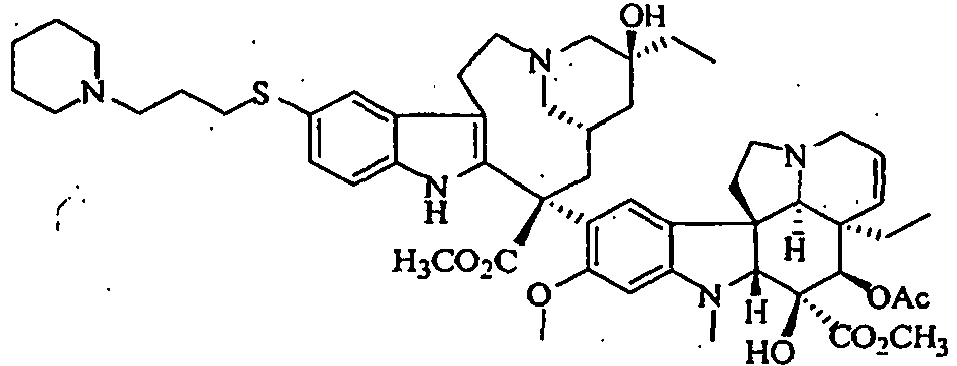
12'-(3-(piperidin-1-yl) propylsulfanyl) vinblastine 51 
12'-[2-Pyrrolidin-1-yl-ethylsulfanyl]vinblastine 52 
12'-(2-(acetylamino) ethylsulfanyl) vinblastine 53 
12'-thiovinblastine 54 
12'-(3-hydroxyphenyl sulfanyl)vincristine 55 
12'-(2-hydroxyphenyl sulfanyl)vinblastine 56 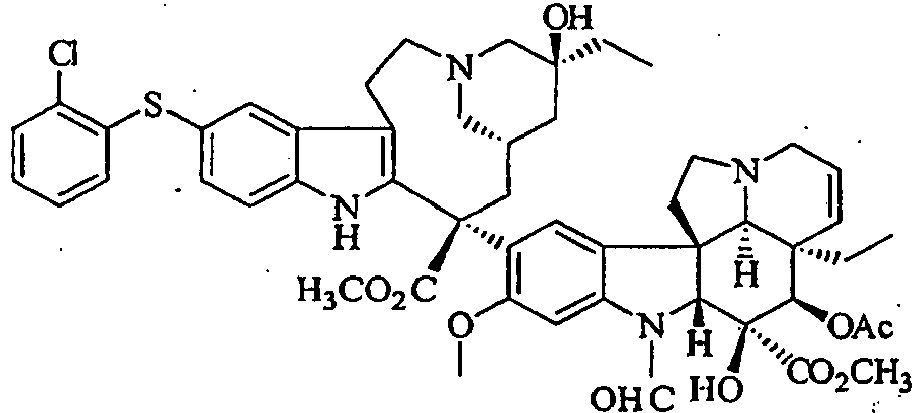
12'-(2-chlorophenyl sulfanyl)vincristine 57 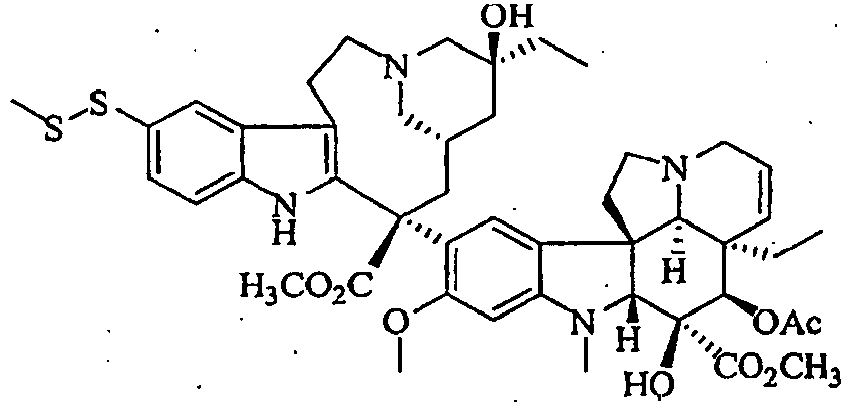
12'-(methyldisulfanyl) vinblastine 58 
12'-(isopropyldisulfanyl) vinblastine 59 
12'-(tert-butyldisulfanyl) vinblastine 60 
di(12'-vinblastine) disulfide 61 
12'-formylvinblastine 62 
12'-formylvincristine 63 
12'-(hydroxymethyl) vinblastine 64 
12'-(N-isopropylamino methyl)vinblastine 65 
12'-cyanovinblastine 66 
12'-cyanovincristine 67 
12'-(methycarbonyl) vinblastine 68 
12'-(2,2,2-trichloroethyl carbonyl)vinblastine 69 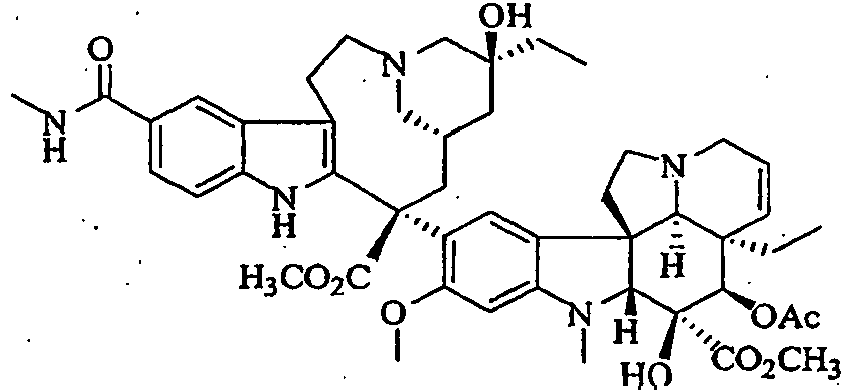
12'-N-(methylamino carbonyl)vinblastine 70 
12'-acetylvinblastine 71 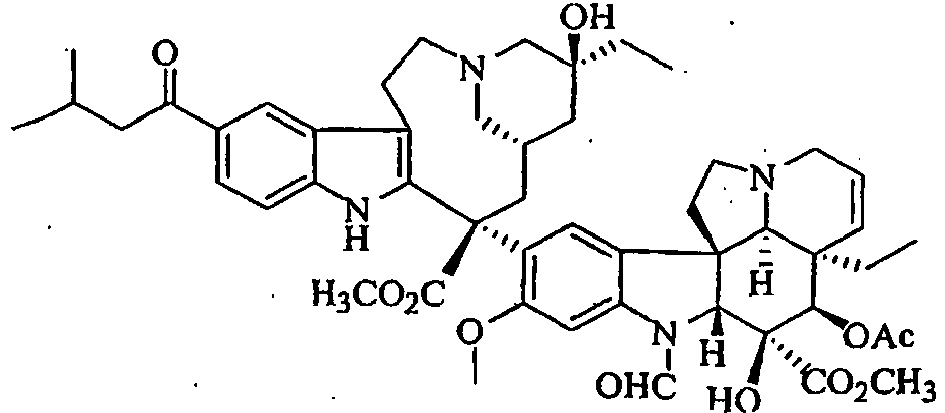
12'-(3-methylbutanoyl) vincristine 72 
12'-hexanoylvincristine 73 
12'-(3-methylbutyl) vincristine 74 
12'-hexylvincristine 75 
12'-methylvinblastine 76 
12'-methylvincristine 77 
12'-ethylvinblastine 78 
12'-ethylvincristine 79 
12'-(N-methyl-N-phenylamino) vinblastine 80 
12'-aminovinblastine 81 
12'-(N,N-dimethyl amino)vinblastine 82 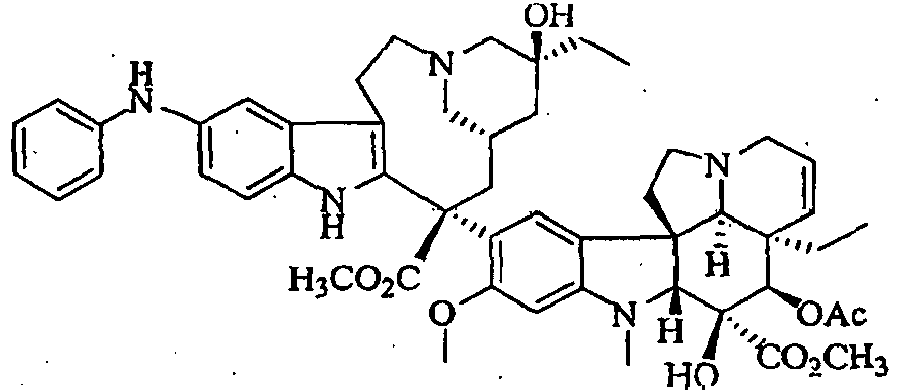
12'-(phenylamino) vinblastine 83 
12'-(4-methoxyphenyl amino)vinblastine 84 
12'-(4-trifluoromethyl phenylamino)vinblastine 85 
12'-(1-piperidinyl) vinblastine 86 
12'-(4-morpholino) vinblastine 87 
12'-(pyrrolidin-1-yl) vinblastine 88 
12'-(azetidin-1-yl) vinblastine 89 
12'-(3-methylpyrazol-1-yl)vinblastine 90 
12', 13'-diiodovincristine 91 
12',13'-diiodovinblastine 92 
13'-iodo-12'-methyl vincristine 93 
12',13'-dimethyl vincristine 94 
13'-ethyl-12'-methyl vincristine 95 
12',13'-diethylvincristine 96 
13'-acetyl-12'-methyl vincristine 97 
12'-bromoanhydro vinblastine 98 
12'-iodoanhydro vinblastine 99 
12'-bromoanhydro vincristine - In yet another embodiment of the present disclosure, a complex can be formed which includes 2 structures of Formula (I) joined together at their R1 groups, where each R1 is -S-.
- The synthetic reaction scheme for the preparation of compounds of Formula (I) is depicted below.
- A synthetic scheme for preparing compounds of Formula (I) is shown in Scheme 1 below. A vinca alkaloid is treated with either N-bromosuccinimide or N-iodosuccinimide to introduce halogens in the 12' and 13'-positions. Pd-mediated coupling is then used to introduce other functionality at these position. This methodology can be used to introduce alkyl, alkenyl, alkynyl, aryl, heterocyclyl, acyl, cyano, amino, and formyl groups and to form sulphides. Each of these groups can then be subjected to further derivatization following standard methods of organic synthesis.

- In practicing the above process, a variety of catalysts may be utilized, such as palladium chloride, palladium acetate,
tris(dibenzylideneacetone)palladium(0), tetrakis(triphenylphosphine)palladium(0), dichlorobis(triphenylphosphine)palladium(II),
benzylchlorobis(triphenylphosphine)palladium(II), or [1,1'-bis(diphenylphosphino)ferrocene]dichloropalladium(II). - Based on the results obtained in the standard pharmacological test procedures described below, the compounds of the present invention are useful in inhibiting cellular proliferation in a mammal by administering to such mammal an effective amount of compound(s) of the present invention.
- In particular, such vinca compound derivatives are useful as antineoplastic agents. More particularly, the compounds of the present invention are useful for inhibiting the growth of neoplastic cells, causing cell death of neoplastic cells, and eradicating neoplastic cells. The compounds of the present invention are, therefore, useful for treating solid tumors, (e.g., sarcomas), carcinomas, (e.g., astrocytomas), lymphomas, (e.g., adult T-cell lymphoma), different cancer disease types, (e.g., prostate cancer, breast cancer, small cell lung cancer, ovarian cancer), Hodgkin's Disease, and other neoplastic disease states (e.g., leukemias, particularly adult T-cell leukemias).
- Since vinca compounds are known to be tubulin inhibitors, the compounds of the present invention would also be expected to be useful in treating the following conditions: bacterial infection; allergy; heart disease; AIDS; Human T-lymphotropic virus 1 infection; Human herpesvirus 3; Human herpesvirus 4; Human papillomavirus; diabetes mellitus; rheumatoid arthritis; Alzheimer's Disease; inflammation; arthritis; asthma; malaria; autoimmune disease; eczema; Lupus erythematosus; psoriasis; rheumatic diseases; Sjogren's syndrome; and viral infection.
- The vinca derivative compounds of the present invention can be administered alone, as indicated above, or utilized as biologically active components in pharmaceutical compositions with suitable pharmaceutically acceptable carriers, adjuvants and/or excipients.
- The compounds in accordance with the present invention, and/or corresponding compositions can be introduced via different administration routes, which include orally, parenterally, intravenously, intraperitoneally, by intranasal instillation, or by application to mucous membranes, such as, that of the nose, throat, and bronchial tubes.
- The active compounds of the present invention may be orally administered, for example, with an inert diluent, or with an assimilable edible carrier, or they may be enclosed in hard or soft shell capsules, or they may be compressed into tablets.
- The quantity of the compound administered will vary depending on the patient and the mode of administration and can be any effective amount. The quantity of the compound administered may vary over a wide range to provide in a unit dosage an effective amount of from about 0.01 to 20 mg/kg of body weight of the patient per day to achieve the desired effect. The amount of active compound in such therapeutically useful compositions is such that a suitable dosage will be obtained. Preferred compositions according to the present invention are prepared so that an oral dosage unit contains between about 1 and 250 mg of active compound.
- For example, with oral therapeutic administration, these active compounds may be incorporated with excipients and used in the form of tablets, capsules, elixirs, suspensions, syrups, and the like. Such compositions and preparations should contain at least 0.1% of active compound. The percentage of the compound in these compositions may, of course, be varied and may conveniently be between about 2% to about 60% of the weight of the unit.
- The tablets, capsules, and the like may also contain a binder such as gum tragacanth, acacia, corn starch, or gelatin; excipients such as dicalcium phosphate; a disintegrating agent such as corn starch, potato starch, alginic acid; a lubricant such as magnesium stearate; and a sweetening agent such as sucrose, lactose, or saccharin. When the dosage unit form is a capsule, it may contain, in addition to materials of the above type, a liquid carrier, such as a fatty oil.
- Various other materials may be present as coatings or to modify the physical form of the dosage unit. For instance, tablets may be coated with shellac, sugar, or both.
- These active compounds and/or pharmaceutical compositions may also be administered parenterally. Solutions of these active compounds and/or compositions can be prepared in water. Dispersions can also be prepared in glycerol, liquid polyethylene glycols, and mixtures thereof in oils.
- Illustrative oils are those of animal, vegetable, or synthetic origin, for example, peanut oil, soybean oil, or mineral oil. In general, water, saline, aqueous dextrose and related sugar solution, and glycols such as, propylene glycol or polyethylene glycol, are preferred liquid carriers, particularly for injectable solutions. Under ordinary conditions of storage and use, these preparations contain a preservative to prevent the growth of microorganisms.
- The pharmaceutical forms suitable for injectable use include sterile aqueous solutions or dispersions and sterile powders for the extemporaneous preparation of sterile injectable solutions or dispersions. In all cases, the pharmaceutical form of the present invention must be sterile and must be fluid to the extent that easy syringability exists. It must be stable under the conditions of manufacture and storage and must be preserved against the contaminating action of microorganisms, such as bacteria and fungi. The carrier can be a solvent or dispersion medium containing, for example, water, ethanol, polyol (e.g., glycerol, propylene glycol, and liquid polyethylene glycol), suitable mixtures thereof, and vegetable oils.
- The compounds and/or pharmaceutical compositions of the present invention may also be administered directly to the airways in the form of an aerosol. For use as aerosols, the compounds of the present invention in solution or suspension may be packaged in a pressurized aerosol container together with suitable propellants, for example, hydrocarbon propellants like propane, butane, or isobutane with conventional adjuvants. The materials of the present invention also may be administered in a non-pressurized form such as in a nebulizer or atomizer.
- Some of the compounds of the present invention can be in the form of pharmaceutically acceptable acid-addition and/or base salts. All of these forms of salts are within the scope of the present invention.
- Pharmaceutically acceptable acid addition salts of the compounds of the present invention include salts derived from nontoxic inorganic acids, such as hydrochloric acid, nitric acid, phosphoric acid, sulfuric acid, hydrobromic acid, hydroiodic acid, hydrofluoric acid, phosphorous acid, and the like, as well as the salts derived from nontoxic organic acids, such as aliphatic mono- and dicarboxylic acids, phenyl-substituted alkanoic acids, hydroxy alkanoic acids, alkanedioic acids, aromatic acids, aliphatic and aromatic sulfonic acids, etc. Such salts thus include sulfates, pyrosulfates, bisulfates, sulfites, bisulfites, nitrates, phosphates, monohydrogenphosphates, dihydrogenphosphates, metaphosphates, pyrophosphates, chlorides, bromides, iodides, acetates, trifluoroacetates, propionates, caprylates, isobutyrates, oxalates, malonates, succinate suberates, sebacates, fumarates, maleates, mandelates, benzoates, chlorobenzoates, methylbenzoates, dinitrobenzoates, phthalates, benzenesulfonates, toluenesulfonates, phenylacetates, citrates, lactates, malates, tartrates, methanesulfonates, and the like. Also contemplated are salts of amino acids, such as arginates, gluconates, and galacturonates (see, for example, Berge S.M. et al., "Pharmaceutical Salts," Journal of Pharmaceutical Science, 66:1-19 (1997).
- The acid addition salts of said basic compounds are prepared by contacting the free base forms with a sufficient amount of the desired acid to produce the salt in the conventional manner.
- Pharmaceutically acceptable base addition salts are formed with metals or amines, such as alkali and alkaline earth metals or organic amines. Examples of metals used as cations are sodium, potassium, magnesium, calcium, and the like. Examples of suitable amines are N,N-dibenzylethylenediamine, chloroprocaine, choline, diethanolamine, dicyclohexylamine, ethylenedianline, N-methylglucamine, and procaine (see, for example, Berge S.M. et al., "Pharmaceutical Salts", Journal of Pharmaceutical Science, 66:1-19 (1997)).
- The base addition salts of the acidic compounds are prepared by contacting the free acid form with a sufficient amount of the desired base to produce the salt in the conventional manner.
- Certain of the compounds of the present invention can exist in unsolvated forms as well as solvated forms, including hydrated forms. In general, the solvated forms, including hydrated forms, are equivalent to unsolvated forms and are intended to be encompassed within the scope of the present invention.
- The present invention can be used in conjunction with other known cancer treatments, including other chemotherapeutic agents and radiation.
- The following examples are provided to illustrate embodiments of the present invention but are no means intended to limit its scope.
- Spectroscopic analysis of products described in the experimental procedures below were performed with conventional or standard scientific instrumentation known in the art. Proton NMR spectra were obtained on a Bruker AC 300 spectrometer at 300 MHz or a Bruker 500 MHz spectrometer at 500 MHz and were referenced to tetramethylsilane as an internal standard. Mass spectra were obtained on either a Shimadzu QP-5000 or a PE Sciex API 150 Mass Spectrometer.
- A solution of vinblastine sulfate (0.5 g, 0.55 mmol) in trifluoroacetic acid (50 mL) under nitrogen was stirred at room temperature for 20 min. The flask was wrapped with foil to keep the reaction mixture in the dark and a solution of N-bromosuccinimide (103 mg, 0.58 mmol) in trifluoroacetic acid (25 mL) was added dropwise. After stirring for 18 h, the reaction mixture was concentrated under reduced pressure, diluted with dichloromethane, and poured into ice water. The aqueous layer was washed 3 x with dichloromethane. The pH of the mixture was adjusted to 11-12 with 3% NH3 (aq). The organic layer was separated and the aqueous layer was extracted with dichloromethane (3 x) and the combined organic layers were washed with water, dried (Na2SO4), and concentrated under reduced pressure. Purification by column chromatography (silica (deactivated by eluting with 10% triethylamine in hexane), EtOAc) gave a mixture of mono and dibromides (0.33 g, 65%). Purification by reversed phase chromatography (C18, acetonitrile/water, 0.05% trifluoroacetic acid) gave 12'-bromovinblastine as a trifluoroacetate (0.42 g, 69%). 1H NMR (300 MHz, CDCl3) δ 8.09 (s, 1H), 7.62 (d, J = 2 Hz, 1H), 7.21 (dd, J = 9, 2 Hz, 1H), 6.97 (d, J = 9 Hz, 1H), 6:52 (s, 1H), 6.10 (s, 1H), 5.85 (dd, J= 9, 4 Hz, 1H), 5.46 (s, 1H), 5.30 (d, J = 9 Hz, 1H), 3.89 (m, 2H), 3.80 (s, 6H), 3.73 (s, 1H), 3.65 (m, 1H), 3.63 (s, 3H), 3.50-2.90 (m, 6H), 2.85 (m, 3H), 2.71 (s, 3H), 2.62 (s, 1H), 2.53-2.38 (m, 2H), 2.36-2.10 (m, 2H), 2.11 (s, 3H), 1.90-1.70 (m, 3H), 1.54-1.25 (m, 7H), 0.89 (t, J = 7 Hz, 3H), 0.77 (t, J = 7 Hz, 3H); ESI MS m/z 889, 891 [M + H]+.
- A solution of N-iodosuccinimide (254 mg, 1.13 mmol) in trifluoroacetic acid/methylene chloride (1 : 1, 16 mL) was cooled to approximately 0 °C in an ice-water jacketed addition funnel then added dropwise to vinblastine hydrogensulfate (1.08 g, 1.19 mmol) in trifluoroacetic acid/methylene chloride (1:1, 32 mL) at -15 °C. The temperature was monitored by an internal thermometer and maintained at -15 ± 3 °C during the course of the addition (45 min). After the addition was complete, the reaction mixture was stirred 10 min then poured carefully into a rapidly stirring mixture of 10 % sodium sulfite/satd sodium hydrogencarbonate/chlorofonn (1 : 2 : 2, 200 mL). Solid sodium hydrogencarbonate was then added in small portions until gas evolution stopped. The solution was then extracted with chloroform (3 × 50 mL) and the combined organic extracts were washed with 10% sodium sulfite (50 mL) and brine (50 mL) and dried over magnesium sulfate. The solvent was remove in vacuo to provide 12'-iodovinblastine (1.19 g, quantitative) as a tan foam which was carried forward without further purification: 1H NMR (500 MHz, CD3OD) δ 7.75 (d, J = 1.1 Hz, 1H), 7.32 (dd, J = 8.4, 1.4 Hz, 1H), 7.00 (d, J = 8.5 Hz, 1H), 6.56 (s, 1H), 6.31 (s, 1H), 5.83 (dd, J = 10.2, 3.9 Hz, 1H), 5.36 (s, 1H), 5.29 (d, J = 10.2 Hz, 1H), 3.91-4.07 (m, 2H), 3.81 (s, 3H), 3.76 (s, 3H), 3.64 (s, 3H), 3.58 (s, 1H), 3.36 (d, J = 14.3 Hz, 1H), 3.30 (m, 1H), 3.15-3.27 (m, 3H), 2.94 (dd, J = 14.8, 4.0 Hz, 1H), 2.71-2.85 (m, 4H), 2.71 (s, 3H), 2.41-2.49 (m, 2H), 2.26 (dd, J = 15.6 3.6 Hz, 1H), 2.07 (m, 1H), 2.02 (s, 3H), 1.87 (m, 1H), 1.66 (m, 1H), 1.50 (d, J = 14.1 Hz, 1H), 1.41 (m, 2H), 1.32 (q, J = 7.4 Hz, 2H), 0.90 (t, J = 7.5 Hz, 3H), 0.81 (m, 1H), 0.75 (t, J = 7.3 Hz, 3H); ESI MS m/z 937 [M + H]+.
- 12'-Bromovincristine was prepared from vincristine following the procedure described in Example 1, yield (1.41 g, 72%). 1H NMR (500 MHz, DMSO-d6) δ 11.16 (br s, 1H), 10.63 (br s, 1H), 9.38 (br s, 1H), 7.83 (d, J = 1 Hz, 1H), 7.46 (s, 1H), 7.35 (d, J = 9 Hz, 1H), 7.23 (dd, J = 9,1 Hz, 1H), 7.07 (s, 1H), 5.90 (dd, J = 11, 6 Hz, 1H), 5.62 (d, J= 10 Hz, 1H), 5.18 (br s, 1H), 5.04 (s, 1H), 4.60 (s, 1H), 4.40 (m, 1H), 4.10-3.32 (m), 3.88 (s, 3H), 3.67 (s, 3H), 3.55 (s, 3H), 3.27 (br d, J = 15 Hz, 1H), 3.12 (m, 3H), 3.02 (m, 1H), 2.76 (m, 1H), 2.30 (m, 1H), 2.21 (m, 1H), 2.03 (s, 3H), 1.82 (m, 1H), 1.58-1.37 (m, 7H), 1.10 (m, 1H), 0.87 (t, J = 7 Hz, 3H), 0.65 (t, J = 7 Hz, 3H); ESI MS m/z 903, 905 [M + H]+.
- A solution of N-iodosuccinimide (160 mg, 0.711 mmol) in trifluoroacetic acid/methylene chloride (1 : 1, 20 mL) was cooled to approximately 0 °C in an ice-water jacketed addition funnel then added dropwise to vinblastine hydrogensulfate (725 mg, 0.785 mmol) in trifluoroacetic acid/methylene chloride (1 : 1, 30 mL) at -15 °C. The temperature was monitored by an internal thermometer and maintained at -15 ± 3 °C during the course of the addition (30 min). The reaction was >97% complete as judged by HPLC (C18, acetonitrile, H2O, 0.5% trifluoroacetic acid). Additional N-iodosuccinimide (8.0 mg, 0.036 mmol) was added and stirred for 10 minutes. HPLC indicated no remaining starting material. The reaction mixture was treated with saturated aqueous sodium bicarbonate, and further neutralized with NaOH (3 N) until a pH of 8 was obtained. The solution was diluted with methylene chloride (150 mL). The organic layer was washed with water and brine then dried over Na2SO4. The solvent was removed in vacuo to provide 12'-iodovincristine (0.68 g, 91%) as a tan powder which was carried forward without further purification: 1H NMR (500 MHz, CD3OD) δ 8.93 (s, 1H), 7.77 (d, J = 1.0 Hz, 1H), 7.32 (dd, J = 8.5, 1.5 Hz, 1H), 7.21 (s, 1H), 7.08 (d, J = 8.5 Hz, 1H), 6.86 (s, 1H), 5.83 (dd, J = 10.0, 5.0 Hz, 1H), 5.40 (d, J = 10.0 Hz, 1H), 5.14 (s, 1H), 4.58 (s, 1H), 4.09-4.01 (m, 2H), 3.90 (s, 3H), 3.68 (s, 3H), 3.62 (s, 3H), 3.39 (d, J = 14.5 Hz, 1H), 3.35-3.22 (m, 4H), 3.04 (s, 1H), 3.01 (m, 1H), 2.88-2.78 (m, 4H), 2.62 (m, 1H), 2.47 (dd, J = 14.5, 4.0 Hz, 1H), 2.32 (dd, J = 14.5 4.0 Hz, 1H), 2.08 (m, 1H), 2.00 (s, 3H), 1.76 (m, 1H), 1.54-1.28 (m, 6H), 0.90 (t, J = 7.5 Hz, 3H), 0.75 (t, J = 7.0 Hz, 3H); ESI MS m/z 93 7 [M + H]+.
- A mixture of 12'-bromovincristine (231 mg, 0.256 mmol), cesium carbonate (0.5 g, 1.5 mmol) and phenyl boronic acid (62.5 mg, 0.51 mmol) in 1,4-dioxane (10 mL) was deoxygenated with argon. [1,1'-bis(diphenylphosphino)ferrocene]dichloropalladium(II) (21 mg, 0.026 mmol) was added and the mixture again deoxygenated with an argon purge, then heated at 60 °C for 24 h. After cooling, the reaction mixture was filtered through a short silica column, washing with dichloromethane then EtOAc, and filtrate concentrated under reduced pressure. Purification of the residue by flash chromatography (silica, EtOAc, then 99:1 EtOAc/EtOH) gave 12'-phenylvincristine (185 mg, 80%). 1H NMR (300 MHz, CDCl3) δ 9.44 (br s, 1H), 8.77 (s, 1H), 8.21 (s, 1H), 8.17 (br s, 1H), 7.71 (s, 1H), 7.63 (d, J = 8 Hz, 2H), 7.47 (t, J = 8 Hz, 1H), 7.43 (d, J = 8 Hz, 1H), 7.35 (t, J = 7 Hz, 1H), 7.25 (d, J = 8 Hz, 1H), 6.96 (s, 1H), 6.80 (s, 1H), 5.83 (m, 1H), 5.42 (d, J = 10 Hz, 1H), 5.24 (d, J = 10 Hz, 1H), 4.75 (s, 1H), 4.55 (s, 1H), 4.10-3.60 (m, 2H), 3.90 (s, 1H), 3.89 (s, 3H), 3.79 (s, 1H), 3.73 (s, 3H), 3.68 (s, 3H), 3.46-3.10 (m, 6H), 2.93 (m, 2H), 2.80 (s, 1H), 2.62 (m, 1H), 2.35 (m, 2H), 2.07 (m, 4H), 1.82-1.55 (m, 3H), 1.50-1.16 (m, 6H), 0.89 (t, J = 7 Hz, 6H); ESI m/z 901 [M + H]+.
- 12'-Phenylvinblastine was prepared 12'-bromobinblastine and phenyl boronic acid following the procedure described in Example 5, yield (45 mg, 19%). 1H NMR (300 MHz, CDCl3) δ 9.89 (s, 1H), 8.08 (s, 1H), 7.69 (s, 1H), 7.63 (d, J= 8 Hz, 2H), 7.45 (d, J = 7 Hz, 1H), 7.42 (t, J = 8 Hz, 2H), 7.34 (t, J = 7 Hz, 1H), 7.19 (d, J = 8 Hz, 1H), 6.66 (s, 1H), 6.11 (s, 1H), 5.87 (dd, J = 10, 4 Hz, 1H), 5.48 (s, 1H), 5.30 (d, J = 10 Hz, 1H), 3.98 (t, J = 13 Hz, 1H), 3.80 (s, 5H), 3.74 (s, 1H), 3.63 (s, 3H), 3.50-3.10 (m, 6H), 2.90-2.75 (m, 2H), 2.72 (s, 3H), 2.72 (s, 1H), 2.53-2.37 (m, 2H), 2.36-2.10 (m, 2H), 2.11 (s, 3H), 1.90-1.55 (m, 3H), 1.55-1.18 (m, 5H), 2.11 (s, 3H), 0.90 (t, J= 7 Hz, 3H), 0.85 (t, J = 7 Hz, 3H); ESI MS m/z 887 [M + H]+.
- The trifluoroacetate of 12'-(4-methoxyphenyl)vincristine was prepared from 12'-bromovincristine and 4-methoxyphenyl boronic acid following the procedure described in Example 5. Purification by reversed phase chromatography (C18, acetonitrile/water, 0.05% trifluoroacetic acid) gave 12'-(4-methoxyphenyl)vincristine trifluoroacetate (135 mg, 87%). 1H NMR (300 MHz, CDCl3) δ 8.76 (s, 1H), 8.21 (s, 1H), 8.16 (br s, 1H), 7.80 (s, 1H), 7.53 (d, J = 9 Hz, 2H), 7.44 (d, J = 8 Hz, 1H), 7.19 (d, J = 8 Hz, 1H), 6.99 (d, J = 8 Hz, 2H), 6.85 (s, 1H), 5.91 (m, 1H), 5.56 (m, 1H), 5.19 (d, J = 15 Hz, 1H), 4.83 (m, 1H), 4.59 (dd, J= 15, 10 Hz, 1H), 4.10-3.60 (m, 4H), 3.93 (s, 3H), 3.86 (s, 3H), 3.79 (s, 3H), 3.75 (s, 3H), 3.70 (s, 1H), 3.60-3.00 (m, 8H), 3.11 (br s, 3H), 2.82 (m, 1H), 2.56 (m, 1H), 2.41 (m, 1H), 2.07 (s, 3H), 1.96 (m, 1H), 1.67 (m, 2H), 1.55 (q, J = 7 Hz, 2H), 1.47-1.19 (m, 2H), 0.99 (t, J = 7 Hz, 3H) 0.76 (m, 3H); ESI m/z 931 [M + H]+.
- 12'-(4-Methoxyphenyl)vinblastine was prepared from 12'-bromovinblastine and 4-methoxyphenyl boronic acid following the procedure described in Example 5 (39 mg, 26%). 1H NMR (300 MHz, CDCl3) δ 8.76 (s, 1H), 8.12 (s, 1H), 7.55 (br s, 1H), 7.53 (d, J = 9 Hz, 2H), 7.42 (dd, J = 9, 2 Hz, 1H), 7.14 (d, J = 9 Hz, 1H), 6.99 (d, J = 9 Hz, 2H), 6.53 (s, 1H), 6.13 (s, 1H), 5.87 (dd, J = 10, 5 Hz, 1H), 5.45 (d, J = 10 Hz, 2H), 5.44 (s, 1H), 4.59 (m, 1H), 4.00 (m, 1H), 3.94 (s, 1H), 3.87 (s, 3H), 3.84 (s, 3H), 3.83 (s, 3H), 3.70 (s, 3H), 3.60-2.80 (m, 12H), 2.71 (s, 3H), 2.63-2.40 (m, 2H), 2.15 (m, 1H), 2.09 (s, 3H), 2.00-1.30 (m, 10H), 0.99 (t, J = 7 Hz, 3H), 0.73 (t, J = 7 Hz, 3H); ESI m/z 917 [M + H]+.
- To a solution of 12'-iodovinblastine (45 mg, 0.05 mmol) in dioxane (1 mL) was added 3-methoxyphenylboronic acid (15 mg, 0.1 mmol) and Cs2CO3 (78 mg, 0.24 mmol). The mixture was deoxygenated with an argon purge, and [1,1'-bis(diphenylphospino)ferrocene]dichloropalladium (5 mg, 0.006 mmol) was added. The resulting mixture was deoxygenated again and then heated to 60 °C for 4 h. The reaction mixture was cooled to room temperature, diluted with CH2Cl2, and filtered through diatomaceous earth. The filtrate was washed with water and brine, and then dried (MgSO4). Purification by column chromatography (silica, 9:1 CH2Cl2/MeOH) followed by preparative TLC (silica, 7:3 EtOAc/MeOH) gave 12'-(3-methoxyphenyl)vinblastine (18.4 mg, 41%). This material was dissolved in CH2Cl2 (1 mL) and treated with a drop of trifluoroacetic acid. The solution was evaporated to give 12'-(3-methoxyphenyl)vinblastine trifluoroacetate (22 mg, quantitative): 1H NMR (300 MHz, CD3OD) δ 9.55 (s, 1H), 7.61 (s, 1H), 7.32-7.19 (m, 3H), 7.09 (d, J = 8.0 Hz, 1H), 7.04 (dd, J = 2.2, 1.8 Hz, 1H), 6.76 (d, J = 7.5, 1.8 Hz, 1H), 6.60 (s, 1H), 6.33 (s, 1H), 5.84 (dd, J = 10.6, 4.3 Hz, 1H), 5.57 (d, J = 10.4 Hz, 1H), 5.27 (s, 1H), 4.61-4.54 (m, 1H), 3.91-3.56 (m, 9H), 3.77 (s, 3H), 3.75 (s, 3H), 3.72 (s, 3H), 3.61 (s, 3H), 3.43-3.29 (m, 2H), 3.15-3.09 (m, 2H), 2.80 (dd, J = 14.4, 6.0 Hz, 1H), 2.68 (s, 3H), 2.40 (dd, J = 15.0,4.7 Hz, 1H), 2.31-2.21 (m, 1H), 1.98-1.89 (m, 1H), 1.98 (s, 3H), 1.71-1.62 (m, 1H), 1.58-1.56 (m, 2H), 1.51-1.39 (m, 3H), 1.27-1.25 (m, 1H), 0.88 (t, J = 7.4 Hz, 3H), 0.74 (t, J = 7.2 Hz, 3H); ESI MS m/z 917 [M + H]+.
- 12'-(4-Fluorophenyl)vinblastine was prepared from 12'-bromovinblastine and 4-fluorophenyl boronic acid following the procedure described in Example 5 (63 mg, 43%). 1H NMR (300 MHz, CDCl3) δ 8.15 (s, 1H), 7.60-7.52 (m, 3H), 7.41 (dd, J = 8, 1 Hz, 1H), 722-7.08 (m, 3H), 6.99 (d, J = 8 Hz, 2H), 6.85 (s, 1H), 5.91 (m, 1H), 5.56 (m, 1H), 5.19 (d, J = 15 Hz, 1H), 4.83 (m, 1H), 4.59 (d, J = 15, 10 Hz, 1H), 4.10-3.60 (m, 3H), 3.93 (s, 3H), 3.86 (s, 3H), 3.79 (s, 3H), 3.75 (s, 3H), 3.70 (s, 1H), 3.60-3.00 (m, 8H), 3.11 (br s, 3H), 2.82 (m, 1H), 2.56 (m), 2.41 (m, 1H), 2.12 (m, 1H), 2.07 (s, 3H), 1.96 (m, 1H), 1.67 (m, 2H), 1.55 (q, J = 7 Hz, 2H), 1.47-1.19 (m, 2H), 0.99 (t, J = 7 Hz, 3H) 0.76 (m, 3H); ESI m/z 905 [M + H]+.
- To a solution of 12'-iodovinblastine (45 mg, 0.05 mmol) in dioxane (1 mL) was added 3-fluorophenylboronic acid (14 mg, 0.1 mmol) and Cs2CO3 (80 mg, 0.25 mmol). The mixture was deoxygenated with an argon purge, and [1,1'-bis(diphenylphospino)ferrocene]dichloropalladium (5 mg, 0.006 mmol) was added. The resulting mixture was deoxygenated again and then heated to 60 °C for 4 h. The reaction mixture was cooled to room temperature, diluted with CH2Cl2 and filtered through diatomaceous earth. The filtrate was washed with water and brine, and then dried (MgSO4). Purification by column chromatography (silica, 9:1 CH2Cl2/MeOH) followed by preparative TLC (silica gel, 7:3 EtOAc/MeOH) gave 12'-(3-fluorophenyl)vinblastine (9.1 mg, 20%). This material was dissolved in CH2Cl2 (1 mL) and treated with a drop of trifluoroacetic acid. The solution was evaporated to give 12'-(3-fluorophenyl)vinblastine trifluoroacetate (11 mg, 80%): 1H NMR (300 MHz, CD3OD) δ 9.63 (s, 1H), 7.65 (s, 1H), 7.40-7.25 (m, 5H), 6.94-6.88 (m, 1H), 6.60 (s, 1H), 6.33 (s, 1H), 5.84 (dd, J = 10.6, 4.1 Hz, 1H), 5.57 (d, J = 10.3 Hz, 1H), 5.27 (s, 1H), 4.61-4.55 (m, 1H), 3.91-3.56 (m, 9H), 3.77 (s, 3H), 3.72 (s, 3H), 3.61 (s, 3H), 3.43-3.30 (m, 2H), 3.15-3.09 (m,2H), 2.80 (dd, J = 14.4, 6.3 Hz, 1H), 2.68 (s, 3H), 2.40 (dd, J= 16.3, 4.9 Hz, 1H), 2.31-2.21 (m, 1H), 1.98-1.89 (m, 1H), 1.98 (s, 3H), 1.71-1.62 (m, 1H), 1.58-1.56 (m, 2H), 1.50-1.39 (m, 3H), 1.31-1.25 (m, 1H), 0.88 (t, J = 7.3 Hz, 3H), 0.74 (t, J = 7.1 Hz, 3H); ESI MS m/z 905 [M + H]+.
- To a solution of 12'-iodovinblastine (39 mg, 0.040 mmol) in dioxane (1 mL) was added 3-hydroxyphenylboronic acid (12 mg, 0.080 mmol) and Cs2CO3 (68 mg, 0.21 mmol). The mixture was deoxygenated with argon, and [1,1'-bis(diphenylphosphino)ferrocene]dichloropalladium(II) (4 mg, 0.0040 mmol) was added. The resulting mixture was deoxygenated with argon again and then heated at 70 °C for 6 h and 80 °C overnight. The reaction mixture was cooled to room temperature, diluted with CH2Cl2, and filtered through diatomaceous earth. The filtrate was washed with water and brine, and dried. After removal of the solvents, the residue was purified by column chromatography (silica, 9:1 CH2Cl2/MeOH) followed by preparativeTLC (silica, 7:3 EtOAc/MeO) to give 12-(3-hydroxyphenyl)vinblastine (4.2 mg, 12%): 1H NMR (500 MHz, CD3OD) δ 7.51 (s, 1H), 7.24 (dd, J = 14.0, 2.5 Hz, 1H), 7.14-7.09 (m, 2H), 7.00-6.95 (m, 2H), 6.61 (dd, J = 13.5, 7.5 Hz, 1H), 6.53 (s, 1H), 6.23 (s, 1H), 5.75 (dd, J = 17.0, 7.0 Hz, 1H), 5.28 (s, 1H), 5.19 (d, J = 16.5 Hz, 1H), 4.02-3.87 (m, 2H), 3.72-3.67 (m, 7H), 3.56-3.49 (m, 5H), 3.36-3.31 (m, 1H), 3.20-2.96 (m, 4H), 2.73-2.61 (m, 7H), 2.40-2.31 (m, 2H), 2.25-2.16 (m, 1H), 2.03-1.91 (m, 4H), 1.86-1.78 (m, 1H), 1.64-1.58 (m, 1H), 1.44-1.19 (m, 7H), 0.83-0.69 (m, 6H); ESI MS m/z 903 [M + H]+.
- 12'-(3-Pyridyl)vinblastine was prepared from 12'-bromovinblastine and 3-pyridyl boronic acid following the procedure described in Example 5 (26 mg, 16%). 1H NMR (300 MHz, CDCl3) δ 9.82 (s, 1H), 8.89 (d, J = 1.5 Hz, 1H), 8.54 (dd, J = 5, 1 Hz, 1H), 8.13 (s, 1H), 7.91 (dt, J = 8, 2 Hz, 1H), 7.69 (s, 1H), 7.33-7.39 (m, 2H), 7.22 (d, J = 8 Hz, 1H), 6.63 (s, 1H), 6.11 (s, 1H), 5.86 (dd, J = 10, 4 Hz, 1H), 5.47 (s, 1H), 5.31 (d, J= 10 Hz, 1H), 3.99 (t, J= 4 Hz, 1H), 3.80 (s, 3H), 3.79 (s, 3H), 3.74 (s, 1H), 3.68-3.87 (m, 2H), 3.63 (s, 3H), 3.26-3.43 (m, 5H), 3.18 (br s, 1H), 3.14 (br s, 1H), 2.82 (br t, J = 8 Hz, 1H), 2.71 (s, 3H), 2.68 (s, 1H), 2.42-2.48 (m, 2H), 2.29 (br d, J = 12 Hz, 1H), 2.15-2.22 (m, 1H), 2.11 (s, 3H), 1.74-1.89 (m, 3H), 1.25-1.51 (m, 6H), 0.89 (t, J = 7 Hz, 3H), 0.83 (t, J = 7 Hz, 3H). ESI m/z 888 [M + H]+.
- 12'-(3-Thienyl)vinblastine was prepared from 12'-bromovinblastine and 3-thienyl boronic acid by following the procedure described in Example 5 and then converted to the free base by treatment with ammonium hydroxide (45 mg, 23%). 1H NMR (300 MHz, CDCl3) δ 9.87 (s, 1H), 8.07 (s, 1H), 7.68 (s, 1H), 7.42 (m, 4H), 7.45 (d, J = 7 Hz, 1H), 7.14 (d, J = 8 Hz, 1H), 6.70 (br s, 1H), 6.11 (s, 1H), 5.87 (dd,J= 10,4 Hz, 1H), 5.47 (s, 1H), 5.30 (obs d, J = 10 Hz, 1H), 5.30 (s, 1H), 4.00-3.85 (m, 1H), 3.80 (s, 6H), 3.74 (s, 1H), 3.63 (s, 3H), 3.50-3.10 (m, 6H), 2.90-2.75 (m, 2H), 2.72 (s, 3H), 2.68 (s, 1H), 2.53-2.37 (m, 2H), 2.36-2.00 (m, 2H), 2.11 (s, 3H), 1.90-1.55 (m, 2H), 1.55-1.18 (m), 2.11 (s, 3H), 0.91 (t, J = 7 Hz, 3H), 0.82 (t, J = 7 Hz, 3H); ESI MS m/z 893 [M + H]+.
- A solution of 12'-iodovinblastine (298 mg, 0.26 mmol) in THF (3 mL) was deoxygenated with an argon purge. Tetrakis(triphenylphosphine)palladium(0) (24 mg, 0.026 mmol) and 2-thiazolylzinc bromide (1.68 mL, 1.06 mmol) was added and the mixture heated at 60 °C overnight. The reaction mixture was diluted with brine and extracted with dichloromethane. The organic layers were combined and concentrated under reduced pressure. Purification by reversed phase chromatography (C18, acetonitrile/water, 0.05% concentrated ammonium hydroxide) gave 12'-(2-thiazolyl)vinblastine (32.8 mg, 14%). 1HNMR (300 MHz, CD3OD) 8.15 (s, 1H), 7.83 (d, J = 5 Hz, 1H), 7.72 (dd, J = 7, 2 Hz, 1H), 7.53 (d, J = 5 Hz, 1H), 7.36 (d, J = 7 Hz, 1H), 6.51 (s, 1H), 6.38 (s, 1H), 5.87 (dd, J = 10, 3 Hz, 1H), 5.41 (d, J = 10 Hz, 1H), 5.34 (s, 1H), 4.66 (m, 1H), 4.23 (t, J = 14 Hz, 1H), 3.85 (s, 3H), 3.78 (s, 3H), 3.70 (s, 3H), 3.63 (s, 1H), 3.60-3.10 (m), 3.11-2.84 (m, 3H), 2.81 (s, 3H), 2.61 (m, 1H), 2.51 (dd, J = 15,2 Hz, 1H), 2.17 (m, 1H), 2.15 (s, 1H), 2.09 (s, 3H), 2.05 (m, 1H), 1.84 (m, 1H), 1.68 (m, 3H), 1.55-1.43 (m, 4H), 1.01 (t, J = 7 Hz, 3H), 0.74 (t, J = 7 Hz, 3H); ESI m/z 894 [M + H]+.
- A solution of 12'-iodovinblastine (310 mg, 0.33 mmol) in toluene (5 mL) and triethylamine (3 mL) was deoxygenated with an argon purge, copper (I) iodide (2.5 mg, 0.013 mmol) and dichlorobis(triphenylphosphine)palladium(II) (10 mg) were added and the mixture deoxygenated again. Trimethylacetylene ( 0.06 mL, 0.42 mmol) was added and the mixture stirred at 55 °C for 24 h. After cooling, the reaction mixture was diluted with methanol and filtered through diatomaceous earth, concentrated to approximately 30 mL, filtered again and then concentrated to dryness. The mixture was diluted with 1 N HCl and extracted with chloroform. The organic solution was separated and concentrated under reduced pressure. Purification by flash chromatography (silica, 97:3 CHCl3/MeOH) gave 12'-(trimethylsilylethynyl)vinblastine (28 mg, quant). 1H NMR (300 MHz, MeOD) δ 7.64 (s, 1H), 7.13 (s, 2H), 6.56 (s, 1H), 6.32 (s, 1H), 5.64 (dd, J = 10, 4 Hz, 1H), 5.35 (s, 1H), 5.29 (d, J = 10 Hz, 1H), 4.02 (t, J = 13 Hz, 1H), 3.78 (s, 3H), 3.76 (s, 3H), 3.64 (s, 3H), 3.64 (m, 1H), 3.58 (s, 1H), 3.42 (d, J = 13 Hz, 1H), 3.23-3.12 (m), 3.05 (d, J = 13 Hz, 1H), 2.92-2.67 (m, 3H), 2.70 (s, 3H), 2.56-2.25 (m, 3H), 2.02 (s, 3H), 1.92-1.25 (m, 6H), 0.90 (t, J= 7 Hz, 3H), 0.75 (t, J = 7 Hz, 3H), 0.22 (s, 9H); ESI m/z 907 [M + H]+.
- To a solution of 12'-(trimethylsilylethynyl)vinblastine (0.088 g, 0.097 mol) in methanol (1.8 mL) was added potassium carbonate (1.3 mg, 0.01 mmol) and the mixture stirred at room temperature for 4 h. The mixture was concentrated under reduced pressure, diluted with dichloromethane, washed with water and saturated sodium bicarbonate, dried (Na2SO4) and concentrated under reduced pressure. Purification by reversed phase chromatography (C18, acetonitrile/water, 0.05% concentrated ammonium hydroxide) gave 12'-(ethynyl)vinblastine 24.4 mg, 30%). 1H NMR (300 MHz, MeOD) δ 7.60 (s, 1H), 7.16 (d, J = 8 Hz, 1H), 7.13 (d, J = 8 Hz, 1H), 6.58 (s, 1H), 6.32 (s, 1H), 5.82 (dd, J = 10, 4 Hz, 1H), 5.36 (s, 1H), 5.29 (d, J = 10 Hz, 1H), 4.01 (t, J = 13 Hz, 1H), 3.95 (m, 1H), 3.81 (s, 3H), 3.76 (s, 3H), 3.66 (m, 1H), 3.65 (s, 3H), 3.58 (s, 1H), 3.45-3.12 (m), 3.02 (d, J = 13 Hz, 1H), 2.88-2.67 (m, 4H), 2.71 (s, 3H), 2.47 (m, 2H), 2.38 (dd, J= 13, 3 Hz, 1H), 2.03 (s, 3H), 1.87 (m, 1H), 1.66 (m, 1H), 1.56-1.25 (m, 5H), 0.90 (t, J = 7 Hz, 3H), 0.76 (t, J = 7 Hz, 3H); ESI m/z 835 [M + H]+.
- Propynylmagnesium bromide (0.5 M in THF, 0.30 mL, 0.15 mmol) was added to zinc bromide (0.5 M in THF, 0.30 mL, 0.15 mmol) in anhydrous 1,4-dioxane (2 mL) under nitrogen. After 10 min [1,1'-bis(diphenylphosphino)ferrocene]dichioropalladium (II) (6.1 mg, 0.008 mmol) was added followed by 12'-Iodovinblastine (71 mg, 0.076 mmol) in anhydrous 1,4-dioxane (1 mL). The reaction mixture was heated at 45 °C for 45 min then quenched by the addition of saturated aqueous NaHCO3 (5 mL). After extraction with chloroform (3 × 8 mL) the combined organic extracts were washed with brine (5 mL), dried over MgSO4, and evaporated to dryness in vacuo. The residue was purified by reverse phase chromatography (C18, acetonitrile/water, 0.05% trifluoroacetic acid) to provide 12'-propynylvinblastine trifluoroacetate (38.6 mg, 47%) as a white powder after lyophilization: 1H NMR (500 MHz, CD3OD) δ 9.71 (s, 1H), 7.56 (s, 1H), 7.20 (d, J = 8.4 Hz, 1H), 7.12 (dd, J = 8.4, 1.1 Hz, 1H), 6.66 (s, 1 H), 6.42 (s, 1H), 5.94 (dd, J = 10.4, 4.4 Hz, 1H), 5.65 (d, J = 10.7 Hz, 1H), 5.36 (s, 1H), 4.84 (m, 1H), 4.63 (dd, J = 16.9, 11.5, 1H), 3.96-3.56 (m, 7H), 3.86 (s, 3H), 3.82 (s, 3H), 3.69 (s, 3H), 3.48 (d, J = 15.9 Hz, 1H), 3.19 (m, 3H), 2.88 (dd, J = 14.4, 6.3 Hz, 1H), 2.77 (s, 3H), 2.47 (dd, J = 16.6, 4.7 Hz, 1H), 2.35 (m, 1H), 2.07 (s, 3H), 2.04 (m, 2H), 2.01 (s, 3H), 1.74 (m, 1H), 1.66 (m, 2H), 1.52 (m, 3H), 1.38 (m, 1H), 0.97 (t, J = 7.4 Hz, 3H), 0.79 (t, J = 7.3 Hz, 3H); ESI MS m/z 849 [M + H]+.
- 12'-(Phenylethynyl)vinblastine was prepared from 12'-iodovinblastine and phenylacetylene following the procedure described in Example 16 except that the reaction was run at room temperature (23 mg, 17%). 1H NMR (300 MHz, MeOD) δ 7.55 (s, 1H), 7.40 (dd, J= 8, 2 Hz, 2H), 7.25 (m, 3H), 7.14 (d, J = 8 Hz, 1H), 7.08 (d, J = 8 Hz, 1H), 6.50 (s, 1H), 6.22 (s, 1H), 5.75 (dd, J= 10, 4 Hz, 1H), 5.27 (s, 1H), 5.20 (d, J = 10 Hz, 1H), 4.53 (br s, 1H), 3.98 (t, J = 14 Hz, 1H), 3.91 (m, 1 H), 3.72 (s, 3H), 3.66 (s, 3H), 3.55 (s, 3H), 3.49 (s, 1H), 3.32 (d, J = 14 Hz, 1H), 3.25-3.05 (m, 5H), 2.95 (d, J = 14 Hz, 1H), 2.70 (m, 2H), 2.65 (s, 1H), 2.62 (s, 3H), 2.37 (m, 2H), 2.07 (dm, J = 14 Hz, 1H), 2.00 (m, 1H), 1.93 (s, 3H), 2.77 (m, 1H), 1.57 (m, 1H), 1.50-1.15 (m, 5H), 0.78 (t, J= 7 Hz, 3H), 0.68 (t, J = 7 Hz, 3H); ESI m/z 911 [M + H]+.
- 12'-Iodovinblastine (52.7 mg, 0.056 mmol), copper(I) iodide (1.6 mg, 0.0084 mmol), dichlorobis(triphenylphosphine)palladium(II) (3.9 mg, 0.0056 mmol), toluene (1.2 mL), and triethylamine (0.8 mL) were combined in a resealable glass test tube and argon was bubbled through the solution for 10 min. 3-Methylbut-1-yne (22.9 mg, 0.33 mmol) was added, the test tube sealed, and the mixture was heated at 55 °C for 1.5 h. Saturated aqueous NaHCO3 (5 mL) was added and the mixture was extracted with ethyl acetate (3 × 5 mL). The combined organic extracts were washed with brine (5 mL), dried over MgSO4, and evaporated to dryness in vacuo. The residue was purified by reverse phase chromatography (C18, acetonitrile/water, 0.05% trifluoroacetic acid) to provide 12'-(3-methylbut-1-yne)vinblastine trifluoroacetate (24.0 mg, 40%) as a white solid after lyophilization: 1H NMR (300 MHz, CD3OD) δ 7.56 (s, 1H), 7.20 (d, J = 8.5 Hz, 1H), 7.13-7.11 (m, 1H), 6.59 (s, 1H), 6.40 (s, 1H), 5.91 (q, J = 10.5, 6.0 Hz, 1H), 5.57-5.55 (m, 1H), 5.35 (s, 1H), 4.84-4.81 (m, 1H), 4.67-4.59 (m, 1H), 3.97-3.80 (m, 9H), 3.68-3.58 (m, 6H), 3.43-3.28 (m, 2H), 3.19-3.17 (m, 2H), 3.03-2.98 (m, 1H), 2.91-2.86 (m, 1H), 2.78-2.74 (m, 4H), 2.50-2.47 (m, 1H), 2.33-2.28 (m, 1H), 2.07-1.94 (m, 5H), 1.78-1.68 (m, 3H), 1.58-1.49 (m, 3H), 1.42-1.38 (m, 1H), 1.24 (d, J= 7.0 Hz, 6H), 0.97 (t, J = 7.5 Hz, 3H), 0.77 (t, J = 7.0 Hz, 3H); ESI MS m/z 877 [M + H]+.
- A solution of 12'-iodovincristine (210 mg, 0.22 mmol) and triethylamine (3 mL) in THF (3 mL) was deoxygenated with argon for 20 min. Dichlorobis(triphenylphosphine)palladium(II) (9 mg, 0.01 mmol) and copper(I) iodide was added, and the reaction mixture was again degassed with argon for 10 min followed by addition of 3-methyl-1-butyne (0.05 mL). The reaction mixture was heated at 60 °C overnight, cooled to room temperature, and quenched by the addition of 1 N HCl. The reaction mixture was extracted with methylene chloride and the organic layer was dried (sodium sulfate), filtered, and concentrated under reduced pressure to give a light orange solid. Purification by flash column chromatography (silica, 97:3 to 95:% CH2Cl2/MeOH) gave 12'-(3-methyl-butynl)vincristine (22 mg, 11%) as an orange solid: 1H NMR (300 MHz, CD3OD) δ 8.99 (s, 1H), 7.45 (s, 1H), 7.21-7.15 (m, 2H), 7.06 (d, J = 7 Hz, 1H), 6.90 (s, 1H), 5.90 (m, 1H), 5.40 (d, J = 6 Hz, 1H), 4.13-4.03 (m, 3H), 3.89 (s, 3H), 3.88 (m, 1H), 3.74 (m, 1H), 3.71 (s, 3H), 3.62 (s, 3H), 3.40 (m), 3.01 (m, 3H), 2.90-2.74 (m, 5H), 2.63 (m, 1H), 2.41 (m, 1H), 2.27 (m, 1H), 2.07 (m, 5H), 1.78 (m, 1H), 1.51-1.30 (m), 1.28 (d, J= 7 Hz, 6H), 0.89 (t, J = 7 Hz, 3H), 0.76 (t, J = 7 Hz, 3H); ESI MS m/z 891 [M+]+.
- 12'-(Hexynyl)vincristine was prepared from 12'-iodovinblastine following the procedure described in Example 16 (12 mg, 44%). 1H NMR (300 MHz, CD3OD) δ 8.95 (s, 1H), 7.54 (s, 1H), 7.24 (s, 1H), 7.23 (d, J = 8 Hz, 1H), 7.11 (d, J = 8 Hz, 1H), 6.86 (s, 1H), 5.88 (d, J = 10, 5 Hz, 1H), 5.41 (d, J = 10 Hz, 1H), 5.14 (s, 1H), 4.57 (s, 1H), 4.40 (dd, J = 16, 11 Hz, 1H), 3.98 (t, J = 15 Hz, 1H), 3.92 (s, 3H), 3.88 (s, 1H), 3.70 (s, 3H), 3.62 (s, 3H), 3.52 (m, 2H), 3.40-2.84 (m, 5H), 2.77 (m, 1H), 2.40 (m, 1H), 2.40 (t, J = 7 Hz, 2H), 2.12 (m, 1H), 2.01 (m, 1H), 2.00 (s, 3H), 1.83 (m, 1H), 1.66-1.20 (m, 14H), 0.96 (t, J = 7 Hz, 3H), 0.93 (t, J = 7 Hz, 3H), 0.76 (t, J = 7 Hz, 3H); ESI MS m/z 905 [M + H]+.
- 12'-(Hexynyl)vinblastine was prepared from 12-'iodovinblastine following the procedure described in Example 16 (19 mg, 14%). 1H NMR (300 MHz, CD3OD) δ 7.77 (s, 1H), 7.26 (d, J = 8 Hz, 1H), 7.14 (d, J = 8 Hz, 1H), 6.32 (s, 1H), 6.25 (s, 1H), 5.83 (d, J = 10, 5 Hz, 1H), 5.77 (d, J = 5 Hz, 1H), 5.30 (s, 1H), 5.23 (d, J = 10 Hz, 1H), 4.41 (s, 1H), 3.85 (s, 3H), 3.77 (m, 1H), 3.75 (s, 3H), 3.73 (s, 3H), 3.58 (s, 1H), 3.41 (m, 2H), 3.20 (m, 1H), 3.06 (m, 1H), 2.71 (s, 3H), 2.70-2.44 (m, 3H), 2.41 (t, J = 7 Hz, 2H), 2.26 (m, 1H), 2.05 (m, 3H), 2.01 (s, 3H), 1.90 (br s, 1H), 1.79 (m, 1H), 1.66-1.20 (m, 10H), 0.96 (t, J= 7 Hz, 3H), 0.93 (t, J = 7 Hz, 3H), 0.76 (t, J = 7 Hz, 3H); ESI MS m/z 859 [M + H]+.
- 12'-iodovinblastine (52.8 mg, 0.057 mmol), copper(I) iodide (1.6 mg, 0.0086 mmol), dichlorobis(triphenylphosphine)palladium(II) (4.0 mg, 0.0057 mmol), toluene (1.2 mL), and triethylamine (0.8 mL) were combined in a resealable glass test tube and argon was bubbled through the solution for 10 min. 1-Dimethylamino-2-propyne (36.7 µL, 0.33 mmol) was added, the test tube sealed, and the mixture was heated at 55 °C for 1.5 h. Saturated aqueous NaHCO3 (5 mL) was added, and the mixture was extracted with ethyl acetate (3 × 5 mL). The combined organic extracts were washed with brine (5 mL), dried over MgSO4, and evaporated to dryness in vacuo. The residue was purified by reverse phase chromatography (C18, acetonitrile/water, 0.05% trifluoroacetic acid) to provide 12'-(N,N-dimethylaminopropynyl)vinblastine trifluoroacetate (22.4 mg, 33%), which was a white solid after lyophilization: 1H NMR (300 MHz, CD3OD) δ 9.91 (br s, 1H), 7.76 (s, 1H), 7.30-7.26 (m, 2H), 6.58 (s, 1H), 6.38 (s, 1H), 5.90 (t, J = 10.5, 6.0 Hz, 1H), 5.52 (d, J = 9.0 Hz, 1H), 5.33 (s, 1H), 4.90-4.81 (m, 1H), 4.66-4.61 (m, 1H), 4.27 (s, 2H), 3.96-3.84 (m, 5H), 3.79 (s, 3H), 3.69-3.62 (m, 7H), 3.55-3.48 (m, 1H), 3.33-2.29 (m, 1H), 3.20-3.16 (m, 3H), 3.00 (s, 6H), 2.89-2.85 (m, 1H), 2.75 (s, 3H), 2.50-2.45 (m, 1H), 2.24-2.21 (m, 1H), 2.05 (s, 3H), 2.03 (s, 1H), 1.97-1.89 (m, 1H), 1.74-1.67 (m, 3H), 1.57-1.49 (m, 3H), 1.40-1.45 (m, 1H), 0.96 (t, J = 7.5 Hz, 3H), 0.75 (t, J = 7.5 Hz, 3H); ESIMS m/z 892 [M + H]+.
- A solution of 12'-iodovinblastine (39 mg, 0.042 mmol) in DME (0.5 mL) and water (0.2 mL) was deoxygenated with argon for 3 minutes. The reaction vessel was charged with 2,4,6-trivinylcyclotriboroxane pyridine complex (11 mg, 0.46 mmol), tetrakis(triphenylphosphine)palladium(0) (6.3 mg, 0.050 mmol), K2CO3 (6.4 mg, 0.046 mmol) and the mixture was heated to 80-90 °C. After 2 h, the reaction appeared complete by ESI mass spectral analysis. The reaction mixture was diluted with saturated aqueous NaHCO3 (8 mL) and extracted with EtOAc (2 x 2 mL). The combined extracts were dried (Na2SO4) and concentrated to a brown solid which was purified by flash chromatography (silica, [CHCl3/MeOH/NH4OH (40:18:2)]/ CH2Cl2, 1:99 to 10:90) to yield 12'-vinylvinblastine (14 mg, 31 %) as a white solid: 1H NMR (500 MHz, CD3OD) δ 9.63 (br s, 1H), 7.51 (s, 1H), 7.33-7.31 (m, 1H), 7.23 (d, J= 8.5 Hz, 1H), 6.81 (dd, J = 17.5,4.4 Hz, 1H), 6.67 (s, 1H), 6.42 (s, 1H), 5.97-5.92 (m, 1H), 5.70-5.64 (m, 2H), 5.35 (s, 1H), 5.08 (d, J = 11.5 Hz, 1H), 4.67-4.60 (m, 1H), 3.97-3.88 (m, 2H), 2.87-2.81 (m, 6H), 3.75-3.58 (m, 6H), 3.50-3.47 (m, 1H), 3.37-3.33 (m, 1H), 3.23-3.17 (m, 3H), 2.91-2.88 (m, 1H), 2.78-2.77 (m, 4H), 2.49-2.44 (m, 1H), 2.37-2.32 (m, 1H), 2.08-2.00 (m, 5H), 1.78-1.67 (m, 3H), 1.57-1.36 (m, 5H), 0.97 (t, J = 7.5 Hz, 3H), 0.81 (t, J = 7.5 Hz, 3H); ESI MS m/z 837 [M + H]+.
- A solution of 12'-iodovinblastine (0.248 g, 0.26 mmol) in toluene (2 mL) was deoxygenated with argon. Palladium acetate (3 mg, 0.013 mmol), triphenylphosphine (32 mg, 0.12 mmol), and triethylamine (0.05 mL, 0.36 mmol) were added and the mixture deoxygenated again. After heating to 70 °C, ethyl acrylate (0.058 mL, 0.53 mmol) was added and the mixture stirred overnight. The mixture was then cooled to room temperature, diluted with dichloromethane, filtered through diatomaceous earth, and concentrated under reduced pressure. Ethyl acetate was added and the mixture filtered through diatomaceous earth and concentrated under reduced pressure. Purification by reversed phase chromatography (C18, acetonitrile/water, 0.05% concentrated ammonium hydroxide) gave 12'-(2-ethoxycarbonylvinyl)vinblastine (24.3 mg, quant.). 1H NMR (300 MHz, MeOD) δ 7.80 (d, J = 16 Hz, 1H), 7.62 (s, 1H), 7.41 (d, J = 8 Hz, 1H), 7.21 (d, J = 8 Hz, 1H), 6.58 (s, 1H), 6.39 (d, J = 16 Hz, 1H), 6.32 (s, 1H), 5.80 (dd, J = 10, 4 Hz, 1H), 5.36 (s, 1H), 5.30 (d, J = 10 Hz, 1H), 4.23 (q, J = 7 Hz, 2H), 4.05 (t, J = 13 Hz, 1H), 3.95 (m, 1H), 3.81 (s, 3H), 3.76 (s, 3H), 3.66 (m, 1H), 3.65 (s, 3H), 3.58 (s, 1H), 3.02 (d, J = 14 Hz, 1H), 3.34-3.15 (m, 4H), 3.07 (br d, J = 13 Hz, 1H), 2.88-2.65 (m, 4H), 2.72 (s, 3H), 2.46 (m, 2H), 2.38 (dd, J = 16, 5 Hz, 1H), 2.08 (m, 2H), 2.03 (s, 3H), 1.87 (m, 1H), 1.66 (m, 1H), 1.56-1.25 (m, 5H), 1.32 (t, J = 7 Hz, 3H), 0.90 (t, J = 7 Hz, 3H), 0.77 (t, J= 7 Hz, 3H); ESI m/z 909 [M + H]+.
- To a solution of 12'-iodovinblastine (114 mg, 0.122 mmol) in toluene (2 mL) was added palladium acetate (2 mg, 0.009 mmol), triphenylphosphine (3.1 mg, 0.005 mmol), triethylamine (24 µL, 0.172 mmol) and the reaction mixture was deoxygenated with an argon purge. Tert-butyl acrylate (36 µL, 0.246 mmol) was added and the reaction mixture was heated to 70 °C. After 1 h, HPLC analysis indicated that 12'-iodovinblastine was present so another equivalent of all reagents except 12'-iodovinblastine were added and the reaction mixture was heated to 70 °C for an additional 17 h. The reaction was cooled to room temperature, the mixture diluted with CH2Cl2 (15 mL) and then filtered through diatomaceous earth. The filtrate was concentrated to dryness, and the resulting residue was triturated with 9:1 ethyl acetate/methanol and the solid was removed by filtration. The filtrate was concentrated and the residue purified by column chromatography (silica, 9:1 EtOAc/MeOH) to give an orange solid which was further purified by reverse phase chromatography (C18, acetonitrile/water, 0.05% concentrated ammonium hydroxide) to give 12'-(2-tert-butoxycarbonylviny)vinblastine as a tan solid (13 mg, 11%): 1H-NMR (300 MHz, CD3OD) δ 7.62 (d, J= 15.9 Hz, 1H), 7.57 (s, 1H), 7.31 (d, J = 8.5 Hz, 1H), 7.13 (d, J = 8.8 Hz, 1H), 6.51 (s, 1H), 6.26 (d, J = 15.8 Hz, 1H), 6.25 (s, 1H), 5.77 (dd, J = 10.2, 4.2 Hz, 1H), 5.29 (s, 1H), 5.23 (d, J = 10.2 Hz, 1H), 4.02-3.86 (m, 2H), 3.74 (s, 3H), 3.69 (s, 3H), 3.57 (s, 3H), 3.51 (s, 1H), 3.34-3.13 (m, 3H), 3.02-2.96 (m, 1H), 2.79-2.64 (m, 3H), 2.64 (s, 3H), 2.40-2.31 (m, 2H), 2.24-2.19 (m, 1H), 2.06-1.95 (m, 2H), 1.95 (s, 3H), 1.84-1.74 (m, 1H), 1.67-1.55 (m, 1H), 1.46 (s, 9H), 1.46-1.21 (m, 8H), 0.83 (t, J = 5.0 Hz, 3H), 0.70 (t, J = 6.9 Hz, 3H); ESI MS m/z 938 [M1 + H]+.
- A mixture of 12'- (2-tert-butoxycarbonylvinyl)vinblastine (17 mg, 0.018 mmol) in CH2Cl2 (1 mL) was treated with trifluoroacetic acid (45 µL, 0.069 mmol) at room temperature. After 3.5 h, HPLC indicated that the reaction was complete. The reaction was quenched with saturated aqueous sodium bicarbonate, diluted with CH2Cl2 and the layers were separated. The aqueous phase was extracted with CH2Cl2 (2 × 10 mL). The combined organics were dried over MgSO4, filtered and concentrated to give 12'-(2-carboxyvinyl)vinblastine as a brown solid (9.4 mg, 59%): 1H NMR (300 MHz, CD3OD) δ 7.49 (s, 1H), 7.44 (d, J = 15.9 Hz, 1H), 7.26 (d, J = 8.5 Hz, 1H), 7.11-7.02 (m, 2H), 6.50 (s, 1H), 6.34 (d, J = 15.8 Hz, 1H), 6.22 (s, 1H), 5.75 (dd, J = 10.2, 4.6 Hz, 1H), 5.27 (s, 1H), 5.20 (d, J = 9.9 Hz, 1H), 4.75-4.65 (m, 1H), 4.00-3.85 (m, 2H), 3.71 (s, 3H), 3.65 (s, 3H), 3.55 (s, 3H), 3.47 (s, 2H), 3.33 (d, J = 14.3 Hz, 1H), 2.99 (d, J = 13.3 Hz, 1H), 2.61 (s, 3H), 2.77- 2.52 (m, 6H), 2.39-2.34 (m, 2H), 2.23-2.17 (m, 2H), 1.93 (s, 3H), 1.84-1.74 (m, 1H), 1.62-1.53 (m, 1H), 1.47-1.18 (m, 6H), 0.81 (t, J = 7.1 Hz, 3H), 0.69 (t, J = 7.0 Hz, 3H); ESI MS m/z 881 [M + H]+.
- 12'-(3-Oxohex-1-enyl)vinblastine was prepared from 12'-iodovinblastine and hexen-3-one following the procedure described in Example 26, yield (90 mg, 42%). 1H NMR (300 MHz, MeOD) δ 7.80 (d, J = 16 Hz, 1H), 7.73 (s, 1H), 7.45 (d, J = 8 Hz, 1H), 7.22 (d, J = 8 Hz, 1H), 6.39 (d, J = 16 Hz, 1H), 6.58 (s, 1H), 6.32 (s, 1H), 5.84 (dd, J = 10, 4 Hz, 1H), 5.49 (s, 1H), 5.34 (d, J = 10 Hz, 1H), 4.06 (t, J = 13 Hz, 1H), 3.95 (m, 1H), 3.81 (s, 3H), 3.76 (s, 3H), 3.65 (s, 3H), 3.64 (m, 1H), 3.58 (s, 1H), 3.39 (d, J = 14 Hz, 1H), 3.36-3.15 (m, 4H), 3.07 (br d, J = 14 Hz, 1H), 2.88-2.54 (m, 3H), 2.70 (s, 3H), 2.69 (t, J = 7 Hz, 2H), 2.42 (m, 2H), 2.28 (dd, J = 16, 5 Hz, 1H), 2.08 (m, 2H), 2.03 (s, 3H), 1.87 (m, 1H), 1.68 (sex, J = 7 Hz, 2H), 1.66 (m, 1H), 1.56-1.25 (m, 6H), 0.99 (t, J = 7 Hz, 3H), 0.88 (t, J = 7 Hz, 3H), 0.77 (t, J = 7 Hz, 3H); ESI m/z 907 [M + H]+.
- 12'-(2-cyanovinyl)vinblastine was prepared from 12'-iodovinblastine and acrylonitrile following the procedure described in Example 26, yield (10 mg, 4%): 1H NMR (300 MHz, MeOD) δ 7.67 (s, 1H), 7.62 (d, J = 17 Hz, 1H), 7.37 (d, J = 8 Hz, 1H), 7.24 (d, J = 8 Hz, 1H), 6.57 (s, 1H), 6.31 (s, 1H), 6.06 (d, J = 17 Hz, 1H), 6.29 (m, 1H), 5.84 (dd, J = 10, 4 Hz, 1H), 5.35 (s, 1H), 5.31 (d, J = 10 Hz, 1H), 4.00 (m, 2H), 3.81 (s, 3H), 3.75 (s, 3H), 3.64 (s, 3H), 3.64 (m, 1H), 3.58 (s, 1H), 3.38 (d, J = 14 Hz, 1H), 3.36-3.15 (m, 2H), 3.07 (br d, J= 14 Hz, 1H), 2.88-2.54 (m, 2H), 2.73 (s, 1H), 2.72 (s, 3H), 2.45 (m, 2H), 2.27 (br d, J = 14 Hz, 1H), 2.08 (m, 2H), 2.03 (s, 3H), 1.84 (m, 1H), 1.66 (m, 1H), 1.56-1.25 (m, 6H), 0.90 (t, J = 7 Hz, 3H), 0.75 (t, J = 7 Hz, 3H); ESI m/z 862 [M + H]+.
- 12'-(3-tert-Butoxycarbonylaminopropenyl)vinblastine was prepared from 12'-iodovinblastine and t-butyl-N-allylcarbonate following the procedure described in Example 26, yield (24 mg, 9%): 1H NMR (300 MHz, MeOD) δ 7.41 (s, 1H), 7.20 (d, J = 8 Hz, 1H), 7.08 (d, J = 8 Hz, 1H), 6.60 (d, J = 15 Hz, 1H), 6.60 (s, 1H), 6.33 (s, 1H), 6.10 (dt, J= 15, 6 Hz, 1H), 5.84 (dd, J= 10, 4 Hz, 1H), 5.49 (s, 1H), 5.36 (s, 1H), 5.28 (d, J = 10 Hz, 1H), 4.22 (d, J= 5 Hz, 2H), 4.04 (m, 2H), 3.81 (s, 3H), 3.81 (m, 1H), 3.76 (s, 3H), 3.64 (s, 3H), 3.58 (s, 1H), 3.42 (d, J = 15 Hz, 1H), 3.36-3.15 (m, 4H), 3.04 (br d, J = 15 Hz, 1H), 2.78 (m, 2H), 2.73 (s, 1H), 2.71 (s, 3H), 2.44 (m, 2H), 2.28 (br d, J = 14 Hz, 1H), 2.08 (m, 1H), 2.03 (s, 3H), 1.87 (m, 1H), 1.66 (m, 1H), 1.56-1.25 (m, 6H), 1.48 (s, 9H), 0.90 (t, J = 7 Hz, 3H), 0.78 (t, J= 7 Hz, 3H); ESI m/z 966 [M + H]+.
- A flask containing compound 12'-iodovinblastine (200 mg, 0.214 mmol), tris(dibenzylideneacetone)dipalladium(0) (19.6 mg, 0.0214 mmol) and 1,1'-bis(diphenylphosphino)ferrocene (47.5 mg, 0.0856 mmol) was flushed with argon. Triethylamine (47 µL, 0.428 mmol), N-methylpyrrolidine (4 mL) and 4-mercaptobutan-1-ol (44 µL, 0.428 mmol) were added by syringe and the mixture was heated at 60 °C for 2 d. After cooling, the mixture was diluted with dichloromethane and washed with brine. The aqueous layer was extracted with dichloromethane and the combined organic layers concentrated under reduced pressure and dried under high vacuum. Purification by reversed phasechromatography (C18, acetonitrile/water, 0.05% concentrated ammonium hydroxide) gave 12'-(4-hydroxybutylsufanyl)vinblastine (0.030 g, 15%). 1H NMR (300 MHz, CDCl3) δ 9.83 (s, 1H), 8.04 (s, 1H), 7.60 (s, 1H), 7.23 (dd, J = 8, 1 Hz, 1H), 7.04 (d, J= 7 Hz, 1H), 6.58 (s, 1H), 6.09 (s, 1H), 5.87 (dd, J = 10,4 Hz, 1H), 5.46 (s, 1H), 5.29 (d, J =10 Hz, 1H), 3.97 (t, J= 15 Hz, 1H), 3.80-3.60 (m, 3H), 3.79 (s, 6H), 3.73 (s, 1H), 3.62 (s, 3H), 3.38-3.29 (m, 4H), 3.09 (m, 2H), 2.93 (m, 2H), 2.85 (s, 1H), 2.84 (s, 3H), 2.80 (br s, 2H), 2.65 (s, 1H), 2.43 (m, 2H), 2.25 (d, J = 15 Hz, 1H), 2.21 (m, 1H), 2.11 (s, 3H), 1.90-1.20 (m), 1.48-1.28 (m, 6H), 0.89 (t, J = 7 Hz, 3H), 0.76 (t, J = 7Hz, 3H); ESI MS m/z 915 [M + H]+.
- 12'-(4-Hydroxypropylsufanyl)vinblastine was prepared from 12'-iodovinblastine and 3-mercaptopropan-1-ol following the procedure described in Example 33, yield (16 mg, 8%): 1H NMR (300 MHz, CDCl3) δ 9.68 (s, 1H), 8.74 (s, 1H), 7.42 (s, 1H), 7.24 (d, J = 8 Hz, 1H), 7.06 (dd, J = 8, 1 Hz, 1H), 6.54 (s, 1H), 6.36 (s, 1H), 5.78 (dd, J = 10, 4 Hz, 1H), 5.29 (d, J = 10 Hz, 1H), 5.14 (s, 1H), 4.48 (t, J = 5 Hz, 1H), 4.01 (m, 2H), 3.74 (s, 3H), 3.67 (s, 3H), 3.55 (s, 3H), 3.53 (s, 1H), 3.45 (q, J= 6 Hz, 1H), 3.40-3.30 (m, 5H), 2.95-2.60 (m, 7H), 2.87 (t, J = 7 Hz, 2H), 2.65 (s, 3H), 2.55-2.30 (m, 5H), 2.02 (m, 1H), 2.01 (s, 3H), 1.64 (m, 2H), 1.53 (m, 1H), 1.31 (m, 1H), 1.19 (m, 2H), 0.78 (t, J = 7 Hz, 3H), 0.66 (t, J = 7 Hz, 3H); ESI MS m/z 901 [M + H]+.
- A mixture of 12'-(3-hydroxypropylthio)vinblastine (77 mg, 0.085 mmol) and triethylamine (24 µL, 0.17 mmol) in dichloromethane (2.0 mL) was treated with methanesulfonyl chloride (7.6 µL, 0.097 mmol) at 0 °C and the reaction was stirred at room temperature for 4 h. The reaction mixture was diluted with dichloromethane and the mixture was washed with saturated NaHCO3 and brine. The organic layer was dried over MgSO4 and then concentrated to afford an orange solid. Purification by column chromatography (silica gel, CH2Cl2/CH3OH, 39:1) gave 12'-(3-methanesulfonyloxypropylsulfanyl)vinblastine as an off-white solid (40 mg, 48%): 1H NMR (300 MHz, CD3OD δ 7.59 (s, 1H), 7.22 (dd, J = 8.4, 1.4 Hz, 1H), 7.16 (d, J = 8.3 Hz, 1H), 6.62 (s, 1H), 6.33 (s, 1H), 5.86 (dd, J = 9.9, 3.7 Hz, 1H), 5.38 (s, 1H), 5.31, (d, J= 10.2 Hz, 1H), 4.35 (t, J = 6.1 Hz, 2H), 4.15-4.06 (m, 1H), 4.01-3.91 (m, 1H), 3.82 (s, 3H), 3.78 (s, 3H), 3.65 (s, 3H), 3.70-3.60 (m, 1H), 3.43 (m, 10H), 3.08-2.93 (m, 2H), 3.02 (s, 3H), 2.87-2.70 (m, 2H), 2.73 (s, 3H), 2.49-2.54 (m, 1H), 2.32-2.25 (m, 1H), 2.15-1.84 (m, 3H), 2.04 (s, 3H), 1.73-1.64 (m, 1H), 1.54-1.21 (m, 6H), 0.91 (t, J = 7.3 Hz, 3H), 0.79 (t, J = 7.2 Hz, 3H); ESI MS m/z 979 [M + H]+.
- 12'-(2-Hydroxyethylsulfanyl)vinblastine was prepared from 12'-iodovinblastine and 2-mercaptoethanol following the procedure described in Example 33, yield (33 mg, 17%) as an off-white powder: 1H NMR (300 MHz, DMSO-d6 ) δ 10.05 (br s, 1H), 8.97 (br s, 1H), 7.64 (s, 1H), 7.31 (d, J = 8 Hz, 1H), 7.18 (dd, J = 8, 1 Hz, 1H), 6.40 (s, 1H), 5.81 (dd, J = 10,4 Hz, 1H), 5.34 (br s, 1H), 5.01 (m, 2H), 4.82 (m, 1H), 4.34 (m, 1H), 3.85 (t, J = 15 Hz, 1H), 3.80-3.10 (m), 3.77 (s, 3H), 3.66 (s, 3H), 3.60 (s, 3H), 3.02-2.98 (m, 4H), 2.71 (m, 3H), 2.15 (m, 2H), 2.01 (s, 3H), 1.73 (m, 1H), 1.60-1.35 (m, 6H), 1.16 (m, 1H), 0.88 (t, J = 8 Hz, 3H), 0.67 (t, J = 8 Hz, 3H); ESI MS m/z 887 [M + H]+.
- A mixture of 12'-iodovinblastine (200 mg, 0.214 mmol), 1,1'-bis(diphenylphosphino)ferrocene (48 mg, 0.09 mmol), and tris(dibenzylideneacetone)dipalladium(0) (20 mg, 0.02 mmol) in NMP (4 mL) was deoxygenated with argon for 10 min. Triethylamine (47 µL) and thiol (66 mg, 0.428 mmol) were added and the reaction mixture was heated to 60 °C for 72 h. The reaction mixture was cooled to room temperature, and partitioned between brine and methylene chloride. The organic layer was separated and concentrated under reduced pressure. The resulting residue was purified by chromatography (silica, 9:1 CH2Cl2/MeOH), then further purified by reverse phase chromatography (C18, acetonitrile/water, 0.05% concentrated ammonium hydroxide) to provide 12'-(4-methoxybenzylsulfanyl)vinblastine (3 mg, 1%) as a white solid: 1H NMR (300 MHz, CDCl3) δ 8.08 (br s, 1H), 7.45 (s, 1H), 7.22 (d, J = 9 Hz, 2H), 7.03 (d, J = 9 Hz, 1H), 6.85 (d, J = 8 Hz, 2H), 6.39 (s, 1H), 6.09 (s, 1H), 5.90 (dd, J = 10, 4 Hz, 1H), 5.39 (m, 2H), 4.46 (m, 1H), 4.11 (s, 2H), 3.89-3.35 (m), 3.68 (s, 3H), 3.28 (m, 2H), 3.09-2.84 (m, 5H), 2.47 (d, J = 16 Hz, 1H), 2.27, (m, 1H), 2.13 (s, 3H), 2.00-1.20 (m), 0.99 (t, J = 8 Hz, 3H), 0.73 (t, J = 7 Hz, 3H); ESI-MS m/z 963 [M + H]+.
- A solution of 11'-iodovincristine (60 mg, 0.063 mmol) in NMP (3 mL) was deoxygenated with argon for 10 minutes. The reaction vessel was charged with 1,1'-bis(diphenylphosphino)ferrocene (20 mg, 0.035 mmol), tris(dibenzylideneacetone)dipalladium(0) (9 mg, 0.009 mmol) and Et3N (13 mg, 0.13 mmol). The mixture was stirred for 10 min at room temperature; 2-chlorobenzenmethane-thiol (20 mg, 0.126 mmol) was added and then the mixture stirred at 60 °C overnight. The mixture was cooled to room temperature, diluted with methylene chloride (100 mL) and washed with saturated aqueous NH4Cl (3 x 10 mL) and brine (3 x 10 mL). The organic layer was dried (Na2SO4), filtered and concentrated. The residue was purified by flash chromatography (silical, 10:1 CH2Cl2/MeOH) and then reverse phase chromatography (C-18, acetonitrile/water, 0.05% trifluoroacetic acid) to give 12 mg of white solid. This solid was dissolved in 10 mL of EtOAc and stirred with 50 mg of solid NaHCO3 for 1 h. The mixture was filtered, concentrated to give 12'-(2-chlorobenzylsulfanyl)vincristine (9.7 mg, 15%) as an off-white solid: mp 168-170 °C; 1H NMR (500 MHz, CD3OD δ 8.95 (s, 1H), 7.46 (s, 1H), 7.37 (d, J = 8.0 Hz, 1H), 7.36 (s, 1H), 7.25 (d, J = 8.5 Hz, 1H), 7.20-7.11 (m, 4H), 6.98 (s, 1H), 5.97 (dd, J = 11.0, 5.0 Hz, 1H), 5.74 (d, J = 10.5 Hz, 1H), 5.48 (s, 1H), 5.18 (s, 1H), 4.67 (s, 1H), 4.64 (dd, J = 17.0, 11.0 Hz, 1H), 4.15 (q, J = 11.0 Hz, 2H), 4.08 (s, 1H), 3.99-3.94 (m, 2H), 3.92 (s, 3H), 3.68-3.81 (m, 3H), 3.73 - (s, 3H), 3.68 (s, 3H), 3.57 (dd, J = 11.2, 6.5 Hz, 1H), 3.54-3.49 (m, 2H), 3.34 (dd, J = 7.5, 5.0 Hz, 1H), 3.22 (dd, J = 17. 5, 6. 5, 1H), 3.16 (s, 1H), 2.84 (dd, J = 14.5, 3.6 Hz, 1H), 2.51-2.47 (m, 1H), 2.42-2.34 (m, 1H), 2.02 (s, 3H), 1.99-1.92 (m, 1H), 1.67-1.60 (m, 3H), 1.51 (q, J = 7.5 Hz, 3H), 1.32-1.28 (m, 1H), 0.96 (t, J = 7.0 Hz, 3H), 0.80 (t, J = 7.5 Hz, 3H); ESI MS m/z 981 [M + H]+.
- A solution of 12'-iodovincristine (50 mg, 0.053 mmol) in NMP (1.5 mL) was deoxygenated with argon for 10 minutes. The reaction vessel was charged with 1,1'-bis(diphenylphosphino)ferrocene (20 mg, 0.035 mmol), tris(dibenzylideneacetone)dipalladium(0) (10 mg, 0.011 mmol) and Et3N (13 mg, 0.13 mmol). The mixture was stirred for 20 min at room temperature, 2-fluorophenylmethane-thiol (20 mg, 0.14 mmol) was added and then the mixture stirred at 60 °C overnight. The mixture was cooled to room temperature, diluted with EtOAc (100 mL) and washed with saturated aqueous NH4Cl (3 x 10 mL) and brine (3 x 10 mL). The organic layer was dried (Na2SO4), filtered and concentrated. The residue was purified by chromatography (silica, 4:1 CH2Cl2/MeOH), then further purified by reverse phase chromatography (C-18, acetonitrile/water, 0.05% trifluoroacetic acid) to give 12'-(2-fluorobenzylsulfanyl)vincristine (8 mg, 15%) as a light brown solid: 1H NMR (500 MHz, CD3OD) δ 9.98 (s, 1H), 8.99 (s, 1H), 7.46 (s, 1H), 7.34 (s, 1H), 7.28-7.13 (m, 4H), 7.04-6.99 (m, 3H), 5.98 (dd, J = 10.5,5.5 Hz, 1H), 5.73 (d, J = 10.0 Hz, 1H), 5.18 (s, 1H), 4.67 (s, 1H), 4.64 (dd, J = 17.5, 11.0 Hz, 1H), 4.09-4.04 (m, 3H), 3.99-3.94 (m, 5H), 3.86-3.79 (m, 2H), 3.76-3.73 (m, 1H), 3.72 (s, 3H), 3.67 (s, 3H), 3.58-3.50 (m, 3H), 3.40-3.37 (m, 1H), 3.23 (dd, J = 7.5, 5.5 Hz, 1H), 3.18 (s, 2H), 2.83 (dd, J = 14.0, 6.0 Hz, 1H), 2.49-2.46 (m, 1H), 2.40-2.36 (m, 1H), 2.08-1.93 (m, 4H), 1.66-1.60 (m, 3H), 1.53-1.49 (m, 3H), 1.32-1.28 (m, 1H), 0.96,(t, J = 7.0 Hz, 3H), 0.80 (t, J = 7.0 Hz, 3H); ESI MS m/z 965 [M + H]+.
- A stirred solution of 12'-iodovinblastine (200 mg, 0.214 mmol), 1,1'-bis(diphenylphosphino)ferrocene (48 mg, 0.09 mmol), tris(dibenzylideneacetone)dipalladium(0) (20mg, 0.02 mmol) in NMP (2 mL) was deoxygenated with argon for 10 min followed by the addition of triethylamine (47 µL, 0.428 mmol) and 1-propanethiol (39 µL, 0.428 mmol). The reaction mixture was heated to 60 °C for 5 h, cooled to room temperature, and then partitioned between methylene chloride and brine. The organic layer was concentrated under reduced pressure and the residue purified by chromatography (silica, 85:15 MeOH/CH2Cl2), then further purified by reverse phase chromatography (C18, acetontrile/water, 0.05% concentrated ammonium hydroxide) to give 12'-(propylsulfanyl)vinblastine (36 mg, 19%) as a tan solid: 1H NMR (300 MHz, CDCl3) δ 8.21 (br s, 1H), 7.57 (s, 1H), 7.29 (dd, J = 9, 1 Hz, 1H), 7.05 (d, J = 9 Hz, 1H), 6.63 (s, 1H), 6.11 (s, 1H), 5.90 (dd, J = 10, 4 Hz, 1H), 5.49 (d, J = 10 Hz, 1H), 5.39 (s, 1H), 4.53 (m, 1H), 4.14 (m, 2H), 4.10 (m, 1H), 3.83 (s, 3H), 3.82 (s, 3H), 3.63 (s, 3H); 3.89-3.56 (m, 5H), 3.41 (br s, 1H), 3.30 (d, J = 15 Hz, 1H), 3.17 (m, 2H), 2.87 (t, J = 7 Hz, 4H), 2.82 (m, 2H), 2.70-2.25 (m), 2.08 (s, 3H), 1.82-1.21 (m, 10H), 1.05 (m, 6H), 0.72 (t, J = 7 Hz, 3H); ESI MS m/z 885 [M + H]+.
- 12'-iodovincristine (650 mg, 0.684 mmol), tris(dibenzylideneacetone)dipalladium(0) (94 mg, 0.10 mmol), 1,1'-bis(diphenylphosphino)ferrocene (227 mg, 0.410 mmol), 1-methyl-2-pyrrolidinone (6 mL), and triethylamine (0.23 mL) were combined in a resealable glass test tube. Argon was bubbled through the solution for 10 min, then ethanethiol (0.25 mL, 3.4 mmol) was added, the test tube sealed, and the mixture was heated to 60 °C. After 4 h, additional ethanethiol (0.25 mL, 3.4 mmol) was added, and the mixture was heated to 60 °C overnight. After cooling, the mixture was diluted with ethyl acetate (250 mL), washed with saturated aqueous NH4Cl (3 x 20 mL), water and brine, then dried (Na2SO4) and evaporated to dryness under vacuum. The residue was purified by reverse phase chromatography (C18, acetonitrile/water, 0.05% trifluoroacetic acid) to provide 12'-(ethylsulfanyl)vincristine trifluoroacetate (130 mg, 17%) as a white powder after lyophilization. After conversion to the free base, treatment with 2 equivalents of L-tartaric acid gave 12'-(ethylsulfanyl)vincristine as a salt of L-tartrate: 1H NMR (500 MHz, CD3OD) δ 8.95 (s, 1H), 7.61 (s, 1H), 7.28-7.26 (m, 2H), 7.22 (dd, J = 8.5, 1.5 Hz, 1H), 6.90 (s, 1H), 5.92 (dd, J =10.0, 4.5 Hz, 1H), 5.48 (d, J = 10.0 Hz, 1H), 5.14 (s, 1H), 4.64-4.59 (m, 2H), 4.42 (s, 4H), 3.40-3.89 (m, 4H), 3.80 (d, J = 16.0 Hz, 1H), 3.72-3.57 (m, 9H), 3.47 (dd, J = 16.0,5.0 Hz, 2H), 3.40-3.38 (m, 1H), 3.33-3.27 (m, 1H), 3.20 (d, J = 14.0 Hz, 1H), 3.10 (d, J = 14.0 Hz, 1H), 3.00 (d, J = 16.0 Hz, 1H), 2.88-2.83 (m, 4H), 2.47 (d, J = 11.5 Hz,1H), 2.17-2.08 (m, 1H), 2.00 (s, 3H), 1.88-1.79 (m, 1H), 1.64-1.40 (m, 7H), 1.21 (t, J = 7.5 Hz, 3H), 0.96 (t, J = 7.5 Hz, 3H), 0.78 (t, J = 7.5 Hz, 3H); ESI MS m/z 885 [M + H]+.
- 12'-iodovinblastine (100 mg, 0.10 mmol), tris(dibenzylideneacetone)dipalladium(0) (14 mg, 0.015 mmol), 1,1'-bis(diphenylphosphino)ferrocene (33 mg, 0.060 mmol), 1-methyl-2-pyrrolidinone (1 mL), and triethylamine (34 µL) were combined in a resealable glass test tube. Argon was bubbled through the solution for 10 min, then ethanethiol (37 µL, 0.50 mmol) was added, the test tube sealed, and the mixture was heated to 60 °C. After 4 h, additional ethanethiol (75 µL, 1.0 mmol) was added, and the mixture was heated to 60 °C overnight. After cooling, the mixture was diluted with ethyl acetate (100 mL), washed with saturated aqueous NH4Cl (3 x 15 mL), water and brine, then dried (Na2SO4) and evaporated to dryness under vacuum. The residue was purified by reverse phase chromatography (C18, acetonitrile/water, 0.05% trifluoroacetic acid) to provide 12'-(ethylsulfanyl)vinblastine trifluoroacetate (10 mg, 11%) as a white powder after lyophilization: 1H NMR (500 MHz, CD3OD) δ 9.75 (br s, 1H), 7.61 (s, 1H), 7.26-7.21 (m, 2H), 6.70 (s, 1H), 6.42 (s, 1H), 5.95 (dd, J = 10.5, 5.0 Hz, 1H), 5.66 (d, J = 10.0 Hz, 1H), 5.35 (s, 1H), 4.64 (dd, J = 17.5, 11.5, 1H), 3.97-3.91 (m, 3H), 3.86 (s, 3H), 3.82 (s, 3H), 3.77-3.57 (m, 8H), 3.49 (d, J = 16.0 Hz, 1H), 3.34-3.31 (m, 1H), 3.27-3.16 (m, 3H), 2.89 (dd, J =14.5, 6.5 Hz, 1H), 2.85 (q, J = 7.5 Hz, 2H), 2.78 (s, 3H), 2.46 (dd, J = 15.5, 4.5 Hz, 1H), 2.37-2.31 (m, 1H), 2.07 (s, 2H), 2.05-1.99 (m, 2H), 1.78-1.50 (m, 6H), 1.39-1.32 (m, 1H), 1.21 (t, J = 7.5 Hz, 3H), 0.97 (t, J = 7.5, Hz, 3H), 0.80 (t, J = 7.5 Hz, 3H); ESI MS m/z 871 [M + H]+.
- 12'-iodovineristine (85 mg, 0.089 mmol), tris(dibenzylideneacetone)dipalladium(0) (12 mg, 0.013 mmol), 1,1'-bis(diphenylphosphino)ferrocene (30 mg, 0.053 mmol), 1-methyl-2-pyrrolidinone (1 mL), and triethylamine (31 µL) were combined in a resealable glass test tube. Argon was bubbled through the solution for 10 min, and methanethiol (0.22 mL of a 4 N solution in NMP, 0.89 mmol) was added, the test tube sealed, and the mixture was heated to 65 °C. After 3h, additional methanethiol (0.22 mL of a 4 N solution in NMP, 0.89 mmol) was added, and the mixture was heated to 65 °C overnight. After cooling, the mixture was diluted with ethyl acetate (100 mL), washed with saturated aqueous NH4Cl (3 x 15 mL), water and brine, then dried (Na2SO4) and evaporated to dryness in vacuo. The residue was purified by reverse phase chromatography (C18, acetonitrile/water, 0.05% trifluoroacetic acid) to provide 12'-(methylsulfanyl)vincristine trifluoroacetate (9 mg, 9%) as a white powder after lyophilization: 1H NMR (500 MHz, CD3OD δ 9.91 (br s, 1H), 8.99 (s, 1H), 7.55 (s, 1H), 7.34 (s, 1H), 7.29 (d, J = 8.5 Hz, 1H), 7.19 (d, J = 8.5 Hz, 1H), 6.96 (s, 1H), 5.98 (dd, J = 10.0, 5.0 Hz, 1H), 5.74 (d, J = 10.0 Hz, 1H), 5.19 (s, 1H), 4.69-4.67 (m, 2H), 4.03-3.76 (m, 11H), 3.73 (s, 3H), 3.67 (s, 3H), 3.52 (d, J = 16.0 Hz, 1H), 3.36-3.32 (m, 1H), 3.17 (s, 2H), 2.84 (dd, J = 14.0, 5.5 Hz, 1H), 2.54-2.46 (m, 1H), 2.45 (s, 3H), 2.44-2.36 (m, 1H), 2.05 (s, 3H), 2.03-1.93 (m, 1H), 1.68-1.58 (m, 3H), 1.54-1.47 (m, 3H), 1.31-1.29 (m, 1H), 0.97 (t, J = 7.5 Hz, 3H), 0.83 (t, J = 7.5 Hz, 3H); ESI MS m/z 871 [M + H]+.
- 12'-iodovinblastine (45 mg, 0.048 mmol), tris(dibenzylideneacetone)dipalladium(0) (9.0 mg, 0.0096 mmol), 1,1'-bis(diphenylphosphino)ferrocene (21 mg, 0.038 mmol), 1-methyl-2-pyrrolidinone (0.5 mL), and triethylamine (17 µL) were combined in a resealable glass test tube. Argon was bubbled through the solution for 10 min, then methanethiol was bubbled through for 10 sec, the test tube sealed, and the mixture was heated to 60 °C for 5 h. After cooling, the mixture was diluted with ethyl acetate (75 mL), washed with saturated aqueous NH4Cl (3 x 15 mL), water and brine, then dried (Na2SO4) and evaporated to dryness under vacuum. The residue was purified by reverse phase chromatography (C18, acetonitrile/water, 0.05% trifluoroacetic acid) to provide 12'-(methylsulfanyl)vinblastine trifluoroacetate (3.5 mg, 7%) as a white powder after lyophilization: 1H NMR (500 MHz, CD3OD δ 7.54 (s, 1H), 7.24 (d, J = 8.5 Hz, 1H), 7.18 (dd, J = 8.5, 1.5 Hz, 1H), 6.67 (s, 1H), 6.42 (s, 1H), 5.94 (dd, J = 10.5, 5.0 Hz, 1H), 5.66 (d, J = 10.5 Hz, 1H), 5.35 (s, 1H), 4.63 (dd, J = 17.0, 11.0 Hz, 1H), 3.97-3.90 (m, 3H), 3.86 (s, 3H), 3.82 (s, 3H), 3.79-3.58 (m, 8H), 3.49 (d, J = 15.5 Hz, 1H), 3.34-3.30 (m, 1H), 3.27-3.16(m, 3H), 2.89 (dd, J = 14.5, 6.0 Hz, 1H), 2.78 (s, 3H), 2.53-2.47 (m, 1H), 2.45 (s, 3H), 2.38-2.32 (m, 1H), 2.07 (s, 3H), 2.05-2.01, (m, 2H), 1.78-1.64 (m,3H), 1.56-1.50 (m, 3H), 1.39-1.36 (m, 1H), 0.97 (t, J = 7.5 Hz, 3H), 0.80 (t, J = 7.5 Hz, 3H); ESI MS m/z 857 [M + H]+.
- tert-Butyl thioglycolate (160 mg, 1.08mmol), 12'-iodovinblastine (101 mg, 0.108 mmol), triethylamine (218 mg, 2.15 mmol), tris(dibenzylideneacetone)dipalladium(0) (9.8 mg, 0.011 mmol) and 1,1'bis(diphenylphosphino)ferrocene (24 mg, 0.043 mmol) were combined in N-methyl-2-pyrrolidinone (2.5 mL) and the reaction mixture was deoxygenated by bubbling argon through the solution for 30 min. The mixture was heated at 60°C for 2 h then diluted with ethyl acetate (20 mL). The organic solution was washed with water (5 mL), saturated NaHCO3 (5 mL) and brine (5 mL), dried over MgSO4, and evaporated to dryness in vacuo. The residue was purified by reverse phase chromatography (C18, acetonitrile/water, 0.05% trifluoroacetic acid) to provide 12'-(tert-butoxycarbonylmethylsulfanyl)vinblastine trifluoroacetate (55 mg, 43%), which was a white powder after lyophilization: 1H NMR (500 MHz, CD3OD δ 9.80 (br s, 1H), 7.69 (s, 1H), 7.26 (m, 2H), 6.68 (s, 1H), 6.42 (s, 1H), 5.94 (dd, J = 10.4, 4.2 Hz, 1H), 5.65 (d, J = 10.4 Hz, 1H), 5.35 (s, 1H), 4.83 (m, 1H), 4.64 (dd, J = 17.1, 11.2, 1H), 3.97-3.54 (m, 6H), 3.86 (s, 3H), 3.81 (s, 3H), 3.69 (s, 3H), 3.46 (m, 3H), 3.33 (m, 1H), 3.21 (m, 1H), 3.18 (s, 2H), 2.88 (m, 1H), 2.77 (s, 3H), 2.47 (dd, J = 16.3, 4.7 Hz, 1H), 2.34 (m, 1H), 2.07 (s, 3H), 2.02 (m, 2H), 1.74 (m, 1H), 1.66 (m, 2H), 1.54 (m, 3H), 1.38 (s, 9H), 0.97 (t, J = 7.4 Hz, 3H), 0.79 (t, J = 7.2 Hz, 3H); ESI MS m/z 957 [M + H]+.
- 12'-tert-Butoxy carbonylmethylsulfanylvinblastine (26 mg, 0.022 mmol) was taken up in methylene chloride (1 mL) and cooled to 0 °C. Trifluoroacetic acid (2 mL) was added dropwise and the reaction mixture was stirred at 0 °C for 20 min then at room temperature for 30 min. The reaction mixture was evaporated to dryness in vacuo and the residue was taken up in deionized water (1 mL) and lyophilized to provide 12'-(carboxymethylsulfanyl)vinblastine trifluoroacetate (25 mg, quantitative yield) as a white powder: 1H NMR (500 MHz, CD3OD δ 9.77 (br s, 1H), 7.71 (s, 1H), 7.28 (m, 2H), 6.69 (s, 1H), 6.42 (s, 1H), 5.94 (dd, J = 10.3,4.1 Hz, 1H), 5.65 (d, J = 10.5 Hz, 1H), 5.35 (s, 1H), 4.82 (m, 1H), 4.65 (dd, J = 16.1, 11.4 Hz, 1H), 3.96-3.44 (m, 8H), 3.86 (s, 3H), 3.81 (s, 3H), 3.69 (s, 3H), 3.33 (m, 1H), 3.24 (m, 2H), 3.18 (s, 2H), 2.88 (dd, J = 14.6, 6.1 Hz, 1H), 2.77 (s, 3H), 2.57 (m, 1H), 2.34 (m, 1H), 2.07 (s, 3H), 2.04 (m, 2H), 1.72 (m, 1H), 1.65 (m, 2H), 1.53 (m, 3H), 1.37 (m, 1H), 0.97 (t, J = 7.4 Hz, 3H), 0.79 (t, J = 7.2 Hz, 3H); ESI MS m/z 901 [M + H]+.
- 12'-tert-Butoxy carbonylmethylsulfanylvinblastine (19 mg, 0.016 mmol) was taken up in methylene chloride (1 mL) and cooled to 0 °C. Trifluoroacetic acid (2 mL) was added dropwise and the reaction mixture was stirred at 0 °C for 20 min then at room temperature for 30 min. The reaction mixture was evaporated to dryness in vacuo, taken up in DMF (1 mL), then HATU (9 mg, 0.024 mmol), methyl amine (40% aqueous, 14 µL, 0.16 mmol), and triethylamine (22 mL, 0.16 mmol) were added. Then reaction mixture was stirred under nitrogen for 24 h then the solvent was removed in vacuo. The residue was purified by reverse phase chromatography (C18, acetonitrile/water, 0.05% trifluoroacetic acid) to provide 12'-(methylaminocarbonylmethylsulfanyl)vinblastine trifluoroacetate (1.6 mg, 9%) as a white powder after lyophilization: 1H NMR (500 MHz, CD3OD) δ 9.75 (br s, 1H), 7.99 (br s, 1H), 7.68 (s, 1H), 7.24 (m, 2H), 6.63 (s, 1H), 6.41 (s, 1H), 5.93 (dd, J = 9.8, 3.9 Hz, 1H), 5.60 (d, J = 9.4 Hz, 1H), 5.35 (s, 1H), 4.86 (m, 1H), 4.62 (m, 1H), 3.96-3.54 (m, 6H), 3.85 (s, 3H), 3.81 (s, 3H), 3.68 (s, 3H), 3.51 (s, 2H), 3.37 (m, 1H), 3.18 (m, 3H), 3.08 (m, 1H), 2.87 (m, 1H), 2.77 (s, 3H), 2.69 (s, 3H), 2.47 (m, 1H), 2.31 (m, 1H), 2.07 (s, 3H), 1.98 (m, 2H), 1.72 (m, 1H), 1.66 (m, 2H), 1.52 (m, 3H), 1.31 (m, 1H), 0.97 (t, J = 7.4 Hz, 3H), 0.78 (t, J = 7.1 Hz, 3H); ESI MS m/z 914 [M + H]+.
- 12'-iodovincristine (200 mg, 0.210 mmol), 1,1'-bis(diphenylphosphino)ferrocene (47 mg, 0.085 mmol), tris(dibenzylideneacetone)dipalladium(0) (21 mg, 0.023 mmol), triethylamine (0.050 mL, 0.36 mmol), and methyl 3-mercaptopropionate (0.050 mL, 0.45 mmol) were combined in N-methylpyrrolidinone (4 mL) and heated at 60 °C under argon for 16 h. After cooling, the mixture was diluted with methylene chloride (10 mL) and washed with brine (10 mL). The aqueous layer was extracted with methylene chloride (2 × 10 mL), and the combined organic layers were dried (Na2SO4) and evaporated to dryness in vacuo. The residue was dissolved in ethyl acetate (50 mL), washed with water (3 × 20 mL) and brine (20 mL), dried over Na2SO4 and evaporated to dryness in vacuo. Purification by reverse phase chromatography (C18, methanol/water) gave 12'-(methoxycarbonylethylsulfanyl)vincristine (29.7 mg, 15%) as an off-white powder: 1H NMR (300 MHz, CD3OD δ 8.93 (s, 1H), 7.83-7.15 (m, 4H), 6.93 (s, 1H), 5.89 (dd, J = 9.7, 4.9 Hz, 1H), 5.41 (d, J = 9.9 Hz, 1H), 5.15 (s, 1H), 4.58 (s, 1H), 4.15-3.94 (m, 2H), 3.90 (s, 3H), 3.67 (s, 3H), 3.63 (s, 6H), 3.39-3.23 (m, 6H), 3.07-3.01 (m, 4H), 2.90-2.72 (m, 3H), 2.62-2.52 (m, 3H), 2.43-2.27 (m, 2H), 2.11-1.95 (m, 4H), 1.80-1.76 (m, 1H), 1.52-1.37 (m, 3H), 1.32-1.29 (m, 3H), 0.89 (t, J = 7.2 Hz, 3H), 0.78 (t, J = 7.0 Hz, 3H); ESI MS m/z 943 [M + H]+.
- To a mixture of 12'-iodovinblastine (47 mg, 0.05 mmol), tris(dibenzylideneacetone)-dipalladium(0) (4.6 mg, 0.005 mmol), 1,1'-bis(diphenylphosphino)ferrocene (11 mg, 0.02 mmol), triethylamine (28 µL, 0.2 mmol) and 1-methyl-2-pyrrolidinone (2 mL) was added 2-(dimethylamino)ethanethiol hydrochloride (14.2 mg, 0.1 mmol). After the addition was complete, the reaction mixture was deoxygenated with an argon purge and was then heated to 70 °C for 6 h. An additional 0.5 equivalents of all the reagents, except 12-iodovinblastine, were added to the reaction mixture at room temperature. The resulting mixture was deoxygenated again and then heated to 70 °C for an additional 20 h. The reaction mixture was cooled to room temperature, diluted with water and extracted with CH2Cl2 (2 × 20 mL). The combined organics were washed with water and brine, and then dried (MgSO4). Purification by flash column chromatography (silica, 97:2:1 CH2Cl2/CH3OH/Et3N) followed by preparative TLC (silica, 2:3 CH2Cl2/CH3OH) afforded 12'-(2-dimethylaminoethylsulfanyl)vinblastine as a tan solid (15 mg, 33%). The solid was dissolved in CH2Cl2 (1 mL) and treated with a drop of trifluoroacetic acid. The solution was evaporated to give the 12'-(2-(N,N-diinethylamino)ethylsulfanyl)vinblastine trifluoroacetate (15 mg, 73%): 1H NMR (300 MHz, CD3OD δ 9.84 (s, 1H), 7.67 (s, 1H), 7.22 (s, 2H), 6.61 (s, 1H), 6.33 (s, 1H), 5.84 (dd, J = 10.5, 3.9 Hz, 1H), 5.58, (d, J = 10.5 Hz, 1H), 5.26 (s, 1H), 4.60-4.54 (m, 1H), 3.89-3.81 (m, 3H), 3.76 (s, 3H), 3.72 (s, 3H), 3.70 (s, 2H), 3.63 (s, 2H), 3.58 (s, 3H), 3.44-3.37 (m, 2H), 3.14-3.09 (m, 5H), 3.03-2.96 (m, 1H), 2.85 (s, 2H), 2.83-2.79 (m, 2H), 2.77 (s, 6H), 2.69 (s, 3H), 2.38-2.33 (m, 1H), 2.33-2.25 (m, 1H),1.98-1.89 (m, 1H), 1.98 (s, 3H), 1.69.-1.61 (m, 1H), 1.57-1.56 (m, 2H), 1.51-1.40 (m, 3H), 0.88 (t, J = 7.3 Hz, 3H), 0.67 (t, J = 7.1 Hz, 3H); ESI MS m/z 914 [M + H]+.
- A mixture of 12'-(3-mesyloxypropylsulfanyl)vinblastine (75 mg, 0.077 mmol) and morpholine (33.4 µL, 0.38 mmol) in THF (2 mL) was heated to reflux for 24 h and then cooled to room temperature. The reaction mixture was diluted with water and extracted with CH2Cl2 (2 × 20 mL). The combined organics were washed with water and brine, and then dried (MgSO4) Purification by column chromatography (silica, 9:1 CH2Cl2/CH3OH) followed by preparative TLC (silica, 4:1 CH2Cl2/CH3OH) gave 12'-[3-(morpholin-4-ylpropylsulfanyl]vinblastine as a solid (29 mg, 39%). The solid was dissolved in CH2Cl2 (1 mL) and treated with a drop of trifluoroacetic acid. The solution was evaporated to give 12'-[3-(morpholin-4-yl)propylsulfanyl]vinblastine trifluoroacetate (33.4 mg, 87%): 1H NMR (300 MHz, CD3OD) δ 9.83 (s, 1H), 7.71 (s, 1H), 7.29 (s, 2H), 6.73 (s, 1H), 6.44 (s, 1H), 5.96 (dd, J = 10.1,4.5 Hz, 1H), 5.68, (d, J = 10.4 Hz, 1H), 5.37 (s, 1H), 4.74-4.60 (m, 1H), 4.05-3.67 (m,13H), 3.87 (s, 3H), 3.83 (s, 3H), 3.70 (s, 3H), 3.58-3.05 (m, 11H), 2.96 (t, J = 6.7 Hz, 2H), 2.80 (s, 3H), 2.50-2.29 (m, 2H), 2.09 (s, 3H), 2.08-1.96 (m, 3H), 1.80-1.67 (m, 3H), 1.61-1.51 (m, 3H), 1.39-1.37 (m, 1H), 0.99 (t, J = 7.3 Hz, 3H), 0.81 (t, J = 7.0 Hz, 3H); ESI MS m/z 970 [M + H]+.
- A mixture of 12'-(3-mesyloxypropylsulfanyl)vinblastine (100 mg, 0.102 mmol) and piperidine (51 µL, 0.51 mmol) in THF (3 mL) was heated to reflux for 72 h and then cooled to room temperature. The reaction mixture was diluted with water and extracted with CH2Cl2 (2 × 20 mL). The combined organics were washed with water and brine, and then dried (MgSO4). Purification by preparative TLC (silica, 4:1 acetone/CH3OH) followed by ion exchange chromatography (Isolute SCX-2 column, 3:1 MeOH/NH4OH) gave 12'-[3-(piperidin-1-yl)propylsulfanyl]vinblastine as a solid (37 mg, 37%). The solid was dissolved in CH2Cl2 (1 mL) and treated with a drop of trifluoroacetic acid. The solution was evaporated to give 12'-[3-(piperidin-1-yl)propylsulfanyl]vinblastine trifluoroacetate (45 mg, 90%): 1H NMR (300 MHz, CD3OD δ 9.84 (s, 1H), 7.70 (s, 1H), 7.29 (s, 2H), 6.73 (s, 1H), 6.44 (s, 1H), 5.96 (dd, J = 10.4,4.3 Hz, 1H), 5.68, (d, J = 10.4 Hz, 1H), 5.37 (s, 1H), 4.74-4.60 (m, 1H), 4.01-3.91 (m, 3H), 3.87 (s, 3H), 3.83 (s, 3H), 3.75 (s, 1H), 3.70 (s, 3H), 3.68-3.63 (m, 1H), 3.56-3.40 (m, 4H), 3.28-3.05 (m, 4H), 2.98-2.87 (m, 5H), 2.80 (s, 3H), 2.53-2.30 (m, 2H), 2.09 (s, 3H), 2.08-1.32 (m, 20H), 0.99 (t, J = 7.3 Hz, 3H), 0.82 (t, J = 7.2 Hz, 3H); ESI MS m/z 968 [M+ H]+.
- To a mixture of 12'-iodovinblastine (176 mg, 0.17 mmol), tris(dibenzylideneacetone)dipalladium(0) (15 mg, 0.016 mmol), 1,1'-bis(diphenylphosphino)ferrocene (18 mg, 0.030 mmol), triethylamine (81 µL, 0.59 mmol) and 1-methyl-2-pyrrolidinone (2 mL) was added 2-pyrrolidin-1-yl-ethanethiol (28 mg, 0.50 mmol). After the addition was complete, the reaction mixture was deoxygenated with an argon purge and was then heated to 70 °C for 16 h. After cooling to room temperature, the reaction mixture was diluted with water and extracted with EtOAc (2 × 20 mL). The combined organics were washed with H2O and brine, and then dried (Na2SO4) and concentrated. Purification by reverse phase chromatography (C18, acetonitrile/water, 0.05% trifluoroacetic acid) gave 12'-(2-pyrrolidin-1-yl-ethylsulfanyl)vinblastine trifluoroacetate (33 mg, 21%): 1H NMR (500 MHz, CD3OD δ 9.93 (m, 1H), 7.75 (s, 1H), 7.31 (s, 2H), 6.71 (s, 1H), 6.42 (s, 1H), 5.93 (dd, J = 10.5, 3.0 Hz, 1H), 5.67 (dd, J = 10.5, 3.0 Hz, 1H), 5.35 (s, 1H), 4.70-4.67 (m, 1H), 3.97-3.90 (m, 3H), 3.84 (s, 3H), 3.82-3.80 (m, 4H), 3.75-3.72 (m, 2H), 3.69-3.62 (m, 7H), 3.52-3.48 (m, 1H), 3.36-3.27 (m, 3H), 3.19-3.16 (m, 4H), 3.06-3.02 (m, 2H), 2.89 (d, J= 14.5, 6.0 Hz, 1H), 2.77 (s, 3H), 2.48-2.44 (m, 1H), 2.37-2.32 (m, 1H), 2.11-1.98 (m, 6H), 2.07 (s, 3H), 1.77-1.72 (m, 1H), 1.65 (d, J = 4.0 Hz, 2H), 1.59-1.50 (m, 3H), 1.40-1.36 (m, 1H), 0.97 (t, J = 7.5 Hz, 3H), 0.79 (t, J= 7.5 Hz, 3H); ESI MS m/z 940 [M + H]+.
- To a mixture of 12'-iodovinblastine (39 mg, 0.04 mmol), tris(dibenzylideneacetone)dipalladium(0) (3.6 mg, 0.004 mmol), 1,1'-bis(diphenylphosphino)ferrocene (9.1 mg, 0.016 mmol), triethylamine (12 µL, 0.08 mmol) and 1-methyl-2-pyrrolidinone (1 mL) was added N-(2-mercaptoethyl)acetamide (9 µL, 0.08 mmol). After the addition was complete, the reaction mixture was deoxygenated with an argon purge and was then heated to 70 °C for 2 h and then cooled to room temperature. The reaction mixture was diluted with water and extracted with CH2Cl2 (2 × 20 mL). The combined organics were washed with H2O and brine, and then dried (MgSO4). Purification by preparative TLC (silica, 92.5:7.5 CH2Cl2/CH3OH) gave an orange solid. The solid was further purified by prep-TLC (silica gel, CH3OH/acetone, 4:1) to afford 12'-[2-(acetylamino)ethylsulfanyl]vinblastine as off-white solid (19 mg, 50%). The solid was dissolved in CH2Cl2 (1 mL) and treated with a drop of trifluroacetic acid. The solution was evaporated to give 12'-[2-acetylaminoethylsulfanyl]vinblastine trifluoroacetate (19 mg, 80%): 1H NMR (300 MHz, CD3OD) δ 9.75 (s, 1H), 7.72 (s, 1H), 7.27 (s, 2H), 6.72 (s, 1H), 6.44 (s, 1 H), 5.96 (dd,J= 10.4, 4.3 Hz, 1H), 5.68, (d, J = 10.4 Hz, 1H), 5.38 (s, 1H), 4.70-4.61 (m, 1H), 3.98-3.64 (m, 8H), 3.87 (s, 3H), 3.84 (s, 3H), 3.71 (s, 3H), 3.60-3.48 (m, 1H), 3.44-3.25 (m, 1H), 3.21 (s, 2H), 2.95 (t, J = 6.9 Hz, 3H), 2.80 (s, 3H), 2.48 (dd, J = 6.2, 4.5 Hz, 1H), 2.42-2.32 (m, 1H), 2.09 (s, 3H), 2.05-1.99 (m, 1H), 1.93 (s, 3H), 1.81-1.68 (m, 3H), 1.61-1.48 (m, 3H), 1.42-1.25 (m, 4H), 0.99 (t, J = 7.5 Hz, 3H), 0.82 (t, J = 7.2 Hz, 3H); ESI MS m/z 928 [M + H]+.
- 12'-Iodovinblastine (60 mg, 0.064 mmol), thiotriisopropysilyl potassium salt (44 mg, 0.192 mmol), and tetrakis(triphenylphosphine) palldium(0) (15 mg, 0.012 mmol) were combined in benzene/tetrahydrofuran (4 mL, 3:1) and the reaction mixture was deoxygenated by bubbling argon through the solution for 30 min. The mixture was heated at 65 °C for 1.5 h then diluted with ethyl acetate (15 mL). The organic solution was washed with water (5 mL), saturated aqueous NaHCO3 (5 mL) and brine (5 mL), dried over MgSO4, and evaporated to dryness in vacuo. The residue was purified by reverse phase chromatography (C18, acetonitrile/water, 0.05% trifluoroacetic acid) to provide 12'thiovinblastine trifluoroacetate (18.9 mg, 28%) which was a white powder after lyophilization: 1H NMR (500 MHz, CD3OD) δ 9.62 (br s, 1H), 7.51 (s, 1H), 7.18 (d, J = 8.4 Hz, 1H), 7.10 (dd, J = 8.4, 1.1 Hz, 1H), 6.64 (s, 1H), 6.41 (s, 1H), 5.94 (dd, J = 10.3, 4.0 Hz, 1H), 5.63 (d, J = 10.5 Hz, 1H), 5.35 (s, 1H), 4.84 (m, 1H), 4.61 (dd, J = 16.6, 11.2 Hz, 1H), 3.95-3.56 (m, 7H), 3.85 (s, 3H), 3.81 (s, 3H), 3.69 (s, 3H), 3.44 (m, 2H), 3.27 (m, 1H), 3.18 (m, 3H), 2.88 (dd, J = 14.2, 6.0 Hz, 1H), 2.77 (s, 3H), 2.47 (dd, J = 15.8, 4.3 Hz, 1H), 2.34 (m, 1H), 2.07 (s, 3H), 2.04 (m, 1H), 1.78-1.62 (m, 3H), 1.52 (q, J = 7.6 Hz, 2H), 1.38 (m, 1H), 0.96 (t, J = 7.4 Hz, 3H), 0.79 (t, J = 7.3 Hz, 3H); ESI MS m/z 843 [M + H]+.
- A solution of 12'-iodovincristine (158 mg, 0.17 mmol), tris(dibenzylideneacetone)dipalladium(0) (18 mg, 0.02 mmol), triethylamine (0.05 mL) in N-methylpyrrolidine (4 mL) was deoxygenated with argon for 10 min, then 3-hydroxythiophenol (0.05 mL) was added and the reaction mixture was heated to 60 °C overnight. After this time, additional tris(dibenzylideneacetone)dipalladium(0) (15 mg) was added and heating was continued for another 24 h. The reaction mixture was cooled to room temperature and diluted with CH2Cl2. The organic layer was washed with brine, dried (sodium sulfate), filtered, and concentrated under reduced pressure to give a dark brown solid. Purification by flash column chromatography (silica, 94.5:5:0.5 CH2Cl2/MeOH/NH4OH) followed by reverse phase chromatography (C18, MeOH/water) gave 12'-(3-hydroxyphenylsulfide)vincristine (2.8 mg, 2%) as an off-white solid: 1H NMR (300 MHz, CD3OD) δ 8.94 (s, 1H), 7.78 (s, 1H), 7.30 (d, J = 8 Hz, 1H), 7.22 (s, 1H), 7.20 (d, J = 8 Hz, 1H), 7.00 (t, J = 8 Hz, 1H), 6.94 (s, 1H), 6.53 (d, J = 8 Hz, 1H), 6.48 (d, J = 8 Hz, 1H), 6.45 (s, 1H), 5.91 (dd, J = 10, 5 Hz, 1H), 5.43 (d, J = 10 Hz, 1H), 5.16 (s, 1H), 4.58 (s, 1H), 4.10 (t, J = 15 Hz, 1H), 4.00 (m, 1H), 3.90 (s, 3H), 3.87 (s, 1H), 3.72 (s. 1H), 3.69 (s, 3H), 3.63 (s, 3H), 3.47-3.13 (m), 3.09 (s, 1H), 3.04 (m, 1H), 2.90 (d, J = 17 Hz, 1H), 2.81 (m, 2H), 2.67 (tm, J = 10 Hz, 1H), 2.44 (d, J= 11 Hz, 1H), 2.30 (d, J = 11 Hz, 1H), 2.09 (m, 1H), 2.03 (s, 3H), 1.75 (m, 1H), 1.60-1.48 (m, 3H), 1.34 (q, J = 7 Hz, 2H), 0.89 (t, J = 7 Hz, 3H), 0.79 (t, J = 7 Hz, 3H); ESI MS m/z 949 [M + H]+.
- A solution of iodovinblastine (200 mg, 0.214 mmol), 1,1'bis(diphenylphosphino)ferrocene (48 mg, 0.09 mmol), tris(dibenzylideneacetone)dipalladium(0) (20 mg, 0.02 mmol), and triethylamine (47 µL, 0.43 mmol) in NMP (3.2 mL) was deoxygenated with argon for 10 min, then 2-hydroxythiophenol (44.3 µL, 0.428 mmol) was added and the reaction mixture was heated to 60 °C for 22 h. The reaction mixture was cooled to room temperature and then partitioned between methylene chloride and brine. The organic layer was concentrated under reduced pressure and the resulting residue was purified by chromatography (silica, 85:15 CH2Cl2/MeOH). Further purification by reverse phase chromatography (C18, acetonitrile/water, 0.05% concentrated ammonium hydroxide) gave 12'-(2-hydroxyphenylsulfanyl)vinblastine (28 mg, 8%) as a white solid: 1H NMR (300 MHz, DMSO-d6 ) δ 7.76 (s, 1H), 7.38 (d, J = 8 Hz, 1H), 7.13 (d, J = 8 Hz, 1H), 6.97 (td, J = 7,2 Hz, 1H), 6.82 (d, J = 8 Hz, 1H), 6.67 (m, 3H), 6.42 (s, 1H), 5.83 (dd, J = 10, 4 Hz, 1H), 5.40 (m, 1H), 5.12 (s, 2H), 4.37 (m, 1H), 3.90 (s, 3H), 3.82 (t, J = 15 Hz, 1H), 3.80-3.20 (m), 3.78 (s, 3H), 3.71 (s, 3H), 3.01 (m, 2H), 2.65 (m, 1H), 2.64 (s, 3H), 2.20 (m, 2H), 2.02 (m, 1H), 2.01 (s, 3H), 1.73 (m, 1H), 1.68-1.30 (m, 5H), 1.15 (m, 1H), 0.85 (t, J = 7 Hz, 3H), 0.65 (t, J = 7 Hz, 3H); ESI MS m/z 935 [M + H]+.
- A solution of 12'-iodovincristine (60 mg, 0.05 mmol) in NMP (1.5 mL) was deoxygenated with argon for 10 minutes. The reaction vessel was charged with 1,1'-bis(diphenylphosphino)ferrocene (20 mg, 0.035 mmol), tris(dibenzylideneacetone)dipalladium(0) (9 mg, 0.009 mmol) and Et3N (13 mg, 0.13 mmol). The mixture was stirred for 20 min at room temperature, 2-chlorobenzene-thiol (15 ing, 0.105 mmol) was added and then stirred at 60 °C overnight. The mixture was cooled to room temperature, diluted with ethyl acetate (100 mL) and washed with saturated aqueous NH4Cl (3 x 10 mL) and brine (3 x 10 mL). The organic layer was dried (Na2SO4), filtered and concentrated. The residue was purified by flash chromatography (silica, 10:1 CH2Cl2/MeOH) and then by reverse phase chromatography (C-18, acetonitrile/water, 0.05% trifluoroacetic acid) to give 11'-(2-chlorophenylsulfanyl)vincristine (18 mg, 35%) trifluoroacetate: 1H NMR (500 MHz, CD3OD) δ 10.25 (s, 1H), 9.00 (s, 1H), 7.81 (s, 1H), 7.44 (d, J = 8.5 Hz, 1H), 7.36 (s, 1H), 7.34 (dd, J = 7.5, 1.0 Hz, 1H), 7.28 (dd, J = 8.5, 1.5 Hz, 1H), 7.07-6.99 (m, 3H), 6.66 (dd, J = 8.0, 1.5 Hz, 1H), 5.99 (dd, J = 10.0,4.5 Hz, 1H), 5.75 (d, J = 10.5 Hz, 1H), 5.21 (s, 1H), 4.69 (t, J = 11.5 Hz, 2H), 4.14 (s, 1H), 4.02-3.98 (m, 2H), 3.96 (s, 3H), 3.92-3.82 (m, 2H), 3.75 (s, 3H), 3.68 (s, 3H), 3.64-3.54 (m, 3H), 3.38-3.33 (m, 2H), 3.16 (s, 2H), 2.88 (dd, J = 14.5, 6.0 Hz, 1H), 2.50 (d, J = 12.0 Hz, 1H), 2.43-2.38 (m, 1H), 2.05 (s, 3H), 2.01-1.96 (m, 1H), 1.68-1.55 (m, 4 H), 1.51 (q, J = 7.5 Hz, 2H), 1.33-1.31 (m, 1H), 0.96 (t, J = 7.5Hz, 3H), 0.84 (t, J = 7.0 Hz, 3H); ESI MS m/z 967 [M + H]+.
- 12'-sulfanylvniblastine (26 mg, 0.031 mmol) and N-(methylthio)phthalimide (12 mg, 0.062 mmol) were combine in benzene (1 ml) under nitrogen at room temperature. After stirring for 45 min, the solvent was removed in vacuo and the residue was purified by reverse phase chromatography (C18, acetonitrile/water, 0.05% trifluoroacetic acid) to provide 12'-(methyldisulfanyl)vinblastine as a salt of thrifluoroacetic acid (11.9 mg, 35%) which was a white powder after lyophilization: 1H NMR (500 MHz, CD3OD) δ 9.86 (br s, 1H), 7.74 (s, 1H), 7.34 (dd, J = 8.5, 1.5 Hz, 1H), 7.30 (d, J = 8.5 Hz, 1H), 6.69 (s, 1H), 6.42 (s, 1H), 5.94 (dd, J = 10.4, 5.3 Hz, 1H), 5.66 (d, J = 10.5 Hz, 1H), 5.35 (s, 1H), 4.96-3.61 (m, 7H), 4.84 (m, 1H), 4.66 (dd, J = 17.2, 11.1 Hz, 1H), 3.86 (s, 3H), 3.81 (s, 3H), 3.70 (s, 3H), 3.49 (d, J = 15.8 Hz, 1H), 3.34 (m, 1H), 3.24 (m, 1H), 3.18 (s, 1H), 2.87 (dd, J = 14.4, 6.1 Hz, 1H), 2.78 (s, 3H), 2.47 (m, 1H), 2.41 (s, 3H), 2.34 (m, 1H), 2.07 (s, 3H), 2.03 (m, 2H), 1.73 (m, 1H), 1.65 (m, 2H), 1.57 (m, 1H), 1.52 (q, J = 7.6 Hz, 2H), 1.38 (m, 1H), 0.97 (t, J = 7.4 Hz, 3H), 0.81 (t, J = 7.2 Hz, 3H); ESI MS m/z 889 [M + H]+.
- 12'-sulfanylvinblastine (17 mg, 0.020 mmol) and diethyl N-isopropylsulfenylhydrazodicarboxylate (15 mg, 0.060 mmol) were combined in benzene (1 ml) under nitrogen and stirred at room temperature for 5 h then at 50 °C overnight. The solvent was removed in vacuo and the non basic impurities were removed by flushing the residue through an Absolute SCX-2 column, first with methanol then with 10% aqueous ammonium hydroxide/methanol. The basic methanol fractions were evaporated in vacuo and the residue was purified by reverse phase chromatography (C18, acetonitrile/water, 0.05% trifluoroacetic acid) to provide di(12'-vinblastine)disulfide trifluoroacetate (11.5 mg, 51%) and 12'-(isopropyldisulfanyl)vinblastine (3.0 mg, 13%) as white powders after lyophilization. The data for the trifluoroacetate of 12'-isopropyldisulfanylvinblastine as as follows: 1H NMR (500 MHz, CD3OD) δ 7.73 (s, 1H), 7.34 (d, J = 8.4 Hz, 1H), 7.27 (d, J = 8.4 Hz, 1H), 6.64 (s, 1H), 6.41 (s, 1H), 5.93 (dd, J = 10.7, 5.2 Hz, 1H), 5.59 (d, J = 9.5 Hz, 1H), 5.35 (s, 1H), 4.86 (m, 1H), 4.62 (m, 1H), 3.96-3.57 (m, 6H), 3.85 (s, 3H), 3.81 (s, 3H), 3.69 (s, 3H), 3.34 (m, 2H), 3.18 (m, 3H), 3.04 (m, 1H), 2.90 (m, 1H), 2.77 (s, 3H), 2.71 (m, 1H), 2.49 (dd, J = 12.5, 6.2 Hz, 1H), 2.28 (m, 1H), 2.07 (s, 3H), 2.06 (m, 1H), 1.96 (m, 1H), 1.74 (m, 1H), 1.66 (m, 2H), 1.52 (m, 3H), 1.38 (m, 1H), 1.28 (d, J = 6.7 Hz, 6H), 0.97 (t, J = 7.2 Hz, 3H), 0.79 (t, J = 7.3 Hz, 3H); ESI MS m/z 917 [M + H]+.
- 12'-sulfariylvinblastine (19 mg, 0.023 mmol) and diethyl N-tert-butylsulfenylhydrazodicarboxylate (12 mg, 0.045 mmol) were combined in benzene (1 ml) under nitrogen and stirred at 50 °C overnight. Additional diethyl N-tert-butylsulfenylhydrazodicarboxylate (30'mg, 0.113 mmol) was added and the reaction mixture was kept at 50 °C for 4 d. The solvent was removed in vacuo and the non-basic impurities were removed by flushing the residue through an Absolute SCX-2 column, first with methanol then with 10% aqueous ammonium hydroxide/methanol. The basic methanol fractions were evaporated in vacuo and the residue was purified by reverse phase chromatography (C18, acetonitrile/water, 0.05% trifluroacetic acid) to provide di(12'-vinblastine)disulfide as a triacetic acid salt (6.2 mg, 33%) and 12'-(tert-butyldisulfanyl)vinblastine as a trifluroacetic acid salt(1.9 mg, 7.3%). The data for the trifluoroacetate of 12'-(tert-butyldisulfanyl)vinblastine is as follows: 1H NMR (500 MHz, CD3OD) δ 9.77 (br s, 1H), 7.73 (s, 1H), 7.36 (dd, J = 8.5, 1.6 Hz, 1H), 7.25 (d, J = 8.5 Hz, 1H), 6.68 (s, 1H), 6.42 (s, 1H), 5.94 (dd, J = 10.5, 4.4 Hz, 1H), 5.64 (d, J = 9.5 Hz, 1H), 5.36 (s, 1H), 4.84 (m, 1H), 4.63 (dd, J = 16.7, 10.5 Hz, 1H), 3.97-3.55 (m, 7H), 3.86 (s, 3H), 3.81 (s, 3H), 3.69 (s, 3H), 3.45 (m, 1H), 3.39 (m, 1H), 3.18 (m, 3H), 2.89 (dd, J = 14.5, 5.7 Hz, 1H), 2.78 (s, 3H), 2.45 (m, 1H), 2.34 (m, 1H), 2.07 (s, 3H), 2.00 (m, 1H), 1.74 (m, 1H), 1.66 (m, 2H), 1.56 (m, 1H), 1.52 (q, J = 7.6 Hz, 2H), 1.38 (m, 1H), 1.29 (s, 9H), 0.97 (t, J = 7.4 Hz, 3H), 0.79 (t, J = 7.3 Hz, 3H); ESI MS m/z 931 [M+H]+.
- 12'-sulfanylvinblastine (17 mg, 0.020 mmol) and diethyl N-isopropylsulfenylhydrazodicarboxylate (15 mg, 0.060 mmol) were combined in benzene (1 ml) under nitrogen and stirred at room temperature for 5 h then at 50 °C overnight. The solvent was removed in vacuo and the non-basic impurities were removed by flushing the residue through an Absolute SCX-2 column, first with methanol then with 10% aqueous ammonium hydroxide/methanol. The basic methanol fractions were evaporated in vacuo and the residue was purified by reverse phase chromatography (C18, acetonitrile/water, 0.05% trifluoroacetic acid) to provide di(12'-vinblastine)disulfide trifluoroacetate (11.5 mg, 51%) and 12'-isopropyldisulfanylvinblastine as a salt of trifluroacetic acid (3.0 mg, 13% yield. The data for the trifluoroacetate of di-(12'-vinblastine)disulfide is as follows: 1H NMR (500 MHz, CD3OD) δ 10.00 (br s, 2H), 7.47 (s, 2H), 7.26 (m, 4H), 6.71 (s, 2H), 6.42 (s, 2H), 5.96 (dd, J = 11.5, 5.3 Hz, 2H), 5.67 (d, J = 10.5 Hz, 2H), 5.35 (s, 2H), 4.85 (m, 2H), 4.62 (dd, J = 16.1, 11.0, 2H), 3.97-3.68 (m, 10H), 3.86 (s, 6H), 3.81 (s, 6H), 3.73 (s, 6H), 3.48 (m, 6H), 3.28-3.08 (m, 8H), 2.88 (dd, J = 14.6, 6.3 Hz, 2H), 2.78 (s, 6H), 2.46 (dd, J = 16.1, 4.7 Hz, 2H), 2.34 (m, 2H), 2.08 (s, 6H), 2.01 (m, 2H), 1.72 (m, 2H), 1.66 (m, 4H), 1.58 (m, 2H), 1.53 (q, J = 7.4 Hz, 4H), 1.38 (m, 2H), 1.00 (t, J = 7.4 Hz, 6H), 0.78 (t, J = 7.2 Hz, 6H); ESI MS m/z 1683 [M + H]+.
- Vinblastine (55 mg, 0.068 mmole) in trifluoroacetic acid (12 mL) was added via pipet to solid hexamethylenetetramine (114 mg, 0.814 mmol) then heated to reflux for 20 min. After cooling to room temperature the reaction mixture was added carefully to a magnetically stirred solution of saturated aqueous NaHCO3:water (1:1, 100 mL). Solid NaHCO3 was then added carefully in small portions until no gas evolution was noted. The mixture was extracted with chloroform (3 × 25 mL) and the combined organic extracts were washed with brine (25 mL), dried over MgSO4, then evaporated to dryness in vacuo. The residue was purified by reverse phase chromatography (C18, acetonitrile/water, 0.05% trifluoroacetic acid) to provide 12'-formylvinblastine trifluoroacetate (28 mg, 40%): 1H NMR (500 MHz, CD3OD) δ 9.95 (s, 1H), 9.66 (s, 1H), 7.59 (s, 1H), 7.28 (d, J = 8.4 Hz, 1H), 7.20 (d, J = 8.3 Hz, 1H), 6.72 (s, 1H), 6.42 (s, 1H), 5.94 (dd, J = 10.5, 5.1 Hz, 1H), 5.66 (d, J = 10.1 Hz, 1H), 5.43 (s, 1H), 5.36 (s, 1H), 4.66 (dd, J = 17.4, 11.2, 1H), 3.97-3.59 (m, 6H), 3.86 (s, 3H), 3.82 (s, 3H), 3.69 (s, 3H), 3.48 (d, J = 15.8 Hz, 1H), 3.33 (m, 1H), 3.20 (m, 3H), 2.89 (dd, J = 14.3, 6.2 Hz, 1H), 2.78 (s, 3H), 2.47 (dd, J = 16.2, 5.0 Hz, 1H), 2.35 (m, 1H), 2.07 (s, 3H), 2.03 (m, 2H), 1.75 (m, 1H), 1.66 (m, 2H), 1.52 (m, 3H), 1.39 (m, 1H), 0.97 (t, J = 7.4 Hz, 3H), 0.81 (t, J = 7.2 Hz, 3H); ESI MS m/z 839 [M + H]+.
- A solution of 12'-iodovincristine (58 mg, 0.062 mmole) in THF (1 mL) was deoxygenated with argon for 3 minutes. The reaction vessel was charged with tetrakis(triphenylphosphine)palladium(0) (1 mg, 0.011 mmol), and the flask was sealed with a septum. CO gas (1 atm, balloon) was bubbled into the solution for 1 minute to generate a saturated solution and to establish a CO atmosphere in the flask. The reaction mixture was heated to 50 °C, and stirred as a solution of tri-n-butyltin hydride (18 µl, 0.068 mmol) in deoxygenated THF (0.5 mL) was slowly added over 30 minutes (syringe pump). After the addition was complete, the mixture was stirred another 15 minutes at 50. °C, and then the reaction's porgress was checked by ESI mass spectral analysis. Starting material was observed by ESI MS therefore another 8 µl of tri-n-butyltin hydride in deoxygenated THF (0.5 mL) was added over 15 min. After 30 min, no starting material remained by ESI mass. The reaction mixture was cool to room temperature, diluted with diethyl ether (75 mL), and washed with 1 N HCl (3 x 25 mL). The combined aqueous washes were back-extracted with diethyl ether (25 mL). The acidic water layer was partially neutralized with saturated aqueous NaHCO3 (10 mL), and the resulting turbid mixture was extracted with EtOAc (3 × 25 mL). The combined organic extracts were dried (Na2SO4) and concentrated. The residue was purified by reverse phase chromatography (C18, acetonitrile/water, 0.05% trifluoroacetic acid) to provide 12'-formylvincristine trifluoroacetate (16 mg, 30%): 1H NMR (500 MHz, CD3OD) δ 9.93 (br s, 1H), 8.97 (s, 1H), 7.59 (s, 1H), 7.35-7.32 (m, 2H), 7.22-7.19 (m, 1H), 6.99 (s, 1H), 5.98-5.95 (m, 1H), 5.75-5.72 (m, 1H), 5.43 (s, 1H), 5.16 (s, 1H), 4.71-4.66 (m, 2H), 4.04-3.88 (m, 5H), 3.85-3.67 (m, 7H), 3.63-3.57 (m, 1H), 3.52-3.45 (m, 1H), 3.23-3.15 (m, 2H), 2.88-2.84 (m, 1H), 2.54-2.49 (m, 1H), 2.43-2.38 (m, 1H), 2.08-2.03 (m, 8H), 1.99-1.94 (m, 1H), 1.69-1.62 (m, 3H), 1.55-1.49 (m, 3H), 1.35-1.30 (m, 1H), 0.97 (t, J = 7.5 Hz, 3H), 083 (t, J = 7.0 Hz, 3H); ESI MS m/z 853 [M + H]+.
- An ice-cold solution of 12'-formylvinblastine (25 mg, 0.030 mmol) in THF (1 mL) was treated with lithium tri-tert-butoxyaluminum hydride (11 mg, 0.045 mmol). The resulting mixture was allowed to warm to room temperature, and after stirring for two hours, the reaction was checked by ESI mass spectral analysis. The reaction was treated again with lithium tri-tert-butoxyaluminum hydride (2 x 15 mg) over a 20 hour period. The reaction was then quenched with saturated aqueous ammonium chloride (5 mL), diluted with water (7 mL) and extracted with methylene chloride (3 x 10 mL). The combined extracts were dried (Na2SO4) and concentrated to a white solid. Purification by preparative TLC (silica, 7:3 EtOAc/hexanes) followed by lyophilization from acetonitrile and water gave 12'-(Hydroxymethyl)vinblastine (15 mg, 60%) as a white solid: 1H NMR (500 MHz, CDCl3) δ 9.80 (s, 1H), 8.05 (s, 1H), 7.51 (s, 1H), 7.18 (dd, J = 1.2, 8.6 Hz, 1H), 7.10 (d, J = 4.3 Hz, 1H), 6.59 (s, 1H), 6.10 (s, 1H), 5.85 (dd, J = 10.1, 3.7 Hz, 1H), 5.46 (s, 1H), 5.30 (d, J = 10.2 Hz, 1H), 4.77 (s, 2H), 3.95 (t, J = 14.2 Hz, 1H), 3.79 (s, 6H), 3.85-3.67 (m, 1H), 3.61 (s, 3H), 3.47-3.23 (m, 4H), 3.20-3.05 (m, 2H), 2.90-2.77 (m, 3H), 2.71 (s, 3H), 2.65 (s, 1H), 2.52-2.36 (m, 2H), 2.29 (d, J = 12.4 Hz, 1H), 2.19-2.13 (m, 1H), 2.10 (s, 3H), 1.91-1.55 (m, 5H), 1.52-1.18 (m, 6H), 0.89 (t, J = 7.5 Hz, 3H), 0.80 (t, J = 7.2 Hz, 3H); ESI MS m/z 841 [M + H]+.
- A solution of 12'-formylvinblastine (30 mg, 0.036 mmol) in 1,2- dichloroethane (1 mL) was treated with isopropylamine (4.2 mg, 0.072 mmol) and sodium triacetoxyborohydride (15 mg, 0.072 mmol). The resulting mixture was stirred at room temperature, until ESI mass spectral analysis indicated no starting material remained. The reaction was quenched with saturated aqueous sodium bicarbonate (5 mL), and the resulting mixture was extracted with methylene chloride (2 x 10 mL). The combined organics were dried (Na2SO4) and concentrated to a tan solid. Purification by reverse phase chromatography (C18, acetonitrile/water, 0.05% trifluoroacetic acid) gave 12'-(N-isopropylaminomethyl)vinblastine trifluoroacetate (26.3 mg, 59%): 1H NMR (500 MHz, CD3OD) δ 9.87 (s, 1H), 7.66 (s, 1H), 7.37 (d, J = 8.3 Hz, 1H), 7.24 (dd, J = 8.3, 1.4 Hz, 1H), 6.6.4 (s, 1H), 6.40 (s, 1H), 5.91 (dd, J = 10.6,4.2 Hz, 1H), 5.57 (d, J = 8.9 Hz, 1H), 5.3 4 ,(s, 1H), 4.74-4.62 (m, 1H), 4.27 (d, J = 3.2 Hz, 2H), 3.99-3.88 (m, 2H), 3.87-3.73 (m, 8H), 3.72-3.54 (m, 8H), 3.45-3.34 (m, 2H), 3.19 (s, 2H), 3.08-2.94 (m, 1H), 2.89 (dd, J = 14.3, 5.9 Hz, 1H), 2.77 (s, 3H), 2.47 (dd, J = 15.9,4.6 Hz, 1H), 2.32-2.21 (m, 1H), 2.06 (s, 3H), 2.00-1.89 (m, 1H), 1.75-1.70 (m, 1H), 1.66 (d, J = 4.1 Hz, 2H), 1.59-1.48 (m, 3H), 1.45-1.33 (m, 2H), 1.39 (d, J = 6.5 Hz, 6H), 0.97 (t, J = 7.5 Hz, 3H), 0.77 (t, J = 7.4 Hz, 3H); ESI MS m/z 882 [M + H]+.
- A solution of 12'-iodovinblastine (496 mg, 0.53 mmol) in DMF (15 mL) was purged with argon for 10 min. Zinc cyanide (137 mg, 1.17 mmol), 1,1'-bis(diphenylphosphino)ferrocene (49 mg, 0.05 mmol), and tris(dibenzylideneacetone)dipalladium(0) (59 mg, 0.11 mmol) were added. The reaction mixture was purged with argon again and then heated to 65 °C for 5 h. The reaction mixture was cooled to 0 °C, diluted with EtOAc, washed with 5% LiCl, and brine, dried (sodium sulfate), filtered, and concentrated under reduced pressure. Purification by flash column chromatography (silica, 96:4 to 94:6 CH2Cl2/MeOH) gave 12'-cyanovinblastine (167 mg, 38%) as a pale yellow solid: 1H NMR (300 MHz, CD3OD) δ 7.88 (s, 1H), 7.33 (s, 2H), 6.55 (s, 1H), 6.32 (s, 1H), 5.82. (dd, J = 9, 4 Hz, 1H), 5.35 (m, 2H), 4.06 (m, 2H), 3.81 (s, 3H), 3.76 (s, 3H), 3.64 (s, 3H), 3.59 (s, 1H), 3.23 (m), 3.06 (d, J = 14 Hz, 1H), 2.81 (m, 4H), 2.71 (s, 3H), 2.48 (br d, J = 9 Hz, 2H), 2.29 (d, J = 14 Hz, 1H), 2.03 (m, 4H), 1.86 (m, 1H), 1.63 (m, 1H), 1.53 (m, 2H), 1.40 (m, 1H), 1.31 (m, 3H), 0.90 (m, 3H), 0.73 (m, 3H); ESI MS m/z 836 [M + H]+.
- To a solution of iodovincristine (81.5 mg, 0.086 mmol) in DMF (4 mL), purged with argon, was added zinc cyanide (22 mg, 0.19 mmol) followed by 1,1'-bis(diphenylphosphino)ferrocene (10.5 mg, 0.019 mmol) and tris(dibenzylideneacetone)dipalladium(0) (8.5 mg, 0.009 mmol). The reaction mixture was heated at 65 °C for 4.5 h, cooled to room temperature, and then partitioned between methylene chloride and saturated aqueous sodium bicarbonate. The organic layer was dried (sodium sulfate), filtered, and concentrated under reduced pressure to give a brown residue. Purification by flash column chromatography (silica, 97:3 CH2Cl2/MeOH) followed by reversed phase chromatography (C18, water/MeOH) gave 12'-cyanovincristine (2.8 mg, 4%) as a white solid: 1H NMR (300 MHz, CD3OD) δ 8.95 (s, 1H), 7.89 (s, 1H), 7.39 (d, J = 8 Hz, 1H), 7.33 3 (d, J = 8 Hz, 1H), 7.22 (s, 1H), 6.86 (s, 1H), 5.89 (dd, J = 10, 5 Hz, 1H), 5.41 (d, J = 1H), 5.17 (s, 1H), 4.57 (s, 1H), 4.11 (t, J = 14 Hz, 1H), 4.00 (m, 1H), 3.95 (s, 3H), 3.87 (s, 1H), 3.72 (s, 1H), 3.68 (s, 3H), 3.63. (s, 3H), 3.40-3.10 (m), 3.07 (s, 1H), 3.04 (m, 1H), 2.87 (d, J = 15 Hz, 1H), 2.79 (m, 2H), 2.63 (td, J = 14, 3 Hz, 1H), 2.44 (dd, J = , 15, 3 Hz, 1H), 2.30 (d, J = 11 Hz, 1H), 2.05 (m, 2H), 2.00 (s, 3H), 1.75 (td, J = 12, 7 Hz, H), 1.50 (m, 3H), 1.38 (m, 1H), 1.31 (q, J = 7 Hz, 2H), 0.89 (t, J = 7 Hz, 3H), 0.73 (t, J = 7 Hz, 3H); ESI MS m/z 850 [M + H]+.
- Carbon monoxide was bubbled through a solution of 12'-iodovinblastine (81 mg, 0.086 mmol), triethylamine (87 mg, 0.86 mmol) and bis(triphenylphosphine)palladium(II) dichloride (12 mg, 0.017 mmol) in a mixture of DMF/methanol (3 mL, 1:1) for 5 min. The reaction mixture was heated at 50 °C for 14 h under one atmosphere of carbon monoxide (balloon). The solution then was diluted with ethyl acetate (20 mL) then washed with saturated aqueous NaHCO3 (2 × 5 mL) and brine (5 mL), dried over MgSO4, and evaporated to dryness in vacuo. The residue was purified by reverse phase chromatography (C18, acetonitrile/water, 0.05% trifluoroacetic acid) to provide 12'-(methylcarbonyl)vinblastine trifluoroacetate (53 mg, 56%) as a white powder after lyophilization: 1H NMR (500 MHz, CD3OD) δ 10.13 (br s, 1H), 8.28 (s, 1H), 7.81 (dd, J = 8.7, 1.4 Hz, 1H), 7.34 (d, J = 8.6 Hz, 1H), 6.67 (s, 1H), 6.42 (s, 1H), 5.93 (dd, J = 10.5, 4.5 Hz, 1H), 5.66 (d, J = 10.5 Hz, 1H), 5.35 (s, 1H), 4.83 (m, 1H), 4.71 (dd, J = 17.2, 10.9, 1H), 3.98-3.50 (m, 6H), 3.90 (s, 3H), 3.86 (s, 3H), 3.81 (s, 3H), 3.70 (s, 3H), 3.46 (d, J = 16.2 Hz, 1H), 3.40 (dd, J = 17.4, 8.4 Hz, 1H), 3.21 (m, 1H), 3.20 (s, 2H), 2.90 (dd, J = 14.4, 6.1 Hz, 1H), 2.78 (s, 3H), 2.48 (dd, J = 16.2,4.9 Hz, 1H), 2.33 (m, 1H), 2.07 (s, 3H), 2.00 (m, 2H), 1.72 (m, 1H), 1.67 (m, 2H), 1.57 (m, 1H), 1.53 (q, J = 7.5 Hz, 2H), 1.38 (m, 1H), 0.98 (t, J = 7.4 Hz, 3H), 0.86 (t, J = 7.2 Hz, 3H); ESI MS m/z 869 [M + H]+.
- Carbon monoxide was bubbled through a solution of 12'-iodovinblastine (53 mg, 0.057 mmol), triethylamine (57 mg, 0.565 mmol) and bis(triphenylphosphine)palladium (II) dichloride (8 mg, 0.011 mmol) in a mixture of DMF/2,2,2-trichloroethanol (2 mL, 1:1) for 5 min, then the reaction mixture was heated at 50 °C for 9 h under one atmosphere of carbon monoxide (balloon). The solution was diluted with ethyl acetate (15 mL) then washed with saturated aqueous NaHCO3 (2 × 5 mL) and brine (5 mL), dried over MgSO4 and evaporated to dryness in vacuo. The residue was purified by reverse phase chromatography (C18, acetonitrile/water, 0.05% trifluoroacetic acid) to provide 12'-(2,2,2-trichloroethylcarbonyl)vinblastine trifluoroacetate (33 mg, 48%) as a white powder after lyophilization: 1H NMR (500 MHz, CD3OD) δ 10.25 (br s, 1H), 8.36 (s, 1H), 7.90 (dd, J = 8.8, 1.5 Hz, 1H), 7.39 (d, J = 8.7 Hz, 1H), 6.64 (s, 1H), 6.42 (s, 1H), 5.93 (dd, J = 10.4,4.2 Hz, 1H), 5.64 (d, J = 10.5 Hz, 1H), 5.35 (s, 1H), 5.08 (d, J = 12.2 Hz, 1H), 5.05 (d, J = 12.1 Hz, 1H), 4.84 (m, 1 H), 4.71 (dd, J = 17.0, 11.3 Hz, 1H), 3.98-3.62 (m, 6H), 3.87 (s, 3H), 3.81 (s, 3H), 3.71 (s, 3H), 3.41 (m, 2H), 3.33 (m, 1H), 3.20 (s, 2H), 3.16 (m, 1H), 2.90 (dd, J = 14.3, 6.0 Hz, 1H), 2.78 (s, 3H), 2.49 (dd, J = 16.0, 3.6 Hz, 1H), 2.31 (m, 1H), 2.07 (s, 3H), 1.97 (m, 1H), 1.74 (m, 1H), 1.66 (m, 2H), 1.58 (m, 1H), 1.53 (q, J = 7.5 Hz, 2H), 1.38 (m, 1H), 0.97 (t, J = 7.4 Hz, 3H), 0.78 (t, J = 7.2 Hz, 3H); ESI MS m/z 985 [M + H]+.
- Diisopropylethyl amine (36 mg, 0.276 mmol) was added to 12'-(carboxy)vinblastine (15 mg, 0.014 mmol) HATU (10 mg, 0.028 mmol), and N-methylamine (2.0 M in THF, 35 µL, 0.069 mmol) in DMF (0.6 mL). After stirring overnight only the 1-hydroxy-7-azabenztriazole ester was detected by ESI MS. N-Methylamine (40% aqueous solution, 0.5 mL) was added to the reaction mixture and the solvent was removed in vacuo. This procedure was repeated and the residue was then diluted with ethyl acetate (15 mL), washed with saturated aqueous NaHCO3 (2 × 5 mL) and brine (5 mL), dried over MgSO4, and evaporated to dryness in vacuo. The residue was purified by reverse phase chromatography (C18, acetonitrile/water, 0.05% trifluoroacetic acid) to provide 12'-(N-methylamino)vinblastine trifluoroacetate (3.4 mg, 22%): 1H NMR (500 MHz, CD3OD) δ 10.01 (br s, 1H), 8.07 (s, 1H), 7.64 (dd, J = 8.5, 1.5 Hz, 1H), 7.33, (d, J = 8.5 Hz, 1H), 6.65 (s, 1H), 6.42 (s, 1H), 5.93 (dd, J = 10.8, 4.7 Hz, 1H), 5.64 (d, J = 10.3 Hz, 1H), 5.36 (s, 1H), 4.85 (m, 1H), 4.67 (dd, J = 16.7, 11.8 Hz, 1H), 3.98-3.63 (m, 8H), 3.86 (s, 3H), 3.81 (s, 3H), 3.69 (s, 3H), 3.38 (m, 2H), 3.19 (m, 3H), 2.94 (s, 3H), 2.92 (m, 1H), 2.78 (s, 3H), 2.48 (dd, J =15.9, 4.2 Hz, 1H), 2.35 (m, 1H), 2.07 (s, 3H), 2.00 (m, 1H), 1.75 (m, 1H), 1.67 (m, 2H), 1.57 (m, 1H), 1.52 (q, J = 7.6 Hz, 2H), 1.41 (m, 1H), 0.98 (t, J = 7.4 Hz, 3H), 0.79 (t, J = 7.1 Hz, 3H); ESI MS m/z 868 [M + H]+.
- A solution of 12'-(trimethylsilylethynyl)vinblastine (130 mg, 0.143 mmol) in formic acid (5 mL) was heated at 80 °C for 2 h. After cooling, the mixture was diluted with dichloromethane (25 mL) and poured slowly into saturated aqueous NaHCO3. The organic layer was washed with brine, dried (Na2SO4), and concentrated under reduced pressure. Purification by flash chromatography (silica, 98:2:0.5 to 96:4:0.5 CHCl3/MeOH/triethylamine) gave 12'-acetylvinblastine (88 mg, 84%). 1H NMR (300 MHz, CD3OD) 8.19 (s, 1H), 7.78 (d, J = 8 Hz, 1H), 7.25 (d, J = 8 Hz, 1H), 6.56 (s, 1H), 6.31 (s, 1H), 5.85 (dd, J = 10, 5 Hz, 1H), 5.35 (s, 1H), 5.30 (d, J = 10 Hz, 1H), 4.07 (t, J = 14 Hz, 1H), 4.01 (m, 1H), 3.81 (s, 3H), 3.76 (s, 3H), 3.65 (s, 3H), 3.14 (m, 1H), 2.82 (m), 2.83 (m, 1H), 2.78 (s, 1H), 2.75 (s, 1H), 2.72 (s, 3H), 2.64 (s, 3H), 2.44 (m, 2H), 2.31 (d, J = 14 Hz, 1H), 2.08 (m, 1H), 2.01 (s, 3H), 1.88 (m, 1H), 1.67 (m, 1H), 1.56-1.33 (m, 5H), 0.90 (t, J = 7 Hz, 3H), 0.75 (t, J = 7 Hz, 3H); ESI m/z 853 [M + H]+.
- A solution of 12'-(3-methylbutynyl)vincristine (75 mg, 0.08 mmol) in formic acid (2 mL) was heated at 80 °C for 4 h. The reaction mixture was cooled to room temperature and neutralized by the addition of solid sodium bicarbonate. Water was added and the mixture was extracted with methylene chloride. The organic layer was dried (sodium sulfate), filtered, and concentrated under reduced pressure to give a brown residue. Purification by flash chromatography (silica, 97:3 to 95:5 CH2Cl2/MeOH) gave 12'-(3-methylbutanoyl)vincristine (27 mg, 35%) as a tan solid: 1H NMR (300 MHz, CD3OD) δ 8.95 (s, 1H), 8.18 (s, 1H), 7.78 (m, 2H), 7.32 (d, J = 7 Hz, 1H), 7.23 (s, 1H), 6.88 (s, 1H), 5.89 (dd, J = 10, 5 Hz, 1H), 5.40 (d, J = 10 Hz, 1H), 5.19 (s, 1H), 4.57 (s, 1H), 4.15-4.05 (m, 2H), 3.90 (s, 3H), 3.87 (m, 1H), 3.72 (s, 1H), 3.69 (s, 3H), 3.62 (s, 3H), 3.40 (d, J = 14 Hz, 1H), 3.32 (m), 3.17 (br d, J = 14 Hz, 1H), 3.06 (s, 1H), 3.00-2.75 (m, 5H), 2.62 (t, J = 10 Hz, 1H), 2.47 (dd, J = 14, 4 Hz, 1H), 2.33 (dd, J = 14,4 Hz, 1H), 2.25 (m, 1H), 2.08 (m, 1H), 2.03 (s, 1H), 2.00 (s, 3H), 1.76 (m, 1H), 1.54-1.47 (m, 3H), 1.42-1.28 (m, 2H), 1.34 (q, J = 7 Hz, 2H), 1.01 (d, J = 7 Hz, 6H), 0.90 (t, J = 7 Hz, 3H), 0.75 (t, J = 7 Hz, 3H); ESI MS m/z 909 [M + H]+.
- Preparation of 12'-(hexanoyl)vinblastine from 12'-(hexynyl)vinblastine was carried out following the procedure described in Example 71 (29 mg, 40%): 1H NMR (300 MHz, CDCl3) δ 8.95 (s, 1H), 8.18 (s, 1H), 7.78 (d, J = 9 Hz, 1H), 7.31 (d, J = 9 Hz, 1H), 7.23 (s, 1H), 6.87(s, 1H), 5.89 (dd, J = 10, 5 Hz, 1H), 5.41 (d, J = 10 Hz, 1H), 5.17 (s, 1H), 4.58 (s, 1H), 4.12 (d, J = 14 Hz, 1H), 4.05 (m, 2H), 3.91 (s, 3H), 3.87 (s, 1H), 3.72 (s, 1H), 3.69 (s, 3H), 3.63 (s, 3H), 3.42-3.00 (m, 7H), 2.83-2.70 (m, 3H), 2.62 (br t, J = 10 Hz, 1H), 2.43 (dd, J = 15, 4 Hz, 1H), 2.29 (dd, J = 15,4 Hz, 1H), 2.14-2.00 (m, 1H), 2.00 (s, 3H), 1.74 (m, 3H), 1.60-1.25 (m, 11H), 0.93 (t, J = 7 Hz, 3H), 0.90 (t, J = 7 Hz, 3H), 0.73 (t, J = 7 Hz, 3H); ESI MS m/z 923 [M + H]+.
- To a solution of 12'-(3-methylbutynl)vincristine (15 mg, 0.02 mmol) in trifluoroacetic acid (1 mL) was added Et3SiH (0.05 mg, 0.31 mmol) and the reaction mixture was stirred overnight. Saturated aqueous sodium bicarbonate was added to quench the reaction and the mixture was extracted with methylene chloride. The organic layer was dried (sodium sulfate), filtered, and concentrated under reduced pressure to give a tan solid. Purification by flash column chromatography (silica, 95:5 to 90:10 CH2Cl2/MeOH) gave 12'-(3-methylbutyl)viricristine (9 mg, 50%) as an off-white solid: 1H NMR (300 MHz, CD3OD) δ 8.93 (s, 1H), 7.22 (s, 1H), 7.15 (d, J = 9 Hz, 1H), 6.96-6.94 (m, 2H), 5.90-5.88 (m, 1H), 5.40 (d, J = 10 Hz, 1H), 5.15 (s, 1H), 4.58 (s, 1H), 4.09-4.07 (m, 1H), 3.90 (s, 3H), 3.73-3.71 (m, 1H), 3.68 (s, 3H), 3.63 (s, 3H), 3.44-3.19 (m, 3H), 3.07-3.05 (m, 2H), 2.89-2.65 (m, 6H), 2.49-2.39 (m, 2H), 2.03-2.01 (m, 1H), 1.99 (s, 3H), 1.82-1.80 (m, 1H), 1.57-1.50 (m, 3H), 1.41-1.28 (m, 9H), 0.96 (d, J = 5 Hz, 6H), 0.89-0.78 (m, 8H); ESI MS m/z 895 [M + H]+.
- 12'-hexylvincristine was prepared from 12'-(hexanoyl)vincristine following the procedure described in Example 73 (87 mg, 44%). 1H NMR (300 MHz, CD3OD) δ 8.92 (s, 1H), 7.89 (s, 1H), 7.20 (s, 2H), 7.21 (d, J = 8 Hz, 1H), 6.95 (s, 1 H), 6.92 (d, J = 8 Hz, 1H), 5.88 (dd, J = 10, 5 Hz, 1H), 5.40 (d, J = 10 Hz, 1H), 5.15 (s, 1H), 4.58 (s, 1H), 4.08 (t, J = 14 Hz, 1H), 3.99-3.97 (m, 1H), 3.90 (s, 3H), 3.85 (s, 1H), 3.70 (s , 1H), 3.67 (s, 3H), 3.63 (s, 3H), 3.45-3.15 (m, 2H), 3.08-3.06 (m, 2H), 2.90-2.55 (m, 6H), 2.39 (dd, J = 15, 5 Hz, 1H), 2.32 (dd, J = 15, 5 Hz, 1H), 2.04-2.03 (m, 1H), 2.00 (s, 3H), 1.81-1.79 (m, 1H), 1.60-1.20 (m, 16H), 0.89 (t, J = 7 Hz, 6H), 0.81 (t, J = 7 Hz, 3H); ESI MS m/z 909 [M + H]+.
- Dimethylzinc (2.0 M in toluene, 0.054 mL, 0.109 mmol) was added to 12'-iodovinblastine (51 mg, 0.054 mmol) and [1,1'-bis(diphenylphosphino)ferrocene]dichloropalladium (II) (4.4 mg, 0.005 mmol) in anhydrous 1,4-dioxane (2 mL) under nitrogen. The reaction mixture was heated at 45 °C for 45 min then quenched by the addition of saturated aqueous NaHCO3 (3 mL). After extraction with chloroform (3 × 5 mL), the combined organic extracts were washed with brine (5 mL), dried over MgSO4, and evaporated to dryness in vacuo. The residue was purified by reverse phase chromatography (C18, acetonitrile/water, 0.05% trifluoroacetic acid) to provide 12'-methylvinblastine trifluoroacetate (9.4 mg, 16%): 1H NMR (500 MHz, CD3OD) δ 9.33 (s, 1H), 7.30 (s, 1H), 7.16 (d, J = 8.3 Hz, 1H), 6.97 (d, J = 8.3 Hz, 1H), 6.68 (s, 1H), 6.42 (s, 1H), 5.93 (dd, J = 10.4, 4.1 Hz, 1H), 5.64 (d, J = 10.5 Hz, 1H), 5.36 (s, 1H), 4.61 (dd, J = 16.8, 11.0, 1H), 3.92 (m, 3H), 3.86 (s, 3H), 3.82 (s, 3H), 3.75-3.58 (m, 5H), 3.69 (s, 3H), 3.47 (d, J=15.7 Hz, 1H), 3.30 (m, 1H), 3.21 (m, 1H), 2.88 (dd, J = 14.3, 7.0 Hz, 1H), 2.77 (s, 3H), 2.48-2.32 (m, 3H), 2.41 (s, 3H), 2.07 (s, 3H), 2.04 (m, 2H), 1.76 (m, 1H), 1.66 (m, 2H), 1.52 (m, 3H), 1.38 (m, 1H), 0.97 (t, J = 7.4 Hz, 3H), 0.81 (t, J = 7.3 Hz, 3H); ESI MS m/z 825 [M + H]+.
- Dimethylzine (0.080 mL of a 2.0 M solution in toluene, 0.160 mmol) was added to 12'-iodovincristine (61 mg, 0.064 mmol) and [1,1'-bis(diphenylphosphino)ferrocene]-dichloropalladium (II) (9.4 mg, 0.012 mmol) in anhydrous 1,4-dioxane (1 mL) under nitrogen. The reaction mixture was heated to 80 °C for 2 h then quenched by the addition of saturated aqueous NaHCO3 (3 mL). After extraction with EtOAc (2 × 5 mL), the combined organic extracts were dried (Na2SO4), and evaporated to dryness in vacuo. The residue was purified by reverse phase chromatography (C18, acetonitrile/water, 0.05% trifluoroacetic acid) to provide 12'-methylvincristine trifluoroacetate (16 mg, 30%): 1H NMR (500 MHz, CD3OD) δ 9.42 (br s, 1H), 8.98 (s, 1H), 7.33 (s, 1H), 7.30 (s, 1H), 7.20 (d, J = 8.5 Hz, 1H), 6.99-6.96 (m, 2H), 5.97 (dd, J = 10.5, 5 Hz, 1H), 7.73 (d. J = 10.5 Hz, 1H), 5.18 (s, 1H), 4.67-4.64 (m, 2H), 4.06-4.02 (m, 1H), 3.99-3.87 (m, 6H), 3.84-3.60 (m, 10H), 3.52 (d, J = 15.5 Hz, 1H), 3.34-3.12 (m, 1H), 3.16 (br s, 2H), 2.82 (dd, J = 14.0, 6.0 Hz, 1H), 2.51-2.48 (m, 1H), 2.41-2.37 (m, 4H), 2.07-1.96 (m, 4H), 1.67-1.57 (m, 3H), 1.53-1.46 (m, 3H), 1.30-1.28 (m, 1H), 0.96 (t, J = 7.0 Hz, 3H), 0.83 (t, J= 7.0 Hz, 3H); ESI MS m/z 839 [M + H]+.
- Diethylzine (1.1 M in toluene, 0.103 mL, 0.113 mmol) was added to 12'-iodovinblastine (53 mg, 0.057 mmol) and [1,1'-bis(diphenylphosphino)ferrocene]dichloropalladium (II) (4.6 mg, 0.006 mmol) in anhydrous 1,4-dioxane (2 mL) under nitrogen. The reaction mixture was heated at 45 °C for 45 min then quenched by the addition of saturated aqueous NaHCO3 (3 mL). After extraction with chloroform (3 × 4 mL) the combined organic extracts were washed with brine (5 mL), dried over MgSO4, and evaporated to dryness in vacuo. The residue was purified by reverse phase chromatography (C18, acetonitrile/water, 0.05% trifluoroacetic acid) to provide 12'-ethylvinblastine as a salt of thrifluoroacetic acid (33.2 mg, 55%): 1H NMR (500 MHz, CD3OD) δ 9.34 (br s, 1H), 7.31 (s, 1H), 7.19 (d, J = 8.3 Hz, 1H), 7.00 (dd, J = 8.4, 1.1 Hz, 1H), 6.68 (s, 1H), 6.42 (s, 1H), 5.94 (dd, J = 10.5, 4.2 Hz, 1H), 5.64 (d, J = 10.2 Hz, 1H), 5.36 (s, 1H), 4.84 (m, 1H), 4.62 (dd, J = 17.0, 11.6, 1H), 3.58-3.95 (m, 6H), 3.86 (s, 3H), 3.82 (s, 3H), 3.69 (s, 3H), 3.48 (d, J = 15.8 Hz, 1H), 3.33 (m, 1H), 3.18 (m, 3H), 2.88 (dd, J = 14.3, 6.0 Hz, 1H), 2.77 (s, 3H), 2.71 (q, J = 7.5 Hz, 2H), 2.46 (m, 1H), 2.36 (m, 1H), 2.07 (s, 3H), 2.03 (m, 2H), 1.78 (m, 1H), 1.66 (m, 2H), 1.52 (m, 3H), 1.39 (m, 1H), 1.24 (t, J = 7.5 Hz, 3H), 0.97 (t, J = 7.4 Hz, 3H), 0.81 (t, J = 7.3 Hz, 3H); ESI MS m/z 839 [M + H]+.
- Diethylzinc (0.174 mL of a 1.0 M solution in toluene, 0.174 mmol) was added to 12'-iodovincristine (66 mg, 0.069 mmol) and [1,1'-bis(diphenylphosphino)ferrocene]dichloropalladium (II) (10.2 mg, 0.014 mmol) in anhydrous 1,4-dioxane (1 mL) under nitrogen. The reaction mixture was heated to 80 °C for 2 h then quenched by the addition of saturated aqueous NaHCO3 (3 mL). After extraction with EtOAc (2 × 5 mL), the combined organic extracts were dried (Na2SO4), and evaporated to dryness in vacuo. The residue was purified by reverse phase chromatography (C18, acetonitrile/water, 0.05% trifluroacetic acid) to provide 12'-ethylvincristine trifluoroacetate (28 mg, 46%): 1H NMR (500 MHz, CD3OD) δ 9.65 (br s, 1H), 8.98 (s, 1H), 7.33 (s, 2H), 7.31 (s, 1H), 7.23 (d, J = 8 Hz, 1H), 7.01-6.99 (m, 2H), 5.98 (dd, J = 10.5, 5.0 Hz, 1H), 5.73 (dd, J = 10.5 Hz, 1H), 5.18 (s, 1H), 4.69-4.67 (m, 2H), 4.07-4.04 (m, 1H), 4.00-3.87 (m, 6H), 3.84-3.58 (m, 8H), 3.54-3.51 (m, 2H), 3.36-3.35 (m, 1H), 3.19-3.15 (m, 2H), 2.82 (dd, J = 14.5, 6 Hz, 1H), 2.71 (q, J = 10.0 Hz, 2H), 2.51-2.49 (m, 1H), 2.41-2.36 (m, 1H), 2.08-1.94 (m, 5H), 1.67-1.58 (m, 3H), 1.53-1.47 (m, 3H), 1.31-1.26 (m, 1H), 1.22 (t, J = 8.0 Hz, 3H), 0.96 (t, J = 7.5 Hz, 3H), 0.83 (t, J = 7.0 Hz, 3H); ESI MS m/z 853 [M + H]+.
- 12'-(N-Methyl-N-phenylamino)vinblastine was prepared according to the scheme below.

- Step 1: A solution of 12'-iodovinblastine (308 mg, 0.328 mmol) in CH2Cl2 (3 mL) was charged with N,N-diisopropylethylamine (575 µL, 3.28 mmol) and tert-butyldimethylsilyl trifluoromethariesulfonate (128 µL, 0.558 mmol). After 2 h, the reaction mixture was diluted with saturated aqueous NaHCO3 (8 mL) and extracted with CH2Cl2 (2 x 10 mL). The combined extracts were dried (Na2SO4) and concentrated to a brown solid which was purified by flash chromatography (silica, [CHCl3/MeOH/NH4OH (40:18:2)]/ CH2Cl2, 1:99 to 10:90) to yield 12'-Iodo-3,4'-(tert-butyldimethylsilanyloxy)vinblastine (88 mg, 25%) as a white solid and 12'-Iodo-3-(tert-butyl-dimethylsilanyloxy)vinblastine (80 mg, 23%) as a white solid. The data for 12'-Iodo-3,4'-(tert-butyl-dimethylsilanyloxy)vinblastine is as flollows: ESI MS m/z 1165 [C58H85IN4O9Si2 + H]+. 12'-Iodo-3-(tert-butyldimethylsilanyloxy) vinblastine: ESI MS m/z 1051 [M + H]+
- Step 2: 12'-Iodo-3,4'-(tert-butyldimethylsilanyloxy)vinblastine (32 mg, 0.030 mmol), N-methylaniline (7.4 mg, 0.070 mmol), and NaOt-Bu (9.2 mg, 0.10 mmol) were dissolved in anhydrous toluene (1.0 mL) while stirring under argon atmosphere in a sealed tube. The reaction mixture was deoxygenated with argon at room temperature for 3 min then tris(dibenzylideneacetone)dipalladium(0) (2.5 mg, 2.7 µmol) and 2-(dicyclohexyl-phosphino)-2',4',6'-tri-i-propyl-1,1'-biphenyl (2.6 mg, 10 µmol) were added. The reaction mixture was sealed and heated to 80 °C for 4 h. The reaction mixture was cooled to room temperature, diluted with EtOAc, filtered through diatomaceous earth, and then concentrated to provide crude 12'-(N-methyl-N-phenylamino)-3,4'-(tert-butyl-dimethylsilanyloxy)vinblastine: ESI MS m/z 1144 [M + H]+.
- Step 3: A solution of crude 12'-(N-methylphenylamino)-3,4'-(tert-butyldimethylsilanyloxy)vinblastine (32 mg, 0.030 mmol) in THF (1.5 mL) was treated with tetrabutylammonium fluoride (400 µL of a 1N solution in THF, 0.40 mmol). After 16 h, the reaction mixture was diluted with saturated aqueous NaHCO3 (10 mL) and then extracted with CH2Cl2 (2 x 10 mL). The combined organics were dried (Na2SO4), concentrated, and purified by purified by flash chromatography (silica gel, [CHCl3/MeOH/NH4OH (40:18:2)]/ CH2Cl2, 1:99 to 10:90) to yield 12'-(N-methyl-N-phenylamino)-4'-(tert-butyldimethylsilanyloxy)vinblastine : ESI MS m/z 1030 [M + H]+.
- Step 4: A solution of 12'-(N-methyl-N-phenylamino)-4'-(tert-butyldimethylsilanyloxy)vinblastine (32 mg, 0.030 mmol) was stirred HF•pyridine (100 µL) as a neat solution in a flask. After 16 h, the reaction mixture was diluted with saturated aqueous NaHCO3 (10 mL) and then extracted with CH2Cl2 (2 x 10 mL). The combined organics were dried (Na2SO4), concentrated, and purified by reverse phase chromatography (C18, acetonitrile/water, 0.05% trifluoroacetic acid) to provide 12'-(N-methyl-N-phenylamino)vinblastine trifluoroacetate (6 mg, 24%): 1H NMR (500 MHz, CD3OD) δ 9.67 (br s, 1H), 7.31-7.28 (m, 2H), 7.11-7.09 (m, 2H), 6.94 (dd, J = 9.0, 2.0 Hz, 1H), 6.76 (s, 1H), 6.70-6.66 (m, 3H), 6.43 (s, 1H), 5.95 (dd, J = 10.5, 4.5 Hz, 1H), 5.66 (d, J = 11.0 Hz, 1H), 5.36 (s, 1H), 4.61 (dd, J = 17.0, 12.0 Hz, 1H), 3.99-3.86 (m, 3H), 3.85-3.83 (m, 4H), 3.82-3.78 (m, 4H), 3.77-3.70 (m, 5H), 3.65-3.51 (m, 3H), 3.34-3.22 (m, 6H), 3.16 (br s, 2H), 2.90 (dd, J = 14.5, 4.5 Hz, 1H), 2.78 (s, 3H), 2.46-2.44 (m, 1H), 2.38-2.34 (m, 1H), 2.07-2.02 (m, 4H), 1.78-1.74 (m, 1H), 1.65-1.64 (m, 1H), 1.60-1.49 (m, 2H), 1.41-1.39 (m, 1H), 0.96 (t, J= 7.5 Hz, 3H), 0.84 (t, J = 7.5 Hz, 3H); ESI MS m/z 916 [M + H]+.
- Step 1: 12'-Iodo-3-(tert-butyldimethylsilanyloxy)-vinblastine (100 mg, 0.0951 mmol), benzophenone imine (39 µL, 0.23 mmol), and NaOt-Bu (32 mg, 0.33 mmol) were dissolved in anhydrous toluene (3 mL) while stirring under argon atmosphere in a sealed tube. The mixture was deoxygenated with argon at room temperature for 3 min then tris(dibenzylideneacetone)dipalladium(0) (8.7 mg, 9.5 µmol) and 2-(dicyclohexylphosphino)-2',4',6'-tri-i-propyl-1,1'-biphenyl (9.0 mg, 19 µmol) were added. The reaction vessel was sealed and the mixture heated to 80 °C for 3 h. The reaction mixture was cooled to room temperature, diluted with EtOAc, filtered through diatomaceous earth, and concentrated to provide crude 12'-benzhydrylideneamino-3-(tert-butyldimethylsilanyloxy)-vinblastine.
- Step 2: A solution of crude 12'-benzhydrylideneamino-3-(tert-butyldimethylsilanyloxy)vinblastine (105 mg, 0.0952 mmol) in methanol (1.5 mL) was treated with NaOAc (54 mg, 0.66 mmol) and hydroxylamine hydrochloride (33 mg, 0.47 mmol). After 4 h, the reaction appeared complete as indicated by ESI mass spectral analysis and the reaction mixture was concentrated to dryness. The residue was diluted with saturated aqueous NaHCO3 (10 mL) and extracted with CH2Cl2 (2 x 10 mL). The combined extracts were dried (Na2SO4), and then concentrated to provide crude 12'-amino-3-(tert-butyl-dimethylsilanyloxy)-vinblastine as a brown oil. A solution of crude 12'-amino-3-(tert-butyldimethylsilanyloxy) vinblastine (8.9 mg, 0.094 mmol) in THF (1.5 mL) was treated with tetrabutylammonium fluoride (450 µL of a 1 N solution in THF, 0.450 mmol). After 3 h, the reaction appeared complete as indicated by ESI mass spectral analysis. The reaction mixture was diluted with saturated aqueous NaHCO3 (10 mL) and extracted with EtOAc (2 x 10 mL). The combined extracts were dried (Na2SO4) and concentrated. The residue was purified by reverse phase chromatography (C18, acetonitrile/water, 0.05% trifluoroacetic acid) to provide 12'-aminovinblastine trifluoroacetate (32 mg, 32% yield over 3 steps): 1H NMR (500 MHz, CD3OD) δ 10.24 (br s, 1H), 7.50 (d, J = 2.0 Hz, 1H), 7.43 (d, J = 8.5 z, 1H), 7.11 (dd, J = 8.5, 2.0 Hz, 1H), 6.70 (s, 1H), 6.42 (s, 1H), 5.93 (dd, J = 10.5, 4.0 Hz, 1H), 5.68 (d, J = 10.5 Hz, 1H), 5.34 (s, 1H), 4.74-4.72 (m, 1H), 3.98-3.90 (m, 4H), 3.86-3.84 (m, 4H), 3.78-3.70 (m, 3H), 3.70-3.63 (m, 6H), 3.48 (d, J = 16.0 Hz, 1H), 3.30-3.23 (m, 2H), 3.19-3.17 (m, 2H), 2.89 (dd, J = 14.5, 6.0 Hz, 1H), 2.79-2.77 (m, 4H), 2.48-2.45 (m, 1H), 2.34-2.31 (m, 1H), 2.07-1.97 (m, 5H), 1.77-1.51 (m, 6H), 1.41-1.35 (m, 1H), 0.97 (t, J = 7.5 Hz, 3H), 0.78 (t, J = 7.0 Hz, 3H); ESI MS m/z 826 [M + H]+.
- Step 1: 12'-Iodo-3-(tert-butyl-dimethylsilanyloxy)vinblastine (31 mg, 0.030 mmol), dimethylamine hydrochloride (6.0 mg, 0.070 mmol), and NaOt-Bu (17 mg, 0.18 mmol) were dissolved in anhydrous toluene (1.0 mL) while stirring under argon atmosphere in a sealed tube. The mixture was deoxygenated with an argon at room temperature for 3 min then tris(dibenzylideneacetone)dipalladium(0) (2.7 mg, 2.9 µmol) and 2-(dicyclohexylphosphino)-2',4',6'-tri-i-propyl-1,1'-biphenyl (2.8 mg, 6.0 µmol) were added. The reaction vessel was sealed and the mixture was heated to 80 °C for 3.5 h. The reaction mixture was cooled to room temperature, diluted with EtOAc, filtered through diatomaceous earth, and then concentrated to provide crude 12'-(N,N-dimethylamino)-3-(tert-butyldimethyl-silanyloxy)vinblastine.
- Step 2: A solution of 12'-(N,N-dimethylamino)-3-(tert-butyldimethylsilanyloxy)vinblastine (28.7 mg, 0.030 mmol) in THF (1.0 mL) was treated with tetrabutylammonium fluoride (400 µL of a 1 N solution in THF, 0.42 mmol). After 3.5 h, the reaction mixture was diluted with saturated aqueous NaHCO3 (10 mL) and then extracted with CH2Cl2 (2 x 10 mL). The combined extracts were dried (Na2SO4), concentrated, and purified by reverse phase chromatography (C18, acetonitrile/water, 0.05% trifluoroacetic acid) to provide 12'-(N,N-dimethylamino)vinblastine trifluoroacetate (8.8 mg, 25%): 1H NMR (500 MHz, CD3OD) δ 10.34 (br s, 1H), 7.83 (d, J = 2.0 Hz, 1H), 7.47 (d, J = 8.5 Hz, 1H), 7.33 (dd, J = 9.0, 2.5 Hz, 1H), 6.69 (s, 1H), 6.42 (s, 1H), 5.95-5.92 (m, 1H), 5.68 (d, J = 10.5 Hz, 1H), 5.34 (s, 1H), 4.75-4.71 (m, 1H), 3.97-3.81 (m, 10H), 3.78-3.65 (m, 7H), 3.50-3.47 (m, 1H), 3.40-3.30 (m, 7H), 3.27-3.22 (m, 1H), 3.19 (br s, 2H), 2.89 (dd, J = 14.5, 6.5 Hz, 1H), 2.78 (s, 3H), 2.47 (dd, J = 16.0, 4.5 Hz, 1H), 2.35-2.32 (m, 1H), 2.07-1.99 (m, 4H), 1.75-1.66 (m, 3H), 1.61-1.51 (m, 3H), 1.40-1.37 (m, 1H), 0.97 (t, J = 7.5 Hz, 3H), 0.77 (t, J = 7.5 Hz, 3H); ESI MS m/z 854 [M + H]+.
- Step 1: 12'-Iodo-3-(tert-butyldimethylsilanyloxy)vinblastine (33 mg, 0.030 mmol), aniline (7.3 mg, 0.080 mmol), and NaOt-Bu (10 mg, 0.11 mmol) were dissolved in anhydrous toluene (1.0 mL) while stirring under an argon atmosphere in a sealed tube. The mixture was deoxygenated with argon at room temperature for 3 min then tris(dibenzylideneacetone)dipalladium(0) (2.9 mg, 3.2 µmol) and 2-(dicyclohexylphosphino)-2',4',6'-tri-i-propyl-1,1'-biphenyl (3.0 mg, 6.4 µmol) were added. The reaction was sealed and heated to 80 °C for 3.5 h. The reaction mixture was cooled to room temperature, diluted with EtOAc, filtered through diatomaceous earth, and then concentrated to provide crude 12'-(phenylamino)-3-(tert-butyldimethylsilanyloxy)vinblastine.
- A solution of crude 12'-(phenylamino)-3-(tert-butyldimethylsilanyloxy)vinblastine (32.7 mg, 0.030 mmol) in THF (1.0 mL) was treated with tetrabutylammonium fluoride (400 µL of a 1 N solution in THF, 0.42 mmol). After 3.5 h, the reaction mixture was diluted with saturated aqueous NaHCO3 (10 mL) and then extracted with CH2Cl2 (2 x 10 mL). The combined organics were dried (Na2SO4), concentrated, and purified by reverse phase chromatography (C18, acetonitrile/water, 0.05% trifluoroacetic acid) to provide 12'-(phenylamino)vinblastine trifluoroacetate (6 mg, 20%): 1H NMR (500 MHz, CD3OD) δ 7.21 (d, J = 2.0 Hz, 1H), 7.13-7.09 (m, 3H), 6.95-6.90 (m, 3H), 6.70-6.66 (m, 2H), 6.32 (s, 1H), 5.88-5.83 (m, 1H), 5.37 (s, 1H), 5:29 (d, J = 10.0 Hz, 1H), 4.08-3.95 (m, 2H), 3.83-3.81 (m, 4H), 3.76 (s, 3H), 3.65 (s, 3H), 3.50-3.46 (m, 2H), 3.34-3.30 (m, 1H), 3.29-3.18 (m, 3H), 2.99-2.95 (m, 1H), 2.82-2.78 (m, 3H), 2.71 (s, 3H), 2.51-2.47 (m, 2H), 2.32-2.28 (m, 1H), 2.13-2.07 (m, 4H), 1.95-1.88 (m, 1H), 1.72-1.67 (m, 1H), 1.54-1.49 (m, 1H), 1.44-1.39 (m, 2H), 1.35-1.28 (m, 3H), 0. 90 (t, J = 7.5 Hz, 3H), 0.81 (t, J = 7.5 Hz, 3H); ESI MS m/z 902 [M + H]+.
- Step 1: 12'-Iodo-3-(tert-butyl-dimethylsilanyloxy)vinblastine (54.4 mg, 0.0501 mmol), p-anisidine (14 mg, 0.13 mmol), and NaOt-Bu (17 mg, 0.18 mmol) were dissolved in anhydrous toluene (1.0 mL) while stirring under argon atmosphere in a sealed tube. The reaction mixture was deoxygenated with argon at room temperature for 3 min then tris(dibenzylideneacetone)dipalladium(0) (4.7 mg, 5.2 µmol) and 2-(dicyclohexylphosphino)-2',4',6'-tri-i-propyl-1,1'-biphenyl (4.9 mg, 10 µmol) were added. The reaction vessel was sealed and heated to 80 °C for 4 h. The reaction mixture was cooled to room temperature, diluted with EtOAc, filtered through diatomaceous earth, and then concentrated to provide crude 12'-(4-methoxyphenylamino)-3-(tert-butyl-dimethylsilanyloxy)vinblastine: ESI MS m/z 1046 [M + H]+.
- Step 2: A solution of 12'-(4-methoxyphenylamino)-3-(tert-butyldimethylsilanyloxy)vinblastine (54 mg, 0.051 mmol) in THF (1.0 mL) was treated with tetrabutylammonium fluoride (154 µL of a 1 N solution in THF, 0.154 mmol). After 4 h, the reaction mixture appeared complete as indicated by ESI mass spectral analysis. The reaction mixture was diluted with saturated aqueous NaHCO3 (10 mL) and extracted with CH2Cl2 (2 x 10 mL). The combined extracts were dried (Na2SO4), concentrated, and purified by reverse phase chromatography (C18, acetonitrile/water, 0.05% trifluoroacetic acid) to provide 12'-(4-methoxyphenylamino)vinblastine trifluoroacetate (23 mg, 48%): 1H NMR (500 MHz, CD3OD) δ 9.98 (br s, 1H), 7.33 (s, 1H), 7.27 (d, J = 8.5 Hz, 1H), 7.03 (d, J = 7 Hz, 2H), 6.91 (d, J = 8.0 Hz, 1H), 6.82 (d, J = 8.5 Hz, 2H), 6.63 (s, 1H), 6.42 (s, 1H), 5.94 (dd, J = 10.5, 4.0 Hz, 1H), 5.85 (d, J = 4.5 Hz, 1H), 5.63 (d, J = 9.5 Hz, 1H), 5.32 (s, 1H), 4.76 (d, J = 14.5 Hz, 1H), 4.65-4.63 (m, 1H), 4.03 (d, J = 16.5 Hz, 1H), 3.94 (dd, J = 15.0, 5.0 Hz, 1H), 3.92-3.87 (m, 4H), 3.85 (m, 4H), 3.78-3.71 (m, 10H), 3.47-3.44 (m, 1H), 3.45-3.29 (m, 2H), 3.20-3.08 (m, 2H), 2.82 (dd, J = 13.5, 4.5 Hz, 1H), 2.78 (s, 3H), 2.63-2.57 (m, 1H), 2.37-2.32 (m, 1H), 2.17-2.03 (m, 7H), 1.95-1.92 (m, 1H), 1.70-1.64 (m, 1H), 1.12 (t, J = 7.5 Hz, 3H), 0.76 (t, J = 7.0 Hz, 3H); ESI MS m/z 932 [C53H65N5O10 + H]+.
- Step 1: 12'-Iodo-3-(tert-butyldimethylsilanyloxy)vinblastine (31 mg, 0.030 mmol), 4-trifluoromethylaniline (11 mg, 0.070 mmol), and NaOt-Bu (9.0 mg, 0.090 mmol) were dissolved in anhydrous toluene (1.0 mL) while stirring under an argon atmosphere in a sealed tube. The mixture was deoxygenated with argon at room temperature for 3 min then tris(dibenzylideneacetone)dipalladium(0) (2.4 mg, 2.6 µmol) and 2-(dicyclohexylphosphino)-2',4'6'-tri-i-propyl-1,1'-biphenyl (2.5 mg, 5.3 µmol) were added. The reaction was sealed and heated to 80 °C for 3 h. The reaction mixture was cooled to room temperature, diluted with EtOAc, filtered through diatomaceous earth, and then concentrated to provide crude 12'-(4-trifluoromethylphenylamino)-3-(tert-butyldimethylsilanyloxy)vinblastine.
- Step 2: A solution of crude 12'-(4-trifluoromethylphenylamino)-3-(tert-butyldimethylsilanyloxy)vinblastine (29 mg, 0.030 mmol) in THF (1.0 mL) was treated with tetrabutylammonium fluoride (700 µL of a 1 N solution in THF, 0.70 mmol). After 16 h, the reaction mixture was diluted with saturated aqueous NaHCO3 (10 mL) and then extracted with CH2Cl2 (2 x 10 mL). The combined organics were dried (Na2SO4), concentrated, and purified by reverse phase chromatography (C18, acetonitrile/water, 0.05% trifluoroacetic acid) to provide 12'-(4-trifluoromethylphenylamino)vinblastine trifluoroacetate (5 mg, 19%): 1H NMR (500 MHz, CD3OD) δ 7.37-7.33 (m, 3H), 7.26 (d, J = 8.5 Hz, 1H), 7.02 (dd, J= 8.5, 1.5 Hz, 1H), 6.94 (d, J = 8.5 Hz, 2H), 6.58 (br s, 1H), 6.39 (s, 1H), 5.90 (dd, J= 9.5, 4.5 Hz, 1H), 5.47-5.43 (m, 1H), 5.35 (s, 1H), 4.61-4.58 (m, 1H), 3.96-3.90 (m, 2H), 3.85 (s, 3H), 3.81-3.79 (m, 4H), 3.69-3.57 (m, 8H), 3.44-3.24 (m, 4H), 3.17 (br s, 2H), 2.89-2.88 (m, 1H), 2.74 (s, 3H), 2.49-2.46 (m, 1H), 2.23-2.21 (m, 1H), 2.05 (s, 3H), 1.92-1.90 (m, 1H), 1.74-1.66 (m, 2H), 1.53-1.38 (m, 3H), 1.29-1.27 (m, 1H), 0.96 (t, J = 7.5 Hz, 3H), 0.80 (t, J = 7.0 Hz, 3H); ESI MS m/z 970 [M + H]+.
- Step 1: 12'-Iodo-3-(tert-butyldimethylsilanyloxy)vinblastine (23 mg, 0.022 mmol), piperidine (5.4 mg, 0.055 mmol), and NaOt-Bu (7.4 mg, 0.077 mmol) were dissolved in anhydrous toluene (1.0 mL) while stirring under argon atmosphere in a sealed tube. The mixture was deoxygenated with argon at room temperature for 3 min then tris(dibenzylideneacetone)dipalladium(0) (2.0 mg, 2.2 µmol) and 2-(dicyclohexylphosphino)-2',4',6'-tri-i-propyl-1,1'-biphenyl (2.1 mg, 4.4 µmol) were added. The reaction vessel was sealed and heated to 80 °C for 4 h. The reaction mixture was cooled to room temperature, diluted with EtOAc, filtered through diatomaceous earth, and then concentrated to provide crude 12'-(1-piperidinyl)-3-(tert-butyldimethylsilanyloxy)vinblastine: ESI MS m/z 1008 [M + H]+.
- Step 2: A solution of 12'-(1-piperidinyl)-3-(tert-butyldimethylsilanyloxy)vinblastine (24 mg, 0.023 mmol) in THF (1.0 mL) was treated with tetrabutylammonium fluoride (95 µL of a 1 N solution in THF, 0.095 mmol). After 3 h, the reaction appeared complete as indicated by ESI mass spectral analysis. The reaction mixture was diluted with saturated aqueous NaHCO3 (10 mL) and extracted with CH2Cl2 (2 x 10 mL). The combined extracts were dried (Na2SO4), concentrated, and purified by reverse phase chromatography (C18, acetonitrile/water, 0.05% trifluoroacetic acid) to provide 12'-(1-piperidinyl)vinblastine trifluoroacetate (6.1 mg, 25%): 1H NMR (500 MHz, CD3OD) δ 10.36 (br s, 1H), 7.84 (d, J = 2.0 Hz, 1H), 7.47 (d, J = 8.5 Hz, 1H), 7.35 (dd, J = 8.5,2.0 Hz, 1H), 6.69 (s, 1H), 6.40 (s, 1H), 5.95-5.92 (m, 1H), 5.68 (d, J = 10.5 Hz, 1H), 5.34 (s, 1H), 4.77-4.71 (m, 1H), 3.98-3.81 (m, 9H), 3.77-3.62 (m, 7H), 3.50-3.34 (m, 3H), 3.33-3.19 (m, 3H), 2.89 (dd, J = 14.5, 6.0 Hz, 1H), 2.77-2.76 (m, 3H), 2.50-2.46 (m, 1H), 2.37-2.31 (m, 1H), 2.07-1.98 (m, 8H), 1.77-1.35 (m, 13H), 0.97 (t, J = 7.5 Hz, 3H), 0.77 (t, J = 7.5 Hz, 3H); ESI MS m/z 894 [M + H]+.
- Step 1: 12'-Iodo-3-(tert-butyldimethylsilanyloxy)vinblastine (23.3 mg, 0.022 mmol), piperidine (6.8 mg, 0.055 mmol), and NaOt-Bu (7.4 mg, 0.077 mmol) were dissolved in anhydrous toluene (1.0 mL) while stirring under argon atmosphere in a sealed tube. The reaction mixture was deoxygenated with argon at room temperature for 3 min then tris(dibenzylideneacetone)dipalladium(0) (2.0 mg, 2.2 µmol) and 2-(dicyclohexylphosphino)-2',4',6'-tri-i-propyl-1, 1'-biphenyl (2.1 mg, 4.4 µmol) were added. The reaction mixture was sealed and heated to 80 °C for 4 h. The reaction mixture was cooled to room temperature, diluted with EtOAc, filtered through diatomaceous earth, and then concentrated to provide crude 12'-(4-morpholino)-3-(tert-butyldimethylsilanyloxy)vinblastine: ESI MS m/z 1010 [M + H]+.
- Step 2: A solution of 12'-(4-morpholino)-3-(tert-butyldimethylsilanyloxy)vinblastine (24 mg, 0.023 mmol) in THF (1.0 mL) was treated with tetrabutylammonium fluoride (95 µL in a 1 N solution in THF, 0.095 mmol). After 3 h, the reaction appeared complete as indicated by ESI mass spectral analysis. The reaction mixture was diluted with saturated aqueous NaHCO3 (10 mL) and extracted with CH2Cl2 (2 x 10 mL). The combined extracts were dried (Na2SO4), concentrated, and purified by reverse phase chromatography (C18, acetonitrile/water, 0.05% trifluoroacetic acid) to provide 12'-(4-morpholino)vinblastine trifluoroacetate (5.1 mg, 20: 1H NMR (500 MHz, CD3OD) δ 9.91 (br s, 1H), 7.48 (s, 1H), 7.36 (d, J = 9.0 Hz, 1H), 7.18 (d, J = 7.0 Hz, 1H), 6.88 (s, 1H), 6.42 (s, 1H), 5.93 (dd, J = 10.5, 4.5 Hz, 1H), 5.66 (d, J = 11.0 Hz, 1H), 5.35 (s, 1H), 4.71-4.65 (m, 1H), 4.02-3.89 (m, 5H), 3.86 (s, 3H), 3.81 (s, 3H), 3.77-3.71 (m, 2H), 3.69-3.63 (m, 5H), 3.49-3.40 (m, 5H), 3.36-3.18 (m, 6H), 2.88-2.87 (m, 1H), 2.78 (s, 3H), 2.47 (dd, J = 16.5, 5.5 Hz, 1H), 2.38-2.32 (m, 1H), 2.07-1.98 (m, 5H), 1.77-1.63 (m, 4H), 1.58-1.51 (m, 2H), 1.43-1.37 (m, 1H), 0.97 (t, J = 7.5 Hz, 3H), 0.79 (t, J = 7.5 Hz, 3H); ESI MS m/z 896 [M + H]+.
- Step 1: 12'-Iodo-3-(tert-butyldimethylsilanyloxy)vinblastine (100 mg, 0.10 mmol), pyrrolidine (19 µL, 0.24 mmol), and NaOt-Bu (32 mg, 0.33 mmol) were dissolved in anhydrous toluene (2.0 mL) while stirring under an argon atmosphere in a sealed tube. The reaction mixture was deoxygenated with argon at room temperature for 3 min then tris(dibenzylideneacetone)dipalladium(0) (8.7 mg, 9.5 µmol) and 2-(dicyclohexylphosphino)-2',4',6'-tri-i-propyl-1,1'-biphenyl (9.1 mg, 20 µmol) were added. The reaction mixture was sealed and heated to 80 °C for 2 h. The reaction mixture was cooled to room temperature, diluted with EtOAc, filtered through diatomaceous earth, and then concentrated. Purification of the residue by flash chromatography (silica, 8:1 to 1:1 EtOAc/hexanes) gave 12'-(pyrrolidin-1-yl)-3-(tert-butyldimethylsilanyloxy)vinblastine: ESI MS m/z 994 [M + H]+.
- Step 2: A solution of 12'-(pyrrolidin-1-yl)-3-(tert-butyldimethylsilanyloxy)vinblastine (12 mg, 0.012 mmol) in THF (2.0 mL) was treated with tetrabutylammonium fluoride (1 mL of a 1 N solution in THF). After 3 h, the reaction appeared complete as indicated by ESI mass spectral analysis. The reaction mixture was diluted with saturated aqueous NaHCO3 (10 mL) and then extracted with EtOAc (2 x 10 mL). The combined extracts were dried (Na2SO4) and concentrated. Purification by reverse phase chromatography (C18, acetonitrile/water, 0.05% trifluoroacetic acid) gave 12'-(pyrrolidin-1-yl)vinblastine trifluoroacetate (2 mg, 2 %): ESI MS m/z 880 [M + H]+.
- Step 1: 12'-Iodo-3-(tert-butyldimethylsilanyloxy)vinblastine (716 mg, 0.68 mmol), azetidine (160 µL, 2.3 mmol), and NaOt-Bu (229 mg, 2.38 mmol) were dissolved in anhydrous toluene (5.0 mL) while stirring under argon atmosphere in a sealed tube. The reaction mixture was deoxygenated with argon at room temperature for 3 min then tris(dibenzylideneacetone)dipalladium(0) (62 mg, 68 µmol) and 2-(dicyclohexylphosphino)-2',4',6'-tri-i-propyl-1,1'-biphenyl (64 mg, 140 µmol) were added. The reaction mixture was sealed and heated to 60 °C. for 3 h. The reaction mixture was cooled to room temperature, diluted with EtOAc, filtered through diatomaceous earth, and then concentrated: ESI MS m/z 980 [M + H]+.
- Step 2: A solution of crude 12'-(azetidin-1-yl)-3-(tert-butyldimethylsilanyloxy)vinblastine in THF (2.0 mL) was treated with tetrabutylammonium fluoride (1 mL in a 1 N solution in THF). After 3 h, the reaction appeared complete as indicated by ESI mass spectral analysis. The reaction mixture was diluted with saturated aqueous NaHCO3 (10 mL) and extracted with EtOAc (2 x 10 mL). The combined extracts were dried (Na2SO4), concentrated, and purified by reverse phase chromatography (C18, acetonitrile/water, 0.05% trifluoroacetic acid) to provide 12'-(azetidin-1-yl)vinblastine (230 mg, 39 %) as a trifluoroacetic acid salt which was converted to an L-tartaric acid salt (200 mg, 64% yield). 12'-(Azetidin-1-yl)vinblastine L-tartaric acid was isolated as a white powder: 1H NMR (500 MHz, CD3OD) 7.18-7.13 (m, 1H), 6.62 (s, 1H), 6.54-6.51 (m, 2H), 6.35 (s, 1H), 5.88-5.85 (m, 1H), 5.38-5.32 (m, 2H), 4.58-4.50 (m, 1H), 4.42 (s, 4H), 3.90-3.82 (m, 6H), 3.79-3.75 (m, 3H), 3.69-3.60 (m, 6H), 3.49-3.40 (m, 2H), 3.35-3.27 (m, 4H), 3.26-3.15 (m, 3H), 2.95-2.83 (m, 3H), 2.77-2.70 (m, 4H), 2.46-2.34 (m, 2H), 2.16-2.12 (m, 1H), 2.07-2.05 (m, 3H), 1.93-1.88 (m, 1H), 1.70-1.61 (m, 3H), 1.53-1.48 (m, 2H), 1.47-1.32 (m, 2H), 0.96 (t, J = 7.5 Hz, 3H), 0.76 (t, J = 7.5 Hz, 3H); ESI MS m/z 866 [M + H]+.
- Step 1: 12'-Iodo-3-(tert-butyl-dimethylsilanyloxy)vinblastine (34 mg, 0.030 mmol), 3-methyl-1H-pyrazole (5.9 µL, 0.070 mmol), and K2CO3 (14 mg, 0.10 mmol) were dissolved in anhydrous toluene (1.0 mL) while stirring under argon atmosphere in a sealed tube. The mixture was deoxygenated with argon at room temperature for 3 min then copper (I) iodide (2.7 mg, 2.9 µmol) and N,N-dimethylethylenediamine (5.6 µL, 10 µmol) were added. The reaction vessel was sealed and the mixture was heated to 80 °C for 2 days. The reaction mixture was cooled to room temperature, diluted with EtOAc, filtered through diatomaceous earth, and then concentrated to provide crude 12'-(3-methylpyrazol-1-yl)-3-(tert-butyldimethylsilanyloxy)vinblastine: ESI MS m/z 1005 [M + H]+.
- Step 2: A solution of crude 12'-(3-methylpyrazol-1-yl)-3-(tert-butyldimethylsilanyloxy)vinblastine (30 mg, 0.030 mmol) in THF (1:0 mL) was treated with tetrabutylammonium fluoride (1.2 mL of a 1 N solution in THF, 1.2 mmol). After 5 h, the reaction mixture was diluted with saturated aqueous NaHCO3 (10 mL) and then extracted with CH2Cl2 (2 x 10 mL). The combined organics were dried (Na2SO4), concentrated, and purified by reverse phase chromatography (C18, acetonitrile/water, 0.05% trifluoroacetic acid) to provide 12'-(3-methylpyrazol-1-yl)vinblastine trifluoroacetate (5.0 mg, 19%): 1H NMR (500 MHz, CD3OD) δ 9.92 (br s, 1H), 7.99 (d, J = 2.0 Hz, 1H), 7.77 (d, J = 2.0 Hz, 1H), 7.44-7.41 (m, 1H), 7.37 (d, J = 8.5 Hz, 1H), 6.70 (s, 1H), 6.44 (d, J = 2.5 Hz, 1H), 6.29 (d, J = 2.0 Hz, 1H), 5.94 (dd, J = 10.5, 4.0 Hz, 1H), 5.68 (d, J = 10.5 Hz, 1H), 5.36 (d, J = 3.0 Hz, 1H), 4.71-4.67 (m, 1H), 3.99-3.90 (m, 3H), 3.87-3.84 (m, 4H), 3.82 (s, 3H), 3.78-3.73 (m, 3H), 3.70-3.65 (m, 4H), 3.51-3.48 (m, 1H), 3.38-3.31 (m, 2H), 3.27-3.16 (m, 3H), 2.91 (dd, J = 14.0,6.0 Hz, 1H), 2.78 (s, 3H), 2.48 (dd, J = 15.5,4.5 Hz, 1H), 2.38-2.34 (m, 4H), 2.08-2.02 (m, 5H), 1.78-1.74 (m, 1H), 1.67-1.66 (m, 1H), 1.60-1.50 (m, 2H), 1.41-1.38 (m, 1H), 0.97 (t, J = 7.0 Hz, 3H), 0.82 (t, J = 7.5 Hz, 3H); ESI MS m/z 891 [M + H]+.
- An ice cold solution of N-iodosuccinimide (65 mg, 0.288 mmol) in 1:1 trifluoroacetic acid/CH2Cl2 (5.0 mL) was added dropwise over 30 minutes to a solution of vincristine sulfate (188 mg, 0.190 mmol) in 1:1 trifluoroacetic acid/CH2Cl2 (5.0 mL) at 0 °C. When the reaction was complete as indicated by HPLC, the reaction mixture was poured into a solution of saturated aqueous NaHCO3 (50 mL) and 10% aqueous NaHSO3 (30 mL) and then extracted with EtOAc (2 x 30 mL). The combined organics were washed with brine (30 mL), dried over Na2SO4, and evaporated to dryness in vacuo. The residue was purified by reverse phase chromatography (C18, acetonitrile/water, 0.05% trifluoroacetic acid) to provide 12',13'-diiodovincristine trifluoroacetate (44 mg, 18%): 1H NMR (500 MHz, CD3OD) δ 10.24 (br s, 1H), 8.98 (s, 1H), 8.14 (s, 1H), 7.99 (s, 1H), 7.34 (s, 1H), 6.88-6.64 (m, 1H), 6.00-5.97 (m, 1H), 5.74 (d, J = 10 Hz, 1H), 5.18 (s, 1H), 4.67-4.58 (m, 2H), 4.01-3.90 (m, 5H), 3.82-3.66 (m, 8H), 3.59-3.43 (m, 3H), 3.35-3.25 (m, 1H), 3.19-3.15 (m, 3H), 2.88-2.82 (m, 1H), 2.53-2.48 (m, 1H), 2.41-2.38 (m, 1H), 2.04-2.02 (m, 4H), 1.95-1.93 (m, 1H), 1.66-1.63 (m, 3H), 1.55-1.50 (m, 3H), 1.32-1.27 (m, 1H), 0.97-0.95 (m, 3H), 0.82-0.79 (m, 3H); ESI MS m/z 1077 [M + H]+.
- An ice cold solution of N-iodosuccinimide (112 mg, 0.498 mmol) in 1:1 trifluoroacetic acid/CH2Cl2 (10 mL) was added dropwise over 40 minutes to a solution of vinblastine sulfate (261 mg, 0.249 mmol) in 1:1 trifluoroacetic acid/CH2Cl2 (10 mL) at 0 °C. When the reaction was complete as indicated by HPLC, the reaction mixture was poured into a solution of saturated aqueous NaHCO3 (50 mL) and 10% aqueous NaHPO3 (30 mL) and then extracted with EtOAc (2 x 30 mL). The combined organics were washed with brine (30 mL), dried over Na2SO4, and evaporated to dryness in vacuo. The residue was purified by reverse phase chromatography (C18, acetonitrile/water, 0.05% trifluoroacetic acid) to provide 12',13'-diiodovinblastine trifluoroacetate (79.5 mg, 25%): 1H NMR (500 MHz, DMSO-d6 ) 10.34 (br s, 1H), 8.17 (s, 1H), 7.97 (s, 1H), 6.70 (s, 1H), 6.45 (s, 1H), 5.88 (dd, J = 11.0, 5.5 Hz, 1H), 5.68 (d, J = 10.5 Hz, 1H), 5.15-5.13 (m, 2H), 4.33-4.27 (m, 1H), 3.95-3.91 (m, 1H), 3.88-3.77 (m, 7H), 3.73-3.60 (m, 8H), 3.55-3.42 (m, 3H), 3.23-3.05 (m, 3H), 2.83-2.81 (m, 1H), 2.70 (s, 3H), 2.30-2.28 (m, 1H), 2.17-2.15 (in, 1H), 2.03 (s, 3H), 1.83-1.79 (m, 1H), 1.58-1.39 (m, 5H), 1.15-1.12 (m, 1H), 0.85 (t, J = 7.0 Hz, 3H), 0.63 (t, J = 7.0 Hz, 3H); ESI MS m/z 1063 [M + H]+.
- A ice cold solution of N-iodosuccinimide (8.2 mg, 0.037 mmol) in 1:1 trifluoroacetic acid/CH2Cl2 (4.0 mL) was added dropwise over 30 minutes to a solution of 12'-methylvincristine (31 mg, 0.37 mmol) in 1:1 trifluoroacetic acid/CH2Cl2 (4.0 mL) at 0 °C. When the reaction was complete as indicated by HPLC, the reaction mixture was poured into a solution of saturated aqueous NaHCO3 (50 mL) and 10% aqueous NaHSO3 (30 mL) and the resulting mixture was extracted with EtOAc (2 x 30 mL). The combined organics were washed with brine (30 mL), dried (Na2SO4), and evaporated to dryness in vacuo. The residue was purified by reverse phase chromatography (C18, acetonitrile/water, 0.05% trifluoroacetic acid) to provide 13'-iodo-12'-methylvincristine trifluoroacetate (6 mg, 17%): 1H NMR (500 MHz, DMSO-d6) δ 10.18 (br s, 1H), 9.07 (s, 1H), 7.87 (s, 1H), 7.53 (s, 1H), 7.43 (s, 1H), 6.98 (s, 1H), 5.88 (dd, J = 10.0, 4.5 Hz, 1H), 5.58-5.54 (m, 1H), 5.14 (br s, 1H), 5.00 (s, 1H), 4.56 (br s, 1H), 4.39-4.33 (m, 1H), 3.92-3.81 (m, 5H), 3.72-3.45 (m, 10H), 3.21-3.18 (m, 1H), 3.13-3.05 (m, 2H), 2.71-2.68 (m, 1H), 2.51-2.45 (m, 4H), 3.99-3.97 (m, 1H), 2.23-2.18 (m, 2H), 2.00 (s, 3H), 1.77-1.75 (m, 1H), 1.56-1.52 (m, 1H), 1.46-1.40 (m, 5H), 1.08-1.06 (m, 1H), 0.86 (t, J = 7.5 Hz, 3H), 0.67 (t, J = 7.0 Hz, 3H); ESI MS m/z 965 [M + H]+.
- Dimethylzinc (0.162 mL of 2.0 M solution in toluene, 0.324 mmol) was added to 12', 13'-diiodovincristine (70 mg, 0.064 mmol) and [1,1'-bis(diphenylphosphino)ferrocene]dichloropalladium (II) (9.4 mg, 0.013 mmol) in anhydrous 1,4-dioxane under nitrogen. The reaction mixture was heated to 80 °C for 3 h then quenched by the addition of saturated aqueous NaHCO3 (10 mL). After extraction with CH2Cl2 (2 × 10 mL), the combined organics were washed with brine (5 mL), dried (Na2SO4), and evaporated to dryness in vacuo. The residue was purified by reverse phase chromatography (C18, acetonitrile/water, 0.05% trifluoroacetic acid) to provide 12',13'-dimethylvincristine trifluoroacetate (12 mg, 21%): 1H NMR (500 MHz, CD3OD) δ 9.46 (br s, 1H), 8.98 (s, 1H), 7.33 (s, 1H), 7.25 (s, 1H), 7.11 (s, 1H), 6.95 (d, J = 3.0 Hz, 1H), 5.96 (dd, J = 10.0,4.5 Hz, 1H), 5.71 (d, J = 10.5, 1H), 5.18 (s, 1H), 4.67 (s, 1H), 4.56-4.48 (m, 1H), 3.95-3.87 (m, 7H), 3.79-3.66 (m, 9H), 3.61-3.56 (m, 1H), 3.48-3.44 (m, 1H), 3.34-3.27 (m, 1H), 3.24-3.15 (m, 2H), 2.83 (dd, J = 14.5, 6.5 Hz, 1H), 2.54-2.48 (m, 1H), 2.41-2.29 (m, 7H), 2.08-1.93 (m, 4H), 1.67-1.59 (m, 3H), 1.52-1.45(m, 3H), 1.33-1.29 (m, 1H), 0.96 (t, J = 7.5 Hz, 3H), 0.84 (t, J = 7.5 Hz, 3H); ESI MS m/z 853 [C48H60N4O10 + H]+.
- Diethylzinc (0.074 mL of a 1.0 M solution in toluene, 0.074 mmol) was added to 13'-iodo-12'-methylvincristine (28 mg, 0.029 mmol) and [1,1'-bis(diphenylphosphino)ferrocene]dichloropalladium (II) (21 mg, 0.029 mmol) in anhydrous 1,4-dioxane (1 mL) under nitrogen. The reaction mixture was heated to 80 °C. for 2 h then quenched by the addition of saturated aqueous NaHCO3 (3 mL). After extraction with EtOAc (2 × 5 mL), the combined organics were dried (Na2SO4), and evaporated to dryness in vacuo. The residue was purified by reverse phase chromatography (C18, acetonitrile/water, 0.05% trifluoroacetic acid) to provide 13'-ethyl-12'-methylvincristine trifluoroacetate (5.0 mg, 19%): 1H NMR (500 MHz, CD3OD) δ 9.53 (br s, 1H), 8.92 (s, 1H), 7.32 (s, 1H), 7.25 (s, 1H), 7.13 (s, 1H), 6.94 (s, 1H), 5.96 (dd, J = 10.4, 5.6 Hz, 1H), 5.70 (d, J = 10.4 Hz, 1H), 5.18 (s, 1H), 4.66 (s, 1 H), 4.61 (dd, J = 18.0, 11.5 Hz, 1H), 3.98-3.87 (m, 6H), 3.75-3.72 (m, 4H), 3.68-3.57 (m, 5H), 3.44-3.27 (m, 3H), 3.20-3.13 (m, 3H), 2.82 (dd, J= 7.0, 14.5 Hz, 1H), 2.70-2.64 (m, 2H), 2.51-2.47 (m, 1H), 2.39-2.35 (m, 4H), 2.06-1.91 (m, 4H), 1.67-1.59 (m, 3H), 1.53-1.48 (m, 3H), 1.31-1.28 (m, 1H), 1.18 (t, J= 7.5 Hz, 3H), 0.96 (t, J= 7.5 Hz, 3H), 0.85 (t, J = 7.5 Hz, 3H); ESI MS m/z 867 [M + H]+.
- Diethylzinc (0.308 mL of a 1.0 M solution in toluene, 0.308 mmol) was added to 12', 13'-diiodovincristine (66 mg, 0.061 mmol) and [1,1'-bis(diphenylphosphiho)ferrocene]dichloropalladium (II) (13.5 mg, 0.018 mmol) in anhydrous 1,4-dioxane under nitrogen. The reaction mixture was heated to 80 °C for 30 minutes then quenched by the addition of saturated aqueous NaHCO3 (10 mL). After extraction with CH2Cl2 (2 × 10 mL), the combined organics were washed with brine (5 mL), dried (Na2SO4), and evaporated to dryness in vacuo. The residue was purified by reverse phase chromatography (C18, acetonitrile/water, 0.05 % trifluoroacetic acid) to provide 12',13'-diethylvincristine trifluoroacetate (25 mg, 36%): 1H NMR (500 MHz, DMSO-d6 ) δ 11.13 (br s, 1H), 9.08 (s, 1H), 7.43 (s, 1H), 7.25 (s, 1H), 7.18 (s, 1H), 7.11 (s, 1H), 5.88 (dd, J = 10.5, 5.5 Hz, 1H), 5.59 (d, J = 10.5 Hz, 1H), 5.19-5.12 (m, 1H), 5.01 (s, 1H), 4.59 (s, 1H), 4.40-4.35 (m, 1H), 4.05-4.01 (m, 1H), 3.93-3.78 (m, 6H), 3.72-3.62 (m, 5H), 3.56-3.53 (m, 4H), 3.41-3.37 (m, 1H), 3.23-2.18 (m, 1H), 3.12-3.10 (m, 2H), 3.05-3.01 (m, 1H), 2.77-2.57 (m, 4H), 2.29-2.17 (m, 2H), 2.03-2.00 (m, 4H), 1.87-1.82 (m, 1H), 1.56-1.39 (m, 6H), 1.19 (t, J = 7.5 Hz, 3H), 1.12 (t, J = 7.5 Hz, 3H), 0.70 (t, J = 7.5 Hz, 3H), 0.65 (t, J = 7.0 Hz, 3H); ESI MS m/z 881 [M + H]+.
- Step 1: 13'-Iodo-12'-methylvincristine (28 mg, 0.030 mmol), copper(I) iodide (0.83 mg, 0.0044 mmol), dichlorobis(triphenylphosphine)palladium (II) (2.0 mg, 0.0029 mmol), toluene (2 mL), and triethylamine (1 mL) were combined in a resealable glass test tube. Argon was bubbled through the solution for 3 min, then (trimethylsilyl)acetylene (24 µL, 0.17 mmol) was added and the mixture was heated at 55 °C for 1 h. Saturated aqueous NaHCO3 (5 mL) was added and the mixture was extracted with ethyl acetate (3 × 5 mL). The combined organics were washed with brine (5 mL), dried over Na2SO4, and evaporated to dryness in vacuo to yield crude 12'-methyl-13'-trimethylsilanylethynylvincristine: ESI MS m/z 935 [Ḿ+ H]+
- Step 2: Crude 12'-methyl-13'-trimethylsilanylethynylvincristine (27 mg, 0.028 mmol) was added to a solution of CH2Cl2 (1 mL) and trifluoroacetic acid (1 mL). The reaction was monitored by ESI MS. After 30 min, the reaction mixture was poured into a solution of saturated aqueous NaHCO3 (50 mL) and the resulting mixture was extracted with EtOAc (2 x 30 mL). The combined organics were washed with brine (30 mL), dried (Na2SO4), and evaporated to dryness in vacuo. The residue was purified by reverse phase chromatography (C18, acetonitrile/water, 0.05% trifluoroacetic acid) to provide 13'-acetyl-12'-methylvincristine trifluoroacetate (6 mg, 17%): 1H NMR (500 MHz, CD3OD) δ 10.24 (br s, 1H), 8.99 (s, 1H), 7.90 (s, 1H), 7.39 (s, 1H), 7.35 (s, 1H), 6.95 (s, 1H), 5.97 (dd, J = 10.0,4.5 Hz, 1H), 5.73 (d, J = 10.0 Hz, 1H), 5.19 (s, 1H), 4.68-4.66 (m, 2H), 4.02-3.91 (m, 6H), 3.84-3.74 (m, 5H), 3.71-3.62 (m, 5H), 3.51-3.48 (m, 1H), 3.37-3.25 (m, 2H), 3.17 (br s, 2H), 2.85 (dd, J = 14.5, 6.0 Hz, 1H), 2.60 (m, 7H), 2.39-2.36, (m, 1H), 2.08-1.94 (m, 4H), 1.68-1.49 (m, 6H), 1.33-1.28 (m, 1H), 0.96 (t, J = 7.5 Hz, 3H), 0.85 (t, J = 7.0 Hz, 3H); ESI MS m/z 881 [M + H]+.
- To an ice cold solution of 12'-bromovinblastine (0.1 g, 0,09 mmol) in DMF (1 mL) was added thionyl chloride (0.04 mL, 0.45 mmol) and the mixture stirred for 2 hours. The reaction mixture was diluted with 5% LiCl (aq) and extracted with dichloromethane (3 x). The organic layer was concentrated under reduced pressure and the residue dried under high vacuum: Purification by column chromatography (silica, 94:4 CHCl3/MeOH) followed by reversed phase chromatography (C18, acetonitrile/water, 0.05% concentrated ammonium hydroxide) gave 12'-bromoanhydrovinblastine (26 mg, 26%): 1H NMR (300 MHz, CDCl3) δ 7.62 (d, J = 1 Hz, 1H), 7.22 (dd, J = 9, 1 Hz, 1H), 6.98 (d, J = 8 Hz, 1H), 6.49 (s, 1H), 6.11 (s, 1H), 5.86 (dd, J= 10,4 Hz, 1H), 5.45 (m, 1H), 5.45 (s, 1H), 5.30 (d, J = 10 Hz, 1H), 3.81 (s, 3H), 3.81 (m, 2H), 3.79 (s, 3H), 3.73 (s, 1H), 3.64 (s, 3H), 3.53 (m, 1H), 3.45-3.05 (m, 4H), 3.00 (m, 2H), 2.80 (m, 2H), 2.71 (s, 3H), 2.62 (s, 1H), 2.42 (m, 2H), 2.13 (m, 1H), 2.11 (s, 3H), 2.03 (s, 1H), 1.93 (q, J = 7 Hz, 2H), 1.76 (obs m), 1.21 (m, 2H), 0.9 (t, J = 7.Hz, 3H), 0.77 (t, J = 7 Hz, 3H); ESI MS m/z 871, 873 [M + H]+.
- 12'-iodoanhydrovinblastine was prepared from 12'-iodovinblastine following the procedure described in Example 98 and was used without purification, yield (0.25 g, quant.): 1H NMR (free base, 300 MHz, MeOD) δ 7.34 (s, 1H), 7.33 (d, J = 8 Hz, 1H), 7.01 (d, J = 8 Hz, 1H), 6.56 (s, 1H), 6.33 (s, 1H), 5.85 (dd, J = 10, 4 Hz, 1H), 5.49 (m, 1H), 5.35 (s, 1H), 5.30 (m, 1H), 4.61 (m, 1H), 3.90-3.55 (m, 7H), 3.83 (s, 3H), 3.76 (s, 3H), 3.65 (s, 3H), 3.60 (s, 1H), 3.45 (d, J = 16 Hz, 1H), 3.10-3.37 (m, 4H), 2.88 (dd, J = 14, 5 Hz, 1H), 2.73 (s, 3H), 2.47 (d, J = 16 Hz, 1H), 2.32 (m, 1H), 2.02 (s, 3H), 2.00 (m, 1H), 1.45-1.80 (m, 6H), 1.02 (t, J = 7 Hz, 3H), 0.72 (t, J = 7 Hz, 3H); ESI m/z 919 [M + H]+.
- 12'-bromoanhydrovincristine was prepared from 12'-bromovincristine and purified following the procedure described in Example 98, yield (32 mg, 23%). 1H NMR (300 MHz, MeOD) δ 8.89 (s, 1H), 7.52 (s, 1H), 7.18 (s, 1H), 7.10 (m, 2H), 6.82 (s, 1H), 5.82 (dd, J = 10, 4 Hz, 1H), 5.40 (m, 1H), 5.43-5.30 (m, 2H), 5.07 (s, 1H), 4.52 (s, 1H), 3.85 (s, 3H), 3.62 (t, J = 10 Hz, 1H), 3.61 (s, 3H), 3.55 (s, 3H), 3.40-3.08 (m), 3.08-2.87 (m, 3H), 2.80 (d, J = 16 Hz, 1H), 2.56 (m, 1H), 2.38 (m, 2H), 1.93 (s, 3H), 1.89 (q, J = 8 Hz, 2H), 1.70 (m, 2H), 1.42 (m, 2H), 1.22 (m, 2H), 0.94 (t, J = 8 Hz, 3H), 0.64 (t, J = 7 Hz, 3H); ESI m/z 885, 887 [M + H]+.
- Growth inhibition (GI50) values were measured on the human cervical carcinoma cell line, HeLa S-3, which were selected for growth on plastic. The HeLa cell assay was based on the description of Skehan et al., J. Natl. Cancer Inst., 82:1107-12 (1990), which is hereby incorporated by reference in its entirety. HeLa cells were plated at 2 x 10⁴ cells/well in 96 well plates. One day later, a control plate was fixed by the addition of TCA to 5%. After five rinses with tap water, the plate was air-dried and stored at 4 °C. Test compounds were added to the remaining plates at 10-fold dilutions. Two days later, all plates were fixed as described above. Cells were then stained by the addition of 100 µL per well of 0.4% sulforhodamine B (SRB) in 1% acetic acid for 30 min at 4 °C. Wells were then quickly rinsed 5× with 1% acetic acid and allowed to air dry. The SRB was then solubilized by the addition of 100 µL per well of unbuffered 10 mM Tris base. Dye was quantified by measuring absorbance at 490 nm on a Molecular Devices microplate reader. Growth inhibition was calculated according to the following equation: GI= 100 x (T-T0)/(C-T0), where the optical density (OD) of the test well after 2 days of treatment was T, the OD of the wells in the control plate on day 0 was To and C was the OD of untreated wells. Plots of percent growth inhibition versus inhibitor concentration were used to determine the GI50.
- Growth inhibition (GI50) values were measured on the human breast carcinoma line, MCF7-7. MCF-7 cells were plated at 2 x 10⁴ cells/well in 96 well plates and grown for 24 hours in drug free media. On day 2, test compounds were added to the plates at 10-fold dilutions. Four days later, cells were fixed by the addition of glutaraldehyde to 0.75%. After 30 min, the fixed cells were extensively rinsed with distilled water and dried at room temperature for one hour. The cells were then stained with a 0.2% crystal violet solution for one hour at room temperature. Unbound stain was removed by ten rinses with tap water and plates were allowed to air dry for 30 min. The crystal violet was then solubilized by the addition of 10% acetic acid for 15 min and quantified by measuring absorbance at 570 mn on a Molecular Devices microplate reader. Growth inhibition was calculated according to the following equation: GI= 100 x (T/T0), where the optical density (OD) of the test well after 4 days of treatment was T, the OD of the wells in the control plate on day 0 was T0. Plots of percent growth inhibition versus inhibitor concentration were used to determine the GI50.
Table 3: Growth Inhibition (GI50) of HeLa Cells for Compounds of the Current Invention. Example HeLa Cells GI50(nM) MCF7-7 Cells GI50 (nM) 5 50 30 6 400 300 7 400 100 8 ND ND 9 300 500 10 250 95 11 300 300 12 200 300 13 >1000 600 14 300 300 15 200 100 16 300 40 17 ND ND 18 300 300 19 >1000 800 20 500 >1000 21 300 300 22 300 300 23 40 50 24 300 400 25 3 9 26 165 70 27 200 300 28 100 300 29 515 515 30 65 45 31 600 300 32 35 30 33 20 30 35 200 60 36 30 50 37 100 200 38 100 200 39 25 25 40 6 8 41 2 3 42 3 3 43 0.6 2 44 70 100 45 50 200 46 200 500 47 20 40 48 30 40 49 8 30 50 20 40 52 200 300 53 20 30 54 100 50 55 19 6 56 30 30 57 300 300 58 200 100 59 300 300 60 10 20 61 3 3 62 10 30 63 40 60 64 900 >1000 65 3 3 66 10 4 67 20 30 68 30 200 69 600 >1000 70 200 100 71 200 100 72 40 50 73 200 300 74 30 40 75 0.3 0.3 76 1 3 77 0.3 0.6 78 5 10 79 700 >1000 80 200 200 81 30 50 82 300 600 83 300 500 84 30 500 85 20 30 86 30 50 87 50 60 90 30 30 91 60 200 92 30 30 93 20 30 94 30 50 95 20 30 96 300 600 97 30 50 98 50 305 99 4 1 - The following data in Table 4 summarize the growth inhibition properties of several compounds of the present invention against 60-human transformed cell lines. These data were cooperatively obtained at the National Cancer Institute in their 60-cell line growth inhibition assay according to published procedures (Boyd, M.R., "Anticancer Drug Development Guide," Preclinical Screening, Clinical Trials, and Approval; Teicher, B. Ed.; Humana Press; Totowa, NJ, 23-42 (1997).
Table 4: In Vitro Growth Inhibition (GI50) of NCI Human Transformed Cell Lines of Several Compounds of the Current Invention. Cancer Type Cell Line 17 GI50 (nM) 19 GI50 (nM) 29 GI50 (nM) 97 GI50 (nM) Breast BT-549 <10 1890 -- -- Breast HS 578T <10 1850 628 <10 Breast MCF7 <10 396 10.5 <10 Breast MDA-MB-231/ATCC <10 2020 <10 <10 Breast MDA-MB-435 <10 60.5 34.3 <10 Breast NCI/ADR-RES 2090 1440 18100 77.9 Breast T-47D -- 4750 -- 19400 CNS SF-268 -- 731 901 <10 CNS SF-295 <10 293 568 <10 CNS SF-539 <10 1790 21 <10 CNS SNB-19 <10 1790 <10 <10 CNS SNB-75 <10 530 -- 12200 CNS U251 <10 9970 <10 <10 Colon COLO 205 <10 1190 <10 <10 Colon HCC-2998 <10 182 <10 <10 Colon HCT-116 <10 300 <10 <10 Colon HCT-15 44 8350 274 <10 Colon HT29 <10 423 <10 <10 Colon KM12 <10 206 212 <10 Colon SW-620 <10 1770 1300 <10 Leukemia CCRF-CEM -- 263 28.8 <10 Leukemia HL-60(TB) -- -- 244 <10 Leukemia K-562 53.1 -- <10 <10 Leukemia MOLT-4 <10 196 11 <10 Leukemia RPMI-8226 -- 252 14.1 <10 Leukemia SR -- -- 396 -- Melanoma LOX IMVI <10 >100000 <10 <10 Melanoma M14 <10 260 <10 <10 Melanoma MALME-3M <10 254 -- 1420 Melanoma SK-MEL-2 <10 2290 9770 -- Melanoma SK-MEL-28 -- 1270 -- 3310 Melanoma SK-MEL-5 <10 757 420 <10 Melanoma UACC-257 22400 46000 19300 3950 Melanoma UACC-62 <10 2040 <10 <10 Non-Small Cell Lung A549/ATCC 16.9 37300 28.7 <10 Non-Small Cell Lung EKVX <10 2790 10800 10200 Non-Small Cell Lung HOP-62 <10 571 <10 <10 Non-Small Cell Lung HOP-92 160 335 9930 12200 Non-Small Cell Lung NCI-H226 -- -- <10 <10 Non-Small Cell Lung NCI-H23 <10 541 -- 325 Non-Small Cell Lung NCI-H322M <10 429 955 -- Non-Small Cell Lung NCI-H460 <10 353 176 <10 Non-Small Cell Lung NCI-H522 <10 1810 31.4 <10 Ovarian IGROV1 -- 2210 1710 <10 Ovarian OVCAR-3 <10 207 59.7 <10 Ovarian OVCAR-4 15.3 1550 21.1 -- Ovarian OSCAR-5 <10 1780 -- 12.4 Ovarian OSCAR-8 <10 32200 22.6 <10 Ovarian SK-OV-3 <10 1880 16.9 <10 Prostate DU-145 <10 2460 15.2 <10 Prostate PC-3 <10 280 44.2 <10 Renal 786-0 <10 889 <10 <10 Renal A498 <10 -- -- -- Renal ACHN <10 22000 93.7 64.1 Renal CAKI-1 73.4 557 1200 589 Renal RXF 393 <10 619 268 -- Renal SN12C <10 2470 <10 <10 Renal TK-10 <10 313 3240 <10 Renal UO-31 98.6 2200 -- -- Renal RPMI-8226 -- 252 14.1 <10 - Although the invention has been described in detail for the purpose of illustration, it is understood that such detail is solely for that purpose, and variations can be made therein by those skilled in the art. The invention is defined by the following claims.
Claims (28)
- A compound selected from the group consisting of:


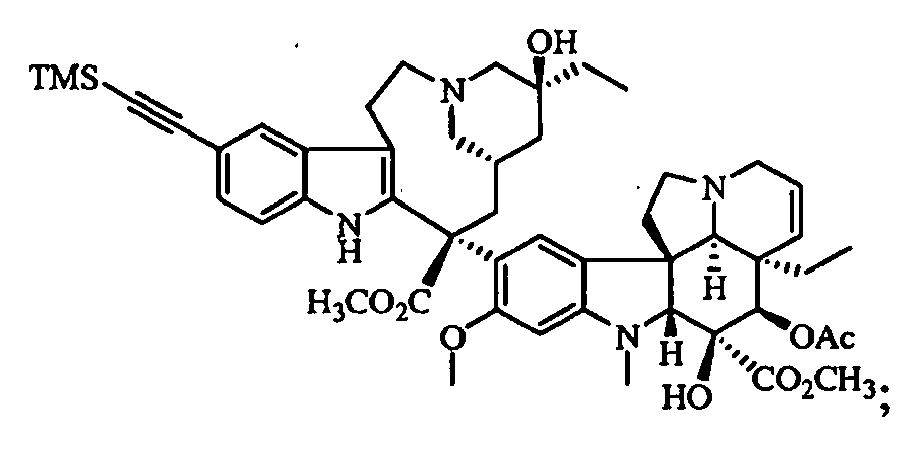


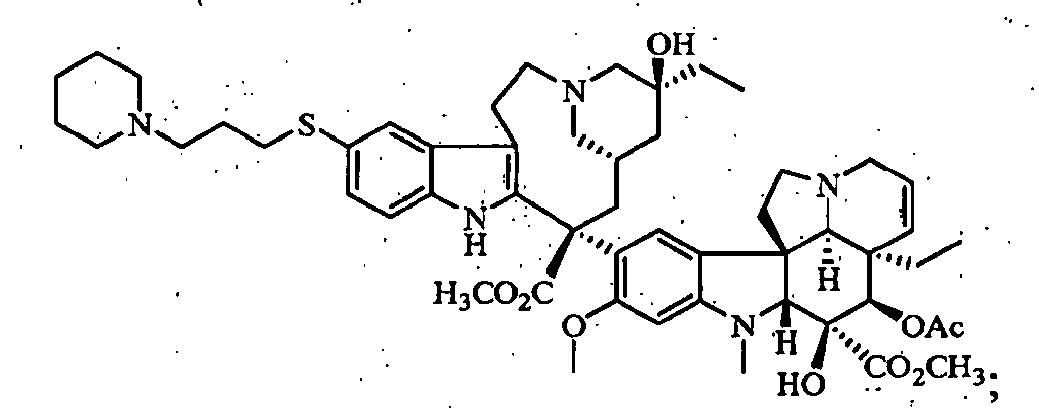


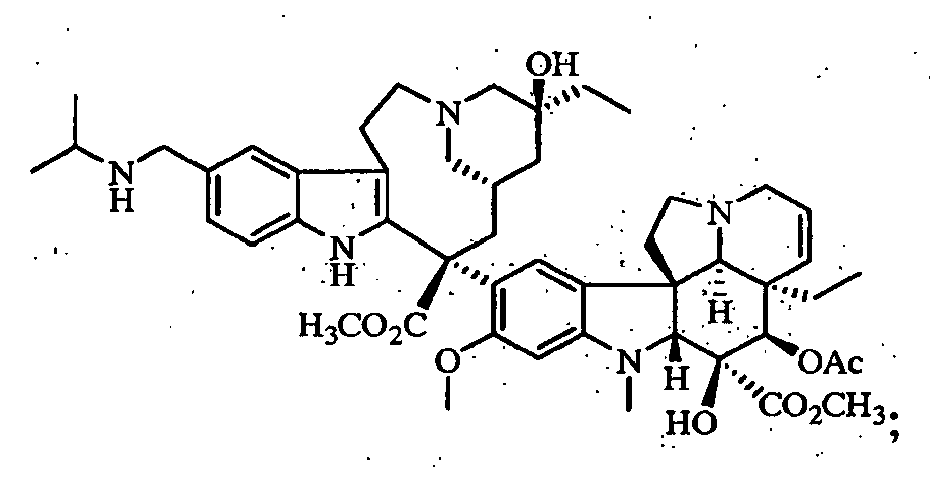


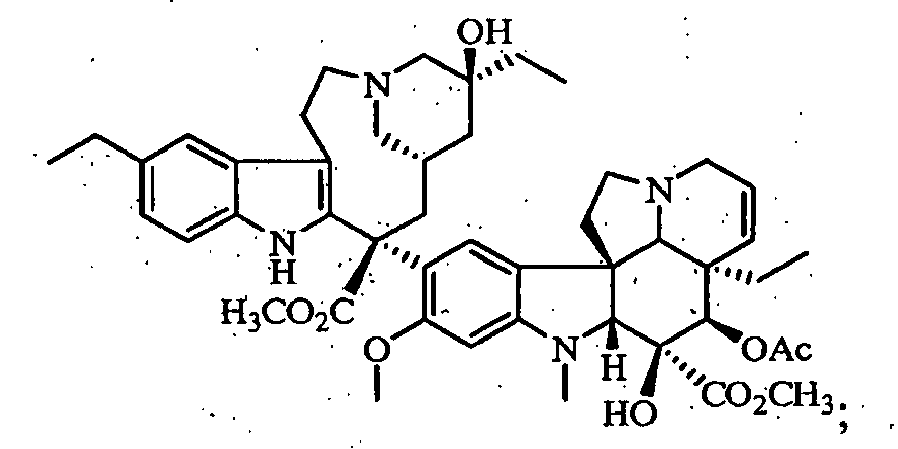


- The compound according to claim 1, wherein the compound has the following chemical formula:

- The compound according to claim 1, wherein the compound has the following chemical formula:

- The compound according to claim 1, wherein the compound has the following chemical formula:

- The compound according to claim 1, wherein the compound has the following chemical formula:

- The compound according to claim 1, wherein the compound has the hollowing chemical formula:
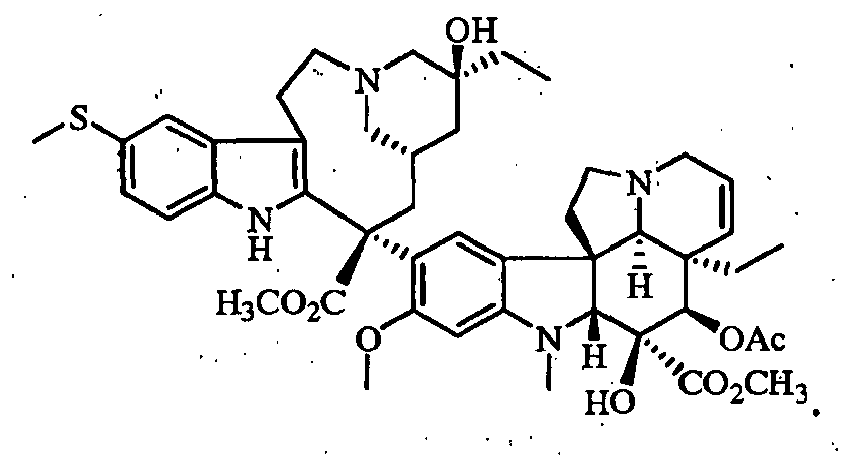
- The compound according to claim 1, wherein the compound has the following chemical formula:

- The compound according to claim 1, wherein the compound has the following chemical formula:

- The compound according to claim 1, wherein the compound has the following chemical formula:

- The compound according to claim 1, wherein the compound has the following chemical formula:

- The compound according to claim 1, wherein the compound has the following chemical formula:

- The compound according to claim 1, wherein the compound has the following chemical formula:

- The compound according to claim 1, wherein the compound has the following chemical formula:

- The compound according to claim 1, wherein the compound has the following chemical formula:

- A process for preparation of a compound selected from the group according to claim 1, said process comprising:converting an intermediate compound of formula:

under conditions effective to produce a compound selected from the group according to claim 1. - The process of claim 15 further comprising:reacting a starting material compound of formula:

- The process of claim 16, wherein the conditions effective to form the intermediate compound include using a halogenating agent selected from the group consisting of N-bromosuccinimide, N-iodo-succinimide, and iodine monochloride.
- The process of claim 16, wherein said converting comprises:reacting the intermediate compound with a palladium catalyst reagent to produce a compound selected from the group according to claim 1.
- The process of claim 18, wherein the palladium catalyst reagent is selected from the group consisting of palladium acetate, tris(dibenzylideneacetone)dipalladium(0), [1,1'-bis(diphenylphosphino)ferrocene]-dichloropalladium(II), tetrakis(triphenylphosphine)palladium, and bis(triphenylphosphine) palladium(II)dichloride.
- A process for preparation of a compound selected from the group according to claim 1, said process comprising:reacting a starting material compound of formula:

- The process of claim 20, wherein the conditions effective to form the intermediate compound include using a halogenating agent selected from the group consisting of N-bromosuccinimide, N-iodo-succinimide, and iodine monochloride.
- A pharmaceutical composition of matter comprising a compound selected from the group of claim 1 and one or more pharmaceutical excipients.
- A compound selected from the group according to claim 1 for use in inhibiting cell proliferation.
- The compound according to claim 1, the pharmaceutical composition according to claim 22, or the compound for the use according to claim 23, wherein R2=CH(O).
- The compound according to claim 1, the pharmaceutical composition according to claim 22, or the compound for the use according to claim 23, wherein R2=alkyl.
- The compound for the use of claim 23, wherein the compound is for use in the treatment of cancer.
- The compound for the use of claim 26, wherein the cancer is selected from the group consisting of solid tumors, carcinomas, lymphomas, cancer diseases, Hodgkin's Disease, and neoplastic diseases.
- The compound selected from the group according to claim 1 for use in the treatment of a condition selected from the group consisting of bacterial infection, allergy, heart disease, AIDS, Human T-lymphotropic virus 1 infection, Human herpesvirus 3, Human herpesvirus 4, Human papillomavirus, diabetes mellitus, rheumatoid arthritis, Alzheimer's Disease, inflammation, arthritis, asthma, malaria, autoimmune disease, eczema, Lupus erythematosus, psoriasis, rheumatic diseases, Sjogren's syndrome, and viral infection.
Applications Claiming Priority (2)
| Application Number | Priority Date | Filing Date | Title |
|---|---|---|---|
| US52691203P | 2003-12-04 | 2003-12-04 | |
| PCT/US2004/040613 WO2005055939A2 (en) | 2003-12-04 | 2004-12-03 | Vinca derivatives |
Publications (3)
| Publication Number | Publication Date |
|---|---|
| EP1689395A2 EP1689395A2 (en) | 2006-08-16 |
| EP1689395A4 EP1689395A4 (en) | 2009-06-24 |
| EP1689395B1 true EP1689395B1 (en) | 2016-02-17 |
Family
ID=34676681
Family Applications (1)
| Application Number | Title | Priority Date | Filing Date |
|---|---|---|---|
| EP04813012.4A Expired - Lifetime EP1689395B1 (en) | 2003-12-04 | 2004-12-03 | Vinca derivatives |
Country Status (6)
| Country | Link |
|---|---|
| US (3) | US7238704B2 (en) |
| EP (1) | EP1689395B1 (en) |
| JP (1) | JP5448299B2 (en) |
| AU (1) | AU2004296191B2 (en) |
| NZ (1) | NZ547370A (en) |
| WO (1) | WO2005055939A2 (en) |
Families Citing this family (17)
| Publication number | Priority date | Publication date | Assignee | Title |
|---|---|---|---|---|
| JP5448299B2 (en) * | 2003-12-04 | 2014-03-19 | アルバニー モレキュラー リサーチ, インコーポレイテッド | Vinca derivative |
| EP1694330A4 (en) * | 2003-12-04 | 2009-06-24 | Amr Technology Inc | Vinorelbine derivatives |
| JP5596924B2 (en) * | 2006-02-17 | 2014-09-24 | カスケード プロドラッグ インコーポレイテッド | Treatment of hyperproliferative diseases with vinca alkaloid N oxides and analogs |
| CN101108859A (en) * | 2006-07-17 | 2008-01-23 | 上海恒瑞医药有限公司 | Vinblastine compound, method of preparing the same and use in medicament thereof |
| US8039453B2 (en) * | 2006-09-12 | 2011-10-18 | Albany Molecular Research, Inc. | Vinca derivatives |
| US20080125451A1 (en) * | 2006-09-12 | 2008-05-29 | Amr Technology, Inc. | Vinorelbine derivatives |
| FR2923485B1 (en) * | 2007-11-12 | 2015-02-06 | Pf Medicament | ANTIMITOTIC COMPOUNDS DERIVED FROM VINCA ALKALOIDS, THEIR PREPARATION AND THEIR THERAPEUTIC APPLICATION |
| EP2539339B1 (en) * | 2010-02-22 | 2014-05-14 | The Scripps Research Institute | 10'-fluorinated vinca alkaloids provide enhanced biological activity against mdr cancer cells |
| AU2014253584B2 (en) * | 2013-04-19 | 2017-02-02 | Jinan University | Vinca Alkaloid Derivatives, Preparation Method therefor and Application thereof |
| CN104740602B (en) * | 2013-12-30 | 2018-10-30 | 暨南大学 | The application of vincaleukoblastinum and the like |
| EP3954394A1 (en) | 2015-06-19 | 2022-02-16 | Centurion BioPharma Corporation | Delivery systems for controlled drug release |
| CN111712263B (en) | 2017-11-30 | 2024-12-17 | 拉德克斯公司 | Maytansinoids-based drug delivery systems |
| DK3717503T3 (en) | 2017-11-30 | 2024-01-22 | Ladrx Corp | Albumin-binding prodrugs of auristatin E derivatives |
| CN109824678B (en) * | 2019-03-20 | 2020-06-19 | 浙江大学 | Azole indole alkaloid, preparation and antimalarial application thereof |
| CN110790777B (en) * | 2019-10-24 | 2021-05-25 | 广州白云山汉方现代药业有限公司 | Vincristine compound impurity and preparation method and application thereof |
| AR126353A1 (en) * | 2021-07-02 | 2023-10-11 | Lg Chemical Ltd | METHOD FOR PREPARING INTERMEDIATE PRODUCTS TO SYNTHESIZE A XANTHINE OXIDASE INHIBITOR |
| WO2026007326A1 (en) * | 2024-07-01 | 2026-01-08 | 四川大学 | Preparation of vinblastine derivative and use thereof |
Family Cites Families (19)
| Publication number | Priority date | Publication date | Assignee | Title |
|---|---|---|---|---|
| FR2296418B1 (en) * | 1974-12-30 | 1978-07-21 | Anvar | |
| US4307100A (en) * | 1978-08-24 | 1981-12-22 | Agence Nationale De Valorisation De La Recherche (Anvar) | Nor bis-indole compounds usable as medicaments |
| FR2461714A1 (en) * | 1979-07-17 | 1981-02-06 | Anvar | NOVEL CLASS OF BIS-INDOLIC COMPOUNDS USEFUL AS MEDICAMENTS AND PROCESS FOR THEIR PREPARATION |
| US4639456A (en) * | 1980-06-10 | 1987-01-27 | Omnichem S.A. | Vinblastin-23-oyl amino acid derivatives |
| OA06421A (en) * | 1980-06-10 | 1981-09-30 | Omnium Chimique Sa | Process for the preparation of N- (vinblastinoyl-23) derivatives of amino acids and peptides. |
| US4430269A (en) * | 1982-04-01 | 1984-02-07 | Eli Lilly And Company | 12'-Iodo derivatives of dimeric indole-dihydroindole alkaloids, and process for preparing them |
| US4841045A (en) | 1985-03-12 | 1989-06-20 | University Of Vermont & State Agricultural College | Synthesis of vinblastine and vincristine type compounds |
| AU590873B2 (en) | 1985-03-12 | 1989-11-23 | University Of Vermont And State Agricultural College, The | Synthesis of vinblastine and vincristine type compounds |
| US5047528A (en) * | 1987-01-22 | 1991-09-10 | University Of Bristish Columbia | Process of synthesis of vinblastine and vincristine |
| USRE37449E1 (en) * | 1987-02-06 | 2001-11-13 | University Of British Columbia | Process of synthesis of 3′,4′-anhydrovinblastine, vinblastine and vincristine |
| FR2707988B1 (en) | 1993-07-21 | 1995-10-13 | Pf Medicament | New antimitotic derivatives of binary alkaloids of catharantus rosesus, process for their preparation and pharmaceutical compositions comprising them. |
| FR2761990B1 (en) * | 1997-04-10 | 1999-06-25 | Pf Medicament | ANTIMITOTIC HALOGEN DERIVATIVES OF VINCA ALKALOIDS |
| FR2779146B1 (en) * | 1998-06-02 | 2002-01-18 | Roowin | NOVEL VINCA-ALKALOIDE DERIVATIVES AND PREPARATION METHODS |
| JP3808735B2 (en) | 2001-08-24 | 2006-08-16 | 独立行政法人科学技術振興機構 | Intermediates for synthesizing vinblastine, methods for producing them, and methods for synthesizing vinblastine |
| EP1694330A4 (en) | 2003-12-04 | 2009-06-24 | Amr Technology Inc | Vinorelbine derivatives |
| JP5448299B2 (en) | 2003-12-04 | 2014-03-19 | アルバニー モレキュラー リサーチ, インコーポレイテッド | Vinca derivative |
| CN101108859A (en) | 2006-07-17 | 2008-01-23 | 上海恒瑞医药有限公司 | Vinblastine compound, method of preparing the same and use in medicament thereof |
| US8039453B2 (en) | 2006-09-12 | 2011-10-18 | Albany Molecular Research, Inc. | Vinca derivatives |
| US20080125451A1 (en) | 2006-09-12 | 2008-05-29 | Amr Technology, Inc. | Vinorelbine derivatives |
-
2004
- 2004-12-03 JP JP2006542813A patent/JP5448299B2/en not_active Expired - Fee Related
- 2004-12-03 EP EP04813012.4A patent/EP1689395B1/en not_active Expired - Lifetime
- 2004-12-03 AU AU2004296191A patent/AU2004296191B2/en not_active Ceased
- 2004-12-03 US US11/003,560 patent/US7238704B2/en not_active Expired - Fee Related
- 2004-12-03 NZ NZ547370A patent/NZ547370A/en not_active IP Right Cessation
- 2004-12-03 WO PCT/US2004/040613 patent/WO2005055939A2/en not_active Ceased
-
2007
- 2007-04-06 US US11/697,415 patent/US8895543B2/en not_active Expired - Fee Related
- 2007-10-31 US US11/933,259 patent/US7745619B2/en not_active Expired - Fee Related
Non-Patent Citations (2)
| Title |
|---|
| CROS S ET AL: "EXPERIMENTAL ANTITUMOR ACTIVITY OF NAVELBINE", SEMINARS IN ONCOLOGY, vol. 16, no. 2 SUPPL. 4, 1989, pages 15 - 20, ISSN: 0093-7754 * |
| VOSS MATTHEW E ET AL: "Synthesis and SAR of vinca alkaloid analogues", BIOORGANIC & MEDICINAL CHEMISTRY LETTERS, vol. 19, no. 4, February 2009 (2009-02-01), pages 1245 - 1249, ISSN: 0960-894X * |
Also Published As
| Publication number | Publication date |
|---|---|
| EP1689395A2 (en) | 2006-08-16 |
| US7238704B2 (en) | 2007-07-03 |
| US20080108644A1 (en) | 2008-05-08 |
| US20050137169A1 (en) | 2005-06-23 |
| AU2004296191A1 (en) | 2005-06-23 |
| NZ547370A (en) | 2010-09-30 |
| WO2005055939A2 (en) | 2005-06-23 |
| WO2005055939A3 (en) | 2005-12-29 |
| EP1689395A4 (en) | 2009-06-24 |
| US7745619B2 (en) | 2010-06-29 |
| JP5448299B2 (en) | 2014-03-19 |
| AU2004296191B2 (en) | 2010-10-28 |
| US8895543B2 (en) | 2014-11-25 |
| US20070179171A1 (en) | 2007-08-02 |
| JP2007513178A (en) | 2007-05-24 |
Similar Documents
| Publication | Publication Date | Title |
|---|---|---|
| US7745619B2 (en) | Vinca derivatives | |
| US7842802B2 (en) | Vinorelbine derivatives | |
| Rahman et al. | Synthesis, stereochemistry and biological activity of some novel long alkyl chain substituted thiazolidin-4-ones and thiazan-4-one from 10-undecenoic acid hydrazide | |
| US5620985A (en) | Antimitotic binary alkaloid derivatives from catharanthus roseus | |
| US4307100A (en) | Nor bis-indole compounds usable as medicaments | |
| JP7694995B2 (en) | Compounds constituting C20 modified salinomycin derivatives, methods for obtaining same, compositions containing same, uses of said compounds, and methods for obtaining intermediate products | |
| Lee et al. | Design, synthesis and antiproliferative evaluation of fluorenone analogs with DNA topoisomerase I inhibitory properties | |
| US8168647B2 (en) | Vinblastine derivatives, their preparation, use and pharmaceutical compositions comprising the said derivatives | |
| US20080119502A1 (en) | Vinca derivatives | |
| EP1608663B1 (en) | Pyrrolo (2,1-c)(1,4) benzodiazepines dimers as antitumour agents and process thereof | |
| US20080125451A1 (en) | Vinorelbine derivatives | |
| Keglevich et al. | Bisindole Alkaloids Condensed with a Cyclopropane Ring, Part 2. Cyclopropano-vinorelbine and Its Derivatives | |
| US7015215B2 (en) | Pyrrolo[2,1-c][1,4] benzodiazepines compounds and process thereof | |
| EP2298780A1 (en) | Antitumoral derivatives of Ecteinascidin ET-743 | |
| DK161833B (en) | METHOD OF ANALOGUE FOR THE PREPARATION OF N- (VINBLASTINOYL-23) DERIVATIVES OF AMINO ACIDS OR PHARMACEUTICAL ACCEPTABLE ACID ADDITION SALTS. | |
| RU2338747C2 (en) | DIMERS OF PYRROL[2,1-c][1,4]BENZODIAZEPINE AS ANTITUMORAL AGENTS AND METHOD OF THEIR OBTAINING | |
| EP4534104A1 (en) | Preparation method for drug linker conjugate and intermediate thereof | |
| HU186282B (en) | Process for the preparation of bisindol compounds | |
| Kamal et al. | Synthesis and biological activity of C-8 fluoroaryl substituted pyrimidine linked-pyrrolobenzodiazepine conjugates |
Legal Events
| Date | Code | Title | Description |
|---|---|---|---|
| PUAI | Public reference made under article 153(3) epc to a published international application that has entered the european phase |
Free format text: ORIGINAL CODE: 0009012 |
|
| 17P | Request for examination filed |
Effective date: 20060519 |
|
| AK | Designated contracting states |
Kind code of ref document: A2 Designated state(s): AT BE BG CH CY CZ DE DK EE ES FI FR GB GR HU IE IS IT LI LT LU MC NL PL PT RO SE SI SK TR |
|
| RIN1 | Information on inventor provided before grant (corrected) |
Inventor name: RALPH, JEFFREY, M. Inventor name: SCOTT, IAN, L. Inventor name: VOSS, MATTHEW, E. |
|
| DAX | Request for extension of the european patent (deleted) | ||
| A4 | Supplementary search report drawn up and despatched |
Effective date: 20090528 |
|
| 17Q | First examination report despatched |
Effective date: 20121023 |
|
| RAP1 | Party data changed (applicant data changed or rights of an application transferred) |
Owner name: ALBANY MOLECULAR RESEARCH, INC. |
|
| GRAP | Despatch of communication of intention to grant a patent |
Free format text: ORIGINAL CODE: EPIDOSNIGR1 |
|
| INTG | Intention to grant announced |
Effective date: 20150114 |
|
| GRAP | Despatch of communication of intention to grant a patent |
Free format text: ORIGINAL CODE: EPIDOSNIGR1 |
|
| INTG | Intention to grant announced |
Effective date: 20150612 |
|
| GRAS | Grant fee paid |
Free format text: ORIGINAL CODE: EPIDOSNIGR3 |
|
| GRAA | (expected) grant |
Free format text: ORIGINAL CODE: 0009210 |
|
| AK | Designated contracting states |
Kind code of ref document: B1 Designated state(s): AT BE BG CH CY CZ DE DK EE ES FI FR GB GR HU IE IS IT LI LT LU MC NL PL PT RO SE SI SK TR |
|
| REG | Reference to a national code |
Ref country code: GB Ref legal event code: FG4D |
|
| REG | Reference to a national code |
Ref country code: CH Ref legal event code: EP |
|
| REG | Reference to a national code |
Ref country code: IE Ref legal event code: FG4D |
|
| REG | Reference to a national code |
Ref country code: AT Ref legal event code: REF Ref document number: 775304 Country of ref document: AT Kind code of ref document: T Effective date: 20160315 |
|
| REG | Reference to a national code |
Ref country code: DE Ref legal event code: R096 Ref document number: 602004048657 Country of ref document: DE |
|
| REG | Reference to a national code |
Ref country code: NL Ref legal event code: MP Effective date: 20160217 |
|
| REG | Reference to a national code |
Ref country code: LT Ref legal event code: MG4D |
|
| REG | Reference to a national code |
Ref country code: AT Ref legal event code: MK05 Ref document number: 775304 Country of ref document: AT Kind code of ref document: T Effective date: 20160217 |
|
| PG25 | Lapsed in a contracting state [announced via postgrant information from national office to epo] |
Ref country code: IT Free format text: LAPSE BECAUSE OF FAILURE TO SUBMIT A TRANSLATION OF THE DESCRIPTION OR TO PAY THE FEE WITHIN THE PRESCRIBED TIME-LIMIT Effective date: 20160217 Ref country code: FI Free format text: LAPSE BECAUSE OF FAILURE TO SUBMIT A TRANSLATION OF THE DESCRIPTION OR TO PAY THE FEE WITHIN THE PRESCRIBED TIME-LIMIT Effective date: 20160217 Ref country code: ES Free format text: LAPSE BECAUSE OF FAILURE TO SUBMIT A TRANSLATION OF THE DESCRIPTION OR TO PAY THE FEE WITHIN THE PRESCRIBED TIME-LIMIT Effective date: 20160217 Ref country code: GR Free format text: LAPSE BECAUSE OF FAILURE TO SUBMIT A TRANSLATION OF THE DESCRIPTION OR TO PAY THE FEE WITHIN THE PRESCRIBED TIME-LIMIT Effective date: 20160518 |
|
| PG25 | Lapsed in a contracting state [announced via postgrant information from national office to epo] |
Ref country code: PL Free format text: LAPSE BECAUSE OF FAILURE TO SUBMIT A TRANSLATION OF THE DESCRIPTION OR TO PAY THE FEE WITHIN THE PRESCRIBED TIME-LIMIT Effective date: 20160217 Ref country code: SE Free format text: LAPSE BECAUSE OF FAILURE TO SUBMIT A TRANSLATION OF THE DESCRIPTION OR TO PAY THE FEE WITHIN THE PRESCRIBED TIME-LIMIT Effective date: 20160217 Ref country code: NL Free format text: LAPSE BECAUSE OF FAILURE TO SUBMIT A TRANSLATION OF THE DESCRIPTION OR TO PAY THE FEE WITHIN THE PRESCRIBED TIME-LIMIT Effective date: 20160217 Ref country code: PT Free format text: LAPSE BECAUSE OF FAILURE TO SUBMIT A TRANSLATION OF THE DESCRIPTION OR TO PAY THE FEE WITHIN THE PRESCRIBED TIME-LIMIT Effective date: 20160617 Ref country code: LT Free format text: LAPSE BECAUSE OF FAILURE TO SUBMIT A TRANSLATION OF THE DESCRIPTION OR TO PAY THE FEE WITHIN THE PRESCRIBED TIME-LIMIT Effective date: 20160217 Ref country code: AT Free format text: LAPSE BECAUSE OF FAILURE TO SUBMIT A TRANSLATION OF THE DESCRIPTION OR TO PAY THE FEE WITHIN THE PRESCRIBED TIME-LIMIT Effective date: 20160217 |
|
| PG25 | Lapsed in a contracting state [announced via postgrant information from national office to epo] |
Ref country code: EE Free format text: LAPSE BECAUSE OF FAILURE TO SUBMIT A TRANSLATION OF THE DESCRIPTION OR TO PAY THE FEE WITHIN THE PRESCRIBED TIME-LIMIT Effective date: 20160217 Ref country code: DK Free format text: LAPSE BECAUSE OF FAILURE TO SUBMIT A TRANSLATION OF THE DESCRIPTION OR TO PAY THE FEE WITHIN THE PRESCRIBED TIME-LIMIT Effective date: 20160217 |
|
| REG | Reference to a national code |
Ref country code: DE Ref legal event code: R097 Ref document number: 602004048657 Country of ref document: DE |
|
| PG25 | Lapsed in a contracting state [announced via postgrant information from national office to epo] |
Ref country code: CZ Free format text: LAPSE BECAUSE OF FAILURE TO SUBMIT A TRANSLATION OF THE DESCRIPTION OR TO PAY THE FEE WITHIN THE PRESCRIBED TIME-LIMIT Effective date: 20160217 Ref country code: RO Free format text: LAPSE BECAUSE OF FAILURE TO SUBMIT A TRANSLATION OF THE DESCRIPTION OR TO PAY THE FEE WITHIN THE PRESCRIBED TIME-LIMIT Effective date: 20160217 Ref country code: SK Free format text: LAPSE BECAUSE OF FAILURE TO SUBMIT A TRANSLATION OF THE DESCRIPTION OR TO PAY THE FEE WITHIN THE PRESCRIBED TIME-LIMIT Effective date: 20160217 |
|
| PLBE | No opposition filed within time limit |
Free format text: ORIGINAL CODE: 0009261 |
|
| STAA | Information on the status of an ep patent application or granted ep patent |
Free format text: STATUS: NO OPPOSITION FILED WITHIN TIME LIMIT |
|
| PG25 | Lapsed in a contracting state [announced via postgrant information from national office to epo] |
Ref country code: BE Free format text: LAPSE BECAUSE OF FAILURE TO SUBMIT A TRANSLATION OF THE DESCRIPTION OR TO PAY THE FEE WITHIN THE PRESCRIBED TIME-LIMIT Effective date: 20160217 |
|
| 26N | No opposition filed |
Effective date: 20161118 |
|
| PG25 | Lapsed in a contracting state [announced via postgrant information from national office to epo] |
Ref country code: SI Free format text: LAPSE BECAUSE OF FAILURE TO SUBMIT A TRANSLATION OF THE DESCRIPTION OR TO PAY THE FEE WITHIN THE PRESCRIBED TIME-LIMIT Effective date: 20160217 Ref country code: BG Free format text: LAPSE BECAUSE OF FAILURE TO SUBMIT A TRANSLATION OF THE DESCRIPTION OR TO PAY THE FEE WITHIN THE PRESCRIBED TIME-LIMIT Effective date: 20160517 |
|
| REG | Reference to a national code |
Ref country code: DE Ref legal event code: R119 Ref document number: 602004048657 Country of ref document: DE |
|
| REG | Reference to a national code |
Ref country code: CH Ref legal event code: PL |
|
| GBPC | Gb: european patent ceased through non-payment of renewal fee |
Effective date: 20161203 |
|
| PG25 | Lapsed in a contracting state [announced via postgrant information from national office to epo] |
Ref country code: MC Free format text: LAPSE BECAUSE OF FAILURE TO SUBMIT A TRANSLATION OF THE DESCRIPTION OR TO PAY THE FEE WITHIN THE PRESCRIBED TIME-LIMIT Effective date: 20160217 |
|
| REG | Reference to a national code |
Ref country code: FR Ref legal event code: ST Effective date: 20170831 |
|
| REG | Reference to a national code |
Ref country code: IE Ref legal event code: MM4A |
|
| PG25 | Lapsed in a contracting state [announced via postgrant information from national office to epo] |
Ref country code: LU Free format text: LAPSE BECAUSE OF NON-PAYMENT OF DUE FEES Effective date: 20161203 Ref country code: FR Free format text: LAPSE BECAUSE OF NON-PAYMENT OF DUE FEES Effective date: 20170102 Ref country code: CH Free format text: LAPSE BECAUSE OF NON-PAYMENT OF DUE FEES Effective date: 20161231 Ref country code: LI Free format text: LAPSE BECAUSE OF NON-PAYMENT OF DUE FEES Effective date: 20161231 |
|
| PG25 | Lapsed in a contracting state [announced via postgrant information from national office to epo] |
Ref country code: DE Free format text: LAPSE BECAUSE OF NON-PAYMENT OF DUE FEES Effective date: 20170701 Ref country code: GB Free format text: LAPSE BECAUSE OF NON-PAYMENT OF DUE FEES Effective date: 20161203 Ref country code: IE Free format text: LAPSE BECAUSE OF NON-PAYMENT OF DUE FEES Effective date: 20161203 |
|
| PG25 | Lapsed in a contracting state [announced via postgrant information from national office to epo] |
Ref country code: CY Free format text: LAPSE BECAUSE OF FAILURE TO SUBMIT A TRANSLATION OF THE DESCRIPTION OR TO PAY THE FEE WITHIN THE PRESCRIBED TIME-LIMIT Effective date: 20160217 Ref country code: HU Free format text: LAPSE BECAUSE OF FAILURE TO SUBMIT A TRANSLATION OF THE DESCRIPTION OR TO PAY THE FEE WITHIN THE PRESCRIBED TIME-LIMIT; INVALID AB INITIO Effective date: 20041203 |
|
| PG25 | Lapsed in a contracting state [announced via postgrant information from national office to epo] |
Ref country code: TR Free format text: LAPSE BECAUSE OF FAILURE TO SUBMIT A TRANSLATION OF THE DESCRIPTION OR TO PAY THE FEE WITHIN THE PRESCRIBED TIME-LIMIT Effective date: 20160217 Ref country code: IS Free format text: LAPSE BECAUSE OF FAILURE TO SUBMIT A TRANSLATION OF THE DESCRIPTION OR TO PAY THE FEE WITHIN THE PRESCRIBED TIME-LIMIT Effective date: 20160217 |