EP1688415A1 - Cytotoxic agents comprising new C-2 modified taxanes - Google Patents
Cytotoxic agents comprising new C-2 modified taxanes Download PDFInfo
- Publication number
- EP1688415A1 EP1688415A1 EP04292899A EP04292899A EP1688415A1 EP 1688415 A1 EP1688415 A1 EP 1688415A1 EP 04292899 A EP04292899 A EP 04292899A EP 04292899 A EP04292899 A EP 04292899A EP 1688415 A1 EP1688415 A1 EP 1688415A1
- Authority
- EP
- European Patent Office
- Prior art keywords
- carbon atoms
- optionally substituted
- cycloalkenyl
- alkynyl
- cycloalkyl
- Prior art date
- Legal status (The legal status is an assumption and is not a legal conclusion. Google has not performed a legal analysis and makes no representation as to the accuracy of the status listed.)
- Withdrawn
Links
- 229940123237 Taxane Drugs 0.000 title claims abstract description 38
- 229940127089 cytotoxic agent Drugs 0.000 title claims abstract description 26
- 231100000599 cytotoxic agent Toxicity 0.000 title claims abstract description 26
- 239000002254 cytotoxic agent Substances 0.000 title claims abstract description 26
- 239000011230 binding agent Substances 0.000 claims abstract description 24
- 230000001225 therapeutic effect Effects 0.000 claims abstract description 8
- 125000004432 carbon atom Chemical group C* 0.000 claims description 526
- -1 piperidino, morpholino, piperazino, N-methylpiperazino Chemical group 0.000 claims description 162
- 125000003107 substituted aryl group Chemical group 0.000 claims description 133
- 125000003342 alkenyl group Chemical group 0.000 claims description 121
- 125000000304 alkynyl group Chemical group 0.000 claims description 121
- 125000000392 cycloalkenyl group Chemical group 0.000 claims description 121
- 125000000753 cycloalkyl group Chemical group 0.000 claims description 121
- KXDHJXZQYSOELW-UHFFFAOYSA-M Carbamate Chemical compound NC([O-])=O KXDHJXZQYSOELW-UHFFFAOYSA-M 0.000 claims description 107
- 125000000217 alkyl group Chemical group 0.000 claims description 106
- 125000000623 heterocyclic group Chemical group 0.000 claims description 76
- 125000005647 linker group Chemical group 0.000 claims description 70
- 125000004429 atom Chemical group 0.000 claims description 46
- 150000001875 compounds Chemical class 0.000 claims description 46
- 125000004423 acyloxy group Chemical group 0.000 claims description 31
- 125000003302 alkenyloxy group Chemical group 0.000 claims description 31
- 125000005194 alkoxycarbonyloxy group Chemical group 0.000 claims description 31
- 125000005133 alkynyloxy group Chemical group 0.000 claims description 31
- 125000005333 aroyloxy group Chemical group 0.000 claims description 31
- 125000005200 aryloxy carbonyloxy group Chemical group 0.000 claims description 31
- 125000004104 aryloxy group Chemical group 0.000 claims description 31
- 125000004465 cycloalkenyloxy group Chemical group 0.000 claims description 31
- 125000000000 cycloalkoxy group Chemical group 0.000 claims description 31
- 125000005844 heterocyclyloxy group Chemical group 0.000 claims description 31
- 125000002887 hydroxy group Chemical group [H]O* 0.000 claims description 31
- 125000002541 furyl group Chemical group 0.000 claims description 26
- 125000000335 thiazolyl group Chemical group 0.000 claims description 26
- 125000001544 thienyl group Chemical group 0.000 claims description 26
- 239000000203 mixture Substances 0.000 claims description 22
- 125000004076 pyridyl group Chemical group 0.000 claims description 21
- 125000002228 disulfide group Chemical group 0.000 claims description 18
- PXBRQCKWGAHEHS-UHFFFAOYSA-N dichlorodifluoromethane Chemical compound FC(F)(Cl)Cl PXBRQCKWGAHEHS-UHFFFAOYSA-N 0.000 claims description 17
- 125000000499 benzofuranyl group Chemical group O1C(=CC2=C1C=CC=C2)* 0.000 claims description 16
- 125000002883 imidazolyl group Chemical group 0.000 claims description 16
- 125000001041 indolyl group Chemical group 0.000 claims description 16
- 125000005092 alkenyloxycarbonyl group Chemical group 0.000 claims description 15
- 125000004453 alkoxycarbonyl group Chemical group 0.000 claims description 15
- 125000005225 alkynyloxycarbonyl group Chemical group 0.000 claims description 15
- 125000003435 aroyl group Chemical group 0.000 claims description 15
- 125000005161 aryl oxy carbonyl group Chemical group 0.000 claims description 15
- 125000004196 benzothienyl group Chemical group S1C(=CC2=C1C=CC=C2)* 0.000 claims description 15
- 125000001589 carboacyl group Chemical group 0.000 claims description 15
- 125000006517 heterocyclyl carbonyl group Chemical group 0.000 claims description 15
- BWGNESOTFCXPMA-UHFFFAOYSA-N Dihydrogen disulfide Chemical compound SS BWGNESOTFCXPMA-UHFFFAOYSA-N 0.000 claims description 12
- 125000000101 thioether group Chemical group 0.000 claims description 12
- 125000000596 cyclohexenyl group Chemical group C1(=CCCCC1)* 0.000 claims description 10
- 125000002433 cyclopentenyl group Chemical group C1(=CCCC1)* 0.000 claims description 10
- 125000006038 hexenyl group Chemical group 0.000 claims description 10
- 125000006850 spacer group Chemical group 0.000 claims description 9
- 125000001424 substituent group Chemical group 0.000 claims description 9
- 239000002202 Polyethylene glycol Substances 0.000 claims description 8
- 229920001223 polyethylene glycol Polymers 0.000 claims description 8
- 108091005804 Peptidases Proteins 0.000 claims description 7
- 102000035195 Peptidases Human genes 0.000 claims description 7
- 235000019833 protease Nutrition 0.000 claims description 7
- 108090000371 Esterases Proteins 0.000 claims description 6
- 108010021625 Immunoglobulin Fragments Proteins 0.000 claims description 6
- 102000008394 Immunoglobulin Fragments Human genes 0.000 claims description 6
- 239000002253 acid Substances 0.000 claims description 6
- 239000000427 antigen Substances 0.000 claims description 6
- 108091007433 antigens Proteins 0.000 claims description 6
- 102000036639 antigens Human genes 0.000 claims description 6
- 125000003118 aryl group Chemical group 0.000 claims description 6
- 238000000034 method Methods 0.000 claims description 6
- 125000000999 tert-butyl group Chemical group [H]C([H])([H])C(*)(C([H])([H])[H])C([H])([H])[H] 0.000 claims description 6
- 150000003573 thiols Chemical class 0.000 claims description 6
- 125000002971 oxazolyl group Chemical group 0.000 claims description 5
- 102000007644 Colony-Stimulating Factors Human genes 0.000 claims description 4
- 108010071942 Colony-Stimulating Factors Proteins 0.000 claims description 4
- 239000003102 growth factor Substances 0.000 claims description 4
- 125000002496 methyl group Chemical group [H]C([H])([H])* 0.000 claims description 3
- 102000014150 Interferons Human genes 0.000 claims description 2
- 108010050904 Interferons Proteins 0.000 claims description 2
- 102000008072 Lymphokines Human genes 0.000 claims description 2
- 108010074338 Lymphokines Proteins 0.000 claims description 2
- 102000004338 Transferrin Human genes 0.000 claims description 2
- 108090000901 Transferrin Proteins 0.000 claims description 2
- 229940047120 colony stimulating factors Drugs 0.000 claims description 2
- 239000003937 drug carrier Substances 0.000 claims description 2
- 239000005556 hormone Substances 0.000 claims description 2
- 229940088597 hormone Drugs 0.000 claims description 2
- 229940047124 interferons Drugs 0.000 claims description 2
- 125000000547 substituted alkyl group Chemical group 0.000 claims description 2
- 239000012581 transferrin Substances 0.000 claims description 2
- 239000011782 vitamin Substances 0.000 claims description 2
- 229930003231 vitamin Natural products 0.000 claims description 2
- 229940088594 vitamin Drugs 0.000 claims description 2
- 235000013343 vitamin Nutrition 0.000 claims description 2
- 125000004368 propenyl group Chemical group C(=CC)* 0.000 claims 1
- DKPFODGZWDEEBT-QFIAKTPHSA-N taxane Chemical class C([C@]1(C)CCC[C@@H](C)[C@H]1C1)C[C@H]2[C@H](C)CC[C@@H]1C2(C)C DKPFODGZWDEEBT-QFIAKTPHSA-N 0.000 abstract description 4
- XEKOWRVHYACXOJ-UHFFFAOYSA-N Ethyl acetate Chemical compound CCOC(C)=O XEKOWRVHYACXOJ-UHFFFAOYSA-N 0.000 description 90
- HEDRZPFGACZZDS-MICDWDOJSA-N Trichloro(2H)methane Chemical compound [2H]C(Cl)(Cl)Cl HEDRZPFGACZZDS-MICDWDOJSA-N 0.000 description 70
- VLKZOEOYAKHREP-UHFFFAOYSA-N n-Hexane Chemical compound CCCCCC VLKZOEOYAKHREP-UHFFFAOYSA-N 0.000 description 48
- YMWUJEATGCHHMB-UHFFFAOYSA-N Dichloromethane Chemical compound ClCCl YMWUJEATGCHHMB-UHFFFAOYSA-N 0.000 description 33
- 238000006243 chemical reaction Methods 0.000 description 28
- 210000004027 cell Anatomy 0.000 description 27
- VYPSYNLAJGMNEJ-UHFFFAOYSA-N Silicium dioxide Chemical compound O=[Si]=O VYPSYNLAJGMNEJ-UHFFFAOYSA-N 0.000 description 26
- 229960003668 docetaxel Drugs 0.000 description 25
- 239000000243 solution Substances 0.000 description 24
- NLXLAEXVIDQMFP-UHFFFAOYSA-N Ammonia chloride Chemical compound [NH4+].[Cl-] NLXLAEXVIDQMFP-UHFFFAOYSA-N 0.000 description 22
- 229940079593 drug Drugs 0.000 description 20
- 239000003814 drug Substances 0.000 description 20
- 238000005160 1H NMR spectroscopy Methods 0.000 description 18
- JUJWROOIHBZHMG-UHFFFAOYSA-N Pyridine Chemical compound C1=CC=NC=C1 JUJWROOIHBZHMG-UHFFFAOYSA-N 0.000 description 18
- 238000004895 liquid chromatography mass spectrometry Methods 0.000 description 18
- 229920006395 saturated elastomer Polymers 0.000 description 18
- 238000001644 13C nuclear magnetic resonance spectroscopy Methods 0.000 description 17
- WYURNTSHIVDZCO-UHFFFAOYSA-N Tetrahydrofuran Chemical compound C1CCOC1 WYURNTSHIVDZCO-UHFFFAOYSA-N 0.000 description 16
- 239000007787 solid Substances 0.000 description 16
- PMZURENOXWZQFD-UHFFFAOYSA-L Sodium Sulfate Chemical compound [Na+].[Na+].[O-]S([O-])(=O)=O PMZURENOXWZQFD-UHFFFAOYSA-L 0.000 description 15
- XLYOFNOQVPJJNP-UHFFFAOYSA-N water Substances O XLYOFNOQVPJJNP-UHFFFAOYSA-N 0.000 description 15
- UIIMBOGNXHQVGW-UHFFFAOYSA-M Sodium bicarbonate Chemical compound [Na+].OC([O-])=O UIIMBOGNXHQVGW-UHFFFAOYSA-M 0.000 description 14
- 239000012044 organic layer Substances 0.000 description 12
- 206010028980 Neoplasm Diseases 0.000 description 11
- 235000019270 ammonium chloride Nutrition 0.000 description 11
- 239000012267 brine Substances 0.000 description 11
- 239000000562 conjugate Substances 0.000 description 11
- 230000001472 cytotoxic effect Effects 0.000 description 11
- HPALAKNZSZLMCH-UHFFFAOYSA-M sodium;chloride;hydrate Chemical compound O.[Na+].[Cl-] HPALAKNZSZLMCH-UHFFFAOYSA-M 0.000 description 11
- 201000011510 cancer Diseases 0.000 description 10
- 231100000433 cytotoxic Toxicity 0.000 description 10
- 239000000377 silicon dioxide Substances 0.000 description 10
- 239000000284 extract Substances 0.000 description 9
- UMJSCPRVCHMLSP-UHFFFAOYSA-N pyridine Natural products COC1=CC=CN=C1 UMJSCPRVCHMLSP-UHFFFAOYSA-N 0.000 description 9
- 239000002904 solvent Substances 0.000 description 9
- OVMSOCFBDVBLFW-VHLOTGQHSA-N 5beta,20-epoxy-1,7beta,13alpha-trihydroxy-9-oxotax-11-ene-2alpha,4alpha,10beta-triyl 4,10-diacetate 2-benzoate Chemical compound O([C@@H]1[C@@]2(C[C@H](O)C(C)=C(C2(C)C)[C@H](C([C@]2(C)[C@@H](O)C[C@H]3OC[C@]3([C@H]21)OC(C)=O)=O)OC(=O)C)O)C(=O)C1=CC=CC=C1 OVMSOCFBDVBLFW-VHLOTGQHSA-N 0.000 description 8
- 239000013058 crude material Substances 0.000 description 8
- IKDUDTNKRLTJSI-UHFFFAOYSA-N hydrazine hydrate Chemical compound O.NN IKDUDTNKRLTJSI-UHFFFAOYSA-N 0.000 description 8
- BDNKZNFMNDZQMI-UHFFFAOYSA-N 1,3-diisopropylcarbodiimide Chemical compound CC(C)N=C=NC(C)C BDNKZNFMNDZQMI-UHFFFAOYSA-N 0.000 description 7
- BGRWYRAHAFMIBJ-UHFFFAOYSA-N diisopropylcarbodiimide Natural products CC(C)NC(=O)NC(C)C BGRWYRAHAFMIBJ-UHFFFAOYSA-N 0.000 description 7
- PSHKMPUSSFXUIA-UHFFFAOYSA-N n,n-dimethylpyridin-2-amine Chemical compound CN(C)C1=CC=CC=N1 PSHKMPUSSFXUIA-UHFFFAOYSA-N 0.000 description 7
- 235000017557 sodium bicarbonate Nutrition 0.000 description 7
- 229910000030 sodium bicarbonate Inorganic materials 0.000 description 7
- STQGQHZAVUOBTE-UHFFFAOYSA-N 7-Cyan-hept-2t-en-4,6-diinsaeure Natural products C1=2C(O)=C3C(=O)C=4C(OC)=CC=CC=4C(=O)C3=C(O)C=2CC(O)(C(C)=O)CC1OC1CC(N)C(O)C(C)O1 STQGQHZAVUOBTE-UHFFFAOYSA-N 0.000 description 6
- WFDIJRYMOXRFFG-UHFFFAOYSA-N Acetic anhydride Chemical compound CC(=O)OC(C)=O WFDIJRYMOXRFFG-UHFFFAOYSA-N 0.000 description 6
- RTZKZFJDLAIYFH-UHFFFAOYSA-N Diethyl ether Chemical compound CCOCC RTZKZFJDLAIYFH-UHFFFAOYSA-N 0.000 description 6
- LFQSCWFLJHTTHZ-UHFFFAOYSA-N Ethanol Chemical compound CCO LFQSCWFLJHTTHZ-UHFFFAOYSA-N 0.000 description 6
- STQGQHZAVUOBTE-VGBVRHCVSA-N daunorubicin Chemical compound O([C@H]1C[C@@](O)(CC=2C(O)=C3C(=O)C=4C=CC=C(C=4C(=O)C3=C(O)C=21)OC)C(C)=O)[C@H]1C[C@H](N)[C@H](O)[C@H](C)O1 STQGQHZAVUOBTE-VGBVRHCVSA-N 0.000 description 6
- 229960000975 daunorubicin Drugs 0.000 description 6
- RAXXELZNTBOGNW-UHFFFAOYSA-N imidazole Natural products C1=CNC=N1 RAXXELZNTBOGNW-UHFFFAOYSA-N 0.000 description 6
- 239000010410 layer Substances 0.000 description 6
- 150000003254 radicals Chemical class 0.000 description 6
- 239000000741 silica gel Substances 0.000 description 6
- 229910002027 silica gel Inorganic materials 0.000 description 6
- 238000003756 stirring Methods 0.000 description 6
- 239000000611 antibody drug conjugate Substances 0.000 description 5
- 238000002360 preparation method Methods 0.000 description 5
- 238000010792 warming Methods 0.000 description 5
- CSCPPACGZOOCGX-UHFFFAOYSA-N Acetone Chemical compound CC(C)=O CSCPPACGZOOCGX-UHFFFAOYSA-N 0.000 description 4
- 229940049595 antibody-drug conjugate Drugs 0.000 description 4
- 229930014667 baccatin III Natural products 0.000 description 4
- 230000015572 biosynthetic process Effects 0.000 description 4
- DCFKHNIGBAHNSS-UHFFFAOYSA-N chloro(triethyl)silane Chemical compound CC[Si](Cl)(CC)CC DCFKHNIGBAHNSS-UHFFFAOYSA-N 0.000 description 4
- 230000003013 cytotoxicity Effects 0.000 description 4
- 231100000135 cytotoxicity Toxicity 0.000 description 4
- 238000003786 synthesis reaction Methods 0.000 description 4
- RCINICONZNJXQF-MZXODVADSA-N taxol Chemical compound O([C@@H]1[C@@]2(C[C@@H](C(C)=C(C2(C)C)[C@H](C([C@]2(C)[C@@H](O)C[C@H]3OC[C@]3([C@H]21)OC(C)=O)=O)OC(=O)C)OC(=O)[C@H](O)[C@@H](NC(=O)C=1C=CC=CC=1)C=1C=CC=CC=1)O)C(=O)C1=CC=CC=C1 RCINICONZNJXQF-MZXODVADSA-N 0.000 description 4
- UKVQBONVSSLJBB-UHFFFAOYSA-N 2-pyridin-2-ylacetonitrile Chemical compound N#CCC1=CC=CC=N1 UKVQBONVSSLJBB-UHFFFAOYSA-N 0.000 description 3
- 0 C[C@](C(C(C)(C)[C@@](C1)([C@]([C@]2[C@@]3(C)[C@@](*)C[C@]4OC[C@@]24OC(C)=O)OC(*)=O)O)=C(C)[C@]1O)C3=O Chemical compound C[C@](C(C(C)(C)[C@@](C1)([C@]([C@]2[C@@]3(C)[C@@](*)C[C@]4OC[C@@]24OC(C)=O)OC(*)=O)O)=C(C)[C@]1O)C3=O 0.000 description 3
- FBOZXECLQNJBKD-ZDUSSCGKSA-N L-methotrexate Chemical compound C=1N=C2N=C(N)N=C(N)C2=NC=1CN(C)C1=CC=C(C(=O)N[C@@H](CCC(O)=O)C(O)=O)C=C1 FBOZXECLQNJBKD-ZDUSSCGKSA-N 0.000 description 3
- CSNNHWWHGAXBCP-UHFFFAOYSA-L Magnesium sulfate Chemical compound [Mg+2].[O-][S+2]([O-])([O-])[O-] CSNNHWWHGAXBCP-UHFFFAOYSA-L 0.000 description 3
- ZDZOTLJHXYCWBA-VCVYQWHSSA-N N-debenzoyl-N-(tert-butoxycarbonyl)-10-deacetyltaxol Chemical compound O([C@H]1[C@H]2[C@@](C([C@H](O)C3=C(C)[C@@H](OC(=O)[C@H](O)[C@@H](NC(=O)OC(C)(C)C)C=4C=CC=CC=4)C[C@]1(O)C3(C)C)=O)(C)[C@@H](O)C[C@H]1OC[C@]12OC(=O)C)C(=O)C1=CC=CC=C1 ZDZOTLJHXYCWBA-VCVYQWHSSA-N 0.000 description 3
- 229930012538 Paclitaxel Natural products 0.000 description 3
- 231100000050 cytotoxic potential Toxicity 0.000 description 3
- 230000000694 effects Effects 0.000 description 3
- YNESATAKKCNGOF-UHFFFAOYSA-N lithium bis(trimethylsilyl)amide Chemical compound [Li+].C[Si](C)(C)[N-][Si](C)(C)C YNESATAKKCNGOF-UHFFFAOYSA-N 0.000 description 3
- 230000001404 mediated effect Effects 0.000 description 3
- 229960000485 methotrexate Drugs 0.000 description 3
- 229960001592 paclitaxel Drugs 0.000 description 3
- XZOSENLGQPCENB-UHFFFAOYSA-N pentanedithioic acid Chemical compound CCCCC(S)=S XZOSENLGQPCENB-UHFFFAOYSA-N 0.000 description 3
- 230000003389 potentiating effect Effects 0.000 description 3
- 239000000126 substance Substances 0.000 description 3
- 210000004881 tumor cell Anatomy 0.000 description 3
- IHCCAYCGZOLTEU-UHFFFAOYSA-N 3-furoic acid Chemical compound OC(=O)C=1C=COC=1 IHCCAYCGZOLTEU-UHFFFAOYSA-N 0.000 description 2
- CURLTUGMZLYLDI-UHFFFAOYSA-N Carbon dioxide Chemical compound O=C=O CURLTUGMZLYLDI-UHFFFAOYSA-N 0.000 description 2
- AOJJSUZBOXZQNB-TZSSRYMLSA-N Doxorubicin Chemical compound O([C@H]1C[C@@](O)(CC=2C(O)=C3C(=O)C=4C=CC=C(C=4C(=O)C3=C(O)C=21)OC)C(=O)CO)[C@H]1C[C@H](N)[C@H](O)[C@H](C)O1 AOJJSUZBOXZQNB-TZSSRYMLSA-N 0.000 description 2
- NWIBSHFKIJFRCO-WUDYKRTCSA-N Mytomycin Chemical compound C1N2C(C(C(C)=C(N)C3=O)=O)=C3[C@@H](COC(N)=O)[C@@]2(OC)[C@@H]2[C@H]1N2 NWIBSHFKIJFRCO-WUDYKRTCSA-N 0.000 description 2
- BKAYIFDRRZZKNF-VIFPVBQESA-N N-acetylcarnosine Chemical compound CC(=O)NCCC(=O)N[C@H](C(O)=O)CC1=CN=CN1 BKAYIFDRRZZKNF-VIFPVBQESA-N 0.000 description 2
- 230000000259 anti-tumor effect Effects 0.000 description 2
- 235000011089 carbon dioxide Nutrition 0.000 description 2
- 239000003795 chemical substances by application Substances 0.000 description 2
- 230000003467 diminishing effect Effects 0.000 description 2
- 201000010099 disease Diseases 0.000 description 2
- 208000037265 diseases, disorders, signs and symptoms Diseases 0.000 description 2
- RWSXRVCMGQZWBV-WDSKDSINSA-N glutathione Chemical compound OC(=O)[C@@H](N)CCC(=O)N[C@@H](CS)C(=O)NCC(O)=O RWSXRVCMGQZWBV-WDSKDSINSA-N 0.000 description 2
- 229940127121 immunoconjugate Drugs 0.000 description 2
- 229940051026 immunotoxin Drugs 0.000 description 2
- 239000002596 immunotoxin Substances 0.000 description 2
- 231100000608 immunotoxin Toxicity 0.000 description 2
- 230000002637 immunotoxin Effects 0.000 description 2
- 230000003834 intracellular effect Effects 0.000 description 2
- 238000000746 purification Methods 0.000 description 2
- 229910052938 sodium sulfate Inorganic materials 0.000 description 2
- 235000011152 sodium sulphate Nutrition 0.000 description 2
- PHEHAQNGGWXAET-QZTJIDSGSA-N tert-butyl (2s,3r)-2-(furan-2-yl)-4-oxo-3-tri(propan-2-yl)silyloxyazetidine-1-carboxylate Chemical compound CC(C)(C)OC(=O)N1C(=O)[C@H](O[Si](C(C)C)(C(C)C)C(C)C)[C@H]1C1=CC=CO1 PHEHAQNGGWXAET-QZTJIDSGSA-N 0.000 description 2
- YLQBMQCUIZJEEH-UHFFFAOYSA-N tetrahydrofuran Natural products C=1C=COC=1 YLQBMQCUIZJEEH-UHFFFAOYSA-N 0.000 description 2
- 210000001519 tissue Anatomy 0.000 description 2
- 231100000331 toxic Toxicity 0.000 description 2
- 230000002588 toxic effect Effects 0.000 description 2
- 108700012359 toxins Proteins 0.000 description 2
- 229960004528 vincristine Drugs 0.000 description 2
- OGWKCGZFUXNPDA-UHFFFAOYSA-N vincristine Natural products C1C(CC)(O)CC(CC2(C(=O)OC)C=3C(=CC4=C(C56C(C(C(OC(C)=O)C7(CC)C=CCN(C67)CC5)(O)C(=O)OC)N4C=O)C=3)OC)CN1CCC1=C2NC2=CC=CC=C12 OGWKCGZFUXNPDA-UHFFFAOYSA-N 0.000 description 2
- OGWKCGZFUXNPDA-XQKSVPLYSA-N vincristine Chemical compound C([N@]1C[C@@H](C[C@]2(C(=O)OC)C=3C(=CC4=C([C@]56[C@H]([C@@]([C@H](OC(C)=O)[C@]7(CC)C=CCN([C@H]67)CC5)(O)C(=O)OC)N4C=O)C=3)OC)C[C@@](C1)(O)CC)CC1=C2NC2=CC=CC=C12 OGWKCGZFUXNPDA-XQKSVPLYSA-N 0.000 description 2
- RLACACQNYZTKSI-RTBURBONSA-N (3r,4s)-1-(furan-2-carbonyl)-4-(furan-2-yl)-3-tri(propan-2-yl)silyloxyazetidin-2-one Chemical compound N1([C@@H]([C@H](C1=O)O[Si](C(C)C)(C(C)C)C(C)C)C=1OC=CC=1)C(=O)C1=CC=CO1 RLACACQNYZTKSI-RTBURBONSA-N 0.000 description 1
- KDXKERNSBIXSRK-RXMQYKEDSA-N D-lysine Chemical compound NCCCC[C@@H](N)C(O)=O KDXKERNSBIXSRK-RXMQYKEDSA-N 0.000 description 1
- 229920002307 Dextran Polymers 0.000 description 1
- 108010024636 Glutathione Proteins 0.000 description 1
- 102000029749 Microtubule Human genes 0.000 description 1
- 108091022875 Microtubule Proteins 0.000 description 1
- 241001529936 Murinae Species 0.000 description 1
- 108010020346 Polyglutamic Acid Proteins 0.000 description 1
- 102000007562 Serum Albumin Human genes 0.000 description 1
- 108010071390 Serum Albumin Proteins 0.000 description 1
- 229910004161 SiNa Inorganic materials 0.000 description 1
- 231100000632 Spindle poison Toxicity 0.000 description 1
- 102000004243 Tubulin Human genes 0.000 description 1
- 108090000704 Tubulin Proteins 0.000 description 1
- JXLYSJRDGCGARV-WWYNWVTFSA-N Vinblastine Natural products O=C(O[C@H]1[C@](O)(C(=O)OC)[C@@H]2N(C)c3c(cc(c(OC)c3)[C@]3(C(=O)OC)c4[nH]c5c(c4CCN4C[C@](O)(CC)C[C@H](C3)C4)cccc5)[C@@]32[C@H]2[C@@]1(CC)C=CCN2CC3)C JXLYSJRDGCGARV-WWYNWVTFSA-N 0.000 description 1
- 230000002159 abnormal effect Effects 0.000 description 1
- 230000002378 acidificating effect Effects 0.000 description 1
- 230000009471 action Effects 0.000 description 1
- 238000012382 advanced drug delivery Methods 0.000 description 1
- NDAUXUAQIAJITI-UHFFFAOYSA-N albuterol Chemical compound CC(C)(C)NCC(O)C1=CC=C(O)C(CO)=C1 NDAUXUAQIAJITI-UHFFFAOYSA-N 0.000 description 1
- 230000003127 anti-melanomic effect Effects 0.000 description 1
- 238000013459 approach Methods 0.000 description 1
- 230000008901 benefit Effects 0.000 description 1
- 230000003115 biocidal effect Effects 0.000 description 1
- 239000008280 blood Substances 0.000 description 1
- 210000004369 blood Anatomy 0.000 description 1
- 230000003327 cancerostatic effect Effects 0.000 description 1
- 239000000969 carrier Substances 0.000 description 1
- 230000030833 cell death Effects 0.000 description 1
- 238000007385 chemical modification Methods 0.000 description 1
- JCKYGMPEJWAADB-UHFFFAOYSA-N chlorambucil Chemical compound OC(=O)CCCC1=CC=C(N(CCCl)CCCl)C=C1 JCKYGMPEJWAADB-UHFFFAOYSA-N 0.000 description 1
- 229960004630 chlorambucil Drugs 0.000 description 1
- GTZCVFVGUGFEME-HNQUOIGGSA-N cis-Aconitic acid Natural products OC(=O)C\C(C(O)=O)=C/C(O)=O GTZCVFVGUGFEME-HNQUOIGGSA-N 0.000 description 1
- GTZCVFVGUGFEME-IWQZZHSRSA-N cis-aconitic acid Chemical compound OC(=O)C\C(C(O)=O)=C\C(O)=O GTZCVFVGUGFEME-IWQZZHSRSA-N 0.000 description 1
- 238000003776 cleavage reaction Methods 0.000 description 1
- 238000004891 communication Methods 0.000 description 1
- 230000021615 conjugation Effects 0.000 description 1
- 238000007796 conventional method Methods 0.000 description 1
- UFULAYFCSOUIOV-UHFFFAOYSA-N cysteamine Chemical class NCCS UFULAYFCSOUIOV-UHFFFAOYSA-N 0.000 description 1
- 231100000263 cytotoxicity test Toxicity 0.000 description 1
- 239000003085 diluting agent Substances 0.000 description 1
- 150000004625 docetaxel anhydrous derivatives Chemical class 0.000 description 1
- 229960004679 doxorubicin Drugs 0.000 description 1
- 230000008030 elimination Effects 0.000 description 1
- 238000003379 elimination reaction Methods 0.000 description 1
- 210000001163 endosome Anatomy 0.000 description 1
- 238000005516 engineering process Methods 0.000 description 1
- 150000002148 esters Chemical class 0.000 description 1
- 229960003180 glutathione Drugs 0.000 description 1
- 230000001771 impaired effect Effects 0.000 description 1
- 238000000338 in vitro Methods 0.000 description 1
- 238000001727 in vivo Methods 0.000 description 1
- 230000002132 lysosomal effect Effects 0.000 description 1
- 210000003712 lysosome Anatomy 0.000 description 1
- 230000001868 lysosomic effect Effects 0.000 description 1
- 229920002521 macromolecule Polymers 0.000 description 1
- 230000007246 mechanism Effects 0.000 description 1
- SGDBTWWWUNNDEQ-LBPRGKRZSA-N melphalan Chemical compound OC(=O)[C@@H](N)CC1=CC=C(N(CCCl)CCCl)C=C1 SGDBTWWWUNNDEQ-LBPRGKRZSA-N 0.000 description 1
- 229960001924 melphalan Drugs 0.000 description 1
- 210000004688 microtubule Anatomy 0.000 description 1
- 229960004857 mitomycin Drugs 0.000 description 1
- 230000000394 mitotic effect Effects 0.000 description 1
- ZDZOTLJHXYCWBA-BSEPLHNVSA-N molport-006-823-826 Chemical compound O([C@H]1[C@H]2[C@@](C([C@H](O)C3=C(C)[C@@H](OC(=O)[C@H](O)[C@@H](NC(=O)OC(C)(C)C)C=4C=CC=CC=4)C[C@@]1(O)C3(C)C)=O)(C)[C@@H](O)C[C@H]1OC[C@]12OC(=O)C)C(=O)C1=CC=CC=C1 ZDZOTLJHXYCWBA-BSEPLHNVSA-N 0.000 description 1
- 229940125645 monoclonal antibody drug Drugs 0.000 description 1
- 229930014626 natural product Natural products 0.000 description 1
- 239000000546 pharmaceutical excipient Substances 0.000 description 1
- 229920002643 polyglutamic acid Polymers 0.000 description 1
- 108090000765 processed proteins & peptides Proteins 0.000 description 1
- 231100000654 protein toxin Toxicity 0.000 description 1
- 230000010837 receptor-mediated endocytosis Effects 0.000 description 1
- 238000011160 research Methods 0.000 description 1
- QEVHRUUCFGRFIF-MDEJGZGSSA-N reserpine Chemical compound O([C@H]1[C@@H]([C@H]([C@H]2C[C@@H]3C4=C(C5=CC=C(OC)C=C5N4)CCN3C[C@H]2C1)C(=O)OC)OC)C(=O)C1=CC(OC)=C(OC)C(OC)=C1 QEVHRUUCFGRFIF-MDEJGZGSSA-N 0.000 description 1
- 238000012552 review Methods 0.000 description 1
- 230000007017 scission Effects 0.000 description 1
- 229910052717 sulfur Inorganic materials 0.000 description 1
- 125000004434 sulfur atom Chemical group 0.000 description 1
- 230000008685 targeting Effects 0.000 description 1
- QERYCTSHXKAMIS-UHFFFAOYSA-N thiophene-2-carboxylic acid Chemical compound OC(=O)C1=CC=CS1 QERYCTSHXKAMIS-UHFFFAOYSA-N 0.000 description 1
- 230000001988 toxicity Effects 0.000 description 1
- 231100000419 toxicity Toxicity 0.000 description 1
- 239000003053 toxin Substances 0.000 description 1
- 231100000765 toxin Toxicity 0.000 description 1
- GTZCVFVGUGFEME-UHFFFAOYSA-N trans-aconitic acid Natural products OC(=O)CC(C(O)=O)=CC(O)=O GTZCVFVGUGFEME-UHFFFAOYSA-N 0.000 description 1
- 229960003048 vinblastine Drugs 0.000 description 1
- JXLYSJRDGCGARV-XQKSVPLYSA-N vincaleukoblastine Chemical compound C([C@@H](C[C@]1(C(=O)OC)C=2C(=CC3=C([C@]45[C@H]([C@@]([C@H](OC(C)=O)[C@]6(CC)C=CCN([C@H]56)CC4)(O)C(=O)OC)N3C)C=2)OC)C[C@@](C2)(O)CC)N2CCC2=C1NC1=CC=CC=C21 JXLYSJRDGCGARV-XQKSVPLYSA-N 0.000 description 1
Classifications
-
- C—CHEMISTRY; METALLURGY
- C07—ORGANIC CHEMISTRY
- C07D—HETEROCYCLIC COMPOUNDS
- C07D305/00—Heterocyclic compounds containing four-membered rings having one oxygen atom as the only ring hetero atoms
- C07D305/14—Heterocyclic compounds containing four-membered rings having one oxygen atom as the only ring hetero atoms condensed with carbocyclic rings or ring systems
-
- A—HUMAN NECESSITIES
- A61—MEDICAL OR VETERINARY SCIENCE; HYGIENE
- A61P—SPECIFIC THERAPEUTIC ACTIVITY OF CHEMICAL COMPOUNDS OR MEDICINAL PREPARATIONS
- A61P35/00—Antineoplastic agents
-
- A—HUMAN NECESSITIES
- A61—MEDICAL OR VETERINARY SCIENCE; HYGIENE
- A61P—SPECIFIC THERAPEUTIC ACTIVITY OF CHEMICAL COMPOUNDS OR MEDICINAL PREPARATIONS
- A61P43/00—Drugs for specific purposes, not provided for in groups A61P1/00-A61P41/00
Definitions
- the present invention relates to novel cytotoxic agents and their therapeutic use. More specifically, the invention relates to novel cytotoxic agents comprising taxanes and their therapeutic use. These novel cytotoxic agents have therapeutic use as a result of delivering the taxanes to a specific cell population in a targeted fashion by chemically linking the taxane to a cell binding agent.
- Cytotoxic drugs such as methotrexate, daunorubicin, doxorubicin, vincristine, vinblastine, melphalan, mitomycin C, and chlorambucil have been conjugated to a variety of murine monoclonal antibodies.
- the drug molecules were linked to the antibody molecules through an intermediary carrier molecule such as serum albumin (Garnett et al, 46 Cancer Res. 2407-2412 (1986); Ohkawa et al 23 Cancer Immunol. Immunother. 81-86 (1986); Endo et al, 47 Cancer Res. 1076-1080 (1980)), dextran (Hurwitz et al, 2 Appl. Biochem. 25-35 (1980); Manabi et al, 34 Biochem.
- an intermediary carrier molecule such as serum albumin (Garnett et al, 46 Cancer Res. 2407-2412 (1986); Ohkawa et al 23 Cancer Immunol. Immunother. 81-86 (1986); Endo et al, 47 Cancer Res.
- One of the cleavable linkers that has been employed for the preparation of antibody-drug conjugates is an acid-labile linker based on cis -aconitic acid that takes advantage of the acidic environment of different intracellular compartments such as the endosomes encountered during receptor mediated endocytosis and the lysosomes.
- Shen and Ryser introduced this method for the preparation of conjugates of daunorubicin with macromolecular carriers (102 Biochem. Biophys. Res. Commun. 1048-1054 (1981)).
- Yang and Reisfeld used the same technique to conjugate daunorubicin to an anti-melanoma antibody (80 J. Natl. Canc. Inst. 1154-1159 (1988)).
- Dillman et al. also used an acid-labile linker in a similar fashion to prepare conjugates of daunorubicin with an anti-T cell antibody (48 Cancer Res. 6097-6102 (1988)).
- Another major drawback with existing antibody-drug conjugates is their inability to deliver a sufficient concentration of drug to the target site because of the limited number of targeted antigens and the relatively moderate cytotoxicity of cancerostatic drugs like methotrexate, daunorubicin, and vincristine.
- cancerostatic drugs like methotrexate, daunorubicin, and vincristine.
- linkage of a large number of drug molecules, either directly to the antibody or through a polymeric carrier molecule becomes necessary.
- such heavily modified antibodies often display impaired binding to the target antigen and fast in vivo clearance from the blood stream.
- Taxanes are mitotic spindle poisons that inhibit the depolymerization of tubulin, resulting in an increase in the rate of microtubule assembly and cell death. While docetaxel and paclitaxel are useful agents in the treatment of cancer, their antitumor activity is limited because of their non-specific toxicity towards normal cells.
- one object of the present invention is to provide taxanes that are highly toxic and that can still be effectively used in the treatment of many diseases.
- Another object of the present invention is to provide novel taxanes.
- the present invention provides a cytotoxic agent comprising one or more taxanes linked to a cell binding agent.
- the present invention provides a method of killing selected cell populations comprising contacting target cells or tissue containing target cells, with a cytotoxic amount of a cytotoxic agent comprising one or more taxanes linked to a cell binding agent.
- This invention is based on the synthesis of novel taxanes that retain high cytotoxicity and that can be effectively linked to cell binding agents. It has previously been shown that the linkage of highly cytotoxic drugs to antibodies using a cleavable link, such as a disulfide bond, ensures the release of fully active drug inside the cell, and such conjugates are cytotoxic in an antigen specific manner (US 6,340,701 ; US 6,372,738 ; US 6,436,931). However, the art reveals that it is extremely difficult to modify existing drugs without diminishing their cytotoxic potential. The disclosed invention overcomes this problem by modifying the disclosed taxanes with chemical moieties.
- the disclosed novel taxanes preserve, and in some cases could even enhance, the cytotoxic potency of known taxanes.
- the cell binding agent-taxane complexes permit the full measure of the cytotoxic action of the taxanes to be applied in a targeted fashion against unwanted cells only, therefore, avoiding side effects due to damage to non-targeted healthy cells.
- the invention provides useful agents for the elimination of diseased or abnormal cells that are to be killed or lysed such as tumor cells (particularly solid tumor cells).
- the cytotoxic agent according to the present invention comprises one or more taxanes linked to a cell binding agent via a linking group.
- the linking group is part of a chemical moiety that is covalently bound to a taxane through conventional methods.
- the chemical moiety can be covalently bound to the taxane via an ester linkage.
- taxanes useful in the present invention have the formula (I) shown below:
- Z is H or a radical of II
- R 1 is an optionally substituted aryl or heterocyclic radical, alkyl having from 1 to 10 carbon atoms, alkynyl or alkenyl having from 2 to 10 carbon atoms, cycloalkyl or cycloalkenyl having from 3 to 10 carbon atoms, -O R 2 or a carbamate formed from any of said alkyl having from 1 to 10 carbon atoms, alkynyl or alkenyl having from 2 to 10 carbon atoms, cycloalkyl or cycloalkenyl having from 3 to 10 carbon atoms, or optionally substituted aryl or heterocyclyl radical
- R 2 is alkyl having from 1 to 10 carbon atoms, alkynyl or alkenyl having from 2 to 10 carbon atoms, cycloalkyl or cycloalkenyl having from 3 to 10 carbon atoms, optionally substituted aryl or heterocyclic radical
- R 1 is t-butoxy, crotyl, dimethylacrylyl, isobutenyl, hexenyl, cyclopentenyl, cyclohexenyl, furyl, pyrroryl, thienyl, thiazolyl, imidazolyl, pyridyl, morpholino, piperidino, piperazino, oxazolyl, indolyl, benzofuranyl or benzothienyl.
- R 1 is t-butoxy, isobutenyl, crotonyl, dimethyacrylyl, thienyl, thiazolyl or furyl
- R 3 is optionally substituted aryl or heterocyclic radical, alkyl having from 1 to 10 carbon atoms, alkenyl or alkynyl having from 2 to 10 carbon atoms, cycloalkyl or cycloalkenyl having from 3 to 10 carbon atoms
- R 3 is crotyl, dimethylacrylyl, isobutenyl, hexenyl, cyclopentenyl, cyclohexenyl, furyl, pyrroryl, thienyl, thiazolyl, imidazolyl, pyridyl, oxazolyl, indolyl, benzofuranyl or benzothienyl.
- R 3 is iso-butenyl, crotyl, dimethyacrylyl, thienyl, thiazolyl, pyridyl, tert-butyl, or furyl.
- R 4 is an H or an optionally substituted, linear, or branched alkyl radical having from 1 to 10 carbon atoms, alkenyl having from 2 to 10 carbon atoms, alkynyl having from 3 to 10 carbon atoms, cycloalkyl or cycloalkenyl having from 3 to 10 carbon atoms, alkanoyl, alkenoyl, alkynoyl, alkoxyacetyl, alkenyloxyacetyl, alkynyloxyacetyl, alkylthioacetyl, alkenylthioacetyl, alkynylthioacetyl, alkyloxycarbonyl, alkenyloxycarbonyl, alkynyloxycarbonyl, optionally substituted aryl or heterocyclyl, aroyl or heterocyclylcarbonyl, aryloxycarbonyl or heterocyclyloxycarbonyl or OR 4 forms a carbamate of the formula -OCOX, where
- R 4 is H.
- R 5 is the linking group.
- Suitable linking groups are well known in the art and include disulfide groups, thioether groups, acid labile groups, photolabile groups, peptidase labile groups and esterase labile groups. Preferred are disulfide groups and thioether groups.
- the side chain carrying the thiol or disulfide group can be linear or branched, aromatic or heterocyclic.
- suitable side chains One of ordinary skill in the art can readily identify suitable side chains.
- R 7 is furyl, pyrroryl, thienyl, thiazolyl, imidazolyl, pyridyl, indolyl, benzofuranyl or benzothienyl.
- R 1 is the linking group.
- Suitable linking groups are well known in the art and include disulfide groups, thioether groups, acid labile groups, photolabile groups, peptidase labile groups and esterase labile groups. Preferred are disulfide groups and thioether groups.
- the side chain carrying the thiol or disulfide group can be linear or branched, aromatic or heterocyclic.
- suitable side chains One of ordinary skill in the art can readily identify suitable side chains.
- R 3 is crotyl, dimethylacrylyl, isobutenyl, hexenyl, cyclopentenyl, cyclohexenyl, furyl, pyrroryl, thienyl, thiazolyl, imidazolyl, pyridyl, oxazolyl, indolyl, benzofuranyl or benzothienyl.
- R 3 is iso-butenyl, crotyl, dimethyacrylyl, thienyl, thiazolyl, pyridyl, tert-butyl, or furyl.
- R 4 is an H or an optionally substituted, linear, or branched alkyl radical having from 1 to 10 carbon atoms, alkenyl having from 2 to 10 carbon atoms, alkynyl having from 3 to 10 carbon atoms, cycloalkyl or cycloalkenyl having from 3 to 10 carbon atoms, alkanoyl, alkenoyl, alkynoyl, alkoxyacetyl, alkenyloxyacetyl, alkynyloxyacetyl, alkylthioacetyl, alkenylthioacetyl, alkynylthioacetyl, alkyloxycarbonyl, alkenyloxycarbonyl, alkynyloxycarbonyl, optionally substituted aryl or heterocyclyl, aroyl or heterocyclylcarbonyl, aryloxycarbonyl or heterocyclyloxycarbonyl or O R 4 forms a carbamate of the formula -OCOX,
- R 4 is H.
- R 5 is H or a hydroxy or an optionally substituted, linear, or branched alkyloxy radical having from 1 to 10 carbon atoms, alkenyloxy having from 2 to 10 carbon atoms, alkynyloxy having from 3 to 10 carbon atoms, cycloalkyloxy or cycloalkenyloxy having from 3 to 10 carbon atoms, alkanoyloxy, alkenoyloxy, alkynoyloxy, alkoxyacetoxy, alkenyloxyacetoxy, alkynyloxyacetoxy, alkylthioacetoxy, alkenylthioacetoxy, alkynylthioacetoxy, alkyloxycarbonyloxy, alkenyloxycarbonyloxy, alkynyloxycarbonyloxy, optionally substituted aryloxy or heterocyclyloxy, aroyloxy or heterocyclylcarbonyloxy, aryloxycarbonyloxy or heterocyclyloxycarbonyloxy or OR 5 forms
- R 6 is H or a hydroxy or a linker, or an optionally substituted, linear, or branched alkyloxy radical having from 1 to 10 carbon atoms, alkenyloxy having from 2 to 10 carbon atoms, alkynyloxy having from 3 to 10 carbon atoms, cycloalkyloxy or cycloalkenyloxy having from 3 to 10 carbon atoms, alkanoyloxy, alkenoyloxy, alkynoyloxy, alkoxyacetoxy, alkenyloxyacetoxy, alkynyloxyacetoxy, alkylthioacetoxy, alkenylthioacetoxy, alkynylthioacetoxy, alkyloxycarbonyloxy, alkenyloxycarbonyloxy, alkynyloxycarbonyloxy, optionally substituted aryloxy or heterocyclyloxy, aroyloxy or heterocyclylcarbonyloxy, aryloxycarbonyloxy or heterocyclyloxycarbony
- R 7 is an optionally substituted heterocyclic radical
- R 7 is furyl, pyrroryl, thienyl, thiazolyl, imidazolyl, pyridyl, indolyl, benzofuranyl or benzothienyl.
- R 1 is an optionally substituted aryl or heterocyclic radical, alkyl having from 1 to 10 carbon atoms, alkynyl or alkenyl having from 2 to 10 carbon atoms, cycloalkyl or cycloalkenyl having from 3 to 10 carbon atoms, -OR 2 or a carbamate formed from any of said alkyl having from 1 to 10 carbon atoms, alkynyl or alkenyl having from 2 to 10 carbon atoms, cycloalkyl or cycloalkenyl having from 3 to 10 carbon atoms, or optionally substituted aryl or heterocyclyl radical
- R 2 is alkyl having from 1 to 10 carbon atoms, alkynyl or alkenyl having from 2 to 10 carbon atoms, cycloalkyl or cycloalkenyl having from 3 to 10 carbon atoms, optionally substituted aryl or heterocyclic radical
- R 1 is t-butoxy, crotyl, dimethylacrylyl, isobutenyl, hexenyl, cyclopentenyl, cyclohexenyl, furyl, pyrroryl, thienyl, thiazolyl, imidazolyl, pyridyl, morpholino, piperidino, piperazino, oxazolyl, indolyl, benzofuranyl or benzothienyl.
- R 1 is t-butoxy, isobutenyl, crotonyl, dimethyacrylyl, thienyl, thiazolyl or furyl
- R 3 is the linking group.
- Suitable linking groups are well known in the art and include disulfide groups, thioether groups, acid labile groups, photolabile groups, peptidase labile groups and esterase labile groups. Preferred are disulfide groups and thioether groups.
- the side chain carrying the thiol or disulfide group can be linear or branched, aromatic or heterocyclic.
- suitable side chains One of ordinary skill in the art can readily identify suitable side chains.
- thiol- or disulfide-containing substituents include -(CR 15 R 16 ) m (CR 17 R 18 ) n (OCH 2 CH 2 ) y SZ', -(CR 15 R 16 ) m (CR 19 )(CR 20 )(CR 17 R 18 ) m (OCH 2 CH 2 ) y SZ', phenyl-X'SZ', furyl-X'SZ', oxazolyl-X'SZ', thiazolyl-X'SZ', thienyl-X'SZ', imidazolyl-X'SZ', wherein :
- R 4 is H.
- R 5 is H or a hydroxy or an optionally substituted, linear, or branched alkyloxy radical having from 1 to 10 carbon atoms, alkenyloxy having from 2 to 10 carbon atoms, alkynyloxy having from 3 to 10 carbon atoms, cycloalkyloxy or cycloalkenyloxy having from 3 to 10 carbon atoms, alkanoyloxy, alkenoyloxy, alkynoyloxy, alkoxyacetoxy, alkenyloxyacetoxy, alkynyloxyacetoxy, alkylthioacetoxy, alkenylthioacetoxy, alkynylthioacetoxy, alkyloxycarbonyloxy, alkenyloxycarbonyloxy, alkynyloxycarbonyloxy, optionally substituted aryloxy or heterocyclyloxy, aroyloxy or heterocyclylcarbonyloxy, aryloxycarbonyloxy or heterocyclyloxycarbonyloxy or OR 5 forms
- R 6 is H or a hydroxy or a linker, or an optionally substituted, linear, or branched alkyloxy radical having from 1 to 10 carbon atoms, alkenyloxy having from 2 to 10 carbon atoms, alkynyloxy having from 3 to 10 carbon atoms, cycloalkyloxy or cycloalkenyloxy having from 3 to 10 carbon atoms, alkanoyloxy, alkenoyloxy, alkynoyloxy, alkoxyacetoxy, alkenyloxyacetoxy, alkynyloxyacetoxy, alkylthioacetoxy, alkenylthioacetoxy, alkynylthioacetoxy, alkyloxycarbonyloxy, alkenyloxycarbonyloxy, alkynyloxycarbonyloxy, optionally substituted aryloxy or heterocyclyloxy, aroyloxy or heterocyclylcarbonyloxy, aryloxycarbonyloxy or heterocyclyloxycarbony
- R 7 is furyl, pyrroryl, thienyl, thiazolyl, imidazolyl, pyridyl, indolyl, benzofuranyl or benzothienyl.
- Z is a radical of formula II
- R 1 is an optionally substituted aryl or heterocyclic radical, alkyl having from 1 to 10 carbon atoms, alkynyl or alkenyl having from 2 to 10 carbon atoms, cycloalkyl or cycloalkenyl having from 3 to 10 carbon atoms, -OR 2 or a carbamate formed from any of said alkyl having from 1 to 10 carbon atoms, alkynyl or alkenyl having from 2 to 10 carbon atoms, cycloalkyl or cycloalkenyl having from 3 to 10 carbon atoms, or optionally substituted aryl or heterocyclyl radical
- R 2 is alkyl having from 1 to 10 carbon atoms, alkynyl or alkenyl having from 2 to 10 carbon atoms, cycloalkyl or cycloalkenyl having from 3 to 10 carbon atoms, optionally substituted aryl or heterocyclic radical
- R 1 is t-butoxy, crotyl, dimethylacrylyl, isobutenyl, hexenyl, cyclopentenyl, cyclohexenyl, furyl, pyrroryl, thienyl, thiazolyl, imidazolyl, pyridyl, morpholino, piperidino, piperazino, oxazolyl, indolyl, benzofuranyl or benzothienyl.
- R 1 is t-butoxy, isobutenyl, crotonyl, dimethyacrylyl, thienyl, thiazolyl or furyl
- R 3 is optionally substituted aryl or heterocyclic radical, alkyl having from 1 to 10 carbon atoms, alkenyl or alkynyl having from 2 to 10 carbon atoms, cycloalkyl or cycloalkenyl having from 3 to 10 carbon atoms
- R 3 is crotyl, dimethylacrylyl, isobutenyl, hexenyl, cyclopentenyl, cyclohexenyl, furyl, pyrroryl, thienyl, thiazolyl, imidazolyl, pyridyl, oxazolyl, indolyl, benzofuranyl or benzothienyl.
- R 3 is iso-butenyl, crotyl, dimethyacrylyl, thienyl, thiazolyl, pyridyl, tert-butyl, or furyl.
- R 4 is the linking group.
- Suitable linking groups are well known in the art and include disulfide groups, thioether groups, acid labile groups, photolabile groups, peptidase labile groups and esterase labile groups. Preferred are disulfide groups and thioether groups.
- the side chain carrying the thiol or disulfide group can be linear or branched, aromatic or heterocyclic.
- suitable side chains One of ordinary skill in the art can readily identify suitable side chains.
- Z is a H or a radical of II
- R 1 is an optionally substituted aryl or heterocyclic radical, alkyl having from 1 to 10 carbon atoms, alkynyl or alkenyl having from 2 to 10 carbon atoms, cycloalkyl or cycloalkenyl having from 3 to 10 carbon atoms, - O R 2 or a carbamate formed from any of said alkyl having from 1 to 10 carbon atoms, alkynyl or alkenyl having from 2 to 10 carbon atoms, cycloalkyl or cycloalkenyl having from 3 to 10 carbon atoms, or optionally substituted aryl or heterocyclyl radical
- R 2 is alkyl having from 1 to 10 carbon atoms, alkynyl or alkenyl having from 2 to 10 carbon atoms, cycloalkyl or cycloalkenyl having from 3 to 10 carbon atoms, optionally substituted aryl or heterocyclic radical.
- R 1 is t-butoxy, crotyl, dimethylacrylyl, isobutenyl, hexenyl, cyclopentenyl, cyclohexenyl, furyl, pyrroryl, thienyl, thiazolyl, imidazolyl, pyridyl, morpholino, piperidino, piperazino, oxazolyl, indolyl, benzofuranyl or benzothienyl.
- R 1 is t-butoxy, isobutenyl, crotonyl, dimethyacrylyl, thienyl, thiazolyl or furyl.
- R 3 is optionally substituted aryl or heterocyclic radical, alkyl having from 1 to 10 carbon atoms, alkenyl or alkynyl having from 2 to 10 carbon atoms, cycloalkyl or cycloalkenyl having from 3 to 10 carbon atoms.
- R 3 is crotyl, dimethylacrylyl, isobutenyl, hexenyl, cyclopentenyl, cyclohexenyl, furyl, pyrroryl, thienyl, thiazolyl, imidazolyl, pyridyl, oxazolyl, indolyl, benzofuranyl or benzothienyl.
- R 3 is iso-butenyl, crotyl, dimethyacrylyl, thienyl, thiazolyl, pyridyl, tert-butyl, or furyl.
- R 4 is an H or an optionally substituted, linear, or branched alkyl radical having from 1 to 10 carbon atoms, alkenyl having from 2 to 10 carbon atoms, alkynyl having from 3 to 10 carbon atoms, cycloalkyl or cycloalkenyl having from 3 to 10 carbon atoms, alkanoyl, alkenoyl, alkynoyl, alkoxyacetyl, alkenyloxyacetyl, alkynyloxyacetyl, alkylthioacetyl, alkenylthioacetyl, alkynylthioacetyl, alkyloxycarbonyl, alkenyloxycarbonyl, alkynyloxycarbonyl, optionally substituted aryl or heterocyclyl, aroyl or heterocyclylcarbonyl, aryloxycarbonyl or heterocyclyloxycarbonyl or OR 4 forms a carbamate of the formula -OCOX, where
- R 4 is H.
- R 5 is H or a hydroxy or an optionally substituted, linear, or branched alkyloxy radical having from 1 to 10 carbon atoms, alkenyloxy having from 2 to 10 carbon atoms, alkynyloxy having from 3 to 10 carbon atoms, cycloalkyloxy or cycloalkenyloxy having from 3 to 10 carbon atoms, alkanoyloxy, alkenoyloxy, alkynoyloxy, alkoxyacetoxy, alkenyloxyacetoxy, alkynyloxyacetoxy, alkylthioacetoxy, alkenylthioacetoxy, alkynylthioacetoxy, alkyloxycarbonyloxy, alkenyloxycarbonyloxy, alkynyloxycarbonyloxy, optionally substituted aryloxy or heterocyclyloxy, aroyloxy or heterocyclylcarbonyloxy, aryloxycarbonyloxy or heterocyclyloxycarbonyloxy or O R 5
- R 6 is the linking group.
- Suitable linking groups are well known in the art and include disulfide groups, thioether groups, acid labile groups, photolabile groups, peptidase labile groups and esterase labile groups. Preferred are disulfide groups and thioether groups.
- the side chain carrying the thiol or disulfide group can be linear or branched, aromatic or heterocyclic.
- suitable side chains One of ordinary skill in the art can readily identify suitable side chains.
- R 7 is furyl, pyrroryl, thienyl, thiazolyl, imidazolyl, pyridyl, indolyl, benzofuranyl or benzothienyl.
- the present invention includes as a second embodiment the taxanes of formula (III) linked to a cell binding agent wherein R 1 is a linker or an optionally substituted aryl or heterocyclic radical, alkyl having from 1 to 10 carbon atoms, alkenyl or alkynyl having from 2 to 10 carbon atoms, cycloalkyl or cycloalkenyl having from 3 to 10 carbon atoms, -OR 2 or a carbamate formed from any of said alkyl having from 1 to 10 carbon atoms, alkenyl or alkynyl having from 2 to 10 carbon atoms, cycloalkyl or cycloalkenyl having from 3 to 10 carbon atoms, or optionally substituted aryl or heterocyclyl radical.
- R 1 is -OR 2 or an optionally substituted aryl or heterocyclic radical.
- R 2 is alkyl having from 1 to 10 carbon atoms, alkynyl or alkenyl having from 2 to 10 carbon atoms, cycloalkyl or cycloalkenyl having from 3 to 10 carbon atoms, optionally substituted aryl or heterocyclic radical.
- R 3 is a linker or an optionally substituted aryl or heterocyclic radical, alkyl having from 1 to 10 carbon atoms, alkenyl or alkynyl having from 2 to 10 carbon atoms, cycloalkyl or cycloalkenyl having from 3 to 10 carbon atoms.
- R 4 is an H or a linker, or an optionally substituted, linear, or branched alkyl radical having from 1 to 10 carbon atoms, alkenyl having from 2 to 10 carbon atoms, alkynyl having from 3 to 10 carbon atoms, cycloalkyl or cycloalkenyl having from 3 to 10 carbon atoms, alkanoyl, alkenoyl, alkynoyl, alkoxyacetyl, alkenyloxyacetyl, alkynyloxyacetyl, alkylthioacetyl, alkenylthioacetyl, alkynylthioacetyl, alkyloxycarbonyl, alkenyloxycarbonyl, alkynyloxycarbonyl, optionally substituted aryl or heterocyclyl, aroyl or heterocyclylcarbonyl, aryloxycarbonyl or heterocyclyloxycarbonyl or OR 4 forms a carbamate of the formula
- R 5 is H or a hydroxy or a linker, or an optionally substituted, linear, or branched alkyloxy radical having from 1 to 10 carbon atoms, alkenyloxy having from 2 to 10 carbon atoms, alkynyloxy having from 3 to 10 carbon atoms, cycloalkyloxy or cycloalkenyloxy having from 3 to 10 carbon atoms, alkanoyloxy, alkenoyloxy, alkynoyloxy, alkoxyacetoxy, alkenyloxyacetoxy, alkynyloxyacetoxy, alkylthioacetoxy, alkenylthioacetoxy, alkynylthioacetoxy, alkyloxycarbonyloxy, alkenyloxycarbonyloxy, alkynyloxycarbonyloxy, optionally substituted aryloxy or heterocyclyloxy, aroyloxy or heterocyclylcarbonyloxy, aryloxycarbonyloxy or heterocyclyloxycarbony
- R 6 is H or a hydroxy or a linker, or an optionally substituted, linear, or branched alkyloxy radical having from 1 to 10 carbon atoms, alkenyloxy having from 2 to 10 carbon atoms, alkynyloxy having from 3 to 10 carbon atoms, cycloalkyloxy or cycloalkenyloxy having from 3 to 10 carbon atoms, alkanoyloxy, alkenoyloxy, alkynoyloxy, alkoxyacetoxy, alkenyloxyacetoxy, alkynyloxyacetoxy, alkylthioacetoxy, alkenylthioacetoxy, alkynylthioacetoxy, alkyloxycarbonyloxy, alkenyloxycarbonyloxy, alkynyloxycarbonyloxy, optionally substituted aryloxy or heterocyclyloxy, aroyloxy or heterocyclylcarbonyloxy, aryloxycarbonyloxy or heterocyclyloxycarbony
- R 7 optionally substituted heterocyclic radical
- binding agents of the present invention can be cited antibodies, an antibody fragment, interferons, lymphokines, hormones, vitamins, growth factors, colony stimulating factors, and transferrin.
- the preferred binding agent is choosen among the antibodies and more preferably the monoclonal antibodies.
- the cell binding agent can also be an antigen specific antibody fragment.
- the preferred antigen specific antibody fragments are choosen among sFV, Fab, Fab', or F(ab') 2 .
- the cell binding agent can also be a growth factor or colony stimulating factor.
- the fourth embodiment of the invention concerns a method of killing selected cell populations comprising contacting target cells or tissue containing target cells with an effective amount of the cytotoxic agent as previously described.
- the reaction was extracted into ethyl acetate (2 x 50 mL)and the combined organic layers were washed with water (50 mL), saturated aqueous ammonium chloride (50 mL), water (50 mL), and brine (50 mL). The organic layer was dried over anhydrous sodium sulfate and concentrated in vacuo.
- the crude material was purified over silica gel using 20 % ethyl acetate in hexane as the eluant. The fractions containing the desired product were pooled and concentrated to give 0.60 g of the title compound as a white solid.
- the reaction was quenched with saturated aqueous sodium bicarbonate and extracted into ethyl acetate (2 x 100 mL). The combined organic layers were washed with water (100 mL), then brine (100 mL), and dried over sodium sulfate and concentrated in vacuo. The crude material was triturated with hexane and decanted, then used without further purification.
- the mixture was extracted into ethyl acetate (2 x 50 mL), and the combined organic layers were washed with water (50 mL), saturated aqueous sodium bicarbonate (2 x 50 mL), water (50 mL), then brine (50 mL). The organic layer was dried over anhydrous sodium sulfate and concentrated in vacuo.
- the crude material was purified over silica gel using 20 % ethyl acetate in methylene chloride as the eluant. The fractions containing the desired product were pooled and concentrated to give 1.15 g of the title compound as a white solid.
- the reaction was quenched with saturated aqueous ammonium chloride (10 mL), and the aqueous layer was extracted with ethyl acetate (25 ml x 3). The combined organic extracts were washed with water (25 mL), brine (25 mL), and dried over anhydrous sodium sulfate and concentrated in vacuo. The residue was purified by silica ptlc using 30 % ethyl acetate in hexane as the developing solvent to afford 178 mg of the title compound as a white solid.
- the reaction was quenched with saturated aqueous ammonium chloride (10 mL), and the aqueous layer was extracted with ethyl acetate (15 ml x 2). The combined organic extracts were dried over anhydrous magnesium sulfate and concentrated in vacuo.
- the crude material was purified over silica gel using 30 % ethyl acetate in hexane as the eluant. The fractions containing the desired product were pooled and concentrated to give 559 mg of the title compound as a white solid.
- the reaction was diluted with methylene chloride (50 mL), washed with water (50 mL), saturated aqueous ammonium chloride (50 mL), water (50 mL), and brine (50 mL).
- the organic layer was dried over anhydrous sodium sulfate and concentrated in vacuo.
- the crude material was purified over silica gel using 20 % ethyl acetate in hexane as the eluant. The fractions containing the desired product were pooled and concentrated to give 6.38 g of the title compound as a white solid.
- the mixture was extracted into ethyl acetate (2 x 50 mL), and the combined organic layers were washed with water (50 mL), saturated aqueous sodium bicarbonate (50 mL), water (50 mL), then brine (50 mL). The organic layer was dried over anhydrous sodium sulfate and concentrated in vacuo.
- the crude material was purified over silica gel using 30 % ethyl acetate in methylene chloride as the eluant. The fractions containing the desired product were pooled and concentrated to give 3.00 g of the title compound as a white solid.
- the reaction was quenched with saturated aqueous ammonium chloride (10 mL), and the aqueous layer was extracted with ethyl acetate (15 ml x 2). The combined organic extracts were dried over anhydrous magnesium sulfate and concentrated in vacuo.
- the crude material was purified over silica gel using 20 % ethyl acetate in hexane as the eluant. The fractions containing the desired product were pooled and concentrated to give 572 g of the title compound as a white solid.
- the aqueous layer was extracted with ethyl acetate (10 ml x 2) and the combined organic extracts were dried over anhydrous sodium sulfate and concentrated in vacuo.
- the residue was purified by silica ptlc using a mixture of 50 % ether, 40 % hexane, and 10 % ethyl acetate as the eluant to afford 310 mg of the title compound as a white solid.
Landscapes
- Organic Chemistry (AREA)
- Chemical & Material Sciences (AREA)
- Health & Medical Sciences (AREA)
- Life Sciences & Earth Sciences (AREA)
- General Health & Medical Sciences (AREA)
- Nuclear Medicine, Radiotherapy & Molecular Imaging (AREA)
- General Chemical & Material Sciences (AREA)
- Pharmacology & Pharmacy (AREA)
- Chemical Kinetics & Catalysis (AREA)
- Animal Behavior & Ethology (AREA)
- Medicinal Chemistry (AREA)
- Public Health (AREA)
- Veterinary Medicine (AREA)
- Engineering & Computer Science (AREA)
- Bioinformatics & Cheminformatics (AREA)
- Pharmaceuticals Containing Other Organic And Inorganic Compounds (AREA)
- Epoxy Compounds (AREA)
- Plural Heterocyclic Compounds (AREA)
- Medicinal Preparation (AREA)
Abstract
Description
- The present invention relates to novel cytotoxic agents and their therapeutic use. More specifically, the invention relates to novel cytotoxic agents comprising taxanes and their therapeutic use. These novel cytotoxic agents have therapeutic use as a result of delivering the taxanes to a specific cell population in a targeted fashion by chemically linking the taxane to a cell binding agent.
- Many reports have appeared on the attempted specific targeting of tumor cells with monoclonal antibody-drug conjugates (Sela et al, in Immunoconjugates 189-216 (C. Vogel, ed. 1987); Ghose et al, in Targeted Drugs 1-22 (E. Goldberg, ed. 1983); Diener et al, in Antibody mediated delivery systems 1-23 (J. Rodwell, ed. 1988); Pietersz et al, in Antibody mediated delivery systems 25-53 (J. Rodwell, ed. 1988); Bumol et al, in Antibody mediated delivery systems 55-79 (J. Rodwell, ed. 1988). All references and patents cited herein are incorporated by reference.
- Cytotoxic drugs such as methotrexate, daunorubicin, doxorubicin, vincristine, vinblastine, melphalan, mitomycin C, and chlorambucil have been conjugated to a variety of murine monoclonal antibodies. In some cases, the drug molecules were linked to the antibody molecules through an intermediary carrier molecule such as serum albumin (Garnett et al, 46 Cancer Res. 2407-2412 (1986); Ohkawa et al 23 Cancer Immunol. Immunother. 81-86 (1986); Endo et al, 47 Cancer Res. 1076-1080 (1980)), dextran (Hurwitz et al, 2 Appl. Biochem. 25-35 (1980); Manabi et al, 34 Biochem. Pharmacol. 289-291 (1985); Dillman et al, 46 Cancer Res. 4886-4891 (1986); Shoval et al , 85 Proc. Natl. Acad. Sci. 8276-8280 (1988)), or polyglutamic acid (Tsukada et al, 73 J. Natl. Canc. Inst. 721-729 (1984); Kato et al 27 J. Med. Chem. 1602-1607 (1984); Tsukada et al, 52 Br. J. Cancer 111-116 (1985)).
- A wide array of linker technologies has been employed for the preparation of such immunoconjugates and both cleavable and non-cleavable linkers have been investigated. In most cases, the full cytotoxic potential of the drugs could only be observed, however, if the drug molecules could be released from the conjugates in unmodified form at the target site.
- One of the cleavable linkers that has been employed for the preparation of antibody-drug conjugates is an acid-labile linker based on cis-aconitic acid that takes advantage of the acidic environment of different intracellular compartments such as the endosomes encountered during receptor mediated endocytosis and the lysosomes. Shen and Ryser introduced this method for the preparation of conjugates of daunorubicin with macromolecular carriers (102 Biochem. Biophys. Res. Commun. 1048-1054 (1981)). Yang and Reisfeld used the same technique to conjugate daunorubicin to an anti-melanoma antibody (80 J. Natl. Canc. Inst. 1154-1159 (1988)). Dillman et al. also used an acid-labile linker in a similar fashion to prepare conjugates of daunorubicin with an anti-T cell antibody (48 Cancer Res. 6097-6102 (1988)).
- An alternative approach, explored by Trouet et al, involved linking daunorubicin to an antibody via a peptide spacer arm (79 Proc. Natl. Acad. Sci. 626-629 (1982)). This was done under the premise that free drug could be released from such a conjugate by the action of lysosomal peptidases.
- In vitro cytotoxicity tests, however, have revealed that antibody-drug conjugates rarely achieved the same cytotoxic potency as the free unconjugated drugs. This suggested that mechanisms by which drug molecules are released from the antibodies are very inefficient. In the area of immunotoxins, conjugates formed via disulfide bridges between monoclonal antibodies and catalytically active protein toxins were shown to be more cytotoxic than conjugates containing other linkers. See, Lambert et al, 260 J. Biol. Chem. 12035-12041 (1985); Lambert et al, in Immunotoxins 175-209 (A. Frankel, ed. 1988); Ghetie et al 48 Cancer Res. 2610-2617 (1988). This was attributed to the high intracellular concentration of glutathione contributing to the efficient cleavage of the disulfide bond between an antibody molecule and a toxin. Despite this, there are only a few reported examples of the use of disulfide bridges for the preparation of conjugates between drugs and macromolecules. Shen et al (260 J. Biol. Chem. 10905-10908 (1985)) described the conversion of methotrexate into a mercaptoethylamide derivative followed by conjugation with poly-D-lysine via a disulfide bond. Another report described the preparation of a conjugate of the trisulfide containing toxic drug calicheamycin with an antibody (Hinman et al., 53 Cancer Res. 3336-3342 (1993)).
- One reason for the lack of disulfide linked antibody-drug conjugates is the unavailability of cytotoxic drugs possessing a sulfur atom containing moiety that can be readily used to link the drug to an antibody via a disulfide bridge. Furthermore, chemical modification of existing drugs is difficult without diminishing their cytotoxic potential.
- Another major drawback with existing antibody-drug conjugates is their inability to deliver a sufficient concentration of drug to the target site because of the limited number of targeted antigens and the relatively moderate cytotoxicity of cancerostatic drugs like methotrexate, daunorubicin, and vincristine. In order to achieve significant cytotoxicity, linkage of a large number of drug molecules, either directly to the antibody or through a polymeric carrier molecule, becomes necessary. However, such heavily modified antibodies often display impaired binding to the target antigen and fast in vivo clearance from the blood stream.
- In spite of the above described difficulties, useful cytotoxic agents comprising cell binding moieties and the group of cytotoxic drugs known as maytansinoids have been reported (USP 5,208,020, USP 5,416,064, and R. V. J. Chari, 31 Advanced Drug Delivery Reviews 89-104 (1998)). Similarly, useful cytotoxic agents comprising cell binding moieties and analogues and derivatives of the potent antitumor antibotic CC-1065 have also been reported (USP 5,475,092 and USP 5,585,499).
- Paclitaxel (Taxol), a cytotoxic natural product, and docetaxel (Taxotere), a semi-synthetic derivative , are widely used in the treatment of cancer. These compounds belong to the family of compounds called taxanes. Taxanes are mitotic spindle poisons that inhibit the depolymerization of tubulin, resulting in an increase in the rate of microtubule assembly and cell death. While docetaxel and paclitaxel are useful agents in the treatment of cancer, their antitumor activity is limited because of their non-specific toxicity towards normal cells.
- Further, compounds like paclitaxel and docetaxel themselves are not sufficiently potent to be used in conjugates of cell binding agents. Recently, a few new docetaxel analogs with greater potency than either docetaxel or paclitaxel have been described (Iwao Ojima et al., J. Med. Chem. 39, 3889-3896 (1996). However, these compounds lack a suitable functionality that allows linkage via a cleavable bond to cell binding agents.
- Accordingly, a method of treating diseases with taxanes wherein their side effects are reduced without compromising their cytotoxicity is greatly needed.
- US 6,436,931, US 6,372,738 and US 6,340,701 described taxanes linked by a disulfide bridge to the monoclonal antibody. Those taxanes seem to be not sufficiently potent to be used.
- As disclosed in a first embodiment, one object of the present invention is to provide taxanes that are highly toxic and that can still be effectively used in the treatment of many diseases.
- Another object of the present invention is to provide novel taxanes.
- In a second embodiment, the present invention provides a cytotoxic agent comprising one or more taxanes linked to a cell binding agent.
- In a third embodiment the present invention provides a therapeutic composition comprising :
- (A) an effective amount of one or more taxanes linked to a cell binding agent, and
- (B) a pharmaceutically acceptable carrier, diluent, or excipient
- In a fourth embodiment, the present invention provides a method of killing selected cell populations comprising contacting target cells or tissue containing target cells, with a cytotoxic amount of a cytotoxic agent comprising one or more taxanes linked to a cell binding agent.
- This invention is based on the synthesis of novel taxanes that retain high cytotoxicity and that can be effectively linked to cell binding agents. It has previously been shown that the linkage of highly cytotoxic drugs to antibodies using a cleavable link, such as a disulfide bond, ensures the release of fully active drug inside the cell, and such conjugates are cytotoxic in an antigen specific manner (US 6,340,701 ; US 6,372,738 ; US 6,436,931). However, the art reveals that it is extremely difficult to modify existing drugs without diminishing their cytotoxic potential. The disclosed invention overcomes this problem by modifying the disclosed taxanes with chemical moieties. As a result, the disclosed novel taxanes preserve, and in some cases could even enhance, the cytotoxic potency of known taxanes. The cell binding agent-taxane complexes permit the full measure of the cytotoxic action of the taxanes to be applied in a targeted fashion against unwanted cells only, therefore, avoiding side effects due to damage to non-targeted healthy cells. Thus, the invention provides useful agents for the elimination of diseased or abnormal cells that are to be killed or lysed such as tumor cells (particularly solid tumor cells).
The cytotoxic agent according to the present invention comprises one or more taxanes linked to a cell binding agent via a linking group. The linking group is part of a chemical moiety that is covalently bound to a taxane through conventional methods. In a preferred embodiment, the chemical moiety can be covalently bound to the taxane via an ester linkage. - The taxanes useful in the present invention have the formula (I) shown below:

- Z = H or a radical of formula II
- R 1 is a linker or an optionally substituted aryl or heterocyclic radical, alkyl having from 1 to 10 carbon atoms, alkenyl or alkynyl having from 2 to 10 carbon atoms, cycloalkyl or cycloalkenyl having from 3 to 10 carbon atoms, -OR 2 or a carbamate formed from any of said alkyl having from 1 to 10 carbon atoms, alkenyl or alkynyl having from 2 to 10 carbon atoms, cycloalkyl or cycloalkenyl having from 3 to 10 carbon atoms, or optionally substituted aryl or heterocyclyl radical. Preferably R1 is -OR2 or an optionally substituted aryl or heterocyclic radical
- R 2 is an alkyl radical having from 1 to 10 carbon atoms, alkenyl or alkynyl having from 2 to 10 carbon atoms, cycloalkyl or cycloalkenyl having from 3 to 10 carbon atoms, optionally substituted aryl or heterocyclic radical. Preferably R2 is an alkyl group and more preferably a substituted alkyl group such as a t-butyl group.
- R 3 is a linker or an optionally substituted aryl or heterocyclic radical, alkyl having from 1 to 10 carbon atoms, alkenyl or alkynyl having from 2 to 10 carbon atoms, cycloalkyl or cycloalkenyl having from 3 to 10 carbon atoms
- R 4 is an H or a linker, or an optionally substituted, linear, or branched alkyl radical having from 1 to 10 carbon atoms, alkenyl having from 2 to 10 carbon atoms, alkynyl having from 3 to 10 carbon atoms, cycloalkyl or cycloalkenyl having from 3 to 10 carbon atoms, alkanoyl, alkenoyl, alkynoyl, alkoxyacetyl, alkenyloxyacetyl, alkynyloxyacetyl, alkylthioacetyl, alkenylthioacetyl, alkynylthioacetyl, alkyloxycarbonyl, alkenyloxycarbonyl, alkynyloxycarbonyl, optionally substituted aryl or heterocyclyl, aroyl or heterocyclylcarbonyl, aryloxycarbonyl or heterocyclyloxycarbonyl or OR 4 forms a carbamate of the formula -OCOX, wherein X is a nitrogen-containing heterocycle such as unsubstituted or substituted piperidino, morpholino, piperazino, N-methylpiperazino, or a carbamate of the formula -OCONR 8 R 9 , wherein R 8 and R 9 are the same or different and are H, linear, branched, or cyclic alkyl having from 1 to 10 atoms, alkenyl having from 2 to 10 carbon atoms, alkynyl having from 3 to 10 carbon atoms, cycloalkyl or cycloalkenyl having from 3 to 10 carbon atoms, optionally substituted aryl, or optionally substituted heterocyclyl.
- R 5 is H or a hydroxy or a linker, or an optionally substituted, linear, or branched alkyloxy radical having from 1 to 10 carbon atoms, alkenyloxy having from 2 to 10 carbon atoms, alkynyloxy having from 3 to 10 carbon atoms, cycloalkyloxy or cycloalkenyloxy having from 3 to 10 carbon atoms, alkanoyloxy, alkenoyloxy, alkynoyloxy, alkoxyacetoxy, alkenyloxyacetoxy, alkynyloxyacetoxy, alkylthioacetoxy, alkenylthioacetoxy, alkynylthioacetoxy, alkyloxycarbonyloxy, alkenyloxycarbonyloxy, alkynyloxycarbonyloxy, optionally substituted aryloxy or heterocyclyloxy, aroyloxy or heterocyclylcarbonyloxy, aryloxycarbonyloxy or heterocyclyloxycarbonyloxy or OR5 forms a carbamate of the formula -OCOX, wherein X is a nitrogen-containing heterocycle such as unsubstituted or substituted piperidino, morpholino, piperazino, N-methylpiperazino, or a carbamate of the formula -OCONR10R11, wherein R10 and R 11 are the same or different and are H, linear, branched, or cyclic alkyl having from 1 to 10 atoms, alkenyl having from 2 to 10 carbon atoms, alkynyl having from 3 to 10 carbon atoms, cycloalkyl or cycloalkenyl having from 3 to 10 carbon atoms, optionally substituted aryl, or optionally substituted heterocyclyl.
- R 6 is H or a hydroxy or a linker, or an optionally substituted, linear, or branched alkyloxy radical having from 1 to 10 carbon atoms, alkenyloxy having from 2 to 10 carbon atoms, alkynyloxy having from 3 to 10 carbon atoms, cycloalkyloxy or cycloalkenyloxy having from 3 to 10 carbon atoms, alkanoyloxy, alkenoyloxy, alkynoyloxy, alkoxyacetoxy, alkenyloxyacetoxy, alkynyloxyacetoxy, alkylthioacetoxy, alkenylthioacetoxy, alkynylthioacetoxy, alkyloxycarbonyloxy, alkenyloxycarbonyloxy, alkynyloxycarbonyloxy, optionally substituted aryloxy or heterocyclyloxy, aroyloxy or heterocyclylcarbonyloxy, aryloxycarbonyloxy or heterocyclyloxycarbonyloxy or OR 6 forms a carbamate of the formula -OCOX, wherein X is a nitrogen-containing heterocycle such as unsubstituted or substituted piperidino, morpholino, piperazino, N-methylpiperazino, or a carbamate of the formula -OCONR 12 R 13 , wherein R 12 and R 13 are the same or different and are H, linear, branched, or cyclic alkyl having from 1 to 10 atoms, alkenyl having from 2 to 10 carbon atoms, alkynyl having from 3 to 10 carbon atoms, cycloalkyl or cycloalkenyl having from 3 to 10 carbon atoms, optionally substituted aryl, or optionally substituted heterocyclyl.
- R 7 = optionally substituted heterocyclic radical
- The present invention will be more completely described with its 5 major embodiments.
- Z is H or a radical of II
- R 1 is an optionally substituted aryl or heterocyclic radical, alkyl having from 1 to 10 carbon atoms, alkynyl or alkenyl having from 2 to 10 carbon atoms, cycloalkyl or cycloalkenyl having from 3 to 10 carbon atoms, -OR 2 or a carbamate formed from any of said alkyl having from 1 to 10 carbon atoms, alkynyl or alkenyl having from 2 to 10 carbon atoms, cycloalkyl or cycloalkenyl having from 3 to 10 carbon atoms, or optionally substituted aryl or heterocyclyl radical
- R 2 is alkyl having from 1 to 10 carbon atoms, alkynyl or alkenyl having from 2 to 10 carbon atoms, cycloalkyl or cycloalkenyl having from 3 to 10 carbon atoms, optionally substituted aryl or heterocyclic radical
- Preferably, R 1 is t-butoxy, crotyl, dimethylacrylyl, isobutenyl, hexenyl, cyclopentenyl, cyclohexenyl, furyl, pyrroryl, thienyl, thiazolyl, imidazolyl, pyridyl, morpholino, piperidino, piperazino, oxazolyl, indolyl, benzofuranyl or benzothienyl.
- More preferably, R 1 is t-butoxy, isobutenyl, crotonyl, dimethyacrylyl, thienyl, thiazolyl or furyl
- R 3 is optionally substituted aryl or heterocyclic radical, alkyl having from 1 to 10 carbon atoms, alkenyl or alkynyl having from 2 to 10 carbon atoms, cycloalkyl or cycloalkenyl having from 3 to 10 carbon atoms
- Preferably, R 3 is crotyl, dimethylacrylyl, isobutenyl, hexenyl, cyclopentenyl, cyclohexenyl, furyl, pyrroryl, thienyl, thiazolyl, imidazolyl, pyridyl, oxazolyl, indolyl, benzofuranyl or benzothienyl.
- More preferably, R 3 is iso-butenyl, crotyl, dimethyacrylyl, thienyl, thiazolyl, pyridyl, tert-butyl, or furyl.
- R 4 is an H or an optionally substituted, linear, or branched alkyl radical having from 1 to 10 carbon atoms, alkenyl having from 2 to 10 carbon atoms, alkynyl having from 3 to 10 carbon atoms, cycloalkyl or cycloalkenyl having from 3 to 10 carbon atoms, alkanoyl, alkenoyl, alkynoyl, alkoxyacetyl, alkenyloxyacetyl, alkynyloxyacetyl, alkylthioacetyl, alkenylthioacetyl, alkynylthioacetyl, alkyloxycarbonyl, alkenyloxycarbonyl, alkynyloxycarbonyl, optionally substituted aryl or heterocyclyl, aroyl or heterocyclylcarbonyl, aryloxycarbonyl or heterocyclyloxycarbonyl or OR4 forms a carbamate of the formula -OCOX, wherein X is a nitrogen-containing heterocycle such as unsubstituted or substituted piperidino, morpholino, piperazino, N-methylpiperazino, or a carbamate of the formula -OCONR 8 R 9, wherein R 8 and R 9 are the same or different and are H, linear, branched, or cyclic alkyl having from 1 to 10 atoms, alkenyl having from 2 to 10 carbon atoms, alkynyl having from 3 to 10 carbon atoms, cycloalkyl or cycloalkenyl having from 3 to 10 carbon atoms, optionally substituted aryl, or optionally substituted heterocyclyl.
- Most preferably, R 4 is H.
- R 5 is the linking group.
- Suitable linking groups are well known in the art and include disulfide groups, thioether groups, acid labile groups, photolabile groups, peptidase labile groups and esterase labile groups. Preferred are disulfide groups and thioether groups.
- When the linking group is a thiol- or disulfide-containing group, the side chain carrying the thiol or disulfide group can be linear or branched, aromatic or heterocyclic. One of ordinary skill in the art can readily identify suitable side chains.
- Specific examples of the thiol- or disulfide-containing substituents include -O(CR15R16)m(CR17R18)n(OCH2CH2)ySZ', -OCO(CR15R16)m(CR17R18)n (OCH2CH2)y SZ', -O(CR15R16)m (CR19=CR20)(CR17R18)m (OCH2CH2)ySZ', -OCO-(CR15R15)m (CR19=CR20)(CR17R18)m (OCH2CH2)ySZ', -OCONR14(CR15R16)m(CR17R18)n (OCH2CH2)ySZ', -OCO-phenyl-X'SZ', -OCO-furyl-X'SZ', -OCO-oxazolyl-X'SZ', -OCO-thiazolyl-X'SZ', -OCO-thienyl-X'SZ', -OCO-imidazolyl-X'SZ', -OCO-morpholino-X'SZ', -OCO-piperazino-X'SZ', -OCO-piperidino-X'SZ' and -OCO-N-methylpiperazino-X'SZ', or -OCO-N-methylpiperazino-X'SZ', wherein :
- Z' is H or SR',
- wherein X' is a direct link or a linear alkyl or branched alkyl having from 1-10 carbon atoms or a polyethylene glycol spacer with 2 to 20 repeating ethylene oxy units;
- R' and R14 are the same or different and are linear alkyl, branched alkyl or cyclic alkyl having from 1 to 10 carbon atoms, or simple or substituted aryl or heterocyclic, and R14 can in addition be H,
- R15, R16, R17 and R18 are the same or different and are H or a linear or branched alkyl having from 1 to 4 carbon atoms,
- R19 and R20 are H or alkyl,
n is an integer of 1 to 10,
m is an integer from 1 to 10 and can also be 0,
y is an integer from 1 to 20 and can also be 0. - R 6 is H or a hydroxy or a linker, or an optionally substituted, linear, or branched alkyloxy radical having from 1 to 10 carbon atoms, alkenyloxy having from 2 to 10 carbon atoms, alkynyloxy having from 3 to 10 carbon atoms, cycloalkyloxy or cycloalkenyloxy having from 3 to 10 carbon atoms, alkanoyloxy, alkenoyloxy, alkynoyloxy, alkoxyacetoxy, alkenyloxyacetoxy, alkynyloxyacetoxy, alkylthioacetoxy, alkenylthioacetoxy, alkynylthioacetoxy, alkyloxycarbonyloxy, alkenyloxycarbonyloxy, alkynyloxycarbonyloxy, optionally substituted aryloxy or heterocyclyloxy, aroyloxy or heterocyclylcarbonyloxy, aryloxycarbonyloxy or heterocyclyloxycarbonyloxy or OR 6 forms a carbamate of the formula -OCOX, wherein X is a nitrogen-containing heterocycle such as unsubstituted or substituted piperidino, morpholino, piperazino, N-methylpiperazino, or a carbamate of the formula -OCONR 12 R 13 , wherein R 12 and R 13 are the same or different and are H, linear, branched, or cyclic alkyl having from 1 to 10 atoms, alkenyl having from 2 to 10 carbon atoms, alkynyl having from 3 to 10 carbon atoms, cycloalkyl or cycloalkenyl having from 3 to 10 carbon atoms, optionally substituted aryl, or optionally substituted heterocyclyl.
- R 7 is an optionally substituted heterocyclic radical
- Preferably, R 7 is furyl, pyrroryl, thienyl, thiazolyl, imidazolyl, pyridyl, indolyl, benzofuranyl or benzothienyl.
- Z is a radical of II
- R 1 is the linking group.
- Suitable linking groups are well known in the art and include disulfide groups, thioether groups, acid labile groups, photolabile groups, peptidase labile groups and esterase labile groups. Preferred are disulfide groups and thioether groups.
- When the linking group is a thiol- or disulfide-containing group, the side chain carrying the thiol or disulfide group can be linear or branched, aromatic or heterocyclic. One of ordinary skill in the art can readily identify suitable side chains.
- Specific examples of the thiol- or disulfide-containing substituents include -(CR15R16)m(CR17R18)n(OCH2CH2)ySZ', -O(CR15R16)m(CR17R18)n (OCH2CH2)y SZ', -(CR15R16)m (CR19=CR20)(CR17R18)m (OCH2CH2)ySZ', -O-(CR15R16)m (CR19=CR20)(CR17R18)m (OCH2CH2)ySZ', -NR14(CR15R16)m(CR17R18)n (OCH2CH2)ySZ', -phenyl-X'SZ', -furyl-X'SZ', -oxazolyl-X'SZ', thiazolyl-X'SZ', -thienyl-X'SZ', -imidazolyl-X'SZ', -morpholino-X'SZ', -piperazino-X'SZ', -piperidino-X'SZ' and -N-methylpiperazino-X'SZ', or -N-methylpiperazino-X'SZ', wherein:
- Z' is H or SR',
- wherein X' is a direct link or a linear alkyl or branched alkyl having from 1-10 carbon atoms or a polyethylene glycol spacer with 2 to 20 repeating ethylene oxy units;
- R' and R14 are the same or different and are linear alkyl, branched alkyl or cyclic alkyl having from 1 to 10 carbon atoms, or simple or substituted aryl or heterocyclic, and R14 can in addition be H,
- R15, R16, R17 and R18 are the same or different and are H or a linear or branched alkyl having from 1 to 4 carbon atoms,
- R19 and R20 are H or alkyl,
n is an integer of 1 to 10,
m is an integer from 1 to 10 and can also be 0,
y is an integer from 1 to 20 and can also be 0. - R 3 is optionally substituted aryl or heterocyclic radical, alkyl having from 1 to 10 carbon atoms, alkenyl or alkynyl having from 2 to 10 carbon atoms, cycloalkyl or cycloalkenyl having from 3 to 10 carbon atoms
- Preferably, R 3 is crotyl, dimethylacrylyl, isobutenyl, hexenyl, cyclopentenyl, cyclohexenyl, furyl, pyrroryl, thienyl, thiazolyl, imidazolyl, pyridyl, oxazolyl, indolyl, benzofuranyl or benzothienyl.
- More preferably, R 3 is iso-butenyl, crotyl, dimethyacrylyl, thienyl, thiazolyl, pyridyl, tert-butyl, or furyl.
- R 4 is an H or an optionally substituted, linear, or branched alkyl radical having from 1 to 10 carbon atoms, alkenyl having from 2 to 10 carbon atoms, alkynyl having from 3 to 10 carbon atoms, cycloalkyl or cycloalkenyl having from 3 to 10 carbon atoms, alkanoyl, alkenoyl, alkynoyl, alkoxyacetyl, alkenyloxyacetyl, alkynyloxyacetyl, alkylthioacetyl, alkenylthioacetyl, alkynylthioacetyl, alkyloxycarbonyl, alkenyloxycarbonyl, alkynyloxycarbonyl, optionally substituted aryl or heterocyclyl, aroyl or heterocyclylcarbonyl, aryloxycarbonyl or heterocyclyloxycarbonyl or OR 4 forms a carbamate of the formula -OCOX, wherein X is a nitrogen-containing heterocycle such as unsubstituted or substituted piperidino, morpholino, piperazino, N-methylpiperazino, or a carbamate of the formula -OCONR 8 R 9 , wherein R8 and R9 are the same or different and are H, linear, branched, or cyclic alkyl having from 1 to 10 atoms, alkenyl having from 2 to 10 carbon atoms, alkynyl having from 3 to 10 carbon atoms, cycloalkyl or cycloalkenyl having from 3 to 10 carbon atoms, optionally substituted aryl, or optionally substituted heterocyclyl.
- Most preferably, R 4 is H.
- R 5 is H or a hydroxy or an optionally substituted, linear, or branched alkyloxy radical having from 1 to 10 carbon atoms, alkenyloxy having from 2 to 10 carbon atoms, alkynyloxy having from 3 to 10 carbon atoms, cycloalkyloxy or cycloalkenyloxy having from 3 to 10 carbon atoms, alkanoyloxy, alkenoyloxy, alkynoyloxy, alkoxyacetoxy, alkenyloxyacetoxy, alkynyloxyacetoxy, alkylthioacetoxy, alkenylthioacetoxy, alkynylthioacetoxy, alkyloxycarbonyloxy, alkenyloxycarbonyloxy, alkynyloxycarbonyloxy, optionally substituted aryloxy or heterocyclyloxy, aroyloxy or heterocyclylcarbonyloxy, aryloxycarbonyloxy or heterocyclyloxycarbonyloxy or OR5 forms a carbamate of the formula -OCOX, wherein X is a nitrogen-containing heterocycle such as unsubstituted or substituted piperidino, morpholino, piperazino, N-methylpiperazino, or a carbamate of the formula -OCONR 10 R 11 , wherein R 10 and R 11 are the same or different and are H, linear, branched, or cyclic alkyl having from 1 to 10 atoms, alkenyl having from 2 to 10 carbon atoms, alkynyl having from 3 to 10 carbon atoms, cycloalkyl or cycloalkenyl having from 3 to 10 carbon atoms, optionally substituted aryl, or optionally substituted heterocyclyl.
- R 6 is H or a hydroxy or a linker, or an optionally substituted, linear, or branched alkyloxy radical having from 1 to 10 carbon atoms, alkenyloxy having from 2 to 10 carbon atoms, alkynyloxy having from 3 to 10 carbon atoms, cycloalkyloxy or cycloalkenyloxy having from 3 to 10 carbon atoms, alkanoyloxy, alkenoyloxy, alkynoyloxy, alkoxyacetoxy, alkenyloxyacetoxy, alkynyloxyacetoxy, alkylthioacetoxy, alkenylthioacetoxy, alkynylthioacetoxy, alkyloxycarbonyloxy, alkenyloxycarbonyloxy, alkynyloxycarbonyloxy, optionally substituted aryloxy or heterocyclyloxy, aroyloxy or heterocyclylcarbonyloxy, aryloxycarbonyloxy or heterocyclyloxycarbonyloxy or OR 6 forms a carbamate of the formula -OCOX, wherein X is a nitrogen-containing heterocycle such as unsubstituted or substituted piperidino, morpholino, piperazino, N-methylpiperazino, or a carbamate of the formula -OCONR 12 R 13, wherein R 12 and R 13 are the same or different and are H, linear, branched, or cyclic alkyl having from 1 to 10 atoms, alkenyl having from 2 to 10 carbon atoms, alkynyl having from 3 to 10 carbon atoms, cycloalkyl or cycloalkenyl having from 3 to 10 carbon atoms, optionally substituted aryl, or optionally substituted heterocyclyl.
- R 7 is an optionally substituted heterocyclic radical
- Preferably, R 7 is furyl, pyrroryl, thienyl, thiazolyl, imidazolyl, pyridyl, indolyl, benzofuranyl or benzothienyl.
- Z is a radical of II
- R 1 is an optionally substituted aryl or heterocyclic radical, alkyl having from 1 to 10 carbon atoms, alkynyl or alkenyl having from 2 to 10 carbon atoms, cycloalkyl or cycloalkenyl having from 3 to 10 carbon atoms, -OR 2 or a carbamate formed from any of said alkyl having from 1 to 10 carbon atoms, alkynyl or alkenyl having from 2 to 10 carbon atoms, cycloalkyl or cycloalkenyl having from 3 to 10 carbon atoms, or optionally substituted aryl or heterocyclyl radical
- R 2 is alkyl having from 1 to 10 carbon atoms, alkynyl or alkenyl having from 2 to 10 carbon atoms, cycloalkyl or cycloalkenyl having from 3 to 10 carbon atoms, optionally substituted aryl or heterocyclic radical
- Preferably, R 1 is t-butoxy, crotyl, dimethylacrylyl, isobutenyl, hexenyl, cyclopentenyl, cyclohexenyl, furyl, pyrroryl, thienyl, thiazolyl, imidazolyl, pyridyl, morpholino, piperidino, piperazino, oxazolyl, indolyl, benzofuranyl or benzothienyl.
- More preferably, R 1 is t-butoxy, isobutenyl, crotonyl, dimethyacrylyl, thienyl, thiazolyl or furyl
- R 3 is the linking group.
- Suitable linking groups are well known in the art and include disulfide groups, thioether groups, acid labile groups, photolabile groups, peptidase labile groups and esterase labile groups. Preferred are disulfide groups and thioether groups.
- When the linking group is a thiol- or disulfide-containing group, the side chain carrying the thiol or disulfide group can be linear or branched, aromatic or heterocyclic. One of ordinary skill in the art can readily identify suitable side chains.
- Specific examples of the thiol- or disulfide-containing substituents include -(CR15R16)m(CR17R18)n(OCH2CH2)ySZ', -(CR15R16)m (CR19)(CR20)(CR17R18)m (OCH2CH2)ySZ', phenyl-X'SZ', furyl-X'SZ', oxazolyl-X'SZ', thiazolyl-X'SZ', thienyl-X'SZ', imidazolyl-X'SZ', wherein :
- Z' is H or SR',
- Wherein X' is a direct link or a linear alkyl or branched alkyl having from 1-10 carbon atoms or a polyethylene glycol spacer with 2 to 20 repeating ethylene oxy units ;
- R' is linear alkyl, branched alkyl or cyclic alkyl having from 1 to 10 carbon atoms, or simple or substituted aryl or heterocyclic,
- R 15, R 16, R 17 and R 18 are the same or different and are H or a linear or branched alkyl having from 1 to 4 carbon atoms,
- R19 and R20 are H or alkyl,
n is an integer of 1 to 10,
m is an integer from 1 to 10 and can also be 0,
y is an integer from 1 to 20 and can also be 0. - R 4 is an H or an optionally substituted, linear, or branched alkyl radical having from 1 to 10 carbon atoms, alkenyl having from 2 to 10 carbon atoms, alkynyl having from 3 to 10 carbon atoms, cycloalkyl or cycloalkenyl having from 3 to 10 carbon atoms, alkanoyl, alkenoyl, alkynoyl, alkoxyacetyl, alkenyloxyacetyl, alkynyloxyacetyl, alkylthioacetyl, alkenylthioacetyl, alkynylthioacetyl, alkyloxycarbonyl, alkenyloxycarbonyl, alkynyloxycarbonyl, optionally substituted aryl or heterocyclyl, aroyl or heterocyclylcarbonyl, aryloxycarbonyl or heterocyclyloxycarbonyl or OR 4 forms a carbamate of the formula -OCOX, wherein X is a nitrogen-containing heterocycle such as unsubstituted or substituted piperidino, morpholino, piperazino, N-methylpiperazino, or a carbamate of the formula -OCONR 8 R 9 , wherein R 8 and R 9 are the same or different and are H, linear, branched, or cyclic alkyl having from 1 to 10 atoms, alkenyl having from 2 to 10 carbon atoms, alkynyl having from 3 to 10 carbon atoms, cycloalkyl or cycloalkenyl having from 3 to 10 carbon atoms, optionally substituted aryl, or optionally substituted heterocyclyl.
- Most preferably, R 4 is H.
- R 5 is H or a hydroxy or an optionally substituted, linear, or branched alkyloxy radical having from 1 to 10 carbon atoms, alkenyloxy having from 2 to 10 carbon atoms, alkynyloxy having from 3 to 10 carbon atoms, cycloalkyloxy or cycloalkenyloxy having from 3 to 10 carbon atoms, alkanoyloxy, alkenoyloxy, alkynoyloxy, alkoxyacetoxy, alkenyloxyacetoxy, alkynyloxyacetoxy, alkylthioacetoxy, alkenylthioacetoxy, alkynylthioacetoxy, alkyloxycarbonyloxy, alkenyloxycarbonyloxy, alkynyloxycarbonyloxy, optionally substituted aryloxy or heterocyclyloxy, aroyloxy or heterocyclylcarbonyloxy, aryloxycarbonyloxy or heterocyclyloxycarbonyloxy or OR 5 forms a carbamate of the formula -OCOX, wherein X is a nitrogen-containing heterocycle such as unsubstituted or substituted piperidino, morpholino, piperazino, N-methylpiperazino, or a carbamate of the formula -OCONR 10 R 11, wherein R 10 and R 11 are the same or different and are H, linear, branched, or cyclic alkyl having from 1 to 10 atoms, alkenyl having from 2 to 10 carbon atoms, alkynyl having from 3 to 10 carbon atoms, cycloalkyl or cycloalkenyl having from 3 to 10 carbon atoms, optionally substituted aryl, or optionally substituted heterocyclyl.
- R 6 is H or a hydroxy or a linker, or an optionally substituted, linear, or branched alkyloxy radical having from 1 to 10 carbon atoms, alkenyloxy having from 2 to 10 carbon atoms, alkynyloxy having from 3 to 10 carbon atoms, cycloalkyloxy or cycloalkenyloxy having from 3 to 10 carbon atoms, alkanoyloxy, alkenoyloxy, alkynoyloxy, alkoxyacetoxy, alkenyloxyacetoxy, alkynyloxyacetoxy, alkylthioacetoxy, alkenylthioacetoxy, alkynylthioacetoxy, alkyloxycarbonyloxy, alkenyloxycarbonyloxy, alkynyloxycarbonyloxy, optionally substituted aryloxy or heterocyclyloxy, aroyloxy or heterocyclylcarbonyloxy, aryloxycarbonyloxy or heterocyclyloxycarbonyloxy or OR6 forms a carbamate of the formula -OCOX, wherein X is a nitrogen-containing heterocycle such as unsubstituted or substituted piperidino, morpholino, piperazino, N-methylpiperazino, or a carbamate of the formula -OCONR 12 R 13 , wherein R 12 and R 13 are the same or different and are H, linear, branched, or cyclic alkyl having from 1 to 10 atoms, alkenyl having from 2 to 10 carbon atoms, alkynyl having from 3 to 10 carbon atoms, cycloalkyl or cycloalkenyl having from 3 to 10 carbon atoms, optionally substituted aryl, or optionally substituted heterocyclyl. R 7 is an optionally substituted heterocyclic radical
- Preferably, R 7 is furyl, pyrroryl, thienyl, thiazolyl, imidazolyl, pyridyl, indolyl, benzofuranyl or benzothienyl.
- Z is a radical of formula II
- R 1 is an optionally substituted aryl or heterocyclic radical, alkyl having from 1 to 10 carbon atoms, alkynyl or alkenyl having from 2 to 10 carbon atoms, cycloalkyl or cycloalkenyl having from 3 to 10 carbon atoms, -OR2 or a carbamate formed from any of said alkyl having from 1 to 10 carbon atoms, alkynyl or alkenyl having from 2 to 10 carbon atoms, cycloalkyl or cycloalkenyl having from 3 to 10 carbon atoms, or optionally substituted aryl or heterocyclyl radical
- R 2 is alkyl having from 1 to 10 carbon atoms, alkynyl or alkenyl having from 2 to 10 carbon atoms, cycloalkyl or cycloalkenyl having from 3 to 10 carbon atoms, optionally substituted aryl or heterocyclic radical
- Preferably, R 1 is t-butoxy, crotyl, dimethylacrylyl, isobutenyl, hexenyl, cyclopentenyl, cyclohexenyl, furyl, pyrroryl, thienyl, thiazolyl, imidazolyl, pyridyl, morpholino, piperidino, piperazino, oxazolyl, indolyl, benzofuranyl or benzothienyl.
- More preferably, R 1 is t-butoxy, isobutenyl, crotonyl, dimethyacrylyl, thienyl, thiazolyl or furyl
- R 3 is optionally substituted aryl or heterocyclic radical, alkyl having from 1 to 10 carbon atoms, alkenyl or alkynyl having from 2 to 10 carbon atoms, cycloalkyl or cycloalkenyl having from 3 to 10 carbon atoms
- Preferably, R 3 is crotyl, dimethylacrylyl, isobutenyl, hexenyl, cyclopentenyl, cyclohexenyl, furyl, pyrroryl, thienyl, thiazolyl, imidazolyl, pyridyl, oxazolyl, indolyl, benzofuranyl or benzothienyl.
- More preferably, R 3 is iso-butenyl, crotyl, dimethyacrylyl, thienyl, thiazolyl, pyridyl, tert-butyl, or furyl.
- R 4 is the linking group.
- Suitable linking groups are well known in the art and include disulfide groups, thioether groups, acid labile groups, photolabile groups, peptidase labile groups and esterase labile groups. Preferred are disulfide groups and thioether groups.
- When the linking group is a thiol- or disulfide-containing group, the side chain carrying the thiol or disulfide group can be linear or branched, aromatic or heterocyclic. One of ordinary skill in the art can readily identify suitable side chains.
- Specific examples of the thiol- or disulfide-containing substituents include -CO(CR15R16)m(CR17R18)n (OCH2CH2)y SZ', -CO-(CR15R16)m (CR19=CR120)(CR17R18)m (OCH2CH2)ySZ', -CONR14(CR15R16)m(CR17R18)n (OCH2CH2)ySZ', CO-furyl-X'SZ', CO-thienyl-X'SZ', CO-thiazolyl-X'SZ' and -CO-N-methylpiperazino-X'SZ', -CO-morpholino-X'SZ', -CO-piperazino-X'SZ', -CO-piperidino-X'SZ', or -CO-N-methylpiperazino-X'SZ', wherein:
- Z' is H or SR',
- X' is a linear alkyl or branched alkyl having from 1-10 carbon atoms or a polyethylene glycol spacer with 2 to 20 repeating ethylene oxy units;
- R' and R14 are the same or different and are linear alkyl, branched alkyl or cyclic alkyl having from 1 to 10 carbon atoms, or simple or substituted aryl or heterocyclic, and R14 can in addition be H,
- R15, R16, R17 and R18 are the same or different and are H or a linear or branched alkyl having from 1 to 4 carbon atoms,
- R19 and R20 are H or methyl,
n is an integer of 1 to 10,
m is an integer from 1 to 10 and can also be 0,
y is an integer from 1 to 20 and can also be 0. - R 5 is H or a hydroxy or an optionally substituted, linear, or branched alkyloxy radical having from 1 to 10 carbon atoms, alkenyloxy having from 2 to 10 carbon atoms, alkynyloxy having from 3 to 10 carbon atoms, cycloalkyloxy or cycloalkenyloxy having from 3 to 10 carbon atoms, alkanoyloxy, alkenoyloxy, alkynoyloxy, alkoxyacetoxy, alkenyloxyacetoxy, alkynyloxyacetoxy, alkylthioacetoxy, alkenylthioacetoxy, alkynylthioacetoxy, alkyloxycarbonyloxy, alkenyloxycarbonyloxy, alkynyloxycarbonyloxy, optionally substituted aryloxy or heterocyclyloxy, aroyloxy or heterocyclylcarbonyloxy, aryloxycarbonyloxy or heterocyclyloxycarbonyloxy or OR 5 forms a carbamate of the formula -OCOX, wherein X is a nitrogen-containing heterocycle such as unsubstituted or substituted piperidino, morpholino, piperazino, N-methylpiperazino, or a carbamate of the formula -OCONR 10 R 11, wherein R 10 and R 11 are the same or different and are H, linear, branched, or cyclic alkyl having from 1 to 10 atoms, alkenyl having from 2 to 10 carbon atoms, alkynyl having from 3 to 10 carbon atoms, cycloalkyl or cycloalkenyl having from 3 to 10 carbon atoms, optionally substituted aryl, or optionally substituted heterocyclyl.
R 6 is H or a hydroxy or a linker, or an optionally substituted, linear, or branched alkyloxy radical having from 1 to 10 carbon atoms, alkenyloxy having from 2 to 10 carbon atoms, alkynyloxy having from 3 to 10 carbon atoms, cycloalkyloxy or cycloalkenyloxy having from 3 to 10 carbon atoms, alkanoyloxy, alkenoyloxy, alkynoyloxy, alkoxyacetoxy, alkenyloxyacetoxy, alkynyloxyacetoxy, alkylthioacetoxy, alkenylthioacetoxy, alkynylthioacetoxy, alkyloxycarbonyloxy, alkenyloxycarbonyloxy, alkynyloxycarbonyloxy, optionally substituted aryloxy or heterocyclyloxy, aroyloxy or heterocyclylcarbonyloxy, aryloxycarbonyloxy or heterocyclyloxycarbonyloxy or OR 6 forms a carbamate of the formula -OCOX, wherein X is a nitrogen-containing heterocycle such as unsubstituted or substituted piperidino, morpholino, piperazino, N-methylpiperazino, or a carbamate of the formula -OCONR 12 R 13, wherein R 12 and R 13 are the same or different and are H, linear, branched, or cyclic alkyl having from 1 to 10 atoms, alkenyl having from 2 to 10 carbon atoms, alkynyl having from 3 to 10 carbon atoms, cycloalkyl or cycloalkenyl having from 3 to 10 carbon atoms, optionally substituted aryl, or optionally substituted heterocyclyl.
R 7 is an optionally substituted heterocyclic radical
Preferably, R 7 is furyl, pyrroryl, thienyl, thiazolyl, imidazolyl, pyridyl, indolyl, benzofuranyl or benzothienyl. - Z is a H or a radical of II
- R 1 is an optionally substituted aryl or heterocyclic radical, alkyl having from 1 to 10 carbon atoms, alkynyl or alkenyl having from 2 to 10 carbon atoms, cycloalkyl or cycloalkenyl having from 3 to 10 carbon atoms, -OR 2 or a carbamate formed from any of said alkyl having from 1 to 10 carbon atoms, alkynyl or alkenyl having from 2 to 10 carbon atoms, cycloalkyl or cycloalkenyl having from 3 to 10 carbon atoms, or optionally substituted aryl or heterocyclyl radical
- R 2 is alkyl having from 1 to 10 carbon atoms, alkynyl or alkenyl having from 2 to 10 carbon atoms, cycloalkyl or cycloalkenyl having from 3 to 10 carbon atoms, optionally substituted aryl or heterocyclic radical.
- Preferably, R 1 is t-butoxy, crotyl, dimethylacrylyl, isobutenyl, hexenyl, cyclopentenyl, cyclohexenyl, furyl, pyrroryl, thienyl, thiazolyl, imidazolyl, pyridyl, morpholino, piperidino, piperazino, oxazolyl, indolyl, benzofuranyl or benzothienyl.
- More preferably, R 1 is t-butoxy, isobutenyl, crotonyl, dimethyacrylyl, thienyl, thiazolyl or furyl.
- R 3 is optionally substituted aryl or heterocyclic radical, alkyl having from 1 to 10 carbon atoms, alkenyl or alkynyl having from 2 to 10 carbon atoms, cycloalkyl or cycloalkenyl having from 3 to 10 carbon atoms.
- Preferably, R 3 is crotyl, dimethylacrylyl, isobutenyl, hexenyl, cyclopentenyl, cyclohexenyl, furyl, pyrroryl, thienyl, thiazolyl, imidazolyl, pyridyl, oxazolyl, indolyl, benzofuranyl or benzothienyl.
- More preferably, R 3 is iso-butenyl, crotyl, dimethyacrylyl, thienyl, thiazolyl, pyridyl, tert-butyl, or furyl.
- R 4 is an H or an optionally substituted, linear, or branched alkyl radical having from 1 to 10 carbon atoms, alkenyl having from 2 to 10 carbon atoms, alkynyl having from 3 to 10 carbon atoms, cycloalkyl or cycloalkenyl having from 3 to 10 carbon atoms, alkanoyl, alkenoyl, alkynoyl, alkoxyacetyl, alkenyloxyacetyl, alkynyloxyacetyl, alkylthioacetyl, alkenylthioacetyl, alkynylthioacetyl, alkyloxycarbonyl, alkenyloxycarbonyl, alkynyloxycarbonyl, optionally substituted aryl or heterocyclyl, aroyl or heterocyclylcarbonyl, aryloxycarbonyl or heterocyclyloxycarbonyl or OR 4 forms a carbamate of the formula -OCOX, wherein X is a nitrogen-containing heterocycle such as unsubstituted or substituted piperidino, morpholino, piperazino, N-methylpiperazino, or a carbamate of the formula -OCONR 8 R 9 , wherein R 8 and R 9 are the same or different and are H, linear, branched, or cyclic alkyl having from 1 to 10 atoms, alkenyl having from 2 to 10 carbon atoms, alkynyl having from 3 to 10 carbon atoms, cycloalkyl or cycloalkenyl having from 3 to 10 carbon atoms, optionally substituted aryl, or optionally substituted heterocyclyl.
- Most preferably, R 4 is H.
- R 5 is H or a hydroxy or an optionally substituted, linear, or branched alkyloxy radical having from 1 to 10 carbon atoms, alkenyloxy having from 2 to 10 carbon atoms, alkynyloxy having from 3 to 10 carbon atoms, cycloalkyloxy or cycloalkenyloxy having from 3 to 10 carbon atoms, alkanoyloxy, alkenoyloxy, alkynoyloxy, alkoxyacetoxy, alkenyloxyacetoxy, alkynyloxyacetoxy, alkylthioacetoxy, alkenylthioacetoxy, alkynylthioacetoxy, alkyloxycarbonyloxy, alkenyloxycarbonyloxy, alkynyloxycarbonyloxy, optionally substituted aryloxy or heterocyclyloxy, aroyloxy or heterocyclylcarbonyloxy, aryloxycarbonyloxy or heterocyclyloxycarbonyloxy or OR 5 forms a carbamate of the formula -OCOX, wherein X is a nitrogen-containing heterocycle such as unsubstituted or substituted piperidino, morpholino, piperazino, N-methylpiperazino, or a carbamate of the formula -OCONR 10 R 11, wherein R 10 and R 11 are the same or different and are H, linear, branched, or cyclic alkyl having from 1 to 10 atoms, alkenyl having from 2 to 10 carbon atoms, alkynyl having from 3 to 10 carbon atoms, cycloalkyl or cycloalkenyl having from 3 to 10 carbon atoms, optionally substituted aryl, or optionally substituted heterocyclyl.
- R 6 is the linking group.
- Suitable linking groups are well known in the art and include disulfide groups, thioether groups, acid labile groups, photolabile groups, peptidase labile groups and esterase labile groups. Preferred are disulfide groups and thioether groups.
- When the linking group is a thiol- or disulfide-containing group, the side chain carrying the thiol or disulfide group can be linear or branched, aromatic or heterocyclic. One of ordinary skill in the art can readily identify suitable side chains.
- Specific examples of the thiol- or disulfide-containing substituents include -O(CR15R16)m(CR17R18)n(OCH2CH2)ySZ', -OCO(CR15R16)m(CR17R18)n (OCH2CH2)y SZ', -O(CR15R16)m (CR19=CR20)(CR17R18)m (OCH2CH2)ySZ', -OCO-(CR15R16)m (CR19=CR20)(CR17R18)m (OCH2CH2)ySZ', -OCONR14(CR15R16)m(CR17R18)n (OCH2CH2)ySZ', -OCO-phenyl-X'SZ', -OCO-furyl-X'SZ', -OCO-oxazolyl-X'SZ', -OCO-thiazolyl-X'SZ', -OCO-thienyl-X'SZ', -OCO-imidazolyl-X'SZ', -OCO-morpholino-X'SZ', -OCO-piperazino-X'SZ', -OCO-piperidino-X'SZ' and -OCO-N-methylpiperazino-X'SZ', or -OCO-N-methylpiperazino-X'SZ', wherein:
- Z' is H or SR',
- wherein X' is a direct link or a linear alkyl or branched alkyl having from 1-10 carbon atoms or a polyethylene glycol spacer with 2 to 20 repeating ethylene oxy units;
- R' and R14 are the same or different and are linear alkyl, branched alkyl or cyclic alkyl having from 1 to 10 carbon atoms, or simple or substituted aryl or heterocyclic, and R14 can in addition be H,
- R15, R16, R17 and R18 are the same or different and are H or a linear or branched alkyl having from 1 to 4 carbon atoms,
- R19 and R20 are H or alkyl,
n is an integer of 1 to 10,
m is an integer from 1 to 10 and can also be 0,
y is an integer from 1 to 20 and can also be 0. - R 7 is an optionally substituted heterocyclic radical.
- Preferably, R 7 is furyl, pyrroryl, thienyl, thiazolyl, imidazolyl, pyridyl, indolyl, benzofuranyl or benzothienyl.
- The present invention includes as a second embodiment the taxanes of formula (III) linked to a cell binding agent

- R 2 is alkyl having from 1 to 10 carbon atoms, alkynyl or alkenyl having from 2 to 10 carbon atoms, cycloalkyl or cycloalkenyl having from 3 to 10 carbon atoms, optionally substituted aryl or heterocyclic radical.
- R3 is a linker or an optionally substituted aryl or heterocyclic radical, alkyl having from 1 to 10 carbon atoms, alkenyl or alkynyl having from 2 to 10 carbon atoms, cycloalkyl or cycloalkenyl having from 3 to 10 carbon atoms.
- R 4 is an H or a linker, or an optionally substituted, linear, or branched alkyl radical having from 1 to 10 carbon atoms, alkenyl having from 2 to 10 carbon atoms, alkynyl having from 3 to 10 carbon atoms, cycloalkyl or cycloalkenyl having from 3 to 10 carbon atoms, alkanoyl, alkenoyl, alkynoyl, alkoxyacetyl, alkenyloxyacetyl, alkynyloxyacetyl, alkylthioacetyl, alkenylthioacetyl, alkynylthioacetyl, alkyloxycarbonyl, alkenyloxycarbonyl, alkynyloxycarbonyl, optionally substituted aryl or heterocyclyl, aroyl or heterocyclylcarbonyl, aryloxycarbonyl or heterocyclyloxycarbonyl or OR4 forms a carbamate of the formula -OCOX, wherein X is a nitrogen-containing heterocycle such as unsubstituted or substituted piperidino, morpholino, piperazino, N-methylpiperazino, or a carbamate of the formula -OCONR 8 R 9 , wherein R 8 and R 9 are the same or different and are H, linear, branched, or cyclic alkyl having from 1 to 10 atoms, alkenyl having from 2 to 10 carbon atoms, alkynyl having from 3 to 10 carbon atoms, cycloalkyl or cycloalkenyl having from 3 to 10 carbon atoms, optionally substituted aryl, or optionally substituted heterocyclyl.
- R 5 is H or a hydroxy or a linker, or an optionally substituted, linear, or branched alkyloxy radical having from 1 to 10 carbon atoms, alkenyloxy having from 2 to 10 carbon atoms, alkynyloxy having from 3 to 10 carbon atoms, cycloalkyloxy or cycloalkenyloxy having from 3 to 10 carbon atoms, alkanoyloxy, alkenoyloxy, alkynoyloxy, alkoxyacetoxy, alkenyloxyacetoxy, alkynyloxyacetoxy, alkylthioacetoxy, alkenylthioacetoxy, alkynylthioacetoxy, alkyloxycarbonyloxy, alkenyloxycarbonyloxy, alkynyloxycarbonyloxy, optionally substituted aryloxy or heterocyclyloxy, aroyloxy or heterocyclylcarbonyloxy, aryloxycarbonyloxy or heterocyclyloxycarbonyloxy or OR 5 forms a carbamate of the formula -OCOX, wherein X is a nitrogen-containing heterocycle such as unsubstituted or substituted piperidino, morpholino, piperazino, N-methylpiperazino, or a carbamate of the formula -OCONR 10 R 11 , wherein R 10 and R 11 are the same or different and are H, linear, branched, or cyclic alkyl having from 1 to 10 atoms, alkenyl having from 2 to 10 carbon atoms, alkynyl having from 3 to 10 carbon atoms, cycloalkyl or cycloalkenyl having from 3 to 10 carbon atoms, optionally substituted aryl, or optionally substituted heterocyclyl.
- R 6 is H or a hydroxy or a linker, or an optionally substituted, linear, or branched alkyloxy radical having from 1 to 10 carbon atoms, alkenyloxy having from 2 to 10 carbon atoms, alkynyloxy having from 3 to 10 carbon atoms, cycloalkyloxy or cycloalkenyloxy having from 3 to 10 carbon atoms, alkanoyloxy, alkenoyloxy, alkynoyloxy, alkoxyacetoxy, alkenyloxyacetoxy, alkynyloxyacetoxy, alkylthioacetoxy, alkenylthioacetoxy, alkynylthioacetoxy, alkyloxycarbonyloxy, alkenyloxycarbonyloxy, alkynyloxycarbonyloxy, optionally substituted aryloxy or heterocyclyloxy, aroyloxy or heterocyclylcarbonyloxy, aryloxycarbonyloxy or heterocyclyloxycarbonyloxy or OR 6 forms a carbamate of the formula -OCOX, wherein X is a nitrogen-containing heterocycle such as unsubstituted or substituted piperidino, morpholino, piperazino, N-methylpiperazino, or a carbamate of the formula -OCONR 12 R 13 , wherein R 12 and R 13 are the same or different and are H, linear, branched, or cyclic alkyl having from 1 to 10 atoms, alkenyl having from 2 to 10 carbon atoms, alkynyl having from 3 to 10 carbon atoms, cycloalkyl or cycloalkenyl having from 3 to 10 carbon atoms, optionally substituted aryl, or optionally substituted heterocyclyl.
- R 7 = optionally substituted heterocyclic radical
- Among the list of binding agents of the present invention can be cited antibodies, an antibody fragment, interferons, lymphokines, hormones, vitamins, growth factors, colony stimulating factors, and transferrin.
- The preferred binding agent is choosen among the antibodies and more preferably the monoclonal antibodies. The cell binding agent can also be an antigen specific antibody fragment. The preferred antigen specific antibody fragments are choosen among sFV, Fab, Fab', or F(ab')2. The cell binding agent can also be a growth factor or colony stimulating factor.
- The fourth embodiment of the invention concerns a method of killing selected cell populations comprising contacting target cells or tissue containing target cells with an effective amount of the cytotoxic agent as previously described.
- The present invention will be more completely described in the following examples which have not to be considered as a limitation of the invention.
-

- To a well stirred solution of 2-debenzoyl-10-deacetyl baccatin III (0.58 g, 0.74 mmol) in methylene chloride (12 mL) was added dimethylaminopyridine (DMAP) (0.54 g, 4.45 mmol) and 3-furoic acid (0.67 g, 6.0 mmol) followed by the addition of diisopropyl-carbodiimide (DIC) (0.9 mL, 5.7 mmol). The reaction was allowed to stir at room temperature overnight, after which it was complete. The reaction was extracted into ethyl acetate (2 x 50 mL)and the combined organic layers were washed with water (50 mL), saturated aqueous ammonium chloride (50 mL), water (50 mL), and brine (50 mL). The organic layer was dried over anhydrous sodium sulfate and concentrated in vacuo. The crude material was purified over silica gel using 20 % ethyl acetate in hexane as the eluant. The fractions containing the desired product were pooled and concentrated to give 0.60 g of the title compound as a white solid. 1H NMR (CDCl3) δ 0.63 (m, 18H), 0.99 (m, 27H), 1.14 (s, 3H), 1.18 (s, 3H), 1.64 (s, 3H), 1.89 (m, 1 H), 1.98 (s, 3H), 2.11 (m, 2H), 2.25 (s, 3H), 2.53 (m, 1 H), 3.81 (d, J = 7.2 Hz, 1 H), 4.17 (d, J = 8.4 Hz, 1 H), 4.37 (d, J = 8.4 Hz, 1 H), 4.41 (dd, J = 6.8, 10.8 Hz, 1 H), 4.94 (m, 2H), 5.19 (s, 1 H), 5.51 (d, J = 7.2 Hz, 1 H), 6.77 (m, 1 H), 7.46 (t, J = 1.6 Hz, 1 H), 8.04 (m, 1 H). 13C NMR (CDCl3) δ 5.1, 5.4, 6.2, 7.0, 7.1, 7.2, 10.6, 14.7, 20.8, 22.6, 26.5, 37.5, 39.9, 43.2, 47.0, 58.4, 66.4, 68.5, 72.9, 75.0, 76.0, 79.7, 81.0, 84.2, 110.0, 119.4, 136.0, 143.9, 144.2, 148.7, 163.7, 170.1, 205.8. m/z LC/MS for C45H76O11Si3Na+: calcd: 899.5; found: 899.2
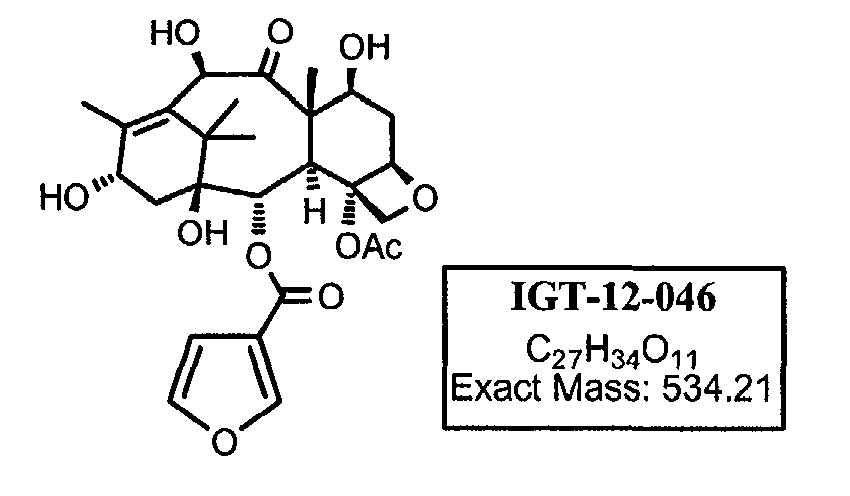
- A solution of 7,10,13-tri(triethylsilyloxy)-2-debenzoyl-2-(3-furoyl)-10-deacetyl baccatin III (2.05 g, 2.3 mmol) in anhydrous tetrahydrofuran (120 mL) was cooled to -30°C. Anhydrous pyridine (30 mL, 370 mmol) was added to the solution and the reaction was kept at -30°C in a dry ice and acetone bath. HF/Pyridine (30 mL) was added dropwise and the reaction was allowed to stir with gradual warming to room temperature overnight. The reaction was quenched with saturated aqueous sodium bicarbonate and extracted into ethyl acetate (2 x 100 mL). The combined organic layers were washed with water (100 mL), then brine (100 mL), and dried over sodium sulfate and concentrated in vacuo. The crude material was triturated with hexane and decanted, then used without further purification. 1H NMR (CDCl3) δ 1.07 (s, 3H), 1.09 (s, 3H), 1.73 (s, 3H), 2.06 (s, 3H), 1.83 (m, 1 H), 2.02 (m, 1 H), 2.19 (m, 1 H), 2.25 (s, 3H), 2.60 (m, 1 H), 3.49 (s, 1 H), 3.96 (d, J = 7.2 Hz, 1 H), 4.19 (d, J = 8.4 Hz, 1 H), 4.27 (m, 1 H), 4.40 (d, J = 8.4 Hz, 1 H), 4.86 (m, 1 H), 4.98 (d, J = 7.6 Hz, 1 H), 5.24 (s, 1 H), 5.52 (d, J = 7.2 Hz, 1 H), 6.77 (m, 1 H), 7.47 (t, J = 1.6 Hz, 1 H), 8.07 (d, J = 0.8 Hz, 1H). m/z LC/MS for C27H34O11Na+: calcd: 557.2; found: 557.1

- To a mixture of 2-debenzoyl-2-(3-furoyl)-10-deacetyl baccatin III (1.02 g, 1.9 mmol) and imidazole (0.77 g, 11.3 mmol) in pyridine (10 ml) was added chlorotriethylsilane (0.56 g, 3.7 mmol) dropwise. The reaction was allowed to stir for 10 minutes at room temperature, after which it was observed by tlc to be complete. Acetic anhydride (3.5 mL, 37 mmol) was added dropwise to the mixture and the resulting mixture was stirred overnight at room temperature. The mixture was extracted into ethyl acetate (2 x 50 mL), and the combined organic layers were washed with water (50 mL), saturated aqueous sodium bicarbonate (2 x 50 mL), water (50 mL), then brine (50 mL). The organic layer was dried over anhydrous sodium sulfate and concentrated in vacuo. The crude material was purified over silica gel using 20 % ethyl acetate in methylene chloride as the eluant. The fractions containing the desired product were pooled and concentrated to give 1.15 g of the title compound as a white solid. 1H NMR (CDCl3) δ 0.58 (m, 6H), 0.92 (t, J = 8.0 Hz, 9H), 1.04 (s, 3H), 1.17 (s, 3H), 1.64 (s, 1 H), 1.66 (s, 3H), 1.87 (m, 1 H), 2.10 (d, J = 5.2 Hz, 1 H), 2.17 (s, 6H), 2.21 (m, 1 H), 2.24 (s, 3H), 2.52 (m, 1 H), 3.83 (d, J = 7.2 Hz, 1 H), 4.17 (d, J = 8.4 Hz, 1 H), 4.38 (d, J = 8.4 Hz, 1 H), 4.47 (dd, J = 6.8, 10.4 Hz, 1 H), 4.82 (m, 1 H), 4.96 (dd, J = 1.6, 9.2 Hz, 1H), 5.51 (d, J = 7.2 Hz, 1 H), 6.44 (s, 1 H), 6.77 (dd, J = 0.8, 1.6 Hz, 1 H), 7.46 (t, J = 1.6 Hz, 1H), 8.07 (dd, J = 0.8, 1.6 Hz, 1H). 13C NMR (CDCl3) δ 5.5, 6.9, 10.1, 15.2, 20.2, 21.1, 22.9, 27.0, 37.4, 38.3, 42.9, 47.4, 58.8, 68.1, 72.5, 74.3, 75.9, 76.8, 78.9, 81.1, 84.4, 110.0, 119.2, 132.8, 144.1, 144.3, 148.8, 163.7, 169.6, 170.9, 202.3. m/z LC/MS for C35H50O12SiNa+ : calcd: 713.3; found: 713.1

- To a well stirred solution of 7-Triethylsilyloxy-2-debenzoyl-2-(3-furoyl)-baccatin III (145 mg, 0.2 mmol) and (3R,4S)-1-(2-furoyl)-3-triisopropylsilyloxy-4-(2-furyl)-2-azetidinone (127 mg, 0.31 mmol) in dry THF (1.5 mL) was added a solution of 1.0 M LiHMDS in THF (0.32 mL, 0.32 mmol) dropwise at -40°C, and the solution was stirred at -40°C for 1.5 hours. The reaction was quenched with saturated aqueous ammonium chloride (10 mL), and the aqueous layer was extracted with ethyl acetate (25 ml x 3). The combined organic extracts were washed with water (25 mL), brine (25 mL), and dried over anhydrous sodium sulfate and concentrated in vacuo. The residue was purified by silica ptlc using 30 % ethyl acetate in hexane as the developing solvent to afford 178 mg of the title compound as a white solid. 1H NMR (CDCl3) δ 0.58 (m, 6H), 0.92 (t, 8.0 Hz, 9H), 1.00 (m, 21 H), 1.16 (s, 3H), 1.18 (s, 3H), 1.68 (s, 3H), 1.90 (m, 1 H), 2.00 (s, 3H), 2.12 (m, 1 H), 2.16 (s, 3H), 2.30 (m, 1 H), 2.45 (s, 3H), 2.52 (m, 1 H), 3.79 (d, J = 7.2 Hz, 1 H), 4.24 (d, J = 8.4 Hz, 1 H), 4.38 (d, J = 8.4 Hz, 1 H), 4.47 (m, 1 H), 4.93 (d, J = 8.0 Hz, 1 H), 5.08 (d, J = 2.0 Hz, 1 H), 5.57 (d, J = 7.2 Hz, 1 H), 5.74 (d, J = 9.6 Hz, 1 H), 6.19 (t, J = 8.8 Hz, 1 H), 6.25 (d, J = 3.2 Hz, 1 H), 6.34 (dd, J = 1.6, 3.2 Hz, 1 H), 6.43 (s, 1 H), 6.48 (dd, J = 1.6, 3.2 Hz, 1 H), 6.81 (dd, J = 0.8, 2.0 Hz, 1 H), 7.05 (dd, J = 0.8, 3.6 Hz, 1 H), 7.13 (d, J = 9.6 Hz, 1 H), 7.38 (m, 1 H), 7.46 (m, 2H), 8.25 (dd, J = 0.8, 1.6 Hz, 1 H). 13C NMR (CDCl3) δ 5.3, 6.7, 10.1, 12.5, 14.3, 17.7, 20.9, 21.4, 22.9, 26.5, 35.6, 37.2, 43.2, 46.7, 50.9, 58.4, 71.2, 72.2, 72.9, 74.4, 75.0, 78.9, 81.1, 84.4, 107.8, 110.0, 110.8, 112.3, 115.1, 118.8, 133.5, 140.2, 142.1, 144.0, 144.5, 147.2, 149.2, 151.1, 157.8, 163.4, 169.3, 170.4, 170.9, 201.7. m/z LC/MS for C56H79NO17Si2Na+: calcd: 1116.5; found: 1116.3

- To a solution of 7-(triethylsilyloxy)-2'-(triisopropylsilyloxy)-3'-dephenyl-3'-(2-furyl)-3'N-de-tert-butoxycarbonyl-3'N-(2-furoyl)-2-debenzoyl-2-(3-furoyl)-10-acetoxydocetaxel (162 mg, 0.15 mmol) in ethanol (14 mL) was added hydrazine monohydrate (0.8 mL) at room temperature. After 10 minutes a second portion of hydrazine monohydrate was added (0.8 mL). The reaction was stirred at rt and monitored by tlc. After 14 hours the reaction was complete by tlc and quenched with saturated aqueous ammonium chloride (10 mL). The aqueous layer was extracted with ethyl acetate (50 ml x 2). The combined organic extracts were washed with water (50 mL), brine (50 mL), and dried over anhydrous sodium sulfate and concentrated in vacuo. The residue was purified by silica ptlc using a mixture of 50 % ether, 40 % hexane, and 10 % ethyl acetate as the developing solvent to afford 97 mg of the title compound as a white solid. 1H NMR (CDCl3) δ 0.54 (m, 6H), 0.95 (m, 30H), 1.04 (s, 3H), 1.17 (s, 3H), 1.72 (s, 3H), 1.87 (m, 1H), 1.92 (s, 3H), 2.09 (m, 1 H), 2.25 (m, 1 H), 2.45 (m, 4H), 3.83 (d, J = 7.2 Hz, 1 H), 4.24 (m, 2H), 4.38 (m, 2H), 4.91 (d, J = 8.0 Hz, 1 H), 5.07 (d, J = 1.2 Hz, 1 H), 5.08 (s, 1 H), 5.52 (d, J = 7.2 Hz, 1 H), 5.73 (d, J = 9.6 Hz, 1 H), 6.24 (m, 2H), 6.33 (dd, J = 1.6, 3.2 Hz, 1 H), 6.46 (dd, J = 1.6, 3.2 Hz, 1 H), 6.80 (d, J = 1.6 Hz, 1 H), 7.03 (d, J = 3.2 Hz, 1 H), 7.14 (d, J = 9.6 Hz, 1 H), 7.37 (s, 1 H), 7.45 (m, 2H), 8.26 (s, 1 H). 13C NMR (CDCl3) δ 5.2, 6.7, 10.1, 12.4, 14.3, 17.7, 20.9, 22.8, 26.6, 36.0, 37.2, 43.1, 46.4, 50.9, 57.7, 71.3, 72.8, 72.9, 74.0, 74.5, 76.7, 79.0, 80.9, 84.4, 107.7, 110.0, 110.8, 112.3, 115.1, 118.8, 135.9, 138.1, 142.1, 144.0, 144.5, 147.1, 149.2, 151.1, 157.8, 163.3, 170.6, 170.8, 209.8. m/z LC/MS for C54H77NO16Si2Na+: calcd: 1074.5; found: 1074.6

- To a solution of 7-(triethylsilyloxy)-2'-(triisopropylsilyloxy)-3'-dephenyl-3'-(2-furyl)-3'N-de-tert-butoxycarbonyl-3'N-(2-furoyl)-2-debenzoyl-2-(3-furoyl)-docetaxel (95 mg, 0.09 mmol) in methylene chloride (3 mL) was added DMAP (22 mg) and 4-methyldithio-butanoic acid (160 mg, 0.89 mmol). To this mixture was then added DIC (0.14 mL, 0.89 mmol) and the resulting mixture stirred overnight. Upon completion, the reaction was quenched with saturated aqueous ammonium chloride (10 mL) and extracted into methylene chloride (10 ml x 3). The combined organic extracts were dried over anhydrous sodium sulfate and concentrated in vacuo. The residue was purified by silica ptlc using 30 % ethyl acetate in hexane as the developing solvent to afford 154 mg of the title compound as a white solid. 1H NMR (CDCl3) δ 0.52 (m, 6H), 0.86 (t, J = 8.0 Hz, 9H), 0.94 (m, 21 H), 1.09 (s, 3H), 1.13 (s, 3H), 1.61 (s, 3H), 1.83 (m, 1 H), 1.95 (s, 3H), 1.99 (m, 2H), 2.12 (m, 2H), 2.35 (s, 3H), 2.38 (s, 3H), 2.47 (m, 1 H), 2.52 (t, J = 7.2 Hz, 2H), 2.67 (m, 2H), 3.73 (d, J = 6.8 Hz, 1 H), 4.18 (d, J = 8.4 Hz, 1 H), 4.30 (d, J = 8.4 Hz, 1 H), 4.40 (dd, J = 6.4, 10.0 Hz, 1 H), 4.88 (d, J = 8.8 Hz, 1 H), 5.03 (s, 1 H), 5.52 (d, J = 6.8 Hz, 1 H), 5.68 (d, J = 9.6 Hz, 1 H), 6.11 (t, J = 8.4 Hz, 1 H), 6.20 (d, J = 2.8 Hz, 1 H), 6.29 (t, J = 2.8 Hz, 1 H), 6.40 (s, 1 H), 6.44 (dd, J = 1.6, 3.2 Hz, 1 H), 6.73 (d, J = 1.6 Hz, 1 H), 7.02 (d, J = 3.2 Hz, 1 H), 7.14 (d, J = 9.6 Hz, 1 H), 7.34 (s, 1 H), 7.41 (s, 1 H), 7.43 (s, 1 H), 8.14 (s, 1H). 13C NMR (CDCl3) δ 5.4, 6.8, 10.1, 12.4, 14.3, 17.8, 20.9, 22.5, 23.2, 24.0, 24.2, 26.5, 32.3, 32.7, 37.0, 43.2, 46.6, 51.1, 58.4, 71.4, 72.2, 72.8, 74.4, 75.0, 76.6, 78.4, 81.1, 84.3, 107.8, 110.0, 110.9, 112.4, 115.6, 118.9, 133.7, 140.1, 142.2, 144.0, 144.8, 146.7, 149.0, 150.9, 158.2, 163.1, 170.9, 171.2, 173.5, 201.7. m/z LC/MS for C59H85NO17S2Si2Na+: calcd: 1222.5; found: 1222.6

- To a solution of 7-(triethylsilyloxy)-2'-(triisopropylsilyloxy)-3'-dephenyl-3'-(2-furyl)-3'N-de-tert-butoxycarbonyl-3'N-(2-furoyl)-2-debenzoyl-2-(3-furoyl)-10-(4-methyldithiobutanoyl)-docetaxel (154 mg, 0.13 mmol) in pyridine-acetonitrile (1/1, 5.0 mL) was added HF/pyridine (70:30, 1.5 mL) at 0°C. The resulting mixture was stirred for 24 hours with gradual warming to room temperature. The reaction was quenched with saturated aqueous sodium bicarbonate (10 mL) and then extracted with ethyl acetate (2 x 20 mL). The combined organic layers were washed with water (15 mL) and brine (15 mL), dried over anhydrous sodium sulfate and concentrated in vacuo. The residue was purified by silica ptlc using 60 % ethyl acetate in hexane as the developing solvent to afford 54 mg of the title compound as a white solid. 1H NMR (CDCl3) δ 1.09 (s, 3H), 1.21 (s, 3H), 1.65 (s, 3H), 1.84 (s, 3H), 1.87 (m, 1H), 2.12 (m, 2H), 2.27 (m, 2H), 2.38 (s, 3H), 2.40 (s, 3H), 2.52 (m, 1 H), 2.66 (m, 2H), 2.81 (m, 2H), 3.65 (m, 1 H) 3.75 (d, J = 7.2 Hz, 1 H), 4.23 (d, J = 8.4 Hz, 1 H), 4.36 (d, J = 8.4 Hz, 1 H), 4.40 (dd, J = 6.4, 10.8 Hz, 1 H), 4.81 (d, J = 2.0 Hz, 1 H), 4.93 (dd, J = 1.6, 9.2 Hz, 1 H), 5.54 (d, J = 7.2 Hz, 1 H), 5.82 (dd, J = 2.0, 9.6 Hz, 1 H), 6.23 (t, J = 8.8 Hz, 1 H), 6.27 (s, 1 H), 6.38 (m, 2H), 6.47 (dd, J = 1.6, 3.6 Hz, 1 H), 6.80 (d, J = 1.6 Hz, 1 H), 7.07 (m, 2H), 7.42 (t, J = 1.2 Hz, 1 H), 7.45 (dd, J = 0.8, 1.6 Hz, 1 H), 7.47 (t, J = 1.6 Hz, 1 H), 8.24 (d, J = 0.8 Hz, 1 H). 13C NMR (CDCl3) δ 9.8, 14.9, 22.2, 22.7, 23.3, 24.1, 24.3, 27.0, 32.2, 32.7, 37.0, 43.3, 45.7, 49.6, 58.7, 71.7, 72.2, 72.4, 74.7, 75.7, 76.7, 79.2, 81.2, 84.7, 108.1, 110.1, 110.9, 112.6, 115.8, 118.9, 133.2, 142.1, 142.9, 144.3, 144.8, 146.9, 149.4, 150.8, 158.1, 163.5, 170.6, 172.4, 173.3, 203.7. m/z LC/MS for C44H51NO17S2Na+: calcd: 952.3; found: 952.3
-

-

- To a well stirred solution of 7-Triethylsilyloxy-2-debenzoyl-2-(3-furoyl)-baccatin III (361 mg, 0.52 mmol) and (3R,4S)-1-(tert butoxycarbonyl)-3-triisopropylsilyloxy-4-(2-furyl)-2-azetidinone (300 mg, 0.73 mmol) in dry THF (3.6 mL) was added a solution of 1.0 M LiHMDS in THF (0.732 mL, 0.73 mmol) dropwise at -40°C, and the solution was stirred at -40°C for 3 hours. The reaction was quenched with saturated aqueous ammonium chloride (10 mL), and the aqueous layer was extracted with ethyl acetate (15 ml x 2). The combined organic extracts were dried over anhydrous magnesium sulfate and concentrated in vacuo. The crude material was purified over silica gel using 30 % ethyl acetate in hexane as the eluant. The fractions containing the desired product were pooled and concentrated to give 559 mg of the title compound as a white solid. 1H NMR (CDCl3) δ 0.58 (m, 6 H), 0.94 (m, 30 H), 1.19 (s, 3 H), 1.20 (s, 3 H), 1.36 (s, 9 H), 1.68 (s, 3 H), 1.90 (m, 1 H), 2.03 (s, 3 H), 2.17 (s, 3 H), 2.24 (m, 2 H), 2.42 (s, 3 H), 2.52 (m, 1 H), 3.80 (d, J = 8.8 Hz, 1 H), 4.21 (d, J = 8.4 Hz, 1 H), 4.38 (d, J = 8.4 Hz, 1 H), 4.47 (dd, J = 6.4, 10.4 Hz, 1 H), 4.93 (d, J = 8.8 Hz, 1 H), 4.97 (d, J = 0.8 Hz, 1 H), 5.26 (d, J = 10.0 Hz, 1 H), 5.32 (d, J = 10.0 Hz, 1 H), 5.56 (d, J = 7.2 Hz, 1 H), 6.20 (t, J = 9.2 Hz, 1 H), 6.24 (d, J = 3.2 Hz, 1 H), 6.34 (dd, J = 2.0, 3.2 Hz, 1 H), 6.45 (s, 1 H), 6.79 (s, 1 H), 7.35 (s, 1 H), 7.43 (m, 1 H), 8.15 (s, 1 H). 13C NMR (CDCl3) δ 5.6, 7.1, 10.4, 12.8, 14.7, 18.10, 18.12, 21.2, 21.6, 23.2, 26.7, 28.4, 35.7, 37.5, 43.6, 47.1, 53.5, 58.7, 71.6, 72.6, 73.4, 74.7, 75.4, 79.2, 80.6, 81.4, 84.7, 107.8, 110.3, 111.1, 119.1, 133.6, 141.0, 142.2, 144.4, 149.4, 152.3, 155.8, 163.8, 169.6, 170.6, 171.6, 202.2. m/z LCMS for C56H85NO17Si2Na+ : calcd: 1122.5; found: 1122.4.

- To a solution of 7-(triethylsilyloxy)-2'-(triisopropylsilyloxy)-3'-dephenyl-3'-(2-furyl)-2-debenzoyl-2-(3-furoyl)-10-acetoxy-docetaxel (559 mg, 0.51 mmol) in ethanol (15 mL) was added dropwise hydrazine monohydrate (5.96 mL) at room temperature. The reaction was stirred at rt and monitored by tic. After 1 hour the reaction was complete by tlc and quenched with saturated aqueous ammonium chloride (10 mL). The aqueous layer was extracted with ethyl acetate (15 ml x 2). The combined extracts were dried over anhydrous magnesium sulfate and concentrated in vacuo. The residue was purified by silica ptlc using a mixture of 50 % ether, 40 % hexane, and 10 % ethyl acetate as the developing solvent to afford 199 mg of the title compound as a white solid. 1H NMR (CDCl3) δ 0.54 (m, 6 H), 0.95 (m, 30 H), 1.07 (s, 3 H), 1.22 (s, 3 H), 1.35 (s, 9 H), 1.72 (s, 3 H), 1.92, (m, 1 H), 1.93 (s, 3 H), 2.21 (m, 2 H), 2.41 (s, 3 H), 2.46 (m, 1 H), 3.85 (d, J = 7.2 Hz, 1 H), 4.22 (d, J = 8.4 Hz, 1 H), 4.24 (d, J = 2.0 Hz, 1 H), 4.38 (m, 2 H)4.92 (d, J = 8.0 Hz, 1 H), 4.94 (d, J = 5.6 Hz, 1 H), 5.10 (d, J = 2.0 Hz, 1 H), 5.27 (d, J = 10.0 Hz, 1 H), 5.31 (d, J = 10.0 Hz, 1 H), 5.52 (d, J = 7.2 Hz, 1 H), 6.23 (d, J = 2.8 Hz, 1 H), 6.26 (t, J = 8.8 Hz, 1 H), 6.33 (dd, J = 2.0, 3.2 Hz, 1 H), 6.78 (d, J = 1.2 Hz, 1 H), 7.34 (d, J = 1.2 Hz, 1 H), 7.42 (t, J = 1.6 Hz, 1 H), 8.15 (s, 1 H). 13C NMR (CDCl3) δ 5.5, 7.1, 10.4, 12.7, 14.7, 18.07, 18.11, 21.1, 23.1, 26.8, 28.4, 36.1, 37.5, 43.5, 46.8, 53.4, 58.1, 71.6, 73.2, 73.4, 74.4, 74.8, 79.3, 80.6, 81.3, 84.7, 107.8, 110.3, 111.1, 119.1, 136.1, 138.8, 142.2, 144.3, 149.4, 152.4, 155.8, 163.7, 170.7, 171.5, 210.2. m/z LCMS for C54H83NO16Si2Na+: calcd: 1080.5; found: 1080.3.

- To a solution of 7-(triethylsilyloxy)-2'-(triisopropylsilyloxy)-3'-dephenyl-3'-(2-furyl)-2-debenzoyl-2-(3-furoyl)-docetaxel (199 mg, 0.188 mmol) in methylene chloride (4.1 mL) was added DMAP (23 mg) and 4-methyldithio-butanoic acid (313 mg, 1.88 mmol). To this mixture was then added DIC (0.294 mL, 1.88 mmol) and the resulting mixture stirred overnight. Upon completion, the reaction was quenched with saturated aqueous ammonium chloride (10 mL) and extracted into methylene chloride (10 ml x 2). The combined organic extracts were dried over anhydrous sodium sulfate and concentrated in vacuo. The residue was purified by silica ptlc using 20 % ethyl acetate in hexane as the developing solvent to afford 135 mg of the title compound as a white solid. 1H NMR (CDCl3) δ 0.56 (m, 6 H), 0.95 (m, 30 H), 1.18 (s, 3 H), 1.34 (s, 12 H), 1.66 (s, 3 H), 1.90 (m, 1 H), 2.01 (s, 3 H), 2.10 (m, 2 H), 2.24 (m, 2 H), 2.38 (s, 3 H), 2.42 (s, 3 H), 2.72 (m, 2 H), 2.82 (m, 2 H), 3.79 (d, J = 7.2 Hz, 1 H), 4.20 (d, J = 8.4 Hz, 1 H), 4.36 (d, J = 8.4 Hz, 1 H), 4.46 (dd, J = 6.4, 10.4 Hz, 1 H), 4.92 (d, J = 8.4 Hz, 1 H), 4.96 (d, J = 1.2 Hz, 1 H), 5.25 (d, J = 10.0 Hz, 1 H), 5.30 (d, J = 10.0 Hz, 1 H), 5.55 (d, J = 7.2 Hz, 1 H), 6.18 (t, J = 8.8 Hz, 1 H), 6.22 (d, J = 3.2 Hz, 1 H), 6.32 (dd, J = 1.6, 3.2 Hz, 1 H), 6.47 (s, 1 H), 6.77 (d, J = 1.2 Hz, 1 H), 7.34 (s, 1 H), 7.42 (t, J = 1.6 Hz, 1 H), 8.13 (s, 1 H). 13C NMR (CDCl3) δ 5.7, 7.1, 10.4, 12.7, 14.7, 18.07, 18.08, 22.9, 23.1, 23.4, 23.5, 24.6, 26.7, 28.4, 32.9, 35.7, 37.2, 43.5, 47.0, 53.5, 58.7, 71.6, 72.5, 73.4, 74.7, 75.3, 76.9, 79.1, 80.6, 81.4, 84.6, 107.8, 110.3, 111.1, 119.1, 133.6, 140.9, 142.2, 144.3, 149.3, 152.3, 155.8, 163.7, 170.6, 171.4, 171.6, 202.0. m/z LCMS for C59H91NO17S2Si2Na+ :
calcd: 1228.5; found: 1228.2.
- To a solution of 7-(triethylsilyloxy)-2'-(triisopropylsilyloxy)-3'-dephenyl-3'-(2-furyl)-2-debenzoyl-2-(3-furoyl)-10-(4-methyldithiobutanoyl)-docetaxel (135 mg, 0.112 mmol) in pyridine-acetonitrile (1/1, 2.7 mL) was added HF/pyridine (70:30, 1.25 mL) at 0°C. The resulting mixture was stirred for 24 hours with gradual warming to room temperature. The reaction was quenched with saturated aqueous sodium bicarbonate (10 mL) and then extracted with ethyl acetate (2 x 20 mL). The combined organic layers were washed with water (15 mL) and brine (15 mL), dried over anhydrous sodium sulfate and concentrated in vacuo. The residue was purified by silica ptlc using 60 % ethyl acetate in hexane as the developing solvent to afford 31.4 mg of the title compound as a white solid. 1H NMR (CDCl3) δ 1.11 (s, 3 H), 1.25 (s, 3 H), 1.36 (s, 9 H), 1.66 (s, 3 H), 1.87 (m, 1 H), 1.88 (s, 3 H), 2.14 (p, J = 7.2 Hz, 2 H), 2.28 (dd, J = 4.4, 8.8 Hz, 2 H), 2.36 (s, 3 H), 2.42 (s, 3 H), 2.49 (d, J = 4.4 Hz, 1 H), 2.65 (m, 2 H), 2.82 (m, 2 H), 3.29 (d, J = 5.6 Hz, 1 H), 3.77 (d, J = 7.2 Hz, 1 H), 4.20 (d, J = 8.4 Hz, 1 H), 4.38 (d, J = 8.4 Hz, 1 H), 4.41 (m, 1 H), 4.71 (dd, J = 1.6, 5.2 Hz, 1 H), 4.95 (d, J = 8.0 Hz, 1 H), 5.24 (d, J = 10.0 Hz, 1 H), 5.34 (d, J = 10.0 Hz, 1 H), 5.54 (d, J = 7.2 Hz, 1 H), 6.24 (t, J = 8.8 Hz, 1 H), 6.29 (s, 1 H), 6.31 (d, J = 3.2 Hz, 1 H), 6.37 (dd, J = 2.0, 3.2 Hz, 1 H), 6.79 (d, J = 1.6 Hz, 1 H), 7.40 (d, J = 1.2 Hz, 1 H), 7.45 (t, J = 1.6 Hz, 1 H), 8.15 (s, 1 H). 13C NMR (CDCl3) δ 9.9, 15.2, 22.3, 22.9, 23.5, 24.5, 27.0, 28.4, 32.9, 35.8, 35.9, 37.1, 43.5, 45.9, 51.9, 58.9, 72.0, 72.5, 72.8, 74.8, 75.9, 76.8, 79.5, 80.9, 81.4, 84.8, 107.8, 110.2, 111.0, 119.0, 133.3, 142.7, 142.8, 144.5, 149.4, 151.6, 155.4, 163.8, 170.6, 173.0, 173.5, 203.9. m/z LCMS for C44H57NO17S2Na+: calcd: 958.3; found: 958.1.
-

- To a well stirred solution 2-debenzoyl-10-deacetyl baccatin III (6.28 g, 8.03 mmol) in methylene chloride (210 mL) was added dimethylaminopyridine (DMAP) (5.89 g, 48.2 mmol) and 2-thiophene carboxylic acid (10.3 g, 80.3 mmol) followed by the addition of diisopropylcarbodiimide (DIC) (10.1 g, 80.3 mmol). The reaction was allowed to stir at room temperature for 2 days, after which it was complete. The reaction was diluted with methylene chloride (50 mL), washed with water (50 mL), saturated aqueous ammonium chloride (50 mL), water (50 mL), and brine (50 mL). The organic layer was dried over anhydrous sodium sulfate and concentrated in vacuo. The crude material was purified over silica gel using 20 % ethyl acetate in hexane as the eluant. The fractions containing the desired product were pooled and concentrated to give 6.38 g of the title compound as a white solid. 1H NMR (CDCl3) δ 0.64 (m, 18 H), 0.97 (m, 27 H), 1.12 (s, 3 H), 1.17 (s, 3 H), 1.65 (s, 3 H), 1.90 (m, 1 H), 1.97 (s, 3 H), 2.11 (m, 2 H), 2.26 (s, 3 H), 2.52 (m, 1 H), 3.81 (d, J = 7.2 Hz, 1 H), 4.21 (d, J = 8.4 Hz, 1 H), 4.39 (m, 2 H), 4.92 (m, 2 H), 5.18 (s, 1 H), 5.52 (d, J = 7.2 Hz, 1 H), 7.12 (dd, J = 3.6, 4.8 Hz, 1 H), 7.61 (dd, J = 1.2, 5.2 Hz, 1 H), 7.84 (dd, J = 1.2, 3.6 Hz, 1 H). 13C NMR (CDCl3) δ 5.2, 5.6, 6.3, 7.2, 7.27, 7.31, 10.8, 14.9, 21.0, 22.7, 23.0, 26.6, 31.9, 37.7, 40.1, 43.3, 47.2, 58.6, 68.7, 73.0, 76.1, 76.2, 80.0, 81.0, 84.3, 128.3, 133.6, 133.8, 134.8, 136.1, 139.8, 163.0, 170.4, 206.0. m/z LCMS for C45H76O10SSi3Na+: calcd: 915.4; found: 915.3.

- A solution of 7,10,13-tri(triethylsilyloxy)-2-debenzoyl-2-(2-thienoyl) baccatin III (6.38 g, 7.14 mmol) in anhydrous tetrahydrofuran (386 mL) was cooled to -30°C. Anhydrous pyridine (106 mL, 1.33 mol) was added to the solution and the reaction was kept at -30°C in a dry ice and acetone bath. HF/Pyridine (106 mL) was added dropwise and the reaction was allowed to stir with gradual warming to room temperature overnight. The reaction was quenched with saturated aqueous sodium bicarbonate and extracted into ethyl acetate (2 x 50 mL). The combined organic layers were washed with water (50 mL), then brine (50 mL), and dried over sodium sulfate and concentrated in vacuo. The crude material was triturated with hexane and decanted, then used without further purification. 1H NMR (CDCl3) δ 1.08 (s, 3 H), 1.10 (s, 3 H), 1.38 (d, J = 8.0 Hz, 1 H), 1.75 (s, 3 H), 1.84 (m, 1 H), 1.99 (d, J = 4.8 Hz, 1 H), 2.07 (s, 3 H), 2.61 (m, 1 H), 3.98 (d, J = 7.2 Hz, 1 H), 4.16 (d, J = 2.0 Hz, 1 H), 4.27 (m, 2 H), 4.44 (d, J = 8.4 Hz, 1 H), 4.52 (m, 5 H), 4.87 (m, 1 H), 4.98 (d, J = 7.6 Hz, 1 H), 5.24 (d, J = 1.6 Hz, 1 H), 5.54 (d, J = 7.2 Hz, 1 H), 7.15 (dd, J = 4.0, 4.8 Hz, 1 H), 7.64 (dd, J = 1.2, 5.2 Hz, 1 H), 7.87 (dd, J = 1.2, 4.0 Hz, 1 H). 13C NMR (CDCl3) δ 10.1, 15.4, 20.0, 22.9, 27.0, 37.5, 39.0, 42.9, 47.2, 58.0, 60.7, 68.3, 72.5, 75.4, 79.3, 81.0, 84.5, 128.4, 133.3, 134.0, 135.0, 135.2, 142.6, 162.9, 171.2, 212.1. m/z LCMS for C27H34O10SNa+ : calcd: 573.2; found: 573.2.

- To a mixture of 2-debenzoyl-2-(2-thienoyl)-10-deacetyl-baccatin III (3.93 g, 7.14 mmol) and imidazole (1.94 g, 28.5 mmol) in pyridine (266 ml) was added chlorotriethylsilane (2.14 g, 14.3 mmol) dropwise. The reaction was allowed to stir for 10 minutes at room temperature, after which it was observed by tlc to be complete. Acetic anhydride (13.5 mL, 143 mmol) was added dropwise to the mixture and the resulting mixture was stirred overnight at room temperature. The mixture was extracted into ethyl acetate (2 x 50 mL), and the combined organic layers were washed with water (50 mL), saturated aqueous sodium bicarbonate (50 mL), water (50 mL), then brine (50 mL). The organic layer was dried over anhydrous sodium sulfate and concentrated in vacuo. The crude material was purified over silica gel using 30 % ethyl acetate in methylene chloride as the eluant. The fractions containing the desired product were pooled and concentrated to give 3.00 g of the title compound as a white solid. 1H NMR (CDCl3) δ 0.58 (m, 6 H), 0.92 (t, J = 8.0 Hz, 9 H), 1.04 (s, 3 H), 1.18 (s, 3 H), 1.68 (s, 3 H), 1.88 (m, 1 H), 1.99 (d, J = 5.2 Hz, 1 H), 2.176 (s, 3 H), 2.182 (s, 3 H), 2.25 (m, 2 H), 2.26 (s, 3 H), 2.53 (m, 1 H), 3.84 (d, J = 7.2 Hz, 1 H), 4.22 (d, J = 8.4 Hz, 1 H), 4.43 (d, J = 8.4 Hz, 1 H), 4.48 (dd, J = 6.8, 10.4 Hz, 1 H), 4.83 (m, 1 H), 4.96 (d, J = 8.4 Hz, 1 H), 5.54 (d, J = 7.2 Hz, 1 H), 6.45 (s, 1 H), 7.14 (dd, J = 3.6, 4.8 Hz, 1 H), 7.63 (dd, J = 1.2, 5.2 Hz, 1 H), 7.87 (dd, J = 1.2, 3.6 Hz, 1 H). 13C NMR (CDCl3) δ 5.6, 7.1, 10.3, 15.3, 20.4, 21.3, 22.3, 27.2, 37.6, 38.6, 43.1, 47.5, 59.0, 68.3, 72.7, 75.4, 76.1, 79.2, 81.1, 84.6, 128.4, 133.0, 133.3, 133.9, 134.9, 144.2, 163.0, 169.7, 171.2, 202.4. m/z LCMS for C35H50O11SSiNa+: calcd: 729.3; found: 729.1.

- To a well stirred solution of 7-triethylsilyloxy-2-debenzoyl-2-(2-thienoyl) baccatin III (370 mg, 0.523 mmol) and (3R,4S)-1-(tert-butoxy carbonyl)-3-triisopropylsilyloxy-4-(2-furyl)-2-azetidinone (300 mg, 0.732 mmol) in dry THF (37 mL) was added a solution of 1.0 M LiHMDS in THF (0.732 mL, 0.732 mmol) dropwise at -40°C, and the solution was stirred at -40°C for 3 hours. The reaction was quenched with saturated aqueous ammonium chloride (10 mL), and the aqueous layer was extracted with ethyl acetate (15 ml x 2). The combined organic extracts were dried over anhydrous magnesium sulfate and concentrated in vacuo. The crude material was purified over silica gel using 20 % ethyl acetate in hexane as the eluant. The fractions containing the desired product were pooled and concentrated to give 572 g of the title compound as a white solid. 1H NMR (CDCl3) δ 0.58 (m, 6 H), 0.96 (m, 30 H), 1.19 (s, 3 H), 1.21 (s, 3 H), 1.36 (s, 9 H), 1.58 (s, 3 H), 1.91 (m, 1 H), 2.03 (s, 3 H), 2.17 (s, 3 H), 2.32 (m, 2 H), 2.44 (s, 3 H), 2.53 (m, 1 H), 3.81 (d, J = 6.8 Hz, 1 H), 4.25 (d, J = 8.4 Hz, 1 H), 4.30 (d, J = 8.4 Hz, 1 H), 4.47 (dd, J = 6.4, 10.4 Hz, 1 H), 4.96 (m, 2 H), 5.26 (d, J = 10.0 Hz, 1 H), 5.30 (d, J = 10.0 Hz, 1 H), 5.59 (d, J = 6.8 Hz, 1 H), 6.17 (t, J = 9.2 Hz, 1 H), 6.24 (d, J = 3.2 Hz, 1 H), 6.34 (dd, J = 2.0, 3.2 Hz, 1 H), 6.47 (s, 1 H), 7.12 (dd, J = 4.0, 4.8 Hz, 1 H), 7.36 (s, 1 H), 7.61 (dd, J = 1.2, 4.8 Hz, 1 H), 7.88 (d, J = 3.2 Hz, 1 H). 13C NMR (CDCl3) δ 5.7, 7.1, 10.4, 12.8, 14.7, 18.1, 18.2, 21.2, 21.5, 23.2, 26.6, 28.5, 35.6, 37.6, 43.6, 47.0, 53.6, 58.8, 71.8, 72.6, 73.4, 75.4, 75.6, 77.6, 79.2, 80.6, 81.3, 84.6, 107.8, 111.1, 128.4, 133.2, 133.7, 134.1, 135.0, 141.1, 142.2, 152.4, 155.8, 162.9, 169.6, 170.6, 171.8, 202.2. m/z LCMS for C56H85NO16SSi2Na+: calcd: 1138.5; found: 1138.4.

- To a solution of 7-(triethylsilyloxy)-2'-(triisopropylsilyloxy)-3'-dephenyl-3'-(2-furyl)-2-debenzoyl-2-(2-thienoyl)-10-acetoxy-docetaxel (555 mg, 0.497 mmol) in ethanol (15 mL) was added hydrazine monohydrate (5.82 mL) at room temperature. The reaction was stirred at rt and monitored by tlc. After 1.5 hours the reaction was completed by tlc and quenched with saturated aqueous ammonium chloride (10 mL). The aqueous layer was extracted with ethyl acetate (10 ml x 2) and the combined organic extracts were dried over anhydrous sodium sulfate and concentrated in vacuo. The residue was purified by silica ptlc using a mixture of 50 % ether, 40 % hexane, and 10 % ethyl acetate as the eluant to afford 310 mg of the title compound as a white solid. 1H NMR (CDCl3) δ 0.54 (m, 6 H), 0.95 (m, 30 H), 1.08 (s, 3 H), 1.21 (s, 3 H), 1.35 (s, 9 H), 1.73 (s, 3 H), 1.92, (m, 1 H), 1.93 (s, 3 H), 2.26 (m, 2 H), 2.44 (s, 3 H), 2.47 (m, 1 H), 3.86 (d, J = 7.2 Hz, 1 H), 4.24 (d, J = 2.0 Hz, 1 H), 4.25 (d, J = 8.4 Hz, 1 H), 4.38 (dd, J = 6.4, 10.4 Hz, 1 H), 4.42 (d, J = 8.4 Hz, 1 H), 4.94 (m, 2 H), 5.11 (d, J = 2.0 Hz, 1 H), 5.28 (m, 2 H), 5.54 (d, J = 7.2 Hz, 1 H), 6.23 (m, 2 H), 6.33 (dd, J = 2.0, 3.2 Hz, 1 H), 7.11 (dd, J = 4.0, 5.2 Hz, 1 H), 7.35 (d, J = 0.8 Hz, 1 H), 7.59 (dd, J = 1.2, 5.2 Hz, 1 H), 7.86 (d, J = 3.2 Hz, 1 H). 13C NMR (CDCl3) δ 5.5, 7.0, 10.4, 12.7, 14.7, 18.08, 18.09, 21.0, 23.1, 26.7, 28.5, 36.0, 37.6, 43.5, 46.8, 53.5, 58.1, 71.8, 73.2, 73.4, 74.5, 75.6, 77.0, 79.2, 80.5, 81.1, 84.6, 107.8, 111.1, 128.4, 133.2, 134.0 134.9, 136.1, 138.9, 142.1, 152.4, 155.8, 162.8, 170.7, 171.6, 210.3. m/z LCMS for C56H85NO16SSi2Na+: calcd: 1096.5; found: 1096.2.

- To a solution of 7-(triethylsilyloxy)-2'-(triisopropylsilyloxy)-3'-dephenyl-3'-(2-furyl)-2-debenzoyl-2-(2-thienoyl)-docetaxel (155 mg, 0.144 mmol) in methylene chloride (3.2 mL) was added DMAP (17.6 mg) and 4-methyldithio-butanoic acid (239 mg, 1.44 mmol). To this mixture was then added DIC (0.225 mL, 1.44 mmol) and the resulting mixture stirred overnight. Upon completion, the reaction was quenched with saturated aqueous ammonium chloride (10 mL) and extracted into methylene chloride (10 ml x 2). The combined organic extracts were dried over anhydrous sodium sulfate and concentrated in vacuo. The residue was purified by silica ptlc using 20 % ethyl acetate in hexane as the developing solvent to afford 158 mg of the title compound as a white solid. 1H NMR (CDCl3) δ 0.57 (m, 6 H), 0.95 (m, 30 H), 1.17 (s, 3 H), 1.19 (s, 3 H), 1.35 (s, 9 H), 1.67 (s, 3 H), 1.88 (m, 1 H), 2.01 (s, 3 H), 2.11 (m, 2 H), 2.33 (m, 2 H), 2.39 (s, 3 H), 2.43 (s, 3 H), 2.51 (m, 1 H), 2.64 (m , 2 H), 2.82 (m, 2 H), 3.80 (d, J = 7.2 Hz, 1 H), 4.24 (d, J = 8.4 Hz, 1 H), 4.38 (d, J = 8.4 Hz, 1 H), 4.46 (dd, J = 6.4, 10.4 Hz, 1 H), 4.94 (d, J = 8.4 Hz, 1 H), 4.97 (s, 1 H), 5.25 (d, J = 10.4 Hz, 1 H), 5.29 (d, J = 10.4 Hz, 1 H), 5.58 (d, J = 7.2 Hz, 1 H), 6.15 (t, J = 9.2 Hz, 1 H), 6.23 (d, J = 3.2 Hz, 1 H), 6.33 (dd, J = 2.0, 3.2 Hz, 1 H), 6.48 (s, 1 H), 7.11 (dd, J = 4.0, 5.2 Hz, 1 H), 7.35 (d, J = 1.2 Hz, 1 H), 7.60 (dd, J = 1.2, 5.2 Hz, 1 H), 7.86 (d, J = 3.2 Hz, 1 H). 13C NMR (CDCl3) δ 5.7, 7.1, 10.4, 12.7, 14.7, 18.1, 22.9, 23.1, 23.4, 23.6, 24.6, 26.6, 28.5, 32.9, 35.6, 37.2, 43.5, 47.0, 53.6, 58.8, 71.8, 72.6, 73.4, 75.3, 75.5, 77.0, 79.1, 80.5, 81.2, 84.5, 107.8, 111.1, 128.4, 133.2, 133.6, 134.0, 135.0, 141.0, 142.2, 152.3, 155.8, 162.8, 170.6, 171.4, 171.8, 202.1. m/z LCMS for C59H91 NO16S3Si2Na+: calcd: 1244.5; found: 1244.3.

- To a solution of 7-(triethylsilyloxy)-2'-(triisopropylsilyloxy)-3'-dephenyl-3'-(2-furyl)-2-debenzoyl-2-(2-thienyl)-10-(4-methyldithiobutanoyl)-docetaxel (158 mg, 0.129 mmol) in pyridine-acetonitrile (1/1, 3.16 mL) was added HF/pyridine (70:30, 1.58 mL) at 0°C. The resulting mixture was stirred for 24 hours with gradual warming to room temperature. The reaction was quenched with saturated aqueous sodium bicarbonate (10 mL) and then extracted with ethyl acetate (2 x 20 mL). The combined organic layers were washed with water (15 mL) and brine (15 mL), dried over anhydrous sodium sulfate and concentrated in vacuo. The residue was purified by silica ptlc using 60 % ethyl acetate in hexane as the developing solvent to afford 57.3 mg of the title compound as a white solid. 1H NMR (CDCl3) δ 1.11 (s, 3 H), 1.24 (s, 3 H), 1.36 (s, 9 H), 1.66 (s, 3 H), 1.87 (s, 3 H), 2.14 (p, J = 7.2 Hz, 2 H), 2.32 (d, J = 9.2 Hz, 2 H), 2.37 (s, 3 H), 2.41 (s, 3 H), 2.51 (m, 1 H), 2.64 (m, 2 H), 2.82 (m, 2 H), 3.40 (bs, 1 H), 3.77 (d, J = 7.2 Hz, 1 H), 4.23 (d, J = 8.4 Hz, 1 H), 4.42 (d, J = 8.4 Hz, 1 H), 4.40 (m, 1 H), 4.70 (s, 1 H), 4.96 (d, J = 8.4 Hz, 1 H), 5.30 (m, 2 H), 5.55 (d, J = 7.2 Hz, 1 H), 6.20 (t, J = 9.2 Hz, 1 H), 6.31 (m, 2 H), 6.36 (dd, J = 2.0, 3.2 Hz, 1 H), 7.13 (dd, J = 4.0, 4.8 Hz, 1 H), 7.40 (d, J = 1.2 Hz, 1 H), 7.63 (dd, J = 0.8, 4.8 Hz 1 H), 7.88 (d, J = 3.2 Hz, 1 H). 13C NMR (CDCl3) δ 9.9, 15.2, 22.2, 22.8, 23.5, 24.5, 27.0, 28.5, 32.9, 35.7, 35.9, 37.1, 43.4, 45.9, 52.1, 58.9, 72.1, 72.5, 72.8, 75.6, 75.9, 76.8, 79.4, 80.8, 81.2, 84.7, 107.8, 111.0, 128.5, 133.0, 133.2, 134.2, 135.1, 142.7, 142.8, 151.6, 155.5, 162.8, 170.6, 173.0, 173.5, 203.9. m/z LCMS for C44H57NO16S3Na+: calcd: 974.3; found: 974.1.
- The activity of the compounds of the present invention were determined following the proceeding described by Riou, Naudin and Lavelle in Biochemical and Biophysical Research Communications; Vol. 187, No1, 1992, p 164-170.

Claims (33)

R 1 is a linker or an optionally substituted aryl or heterocyclic radical, alkyl having from 1 to 10 carbon atoms, alkenyl or alkynyl having from 2 to 10 carbon atoms, cycloalkyl or cycloalkenyl having from 3 to 10 carbon atoms, -OR 2 or a carbamate formed from any of said alkyl having from 1 to 10 carbon atoms, alkenyl or alkynyl having from 2 to 10 carbon atoms, cycloalkyl or cycloalkenyl having from 3 to 10 carbon atoms, or optionally substituted aryl or heterocyclyl radical. Preferably R1 is -OR2 or an optionally substituted aryl or heterocyclic radical
R 2 is alkyl having from 1 to 10 carbon atoms, alkynyl or alkenyl having from 2 to 10 carbon atoms, cycloalkyl or cycloalkenyl having from 3 to 10 carbon atoms, optionally substituted aryl or heterocyclic radical
R 3 is a linker or an optionally substituted aryl or heterocyclic radical, alkyl having from 1 to 10 carbon atoms, alkenyl or alkynyl having from 2 to 10 carbon atoms, cycloalkyl or cycloalkenyl having from 3 to 10 carbon atoms
R 4 is an H or a linker, or an optionally substituted, linear, or branched alkyl radical having from 1 to 10 carbon atoms, alkenyl having from 2 to 10 carbon atoms, alkynyl having from 3 to 10 carbon atoms, cycloalkyl or cycloalkenyl having from 3 to 10 carbon atoms, alkanoyl, alkenoyl, alkynoyl, alkoxyacetyl, alkenyloxyacetyl, alkynyloxyacetyl, alkylthioacetyl, alkenylthioacetyl, alkynylthioacetyl, alkyloxycarbonyl, alkenyloxycarbonyl, alkynyloxycarbonyl, optionally substituted aryl or heterocyclyl, aroyl or heterocyclylcarbonyl, aryloxycarbonyl or heterocyclyloxycarbonyl or OR4 forms a carbamate of the formula -OCOX, wherein X is a nitrogen-containing heterocycle such as unsubstituted or substituted piperidino, morpholino, piperazino, N-methylpiperazino, or a carbamate of the formula -OCONR 8 R 9, wherein R 8 and R 9 are the same or different and are H, linear, branched, or cyclic alkyl having from 1 to 10 atoms, alkenyl having from 2 to 10 carbon atoms, alkynyl having from 3 to 10 carbon atoms, cycloalkyl or cycloalkenyl having from 3 to 10 carbon atoms, optionally substituted aryl, or optionally substituted heterocyclyl.
R 5 is H or a hydroxy or a linker, or an optionally substituted, linear, or branched alkyloxy radical having from 1 to 10 carbon atoms, alkenyloxy having from 2 to 10 carbon atoms, alkynyloxy having from 3 to 10 carbon atoms, cycloalkyloxy or cycloalkenyloxy having from 3 to 10 carbon atoms, alkanoyloxy, alkenoyloxy, alkynoyloxy, alkoxyacetoxy, alkenyloxyacetoxy, alkynyloxyacetoxy, alkylthioacetoxy, alkenylthioacetoxy, alkynylthioacetoxy, alkyloxycarbonyloxy, alkenyloxycarbonyloxy, alkynyloxycarbonyloxy, optionally substituted aryloxy or heterocyclyloxy, aroyloxy or heterocyclylcarbonyloxy, aryloxycarbonyloxy or heterocyclyloxycarbonyloxy or OR 5 forms a carbamate of the formula -OCOX, wherein X is a nitrogen-containing heterocycle such as unsubstituted or substituted piperidino, morpholino, piperazino, N-methylpiperazino, or a carbamate of the formula -OCONR 10 R 11 , wherein R 10 and R 11 are the same or different and are H, linear, branched, or cyclic alkyl having from 1 to 10 atoms, alkenyl having from 2 to 10 carbon atoms, alkynyl having from 3 to 10 carbon atoms, cycloalkyl or cycloalkenyl having from 3 to 10 carbon atoms, optionally substituted aryl, or optionally substituted heterocyclyl.
R 6 is H or a hydroxy or a linker, or an optionally substituted, linear, or branched alkyloxy radical having from 1 to 10 carbon atoms, alkenyloxy having from 2 to 10 carbon atoms, alkynyloxy having from 3 to 10 carbon atoms, cycloalkyloxy or cycloalkenyloxy having from 3 to 10 carbon atoms, alkanoyloxy, alkenoyloxy, alkynoyloxy, alkoxyacetoxy, alkenyloxyacetoxy, alkynyloxyacetoxy, alkylthioacetoxy, alkenylthioacetoxy, alkynylthioacetoxy, alkyloxycarbonyloxy, alkenyloxycarbonyloxy, alkynyloxycarbonyloxy, optionally substituted aryloxy or heterocyclyloxy, aroyloxy or heterocyclylcarbonyloxy, aryloxycarbonyloxy or heterocyclyloxycarbonyloxy or OR 6 forms a carbamate of the formula -OCOX, wherein X is a nitrogen-containing heterocycle such as unsubstituted or substituted piperidino, morpholino, piperazino, N-methylpiperazino, or a carbamate of the formula -OCONR 12 R 13 , wherein R 12 and
R 13 are the same or different and are H, linear, branched, or cyclic alkyl having from 1 to 10 atoms, alkenyl having from 2 to 10 carbon atoms, alkynyl having from 3 to 10 carbon atoms, cycloalkyl or cycloalkenyl having from 3 to 10 carbon atoms, optionally substituted aryl, or optionally substituted heterocyclyl.
R 7 = optionally substituted heterocyclic radical.
and wherein -X' is a linear alkyl or branched alkyl having from 1-10 carbon atoms or a polyethylene glycol spacer with 2 to 20 repeating ethylene oxy units;
n is an integer of 1 to 10,
m is an integer from 1 to 10 and can also be 0,
y is an integer from 1 to 20 and can also be 0.
n is an integer of 1 to 10,
m is an integer from 1 to 10 and can also be 0,
y is an integer from 1 to 20 and can also be 0.
n is an integer of 1 to 10,
m is an integer from 1 to 10 and can also be 0,
y is an integer from 1 to 20 and can also be 0.
R 5 is the linker
Z = H or radical of formula II
R 1 is an optionally substituted aryl or heterocyclic radical, alkyl having from 1 to 10 carbon atoms, alkynyl or alkenyl having from 2 to 10 carbon atoms, cycloalkyl or cycloalkenyl having from 3 to 10 carbon atoms, -OR 2 or a carbamate formed from any of said alkyl having from 1 to 10 carbon atoms, alkynyl or alkenyl having from 2 to 10 carbon atoms, cycloalkyl or cycloalkenyl having from 3 to 10 carbon atoms, or optionally substituted aryl or heterocyclyl radical
R 2 is alkyl having from 1 to 10 carbon atoms, alkynyl or alkenyl having from 2 to 10 carbon atoms, cycloalkyl or cycloalkenyl having from 3 to 10 carbon atoms, optionally substituted aryl or heterocyclic radical
R 3 is optionally substituted aryl or heterocyclic radical, alkyl having from 1 to 10 carbon atoms, alkenyl or alkynyl having from 2 to 10 carbon atoms, cycloalkyl or cycloalkenyl having from 3 to 10 carbon atoms
R 4 is an H or an optionally substituted, linear, or branched alkyl radical having from 1 to 10 carbon atoms, alkenyl having from 2 to 10 carbon atoms, alkynyl having from 3 to 10 carbon atoms, cycloalkyl or cycloalkenyl having from 3 to 10 carbon atoms, alkanoyl, alkenoyl, alkynoyl, alkoxyacetyl, alkenyloxyacetyl, alkynyloxyacetyl, alkylthioacetyl, alkenylthioacetyl, alkynylthioacetyl, alkyloxycarbonyl, alkenyloxycarbonyl, alkynyloxycarbonyl, optionally substituted aryl or heterocyclyl, aroyl or heterocyclylcarbonyl, aryloxycarbonyl or heterocyclyloxycarbonyl or OR 4 forms a carbamate of the formula -OCOX, wherein X is a nitrogen-containing heterocycle such as unsubstituted or substituted piperidino, morpholino, piperazino, N-methylpiperazino, or a carbamate of the formula -OCONR 8 R 9, wherein R 8 and R 9 are the same or different and are H, linear, branched, or cyclic alkyl having from 1 to 10 atoms, alkenyl having from 2 to 10 carbon atoms, alkynyl having from 3 to 10 carbon atoms, cycloalkyl or cycloalkenyl having from 3 to 10 carbon atoms, optionally substituted aryl, or optionally substituted heterocyclyl.
R 6 is H or a hydroxy or an optionally substituted, linear, or branched alkyloxy radical having from 1 to 10 carbon atoms, alkenyloxy having from 2 to 10 carbon atoms, alkynyloxy having from 3 to 10 carbon atoms, cycloalkyloxy or cycloalkenyloxy having from 3 to 10 carbon atoms, alkanoyloxy, alkenoyloxy, alkynoyloxy, alkoxyacetoxy, alkenyloxyacetoxy, alkynyloxyacetoxy, alkylthioacetoxy, alkenylthioacetoxy, alkynylthioacetoxy, alkyloxycarbonyloxy, alkenyloxycarbonyloxy, alkynyloxycarbonyloxy, optionally substituted aryloxy or heterocyclyloxy, aroyloxy or heterocyclylcarbonyloxy, aryloxycarbonyloxy or heterocyclyloxycarbonyloxy or OR6 forms a carbamate of the formula -OCOX, wherein X is a nitrogen-containing heterocycle such as unsubstituted or substituted piperidino, morpholino, piperazino, N-methylpiperazino, or a carbamate of the formula -OCONR 12 R 13, wherein R 12 andR 13 are the same or different and are H, linear, branched, or cyclic alkyl having from 1 to 10 atoms, alkenyl having from 2 to 10 carbon atoms, alkynyl having from 3 to 10 carbon atoms, cycloalkyl or cycloalkenyl having from 3 to 10 carbon atoms, optionally substituted aryl, or optionally substituted heterocyclyl.
R 7 is an optionally substituted heterocyclic radical
R 1 is the linking group.
Z is a radical of formula II
R 3 is optionally substituted aryl or heterocyclic radical, alkyl having from 1 to 10 carbon atoms, alkenyl or alkynyl having from 2 to 10 carbon atoms, cycloalkyl or cycloalkenyl having from 3 to 10 carbon atoms
R 4 is an H or an optionally substituted, linear, or branched alkyl radical having from 1 to 10 carbon atoms, alkenyl having from 2 to 10 carbon atoms, alkynyl having from 3 to 10 carbon atoms, cycloalkyl or cycloalkenyl having from 3 to 10 carbon atoms, alkanoyl, alkenoyl, alkynoyl, alkoxyacetyl, alkenyloxyacetyl, alkynyloxyacetyl, alkylthioacetyl, alkenylthioacetyl, alkynylthioacetyl, alkyloxycarbonyl, alkenyloxycarbonyl, alkynyloxycarbonyl, optionally substituted aryl or heterocyclyl, aroyl or heterocyclylcarbonyl, aryloxycarbonyl or heterocyclyloxycarbonyl or OR 4 forms a carbamate of the formula -OCOX, wherein X is a nitrogen-containing heterocycle such as unsubstituted or substituted piperidino, morpholino, piperazino, N-methylpiperazino, or a carbamate of the formula -OCONR 8 R 9 , wherein R 8 and R 9 are the same or different and are H, linear, branched, or cyclic alkyl having from 1 to 10 atoms, alkenyl having from 2 to 10 carbon atoms, alkynyl having from 3 to 10 carbon atoms, cycloalkyl or cycloalkenyl having from 3 to 10 carbon atoms, optionally substituted aryl, or optionally substituted heterocyclyl.
R 5 is H or a hydroxy or an optionally substituted, linear, or branched alkyloxy radical having from 1 to 10 carbon atoms, alkenyloxy having from 2 to 10 carbon atoms, alkynyloxy having from 3 to 10 carbon atoms, cycloalkyloxy or cycloalkenyloxy having from 3 to 10 carbon atoms, alkanoyloxy, alkenoyloxy, alkynoyloxy, alkoxyacetoxy, alkenyloxyacetoxy, alkynyloxyacetoxy, alkylthioacetoxy, alkenylthioacetoxy, alkynylthioacetoxy, alkyloxycarbonyloxy, alkenyloxycarbonyloxy, alkynyloxycarbonyloxy, optionally substituted aryloxy or heterocyclyloxy, aroyloxy or heterocyclylcarbonyloxy, aryloxycarbonyloxy or heterocyclyloxycarbonyloxy or OR5 forms a carbamate of the formula -OCOX, wherein X is a nitrogen-containing heterocycle such as unsubstituted or substituted piperidino, morpholino, piperazino, N-methylpiperazino, or a carbamate of the formula -OCONR 10 R 11, wherein R 10 and R 11 are the same or different and are H, linear, branched, or cyclic alkyl having from 1 to 10 atoms, alkenyl having from 2 to 10 carbon atoms, alkynyl having from 3 to 10 carbon atoms, cycloalkyl or cycloalkenyl having from 3 to 10 carbon atoms, optionally substituted aryl, or optionally substituted heterocyclyl.
R6 is H or a hydroxy or an optionally substituted, linear, or branched alkyloxy radical having from 1 to 10 carbon atoms, alkenyloxy having from 2 to 10 carbon atoms, alkynyloxy having from 3 to 10 carbon atoms, cycloalkyloxy or cycloalkenyloxy having from 3 to 10 carbon atoms, alkanoyloxy, alkenoyloxy, alkynoyloxy, alkoxyacetoxy, alkenyloxyacetoxy, alkynyloxyacetoxy, alkylthioacetoxy, alkenylthioacetoxy, alkynylthioacetoxy, alkyloxycarbonyloxy, alkenyloxycarbonyloxy, alkynyloxycarbonyloxy, optionally substituted aryloxy or heterocyclyloxy, aroyloxy or heterocyclylcarbonyloxy, aryloxycarbonyloxy or heterocyclyloxycarbonyloxy or OR 6 forms a carbamate of the formula -OCOX, wherein X is a nitrogen-containing heterocycle such as unsubstituted or substituted piperidino, morpholino, piperazino, N-methylpiperazino, or a carbamate of the formula -OCONR 12R13, wherein R 12 and R 13 are the same or different and are H, linear, branched, or cyclic alkyl having from 1 to 10 atoms, alkenyl having from 2 to 10 carbon atoms, alkynyl having from 3 to 10 carbon atoms, cycloalkyl or cycloalkenyl having from 3 to 10 carbon atoms, optionally substituted aryl, or optionally substituted heterocyclyl.
R 7 is an optionally substituted heterocyclic radical.
wherein R 3 is the linker
Z is a radical of formula II
R 1 is an optionally substituted aryl or heterocyclic radical, alkyl having from 1 to 10 carbon atoms, alkynyl or alkenyl having from 2 to 10 carbon atoms, cycloalkyl or cycloalkenyl having from 3 to 10 carbon atoms, -OR2 or a carbamate formed from any of said alkyl having from 1 to 10 carbon atoms, alkynyl or alkenyl having from 2 to 10 carbon atoms, cycloalkyl or cycloalkenyl having from 3 to 10 carbon atoms, or optionally substituted aryl or heterocyclyl radicalR 2 is alkyl having from 1 to 10 carbon atoms, alkynyl or alkenyl having from 2 to 10 carbon atoms, cycloalkyl or cycloalkenyl having from 3 to 10 carbon atoms, optionally substituted aryl or heterocyclic radical
R 4 is an H or an optionally substituted, linear, or branched alkyl radical having from 1 to 10 carbon atoms, alkenyl having from 2 to 10 carbon atoms, alkynyl having from 3 to 10 carbon atoms, cycloalkyl or cycloalkenyl having from 3 to 10 carbon atoms, alkanoyl, alkenoyl, alkynoyl, alkoxyacetyl, alkenyloxyacetyl, alkynyloxyacetyl, alkylthioacetyl, alkenylthioacetyl, alkynylthioacetyl, alkyloxycarbonyl, alkenyloxycarbonyl, alkynyloxycarbonyl, optionally substituted aryl or heterocyclyl, aroyl or heterocyclylcarbonyl, aryloxycarbonyl or heterocyclyloxycarbonyl or OR 4 forms a carbamate of the formula -OCOX, wherein X is a nitrogen-containing heterocycle such as unsubstituted or substituted piperidino, morpholino, piperazino, N-methylpiperazino, or a carbamate of the formula -OCONR 8 R 9 , wherein R 8 and R 9 are the same or different and are H, linear, branched, or cyclic alkyl having from 1 to 10 atoms, alkenyl having from 2 to 10 carbon atoms, alkynyl having from 3 to 10 carbon atoms, cycloalkyl or cycloalkenyl having from 3 to 10 carbon atoms, optionally substituted aryl, or optionally substituted heterocyclyl.
R 5 is H or a hydroxy or an optionally substituted, linear, or branched alkyloxy radical having from 1 to 10 carbon atoms, alkenyloxy having from 2 to 10 carbon atoms, alkynyloxy having from 3 to 10 carbon atoms, cycloalkyloxy or cycloalkenyloxy having from 3 to 10 carbon atoms, alkanoyloxy, alkenoyloxy, alkynoyloxy, alkoxyacetoxy, alkenyloxyacetoxy, alkynyloxyacetoxy, alkylthioacetoxy, alkenylthioacetoxy, alkynylthioacetoxy, alkyloxycarbonyloxy, alkenyloxycarbonyloxy, alkynyloxycarbonyloxy, optionally substituted aryloxy or heterocyclyloxy, aroyloxy or heterocyclylcarbonyloxy, aryloxycarbonyloxy or heterocyclyloxycarbonyloxy or OR 5 forms a carbamate of the formula -OCOX, wherein X is a nitrogen-containing heterocycle such as unsubstituted or substituted piperidino, morpholino, piperazino, N-methylpiperazino, or a carbamate of the formula -OCONR 10 R 11, wherein R 10 and R 11 are the same or different and are H, linear, branched, or cyclic alkyl having from 1 to 10 atoms, alkenyl having from 2 to 10 carbon atoms, alkynyl having from 3 to 10 carbon atoms, cycloalkyl or cycloalkenyl having from 3 to 10 carbon atoms, optionally substituted aryl, or optionally substituted heterocyclyl.
R 6 is H or a hydroxy or an optionally substituted, linear, or branched alkyloxy radical having from 1 to 10 carbon atoms, alkenyloxy having from 2 to 10 carbon atoms, alkynyloxy having from 3 to 10 carbon atoms, cycloalkyloxy or cycloalkenyloxy having from 3 to 10 carbon atoms, alkanoyloxy, alkenoyloxy, alkynoyloxy, alkoxyacetoxy, alkenyloxyacetoxy, alkynyloxyacetoxy, alkylthioacetoxy, alkenylthioacetoxy, alkynylthioacetoxy, alkyloxycarbonyloxy, alkenyloxycarbonyloxy, alkynyloxycarbonyloxy, optionally substituted aryloxy or heterocyclyloxy, aroyloxy or heterocyclylcarbonyloxy, aryloxycarbonyloxy or heterocyclyloxycarbonyloxy or OR 6 forms a carbamate of the formula -OCOX, wherein X is a nitrogen-containing heterocycle such as unsubstituted or substituted piperidino, morpholino, piperazino, N-methylpiperazino, or a carbamate of the formula -OCONR12R13, wherein R 12 and R 13 are the same or different and are H, linear, branched, or cyclic alkyl having from 1 to 10 atoms, alkenyl having from 2 to 10 carbon atoms, alkynyl having from 3 to 10 carbon atoms, cycloalkyl or cycloalkenyl having from 3 to 10 carbon atoms, optionally substituted aryl, or optionally substituted heterocyclyl.
R 7 is an optionally substituted heterocyclic radical
wherein R 4 is the linker
Z is a radical of formula II
R 1 is an optionally substituted aryl or heterocyclic radical, alkyl having from 1 to 10 carbon atoms, alkynyl or alkenyl having from 2 to 10 carbon atoms, cycloalkyl or cycloalkenyl having from 3 to 10 carbon atoms, -OR 2 or a carbamate formed from any of said alkyl having from 1 to 10 carbon atoms, alkynyl or alkenyl having from 2 to 10 carbon atoms, cycloalkyl or cycloalkenyl having from 3 to 10 carbon atoms, or optionally substituted aryl or heterocyclyl radical
R 2 is alkyl having from 1 to 10 carbon atoms, alkynyl or alkenyl having from 2 to 10 carbon atoms, cycloalkyl or cycloalkenyl having from 3 to 10 carbon atoms, optionally substituted aryl or heterocyclic radical
R3 is optionally substituted aryl or heterocyclic radical, alkyl having from 1 to 10 carbon atoms, alkenyl or alkynyl having from 2 to 10 carbon atoms, cycloalkyl or cycloalkenyl having from 3 to 10 carbon atoms
R 5 is H or a hydroxy or an optionally substituted, linear, or branched alkyloxy radical having from 1 to 10 carbon atoms, alkenyloxy having from 2 to 10 carbon atoms, alkynyloxy having from 3 to 10 carbon atoms, cycloalkyloxy or cycloalkenyloxy having from 3 to 10 carbon atoms, alkanoyloxy, alkenoyloxy, alkynoyloxy, alkoxyacetoxy, alkenyloxyacetoxy, alkynyloxyacetoxy, alkylthioacetoxy, alkenylthioacetoxy, alkynylthioacetoxy, alkyloxycarbonyloxy, alkenyloxycarbonyloxy, alkynyloxycarbonyloxy, optionally substituted aryloxy or heterocyclyloxy, aroyloxy or heterocyclylcarbonyloxy, aryloxycarbonyloxy or heterocyclyloxycarbonyloxy or OR 5 forms a carbamate of the formula -OCOX, wherein X is a nitrogen-containing heterocycle such as unsubstituted or substituted piperidino, morpholino, piperazino, N-methylpiperazino, or a carbamate of the formula -OCONR 10 R 11, wherein R 10 and R 11 are the same or different and are H, linear, branched, or cyclic alkyl having from 1 to 10 atoms, alkenyl having from 2 to 10 carbon atoms, alkynyl having from 3 to 10 carbon atoms, cycloalkyl or cycloalkenyl having from 3 to 10 carbon atoms, optionally substituted aryl, or optionally substituted heterocyclyl.
R6 is H or a hydroxy or an optionally substituted, linear, or branched alkyloxy radical having from 1 to 10 carbon atoms, alkenyloxy having from 2 to 10 carbon atoms, alkynyloxy having from 3 to 10 carbon atoms, cycloalkyloxy or cycloalkenyloxy having from 3 to 10 carbon atoms, alkanoyloxy, alkenoyloxy, alkynoyloxy, alkoxyacetoxy, alkenyloxyacetoxy, alkynyloxyacetoxy, alkylthioacetoxy, alkenylthioacetoxy, alkynylthioacetoxy, alkyloxycarbonyloxy, alkenyloxycarbonyloxy, alkynyloxycarbonyloxy, optionally substituted aryloxy or heterocyclyloxy, aroyloxy or heterocyclylcarbonyloxy, aryloxycarbonyloxy or heterocyclyloxycarbonyloxy or OR6 forms a carbamate of the formula -OCOX, wherein X is a nitrogen-containing heterocycle such as unsubstituted or substituted piperidino, morpholino, piperazino, N-methylpiperazino, or a carbamate of the formula -OCONR 12 R 13 , wherein R 12 and R 13 are the same or different and are H, linear, branched, or cyclic alkyl having from 1 to 10 atoms, alkenyl having from 2 to 10 carbon atoms, alkynyl having from 3 to 10 carbon atoms, cycloalkyl or cycloalkenyl having from 3 to 10 carbon atoms, optionally substituted aryl, or optionally substituted heterocyclyl.
R 7 is an optionally substituted heterocyclic radical
wherein R 6 is the linker
Z is H or a radical of formula II
R 1 is an optionally substituted aryl or heterocyclic radical, alkyl having from 1 to 10 carbon atoms, alkynyl or alkenyl having from 2 to 10 carbon atoms, cycloalkyl or cycloalkenyl having from 3 to 10 carbon atoms, -OR2 or a carbamate formed from any of said alkyl having from 1 to 10 carbon atoms, alkynyl or alkenyl having from 2 to 10 carbon atoms, cycloalkyl or cycloalkenyl having from 3 to 10 carbon atoms, or optionally substituted aryl or heterocyclyl radical
R 2 is alkyl having from 1 to 10 carbon atoms, alkynyl or alkenyl having from 2 to 10 carbon atoms, cycloalkyl or cycloalkenyl having from 3 to 10 carbon atoms, optionally substituted aryl or heterocyclic radical
R 3 is optionally substituted aryl or heterocyclic radical, alkyl having from 1 to 10 carbon atoms, alkenyl or alkynyl having from 2 to 10 carbon atoms, cycloalkyl or cycloalkenyl having from 3 to 10 carbon atoms
R 4 is an H or an optionally substituted, linear, or branched alkyl radical having from 1 to 10 carbon atoms, alkenyl having from 2 to 10 carbon atoms, alkynyl having from 3 to 10 carbon atoms, cycloalkyl or cycloalkenyl having from 3 to 10 carbon atoms, alkanoyl, alkenoyl, alkynoyl, alkoxyacetyl, alkenyloxyacetyl, alkynyloxyacetyl, alkylthioacetyl, alkenylthioacetyl, alkynylthioacetyl, alkyloxycarbonyl, alkenyloxycarbonyl, alkynyloxycarbonyl, optionally substituted aryl or heterocyclyl, aroyl or heterocyclylcarbonyl, aryloxycarbonyl or heterocyclyloxycarbonyl or OR 4 forms a carbamate of the formula -OCOX, wherein X is a nitrogen-containing heterocycle such as unsubstituted or substituted piperidino, morpholino, piperazino, N-methylpiperazino, or a carbamate of the formula -OCONR 8 R 9 , wherein R 8 and R 9 are the same or different and are H, linear, branched, or cyclic alkyl having from 1 to 10 atoms, alkenyl having from 2 to 10 carbon atoms, alkynyl having from 3 to 10 carbon atoms, cycloalkyl or cycloalkenyl having from 3 to 10 carbon atoms, optionally substituted aryl, or optionally substituted heterocyclyl.
R 5 is H or a hydroxy or an optionally substituted, linear, or branched alkyloxy radical having from 1 to 10 carbon atoms, alkenyloxy having from 2 to 10 carbon atoms, alkynyloxy having from 3 to 10 carbon atoms, cycloalkyloxy or cycloalkenyloxy having from 3 to 10 carbon atoms, alkanoyloxy, alkenoyloxy, alkynoyloxy, alkoxyacetoxy, alkenyloxyacetoxy, alkynyloxyacetoxy, alkylthioacetoxy, alkenylthioacetoxy, alkynylthioacetoxy, alkyloxycarbonyloxy, alkenyloxycarbonyloxy, alkynyloxycarbonyloxy, optionally substituted aryloxy or heterocyclyloxy, aroyloxy or heterocyclylcarbonyloxy, aryloxycarbonyloxy or heterocyclyloxycarbonyloxy or OR 5 forms a carbamate of the formula -OCOX, wherein X is a nitrogen-containing heterocycle such as unsubstituted or substituted piperidino, morpholino, piperazino, N-methylpiperazino, or a carbamate of the formula -OCONR 10 R 11 , wherein R 10 and R 11 are the same or different and are H, linear, branched, or cyclic alkyl having from 1 to 10 atoms, alkenyl having from 2 to 10 carbon atoms, alkynyl having from 3 to 10 carbon atoms, cycloalkyl or cycloalkenyl having from 3 to 10 carbon atoms, optionally substituted aryl, or optionally substituted heterocyclyl.
R 7 is an optionally substituted heterocyclic radical.

R 7 is an optionally substituted heterocyclic radical
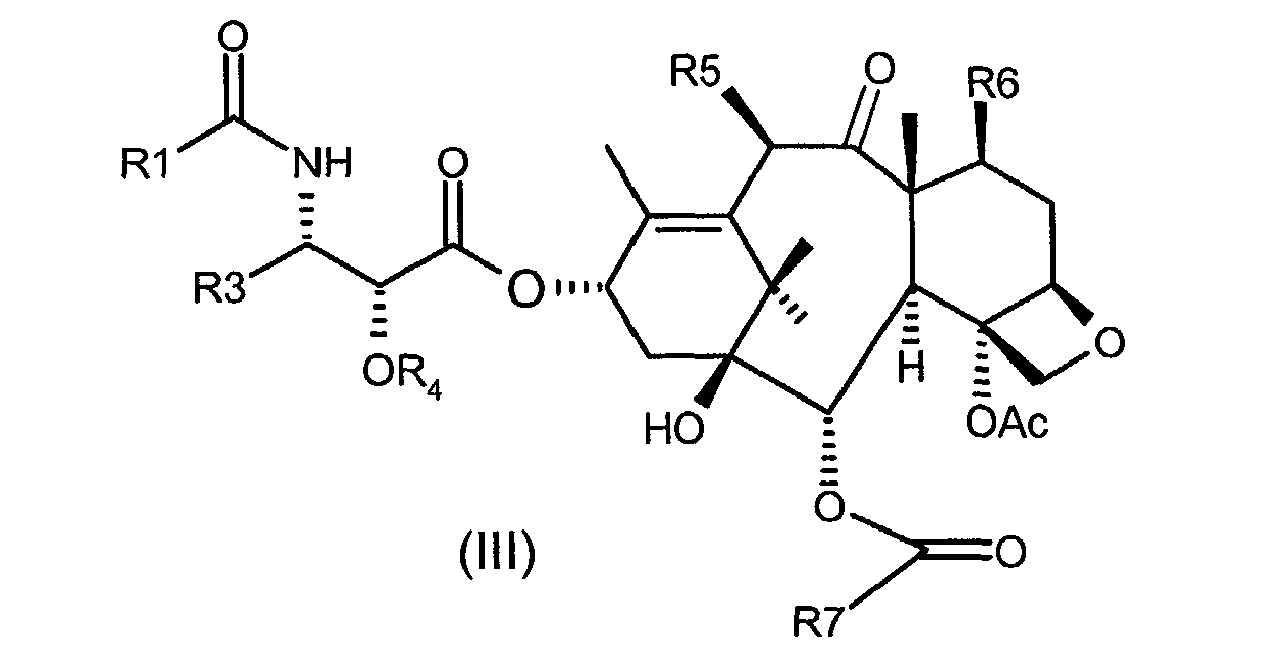


forms a carbamate of the formula -OCOX, wherein X is a nitrogen-containing heterocycle such as unsubstituted or substituted piperidino, morpholino, piperazino, N-methylpiperazino, or a carbamate of the formula -OCONR 10 R 11 , wherein R 10 and R 11 are the same or different and are H, linear, branched, or cyclic alkyl having from 1 to 10 atoms, alkenyl having from 2 to 10 carbon atoms, alkynyl having from 3 to 10 carbon atoms, cycloalkyl or cycloalkenyl having from 3 to 10 carbon atoms, optionally substituted aryl, or optionally substituted heterocyclyl.
Priority Applications (14)
| Application Number | Priority Date | Filing Date | Title |
|---|---|---|---|
| EP04292899A EP1688415A1 (en) | 2004-12-07 | 2004-12-07 | Cytotoxic agents comprising new C-2 modified taxanes |
| PE2005001368A PE20061063A1 (en) | 2004-12-07 | 2005-11-24 | DERIVATIVES OF TAXANS AS CYTOTOXIC AGENTS |
| DO2005P000243A DOP2005000243A (en) | 2004-12-07 | 2005-11-28 | CYTOTOXIC AGENTS UNDERSTANDING NEW TAXAN MODIFIED IN C-2. |
| PA20058654201A PA8654201A1 (en) | 2004-12-07 | 2005-12-01 | CYTOTOXIC AGENTS UNDERSTANDING NEW TAXANS MODIFIED IN C-2 |
| CA002614574A CA2614574A1 (en) | 2004-12-07 | 2005-12-02 | Cytotoxic agents comprising new c-2 modified taxanes |
| EP05843727A EP1819687A2 (en) | 2004-12-07 | 2005-12-02 | Cytotoxic agents comprising new c-2 modified taxanes |
| PCT/EP2005/014178 WO2006061259A2 (en) | 2004-12-07 | 2005-12-02 | Cytotoxic agents comprising new c-2 modified taxanes |
| AU2005313445A AU2005313445A1 (en) | 2004-12-07 | 2005-12-02 | Cytotoxic agents comprising new C-2 modified taxanes |
| JP2007544850A JP2008523020A (en) | 2004-12-07 | 2005-12-02 | Cytotoxic substances including novel C-2 modified taxanes |
| ARP050105075A AR051785A1 (en) | 2004-12-07 | 2005-12-05 | CYTOTOXIC AGENTS UNDERSTANDING NEW TAXANS MODIFIED IN C-2 |
| TW094142850A TW200640893A (en) | 2004-12-07 | 2005-12-06 | Cytotoxic agents comprising new C-2 modified taxanes |
| PA20058654601A PA8654601A1 (en) | 2004-12-07 | 2005-12-06 | CYTOTOXIC AGENTS UNDERSTANDING NEW TAXANS |
| UY29250A UY29250A1 (en) | 2004-12-07 | 2005-12-07 | CYTOTOXIC AGENTS UNDERSTANDING NEW TAXANES MODIFIED IN C-2.- |
| US11/679,347 US7598290B2 (en) | 2004-12-07 | 2007-02-27 | Cytotoxic agents comprising new C-2 modified taxanes |
Applications Claiming Priority (1)
| Application Number | Priority Date | Filing Date | Title |
|---|---|---|---|
| EP04292899A EP1688415A1 (en) | 2004-12-07 | 2004-12-07 | Cytotoxic agents comprising new C-2 modified taxanes |
Publications (1)
| Publication Number | Publication Date |
|---|---|
| EP1688415A1 true EP1688415A1 (en) | 2006-08-09 |
Family
ID=34931584
Family Applications (2)
| Application Number | Title | Priority Date | Filing Date |
|---|---|---|---|
| EP04292899A Withdrawn EP1688415A1 (en) | 2004-12-07 | 2004-12-07 | Cytotoxic agents comprising new C-2 modified taxanes |
| EP05843727A Withdrawn EP1819687A2 (en) | 2004-12-07 | 2005-12-02 | Cytotoxic agents comprising new c-2 modified taxanes |
Family Applications After (1)
| Application Number | Title | Priority Date | Filing Date |
|---|---|---|---|
| EP05843727A Withdrawn EP1819687A2 (en) | 2004-12-07 | 2005-12-02 | Cytotoxic agents comprising new c-2 modified taxanes |
Country Status (12)
| Country | Link |
|---|---|
| US (1) | US7598290B2 (en) |
| EP (2) | EP1688415A1 (en) |
| JP (1) | JP2008523020A (en) |
| AR (1) | AR051785A1 (en) |
| AU (1) | AU2005313445A1 (en) |
| CA (1) | CA2614574A1 (en) |
| DO (1) | DOP2005000243A (en) |
| PA (2) | PA8654201A1 (en) |
| PE (1) | PE20061063A1 (en) |
| TW (1) | TW200640893A (en) |
| UY (1) | UY29250A1 (en) |
| WO (1) | WO2006061259A2 (en) |
Families Citing this family (15)
| Publication number | Priority date | Publication date | Assignee | Title |
|---|---|---|---|---|
| US20100056762A1 (en) | 2001-05-11 | 2010-03-04 | Old Lloyd J | Specific binding proteins and uses thereof |
| AU2002311919B8 (en) | 2001-05-11 | 2007-03-22 | Ludwig Institute For Cancer Research Ltd | Specific binding proteins and uses thereof |
| EP1888121A2 (en) * | 2005-05-12 | 2008-02-20 | Tapestry Pharmaceuticals, Inc. | Anticancer targeted conjugates comprising a succinyl or glutaryl linker |
| US9090693B2 (en) | 2007-01-25 | 2015-07-28 | Dana-Farber Cancer Institute | Use of anti-EGFR antibodies in treatment of EGFR mutant mediated disease |
| CA2680854C (en) | 2007-03-15 | 2017-02-14 | Ludwig Institute For Cancer Research | Treatment method using egfr antibodies and src inhibitors and related formulations |
| CN108424454B (en) | 2007-08-14 | 2022-05-31 | 路德维格癌症研究所有限公司 | Monoclonal antibody 175 targeting EGF receptor, and derivatives and uses thereof |
| KR20130009760A (en) | 2010-02-10 | 2013-01-23 | 이뮤노젠 아이엔씨 | Cd20 antibodies and uses thereof |
| LT3153504T (en) | 2010-12-09 | 2019-02-11 | Immunogen, Inc. | Methods for the preparation of charged crosslinkers |
| CA2891280C (en) | 2012-11-24 | 2018-03-20 | Hangzhou Dac Biotech Co., Ltd. | Hydrophilic linkers and their uses for conjugation of drugs to cell binding molecules |
| US10464955B2 (en) | 2014-02-28 | 2019-11-05 | Hangzhou Dac Biotech Co., Ltd. | Charged linkers and their uses for conjugation |
| NZ739830A (en) | 2015-07-12 | 2021-12-24 | Hangzhou Dac Biotech Co Ltd | Bridge linkers for conjugation of cell-binding molecules |
| US9839687B2 (en) | 2015-07-15 | 2017-12-12 | Suzhou M-Conj Biotech Co., Ltd. | Acetylenedicarboxyl linkers and their uses in specific conjugation of a cell-binding molecule |
| KR20220150408A (en) | 2016-11-14 | 2022-11-10 | 항저우 디에이씨 바이오테크 씨오, 엘티디 | Conjugation linkers, cell binding molecule-drug conjugates containing the likers, methods of making and uses such conjugates with the linkers |
| WO2022010797A2 (en) | 2020-07-07 | 2022-01-13 | Bionecure Therapeutics, Inc. | Novel maytansinoids as adc payloads and their use for the treatment of cancer |
| EP4426727A2 (en) | 2021-11-03 | 2024-09-11 | Hangzhou Dac Biotech Co., Ltd. | Specific conjugation of an antibody |
Citations (4)
| Publication number | Priority date | Publication date | Assignee | Title |
|---|---|---|---|---|
| EP0617034A1 (en) * | 1993-03-11 | 1994-09-28 | Virginia Tech Intellectual Properties, Inc. | 2-Debenzoyl-2-acyl taxol derivatives and methods for making same |
| WO2001038318A1 (en) * | 1999-11-24 | 2001-05-31 | Immunogen, Inc. | Cytotoxic agents comprising taxanes and their therapeutic use |
| WO2003097625A1 (en) * | 2002-05-14 | 2003-11-27 | Immunogen, Inc. | Cytotoxic agents comprising polyethylene glycol-containing taxanes and their therapeutic use |
| WO2004013093A2 (en) * | 2002-08-02 | 2004-02-12 | Immunogen, Inc. | Cytotoxic agents containing novel potent taxanes and their therapeutic use |
Family Cites Families (2)
| Publication number | Priority date | Publication date | Assignee | Title |
|---|---|---|---|---|
| IT1317731B1 (en) * | 2000-01-18 | 2003-07-15 | Indena Spa | SEMISYNTHETIC TASSANI WITH ANTI-TUMOR AND ANTIANGIOGENETIC ACTIVITY. |
| CN1942459A (en) * | 2004-05-14 | 2007-04-04 | 免疫基因公司 | Facile method for synthesizing baccatin III compounds |
-
2004
- 2004-12-07 EP EP04292899A patent/EP1688415A1/en not_active Withdrawn
-
2005
- 2005-11-24 PE PE2005001368A patent/PE20061063A1/en not_active Application Discontinuation
- 2005-11-28 DO DO2005P000243A patent/DOP2005000243A/en unknown
- 2005-12-01 PA PA20058654201A patent/PA8654201A1/en unknown
- 2005-12-02 EP EP05843727A patent/EP1819687A2/en not_active Withdrawn
- 2005-12-02 CA CA002614574A patent/CA2614574A1/en not_active Abandoned
- 2005-12-02 JP JP2007544850A patent/JP2008523020A/en not_active Withdrawn
- 2005-12-02 WO PCT/EP2005/014178 patent/WO2006061259A2/en not_active Ceased
- 2005-12-02 AU AU2005313445A patent/AU2005313445A1/en not_active Abandoned
- 2005-12-05 AR ARP050105075A patent/AR051785A1/en unknown
- 2005-12-06 TW TW094142850A patent/TW200640893A/en unknown
- 2005-12-06 PA PA20058654601A patent/PA8654601A1/en unknown
- 2005-12-07 UY UY29250A patent/UY29250A1/en unknown
-
2007
- 2007-02-27 US US11/679,347 patent/US7598290B2/en not_active Expired - Fee Related
Patent Citations (4)
| Publication number | Priority date | Publication date | Assignee | Title |
|---|---|---|---|---|
| EP0617034A1 (en) * | 1993-03-11 | 1994-09-28 | Virginia Tech Intellectual Properties, Inc. | 2-Debenzoyl-2-acyl taxol derivatives and methods for making same |
| WO2001038318A1 (en) * | 1999-11-24 | 2001-05-31 | Immunogen, Inc. | Cytotoxic agents comprising taxanes and their therapeutic use |
| WO2003097625A1 (en) * | 2002-05-14 | 2003-11-27 | Immunogen, Inc. | Cytotoxic agents comprising polyethylene glycol-containing taxanes and their therapeutic use |
| WO2004013093A2 (en) * | 2002-08-02 | 2004-02-12 | Immunogen, Inc. | Cytotoxic agents containing novel potent taxanes and their therapeutic use |
Non-Patent Citations (5)
| Title |
|---|
| KIM ET AL.: "C-2 modified taxol...", BULL. KOREAN CHEM. SOC., vol. 20, no. 12, 1999, pages 1389 - 1390, XP002331655 * |
| MILLER MICHAEL L ET AL: "Synthesis of potent taxoids for tumor-specific delivery using monoclonal antibodies", BIOORGANIC & MEDICINAL CHEMISTRY LETTERS, vol. 14, no. 15, 2 August 2004 (2004-08-02), pages 4079 - 4082, XP002331657, ISSN: 0960-894X * |
| MILLER MICHAEL L ET AL: "Synthesis of taxoids with improved cytotoxicity and solubility for use in tumor-specific delivery", JOURNAL OF MEDICINAL CHEMISTRY, vol. 47, no. 20, 23 September 2004 (2004-09-23), pages 4802 - 4805, XP002331658, ISSN: 0022-2623 * |
| NICOLAOU K C ET AL: "CHEMICAL SYNTHESIS AND BIOLOGICAL EVALUATION OF C-2 TAXOIDS", JOURNAL OF THE AMERICAN CHEMICAL SOCIETY, AMERICAN CHEMICAL SOCIETY, WASHINGTON, DC, US, vol. 117, no. 9, 1995, pages 2409 - 2420, XP000882769, ISSN: 0002-7863 * |
| OJIMA IWAO ET AL: "Tumor-specific novel taxoid-monoclonal antibody conjugates.", JOURNAL OF MEDICINAL CHEMISTRY, vol. 45, no. 26, 19 December 2002 (2002-12-19), pages 5620 - 5623, XP002331656, ISSN: 0022-2623 * |
Also Published As
| Publication number | Publication date |
|---|---|
| EP1819687A2 (en) | 2007-08-22 |
| PA8654201A1 (en) | 2006-07-03 |
| TW200640893A (en) | 2006-12-01 |
| UY29250A1 (en) | 2006-06-30 |
| PA8654601A1 (en) | 2006-09-08 |
| AU2005313445A1 (en) | 2006-06-15 |
| WO2006061259A3 (en) | 2007-01-11 |
| DOP2005000243A (en) | 2006-11-30 |
| US7598290B2 (en) | 2009-10-06 |
| PE20061063A1 (en) | 2006-11-06 |
| CA2614574A1 (en) | 2006-06-15 |
| JP2008523020A (en) | 2008-07-03 |
| AR051785A1 (en) | 2007-02-07 |
| WO2006061259A2 (en) | 2006-06-15 |
| US20070270482A1 (en) | 2007-11-22 |
Similar Documents
| Publication | Publication Date | Title |
|---|---|---|
| US7414073B2 (en) | Cytotoxic agents containing novel potent taxanes and their therapeutic use | |
| AP785A (en) | Novel taxoids, preparation thereof and pharmaceutical compositions containing same. | |
| US7598290B2 (en) | Cytotoxic agents comprising new C-2 modified taxanes | |
| AU2003210731B2 (en) | Cytotoxic agents comprising polyethylene glycol-containing taxanes and their therapeutic use | |
| US7390898B2 (en) | Cytotoxic agents containing novel potent taxanes and their therapeutic use | |
| EP1669358A1 (en) | Cytotoxic agents comprising new taxanes | |
| PL189311B1 (en) | Novel taxoids, method of obtaining them and pharmaceutic compositions containing such compounds | |
| AU715228B2 (en) | Taxoids, preparation thereof and pharmaceutical compositions containing same | |
| HK1116770A (en) | Cytotoxic agents comprising new taxanes |
Legal Events
| Date | Code | Title | Description |
|---|---|---|---|
| PUAI | Public reference made under article 153(3) epc to a published international application that has entered the european phase |
Free format text: ORIGINAL CODE: 0009012 |
|
| AK | Designated contracting states |
Kind code of ref document: A1 Designated state(s): AT BE BG CH CY CZ DE DK EE ES FI FR GB GR HU IE IS IT LI LT LU MC NL PL PT RO SE SI SK TR |
|
| AX | Request for extension of the european patent |
Extension state: AL BA HR LV MK YU |
|
| AKX | Designation fees paid |
Designated state(s): FR |
|
| REG | Reference to a national code |
Ref country code: DE Ref legal event code: 8566 |
|
| STAA | Information on the status of an ep patent application or granted ep patent |
Free format text: STATUS: THE APPLICATION IS DEEMED TO BE WITHDRAWN |
|
| 18D | Application deemed to be withdrawn |
Effective date: 20070210 |