EP1686815A1 - Registration and deregistration of a cordless terminal in a cordless extension phone system - Google Patents
Registration and deregistration of a cordless terminal in a cordless extension phone system Download PDFInfo
- Publication number
- EP1686815A1 EP1686815A1 EP06250448A EP06250448A EP1686815A1 EP 1686815 A1 EP1686815 A1 EP 1686815A1 EP 06250448 A EP06250448 A EP 06250448A EP 06250448 A EP06250448 A EP 06250448A EP 1686815 A1 EP1686815 A1 EP 1686815A1
- Authority
- EP
- European Patent Office
- Prior art keywords
- registration
- registration number
- unit
- main device
- additional device
- Prior art date
- Legal status (The legal status is an assumption and is not a legal conclusion. Google has not performed a legal analysis and makes no representation as to the accuracy of the status listed.)
- Granted
Links
- 238000004891 communication Methods 0.000 claims abstract description 34
- 238000012217 deletion Methods 0.000 claims description 10
- 230000037430 deletion Effects 0.000 claims description 10
- 238000001514 detection method Methods 0.000 claims description 3
- 238000000034 method Methods 0.000 description 62
- 238000012545 processing Methods 0.000 description 42
- 238000012790 confirmation Methods 0.000 description 16
- 238000010586 diagram Methods 0.000 description 4
- 230000007704 transition Effects 0.000 description 4
- 239000004973 liquid crystal related substance Substances 0.000 description 2
- 239000003086 colorant Substances 0.000 description 1
Images




Classifications
-
- H—ELECTRICITY
- H04—ELECTRIC COMMUNICATION TECHNIQUE
- H04M—TELEPHONIC COMMUNICATION
- H04M1/00—Substation equipment, e.g. for use by subscribers
- H04M1/72—Mobile telephones; Cordless telephones, i.e. devices for establishing wireless links to base stations without route selection
- H04M1/725—Cordless telephones
- H04M1/72502—Cordless telephones with one base station connected to a single line
-
- H—ELECTRICITY
- H04—ELECTRIC COMMUNICATION TECHNIQUE
- H04M—TELEPHONIC COMMUNICATION
- H04M1/00—Substation equipment, e.g. for use by subscribers
- H04M1/72—Mobile telephones; Cordless telephones, i.e. devices for establishing wireless links to base stations without route selection
- H04M1/725—Cordless telephones
- H04M1/727—Identification code transfer arrangements
-
- H—ELECTRICITY
- H04—ELECTRIC COMMUNICATION TECHNIQUE
- H04W—WIRELESS COMMUNICATION NETWORKS
- H04W84/00—Network topologies
- H04W84/02—Hierarchically pre-organised networks, e.g. paging networks, cellular networks, WLAN [Wireless Local Area Network] or WLL [Wireless Local Loop]
- H04W84/10—Small scale networks; Flat hierarchical networks
- H04W84/16—WPBX [Wireless Private Branch Exchange]
Definitions
- aspects of the present invention relate to a communication apparatus including a main device and a mobile device that can be connected to the main device
- a cordless extension telephone system has been available as a representative of communication apparatus made up of a main device and a mobile device.
- the cordless extension telephone system includes the main device connected to a public telephone line and the mobile device for enabling the user to hold a telephone conversation like the main device as the mobile device is connected to the main device wirelessly.
- To add a new mobile device predetermined entry operation is performed for the main device and the mobile device to be added, whereby the added mobile device can be newly registered in the main device. (For example, refer to JP-A-1-218223, etc.)
- the main device transmits a registration command to the mobile device.
- the mobile device receiving the registration command enters an entry wait state for accepting entry of the registration number from the user.
- the mobile device stores the registration number as the registration number of the mobile device.
- the registration number is stored as the registration number of the mobile device. The mobile device is thus added.
- the method in the related art as described above requires that the user should directly enter the registration number of the mobile device and thus to register the mobile device, various entry mistakes such that the user enters an already used registration number or a totally unrelated number that cannot be used as a registration number occur. If such an entry mistake occurs, it takes time that the user completes the mobile device registration operation.
- aspects of the invention provide a communication apparatus for making it possible to prevent an entry mistake from occurring and enabling the user to reliably and easily register an additional device and cancel registration of the registered additional device.
- a communication apparatus including: a main device that has: a selection unit that selects one registration number according to a specific rule from among provided registration numbers to be assigned to an additional device; a main device registration unit that transmits the registration number selected by the selection unit to the additional device and stores information to the effect that the selected registration number is used as the registration number of the additional device in a main device storage section included in the main device; a display unit that displays information; and a display control unit that causes the display unit to display information indicating which of the registration numbers is used as the registration number of the additional device based on the information stored in the main device storage section; and the additional device capable of communicating with the main device wirelessly.
- the main device automatically selects the registration number to be assigned to the additional device and sets the registration number as the registration number of the additional device.
- the main device displays information indicating which of the registration numbers is used on the display unit.
- the user can easily keep track of the use state of the registration numbers, in other words, the registration state of the additional devices; the ease of use is provided for the user.
- a communication apparatus including: a main device a main device that has: a main device storage section that stores information to the effect that one of provided registration numbers to be assigned to an additional device is used as the registration number of a additional device; a selection unit that selects one registration number stored in the main device storage section according to a specific rule from among already used registration numbers corresponding to the information to the effect that the registration number is used as the registration number of the additional device; and a deletion unit that deletes information to the effect that the registration number selected by the selection unit is used as the registration number of the additional device from the main device storage section; and the additional device capable of communicating with the main device wirelessly.
- the main device to cancel registration of the additional device, automatically selects one of the already used registration numbers assigned to the already registered additional devices.
- an entry mistake such that the user enters an unused registration number or enters a totally unrelated number which is not any registration number can be prevented from occurring.
- the user can be saved from having to select the registration number (already used registration number) and thus can easily cancel registration of the additional device.
- a communication apparatus including: a main device that has: a display unit that displays information; a display control unit that causes the display unit to list a plurality of provided registration numbers to be assigned to an additional device; a selection unit that selects one registration number out of a registration number list displayed on the display unit; and a main device registration unit that transmits the registration number selected by the selection unit to the additional device and stores information to the effect that the registration number is used as the registration number of the additional device in a main device storage section included in the main device; and the additional device capable of communicating with the main device wirelessly.
- the main device lists the registration numbers of candidates for the registration number of the additional device on the display unit in registering the additional device and selects the registration number to be used based on entry of the user out of the registration number list.
- an entry mistake such that the user enters a totally unrelated number that cannot be used as the registration number can be prevented from occurring.
- the user can also select his or her favorite number, so that the ease of use is provided for the user.
- a communication apparatus including: a main device that has: a main device storage section that stores information to the effect that one of provided registration numbers to be assigned to an additional device is used as the registration number of the additional device; a display unit that displays information; a display control unit that causes the display unit to display information indicating which of the registration numbers is used as the registration number of the additional device based on the information stored in the main device storage section; a selection unit that selects one registration number used as the registration number of the additional device from among the registration numbers; and a deletion unit that deletes information to the effect that the registration number selected by the selection unit is used as the registration number of the additional device from the main device storage section; and the additional device capable of being connected to the main device wirelessly.
- the main device selects the registration number to be canceled from among the already used registration numbers based on entry of the user.
- an entry mistake such that the user enters an unused registration number can be prevented from occurring.
- the user can also select his or her favorite number, so that the ease of use is provided for the user.
- FIG. 1 is a perspective view showing the appearance of a cordless extension telephone system 1
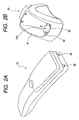
- FIG. 2A is a perspective view showing the rear of a mobile device 50
- FIG. 2B is a perspective view of a charging stand.
- the cordless extension telephone system 1 is made up of a main device 10 connected to a telephone line 100 (see FIG. 3), the mobile device 50 for communicating with the mobile device 10 over a wireless channel, and a charging stand 80 being connected to an external AC power supply (see FIG. 4) for charging the mobile device 50 placed detachably on the charging stand at a predetermined voltage, as shown in FIG. 1.
- a handset 12 used in a state in which it is detached from the main device 10 main body is attached to a side of a main device main body case 11 of the main device 10. Further,' installed on the top of the main device main body case 11 are a display panel 13 as a display unit for displaying various pieces of information and various operation buttons such as dial buttons 14a for entering the telephone number of a called party, a playback button 14b operated to play back a message recorded on the answering machine, etc., an erasion button 14c operated to erase the message recorded on the answering machine, the entered telephone number, etc., a stop button 14d operated to cancel operation, a selection button 14e operated to make a selection on a menu screen, etc., displayed on the display panel 13, and a confirmation button 14f operated to confirm the entered telephone number, etc.
- dial buttons 14a for entering the telephone number of a called party
- a playback button 14b operated to play back a message recorded on the answering machine, etc.
- an erasion button 14c operated to erase the message recorded on
- the display panel 13 is a liquid crystal display (LCD) with a backlight for illuminating the display screen from the rear.
- LCD liquid crystal display
- the mobile device 50 is provided with a display panel 53 for displaying various pieces of information, various operation buttons such as dial buttons 54a for entering the telephone number of a called party, an outside line conversation button 54b operated to start an outside line conversation, a stop button 54c operated to terminate conversation and cancel operation, and a selection button 54d operated to make a selection on a menu screen, etc., displayed on the display panel 53, and charging terminals 55 (see FIG. 2A) for charging a battery 67 (see FIG. 4) for supplying power to the whole mobile device 50 from the charging stand 80 on the surface of a mobile device main body case 51 shaped like a handset.
- various operation buttons such as dial buttons 54a for entering the telephone number of a called party, an outside line conversation button 54b operated to start an outside line conversation, a stop button 54c operated to terminate conversation and cancel operation, and a selection button 54d operated to make a selection on a menu screen, etc.
- charging terminals 55 for charging a battery 67 (see FIG. 4) for supplying power to the
- the display panel 53 is a liquid crystal display (LCD) with a backlight for illuminating the display screen from the rear.
- LCD liquid crystal display
- the charging stand 80 is made up of a charging stand main body 81 formed with a placement recess 81a for detachably placing the mobile device 50 and charging terminals 82 which are provided in the placement recess 81a and come in contact with the charging terminals 55 of the mobile device 50 when the mobile device 50 is placed in the placement recess 81a, as shown in FIG. 2B.
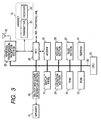
- FIG. 3 is a block diagram showing the configuration of the main device 10.
- the main device 10 includes a CPU 31 for operating in accordance with various programs, ROM 32 previously storing programs and fixed data for causing the CPU 31 to perform various types of processing, RAM 33 for temporarily storing the operation result of the CPU 31, EEPROM 34 as a main device storage section for rewritably storing various pieces of data, a MODEM 35 for connecting the main device 10 to the telephone line 100, an NCU 36 for inputting/outputting a voice signal transmitted between the telephone line 100 and the MODEM 35, a wireless transmission-reception section 25 being connected to an antenna 15 for transmitting and receiving various signals including the voice signal to and from the mobile device 50 by conducting wireless communications, a melody and sound generation section 26 being connected to a speaker 16 for outputting a sound from the speaker 16, the above-mentioned display panel 13, an operation section 24 made up of the various operation buttons 14 (a, b, c, d, e, f), etc., a read section 27 for reading image data, etc., a record section 28 for recording the
- the handset 12 made up of a transmitter 21 and a receiver 22 for holding a conversation is connected to the wireless transmission-reception section 25 and the NCU 36.
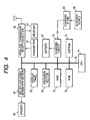
- FIG. 4 is a block diagram showing the configuration of the mobile device 50.
- the mobile device 50 includes a CPU 71 for operating in accordance with various programs, ROM 72 previously storing programs and fixed data for causing the CPU 31 to perform various types of processing, RAM 73 for temporarily storing the operation result of the CPU 71, EEPROM 74 as a mobile device storage section for rewritably storing various pieces of data, a charging circuit 75 being connected to a battery 67 for charging the battery 67, a wireless transmission-reception section 65 being connected to an antenna for transmitting and receiving various signals including the voice signal to and from the main device 10 by conducting wireless communications, a melody and sound generation section 66 being connected to a speaker 56 for outputting a sound from the speaker 56, the above-mentioned display panel 53, an operation section 64 made up of the various operation buttons 54 (a, b, c, d), etc., and a system bus 70 for connecting the components.
- a CPU 71 for operating in accordance with various programs
- ROM 72 previously storing programs and fixed data for causing the CPU 31 to perform various types
- a transmitter 61 and a receiver 62 for holding a conversation are connected to the wireless transmission-reception section 65.
- An external AC power supply 90 can be connected to the charging circuit 75 through the charging stand 80.
- the main device 10 can hold an outside line conversation with an external associated communication terminal over the telephone line 100 and can also hold an extension conversation with the mobile device 50.
- the user can register the mobile device 50 in the main device 10 (namely, make it possible to have an extension conversation therebetween) or cancel registration of the mobile device 50 by performing predetermined entry operation in the main device 10 and the mobile device 50. Processing executed in the main device 10 and the mobile device 50 in the registration or the registration cancel will be described below in detail.
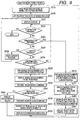
- FIG. 5 is a flowchart showing registration and registration cancel processing of the mobile device 50 executed by the CPU 31 of the main device 10 (which-will be hereinafter referred to as addition processing).
- the main device 10 In the usual state, the main device 10 is in a standby state for accepting entry of the telephone number of a called party, etc.
- the addition processing is started.
- the standby state information of the date, the day of the week, the time, etc., is displayed on the display panel 13 as illustrated in FIG. 6 (a).
- the registration state of the mobile device 50 in the main device 10 in other words, which of the registration numbers used in registering the mobile device 50 (in the aspect, an integer of 1 to 4) is assigned to, namely, used for the mobile device 50 is read from the EEPROM 34.
- the number of mobile devices 50 registered in the main device 10 at present, L is calculated based on information concerning the registration state of the mobile device 50 read from the EEPROM 34.
- the calculation result is once stored in the RAM 33.
- the registration state of the mobile device 50 is listed on the display panel 13 as illustrated in FIG. 6 (b1) or (b2). That is, on the display panel 13, the mode name representing the current operation mode, "mobile device addition mode,” is displayed and a list of the already used registration numbers corresponding to the already registered mobile devices 50 is displayed below the “mobile device addition mode.”
- the number of the registeredmobile devices 50, L is 1 (only registration number 1 is already used as the registration number) and "registered mobile device" of item name is displayed with “1" on the side thereof.
- the number of the registered mobile devices 50, L is 2 (registration numbers 1 and 2 are already used as the registration numbers) and "registered mobile device" of item name is displayed with "1" and "2" on the side thereof.
- An unused registration number is displayed simply as a horizontal line rather than the registration number, thereby enabling the user to recognize that an additional mobile device 50 can be registered.
- the process goes to S121 and whether or not the user presses the stop button 14d for canceling the operation is determined.
- the addition processing is terminated.
- the process goes to S122 and whether or not the user presses the erasion button 14c for making a transition to a registration cancel flow of the mobile device 50 is determined.
- the process goes to S123.
- the number of the already registered mobile devices 50, L, calculated at S111 plus one, namely, the minimum one of the unused registration numbers is calculated as the registration number to be assigned to the newly registered mobile device 50 (also called registration mobile device number) M.
- the process goes to S131 and the registration number M is displayed on the display panel 13 as illustrated in FIG. 6 (c).
- the process goes to S132 and whether or not the user presses the stop button 14d is determined.
- the process returns to S120.
- the process goes to S133 and whether or not the user presses the confirmation button 14f for confirming the registration of the mobile device 50 is determined.
- the process returns to S132.
- the process goes to S140.
- a registration command to store the registration number is transmitted to the mobile device 50.
- Information. representing the registration number M calculated at S130 is added to the registration command.
- the process goes to S141 and whether or not a response command is received is determined.
- the response command is a command transmitted from the mobile device 50 in response to the registration command at S940 in FIG. 7 described later.
- the process goes to S160 and a message to the effect that the registration ends in failure is displayed on the display panel 13 as illustrated in FIG. 6 (e). Then, the process returns to S110.
- the process goes to S150.
- an acknowledge command representing reception of the response command is transmitted to the mobile device 50.
- the process goes to S151 and the registration number newly assigned to the mobile device 50 is stored in the EEPROM 34 as the registration number of the mobile device 50.
- a registration completion message with the registration number is displayed on the display panel 13 as illustrated in FIG. 6 (d). Then, the process returns to S110.
- the process goes to S170 and the number representing the number of the already registeredmobile devices 50, L, calculated at S111, namely, the maximum one of the already used registration numbers is calculated as registration number N to be canceled. In other words, the registration of the mobile device with the maximum registration number among the already registered mobile devices 50 is canceled. Then, the process goes to S171 and the registration number is displayed on the display panel 13 as illustrated in FIG. 6 (f) .
- the registration number corresponding to the mobile device 50 whose registration is cancelled is stored in the EEPROM 34 as an unused registration number.
- a registration cancel completion message with the registration number is displayed on the display panel 13 as illustrated in FIG. 6 (g). Then, the process returns to S110.
- FIG. 7 is a flowchart showing the addition processing executed by the CPU 71 of the mobile device 50.
- the mobile device 50 In the usual state, the mobile device 50 is in a standby state for accepting entry of the telephone number of a called party, etc.
- the addition processing is started.
- the standby state information of the registration number, the day of the week, the time, a message indicating charging, etc., of the mobile device 50 is displayed on the display panel 53 as illustrated in FIG. 8 (a).
- This registration command is a command transmitted from the main device 10 at S140 in FIG. 5 described above and instructs the mobile device 50 to store the registration number specified by the registration command as the registration number of the mobile device 50.
- the process goes to S913 and whether or not a predetermined time has elapsed since the mobile device 50 was set to the addition mode as described above is determined.
- the addition processing is terminated.
- the process returns to S911.
- the process goes to S920 and a number entry guide for requesting the user to enter the registration number of the mobile device 50 is displayed on the display panel 53 as illustrated in FIG. 8 (c). That is, the message to the effect that the operation mode is the addition mode and a message for encouraging the user to enter the registration number (the registration number specified by the registration command) are displayed.
- the process goes to S921 and whether or not the user presses the dial button 54a, namely, whether or not the user enters a number is determined.
- the process goes to S922 and whether or not a predetermined time has elapsed is determined.
- the addition processing is terminated.
- the process returns to S921.
- This acknowledge command is a command transmitted from the main device 10 at S150 in FIG. 5 described above.
- the process goes to S942 and whether or not a predetermined time has elapsed is determined.
- the addition processing is terminated.
- the process returns to S941.
- the process goes to S950 and the registration number transmitted from the main device 10 is stored in the EEPROM 74 as the registration number of the mobile device 50. That is, the mobile device 50 is registered for the main device 10.
- S120 functions as a display control unit; S130 functions as a selection unit; S131 functions as a notification unit; S132 and S133 function as a determination unit; S151 functions as a main device registration unit; S170 functions as a selection unit; S171 functions as a notification unit; S172 and S173 function as a determination unit; and S180 functions as a deletion unit.
- S950 functions as an additional device registration unit.
- the main device 10 to register the mobile device 50, the main device 10 automatically selects the minimum one of the unused registration numbers as the registration number assigned to the mobile device 50. To cancel registration of the mobile device 50, the main device 10 automatically selects the mobile device 50 with the maximum registration number among the already registered mobile devices 50 as the mobile device whose registration is to be canceled (in other words, automatically selects the maximum from among the registration numbers).
- the main device 10 determines whether or not to adopt the registration number automatically selected by the main device 10 as described above based on user's selection.
- the user can also cancel the number selected by the main device 10; the ease of use is provided for the user.
- the user needs only to specify whether or not to adopt the registration number selected by the main device 10 and need not select the registration number, so that the user can easily register the mobile device 50 or cancel registration thereof.
- the main device 10 lists the use state of the registration numbers, in other words, the registration state of the mobile devices 50 on the display panel 13.
- the ease of use is provided for the user in an easy-to-understand manner.
- the cordless extension telephone system 1 of the second aspect has the same hardware configuration as that of the first aspect and parts identical with those previously described in the first aspect are denoted by the same reference numerals in the second aspect.
- Addition processing executed by a CPU of a mobile device 50 is also the same as that in the first aspect (similar comments apply to a third aspect).
- a CPU 31 of a main device 10 executes addition processing in FIG. 9 in place of the addition processing in FIG. 5.
- the addition processing will be described below according to a flowchart of FIG. 9.
- the main device 10 In the usual state, the main device 10 is in a standby state for accepting entry of the telephone number of a called party, etc., (see FIG. 6 (a)).
- the user sets the main device 10 to an addition mode by operating a mode switching button of the various buttons described above, the addition processing is started.
- the registration state of the mobile device 50 in the main device 10 in other words, which of the registration numbers used in registering the mobile device 50 is assigned to, namely, used for the mobile device 50 is read from EEPROM 34.
- the process goes to S220 and the registration state of the mobile device 50, in other words, which registration numbers are used is displayed on a display panel 13 as illustrated in FIG. 10.
- the process goes to S221 and a cursor for the user to select the registration number to be used is displayed on the display panel 13 as in FIG. 10.
- An unused registration number is displayed simply as a horizontal line, thereby enabling the user to recognize that-an additional mobile device 50 can be registered.
- the mode name representing the current operation mode "mobile device addition mode, "is displayed and "registered mobile device” of item name is displayed below the “mobile device addition mode.”
- the already used registration number and horizontal lines corresponding to unused registration numbers are displayed on the side of the item name and further a horizontal line as a cursor is displayed below the already used registration number.
- the user can move the cursor in a lateral direction between the registration numbers represented by the digit and horizontal line by operating a selection button 14e. For example, when the user presses the selection button 14e representing a right-direction arrow, the cursor moves one position to the right; when the user presses the selection button 14e representing a left-direction arrow, the cursor moves one position to the left.
- the process goes to S225 and whether or not the user presses a confirmation button 14f for confirming use of the registration number specified by the cursor described above as the registration number of the mobile device 50 is determined.
- the process returns to S221.
- the process goes to S230.
- the registration number is calculated based on the position of the cursor, in other words, user's operation at S224 and S225.
- the process goes to S231 and the registration number is displayed on the display panel 13 (see FIG. 6 (c)).
- a registration command for instructing the mobile device 50 to execute registration processing for the main device 10 is transmitted to the mobile device 50.
- the registration number calculated at S270 is stored in the EEPROM 34 as an unused registration number.
- a registration cancel completion message is displayed on the display panel 13 (see FIG. 6 (g)). Then, the process returns to S210.
- S220 and S252 function as a display control unit;
- S222 to S230 functions as a selection unit;
- S222 to S270 functions as a selection unit;
- S251 functions as a main device registration unit;
- S280 functions as a deletion unit.
- the main device 10 selects the registration number to be assigned to the mobile device 50 from among the registration numbers displayed on the display panel 13 based on the cursor operation of the user.
- the main device 10 selects the registration number corresponding to the mobile device 50 to be canceled from among the registration numbers displayed on the display panel 13 based on the cursor operation of the user.
- an entry mistake such that the user enters an already used registration number in registering the mobile device 50 or enters an unused registration number in canceling registration can be prevented from occurring.
- the user can also select his or her favorite number, so that the ease of use is provided for the user.
- the user To register the mobile device 50, the user enters the already used registration number (selects the already used registration number by cursor operation), whereby the user can easily replace the already used mobile device 50 with the mobile device to be newly registered for registration.
- the main device 10 lists the use state of the registration numbers, in other words, the registration state of the mobile devices 50 on the display panel 13.
- the ease of use is provided for the user in an easy-to-understand manner.
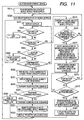
- a CPU 31 of a main device 10 executes addition processing in FIG. 11 in place of the addition processing in FIG. 9.
- Processing at S210 to S260 in FIG. 11 is the same as the processing at S210 to S260 in FIG. 9 and only the differences between the second and third aspects will be described below according to a flowchart of FIG. 11.
- the process goes to S375 and whether or not there is a mobile device 50 not responding to the communications is determined. When it is determined that there is no mobile device 50 not responding to the communications, the process returns to S220. On the other hand, when it is determined at S375 that there is a mobile device 50 not responding to the communications, the process goes to S370.
- registration of the mobile device 50 with the maximum registration number among the mobile devices 50 not responding to the communications is to be canceled. This means that registration of the maximum registration number of the registration numbers corresponding to the mobile devices 50 not responding to the communications is to be canceled.
- the registration number is displayed on a display panel 13 (see FIG. 6 (f)).
- the process goes to S372 and whether or not the user presses a stop button 14d for canceling the operation is determined.
- the process returns to S220.
- the process goes to S373.
- the registration number to be canceled is stored in EEPROM 34 as an unused registration number.
- a registration cancel completion message is displayed on the display panel 13 (see FIG. 6 (g)). Then, the process returns to S210.
- S374 and S375 function as a detection unit and S380 functions as a deletion unit.
- the main device 10 to cancel registration of the mobile device 50, the main device 10 detects the mobile device 50 that cannot communicate with the main device, and cancels registration of the detected mobile device 50.
- the possible reason why the mobile device 50 cannot communicate with the main device is that the mobile device 50 fails, etc.
- the cordless extension telephone system 1 of the aspect registration of the mobile device 50 that cannot communicate with the main device, namely, cannot be used can be easily canceled, so that the ease of use is provided for the user.
- digits and horizontal bars are displayed, enabling the user to distinguish the already used registration numbers from unused registration numbers; however, for example, all registration numbers may be displayed as digits in different colors, sizes, item names, etc., for enabling the user to distinguish the already used registration numbers from unused registration numbers.
- the main device 10 transmits the registration number to be used together with a registration command to the mobile device 50 and the registration number is entered in the mobile device 50 through the dial button 54a, etc., whereby the registration number is stored in the mobile device 50 as the registration number of the mobile device 50; however, entry through various operation buttons such as the dial button 54a is not limited to entry of the registration number and may be entry of any user-defined information, for example, key information entered through the main device 10 (information entered through various operation buttons such as the dial button 14a).
Landscapes
- Engineering & Computer Science (AREA)
- Computer Networks & Wireless Communication (AREA)
- Signal Processing (AREA)
- Mobile Radio Communication Systems (AREA)
- Telephone Function (AREA)
Abstract
Description
- This application claims priority from Japanese Patent Application No. 2005-018700, filed on January 26, 2005, the entire subject matter of which is incorporated herein by reference.
- Aspects of the present invention relate to a communication apparatus including a main device and a mobile device that can be connected to the main device
- Hitherto, a cordless extension telephone system has been available as a representative of communication apparatus made up of a main device and a mobile device. The cordless extension telephone system includes the main device connected to a public telephone line and the mobile device for enabling the user to hold a telephone conversation like the main device as the mobile device is connected to the main device wirelessly. To add a new mobile device, predetermined entry operation is performed for the main device and the mobile device to be added, whereby the added mobile device can be newly registered in the main device. (For example, refer to JP-A-1-218223, etc.)
- By the way, to register the added mobile device in the main device, when the user switches both the main device and the mobile device to a special mode such as an addition mode, for example, the main device transmits a registration command to the mobile device. The mobile device receiving the registration command enters an entry wait state for accepting entry of the registration number from the user. When the user enters the registration number, the mobile device stores the registration number as the registration number of the mobile device. In the main device, the registration number is stored as the registration number of the mobile device. The mobile device is thus added.
- However, the method in the related art as described above requires that the user should directly enter the registration number of the mobile device and thus to register the mobile device, various entry mistakes such that the user enters an already used registration number or a totally unrelated number that cannot be used as a registration number occur. If such an entry mistake occurs, it takes time that the user completes the mobile device registration operation.
- On the other hand, to cancel registration of the mobile device, various entry mistakes such that the user enters an unused registration number or a totally unrelated number can occur. In this case, it takes time that the user completes the mobile device cancel operation.
- Aspects of the invention provide a communication apparatus for making it possible to prevent an entry mistake from occurring and enabling the user to reliably and easily register an additional device and cancel registration of the registered additional device.
- According to an aspect of the invention, there is provided a communication apparatus including: a main device that has: a selection unit that selects one registration number according to a specific rule from among provided registration numbers to be assigned to an additional device; a main device registration unit that transmits the registration number selected by the selection unit to the additional device and stores information to the effect that the selected registration number is used as the registration number of the additional device in a main device storage section included in the main device; a display unit that displays information; and a display control unit that causes the display unit to display information indicating which of the registration numbers is used as the registration number of the additional device based on the information stored in the main device storage section; and the additional device capable of communicating with the main device wirelessly.
- According to the communication apparatus, to register an additional device, the main device automatically selects the registration number to be assigned to the additional device and sets the registration number as the registration number of the additional device.
- Thus, an entry mistake such that the user enters a totally unrelated number that cannot be used as the registration number can be prevented from occurring. The user can be saved from having to select the registration number and thus can easily register the additional device.
- According to the communication apparatus, the main device displays information indicating which of the registration numbers is used on the display unit.
- Thus, the user can easily keep track of the use state of the registration numbers, in other words, the registration state of the additional devices; the ease of use is provided for the user.
- According to another aspect of the invention, there is provided a communication apparatus including: a main device a main device that has: a main device storage section that stores information to the effect that one of provided registration numbers to be assigned to an additional device is used as the registration number of a additional device; a selection unit that selects one registration number stored in the main device storage section according to a specific rule from among already used registration numbers corresponding to the information to the effect that the registration number is used as the registration number of the additional device; and a deletion unit that deletes information to the effect that the registration number selected by the selection unit is used as the registration number of the additional device from the main device storage section; and the additional device capable of communicating with the main device wirelessly.
- According to the communication apparatus, to cancel registration of the additional device, the main device automatically selects one of the already used registration numbers assigned to the already registered additional devices.
- Thus, an entry mistake such that the user enters an unused registration number or enters a totally unrelated number which is not any registration number can be prevented from occurring. The user can be saved from having to select the registration number (already used registration number) and thus can easily cancel registration of the additional device.
- According to still another aspect of the invention, there is provided a communication apparatus including: a main device that has: a display unit that displays information; a display control unit that causes the display unit to list a plurality of provided registration numbers to be assigned to an additional device; a selection unit that selects one registration number out of a registration number list displayed on the display unit; and a main device registration unit that transmits the registration number selected by the selection unit to the additional device and stores information to the effect that the registration number is used as the registration number of the additional device in a main device storage section included in the main device; and the additional device capable of communicating with the main device wirelessly.
- According to the communication apparatus, the main device lists the registration numbers of candidates for the registration number of the additional device on the display unit in registering the additional device and selects the registration number to be used based on entry of the user out of the registration number list.
- Thus, an entry mistake such that the user enters a totally unrelated number that cannot be used as the registration number can be prevented from occurring. The user can also select his or her favorite number, so that the ease of use is provided for the user.
- According still another aspect of the invention, there is provided a communication apparatus including: a main device that has: a main device storage section that stores information to the effect that one of provided registration numbers to be assigned to an additional device is used as the registration number of the additional device; a display unit that displays information; a display control unit that causes the display unit to display information indicating which of the registration numbers is used as the registration number of the additional device based on the information stored in the main device storage section; a selection unit that selects one registration number used as the registration number of the additional device from among the registration numbers; and a deletion unit that deletes information to the effect that the registration number selected by the selection unit is used as the registration number of the additional device from the main device storage section; and the additional device capable of being connected to the main device wirelessly.
- According to the communication apparatus, to cancel registration of the additional device, the main device selects the registration number to be canceled from among the already used registration numbers based on entry of the user.
- Thus, an entry mistake such that the user enters an unused registration number can be prevented from occurring. The user can also select his or her favorite number, so that the ease of use is provided for the user.
- Illustrative aspects of the invention may be more readily described with reference to the accompanying drawings:
- FIG. 1 is an external view showing a cordless extension telephone system according to a first aspect of the invention;
- FIGS. 2A and 2B are external views showing a mobile device and a charging stand making up the cordless extension telephone system of the first aspect of the invention;
- FIG. 3 is a block diagram showing the configuration of a main device of the first aspect of the invention;
- FIG. 4 is a block diagram showing the configuration of the mobile device of the first aspect of the invention;
- FIG. 5 is a flowchart showing addition processing executed by a CPU of the main device of the first aspect of the invention;
- FIG. 6 is a schematic representation showing display images displayed on a display panel of the first aspect of the invention;
- FIG. 7 is a flowchart showing addition processing executed by a CPU of the mobile device of the first aspect of the invention;
- FIG. 8 is a schematic representation showing display images displayed on a display panel of the first aspect of the invention;
- FIG. 9 is a flowchart showing addition processing executed by a CPU of a main device of a second aspect of the invention;
- FIG. 10 is a schematic representation showing display images displayed on a display panel of the second aspect of the invention; and
- FIG. 11 is a flowchart showing addition processing executed by a CPU of a main device of a third aspect of the invention.
- Referring now to the accompanying drawings, there are shown aspects of the invention.
- FIG. 1 is a perspective view showing the appearance of a cordless
extension telephone system 1, FIG. 2A is a perspective view showing the rear of amobile device 50 and FIG. 2B is a perspective view of a charging stand. - The cordless
extension telephone system 1 is made up of amain device 10 connected to a telephone line 100 (see FIG. 3), themobile device 50 for communicating with themobile device 10 over a wireless channel, and acharging stand 80 being connected to an external AC power supply (see FIG. 4) for charging themobile device 50 placed detachably on the charging stand at a predetermined voltage, as shown in FIG. 1. - A
handset 12 used in a state in which it is detached from themain device 10 main body is attached to a side of a main devicemain body case 11 of themain device 10. Further,' installed on the top of the main devicemain body case 11 are adisplay panel 13 as a display unit for displaying various pieces of information and various operation buttons such asdial buttons 14a for entering the telephone number of a called party, aplayback button 14b operated to play back a message recorded on the answering machine, etc., anerasion button 14c operated to erase the message recorded on the answering machine, the entered telephone number, etc., astop button 14d operated to cancel operation, aselection button 14e operated to make a selection on a menu screen, etc., displayed on thedisplay panel 13, and aconfirmation button 14f operated to confirm the entered telephone number, etc. - The
display panel 13 is a liquid crystal display (LCD) with a backlight for illuminating the display screen from the rear. - The
mobile device 50 is provided with adisplay panel 53 for displaying various pieces of information, various operation buttons such asdial buttons 54a for entering the telephone number of a called party, an outside line conversation button 54b operated to start an outside line conversation, astop button 54c operated to terminate conversation and cancel operation, and aselection button 54d operated to make a selection on a menu screen, etc., displayed on thedisplay panel 53, and charging terminals 55 (see FIG. 2A) for charging a battery 67 (see FIG. 4) for supplying power to the wholemobile device 50 from thecharging stand 80 on the surface of a mobile devicemain body case 51 shaped like a handset. - The
display panel 53 is a liquid crystal display (LCD) with a backlight for illuminating the display screen from the rear. - The charging
stand 80 is made up of a charging standmain body 81 formed with aplacement recess 81a for detachably placing themobile device 50 and chargingterminals 82 which are provided in theplacement recess 81a and come in contact with the chargingterminals 55 of themobile device 50 when themobile device 50 is placed in theplacement recess 81a, as shown in FIG. 2B. - FIG. 3 is a block diagram showing the configuration of the
main device 10. - As shown in FIG. 3, the
main device 10 includes a CPU 31 for operating in accordance with various programs,ROM 32 previously storing programs and fixed data for causing the CPU 31 to perform various types of processing,RAM 33 for temporarily storing the operation result of the CPU 31,EEPROM 34 as a main device storage section for rewritably storing various pieces of data, aMODEM 35 for connecting themain device 10 to thetelephone line 100, anNCU 36 for inputting/outputting a voice signal transmitted between thetelephone line 100 and theMODEM 35, a wireless transmission-reception section 25 being connected to anantenna 15 for transmitting and receiving various signals including the voice signal to and from themobile device 50 by conducting wireless communications, a melody andsound generation section 26 being connected to aspeaker 16 for outputting a sound from thespeaker 16, the above-mentioneddisplay panel 13, anoperation section 24 made up of the various operation buttons 14 (a, b, c, d, e, f), etc., aread section 27 for reading image data, etc., arecord section 28 for recording the read image data on paper, etc., and asystem bus 30 for connecting the components. - Further, the
handset 12 made up of atransmitter 21 and areceiver 22 for holding a conversation is connected to the wireless transmission-reception section 25 and theNCU 36. - FIG. 4 is a block diagram showing the configuration of the
mobile device 50. - As shown in FIG. 4, the
mobile device 50 includes a CPU 71 for operating in accordance with various programs, ROM 72 previously storing programs and fixed data for causing the CPU 31 to perform various types of processing,RAM 73 for temporarily storing the operation result of the CPU 71,EEPROM 74 as a mobile device storage section for rewritably storing various pieces of data, a chargingcircuit 75 being connected to abattery 67 for charging thebattery 67, a wireless transmission-reception section 65 being connected to an antenna for transmitting and receiving various signals including the voice signal to and from themain device 10 by conducting wireless communications, a melody andsound generation section 66 being connected to aspeaker 56 for outputting a sound from thespeaker 56, the above-mentioneddisplay panel 53, anoperation section 64 made up of the various operation buttons 54 (a, b, c, d), etc., and asystem bus 70 for connecting the components. - Further, a
transmitter 61 and areceiver 62 for holding a conversation are connected to the wireless transmission-reception section 65. An externalAC power supply 90 can be connected to the chargingcircuit 75 through the chargingstand 80. - In the described cordless
extension telephone system 1, themain device 10 can hold an outside line conversation with an external associated communication terminal over thetelephone line 100 and can also hold an extension conversation with themobile device 50. The user can register themobile device 50 in the main device 10 (namely, make it possible to have an extension conversation therebetween) or cancel registration of themobile device 50 by performing predetermined entry operation in themain device 10 and themobile device 50. Processing executed in themain device 10 and themobile device 50 in the registration or the registration cancel will be described below in detail. - FIG. 5 is a flowchart showing registration and registration cancel processing of the
mobile device 50 executed by the CPU 31 of the main device 10 (which-will be hereinafter referred to as addition processing). - In the usual state, the
main device 10 is in a standby state for accepting entry of the telephone number of a called party, etc. When the user sets themain device 10 to an addition mode by operating a mode switching button of the various buttons described above, the addition processing is started. In the standby state, information of the date, the day of the week, the time, etc., is displayed on thedisplay panel 13 as illustrated in FIG. 6 (a). - In the addition processing, first, at S110, the registration state of the
mobile device 50 in themain device 10, in other words, which of the registration numbers used in registering the mobile device 50 (in the aspect, an integer of 1 to 4) is assigned to, namely, used for themobile device 50 is read from theEEPROM 34. Next, at S111, the number ofmobile devices 50 registered in themain device 10 at present, L, is calculated based on information concerning the registration state of themobile device 50 read from theEEPROM 34. Here, the calculation result is once stored in theRAM 33. - At S120, the registration state of the
mobile device 50 is listed on thedisplay panel 13 as illustrated in FIG. 6 (b1) or (b2). That is, on thedisplay panel 13, the mode name representing the current operation mode, "mobile device addition mode," is displayed and a list of the already used registration numbers corresponding to the already registeredmobile devices 50 is displayed below the "mobile device addition mode." - In FIG. 6 (b1), the number of the
registeredmobile devices 50, L, is 1 (only registration number 1 is already used as the registration number) and "registered mobile device" of item name is displayed with "1" on the side thereof. In FIG. 6 (b2), the number of the registeredmobile devices 50, L, is 2 (registration numbers mobile device 50 can be registered. - Next, the process goes to S121 and whether or not the user presses the
stop button 14d for canceling the operation is determined. When it is determined that the user presses thestop button 14d, the addition processing is terminated. On the other hand, when it is determined at S121 that the user does not press thestop button 14d, then the process goes to S122 and whether or not the user presses theerasion button 14c for making a transition to a registration cancel flow of themobile device 50 is determined. When it is determined that the user does not press theerasion button 14c, then the process goes to S123. - At S123, whether or not the user presses the
confirmation button 14f for making a transition to a registration flow of themobile device 50 is determined. When it is determined that the user does not press theconfirmation button 14f, the process returns to S121. On the other hand, when it is determined at S123 that the user presses theconfirmation button 14f, then the process goes to S130. - At S130, the number of the already registered
mobile devices 50, L, calculated at S111 plus one, namely, the minimum one of the unused registration numbers is calculated as the registration number to be assigned to the newly registered mobile device 50 (also called registration mobile device number) M. Next, the process goes to S131 and the registration number M is displayed on thedisplay panel 13 as illustrated in FIG. 6 (c). FIG. 6 (c) shows the display produced when the number of the alreadyregisteredmobile devices 50 is one (namely, L=1), in which case the registration number used as the "registration number" of themobile device 50, "2," is displayed. - Alternatively, At S130, if the registration number M newly assigned to the
mobile device 50 is temporarily determined M=1, for example, and the temporarily determinednumber 1 is already used as the registration number, the number M plus one, namely, M=2 may be temporarily determined and if the temporarily determined registration number is unused, it may be calculated as the registration number M. In doing so, for example; when 1 and 3 are used as the registration numbers, 2 (the minimum one of the unused registration numbers) is selected as the registration number M. - Next, the process goes to S132 and whether or not the user presses the
stop button 14d is determined. When it is determined that the user presses thestop button 14d, the process returns to S120. On the other hand, when it is determined at S132 that the user does not press thestop button 14d, then the process goes to S133 and whether or not the user presses theconfirmation button 14f for confirming the registration of themobile device 50 is determined. When it is determined that the user does not press theconfirmation button 14f, the process returns to S132. On the other hand, when it is determined at S133 that the user presses theconfirmation button 14f, then the process goes to S140. - At S140, a registration command to store the registration number is transmitted to the
mobile device 50. Information. representing the registration number M calculated at S130 is added to the registration command. - Next, the process goes to S141 and whether or not a response command is received is determined. The response command is a command transmitted from the
mobile device 50 in response to the registration command at S940 in FIG. 7 described later. When it is determined that a response command is not received, then the process goes to S160 and a message to the effect that the registration ends in failure is displayed on thedisplay panel 13 as illustrated in FIG. 6 (e). Then, the process returns to S110. On the other hand, when it is determined at S141 that a response command is received, then the process goes to S150. - At S150, an acknowledge command representing reception of the response command is transmitted to the
mobile device 50. Next, the process goes to S151 and the registration number newly assigned to themobile device 50 is stored in theEEPROM 34 as the registration number of themobile device 50. At S152, a registration completion message with the registration number is displayed on thedisplay panel 13 as illustrated in FIG. 6 (d). Then, the process returns to S110. - When it is determined at S122 that the user presses the
erasion button 14c, then the process goes to S170 and the number representing the number of the alreadyregisteredmobile devices 50, L, calculated at S111, namely, the maximum one of the already used registration numbers is calculated as registration number N to be canceled. In other words, the registration of the mobile device with the maximum registration number among the already registeredmobile devices 50 is canceled. Then, the process goes to S171 and the registration number is displayed on thedisplay panel 13 as illustrated in FIG. 6 (f) . FIG. 6 (f) shows the display produced when the number of the already registeredmobile devices 50 is two (namely, L=2), in which case the registration number "2" is displayed as the "erasion number" to cancel the registration of the mobile device. - Next, at S172, whether or not the user presses the
stop button 14d is determined. When it is determined that the user presses thestop button 14d, the process returns to S120. On the other hand, when it is determined at S172 that the user does not press thestop button 14d, then the process goes to S173. and whether or not the user presses theconfirmation button 14f for confirming the registration cancel of themobile device 50 is determined. When it is determined that the user does not press theconfirmation button 14f, the process returns to S172. On the other hand, when it is determined at S173 that the user presses theconfirmation button 14f, then the process goes to S180. - At S180, the registration number corresponding to the
mobile device 50 whose registration is cancelled is stored in theEEPROM 34 as an unused registration number. At S181, a registration cancel completion message with the registration number is displayed on thedisplay panel 13 as illustrated in FIG. 6 (g). Then, the process returns to S110. - FIG. 7 is a flowchart showing the addition processing executed by the CPU 71 of the
mobile device 50. - In the usual state, the
mobile device 50 is in a standby state for accepting entry of the telephone number of a called party, etc. When the user sets themobile device 50 to an addition mode by operating a mode switching button of the various buttons described above, the addition processing is started. In the standby state, information of the registration number, the day of the week, the time, a message indicating charging, etc., of themobile device 50 is displayed on thedisplay panel 53 as illustrated in FIG. 8 (a). - In the addition processing, first, at S910, a message to the effect that the operation mode of the
mobile device 50 is the addition mode is displayed on thedisplay panel 53 as illustrated in FIG. 8 (b). - Next, the process goes to S911 and whether or not the user presses the
stop button 54d for canceling the operation is determined. When it is determined that the user presses thestop button 54d, the addition processing is terminated. On the other hand, when it is determined at S911 that the user does not press thestop button 54d, then the process goes to S912. - At S912, whether or not a registration command is received is determined. This registration command is a command transmitted from the
main device 10 at S140 in FIG. 5 described above and instructs themobile device 50 to store the registration number specified by the registration command as the registration number of themobile device 50. When it is determined at S912 that a registration command is not received, then the process goes to S913 and whether or not a predetermined time has elapsed since themobile device 50 was set to the addition mode as described above is determined. When it is determined that the predetermined time has elapsed, the addition processing is terminated. On the other hand, when it is determined at S913 that the predetermined time has not elapsed, the process returns to S911. - When it is determined at S912 that a registration command is received, then the process goes to S920 and a number entry guide for requesting the user to enter the registration number of the
mobile device 50 is displayed on thedisplay panel 53 as illustrated in FIG. 8 (c). That is, the message to the effect that the operation mode is the addition mode and a message for encouraging the user to enter the registration number (the registration number specified by the registration command) are displayed. - Next, the process goes to S921 and whether or not the user presses the
dial button 54a, namely, whether or not the user enters a number is determined. When it is determined that the user does not press thedial button 54a, then the process goes to S922 and whether or not a predetermined time has elapsed is determined. When it is determined that the predetermined time has elapsed, the addition processing is terminated. On the other hand, when it is determined at S922 that the predetermined time has not elapsed, the process returns to S921. - When it is determined at S921 that the user presses the
dial button 54a, then the process goes to S930. - At S930, whether or not the number entered by the user pressing the
dial button 54a matches the-registration number transmitted together with the registration command from themain device 10 is determined. When it is determined that they do not match, the addition processing is terminated. On the other hand, when it is determined at 930 that the numbers match, then the process goes to S940 and a response command is transmitted to themain device 10. - At S941, whether or not an acknowledge command is received is determined. This acknowledge command is a command transmitted from the
main device 10 at S150 in FIG. 5 described above. When it is determined that the acknowledge command is not received, then the process goes to S942 and whether or not a predetermined time has elapsed is determined. When it is determined that the predetermined time has elapsed, the addition processing is terminated. On the other hand, when it is determined at S942 that the predetermined time has not elapsed, the process returns to S941. - When it is determined at S941 that the acknowledge command is received, then the process goes to S950 and the registration number transmitted from the
main device 10 is stored in theEEPROM 74 as the registration number of themobile device 50. That is, themobile device 50 is registered for themain device 10. - Next, the process goes to S960 and a registration completion message and the registration number are displayed on the
display panel 53 as illustrated in FIG. 8 (d). Then, the addition processing is terminated. - In the aspect, in the processing in FIG. 5, S120 functions as a display control unit; S130 functions as a selection unit; S131 functions as a notification unit; S132 and S133 function as a determination unit; S151 functions as a main device registration unit; S170 functions as a selection unit; S171 functions as a notification unit; S172 and S173 function as a determination unit; and S180 functions as a deletion unit. In the processing in FIG. 7, S950 functions as an additional device registration unit.
- As described above, in the cordless
extension telephone system 1 of the aspect, to register themobile device 50, themain device 10 automatically selects the minimum one of the unused registration numbers as the registration number assigned to themobile device 50. To cancel registration of themobile device 50, themain device 10 automatically selects themobile device 50 with the maximum registration number among the already registeredmobile devices 50 as the mobile device whose registration is to be canceled (in other words, automatically selects the maximum from among the registration numbers). - Therefore, an entry mistake such that the user enters an already used registration number in registering the
mobile device 50 or enters an unused registration number in canceling registration can be prevented from occurring. The minimum one of the unused registration numbers is selected in registering themobile device 50 and the maximum registration number is selected in canceling registration, so that the ease of use is provided for the user in an easy-to-understand manner. - In the aspect, the
main device 10 determines whether or not to adopt the registration number automatically selected by themain device 10 as described above based on user's selection. Thus, the user can also cancel the number selected by themain device 10; the ease of use is provided for the user. The user needs only to specify whether or not to adopt the registration number selected by themain device 10 and need not select the registration number, so that the user can easily register themobile device 50 or cancel registration thereof. - In the aspect, the
main device 10 lists the use state of the registration numbers, in other words, the registration state of themobile devices 50 on thedisplay panel 13. Thus, the ease of use is provided for the user in an easy-to-understand manner. - Next, a cordless
extension telephone system 1 of a second aspect of the invention will be described. The cordlessextension telephone system 1 of the second aspect has the same hardware configuration as that of the first aspect and parts identical with those previously described in the first aspect are denoted by the same reference numerals in the second aspect. Addition processing executed by a CPU of amobile device 50 is also the same as that in the first aspect (similar comments apply to a third aspect). - In the second aspect, a CPU 31 of a
main device 10 executes addition processing in FIG. 9 in place of the addition processing in FIG. 5. The addition processing will be described below according to a flowchart of FIG. 9. - In the usual state, the
main device 10 is in a standby state for accepting entry of the telephone number of a called party, etc., (see FIG. 6 (a)). When the user sets themain device 10 to an addition mode by operating a mode switching button of the various buttons described above, the addition processing is started. - In the addition processing, first, at S210, the registration state of the
mobile device 50 in themain device 10, in other words, which of the registration numbers used in registering themobile device 50 is assigned to, namely, used for themobile device 50 is read fromEEPROM 34. - Next, the process goes to S220 and the registration state of the
mobile device 50, in other words, which registration numbers are used is displayed on adisplay panel 13 as illustrated in FIG. 10. Next, the process goes to S221 and a cursor for the user to select the registration number to be used is displayed on thedisplay panel 13 as in FIG. 10. An unused registration number is displayed simply as a horizontal line, thereby enabling the user to recognize that-an additionalmobile device 50 can be registered. - More specifically, on the
display panel 13, the mode name representing the current operation mode, "mobile device addition mode, "is displayed and "registered mobile device" of item name is displayed below the "mobile device addition mode." The already used registration number and horizontal lines corresponding to unused registration numbers are displayed on the side of the item name and further a horizontal line as a cursor is displayed below the already used registration number. The user can move the cursor in a lateral direction between the registration numbers represented by the digit and horizontal line by operating aselection button 14e. For example, when the user presses theselection button 14e representing a right-direction arrow, the cursor moves one position to the right; when the user presses theselection button 14e representing a left-direction arrow, the cursor moves one position to the left. - Next, at 5222, whether or not the user presses a
stop button 14d for canceling the operation is determined. When it is determined that the user presses thestop button 14d, the addition processing is terminated. On the other hand, when it is determined at S222 that the user does not press thestop button 14d, then the process goes to S223. - At S223, whether or not the user presses an
erasion button 14c for making a transition to registration cancel processing of themobile device 50 is determined. When it is determined that the user does not press theerasion button 14c, then the process goes to S224 and whether or not the user presses theselection button 14e for moving the cursor is determined. When it is determined that the user presses theselection button 14e, then the process goes to S226 and the position of the cursor displayed on thedisplay panel 13 is moved based on the user's operation of theselection button 14e as described above. - On the other hand, when it is determined at S224 that the user does not press the
selection button 14e, then the process goes to S225 and whether or not the user presses aconfirmation button 14f for confirming use of the registration number specified by the cursor described above as the registration number of themobile device 50 is determined. When it is determined that the user presses theconfirmation button 14f, the process returns to S221. On the other hand, when it is determined at S225 that the user presses theconfirmation button 14f, then the process goes to S230. - At S230, the registration number is calculated based on the position of the cursor, in other words, user's operation at S224 and S225. Next, the process goes to S231 and the registration number is displayed on the display panel 13 (see FIG. 6 (c)).
- At S240, a registration command for instructing the
mobile device 50 to execute registration processing for themain device 10 is transmitted to themobile device 50. - Next, the process goes to S241. The processing at S241 to S260 is the same as the processing at S141 to S160 in FIG. 5 and therefore will not be described again.
- When it is determined at S223 that the user presses the
erasion button 14c, then the process goes to S270 and the registration number to be canceled (already used registration number) is calculated based on the position of the cursor described above. Next, the process goes to S271 and the registration number is displayed on the display panel 13 (see FIG. 6 (f)). - Next, at 5280, the registration number calculated at S270 is stored in the
EEPROM 34 as an unused registration number. At S281, a registration cancel completion message is displayed on the display panel 13 (see FIG. 6 (g)). Then, the process returns to S210. - In the aspect, in the processing in FIG. 9, S220 and S252 function as a display control unit; S222 to S230 functions as a selection unit; S222 to S270 functions as a selection unit; S251 functions as a main device registration unit; and S280 functions as a deletion unit.
- As described above, in the cordless
extension telephone system 1 of the aspect, to register themobile device 50, themain device 10 selects the registration number to be assigned to themobile device 50 from among the registration numbers displayed on thedisplay panel 13 based on the cursor operation of the user. To cancel registration of themobile device 50, themain device 10 selects the registration number corresponding to themobile device 50 to be canceled from among the registration numbers displayed on thedisplay panel 13 based on the cursor operation of the user. - Therefore, an entry mistake such that the user enters an already used registration number in registering the
mobile device 50 or enters an unused registration number in canceling registration can be prevented from occurring. The user can also select his or her favorite number, so that the ease of use is provided for the user. - To register the
mobile device 50, the user enters the already used registration number (selects the already used registration number by cursor operation), whereby the user can easily replace the already usedmobile device 50 with the mobile device to be newly registered for registration. - In the aspect, the
main device 10 lists the use state of the registration numbers, in other words, the registration state of themobile devices 50 on thedisplay panel 13. Thus, the ease of use is provided for the user in an easy-to-understand manner. - Next, a cordless
extension telephone system 1 of a third aspect of the invention will be described. - In the third aspect, a CPU 31 of a
main device 10 executes addition processing in FIG. 11 in place of the addition processing in FIG. 9. Processing at S210 to S260 in FIG. 11 is the same as the processing at S210 to S260 in FIG. 9 and only the differences between the second and third aspects will be described below according to a flowchart of FIG. 11. - In the addition processing, when it is determined at S223 that the user presses an
erasion button 14c for making a transition to registration cancel processing of amobile device 50, then the process goes to S374. - At S374, an attempt is made to communicate with all
mobile devices 50 registered for themain device 10. - Next, the process goes to S375 and whether or not there is a
mobile device 50 not responding to the communications is determined. When it is determined that there is nomobile device 50 not responding to the communications, the process returns to S220. On the other hand, when it is determined at S375 that there is amobile device 50 not responding to the communications, the process goes to S370. - At S370, registration of the
mobile device 50 with the maximum registration number among themobile devices 50 not responding to the communications is to be canceled. This means that registration of the maximum registration number of the registration numbers corresponding to themobile devices 50 not responding to the communications is to be canceled. At S371, the registration number is displayed on a display panel 13 (see FIG. 6 (f)). - Next, the process goes to S372 and whether or not the user presses a
stop button 14d for canceling the operation is determined. When it is determined that the user presses thestop button 14d, the process returns to S220. On the other hand, when it is determined at S372 that the user does not press thestop button 14d, then the process goes to S373. - At 3373, whether or not the user presses a
confirmation button 14f for confirming the registration number to be canceled is determined. When it is determined that the user does not press theconfirmation button 14f, the process returns to S372. On the other hand, when it is determined at S373 that the user presses theconfirmation button 14f, then the process goes to S380. - At S380, the registration number to be canceled is stored in
EEPROM 34 as an unused registration number. At S381, a registration cancel completion message is displayed on the display panel 13 (see FIG. 6 (g)). Then, the process returns to S210. - In the aspect, in the processing in FIG. 11, S374 and S375 function as a detection unit and S380 functions as a deletion unit.
- As described above, in the cordless
extension telephone system 1 of the aspect, to cancel registration of themobile device 50, themain device 10 detects themobile device 50 that cannot communicate with the main device, and cancels registration of the detectedmobile device 50. The possible reason why themobile device 50 cannot communicate with the main device is that themobile device 50 fails, etc. - Thus, according to the cordless
extension telephone system 1 of the aspect, registration of themobile device 50 that cannot communicate with the main device, namely, cannot be used can be easily canceled, so that the ease of use is provided for the user. - Although the aspects of the invention have been described, it is to be understood that the invention is not limited to the specific aspects thereof and that various forms can be adopted in the invention without departing from the spirit and scope thereof.
- For example, in the aspects described above, to display the registration numbers on the
display panel 13, digits and horizontal bars are displayed, enabling the user to distinguish the already used registration numbers from unused registration numbers; however, for example, all registration numbers may be displayed as digits in different colors, sizes, item names, etc., for enabling the user to distinguish the already used registration numbers from unused registration numbers. - In the aspects described above, the
main device 10 transmits the registration number to be used together with a registration command to themobile device 50 and the registration number is entered in themobile device 50 through thedial button 54a, etc., whereby the registration number is stored in themobile device 50 as the registration number of themobile device 50; however, entry through various operation buttons such as thedial button 54a is not limited to entry of the registration number and may be entry of any user-defined information, for example, key information entered through the main device 10 (information entered through various operation buttons such as thedial button 14a).
Claims (17)
- A communication apparatus comprising:a main device that comprises:a selection unit that selects one registration number according to a specific rule from among provided registration numbers to be assigned to an additional device;a main device registration unit that transmits the registration number selected by the selection unit to the additional device and stores information to the effect that the selected registration number is used as the registration number of the additional device in a main device storage section included in the main device;a display unit that displays information; anda display control unit that causes the display unit to display information indicating which of the registration numbers is used as the registration number of the additional device based on the information stored in the main device storage section; andthe additional device capable of communicating with the main device wirelessly.
- The communication apparatus as claimed in claim 1, wherein the selection unit selects a minimum registration number from among unused registration numbers as the registration number of the additional device.
- The communication apparatus as claimed in claim 1 or 2, wherein the main device further comprises:a notification unit that notifies the registration number selected by the selection unit; anda determination unit that determines whether or not the selected registration number is to be adopted user and when it is determined that the selected registration number is adopted, permitting the main device registration unit to operate with respect to the selected registration number.
- The additional device in the communication apparatus as claimed in claim 1, 2 or 3,
the additional device comprising an additional device registration unit that stores the registration number transmitted by the main device registration unit in an additional device storage section included in the additional device. - A communication apparatus comprising:a main device that comprises:a main device storage section that stores information to the effect that one of provided registration numbers to be assigned to an additionaldevice is used as the registration number of anadditional device;a selection unit that selects one registration number stored in the main device storage section according to a specific rule from among already used registration numbers corresponding to the information to the effect that the registration number is used asthe registration number of the additional device; anda deletion unit that deletes information to theeffect that the registration number selected by the selection unit is used as the registration number of the additional device from the main device storagesection; andthe additional device capable of communicating with the main device wirelessly.
- The communication apparatus as claimed in claim 5, wherein the selection unit selects a maximum registration number from among the already used registration numbers.
- The communication apparatus as claimed in claim 5 or 6,
wherein
the selection unit comprises a detection unit that detects an additional device that cannot communicate with the main device from among the additional devices with the already used registration numbers used as the registration numbers of the additional devices, and selects the registration number corresponding to the additional device detected by the detection unit. - The communication apparatus as claimed in claim 5, 6 or 7,
wherein
the main device further comprises:a notification unit that notifies the registration number selected by the selection unit; anda determination unit that determines whether or not the selected registration number is to be adopted and when it is determined that the selected registration number is adopted, permitting the deletion unit to operate with respect to the selected registration number. - A communication apparatus comprising:a main device that comprises:a display unit that displays information;a display control unit that causes the display unit to list a plurality of provided registration numbers to be assigned to an additional device;a selection unit that selects one registration number out of a registration number list displayed on the display unit; anda main device registration unit that transmits the registration number selected by the selection unit to the additional device and stores information to the effect that the registration number is used as the registration number of the additional device in a main device storage section included in the main device; andthe additional device capable of communicating with the main device wirelessly.
- The communication apparatus as claimed in claim 9, wherein the display control unit causes the display unit to list unused registration numbers not corresponding to the information to the effect that the registration number is used as the registration number of the additional device, stored in the main device storage section among the registration numbers.
- The communication apparatus as claimed in claim 9 or 10,
wherein
the display control unit causes the display unit to list the already used registration numbers corresponding to the information to the effect that the registration number is used as the registration number of the additional device, stored in the main device storage section among the registration numbers. - The additional device in the communication apparatus as claimed in claim 9, 10 or 11,
the additional device comprising an additional device registration unit that stores the registration number transmitted by the main device registration unit in an additional device storage section included in the additional device as the registration number of the additional device. - A communication apparatus comprising:a main device that comprises:a main device storage section that stores information to the effect that one of provided registration numbers to be assigned to an additional device is used as the registration number of the additional device;a display unit that displays information;a display control unit that causes the display unit to display information indicating which of the registration numbers is used as the registration number of the additional device based on the information stored in the main device storage section;a selection unit that selects one registration number used as the registration number of the additional device from among the registration numbers; anda deletion unit that deletes information to the effect that the registration number selected by the selection unit is used as the registration number of the additional device from the main device storagesection; andthe additional device capable of communicating with the main device wirelessly.
- A control program product for enabling a computer to perform functions comprising:a selection unit that selects one registration number according to a specific rule from among provided registration numbers to be assigned to an additional device;a main device registration unit that transmits the registration number selected by the selection unit to the additional device and stores information to the effect that the selected registration number is used as the registration number of the additional device in a main device storage section included in the main device; anda display control unit that causes a display unit to display information indicating which of the registration numbers is used as the registration number of the additional device based on the information stored in the main device storage section.
- A control program product for enabling a computer to perform functions comprising:a selection unit that selects one registration number stored in a main device storage section according to a specific rule from among already used registration numbers corresponding to information to the effect that the registration number is used as the registration number of the additional device; anda deletion unit that deletes information to the effect that the registration number selected by the selection unit is used as the registration number of the additional device from the main device storage section.
- A control program product for enabling a computer to perform functions comprising:a display control unit that causes a display unit to list a plurality of provided registration numbers to be assigned to an additional device;a selection unit that selects one registration number out of a registration number list displayed on the display unit; anda main device registration unit that transmits the registration number selected by the selection unit to the additional device and stores information to the effect that the registration number is used as the registration number of the additional device in a main device storage section included in the main device.
- A control program product for enabling a computer to perform functions comprising:a display control unit that causes a display unit to display information indicating which of registration numbers is used as the registration number of an additional device based on information stored in a main device storage section;a selection unit that selects one registration number used as the registration number of the additional device from among the registration numbers; anda deletion unit that deletes information to the effect that the registration number selected by the selection unit is used as the registration number of the additional device from the main device storage section.
Applications Claiming Priority (1)
| Application Number | Priority Date | Filing Date | Title |
|---|---|---|---|
| JP2005018700A JP4333591B2 (en) | 2005-01-26 | 2005-01-26 | Communication device, slave unit, and control program |
Publications (2)
| Publication Number | Publication Date |
|---|---|
| EP1686815A1 true EP1686815A1 (en) | 2006-08-02 |
| EP1686815B1 EP1686815B1 (en) | 2017-09-06 |
Family
ID=36254434
Family Applications (1)
| Application Number | Title | Priority Date | Filing Date |
|---|---|---|---|
| EP06250448.5A Expired - Lifetime EP1686815B1 (en) | 2005-01-26 | 2006-01-26 | Registration and deregistration of a cordless terminal in a cordless extension phone system |
Country Status (4)
| Country | Link |
|---|---|
| US (1) | US20060182271A1 (en) |
| EP (1) | EP1686815B1 (en) |
| JP (1) | JP4333591B2 (en) |
| CN (1) | CN100546317C (en) |
Cited By (1)
| Publication number | Priority date | Publication date | Assignee | Title |
|---|---|---|---|---|
| WO2009071391A1 (en) * | 2007-12-03 | 2009-06-11 | Gigaset Communications Gmbh | Method for operating a wireless mobile radio device and a wireless stationary radio device connected thereto |
Families Citing this family (1)
| Publication number | Priority date | Publication date | Assignee | Title |
|---|---|---|---|---|
| CN113672621B (en) * | 2021-08-20 | 2025-02-18 | 建信金融科技有限责任公司 | A method, device and equipment for generating a time series primary key |
Citations (1)
| Publication number | Priority date | Publication date | Assignee | Title |
|---|---|---|---|---|
| JPH01218223A (en) | 1988-02-26 | 1989-08-31 | Nippon Telegr & Teleph Corp <Ntt> | Method for registering identification information of radio telephone system |
Family Cites Families (2)
| Publication number | Priority date | Publication date | Assignee | Title |
|---|---|---|---|---|
| JP2000125349A (en) * | 1998-10-12 | 2000-04-28 | Sony Corp | Cordless telephone and its registration method |
| JP2003333173A (en) * | 2002-05-15 | 2003-11-21 | Brother Ind Ltd | Cordless telephone system, telephone of cordless telephone system, and terminal device of cordless telephone system |
-
2005
- 2005-01-26 JP JP2005018700A patent/JP4333591B2/en not_active Expired - Fee Related
-
2006
- 2006-01-25 US US11/338,751 patent/US20060182271A1/en not_active Abandoned
- 2006-01-26 EP EP06250448.5A patent/EP1686815B1/en not_active Expired - Lifetime
- 2006-01-26 CN CNB200610002972XA patent/CN100546317C/en not_active Expired - Fee Related
Patent Citations (1)
| Publication number | Priority date | Publication date | Assignee | Title |
|---|---|---|---|---|
| JPH01218223A (en) | 1988-02-26 | 1989-08-31 | Nippon Telegr & Teleph Corp <Ntt> | Method for registering identification information of radio telephone system |
Non-Patent Citations (3)
| Title |
|---|
| PANASONIC: "2.4 GHz Multi-Handset Cordless Phone System. Model No. KX-TG4000B Operating Instructions", 10 October 2003 (2003-10-10), pages 1 - 107, XP002381411, Retrieved from the Internet <URL:http://telecom.hellodirect.com//docs/Support/emanuals/7783eman.pdf> [retrieved on 20060515] * |
| PATENT ABSTRACTS OF JAPAN vol. 013, no. 534 (E - 852) 29 November 1989 (1989-11-29) * |
| SIEMENS: "GIGASET 4170-4175 ISDN OPERATING INSTRUCTIONS", February 2002 (2002-02-01), Munich, pages 1 - 107, XP002381412, Retrieved from the Internet <URL:http://shc-download.siemens.com/repository/243/24394/gigaset417x_ug_int_eng_2.pdf> [retrieved on 20060515] * |
Cited By (2)
| Publication number | Priority date | Publication date | Assignee | Title |
|---|---|---|---|---|
| WO2009071391A1 (en) * | 2007-12-03 | 2009-06-11 | Gigaset Communications Gmbh | Method for operating a wireless mobile radio device and a wireless stationary radio device connected thereto |
| AU2008333417B2 (en) * | 2007-12-03 | 2013-05-02 | Gigaset Communications Gmbh | Method for operating a wireless mobile radio device and a wireless stationary radio device connected thereto |
Also Published As
| Publication number | Publication date |
|---|---|
| CN100546317C (en) | 2009-09-30 |
| US20060182271A1 (en) | 2006-08-17 |
| EP1686815B1 (en) | 2017-09-06 |
| CN1812443A (en) | 2006-08-02 |
| JP4333591B2 (en) | 2009-09-16 |
| JP2006211150A (en) | 2006-08-10 |
Similar Documents
| Publication | Publication Date | Title |
|---|---|---|
| KR101824379B1 (en) | Communication apparatus, control method, and storage medium | |
| JP2009239798A (en) | Communication device | |
| US8587792B2 (en) | Communication device capable of performing easy-maintenance when permitted by external device | |
| JP2000341392A (en) | Communication terminal device | |
| CN102082888B (en) | Communication apparatus and communication system | |
| EP1686815B1 (en) | Registration and deregistration of a cordless terminal in a cordless extension phone system | |
| KR100784876B1 (en) | Information terminal device, portable telephone device, computer-readable storage medium and method for editing reserved mail | |
| JP4924655B2 (en) | Communication device, parent device, and child device | |
| JP2001111675A (en) | Mobile phone equipment | |
| JPH10271192A (en) | Mobile phone terminal | |
| KR100521332B1 (en) | Personal information management system of ic card type for communication with external electronic apparatuses and method of using the same | |
| JP3354347B2 (en) | Mobile phone equipment | |
| JP2010288102A (en) | Facsimile equipment, and wrong transmission preventing method in the same | |
| JP3829785B2 (en) | Telephone equipment | |
| JP2005210458A (en) | Information terminal and information system | |
| JP2012147123A (en) | Portable terminal | |
| JP2547711B2 (en) | Fax machine | |
| JPH1188925A (en) | How to register a dial-in number | |
| JPH0628279A (en) | Mobile phone system | |
| JP2007336147A (en) | Image forming apparatus | |
| JP3439185B2 (en) | Communication device and storage medium | |
| KR100713434B1 (en) | How to move phone number of portable terminal | |
| JPH0613259U (en) | Fax machine | |
| JP2001053894A (en) | Facsimile machine | |
| JP2003032418A (en) | Communication terminal equipment |
Legal Events
| Date | Code | Title | Description |
|---|---|---|---|
| PUAI | Public reference made under article 153(3) epc to a published international application that has entered the european phase |
Free format text: ORIGINAL CODE: 0009012 |
|
| AK | Designated contracting states |
Kind code of ref document: A1 Designated state(s): AT BE BG CH CY CZ DE DK EE ES FI FR GB GR HU IE IS IT LI LT LU LV MC NL PL PT RO SE SI SK TR |
|
| AX | Request for extension of the european patent |
Extension state: AL BA HR MK YU |
|
| 17P | Request for examination filed |
Effective date: 20070111 |
|
| AKX | Designation fees paid |
Designated state(s): DE FR GB |
|
| STAA | Information on the status of an ep patent application or granted ep patent |
Free format text: STATUS: EXAMINATION IS IN PROGRESS |
|
| 17Q | First examination report despatched |
Effective date: 20170105 |
|
| REG | Reference to a national code |
Ref country code: DE Ref legal event code: R079 Ref document number: 602006053517 Country of ref document: DE Free format text: PREVIOUS MAIN CLASS: H04Q0007260000 Ipc: H04M0001725000 |
|
| GRAJ | Information related to disapproval of communication of intention to grant by the applicant or resumption of examination proceedings by the epo deleted |
Free format text: ORIGINAL CODE: EPIDOSDIGR1 |
|
| STAA | Information on the status of an ep patent application or granted ep patent |
Free format text: STATUS: GRANT OF PATENT IS INTENDED |
|
| RIC1 | Information provided on ipc code assigned before grant |
Ipc: H04M 1/725 20060101AFI20170224BHEP Ipc: H04M 1/727 20060101ALN20170224BHEP |
|
| GRAP | Despatch of communication of intention to grant a patent |
Free format text: ORIGINAL CODE: EPIDOSNIGR1 |
|
| RIC1 | Information provided on ipc code assigned before grant |
Ipc: H04M 1/727 20060101ALN20170330BHEP Ipc: H04M 1/725 20060101AFI20170330BHEP |
|
| INTG | Intention to grant announced |
Effective date: 20170410 |
|
| RIN1 | Information on inventor provided before grant (corrected) |
Inventor name: KUWABARA, KAZUHIRO |
|
| GRAS | Grant fee paid |
Free format text: ORIGINAL CODE: EPIDOSNIGR3 |
|
| GRAA | (expected) grant |
Free format text: ORIGINAL CODE: 0009210 |
|
| STAA | Information on the status of an ep patent application or granted ep patent |
Free format text: STATUS: THE PATENT HAS BEEN GRANTED |
|
| AK | Designated contracting states |
Kind code of ref document: B1 Designated state(s): DE FR GB |
|
| REG | Reference to a national code |
Ref country code: GB Ref legal event code: FG4D |
|
| REG | Reference to a national code |
Ref country code: DE Ref legal event code: R096 Ref document number: 602006053517 Country of ref document: DE |
|
| REG | Reference to a national code |
Ref country code: FR Ref legal event code: PLFP Year of fee payment: 13 |
|
| PGFP | Annual fee paid to national office [announced via postgrant information from national office to epo] |
Ref country code: FR Payment date: 20171211 Year of fee payment: 13 |
|
| PGFP | Annual fee paid to national office [announced via postgrant information from national office to epo] |
Ref country code: GB Payment date: 20180124 Year of fee payment: 13 Ref country code: DE Payment date: 20180117 Year of fee payment: 13 |
|
| REG | Reference to a national code |
Ref country code: DE Ref legal event code: R097 Ref document number: 602006053517 Country of ref document: DE |
|
| PLBE | No opposition filed within time limit |
Free format text: ORIGINAL CODE: 0009261 |
|
| STAA | Information on the status of an ep patent application or granted ep patent |
Free format text: STATUS: NO OPPOSITION FILED WITHIN TIME LIMIT |
|
| 26N | No opposition filed |
Effective date: 20180607 |
|
| REG | Reference to a national code |
Ref country code: DE Ref legal event code: R119 Ref document number: 602006053517 Country of ref document: DE |
|
| GBPC | Gb: european patent ceased through non-payment of renewal fee |
Effective date: 20190126 |
|
| PG25 | Lapsed in a contracting state [announced via postgrant information from national office to epo] |
Ref country code: DE Free format text: LAPSE BECAUSE OF NON-PAYMENT OF DUE FEES Effective date: 20190801 Ref country code: FR Free format text: LAPSE BECAUSE OF NON-PAYMENT OF DUE FEES Effective date: 20190131 |
|
| PG25 | Lapsed in a contracting state [announced via postgrant information from national office to epo] |
Ref country code: GB Free format text: LAPSE BECAUSE OF NON-PAYMENT OF DUE FEES Effective date: 20190126 |