EP1686495B1 - Mapping web services to ontologies - Google Patents
Mapping web services to ontologies Download PDFInfo
- Publication number
- EP1686495B1 EP1686495B1 EP05001913A EP05001913A EP1686495B1 EP 1686495 B1 EP1686495 B1 EP 1686495B1 EP 05001913 A EP05001913 A EP 05001913A EP 05001913 A EP05001913 A EP 05001913A EP 1686495 B1 EP1686495 B1 EP 1686495B1
- Authority
- EP
- European Patent Office
- Prior art keywords
- class
- ontology
- instance
- xml
- property
- Prior art date
- Legal status (The legal status is an assumption and is not a legal conclusion. Google has not performed a legal analysis and makes no representation as to the accuracy of the status listed.)
- Expired - Lifetime
Links
Images


Classifications
-
- G—PHYSICS
- G06—COMPUTING OR CALCULATING; COUNTING
- G06F—ELECTRIC DIGITAL DATA PROCESSING
- G06F16/00—Information retrieval; Database structures therefor; File system structures therefor
- G06F16/80—Information retrieval; Database structures therefor; File system structures therefor of semi-structured data, e.g. markup language structured data such as SGML, XML or HTML
- G06F16/84—Mapping; Conversion
-
- Y—GENERAL TAGGING OF NEW TECHNOLOGICAL DEVELOPMENTS; GENERAL TAGGING OF CROSS-SECTIONAL TECHNOLOGIES SPANNING OVER SEVERAL SECTIONS OF THE IPC; TECHNICAL SUBJECTS COVERED BY FORMER USPC CROSS-REFERENCE ART COLLECTIONS [XRACs] AND DIGESTS
- Y10—TECHNICAL SUBJECTS COVERED BY FORMER USPC
- Y10S—TECHNICAL SUBJECTS COVERED BY FORMER USPC CROSS-REFERENCE ART COLLECTIONS [XRACs] AND DIGESTS
- Y10S707/00—Data processing: database and file management or data structures
- Y10S707/99931—Database or file accessing
- Y10S707/99933—Query processing, i.e. searching
-
- Y—GENERAL TAGGING OF NEW TECHNOLOGICAL DEVELOPMENTS; GENERAL TAGGING OF CROSS-SECTIONAL TECHNOLOGIES SPANNING OVER SEVERAL SECTIONS OF THE IPC; TECHNICAL SUBJECTS COVERED BY FORMER USPC CROSS-REFERENCE ART COLLECTIONS [XRACs] AND DIGESTS
- Y10—TECHNICAL SUBJECTS COVERED BY FORMER USPC
- Y10S—TECHNICAL SUBJECTS COVERED BY FORMER USPC CROSS-REFERENCE ART COLLECTIONS [XRACs] AND DIGESTS
- Y10S707/00—Data processing: database and file management or data structures
- Y10S707/99931—Database or file accessing
- Y10S707/99933—Query processing, i.e. searching
- Y10S707/99936—Pattern matching access
-
- Y—GENERAL TAGGING OF NEW TECHNOLOGICAL DEVELOPMENTS; GENERAL TAGGING OF CROSS-SECTIONAL TECHNOLOGIES SPANNING OVER SEVERAL SECTIONS OF THE IPC; TECHNICAL SUBJECTS COVERED BY FORMER USPC CROSS-REFERENCE ART COLLECTIONS [XRACs] AND DIGESTS
- Y10—TECHNICAL SUBJECTS COVERED BY FORMER USPC
- Y10S—TECHNICAL SUBJECTS COVERED BY FORMER USPC CROSS-REFERENCE ART COLLECTIONS [XRACs] AND DIGESTS
- Y10S707/00—Data processing: database and file management or data structures
- Y10S707/99941—Database schema or data structure
- Y10S707/99943—Generating database or data structure, e.g. via user interface
-
- Y—GENERAL TAGGING OF NEW TECHNOLOGICAL DEVELOPMENTS; GENERAL TAGGING OF CROSS-SECTIONAL TECHNOLOGIES SPANNING OVER SEVERAL SECTIONS OF THE IPC; TECHNICAL SUBJECTS COVERED BY FORMER USPC CROSS-REFERENCE ART COLLECTIONS [XRACs] AND DIGESTS
- Y10—TECHNICAL SUBJECTS COVERED BY FORMER USPC
- Y10S—TECHNICAL SUBJECTS COVERED BY FORMER USPC CROSS-REFERENCE ART COLLECTIONS [XRACs] AND DIGESTS
- Y10S707/00—Data processing: database and file management or data structures
- Y10S707/99941—Database schema or data structure
- Y10S707/99944—Object-oriented database structure
- Y10S707/99945—Object-oriented database structure processing
Definitions
- the present invention relates to unified querying of distributed data sources and methods for the efficient recovery of information stored in distributed data sources.
- the present invention concerns the mapping of the data structure of XML documents to ontologies.
- Enterprise data systems especially for large enterprises, typically include multiple data sources that may be based on different data schemas like
- enterprise employment data may be stored in a relational database conforming to a first relational database schema and enterprise accounting data may be stored in a relational databases conforming to a second relational database schema.
- enterprise accounting data may be stored in a relational databases conforming to a second relational database schema.
- tables are generally mapped to ontology classes, and fields of tables are generally mapped to properties of the classes.
- complex types are generally mapped to ontology classes, and elements and properties within complex types are generally mapped to ontology properties.
- XML data can originate from
- Web services take - in the most general case - an XML document as input and generate an XML document as output or answer. Such web services are called "document style web services”.
- XML is an abbreviation for extensible Markup Language.
- a markup language is (simply described) a collection of tags and text-values.
- the most well-known markup language today is HTML, which is used to layout homepages.
- XML enables people to design their own markup languages, tailored for storing any kind of information. The following is an example XML-document:
- the outermost element the one containing all the other tags, is called the root-node or root-element.
- the root-node In the above example ⁇ addresses> is the root-node. Any elements in the contents of another element are called the children of the element.
- An XML-document can be visualized by a hierarchical tree structure. Each element is a node. The top node is the root-element or root-node. Notice that all nodes, except the root, have one:and only one parent.
- An XML schema describes the structure of an XML document.
- the XML schema language is also referred to as XML Schema Definition (XSD) .
- XSD XML Schema Definition
- the note element is said to be of a complex type (complex element) because it contains other elements.
- the other elements to, from, heading, body) are said to be simple types (simple element) because they do not contain other elements.
- Other datatypes are possible, like “integer”, “date”, etc. These simplest types are called “atomic” types.
- the ⁇ schema> element is the root element of every XML schema:
- the ⁇ schema> element may contain some attributes.
- a schema declaration often looks something like: this:
- This XML document has a reference to an XML schema:
- an XML schema can be generated, which contains the data type definitions of the data contained in the XML document.
- the corresponding XML document can be validated, i.e. the data in the document can be checked under the aspect, whether they conform to the correct data type.
- PSVI instance contains information on the data type of the XML instance.
- An example of a PSVI is:
- xsi:type "fullpersoninfo" is a PSVI annotation. It comes in the form of an additional attribute.
- complex types are mapped to ontology classes, and elements and attributes within complex types are mapped to ontology properties.
- the simpleContent element contains extensions or restrictions on a text-only complex type or on a simple type as content and contains no elements, however it has attributes.
- the corresponding parent element is a complexType element (see below).
- XML element ⁇ shoesize>
- the complexContent element defines extensions or restrictions on a complex type that contains mixed content or elements only.
- the "employee” element must contain, in sequence, the following elements: "firstname”, “lastname”, “address”, “city”, and "country”.
- an XSD complexContent element is an element whose type is comlexType with complexContent.
- the proposed method for mapping an XML data structure to an ontology comprises the following steps:
- mapping XML nodes without PSVI-type annotation to ontology instances and to ontology definitions by mapping XML element and attribute nodes to ontology property instances of the predefined ontology property definitions and ontology class instances of the predefined ontology class definitions.
- This mapping is performed dynamically while evaluating a query inquiring data from the XML document.
- an XSD complexContent element declaration of an XSD complexType definition to an object property definition of the ontology, the object property having a domain class and a range class, the domain class being the class where the element is used, and the range class of the object property being the class to which the complexType of the complexContent element is mapped.
- An example of an XSD complexContent element declaration in the above given examples is "employee”.
- the domain class of a property is the class whose property is defined by the property.
- the range defines the allowed values of the property.
- the above given class "companytype” has the datatype property "name” and the object property “employee”, which has as range (class) "fullpersoninfo” and as domain (class) "companytype”.
- An example of an XSD simpleContent element declaration in the above given examples is "firstname".
- an XSD simpleContent element is an element whose type is comlexType with simpleContent.
- an XSD simpleContent element declaration with an attribute to an object property definition of the ontology, the object property having a domain class and a range class, the domain class being the class where the element is used, and the range class of the object property being the class to which the complexType of the simpleContent element is mapped.
- An example of an XSD simpleContent element declaration with an attribute in the above given examples is "shoesize".
- An example of an XSD attribute declaration in the above given examples is "country".
- XML nodes with a known PSVI-type are mapped to ontology instances in the following way:
- Object properties of a class are sometimes called “relations”. They define pointers from one class or object to another class or object. Usually, object properties among classes and the inheritance of properties are incorporated into an ontology. Besides object properties, so called datatype properties are the norm, for which the properties of a class can be defined in the form of data.
- XML simpleType element node Mapping an XML simpleType element node to a datatype property instance of the ontology, the domain class instance of the datatype property instance being the instance which is generated for the PSVI type annotation where the element node is used.
- an XML simpleContent element node with an attribute to an object property instance of the ontology having a domain class instance and a range class instance, the domain class instance of the object property instance being the instance which is generated for the type annotation where the element is used, the range class instance of the object property instance being the class instance which is generated for the PSVI type annotation of the XML simpleContent element node.
- an XML complexContent element node Mapping an XML complexContent element node to an object property instance of the ontology, the object property having a domain class instance and a range class instance, the domain class instance of the object property instance being the instance which is generated for the PSVI type annotation where the element is used, and the range class instance of the object property instance being the class instance which is generated for the PSVI type annotation of the XML complexContent element node.
- An example of an XML complexContent element node in the above given examples is:
- XML simpleType attribute node Mapping an XML simpleType attribute node to a datatype property instance of the ontology, the domain class instance of the datatype property instance being the instance which is generated for the PSVI type annotation where the attribute node is used.
- a datatype property instance of the predefined super datatype property is generated, the domain class instance of the datatype property being the instance which is generated for the containing element node.
- the "containing element node” is the next higher level node of the XML document.
- a datatype property instance of the predefined super datatype property is generated, the domain class instance of the datatype property being the in stance which is generated for the element node to which the attribute belongs.
- Typical XML-nodes without PSVI-type are nodes validated via XSD wildcards.
- class GeneralWSInstance object property
- GeneralWSObjectProperty datatype property
- ontology instances and property instances have always these ontology definitions as types: either directly for XML nodes without PSVI-types or indirectly for nodes with PSVI-types, because all generated ontology definitions have these ontology definitions as super classes or super properties.
- Class and property types are preferably generated from the schema definitions. If this is not possible (i.e. if there is no PSVI-type e.g. for wildcard elements), class and property definitions are generated using the default definitions.
- mapping document style web services to an ontology can be achieved, if the mapping of the XML data structure needed therefore is accomplished according to the method described above.
- mapping an XML web service to an ontology the following steps are performed:
- mapping of the WSDL definitions.to ontology schema definitions can be done in the following way:
- An example of a request operation is the input message of "getProductDetails" in Appendix C.
- An example of an simple element node part is the node “ProductNumber” in the input message of the SOAP request in Appendix C.
- An example of a complex content element node part is the node "ProductDetails" in the output message of the SOAP request in Appendix C.
- the input In order for a web service to be able to produce a result or an output, the input must be well defined.
- the input may not contain variables; all variables must have assigned values. In other words, all variables must be "grounded".
- a property of an ontology is "grounded” if there is an instance or value for this property. Therefore, an ontology definition is needed, in which an object or datatype property of an ontology class can be marked as grounded.
- Fig. 1 shows a general view of the enterprise information integration platform. Shown are a number of data sources XML, DB1, DB2, and RPC, RPC denoting a remote procedure call and standing for a web service. There is a source ontology 100, 102, 104, and 106 corresponding respectively to every data source. The source ontologies are integrated into an integration ontology 108. The integration ontology and the underlying structures can be accessed via predefined external views V1, V2, and V3. Corresponding to these external views are web services WS1, WS2, and WS3. These web services can be used to input queries into the system. The inference or runtime unit 110 is used for answering the queries.
- the runtime engine 110 while evaluating the query using the rules, directly accesses the external data sources.
- the invention comprises a system, preferably a computer system, for unified querying of distributed data sources conforming to different data schema.
- the system comprises a plurality of data sources conforming each to a given data schema.
- the different data schema of the data sources can e.g. be a relational database, an XML text, a web service, etc.
- the different data sources can be stored in different storage means, on different computers in a network, at different plants, or on one computer or one hard disk drive.
- Each data schema has constructs for organizing the data and a data schema query language, like SQL, XQuery, a remote procedure call of an API of a web service, etc.
- the system also comprises a plurality of source ontologies, each corresponding to one data source.
- Each source ontology comprises a group of constructs.
- the group of constructs comprises at least classes and properties of the classes.
- the classes are called “categories” and the properties are called “attributes”.
- attributetes usually, also object properties or relations among classes and the inheritance of datatype properties are incorporated into the ontologies.
- classes are sets and the data / instances are members of the sets.
- the object model is preferably realized as a hierarchical structure of classes.
- the classes in a predetermined level are respectively allocated to precisely one class of a superior level, meaning only single inheritances are permitted.
- the class structure can also be more generally embodied as an acyclic graph for which multiple inheritances are permitted.
- An example for a class can be the class "person”.
- An example of a property for the class person is the "name" of a person.
- Classes or data can be linked via object properties. E. g., person A is "cooperating with” person B.
- mappings between each data source and its corresponding source ontology is defined.
- constructs of the data schema of the data source are mapped to constructs of the source ontology.
- tables are generally mapped to classes of the source ontology and fields of tables are generally mapped to properties of the classes.
- mapping between each data source and its corresponding source ontology is accomplished using a declarative system of rules based on predicate logic.
- One important characteristic of a declarative system of rules is that the result of an evaluation of the rules does not depend on the sequence of the definition of the rules.
- the mapping comprises means for querying the data source with the data schema query language of the data source.
- the system comprises an integration ontology.
- the integration ontology comprises a group of constructs, generally at least classes and properties.
- the integration ontology has an ontology query language associated therewith.
- the ontology query language of the integration ontology does not necessarily have to be the same as that of the source ontologies, although it usually is, for practical reasons.
- the system provides a mapping between each source ontology and the integration ontology.
- the integration ontology is a top level or global ontology.
- mapping constructs of the source ontologies are mapped to constructs of the integration ontology. It is the integration ontology which gives a unified view on the data. It enables the information integration.
- the mapping does not necessarily map a class of a source ontology to a class of the integration ontology and an property to an property.
- the ontologies can have different structures, which might make it more appropriate in individual cases to map a certain class to an property.
- one source ontology may have the class "laser-printer” while the integration ontology may have the class "printers” with the property "type", an instance (realization, data) of which could be "laser-printer”.
- mapping between the source ontologies and the integration ontology is accomplished using a declarative system of rules based on predicate logic.
- the system also comprises query means for inputting a query related to the data of the data sources.
- the inference unit based on predicate logic for evaluating the query with the help of the rules. It is the inference unit that answers the query. For this purpose, the inference unit evaluates the rules, it chooses those rules, which are suitable for answering the question. In a top-down-approach, the rules successively lead from the integration ontology to the relevant source ontologies. Furthermore, the rules mapping the relevant source ontology to the corresponding data source comprise means for querying that data source with the data schema query language of that data source. These means translate queries into the language of the data schema. These queries can be answered and the results returned. These results are used by the inference unit to answer the query posed on the web service level. Thus, the inference unit serves as runtime unit for answering queries. Using the information from the ontologies and the rules it directly queries the underlying data sources. It is a separate unit and not part of the ontology structure.
- predicate logic based on predicate logic and not on business rules, which are often used in the prior art. This may need some explanation. If we restrict predicate logic to horn logic with negation (normal logic) then business rules and normal logic rules seem to be closely related at least from their surface representation, i.e. from their syntax. In contrast their underlying background theory are fundamentally different. Normal logic is based on a well-defined theory: the model theory of predicate logic. A Herbrand model is a (sometimes infinite) set of facts. The meaning of a set of normal logic rules and facts is defined by a unique minimal Herbrand model.
- a set of normal logic rules and facts is an abbreviation for a set of facts, the minimal Herbrand model.
- This minimal Herbrand model is defined independently from the given sequence of the rules, from the given sequence of the rule bodies and independently from the inference algorithm to compute this model.
- no theory is available.
- the meaning of a set of business rules is given by a simple inference algorithm: the Rete algorithm.
- the outcome of this algorithm is strongly dependent on the sequence of the rules, the sequence of the rule bodies and the operations used in the rule heads. So there is no independent theory what a set of rules means, but it has to be waited for an answer of the inference algorithm to get an idea of what the set of rules does. To make things worse, every business rule system behaves differently.
- the source ontology corresponding to a data source and its data schema can be automatically generated.
- predicate logic may be used to define ontologies and mappings between them in an unambiguous way. These models can be executed directly using an inference engine. Thus, there is no loss of information or reinterpretation of information during the implementation phase and, thus, the execution corresponds to the original meaning and, additionally, the execution may be started immediately.
- the inference unit which serves as runtime engine, can dynamically access the rules and the structure of the ontologies during the evaluation of a query.
- a way to accomplish this is given, when the inference unit accesses the data structure in which the model is stored. This allows for dynamically modelling the data integration and at the same time querying the modelled structure. Thus, the model can be tested. Also, knowledge engineers and users of the system can work on the system at the same time.
- the integration ontology has an ontology query language associated therewith and the system comprises means for translating each query into the ontology query language of the integration ontology.
- At least one of the ontologies is complemented by a declarative system of rules based on predicate logic for expressing additional information.
- the system comprises in an embodiment at least one query unit in the form of a web service for inputting a query relating to the integration ontology.
- This query is translated from the web service input to the ontology query language of the integration ontology, allowing unified queries of the distributed data.
- a separate web service is defined for all relevant queries.
- the system comprises means for identifying queries or rules or combinations of rules that can be combined into a complex query in the data schema query language of the data source and means for translating these queries or rules or combinations of rules into a complex query in the data schema query language of the data source.
- queries combining different tables and field and their entries can be identified and translated into a corresponding SQL query.
- the system comprises means for dynamically filtering those data or rules or queries which cannot have an impact on answering the query posed on the web service level.
- the system can comprise a plurality of integration ontologies, integrating different data sources or integrating identical data sources and representing each a different view on the data.
- F-Logic is a useful ontology query language (see, e.g., J. Angele, G. Lausen: "Ontologies in F-Logic” in S. Staab, R. Studer (Eds.): Handbook on Ontologies in Information Systems. International Handbooks on Information Systems, Springer, 2003, page 29 ).
- F-Logic the following example might be of use, which maps the relations between well-known biblical persons.
- F-Logic is suited for defining the class structure of an ontology, nevertheless, in many cases, the ontology languages RDF or OWL are used for these purposes.
- Rules written using F-Logic consist of a rule header (left side) and a rule body (right side).
- the first rule in the example given above means in translation: If.Y is a man, whose father was X, then Y is one of the (there might be more than one) sons of X.
- the simple arrow "->" indicates that, for a given datatype or object property, only one value is possible, whereas the double-headed arrow "->>" indicates that more than one value might be assigned to a property.
- the syntax of a query is similar to the definition of a rule, but the rule header is omitted.
- mapping of databases For the mapping of databases, a special built-in is defined. This built-in allows the access of the database. It creates e.g. SQL queries to the data of the database. The built-in is incorporated into the mapping rule.
- the following example illustrates accessing a database on an MS SQLServer as database type, running on a special computer or port called "host".
- the database contains a table "Person” containing information on the "Id” of the person, its "name” and its "town” .
- the mapping.rule: has the form :
- a relational database consists of a set of tables. Every table consists of a fixed number of named columns. For each column a data type is given. The contents of a table must conform to these data types. For a row in a table a (unique) key may be given identifying one row in an unambiguous way. This key may consist of the values of some columns or may be a separate additional value like a number. Foreign keys define links into other tables; they refer to the keys of other tables and, thus, represent object properties.
- mapping of a relational database to its corresponding source ontology is defined as follows:
- the source ontology and the mapping may be generated automatically for the data schema of the relational database in the following way:
- the corresponding source ontology looks like the following (in F-Logic) :
- the source ontology as well as the mappings from the.tables to the source ontology can, thus, be generated automatically.
- a mapping is needed between XML instances and F-Logic instances or constructs of the source ontologies.
- an XML schema can be generated, which contains the data type definitions of the data contained in the XML document.
- the corresponding XML document can be validated, i.e. the data in the document can be checked under the aspect, whether they conform to the correct data type.
- PSVI instance contains.information on the data type of the XML instance.
- mapping should preserve as much as possible information. However it is acceptable, if some information is lost, because the effort to preserve this is too high, e.g.
- mapping is defined as follows:
- mapping is illustrated by the following example.
- the XML schema of the example is illustrated with the catalog schema in Appendix .B.
- the structure can be seen in Fig. 3 .
- the XML mapping maps the above XML instances to the following ontology instances:
- Fig. 2 shows a general overview of the mapping of XML data structures to ontologies. Schema definitions are mapped to schema definitions and instances are mapped to instances.
- mapping is realized by generated F-Logic mapping rules, which map the generated ontology classes and properties to the corresponding XML constructs with the help of this XML built-in.
- F-Logic mapping rules which map the generated ontology classes and properties to the corresponding XML constructs with the help of this XML built-in.
- This built-in generates XQueries.
- the XML results of the XQueries are mapped to ontology instances according to this rule.
- a web service method itself can be mapped to a class (concept) of a source ontology with all its parameters being mapped to datatype or object properties.
- SimpleType XML element declarations can be mapped like tables, i.e. they can be mapped to datatype or object properties in a straight forward way.
- the problems are parameters with complexContent.
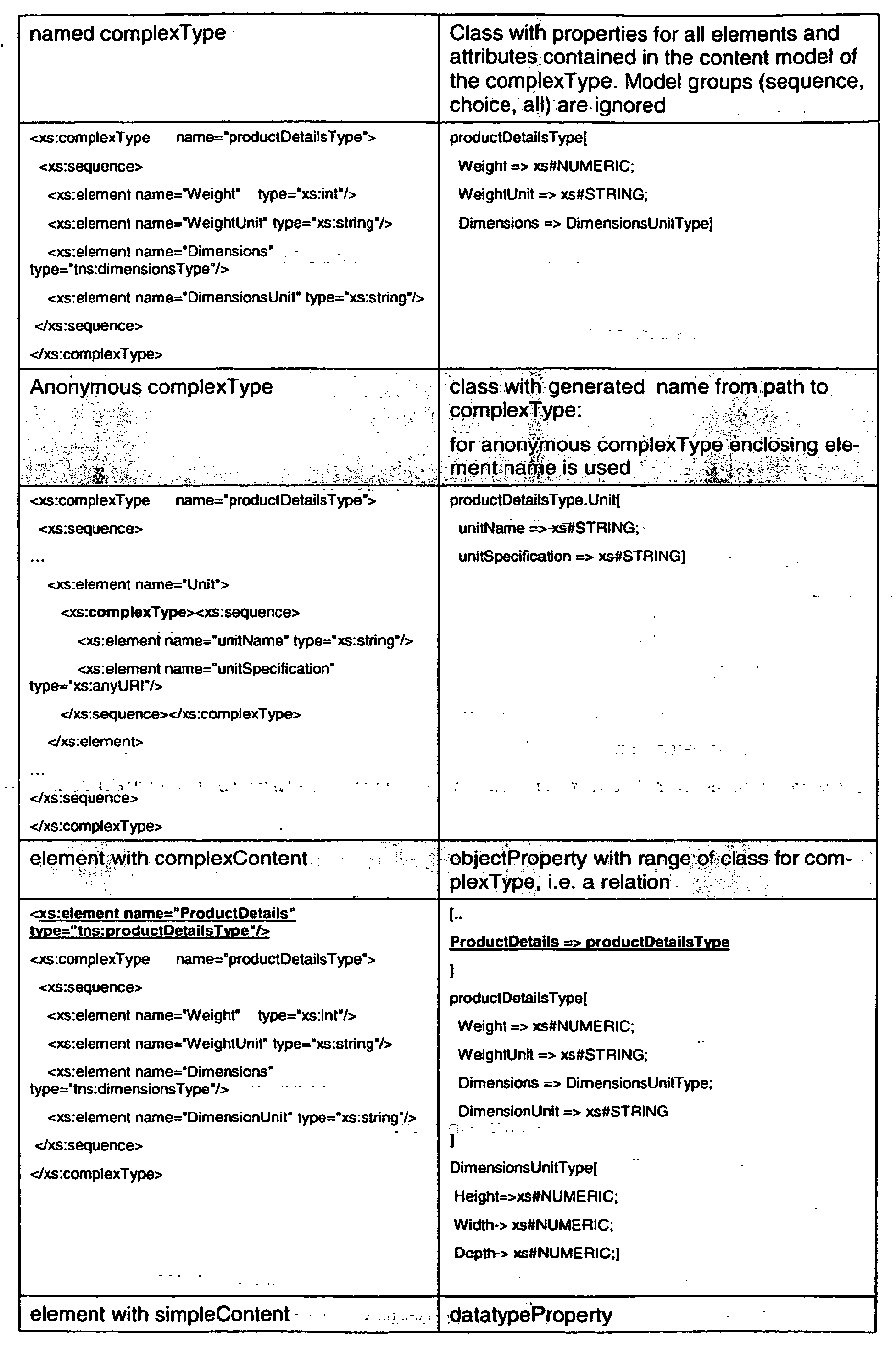
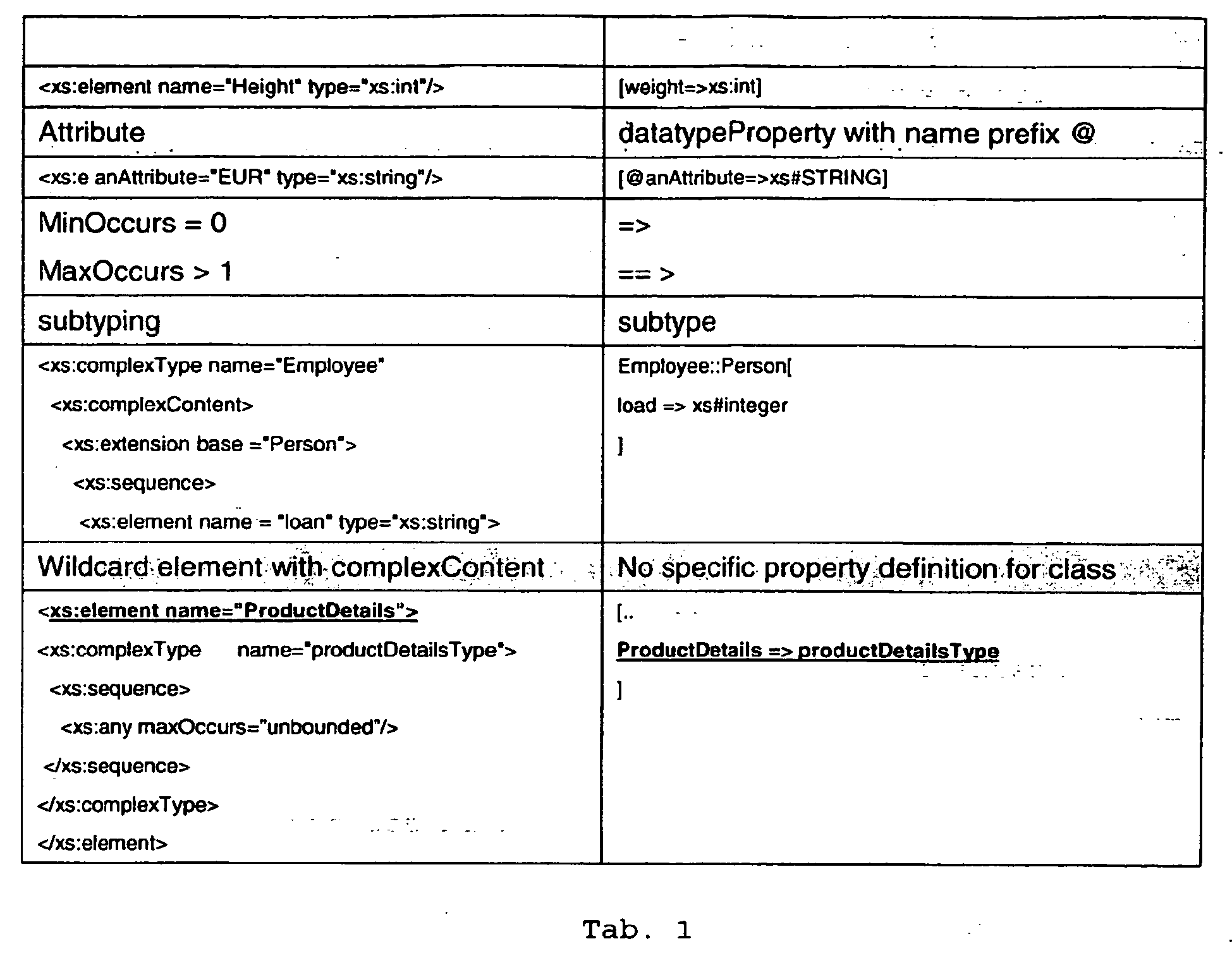
- the following table 1 defines a mapping from XML element nodes with XML schema information including complexContent to F-Logic / ontology schema (the ontology being expressed in F-Logic).
- the following table 2 defines a mapping from XML element nodes with ⁇ XML schema information including complexContent to F-Logic / ontology instances (the ontology being expressed in F-Logic).
- Web services can be considered as remote procedure call (RPC) with a list of input parameters and a list of output parameters, which contain the result.
- RPC remote procedure call
- a web service who delivers the current temperature of a city may have as input parameter the zip code and as output parameter the temperature.
- a corresponding source ontology would have a class "place” with two properties: "zip code” and "temperature”.
- Appendix A contains the following example defining a web service getProductDetails, which uses elements of the same schema we used in the description of the XML mapping.
- a web service operation is mapped to an ontology class, which has the element of the input message and the element of the output message as object properties.
- the content of these elements are mapped like specified in the XML mapping above to ontology definitions. Therefore, the above web service will result in the following ontology definitions.
- SOAP stands for "Simple Object Access Protocol"; it is a lightweight XML-based messaging protocol used to encode the information in Web service request and response messages before sending them over a network.
- the web service mapping maps this SOAP request of the web service above to the following ontology instances. Please note that only the first instance is special to the web service mapping. All other instances are the same as in the XML mapping example.
- a generic built-in "webservice” realizes the transformation of the corresponding SOAP request to the ontology instances according to the mapping specified above.
- the built-in gets the WSDL description and its mapping to ontology definitions as input. From that it constructs ontology instances from the result of the SOAP request.
- mapping is realized by generated F-Logic mapping rules, which map the generated ontology classes and properties to this web service built-in.
- F-Logic mapping rules which map the generated ontology classes and properties to this web service built-in.
- Appendix A to C show a web service with a web service description with a corresponding SOAP request and how this is mapped to ontology schemas and instances.
- the input In order for a web service to be able to produce a result or an output, the input must be well defined.
- the input may not contain variables; all variables must have assigned values. In other words, all variables must be "grounded".
- a property of an ontology is "grounded” if there is an instance or value for this property.
- ontology definitions can be defined, which mark object or datatype properties of an ontology class as grounded. Only queries to these ontology elements are allowed, in which these elements are grounded either directly or via equality to other grounded properties. Those property definitions which are dependent either directly or indirectly (via rules) on the output of the WSDL operation are grounded, if the input is grounded, or in other words: are marked as having to be grounded. Property definitions dependent on the input of the WSDL are a priori not grounded.
- the inference engine knows which object or datatype properties have to be grounded (they must not be marked in the ontology) and rejects queries without an appropriate grounding.
- the inference engine propagates the grounded properties through the rule graph (system graph).
- the ontology need not be extended by a description which properties have to be grounded and which properties need not be grounded.
- mapping of a web service can be extended by feeding the input values of the web service with values from the integration ontology. If the integration ontology knows all possible product numbers (e.g. by a mapping from a database) these product numbers could be used as input for the web service:
- mapping is extended. Now the product numbers from the integration ontology are used for instantiating the variable PN with values and thus the input of the web service is grounded. This allows queries like FORALL X,Y ⁇ - X:Product[PoNumber->Y]. to be answered, because for all product numbers the ontology knows about (via e.g. the database mapping) the web service built-in can be executed.
- Different external views on the integrated data can be defined by specifying predefined queries. They can be understood as predefined parameterized queries posed to the integration ontology and formulated in the query language of the integration ontology.
- a corresponding web service access of the system can be defined, which allows the corresponding querying of the system.
- Such web services take - in the most general case - an XML document as input and generate an XML document as output or answer.
- Such web services are called "document style web services”.
Landscapes
- Engineering & Computer Science (AREA)
- Theoretical Computer Science (AREA)
- Data Mining & Analysis (AREA)
- Databases & Information Systems (AREA)
- Physics & Mathematics (AREA)
- General Engineering & Computer Science (AREA)
- General Physics & Mathematics (AREA)
- Information Retrieval, Db Structures And Fs Structures Therefor (AREA)
- Document Processing Apparatus (AREA)
- Treatments For Attaching Organic Compounds To Fibrous Goods (AREA)
- Knitting Of Fabric (AREA)
- Chemical Or Physical Treatment Of Fibers (AREA)
Abstract
Description
- The present invention relates to unified querying of distributed data sources and methods for the efficient recovery of information stored in distributed data sources.
- More particularly, the present invention concerns the mapping of the data structure of XML documents to ontologies.
- Enterprise data systems, especially for large enterprises, typically include multiple data sources that may be based on different data schemas like
- relational databases,
- XML documents, XML schema, XML document type definitions (DTD),
- web services,
- Adabas files
- SGML texts,
- Interface Description Language (IDL),
- JAVA interface,
- Resource Description Framework (RDF),
- Unified Modeling Language (UML),
- Ontology Web Language (OWL),
- Object role modelling,
- Topic maps,
- etc.
- As a result of several IT generations and/or mergers and acquisitions, several databases with different schemas may contain information on different areas of the business. On the other hand, information may be gained form web services. For example, enterprise employment data may be stored in a relational database conforming to a first relational database schema and enterprise accounting data may be stored in a relational databases conforming to a second relational database schema. Often these various data sources may overlap, and it is difficult for a user to query across the enterprise data sources.
- There is, thus, a need for tools for data integration or information integration and a need for a unified querying tool that enables a user to query data across data sources conforming to different data schemas. The need for a unified querying tool also arises when a single question crosses multiple data sources.
- The patent applications
US 2004/0216030 A1 ,US 2004/0093559 A1 ,US 2004/0093344 A1 ,US 2003/0179228 A1 ,US 2003/0177481 A1 ,US 2003/0163597 A1 ,US 2003/0163450 A1 ,US 2003/0120665 A1 , andUS 2003/0101170 A1 , all belonging to one family, describe the mapping of data schema, including inter alia relational database schema and XML schema, into a central ontology model for solving the data integration problem. (Ontologies will be described in more detail below.) Basic constructs of the different data schema are mapped to classes and properties of the central ontology model. Thus, for a relational database schema, tables are generally mapped to ontology classes, and fields of tables are generally mapped to properties of the classes. Similarly, for XML schema, complex types are generally mapped to ontology classes, and elements and properties within complex types are generally mapped to ontology properties. - Thus, a mapping is needed between XML documents and constructs of ontologies.
- XML data can originate from
- a web service,
- an XML document or database
- or another source of XML data.
- Web services take - in the most general case - an XML document as input and generate an XML document as output or answer. Such web services are called "document style web services".
- XML is an abbreviation for extensible Markup Language. A markup language is (simply described) a collection of tags and text-values. The most well-known markup language today is HTML, which is used to layout homepages. XML enables people to design their own markup languages, tailored for storing any kind of information. The following is an example XML-document:
     <addresses>
         <employee name="John Doe">
             <address>
                 <street> Oakroad 5 </street>
                 <city> Lyngby </city>
             <country> Denmark </country>
             </address>
             <phone> 124-21424-21 </phone>
             <email> jd@example.com </email>
             <category>friend</category>
             <category>co-worker</category>
         </employee>
     </addresses>
- <employee name="John Doe"> ... </person>
- <!-- Comment goes here. -->
<?xml version="1.0" encoding="iso-8859-1"?>
- <?xml-stylesheet href="stylesheet.xsl" type="text/xsl"?>
     <?xml version="1.0"?>
     <note>
          <to>Tove</to>
          <from>Jani</from>
          <heading>Reminder</heading>
          <body>Don't forget me this weekend!</body>
    </note>
    <?xml version="1.0"?>
    <xs:schema xmlns:xs="http://www.w3.org/2001/XMLSchema"
    targetNamespace="http://www.w3schools.com"
    xmlns="http://www.w3schools.com"
    elementFormDefault="qualified">

    <xs:element name="note">
         <xs:complexType>
              <xs:sequence>
                 <xs:element name="to" type="xs:string"/>
                  <xs:element name="from" type="xs:string"/>
                  <xs:element name="heading" type="xs:string"/>
                 <xs:element name="body" type="xs:string"/>
              </xs:sequence>
         </xs:complexType>
    </xs:element>
    </xs:schema>
    <?xml version="1.0"?>
    <xs:schema>
     ...
    </xs:schema>
    <?xml version="1.0"?>
    <xs:schema xmlns:xs="http://www.w3.org/2001/XMLSchema"
    targetNamespace="http://www.w3schools.com"
   xmlns="http://www.w3schools.com"
    elementFormDefault="qualified">
    ...
    </xs:schema>
- xmlns:xs="http://www.w3.org/2001/XMLSchema"
- targetNamespace="http://www.w3schools.com"
- xmlns="http://www.w3schools.com"
- elementFormDefault="qualified"
<?xml version="1.0"?>
    <note xmlns="http://www.w3schools.com"
    xmlns:xsi="http://www.w3.org/2001/XMLSchema-instance"
    xsi:schemaLocation="http://www.w3schools.com note.xsd">
         <to>Tove</to>
          <from>Jani</from>
          <heading>Reminder</heading>
          <body>Don't forget me this weekend!</body>
     </note>
- xmlns:xsi="http://www.w3.org/2001/XMLSchema-instance"
- xsi:schemaLocation="http://www.w3schools.com note.xsd"
- <ProductDetails xsi:type="productDetailsType">
<addresses xsi:type="addressestype">
        <employee xsi:type="fullpersoninfo" name="John Doe">
            <shoesize xsi:type="shoesizetype"
                    country="france">35</shoesize>
            <address xsi:type="addresstype">
                <street xsi:type="xs:string"> Oakroad 5
                </street>
                <city xsi:type="xs:string"> Lyngby </city>
                <country xsi:type="xs:string"> Denmark
                </country>
            </address>
            <phone xsi:type="xs:string"> 124-21424-21 </phone>
            <email xsi:type="xs:string"> jd@example.com
            </email>
            <category xsi:type="xs:string">friend</category>
            <category xsi:type="xs:string>co-worker</category>
        </employee>
    </addresses>
- <xs:element name="firstname" type="xs:string"/>
- <shoesize country="france">35</shoesize>
   <xs:complexType name="shoesizetype">
     <xs:simpleContent>
       <xs:extension base="xs:integer">
         <xs:attribute name="country" type="xs:string" />
       </xs:extension>
     </xs:simpleContent>
   </xs:complexType>

   <xs:element name="shoesize" type="shoesizetype"/>
 <xs:complexType name="personinfo">
  <xs:sequence>
   <xs:element name="firstname" type="xs:string"/>
   <xs:element name="lastname" type="xs:string"/>
   <xs:element name="shoesize" type="shoesizetype"/>
  </xs:sequence>
 </xs:complexType>
 <xs:complexType name="companytype">
  <xs:sequence>
   <xs:element name="name" type="xs:string"/>
   <xs:element name="employee" type="fullpersoninfo"/>
  </xs:sequence>
 </xs:complexType>
 <xs:complexType name="fullpersoninfo">
  <xs:complexContent>
   <xs:extension base="personinfo">
     <xs:sequence>
       <xs:element name="address" type="xs:string"/>
       <xs:element name="city" type="xs:string"/>
       <xs:element name="country" type="xs:string"/>
     </xs:sequence>
   </xs:extension>
  </xs:complexContent>
 </xs:complexType>
- Providing an XML document with a corresponding XML schema definition.
- mapping XML element and attribute declarations to ontology property definitions;
- mapping XML schema complexType definitions to ontology class definitions.
- mapping PSVI complexType annotations to ontology class instances;
- mapping element and attribute nodes to ontology property instances.
- A PSVI annotation (e.g. xsi:type="fullpersoninfo") leads the way to the ontology schema construct as defined above, which is then complemented with the instance from the XML element. For an ontology, the "data" are called instances. The instance of a class is called "object". The "instances" of XML documents are called "nodes".
<shoesize country="france">35</shoesize>.
   <employee name="John Doe">
           <shoesize
                   country="france">35</shoesize>
           <address>
               <street>Oakroad 5
               </street>
               <city>Lyngby </city>
               <country>Denmark
               </country>
           </address>
           <phone>124-21424-21 </phone>
           <email>jd@example.com
           </email>
           <category>friend</category>
           <category>co-worker</category>
       </employee>
country = "France".
- a single class definition which is a super class of all generated class definitions;
- a single object property definition which is a super object property of all generated object property definitions, the object property having a domain class and a range class, which are said super class;
- a single datatype property definition which is a super datatype property of all generated datatype property definitions, the datatype property having a domain class which is said super class, the range type being any atomic type.
- For each XML element node which is not a leaf-node an instance of the predefined super class of all generated classes of the ontology is generated; and an object property instance of the predefined super object property is generated, the domain class instance of the object property instance being the instance which is generated for the containing element node and the range class instance being the class instance which is generated for this XML element node. A leaf-node is a node on the lowest level.
| class | GeneralWSInstance |
| object property | GeneralWSObjectProperty |
| datatype property | GeneralWSDatatypeProperty |
- Providing an XML SOAP webservice with a corresponding web service description (WSDL).
- mapping an operation definition to a class definition of the ontology;
- mapping a part definition to an ontology property definition.
- a single SOAP request is mapped to a single ontology class instance;
- the element nodes representing the parts of the input and output message are mapped to ontology property instances.
- mapping an operation definition to a class definition of the ontology;
- if the part of the input or output message is defined as an complexContent element declaration, it is mapped to an object property definition of the ontology, the object property having a domain class and a range class, the domain class being the class which is mapped from the operation definition, and the range class of the object property being the class to which the complexType of the complexContent element is mapped;
- if the part of the input or output message is defined as an XSD simpleType element declaration, it is mapped to a datatype property definition-of the ontology, the datatype property having a domain class, which is mapped from the operation definition and the range type being the XML schema type of the simpleType element declaration;
- if the part of the input or output message is defined as an XSD simpleContent element declaration with an attribute, it is mapped to an object property definition of the ontology, the object property having a domain class and a range class, the domain class being the class, which is mapped from the operation definition, and the range class of the object property being the class to which the complexType of the simpleContent element is mapped.
- for each SOAP request of an operation an instance of a class of the ontology is generated, the class of this instance is the class to which this operation definition is mapped;
- if the input or output message contains XML simpleType element node it is mapped to a datatype property instance of the ontology, the domain class instance of the datatype property instance being the instance which is generated for the operation of the SOAP request;
- if the input or output message contains an XML simpleContent element node with an attribute it is mapped to an object property instance of the ontology, the object property having a domain class instance and a range class instance, the domain class instance of the object property instance being the instance which is generated for the operation of the SOAP request, the range class instance of the object property instance being the class instance which is generated for the PSVI type annotation of the XML simpleContent element node;
- if the input or output message contains an XML complexContent element node it is mapped to an object property instance of the ontology, the object property having a domain class instance and a range class instance, the domain class instance of the object property instance being the instance which is generated for operation of the SOAP request, and the range class instance of the object property instance being the class instance which is generated for the PSVI type annotation of the XML complexContent element node.
- a computer loadable data structure that is adapted to perform the method according to the embodiment described in this description while the data structure is being executed on a computer,
- a computer program, wherein the computer program is adapted to perform the method according to the embodiment described in this description while the program is being executed on a computer,
- a computer program comprising program means for performing the method according to the embodiment described in this description while the computer program is being executed on a computer or on a computer network,
- a computer program comprising program means according to the preceding claim, wherein the program means are stored on a storage medium readable to a computer,
- a storage medium, wherein a data structure is stored on the storage medium and wherein the data structure is adapted to perform the method according to the embodiment described in this description after having been loaded into a main and/or working storage of a computer or of a computer network,
- a computer program product having program code means, wherein the program code means can be stored or are stored on a.storage medium, for performing the method according to one of the embodiments described in this description, if the program code means are executed on a computer or on a computer network,
- at least one of an operating system, a computer readable medium having stored thereon a plurality of computer-executable instructions, a co-processing device, a computing device and a modulated data signal carrying computer executable instructions for performing the method according to the embodiment described in this description.
- Fig. 1
- shows a general view of the enterprise information integration platform;
- Fig. 2
- shows a general overview of the mapping of XML data structures to ontologies; and
- Fig. 3
- shows an exemplary data structure.
- 1. General view of the system
- 2. Introduction to F-Logic
- 3. Mapping
- 3.1. Mapping of databases
- 3.1.1. Mapping of relational databases to a source ontology
- 3.2. XML Mapping
- 3.2.1. Mapping XML parameters with complexContent to ontology
- 3.3. Web service mapping
- 3.3.1. Grounding of input variables
- 3.1. Mapping of databases
- 4. External views defined as parameterized queries
- 5. Publication as web service
- Appendix A An example of a web service schema of a web service
- Appendix B The XML schema included in the web service description of the web service according to Appendix A
- Appendix C A SOAP request for the web service according to Appendix A
- abraham:man.
- sarah:woman.
- isaac:man[fatherIs->abraham; motherIs->sarah].
- ishmael:man[fatherIs->abraham; motherIs->hagar:woman].
- jacob:man[fatherIs->isaac; motherIs->rebekah:woman].
- esau:man[fatherIs->isaac; motherIs->rebekah].
- FORALL X, Y X [sonIs->>Y] <- Y:man [fatherIs->X] .
- FORALL X, Y X [sonIs->>Y] <- Y:man [motherIs->X] .
- FORALL X, Y X [daughterIs->>Y] <- Y:woman [fatherIs->X] .
- FORALL X,Y X [daughterIs->>Y] <- Y:woman[motherIs->X] .
FORALL X, Y <- X:woman [sonIs->>Y[fatherIs->abraham]].
- X = sarah
- X = hagar
- X:Person [hasName->Y; livesInTown->Z]. <- dbaccess ("MS SQL", host, Person, f (Id, X, Name, Y, Town, Z)).
- Every table is mapped to a class in the ontology.
- Every column of a table, which does not represent a foreign key, i.e. which does not represent a relation, is mapped to a datatype property of the corresponding class of the ontology.
- Every column which represents a foreign key is mapped to a binary relationship of the ontology.
- Every row in a table is mapped to an instance of the ontology. The unique identifier of the instance is generated from the key of the row or from all values within the row, if no key is available.
- The values within the row are mapped to the mentioned datatype property values and object properties.
- The class names are the table names.
- The property names are the names of the columns.
- If there is a primary key, then the unique identifiers for the instances are generated from the database name, the database location, the table name plus the primary key.
- If there is no unique key, all the values v1, ..., vn in a row are used to create a unique key by concatenating the values.
- The values of the properties of an instance are directly given by the values in the row.
- Object properties are created by the mentioned key transformations of the foreign key.
- Person[
- name=>STRING;
- city=>STRING;
- street=>STRING;
- zip=>NUMBER;
- married=>Person].
- f(database,person,X) :Person[id->X; name->Y; city->Z; street-> U; zip->V; married-> f(database,foreigntablename,W)] <- dbaccess(database, person, access(id,X,name,Y,city,Z,street,U, zip,V,married,W)).
- Constraints of complex content models via nested sequence, choice or all model groups.
- MinOccurs and MaxOccurs constraints with other cardinality as 0, 1 and unbounded.
- XML simpleType element declarations are mapped to a datatype property definitions of the ontology (like columns from tables).
- XML complexType definitions are mapped to ontology class definitions.
- XML complexContent element declarations are mapped to object property definitions of the ontology.
- XML simpleContent element declarations with attributes are mapped to object property definitions of the ontology.
 <ProductDetails ="tns:productDetailsType" xmlns="http://www.example.com/ProductCatalog.xsd"
 xmlns:xsi="http://www.w3.org/2001/XMLSchema-instance"
 xmlns:tns="http://www.example.com/ProductCatalog.xsd"
 xmlns:xs="http://www.w3.org/2001/XMLSchema"
 xsi:schemaLocation="http://www.example.com/ProductCatalog.xsd
 ProductCatalog.xsd">
  <Weight>25</Weight>
  <WeightUnit>kg</WeightUnit>
  <Dimensions>
    <Height>27</Height>
    <Width>24</Width>
    <Depth>21 </Depth>
  </Dimensions>
  <DimensionsUnit>cm</DimensionsUnit>
  <Colour transparency="50">red</Colour>
 </ProductDetails>
    productDetailsType[].
    dimensionsType [].
    productDetailsType[Weight=>xsd#INTEGER;
         WeightUnit=>xsd#STRING;
         Dimensions=>>dimensionsType;
         DimensionsUnit=>xsd#STRING;
          Colour=>colourType].
    dimensionsType[Height=>xsd#INTEGER;
         Width=>xsd#INTEGER;
         Depth=>xsd#STRING].
    colourType[value=>xsd#STRING;
          transparency=>xsd#INTEGER].
     instance2productDetailsType:productDetailsType.
     instance2productDetailsType[Weight->>"24,6";
          WeightUnit->>"pounds";
          Dimensions->>instance4dimenstionsType;
          DimensionsUnit->>"inches";
          Colour->>instance5ColourType].
     instance4dimensionsType:dimensionsType.
     instance4dimensionsType [Width->>24.0;
          Depth->>21.0 ;
          Height->>26.0].
     instance5ColourType:ColourType.
     instance5ColourType[value-> "red";
          transparency->>50].
 FORALL VAR0,VAR1,VAR2,VAR3,VAR4,VAR5 (
 id("productDetailsType",VAR0):
   productDetailsType[
     Weight ->> VAR1;
     WeightUnit ->> VAR2;
     Dimensions ->> VAR3;
     DimensionsUnit ->> VAR4;
     Colour ->> VAR5]
 <-
 XMLBuiltin("datasource-URL",VAR0
     "XMLSchemaDefiniton", "MappingToOntology",
       F(VAR1,VAR2,VAR3,VAR4,VAR5))



- differences in the model groups sequence, choice and all mixed content.
- Processing Instruction nodes and
- Comments
 //CLASSES --------------------
 getProductDetailsOperation[].
 productDetailsType[].
 dimensionsType[].
 getProductDetailsType[].
 // PROPERTIES --------------------
 getProductDetailsOperation[
  ProductNumber=>ProductNumberType;
  ProductDetails=>productDetailsType].
 productDetailsType[Weight=>xsd#INTEGER;
  WeightUnit=>xsd#STRING;
  Dimensions=>>dimensionsType;
  DimensionsUnit=>xsd#STRING;
 Colour=>colourType].
 dimensionsType[Height=>xsd#INTEGER;
  Width=>xsd#INTEGER;
  Depth=>xsd#STRING].
  colourType[value=>xsd#STRING;
  transparency=>xsd#INTEGER].
 instance1GetProductDetailsOperation:getProductDetailsOperation.
 instance1GetProductDetailsOperation[ProductNumber->>605001;
  ProductDetails->>instance2productDetailsType].
 instance2productDetailsType:productDetailsType.
 instance2productDetailsType[Weight->>"24,6";
  WeightUnit->>"pounds";
  Dimensions->>instance4dimenstionsType;
  DimensionsUnit->>"inches";
  Colour->>instance5ColourType].
 instance4dimenstionsType:dimensionsType.
 instance4dimenstionsType[Width->>24.0;
  Depth->>21.0;
  Height->>26.0].
  instance5ColourType:ColourType
  instance5ColourType[value-> "red";
  transparency->>50].
 FORALL PN,PD
 getProductDetailsOperation(PN):getProductDetailsOperation
    [ProductNumber->PN; ProductDetails->PD]
 <- webservice("http://www.example.com/Products",
     input("ProductNumber",PN),
    output("ProductDetails",PD))
 FORALL PN, PD
            getProductDetailsOperation(PN):
            getProductDetailsOperation[
            ProductNumber->PN; ProductDetails->PD]
         <- webservice(http://
            www.example.com/Products,
                  input("ProductNumber",PN),
                  output("ProductDetails",PD)).
- FORALL X , Y
- X : Product[PoNumber->Y] < -
- X:getProductDetailsOperation[ProductNumber->Y].
- FORALL X <- X:Product[PoNumber->5].
- FORALL X, Y < - X:Product [PoNumber->Y].
 FORALL PN, PD, X
           getProductDetailsOperation (PN) :
            getProductDetailsOperation[
            ProductNumber->PN; ProductDetails->PD]
         <- X:Product[PoNumber->PN] and
            webservice(http://www.example.com/Products,
            input("ProductNumber",PN),
            output("ProductDetails",PD)).
FORALL X,Y <- X:Product[PoNumber->Y].
to be answered, because for all product numbers the ontology knows about (via e.g. the database mapping) the web service built-in can be executed.
- Forall X,Y,Z,U <- X:getProductDetails[ProductNumber -> 50600; getProductDetails -> Y[Weight -> Z; WeightUnit -> U]].
     <ProductNumber>
          123
    </ProductNumber>
     <ProductDetails>
          <Weight> 60 </Weight>
          <WeightUnit> kg </WeightUnit>
     </ProductDetails>
- XML
- data sources
- DB1
- data sources
- DB2
- data sources
- RPC
- remote procedure call and standing for a web service
- 100
- source ontology
- 102
- source ontology
- 104
- source ontology
- 106
- source ontology
- 108
- integration ontology
- V1
- external view
- V2
- external view
- V3
- external view
- WS1
- web service
- WS2
- web service
- WS3
- web service
- 110
- runtime unit, inference engine
-
US 2004/0216030 A1 -
US 2004/0093559 A1 -
US 2004/0093344 A1 -
US 2003/0179228 A1 -
US 2003/0177481 A1 -
US 2003/0163597 A1 -
US-2003/0163450 A1 -
US 2003/0120665 A1 -
US 2003/0101170 A1
- J. Angele, G. Lausen: "Ontologies in F-Logic" in S. Staab, R. Studer (Eds.): Handbook on Ontologies in Information Systems. International Handbooks on Information Systems, Springer, 2003, page 29 ff..
- A. Van Gelder, K. A. Ross, and J. S. Schlipf: "The well-founded semantics for general logic programs"; Journal of the ACM, 38 (3) :620-650, July 19991.
- J. D. Ullman: "Principles of Database and Knowledge-Base Systems"; vol. I, Computer Sciences Press, Rockville, Maryland, 1988.
<wsdl:definitions
 xmlns:wsdl="http://schemas.xmlsoap.org/wsdl/"
 xmlns:cat="http://www.example.com/ProductCatalog.xsd"
 xmlns:tns="http://www.example.com/ProductCatalog.wsdl"
 xmlns:xs="http://www.w3.org/2001/XMLSchema"
 xmlns:soap=."http://schemas.xmlsoap.org/wsdl/soap/" targetName-
 space="http://www.example.com/ProductCatalog.wsdl">
     <wsdl:types>
          <xs:schema xmlns:xs="http://
                    www.w3.org/2001/XMLSchema">
               <xs:import namespace="http://
                         www.example.com/ProductCatalog.xsd"
                         schemalocation="ProductCatalog.xsd"/>
          </xs:schema>
    </wsdl:types>
    <wsdl:message name="getProductDetailsRequest">
          <wsdl:part name="request"
                 element="cat:ProductNumber"/>
    </wsdl:message>
    <wsdl:message name="getProductDetailsResponse">
         <wsdl:part name="Body" element="cat:ProductDetails"/>
   </wsdl:message>
    <wsdl:portType name="CatalogPortType">
         <wsdl:operation-name="getProductDetails">
              <wsdl:input name="getDetailsRequest"
                      message="tns:getProductDetailsRequest"/>
              <wsdl:output name="getDetailsResponse"
                    message="tns:getProductDetailsResponse"/>
         </wsdl:operation>
    </wsdl:portType>
    <wsdl:binding name="CatalogSoapBinding"
                      type="tns:CatalogPortType">
         <soap:binding style="document" transport="http://
                      schemas.xmlsoap.org/soap/http"/>
         <wsdl:operation name="getProductDetails">
              <soap:operation/>
              <wsdl:input>
                   <soap:body parts="request" use="literal"/>
              </wsdl:input>
              <wsdl:output>
                   <soap:body parts="Body" use="literal"/>
              </wsdl:output>
         </wsdl:operation>
    </wsdl:binding>
    <wsdl:service name="getProductDetails">
          <wsdl:port name="getProductPort"
                       binding="tns:CatalogSoapBinding">
               <soap:address location="http://
                       www.example.com/getProductDetails"/>
          </wsdl:port>
     </wsdl:service>
 </wsdl:definitions>
<?xml version="1.0" encoding="UTF-8"?>
 <xs:schema targetNamespace="http://
                www.example.com/ProductCatalog.xsd"
 xmlns:tns="http://www.example.com/ProductCatalog.xsd"
 xmlns:xs="http://www.w3.org/2001/XMLSchema"
                elementFormDefault="qualified">
    <xs:element name="ProductNumber" type="xs:int"/>
    <xs:element name="ProductDetails"
                type="tns:productDetailsType"/>
    <xs:complexType name="productDetailsType">
          <xs:complexContent>
               <xs:restriction base="xs:anyType">
                    <xs:sequence>
                         <xs:element name="Weight"
                            type="xs:int"/>
                         <xs:element name="WeightUnit"
                                 type="xs:string"/>
                         <xs:element name="Dimensions"
                                 type="tns:dimensionsType"/>
                         <xs:element name="DimensionsUnit"
                                 type="xs:string"/>
                         <xs:element name="Colour"
                                 type="tns:colourType"/>
                    </xs:sequence>
               </xs:restriction>
         </xs:complexContent>
    </xs:complexType>
    <xs:complexType name="colourType">
          <xs:simpleContent>
               <xs:extension base="xs:string">
                    <xs:attribute name="transparency"
                              type="xs:int"/>
               </xs:extension>
         </xs:simpleContent>
    </xs:complexType>
    <xs:complexType name="dimensionsType">
         <xs:complexContent>
              <xs:restriction base="xs:anyType">
                    <xs:sequence>
                         <xs:element name="Height"
                              type="xs:int"/>
                         <xs:element name="Width"
                              type="xs:int"/>
                        <xs:element name="Depth"
                              type="xs:int"/>
                    </xs:sequence>
              </xs:restriction>
         </xs:complexContent>
    </xs:complexType>
 </xs:schema>
<SOAP-ENV:Envelope xmlns:SOAP-
 ENV="http://schemas.xmlsoap.org/soap/envelope/" xmlns:SOAP-
 ENC="http://schemas.xmlsoap.org/soap/encoding/"
 xmlns:xsi="http://www.w3.org/2001/XMLSchema-instance"
 xmlns:xsd="http://www.w3.org/2001/XMLSchema">
  <SOAP-ENV:Body>
    <tns:ProductNumber
 xmlns:tns="http://www.example.com/ProductCatalog.xsd"
 xsi:schemaLocation="http://www.example.com/ProductCatalog.xsd
 ProductCatalog.xsd">50600</tns:ProductNumber>
  </SOAP-ENV:Body>
 </SOAP-ENV:Envelope>
<SOAP-ENV:Envelope xmlns:SOAP-ENV="http://
          schemas.xmlsoap.org/soap/envelope/"
 xmlns:SOAP-ENC="http://schemas.xmlsoap.org/soap/encoding/"
 xmlns:xsi="http://www.w3.org/2001/XMLSchema-instance"
 xmlns:xsd="http://www.w3.org/2001/XMLSchema">
  <SOAP-ENV:Body>
    <tns:ProductDetails
 xmlns:tns="http://www.example.com/ProductCatalog.xsd"
 xsi:schemaLocation="http://
   www.example.com/ProductCatalog.xsd ProductCatalog.xsd">
      <tns:Weight>25</tns:Weight>
      <tns:WeightUnit>kg</tns:WeightUnit>
      <tns:Dimensions>
        <tns:Height>27</tns:Height>
        <tns:Width>24</tns:Width>
        <tns:Depth>21</tns:Depth>
      </tns:Dimensions>
      <tns:DimensionsUnit>cm</tns:DimensionsUnit>
      <tns:Colour transparency="50">red</tns:Colour>
    </tns:ProductDetails>
  </SOAP-ENV:Body>
 </SOAP-ENV:Envelope>
Claims (9)
- A method for mapping an XML data structure to an ontology comprising:a) providing an XML document with a corresponding XML schema definition;b) mapping XML schema declarations and definitions to ontology schema definitions in the following way:- mapping XML element and attribute declarations to ontology property definition;- mapping XML complexType definitions to ontology class definitions;c) validating the XML document-by the XML schema to generate a PSVI annotation of the XML document;d) using the PSVI annotation from the validation of the XML document by the XML schema for mapping XML nodes with known PSVI-type to ontology instances in the following way:- mapping PSVI complexType annotations to ontology class instances;- mapping element and attribute nodes to ontology property instances;e) defining the following predefined ontology schema definitions:- defining a predefined ontology class definition and a predefined ontology datatype property definition and a predefined object property definition;f) mapping XML nodes without PSVI-type annotation to ontology instances and to ontology definitions in the following way:- mapping XML element and attribute nodes to ontology property instances of the predefined ontology property definitions and ontology class instances of the predefined ontology class definitions;g) wherein this mapping is performed dynamically while evaluating a query inquiring data from the XML document.
- The method according to claim 1, wherein the step ofmapping XML schema declarations and definitions to ontology schema definitions comprises the steps of:b1) mapping an XSD complexType definition to a class definition of the ontology;b2) mapping an XSD complexContent element declaration of an XSD complexType definition to an object property definition of the ontology, the object property having a domain class and a range class, the domain class being the class where the element is used, and the range class of the object property being the class to which the complexType of the complexContent element is mapped;b3) mapping an XSD simpleType element declaration to a datatype property definition of the ontology, the datatype property having a domain class, the domain class being the class where the element is used, and the range type being the XML schema type of the simpleType element declaration;b4) mapping an XSD simpleContent element declaration with an attribute to an object property definition of the ontology, the object property having a domain class and a range class, the domain class being the class where the element is used, and the range class of the object property being the class to which the complexType of the simpleContent element is mapped;b5) mapping an XSD attribute declaration to a datatype property definition of the ontology, the datatype property having a domain class, the domain class being the class where the element is used, and the range type being the XML schema type of the attribute declaration.
- The method according to claim 1, wherein the step of mapping XML nodes with known PSVI-type to ontology instances comprises the steps of:d1) generating for each XML element node with a complexType annotation an instance of a class of the ontology, the class of this instance is the class to which this complexType definition is mapped;d2) mapping an XML simpleType element node to a datatype property instance of the ontology, the domain class instance of the datatype property instance being the instance which is generated for the PSVI type annotation where the element node is used;d3) mapping an XML simpleContent element node with an attribute to an object property instance of the ontology, the object property having a domain class instance and a range class instance, the domain class instance of the object property instance being the instance which is generated for the type annotation where the element is used, the range class instance of the object property instance being the class instance which is generated for the PSVI type annotation of the XML simpleContent element node;d4) mapping an XML complexContent element node to an object property instance of the ontology, the object property having a domain class instance and a range class instance, the domain class instance of the object property instance being the instance which is generated for the PSVI type annotation where the element is used, and the range class instance of the object property instance being the class instance which is generated for the PSVI type annotation of the XML complexContent element node;d5) mapping an XML simpleType attribute node to a datatype property instance of the ontology, the domain class instance of the datatype property instance being the instance which is generated for the PSVI type annotation where the attribute node is used.
- The method according to claim 1, wherein the following predefined ontology schema definitions are defined:e1) a single class definition which is a super class of all generated class definitions;e2) a single object property definition which is a super object property of all generated object property definitions, the object property having a domain class and a range class, which are said super class;e3) a single datatype property definition which is a super datatype property of all generated datatype property definitions, the datatype property having a domain class which is said super class, the range type being any atomic type.
- The method according to claim 1, wherein the step of mapping XML nodes without PSVI-type annotation to ontology instances and to ontology definitions comprises the steps of:f1) generating for each XML element node which is not a leaf-node- an instance of the predefined super class of all generated classes of the ontology; and- an object property instance of the predefined super object property, the domain class instance of the object property instance being the instance which is generated for the containing element node and the range class instance being the class instance which is generated for this XML element node;f2) generating for each XML leaf element node without attribute nodes a datatype property instance of the predefined super datatype property, the domain class instance of the datatype property being the instance which is generated for the containing element node;f3) generating for each XML leaf element node with an attribute node an object property instance of the predefined super object property, the domain class instance of the object property being the instance which is generated for the containing element node, and the range class instance being the class instance which is generated for this element node;f4) generating for each XML attribute node a datatype property instance of the predefined super datatype property, the domain class instance of the datatype property being the instance which is generated for the element node to which the attribute belongs.
- A method for mapping document style web services to an ontology whereby the mapping of the XML data structure needed therefore is accomplished according to the preceding method claims.
- The method according claim 6,
wherein an ontology definition for the ontology is used, in which an object or datatype property of an ontology class can be marked as grounded. - Computer program, wherein the computer program is adapted to perform the method according to one of claims 1 to 7 while the computer program is being executed on a computer.
- A storage medium, wherein a data structure is stored on the storage medium and wherein the data structure is adapted to perform the method according to one of claims 1 to 7 after having been loaded into a main and/or working memory of a computer or of a computer network.
Priority Applications (5)
| Application Number | Priority Date | Filing Date | Title |
|---|---|---|---|
| AT05001913T ATE510259T1 (en) | 2005-01-31 | 2005-01-31 | MAPPING WEB SERVICES TO ONTOLOGIES |
| EP05001913A EP1686495B1 (en) | 2005-01-31 | 2005-01-31 | Mapping web services to ontologies |
| US11/108,139 US7487166B2 (en) | 2005-01-31 | 2005-04-18 | Mapping web services to ontologies |
| CN200610004710A CN100583093C (en) | 2005-01-31 | 2006-01-27 | Mapping web services to ontologies |
| HK06111768.1A HK1091282B (en) | 2006-10-25 | Mapping web services to ontologies |
Applications Claiming Priority (1)
| Application Number | Priority Date | Filing Date | Title |
|---|---|---|---|
| EP05001913A EP1686495B1 (en) | 2005-01-31 | 2005-01-31 | Mapping web services to ontologies |
Publications (2)
| Publication Number | Publication Date |
|---|---|
| EP1686495A1 EP1686495A1 (en) | 2006-08-02 |
| EP1686495B1 true EP1686495B1 (en) | 2011-05-18 |
Family
ID=34933517
Family Applications (1)
| Application Number | Title | Priority Date | Filing Date |
|---|---|---|---|
| EP05001913A Expired - Lifetime EP1686495B1 (en) | 2005-01-31 | 2005-01-31 | Mapping web services to ontologies |
Country Status (4)
| Country | Link |
|---|---|
| US (1) | US7487166B2 (en) |
| EP (1) | EP1686495B1 (en) |
| CN (1) | CN100583093C (en) |
| AT (1) | ATE510259T1 (en) |
Families Citing this family (68)
| Publication number | Priority date | Publication date | Assignee | Title |
|---|---|---|---|---|
| US7426516B1 (en) * | 2003-11-24 | 2008-09-16 | Novell, Inc. | Mechanism for supporting indexed tagged content in a general purpose data store |
| US7877726B2 (en) * | 2004-07-13 | 2011-01-25 | The Mitre Corporation | Semantic system for integrating software components |
| US7823123B2 (en) * | 2004-07-13 | 2010-10-26 | The Mitre Corporation | Semantic system for integrating software components |
| WO2006051956A1 (en) * | 2004-11-12 | 2006-05-18 | Justsystems Corporation | Server device and search method |
| US7461075B2 (en) * | 2005-05-20 | 2008-12-02 | International Business Machines Corporation | Method for updating XML schema registry using schema pass by value with message |
| US7680800B2 (en) * | 2005-05-20 | 2010-03-16 | International Business Machines Corporation | Algorithm to marshal/unmarshal XML schema annotations to SDO dataobjects |
| US7941433B2 (en) * | 2006-01-20 | 2011-05-10 | Glenbrook Associates, Inc. | System and method for managing context-rich database |
| US20080033967A1 (en) * | 2006-07-18 | 2008-02-07 | Ravi Murthy | Semantic aware processing of XML documents |
| EP1901181B1 (en) * | 2006-09-13 | 2010-07-07 | Alcatel Lucent | Discovery Web Service |
| US20080120544A1 (en) * | 2006-11-21 | 2008-05-22 | Sybase, Inc. | Automated Generation of Agent Networks from Standard Ontologies |
| US7469252B2 (en) * | 2006-11-30 | 2008-12-23 | Fortinet, Inc. | Device, system and/or method for providing schema-independent access to object in documents |
| EP1944695A1 (en) | 2007-01-15 | 2008-07-16 | Software Ag | Method and system for monitoring a software system |
| US20080222515A1 (en) * | 2007-02-26 | 2008-09-11 | Microsoft Corporation | Parameterized types and elements in xml schema |
| US20080229274A1 (en) * | 2007-03-16 | 2008-09-18 | Cacenco Michael V | Automating Construction of a Data-Source Interface For Component Applications |
| US8027948B2 (en) * | 2008-01-31 | 2011-09-27 | International Business Machines Corporation | Method and system for generating an ontology |
| US8370812B2 (en) | 2007-04-02 | 2013-02-05 | International Business Machines Corporation | Method and system for automatically assembling processing graphs in information processing systems |
| US8166465B2 (en) | 2007-04-02 | 2012-04-24 | International Business Machines Corporation | Method and system for composing stream processing applications according to a semantic description of a processing goal |
| US7953770B2 (en) * | 2007-04-18 | 2011-05-31 | Sap Ag | Conflict management in a versioned file system |
| US7765241B2 (en) * | 2007-04-20 | 2010-07-27 | Microsoft Corporation | Describing expected entity relationships in a model |
| US8332209B2 (en) * | 2007-04-24 | 2012-12-11 | Zinovy D. Grinblat | Method and system for text compression and decompression |
| US8117233B2 (en) * | 2007-05-14 | 2012-02-14 | International Business Machines Corporation | Method and system for message-oriented semantic web service composition based on artificial intelligence planning |
| US7865823B2 (en) * | 2007-06-28 | 2011-01-04 | Intel Corporation | Method and apparatus for schema validation |
| US9613138B2 (en) * | 2008-09-03 | 2017-04-04 | Hamid Hatami-Hanza | Unified semantic scoring of compositions of ontological subjects |
| US7711749B2 (en) * | 2007-08-20 | 2010-05-04 | International Business Machines Corporation | Privacy ontology for identifying and classifying personally identifiable information and a related GUI |
| US8429709B2 (en) * | 2007-08-20 | 2013-04-23 | International Business Machines Corporation | Privacy ontology for identifying and classifying personally identifiable information and a related GUI |
| US8645434B2 (en) * | 2008-03-18 | 2014-02-04 | Apple Inc. | Techniques for schema production and transformation |
| US8229963B2 (en) * | 2008-03-25 | 2012-07-24 | Microsoft Corporation | Schema for federated searching |
| US8117239B2 (en) * | 2008-03-25 | 2012-02-14 | Microsoft Corporation | Aggregating schema data from multiple sources |
| US9213699B2 (en) * | 2008-04-30 | 2015-12-15 | Aspect Software Inc. | Super-object in administering system |
| TWI393107B (en) * | 2008-07-02 | 2013-04-11 | Au Optronics Corp | Liquid crystal display device |
| CN101605141A (en) * | 2008-08-05 | 2009-12-16 | 天津大学 | Web Service Relational Network System Based on Semantics |
| CN101686246A (en) * | 2008-09-27 | 2010-03-31 | 国家电力调度通信中心 | Datamodel describing method for massive information exchanging and processing |
| CN101398858B (en) * | 2008-11-07 | 2011-09-21 | 西安交通大学 | A Web Service Semantic Extraction Method Based on Ontology Learning |
| CN101504657B (en) * | 2009-03-20 | 2011-02-16 | 武汉大学 | Semantic Web service oriented resource search method |
| KR101386994B1 (en) * | 2009-05-08 | 2014-04-25 | 코어 와이어리스 라이센싱 에스.에이.알.엘. | Method and apparatus for configuring presentation of service guides |
| US20110035418A1 (en) * | 2009-08-06 | 2011-02-10 | Raytheon Company | Object-Knowledge Mapping Method |
| US20110035349A1 (en) * | 2009-08-07 | 2011-02-10 | Raytheon Company | Knowledge Management Environment |
| US9542484B2 (en) * | 2009-09-29 | 2017-01-10 | Sap Se | Updating ontology while maintaining document annotations |
| CA2724144A1 (en) * | 2010-03-07 | 2011-09-07 | Hamid Hatami-Hanza | Interactive and social knowledge discovery sessions |
| US8745096B1 (en) | 2010-03-31 | 2014-06-03 | Amazon Technologies, Inc. | Techniques for aggregating data from multiple sources |
| US9477730B2 (en) * | 2010-10-28 | 2016-10-25 | Microsoft Technology Licensing, Llc | Web services runtime for dataset transformation |
| US9760566B2 (en) | 2011-03-31 | 2017-09-12 | Microsoft Technology Licensing, Llc | Augmented conversational understanding agent to identify conversation context between two humans and taking an agent action thereof |
| US9858343B2 (en) | 2011-03-31 | 2018-01-02 | Microsoft Technology Licensing Llc | Personalization of queries, conversations, and searches |
| JP6087899B2 (en) * | 2011-03-31 | 2017-03-01 | マイクロソフト テクノロジー ライセンシング,エルエルシー | Conversation dialog learning and conversation dialog correction |
| US9298287B2 (en) | 2011-03-31 | 2016-03-29 | Microsoft Technology Licensing, Llc | Combined activation for natural user interface systems |
| US9842168B2 (en) | 2011-03-31 | 2017-12-12 | Microsoft Technology Licensing, Llc | Task driven user intents |
| US10642934B2 (en) | 2011-03-31 | 2020-05-05 | Microsoft Technology Licensing, Llc | Augmented conversational understanding architecture |
| US9244984B2 (en) | 2011-03-31 | 2016-01-26 | Microsoft Technology Licensing, Llc | Location based conversational understanding |
| US9454962B2 (en) | 2011-05-12 | 2016-09-27 | Microsoft Technology Licensing, Llc | Sentence simplification for spoken language understanding |
| US9064006B2 (en) | 2012-08-23 | 2015-06-23 | Microsoft Technology Licensing, Llc | Translating natural language utterances to keyword search queries |
| US20130173523A1 (en) * | 2011-12-29 | 2013-07-04 | Spribo, Llc. | Method and system for contextual knowledge society network |
| US9116932B2 (en) * | 2012-04-24 | 2015-08-25 | Business Objects Software Limited | System and method of querying data |
| JP6505600B2 (en) * | 2012-09-07 | 2019-04-24 | アメリカン ケミカル ソサイエティ | Automatic configuration evaluator |
| US9189531B2 (en) * | 2012-11-30 | 2015-11-17 | Orbis Technologies, Inc. | Ontology harmonization and mediation systems and methods |
| CN103123646B (en) * | 2012-12-11 | 2015-11-04 | 北京航空航天大学 | Conversion method and device for automatically converting XML documents into OWL documents |
| US9183501B2 (en) | 2013-05-11 | 2015-11-10 | International Business Machines Corporation | Upper merged ontology for it architecture |
| US9720972B2 (en) * | 2013-06-17 | 2017-08-01 | Microsoft Technology Licensing, Llc | Cross-model filtering |
| IN2013CH05997A (en) | 2013-12-20 | 2015-06-26 | Infosys Ltd | |
| US10262075B2 (en) * | 2014-12-05 | 2019-04-16 | Sap Se | Efficient navigation through hierarchical mappings |
| RU2592396C1 (en) * | 2015-02-03 | 2016-07-20 | Общество с ограниченной ответственностью "Аби ИнфоПоиск" | Method and system for machine extraction and interpretation of text information |
| KR101713625B1 (en) * | 2015-07-29 | 2017-03-08 | 조선대학교산학협력단 | System for collecting and analyzing environment information data associated with regional industry and method thereof |
| WO2017099059A1 (en) * | 2015-12-08 | 2017-06-15 | 日本電気株式会社 | Document processing device, method and storage medium |
| GB201716304D0 (en) | 2017-10-05 | 2017-11-22 | Palantir Technologies Inc | Data analysis system and method |
| EP3709189A1 (en) * | 2019-03-14 | 2020-09-16 | Siemens Aktiengesellschaft | Recommender system for data integration |
| CN111767406B (en) * | 2019-04-01 | 2022-08-30 | 杭州电子科技大学 | Knowledge representation method and device for PLC engineering |
| CN112035707B (en) * | 2020-08-17 | 2021-03-30 | 深圳市中盛瑞达科技有限公司 | Method and system for job conversion |
| CN115509647B (en) * | 2022-11-21 | 2023-03-03 | 深圳市蓝凌软件股份有限公司 | API (application program interface) access method, conversion method, device, equipment and storage medium |
| US20250086373A1 (en) * | 2023-09-13 | 2025-03-13 | Adobe Inc. | Automated inference and evaluation of design relations for elements of a design |
Family Cites Families (10)
| Publication number | Priority date | Publication date | Assignee | Title |
|---|---|---|---|---|
| US6418448B1 (en) * | 1999-12-06 | 2002-07-09 | Shyam Sundar Sarkar | Method and apparatus for processing markup language specifications for data and metadata used inside multiple related internet documents to navigate, query and manipulate information from a plurality of object relational databases over the web |
| US7099885B2 (en) * | 2001-05-25 | 2006-08-29 | Unicorn Solutions | Method and system for collaborative ontology modeling |
| US7877421B2 (en) * | 2001-05-25 | 2011-01-25 | International Business Machines Corporation | Method and system for mapping enterprise data assets to a semantic information model |
| US8412746B2 (en) * | 2001-05-25 | 2013-04-02 | International Business Machines Corporation | Method and system for federated querying of data sources |
| US20030101170A1 (en) * | 2001-05-25 | 2003-05-29 | Joseph Edelstein | Data query and location through a central ontology model |
| JP2006503351A (en) * | 2002-09-20 | 2006-01-26 | ボード オブ リージェンツ ユニバーシティ オブ テキサス システム | Computer program product, system and method for information discovery and relationship analysis |
| GB0226778D0 (en) * | 2002-11-18 | 2002-12-24 | Hewlett Packard Co | Using semantic web technology to enhance current business-to-business integration approaches |
| US7823123B2 (en) * | 2004-07-13 | 2010-10-26 | The Mitre Corporation | Semantic system for integrating software components |
| US20060074980A1 (en) * | 2004-09-29 | 2006-04-06 | Sarkar Pte. Ltd. | System for semantically disambiguating text information |
| US7337170B2 (en) * | 2005-01-18 | 2008-02-26 | International Business Machines Corporation | System and method for planning and generating queries for multi-dimensional analysis using domain models and data federation |
-
2005
- 2005-01-31 EP EP05001913A patent/EP1686495B1/en not_active Expired - Lifetime
- 2005-01-31 AT AT05001913T patent/ATE510259T1/en not_active IP Right Cessation
- 2005-04-18 US US11/108,139 patent/US7487166B2/en not_active Expired - Fee Related
-
2006
- 2006-01-27 CN CN200610004710A patent/CN100583093C/en not_active Expired - Fee Related
Also Published As
| Publication number | Publication date |
|---|---|
| US7487166B2 (en) | 2009-02-03 |
| CN100583093C (en) | 2010-01-20 |
| ATE510259T1 (en) | 2011-06-15 |
| US20060173868A1 (en) | 2006-08-03 |
| EP1686495A1 (en) | 2006-08-02 |
| CN1866253A (en) | 2006-11-22 |
| HK1091282A1 (en) | 2007-01-12 |
Similar Documents
| Publication | Publication Date | Title |
|---|---|---|
| US7487166B2 (en) | Mapping web services to ontologies | |
| US7293010B2 (en) | Enterprise information integration platform | |
| US7383255B2 (en) | Common query runtime system and application programming interface | |
| US7496599B2 (en) | System and method for viewing relational data using a hierarchical schema | |
| US6766330B1 (en) | Universal output constructor for XML queries universal output constructor for XML queries | |
| US7403956B2 (en) | Relational schema format | |
| JP4709213B2 (en) | Efficient evaluation of queries using transformations | |
| US20040064466A1 (en) | Techniques for rewriting XML queries directed to relational database constructs | |
| US20060265352A1 (en) | Methods and apparatus for information integration in accordance with web services | |
| US20090094216A1 (en) | Database query language transformation method, transformation apparatus and database query system | |
| Bikakis et al. | Querying xml data with sparql | |
| Lee et al. | Modeling imprecise requirements with XML | |
| Zhu et al. | Materializing web data for OLAP and DSS | |
| Di Ruscio et al. | A data-modelling approach to web application synthesis | |
| Kirchhoff et al. | Semantic description of OData services | |
| Kozankiewicz et al. | Implementing Mediators through Virtual Updateable Views. | |
| HK1091282B (en) | Mapping web services to ontologies | |
| Nicolle et al. | XML integration and toolkit for B2B applications | |
| Siegel et al. | Composite information systems: resolving semantic heterogeneities | |
| Zhan | XML-based data integration for application interoperability | |
| Petrov et al. | A query language for mof repository systems | |
| HK1094268A (en) | Integration platform for heterogeneous information sources | |
| Joshi | Working with LINQ to XML | |
| Badea et al. | Semantic Web Reasoning for the Intelligent Integration of Web Resources | |
| Montes et al. | Integrity issues in the Web: Beyond distributed databases |
Legal Events
| Date | Code | Title | Description |
|---|---|---|---|
| PUAI | Public reference made under article 153(3) epc to a published international application that has entered the european phase |
Free format text: ORIGINAL CODE: 0009012 |
|
| 17P | Request for examination filed |
Effective date: 20051101 |
|
| AK | Designated contracting states |
Kind code of ref document: A1 Designated state(s): AT BE BG CH CY CZ DE DK EE ES FI FR GB GR HU IE IS IT LI LT LU MC NL PL PT RO SE SI SK TR |
|
| AX | Request for extension of the european patent |
Extension state: AL BA HR LV MK YU |
|
| REG | Reference to a national code |
Ref country code: HK Ref legal event code: DE Ref document number: 1091282 Country of ref document: HK |
|
| 17Q | First examination report despatched |
Effective date: 20070228 |
|
| AKX | Designation fees paid |
Designated state(s): AT BE BG CH CY CZ DE DK EE ES FI FR GB GR HU IE IS IT LI LT LU MC NL PL PT RO SE SI SK TR |
|
| RIN1 | Information on inventor provided before grant (corrected) |
Inventor name: WATERFELD, WALTER Inventor name: HARBARTH, JUERGEN Inventor name: GESMANN, MICHAEL Inventor name: WINKLER, KAY Inventor name: SCHOENING, HARALD Inventor name: ANGELE, JUERGEN |
|
| GRAP | Despatch of communication of intention to grant a patent |
Free format text: ORIGINAL CODE: EPIDOSNIGR1 |
|
| RIN1 | Information on inventor provided before grant (corrected) |
Inventor name: GESMANN, MICHAEL Inventor name: WATERFELD, WALTER Inventor name: WINKLER, KAY Inventor name: SCHOENING, HARALD Inventor name: HARBARTH, JUERGEN Inventor name: ANGELE, JUERGEN |
|
| GRAS | Grant fee paid |
Free format text: ORIGINAL CODE: EPIDOSNIGR3 |
|
| GRAA | (expected) grant |
Free format text: ORIGINAL CODE: 0009210 |
|
| AK | Designated contracting states |
Kind code of ref document: B1 Designated state(s): AT BE BG CH CY CZ DE DK EE ES FI FR GB GR HU IE IS IT LI LT LU MC NL PL PT RO SE SI SK TR |
|
| REG | Reference to a national code |
Ref country code: GB Ref legal event code: FG4D |
|
| REG | Reference to a national code |
Ref country code: CH Ref legal event code: EP |
|
| REG | Reference to a national code |
Ref country code: IE Ref legal event code: FG4D |
|
| REG | Reference to a national code |
Ref country code: DE Ref legal event code: R096 Ref document number: 602005028084 Country of ref document: DE Effective date: 20110630 |
|
| REG | Reference to a national code |
Ref country code: DE Ref legal event code: R081 Ref document number: 602005028084 Country of ref document: DE Owner name: SEMEO SERVICES GMBH, DE Free format text: FORMER OWNERS: ONTOPRISE GMBH INTELLIGENTE LOESUNGEN FUER DAS WISSENSMANAGEMENT, 76227 KARLSRUHE, DE; SOFTWARE AG, 64297 DARMSTADT, DE Ref country code: DE Ref legal event code: R081 Ref document number: 602005028084 Country of ref document: DE Owner name: SOFTWARE AG, DE Free format text: FORMER OWNERS: ONTOPRISE GMBH INTELLIGENTE LOESUNGEN FUER DAS WISSENSMANAGEMENT, 76227 KARLSRUHE, DE; SOFTWARE AG, 64297 DARMSTADT, DE |
|
| REG | Reference to a national code |
Ref country code: DE Ref legal event code: R082 Ref document number: 602005028084 Country of ref document: DE Representative=s name: KOELLNER & PARTNER, PATENTANWAELTE, DE Ref country code: DE Ref legal event code: R081 Ref document number: 602005028084 Country of ref document: DE Owner name: SEMEO SERVICES GMBH, DE Free format text: FORMER OWNER: ONTOPRISE GMBH, 76227 KARLSRUHE, DE Ref country code: DE Ref legal event code: R081 Ref document number: 602005028084 Country of ref document: DE Owner name: SOFTWARE AG, DE Free format text: FORMER OWNER: ONTOPRISE GMBH, 76227 KARLSRUHE, DE |
|
| REG | Reference to a national code |
Ref country code: NL Ref legal event code: VDEP Effective date: 20110518 |
|
| PG25 | Lapsed in a contracting state [announced via postgrant information from national office to epo] |
Ref country code: PT Free format text: LAPSE BECAUSE OF FAILURE TO SUBMIT A TRANSLATION OF THE DESCRIPTION OR TO PAY THE FEE WITHIN THE PRESCRIBED TIME-LIMIT Effective date: 20110919 Ref country code: SE Free format text: LAPSE BECAUSE OF FAILURE TO SUBMIT A TRANSLATION OF THE DESCRIPTION OR TO PAY THE FEE WITHIN THE PRESCRIBED TIME-LIMIT Effective date: 20110518 Ref country code: LT Free format text: LAPSE BECAUSE OF FAILURE TO SUBMIT A TRANSLATION OF THE DESCRIPTION OR TO PAY THE FEE WITHIN THE PRESCRIBED TIME-LIMIT Effective date: 20110518 |
|
| PG25 | Lapsed in a contracting state [announced via postgrant information from national office to epo] |
Ref country code: SI Free format text: LAPSE BECAUSE OF FAILURE TO SUBMIT A TRANSLATION OF THE DESCRIPTION OR TO PAY THE FEE WITHIN THE PRESCRIBED TIME-LIMIT Effective date: 20110518 Ref country code: BE Free format text: LAPSE BECAUSE OF FAILURE TO SUBMIT A TRANSLATION OF THE DESCRIPTION OR TO PAY THE FEE WITHIN THE PRESCRIBED TIME-LIMIT Effective date: 20110518 Ref country code: IS Free format text: LAPSE BECAUSE OF FAILURE TO SUBMIT A TRANSLATION OF THE DESCRIPTION OR TO PAY THE FEE WITHIN THE PRESCRIBED TIME-LIMIT Effective date: 20110918 Ref country code: AT Free format text: LAPSE BECAUSE OF FAILURE TO SUBMIT A TRANSLATION OF THE DESCRIPTION OR TO PAY THE FEE WITHIN THE PRESCRIBED TIME-LIMIT Effective date: 20110518 Ref country code: CY Free format text: LAPSE BECAUSE OF FAILURE TO SUBMIT A TRANSLATION OF THE DESCRIPTION OR TO PAY THE FEE WITHIN THE PRESCRIBED TIME-LIMIT Effective date: 20110518 Ref country code: ES Free format text: LAPSE BECAUSE OF FAILURE TO SUBMIT A TRANSLATION OF THE DESCRIPTION OR TO PAY THE FEE WITHIN THE PRESCRIBED TIME-LIMIT Effective date: 20110829 Ref country code: GR Free format text: LAPSE BECAUSE OF FAILURE TO SUBMIT A TRANSLATION OF THE DESCRIPTION OR TO PAY THE FEE WITHIN THE PRESCRIBED TIME-LIMIT Effective date: 20110819 Ref country code: FI Free format text: LAPSE BECAUSE OF FAILURE TO SUBMIT A TRANSLATION OF THE DESCRIPTION OR TO PAY THE FEE WITHIN THE PRESCRIBED TIME-LIMIT Effective date: 20110518 |
|
| REG | Reference to a national code |
Ref country code: HK Ref legal event code: GR Ref document number: 1091282 Country of ref document: HK |
|
| PG25 | Lapsed in a contracting state [announced via postgrant information from national office to epo] |
Ref country code: NL Free format text: LAPSE BECAUSE OF FAILURE TO SUBMIT A TRANSLATION OF THE DESCRIPTION OR TO PAY THE FEE WITHIN THE PRESCRIBED TIME-LIMIT Effective date: 20110518 |
|
| PG25 | Lapsed in a contracting state [announced via postgrant information from national office to epo] |
Ref country code: CZ Free format text: LAPSE BECAUSE OF FAILURE TO SUBMIT A TRANSLATION OF THE DESCRIPTION OR TO PAY THE FEE WITHIN THE PRESCRIBED TIME-LIMIT Effective date: 20110518 Ref country code: EE Free format text: LAPSE BECAUSE OF FAILURE TO SUBMIT A TRANSLATION OF THE DESCRIPTION OR TO PAY THE FEE WITHIN THE PRESCRIBED TIME-LIMIT Effective date: 20110518 |
|
| PG25 | Lapsed in a contracting state [announced via postgrant information from national office to epo] |
Ref country code: RO Free format text: LAPSE BECAUSE OF FAILURE TO SUBMIT A TRANSLATION OF THE DESCRIPTION OR TO PAY THE FEE WITHIN THE PRESCRIBED TIME-LIMIT Effective date: 20110518 Ref country code: SK Free format text: LAPSE BECAUSE OF FAILURE TO SUBMIT A TRANSLATION OF THE DESCRIPTION OR TO PAY THE FEE WITHIN THE PRESCRIBED TIME-LIMIT Effective date: 20110518 Ref country code: PL Free format text: LAPSE BECAUSE OF FAILURE TO SUBMIT A TRANSLATION OF THE DESCRIPTION OR TO PAY THE FEE WITHIN THE PRESCRIBED TIME-LIMIT Effective date: 20110518 Ref country code: DK Free format text: LAPSE BECAUSE OF FAILURE TO SUBMIT A TRANSLATION OF THE DESCRIPTION OR TO PAY THE FEE WITHIN THE PRESCRIBED TIME-LIMIT Effective date: 20110518 |
|
| PLBE | No opposition filed within time limit |
Free format text: ORIGINAL CODE: 0009261 |
|
| STAA | Information on the status of an ep patent application or granted ep patent |
Free format text: STATUS: NO OPPOSITION FILED WITHIN TIME LIMIT |
|
| 26N | No opposition filed |
Effective date: 20120221 |
|
| PG25 | Lapsed in a contracting state [announced via postgrant information from national office to epo] |
Ref country code: IT Free format text: LAPSE BECAUSE OF FAILURE TO SUBMIT A TRANSLATION OF THE DESCRIPTION OR TO PAY THE FEE WITHIN THE PRESCRIBED TIME-LIMIT Effective date: 20110518 |
|
| REG | Reference to a national code |
Ref country code: DE Ref legal event code: R097 Ref document number: 602005028084 Country of ref document: DE Effective date: 20120221 |
|
| REG | Reference to a national code |
Ref country code: DE Ref legal event code: R082 Ref document number: 602005028084 Country of ref document: DE |
|
| PG25 | Lapsed in a contracting state [announced via postgrant information from national office to epo] |
Ref country code: MC Free format text: LAPSE BECAUSE OF NON-PAYMENT OF DUE FEES Effective date: 20120131 |
|
| REG | Reference to a national code |
Ref country code: CH Ref legal event code: PL |
|
| REG | Reference to a national code |
Ref country code: IE Ref legal event code: MM4A |
|
| PG25 | Lapsed in a contracting state [announced via postgrant information from national office to epo] |
Ref country code: CH Free format text: LAPSE BECAUSE OF NON-PAYMENT OF DUE FEES Effective date: 20120131 Ref country code: LI Free format text: LAPSE BECAUSE OF NON-PAYMENT OF DUE FEES Effective date: 20120131 |
|
| PG25 | Lapsed in a contracting state [announced via postgrant information from national office to epo] |
Ref country code: IE Free format text: LAPSE BECAUSE OF NON-PAYMENT OF DUE FEES Effective date: 20120131 |
|
| PG25 | Lapsed in a contracting state [announced via postgrant information from national office to epo] |
Ref country code: BG Free format text: LAPSE BECAUSE OF FAILURE TO SUBMIT A TRANSLATION OF THE DESCRIPTION OR TO PAY THE FEE WITHIN THE PRESCRIBED TIME-LIMIT Effective date: 20110818 |
|
| PG25 | Lapsed in a contracting state [announced via postgrant information from national office to epo] |
Ref country code: TR Free format text: LAPSE BECAUSE OF FAILURE TO SUBMIT A TRANSLATION OF THE DESCRIPTION OR TO PAY THE FEE WITHIN THE PRESCRIBED TIME-LIMIT Effective date: 20110518 |
|
| PG25 | Lapsed in a contracting state [announced via postgrant information from national office to epo] |
Ref country code: LU Free format text: LAPSE BECAUSE OF NON-PAYMENT OF DUE FEES Effective date: 20120131 |
|
| PG25 | Lapsed in a contracting state [announced via postgrant information from national office to epo] |
Ref country code: HU Free format text: LAPSE BECAUSE OF FAILURE TO SUBMIT A TRANSLATION OF THE DESCRIPTION OR TO PAY THE FEE WITHIN THE PRESCRIBED TIME-LIMIT Effective date: 20050131 |
|
| REG | Reference to a national code |
Ref country code: FR Ref legal event code: PLFP Year of fee payment: 11 |
|
| PGFP | Annual fee paid to national office [announced via postgrant information from national office to epo] |
Ref country code: GB Payment date: 20150121 Year of fee payment: 11 Ref country code: FR Payment date: 20150122 Year of fee payment: 11 |
|
| REG | Reference to a national code |
Ref country code: DE Ref legal event code: R081 Ref document number: 602005028084 Country of ref document: DE Owner name: SOFTWARE AG, DE Free format text: FORMER OWNERS: ONTOPRISE GMBH, 76227 KARLSRUHE, DE; SOFTWARE AG, 64297 DARMSTADT, DE Ref country code: DE Ref legal event code: R081 Ref document number: 602005028084 Country of ref document: DE Owner name: SEMEO SERVICES GMBH, DE Free format text: FORMER OWNERS: ONTOPRISE GMBH, 76227 KARLSRUHE, DE; SOFTWARE AG, 64297 DARMSTADT, DE |
|
| GBPC | Gb: european patent ceased through non-payment of renewal fee |
Effective date: 20160131 |
|
| REG | Reference to a national code |
Ref country code: FR Ref legal event code: ST Effective date: 20160930 |
|
| PG25 | Lapsed in a contracting state [announced via postgrant information from national office to epo] |
Ref country code: GB Free format text: LAPSE BECAUSE OF NON-PAYMENT OF DUE FEES Effective date: 20160131 |
|
| PG25 | Lapsed in a contracting state [announced via postgrant information from national office to epo] |
Ref country code: FR Free format text: LAPSE BECAUSE OF NON-PAYMENT OF DUE FEES Effective date: 20160201 |
|
| PGFP | Annual fee paid to national office [announced via postgrant information from national office to epo] |
Ref country code: DE Payment date: 20170425 Year of fee payment: 13 |
|
| REG | Reference to a national code |
Ref country code: DE Ref legal event code: R119 Ref document number: 602005028084 Country of ref document: DE |
|
| PG25 | Lapsed in a contracting state [announced via postgrant information from national office to epo] |
Ref country code: DE Free format text: LAPSE BECAUSE OF NON-PAYMENT OF DUE FEES Effective date: 20180801 |