EP1685838A1 - Compounds for the treatment of addictive disorders - Google Patents
Compounds for the treatment of addictive disorders Download PDFInfo
- Publication number
- EP1685838A1 EP1685838A1 EP06007780A EP06007780A EP1685838A1 EP 1685838 A1 EP1685838 A1 EP 1685838A1 EP 06007780 A EP06007780 A EP 06007780A EP 06007780 A EP06007780 A EP 06007780A EP 1685838 A1 EP1685838 A1 EP 1685838A1
- Authority
- EP
- European Patent Office
- Prior art keywords
- alkyl
- disorders
- compounds
- day
- dose
- Prior art date
- Legal status (The legal status is an assumption and is not a legal conclusion. Google has not performed a legal analysis and makes no representation as to the accuracy of the status listed.)
- Withdrawn
Links
- 150000001875 compounds Chemical class 0.000 title claims abstract description 60
- 208000037265 diseases, disorders, signs and symptoms Diseases 0.000 claims abstract description 37
- 229910052739 hydrogen Inorganic materials 0.000 claims abstract description 28
- 208000035475 disorder Diseases 0.000 claims abstract description 25
- 125000001997 phenyl group Chemical group [H]C1=C([H])C([H])=C(*)C([H])=C1[H] 0.000 claims abstract description 23
- 150000003839 salts Chemical class 0.000 claims abstract description 19
- 239000001257 hydrogen Substances 0.000 claims abstract description 17
- 241000208125 Nicotiana Species 0.000 claims abstract description 14
- 235000002637 Nicotiana tabacum Nutrition 0.000 claims abstract description 14
- 125000004178 (C1-C4) alkyl group Chemical group 0.000 claims abstract description 13
- 229910052736 halogen Inorganic materials 0.000 claims abstract description 12
- 206010012335 Dependence Diseases 0.000 claims abstract description 11
- 239000003814 drug Substances 0.000 claims abstract description 11
- 206010057852 Nicotine dependence Diseases 0.000 claims abstract description 10
- 208000025569 Tobacco Use disease Diseases 0.000 claims abstract description 10
- 150000002367 halogens Chemical group 0.000 claims abstract description 9
- 125000002496 methyl group Chemical group [H]C([H])([H])* 0.000 claims abstract description 9
- 150000002431 hydrogen Chemical group 0.000 claims abstract description 8
- 208000011117 substance-related disease Diseases 0.000 claims abstract description 8
- 125000000304 alkynyl group Chemical group 0.000 claims abstract description 6
- 125000004435 hydrogen atom Chemical group [H]* 0.000 claims abstract description 6
- 125000000956 methoxy group Chemical group [H]C([H])([H])O* 0.000 claims abstract description 6
- 208000024891 symptom Diseases 0.000 claims abstract description 6
- 125000001797 benzyl group Chemical group [H]C1=C([H])C([H])=C(C([H])=C1[H])C([H])([H])* 0.000 claims abstract description 5
- 230000035987 intoxication Effects 0.000 claims abstract description 5
- 231100000566 intoxication Toxicity 0.000 claims abstract description 5
- 125000000113 cyclohexyl group Chemical group [H]C1([H])C([H])([H])C([H])([H])C([H])(*)C([H])([H])C1([H])[H] 0.000 claims abstract description 4
- 208000007848 Alcoholism Diseases 0.000 claims abstract description 3
- 125000004399 C1-C4 alkenyl group Chemical group 0.000 claims abstract description 3
- 125000002485 formyl group Chemical group [H]C(*)=O 0.000 claims abstract description 3
- 239000013543 active substance Substances 0.000 claims description 20
- KORNTPPJEAJQIU-KJXAQDMKSA-N Cabaser Chemical compound C1=CC([C@H]2C[C@H](CN(CC=C)[C@@H]2C2)C(=O)N(CCCN(C)C)C(=O)NCC)=C3C2=CNC3=C1 KORNTPPJEAJQIU-KJXAQDMKSA-N 0.000 claims description 15
- SNICXCGAKADSCV-JTQLQIEISA-N (-)-Nicotine Chemical compound CN1CCC[C@H]1C1=CC=CN=C1 SNICXCGAKADSCV-JTQLQIEISA-N 0.000 claims description 7
- 229960002715 nicotine Drugs 0.000 claims description 7
- SNICXCGAKADSCV-UHFFFAOYSA-N nicotine Natural products CN1CCCC1C1=CC=CN=C1 SNICXCGAKADSCV-UHFFFAOYSA-N 0.000 claims description 7
- 230000000391 smoking effect Effects 0.000 claims description 3
- 230000001055 chewing effect Effects 0.000 claims description 2
- 239000000463 material Substances 0.000 claims description 2
- -1 heterocyclic amine Chemical class 0.000 description 57
- 125000004169 (C1-C6) alkyl group Chemical group 0.000 description 20
- 125000000753 cycloalkyl group Chemical group 0.000 description 18
- 238000000034 method Methods 0.000 description 18
- 229960004596 cabergoline Drugs 0.000 description 13
- 229910052794 bromium Inorganic materials 0.000 description 10
- 229910052801 chlorine Inorganic materials 0.000 description 10
- 239000000460 chlorine Substances 0.000 description 10
- 229910052731 fluorine Inorganic materials 0.000 description 10
- 125000001424 substituent group Chemical group 0.000 description 10
- 125000002023 trifluoromethyl group Chemical group FC(F)(F)* 0.000 description 10
- 125000000217 alkyl group Chemical group 0.000 description 9
- 229910052740 iodine Inorganic materials 0.000 description 9
- 125000004432 carbon atom Chemical group C* 0.000 description 8
- 125000000325 methylidene group Chemical group [H]C([H])=* 0.000 description 8
- 229910052760 oxygen Inorganic materials 0.000 description 8
- 125000004209 (C1-C8) alkyl group Chemical group 0.000 description 7
- 230000000694 effects Effects 0.000 description 7
- 239000003826 tablet Substances 0.000 description 7
- KAESVJOAVNADME-UHFFFAOYSA-N Pyrrole Chemical compound C=1C=CNC=1 KAESVJOAVNADME-UHFFFAOYSA-N 0.000 description 6
- 125000003545 alkoxy group Chemical group 0.000 description 6
- 125000003178 carboxy group Chemical group [H]OC(*)=O 0.000 description 6
- 229940079593 drug Drugs 0.000 description 6
- 125000006552 (C3-C8) cycloalkyl group Chemical group 0.000 description 5
- 229910052799 carbon Inorganic materials 0.000 description 5
- 125000004981 cycloalkylmethyl group Chemical group 0.000 description 5
- 201000010099 disease Diseases 0.000 description 5
- 229910052757 nitrogen Inorganic materials 0.000 description 5
- QJOMEJDBLGGZNA-MRVPVSSYSA-N (5r)-5-(methylamino)-5,6-dihydro-4h-imidazo[4,5,1-ij]quinoline-2(1h)-thione Chemical compound C([C@H](C1)NC)C2=CC=CC3=C2N1C(=S)N3 QJOMEJDBLGGZNA-MRVPVSSYSA-N 0.000 description 4
- 125000004206 2,2,2-trifluoroethyl group Chemical group [H]C([H])(*)C(F)(F)F 0.000 description 4
- IJGRMHOSHXDMSA-UHFFFAOYSA-N Atomic nitrogen Chemical compound N#N IJGRMHOSHXDMSA-UHFFFAOYSA-N 0.000 description 4
- 125000004648 C2-C8 alkenyl group Chemical group 0.000 description 4
- 125000004649 C2-C8 alkynyl group Chemical group 0.000 description 4
- 208000012902 Nervous system disease Diseases 0.000 description 4
- 229910007161 Si(CH3)3 Inorganic materials 0.000 description 4
- 125000003118 aryl group Chemical group 0.000 description 4
- 229940112822 chewing gum Drugs 0.000 description 4
- 235000015218 chewing gum Nutrition 0.000 description 4
- 125000002887 hydroxy group Chemical group [H]O* 0.000 description 4
- 150000003254 radicals Chemical class 0.000 description 4
- 230000001225 therapeutic effect Effects 0.000 description 4
- UHOVQNZJYSORNB-UHFFFAOYSA-N Benzene Chemical compound C1=CC=CC=C1 UHOVQNZJYSORNB-UHFFFAOYSA-N 0.000 description 3
- OKTJSMMVPCPJKN-UHFFFAOYSA-N Carbon Chemical group [C] OKTJSMMVPCPJKN-UHFFFAOYSA-N 0.000 description 3
- YLQBMQCUIZJEEH-UHFFFAOYSA-N Furan Chemical compound C=1C=COC=1 YLQBMQCUIZJEEH-UHFFFAOYSA-N 0.000 description 3
- UFHFLCQGNIYNRP-UHFFFAOYSA-N Hydrogen Chemical compound [H][H] UFHFLCQGNIYNRP-UHFFFAOYSA-N 0.000 description 3
- 125000003342 alkenyl group Chemical group 0.000 description 3
- QVGXLLKOCUKJST-UHFFFAOYSA-N atomic oxygen Chemical compound [O] QVGXLLKOCUKJST-UHFFFAOYSA-N 0.000 description 3
- 239000003937 drug carrier Substances 0.000 description 3
- 150000002430 hydrocarbons Chemical group 0.000 description 3
- 125000001434 methanylylidene group Chemical group [H]C#[*] 0.000 description 3
- 239000000203 mixture Substances 0.000 description 3
- 125000004123 n-propyl group Chemical group [H]C([H])([H])C([H])([H])C([H])([H])* 0.000 description 3
- 210000000653 nervous system Anatomy 0.000 description 3
- 239000001301 oxygen Substances 0.000 description 3
- 230000005586 smoking cessation Effects 0.000 description 3
- 239000000126 substance Substances 0.000 description 3
- 229910052717 sulfur Inorganic materials 0.000 description 3
- 125000005913 (C3-C6) cycloalkyl group Chemical group 0.000 description 2
- UUFQTNFCRMXOAE-UHFFFAOYSA-N 1-methylmethylene Chemical compound C[CH] UUFQTNFCRMXOAE-UHFFFAOYSA-N 0.000 description 2
- 125000003903 2-propenyl group Chemical group [H]C([*])([H])C([H])=C([H])[H] 0.000 description 2
- WNUQCGWXPNGORO-UHFFFAOYSA-N 4-[4-[2-(3,4-dihydro-1h-isochromen-1-yl)ethyl]piperazin-1-yl]benzenesulfonamide Chemical compound C1=CC(S(=O)(=O)N)=CC=C1N1CCN(CCC2C3=CC=CC=C3CCO2)CC1 WNUQCGWXPNGORO-UHFFFAOYSA-N 0.000 description 2
- 0 C[C@@](C1)([C@](*)(C2)c3cccc4c3c1c(*)[n]4C)N(*)CC2C(N(*)C(N*)=O)=O Chemical compound C[C@@](C1)([C@](*)(C2)c3cccc4c3c1c(*)[n]4C)N(*)CC2C(N(*)C(N*)=O)=O 0.000 description 2
- 206010008874 Chronic Fatigue Syndrome Diseases 0.000 description 2
- 208000001640 Fibromyalgia Diseases 0.000 description 2
- 208000018737 Parkinson disease Diseases 0.000 description 2
- JUJWROOIHBZHMG-UHFFFAOYSA-N Pyridine Chemical compound C1=CC=NC=C1 JUJWROOIHBZHMG-UHFFFAOYSA-N 0.000 description 2
- WYURNTSHIVDZCO-UHFFFAOYSA-N Tetrahydrofuran Chemical compound C1CCOC1 WYURNTSHIVDZCO-UHFFFAOYSA-N 0.000 description 2
- YTPLMLYBLZKORZ-UHFFFAOYSA-N Thiophene Chemical compound C=1C=CSC=1 YTPLMLYBLZKORZ-UHFFFAOYSA-N 0.000 description 2
- 125000001931 aliphatic group Chemical group 0.000 description 2
- 150000001721 carbon Chemical group 0.000 description 2
- 210000003169 central nervous system Anatomy 0.000 description 2
- 125000004093 cyano group Chemical group *C#N 0.000 description 2
- 125000001153 fluoro group Chemical group F* 0.000 description 2
- 238000009472 formulation Methods 0.000 description 2
- 125000002541 furyl group Chemical group 0.000 description 2
- 125000005843 halogen group Chemical group 0.000 description 2
- HQKMJHAJHXVSDF-UHFFFAOYSA-L magnesium stearate Chemical compound [Mg+2].CCCCCCCCCCCCCCCCCC([O-])=O.CCCCCCCCCCCCCCCCCC([O-])=O HQKMJHAJHXVSDF-UHFFFAOYSA-L 0.000 description 2
- 125000002816 methylsulfanyl group Chemical group [H]C([H])([H])S[*] 0.000 description 2
- 150000007522 mineralic acids Chemical class 0.000 description 2
- 208000029766 myalgic encephalomeyelitis/chronic fatigue syndrome Diseases 0.000 description 2
- 208000018360 neuromuscular disease Diseases 0.000 description 2
- 150000007524 organic acids Chemical class 0.000 description 2
- 125000001544 thienyl group Chemical group 0.000 description 2
- 229930195735 unsaturated hydrocarbon Natural products 0.000 description 2
- 125000000391 vinyl group Chemical group [H]C([*])=C([H])[H] 0.000 description 2
- GTSVNRNOMOFNEY-PFEQFJNWSA-N (3s)-3-(3-methylsulfonylphenyl)-1-propylpiperidine;hydrobromide Chemical compound Br.C1N(CCC)CCC[C@H]1C1=CC=CC(S(C)(=O)=O)=C1 GTSVNRNOMOFNEY-PFEQFJNWSA-N 0.000 description 1
- LEMGVHZVBREXAD-PFEQFJNWSA-N (3s)-3-(3-methylsulfonylphenyl)-1-propylpiperidine;hydrochloride Chemical compound Cl.C1N(CCC)CCC[C@H]1C1=CC=CC(S(C)(=O)=O)=C1 LEMGVHZVBREXAD-PFEQFJNWSA-N 0.000 description 1
- KKDQOEBUGGUTJV-ORHWHDKWSA-N (5r)-5-(methylamino)-5,6-dihydro-4h-imidazo[4,5,1-ij]quinoline-2(1h)-thione maleate Chemical compound OC(=O)\C=C/C(O)=O.C([C@H](C1)NC)C2=CC=CC3=C2N1C(=S)N3 KKDQOEBUGGUTJV-ORHWHDKWSA-N 0.000 description 1
- 125000006272 (C3-C7) cycloalkyl group Chemical group 0.000 description 1
- UKOCGOXTVCIACM-UHFFFAOYSA-N 1-[2-(3,4-dihydro-1H-2-benzopyran-1-yl)ethyl]-4-(4-fluorophenyl)piperazine Chemical compound C1=CC(F)=CC=C1N1CCN(CCC2C3=CC=CC=C3CCO2)CC1 UKOCGOXTVCIACM-UHFFFAOYSA-N 0.000 description 1
- IAUNACXRZSWWJT-UHFFFAOYSA-N 1-[2-(3,4-dihydro-1h-isochromen-1-yl)ethyl]-4-(4-methoxyphenyl)piperazine Chemical compound C1=CC(OC)=CC=C1N1CCN(CCC2C3=CC=CC=C3CCO2)CC1 IAUNACXRZSWWJT-UHFFFAOYSA-N 0.000 description 1
- KTUORIQQGCOOTL-UHFFFAOYSA-N 1-[2-(3,4-dihydro-1h-isochromen-1-yl)ethyl]-4-phenylpiperazine Chemical compound O1CCC2=CC=CC=C2C1CCN(CC1)CCN1C1=CC=CC=C1 KTUORIQQGCOOTL-UHFFFAOYSA-N 0.000 description 1
- 125000004973 1-butenyl group Chemical group C(=CCC)* 0.000 description 1
- 125000004972 1-butynyl group Chemical group [H]C([H])([H])C([H])([H])C#C* 0.000 description 1
- 125000006039 1-hexenyl group Chemical group 0.000 description 1
- 125000006055 1-methyl-4-pentenyl group Chemical group 0.000 description 1
- 125000006023 1-pentenyl group Chemical group 0.000 description 1
- 125000006017 1-propenyl group Chemical group 0.000 description 1
- 125000000530 1-propynyl group Chemical group [H]C([H])([H])C#C* 0.000 description 1
- 125000004974 2-butenyl group Chemical group C(C=CC)* 0.000 description 1
- 125000000069 2-butynyl group Chemical group [H]C([H])([H])C#CC([H])([H])* 0.000 description 1
- 125000006040 2-hexenyl group Chemical group 0.000 description 1
- 125000006026 2-methyl-1-butenyl group Chemical group 0.000 description 1
- 125000006024 2-pentenyl group Chemical group 0.000 description 1
- 125000001494 2-propynyl group Chemical group [H]C#CC([H])([H])* 0.000 description 1
- RSEBUVRVKCANEP-UHFFFAOYSA-N 2-pyrroline Chemical compound C1CC=CN1 RSEBUVRVKCANEP-UHFFFAOYSA-N 0.000 description 1
- JZIBVTUXIVIFGC-UHFFFAOYSA-N 2H-pyrrole Chemical compound C1C=CC=N1 JZIBVTUXIVIFGC-UHFFFAOYSA-N 0.000 description 1
- 125000004975 3-butenyl group Chemical group C(CC=C)* 0.000 description 1
- 125000000474 3-butynyl group Chemical group [H]C#CC([H])([H])C([H])([H])* 0.000 description 1
- 125000006041 3-hexenyl group Chemical group 0.000 description 1
- 125000006046 3-methyl-1-pentenyl group Chemical group 0.000 description 1
- BIZAPGVYOIVUSN-UHFFFAOYSA-N 4-[4-[2-(3,4-dihydro-1h-isochromen-1-yl)ethyl]piperazin-1-yl]benzamide Chemical compound C1=CC(C(=O)N)=CC=C1N1CCN(CCC2C3=CC=CC=C3CCO2)CC1 BIZAPGVYOIVUSN-UHFFFAOYSA-N 0.000 description 1
- HBAQYPYDRFILMT-UHFFFAOYSA-N 8-[3-(1-cyclopropylpyrazol-4-yl)-1H-pyrazolo[4,3-d]pyrimidin-5-yl]-3-methyl-3,8-diazabicyclo[3.2.1]octan-2-one Chemical class C1(CC1)N1N=CC(=C1)C1=NNC2=C1N=C(N=C2)N1C2C(N(CC1CC2)C)=O HBAQYPYDRFILMT-UHFFFAOYSA-N 0.000 description 1
- WKBOTKDWSSQWDR-UHFFFAOYSA-N Bromine atom Chemical compound [Br] WKBOTKDWSSQWDR-UHFFFAOYSA-N 0.000 description 1
- COVZYZSDYWQREU-UHFFFAOYSA-N Busulfan Chemical compound CS(=O)(=O)OCCCCOS(C)(=O)=O COVZYZSDYWQREU-UHFFFAOYSA-N 0.000 description 1
- 239000004215 Carbon black (E152) Substances 0.000 description 1
- 208000024172 Cardiovascular disease Diseases 0.000 description 1
- ZAMOUSCENKQFHK-UHFFFAOYSA-N Chlorine atom Chemical compound [Cl] ZAMOUSCENKQFHK-UHFFFAOYSA-N 0.000 description 1
- 229920002261 Corn starch Polymers 0.000 description 1
- FBPFZTCFMRRESA-KVTDHHQDSA-N D-Mannitol Chemical compound OC[C@@H](O)[C@@H](O)[C@H](O)[C@H](O)CO FBPFZTCFMRRESA-KVTDHHQDSA-N 0.000 description 1
- 102000015554 Dopamine receptor Human genes 0.000 description 1
- 108050004812 Dopamine receptor Proteins 0.000 description 1
- LFQSCWFLJHTTHZ-UHFFFAOYSA-N Ethanol Chemical compound CCO LFQSCWFLJHTTHZ-UHFFFAOYSA-N 0.000 description 1
- PXGOKWXKJXAPGV-UHFFFAOYSA-N Fluorine Chemical compound FF PXGOKWXKJXAPGV-UHFFFAOYSA-N 0.000 description 1
- VZCYOOQTPOCHFL-OWOJBTEDSA-N Fumaric acid Chemical compound OC(=O)\C=C\C(O)=O VZCYOOQTPOCHFL-OWOJBTEDSA-N 0.000 description 1
- 208000001953 Hypotension Diseases 0.000 description 1
- 235000019759 Maize starch Nutrition 0.000 description 1
- 229930195725 Mannitol Natural products 0.000 description 1
- WHNWPMSKXPGLAX-UHFFFAOYSA-N N-Vinyl-2-pyrrolidone Chemical compound C=CN1CCCC1=O WHNWPMSKXPGLAX-UHFFFAOYSA-N 0.000 description 1
- 206010028813 Nausea Diseases 0.000 description 1
- 239000000866 Neuromuscular Agent Substances 0.000 description 1
- ZCQWOFVYLHDMMC-UHFFFAOYSA-N Oxazole Chemical compound C1=COC=N1 ZCQWOFVYLHDMMC-UHFFFAOYSA-N 0.000 description 1
- VYPSYNLAJGMNEJ-UHFFFAOYSA-N Silicium dioxide Chemical compound O=[Si]=O VYPSYNLAJGMNEJ-UHFFFAOYSA-N 0.000 description 1
- NINIDFKCEFEMDL-UHFFFAOYSA-N Sulfur Chemical compound [S] NINIDFKCEFEMDL-UHFFFAOYSA-N 0.000 description 1
- FZWLAAWBMGSTSO-UHFFFAOYSA-N Thiazole Chemical compound C1=CSC=N1 FZWLAAWBMGSTSO-UHFFFAOYSA-N 0.000 description 1
- 239000002253 acid Substances 0.000 description 1
- 150000007513 acids Chemical class 0.000 description 1
- 239000004480 active ingredient Substances 0.000 description 1
- 150000001412 amines Chemical class 0.000 description 1
- 206010003119 arrhythmia Diseases 0.000 description 1
- 230000006399 behavior Effects 0.000 description 1
- 230000015572 biosynthetic process Effects 0.000 description 1
- GDTBXPJZTBHREO-UHFFFAOYSA-N bromine Substances BrBr GDTBXPJZTBHREO-UHFFFAOYSA-N 0.000 description 1
- 125000004799 bromophenyl group Chemical group 0.000 description 1
- 239000002775 capsule Substances 0.000 description 1
- YDVJBLJCSLVMSY-UHFFFAOYSA-N carbamoyl cyanide Chemical group NC(=O)C#N YDVJBLJCSLVMSY-UHFFFAOYSA-N 0.000 description 1
- 150000003857 carboxamides Chemical class 0.000 description 1
- 206010061592 cardiac fibrillation Diseases 0.000 description 1
- 208000015114 central nervous system disease Diseases 0.000 description 1
- 238000006243 chemical reaction Methods 0.000 description 1
- 125000000068 chlorophenyl group Chemical group 0.000 description 1
- 239000008119 colloidal silica Substances 0.000 description 1
- 235000019788 craving Nutrition 0.000 description 1
- 125000001995 cyclobutyl group Chemical group [H]C1([H])C([H])([H])C([H])(*)C1([H])[H] 0.000 description 1
- 125000001511 cyclopentyl group Chemical group [H]C1([H])C([H])([H])C([H])([H])C([H])(*)C1([H])[H] 0.000 description 1
- 125000001559 cyclopropyl group Chemical group [H]C1([H])C([H])([H])C1([H])* 0.000 description 1
- 239000007933 dermal patch Substances 0.000 description 1
- 239000000839 emulsion Substances 0.000 description 1
- 125000001495 ethyl group Chemical group [H]C([H])([H])C([H])([H])* 0.000 description 1
- 206010016256 fatigue Diseases 0.000 description 1
- 239000011737 fluorine Substances 0.000 description 1
- 125000001207 fluorophenyl group Chemical group 0.000 description 1
- 125000005842 heteroatom Chemical group 0.000 description 1
- 125000000623 heterocyclic group Chemical group 0.000 description 1
- 229930195733 hydrocarbon Natural products 0.000 description 1
- 230000000147 hypnotic effect Effects 0.000 description 1
- 208000021822 hypotensive Diseases 0.000 description 1
- 230000001077 hypotensive effect Effects 0.000 description 1
- 208000026278 immune system disease Diseases 0.000 description 1
- 238000002664 inhalation therapy Methods 0.000 description 1
- 238000001990 intravenous administration Methods 0.000 description 1
- PNDPGZBMCMUPRI-UHFFFAOYSA-N iodine Chemical compound II PNDPGZBMCMUPRI-UHFFFAOYSA-N 0.000 description 1
- 125000006303 iodophenyl group Chemical group 0.000 description 1
- 125000000959 isobutyl group Chemical group [H]C([H])([H])C([H])(C([H])([H])[H])C([H])([H])* 0.000 description 1
- 125000004491 isohexyl group Chemical group C(CCC(C)C)* 0.000 description 1
- 125000001449 isopropyl group Chemical group [H]C([H])([H])C([H])(*)C([H])([H])[H] 0.000 description 1
- 239000007937 lozenge Substances 0.000 description 1
- 235000019359 magnesium stearate Nutrition 0.000 description 1
- 150000002688 maleic acid derivatives Chemical class 0.000 description 1
- 239000000594 mannitol Substances 0.000 description 1
- 235000010355 mannitol Nutrition 0.000 description 1
- 238000004519 manufacturing process Methods 0.000 description 1
- 125000004092 methylthiomethyl group Chemical group [H]C([H])([H])SC([H])([H])* 0.000 description 1
- 125000004108 n-butyl group Chemical group [H]C([H])([H])C([H])([H])C([H])([H])C([H])([H])* 0.000 description 1
- 125000001280 n-hexyl group Chemical group C(CCCCC)* 0.000 description 1
- 125000000740 n-pentyl group Chemical group [H]C([H])([H])C([H])([H])C([H])([H])C([H])([H])C([H])([H])* 0.000 description 1
- 125000001624 naphthyl group Chemical group 0.000 description 1
- 230000008693 nausea Effects 0.000 description 1
- 125000001971 neopentyl group Chemical group [H]C([*])([H])C(C([H])([H])[H])(C([H])([H])[H])C([H])([H])[H] 0.000 description 1
- 230000002232 neuromuscular Effects 0.000 description 1
- 231100000252 nontoxic Toxicity 0.000 description 1
- 230000003000 nontoxic effect Effects 0.000 description 1
- 235000005985 organic acids Nutrition 0.000 description 1
- XSXHWVKGUXMUQE-UHFFFAOYSA-N osmium dioxide Inorganic materials O=[Os]=O XSXHWVKGUXMUQE-UHFFFAOYSA-N 0.000 description 1
- 239000000546 pharmaceutical excipient Substances 0.000 description 1
- 239000000825 pharmaceutical preparation Substances 0.000 description 1
- 230000000144 pharmacologic effect Effects 0.000 description 1
- 229920000036 polyvinylpyrrolidone Polymers 0.000 description 1
- 235000013855 polyvinylpyrrolidone Nutrition 0.000 description 1
- 230000003334 potential effect Effects 0.000 description 1
- 229940069328 povidone Drugs 0.000 description 1
- 239000000843 powder Substances 0.000 description 1
- UMJSCPRVCHMLSP-UHFFFAOYSA-N pyridine Natural products COC1=CC=CN=C1 UMJSCPRVCHMLSP-UHFFFAOYSA-N 0.000 description 1
- 125000000246 pyrimidin-2-yl group Chemical group [H]C1=NC(*)=NC([H])=C1[H] 0.000 description 1
- 125000004527 pyrimidin-4-yl group Chemical group N1=CN=C(C=C1)* 0.000 description 1
- 125000004528 pyrimidin-5-yl group Chemical group N1=CN=CC(=C1)* 0.000 description 1
- 125000000168 pyrrolyl group Chemical group 0.000 description 1
- 239000000376 reactant Substances 0.000 description 1
- 230000004043 responsiveness Effects 0.000 description 1
- 201000000980 schizophrenia Diseases 0.000 description 1
- 125000002914 sec-butyl group Chemical group [H]C([H])([H])C([H])([H])C([H])(*)C([H])([H])[H] 0.000 description 1
- 239000000243 solution Substances 0.000 description 1
- WNUQCGWXPNGORO-NRFANRHFSA-N sonepiprazole Chemical compound C1=CC(S(=O)(=O)N)=CC=C1N1CCN(CC[C@H]2C3=CC=CC=C3CCO2)CC1 WNUQCGWXPNGORO-NRFANRHFSA-N 0.000 description 1
- 239000011593 sulfur Substances 0.000 description 1
- 239000000829 suppository Substances 0.000 description 1
- 239000000725 suspension Substances 0.000 description 1
- 208000011580 syndromic disease Diseases 0.000 description 1
- 238000003786 synthesis reaction Methods 0.000 description 1
- 239000006188 syrup Substances 0.000 description 1
- 235000020357 syrup Nutrition 0.000 description 1
- 125000000999 tert-butyl group Chemical group [H]C([H])([H])C(*)(C([H])([H])[H])C([H])([H])[H] 0.000 description 1
- 125000003718 tetrahydrofuranyl group Chemical group 0.000 description 1
- 150000003536 tetrazoles Chemical class 0.000 description 1
- 229930192474 thiophene Natural products 0.000 description 1
- 230000002110 toxicologic effect Effects 0.000 description 1
- 231100000027 toxicology Toxicity 0.000 description 1
- 150000003852 triazoles Chemical class 0.000 description 1
- 125000002827 triflate group Chemical group FC(S(=O)(=O)O*)(F)F 0.000 description 1
- 125000001889 triflyl group Chemical group FC(F)(F)S(*)(=O)=O 0.000 description 1
- XLYOFNOQVPJJNP-UHFFFAOYSA-N water Substances O XLYOFNOQVPJJNP-UHFFFAOYSA-N 0.000 description 1
Classifications
-
- A—HUMAN NECESSITIES
- A61—MEDICAL OR VETERINARY SCIENCE; HYGIENE
- A61K—PREPARATIONS FOR MEDICAL, DENTAL OR TOILETRY PURPOSES
- A61K31/00—Medicinal preparations containing organic active ingredients
- A61K31/33—Heterocyclic compounds
- A61K31/395—Heterocyclic compounds having nitrogen as a ring hetero atom, e.g. guanethidine or rifamycins
- A61K31/435—Heterocyclic compounds having nitrogen as a ring hetero atom, e.g. guanethidine or rifamycins having six-membered rings with one nitrogen as the only ring hetero atom
- A61K31/47—Quinolines; Isoquinolines
- A61K31/48—Ergoline derivatives, e.g. lysergic acid, ergotamine
-
- A—HUMAN NECESSITIES
- A61—MEDICAL OR VETERINARY SCIENCE; HYGIENE
- A61P—SPECIFIC THERAPEUTIC ACTIVITY OF CHEMICAL COMPOUNDS OR MEDICINAL PREPARATIONS
- A61P25/00—Drugs for disorders of the nervous system
- A61P25/30—Drugs for disorders of the nervous system for treating abuse or dependence
-
- A—HUMAN NECESSITIES
- A61—MEDICAL OR VETERINARY SCIENCE; HYGIENE
- A61P—SPECIFIC THERAPEUTIC ACTIVITY OF CHEMICAL COMPOUNDS OR MEDICINAL PREPARATIONS
- A61P25/00—Drugs for disorders of the nervous system
- A61P25/30—Drugs for disorders of the nervous system for treating abuse or dependence
- A61P25/32—Alcohol-abuse
-
- A—HUMAN NECESSITIES
- A61—MEDICAL OR VETERINARY SCIENCE; HYGIENE
- A61P—SPECIFIC THERAPEUTIC ACTIVITY OF CHEMICAL COMPOUNDS OR MEDICINAL PREPARATIONS
- A61P25/00—Drugs for disorders of the nervous system
- A61P25/30—Drugs for disorders of the nervous system for treating abuse or dependence
- A61P25/34—Tobacco-abuse
Definitions
- the invention relates to the use of neuromuscular agents, and the pharmacologically acceptable salts thereof, for the treatment of, or improving symptoms of, several nervous system disorders. More particularly, the invention relates to treatment and improvement of symptoms related to addictive disorders, psychoactive substance use disorders, nicotine addiction, and tobacco addiction.
- FMS fibromyalgia
- CFDS Chronic Fatigue Immune Disorders Syndrome
- CFS Chronic Fatigue Syndrome
- heterocyclic amine type compounds, phenylazacycloalkane type compounds, cabergoline and cabergoline-type compounds have been described for the effective treatment and management of these neuromuscular conditions.
- Phenylazacycloalkane compounds and methods of making the same have been described in U.S. Patent Nos. 5,594,024, issued January 14, 1997, and U.S. 5,462,947, issued October 31, 1995.
- the compounds are disclosed as having useful activity in treating central nervous disorders related to dopamine receptor activity.
- Cabergoline and cabergoline-type compounds have been disclosed as demonstrating hypotensive and antiprolactinic activity.
- the compound is commercially available from Pharmacia & UpJohn, Inc. (now Pharmacia Corporation) under the trade names DOSTINEXTM and CABASERTM for hyperprolactinemic disorders and Parkinson's disease.
- DOSTINEXTM and CABASERTM for hyperprolactinemic disorders and Parkinson's disease.
- the compounds and methods for making the same are described in U.S. Patent No. 4,526,892, issued July 2, 1985.
- aromatic bicyclic amine compounds have also been investigated for potential activity useful for treating nervous system disorders, such as addictive diseases.
- the aromatic bicyclic amine compounds have been reported to demonstrate activity useful for treatment of some central nervous system disorders, for example, schizophrenia, and cardiovascular disease, such as cardiac arrhythmias and cardiac fibrillation.
- Bicyclic amine compounds and methods of making the same are described in U.S. Patent No. 5,877,317, issued March 2, 1999.
- the invention provides a method for the treatment of certain addictive disorders, for example, psychoactive substance use disorders, nicotine addiction or tobacco addiction (with a result of smoking cessation or a decrease in smoking).
- the method includes the step of administering a therapeutically effective, nontoxic dose of a heterocyclic amine, a phenylazacycloalkane, a cabergoline, or an aromatic bicyclic amine compound, or a pharmaceutically acceptable salt or derivative thereof, to a patient suffering from or susceptible to such an addiction or disorder.
- Heterocyclic amine, phenylazacycloalkane, cabergoline, aromatic bicyclic amine compounds, and the pharmaceutically acceptable salts or derivatives of these compounds can be used to treat and ameliorate nervous system disorders.
- the disorders typically can include, but are not limited to, addictive disorders, psychoactive substance use disorders, nicotine addition, tobacco addiction, and other diseases or disorders related to affliction of the nervous system, and more particularly, the central nervous system.
- a suitable compound can have the formula, below: or a pharmaceutically acceptable salt thereof, wherein:
- Preferred compounds of the formula ( I ) are those wherein D is N or NH, n is 0, and R 1 , R 2 , R 3 , X, A, and B are as previously defined.
- Compounds of formula ( I ) can be prepared by any suitable method.
- the compounds generally can be referred to as heterocyclic amine compounds.
- Methods for preparing compounds of formula ( I ) are further described in U.S. Patent No. 5,273,975, issued December 28, 1993, which is herein incorporated by reference.
- Nonlimiting examples of formula ( I ) for the practice of the invention include, but are not limited to: (R)-5,6-dihydro-5-(methylamino)-4H-imadazo[4,5,1-ij]-quinolin-2(1H)-one (uninverted CAS name) or (5R)-5-(methylamino)-5,6-dihydro-4H-imidao[4,5,1-ij]quinolin-(2H)-one (generated by ACD/Name software); (5R)-5-(methylamino)-5,6-dihydro-4H-imidazo[4,5,1-ij]quinoline-2(1H)-thione; and pharmaceutically acceptable salts thereof.
- Pharmaceutically acceptable salts include addition salts of both inorganic and organic acids.
- the pharmaceutically acceptable salts are preferred over the corresponding free amines since they produce compounds which are more water soluble and more crystalline.
- the active agent (5R)-5-(methylamino)-5,6-dihydro-4H-imidazo[4,5,1-ij]quinoline-2(1H)-thione be present as the maleate salt, which is (5R)-5-(methylamino)-5,6-dihydro-4H-imidazo[4,5,1-ij]quinoline-2(1H)-thione maleate.
- a preferred salt of (5R)-5-(methylamino)-5,6-dihydro-4H-imidazo[4,5,1-ij]quinoline-2(1H)-thione is (5R)-5-(methylamino)-5,6-dihydro-4H-imidazo[4,5,1-ij]quinoline-2(1H)-thione 2-butenedioanate.
- the preferred compounds are at least those compounds of formula ( II ) wherein:
- Nonlimiting examples of formula ( II ) for the practice of the invention include, but are not limited to:
- More compounds suitable for the invention are the active agent cabergoline and derivatives thereof of the formula: or a pharmaceutically acceptable salt thereof, wherein:
- cabergoline is 1-((6-allylergolin-8 ⁇ -yl)carbonyl)-1-(3-(dimethylamino)propyl)-3-ethylurea.
- Cabergoline is the generic name for the active ingredient in DOSTINEXTM (Pharmacia & UpJohn, Inc., Kalamazoo, Michigan, now Pharmacia Corporation), which is sold in the United States as a treatment for hyperprolactinemic disorders, and CABASERTM (Pharmacia & UpJohn, Inc.), which is sold in Europe as a treatment for Parkinson's disease.
- DOSTINEXTM Pulharmacia & UpJohn, Inc., Kalamazoo, Michigan, now Pharmacia Corporation
- CABASERTM Pharmacia & UpJohn, Inc.
- the synthesis and use of cabergoline and some useful derivatives thereof are disclosed and claimed in U.S. Patent No. 4,526,892, which is incorporated herein by reference. More specifically, the compounds disclosed generically and specifically in claims 1-4 of
- Another class of compounds suitable for the invention is the aromatic bicyclic amine compounds of the formula: wherein:
- Preferred compounds of formula (IV) are those wherein one of the substituents represented by R 18-1 or R 182 is H, and the other substituent represented by R 18-1 or R 18-2 is a group of the formula: wherein R 26 , R 27 , R 28 , R 29 and R 30 are as previously defined.
- Nonlimiting examples of formula (IV) for the practice of the invention include, but are not limited to, compounds selected from the group consisting of:
- the preferred compound is (-)-4-[4-[2-(isochroman-1-yl) ethyl] piperazin-1-yl] benzenesulfonamide, or (-)-4-[4-[2-(3,4-dihydro-1H-2-benzopyran-1-yl)ethyl]-1-piperazinyl] -benzenesulfonamide, or 4-(4-(2-[(1S)-3,4-dihydro-1H-isochromen-1-yl]ethyl)-1-piperazinyl)benzenesulfonamide (Generated by ACD/Name software).
- alkyl refers to The notation "C y -C z " denotes a hydrocarbon chain containing from y carbon atoms to z carbon atoms.
- C 1 -C 6 alkyl refers to a straight or branched alkyl group of from about 1 to about 6 carbon atoms, such as methyl, ethyl, n-propyl, iso-propyl, n-butyl, iso-butyl, sec-butyl, tert-butyl, n-pentyl, neopentyl, n-hexyl, iso-hexyl, and the like.
- alkenyl refers to a radical of an aliphatic, unsaturated hydrocarbon containing at least one double bond, including branched and unbranched forms.
- alkenyl groups include, but are not limited to, ethenyl, 1-methyl-1-ethenyl, 1-propenyl, 2-propenyl, 1-butenyl, 2-butenyl, 3-butenyl, 2-methyl-1-butenyl, 1-pentenyl, 2-pentenyl, 3-pentenyl, 4-pentenyl, 1-methyl-4-pentenyl, 3-methyl-1-pentenyl, 3-methyl,-2-pentenyl, 1-hexenyl, 2-hexenyl, 3-hexenyl, and the like.
- alkynyl refers to an aliphatic unsaturated hydrocarbon containing at least one triple bond, including branched and unbranched forms.
- alkynyl groups are 1-propynyl, 2-propynyl, 1-butynyl, 2-butynyl, 3-butynyl, 2-methyl-1-butynyl, 1-pentynyl, 2-pentynyl, 3-pentynyl, 4-pentynyl, 1-methyl-4-pentynyl, 3-methyl-1-pentynyl, 3-methyl,-2-pentynyl, 1-hexynyl, 2-hexynyl, 3-hexynyl, and the like.
- cycloalkyl refers to nonaromatic cyclic hydrocarbon group, preferably containing from three to six carbon atoms.
- examples of cycloalkyl are cyclopropyl, cyclobutyl, cyclopentyl, cyclohexyl, and the like.
- Cycloalkyl groups also can have alkyl and alkoxy groups, as defined above, as well as halo substituents, for example, bromo, chloro, iodo, and fluoro.
- cycloalkyl-substituted alkyl refers to an alkyl group as defined above, wherein at least one carbon atom of the alkyl group is attached to a cycloalkyl group as defined above.
- phenyl-substituted alkyl refers to an alkyl group as defined above, wherein at least one carbon atom of the alkyl group is attached to a phenyl group, i.e. a substituted or unsubstituted radical derivatized from benzene comprising a 6-membered aromatic ring.
- halogen refers to the typical halogen atoms, for example, bromine, chlorine, iodine, and fluorine.
- hydroxy refers to the group -OH.
- alkoxy refers to a straight or branched hydrocarbon group as defined above attached to the parent molecule through an oxygen heteroatom, typically by a carbon to oxygen bond.
- the hydrocarbon of the alkoxy group preferably contains from 1 to 6 carbon atoms.
- Typical alkoxy groups are methoxy, ethoxy, n-propoxy, isopropoxy, n-butoxy, sec-butoxy (1-methylpropoxy), t-butoxy (1,1-dimethylethoxy), n-pentoxy, t-pentoxy (1,1-dimethylpropoxy), and the like.
- aryl refers to an aromatic cyclic hydrocarbon, such as phenyl and naphthyl.
- the aryl group such as phenyl groups, optionally can be substituted with alkyl, alkoxy or a halo group, for example, bromo, chloro, iodo, and fluoro.
- alkyl, alkoxy or a halo group for example, bromo, chloro, iodo, and fluoro.
- aryl groups include, but are not limited to, phenyl, bromophenyl, chlorophenyl, iodophenyl, fluorophenyl, bromonaphthyl, and the like.
- cyano refers to the group -CN.
- carboxyamide refers to the group -CONH 2 .
- carboxyl refers to the group -COOH.
- carboxyl refers to a group -COOR wherein R is ower alkyl, such as carboxymethoxy, carboethoxy, and the like.
- thienyl refers to the radical derived from thiophene.
- furyl refers to the radical derived from furan, and its derivatives, including tetrahydrofuran, e.g. tetrahydrofuryl.
- pyrrole refers to all isomers of the pyrrole ring, including 2H-pyrrole, pyrrole, 2-pyrroline, and like.
- cycloalkylmethyl refers to a cycloalkyl group attached to the parent compound by a methylene (-CH 2 -) group.
- “Pharmaceutically acceptable” refers to those properties and/or substances which are acceptable to the patient from a pharmacological/toxicological point of view and to the manufacturing pharmaceutical chemist from a physical/chemical point of view regarding composition, formulation, stability, patient acceptance and bioavailability. More particularly, the term “pharmaceutically acceptable salts” as used herein refers to organic and inorganic acid addition salts of the parent compound.
- the dosages to be given with the compounds above can be easily determined by a skilled physician with experience in prescribing biologically active drugs designed to modulate central nervous system, movement and related psychological and physiological disorders, preferably of the disorders described herein. While the active agent generally is administered once a day or twice a day, it can be administered more, or less, frequently, as is suitable, and in the dosages desired for the particular patient.
- any conventional pharmaceutical preparations can be used, e.g., consisting essentially of an inert pharmaceutical carrier and an effective dose of the active substance; e.g., plain or coated tablets, capsules, lozenges, powders, solutions, suspensions, emulsions, syrups, suppositories, transdermal patch, and other useful mediums for delivering the active agent.
- the active agent is formulated into oral dose tablets.
- Preferred oral dose tablets comprise the active agent and a pharmaceutically acceptable carrier.
- the preferred pharmaceutically acceptable carrier can comprise one or more inert excipients, for example, mannitol, maize starch, colloidal silica, povidone, and magnesium stearate.
- Tablets containing heterocyclic amine compounds, phenylazacycloalkane compounds, and cabergoline or cabergoline-type compounds typically incorporate, in mg/tablet, the following amounts of active agent: 0.125, 0.25, 0.5, 1.0, 1.25 and 1.5 mg.
- the preferred starting dose for the administration of these compounds is about 0.125 mg/day, provided to a patient three times per day (tid).
- the dose may be increased from the initial dosage to a higher amount with increases every five to seven days up to a maximum dose of 10 mg/day.
- a preferred higher total daily dosage is about 6 mg/day.
- a more preferred higher dosage is about 4.5 mg/day to 5 mg/day.
- Dosages of the aromatic bicyclic amine compounds can be from about 5 mg of the aromatic bicyclic amine active agent to about 120 mg of the aromatic bicyclic amine active agent per day.
- an aromatic bicyclic amine active agent is administered in an amount of about 20 mg/day to about 100 mg/day. More preferably, an aromatic bicyclic amine active agent is administered in an amount of about 40 mg/day to about 80 mg/day.
- the aromatic bicyclic amine compounds like other compounds suitable for the invention, can be administered at an initial dose strength that is later increased to a suitable maximum daily dose.
- the drug may also be provided in chewable format, such as a chewing gum.
- the amount of active drug included in a chewable base may be half the dosage suggested above for the tablet, for example starting with about 0.075 mg of cabergoline per square of chewing gum being administered tid and followed with higher levels after the patient shows tolerance to the drug.
- Chewing gum dosages contemplated within the scope of the invention include at least 0.075, 0.10, 0.125, 0.150 mg/day, in addition to those mentioned for a tablet for heterocyclic amine compounds, phenylazacycloalkane compounds, and cabergoline or cabergoline-type compounds.
- dosages contemplated for the aromatic bicyclic amine compounds include from about 2.5 mg/day to about 125 mg/day.
- One or two chewing gum squares can be provided to the patient up to three times a day, depending on the therapeutic need of the recipient.
- Transdermal administration such as with a skin patch application
- inhalation therapy such as with an inhaler
- a transdermal patch containing the active agent also could be combined with a patch containing nicotine to eliminate a patient's craving for tobacco-containing products.
- the drug first is typically administered to a patient at a low dosage to avoid possible nausea that may occur with higher starting doses. The dose is then titrated up to higher levels until a suitable therapeutic effect is achieved.
- the effective dose range can be from 0.01 mg/day to about 10.0 mg/day per patient for a heterocyclic amine, phenylazacycloalkane, cabergoline, or cabergoline-type derivative.
- the preferred effective dose is an amount of the active agent between about 0.125 mg/day and about 6 mg/day.
- the more preferred effective dose is an amount of the active agent between about 0.375 mg/day to about 5 mg/day.
- An especially preferred effective dose is an amount of the active agent between about 0.75 mg/day and 4.5 mg/day to a patient.
- the active agent In addition to being administered by oral or intravenous route, the active agent also can be administered transdermally or by inhalation.
- the dosage can be titrated to achieve a maximal therapeutic effect, provided that the patient does not experience intolerable side effects.
- One ordinarily skilled in art of providing medicine such as a physician or pharmacist can determine the optimal dosage level after considering a patient's age, size, medical history, responsiveness to and toleration for the drug.
- Addictive disorders and psychoactive substance use disorders such as intoxication disorders, inhalation disorders, alcohol addiction, tobacco addiction and/or nicotine addiction can be treated according to the invention.
- Tobacco and nicotine addiction would be treated with the goal of achieving either smoking cessation or at least a reduction in the intake of tobacco and/or nicotine.
- General descriptions of addictive disorders, including disorders related to intoxication, inhalants, and tobacco addiction or nicotine addiction can be found in many standard sources.
- the addictions and behaviors that can be treated by the invention generally are further described in, for example, The American Psychiatric Press Textbook of Psychiatry, Second Edition, edited by Robert E. Hales, Stuart C. Yudofsky, and John A. Talbott, 1994, incorporated by reference, especially pp. 401 et. seq., section on "Nicotine” incorporated by reference; and Manual of Psychia tri c Therapeutics, Second Edition, edited by Richard I. Shader, incorporated by reference, especially pp. 85 from Chapter 11, entitled "Hyp
- the method is particularly useful for the treatment of and relief from alcohol and other psychoactive substance use disorders such as, for example, disorders related to intoxication or inhalants, more particularly tobacco or nicotine addiction.
- the effect of the invention on tobacco addiction more particularly involves the administration of the active agent in a manner and form that reduces the symptoms of the disease.
- the tobacco- and/or nicotine-related aspect of the invention can be used to reduce or stop the smoking or chewing of nicotine-containing materials by a patient.
Landscapes
- Health & Medical Sciences (AREA)
- Addiction (AREA)
- Medicinal Chemistry (AREA)
- Veterinary Medicine (AREA)
- Public Health (AREA)
- General Health & Medical Sciences (AREA)
- Animal Behavior & Ethology (AREA)
- Life Sciences & Earth Sciences (AREA)
- Chemical & Material Sciences (AREA)
- Pharmacology & Pharmacy (AREA)
- Biomedical Technology (AREA)
- General Chemical & Material Sciences (AREA)
- Nuclear Medicine, Radiotherapy & Molecular Imaging (AREA)
- Organic Chemistry (AREA)
- Chemical Kinetics & Catalysis (AREA)
- Neurosurgery (AREA)
- Neurology (AREA)
- Bioinformatics & Cheminformatics (AREA)
- Engineering & Computer Science (AREA)
- Psychiatry (AREA)
- Epidemiology (AREA)
- Pharmaceuticals Containing Other Organic And Inorganic Compounds (AREA)
Abstract

- R11 is hydrogen or methyl;
- R12 is hydrogen, halogen, methyl, formyl, S-R17, or SO-R17 wherein R17 is C1-C4 alkyl or phenyl;
- R13 is hydrogen or methoxy;
- R14 is C1-C4 alkyl, C1-C4 alkenyl, C1-C4 alkynyl, benzyl or phenyl; and
Description
- The invention relates to the use of neuromuscular agents, and the pharmacologically acceptable salts thereof, for the treatment of, or improving symptoms of, several nervous system disorders. More particularly, the invention relates to treatment and improvement of symptoms related to addictive disorders, psychoactive substance use disorders, nicotine addiction, and tobacco addiction.
- Several classes of compounds have been described for the effective treatment and management of the diseases fibromyalgia (FMS) (or fibromyalgia syndrome) and Chronic Fatigue Immune Disorders Syndrome (CFIDS) or Chronic Fatigue Syndrome (CFS). More particularly, heterocyclic amine type compounds, phenylazacycloalkane type compounds, cabergoline and cabergoline-type compounds have been described for the effective treatment and management of these neuromuscular conditions.
- Heterocyclic amine compounds and methods of making the same are disclosed in U.S. Patent Nos. 5,273,975, issued December 28, 1993; U.S. 5,436,240, issued July 25, 1995; U.S. 5,462,947, issued October 31, 1995; and U.S. 5,594,024, issued January 14, 1997. More particularly, the compounds and the processes for making those compounds, formulations and methods of preparing medicaments are described in U.S. Patent No. 5,273,975, issued December 28, 1993; and U.S. Patent No. 5,436,240, issued July 25, 1995, also providing a generic description of compounds having use in the treatment of FMS and CFIDS.
- Phenylazacycloalkane compounds and methods of making the same have been described in U.S. Patent Nos. 5,594,024, issued January 14, 1997, and U.S. 5,462,947, issued October 31, 1995. The compounds are disclosed as having useful activity in treating central nervous disorders related to dopamine receptor activity.
- Cabergoline and cabergoline-type compounds have been disclosed as demonstrating hypotensive and antiprolactinic activity. The compound is commercially available from Pharmacia & UpJohn, Inc. (now Pharmacia Corporation) under the trade names DOSTINEX™ and CABASER™ for hyperprolactinemic disorders and Parkinson's disease. The compounds and methods for making the same are described in U.S. Patent No. 4,526,892, issued July 2, 1985.
- More recently, scientists have considered whether these compounds having useful properties for treating neuromuscular disorders can be used for treating other nervous system disorders, particularly addictive diseases. More particularly, the use of these compounds for nervous systems disorders, for example, addictive disorders, psychoactive substance use disorders, nicotine addiction, or tobacco addiction resulting in smoking cessation, have been considered.
- In addition to the previously mentioned compounds, aromatic bicyclic amine compounds have also been investigated for potential activity useful for treating nervous system disorders, such as addictive diseases. The aromatic bicyclic amine compounds have been reported to demonstrate activity useful for treatment of some central nervous system disorders, for example, schizophrenia, and cardiovascular disease, such as cardiac arrhythmias and cardiac fibrillation. Bicyclic amine compounds and methods of making the same are described in U.S. Patent No. 5,877,317, issued March 2, 1999.
- Methods for using the described compounds for treating addictive-type nervous disorders has not been reported. Methods and dosages for using heterocyclic amine compounds, phenylazacycloalkane compounds, cabergoline, aromatic bicyclic amine compounds and the derivatives of these classes of compounds for treating specific addictive disorders are described herein.
- The invention provides a method for the treatment of certain addictive disorders, for example, psychoactive substance use disorders, nicotine addiction or tobacco addiction (with a result of smoking cessation or a decrease in smoking). The method includes the step of administering a therapeutically effective, nontoxic dose of a heterocyclic amine, a phenylazacycloalkane, a cabergoline, or an aromatic bicyclic amine compound, or a pharmaceutically acceptable salt or derivative thereof, to a patient suffering from or susceptible to such an addiction or disorder.
- Heterocyclic amine, phenylazacycloalkane, cabergoline, aromatic bicyclic amine compounds, and the pharmaceutically acceptable salts or derivatives of these compounds can be used to treat and ameliorate nervous system disorders. The disorders typically can include, but are not limited to, addictive disorders, psychoactive substance use disorders, nicotine addition, tobacco addiction, and other diseases or disorders related to affliction of the nervous system, and more particularly, the central nervous system.
- Several compounds demonstrating activity in treating neuromuscular disease have been identified for the method of the invention. The following classes of compounds can be used for treating or suppressing the symptoms of conditions related to nervous system affliction, particularly addictive disorders. Examples of at least the following classes of compounds are provided for the method of the invention.
- A suitable compound can have the formula, below:

- R1, R2, and R3 are each independently hydrogen, C1-6 alkyl, C3-5 alkenyl, C3-5 alkynyl, C3-7 cycloalkyl, C4-10 cycloalkyl- or phenyl-substituted C1-6 alkyl, or R1 and R2 are joined to form a C3-7 cyclic amine which can contain additional heteroatoms and/or unsaturation;
- n is 0 or 1;
- X is hydrogen, C1-6 alkyl, halogen, hydroxy, alkoxy, cyano, carboxamide, carboxyl, or carboalkoxyl;
- A is CH, CH2, CH-halogen, CHCH3, C=O, C::S, C-SCH3, C=NH, C-NH2, C-NHCH3, C-NHCOOCH3, C-NHCN, SO2, or N;
- B is CH2, CH, CH-halogen, C=O, N, NH, N-CH3, or O; and
- D is CH, CH2, CH-halogen, C=O, O, N, NH, or N-CH3.
- Preferred compounds of the formula ( I ) are those wherein D is N or NH, n is 0, and R1, R2, R3, X, A, and B are as previously defined. Additional preferred compounds of formula ( I ) are those wherein A is CH, CH2, CHCH3, C=O, C=S, C-SCH3, C=NH, C-NH2, C-NHCH3, C-NHCOOCH3, or C-NHCN, and R1, R2, R3, n, X, B, and D are as previously defined.
- More preferred compounds of formula ( I ) for the invention are those wherein A is CH or C=O, and R1, R2, R3, n, X, B, and D are as previously defined.
- Compounds of formula ( I ) can be prepared by any suitable method. The compounds generally can be referred to as heterocyclic amine compounds. Methods for preparing compounds of formula ( I ) are further described in U.S. Patent No. 5,273,975, issued December 28, 1993, which is herein incorporated by reference.
- Nonlimiting examples of formula ( I ) for the practice of the invention include, but are not limited to:
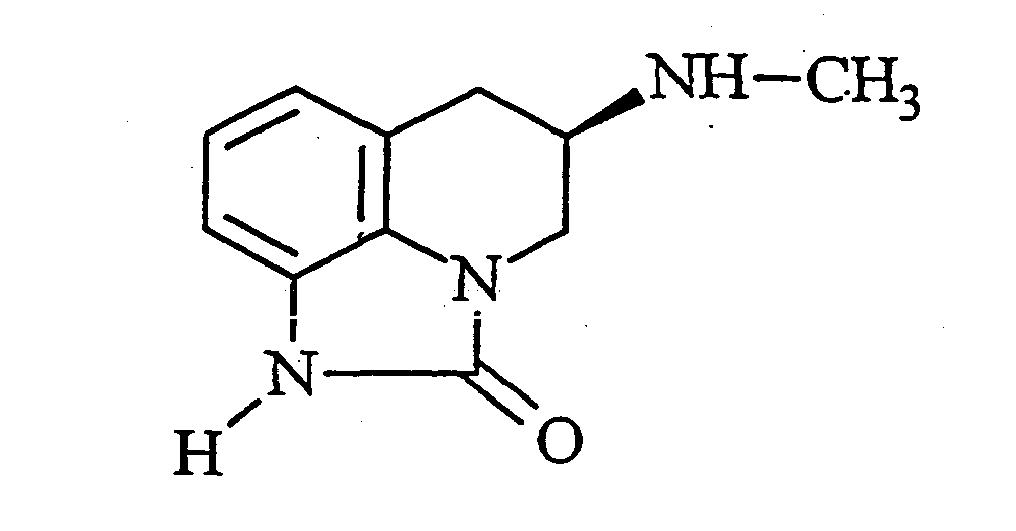

- Pharmaceutically acceptable salts include addition salts of both inorganic and organic acids. The pharmaceutically acceptable salts are preferred over the corresponding free amines since they produce compounds which are more water soluble and more crystalline. The preferred pharmaceutically acceptable salts include salts of the following acids hydrochloric, hydrobromic, sulfuric, phosphoric, nitric, citric, methanesulfonic CH3-(CH2)n1-COOH where n1 is 0 thru 4, HOOC-(CH2)n1-COOH where n1 is as defined above, and HOOC-CH=CH-COOH. For other pharmaceutically acceptable salts, see Int. J. Pharm., 33, 201-217 (1986).
- It is more preferred that the active agent (5R)-5-(methylamino)-5,6-dihydro-4H-imidazo[4,5,1-ij]quinoline-2(1H)-thione be present as the maleate salt, which is (5R)-5-(methylamino)-5,6-dihydro-4H-imidazo[4,5,1-ij]quinoline-2(1H)-thione maleate. A preferred salt of (5R)-5-(methylamino)-5,6-dihydro-4H-imidazo[4,5,1-ij]quinoline-2(1H)-thione is (5R)-5-(methylamino)-5,6-dihydro-4H-imidazo[4,5,1-ij]quinoline-2(1H)-thione 2-butenedioanate.
- Other compounds suitable for the invention are those having the formula:

- n2 is 0-3;
- R4 and R5 are independently hydrogen, -OH, CN, CH2CN, 2-CF3, 4-CF3, CH2CF3, CH2CHF2, CH=CF2, (CH2)2CF3, ethenyl, 2-propenyl, OSO2CH3, OSO2CF3, SSO2CF3, COR7, COOR7, CON(R7)2, SOx1CH3, wherein x1 is 0-2, SOx1CF3, O(CH2)x1CF3, SO2N(R7)2, CH=NOR7, COCOOR7, COCOON(R7)2, C1-8 alkyl, C3-8 cycloalkyl, CH2OR7, CH2(R7)2, NR7SO2CF3, NO2, halogen, a phenyl at positions 2, 3 or 4, thienyl, furyl, pyrrole, oxazole, thiazole, N-pyrroline, triazole, tetrazole or pyridine; provided that at least one of R4 and R5 is a substituent other than hydrogen and provided that when R4 or R5 is -OH R7 is other than hydrogen;
- R6 is hydrogen, CF3, CH2CF3, C1-C8 alkyl, C3-C8 cycloalkyl, C4-C9 cycloalkyl-methyl, C2-C8 alkenyl, C2-C8 alkynyl, 3,3,3-trifluoropropyl, 4,4,4-trifluorobutyl, -(CH2)m-R8, wherein m is 1-8, CH2SCH3 or a C4-C8 alkyl bonded to said nitrogen and one of its adjacent carbon atoms inclusive to form a heterocyclic structure;
- R7 is independently hydrogen, CF3, CH2CF3, C1-C8 alkyl, C3-C8 cycloalkyl, C4-C9 cycloalkyl-methyl, C2-C8 alkenyl, C2-C8 alkynyl, 3,3,3-trifluoropropyl, 4,4,4-trifluorobutyl, -(CH2)m-R8, wherein m is 1-8;
- R8 is phenyl optionally substituted with a CN, CF3, CH2CF3, C1-C8 alkyl, C3-C8 cycloalkyl, C4-C9 cycloalkyl-methyl, C2-C8 alkenyl, C2-C8 alkynyl, 2-thiophenyl, 3-thiophenyl, -NR9CONR9R10, or -CONR9R10; and
- R9 and R10 are each independently hydrogen, C1-C8 alkyl, C3-C8 cycloalkyl, C4-C9 cycloalkylmethyl, C2-C8 alkenyl or C2-C8 alkynyl.
- The preferred compounds are at least those compounds of formula ( II ) wherein:
- R4 is CN, and n2, R5, R6, and R7 are as previously defined;
- R5 is H, R6 is n-propyl, and n2, R4, and R7 are as previously defined;
- R4 is -OSO2CF3, and n2 and R5-R7 are as previously defined;
- R5 is H, R6 is C1-8 alkyl, and n2, R4, and R7 are as previously defined;
- R4 is 3-OH, R5 is H, R6 is n-propyl, R7 is a C1-8 alkyl, and n2 is as previously defined;
- n2 is 2, and R4-R7 are as previously defined; and
- n2 is 0, and R4-R7 are as previously defined.
- Compounds of formula ( II ) are described in U.S. Patent Nos. 5,594,024, issued January 14, 1997, and U.S. 5,462,947, issued October 31, 1995, each of which is incorporated herein by reference. The compounds can more generally be referred to as phenylazacycloalkane compounds.
- Nonlimiting examples of formula ( II ) for the practice of the invention include, but are not limited to:
- (3S)-3-[3-(methylsulfonyl)phenyl]-1-propylpiperidine hydrochloride;
- (3S) -3- [3- (methylsulfonyl)phenyl] -1-propylpiperidine hydrobromide; and
- (3S)-3-[3-methylsulfonyl)phenyl]-1-propylpiperidine (2E)-2-butenedioate.
- More compounds suitable for the invention are the active agent cabergoline and derivatives thereof of the formula:

- R11 is hydrogen or methyl;
- R12 is independently hydrogen, halogen, methyl, formyl, S-R17, or SO-R17, wherein R17 is C1-C4 alkyl or phenyl;
- R13 is hydrogen or methoxy;
- R14 is independently C1-C4 alkyl, C1-C4 alkenyl, C1-C4 alkynyl, benzyl, or phenyl; and
- R15 and R16 are each independently C1-C4 alkyl, cyclohexyl, phenyl optionally substituted with halogen or methoxy, or (CH2)n3N(CH3)2, wherein n3 is an integer.
- The chemical name for cabergoline is 1-((6-allylergolin-8β-yl)carbonyl)-1-(3-(dimethylamino)propyl)-3-ethylurea. Cabergoline is the generic name for the active ingredient in DOSTINEX™ (Pharmacia & UpJohn, Inc., Kalamazoo, Michigan, now Pharmacia Corporation), which is sold in the United States as a treatment for hyperprolactinemic disorders, and CABASER™ (Pharmacia & UpJohn, Inc.), which is sold in Europe as a treatment for Parkinson's disease. The synthesis and use of cabergoline and some useful derivatives thereof are disclosed and claimed in U.S. Patent No. 4,526,892, which is incorporated herein by reference. More specifically, the compounds disclosed generically and specifically in claims 1-4 of U.S. Patent No. 4,526,892 are incorporated herein by reference.
- Another class of compounds suitable for the invention is the aromatic bicyclic amine compounds of the formula:

- n3 is 0 or 1;
- n4 is 0 or 1, provided that R20 is not present when n4 is 0;
- R18 (1) is α-R18-1:β-R18-2 where one of R18-1 or R18-2 is selected from the group consisting of H or C1-C6 alkyl, and the other of R18-1 or R18-2 is a group of the formula :

- R19 is oxygen (O) or sulfur (S);
- R20 is α-R20-1: β-R20-1, wherein one of R20-1 and R20-2 is H, C1-C6 alkyl, and the other of R20-1 or R20-2 is H, C1-C6 alkyl, phenyl, hydroxy, and -O-(C1-C3 alkyl);
- R21 is α-R21-1: β-R21-1, wherein one of R21-1 and R21-2 is H, C1-C6 alkyl, and the other of R21-1 or R21-2 is H, C1-C6 alkyl, phenyl, hydroxy, and -O-(C1-C3 alkyl);
- and when n4 is 1, one of R20-1 or R20-2 and one of R21-1 or R21-2 can be taken together with the carbon atoms to which they are attached to form a carbon ring of 5-, 6-, or 7- members;
- R22 is H, F, Cl, Br, I, -CONR35R36, -SONR35R36, CF3, NR35R36, NO2, CN, -NR35-CO-R36, -SO2CF3, C1-C4 alkyl, Si(CH3)3, and phenyl optionally substituted with one or two substituents selected from the group consisting of F, Cl, Br, I, and -CO-NR35R36, wherein R35 and R36 are independently selected from the group consisting of H, C1-C6 alkyl, C3-C7 cycloalkyl, and -C1-C3 alkyl-(C3-C7 cycloalkyl);
- and where R22 and one of R21-1 or R21-2 are taken together with the carbon atoms to which they are attached to form a carbon ring of 5-, 6-, or 7-members;
- R23 is H, F, Cl, Br, I, -CONR37R38, -SONR37R38, CF3, NR37R38, NO2, CN, -NR37-CO-R38, -SO2CF3, C1-C4 alkyl, Si(CH3)3, and phenyl optionally substituted with one or two substituents selected from the group consisting of F, Cl, Br, I, and -CO-NR37R38, wherein R37 and R38 are independently selected from the group consisting of H, C1-C6 alkyl, C3-C7 cycloalkyl, and -C1-C3 alkyl- (C3-C7 cycloalkyl);
- R24 is H, F, Cl, Br, I, -CONR39R40, -SONR39R40, CF3, NR39R40, NO2, CN, -NR39-CO-R40, -SO2CF3, C1-C4 alkyl, Si(CH3)3, and phenyl optionally substituted with one or two substituents selected from the group consisting of F, Cl, Br, I, and -CO-NR39R40, wherein R39 and R40 are independently selected from the group consisting of H, C1-C6 alkyl, C3-C7 cycloalkyl, and -C1-C3 alkyl- (C3-C7 cycloalkyl);
- R25 is H, F, Cl, Br, I, -CONR41R42, -SONR41R42, CF3, NR41R42, NO2, CN, -NR41-CO-R42, -SO2CF3, C1-C4 alkyl, Si(CH3)3, and phenyl optionally substituted with one or two substituents selected from the group consisting of F, Cl, Br, I, and -CO-NR41R42, wherein R41 and R42 are independently selected from the group consisting of H, C1-C6 alkyl, C3-C7 cycloalkyl, and -C1-C3 alkyl-(C3-C7 cycloalkyl);
- with the proviso that not more than two of R22, R23, R24, and R25 are other than H; and
- R30 is selected from the group consisting of:
- phenyl optionally substituted with one or two substituents selected from the group consisting of CF3, COR43, COOR43, CN, NO2, NR44-CO-R45, -S-(C1-C6 alkyl), NR44R45, or a group represented by R46;
- 2-, 3-, and 4-pyridinyl optionally substituted with one or two substituents represented by R46; and
- 2-, 4-, and 5-pyrimidinyl optionally substituted with one or two substituents represented by R46;
- Compounds of formula (IV) are described in U.S. Patent No. 5,877,317, issued March 2, 1999, which is herein incorporated by reference. Aromatic bicyclic amine compounds, as well as methods for making and using the compounds, are disclosed in U.S. Patent No. 5,877,317. More particularly, aromatic bicyclic amine compounds are claimed in claims 1-18 of U.S. Patent No. 5,877,317.
- Preferred compounds of formula (IV) are those wherein one of the substituents represented by R18-1 or R182 is H, and the other substituent represented by R18-1 or R18-2 is a group of the formula:

- Nonlimiting examples of formula (IV) for the practice of the invention include, but are not limited to, compounds selected from the group consisting of:
- 1-(4-fluorophenyl)-4-[2-(isochroman-1-yl) ethyl] piperazine,
- 1-[2-(isochroman-1-yl)ethyl]-4-phenylpiperazine,
- 1-[2-(isochroman-1-yl)ethyl]-4-(4-methoxyphenyl) piperazine,
- (-)-4-[4-[2-(isochroman-1-yl)ethyl]piperazin-1-yl]benzamide, and
- (-)-4-[4-[2-(isochroman-1-yl)ethyl]piperazin-1-yl]benzenesulfonamide.
- The preferred compound is (-)-4-[4-[2-(isochroman-1-yl) ethyl] piperazin-1-yl] benzenesulfonamide, or (-)-4-[4-[2-(3,4-dihydro-1H-2-benzopyran-1-yl)ethyl]-1-piperazinyl] -benzenesulfonamide, or 4-(4-(2-[(1S)-3,4-dihydro-1H-isochromen-1-yl]ethyl)-1-piperazinyl)benzenesulfonamide (Generated by ACD/Name software).
- The term "alkyl" as used herein refers to The notation "Cy-Cz" denotes a hydrocarbon chain containing from y carbon atoms to z carbon atoms. For example, the term C1-C6 alkyl refers to a straight or branched alkyl group of from about 1 to about 6 carbon atoms, such as methyl, ethyl, n-propyl, iso-propyl, n-butyl, iso-butyl, sec-butyl, tert-butyl, n-pentyl, neopentyl, n-hexyl, iso-hexyl, and the like.
- As used herein, the term "alkenyl" refers to a radical of an aliphatic, unsaturated hydrocarbon containing at least one double bond, including branched and unbranched forms. Examples of alkenyl groups include, but are not limited to, ethenyl, 1-methyl-1-ethenyl, 1-propenyl, 2-propenyl, 1-butenyl, 2-butenyl, 3-butenyl, 2-methyl-1-butenyl, 1-pentenyl, 2-pentenyl, 3-pentenyl, 4-pentenyl, 1-methyl-4-pentenyl, 3-methyl-1-pentenyl, 3-methyl,-2-pentenyl, 1-hexenyl, 2-hexenyl, 3-hexenyl, and the like.
- The term "alkynyl" as used herein refers to an aliphatic unsaturated hydrocarbon containing at least one triple bond, including branched and unbranched forms. Examples of alkynyl groups are 1-propynyl, 2-propynyl, 1-butynyl, 2-butynyl, 3-butynyl, 2-methyl-1-butynyl, 1-pentynyl, 2-pentynyl, 3-pentynyl, 4-pentynyl, 1-methyl-4-pentynyl, 3-methyl-1-pentynyl, 3-methyl,-2-pentynyl, 1-hexynyl, 2-hexynyl, 3-hexynyl, and the like.
- The term "cycloalkyl" as used herein refers to nonaromatic cyclic hydrocarbon group, preferably containing from three to six carbon atoms. Examples of cycloalkyl are cyclopropyl, cyclobutyl, cyclopentyl, cyclohexyl, and the like. Cycloalkyl groups also can have alkyl and alkoxy groups, as defined above, as well as halo substituents, for example, bromo, chloro, iodo, and fluoro.
- The term "cycloalkyl-substituted alkyl" as used herein refers to an alkyl group as defined above, wherein at least one carbon atom of the alkyl group is attached to a cycloalkyl group as defined above.
- As used herein, the term "phenyl-substituted alkyl" as used herein refers to an alkyl group as defined above, wherein at least one carbon atom of the alkyl group is attached to a phenyl group, i.e. a substituted or unsubstituted radical derivatized from benzene comprising a 6-membered aromatic ring.
- The term "halogen" as used herein refers to the typical halogen atoms, for example, bromine, chlorine, iodine, and fluorine.
- The term "hydroxy" refers to the group -OH.
- The term "alkoxy" as used herein refers to a straight or branched hydrocarbon group as defined above attached to the parent molecule through an oxygen heteroatom, typically by a carbon to oxygen bond. The hydrocarbon of the alkoxy group preferably contains from 1 to 6 carbon atoms. Typical alkoxy groups are methoxy, ethoxy, n-propoxy, isopropoxy, n-butoxy, sec-butoxy (1-methylpropoxy), t-butoxy (1,1-dimethylethoxy), n-pentoxy, t-pentoxy (1,1-dimethylpropoxy), and the like.
- The term "aryl" as used herein refers to an aromatic cyclic hydrocarbon, such as phenyl and naphthyl. The aryl group, such as phenyl groups, optionally can be substituted with alkyl, alkoxy or a halo group, for example, bromo, chloro, iodo, and fluoro. Examples of aryl groups include, but are not limited to, phenyl, bromophenyl, chlorophenyl, iodophenyl, fluorophenyl, bromonaphthyl, and the like.
- The term "cyano" as used herein refers to the group -CN.
- The term "carboxamide" as used herein refers to the group -CONH2.
- The term "carboxyl" as used herein refers to the group -COOH.
- The term "carboalkoxyl" as used herein refers to a group -COOR wherein R is ower alkyl, such as carboxymethoxy, carboethoxy, and the like.
- The term "thienyl" as used herein refers to the radical derived from thiophene.
- The term "furyl" as used herein refers to the radical derived from furan, and its derivatives, including tetrahydrofuran, e.g. tetrahydrofuryl.
- The term "pyrrole" as used herein refers to all isomers of the pyrrole ring, including 2H-pyrrole, pyrrole, 2-pyrroline, and like.
- The term "cycloalkylmethyl" as used herein refers to a cycloalkyl group attached to the parent compound by a methylene (-CH2-) group.
- "Pharmaceutically acceptable" refers to those properties and/or substances which are acceptable to the patient from a pharmacological/toxicological point of view and to the manufacturing pharmaceutical chemist from a physical/chemical point of view regarding composition, formulation, stability, patient acceptance and bioavailability. More particularly, the term "pharmaceutically acceptable salts" as used herein refers to organic and inorganic acid addition salts of the parent compound.
- The dosages to be given with the compounds above can be easily determined by a skilled physician with experience in prescribing biologically active drugs designed to modulate central nervous system, movement and related psychological and physiological disorders, preferably of the disorders described herein. While the active agent generally is administered once a day or twice a day, it can be administered more, or less, frequently, as is suitable, and in the dosages desired for the particular patient.
- Any conventional pharmaceutical preparations can be used, e.g., consisting essentially of an inert pharmaceutical carrier and an effective dose of the active substance; e.g., plain or coated tablets, capsules, lozenges, powders, solutions, suspensions, emulsions, syrups, suppositories, transdermal patch, and other useful mediums for delivering the active agent. Preferably, the active agent is formulated into oral dose tablets.
- Preferred oral dose tablets comprise the active agent and a pharmaceutically acceptable carrier. The preferred pharmaceutically acceptable carrier can comprise one or more inert excipients, for example, mannitol, maize starch, colloidal silica, povidone, and magnesium stearate.
- Tablets containing heterocyclic amine compounds, phenylazacycloalkane compounds, and cabergoline or cabergoline-type compounds typically incorporate, in mg/tablet, the following amounts of active agent: 0.125, 0.25, 0.5, 1.0, 1.25 and 1.5 mg. The preferred starting dose for the administration of these compounds is about 0.125 mg/day, provided to a patient three times per day (tid). The dose may be increased from the initial dosage to a higher amount with increases every five to seven days up to a maximum dose of 10 mg/day. A preferred higher total daily dosage is about 6 mg/day. A more preferred higher dosage is about 4.5 mg/day to 5 mg/day.
- Dosages of the aromatic bicyclic amine compounds can be from about 5 mg of the aromatic bicyclic amine active agent to about 120 mg of the aromatic bicyclic amine active agent per day. Preferably, an aromatic bicyclic amine active agent is administered in an amount of about 20 mg/day to about 100 mg/day. More preferably, an aromatic bicyclic amine active agent is administered in an amount of about 40 mg/day to about 80 mg/day. The aromatic bicyclic amine compounds, like other compounds suitable for the invention, can be administered at an initial dose strength that is later increased to a suitable maximum daily dose.
- For treating the addictive disorders described herein the drug may also be provided in chewable format, such as a chewing gum. The amount of active drug included in a chewable base may be half the dosage suggested above for the tablet, for example starting with about 0.075 mg of cabergoline per square of chewing gum being administered tid and followed with higher levels after the patient shows tolerance to the drug. Chewing gum dosages contemplated within the scope of the invention include at least 0.075, 0.10, 0.125, 0.150 mg/day, in addition to those mentioned for a tablet for heterocyclic amine compounds, phenylazacycloalkane compounds, and cabergoline or cabergoline-type compounds. Similarly, dosages contemplated for the aromatic bicyclic amine compounds include from about 2.5 mg/day to about 125 mg/day. One or two chewing gum squares can be provided to the patient up to three times a day, depending on the therapeutic need of the recipient.
- Transdermal administration, such as with a skin patch application, and inhalation therapy, such as with an inhaler, also are foreseen where the patch or inhaler would deliver desired levels of the active agent to the patient. A transdermal patch containing the active agent also could be combined with a patch containing nicotine to eliminate a patient's craving for tobacco-containing products.
- The drug first is typically administered to a patient at a low dosage to avoid possible nausea that may occur with higher starting doses. The dose is then titrated up to higher levels until a suitable therapeutic effect is achieved.
- The effective dose range can be from 0.01 mg/day to about 10.0 mg/day per patient for a heterocyclic amine, phenylazacycloalkane, cabergoline, or cabergoline-type derivative. The preferred effective dose is an amount of the active agent between about 0.125 mg/day and about 6 mg/day. The more preferred effective dose is an amount of the active agent between about 0.375 mg/day to about 5 mg/day. An especially preferred effective dose is an amount of the active agent between about 0.75 mg/day and 4.5 mg/day to a patient. In addition to being administered by oral or intravenous route, the active agent also can be administered transdermally or by inhalation.
- In the practice of the invention, typically a starting dose of about 0.125 mg/day, administered three times per day, is incrementally increased every five to seven days until optimal therapeutic effect is achieved. The dosage can be titrated to achieve a maximal therapeutic effect, provided that the patient does not experience intolerable side effects. One ordinarily skilled in art of providing medicine, such as a physician or pharmacist can determine the optimal dosage level after considering a patient's age, size, medical history, responsiveness to and toleration for the drug.
- Addictive disorders and psychoactive substance use disorders, such as intoxication disorders, inhalation disorders, alcohol addiction, tobacco addiction and/or nicotine addiction can be treated according to the invention. Tobacco and nicotine addiction would be treated with the goal of achieving either smoking cessation or at least a reduction in the intake of tobacco and/or nicotine. General descriptions of addictive disorders, including disorders related to intoxication, inhalants, and tobacco addiction or nicotine addiction can be found in many standard sources. The addictions and behaviors that can be treated by the invention generally are further described in, for example, The American Psychiatric Press Textbook of Psychiatry, Second Edition, edited by Robert E. Hales, Stuart C. Yudofsky, and John A. Talbott, 1994, incorporated by reference, especially pp. 401 et. seq., section on "Nicotine" incorporated by reference; and Manual of Psychia tri c Therapeutics, Second Edition, edited by Richard I. Shader, incorporated by reference, especially pp. 85 from Chapter 11, entitled "Hypnosis".
- The method is particularly useful for the treatment of
and relief from alcohol and other psychoactive substance use disorders such as, for example, disorders related to intoxication or inhalants, more particularly tobacco or nicotine addiction. The effect of the invention on tobacco addiction more particularly involves the administration of the active agent in a manner and form that reduces the symptoms of the disease. In particular, the tobacco- and/or nicotine-related aspect of the invention can be used to reduce or stop the smoking or chewing of nicotine-containing materials by a patient. - Without further elaboration, it is believed that one skilled in the art can, using the preceding description, practice the invention to its fullest extent. Those skilled in the art will promptly recognize appropriate variations from the procedures both as to reactants and as to reaction conditions and techniques.


wherein R34 is selected from the group consisting of H, C1-C6 alkyl, C3-C7 cycloalkyl, -C1-C3 alkyl-(C3-C7 cycloalkyl) ; and S2 is 0, 1, or 2;

-C1-C3 alkyl-(C3-C7 cycloalkyl) ; and R46 is selected from the group consisting of F, Cl, Br, I, -CO-NR44R45, - SO2NR44R45, OH, SH, C1-C6 alkyl, C3-C6 cycloalkyl, -OR47, - CH2-(C3-C6 cycloalkyl), -CH2-phenyl, C3-C6 cycloalkyl, SO2CF3, and
-CH2CF3, wherein R44 and R45 are as previously defined and R47 is C1-C6 alkyl;
and enantiomers and diasteromers thereof, where such exist, and pharmaceutically acceptable salts thereof.
Claims (9)
- Use of a compound for the preparation of a medicament for treating or suppressing the symptoms of at least one disorder selected from addictive disorders, psychoactive substance use disorders, intoxication disorders, inhalation disorders, alcohol addiction, tobacco addiction, and nicotine addiction, wherein the compound is of the formula:
 R11 is hydrogen or methyl;R12 is hydrogen, halogen, methyl, formyl, S-R17, or SO-R17 wherein R17 is C1-C4 alkyl or phenyl;R13 is hydrogen or methoxy;R14 is C1-C4 alkyl, C1-C4 alkenyl, C1-C4 alkynyl, benzyl or phenyl; andR15 and R16 are each independently C1-C4 alkyl, cyclohexyl, benzyl, phenyl optionally substituted with halogen or methoxy, or (CH2)nN(CH3)2, wherein n is an integer.
 - The use of claim 1, wherein the compound is 1-((6-allylergolin-8β-yl)carbonyl)-1-(3-(dimethylamino)propyl)-3-ethylurea.
- The use of claim 1 or claim 2, wherein the disorder is tobacco and/or nicotine addiction.
- The use of claim 1 or claim 2, wherein the active agent is used to reduce the smoking or chewing of nicotine-containing materials.
- The use of any preceding claim, wherein the compound is to be administered in a dose of 0.01 to 10.0 mg/day.
- The use of claim 5, wherein the dose is 0.125 to 6 mg/day.
- The use of claim 6, wherein the dose is 0.375 to 5 mg/day.
- The use of claim 7, wherein the dose is 0.75 to 4.5 mg/day.
- The use of any of claims 5 to 8, wherein the dose is about 0.125 mg/day to be administered three times per day and titrated to higher levels every five to seven days up to a maximum dose of 10 mg/day.
Applications Claiming Priority (3)
| Application Number | Priority Date | Filing Date | Title |
|---|---|---|---|
| US22571400P | 2000-08-16 | 2000-08-16 | |
| US26361001P | 2001-01-23 | 2001-01-23 | |
| EP01962196A EP1363634A2 (en) | 2000-08-16 | 2001-08-13 | Compounds for the treatment of addictive disorders |
Related Parent Applications (1)
| Application Number | Title | Priority Date | Filing Date |
|---|---|---|---|
| EP01962196A Division EP1363634A2 (en) | 2000-08-16 | 2001-08-13 | Compounds for the treatment of addictive disorders |
Publications (1)
| Publication Number | Publication Date |
|---|---|
| EP1685838A1 true EP1685838A1 (en) | 2006-08-02 |
Family
ID=36602897
Family Applications (1)
| Application Number | Title | Priority Date | Filing Date |
|---|---|---|---|
| EP06007780A Withdrawn EP1685838A1 (en) | 2000-08-16 | 2001-08-13 | Compounds for the treatment of addictive disorders |
Country Status (1)
| Country | Link |
|---|---|
| EP (1) | EP1685838A1 (en) |
Citations (5)
| Publication number | Priority date | Publication date | Assignee | Title |
|---|---|---|---|---|
| US5430031A (en) * | 1992-12-24 | 1995-07-04 | Farmitalia Carlo Erba S.R.L. | Serotoninergic ergoline derivatives |
| US5441961A (en) * | 1992-08-27 | 1995-08-15 | Eli Lilly And Company | Substituted cyclo or bicycloalkylamides of (8β)-6-(substituted) ergolines |
| WO1998000142A1 (en) * | 1996-07-02 | 1998-01-08 | Hexal Ag | Plaster for the transdermal application of pergolide |
| US6087371A (en) * | 1996-02-15 | 2000-07-11 | Pharmacia & Upjohn S.P.A. | Heterocyclyl-ergoline derivatives as 5-HT1A receptor ligands |
| WO2001041763A1 (en) * | 1999-12-10 | 2001-06-14 | University Of Cincinnati | Treatment of addiction disorders |
-
2001
- 2001-08-13 EP EP06007780A patent/EP1685838A1/en not_active Withdrawn
Patent Citations (5)
| Publication number | Priority date | Publication date | Assignee | Title |
|---|---|---|---|---|
| US5441961A (en) * | 1992-08-27 | 1995-08-15 | Eli Lilly And Company | Substituted cyclo or bicycloalkylamides of (8β)-6-(substituted) ergolines |
| US5430031A (en) * | 1992-12-24 | 1995-07-04 | Farmitalia Carlo Erba S.R.L. | Serotoninergic ergoline derivatives |
| US6087371A (en) * | 1996-02-15 | 2000-07-11 | Pharmacia & Upjohn S.P.A. | Heterocyclyl-ergoline derivatives as 5-HT1A receptor ligands |
| WO1998000142A1 (en) * | 1996-07-02 | 1998-01-08 | Hexal Ag | Plaster for the transdermal application of pergolide |
| WO2001041763A1 (en) * | 1999-12-10 | 2001-06-14 | University Of Cincinnati | Treatment of addiction disorders |
Similar Documents
| Publication | Publication Date | Title |
|---|---|---|
| EP1257271B1 (en) | Use of pramipexole for the treament of tobacco/nicotine addiction | |
| CN1638739A (en) | Compounds for the treatment of addictive disorders | |
| US20050154009A1 (en) | Pharmaceutical composition comprising a monoamine neurotransmitter re-uptake inhibitor and an acetylcholinesterase inhibitor | |
| JPH05507731A (en) | Pharmaceutical compositions for the treatment of substance abuse disorders | |
| US20050182089A1 (en) | Pharmaceutical composition comprising a monoamine neurotransmitter re-uptake inhibitor and an N-methyl-D-aspartate (NMDA) receptors antagonist | |
| US6166032A (en) | Method for controlling tobacco use and alleviating withdrawal symptoms due to cessation of tobacco use | |
| NZ531171A (en) | Cabergoline-type compounds for treating fibromyalgia and chronic fatigue syndrome | |
| JP2005505539A (en) | Composition comprising a CB1 receptor antagonist for the treatment of Parkinson's disease and a product that activates brain dopaminergic neurotransmission | |
| JP2002539256A (en) | Use of certain affinity NMDA antagonists as antidepressants | |
| US6841557B2 (en) | Compounds for the treatment of addictive disorders | |
| AU2001283393A1 (en) | Compounds for the treatment of addictive disorders | |
| HUP0200969A2 (en) | Use of saredutant and the pharmaceutically acceptable salts thereof to produce medicaments used to treat or prevent mood disorders, adjustment disorders os mixed anxiety-depression disorders | |
| SK284264B6 (en) | Medicament for the treatment of Restless Legs Syndrome | |
| EP1685838A1 (en) | Compounds for the treatment of addictive disorders | |
| US20030036548A1 (en) | Method for treating anhedonia using dopamine agonists | |
| EP4212159A1 (en) | Use of sphingosine-1-phosphate receptor agonist | |
| ZA200300220B (en) | Compounds for the treatment of addictive disorders. | |
| JPH0564124B2 (en) | ||
| HK1079449A (en) | Compounds for the treatment of addictive disorders | |
| JPH1129476A (en) | Depressant for drug dependence | |
| JP2002536326A (en) | Methods for preventing or reducing cardiovascular events associated with coronary intervention | |
| JPH10109936A (en) | Agent for treatment and prevention of diabetic neuropathy | |
| WO2017017511A1 (en) | Modified release formulation for treating premature ejaculation | |
| JPS61191615A (en) | Medicinal composition for treating parkinsonism or parkinsonic syndrome |
Legal Events
| Date | Code | Title | Description |
|---|---|---|---|
| PUAI | Public reference made under article 153(3) epc to a published international application that has entered the european phase |
Free format text: ORIGINAL CODE: 0009012 |
|
| AC | Divisional application: reference to earlier application |
Ref document number: 1363634 Country of ref document: EP Kind code of ref document: P |
|
| AK | Designated contracting states |
Kind code of ref document: A1 Designated state(s): AT BE CH CY DE DK ES FI FR GB GR IE IT LI LU MC NL PT SE TR |
|
| AX | Request for extension of the european patent |
Extension state: AL LT LV MK RO SI |
|
| RAP1 | Party data changed (applicant data changed or rights of an application transferred) |
Owner name: PHARMACIA & UPJOHN COMPANY LLC |
|
| AKX | Designation fees paid | ||
| REG | Reference to a national code |
Ref country code: DE Ref legal event code: 8566 |
|
| STAA | Information on the status of an ep patent application or granted ep patent |
Free format text: STATUS: THE APPLICATION IS DEEMED TO BE WITHDRAWN |
|
| 18D | Application deemed to be withdrawn |
Effective date: 20070203 |