EP1684974B1 - Sculptured and etched polyester textile having shade contrast corresponding to surface etched regions - Google Patents
Sculptured and etched polyester textile having shade contrast corresponding to surface etched regions Download PDFInfo
- Publication number
- EP1684974B1 EP1684974B1 EP20040782639 EP04782639A EP1684974B1 EP 1684974 B1 EP1684974 B1 EP 1684974B1 EP 20040782639 EP20040782639 EP 20040782639 EP 04782639 A EP04782639 A EP 04782639A EP 1684974 B1 EP1684974 B1 EP 1684974B1
- Authority
- EP
- European Patent Office
- Prior art keywords
- regions
- fabric
- pile
- color
- etched
- Prior art date
- Legal status (The legal status is an assumption and is not a legal conclusion. Google has not performed a legal analysis and makes no representation as to the accuracy of the status listed.)
- Expired - Lifetime
Links
- 229920000728 polyester Polymers 0.000 title claims description 10
- 239000004753 textile Substances 0.000 title description 42
- 239000004744 fabric Substances 0.000 claims description 58
- 238000000034 method Methods 0.000 claims description 43
- 238000005530 etching Methods 0.000 claims description 19
- 239000000203 mixture Substances 0.000 claims description 13
- 238000001035 drying Methods 0.000 claims description 9
- 238000004519 manufacturing process Methods 0.000 claims description 6
- 238000010438 heat treatment Methods 0.000 claims description 4
- 238000005406 washing Methods 0.000 claims description 2
- 239000000975 dye Substances 0.000 description 37
- 239000000126 substance Substances 0.000 description 20
- 239000000835 fiber Substances 0.000 description 18
- 239000002585 base Substances 0.000 description 10
- 239000000463 material Substances 0.000 description 10
- HEMHJVSKTPXQMS-UHFFFAOYSA-M Sodium hydroxide Chemical compound [OH-].[Na+] HEMHJVSKTPXQMS-UHFFFAOYSA-M 0.000 description 9
- 239000000986 disperse dye Substances 0.000 description 9
- 239000000047 product Substances 0.000 description 9
- 238000007639 printing Methods 0.000 description 7
- 239000003518 caustics Substances 0.000 description 6
- 239000007787 solid Substances 0.000 description 5
- 238000004043 dyeing Methods 0.000 description 4
- 230000000694 effects Effects 0.000 description 4
- 230000002829 reductive effect Effects 0.000 description 4
- QTBSBXVTEAMEQO-UHFFFAOYSA-N Acetic acid Chemical compound CC(O)=O QTBSBXVTEAMEQO-UHFFFAOYSA-N 0.000 description 3
- 230000002378 acidificating effect Effects 0.000 description 3
- 239000003086 colorant Substances 0.000 description 3
- 238000010586 diagram Methods 0.000 description 3
- 229920001778 nylon Polymers 0.000 description 3
- 238000007650 screen-printing Methods 0.000 description 3
- 235000011121 sodium hydroxide Nutrition 0.000 description 3
- 239000002904 solvent Substances 0.000 description 3
- 239000000758 substrate Substances 0.000 description 3
- 239000002253 acid Substances 0.000 description 2
- 239000000853 adhesive Substances 0.000 description 2
- 230000001070 adhesive effect Effects 0.000 description 2
- 238000003486 chemical etching Methods 0.000 description 2
- 239000003795 chemical substances by application Substances 0.000 description 2
- 239000000470 constituent Substances 0.000 description 2
- 238000010014 continuous dyeing Methods 0.000 description 2
- 238000000151 deposition Methods 0.000 description 2
- 230000003628 erosive effect Effects 0.000 description 2
- 239000012467 final product Substances 0.000 description 2
- 239000006260 foam Substances 0.000 description 2
- 239000010410 layer Substances 0.000 description 2
- 238000005259 measurement Methods 0.000 description 2
- 239000000243 solution Substances 0.000 description 2
- 239000002344 surface layer Substances 0.000 description 2
- 238000012360 testing method Methods 0.000 description 2
- 230000000007 visual effect Effects 0.000 description 2
- 229920003043 Cellulose fiber Polymers 0.000 description 1
- 239000004677 Nylon Substances 0.000 description 1
- 239000004952 Polyamide Substances 0.000 description 1
- 239000003513 alkali Substances 0.000 description 1
- 239000011324 bead Substances 0.000 description 1
- 238000009978 beck dyeing Methods 0.000 description 1
- 230000015556 catabolic process Effects 0.000 description 1
- 238000004040 coloring Methods 0.000 description 1
- 238000004891 communication Methods 0.000 description 1
- 238000010276 construction Methods 0.000 description 1
- 238000006731 degradation reaction Methods 0.000 description 1
- 230000000593 degrading effect Effects 0.000 description 1
- 230000008021 deposition Effects 0.000 description 1
- 238000013461 design Methods 0.000 description 1
- 238000007599 discharging Methods 0.000 description 1
- 238000004090 dissolution Methods 0.000 description 1
- 230000008030 elimination Effects 0.000 description 1
- 238000003379 elimination reaction Methods 0.000 description 1
- 150000002148 esters Chemical class 0.000 description 1
- 238000011156 evaluation Methods 0.000 description 1
- 238000010016 exhaust dyeing Methods 0.000 description 1
- 230000002209 hydrophobic effect Effects 0.000 description 1
- 238000011065 in-situ storage Methods 0.000 description 1
- 239000003112 inhibitor Substances 0.000 description 1
- 238000002347 injection Methods 0.000 description 1
- 239000007924 injection Substances 0.000 description 1
- 238000007641 inkjet printing Methods 0.000 description 1
- 230000000873 masking effect Effects 0.000 description 1
- 238000012986 modification Methods 0.000 description 1
- 230000004048 modification Effects 0.000 description 1
- 238000009980 pad dyeing Methods 0.000 description 1
- 150000002978 peroxides Chemical class 0.000 description 1
- 229920002647 polyamide Polymers 0.000 description 1
- 229920001223 polyethylene glycol Polymers 0.000 description 1
- 238000012545 processing Methods 0.000 description 1
- 238000005507 spraying Methods 0.000 description 1
- 238000000859 sublimation Methods 0.000 description 1
- 230000008022 sublimation Effects 0.000 description 1
- 238000009976 warp beam dyeing Methods 0.000 description 1
Images

Classifications
-
- D—TEXTILES; PAPER
- D06—TREATMENT OF TEXTILES OR THE LIKE; LAUNDERING; FLEXIBLE MATERIALS NOT OTHERWISE PROVIDED FOR
- D06Q—DECORATING TEXTILES
- D06Q1/00—Decorating textiles
- D06Q1/06—Decorating textiles by local treatment of pile fabrics with chemical means
-
- D—TEXTILES; PAPER
- D06—TREATMENT OF TEXTILES OR THE LIKE; LAUNDERING; FLEXIBLE MATERIALS NOT OTHERWISE PROVIDED FOR
- D06P—DYEING OR PRINTING TEXTILES; DYEING LEATHER, FURS OR SOLID MACROMOLECULAR SUBSTANCES IN ANY FORM
- D06P5/00—Other features in dyeing or printing textiles, or dyeing leather, furs, or solid macromolecular substances in any form
- D06P5/12—Reserving parts of the material before dyeing or printing ; Locally decreasing dye affinity by chemical means
-
- D—TEXTILES; PAPER
- D06—TREATMENT OF TEXTILES OR THE LIKE; LAUNDERING; FLEXIBLE MATERIALS NOT OTHERWISE PROVIDED FOR
- D06Q—DECORATING TEXTILES
- D06Q1/00—Decorating textiles
- D06Q1/02—Producing patterns by locally destroying or modifying the fibres of a web by chemical actions, e.g. making translucent
-
- Y—GENERAL TAGGING OF NEW TECHNOLOGICAL DEVELOPMENTS; GENERAL TAGGING OF CROSS-SECTIONAL TECHNOLOGIES SPANNING OVER SEVERAL SECTIONS OF THE IPC; TECHNICAL SUBJECTS COVERED BY FORMER USPC CROSS-REFERENCE ART COLLECTIONS [XRACs] AND DIGESTS
- Y10—TECHNICAL SUBJECTS COVERED BY FORMER USPC
- Y10S—TECHNICAL SUBJECTS COVERED BY FORMER USPC CROSS-REFERENCE ART COLLECTIONS [XRACs] AND DIGESTS
- Y10S8/00—Bleaching and dyeing; fluid treatment and chemical modification of textiles and fibers
- Y10S8/929—Carpet dyeing
-
- Y—GENERAL TAGGING OF NEW TECHNOLOGICAL DEVELOPMENTS; GENERAL TAGGING OF CROSS-SECTIONAL TECHNOLOGIES SPANNING OVER SEVERAL SECTIONS OF THE IPC; TECHNICAL SUBJECTS COVERED BY FORMER USPC CROSS-REFERENCE ART COLLECTIONS [XRACs] AND DIGESTS
- Y10—TECHNICAL SUBJECTS COVERED BY FORMER USPC
- Y10T—TECHNICAL SUBJECTS COVERED BY FORMER US CLASSIFICATION
- Y10T428/00—Stock material or miscellaneous articles
- Y10T428/23907—Pile or nap type surface or component
- Y10T428/23929—Edge feature or configured or discontinuous surface
-
- Y—GENERAL TAGGING OF NEW TECHNOLOGICAL DEVELOPMENTS; GENERAL TAGGING OF CROSS-SECTIONAL TECHNOLOGIES SPANNING OVER SEVERAL SECTIONS OF THE IPC; TECHNICAL SUBJECTS COVERED BY FORMER USPC CROSS-REFERENCE ART COLLECTIONS [XRACs] AND DIGESTS
- Y10—TECHNICAL SUBJECTS COVERED BY FORMER USPC
- Y10T—TECHNICAL SUBJECTS COVERED BY FORMER US CLASSIFICATION
- Y10T428/00—Stock material or miscellaneous articles
- Y10T428/23907—Pile or nap type surface or component
- Y10T428/23929—Edge feature or configured or discontinuous surface
- Y10T428/23936—Differential pile length or surface
Definitions
- a typical pile-containing textile may be treated to provide a sculptured (i.e. "carved") three-dimensional surface geometry by known methods.
- Such methods include for example air jet carving, such as the Millitex® process by Milliken and Company. This process is capable of producing a more luxurious and appealing textile or fabric surface in part by dissolution or elimination of fibers upon various preselected regions of a pile-containing surface by application of very hot air.
- Another method of providing a three-dimensional surface to a textile is by applying a chemical etch to the surface of the textile.
- a chemical etch may be strongly basic, or alternatively strongly acidic, to erode or eliminate pre-selected portions of a pile-containing surface.
- Such etching methods result in a surface having a three-dimensional surface geometry, with areas of reduced pile height corresponding to areas upon the surface of the textile which receive the chemical etch.
- Chemical etching is practiced in the industry in certain applications by applying a caustic or acid material to a textile. This application results in dissolving or wearing away a portion of the fibers of the textile, which has the effect of carving the textile to achieve a three-dimensional geometry or appearance.
- Color shade matching may be performed on textiles.
- the industry it is common to measure color shade using a three-dimensional color space coordinate. That is, three dimensions of color may be measured.
- the first dimension L* refers to a light or dark value.
- the second dimension of color is a red/green, and this second color space coordinate is designated a*.
- a negative (i.e. below zero) value for a* is a green, and a positive value for a* is a red.
- the third color space coordinate is b*. This coordinate is yellow/blue, with yellow being represented by a positive number, and blue being represented by a negative number.
- color space refers generally to a method of expressing the color of an object or a light source using some kind of notation, such as numbers.
- U.S. Patent No. 4,417,897 to Stahl et al is directed to a process for preparing white or colored burn-out effects on textile materials containing hydrophobic fibers and cellulose fibers. In the process, one applies to the material a dyeing liquor or printing paste containing at least one disperse dyestuff.
- U.S. Patent No. 6,494,925 to Child et al is directed to a sculptured pile fabric having both a printed pattern and a sculpted surface having various pile heights.
- a chemical sculpting method is disclosed in which the height of the pile surface is selectively reduced in a pattern configuration, followed by an overall "dilute" dying process.
- U.S. Patent No. 4,846,845 to McBride et al. is directed to a process for sculpting pile fabrics which comprises contacting the pile fabric surface with a fiber degrading composition. The resulting products produced by following the teachings of this particular patent do not show any substantial color contrast between etched and non-etched areas.
- U.S. Patent No. 3,849,159 discloses a method for producing an embossed effect on nylon pile fabric having a surface of nylon fibers comprising selectively contacting the surface with a chemical fiber shrinking agent therefore, allowing the shrinking action to occur, and thereafter, effectively removing the shrinking agent from the surface, the shrinking serving to reduce the height of the pile in the treated areas.
- U. S. Patent No. 4,215,987 discloses a method for imparting a durable, multiple-level, pile height to bleached, unbleached or dyed material, said material having a ground layer supporting a surface layer of piles on at least one of itsfaces, said method comprising: applying a caustic paste to at least one predetermined area of one of the surface layers of piles; allowing the caustic paste sufficient time to shrink to piles in said at least one predetermined area in the absence of substantial shrinkage of the ground layer; and recovering the material.
- U.S. Patent No. 3,567,548 discloses a process for sculpturing a pile fabric comprising the steps of (1) directly depositing in a predetermined pattern on the surface of said pile a solution having a viscosity of about 500 to 1000 cps. and containing a solvent for at least one of the major constituent fibers of said pile, said deposition being at a depth of about 10 to 30% of the average pile height and in sufficient amount and under sufficient pressure to penetrate the pile substantially to the base of the fabric, (2) heating said solvent-containing pile fabric to remove at least 75% of said solvent to form in situ an adhesive mixture comprising the dissolved major constituent fibers of said pile (3), compacting said pile with said adhesive mixture present and (4) relofting the pile elements.
- etching of such a pile-containing fabric may occur by providing a pile fabric which previously has received upon the pile surface an unfixed dye. Then, this fabric which has been treated with unfixed dye may be dried and screen printed. Screen printing (also known as "etching") is applied using an extremely strung alkali paste upon the fabric, followed by heating the fabric in a high temperature steamer. The dye is fixed in a subsequent step, and then the fabric is washed and dried.
- a washing step and a drying step results in a product having a color shade difference between etched areas and non-etched areas having a ⁇ L* value.
- this difference may be at least about 25 percent. In other embodiments, the difference may be as much as 35%, or even 40-50%, or more.
- the textile surface patterns that result are geometrically three-dimensional due to erosion/degradation of fiber in pre-selected regions.
- the etched regions are of different color shade as compared to non-etched regions, which provides a surprisingly attractive physical appearance.
- the process includes, in one embodiment, the application of an extremely strong alkaline paste upon an unfixed base substrate.
- the resulting pattern may be a tone-on-tone pattern with the base dye, or may be of a different shade than the dyed base fabric. It is believed that the application of the caustic (or acid, in other embodiments) to the fibers of the substrate which contain unfixed dye causes the unfixed dye to: (1) become chemically denatured and therefore exhibit less color intensity, or (2) wash out away from the fibers during the process, or perhaps both.
- the result is a color shade differential between the etched and non-etched areas which corresponds to the boundaries of those areas or regions which receive chemical etch treatment.
- the substances or processes that can be used to "carve” or etch textile fibers include sodium hydroxide.
- polyester fibers are etched by caustic (basic) substances, while polyamide or nylon fibers are etched by acidic etching materials or paste.
- "Paste” refers in general to any semi-solid substance which may be used in connection with a masking device (such as a print screen) to selectively etch chemically certain portions of a textile, while specifically avoiding chemical etching of other predetermined portions of the textile.
- the amount of paste employed and the screen printing procedure used in a given application will vary in the practice of the invention. The process and procedure may be tuned or specified for a particular application.
- the base textile, or fabric can be essentially any known textile polyester fabric having a pile capable of receiving a carve or etch upon its surface, and which also is capable of receiving a dye application.
- a "pile” refers to any lofted material, chenille, flocked, ribbed, corderoy, felt, or napped material.
- a knitted or woven polyester fabric is The products which can be produced may find application in numerous end uses, including for example automotive body cloth for the interior of an automobile.
- the polyester yarn employed is typically greige yarn, but in various other applications can as well be piece-dyed yarn.
- sodium hydroxide in a concentration of about 23.5% by weight, for example.
- other caustic substances, or acidic substances can be used in such an etch.
- oxidizers, polyethylene glycols, polypropanol, esters, and/or other peroxide generators also can be employed as etching materials.
- concentration will vary depending upon the particular application at issue.
- Other methods and processes for producing such a color shade differential that do not include the employment of a chemical etch are within the scope of the invention as well.
- the invention is not limited to only chemical etch processes.
- a three pile height product could be produced, having for example three different color shade areas corresponding to the different areas or regions of pile height. This could be achieved by using multiple screens, as a further elaboration of that provided below.
- Other applications could employ 4 pile height areas with 4 shade regions, or more. There is no limit to the number of pile height regions with corresponding shade differential regions that could be developed.
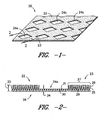
- Figure 1 shows one embodiment of the invention comprising a textile 20 having color contrast and three-dimensional surface geometry corresponding to the areas which exhibit color contrast.
- the textile has a first side 22 having at least one first region 23.
- a second side 28, opposite first side 22, is also shown in Figure 2 .
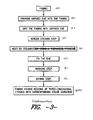
- FIG. 2 is a cross sectional view taken along line 2-2 of Figure 1 .
- the first region 23 includes a pile 29, shown in Figure 2 .
- the pile 29 is comprised of first yarns 25 having first distal ends 26.
- the first distal ends 26 collectively form an upper plane 27 of said first region 23 of said textile 20.
- the first yarns 25 have applied thereon a dye, which provides visual color.
- the first region 23 includes a first color shade having a given intensity and color value.
- the first region 23 provides a first pile height 33 (shown on the left side of Figure 2 ), while the second region 24a provides a second pile height 34, which is less (i.e. shorter) than the first pile height 33.
- the textile 20 typically will include second regions 24a-c upon the first side 22, which may be provided in a predetermined and desirable pattern in connection with the first region 23.
- the second region 24a for example, comprises a plurality of second yarns 30 having respective second distal ends 31, wherein at least a portion of the second distal ends 31 are eroded to a position beneath the upper plane 27 of the first region 23.
- the second regions 24a-c exhibit a second color shade.
- the first color shade of the first region 23 and the second color shade of the second regions 24a-c differ in L* value. In some embodiments, this difference may be at least about 25 percent, while in other embodiments, it may be more, depending upon the fiber type, processing conditions, etch composition, concentration of paste, and other factors.
- the first region 23 provides a first pile height 33 (see Figure 2 ), which is taller or higher than the second height 34 of the second regions 24.
- the erosion which occurs upon the fibers in the second region may be seen by reference to this pile height difference in Figure 2.
- Figure 2 shows a cross sectional view along line 2-2 of Figure 1 .
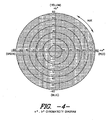
- FIG 3 shows a schematic of one method of making a textile 20 as shown in Figures 1-2 .
- a textile 20 (or base fabric, collectively referred to herein as "substrate") is provided.
- Unfixed dye is applied to the textile 20.
- a dye base shade is applied without chemically fixing the dyes to the fibers of the textile.
- "Fixing" a dye refers to the chemical or thermodynamic change effected upon a dye molecule that causes the dye molecule to firmly attach itself to a fiber, and/or exhibit color.
- This method of dye application can be accomplished by any method of continuous dyeing. Examples of possible methods of continuous dyeing include, but are not limited to: pad dyeing, blotch screen printing, ink jet printing, spraying, foam dyeing, exhaust dyeing, sublimation dyeing, dye injection, beam dyeing and beck dyeing.
- Drying may employ a drying profile which can be altered to achieve a desired degree of dye fixation. Fabrics with no dye fixation during drying can be altered to achieve a desired degree of dye fixation. Fabrics with no dye fixation during drying and with appropriate dyes can be discharged to white. Using higher temperatures or longer dwell times, some fixation of the dyes can occur and it may be possible to create tone-on-tone discharging in etched areas. Furthermore, etched areas will desirably show color shade differential as compared to the non-etches areas. This may result in an etched area having a lighter shade than the non-etched area, or an etched area with a darker shade, although the former is more likely.
- a screen etching step may be performed, with base.
- base For polyester fabrics, it is desirable to print a strong alkaline paste upon the base fabric in areas to be etched.
- This screen etching step is performed upon a fabric having a dye that is not yet fixed, or is only partially fixed.
- a second screen etching step can be performed, to form a third area or region having yet another pile height (not shown in Figures).
- color may be printed into areas of the fabric not covered by alkaline paste to provide further design effects.
- a printing step is optional, and is not required in the practice of the invention. This optional printing step is not shown in Figure 3 .
- the fabric is heated in a high temperature steamer. Once the dye is chemically fixed by heating, it is then desirable to wash and dry the fabric or textile 20.
- the final product may include multiple first regions which are positioned so as to be inter-dispersed within multiple second eroded regions.
- the fabric therefore, includes regions of three dimensional etching with corresponding color variation in which the color contrast is applied to essentially the same regions or boundaries as the etched regions.
- the L*a*b* color space (also referred to as CIELAB) is presently one of the most popular color space for measuring object color and is widely used in virtually all fields. It is one of the uniform color spaces defined by CIE in 1976 in order to reduce one of the major problems of the original Yxy color space: that equal distances on the x, y chromaticity diagram did not correspond to equal perceived color differences. In this color space, L* indicates lightness and a* and b* are the chromaticity coordinates.
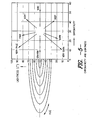
- Figure 4 shows the a*, b* chromaticity diagram.
- the a* and b* indicate color directions: +a* is the red direction, -a* is the green direction, +b* is the yellow direction, and -b* is the blue direction.
- the center is achromatic; as the a* and b* values increase and the point moves out from the center, the saturation of the color increases.
- Figure 4 is a view of a three-dimensional solid cut horizontally at a constant L* value.
- Figure 5 shows a view of chromaticity versus lightness.
- Figure 6 is a representation of the color solid for the L*a*b* color space.
- the first light source employs a cool white fluoroescent source. See Table 3.
- the second fight source employed was a daylight light source.
- the third light source was a horizon light source. Table 3 below specifically provides data obtained when evaluating the color shade of the first region (i.e. non-eiched region), as compared to the second region of each sample. Four samples were reported in Table 3.
- a 100% polyester pile fabric is continuously dyed a medium gray shade.
- the dye mix was composed of the following blend:
- Dye was applied to the fabric in a dye pad at about 60% wet pickup.
- the fabric was dried on a radio frequency dryer to ensure level and evenly distributed dye application during drying. At this stage the fabric had been dried, but dyes were not fixed in the fibers.
- the fabric was printed with etching chemistry on a rotary screen print machine.
- etching chemistry was strongly alkaline, and was composed of:
- the fabric was printed at about 7 yards per minute, and entered a 5-zone, gas-fired Tenter at 177 degrees Celsius (350 degrees Fahrenheit).
- the etching chemistry was activated under heat, and the pile of the fabric was destroyed and/or eroded in the areas where the mixture was applied.
- the dyes were fixed to the fabric by means of a superheated steamer. Fabric entered the steamer at a temperature of 180 degrees Celsius. The dwell time was about 8 minutes, which was adequate to fix the dyes.
- the fabric proceeded through a continuous wash range.
- the degraded fibers, auxiliary chemicals, and remaining surface dyes were removed from the fabric.
- a reductive clearing of surface dyes was accomplished to remove residual dyes from the face of the fabric.
- the fabric was dried on a 5-zone, gas-fired Tenter at a speed of about 25 yards per minute with a temperature of about 177 degrees Celsius (350 degrees Fahrenheit).
- Table 3 shows the results of four samples that used four different printing conditions, as practiced by following Example 1 above.
- the four printing conditions provided variable amounts of paste pick-up in the etched regions.
- One variable employed was the screen pressure on the fabric.
- each of the four samples showed varying degrees of % L * increase. This result indicates that different aesthetics can be achieved depending upon the desired result.
Landscapes
- Engineering & Computer Science (AREA)
- Textile Engineering (AREA)
- Chemical & Material Sciences (AREA)
- Chemical Kinetics & Catalysis (AREA)
- General Chemical & Material Sciences (AREA)
- Coloring (AREA)
- Chemical Or Physical Treatment Of Fibers (AREA)
- Treatment Of Fiber Materials (AREA)
Description
- In the manufacture of textile articles, the surface properties of a textile surface may desirably be changed in ways that consumers find pleasing. For example, a typical pile-containing textile may be treated to provide a sculptured (i.e. "carved") three-dimensional surface geometry by known methods. Such methods include for example air jet carving, such as the Millitex® process by Milliken and Company. This process is capable of producing a more luxurious and appealing textile or fabric surface in part by dissolution or elimination of fibers upon various preselected regions of a pile-containing surface by application of very hot air.
- Another method of providing a three-dimensional surface to a textile is by applying a chemical etch to the surface of the textile. Such a chemical etch may be strongly basic, or alternatively strongly acidic, to erode or eliminate pre-selected portions of a pile-containing surface. Such etching methods result in a surface having a three-dimensional surface geometry, with areas of reduced pile height corresponding to areas upon the surface of the textile which receive the chemical etch.
- Chemical etching is practiced in the industry in certain applications by applying a caustic or acid material to a textile. This application results in dissolving or wearing away a portion of the fibers of the textile, which has the effect of carving the textile to achieve a three-dimensional geometry or appearance.
- It is also desirable to provide color or shade variation in textiles. For example, consumers respond positively to textiles which have color contrast in predefined patterns upon a pile surface. Various methods in the industry are known for providing color shade patterns or variations upon a textile surface.
- Color shade matching, or color testing, may be performed on textiles. In the industry it is common to measure color shade using a three-dimensional color space coordinate. That is, three dimensions of color may be measured. The first dimension L*, refers to a light or dark value. The second dimension of color is a red/green, and this second color space coordinate is designated a*. A negative (i.e. below zero) value for a* is a green, and a positive value for a* is a red. The third color space coordinate is b*. This coordinate is yellow/blue, with yellow being represented by a positive number, and blue being represented by a negative number. The method of color space measurement described as L*a*b* color space method was devised in about 1976 to provide more uniform color differences in relation to visual differences. Color spaces* such as these are now used throughout the world for color communication, and are known as generally accepted standards in the industry. A "color space" refers generally to a method of expressing the color of an object or a light source using some kind of notation, such as numbers.
-
U.S. Patent No. 4,417,897 to Stahl et al is directed to a process for preparing white or colored burn-out effects on textile materials containing hydrophobic fibers and cellulose fibers. In the process, one applies to the material a dyeing liquor or printing paste containing at least one disperse dyestuff. -
U.S. Patent No. 6,494,925 to Child et al is directed to a sculptured pile fabric having both a printed pattern and a sculpted surface having various pile heights. A chemical sculpting method is disclosed in which the height of the pile surface is selectively reduced in a pattern configuration, followed by an overall "dilute" dying process.U.S. Patent No. 4,846,845 to McBride et al. is directed to a process for sculpting pile fabrics which comprises contacting the pile fabric surface with a fiber degrading composition. The resulting products produced by following the teachings of this particular patent do not show any substantial color contrast between etched and non-etched areas. -
U.S. Patent No. 3,849,159 discloses a method for producing an embossed effect on nylon pile fabric having a surface of nylon fibers comprising selectively contacting the surface with a chemical fiber shrinking agent therefore, allowing the shrinking action to occur, and thereafter, effectively removing the shrinking agent from the surface, the shrinking serving to reduce the height of the pile in the treated areas. -
U. S. Patent No. 4,215,987 discloses a method for imparting a durable, multiple-level, pile height to bleached, unbleached or dyed material, said material having a ground layer supporting a surface layer of piles on at least one of itsfaces, said method comprising: applying a caustic paste to at least one predetermined area of one of the surface layers of piles; allowing the caustic paste sufficient time to shrink to piles in said at least one predetermined area in the absence of substantial shrinkage of the ground layer; and recovering the material. -
U.S. Patent No. 3,567,548 discloses a process for sculpturing a pile fabric comprising the steps of (1) directly depositing in a predetermined pattern on the surface of said pile a solution having a viscosity of about 500 to 1000 cps. and containing a solvent for at least one of the major constituent fibers of said pile, said deposition being at a depth of about 10 to 30% of the average pile height and in sufficient amount and under sufficient pressure to penetrate the pile substantially to the base of the fabric, (2) heating said solvent-containing pile fabric to remove at least 75% of said solvent to form in situ an adhesive mixture comprising the dissolved major constituent fibers of said pile (3), compacting said pile with said adhesive mixture present and (4) relofting the pile elements. - What is needed in the textile industry are improved products and methods for producing textile products which have desirable color contrast in predefined patterns, and which have desirable sculptured three-dimensional surface geometry. Textiles which have a color shade differential between (1) full pile height areas, and (2) carved or etched areas with reduced pile height, would be particularly desirable. Furthermore, methods of achieving such products in a more efficient manufacturing process are very desirable. The invention is directed to such products and methods for making such products.
- A full and enabling disclosure of this invention, including the best mode shown to one of ordinary skill in the art, is set forth in this specification. The following Figures illustrate the invention:
-
Figure 1 is a perspective view of a textile with a surface having color contrast and three-dimensional surface geometry; -
Figure 2 shows a cross section of the textile ofFigure 1 taken along line 2-2; -
Figure 3 depicts a process or method for making a textile or fabric having regions of three-dimensional geometry by etching, with corresponding color variation to correspond with the etched areas; and -
Figure 4 is a schematic of a color space, showing a three-dimensional solid cut horizontally at a constant L* value; -
Figure 5 shows a view of chromaticity versus lightness; and -
Figure 6 is a graphic representation of a color solid for L*a*b* color space. - Reference now will be made to the embodiments of the invention, one or more examples of which are set forth below. Each example is provided by way of explanation of the invention, not as a limitation of the invention. In fact, it will be apparent to those skilled in the art that various modifications and variations can be made in this invention without departing from the scope of the invention.
- Surprisingly it has been discovered that it is possible to provide a color shade contrast and differential that corresponds with carved or etched areas on a textile. In the case of polyester pile fabrics, etching of such a pile-containing fabric may occur by providing a pile fabric which previously has received upon the pile surface an unfixed dye. Then, this fabric which has been treated with unfixed dye may be dried and screen printed. Screen printing (also known as "etching") is applied using an extremely strung alkali paste upon the fabric, followed by heating the fabric in a high temperature steamer. The dye is fixed in a subsequent step, and then the fabric is washed and dried.
- A washing step and a drying step results in a product having a color shade difference between etched areas and non-etched areas having a ΔL* value. For some embodiments of the invention, this difference may be at least about 25 percent. In other embodiments, the difference may be as much as 35%, or even 40-50%, or more. The textile surface patterns that result are geometrically three-dimensional due to erosion/degradation of fiber in pre-selected regions. The etched regions are of different color shade as compared to non-etched regions, which provides a surprisingly attractive physical appearance.
- The process includes, in one embodiment, the application of an extremely strong alkaline paste upon an unfixed base substrate. Depending upon the selection of the base dyes and the degree of fixation prior to etching, the resulting pattern may be a tone-on-tone pattern with the base dye, or may be of a different shade than the dyed base fabric. It is believed that the application of the caustic (or acid, in other embodiments) to the fibers of the substrate which contain unfixed dye causes the unfixed dye to: (1) become chemically denatured and therefore exhibit less color intensity, or (2) wash out away from the fibers during the process, or perhaps both. In any event, without being limited to any theory of application, the result is a color shade differential between the etched and non-etched areas which corresponds to the boundaries of those areas or regions which receive chemical etch treatment.
- The substances or processes that can be used to "carve" or etch textile fibers include sodium hydroxide. In general, polyester fibers are etched by caustic (basic) substances, while polyamide or nylon fibers are etched by acidic etching materials or paste. "Paste" refers in general to any semi-solid substance which may be used in connection with a masking device (such as a print screen) to selectively etch chemically certain portions of a textile, while specifically avoiding chemical etching of other predetermined portions of the textile. The amount of paste employed and the screen printing procedure used in a given application will vary in the practice of the invention. The process and procedure may be tuned or specified for a particular application.
- The base textile, or fabric, can be essentially any known textile polyester fabric having a pile capable of receiving a carve or etch upon its surface, and which also is capable of receiving a dye application. For purposes herein, a "pile" refers to any lofted material, chenille, flocked, ribbed, corderoy, felt, or napped material. A knitted or woven polyester fabric is The products which can be produced may find application in numerous end uses, including for example automotive body cloth for the interior of an automobile. The polyester yarn employed is typically greige yarn, but in various other applications can as well be piece-dyed yarn.
- In one particular application of the invention, it has been useful to employ sodium hydroxide in a concentration of about 23.5% by weight, for example. However, other caustic substances, or acidic substances, can be used in such an etch. In general, oxidizers, polyethylene glycols, polypropanol, esters, and/or other peroxide generators also can be employed as etching materials. The concentration will vary depending upon the particular application at issue. Other methods and processes for producing such a color shade differential that do not include the employment of a chemical etch are within the scope of the invention as well. The invention is not limited to only chemical etch processes.
- In some applications of the invention, there could be multiple pile height areas, such that a first etched region and a second etched region were provided, each region having its own height. In these applications, then, a three pile height product could be produced, having for example three different color shade areas corresponding to the different areas or regions of pile height. This could be achieved by using multiple screens, as a further elaboration of that provided below. Other applications could employ 4 pile height areas with 4 shade regions, or more. There is no limit to the number of pile height regions with corresponding shade differential regions that could be developed.
- After the textile is etched, it may be desirable to print color upon the textile surface. Methods of providing color into the tallest pile height area could include customary printing upon a print range. For etched areas, it would be possible to use solution dyed ground yarns, as one example, to provide such color down in the etched region. In other applications, it may be possible to add ink colorant directly into the etching composition, thereby coloring the etched region during the actual etching process. This could produce a final product that is printed upon both the first region and the eroded second region, with color provided in relatively exact registration with the pile height differential regions.
-
Figure 1 shows one embodiment of the invention comprising atextile 20 having color contrast and three-dimensional surface geometry corresponding to the areas which exhibit color contrast. The textile has afirst side 22 having at least onefirst region 23. Asecond side 28, oppositefirst side 22, is also shown inFigure 2 . -
Figure 2 is a cross sectional view taken along line 2-2 ofFigure 1 . Thefirst region 23 includes apile 29, shown inFigure 2 . Thepile 29 is comprised offirst yarns 25 having first distal ends 26. The first distal ends 26 collectively form anupper plane 27 of saidfirst region 23 of saidtextile 20. Thefirst yarns 25 have applied thereon a dye, which provides visual color. Thefirst region 23 includes a first color shade having a given intensity and color value. Thefirst region 23 provides a first pile height 33 (shown on the left side ofFigure 2 ), while thesecond region 24a provides asecond pile height 34, which is less (i.e. shorter) than thefirst pile height 33. - Furthermore, the
textile 20 typically will includesecond regions 24a-c upon thefirst side 22, which may be provided in a predetermined and desirable pattern in connection with thefirst region 23. Thesecond region 24a, for example, comprises a plurality ofsecond yarns 30 having respective second distal ends 31, wherein at least a portion of the second distal ends 31 are eroded to a position beneath theupper plane 27 of thefirst region 23. - Further, the
second regions 24a-c exhibit a second color shade. The first color shade of thefirst region 23 and the second color shade of thesecond regions 24a-c differ in L* value. In some embodiments, this difference may be at least about 25 percent, while in other embodiments, it may be more, depending upon the fiber type, processing conditions, etch composition, concentration of paste, and other factors. - In
Figure 2 , thefirst region 23 provides a first pile height 33 (seeFigure 2 ), which is taller or higher than thesecond height 34 of the second regions 24. The erosion which occurs upon the fibers in the second region may be seen by reference to this pile height difference inFigure 2. Figure 2 shows a cross sectional view along line 2-2 ofFigure 1 . -
Figure 3 shows a schematic of one method of making a textile 20 as shown inFigures 1-2 . InFigure 3 , a textile 20 (or base fabric, collectively referred to herein as "substrate") is provided. Unfixed dye is applied to thetextile 20. A dye base shade is applied without chemically fixing the dyes to the fibers of the textile. "Fixing" a dye refers to the chemical or thermodynamic change effected upon a dye molecule that causes the dye molecule to firmly attach itself to a fiber, and/or exhibit color. This method of dye application can be accomplished by any method of continuous dyeing. Examples of possible methods of continuous dyeing include, but are not limited to: pad dyeing, blotch screen printing, ink jet printing, spraying, foam dyeing, exhaust dyeing, sublimation dyeing, dye injection, beam dyeing and beck dyeing. - Drying may employ a drying profile which can be altered to achieve a desired degree of dye fixation. Fabrics with no dye fixation during drying can be altered to achieve a desired degree of dye fixation. Fabrics with no dye fixation during drying and with appropriate dyes can be discharged to white. Using higher temperatures or longer dwell times, some fixation of the dyes can occur and it may be possible to create tone-on-tone discharging in etched areas. Furthermore, etched areas will desirably show color shade differential as compared to the non-etches areas. This may result in an etched area having a lighter shade than the non-etched area, or an etched area with a darker shade, although the former is more likely.
- Next, a screen etching step may be performed, with base. For polyester fabrics, it is desirable to print a strong alkaline paste upon the base fabric in areas to be etched. This screen etching step is performed upon a fabric having a dye that is not yet fixed, or is only partially fixed. A second screen etching step can be performed, to form a third area or region having yet another pile height (not shown in Figures).
- Following this screen etching process, color may be printed into areas of the fabric not covered by alkaline paste to provide further design effects. However, such a printing step is optional, and is not required in the practice of the invention. This optional printing step is not shown in
Figure 3 . Also, it may be possible to provide an ink colorant to said etched region by providing such a colorant in the etch paste composition, which would give the possibility to color more darkly the etched region, as compared to the non-etched region or regions. - In the practice of the invention, the fabric is heated in a high temperature steamer. Once the dye is chemically fixed by heating, it is then desirable to wash and dry the fabric or
textile 20. The final product may include multiple first regions which are positioned so as to be inter-dispersed within multiple second eroded regions. The fabric, therefore, includes regions of three dimensional etching with corresponding color variation in which the color contrast is applied to essentially the same regions or boundaries as the etched regions. - The L*a*b* color space (also referred to as CIELAB) is presently one of the most popular color space for measuring object color and is widely used in virtually all fields. It is one of the uniform color spaces defined by CIE in 1976 in order to reduce one of the major problems of the original Yxy color space: that equal distances on the x, y chromaticity diagram did not correspond to equal perceived color differences. In this color space, L* indicates lightness and a* and b* are the chromaticity coordinates.
-
Figure 4 shows the a*, b* chromaticity diagram. In this diagram, the a* and b* indicate color directions: +a* is the red direction, -a* is the green direction, +b* is the yellow direction, and -b* is the blue direction. The center is achromatic; as the a* and b* values increase and the point moves out from the center, the saturation of the color increases. -
Figure 4 is a view of a three-dimensional solid cut horizontally at a constant L* value.Figure 5 shows a view of chromaticity versus lightness.Figure 6 is a representation of the color solid for the L*a*b* color space. - For purposes of this specification and testing herein, several different light sources may be employed. The first light source employs a cool white fluoroescent source. See Table 3. The second fight source employed was a daylight light source. The third light source was a horizon light source. Table 3 below specifically provides data obtained when evaluating the color shade of the first region (i.e. non-eiched region), as compared to the second region of each sample. Four samples were reported in Table 3.
- The following is an example of a method of producing a fabric with color contrast and three-dimensional surface geometry according to the invention. A 100% polyester pile fabric is continuously dyed a medium gray shade. The dye mix was composed of the following blend:
- 8.08 g/kg Yellow Disperse Dye (Dorospers Yellow KHM™-M Dohmen USA, Inc.)
- 0.63 g/kg Red Disperse Dye (Dorospers Red KFFN ™-M Dohmen USA, Inc.)
- 3.04 g/kg Red Disperse Dye (Dianix Red BLS ™-DyStar, Inc.)
- 8.55 g/kg Blue Disperse Dye (Terasil Blue GLF ™-Ciba, Inc.)
- 0.66 g/kg Blue Disperse Dye (Dianix Blue BGE ™-DyStar, Inc.)
- 33.3 g/kg Ultraviolet Inhibitor (Millitex® Millad 450™- Milliken Chemical)
- 1.0 g/kg Acetic Acid
- 10 g/kg Antimigrant (Astrotherm 111 C™ - Glotex Chemical)
- Dye was applied to the fabric in a dye pad at about 60% wet pickup. The fabric was dried on a radio frequency dryer to ensure level and evenly distributed dye application during drying. At this stage the fabric had been dried, but dyes were not fixed in the fibers.
- The fabric was printed with etching chemistry on a rotary screen print machine. In addition, two screens of color were added to the print. The etching chemistry employed was strongly alkaline, and was composed of:
- 70 g/kg Millitex® APG (Milliken Chemical)
- 235 g/kg Caustic Soda Beads
- The fabric was printed at about 7 yards per minute, and entered a 5-zone, gas-fired Tenter at 177 degrees Celsius (350 degrees Fahrenheit). The etching chemistry was activated under heat, and the pile of the fabric was destroyed and/or eroded in the areas where the mixture was applied.
- The dyes were fixed to the fabric by means of a superheated steamer. Fabric entered the steamer at a temperature of 180 degrees Celsius. The dwell time was about 8 minutes, which was adequate to fix the dyes.
- The fabric proceeded through a continuous wash range. The degraded fibers, auxiliary chemicals, and remaining surface dyes were removed from the fabric. A reductive clearing of surface dyes was accomplished to remove residual dyes from the face of the fabric.
- The fabric was dried on a 5-zone, gas-fired Tenter at a speed of about 25 yards per minute with a temperature of about 177 degrees Celsius (350 degrees Fahrenheit).
- A color space coordinate evaluation was provided on the fabrics produced, comparing the etched regions to the non-etched regions to determine color shade variation. A positive % L* increase indicated that the etched region was lighter in shade than the non-etched (or non-eroded) region. Values are reported in Table 1 below.
TABLE 1 COOL WHITE DELTA L* 9.21 DELTA a* -0.46 DELTA B* 3.26 % L* INCREASE 29 DAYLIGHT DELTA L* 9.37 DELTA a* -0.11 DELTA B* 3.45 % L* INCREASE 29 HORIZON LIGHT DELTA L* 9.45 DELTA a* -0.38 DELTA B* 3.68 % L* INCREASE 30 - The procedure was performed as in Example 1, but instead using the following dyes with a foam dyeing application:
- 8.45 g/kg Yellow Disperse Dye (Dianix Yellow AM-SLR ™-DyStar, Inc.)
- 6.75 g/kg Orange Disperse Dye (Dianix Orange AM-SLR™-DyStar, Inc.)
- 4.50 g/kg Red Disperse Dye (Dianix Red AM-SLR™-DyStar, Inc.)
- 26.3 g/kg Blue Disperse Dye (Dianix Blue AM-SLR ™-DyStar, Inc.)
- A color shade determination was made, and results are shown in Table 2, below.
TABLE 2 COOL WHITE DELTA L* 9.99 DELTA a* 2.41 DELTA B* -2.38 % L* INCREASE 27 DAYLIGHT DELTA L* 10.09 DELTA a* 1.33 DELTA B* -1.85 % L* INCREASE 28 HORIZON LIGHT DELTA L* 10.17 DELTA a* 1.69 DELTA B* -2.35 % L* INCREASE 28 - In the practice of the invention, it is possible to control the relative value or the change in delta L* value within a given sample, so as to regulate or "tune" the difference in delta L* value. It is possible to regulate this difference or change by controlling one or more of several process variables which include chemical composition, chemical concentration, drying conditions, printing conditions or other conditions related to the
second regions 24a-c of the textile 20 (seeFigure 1 ). - Table 3 below shows the results of four samples that used four different printing conditions, as practiced by following Example 1 above. The four printing conditions provided variable amounts of paste pick-up in the etched regions. One variable employed was the screen pressure on the fabric. Importantly, each of the four samples showed varying degrees of % L * increase. This result indicates that different aesthetics can be achieved depending upon the desired result.
Table 3: Color Space Values for Various Selected Screen Printed Textile Samples Sample # 1 Sample # 2Sample #3 Sample #4 COOL WHITE DELTA L* 12.74 15.31 8.69 11.45 DELTA a* 1.89 0.89 0.8 1.5 DELTA b* 7.52 8.95 5.67 8.03 % L* INCREASE 40 51 25 37 DAYLIGHT DELTA L* 13.36 15.9 9.11 12.01 DELTA a* 1.34 0.56 0.53 1.03 DELTA b* 8.49 9.94 6.33 9.01 % L* INCREASE 41 53 26 38 HORIZON LIGHT DELTA L* 13.61 16.14 9.27 12.02 DELTA a* 2.35 1.88 1.29 2.39 DELTA b* 8.81 9.84 7.49 9.14 % L* INCREASE 42 53 27 38 - It is understood by one of ordinary skill in the art that the present discussion is a description of exemplary embodiments only, and is not intended as limiting the broader aspects of the present invention, which broader aspects are embodied in the exemplary constructions. The invention is shown by example in the appended claims.
Claims (3)
- A method of making a woven or knitted polyester fabric having corresponding color contrast and surface geometry contrast between first regions and second regions in the fabric, said method comprising:(a) providing a polyester fabric, said fabric having yarns forming a pile, said first pile having a first pile height, said fabric having first regions and second regions;(b) providing dye in an unfixed state into said yarns of said fabric;(c) drying said fabric with unfixed dye;(d) screen etching said fabric upon said pile in a predetermined pattern by applying to said pile of said second regions a yarn-degrading composition, said yarn-degrading composition being effective to degrade yarns in said second regions, thereby forming in said second regions yarns having a second pile height, said yarn-degrading composition comprising an alkaline paste;(e) fixing said dye in said first and second regions by heating said fabric in a high temperature steamer;(f) washing and drying the fabric;(g) forming a fabric having first regions of a first pile height and second regions of a second pile height, said second pile height being less than said first pile height; and(h) generating a substantial color contrast which provides a predetermined positive ΔL* value differential between said first regions and said second regions.
- The method of claim 1 wherein said color contrast ΔL* value is at least about 25 percent.
- The method of claim 1, said method further comprises, after step (d), a second screen etching to form third regions having a yet another pile height.
Priority Applications (1)
| Application Number | Priority Date | Filing Date | Title |
|---|---|---|---|
| PL04782639T PL1684974T3 (en) | 2003-11-12 | 2004-08-31 | Sculptured and etched polyester textile having shade contrast corresponding to surface etched regions |
Applications Claiming Priority (2)
| Application Number | Priority Date | Filing Date | Title |
|---|---|---|---|
| US10/706,807 US7435264B2 (en) | 2003-11-12 | 2003-11-12 | Sculptured and etched textile having shade contrast corresponding to surface etched regions |
| PCT/US2004/028202 WO2005057487A2 (en) | 2003-11-12 | 2004-08-31 | Sculptured and etched textile having shade contrast corresponding to surface etched regions |
Publications (3)
| Publication Number | Publication Date |
|---|---|
| EP1684974A2 EP1684974A2 (en) | 2006-08-02 |
| EP1684974A4 EP1684974A4 (en) | 2008-06-25 |
| EP1684974B1 true EP1684974B1 (en) | 2013-05-08 |
Family
ID=34552625
Family Applications (1)
| Application Number | Title | Priority Date | Filing Date |
|---|---|---|---|
| EP20040782639 Expired - Lifetime EP1684974B1 (en) | 2003-11-12 | 2004-08-31 | Sculptured and etched polyester textile having shade contrast corresponding to surface etched regions |
Country Status (6)
| Country | Link |
|---|---|
| US (1) | US7435264B2 (en) |
| EP (1) | EP1684974B1 (en) |
| BR (1) | BRPI0416517B1 (en) |
| CA (1) | CA2544732C (en) |
| PL (1) | PL1684974T3 (en) |
| WO (1) | WO2005057487A2 (en) |
Families Citing this family (18)
| Publication number | Priority date | Publication date | Assignee | Title |
|---|---|---|---|---|
| TW200525065A (en) * | 2003-12-16 | 2005-08-01 | Teijin Fibers Ltd | Plush fabric and method for production thereof |
| JP2005325462A (en) * | 2004-05-12 | 2005-11-24 | Kaneka Corp | Pile cloth for apparel use excellent in designability |
| ITFI20060237A1 (en) * | 2006-09-27 | 2008-03-28 | Stamperia Altair S R L | PRINTING PROCEDURE ON POLYESTER TEXTILE ARTICLES, AND TEXTILE ARTICLES SO OBTAINED |
| TWI340778B (en) * | 2007-08-28 | 2011-04-21 | Formosa Taffeta Co Ltd | Manufacturing method of fabrics with colored stereoscopic patterns and fabrics manufactured therefrom |
| US7946935B2 (en) * | 2008-01-14 | 2011-05-24 | 766089 Alberta Ltd. | Golf practice mat |
| KR100975107B1 (en) | 2010-04-28 | 2010-08-11 | 김경규 | Groove pattern shearing method for fur |
| US8719962B1 (en) | 2011-12-07 | 2014-05-13 | Brady Huff | Method of creating a three-dimensional image on a garment |
| US20130255324A1 (en) * | 2012-03-30 | 2013-10-03 | Deckers Outdoor Corporation | Density enhancement method for wool pile fabric |
| CN103362005A (en) * | 2012-03-31 | 2013-10-23 | 常熟市启弘纺织实业有限公司 | Three-dimensional surfaced printing process |
| ITFI20120093A1 (en) * | 2012-05-15 | 2013-11-16 | Antonio Masi | CARPET |
| US9593443B2 (en) | 2012-11-28 | 2017-03-14 | Crayola Llc | Compositions and methods for embossing and debossing fabrics |
| JP6460315B2 (en) * | 2014-03-18 | 2019-01-30 | セイコーエプソン株式会社 | Inkjet discharge method and inkjet printing system |
| WO2015171363A1 (en) | 2014-05-09 | 2015-11-12 | The North Face Apparel Corp. | Unitary woven fabric construct of multiple zones |
| US9458568B2 (en) * | 2014-05-23 | 2016-10-04 | The Trustees Of The Stevens Institute Of Technology | Creation of patterns in fibrous matrices using localized dissolution printing |
| US9844963B2 (en) | 2015-04-10 | 2017-12-19 | Electronics For Imaging, Inc. | UV dye sublimation decoration of complex-shaped objects |
| US9789706B2 (en) * | 2015-04-10 | 2017-10-17 | Electronics For Imaging, Inc. | Removable ultraviolet curable dye sublimation inks |
| US11105025B2 (en) | 2018-05-29 | 2021-08-31 | Nike, Inc. | Spacer textile having tie yarns of one or more lengths |
| US20240240394A1 (en) * | 2023-01-12 | 2024-07-18 | Milliken & Company | Printed textile substrate and process for making |
Family Cites Families (34)
| Publication number | Priority date | Publication date | Assignee | Title |
|---|---|---|---|---|
| US705977A (en) * | 1901-12-04 | 1902-07-29 | Otto Timme | Method of producing figured pile fabric. |
| US1513370A (en) * | 1924-02-15 | 1924-10-28 | Cadgene | Soda-print process |
| US1655414A (en) * | 1925-10-09 | 1928-01-10 | Flory Henry | Method and chemical mixture for producing brocaded textiles |
| US2815558A (en) * | 1954-10-21 | 1957-12-10 | Borg George W Corp | Pile fabrics and method of pile fabric treatment |
| US3567548A (en) | 1967-05-10 | 1971-03-02 | Phillip Miller | Production of permanently sculptured pile fabrics |
| US3945791A (en) * | 1970-06-30 | 1976-03-23 | Armstrong Cork Company | In-register printed and embossed carpet |
| US3856598A (en) * | 1971-09-24 | 1974-12-24 | United Merchants & Mfg | Process for treating fabrics |
| US3874958A (en) * | 1973-07-23 | 1975-04-01 | Plauener Spritze Veb | Method of making burned-out fabric |
| US3849159A (en) * | 1973-08-06 | 1974-11-19 | Congoleum Ind Inc | Carpet embossing in register with print |
| US3849158A (en) * | 1973-08-06 | 1974-11-19 | Congoleum Ind Inc | Carpet embossing in register with print |
| US3849157A (en) * | 1973-08-06 | 1974-11-19 | Congoleum Ind Inc | Carpet embossing in register with print |
| US3953164A (en) * | 1974-10-29 | 1976-04-27 | Congoleum Industries, Inc. | Embossing of pile fabrics |
| US4443505A (en) * | 1975-09-24 | 1984-04-17 | Congoleum Corporation | Embossing pile fabrics and embossed loop pile fabric |
| US4188430A (en) * | 1977-05-25 | 1980-02-12 | Allied Chemical Corporation | Multilevel colorway carpet system |
| CH622921B (en) * | 1978-07-27 | Ciba Geigy Ag | PROCESS FOR FINISHING, IN PARTICULAR COLORING, PRINTING OR LIGHTENING. | |
| US4215987A (en) * | 1978-12-11 | 1980-08-05 | Cotton Incorporated | Process for chemically imparting a durable, multiple-level, pile height to terry towelling, terry fabric and cut pile cotton fabric |
| US4255231A (en) * | 1979-06-13 | 1981-03-10 | Congoleum Corporation | Carpet etching |
| US4286955A (en) * | 1979-07-30 | 1981-09-01 | Armstrong Cork Company | Fiber shrinking composition for nylon pile fabric |
| US4260390A (en) * | 1979-12-10 | 1981-04-07 | Armstrong Cork Company | Additive-solvent process to form embossed product |
| US4353706A (en) * | 1980-04-17 | 1982-10-12 | Milliken Research Corporation | Process for producing sculptured pile fabric |
| JPS5711281A (en) * | 1980-05-19 | 1982-01-20 | Ciba Geigy Ag | Dyeing and finishing of fabric fiber material |
| US4290766A (en) * | 1980-09-22 | 1981-09-22 | Milliken Research Corporation | Chemically sculpturing acrylic fabrics and process for preparing same |
| DE3042144A1 (en) * | 1980-11-08 | 1982-07-22 | Cassella Ag, 6000 Frankfurt | METHOD FOR PRODUCING ETCH RESERVE PRINTS ON TEXTILE MACHINES |
| US4415331A (en) * | 1982-03-11 | 1983-11-15 | Milliken Research Corporation | Process for chemically sculpturing wool pile fabrics |
| DE3209329A1 (en) * | 1982-03-15 | 1983-09-15 | Cassella Ag, 6000 Frankfurt | METHOD FOR PRODUCING BURN OUT EFFECTS ON TEXTILE MATERIALS |
| US4631067A (en) * | 1985-04-08 | 1986-12-23 | Burlington Industries, Inc. | Discharge print paste and method of using same for the discharge printing of synthetic textile materials |
| US4694925A (en) * | 1986-05-30 | 1987-09-22 | Trw Inc. | Steering apparatus |
| US4846845A (en) * | 1988-07-11 | 1989-07-11 | Milliken Research Corporation | Process for producing sculptured pile fabric |
| US5476518A (en) * | 1995-03-14 | 1995-12-19 | A. Wimpfheimer & Bro., Inc. | Process for producing two-toned lustrous effects in dyed fabrics |
| ATE237709T1 (en) * | 1995-03-16 | 2003-05-15 | Milliken & Co | METHOD AND DEVICE FOR PATTERNING TEXTILE FABRIC |
| US6332293B1 (en) * | 1997-02-28 | 2001-12-25 | Milliken & Company | Floor mat having antimicrobial characteristics |
| GB9910023D0 (en) * | 1999-05-01 | 1999-06-30 | Milliken Denmark | Floor covering with borders and method of making same |
| US6494925B1 (en) * | 2000-01-14 | 2002-12-17 | Milliken & Company | Sculptured pile fabric having improved aesthetic characteristics |
| US7021085B2 (en) * | 2002-09-26 | 2006-04-04 | Teijin Fibers Limited | Concave and convex-patterned multi-colored fiber pile fabric |
-
2003
- 2003-11-12 US US10/706,807 patent/US7435264B2/en not_active Expired - Fee Related
-
2004
- 2004-08-31 CA CA 2544732 patent/CA2544732C/en not_active Expired - Fee Related
- 2004-08-31 PL PL04782639T patent/PL1684974T3/en unknown
- 2004-08-31 BR BRPI0416517-9B1A patent/BRPI0416517B1/en not_active IP Right Cessation
- 2004-08-31 EP EP20040782639 patent/EP1684974B1/en not_active Expired - Lifetime
- 2004-08-31 WO PCT/US2004/028202 patent/WO2005057487A2/en not_active Ceased
Also Published As
| Publication number | Publication date |
|---|---|
| BRPI0416517B1 (en) | 2014-03-18 |
| WO2005057487A2 (en) | 2005-06-23 |
| BRPI0416517A (en) | 2007-01-09 |
| US7435264B2 (en) | 2008-10-14 |
| WO2005057487A3 (en) | 2005-08-18 |
| CA2544732C (en) | 2015-02-17 |
| EP1684974A4 (en) | 2008-06-25 |
| PL1684974T3 (en) | 2013-10-31 |
| US20050100705A1 (en) | 2005-05-12 |
| EP1684974A2 (en) | 2006-08-02 |
| CA2544732A1 (en) | 2005-06-23 |
Similar Documents
| Publication | Publication Date | Title |
|---|---|---|
| CA2544732C (en) | Sculptured and etched textile having shade contrast corresponding to surface etched regions | |
| US6247215B1 (en) | Printed flocked pile fabric and method for making same | |
| US8719962B1 (en) | Method of creating a three-dimensional image on a garment | |
| US3945791A (en) | In-register printed and embossed carpet | |
| EP0636741A2 (en) | Textiles dyed in a non-uniform fashion | |
| GB1449770A (en) | Process for the manufacture of a dyed textil web | |
| US6634070B2 (en) | Multi-colored materials and method of making same | |
| US5368611A (en) | Printed woven blanket and method for the manufacture thereof | |
| US4290766A (en) | Chemically sculpturing acrylic fabrics and process for preparing same | |
| WO1999019550A1 (en) | Warp knitting fabric exhibiting interference color tone | |
| KR20070105304A (en) | Method of manufacturing uneven processed fabric | |
| MXPA06005139A (en) | Sculptured and etched textile having shade contrast corresponding to surface etched regions | |
| CA1261108A (en) | In-register printed and embossed carpet | |
| KR102961892B1 (en) | Manufacturing method of double-sided fabric with burn-out and coloring at the same time | |
| US20030061669A1 (en) | Method of dyeing a textile product to achieve a desired appearance effect and textile product with appearance effect | |
| US20050241077A1 (en) | Method of producing printed fabrics and the produced therefrom | |
| US1744410A (en) | Manufacture of color-printed fabrics | |
| KR100525165B1 (en) | Blue jeans material pattern formation method | |
| JPH08296180A (en) | Production of pile cloth showing vague pattern | |
| KR20030020017A (en) | A processing method of textile have solid fluff and double impression of a color | |
| KR20010034954A (en) | Fuzzy textile and its manufacturing method | |
| JPH032990B2 (en) | ||
| JPH0995873A (en) | Production of flambe-patterned pile fabric | |
| JP2005068600A (en) | Method for producing uneven pile fabric | |
| JP2003113576A (en) | Plush fabric having three-dimensional pattern and method for manufacturing the same |
Legal Events
| Date | Code | Title | Description |
|---|---|---|---|
| PUAI | Public reference made under article 153(3) epc to a published international application that has entered the european phase |
Free format text: ORIGINAL CODE: 0009012 |
|
| 17P | Request for examination filed |
Effective date: 20060511 |
|
| AK | Designated contracting states |
Kind code of ref document: A2 Designated state(s): AT BE BG CH CY CZ DE DK EE ES FI FR GB GR HU IE IT LI LU MC NL PL PT RO SE SI SK TR |
|
| DAX | Request for extension of the european patent (deleted) | ||
| A4 | Supplementary search report drawn up and despatched |
Effective date: 20080526 |
|
| RIC1 | Information provided on ipc code assigned before grant |
Ipc: D06Q 1/06 20060101ALI20080519BHEP Ipc: D06Q 1/02 20060101AFI20080519BHEP Ipc: D06P 5/12 20060101ALI20080519BHEP |
|
| 17Q | First examination report despatched |
Effective date: 20090325 |
|
| RAP1 | Party data changed (applicant data changed or rights of an application transferred) |
Owner name: SAGE AUTOMOTIVE INTERIORS, INC. |
|
| GRAP | Despatch of communication of intention to grant a patent |
Free format text: ORIGINAL CODE: EPIDOSNIGR1 |
|
| GRAS | Grant fee paid |
Free format text: ORIGINAL CODE: EPIDOSNIGR3 |
|
| GRAA | (expected) grant |
Free format text: ORIGINAL CODE: 0009210 |
|
| AK | Designated contracting states |
Kind code of ref document: B1 Designated state(s): AT BE BG CH CY CZ DE DK EE ES FI FR GB GR HU IE IT LI LU MC NL PL PT RO SE SI SK TR |
|
| REG | Reference to a national code |
Ref country code: GB Ref legal event code: FG4D |
|
| REG | Reference to a national code |
Ref country code: CH Ref legal event code: EP Ref country code: AT Ref legal event code: REF Ref document number: 611171 Country of ref document: AT Kind code of ref document: T Effective date: 20130515 |
|
| REG | Reference to a national code |
Ref country code: IE Ref legal event code: FG4D |
|
| REG | Reference to a national code |
Ref country code: DE Ref legal event code: R096 Ref document number: 602004042058 Country of ref document: DE Effective date: 20130711 |
|
| REG | Reference to a national code |
Ref country code: CH Ref legal event code: NV Representative=s name: NOVAGRAAF INTERNATIONAL SA, CH |
|
| REG | Reference to a national code |
Ref country code: AT Ref legal event code: MK05 Ref document number: 611171 Country of ref document: AT Kind code of ref document: T Effective date: 20130508 |
|
| REG | Reference to a national code |
Ref country code: NL Ref legal event code: VDEP Effective date: 20130508 |
|
| PG25 | Lapsed in a contracting state [announced via postgrant information from national office to epo] |
Ref country code: SI Free format text: LAPSE BECAUSE OF FAILURE TO SUBMIT A TRANSLATION OF THE DESCRIPTION OR TO PAY THE FEE WITHIN THE PRESCRIBED TIME-LIMIT Effective date: 20130508 Ref country code: AT Free format text: LAPSE BECAUSE OF FAILURE TO SUBMIT A TRANSLATION OF THE DESCRIPTION OR TO PAY THE FEE WITHIN THE PRESCRIBED TIME-LIMIT Effective date: 20130508 Ref country code: FI Free format text: LAPSE BECAUSE OF FAILURE TO SUBMIT A TRANSLATION OF THE DESCRIPTION OR TO PAY THE FEE WITHIN THE PRESCRIBED TIME-LIMIT Effective date: 20130508 Ref country code: ES Free format text: LAPSE BECAUSE OF FAILURE TO SUBMIT A TRANSLATION OF THE DESCRIPTION OR TO PAY THE FEE WITHIN THE PRESCRIBED TIME-LIMIT Effective date: 20130819 Ref country code: SE Free format text: LAPSE BECAUSE OF FAILURE TO SUBMIT A TRANSLATION OF THE DESCRIPTION OR TO PAY THE FEE WITHIN THE PRESCRIBED TIME-LIMIT Effective date: 20130508 Ref country code: GR Free format text: LAPSE BECAUSE OF FAILURE TO SUBMIT A TRANSLATION OF THE DESCRIPTION OR TO PAY THE FEE WITHIN THE PRESCRIBED TIME-LIMIT Effective date: 20130809 Ref country code: PT Free format text: LAPSE BECAUSE OF FAILURE TO SUBMIT A TRANSLATION OF THE DESCRIPTION OR TO PAY THE FEE WITHIN THE PRESCRIBED TIME-LIMIT Effective date: 20130909 |
|
| REG | Reference to a national code |
Ref country code: PL Ref legal event code: T3 |
|
| PG25 | Lapsed in a contracting state [announced via postgrant information from national office to epo] |
Ref country code: BG Free format text: LAPSE BECAUSE OF FAILURE TO SUBMIT A TRANSLATION OF THE DESCRIPTION OR TO PAY THE FEE WITHIN THE PRESCRIBED TIME-LIMIT Effective date: 20130808 Ref country code: CY Free format text: LAPSE BECAUSE OF FAILURE TO SUBMIT A TRANSLATION OF THE DESCRIPTION OR TO PAY THE FEE WITHIN THE PRESCRIBED TIME-LIMIT Effective date: 20130508 |
|
| PG25 | Lapsed in a contracting state [announced via postgrant information from national office to epo] |
Ref country code: CZ Free format text: LAPSE BECAUSE OF FAILURE TO SUBMIT A TRANSLATION OF THE DESCRIPTION OR TO PAY THE FEE WITHIN THE PRESCRIBED TIME-LIMIT Effective date: 20130508 Ref country code: EE Free format text: LAPSE BECAUSE OF FAILURE TO SUBMIT A TRANSLATION OF THE DESCRIPTION OR TO PAY THE FEE WITHIN THE PRESCRIBED TIME-LIMIT Effective date: 20130508 Ref country code: BE Free format text: LAPSE BECAUSE OF FAILURE TO SUBMIT A TRANSLATION OF THE DESCRIPTION OR TO PAY THE FEE WITHIN THE PRESCRIBED TIME-LIMIT Effective date: 20130508 Ref country code: DK Free format text: LAPSE BECAUSE OF FAILURE TO SUBMIT A TRANSLATION OF THE DESCRIPTION OR TO PAY THE FEE WITHIN THE PRESCRIBED TIME-LIMIT Effective date: 20130508 Ref country code: SK Free format text: LAPSE BECAUSE OF FAILURE TO SUBMIT A TRANSLATION OF THE DESCRIPTION OR TO PAY THE FEE WITHIN THE PRESCRIBED TIME-LIMIT Effective date: 20130508 |
|
| PG25 | Lapsed in a contracting state [announced via postgrant information from national office to epo] |
Ref country code: IT Free format text: LAPSE BECAUSE OF FAILURE TO SUBMIT A TRANSLATION OF THE DESCRIPTION OR TO PAY THE FEE WITHIN THE PRESCRIBED TIME-LIMIT Effective date: 20130508 Ref country code: NL Free format text: LAPSE BECAUSE OF FAILURE TO SUBMIT A TRANSLATION OF THE DESCRIPTION OR TO PAY THE FEE WITHIN THE PRESCRIBED TIME-LIMIT Effective date: 20130508 Ref country code: RO Free format text: LAPSE BECAUSE OF FAILURE TO SUBMIT A TRANSLATION OF THE DESCRIPTION OR TO PAY THE FEE WITHIN THE PRESCRIBED TIME-LIMIT Effective date: 20130508 |
|
| PLBE | No opposition filed within time limit |
Free format text: ORIGINAL CODE: 0009261 |
|
| STAA | Information on the status of an ep patent application or granted ep patent |
Free format text: STATUS: NO OPPOSITION FILED WITHIN TIME LIMIT |
|
| 26N | No opposition filed |
Effective date: 20140211 |
|
| REG | Reference to a national code |
Ref country code: DE Ref legal event code: R097 Ref document number: 602004042058 Country of ref document: DE Effective date: 20140211 |
|
| PG25 | Lapsed in a contracting state [announced via postgrant information from national office to epo] |
Ref country code: TR Free format text: LAPSE BECAUSE OF FAILURE TO SUBMIT A TRANSLATION OF THE DESCRIPTION OR TO PAY THE FEE WITHIN THE PRESCRIBED TIME-LIMIT Effective date: 20130508 |
|
| PG25 | Lapsed in a contracting state [announced via postgrant information from national office to epo] |
Ref country code: HU Free format text: LAPSE BECAUSE OF FAILURE TO SUBMIT A TRANSLATION OF THE DESCRIPTION OR TO PAY THE FEE WITHIN THE PRESCRIBED TIME-LIMIT; INVALID AB INITIO Effective date: 20040831 |
|
| REG | Reference to a national code |
Ref country code: FR Ref legal event code: PLFP Year of fee payment: 13 |
|
| REG | Reference to a national code |
Ref country code: FR Ref legal event code: PLFP Year of fee payment: 14 |
|
| PGFP | Annual fee paid to national office [announced via postgrant information from national office to epo] |
Ref country code: LU Payment date: 20170825 Year of fee payment: 14 |
|
| PGFP | Annual fee paid to national office [announced via postgrant information from national office to epo] |
Ref country code: MC Payment date: 20170803 Year of fee payment: 14 Ref country code: FR Payment date: 20170825 Year of fee payment: 14 Ref country code: CH Payment date: 20170827 Year of fee payment: 14 Ref country code: DE Payment date: 20170829 Year of fee payment: 14 Ref country code: GB Payment date: 20170829 Year of fee payment: 14 |
|
| PGFP | Annual fee paid to national office [announced via postgrant information from national office to epo] |
Ref country code: PL Payment date: 20170802 Year of fee payment: 14 Ref country code: IE Payment date: 20170830 Year of fee payment: 14 |
|
| REG | Reference to a national code |
Ref country code: DE Ref legal event code: R119 Ref document number: 602004042058 Country of ref document: DE |
|
| PG25 | Lapsed in a contracting state [announced via postgrant information from national office to epo] |
Ref country code: MC Free format text: LAPSE BECAUSE OF NON-PAYMENT OF DUE FEES Effective date: 20180831 |
|
| REG | Reference to a national code |
Ref country code: CH Ref legal event code: PL |
|
| GBPC | Gb: european patent ceased through non-payment of renewal fee |
Effective date: 20180831 |
|
| PG25 | Lapsed in a contracting state [announced via postgrant information from national office to epo] |
Ref country code: CH Free format text: LAPSE BECAUSE OF NON-PAYMENT OF DUE FEES Effective date: 20180831 Ref country code: LI Free format text: LAPSE BECAUSE OF NON-PAYMENT OF DUE FEES Effective date: 20180831 Ref country code: LU Free format text: LAPSE BECAUSE OF NON-PAYMENT OF DUE FEES Effective date: 20180831 |
|
| PG25 | Lapsed in a contracting state [announced via postgrant information from national office to epo] |
Ref country code: DE Free format text: LAPSE BECAUSE OF NON-PAYMENT OF DUE FEES Effective date: 20190301 |
|
| PG25 | Lapsed in a contracting state [announced via postgrant information from national office to epo] |
Ref country code: FR Free format text: LAPSE BECAUSE OF NON-PAYMENT OF DUE FEES Effective date: 20180831 |
|
| PG25 | Lapsed in a contracting state [announced via postgrant information from national office to epo] |
Ref country code: GB Free format text: LAPSE BECAUSE OF NON-PAYMENT OF DUE FEES Effective date: 20180831 |
|
| PG25 | Lapsed in a contracting state [announced via postgrant information from national office to epo] |
Ref country code: PL Free format text: LAPSE BECAUSE OF NON-PAYMENT OF DUE FEES Effective date: 20180831 |
|
| PG25 | Lapsed in a contracting state [announced via postgrant information from national office to epo] |
Ref country code: IE Free format text: LAPSE BECAUSE OF NON-PAYMENT OF DUE FEES Effective date: 20180831 |