EP1684475A1 - Weighted Fair Queuing (WFQ) method and system for jitter control - Google Patents
Weighted Fair Queuing (WFQ) method and system for jitter control Download PDFInfo
- Publication number
- EP1684475A1 EP1684475A1 EP06300016A EP06300016A EP1684475A1 EP 1684475 A1 EP1684475 A1 EP 1684475A1 EP 06300016 A EP06300016 A EP 06300016A EP 06300016 A EP06300016 A EP 06300016A EP 1684475 A1 EP1684475 A1 EP 1684475A1
- Authority
- EP
- European Patent Office
- Prior art keywords
- wfq
- queue
- packet
- jitter
- servicing
- Prior art date
- Legal status (The legal status is an assumption and is not a legal conclusion. Google has not performed a legal analysis and makes no representation as to the accuracy of the status listed.)
- Granted
Links
Images

Classifications
-
- H—ELECTRICITY
- H04—ELECTRIC COMMUNICATION TECHNIQUE
- H04L—TRANSMISSION OF DIGITAL INFORMATION, e.g. TELEGRAPHIC COMMUNICATION
- H04L47/00—Traffic control in data switching networks
- H04L47/50—Queue scheduling
Definitions
- This invention relates to the management of packet traffic using a weighted fair queuing (WFQ) scheme and more particularly to systems and methods of reducing service jitter in such schemes when implemented at very high speeds.
- WFQ weighted fair queuing
- WFQ scheduler In data traffic management it is known to implement a WFQ scheme to achieve fair scheduling of multiple queues at a network interface.
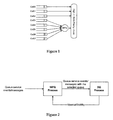
- An example of a WFQ scheduler implementing eight classes of service is illustrated in Figure 1.
- the WFQ scheduler is used to schedule servicing of queues having classes of service CoS 3 to CoS 7 .
- Classes of services CoS 0 to CoS 2 have been assigned a high priority rating and are typically serviced using one or more servicing algorithms such as an exhaustive round robin scheme.
- WFQ is an algorithm used to select a queue amongst a multitude of queues for servicing at any point in time.
- Each queue on a WFQ structure is assigned a weight and the effect of service provided to a queue is the proportion of the queue's weight divided by the sum of all of the queues' weights.
- the present invention is particularly directed to WFQ implementations for use on very high speed interfaces in order to deal with the constraints of the implementing devices which may be, for example, network processors, field programmable gate arrays (FPGA) and applications specific integrated circuits (ASIC).
- the constraints of the implementing devices are the number of processing cycles any single packet may consume within the devices, and the latency associated with accessing a packet's context.
- Such constraints make it difficult to impossible to use theoretically ideal WFQ algorithms.
- parasitic second order effects such as service jitter can become problematic, potentially resulting in down stream service level agreement (SLA) violations.
- SLA down stream service level agreement
- jitter can be defined as the variance in time between when a queue should have theoretically been selected for service and the actual time the queue has been selected.
- the goal of the WFQ algorithm of the present application is to address the performance constraints on very high speed interfaces while maintaining control of the jitter characteristics of the algorithm.
- Weighted fair queuing schemes are well known and are described extensively in the prior art. None of the prior art, of which Applicants are aware, account for the performance constraints associated with network processors nor do any prior art implementations deal with maintaining bounds on jitter characteristics as jitter is non-existent with an ideal implementation of a WFQ.
- the present invention addresses the problem of reducing service jitter in WFQ schemes commonly used in packet traffic management.
- the present invention controls jitter characteristics of a WFQ process by applying a dampening factor to a difference amount that is used by the WFQ process to adjust its timing of queue selection.
- the difference amount is queue-specific and is a running difference between a calculated and actual Vperiod for a given queue.
- a method of managing packet traffic using a weighted fair queuing (WFQ) scheme the WFQ scheme including a Wfq process for selecting a queue to be serviced and Dq process for dequeuing a packet to be processed, the method comprising creating a feedback loop between respective processes and feeding back to the WFQ process from the Dq process a queue specific damping difference value used by the WFQ process to select a queue for servicing.
- WFQ weighted fair queuing
- a system for managing packet traffic using a Weighted Fair Queuing (WFQ) scheme the WFQ scheme including a Wfq process for selecting a queue to be serviced and a Dq process for dequeuing a packet to be processed, the system comprising: a closed loop feedback control means between respective processes; and means for determining and feeding back to the Wfq process from the Dq process a queue-specific dampening difference value used by the Wfq process to select a queue for servicing.
- WFQ Weighted Fair Queuing
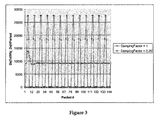
- the WFQ functionality according to the present invention is distributed amongst two separate but related processes. There is the Wfq process and the Dq process as shown in Figure 2. Messages are passed between processes to signal events and pass information. In a network processor (NP) implementation, these processes can be implemented through the use of different micro engines (MEs).
- the Wfq process receives events from an upstream process indicating the arrival of packets to a queue as well as messages from the downstream Dq process.
- the most important message the Wfq process receives is the VperiodToWfq message from the Dq process which is used to correct assumptions made by the Wfq process when selecting a queue for service.
- the Dq process receives messages from the Wfq process to indicate that a queue has been selected for servicing, and what the Wfq process assumed for the selected queue's Vperiod.
- the Wfq process maintains a timestamp for each queue and selects the queue with the lowest timestamp value for servicing.
- a calendar may be maintained as is well known to one skilled in the art.
- the selected queue's timestamp, or placement on the calendar is then updated with a value supplied by the Dq process which is an adjusted value based on the queue's weight, the packet size of the previous packet selected from that queue, and the history of values used. This is done because there is a latency involved between the time a queue is selected and the time at which the packet size is known, as discussed below.
- the current timestamp is updated and a message is sent to the Dq process.
- the Dq process receives Dq messages from the Wfq process including the Vperiod used. It is the responsibility of the Dq process to remove, from the selected queue, the packet at the head of the queue, thereby dequeueing it. The Dq process then determines the actual Vperiod that the Wfq process should have used for this packet that is equal to the dequeued packet's size multiplied by the queue's weight. For each queue, a remainder is maintained such that the running difference between what the Wfq process used as a Vperiod and what it should have used is tracked. This remainder value is then dampened and fed back to the Wfq process which it will use to update the queue's timestamp the very next time the queue is selected. This dampening is critical to the reduction of jitter in this algorithm.
- the WFQ implementation is based on the comparison of virtual timestamps, although calendars can be used where a large number of queues exist on the WFQ structure.
- Each queue has a virtual timestamp and is initialized to zero at startup.
- DqToWfq_DqVperiod is received from the Dq process and is related to the previous packet length and the weight of the queue that the packet came from.
- the non-empty queue with the lowest virtual timestamp is chosen for service.
- the DqToWfq_DqVperiod which is used to update the timestamp in the Wfq process, is not exactly equal to the product of the dequeued packet's length multiplied by weight, but adjusted and dampened as discussed below. Latencies are introduced by, for example:
- the DQ process keeps track of difference between WfqToDq_DqVperiod and lengthWeightProduct and feeds back a new and adjusted DqToWfq_DqVperiod.
- the dampfactor is 0.25 by default in this implementation, and used for reducing the swing of DqToWfq_DqVperiod and thereby reducing overall jitter and burstiness. Simulations have shown that without this damping factor, there is significant jitter and burstiness in queue servicing, although long term behavior is still correct.
- Figure 4 illustrates that even though the long term weighting without damping is correct, with damping, packet streams converge faster to their configured weight value for packets of size 9192 Bytes. This jitter is a result of oscillations in the DqToWfq_DqVperiod value calculated by the Dq process and may result in the violation of downstream SLAs.
- This algorithm is also applicable to general purpose processors which require a fast and efficient WFQ algorithm.
- This algorithm may also be applied to ASIC and FPGA implementations of a WFQ where similar performance constraints exist.
Landscapes
- Engineering & Computer Science (AREA)
- Computer Networks & Wireless Communication (AREA)
- Signal Processing (AREA)
- Data Exchanges In Wide-Area Networks (AREA)
- Signal Processing For Digital Recording And Reproducing (AREA)
- Stabilization Of Oscillater, Synchronisation, Frequency Synthesizers (AREA)
- Television Signal Processing For Recording (AREA)
Abstract
Description
- This invention relates to the management of packet traffic using a weighted fair queuing (WFQ) scheme and more particularly to systems and methods of reducing service jitter in such schemes when implemented at very high speeds.
- In data traffic management it is known to implement a WFQ scheme to achieve fair scheduling of multiple queues at a network interface. An example of a WFQ scheduler implementing eight classes of service is illustrated in Figure 1. The WFQ scheduler is used to schedule servicing of queues having classes of service CoS3 to CoS7. Classes of services CoS0 to CoS2 have been assigned a high priority rating and are typically serviced using one or more servicing algorithms such as an exhaustive round robin scheme.
- In Figure 1 classes of service CoS3 to CoS7 are serviced using the WFQ scheme wherein each CoS has assigned thereto a service weight which is factored into the servicing scheme.
- In general, WFQ is an algorithm used to select a queue amongst a multitude of queues for servicing at any point in time. Each queue on a WFQ structure is assigned a weight and the effect of service provided to a queue is the proportion of the queue's weight divided by the sum of all of the queues' weights.
- The present invention is particularly directed to WFQ implementations for use on very high speed interfaces in order to deal with the constraints of the implementing devices which may be, for example, network processors, field programmable gate arrays (FPGA) and applications specific integrated circuits (ASIC). Typical of the constraints of implementing devices are the number of processing cycles any single packet may consume within the devices, and the latency associated with accessing a packet's context. Such constraints make it difficult to impossible to use theoretically ideal WFQ algorithms. Furthermore, if special care is not taken with the optimizations necessary for WFQ implementations, parasitic second order effects such as service jitter can become problematic, potentially resulting in down stream service level agreement (SLA) violations.
- In the present application jitter can be defined as the variance in time between when a queue should have theoretically been selected for service and the actual time the queue has been selected. The goal of the WFQ algorithm of the present application is to address the performance constraints on very high speed interfaces while maintaining control of the jitter characteristics of the algorithm.
- Weighted fair queuing schemes are well known and are described extensively in the prior art. None of the prior art, of which Applicants are aware, account for the performance constraints associated with network processors nor do any prior art implementations deal with maintaining bounds on jitter characteristics as jitter is non-existent with an ideal implementation of a WFQ.
- Accordingly, there is a present requirement, which requirement will become even more desirable in the future, to reduce or eliminate service jitter in implementations involving very high speeds.
- The present invention addresses the problem of reducing service jitter in WFQ schemes commonly used in packet traffic management. The present invention controls jitter characteristics of a WFQ process by applying a dampening factor to a difference amount that is used by the WFQ process to adjust its timing of queue selection. The difference amount is queue-specific and is a running difference between a calculated and actual Vperiod for a given queue.
- Therefore, in accordance with a first aspect of the present invention there is provided a method of managing packet traffic using a weighted fair queuing (WFQ) scheme, the WFQ scheme including a Wfq process for selecting a queue to be serviced and Dq process for dequeuing a packet to be processed, the method comprising creating a feedback loop between respective processes and feeding back to the WFQ process from the Dq process a queue specific damping difference value used by the WFQ process to select a queue for servicing.
- In accordance with a second aspect of the present invention there is provided a system for managing packet traffic using a Weighted Fair Queuing (WFQ) scheme, the WFQ scheme including a Wfq process for selecting a queue to be serviced and a Dq process for dequeuing a packet to be processed, the system comprising: a closed loop feedback control means between respective processes; and means for determining and feeding back to the Wfq process from the Dq process a queue-specific dampening difference value used by the Wfq process to select a queue for servicing.
- The invention will now be described in greater detail with reference to the attached drawings wherein:
- FIG. 1 is an overview of a WFQ scheme contained in an implementation of an eight class of service scheme;
- FIG. 2 illustrates the processes and management in a WFQ scheme according to the present invention;
- FIG. 3 illustrates the effect of the damping factor on the behaviour of the scheduling scheme; and
- FIG. 4 illustrates the effect of a damping factor on the average effective queue weight.
- The WFQ functionality according to the present invention is distributed amongst two separate but related processes. There is the Wfq process and the Dq process as shown in Figure 2. Messages are passed between processes to signal events and pass information. In a network processor (NP) implementation, these processes can be implemented through the use of different micro engines (MEs). The Wfq process receives events from an upstream process indicating the arrival of packets to a queue as well as messages from the downstream Dq process. The most important message the Wfq process receives is the VperiodToWfq message from the Dq process which is used to correct assumptions made by the Wfq process when selecting a queue for service. The Dq process receives messages from the Wfq process to indicate that a queue has been selected for servicing, and what the Wfq process assumed for the selected queue's Vperiod.
- In general, the Wfq process maintains a timestamp for each queue and selects the queue with the lowest timestamp value for servicing. Alternatively, a calendar may be maintained as is well known to one skilled in the art. The selected queue's timestamp, or placement on the calendar, is then updated with a value supplied by the Dq process which is an adjusted value based on the queue's weight, the packet size of the previous packet selected from that queue, and the history of values used. This is done because there is a latency involved between the time a queue is selected and the time at which the packet size is known, as discussed below. Finally, the current timestamp is updated and a message is sent to the Dq process.
- The Dq process, generally speaking, receives Dq messages from the Wfq process including the Vperiod used. It is the responsibility of the Dq process to remove, from the selected queue, the packet at the head of the queue, thereby dequeueing it. The Dq process then determines the actual Vperiod that the Wfq process should have used for this packet that is equal to the dequeued packet's size multiplied by the queue's weight. For each queue, a remainder is maintained such that the running difference between what the Wfq process used as a Vperiod and what it should have used is tracked. This remainder value is then dampened and fed back to the Wfq process which it will use to update the queue's timestamp the very next time the queue is selected. This dampening is critical to the reduction of jitter in this algorithm.
- For the WFQ example shown in Figure 1, the WFQ implementation is based on the comparison of virtual timestamps, although calendars can be used where a large number of queues exist on the WFQ structure. Each queue has a virtual timestamp and is initialized to zero at startup. The virtual timestamp of a non empty queue is updated each time a queue is selected for service as follows,

Where current_timestamp is always set to the timestamp of the queue just serviced. DqToWfq_DqVperiod is received from the Dq process and is related to the previous packet length and the weight of the queue that the packet came from. The non-empty queue with the lowest virtual timestamp is chosen for service. - Due to any internal device data movement latencies, the DqToWfq_DqVperiod, which is used to update the timestamp in the Wfq process, is not exactly equal to the product of the dequeued packet's length multiplied by weight, but adjusted and dampened as discussed below. Latencies are introduced by, for example:
- Dequeueing of the packet and fetching its lengthWeightProduct from its buffer descriptor. The dequeueing and fetching buffer descriptor operations are memory operations. Due to the limitation of memory technology, the latency are usually higher than the number of processing cycles any single packet may consume within the devices on high-speed interfaces, e.g. OC192.
- DQ process sending the DqToWfq_DqVperiod message to Wfq process.
- Because of these latencies, the Wfq process might use an old lengthWeightProduct which increases the jitter or burstiness of the WFQ. As a remedy, the Wfq process will send a message to the Dq process containing WfqToDq_DqVperiod = DqToWfq_DqVperiod. The DQ process keeps track of difference between WfqToDq_DqVperiod and lengthWeightProduct and feeds back a new and adjusted DqToWfq_DqVperiod.
- This represents a feedback loop system where feedback is presented to the Wfq process subject to a delay, and a stimulus is presented to the Dq process. Depending on the difference between the DqToWfq_DqVperiod used by the Wfq and the lengthWeightProduct retrieved by the Dq process, and the latencies involved, oscillations will occur in the DqToWfq_DqVperiod value. Such oscillations directly correspond to jitter and burstiness in queue servicing. It is the role of the damping factor to ensure that oscillations are controlled and die out under steady state conditions. Figure 3 demonstrates the effect of applying a damping factor. In this example, a two cell time latency is assumed, and a single stream of 9192 byte packets arrive to a queue whose weight is normalized to 1.
- The following is the pseudo code for the Dq process:

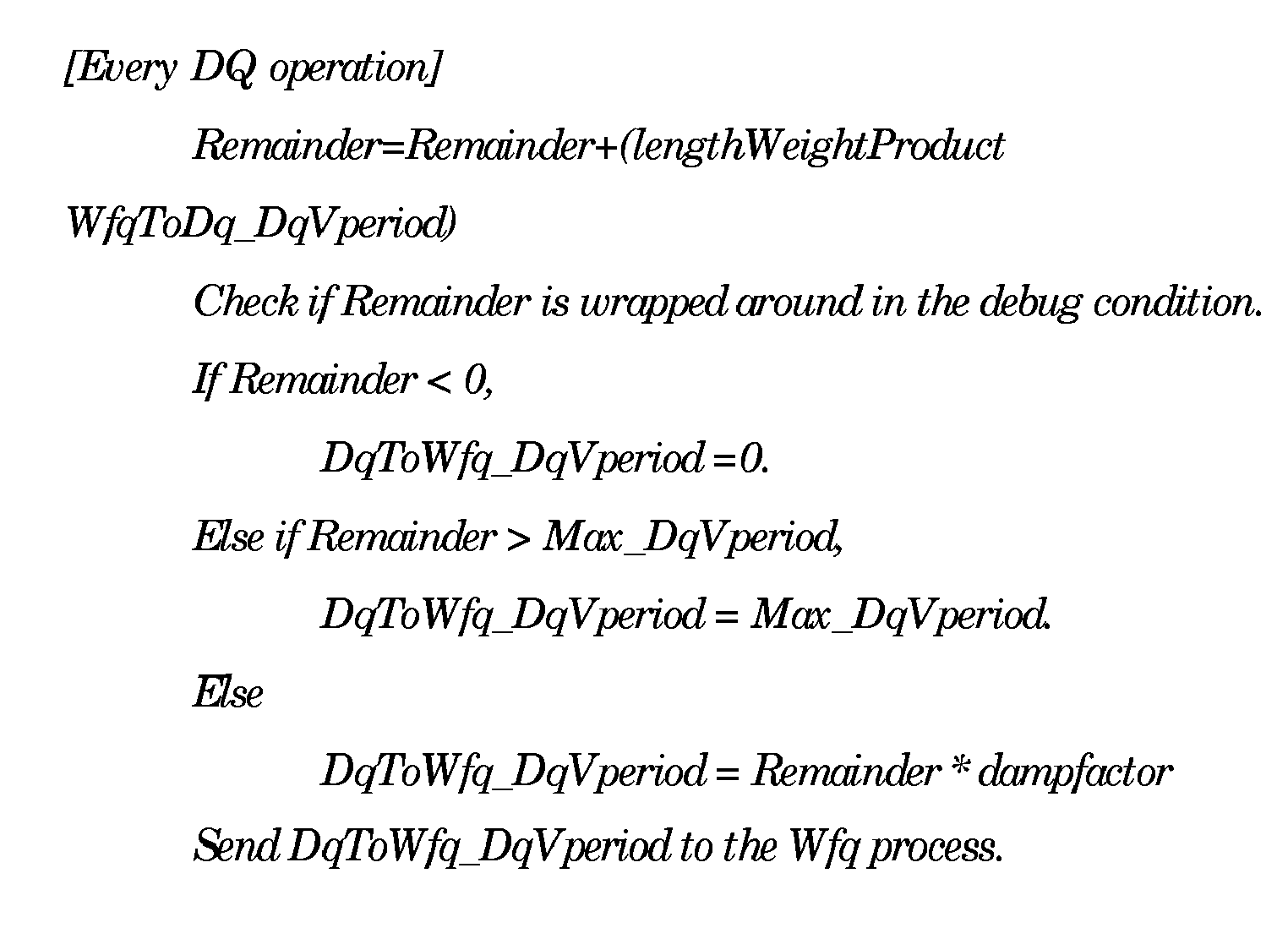
- The dampfactor is 0.25 by default in this implementation, and used for reducing the swing of DqToWfq_DqVperiod and thereby reducing overall jitter and burstiness. Simulations have shown that without this damping factor, there is significant jitter and burstiness in queue servicing, although long term behavior is still correct. Figure 4 illustrates that even though the long term weighting without damping is correct, with damping, packet streams converge faster to their configured weight value for packets of size 9192 Bytes. This jitter is a result of oscillations in the DqToWfq_DqVperiod value calculated by the Dq process and may result in the violation of downstream SLAs.
- This is a simple algorithm that, on a NP, can be executed in real time while maintaining control on the jitter characteristics of queue servicing. This algorithm is also applicable to general purpose processors which require a fast and efficient WFQ algorithm. This algorithm may also be applied to ASIC and FPGA implementations of a WFQ where similar performance constraints exist.
- Although preferred embodiments of the invention have been described and illustrated it will be apparent to one skilled in the art that numerous changes can be introduced without departing from the basic concept. It is to be understood, however, that such changes will fall within the full scope of the invention as defined by the appended claims.
Claims (17)
- A method of managing packet traffic using a Weighted Fair Queuing (WFQ) scheme, the WFQ scheme including a Wfq process for selecting a queue to be serviced and a Dq process for dequeuing a packet to be processed, the method comprising:creating a feedback loop between respective processes; andfeeding back to the Wfq process from the Dq process a queue-specific dampening difference value used by the Wfq process to select a queue for servicing.
- The method as defined in claim 1 for use in managing high speed traffic.
- The method as defined in claim 2 for use in managing communications traffic for telecommunications services.
- The method as defined in claim 2 for use in managing traffic relating to prioritized database access.
- The method as defined in claim 2 for use in process management in multiprocessor operating systems.
- The method as defined in claim 1 wherein the dampening difference value is based on a virtual time stamp foe each queue.
- The method as defined in claim 6 wherein for each queue a remainder value is maintained whereby a running difference between what the Wfq process used as a Vperiod and what it should have used is tracked.
- The method as defined in claim 7 wherein the remainder value is dampened and fed back to the Wfq process via the feedback loop.
- The method as defined in claim 8 wherein the remainder value is used to update a queues timestamp the very next time the queue is selected.
- The method as defined in claim 1 for reducing jitter in high speed communications systems.
- A system for managing packet traffic using a Weighted Fair Queuing (WFQ) scheme, the WFQ scheme including a Wfq process for selecting a queue to be serviced and a Dq process for dequeuing a packet to be processed, the system comprising:a closed loop feedback control means between respective processes; andmeans for determining and feeding back to the Wfq process from the Dq process a queue-specific dampening difference value used by the Wfq process to select a queue for servicing.
- The system as defined in claim 11 implemented in a network processor.
- The system as defined in claim 11 implemented in an application specific integrated circuit (ASIC).
- The system as defined in claim 11 implemented in a field programmable gate array (FPGA).
- The system as defined in claim 11 wherein the Wfp process receive event messages from an upstream process indicating arrival of packets to a queue and messages from the Dq process.
- The system as defined in claim 15 wherein the message received from the Dq process is a VperiodToWfq message.
- The system as defined in claim 16 wherein the VperiodToWfq message is used to correct timing assumptions made by the Wfq process.
Applications Claiming Priority (1)
| Application Number | Priority Date | Filing Date | Title |
|---|---|---|---|
| US11/032,074 US7414972B2 (en) | 2005-01-11 | 2005-01-11 | Jitter controlled WFQ algorithm on network processors and latency constrained hardware |
Publications (2)
| Publication Number | Publication Date |
|---|---|
| EP1684475A1 true EP1684475A1 (en) | 2006-07-26 |
| EP1684475B1 EP1684475B1 (en) | 2008-12-31 |
Family
ID=36061480
Family Applications (1)
| Application Number | Title | Priority Date | Filing Date |
|---|---|---|---|
| EP06300016A Expired - Lifetime EP1684475B1 (en) | 2005-01-11 | 2006-01-09 | Weighted Fair Queuing (WFQ) method and system for jitter control |
Country Status (5)
| Country | Link |
|---|---|
| US (1) | US7414972B2 (en) |
| EP (1) | EP1684475B1 (en) |
| CN (1) | CN1809028A (en) |
| AT (1) | ATE419700T1 (en) |
| DE (1) | DE602006004482D1 (en) |
Cited By (2)
| Publication number | Priority date | Publication date | Assignee | Title |
|---|---|---|---|---|
| CN113096295A (en) * | 2021-04-06 | 2021-07-09 | 中国工商银行股份有限公司 | Numbering method, numbering device, electronic equipment and computer readable storage medium |
| US11409469B2 (en) | 2020-02-04 | 2022-08-09 | Samsung Electronics Co., Ltd. | Storage device for supporting multiple hosts and operation method thereof |
Families Citing this family (2)
| Publication number | Priority date | Publication date | Assignee | Title |
|---|---|---|---|---|
| CN101247552B (en) * | 2007-02-14 | 2012-04-25 | 华为技术有限公司 | Feedback method, system and equipment |
| US8385210B1 (en) | 2008-12-18 | 2013-02-26 | Cisco Technology, Inc. | System and method for detection and delay control in a network environment |
Citations (1)
| Publication number | Priority date | Publication date | Assignee | Title |
|---|---|---|---|---|
| US20030179765A1 (en) | 2002-03-20 | 2003-09-25 | International Business Machines Corporation | Method and apparatus for improving the fairness of new attaches to a weighted fair queue in a quality of service (QoS) scheduler |
Family Cites Families (4)
| Publication number | Priority date | Publication date | Assignee | Title |
|---|---|---|---|---|
| US6157654A (en) * | 1997-06-24 | 2000-12-05 | Alcatel Networks Corporation | Adaptive service weight assignments for ATM scheduling |
| US6526060B1 (en) * | 1997-12-05 | 2003-02-25 | Cisco Technology, Inc. | Dynamic rate-based, weighted fair scheduler with explicit rate feedback option |
| JP3790429B2 (en) * | 2001-01-23 | 2006-06-28 | 富士通株式会社 | Packet scheduler |
| KR100460429B1 (en) * | 2002-11-15 | 2004-12-08 | 삼성전자주식회사 | Priority queuing apparatus and priority queuing method using the same |
-
2005
- 2005-01-11 US US11/032,074 patent/US7414972B2/en not_active Expired - Fee Related
-
2006
- 2006-01-09 AT AT06300016T patent/ATE419700T1/en not_active IP Right Cessation
- 2006-01-09 EP EP06300016A patent/EP1684475B1/en not_active Expired - Lifetime
- 2006-01-09 DE DE602006004482T patent/DE602006004482D1/en not_active Expired - Lifetime
- 2006-01-11 CN CNA2006100040019A patent/CN1809028A/en active Pending
Patent Citations (1)
| Publication number | Priority date | Publication date | Assignee | Title |
|---|---|---|---|---|
| US20030179765A1 (en) | 2002-03-20 | 2003-09-25 | International Business Machines Corporation | Method and apparatus for improving the fairness of new attaches to a weighted fair queue in a quality of service (QoS) scheduler |
Non-Patent Citations (1)
| Title |
|---|
| STILIADIS D ET AL: "EFFICIENT FAIR QUEUEING ALGORITHMS FOR PACKET-SWITCHED NETWORKS", IEEE / ACM TRANSACTIONS ON NETWORKING, IEEE / ACM, NEW YORK, NY, US, vol. 6, no. 2, 1 April 1998 (1998-04-01), pages 175 - 185, XP000751630, ISSN: 1063-6692 * |
Cited By (3)
| Publication number | Priority date | Publication date | Assignee | Title |
|---|---|---|---|---|
| US11409469B2 (en) | 2020-02-04 | 2022-08-09 | Samsung Electronics Co., Ltd. | Storage device for supporting multiple hosts and operation method thereof |
| US11861238B2 (en) | 2020-02-04 | 2024-01-02 | Samsung Electronics Co., Ltd. | Storage device for supporting multiple hosts and operation method thereof |
| CN113096295A (en) * | 2021-04-06 | 2021-07-09 | 中国工商银行股份有限公司 | Numbering method, numbering device, electronic equipment and computer readable storage medium |
Also Published As
| Publication number | Publication date |
|---|---|
| US7414972B2 (en) | 2008-08-19 |
| ATE419700T1 (en) | 2009-01-15 |
| EP1684475B1 (en) | 2008-12-31 |
| CN1809028A (en) | 2006-07-26 |
| US20060153071A1 (en) | 2006-07-13 |
| DE602006004482D1 (en) | 2009-02-12 |
Similar Documents
| Publication | Publication Date | Title |
|---|---|---|
| US6876952B1 (en) | Methods and apparatus for maintaining queues | |
| US7142513B2 (en) | Method and multi-queue packet scheduling system for managing network packet traffic with minimum performance guarantees and maximum service rate control | |
| EP1774714B1 (en) | Hierarchal scheduler with multiple scheduling lanes | |
| JP3252823B2 (en) | Time-based scheduler architecture and method for ATM networks | |
| US20050047425A1 (en) | Hierarchical scheduling for communications systems | |
| US6785236B1 (en) | Packet transmission scheduling with threshold based backpressure mechanism | |
| US7929438B2 (en) | Scheduler pipeline design for hierarchical link sharing | |
| EP1303083B1 (en) | Packet scheduling apparatus | |
| US6122673A (en) | Port scheduler and method for scheduling service providing guarantees, hierarchical rate limiting with/without overbooking capability | |
| EP3720069B1 (en) | Packet sending method and device | |
| US7911957B2 (en) | Zero-delay queuing method and system | |
| JP2003324471A (en) | Packet output control device | |
| US6526062B1 (en) | System and method for scheduling and rescheduling the transmission of cell objects of different traffic types | |
| US7292578B1 (en) | Flexible, high performance support for QoS on an arbitrary number of queues | |
| US20030165149A1 (en) | Hardware self-sorting scheduling queue | |
| Liu et al. | An efficient scheduling discipline for packet switching networks using earliest deadline first round robin | |
| EP1684475B1 (en) | Weighted Fair Queuing (WFQ) method and system for jitter control | |
| Chiussi et al. | Implementing fair queueing in atm switches: The discrete-rate approach | |
| US7385987B1 (en) | Scheduling system and method for multi-level class hierarchy | |
| CN1391756B (en) | Method and device for controlling packet transmission in a computer network | |
| EP1347602B1 (en) | Two stage egress scheduler for a network device | |
| US7231425B1 (en) | Rate-based scheduling method and system | |
| US6618391B1 (en) | Method and apparatus for guaranteeing data transfer rates and delays in data packet networks using discrete data transfer rates | |
| US6987774B1 (en) | Method and apparatus for traffic scheduling | |
| EP1774721B1 (en) | Propagation of minimum guaranteed scheduling rates |
Legal Events
| Date | Code | Title | Description |
|---|---|---|---|
| PUAI | Public reference made under article 153(3) epc to a published international application that has entered the european phase |
Free format text: ORIGINAL CODE: 0009012 |
|
| AK | Designated contracting states |
Kind code of ref document: A1 Designated state(s): AT BE BG CH CY CZ DE DK EE ES FI FR GB GR HU IE IS IT LI LT LU LV MC NL PL PT RO SE SI SK TR |
|
| AX | Request for extension of the european patent |
Extension state: AL BA HR MK YU |
|
| 17P | Request for examination filed |
Effective date: 20070126 |
|
| 17Q | First examination report despatched |
Effective date: 20070222 |
|
| AKX | Designation fees paid |
Designated state(s): AT BE BG CH CY CZ DE DK EE ES FI FR GB GR HU IE IS IT LI LT LU LV MC NL PL PT RO SE SI SK TR |
|
| RAP1 | Party data changed (applicant data changed or rights of an application transferred) |
Owner name: ALCATEL LUCENT |
|
| GRAP | Despatch of communication of intention to grant a patent |
Free format text: ORIGINAL CODE: EPIDOSNIGR1 |
|
| GRAS | Grant fee paid |
Free format text: ORIGINAL CODE: EPIDOSNIGR3 |
|
| GRAA | (expected) grant |
Free format text: ORIGINAL CODE: 0009210 |
|
| AK | Designated contracting states |
Kind code of ref document: B1 Designated state(s): AT BE BG CH CY CZ DE DK EE ES FI FR GB GR HU IE IS IT LI LT LU LV MC NL PL PT RO SE SI SK TR |
|
| REG | Reference to a national code |
Ref country code: GB Ref legal event code: FG4D Ref country code: CH Ref legal event code: EP |
|
| REF | Corresponds to: |
Ref document number: 602006004482 Country of ref document: DE Date of ref document: 20090212 Kind code of ref document: P |
|
| REG | Reference to a national code |
Ref country code: IE Ref legal event code: FG4D |
|
| PG25 | Lapsed in a contracting state [announced via postgrant information from national office to epo] |
Ref country code: FI Free format text: LAPSE BECAUSE OF FAILURE TO SUBMIT A TRANSLATION OF THE DESCRIPTION OR TO PAY THE FEE WITHIN THE PRESCRIBED TIME-LIMIT Effective date: 20081231 Ref country code: PL Free format text: LAPSE BECAUSE OF FAILURE TO SUBMIT A TRANSLATION OF THE DESCRIPTION OR TO PAY THE FEE WITHIN THE PRESCRIBED TIME-LIMIT Effective date: 20081231 Ref country code: NL Free format text: LAPSE BECAUSE OF FAILURE TO SUBMIT A TRANSLATION OF THE DESCRIPTION OR TO PAY THE FEE WITHIN THE PRESCRIBED TIME-LIMIT Effective date: 20081231 Ref country code: SI Free format text: LAPSE BECAUSE OF FAILURE TO SUBMIT A TRANSLATION OF THE DESCRIPTION OR TO PAY THE FEE WITHIN THE PRESCRIBED TIME-LIMIT Effective date: 20081231 Ref country code: LV Free format text: LAPSE BECAUSE OF FAILURE TO SUBMIT A TRANSLATION OF THE DESCRIPTION OR TO PAY THE FEE WITHIN THE PRESCRIBED TIME-LIMIT Effective date: 20081231 |
|
| NLV1 | Nl: lapsed or annulled due to failure to fulfill the requirements of art. 29p and 29m of the patents act | ||
| PG25 | Lapsed in a contracting state [announced via postgrant information from national office to epo] |
Ref country code: EE Free format text: LAPSE BECAUSE OF FAILURE TO SUBMIT A TRANSLATION OF THE DESCRIPTION OR TO PAY THE FEE WITHIN THE PRESCRIBED TIME-LIMIT Effective date: 20081231 Ref country code: RO Free format text: LAPSE BECAUSE OF FAILURE TO SUBMIT A TRANSLATION OF THE DESCRIPTION OR TO PAY THE FEE WITHIN THE PRESCRIBED TIME-LIMIT Effective date: 20081231 Ref country code: LT Free format text: LAPSE BECAUSE OF FAILURE TO SUBMIT A TRANSLATION OF THE DESCRIPTION OR TO PAY THE FEE WITHIN THE PRESCRIBED TIME-LIMIT Effective date: 20081231 Ref country code: BE Free format text: LAPSE BECAUSE OF FAILURE TO SUBMIT A TRANSLATION OF THE DESCRIPTION OR TO PAY THE FEE WITHIN THE PRESCRIBED TIME-LIMIT Effective date: 20081231 Ref country code: ES Free format text: LAPSE BECAUSE OF FAILURE TO SUBMIT A TRANSLATION OF THE DESCRIPTION OR TO PAY THE FEE WITHIN THE PRESCRIBED TIME-LIMIT Effective date: 20090411 |
|
| PG25 | Lapsed in a contracting state [announced via postgrant information from national office to epo] |
Ref country code: AT Free format text: LAPSE BECAUSE OF FAILURE TO SUBMIT A TRANSLATION OF THE DESCRIPTION OR TO PAY THE FEE WITHIN THE PRESCRIBED TIME-LIMIT Effective date: 20081231 Ref country code: SE Free format text: LAPSE BECAUSE OF FAILURE TO SUBMIT A TRANSLATION OF THE DESCRIPTION OR TO PAY THE FEE WITHIN THE PRESCRIBED TIME-LIMIT Effective date: 20090331 Ref country code: CZ Free format text: LAPSE BECAUSE OF FAILURE TO SUBMIT A TRANSLATION OF THE DESCRIPTION OR TO PAY THE FEE WITHIN THE PRESCRIBED TIME-LIMIT Effective date: 20081231 Ref country code: PT Free format text: LAPSE BECAUSE OF FAILURE TO SUBMIT A TRANSLATION OF THE DESCRIPTION OR TO PAY THE FEE WITHIN THE PRESCRIBED TIME-LIMIT Effective date: 20090601 Ref country code: IS Free format text: LAPSE BECAUSE OF FAILURE TO SUBMIT A TRANSLATION OF THE DESCRIPTION OR TO PAY THE FEE WITHIN THE PRESCRIBED TIME-LIMIT Effective date: 20090430 Ref country code: MC Free format text: LAPSE BECAUSE OF NON-PAYMENT OF DUE FEES Effective date: 20090131 |
|
| PG25 | Lapsed in a contracting state [announced via postgrant information from national office to epo] |
Ref country code: SK Free format text: LAPSE BECAUSE OF FAILURE TO SUBMIT A TRANSLATION OF THE DESCRIPTION OR TO PAY THE FEE WITHIN THE PRESCRIBED TIME-LIMIT Effective date: 20081231 |
|
| PG25 | Lapsed in a contracting state [announced via postgrant information from national office to epo] |
Ref country code: DK Free format text: LAPSE BECAUSE OF FAILURE TO SUBMIT A TRANSLATION OF THE DESCRIPTION OR TO PAY THE FEE WITHIN THE PRESCRIBED TIME-LIMIT Effective date: 20081231 |
|
| PLBE | No opposition filed within time limit |
Free format text: ORIGINAL CODE: 0009261 |
|
| STAA | Information on the status of an ep patent application or granted ep patent |
Free format text: STATUS: NO OPPOSITION FILED WITHIN TIME LIMIT |
|
| 26N | No opposition filed |
Effective date: 20091001 |
|
| PG25 | Lapsed in a contracting state [announced via postgrant information from national office to epo] |
Ref country code: BG Free format text: LAPSE BECAUSE OF FAILURE TO SUBMIT A TRANSLATION OF THE DESCRIPTION OR TO PAY THE FEE WITHIN THE PRESCRIBED TIME-LIMIT Effective date: 20090331 Ref country code: IE Free format text: LAPSE BECAUSE OF NON-PAYMENT OF DUE FEES Effective date: 20090109 |
|
| REG | Reference to a national code |
Ref country code: CH Ref legal event code: PL |
|
| PG25 | Lapsed in a contracting state [announced via postgrant information from national office to epo] |
Ref country code: LI Free format text: LAPSE BECAUSE OF NON-PAYMENT OF DUE FEES Effective date: 20100131 Ref country code: GR Free format text: LAPSE BECAUSE OF FAILURE TO SUBMIT A TRANSLATION OF THE DESCRIPTION OR TO PAY THE FEE WITHIN THE PRESCRIBED TIME-LIMIT Effective date: 20090401 Ref country code: CH Free format text: LAPSE BECAUSE OF NON-PAYMENT OF DUE FEES Effective date: 20100131 |
|
| PG25 | Lapsed in a contracting state [announced via postgrant information from national office to epo] |
Ref country code: IT Free format text: LAPSE BECAUSE OF FAILURE TO SUBMIT A TRANSLATION OF THE DESCRIPTION OR TO PAY THE FEE WITHIN THE PRESCRIBED TIME-LIMIT Effective date: 20081231 |
|
| PG25 | Lapsed in a contracting state [announced via postgrant information from national office to epo] |
Ref country code: LU Free format text: LAPSE BECAUSE OF NON-PAYMENT OF DUE FEES Effective date: 20090109 |
|
| PG25 | Lapsed in a contracting state [announced via postgrant information from national office to epo] |
Ref country code: HU Free format text: LAPSE BECAUSE OF FAILURE TO SUBMIT A TRANSLATION OF THE DESCRIPTION OR TO PAY THE FEE WITHIN THE PRESCRIBED TIME-LIMIT Effective date: 20090701 |
|
| PG25 | Lapsed in a contracting state [announced via postgrant information from national office to epo] |
Ref country code: TR Free format text: LAPSE BECAUSE OF FAILURE TO SUBMIT A TRANSLATION OF THE DESCRIPTION OR TO PAY THE FEE WITHIN THE PRESCRIBED TIME-LIMIT Effective date: 20081231 |
|
| PG25 | Lapsed in a contracting state [announced via postgrant information from national office to epo] |
Ref country code: CY Free format text: LAPSE BECAUSE OF FAILURE TO SUBMIT A TRANSLATION OF THE DESCRIPTION OR TO PAY THE FEE WITHIN THE PRESCRIBED TIME-LIMIT Effective date: 20081231 |
|
| REG | Reference to a national code |
Ref country code: FR Ref legal event code: GC Effective date: 20131018 |
|
| REG | Reference to a national code |
Ref country code: FR Ref legal event code: RG Effective date: 20141016 |
|
| REG | Reference to a national code |
Ref country code: FR Ref legal event code: PLFP Year of fee payment: 10 |
|
| REG | Reference to a national code |
Ref country code: FR Ref legal event code: CA Effective date: 20150521 |
|
| REG | Reference to a national code |
Ref country code: FR Ref legal event code: CA Effective date: 20150521 |
|
| REG | Reference to a national code |
Ref country code: FR Ref legal event code: PLFP Year of fee payment: 11 |
|
| REG | Reference to a national code |
Ref country code: FR Ref legal event code: PLFP Year of fee payment: 12 |
|
| REG | Reference to a national code |
Ref country code: FR Ref legal event code: PLFP Year of fee payment: 13 |
|
| REG | Reference to a national code |
Ref country code: DE Ref legal event code: R082 Ref document number: 602006004482 Country of ref document: DE Representative=s name: METACOM LEGAL RECHTSANWAELTE, DE Ref country code: DE Ref legal event code: R082 Ref document number: 602006004482 Country of ref document: DE Representative=s name: METACOM LEGAL, DE Ref country code: DE Ref legal event code: R081 Ref document number: 602006004482 Country of ref document: DE Owner name: WSOU INVESTMENTS, LLC, LOS ANGELES, US Free format text: FORMER OWNER: ALCATEL LUCENT, PARIS, FR Ref country code: DE Ref legal event code: R082 Ref document number: 602006004482 Country of ref document: DE Representative=s name: BARKHOFF REIMANN VOSSIUS, DE |
|
| REG | Reference to a national code |
Ref country code: GB Ref legal event code: 732E Free format text: REGISTERED BETWEEN 20200820 AND 20200826 |
|
| REG | Reference to a national code |
Ref country code: DE Ref legal event code: R082 Ref document number: 602006004482 Country of ref document: DE Representative=s name: METACOM LEGAL RECHTSANWAELTE, DE Ref country code: DE Ref legal event code: R082 Ref document number: 602006004482 Country of ref document: DE Representative=s name: METACOM LEGAL, DE Ref country code: DE Ref legal event code: R082 Ref document number: 602006004482 Country of ref document: DE Representative=s name: METACOM LEGAL NAGEL MARKOWSKY VOSSIUS RECHTSAN, DE |
|
| P01 | Opt-out of the competence of the unified patent court (upc) registered |
Effective date: 20230606 |
|
| PGFP | Annual fee paid to national office [announced via postgrant information from national office to epo] |
Ref country code: DE Payment date: 20250627 Year of fee payment: 20 |
|
| PGFP | Annual fee paid to national office [announced via postgrant information from national office to epo] |
Ref country code: GB Payment date: 20250627 Year of fee payment: 20 |
|
| PGFP | Annual fee paid to national office [announced via postgrant information from national office to epo] |
Ref country code: FR Payment date: 20250625 Year of fee payment: 20 |
|
| REG | Reference to a national code |
Ref country code: DE Ref legal event code: R071 Ref document number: 602006004482 Country of ref document: DE |
|
| REG | Reference to a national code |
Ref country code: GB Ref legal event code: PE20 Expiry date: 20260108 |