EP1683796A1 - Pyrazolopyridines, their preparation and their medical use - Google Patents
Pyrazolopyridines, their preparation and their medical use Download PDFInfo
- Publication number
- EP1683796A1 EP1683796A1 EP05075177A EP05075177A EP1683796A1 EP 1683796 A1 EP1683796 A1 EP 1683796A1 EP 05075177 A EP05075177 A EP 05075177A EP 05075177 A EP05075177 A EP 05075177A EP 1683796 A1 EP1683796 A1 EP 1683796A1
- Authority
- EP
- European Patent Office
- Prior art keywords
- stands
- alkyl
- group
- optionally
- differently
- Prior art date
- Legal status (The legal status is an assumption and is not a legal conclusion. Google has not performed a legal analysis and makes no representation as to the accuracy of the status listed.)
- Withdrawn
Links
- 150000005229 pyrazolopyridines Chemical class 0.000 title abstract description 6
- 238000002360 preparation method Methods 0.000 title description 60
- 150000001875 compounds Chemical class 0.000 claims abstract description 87
- 201000010099 disease Diseases 0.000 claims abstract description 71
- 208000037265 diseases, disorders, signs and symptoms Diseases 0.000 claims abstract description 71
- 238000000034 method Methods 0.000 claims abstract description 71
- 150000003839 salts Chemical class 0.000 claims abstract description 26
- 230000006444 vascular growth Effects 0.000 claims abstract description 21
- 239000008194 pharmaceutical composition Substances 0.000 claims abstract description 12
- 238000004519 manufacturing process Methods 0.000 claims abstract description 3
- 125000004169 (C1-C6) alkyl group Chemical group 0.000 claims description 66
- 229910052736 halogen Inorganic materials 0.000 claims description 48
- 150000002367 halogens Chemical class 0.000 claims description 48
- -1 C2-C6-alkinyl Chemical group 0.000 claims description 42
- 206010028980 Neoplasm Diseases 0.000 claims description 40
- 125000000449 nitro group Chemical group [O-][N+](*)=O 0.000 claims description 38
- 125000003118 aryl group Chemical group 0.000 claims description 37
- 230000033115 angiogenesis Effects 0.000 claims description 36
- 125000004093 cyano group Chemical group *C#N 0.000 claims description 36
- 125000001424 substituent group Chemical group 0.000 claims description 34
- IJGRMHOSHXDMSA-UHFFFAOYSA-N Atomic nitrogen Chemical compound N#N IJGRMHOSHXDMSA-UHFFFAOYSA-N 0.000 claims description 24
- 125000004191 (C1-C6) alkoxy group Chemical group 0.000 claims description 20
- 125000000882 C2-C6 alkenyl group Chemical group 0.000 claims description 20
- 229910052739 hydrogen Inorganic materials 0.000 claims description 18
- 239000001257 hydrogen Substances 0.000 claims description 18
- HBAQYPYDRFILMT-UHFFFAOYSA-N 8-[3-(1-cyclopropylpyrazol-4-yl)-1H-pyrazolo[4,3-d]pyrimidin-5-yl]-3-methyl-3,8-diazabicyclo[3.2.1]octan-2-one Chemical class C1(CC1)N1N=CC(=C1)C1=NNC2=C1N=C(N=C2)N1C2C(N(CC1CC2)C)=O HBAQYPYDRFILMT-UHFFFAOYSA-N 0.000 claims description 16
- 206010030113 Oedema Diseases 0.000 claims description 16
- 239000012453 solvate Substances 0.000 claims description 16
- 125000004429 atom Chemical group 0.000 claims description 15
- 150000001204 N-oxides Chemical class 0.000 claims description 14
- 150000004677 hydrates Chemical class 0.000 claims description 14
- 230000036573 scar formation Effects 0.000 claims description 14
- 125000001072 heteroaryl group Chemical group 0.000 claims description 13
- NINIDFKCEFEMDL-UHFFFAOYSA-N Sulfur Chemical compound [S] NINIDFKCEFEMDL-UHFFFAOYSA-N 0.000 claims description 12
- 150000002431 hydrogen Chemical class 0.000 claims description 12
- 229910052757 nitrogen Inorganic materials 0.000 claims description 12
- 230000009467 reduction Effects 0.000 claims description 12
- 229910052717 sulfur Inorganic materials 0.000 claims description 12
- 239000011593 sulfur Substances 0.000 claims description 12
- QVGXLLKOCUKJST-UHFFFAOYSA-N atomic oxygen Chemical compound [O] QVGXLLKOCUKJST-UHFFFAOYSA-N 0.000 claims description 11
- 229910052760 oxygen Inorganic materials 0.000 claims description 11
- 239000001301 oxygen Substances 0.000 claims description 11
- 208000014674 injury Diseases 0.000 claims description 10
- 230000008733 trauma Effects 0.000 claims description 10
- 206010027476 Metastases Diseases 0.000 claims description 9
- 230000001419 dependent effect Effects 0.000 claims description 9
- 208000027866 inflammatory disease Diseases 0.000 claims description 9
- USFZMSVCRYTOJT-UHFFFAOYSA-N Ammonium acetate Chemical compound N.CC(O)=O USFZMSVCRYTOJT-UHFFFAOYSA-N 0.000 claims description 7
- 239000005695 Ammonium acetate Substances 0.000 claims description 7
- UFHFLCQGNIYNRP-UHFFFAOYSA-N Hydrogen Chemical compound [H][H] UFHFLCQGNIYNRP-UHFFFAOYSA-N 0.000 claims description 7
- 235000019257 ammonium acetate Nutrition 0.000 claims description 7
- 229940043376 ammonium acetate Drugs 0.000 claims description 7
- 230000002062 proliferating effect Effects 0.000 claims description 7
- 208000017442 Retinal disease Diseases 0.000 claims description 6
- 206010038923 Retinopathy Diseases 0.000 claims description 6
- 229910052700 potassium Inorganic materials 0.000 claims description 6
- 125000002924 primary amino group Chemical group [H]N([H])* 0.000 claims description 6
- 206010039073 rheumatoid arthritis Diseases 0.000 claims description 6
- 206010001052 Acute respiratory distress syndrome Diseases 0.000 claims description 5
- 206010003445 Ascites Diseases 0.000 claims description 5
- 206010061692 Benign muscle neoplasm Diseases 0.000 claims description 5
- 206010004446 Benign prostatic hyperplasia Diseases 0.000 claims description 5
- 208000003174 Brain Neoplasms Diseases 0.000 claims description 5
- 206010048962 Brain oedema Diseases 0.000 claims description 5
- 206010012442 Dermatitis contact Diseases 0.000 claims description 5
- 201000009273 Endometriosis Diseases 0.000 claims description 5
- 206010021143 Hypoxia Diseases 0.000 claims description 5
- 208000019693 Lung disease Diseases 0.000 claims description 5
- 208000001344 Macular Edema Diseases 0.000 claims description 5
- 206010025415 Macular oedema Diseases 0.000 claims description 5
- 201000004458 Myoma Diseases 0.000 claims description 5
- 206010033266 Ovarian Hyperstimulation Syndrome Diseases 0.000 claims description 5
- 206010055870 Postmenopausal haemorrhage Diseases 0.000 claims description 5
- 201000004681 Psoriasis Diseases 0.000 claims description 5
- 206010037423 Pulmonary oedema Diseases 0.000 claims description 5
- 208000013616 Respiratory Distress Syndrome Diseases 0.000 claims description 5
- 206010052779 Transplant rejections Diseases 0.000 claims description 5
- 206010053613 Type IV hypersensitivity reaction Diseases 0.000 claims description 5
- 208000011341 adult acute respiratory distress syndrome Diseases 0.000 claims description 5
- 201000000028 adult respiratory distress syndrome Diseases 0.000 claims description 5
- 206010064930 age-related macular degeneration Diseases 0.000 claims description 5
- 208000006673 asthma Diseases 0.000 claims description 5
- 208000006752 brain edema Diseases 0.000 claims description 5
- 230000001684 chronic effect Effects 0.000 claims description 5
- 208000010247 contact dermatitis Diseases 0.000 claims description 5
- 208000029078 coronary artery disease Diseases 0.000 claims description 5
- 230000007954 hypoxia Effects 0.000 claims description 5
- 208000002780 macular degeneration Diseases 0.000 claims description 5
- 201000010230 macular retinal edema Diseases 0.000 claims description 5
- 201000006417 multiple sclerosis Diseases 0.000 claims description 5
- 210000005036 nerve Anatomy 0.000 claims description 5
- 208000030613 peripheral artery disease Diseases 0.000 claims description 5
- 201000011461 pre-eclampsia Diseases 0.000 claims description 5
- 208000005333 pulmonary edema Diseases 0.000 claims description 5
- 208000002815 pulmonary hypertension Diseases 0.000 claims description 5
- 230000008929 regeneration Effects 0.000 claims description 5
- 238000011069 regeneration method Methods 0.000 claims description 5
- 208000037803 restenosis Diseases 0.000 claims description 5
- 230000005951 type IV hypersensitivity Effects 0.000 claims description 5
- 208000027930 type IV hypersensitivity disease Diseases 0.000 claims description 5
- 230000029663 wound healing Effects 0.000 claims description 5
- 125000006584 (C3-C10) heterocycloalkyl group Chemical group 0.000 claims description 4
- 208000006011 Stroke Diseases 0.000 claims description 4
- 210000000988 bone and bone Anatomy 0.000 claims description 4
- 210000004087 cornea Anatomy 0.000 claims description 4
- 125000000592 heterocycloalkyl group Chemical group 0.000 claims description 4
- QJGQUHMNIGDVPM-UHFFFAOYSA-N nitrogen group Chemical group [N] QJGQUHMNIGDVPM-UHFFFAOYSA-N 0.000 claims description 4
- 125000000843 phenylene group Chemical group C1(=C(C=CC=C1)*)* 0.000 claims description 4
- 125000006413 ring segment Chemical group 0.000 claims description 4
- 125000004178 (C1-C4) alkyl group Chemical group 0.000 claims description 3
- CSCPPACGZOOCGX-UHFFFAOYSA-N Acetone Chemical compound CC(C)=O CSCPPACGZOOCGX-UHFFFAOYSA-N 0.000 claims description 3
- 125000001559 cyclopropyl group Chemical group [H]C1([H])C([H])([H])C1([H])* 0.000 claims description 3
- 125000002485 formyl group Chemical class [H]C(*)=O 0.000 claims description 3
- 238000001727 in vivo Methods 0.000 claims description 3
- 125000002496 methyl group Chemical group [H]C([H])([H])* 0.000 claims description 3
- 125000002757 morpholinyl group Chemical group 0.000 claims description 3
- 125000004193 piperazinyl group Chemical group 0.000 claims description 3
- 125000000719 pyrrolidinyl group Chemical group 0.000 claims description 3
- 150000002148 esters Chemical class 0.000 claims description 2
- 150000002429 hydrazines Chemical class 0.000 claims description 2
- 125000000951 phenoxy group Chemical group [H]C1=C([H])C([H])=C(O*)C([H])=C1[H] 0.000 claims description 2
- 125000003386 piperidinyl group Chemical group 0.000 claims description 2
- 230000002829 reductive effect Effects 0.000 claims description 2
- 125000002887 hydroxy group Chemical group [H]O* 0.000 claims 20
- 239000003085 diluting agent Substances 0.000 claims 1
- 101100481410 Mus musculus Tek gene Proteins 0.000 abstract description 51
- 101100481408 Danio rerio tie2 gene Proteins 0.000 abstract description 50
- 230000011664 signaling Effects 0.000 abstract description 9
- APXRHPDHORGIEB-UHFFFAOYSA-N 1H-pyrazolo[4,3-d]pyrimidine Chemical class N1=CN=C2C=NNC2=C1 APXRHPDHORGIEB-UHFFFAOYSA-N 0.000 abstract description 4
- 102000009840 Angiopoietins Human genes 0.000 abstract description 4
- 108010009906 Angiopoietins Proteins 0.000 abstract description 4
- 239000000047 product Substances 0.000 description 46
- 238000006243 chemical reaction Methods 0.000 description 44
- 238000005160 1H NMR spectroscopy Methods 0.000 description 42
- IAZDPXIOMUYVGZ-WFGJKAKNSA-N Dimethyl sulfoxide Chemical compound [2H]C([2H])([2H])S(=O)C([2H])([2H])[2H] IAZDPXIOMUYVGZ-WFGJKAKNSA-N 0.000 description 37
- 102000009088 Angiopoietin-1 Human genes 0.000 description 20
- 108010048154 Angiopoietin-1 Proteins 0.000 description 20
- 125000004356 hydroxy functional group Chemical group O* 0.000 description 20
- 239000000243 solution Substances 0.000 description 19
- IAZDPXIOMUYVGZ-UHFFFAOYSA-N Dimethylsulphoxide Chemical compound CS(C)=O IAZDPXIOMUYVGZ-UHFFFAOYSA-N 0.000 description 18
- BDERNNFJNOPAEC-UHFFFAOYSA-N propan-1-ol Chemical compound CCCO BDERNNFJNOPAEC-UHFFFAOYSA-N 0.000 description 16
- NWZSZGALRFJKBT-KNIFDHDWSA-N (2s)-2,6-diaminohexanoic acid;(2s)-2-hydroxybutanedioic acid Chemical compound OC(=O)[C@@H](O)CC(O)=O.NCCCC[C@H](N)C(O)=O NWZSZGALRFJKBT-KNIFDHDWSA-N 0.000 description 15
- 102000009075 Angiopoietin-2 Human genes 0.000 description 15
- 108010048036 Angiopoietin-2 Proteins 0.000 description 15
- IKDUDTNKRLTJSI-UHFFFAOYSA-N hydrazine monohydrate Substances O.NN IKDUDTNKRLTJSI-UHFFFAOYSA-N 0.000 description 15
- 210000005166 vasculature Anatomy 0.000 description 13
- 230000014509 gene expression Effects 0.000 description 11
- HEDRZPFGACZZDS-MICDWDOJSA-N Trichloro(2H)methane Chemical compound [2H]C(Cl)(Cl)Cl HEDRZPFGACZZDS-MICDWDOJSA-N 0.000 description 10
- AZUYLZMQTIKGSC-UHFFFAOYSA-N 1-[6-[4-(5-chloro-6-methyl-1H-indazol-4-yl)-5-methyl-3-(1-methylindazol-5-yl)pyrazol-1-yl]-2-azaspiro[3.3]heptan-2-yl]prop-2-en-1-one Chemical compound ClC=1C(=C2C=NNC2=CC=1C)C=1C(=NN(C=1C)C1CC2(CN(C2)C(C=C)=O)C1)C=1C=C2C=NN(C2=CC=1)C AZUYLZMQTIKGSC-UHFFFAOYSA-N 0.000 description 9
- YMWUJEATGCHHMB-UHFFFAOYSA-N Dichloromethane Chemical compound ClCCl YMWUJEATGCHHMB-UHFFFAOYSA-N 0.000 description 9
- XEKOWRVHYACXOJ-UHFFFAOYSA-N Ethyl acetate Chemical compound CCOC(C)=O XEKOWRVHYACXOJ-UHFFFAOYSA-N 0.000 description 9
- 230000004913 activation Effects 0.000 description 9
- 201000011510 cancer Diseases 0.000 description 9
- 210000004027 cell Anatomy 0.000 description 9
- 230000000694 effects Effects 0.000 description 9
- 102000005962 receptors Human genes 0.000 description 9
- 108020003175 receptors Proteins 0.000 description 9
- 241000699670 Mus sp. Species 0.000 description 8
- JUJWROOIHBZHMG-UHFFFAOYSA-N Pyridine Chemical compound C1=CC=NC=C1 JUJWROOIHBZHMG-UHFFFAOYSA-N 0.000 description 8
- ZMANZCXQSJIPKH-UHFFFAOYSA-N Triethylamine Chemical compound CCN(CC)CC ZMANZCXQSJIPKH-UHFFFAOYSA-N 0.000 description 8
- 239000000758 substrate Substances 0.000 description 8
- 238000001514 detection method Methods 0.000 description 7
- UQLDLKMNUJERMK-UHFFFAOYSA-L di(octadecanoyloxy)lead Chemical compound [Pb+2].CCCCCCCCCCCCCCCCCC([O-])=O.CCCCCCCCCCCCCCCCCC([O-])=O UQLDLKMNUJERMK-UHFFFAOYSA-L 0.000 description 7
- 230000012010 growth Effects 0.000 description 7
- 230000005764 inhibitory process Effects 0.000 description 7
- 210000001519 tissue Anatomy 0.000 description 7
- 230000004614 tumor growth Effects 0.000 description 7
- LFQSCWFLJHTTHZ-UHFFFAOYSA-N Ethanol Chemical compound CCO LFQSCWFLJHTTHZ-UHFFFAOYSA-N 0.000 description 6
- OKKJLVBELUTLKV-UHFFFAOYSA-N Methanol Chemical compound OC OKKJLVBELUTLKV-UHFFFAOYSA-N 0.000 description 6
- 230000002491 angiogenic effect Effects 0.000 description 6
- 239000012043 crude product Substances 0.000 description 6
- 230000006870 function Effects 0.000 description 6
- 239000003112 inhibitor Substances 0.000 description 6
- 230000001404 mediated effect Effects 0.000 description 6
- 230000037361 pathway Effects 0.000 description 6
- 239000011541 reaction mixture Substances 0.000 description 6
- XLYOFNOQVPJJNP-UHFFFAOYSA-N water Substances O XLYOFNOQVPJJNP-UHFFFAOYSA-N 0.000 description 6
- SINQIEAULQKUPD-UHFFFAOYSA-N 4-[4-(6-methoxy-2-naphthalenyl)-2-(4-methylsulfinylphenyl)-1H-imidazol-5-yl]pyridine Chemical compound C1=CC2=CC(OC)=CC=C2C=C1C=1N=C(C=2C=CC(=CC=2)S(C)=O)NC=1C1=CC=NC=C1 SINQIEAULQKUPD-UHFFFAOYSA-N 0.000 description 5
- VYPSYNLAJGMNEJ-UHFFFAOYSA-N Silicium dioxide Chemical compound O=[Si]=O VYPSYNLAJGMNEJ-UHFFFAOYSA-N 0.000 description 5
- 108010090091 TIE-2 Receptor Proteins 0.000 description 5
- 102000012753 TIE-2 Receptor Human genes 0.000 description 5
- 102000005789 Vascular Endothelial Growth Factors Human genes 0.000 description 5
- 108010019530 Vascular Endothelial Growth Factors Proteins 0.000 description 5
- 238000003556 assay Methods 0.000 description 5
- 210000000481 breast Anatomy 0.000 description 5
- 239000000872 buffer Substances 0.000 description 5
- 210000002889 endothelial cell Anatomy 0.000 description 5
- 239000003446 ligand Substances 0.000 description 5
- 239000000203 mixture Substances 0.000 description 5
- 239000012224 working solution Substances 0.000 description 5
- YBJHBAHKTGYVGT-ZKWXMUAHSA-N (+)-Biotin Chemical compound N1C(=O)N[C@@H]2[C@H](CCCCC(=O)O)SC[C@@H]21 YBJHBAHKTGYVGT-ZKWXMUAHSA-N 0.000 description 4
- OLOJEFMHISXGJK-UHFFFAOYSA-N 1-[4-(3-amino-6-cyclopropyl-2h-pyrazolo[3,4-b]pyridin-4-yl)phenyl]-3-phenylurea Chemical compound C=12C(N)=NNC2=NC(C2CC2)=CC=1C(C=C1)=CC=C1NC(=O)NC1=CC=CC=C1 OLOJEFMHISXGJK-UHFFFAOYSA-N 0.000 description 4
- AMFYRKOUWBAGHV-UHFFFAOYSA-N 1h-pyrazolo[4,3-b]pyridine Chemical compound C1=CN=C2C=NNC2=C1 AMFYRKOUWBAGHV-UHFFFAOYSA-N 0.000 description 4
- 238000002965 ELISA Methods 0.000 description 4
- 102000004190 Enzymes Human genes 0.000 description 4
- 108090000790 Enzymes Proteins 0.000 description 4
- TWRXJAOTZQYOKJ-UHFFFAOYSA-L Magnesium chloride Chemical compound [Mg+2].[Cl-].[Cl-] TWRXJAOTZQYOKJ-UHFFFAOYSA-L 0.000 description 4
- 230000035578 autophosphorylation Effects 0.000 description 4
- 238000004440 column chromatography Methods 0.000 description 4
- ANGDWNBGPBMQHW-UHFFFAOYSA-N methyl cyanoacetate Chemical compound COC(=O)CC#N ANGDWNBGPBMQHW-UHFFFAOYSA-N 0.000 description 4
- 230000001575 pathological effect Effects 0.000 description 4
- UMJSCPRVCHMLSP-UHFFFAOYSA-N pyridine Natural products COC1=CC=CN=C1 UMJSCPRVCHMLSP-UHFFFAOYSA-N 0.000 description 4
- 238000012552 review Methods 0.000 description 4
- 239000000741 silica gel Substances 0.000 description 4
- 229910002027 silica gel Inorganic materials 0.000 description 4
- WJKHJLXJJJATHN-UHFFFAOYSA-N triflic anhydride Chemical compound FC(F)(F)S(=O)(=O)OS(=O)(=O)C(F)(F)F WJKHJLXJJJATHN-UHFFFAOYSA-N 0.000 description 4
- QSRUEGXXRLSWGV-UHFFFAOYSA-N 1-[4-(3-amino-6-cyclopropyl-2h-pyrazolo[3,4-b]pyridin-4-yl)phenyl]-3-(2-fluorophenyl)urea Chemical compound C=12C(N)=NNC2=NC(C2CC2)=CC=1C(C=C1)=CC=C1NC(=O)NC1=CC=CC=C1F QSRUEGXXRLSWGV-UHFFFAOYSA-N 0.000 description 3
- AFOQKYHUXPSKDS-UHFFFAOYSA-N 1-[4-(3-amino-6-tert-butyl-2h-pyrazolo[3,4-b]pyridin-4-yl)phenyl]-3-(2,4-difluorophenyl)urea Chemical compound C=12C(N)=NNC2=NC(C(C)(C)C)=CC=1C(C=C1)=CC=C1NC(=O)NC1=CC=C(F)C=C1F AFOQKYHUXPSKDS-UHFFFAOYSA-N 0.000 description 3
- AUYGIVFSXOUFFB-UHFFFAOYSA-N 1-[4-(3-amino-6-tert-butyl-2h-pyrazolo[3,4-b]pyridin-4-yl)phenyl]-3-(2,5-difluorophenyl)urea Chemical compound C=12C(N)=NNC2=NC(C(C)(C)C)=CC=1C(C=C1)=CC=C1NC(=O)NC1=CC(F)=CC=C1F AUYGIVFSXOUFFB-UHFFFAOYSA-N 0.000 description 3
- KALWZZIZVXGDLT-UHFFFAOYSA-N 1-[4-(3-amino-6-tert-butyl-2h-pyrazolo[3,4-b]pyridin-4-yl)phenyl]-3-(3,4-difluorophenyl)urea Chemical compound C=12C(N)=NNC2=NC(C(C)(C)C)=CC=1C(C=C1)=CC=C1NC(=O)NC1=CC=C(F)C(F)=C1 KALWZZIZVXGDLT-UHFFFAOYSA-N 0.000 description 3
- RDRRLDUZTZBZLW-UHFFFAOYSA-N 1-[4-(3-amino-6-tert-butyl-2h-pyrazolo[3,4-b]pyridin-4-yl)phenyl]-3-(3-fluorophenyl)urea Chemical compound C=12C(N)=NNC2=NC(C(C)(C)C)=CC=1C(C=C1)=CC=C1NC(=O)NC1=CC=CC(F)=C1 RDRRLDUZTZBZLW-UHFFFAOYSA-N 0.000 description 3
- AIKMQPYFTJQVQV-UHFFFAOYSA-N 1-[4-(3-amino-6-tert-butyl-2h-pyrazolo[3,4-b]pyridin-4-yl)phenyl]-3-(3-methylphenyl)urea Chemical compound CC1=CC=CC(NC(=O)NC=2C=CC(=CC=2)C=2C=3C(N)=NNC=3N=C(C=2)C(C)(C)C)=C1 AIKMQPYFTJQVQV-UHFFFAOYSA-N 0.000 description 3
- JAQBQSKPULPLRE-UHFFFAOYSA-N 1-[4-(3-amino-6-tert-butyl-2h-pyrazolo[3,4-b]pyridin-4-yl)phenyl]-3-(4-cyanophenyl)urea Chemical compound C=12C(N)=NNC2=NC(C(C)(C)C)=CC=1C(C=C1)=CC=C1NC(=O)NC1=CC=C(C#N)C=C1 JAQBQSKPULPLRE-UHFFFAOYSA-N 0.000 description 3
- ZUBFWBNOSRFINZ-UHFFFAOYSA-N 1-[4-(3-amino-6-tert-butyl-2h-pyrazolo[3,4-b]pyridin-4-yl)phenyl]-3-(4-fluorophenyl)urea Chemical compound C=12C(N)=NNC2=NC(C(C)(C)C)=CC=1C(C=C1)=CC=C1NC(=O)NC1=CC=C(F)C=C1 ZUBFWBNOSRFINZ-UHFFFAOYSA-N 0.000 description 3
- CUNFCSMTRUXDHV-UHFFFAOYSA-N 1-[4-(3-amino-6-tert-butyl-2h-pyrazolo[3,4-b]pyridin-4-yl)phenyl]-3-naphthalen-2-ylurea Chemical compound C1=CC=CC2=CC(NC(=O)NC3=CC=C(C=C3)C=3C=C(N=C4NN=C(N)C4=3)C(C)(C)C)=CC=C21 CUNFCSMTRUXDHV-UHFFFAOYSA-N 0.000 description 3
- QWHZANHESALLIZ-UHFFFAOYSA-N 1-[4-(3-amino-6-tert-butyl-2h-pyrazolo[3,4-b]pyridin-4-yl)phenyl]-3-phenylurea Chemical compound C=12C(N)=NNC2=NC(C(C)(C)C)=CC=1C(C=C1)=CC=C1NC(=O)NC1=CC=CC=C1 QWHZANHESALLIZ-UHFFFAOYSA-N 0.000 description 3
- JKMHFZQWWAIEOD-UHFFFAOYSA-N 2-[4-(2-hydroxyethyl)piperazin-1-yl]ethanesulfonic acid Chemical compound OCC[NH+]1CCN(CCS([O-])(=O)=O)CC1 JKMHFZQWWAIEOD-UHFFFAOYSA-N 0.000 description 3
- 0 CC(C)(C)c1nc([n]nc2N)c2c(-c2ccc(*C(Nc(cc3)cc(F)c3F)=O)cc2)c1 Chemical compound CC(C)(C)c1nc([n]nc2N)c2c(-c2ccc(*C(Nc(cc3)cc(F)c3F)=O)cc2)c1 0.000 description 3
- RTZKZFJDLAIYFH-UHFFFAOYSA-N Diethyl ether Chemical compound CCOCC RTZKZFJDLAIYFH-UHFFFAOYSA-N 0.000 description 3
- 239000007995 HEPES buffer Substances 0.000 description 3
- VEXZGXHMUGYJMC-UHFFFAOYSA-N Hydrochloric acid Chemical compound Cl VEXZGXHMUGYJMC-UHFFFAOYSA-N 0.000 description 3
- 241000699660 Mus musculus Species 0.000 description 3
- 238000005481 NMR spectroscopy Methods 0.000 description 3
- 206010029113 Neovascularisation Diseases 0.000 description 3
- 208000034038 Pathologic Neovascularization Diseases 0.000 description 3
- PMZURENOXWZQFD-UHFFFAOYSA-L Sodium Sulfate Chemical compound [Na+].[Na+].[O-]S([O-])(=O)=O PMZURENOXWZQFD-UHFFFAOYSA-L 0.000 description 3
- YXFVVABEGXRONW-UHFFFAOYSA-N Toluene Chemical compound CC1=CC=CC=C1 YXFVVABEGXRONW-UHFFFAOYSA-N 0.000 description 3
- 150000001299 aldehydes Chemical class 0.000 description 3
- 239000005557 antagonist Substances 0.000 description 3
- 239000012131 assay buffer Substances 0.000 description 3
- 239000012267 brine Substances 0.000 description 3
- 230000007547 defect Effects 0.000 description 3
- 238000011161 development Methods 0.000 description 3
- 230000018109 developmental process Effects 0.000 description 3
- 210000002257 embryonic structure Anatomy 0.000 description 3
- 210000003038 endothelium Anatomy 0.000 description 3
- 238000002474 experimental method Methods 0.000 description 3
- 230000003993 interaction Effects 0.000 description 3
- 239000000463 material Substances 0.000 description 3
- 230000035800 maturation Effects 0.000 description 3
- 230000035772 mutation Effects 0.000 description 3
- SYSQUGFVNFXIIT-UHFFFAOYSA-N n-[4-(1,3-benzoxazol-2-yl)phenyl]-4-nitrobenzenesulfonamide Chemical class C1=CC([N+](=O)[O-])=CC=C1S(=O)(=O)NC1=CC=C(C=2OC3=CC=CC=C3N=2)C=C1 SYSQUGFVNFXIIT-UHFFFAOYSA-N 0.000 description 3
- WRYOOVJWNVXOBR-UHFFFAOYSA-N n-[4-(3-amino-6-tert-butyl-2h-pyrazolo[3,4-b]pyridin-4-yl)phenyl]benzenesulfonamide Chemical compound C=12C(N)=NNC2=NC(C(C)(C)C)=CC=1C(C=C1)=CC=C1NS(=O)(=O)C1=CC=CC=C1 WRYOOVJWNVXOBR-UHFFFAOYSA-N 0.000 description 3
- 239000012044 organic layer Substances 0.000 description 3
- 230000002085 persistent effect Effects 0.000 description 3
- PJGSXYOJTGTZAV-UHFFFAOYSA-N pinacolone Chemical compound CC(=O)C(C)(C)C PJGSXYOJTGTZAV-UHFFFAOYSA-N 0.000 description 3
- 238000000746 purification Methods 0.000 description 3
- 230000019491 signal transduction Effects 0.000 description 3
- 229910052938 sodium sulfate Inorganic materials 0.000 description 3
- 235000011152 sodium sulphate Nutrition 0.000 description 3
- HPALAKNZSZLMCH-UHFFFAOYSA-M sodium;chloride;hydrate Chemical compound O.[Na+].[Cl-] HPALAKNZSZLMCH-UHFFFAOYSA-M 0.000 description 3
- 230000006641 stabilisation Effects 0.000 description 3
- 238000011105 stabilization Methods 0.000 description 3
- 238000011830 transgenic mouse model Methods 0.000 description 3
- AXKGIPZJYUNAIW-UHFFFAOYSA-N (4-aminophenyl)methanol Chemical compound NC1=CC=C(CO)C=C1 AXKGIPZJYUNAIW-UHFFFAOYSA-N 0.000 description 2
- RSCFYFWMVDCMAV-UHFFFAOYSA-N 1-[4-(3-amino-6-tert-butyl-2h-pyrazolo[3,4-b]pyridin-4-yl)phenyl]-3-(2-fluorophenyl)urea Chemical compound C=12C(N)=NNC2=NC(C(C)(C)C)=CC=1C(C=C1)=CC=C1NC(=O)NC1=CC=CC=C1F RSCFYFWMVDCMAV-UHFFFAOYSA-N 0.000 description 2
- SBMYAKNJFDJACA-UHFFFAOYSA-N 1-[4-(3-amino-6-tert-butyl-2h-pyrazolo[3,4-b]pyridin-4-yl)phenyl]-3-(2-nitrophenyl)urea Chemical compound C=12C(N)=NNC2=NC(C(C)(C)C)=CC=1C(C=C1)=CC=C1NC(=O)NC1=CC=CC=C1[N+]([O-])=O SBMYAKNJFDJACA-UHFFFAOYSA-N 0.000 description 2
- VZNCSZQPNIEEMN-UHFFFAOYSA-N 1-fluoro-2-isocyanatobenzene Chemical compound FC1=CC=CC=C1N=C=O VZNCSZQPNIEEMN-UHFFFAOYSA-N 0.000 description 2
- ARGCQEVBJHPOGB-UHFFFAOYSA-N 2,5-dihydrofuran Chemical compound C1OCC=C1 ARGCQEVBJHPOGB-UHFFFAOYSA-N 0.000 description 2
- HZAXFHJVJLSVMW-UHFFFAOYSA-N 2-Aminoethan-1-ol Chemical compound NCCO HZAXFHJVJLSVMW-UHFFFAOYSA-N 0.000 description 2
- BXRFQSNOROATLV-UHFFFAOYSA-N 4-nitrobenzaldehyde Chemical compound [O-][N+](=O)C1=CC=C(C=O)C=C1 BXRFQSNOROATLV-UHFFFAOYSA-N 0.000 description 2
- QGZKDVFQNNGYKY-UHFFFAOYSA-N Ammonia Chemical compound N QGZKDVFQNNGYKY-UHFFFAOYSA-N 0.000 description 2
- 206010006187 Breast cancer Diseases 0.000 description 2
- 208000026310 Breast neoplasm Diseases 0.000 description 2
- KCXVZYZYPLLWCC-UHFFFAOYSA-N EDTA Chemical compound OC(=O)CN(CC(O)=O)CCN(CC(O)=O)CC(O)=O KCXVZYZYPLLWCC-UHFFFAOYSA-N 0.000 description 2
- 206010016654 Fibrosis Diseases 0.000 description 2
- OAKJQQAXSVQMHS-UHFFFAOYSA-N Hydrazine Chemical compound NN OAKJQQAXSVQMHS-UHFFFAOYSA-N 0.000 description 2
- 229910021380 Manganese Chloride Inorganic materials 0.000 description 2
- GLFNIEUTAYBVOC-UHFFFAOYSA-L Manganese chloride Chemical compound Cl[Mn]Cl GLFNIEUTAYBVOC-UHFFFAOYSA-L 0.000 description 2
- 102000008052 Nitric Oxide Synthase Type III Human genes 0.000 description 2
- 108010075520 Nitric Oxide Synthase Type III Proteins 0.000 description 2
- MWUXSHHQAYIFBG-UHFFFAOYSA-N Nitric oxide Chemical compound O=[N] MWUXSHHQAYIFBG-UHFFFAOYSA-N 0.000 description 2
- 102100035593 POU domain, class 2, transcription factor 1 Human genes 0.000 description 2
- 101710084414 POU domain, class 2, transcription factor 1 Proteins 0.000 description 2
- NBIIXXVUZAFLBC-UHFFFAOYSA-N Phosphoric acid Chemical compound OP(O)(O)=O NBIIXXVUZAFLBC-UHFFFAOYSA-N 0.000 description 2
- 108091000080 Phosphotransferase Proteins 0.000 description 2
- UIIMBOGNXHQVGW-UHFFFAOYSA-M Sodium bicarbonate Chemical compound [Na+].OC([O-])=O UIIMBOGNXHQVGW-UHFFFAOYSA-M 0.000 description 2
- 102000005450 TIE receptors Human genes 0.000 description 2
- 108010006830 TIE receptors Proteins 0.000 description 2
- WYURNTSHIVDZCO-UHFFFAOYSA-N Tetrahydrofuran Chemical compound C1CCOC1 WYURNTSHIVDZCO-UHFFFAOYSA-N 0.000 description 2
- DTQVDTLACAAQTR-UHFFFAOYSA-N Trifluoroacetic acid Chemical compound OC(=O)C(F)(F)F DTQVDTLACAAQTR-UHFFFAOYSA-N 0.000 description 2
- 108091008605 VEGF receptors Proteins 0.000 description 2
- PXDHEJIXEPPCBK-UHFFFAOYSA-N [3-cyano-6-cyclopropyl-4-[4-[(2-fluorophenyl)carbamoylamino]phenyl]pyridin-2-yl] trifluoromethanesulfonate Chemical compound FC1=CC=CC=C1NC(=O)NC1=CC=C(C=2C(=C(OS(=O)(=O)C(F)(F)F)N=C(C=2)C2CC2)C#N)C=C1 PXDHEJIXEPPCBK-UHFFFAOYSA-N 0.000 description 2
- 125000003342 alkenyl group Chemical group 0.000 description 2
- 125000006193 alkinyl group Chemical group 0.000 description 2
- 125000003545 alkoxy group Chemical group 0.000 description 2
- 125000000217 alkyl group Chemical group 0.000 description 2
- 230000001772 anti-angiogenic effect Effects 0.000 description 2
- 239000007864 aqueous solution Substances 0.000 description 2
- 229940120638 avastin Drugs 0.000 description 2
- 239000002585 base Substances 0.000 description 2
- 230000033228 biological regulation Effects 0.000 description 2
- 230000015572 biosynthetic process Effects 0.000 description 2
- 229960002685 biotin Drugs 0.000 description 2
- 235000020958 biotin Nutrition 0.000 description 2
- 239000011616 biotin Substances 0.000 description 2
- 239000002775 capsule Substances 0.000 description 2
- 239000006143 cell culture medium Substances 0.000 description 2
- OGEBRHQLRGFBNV-RZDIXWSQSA-N chembl2036808 Chemical class C12=NC(NCCCC)=NC=C2C(C=2C=CC(F)=CC=2)=NN1C[C@H]1CC[C@H](N)CC1 OGEBRHQLRGFBNV-RZDIXWSQSA-N 0.000 description 2
- 239000000460 chlorine Substances 0.000 description 2
- KRKNYBCHXYNGOX-UHFFFAOYSA-N citric acid Natural products OC(=O)CC(O)(C(O)=O)CC(O)=O KRKNYBCHXYNGOX-UHFFFAOYSA-N 0.000 description 2
- 238000003776 cleavage reaction Methods 0.000 description 2
- 239000011248 coating agent Substances 0.000 description 2
- 238000000576 coating method Methods 0.000 description 2
- 210000004246 corpus luteum Anatomy 0.000 description 2
- 125000004122 cyclic group Chemical group 0.000 description 2
- 230000003247 decreasing effect Effects 0.000 description 2
- 238000010790 dilution Methods 0.000 description 2
- 239000012895 dilution Substances 0.000 description 2
- ZUOUZKKEUPVFJK-UHFFFAOYSA-N diphenyl Chemical compound C1=CC=CC=C1C1=CC=CC=C1 ZUOUZKKEUPVFJK-UHFFFAOYSA-N 0.000 description 2
- 231100001129 embryonic lethality Toxicity 0.000 description 2
- 230000003511 endothelial effect Effects 0.000 description 2
- 108091007231 endothelial receptors Proteins 0.000 description 2
- 238000001914 filtration Methods 0.000 description 2
- 238000002866 fluorescence resonance energy transfer Methods 0.000 description 2
- 125000000524 functional group Chemical group 0.000 description 2
- 230000002757 inflammatory effect Effects 0.000 description 2
- 230000002401 inhibitory effect Effects 0.000 description 2
- 239000007788 liquid Substances 0.000 description 2
- 230000035168 lymphangiogenesis Effects 0.000 description 2
- 230000001926 lymphatic effect Effects 0.000 description 2
- 210000004324 lymphatic system Anatomy 0.000 description 2
- 239000006166 lysate Substances 0.000 description 2
- 239000012139 lysis buffer Substances 0.000 description 2
- 229910001629 magnesium chloride Inorganic materials 0.000 description 2
- HQKMJHAJHXVSDF-UHFFFAOYSA-L magnesium stearate Chemical compound [Mg+2].CCCCCCCCCCCCCCCCCC([O-])=O.CCCCCCCCCCCCCCCCCC([O-])=O HQKMJHAJHXVSDF-UHFFFAOYSA-L 0.000 description 2
- 239000011565 manganese chloride Substances 0.000 description 2
- NUJOXMJBOLGQSY-UHFFFAOYSA-N manganese dioxide Chemical compound O=[Mn]=O NUJOXMJBOLGQSY-UHFFFAOYSA-N 0.000 description 2
- 239000003550 marker Substances 0.000 description 2
- 230000007246 mechanism Effects 0.000 description 2
- 230000005012 migration Effects 0.000 description 2
- 238000013508 migration Methods 0.000 description 2
- 230000004048 modification Effects 0.000 description 2
- 238000012986 modification Methods 0.000 description 2
- 238000000059 patterning Methods 0.000 description 2
- 238000006366 phosphorylation reaction Methods 0.000 description 2
- 102000020233 phosphotransferase Human genes 0.000 description 2
- DCWXELXMIBXGTH-UHFFFAOYSA-N phosphotyrosine Chemical compound OC(=O)C(N)CC1=CC=C(OP(O)(O)=O)C=C1 DCWXELXMIBXGTH-UHFFFAOYSA-N 0.000 description 2
- 239000002798 polar solvent Substances 0.000 description 2
- 125000003367 polycyclic group Chemical group 0.000 description 2
- BWHMMNNQKKPAPP-UHFFFAOYSA-L potassium carbonate Chemical compound [K+].[K+].[O-]C([O-])=O BWHMMNNQKKPAPP-UHFFFAOYSA-L 0.000 description 2
- 230000008569 process Effects 0.000 description 2
- 230000035755 proliferation Effects 0.000 description 2
- 125000006239 protecting group Chemical group 0.000 description 2
- 125000003226 pyrazolyl group Chemical group 0.000 description 2
- 102000027426 receptor tyrosine kinases Human genes 0.000 description 2
- 238000003118 sandwich ELISA Methods 0.000 description 2
- 230000007017 scission Effects 0.000 description 2
- 239000011550 stock solution Substances 0.000 description 2
- 239000000126 substance Substances 0.000 description 2
- 239000000725 suspension Substances 0.000 description 2
- 238000003786 synthesis reaction Methods 0.000 description 2
- 239000000454 talc Substances 0.000 description 2
- 235000012222 talc Nutrition 0.000 description 2
- 229910052623 talc Inorganic materials 0.000 description 2
- 125000000999 tert-butyl group Chemical group [H]C([H])([H])C(*)(C([H])([H])[H])C([H])([H])[H] 0.000 description 2
- 238000002560 therapeutic procedure Methods 0.000 description 2
- GZNAASVAJNXPPW-UHFFFAOYSA-M tin(4+) chloride dihydrate Chemical compound O.O.[Cl-].[Sn+4] GZNAASVAJNXPPW-UHFFFAOYSA-M 0.000 description 2
- FWPIDFUJEMBDLS-UHFFFAOYSA-L tin(II) chloride dihydrate Substances O.O.Cl[Sn]Cl FWPIDFUJEMBDLS-UHFFFAOYSA-L 0.000 description 2
- 230000005747 tumor angiogenesis Effects 0.000 description 2
- 210000004881 tumor cell Anatomy 0.000 description 2
- 125000001493 tyrosinyl group Chemical group [H]OC1=C([H])C([H])=C(C([H])=C1[H])C([H])([H])C([H])(N([H])[H])C(*)=O 0.000 description 2
- 230000002792 vascular Effects 0.000 description 2
- 230000006459 vascular development Effects 0.000 description 2
- 230000004862 vasculogenesis Effects 0.000 description 2
- CRPTXKKKIGGDBX-UHFFFAOYSA-N (z)-but-2-ene Chemical group [CH2]C=CC CRPTXKKKIGGDBX-UHFFFAOYSA-N 0.000 description 1
- YBWJVFMNWMLZEN-UHFFFAOYSA-N 1,2-difluoro-4-isocyanatobenzene Chemical compound FC1=CC=C(N=C=O)C=C1F YBWJVFMNWMLZEN-UHFFFAOYSA-N 0.000 description 1
- ABADUMLIAZCWJD-UHFFFAOYSA-N 1,3-dioxole Chemical compound C1OC=CO1 ABADUMLIAZCWJD-UHFFFAOYSA-N 0.000 description 1
- XQRNVTKXXVUZJP-UHFFFAOYSA-N 1-(4-formylphenyl)-3-phenylurea Chemical compound C1=CC(C=O)=CC=C1NC(=O)NC1=CC=CC=C1 XQRNVTKXXVUZJP-UHFFFAOYSA-N 0.000 description 1
- PEHXINVTSKYEDR-UHFFFAOYSA-N 1-[4-(3-amino-6-tert-butyl-2h-pyrazolo[3,4-b]pyridin-4-yl)phenyl]-3-naphthalen-1-ylurea Chemical compound C1=CC=C2C(NC(=O)NC3=CC=C(C=C3)C=3C=C(N=C4NN=C(N)C4=3)C(C)(C)C)=CC=CC2=C1 PEHXINVTSKYEDR-UHFFFAOYSA-N 0.000 description 1
- GWVGGWNGWGVNSP-UHFFFAOYSA-N 1-[4-(6-tert-butyl-3-cyano-2-oxo-1h-pyridin-4-yl)phenyl]-3-phenylurea Chemical compound O=C1NC(C(C)(C)C)=CC(C=2C=CC(NC(=O)NC=3C=CC=CC=3)=CC=2)=C1C#N GWVGGWNGWGVNSP-UHFFFAOYSA-N 0.000 description 1
- WUYUMNCLAXOIFX-UHFFFAOYSA-N 1-[4-(hydroxymethyl)phenyl]-3-phenylurea Chemical compound C1=CC(CO)=CC=C1NC(=O)NC1=CC=CC=C1 WUYUMNCLAXOIFX-UHFFFAOYSA-N 0.000 description 1
- 125000004973 1-butenyl group Chemical group C(=CCC)* 0.000 description 1
- HVCFCNAITDHQFX-UHFFFAOYSA-N 1-cyclopropylethanone Chemical compound CC(=O)C1CC1 HVCFCNAITDHQFX-UHFFFAOYSA-N 0.000 description 1
- RIKWVZGZRYDACA-UHFFFAOYSA-N 1-fluoro-3-isocyanatobenzene Chemical compound FC1=CC=CC(N=C=O)=C1 RIKWVZGZRYDACA-UHFFFAOYSA-N 0.000 description 1
- DSVGFKBFFICWLZ-UHFFFAOYSA-N 1-fluoro-4-isocyanatobenzene Chemical compound FC1=CC=C(N=C=O)C=C1 DSVGFKBFFICWLZ-UHFFFAOYSA-N 0.000 description 1
- JRVZITODZAQRQM-UHFFFAOYSA-N 1-isocyanato-2-nitrobenzene Chemical compound [O-][N+](=O)C1=CC=CC=C1N=C=O JRVZITODZAQRQM-UHFFFAOYSA-N 0.000 description 1
- CPPGZWWUPFWALU-UHFFFAOYSA-N 1-isocyanato-3-methylbenzene Chemical compound CC1=CC=CC(N=C=O)=C1 CPPGZWWUPFWALU-UHFFFAOYSA-N 0.000 description 1
- BDQNKCYCTYYMAA-UHFFFAOYSA-N 1-isocyanatonaphthalene Chemical compound C1=CC=C2C(N=C=O)=CC=CC2=C1 BDQNKCYCTYYMAA-UHFFFAOYSA-N 0.000 description 1
- OXBLVCZKDOZZOJ-UHFFFAOYSA-N 2,3-Dihydrothiophene Chemical compound C1CC=CS1 OXBLVCZKDOZZOJ-UHFFFAOYSA-N 0.000 description 1
- JKTCBAGSMQIFNL-UHFFFAOYSA-N 2,3-dihydrofuran Chemical compound C1CC=CO1 JKTCBAGSMQIFNL-UHFFFAOYSA-N 0.000 description 1
- HNENEALJPWJWJY-UHFFFAOYSA-N 2,4-difluoro-1-isocyanatobenzene Chemical compound FC1=CC=C(N=C=O)C(F)=C1 HNENEALJPWJWJY-UHFFFAOYSA-N 0.000 description 1
- WURYWHAKEJHAOV-UHFFFAOYSA-N 2,5-dihydrothiophene Chemical compound C1SCC=C1 WURYWHAKEJHAOV-UHFFFAOYSA-N 0.000 description 1
- IMSODMZESSGVBE-UHFFFAOYSA-N 2-Oxazoline Chemical compound C1CN=CO1 IMSODMZESSGVBE-UHFFFAOYSA-N 0.000 description 1
- MSWZFWKMSRAUBD-IVMDWMLBSA-N 2-amino-2-deoxy-D-glucopyranose Chemical compound N[C@H]1C(O)O[C@H](CO)[C@@H](O)[C@@H]1O MSWZFWKMSRAUBD-IVMDWMLBSA-N 0.000 description 1
- 125000004974 2-butenyl group Chemical group C(C=CC)* 0.000 description 1
- XIXJQNFTNSQTBT-UHFFFAOYSA-N 2-isocyanatonaphthalene Chemical compound C1=CC=CC2=CC(N=C=O)=CC=C21 XIXJQNFTNSQTBT-UHFFFAOYSA-N 0.000 description 1
- MGADZUXDNSDTHW-UHFFFAOYSA-N 2H-pyran Chemical compound C1OC=CC=C1 MGADZUXDNSDTHW-UHFFFAOYSA-N 0.000 description 1
- BMYNFMYTOJXKLE-UHFFFAOYSA-N 3-azaniumyl-2-hydroxypropanoate Chemical compound NCC(O)C(O)=O BMYNFMYTOJXKLE-UHFFFAOYSA-N 0.000 description 1
- JVQIKJMSUIMUDI-UHFFFAOYSA-N 3-pyrroline Chemical compound C1NCC=C1 JVQIKJMSUIMUDI-UHFFFAOYSA-N 0.000 description 1
- GKVDXUXIAHWQIK-UHFFFAOYSA-N 3H-diazirine Chemical compound C1N=N1 GKVDXUXIAHWQIK-UHFFFAOYSA-N 0.000 description 1
- TVSXDZNUTPLDKY-UHFFFAOYSA-N 4-isocyanatobenzonitrile Chemical compound O=C=NC1=CC=C(C#N)C=C1 TVSXDZNUTPLDKY-UHFFFAOYSA-N 0.000 description 1
- 125000000339 4-pyridyl group Chemical group N1=C([H])C([H])=C([*])C([H])=C1[H] 0.000 description 1
- MRUWJENAYHTDQG-UHFFFAOYSA-N 4H-pyran Chemical compound C1C=COC=C1 MRUWJENAYHTDQG-UHFFFAOYSA-N 0.000 description 1
- AVHCHJKMIGPLIZ-UHFFFAOYSA-N 4h-1,3,4-thiadiazine Chemical compound N1C=CSC=N1 AVHCHJKMIGPLIZ-UHFFFAOYSA-N 0.000 description 1
- ZOXMLSDKXHNVOQ-UHFFFAOYSA-N 4h-1,4-thiazine Chemical compound N1C=CSC=C1 ZOXMLSDKXHNVOQ-UHFFFAOYSA-N 0.000 description 1
- PXRKCOCTEMYUEG-UHFFFAOYSA-N 5-aminoisoindole-1,3-dione Chemical compound NC1=CC=C2C(=O)NC(=O)C2=C1 PXRKCOCTEMYUEG-UHFFFAOYSA-N 0.000 description 1
- HMGVHZFRXKQMCB-UHFFFAOYSA-N 6-cyclopropyl-4-(4-nitrophenyl)-2-oxo-1h-pyridine-3-carbonitrile Chemical compound C1=CC([N+](=O)[O-])=CC=C1C1=C(C#N)C(=O)NC(C2CC2)=C1 HMGVHZFRXKQMCB-UHFFFAOYSA-N 0.000 description 1
- VCSRBPOZBMVVOZ-UHFFFAOYSA-N 6-tert-butyl-4-(4-nitrophenyl)-2-oxo-1h-pyridine-3-carbonitrile Chemical compound O=C1NC(C(C)(C)C)=CC(C=2C=CC(=CC=2)[N+]([O-])=O)=C1C#N VCSRBPOZBMVVOZ-UHFFFAOYSA-N 0.000 description 1
- ZCYVEMRRCGMTRW-UHFFFAOYSA-N 7553-56-2 Chemical compound [I] ZCYVEMRRCGMTRW-UHFFFAOYSA-N 0.000 description 1
- PZASAAIJIFDWSB-CKPDSHCKSA-N 8-[(1S)-1-[8-(trifluoromethyl)-7-[4-(trifluoromethyl)cyclohexyl]oxynaphthalen-2-yl]ethyl]-8-azabicyclo[3.2.1]octane-3-carboxylic acid Chemical compound FC(F)(F)C=1C2=CC([C@@H](N3C4CCC3CC(C4)C(O)=O)C)=CC=C2C=CC=1OC1CCC(C(F)(F)F)CC1 PZASAAIJIFDWSB-CKPDSHCKSA-N 0.000 description 1
- HJCMDXDYPOUFDY-WHFBIAKZSA-N Ala-Gln Chemical compound C[C@H](N)C(=O)N[C@H](C(O)=O)CCC(N)=O HJCMDXDYPOUFDY-WHFBIAKZSA-N 0.000 description 1
- 108700028369 Alleles Proteins 0.000 description 1
- 102100022712 Alpha-1-antitrypsin Human genes 0.000 description 1
- 102100022014 Angiopoietin-1 receptor Human genes 0.000 description 1
- 108020005544 Antisense RNA Proteins 0.000 description 1
- 208000006386 Bone Resorption Diseases 0.000 description 1
- WKBOTKDWSSQWDR-UHFFFAOYSA-N Bromine atom Chemical compound [Br] WKBOTKDWSSQWDR-UHFFFAOYSA-N 0.000 description 1
- YCAXCQUUXCRDJI-UHFFFAOYSA-M CC(C)(C)c(cc1-c(cc2)ccc2NC(Nc2ccccc2[IH]([O-])=O)=O)nc(OS(C(F)(F)F)(=O)=O)c1C#N Chemical compound CC(C)(C)c(cc1-c(cc2)ccc2NC(Nc2ccccc2[IH]([O-])=O)=O)nc(OS(C(F)(F)F)(=O)=O)c1C#N YCAXCQUUXCRDJI-UHFFFAOYSA-M 0.000 description 1
- ULKIBRCKWOPYFD-UHFFFAOYSA-N CC(C)(C)c(cc1-c(cc2)ccc2[N+](O)=O)nc(OS(C(F)(F)F)(=O)=O)c1C#N Chemical compound CC(C)(C)c(cc1-c(cc2)ccc2[N+](O)=O)nc(OS(C(F)(F)F)(=O)=O)c1C#N ULKIBRCKWOPYFD-UHFFFAOYSA-N 0.000 description 1
- OYPRJOBELJOOCE-UHFFFAOYSA-N Calcium Chemical compound [Ca] OYPRJOBELJOOCE-UHFFFAOYSA-N 0.000 description 1
- 206010008342 Cervix carcinoma Diseases 0.000 description 1
- ZAMOUSCENKQFHK-UHFFFAOYSA-N Chlorine atom Chemical compound [Cl] ZAMOUSCENKQFHK-UHFFFAOYSA-N 0.000 description 1
- 206010009944 Colon cancer Diseases 0.000 description 1
- 229920002261 Corn starch Polymers 0.000 description 1
- 208000011231 Crohn disease Diseases 0.000 description 1
- 102100024746 Dihydrofolate reductase Human genes 0.000 description 1
- 229910052693 Europium Inorganic materials 0.000 description 1
- 108010037362 Extracellular Matrix Proteins Proteins 0.000 description 1
- 102000010834 Extracellular Matrix Proteins Human genes 0.000 description 1
- 108010073385 Fibrin Proteins 0.000 description 1
- 102000009123 Fibrin Human genes 0.000 description 1
- BWGVNKXGVNDBDI-UHFFFAOYSA-N Fibrin monomer Chemical group CNC(=O)CNC(=O)CN BWGVNKXGVNDBDI-UHFFFAOYSA-N 0.000 description 1
- PXGOKWXKJXAPGV-UHFFFAOYSA-N Fluorine Chemical compound FF PXGOKWXKJXAPGV-UHFFFAOYSA-N 0.000 description 1
- 102000016621 Focal Adhesion Protein-Tyrosine Kinases Human genes 0.000 description 1
- 108010067715 Focal Adhesion Protein-Tyrosine Kinases Proteins 0.000 description 1
- 240000004260 Garcinia hombroniana Species 0.000 description 1
- 108010010803 Gelatin Proteins 0.000 description 1
- 101000753291 Homo sapiens Angiopoietin-1 receptor Proteins 0.000 description 1
- DGAQECJNVWCQMB-PUAWFVPOSA-M Ilexoside XXIX Chemical compound C[C@@H]1CC[C@@]2(CC[C@@]3(C(=CC[C@H]4[C@]3(CC[C@@H]5[C@@]4(CC[C@@H](C5(C)C)OS(=O)(=O)[O-])C)C)[C@@H]2[C@]1(C)O)C)C(=O)O[C@H]6[C@@H]([C@H]([C@@H]([C@H](O6)CO)O)O)O.[Na+] DGAQECJNVWCQMB-PUAWFVPOSA-M 0.000 description 1
- 206010061218 Inflammation Diseases 0.000 description 1
- JVTAAEKCZFNVCJ-UHFFFAOYSA-M Lactate Chemical compound CC(O)C([O-])=O JVTAAEKCZFNVCJ-UHFFFAOYSA-M 0.000 description 1
- GUBGYTABKSRVRQ-QKKXKWKRSA-N Lactose Natural products OC[C@H]1O[C@@H](O[C@H]2[C@H](O)[C@@H](O)C(O)O[C@@H]2CO)[C@H](O)[C@@H](O)[C@H]1O GUBGYTABKSRVRQ-QKKXKWKRSA-N 0.000 description 1
- 206010025282 Lymphoedema Diseases 0.000 description 1
- KDXKERNSBIXSRK-UHFFFAOYSA-N Lysine Natural products NCCCCC(N)C(O)=O KDXKERNSBIXSRK-UHFFFAOYSA-N 0.000 description 1
- 239000004472 Lysine Substances 0.000 description 1
- 108700029942 Megaloblastic Anemia due to Dihydrofolate Reductase Deficiency Proteins 0.000 description 1
- 241001465754 Metazoa Species 0.000 description 1
- 101000805163 Mus musculus Docking protein 2 Proteins 0.000 description 1
- 101100481406 Mus musculus Tie1 gene Proteins 0.000 description 1
- LFTLOKWAGJYHHR-UHFFFAOYSA-N N-methylmorpholine N-oxide Chemical compound CN1(=O)CCOCC1 LFTLOKWAGJYHHR-UHFFFAOYSA-N 0.000 description 1
- 229910020700 Na3VO4 Inorganic materials 0.000 description 1
- 108091005804 Peptidases Proteins 0.000 description 1
- OAICVXFJPJFONN-UHFFFAOYSA-N Phosphorus Chemical compound [P] OAICVXFJPJFONN-UHFFFAOYSA-N 0.000 description 1
- 239000004743 Polypropylene Substances 0.000 description 1
- OFOBLEOULBTSOW-UHFFFAOYSA-N Propanedioic acid Natural products OC(=O)CC(O)=O OFOBLEOULBTSOW-UHFFFAOYSA-N 0.000 description 1
- 239000004365 Protease Substances 0.000 description 1
- 101710115194 Protease inhibitor 1 Proteins 0.000 description 1
- 102100037486 Reverse transcriptase/ribonuclease H Human genes 0.000 description 1
- XUIMIQQOPSSXEZ-UHFFFAOYSA-N Silicon Chemical compound [Si] XUIMIQQOPSSXEZ-UHFFFAOYSA-N 0.000 description 1
- 229920002472 Starch Polymers 0.000 description 1
- QAOWNCQODCNURD-UHFFFAOYSA-N Sulfuric acid Chemical compound OS(O)(=O)=O QAOWNCQODCNURD-UHFFFAOYSA-N 0.000 description 1
- 208000006105 Uterine Cervical Neoplasms Diseases 0.000 description 1
- 108010073929 Vascular Endothelial Growth Factor A Proteins 0.000 description 1
- 102000009520 Vascular Endothelial Growth Factor C Human genes 0.000 description 1
- 108010073923 Vascular Endothelial Growth Factor C Proteins 0.000 description 1
- 102000016549 Vascular Endothelial Growth Factor Receptor-2 Human genes 0.000 description 1
- 108010053099 Vascular Endothelial Growth Factor Receptor-2 Proteins 0.000 description 1
- 102000016663 Vascular Endothelial Growth Factor Receptor-3 Human genes 0.000 description 1
- 108010053100 Vascular Endothelial Growth Factor Receptor-3 Proteins 0.000 description 1
- 102000009484 Vascular Endothelial Growth Factor Receptors Human genes 0.000 description 1
- 208000032594 Vascular Remodeling Diseases 0.000 description 1
- 102100033177 Vascular endothelial growth factor receptor 2 Human genes 0.000 description 1
- 240000008042 Zea mays Species 0.000 description 1
- 235000016383 Zea mays subsp huehuetenangensis Nutrition 0.000 description 1
- 235000002017 Zea mays subsp mays Nutrition 0.000 description 1
- JTRIZJQAJGNVNX-UHFFFAOYSA-N [3-cyano-6-cyclopropyl-4-(4-nitrophenyl)pyridin-2-yl] trifluoromethanesulfonate Chemical compound C1=CC([N+](=O)[O-])=CC=C1C1=CC(C2CC2)=NC(OS(=O)(=O)C(F)(F)F)=C1C#N JTRIZJQAJGNVNX-UHFFFAOYSA-N 0.000 description 1
- SOWZKMRXLUSMPE-UHFFFAOYSA-N [3-cyano-6-cyclopropyl-4-[4-(phenylcarbamoylamino)phenyl]pyridin-2-yl] trifluoromethanesulfonate Chemical compound N#CC=1C(OS(=O)(=O)C(F)(F)F)=NC(C2CC2)=CC=1C(C=C1)=CC=C1NC(=O)NC1=CC=CC=C1 SOWZKMRXLUSMPE-UHFFFAOYSA-N 0.000 description 1
- NWWWCYPMXRULPF-UHFFFAOYSA-N [4-(4-aminophenyl)-3-cyano-6-cyclopropylpyridin-2-yl] trifluoromethanesulfonate Chemical compound C1=CC(N)=CC=C1C1=CC(C2CC2)=NC(OS(=O)(=O)C(F)(F)F)=C1C#N NWWWCYPMXRULPF-UHFFFAOYSA-N 0.000 description 1
- QYRNBXGIUPTFJL-UHFFFAOYSA-N [4-(4-aminophenyl)-6-tert-butyl-3-cyanopyridin-2-yl] trifluoromethanesulfonate Chemical compound FC(F)(F)S(=O)(=O)OC1=NC(C(C)(C)C)=CC(C=2C=CC(N)=CC=2)=C1C#N QYRNBXGIUPTFJL-UHFFFAOYSA-N 0.000 description 1
- HSXRTNCVIVWONI-UHFFFAOYSA-N [4-[4-(benzenesulfonamido)phenyl]-6-tert-butyl-3-cyanopyridin-2-yl] trifluoromethanesulfonate Chemical compound FC(F)(F)S(=O)(=O)OC1=NC(C(C)(C)C)=CC(C=2C=CC(NS(=O)(=O)C=3C=CC=CC=3)=CC=2)=C1C#N HSXRTNCVIVWONI-UHFFFAOYSA-N 0.000 description 1
- NKLCCMWGSJDVEP-UHFFFAOYSA-N [6-tert-butyl-3-cyano-4-(4-nitrophenyl)pyridin-2-yl] trifluoromethanesulfonate Chemical compound FC(F)(F)S(=O)(=O)OC1=NC(C(C)(C)C)=CC(C=2C=CC(=CC=2)[N+]([O-])=O)=C1C#N NKLCCMWGSJDVEP-UHFFFAOYSA-N 0.000 description 1
- YASBWKWJLQPAKP-UHFFFAOYSA-N [6-tert-butyl-3-cyano-4-[4-(naphthalen-1-ylcarbamoylamino)phenyl]pyridin-2-yl] trifluoromethanesulfonate Chemical compound FC(F)(F)S(=O)(=O)OC1=NC(C(C)(C)C)=CC(C=2C=CC(NC(=O)NC=3C4=CC=CC=C4C=CC=3)=CC=2)=C1C#N YASBWKWJLQPAKP-UHFFFAOYSA-N 0.000 description 1
- AKVUORIUKKOTHM-UHFFFAOYSA-N [6-tert-butyl-3-cyano-4-[4-(naphthalen-2-ylcarbamoylamino)phenyl]pyridin-2-yl] trifluoromethanesulfonate Chemical compound FC(F)(F)S(=O)(=O)OC1=NC(C(C)(C)C)=CC(C=2C=CC(NC(=O)NC=3C=C4C=CC=CC4=CC=3)=CC=2)=C1C#N AKVUORIUKKOTHM-UHFFFAOYSA-N 0.000 description 1
- DGCIQTYUVWOJQU-UHFFFAOYSA-N [6-tert-butyl-3-cyano-4-[4-(phenylcarbamoylamino)phenyl]pyridin-2-yl] trifluoromethanesulfonate Chemical compound FC(F)(F)S(=O)(=O)OC1=NC(C(C)(C)C)=CC(C=2C=CC(NC(=O)NC=3C=CC=CC=3)=CC=2)=C1C#N DGCIQTYUVWOJQU-UHFFFAOYSA-N 0.000 description 1
- SLKDRVOAHHTFPR-UHFFFAOYSA-N [6-tert-butyl-3-cyano-4-[4-[(2,4-difluorophenyl)carbamoylamino]phenyl]pyridin-2-yl] trifluoromethanesulfonate Chemical compound FC(F)(F)S(=O)(=O)OC1=NC(C(C)(C)C)=CC(C=2C=CC(NC(=O)NC=3C(=CC(F)=CC=3)F)=CC=2)=C1C#N SLKDRVOAHHTFPR-UHFFFAOYSA-N 0.000 description 1
- DSASYJMKOZAXKR-UHFFFAOYSA-N [6-tert-butyl-3-cyano-4-[4-[(2,5-difluorophenyl)carbamoylamino]phenyl]pyridin-2-yl] trifluoromethanesulfonate Chemical compound FC(F)(F)S(=O)(=O)OC1=NC(C(C)(C)C)=CC(C=2C=CC(NC(=O)NC=3C(=CC=C(F)C=3)F)=CC=2)=C1C#N DSASYJMKOZAXKR-UHFFFAOYSA-N 0.000 description 1
- VOVSJAJHJSXTOJ-UHFFFAOYSA-N [6-tert-butyl-3-cyano-4-[4-[(2-fluorophenyl)carbamoylamino]phenyl]pyridin-2-yl] trifluoromethanesulfonate Chemical compound FC(F)(F)S(=O)(=O)OC1=NC(C(C)(C)C)=CC(C=2C=CC(NC(=O)NC=3C(=CC=CC=3)F)=CC=2)=C1C#N VOVSJAJHJSXTOJ-UHFFFAOYSA-N 0.000 description 1
- SIDMUYCNCWXRJE-UHFFFAOYSA-N [6-tert-butyl-3-cyano-4-[4-[(2-nitrophenyl)carbamoylamino]phenyl]pyridin-2-yl] trifluoromethanesulfonate Chemical compound FC(F)(F)S(=O)(=O)OC1=NC(C(C)(C)C)=CC(C=2C=CC(NC(=O)NC=3C(=CC=CC=3)[N+]([O-])=O)=CC=2)=C1C#N SIDMUYCNCWXRJE-UHFFFAOYSA-N 0.000 description 1
- QIEUMALMTHUUSL-UHFFFAOYSA-N [6-tert-butyl-3-cyano-4-[4-[(3,4-difluorophenyl)carbamoylamino]phenyl]pyridin-2-yl] trifluoromethanesulfonate Chemical compound FC(F)(F)S(=O)(=O)OC1=NC(C(C)(C)C)=CC(C=2C=CC(NC(=O)NC=3C=C(F)C(F)=CC=3)=CC=2)=C1C#N QIEUMALMTHUUSL-UHFFFAOYSA-N 0.000 description 1
- NRTDIXYARYBULI-UHFFFAOYSA-N [6-tert-butyl-3-cyano-4-[4-[(3-fluorophenyl)carbamoylamino]phenyl]pyridin-2-yl] trifluoromethanesulfonate Chemical compound FC(F)(F)S(=O)(=O)OC1=NC(C(C)(C)C)=CC(C=2C=CC(NC(=O)NC=3C=C(F)C=CC=3)=CC=2)=C1C#N NRTDIXYARYBULI-UHFFFAOYSA-N 0.000 description 1
- QIDIVHYSSQAAJS-UHFFFAOYSA-N [6-tert-butyl-3-cyano-4-[4-[(3-methylphenyl)carbamoylamino]phenyl]pyridin-2-yl] trifluoromethanesulfonate Chemical compound CC1=CC=CC(NC(=O)NC=2C=CC(=CC=2)C=2C(=C(OS(=O)(=O)C(F)(F)F)N=C(C=2)C(C)(C)C)C#N)=C1 QIDIVHYSSQAAJS-UHFFFAOYSA-N 0.000 description 1
- LDXQUZQKDCUTQJ-UHFFFAOYSA-N [6-tert-butyl-3-cyano-4-[4-[(4-cyanophenyl)carbamoylamino]phenyl]pyridin-2-yl] trifluoromethanesulfonate Chemical compound FC(F)(F)S(=O)(=O)OC1=NC(C(C)(C)C)=CC(C=2C=CC(NC(=O)NC=3C=CC(=CC=3)C#N)=CC=2)=C1C#N LDXQUZQKDCUTQJ-UHFFFAOYSA-N 0.000 description 1
- BOPNFIVDKCRXIG-UHFFFAOYSA-N [6-tert-butyl-3-cyano-4-[4-[(4-fluorophenyl)carbamoylamino]phenyl]pyridin-2-yl] trifluoromethanesulfonate Chemical compound FC(F)(F)S(=O)(=O)OC1=NC(C(C)(C)C)=CC(C=2C=CC(NC(=O)NC=3C=CC(F)=CC=3)=CC=2)=C1C#N BOPNFIVDKCRXIG-UHFFFAOYSA-N 0.000 description 1
- BOGSOFADOWIECK-UHFFFAOYSA-N [N].C=1C=NNC=1 Chemical compound [N].C=1C=NNC=1 BOGSOFADOWIECK-UHFFFAOYSA-N 0.000 description 1
- 150000001241 acetals Chemical class 0.000 description 1
- 239000002253 acid Substances 0.000 description 1
- 230000002378 acidificating effect Effects 0.000 description 1
- 230000003213 activating effect Effects 0.000 description 1
- 239000000556 agonist Substances 0.000 description 1
- 229910052783 alkali metal Inorganic materials 0.000 description 1
- 229910052784 alkaline earth metal Inorganic materials 0.000 description 1
- 150000005215 alkyl ethers Chemical class 0.000 description 1
- 150000001408 amides Chemical class 0.000 description 1
- 229910021529 ammonia Inorganic materials 0.000 description 1
- 150000003863 ammonium salts Chemical class 0.000 description 1
- 238000013459 approach Methods 0.000 description 1
- 125000005418 aryl aryl group Chemical group 0.000 description 1
- 125000004391 aryl sulfonyl group Chemical group 0.000 description 1
- 210000003050 axon Anatomy 0.000 description 1
- 125000002393 azetidinyl group Chemical group 0.000 description 1
- 125000004069 aziridinyl group Chemical group 0.000 description 1
- UHOVQNZJYSORNB-UHFFFAOYSA-N benzene Substances C1=CC=CC=C1 UHOVQNZJYSORNB-UHFFFAOYSA-N 0.000 description 1
- CSKNSYBAZOQPLR-UHFFFAOYSA-N benzenesulfonyl chloride Chemical compound ClS(=O)(=O)C1=CC=CC=C1 CSKNSYBAZOQPLR-UHFFFAOYSA-N 0.000 description 1
- MSWZFWKMSRAUBD-UHFFFAOYSA-N beta-D-galactosamine Natural products NC1C(O)OC(CO)C(O)C1O MSWZFWKMSRAUBD-UHFFFAOYSA-N 0.000 description 1
- 239000011230 binding agent Substances 0.000 description 1
- 235000010290 biphenyl Nutrition 0.000 description 1
- 239000004305 biphenyl Substances 0.000 description 1
- 239000008280 blood Substances 0.000 description 1
- 210000004369 blood Anatomy 0.000 description 1
- 210000004204 blood vessel Anatomy 0.000 description 1
- 230000024279 bone resorption Effects 0.000 description 1
- 210000004556 brain Anatomy 0.000 description 1
- GDTBXPJZTBHREO-UHFFFAOYSA-N bromine Substances BrBr GDTBXPJZTBHREO-UHFFFAOYSA-N 0.000 description 1
- 229910052794 bromium Inorganic materials 0.000 description 1
- 125000005510 but-1-en-2-yl group Chemical group 0.000 description 1
- 239000011575 calcium Substances 0.000 description 1
- 229910052791 calcium Inorganic materials 0.000 description 1
- 208000035269 cancer or benign tumor Diseases 0.000 description 1
- 150000004657 carbamic acid derivatives Chemical class 0.000 description 1
- 239000004202 carbamide Substances 0.000 description 1
- 125000004432 carbon atom Chemical group C* 0.000 description 1
- 208000003295 carpal tunnel syndrome Diseases 0.000 description 1
- 239000000969 carrier Substances 0.000 description 1
- 239000004359 castor oil Substances 0.000 description 1
- 235000019438 castor oil Nutrition 0.000 description 1
- 239000003054 catalyst Substances 0.000 description 1
- 150000001768 cations Chemical class 0.000 description 1
- 238000004113 cell culture Methods 0.000 description 1
- 201000010881 cervical cancer Diseases 0.000 description 1
- 238000000451 chemical ionisation Methods 0.000 description 1
- 239000013626 chemical specie Substances 0.000 description 1
- 239000003795 chemical substances by application Substances 0.000 description 1
- 230000003399 chemotactic effect Effects 0.000 description 1
- 230000035605 chemotaxis Effects 0.000 description 1
- 229910052801 chlorine Inorganic materials 0.000 description 1
- 230000007882 cirrhosis Effects 0.000 description 1
- 208000019425 cirrhosis of liver Diseases 0.000 description 1
- 210000001072 colon Anatomy 0.000 description 1
- 208000029742 colonic neoplasm Diseases 0.000 description 1
- 230000001609 comparable effect Effects 0.000 description 1
- 239000003184 complementary RNA Substances 0.000 description 1
- 239000003636 conditioned culture medium Substances 0.000 description 1
- 208000015806 constitutional megaloblastic anemia with severe neurologic disease Diseases 0.000 description 1
- 201000000159 corneal neovascularization Diseases 0.000 description 1
- 239000013078 crystal Substances 0.000 description 1
- 125000000392 cycloalkenyl group Chemical group 0.000 description 1
- 125000000753 cycloalkyl group Chemical group 0.000 description 1
- 125000001047 cyclobutenyl group Chemical group C1(=CCC1)* 0.000 description 1
- 125000001995 cyclobutyl group Chemical group [H]C1([H])C([H])([H])C([H])(*)C1([H])[H] 0.000 description 1
- 125000001162 cycloheptenyl group Chemical group C1(=CCCCCC1)* 0.000 description 1
- 125000000582 cycloheptyl group Chemical group [H]C1([H])C([H])([H])C([H])([H])C([H])([H])C([H])(*)C([H])([H])C1([H])[H] 0.000 description 1
- 125000000596 cyclohexenyl group Chemical group C1(=CCCCC1)* 0.000 description 1
- 125000000113 cyclohexyl group Chemical group [H]C1([H])C([H])([H])C([H])([H])C([H])(*)C([H])([H])C1([H])[H] 0.000 description 1
- 125000004090 cyclononenyl group Chemical group C1(=CCCCCCCC1)* 0.000 description 1
- 125000006547 cyclononyl group Chemical group [H]C1([H])C([H])([H])C([H])([H])C([H])([H])C([H])([H])C([H])(*)C([H])([H])C([H])([H])C1([H])[H] 0.000 description 1
- 125000000522 cyclooctenyl group Chemical group C1(=CCCCCCC1)* 0.000 description 1
- 125000000640 cyclooctyl group Chemical group [H]C1([H])C([H])([H])C([H])([H])C([H])([H])C([H])(*)C([H])([H])C([H])([H])C1([H])[H] 0.000 description 1
- 125000002433 cyclopentenyl group Chemical group C1(=CCCC1)* 0.000 description 1
- 125000001511 cyclopentyl group Chemical group [H]C1([H])C([H])([H])C([H])([H])C([H])(*)C1([H])[H] 0.000 description 1
- 125000000298 cyclopropenyl group Chemical group [H]C1=C([H])C1([H])* 0.000 description 1
- DEZRYPDIMOWBDS-UHFFFAOYSA-N dcm dichloromethane Chemical compound ClCCl.ClCCl DEZRYPDIMOWBDS-UHFFFAOYSA-N 0.000 description 1
- 125000002704 decyl group Chemical group [H]C([H])([H])C([H])([H])C([H])([H])C([H])([H])C([H])([H])C([H])([H])C([H])([H])C([H])([H])C([H])([H])C([H])([H])* 0.000 description 1
- 239000005549 deoxyribonucleoside Substances 0.000 description 1
- 230000008021 deposition Effects 0.000 description 1
- 238000000502 dialysis Methods 0.000 description 1
- MHDVGSVTJDSBDK-UHFFFAOYSA-N dibenzyl ether Chemical class C=1C=CC=CC=1COCC1=CC=CC=C1 MHDVGSVTJDSBDK-UHFFFAOYSA-N 0.000 description 1
- 229960004132 diethyl ether Drugs 0.000 description 1
- 230000004069 differentiation Effects 0.000 description 1
- 108020001096 dihydrofolate reductase Proteins 0.000 description 1
- 238000006471 dimerization reaction Methods 0.000 description 1
- UXGNZZKBCMGWAZ-UHFFFAOYSA-N dimethylformamide dmf Chemical compound CN(C)C=O.CN(C)C=O UXGNZZKBCMGWAZ-UHFFFAOYSA-N 0.000 description 1
- KPUWHANPEXNPJT-UHFFFAOYSA-N disiloxane Chemical class [SiH3]O[SiH3] KPUWHANPEXNPJT-UHFFFAOYSA-N 0.000 description 1
- 125000005883 dithianyl group Chemical group 0.000 description 1
- CETRZFQIITUQQL-UHFFFAOYSA-N dmso dimethylsulfoxide Chemical compound CS(C)=O.CS(C)=O CETRZFQIITUQQL-UHFFFAOYSA-N 0.000 description 1
- 230000009977 dual effect Effects 0.000 description 1
- 229920001971 elastomer Polymers 0.000 description 1
- 238000000132 electrospray ionisation Methods 0.000 description 1
- 230000013020 embryo development Effects 0.000 description 1
- 239000003995 emulsifying agent Substances 0.000 description 1
- 239000000839 emulsion Substances 0.000 description 1
- 210000003989 endothelium vascular Anatomy 0.000 description 1
- HKSZLNNOFSGOKW-UHFFFAOYSA-N ent-staurosporine Natural products C12=C3N4C5=CC=CC=C5C3=C3CNC(=O)C3=C2C2=CC=CC=C2N1C1CC(NC)C(OC)C4(C)O1 HKSZLNNOFSGOKW-UHFFFAOYSA-N 0.000 description 1
- 229940052303 ethers for general anesthesia Drugs 0.000 description 1
- 125000001495 ethyl group Chemical group [H]C([H])([H])C([H])([H])* 0.000 description 1
- 125000002534 ethynyl group Chemical group [H]C#C* 0.000 description 1
- OGPBJKLSAFTDLK-UHFFFAOYSA-N europium atom Chemical compound [Eu] OGPBJKLSAFTDLK-UHFFFAOYSA-N 0.000 description 1
- GWQVMPWSEVRGPY-UHFFFAOYSA-N europium cryptate Chemical compound [Eu+3].N=1C2=CC=CC=1CN(CC=1N=C(C=CC=1)C=1N=C(C3)C=CC=1)CC(N=1)=CC(C(=O)NCCN)=CC=1C(N=1)=CC(C(=O)NCCN)=CC=1CN3CC1=CC=CC2=N1 GWQVMPWSEVRGPY-UHFFFAOYSA-N 0.000 description 1
- 238000011156 evaluation Methods 0.000 description 1
- 230000005284 excitation Effects 0.000 description 1
- 210000002744 extracellular matrix Anatomy 0.000 description 1
- 229950003499 fibrin Drugs 0.000 description 1
- 230000004761 fibrosis Effects 0.000 description 1
- 239000000706 filtrate Substances 0.000 description 1
- 239000011737 fluorine Substances 0.000 description 1
- 229910052731 fluorine Inorganic materials 0.000 description 1
- 235000003599 food sweetener Nutrition 0.000 description 1
- 235000011389 fruit/vegetable juice Nutrition 0.000 description 1
- 125000002541 furyl group Chemical group 0.000 description 1
- 239000008273 gelatin Substances 0.000 description 1
- 229920000159 gelatin Polymers 0.000 description 1
- 235000019322 gelatine Nutrition 0.000 description 1
- 235000011852 gelatine desserts Nutrition 0.000 description 1
- 238000001415 gene therapy Methods 0.000 description 1
- 229960002442 glucosamine Drugs 0.000 description 1
- ZEMPKEQAKRGZGQ-XOQCFJPHSA-N glycerol triricinoleate Natural products CCCCCC[C@@H](O)CC=CCCCCCCCC(=O)OC[C@@H](COC(=O)CCCCCCCC=CC[C@@H](O)CCCCCC)OC(=O)CCCCCCCC=CC[C@H](O)CCCCCC ZEMPKEQAKRGZGQ-XOQCFJPHSA-N 0.000 description 1
- 239000003102 growth factor Substances 0.000 description 1
- 239000003966 growth inhibitor Substances 0.000 description 1
- 230000002440 hepatic effect Effects 0.000 description 1
- 206010073071 hepatocellular carcinoma Diseases 0.000 description 1
- 231100000844 hepatocellular carcinoma Toxicity 0.000 description 1
- 125000003187 heptyl group Chemical group [H]C([*])([H])C([H])([H])C([H])([H])C([H])([H])C([H])([H])C([H])([H])C([H])([H])[H] 0.000 description 1
- 125000000623 heterocyclic group Chemical group 0.000 description 1
- 125000004051 hexyl group Chemical group [H]C([H])([H])C([H])([H])C([H])([H])C([H])([H])C([H])([H])C([H])([H])* 0.000 description 1
- 238000002868 homogeneous time resolved fluorescence Methods 0.000 description 1
- 125000002883 imidazolyl group Chemical group 0.000 description 1
- 238000002991 immunohistochemical analysis Methods 0.000 description 1
- 230000001939 inductive effect Effects 0.000 description 1
- 230000004054 inflammatory process Effects 0.000 description 1
- 238000001802 infusion Methods 0.000 description 1
- 238000002347 injection Methods 0.000 description 1
- 239000007924 injection Substances 0.000 description 1
- 239000012194 insect media Substances 0.000 description 1
- 230000002452 interceptive effect Effects 0.000 description 1
- 230000003834 intracellular effect Effects 0.000 description 1
- 238000007918 intramuscular administration Methods 0.000 description 1
- 238000001990 intravenous administration Methods 0.000 description 1
- 239000011630 iodine Substances 0.000 description 1
- 229910052740 iodine Inorganic materials 0.000 description 1
- 125000000959 isobutyl group Chemical group [H]C([H])([H])C([H])(C([H])([H])[H])C([H])([H])* 0.000 description 1
- 239000012948 isocyanate Substances 0.000 description 1
- 125000001972 isopentyl group Chemical group [H]C([H])([H])C([H])(C([H])([H])[H])C([H])([H])C([H])([H])* 0.000 description 1
- 125000001449 isopropyl group Chemical group [H]C([H])([H])C([H])(*)C([H])([H])[H] 0.000 description 1
- 125000002183 isoquinolinyl group Chemical group C1(=NC=CC2=CC=CC=C12)* 0.000 description 1
- 229940043355 kinase inhibitor Drugs 0.000 description 1
- 239000008101 lactose Substances 0.000 description 1
- 230000000670 limiting effect Effects 0.000 description 1
- 239000002502 liposome Substances 0.000 description 1
- 238000004020 luminiscence type Methods 0.000 description 1
- 210000004072 lung Anatomy 0.000 description 1
- 210000002751 lymph Anatomy 0.000 description 1
- 230000000492 lymphangiogenic effect Effects 0.000 description 1
- 208000002502 lymphedema Diseases 0.000 description 1
- 159000000003 magnesium salts Chemical class 0.000 description 1
- 235000019359 magnesium stearate Nutrition 0.000 description 1
- 235000009973 maize Nutrition 0.000 description 1
- VZCYOOQTPOCHFL-UPHRSURJSA-N maleic acid Chemical compound OC(=O)\C=C/C(O)=O VZCYOOQTPOCHFL-UPHRSURJSA-N 0.000 description 1
- 239000011976 maleic acid Substances 0.000 description 1
- 210000001161 mammalian embryo Anatomy 0.000 description 1
- 238000004949 mass spectrometry Methods 0.000 description 1
- 238000005259 measurement Methods 0.000 description 1
- 239000002609 medium Substances 0.000 description 1
- 201000001441 melanoma Diseases 0.000 description 1
- 230000009401 metastasis Effects 0.000 description 1
- 210000004088 microvessel Anatomy 0.000 description 1
- 150000007522 mineralic acids Chemical class 0.000 description 1
- 239000002808 molecular sieve Substances 0.000 description 1
- ZHQUQGCHHYLPSD-UHFFFAOYSA-N n-(4-formylphenyl)benzenesulfonamide Chemical compound C1=CC(C=O)=CC=C1NS(=O)(=O)C1=CC=CC=C1 ZHQUQGCHHYLPSD-UHFFFAOYSA-N 0.000 description 1
- IOUPFKTUBQNPHH-UHFFFAOYSA-N n-[4-(6-tert-butyl-3-cyano-2-oxo-1h-pyridin-4-yl)phenyl]benzenesulfonamide Chemical compound O=C1NC(C(C)(C)C)=CC(C=2C=CC(NS(=O)(=O)C=3C=CC=CC=3)=CC=2)=C1C#N IOUPFKTUBQNPHH-UHFFFAOYSA-N 0.000 description 1
- NJYQEVYFSKGUAQ-UHFFFAOYSA-N n-[4-(hydroxymethyl)phenyl]benzenesulfonamide Chemical compound C1=CC(CO)=CC=C1NS(=O)(=O)C1=CC=CC=C1 NJYQEVYFSKGUAQ-UHFFFAOYSA-N 0.000 description 1
- 125000004108 n-butyl group Chemical group [H]C([H])([H])C([H])([H])C([H])([H])C([H])([H])* 0.000 description 1
- WOOWBQQQJXZGIE-UHFFFAOYSA-N n-ethyl-n-propan-2-ylpropan-2-amine Chemical compound CCN(C(C)C)C(C)C.CCN(C(C)C)C(C)C WOOWBQQQJXZGIE-UHFFFAOYSA-N 0.000 description 1
- 125000004123 n-propyl group Chemical group [H]C([H])([H])C([H])([H])C([H])([H])* 0.000 description 1
- 125000001624 naphthyl group Chemical group 0.000 description 1
- 230000003472 neutralizing effect Effects 0.000 description 1
- 125000001400 nonyl group Chemical group [H]C([*])([H])C([H])([H])C([H])([H])C([H])([H])C([H])([H])C([H])([H])C([H])([H])C([H])([H])C([H])([H])[H] 0.000 description 1
- 125000002347 octyl group Chemical group [H]C([*])([H])C([H])([H])C([H])([H])C([H])([H])C([H])([H])C([H])([H])C([H])([H])C([H])([H])[H] 0.000 description 1
- 150000007524 organic acids Chemical class 0.000 description 1
- 150000007530 organic bases Chemical class 0.000 description 1
- 230000003204 osmotic effect Effects 0.000 description 1
- 230000002611 ovarian Effects 0.000 description 1
- 230000002018 overexpression Effects 0.000 description 1
- 125000002971 oxazolyl group Chemical group 0.000 description 1
- 125000003566 oxetanyl group Chemical group 0.000 description 1
- 238000007254 oxidation reaction Methods 0.000 description 1
- 230000009963 pathologic angiogenesis Effects 0.000 description 1
- 125000001147 pentyl group Chemical group C(CCCC)* 0.000 description 1
- 210000003668 pericyte Anatomy 0.000 description 1
- 239000000546 pharmaceutical excipient Substances 0.000 description 1
- 239000000825 pharmaceutical preparation Substances 0.000 description 1
- 229940127557 pharmaceutical product Drugs 0.000 description 1
- 125000001997 phenyl group Chemical group [H]C1=C([H])C([H])=C(*)C([H])=C1[H] 0.000 description 1
- DGTNSSLYPYDJGL-UHFFFAOYSA-N phenyl isocyanate Chemical compound O=C=NC1=CC=CC=C1 DGTNSSLYPYDJGL-UHFFFAOYSA-N 0.000 description 1
- 150000003905 phosphatidylinositols Chemical class 0.000 description 1
- 229910052698 phosphorus Inorganic materials 0.000 description 1
- 239000011574 phosphorus Substances 0.000 description 1
- 239000003757 phosphotransferase inhibitor Substances 0.000 description 1
- 229920001155 polypropylene Polymers 0.000 description 1
- 229920000136 polysorbate Polymers 0.000 description 1
- XAEFZNCEHLXOMS-UHFFFAOYSA-M potassium benzoate Chemical compound [K+].[O-]C(=O)C1=CC=CC=C1 XAEFZNCEHLXOMS-UHFFFAOYSA-M 0.000 description 1
- 229910000027 potassium carbonate Inorganic materials 0.000 description 1
- 229920001592 potato starch Polymers 0.000 description 1
- 238000002203 pretreatment Methods 0.000 description 1
- 230000002265 prevention Effects 0.000 description 1
- 230000002035 prolonged effect Effects 0.000 description 1
- 108090000623 proteins and genes Proteins 0.000 description 1
- 239000008213 purified water Substances 0.000 description 1
- 125000004076 pyridyl group Chemical group 0.000 description 1
- 125000000714 pyrimidinyl group Chemical group 0.000 description 1
- 125000002943 quinolinyl group Chemical group N1=C(C=CC2=CC=CC=C12)* 0.000 description 1
- 108091008598 receptor tyrosine kinases Proteins 0.000 description 1
- 238000001953 recrystallisation Methods 0.000 description 1
- 230000004044 response Effects 0.000 description 1
- 239000002342 ribonucleoside Substances 0.000 description 1
- 239000005060 rubber Substances 0.000 description 1
- 229920006395 saturated elastomer Polymers 0.000 description 1
- 125000002914 sec-butyl group Chemical group [H]C([H])([H])C([H])([H])C([H])(*)C([H])([H])[H] 0.000 description 1
- 230000028327 secretion Effects 0.000 description 1
- 229910052710 silicon Inorganic materials 0.000 description 1
- 239000010703 silicon Substances 0.000 description 1
- 210000000329 smooth muscle myocyte Anatomy 0.000 description 1
- 229910052708 sodium Inorganic materials 0.000 description 1
- 239000011734 sodium Substances 0.000 description 1
- URGAHOPLAPQHLN-UHFFFAOYSA-N sodium aluminosilicate Chemical compound [Na+].[Al+3].[O-][Si]([O-])=O.[O-][Si]([O-])=O URGAHOPLAPQHLN-UHFFFAOYSA-N 0.000 description 1
- 229910000030 sodium bicarbonate Inorganic materials 0.000 description 1
- 235000017557 sodium bicarbonate Nutrition 0.000 description 1
- 239000007787 solid Substances 0.000 description 1
- 238000001228 spectrum Methods 0.000 description 1
- 206010041823 squamous cell carcinoma Diseases 0.000 description 1
- 239000003381 stabilizer Substances 0.000 description 1
- 239000008107 starch Substances 0.000 description 1
- 235000019698 starch Nutrition 0.000 description 1
- HKSZLNNOFSGOKW-FYTWVXJKSA-N staurosporine Chemical compound C12=C3N4C5=CC=CC=C5C3=C3CNC(=O)C3=C2C2=CC=CC=C2N1[C@H]1C[C@@H](NC)[C@@H](OC)[C@]4(C)O1 HKSZLNNOFSGOKW-FYTWVXJKSA-N 0.000 description 1
- CGPUWJWCVCFERF-UHFFFAOYSA-N staurosporine Natural products C12=C3N4C5=CC=CC=C5C3=C3CNC(=O)C3=C2C2=CC=CC=C2N1C1CC(NC)C(OC)C4(OC)O1 CGPUWJWCVCFERF-UHFFFAOYSA-N 0.000 description 1
- 208000023516 stroke disease Diseases 0.000 description 1
- 238000007920 subcutaneous administration Methods 0.000 description 1
- 238000006467 substitution reaction Methods 0.000 description 1
- 239000001117 sulphuric acid Substances 0.000 description 1
- 239000000829 suppository Substances 0.000 description 1
- 230000001629 suppression Effects 0.000 description 1
- 239000004094 surface-active agent Substances 0.000 description 1
- 230000004083 survival effect Effects 0.000 description 1
- 239000003765 sweetening agent Substances 0.000 description 1
- 230000008685 targeting Effects 0.000 description 1
- 125000001981 tert-butyldimethylsilyl group Chemical group [H]C([H])([H])[Si]([H])(C([H])([H])[H])[*]C(C([H])([H])[H])(C([H])([H])[H])C([H])([H])[H] 0.000 description 1
- 125000000037 tert-butyldiphenylsilyl group Chemical group [H]C1=C([H])C([H])=C([H])C([H])=C1[Si]([H])([*]C(C([H])([H])[H])(C([H])([H])[H])C([H])([H])[H])C1=C([H])C([H])=C([H])C([H])=C1[H] 0.000 description 1
- YLQBMQCUIZJEEH-UHFFFAOYSA-N tetrahydrofuran Natural products C=1C=COC=1 YLQBMQCUIZJEEH-UHFFFAOYSA-N 0.000 description 1
- WHRNULOCNSKMGB-UHFFFAOYSA-N tetrahydrofuran thf Chemical compound C1CCOC1.C1CCOC1 WHRNULOCNSKMGB-UHFFFAOYSA-N 0.000 description 1
- 125000003718 tetrahydrofuranyl group Chemical group 0.000 description 1
- OSBSFAARYOCBHB-UHFFFAOYSA-N tetrapropylammonium Chemical compound CCC[N+](CCC)(CCC)CCC OSBSFAARYOCBHB-UHFFFAOYSA-N 0.000 description 1
- WROMPOXWARCANT-UHFFFAOYSA-N tfa trifluoroacetic acid Chemical compound OC(=O)C(F)(F)F.OC(=O)C(F)(F)F WROMPOXWARCANT-UHFFFAOYSA-N 0.000 description 1
- 125000000335 thiazolyl group Chemical group 0.000 description 1
- 125000001544 thienyl group Chemical group 0.000 description 1
- 125000004568 thiomorpholinyl group Chemical group 0.000 description 1
- 231100000331 toxic Toxicity 0.000 description 1
- 230000002588 toxic effect Effects 0.000 description 1
- VZCYOOQTPOCHFL-UHFFFAOYSA-N trans-butenedioic acid Natural products OC(=O)C=CC(O)=O VZCYOOQTPOCHFL-UHFFFAOYSA-N 0.000 description 1
- 230000009261 transgenic effect Effects 0.000 description 1
- 125000004306 triazinyl group Chemical group 0.000 description 1
- 125000001425 triazolyl group Chemical group 0.000 description 1
- 125000000026 trimethylsilyl group Chemical group [H]C([H])([H])[Si]([*])(C([H])([H])[H])C([H])([H])[H] 0.000 description 1
- LENZDBCJOHFCAS-UHFFFAOYSA-N tris Chemical compound OCC(N)(CO)CO LENZDBCJOHFCAS-UHFFFAOYSA-N 0.000 description 1
- IHIXIJGXTJIKRB-UHFFFAOYSA-N trisodium vanadate Chemical compound [Na+].[Na+].[Na+].[O-][V]([O-])([O-])=O IHIXIJGXTJIKRB-UHFFFAOYSA-N 0.000 description 1
- 125000005455 trithianyl group Chemical group 0.000 description 1
- LSGOVYNHVSXFFJ-UHFFFAOYSA-N vanadate(3-) Chemical compound [O-][V]([O-])([O-])=O LSGOVYNHVSXFFJ-UHFFFAOYSA-N 0.000 description 1
- 230000006496 vascular abnormality Effects 0.000 description 1
- 210000003556 vascular endothelial cell Anatomy 0.000 description 1
- 229940124676 vascular endothelial growth factor receptor Drugs 0.000 description 1
- 206010055031 vascular neoplasm Diseases 0.000 description 1
- 230000008728 vascular permeability Effects 0.000 description 1
- 235000015112 vegetable and seed oil Nutrition 0.000 description 1
- 239000008158 vegetable oil Substances 0.000 description 1
- 235000013311 vegetables Nutrition 0.000 description 1
- 201000009371 venous hemangioma Diseases 0.000 description 1
- 230000007998 vessel formation Effects 0.000 description 1
- 125000000391 vinyl group Chemical group [H]C([*])=C([H])[H] 0.000 description 1
- 229920002554 vinyl polymer Polymers 0.000 description 1
- 239000000080 wetting agent Substances 0.000 description 1
Images

Classifications
-
- C—CHEMISTRY; METALLURGY
- C07—ORGANIC CHEMISTRY
- C07D—HETEROCYCLIC COMPOUNDS
- C07D471/00—Heterocyclic compounds containing nitrogen atoms as the only ring hetero atoms in the condensed system, at least one ring being a six-membered ring with one nitrogen atom, not provided for by groups C07D451/00 - C07D463/00
- C07D471/02—Heterocyclic compounds containing nitrogen atoms as the only ring hetero atoms in the condensed system, at least one ring being a six-membered ring with one nitrogen atom, not provided for by groups C07D451/00 - C07D463/00 in which the condensed system contains two hetero rings
- C07D471/04—Ortho-condensed systems
-
- A—HUMAN NECESSITIES
- A61—MEDICAL OR VETERINARY SCIENCE; HYGIENE
- A61P—SPECIFIC THERAPEUTIC ACTIVITY OF CHEMICAL COMPOUNDS OR MEDICINAL PREPARATIONS
- A61P1/00—Drugs for disorders of the alimentary tract or the digestive system
-
- A—HUMAN NECESSITIES
- A61—MEDICAL OR VETERINARY SCIENCE; HYGIENE
- A61P—SPECIFIC THERAPEUTIC ACTIVITY OF CHEMICAL COMPOUNDS OR MEDICINAL PREPARATIONS
- A61P11/00—Drugs for disorders of the respiratory system
-
- A—HUMAN NECESSITIES
- A61—MEDICAL OR VETERINARY SCIENCE; HYGIENE
- A61P—SPECIFIC THERAPEUTIC ACTIVITY OF CHEMICAL COMPOUNDS OR MEDICINAL PREPARATIONS
- A61P11/00—Drugs for disorders of the respiratory system
- A61P11/06—Antiasthmatics
-
- A—HUMAN NECESSITIES
- A61—MEDICAL OR VETERINARY SCIENCE; HYGIENE
- A61P—SPECIFIC THERAPEUTIC ACTIVITY OF CHEMICAL COMPOUNDS OR MEDICINAL PREPARATIONS
- A61P15/00—Drugs for genital or sexual disorders; Contraceptives
-
- A—HUMAN NECESSITIES
- A61—MEDICAL OR VETERINARY SCIENCE; HYGIENE
- A61P—SPECIFIC THERAPEUTIC ACTIVITY OF CHEMICAL COMPOUNDS OR MEDICINAL PREPARATIONS
- A61P17/00—Drugs for dermatological disorders
-
- A—HUMAN NECESSITIES
- A61—MEDICAL OR VETERINARY SCIENCE; HYGIENE
- A61P—SPECIFIC THERAPEUTIC ACTIVITY OF CHEMICAL COMPOUNDS OR MEDICINAL PREPARATIONS
- A61P17/00—Drugs for dermatological disorders
- A61P17/02—Drugs for dermatological disorders for treating wounds, ulcers, burns, scars, keloids, or the like
-
- A—HUMAN NECESSITIES
- A61—MEDICAL OR VETERINARY SCIENCE; HYGIENE
- A61P—SPECIFIC THERAPEUTIC ACTIVITY OF CHEMICAL COMPOUNDS OR MEDICINAL PREPARATIONS
- A61P17/00—Drugs for dermatological disorders
- A61P17/06—Antipsoriatics
-
- A—HUMAN NECESSITIES
- A61—MEDICAL OR VETERINARY SCIENCE; HYGIENE
- A61P—SPECIFIC THERAPEUTIC ACTIVITY OF CHEMICAL COMPOUNDS OR MEDICINAL PREPARATIONS
- A61P19/00—Drugs for skeletal disorders
- A61P19/02—Drugs for skeletal disorders for joint disorders, e.g. arthritis, arthrosis
-
- A—HUMAN NECESSITIES
- A61—MEDICAL OR VETERINARY SCIENCE; HYGIENE
- A61P—SPECIFIC THERAPEUTIC ACTIVITY OF CHEMICAL COMPOUNDS OR MEDICINAL PREPARATIONS
- A61P25/00—Drugs for disorders of the nervous system
-
- A—HUMAN NECESSITIES
- A61—MEDICAL OR VETERINARY SCIENCE; HYGIENE
- A61P—SPECIFIC THERAPEUTIC ACTIVITY OF CHEMICAL COMPOUNDS OR MEDICINAL PREPARATIONS
- A61P27/00—Drugs for disorders of the senses
-
- A—HUMAN NECESSITIES
- A61—MEDICAL OR VETERINARY SCIENCE; HYGIENE
- A61P—SPECIFIC THERAPEUTIC ACTIVITY OF CHEMICAL COMPOUNDS OR MEDICINAL PREPARATIONS
- A61P27/00—Drugs for disorders of the senses
- A61P27/02—Ophthalmic agents
-
- A—HUMAN NECESSITIES
- A61—MEDICAL OR VETERINARY SCIENCE; HYGIENE
- A61P—SPECIFIC THERAPEUTIC ACTIVITY OF CHEMICAL COMPOUNDS OR MEDICINAL PREPARATIONS
- A61P29/00—Non-central analgesic, antipyretic or antiinflammatory agents, e.g. antirheumatic agents; Non-steroidal antiinflammatory drugs [NSAID]
-
- A—HUMAN NECESSITIES
- A61—MEDICAL OR VETERINARY SCIENCE; HYGIENE
- A61P—SPECIFIC THERAPEUTIC ACTIVITY OF CHEMICAL COMPOUNDS OR MEDICINAL PREPARATIONS
- A61P35/00—Antineoplastic agents
-
- A—HUMAN NECESSITIES
- A61—MEDICAL OR VETERINARY SCIENCE; HYGIENE
- A61P—SPECIFIC THERAPEUTIC ACTIVITY OF CHEMICAL COMPOUNDS OR MEDICINAL PREPARATIONS
- A61P35/00—Antineoplastic agents
- A61P35/04—Antineoplastic agents specific for metastasis
-
- A—HUMAN NECESSITIES
- A61—MEDICAL OR VETERINARY SCIENCE; HYGIENE
- A61P—SPECIFIC THERAPEUTIC ACTIVITY OF CHEMICAL COMPOUNDS OR MEDICINAL PREPARATIONS
- A61P37/00—Drugs for immunological or allergic disorders
- A61P37/02—Immunomodulators
- A61P37/06—Immunosuppressants, e.g. drugs for graft rejection
-
- A—HUMAN NECESSITIES
- A61—MEDICAL OR VETERINARY SCIENCE; HYGIENE
- A61P—SPECIFIC THERAPEUTIC ACTIVITY OF CHEMICAL COMPOUNDS OR MEDICINAL PREPARATIONS
- A61P9/00—Drugs for disorders of the cardiovascular system
-
- A—HUMAN NECESSITIES
- A61—MEDICAL OR VETERINARY SCIENCE; HYGIENE
- A61P—SPECIFIC THERAPEUTIC ACTIVITY OF CHEMICAL COMPOUNDS OR MEDICINAL PREPARATIONS
- A61P9/00—Drugs for disorders of the cardiovascular system
- A61P9/10—Drugs for disorders of the cardiovascular system for treating ischaemic or atherosclerotic diseases, e.g. antianginal drugs, coronary vasodilators, drugs for myocardial infarction, retinopathy, cerebrovascula insufficiency, renal arteriosclerosis
-
- A—HUMAN NECESSITIES
- A61—MEDICAL OR VETERINARY SCIENCE; HYGIENE
- A61P—SPECIFIC THERAPEUTIC ACTIVITY OF CHEMICAL COMPOUNDS OR MEDICINAL PREPARATIONS
- A61P9/00—Drugs for disorders of the cardiovascular system
- A61P9/12—Antihypertensives
-
- C—CHEMISTRY; METALLURGY
- C07—ORGANIC CHEMISTRY
- C07D—HETEROCYCLIC COMPOUNDS
- C07D213/00—Heterocyclic compounds containing six-membered rings, not condensed with other rings, with one nitrogen atom as the only ring hetero atom and three or more double bonds between ring members or between ring members and non-ring members
- C07D213/02—Heterocyclic compounds containing six-membered rings, not condensed with other rings, with one nitrogen atom as the only ring hetero atom and three or more double bonds between ring members or between ring members and non-ring members having three double bonds between ring members or between ring members and non-ring members
- C07D213/04—Heterocyclic compounds containing six-membered rings, not condensed with other rings, with one nitrogen atom as the only ring hetero atom and three or more double bonds between ring members or between ring members and non-ring members having three double bonds between ring members or between ring members and non-ring members having no bond between the ring nitrogen atom and a non-ring member or having only hydrogen or carbon atoms directly attached to the ring nitrogen atom
- C07D213/60—Heterocyclic compounds containing six-membered rings, not condensed with other rings, with one nitrogen atom as the only ring hetero atom and three or more double bonds between ring members or between ring members and non-ring members having three double bonds between ring members or between ring members and non-ring members having no bond between the ring nitrogen atom and a non-ring member or having only hydrogen or carbon atoms directly attached to the ring nitrogen atom with hetero atoms or with carbon atoms having three bonds to hetero atoms with at the most one bond to halogen, e.g. ester or nitrile radicals, directly attached to ring carbon atoms
- C07D213/78—Carbon atoms having three bonds to hetero atoms, with at the most one bond to halogen, e.g. ester or nitrile radicals
- C07D213/84—Nitriles
- C07D213/85—Nitriles in position 3
Definitions
- the invention relates to pyrazolopyridine compounds of general formula (I) and the salts thereof, to pharmaceutical compositions comprising the pyrazolopyrimidine compounds, to methods of preparing the sulfonamido-macrocycles as well as to the use thereof.
- tumour angiogenesis is a prerequisite for the growth of solid tumours.
- the angiogenesis represents beside the vasculogenesis one of two basic processes during the genesis of vasculature.
- Vasculogensis names the neoplasm of vascular tissue during the embryo development, wherein the angiogenesis describes the neoplasm of vasculature by sprouts or division of present vasculature.
- VEGF- vascular endothelial growth factor
- Tie-receptors two receptors expressed on endothelial cells, VEGF- (vascular endothelial growth factor) and Tie-receptors, are essential for normal development of vasculature as blood vessels (Dumont et al., (1994).
- Tie2 signalling was characterized by different searchers, wherein different angiopoietins were found to be involved. So it could be explained that angiopoietin-1 if bound to the extracellular domain of the Tie2-receptor stimulates autophosphorylation and activates the intracellular kinase domain. Angiopoietin-1 activation of Tie2, however, does not stimulate mitogenesis but rather migration. Angiopoietin-2 can block angiopoietin-1 mediated Tie2 activation and the resulting endothelial migration.
- angiopoietin-2 is a naturally occurring inhibitor of Tie2 activation (Maisonpierre et al.: "Angiopoietin-2, a natural antagonist for Tie2 that disrupts in vivo angiogenesis". Science. 1997, Jul 4; 277(5322):55-60; Witzenbichler et al .: "Chemotactic properties of angiopoietin-1 and -2, ligands for the endothelial-specific receptor tyrosine kinase Tie2". J Biol Chem. 1998, Jul 17; 273(29):18514-21).
- Figure 1 modified by Peters et al. (Peters et al.: "Functional significance of Tie2 signalling in the adult vasculature". Recent Prog Horm Res. 2004; 59:51-71. Review.).
- Receptor dimerization results in cross-phosphorylation on specific tyrosine-residues.
- Receptor cross-phosphorylation has a dual effect: it enhances the receptor's kinase activity and it provides binding sites for signalling molecules possessing phosphotyrosine binding domains (SH2 and PTB domains) (Pawson T.: "Regulation and targets of receptor tyrosine kinases”. Eur J Cancer. 2002, Sep, 38 Suppl 5:S3-10. Review).
- angiopoietins which signal via Tie2 receptors, play an important role in angiogenesis (Babaei et al., 2003).
- Tie2 promoter driven reporters See FIG. 1 .
- FIG. 1 The broad expression of Tie2 in adult vasculature has been confirmed in transgenic mice using Tie2 promoter driven reporters.
- Schoeger et al. "Uniform vascular-endothelial-cell-specific gene expression in both embryonic and adult transgenic mice”. Proc Natl Acad Sci U S A. 1997, Apr 1; 94(7):3058-63; Motoike et al.: "Universal GFP reporter for the study of vascular development”. Genesis. 2000, Oct; 28(2):75-81).
- Immunohistochemical analysis demonstrated the expression of Tie2 in adult rat tissues undergoing angiogenesis. During ovarian folliculogenesis, Tie2 was expressed in the neo-vessels of the developing corpus luteum.
- Angiopoietin-1 and angiopoietin-2 also were expressed in the corpus luteum, with angiopoietin-2 localizing to the leading edge of proliferating vessels and angiopoietin-1 localizing diffusely behind the leading edge (Maisonpierre et al., 1997). It was suggested that angiopoietin-2-mediated inhibition of Tie2 activation serves to "destabilize" the vessel, to make it responsive to other angiogenic growth factors such as VEGF. Subsequently, angiopoietin-1-mediated activation of Tie2 would trigger stabilization of the neovasculature.
- Tie2 function shows the relevance of Tie2 for neoangiogenesis in transgenic mice resulting in early embryonic lethality as a consequence of vascular abnormalities (Dumont et al., 1994; Sato et al., 1995).
- Tie2-/- embryos failed to develop the normal vessel hierarchy, suggestive of a failure of vascular branching and differentiation.
- Tie2-/- embryos have a decreased number of endothelial cells and furthermore less contact between endothelial cells and the underlying pericytes/smooth muscle cells. This implies a role in the maturation and stabilization of newly formed vasculature.
- mice with transgenic or ablated Tie2 gene suggest a critical role for Tie2 in maturation of vascular development in embryos and in adult vasculature.
- Conditional expression of Tie2 in the endothelium of mice homozygous for a Tie2 null allele partially rescued the embryonic lethality of the Tie2 null phenotype (Jones et al., "Tie receptors: new modulators of angiogenic and lymphangiogenic responses", Nat Rev Mol Cell Biol. 2001 Apr;2(4):257-67. Review).
- mice lacking functional angiopoietin-1 expression and mice overexpressing angiopoietin-2 both displayed a phenotype similar to Tie2-/mice (Suri et al., "Requisite role of angiopoietin-1, a ligand for the TIE2 receptor, during embryonic angiogenesis.”, Cell. 1996 Dec 27;87(7):1171-80; Maisonpierre et al., "Angiopoietin-2, a natural antagonist for Tie2 that disrupts in vivo angiogenesis.”, Science, 1997 Jul 4;277(5322):55-60).
- Angiopoietin-2 -/- mice have profound defects in the growth and patterning of lymphatic vasculature and fail to remodel and regress the hyaloid vasculature of the neonatal lens (Gale et al.: "Angiopoietin 2 is required for postnatal angiogenesis and lymphatic patterning, and only the latter role is rescued by Angiopoietin-1". Dev Cell. 2002, Sep; 3(3):411-23). Angiopoietin-1 rescued the lymphatic defects, but not the vascular remodeling defects. So angiopoietin-2 might function as a Tie2 antagonist in blood vasculature but as a Tie2 agonist in developing lymph vasculature.
- Tie2 also plays a role in pathological angiogenesis. It was shown that mutations in Tie2 that cause inherited venous malformations and enhance both ligand dependent and independent Tie2 kinase activity (Vikkula et al.: "Dysmorphogenesis caused by an activating mutation in the receptor tyrosine kinase TIE2". Cell. 1996, Dec 27; 87(7):1181-90). Tie2 expression was investigated in human breast cancer tumour specimens and Tie2 expression was found in the vascular endothelium both in normal breast tissue and in breast tumours.
- Angiopoietin-1 overexpression in tumour models resulted in decreased tumour growth.
- the effect is possibly related to angiopoietin-1 mediated stabilization of the tumour vasculature, which renders the vessels resistant to angiogenic stimuli (Hayes et al.: "Expression and function of angiopoietin-1 in breast cancer”. BrJ Cancer. 2000, Nov; 83(9):1154-60; Shim et al.: 'inhibition of angiopoietin-1 expression in tumour cells by an antisense RNA approach inhibited xenograft tumour growth in immunodeficient mice". Int J Cancer.
- angiogenesis may be blocked with blockers like Avastin which interfere with VEGF signal transduction to endothelial cells.
- Avastin is a clinically effective antibody that functions as tumour growth inhibitor by blockade of VEGFR mediated angiogenic signalling.
- VEGF-C is a molecule inducing lymph angiogenesis via VEGFR 3.
- the blockade of this signal pathway is inhibiting diseases associated with lymph angiogenesis as is lymphedema and related diseases (Saharinen et al.: "Lymphatic vasculature: development, molecular regulation and role in tumour metastasis and inflammation.” Trends Immunol. 2004, Jul:25(7): 387-95. Review).
- Pyrazolopyridine have been disclosed as antimicrobiotic substances (e.g. Attaby et al, Phosphorus, Sulfur and Silicon and the related Elements (1999), 149, 49-64; ibid. (1999), 155, 253-270).
- WO 01/19828 discloses 125 templates, including pyrazolopyrimidine as kinase inhibitors.
- stereoisomers the atoms are connected sequentially in the same way, such that condensed formulae for two isomeric molecules are identical.
- the isomers differ, however, in the way the atoms are arranged in space.
- conformational isomers which interconvert through rotations around single bonds
- configurational isomers which are not readily interconvertable.
- Configurational isomers are, in turn, comprised of enantiomers and diastereomers.
- Enantiomers are stereoisomers which are related to each other as mirror images. Enantiomers can contain any number of stereogenic centers, as long as each center is the exact mirror image of the corresponding center in the other molecule. If one or more of these centers differs in configuration, the two molecules are no longer mirror images.
- Stereoisomers which are not enantiomers are called diastereomers.
- Diastereomers which still have a different constitution are another sub-class of diastereomers, the best known of which are simple cis - trans isomers.
- the compound according to Fomula I can exist in free form or in a salt form.
- a suitably pharmaceutically acceptable salt of the sulfonamido-macrocycles of the invention is, for example, an acid-addition salt of a sulfonamido-macrocycle of the invention which is sufficiently basic, for example, an acid-addition salt with, for example, an inorganic or organic acid, for example hydrochloric, hydrobromic, sulphuric, phosphoric, trifluoroacetic, citric or maleic acid.
- a suitably pharmaceutically acceptable salt of a sulfonamido-macrocycle of the invention which is sufficiently acidic is an alkali metal salt, for example a sodium or potassium salt, an alkaline earth metal salt, for example a calcium or magnesium salt, an ammonium salt or a salt with an organic base which affords a physiologically acceptable cation, for example a salt with N-methyl-glukamine, dimethyl-glukamine, ethyl-glukamine, lysine, 1,6-hexadiamin, ethanolamine, glucosamine, sarkosine, serinole, tris-hydroxy-methyl-aminomethan, aminopropandiole, sovak-base, 1-amino-2,3,4-butantriole.
- an alkali metal salt for example a sodium or potassium salt
- an alkaline earth metal salt for example a calcium or magnesium salt
- an ammonium salt or a salt with an organic base which affords a physiologically acceptable c
- the compound according to Formula I (pyrazolopyridine) can exist as N-oxides which are defined in that at least one nitrogen of the compounds of the general Formula I may be oxidized.
- the compound according to Formula I can exist as solvates, in particular as hydrate, wherein the compound according to Formula I may contain polar solvents, in particular water, as structural element of the crystal lattice of the compounds.
- the amount of polar solvents, in particular water may exist in a stoichiometric or unstoichiometric ratio.
- stoichiometric solvates e.g. hydrate, are possible hemi-, (semi-), mono-, sesqui-, di-, tri-, tetra-, penta- etc. solvates or hydrates, respectively.
- Another aspect of the invention is the method of preparation of pyrazolopyrimidines of general formula (I) described hereinbefore, the method comprising the following method steps:
- a further method of preparation of pyrazolopyrimidines of general formula (I) described hereinbefore, is the method comprising the following method steps:
- the compounds of the present invention can be used in treating diseases of dysregulated vascular growth or diseases which are accompanied with dysregulated vascular growth. Especially the compounds effectively interfere with angiopoietin and therefore influence Tie2 signalling. Surprisingly the compounds block Tie2 signalling, wherein obviously Tie2 kinase activity is blocked. This effect will therefore allow prolonged treatment of patients with the inventive compounds offering good tolerability and high anti-angiogenic efficacy, where persistent angiogenesis plays a pathologic role.
- Another aspect of the present invention is a use of the compound of general formula (I) described hereinbefore for manufacturing a pharmaceutical composition for the treatment of diseases of dysregulated vascular growth or of diseases which are accompanied with dysregulated vascular growth.
- the use is in the treatment of diseases, wherein the diseases are tumors and / or metastases thereof.
- diseases are retinopathy, other angiogenesis dependent diseases of the eye, in particular cornea transplant rejection or age-related macular degeneration, rheumatoid arthritis, and other inflammatory diseases associated with angiogenesis, in particular psoriasis, delayed type hypersensitivity, contact dermatitis, asthma, multiple sclerosis, restenosis, pulmonary hypertension, stroke, and diseases of the bowel.
- diseases are retinopathy, other angiogenesis dependent diseases of the eye, in particular cornea transplant rejection or age-related macular degeneration, rheumatoid arthritis, and other inflammatory diseases associated with angiogenesis, in particular psoriasis, delayed type hypersensitivity, contact dermatitis, asthma, multiple sclerosis, restenosis, pulmonary hypertension, stroke, and diseases of the bowel.
- a further use is in the treatment of diseases, wherein the diseases are coronary and peripheral artery disease.
- diseases are ascites, edema like brain tumour associated edema, high altitude trauma, hypoxia induced cerebral edema pulmonary edema and macular edema or edema following burns and trauma, chronic lung disease, adult respiratory distress syndrome, bone resorbtion and for benign proliferating diseases like myoma, benign prostate hyperplasia and wound healing for the reduction of scar formation, reduction of scar formation scar formation during regeneration of damaged nerves, endometriosis, pre-eclampsia, postmenopausal bleeding and ovarian hyperstimulation.
- diseases are ascites, edema like brain tumour associated edema, high altitude trauma, hypoxia induced cerebral edema pulmonary edema and macular edema or edema following burns and trauma, chronic lung disease, adult respiratory distress syndrome, bone resorbtion and for benign proliferating diseases like myoma, benign prostate hyperplasia and wound healing for the reduction of scar formation, reduction of scar formation scar
- a further use is in the treatment of diseases, wherein the diseases are retinopathy, other angiogenesis dependent diseases of the eye, rheumatoid arthritis, and other inflammatory diseases associated with angiogenesis.
- a next aspect of the invention is a method of treating a disease of dysregulated vascular growth or diseases which are accompanied with dysregulated vascular growth by administering an effective amount of a compound of general formula (I) described hereinbefore.
- the diseases of said method is tumor and / or metastases thereof.
- the diseases of said method are retinopathy, other angiogenesis dependent diseases of the eye, in particular cornea transplant rejection or age-related macular degeneration e.g. , rheumatoid arthritis, and other inflammatory diseases associated with angiogenesis, in particular psoriasis, delayed type hypersensitivity, contact dermatitis, asthma, multiple sclerosis, restenosis, pulmonary hypertension, stroke, and diseases of the bowel.
- disease of the method are coronary and peripheral artery disease.
- Another diseases of the method are ascites, edema like brain tumour associated edema, high altitude trauma, hypoxia induced cerebral edema pulmonary edema and macular edema or edema following burns and trauma, chronic lung disease, adult respiratory distress syndrome, bone resorbtion and for benign proliferating diseases like myoma, benign prostate hyperplasia and wound healing for the reduction of scar formation, reduction of scar formation scar formation during regeneration of damaged nerves, endometriosis, pre-eclampsia, postmenopausal bleeding and ovarian hyperstimulation.
- the compounds of the present invention can be applied for the treatment of diseases accompanied by neoangiogenesis.
- diseases accompanied by neoangiogenesis This holds principally for all solid tumours, e.g. mamma, colon, renal, lung and/or brain tomours or metastases thereof and can be extended to a broad range of diseases, where pathologic angiogenesis is persistent.
- diseases with inflammatory association diseases associated with edema of various forms and diseases associated with stromal proliferation and pathologic stromal reactions broadly.
- Particularly suited is the treatment for gynaecological diseases where inhibition of angiogenic, inflammatory and stromal processes with pathologic character can be inhibited.
- the toxic side effects on normal proliferating tissue are low.
- the treatment is therefore an addition to the existing armament to treat diseases associated with neoangiogenesis.
- the compounds of the present invention can be used in particular in therapy and prevention of tumour growth and metastases especially in solid tumours of all indications and stages with or without pre-treatment if the tumour growth is accompanied with persistent angiogenesis.
- tumour therapy is also of great value for the treatment of other diseases with dysregulated vascular growth.
- This includes retinopathy and other angiogenesis dependent diseases of the eye (e.g. cornea transplant rejection, age-related macular degeneration), rheumatoid arthritis, and other inflammatory diseases associated with angiogenesis like psoriasis, delayed type hypersensitivity, contact dermatitis, asthma, multiple sclerosis, restenosis, pulmonary hypertension, stroke and inflammatory diseases of the bowel, like Crohn's disease.
- Another aspect of the present invention is a pharmaceutical composition which contains a compound of Formula I or pharmaceutically acceptable salts thereof, N-oxides, solvates, hydrates, isomers or mixtures of isomers thereof, in admixture with one or more suitable excipients.
- This composition is particularly suited for the treatment of diseases of dysregulated vascular growth or of diseases which are accompanied with dysregulated vascular growth as explained above.
- the compounds or mixtures thereof are provided in a pharmaceutical composition, which beside the compounds of the present invention for enteral, oral or parenteral application contain suitably pharmaceutically acceptable organic or inorganic inert base material, e.g. purified water, gelatin, rubber arabicum, lactate, starch, magnesium stearate, talcum, vegetable oils, polyalkylenglycole, etc.
- suitably pharmaceutically acceptable organic or inorganic inert base material e.g. purified water, gelatin, rubber arabicum, lactate, starch, magnesium stearate, talcum, vegetable oils, polyalkylenglycole, etc.
- the pharmaceutical composition may be provided in a solid form, e.g. as tablets, dragèes, suppositories, capsules or in liquid form, e.g. as a solution, suspension or emulsion.
- the pharmaceutical composition may additionally contain auxiliary substances, e.g. conservators, stabilisers, wetting agents or emulgators, salts for adjusting the osmotic pressure or buffers.
- sterile injection solutions or suspensions are preferred, especially aqueous solutions of the compounds in polyhydroxyethoxy containing castor oil.
- the pharmaceutical composition may further contain surface active agents, e.g . salts of gallenic acid, phosphorlipids of animal or vegetable origin, mixtures thereof and liposomes and parts thereof.
- surface active agents e.g . salts of gallenic acid, phosphorlipids of animal or vegetable origin, mixtures thereof and liposomes and parts thereof.
- dragèes or capsules with talcum and/or carbonhydrogen carriers and -binders are preferred.
- Further application in liquid form is possible, for example as juice, which contains sweetener if necessary.
- the dosage will necessarily be varied depending upon the route of administration, age, weight of the patient, the kind and severity of the illness being treated and similar factors.
- the daily dose is in the range of 0.5 bis 1.500 mg.
- a dose can be administered as unit dose or in part thereof and distributed over the day. Accordingly the optimum dosage may be determined by the practitioner who is treating any particular patient.
- Another aspect of the present invention is the method of preparing the compounds according to the present invention.
- Y stands for C 1 -C 4 -alkyl
- X stands for halogen or perfluor-C 1 -C 4 -alkyl sulfonyl
- R A , R 1 , R 2 , Y 1 , Y 2 , Y 3 , Y 4 , Y 5 and p have the meaning described in general formula (I).
- the substituents Y 1 , Y 2 , Y 3 , Y 4 Y 5 , R 1 , R A , R 2 may be further modified on each step (formula 3 to formula 6) or in the last step (general formula 1). These modifications might be cleavage of protecting groups, reduction or oxydation of functional groups, substitution or other reactions.
- the sequence shown in scheme 1 can be also changed in a way that modifications or introduction of the substituents is performed earlier or later. In particular the introduction of substituents R A and R 2 can be performed earlier or later. It is possible, that e.g. aldehydes of type 1 already contain the the group (CH 2 ) p NR A R 2 instead of (CH 2 ) p NO 2 .
- the substituents Y 1 , Y 2 , Y 3 , Y 4 , Y 5 , R 1 , R A , R 2 and p have the same meaning as described in the general formula 1.
- functional groups may be protected. Possible protecting groups are ketals/acetals, esters, amides, nitro groups, carbamates, alkyl ethers, allyl ethers, benzyl ethers, or silyl ethers such as e.g. trimethylsilyl, tert-butyldimethylsilyl, tert-butyl-diphenylsilyl, triethylsilyl.
- CHO cell-cultures which are stably transfected by known techniques with Tie2 using DHFR deficiency as selection marker, are stimulated by angiopoietin-2.
- the specific autophosphorylation of Tie2 receptors is quantified with a sandwich-ELISA using anti-Tie2 antibodies for catch and anti-phosphotyrosine antibodies coupled to HRP as detection.
- 96well tissue culture plate sterile, Greiner 96well FluoroNunc plate MaxiSorp Surface C, Nunc 96well plate polypropylene for compound dilution in DMSO CHO Tie2/DHFR (transfected cells) PBS-; PBS++, DMSO MEM alpha Medium with Glutamax-I without Ribonucleosides and Deoxyribonucleosides (Gibco #32561-029) with 10% FCS after dialysis!
- Tie-2 phosphorylates tyrosine residues of the artificial substrate polyGAT (biotinylated polyGluAlaTyr). Detection of phosphorylated product is achieved specifically by a trimeric detection complex consisting of the phosphorylated substrate, streptavidin-XLent (SA-XLent) which binds to biotin, and Europium Cryptate-labeled anti-phosphotyrosine antibody PT66 which binds to phosphorylated tyrosine. Excitation of Europium fluorescence with 337 nm light results in emission of long-lived light with 620 nm.
- SA-XLent streptavidin-XLent
- Europium Cryptate-labeled anti-phosphotyrosine antibody PT66 which binds to phosphorylated tyrosine. Excitation of Europium fluorescence with 337 nm light results in emission of long-lived light with 620 nm.
- Enzyme Tie-2-Kinase, in house, aliquots (12 x 10 mL) stored at -80 °C
- Substrate PolyGAT labeled with Biotin (1000 ⁇ g / mL); CIS Bio ; # 61GATBLB; aliquots stored at -20 °C
- Tie-2 stock solution is diluted 1:250 in assay buffer
- PolyGAT 1000 ⁇ g/mL; 36.23 ⁇ M is diluted 1:90.6 to 400 nM or 77.3 ng/well, ATP (100 mM) is diluted 1 : 5000 to 20.0 ⁇ M. Both dilutions in assay buffer. Final assay concentrations: poly-GAT: 200 nM or 5.25 ⁇ g/mL, ATP: 10 ⁇ M (1 x Km each).
- Detection solution 50 mM HEPES (pH 7.0), BSA 0.2%, 0.6 M KF, 200 mM EDTA, PT66-Europium Cryptate 2.5 ng/well, SA-XLent Cis Bio 90 ng/well.
- the compounds presented in this application in particular Example 1, 2, 3, 9, 12, 14 and 15, have high potency activity as inhibitors of Tie2 kinase and/or Tie2 autophosphorylation as measured with the ELISA-method.
- the lC 50 values are below 5 ⁇ M.
Landscapes
- Health & Medical Sciences (AREA)
- Organic Chemistry (AREA)
- Chemical & Material Sciences (AREA)
- General Health & Medical Sciences (AREA)
- Veterinary Medicine (AREA)
- Nuclear Medicine, Radiotherapy & Molecular Imaging (AREA)
- General Chemical & Material Sciences (AREA)
- Pharmacology & Pharmacy (AREA)
- Life Sciences & Earth Sciences (AREA)
- Animal Behavior & Ethology (AREA)
- Chemical Kinetics & Catalysis (AREA)
- Public Health (AREA)
- Medicinal Chemistry (AREA)
- Engineering & Computer Science (AREA)
- Bioinformatics & Cheminformatics (AREA)
- Immunology (AREA)
- Pulmonology (AREA)
- Dermatology (AREA)
- Cardiology (AREA)
- Heart & Thoracic Surgery (AREA)
- Rheumatology (AREA)
- Vascular Medicine (AREA)
- Biomedical Technology (AREA)
- Neurology (AREA)
- Neurosurgery (AREA)
- Pain & Pain Management (AREA)
- Oncology (AREA)
- Ophthalmology & Optometry (AREA)
- Urology & Nephrology (AREA)
- Transplantation (AREA)
- Orthopedic Medicine & Surgery (AREA)
- Physical Education & Sports Medicine (AREA)
- Endocrinology (AREA)
- Reproductive Health (AREA)
- Pharmaceuticals Containing Other Organic And Inorganic Compounds (AREA)
- Nitrogen Condensed Heterocyclic Rings (AREA)
Abstract
Description
- The invention relates to pyrazolopyridine compounds of general formula (I) and the salts thereof, to pharmaceutical compositions comprising the pyrazolopyrimidine compounds, to methods of preparing the sulfonamido-macrocycles as well as to the use thereof.
- In order to defeat diseases with dysregulated vascular growth like cancer different strategies were developed. One possible strategy is the blockade of angiogenesis to the tumour tissue, because tumour angiogenesis is a prerequisite for the growth of solid tumours.
- The angiogenesis represents beside the vasculogenesis one of two basic processes during the genesis of vasculature. Vasculogensis names the neoplasm of vascular tissue during the embryo development, wherein the angiogenesis describes the neoplasm of vasculature by sprouts or division of present vasculature. It has been found that two receptors expressed on endothelial cells, VEGF- (vascular endothelial growth factor) and Tie-receptors, are essential for normal development of vasculature as blood vessels (Dumont et al., (1994). Dominant-negative and targeted null mutations in the endothelial receptor tyrosine kinase, tek, reveal a critical role in vasculogenesis of the embryo. Genes Dev, 8:1897-909; Sato et al.: "Distinct roles of the receptor tyrosine kinases Tie-1 and Tie-2 in blood vessel formation" Nature. 1995, Jul 6; 376(6535):70-4.).
- The mechanism of Tie2 signalling was characterized by different searchers, wherein different angiopoietins were found to be involved. So it could be explained that angiopoietin-1 if bound to the extracellular domain of the Tie2-receptor stimulates autophosphorylation and activates the intracellular kinase domain. Angiopoietin-1 activation of Tie2, however, does not stimulate mitogenesis but rather migration. Angiopoietin-2 can block angiopoietin-1 mediated Tie2 activation and the resulting endothelial migration. This indicates that angiopoietin-2 is a naturally occurring inhibitor of Tie2 activation (Maisonpierre et al.: "Angiopoietin-2, a natural antagonist for Tie2 that disrupts in vivo angiogenesis". Science. 1997, Jul 4; 277(5322):55-60; Witzenbichler et al.: "Chemotactic properties of angiopoietin-1 and -2, ligands for the endothelial-specific receptor tyrosine kinase Tie2". J Biol Chem. 1998, Jul 17; 273(29):18514-21). For an overview see Figure 1 modified by Peters et al. (Peters et al.: "Functional significance of Tie2 signalling in the adult vasculature". Recent Prog Horm Res. 2004; 59:51-71. Review.).
- Receptor dimerization results in cross-phosphorylation on specific tyrosine-residues. Receptor cross-phosphorylation has a dual effect: it enhances the receptor's kinase activity and it provides binding sites for signalling molecules possessing phosphotyrosine binding domains (SH2 and PTB domains) (Pawson T.: "Regulation and targets of receptor tyrosine kinases". Eur J Cancer. 2002, Sep, 38 Suppl 5:S3-10. Review).
- The signalling cross-talk between the P13-K pathway and the Dok-R pathway is required for an optimal chemotactic response downstream of Tie2. Other recent studies have shown that Tie2-mediated activation of the P13-K/Akt pathway is required for endothelial nitric oxide synthase (eNOS) activation, focal adhesion kinase activation, and protease secretion, all of which may contribute importantly to Tie2 function during angiogenesis (Kim I. et al.: "Angiopoietin-1 regulates endothelial cell survival through the phosphatidylinositol 3'-Kinase/Akt signal transduction pathway". Circ Res. 2000, Jan 7-21; 86(1):24-9; Babaei et al.: "Angiogenic actions of angiopoietin-1 require endothelium-derived nitric oxide". Am J Pathol. 2003, Jun; 162(6):1927-36).
- For normal development a balanced interaction between the receptors and so-called ligands is necessary. Especially the angiopoietins, which signal via Tie2 receptors, play an important role in angiogenesis (Babaei et al., 2003).
- The broad expression of Tie2 in adult vasculature has been confirmed in transgenic mice using Tie2 promoter driven reporters (Schlaeger et al.: "Uniform vascular-endothelial-cell-specific gene expression in both embryonic and adult transgenic mice". Proc Natl Acad Sci U S A. 1997, Apr 1; 94(7):3058-63; Motoike et al.: "Universal GFP reporter for the study of vascular development". Genesis. 2000, Oct; 28(2):75-81). Immunohistochemical analysis demonstrated the expression of Tie2 in adult rat tissues undergoing angiogenesis. During ovarian folliculogenesis, Tie2 was expressed in the neo-vessels of the developing corpus luteum. Angiopoietin-1 and angiopoietin-2 also were expressed in the corpus luteum, with angiopoietin-2 localizing to the leading edge of proliferating vessels and angiopoietin-1 localizing diffusely behind the leading edge (Maisonpierre et al., 1997). It was suggested that angiopoietin-2-mediated inhibition of Tie2 activation serves to "destabilize" the vessel, to make it responsive to other angiogenic growth factors such as VEGF. Subsequently, angiopoietin-1-mediated activation of Tie2 would trigger stabilization of the neovasculature.
- The disruption of Tie2 function shows the relevance of Tie2 for neoangiogenesis in transgenic mice resulting in early embryonic lethality as a consequence of vascular abnormalities (Dumont et al., 1994; Sato et al., 1995). Tie2-/- embryos failed to develop the normal vessel hierarchy, suggestive of a failure of vascular branching and differentiation. Tie2-/- embryos have a decreased number of endothelial cells and furthermore less contact between endothelial cells and the underlying pericytes/smooth muscle cells. This implies a role in the maturation and stabilization of newly formed vasculature.
- The studies in mice with transgenic or ablated Tie2 gene suggest a critical role for Tie2 in maturation of vascular development in embryos and in adult vasculature. Conditional expression of Tie2 in the endothelium of mice homozygous for a Tie2 null allele partially rescued the embryonic lethality of the Tie2 null phenotype (Jones et al., "Tie receptors: new modulators of angiogenic and lymphangiogenic responses", Nat Rev Mol Cell Biol. 2001 Apr;2(4):257-67. Review). Mice lacking functional angiopoietin-1 expression and mice overexpressing angiopoietin-2 both displayed a phenotype similar to Tie2-/mice (Suri et al., "Requisite role of angiopoietin-1, a ligand for the TIE2 receptor, during embryonic angiogenesis.", Cell. 1996 Dec 27;87(7):1171-80; Maisonpierre et al., "Angiopoietin-2, a natural antagonist for Tie2 that disrupts in vivo angiogenesis.", Science, 1997 Jul 4;277(5322):55-60).
- Angiopoietin-2 -/- mice have profound defects in the growth and patterning of lymphatic vasculature and fail to remodel and regress the hyaloid vasculature of the neonatal lens (Gale et al.: "Angiopoietin 2 is required for postnatal angiogenesis and lymphatic patterning, and only the latter role is rescued by Angiopoietin-1". Dev Cell. 2002, Sep; 3(3):411-23). Angiopoietin-1 rescued the lymphatic defects, but not the vascular remodeling defects. So angiopoietin-2 might function as a Tie2 antagonist in blood vasculature but as a Tie2 agonist in developing lymph vasculature.
- Tie2 also plays a role in pathological angiogenesis. It was shown that mutations in Tie2 that cause inherited venous malformations and enhance both ligand dependent and independent Tie2 kinase activity (Vikkula et al.: "Dysmorphogenesis caused by an activating mutation in the receptor tyrosine kinase TIE2". Cell. 1996, Dec 27; 87(7):1181-90). Tie2 expression was investigated in human breast cancer tumour specimens and Tie2 expression was found in the vascular endothelium both in normal breast tissue and in breast tumours. The proportion of Tie2-positive tumour microvessels was increased in tumours as compared to normal breast tissue (Peters et al., "Expression of Tie2/Tek in breast tumour vasculature provides a new marker for evaluation of tumour angiogenesis.", Br J Cancer. 1998 ;77(1):51-6).
- Angiopoietin-1 overexpression in tumour models resulted in decreased tumour growth. The effect is possibly related to angiopoietin-1 mediated stabilization of the tumour vasculature, which renders the vessels resistant to angiogenic stimuli (Hayes et al.: "Expression and function of angiopoietin-1 in breast cancer". BrJ Cancer. 2000, Nov; 83(9):1154-60; Shim et al.: 'inhibition of angiopoietin-1 expression in tumour cells by an antisense RNA approach inhibited xenograft tumour growth in immunodeficient mice". Int J Cancer. 2001, Oct 1; 94(1):6-15; Shim et al.: "Angiopoietin 1 promotes tumour angiogenesis and tumour vessel plasticity of human cervical cancer in mice". Exp Cell Res. 2002, Oct 1; 279(2):299-309; Hawighorst et al.: "Activation of the tie2 receptor by angiopoietin-1 enhances tumour vessel maturation and impairs squamous cell carcinoma growth". Am J Pathol. 2002, Apr;160(4):1381-92.; Stoeltzing et al.: "Angiopoietin-1 inhibits vascular permeability, angiogenesis, and growth of hepatic colon cancer tumours". Cancer Res. 2003, Jun 15; 63(12):3370-7.).
- Corneal angiogenesis induced by tumour cell conditioned medium was inhibited by recombinant sTie, despite the presence of VEGF. Mammary tumour growth was significantly inhibited in a skin chamber tumour model recombinant sTie2 (Lin et al.: "Inhibition of tumour angiogenesis using a soluble receptor establishes a role for Tie2 in pathologic vascular growth". J Clin Invest. 1997, Oct 15;100(8):2072-8; Lin et al.: "Antiangiogenic gene therapy targeting the endothelium-specific receptor tyrosine kinase Tie2". Proc Natl Acad Sci U S A. 1998, Jul 21; 95(15):8829-34). Similar sTie constructs have shown comparable effects in different tumour models (Siemeister et al.: "Two independent mechanisms essential for tumor angiogenesis: inhibition of human melanoma xenograft growth by interfering with either the vascular endothelial growth factor receptor pathway or the Tie-2 pathway". Cancer Res. 1999, Jul 1; 59(13):3185-91; Stratmann et al.: "Differential inhibition of tumor angiogenesis by tie2 and vascular endothelial growth factor receptor-2 dominant-negative receptor mutants". Int J Cancer. 2001, Feb 1; 91(3):273-82; Tanaka et al.: "Tie2 vascular endothelial receptor expression and function in hepatocellular carcinoma". Hepatology. 2002, Apr; 35(4):861-7).
- When the interaction of angiopoietin-2 with its receptor is blocked by application of a neutralizing anti-angiopoietin-2 monoclonal antibody, the growth of experimental tumours can be blocked efficiently again pointing to the important role of Tie2 in tumour angiogenesis and growth (Oliner et al.: "Suppression of angiogenesis and tumor growth by selective inhibition of angiopoietin-2". Cancer Cell. 2004, Nov; 6(5):507-16.) So inhibiting the Tie2 pathway will inhibit pathological angiogenesis.
- To influence the interaction between receptor and ligand it could be shown that angiogenesis may be blocked with blockers like Avastin which interfere with VEGF signal transduction to endothelial cells.
- Avastin is a clinically effective antibody that functions as tumour growth inhibitor by blockade of VEGFR mediated angiogenic signalling. Thus interference with VEGF signalling is a proven clinical principle. VEGF-C is a molecule inducing lymph angiogenesis via VEGFR 3. The blockade of this signal pathway is inhibiting diseases associated with lymph angiogenesis as is lymphedema and related diseases (Saharinen et al.: "Lymphatic vasculature: development, molecular regulation and role in tumour metastasis and inflammation." Trends Immunol. 2004, Jul:25(7): 387-95. Review).
- Pyrazolopyridine have been disclosed as antimicrobiotic substances (e.g. Attaby et al, Phosphorus, Sulfur and Silicon and the related Elements (1999), 149, 49-64; ibid. (1999), 155, 253-270).
- US 5,478,830 further discloses fused heterocycles for the treatment of atherisclerosis.
- WO 01/19828 (BASF AG) discloses 125 templates, including pyrazolopyrimidine as kinase inhibitors.
- However, the state of the art does not disclose any pyrazolopyridines as Tie2 inhibitors.
- Since there is a high demand for active compounds which can be used as inhibitors of Tie2 and in the treatment of for the treatment of diseases of dysregulated vascular growth or diseases which are accompanied with dysregulated vascular growth, in particular solid tumors and metastases thereof, it is the aim of the present invention to provide novel compounds, which inhibit Tie 2 and are useful for the treatment of diseases of dysregulated vascular growth or diseases which are accompanied with dysregulated vascular growth, in particular solid tumors and metastases thereof.
- The solution to the above problems is achieved by providing compounds derived from a class of pyrazolopyridines and the salts thereof in accordance with claim 1, methods of preparing pyrazolopyrimidines in accordance with claims 5 and 6, a pharmaceutical composition in accordance with claim 7, the use of the compounds in accordance with claim 8 and a method for treating diseases with the inventive compounds in accordance with claim 15.
- The invention thus relates to compounds of general formula (I),

- R1
- stands for C1-C6-alkyl, C2-C6-alkenyl, C2-C6-alkinyl, C3-C10-cycloalkyl, C3-C1o-heterocycloalkyl, aryl or heteroaryl optionally being substituted one or more times, the same way or differently with K, whereby C3-C10-heterocycloalkyl itself must at least once be interrupted by an atom of the group comprising nitrogen, oxygen and/or sulfur and whereby C3-C10-cydoalkyl ring and/or C3-C10-heterocycloalkyl ring can optionally be interrupted one or more times, the same or differently with a group -(CO)-, -SO- or -SO2- and whereby C3-C10-cycloalkyl ring and/or C3-C10-heterocycloalkyl ring can optionally contain one or more double bonds,
- K
- stands for halogen, hydroxy or a substituent of the group comprising -O-R3 or -NR5R6
or for C3-C10-cycloalkyl, C3-C10-heterocycloalkyl, aryl or heteroaryl optionally being substituted one or more times, the same way or differently with L, whereby C3-C10-heterocycloalkyl itself must at least one time be interrupted by an atom of the group comprising nitrogen, oxygen and/or sulfur and whereby C3-C10-cycloalkyl ring and/or C3-C10-heterocycloalkyl ring can optionally be interrupted one or more times, the same or differently with a group -(CO)-, -SO- or -SO2- and whereby C3-C10-cycloalkyl ring and/or C3-C10-heterocycloalkyl ring can optionally contain one or more double bonds, - L
- stands for a substituent of the group comprising -COR4 or -NR5R6 or for C1-C6-alkyl optionally being substituted one or more times, the same way or differently with halogen, hydroxy, cyano, nitro or the group -NR5R6 or -COR4,
- RA
- stands for hydrogen or C1-C6-alkyl optionally being substituted one or more times, the same way or differently with halogen, hydroxy, cyano, nitro or the group - NR5R6 or -COR4,
- R2
- stands for a substituent of the group comprising -C(O)-NR7R7a, -S(O)2-R7, -S(O)2NR7R7a, -S(O)(NH)R7, -C(O)R7 or -C(O)OR7,
- R3
- stands for C1-C6-alkyl, aryl or -(CH2)n-aryl, wherein C1-C6-alkyl, aryl or -(CH2)n-aryl can optionally be substituted one or more times, the same way or differently with C1-C6-alkyl, C1-C6-alkoxy, halogen, hydroxy, cyano, nitro or the group - NR5R6 or -COR4,
- R4
- stands for hydrogen, hydroxy, C1-C6-alkyl, C1-C6-alkoxy or the group -NR5R6,
- R5 and R6
- independently from another stand for hydrogen, C1-C6-alkyl, aryl or for a group -COR4 , wherein C1-C6-alkyl or aryl can optionally be substituted one or more times, the same way or differently with halogen, hydroxy, cyano, nitro or the group - NR7R7a or -COR4,
or - R5 and R6
- together with nitrogen form a 3 to 10 membered heterocycloalkyl ring, whereby heterocycloalkyl ring itself must at least one time be interrupted by an atom of the group comprising nitrogen, oxygen and/or sulfur and can optionally be interrupted one or more times, the same way or differently with a group -(CO)-, -SO- and/or -SO2- and can optionally contain one or more double bonds,
- R7 and R7a
- independently from another stand for hydrogen, C1-C6-alkyl , C3-C10-cycloalkyl, C3-C10-heterocycloalkyl, aryl or heteroaryl, wherein C1-C6-alkyl , C3-C10-cycloalkyl, C3-C10-heterocycloalkyl, aryl or heteroaryl can optionally be substituted one or more times, the same way or differently with M, whereby C3-C10-heterocycloalkyl itself must at least one time be interrupted by an atom of the group comprising nitrogen, oxygen and/or sulfur and whereby C3-C10-cycloalkylring and/or C3-C10-heterocycloalkyl ring can optionally be interrupted one or more times, the same way or differently with a group -(CO)-, -SO- or -SO2- and whereby C3-C10-cycloalkyl ring and/or C3-C10-heterocycloalkyl ring can optionally contain one or more double bonds,
or - R7 and R7a
- together with nitrogen form a 3 to 10 membered heterocycloalkyl ring, whereby heterocycloalkyl ring itself must at least one time be interrupted by an atom of the group comprising nitrogen, oxygen and/or sulfur and can optionally be interrupted one or more times, the same way or differently with a group -(CO)-, -SO- or -SO2- and can optionally contain one or more double bonds,
- M
- stands for a substituent of the group comprising cyano, halogen, hydroxy, nitro or for C1-C6-alkyl, C2-C6-alkenyl, C2-C6-alkinyl, C1-C6-alkoxy, aryl, C3-C10-heteroaryl, -(CH2)n-phenyl or -(CH2)p-O-(CH2)pphenyl, wherein C1-C6-alkyl, C2-C6-alkenyl, C2-C6-alkinyl, C1-C6-alkoxy, aryl, C3-C10-heteroaryl, -(CH2)n-phenyl or -(CH2)p-O-(CH2)pphenyl can optionally be substituted one or more times, the same way or differently with a substituent of the group comprising amino, cyano, halogen, hydroxy, nitro, C1-C6-alkoxy, -(CH2)p-phenyl or -(CH2)p-O-(CH2)pphenyl,
- Y1, Y2, Y3, Y4 and Y5
- independently from another stand for -CH=, -CZ= or -N= and -N= can stand from 0 to 3 times as a ringatom,
- Z
- stands for cyano, nitro, halogen, hydroxy or a substituent of the group comprising -NR5R6, -OR3, -C(O)R7, -C(O)OR7, -C(O)NR7R7a , -S(O)R7 or -S(O)2R7 or for C1-C6-alkyl, C2-C6-alkenyl, C2-C6-alkinyl or C3-C10-cycloalkyl, whereby C1-C6-alkyl, C2-C6-alkenyl, C2-C6-alkinyl or C3-C10-cycloalkyl can optionally be substituted one or more times, the same way or different with cyano, nitro, halogen, hydroxy, -OR3 or -NR5R6,
- n
- stands for 1 to 4 and
- p
- stands for 0 to 4 as well as
- The terms as mentioned herein below and in the claims have preferably the following meanings:
- The term alkyl preferably refers to branched and unbranched alkyl, meaning e.g. methyl, ethyl, n-propyl, iso-propyl, n-butyl, iso-butyl, tert-butyl, sec-butyl, pentyl, iso-pentyl, hexyl, heptyl, octyl, nonyl and decyl and the isomers thereof.
- The term alkoxy preferably refers to branched and unbranched alkoxy, meaning e.g. methoxy, ethoxy, propyloxy, iso-propyloxy, butyloxy, iso-butyloxy, tert butyloxy, sec-butyloxy, pentyloxy, iso-pentyloxy, hexyloxy, heptyloxy, octyloxy, nonyloxy, decyloxy, undecyloxy and dodecyloxy and the isomers thereof.
- The term C3-C10-cycloalkyl preferably refers to cycloalkyl, meaning e.g. cyclopropyl, cyclobutyl, cyclopentyl, cyclohexyl, cycloheptyl, cyclooctyl, cyclononyl and cyclodecyl. C3-C10-cycloalkylring can optionally be interrupted one or more times, the same or differently with a group -(CO)-, -SO- or -SO2-and can optionally contain one or more double bonds e.g. cycloalkenyl, such as cyclopropenyl, cyclobutenyl, cyclopentenyl, cyclohexenyl and cycloheptenyl, cyclooctenyl, cyclononenyl, cyclodecenyl, wherein the linkage can be provided to the double or single bond.
- The term C3-C10-heterocycloalkyl preferably is at least once interrupted by an atom, the same or different, of the group comprising nitrogen, oxygen and/or sulfur e.g. oxyranyl, oxetanyl, aziridinyl, azetidinyl, tetrahydrofuranyl, pyrrolidinyl, morpholinyl, dithianyl, thiomorpholinyl, piperazinyl, trithianyl and chinuclidinyl. C3-C10-heterocycloalkylring can optionally be interrupted one or more times, the same or differently with a group -(CO)-, -SO- or -SO2- and C3-C10-heterocycloalkylring can optionally contain one or more double bonds, e.g. 4H-Pyran, 2H-Pyran, 3H-Diazirine, 2,5-Dihydro-1H-pyrrole, [1,3]Dioxole; 4H-[1,3,4]Thiadiazine, 2,5-Dihydrofuran, 2,3-Dihydrofuran, 2,5-Dihydrothiophene, 2,3-Dihydrothiophene, 4,5-Dihydrooxazole or 4H-[1,4]Thiazine.
- Halogen or Hal preferably refers to fluorine, chlorine, bromine and iodine.
- The term alkenyl preferably refers to branched and unbranched alkenyl, e.g. to vinyl, propen-1-yl, propen-2-yl, but-1-en-1-yl, but-1-en-2-yl, but-2-en-1-yl, but-2-en-2-yl, but-1-en-3-yl, 2-methyl-prop-2-en-1-yl and 2-methyl-prop-1-en-1-yl.
- The term alkinyl preferably refers to branched and unbranched alkinyl, e.g. to ethinyl, prop-1-in-1-yl, but-1-in-1-yl, but-2-in-1-yl and but-3-in-1-yl.
- The term aryl refers to cyclic or polycyclic aromates having 6 to 12 carbon atoms, e.g. to phenyl, naphthyl and biphenyl.
- The term heteroaryl refers to cyclic or polycyclic aromates having 5 to 12 ring members, e.g. to five-membered heteroaromates, such as thiophenyl, furanyl, oxazolyl, thiazolyl, imidazolyl, pyrazolyl, triazolyl, thia-4H-pyrazolyl and benzo-derivates thereof, or six-membered heteroaromates, such as pyridinyl, pyrimidinyl, triazinyl, and benzo-derivates thereof, or 12 membered heteroaromates, such as quinolinyl, isoquinolinyl etc. .
- The term isomers refers to chemical compounds with the same number and types of atoms as another chemical species. There are two main classes of isomers, constitutional isomers and stereoisomers.
- The term constitutional isomers refers to chemical compounds with the same number and types of atoms, but they are connected in differing sequences. There are functional isomers, structural isomers, tautomers or valence isomers.
- In stereoisomers, the atoms are connected sequentially in the same way, such that condensed formulae for two isomeric molecules are identical. The isomers differ, however, in the way the atoms are arranged in space. There are two major sub-classes of stereoisomers; conformational isomers, which interconvert through rotations around single bonds, and configurational isomers, which are not readily interconvertable.
- Configurational isomers are, in turn, comprised of enantiomers and diastereomers. Enantiomers are stereoisomers which are related to each other as mirror images. Enantiomers can contain any number of stereogenic centers, as long as each center is the exact mirror image of the corresponding center in the other molecule. If one or more of these centers differs in configuration, the two molecules are no longer mirror images. Stereoisomers which are not enantiomers are called diastereomers. Diastereomers which still have a different constitution, are another sub-class of diastereomers, the best known of which are simple cis - trans isomers.
- In order to limit different types of isomers from each other reference is made to IUPAC Roles Section E (Pure Appl Chem 45, 11-30, 1976).
- The compound according to Fomula I (pyrazolopyridine) can exist in free form or in a salt form. A suitably pharmaceutically acceptable salt of the sulfonamido-macrocycles of the invention is, for example, an acid-addition salt of a sulfonamido-macrocycle of the invention which is sufficiently basic, for example, an acid-addition salt with, for example, an inorganic or organic acid, for example hydrochloric, hydrobromic, sulphuric, phosphoric, trifluoroacetic, citric or maleic acid. In addition a suitably pharmaceutically acceptable salt of a sulfonamido-macrocycle of the invention which is sufficiently acidic is an alkali metal salt, for example a sodium or potassium salt, an alkaline earth metal salt, for example a calcium or magnesium salt, an ammonium salt or a salt with an organic base which affords a physiologically acceptable cation, for example a salt with N-methyl-glukamine, dimethyl-glukamine, ethyl-glukamine, lysine, 1,6-hexadiamin, ethanolamine, glucosamine, sarkosine, serinole, tris-hydroxy-methyl-aminomethan, aminopropandiole, sovak-base, 1-amino-2,3,4-butantriole.
- The compound according to Formula I (pyrazolopyridine) can exist as N-oxides which are defined in that at least one nitrogen of the compounds of the general Formula I may be oxidized.
- The compound according to Formula I (pyrazolopyridine) can exist as solvates, in particular as hydrate, wherein the compound according to Formula I may contain polar solvents, in particular water, as structural element of the crystal lattice of the compounds. The amount of polar solvents, in particular water, may exist in a stoichiometric or unstoichiometric ratio. In case of stoichiometric solvates, e.g. hydrate, are possible hemi-, (semi-), mono-, sesqui-, di-, tri-, tetra-, penta- etc. solvates or hydrates, respectively.
- Compounds of general formula (I) are particularly preferred, wherein
- R1
- stands for C1-C6-alkyl, C2-C6-alkenyl, C2-C6-alkinyl, C3-C10-cycloalkyl, aryl or heteroaryl optionally being substituted one or more times, the same way or differently with K,
- K
- stands for halogen, hydroxy or stands for morpholinyl, piperazinyl, piperidinyl, pyrrolidinyl or phenoxy optionally substituted with L,
- L
- stands for C1-C6-alkyl or -COO-C1-C6 alkyl, whereby C1-C6-alkyl or -COO-C1-C6 alkyl can optionally be substituted one or more times, the same way or differently with halogen,
- RA
- stands for hydrogen or C1-C6-alkyl optionally being substituted one or more times, the same way or differently with halogen, hydroxy, cyano, nitro or the group - NR5R6 or -COR4,
- R2
- stands for a substituent of the group comprising -C(O)-NR7R7a, -S(O)2-R7, -S(O)2NR7R7a, -S(O)(NH)R7, -C(O)R7 or -C(O)OR7,
- R3
- stands for C1-C6-alkyl, aryl or -(CH2)n-aryl, wherein C1-C6-alkyl, aryl or -(CH2)n-aryl can optionally be substituted one or more times, the same way or differently with C1-C6-alkyl, C1-C6-alkoxy, halogen, hydroxy, cyano, nitro or the group - NR5R6 or -COR4,
- R5 and R6
- independently from another stand for hydrogen, C1-C6-alkyl, aryl or for a group -COR4, wherein C1-C6-alkyl or aryl can optionally be substituted one or more times, the same way or differently with halogen, hydroxy, cyano, nitro or the group - NR7R7a or -COR4,
- R7 and R7a
- independently from another stand for hydrogen, aryl or heteroaryl optionally being substituted one or more times, the same way or differently with M,
- M
- stands for a substituent of the group comprising cyano, halogen, hydroxy, nitro or for C1-C6-alkyl, C2-C6-alkenyl, C2-C6-alkinyl, C1-C6-alkoxy, aryl, C3-C10-heteroaryl, -(CH2)n-phenyl or -(CH2)p-O-(CH2)pphenyl, wherein C1-C6-alkyl, C2-C6-alkenyl, C2-C6-alkinyl, C1-C6-alkoxy, aryl, C3-C10-heteroaryl, -(CH2)n-phenyl) or -(CH2)p-O-(CH2)pphenyl can optionally be substituted one or more times, the same way or differently with a substituent of the group comprising amino, cyano, halogen, hydroxy, nitro or C1-C6-alkoxy,
- Y1 , Y2, Y3, Y4 and Y5
- independently from another stand for -CH=, -CZ= or -N= and -N= can stand from 0 to 3 times as a ringatom,
- Z
- stands for cyano, nitro, halogen, hydroxy or a substituent of the group comprising -NR5R6, -OR3, -C(O)R7, -C(O)OR7, -C(O)NR7R7a -S(O)R7 or -S(O)2R7 or for C1-C6-alkyl, C2-C6-alkenyl, C2-C6-alkinyl or C3-C10-cycloalkyl, whereby C1-C6-alkyl, C2-C6-alkenyl, C2-C6-alkinyl or C3-C10-cycloalkyl can optionally be substituted one or more times, the same way or different with cyano, nitro, halogen, hydroxy, -OR3 or -NR5R6,
- n
- stands for 1 to 4 and
- p
- stands for 0 to 4
- Further preferred are compounds of general formula (I), wherein
- R1
- stands for C1-C6-alkyl or C3-C10-cycloalkyl optionally being substituted one or more times, the same way or differently with K,
- K
- stands for halogen, hydroxy or stands for morpholinylene, piperazinylene, piperidinylene or phenyleneoxy,
- RA
- stands for hydrogen or C1-C6-alkyl,
- R2
- stands for a substituent of the group comprising -C(O)-NH-R7 or -S(O)2-R7,
- R7
- stands for phenylene or naphtylene optionally being substituted one or more times, the same way or differently with M,
- M
- stands for a substituent of the group comprising cyano, halogen, nitro or for C1-C6-alkyl optionally being substituted one or more times, the same way or differently with a substituent of the group comprising amino, cyano, halogen, hydroxy, nitro or C1-C6-alkoxy,
- Y1, Y2, Y3 Y4 and Y5
- stand for -CH= and
- p
- stands for 0 to 4
- More preferred are compounds of general formula (I), wherein
- R1
- stands for tert.-butyl or cyclopropyl,
- RA
- stands for hydrogen,
- R2
- stands for a substituent of the group comprising -C(O)-NH-R7 or -S(O)2-R7,
- R7
- stands for phenylene or naphtylene optionally being substituted one or more times, the same way or differently with M,
- M
- stands for a substituent of the group comprising cyano, halogen, nitro or for methyl,
- Y1, Y2, Y3 Y4 and Y5
- stand for -CH= and
- p
- stands for 0
- The following compounds are mostly preferred:
- Example 1:
1-[4-(3-Amino-6-tert-butyl-1 H-pyrazolo[3,4-b]pyridin-4-yl)-phenyl]-3-phenyl-urea - Example 2:
N-[4-(3-Amino-6-tert-butyl-1 H-pyrazolo[3,4-b]pyridin-4-yl)-phenyl]-benzenesulfonamide - Example 3:
1-[4-(3-Amino-6-tert-butyl-1H-pyrazolo[3,4-b]pyridin-4-yl)-phenyl]-3-(3-fluorophenyl)-urea - Example 4:
1-[4-(3-Amino-6-tert-butyl-1H-pyrazolo[3,4-b]pyridin-4-yl)-phenyl]-3-(2-fluorophenyl)-urea - Example 5:
1-[4-(3-Amino-6-tert-butyl-1 H-pyrazolo[3,4-b]pyridin-4-yl)-phenyl]-3-(2,5-difluorophenyl)-urea - Example 6:
1-[4-(3-Amino-6-tert-butyl-1 H-pyrazolo[3,4-b]pyridin-4-yl)-phenyl]-3-(3,4-difluorophenyl)-urea - Example 7:
1-[4-(3-Amino-6-tert-butyl-1 H-pyrazolo[3,4-b]pyridin-4-yl)-phenyl]-3-naphthalen-1-yl-u rea - Example 8:
1-[4-(3-Amino-6-tert-butyl-1H-pyrazolo[3,4-b]pyridin-4-yl)-phenyl]-3-naphthalen-2-yl-urea - Example 9:
1-[4-(3-Amino-6-tert-butyl-1H-pyrazolo[3,4-b]pyridin-4-yl)-phenyl]-3-m-tolyl-urea - Example 10:
1-[4-(3-Amino-6-tert-butyl-1 H-pyrazolo[3,4-b]pyridin-4-yl)-phenyl]-3-(2-nitrophenyl)-urea - Example 11:
1-[4-(3-Amino-6-tert-butyl-1 H-pyrazolo[3,4-b]pyridin-4-yl)-phenyl]-3-(2,4-difluorophenyl)-urea - Example 12:
1-[4-(3-Amino-6-tert-butyl-1H-pyrazolo[3,4-b]pyridin-4-yl)-phenyl]-3-(4-fluorophenyl)-urea - Example 13:
1-[4-(3-Amino-6-tert-butyl-1H-pyrazolo[3,4-b]pyridin-4-yl)-phenyl]-3-(4-cyanophenyl)-urea - Example 14:
1-[4-(3-Amino-6-cyclopropyl-1 H-pyrazolo[3,4-b]pyridin-4-yl)-phenyl]-3-phenyl-urea - Example 15:
1-[4-(3-Amino-6-cyclopropyl-1 H-pyrazolo[3,4-b]pyridin-4-yl)-phenyl]-3-(2-fluorophenyl)-urea - Another aspect of the invention is the method of preparation of pyrazolopyrimidines of general formula (I) described hereinbefore, the method comprising the following method steps:
- A) an aldehyde of formula 1 is reacted with methylketone of formula 2, an alkyl cyanoacetate and an ammonium acetate into a compound of formula 3

- B) a compound of formula 3 reacted to a compound of formula 4

- C) a compound of formula 4 reduced to a compound of formula 5

- D) a compound of formula 5 reacted to a compound of formula 6

- E) a compound of formula 6 reacted by addition of hydrazines to a compound of general formula (I)

- A further method of preparation of pyrazolopyrimidines of general formula (I) described hereinbefore, is the method comprising the following method steps:
- A) a compound of formula 7 reacted to a compound to formula 8 and
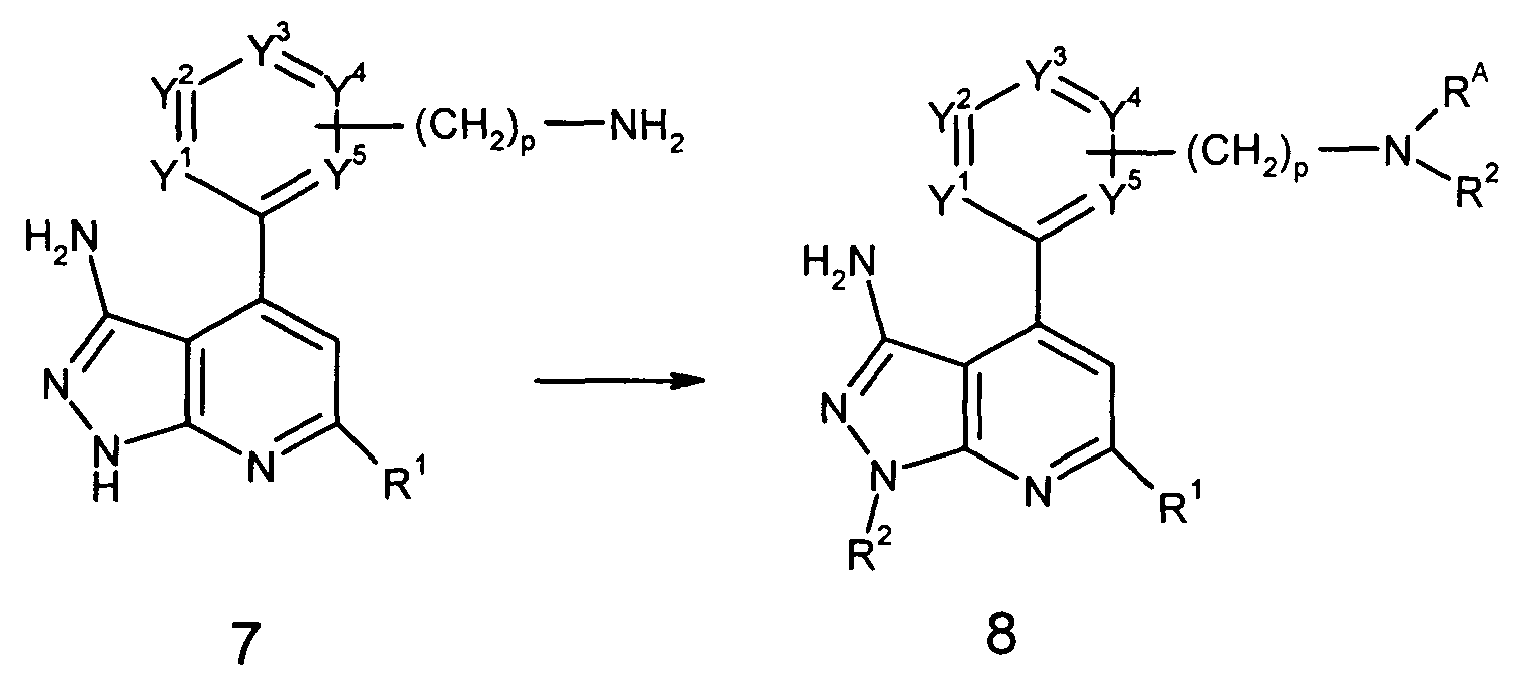
- B) a compound of formula 8 reacted to a compound of general formula (I)

- The compounds of the present invention can be used in treating diseases of dysregulated vascular growth or diseases which are accompanied with dysregulated vascular growth. Especially the compounds effectively interfere with angiopoietin and therefore influence Tie2 signalling. Surprisingly the compounds block Tie2 signalling, wherein obviously Tie2 kinase activity is blocked. This effect will therefore allow prolonged treatment of patients with the inventive compounds offering good tolerability and high anti-angiogenic efficacy, where persistent angiogenesis plays a pathologic role.
- Therefore another aspect of the present invention is a use of the compound of general formula (I) described hereinbefore for manufacturing a pharmaceutical composition for the treatment of diseases of dysregulated vascular growth or of diseases which are accompanied with dysregulated vascular growth.
- Preferably the use is in the treatment of diseases, wherein the diseases are tumors and / or metastases thereof.
- Another use is in the treatment of diseases, wherein the diseases are retinopathy, other angiogenesis dependent diseases of the eye, in particular cornea transplant rejection or age-related macular degeneration, rheumatoid arthritis, and other inflammatory diseases associated with angiogenesis, in particular psoriasis, delayed type hypersensitivity, contact dermatitis, asthma, multiple sclerosis, restenosis, pulmonary hypertension, stroke, and diseases of the bowel.
- A further use is in the treatment of diseases, wherein the diseases are coronary and peripheral artery disease.
- Another use is in the treatment of diseases, wherein the diseases are ascites, edema like brain tumour associated edema, high altitude trauma, hypoxia induced cerebral edema pulmonary edema and macular edema or edema following burns and trauma, chronic lung disease, adult respiratory distress syndrome, bone resorbtion and for benign proliferating diseases like myoma, benign prostate hyperplasia and wound healing for the reduction of scar formation, reduction of scar formation scar formation during regeneration of damaged nerves, endometriosis, pre-eclampsia, postmenopausal bleeding and ovarian hyperstimulation.
- A further use is in the treatment of diseases, wherein the diseases are retinopathy, other angiogenesis dependent diseases of the eye, rheumatoid arthritis, and other inflammatory diseases associated with angiogenesis.
- A next aspect of the invention is a method of treating a disease of dysregulated vascular growth or diseases which are accompanied with dysregulated vascular growth by administering an effective amount of a compound of general formula (I) described hereinbefore.
- Preferably the diseases of said method is tumor and / or metastases thereof.
- Also the diseases of said method are retinopathy, other angiogenesis dependent diseases of the eye, in particular cornea transplant rejection or age-related macular degeneration e.g. , rheumatoid arthritis, and other inflammatory diseases associated with angiogenesis, in particular psoriasis, delayed type hypersensitivity, contact dermatitis, asthma, multiple sclerosis, restenosis, pulmonary hypertension, stroke, and diseases of the bowel.
- Further the disease of the method are coronary and peripheral artery disease.
- Another diseases of the method are ascites, edema like brain tumour associated edema, high altitude trauma, hypoxia induced cerebral edema pulmonary edema and macular edema or edema following burns and trauma, chronic lung disease, adult respiratory distress syndrome, bone resorbtion and for benign proliferating diseases like myoma, benign prostate hyperplasia and wound healing for the reduction of scar formation, reduction of scar formation scar formation during regeneration of damaged nerves, endometriosis, pre-eclampsia, postmenopausal bleeding and ovarian hyperstimulation.
- Therefore the compounds of the present invention can be applied for the treatment of diseases accompanied by neoangiogenesis. This holds principally for all solid tumours, e.g. mamma, colon, renal, lung and/or brain tomours or metastases thereof and can be extended to a broad range of diseases, where pathologic angiogenesis is persistent. This applies for diseases with inflammatory association, diseases associated with edema of various forms and diseases associated with stromal proliferation and pathologic stromal reactions broadly. Particularly suited is the treatment for gynaecological diseases where inhibition of angiogenic, inflammatory and stromal processes with pathologic character can be inhibited. At the same time the toxic side effects on normal proliferating tissue are low. The treatment is therefore an addition to the existing armament to treat diseases associated with neoangiogenesis.
- The compounds of the present invention can be used in particular in therapy and prevention of tumour growth and metastases especially in solid tumours of all indications and stages with or without pre-treatment if the tumour growth is accompanied with persistent angiogenesis. However it is not restricted to tumour therapy but is also of great value for the treatment of other diseases with dysregulated vascular growth. This includes retinopathy and other angiogenesis dependent diseases of the eye (e.g. cornea transplant rejection, age-related macular degeneration), rheumatoid arthritis, and other inflammatory diseases associated with angiogenesis like psoriasis, delayed type hypersensitivity, contact dermatitis, asthma, multiple sclerosis, restenosis, pulmonary hypertension, stroke and inflammatory diseases of the bowel, like Crohn's disease. It includes coronary and peripheral artery disease. It can be applied for disease states like ascites, edema, like brain tumour associated edema, high altitude trauma, hypoxia induced cerebral edema, pulmonary edema and macular edema or edema following burns and trauma. Furthermore it is useful for chronic lung disease, adult respiratory distress syndrome. Also for bone resorption and for benign proliferating diseases like myoma, benign prostate hyperplasia and wound healing for the reduction of scar formation. It is therapeutically valuable for the treatment of diseases, where deposition of fibrin or extracellular matrix is an issue and stroma proliferation is accelerated (e.g. fibrosis, cirrhosis, carpal tunnel syndrome etc). In addition it can be used for the reduction of scar formation during regeneration of damaged nerves, permitting the reconnection of axons. Further uses are endometriosis, pre-eclampsia, postmenopausal bleeding and ovarian hyperstimulation.
- Another aspect of the present invention is a pharmaceutical composition which contains a compound of Formula I or pharmaceutically acceptable salts thereof, N-oxides, solvates, hydrates, isomers or mixtures of isomers thereof, in admixture with one or more suitable excipients. This composition is particularly suited for the treatment of diseases of dysregulated vascular growth or of diseases which are accompanied with dysregulated vascular growth as explained above.
- For using the compounds of the present invention as pharmaceutical product the compounds or mixtures thereof are provided in a pharmaceutical composition, which beside the compounds of the present invention for enteral, oral or parenteral application contain suitably pharmaceutically acceptable organic or inorganic inert base material, e.g. purified water, gelatin, rubber arabicum, lactate, starch, magnesium stearate, talcum, vegetable oils, polyalkylenglycole, etc.
- The pharmaceutical composition may be provided in a solid form, e.g. as tablets, dragèes, suppositories, capsules or in liquid form, e.g. as a solution, suspension or emulsion. The pharmaceutical composition may additionally contain auxiliary substances, e.g. conservators, stabilisers, wetting agents or emulgators, salts for adjusting the osmotic pressure or buffers.
- For parenteral application (including intravenous, subcutaneous, intramuscular, intravascular or infusion) sterile injection solutions or suspensions are preferred, especially aqueous solutions of the compounds in polyhydroxyethoxy containing castor oil.
- The pharmaceutical composition may further contain surface active agents, e.g. salts of gallenic acid, phosphorlipids of animal or vegetable origin, mixtures thereof and liposomes and parts thereof.
- For oral application tablets, dragèes or capsules with talcum and/or carbonhydrogen carriers and -binders, e.g. lactose, maize and potato starch, are preferred. Further application in liquid form is possible, for example as juice, which contains sweetener if necessary.
- The dosage will necessarily be varied depending upon the route of administration, age, weight of the patient, the kind and severity of the illness being treated and similar factors. The daily dose is in the range of 0.5 bis 1.500 mg. A dose can be administered as unit dose or in part thereof and distributed over the day. Accordingly the optimum dosage may be determined by the practitioner who is treating any particular patient.
- Another aspect of the present invention is the method of preparing the compounds according to the present invention.
- The following table lists the abbreviations used in this paragraph, and in the Examples section. NMR peak forms are stated as they appear in the spectra, possible higher order effects have not been considered.
Abbreviation Meaning Ac Acetyl Boc tert-butyloxycarbonyl br broad c- cyclo- Cl chemical ionisation d doublet dd doublet of doublet DCM dichloromethane DIPEA N,N-diisopropylethyl amine DMF N, N-dimethylformamide DMSO Dimethyl sulfoxide eq equivalent ESI electrospray ionisation GP general procedure m multiplet mc centred multiplet MS mass spectrometry NMR nuclear magnetic resonance spectroscopy POPd Dihydrogen dichlorobis(di-tert-butyl phosphinito-κP)palladate(2); CombiPhos Catalysts, Inc. q quartet s singlet t triplet TEA triethylamine TFA trifluoroacetic acid THF tetrahydrofuran - The following schemes and general procedures illustrate general synthetic routes to the compounds of the invention and are not intended to be limiting. Specific examples are described in the subsequent paragraph.
- A first reaction scheme is outlined herein below:
-

- Compounds of general formula (I) can be synthesized according to the procedure depicted in scheme 1. Reaction of aldehyde 1 with methylketone 2, alkyl cyanoacetate, and ammonium acetate yields compounds of formula 3 which are formed into compounds of formula 4. Reduction of the nitro group gives compounds of formula 5. Compounds of formula 6 are formed from compounds of formula 5 by reaction with e.g. aryl- or heteroaryl isocyanates or aryl- or heteroarylsulfonyl chlorides. Addition of hydrazine to compounds of formula 6 leads to compounds of general formula (I). The substituents Y1, Y2, Y3, Y4 Y5, R1, RA, R2 may be further modified on each step (formula 3 to formula 6) or in the last step (general formula 1). These modifications might be cleavage of protecting groups, reduction or oxydation of functional groups, substitution or other reactions. The sequence shown in scheme 1 can be also changed in a way that modifications or introduction of the substituents is performed earlier or later. In particular the introduction of substituents RA and R2 can be performed earlier or later. It is possible, that e.g. aldehydes of type 1 already contain the the group (CH2)pNRAR2 instead of (CH2)pNO2. On the other hand it is also possible e.g. to introduce R2 after the pyrazole ring has been formed. In certain cases double addition occurs and compounds of formula 8 (scheme 2) are obtained. In these cases a selective cleavage of the group R2 at pyrazole nitrogen 1 can be achieved for example by treatment of 8 with potassium carbonate in methanol to give compounds of general formula (I).
- A second reaction scheme is outlined below:
-

- The substituents Y1, Y2, Y3, Y4, Y5, R1, RA, R2 and p have the same meaning as described in the general formula 1. In addition functional groups may be protected. Possible protecting groups are ketals/acetals, esters, amides, nitro groups, carbamates, alkyl ethers, allyl ethers, benzyl ethers, or silyl ethers such as e.g. trimethylsilyl, tert-butyldimethylsilyl, tert-butyl-diphenylsilyl, triethylsilyl.
-

-

- A solution of 3.75 g 4-Aminobenzylalkohol and 3.3 ml lsocyanato-benzene in 120 ml dichloromethane was stirred at 23°C for 2 hours. Afterwards, the reaction mixture was filtered. The crystalline product was washed with diethylether. 6.82 g product was obtained which was used without further purification.
1H-NMR (d6-DMSO): δ = 4,40 (2H); 5,06 (1H); 6,96 (1H); 7,16-7,32 (4H); 7,35-7,52 (4H); 8,63 (2H) ppm. -

- A solution of 3.41 g 1 a and 10 g manganese dioxide in toluene was stirred at 23°C for 20 hours. Afterwards, the reaction mixture was filtered through celite and evaporated in vacuo. The crude product (2.57 g) was used without further purification.
1H-NMR (d6-DMSO): δ = 7,00 (1H); 7,30 (2H); 7,48 (2H); 7,67 (2H); 7,84 (2H); 8,87 (1 H); 9,21 (1 H) 9,85 (1 H) ppm. -

- A solution of 6.66 g ammonium acetate, 1.14 ml methyl cyanoacetate, 1.32 ml 3,3-dimethylbutan-2-one, and 2.57 g 1b in 100 ml ethanol was stirred at 80°C for 6 hours. Afterwards, it was cooled to 23°C and the precipitated product was obtained by filtration. The product was purified by recrystallization from methylene chloride/ methanol. 1.44 g product was isolated.
1H-NMR (d6-DMSO): δ = 1,30 (9H); 6,25 (2H); 6,99 (1 H); 7,29 (2H); 7,46 (2H); 7,13 (4H); 8,79 (1 H); 9,02 (1 H); 12,18 (1 H) ppm. -

- A solution of 340 mg 1 c and 300 µl trifluoromethanesulfonic acid anhydride in pyridine was stirred at 0°C for 3 hours. Afterwards, the reaction mixture was poured into a saturated aqueous sodium hydrogen carbonate solution. It was extracted with ethyl acetate and the organic layer was washed with brine. It was dried over sodium sulfate and evaporated in vacuo. The crude product was purified by column chromatography on silica gel. 116 mg product was obtained.
1H-NMR (d6-DMSO): δ = 1,36 (9H); 7,00 (1H); 7,29 (2H); 7,47 (2H); 7,65-7,85 (5H); 8,80 (1 H); 9,07 (1 H) ppm. -

- A solution of 78 mg 1d and 30 µl hydrazine hydrate (80%) in propanol was stirred at 100°C for 3 hours. Afterwards, the reaction mixture was cooled to 0°C and left at this temperature for 2 hours. Then, the precipitated product was isolated by filtration. The product was washed with ice-cold propanol and dried at 50°C in vacuo. The crude product was purified by column chromatography on silica gel. 25 mg product was isolated.
1H-NMR (d6-DMSO): δ = 1,39 (9H); 4,52 (2H); 6,93-7,03 (2H); 7,29 (2H); 7,44-7,58 (4H); 7,65 (2H); 8,81 (1H); 8,99 (1H); 12,12 (1H) ppm. -

-

- A solution of 500 mg (4-aminophenyl)-methanol, 1.7 ml triethylamine, and 780 µl benzenesulfonyl chloride in 10 ml tetrahydrofuran was stirred at 23°C for 17 hours. Afterwards, the reaction mixture was poured into ice-old hydrochloric acid. It was stirred for 10 minutes and then extracted with ethyl acetate. The organic layer was washed with brine and dried over sodium sulfate. The crude product was purified by column chromatography on silica gel. 572 mg product was isolated.
1H-NMR (CDCl3): δ = 4,62 (2H); 6,68 (2H); 7,05 (2H); 7,24 (2H); 7,40-7,48 (2H); 7,54 (1 H); 7,77 (2H) ppm. -

- A solution of 303 mg 2a, 260 mg 4-methyl-morpholine 4-oxide, and 22 mg tetrapropylammonium peruthenate in dichloromethane was stirred with molecular sieves (4 A) at 23°C for 17 hours. Afterwards, it was filtered and the filtrate was evaporated in vacuo. The crude product was purified by column chromatography on silica gel. 234 mg product was isolated.
1H-NMR (CDCl3): δ = 7,23 (2H); 7,35-7,65 (4H); 7,78 (2H); 7,89 (2H); 9,89 (1H) ppm. -

- In analogy to the procedure described for example 1c reaction of 1.16 g ammonium acetate, 200 µl methyl cyanoacetate, 235 µl 3,3-dimethylbutan-2-one, and 492 mg of 2b yielded 237 mg product.
1H-NMR (d6-DMSO): δ = 1,26 (9H); 6,18 (1H); 7,23 (2H); 7,52-7,70 (5H); 7,86 (2H); 10,80 (1H); 12,22 (1H) ppm. -

- In analogy to the procedure described for example 1 d reaction of 193 mg 2c and 240 µl trifluoromethanesulfonic acid anhydride in pyridine yielded 219 mg product.
1H-NMR (CDCl3): δ = 1,36 (9H); 7,22-7,35 (4H); 7,45-7,60 (2H); 7,69 (1H); 7,86 (1 H); 8,62 (2H) ppm. -
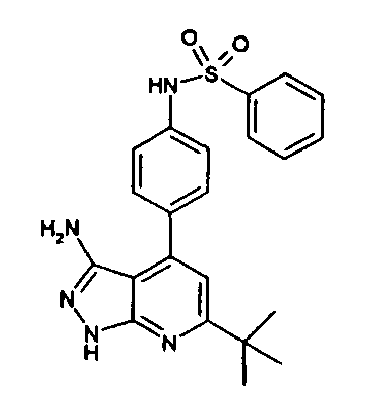
- In analogy to the procedure described for example 1e reaction of 212 mg 2d and 72 µl hydrazine hydrate in propanol yielded 69 mg product.
1H-NMR (d6-DMSO): δ = 1,33 (9H); 4,40 (2H); 6,89 (1 H); 7,25 (2H); 7,46 (2H); 7,52-7,68 (3H); 7,84 (2H); 10,52 (1H); 12,12 (1H) ppm. -

-

- In analogy to the procedure described for example 1 c reaction of 41 g ammonium acetate, 7 ml methyl cyanoacetate, 8.2 ml 3,3-dimethylbutan-2-one, and 10 g 4-nitrobenzaldehyde yielded 4.71 g product.
1H-NMR (d6-DMSO): δ = 1,32 (9H); 6,30 (1H); 7,92 (2H); 8,39 (2H) ppm. -

- In analogy to the procedure described for example 1 d reaction of 2.5 g 3a and 4.25 ml Trifluoromethanesulfonic acid anhydride in pyridine yielded 3.01 g product.
1H-NMR (CDCl3): δ = 1,41 (9H); 7,48 (1H); 7,78 (2H); 8,42 (2H) ppm. -

- A solution of 3 g 3b and 8 g tin(II) chloride dihydrate in 50 ml ethanol was stirred at 70°C for 10 minutes. Afterwards, the reaction mixture was poured into 120 ml of an aqueous solution of ammonia (33%). It was stirred for 45 minutes at 23°C. Afterwards, it was extracted with ethyl acetate. The organic layer was washed with brine, dried over sodium sulfate and evaporated in vacuo. The crude product (2.6 g) was used without further purification.
1H-NMR (d6-DMSO): δ = 1,32 (9H); 5,96 (2H); 6,71 (2H); 7,54 (2H); 7,65 (1 H) ppm. -

- In analogy to the procedure described for example 1 a reaction of 200 mg 3c and 60 µl 1-Fluoro-3-isocyanato-benzene yielded 260 mg product.
1H-NMR (d6-DMSO): δ = 1,35 (9H); 6,80 (1 H); 7,14 (1 H); 7,30 (1 H); 7,49 (1 H); 7,66-7,85 (5H); 8,96 (1 H); 9,13 (1 H) ppm. -

- In analogy to the procedure described for example 1e reaction of 260 mg 3d with 91 µl hydrazine hydrate in propanol yielded 141 mg product.
1H-NMR (d6-DMSO): δ = 1,38 (9H); 4,50 (2H); 6,79 (1 H); 6,96 (1 H); 7,15 (1 H); 7,31 (1 H); 7,49-7,60 (3H); 7,65 (2H); 8,98 (2H); 12,11 (1 H) ppm. -

-

- In analogy to the procedure described for example 1 a reaction of 200 mg 3c and 60 µl 1-Fluoro-2-isocyanato-benzene yielded 201 mg product.
1H-NMR (d6-DMSO): δ = 1,35 (9H); 7,03 (1 H); 7,10-7,30 (2H); 7,69 (2H); 7,78 (3H); 8,16 (1 H); 8,70 (1 H); 9,45 (1 H) ppm. -

- In analogy to the procedure described for example 1e reaction of 196 mg 4a with 70 µl hydrazine hydrate in propanol yielded 61 mg product.
1H-NMR (d6-DMSO): δ = 1,38 (9H); 4,50 (2H); 6,95 (1 H); 7,04 (1 H); 7,16 (1 H); 7,26 (1 H); 7,55 (2H); 7,66 (2H); 8,18 (1 H); 8,62 (1 H); 9,31 (1 H); 12,10 (1 H) ppm. -

-

- In analogy to the procedure described for example 1a reaction of 200 mg 3c and 71 µl 1- 1,4-Difluoro-2-isocyanato-benzene yielded 264 mg product.
1H-NMR (d6-DMSO): δ = 1,36 (9H); 6,85 (1H); 7,31 (1H); 7,70 (2H); 7,79 (3H); 8,04 (1 H); 8,90 (1 H); 9,50 (1 H) ppm. -

- In analogy to the procedure described for example 1e reaction of 261 mg 5a with 90 µl hydrazine hydrate in propanol yielded 63 mg product.
1H-NMR (d6-DMSO): *δ = 1,39 (9H); 4,51 (2H); 6,84 (1 H); 6,96 (1 H); 7,31 (1 H); 7,58 (2H); 7,66 (2H); 8,06 (1 H); 8,84 (1 H); 9,38 (1 H); 21,10 (1 H) ppm. -

-

- In analogy to the procedure described for example 1a reaction of 200 mg 3c and 71 µl 1,2-Difluoro-4-isocyanato-benzene yielded 275 mg product.
1H-NMR (d6-DMSO): δ = 1,31 (9H); 7,12 (1H); 7,32 (1H); 7,60-7,78 (6H); 9,02 (1 H); 9,14 (1 H) ppm. -

- In analogy to the procedure described for example 1e reaction of 270 mg 6a with 91 µl hydrazine hydrate in propanol yielded 153 mg product.
1H-NMR (d6-DMSO): δ = 1,32 (9H); 4,46 (2H); 6,91 (1H); 7,11 (1H); 7,31 (1H); 7,50 (2H); 7,58-7,70 (3H) 8,95 (2H) ppm. -

-

- In analogy to the procedure described for example 1a reaction of 200 mg 3c and 80 µl 1-isocyanato-naphthalene yielded 283 mg product.
1H-NMR (d6-DMSO): δ = 1,31 (9H); 7,45 (1 H); 7,50-7,62 (2H); 7,65 (1 H); 7,70-7,80 (5H); 7,91 (1 H); 7,98 (1 H); 8,10 (1 H); 8,88 (1 H); 9,41 (1 H) ppm. -

- In analogy to the procedure described for example 1e reaction of 280 mg 7a with 91 µl hydrazine hydrate in propanol yielded 137 mg product.
1H-NMR (d6-DMSO): δ = 1,39 (9H); 4,51 (2H); 6,98 (1H); 7,45-7,78 (8H); 7,95 (1 H); 8,02 (1 H); 8,16 (1 H); 8,84 (1 H); 9,30 (1 H); 12,12 (1 H) ppm. -

-
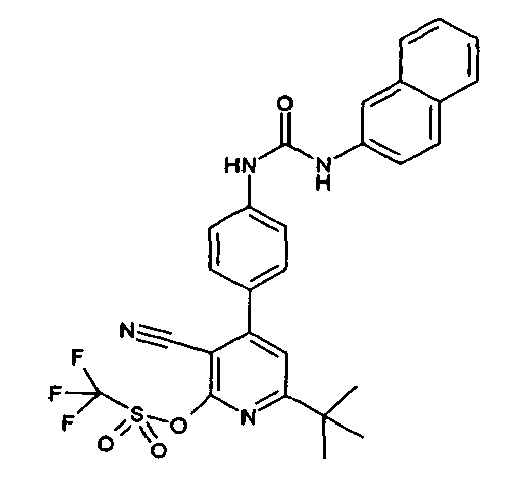
- In analogy to the procedure described for example 1 a reaction of 200 mg 3c and 93 mg 2-isocyanato-naphthalene yielded 234 mg product.
1H-NMR (d6-DMSO): 8 = 1,32 (9H); 7,36 (1 H); 7,45 (1 H); 7,51 (1 H); 7,70-7,90 (8H); 8,12 (1 H); 9,06 (1 H); 9,19 (1 H) ppm. -

- In analogy to the procedure described for example 1e reaction of 227 mg 8a with 75 µl hydrazine hydrate in propanol yielded 131 mg product. 1H-NMR (d6-DMSO): δ = 1,40 (9H); 4,52 (2H); 6,98 (1 H); 7,38 (1 H); 7,48 (1 H); 7,56 (3H); 7,70 (2H); 7,78-7,90 (3H); 8,13 (1 H); 9,00 (1 H); 9,05 (1 H); 12,12 (1 H) ppm.
-

-

- In analogy to the procedure described for example 1a reaction of 200 mg 3c and 70 µl 1-isocyanato-3-methyl-benzene yielded 244 mg product.
1H-NMR (d6-DMSO): δ = 1,38 (9H); 2,30 (3H); 6,71 (1H); 7,12-7,28 (2H); 7,32 (1 H); 7,64-7,83 (5H); 8,71 (1 H); 9,03 (1 H) ppm. -

- In analogy to the procedure described for example 1e reaction of 237 mg 9a with 81 µl hydrazine hydrate in propanol yielded 113 mg product.
1H-NMR (d6-DMSO): δ = 1,32 (9H); 2,23 (3H); 4,48 (2H); 6,77 (1H); 6,91 (1H); 7,12 (1 H); 7,22 (1 H); 7,28 (1 H); 7,50 (2H); 7,60 (2H); 8,64 (1 H); 8,89 (1 H); 12,08 (1 H) ppm. -

-

- In analogy to the procedure described for example 1a reaction of 200 mg 3c and 91 mg 1-Isocyanato-2-nitro-benzene yielded 275 mg product.
1H-NMR (d6-DMSO): δ = 1,35 (9H); 7,23 (1H); 7,70-7,86 (6H); 8,11 (1H); 8,30 (1H); 9,67 (1H); 10,17 (1 H) ppm. -

- In analogy to the procedure described for example 1e reaction of 270 mg 10a with 88 µl hydrazine hydrate in propanol yielded 97 mg product.
1H-NMR (d6-DMSO): δ = 1,38 (9H); 4,50 (2H); 6,97 (1 H); 7,22 (1 H); 7,56 (2H); 7,66-7,78 (3H); 8,11 (1 H); 8,31 (1 H); 9,65 (1 H); 10,06 (1 H); 12,10 (1 H) ppm. -

-

- In analogy to the procedure described for example 1a reaction of 200 mg 3c and 71 µl 2,4-Difluoro-1-isocyanato-benzene yielded 259 mg product.
1H-NMR (d6-DMSO): δ = 1,35 (9H); 7,08 (1H); 7,32 (1H); 7,69 (2H); 7,78 (3H); 8,09 (1 H); 8,65 (1 H); 9,40 (1 H) ppm. -

- In analogy to the procedure described for example 1e reaction of 254 mg 11a with 85 µl hydrazine hydrate in propanol yielded 58 mg product.
1H-NMR (d6-DMSO): δ= 1,37 (9H); 4,50 (2H); 6,96 (1H); 7,07 (1H); 7,32 (1H); 7,55 (2H); 7,63 (2H); 8,10 (1 H); 8,57 (1 H); 9,22 (1 H); 12,10 (1 H) ppm. -

-

- In analogy to the procedure described for example 1a reaction of 200 mg 3c and 70 µ 4-fluoro-1-isocyanato-benzene yielded 264 mg product.
1H-NMR (d6-DMSO): δ = 1,34 (9H); 7,14 (2H); 7,48 (2H); 7,65-7,82 (5H); 8,83 (1 H); 9,06 (1 H) ppm. -

- In analogy to the procedure described for example 1e reaction of 259 mg 12a with 88 µl hydrazine hydrate in propanol yielded 127 mg product.
1H-NMR (d6-DMSO): δ = 1,36 (9H); 4,46 (2H); 6,91 (1H); 7,10 (2H); 7,40-7,53 (4H); 7,60 (2H); 8,74 (1 H); 8,86 (1 H); 12,08 (1 H) ppm. -

-

- In analogy to the procedure described for example 1a reaction of 200 mg 3c and 90 µl 4-isocyanato-benzonitrile yielded 142 mg product.
1H-NMR (d6-DMSO): δ = 1,35 (9H); 7,62-7,83 (9H); 9,23 (1 H); 9,32 (1 H) ppm. -

- In analogy to the procedure described for example 1e reaction of 259 mg 13a with 50 µl hydrazine hydrate in propanol yielded 53 mg product.
1H-NMR (d6-DMSO): δ = 1,32 (9H); 4,48 (2H); 6,91 (1H); 7,51 (2H); 7,61 (4H); 7,70 (2H); 9,07 (1 H); 9,24 (1 H); 12,10 (1 H) ppm. -

-

- In analogy to the procedure described for example 3a reaction of 17.9 g ammonium acetate, 3.5 ml methyl cyanoacetate, 3.8 ml 1-Cyclopropylethanone, and 5 g 4-nitrobenzaldehyde yielded 3.23 g product.
1H-NMR (d6-DMSO): δ = 1,00-1,25 (4H); 2,00 (1H); 6,10 (1H); 7,88 (2H); 8,37 (2H); 12,82 (1H) ppm. -

- In analogy to the procedure described for example 3b reaction of 1.5 g 14a and 2.69 ml Trifluoromethanesulfonic acid anhydride in pyridine yielded 1.49 g product.
1H-NMR (CDCl3): δ = 1,26 (4H); 2,15 (1H); 7,40 (1H); 7,78 (2H); 8,41 (2H) ppm. -

- In analogy to the procedure described for example 3c reaction of 1.49 g 14b and 4.1 g tin(II) chloride dihydrate in ethanol yielded 1.2 g product.
1H-NMR (d6-DMSO): δ = 0,98 (2H); 1,17 (2H); 2,31 (1H); 5,92 (2H); 6,70 (2H); 7,51 (2H); 7,76 (1 H) ppm. -

- In analogy to the procedure described for example 3d reaction of 250 mg 14c and 70 µl Isocyanato-benzene yielded 266 mg product.
1H-NMR (d6-DMSO): δ = 1,03 (2H); 1,21 (2H); 2,37 (1H); 6,99 (1H); 7,30 (2H); 7,48 (2H); 7,65-7,77 (4H); 7,86 (1H); 8,86 (1H); 9,10 (1H); 1,36 (9H); 7,22-7,35 (4H); 7,45-7,60 (2H); 7,69 (1H); 7,86 (1H); 8,62 (2H) ppm. -

- In analogy to the procedure described for example 3e reaction of 261 mg 14d with 95 µl hydrazine hydrate in propanol yielded 78 mg product.
1H-NMR (d6-DMSO): δ = 1,00 (4H); 2,19 (1H); 4,48 (2H); 6,86 (1H); 6,99 (1H); 7,30 (2H); 7,45-7,59 (4H); 7,63 (2H); 8,78 (1 H); 8,91 (1 H); 11,97 (1 H) ppm. -

-

- In analogy to the procedure described for example 3d reaction of 200 mg 14c and 71 µl 1-Fluoro-2-isocyanato-benzene yielded 179 mg product.
1H-NMR (d6-DMSO): δ = 0,99 (2H); 1,19 (2H); 2,32 (1H); 7,00 (1H); 7,11 (1H); 7,21 (1H); 7,61-7,74 (4H); 7,83 (1H); 8,10 (1H); 8,69 (1H); 9,42 (1H) ppm. -

- In analogy to the procedure described for example 3a reaction of 175 mg 15a with 62 µl hydrazine hydrate in propanol yielded 35 mg product.
1H-NMR (d6-DMSO): δ = 0,94 (4H); 2,15 (1 H); 4,45 (2H); 6,80 (1 H); 6,99 (1 H); 7,10 (1 H); 7,20 (1 H); 7,50 (2H); 7,59 (2H); 8,12 (1 H); 8,60 (1 H); 9,26 (1 H); 11,95 (1H) ppm. - To prove the high potency activity as inhibitors of Tie2 kinase and Tie2 autophosphorylation the following ELISA-method was established and used.
- Herein CHO cell-cultures, which are stably transfected by known techniques with Tie2 using DHFR deficiency as selection marker, are stimulated by angiopoietin-2. The specific autophosphorylation of Tie2 receptors is quantified with a sandwich-ELISA using anti-Tie2 antibodies for catch and anti-phosphotyrosine antibodies coupled to HRP as detection.
- 96well tissue culture plate, sterile, Greiner
96well FluoroNunc plate MaxiSorp Surface C, Nunc
96well plate polypropylene for compound dilution in DMSO
CHO Tie2/DHFR (transfected cells)
PBS-; PBS++, DMSO
MEM alpha Medium with Glutamax-I without Ribonucleosides and Deoxyribonucleosides (Gibco #32561-029) with 10% FCS after dialysis! and 1% PenStrepLysis buffer: 1 Tablet "Complete" protease inhibitor
1 cap Vanadate (1 mL > 40 mg/mL; working solution 2 mM)
ad 50 mL with Duschl-Puffer
pH 7.6Anti-TIE-II antibody 1 : 425 in Coating Buffer pH 9.6 Stock solution: 1.275 mg/mL > working.: 3 µg/mL PBST:2 bottles PBS(10x) + 10ml Tween, fill up with VE-water RotiBlock 1 : 10 in VE-water Anti-Phosphotyrosine HRP-Conjugated 1 : 10000 in 3% TopBlock 3% TopBlock in PBST BM Chemiluminescence ELISA Substrate (POD) solution B 1 : 100 solution A SF9 cell culture medium Ang2-Fc in SF9 cell culture medium - Dispense 5 x 10⁴ cells / well / 98 µL in 96well tissue culture plate
Incubate at 37 °C / 5% CO2
After 24 h add compounds according to desired concentrations
Add also to control and stimulated values without compounds 2 µL DMSO And mix for a few min at room temperature
Add 100 µL Ang2-Fc to all wells except control, which receives insect medium Incubate 20 min at 37 °C.
Wash 3x with PBS++
Add 100 µl Lysis buffer /well and shake a couple of min at room temperature Store lysates at 20 °C before utilizing for the ELISA - Coat 96well FluoroNunc Plate MaxiSorp Surface C with anti-Tie2 Mab
1 : 425 in Coating buffer pH 9.6; 100 µL / well overnight at 4 °C
Wash 2x with PBST
Blcock plates with 250 µL / well RotiBlock 1 : 10 in VE-water
Incubate for 2 h at room temperature or overnight at 4 °C shaking
Wash 2x in PBST
Add thawed lysates to wells and incubate overnight shaking at 4 °C
Wash 2x with PBST
Add 100 µL/well anti-Phosphotyrosine HRP-Conjugated 1 : 10000 in 3% TopBlock (3% TopBlock in PBST) and incubate overnight under shaking Wash 6x with PBST
Add 100 µL/well BM Chemiluminescence ELISA Substrate (POD solutions 1 und 2 (1 : 100)
Determine luminescence with the LumiCount. - To prove the effectiveness of the compound according to the present invention a Tie-2-Kinase HTRF-Assay was established.
- Tie-2 phosphorylates tyrosine residues of the artificial substrate polyGAT (biotinylated polyGluAlaTyr). Detection of phosphorylated product is achieved specifically by a trimeric detection complex consisting of the phosphorylated substrate, streptavidin-XLent (SA-XLent) which binds to biotin, and Europium Cryptate-labeled anti-phosphotyrosine antibody PT66 which binds to phosphorylated tyrosine. Excitation of Europium fluorescence with 337 nm light results in emission of long-lived light with 620 nm. In case a trimeric detection complex has formed, part of the energy will be transferred to the SA-XLent fluorophore that itself then emits long-lived light of 665 nm (FRET: fluorescence resonance energy transfer). Unphosphorylated substrate does not give rise to light emission at 665nm, because no FRET-competent trimeric detection complex can be formed. Measurement is performed in a Packard Discovery or BMG Rubystar instrument. A-counts (emission at 665 nm) will be divided by B-counts (emission at 620 nm) and multiplicated with a factor of 10000. The resulting numbers are called the "well ratio" of the sample.
- Enzyme: Tie-2-Kinase, in house, aliquots (12 x 10 mL) stored at -80 °C Substrate: PolyGAT labeled with Biotin (1000 µg / mL); CIS Bio ; # 61GATBLB; aliquots stored at -20 °C
- ATP: Amersham Pharmacia Biotech Inc. # 27-2056-01; 100 mM; stored at -20 °C
- Antibody: PT66-Eu Cryptate ; CIS Bio ; # 61T66KLB ; 30µg/mL; aliquots stored at -20 °C
- SA-XLent ; CIS Bio; # 611 SAXLB ; 1000 µg/mL; aliquots stored at -80 °C Microplates : 384 Well black, SV, Greiner, # 784076
- 50 mM HEPES (pH 7.0), 25 mM MgCl2, 5 mM MnCl2, 1 mM DTT, 0.5 mM Na3VO4, 0.01% (v/v) NP40, 1 x Complete EDTA free
- Tie-2 stock solution is diluted 1:250 in assay buffer
- PolyGAT (1000 µg/mL; 36.23 µM) is diluted 1:90.6 to 400 nM or 77.3 ng/well, ATP (100 mM) is diluted 1 : 5000 to 20.0 µM. Both dilutions in assay buffer. Final assay concentrations: poly-GAT: 200 nM or 5.25 µg/mL, ATP: 10 µM (1 x Km each).
- Detection solution: 50 mM HEPES (pH 7.0), BSA 0.2%, 0.6 M KF, 200 mM EDTA, PT66-Europium Cryptate 2.5 ng/well, SA-XLent Cis Bio 90 ng/well.
- All steps at 20 °C
- 1. 0.75 µL of compound solution in 30 % (v/v) DMSO
- 2. add 7 µL of substrate working solution
- 3. add 7 µL of enzyme working solution
- 4. incubate 75 min (reaction volume: 14.75 µL)
- 5. add 8 µL of detection solution
- 6. incubate 180 min or over night at 4 °C (total volume: 22.75 µL)
- 7. measure HTRF in Packard Discovery or BMG Rubystar instrument (delay 50 µs, integrated time 400 µs)
- Final concentrations (in 14.75 µL reaction volume):
- Enzyme: unknown
- polyGAT (1 x Km): 200 nM (77.3 ng)
- ATP (1 x Km): 10 µM
- DMSO: 1.5% (v/v)
- Buffer conditions: 50 mM HEPES (pH 7.0), 25 mM MgCl2, 5 mM MnCl2, 1 mM DTT, 0.5 mM NaV04, 0.01 % (v/v) NP40, 1 x Complete
-
- C0: uninhibited reaction (DMSO only)
- Ci: inhibited reaction with 20 µM Staurosporine
- The compounds presented in this application, in particular Example 1, 2, 3, 9, 12, 14 and 15, have high potency activity as inhibitors of Tie2 kinase and/or Tie2 autophosphorylation as measured with the ELISA-method. The lC50 values are below 5 µM.
Claims (21)
- A compound of general formula (1):
 R1 stands for C1-C6-alkyl, C2-C6-alkenyl, C2-C6-alkinyl, C3-C10-cycloalkyl, C3-C10-heterocycloalkyl, aryl or heteroaryl optionally being substituted one or more times, the same way or differently with K, whereby C3-C10-heterocycloalkyl itself must at least once be interrupted by an atom of the group comprising nitrogen, oxygen and/or sulfur and whereby C3-C10-cycloalkyl ring and/or C3-C10-heterocycloalkyl ring can optionally be interrupted one or more times, the same or differently with a group -(CO)-, -SO- or -SO2- and whereby C3-C10-cycloalkyl ring and/or C3-C10-heterocycloalkyl ring can optionally contain one or more double bonds,K stands for halogen, hydroxy or a substituent of the group comprising -O-R3 or -NR5R6
or for C3-C10-cycloalkyl, C3-C10-heterocycloalkyl, aryl or heteroaryl optionally being substituted one or more times, the same way or differently with L, whereby C3-C10-heterocycloalkyl itself must at least one time be interrupted by an atom of the group comprising nitrogen, oxygen and/or sulfur and whereby C3-C10-cycloalkyl ring and/or C3-C10-heterocycloalkyl ring can optionally be interrupted one or more times, the same or differently with a group -(CO)-, -SO- or -SO2- and whereby C3-C10-cycloalkyl ring and/or C3-C10- heterocycloalkyl ring can optionally contain one or more double bonds,L stands for a substituent of the group comprising -COR4 or -NR5R6 or for C1-C6-alkyl optionally being substituted one or more times, the same way or differently with halogen, hydroxy, cyano, nitro or the group -NR5R6 or -COR4,RA stands for hydrogen or C1-C6-alkyl optionally being substituted one or more times, the same way or differently with halogen, hydroxy, cyano, nitro or the group - NR5R6 or -COR4,R2 stands for a substituent of the group comprising -C(O)-NR7R7a, -S(O)2-R7, -S(O)2NR7R7a, -S(O)(NH)R7, -C(O)R7 or -C(O)OR7 ,R3 stands for C1-C6-alkyl, aryl or -(CH2),-aryl, wherein C1-C6-alkyl, aryl or -(CH2)n-aryl can optionally be substituted one or more times, the same way or differently with C1-C6-alkyl, C1-C6-alkoxy, halogen, hydroxy, cyano, nitro or the group - NR5R6 or -COR4,R4 stands for hydrogen, hydroxy, C1-C6-alkyl, C1-C6-alkoxy or the group -NR5R6,R5 and R6 independently from another stand for hydrogen, C1-C6-alkyl, aryl or for a group -COR4 , wherein C1-C6-alkyl or aryl can optionally be substituted one or more times, the same way or differently with halogen, hydroxy, cyano, nitro or the group - NR7R7a or -COR4,
orR5 and R6 together with nitrogen form a 3 to 10 membered heterocycloalkyl ring, whereby heterocycloalkyl ring itself must at least one time be interrupted by an atom of the group comprising nitrogen, oxygen and/or sulfur and can optionally be interrupted one or more times, the same way or differently with a group -(CO)-, -SO- and/or -SO2- and can optionally contain one or more double bonds,R7 and R7a independently from another stand for hydrogen, C1-C6-alkyl, C3-C10-cycloalkyl, C3-C10-heterocycloalkyl, aryl or heteroaryl, wherein C1-C6-alkyl , C3-C10-cycloalkyl, C3-C10-heterocycloalkyl, aryl or heteroaryl can optionally be substituted one or more times, the same way or differently with M, whereby C3-C10-heterocycloalkyl itself must at least one time be interrupted by an atom of the group comprising nitrogen, oxygen and/or sulfur and whereby C3-C10-cycloalkylring and/or C3-C10-heterocycloalkyl ring can optionally be interrupted one or more times, the same way or differently with a group -(CO)-, -SO- or -SO2- and whereby C3-C10-cycloalkyl ring and/or C3-C10-heterocycloalkyl ring can optionally contain one or more double bonds,
orR7 and R7a together with nitrogen form a 3 to 10 membered heterocycloalkyl ring, whereby heterocycloalkyl ring itself must at least one time be interrupted by an atom of the group comprising nitrogen, oxygen and/or sulfur and can optionally be interrupted one or more times, the same way or differently with a group -(CO)-, -SO- or -SO2- and can optionally contain one or more double bonds,M stands for a substituent of the group comprising cyano, halogen, hydroxy, nitro or for C1-C6-alkyl, C2-C6-alkenyl, C2-C6-alkinyl, C1-C6-alkoxy, aryl, C3-C10-heteroaryl, -(CH2)n-phenyl or -(CH2)p-O-(CH2)pphenyl, wherein C1-C6-alkyl, C2-C6-alkenyl, C2-C6-alkinyl, C1-C6-alkoxy, aryl, C3-C10-heteroaryl, -(CH2)n-pheny) or -(CH2)p-O-(CH2)pphenyl can optionally be substituted one or more times, the same way or differently with a substituent of the group comprising amino, cyano, halogen, hydroxy, nitro, C1-C6-alkoxy, -(CH2)p-phenyl or -(CH2)p-O-(CH2)pphenyl,Y1, Y2, Y3, Y4 and Y5 independently from another stand for -CH=, -CZ= or -N= and -N= can stand from 0 to 3 times as a ringatom,Z stands for cyano, nitro, halogen, hydroxy or a substituent of the group comprising -NR5R6, -OR3, -C(O)R7, -C(O)OR7, -C(O)NR7R7a , -S(O)R7 or -S(O)2R7 or for C1-C6-alkyl, C2-C6-alkenyl, C2-C6-alkinyl or C3-C10-cycloalkyl, whereby C1-C6-alkyl, C2-C6-alkenyl, C2-C6-alkinyl or C3-C10-cycloalkyl can optionally be substituted one or more times, the same way or different with cyano, nitro, halogen, hydroxy, -OR3 or -NR5R6,n stands for 1 to 4 andp stands for 0 to 4 as well asN-oxides, solvates, hydrates, isomers, diastereomers, enantiomers and salts thereof. - Compounds of general formula (I) according to claim 1, whereinR1 stands for C1-C6-alkyl, C2-C6-alkenyl, C2-C6-alkinyl, C3-C10-cycloalkyl, aryl or heteroaryl optionally being substituted one or more times, the same way or differently with K,K stands for halogen, hydroxy or stands for morpholinyl, piperazinyl, piperidinyl, pyrrolidinyl or phenoxy optionally substituted with L,L stands for C1-C6-alkyl or -COO-C1-C6 alkyl, whereby C1-C6-alkyl or -COO-C1-C6 alkyl can optionally be substituted one or more times, the same way or differently with halogen,RA stands for hydrogen or C1-C6-alkyl optionally being substituted one or more times, the same way or differently with halogen, hydroxy, cyano, nitro or the group - NR5R6 or -COR4,R2 stands for a substituent of the group comprising -C(O)-NR7R7a, -S(O)2-R7, -S(O)2NR7R7a, -S(O)(NH)R7, -C(O)R7 or -C(O)OR7,R3 stands for C1-C6-alkyl, aryl or -(CH2)n-aryl, wherein C1-C6-alkyl, aryl or -(CH2)n-aryl can optionally be substituted one or more times, the same way or differently with C1-C6-alkyl, C1-C6-alkoxy, halogen, hydroxy, cyano, nitro or the group - NR5R6 or -COR4,R5 and R6 independently from another stand for hydrogen, C1-C6-alkyl, aryl or for a group -COR4, wherein C1-C6-alkyl or aryl can optionally be substituted one or more times, the same way or differently with halogen, hydroxy, cyano, nitro or the group - NR7R7a or -COR4,R7 and R7a independently from another stand for hydrogen, aryl or heteroaryl optionally being substituted one or more times, the same way or differently with M,M stands for a substituent of the group comprising cyano, halogen, hydroxy, nitro or for C1-C6-alkyl, C2-C6-alkenyl, C2-C6-alkinyl, C1-C6-alkoxy, aryl, C3-C10-heteroaryl, -(CH2)n-phenyl or -(CH2)p-O- (CH2)pphenyl, wherein C1-C6-alkyl, C2-C6-alkenyl, C2-C6-alkinyl, C1-C6-alkoxy, aryl, C3-C10-heteroaryl, -(CH2)n-phenyl or -(CH2)P-O-(CH2)pphenyl can optionally be substituted one or more times, the same way or differently with a substituent of the group comprising amino, cyano, halogen, hydroxy, nitro or C1-C6-alkoxy,Y1, Y2, Y3, Y4 and Y5 independently from another stand for -CH=, -CZ= or -N= and -N= can stand from 0 to 3 times as a ringatom,Z stands for cyano, nitro, halogen, hydroxy or a substituent of the group comprising -NR5R6, ,-OR3 ,-C(O)R7, -C(O)OR7, -C(O)NR7R7a , -S(O)R7 or -S(O)2R7 or for C1-C6-alkyl, C2-C6-alkenyl, C2-C6-alkinyl or C3-C10-cycloalkyl, whereby C1-C6-alkyl, C2-C6-alkenyl, C2-C6-alkinyl or C3-C10-cycloalkyl can optionally be substituted one or more times, the same way or different with cyano, nitro, halogen, hydroxy, -OR3 or -NR5R6,n stands for 1 to 4 andp stands for 0 to 4 as well asN-oxides, solvates, hydrates, isomers, diastereomers, enantiomers and salts thereof.
- Compounds of general formula (I) according to claim 1 or 2, whereinR1 stands for C1-C6-alkyl, C3-C10-cycloalkyl optionally being substituted one or more times the same way or differently with K,K stands for halogen, hydroxy or stands for morpholinylene, piperazinylene, piperidinylene or phenyleneoxy,RA stands for hydrogen or C1-C6-alkyl,R2 stands for a substituent of the group comprising -C(O)-NH-R7 or -S(O)2-R7,R7 stands for phenylene or naphtylene optionally being substituted one or more times, the same way or differently with M,M stands for a substituent of the group comprising cyano, halogen, nitro or for C1-C6-alkyl optionally being substituted one or more times, the same way or differently with a substituent of the group comprising amino, cyano, halogen, hydroxy, nitro or C1-C6-alkoxy,Y1, Y2, Y3 Y4 and Y5 stand for -CH= andp stands for 0 to 4as well as N-oxides, solvates, hydrates, isomers, diastereomers, enantiomers and salts thereof.
- Compounds of general formula (I) according to any one of claims 1 to 3, whereinR1 stands for tert.-butyl or cyclopropyl,RA stands for hydrogen,R2 stands for a substituent of the group comprising -C(O)-NH-R7 or -S(O)2-R7,R7 stands for phenylene or naphtylene optionally being substituted one or more times, the same way or differently with M,M stands for a substituent of the group comprising cyano, halogen, nitro or for methyl,Y1, Y2, Y3 Y4 and Y5 stand for -CH= andp stands for 0as well as N-oxides, solvates, hydrates, isomers, diastereomers, enantiomers and salts thereof.
- A method of preparing the compound of general formula (I) according to any one of claims 1 to 4, the method comprising the following method steps:A) an aldehyde of formula 1 is reacted with methylketone of formula 2, an alkyl cyanoacetate and an ammonium acetate into a compound of formula 3
 B) a compound of formula 3 reacted to a compound of formula 4
 C) a compound of formula 4 reduced to a compound of formula 5
 D) a compound of formula 5 reacted to a compound of formula 6
 E) a compound of formula 6 reacted by addition of hydrazines to a compound of general formula (I)wherein Y stands for C1-C4-alkyl, X stands for halogen or perfluor-C1-C4-alkyl sulfonyl and RA, R1, R2, Y1, Y2, Y3, Y4, Y5 and p have the meaning described in general formula (I) according to any one of claims 1 to 4 as well as N-oxides, solvates, hydrates, isomers, diastereomers, enantiomers and salts thereof.
- A method for preparing a compound of general formula (I) according to any one of claims 1 to 4, the method comprising the following method steps:A) a compound of formula 7 reacted to a compound to formula 8 and
 B) a compound of formula 8 reacted to a compound of general formula (I)wherein RA, R1, R2, Y1, Y2, Y3, Y4, Y5 and p have the meaning described in general formula (I) according to any one of claims 1 to 4 as well as N-oxides, solvates, hydrates, isomers, diastereomers, enantiomers and salts thereof.
- A pharmaceutical composition which comprises the compounds of general formula (I) according to any one of claims 1 to 4 or a pharmaceutically acceptable salt or an in vivo hydrolysable ester thereof, and a pharmaceutically-acceptable diluent or carrier.
- A use of the compound of any one of claims 1 to 4 for manufacturing a pharmaceutical composition for the treatment of diseases of dysregulated vascular growth or of diseases which are accompanied with dysregulated vascular growth.
- The use according to claim 8, wherein the diseases are tumors and / or metastases thereof.
- The use according to claim 8, wherein the diseases are retinopathy, other angiogenesis dependent diseases of the eye, rheumatoid arthritis, and other inflammatory diseases associated with angiogenesis.
- The use of claim 10, wherein the angiogenesis dependent diseases of the eye are cornea transplant rejection, age-related macular degeneration.
- The use according to claim 11, wherein the diseases are coronary and peripheral artery disease.
- The use of claim 10, wherein the inflammatory diseases associated with angiogenesis are psoriasis, delayed type hypersensitivity, contact dermatitis, asthma, multiple sclerosis, restenosis, pulmonary hypertension, stroke, and diseases of the bowel.
- The use according to claim 8, wherein the diseases are ascites, edema like brain tumour associated edema, high altitude trauma, hypoxia induced cerebral edema pulmonary edema and macular edema or edema following burns and trauma, chronic lung disease, adult respiratory distress syndrome, bone resorbtion and for benign proliferating diseases like myoma, benign prostate hyperplasia and wound healing for the reduction of scar formation, reduction of scar formation scar formation during regeneration of damaged nerves, endometriosis, pre-eclampsia, postmenopausal bleeding and ovarian hyperstimulation.
- A method for treating a disease of dysregulated vascular growth or diseases which are accompanied with dysregulated vascular growth administering an effective amount of a compound of general formula (I) according to any one of claims 1 to 4.
- The method according to claim 15, wherein the disease is tumor and / or metastases thereof.
- The method according to claim 15, wherein the diseases are retinopathy, other angiogenesis dependent diseases of the eye rheumatoid arthritis, and other inflammatory diseases associated with angiogenesis.
- The method according to claim 17, wherein the angiogenesis dependent diseases of the eye are cornea transplant rejection, age-related macular degeneration.
- The method according to claim 18, wherein the diseases are coronary and peripheral artery disease.
- The method according to 17, wherein the inflammatory diseases associated with angiogenesis are psoriasis, delayed type hypersensitivity, contact dermatitis, asthma, multiple sclerosis, restenosis, pulmonary hypertension, stroke, and diseases of the bowel.
- The method according to claim 15, wherein the diseases are ascites, edema like brain tumour associated edema, high altitude trauma, hypoxia induced cerebral edema pulmonary edema and macular edema or edema following burns and trauma, chronic lung disease, adult respiratory distress syndrome, bone resorbtion and for benign proliferating diseases like myoma, benign prostate hyperplasia and wound healing for the reduction of scar formation, reduction of scar formation scar formation during regeneration of damaged nerves, endometriosis, pre-eclampsia, postmenopausal bleeding and ovarian hyperstimulation.
Priority Applications (12)
| Application Number | Priority Date | Filing Date | Title |
|---|---|---|---|
| EP05075177A EP1683796A1 (en) | 2005-01-24 | 2005-01-24 | Pyrazolopyridines, their preparation and their medical use |
| EP20060701504 EP1841767A1 (en) | 2005-01-24 | 2006-01-20 | Pyrazolopyridines, their preparation and their medical use |
| JP2007551638A JP5203713B2 (en) | 2005-01-24 | 2006-01-20 | Pyrazolopyridines, methods for their preparation and their pharmaceutical use |
| PCT/EP2006/000623 WO2006077168A1 (en) | 2005-01-24 | 2006-01-20 | Pyrazolopyridines, their preparation and their medical use |
| GT200600025A GT200600025A (en) | 2005-01-24 | 2006-01-23 | PIRAZOLOPIRIDINAS AND SALTS OF THE SAME, A PHARMACEUTICAL COMPOSITION THAT INCLUDES SUCH COMPOUNDS, A METHOD FOR PREPARING THEM AND THEIR USE |
| US11/337,114 US7842809B2 (en) | 2005-01-24 | 2006-01-23 | Pyrazolopyridines and salts thereof, a pharmaceutical composition comprising said compounds, a method of preparing same and use of same |
| UY29343A UY29343A1 (en) | 2005-01-24 | 2006-01-23 | PIRAZOLOPIRIDINAS AND SALTS OF THE SAME, A PHARMACEUTICAL COMPOSITION THAT INCLUDES SUCH COMPOUNDS, A METHOD FOR PREPARING THEM AND THEIR USE. |
| DO2006000017A DOP2006000017A (en) | 2005-01-24 | 2006-01-23 | PIRAZOLOPIRIDINAS AND SALTS OF THE SAME, A PHARMACEUTICAL COMPOSITION THAT INCLUDES SUCH COMPOUNDS, A METHOD FOR PREPARING THEM AND THEIR USE |
| PE2006000096A PE20060957A1 (en) | 2005-01-24 | 2006-01-23 | PYRAZOLOPYRIDINE COMPOUNDS, THEIR PREPARATION AND PHARMACEUTICAL COMPOSITIONS |
| PA20068660601A PA8660601A1 (en) | 2005-01-24 | 2006-01-24 | PIRAZOLOPIRIDINAS AND SALTS OF THE SAME, A PHARMACEUTICAL COMPOSITION THAT INCLUDES SUCH COMPOUNDS, A METHOD FOR PREPARING THEM AND THEIR USE |
| ARP060100245A AR054725A1 (en) | 2005-01-24 | 2006-01-24 | PIRAZOLOPIRIDINAS AND SALTS OF THE SAME, A PHARMACEUTICAL COMPOSITION THAT INCLUDES SUCH COMPOUNDS, A METHOD FOR PREPARING THEM AND THEIR USE |
| TW095102709A TW200637860A (en) | 2005-01-24 | 2006-01-24 | Pyrazolopyridines and salts thereof, a pharmaceutical composition comprising said compounds, a method of preparing same and use of same |
Applications Claiming Priority (1)
| Application Number | Priority Date | Filing Date | Title |
|---|---|---|---|
| EP05075177A EP1683796A1 (en) | 2005-01-24 | 2005-01-24 | Pyrazolopyridines, their preparation and their medical use |
Publications (1)
| Publication Number | Publication Date |
|---|---|
| EP1683796A1 true EP1683796A1 (en) | 2006-07-26 |
Family
ID=34938008
Family Applications (2)
| Application Number | Title | Priority Date | Filing Date |
|---|---|---|---|
| EP05075177A Withdrawn EP1683796A1 (en) | 2005-01-24 | 2005-01-24 | Pyrazolopyridines, their preparation and their medical use |
| EP20060701504 Withdrawn EP1841767A1 (en) | 2005-01-24 | 2006-01-20 | Pyrazolopyridines, their preparation and their medical use |
Family Applications After (1)
| Application Number | Title | Priority Date | Filing Date |
|---|---|---|---|
| EP20060701504 Withdrawn EP1841767A1 (en) | 2005-01-24 | 2006-01-20 | Pyrazolopyridines, their preparation and their medical use |
Country Status (10)
| Country | Link |
|---|---|
| EP (2) | EP1683796A1 (en) |
| JP (1) | JP5203713B2 (en) |
| AR (1) | AR054725A1 (en) |
| DO (1) | DOP2006000017A (en) |
| GT (1) | GT200600025A (en) |
| PA (1) | PA8660601A1 (en) |
| PE (1) | PE20060957A1 (en) |
| TW (1) | TW200637860A (en) |
| UY (1) | UY29343A1 (en) |
| WO (1) | WO2006077168A1 (en) |
Cited By (2)
| Publication number | Priority date | Publication date | Assignee | Title |
|---|---|---|---|---|
| WO2008065282A3 (en) * | 2006-11-10 | 2008-07-31 | Sanofi Aventis | Substituted pyrazoles, compositions containing these, method of production and use |
| US8846673B2 (en) | 2009-08-11 | 2014-09-30 | Bristol-Myers Squibb Company | Azaindazoles as kinase inhibitors and use thereof |
Families Citing this family (13)
| Publication number | Priority date | Publication date | Assignee | Title |
|---|---|---|---|---|
| PE20061119A1 (en) * | 2005-01-19 | 2006-11-27 | Aventis Pharma Sa | PYRAZOLO PYRIDINES SUBSTITUTED AS INHIBITORS OF FAK, KDR AND Tie KINASES |
| EP1870410A1 (en) | 2006-06-13 | 2007-12-26 | Bayer Schering Pharma Aktiengesellschaft | Substituted arylpyrazolopyridines and salts thereof, pharmaceutical compositions comprising same, methods of preparing same and uses of same |
| TW200815438A (en) * | 2006-06-13 | 2008-04-01 | Bayer Schering Pharma Ag | Substituted pyrazolopyridines and salts thereof, pharmaceutical compositions comprising same, methods of preparing same and uses of same |
| EP1932845A1 (en) * | 2006-12-15 | 2008-06-18 | Bayer Schering Pharma Aktiengesellschaft | 3-H-pyrazolopyridines and salts thereof, pharmaceutical compositions comprising same, methods of preparing same and uses of same |
| CL2007003627A1 (en) * | 2006-12-15 | 2008-07-25 | Bayer Schering Pharma Ag | COMPOUNDS DERIVED FROM 3-H-PIRAZOLOPIRIDINAS; PREPARATION METHOD; PHARMACEUTICAL COMPOSITION; AND USE FOR THE TREATMENT OF DECREGULATED VASCULAR GROWTH DISEASES SUCH AS ACUTE MYELOGEN LEUKEMIA, RETINOPATIA, REUMATOID ARTHRITIS, PSORIAS |
| EP2070929A1 (en) | 2007-12-11 | 2009-06-17 | Bayer Schering Pharma Aktiengesellschaft | Alkynylaryl compounds and salts thereof, pharmaceutical compositions comprising same, methods of preparing same and uses of same |
| AU2009262199B2 (en) | 2008-06-27 | 2012-08-09 | Amgen Inc. | Ang-2 inhibition to treat multiple sclerosis |
| EP3030239A4 (en) * | 2013-06-11 | 2017-03-08 | Kala Pharmaceuticals, Inc. | Urea derivatives and uses thereof |
| US10421756B2 (en) | 2015-07-06 | 2019-09-24 | Rodin Therapeutics, Inc. | Heterobicyclic N-aminophenyl-amides as inhibitors of histone deacetylase |
| LT3319959T (en) | 2015-07-06 | 2021-12-27 | Alkermes, Inc. | HISTON DEACETYLASE HETERO-HALOGEN INHIBITORS |
| ES2909086T3 (en) | 2017-01-11 | 2022-05-05 | Alkermes Inc | Bicyclic histone deacetylase inhibitors |
| SG11202000970WA (en) | 2017-08-07 | 2020-02-27 | Rodin Therapeutics Inc | Bicyclic inhibitors of histone deacetylase |
| CA3241624A1 (en) * | 2021-12-22 | 2023-06-29 | Anaxis Pharma Pty Ltd | Arylsulphonamide compounds |
Citations (2)
| Publication number | Priority date | Publication date | Assignee | Title |
|---|---|---|---|---|
| WO2001019828A2 (en) * | 1999-09-17 | 2001-03-22 | Basf Aktiengesellschaft | Kinase inhibitors as therapeutic agents |
| WO2004113304A1 (en) * | 2003-05-22 | 2004-12-29 | Abbott Laboratories | Indazole, benzisoxazole, and benzisothiazole kinase inhibitors |
-
2005
- 2005-01-24 EP EP05075177A patent/EP1683796A1/en not_active Withdrawn
-
2006
- 2006-01-20 EP EP20060701504 patent/EP1841767A1/en not_active Withdrawn
- 2006-01-20 JP JP2007551638A patent/JP5203713B2/en not_active Expired - Fee Related
- 2006-01-20 WO PCT/EP2006/000623 patent/WO2006077168A1/en not_active Ceased
- 2006-01-23 DO DO2006000017A patent/DOP2006000017A/en unknown
- 2006-01-23 PE PE2006000096A patent/PE20060957A1/en not_active Application Discontinuation
- 2006-01-23 GT GT200600025A patent/GT200600025A/en unknown
- 2006-01-23 UY UY29343A patent/UY29343A1/en not_active Application Discontinuation
- 2006-01-24 TW TW095102709A patent/TW200637860A/en unknown
- 2006-01-24 PA PA20068660601A patent/PA8660601A1/en unknown
- 2006-01-24 AR ARP060100245A patent/AR054725A1/en not_active Application Discontinuation
Patent Citations (2)
| Publication number | Priority date | Publication date | Assignee | Title |
|---|---|---|---|---|
| WO2001019828A2 (en) * | 1999-09-17 | 2001-03-22 | Basf Aktiengesellschaft | Kinase inhibitors as therapeutic agents |
| WO2004113304A1 (en) * | 2003-05-22 | 2004-12-29 | Abbott Laboratories | Indazole, benzisoxazole, and benzisothiazole kinase inhibitors |
Non-Patent Citations (1)
| Title |
|---|
| ELNEAIRY M A A: "CYANOTHIOACETAMIDE IN HETEROCYCLIC SYNTHESIS...", PHOSPHORUS, SULFUR AND SILICON AND THE RELATED ELEMENTS, GORDON AND BREACH SCIENCE PUBLISHERS, AMSTERDAM, GB, vol. 178, no. 10, 2003, pages 2201 - 2214, XP008040312, ISSN: 1042-6507 * |
Cited By (8)
| Publication number | Priority date | Publication date | Assignee | Title |
|---|---|---|---|---|
| WO2008065282A3 (en) * | 2006-11-10 | 2008-07-31 | Sanofi Aventis | Substituted pyrazoles, compositions containing these, method of production and use |
| US7989439B2 (en) | 2006-11-10 | 2011-08-02 | Sanofi-Aventis | Substituted pyrazoles, compositions containing these, method of production and use |
| AU2007327423B2 (en) * | 2006-11-10 | 2012-09-06 | Sanofi-Aventis | Substituted pyrazoles, compositions containing these, method of production and use |
| US8410286B2 (en) | 2006-11-10 | 2013-04-02 | Sanofi-Aventis | Substituted pyrazoles, compositions containing these, method of production and use |
| US8420824B2 (en) | 2006-11-10 | 2013-04-16 | Sanofi | Substituted pyrazoles, compositions containing these, method of production and use |
| CN101553473B (en) * | 2006-11-10 | 2013-06-05 | 赛诺菲-安万特 | Substituted pyrazoles, compositions comprising them, methods of production and uses |
| EA019454B1 (en) * | 2006-11-10 | 2014-03-31 | Санофи-Авентис | Substituted pyrazoles, compositions containing these, method of production and use |
| US8846673B2 (en) | 2009-08-11 | 2014-09-30 | Bristol-Myers Squibb Company | Azaindazoles as kinase inhibitors and use thereof |
Also Published As
| Publication number | Publication date |
|---|---|
| JP5203713B2 (en) | 2013-06-05 |
| JP2008528458A (en) | 2008-07-31 |
| UY29343A1 (en) | 2006-08-31 |
| DOP2006000017A (en) | 2006-08-15 |
| WO2006077168A1 (en) | 2006-07-27 |
| GT200600025A (en) | 2007-01-03 |
| AR054725A1 (en) | 2007-07-11 |
| TW200637860A (en) | 2006-11-01 |
| EP1841767A1 (en) | 2007-10-10 |
| PE20060957A1 (en) | 2006-10-13 |
| PA8660601A1 (en) | 2006-08-03 |
Similar Documents
| Publication | Publication Date | Title |
|---|---|---|
| EP1710246A1 (en) | Sulfoximine-pyrimidine Macrocycles and the salts thereof, a process for making them, and their pharmaceutical use against cancer | |
| JP5475442B2 (en) | Substituted aminopyrazolopyrines and their salts, their preparation and pharmaceutical compositions comprising them | |
| US20090062273A1 (en) | 3-H-pyrazolopyridines and salts thereof, pharmaceutical compositions comprising same, methods of preparing same and uses of same. | |
| US7795264B2 (en) | Substituted arylpyrazolopyridines and salts thereof, pharmaceutical compositions comprising same, methods of preparing same and uses of same | |
| JP5203713B2 (en) | Pyrazolopyridines, methods for their preparation and their pharmaceutical use | |
| US20080039482A1 (en) | Sulfonamido-macrocycles as tie2 inhibitors and salts thereof, pharmaceutical compositions comprising same, methods of preparing same and uses of same | |
| US20090005373A1 (en) | Substituted sulfonamido-macrocycles as tie2 inhibitors and salts thereof, pharmaceutical compositions comprising same, methods of preparing same and uses of same | |
| EP1674470A1 (en) | Sulfonamido-macrocycles as Tie2 inhibitors | |
| CA2631907A1 (en) | Substituted pyrrolo-pyrazole derivatives active as kinase inhibitors | |
| EP1674469A1 (en) | Sulfonamido-macrocycles as Tie2 inhibitors | |
| US20060194823A1 (en) | Sulfonamido-macrocycles as Tie2 inhibitors and the salts thereof, a pharmaceutical composition comprising these compounds, the method of preparing and the use thereof | |
| EP2046758B1 (en) | Substituted sulphoximines as tie2 inhibitors and salts thereof, pharmaceutical compositions comprising same, methods of preparing same and uses of same | |
| EP1867648A1 (en) | Substituted aminopyrazolopyridines and salts thereof, their preparations and pharmaceutical compositions comprising them. | |
| US7842809B2 (en) | Pyrazolopyridines and salts thereof, a pharmaceutical composition comprising said compounds, a method of preparing same and use of same | |
| US20060167030A1 (en) | Sulfonamido-macrocycles and the salts thereof, a pharmaceutical composition comprising these compounds, the method of preparing and the use thereof | |
| EP1932845A1 (en) | 3-H-pyrazolopyridines and salts thereof, pharmaceutical compositions comprising same, methods of preparing same and uses of same | |
| EP1867647A1 (en) | Substituted aminopyrazolopyridines and salts thereof, their preparations and pharmaceutical compositions comprising them. | |
| EP2042500A1 (en) | N-[4-(1-H-pyrazolo[3,4-c]pyridin-4-yl)phenyl]-N'-[(hetero)aryl]-urea compounds, pharmaceutical compositions comprising them, their preparation and their use as Tie2-kinase inhibitors |
Legal Events
| Date | Code | Title | Description |
|---|---|---|---|
| PUAI | Public reference made under article 153(3) epc to a published international application that has entered the european phase |
Free format text: ORIGINAL CODE: 0009012 |
|
| 17P | Request for examination filed |
Effective date: 20050124 |
|
| AK | Designated contracting states |
Kind code of ref document: A1 Designated state(s): AT BE BG CH CY CZ DE DK EE ES FI FR GB GR HU IE IS IT LI LT LU MC NL PL PT RO SE SI SK TR |
|
| AX | Request for extension of the european patent |
Extension state: AL BA HR LV MK YU |
|
| AKX | Designation fees paid |
Designated state(s): AT BE BG CH CY CZ DE DK EE ES FI FR GB GR HU IE IS IT LI LT LU MC NL PL PT RO SE SI SK TR |
|
| AXX | Extension fees paid |
Extension state: YU Payment date: 20050124 Extension state: MK Payment date: 20050124 Extension state: LV Payment date: 20050124 Extension state: HR Payment date: 20050124 Extension state: BA Payment date: 20050124 Extension state: AL Payment date: 20050124 |
|
| RAP1 | Party data changed (applicant data changed or rights of an application transferred) |
Owner name: BAYER SCHERING PHARMA AG |
|
| RAP1 | Party data changed (applicant data changed or rights of an application transferred) |
Owner name: BAYER SCHERING PHARMA AKTIENGESELLSCHAFT |
|
| STAA | Information on the status of an ep patent application or granted ep patent |
Free format text: STATUS: THE APPLICATION IS DEEMED TO BE WITHDRAWN |
|
| 18D | Application deemed to be withdrawn |
Effective date: 20090801 |