EP1681795A1 - Transmission burst time indications for power saving - Google Patents
Transmission burst time indications for power saving Download PDFInfo
- Publication number
- EP1681795A1 EP1681795A1 EP06113641A EP06113641A EP1681795A1 EP 1681795 A1 EP1681795 A1 EP 1681795A1 EP 06113641 A EP06113641 A EP 06113641A EP 06113641 A EP06113641 A EP 06113641A EP 1681795 A1 EP1681795 A1 EP 1681795A1
- Authority
- EP
- European Patent Office
- Prior art keywords
- packets
- controller
- burst
- address
- receiver
- Prior art date
- Legal status (The legal status is an assumption and is not a legal conclusion. Google has not performed a legal analysis and makes no representation as to the accuracy of the status listed.)
- Withdrawn
Links
- 230000005540 biological transmission Effects 0.000 title claims description 30
- 230000008859 change Effects 0.000 claims description 9
- 238000004458 analytical method Methods 0.000 claims description 5
- 230000004044 response Effects 0.000 claims description 3
- 238000004891 communication Methods 0.000 claims description 2
- 238000000034 method Methods 0.000 abstract description 25
- 238000013459 approach Methods 0.000 abstract description 4
- 238000007726 management method Methods 0.000 abstract description 2
- 230000008569 process Effects 0.000 description 4
- 230000007246 mechanism Effects 0.000 description 3
- 238000010586 diagram Methods 0.000 description 2
- 230000008901 benefit Effects 0.000 description 1
- 238000012937 correction Methods 0.000 description 1
- 239000000284 extract Substances 0.000 description 1
- 230000006870 function Effects 0.000 description 1
- 230000006855 networking Effects 0.000 description 1
- 238000012545 processing Methods 0.000 description 1
Images

Classifications
-
- H—ELECTRICITY
- H04—ELECTRIC COMMUNICATION TECHNIQUE
- H04L—TRANSMISSION OF DIGITAL INFORMATION, e.g. TELEGRAPHIC COMMUNICATION
- H04L69/00—Network arrangements, protocols or services independent of the application payload and not provided for in the other groups of this subclass
- H04L69/16—Implementation or adaptation of Internet protocol [IP], of transmission control protocol [TCP] or of user datagram protocol [UDP]
-
- H—ELECTRICITY
- H04—ELECTRIC COMMUNICATION TECHNIQUE
- H04L—TRANSMISSION OF DIGITAL INFORMATION, e.g. TELEGRAPHIC COMMUNICATION
- H04L12/00—Data switching networks
- H04L12/02—Details
- H04L12/12—Arrangements for remote connection or disconnection of substations or of equipment thereof
-
- H—ELECTRICITY
- H04—ELECTRIC COMMUNICATION TECHNIQUE
- H04L—TRANSMISSION OF DIGITAL INFORMATION, e.g. TELEGRAPHIC COMMUNICATION
- H04L12/00—Data switching networks
- H04L12/02—Details
- H04L12/16—Arrangements for providing special services to substations
- H04L12/18—Arrangements for providing special services to substations for broadcast or conference, e.g. multicast
-
- H—ELECTRICITY
- H04—ELECTRIC COMMUNICATION TECHNIQUE
- H04L—TRANSMISSION OF DIGITAL INFORMATION, e.g. TELEGRAPHIC COMMUNICATION
- H04L67/00—Network arrangements or protocols for supporting network services or applications
- H04L67/50—Network services
- H04L67/60—Scheduling or organising the servicing of application requests, e.g. requests for application data transmissions using the analysis and optimisation of the required network resources
- H04L67/62—Establishing a time schedule for servicing the requests
-
- H—ELECTRICITY
- H04—ELECTRIC COMMUNICATION TECHNIQUE
- H04L—TRANSMISSION OF DIGITAL INFORMATION, e.g. TELEGRAPHIC COMMUNICATION
- H04L69/00—Network arrangements, protocols or services independent of the application payload and not provided for in the other groups of this subclass
- H04L69/16—Implementation or adaptation of Internet protocol [IP], of transmission control protocol [TCP] or of user datagram protocol [UDP]
- H04L69/161—Implementation details of TCP/IP or UDP/IP stack architecture; Specification of modified or new header fields
-
- H—ELECTRICITY
- H04—ELECTRIC COMMUNICATION TECHNIQUE
- H04L—TRANSMISSION OF DIGITAL INFORMATION, e.g. TELEGRAPHIC COMMUNICATION
- H04L69/00—Network arrangements, protocols or services independent of the application payload and not provided for in the other groups of this subclass
- H04L69/22—Parsing or analysis of headers
-
- H—ELECTRICITY
- H04—ELECTRIC COMMUNICATION TECHNIQUE
- H04W—WIRELESS COMMUNICATION NETWORKS
- H04W76/00—Connection management
- H04W76/20—Manipulation of established connections
- H04W76/28—Discontinuous transmission [DTX]; Discontinuous reception [DRX]
-
- H—ELECTRICITY
- H04—ELECTRIC COMMUNICATION TECHNIQUE
- H04W—WIRELESS COMMUNICATION NETWORKS
- H04W88/00—Devices specially adapted for wireless communication networks, e.g. terminals, base stations or access point devices
- H04W88/02—Terminal devices
-
- H—ELECTRICITY
- H04—ELECTRIC COMMUNICATION TECHNIQUE
- H04L—TRANSMISSION OF DIGITAL INFORMATION, e.g. TELEGRAPHIC COMMUNICATION
- H04L69/00—Network arrangements, protocols or services independent of the application payload and not provided for in the other groups of this subclass
- H04L69/30—Definitions, standards or architectural aspects of layered protocol stacks
- H04L69/32—Architecture of open systems interconnection [OSI] 7-layer type protocol stacks, e.g. the interfaces between the data link level and the physical level
- H04L69/322—Intralayer communication protocols among peer entities or protocol data unit [PDU] definitions
- H04L69/329—Intralayer communication protocols among peer entities or protocol data unit [PDU] definitions in the application layer [OSI layer 7]
-
- H—ELECTRICITY
- H04—ELECTRIC COMMUNICATION TECHNIQUE
- H04W—WIRELESS COMMUNICATION NETWORKS
- H04W52/00—Power management, e.g. Transmission Power Control [TPC] or power classes
- H04W52/02—Power saving arrangements
- H04W52/0209—Power saving arrangements in terminal devices
- H04W52/0212—Power saving arrangements in terminal devices managed by the network, e.g. network or access point is leader and terminal is follower
-
- Y—GENERAL TAGGING OF NEW TECHNOLOGICAL DEVELOPMENTS; GENERAL TAGGING OF CROSS-SECTIONAL TECHNOLOGIES SPANNING OVER SEVERAL SECTIONS OF THE IPC; TECHNICAL SUBJECTS COVERED BY FORMER USPC CROSS-REFERENCE ART COLLECTIONS [XRACs] AND DIGESTS
- Y02—TECHNOLOGIES OR APPLICATIONS FOR MITIGATION OR ADAPTATION AGAINST CLIMATE CHANGE
- Y02D—CLIMATE CHANGE MITIGATION TECHNOLOGIES IN INFORMATION AND COMMUNICATION TECHNOLOGIES [ICT], I.E. INFORMATION AND COMMUNICATION TECHNOLOGIES AIMING AT THE REDUCTION OF THEIR OWN ENERGY USE
- Y02D30/00—Reducing energy consumption in communication networks
-
- Y—GENERAL TAGGING OF NEW TECHNOLOGICAL DEVELOPMENTS; GENERAL TAGGING OF CROSS-SECTIONAL TECHNOLOGIES SPANNING OVER SEVERAL SECTIONS OF THE IPC; TECHNICAL SUBJECTS COVERED BY FORMER USPC CROSS-REFERENCE ART COLLECTIONS [XRACs] AND DIGESTS
- Y02—TECHNOLOGIES OR APPLICATIONS FOR MITIGATION OR ADAPTATION AGAINST CLIMATE CHANGE
- Y02D—CLIMATE CHANGE MITIGATION TECHNOLOGIES IN INFORMATION AND COMMUNICATION TECHNOLOGIES [ICT], I.E. INFORMATION AND COMMUNICATION TECHNOLOGIES AIMING AT THE REDUCTION OF THEIR OWN ENERGY USE
- Y02D30/00—Reducing energy consumption in communication networks
- Y02D30/70—Reducing energy consumption in communication networks in wireless communication networks
Definitions
- the present invention relates to the content delivery utilising Internet Protocol (IP) networking, particularly, although not exclusively data networks.
- IP Internet Protocol
- Wireless IP networks and particularly mobile wireless IP networks typically include a terminal having stringent power requirements. Such a mobile terminal may be required to operate for lengthy periods on an internal source of power.
- a mobile terminal may be required to operate for lengthy periods on an internal source of power.
- simplex wireless IP networks exemplified by the Digital Video Broadcast (DVB) terrestrial (DVB-T) and satellite (DVB-S) networks
- DVD-T Digital Video Broadcast
- DVD-S satellite
- a user of the terminal may at an application level, as set out in the well-known Open System Interconnect (OSI) model, make a selection of particular content from the range of content presently received by the terminal. Although such a selection may take place in a unicast environment, that is a one to one transmission, more typically the content is distributed in a one to many transmission, that is a multicast environment.
- OSI Open System Interconnect
- SAP Session Announcement Protocol
- SDP Session Description Protocol
- API Application Programming Interface
- the information provided at that address is then provided to an application, a browser for example, which in turn uses the API to access a selected stream by opening a socket at which the selected stream can be heard.
- an application a browser for example, which in turn uses the API to access a selected stream by opening a socket at which the selected stream can be heard.
- the selection of the desired content is made by a user via the browser, i.e. by clicking on a particular link.
- a packet data transmission method comprising receiving a content stream containing packets and dividing said packets into a sequence of sets of packets and for each set of packets in said sequence generating a transmission burst, wherein a field in each packet of a set includes a value indicative of a time offset to the generation of a further transmission burst containing a next set of packets in the sequence.
- Such a transmission method facilitates a time-slicing approach to the delivery of packet data over IP networks, particularly wireless networks such as those now being utilised for the delivery of digital television and the like.
- IP networks particularly wireless networks such as those now being utilised for the delivery of digital television and the like.
- Such a method is particularly suited to the delivery of data including multimedia content to mobile clients or terminal over such networks.
- the method allows a head-end to receive multiple streams of content or services and thereby take advantage of the broad bandwidth and high data rates of such networks.
- the method is particularly suitable for use with the IPv6 protocol which is intended to include within the standard header space fields such as a flow_label field suitable for providing the timing and optionally grouping information for a burst. Each burst will contain sufficient information to allow it to be recognised by a receiving client (hereinafter a terminal).
- the identification is provided by an IP address and a flow_label value containing at least the time offset. It will be recognised that some information pointing towards the IP address or some other identifier may be added to the flow_label value so as to identifier a packet and in particular to allow it to be associated with a particular content or service stream.
- the method is applied to the delivery of data over a simplex broadcast network such as a broadband digital broadcast network.
- the method may be carried out entirely within the network head-end, in which case the generation of a value of the time offset may be carried out entirely within parameters set by the network operator.
- the content provider may apply the method to content before delivery of a content stream to the head-end of the transmission network.
- the method allows the re-transmission of packets in so-called copy bursts, that is bursts containing substantially the same packets as originally transmitted, so-called original bursts.
- copy bursts that is bursts containing substantially the same packets as originally transmitted, so-called original bursts.
- the offset time held in packets of copy bursts will decrease as the burst generation time of the next original burst approaches.
- a packet data reception method comprising receiving a plurality of transmission bursts, extracting a set of packets from each burst, each packet including a first field having a value indicative of a sequence of sets of packets and a second field indicative of a time offset to the generation of a transmission burst containing a next set of packets in the sequence, analysing each of said extracted packets and identifying firstly a packet where a change in said first field to a predetermined value is detected and storing this and any subsequent packet with the same first field until such time as a further change in said first field value is detected whereupon reception of transmission bursts is suspended for the time offset identified from said second field value.
- the reception method facilitates the delivery of multiple services or content for consumption by a terminal.
- the method seeks to facilitate robust error correction in that conveniently additional copy bursts may be received to allow replacement of erroneous packets.
- the burst nature of the transmission method coupled with the timing information regarding the delivery of original bursts permits power management of the terminal functions.
- power intensive features of the terminal such as the broadband receiver circuitry may be powered down during periods where no burst is expected.
- Other power saving opportunities provided by the method include suspending processing requirements related to the identification of burst boundaries, a burst boundary being the change in the IP address or other sequence identifier between packets delivered in a stream as extracted from received bursts.
- each packet includes a flow_label field to facilitate the handling by the Internet infrastructure of particular so-called flows of related packets.
- the flow_label itself forms part of the IPv6 header and is a 20bit field having a default value of zero.
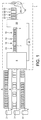
- Each source of content A, B, C is encapsulated by a packet data processor 6 at the head end 1 and placed into a transport stream 7 where it is multiplexed with the other content similarly encapsulated at the head-end 1 by the packet data processor 6.
- multicast and possibly unicast may include a non-zero flow_label field within the IPv6 header.
- the transport stream 7 further includes packets 9 providing time stamp information and control data identifying content in the stream 7.
- Other mechanisms for placing content into the transport stream 7 include, data piping, data streaming, and the use of data and object carousel. Such mechanisms are known, in the case of digital broadcast television, for example, from the Digital Video Broadcast (DVB) Project which describes one particular broadband digital broadcast solution using MPEG-2 to which the invention is applicable.
- DVD Digital Video Broadcast
- the content can include the delivery of Internet services via the transmission channel 18.
- Such services may be unicast, in the sense that they are a one to one provision of content or multicast in the sense that they are a one to many provision of content.
- IP terms a multicast address is differentiated from a unicast address by inspecting the most significant byte.
- a particular block of IP addresses are dedicated to use by multicast services namely 224.0.0.0 to 239.255.254.0 using the dotted decimal notation known from IPv4.
- multicast addresses are in the format FFAB where FF is the multicast identifier, A indicates whether the address is permanent or temporary and B provides the scope of the address.
- FFAB the multicast identifier
- A indicates whether the address is permanent or temporary
- B provides the scope of the address.
- the packet data processor 6 having received the streams A, B, C of data corresponding to content or a service 2,3,4 divides each stream of packets into a sequence of discrete sets of packets for transmission at a selected time.
- the sets of packets 19 which have been divided in this manner are passed to a burst generator 20 which generates a high-bandwidth low-duration original burst 22 for transmission by a transmitter portion 21 of the head-end 1.
- Each original burst 22 contains data from a single IP address corresponding to the content or a service 2,3,4.
- the packet data processor 6 is further operable to generate a copy 23 of a set of packets which together make up a particular original burst 22 when so instructed by a controller 24.
- copy set of packets 23 contains data from a single IP address corresponding to the content or service 2,3,4.
- This copy 23 of a set of packets is then passed to the burst generator 20 which, as before, generates a high-bandwidth low-duration burst for re-transmission as a copy burst 25 by the transmitter portion 21 of the head end 1.
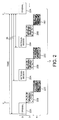
- the copy bursts 25 are also transmitted at selected times which times are arranged such that bursts, whether an original or a copy and containing packets from a particular stream of data corresponding to content or service 2,3,4 do not collide either with another burst containing packets in that stream or another stream currently being transmitted by the head-end 1.
- the packet data processor 6 in order to facilitate reception of a particular service or content 2,3,4 in such a transmission channel 18 where multiple bursts containing the same packets are transmitted, namely an original burst 22 and one or more copy bursts 25, in addition to dividing each packet stream into a sequence of discrete sets of packets, the packet data processor 6 also introduces a non-zero value into a flow_label field of every packet in each set which ultimately comprise a burst, whether an original or a copy burst 22,25.
- the value introduced into the flow_label field of each packet in a set from which a burst is formed is a time offset 26 which provides the time interval from the start of the burst which includes that packet to the start of the next original burst in the sequence of bursts making up that particular content or service.
- a time offset 26 which provides the time interval from the start of the burst which includes that packet to the start of the next original burst in the sequence of bursts making up that particular content or service.
- the channel 18 is received by a set of terminals which in the case of a satellite system fall under the satellite footprint, whilst in the case of a terrestrial system, the receiving terminals fall within areas of transmission coverage of a transmitter network.
- Each terminal which includes a mobile terminal 10, is typically under the control of a user at least as far as she is able to select particular content from that currently being transmitted in the transport stream 7.
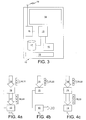
- the mobile terminal 10 shown in Figure 3 includes an internal power supply 12, such as a rechargeable battery supplying power to a controller 13, user interface 14 and a receiver 15.
- the terminal 10 also incorporates both memory 16 and storage 17 necessary to execute applications and consume content.
- a fixed terminal may, of course, dispense with the requirement for a internal source of power.
- the receiver 15 may be switched on and off in response to instructions received from the controller 13.
- the receiver 15 when in operation, receives the channel 18 over the air, in the case of satellite or terrestrial transmission.
- the operation of the receiver 15 is such that over a predetermined and possibly variable service period, say 60 seconds, the receiver 15 is capable of being switched into operation for one or more periods of time determined by the accuracy of a receiver clock forming part of the controller 13. For example, where the receiver clock accuracy can be maintained at 234 milliseconds, each period may last for 234.375 milliseconds there being 256 such periods within the aforementioned 60 second service period.
- the controller 13 is operable to switch the receiver 15 between on and off states in response to the offset determined from the flow_label field as further described below with additional reference to Figures 4 and 5.
- the receiver 15 is operable to receive bursts transmitted by the head-end 1.
- the head-end 1 will be transmitting bursts corresponding to a range of services and content 2,3,4.
- the receiver 15 extracts packets from each burst 22,25 it receives and the resulting sets of packets 19,23 are placed into a stream 27 which is analysed by the controller 13.
- the controller 13 analyses packets 22,25 in the stream 27 by determining the IP address and flow_label field values from the header of each packet.
- the controller 13 seeks 100 to identify a change from one IP multicast address to another IP multicast address which corresponds to content or a service which the terminal 10 wishes to consume.
- a change in IP address identifies a burst boundary, that is the beginning of a set of packets in the stream 27, which have been placed in the same burst 19,23 at the head-end 1.
- the controller determines whether the IP address of the another IP multicast address corresponds to an address of content or a service to be consumed by the terminal 10. If the another IP multicast address does indeed correspond then the controller, having identified such a boundary, further determines the flow_label field value in each packet header. This value will remain constant for each packet forming part of the same burst because it is a value indicative of the time offset 26 to the next original burst in the sequence of bursts making up that particular service 2,3,4. The controller 13 thereafter stores each packet it identifies as having the same IP address and offset value 26.
- each burst 22,25 (although not shown as such on Figure 2 in particular) may be varied and correspondingly the number of packets contained in a burst need not be constant as the controller 13 will only stop storing packets from a burst once a change is detected in the IP address and/or flow_label value. Once such a change has been detected, the controller 13 initiates an error check 103 of the stored packets. Depending on the outcome of this error check the controller will take one of two steps.
- the controller marks those packets containing errors and continues to analyse the stream of packets 27 being extracted by the receiver 15 for a burst boundary indicative of a copy burst 25 corresponding to the burst 22,25 which delivered the packets presently in storage, namely the controller again seeks to identify a burst having the same IP address but note that the time offset 26 will be reduced.
- the controller 13 will store the packets from the copy burst and carry out an error analysis before replacing any bad packets in the first received burst with packets from the copy burst. Such a process will be repeated until the time-offset 26 has expired in which case a new original burst having the same IP address should be detected unless the service is discontinued.
- the entire set of packets from the first burst is discarded and replaced by the packets extracted from a copy burst. This process will be repeated until either all packet errors have been corrected or the next original burst in the sequence is received by the terminal in which case the packets from the last original burst may either be flushed from storage or passed with or without the marked up bad packets to a terminal application for consumption.
- the process moves to the second outcome namely the process followed where the error check 103 of the stored packets reveals no errors.
- the packets are marked as valid by the controller 13 and are passed for consumption at the application level by the terminal 10.
- the controller will simply drop the partial burst.
- the controller 13 instructs the receiver 15 to shut down such that no more packets are extracted from incoming bursts 22,25 in the channel 18 with the result shown in Figure 4b that no packet stream 27 is delivered to the controller 13.
- the controller 13 however remains active and ready to instruct the receiver 15 to power up in anticipation of receiving ( Figure 4c) the next original burst 22 in the sequence of bursts making up the particular content or service 2,3,4.
- the time period for which the receiver is shut down is determined, of course, from the flow_label field value namely the offset 26 derived from those valid packets extracted from the current burst.
- the controller 13 utilises the offset 26 to determine the time at which the receiver should be powered up ready to receive the next original burst in the sequence of packets making up the content or service. It may well be the case that the receiver 15 should be powered up some time in advance of the expiry of the time offset period to ensure that packets can be reliably extracted from the incoming channel 18.
- the controller 13 is simply provided with the IP address of the content or service 2,3,4 which is now desired.
- the receiver 15 will be extracting packets from a number of bursts 22,25 containing packets of several content or service streams A,B,C delivered to the head-end 1 from their respective sources 2,3,4. It may well also be the case that the receiver 15 is powered off as a consequence of the last offset value 26 derived by the controller 13. In this event, the controller 13 may immediately power up the receiver 15 following the receipt of instructions to consume a new service or content.
- the receiver 15 may remain powered down until the time at which the controller causes it to power up to commence receiving the next original burst of what was the previously desired content.
- the controller will, rather than identify and store packets corresponding to the previously desired content, instead continue analysing the packet flow until a burst boundary is detected for a burst 22,25 containing the newly selected content or service packets 19,23.
Landscapes
- Engineering & Computer Science (AREA)
- Computer Networks & Wireless Communication (AREA)
- Signal Processing (AREA)
- Computer Security & Cryptography (AREA)
- Data Exchanges In Wide-Area Networks (AREA)
- Mobile Radio Communication Systems (AREA)
- Communication Control (AREA)
Abstract
Description
- The present invention relates to the content delivery utilising Internet Protocol (IP) networking, particularly, although not exclusively data networks.
- Wireless IP networks, and particularly mobile wireless IP networks typically include a terminal having stringent power requirements. Such a mobile terminal may be required to operate for lengthy periods on an internal source of power. In the case of simplex wireless IP networks exemplified by the Digital Video Broadcast (DVB) terrestrial (DVB-T) and satellite (DVB-S) networks, typically a large part of the energy requirement of a terminal is due to the demands of a receiver necessary to receive transmissions carrying a range of content.
- It is the case, however, that a user of the terminal may at an application level, as set out in the well-known Open System Interconnect (OSI) model, make a selection of particular content from the range of content presently received by the terminal. Although such a selection may take place in a unicast environment, that is a one to one transmission, more typically the content is distributed in a one to many transmission, that is a multicast environment.
- A well-known mechanism for facilitating the delivery of content in a multicast environment is provided by the Session Announcement Protocol (SAP), details of which are set out in RFC2974 published by the intemet Engineering Task Force (IETF repository at http://www.ietf.org) and the Session Description Protocol (SDP), details of which are to be found in RFC2327 published by the Internet Engineering Task Force (IETF repository at http://www.ietf.org). In summary, an Application Programming Interface (API) is provided which facilitates communication between applications over an IP protocol. The API listens at a particular address for information identifying available streams of content, so-called services. The information provided at that address is then provided to an application, a browser for example, which in turn uses the API to access a selected stream by opening a socket at which the selected stream can be heard. Typically, the selection of the desired content is made by a user via the browser, i.e. by clicking on a particular link.
- According to a first aspect of the present invention, there is provided a packet data transmission method, the method comprising receiving a content stream containing packets and dividing said packets into a sequence of sets of packets and for each set of packets in said sequence generating a transmission burst, wherein a field in each packet of a set includes a value indicative of a time offset to the generation of a further transmission burst containing a next set of packets in the sequence.
- Such a transmission method facilitates a time-slicing approach to the delivery of packet data over IP networks, particularly wireless networks such as those now being utilised for the delivery of digital television and the like. Such a method is particularly suited to the delivery of data including multimedia content to mobile clients or terminal over such networks. Preferably, the method allows a head-end to receive multiple streams of content or services and thereby take advantage of the broad bandwidth and high data rates of such networks. The method is particularly suitable for use with the IPv6 protocol which is intended to include within the standard header space fields such as a flow_label field suitable for providing the timing and optionally grouping information for a burst. Each burst will contain sufficient information to allow it to be recognised by a receiving client (hereinafter a terminal). Typically, the identification is provided by an IP address and a flow_label value containing at least the time offset. It will be recognised that some information pointing towards the IP address or some other identifier may be added to the flow_label value so as to identifier a packet and in particular to allow it to be associated with a particular content or service stream.
- Preferably, the method is applied to the delivery of data over a simplex broadcast network such as a broadband digital broadcast network. The method may be carried out entirely within the network head-end, in which case the generation of a value of the time offset may be carried out entirely within parameters set by the network operator. Alternatively, the content provider may apply the method to content before delivery of a content stream to the head-end of the transmission network.
- Preferably, the method allows the re-transmission of packets in so-called copy bursts, that is bursts containing substantially the same packets as originally transmitted, so-called original bursts. In this transmission environment, the offset time held in packets of copy bursts will decrease as the burst generation time of the next original burst approaches.
- According to a further aspect of the invention, there is provided a packet data reception method, the method comprising receiving a plurality of transmission bursts, extracting a set of packets from each burst, each packet including a first field having a value indicative of a sequence of sets of packets and a second field indicative of a time offset to the generation of a transmission burst containing a next set of packets in the sequence, analysing each of said extracted packets and identifying firstly a packet where a change in said first field to a predetermined value is detected and storing this and any subsequent packet with the same first field until such time as a further change in said first field value is detected whereupon reception of transmission bursts is suspended for the time offset identified from said second field value.
- The reception method facilitates the delivery of multiple services or content for consumption by a terminal. The method seeks to facilitate robust error correction in that conveniently additional copy bursts may be received to allow replacement of erroneous packets. In addition, the burst nature of the transmission method coupled with the timing information regarding the delivery of original bursts permits power management of the terminal functions. Thus, power intensive features of the terminal such as the broadband receiver circuitry may be powered down during periods where no burst is expected. Other power saving opportunities provided by the method include suspending processing requirements related to the identification of burst boundaries, a burst boundary being the change in the IP address or other sequence identifier between packets delivered in a stream as extracted from received bursts.
- It should be noted that either of the above two aspects of the invention may be implemented as software, hardware, or a combination of the two, as would be apparent to those skilled in the art.
- In order to assist in understanding the invention, an embodiment thereof will be described by way of example and with reference to the accompanying drawings, in which:
- Figure 1, is a diagram illustrative of a transmission method in accordance with a first aspect of the present invention;
- Figure 2, is a diagram showing in more detail a transmission channel of the method of Figure 1;
- Figure 3, is a diagrammatic view of a terminal operable in accordance with a method of reception according to a second aspect of the present invention, shown receiving the transmission channel of Figure 2;
- Figures 4a, 4b and 4c, are views illustrative of packet flows in the terminal of Figure 3; and
- Figure 5, is a flow chart useful in understanding the reception method of Figure 3.
- Referring to Figure 1, there is shown a broadband digital broadcast head-
end 1 connected to a variety ofsources Version 6 of the Internet Protocol (IPv6) details of which may be found in RFC260 published by the Internet Engineering Task Force (IETF) and available at www.ietf.org. Thus, each packet includes a flow_label field to facilitate the handling by the Internet infrastructure of particular so-called flows of related packets. The flow_label itself forms part of the IPv6 header and is a 20bit field having a default value of zero. Further details of the flow_label as originally proposed may be found in RFC 2460 published by the IETF and available at www.ietf.org. Each source of content A, B, C is encapsulated by apacket data processor 6 at thehead end 1 and placed into a transport stream 7 where it is multiplexed with the other content similarly encapsulated at the head-end 1 by thepacket data processor 6. As will be described in more detail below, multicast and possibly unicast may include a non-zero flow_label field within the IPv6 header. The transport stream 7 further includespackets 9 providing time stamp information and control data identifying content in the stream 7. Other mechanisms for placing content into the transport stream 7 include, data piping, data streaming, and the use of data and object carousel. Such mechanisms are known, in the case of digital broadcast television, for example, from the Digital Video Broadcast (DVB) Project which describes one particular broadband digital broadcast solution using MPEG-2 to which the invention is applicable. - The content can include the delivery of Internet services via the
transmission channel 18. Such services may be unicast, in the sense that they are a one to one provision of content or multicast in the sense that they are a one to many provision of content. In IP terms, a multicast address is differentiated from a unicast address by inspecting the most significant byte. A particular block of IP addresses are dedicated to use by multicast services namely 224.0.0.0 to 239.255.254.0 using the dotted decimal notation known from IPv4. In the case of IPv6, further details of which may be found from RFC2375 published by the IETF and available for the time being from www.ietf.org), multicast addresses are in the format FFAB where FF is the multicast identifier, A indicates whether the address is permanent or temporary and B provides the scope of the address. Thus, where a service is intended to be multicast, the service must ensure that an address from this block is utilised in the destination address portion of each IP packet. - Returning to the operation of the head-
end 1, thepacket data processor 6 having received the streams A, B, C of data corresponding to content or aservice packets 19 which have been divided in this manner are passed to aburst generator 20 which generates a high-bandwidth low-durationoriginal burst 22 for transmission by atransmitter portion 21 of the head-end 1. Eachoriginal burst 22 contains data from a single IP address corresponding to the content or aservice packet data processor 6 is further operable to generate acopy 23 of a set of packets which together make up a particularoriginal burst 22 when so instructed by acontroller 24. Again, copy set ofpackets 23 contains data from a single IP address corresponding to the content orservice copy 23 of a set of packets is then passed to theburst generator 20 which, as before, generates a high-bandwidth low-duration burst for re-transmission as a copy burst 25 by thetransmitter portion 21 of thehead end 1. Thecopy bursts 25 are also transmitted at selected times which times are arranged such that bursts, whether an original or a copy and containing packets from a particular stream of data corresponding to content orservice end 1. - With reference to Figure 2, in order to facilitate reception of a particular service or
content transmission channel 18 where multiple bursts containing the same packets are transmitted, namely anoriginal burst 22 and one ormore copy bursts 25, in addition to dividing each packet stream into a sequence of discrete sets of packets, thepacket data processor 6 also introduces a non-zero value into a flow_label field of every packet in each set which ultimately comprise a burst, whether an original or a copy burst 22,25. The value introduced into the flow_label field of each packet in a set from which a burst is formed, is atime offset 26 which provides the time interval from the start of the burst which includes that packet to the start of the next original burst in the sequence of bursts making up that particular content or service. Where a service is discontinued, there will be no further bursts having the same IP address, at least until a pre-determined timeout or guard interval has expired before a new service may start from that address. In this situation, the offset will be set to a maximum value or another predetermined value indicative of the service being discontinued. - The
channel 18 is received by a set of terminals which in the case of a satellite system fall under the satellite footprint, whilst in the case of a terrestrial system, the receiving terminals fall within areas of transmission coverage of a transmitter network. Each terminal, which includes amobile terminal 10, is typically under the control of a user at least as far as she is able to select particular content from that currently being transmitted in the transport stream 7. Themobile terminal 10 shown in Figure 3, includes aninternal power supply 12, such as a rechargeable battery supplying power to acontroller 13,user interface 14 and areceiver 15. The terminal 10 also incorporates bothmemory 16 andstorage 17 necessary to execute applications and consume content. A fixed terminal may, of course, dispense with the requirement for a internal source of power. - The
receiver 15, as has been mentioned, has a proportionally larger power consumption than the other components of the terminal 10. In order to minimise drain on theinternal power supply 12, thereceiver 15 may be switched on and off in response to instructions received from thecontroller 13. Thereceiver 15 , when in operation, receives thechannel 18 over the air, in the case of satellite or terrestrial transmission. The operation of thereceiver 15 is such that over a predetermined and possibly variable service period, say 60 seconds, thereceiver 15 is capable of being switched into operation for one or more periods of time determined by the accuracy of a receiver clock forming part of thecontroller 13. For example, where the receiver clock accuracy can be maintained at 234 milliseconds, each period may last for 234.375 milliseconds there being 256 such periods within the aforementioned 60 second service period. - The
controller 13 is operable to switch thereceiver 15 between on and off states in response to the offset determined from the flow_label field as further described below with additional reference to Figures 4 and 5. - Thus, the
receiver 15 is operable to receive bursts transmitted by the head-end 1. Of course, the head-end 1 will be transmitting bursts corresponding to a range of services andcontent receiver 15 extracts packets from each burst 22,25 it receives and the resulting sets ofpackets stream 27 which is analysed by thecontroller 13. Thecontroller 13analyses packets stream 27 by determining the IP address and flow_label field values from the header of each packet. Thecontroller 13 seeks 100 to identify a change from one IP multicast address to another IP multicast address which corresponds to content or a service which the terminal 10 wishes to consume. A change in IP address identifies a burst boundary, that is the beginning of a set of packets in thestream 27, which have been placed in thesame burst end 1. - Thus, where a boundary is identified 101, the controller determines whether the IP address of the another IP multicast address corresponds to an address of content or a service to be consumed by the terminal 10. If the another IP multicast address does indeed correspond then the controller, having identified such a boundary, further determines the flow_label field value in each packet header. This value will remain constant for each packet forming part of the same burst because it is a value indicative of the time offset 26 to the next original burst in the sequence of bursts making up that
particular service controller 13 thereafter stores each packet it identifies as having the same IP address and offsetvalue 26. It will be recognised that the duration of each burst 22,25 (although not shown as such on Figure 2 in particular) may be varied and correspondingly the number of packets contained in a burst need not be constant as thecontroller 13 will only stop storing packets from a burst once a change is detected in the IP address and/or flow_label value. Once such a change has been detected, thecontroller 13 initiates anerror check 103 of the stored packets. Depending on the outcome of this error check the controller will take one of two steps. Where errors are detected, the controller marks those packets containing errors and continues to analyse the stream ofpackets 27 being extracted by thereceiver 15 for a burst boundary indicative of a copy burst 25 corresponding to theburst controller 13, thecontroller 13 will store the packets from the copy burst and carry out an error analysis before replacing any bad packets in the first received burst with packets from the copy burst. Such a process will be repeated until the time-offset 26 has expired in which case a new original burst having the same IP address should be detected unless the service is discontinued. - In a second non-illustrated variant, rather than replace individual packets, the entire set of packets from the first burst is discarded and replaced by the packets extracted from a copy burst. This process will be repeated until either all packet errors have been corrected or the next original burst in the sequence is received by the terminal in which case the packets from the last original burst may either be flushed from storage or passed with or without the marked up bad packets to a terminal application for consumption.
- Where all the packet errors have been corrected or alternatively the time offset is about to expire, then the process moves to the second outcome namely the process followed where the error check 103 of the stored packets reveals no errors. Thus, the packets are marked as valid by the
controller 13 and are passed for consumption at the application level by the terminal 10. However it is conceivable that in some circumstances, it may not be desirable to forward partial bursts, that is bursts containing some errors, for consumption by the terminal. In which case, the controller will simply drop the partial burst. At the same time, thecontroller 13 instructs thereceiver 15 to shut down such that no more packets are extracted fromincoming bursts channel 18 with the result shown in Figure 4b that nopacket stream 27 is delivered to thecontroller 13. Thecontroller 13 however remains active and ready to instruct thereceiver 15 to power up in anticipation of receiving (Figure 4c) the next original burst 22 in the sequence of bursts making up the particular content orservice controller 13 utilises the offset 26 to determine the time at which the receiver should be powered up ready to receive the next original burst in the sequence of packets making up the content or service. It may well be the case that thereceiver 15 should be powered up some time in advance of the expiry of the time offset period to ensure that packets can be reliably extracted from theincoming channel 18. - By way of further explanation, where consumption of different content is desired, the
controller 13 is simply provided with the IP address of the content orservice receiver 15 will be extracting packets from a number ofbursts end 1 from theirrespective sources receiver 15 is powered off as a consequence of the last offsetvalue 26 derived by thecontroller 13. In this event, thecontroller 13 may immediately power up thereceiver 15 following the receipt of instructions to consume a new service or content. Alternatively, thereceiver 15 may remain powered down until the time at which the controller causes it to power up to commence receiving the next original burst of what was the previously desired content. In this case, the controller will, rather than identify and store packets corresponding to the previously desired content, instead continue analysing the packet flow until a burst boundary is detected for aburst service packets
Claims (19)
- A device (10) for receiving content transmitted over a communications channel (18), the device comprising:a receiver (15) for receiving the content;a controller (13) for selectively switching the receiver (15) into operation for one or more time periods during a predetermined interval in accordance with information included in the received content.
- A device according to claim 1, wherein the duration of each of the one or more time periods is determined by the accuracy of a receiver clock.
- A device according to claim 1 or 2, wherein the device is arranged to receive a transmission burst (22, 25) including a plurality of packets, the packets including a value indicative of a time offset to a next transmission burst, wherein the controller is operable to switch the receiver between on and off states in response to the time offset included in a packet.
- A device according to claim 3, wherein the controller is arranged to use the time offset value to determine the time at which the receiver should be powered up to receive the next transmission burst.
- A device according to claim 4, wherein the controller is arranged to power up the receiver in advance of expiry of the time offset period.
- A device according to claim 3, 4 or 5 wherein the offset is included in the flow_label field of an Ipv6 packet.
- A device according to any one of claims 3 to 6, wherein the receiver is arranged to extract packets from a transmission burst to provide a set of packets, and to place the set of packets into a stream (27) for analysis by the controller.
- A device according to claim 7, wherein the controller is arranged to analyse packets in the stream by determining the IP address and flow_label field values from the header of each of the packets.
- A device according to claim 7 or 8, wherein the controller is arranged to identify a change from one IP multicast address to a new IP multicast address which corresponds to a desired content or service.
- A device according to claim 9, wherein a change in the IP multicast addresss identifies a burst boundary representing a start of a set of packets in the stream (27).
- A device according to claim 10, wherein the controller is configured, on identification of the burst boundary, to determine whether the IP address of the new IP multicast address corresponds to an address of content or a service.
- A device according to any one of claims 8 to 11, wherein the controller is arranged to identify each packet having the same IP address and offset value.
- A device according to claim 12, wherein the controller is further arranged to store each of said identified packets.
- A device according to claim 13, wherein the controller is arranged to stop storing packets when it identifies a packet having a different IP address and/or offset value.
- A device according to claim 13 or 14, wherein the controller is arranged to initiate an error check of the stored packets when it stops storing the packets.
- A device according to claim 15, wherein the controller is arranged to discard a transmission burst that contains errors.
- A device according to claim 15 or 16, wherein the controller is arranged to extract the time offset value from packets marked as valid.
- A device according to any one of claims 3 to 17, wherein the device is arranged to receive a plurality of transmission bursts, the duration of each transmission burst being variable, such that different numbers of packets are contained in the bursts.
- A device according to any one of claims 3 to 18, wherein when the controller is provided with a new IP address, the controller is operative to wait until the predetermined time offset has expired to power the receiver on, and is then arranged to continue analysing the packet flow until a burst boundary is detected for a burst containing the newly selected content or service packets.
Applications Claiming Priority (2)
| Application Number | Priority Date | Filing Date | Title |
|---|---|---|---|
| GBGB0203538.4A GB0203538D0 (en) | 2002-02-14 | 2002-02-14 | Improvements in and relating to content delivery |
| EP03250872A EP1337071B1 (en) | 2002-02-14 | 2003-02-12 | Transmission burst time indications for power saving |
Related Parent Applications (1)
| Application Number | Title | Priority Date | Filing Date |
|---|---|---|---|
| EP03250872A Division EP1337071B1 (en) | 2002-02-14 | 2003-02-12 | Transmission burst time indications for power saving |
Publications (1)
| Publication Number | Publication Date |
|---|---|
| EP1681795A1 true EP1681795A1 (en) | 2006-07-19 |
Family
ID=9931099
Family Applications (2)
| Application Number | Title | Priority Date | Filing Date |
|---|---|---|---|
| EP03250872A Expired - Lifetime EP1337071B1 (en) | 2002-02-14 | 2003-02-12 | Transmission burst time indications for power saving |
| EP06113641A Withdrawn EP1681795A1 (en) | 2002-02-14 | 2003-02-12 | Transmission burst time indications for power saving |
Family Applications Before (1)
| Application Number | Title | Priority Date | Filing Date |
|---|---|---|---|
| EP03250872A Expired - Lifetime EP1337071B1 (en) | 2002-02-14 | 2003-02-12 | Transmission burst time indications for power saving |
Country Status (4)
| Country | Link |
|---|---|
| US (1) | US7733909B2 (en) |
| EP (2) | EP1337071B1 (en) |
| DE (1) | DE60305082T2 (en) |
| GB (1) | GB0203538D0 (en) |
Cited By (1)
| Publication number | Priority date | Publication date | Assignee | Title |
|---|---|---|---|---|
| EP2062362A4 (en) * | 2006-09-11 | 2009-10-14 | Nokia Corp | SYSTEM AND METHOD FOR PRE-DEFINED PURPOSES OF SERIAL HIGH-SPEED CONNECTIONS |
Families Citing this family (22)
| Publication number | Priority date | Publication date | Assignee | Title |
|---|---|---|---|---|
| US20060146853A1 (en) * | 2004-12-30 | 2006-07-06 | Nokia Corporation | System and method for sending related data over a digital broadcast system |
| GB2401759A (en) * | 2003-05-13 | 2004-11-17 | Nokia Corp | Method of signalling in a mobile communications network |
| US8630168B2 (en) * | 2003-06-23 | 2014-01-14 | Intel Corporation | Adaptive use of a transmit opportunity |
| EP1509043A1 (en) * | 2003-08-22 | 2005-02-23 | Matsushita Electric Industrial Co., Ltd. | Repeated transmission of DVB-H bursts |
| GB2405557A (en) * | 2003-08-27 | 2005-03-02 | Nokia Corp | Service identification data relating services at a given frequency to services and identifying their media format |
| US8250622B2 (en) | 2003-10-30 | 2012-08-21 | Panasonic Corporation | Method and apparatus for broadcasting to a portable terminal |
| US20070110105A1 (en) * | 2003-10-30 | 2007-05-17 | Matsushita Electric Industrial Co., Ltd. | Apparatus and a method for receiving a multiplexed broadcast signal carrying a plurality of services |
| JP4423263B2 (en) * | 2003-10-30 | 2010-03-03 | パナソニック株式会社 | Transmission method and apparatus for portable terminal |
| US20050213576A1 (en) * | 2004-03-29 | 2005-09-29 | Stephens Adrian P | Multicasting in wireless networks |
| WO2005117444A1 (en) * | 2004-05-31 | 2005-12-08 | Matsushita Electric Industrial Co., Ltd. | Digital broadcasting system and digital broadcast transmission and reception method |
| WO2006027846A1 (en) * | 2004-09-10 | 2006-03-16 | Matsushita Electric Industrial Co., Ltd. | Zapping stream generating apparatus and method |
| GB0420540D0 (en) * | 2004-09-15 | 2004-10-20 | Nokia Corp | Burst transmission in a digital broadcasting network |
| WO2006114830A1 (en) * | 2005-04-06 | 2006-11-02 | Matsushita Electric Industrial Co., Ltd. | Method for arranging zapping streams in mpe-fec frame and receiver |
| US7490341B2 (en) * | 2005-06-07 | 2009-02-10 | Nokia Corporation | System and associated terminal, method and computer program product for directional channel browsing of broadcast content |
| KR100856920B1 (en) * | 2006-12-05 | 2008-09-05 | 한국전자통신연구원 | Wireless Multicasting Service Method Using Relay Transmission Method |
| DE102008017290A1 (en) * | 2007-12-11 | 2009-06-18 | Rohde & Schwarz Gmbh & Co. Kg | Method and device for forming a common data stream, in particular according to the ATSC standard |
| MX2011004645A (en) | 2008-11-06 | 2011-05-30 | Rohde & Schwarz | Method and system for synchronized mapping of data packets in an atsc data stream. |
| US8982745B2 (en) | 2009-03-21 | 2015-03-17 | Rohde & Schwarz Gmbh & Co. Kg | Method for improving the data rate of mobile/handheld data and the quality of channel estimation in an ATSC-M/H transport data stream |
| GB2485142A (en) | 2010-10-27 | 2012-05-09 | Nds Ltd | Secure broadcast/multicast of media content |
| US8989021B2 (en) | 2011-01-20 | 2015-03-24 | Rohde & Schwarz Gmbh & Co. Kg | Universal broadband broadcasting |
| DE102011082098B4 (en) * | 2011-09-02 | 2014-04-10 | Fraunhofer-Gesellschaft zur Förderung der angewandten Forschung e.V. | Battery operated stationary sensor arrangement with unidirectional data transmission |
| EP2805328B1 (en) * | 2012-01-19 | 2018-12-12 | Irdeto B.V. | Distributing content to multiple receivers using multicast channels |
Citations (2)
| Publication number | Priority date | Publication date | Assignee | Title |
|---|---|---|---|---|
| US20010031626A1 (en) * | 2000-01-28 | 2001-10-18 | Jan Lindskog | Power status for wireless communications |
| WO2001097538A1 (en) * | 2000-06-12 | 2001-12-20 | Xircom, Inc. | Flexible paging for packet data |
Family Cites Families (18)
| Publication number | Priority date | Publication date | Assignee | Title |
|---|---|---|---|---|
| US71A (en) * | 1836-10-27 | Parlob | ||
| US5333135A (en) | 1993-02-01 | 1994-07-26 | North American Philips Corporation | Identification of a data stream transmitted as a sequence of packets |
| US5382949A (en) * | 1993-02-01 | 1995-01-17 | Motorola, Inc. | Method for increasing battery life for selective call receivers |
| US5734966A (en) * | 1995-01-20 | 1998-03-31 | Diablo Research Corporation | Wireless communication system for adapting to frequency drift |
| US5928330A (en) * | 1996-09-06 | 1999-07-27 | Motorola, Inc. | System, device, and method for streaming a multimedia file |
| US5987030A (en) | 1996-09-27 | 1999-11-16 | Cisco Technology, Inc. | Transparent circuit emulation for packet switching network |
| US6891852B1 (en) * | 1999-04-08 | 2005-05-10 | Lucent Technologies Inc. | Method of dynamically adjusting the duration of a burst transmission in wireless communication systems |
| JP2001189736A (en) * | 1999-12-28 | 2001-07-10 | Fujitsu Ltd | LAN interface device and frame transmission / reception control method |
| US6738379B1 (en) * | 2000-03-30 | 2004-05-18 | Telefonaktiebolaget Lm Ericsson (Publ) | Method of preserving data packet sequencing |
| GB0022269D0 (en) * | 2000-09-12 | 2000-10-25 | Koninkl Philips Electronics Nv | Data transmission system |
| US6954432B1 (en) * | 2000-10-04 | 2005-10-11 | Motorola, Inc. | Method and apparatus for improving perceived signal quality of transmitted information in a full duplex wireless communication system |
| US6807159B1 (en) * | 2000-10-25 | 2004-10-19 | International Business Machines Corporation | Methodology for managing power consumption in master driven time division duplex wireless network |
| US20020091956A1 (en) * | 2000-11-17 | 2002-07-11 | Potter Scott T. | Methods and systems for reducing power consumption in computer data communications |
| US6891841B2 (en) * | 2001-03-12 | 2005-05-10 | Advent Networks, Inc. | Time division multiple access over broadband modulation method and apparatus |
| US7215679B2 (en) * | 2001-08-30 | 2007-05-08 | Thomson Licensing | Method, apparatus and data structure enabling multiple channel data stream transmission |
| US7100078B1 (en) * | 2001-11-15 | 2006-08-29 | Network Appliance, Inc. | Method and apparatus for restoration of lost blocks in a multicast data transmission |
| US6907028B2 (en) * | 2002-02-14 | 2005-06-14 | Nokia Corporation | Clock-based time slicing |
| US7130313B2 (en) * | 2002-02-14 | 2006-10-31 | Nokia Corporation | Time-slice signaling for broadband digital broadcasting |
-
2002
- 2002-02-14 GB GBGB0203538.4A patent/GB0203538D0/en not_active Ceased
-
2003
- 2003-02-12 EP EP03250872A patent/EP1337071B1/en not_active Expired - Lifetime
- 2003-02-12 DE DE60305082T patent/DE60305082T2/en not_active Expired - Lifetime
- 2003-02-12 EP EP06113641A patent/EP1681795A1/en not_active Withdrawn
- 2003-02-14 US US10/366,404 patent/US7733909B2/en active Active
Patent Citations (2)
| Publication number | Priority date | Publication date | Assignee | Title |
|---|---|---|---|---|
| US20010031626A1 (en) * | 2000-01-28 | 2001-10-18 | Jan Lindskog | Power status for wireless communications |
| WO2001097538A1 (en) * | 2000-06-12 | 2001-12-20 | Xircom, Inc. | Flexible paging for packet data |
Non-Patent Citations (1)
| Title |
|---|
| "Bluetooth specification Version 1.1", BLUETOOTH SPECIFICATIONS, 8 May 2001 (2001-05-08), pages 110 - 117, XP002271546 * |
Cited By (1)
| Publication number | Priority date | Publication date | Assignee | Title |
|---|---|---|---|---|
| EP2062362A4 (en) * | 2006-09-11 | 2009-10-14 | Nokia Corp | SYSTEM AND METHOD FOR PRE-DEFINED PURPOSES OF SERIAL HIGH-SPEED CONNECTIONS |
Also Published As
| Publication number | Publication date |
|---|---|
| GB0203538D0 (en) | 2002-04-03 |
| US20030200328A1 (en) | 2003-10-23 |
| EP1337071B1 (en) | 2006-05-10 |
| EP1337071A3 (en) | 2004-05-06 |
| DE60305082D1 (en) | 2006-06-14 |
| DE60305082T2 (en) | 2006-11-23 |
| US7733909B2 (en) | 2010-06-08 |
| EP1337071A2 (en) | 2003-08-20 |
Similar Documents
| Publication | Publication Date | Title |
|---|---|---|
| EP1337071B1 (en) | Transmission burst time indications for power saving | |
| EP1516456B1 (en) | Packet identifier search filtering | |
| KR100753026B1 (en) | Broadcast hand-over in a wireless network | |
| JP4256264B2 (en) | Time slice signaling for broadband digital broadcasting | |
| KR20140126210A (en) | Method and apparatus for transmitting/receiving signalling information for mpeg mmt in a dvb terrestrial broadcasting system | |
| JP2010527175A (en) | Best effort service of digital broadcasting network | |
| CN101605304A (en) | Content distribution system, content distribution device, terminal device and content distribution method | |
| US20050120378A1 (en) | Event driven filter monitoring for IP multicast services | |
| CN100495936C (en) | Method and apparatus for selective data reception | |
| KR100890608B1 (en) | Method and apparatus for mapping multicast address into packet identifier for broadcast system | |
| JP5161111B2 (en) | Method and apparatus for broadcasting or receiving digital video service | |
| KR100970988B1 (en) | Improved content delivery | |
| US20040133669A1 (en) | Event or polling driven DVB-T filter detection | |
| US9258529B2 (en) | Data distribution | |
| CN117643060A (en) | Methods and devices for processing multicast signals | |
| US20090240825A1 (en) | Delivering streaming data | |
| Collini-Nocker et al. | Ultra Lightweight Encapsulation for Efficient IPv6 Transport |
Legal Events
| Date | Code | Title | Description |
|---|---|---|---|
| PUAI | Public reference made under article 153(3) epc to a published international application that has entered the european phase |
Free format text: ORIGINAL CODE: 0009012 |
|
| AC | Divisional application: reference to earlier application |
Ref document number: 1337071 Country of ref document: EP Kind code of ref document: P |
|
| AK | Designated contracting states |
Kind code of ref document: A1 Designated state(s): DE FR GB IT |
|
| 17P | Request for examination filed |
Effective date: 20060914 |
|
| 17Q | First examination report despatched |
Effective date: 20061016 |
|
| AKX | Designation fees paid |
Designated state(s): DE FR GB IT |
|
| STAA | Information on the status of an ep patent application or granted ep patent |
Free format text: STATUS: THE APPLICATION IS DEEMED TO BE WITHDRAWN |
|
| 18D | Application deemed to be withdrawn |
Effective date: 20080425 |