EP1679621A1 - Method and appartus for explaining categorization decisions - Google Patents
Method and appartus for explaining categorization decisions Download PDFInfo
- Publication number
- EP1679621A1 EP1679621A1 EP05257572A EP05257572A EP1679621A1 EP 1679621 A1 EP1679621 A1 EP 1679621A1 EP 05257572 A EP05257572 A EP 05257572A EP 05257572 A EP05257572 A EP 05257572A EP 1679621 A1 EP1679621 A1 EP 1679621A1
- Authority
- EP
- European Patent Office
- Prior art keywords
- feature
- document
- features
- contribution
- categorization
- Prior art date
- Legal status (The legal status is an assumption and is not a legal conclusion. Google has not performed a legal analysis and makes no representation as to the accuracy of the status listed.)
- Ceased
Links
Images



Classifications
-
- G—PHYSICS
- G06—COMPUTING OR CALCULATING; COUNTING
- G06F—ELECTRIC DIGITAL DATA PROCESSING
- G06F18/00—Pattern recognition
- G06F18/20—Analysing
- G06F18/21—Design or setup of recognition systems or techniques; Extraction of features in feature space; Blind source separation
- G06F18/211—Selection of the most significant subset of features
- G06F18/2113—Selection of the most significant subset of features by ranking or filtering the set of features, e.g. using a measure of variance or of feature cross-correlation
Definitions
- the following relates generally to methods, and apparatus therefore, for categorizing documents, and more particularly to a method and apparatus for explaining categorization decisions.
- Categorizers such as statistical categorizers, may be deployed with relative ease if the appropriate amount of pre-processed data exists. For example, learning model parameters of a statistical categorizer on a new collection of several thousand documents may take on the order of minutes to hours depending on the amount of pre-processing required. Such preprocessing may, for example, include any required document transformations and/or linguistic processing and/or annotation associated therewith.
- Examples of statistical categorizers include Na ⁇ ve Bayes, Probabilistic Latent Categorization (PLC), and Support Vector Machines (SVM).
- PLC Probabilistic Latent Categorization
- SVM Support Vector Machines
- a problem that exists when using statistical and other categorizers is that the one or more features (e.g., words) that influence a categorization decision are often difficult to understand (i.e., assess why the categorizer selected one particular class instead of another in categorizing a document). More specifically, before a categorization decision is made, a document is initially decomposed into a set of features (or terms). The set of features is input into the categorizer and a score is output for each category (or class), with the highest scored category being the categorization decision. Exactly which ones of the features in the set of features influenced the computation of each score is difficult to assess as each score may be influenced by thousands of different features.
- features e.g., words
- a score is computed for each of a plurality of classes using model parameter values of a selected categorization model and feature values of a document to be categorized.
- a contribution is computed for each of a plurality of features in the document, where the contribution of a selected feature is computed using model-independent, model-dependent, or document-dependent feature selection.
- a categorization decision is specified using at least the class with the highest score, and an importance is assigned to each of a plurality of the features using the computed contributions to identify for different ones of the plurality of features, their influence on the categorization decision.
- Term Definition feature quantifiable qualities of the content of a document (e.g., frequency of occurrence of a word or term in a document) class (or category) a label assigned to a feature PLC Probabilistic Latent Categorizer SVM Support Vector Machines
- Figures 1-2 and 3-4 illustrate two embodiments for explaining a categorization decision 107 of a classification system or categorizer 106.
- the goal of the classification system 106 in each embodiment is to produce the categorization decision 107 to classify a document 108 into a set of one or more classes (or category labels), which are also referred to as categories.
- the categorizer 106 assigns the document 108 one or more classes in a set of classes that may, for example, be defined in an ontology such as the DMOZ ontology (see dmoz.org).
- a document 108 input for classification to the categorizer 106 is preprocessed to transform its contents into a set of features and associated values (or weights) 109, otherwise referred to herein as a set of feature value pairs.
- Different combinations of known techniques from natural language processing such as translation of HTML to text, tokenization, stemming, stop word removal, parsing techniques, and entity recognition may be used to generate the sets of feature.
- the document 108 (to be categorized) may be preprocessed using a number of components such as an HTML to text converter, a tokenizer, a stemmer, a grammar-based feature generator, a feature generator, a word frequency analyzer, and a noun phrase analyzer (or extractor) to produce the features of the set of feature value pairs 109.
- the value (or weight) associated with each feature of the pairs 109 of the document 108 may be calculated using any of a number of well known techniques, varying from a normalized frequency count to more sophisticated weighting schemes that calculate values based upon an aggregation of a number of measures such as the frequency of each feature in the document, its location in a document, the frequency of each feature in a reference corpus, and the inverse document frequency of the feature.
- the document 108 is preprocessed into a list of tokens that is delimited by spaces, while removing tokens that correspond to stop words (i.e., words that do not improve the quality of the categorization).
- the categorizer 106 processes the set of feature value pairs 109 using model parameters 105 associated with a selected categorization model 101, such as Naive Bayesian, PLC, or SVM, to produce a categorization decision 107.
- a list of features 113 from a training set 112 is processed initially by a model independent feature selector 102 to provide features and associated values 103 (i.e., a ranked list of features).
- the ranked list of features 103 is processed by a model-based feature selector and parameter trainer 104 to define model parameters 105 for the selected categorization model 101 that is used by the categorizer 106 to model a mapping between the transformed representation 109 of the document 108 and different classes of an ontology. The mapping or mappings with the highest scores result in the categorization decision 107.
- the categorizer 106 assigns a class (i.e., categorization decision 107) to the document to be categorized " d " by computing a score s ( c , d ) for each possible class " c ", where c is from the set of possible classes ⁇ c 1 , c 2 , c 3 ,... c n ⁇ .
- the categorizer 106 will then assign the class (or classes) with the highest class-posterior probability (i.e., score) as the categorization decision 107.
- the computed score s(c,d) is based on a (possibly large) number of features in the set of feature value pairs 109 of the document 108.
- Feature selection which concerns operations for identifying those features that are most important or most relevant in making a categorization decision (i.e., feature influence), is an important step in computing the model parameters 105 of the selected categorization model.
- feature selection may take place before and/or after the model parameters 105 are estimated or after the computation of the categorization decision 107.
- Model-independent feature selection takes place before estimating the model parameters 105 to limit the number of features that are to be modeled.
- Model-dependent features selection takes place after estimating model parameters 105 to analyze the selected categorization model 101 and remove unnecessary model parameters, thereby improving a model's ability to generalize.
- Document-based feature selection takes into account the features 109 of a document 108 used in computing its categorization decision 107.
- feature selection is used to determine feature influence (or feature relevance) for a given categorization decision, and thereby identify (i.e., highlight) features in the document that (highly) influence a given categorization decision. That is, determining feature influence allows relevant features in a document to be identified in order to explain a categorization decision or provide assistance in making a decision on subsequent processing of the document (e.g., routing, etc.).
- document-based feature selection is used to determine feature influence
- model-independent or model-dependent feature selection is used to determine feature influence.
- Each method for determining feature influence is examined below in order from the most general to the most specific method of feature selection: model-independent, model-dependent, and document-based.
- the model-independent approach described in this section evaluates feature influence independent of the categorization model 101.
- the "independence" of the feature and class are evaluated.
- the feature and the class are represented using binary variables that indicate whether the feature f is present in the document ( f ⁇ 0,1 ⁇ ) and whether the document belongs to the class c ( c ⁇ 0,1 ⁇ ). This relationship is between the feature variable f and class variable c is represented in Tables 1 and 2, where Table 1 sets forth observed frequencies and Table 2 sets forth underlying probabilities.
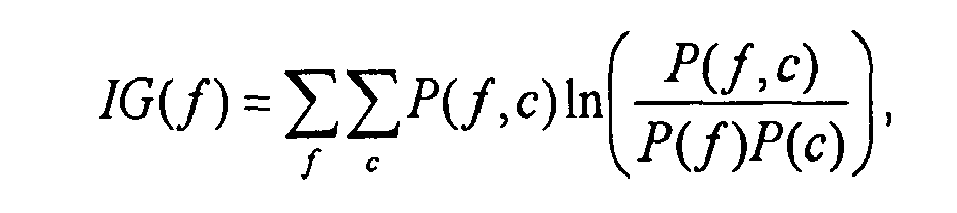
- IG ( f ) ⁇ f ⁇ c P ( f , c ) ln ( P ( f , c ) P ( f ) P ( c ) ) , where large values of IG ( f ) indicate that feature f is very relevant for (i.e., brings a lot of information to) making the categorization decision 107. Additional background on the computation of an information gain is disclosed by Bernard Colin, "Information Et Analyse Des Don dires", in Pub. Inst. Stat. Univ. Paris, XXXVII(3-4):43-60, 1993.
- Alternate frequency-based methods may be used to achieve a similar result by, for example, relying on likelihood ratio statistics or chi-squared statistics (i.e., ⁇ 2 ), which may be extended to the case where the feature f is a discrete variable containing counts, and the class c is a discrete index over classes (instead of simple counts).
- Such frequency-based methods examine the frequency distribution for all of the features and may be most useful to examine query based results (i.e., documents that are identified by a set of keywords). In such cases, the existence (i.e., absence or presence) of a query term, as well as, its frequency in the document are used to assess the importance of a feature in a document.
- the model-dependent approach described in this section evaluates feature influence with respect to the selected categorization model 101. That is, the model-dependent approach identifies those features important to a model when it makes a categorization decision.
- This section follows with a discussion for explaining categorization decisions made with model-dependent selection for three different categorization models. Further details are disclose by Goutte et al., in "Corpus-Based vs. Model-Based Selection of Relevant Features", Proceedings of CORIA04, Toulouse, France, March, 2004, pp. 75-88.
- the importance of a feature f for categorization in class c is directly related to its weight w f c . .
- w f c is multiplied by the standard deviation ⁇ f of feature value x f .
- the Na ⁇ ve Bayes assumption provides that all features f are independent of its target class c, to simplify the computation of the probability distribution P over class c given a description of the document d as: P ( d
- the maximum posterior decision i.e., the categorization decision
- a document Under the vector-space model, a document can be conceptually viewed as a vector of features, such as words, noun phrases, and other linguistically derived features (e.g., parse tree features).
- the score s ( c,d ) for a document d may be computed for SVM models using a linear model by extracting linear parameters from the implicit feature space of polynomial kernels without explicitly performing feature space expansion.
- the implicit feature space of the original feature space x [ x 1 ...
- the polynomial kernel plays a special role, in particular in text categorization, because most of implicit features correspond to combinations of single features ⁇ 2 x i x j . If x i and x j are the frequencies of feature i and feature j in a document, then this combination of single features is (up to the ⁇ 2) the number of ways to select a pair of features (i.e., feature i and feature j ) in the document.
- the importance ⁇ f of a feature f in a linear model is related to the corresponding weight w given to the feature (i.e., ⁇ f ⁇ w f for a given feature f).
- w 0 the "null" vector
- the implicit linear parameters corresponding to any feature combination may be estimated without performing the actual expansion into feature space.
- any feature combination e.g., single features, squared features, or product features
- this standard deviation may be implicitly calculated.
- searching for the best feature among a large number of candidates may be computationally restrictive.
- KL Kullback-Leibler
- the KL divergence may be extended to evaluate multiple classes by considering the KL divergence between each conditional feature distribution and their average P ( f ).
- the document-based approaches described in this section evaluate feature influence while taking into account the categorized document. That is, the document-based approaches concern a method for identifying those features in a particular document that support a model's categorization decision in one class rather than another.
- the influence of a feature on one class compared to another may be evaluated using the score difference s ( c 1 , d )- s ( c 2 , d ) as a decision function in which the contribution ⁇ f of a selected feature f is a function of the product of its corresponding value and the difference between the model parameter values of different classes of the selected feature.
- the influence of a feature is evaluated by its contribution w k ⁇ k ( x ) to the decision function f ( x ). Large positive contributions to the decision function f ( x ) will tend to "push" the categorization decision more towards one class rather than another. Conversely, large negative contributions have the reverse effect.
- the contribution of each feature to a categorization decision is computed without ever performing feature space expansion.
- the search for the best feature is less computationally restrictive.
- an exhaustive search may be performed since there tends to be only a small fraction of the vocabulary present in the current document (e.g., for one corpus, fifty-three words on average). Consequently, the most important features may be extracted for each categorized document.
- implicit features i.e., those features that are not found in a document
- that may be relevant in categorizing a document may be identified using the technique described in section C.3 above.
- PLC there are three model parameters: class profile P ( f
- d ) is estimated by maximizing the likelihood of document d using the Expectation-Maximization (EM) algorithm (the details of which are disclosed by Dempster et al., “Maximum Likelihood From Incomplete Data Via The EM Algorithm", Journal of the Royal Statistical Society, Series B, 39(1):1-38, 1997).
- EM Expectation-Maximization
- the maximized likelihood l ( d ) may be used to evaluate the influence of a feature on one category as opposed to the average.
- P ( f ) ⁇ c P ( c ) P ( f
- c ) ⁇ P ( f ) ) 0
- Figures 1-2 illustrate a first embodiment of a system that evaluates the contribution of features to a categorization decision.
- a feature influence calculator (and optional highlighter) 114 use document-based feature selection to determine the influence of features in an input document 108 on its categorization decision 107.
- the features that influence the categorization decision 107 are optionally highlighted in a marked-up input document 116.
- the features of the input document 108 with the greatest influence are set forth in a ranked list that is output together with the marked-up input document 116 or separately on its own with the categorization decision 107.
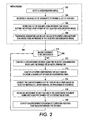
- the system shown in Figure 1 operates according to the flow diagram set forth in Figure 2.
- the categorizer 106 is initialized (at 200).
- Initialization of the categorizer 106 includes: the selection of the categorization model 101 (at 202); the receipt and use of the document training set 112 to provide a list of features 113 (at 204); the refinement of the list of features 113 using the model independent feature selector 102 that employs model-independent feature selection methods described in section B above to assess feature importance independent of the selected categorization model (at 206); and the training of model parameters 105 and the refinement of the ranked list of features (as shown in Figure 3 at 103A and 103B) using the model-based feature selector and parameter trainer 104 that employs model-dependent feature methods described in section C above to assess the importance of features of the selected categorization model 101 (at 208).
- the categorizer 106 performs the operation 212 and the feature influence calculator and highlighter 114 performs the operations 214, 216, 218, and 220 upon receipt of a document 108 to be categorized that is defined by a set of feature value pairs 109.
- the categorizer 106 computes a categorization decision 107 for the set of feature value pairs 109 using the selected categorization model 101 and the model parameters 105.
- the calculator 114 computes a contribution for each feature (using the model parameters 105 and the set of feature value pairs 109) to define a ranked list of feature contribution pairs using the methods set forth in section D above, where each feature contribution pair is a function of the product of the difference between category model parameter values and the feature value.
- the ranked list of feature contribution pairs (defined at 214) is segmented based on selected criteria (at 216) to define a segmented ranked list of feature value pairs.
- the selected criteria may include one or more of an ordered ranking or a percentage of feature value.
- the segmented ranked list of feature value pairs assigns one of a high, medium, or low level of contribution to each feature.
- An importance is assigned to each feature in the categorized document using the segmented ranked list of feature value pairs (at 218).
- the categorization decision 107 is output together with a marked-up input document 116 indicating the influence of features on the categorization decision (at 220).
- Figures 3-4 illustrate a second embodiment of a system 100 that evaluates a categorization decision.
- the system shown in Figure 3 is similar to the system shown in Figure 1 except that the highlighter calculator 114 shown in Figure 1 is replaced with feature influence highlighter 302 shown in Figure 3.
- the feature influence highlighter 302 receives as input a ranked list of features 103 and a categorization decision 107.
- the system shown in Figure 3 operates according to the flow diagram set forth in Figure 4.
- the flow diagram sets forth similar operations to those discussed above in Figure 2 except in lieu of performing the operations at 214, the operations at 414 are performed instead.
- the feature influence highlighter 302 receives the (model-dependent) ranked list of features 103B from the model-based feature selector and parameter trainer 104 that is computed in accordance with the model-dependent feature selection methods set forth in section C.
- the feature influence highlighter 302 receives the ranked list of features 103A from the model independent feature selector 102 that is computed in accordance with the model-independent feature selection methods set forth in section B.
- the feature influence highlighter 302 uses the ranked list of feature value pairs as discussed above at 216, 218, and 220 to output a categorization decision 107 while identifying features in a marked-up input document 116 that influenced the categorization decision.
- a general purpose computer may be used for implementing elements of the systems and methods described herein.
- Such a general purpose computer would include hardware and software.
- the hardware would comprise, for example, a processor (i.e., CPU), memory (ROM, RAM, etc.), persistent storage (e.g., CD-ROM, hard drive, floppy drive, tape drive, etc.), user I/O, and network I/O.
- the user I/O can include a camera, a microphone, speakers, a keyboard, a pointing device (e.g. pointing stick, mouse, etc.), and the display.
- the network I/O may for example be coupled to a network such as the Internet.
- the software of the general purpose computer would include an operating system.
- Memory devices include, but are not limited to, fixed (hard) disk drives, floppy disks (or diskettes), optical disks, magnetic tape, semiconductor memories such as RAM, ROM, Proms, etc.
- Transmitting devices include, but are not limited to, the Internet, intranets, electronic bulletin board and message/note exchanges, telephone/modem based network communication, hard-wired/cabled communication network, cellular communication, radio wave communication, satellite communication, and other stationary or mobile network systems/communication links.
- a machine embodying the embodiments may involve one or more processing systems including, but not limited to, CPU, memory/storage devices, communication links, communication/transmitting devices, servers, I/O devices, or any subcomponents or individual parts of one or more processing systems, including software, firmware, hardware, or any combination or subcombination thereof, which embody the disclosure as set forth in the claims.
- processing systems including, but not limited to, CPU, memory/storage devices, communication links, communication/transmitting devices, servers, I/O devices, or any subcomponents or individual parts of one or more processing systems, including software, firmware, hardware, or any combination or subcombination thereof, which embody the disclosure as set forth in the claims.
Landscapes
- Engineering & Computer Science (AREA)
- Data Mining & Analysis (AREA)
- Theoretical Computer Science (AREA)
- Computer Vision & Pattern Recognition (AREA)
- Bioinformatics & Cheminformatics (AREA)
- Bioinformatics & Computational Biology (AREA)
- Artificial Intelligence (AREA)
- Evolutionary Biology (AREA)
- Evolutionary Computation (AREA)
- Physics & Mathematics (AREA)
- General Engineering & Computer Science (AREA)
- General Physics & Mathematics (AREA)
- Life Sciences & Earth Sciences (AREA)
- Information Retrieval, Db Structures And Fs Structures Therefor (AREA)
Abstract
Description
- The following relates generally to methods, and apparatus therefore, for categorizing documents, and more particularly to a method and apparatus for explaining categorization decisions.
- Categorizers, such as statistical categorizers, may be deployed with relative ease if the appropriate amount of pre-processed data exists. For example, learning model parameters of a statistical categorizer on a new collection of several thousand documents may take on the order of minutes to hours depending on the amount of pre-processing required. Such preprocessing may, for example, include any required document transformations and/or linguistic processing and/or annotation associated therewith.
- Examples of statistical categorizers include Naïve Bayes, Probabilistic Latent Categorization (PLC), and Support Vector Machines (SVM). The use of Naïve Bayes, PLC, and SVM, for categorization is disclosed in the following publications respectively by: Sahami et al., in a publication entitled "A Bayesian approach to filtering spam e-mail, Learning for Text Categorization", published in Papers from the 1998 AAAI Workshop; Gaussier et al. in a publication entitled "A Hierarchical Model For Clustering And Categorizing Documents", published in F. Crestani, M. Girolami and C.J. van Rijsbergen (eds), Advances in Information Retrieval―Proceedings of the 24th BCS-IRSG European Colloquium on IR Research, Lecture Notes in Computer Science 2291, Springer, pp. 229-247, 2002; and Drucker et al., in a publication entitled "Support Vector Machines for Spam Categorization", IEEE Trans. on Neural Networks, 10:5(1048-1054), 1999.
- A problem that exists when using statistical and other categorizers is that the one or more features (e.g., words) that influence a categorization decision are often difficult to understand (i.e., assess why the categorizer selected one particular class instead of another in categorizing a document). More specifically, before a categorization decision is made, a document is initially decomposed into a set of features (or terms). The set of features is input into the categorizer and a score is output for each category (or class), with the highest scored category being the categorization decision. Exactly which ones of the features in the set of features influenced the computation of each score is difficult to assess as each score may be influenced by thousands of different features.
- Known methods for solving this problem rely on either non-parametric or model-based approaches to identify the most relevant features. Examples of such approaches are described by Goutte et al., in "Corpus-Based vs. Model-Based Selection of Relevant Features", Proceedings of CORIA04, Toulouse, France, March, 2004, pp. 75-88, and Dobrokhotov et al., in "Combining NLP and Probabilistic Categorisation for Document and term Selection for Swiss-Prot Medical Annotation", Proceedings of ISMB-03, Bioinformatics. vol. 19,
Suppl 1, pages 191-194, 2003. However, such known methods tend to be unable to explain a particular categorization decision (i.e., identify those features used to make a categorization decision), and tend to lead to the paradoxical conclusion that the importance of a feature in categorizing a document is independent of its frequency. Accordingly it would be advantageous to provide an improved method for more accurately assessing which features are relied on by a categorizer when computing the score for each category in assessing the categorization decision. - In accordance with the various embodiments, there is provided a method, and apparatus, for explaining a categorization decision. In the method, a score is computed for each of a plurality of classes using model parameter values of a selected categorization model and feature values of a document to be categorized. In addition in the method, a contribution is computed for each of a plurality of features in the document, where the contribution of a selected feature is computed using model-independent, model-dependent, or document-dependent feature selection. A categorization decision is specified using at least the class with the highest score, and an importance is assigned to each of a plurality of the features using the computed contributions to identify for different ones of the plurality of features, their influence on the categorization decision.
- These and other aspects of the disclosure will become apparent from the following description read in conjunction with the accompanying drawings wherein the same reference numerals have been applied to like parts and in which:
- Figure 1 illustrates a first embodiment of a system for explaining a categorization decision using document-based feature selection;
- Figure 2 is a flow diagram that sets forth a method for explaining a categorization decision in accordance with the embodiment shown in Figure 1;
- Figure 3 illustrates a second embodiment of a system for explaining a categorization decision using model-independent or model-dependent feature selection; and,
- Figure 4 is a flow diagram that sets forth a method for explaining a categorization decision in accordance with the embodiment shown in Figure 3.
- The table that follows set forth definitions of terminology used throughout the specification, including the claims.
Term Definition feature quantifiable qualities of the content of a document (e.g., frequency of occurrence of a word or term in a document) class (or category) a label assigned to a feature PLC Probabilistic Latent Categorizer SVM Support Vector Machines - Figures 1-2 and 3-4 illustrate two embodiments for explaining a
categorization decision 107 of a classification system orcategorizer 106. The goal of theclassification system 106 in each embodiment is to produce thecategorization decision 107 to classify adocument 108 into a set of one or more classes (or category labels), which are also referred to as categories. In operation, thecategorizer 106 assigns thedocument 108 one or more classes in a set of classes that may, for example, be defined in an ontology such as the DMOZ ontology (see dmoz.org). - A
document 108 input for classification to thecategorizer 106 is preprocessed to transform its contents into a set of features and associated values (or weights) 109, otherwise referred to herein as a set of feature value pairs. Different combinations of known techniques from natural language processing such as translation of HTML to text, tokenization, stemming, stop word removal, parsing techniques, and entity recognition may be used to generate the sets of feature. In one embodiment, the document 108 (to be categorized) may be preprocessed using a number of components such as an HTML to text converter, a tokenizer, a stemmer, a grammar-based feature generator, a feature generator, a word frequency analyzer, and a noun phrase analyzer (or extractor) to produce the features of the set offeature value pairs 109. - The value (or weight) associated with each feature of the
pairs 109 of thedocument 108 may be calculated using any of a number of well known techniques, varying from a normalized frequency count to more sophisticated weighting schemes that calculate values based upon an aggregation of a number of measures such as the frequency of each feature in the document, its location in a document, the frequency of each feature in a reference corpus, and the inverse document frequency of the feature. In one example embodiment, thedocument 108 is preprocessed into a list of tokens that is delimited by spaces, while removing tokens that correspond to stop words (i.e., words that do not improve the quality of the categorization). The remaining tokens in the list are then stemmed using Porters stemming algorithm, while again removing stop words, resulting in a list of features (i.e., terms or words). Finally, this list of features is transformed into a frequency distribution consisting of <feature, frequency> tuples where frequency denotes the number of occurrences of that feature in the document to define the set offeature value pairs 109. - The
categorizer 106 processes the set offeature value pairs 109 usingmodel parameters 105 associated with aselected categorization model 101, such as Naive Bayesian, PLC, or SVM, to produce acategorization decision 107. A list offeatures 113 from atraining set 112 is processed initially by a modelindependent feature selector 102 to provide features and associated values 103 (i.e., a ranked list of features). Subsequently, the ranked list offeatures 103 is processed by a model-based feature selector andparameter trainer 104 to definemodel parameters 105 for the selectedcategorization model 101 that is used by thecategorizer 106 to model a mapping between thetransformed representation 109 of thedocument 108 and different classes of an ontology. The mapping or mappings with the highest scores result in thecategorization decision 107. - More specifically, the
categorizer 106 assigns a class (i.e., categorization decision 107) to the document to be categorized "d" by computing a score s(c,d) for each possible class "c", where c is from the set of possible classes {c 1, c 2, c 3,... c n }. In one embodiment, the computed score "s" of the selectedprobabilistic model 101 is PLC, which is based on the class-posterior probability s(c,d) = P(c|d) (i.e., the categorizer computes a posterior probability distribution P over all possible classes c given a description of the document d). Thecategorizer 106 will then assign the class (or classes) with the highest class-posterior probability (i.e., score) as thecategorization decision 107. The computed score s(c,d) is based on a (possibly large) number of features in the set offeature value pairs 109 of thedocument 108. - Feature selection, which concerns operations for identifying those features that are most important or most relevant in making a categorization decision (i.e., feature influence), is an important step in computing the
model parameters 105 of the selected categorization model. Depending on the embodiment, feature selection may take place before and/or after themodel parameters 105 are estimated or after the computation of thecategorization decision 107. Model-independent feature selection takes place before estimating themodel parameters 105 to limit the number of features that are to be modeled. Model-dependent features selection takes place after estimatingmodel parameters 105 to analyze theselected categorization model 101 and remove unnecessary model parameters, thereby improving a model's ability to generalize. Document-based feature selection takes into account thefeatures 109 of adocument 108 used in computing itscategorization decision 107. - In accordance with the various embodiments described in further detail below, feature selection is used to determine feature influence (or feature relevance) for a given categorization decision, and thereby identify (i.e., highlight) features in the document that (highly) influence a given categorization decision. That is, determining feature influence allows relevant features in a document to be identified in order to explain a categorization decision or provide assistance in making a decision on subsequent processing of the document (e.g., routing, etc.). In the embodiment shown in Figures 1-2, document-based feature selection is used to determine feature influence, and in the embodiment shown in Figures 3-4, model-independent or model-dependent feature selection is used to determine feature influence. Each method for determining feature influence is examined below in order from the most general to the most specific method of feature selection: model-independent, model-dependent, and document-based.
- The model-independent approach described in this section evaluates feature influence independent of the
categorization model 101. In order to evaluate the influence of a feature independently of any underlying model, the "independence" of the feature and class are evaluated. In a simplified embodiment (i.e., binary method), the feature and the class are represented using binary variables that indicate whether the feature f is present in the document (f∈{0,1}) and whether the document belongs to the class c (c ∈{0,1}). This relationship is between the feature variable f and class variable c is represented in Tables 1 and 2, where Table 1 sets forth observed frequencies and Table 2 sets forth underlying probabilities.Table 1 c=0 c=1 f = 0 A B A+B f = 1 C D C+D Total A+C B+D N Table 2 c = 0 c = 1 f = 0 P(f=0,c=0) P(f=0,c=1) P(f=0) f = 1 P(f=1,c=0) P(f=1,c=1) P(f = 1) Total P(c=0) P(c=1) 1 - If the feature variable and the class variable are independent (i.e., the feature is irrelevant), then the probabilities should reflect this independence as P(f,c)=P(f)P(c). One method for measuring the relevance of a feature in accordance with this method is to compute the information gain (IG) as follows:
categorization decision 107. Additional background on the computation of an information gain is disclosed by Bernard Colin, "Information Et Analyse Des Données", in Pub. Inst. Stat. Univ. Paris, XXXVII(3-4):43-60, 1993. - Alternate frequency-based methods may be used to achieve a similar result by, for example, relying on likelihood ratio statistics or chi-squared statistics (i.e., χ2), which may be extended to the case where the feature f is a discrete variable containing counts, and the class c is a discrete index over classes (instead of simple counts). Such frequency-based methods examine the frequency distribution for all of the features and may be most useful to examine query based results (i.e., documents that are identified by a set of keywords). In such cases, the existence (i.e., absence or presence) of a query term, as well as, its frequency in the document are used to assess the importance of a feature in a document. Additional background concerning likelihood statistics is disclosed by Ted Dunning, "Accurate Methods For The Statistics Of Surprise And Coincidence" (in Computational Linguistics, 19(1):61-74, 1993) and by Yinming Yang and Jan Pedersen, "A Comparative Study On Feature Selection In Text Categorization" (in Proceedings of ICML-97, 14th International Conference on Machine Learning, pages 412-420, 1997).
- The model-dependent approach described in this section evaluates feature influence with respect to the selected
categorization model 101. That is, the model-dependent approach identifies those features important to a model when it makes a categorization decision. This section follows with a discussion for explaining categorization decisions made with model-dependent selection for three different categorization models. Further details are disclose by Goutte et al., in "Corpus-Based vs. Model-Based Selection of Relevant Features", Proceedings of CORIA04, Toulouse, France, March, 2004, pp. 75-88. - For linear models, the score s(c,d) of a document d for each possible class c, where c is from the set of possible classes {c 1, c 2, c 3, ... c n} is given by:


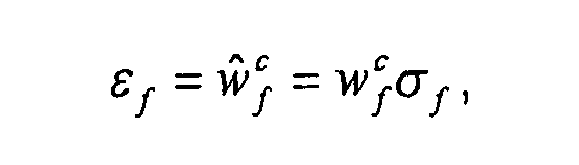

- For Naïve Bayes models, the score s(c,d) for a document d is given by the class c posterior as:

- The Naïve Bayes assumption provides that all features f are independent of its target class c, to simplify the computation of the probability distribution P over class c given a description of the document d as:


- Under the vector-space model, a document can be conceptually viewed as a vector of features, such as words, noun phrases, and other linguistically derived features (e.g., parse tree features). For non-linear SVM models, the score s(c,d) for a document d may be computed for SVM models using a linear model by extracting linear parameters from the implicit feature space of polynomial kernels without explicitly performing feature space expansion. A solution is presented below for the quadratic kernel K 2(x,y)=(1+〈x,y〉)2 which those skilled in the art will appreciate may be extend to any polynomial kernel K p (x,y) = (1 + 〈x,y〉) p .
- In the quadratic kernel K 2(x,y) = (1+〈x,y〉)2, similar to all kernels, K 2 corresponds to performing a scalar product in an implicit feature space K 2 (x, y) = 〈φ(x),φ(y)〉. For the quadratic kernel K 2, the implicit feature space of the original feature space x = [x 1 ... x M ] , which has 1+M(M+3)/2 dimensions, is given by:

- The decision function for the quadratic kernel is given by f(x) = Σ i α (i) K 2(x,x (i)) = 〈w,φ(x)〉, where x (i) are the training examples of weight α(i) (where α(i) ≠ 0 for support vectors only) and w is the parameter vector in the implicit feature space φ(x) that may be given by:

- The polynomial kernel plays a special role, in particular in text categorization, because most of implicit features correspond to combinations of single features √2x i x j . If x i and x j are the frequencies of feature i and feature j in a document, then this combination of single features is (up to the √2) the number of ways to select a pair of features (i.e., feature i and feature j) in the document.
- In model-based feature selection, the importance ε f of a feature f in a linear model is related to the corresponding weight w given to the feature (i.e., ε f ≈ w f for a given feature f). Denoting by "0" the "null" vector, and "1 i" the vector in the input space which has its "ith" coordinate set to "1" and all other coordinates set to "0", provides that:



- Accordingly, the implicit linear parameters corresponding to any feature combination (e.g., single features, squared features, or product features) may be estimated without performing the actual expansion into feature space. Those skilled in the art will appreciate that given the linear coefficients are scaled by the standard deviation of the corresponding feature to estimate their importance, this standard deviation may be implicitly calculated. However, while the usefulness of a feature may be estimated as set forth above, searching for the best feature among a large number of candidates may be computationally restrictive. In one embodiment, the search for the best feature is limited to those features represented in the support vectors and combinations thereof to reduce the computational complexity (e.g., if M = 10000 features, the implicit space will have 1+M(M+3)/2=50015001 features, only a few of which are used by the support vectors).
- The PLC is a probabilistic model of the co-occurrence of features f and document d: P(d,f)= Σ c P(c)P(d|c)P(f|c), where the influence of a feature f in a class c is reflected by the probability P(f |c). That is, each class c has its own class-conditional feature distribution P(f|c). Each term distribution may be compared to find features that have different importance for different classes. For example, if P(f|c 0) >> P(f|c 1) (i.e., the probability of the presence of the feature is much greater that its absence in a given class c 0 versus class c 1) then the presence of this feature in a document will be a strong indicator that it is relevant to the class. The difference between two probability distributions over the same event space may be evaluated using the symmetrized Kullback-Leibler (KL) divergence, which is given by:

Suppl 1, pages 191-194, 2003). The larger the importance of contribution ε f the greater the importance of feature f in differentiating between classes. The KL divergence may be extended to evaluate multiple classes by considering the KL divergence between each conditional feature distribution and their average P(f). - The document-based approaches described in this section evaluate feature influence while taking into account the categorized document. That is, the document-based approaches concern a method for identifying those features in a particular document that support a model's categorization decision in one class rather than another.
- For linear models, including Naïve Bayes models, the score s(c,d) which is a function of document d and class c is given by


- ε f is the contribution of feature f to a categorization decision;
- c n is a class n in which the document may be categorized;
- d is the document being categorized;
- s(c n,d) is the score of the category c n as it depends on a feature value x;
- x f is the feature value associated with the document for the feature f;
-

- For SVM models, the decision function is given as


- As in section C.3, the contribution of each feature to a categorization decision is computed without ever performing feature space expansion. Given the nature of the problem presented in this section, the search for the best feature is less computationally restrictive. Thus, if the search is restricted to those features in a specific document, an exhaustive search may be performed since there tends to be only a small fraction of the vocabulary present in the current document (e.g., for one corpus, fifty-three words on average). Consequently, the most important features may be extracted for each categorized document. In addition, implicit features (i.e., those features that are not found in a document) that may be relevant in categorizing a document may be identified using the technique described in section C.3 above.
- As set forth above, the score in PLC models is based on the posterior class probability s(c,d)=P(c|d). In PLC there are three model parameters: class profile P(f|c), document contribution P(d|c), and class prior P(c). From these three model parameters the probability of the model to observe a feature or combination of features given a document P(f |d) may be computed. When categorizing a document, the posterior probability distribution P(c|d) is estimated by maximizing the likelihood of document d using the Expectation-Maximization (EM) algorithm (the details of which are disclosed by Dempster et al., "Maximum Likelihood From Incomplete Data Via The EM Algorithm", Journal of the Royal Statistical Society, Series B, 39(1):1-38, 1997). While it is difficult to relate P(c|d) with the frequencies of the different features in the current document being categorized since the EM algorithm is an iterative fixed-point algorithm, the fact that the posterior probability distribution P(c|d) may be obtained by maximizing the likelihood ℓ(d) may be used to compute ε f the contribution of feature f to a categorization decision.
- The likelihood ℓ(d), which is given by:


- As the preceding equation is true for all classes c, it may be used to compute the contribution ε f of feature f to a categorization decision of document d (i.e., the influence of a feature in favor of one class c 1 as opposed to another class c 2) using:


- P(f|c) is the feature profile for class c;
- ε f is the contribution of feature f to a categorization decision;
- c n is a class n in which the document may be categorized;
- d is the document being categorized;
- x f is the feature value associated with the document for the feature f;
- Similarly, the maximized likelihood ℓ(d) may be used to evaluate the influence of a feature on one category as opposed to the average. Given P(f) = Σ c P(c)P(f|c),


- P(f|c) is the feature profile for class c;
- P(f) is the marginal distribution of feature f(i.e., average feature profile);
- ε f is the contribution of feature f to a categorization decision;
- c is a class in which the document may be categorized;
- d is the document being categorized;
- x f is the feature value associated with the document for the feature f.
- Referring again to Figures 1-4, Figures 1-2 illustrate a first embodiment of a system that evaluates the contribution of features to a categorization decision. In the system shown in Figure 1, a feature influence calculator (and optional highlighter) 114 use document-based feature selection to determine the influence of features in an
input document 108 on itscategorization decision 107. In addition, the features that influence thecategorization decision 107 are optionally highlighted in a marked-upinput document 116. It will be appreciated by those skilled in the art that there exists many alternate ways to highlight those features of an input document that are determined to influence the categorization decision, including but not limited to the use of a combination of one or more of color highlighting, pop-up windows, comments, color fonts, underlying, etc. In an alternate embodiment, the features of theinput document 108 with the greatest influence are set forth in a ranked list that is output together with the marked-upinput document 116 or separately on its own with thecategorization decision 107. - In one embodiment, the system shown in Figure 1 operates according to the flow diagram set forth in Figure 2. Initially, the
categorizer 106 is initialized (at 200). Initialization of thecategorizer 106 includes: the selection of the categorization model 101 (at 202); the receipt and use of the document training set 112 to provide a list of features 113 (at 204); the refinement of the list offeatures 113 using the modelindependent feature selector 102 that employs model-independent feature selection methods described in section B above to assess feature importance independent of the selected categorization model (at 206); and the training ofmodel parameters 105 and the refinement of the ranked list of features (as shown in Figure 3 at 103A and 103B) using the model-based feature selector andparameter trainer 104 that employs model-dependent feature methods described in section C above to assess the importance of features of the selected categorization model 101 (at 208). - Subsequent to the initialization of the categorizer 106 (at 200) that defines its
categorization model 101 andmodel parameters 105, thecategorizer 106 performs theoperation 212 and the feature influence calculator andhighlighter 114 performs theoperations document 108 to be categorized that is defined by a set of feature value pairs 109. At 212, thecategorizer 106 computes acategorization decision 107 for the set of feature value pairs 109 using the selectedcategorization model 101 and themodel parameters 105. At 214, thecalculator 114 computes a contribution for each feature (using themodel parameters 105 and the set of feature value pairs 109) to define a ranked list of feature contribution pairs using the methods set forth in section D above, where each feature contribution pair is a function of the product of the difference between category model parameter values and the feature value. - The ranked list of feature contribution pairs (defined at 214) is segmented based on selected criteria (at 216) to define a segmented ranked list of feature value pairs. The selected criteria may include one or more of an ordered ranking or a percentage of feature value. In one embodiment, the segmented ranked list of feature value pairs assigns one of a high, medium, or low level of contribution to each feature. An importance is assigned to each feature in the categorized document using the segmented ranked list of feature value pairs (at 218). The
categorization decision 107 is output together with a marked-upinput document 116 indicating the influence of features on the categorization decision (at 220). - Figures 3-4 illustrate a second embodiment of a system 100 that evaluates a categorization decision. The system shown in Figure 3 is similar to the system shown in Figure 1 except that the
highlighter calculator 114 shown in Figure 1 is replaced withfeature influence highlighter 302 shown in Figure 3. Thefeature influence highlighter 302 receives as input a ranked list offeatures 103 and acategorization decision 107. - In one embodiment, the system shown in Figure 3 operates according to the flow diagram set forth in Figure 4. The flow diagram sets forth similar operations to those discussed above in Figure 2 except in lieu of performing the operations at 214, the operations at 414 are performed instead. In one embodiment at 414, the
feature influence highlighter 302 receives the (model-dependent) ranked list offeatures 103B from the model-based feature selector andparameter trainer 104 that is computed in accordance with the model-dependent feature selection methods set forth in section C. In another embodiment at 414, thefeature influence highlighter 302 receives the ranked list offeatures 103A from the modelindependent feature selector 102 that is computed in accordance with the model-independent feature selection methods set forth in section B. Subsequently, thefeature influence highlighter 302 uses the ranked list of feature value pairs as discussed above at 216, 218, and 220 to output acategorization decision 107 while identifying features in a marked-upinput document 116 that influenced the categorization decision. - A general purpose computer may be used for implementing elements of the systems and methods described herein. Such a general purpose computer would include hardware and software. The hardware would comprise, for example, a processor (i.e., CPU), memory (ROM, RAM, etc.), persistent storage (e.g., CD-ROM, hard drive, floppy drive, tape drive, etc.), user I/O, and network I/O. The user I/O can include a camera, a microphone, speakers, a keyboard, a pointing device (e.g. pointing stick, mouse, etc.), and the display. The network I/O may for example be coupled to a network such as the Internet. The software of the general purpose computer would include an operating system.
- Memory devices include, but are not limited to, fixed (hard) disk drives, floppy disks (or diskettes), optical disks, magnetic tape, semiconductor memories such as RAM, ROM, Proms, etc. Transmitting devices include, but are not limited to, the Internet, intranets, electronic bulletin board and message/note exchanges, telephone/modem based network communication, hard-wired/cabled communication network, cellular communication, radio wave communication, satellite communication, and other stationary or mobile network systems/communication links.
- A machine embodying the embodiments may involve one or more processing systems including, but not limited to, CPU, memory/storage devices, communication links, communication/transmitting devices, servers, I/O devices, or any subcomponents or individual parts of one or more processing systems, including software, firmware, hardware, or any combination or subcombination thereof, which embody the disclosure as set forth in the claims.
Claims (9)
- A method for explaining a categorization decision, comprising:computing a score for each of a plurality of classes using model parameter values of a selected categorization model and feature values of a document to be categorized;computing a contribution for each of a plurality of features in the document, where the contribution is computed using document-dependent feature selection;specifying a categorization decision using at least the class with the highest score;assigning an importance to each of a plurality of the features using the computed contributions to identify for different ones of the plurality of features, their influence on the categorization decision.
- The method according to claim 1, wherein the contribution ε f of a selected feature f is a function of the product of its corresponding value and the difference between the model parameter values of different classes of the selected feature.
- The method according to claim 2, wherein the contribution for each feature is computed using the following equation:
 ε f is the contribution of feature f to a categorization decision;c n is a class n in which the document may be categorized;d is the document being categorized;s(c n,d) is the score of the category c n as it depends on a feature value x;x f is the feature value associated with the document for the feature f ;
- The method according to claim 3, wherein the categorization model is Naïve Bayes, or linear.
- The method according to claim 1, wherein the contribution ε f of a selected feature f is a function of the product of its corresponding normalized feature value and the difference between feature profiles for two classes..
- The method according to claim 5, wherein the contribution for each feature is computed using the following equation:
 P(f|c) is the feature profile for class c;ε f is the contribution of feature f to a categorization decision;c n is a class n in which the document may be categorized;d is the document being categorized;x f is the feature value associated with the document for the feature f.
 - A method according to claim 1, wherein the contribution is computed by computing the contribution ε f of feature f to a categorization decision using:


whereε i is the frequency contribution from feature f i ,ε ii is the squared contribution from feature f i , andε ij is the contribution from the combination of features f i and f j ,i and j are any two features in an original feature spacecomputing a score for each of a plurality of classes using model parameter values of a selected categorization model and feature values of a document to be categorized;
computing a contribution for each of a plurality of features in the document, where the contribution is computed using document-dependent feature selection;
specifying a categorization decision using at least the class with the highest score;
assigning an importance to each of a plurality of the features using the computed contributions to identify for different ones of the plurality of features, their influence on the categorization decision. - The method according to any of the preceding claims, wherein the importance is assigned by segmenting a ranked list of feature contributions, for example based on selected criteria.
- Apparatus for explaining a categorization decision, the apparatus comprising:means for computing a score for each of a plurality of classes using model parameter values of a selected categorization model and feature values of a document to be categorized;means for computing a contribution for each of a plurality of features in the document, where the contribution is computed using document-dependent feature selection;means for specifying a categorization decision using at least the class with the highest score;means for assigning an importance to each of a plurality of the features using the computed contributions to identify for different ones of the plurality of features, their influence on the categorization decision.
Applications Claiming Priority (1)
| Application Number | Priority Date | Filing Date | Title |
|---|---|---|---|
| US11/013,365 US7457808B2 (en) | 2004-12-17 | 2004-12-17 | Method and apparatus for explaining categorization decisions |
Publications (1)
| Publication Number | Publication Date |
|---|---|
| EP1679621A1 true EP1679621A1 (en) | 2006-07-12 |
Family
ID=35945156
Family Applications (1)
| Application Number | Title | Priority Date | Filing Date |
|---|---|---|---|
| EP05257572A Ceased EP1679621A1 (en) | 2004-12-17 | 2005-12-08 | Method and appartus for explaining categorization decisions |
Country Status (2)
| Country | Link |
|---|---|
| US (1) | US7457808B2 (en) |
| EP (1) | EP1679621A1 (en) |
Cited By (5)
| Publication number | Priority date | Publication date | Assignee | Title |
|---|---|---|---|---|
| US7457808B2 (en) * | 2004-12-17 | 2008-11-25 | Xerox Corporation | Method and apparatus for explaining categorization decisions |
| WO2014178895A1 (en) * | 2013-05-03 | 2014-11-06 | Microsoft Corporation | Identifying search matches and altered search results |
| US9600806B2 (en) | 2010-02-03 | 2017-03-21 | Arcode Corporation | Electronic message systems and methods |
| WO2018082569A1 (en) * | 2016-11-04 | 2018-05-11 | 华为技术有限公司 | Sequence conversion method and device |
| US11501874B2 (en) * | 2010-10-26 | 2022-11-15 | Stanley Victor CAMPBELL | System and method for machine based medical diagnostic code identification, accumulation, analysis and automatic claim process adjudication |
Families Citing this family (59)
| Publication number | Priority date | Publication date | Assignee | Title |
|---|---|---|---|---|
| US7499591B2 (en) * | 2005-03-25 | 2009-03-03 | Hewlett-Packard Development Company, L.P. | Document classifiers and methods for document classification |
| US7813919B2 (en) | 2005-12-20 | 2010-10-12 | Xerox Corporation | Class description generation for clustering and categorization |
| EP2024863B1 (en) | 2006-05-07 | 2018-01-10 | Varcode Ltd. | A system and method for improved quality management in a product logistic chain |
| US7562811B2 (en) | 2007-01-18 | 2009-07-21 | Varcode Ltd. | System and method for improved quality management in a product logistic chain |
| US20080147579A1 (en) * | 2006-12-14 | 2008-06-19 | Microsoft Corporation | Discriminative training using boosted lasso |
| US7711747B2 (en) * | 2007-04-06 | 2010-05-04 | Xerox Corporation | Interactive cleaning for automatic document clustering and categorization |
| EP2156369B1 (en) | 2007-05-06 | 2015-09-02 | Varcode Ltd. | A system and method for quality management utilizing barcode indicators |
| US8914278B2 (en) * | 2007-08-01 | 2014-12-16 | Ginger Software, Inc. | Automatic context sensitive language correction and enhancement using an internet corpus |
| WO2009055819A1 (en) * | 2007-10-26 | 2009-04-30 | Honda Motor Co., Ltd. | Improving free-speech command classification for car navigation system |
| WO2009063465A2 (en) | 2007-11-14 | 2009-05-22 | Varcode Ltd. | A system and method for quality management utilizing barcode indicators |
| US20110086331A1 (en) * | 2008-04-16 | 2011-04-14 | Ginger Software, Inc. | system for teaching writing based on a users past writing |
| US11704526B2 (en) | 2008-06-10 | 2023-07-18 | Varcode Ltd. | Barcoded indicators for quality management |
| US8189930B2 (en) * | 2008-07-17 | 2012-05-29 | Xerox Corporation | Categorizer with user-controllable calibration |
| US8560298B2 (en) * | 2008-10-21 | 2013-10-15 | Microsoft Corporation | Named entity transliteration using comparable CORPRA |
| US8332205B2 (en) * | 2009-01-09 | 2012-12-11 | Microsoft Corporation | Mining transliterations for out-of-vocabulary query terms |
| US8396721B2 (en) * | 2009-02-23 | 2013-03-12 | Healthy Communities Institute Corporation | Community health system |
| US8339680B2 (en) * | 2009-04-02 | 2012-12-25 | Xerox Corporation | Printer image log system for document gathering and retention |
| US8386437B2 (en) * | 2009-04-02 | 2013-02-26 | Xerox Corporation | Apparatus and method for document collection and filtering |
| US8165974B2 (en) | 2009-06-08 | 2012-04-24 | Xerox Corporation | System and method for assisted document review |
| US8566349B2 (en) | 2009-09-28 | 2013-10-22 | Xerox Corporation | Handwritten document categorizer and method of training |
| US8468195B1 (en) | 2009-09-30 | 2013-06-18 | Cisco Technology, Inc. | System and method for controlling an exchange of information in a network environment |
| US8166161B1 (en) | 2009-09-30 | 2012-04-24 | Cisco Technology, Inc. | System and method for ensuring privacy while tagging information in a network environment |
| US8489390B2 (en) * | 2009-09-30 | 2013-07-16 | Cisco Technology, Inc. | System and method for generating vocabulary from network data |
| US9201965B1 (en) * | 2009-09-30 | 2015-12-01 | Cisco Technology, Inc. | System and method for providing speech recognition using personal vocabulary in a network environment |
| US8990083B1 (en) * | 2009-09-30 | 2015-03-24 | Cisco Technology, Inc. | System and method for generating personal vocabulary from network data |
| JP5752150B2 (en) | 2010-02-01 | 2015-07-22 | ジンジャー ソフトウェア、インコーポレイティッド | Context-sensitive automatic language correction using an Internet corpus specifically for small keyboard devices |
| US8935274B1 (en) | 2010-05-12 | 2015-01-13 | Cisco Technology, Inc | System and method for deriving user expertise based on data propagating in a network environment |
| US8375061B2 (en) * | 2010-06-08 | 2013-02-12 | International Business Machines Corporation | Graphical models for representing text documents for computer analysis |
| US9465795B2 (en) | 2010-12-17 | 2016-10-11 | Cisco Technology, Inc. | System and method for providing feeds based on activity in a network environment |
| US8667169B2 (en) | 2010-12-17 | 2014-03-04 | Cisco Technology, Inc. | System and method for providing argument maps based on activity in a network environment |
| US9836455B2 (en) | 2011-02-23 | 2017-12-05 | New York University | Apparatus, method and computer-accessible medium for explaining classifications of documents |
| US8553065B2 (en) | 2011-04-18 | 2013-10-08 | Cisco Technology, Inc. | System and method for providing augmented data in a network environment |
| US8528018B2 (en) | 2011-04-29 | 2013-09-03 | Cisco Technology, Inc. | System and method for evaluating visual worthiness of video data in a network environment |
| US8620136B1 (en) | 2011-04-30 | 2013-12-31 | Cisco Technology, Inc. | System and method for media intelligent recording in a network environment |
| US8909624B2 (en) | 2011-05-31 | 2014-12-09 | Cisco Technology, Inc. | System and method for evaluating results of a search query in a network environment |
| US8886797B2 (en) | 2011-07-14 | 2014-11-11 | Cisco Technology, Inc. | System and method for deriving user expertise based on data propagating in a network environment |
| US8831403B2 (en) | 2012-02-01 | 2014-09-09 | Cisco Technology, Inc. | System and method for creating customized on-demand video reports in a network environment |
| US9569327B2 (en) | 2012-10-03 | 2017-02-14 | Xerox Corporation | System and method for labeling alert messages from devices for automated management |
| US8807422B2 (en) | 2012-10-22 | 2014-08-19 | Varcode Ltd. | Tamper-proof quality management barcode indicators |
| JP6217468B2 (en) * | 2014-03-10 | 2017-10-25 | 富士ゼロックス株式会社 | Multilingual document classification program and information processing apparatus |
| US20150347926A1 (en) * | 2014-06-02 | 2015-12-03 | Salesforce.Com, Inc. | Fast Naive Bayesian Framework with Active-Feature Ordering |
| CN104142998A (en) * | 2014-08-01 | 2014-11-12 | 中国传媒大学 | A Text Classification Method |
| CA2985160C (en) | 2015-05-18 | 2023-09-05 | Varcode Ltd. | Thermochromic ink indicia for activatable quality labels |
| US9529500B1 (en) | 2015-06-05 | 2016-12-27 | Apple Inc. | Application recommendation based on detected triggering events |
| US20160357774A1 (en) * | 2015-06-05 | 2016-12-08 | Apple Inc. | Segmentation techniques for learning user patterns to suggest applications responsive to an event on a device |
| WO2017006326A1 (en) | 2015-07-07 | 2017-01-12 | Varcode Ltd. | Electronic quality indicator |
| CN105488025B (en) * | 2015-11-24 | 2019-02-12 | 小米科技有限责任公司 | Template construction method and device, information identification method and device |
| TWI571756B (en) | 2015-12-11 | 2017-02-21 | 財團法人工業技術研究院 | Methods and systems for analyzing reading log and documents corresponding thereof |
| WO2018119684A1 (en) * | 2016-12-27 | 2018-07-05 | 深圳前海达闼云端智能科技有限公司 | Image recognition system and image recognition method |
| KR102073020B1 (en) * | 2017-11-02 | 2020-03-02 | 디어젠 주식회사 | System and method for selecting optimized medical features using neural network |
| EP3726433A1 (en) * | 2019-04-17 | 2020-10-21 | Siemens Aktiengesellschaft | A method for computer-implemented analysis of a classification model |
| US11477220B2 (en) * | 2019-05-13 | 2022-10-18 | Feedzai—Consultadoria e Inovação Tecnológica, S.A. | Adaptive threshold estimation for streaming data |
| US11176495B1 (en) * | 2020-06-21 | 2021-11-16 | Liquidity Capital M. C. Ltd. | Machine learning model ensemble for computing likelihood of an entity failing to meet a target parameter |
| CN112116028B (en) * | 2020-09-29 | 2024-04-26 | 联想(北京)有限公司 | Model decision interpretation realization method and device and computer equipment |
| US11537647B2 (en) * | 2020-10-23 | 2022-12-27 | Larsen & Toubro Infotech Ltd | System and method for decision driven hybrid text clustering |
| CN112699944B (en) * | 2020-12-31 | 2024-04-23 | 中国银联股份有限公司 | Return order processing model training method, processing method, device, equipment and medium |
| US20240161005A1 (en) * | 2021-03-01 | 2024-05-16 | Medial Earlysign Ltd. | Add-on to a machine learning model for interpretation thereof |
| CN113657106B (en) * | 2021-07-05 | 2024-06-21 | 不亦乐乎有朋(北京)科技有限公司 | Feature selection method based on normalized word frequency weight |
| US12314290B2 (en) | 2023-06-12 | 2025-05-27 | International Business Machines Corporation | Key category identification and visualization |
Family Cites Families (10)
| Publication number | Priority date | Publication date | Assignee | Title |
|---|---|---|---|---|
| IL127254A0 (en) * | 1998-11-25 | 1999-09-22 | Univ Ramot | Method and system for automatic classification and quantitative evaluation of adnexal masses bases on a cross-sectional or projectional images of the adnex |
| US7213023B2 (en) * | 2000-10-16 | 2007-05-01 | University Of North Carolina At Charlotte | Incremental clustering classifier and predictor |
| US6772120B1 (en) * | 2000-11-21 | 2004-08-03 | Hewlett-Packard Development Company, L.P. | Computer method and apparatus for segmenting text streams |
| US7644102B2 (en) * | 2001-10-19 | 2010-01-05 | Xerox Corporation | Methods, systems, and articles of manufacture for soft hierarchical clustering of co-occurring objects |
| US6947985B2 (en) * | 2001-12-05 | 2005-09-20 | Websense, Inc. | Filtering techniques for managing access to internet sites or other software applications |
| US7130837B2 (en) * | 2002-03-22 | 2006-10-31 | Xerox Corporation | Systems and methods for determining the topic structure of a portion of text |
| US20050114313A1 (en) * | 2003-11-26 | 2005-05-26 | Campbell Christopher S. | System and method for retrieving documents or sub-documents based on examples |
| US7139754B2 (en) * | 2004-02-09 | 2006-11-21 | Xerox Corporation | Method for multi-class, multi-label categorization using probabilistic hierarchical modeling |
| US7266548B2 (en) * | 2004-06-30 | 2007-09-04 | Microsoft Corporation | Automated taxonomy generation |
| US7457808B2 (en) * | 2004-12-17 | 2008-11-25 | Xerox Corporation | Method and apparatus for explaining categorization decisions |
-
2004
- 2004-12-17 US US11/013,365 patent/US7457808B2/en not_active Expired - Lifetime
-
2005
- 2005-12-08 EP EP05257572A patent/EP1679621A1/en not_active Ceased
Non-Patent Citations (10)
| Title |
|---|
| BERNARD COLIN: "Information Et Analyse Des Données", PUB. INST. STAT. UNIV. PARIS, vol. XXXVII, no. 3-4, 1993, pages 43 - 60 |
| DEMPSTER: "Maximum Likelihood From Incomplete Data Via The EM Algorithm", JOURNAL OF THE ROYAL STATISTICAL SOCIETY, SERIES B, vol. 39, no. 1, 1997, pages 1 - 38 |
| DOBROKHOTOV: "Combining NLP and Probabilistic Categorisation for Document and term Selection for Swiss-Prot Medical Annotation", PROCEEDINGS OF ISMB-03, BIOINFORMATICS., vol. 19, 2003, pages 191 - 194 |
| DRUCKER: "Support Vector Machines for Spam Categorization", IEEE TRANS. ON NEURAL NETWORKS, vol. 10, no. 5, 1999, pages 1048 - 1054 |
| GAUSSIER: "ADVANCES IN INFORMATION RETRIEVALÔÇòPROCEEDINGS OF THE 24TH BCS-IRSG EUROPEAN COLLOQUIUM ON IR RESEARCH, LECTURE NOTES IN COMPUTER SCIENCE", vol. 2291, 2002, SPRINGER, article "A Hierarchical Model For Clustering And Categorizing Documents", pages: 229 - 247 |
| GOUTTE C ET AL: "Corpus-Based vs. Model-Based Selection of Relevant Features", PROCEEDINGS OF CORIA04, 10 March 2004 (2004-03-10), Toulouse, France, pages 75 - 88, XP002371156 * |
| GOUTTE: "Corpus-Based vs. Model-Based Selection of Relevant Features", PROCEEDINGS OF CORIA04, March 2004 (2004-03-01), pages 75 - 88 |
| SAHAMI: "A BAYESIAN APPROACH TO FILTERING SPAM E-MAIL, LEARNING FOR TEXT CATEGORIZATION", 1998, AAAI WORKSHOP |
| TED DUNNING: "Accurate Methods For The Statistics Of Surprise And Coincidence", COMPUTATIONAL LINGUISTICS, vol. 19, no. 1, 1993, pages 61 - 74 |
| YINMING YANG; JAN PEDERSEN: "A Comparative Study On Feature Selection In Text Categorization", PROCEEDINGS OF ICML-97, 14TH INTERNATIONAL CONFERENCE ON MACHINE LEARNING, 1997, pages 412 - 420 |
Cited By (9)
| Publication number | Priority date | Publication date | Assignee | Title |
|---|---|---|---|---|
| US7457808B2 (en) * | 2004-12-17 | 2008-11-25 | Xerox Corporation | Method and apparatus for explaining categorization decisions |
| US9600806B2 (en) | 2010-02-03 | 2017-03-21 | Arcode Corporation | Electronic message systems and methods |
| US11501874B2 (en) * | 2010-10-26 | 2022-11-15 | Stanley Victor CAMPBELL | System and method for machine based medical diagnostic code identification, accumulation, analysis and automatic claim process adjudication |
| WO2014178895A1 (en) * | 2013-05-03 | 2014-11-06 | Microsoft Corporation | Identifying search matches and altered search results |
| CN105378710A (en) * | 2013-05-03 | 2016-03-02 | 微软技术许可有限责任公司 | Identifying search matches and altered search results |
| US9563675B2 (en) | 2013-05-03 | 2017-02-07 | Microsoft Technology Licensing, Llc | Identifying search matches and altered search results |
| CN105378710B (en) * | 2013-05-03 | 2019-05-10 | 微软技术许可有限责任公司 | Identify search matches and altered search results |
| WO2018082569A1 (en) * | 2016-11-04 | 2018-05-11 | 华为技术有限公司 | Sequence conversion method and device |
| US11132516B2 (en) | 2016-11-04 | 2021-09-28 | Huawei Technologies Co., Ltd. | Sequence translation probability adjustment |
Also Published As
| Publication number | Publication date |
|---|---|
| US7457808B2 (en) | 2008-11-25 |
| US20060136410A1 (en) | 2006-06-22 |
Similar Documents
| Publication | Publication Date | Title |
|---|---|---|
| US7457808B2 (en) | Method and apparatus for explaining categorization decisions | |
| US7620539B2 (en) | Methods and apparatuses for identifying bilingual lexicons in comparable corpora using geometric processing | |
| US11379668B2 (en) | Topic models with sentiment priors based on distributed representations | |
| EP1801714B1 (en) | Generation of descriptions for classes and clusters of documents | |
| US6868411B2 (en) | Fuzzy text categorizer | |
| US8326785B2 (en) | Joint ranking model for multilingual web search | |
| US7272594B1 (en) | Method and apparatus to link to a related document | |
| EP1090365B1 (en) | Methods and apparatus for classifying text and for building a text classifier | |
| EP1544748B1 (en) | Method and apparatus for evaluating machine translation quality | |
| US8594998B2 (en) | Multilingual sentence extractor | |
| US7689531B1 (en) | Automatic charset detection using support vector machines with charset grouping | |
| US8566270B2 (en) | Sparse representations for text classification | |
| US20030083859A1 (en) | System and method for analyzing language using supervised machine learning method | |
| CN111563361B (en) | Text label extraction method and device and storage medium | |
| CN117973381A (en) | A method for automatically extracting text keywords | |
| Liu et al. | Unsupervised post-processing of word vectors via conceptor negation | |
| CN115858787B (en) | A Hotspot Extraction and Mining Method Based on Problem Appeal Information in Road Transportation | |
| CN112836491A (en) | Mashup service spectrum clustering method based on GSDPMM and topic model for NLP | |
| Soleimani et al. | Spectral word embedding with negative sampling | |
| Goz et al. | MGRank: A keyword extraction system based on multigraph GoW model and novel edge weighting procedure | |
| CN120012729A (en) | Official document content generation method, device, terminal device and storage medium based on artificial intelligence | |
| Salvetti et al. | Opinion polarity identification of movie reviews | |
| Bruce | A Bayesian Approach to Semi-Supervised Learning. | |
| Farek et al. | A hybrid feature selection method for text classification using a feature-correlation-based genetic algorithm: L. Farek, A. Benaidja | |
| Rojas-Simón et al. | Selection of Content Measures for Evaluation of Text Summaries Using Genetic Algorithms |
Legal Events
| Date | Code | Title | Description |
|---|---|---|---|
| PUAI | Public reference made under article 153(3) epc to a published international application that has entered the european phase |
Free format text: ORIGINAL CODE: 0009012 |
|
| AK | Designated contracting states |
Kind code of ref document: A1 Designated state(s): AT BE BG CH CY CZ DE DK EE ES FI FR GB GR HU IE IS IT LI LT LU LV MC NL PL PT RO SE SI SK TR |
|
| AX | Request for extension of the european patent |
Extension state: AL BA HR MK YU |
|
| 17P | Request for examination filed |
Effective date: 20070112 |
|
| 17Q | First examination report despatched |
Effective date: 20070219 |
|
| AKX | Designation fees paid |
Designated state(s): DE FR GB |
|
| STAA | Information on the status of an ep patent application or granted ep patent |
Free format text: STATUS: THE APPLICATION HAS BEEN REFUSED |
|
| 18R | Application refused |
Effective date: 20110829 |