EP1679613A2 - Method and apparatus for detecting pagination constructs including a header and a footer in legacy documents - Google Patents
Method and apparatus for detecting pagination constructs including a header and a footer in legacy documents Download PDFInfo
- Publication number
- EP1679613A2 EP1679613A2 EP20060100200 EP06100200A EP1679613A2 EP 1679613 A2 EP1679613 A2 EP 1679613A2 EP 20060100200 EP20060100200 EP 20060100200 EP 06100200 A EP06100200 A EP 06100200A EP 1679613 A2 EP1679613 A2 EP 1679613A2
- Authority
- EP
- European Patent Office
- Prior art keywords
- header
- footer
- document
- text
- content
- Prior art date
- Legal status (The legal status is an assumption and is not a legal conclusion. Google has not performed a legal analysis and makes no representation as to the accuracy of the status listed.)
- Ceased
Links
Images



Classifications
-
- G—PHYSICS
- G06—COMPUTING OR CALCULATING; COUNTING
- G06F—ELECTRIC DIGITAL DATA PROCESSING
- G06F40/00—Handling natural language data
- G06F40/10—Text processing
- G06F40/103—Formatting, i.e. changing of presentation of documents
- G06F40/114—Pagination
-
- G—PHYSICS
- G06—COMPUTING OR CALCULATING; COUNTING
- G06F—ELECTRIC DIGITAL DATA PROCESSING
- G06F40/00—Handling natural language data
- G06F40/20—Natural language analysis
- G06F40/258—Heading extraction; Automatic titling; Numbering
Definitions
- the following relates to the information storage and processing arts. It finds application in conjunction with electronic document format conversion and in particular with cataloging of legacy documents in a marked-up format such as extensible markup language (XML), standard generalized markup language (SGML), hypertext markup language (HTML), or the like, and will be described with particular reference thereto. However, it is to be appreciated that the following is amenable to other like applications.
- XML extensible markup language
- SGML standard generalized markup language
- HTML hypertext markup language
- Legacy document conversion relates to converting unstructured documents existing in formats such as Adobe portable document format (PDF), various text formats, various word processing formats, and the like into structured documents employing a markup language such as XML, SGML, HTML, and the like.
- PDF Portable document format
- content is organized into delineated sections such as document pages with suitable headers/footers and so forth.
- a textual header of a table spanning our multiple pages comprises a pagination construct when this header repeats itself on those pages.
- Such organization typically is implemented using markup tags.
- a document type definition (DTD) or similar document portion provides overall information about the document, such as an identification of the sections, and facilitates complex document structures such as nested sections.
- DTD document type definition
- a particular problematic issue that arises during the conversion process is the rebuilding or preserving of structural information.
- the output structure can be very different from the input structure. For example, page segmentation is often discarded in a logical representation, where logical units are elements such as chapters and sections (pages are usually considered as a physical element and do not appear). Content elements related to this page segmentation, typically headers and footers, and present in the input document have then to be processed cautiously.
- headers and footers are not differentiated from the body elements and can disrupt the flow of the main text. This not only generates an incorrect logical document, but can also introduce noise for further processing (natural language processing, for instance).
- header is intended to comprise matter (textual content) that is printed at the top of every page of the document typically positioned in the top margin of the page, for example, a title, page number, file name, revision dates, the author's name, or any other information about the document that is repeated throughout the document or a portion of the document.
- a “footer” is similar information content positioned in the bottom margin of the page.
- header/footer should be construed to include either a header or footer individually or in combination.
- the following provides improved apparatuses and methods that overcome the above-mentioned disadvantages and others to provide a light and robust method and system for detecting headers and footers of a document.
- a method and apparatus for detecting pagination constructs, i.e., textual elements of a document that were introduced by the pagination, which is particularly useful for more efficiently converting an unstructured document into a structured document during legacy document conversion.
- Pagination constructs can be characterized by the fact that their number of occurrences in the paginated document directly depends on the size of the pages in the document. At the extreme, each of the constructs would occur only once if the document were to fit on a single large enough page.
- Such constructs typically include the page headers and footers, but are not restricted to merely those types. For instance, it also includes a textual header of a table spanning multiple pages.
- a model of the document can be assumed wherein the pages have a certain size to contain textual elements (text-boxes) with some coordinates (x, y, width, height) on the page and some textual content.
- text-boxes textual elements
- some coordinates x, y, width, height
- pagination constructs can be identified when the similarity is determined to be above a certain threshold.
- a more particular method and apparatus is described for detecting a header/footer.
- the text content variability is much lower than in the main body of text content in a document page.
- the subject method and apparatus rely upon this factual basis to identify the header and footer zones in the document.
- Such methods and apparatus are especially useful as a preprocessing step in order to delete the noise introduced by headers and footers, and to better facilitate content-based processing, such as legacy document conversation.
- identifying the header/footer of a document a relative position of textual content of the document is identified.
- a textual variability of the content of the identified relative position is computed.
- the textual variability is compared with a predetermined textual variability known as indicative of a header/footer content.
- the header/footer of the document is then set by associating contiguous contents having the predetermined textual variability.
- the identifying of the relative position typically comprises allocating a relative vertical position, such as line numbering per page of the document.
- the textual variability is computed by fragmenting the text content into a number of text blocks and differentiating the fragmented text blocks into predetermined different kinds of text blocks.
- the ratio comprising the percentage of different kinds of text blocks within the total number of text blocks for a particular portion of the document is used as an indicator of the candidacy of that portion as a header/footer.
- a particular value of the relationship has been empirically determined to be a reliable comparative value.
- surrounding content elements to the header/footer lines identified as above are merged into the header/footer line list even where a textual variability computation indicates that such lines by themselves are not likely header/footer candidates, when the number of text blocks and the number of different kind of text blocks in the surrounding lines is added to the pre-identified header/footer zone line list and there is no increase in the value of the textual variability for the overall list.
- a textual variability computation would generally indicate that the kind of text blocks in the surrounding lines are already within the header/footer line list so that they are likely portions of the header/footer zone.
- an apparatus for identifying a pagination construct such as a header/footer in a document.
- a text fragmenter segregates the document into pages and differential text blocks on the pages. The text blocks are identifiable with respect to relative zones within the page, e.g., the top half or bottom half of the page.
- a processor computes a textual variability score (TVS) for the text blocks.
- the TVS comprises of the relationship between a total number of text blocks and a number of different kind of text blocks within a selected zone of the page.
- a selector selects a potential header/footer text contents comprising a compilation of text blocks having a TVS indicative of header/footer content whereby a selected text content is set as the header/footer.
- the selector first associates a header/footer content by page line computation of TVS for the textual content therein and secondly associates contiguous line content all having a preselected TVS indicative of header/footer context.
- the mathematically relating comprises dividing the number of different text blocks by the number of text blocks.
- the predetermined textual variability indicative of a header/footer comprises a textual variability score (TVS) of about 0.5; and wherein the associating comprises merging contents having a TVS lower than the 0.5 to form a potential header/footer zone.
- TVS textual variability score
- the associating comprises identifying a first content element occurring in a header/footer zone having the predetermined textual variability indicative of a header/footer, and merging contiguous content elements also having the predetermined textual variability therewith for the identifying of the header/footer.
- the computing the TVS comprises fragmenting the document content into a number of text blocks and differentiating the text blocks into predetermined different kinds of text blocks, and mathematically relating the number of text blocks to a number of different kinds of text blocks.
- the second TVS is computed with a compiled number of text blocks and a compiled number of different kinds of text blocks for all the lines in the header/footer augmented line list.
- the identifying of the header/footer for a single page is effected with reference to textual content for an entire document including the single page.
- an alarm is made for textual content failing to satisfy the merging steps and content positioned higher/lower than the set header/footer zone, for adding the failing content to the header/footer zone.
- the relationship comprises a relatively small percentage of the number of different kinds of text blocks within the total number of text blocks within the selected zone.
- the text fragments segregates the document into the kinds of text blocks, predetermined as differentiable text blocks in accordance with a converted legacy document.
- the selector first associates header/footer content by page line computation of TVS of textual content therein, and second associates contiguous line content all having a preselected TVS indicative of header/footer context.
- the selector further merges surrounding line text content with the associated contiguous line content as header/footer content when a compiled TVS for the merged surrounding and contiguous line content has a lower TVS than a computed TVS for the contiguous line content.
- the comparing comprises assessing the text-boxes for similarity of textual content, positions and areas on a page, and distance within the document comprising a number of pages including a particular one of the text-boxes.
- the assessing for positions and areas on the page includes assessing for geometric similarity comprising a ratio of a surface of intersection of respective text-boxes including a surface of a union of the text-boxes.
- the clustering comprises an agglomerative single-link clustering algorithm, and wherein the similarity value has a threshold value of about 0.5.
- FIGURE 1 diagrammatically shows an apparatus for identifying a header/footer portion of a document
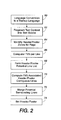
- FIGURE 2 comprises a flowchart of a method for identifying the header/footer portion of the document
- FIGURES 3A and 3B diagrammatically show how textual elements can be identified by spatial position on a page
- FIGURES 4A, 4B and 4C illustrate how contiguous and surrounding text elements can be merged into a header/footer zone
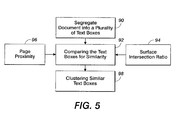
- FIGURE 5 is a flow chart of alternative process for detecting pagination constructs.
- the subject embodiments have an overall purpose of detecting a zone at the top of a page of a document and at the bottom of a page of a document, which corresponds to a pagination construct such as a header or footer zone. Efficient characterization of such zones as shown herein, use the following heuristic: In a header or footer zone, the textual variety is much lower than in the body page of the document.
- the illustrated embodiments for header/footer detection may comprise at least four steps:
- FIGURE 1 shows an assembly wherein an unstructured document 10, e.g., a technical manual or the like in a PDF format, is converted by conversion processor 12 into an alternative language format such as XML, and when in such format can be processed for various purposes as a legacy document. It has been observed that the inclusion of headers and footers in such converted formatted can be responsible for the introduction of undesired noise when accessing the legacy document so that the identification of the header/footer as a preprocessing step can be particularly beneficial to enhancing the efficiency in accessing the document.
- an unstructured document 10 e.g., a technical manual or the like in a PDF format
- Text fragmenter 14 breaks the converted document into an order sequence of text fragments comprised of pages and text blocks 16 , and which are typically loaded as a list of text strings from a text from an XML file produced from the document using an off-the-shelf converter.
- a paper document is suitably scanned using an optical scanner and processed by optical character recognition (OCR).
- OCR optical character recognition
- For a text document each line suitably becomes a fragment ordered line-by-line.
- Fragmenter 14 also affects a position allocation of the document text content so that the page segmentation and vertical positions per page of the text content are preserved.
- plain text format the vertical position used is a line number.
- the document can be converted into plain text format, or can be converted into a format where information about the vertical position exists.
- a PDF2XML converter can provide page segmentation and positional information of the blocks of texts.
- a document page having the text elements shown therein can be converted to relative positions within the document by identifying a text block spatial position on the page corresponding to the y axis (FIGURE 3B).
- the positional information (line number or y coordinate) used is hereinafter identified as the position of the text content candidate.
- Positional application thus comprises characterizing each element (line or block of text) on the page of the document by its vertical position as either a line for plain texts or a y coordinate provided by converters for proprietary formats. It is assumed that a header will likely occur in the top half of a page and the footer will occur in the bottom half of the page.
- steps 60, 62 and 64 are identified as steps 60, 62 and 64 .
- textual content is preferably normalized. All digits [0-9] are replaced by a unique character (D).
- D a unique character
- a processor 18 effects the textual variability computation.
- the different positions of all the textual blocks in a document are listed. For each position a computation is performed for associating the number of text blocks occurring at the position and the total number of different types of text blocks occurring at the position taking into account the whole document, e.g. all the pages of the document.
- Table 1 below shows the text blocks occurring at a position 108 for all pages and their frequencies in the document (e.g., a technical manual).
- TABLE 1 Texts at position 108 Frequency Installing and Configuring 10/100Base-TX/9000 25 Configuring Network Connectivity Using SAM 05 10/100Base-TX Interface Card Statistics 09 Hardware Regulatory Statements 03 100Base-TX Resources 09 Hardware Reference Information 09 Troubleshooting 10/100Base-TX/9000
- Table 1 shows seven different types of text blocks but the total number of all text blocks within all seven types is 93 text blocks. Applying Equation 1 to the text content of Table 1 would thereby result in a textual variability score at position 108 of 7 ⁇ 93 or 0.075.
- Table 2 below shows a TVS score for six different positions in a page of the document. TABLE 2 Position #Text Blocks #Different Text Blocks Textual Variability 96 5 3 0.6 108 93 7 0.08 122 89 32 0.35 143 1 1 1 155 17 11 0.67 156 47 45 0.96
- the top element in the Table comprises the relative line position (e.g., 96, 108, etc.), the second line comprises the total number of text blocks at the line position (e.g., 5, 93, etc.), the third line number comprises the total number of text blocks at the position (e.g., 3, 7, etc.), and the last item for each set comprises the computed textual variability score (e.g., 0.6, 0.08, etc.)
- the textual variability of the element at position 108 has a very low score, while the textual variability of the element at position 156 has a very high score.
- the variability score for each content element (a content element is composed of a position number in the text blocks occurring at this position in the document) is computed.
- An effort is made to identify whether the document has header zones and footer zones.
- the method comprises identifying a first textual content element whose TVS is predetermined to likely comprise a part of the header/footer zone.
- the zone is extended from this textual element by merging all contiguous content elements in order to find the largest possible header/footer zone.
- the identification number of potential header/footer textual content element is accomplished by preselecting a given TVS threshold which has been empirically determined to give a likely identification of a header/footer content element.
- the threshold ⁇ was set at 0.5 so that all content elements with a TVS lower than 0.5 are identified as potential header/footer textual content elements.
- the threshold can be selectively set at different values based upon empirical results for the type of document being converted for legacy storage and access.
- the top content element in the header zone and the bottom contact element in the footer zone In order to define the top content element in the header zone and the bottom contact element in the footer zone, one starts from the top of the page for the header and at the bottom of the page for the footer.
- the first contact element starting from the top of the page or from the bottom of the page having a TVS indicative of a header/footer would be the initial textual content element of either the header/footer.
- the initial selected element must occur in the upper half of the page, and for the footer detection, the initial contact element must occur in the lower half of the page. If no element is identified that has the required TVS, then the subject method considers that the document has no header or no footer. In the example of Table 3, the element 108 is identified as the initial contact element and the element 684 as the initial footer content element.
- Expansion of the header/footer zone beyond the initial contact elements comprises merging of contiguous elements to the initial content elements. More particularly, any contiguous textual content elements to the initial contact element having a TVS lower than ⁇ also belong in the header/footer zone.
- a list with all the contiguous potential textual contact candidates is built.
- the augmented list comprises a new larger header/footer zone.
- a new TVS for the augmented list is computed 70 by applying the formula of Equation 1 for the entire number of text blocks in the list as a divisor for the total number of different types of text blocks in the list. (By construction, the new augmented list also has a variability score lower than 8).
- the element 122 is added to the initial element 108.
- the score of the header list is 0.23.
- the footer list is only composed of the element 684, since no adjacent element has a score below ⁇ .
- the merging process is especially useful in order to smooth the textual contacts elements position.
- converted documents for example, a PDF document converted in XML
- a small variation in the position of elements per page can occur.
- the position of the first paragraph in the body page can start at position 61 for some pages, 62 for other pages or 63.
- the subject method does not require a specific (pre)processing for these elements.
- the body page of textual contact elements thus corresponds to content elements contiguous to the header/footer zone whose line TVS is higher than 0.
- surrounding line elements to the header/footer zone are further investigated for identifying previous and following elements whose variability is higher than ⁇ , but which line elements should also be considered nevertheless as components of the headers/footers.
- the merging 72 of potential surrounding lines in processor 24 is affected by determination that the preceding and following elements are appropriate for insertion into the header/footer zone if a lines insertion decreases the TVS of the new augmented list. More particularly, and with references to FIGURES 4A, 4B and 4C, it can be seen that the header zone augmented list is composed of line contact elements 108, 122 which have been merged as a result of their individual TVS.
- This surrounding element 96 is then next tested to determine if it can be inserted into the header zone and if the new TVS of the augmented list plus element 96 would be lower. Accordingly, the textual content, i.e., text blocks and number of different kinds of text blocks, is added into the list for computation of a new TVS. In this case element 96 does in fact lower the overall TVS of the augmented list plus surrounding line 96 so that the line content relative to 96 is in fact added to the header.
- the content of line element 143 is similarly tested, but the score of the augmented list plus surrounding line element 143 is 0.24 which is higher than the old score (0.23).
- the content element of the text occurring at the position 143 should not be added to the header zone and is not added to the augmented list.
- Line element 143 is not inserted and the merging of contiguous lines to identify the header zone then stops. The same procedure is effected for the initial contact elements, plus merge lines, plus surrounding lines for the footer zone.
- the steps for effecting merger of surrounding elements is to integrate textual content elements whose individual line TVS is higherthan the threshold, but which can still be actual header/footer content elements.
- Another aspect of the subject embodiments considers whether the identified list of header elements may not start from the top of the page. For example, with reference to FIGURE 4C, if line element 96 failed to satisfy the preceding process steps for insertion into the header zone. More generally, some line elements which surround the augmented list as defined above, and which have a relatively high textual variability ( ⁇ >0.5) should also be considered for insertion within the header zone. These are usually elements with a very low frequency (5 for element 96, 1 for element 143), which are due to some very small variation of their position. For example, a line element which occurs only once in the document will have a TVS equal to 1.
- an alarm mechanism may be triggered when all of the line elements between the identified list of header elements and the top of the page (or bottom for footer zone) are not merged into the header/footer.
- the list of such pages where such line element noninsertion occurs is generated for possible post-correction or post-validation.
- all of the line elements occurring between the beginning of the page and the header list are all portions of the header zone, and the alarm mechanism is an easy way to detect potential problems. As a consequence of such an alarm mechanism, the highest position of the header zone is returned and the lowest position of the footer zone is returned.
- the couple 122, 648 is returned so that all line elements per page whose position is lower or equal than 122 (i.e. extending toward the top of the page) are recognized as elements of the header zone, while all elements whose line position is higher or equal than 648 (i.e., extending toward the bottom of the page) are recognized as elements within the footer zone.
- the textual elements i.e., pagination constructs
- the textual elements so introduced can be characterized by the fact that their number of occurrences in the paginated document directly depends on the size of the pages. At the extreme, each construct would occur only once if the document were to fit on a single large enough page.
- Such constructs typically include the header/footer, but are not restricted to merely these types. For instance, it may also include the textual header of a table spanning over multiple pages when the header repeats itself on those pages. Such tables are common portions of technical manuals.
- the subject embodiment relies on the clustering of the pagination constructs within an appropriate distant measure. It is therefore valuable in legacy document conversion since the pagination elements constitute noise for further processing.
- the document is segregated 90 into a plurality of text-boxes.
- the model of the document, where the document is segmented into pages is comprised of pages having a certain size and containing textual elements with some coordinates(x, y, width, height) on the page and some textual content. It is a general model that most PDF2HML converters use.
- textual elements will be referred to as a "text-box”.
- the text-boxes are compared 92 for text-box similarity measure, taking values that take into account three features: first, their textual content, second, their positions in areas on the page, and third, their distance in terms of the number of pages they are on.
- the similarity measure 92 is comprised of a combination of these three measures.
- textual similarity is valued as 1 if the two texts are equal, or 0 otherwise.
- an edit distance coupled or not with some text normalization can be used.
- Text normalization permits in particular the detection of a page number as a pagination element, while the strict equality test fails since each page is a different number.
- geometric similarity may optionally comprise a page centering or text-box thickness. Page centering relates to the changing of the coordinate system of each page. The origin of the new coordinate system moves from the top left corner (typically) to the center of the box bounding all text-boxes on the page.
- the centering operation is useful in dealing with global translation of text-boxes between odd and even pages, which appears in dome documents, some other collections do not need it.
- Making the text-boxes border thicker by T pixels to prevent more displacements from one page to another is also useful in assessing geometric similarity where T is an empirically preselected value.
- the geometric similarity would then be defined 94 as the ratio of the surface of the intersection of two text-boxes by the surface of their union.
- the third measure for similarity comprises page proximity 96. It is assigned a value of 1 if the two text-boxes are on pages closer than P (a preselected number) of pages, 0 otherwise. This defines a window of page proximity of pages around each text-box out of which the similarity falls to 0.
- Similar text-boxes can then be clustered 98 using a classical agglomerative single-link clustering algorithm.
- Data Clustering a review, ACM Computing Surveys, (CSUR) Volume 31, Issue 3 (September 1999), A. K. Jain, M. N. Murty, P. J. Flynn.
- the similarity spatial data is set to 0.5.
- Clusters grouping elements having a similarity above 8 are those containing pagination elements. Other clusters are ignored, including those with a single text-box inside.
Landscapes
- Engineering & Computer Science (AREA)
- Theoretical Computer Science (AREA)
- Health & Medical Sciences (AREA)
- Artificial Intelligence (AREA)
- Audiology, Speech & Language Pathology (AREA)
- Computational Linguistics (AREA)
- General Health & Medical Sciences (AREA)
- Physics & Mathematics (AREA)
- General Engineering & Computer Science (AREA)
- General Physics & Mathematics (AREA)
- Document Processing Apparatus (AREA)
- Information Retrieval, Db Structures And Fs Structures Therefor (AREA)
Abstract
Description
- The following relates to the information storage and processing arts. It finds application in conjunction with electronic document format conversion and in particular with cataloging of legacy documents in a marked-up format such as extensible markup language (XML), standard generalized markup language (SGML), hypertext markup language (HTML), or the like, and will be described with particular reference thereto. However, it is to be appreciated that the following is amenable to other like applications.
- Legacy document conversion relates to converting unstructured documents existing in formats such as Adobe portable document format (PDF), various text formats, various word processing formats, and the like into structured documents employing a markup language such as XML, SGML, HTML, and the like. In structured documents, content is organized into delineated sections such as document pages with suitable headers/footers and so forth. Alternatively, a textual header of a table spanning our multiple pages comprises a pagination construct when this header repeats itself on those pages. Such organization typically is implemented using markup tags. In some structured document formats such as XML, a document type definition (DTD) or similar document portion provides overall information about the document, such as an identification of the sections, and facilitates complex document structures such as nested sections.
- There is thus interest in converting unstructured documents to a structured format when such structure can facilitate storage and access of this document as a "legacy document". The particular motivations for converting documents are diverse, typically including intent to reuse or repurpose parts of the documents, desire for document uniformity across a database of information store, facilitating document searches, and so forth. Technical manuals, user manuals and other proprietary reference documents are common candidates for such legacy conversions.
- A particular problematic issue that arises during the conversion process is the rebuilding or preserving of structural information. The output structure can be very different from the input structure. For example, page segmentation is often discarded in a logical representation, where logical units are elements such as chapters and sections (pages are usually considered as a physical element and do not appear). Content elements related to this page segmentation, typically headers and footers, and present in the input document have then to be processed cautiously. In prior art converters (PDF2[XML/HTML]), headers and footers are not differentiated from the body elements and can disrupt the flow of the main text. This not only generates an incorrect logical document, but can also introduce noise for further processing (natural language processing, for instance). Accordingly, the existing methods and apparatuses for identifying and extracting pagination constructs in the conversion of structured legacy documents is neither efficient nor robust. Of particular note is Xiaofan Lin, Header and Footer Extraction by Page-Association, Hewlett-Packard Technical Report, www.hpl.hp.com/techrepports/2002/HPL-2002-129.pdf, 2002. This reference relies upon comparison with neighboring pages for identifying a particular relationship indicative of commonly configured headers/footers. Such neighboring page comparison techniques can fail when the header/footer occurs very few times in the document.
- For purposes of this application, "header" is intended to comprise matter (textual content) that is printed at the top of every page of the document typically positioned in the top margin of the page, for example, a title, page number, file name, revision dates, the author's name, or any other information about the document that is repeated throughout the document or a portion of the document. Likewise, a "footer" is similar information content positioned in the bottom margin of the page. As used in the subject application, "header/footer" should be construed to include either a header or footer individually or in combination.
- The following provides improved apparatuses and methods that overcome the above-mentioned disadvantages and others to provide a light and robust method and system for detecting headers and footers of a document.
- A method and apparatus is provided for detecting pagination constructs, i.e., textual elements of a document that were introduced by the pagination, which is particularly useful for more efficiently converting an unstructured document into a structured document during legacy document conversion. Pagination constructs can be characterized by the fact that their number of occurrences in the paginated document directly depends on the size of the pages in the document. At the extreme, each of the constructs would occur only once if the document were to fit on a single large enough page. Such constructs typically include the page headers and footers, but are not restricted to merely those types. For instance, it also includes a textual header of a table spanning multiple pages. When a document is segmented to pages, a model of the document can be assumed wherein the pages have a certain size to contain textual elements (text-boxes) with some coordinates (x, y, width, height) on the page and some textual content. By measuring text-box-to-text-box similarity as defined by such features as textual content, text-box position and area on a page, and the distance within the document in terms of number of pages the text-boxes are on, pagination constructs can be identified when the similarity is determined to be above a certain threshold.
- A more particular method and apparatus is described for detecting a header/footer. In header and footer zones, it is a fact that the text content variability is much lower than in the main body of text content in a document page. The subject method and apparatus rely upon this factual basis to identify the header and footer zones in the document. Such methods and apparatus are especially useful as a preprocessing step in order to delete the noise introduced by headers and footers, and to better facilitate content-based processing, such as legacy document conversation. In one embodiment for identifying the header/footer of a document, a relative position of textual content of the document is identified. A textual variability of the content of the identified relative position is computed. The textual variability is compared with a predetermined textual variability known as indicative of a header/footer content. The header/footer of the document is then set by associating contiguous contents having the predetermined textual variability. The identifying of the relative position typically comprises allocating a relative vertical position, such as line numbering per page of the document. The textual variability is computed by fragmenting the text content into a number of text blocks and differentiating the fragmented text blocks into predetermined different kinds of text blocks. The ratio comprising the percentage of different kinds of text blocks within the total number of text blocks for a particular portion of the document is used as an indicator of the candidacy of that portion as a header/footer. A particular value of the relationship has been empirically determined to be a reliable comparative value.
- In accordance with another aspect of an illustrated embodiment, surrounding content elements to the header/footer lines identified as above are merged into the header/footer line list even where a textual variability computation indicates that such lines by themselves are not likely header/footer candidates, when the number of text blocks and the number of different kind of text blocks in the surrounding lines is added to the pre-identified header/footer zone line list and there is no increase in the value of the textual variability for the overall list. Such a computation would generally indicate that the kind of text blocks in the surrounding lines are already within the header/footer line list so that they are likely portions of the header/footer zone.
- In accordance with another aspect of the disclosed embodiments, an apparatus is disclosed for identifying a pagination construct such as a header/footer in a document. A text fragmenter segregates the document into pages and differential text blocks on the pages. The text blocks are identifiable with respect to relative zones within the page, e.g., the top half or bottom half of the page. A processor computes a textual variability score (TVS) for the text blocks. The TVS comprises of the relationship between a total number of text blocks and a number of different kind of text blocks within a selected zone of the page. A selector selects a potential header/footer text contents comprising a compilation of text blocks having a TVS indicative of header/footer content whereby a selected text content is set as the header/footer. The selector first associates a header/footer content by page line computation of TVS for the textual content therein and secondly associates contiguous line content all having a preselected TVS indicative of header/footer context.
In one embodiment of the method of claim 7 the mathematically relating comprises dividing the number of different text blocks by the number of text blocks.
In a further embodiment the predetermined textual variability indicative of a header/footer comprises a textual variability score (TVS) of about 0.5; and wherein the associating comprises merging contents having a TVS lower than the 0.5 to form a potential header/footer zone.
In a further embodiment the associating comprises identifying a first content element occurring in a header/footer zone having the predetermined textual variability indicative of a header/footer, and merging contiguous content elements also having the predetermined textual variability therewith for the identifying of the header/footer.
In one embodiment of the method of claim 8 the computing the TVS comprises fragmenting the document content into a number of text blocks and differentiating the text blocks into predetermined different kinds of text blocks, and mathematically relating the number of text blocks to a number of different kinds of text blocks.
In a further embodiment the second TVS is computed with a compiled number of text blocks and a compiled number of different kinds of text blocks for all the lines in the header/footer augmented line list.
In a further embodiment the identifying of the header/footer for a single page is effected with reference to textual content for an entire document including the single page.
In a further embodiment an alarm is made for textual content failing to satisfy the merging steps and content positioned higher/lower than the set header/footer zone, for adding the failing content to the header/footer zone.
In one embodiment of the apparatus as defined in claim 9 the relationship comprises a relatively small percentage of the number of different kinds of text blocks within the total number of text blocks within the selected zone.
In a further embodiment the text fragments segregates the document into the kinds of text blocks, predetermined as differentiable text blocks in accordance with a converted legacy document.
In a further embodiment the selector first associates header/footer content by page line computation of TVS of textual content therein, and second associates contiguous line content all having a preselected TVS indicative of header/footer context.
In a further embodiment the selector further merges surrounding line text content with the associated contiguous line content as header/footer content when a compiled TVS for the merged surrounding and contiguous line content has a lower TVS than a computed TVS for the contiguous line content.
In one embodiment of the method ofclaim 10 the comparing comprises assessing the text-boxes for similarity of textual content, positions and areas on a page, and distance within the document comprising a number of pages including a particular one of the text-boxes.
In a further embodiment the assessing for positions and areas on the page includes assessing for geometric similarity comprising a ratio of a surface of intersection of respective text-boxes including a surface of a union of the text-boxes.
In a further embodiment the clustering comprises an agglomerative single-link clustering algorithm, and wherein the similarity value has a threshold value of about 0.5. - Various alternatives with the above-mentioned and further features and advantages will be apparent to those skilled in the art from the specific apparatus and its operation or methods described in the examples below, and the claims.
- FIGURE 1 diagrammatically shows an apparatus for identifying a header/footer portion of a document;
- FIGURE 2 comprises a flowchart of a method for identifying the header/footer portion of the document;
- FIGURES 3A and 3B diagrammatically show how textual elements can be identified by spatial position on a page;
- FIGURES 4A, 4B and 4C illustrate how contiguous and surrounding text elements can be merged into a header/footer zone; and
- FIGURE 5 is a flow chart of alternative process for detecting pagination constructs.
- The subject embodiments have an overall purpose of detecting a zone at the top of a page of a document and at the bottom of a page of a document, which corresponds to a pagination construct such as a header or footer zone. Efficient characterization of such zones as shown herein, use the following heuristic: In a header or footer zone, the textual variety is much lower than in the body page of the document. The illustrated embodiments for header/footer detection may comprise at least four steps:
- 1. position allocation,
- 2. text normalization,
- 3. textual variability computation, and
- 4. header/footer zone detection.
- These steps, and others, will be described in detail with reference to the drawings and wherein FIGURE 1 shows an assembly wherein an
unstructured document 10, e.g., a technical manual or the like in a PDF format, is converted byconversion processor 12 into an alternative language format such as XML, and when in such format can be processed for various purposes as a legacy document. It has been observed that the inclusion of headers and footers in such converted formatted can be responsible for the introduction of undesired noise when accessing the legacy document so that the identification of the header/footer as a preprocessing step can be particularly beneficial to enhancing the efficiency in accessing the document. -
Text fragmenter 14 breaks the converted document into an order sequence of text fragments comprised of pages and text blocks 16, and which are typically loaded as a list of text strings from a text from an XML file produced from the document using an off-the-shelf converter. A paper document is suitably scanned using an optical scanner and processed by optical character recognition (OCR). For a text document, each line suitably becomes a fragment ordered line-by-line. For an XML or HML document, each PCDATA suitably becomes a text fragment.Fragmenter 14 also affects a position allocation of the document text content so that the page segmentation and vertical positions per page of the text content are preserved. For plain text format, the vertical position used is a line number. For proprietary format, the document can be converted into plain text format, or can be converted into a format where information about the vertical position exists. For example, a PDF2XML converter can provide page segmentation and positional information of the blocks of texts. - With reference to FIGURE 3A, a document page having the text elements shown therein can be converted to relative positions within the document by identifying a text block spatial position on the page corresponding to the y axis (FIGURE 3B). The positional information (line number or y coordinate) used is hereinafter identified as the position of the text content candidate. Positional application thus comprises characterizing each element (line or block of text) on the page of the document by its vertical position as either a line for plain texts or a y coordinate provided by converters for proprietary formats. It is assumed that a header will likely occur in the top half of a page and the footer will occur in the bottom half of the page.
- With reference to FIGURE 2, the steps for such conversion fragmenting and header/footer zone identification are identified as
steps - Once the text blocks with their positions have been identified, textual content is preferably normalized. All digits [0-9] are replaced by a unique character (D). Such normalization is preferably the only normalization applied and is due to the frequent presence of page/chapter/section numbers and date in headers/footers, which introduces a textual variability which is not relevant for the subject discussions.
- A
processor 18 effects the textual variability computation. The different positions of all the textual blocks in a document are listed. For each position a computation is performed for associating the number of text blocks occurring at the position and the total number of different types of text blocks occurring at the position taking into account the whole document, e.g. all the pages of the document. A textual variability score (TVS) for each position is computed as follows:
- Table 1 below shows the text blocks occurring at a
position 108 for all pages and their frequencies in the document (e.g., a technical manual).TABLE 1 Texts at position 108 FrequencyInstalling and Configuring 10/100Base-TX/9000 25Configuring Network Connectivity Using SAM 05 10/100Base-TX Interface Card Statistics 09 Hardware Regulatory Statements 03 100Base-TX Resources 09 Hardware Reference Information 09 Troubleshooting 10/100Base-TX/9000 - Table 1 shows seven different types of text blocks but the total number of all text blocks within all seven types is 93 text blocks. Applying
Equation 1 to the text content of Table 1 would thereby result in a textual variability score atposition 108 of 7 ÷93 or 0.075. - Table 2 below shows a TVS score for six different positions in a page of the document.
TABLE 2 Position #Text Blocks #Different Text Blocks Textual Variability 96 5 3 0.6 108 93 7 0.08 122 89 32 0.35 143 1 1 1 155 17 11 0.67 156 47 45 0.96 - The top element in the Table comprises the relative line position (e.g., 96, 108, etc.), the second line comprises the total number of text blocks at the line position (e.g., 5, 93, etc.), the third line number comprises the total number of text blocks at the position (e.g., 3, 7, etc.), and the last item for each set comprises the computed textual variability score (e.g., 0.6, 0.08, etc.)
- As Table 2 shows, the textual variability of the element at
position 108 has a very low score, while the textual variability of the element at position 156 has a very high score. Theelement 108 has 93 occurrences of text blocks (which means that 93 blocks of text were positioned at the location y=108). Among these 93 occurrences, only 7 were different kinds of text blocks. After the TVS for all of the lines of the document have been computed, they are stored in adatabase - The identification number of potential header/footer textual content element is accomplished by preselecting a given TVS threshold which has been empirically determined to give a likely identification of a header/footer content element. In the present embodiment the threshold θ was set at 0.5 so that all content elements with a TVS lower than 0.5 are identified as potential header/footer textual content elements. The threshold can be selectively set at different values based upon empirical results for the type of document being converted for legacy storage and access.
- Continuing with the example of the selective first top element and first bottom elements identified in Table 1, Table 3 below indicates which elements are potential header/footer textual content candidates:
TABLE 3 Position #Text Blocks #Different Text Blocks Textual Variability Potential Candidate (θ=0.5) 96 5 3 0.6 No 108 93 7 0.08 Yes 122 89 32 0.35 Yes 143 1 1 1 No 155 17 11 0.67 No 156 47 45 0.96 No ... ... ... ... ... ... ... ... ... ... ... ... 652 5 1 1 No 655 1 1 1 No 684 204 7 0.03 Yes - In order to define the top content element in the header zone and the bottom contact element in the footer zone, one starts from the top of the page for the header and at the bottom of the page for the footer. The first contact element starting from the top of the page or from the bottom of the page having a TVS indicative of a header/footer would be the initial textual content element of either the header/footer. For the header detection, the initial selected element must occur in the upper half of the page, and for the footer detection, the initial contact element must occur in the lower half of the page. If no element is identified that has the required TVS, then the subject method considers that the document has no header or no footer. In the example of Table 3, the
element 108 is identified as the initial contact element and the element 684 as the initial footer content element. - Expansion of the header/footer zone beyond the initial contact elements comprises merging of contiguous elements to the initial content elements. More particularly, any contiguous textual content elements to the initial contact element having a TVS lower than θ also belong in the header/footer zone. Starting with the initial contact elements in the header and footer zones, a list with all the contiguous potential textual contact candidates is built. The augmented list comprises a new larger header/footer zone. A new TVS for the augmented list is computed 70 by applying the formula of
Equation 1 for the entire number of text blocks in the list as a divisor for the total number of different types of text blocks in the list. (By construction, the new augmented list also has a variability score lower than 8). Continuing with the Table example, theelement 122 is added to theinitial element 108. The score of the header list is 0.23. The footer list is only composed of the element 684, since no adjacent element has a score below θ. - The merging process is especially useful in order to smooth the textual contacts elements position. In converted documents (for example, a PDF document converted in XML), a small variation in the position of elements per page can occur. For example, the position of the first paragraph in the body page can start at position 61 for some pages, 62 for other pages or 63. The subject method does not require a specific (pre)processing for these elements. The body page of textual contact elements thus corresponds to content elements contiguous to the header/footer zone whose line TVS is higher than 0.
- It is another feature of the subject embodiments that surrounding line elements to the header/footer zone are further investigated for identifying previous and following elements whose variability is higher than θ, but which line elements should also be considered nevertheless as components of the headers/footers. The merging 72 of potential surrounding lines in
processor 24 is affected by determination that the preceding and following elements are appropriate for insertion into the header/footer zone if a lines insertion decreases the TVS of the new augmented list. More particularly, and with references to FIGURES 4A, 4B and 4C, it can be seen that the header zone augmented list is composed ofline contact elements element 96 is then next tested to determine if it can be inserted into the header zone and if the new TVS of the augmented list pluselement 96 would be lower. Accordingly, the textual content, i.e., text blocks and number of different kinds of text blocks, is added into the list for computation of a new TVS. In thiscase element 96 does in fact lower the overall TVS of the augmented list plus surroundingline 96 so that the line content relative to 96 is in fact added to the header. The content of line element 143 is similarly tested, but the score of the augmented list plus surrounding line element 143 is 0.24 which is higher than the old score (0.23). Accordingly, the content element of the text occurring at the position 143 should not be added to the header zone and is not added to the augmented list. Line element 143 is not inserted and the merging of contiguous lines to identify the header zone then stops. The same procedure is effected for the initial contact elements, plus merge lines, plus surrounding lines for the footer zone. - The steps for effecting merger of surrounding elements is to integrate textual content elements whose individual line TVS is higherthan the threshold, but which can still be actual header/footer content elements.
- Another aspect of the subject embodiments considers whether the identified list of header elements may not start from the top of the page. For example, with reference to FIGURE 4C, if
line element 96 failed to satisfy the preceding process steps for insertion into the header zone. More generally, some line elements which surround the augmented list as defined above, and which have a relatively high textual variability (θ>0.5) should also be considered for insertion within the header zone. These are usually elements with a very low frequency (5 forelement couple 122, 648 is returned so that all line elements per page whose position is lower or equal than 122 (i.e. extending toward the top of the page) are recognized as elements of the header zone, while all elements whose line position is higher or equal than 648 (i.e., extending toward the bottom of the page) are recognized as elements within the footer zone. - Alternatively, in order to reduce the processing time, only a selected number of the first n top elements, and a selected number of the first n bottom elements can be selected for processing in accordance with the steps identified above. As a practical matter, considering all elements of a document should not deteriorate the overall method performance, which should be very fast, no more than a few seconds for a 1,500 page document.
- With reference to FIGURE 5, an approach for detecting pagination constructs in a document introduced as a result of the pagination resulting from the legacy document conversion is illustrated. The textual elements (i.e., pagination constructs) so introduced can be characterized by the fact that their number of occurrences in the paginated document directly depends on the size of the pages. At the extreme, each construct would occur only once if the document were to fit on a single large enough page. Such constructs typically include the header/footer, but are not restricted to merely these types. For instance, it may also include the textual header of a table spanning over multiple pages when the header repeats itself on those pages. Such tables are common portions of technical manuals. The subject embodiment relies on the clustering of the pagination constructs within an appropriate distant measure. It is therefore valuable in legacy document conversion since the pagination elements constitute noise for further processing.
- For purposes of this embodiment, it is considered that the document is segregated 90 into a plurality of text-boxes. It is assumed that the model of the document, where the document is segmented into pages is comprised of pages having a certain size and containing textual elements with some coordinates(x, y, width, height) on the page and some textual content. It is a general model that most PDF2HML converters use. For purposes herein, such textual elements will be referred to as a "text-box". The text-boxes are compared 92 for text-box similarity measure, taking values that take into account three features: first, their textual content, second, their positions in areas on the page, and third, their distance in terms of the number of pages they are on. More particularly, the
similarity measure 92 is comprised of a combination of these three measures. First, textual similarity, is valued as 1 if the two texts are equal, or 0 otherwise. Alternatively, an edit distance, coupled or not with some text normalization can be used. Text normalization permits in particular the detection of a page number as a pagination element, while the strict equality test fails since each page is a different number. Second, geometric similarity may optionally comprise a page centering or text-box thickness. Page centering relates to the changing of the coordinate system of each page. The origin of the new coordinate system moves from the top left corner (typically) to the center of the box bounding all text-boxes on the page. The centering operation is useful in dealing with global translation of text-boxes between odd and even pages, which appears in dome documents, some other collections do not need it. Making the text-boxes border thicker by T pixels to prevent more displacements from one page to another is also useful in assessing geometric similarity where T is an empirically preselected value. The geometric similarity would then be defined 94 as the ratio of the surface of the intersection of two text-boxes by the surface of their union. The third measure for similarity comprisespage proximity 96. It is assigned a value of 1 if the two text-boxes are on pages closer than P (a preselected number) of pages, 0 otherwise. This defines a window of page proximity of pages around each text-box out of which the similarity falls to 0. - Similar text-boxes can then be clustered 98 using a classical agglomerative single-link clustering algorithm. Data Clustering: a review, ACM Computing Surveys, (CSUR) Volume 31, Issue 3 (September 1999), A. K. Jain, M. N. Murty, P. J. Flynn. The similarity spatial data is set to 0.5. Clusters grouping elements having a similarity above 8 are those containing pagination elements. Other clusters are ignored, including those with a single text-box inside.
Claims (10)
- A method for identifying a header/footer of a document for facilitating structural legacy document conversion of the document, the method comprising:identifying a relative position of content of the document;computing a textual variability of the content;comparing the computed textual variability with a predetermined textual variability indicative of a header/footer; and;associating contiguous contents having the predetermined textual variability wherein the associated contents are construed to comprise the header/footer.
- The method of claim 1 wherein the identifying comprises allocating a relative vertical position.
- The method of claim 2 wherein the allocating comprises page segmentation and line numbering per page of the document and wherein the relative position of the content comprises an allocated line number.
- The method of claim 3 wherein the identifying further includes normalizing the content.
- The method of claim 1 wherein the computing the textual variability of the content includes fragmenting this content into a number of text blocks and differentiating the text blocks into predetermined different kinds of text blocks.
- The method of claim 5 wherein the differentiating comprises recognizing the different kinds of text blocks included in the converted legacy document.
- The method of claim 5 wherein the computing further includes counting the number of text blocks of the relative position and counting the number of different kinds of text blocks at the relative position, and wherein the textual variability of the content at this relative position comprises mathematically relating the number of different kinds of text blocks to the number of text blocks for computing a textual variability score (TVS).
- A method for identifying a header/footer in a page of document for improved efficiencies in conversion of the document from a first format to a second structured format in legacy document conversion, the method comprising:detecting zones in the page indicative of document content comprising potential header/footer content, including:(i) computing a first textual variability score (TVS) for textual content at a selected vertical position of the page;(ii) identifying the textual content as header/footer content when the TVS is representative of the header/footer;(iii) merging the textual content of contiguous line positions when corresponding TVS indicate contiguous header/footer content to form a header/footer augmented line list;(iv) computing a second TVS for the header/footer augmented line list;(v) merging surrounding content elements into the header/footer augmented line list when an insertion of the surrounding content elements into the line list results in a third TVS computed to be less than the second TVS; and(vi) setting the header/footer zones of the page when no more surrounding content elements can be merged in accordance with the (v) merging.
- An apparatus for identifying a header/footer in a document, the apparatus comprising:a text fragmenter for segregating the document into pages and differentiable text blocks on the pages, and wherein the text blocks are identifiable with respect to a relative zone within the page;a processor for computing a textual variability score (TVS) for the text blocks, and wherein the TVS comprises a relationship between a total number of text blocks and a number of different kinds of text blocks within a selected zone of the page; and,a selector for selecting potential header/footer text content comprising a compilation of text blocks having a TVS indicative of header/footer content whereby the selected text content is set as the header/footer.
- A method for identifying a pagination construct of a document during structural legacy document conversion of the document, the method comprising;segmenting the document into a plurality of pages including text-boxes having spatial coordinate definition of the text-boxes;comparing the text-boxes for similarity and page proximity; and,clustering the text-boxes satisfying a predetermined similarity value, wherein the clustered text-boxes are deemed to comprise pagination constructs.
Applications Claiming Priority (1)
| Application Number | Priority Date | Filing Date | Title |
|---|---|---|---|
| US11/032,817 US7937653B2 (en) | 2005-01-10 | 2005-01-10 | Method and apparatus for detecting pagination constructs including a header and a footer in legacy documents |
Publications (2)
| Publication Number | Publication Date |
|---|---|
| EP1679613A2 true EP1679613A2 (en) | 2006-07-12 |
| EP1679613A3 EP1679613A3 (en) | 2009-10-14 |
Family
ID=36218159
Family Applications (1)
| Application Number | Title | Priority Date | Filing Date |
|---|---|---|---|
| EP20060100200 Ceased EP1679613A3 (en) | 2005-01-10 | 2006-01-10 | Method and apparatus for detecting pagination constructs including a header and a footer in legacy documents |
Country Status (3)
| Country | Link |
|---|---|
| US (2) | US7937653B2 (en) |
| EP (1) | EP1679613A3 (en) |
| JP (1) | JP4974529B2 (en) |
Families Citing this family (53)
| Publication number | Priority date | Publication date | Assignee | Title |
|---|---|---|---|---|
| US8645821B2 (en) | 2010-09-28 | 2014-02-04 | Xerox Corporation | System and method for page frame detection |
| US7937653B2 (en) | 2005-01-10 | 2011-05-03 | Xerox Corporation | Method and apparatus for detecting pagination constructs including a header and a footer in legacy documents |
| US9110868B2 (en) * | 2005-01-10 | 2015-08-18 | Xerox Corporation | System and method for logical structuring of documents based on trailing and leading pages |
| US7676744B2 (en) * | 2005-08-19 | 2010-03-09 | Vistaprint Technologies Limited | Automated markup language layout |
| US7584424B2 (en) * | 2005-08-19 | 2009-09-01 | Vista Print Technologies Limited | Automated product layout |
| US7797622B2 (en) * | 2006-11-15 | 2010-09-14 | Xerox Corporation | Versatile page number detector |
| JP4436851B2 (en) * | 2007-05-22 | 2010-03-24 | シャープ株式会社 | Printer driver program and image forming apparatus |
| US8023740B2 (en) * | 2007-08-13 | 2011-09-20 | Xerox Corporation | Systems and methods for notes detection |
| US9224041B2 (en) * | 2007-10-25 | 2015-12-29 | Xerox Corporation | Table of contents extraction based on textual similarity and formal aspects |
| US9135249B2 (en) * | 2009-05-29 | 2015-09-15 | Xerox Corporation | Number sequences detection systems and methods |
| US8739030B2 (en) * | 2010-03-10 | 2014-05-27 | Salesforce.Com, Inc. | Providing a quote template in a multi-tenant database system environment |
| US8606789B2 (en) | 2010-07-02 | 2013-12-10 | Xerox Corporation | Method for layout based document zone querying |
| US9218322B2 (en) * | 2010-07-28 | 2015-12-22 | Hewlett-Packard Development Company, L.P. | Producing web page content |
| US8340425B2 (en) | 2010-08-10 | 2012-12-25 | Xerox Corporation | Optical character recognition with two-pass zoning |
| US9069767B1 (en) | 2010-12-28 | 2015-06-30 | Amazon Technologies, Inc. | Aligning content items to identify differences |
| US8798366B1 (en) * | 2010-12-28 | 2014-08-05 | Amazon Technologies, Inc. | Electronic book pagination |
| US9846688B1 (en) | 2010-12-28 | 2017-12-19 | Amazon Technologies, Inc. | Book version mapping |
| US9881009B1 (en) | 2011-03-15 | 2018-01-30 | Amazon Technologies, Inc. | Identifying book title sets |
| US8560937B2 (en) | 2011-06-07 | 2013-10-15 | Xerox Corporation | Generate-and-test method for column segmentation |
| US8645819B2 (en) | 2011-06-17 | 2014-02-04 | Xerox Corporation | Detection and extraction of elements constituting images in unstructured document files |
| US10540426B2 (en) * | 2011-07-11 | 2020-01-21 | Paper Software LLC | System and method for processing document |
| WO2013013335A1 (en) * | 2011-07-22 | 2013-01-31 | Hewlett-Packard Development Company, L.P. | Automated document composition using clusters |
| US8478046B2 (en) | 2011-11-03 | 2013-07-02 | Xerox Corporation | Signature mark detection |
| WO2013110290A1 (en) * | 2012-01-23 | 2013-08-01 | Microsoft Corporation | Pattern matching engine |
| US10803233B2 (en) | 2012-05-31 | 2020-10-13 | Conduent Business Services Llc | Method and system of extracting structured data from a document |
| US9524274B2 (en) | 2013-06-06 | 2016-12-20 | Xerox Corporation | Methods and systems for generation of document structures based on sequential constraints |
| US9008443B2 (en) | 2012-06-22 | 2015-04-14 | Xerox Corporation | System and method for identifying regular geometric structures in document pages |
| US8830487B2 (en) | 2012-07-09 | 2014-09-09 | Xerox Corporation | System and method for separating image and text in a document |
| US8812870B2 (en) | 2012-10-10 | 2014-08-19 | Xerox Corporation | Confidentiality preserving document analysis system and method |
| US9008425B2 (en) | 2013-01-29 | 2015-04-14 | Xerox Corporation | Detection of numbered captions |
| US20140230075A1 (en) | 2013-02-08 | 2014-08-14 | Xerox Corporation | Physical and electronic book reconciliation |
| US9672195B2 (en) | 2013-12-24 | 2017-06-06 | Xerox Corporation | Method and system for page construct detection based on sequential regularities |
| WO2015193905A1 (en) * | 2014-06-16 | 2015-12-23 | Hewlett-Packard Development Company, L.P. | Pagination point identification |
| RU2604668C2 (en) * | 2014-06-17 | 2016-12-10 | Общество с ограниченной ответственностью "Аби Девелопмент" | Rendering computer-generated document image |
| JP6063964B2 (en) * | 2015-01-15 | 2017-01-18 | 京セラドキュメントソリューションズ株式会社 | Image processing apparatus and image forming apparatus |
| US9530070B2 (en) | 2015-04-29 | 2016-12-27 | Procore Technologies, Inc. | Text parsing in complex graphical images |
| US10997362B2 (en) * | 2016-09-01 | 2021-05-04 | Wacom Co., Ltd. | Method and system for input areas in documents for handwriting devices |
| US11309075B2 (en) * | 2016-12-29 | 2022-04-19 | Cerner Innovation, Inc. | Generation of a transaction set |
| US10726198B2 (en) | 2017-10-17 | 2020-07-28 | Handycontract, LLC | Method, device, and system, for identifying data elements in data structures |
| US11475209B2 (en) | 2017-10-17 | 2022-10-18 | Handycontract Llc | Device, system, and method for extracting named entities from sectioned documents |
| US10650186B2 (en) | 2018-06-08 | 2020-05-12 | Handycontract, LLC | Device, system and method for displaying sectioned documents |
| US10534846B1 (en) * | 2018-10-17 | 2020-01-14 | Pricewaterhousecoopers Llp | Page stream segmentation |
| KR102345625B1 (en) * | 2019-02-01 | 2021-12-31 | 삼성전자주식회사 | Caption generation method and apparatus for performing the same |
| CN110543810A (en) * | 2019-06-28 | 2019-12-06 | 南京智录信息科技有限公司 | Technology for completely identifying header and footer of PDF (Portable document Format) file |
| JP7396032B2 (en) * | 2019-12-24 | 2023-12-12 | 京セラドキュメントソリューションズ株式会社 | Image forming device |
| US11803706B2 (en) * | 2020-01-24 | 2023-10-31 | Thomson Reuters Enterprise Centre Gmbh | Systems and methods for structure and header extraction |
| CN112036132B (en) * | 2020-09-01 | 2024-04-19 | 珠海豹趣科技有限公司 | Method and device for editing header and footer of document and electronic equipment |
| US11873485B2 (en) | 2021-01-26 | 2024-01-16 | California Institute Of Technology | Allosteric conditional guide RNAs for cell-selective regulation of CRISPR/Cas |
| CN113065154B (en) * | 2021-03-19 | 2023-12-29 | 深信服科技股份有限公司 | Document detection method, device, equipment and storage medium |
| US12380712B2 (en) * | 2022-08-18 | 2025-08-05 | Google Llc | Unified scene text detection and layout analysis |
| US12481819B2 (en) | 2022-11-09 | 2025-11-25 | Hcl Technologies Limited | System and method of transforming legacy documents to XML formats |
| CN117058704B (en) * | 2023-09-15 | 2024-01-05 | 之江实验室 | Teaching material content and structure extraction method and device based on visual and text characteristics |
| CN119025615A (en) * | 2024-08-22 | 2024-11-26 | 百望股份有限公司 | A method for identifying OFD document headers and footers and performing structural processing |
Family Cites Families (22)
| Publication number | Priority date | Publication date | Assignee | Title |
|---|---|---|---|---|
| US5434962A (en) | 1990-09-07 | 1995-07-18 | Fuji Xerox Co., Ltd. | Method and system for automatically generating logical structures of electronic documents |
| JPH06214983A (en) * | 1993-01-20 | 1994-08-05 | Kokusai Denshin Denwa Co Ltd <Kdd> | Method and device for converting document picture to logical structuring document |
| US5491628A (en) | 1993-12-10 | 1996-02-13 | Xerox Corporation | Method and apparatus for document transformation based on attribute grammars and attribute couplings |
| US6470306B1 (en) * | 1996-04-23 | 2002-10-22 | Logovista Corporation | Automated translation of annotated text based on the determination of locations for inserting annotation tokens and linked ending, end-of-sentence or language tokens |
| US6298357B1 (en) | 1997-06-03 | 2001-10-02 | Adobe Systems Incorporated | Structure extraction on electronic documents |
| JPH1166196A (en) * | 1997-08-15 | 1999-03-09 | Ricoh Co Ltd | Document image recognition device and computer-readable recording medium storing a program for causing a computer to function as the device |
| US6353840B2 (en) * | 1997-08-15 | 2002-03-05 | Ricoh Company, Ltd. | User-defined search template for extracting information from documents |
| IE980959A1 (en) | 1998-03-31 | 1999-10-20 | Datapage Ireland Ltd | Document Production |
| US6487566B1 (en) | 1998-10-05 | 2002-11-26 | International Business Machines Corporation | Transforming documents using pattern matching and a replacement language |
| US20020143818A1 (en) | 2001-03-30 | 2002-10-03 | Roberts Elizabeth A. | System for generating a structured document |
| JP2003150586A (en) | 2001-11-12 | 2003-05-23 | Ntt Docomo Inc | Document conversion system, document conversion method, and computer-readable recording medium storing document conversion program |
| US20040205568A1 (en) * | 2002-03-01 | 2004-10-14 | Breuel Thomas M. | Method and system for document image layout deconstruction and redisplay system |
| US6907431B2 (en) | 2002-05-03 | 2005-06-14 | Hewlett-Packard Development Company, L.P. | Method for determining a logical structure of a document |
| JP2004178010A (en) * | 2002-11-22 | 2004-06-24 | Toshiba Corp | Document processing apparatus, method and program |
| US7310773B2 (en) * | 2003-01-13 | 2007-12-18 | Hewlett-Packard Development Company, L.P. | Removal of extraneous text from electronic documents |
| US7165216B2 (en) * | 2004-01-14 | 2007-01-16 | Xerox Corporation | Systems and methods for converting legacy and proprietary documents into extended mark-up language format |
| US8495061B1 (en) * | 2004-09-29 | 2013-07-23 | Google Inc. | Automatic metadata identification |
| US7440967B2 (en) * | 2004-11-10 | 2008-10-21 | Xerox Corporation | System and method for transforming legacy documents into XML documents |
| US7693848B2 (en) | 2005-01-10 | 2010-04-06 | Xerox Corporation | Method and apparatus for structuring documents based on layout, content and collection |
| US7937653B2 (en) | 2005-01-10 | 2011-05-03 | Xerox Corporation | Method and apparatus for detecting pagination constructs including a header and a footer in legacy documents |
| US8706475B2 (en) * | 2005-01-10 | 2014-04-22 | Xerox Corporation | Method and apparatus for detecting a table of contents and reference determination |
| JP4789516B2 (en) * | 2005-06-14 | 2011-10-12 | キヤノン株式会社 | Document conversion apparatus, document conversion method, and storage medium |
-
2005
- 2005-01-10 US US11/032,817 patent/US7937653B2/en not_active Expired - Fee Related
-
2006
- 2006-01-05 JP JP2006000315A patent/JP4974529B2/en not_active Expired - Fee Related
- 2006-01-10 EP EP20060100200 patent/EP1679613A3/en not_active Ceased
-
2011
- 2011-02-23 US US13/032,996 patent/US9218326B2/en active Active
Non-Patent Citations (6)
| Title |
|---|
| ANONYMOUS: "Document Recognition and Retreval X (Proceedings of SPIE/IS&T): Header and Footer Extraction by Page-Association from Xiaofan Lin" IMAGING ONLINE PUBLICATIONS CATALOG, [Online] vol. 5010, XP002543908 Retrieved from the Internet: URL:http://www.imaging.org/ScriptContent/store/physpub.cfm?seriesid=24&pubid=571> [retrieved on 2009-06-23] * |
| HERVÉ DÉJEAN, JEAN-LUC MEUNIER: "Versatile Page Numbering Analysis" XEROX PUBLICATIONS, [Online] XP002533713 Retrieved from the Internet: URL:http://www.xrce.xerox.com/Publications/Attachments/2007-031/2007-031.pdf> [retrieved on 2009-06-24] * |
| XIAOFAN LIN: "Header and Footer Extraction by Page-Association" CITESEERX ABSTRACT, [Online] 2002, XP002543906 Retrieved from the Internet: URL:http://citeseerx.ist.psu.edu/viewdoc/summary?doi=10.1.1.11.6211> [retrieved on 2009-06-23] * |
| XIAOFAN LIN: "Header and Footer Extraction by Page-Association" DOCUMENT RECOGNITION AND RETRIEVAL X- DRR 2003: SANTA CLARA, CALIFORNIA, USA (LAYOUT ANALYSIS), [Online] pages 1-3, XP002543907 Universität Trier Retrieved from the Internet: URL:http://www.informatik.uni-trier.de/~ley/db/conf/drr/drr2003.html#Lin03> [retrieved on 2009-06-23] * |
| XIAOFAN LIN: "Header and Footer Extraction by Page-Association" HP LABS TECHNICAL REPORTS, [Online] 26 December 2002 (2002-12-26), XP002533592 Retrieved from the Internet: URL:http://web.archive.org/web/20021226015423/http://www.hpl.hp.com/techreports/2002/HPL-2002-129.html> [retrieved on 2009-06-23] * |
| XIAOFAN LIN: "Header and Footer Extraction by Page-Association"[Online] 2002, pages 1-8, XP002533579 Retrieved from the Internet: URL:http://citeseerx.ist.psu.edu/viewdoc/summary?doi=10.1.1.11.6211> [retrieved on 2009-06-23] * |
Also Published As
| Publication number | Publication date |
|---|---|
| US20110145701A1 (en) | 2011-06-16 |
| US20060156226A1 (en) | 2006-07-13 |
| JP4974529B2 (en) | 2012-07-11 |
| US7937653B2 (en) | 2011-05-03 |
| US9218326B2 (en) | 2015-12-22 |
| JP2006195980A (en) | 2006-07-27 |
| EP1679613A3 (en) | 2009-10-14 |
Similar Documents
| Publication | Publication Date | Title |
|---|---|---|
| US7937653B2 (en) | Method and apparatus for detecting pagination constructs including a header and a footer in legacy documents | |
| US7797622B2 (en) | Versatile page number detector | |
| Hu et al. | Medium-independent table detection | |
| US6694053B1 (en) | Method and apparatus for performing document structure analysis | |
| EP1679625B1 (en) | Method and apparatus for structuring documents based on layout, content and collection | |
| US20090192956A1 (en) | Method and apparatus for structuring documents utilizing recognition of an ordered sequence of identifiers | |
| US8060511B2 (en) | Method for extracting referential keys from a document | |
| MXPA04011507A (en) | Document structure identifier. | |
| US20100306260A1 (en) | Number sequences detection systems and methods | |
| Meunier | Optimized XY-cut for determining a page reading order | |
| Klampfl et al. | A comparison of two unsupervised table recognition methods from digital scientific articles | |
| CN113962201A (en) | Document structuralization and extraction method for documents | |
| US20080065671A1 (en) | Methods and apparatuses for detecting and labeling organizational tables in a document | |
| US7852499B2 (en) | Captions detector | |
| KR100319756B1 (en) | Method for analyzing structure of treatise typed of document image | |
| Li et al. | Visual segmentation-based data record extraction from web documents | |
| JPH11232439A (en) | Document picture structure analysis method | |
| Kamola et al. | Image-based logical document structure recognition | |
| He et al. | Hierarchical logical structure extraction of book documents by analyzing tables of contents | |
| Chanod et al. | From legacy documents to xml: A conversion framework | |
| WO2007070010A1 (en) | Improvements in electronic document analysis | |
| JP2559356B2 (en) | Document image processing method | |
| Hasan et al. | Improving the Extraction of Text in PDFs by Simulating the Human Reading Order. | |
| CN120408321B (en) | A rating feature classification method for technology company rating models | |
| Davulcu et al. | A clustering technique for mining data from text tables |
Legal Events
| Date | Code | Title | Description |
|---|---|---|---|
| PUAI | Public reference made under article 153(3) epc to a published international application that has entered the european phase |
Free format text: ORIGINAL CODE: 0009012 |
|
| AK | Designated contracting states |
Kind code of ref document: A2 Designated state(s): AT BE BG CH CY CZ DE DK EE ES FI FR GB GR HU IE IS IT LI LT LU LV MC NL PL PT RO SE SI SK TR |
|
| AX | Request for extension of the european patent |
Extension state: AL BA HR MK YU |
|
| PUAL | Search report despatched |
Free format text: ORIGINAL CODE: 0009013 |
|
| AK | Designated contracting states |
Kind code of ref document: A3 Designated state(s): AT BE BG CH CY CZ DE DK EE ES FI FR GB GR HU IE IS IT LI LT LU LV MC NL PL PT RO SE SI SK TR |
|
| AX | Request for extension of the european patent |
Extension state: AL BA HR MK YU |
|
| 17P | Request for examination filed |
Effective date: 20100414 |
|
| AKX | Designation fees paid |
Designated state(s): DE FR GB |
|
| 17Q | First examination report despatched |
Effective date: 20100601 |
|
| APBK | Appeal reference recorded |
Free format text: ORIGINAL CODE: EPIDOSNREFNE |
|
| APBN | Date of receipt of notice of appeal recorded |
Free format text: ORIGINAL CODE: EPIDOSNNOA2E |
|
| APBR | Date of receipt of statement of grounds of appeal recorded |
Free format text: ORIGINAL CODE: EPIDOSNNOA3E |
|
| APAF | Appeal reference modified |
Free format text: ORIGINAL CODE: EPIDOSCREFNE |
|
| RAP1 | Party data changed (applicant data changed or rights of an application transferred) |
Owner name: XEROX CORPORATION |
|
| APAF | Appeal reference modified |
Free format text: ORIGINAL CODE: EPIDOSCREFNE |
|
| APBT | Appeal procedure closed |
Free format text: ORIGINAL CODE: EPIDOSNNOA9E |
|
| STAA | Information on the status of an ep patent application or granted ep patent |
Free format text: STATUS: THE APPLICATION HAS BEEN REFUSED |
|
| 18R | Application refused |
Effective date: 20161005 |