EP1679344A1 - Power transmission belts having enhanced properties - Google Patents
Power transmission belts having enhanced properties Download PDFInfo
- Publication number
- EP1679344A1 EP1679344A1 EP05112714A EP05112714A EP1679344A1 EP 1679344 A1 EP1679344 A1 EP 1679344A1 EP 05112714 A EP05112714 A EP 05112714A EP 05112714 A EP05112714 A EP 05112714A EP 1679344 A1 EP1679344 A1 EP 1679344A1
- Authority
- EP
- European Patent Office
- Prior art keywords
- ethylene
- elastomer
- polyethylene
- composition
- alpha
- Prior art date
- Legal status (The legal status is an assumption and is not a legal conclusion. Google has not performed a legal analysis and makes no representation as to the accuracy of the status listed.)
- Granted
Links
Images

Classifications
-
- C—CHEMISTRY; METALLURGY
- C08—ORGANIC MACROMOLECULAR COMPOUNDS; THEIR PREPARATION OR CHEMICAL WORKING-UP; COMPOSITIONS BASED THEREON
- C08L—COMPOSITIONS OF MACROMOLECULAR COMPOUNDS
- C08L23/00—Compositions of homopolymers or copolymers of unsaturated aliphatic hydrocarbons having only one carbon-to-carbon double bond; Compositions of derivatives of such polymers
- C08L23/26—Compositions of homopolymers or copolymers of unsaturated aliphatic hydrocarbons having only one carbon-to-carbon double bond; Compositions of derivatives of such polymers modified by chemical after-treatment
- C08L23/30—Compositions of homopolymers or copolymers of unsaturated aliphatic hydrocarbons having only one carbon-to-carbon double bond; Compositions of derivatives of such polymers modified by chemical after-treatment by oxidation
-
- C—CHEMISTRY; METALLURGY
- C08—ORGANIC MACROMOLECULAR COMPOUNDS; THEIR PREPARATION OR CHEMICAL WORKING-UP; COMPOSITIONS BASED THEREON
- C08L—COMPOSITIONS OF MACROMOLECULAR COMPOUNDS
- C08L23/00—Compositions of homopolymers or copolymers of unsaturated aliphatic hydrocarbons having only one carbon-to-carbon double bond; Compositions of derivatives of such polymers
- C08L23/02—Compositions of homopolymers or copolymers of unsaturated aliphatic hydrocarbons having only one carbon-to-carbon double bond; Compositions of derivatives of such polymers not modified by chemical after-treatment
- C08L23/16—Ethylene-propylene or ethylene-propylene-diene copolymers
-
- F—MECHANICAL ENGINEERING; LIGHTING; HEATING; WEAPONS; BLASTING
- F16—ENGINEERING ELEMENTS AND UNITS; GENERAL MEASURES FOR PRODUCING AND MAINTAINING EFFECTIVE FUNCTIONING OF MACHINES OR INSTALLATIONS; THERMAL INSULATION IN GENERAL
- F16G—BELTS, CABLES, OR ROPES, PREDOMINANTLY USED FOR DRIVING PURPOSES; CHAINS; FITTINGS PREDOMINANTLY USED THEREFOR
- F16G1/00—Driving-belts
- F16G1/06—Driving-belts made of rubber
- F16G1/08—Driving-belts made of rubber with reinforcement bonded by the rubber
- F16G1/10—Driving-belts made of rubber with reinforcement bonded by the rubber with textile reinforcement
-
- F—MECHANICAL ENGINEERING; LIGHTING; HEATING; WEAPONS; BLASTING
- F16—ENGINEERING ELEMENTS AND UNITS; GENERAL MEASURES FOR PRODUCING AND MAINTAINING EFFECTIVE FUNCTIONING OF MACHINES OR INSTALLATIONS; THERMAL INSULATION IN GENERAL
- F16G—BELTS, CABLES, OR ROPES, PREDOMINANTLY USED FOR DRIVING PURPOSES; CHAINS; FITTINGS PREDOMINANTLY USED THEREFOR
- F16G1/00—Driving-belts
- F16G1/28—Driving-belts with a contact surface of special shape, e.g. toothed
-
- F—MECHANICAL ENGINEERING; LIGHTING; HEATING; WEAPONS; BLASTING
- F16—ENGINEERING ELEMENTS AND UNITS; GENERAL MEASURES FOR PRODUCING AND MAINTAINING EFFECTIVE FUNCTIONING OF MACHINES OR INSTALLATIONS; THERMAL INSULATION IN GENERAL
- F16G—BELTS, CABLES, OR ROPES, PREDOMINANTLY USED FOR DRIVING PURPOSES; CHAINS; FITTINGS PREDOMINANTLY USED THEREFOR
- F16G5/00—V-belts, i.e. belts of tapered cross-section
- F16G5/04—V-belts, i.e. belts of tapered cross-section made of rubber
- F16G5/06—V-belts, i.e. belts of tapered cross-section made of rubber with reinforcement bonded by the rubber
-
- F—MECHANICAL ENGINEERING; LIGHTING; HEATING; WEAPONS; BLASTING
- F16—ENGINEERING ELEMENTS AND UNITS; GENERAL MEASURES FOR PRODUCING AND MAINTAINING EFFECTIVE FUNCTIONING OF MACHINES OR INSTALLATIONS; THERMAL INSULATION IN GENERAL
- F16G—BELTS, CABLES, OR ROPES, PREDOMINANTLY USED FOR DRIVING PURPOSES; CHAINS; FITTINGS PREDOMINANTLY USED THEREFOR
- F16G5/00—V-belts, i.e. belts of tapered cross-section
- F16G5/04—V-belts, i.e. belts of tapered cross-section made of rubber
- F16G5/06—V-belts, i.e. belts of tapered cross-section made of rubber with reinforcement bonded by the rubber
- F16G5/08—V-belts, i.e. belts of tapered cross-section made of rubber with reinforcement bonded by the rubber with textile reinforcement
-
- F—MECHANICAL ENGINEERING; LIGHTING; HEATING; WEAPONS; BLASTING
- F16—ENGINEERING ELEMENTS AND UNITS; GENERAL MEASURES FOR PRODUCING AND MAINTAINING EFFECTIVE FUNCTIONING OF MACHINES OR INSTALLATIONS; THERMAL INSULATION IN GENERAL
- F16G—BELTS, CABLES, OR ROPES, PREDOMINANTLY USED FOR DRIVING PURPOSES; CHAINS; FITTINGS PREDOMINANTLY USED THEREFOR
- F16G5/00—V-belts, i.e. belts of tapered cross-section
- F16G5/20—V-belts, i.e. belts of tapered cross-section with a contact surface of special shape, e.g. toothed
-
- C—CHEMISTRY; METALLURGY
- C08—ORGANIC MACROMOLECULAR COMPOUNDS; THEIR PREPARATION OR CHEMICAL WORKING-UP; COMPOSITIONS BASED THEREON
- C08L—COMPOSITIONS OF MACROMOLECULAR COMPOUNDS
- C08L2205/00—Polymer mixtures characterised by other features
- C08L2205/02—Polymer mixtures characterised by other features containing two or more polymers of the same C08L -group
Definitions
- the present invention is directed to improved ethylene-alpha-olefin elastomers, especially EPDM-based elastomers, for use in manufacturing power transmission products, such as power transmission belts, timing belts, and the like. More specifically, the invention is directed to such elastomers which incorporate certain types of functionalized polyethylenes which result in belts having enhanced physical properties.
- EPDM ethylene propylene diene terpolymer
- elastomers cured by organic peroxides in the manufacture of power transmission belts, because of the qualities and advantages of such elastomers such as cost, operating temperature range, and ability to withstand oxygen and ozone
- EPDM-based elastomers having additives which improve their dynamic properties such as resistance to fatigue and to wear, their breaking strength, and their modulus of elasticity, and also their adhesion to traction cords, which additives are generally constituted by metallic salts of ⁇ , ⁇ -unsaturated organic acids (in particular zinc methacrylate) plus reinforcing fillers such as carbon black and possibly fibers, e.g. aramid fibers.
- US-B- 5,610,217 teaches the use of ⁇ , ⁇ -unsaturated organic acids in peroxide cured EPDM elastomers.
- US-B- 6,251,977 teaches the inclusion, in peroxide cured elastomers, of an elastomer grafted with maleic anhydride which reacts with the ⁇ , ⁇ -unsaturated organic acid metallic salt included in the composition to reinforce the curing of the EPDM-based elastomer and to improve its dynamic characteristics, such as in particular its modulus of elasticity, its breaking strength, and its hardness.
- the elastomer grafted with maleic anhydride can be a polybutadiene, polyisoprene, polypropylene, or an ethyl vinyl acetate (EVA) copolymer, and the elastomer is used as a power transmission belt.
- EVA ethyl vinyl acetate
- Oxidized polyethylenes are known and are taught by US-B- 2,683,141 and US-B- 3,060,163. They are used to form stable, translucent emulsions for use in floor waxes, in coatings for asbestos shingles, paper and textiles, and in inks for application to various surfaces. They have been incorporated into thermoplastic polypropylene compositions containing EPDM compositions, such as those described in US-B- 4,990,568. In this patent, a thermoplastic polypropylene is modified with EPM or EPDM and an oxidized or carboxylated polyolefin, in at an amount of 2 to 20% of the elastomer, to improve the problem of adherence of coatings applied to the surfaces of articles formed from the thermoplastic elastomers.
- the present invention is the result of the discovery that the incorporation of functionalized polyethylenes into ethylene alpha olefin elastomers , such as EPDM elastomer compositions, which are cured by peroxides, will result in improved properties, such as hardness and modulus of elongation, and can result in improved higher abrasion resistance, wear resistance, coefficient of friction, tensile strength, and other properties over a wide temperature range. Enhancement of these properties is beneficial to power transmission products, such as power transmission belts. Further, the formulation results in a reduction in the viscosity of the uncured compound, resulting in easier processing.
- the "total crosslinkable material" in the rubber composition is used as the basis for the "parts per hundred rubber” (phr) calculation.
- the quantity of crosslinkable polyethylene in the compound is included in the phr amount.
- Cross-linkable material is herein defined as a material in a composition that chemically links with other material within the composition.
- co-agents and co-cures such as peroxide, zinc methacrylate, zinc diacrylate, bis-maleimide, are not considered cross-linkable materials.
- Cross-linkable materials include conventional solid elastomers, liquid elastomers, and cross-linkable thermoplastic resins or waxes.
- the incorporation of the functionalized polyethylene is at an amount of 1 % to 95%, with 5% to 95%, 5% to 80% and 20% to 80% by weight of the crosslinkable material being more preferred ranges.
- the functionalized polyethylene is also crosslinked into the composition, and the result is an improved belting composition.
- the high ethylene content which is beneficial in improving the pilling and wear resistance of the ribs in, e.g., v-ribbed belts, is currently achieved using ethylene alpha olefin base elastomers with high ethylene levels, i.e., elastomers having ethylene levels of greater than 65%.
- Such compositions are difficult to process on conventional rubber processing equipment.
- the process of the present invention allows for use of easy processing low ethylene base elastomers in which the ethylene content is boosted by the functionalized polyethylene, allows the use of smaller amounts of high ethylene elastomer, and enables the increase in low extension modulus of the compound.
- the belt properties are improved without a negative impact on processing.
- the present invention is directed to improved power transmission products, such as transmission belts, timing belts, and the like.
- the invention will be described with reference to power transmission belts, but could be applied to other structures, and so are not limited thereto.
- the structures of power transmission belts are well know and illustrated in patents such as US-B-6,251,977, US-B- 6,561,937, and US-B- 5,610,217.
- the belt is designed to rotate any rotary member, and can be of the "poly-V" type.
- the belt has at least one sheet of traction cords which are embedded in the ethylene-alpha-olefin elastomer of the belt, between its top surface and the ribs, with the cords being spiral-wound inside the belt and with the number of turns thereof being a function of the mechanical characteristics desired of the belt.
- the ethylene-alpha-olefin elastomers useful in the present invention include but are not limited to copolymers composed of ethylene and propylene units (EPM), ethylene and butene units, ethylene and pentene units, or ethylene and octene units (EOM), and terpolymers composed of ethylene and propylene units and an unsaturated component (EPDM), as well as mixtures thereof.
- EPM ethylene and propylene units
- EOM ethylene and pentene units
- EOM ethylene and octene units
- EPDM unsaturated component
- any appropriate non-conjugated diene may be used, including for example, 1,4-hexadiene, dicyclopentadiene or ethylidenenorbornene (ENB).
- the ethylene-alpha-olefin elastomer preferred in the present invention contains from 35% by weight to 80% by weight of the ethylene unit, from 65% by weight to 25% by weight of the propylene or octene unit, and 0-10% by weight of the unsaturated component.
- the ethylene-alpha-olefin elastomer contains from 55% to 78% by weight of the ethylene unit, and in a most preferred embodiment, the ethylene-alpha-olefin elastomer contains from 65% to 75% of the ethylene unit.
- endless belts incorporating as their main belt body portions the ethylene-alpha-olefin elastomeric compositions of this preferred embodiment of the present invention exhibit improved pilling resistance.
- the most preferred ethylene-alpha-olefin elastomers are EPM and/or EPDM.
- the ethylene-alpha-olefin elastomer may optionally be blended with less than 50% by weight, more preferably up to 25%, and most preferably from 5% to 10% based on the total crosslinkable material of a second elastomeric material including but not limited to silicone rubber, polychloroprene, epichlorohydrin, hydrogenated nitrile butadiene rubber, natural rubber, ethylene-vinyl-acetate copolymer, ethylene methacrylate copolymers and terpolymers, styrene butadiene rubber, nitrile rubber, chlorinated polyethylene, chlorosulfonated polyethylene, alkylated chlorosulfonated polyethylene, transpolyoctenamer, polyacrylic rubbers, butadiene rubber, and mixtures thereof, to fine-tune certain mechanical properties such as high temperature performance and tack.
- the composition of the elastomer of the invention may also be
- the elastomer may incorporate metal salts of ⁇ , ⁇ -unsaturated organic acids.
- the metal salts of ⁇ , ⁇ -unsaturated organic acids that can be useful in the present invention are metal salts of acids such as for example, acrylic, methacrylic, maleic, fumaric, ethacrylic, vinyl-acrylic, itaconic, methyl itaconic, aconitic, methyl aconitic, crotonic, ⁇ -methylcrotonic, cinnamic, and 2,4-dihydroxy cinnamic acids.
- These salts may be of zinc, cadmium, calcium, magnesium, sodium or aluminum, and are preferably those of zinc.
- the preferred metal salts of ⁇ , ⁇ -unsaturated organic acids are zinc diacrylate and zinc dimethacrylate.
- the most preferred metal salt of unsaturated organic acid is zinc dimethacrylate.
- Amounts of the metal salt useful in the present invention may range from 1 to 30 phr, and are preferably from 5 to 20 phr.
- the metal salt is zinc dimethacrylate used in an amount of 5 phr when used in conjunction with EPDM mixed with up to 10% of silicone rubber, and from 10 to 20 phr and more preferably 15 phr when used in conjunction with the other ethylene-alpha-olefin elastomers useful in the present invention.
- the functionalized polyethylenes that can be employed in the present invention include oxidized polyethylenes and copolymers of polyethylene, such as ethylene maleic anhydride and ethylene-vinyl acetate copolymers, which will crosslink with the elastomer to increase the hardness and modulus of the elastomer, which in turn, leads to improved belt properties, especially for power transmission belts.
- the preferred functionalized polyethylenes include oxidized polyethylene, ethylene-vinyl acetate copolymer, and ethylene maleic anhydride copolymer. Functionalized polyethylenes are available from Honeywell International Inc.
- A-C® polyethylene including A-C® 307, 307A, 395, and 395A, which are oxidized polyethylenes, A-C® 400 and 400A, which are ethylene-vinyl acetate copolymers, and A-C® 575P and 575A, which are ethylene-maleic anhydride copolymers.
- Oxidized polyethylene wax materials suitable for use in the practice of this invention are described in US-B- 2,683,141 and US-B- 3,060,163. According to the latter patent, normally solid, hard, waxy polymers of ethylene having an average molecular weight between 1,000 and 3,000 are subjected, in the liquid phase, to the action of an oxygen-containing gas to cause reaction of between 2-17 pounds of oxygen per 100 pounds of wax, i.e. to provide an oxidized polyethylene wax containing at least 1 percent and preferably 1-8 percent by weight of oxygen, and acid numbers of not more than 50, and preferably between 10 and 45.
- the oxidized polyethylene is characterized by having a minimum number average molecular weight above 1000 and preferably at least 1200, as determined by high temperature vapor pressure osmometry, containing between 1-5 percent by weight of total oxygen, and having an acid number of from 10 to 35.
- the described oxidized polyethylene is obtained by oxidation of polyethylene in molten or finely divided solid form, with free oxygen containing gas, usually air, generally at elevated temperature, until the desired oxygen content is obtained.
- Starting materials for making the oxidized polyethylene suitable for use in the practice of this invention include low molecular weight, low density or linear low density polyethylene waxes having specific gravities in the range of 0.91 to 0.96 as, for example, prepared by the process described in US-B- 2,683,141, as well as high density, linear polyethylene as, for example, prepared in the presence of such well know catalysts as the "Phillips” or “Ziegler” type catalysts, having specific gravities in the range of 0.93-0.97 or above.
- the low molecular weight, low density polyethylene starting material can be oxidized by contacting in the molten state with a stream of air until the desired oxygen content has been obtained.
- the high density, linear polyethylene starting material is usually oxidized by contact, preferably in the finely divided solid state, with free oxygen-containing gas, usually air, at temperatures ranging from 100°C up to, but not including, the crystalline melting point of the polyethylene, until the desired oxygen content has been obtained.
- free oxygen-containing gas usually air
- the ethylene-alpha-olefin elastomeric compositions useful in the endless belts of the present invention further comprise from 25 to 250 phr and preferably from 25 to 100 phr of a reinforcing filler such as carbon black, calcium carbonate, talc, clay or hydrated silica, or mixtures of the foregoing.
- a reinforcing filler such as carbon black, calcium carbonate, talc, clay or hydrated silica, or mixtures of the foregoing.
- the incorporation of from 1 to 30 phr of a metal salt of an unsaturated organic acid and from 25 to 250 phr, preferably 25 to 100 phr, of reinforcing filler in the peroxide-cured ethylene-alpha-olefin elastomeric composition preserves the heat stability of conventional peroxide-cured elastomers, while providing the tear strength and dynamic properties usually associated with sulfur cured elastomers.
- the elastomeric composition may contain from 0.1 to 40 phr of an acrylated polybutadiene. Preferably, from 1 to 10 phr is present.
- the polybutadiene may be a random polybutadiene polymer containing both 1,4 and 1,2 butadiene units.
- the amount of 1,2 vinyl bonds may range from 15 to 90 percent by weight of the acrylated polybutadiene. Preferably, from 20 to 70 percent by weight of 1,2 vinyl bonds are present.
- the acrylated polybutadiene may be prepared from a Ziegler Natta polymerization.
- the acrylated polybutadiene may have a molecular weight (M N ) ranging from 500 to 500,000.
- the molecular weight ranges from 1,000 to 70,000.
- Preferred acrylated polybutadienes are sold by Sartomer Company, Inc., under the trademark RICACRYL.
- a specific example is RICACRYL 3500 (mol weight M N of approximately 6400 and a Brookfield viscosity of approximately 50,000 centipoise).
- Acrylated polybutadienes may be used with acrylates and methacrylates, e.g., trimethylolpropane trimethacrylate (TMPTMA), which is available as SR® 350 from Sartomer Company, Inc., in amounts of from 0.1 to 50 phr (preferably 1-20 phr) to make up a coagent system.
- TMPTMA trimethylolpropane trimethacrylate
- Other examples are set forth in US-B- 6,491,598.
- the free-radical producing curatives useful in the present invention are those suitable for curing ethylene-alpha-olefin elastomers and include for example, organic peroxides and ionizing radiation.
- the preferred curative is an organic peroxide, including but not limited to dicumyl peroxide, bis-(t-butyl peroxy-diisopropyl benzene, t-butyl perbenzoate, di-t-butyl peroxide, 2,5-dimethyl-2,5-di-t-butylperoxyhexane, ⁇ - ⁇ -bis(t-butylperoxy) diisopropylbenzene.
- the preferred organic peroxide curative is ⁇ - ⁇ -bis(t-butylperoxy) diisopropylbenzene.
- Cure-effective amounts of organic peroxide for purposes of the present invention are typically from 2 to 15 phr. Preferred levels of organic peroxide are from 4 to 12 phr.
- Sulfur may optionally be added to the organic peroxide curative as part of a mixed cure system in an amount of from 0.01 to 1.0 phr, to improve the cured elastomer's Young's modulus without negatively affecting its tear resistance.
- the elastomeric composition also contains from 0.5 to 1.5 phr of an antiozonant or antioxidant and from 5 to 15 phr of a paraffinic petroleum oil plasticizer/softener.
- the ethylene-alpha-olefin elastomeric compositions useful in the present invention may be prepared by any conventional procedure such as for example, by mixing and milling the ingredients in an internal mixer or mill. It should be noted that in blending some of the functionalized polyethylenes, attaining temperatures above the melting point of the polyethylene grade may be necessary to achieve processing of the mixed materials, and thus a uniform blend.
- a belt made out of an EPDM elastomer of the invention has the following composition prior to curing:
- polyamide, aramid, polyester, rayon, cotton, carbon, or glass fibers constituting 3 to 30 phr approximately to improve the tensile and low extension modulus.
- the functionalized polyethylene is crosslinked with the EPDM.
- the resulting composition would provide improved properties for the belting material.
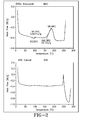
- the DSC scans of uncured A-C® 307A compound, Fig. 1, and A-C® 575A compound, Fig. 2, show melt point peaks for the functionalized polyethylenes at 127.97°C and 93.59°C respectively, along with the DiCup cure exotherm at 185-186°C.
- the same melt point peaks are absent from the DSC scans of cured samples of these compounds and show that the functionalized polyethylenes are crosslinked into the compounds on cure.
Landscapes
- Engineering & Computer Science (AREA)
- General Engineering & Computer Science (AREA)
- Chemical & Material Sciences (AREA)
- Mechanical Engineering (AREA)
- Health & Medical Sciences (AREA)
- Chemical Kinetics & Catalysis (AREA)
- Medicinal Chemistry (AREA)
- Polymers & Plastics (AREA)
- Organic Chemistry (AREA)
- Textile Engineering (AREA)
- General Chemical & Material Sciences (AREA)
- Compositions Of Macromolecular Compounds (AREA)
Abstract
Description
- The present invention is directed to improved ethylene-alpha-olefin elastomers, especially EPDM-based elastomers, for use in manufacturing power transmission products, such as power transmission belts, timing belts, and the like. More specifically, the invention is directed to such elastomers which incorporate certain types of functionalized polyethylenes which result in belts having enhanced physical properties.
- Proposals have already been made on numerous occasions to use EPDM (ethylene propylene diene terpolymer) elastomers cured by organic peroxides in the manufacture of power transmission belts, because of the qualities and advantages of such elastomers such as cost, operating temperature range, and ability to withstand oxygen and ozone, such EPDM-based elastomers having additives which improve their dynamic properties such as resistance to fatigue and to wear, their breaking strength, and their modulus of elasticity, and also their adhesion to traction cords, which additives are generally constituted by metallic salts of α,β-unsaturated organic acids (in particular zinc methacrylate) plus reinforcing fillers such as carbon black and possibly fibers, e.g. aramid fibers. For example, US-B- 5,610,217 teaches the use of α,β-unsaturated organic acids in peroxide cured EPDM elastomers. US-B- 6,251,977 teaches the inclusion, in peroxide cured elastomers, of an elastomer grafted with maleic anhydride which reacts with the α,β-unsaturated organic acid metallic salt included in the composition to reinforce the curing of the EPDM-based elastomer and to improve its dynamic characteristics, such as in particular its modulus of elasticity, its breaking strength, and its hardness. The elastomer grafted with maleic anhydride can be a polybutadiene, polyisoprene, polypropylene, or an ethyl vinyl acetate (EVA) copolymer, and the elastomer is used as a power transmission belt.
- Oxidized polyethylenes are known and are taught by US-B- 2,683,141 and US-B- 3,060,163. They are used to form stable, translucent emulsions for use in floor waxes, in coatings for asbestos shingles, paper and textiles, and in inks for application to various surfaces. They have been incorporated into thermoplastic polypropylene compositions containing EPDM compositions, such as those described in US-B- 4,990,568. In this patent, a thermoplastic polypropylene is modified with EPM or EPDM and an oxidized or carboxylated polyolefin, in at an amount of 2 to 20% of the elastomer, to improve the problem of adherence of coatings applied to the surfaces of articles formed from the thermoplastic elastomers.
- The present invention is the result of the discovery that the incorporation of functionalized polyethylenes into ethylene alpha olefin elastomers , such as EPDM elastomer compositions, which are cured by peroxides, will result in improved properties, such as hardness and modulus of elongation, and can result in improved higher abrasion resistance, wear resistance, coefficient of friction, tensile strength, and other properties over a wide temperature range. Enhancement of these properties is beneficial to power transmission products, such as power transmission belts. Further, the formulation results in a reduction in the viscosity of the uncured compound, resulting in easier processing.
- For the purposes of this application, the "total crosslinkable material" in the rubber composition is used as the basis for the "parts per hundred rubber" (phr) calculation. The quantity of crosslinkable polyethylene in the compound is included in the phr amount. Cross-linkable material is herein defined as a material in a composition that chemically links with other material within the composition. For the purpose of this definition, co-agents and co-cures, such as peroxide, zinc methacrylate, zinc diacrylate, bis-maleimide, are not considered cross-linkable materials. Cross-linkable materials include conventional solid elastomers, liquid elastomers, and cross-linkable thermoplastic resins or waxes.
- The incorporation of the functionalized polyethylene is at an amount of 1 % to 95%, with 5% to 95%, 5% to 80% and 20% to 80% by weight of the crosslinkable material being more preferred ranges. When the composition is cured by the peroxide that is included in the mixture, the functionalized polyethylene is also crosslinked into the composition, and the result is an improved belting composition.
- The high ethylene content, which is beneficial in improving the pilling and wear resistance of the ribs in, e.g., v-ribbed belts, is currently achieved using ethylene alpha olefin base elastomers with high ethylene levels, i.e., elastomers having ethylene levels of greater than 65%. Such compositions are difficult to process on conventional rubber processing equipment. The process of the present invention allows for use of easy processing low ethylene base elastomers in which the ethylene content is boosted by the functionalized polyethylene, allows the use of smaller amounts of high ethylene elastomer, and enables the increase in low extension modulus of the compound. Thus, the belt properties are improved without a negative impact on processing.
-
- Fig. 1 is a differential scanning calorimeter graph of the exotherms of uncured versus cured compounds of a composition containing functionalized polyethylene;
- Fig. 2 is a differential scanning calorimeter graph, similar to Fig. 1, of the exotherms of uncured versus cured compounds of a composition containing another functionalized polyethylene;
- The present invention is directed to improved power transmission products, such as transmission belts, timing belts, and the like. The invention will be described with reference to power transmission belts, but could be applied to other structures, and so are not limited thereto. The structures of power transmission belts are well know and illustrated in patents such as US-B-6,251,977, US-B- 6,561,937, and US-B- 5,610,217. The belt is designed to rotate any rotary member, and can be of the "poly-V" type. As such it would have an inside surface and a certain number of circumferential ribs of trapezoidal cross-section, where the ribs are mutually parallel and extend over the entire length of the belt and are designed to be engaged in grooves of complementary shape in the pulleys on which the belt is mounted.
- The belt has at least one sheet of traction cords which are embedded in the ethylene-alpha-olefin elastomer of the belt, between its top surface and the ribs, with the cords being spiral-wound inside the belt and with the number of turns thereof being a function of the mechanical characteristics desired of the belt.
- The ethylene-alpha-olefin elastomers useful in the present invention include but are not limited to copolymers composed of ethylene and propylene units (EPM), ethylene and butene units, ethylene and pentene units, or ethylene and octene units (EOM), and terpolymers composed of ethylene and propylene units and an unsaturated component (EPDM), as well as mixtures thereof. As the unsaturated component of EPDM, any appropriate non-conjugated diene may be used, including for example, 1,4-hexadiene, dicyclopentadiene or ethylidenenorbornene (ENB). The ethylene-alpha-olefin elastomer preferred in the present invention contains from 35% by weight to 80% by weight of the ethylene unit, from 65% by weight to 25% by weight of the propylene or octene unit, and 0-10% by weight of the unsaturated component. In a more preferred embodiment, the ethylene-alpha-olefin elastomer contains from 55% to 78% by weight of the ethylene unit, and in a most preferred embodiment, the ethylene-alpha-olefin elastomer contains from 65% to 75% of the ethylene unit. At these more preferred ethylene unit content levels, endless belts incorporating as their main belt body portions the ethylene-alpha-olefin elastomeric compositions of this preferred embodiment of the present invention exhibit improved pilling resistance. The most preferred ethylene-alpha-olefin elastomers are EPM and/or EPDM.
- To form the elastomer composition of the present invention the ethylene-alpha-olefin elastomer may optionally be blended with less than 50% by weight, more preferably up to 25%, and most preferably from 5% to 10% based on the total crosslinkable material of a second elastomeric material including but not limited to silicone rubber, polychloroprene, epichlorohydrin, hydrogenated nitrile butadiene rubber, natural rubber, ethylene-vinyl-acetate copolymer, ethylene methacrylate copolymers and terpolymers, styrene butadiene rubber, nitrile rubber, chlorinated polyethylene, chlorosulfonated polyethylene, alkylated chlorosulfonated polyethylene, transpolyoctenamer, polyacrylic rubbers, butadiene rubber, and mixtures thereof, to fine-tune certain mechanical properties such as high temperature performance and tack. For example, the composition of the elastomer of the invention may also be blended with:
- hydrogenated nitrile butadiene rubber (HNBR) constituting 2 to 20 phr approximately to improve resistance to oils and to solvents, or nitrile butadiene rubber (NBR) in the same quantities and for the same purpose;
- polybutadiene (BR) constituting 2 to 20 phr approximately to improve dynamic properties and resistance to abrasion;
- chloro-sulfonated polyethylene with alkyl groups (ACSM) constituting 2 to 40 phr approximately to increase resistance to oils and resistance to tearing; and
- natural rubber comprising about 2 to 20 phr to improve raw adhesion.
- The elastomer may incorporate metal salts of α,β-unsaturated organic acids. The metal salts of α,β-unsaturated organic acids that can be useful in the present invention are metal salts of acids such as for example, acrylic, methacrylic, maleic, fumaric, ethacrylic, vinyl-acrylic, itaconic, methyl itaconic, aconitic, methyl aconitic, crotonic, α-methylcrotonic, cinnamic, and 2,4-dihydroxy cinnamic acids. These salts may be of zinc, cadmium, calcium, magnesium, sodium or aluminum, and are preferably those of zinc. The preferred metal salts of α,β-unsaturated organic acids are zinc diacrylate and zinc dimethacrylate. The most preferred metal salt of unsaturated organic acid is zinc dimethacrylate. Amounts of the metal salt useful in the present invention may range from 1 to 30 phr, and are preferably from 5 to 20 phr. In the most preferred embodiment, the metal salt is zinc dimethacrylate used in an amount of 5 phr when used in conjunction with EPDM mixed with up to 10% of silicone rubber, and from 10 to 20 phr and more preferably 15 phr when used in conjunction with the other ethylene-alpha-olefin elastomers useful in the present invention.
- The functionalized polyethylenes that can be employed in the present invention include oxidized polyethylenes and copolymers of polyethylene, such as ethylene maleic anhydride and ethylene-vinyl acetate copolymers, which will crosslink with the elastomer to increase the hardness and modulus of the elastomer, which in turn, leads to improved belt properties, especially for power transmission belts. The preferred functionalized polyethylenes include oxidized polyethylene, ethylene-vinyl acetate copolymer, and ethylene maleic anhydride copolymer. Functionalized polyethylenes are available from Honeywell International Inc. under the brand name A-C® polyethylene, including A-C® 307, 307A, 395, and 395A, which are oxidized polyethylenes, A-C® 400 and 400A, which are ethylene-vinyl acetate copolymers, and A-C® 575P and 575A, which are ethylene-maleic anhydride copolymers.
- Oxidized polyethylene wax materials suitable for use in the practice of this invention are described in US-B- 2,683,141 and US-B- 3,060,163. According to the latter patent, normally solid, hard, waxy polymers of ethylene having an average molecular weight between 1,000 and 3,000 are subjected, in the liquid phase, to the action of an oxygen-containing gas to cause reaction of between 2-17 pounds of oxygen per 100 pounds of wax, i.e. to provide an oxidized polyethylene wax containing at least 1 percent and preferably 1-8 percent by weight of oxygen, and acid numbers of not more than 50, and preferably between 10 and 45.
- The oxidized polyethylene is characterized by having a minimum number average molecular weight above 1000 and preferably at least 1200, as determined by high temperature vapor pressure osmometry, containing between 1-5 percent by weight of total oxygen, and having an acid number of from 10 to 35. The described oxidized polyethylene is obtained by oxidation of polyethylene in molten or finely divided solid form, with free oxygen containing gas, usually air, generally at elevated temperature, until the desired oxygen content is obtained. Starting materials for making the oxidized polyethylene suitable for use in the practice of this invention include low molecular weight, low density or linear low density polyethylene waxes having specific gravities in the range of 0.91 to 0.96 as, for example, prepared by the process described in US-B- 2,683,141, as well as high density, linear polyethylene as, for example, prepared in the presence of such well know catalysts as the "Phillips" or "Ziegler" type catalysts, having specific gravities in the range of 0.93-0.97 or above. The low molecular weight, low density polyethylene starting material can be oxidized by contacting in the molten state with a stream of air until the desired oxygen content has been obtained. The high density, linear polyethylene starting material is usually oxidized by contact, preferably in the finely divided solid state, with free oxygen-containing gas, usually air, at temperatures ranging from 100°C up to, but not including, the crystalline melting point of the polyethylene, until the desired oxygen content has been obtained.
- The ethylene-alpha-olefin elastomeric compositions useful in the endless belts of the present invention further comprise from 25 to 250 phr and preferably from 25 to 100 phr of a reinforcing filler such as carbon black, calcium carbonate, talc, clay or hydrated silica, or mixtures of the foregoing. If desired, the incorporation of from 1 to 30 phr of a metal salt of an unsaturated organic acid and from 25 to 250 phr, preferably 25 to 100 phr, of reinforcing filler in the peroxide-cured ethylene-alpha-olefin elastomeric composition preserves the heat stability of conventional peroxide-cured elastomers, while providing the tear strength and dynamic properties usually associated with sulfur cured elastomers.
- The elastomeric composition may contain from 0.1 to 40 phr of an acrylated polybutadiene. Preferably, from 1 to 10 phr is present. The polybutadiene may be a random polybutadiene polymer containing both 1,4 and 1,2 butadiene units. The amount of 1,2 vinyl bonds may range from 15 to 90 percent by weight of the acrylated polybutadiene. Preferably, from 20 to 70 percent by weight of 1,2 vinyl bonds are present. The acrylated polybutadiene may be prepared from a Ziegler Natta polymerization. The acrylated polybutadiene may have a molecular weight (MN) ranging from 500 to 500,000. Preferably, the molecular weight ranges from 1,000 to 70,000. Preferred acrylated polybutadienes are sold by Sartomer Company, Inc., under the trademark RICACRYL. A specific example is RICACRYL 3500 (mol weight MN of approximately 6400 and a Brookfield viscosity of approximately 50,000 centipoise). Acrylated polybutadienes may be used with acrylates and methacrylates, e.g., trimethylolpropane trimethacrylate (TMPTMA), which is available as SR® 350 from Sartomer Company, Inc., in amounts of from 0.1 to 50 phr (preferably 1-20 phr) to make up a coagent system. Other examples are set forth in US-B- 6,491,598.
- The free-radical producing curatives useful in the present invention are those suitable for curing ethylene-alpha-olefin elastomers and include for example, organic peroxides and ionizing radiation. The preferred curative is an organic peroxide, including but not limited to dicumyl peroxide, bis-(t-butyl peroxy-diisopropyl benzene, t-butyl perbenzoate, di-t-butyl peroxide, 2,5-dimethyl-2,5-di-t-butylperoxyhexane, α-α-bis(t-butylperoxy) diisopropylbenzene. The preferred organic peroxide curative is α-α-bis(t-butylperoxy) diisopropylbenzene. Cure-effective amounts of organic peroxide for purposes of the present invention are typically from 2 to 15 phr. Preferred levels of organic peroxide are from 4 to 12 phr. Sulfur may optionally be added to the organic peroxide curative as part of a mixed cure system in an amount of from 0.01 to 1.0 phr, to improve the cured elastomer's Young's modulus without negatively affecting its tear resistance.
- Other conventional ethylene-alpha-olefin elastomer additives, process and extender oils, antioxidants, waxes, pigments, plasticizers, softeners and the like may be added according to common rubber processing practice without departing from the present invention. For example, in a preferred embodiment of the present invention, the elastomeric composition also contains from 0.5 to 1.5 phr of an antiozonant or antioxidant and from 5 to 15 phr of a paraffinic petroleum oil plasticizer/softener.
- The ethylene-alpha-olefin elastomeric compositions useful in the present invention may be prepared by any conventional procedure such as for example, by mixing and milling the ingredients in an internal mixer or mill. It should be noted that in blending some of the functionalized polyethylenes, attaining temperatures above the melting point of the polyethylene grade may be necessary to achieve processing of the mixed materials, and thus a uniform blend.
- Typically, a belt made out of an EPDM elastomer of the invention has the following composition prior to curing:
- EPDM: 99 to 20 % by weight of the total crosslinkable material;
- functionalized polyethylene: 1 to 80 % (preferable: 5 to 70 %) by weight of the total crosslinkable material;
- carbon black: 5 to 100 phr (preferably: 50 to 60 phr);
- electrically conductive carbon black: 0 to 15 phr (preferably: 5 to 10 phr);
- antioxidant: 0.5 to 8 phr (preferably: 1.5 to 3 phr);
- organic peroxide: 0.5 to 15 phr (preferably: 2 to 12 phr);
- curing coagent: 0.5 to 10 phr (1 to 8 phr);
- plasticizer: 0 to 20 phr (preferably: 1 to 10 phr).
- In addition, it may also have polyamide, aramid, polyester, rayon, cotton, carbon, or glass fibers constituting 3 to 30 phr approximately to improve the tensile and low extension modulus.
- In order to demonstrate the present invention, belt compositions were made and tested. The following composition was mixed and compounded in a two stage Banbury mixer in a manner typical for rubber compounding:
- EPDM: 84.4 % by weight of crosslinkable material;
- functionalized polyethylene: 15.6 % by weight of crosslinkable material;
- carbon black: 42 phr;
- dicumyl peroxide: 8.4 phr
- From the data above, the blends have lowered S'min (indicator of improved processing). Tensile strength, elongation, modulus, hardness are increased resulting in a more useful compound.
- As can be seen from the data above and the DSC (differential scanning calorimeter) scans shown in Figures 1 and 2, the functionalized polyethylene is crosslinked with the EPDM. The resulting composition would provide improved properties for the belting material.
- The DSC scans of
uncured A-C® 307A compound, Fig. 1, andA-C® 575A compound, Fig. 2, show melt point peaks for the functionalized polyethylenes at 127.97°C and 93.59°C respectively, along with the DiCup cure exotherm at 185-186°C. The same melt point peaks are absent from the DSC scans of cured samples of these compounds and show that the functionalized polyethylenes are crosslinked into the compounds on cure.
| Example No. | Functionalized polyethylene employed | sg (g/cc) | Mettler drop point (°F) | RPA 2000 Rubber process analyzer "Cure" data | ||
| Min S' (dNm) | Max S' (dNm) | Max S' - Min S' (dNm) | ||||
| 1 | none | 3.266 | 34.96 | 31.70 | ||
| 2 | | 0.98 | 284 | 2.32 | 31.76 | 29.44 |
| 3 | A-C® 395A Oxidized polyethylene | 1.00 | 279 | 2.33 | 25.31 | 22.98 |
| 4 | | 0.92 | 223 | 2.239 | 27.11 | 24.87 |
| Note: A-C® polyethylenes & copolymers are available from Honeywell International, Inc. |
| Test | | A-C® | 575A | A-C® | 307A Example |
| Tensile strength; | 1460.3 | 1392.8 | 1667.8 | ||
| Psi (MPa) | (10.1 MPa) | (9.6) | (11.5) | ||
| Elongation (%) | 141 | 175 | 156 | ||
| Modulus (MPa) | |||||
| 10%; | 64.9 | 116.5 | 203.9 | ||
| Psi | (0.45 MPa) | (0.8) | (1.41) | ||
| 25% | 138.7 | 215.5 | 343.2 | ||
| (0.96) | (1.48) | (2.37) | |||
| 50% | 246.2 | 322.3 | 492.7 | ||
| (1.70) | (2.22) | (3.4) | |||
| 100% | 712.9 | 609.3 | 903.8 | ||
| (4.92) | (4.2) | (6.23) | |||
| 141% | 1460.3 | ||||
| (10.1) | |||||
| 156% | 1667.8 | ||||
| (11.5) | |||||
| 175% | 1392.8 | ||||
| (9.6) | |||||
| Hardness | 66 | 73 | 80 | ||
| (Shore A) |
Claims (10)
- An organic peroxide curable elastomer composition comprising:(a) ethylene-alpha-olefin elastomer, and(b) an organic peroxide curing agent,characterized in that the composition contains a functionalized polyethylene in an amount of 1 to 95 % by weight based upon the total weight of crosslinkable material.
- The elastomer composition of claim 1, wherein the ethylene-alpha-olefin elastomer is selected from ethylene-propylene-diene copolymer, ethylene-propylene-diene terpolymer, or mixtures thereof.
- The elastomer composition of claim 1 or 2, wherein the functionalized polyethylene is crosslinkable with the ethylene-alpha-olefin elastomer and/or wherein the functionalized polyethylene is an oxidized polyethylene.
- The elastomer composition of at least one of the previous claims, wherein the functionalized polyethylene is a copolymer of polyethylene and maleic anhydride.
- The elastomer composition of at least one of the previous claims, wherein the functionalized polyethylene is present in an amount of 1 to 80% by weight based upon the total weight of crosslinkable material.
- The elastomer composition of at least one of the previous claims, wherein the functionalized polyethylene is present in an amount of 20 to 80% by weight based upon the total weight of crosslinkable material.
- The elastomer composition of at least one of the previous claims, wherein the cured compound is in the form of a power transmission belt selected from the group consisting of synchronous belts, v-belts, and multi-V-ribbed belts.
- The elastomer composition of at least one of the previous claims, wherein the composition further includes a filler and/or a reinforcing fiber.
- The elastomer composition of at least one of the previous claims, wherein the uncured composition comprises:(a) ethylene-alpha-olefin elastomer in an amount of 5% to 99% by weight of the total crosslinkable material,(b) functionalized polyethylene, which is crosslinkable with the elastomer, in an amount of 1% to 95% by weight of the total crosslinkable material, and(c) 2 to 15 phr of the organic peroxide curing agent.
- A power transmission belt, the belt comprising an elastomeric body having at least one cord or fabric layer, characterized in that the body comprises an organic peroxide curable elastomer composition including:(a) ethylene-alpha-olefin elastomer,(b) an organic peroxide curing agent, and(c) a functionalized polyethylene in an amount of 1 to 95 % by weight based upon the total weight of crosslinkable material.
Applications Claiming Priority (2)
| Application Number | Priority Date | Filing Date | Title |
|---|---|---|---|
| US11/026,769 US20060148989A1 (en) | 2004-12-31 | 2004-12-31 | Power transmission belts having enhanced properties |
| US29033205A | 2005-11-30 | 2005-11-30 |
Publications (2)
| Publication Number | Publication Date |
|---|---|
| EP1679344A1 true EP1679344A1 (en) | 2006-07-12 |
| EP1679344B1 EP1679344B1 (en) | 2008-12-17 |
Family
ID=36293322
Family Applications (1)
| Application Number | Title | Priority Date | Filing Date |
|---|---|---|---|
| EP20050112714 Ceased EP1679344B1 (en) | 2004-12-31 | 2005-12-22 | Power transmission belts having enhanced properties |
Country Status (2)
| Country | Link |
|---|---|
| EP (1) | EP1679344B1 (en) |
| DE (1) | DE602005011747D1 (en) |
Citations (13)
| Publication number | Priority date | Publication date | Assignee | Title |
|---|---|---|---|---|
| US4854446A (en) | 1988-08-03 | 1989-08-08 | The Goodyear Tire & Rubber Company | Electrical conductor |
| US5168266A (en) | 1990-04-17 | 1992-12-01 | Bando Kagaku Kabushiki Kaisha | Method for detecting longitudinal tear in a conveyor belt |
| DE4220773A1 (en) * | 1992-06-25 | 1994-01-05 | Leuna Werke Ag | Compatibilising and impact improving polymer alloy prepn. for plastics flow improver - by reacting ethylene@]-vinyl] acetate and ethylene@]-propylene@]-rubber or ethylene@]-propylene@]-diene] monomer with unsatd. acid or anhydride in melt, for improved chemical reactivity |
| EP1030226A2 (en) * | 1999-02-17 | 2000-08-23 | The Goodyear Tire & Rubber Company | Paper transport belt of alkylated chlorosulfonated polyethylene |
| WO2000053517A1 (en) | 1999-03-10 | 2000-09-14 | Canada Conveyor Belt Co., Ltd. | Conveyor belt fault detection apparatus and method |
| EP1108750A1 (en) * | 1999-12-15 | 2001-06-20 | The Goodyear Tire & Rubber Company | Power transmission belt |
| US6251977B1 (en) * | 1998-06-11 | 2001-06-26 | Hutchinson | Elastomer composition based on EPDM, and a powder transmission belt made essentially out of said elastomer |
| US6352149B1 (en) | 2000-08-25 | 2002-03-05 | The Goodyear Tire & Rubber Company | Conveyor belt with microcoil springwire sensor |
| EP1205515A1 (en) * | 1994-10-31 | 2002-05-15 | The Gates Rubber Company | Ethylene-Alpha-Olefin belting |
| EP1241379A1 (en) * | 2001-03-16 | 2002-09-18 | The Goodyear Tire & Rubber Company | Power transmission belt containing chopped carbon fiber |
| EP1300442A1 (en) * | 2001-09-06 | 2003-04-09 | The Goodyear Tire & Rubber Company | Power transmission belt |
| EP1469032A1 (en) * | 2003-04-14 | 2004-10-20 | The Goodyear Tire & Rubber Company | Power transmission belt containing short high molecular weight polyacrylonitrile fiber |
| US20050096433A1 (en) * | 2003-10-31 | 2005-05-05 | Mitsuboshi Belting Ltd. | Power transmission belt |
-
2005
- 2005-12-22 DE DE200560011747 patent/DE602005011747D1/en not_active Expired - Lifetime
- 2005-12-22 EP EP20050112714 patent/EP1679344B1/en not_active Ceased
Patent Citations (13)
| Publication number | Priority date | Publication date | Assignee | Title |
|---|---|---|---|---|
| US4854446A (en) | 1988-08-03 | 1989-08-08 | The Goodyear Tire & Rubber Company | Electrical conductor |
| US5168266A (en) | 1990-04-17 | 1992-12-01 | Bando Kagaku Kabushiki Kaisha | Method for detecting longitudinal tear in a conveyor belt |
| DE4220773A1 (en) * | 1992-06-25 | 1994-01-05 | Leuna Werke Ag | Compatibilising and impact improving polymer alloy prepn. for plastics flow improver - by reacting ethylene@]-vinyl] acetate and ethylene@]-propylene@]-rubber or ethylene@]-propylene@]-diene] monomer with unsatd. acid or anhydride in melt, for improved chemical reactivity |
| EP1205515A1 (en) * | 1994-10-31 | 2002-05-15 | The Gates Rubber Company | Ethylene-Alpha-Olefin belting |
| US6251977B1 (en) * | 1998-06-11 | 2001-06-26 | Hutchinson | Elastomer composition based on EPDM, and a powder transmission belt made essentially out of said elastomer |
| EP1030226A2 (en) * | 1999-02-17 | 2000-08-23 | The Goodyear Tire & Rubber Company | Paper transport belt of alkylated chlorosulfonated polyethylene |
| WO2000053517A1 (en) | 1999-03-10 | 2000-09-14 | Canada Conveyor Belt Co., Ltd. | Conveyor belt fault detection apparatus and method |
| EP1108750A1 (en) * | 1999-12-15 | 2001-06-20 | The Goodyear Tire & Rubber Company | Power transmission belt |
| US6352149B1 (en) | 2000-08-25 | 2002-03-05 | The Goodyear Tire & Rubber Company | Conveyor belt with microcoil springwire sensor |
| EP1241379A1 (en) * | 2001-03-16 | 2002-09-18 | The Goodyear Tire & Rubber Company | Power transmission belt containing chopped carbon fiber |
| EP1300442A1 (en) * | 2001-09-06 | 2003-04-09 | The Goodyear Tire & Rubber Company | Power transmission belt |
| EP1469032A1 (en) * | 2003-04-14 | 2004-10-20 | The Goodyear Tire & Rubber Company | Power transmission belt containing short high molecular weight polyacrylonitrile fiber |
| US20050096433A1 (en) * | 2003-10-31 | 2005-05-05 | Mitsuboshi Belting Ltd. | Power transmission belt |
Also Published As
| Publication number | Publication date |
|---|---|
| EP1679344B1 (en) | 2008-12-17 |
| DE602005011747D1 (en) | 2009-01-29 |
Similar Documents
| Publication | Publication Date | Title |
|---|---|---|
| US8030404B2 (en) | Power transmission products having enhanced properties | |
| EP0737228B2 (en) | Ethylene-alpha-olefin belting | |
| EP1205515B1 (en) | Ethylene-Alpha-Olefin belting | |
| US7655729B2 (en) | Power transmission products having enhanced properties | |
| US6251977B1 (en) | Elastomer composition based on EPDM, and a powder transmission belt made essentially out of said elastomer | |
| EP1309808B1 (en) | Power transmission belt having high modulus adhesive rubber member | |
| EP1302507B1 (en) | Thermoplastic elastomer composition, moldings using the same | |
| JP2004316905A (en) | Power transmission belt containing high molecular weight polyacrylonitrile short fiber | |
| EP1679344B1 (en) | Power transmission belts having enhanced properties | |
| US20250382446A1 (en) | Nbr and ethylene blend | |
| US6669591B1 (en) | Rubber composition for power transmission belts | |
| US20260103584A1 (en) | Halogenated Polyethylene And Ethylene Polymer Blends | |
| EP0477186A1 (en) | Compatible blends of ethylene-propylene rubber and polychloroprene or nitrile rubbers | |
| CA3269059A1 (en) | Halogenated polyethylene and ethylene polymer blends | |
| JP7814092B2 (en) | Ethylene-based copolymer composition and its use | |
| JP2025085505A (en) | Ethylene-based copolymer composition and its use | |
| JP2023134919A (en) | Thermoplastic elastomer composition, molding, and method for producing thermoplastic elastomer composition | |
| JP2020122130A (en) | Elastomer composition for belts | |
| JP2020122128A (en) | Method for producing thermoplastic elastomer composition | |
| JPH0797492A (en) | Power transmission belt | |
| AU2001283448A1 (en) | Power transmission belt having high modulus adhesive rubber member |
Legal Events
| Date | Code | Title | Description |
|---|---|---|---|
| PUAI | Public reference made under article 153(3) epc to a published international application that has entered the european phase |
Free format text: ORIGINAL CODE: 0009012 |
|
| AK | Designated contracting states |
Kind code of ref document: A1 Designated state(s): AT BE BG CH CY CZ DE DK EE ES FI FR GB GR HU IE IS IT LI LT LU LV MC NL PL PT RO SE SI SK TR |
|
| AX | Request for extension of the european patent |
Extension state: AL BA HR MK YU |
|
| 17P | Request for examination filed |
Effective date: 20070112 |
|
| 17Q | First examination report despatched |
Effective date: 20070215 |
|
| AKX | Designation fees paid |
Designated state(s): DE FR GB |
|
| GRAP | Despatch of communication of intention to grant a patent |
Free format text: ORIGINAL CODE: EPIDOSNIGR1 |
|
| GRAS | Grant fee paid |
Free format text: ORIGINAL CODE: EPIDOSNIGR3 |
|
| GRAA | (expected) grant |
Free format text: ORIGINAL CODE: 0009210 |
|
| RAP1 | Party data changed (applicant data changed or rights of an application transferred) |
Owner name: VEYANCE TECHNOLOGIES, INC. |
|
| AK | Designated contracting states |
Kind code of ref document: B1 Designated state(s): DE FR GB |
|
| REG | Reference to a national code |
Ref country code: GB Ref legal event code: FG4D |
|
| REF | Corresponds to: |
Ref document number: 602005011747 Country of ref document: DE Date of ref document: 20090129 Kind code of ref document: P |
|
| PLBE | No opposition filed within time limit |
Free format text: ORIGINAL CODE: 0009261 |
|
| STAA | Information on the status of an ep patent application or granted ep patent |
Free format text: STATUS: NO OPPOSITION FILED WITHIN TIME LIMIT |
|
| 26N | No opposition filed |
Effective date: 20090918 |
|
| REG | Reference to a national code |
Ref country code: FR Ref legal event code: PLFP Year of fee payment: 11 |
|
| REG | Reference to a national code |
Ref country code: FR Ref legal event code: PLFP Year of fee payment: 12 |
|
| REG | Reference to a national code |
Ref country code: DE Ref legal event code: R082 Ref document number: 602005011747 Country of ref document: DE Representative=s name: DREISS PATENTANWAELTE PARTG MBB, DE Ref country code: DE Ref legal event code: R081 Ref document number: 602005011747 Country of ref document: DE Owner name: CONTITECH USA, INC. (N.D.GES.D. STAATES DELAWA, US Free format text: FORMER OWNER: VEYANCE TECHNOLOGIES, INC., FAIRLAWN, OHIO, US |
|
| REG | Reference to a national code |
Ref country code: FR Ref legal event code: PLFP Year of fee payment: 13 |
|
| REG | Reference to a national code |
Ref country code: FR Ref legal event code: CD Owner name: AMCOR GROUP GMBH, US Effective date: 20180103 |
|
| PGFP | Annual fee paid to national office [announced via postgrant information from national office to epo] |
Ref country code: FR Payment date: 20211224 Year of fee payment: 17 Ref country code: GB Payment date: 20211222 Year of fee payment: 17 |
|
| PGFP | Annual fee paid to national office [announced via postgrant information from national office to epo] |
Ref country code: DE Payment date: 20220601 Year of fee payment: 18 |
|
| GBPC | Gb: european patent ceased through non-payment of renewal fee |
Effective date: 20221222 |
|
| PG25 | Lapsed in a contracting state [announced via postgrant information from national office to epo] |
Ref country code: GB Free format text: LAPSE BECAUSE OF NON-PAYMENT OF DUE FEES Effective date: 20221222 |
|
| PG25 | Lapsed in a contracting state [announced via postgrant information from national office to epo] |
Ref country code: FR Free format text: LAPSE BECAUSE OF NON-PAYMENT OF DUE FEES Effective date: 20221231 |
|
| REG | Reference to a national code |
Ref country code: DE Ref legal event code: R119 Ref document number: 602005011747 Country of ref document: DE |
|
| PG25 | Lapsed in a contracting state [announced via postgrant information from national office to epo] |
Ref country code: DE Free format text: LAPSE BECAUSE OF NON-PAYMENT OF DUE FEES Effective date: 20240702 |
|
| PG25 | Lapsed in a contracting state [announced via postgrant information from national office to epo] |
Ref country code: DE Free format text: LAPSE BECAUSE OF NON-PAYMENT OF DUE FEES Effective date: 20240702 |