EP1677491A2 - Method for assigning internet protocol (IP) address to wireless terminal incapable of accessing mobile communication network, and mobile communication terminal capable of implementing the same - Google Patents
Method for assigning internet protocol (IP) address to wireless terminal incapable of accessing mobile communication network, and mobile communication terminal capable of implementing the same Download PDFInfo
- Publication number
- EP1677491A2 EP1677491A2 EP20050028654 EP05028654A EP1677491A2 EP 1677491 A2 EP1677491 A2 EP 1677491A2 EP 20050028654 EP20050028654 EP 20050028654 EP 05028654 A EP05028654 A EP 05028654A EP 1677491 A2 EP1677491 A2 EP 1677491A2
- Authority
- EP
- European Patent Office
- Prior art keywords
- mobile communication
- communication terminal
- address
- wireless terminal
- terminal
- Prior art date
- Legal status (The legal status is an assumption and is not a legal conclusion. Google has not performed a legal analysis and makes no representation as to the accuracy of the status listed.)
- Withdrawn
Links
Images


Classifications
-
- H—ELECTRICITY
- H04—ELECTRIC COMMUNICATION TECHNIQUE
- H04W—WIRELESS COMMUNICATION NETWORKS
- H04W8/00—Network data management
- H04W8/26—Network addressing or numbering for mobility support
-
- H—ELECTRICITY
- H04—ELECTRIC COMMUNICATION TECHNIQUE
- H04L—TRANSMISSION OF DIGITAL INFORMATION, e.g. TELEGRAPHIC COMMUNICATION
- H04L67/00—Network arrangements or protocols for supporting network services or applications
- H04L67/34—Network arrangements or protocols for supporting network services or applications involving the movement of software or configuration parameters
-
- H—ELECTRICITY
- H04—ELECTRIC COMMUNICATION TECHNIQUE
- H04L—TRANSMISSION OF DIGITAL INFORMATION, e.g. TELEGRAPHIC COMMUNICATION
- H04L61/00—Network arrangements, protocols or services for addressing or naming
- H04L61/50—Address allocation
- H04L61/5007—Internet protocol [IP] addresses
- H04L61/5014—Internet protocol [IP] addresses using dynamic host configuration protocol [DHCP] or bootstrap protocol [BOOTP]
-
- H—ELECTRICITY
- H04—ELECTRIC COMMUNICATION TECHNIQUE
- H04L—TRANSMISSION OF DIGITAL INFORMATION, e.g. TELEGRAPHIC COMMUNICATION
- H04L9/00—Cryptographic mechanisms or cryptographic arrangements for secret or secure communications; Network security protocols
- H04L9/40—Network security protocols
-
- H—ELECTRICITY
- H04—ELECTRIC COMMUNICATION TECHNIQUE
- H04W—WIRELESS COMMUNICATION NETWORKS
- H04W80/00—Wireless network protocols or protocol adaptations to wireless operation
- H04W80/04—Network layer protocols, e.g. mobile IP [Internet Protocol]
-
- H—ELECTRICITY
- H04—ELECTRIC COMMUNICATION TECHNIQUE
- H04L—TRANSMISSION OF DIGITAL INFORMATION, e.g. TELEGRAPHIC COMMUNICATION
- H04L69/00—Network arrangements, protocols or services independent of the application payload and not provided for in the other groups of this subclass
- H04L69/30—Definitions, standards or architectural aspects of layered protocol stacks
- H04L69/32—Architecture of open systems interconnection [OSI] 7-layer type protocol stacks, e.g. the interfaces between the data link level and the physical level
- H04L69/322—Intralayer communication protocols among peer entities or protocol data unit [PDU] definitions
- H04L69/329—Intralayer communication protocols among peer entities or protocol data unit [PDU] definitions in the application layer [OSI layer 7]
Definitions
- IP internet protocol
- the present invention relates to a method for providing a wireless terminal with an Internet service. More particularly, the invention relates to a method for assigning an Internet Protocol (IP) address to a wireless terminal capable of accessing a mobile communication terminal but incapable of directly accessing a mobile communication network, and to the mobile communication terminal for performing the IP address assignment method.
- IP Internet Protocol
- Conventional wireless terminals such as Personal Digital Assistants (PDAs) can communicate with each other via a Bluetooth or a Wireless Local Area Network (WLAN), but they are unable to access a mobile communication network such as a Code Division Multiple Access (CDMA) network.
- CDMA Code Division Multiple Access
- the above-mentioned conventional wireless terminals are unable to access the Internet indicative of a representative communication network.
- the terminal must enter an additional hot-spot area including an Access Point (AP) for the aforementioned wireless terminals.
- AP Access Point
- the wireless terminal in order to enable the wireless terminal to wirelessly access the Internet, the wireless terminal must enter the hot-spot area, must gain access to a Dynamic Host Configuration Protocol (DHCP) server via the AP contained in the hot-spot area over the WLAN, and must receive an Internet Protocol (IP) address from the DHCP server, such that it can wirelessly access the Internet within the hot-spot area only.
- DHCP Dynamic Host Configuration Protocol
- IP Internet Protocol
- wireless communication between the above-mentioned conventional wireless terminals in other areas other than the hot-spot area can be established in an Adhoc mode on the condition that IP addresses of the wireless terminals are established according to a zero configuration method.
- the Adhoc mode is indicative of a communication mode between terminals instead of a communication mode between a base station and terminals.
- terminals widely spaced apart from each other can communicate with each other because an intermediate terminal located between the above terminals serves as a repeater, and this communication method is generally referred to as a multi-hop access.
- a terminal In order to implement the above-mentioned Adhoc-mode communication, a terminal firstly establishes a single IP address, broadcasts the established IP address to peripheral terminals, and determines whether the established IP address collides with IP addresses of the peripheral terminals. If there is no IP address collision, the terminal uses the established IP address as its own IP address. Otherwise, if the occurrence of IP address collision is determined, the terminal establishes another IP address (i.e., a second IP address), broadcasts the second IP address to peripheral terminals, and determines whether the second IP address collides with IP addresses of the peripheral terminals.
- the above-mentioned terminal operations are referred to as a Duplicated Address Detection (DAD) task. The DAD task is repeated until a predetermined IP address having no IP address collision is established, and this IP address assignment method is referred to as a zero-configuration method.
- DAD Duplicated Address Detection
- the IP address established by the zero-configuration method for use in wireless terminals is not a public IP address, it is impossible for a wireless terminal to access the Internet via the established IP address according to the multi-hop access method.
- the IP address assignment method according to the zero-configuration method for use in wireless terminal must be repeatedly performed until a predetermined IP address having no IP address collision is established, such that a long period of time is consumed to perform an IP address setup process when a large number of peripheral terminals are used.
- the present invention is directed to a method for assigning an IP address to a wireless terminal incapable of accessing a mobile communication network, and a mobile communication terminal capable of implementing the same that substantially obviate one or more problems due to limitations and disadvantages of the related art.
- An object of the present invention is to provide a method for assigning an IP address to at least one wireless terminal capable of accessing a mobile communication terminal but incapable of accessing a mobile communication network, and to the mobile communication terminal for performing the IP address assignment method.
- a method for assigning an Internet Protocol (IP) address to a wireless terminal using a mobile communication terminal comprising accessing, by the mobile communication terminal, a Dynamic Host Configuration Protocol (DHCP) server over a mobile communication network; downloading, by the mobile communication terminal, a DHCP software program from the DHCP server; and performing, by the mobile communication terminal, a pseudo-DHCP server function using the downloaded DHCP server software program in association with at least one wireless terminal capable of wirelessly accessing the mobile communication terminal.
- IP Internet Protocol
- a mobile communication terminal comprising a mobile communication interface unit for accessing a mobile communication network, an adhoc interface unit for wirelessly accessing at least one wireless terminal, and a controller for controlling the mobile network interface unit and the adhoc interface unit, wherein the mobile communication terminal accesses a Dynamic Host Configuration Protocol (DHCP) server over the mobile communication network, downloads a DHCP server software program from the DHCP server, and serves as a pseudo-DHCP server for at least one wireless terminal capable of accessing the mobile communication terminal.
- DHCP Dynamic Host Configuration Protocol
- a mobile communication terminal comprising a mobile network interface configured to access a Dynamic Host Configuration Protocol (DHCP) server over a mobile communication network, and to download a DHCP server software program from the DHCP server, so that the mobile communication terminal can serve as a pseudo-DHCP server for at least one wireless terminal capable of accessing the mobile communication terminal.
- DHCP Dynamic Host Configuration Protocol
- FIG. 1 is a block diagram illustrating a mobile communication terminal according to the present invention.
- the mobile communication terminal 100 (e.g., a cellular phone) includes a mobile network interface unit 110, an Adhoc interface unit 130, a memory unit 150, and a controller 170, all operatively coupled.
- the mobile network interface unit 110 allows the mobile communication terminal 100 to access a mobile communication network such as a CDMA network.
- the Adhoc interface unit 130 (e.g., a WLAN or Bluetooth interface unit) allows the mobile communication terminal 100 to wirelessly communicate with at least one wireless terminal (e.g., a PDA).
- the memory unit 150 stores a variety of software programs (e.g., DHCP server software and NAT (Network Address Translation) software) required for assigning an IP address to at least one wireless terminal.
- the controller 170 controls overall components of the mobile communication terminal 100.
- IP address assignment method for use in a wireless terminal using the above-mentioned mobile communication terminal 100 will hereinafter be described with reference to FIGS. 2-3. However, this method can be implemented in other suitable device/system.
- the mobile communication terminal 100 gains access to a mobile communication network 200, and gains access to a DHCP server 300 over the mobile communication network 200 at step S31.
- the aforementioned access by the mobile communication terminal 100 may be executed via an Open Shortest Path First (OSPF) protocol or a Routing Information (RI) protocol.
- OSPF Open Shortest Path First
- RI Routing Information
- the mobile communication terminal 100 downloads a DHCP server software program from the DHCP server 300 for allowing the mobile communication terminal 100 to serve as a Pseudo-DHCP server, and stores the downloaded software program in the memory unit 150 (or other suitable storage) at step S33.
- the mobile communication terminal 100 also receives a predetermined number of public IP addresses from the DHCP server 300 via the network 200.
- the mobile communication terminal 100 serves as a Pseudo-DHCP server for one or more wireless terminals (400a, 400b, ... , 400n) capable of wirelessly accessing and communicating with the mobile communication terminal 100, using the downloaded DHCP server software program at step S35.
- the wireless terminal 400a, 400b,..., 400n can be PDAs or other devices capable of communicating with the mobile communication terminal 100 but incapable of directly accessing the Internet or the like. Any number of wireless terminals are applicable.
- the mobile communication terminal 100 assigns the received public IP addresses to the above-mentioned wireless terminals (400a, 400b,..., or 400n).
- each wireless terminal 400a, 400b..., 400n can be assigned with one public IP address. Therefore, the wireless terminals (400a, 400b, ... , 400n) can access the Internet via the mobile communication terminal 100 serving as the pseudo-DHCP server using the assigned public IP addresses.
- the wireless terminals (400a, 400b, ... , 400n) can communicate with each other in the Adhoc mode using the above-mentioned assigned public IP addresses.
- the Adhoc-mode communication may be executed using an AODV (Ad hoc On-Demand Distance Vector) protocol.
- AODV Ad hoc On-Demand Distance Vector
- the mobile communication terminal 100 withdraws the assigned public IP address from that wireless terminal 400a. In other words, the disconnected wireless terminal is longer assigned to a public IP address.
- NAT Network Address Translation
- the mobile communication terminal 100 generates any number of private IP addresses (e.g., larger than the number of the public IP addresses received from the DHCP server), and assigns the private IP addresses to wireless terminals (400a, 400b, ... , 400n), such that the wireless terminals (400a, 400b, ..., 400n) can communicate with each other in an Adhoc mode.
- the NAT software program in the mobile communication terminal 100 converts/maps the assigned private IP address(es) of only the wireless terminal(s), which access the mobile communication terminal 100 to access the Internet, to the public IP address(es). Therefore, the mobile communication terminal 100 can assign many more wireless terminals than the number of the public IP addresses received from the DHCP server, by using the private IP addresses and selectively assigning the public IP addresses as needed for the Internet access.
- the mobile communication terminal 100 if the mobile communication terminal 100 stops the pseudo-DHCP server function as a result of unavoidable circumstances (e.g., separation from the mobile communication network), the mobile communication terminal 100 transfers software programs and IP pool information for the pseudo-DHCP server function to a third-party mobile communication terminal, such that the third-party mobile communication terminal can continuously perform the pseudo-DHCP server function.
- the present invention allows a wireless terminal incapable of directly accessing a mobile communication network to access the Internet over the mobile communication terminal even at a place spaced apart from a hot-spot area, and does not use the zero-configuration method when establishing IP addresses of a plurality of wireless terminals, such that a time consumed for establishing the IP addresses is greatly reduced.
Landscapes
- Engineering & Computer Science (AREA)
- Computer Networks & Wireless Communication (AREA)
- Signal Processing (AREA)
- Computer Security & Cryptography (AREA)
- Databases & Information Systems (AREA)
- Mobile Radio Communication Systems (AREA)
- Small-Scale Networks (AREA)
- Data Exchanges In Wide-Area Networks (AREA)
Abstract
A method and mobile communication terminal for assigning an IP address are discussed. In one embodiment, the mobile communication terminal includes a mobile network interface configured to access a Dynamic Host Configuration Protocol (DHCP) server over the mobile communication network, and to download a DHCP server software program from the DHCP server, so that the mobile communication terminal can serve as a pseudo-DHCP server for at least one wireless terminal capable of accessing the mobile communication terminal.
Description
- Method for assigning internet protocol (IP) address to wireless terminal incapable of accessing mobile communication network, and mobile communication terminal capable of implementing the same
- This application claims, under 35 U.S.C. §119, the priority benefit of Korean Patent Application No. 10-2004-0116697, filed on December 30, 2004 in Korea, which is hereby incorporated by reference as if fully set forth herein.
- The present invention relates to a method for providing a wireless terminal with an Internet service. More particularly, the invention relates to a method for assigning an Internet Protocol (IP) address to a wireless terminal capable of accessing a mobile communication terminal but incapable of directly accessing a mobile communication network, and to the mobile communication terminal for performing the IP address assignment method.
- Conventional wireless terminals such as Personal Digital Assistants (PDAs) can communicate with each other via a Bluetooth or a Wireless Local Area Network (WLAN), but they are unable to access a mobile communication network such as a Code Division Multiple Access (CDMA) network. As a result, the above-mentioned conventional wireless terminals are unable to access the Internet indicative of a representative communication network. Typically, if a user terminal desires to wirelessly access the Internet, the terminal must enter an additional hot-spot area including an Access Point (AP) for the aforementioned wireless terminals. In other words, in order to enable the wireless terminal to wirelessly access the Internet, the wireless terminal must enter the hot-spot area, must gain access to a Dynamic Host Configuration Protocol (DHCP) server via the AP contained in the hot-spot area over the WLAN, and must receive an Internet Protocol (IP) address from the DHCP server, such that it can wirelessly access the Internet within the hot-spot area only. This results in greater inconvenience of use.
- In the meantime, wireless communication between the above-mentioned conventional wireless terminals in other areas other than the hot-spot area can be established in an Adhoc mode on the condition that IP addresses of the wireless terminals are established according to a zero configuration method. The Adhoc mode is indicative of a communication mode between terminals instead of a communication mode between a base station and terminals. In the Adhoc mode, terminals widely spaced apart from each other can communicate with each other because an intermediate terminal located between the above terminals serves as a repeater, and this communication method is generally referred to as a multi-hop access.
- In order to implement the above-mentioned Adhoc-mode communication, a terminal firstly establishes a single IP address, broadcasts the established IP address to peripheral terminals, and determines whether the established IP address collides with IP addresses of the peripheral terminals. If there is no IP address collision, the terminal uses the established IP address as its own IP address. Otherwise, if the occurrence of IP address collision is determined, the terminal establishes another IP address (i.e., a second IP address), broadcasts the second IP address to peripheral terminals, and determines whether the second IP address collides with IP addresses of the peripheral terminals. The above-mentioned terminal operations are referred to as a Duplicated Address Detection (DAD) task. The DAD task is repeated until a predetermined IP address having no IP address collision is established, and this IP address assignment method is referred to as a zero-configuration method.
- However, since the IP address established by the zero-configuration method for use in wireless terminals is not a public IP address, it is impossible for a wireless terminal to access the Internet via the established IP address according to the multi-hop access method. In addition, the IP address assignment method according to the zero-configuration method for use in wireless terminal must be repeatedly performed until a predetermined IP address having no IP address collision is established, such that a long period of time is consumed to perform an IP address setup process when a large number of peripheral terminals are used.
- Accordingly, the present invention is directed to a method for assigning an IP address to a wireless terminal incapable of accessing a mobile communication network, and a mobile communication terminal capable of implementing the same that substantially obviate one or more problems due to limitations and disadvantages of the related art.
- An object of the present invention is to provide a method for assigning an IP address to at least one wireless terminal capable of accessing a mobile communication terminal but incapable of accessing a mobile communication network, and to the mobile communication terminal for performing the IP address assignment method.
- Additional advantages, objects, and features of the invention will be set forth in part in the description which follows and in part will become apparent to those having ordinary skill in the art upon examination of the following or may be learned from practice of the invention. The objectives and other advantages of the invention may be realized and attained by the structure particularly pointed out in the written description and claims hereof as well as the appended drawings.
- To achieve these objects and other advantages and in accordance with the purpose of the invention, as embodied and broadly described herein, according to an embodiment a method for assigning an Internet Protocol (IP) address to a wireless terminal using a mobile communication terminal, the method comprising accessing, by the mobile communication terminal, a Dynamic Host Configuration Protocol (DHCP) server over a mobile communication network; downloading, by the mobile communication terminal, a DHCP software program from the DHCP server; and performing, by the mobile communication terminal, a pseudo-DHCP server function using the downloaded DHCP server software program in association with at least one wireless terminal capable of wirelessly accessing the mobile communication terminal.
- In another aspect of the present invention, there is provided a mobile communication terminal comprising a mobile communication interface unit for accessing a mobile communication network, an adhoc interface unit for wirelessly accessing at least one wireless terminal, and a controller for controlling the mobile network interface unit and the adhoc interface unit, wherein the mobile communication terminal accesses a Dynamic Host Configuration Protocol (DHCP) server over the mobile communication network, downloads a DHCP server software program from the DHCP server, and serves as a pseudo-DHCP server for at least one wireless terminal capable of accessing the mobile communication terminal.
- According to another aspect of the present invention, there is provided a mobile communication terminal comprising a mobile network interface configured to access a Dynamic Host Configuration Protocol (DHCP) server over a mobile communication network, and to download a DHCP server software program from the DHCP server, so that the mobile communication terminal can serve as a pseudo-DHCP server for at least one wireless terminal capable of accessing the mobile communication terminal.
- It is to be understood that both the foregoing general description and the following detailed description of the present invention are exemplary and explanatory and are intended to provide further explanation of the invention as claimed.
- The accompanying drawings, which are included to provide a further understanding of the invention and are incorporated in and constitute a part of this application, illustrate embodiment(s) of the invention and together with the description serve to explain the principle of the invention. In the drawings:
- FIG. 1 is a block diagram illustrating a mobile communication terminal according to an embodiment of the present invention;
- FIG. 2 is a structural diagram illustrating a network for providing a wireless terminal with an Internet service using the mobile communication terminal of FIG. 1 according to an embodiment of the present invention; and
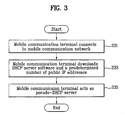
- FIG. 3 is a flow chart illustrating a method for constructing an IP address of a wireless terminal using the mobile communication terminal of FIG. 1 according to an embodiment of the present invention.
- Reference will now be made in detail to the preferred embodiments of the present invention, examples of which are illustrated in the accompanying drawings. Wherever possible, the same reference numbers will be used throughout the drawings to refer to the same or like parts.
- A
mobile communication terminal 100 according to an embodiment of the present invention will hereinafter be described with reference to FIG. 1. FIG. 1 is a block diagram illustrating a mobile communication terminal according to the present invention. - Referring to FIG. 1, the mobile communication terminal 100 (e.g., a cellular phone) includes a mobile
network interface unit 110, an Adhocinterface unit 130, amemory unit 150, and acontroller 170, all operatively coupled. The mobilenetwork interface unit 110 allows themobile communication terminal 100 to access a mobile communication network such as a CDMA network. The Adhoc interface unit 130 (e.g., a WLAN or Bluetooth interface unit) allows themobile communication terminal 100 to wirelessly communicate with at least one wireless terminal (e.g., a PDA). Thememory unit 150 stores a variety of software programs (e.g., DHCP server software and NAT (Network Address Translation) software) required for assigning an IP address to at least one wireless terminal. Thecontroller 170 controls overall components of themobile communication terminal 100. - A detailed IP address assignment method for use in a wireless terminal using the above-mentioned
mobile communication terminal 100 will hereinafter be described with reference to FIGS. 2-3. However, this method can be implemented in other suitable device/system. - Referring to FIGS. 2-3, the
mobile communication terminal 100 gains access to amobile communication network 200, and gains access to aDHCP server 300 over themobile communication network 200 at step S31. Preferably, the aforementioned access by themobile communication terminal 100 may be executed via an Open Shortest Path First (OSPF) protocol or a Routing Information (RI) protocol. - The mobile communication terminal 100 (e.g., using the mobile network interface unit 110) downloads a DHCP server software program from the DHCP
server 300 for allowing themobile communication terminal 100 to serve as a Pseudo-DHCP server, and stores the downloaded software program in the memory unit 150 (or other suitable storage) at step S33. Themobile communication terminal 100 also receives a predetermined number of public IP addresses from the DHCPserver 300 via thenetwork 200. - Thereafter, the
mobile communication terminal 100 serves as a Pseudo-DHCP server for one or more wireless terminals (400a, 400b, ... , 400n) capable of wirelessly accessing and communicating with themobile communication terminal 100, using the downloaded DHCP server software program at step S35. Thewireless terminal mobile communication terminal 100 but incapable of directly accessing the Internet or the like. Any number of wireless terminals are applicable. - In other words, the
mobile communication terminal 100 assigns the received public IP addresses to the above-mentioned wireless terminals (400a, 400b,..., or 400n). For instance, eachwireless terminal mobile communication terminal 100 serving as the pseudo-DHCP server using the assigned public IP addresses. In addition, the wireless terminals (400a, 400b, ... , 400n) can communicate with each other in the Adhoc mode using the above-mentioned assigned public IP addresses. Preferably, the Adhoc-mode communication may be executed using an AODV (Ad hoc On-Demand Distance Vector) protocol. - If one (e.g., 400a) of the above wireless terminals (400a, 400b, ... , 400n) is disconnected from the
mobile communication terminal 100, themobile communication terminal 100 withdraws the assigned public IP address from thatwireless terminal 400a. In other words, the disconnected wireless terminal is longer assigned to a public IP address. - According to the above-mentioned preferred embodiments of the present invention, only a predetermined number of wireless terminals corresponding to the number of public IP addresses obtained from the DHCP server can receive IP addresses from the mobile communication terminal. However, if the mobile communication terminal further downloads a Network Address Translation (NAT) software program from the DHCP server, the mobile communication terminal can assign IP addresses to a larger number of wireless terminals than the number of the public IP addresses received from the DHCP server, and a detailed description thereof will hereinafter be described.
- In one embodiment, the
mobile communication terminal 100 generates any number of private IP addresses (e.g., larger than the number of the public IP addresses received from the DHCP server), and assigns the private IP addresses to wireless terminals (400a, 400b, ... , 400n), such that the wireless terminals (400a, 400b, ..., 400n) can communicate with each other in an Adhoc mode. However, it is unusual for all the wireless terminals (400a, 400b, ... , 400n) receiving private IP addresses from themobile communication terminal 100 to simultaneously desire to access the Internet. Therefore, the NAT software program in themobile communication terminal 100 converts/maps the assigned private IP address(es) of only the wireless terminal(s), which access themobile communication terminal 100 to access the Internet, to the public IP address(es). Therefore, themobile communication terminal 100 can assign many more wireless terminals than the number of the public IP addresses received from the DHCP server, by using the private IP addresses and selectively assigning the public IP addresses as needed for the Internet access. - In one embodiment, if the
mobile communication terminal 100 stops the pseudo-DHCP server function as a result of unavoidable circumstances (e.g., separation from the mobile communication network), themobile communication terminal 100 transfers software programs and IP pool information for the pseudo-DHCP server function to a third-party mobile communication terminal, such that the third-party mobile communication terminal can continuously perform the pseudo-DHCP server function. - As apparent from the above description, the present invention allows a wireless terminal incapable of directly accessing a mobile communication network to access the Internet over the mobile communication terminal even at a place spaced apart from a hot-spot area, and does not use the zero-configuration method when establishing IP addresses of a plurality of wireless terminals, such that a time consumed for establishing the IP addresses is greatly reduced.
- It will be apparent to those skilled in the art that various modifications and variations can be made in the present invention without departing from the spirit or scope of the inventions. Thus, it is intended that the present invention covers the modifications and variations of this invention provided they come within the scope of the appended claims and their equivalents.
Claims (30)
- A method for assigning an Internet Protocol (IP) address to a wireless terminal using a mobile communication terminal, the method comprising:accessing, by the mobile communication terminal, a Dynamic Host Configuration Protocol (DHCP) server over a mobile communication network;downloading, by the mobile communication terminal, a DHCP software program from the DHCP server; andperforming, by the mobile communication terminal, a pseudo-DHCP server function using the downloaded DHCP server software program in association with at least one wireless terminal capable of wirelessly accessing the mobile communication terminal.
- The method according to claim 1, wherein the downloading step further includes:receiving, by the mobile communication terminal, a predetermined number of public IP addresses from the DHCP server.
- The method according to claim 2, wherein the performing step includes:if the at least one wireless terminal wirelessly accesses the mobile communication terminal, assigning by the mobile communication terminal at lest one of the received public IP addresses to the at lest one wireless terminal.
- The method according to claim 3, wherein the performing step further includes:if one of the at least one wireless terminal is disconnected from the mobile communication terminal, withdrawing by the mobile communication terminal the assignment of the public IP address from the disconnected wireless terminal.
- The method according to claim 1, wherein the at least one wireless terminal wirelessly accesses the mobile communication terminal in an Adhoc mode.
- The method according to claim 1, wherein the mobile communication terminal is a cellular phone.
- The method according to claim 6, wherein the at least one wireless terminal is at least one Personal Digital Assistant (PDA).
- The method according to claim 2, wherein the downloading step further includes:downloading, by the mobile communication terminal, a Network Address Translation (NAT) software program from the DHCP server.
- The method according to claim 8, wherein the performing step further includes:if one of the at least one wireless terminal wirelessly accesses the mobile communication terminal, generating by the mobile communication terminal a private IP address, and assigning the private IP address to the one wireless terminal.
- The method according to claim 9, wherein the performing step further includes:if the one wireless terminal desires to access an Internet service using the private IP address assigned by the mobile communication terminal, converting by the mobile communication terminal the assigned private IP address into one of the received public IP addresses using the NAT software program.
- The method according to claim 10, wherein the performing step further includes:if the one wireless terminal is disconnected from the mobile communication terminal, withdrawing by the mobile communication terminal the assignment of the converted public IP address from the one wireless terminal.
- A mobile communication terminal comprising:a mobile network interface unit for accessing a mobile communication network;an adhoc interface unit for wirelessly accessing at least one wireless terminal; anda controller for controlling the mobile network interface unit and the adhoc interface unit,wherein the mobile communication terminal accesses a Dynamic Host Configuration Protocol (DHCP) server over the mobile communication network, downloads a DHCP server software program from the DHCP server, and serves as a pseudo-DHCP server for the at least one wireless terminal capable of accessing the mobile communication terminal.
- The mobile communication terminal according to claim 12, wherein the mobile communication terminal also receives a predetermined number of public IP addresses from the DHCP server over the mobile communication network.
- The mobile communication terminal according to claim 13, wherein if the at least one wireless terminal wirelessly accesses the mobile communication terminal, the mobile communication terminal assigns at least one of the received public IP addresses to the at least one wireless terminal.
- The mobile communication terminal according to claim 14, wherein if one of the at least one wireless terminal is disconnected from the mobile communication terminal, the mobile communication terminal withdraws the assignment of the public IP address from the disconnected wireless terminal.
- The mobile communication terminal according to claim 12, wherein the adhoc interface unit allows the at least one wireless terminal to wirelessly access the mobile communication terminal in an adhoc mode.
- The mobile communication terminal according to claim 12, wherein the mobile communication terminal is a cellular phone.
- The mobile communication terminal according to claim 17, wherein the mobile communication terminal serves as the pseudo-DHCP server to the at least one wireless terminal being at least one Personal Digital Assistant (PDA).
- The mobile communication terminal according to claim 13, wherein the mobile communication terminal further downloads a Network Address Translation (NAT) software program from the DHCP server.
- The mobile communication terminal according to claim 19, wherein if one of the at least one wireless terminal wirelessly accesses the mobile communication terminal, the mobile communication terminal generates a private IP address, and assigns the private IP address to the one wireless terminal.
- The mobile communication terminal according to claim 20, wherein if the one wireless terminal desires to access an Internet service using the private IP address assigned by the mobile communication terminal, the mobile communication terminal converts the assigned private IP address into one of the received public IP addresses using the NAT software program.
- The mobile communication terminal according to claim 21, wherein if the one wireless terminal is disconnected from the mobile communication terminal, the mobile communication terminal withdraws the assignment of the converted public IP address from the disconnected wireless terminal.
- A mobile communication terminal comprising:a mobile network interface configured to access a Dynamic Host Configuration Protocol (DHCP) server over a mobile communication network, and to download a DHCP server software program from the DHCP server, so that the mobile communication terminal can serve as a pseudo-DHCP server for at least one wireless terminal capable of accessing the mobile communication terminal.
- The mobile communication terminal according to claim 23, wherein the mobile communication terminal receives a predetermined number of public IP addresses from the DHCP server over the mobile communication network; and if the at least one wireless terminal wirelessly accesses the mobile communication terminal, the mobile communication terminal assigns at least one of the received public IP addresses to the at least one wireless terminal.
- The mobile communication terminal according to claim 24, wherein if one of the at least one wireless terminal is disconnected from the mobile communication terminal, the mobile communication terminal withdraws the assignment of public IP address from the disconnected wireless terminal.
- The mobile communication terminal according to claim 23, wherein the mobile communication terminal is a cellular phone, and the at least one wireless terminal is at least one Personal Digital Assistant (PDA).
- The mobile communication terminal according to claim 23, wherein the mobile communication terminal further downloads a Network Address Translation (NAT) software program from the DHCP server.
- The mobile communication terminal according to claim 27, wherein the mobile communication terminal generates a private IP address, and selectively assigns the private IP address to one of the at least one wireless terminal.
- The mobile communication terminal according to claim 28, wherein if the one wireless terminal desires to access an Internet service using the private IP address assigned by the mobile communication terminal, the mobile communication terminal converts the assigned private IP address of the one wireless terminal into a public IP address using the NAT software program.
- The mobile communication terminal according to claim 29, wherein if the one wireless terminal is disconnected from the mobile communication terminal, the mobile communication terminal withdraws the assignment of the converted public IP address from the disconnected wireless terminal.
Applications Claiming Priority (1)
| Application Number | Priority Date | Filing Date | Title |
|---|---|---|---|
| KR20040116697A KR100628112B1 (en) | 2004-12-30 | 2004-12-30 | IP address setting control method using mobile communication terminal in network area to which multi-hop connection method is applied |
Publications (1)
| Publication Number | Publication Date |
|---|---|
| EP1677491A2 true EP1677491A2 (en) | 2006-07-05 |
Family
ID=36087656
Family Applications (1)
| Application Number | Title | Priority Date | Filing Date |
|---|---|---|---|
| EP20050028654 Withdrawn EP1677491A2 (en) | 2004-12-30 | 2005-12-29 | Method for assigning internet protocol (IP) address to wireless terminal incapable of accessing mobile communication network, and mobile communication terminal capable of implementing the same |
Country Status (5)
| Country | Link |
|---|---|
| US (1) | US20060146746A1 (en) |
| EP (1) | EP1677491A2 (en) |
| JP (1) | JP4215770B2 (en) |
| KR (1) | KR100628112B1 (en) |
| CN (1) | CN1819592A (en) |
Cited By (5)
| Publication number | Priority date | Publication date | Assignee | Title |
|---|---|---|---|---|
| EP2230876A1 (en) | 2009-03-16 | 2010-09-22 | Samsung Electronics Co., Ltd. | Method and Apparatus for Setting up Network for IP Communication in Mobile Terminal |
| CN102752409A (en) * | 2012-07-31 | 2012-10-24 | 上海虎符通信科技有限公司 | Control system and control method of wireless cluster |
| CN102801798A (en) * | 2012-08-03 | 2012-11-28 | 浙江宇视科技有限公司 | Method and device for distributing IP (Internet Protocol) address |
| CN102857953A (en) * | 2011-06-30 | 2013-01-02 | 中兴通讯股份有限公司 | Self-configuration method and device of base station |
| CN104219289A (en) * | 2014-08-15 | 2014-12-17 | 合肥美菱股份有限公司 | Wireless network parameter setting method of Internet of Things refrigerator |
Families Citing this family (24)
| Publication number | Priority date | Publication date | Assignee | Title |
|---|---|---|---|---|
| SE527871C2 (en) * | 2004-03-09 | 2006-06-27 | Ericsson Telefon Ab L M | Method and system for managing web services |
| KR100628112B1 (en) | 2004-12-30 | 2006-09-26 | 엘지전자 주식회사 | IP address setting control method using mobile communication terminal in network area to which multi-hop connection method is applied |
| US8559369B2 (en) | 2006-02-22 | 2013-10-15 | Elad Barkan | Wireless internet system and method |
| US8477683B2 (en) * | 2006-04-13 | 2013-07-02 | Qualcomm Incorporated | Configuring a host device by way of MMP |
| KR100781523B1 (en) * | 2006-04-25 | 2007-12-03 | 삼성전자주식회사 | IP identification packet configuration and IP allocation apparatus, IP identification packet configuration and IP allocation method using the same |
| US8165135B2 (en) * | 2006-05-05 | 2012-04-24 | At&T Intellectual Property I, L.P. | Methods, computer networks, and computer program products that facilitate providing broadband services wirelessly to third party users via a mesh network of customer premise equipment |
| US20070283033A1 (en) * | 2006-05-31 | 2007-12-06 | Bloebaum L Scott | System and method for mobile telephone as audio gateway |
| US7680490B2 (en) * | 2006-06-30 | 2010-03-16 | Sony Ericsson Mobile Communications Ab | System and method for multimedia networking with mobile telephone and headset |
| US7894454B2 (en) * | 2007-06-27 | 2011-02-22 | Alcatel-Lucent Usa Inc. | Special termination mobile announcement, for wireless VoIP customized ring back tone service |
| JP5248820B2 (en) * | 2007-08-15 | 2013-07-31 | キヤノン株式会社 | Communication apparatus and communication method thereof |
| KR101400398B1 (en) * | 2007-08-31 | 2014-05-26 | 엘지전자 주식회사 | Terminal for IP Communication and its using Method of Network Configuration |
| JP5072788B2 (en) * | 2008-09-19 | 2012-11-14 | 三洋電機株式会社 | COMMUNICATION METHOD AND TERMINAL DEVICE USING THE SAME |
| JP2010177830A (en) * | 2009-01-28 | 2010-08-12 | Nec Corp | Automatic network setting system, radio access device, and automatic network setting method used therefor |
| US8472868B2 (en) * | 2009-05-06 | 2013-06-25 | Telefonaktiebolaget Lm Ericsson (Publ) | Method and apparatus for MIMO repeater chains in a wireless communication network |
| KR101613170B1 (en) * | 2009-10-13 | 2016-04-18 | 삼성전자주식회사 | Apparatus and method for providing access point function in portable communication system |
| JP5325192B2 (en) * | 2010-10-22 | 2013-10-23 | 株式会社バッファロー | COMMUNICATION DEVICE AND COMMUNICATION DEVICE OPERATION CONTROL METHOD |
| WO2012114527A1 (en) * | 2011-02-25 | 2012-08-30 | 富士通株式会社 | Method for assigning ip address to relay device |
| JP5994261B2 (en) * | 2012-01-31 | 2016-09-21 | ブラザー工業株式会社 | Communication device |
| CN103139323A (en) * | 2013-01-30 | 2013-06-05 | 北京天地互连信息技术有限公司 | Method for dynamic configuration of original address agency of mobile IPv6 mobile terminal |
| CN105850166A (en) * | 2013-12-27 | 2016-08-10 | 日本电气株式会社 | Wireless communication device, wireless communication network, and identification-number setting method |
| CN107241453B (en) * | 2016-03-28 | 2020-07-24 | 华为技术有限公司 | Network address translation mapping keep-alive method and device |
| JP6269752B2 (en) * | 2016-08-24 | 2018-01-31 | ブラザー工業株式会社 | Communication device |
| CN108934058B (en) * | 2017-05-25 | 2020-11-27 | 华为技术有限公司 | A communication method and device |
| JP6519668B2 (en) * | 2018-01-04 | 2019-05-29 | ブラザー工業株式会社 | Communication device |
Citations (1)
| Publication number | Priority date | Publication date | Assignee | Title |
|---|---|---|---|---|
| KR20060078031A (en) | 2004-12-30 | 2006-07-05 | 엘지전자 주식회사 | IP address setting control method using mobile communication terminal in network area to which multi-hop connection method is applied |
Family Cites Families (6)
| Publication number | Priority date | Publication date | Assignee | Title |
|---|---|---|---|---|
| WO2003037009A1 (en) * | 2001-10-23 | 2003-05-01 | Meshnetworks, Inc. | System and method for providing a congestion optimized address resolution protocol for wireless ad-hoc networks |
| US6801528B2 (en) * | 2002-07-03 | 2004-10-05 | Ericsson Inc. | System and method for dynamic simultaneous connection to multiple service providers |
| GB2398704B (en) * | 2003-02-21 | 2005-07-06 | Toshiba Res Europ Ltd | Address autoconfiguration in ad hoc networks |
| US7430614B2 (en) * | 2003-10-31 | 2008-09-30 | Redback Networks, Inc. | Use of IP address blocks with default interfaces in a router |
| US20050188069A1 (en) * | 2003-12-31 | 2005-08-25 | Ravikumar Mohandas | Zero-configuring IP addresses for peer-to-peer networks |
| KR100689554B1 (en) * | 2004-10-07 | 2007-03-02 | 삼성전자주식회사 | Apparatus and method for providing indoor and outdoor wireless access in broadband wireless access communication system |
-
2004
- 2004-12-30 KR KR20040116697A patent/KR100628112B1/en not_active Expired - Fee Related
-
2005
- 2005-12-19 JP JP2005365600A patent/JP4215770B2/en not_active Expired - Fee Related
- 2005-12-29 EP EP20050028654 patent/EP1677491A2/en not_active Withdrawn
- 2005-12-29 US US11/319,382 patent/US20060146746A1/en not_active Abandoned
- 2005-12-30 CN CNA2005100035232A patent/CN1819592A/en active Pending
Patent Citations (1)
| Publication number | Priority date | Publication date | Assignee | Title |
|---|---|---|---|---|
| KR20060078031A (en) | 2004-12-30 | 2006-07-05 | 엘지전자 주식회사 | IP address setting control method using mobile communication terminal in network area to which multi-hop connection method is applied |
Cited By (12)
| Publication number | Priority date | Publication date | Assignee | Title |
|---|---|---|---|---|
| EP2230876A1 (en) | 2009-03-16 | 2010-09-22 | Samsung Electronics Co., Ltd. | Method and Apparatus for Setting up Network for IP Communication in Mobile Terminal |
| US8208472B2 (en) | 2009-03-16 | 2012-06-26 | Samsung Electronics Co., Ltd | Method and apparatus for setting up network for IP communication in mobile terminal |
| US8422475B2 (en) | 2009-03-16 | 2013-04-16 | Samsung Electronics Co., Ltd | Method and apparatus for setting up network for IP communication in mobile terminal |
| EP2723137A1 (en) * | 2009-03-16 | 2014-04-23 | Samsung Electronics Co., Ltd | Method and apparatus for setting up network for IP communication in mobile terminal |
| US8855119B2 (en) | 2009-03-16 | 2014-10-07 | Samsung Electronics Co., Ltd | Method and apparatus for setting up network for IP communication in mobile terminal |
| CN102857953A (en) * | 2011-06-30 | 2013-01-02 | 中兴通讯股份有限公司 | Self-configuration method and device of base station |
| CN102857953B (en) * | 2011-06-30 | 2017-03-22 | 中兴通讯股份有限公司 | Self-configuration method and device of base station |
| CN102752409A (en) * | 2012-07-31 | 2012-10-24 | 上海虎符通信科技有限公司 | Control system and control method of wireless cluster |
| CN102752409B (en) * | 2012-07-31 | 2015-06-03 | 上海虎符通信科技有限公司 | Control system and control method of wireless cluster |
| CN102801798A (en) * | 2012-08-03 | 2012-11-28 | 浙江宇视科技有限公司 | Method and device for distributing IP (Internet Protocol) address |
| CN102801798B (en) * | 2012-08-03 | 2015-05-06 | 浙江宇视科技有限公司 | Method and device for distributing IP (Internet Protocol) address |
| CN104219289A (en) * | 2014-08-15 | 2014-12-17 | 合肥美菱股份有限公司 | Wireless network parameter setting method of Internet of Things refrigerator |
Also Published As
| Publication number | Publication date |
|---|---|
| JP4215770B2 (en) | 2009-01-28 |
| KR20060078031A (en) | 2006-07-05 |
| US20060146746A1 (en) | 2006-07-06 |
| KR100628112B1 (en) | 2006-09-26 |
| CN1819592A (en) | 2006-08-16 |
| JP2006191570A (en) | 2006-07-20 |
Similar Documents
| Publication | Publication Date | Title |
|---|---|---|
| EP1677491A2 (en) | Method for assigning internet protocol (IP) address to wireless terminal incapable of accessing mobile communication network, and mobile communication terminal capable of implementing the same | |
| US6603763B1 (en) | System and method for communicating between a mobile station and a network using address assignment | |
| EP1238546B1 (en) | Cellular radio communication system | |
| EP2312905B1 (en) | Apparatus and method for providing access point function in portable communication system | |
| US20040005886A1 (en) | Radio terminal, radio terminal controlling apparatus and location registration auxiliary apparatus | |
| US8103784B2 (en) | Communication device and communication control method using efficient echonet address determination scheme | |
| US20020169886A1 (en) | Communication device and communication control device for enabling operation of control protocol for one network on other types of networks | |
| CN100418323C (en) | Location management server and mobile communication system | |
| JP2005130512A (en) | Mobility support method and system for mobile terminal | |
| JP2007221786A (en) | Automatic network selection method and apparatus using steering PLMN | |
| CN111934961B (en) | Intelligent household network configuration method, equipment and computer readable storage medium | |
| US9615246B2 (en) | Dynamic allocation of host IP addresses | |
| US6671510B1 (en) | Wireless telephone system and operation method therefor | |
| CN106255089A (en) | A kind of method and apparatus of radio three layer roaming | |
| US8054814B2 (en) | System and signaling method for interworking wireless LAN and portable internet | |
| CN109076444B (en) | Access method, device, equipment and system | |
| US7831721B2 (en) | System and method for providing IPv6 services | |
| KR101758173B1 (en) | Apparatus and method for discovering gateway in broadband wireless access system | |
| US7633902B2 (en) | Information communication program, information communication apparatus and information communication method | |
| US20050089041A1 (en) | Method and apparatus for assisting a mobile node to transmit a packet | |
| DK1817892T3 (en) | PROCEDURE AND SYSTEM TO OPEN A NETWORK LINK | |
| EP3820177B1 (en) | Device and method for connecting a user device with a network via a telecommunication hub | |
| EP3820179B1 (en) | Device and method for connecting a user device with a network via a telecommunication hub | |
| EP3820178B1 (en) | Device and method for connecting a user device with a network via a telecommunication hub | |
| JP2006115514A (en) | Wireless network device and communication method using the same |
Legal Events
| Date | Code | Title | Description |
|---|---|---|---|
| PUAI | Public reference made under article 153(3) epc to a published international application that has entered the european phase |
Free format text: ORIGINAL CODE: 0009012 |
|
| AK | Designated contracting states |
Kind code of ref document: A2 Designated state(s): AT BE BG CH CY CZ DE DK EE ES FI FR GB GR HU IE IS IT LI LT LU LV MC NL PL PT RO SE SI SK TR |
|
| AX | Request for extension of the european patent |
Extension state: AL BA HR MK YU |
|
| STAA | Information on the status of an ep patent application or granted ep patent |
Free format text: STATUS: THE APPLICATION HAS BEEN WITHDRAWN |
|
| 18W | Application withdrawn |
Effective date: 20090122 |