EP1677194A1 - Backup method and system for operation and maintenance centers of a telecommunication system using storage based activity detection - Google Patents
Backup method and system for operation and maintenance centers of a telecommunication system using storage based activity detection Download PDFInfo
- Publication number
- EP1677194A1 EP1677194A1 EP04030923A EP04030923A EP1677194A1 EP 1677194 A1 EP1677194 A1 EP 1677194A1 EP 04030923 A EP04030923 A EP 04030923A EP 04030923 A EP04030923 A EP 04030923A EP 1677194 A1 EP1677194 A1 EP 1677194A1
- Authority
- EP
- European Patent Office
- Prior art keywords
- messages
- telecommunication network
- devices
- active
- message
- Prior art date
- Legal status (The legal status is an assumption and is not a legal conclusion. Google has not performed a legal analysis and makes no representation as to the accuracy of the status listed.)
- Withdrawn
Links
Images



Classifications
-
- G—PHYSICS
- G06—COMPUTING OR CALCULATING; COUNTING
- G06F—ELECTRIC DIGITAL DATA PROCESSING
- G06F11/00—Error detection; Error correction; Monitoring
- G06F11/07—Responding to the occurrence of a fault, e.g. fault tolerance
- G06F11/16—Error detection or correction of the data by redundancy in hardware
- G06F11/20—Error detection or correction of the data by redundancy in hardware using active fault-masking, e.g. by switching out faulty elements or by switching in spare elements
- G06F11/202—Error detection or correction of the data by redundancy in hardware using active fault-masking, e.g. by switching out faulty elements or by switching in spare elements where processing functionality is redundant
- G06F11/2023—Failover techniques
- G06F11/2028—Failover techniques eliminating a faulty processor or activating a spare
-
- H—ELECTRICITY
- H04—ELECTRIC COMMUNICATION TECHNIQUE
- H04L—TRANSMISSION OF DIGITAL INFORMATION, e.g. TELEGRAPHIC COMMUNICATION
- H04L41/00—Arrangements for maintenance, administration or management of data switching networks, e.g. of packet switching networks
- H04L41/50—Network service management, e.g. ensuring proper service fulfilment according to agreements
- H04L41/5003—Managing SLA; Interaction between SLA and QoS
- H04L41/5009—Determining service level performance parameters or violations of service level contracts, e.g. violations of agreed response time or mean time between failures [MTBF]
- H04L41/5012—Determining service level performance parameters or violations of service level contracts, e.g. violations of agreed response time or mean time between failures [MTBF] determining service availability, e.g. which services are available at a certain point in time
-
- H—ELECTRICITY
- H04—ELECTRIC COMMUNICATION TECHNIQUE
- H04W—WIRELESS COMMUNICATION NETWORKS
- H04W24/00—Supervisory, monitoring or testing arrangements
- H04W24/04—Arrangements for maintaining operational condition
-
- G—PHYSICS
- G06—COMPUTING OR CALCULATING; COUNTING
- G06F—ELECTRIC DIGITAL DATA PROCESSING
- G06F11/00—Error detection; Error correction; Monitoring
- G06F11/07—Responding to the occurrence of a fault, e.g. fault tolerance
- G06F11/16—Error detection or correction of the data by redundancy in hardware
- G06F11/20—Error detection or correction of the data by redundancy in hardware using active fault-masking, e.g. by switching out faulty elements or by switching in spare elements
- G06F11/2097—Error detection or correction of the data by redundancy in hardware using active fault-masking, e.g. by switching out faulty elements or by switching in spare elements maintaining the standby controller/processing unit updated
-
- H—ELECTRICITY
- H04—ELECTRIC COMMUNICATION TECHNIQUE
- H04L—TRANSMISSION OF DIGITAL INFORMATION, e.g. TELEGRAPHIC COMMUNICATION
- H04L41/00—Arrangements for maintenance, administration or management of data switching networks, e.g. of packet switching networks
- H04L41/06—Management of faults, events, alarms or notifications
- H04L41/0681—Configuration of triggering conditions
Definitions
- US 2002/0095489 A1 discloses a stand-by host group system.
- Mobile telecommunications systems as such are known to one skilled in the art e.g. from the GSM network (see e.g. www.etsi.com) or 3 rd generation networks (see e.g. www.3GPP.com) or other networks.
- Such telecommunication networks can comprise operation and maintenance centers OMC which can control and monitor the operation of an entire telecommunication network or of sections of a telecommunication network.
- OMC operation and maintenance centers
- As an operation and maintenance center is an important functionality of a mobile telecommunication network it can be implemented twice with one active operation maintenance center and a second operation maintenance center which is in a stand-by mode during operation of the first operation and maintenance center.
- An object of the invention is to provide an efficient and highly reliable coordination of the activities of operation and maintenance centers in a telecommunication network.
- the object is achieved by the invention said forth in the claims.
- the invention provides a highly reliable coordination of the activity of (always only one of) two or more operation and maintenance centers both able to control a mobile network or sections of such mobile network.
- a process of one operation and maintenance center can regularly send activity indicating messages to devices as e.g. servers, whereas a process on the second (backup) operation and maintenance center can regularly try to read such messages from the devices (servers etc.).
- the second operation and maintenance center can highly reliably detect whether the first operation maintenance center is active which allows the second operation and maintenance center to be always active if the first operation and maintenance center is not active but not in other cases.
- the invention provides an automatic fail-over procedure for pairs of TMN applications.
- A1 be an application, or a group of applications, or a part of an application which can work independently from other parts.
- A1 will be a process.
- the "read” is scheduled a certain time span before the next put.
- both OMCs should have the same time (synchronized clocks etc).
- Means The time should e.g. not differ more than 20 seconds.
- the algorithm did not yet consider the case that A1 and A2 can run in parallel. However his can happen, because the algorithm is based on the assumption that OMC1 and OMC2 have (almost) the same time. A misfortune could invalidate this assumption.
- the invention provides a highly reliable fail-over procedure without the need of any special hardware only by using inherent functionality.
- process A2 If process A2 is active then it uses subdirs SUBDIR A2 which are different from SUBDIR A1 .
- the servers need not to be same. 1 "right file creation time": not older than At.
- A1 is a process on server S1 in OMC1 and A2 is a process on S2 of OMC2.
- n 1. If A1 is active it deposits its messages on S1, S2, S3. If A2 is active it deposits its messages on S1, S3, S4. If A1 is active it periodically tries to create a file in SUBDIR A1 on 2 servers. One minute later A2 tries to read SUBDIR A1 from 2 servers.
- A2 If A2 is active it periodically tries to create a file in SUBDIR A2 on 2 servers. A1 tries to read SUBDIR A2 from 2 servers.
- A1 (or A2) writes a message it could contain the current time of OMC1 (or OMC2). If A1 is active and finds an unexpected message from A2 it can compare the file creation time with the time written into the file. The difference of both times could be included into an alarm which A1 is going to send.
Landscapes
- Engineering & Computer Science (AREA)
- Theoretical Computer Science (AREA)
- Computer Networks & Wireless Communication (AREA)
- Signal Processing (AREA)
- Quality & Reliability (AREA)
- Physics & Mathematics (AREA)
- General Engineering & Computer Science (AREA)
- General Physics & Mathematics (AREA)
- Hardware Redundancy (AREA)
Abstract
one process being a backup process for the other process wherein, when the first process is active and the second process is inactive, the first process regularly sends messages representing its activity status to devices in predetermined time intervals,
and the devices respectively store received messages,
and the second process tries to read stored messages from the devices,
wherein only if the second operation and maintenance center can contact at least one device and if the second process finds a stored message of the first process on at least one device, which's message is younger than the time interval, then the inactive second process turns active,
wherein the active first process only turns inactive, if it did not leave a message on a device or if it did not reach any device.
Description
- Principle for redundancy of TMN applications to get improved availability using multi surface systems
- US 2002/0095489 A1 discloses a stand-by host group system. Mobile telecommunications systems as such are known to one skilled in the art e.g. from the GSM network (see e.g. www.etsi.com) or 3rd generation networks (see e.g. www.3GPP.com) or other networks.
Such telecommunication networks can comprise operation and maintenance centers OMC which can control and monitor the operation of an entire telecommunication network or of sections of a telecommunication network. As an operation and maintenance center is an important functionality of a mobile telecommunication network it can be implemented twice with one active operation maintenance center and a second operation maintenance center which is in a stand-by mode during operation of the first operation and maintenance center. - An object of the invention is to provide an efficient and highly reliable coordination of the activities of operation and maintenance centers in a telecommunication network. The object is achieved by the invention said forth in the claims.
- The invention provides a highly reliable coordination of the activity of (always only one of) two or more operation and maintenance centers both able to control a mobile network or sections of such mobile network. According to the inventions a process of one operation and maintenance center can regularly send activity indicating messages to devices as e.g. servers, whereas a process on the second (backup) operation and maintenance center can regularly try to read such messages from the devices (servers etc.). If these messages are sent in regular time intervals from the process of the first operation and maintenance center and are also read out in time intervals which are not longer than this time interval or which are the same as the named time interval and the second operation and maintenance center can highly reliably detect whether the first operation maintenance center is active which allows the second operation and maintenance center to be always active if the first operation and maintenance center is not active but not in other cases.
Preferably there are at least two devices to which the said messages are sent and from which they are read out to guarantee high reliability of the coordination of the two operation and maintenance centers independently from the reliability of the server devices receiving and providing the messages. E.g. there can also be more than two devices as e.g. 3, 4, 5 or even more server devices. - Further advantages are obvious from the claims and the following description of an example of an implementation of the invention in the description and the enclosed drawing.
- In the drawing,
- Fig. 1 shows two operation and maintenance centers exchanging activity messages ("heartbeat messages")
- Fig. 2 shows transitions of the activity statuses of the two operation and maintenance centers
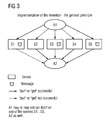
- Fig. 3 shows an implementation of activity message transfer via devices
- Fig. 4 shows the activity message time limit ("heartbeat schedule")
- Fig. 5 explains state transitions
- Fig. 6 explains two time scales
- Fig. 7 explains the case of no fail/over
- Fig. 8 explains the case of a late failover
- Figures 7 to 9 explain the probability of certain cases
- Fig. 10 explains status transitions
- The invention provides an automatic fail-over procedure for pairs of TMN applications.
- Let A1 be an application, or a group of applications, or a part of an application which can work independently from other parts. Usually A1 will be a process.
- E.g. A1 runs in the Operation- and Maintenance Centre OMC1 and A2 is its redundant partner in OMC2 according to Fig.1. Fig. 2 suggests requirements for this situation.
- Instead of using one highly reliable communication channel for the heart-beat the invention suggests several lower reliable channels across different servers. High reliability can thus be reached statistically.
- Stateless recovery from double-crash will be reached by a defined read-write time scale.
- The invention suggests one type of message which is a sign of live (which might also be called "heartbeat message"or "message"). More precisely the message means that a process (A1 etc) of an OMC is alive (= functioning) and it is going to continue its work (A1 could also be alive but could decide that it is not able to continue successfully.)
- Next the general inventive method and mechanism are described referring to fig. 3:
- 1. If process A1 is up (active) and decides (by means of certain criteria), that it probably will be able to fulfil its job, then it tries to deposit a message on n+1 servers (named devices in the claims) of OMC1 and/or OMC2. It's no matter on which n+1 servers of the 2n+1 servers A1 succeeds (regarding depositing a message).
In the above figure is n = 2, process A1 succeeds in depositing a message on n+1 = 3 servers, here: S1, S3, S5.
Process A2 is able to access n+1 = 3 servers, here: S2, S4, S5. It is guaranteed that in this case A2 will find a message on at least one server, here: S5.
"A2 is able to access a server" actually means:- Process A2 is able to decide whether there is a message on the server or not. But for simplicity this will be named "A2 is able to access".
- 2. If process A1 is not able to deposit the message on n+1 servers, then it stops working (if not already stopped).
- 3. If process A1 stops working then it assumes that process A2 takes over, regardless whether process A2 really becomes active or not. Therefore from now on process A1 expects messages from process A2.
- 4. Process A2 takes over if and only if it is able to access n+1 servers but does not find a message.
- Remark 1: If process A2 is active then it may (or even should) use some other servers to deposit its messages than process A1.
- Remark 2 : From an algorithmic point of view it makes no difference whether A1 deposits a messages on exactly n+1 servers or on more than n+1 servers. From a performance point of view A1 should not try to deposit the messages on more than n+1 servers. In the long-term this rule leads to more get-attempts by A2, but A2 is stand-by and has "nothing" to do.
- Remark 3:
Point 2 of the algorithm says "If process A1 is not able to deposit the message on n+1 servers, then it stops working (if not already stopped)."
Here is a refinement: If A1 has deposited messages on k servers, k < n+1, and it decides to stop because it is not able to access n+1 servers (or by any other reason), then it should try to delete the k messages.
The algorithm would work without this refinement as well (therefore it is no tragedy if a deletion fails). But it increases the probability that A2 takes over already after its next read. - The messages are put / read at certain intervals □t, e.g. □t = 7 minutes.
The "read" is scheduled a certain time span before the next put. - Therefore both OMCs should have the same time (synchronized clocks etc). Means: The time should e.g. not differ more than 20 seconds.
- E.g. in figure 4 the "read" is scheduled to 1 minute and 30 seconds before the next put.
To give process A1 such a large time window for the put avoids unnecessary fail-over-s.
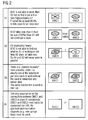
It gives A1 the chance to recover from a restart, or the working conditions for A1 improve during the put-time-window. The generous get-time-window of one minute could be used to repeat failed get-s. - The table in Fig. 5 describes the possible state transitions of A1 and A2.
In Fig. 5 the references (*1), (*2) and (*3) mean: - (*1) Possible reasons:
- A1 is down
- A1 is up but is not able to put messages on n+1 servers
- A1 is up but does not want to put messages, i.e. it wants to stop "voluntarily"
- A1 is down
- (*2) Obviously this transition can happen only once, namely if A1 was not able to delete all of the already deposited messages. But in the next cycle A1 will not write any message. Therefore we do not need to examine this transition in more detail.
- (*3) "A1 stops working" includes that it has already stopped, e.g. because of a crash.
Anyway: If A1 remains alive or comes up again, than it assumes that A2 became active.
A1 and A2 work stateless! If an application of a redundant pair comes up it always assumes that its partner is active. As we will see below exactly one of them automatically becomes active, i.e. there is no need for any additional handling. - (*4) This is the bad case: A1 stops but A2 remains inactive - possibly lasting.
- How does such an (unlikely) situation come to an end? There are several possibilities:
- (1) A1 assumes that A2 has become active. Therefore from now on - may be after a recovery - A1 looks for messages deposited by A2. Because it will not find a message it will become active again.
- (2) Finally A2 is able to access n+1 servers and becomes active.
- (3) Worst case: A1 does not recover and A2 is permanently not able to access n+1 servers. This could happen e.g. if OMC1 crashes completely.
- (1) Then A2 must be told manually that it should become active.
- It happen that the transitions (1) and (2) happen approximately at the same time, so A1 and A2 both become active - if the following additional rules were not introduced with respect to the timing.
-
- □t the length of one sign-of-life cycle,
- □w the length of a write period,
- Or the length of a read period.
-
- 1. After a fail-over the write-read schedule should remain the same but out of phase
(i.e.: same rhythm but shifted start points). - 2. The phase displacement should be □t/2,
i.e. the write periods of A2 start □t/2 after the write periods of A1 - 3. It must be □w >= 3*□r
- 4. An applications changes its state from "stand-by" to "active" exactly at the end of a read phase (in which it was able to access n+1 servers but did not find a message). The phase displacement of □t/2 takes place immediately.
- In the figure 6 e.g.: □w = 3*□r.
- Now, it is assumed that A1 stopped working but A2 does not become active. A1 uses Scale-2 and A2 uses Scale-1.
If A1 once more becomes active, then the situation is as depicted in fig. 7. - And now the opposite event (A2 "wins") is described referring to fig.8.
- The algorithm did not yet consider the case that A1 and A2 can run in parallel. However his can happen, because the algorithm is based on the assumption that OMC1 and OMC2 have (almost) the same time. A misfortune could invalidate this assumption.
- Therefore:
- If an application is active, then it writes in "its" time scale.
- Additionally it shall read in the complementary time scale . If it finds a message from its partner, then it should raise an alarm stop working.
- Repeating explicitely the behaviour at start-up:
- Both redundant partners start without any additional parameters like "you should become the active one"
- Both partners will begin with the assumption that their partner is active.
One of them will be the first which notices, that there is no message from the partner. And it will become active.
Our timing rules prevent that the partner becomes active at the same time. - The invention provides a highly reliable fail-over procedure without the need of any special hardware only by using inherent functionality.
- The basic probabilities acc. To fig.7 are assumed.
- Then the probability, that the server it disconnected is, acc. to fig. 10, less than P1+P2, because we have to consider that both things could happen at the same time.
- Then (s. fig. 11) the probability P4 that only n of 2n+1 servers are accessible is the Bernoulli distribution B(n;2n+1,1-P3). In Excel this looks like BINOMVERT(n,2n+1,1-P3,TRUE). Search for the keyword "binom" in Excels help to see a definition of B or BINOMVERT.
P4 B(n;2n+1,1-P3) only n of 2n+1 servers are accessible n=1 0.0003 " 1 " 3 " n=2 0.0001 " 2 " 5 " - 2. Stateless recovery / startup
- 3. The OMCs need not to be in one and the same LAN. So they may be - lets say - 1000 km apart from each other.
- E.g. the choice is:
- put message = create a file,
- read message = find a file.
- On the local disks of the 2n+1 servers there is a defined sub-directory SUBDIRA1 which is used by A1 to deposit its messages.
The subdirs on the servers S1, S2, ...are denoted by SUBDIRA1 (S1), SUBDIRA1(S2),... - To put a message onto S1 simply means to create an (empty) file in SUBDIRA1(S1).
- A2 opens and reads the directory SUBDIRA1(S1).
If it finds a file with the right file creation time1 then A2 has received the message.
A2 is able to decide whether there is a message on S1 (we said "is able to access S1") if a readdir() succeeds. - If process A2 is active then it uses subdirs SUBDIRA2 which are different from SUBDIRA1.
Remember that also the servers need not to be same.
1 "right file creation time": not older than At. - Remark: We say intentionally nothing about the implementation of the remote createfile() and readdir(). It may be accomplished by exported directories (shared network drives), ftp (put, ls) or somehow else.
We also say nothing about all the necessary things like clean up. - So A1 is a process on server S1 in OMC1 and A2 is a process on S2 of OMC2.
We choose n=1.
If A1 is active it deposits its messages on S1, S2, S3.
If A2 is active it deposits its messages on S1, S3, S4.
If A1 is active it periodically tries to create a file in SUBDIRA1 on 2 servers.
One minute later A2 tries to read SUBDIRA1 from 2 servers. - If A2 is active it periodically tries to create a file in SUBDIRA2 on 2 servers.
A1 tries to read SUBDIRA2 from 2 servers. - Remark: If A1 (or A2) writes a message it could contain the current time of OMC1 (or OMC2).
If A1 is active and finds an unexpected message from A2 it can compare the file creation time with the time written into the file. The difference of both times could be included into an alarm which A1 is going to send.
Claims (7)
- Method for controlling the activity of a first process (A1) of a first operation and maintenance center (OMC1) of a telecommunication network and of a second process (A2) of a second operation and maintenance center (OMC2) of the telecommunication network,
one process (A2) being a backup process for the other process (A1),
wherein, when the first process (A1) is active and the second process (A2) is inactive, the first process (A1) regularly sends messages representing its activity status to devices (S1, S2, S3) in predetermined time intervals(Δt),
and the devices respectively store received messages,
and the second process tries to read stored messages from the devices,
wherein only if the second operation and maintenance center (OMC2) is able to contact at least one device and if the second process does not find a stored message of the first process on at least one device, which message is younger than the time interval, then the inactive second process turns active. - Method according to claim 1,
characterized in that that the telecommunication network is a mobile telecommunication network, especially a cellular mobile telecommunication network. - Method according to one of the preceding claims,
characterized in that the said devices are servers, especially servers of a telecommunication network. - Method according to one of the preceding claims,
characterized in that the first and second process are operation and/or maintenance processes for the telecommunication network. - Method according to one of the preceding claims,
characterized in that an active status means carrying out an activity beyond reading the messages. - Method according to one of the preceding claims,
characterized in that an active status comprises doing an operation and/or maintenance process for the telecommunication network and an inactive status comprises not doing such processes. - Operation and maintenance system for a telecommunication network, especially a cellular mobile telecommunication network,- comprising a first operation and maintenance center (OMC1) on which a first process is implemented and- comprising a second operation and maintenance center (OMC2) on which a second process is implemented- comprising a plurality of devices with a receiving means for receiving messages from the first process and with storing means for storing received messages and with sending means for sending stored messages for the second process if the second process tries to read the messages,- comprising triggering means for making the first process send messages to the devices in predetermined time intervals,- comprising triggering means for making the second process try to read stored messages from the devices,- comprising activation means for activating the second process if it cannot find a message on any device,- comprising a deactivation means for deactivating the first process if it does not or cannot send messages for a longer time than the time interval to at least one device.
Priority Applications (2)
| Application Number | Priority Date | Filing Date | Title |
|---|---|---|---|
| EP04030923A EP1677194A1 (en) | 2004-12-28 | 2004-12-28 | Backup method and system for operation and maintenance centers of a telecommunication system using storage based activity detection |
| PCT/EP2005/056449 WO2006069891A1 (en) | 2004-12-28 | 2005-12-02 | Backup method and system for operation and maintenance centers of a telecommunication system using storage based activity detection |
Applications Claiming Priority (1)
| Application Number | Priority Date | Filing Date | Title |
|---|---|---|---|
| EP04030923A EP1677194A1 (en) | 2004-12-28 | 2004-12-28 | Backup method and system for operation and maintenance centers of a telecommunication system using storage based activity detection |
Publications (1)
| Publication Number | Publication Date |
|---|---|
| EP1677194A1 true EP1677194A1 (en) | 2006-07-05 |
Family
ID=34928022
Family Applications (1)
| Application Number | Title | Priority Date | Filing Date |
|---|---|---|---|
| EP04030923A Withdrawn EP1677194A1 (en) | 2004-12-28 | 2004-12-28 | Backup method and system for operation and maintenance centers of a telecommunication system using storage based activity detection |
Country Status (2)
| Country | Link |
|---|---|
| EP (1) | EP1677194A1 (en) |
| WO (1) | WO2006069891A1 (en) |
Citations (1)
| Publication number | Priority date | Publication date | Assignee | Title |
|---|---|---|---|---|
| US20020095489A1 (en) * | 2001-01-12 | 2002-07-18 | Kenji Yamagami | Failure notification method and system using remote mirroring for clustering systems |
-
2004
- 2004-12-28 EP EP04030923A patent/EP1677194A1/en not_active Withdrawn
-
2005
- 2005-12-02 WO PCT/EP2005/056449 patent/WO2006069891A1/en not_active Ceased
Patent Citations (1)
| Publication number | Priority date | Publication date | Assignee | Title |
|---|---|---|---|---|
| US20020095489A1 (en) * | 2001-01-12 | 2002-07-18 | Kenji Yamagami | Failure notification method and system using remote mirroring for clustering systems |
Non-Patent Citations (1)
| Title |
|---|
| "Electromagnetic compatibility and Radio spectrum Matters (ERM); Enhanced Radio MEssage System (ERMES); Part 7: Operation and maintenance aspects; ETS 300 133-7", ETSI STANDARDS, EUROPEAN TELECOMMUNICATIONS STANDARDS INSTITUTE, SOPHIA-ANTIPO, FR, vol. ERM-RP04, no. Second Edition, November 1997 (1997-11-01), XP014012136, ISSN: 0000-0001 * |
Also Published As
| Publication number | Publication date |
|---|---|
| WO2006069891A1 (en) | 2006-07-06 |
Similar Documents
| Publication | Publication Date | Title |
|---|---|---|
| EP2281240B1 (en) | Maintaining data integrity in data servers across data centers | |
| CN112084072B (en) | Method, system, medium and terminal for improving disaster tolerance capability of PostgreSQL cluster | |
| US7016946B2 (en) | Method and system for establishing a quorum for a geographically distributed cluster of computers | |
| CN112003716A (en) | Data center dual-activity implementation method | |
| CN115277379B (en) | Distributed lock disaster recovery processing method and device, electronic equipment and storage medium | |
| CN101136728A (en) | Cluster system and method for backing up a replica in a cluster system | |
| CN101989922A (en) | Method and system for recovering session initial protocol affairs | |
| TWI677797B (en) | Management method, system and equipment of master and backup database | |
| CN102868754A (en) | High-availability method, node device and system for achieving cluster storage | |
| CN101582787A (en) | Double-computer backup system and backup method | |
| US20060117101A1 (en) | Node discovery and communications in a network | |
| US11347607B1 (en) | Data storage cluster with witness node for selecting surviving storage node after replication failure | |
| CN107357800A (en) | A kind of database High Availabitity zero loses solution method | |
| US8458513B2 (en) | Efficient failure recovery in a distributed data storage system | |
| KR100744448B1 (en) | Communication system | |
| JP2000250771A (en) | Server duplication system | |
| CN118535551A (en) | High availability data management method and device, program product, equipment and storage medium | |
| CN117435405A (en) | Dual hot standby and failover system and method | |
| CN112367182B (en) | Configuration method and device of disaster recovery main and standby equipment | |
| EP2887592A1 (en) | Enum-dns disaster recovery method and system in ims network | |
| CN107071189A (en) | A kind of connection method of communication apparatus physical interface | |
| CN111865659A (en) | Method and device for switching master controller and slave controller, controller and network equipment | |
| CN109189854B (en) | Method and node equipment for providing continuous service | |
| CN108009045A (en) | A kind of master/slave data storehouse fault handling method and device | |
| WO2006069891A1 (en) | Backup method and system for operation and maintenance centers of a telecommunication system using storage based activity detection |
Legal Events
| Date | Code | Title | Description |
|---|---|---|---|
| PUAI | Public reference made under article 153(3) epc to a published international application that has entered the european phase |
Free format text: ORIGINAL CODE: 0009012 |
|
| 17P | Request for examination filed |
Effective date: 20050606 |
|
| AK | Designated contracting states |
Kind code of ref document: A1 Designated state(s): AT BE BG CH CY CZ DE DK EE ES FI FR GB GR HU IE IS IT LI LT LU MC NL PL PT RO SE SI SK TR |
|
| AX | Request for extension of the european patent |
Extension state: AL BA HR LV MK YU |
|
| AKX | Designation fees paid |
Designated state(s): AT BE BG CH CY CZ DE DK EE ES FI FR GB GR HU IE IS IT LI LT LU MC NL PL PT RO SE SI SK TR |
|
| 17Q | First examination report despatched |
Effective date: 20070216 |
|
| RAP1 | Party data changed (applicant data changed or rights of an application transferred) |
Owner name: NOKIA SIEMENS NETWORKS GMBH & CO. KG |
|
| RAP3 | Party data changed (applicant data changed or rights of an application transferred) |
Owner name: NOKIA SIEMENS NETWORKS S.P.A. |
|
| RAP3 | Party data changed (applicant data changed or rights of an application transferred) |
Owner name: NOKIA SIEMENS NETWORKS GMBH & CO. KG |
|
| RAP1 | Party data changed (applicant data changed or rights of an application transferred) |
Owner name: NOKIA SOLUTIONS AND NETWORKS GMBH & CO. KG |
|
| STAA | Information on the status of an ep patent application or granted ep patent |
Free format text: STATUS: THE APPLICATION IS DEEMED TO BE WITHDRAWN |
|
| 18D | Application deemed to be withdrawn |
Effective date: 20150613 |