EP1676813A1 - Porous and spherical calcium phosphate particle being partly substituted with metal ion or having metal ion carried on surface thereof, and porous multiayer calcium phosphate particle - Google Patents
Porous and spherical calcium phosphate particle being partly substituted with metal ion or having metal ion carried on surface thereof, and porous multiayer calcium phosphate particle Download PDFInfo
- Publication number
- EP1676813A1 EP1676813A1 EP04723345A EP04723345A EP1676813A1 EP 1676813 A1 EP1676813 A1 EP 1676813A1 EP 04723345 A EP04723345 A EP 04723345A EP 04723345 A EP04723345 A EP 04723345A EP 1676813 A1 EP1676813 A1 EP 1676813A1
- Authority
- EP
- European Patent Office
- Prior art keywords
- porous
- calcium phosphate
- particle
- spherical
- metal ion
- Prior art date
- Legal status (The legal status is an assumption and is not a legal conclusion. Google has not performed a legal analysis and makes no representation as to the accuracy of the status listed.)
- Withdrawn
Links
Images

Classifications
-
- B—PERFORMING OPERATIONS; TRANSPORTING
- B01—PHYSICAL OR CHEMICAL PROCESSES OR APPARATUS IN GENERAL
- B01J—CHEMICAL OR PHYSICAL PROCESSES, e.g. CATALYSIS OR COLLOID CHEMISTRY; THEIR RELEVANT APPARATUS
- B01J20/00—Solid sorbent compositions or filter aid compositions; Sorbents for chromatography; Processes for preparing, regenerating or reactivating thereof
- B01J20/30—Processes for preparing, regenerating, or reactivating
- B01J20/32—Impregnating or coating ; Solid sorbent compositions obtained from processes involving impregnating or coating
- B01J20/3202—Impregnating or coating ; Solid sorbent compositions obtained from processes involving impregnating or coating characterised by the carrier, support or substrate used for impregnation or coating
- B01J20/3204—Inorganic carriers, supports or substrates
-
- B—PERFORMING OPERATIONS; TRANSPORTING
- B01—PHYSICAL OR CHEMICAL PROCESSES OR APPARATUS IN GENERAL
- B01J—CHEMICAL OR PHYSICAL PROCESSES, e.g. CATALYSIS OR COLLOID CHEMISTRY; THEIR RELEVANT APPARATUS
- B01J20/00—Solid sorbent compositions or filter aid compositions; Sorbents for chromatography; Processes for preparing, regenerating or reactivating thereof
- B01J20/02—Solid sorbent compositions or filter aid compositions; Sorbents for chromatography; Processes for preparing, regenerating or reactivating thereof comprising inorganic material
- B01J20/04—Solid sorbent compositions or filter aid compositions; Sorbents for chromatography; Processes for preparing, regenerating or reactivating thereof comprising inorganic material comprising compounds of alkali metals, alkaline earth metals or magnesium
- B01J20/048—Solid sorbent compositions or filter aid compositions; Sorbents for chromatography; Processes for preparing, regenerating or reactivating thereof comprising inorganic material comprising compounds of alkali metals, alkaline earth metals or magnesium containing phosphorus, e.g. phosphates, apatites, hydroxyapatites
-
- B—PERFORMING OPERATIONS; TRANSPORTING
- B01—PHYSICAL OR CHEMICAL PROCESSES OR APPARATUS IN GENERAL
- B01J—CHEMICAL OR PHYSICAL PROCESSES, e.g. CATALYSIS OR COLLOID CHEMISTRY; THEIR RELEVANT APPARATUS
- B01J20/00—Solid sorbent compositions or filter aid compositions; Sorbents for chromatography; Processes for preparing, regenerating or reactivating thereof
- B01J20/28—Solid sorbent compositions or filter aid compositions; Sorbents for chromatography; Processes for preparing, regenerating or reactivating thereof characterised by their form or physical properties
- B01J20/28002—Solid sorbent compositions or filter aid compositions; Sorbents for chromatography; Processes for preparing, regenerating or reactivating thereof characterised by their form or physical properties characterised by their physical properties
- B01J20/28004—Sorbent size or size distribution, e.g. particle size
-
- B—PERFORMING OPERATIONS; TRANSPORTING
- B01—PHYSICAL OR CHEMICAL PROCESSES OR APPARATUS IN GENERAL
- B01J—CHEMICAL OR PHYSICAL PROCESSES, e.g. CATALYSIS OR COLLOID CHEMISTRY; THEIR RELEVANT APPARATUS
- B01J20/00—Solid sorbent compositions or filter aid compositions; Sorbents for chromatography; Processes for preparing, regenerating or reactivating thereof
- B01J20/28—Solid sorbent compositions or filter aid compositions; Sorbents for chromatography; Processes for preparing, regenerating or reactivating thereof characterised by their form or physical properties
- B01J20/28014—Solid sorbent compositions or filter aid compositions; Sorbents for chromatography; Processes for preparing, regenerating or reactivating thereof characterised by their form or physical properties characterised by their form
- B01J20/28016—Particle form
- B01J20/28019—Spherical, ellipsoidal or cylindrical
-
- B—PERFORMING OPERATIONS; TRANSPORTING
- B01—PHYSICAL OR CHEMICAL PROCESSES OR APPARATUS IN GENERAL
- B01J—CHEMICAL OR PHYSICAL PROCESSES, e.g. CATALYSIS OR COLLOID CHEMISTRY; THEIR RELEVANT APPARATUS
- B01J20/00—Solid sorbent compositions or filter aid compositions; Sorbents for chromatography; Processes for preparing, regenerating or reactivating thereof
- B01J20/281—Sorbents specially adapted for preparative, analytical or investigative chromatography
- B01J20/282—Porous sorbents
-
- B—PERFORMING OPERATIONS; TRANSPORTING
- B01—PHYSICAL OR CHEMICAL PROCESSES OR APPARATUS IN GENERAL
- B01J—CHEMICAL OR PHYSICAL PROCESSES, e.g. CATALYSIS OR COLLOID CHEMISTRY; THEIR RELEVANT APPARATUS
- B01J20/00—Solid sorbent compositions or filter aid compositions; Sorbents for chromatography; Processes for preparing, regenerating or reactivating thereof
- B01J20/281—Sorbents specially adapted for preparative, analytical or investigative chromatography
- B01J20/286—Phases chemically bonded to a substrate, e.g. to silica or to polymers
-
- B—PERFORMING OPERATIONS; TRANSPORTING
- B01—PHYSICAL OR CHEMICAL PROCESSES OR APPARATUS IN GENERAL
- B01J—CHEMICAL OR PHYSICAL PROCESSES, e.g. CATALYSIS OR COLLOID CHEMISTRY; THEIR RELEVANT APPARATUS
- B01J20/00—Solid sorbent compositions or filter aid compositions; Sorbents for chromatography; Processes for preparing, regenerating or reactivating thereof
- B01J20/30—Processes for preparing, regenerating, or reactivating
- B01J20/32—Impregnating or coating ; Solid sorbent compositions obtained from processes involving impregnating or coating
- B01J20/3231—Impregnating or coating ; Solid sorbent compositions obtained from processes involving impregnating or coating characterised by the coating or impregnating layer
- B01J20/3234—Inorganic material layers
- B01J20/3236—Inorganic material layers containing metal, other than zeolites, e.g. oxides, hydroxides, sulphides or salts
-
- B—PERFORMING OPERATIONS; TRANSPORTING
- B01—PHYSICAL OR CHEMICAL PROCESSES OR APPARATUS IN GENERAL
- B01J—CHEMICAL OR PHYSICAL PROCESSES, e.g. CATALYSIS OR COLLOID CHEMISTRY; THEIR RELEVANT APPARATUS
- B01J20/00—Solid sorbent compositions or filter aid compositions; Sorbents for chromatography; Processes for preparing, regenerating or reactivating thereof
- B01J20/30—Processes for preparing, regenerating, or reactivating
- B01J20/32—Impregnating or coating ; Solid sorbent compositions obtained from processes involving impregnating or coating
- B01J20/3231—Impregnating or coating ; Solid sorbent compositions obtained from processes involving impregnating or coating characterised by the coating or impregnating layer
- B01J20/3242—Layers with a functional group, e.g. an affinity material, a ligand, a reactant or a complexing group
- B01J20/3268—Macromolecular compounds
- B01J20/3272—Polymers obtained by reactions otherwise than involving only carbon to carbon unsaturated bonds
-
- B—PERFORMING OPERATIONS; TRANSPORTING
- B01—PHYSICAL OR CHEMICAL PROCESSES OR APPARATUS IN GENERAL
- B01J—CHEMICAL OR PHYSICAL PROCESSES, e.g. CATALYSIS OR COLLOID CHEMISTRY; THEIR RELEVANT APPARATUS
- B01J20/00—Solid sorbent compositions or filter aid compositions; Sorbents for chromatography; Processes for preparing, regenerating or reactivating thereof
- B01J20/30—Processes for preparing, regenerating, or reactivating
- B01J20/32—Impregnating or coating ; Solid sorbent compositions obtained from processes involving impregnating or coating
- B01J20/3291—Characterised by the shape of the carrier, the coating or the obtained coated product
- B01J20/3293—Coatings on a core, the core being particle or fiber shaped, e.g. encapsulated particles, coated fibers
-
- C—CHEMISTRY; METALLURGY
- C01—INORGANIC CHEMISTRY
- C01B—NON-METALLIC ELEMENTS; COMPOUNDS THEREOF; METALLOIDS OR COMPOUNDS THEREOF NOT COVERED BY SUBCLASS C01C
- C01B25/00—Phosphorus; Compounds thereof
- C01B25/16—Oxyacids of phosphorus; Salts thereof
- C01B25/26—Phosphates
- C01B25/32—Phosphates of magnesium, calcium, strontium, or barium
-
- Y—GENERAL TAGGING OF NEW TECHNOLOGICAL DEVELOPMENTS; GENERAL TAGGING OF CROSS-SECTIONAL TECHNOLOGIES SPANNING OVER SEVERAL SECTIONS OF THE IPC; TECHNICAL SUBJECTS COVERED BY FORMER USPC CROSS-REFERENCE ART COLLECTIONS [XRACs] AND DIGESTS
- Y10—TECHNICAL SUBJECTS COVERED BY FORMER USPC
- Y10T—TECHNICAL SUBJECTS COVERED BY FORMER US CLASSIFICATION
- Y10T428/00—Stock material or miscellaneous articles
- Y10T428/29—Coated or structually defined flake, particle, cell, strand, strand portion, rod, filament, macroscopic fiber or mass thereof
- Y10T428/2982—Particulate matter [e.g., sphere, flake, etc.]
-
- Y—GENERAL TAGGING OF NEW TECHNOLOGICAL DEVELOPMENTS; GENERAL TAGGING OF CROSS-SECTIONAL TECHNOLOGIES SPANNING OVER SEVERAL SECTIONS OF THE IPC; TECHNICAL SUBJECTS COVERED BY FORMER USPC CROSS-REFERENCE ART COLLECTIONS [XRACs] AND DIGESTS
- Y10—TECHNICAL SUBJECTS COVERED BY FORMER USPC
- Y10T—TECHNICAL SUBJECTS COVERED BY FORMER US CLASSIFICATION
- Y10T428/00—Stock material or miscellaneous articles
- Y10T428/29—Coated or structually defined flake, particle, cell, strand, strand portion, rod, filament, macroscopic fiber or mass thereof
- Y10T428/2982—Particulate matter [e.g., sphere, flake, etc.]
- Y10T428/2991—Coated
Definitions
- the invention of this application relates to a porous and spherical particle and porous multilayer particle of calcium phosphate, useful for a scaffold for cell propagation, a material for use in chromatography, and the like.
- Patent Documents 1 to 3 a method for producing a spherical particle of calcium phosphate by spraying calcium phosphate with a sprayed drier is known (for example, Patent Documents 1 to 3). Further, a sintered product or porous material, obtained by substituting part of tricalcium phosphate with zinc, a cement material thereof, and the like are also already known.
- spherical particles of calcium phosphate are utilized in a dental cement, a material for chromatography, and the like.
- the particles of calcium phosphate are well known as bio-adaptable materials, or bio-related materials such as DDS carrier, and expansion of its utilization is expected.
- formation of multilayer with bio-related materials, improvement of functionality by carrying those, and formation of a composite are expected.
- the objects of the invention of this application are to overcome the limits and problems of the prior arts mentioned above, and to provide a novel particle of calcium phosphate useful as a material for use in chromatography that can precisely separate even a chemical substance in a trace amount by formation of a multilayer to the particles, and having adjusted structure and properties, a sintered product thereof, and a composite thereof.
- the invention of this application provides firstly a porous and spherical calcium phosphate particle having a particle diameter in a range of from 0.1 to 100 ⁇ m, wherein the calcium phosphate is substituted with a metal ion or has a metal ion carried on the surface thereof, in a range of from 0.0001 to 10wt%.
- the invention provides secondly the porous and spherical particle, characterized in that a porosity by a specific surface area/pore distribution measurement with BET method (specific surface area measurement method) is 20% or more, and a specific surface area is 20 m 2 /g or more; thirdly the porous and spherical particle, which is a porous particle formed from microcrystal of calcium phosphate by spray drying or the like; fourthly the porous and spherical particle, wherein the metal ion for substitution or surface carrying is at least one of ions of zinc, magnesium, iron and copper; fifthly a porous and spherical calcium phosphate particle, which is obtained by sintering at a temperature in a range of from 100 to 800°C; sixthly the porous and spherical calcium phosphate particle, wherein a bio-adaptable polymer such as a biopolymer or a polyethylene glycol is applied to or carried on the surface thereof; seventhly the porous and spherical calcium
- the invention of this application utilizes such properties, and improves the bondability to various polymers, particularly biopolymers, by substituting part of constitutent of calcium phosphate-based microcrystal with metal ions, or carrying the metal ions on the surface thereof, thereby forming a porous and spherical particle, while maintaining bio-adaptability of calcium phosphate.
- the invention of this application further increases adsorptivity by covering the surface of the porous and spherical particle from calcium phosphate-based microcrystal, which is partly substituted with a metal ion or has a metal ion carried on the surface thereof, with a porous inorganic material.
- a functional material which has properties as a composite material of an organic material and an inorganic material and is useful for a scaffolding material for cell propagation, an air cleaning filter, a material for use in chromatography, and the like is provided by increasing bondability and adsorptivity of the surface of calcium phosphate.
- the calcium phosphate may be various kinds including the conventional apatite. Partial substitution or surface carrying of calcium phosphate with the metal ion may be substitution of calcium which is the constituent atom, or may be that the metal ion is carried on the surface by ionic bond or ionic adsorption.
- porous and spherical calcium phosphate particle having a particle diameter in a range of from 0.1 to 100 ⁇ m which is partly substituted or carried with the metal ion is not yet known.
- the particle diameter is less than 0.1 ⁇ m or exceeds 100 ⁇ m, it is difficult to produce a porous and spherical particle.
- the porous and spherical calcium phosphate particle of the invention of this application preferably has a porosity by a specific surface area/pore distribution measurement with BET method (specific surface area measurement method) of 20% or more, and a specific surface area of 20 m 2 /g or more.
- a spherical particle formed from microcrystal of calcium phosphate by spray drying or the like is shown as a preferable particle.
- the spherical particle can be formed by spray drying a microcrystal suspension formed by mixing a phosphoric acid aqueous solution and a calcium phosphate suspension in the presence of a metal compound such as metal salt.
- the spherical fine particle can also be formed by synthesizing a calcium phosphate microcrystal which is partly substituted with a metal ion or has a metal ion carried on the surface thereof by such a wet process or dry process, and then spraying with a spray dry method. Further, the particle obtained may be sintered at from 100 to 800°C.
- Size of the microcrystal of calcium phosphate is not limited, but the particle diameter is preferably from about 1 nm to about 100 nm, and further preferably from about 5 nm to about 50 nm, taking into consideration physical properties, workability and the like.
- the porous and spherical calcium phosphate particle which is substituted with a metal ion or has a metal ion carried on the surface thereof can be covered with a polymer, for example, a bio-adaptable polymer such as a biopolymer or a polyethylene glycol, or can have the polymer carried, in the inside or on the surface thereof.
- the biopolymer is considered as at least one kind constituting a living tissue, and examples thereof include glycosaminoglycan such as hyaluronic acid or chondroitin sulfuric acid.
- the porous particle may have a porous inorganic material carried, or may be covered with the same, in the inside of pores thereof, or on the surface thereof.
- the covered material may have the same polymer such as a biopolymer carried in the inside or on the surface thereof.
- Carrying or covering with a polymer or a porous inorganic material can be carried out by various methods, and is realized by, for example, means of dipping the porous calcium phosphate particle in their aqueous solution or suspension, spraying to the porous calcium phosphate particle, or reaction accumulation.
- the amount (proportion) of carrying or covering may appropriately be determined according to the purpose of utilization or purpose of use of the porous particle or porous multilayer particle obtained.
- the porous inorganic material used for covering is preferably a calcium phosphate-based material or a calcium carbonate-based material.
- a solution prepared by dispersing 30 mg of chondroitin sulfuric acid (ChS) in 10 ml of purified water was added to 500 mg of the spherical particles obtained above.
- the resulting mixture was subjected to suction filtration while washing with purified water, followed by freeze drying.
- apatite spherical particles produced in the same manner as above except that zinc chloride was not dissolved were treated under the same conditions as above, and then subjected to freeze drying.
- spherical particles thus prepared were analyzed with infrared spectrum (IR), thermal analysis (TG-DTGA), scanning electron microscope observation (SEM) and energy dispersion type X ray (EDX). From IR measurement, SO 3 which is a functional group of ChG was observed in the zinc-containing apatite. However, SO 3 was not observed in the apatite not containing zinc. As a result of thermal analysis, heat generation which is inherent in ChG was observed around 300°C in the zinc-containing apatite, but heat generation was not observed in the apatite not containing zinc.
- IR infrared spectrum
- TG-DTGA thermal analysis
- SEM scanning electron microscope observation
- EDX energy dispersion type X ray
- chondroitin sulfuric acid (ChS) content increased from about 2 wt% to about 4 wt% according to the content of zinc.
- Example 2 Using the spherical particle produced in Example 1, 30 ml of hyaluronic acid (HyA) in place of chondroitin sulfuric acid (ChS) was dispersed in 10 ml of purified water. The resulting mixture was subjected to suction filtration while washing with purified water, followed by freeze drying. As a result of thermal analysis, where the zinc-containing apatite was used, heat generation which is inherent in hyaluronic acid (HyA) was observed around 300°C. Hyaluronic acid (HyA) content was almost the same amount as the case of using chondroitin sulfuric acid (ChS).
- Hyaluronic acid (HyA) content was almost the same amount as the case of using chondroitin sulfuric acid (ChS).
- a thin piece was formed from the apatite spherical particles produced in Example 1 (13.6 g: zinc chloride), and its internal structure was observed with a transmission electron microscope. It was confirmed that the spherical particle obtained was a porous body having inner cavity.
- the apatite spherical particles produced in Example 1 (13.6 g: zinc chloride) were dipped in 1 mol/l liter calcium chloride solution, and after centrifuge, further dipped in 1 mol/l liter NaHCO 3 solution.
- calcium carbonate was detected.
- 12 wt%, per apatite, of calcium carbonate was contained.
- crystal of calcium carbonate was not observed on the surface of apatite. From this fact, it was confirmed that calcium carbonate was present in the inside of the apatite spherical particle.
- the apatite particles produced in Example 1 (13.6 g: zinc chloride) were sintered at each temperature, and were subjected to a specific area/pore distribution measurement using nitrogen gas by BET method (specific area measurement method). The specific area/BET total volume decreased according to the sintering temperature.
- the invention of this application provides a novel functional particle of calcium phosphate having controlled structure and properties, which is useful as a material for chromatography that can accurately separate even a trace amount of chemical substance by multilayer formation of particles with a biopolymer or a porous inorganic material, while maintaining characteristics of calcium phosphate as a bio-adaptable material, its sintered body, and their composites.
Landscapes
- Chemical & Material Sciences (AREA)
- Analytical Chemistry (AREA)
- Organic Chemistry (AREA)
- Chemical Kinetics & Catalysis (AREA)
- Inorganic Chemistry (AREA)
- Solid-Sorbent Or Filter-Aiding Compositions (AREA)
- Materials For Medical Uses (AREA)
Abstract
Description
- The invention of this application relates to a porous and spherical particle and porous multilayer particle of calcium phosphate, useful for a scaffold for cell propagation, a material for use in chromatography, and the like.
- Conventionally, a method for producing a spherical particle of calcium phosphate by spraying calcium phosphate with a sprayed drier is known (for example, Patent Documents 1 to 3). Further, a sintered product or porous material, obtained by substituting part of tricalcium phosphate with zinc, a cement material thereof, and the like are also already known.
- Actually, spherical particles of calcium phosphate are utilized in a dental cement, a material for chromatography, and the like. The particles of calcium phosphate are well known as bio-adaptable materials, or bio-related materials such as DDS carrier, and expansion of its utilization is expected. In particular, formation of multilayer with bio-related materials, improvement of functionality by carrying those, and formation of a composite are expected.
- Patent Document 1: JP-A-62-230607
- Patent Document 2: JP-A-1-152580
- Patent Document 3: JP-A-4-175213
- However, it is the present status that conventionally, investigations have not substantially been advanced on the properties with which calcium phosphate particles should be provided for improvement of such a functionality or formation of a composite, and on the requirements for formation of a multilayer and for deposition carrying. In fact, regarding, for example, a method for producing a composite of, for example, a polymer and calcium phosphate spherical particles, the method is limited to that calcium phosphate spherical particles are merely coated with a polymer material such as polysaccharides or collagen, and a structure of a coating or a composite, and a method of adjusting their states and the like in nano order are not known.
- Accordingly, the objects of the invention of this application are to overcome the limits and problems of the prior arts mentioned above, and to provide a novel particle of calcium phosphate useful as a material for use in chromatography that can precisely separate even a chemical substance in a trace amount by formation of a multilayer to the particles, and having adjusted structure and properties, a sintered product thereof, and a composite thereof.
- To achieve the above objects, the invention of this application provides firstly a porous and spherical calcium phosphate particle having a particle diameter in a range of from 0.1 to 100 µm, wherein the calcium phosphate is substituted with a metal ion or has a metal ion carried on the surface thereof, in a range of from 0.0001 to 10wt%. The invention provides secondly the porous and spherical particle, characterized in that a porosity by a specific surface area/pore distribution measurement with BET method (specific surface area measurement method) is 20% or more, and a specific surface area is 20 m2/g or more; thirdly the porous and spherical particle, which is a porous particle formed from microcrystal of calcium phosphate by spray drying or the like; fourthly the porous and spherical particle, wherein the metal ion for substitution or surface carrying is at least one of ions of zinc, magnesium, iron and copper; fifthly a porous and spherical calcium phosphate particle, which is obtained by sintering at a temperature in a range of from 100 to 800°C; sixthly the porous and spherical calcium phosphate particle, wherein a bio-adaptable polymer such as a biopolymer or a polyethylene glycol is applied to or carried on the surface thereof; seventhly the porous and spherical calcium phosphate particle, wherein the biopolymer is glycosaminoglycan; eighthly a porous multilayer spherical particle, wherein a porous inorganic particle is coated or carried on the porous and spherical particle; ninthly the porous multilayer spherical particle, wherein the porous inorganic material is a calcium phosphate-based material or a calcium carbonate-based inorganic material, tenthly the porous multilayer spherical particle, wherein a bio-adaptable polymer such as a biopolymer or a polyethylene glycol is carried on the surface or inside thereof; and eleventhly the porous multilayer calcium phosphate spherical particle, characterized in that the biopolymer is glycosaminoglycan.
-
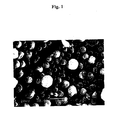
- Fig. 1 is an electron microphotograph of a porous and spherical particle produced by the method of this invention.
- Fig. 2 shows an image of a transmission electron microscope in Example 3.
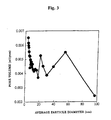
- Fig. 3 is a pore distribution view measured by BET method when sintered at 180°C.
- The invention of this application has the above-mentioned characteristics, but the embodiment is described below.
- It is well known that metal ions have high bondability to many polymers. The invention of this application utilizes such properties, and improves the bondability to various polymers, particularly biopolymers, by substituting part of constitutent of calcium phosphate-based microcrystal with metal ions, or carrying the metal ions on the surface thereof, thereby forming a porous and spherical particle, while maintaining bio-adaptability of calcium phosphate. The invention of this application further increases adsorptivity by covering the surface of the porous and spherical particle from calcium phosphate-based microcrystal, which is partly substituted with a metal ion or has a metal ion carried on the surface thereof, with a porous inorganic material.
- Thus, a functional material which has properties as a composite material of an organic material and an inorganic material and is useful for a scaffolding material for cell propagation, an air cleaning filter, a material for use in chromatography, and the like is provided by increasing bondability and adsorptivity of the surface of calcium phosphate.
- The porous calcium phosphate particle of the invention of this application has basic characteristics that:
- A) it is partly substituted with a metal ion or has metal ion carried on the surface thereof;
- B) a particle diameter is in a range of from 0.1 to 100 µm; and
- C) it is a porous and spherical particle.
- The calcium phosphate may be various kinds including the conventional apatite. Partial substitution or surface carrying of calcium phosphate with the metal ion may be substitution of calcium which is the constituent atom, or may be that the metal ion is carried on the surface by ionic bond or ionic adsorption.
- The porous and spherical calcium phosphate particle having a particle diameter in a range of from 0.1 to 100 µm which is partly substituted or carried with the metal ion is not yet known.
- Where the particle diameter is less than 0.1 µm or exceeds 100 µm, it is difficult to produce a porous and spherical particle.
- Although the shape is defined as spherical, a distorted shape, an ellipse and the like are included in the definition of "spherical".
- To use as a carrier or a carrier material, the porous and spherical calcium phosphate particle of the invention of this application preferably has a porosity by a specific surface area/pore distribution measurement with BET method (specific surface area measurement method) of 20% or more, and a specific surface area of 20 m2/g or more. The porosity in this case is calculated by the following equation.

- Regarding the above porous and spherical calcium phosphate particle of the invention of this application, a spherical particle formed from microcrystal of calcium phosphate by spray drying or the like is shown as a preferable particle. In this case, for example, the spherical particle can be formed by spray drying a microcrystal suspension formed by mixing a phosphoric acid aqueous solution and a calcium phosphate suspension in the presence of a metal compound such as metal salt.
- The spherical fine particle can also be formed by synthesizing a calcium phosphate microcrystal which is partly substituted with a metal ion or has a metal ion carried on the surface thereof by such a wet process or dry process, and then spraying with a spray dry method. Further, the particle obtained may be sintered at from 100 to 800°C.
- Size of the microcrystal of calcium phosphate is not limited, but the particle diameter is preferably from about 1 nm to about 100 nm, and further preferably from about 5 nm to about 50 nm, taking into consideration physical properties, workability and the like.
- The porous and spherical calcium phosphate particle which is substituted with a metal ion or has a metal ion carried on the surface thereof can be covered with a polymer, for example, a bio-adaptable polymer such as a biopolymer or a polyethylene glycol, or can have the polymer carried, in the inside or on the surface thereof. The biopolymer is considered as at least one kind constituting a living tissue, and examples thereof include glycosaminoglycan such as hyaluronic acid or chondroitin sulfuric acid. Further, the porous particle may have a porous inorganic material carried, or may be covered with the same, in the inside of pores thereof, or on the surface thereof. Moreover, the covered material may have the same polymer such as a biopolymer carried in the inside or on the surface thereof.
- Carrying or covering with a polymer or a porous inorganic material can be carried out by various methods, and is realized by, for example, means of dipping the porous calcium phosphate particle in their aqueous solution or suspension, spraying to the porous calcium phosphate particle, or reaction accumulation.
- Needless to say, the amount (proportion) of carrying or covering may appropriately be determined according to the purpose of utilization or purpose of use of the porous particle or porous multilayer particle obtained.
- The porous inorganic material used for covering is preferably a calcium phosphate-based material or a calcium carbonate-based material.
- The invention of this application is described in more detail by reference to the following Examples. However, the invention should not be limited to the following Examples.
- 1.36 g or 13.6 g of zinc chloride was dissolved in 1 liter of a phosphoric acid aqueous solution (0.6 mol/l) to prepare two kinds of samples. Each of those two samples was added to 2 liters of a calcium hydroxide suspension (0.5 mol/l) at a dropping rate of 20 ml/min while stirring. A zinc (Zn) ion-carried apatite suspension thus obtained was sprayed with a spray drier using two fluid nozzles maintained at 180°C to prepare a spherical particle. The spherical particle had a particle diameter in a range of from 1 to 10 µm. The attached Fig. 1 shows an image of a scanning electron microscope (SEM).
- A solution prepared by dispersing 30 mg of chondroitin sulfuric acid (ChS) in 10 ml of purified water was added to 500 mg of the spherical particles obtained above. The resulting mixture was subjected to suction filtration while washing with purified water, followed by freeze drying.
- For the sake of comparison, apatite spherical particles produced in the same manner as above except that zinc chloride was not dissolved were treated under the same conditions as above, and then subjected to freeze drying.
- Three kinds of spherical particles thus prepared were analyzed with infrared spectrum (IR), thermal analysis (TG-DTGA), scanning electron microscope observation (SEM) and energy dispersion type X ray (EDX). From IR measurement, SO3 which is a functional group of ChG was observed in the zinc-containing apatite. However, SO3 was not observed in the apatite not containing zinc. As a result of thermal analysis, heat generation which is inherent in ChG was observed around 300°C in the zinc-containing apatite, but heat generation was not observed in the apatite not containing zinc. In EDX analysis, the zinc-containing apatite showed spectrum which is inherent in sulfur, but the spectrum was not observed in the apatite not containing zinc. The chondroitin sulfuric acid (ChS) content increased from about 2 wt% to about 4 wt% according to the content of zinc.
- Using the spherical particle produced in Example 1, 30 ml of hyaluronic acid (HyA) in place of chondroitin sulfuric acid (ChS) was dispersed in 10 ml of purified water. The resulting mixture was subjected to suction filtration while washing with purified water, followed by freeze drying. As a result of thermal analysis, where the zinc-containing apatite was used, heat generation which is inherent in hyaluronic acid (HyA) was observed around 300°C. Hyaluronic acid (HyA) content was almost the same amount as the case of using chondroitin sulfuric acid (ChS).
- A thin piece was formed from the apatite spherical particles produced in Example 1 (13.6 g: zinc chloride), and its internal structure was observed with a transmission electron microscope. It was confirmed that the spherical particle obtained was a porous body having inner cavity.
- The apatite spherical particles produced in Example 1 (13.6 g: zinc chloride) were dipped in 1 mol/l liter calcium chloride solution, and after centrifuge, further dipped in 1 mol/l liter NaHCO3 solution. As a result of measuring X ray analysis of a composite obtained, calcium carbonate was detected. Further, as a result of its weight change by thermal analysis, it was clarified that 12 wt%, per apatite, of calcium carbonate was contained. As a result of SEM observation, crystal of calcium carbonate was not observed on the surface of apatite. From this fact, it was confirmed that calcium carbonate was present in the inside of the apatite spherical particle.
- The apatite particles produced in Example 1 (13.6 g: zinc chloride) were sintered at each temperature, and were subjected to a specific area/pore distribution measurement using nitrogen gas by BET method (specific area measurement method). The specific area/BET total volume decreased according to the sintering temperature. For example, in sintering at 180°C, specific surface area 88 m2/g, BET total volume 0.44 ml/g and porosity 58%; in sintering at 600°C, specific surface area 56 m2/g, BET total volume 0.24 ml/g and porosity 43%; and in sintering at 800°C, specific surface area 45 m2/g, BET total volume 0.13 ml/g and porosity 29%. However, pore was not almost detected in the sample sintered at 1,200°C. Further, in the case of sintering at 180°C, the pore distribution showed the maximum distribution at 60 nm by BET method. A graph showing this relationship is Fig. 3.
- In each sintering at the above respective sintering temperatures, it was confirmed that agglomeration of particles did not substantially occur.
- As described in detail above, the invention of this application provides a novel functional particle of calcium phosphate having controlled structure and properties, which is useful as a material for chromatography that can accurately separate even a trace amount of chemical substance by multilayer formation of particles with a biopolymer or a porous inorganic material, while maintaining characteristics of calcium phosphate as a bio-adaptable material, its sintered body, and their composites.
Claims (11)
- A porous and spherical calcium phosphate particle having a particle diameter in a range of from 0.1 to 100 µm, wherein the calcium phosphate is substituted with a metal ion or has a metal ion carried on the surface thereof, in a range of from 0.0001 to 10wt%.
- The porous and spherical calcium phosphate particle as claimed in claim 1, characterized in that a porosity by a specific surface area/pore distribution measurement with BET method (specific surface area measurement method) is 20 % or more, and a specific surface area is 20 m2/g or more.
- The porous and spherical calcium phosphate particle as claimed in claim 1 or 2, which is a porous particle formed from microcrystal of calcium phosphate by spray drying or the like.
- The porous and spherical calcium phosphate particle as claimed in claim 1 or 2, characterized in that the metal ion substituted or carried on the surface is at least one of ions of zinc, magnesium, iron and copper.
- A porous and spherical calcium phosphate particle, which is obtained by sintering the particle as claimed in any one of claims 1 to 4 at a temperature in a range of from 100 to 800°C.
- The porous and spherical calcium phosphate particle as claimed in any one of claims 1 to 5, characterized in that a bio-adaptable polymer such as a biopolymer or a polyethylene glycol is applied to or carried on the surface thereof.
- The porous and spherical calcium phosphate particle as claimed in claim 6, characterized in that the biopolymer is glycosaminoglycan.
- A porous multilayer spherical particle, characterized in that the porous and spherical calcium phosphate particle as claimed in any one of claims 1 to 7 is covered with a porous inorganic material.
- The porous multilayer calcium phosphate spherical particle as claimed in claim 8, characterized in that the porous inorganic material is a calcium phosphate-based material or a calcium carbonate-based material.
- The porous multilayer calcium phosphate spherical particle as claimed in claim 8 or 9, characterized in that a bio-adaptable polymer such as a biopolymer or polyethylene glycol is carried thereon.
- The porous multilayer calcium phosphate spherical particle as claimed in claim 10, characterized in that the biopolymer is glycosaminoglycan.
Applications Claiming Priority (2)
| Application Number | Priority Date | Filing Date | Title |
|---|---|---|---|
| JP2003299362A JP2004099433A (en) | 2002-08-22 | 2003-08-22 | Calcium phosphate porous spherical particles and calcium phosphate porous multilayer spherical particles partially substituted or surface-supported by metal ions |
| PCT/JP2004/004149 WO2005019102A1 (en) | 2003-08-22 | 2004-03-25 | Porous and spherical calcium phosphate particle being partly substituted with metal ion or having metal ion carried on surface thereof, and porous multiayer calcium phosphate particle |
Publications (2)
| Publication Number | Publication Date |
|---|---|
| EP1676813A1 true EP1676813A1 (en) | 2006-07-05 |
| EP1676813A4 EP1676813A4 (en) | 2009-08-12 |
Family
ID=34213755
Family Applications (1)
| Application Number | Title | Priority Date | Filing Date |
|---|---|---|---|
| EP04723345A Withdrawn EP1676813A4 (en) | 2003-08-22 | 2004-03-25 | PARTIALLY SUBSTITUTED SPHERICAL CALCIUM PHOSPHATE PARTICLE AND POROUS SUBSTITUTED WITH A METAL ION OR POSSESSING A METAL ION ON ITS SURFACE, AND POROUS MULTILAYER CALCIUM PHOSPHATE PARTICLE |
Country Status (4)
| Country | Link |
|---|---|
| US (1) | US7348060B2 (en) |
| EP (1) | EP1676813A4 (en) |
| CN (1) | CN100434357C (en) |
| WO (1) | WO2005019102A1 (en) |
Cited By (1)
| Publication number | Priority date | Publication date | Assignee | Title |
|---|---|---|---|---|
| WO2007054548A3 (en) * | 2005-11-09 | 2007-09-20 | Nanosep Ab | Particles for use in a mobile solid chromatography phase |
Families Citing this family (8)
| Publication number | Priority date | Publication date | Assignee | Title |
|---|---|---|---|---|
| JP5261712B2 (en) * | 2005-08-15 | 2013-08-14 | 国立大学法人京都大学 | Method for stabilizing calcium phosphates fine particles, method for producing calcium phosphates fine particles using the same, and use thereof |
| KR20180114970A (en) * | 2009-05-06 | 2018-10-19 | 라보라토리 스킨 케어, 인크. | Dermal delivery compositions comprising active agent-calcium phosphate particle complexes and methods of using the same |
| GB0909183D0 (en) | 2009-05-28 | 2009-07-08 | Bedi Kathryn J | Coating method |
| PH12013501524A1 (en) | 2011-01-19 | 2022-10-26 | Laboratory Skin Care Inc | Topical minocycline compositions and methods of using the same |
| MY175420A (en) | 2013-03-15 | 2020-06-24 | Laboratory Skin Care Inc | Fine dry particulate resveratrol active agent compositions and topical formulations including the same |
| FR3021045B1 (en) | 2014-05-16 | 2020-02-21 | Solvay Sa | PROCESS FOR PRODUCING A PHOSPHOCALCIC REAGENT, REAGENT OBTAINED AND ITS USE |
| US10814305B2 (en) * | 2016-09-29 | 2020-10-27 | Bio-Rad Laboratories, Inc. | Agarose-filled ceramic apatite |
| CN108671881B (en) * | 2018-05-12 | 2020-09-04 | 北京化工大学 | Wastewater treatment method for removing ammonia nitrogen by inorganic salt combined MAP chemical precipitation adsorption method |
Family Cites Families (15)
| Publication number | Priority date | Publication date | Assignee | Title |
|---|---|---|---|---|
| US3787900A (en) * | 1971-06-09 | 1974-01-29 | Univ Iowa State Res Found | Artificial bone or tooth prosthesis material |
| JPH03141956A (en) | 1989-10-30 | 1991-06-17 | Mitsubishi Materials Corp | Filling material for bone defect part and bone cavity part |
| JPH04118047A (en) * | 1990-03-30 | 1992-04-20 | Central Glass Co Ltd | Adsorbent and filler for separation and refining and manufacture thereof |
| JP3228955B2 (en) | 1991-04-11 | 2001-11-12 | 日本化学工業株式会社 | Method for producing apatite powder |
| US5658593A (en) * | 1992-01-16 | 1997-08-19 | Coletica | Injectable compositions containing collagen microcapsules |
| JP2780763B2 (en) | 1993-05-12 | 1998-07-30 | 積水化成品工業株式会社 | Antibacterial particles |
| JPH07133201A (en) * | 1993-11-11 | 1995-05-23 | Sekisui Plastics Co Ltd | Antibacterial particles |
| US5496399A (en) * | 1994-08-23 | 1996-03-05 | Norian Corporation | Storage stable calcium phosphate cements |
| US6210715B1 (en) * | 1997-04-01 | 2001-04-03 | Cap Biotechnology, Inc. | Calcium phosphate microcarriers and microspheres |
| JP3866864B2 (en) | 1998-07-29 | 2007-01-10 | 積水化成品工業株式会社 | Hydroxyapatite spherical particles, production method thereof, and biomaterial using the same |
| JP3400740B2 (en) * | 1999-04-13 | 2003-04-28 | 東芝セラミックス株式会社 | Calcium phosphate porous sintered body and method for producing the same |
| US7094282B2 (en) * | 2000-07-13 | 2006-08-22 | Calcitec, Inc. | Calcium phosphate cement, use and preparation thereof |
| JP3550652B2 (en) | 2000-03-29 | 2004-08-04 | 独立行政法人産業技術総合研究所 | Titanium dioxide coated apatite |
| JP2004511320A (en) * | 2000-10-16 | 2004-04-15 | ユニバーシテイ・オブ・サウス・カロライナ | Biocompatible cement containing reactive calcium phosphate nanoparticles and methods of making and using said cement |
| JP4540969B2 (en) * | 2003-11-27 | 2010-09-08 | Hoya株式会社 | Calcium phosphate ceramic porous body and method for producing the same |
-
2004
- 2004-03-25 WO PCT/JP2004/004149 patent/WO2005019102A1/en not_active Ceased
- 2004-03-25 EP EP04723345A patent/EP1676813A4/en not_active Withdrawn
- 2004-03-25 US US10/568,680 patent/US7348060B2/en not_active Expired - Fee Related
- 2004-03-25 CN CNB2004800241021A patent/CN100434357C/en not_active Expired - Fee Related
Cited By (1)
| Publication number | Priority date | Publication date | Assignee | Title |
|---|---|---|---|---|
| WO2007054548A3 (en) * | 2005-11-09 | 2007-09-20 | Nanosep Ab | Particles for use in a mobile solid chromatography phase |
Also Published As
| Publication number | Publication date |
|---|---|
| US20060257658A1 (en) | 2006-11-16 |
| US7348060B2 (en) | 2008-03-25 |
| EP1676813A4 (en) | 2009-08-12 |
| CN1839097A (en) | 2006-09-27 |
| WO2005019102A1 (en) | 2005-03-03 |
| CN100434357C (en) | 2008-11-19 |
Similar Documents
| Publication | Publication Date | Title |
|---|---|---|
| Mocanu et al. | Ion release from hydroxyapatite and substituted hydroxyapatites in different immersion liquids: In vitro experiments and theoretical modelling study | |
| EP1808411B1 (en) | Ceramic particle group and method for production thereof and use thereof | |
| Ben-Arfa et al. | Novel route for rapid sol-gel synthesis of hydroxyapatite, avoiding ageing and using fast drying with a 50-fold to 200-fold reduction in process time | |
| US6132773A (en) | Method for preparing particles comprising a core and a silica shell | |
| US7348060B2 (en) | Porous and spherical calcium phosphate particle comprising metal ion, and porous multilayer calcium phophate particle | |
| WO2011053598A1 (en) | Hydroxyapatite with controllable size and morphology | |
| Olya et al. | Construction of a novel corrosion protective composite film based on a core-shell LDH-Mo@ SiO2 inhibitor nanocarrier with both self-healing/barrier functions | |
| WO2006083418A2 (en) | Hydroxyapatite with controllable size and morphology | |
| Iafisco et al. | Electrostatic spray deposition of biomimetic nanocrystalline apatite coatings onto titanium | |
| Sarango et al. | Homogeneous thin coatings of zeolitic imidazolate frameworks prepared on quartz crystal sensors for CO2 adsorption | |
| JP2019529299A (en) | Surface-reacted calcium carbonate with functional cations | |
| Jamnik et al. | Stabilizers of particle size and morphology: a road towards high-rate performance insertion materials | |
| Gao et al. | Synthesis of water-degradable silica nanoparticles from carbamate-containing bridged silsesquioxane precursor | |
| KR20120120265A (en) | Composite inorganic particles and methods of making and using the same | |
| JP2004099433A (en) | Calcium phosphate porous spherical particles and calcium phosphate porous multilayer spherical particles partially substituted or surface-supported by metal ions | |
| Lakshmanaperumal et al. | Structural, dielectric, cytocompatibility, and in vitro bioactivity studies of yttrium and strontium co-substituted nano-hydroxyapatite by sol–gel method | |
| JP5022267B2 (en) | Calcium phosphate porous spherical particles and calcium phosphate porous multilayer spherical particles partially substituted or surface-supported with metal ions | |
| Saeedi et al. | Nanoscale hydroxyapatite/chitosan polymer coatings: Synthesis and characterization | |
| KR101132717B1 (en) | Ceramic/carbon nanotube composite and preparing method thereof | |
| Skwarek et al. | The influence of carbonate ions on the structure of the electrical double layer at the interface of hydroxyapatite/electrolyte solution | |
| He et al. | Biomimetic synthesis of mesoporous zinc phosphate nanoparticles | |
| JP3598349B2 (en) | Manufacturing method of composite ceramic material | |
| Tavakoli-Azar et al. | Synergistic effects of PVP-surface-treated CNTs and Mg2P2O7 nanoparticles on corrosion rate reduction of mild steel immersed in a 3.5% NaCl solution | |
| Malikova et al. | Physicochemical properties of calcium phosphate–chitosan composites and scaffolds | |
| CN101234756A (en) | A kind of preparation method of spherical nano-hydroxyapatite material |
Legal Events
| Date | Code | Title | Description |
|---|---|---|---|
| PUAI | Public reference made under article 153(3) epc to a published international application that has entered the european phase |
Free format text: ORIGINAL CODE: 0009012 |
|
| 17P | Request for examination filed |
Effective date: 20060317 |
|
| AK | Designated contracting states |
Kind code of ref document: A1 Designated state(s): DE GB |
|
| DAX | Request for extension of the european patent (deleted) | ||
| RBV | Designated contracting states (corrected) |
Designated state(s): DE GB |
|
| A4 | Supplementary search report drawn up and despatched |
Effective date: 20090713 |
|
| RIC1 | Information provided on ipc code assigned before grant |
Ipc: C01B 25/32 20060101AFI20060601BHEP Ipc: B01J 20/28 20060101ALI20090703BHEP |
|
| 17Q | First examination report despatched |
Effective date: 20110317 |
|
| RIC1 | Information provided on ipc code assigned before grant |
Ipc: B01J 20/32 20060101ALI20180116BHEP Ipc: B01J 20/04 20060101ALI20180116BHEP Ipc: C01B 25/32 20060101AFI20180116BHEP Ipc: B01J 20/286 20060101ALI20180116BHEP Ipc: G01N 30/50 20060101ALI20180116BHEP Ipc: G01N 30/88 20060101ALI20180116BHEP Ipc: B01J 20/28 20060101ALI20180116BHEP Ipc: B01J 20/282 20060101ALI20180116BHEP |
|
| GRAP | Despatch of communication of intention to grant a patent |
Free format text: ORIGINAL CODE: EPIDOSNIGR1 |
|
| STAA | Information on the status of an ep patent application or granted ep patent |
Free format text: STATUS: GRANT OF PATENT IS INTENDED |
|
| INTG | Intention to grant announced |
Effective date: 20180228 |
|
| STAA | Information on the status of an ep patent application or granted ep patent |
Free format text: STATUS: THE APPLICATION IS DEEMED TO BE WITHDRAWN |
|
| 18D | Application deemed to be withdrawn |
Effective date: 20180711 |