EP1676605A1 - Product for hair dyeing - Google Patents
Product for hair dyeing Download PDFInfo
- Publication number
- EP1676605A1 EP1676605A1 EP04030562A EP04030562A EP1676605A1 EP 1676605 A1 EP1676605 A1 EP 1676605A1 EP 04030562 A EP04030562 A EP 04030562A EP 04030562 A EP04030562 A EP 04030562A EP 1676605 A1 EP1676605 A1 EP 1676605A1
- Authority
- EP
- European Patent Office
- Prior art keywords
- composition
- oxidative
- optionally
- aqueous
- product according
- Prior art date
- Legal status (The legal status is an assumption and is not a legal conclusion. Google has not performed a legal analysis and makes no representation as to the accuracy of the status listed.)
- Granted
Links
- 0 *[n]1c(/N=N/c(cc2)ccc2Nc(cc2)ccc2N)p(*)cc1 Chemical compound *[n]1c(/N=N/c(cc2)ccc2Nc(cc2)ccc2N)p(*)cc1 0.000 description 3
Images


Classifications
-
- A—HUMAN NECESSITIES
- A61—MEDICAL OR VETERINARY SCIENCE; HYGIENE
- A61Q—SPECIFIC USE OF COSMETICS OR SIMILAR TOILETRY PREPARATIONS
- A61Q5/00—Preparations for care of the hair
- A61Q5/10—Preparations for permanently dyeing the hair
-
- A—HUMAN NECESSITIES
- A45—HAND OR TRAVELLING ARTICLES
- A45D—HAIRDRESSING OR SHAVING EQUIPMENT; EQUIPMENT FOR COSMETICS OR COSMETIC TREATMENTS, e.g. FOR MANICURING OR PEDICURING
- A45D19/00—Devices for washing the hair or the scalp; Similar devices for colouring the hair
- A45D19/02—Hand-actuated implements, e.g. hand-actuated spray heads
-
- A—HUMAN NECESSITIES
- A45—HAND OR TRAVELLING ARTICLES
- A45D—HAIRDRESSING OR SHAVING EQUIPMENT; EQUIPMENT FOR COSMETICS OR COSMETIC TREATMENTS, e.g. FOR MANICURING OR PEDICURING
- A45D19/00—Devices for washing the hair or the scalp; Similar devices for colouring the hair
- A45D19/0041—Processes for treating the hair of the scalp
- A45D19/0066—Coloring or bleaching
-
- A—HUMAN NECESSITIES
- A61—MEDICAL OR VETERINARY SCIENCE; HYGIENE
- A61K—PREPARATIONS FOR MEDICAL, DENTAL OR TOILETRY PURPOSES
- A61K8/00—Cosmetics or similar toiletry preparations
- A61K8/02—Cosmetics or similar toiletry preparations characterised by special physical form
- A61K8/04—Dispersions; Emulsions
- A61K8/046—Aerosols; Foams
-
- A—HUMAN NECESSITIES
- A61—MEDICAL OR VETERINARY SCIENCE; HYGIENE
- A61K—PREPARATIONS FOR MEDICAL, DENTAL OR TOILETRY PURPOSES
- A61K8/00—Cosmetics or similar toiletry preparations
- A61K8/18—Cosmetics or similar toiletry preparations characterised by the composition
- A61K8/30—Cosmetics or similar toiletry preparations characterised by the composition containing organic compounds
- A61K8/40—Cosmetics or similar toiletry preparations characterised by the composition containing organic compounds containing nitrogen
- A61K8/41—Amines
- A61K8/418—Amines containing nitro groups
-
- A—HUMAN NECESSITIES
- A61—MEDICAL OR VETERINARY SCIENCE; HYGIENE
- A61K—PREPARATIONS FOR MEDICAL, DENTAL OR TOILETRY PURPOSES
- A61K8/00—Cosmetics or similar toiletry preparations
- A61K8/18—Cosmetics or similar toiletry preparations characterised by the composition
- A61K8/30—Cosmetics or similar toiletry preparations characterised by the composition containing organic compounds
- A61K8/46—Cosmetics or similar toiletry preparations characterised by the composition containing organic compounds containing sulfur
-
- B—PERFORMING OPERATIONS; TRANSPORTING
- B65—CONVEYING; PACKING; STORING; HANDLING THIN OR FILAMENTARY MATERIAL
- B65D—CONTAINERS FOR STORAGE OR TRANSPORT OF ARTICLES OR MATERIALS, e.g. BAGS, BARRELS, BOTTLES, BOXES, CANS, CARTONS, CRATES, DRUMS, JARS, TANKS, HOPPERS, FORWARDING CONTAINERS; ACCESSORIES, CLOSURES, OR FITTINGS THEREFOR; PACKAGING ELEMENTS; PACKAGES
- B65D47/00—Closures with filling and discharging, or with discharging, devices
- B65D47/04—Closures with discharging devices other than pumps
- B65D47/20—Closures with discharging devices other than pumps comprising hand-operated members for controlling discharge
- B65D47/2018—Closures with discharging devices other than pumps comprising hand-operated members for controlling discharge comprising a valve or like element which is opened or closed by deformation of the container or closure
- B65D47/2031—Closures with discharging devices other than pumps comprising hand-operated members for controlling discharge comprising a valve or like element which is opened or closed by deformation of the container or closure the element being formed by a slit, narrow opening or constrictable spout, the size of the outlet passage being able to be varied by increasing or decreasing the pressure
-
- A—HUMAN NECESSITIES
- A61—MEDICAL OR VETERINARY SCIENCE; HYGIENE
- A61K—PREPARATIONS FOR MEDICAL, DENTAL OR TOILETRY PURPOSES
- A61K2800/00—Properties of cosmetic compositions or active ingredients thereof or formulation aids used therein and process related aspects
- A61K2800/80—Process related aspects concerning the preparation of the cosmetic composition or the storage or application thereof
- A61K2800/87—Application Devices; Containers; Packaging
Definitions
- This invention relates to a product for oxidative dyeing hair consisting of a packaging and an aqueous composition comprising at least one oxidative dye precursor and optionally at least one coupling agent and optionally at least one direct dye which is mixed with an aqueous composition comprising at least one oxidizing agent prior to application.
- Hair dyeing compositions have been marketed for many decades. Especially the oxidative hair dyeing is believed to be producing the most long lasting colours as small uncoloured molecules polymerise partly on hair surface but more importantly inside of hair so that they cannot easily been washed away with subsequent hair treatments other than colourations such as shampooing and/or conditioning hair.
- This invention starts form the problems as explained above and aims primarily for finding an alternative, which is more cost effective and environmental friendly.
- the alternative packaging makes withdrawal of the package content in smaller portions than the whole content of the product without affecting the stability of the remaining product during its lifetime. Lifetime of a cosmetic product in general 3 years after production.
- Packaging with such kind of closure cap have been proposed in a US patent application published US 2003/0106910 A1.
- the object of the present invention is product for hair dyeing consisting of a packaging and an aqueous composition
- packaging is consisting a twist cap (A) on a tube (7) or a pouch packaging component (8) or a bottle consisting of a seal (1), temper evident (2), thread (3) and a carrying element (4) and confectioned with a silicone valve (5) and a retainer therefore (6) filled a hair dyeing composition comprising at least one oxidative dye precursor and optionally at least one coupling agent and optionally at least one direct dye which is mixed with an aqueous composition comprising at least one oxidizing agent prior to application.
- the packaging as described above makes storage of an oxidative colouring composition for a long period of time possible. When the content of such packaging is only partially emptied, the remaining is as well stored without showing any signs of instability for a long time.
- Such kind of packaging materials are commercially available.
- hair dyeing composition filled into the packaging mentioned above comprises at least one oxidative dye precursor and at least one coupling agent and optionally at least one direct dye which is mixed with an aqueous composition comprising at least one oxidizing agent prior to application.
- hair dyeing composition filled into the packaging mentioned above comprises at least one oxidative dye precursor and at least one coupling agent and at least one direct dye which is mixed with an aqueous composition comprising at least one oxidizing agent prior to application.
- FIG. 1 Further object of the present invention is multiportion product for hair dyeing consisting of a packaging and an aqueous composition
- packaging is consisting a twist cap (A) on a tube (7) or a pouch packaging component (8) or a bottle consisting of a seal (1), temper evident (2), thread (3) and a carrying element (4) and confectioned with a silicone valve (5) and a retainer therefore (6) filled a hair dyeing composition comprising at least one oxidative dye precursor and optionally at least one coupling agent and optionally at least one direct dye which is mixed with an aqueous composition comprising at least one oxidizing agent prior to application wherein the composition can be removed partially without effecting the stability of the remaining product.
- packaging is consisting a twist cap (A) on a tube (7) or a pouch packaging component (8) or a bottle consisting of a seal (1), temper evident (2), thread (3) and a carrying element (4) and confectioned with a silicone valve (5) and a retainer therefore (6) filled a hair dyeing composition compris
- the silicone valve (5) is of heat curable liquid silicone rubber.
- Liquid silicone rubber used therefore is for example Silastic 94-595 from Dow Corning.
- Composition filled into tube, pouch or bottle is an oxidative dyestuff composition
- an oxidative dyestuff composition comprising at least one oxidative dyestuff precursor (developing substance) and optionally at least one coupling substance and optionally at least one direct dye.
- composition can be in the form of emulsion, solution, dispersion and/or gel.
- Emulsion and gel forms are preferred. The most preferred is emulsion.
- the viscosity of the compositions according to the invention ranges from 1,000 to 50,000, in particular 1,000 to 30,000, especially 1,000 to 20,000 mPa.s, measured at 20°C with a Brookfield rotation viscosimeter, with spindle 5 at 5 rpm.
- Dyeing composition according to the present invention comprises at least one oxidation dyestuff precursor (developing substance) and optionally at least one coupling substance and optionally at least one direct dye.
- developing substances known per se.
- aminopyridines are 2,5-diaminopyridine, 2,3-diaminopyridine, 2,6-diaminopyridine, 3-amino-2-methyl amino-6-methoxypyridine, 2-dimethyl-5-aminopyridine, 2-dimethyl aminoethyl-3-hydroxypyridine, 2-amino-4,6-dimethyl pyridine, 2-amino-3-hydroxypyridine, 3-amino-2( ⁇ -hydroxyethyl amino)-6-methoxypyridine, 2,6-dimethyl amino-5-aminopyridine, 2-di(hydroxyethyl) amino-5-aminopyridine, 2-hydroxyethyl amino-5-aminopyridine, 4-hydroxy-2,5,6-triaminopyrimidine and/or the water-soluble salts thereof.
- the total concentration of the developing substances customarily ranges between about 0.05 % and 5 %, preferably 0.1 % and 4 %, in particular 0.25 % to 3 % by weight, calculated to the total hair dyeing composition (excluding the oxidation agent), whereby these figures are always related to the proportion of free base.
- composition according to the present invention contains optionally at least one coupling substance, which can be selected from 5-amino-2-methylphenol, 2-methyl-5-hydroxyethylaminophenol, 2,4,-diamnophenoxyehanol, 2-amino-4-hydroxyethylaminoanisol, 2-methyl-5-amino-6-chlorphenol, 1,3-bis(2,4-diaminophenoxy)propane, 2-bis(2-hydroxyethyl)aminotoluene, 2-amino-5-methylphenol, resorcinol, 2-methyl resorcinol, 4-chlororesorcinol, 2-amino-4-chlorophenol, 5-amino-4-methoxy-2-methylphenol, 2-aminophenol, 3-amino-phenol, 1-methyl-2-hydroxy-4-aminobenzene, 3-N,N-dimethyl aminophenol, 2,6-dihydroxy-3,5-dimethoxypyridine, 5-amino-3-methylphenol, 6-amino-3-methyl
- indole and indoline derivatives can as well be contained in the colouring composition of the present invention.
- examples to those are: 6-aminoindol, 6-hydroxyindole, 1-ethyl-6-hydroxyindole, 1-methyl-4-hydroxyindol, 1-methyl-6-hydroxyindole, 2-methyl-6-hydroxyindole, 5-hydroxyindol, 4-hydroxyindol, 5,6-dihydroxyindole, 6-aminoindoline, 6-hydroxyindoline, 1-ethyl-6-hydroxyindoline, 1-methyl-4-hydroxyindoline, 1-methyl-6-hydroxyindoline, 2-methyl-6-hydroxyindoline, 5-hydroxyindoline, 4-hydroxyindoline, 5,6-dihydroxyindoline and their respective salts.
- the coupling substance(s) as reaction partners of the developing substance(s) are present in approximately the same molecular proportions as the developing substances, i.e. in amounts from 0.01 % to 5.0 %, preferably 0.05 % to 4 %, in particular 0.1 % to 3 % by weight, calculated to the total composition (excluding the oxidizing agent), whereby these figures are always related to the proportion of free base.
- dyeing composition comprises optionally at least one direct acting dyestuff selected from anionic, cationic and neutral ones.
- Suitable cationic dyestuffs are in principal those available on the market for hair colouring applications. Some examples to those are:
- cationic dyestuffs with the following chemical structures are especially, the most, preferred ones according to the present invention. and wherein R 1 , R 2 , R 3 and R 4 stand for hydrogen, a CH 3 - or C 2 H 5 - group, R 5 stands for hydrogen, -OCH 3 or -OC 2 H 5 and Y is an anion such as chloride, bromide, methosulfate.
- the most preferred compounds are the ones according to the formula I, where R 1 , R 2 , R 3 and R 4 are methyl and Y is chloride, according to formula II where R 1 and R 2 are methyl and Y is chloride and according to the formula IV, where R 1 and R 2 , are methyl, R 5 is hydrogen and Y is methosulfate.
- Cationic dyestuffs are included into the compositions of the present invention at a concentration of 0.01 to 7.5%, preferably 0.05 to 5% and more preferably 0.05 to 3% by weight calculated to total aqueous composition.
- Anionic dyes suitable for the compositions of the present invention are:
- the most preferred anionic dyestuffs are Acid Red 52, DC Violet 2, DC Red 33, DC Orange 4, DC Red 27 and DC Yellow 10.
- anionic dyes are included into oxidative dyeing compositions at a concentration of 0.1 to 7.5%, preferably 0.1 to 5%, more preferably 0.1 to 3% by weight calculated to total aqueous composition.
- the ratio of cationic dyestuffs to acidic dyestuffs by weight is preferably in the range of 3:1 to 1:10, preferably 2: 1 to 1:7 and further more preferably 2:1 to 1:5.
- the ratio of cationic to anionic dyes is disclosed in detail.
- coloring compositions of the present invention can comprise neutral nitro dyes (HC dyes), so called nitro dyes as direct dye. Concentration of those can typically be in the range from 0.01 to 2.5%, preferably 0.1 to 2% by weight calculated to total aqueous composition.
- HC dyes neutral nitro dyes
- Concentration of those can typically be in the range from 0.01 to 2.5%, preferably 0.1 to 2% by weight calculated to total aqueous composition.
- Plant dyestuffs can also be used alone or in combination with synthetic direct-acting dyestuffs, for example henna (red or black), alkanna root, laccaic acid, indigo, logwood powder, madder root and rhubarb powder, etc.
- henna red or black
- alkanna root laccaic acid
- indigo indigo
- pH of the aqueous composition of the present invention varies between 5 and 12, preferably 6 - 11, more preferably 6.8 to 10. pH of the aqueous composition is adjusted to the required pH by using triethanolamine, ammonia or its salts with acids such as ammonium chloride, ammonium sulphate, ammonium carbonate, ammonium bicarbonate, ammonium nitrate, or using alkaline solutions such as sodium hydroxide, potassium hydroxide and their respective salts with the known acids.
- acids such as ammonium chloride, ammonium sulphate, ammonium carbonate, ammonium bicarbonate, ammonium nitrate, or using alkaline solutions such as sodium hydroxide, potassium hydroxide and their respective salts with the known acids.
- the most preferred, aqueous composition for oxidative dyeing comprises in the base formulation fatty acids with 0 to 3 ethylenic bonds and with fatty acyl chain length of 12 to 22 C atom. Concentration of the fatty acids can be in the range of 0.1 to 10%, preferably 0.1 to 7.5% and most preferably 0.2 to 5% by weight calculated to the total composition.
- Fatty acid examples, without limiting the choice, suitable for colouring compositions are myristic acid, palmitic acid, behenic acid, steraic acid, oleic acid, linoleic acid. The most preferred fatty acid is oleic acid.
- the coloring composition in the form of an emulsion, it comprises as an emulsion base at least one fatty alcohol or mixture of fatty alcohols with the chain length of 14 to 22 C atoms.
- suitable fatty alcohols without limiting the choice, are myristyl alcohol, cetyl alcohol, stearyl alcohol, behenyl alcohol and cetostearyl alcohol.
- cetostearyl alcohol well known with its trade name Lanette O or as Lanette N in mixture with sodium cetearyl sulfate from Cognis.
- the concentration of fatty alcohol(s) is in the range from 0.5 to 25%, preferably 0.5 to 20% by weight and more preferably 0.5 to 15% by weight calculated to total composition without oxidizing agent.
- Coloring compositions according to present invention comprises surfactants selected from anionic, nonionic, amphoteric (or zwiterionic) and/or cationic surfactants as emulsifier or solubilizer.
- Cationic surfactants are as well used as hair conditioners in the coloring composition.
- Anionic surfactants suitable within the scope of the invention are in principal known from the cleansing compositions and are preferably present in an amount from 0.1 to about 10%, preferably 0.2 to 7.5% and most preferably 0.2 - 5% by weight, calculated to the total composition.
- anionic surfactants of the sulfate, sulfonate, carboxylate and alkyl phosphate type for example, the known C 10 -C 18 -alkyl sulfates, and in particular the respective ether sulfates, for example, C 12 -C 14 -alkyl ether sulfate, lauryl ether sulfate, especially with 1 to 4 ethylene oxide groups in the molecule, monoglyceride (ether) sulfates, fatty acid amide sulfates obtained by ethoxylation and subsequent sulfatation of fatty acid alkanolamides, and the alkali salts thereof, as well as the salts of long-chain mono- and dialkyl phosphates.
- ether sulfates for example, C 12 -C 14 -alkyl ether sulfate, lauryl ether sulfate, especially with 1 to 4 ethylene oxide groups in the molecule
- Additional anionic surfactants useful within the scope of the invention are ⁇ -olefin sulfonates or the salts thereof, and in particular alkali salts of sulfosuccinic acid semiesters, for example, the disodium salt of monooctyl sulfosuccinate and alkali salts of long-chain monoalkyl ethoxysulfosuccinates.
- Suitable surfactants of the carboxylate type are alkyl polyether carboxylic acids and the salts thereof of the formula R 6 - (C 2 H 4 O) n - O - CH 2 COOX, wherein R 6 is a C 8 -C 20 -alkyl group, preferably a C 12 -C 14 -alkyl group, n is a number from 1 to 20, preferably 2 to 17, and X is H or preferably a cation of the group sodium, potassium, magnesium and ammonium, which can optionally be hydroxyalkyl-substituted, as well as alkyl amido polyether carboxylic acids of the general formula wherein R 6 and X have the above meanings, and n is in particular a number from 1 to 10, preferably 2.5 to 5.
- C 8 -C 20 -acyl isethionates are also useful, alone or in admixture with other anionic surfactants, as well as sulfofatty acids and the esters thereof.
- anionic surfactants are also C 8 -C 22 -acyl aminocarboxylic acids or the water-soluble salts thereof.
- N-lauroyl glutamate in particular as sodium salt
- N-lauroyl sarcosinate N-C 12 -C 18 -acyl asparaginic acid
- N-myristoyl sarcosinate N-oleoyl sarcosinate
- N-lauroyl methylalanine N-lauroyl lysine
- N-lauroyl aminopropyl glycine preferably in form of the water-soluble alkali or ammonium, in particular the sodium salts thereof, preferably in admixture with the above-named anionic surfactants.
- anionic surfactants suitable for the present invention can furthermore be found in the monography of K. Schrader, "Grundlagen und printeduren der Kosmetika", 2 nd Ed.(1989, Wegig Buchverlag), pp. 595-600 and pp. 683 to 691.
- surfactants in the colouring compositions according to the invention are nonionic surfactants alone or in admixture with anionic surfactants at a weight ratio of 3:1 to 1:3.
- nonionic surfactants are, for example, long-chain fatty acid mono-and dialkanolamides, such as coco fatty acid mono- or diethanolamide and myristic fatty acid mono or diethanolamide, stearic acid mono or diethanolamide.
- nonionic surfactants suited are alkyl polyglucosides of the general formula R 7 -O-(R 3 O) n -Z x , wherein R 7 is an alkyl group with 8 to 18 carbon atoms, R 3 is an ethylene or propylene group, Z is a saccharide group with 5 to 6 carbon atoms, n is a number from 0 to 10 and x is a number between 1 and 5.
- nonionic surfactants are, for example, the various sorbitan esters, such as polyethylene glycol sorbitan stearic acid ester, fatty acid polyglycol esters or poly-condensates of ethyleneoxide and propyleneoxide, as they are on the market, for example, under the trade name "Pluronics R ", as well as fatty alcohol ethoxylates.
- sorbitan esters such as polyethylene glycol sorbitan stearic acid ester, fatty acid polyglycol esters or poly-condensates of ethyleneoxide and propyleneoxide, as they are on the market, for example, under the trade name "Pluronics R ", as well as fatty alcohol ethoxylates.
- amineoxides are state of the art, for example C 12 -C 18 - alkyl dimethyl amineoxides such as lauryl dimethyl amineoxide, C 12 -C 18 - alkyl amidopropyl or -ethyl amineoxides, C 12 -C 18 -alkyl di(hydroxyethyl) or (hydroxypropyl) amineoxides, or also amineoxides with ethyleneoxide and/or propyleneoxide groups in the alkyl chain.
- Such amineoxides are on the market, for example, under the trade names "Ammonyx® ", "Aromox® " or "Genaminox® ".
- nonionic surfactants useful in the compositions according to invention are C 10 -C 22 -fatty alcohol ethoxylates.
- C 10 -C 22 -fatty alcohol ethers the alkyl polyglycol ethers known by the generic terms "Laureth”, “Myristeth”, “Oleth”, “Ceteth”, “Deceth”, “Steareth” and “Ceteareth” according to the CTFA nomenclature, including addition of the number of ethylene oxide molecules, e.g., "Laureth-16":
- the concentration of nonionic surfactant is in the range from 0.5 to 15%, preferably 0.5 to 10% by weight and more preferably 0.5 to 7.5% by weight calculated to total composition without oxidizing agent.
- the colouring compositions according to the invention can also contain amphoteric or zwitterionic surfactants, for example in an amount from about 0.5 % to about 5 %, preferably from about 1 % to about 2.5 % by weight, calculated to the total composition without oxidizing agent.
- betaines such as alkyl betaines, fatty acid amidoalkyl betaines and sulfobetaines, for example, lauryl hydroxysulfobetaine; long-chain alkyl amino acids, such as cocoaminoacetate, cocoaminopropionate and sodium cocoamphopropionate and -acetate have also proven suitable.
- Colouring composition can contain cationic surfactants as emulsifier, solubilizer and/or conditioning ingredients according to the formula, but not limited to where R 9 is a saturated or unsaturated, branched or non-branched alkyl chain with 8-22 C atoms or R 13 CO NH (CH 2 ) n where R 13 is saturated or unsaturated, branched or non-branched alkyl chain with 7-21 C atoms and n has typical value of 1 - 4 or R 14 CO O (CH 2 ) n where R 14 is saturated or unsaturated, branched or non-branched alkyl chain with 7-21 C atoms and n has typical value of 1 - 4, and R 10 is H or unsaturated or saturated, branched or non-branched alkyl chain with 1 - 22 C atoms or R 13 CO NH (CH 2 ) n or R 14 CO O (CH 2 ) n where R 13 , R 14 and n are same as above.
- R 11 and R 12 are H or lower alkyl chain with 1 to 4 Carbon atoms, and X is typically an anion such as chloride, bromide, methosulfate.
- Typical examples of those ingredients are cetyl trimethyl ammonium chloride, steartrimonium chloride, dipalmitoyl dimonium chloride, distearyl dimethyl ammonium chloride, stearamidopropyl trimonuim chloride, dioleoylethyl dimethyl ammonium methosulfate, dioleoylethyl hydroxyethylmonium methosulfate.
- Colouring composition can also contain cationic polymers as conditioning agents and gel forming agents.
- cationic polymers know as Polymer JR type from Amerchol such as Polyquaternium 10 or cationic guar gum known with trade name Jaguar from Rhône-Poulenc and chemically for example Guar hydroxypropyl trimonium chloride.
- chitosan and chitin can also be included in the compositions as cationic natural polymers.
- those cationic polymers known with their CTFA category name Polyquaternium Typical examples of those Polyquaternium 6, Polyquaternium 7, Polyquaternium 10, Polyquaternium 11, Polyquaternium 16, Polyquaternium 22 and Polyquaternium 28, Polyquaternium 30, Polyquaternium 37, Polyquaternium 36, Polyquaternium 46.
- those the most preferred one is the Polyquaternium 11 as well known with its trade name Gafquat from ISP and as Luviquat PQ from BASF.
- Quaternium As well those polymers known with their CTFA category name Quaternium are suitable. Those are for example Quaternium-8, Quaternium-14, Quaternium-15, Quaternium-18, Quaternium-22, Quaternium-24, Quaternium-26, Quaternium-27, Quaternium-30, Quaternium-33, Quaternium-53, Quaternium-60, Quaternium-61, Quaternium-72, Quaternium-78, Quaternium-80, Quaternium-81, Quaternium-81, Quaternium-82, Quaternium-83 and Quaternium-84.
- Typical concentration range for any of the cationic conditioners mentioned above can be 0.01 - 5% by weight, preferably 0.05 - 3% by weight and more preferably 0.05 - 2% by weight calculated to total composition without oxidizing agent.
- Colouring composition comprise preferably an organopolysiloxane wherein at least one silicium atom is linked to an alkylene group having a hetero-atom, in particular a nitrogen atom, with a poly-(N-acyl alkyleneimine) units of the formula wherein n is a number from 1 to 5 and R 15 is hydrogen, a C 1 -C 12 -alkyl or cycloalkyl, aralkyl or aryl group.
- Preferred organopolysiloxane polymers are those of the type disclosed in EP-A 640 643, in particular optionally quaternized aminoalkyl, in particular aminopropyl dimethyl polysiloxane/polyethyl oxazoline copolymers of the formula wherein m and n each are numbers from 20 to 10,000, in particular 50 to 7,000, especially 100 to 5,000, x is a number between 1 and 5, preferably 3, and y is a number from 5 to 30, R 16 is a C 1 -C 12 -alkyl or aryl group, in particular a methyl, ethyl or benzyl group, and Y- is an anion.
- the proportion of graft copolymers in the hair colouring compositions according to the invention ranges from 0.05 % to 5 %, preferably 0.1 % to 2.5 %, in particular 0.5 % to 1.5 % by weight, calculated to the total composition.
- Colouring compositions according to the present invention can contain organic solvents as penetration enhancers and also as a solubilzers.
- organic solvents are benzyloxy ethanol, benzyl alcohol, phenoxy ethanol, phenoxy isopropanol, methyl phenoxy ethanol, benzyl glycerol, N-benzyl formide, N-methyl pyrrolidone, N-ethyl pyrrolidone, cinnamyl alcohol, phenethyl alcohol, p-methyl benzyl alcohol, butyl cellosolve, methyl carbitol, ethyl carbitol, propyl carbitol, butyl carbitol, diethyleneglycol, diethyl ether and dipropyleneglycol diethyl ether.
- concentration of those solvents can be in the range from 0.5% to 25%, preferably 0.5 - 20% by weight and more preferably 0.5 -15% by weight calculated to the total composition without
- the hair dyeing compositions according to the invention preferably contain thickening agents, especially in the case a gel type of preparation is preferred.
- thickening agents especially in the case a gel type of preparation is preferred.
- these are, for example, the various cellulose derivatives such as hydroxyalkyl celluloses, e.g. hydroxyethyl cellulose, hydroxypropyl cellulose, hydroxypropyl methyl cellulose, natural polysaccharides such as xanthan gum; guar gum and the alkoxylation products thereof in amounts from 0.1 - 5 %, preferably 0.1 - 3% and most preferably 0.1 - 2% by weight calculated to the total composition and depending on the desired consistency thereof.
- hydroxyalkyl celluloses e.g. hydroxyethyl cellulose, hydroxypropyl cellulose, hydroxypropyl methyl cellulose
- natural polysaccharides such as xanthan gum
- guar gum and the alkoxylation products thereof in amounts from 0.1 -
- the composition of this invention can comprise further hair conditioning agents such as silicone oils either volatile or non-volatile, natural and synthetic oils.
- silicone oils those can be added to the colouring composition include dimethicone, dimethiconol, polydimethylsiloxane, DC fluid ranges from Dow Corning, natural oils such as olive oil, almond oil, avocado oil, weizenkeim oil, ricinus oil and the synthetic oils, such as mineral oil, isopropyl myristate, palmitate, stearate and isostearate, oleyl oleate, isocetyl stearate, hexyl laurate, dibutyl adipate, dioctyl adipate, myristyl myristate and oleyl erucate.
- Additional non-ionic conditioning agents may be polyols such as glycerin, glycol and derivatives, polyethyleneglycoles known with trade names Carbowax PEG from Union Carbide and Polyox WSR range from Amerchol, polyglycerin, polyethyleneglycol mono or di fatty acid esters having general formula X or XI, respectively, R 17 CO (O CH 2 CH 2 ) n OH formula X R 17 CO (O CH 2 CH 2 ) n O OC R 18 formula X where R 17 and R 18 are independent from each other saturated, unsaturated or branched or non-branched alkyl chain with 7 to 21 C atoms and n is typically 2 - 100.
- polyols such as glycerin, glycol and derivatives, polyethyleneglycoles known with trade names Carbowax PEG from Union Carbide and Polyox WSR range from Amerchol, polyglycerin, polyethyleneglycol mono or di fatty acid esters having general formula X
- Another preferred compound in the composition is of ceramide type of compounds according to general formula where R 19 and R 20 are independent from each other alkyl- or. alkenyl group mit 10 to 22 carbon atoms, R 21 is methyl, ethyl, n-propyl or isopropyl group and n is a number between 1 to 6, preferably 2 or 3.
- the concentration of ceramide type of compound in colouring compositions of the present invention can be in the range of 0.01 to 2 and especially 0.01 to 1% by weight calculated to the total composition.
- compositions of the present invention can comprise of at least one ubiquinone of the formula (I) wherein n is a number from 1 to 10. Concentration of ubichinone can vary between 0.001 % and 10 % by weight, calculated to the total composition, excluding the oxidizing agent.
- the composition is mixed with an aqueous composition comprising at least one oxidizing agent prior to application onto hair.
- oxidizing agents suitable are hydrogen peroxide, urea peroxide, melanin peroxide or perborate salts.
- the most preferred is hydrogen peroxide, which is used as a lotion containing 3 to 12% by weight, calculated to composition only comprising hydrogen peroxide.
- the mixing ratio is usually in the range of 4:1 to 1:4, by weight, preferably 3:1 to 1:3 by weight, more preferably 2:1 to 1:3 by weight.
- the tubes or pouches or bottles can be emptied with very low level of remains in the packaging.
- the emptying is achieved at most not les than 98% of its content by weight.
- aqueous composition into tube or pouch or bottle for obtaining product for oxidative colouring hair comprising at least one oxidation dyestuff precursor and optionally at least one coupling substance and optionally at least one direct dye is carried out in a process in which the compositions is filled into the tube or pouch or bottle with an extendable filling nozzle entering into pouch or tube or bottle in order to secure the long lifetime of the content - long-term stability.
- the dyestuffs given in the following as for various color directions are added to the base compositions either I or II. Water amount is reduced in the base formula corresponding to the amount of dyes present in the formulations.
- the both base formulations have similar viscosity values of around 5000 mPa s measured by Brookfield viscosimeter at 20°C with spindle 4.
- the pH of the composition is adjusted to 9.5.
- the composition obtained was mixed with a 6% by weight hydrogen peroxide comprising composition at a weight ratio of 1:1 and hair swatches were colored at room temperature for 30 min. A light brown color was obtained.
- composition of example 1 was filled into a pouch and a tube as described above.
- the product was stable over the period of 12 weeks (period tested) at 40°C and at room temperature. No instability is observed in terms of colouring performance on hair, pH, viscosity, appearance (especially macroscopic colour of the composition).
- Table I Results of colouring test of the products stored in different packaging as described above and a freshly prepared colouring composition.
- Storage Example 1 stored in according to (see above) Period (weeks) Invention* Comparative* Fresh composition 1 5 5 5 2 5 4 5 3 4 3 5 4 5 1 5 6 5 1 5 * either pouch or tube, no difference was observed
- the composition stored in a packaging according to invention shows very good colouring performance and therefore without oxidative polymerization of the oxidative dyes during storage, whereas the composition stored in a pouch or tube with a cap without silicone valve did not show any coloruing effect after storing 4 weeks at room temperature indicating that the oxidative dyes are not stable under those conditions.
- the product of the invention has a longer shelf life than that of comparative product.
Landscapes
- Health & Medical Sciences (AREA)
- Life Sciences & Earth Sciences (AREA)
- General Health & Medical Sciences (AREA)
- Public Health (AREA)
- Veterinary Medicine (AREA)
- Animal Behavior & Ethology (AREA)
- Epidemiology (AREA)
- Birds (AREA)
- Dermatology (AREA)
- Engineering & Computer Science (AREA)
- Mechanical Engineering (AREA)
- Chemical & Material Sciences (AREA)
- Dispersion Chemistry (AREA)
- Cosmetics (AREA)
Abstract
Description
- This invention relates to a product for oxidative dyeing hair consisting of a packaging and an aqueous composition comprising at least one oxidative dye precursor and optionally at least one coupling agent and optionally at least one direct dye which is mixed with an aqueous composition comprising at least one oxidizing agent prior to application.
- Hair dyeing compositions have been marketed for many decades. Especially the oxidative hair dyeing is believed to be producing the most long lasting colours as small uncoloured molecules polymerise partly on hair surface but more importantly inside of hair so that they cannot easily been washed away with subsequent hair treatments other than colourations such as shampooing and/or conditioning hair.
- These products are usually packed in single dose units because of their sensibility to oxidation when contacting air. Once packaging is opened and emptied partly, remaining product is not anymore stable. This brings certainly high packaging costs and waste, which, in addition, brings about environmental problems.
- In order to solve these problems, there have been products available for oxidative hair dyeing packed into two chamber pressurized can which allow partial withdrawal of its content and the remaining part can stably be stored further (for example DE 28 27 610). This type of packaging is first of all not economic from the can material point of view (mostly aluminium) and secondly flammable gas is usually used for building up pressure inside the can between the product and outer can wall. These points bring about other disadvantages such as labelling as flammable and, therefore, special requirements in storage and transportation.
- It is highly desirable to achieve a product, especially from the view point of making available multi-portion products, with low cost without loosing the performance in terms of stability and colouring ability during whole life time.
- This invention starts form the problems as explained above and aims primarily for finding an alternative, which is more cost effective and environmental friendly. The alternative packaging makes withdrawal of the package content in smaller portions than the whole content of the product without affecting the stability of the remaining product during its lifetime. Lifetime of a cosmetic product in general 3 years after production.
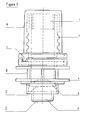
- The inventors have surprisingly found out the use of a twist cap (A) on a tube (7) or a pouch packaging component (8) or a bottle consisting of a seal (1), temper evident (2), thread (3) and a carrying element (4) and confectioned with a silicone valve (5) and a retainer therefore (6) filled with a hair dyeing composition comprising at least one oxidative dye precursor and optionally at least one coupling agent and optionally at least one direct dye which is mixed with an aqueous composition comprising at least one oxidizing agent prior to application, solves the above mentioned problems. Packaging with such kind of closure cap have been proposed in a US patent application published US 2003/0106910 A1.
- Accordingly the object of the present invention is product for hair dyeing consisting of a packaging and an aqueous composition wherein packaging is consisting a twist cap (A) on a tube (7) or a pouch packaging component (8) or a bottle consisting of a seal (1), temper evident (2), thread (3) and a carrying element (4) and confectioned with a silicone valve (5) and a retainer therefore (6) filled a hair dyeing composition comprising at least one oxidative dye precursor and optionally at least one coupling agent and optionally at least one direct dye which is mixed with an aqueous composition comprising at least one oxidizing agent prior to application. The packaging as described above makes storage of an oxidative colouring composition for a long period of time possible. When the content of such packaging is only partially emptied, the remaining is as well stored without showing any signs of instability for a long time. Such kind of packaging materials are commercially available.
- In the preferred from of the invention hair dyeing composition filled into the packaging mentioned above comprises at least one oxidative dye precursor and at least one coupling agent and optionally at least one direct dye which is mixed with an aqueous composition comprising at least one oxidizing agent prior to application.
- In still another preferred from of the invention hair dyeing composition filled into the packaging mentioned above comprises at least one oxidative dye precursor and at least one coupling agent and at least one direct dye which is mixed with an aqueous composition comprising at least one oxidizing agent prior to application.
- Further object of the present invention is multiportion product for hair dyeing consisting of a packaging and an aqueous composition wherein packaging is consisting a twist cap (A) on a tube (7) or a pouch packaging component (8) or a bottle consisting of a seal (1), temper evident (2), thread (3) and a carrying element (4) and confectioned with a silicone valve (5) and a retainer therefore (6) filled a hair dyeing composition comprising at least one oxidative dye precursor and optionally at least one coupling agent and optionally at least one direct dye which is mixed with an aqueous composition comprising at least one oxidizing agent prior to application
wherein the composition can be removed partially without effecting the stability of the remaining product. - Figure 1 presents schematically a confectioned cap (The letters B, C and D all together are defined as spout.)
- Figure 2 presents schematically individual elements of cap (The letters B, C and D all together are defined as spout.)
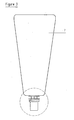
- Figure 3 presents schematically a tube confectioned with a cap (circled) as shown in figures 1 and 2
- Figure 4 presents schematically a pouch confectioned with a cap (circled) as shown in figures 1 and 2
- The silicone valve (5) is of heat curable liquid silicone rubber. Liquid silicone rubber used therefore is for example Silastic 94-595 from Dow Corning.
- Composition filled into tube, pouch or bottle is an oxidative dyestuff composition comprising at least one oxidative dyestuff precursor (developing substance) and optionally at least one coupling substance and optionally at least one direct dye.
- According to the invention, composition can be in the form of emulsion, solution, dispersion and/or gel. Emulsion and gel forms are preferred. The most preferred is emulsion.
- The viscosity of the compositions according to the invention ranges from 1,000 to 50,000, in particular 1,000 to 30,000, especially 1,000 to 20,000 mPa.s, measured at 20°C with a Brookfield rotation viscosimeter, with
spindle 5 at 5 rpm. - Dyeing composition according to the present invention comprises at least one oxidation dyestuff precursor (developing substance) and optionally at least one coupling substance and optionally at least one direct dye. In principal, it is possible to incorporate developing substances known per se. Special mention is made of p-phenlynediamine, p-methylaminophenol and substituted p-phenylenediamines such as 2,5-diamino-toluene, 2-n-propyl or 2-ethyl-p-phenylenediamine, 2,6-di-methyl-p-phenylene- diamine, 2-(2,5-diaminophenyl) ethanol, 1-amino-4-bis-(2'-hydroxyethyl)amino- benzene, 2-(2-hydroxyethyl amino)-5-aminotoluene, 4,4'-diaminodiphenylamine, 4-aminodiphenylamine, 2-amino-5-N,N-diethyl aminotoluene, 4-amino-N-ethyl-N-isopropyl aniline, 2-chloro-p-phenylenediamine, 1-β-hydroxyethyi-2,5-diamino-4-chlorobenzene, 1-β-hydroxyethyl-2,5-diamino-4-methyl benzene, 2-methoxy-p-phenylenediamine, N,N-diethyl-p-phenylenediamine, 1-amino-4-β-methoxyethyl aminobenzene, 1-dimethyl-amino-4-aminobenzene, 1-hydroxy-2,5-diamino-4-methyl benzene, 1-hydroxymethyl-2,5-diaminobenzene, 1,3-dimethyl-2,5-diaminobenzene, 1,4-diamino isopropyl benzene and/or 1-amino-4-β-hydroxypropyl aminobenzene, pyrazole and the derivatives thereof such as 1-hydroxyethyl-4,5-diaminopyrazole, 3,4-diamino-5-hydroxypyrazole, 3,5-diaminopyrazole, 3,5-diamino pyrazol-1-carboxamide, 3-amino-5-hydroxypyrazole, 1-phenyl-2-methylpyrazole, 1-phenyl-3-methylpyrazole-5-one, 3,5-dimethylpyrazole, 3,5-dimethylpyrazole-1-methanol, 3,5-diamino-1,2,4-triazole, 4-aminophenol and the derivatives thereof such as 4-amino-3-methylphenol, 2-chloro-4-aminophenol, 2,6-dichloro-4-aminophenol, 2,4-diamino-phenol, 2,6-dibromo-4-aminophenol, tetraamino pyrimidines, triaminohydroxy pyrimidines, diaminomono- and -dihydroxy pyrimidines, aminotriazines, 5-amino salicylic acid and/or 1,2,4-triamino benzene or the water-soluble salts thereof.
- Further suitable aminopyridines are 2,5-diaminopyridine, 2,3-diaminopyridine, 2,6-diaminopyridine, 3-amino-2-methyl amino-6-methoxypyridine, 2-dimethyl-5-aminopyridine, 2-dimethyl aminoethyl-3-hydroxypyridine, 2-amino-4,6-dimethyl pyridine, 2-amino-3-hydroxypyridine, 3-amino-2(β-hydroxyethyl amino)-6-methoxypyridine, 2,6-dimethyl amino-5-aminopyridine, 2-di(hydroxyethyl) amino-5-aminopyridine, 2-hydroxyethyl amino-5-aminopyridine, 4-hydroxy-2,5,6-triaminopyrimidine and/or the water-soluble salts thereof.
- The total concentration of the developing substances customarily ranges between about 0.05 % and 5 %, preferably 0.1 % and 4 %, in particular 0.25 % to 3 % by weight, calculated to the total hair dyeing composition (excluding the oxidation agent), whereby these figures are always related to the proportion of free base.
- The composition according to the present invention contains optionally at least one coupling substance, which can be selected from 5-amino-2-methylphenol, 2-methyl-5-hydroxyethylaminophenol, 2,4,-diamnophenoxyehanol, 2-amino-4-hydroxyethylaminoanisol, 2-methyl-5-amino-6-chlorphenol, 1,3-bis(2,4-diaminophenoxy)propane, 2-bis(2-hydroxyethyl)aminotoluene, 2-amino-5-methylphenol, resorcinol, 2-methyl resorcinol, 4-chlororesorcinol, 2-amino-4-chlorophenol, 5-amino-4-methoxy-2-methylphenol, 2-aminophenol, 3-amino-phenol, 1-methyl-2-hydroxy-4-aminobenzene, 3-N,N-dimethyl aminophenol, 2,6-dihydroxy-3,5-dimethoxypyridine, 5-amino-3-methylphenol, 6-amino-3-methylphenol, 1,3-diamino- benzene, 1-amino-3-(2'-hydroxyethylamino)benzene, 1-amino-3-[bis(2'-hydroxy-ethyl) amino]benzene, α-naphthol, 4,6-dichlororesorcinol, 1,3-diamino-toluene, 4-hydroxy-1,2-methylenedioxy benzene, 1,5-dihydroxy naphthalene, 1,6-dihydroxy naphthalene, 1,7-dihydroxy naphthalene, 2,7-dihydroxy naphthalene, 1-hydroxy-2-methyl naphthalene, 4-hydroxy-1,2-methyldioxy benzene, 2,4-diamino-3-chlorophenol, 5-amino-2-methoxyphenol and/or 1-methoxy-2-amino-4-(2'-hydroxyethyl amino)benzene or the water-soluble salts thereof.
- Further, indole and indoline derivatives can as well be contained in the colouring composition of the present invention. Examples to those are: 6-aminoindol, 6-hydroxyindole, 1-ethyl-6-hydroxyindole, 1-methyl-4-hydroxyindol, 1-methyl-6-hydroxyindole, 2-methyl-6-hydroxyindole, 5-hydroxyindol, 4-hydroxyindol, 5,6-dihydroxyindole, 6-aminoindoline, 6-hydroxyindoline, 1-ethyl-6-hydroxyindoline, 1-methyl-4-hydroxyindoline, 1-methyl-6-hydroxyindoline, 2-methyl-6-hydroxyindoline, 5-hydroxyindoline, 4-hydroxyindoline, 5,6-dihydroxyindoline and their respective salts.
- In the hair dyeing compositions according to the invention, the coupling substance(s) as reaction partners of the developing substance(s) are present in approximately the same molecular proportions as the developing substances, i.e. in amounts from 0.01 % to 5.0 %, preferably 0.05 % to 4 %, in particular 0.1 % to 3 % by weight, calculated to the total composition (excluding the oxidizing agent), whereby these figures are always related to the proportion of free base.
- According to the invention, dyeing composition comprises optionally at least one direct acting dyestuff selected from anionic, cationic and neutral ones. Suitable cationic dyestuffs are in principal those available on the market for hair colouring applications. Some examples to those are:
- Basic Blue 6, Basic Blue 7, Basic Blue 9, Basic Blue 26, Basic Blue 41, Basic Blue 99, Basic Brown 4, Basic Brown 16, Basic Brown 17, Natural Brown 7, Basic Green 1, Basic Red 2, Basic Red 12 Basic Red 22, Basic Red 76, Basic Violet 1, Basic Violet 2, Basic Violet 3, Basic Violet 10, Basic Violet 14 and Basic Yellow 57.
- For this purpose, special reference is made to the PCT application WO 95/15144 of Ciba-Geigy AG. The cationic dyestuffs with the following chemical structures are especially, the most, preferred ones according to the present invention.


- The most preferred compounds are the ones according to the formula I, where R1, R2, R3 and R4 are methyl and Y is chloride, according to formula II where R1 and R2 are methyl and Y is chloride and according to the formula IV, where R1 and R2, are methyl, R5 is hydrogen and Y is methosulfate.
- Cationic dyestuffs are included into the compositions of the present invention at a concentration of 0.01 to 7.5%, preferably 0.05 to 5% and more preferably 0.05 to 3% by weight calculated to total aqueous composition.
- Acid Black 1, Acid Blue 1, Acid Blue 3, Food Blue 5, Acid Blue 7, Acid Blue 9, Acid Blue 74, Acid Orange 3, Acid Orange 6, Acid Orange 7, Acid Orange 10, Acid Red 1, Acid Red 14, Acid Red 18, Acid Red 27, Acid Red 50, Acid Red 52, Acid Red 73, Acid Red 87, Acid Red 88, Acid Red 92, Acid Red 155, Acid Red 180, Acid Violet 9, Acid Violet 43, Acid Violet 49, Acid Yellow 1, Acid Yellow 23, Acid Yellow 3, Food Yellow No. 8, D&C Brown No. 1, D&C Green No. 5, D&C Green No. 8, D&C Orange No. 4, D&C Orange No. 10, D&C Orange No. 11, D&C Red No. 21, D&C Red No. 27, D&C Red No. 33, D&C Violet 2, D&C Yellow No. 7, D&C Yellow No. 8, D&C Yellow No. 10, FD&C Red 2, FD&C Red 40, FD&C Red No. 4, FD&C Yellow No. 6, FD&C Blue 1, Food Black 1, Food Black 2, Disperse Black 9 and
Disperse Violet 1 and their alkali metal salts such as sodium, potassium. - Among those, the most preferred anionic dyestuffs are Acid Red 52,
DC Violet 2, DC Red 33, DC Orange 4, DC Red 27 and DC Yellow 10. - According to the invention anionic dyes are included into oxidative dyeing compositions at a concentration of 0.1 to 7.5%, preferably 0.1 to 5%, more preferably 0.1 to 3% by weight calculated to total aqueous composition.
- When both anionic and cationic dyes are present in the dyeing compositions the ratio of cationic dyestuffs to acidic dyestuffs by weight is preferably in the range of 3:1 to 1:10, preferably 2: 1 to 1:7 and further more preferably 2:1 to 1:5. In a patent application from the applicant the importance of the ratio of cationic to anionic dyes is disclosed in detail.
- Additionally, the coloring compositions of the present invention can comprise neutral nitro dyes (HC dyes), so called nitro dyes as direct dye. Concentration of those can typically be in the range from 0.01 to 2.5%, preferably 0.1 to 2% by weight calculated to total aqueous composition.
- Some examples to those are: HC Blue No.2, HC Blue No.4, HC Blue No.5, HC Blue No.6, HC Blue No.7, HC Blue No.8, HC Blue No.9, HC Blue No.10, HC Blue No.11, HC Blue No.12, HC Blue No.13, HC Brown No.1, HC Brown No.2, HC Green No.1, HC Orange No.1, HC Orange No.2, HC Orange No.3, HC Orange No.5, HC Red BN, HC Red No.1, HC Red No.3, HC Red No.7, HC Red No.8, HC Red No.9, HC Red No.10, HC Red No.11, HC Red No.13, HC Red No.54, HC Red No.14, HC Violet BS, HC Violet No.1, HC Violet No.2, HC Yellow No.2, HC Yellow No.4, HC Yellow No.5, HC Yellow No.6, HC Yellow No.7, HC Yellow No.8, HC Yellow No.9, HC Yellow No.10, HC Yellow No.11, HC Yellow No.12, HC Yellow No.13, HC Yellow No.14, HC Yellow No.15, 2- Amino-6-chloro-4-nitrophenol, picramic acid, 1,2-Diamino-4-nitrobenzol, 1,4-Diamino-2-nitrobenzol, 3-Nitro-4-aminophenol, 1-Hydroxy-2-amino-3-nitrobenzol and 2-hydroxyethylpicramic acid.
- Plant dyestuffs can also be used alone or in combination with synthetic direct-acting dyestuffs, for example henna (red or black), alkanna root, laccaic acid, indigo, logwood powder, madder root and rhubarb powder, etc.
- pH of the aqueous composition of the present invention varies between 5 and 12, preferably 6 - 11, more preferably 6.8 to 10. pH of the aqueous composition is adjusted to the required pH by using triethanolamine, ammonia or its salts with acids such as ammonium chloride, ammonium sulphate, ammonium carbonate, ammonium bicarbonate, ammonium nitrate, or using alkaline solutions such as sodium hydroxide, potassium hydroxide and their respective salts with the known acids.
- In the case that the composition is an emulsion, the most preferred, aqueous composition for oxidative dyeing comprises in the base formulation fatty acids with 0 to 3 ethylenic bonds and with fatty acyl chain length of 12 to 22 C atom. Concentration of the fatty acids can be in the range of 0.1 to 10%, preferably 0.1 to 7.5% and most preferably 0.2 to 5% by weight calculated to the total composition. Fatty acid examples, without limiting the choice, suitable for colouring compositions are myristic acid, palmitic acid, behenic acid, steraic acid, oleic acid, linoleic acid. The most preferred fatty acid is oleic acid.
- In the case that the coloring composition is in the form of an emulsion, it comprises as an emulsion base at least one fatty alcohol or mixture of fatty alcohols with the chain length of 14 to 22 C atoms. Examples to suitable fatty alcohols, without limiting the choice, are myristyl alcohol, cetyl alcohol, stearyl alcohol, behenyl alcohol and cetostearyl alcohol. The most preferred is cetostearyl alcohol well known with its trade name Lanette O or as Lanette N in mixture with sodium cetearyl sulfate from Cognis.
- The concentration of fatty alcohol(s) is in the range from 0.5 to 25%, preferably 0.5 to 20% by weight and more preferably 0.5 to 15% by weight calculated to total composition without oxidizing agent.
- Coloring compositions according to present invention comprises surfactants selected from anionic, nonionic, amphoteric (or zwiterionic) and/or cationic surfactants as emulsifier or solubilizer. Cationic surfactants are as well used as hair conditioners in the coloring composition.
- Anionic surfactants suitable within the scope of the invention are in principal known from the cleansing compositions and are preferably present in an amount from 0.1 to about 10%, preferably 0.2 to 7.5% and most preferably 0.2 - 5% by weight, calculated to the total composition.
- These are anionic surfactants of the sulfate, sulfonate, carboxylate and alkyl phosphate type, for example, the known C10-C18-alkyl sulfates, and in particular the respective ether sulfates, for example, C12-C14-alkyl ether sulfate, lauryl ether sulfate, especially with 1 to 4 ethylene oxide groups in the molecule, monoglyceride (ether) sulfates, fatty acid amide sulfates obtained by ethoxylation and subsequent sulfatation of fatty acid alkanolamides, and the alkali salts thereof, as well as the salts of long-chain mono- and dialkyl phosphates.
- Additional anionic surfactants useful within the scope of the invention are α-olefin sulfonates or the salts thereof, and in particular alkali salts of sulfosuccinic acid semiesters, for example, the disodium salt of monooctyl sulfosuccinate and alkali salts of long-chain monoalkyl ethoxysulfosuccinates.
- Suitable surfactants of the carboxylate type are alkyl polyether carboxylic acids and the salts thereof of the formula
R6- (C2H4O)n- O - CH2COOX,
wherein R6 is a C8-C20-alkyl group, preferably a C12-C14-alkyl group, n is a number from 1 to 20, preferably 2 to 17, and X is H or preferably a cation of the group sodium, potassium, magnesium and ammonium, which can optionally be hydroxyalkyl-substituted, as well as alkyl amido polyether carboxylic acids of the general formula
- Such products have been known for some time and are on the market, for example, under the trade name "AKYPO® " and "AKYPO-SOFT® ".
- Also useful are C8-C20-acyl isethionates, alone or in admixture with other anionic surfactants, as well as sulfofatty acids and the esters thereof.
- Further suitable anionic surfactants are also C8-C22-acyl aminocarboxylic acids or the water-soluble salts thereof. Especially preferred is N-lauroyl glutamate, in particular as sodium salt, as well as, for example, N-lauroyl sarcosinate, N-C12-C18-acyl asparaginic acid, N-myristoyl sarcosinate, N-oleoyl sarcosinate, N-lauroyl methylalanine, N-lauroyl lysine and N-lauroyl aminopropyl glycine, preferably in form of the water-soluble alkali or ammonium, in particular the sodium salts thereof, preferably in admixture with the above-named anionic surfactants.
- It is also possible to use mixtures of several anionic surfactants in a mixture.
- An overview of the anionic surfactants suitable for the present invention can furthermore be found in the monography of K. Schrader, "Grundlagen und Rezepturen der Kosmetika", 2nd Ed.(1989, Hüthig Buchverlag), pp. 595-600 and pp. 683 to 691.
- Further surfactants in the colouring compositions according to the invention are nonionic surfactants alone or in admixture with anionic surfactants at a weight ratio of 3:1 to 1:3.
- These are described as well in Schrader, I.c., on pages 600-601 and pp. 694-695.
- Especially suited nonionic surfactants are, for example, long-chain fatty acid mono-and dialkanolamides, such as coco fatty acid mono- or diethanolamide and myristic fatty acid mono or diethanolamide, stearic acid mono or diethanolamide.
- Further nonionic surfactants suited are alkyl polyglucosides of the general formula
R7-O-(R3O)n-Zx,
wherein R7 is an alkyl group with 8 to 18 carbon atoms, R3 is an ethylene or propylene group, Z is a saccharide group with 5 to 6 carbon atoms, n is a number from 0 to 10 and x is a number between 1 and 5. - Further additionally useful nonionic surfactants are, for example, the various sorbitan esters, such as polyethylene glycol sorbitan stearic acid ester, fatty acid polyglycol esters or poly-condensates of ethyleneoxide and propyleneoxide, as they are on the market, for example, under the trade name "PluronicsR", as well as fatty alcohol ethoxylates.
- Further suitable nonionic surfactants are amineoxides. Such amineoxides are state of the art, for example C12-C18- alkyl dimethyl amineoxides such as lauryl dimethyl amineoxide, C12-C18- alkyl amidopropyl or -ethyl amineoxides, C12-C18 -alkyl di(hydroxyethyl) or (hydroxypropyl) amineoxides, or also amineoxides with ethyleneoxide and/or propyleneoxide groups in the alkyl chain. Such amineoxides are on the market, for example, under the trade names "Ammonyx® ", "Aromox® " or "Genaminox® ".
- Further nonionic surfactants useful in the compositions according to invention are C10-C22-fatty alcohol ethoxylates. Especially suited are C10-C22-fatty alcohol ethers, the alkyl polyglycol ethers known by the generic terms "Laureth", "Myristeth", "Oleth", "Ceteth", "Deceth", "Steareth" and "Ceteareth" according to the CTFA nomenclature, including addition of the number of ethylene oxide molecules, e.g., "Laureth-16":
- The average degree of ethoxylation thereby ranges between about 2.5 and about 25, preferably about 10 and about 20.
- The concentration of nonionic surfactant is in the range from 0.5 to 15%, preferably 0.5 to 10% by weight and more preferably 0.5 to 7.5% by weight calculated to total composition without oxidizing agent.
- As further surfactant component, the colouring compositions according to the invention can also contain amphoteric or zwitterionic surfactants, for example in an amount from about 0.5 % to about 5 %, preferably from about 1 % to about 2.5 % by weight, calculated to the total composition without oxidizing agent.
- Useful as such are in particular the various known betaines such as alkyl betaines, fatty acid amidoalkyl betaines and sulfobetaines, for example, lauryl hydroxysulfobetaine; long-chain alkyl amino acids, such as cocoaminoacetate, cocoaminopropionate and sodium cocoamphopropionate and -acetate have also proven suitable.
- In detail, it is possible to use betaines of the structures


- Colouring composition can contain cationic surfactants as emulsifier, solubilizer and/or conditioning ingredients according to the formula, but not limited to

R13CO NH (CH2)n
where R13 is saturated or unsaturated, branched or non-branched alkyl chain with 7-21 C atoms and n has typical value of 1 - 4 or
R14 CO O (CH2)n
where R14 is saturated or unsaturated, branched or non-branched alkyl chain with 7-21 C atoms and n has typical value of 1 - 4, and
R10 is H or unsaturated or saturated, branched or non-branched alkyl chain with 1 - 22 C atoms or
R13 CO NH (CH2)n
or
R14 CO O (CH2)n
where R13, R14 and n are same as above. - R11 and R12 are H or lower alkyl chain with 1 to 4 Carbon atoms, and X is typically an anion such as chloride, bromide, methosulfate.
- Typical examples of those ingredients are cetyl trimethyl ammonium chloride, steartrimonium chloride, dipalmitoyl dimonium chloride, distearyl dimethyl ammonium chloride, stearamidopropyl trimonuim chloride, dioleoylethyl dimethyl ammonium methosulfate, dioleoylethyl hydroxyethylmonium methosulfate.
- Colouring composition can also contain cationic polymers as conditioning agents and gel forming agents. Those are cationic cellulose type polymers know as Polymer JR type from Amerchol such as Polyquaternium 10 or cationic guar gum known with trade name Jaguar from Rhône-Poulenc and chemically for example Guar hydroxypropyl trimonium chloride. Furthermore, chitosan and chitin can also be included in the compositions as cationic natural polymers.
- Furthermore, it has been found suitable those cationic polymers known with their CTFA category name Polyquaternium. Typical examples of those
Polyquaternium 6,Polyquaternium 7, Polyquaternium 10, Polyquaternium 11, Polyquaternium 16, Polyquaternium 22 and Polyquaternium 28, Polyquaternium 30, Polyquaternium 37, Polyquaternium 36, Polyquaternium 46. Among those the most preferred one is the Polyquaternium 11 as well known with its trade name Gafquat from ISP and as Luviquat PQ from BASF. - As well those polymers known with their CTFA category name Quaternium are suitable. Those are for example Quaternium-8, Quaternium-14, Quaternium-15, Quaternium-18, Quaternium-22, Quaternium-24, Quaternium-26, Quaternium-27, Quaternium-30, Quaternium-33, Quaternium-53, Quaternium-60, Quaternium-61, Quaternium-72, Quaternium-78, Quaternium-80, Quaternium-81, Quaternium-81, Quaternium-82, Quaternium-83 and Quaternium-84.
- Typical concentration range for any of the cationic conditioners mentioned above can be 0.01 - 5% by weight, preferably 0.05 - 3% by weight and more preferably 0.05 - 2% by weight calculated to total composition without oxidizing agent.
- Colouring composition comprise preferably an organopolysiloxane wherein at least one silicium atom is linked to an alkylene group having a hetero-atom, in particular a nitrogen atom, with a poly-(N-acyl alkyleneimine) units of the formula

- Preferred organopolysiloxane polymers are those of the type disclosed in EP-A 640 643, in particular optionally quaternized aminoalkyl, in particular aminopropyl dimethyl polysiloxane/polyethyl oxazoline copolymers of the formula

- Especially suited are the organopolysiloxanes disclosed under the terms A-1, A-2 and A-3 on pages 12 to 13 of EP-A 640 643. The proportion of graft copolymers in the hair colouring compositions according to the invention ranges from 0.05 % to 5 %, preferably 0.1 % to 2.5 %, in particular 0.5 % to 1.5 % by weight, calculated to the total composition.
- Colouring compositions according to the present invention can contain organic solvents as penetration enhancers and also as a solubilzers. Examples of such organic solvents are benzyloxy ethanol, benzyl alcohol, phenoxy ethanol, phenoxy isopropanol, methyl phenoxy ethanol, benzyl glycerol, N-benzyl formide, N-methyl pyrrolidone, N-ethyl pyrrolidone, cinnamyl alcohol, phenethyl alcohol, p-methyl benzyl alcohol, butyl cellosolve, methyl carbitol, ethyl carbitol, propyl carbitol, butyl carbitol, diethyleneglycol, diethyl ether and dipropyleneglycol diethyl ether. Typically the concentration of those solvents can be in the range from 0.5% to 25%, preferably 0.5 - 20% by weight and more preferably 0.5 -15% by weight calculated to the total composition without oxidizing agent.
- The hair dyeing compositions according to the invention preferably contain thickening agents, especially in the case a gel type of preparation is preferred. These are, for example, the various cellulose derivatives such as hydroxyalkyl celluloses, e.g. hydroxyethyl cellulose, hydroxypropyl cellulose, hydroxypropyl methyl cellulose, natural polysaccharides such as xanthan gum; guar gum and the alkoxylation products thereof in amounts from 0.1 - 5 %, preferably 0.1 - 3% and most preferably 0.1 - 2% by weight calculated to the total composition and depending on the desired consistency thereof.
- Optionally, the composition of this invention can comprise further hair conditioning agents such as silicone oils either volatile or non-volatile, natural and synthetic oils. Among silicone oils those can be added to the colouring composition include dimethicone, dimethiconol, polydimethylsiloxane, DC fluid ranges from Dow Corning, natural oils such as olive oil, almond oil, avocado oil, weizenkeim oil, ricinus oil and the synthetic oils, such as mineral oil, isopropyl myristate, palmitate, stearate and isostearate, oleyl oleate, isocetyl stearate, hexyl laurate, dibutyl adipate, dioctyl adipate, myristyl myristate and oleyl erucate.
- Additional non-ionic conditioning agents may be polyols such as glycerin, glycol and derivatives, polyethyleneglycoles known with trade names Carbowax PEG from Union Carbide and Polyox WSR range from Amerchol, polyglycerin, polyethyleneglycol mono or di fatty acid esters having general formula X or XI, respectively,
R17 CO (O CH2 CH2)n OH formula X
R17 CO (O CH2 CH2)n O OC R18 formula X
where R17 and R18 are independent from each other saturated, unsaturated or branched or non-branched alkyl chain with 7 to 21 C atoms and n is typically 2 - 100. - Another preferred compound in the composition is of ceramide type of compounds according to general formula

- The compositions of the present invention can comprise of at least one ubiquinone of the formula (I)

- After removal of the content of the product comprising at least one oxidation dyestuff precursor and optionally at least one coupling substance and optionally at least one direct dye, the composition is mixed with an aqueous composition comprising at least one oxidizing agent prior to application onto hair. The oxidizing agents suitable are hydrogen peroxide, urea peroxide, melanin peroxide or perborate salts. The most preferred is hydrogen peroxide, which is used as a lotion containing 3 to 12% by weight, calculated to composition only comprising hydrogen peroxide. The mixing ratio is usually in the range of 4:1 to 1:4, by weight, preferably 3:1 to 1:3 by weight, more preferably 2:1 to 1:3 by weight.
- The tubes or pouches or bottles can be emptied with very low level of remains in the packaging. The emptying is achieved at most not les than 98% of its content by weight.
- Filling of the aqueous composition into tube or pouch or bottle for obtaining product for oxidative colouring hair comprising at least one oxidation dyestuff precursor and optionally at least one coupling substance and optionally at least one direct dye is carried out in a process in which the compositions is filled into the tube or pouch or bottle with an extendable filling nozzle entering into pouch or tube or bottle in order to secure the long lifetime of the content - long-term stability.
- The following examples are used to illustrate the invention, but not limit it
-
Base formulations % by weight % by weight I II Stearamide MEA - 1.50 Cocamide MEA 4.00 2.00 Cetearyl alcohol 10.00 8.00 Tegin P 1.40 1.40 Propylene Glycol 2.40 1.60 Oleic acid 3.00 3.00 Ammonium chloride 0.50 0.50 Tetrasodium EDTA 0.20 0.20 Sodium lauryl sulfate 1.50 - Sodium cetearyl sulfate - 1.20 Organopolysiloxane A1 of EP 640 643 0.20 0.20 Ceramide according to formula wherein R18 and R19 are C16 alkyl and R20 is ethyl 0.10 0.20 Water to 100 to 100 - The dyestuffs given in the following as for various color directions are added to the base compositions either I or II. Water amount is reduced in the base formula corresponding to the amount of dyes present in the formulations.
The both base formulations have similar viscosity values of around 5000 mPa s measured by Brookfield viscosimeter at 20°C withspindle 4. -
% by weight p-Toluenediamine sulfate 1.40 Resorcin 0.60 3-Aminophenol 0.10 2-Amino-4-hydroxyethylaminoanisolsulfate 0.02 Base formula I or II to 100 - The pH of the composition is adjusted to 9.5. The composition obtained was mixed with a 6% by weight hydrogen peroxide comprising composition at a weight ratio of 1:1 and hair swatches were colored at room temperature for 30 min. A light brown color was obtained.
- The composition of example 1 was filled into a pouch and a tube as described above. The product was stable over the period of 12 weeks (period tested) at 40°C and at room temperature. No instability is observed in terms of colouring performance on hair, pH, viscosity, appearance (especially macroscopic colour of the composition).
- In another test the same product was filled into a tube and a pouch with a volume of 100 ml according to the invention and in a tube and a pouch without containing the silicone valve, meaning that when the cap is opened the content is directly in contact with air. All products were stored at room temperature and their content was emptied every week by removing approximately 15 g. With the removed composition colouring test was carried out as described above. Comparison was also made with a freshly prepared composition. The evaluation was carried out according to following scale.
- 1 extremely weak colouring
- 2 very weak colouring
- 3 colouring with low intensity
- 4 intensive colouring
- 5 very intensive colouring
- The results are presented in Table I.
Table I : Results of colouring test of the products stored in different packaging as described above and a freshly prepared colouring composition. Storage Example 1 stored in according to (see above) Period (weeks) Invention* Comparative* Fresh composition 1 5 5 5 2 5 4 5 3 4 3 5 4 5 1 5 6 5 1 5 * either pouch or tube, no difference was observed - From the above results it is clear that the composition stored in a packaging according to invention shows very good colouring performance and therefore without oxidative polymerization of the oxidative dyes during storage, whereas the composition stored in a pouch or tube with a cap without silicone valve did not show any coloruing effect after storing 4 weeks at room temperature indicating that the oxidative dyes are not stable under those conditions. Thus, the product of the invention has a longer shelf life than that of comparative product.
- Similar results are obtained with the following examples as well.
-
% by weight 1-Hydroxyethyl-4,5-diaminopyrazolsulfate 0.54 4-Amino-2-hydroxytoluol 0.27 Base formula I or II to 100 - The preparation and filling and colouring tests were carried out as above and Red copper colour is obtained.
-
% by weight 2,4,5,6-Tetraaminopyrimidine sulphate 0.77 2-Amino-4-hydroxyethylaminoanisolsulfate 0.90 Base formula I to 100 - The preparation and filling and colouring tests was carried out as above and violet colour is obtained.
-
% by weight 2,4,5,6-Tetraaminopyrimidine sulphate 0.53 2-Methylresorcin 0.28 Basic red 51 0.20 Base formula I or II to 100 - The preparation and filling and colouring tests was carried out as above and intensive red colour is obtained.
-
% by weight 2,4-Diamino-6-hydroxypyrimidine 0.28 4-amino-2hydroxytoluol 0.27 Base formula I or II to 100 - The preparation and filling and colouring tests was carried out as above and orange colour is obtained.
Claims (9)
- Product for oxidative colouring hair consisting of a packaging consisting a twist cap (A) on a tube (7) or a pouch packaging component (8) or a bottle consisting of a seal (1), temper evident (2), thread (3) and a carrying element (4) and confectioned with a silicone valve (5) and a retainer therefore (6) and an aqueous oxidative colouring composition comprising at least one oxidative dye precursor and optionally at least one coupling agent and optionally at least one direct dye which is mixed with an aqueous composition comprising at least one oxidizing agent prior to application.
- Product according to claim 1 characterised in that the aqueous colouring composition has a viscosity in the range from 1,000 to 50,000 mPa.s measured at 20°C with a Brookfiled viscosimeter with a spindle 5 at 5 rpm.
- Product according to any of the preceding claims characterised in that it comprises at least one coupling substance in addition to oxidative dye precursor.
- Product according to any of the preceding claims characterised in that it comprises at least one direct dye selected from anionic, cationic and neutral nitro dyes.
- Product according to claim 4 that the direct dye is cationic hair dye.
- Product according to claim 4 that the direct dye is neural nitro hair dye.
- Product according to any of the preceding claims characterised in that the aqueous oxidative dyeing composition is an emulsion and comprises at least one emulgator.
- Product according to any of the preceding claims characterised in that the aqueous oxidative dyeing composition has a pH between 5 and 12.
- Use of a packaging consisting a twist cap (A) on a tube (7) or a pouch packaging component (8) or a bottle consisting of a seal (1), temper evident (2), thread (3) and a carrying element (4) and confectioned with a silicone valve (5) and a retainer therefore (6) for stably storing an aqueous oxidative colouring composition comprising at least one oxidative dye precursor and optionally at least one coupling agent and optionally at least one direct dye which is mixed with an aqueous composition comprising at least one oxidizing agent prior to application.
Priority Applications (3)
| Application Number | Priority Date | Filing Date | Title |
|---|---|---|---|
| AT04030562T ATE496655T1 (en) | 2004-12-23 | 2004-12-23 | HAIR DYE PRODUCT |
| DE602004031246T DE602004031246D1 (en) | 2004-12-23 | 2004-12-23 | The hair dye |
| EP04030562A EP1676605B1 (en) | 2004-12-23 | 2004-12-23 | Product for hair dyeing |
Applications Claiming Priority (1)
| Application Number | Priority Date | Filing Date | Title |
|---|---|---|---|
| EP04030562A EP1676605B1 (en) | 2004-12-23 | 2004-12-23 | Product for hair dyeing |
Publications (2)
| Publication Number | Publication Date |
|---|---|
| EP1676605A1 true EP1676605A1 (en) | 2006-07-05 |
| EP1676605B1 EP1676605B1 (en) | 2011-01-26 |
Family
ID=34927939
Family Applications (1)
| Application Number | Title | Priority Date | Filing Date |
|---|---|---|---|
| EP04030562A Expired - Lifetime EP1676605B1 (en) | 2004-12-23 | 2004-12-23 | Product for hair dyeing |
Country Status (3)
| Country | Link |
|---|---|
| EP (1) | EP1676605B1 (en) |
| AT (1) | ATE496655T1 (en) |
| DE (1) | DE602004031246D1 (en) |
Cited By (1)
| Publication number | Priority date | Publication date | Assignee | Title |
|---|---|---|---|---|
| US7874466B2 (en) | 2006-11-07 | 2011-01-25 | The Procter & Gamble Company | Package comprising push-pull closure and slit valve |
Citations (9)
| Publication number | Priority date | Publication date | Assignee | Title |
|---|---|---|---|---|
| US4561570A (en) * | 1982-12-21 | 1985-12-31 | Wella Aktiengesellschaft | Automatic locking device for a flexible container |
| EP0391662A1 (en) * | 1989-04-04 | 1990-10-10 | Bristol-Myers Squibb Company | Nitroaniline dyes with a cyano substituent group |
| US5651793A (en) * | 1993-09-30 | 1997-07-29 | Henkel Kommanditgesellschaft Auf Aktien | Hydrogen peroxide preparations containing foam regulators |
| EP0788831A2 (en) * | 1996-02-06 | 1997-08-13 | Bristol-Myers Squibb Company | Hair dye color selection system and method |
| FR2785878A1 (en) * | 1998-11-12 | 2000-05-19 | Jean Philippe Taberlet | Seal assembly for fluid distribution head comprises elastic element shaped as cup with hole that is covered by fixed cylinder and deforms under effect of product distribution pressure. |
| USH2027H1 (en) * | 2001-06-06 | 2002-06-04 | Seaquist Closures Foreign, Inc. | Flexible slit valve |
| US20020144358A1 (en) * | 2001-01-23 | 2002-10-10 | Mu-Ill Lim | Primary intermediates for oxidative coloration of hair |
| US20030106910A1 (en) * | 2001-12-07 | 2003-06-12 | Seaquist Closures Foreign, Inc. | Closure with pressure-actuated valve and lid seal |
| US20040244126A1 (en) * | 2003-06-04 | 2004-12-09 | Vena Lou Ann Christine | Method, compositions, and kit for coloring hair |
-
2004
- 2004-12-23 EP EP04030562A patent/EP1676605B1/en not_active Expired - Lifetime
- 2004-12-23 DE DE602004031246T patent/DE602004031246D1/en not_active Expired - Lifetime
- 2004-12-23 AT AT04030562T patent/ATE496655T1/en not_active IP Right Cessation
Patent Citations (9)
| Publication number | Priority date | Publication date | Assignee | Title |
|---|---|---|---|---|
| US4561570A (en) * | 1982-12-21 | 1985-12-31 | Wella Aktiengesellschaft | Automatic locking device for a flexible container |
| EP0391662A1 (en) * | 1989-04-04 | 1990-10-10 | Bristol-Myers Squibb Company | Nitroaniline dyes with a cyano substituent group |
| US5651793A (en) * | 1993-09-30 | 1997-07-29 | Henkel Kommanditgesellschaft Auf Aktien | Hydrogen peroxide preparations containing foam regulators |
| EP0788831A2 (en) * | 1996-02-06 | 1997-08-13 | Bristol-Myers Squibb Company | Hair dye color selection system and method |
| FR2785878A1 (en) * | 1998-11-12 | 2000-05-19 | Jean Philippe Taberlet | Seal assembly for fluid distribution head comprises elastic element shaped as cup with hole that is covered by fixed cylinder and deforms under effect of product distribution pressure. |
| US20020144358A1 (en) * | 2001-01-23 | 2002-10-10 | Mu-Ill Lim | Primary intermediates for oxidative coloration of hair |
| USH2027H1 (en) * | 2001-06-06 | 2002-06-04 | Seaquist Closures Foreign, Inc. | Flexible slit valve |
| US20030106910A1 (en) * | 2001-12-07 | 2003-06-12 | Seaquist Closures Foreign, Inc. | Closure with pressure-actuated valve and lid seal |
| US20040244126A1 (en) * | 2003-06-04 | 2004-12-09 | Vena Lou Ann Christine | Method, compositions, and kit for coloring hair |
Cited By (1)
| Publication number | Priority date | Publication date | Assignee | Title |
|---|---|---|---|---|
| US7874466B2 (en) | 2006-11-07 | 2011-01-25 | The Procter & Gamble Company | Package comprising push-pull closure and slit valve |
Also Published As
| Publication number | Publication date |
|---|---|
| ATE496655T1 (en) | 2011-02-15 |
| DE602004031246D1 (en) | 2011-03-10 |
| EP1676605B1 (en) | 2011-01-26 |
Similar Documents
| Publication | Publication Date | Title |
|---|---|---|
| EP1598052B1 (en) | Composition for bleaching and dyeing keratin fibres | |
| EP2509567B1 (en) | Process for oxidative colouring keratin fibres | |
| US8029576B2 (en) | Composition for dyeing keratin fibres | |
| EP2547315B1 (en) | Colouring composition for keratin fibres | |
| EP2532347A1 (en) | Colouring composition | |
| EP1645264B1 (en) | Product for hair dyeing in a two chamber aerosol can | |
| EP2658511B1 (en) | Dyeing composition for keratin fibers | |
| US20080072384A1 (en) | Hair Colouring Composition | |
| EP1627666B1 (en) | Composition for dyeing keratin fibres | |
| US8579993B2 (en) | Use of dyestuffs for dyeing keratin fibers and compositions comprising the dyestuffs | |
| EP2177204A1 (en) | Colouring composition | |
| US20060174424A1 (en) | Composition for dyeing human hair | |
| EP2609906A1 (en) | Hair dyeing composition | |
| US8608809B2 (en) | Stable oxidative colouring composition for keratin fibres | |
| EP1676605B1 (en) | Product for hair dyeing | |
| EP1632218B1 (en) | Composition for dyeing keratin fibres | |
| EP2424620B1 (en) | Colouring composition |
Legal Events
| Date | Code | Title | Description |
|---|---|---|---|
| PUAI | Public reference made under article 153(3) epc to a published international application that has entered the european phase |
Free format text: ORIGINAL CODE: 0009012 |
|
| AK | Designated contracting states |
Kind code of ref document: A1 Designated state(s): AT BE BG CH CY CZ DE DK EE ES FI FR GB GR HU IE IS IT LI LT LU MC NL PL PT RO SE SI SK TR |
|
| AX | Request for extension of the european patent |
Extension state: AL BA HR LV MK YU |
|
| 17P | Request for examination filed |
Effective date: 20061212 |
|
| 17Q | First examination report despatched |
Effective date: 20070209 |
|
| AKX | Designation fees paid |
Designated state(s): AT BE BG CH CY CZ DE DK EE ES FI FR GB GR HU IE IS IT LI LT LU MC NL PL PT RO SE SI SK TR |
|
| GRAP | Despatch of communication of intention to grant a patent |
Free format text: ORIGINAL CODE: EPIDOSNIGR1 |
|
| GRAS | Grant fee paid |
Free format text: ORIGINAL CODE: EPIDOSNIGR3 |
|
| GRAA | (expected) grant |
Free format text: ORIGINAL CODE: 0009210 |
|
| AK | Designated contracting states |
Kind code of ref document: B1 Designated state(s): AT BE BG CH CY CZ DE DK EE ES FI FR GB GR HU IE IS IT LI LT LU MC NL PL PT RO SE SI SK TR |
|
| REG | Reference to a national code |
Ref country code: GB Ref legal event code: FG4D |
|
| REG | Reference to a national code |
Ref country code: CH Ref legal event code: EP |
|
| REG | Reference to a national code |
Ref country code: IE Ref legal event code: FG4D |
|
| REF | Corresponds to: |
Ref document number: 602004031246 Country of ref document: DE Date of ref document: 20110310 Kind code of ref document: P |
|
| REG | Reference to a national code |
Ref country code: DE Ref legal event code: R096 Ref document number: 602004031246 Country of ref document: DE Effective date: 20110310 |
|
| REG | Reference to a national code |
Ref country code: NL Ref legal event code: VDEP Effective date: 20110126 |
|
| LTIE | Lt: invalidation of european patent or patent extension |
Effective date: 20110126 |
|
| PG25 | Lapsed in a contracting state [announced via postgrant information from national office to epo] |
Ref country code: SE Free format text: LAPSE BECAUSE OF FAILURE TO SUBMIT A TRANSLATION OF THE DESCRIPTION OR TO PAY THE FEE WITHIN THE PRESCRIBED TIME-LIMIT Effective date: 20110126 Ref country code: PT Free format text: LAPSE BECAUSE OF FAILURE TO SUBMIT A TRANSLATION OF THE DESCRIPTION OR TO PAY THE FEE WITHIN THE PRESCRIBED TIME-LIMIT Effective date: 20110526 Ref country code: IS Free format text: LAPSE BECAUSE OF FAILURE TO SUBMIT A TRANSLATION OF THE DESCRIPTION OR TO PAY THE FEE WITHIN THE PRESCRIBED TIME-LIMIT Effective date: 20110526 Ref country code: GR Free format text: LAPSE BECAUSE OF FAILURE TO SUBMIT A TRANSLATION OF THE DESCRIPTION OR TO PAY THE FEE WITHIN THE PRESCRIBED TIME-LIMIT Effective date: 20110427 Ref country code: LT Free format text: LAPSE BECAUSE OF FAILURE TO SUBMIT A TRANSLATION OF THE DESCRIPTION OR TO PAY THE FEE WITHIN THE PRESCRIBED TIME-LIMIT Effective date: 20110126 Ref country code: ES Free format text: LAPSE BECAUSE OF FAILURE TO SUBMIT A TRANSLATION OF THE DESCRIPTION OR TO PAY THE FEE WITHIN THE PRESCRIBED TIME-LIMIT Effective date: 20110507 |
|
| PG25 | Lapsed in a contracting state [announced via postgrant information from national office to epo] |
Ref country code: CY Free format text: LAPSE BECAUSE OF FAILURE TO SUBMIT A TRANSLATION OF THE DESCRIPTION OR TO PAY THE FEE WITHIN THE PRESCRIBED TIME-LIMIT Effective date: 20110126 Ref country code: BE Free format text: LAPSE BECAUSE OF FAILURE TO SUBMIT A TRANSLATION OF THE DESCRIPTION OR TO PAY THE FEE WITHIN THE PRESCRIBED TIME-LIMIT Effective date: 20110126 Ref country code: AT Free format text: LAPSE BECAUSE OF FAILURE TO SUBMIT A TRANSLATION OF THE DESCRIPTION OR TO PAY THE FEE WITHIN THE PRESCRIBED TIME-LIMIT Effective date: 20110126 Ref country code: FI Free format text: LAPSE BECAUSE OF FAILURE TO SUBMIT A TRANSLATION OF THE DESCRIPTION OR TO PAY THE FEE WITHIN THE PRESCRIBED TIME-LIMIT Effective date: 20110126 Ref country code: BG Free format text: LAPSE BECAUSE OF FAILURE TO SUBMIT A TRANSLATION OF THE DESCRIPTION OR TO PAY THE FEE WITHIN THE PRESCRIBED TIME-LIMIT Effective date: 20110426 Ref country code: NL Free format text: LAPSE BECAUSE OF FAILURE TO SUBMIT A TRANSLATION OF THE DESCRIPTION OR TO PAY THE FEE WITHIN THE PRESCRIBED TIME-LIMIT Effective date: 20110126 Ref country code: SI Free format text: LAPSE BECAUSE OF FAILURE TO SUBMIT A TRANSLATION OF THE DESCRIPTION OR TO PAY THE FEE WITHIN THE PRESCRIBED TIME-LIMIT Effective date: 20110126 Ref country code: PL Free format text: LAPSE BECAUSE OF FAILURE TO SUBMIT A TRANSLATION OF THE DESCRIPTION OR TO PAY THE FEE WITHIN THE PRESCRIBED TIME-LIMIT Effective date: 20110126 |
|
| PG25 | Lapsed in a contracting state [announced via postgrant information from national office to epo] |
Ref country code: EE Free format text: LAPSE BECAUSE OF FAILURE TO SUBMIT A TRANSLATION OF THE DESCRIPTION OR TO PAY THE FEE WITHIN THE PRESCRIBED TIME-LIMIT Effective date: 20110126 Ref country code: DK Free format text: LAPSE BECAUSE OF FAILURE TO SUBMIT A TRANSLATION OF THE DESCRIPTION OR TO PAY THE FEE WITHIN THE PRESCRIBED TIME-LIMIT Effective date: 20110126 |
|
| PG25 | Lapsed in a contracting state [announced via postgrant information from national office to epo] |
Ref country code: CZ Free format text: LAPSE BECAUSE OF FAILURE TO SUBMIT A TRANSLATION OF THE DESCRIPTION OR TO PAY THE FEE WITHIN THE PRESCRIBED TIME-LIMIT Effective date: 20110126 Ref country code: RO Free format text: LAPSE BECAUSE OF FAILURE TO SUBMIT A TRANSLATION OF THE DESCRIPTION OR TO PAY THE FEE WITHIN THE PRESCRIBED TIME-LIMIT Effective date: 20110126 Ref country code: SK Free format text: LAPSE BECAUSE OF FAILURE TO SUBMIT A TRANSLATION OF THE DESCRIPTION OR TO PAY THE FEE WITHIN THE PRESCRIBED TIME-LIMIT Effective date: 20110126 |
|
| PLBE | No opposition filed within time limit |
Free format text: ORIGINAL CODE: 0009261 |
|
| STAA | Information on the status of an ep patent application or granted ep patent |
Free format text: STATUS: NO OPPOSITION FILED WITHIN TIME LIMIT |
|
| 26N | No opposition filed |
Effective date: 20111027 |
|
| REG | Reference to a national code |
Ref country code: DE Ref legal event code: R097 Ref document number: 602004031246 Country of ref document: DE Effective date: 20111027 |
|
| REG | Reference to a national code |
Ref country code: CH Ref legal event code: PFA Owner name: KAO GERMANY GMBH Free format text: KPSS-KAO PROFESSIONAL SALON SERVICES GMBH#PFUNGSTAEDTER STR. 92-100#64297 DARMSTADT (DE) -TRANSFER TO- KAO GERMANY GMBH#PFUNGSTAEDTER STR. 92-100#64297 DARMSTADT (DE) |
|
| REG | Reference to a national code |
Ref country code: FR Ref legal event code: CD Owner name: KAO GERMANY GMBH, DE Effective date: 20120411 |
|
| PG25 | Lapsed in a contracting state [announced via postgrant information from national office to epo] |
Ref country code: IT Free format text: LAPSE BECAUSE OF FAILURE TO SUBMIT A TRANSLATION OF THE DESCRIPTION OR TO PAY THE FEE WITHIN THE PRESCRIBED TIME-LIMIT Effective date: 20110126 |
|
| PG25 | Lapsed in a contracting state [announced via postgrant information from national office to epo] |
Ref country code: MC Free format text: LAPSE BECAUSE OF NON-PAYMENT OF DUE FEES Effective date: 20111231 |
|
| REG | Reference to a national code |
Ref country code: IE Ref legal event code: MM4A |
|
| PG25 | Lapsed in a contracting state [announced via postgrant information from national office to epo] |
Ref country code: IE Free format text: LAPSE BECAUSE OF NON-PAYMENT OF DUE FEES Effective date: 20111223 |
|
| PG25 | Lapsed in a contracting state [announced via postgrant information from national office to epo] |
Ref country code: LU Free format text: LAPSE BECAUSE OF NON-PAYMENT OF DUE FEES Effective date: 20111223 |
|
| PG25 | Lapsed in a contracting state [announced via postgrant information from national office to epo] |
Ref country code: TR Free format text: LAPSE BECAUSE OF FAILURE TO SUBMIT A TRANSLATION OF THE DESCRIPTION OR TO PAY THE FEE WITHIN THE PRESCRIBED TIME-LIMIT Effective date: 20110126 |
|
| PG25 | Lapsed in a contracting state [announced via postgrant information from national office to epo] |
Ref country code: HU Free format text: LAPSE BECAUSE OF FAILURE TO SUBMIT A TRANSLATION OF THE DESCRIPTION OR TO PAY THE FEE WITHIN THE PRESCRIBED TIME-LIMIT Effective date: 20110126 |
|
| PGFP | Annual fee paid to national office [announced via postgrant information from national office to epo] |
Ref country code: CH Payment date: 20131219 Year of fee payment: 10 |
|
| REG | Reference to a national code |
Ref country code: CH Ref legal event code: PL |
|
| PG25 | Lapsed in a contracting state [announced via postgrant information from national office to epo] |
Ref country code: CH Free format text: LAPSE BECAUSE OF NON-PAYMENT OF DUE FEES Effective date: 20141231 Ref country code: LI Free format text: LAPSE BECAUSE OF NON-PAYMENT OF DUE FEES Effective date: 20141231 |
|
| REG | Reference to a national code |
Ref country code: FR Ref legal event code: PLFP Year of fee payment: 12 |
|
| REG | Reference to a national code |
Ref country code: FR Ref legal event code: PLFP Year of fee payment: 13 |
|
| PGFP | Annual fee paid to national office [announced via postgrant information from national office to epo] |
Ref country code: GB Payment date: 20161228 Year of fee payment: 13 |
|
| PGFP | Annual fee paid to national office [announced via postgrant information from national office to epo] |
Ref country code: FR Payment date: 20161222 Year of fee payment: 13 |
|
| PGFP | Annual fee paid to national office [announced via postgrant information from national office to epo] |
Ref country code: DE Payment date: 20170228 Year of fee payment: 13 |
|
| REG | Reference to a national code |
Ref country code: DE Ref legal event code: R119 Ref document number: 602004031246 Country of ref document: DE |
|
| GBPC | Gb: european patent ceased through non-payment of renewal fee |
Effective date: 20171223 |
|
| REG | Reference to a national code |
Ref country code: FR Ref legal event code: ST Effective date: 20180831 |
|
| PG25 | Lapsed in a contracting state [announced via postgrant information from national office to epo] |
Ref country code: DE Free format text: LAPSE BECAUSE OF NON-PAYMENT OF DUE FEES Effective date: 20180703 Ref country code: FR Free format text: LAPSE BECAUSE OF NON-PAYMENT OF DUE FEES Effective date: 20180102 |
|
| PG25 | Lapsed in a contracting state [announced via postgrant information from national office to epo] |
Ref country code: GB Free format text: LAPSE BECAUSE OF NON-PAYMENT OF DUE FEES Effective date: 20171223 |