EP1676602A1 - Continuous administration of epitopes derived from protein present in atherosclerotic plaque for the treatment of atherosclerosis - Google Patents
Continuous administration of epitopes derived from protein present in atherosclerotic plaque for the treatment of atherosclerosis Download PDFInfo
- Publication number
- EP1676602A1 EP1676602A1 EP05290008A EP05290008A EP1676602A1 EP 1676602 A1 EP1676602 A1 EP 1676602A1 EP 05290008 A EP05290008 A EP 05290008A EP 05290008 A EP05290008 A EP 05290008A EP 1676602 A1 EP1676602 A1 EP 1676602A1
- Authority
- EP
- European Patent Office
- Prior art keywords
- human
- accession number
- apob
- epitope
- atherosclerotic plaque
- Prior art date
- Legal status (The legal status is an assumption and is not a legal conclusion. Google has not performed a legal analysis and makes no representation as to the accuracy of the status listed.)
- Withdrawn
Links
Classifications
-
- A—HUMAN NECESSITIES
- A61—MEDICAL OR VETERINARY SCIENCE; HYGIENE
- A61K—PREPARATIONS FOR MEDICAL, DENTAL OR TOILETRY PURPOSES
- A61K9/00—Medicinal preparations characterised by special physical form
- A61K9/10—Dispersions; Emulsions
- A61K9/127—Synthetic bilayered vehicles, e.g. liposomes or liposomes with cholesterol as the only non-phosphatidyl surfactant
-
- A—HUMAN NECESSITIES
- A61—MEDICAL OR VETERINARY SCIENCE; HYGIENE
- A61K—PREPARATIONS FOR MEDICAL, DENTAL OR TOILETRY PURPOSES
- A61K38/00—Medicinal preparations containing peptides
- A61K38/04—Peptides having up to 20 amino acids in a fully defined sequence; Derivatives thereof
- A61K38/10—Peptides having 12 to 20 amino acids
-
- A—HUMAN NECESSITIES
- A61—MEDICAL OR VETERINARY SCIENCE; HYGIENE
- A61K—PREPARATIONS FOR MEDICAL, DENTAL OR TOILETRY PURPOSES
- A61K38/00—Medicinal preparations containing peptides
- A61K38/16—Peptides having more than 20 amino acids; Gastrins; Somatostatins; Melanotropins; Derivatives thereof
- A61K38/17—Peptides having more than 20 amino acids; Gastrins; Somatostatins; Melanotropins; Derivatives thereof from animals; from humans
-
- A—HUMAN NECESSITIES
- A61—MEDICAL OR VETERINARY SCIENCE; HYGIENE
- A61K—PREPARATIONS FOR MEDICAL, DENTAL OR TOILETRY PURPOSES
- A61K9/00—Medicinal preparations characterised by special physical form
- A61K9/0012—Galenical forms characterised by the site of application
- A61K9/0014—Skin, i.e. galenical aspects of topical compositions
-
- A—HUMAN NECESSITIES
- A61—MEDICAL OR VETERINARY SCIENCE; HYGIENE
- A61K—PREPARATIONS FOR MEDICAL, DENTAL OR TOILETRY PURPOSES
- A61K9/00—Medicinal preparations characterised by special physical form
- A61K9/70—Web, sheet or filament bases ; Films; Fibres of the matrix type containing drug
- A61K9/7023—Transdermal patches and similar drug-containing composite devices, e.g. cataplasms
-
- A—HUMAN NECESSITIES
- A61—MEDICAL OR VETERINARY SCIENCE; HYGIENE
- A61P—SPECIFIC THERAPEUTIC ACTIVITY OF CHEMICAL COMPOUNDS OR MEDICINAL PREPARATIONS
- A61P37/00—Drugs for immunological or allergic disorders
-
- A—HUMAN NECESSITIES
- A61—MEDICAL OR VETERINARY SCIENCE; HYGIENE
- A61P—SPECIFIC THERAPEUTIC ACTIVITY OF CHEMICAL COMPOUNDS OR MEDICINAL PREPARATIONS
- A61P9/00—Drugs for disorders of the cardiovascular system
- A61P9/10—Drugs for disorders of the cardiovascular system for treating ischaemic or atherosclerotic diseases, e.g. antianginal drugs, coronary vasodilators, drugs for myocardial infarction, retinopathy, cerebrovascula insufficiency, renal arteriosclerosis
-
- Y—GENERAL TAGGING OF NEW TECHNOLOGICAL DEVELOPMENTS; GENERAL TAGGING OF CROSS-SECTIONAL TECHNOLOGIES SPANNING OVER SEVERAL SECTIONS OF THE IPC; TECHNICAL SUBJECTS COVERED BY FORMER USPC CROSS-REFERENCE ART COLLECTIONS [XRACs] AND DIGESTS
- Y02—TECHNOLOGIES OR APPLICATIONS FOR MITIGATION OR ADAPTATION AGAINST CLIMATE CHANGE
- Y02A—TECHNOLOGIES FOR ADAPTATION TO CLIMATE CHANGE
- Y02A50/00—TECHNOLOGIES FOR ADAPTATION TO CLIMATE CHANGE in human health protection, e.g. against extreme weather
- Y02A50/30—Against vector-borne diseases, e.g. mosquito-borne, fly-borne, tick-borne or waterborne diseases whose impact is exacerbated by climate change
Definitions
- the present invention relates to the prevention or treatment of atherosclerosis, in particular to a composition comprising at least one epitope derived from a protein present in the atherosclerotic which can be administrated to a subject suffering from atherosclerosis and use thereof.
- Atherosclerosis is the most common cause of death in western societies and is predicted to become the leading cause of cardiovascular disease in the world within two decades.
- Atherosclerosis can be considered to be a form of chronic inflammation resulting from interaction between modified lipoproteins, monocyte-derived macrophages, T cells and the normal cellular elements of the arterial wall. This inflammatory process can ultimately lead to the development of complex lesions or plaques that may protrude into the arterial lumen. Plaque rupture/erosion and thrombosis results in the acute clinical complications of myocardial infarction and stroke (ROSS, N. Eng. J.
- the disease is initiated by accumulation of lipoproteins particles in the extra-cellular matrix of the vessel.
- the principal lipid components of lipoprotein particles are cholesterol, triglycerides and phospholipids.
- Cholesterol is required for normal cellular function and forms an important component of cell membranes.
- LDLc low-density lipoprotein cholesterol
- HDLc high-density lipoprotein cholesterol
- VLDLc very low-density lipoprotein cholesterol
- Plasma lipid levels are determined by both genetic and environmental factors such as the LDL receptor locus, apolipoprotein B, genetic polymorphisms, diet, obesity and alcohol intake. Common abnormalities of lipid levels include raised LDLc, a low HDLc and high triglyceride level or a combination of these lipid disturbances.
- ATD atherosclerotic vascular diseases
- Ischaemic heart disease includes angina (chest pain caused by insufficient blood supply to cardiac muscle) and myocardial infarction (death of cardiac muscle) and cerebrovascular disease includes stroke and transient ischaemic attacks.
- IHD Ischaemic heart disease
- Angina chest pain caused by insufficient blood supply to cardiac muscle
- myocardial infarction death of cardiac muscle
- cerebrovascular disease includes stroke and transient ischaemic attacks.
- One in three men and one in four women will die from IHD and the death rate for IHD was 58 per 100,000 in 1990.
- HDLc levels are inversely associated with risk of AVD and patterns of lipid abnormalities reflected by an increased ratio of total cholesterol to HDLc, combined with raised fasting triglyceride levels, are a better predictor of risk of IHD than total cholesterol levels alone.
- a high ratio in combination with increased fasting triglyceride levels is frequently associated with the atherogenic lipoprotein phenotype (ALP), which also includes the presence of increased concentrations of small dense LDL particles.
- ALP atherogenic lipoprotein phenotype
- Other cardiovascular risk factors are known to predispose to atherosclerosis, including hypertension, smoking, diabetes, obesity, sedentarity.
- Plasma levels of several mediators of inflammation or endothelial dysfunction have been found to predict future cardiovascular events. These biomarkers include, but are not restricted to, hsCRP, IL-6, CD40L, IL-10, IL-18, MMP9, P1GF, circulating microparticles, secretory PLA2, circulating endothelial cells, circulating endothelial progenitor cells.
- Atherosclerotic plaques begin as fatty streaks underlying the endothelium of large arteries. Recruitment of macrophages and their subsequent uptake of LDL-derived cholesterol are the major cellular events contributing to fatty streak formation.
- Many lines of evidence suggest that oxidative or non-oxidative modifications in the lipid and apolipoprotein B (apo B) components of LDL drive the initial formation of fatty streaks (NAVAB et al., Arterioscler. Thromb. Vasc. Biol., vol.16, p:831-842, 1996).
- oxLDL oxidized LDL
- mmLDL minimal modification
- apoB component is fragmented and lysine residues are covalently modified with reactive breakdown products of oxidized lipids.
- Such particles are not bound by the LDL receptor but rather by so-called scavenger receptors expressed on macrophages and smooth muscle cells.
- scavenger receptors expressed on macrophages and smooth muscle cells.
- proinflammatory and proatherogenic properties have been ascribed to mmLDL and oxLDL and their components. For instance, lysophosphatidylcholine or oxidized phospholipids increase monocyte's adhesion, monocyte and T cell chemotaxis and can induce proinflammatory gene expression.
- T cells includes lymphocytes which express phenotypic markers and rearrangements of the TCR ⁇ locus with or without rearrangements of the TCR ⁇ .
- Phenotypic markers include expression of CD4 and/or CD8.
- the transition from the relatively simple fatty streak to the more complex plaque is characterized by the migration of smooth muscle cells from the medial layer of the artery wall to the internal elastic lamina and to intimal or subendothelial space, or by recruitment of smooth muscle cell progenitors.
- Intimal smooth muscle cells may proliferate and take up modified lipoproteins, thus contributing to foam cell formation, and synthesize extracellular matrix proteins that lead to the development of the fibrous cap (ROSS, 1999, aforementioned; PAULSSON et al., Arterioscler. Thromb. Vasc. Biol., vol.20, p:10-17, 2000).
- the advanced atherosclerotic plaque is schematically divided into two portions: the fibrous cap making up the surface layer and a lipid core making up the deep layer.
- This extra-cellular matrix (ECM) is composed of vastly different macromolecules including collagen, elastin, glycoproteins and proteoglycans (KATSUDA and KAJI, J. Atheroscler. Thromb., vol.10(5), p:267-274, 2003).
- ECM extra-cellular matrix
- KATSUDA and KAJI J. Atheroscler. Thromb., vol.10(5), p:267-274, 2003.
- Large amounts of ECM are deposited in the fibrous cap, with the strength of the plaque maintained, whereas in the lipid core in addition to lipid deposition, ECM degradation is enhanced, leading to increased tissue fragility. This plaque fragility gives rise to plaque vulnerability in turn becoming a cause of plaque rupture.
- This phase of plaque development is influenced by interactions between monocyte/macrophages and T cells that result in a broad range of cellular and humoral responses and the acquisition of many features of a chronic inflammatory state. Significant cross talk appears to occur among the cellular elements of developing lesions. Lesional T cells appear to be activated and express both Th1 and Th2 cytokines (HANSSON et al., Circ. Res., vol.91(1), p:281-91, 2002). Similarly, macrophages, endothelial cells and smooth muscle cells appear to be activated based on their expression of MHC class II molecules and numerous inflammatory products such as TNF, IL-6 and MCP 1.
- TCR T-cell receptor
- Th1 T-helper subtype
- IFN- ⁇ IFN- ⁇
- IL-2 IFN- ⁇
- TNF ⁇ TNF ⁇
- - ⁇ macrophage activation
- FROSTEGARD et al., Atherosclerosis, vol.145, p:33-43, 1999
- IFN- ⁇ induces expression of inflammatory cytokines and of secretory phopsholipase A2 which can lead to the production of inflammatory lipid mediators such as eicosanoids, lysophosphatidylcholine and platelet activating factor (PAF).
- PAF platelet activating factor
- the cytokine IL-12 and IL-18 which are produced by many lesion cells is an important stimulus for Th1 differentiation, and both have been shown to promote plaque progression and instability (UYEMURA et al., J. Clin. Invest., vol.97, p:2130-8, 1996; MALLAT et al., Circ. Res., vol.89, p:e41-e45, 2001).
- Osteopontin also called early T-lymphocyte activation protein-1 (Eta-1), is needed for Th1 responses and promotes IL-12 expression and granuloma formation (ASHKAR et al., Science, vol.287, p:860-4, 2000).
- Th2 cytokines such as IL-4, IL-5 and IL-10 are less abundant than cytokines of the Th1 type in end-stage human lesions (FROSTERGARD et al ., 1999, aforementioned).
- Th2 the prototypic Th2-related cytokine
- Th1 cells refer to a subset of CD4+ T that produces IL-2, IFN ⁇ and lymphotoxin (LT also called TNF ⁇ ). Th1 differentiation from naive T cell is favoured by the presence of exogenous IFN ⁇ , IL-12 and IL-18. The expression of the IL-12R ⁇ 2 subunit and IL-18r may be considered as a marker for Th1 cells. Th1 play important roles in cellular immune functions such as delayed-type hypersensitivity or in the defence against intracellular organisms such as parasites.
- Th2 cells refer to another subset of cells that produce IL-4, IL-5, IL-6, IL-9, IL-10 and IL-13, but not IL-12 and IFN ⁇ .
- the essential cytokine for the development of Th2 cells is IL-4.
- Th2 cells generally enhance antibody production from B cells.
- IL-10 and TGF ⁇ appears to be two of the most interesting cytokines, which are capable of downregulating the inflammatory process trigerred by Th1 cells.
- IL-10 is a pleitropic cytokine that is expressed in human atherosclerotic plaques and is mainly produced by macrophages, T helper (Th) type 2 and T regulatory type-1 lymphocytes (Tr1 cells).
- the purpose of the present invention is to fulfil this need by providing a composition for generating a specific regulatory immune response, preferably regulatory T cell response, within the atherosclerotic lesion sites to prevent the unwanted Thl/Th2 pro-atherogenic immunity.
- the inventors demonstrate that prolonged subcutaneous administration to apoE-null mice of apo B-100 peptides, with a concentration which does not induce an humoral response corresponding to the production of antibodies, by means of ALZET mini pumps, results in the induction of a Treg response which is responsible of plaque antigen specific tolerance.
- WO 02/080954 describes a treatment of atherosclerosis by the injection of one or more epitopes derived from apoB-100 in a dose efficient for the induction of specific antibodies' expression.
- WO 02/080954 does not describe nor suggest a treatment of atherosclerosis with a "continuous" administration without induction of an humoral response corresponding to the production of specific antibodies.
- the present invention limits the risk of inflammatory complications associated with the induction of antibodies' expression.
- the present invention relates to a method of prophylactic or therapeutic treatment of a subject suffering from atherosclerosis comprising the step of administrating a composition comprising at least one epitope derived from a protein present in the atherosclerotic plaque to said subject with a continuous subcutaneous or transcutaneous administration.
- the term "subject” denotes a Mammal, such as a rodent, a feline, a canine and a primate.
- the subject is an animal such as cow, pig, horse, chicken, cat, dog and most preferably a human.
- Inflammatory and thrombotic processes are major determinants of atherosclerotic plaque complications leading to acute coronary syndrome (ACS) and sudden death.
- ACS acute coronary syndrome
- IL-6 IL-6
- IL-1ra IL-1 receptor antagonist
- VCAM vascular cell adhesion molecule
- CRP levels in ACS patients assigned to early invasive revascularization procedures also predict adverse outcomes (MUELLER,Circulation, vol.105(12), p:1412-1415, 2002 ).
- the method according to the present invention can be supplied to a subject, which has been diagnosed as presenting one of the following coronary disorders:
- Tissue ischemia occurs when the needs in oxygen exceed the delivery of oxygen to tissues.
- Myocardial ischemia can be diagnosed clinically (e.g. chest pain), biologically (e.g. increase in myeloperoxidase activity), metabolically, using scintigraphy, or by use of an electrocardiogram (typical modifications of the ST segment, upper or lower ST segment deviation, typical changes in T waves such as T wave inversion or steep asymmetric or high amplitude positives T waves).
- Silent ischemia is typically diagnosed using scintigraphy or a 24h electrocardiogram recording.
- Angina pectoris is classically described as a retrosternal pressure that may radiate to the jaw, back, or left arm or shoulder. It may be associated with nausea, diaphoresis and a sense of impending doom.
- Stable angina is typically brought on by physical exertion, emotional stress, food and exposure to cold.
- Angina was originally studied in men, and the presentation of angina in women and the elderly tends to be less straightforward.
- Provocative stress testing with physical or pharmacological stress attempts to induce myocardial ischaemia in a controlled setting.
- the ischaemic zone may be detected as an electrically abnormal area on electrocardiagraphy (ECG), an area of impaired radionuclide intake with single photon emission computed tomography (SPECT), or as a wall motion abnormality on echocardiography.
- ECG electrocardiagraphy
- SPECT single photon emission computed tomography
- Patients with typical angina have a high pretest probability of CAD, but a negative test does not exclude the diagnosis.
- Unstable angina is defined as new-onset angina, angina at rest, angina of increasing frequency and severity, or angina in the early post-MI setting.
- the pathological correlate of unstable angina is rupture of an atherosclerotic plaque with formation of a flow-limiting, but nonocclusive, intracoronary platelet-rich thrombus.
- Vulnerable plaques are thought to have a thick lipid core with a thin fibrous cap and a preponderance of inflammatory cells. The ability to identify which plaques are unstable is limited.
- Intravascular ultrasonography and intracoronary catheters that can detect temperature differences in plaques are two methods under investigation.
- Unstable angina and non Q-wave myocardial infarction are diagnosed by history, examination, ECG and laboratory studies. As noted above, rest pain is the hallmark of unstable angina.
- the ECG may show ST segment depression in the area of ischaemia, caused by abnormalities of polarization in the ischaemic tissue. The lack of pathologic Q waves on ECG signifies that the infarction is nontransmural.
- Prolonged ischaemia results in myocardial necrosis and release of the cardiac specific molecule troponin and creatine kinase (CK-MB) into the bloodstream. These markers of necrosis define the presence of MI and are usually evident only in retrospect. Therefore, unstable angina and NQWMI are usually grouped together for purposes of initial management.
- Acute myocardial infarction is also known as Q-wave MI, transmural MI, or ST-elevation. It may occur suddenly or be preceded by unstable angina.
- the pathological correlate of acute MI is rupture of an atherosclerotic plaque with occlusive fibrin and platelet-rich intracoronary thrombus. Complete occlusion of the vessel results in transmural myocardial injury.
- the clinical presentation of patients with acute MI is protean, ranging from mild chest pain to cardiogenic shock or sudden cardiac death. Physical examination may reveal only abnormal heart sounds or may demonstrate hypotension and pulmonary oedema.
- the ECG reveals ST-segment elevation in the area of ischaemia representing myocardial injury, and Q waves in areas of infarction. CK-MB and troponin levels are increased.
- Clinical features that predict a poor outcome include advanced patient age, tachycardia, low blood pressure, and the presence of pulmonary oedema and impaired tissue perfusion.
- the continuous administration of said composition is carried out for a period of time and at a daily dose of said at least one epitope, which are sufficient to induce a specific regulatory immune response, preferably a Treg response.
- a specific regulatory immune response is a cellular immune response corresponding to an induction of tolerance for the administrated epitope, which is also present in the atherosclerotic plaque, which can also dampen the immune response against any other epitope present in the micro-environment of the specific epitope by the so called bystander regulatory immune response and inhibit the local inflammatory response, through the release of IL-10 and of TGF- ⁇ .
- Tr cells exhibit a cytokine pattern distinct from Th1 and Th2 cells.
- Tr cells secrete high amount of IL-10 and subsequent of TGF- ⁇ .
- Tr cells play a major role in induction of tolerance, largely by their ability to suppress responses mediated by other populations of T cells, especially Th1 cells.
- Tr cells include Tr1 cells and Th3 cells, which are characterized by the secretion of high amount of TGF- ⁇ . Tr1 cells secrete high levels of IL-10 and/or TGF- ⁇ , with or without IL-5 or IL-13, but little or no IL-2.
- CD4+CD25+ T cells comprise 5-10% of the peripheral T cell pool and exhibit immunosuppressive abilities both in vitro and in vivo. Specifically, CD4+CD25+ T cells express the Foxp3 gene. This regulatory activity may depend on TGF ⁇ or cell-cell contact. Other Th1- or Th2-like cells may exert regulatory activity. As used herein, "Treg response" may be preceded or associated by the induction of tolerogenic antigen presenting cell response.
- said continuous administration of said composition is carried out for a period of time within the range of 7 days to 30 days, preferably of 10 days to 20, most preferably about 14 days. This period might be repeated one or several times.
- said continuous administration of said composition corresponds to a daily dose within the range of 0,05 to 5000 ⁇ g per kg body weight per day, preferably of 0,5 to 1000 ⁇ g and more preferably of 5 to 500 ⁇ g.
- This daily dose is sufficient to induce a regulatory immune response but insufficient to induce a humoral immune response corresponding to the production of antibodies, specifically of protective antibodies generated against said epitope, said protective antibodies can for example facilitate the removal of oxidatively damaged LDL particles by macrophages receptor when the used epitope is a peptide derived from apolipoprotein B.
- Proteins present in the atherosclerotic plaque are well known from one of skills in the art. Such proteins can include apolipoprotein B-100 (apoB-100, human, Accession number P04114), collagen type I (human, Accession number CAA67261; AAB59577), type III (human, Accession number P02458), type IV (human, Accession number P02462) and type V (human, Accession number CAI17260), elastin (human, Accession number P15502), laminin (human, Accession number P024043; Q16363), entactin/nidogen (human, Accession number P14543), fibronectin (human, Accession number NP_997647; NP_997643; NP_997641; NP_997640; NP_997639; NP_997635), thrombospondin (human, Accession number NP_003237), vitronectin (human, Accession number P04004), tenasc
- Epitopes from these proteins can be simply identified by one of skills in the art. These epitopes correspond to proteins present in the atherosclerotic plaque or to synthetic peptides from more than 10 amino acids length, more preferably from more than 15 amino acids, derived from such a protein and which can be presented in a MHC class II context. Such epitopes corresponding to proteins present in the atherosclerotic plaque can be obtained by grinding an atherosclerotic plaque as described in XU et al.(Arterioscler Thromb. Vol.12(7), p:789-799, 1992).
- theses epitopes correspond to synthetic peptides. Typically, the length of these peptides is comprised between 15 and 25 amino acids.
- Such epitopes can include the apoB-100 epitopes described in WO 02/080954, the HSP 60 and HSP 70 epitopes described in WYSOCKI et al. (Cardiovasc. Pathol. vol.11, p :238- 243, 2002) and in CHAN et al. (Eur. J. Vasc. Endovasc. Surg. Vol .18, p:381-385, 1999).
- the peptides can be used in their native state, or after incorporation in phopholipid liposomes, after a modification of the amino acids that mimics the different modifications of apoB-100 protein that may occur during oxidation or non-oxidative modification of LDL.
- this modification is selected among oxidation by exposure to copper, oxidation after aldehyde-modification, like malone dealdehyde (MDA), hydroxynonenal or other aldehydes, or acetylation, most preferably this modification corresponds to oxidation after malone dealdehyde (MDA)-modification.
- these epitopes correspond to the peptides below:
- the peptides are selected among IALDDAKINFNEKLSQLQTY (SEQ ID NO: 13), and KTTKQSFDLSVKAQYKKNKH (SEQ ID NO: 14).
- said at least on epitope is not administrated with any adjuvant or any effective amount of such an adjuvant likely to induce antibodies' expression.
- the present invention relates to a composition adapted for the prophylactic or therapeutic treatment by continuous subcutaneous administration of a subject suffering from atherosclerosis, said composition comprising an effective amount of at least one epitope derived from a protein present in the atherosclerotic plaque, whereby administration of said composition to said subject induces a specific regulatory immune response, preferably a Treg response.
- composition of the present invention does not contain any adjuvant or any effective amount of such an adjuvant likely to induce antibodies' expression.
- adjuvants are well known from one of skills in the art (e.g. DNA with non methylated CG nucleotides).
- composition according to the present invention can be supplied to a subject, which has been diagnosed as presenting one of the following coronary disorders:
- said composition comprises at least one epitope derived from a protein present in the atherosclerotic plaque in an amount within the range of 0,05 ⁇ g to 250 mg per millilitre, preferably of 0,5 ⁇ g to 50 mg per millilitre and more preferably of 5 ⁇ g to 25 mg.
- Proteins present in the atherosclerotic plaque are well known from one of skills in the art. Such proteins can include apolipoprotein B-100 (apoB-100, human, Accession number P04114), collagen type I (human, Accession number CAA67261; AAB59577), type III (human, Accession number P02458), type IV (human, Accession number P02462) and type V (human, Accession number CAI17260), elastin (human, Accession number P15502), laminin (human, Accession number P024043; Q16363), entactin/nidogen (human, Accession number P14543), fibronectin (human, Accession number NP_997647; NP_997643; NP_997641; NP_997640; NP_997639; NP_997635), thrombospondin (human, Accession number NP_003237), vitronectin (human, Accession number P04004), tenasc
- Epitopes from these proteins can be simply identified by one of skills in the art. These epitopes correspond to proteins present in the atherosclerotic plaque or to synthetic peptides from more than 10 amino acids length, more preferably from more than 15 amino acids, derived from such a protein and which can be presented in a MHC class II context. Such epitopes corresponding to proteins present in the atherosclerotic plaque can be obtained by grinding an atherosclerotic plaque as described in XU et al . (1992, abovementioned).
- these epitopes correspond to synthetic peptides.
- the length of these peptides is comprised between 15 and 25 amino acids.
- Such epitopes can include the apoB-100 epitopes described in WO 02/080954, the HSP 60 and HSP 70 epitopes described in WYSOCKI et al. (2002, abovementioned) and in CHAN et al. (1999, abovementioned).
- the peptides can be used in their native state, or after incorporation in phopholipid liposomes, after a modification of the amino acids that mimics the different modifications of apoB-100 protein that may occur during oxidation or non-oxidative modification of LDL.
- this modification is selected among oxidation by exposure to copper, oxidation after aldehyde-modification, like malone dealdehyde (MDA), hydroxynonenal or other aldehydes, or acetylation, most preferably this modification corresponds to oxidation after malone dealdehyde (MDA)-modification.
- these epitopes correspond to the peptides below:
- the peptides are selected among IALDDAKINFNEKLSQLQTY (SEQ ID NO: 13), and KTTKQSFDLSVKAQYKKNKH (SEQ ID NO: 14).
- the composition may comprise a vehicle.
- the composition may comprise emulsions, microemulsions, oil-in-water emulsions, anhydrous lipids and oil-in-water emulsions, other types of emulsions.
- the composition may also comprise one or more additives (e.g., diluents, excipients, stabilizers, preservatives). See, generally, Ullmann's Encyclopedia of Industrial Chemistry, 6 th Ed. (various editors, 1989-1998, Marcel Deicicer); and Pharmaceutical Dosage Forms and Drug Delivery Systems (ANSEL et al., 1994, WILLIAMS & WILKINS).
- Epitope may be solubilized in a buffer or water or incorporated in emulsions and microemulsions.
- Suitable buffers include, but are not limited to, phosphate buffered saline Ca ++ /Mg ++ free (PBS), phosphate buffered saline (PBS), normal saline (150 mM NaCl in water), and Tris buffer.
- Stabilizers include cyclodextrine and derivatives thereof (see U.S. Pat. No. 5,730,969). Suitable preservatives such as sucrose, mannitol, sorbitol, trehalose, dextran and glycerin can also be added to stabilize the final formulation. A stabilizer selected from non-ionic surfactants, D-glucose, D-galactose, D-xylose, D-galacturonic acid, trehalose, dextrans, hydroxyethyl starches, and mixtures thereof may be added to the formulation. Addition of alkali metal salt or magnesium chloride may stabilize a peptide.
- the peptide may also be stabilized by contacting it with a saccharide selected from the group consisting of dextran, chondroitin sulphuric acid, starch, glycogen, dextrin, and alginic acid salt.
- a saccharide selected from the group consisting of dextran, chondroitin sulphuric acid, starch, glycogen, dextrin, and alginic acid salt.
- Other sugars that can be added include monosaccharides, disaccharides, sugar alcohols, and mixtures thereof (E.g., glucose, mannose, galactose, fructose, sucrose, maltose, lactose, mannitol, xylitol).
- Polyols may stabilize a peptide, and are water-miscible or water-soluble.
- Suitable polyols may be polyhydroxy alcohols, monosaccharides and disaccharides including mannitol, glycrol, ethylene glycol, propylene glycol, trimethyl glycol, vinyl pyrrolidone, glucose, fructose, arabinose, mannose, maltose, sucrose, and polymers thereof.
- Various excipients may also stabilize peptides, including serum albumin, amino acids, heparin, fatty acids and phospholipids, surfactants, metals, polyols, reducing agents, metal chelating agents, polyvinyl pyrrolidone, hydrolysed gelatin, and ammonium sulfate.
- the invention relates to a patch adapted for the prophylactic or therapeutic treatment by continuous transcutaneous administration of a subject, suffering from atherosclerosis, said patch comprising:
- the patch according to the present invention can be applied to a subject, which has been diagnosed as presenting one of the following coronary disorders:
- the dressing may be occlusive or non-occlusive.
- said effective amount of at least one epitope is adapted for obtaining an administration of a daily dose of said at least one epitope within the range of 0,05 to 5000 ⁇ g per kg body weight per day, preferably of 0,5 to 1000 ⁇ g and more preferably of 5 to 500 ⁇ g.
- This daily dose is sufficient to induce a regulatory immune response but insufficient to induce an humoral immune response corresponding to the production of antibodies, specifically of protective antibodies generated against said epitope, which could for example facilitate the removal of oxidatively damaged LDL particles by macrophages receptor when the used epitope is a peptide derived from apolipoprotein B.
- multiples patches may be applied at frequent intervals or constantly over a period of time within the range of 7 days to 30 days, preferably of 10 days to 20, most preferably about 14 days. (see U.S. Pat. No. 5,049,387 and Example 1 for a detailed description of a patch); or may be applied simultaneously.
- Proteins present in the atherosclerotic plaque are well known from one of skills in the art. Such proteins can include apolipoprotein B-100 (apoB-100, human, Accession number P04114), collagen type I (human, Accession number CAA67261; AAB59577), type III (human, Accession number P02458), type IV (human, Accession number P02462) and type V (human, Accession number CAI17260), elastin (human, Accession number P15502), laminin (human, Accession number P024043; Q16363), entactin/nidogen (human, Accession number P14543), fibronectin (human, Accession number NP_997647; NP_997643; NP_997641; NP_997640; NP_997639; NP_997635), thrombospondin (human, Accession number NP_003237), vitronectin (human, Accession number P04004), tenasc
- Epitopes from these proteins can be simply identified by one of skills in the art. These epitopes correspond to proteins present in the atherosclerotic plaque or to synthetic peptides from more than 10 amino acids length, more preferably from more than 15 amino acids, derived from such a protein and which can be presented in a MHC class II context. Such epitopes corresponding to proteins present in the atherosclerotic plaque can be obtained by grinding an atherosclerotic plaque as described in XU et al .(1992, abovementioned).
- these epitopes correspond to synthetic peptides.
- the length of these peptides is comprised between 15 and 25 amino acids.
- Such epitopes can include the apoB-100 epitopes described in WO 02/080954, the HSP 60 and HSP 70 epitopes described in WYSOCKI et al . (2002, abovementioned) and in CHAN et al . (1999, abovementioned).
- the peptides can be used in their native state, or after incorporation in phopholipid liposomes, after a modification of the amino acids that mimics the different modifications of apoB-100 protein that may occur during oxidation or non-oxidative modification of LDL.
- this modification is selected among oxidation by exposure to copper, oxidation after aldehyde-modification, like malone dealdehyde (MDA), hydroxynonenal or other aldehydes, or acetylation, most preferably this modification corresponds to oxidation after malone dealdehyde (MDA)-modification.
- these epitopes correspond to the peptides below:
- the peptides are selected among IALDDAKINFNEKLSQLQTY (SEQ ID NO: 13), and KTTKQSFDLSVKAQYKKNKH (SEQ ID NO: 14).
- the patch may include a controlled, released reservoir or, a matrix or rate controlling membrane, which allows stepped release of epitope.
- a controlled, released reservoir or, a matrix or rate controlling membrane which allows stepped release of epitope.
- said epitope is maintained in a dry form prior to administration. Subsequent release of liquid from a reservoir or entry of liquid into the reservoir containing the dry ingredient of the formulation will at least partially dissolve that ingredient.
- the formulation may comprise a vehicle.
- the formulation may comprise AQUAFOR (an emulsion of petrolatum, mineral oil, mineral wax, wool wax, panthenol, bisabol, and glycerin as shown in WO 98/20734), emulsions, microemulsions, gels, oil-in-water emulsions, anhydrous lipids and oil-in-water emulsions, other types of emulsions, fats waxes, oil, silicones, gels and humectants.
- the formulation may also comprise one or more additives (e.g., diluents, binders, excipients, stabilizers, dessicants, preservatives, coloring). See, generally, Ullmann's Encyclopedia of Industrial Chemistry, (abovementioned) and Pharmaceutical Dosage Forms and Drug Delivery Systems (abovementioned).
- said formulation does not contain any adjuvant or any effective amount of such an adjuvant likely to induce antibodies' expression.
- Epitope may be solubilized in a buffer or water or organic solvents such as alcohol or DMSO, or incorporated in gels, emulsions, microemulsions, and creams.
- Suitable buffers include, but are not limited to, phosphate buffered saline Ca ++ /Mg ++ free (PBS), phosphate buffered saline (PBS), normal saline (150 mM NaCl in water), and Tris buffer.
- Epitope not soluble in neutral buffer can be solubilized in 10 mM acetic acid and then diluted to the desired volume with a neutral buffer such as PBS.
- acetate-PBS at acid pH may be used as a diluent after solubilization in dilute acetic acid.
- Glycerol may be a suitable non-aqueous buffer for use in the invention.
- This formulation may be pretreated with agents (i.e., cryoprotectants and dry stabilizers) and then subjected to cooling rates and final temperatures that minimize ice crystal formation.
- agents i.e., cryoprotectants and dry stabilizers
- Stabilizers include cyclodextrine and derivatives thereof (see U.S. Pat. No. 5,730,969). Suitable preservatives such as sucrose, mannitol, sorbitol, trehalose, dextran and glycerin can also be added to stabilize the final formulation. A stabilizer selected from non-ionic surfactants, D-glucose, D-galactose, D-xylose, D-galacturonic acid, trehalose, dextrans, hydroxyethyl starches, and mixtures thereof may be added to the formulation. Addition of alkali metal salt or magnesium chloride may stabilize a peptide.
- the peptide may also be stabilized by contacting it with a saccharide selected from the group consisting of dextran, chondroitin sulphuric acid, starch, glycogen, dextrin, and alginic acid salt.
- a saccharide selected from the group consisting of dextran, chondroitin sulphuric acid, starch, glycogen, dextrin, and alginic acid salt.
- Other sugars that can be added include monosaccharides, disaccharides, sugar alcohols, and mixtures thereof (E.g., glucose, mannose, galactose, fructose, sucrose, maltose, lactose, mannitol, xylitol).
- Polyols may stabilize a peptide, and are water-miscible or water-soluble.
- Suitable polyols may be polyhydroxy alcohols, monosaccharides and disaccharides including mannitol, glycrol, ethylene glycol, propylene glycol, trimethyl glycol, vinyl pyrrolidone, glucose, fructose, arabinose, mannose, maltose, sucrose, and polymers thereof.
- Various excipients may also stabilize peptides, including serum albumin, amino acids, heparin, fatty acids and phospholipids, surfactants, metals, polyols, reducing agents, metal chelating agents, polyvinyl pyrrolidone, hydrolysed gelatin, and ammonium sulfate.
- the present invention relates to the Use of at least one epitope derived from a protein present in the atherosclerotic plaque for the manufacture of a medicament for use in the prevention or treatment by continuous subcutaneous or transcutaneous administration, which induce a specific regulatory immune response, preferably a Treg response, to a subject suffering from atherosclerosis.
- Said medicament can be administrated to a subject, which has been diagnosed as presenting one of the following coronary disorders:
- said medicament is administrated for a period of time and at a daily dose of said at least one epitope, which are sufficient to induce a regulatory immune response, preferably a Treg response.
- Proteins present in the atherosclerotic plaque are well known from one of skills in the art. Such proteins can include apolipoprotein B-100 (apoB-100, human, Accession number P04114), collagen type I (human, Accession number CAA67261; AAB59577), type III (human, Accession number P02458), type IV (human, Accession number P02462) and type V (human, Accession number CAI17260), elastin (human, Accession number P15502), laminin (human, Accession number P024043; Q16363), entactin/nidogen (human, Accession number P14543), fibronectin (human, Accession number NP_997647; NP_997643; NP_997641; NP_997640; NP_997639; NP_997635), thrombospondin (human, Accession number NP_003237), vitronectin (human, Accession number P04004), tenasc
- Epitopes from these proteins can be simply identified by one of skills in the art. These epitopes correspond to proteins present in the atherosclerotic plaque or to synthetic peptides from more than 10 amino acids length, more preferably from more than 15 amino acids, derived from such a protein and which can be presented in a MHC class II context. Such epitopes corresponding to proteins present in the atherosclerotic plaque can be obtained by grinding an atherosclerotic plaque as described in XU et al .(2002, abovementioned).
- these epitopes correspond to synthetic peptides.
- the length of these peptides is comprised between 15 and 25 amino acids.
- Such epitopes can include the apoB-100 epitopes described in WO 02/080954, the HSP 60 and HSP 70 epitopes described in WYSOCKI et al. (2002, abovementioned) and in CHAN et al. (1999, abovementioned).
- the peptides can be used in their native state, or after incorporation in phopholipid liposomes, after a modification of the amino acids that mimics the different modifications of apoB-100 protein that may occur during oxidation or non-oxidative modification of LDL.
- this modification is selected among oxidation by exposure to copper, oxidation after aldehyde-modification, like malone dealdehyde (MDA), hydroxynonenal or other aldehydes, or acetylation, most preferably this modification corresponds to oxidation after malone dealdehyde (MDA)-modification.
- these epitopes correspond to the peptides below:
- the peptides are selected among IALDDAKINFNEKLSQLQTY (SEQ ID NO: 13), and KTTKQSFDLSVKAQYKKNKH (SEQ ID NO: 14).
- said medicament does not contain any adjuvant or any effective amount of such an adjuvant likely to induce antibodies' expression.
- said medicament is administrated for a period of time within the range of 7 days to 30 days, preferably of 10 days to 20, most preferably about 14 days. This period might be repeated one or several times.
- said medicament is administrated at a daily dose within the range of 0,05 to 5000 ⁇ g per kg body weight per day, preferably of 0,5 to 1000 ⁇ g and more preferably of 5 to 500 ⁇ g.
- This daily dose is sufficient to induce a regulatory immune response but insufficient to induce an humoral immune response corresponding to the production of antibodies, specifically of protective antibodies generated against said epitope, which could for example facilitate the removal of oxidatively damaged LDL particles by macrophages receptor when the used epitope is a peptide derived from apolipoprotein B.
- ApoE -/- mice (B&M, RY, DENMARK, 7-8 week old) are implanted subcutaneously with mini-osmotic pumps (ALZET1002, DURECT CORPORATION) diffusing phosphate buffer saline (PBS) or 10 ⁇ g of the peptide previously described per day and for 14 day, at a rate of 0,25 ⁇ L/h.
- AZAT1002, DURECT CORPORATION phosphate buffer saline
- PBS phosphate buffer saline
- mice are kept for another 10 weeks and killed at 19-20 weeks of age.
- T cells are purified from spleen or from draining lymph nodes by negative selection with anti-CD11b (M1/70), anti B220 and anti-NK cells (DX5) followed by depletion with a mixture of magnetic beads coated with anti-rat Ig (DYNAL).
- purified T cells are mixed with irradiated splenic antigen-presenting cells and concanavalin A (conA; 2 ⁇ g/mL), or HSP 60 or one the infused pepdides, in 96-well plates. Supernatants are collected at 24 hours (for IL-4 measurements) and at 48 hours (for IL-5, IL-10 and IFN- measurements) and assayed for cytokine levels by ELISA.
- T cells are mixed with irradiated splenic cells and conA, or hsp60 or one the infused pepdide.
- [3H]-Thymidine (1Ci; PERKIN ELMER) is added for the last 12 hours of cell culture.
- T cells are stimulated in the presence of brefeldin and used for intracellular detection of cytokine expression by flow cytometry.
- Flow cytometry is also used to assess surface expression of CD4, CD25, CD69 ABD CD44.
- Co-culture experiments are performed to evaluate regulatory T cell function. Isolated dendritic cells are also assessed for their cytokine production
- Total Plasma and HDL cholesterol are measured with a commercially available cholesterol kit (SIGMA) according to the manufacturer's instructions. Morphometric and immuno-histochemical studies are performed in the aortic sinus and in the thoracic aorta (spanning from the brachiocephalic artery to the renal arteries). Collagen fibers are stained with Sirius red. Immuno-histochemical analysis are then performed. The following primary antibodies are used : MOMA-2 (BIOSOURCE INTERNATIONAL) as a specific marker for macrophages; anti-mouse CD3- (SANTA CRUZ); anti-smooth muscle actin, alkaline phosphatase conjugate, clone 1A4 (SIGMA); and anti-IL-10 antibody (SANTA CRUZ). Morphometric analysis was performed with an automated image processor (HISTOLAB, MICROVISION).
Landscapes
- Health & Medical Sciences (AREA)
- Life Sciences & Earth Sciences (AREA)
- Chemical & Material Sciences (AREA)
- Pharmacology & Pharmacy (AREA)
- Animal Behavior & Ethology (AREA)
- General Health & Medical Sciences (AREA)
- Veterinary Medicine (AREA)
- Medicinal Chemistry (AREA)
- Public Health (AREA)
- Bioinformatics & Cheminformatics (AREA)
- Engineering & Computer Science (AREA)
- Epidemiology (AREA)
- Immunology (AREA)
- Proteomics, Peptides & Aminoacids (AREA)
- Gastroenterology & Hepatology (AREA)
- Dermatology (AREA)
- Nuclear Medicine, Radiotherapy & Molecular Imaging (AREA)
- General Chemical & Material Sciences (AREA)
- Chemical Kinetics & Catalysis (AREA)
- Zoology (AREA)
- Dispersion Chemistry (AREA)
- Organic Chemistry (AREA)
- Urology & Nephrology (AREA)
- Heart & Thoracic Surgery (AREA)
- Cardiology (AREA)
- Vascular Medicine (AREA)
- Medicines That Contain Protein Lipid Enzymes And Other Medicines (AREA)
- Peptides Or Proteins (AREA)
Abstract
The present invention concern a composition or a patch adapted for the prophylactic or therapeutic treatment by continuous subcutaneous administration of a subject suffering from atherosclerosis, comprising an effective amount of at least one epitope derived from a protein present in the atherosclerotic plaque, whereby administration of said at least one epitope to said subject induces a specific regulatory immune response, preferably a Treg response.
Description
- The present invention relates to the prevention or treatment of atherosclerosis, in particular to a composition comprising at least one epitope derived from a protein present in the atherosclerotic which can be administrated to a subject suffering from atherosclerosis and use thereof.
- Atherosclerosis is the most common cause of death in western societies and is predicted to become the leading cause of cardiovascular disease in the world within two decades.
Atherosclerosis can be considered to be a form of chronic inflammation resulting from interaction between modified lipoproteins, monocyte-derived macrophages, T cells and the normal cellular elements of the arterial wall. This inflammatory process can ultimately lead to the development of complex lesions or plaques that may protrude into the arterial lumen. Plaque rupture/erosion and thrombosis results in the acute clinical complications of myocardial infarction and stroke (ROSS, N. Eng. J. Med., vol.340, p:115-126, 1999; LIBBY, Nature, vol:420, p:868-74, 2002; VIRMANI et al., Arterioscler. Thromb. Vasc. Biol., vol. 20, p:1262-1275, 2000). - The disease is initiated by accumulation of lipoproteins particles in the extra-cellular matrix of the vessel. The principal lipid components of lipoprotein particles are cholesterol, triglycerides and phospholipids. Cholesterol is required for normal cellular function and forms an important component of cell membranes. Cholesterol exits in various forms in the circulation and the major component is low-density lipoprotein cholesterol (LDLc, approximately 60% of total serum cholesterol), with about 25% in the form of high-density lipoprotein cholesterol (HDLc) and the remainder circulating in very low-density lipoprotein cholesterol (VLDLc) and other lipoprotein particles.Plasma lipid levels are determined by both genetic and environmental factors such as the LDL receptor locus, apolipoprotein B, genetic polymorphisms, diet, obesity and alcohol intake. Common abnormalities of lipid levels include raised LDLc, a low HDLc and high triglyceride level or a combination of these lipid disturbances.
- The common abnormalities of plasma lipid levels described above contribute to the development of atherosclerotic vascular diseases (AVD) which may affect the coronary arteries (causing ischaemic heart disease), the cerebral circulation (causing cerebrovascular disease), the aorta (producing aneurysms that are prone to thrombosis and rupture) and peripheral blood vessels, typically the legs (causing peripheral vascular disease and intermittent claudication).
- Ischaemic heart disease (IHD) includes angina (chest pain caused by insufficient blood supply to cardiac muscle) and myocardial infarction (death of cardiac muscle) and cerebrovascular disease includes stroke and transient ischaemic attacks. One in three men and one in four women will die from IHD and the death rate for IHD was 58 per 100,000 in 1990.
- HDLc levels are inversely associated with risk of AVD and patterns of lipid abnormalities reflected by an increased ratio of total cholesterol to HDLc, combined with raised fasting triglyceride levels, are a better predictor of risk of IHD than total cholesterol levels alone. A high ratio in combination with increased fasting triglyceride levels is frequently associated with the atherogenic lipoprotein phenotype (ALP), which also includes the presence of increased concentrations of small dense LDL particles. Other cardiovascular risk factors are known to predispose to atherosclerosis, including hypertension, smoking, diabetes, obesity, sedentarity.
- Plasma levels of several mediators of inflammation or endothelial dysfunction have been found to predict future cardiovascular events. These biomarkers include, but are not restricted to, hsCRP, IL-6, CD40L, IL-10, IL-18, MMP9, P1GF, circulating microparticles, secretory PLA2, circulating endothelial cells, circulating endothelial progenitor cells.
- Atherosclerotic plaques begin as fatty streaks underlying the endothelium of large arteries. Recruitment of macrophages and their subsequent uptake of LDL-derived cholesterol are the major cellular events contributing to fatty streak formation. Many lines of evidence suggest that oxidative or non-oxidative modifications in the lipid and apolipoprotein B (apo B) components of LDL drive the initial formation of fatty streaks (NAVAB et al., Arterioscler. Thromb. Vasc. Biol., vol.16, p:831-842, 1996). The specific properties of oxidized LDL (oxLDL), usually studied following oxidation of native LDL in vitro, depend on the extent of modification. This can range from "minimal" modification (mmLDL) wherein the LDL particle can still be recognized by LDL receptors, to extensive oxidation wherein the apoB component is fragmented and lysine residues are covalently modified with reactive breakdown products of oxidized lipids. Such particles are not bound by the LDL receptor but rather by so-called scavenger receptors expressed on macrophages and smooth muscle cells. A large number of proinflammatory and proatherogenic properties have been ascribed to mmLDL and oxLDL and their components. For instance, lysophosphatidylcholine or oxidized phospholipids increase monocyte's adhesion, monocyte and T cell chemotaxis and can induce proinflammatory gene expression. Although the recruitment of monocytes to the arterial wall and their subsequent differentiation into macrophages may initially serve a function by removing cytotoxic and proinflammatory oxLDL particles or apoptotic cells, progressive accumulation of macrophages and their uptake of oxLDL ultimately leads to development of atherosclerotic lesions.
- As used herein, the term "T cells" includes lymphocytes which express phenotypic markers and rearrangements of the TCRβ locus with or without rearrangements of the TCRα. Phenotypic markers include expression of CD4 and/or CD8.
- The transition from the relatively simple fatty streak to the more complex plaque is characterized by the migration of smooth muscle cells from the medial layer of the artery wall to the internal elastic lamina and to intimal or subendothelial space, or by recruitment of smooth muscle cell progenitors. Intimal smooth muscle cells may proliferate and take up modified lipoproteins, thus contributing to foam cell formation, and synthesize extracellular matrix proteins that lead to the development of the fibrous cap (ROSS, 1999, aforementioned; PAULSSON et al., Arterioscler. Thromb. Vasc. Biol., vol.20, p:10-17, 2000). Thus, the advanced atherosclerotic plaque is schematically divided into two portions: the fibrous cap making up the surface layer and a lipid core making up the deep layer. This extra-cellular matrix (ECM) is composed of vastly different macromolecules including collagen, elastin, glycoproteins and proteoglycans (KATSUDA and KAJI, J. Atheroscler. Thromb., vol.10(5), p:267-274, 2003). Large amounts of ECM are deposited in the fibrous cap, with the strength of the plaque maintained, whereas in the lipid core in addition to lipid deposition, ECM degradation is enhanced, leading to increased tissue fragility. This plaque fragility gives rise to plaque vulnerability in turn becoming a cause of plaque rupture.
- This phase of plaque development is influenced by interactions between monocyte/macrophages and T cells that result in a broad range of cellular and humoral responses and the acquisition of many features of a chronic inflammatory state. Significant cross talk appears to occur among the cellular elements of developing lesions. Lesional T cells appear to be activated and express both Th1 and Th2 cytokines (HANSSON et al., Circ. Res., vol.91(1), p:281-91, 2002). Similarly, macrophages, endothelial cells and smooth muscle cells appear to be activated based on their expression of MHC class II molecules and numerous inflammatory products such as TNF, IL-6 and MCP 1.
- Most of the T cells in atherosclerotic lesions are CD3+CD4+ T-cell receptor (TCR) αβ+ cells (JONASSON et al., Arteriosclerosis, vol.6, p:131-138 ,1986; STEMME et al., Arterioscler. Thromb., vol.12, p:206-211, 1992). This implies that they recognize protein antigens presented to them by macrophages after uptake and processing through the endosomal pathway. Most of them are of the T-helper (Th1) subtype) which secretes IFN-γ, IL-2, TNFα and -β, and which causes macrophage activation, vascular activation and inflammation (FROSTEGARD et al., Atherosclerosis, vol.145, p:33-43, 1999). For instance, IFN-γ induces expression of inflammatory cytokines and of secretory phopsholipase A2 which can lead to the production of inflammatory lipid mediators such as eicosanoids, lysophosphatidylcholine and platelet activating factor (PAF). At least three important stimuli for Th1 differentiation are present in the atherosclerotic plaque. The cytokine IL-12 and IL-18 which are produced by many lesion cells is an important stimulus for Th1 differentiation, and both have been shown to promote plaque progression and instability (UYEMURA et al., J. Clin. Invest., vol.97, p:2130-8, 1996; MALLAT et al., Circ. Res., vol.89, p:e41-e45, 2001). Osteopontin, also called early T-lymphocyte activation protein-1 (Eta-1), is needed for Th1 responses and promotes IL-12 expression and granuloma formation (ASHKAR et al., Science, vol.287, p:860-4, 2000). It is expressed by macrophages, endothelial cells and smooth muscle cells in plaques (O'BRIEN et al., Arterioscler. Thromb., vol.14, p:1648-54, 1994) and may be important for local immunity as well as for mineralization. Th2 cytokines such as IL-4, IL-5 and IL-10 are less abundant than cytokines of the Th1 type in end-stage human lesions (FROSTERGARD et al., 1999, aforementioned). Deficiency in IL-4, the prototypic Th2-related cytokine, has been associated with a decrease in atherosclerotic lesion formation, thus suggesting a pro-atherogenic role of Th2, and exaggerated Th2 responses promoted atherosclerotic plaque progression (KING et al., Arterioscler. Thromb. Vasc. Biol., vol.22, p:456-461, 2002) as well as aneurysm formation (SHIMIZU et al., J. Clin. Invest., vo1.114, p:300-308, 2004). Mice showing up-regulation of both Th1 and Th2 responses display enhanced plaque inflammation (GOJOVA et al., Blood, vol.102, p:4052-4058, 2003; ROBERTSON et al., J. Clin. Invest., vol.112:1342-1350, 2003). Therefore, even though atherosclerosis occurs mostly in a Th1-related pathogenic context, no direct and solid evidence is available suggesting that promotion of Th2 responses would invariably lead to limitation of disease progression. Moreover, frequent association in humans between atherosclerosis, a Th1-predominant disease, and aortic aneurysm, a Th2-predominant process, suggests a deregulation in both Th1- and Th2-mediated responses (MALLAT and TEDGUI, Expert. Opin. Biol. Ther., vol.4, p:1387-1393, 2004).
- As used herein, "Th1 cells" refer to a subset of CD4+ T that produces IL-2, IFNγ and lymphotoxin (LT also called TNFβ). Th1 differentiation from naive T cell is favoured by the presence of exogenous IFNγ, IL-12 and IL-18. The expression of the IL-12R β2 subunit and IL-18r may be considered as a marker for Th1 cells. Th1 play important roles in cellular immune functions such as delayed-type hypersensitivity or in the defence against intracellular organisms such as parasites.
- As used herein, "Th2 cells" refer to another subset of cells that produce IL-4, IL-5, IL-6, IL-9, IL-10 and IL-13, but not IL-12 and IFNγ. The essential cytokine for the development of Th2 cells is IL-4. Th2 cells generally enhance antibody production from B cells.
- An existing approach for the treatment of atherosclerosis result from the identification of circulating auto-antibodies against oxidized LDL in humans (PALINSKI et al., Proc. Natl. Acad. Sci. USA., vol.86(4), p :1372-6, 1989) and from the observation that an immunization with oxidized LDL had a effect reducing atherosclerosis with about 50%. In this approach the athero- effect is mediated by antibodies generated against peptidic sequences present in oxLDL. It has been supposed that these antibodies could facilitate the removal of oxLDL by macrophage. Thus, the application WO 02/080954 describes the identification of epitopes in apolipoprotein B that give rise to "antibody formation" in man and the use of efficient quantities of such epitopes in order to induce an humoral immune response corresponding to the production of antibodies.
- Another approach is based on evidence that the Th1 and Th2 pathways appear to play a key role. Thus immunomodulatory treatment that promotes regulatory immunity can represent an attractive tool for treating and/or preventing atherosclerosis. This might be accomplished by promoting regulatory T cell generation such as Tr1 cells, CD4+CD25+cells or Th3 cells. In that context, IL-10 and TGFβ appears to be two of the most interesting cytokines, which are capable of downregulating the inflammatory process trigerred by Th1 cells. Indeed IL-10 is a pleitropic cytokine that is expressed in human atherosclerotic plaques and is mainly produced by macrophages, T helper (Th) type 2 and T regulatory type-1 lymphocytes (Tr1 cells). It has been shown that ex vivo repeated stimulation of naive T cells with ovalbumin (OVA) and IL-10 results in the generation of T cells clones with immunosuppressives properties, which can prevent in vivo Th1 response after cells injection (GROUX et al., Nature, vol.389(6652), p :737-42, 1997). On the basis of these observations, a recent study has shown that intraperitoneal administration of OVA-Tr1 cells (expanded in vitro) with their cognate antigen to female apo-E null mice results in a significant reduction of atherosclerotic plaque size (MALLAT et al., Circulation, vol.108(10), p:1232-7, 2003). Nevertheless, all of these methods actually implicate the administration of the T regulatory cells in the atherosclerotic subjects. Thus, these methods are far to be simple and reliable because they first involve the isolation of T cell from the subject, the stimulation of said T cells with antigen and IL-10 in order to induce regulatory T cells, the expansion of said regulatory T cells and finally the administration of said cells to the subject.
- So, there is a recognized and permanent need in the art for new reliable method for triggering a regulatory immune response in order to enhance IL-10 and/or TGFβ to dampen the inflammatory response in atherosclerotic lesions.
- The purpose of the present invention is to fulfil this need by providing a composition for generating a specific regulatory immune response, preferably regulatory T cell response, within the atherosclerotic lesion sites to prevent the unwanted Thl/Th2 pro-atherogenic immunity.
- Unexpectedly, the inventors demonstrate that prolonged subcutaneous administration to apoE-null mice of apo B-100 peptides, with a concentration which does not induce an humoral response corresponding to the production of antibodies, by means of ALZET mini pumps, results in the induction of a Treg response which is responsible of plaque antigen specific tolerance.
- WO 02/080954 describes a treatment of atherosclerosis by the injection of one or more epitopes derived from apoB-100 in a dose efficient for the induction of specific antibodies' expression. Thus, WO 02/080954 does not describe nor suggest a treatment of atherosclerosis with a "continuous" administration without induction of an humoral response corresponding to the production of specific antibodies. By this way, the present invention limits the risk of inflammatory complications associated with the induction of antibodies' expression.
- In one aspect the present invention relates to a method of prophylactic or therapeutic treatment of a subject suffering from atherosclerosis comprising the step of administrating a composition comprising at least one epitope derived from a protein present in the atherosclerotic plaque to said subject with a continuous subcutaneous or transcutaneous administration.
- As used herein, the term "subject" denotes a Mammal, such as a rodent, a feline, a canine and a primate. The subject is an animal such as cow, pig, horse, chicken, cat, dog and most preferably a human.
- Inflammatory and thrombotic processes are major determinants of atherosclerotic plaque complications leading to acute coronary syndrome (ACS) and sudden death. In addition to pathological studies showing an important association between plaque inflammation and plaque rupture in humans, and experimental data showing a critical role of the immuno-inflammatory response both in plaque development and composition, the last decade has witnessed an increasing interest in the study of the role of the systemic inflammatory markers and their relation to the severe complications of atherosclerosis. Several circulating inflammatory markers, including CRP, IL-6, IL-1 receptor antagonist (IL-1ra), vascular cell adhesion molecule (VCAM)-1, and more recently myeloperoxidase, have been shown to be elevated in patients with ACS and to be associated with adverse clinical outcomes at follow-up. Since the landmark study of LIUZZO et al. (N. Engl. J. Med., vol.331(7), p:417-24, 1994), numerous studies have addressed the prognostic value of CRP in patients with ACS. Higher CRP levels were associated with increased risk at follow-up in several randomized trials of patients with unstable angina or NSTEMI, including TIMI IIa (MORROW et al., J. Am. Coll. Cardiol., vol 31(7), p:1460-5, 1998), CAPTURE (HEESCHEN et al., J. Am. Coll. Cardiol., vol 35(6), p:1535-42, 2000), FRISC (LINDAHL et al., N. Engl. J. Med., vol.343(16), p:1139-47, 2000) and GUSTO-IV (JAMES et al., Circulation, vol.108(3), p;275-81, 2003). CRP levels in ACS patients assigned to early invasive revascularization procedures also predict adverse outcomes (MUELLER,Circulation, vol.105(12), p:1412-1415, 2002 ). On the basis of previous experimental data by the inventors and others showing a potent pro-atherogenic role for endogenous IL-18 (MALLAT et al., Circulation, vol.104(4), p:1598-603, 2001; MALLAT et al., Circulation Res., vol.89(7), E41-5, 2001; WHITMAN et al., Circulation Res., vol.90(2), E34-8, 2002), plasma levels have been measured in patients with a history of coronary artery disease and in healthy middle-aged men and was found to be an independent predictor of coronary events (BLANKENBERG et al., Circulation, vol.107(12), p: 1579-85, 2003; BLANKENBERG et al., Circulation, vol.108(20), p:2453-9, 2003).
- The method according to the present invention can be supplied to a subject, which has been diagnosed as presenting one of the following coronary disorders:
- asymptomatic coronary artery coronary diseases with silent ischemia or without ischemia;
- chronic ischemic disorders without myocardial necrosis, such as stable or effort angina pectoris;
- acute ischemic disorders myocardial necrosis, such as unstable angina pectoris;
- ischemic disorders with myocardial necrosis, such as ST segment elevation myocardial infarction or non-ST segment elevation myocardial infarction.
- Tissue ischemia occurs when the needs in oxygen exceed the delivery of oxygen to tissues. Myocardial ischemia can be diagnosed clinically (e.g. chest pain), biologically (e.g. increase in myeloperoxidase activity), metabolically, using scintigraphy, or by use of an electrocardiogram (typical modifications of the ST segment, upper or lower ST segment deviation, typical changes in T waves such as T wave inversion or steep asymmetric or high amplitude positives T waves). Silent ischemia is typically diagnosed using scintigraphy or a 24h electrocardiogram recording.
- Chronic stable angina results from fixed stenoses in epicardial coronary arteries, which do not limit blood flow at rest, may become flow-limiting during periods of increased myocardial oxygen demand. Stenoses producing a 50% reduction in diameter, or a 70% reduction in cross-sectional area, are sufficient to impair the hyperaemic response that occurs with increasing cardiac work. Selective coronary arteriography is the gold standard for detecting such lesions, although it may underestimate the severity of CAD in more diffusely diseased arteries. Angina pectoris is classically described as a retrosternal pressure that may radiate to the jaw, back, or left arm or shoulder. It may be associated with nausea, diaphoresis and a sense of impending doom. Stable angina is typically brought on by physical exertion, emotional stress, food and exposure to cold. Angina was originally studied in men, and the presentation of angina in women and the elderly tends to be less straightforward. Provocative stress testing with physical or pharmacological stress attempts to induce myocardial ischaemia in a controlled setting. The ischaemic zone may be detected as an electrically abnormal area on electrocardiagraphy (ECG), an area of impaired radionuclide intake with single photon emission computed tomography (SPECT), or as a wall motion abnormality on echocardiography. Patients with typical angina have a high pretest probability of CAD, but a negative test does not exclude the diagnosis.
- Unstable angina is defined as new-onset angina, angina at rest, angina of increasing frequency and severity, or angina in the early post-MI setting. The pathological correlate of unstable angina is rupture of an atherosclerotic plaque with formation of a flow-limiting, but nonocclusive, intracoronary platelet-rich thrombus. Vulnerable plaques are thought to have a thick lipid core with a thin fibrous cap and a preponderance of inflammatory cells. The ability to identify which plaques are unstable is limited. Intravascular ultrasonography and intracoronary catheters that can detect temperature differences in plaques are two methods under investigation. Unstable angina and non Q-wave myocardial infarction (NQWMI) are diagnosed by history, examination, ECG and laboratory studies. As noted above, rest pain is the hallmark of unstable angina. The ECG may show ST segment depression in the area of ischaemia, caused by abnormalities of polarization in the ischaemic tissue. The lack of pathologic Q waves on ECG signifies that the infarction is nontransmural. Prolonged ischaemia results in myocardial necrosis and release of the cardiac specific molecule troponin and creatine kinase (CK-MB) into the bloodstream. These markers of necrosis define the presence of MI and are usually evident only in retrospect. Therefore, unstable angina and NQWMI are usually grouped together for purposes of initial management.
- Acute myocardial infarction is also known as Q-wave MI, transmural MI, or ST-elevation. It may occur suddenly or be preceded by unstable angina. The pathological correlate of acute MI is rupture of an atherosclerotic plaque with occlusive fibrin and platelet-rich intracoronary thrombus. Complete occlusion of the vessel results in transmural myocardial injury. The clinical presentation of patients with acute MI is protean, ranging from mild chest pain to cardiogenic shock or sudden cardiac death. Physical examination may reveal only abnormal heart sounds or may demonstrate hypotension and pulmonary oedema. The ECG reveals ST-segment elevation in the area of ischaemia representing myocardial injury, and Q waves in areas of infarction. CK-MB and troponin levels are increased. Clinical features that predict a poor outcome include advanced patient age, tachycardia, low blood pressure, and the presence of pulmonary oedema and impaired tissue perfusion.
- Preferably, the continuous administration of said composition is carried out for a period of time and at a daily dose of said at least one epitope, which are sufficient to induce a specific regulatory immune response, preferably a Treg response.
- As used herein, a specific regulatory immune response is a cellular immune response corresponding to an induction of tolerance for the administrated epitope, which is also present in the atherosclerotic plaque, which can also dampen the immune response against any other epitope present in the micro-environment of the specific epitope by the so called bystander regulatory immune response and inhibit the local inflammatory response, through the release of IL-10 and of TGF-β.
- As used herein, a "Treg response" corresponds to a response specific of "Treg cells" or "Tr cells" which refer to a distinct subset of T cells. Tr cells exhibit a cytokine pattern distinct from Th1 and Th2 cells. In particular, Tr cells secrete high amount of IL-10 and subsequent of TGF-β. Tr cells play a major role in induction of tolerance, largely by their ability to suppress responses mediated by other populations of T cells, especially Th1 cells. Tr cells include Tr1 cells and Th3 cells, which are characterized by the secretion of high amount of TGF-β. Tr1 cells secrete high levels of IL-10 and/or TGF-β, with or without IL-5 or IL-13, but little or no IL-2. There exists another subset of Tr cell that is antigen specific and can induce tolerance: CD4+CD25+ T cells. CD4+CD25+ T cells comprise 5-10% of the peripheral T cell pool and exhibit immunosuppressive abilities both in vitro and in vivo. Specifically, CD4+CD25+ T cells express the Foxp3 gene. This regulatory activity may depend on TGFβ or cell-cell contact. Other Th1- or Th2-like cells may exert regulatory activity. As used herein, "Treg response" may be preceded or associated by the induction of tolerogenic antigen presenting cell response.
- Advantageously, said continuous administration of said composition is carried out for a period of time within the range of 7 days to 30 days, preferably of 10 days to 20, most preferably about 14 days. This period might be repeated one or several times.
- Advantageously, said continuous administration of said composition corresponds to a daily dose within the range of 0,05 to 5000 µg per kg body weight per day, preferably of 0,5 to 1000 µg and more preferably of 5 to 500 µg. This daily dose is sufficient to induce a regulatory immune response but insufficient to induce a humoral immune response corresponding to the production of antibodies, specifically of protective antibodies generated against said epitope, said protective antibodies can for example facilitate the removal of oxidatively damaged LDL particles by macrophages receptor when the used epitope is a peptide derived from apolipoprotein B.
- Proteins present in the atherosclerotic plaque are well known from one of skills in the art. Such proteins can include apolipoprotein B-100 (apoB-100, human, Accession number P04114), collagen type I (human, Accession number CAA67261; AAB59577), type III (human, Accession number P02458), type IV (human, Accession number P02462) and type V (human, Accession number CAI17260), elastin (human, Accession number P15502), laminin (human, Accession number P024043; Q16363), entactin/nidogen (human, Accession number P14543), fibronectin (human, Accession number NP_997647; NP_997643; NP_997641; NP_997640; NP_997639; NP_997635), thrombospondin (human, Accession number NP_003237), vitronectin (human, Accession number P04004), tenascin (human, Accession number P24821), osteopontin (human, Accession number NP_000573), proteoglycans [glycorin, decorin (human, Accession number AAV38603), versican, hyaluronan], medin (human, Accession number Q08431), lactadherin (human, Accession number Q08431), β-amyloid (human, Accession number P05067), HSP 60 (human, Accession number AAA36022.1) or HSP 70 (human, Accession number BAA24847.1). Preferably, the protein is selected among apoB-100, HSP 60 and HSP 70, most preferably the protein is apoB-100.
- Epitopes from these proteins can be simply identified by one of skills in the art. These epitopes correspond to proteins present in the atherosclerotic plaque or to synthetic peptides from more than 10 amino acids length, more preferably from more than 15 amino acids, derived from such a protein and which can be presented in a MHC class II context. Such epitopes corresponding to proteins present in the atherosclerotic plaque can be obtained by grinding an atherosclerotic plaque as described in XU et al.(Arterioscler Thromb. Vol.12(7), p:789-799, 1992).
- Preferably, theses epitopes correspond to synthetic peptides. Typically, the length of these peptides is comprised between 15 and 25 amino acids. Such epitopes can include the apoB-100 epitopes described in WO 02/080954, the HSP 60 and HSP 70 epitopes described in WYSOCKI et al. (Cardiovasc. Pathol. vol.11, p :238- 243, 2002) and in CHAN et al. (Eur. J. Vasc. Endovasc. Surg. Vol.18, p:381-385, 1999).
- For the epitopes derived from apoB-100, the peptides can be used in their native state, or after incorporation in phopholipid liposomes, after a modification of the amino acids that mimics the different modifications of apoB-100 protein that may occur during oxidation or non-oxidative modification of LDL. Preferably, this modification is selected among oxidation by exposure to copper, oxidation after aldehyde-modification, like malone dealdehyde (MDA), hydroxynonenal or other aldehydes, or acetylation, most preferably this modification corresponds to oxidation after malone dealdehyde (MDA)-modification.
- Preferably, these epitopes correspond to the peptides below:
















- More preferably, the peptides are selected among IALDDAKINFNEKLSQLQTY (SEQ ID NO: 13), and KTTKQSFDLSVKAQYKKNKH (SEQ ID NO: 14).
- Advantageously, said at least on epitope is not administrated with any adjuvant or any effective amount of such an adjuvant likely to induce antibodies' expression.
- In another aspect the present invention relates to a composition adapted for the prophylactic or therapeutic treatment by continuous subcutaneous administration of a subject suffering from atherosclerosis, said composition comprising an effective amount of at least one epitope derived from a protein present in the atherosclerotic plaque, whereby administration of said composition to said subject induces a specific regulatory immune response, preferably a Treg response.
- Advantageously, the composition of the present invention does not contain any adjuvant or any effective amount of such an adjuvant likely to induce antibodies' expression. Such adjuvants are well known from one of skills in the art (e.g. DNA with non methylated CG nucleotides).
- The composition according to the present invention can be supplied to a subject, which has been diagnosed as presenting one of the following coronary disorders:
- asymptomatic coronary artery coronary diseases with silent ischemia or without ischemia;
- chronic ischemic disorders without myocardial necrosis, such as stable or effort angina pectoris;
- acute ischemic disorders myocardial necrosis, such as unstable angina pectoris;
- ischemic disorders with myocardial necrosis, such as ST segment elevation myocardial infarction or non-ST segment elevation myocardial infarction.
- Advantageously, said composition comprises at least one epitope derived from a protein present in the atherosclerotic plaque in an amount within the range of 0,05 µg to 250 mg per millilitre, preferably of 0,5 µg to 50 mg per millilitre and more preferably of 5 µg to 25 mg.
- Proteins present in the atherosclerotic plaque are well known from one of skills in the art. Such proteins can include apolipoprotein B-100 (apoB-100, human, Accession number P04114), collagen type I (human, Accession number CAA67261; AAB59577), type III (human, Accession number P02458), type IV (human, Accession number P02462) and type V (human, Accession number CAI17260), elastin (human, Accession number P15502), laminin (human, Accession number P024043; Q16363), entactin/nidogen (human, Accession number P14543), fibronectin (human, Accession number NP_997647; NP_997643; NP_997641; NP_997640; NP_997639; NP_997635), thrombospondin (human, Accession number NP_003237), vitronectin (human, Accession number P04004), tenascin (human, Accession number P24821), osteopontin (human, Accession number NP_000573), proteoglycans [glycorin, decorin (human, Accession number AAV38603), versican, hyaluronan], medin (human, Accession number Q08431), lactadherin (human, Accession number Q08431), β-amyloid (human, Accession number P05067), HSP 60 (human, Accession number AAA36022.1) or HSP 70 (human, Accession number BAA24847.1). Preferably, the protein is selected among apoB-100, HSP 60 and HSP 70, most preferably the protein is apoB-100.
- Epitopes from these proteins can be simply identified by one of skills in the art. These epitopes correspond to proteins present in the atherosclerotic plaque or to synthetic peptides from more than 10 amino acids length, more preferably from more than 15 amino acids, derived from such a protein and which can be presented in a MHC class II context. Such epitopes corresponding to proteins present in the atherosclerotic plaque can be obtained by grinding an atherosclerotic plaque as described in XU et al. (1992, abovementioned).
- Preferably, these epitopes correspond to synthetic peptides. Typically, the length of these peptides is comprised between 15 and 25 amino acids. Such epitopes can include the apoB-100 epitopes described in WO 02/080954, the HSP 60 and HSP 70 epitopes described in WYSOCKI et al. (2002, abovementioned) and in CHAN et al. (1999, abovementioned).
- For the epitopes derived from apoB-100, the peptides can be used in their native state, or after incorporation in phopholipid liposomes, after a modification of the amino acids that mimics the different modifications of apoB-100 protein that may occur during oxidation or non-oxidative modification of LDL. Preferably, this modification is selected among oxidation by exposure to copper, oxidation after aldehyde-modification, like malone dealdehyde (MDA), hydroxynonenal or other aldehydes, or acetylation, most preferably this modification corresponds to oxidation after malone dealdehyde (MDA)-modification.
- Preferably, these epitopes correspond to the peptides below:














- More preferably, the peptides are selected among IALDDAKINFNEKLSQLQTY (SEQ ID NO: 13), and KTTKQSFDLSVKAQYKKNKH (SEQ ID NO: 14).
- The composition may comprise a vehicle. For example, the composition may comprise emulsions, microemulsions, oil-in-water emulsions, anhydrous lipids and oil-in-water emulsions, other types of emulsions. The composition may also comprise one or more additives (e.g., diluents, excipients, stabilizers, preservatives). See, generally, Ullmann's Encyclopedia of Industrial Chemistry, 6 th Ed. (various editors, 1989-1998, Marcel Deicicer); and Pharmaceutical Dosage Forms and Drug Delivery Systems (ANSEL et al., 1994, WILLIAMS & WILKINS).
- Epitope may be solubilized in a buffer or water or incorporated in emulsions and microemulsions. Suitable buffers include, but are not limited to, phosphate buffered saline Ca++/Mg++ free (PBS), phosphate buffered saline (PBS), normal saline (150 mM NaCl in water), and Tris buffer.
- There are numerous causes of peptide instability or degradation, including hydrolysis and denaturation. Hydrophobic interaction may cause clumping of molecules together (i.e. aggregation). This result may entail diminution of the induction of a Treg response. Stabilizers may be added to lessen or prevent such problems.
- Stabilizers include cyclodextrine and derivatives thereof (see U.S. Pat. No. 5,730,969). Suitable preservatives such as sucrose, mannitol, sorbitol, trehalose, dextran and glycerin can also be added to stabilize the final formulation. A stabilizer selected from non-ionic surfactants, D-glucose, D-galactose, D-xylose, D-galacturonic acid, trehalose, dextrans, hydroxyethyl starches, and mixtures thereof may be added to the formulation. Addition of alkali metal salt or magnesium chloride may stabilize a peptide. The peptide may also be stabilized by contacting it with a saccharide selected from the group consisting of dextran, chondroitin sulphuric acid, starch, glycogen, dextrin, and alginic acid salt. Other sugars that can be added include monosaccharides, disaccharides, sugar alcohols, and mixtures thereof (E.g., glucose, mannose, galactose, fructose, sucrose, maltose, lactose, mannitol, xylitol). Polyols may stabilize a peptide, and are water-miscible or water-soluble. Suitable polyols may be polyhydroxy alcohols, monosaccharides and disaccharides including mannitol, glycrol, ethylene glycol, propylene glycol, trimethyl glycol, vinyl pyrrolidone, glucose, fructose, arabinose, mannose, maltose, sucrose, and polymers thereof. Various excipients may also stabilize peptides, including serum albumin, amino acids, heparin, fatty acids and phospholipids, surfactants, metals, polyols, reducing agents, metal chelating agents, polyvinyl pyrrolidone, hydrolysed gelatin, and ammonium sulfate.
- In another aspect the invention relates to a patch adapted for the prophylactic or therapeutic treatment by continuous transcutaneous administration of a subject, suffering from atherosclerosis, said patch comprising:
- (a) a dressing, and
- (b) an effective amount of at least one epitope derived from a protein present in the atherosclerotic plaque,
whereby application of said patch to intact skin induces a specific regulatory immune response, preferably a Treg response. - The production of such a patch is described in US patent application 2004/0028727 A1 in the name of Gregory M.GLENN.
- The patch according to the present invention can be applied to a subject, which has been diagnosed as presenting one of the following coronary disorders:
- asymptomatic coronary artery coronary diseases with silent ischemia or without ischemia;
- chronic ischemic disorders without myocardial necrosis, such as stable or effort angina pectoris;
- acute ischemic disorders myocardial necrosis, such as unstable angina pectoris;
- ischemic disorders with myocardial necrosis, such as ST segment elevation myocardial infarction or non-ST segment elevation myocardial infarction.
- The dressing may be occlusive or non-occlusive.
- Advantageously, said effective amount of at least one epitope is adapted for obtaining an administration of a daily dose of said at least one epitope within the range of 0,05 to 5000 µg per kg body weight per day, preferably of 0,5 to 1000 µg and more preferably of 5 to 500 µg. This daily dose is sufficient to induce a regulatory immune response but insufficient to induce an humoral immune response corresponding to the production of antibodies, specifically of protective antibodies generated against said epitope, which could for example facilitate the removal of oxidatively damaged LDL particles by macrophages receptor when the used epitope is a peptide derived from apolipoprotein B.
- For effective treatment, multiples patches may be applied at frequent intervals or constantly over a period of time within the range of 7 days to 30 days, preferably of 10 days to 20, most preferably about 14 days. (see U.S. Pat. No. 5,049,387 and Example 1 for a detailed description of a patch); or may be applied simultaneously.
- Proteins present in the atherosclerotic plaque are well known from one of skills in the art. Such proteins can include apolipoprotein B-100 (apoB-100, human, Accession number P04114), collagen type I (human, Accession number CAA67261; AAB59577), type III (human, Accession number P02458), type IV (human, Accession number P02462) and type V (human, Accession number CAI17260), elastin (human, Accession number P15502), laminin (human, Accession number P024043; Q16363), entactin/nidogen (human, Accession number P14543), fibronectin (human, Accession number NP_997647; NP_997643; NP_997641; NP_997640; NP_997639; NP_997635), thrombospondin (human, Accession number NP_003237), vitronectin (human, Accession number P04004), tenascin (human, Accession number P24821), osteopontin (human, Accession number NP_000573), proteoglycans [glycorin, decorin (human, Accession number AAV38603), versican, hyaluronan], medin (human, Accession number Q08431), lactadherin (human, Accession number Q08431), β-amyloid (human, Accession number P05067), HSP 60 (human, Accession number AAA36022.1) or HSP 70 (human, Accession number BAA24847.1). Preferably, the protein is selected among apoB-100, HSP 60 and HSP 70, most preferably the protein is apoB-100.
- Epitopes from these proteins can be simply identified by one of skills in the art. These epitopes correspond to proteins present in the atherosclerotic plaque or to synthetic peptides from more than 10 amino acids length, more preferably from more than 15 amino acids, derived from such a protein and which can be presented in a MHC class II context. Such epitopes corresponding to proteins present in the atherosclerotic plaque can be obtained by grinding an atherosclerotic plaque as described in XU et al.(1992, abovementioned).
- Preferably, these epitopes correspond to synthetic peptides. Typically, the length of these peptides is comprised between 15 and 25 amino acids. Such epitopes can include the apoB-100 epitopes described in WO 02/080954, the HSP 60 and HSP 70 epitopes described in WYSOCKI et al. (2002, abovementioned) and in CHAN et al. (1999, abovementioned).
- For the epitopes derived from apoB-100, the peptides can be used in their native state, or after incorporation in phopholipid liposomes, after a modification of the amino acids that mimics the different modifications of apoB-100 protein that may occur during oxidation or non-oxidative modification of LDL. Preferably, this modification is selected among oxidation by exposure to copper, oxidation after aldehyde-modification, like malone dealdehyde (MDA), hydroxynonenal or other aldehydes, or acetylation, most preferably this modification corresponds to oxidation after malone dealdehyde (MDA)-modification.
- Preferably, these epitopes correspond to the peptides below:





















- More preferably, the peptides are selected among IALDDAKINFNEKLSQLQTY (SEQ ID NO: 13), and KTTKQSFDLSVKAQYKKNKH (SEQ ID NO: 14).
- The patch may include a controlled, released reservoir or, a matrix or rate controlling membrane, which allows stepped release of epitope. Preferably said epitope is maintained in a dry form prior to administration. Subsequent release of liquid from a reservoir or entry of liquid into the reservoir containing the dry ingredient of the formulation will at least partially dissolve that ingredient.
- The formulation may comprise a vehicle. For example, the formulation may comprise AQUAFOR (an emulsion of petrolatum, mineral oil, mineral wax, wool wax, panthenol, bisabol, and glycerin as shown in WO 98/20734), emulsions, microemulsions, gels, oil-in-water emulsions, anhydrous lipids and oil-in-water emulsions, other types of emulsions, fats waxes, oil, silicones, gels and humectants. The formulation may also comprise one or more additives (e.g., diluents, binders, excipients, stabilizers, dessicants, preservatives, coloring). See, generally, Ullmann's Encyclopedia of Industrial Chemistry, (abovementioned) and Pharmaceutical Dosage Forms and Drug Delivery Systems (abovementioned).
- Advantageously, said formulation does not contain any adjuvant or any effective amount of such an adjuvant likely to induce antibodies' expression.
- Epitope may be solubilized in a buffer or water or organic solvents such as alcohol or DMSO, or incorporated in gels, emulsions, microemulsions, and creams. Suitable buffers include, but are not limited to, phosphate buffered saline Ca++/Mg++ free (PBS), phosphate buffered saline (PBS), normal saline (150 mM NaCl in water), and Tris buffer. Epitope not soluble in neutral buffer can be solubilized in 10 mM acetic acid and then diluted to the desired volume with a neutral buffer such as PBS. In the case of epitope soluble only at acid pH, acetate-PBS at acid pH may be used as a diluent after solubilization in dilute acetic acid. Glycerol may be a suitable non-aqueous buffer for use in the invention.
- There are numerous causes of peptide instability or degradation, including hydrolysis and denaturation. Hydrophobic interaction may cause clumping of molecules together (i.e. aggregation). This result may entail diminution of the induction of a Treg response. Stabilizers may be added to lessen or prevent such problems.
- This formulation, or any intermediate in its production, may be pretreated with agents (i.e., cryoprotectants and dry stabilizers) and then subjected to cooling rates and final temperatures that minimize ice crystal formation. By proper selection of cryo agents and use of pre-selected drying parameters, almost any formulation might be cryoprepared for a suitable desired end use.
- Stabilizers include cyclodextrine and derivatives thereof (see U.S. Pat. No. 5,730,969). Suitable preservatives such as sucrose, mannitol, sorbitol, trehalose, dextran and glycerin can also be added to stabilize the final formulation. A stabilizer selected from non-ionic surfactants, D-glucose, D-galactose, D-xylose, D-galacturonic acid, trehalose, dextrans, hydroxyethyl starches, and mixtures thereof may be added to the formulation. Addition of alkali metal salt or magnesium chloride may stabilize a peptide. The peptide may also be stabilized by contacting it with a saccharide selected from the group consisting of dextran, chondroitin sulphuric acid, starch, glycogen, dextrin, and alginic acid salt. Other sugars that can be added include monosaccharides, disaccharides, sugar alcohols, and mixtures thereof (E.g., glucose, mannose, galactose, fructose, sucrose, maltose, lactose, mannitol, xylitol). Polyols may stabilize a peptide, and are water-miscible or water-soluble. Suitable polyols may be polyhydroxy alcohols, monosaccharides and disaccharides including mannitol, glycrol, ethylene glycol, propylene glycol, trimethyl glycol, vinyl pyrrolidone, glucose, fructose, arabinose, mannose, maltose, sucrose, and polymers thereof. Various excipients may also stabilize peptides, including serum albumin, amino acids, heparin, fatty acids and phospholipids, surfactants, metals, polyols, reducing agents, metal chelating agents, polyvinyl pyrrolidone, hydrolysed gelatin, and ammonium sulfate.
- In another aspect the present invention relates to the Use of at least one epitope derived from a protein present in the atherosclerotic plaque for the manufacture of a medicament for use in the prevention or treatment by continuous subcutaneous or transcutaneous administration, which induce a specific regulatory immune response, preferably a Treg response, to a subject suffering from atherosclerosis.
- Said medicament can be administrated to a subject, which has been diagnosed as presenting one of the following coronary disorders:
- asymptomatic coronary artery coronary diseases with silent ischemia or without ischemia;
- chronic ischemic disorders without myocardial necrosis, such as stable or effort angina pectoris;
- acute ischemic disorders myocardial necrosis, such as unstable angina pectoris;
- ischemic disorders with myocardial necrosis, such as ST segment elevation myocardial infarction or non-ST segment elevation myocardial infarction.
- Preferably, said medicament is administrated for a period of time and at a daily dose of said at least one epitope, which are sufficient to induce a regulatory immune response, preferably a Treg response.
- Proteins present in the atherosclerotic plaque are well known from one of skills in the art. Such proteins can include apolipoprotein B-100 (apoB-100, human, Accession number P04114), collagen type I (human, Accession number CAA67261; AAB59577), type III (human, Accession number P02458), type IV (human, Accession number P02462) and type V (human, Accession number CAI17260), elastin (human, Accession number P15502), laminin (human, Accession number P024043; Q16363), entactin/nidogen (human, Accession number P14543), fibronectin (human, Accession number NP_997647; NP_997643; NP_997641; NP_997640; NP_997639; NP_997635), thrombospondin (human, Accession number NP_003237), vitronectin (human, Accession number P04004), tenascin (human, Accession number P24821), osteopontin (human, Accession number NP_000573), proteoglycans [glycorin, decorin (human, Accession number AAV38603), versican, hyaluronan], medin (human, Accession number Q08431), lactadherin (human, Accession number Q08431), β-amyloid (human, Accession number P05067), HSP 60 (human, Accession number AAA36022.1) or HSP 70 (human, Accession number BAA24847.1). Preferably, the protein is selected among apoB-100, HSP 60 and HSP 70, most preferably the protein is apoB-100.
- Epitopes from these proteins can be simply identified by one of skills in the art. These epitopes correspond to proteins present in the atherosclerotic plaque or to synthetic peptides from more than 10 amino acids length, more preferably from more than 15 amino acids, derived from such a protein and which can be presented in a MHC class II context. Such epitopes corresponding to proteins present in the atherosclerotic plaque can be obtained by grinding an atherosclerotic plaque as described in XU et al.(2002, abovementioned).
- Preferably, these epitopes correspond to synthetic peptides. Typically, the length of these peptides is comprised between 15 and 25 amino acids. Such epitopes can include the apoB-100 epitopes described in WO 02/080954, the HSP 60 and HSP 70 epitopes described in WYSOCKI et al. (2002, abovementioned) and in CHAN et al. (1999, abovementioned).
- For the epitopes derived from apoB-100, the peptides can be used in their native state, or after incorporation in phopholipid liposomes, after a modification of the amino acids that mimics the different modifications of apoB-100 protein that may occur during oxidation or non-oxidative modification of LDL. Preferably, this modification is selected among oxidation by exposure to copper, oxidation after aldehyde-modification, like malone dealdehyde (MDA), hydroxynonenal or other aldehydes, or acetylation, most preferably this modification corresponds to oxidation after malone dealdehyde (MDA)-modification.
- Preferably, these epitopes correspond to the peptides below:
















- More preferably, the peptides are selected among IALDDAKINFNEKLSQLQTY (SEQ ID NO: 13), and KTTKQSFDLSVKAQYKKNKH (SEQ ID NO: 14).
- Advantageously, said medicament does not contain any adjuvant or any effective amount of such an adjuvant likely to induce antibodies' expression.
- Advantageously, said medicament is administrated for a period of time within the range of 7 days to 30 days, preferably of 10 days to 20, most preferably about 14 days. This period might be repeated one or several times.
- Advantageously, said medicament is administrated at a daily dose within the range of 0,05 to 5000 µg per kg body weight per day, preferably of 0,5 to 1000 µg and more preferably of 5 to 500 µg. This daily dose is sufficient to induce a regulatory immune response but insufficient to induce an humoral immune response corresponding to the production of antibodies, specifically of protective antibodies generated against said epitope, which could for example facilitate the removal of oxidatively damaged LDL particles by macrophages receptor when the used epitope is a peptide derived from apolipoprotein B.
- The invention is further illustrated below by the following Examples, which are not intended to limit its scope.
-
- * P210: Human apoB-100 derived peptide (SEQ ID NO: 14, KTTKQSFDLSVKAQYKKNKH, amino acids 3136 to 3155). The homology between human (Accession number: P04114) and mouse (Accession number: XP_137955) sequences is 90% for this peptide.
- * MDA P210: Malondialdehyde (MDA)-modified human apoB-100 derived peptide. A fraction of native P210 is modified by 0.5 mol/L MDA for 3 hours at 37°C. The MDA-modified peptide is dialysed against PBS containing 1 mmol/L EDTA with several changes for 18 hours at 4°C. The MDA modification of P210 is assessed using the thiobarbituric acid reactive substances assay.
- * P143: Human apoB-100 derived peptide (SEQ ID NO: 13, IALDDAKINFNEKLSQLQTY, amino acids 2131 to 2150). The homology between human and mouse sequences is 85% for this peptide.
- * MDA P143: Malondialdehyde (MDA)-modified human apoB-100 derived peptide. A fraction of native P143 is modified as described for MDA P210.
- * Control: Non homologous human apoB-100 derived peptide with 0% homology with the mouse sequence.
- ApoE -/- mice (B&M, RY, DENMARK, 7-8 week old) are implanted subcutaneously with mini-osmotic pumps (ALZET1002, DURECT CORPORATION) diffusing phosphate buffer saline (PBS) or 10 µg of the peptide previously described per day and for 14 day, at a rate of 0,25 µL/h.
- Then, the mice are kept for another 10 weeks and killed at 19-20 weeks of age.
- T cells are purified from spleen or from draining lymph nodes by negative selection with anti-CD11b (M1/70), anti B220 and anti-NK cells (DX5) followed by depletion with a mixture of magnetic beads coated with anti-rat Ig (DYNAL). For cytokine measurements, purified T cells are mixed with irradiated splenic antigen-presenting cells and concanavalin A (conA; 2 µg/mL), or HSP 60 or one the infused pepdides, in 96-well plates. Supernatants are collected at 24 hours (for IL-4 measurements) and at 48 hours (for IL-5, IL-10 and IFN- measurements) and assayed for cytokine levels by ELISA. For the cell proliferation assay, purified T cells are mixed with irradiated splenic cells and conA, or hsp60 or one the infused pepdide. [3H]-Thymidine (1Ci; PERKIN ELMER) is added for the last 12 hours of cell culture. In some experiments T cells are stimulated in the presence of brefeldin and used for intracellular detection of cytokine expression by flow cytometry. Flow cytometry is also used to assess surface expression of CD4, CD25, CD69 ABD CD44. Co-culture experiments are performed to evaluate regulatory T cell function. Isolated dendritic cells are also assessed for their cytokine production
- Total Plasma and HDL cholesterol are measured with a commercially available cholesterol kit (SIGMA) according to the manufacturer's instructions. Morphometric and immuno-histochemical studies are performed in the aortic sinus and in the thoracic aorta (spanning from the brachiocephalic artery to the renal arteries). Collagen fibers are stained with Sirius red. Immuno-histochemical analysis are then performed. The following primary antibodies are used : MOMA-2 (BIOSOURCE INTERNATIONAL) as a specific marker for macrophages; anti-mouse CD3- (SANTA CRUZ); anti-smooth muscle actin, alkaline phosphatase conjugate, clone 1A4 (SIGMA); and anti-IL-10 antibody (SANTA CRUZ). Morphometric analysis was performed with an automated image processor (HISTOLAB, MICROVISION).
- The continuous administration of p210 peptide and p210 MDA to apoE null mice results in a diminution of the atherosclerotic plaques and of associated inflammation, together with a change in the composition of the plaque toward a more stable phenotype. No significant modification was observed with the administration of the control peptide.


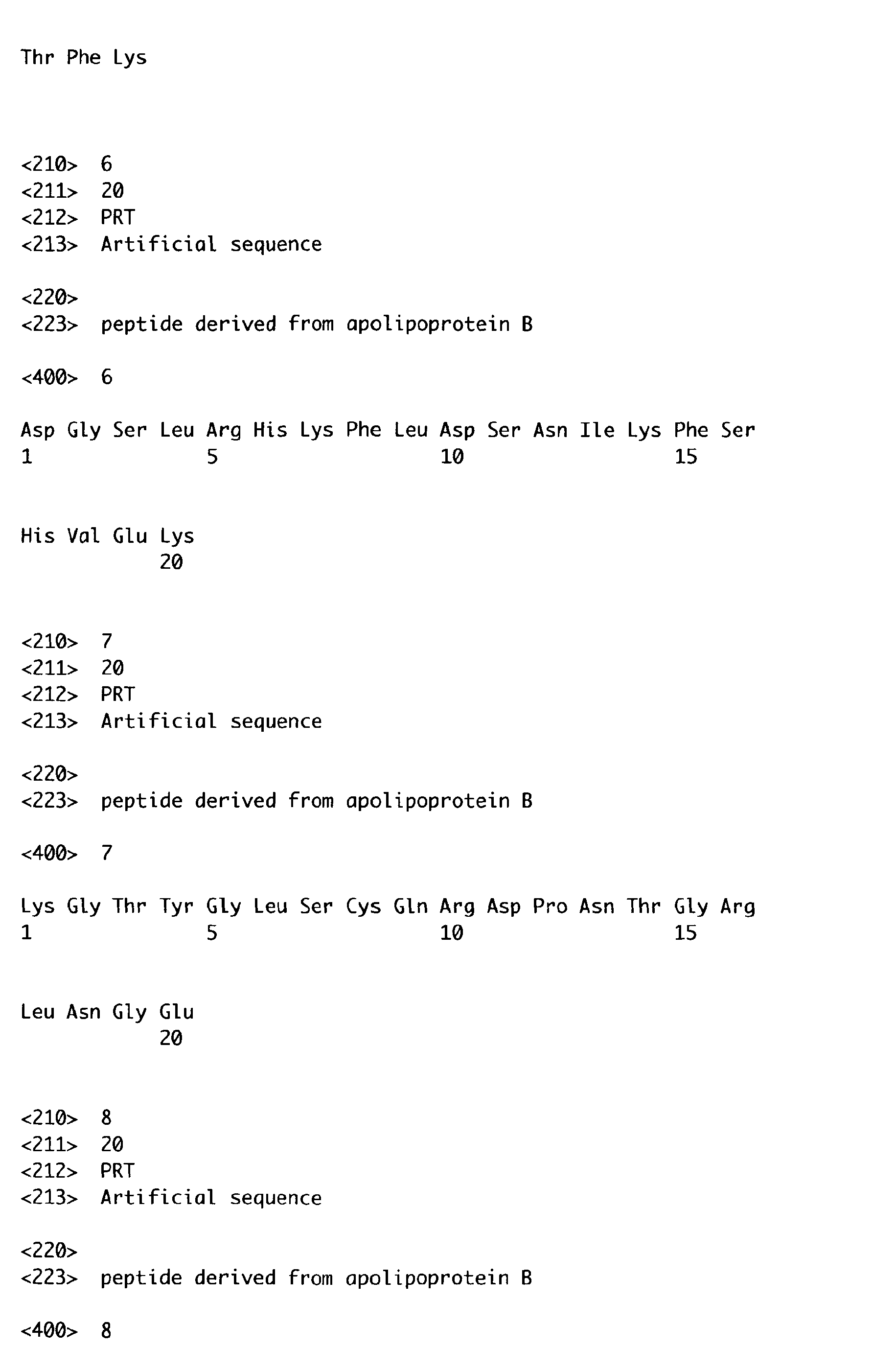


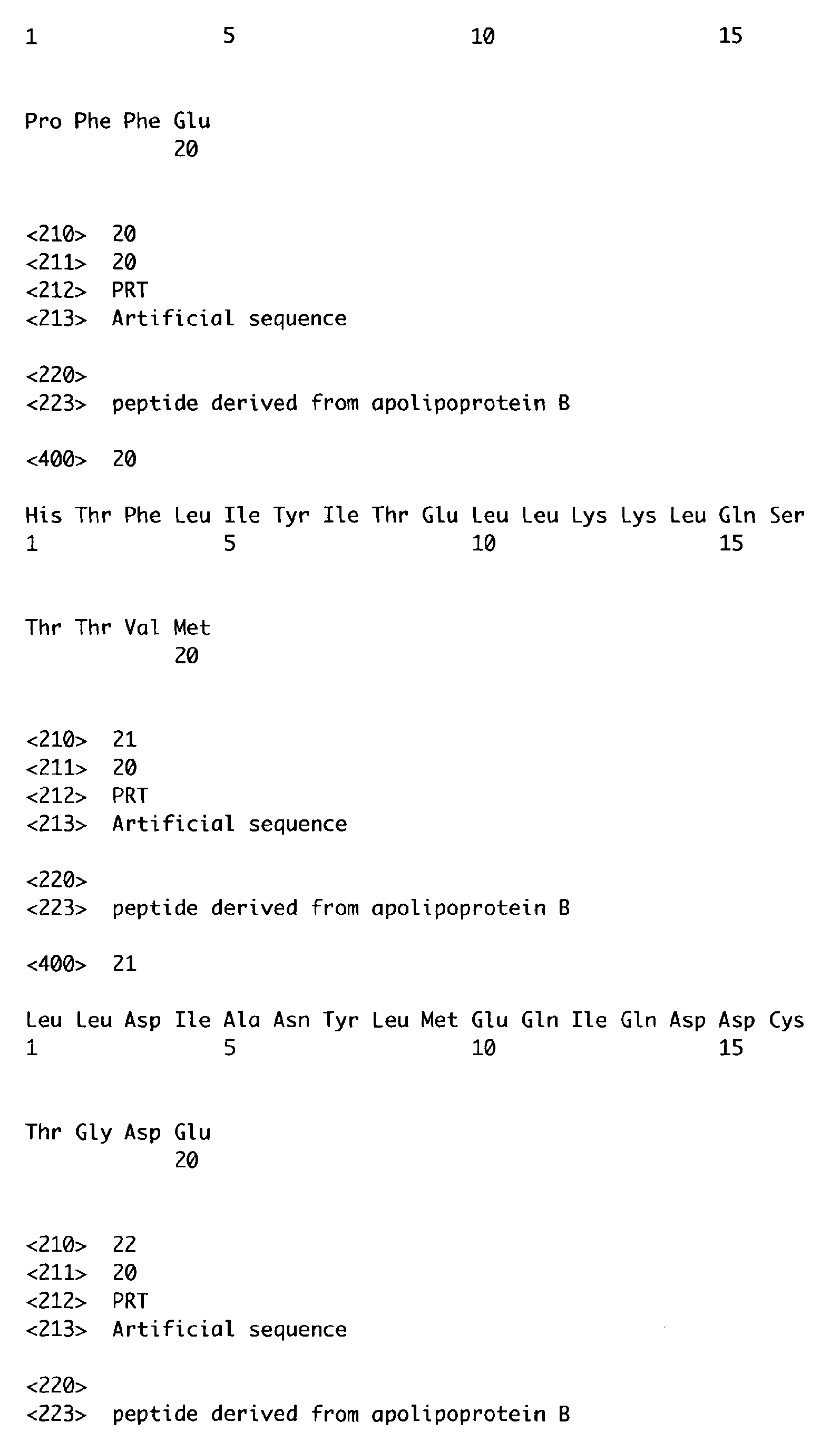


Claims (25)
- Use of at least one epitope derived from a protein present in the atherosclerotic plaque for the manufacture of a medicament for use in the prevention or treatment by continuous subcutaneous or transcutaneous administration, which induce a specific regulatory immune response, to a subject suffering from atherosclerosis.
- Use according to claim 1, wherein said medicament can be administrated to a subject, which has been diagnosed as presenting one of the following coronary disorders:• asymptomatic coronary artery coronary diseases with silent ischemia or without ischemia;• chronic ischemic disorders without myocardial necrosis, such as stable or effort angina pectoris;• acute ischemic disorders myocardial necrosis, such as unstable angina pectoris;• ischemic disorders with myocardial necrosis, such as ST segment elevation myocardial infarction or non-ST segment elevation myocardial infarction.
- Use according to any one of claims 1 or 2, wherein said medicament is administrated for a period of time and at a daily dose of said at least one epitope, which are sufficient to induce a specific regulatory immune response.
- Use according to any one of claims 1 to 3, wherein the protein present in the atherosclerotic plaque is selected in the group comprising apolipoprotein B-100 (apoB-100, human, Accession number P04114), collagen type I (human, Accession number CAA67261; AAB59577), type III (human, Accession number P02458), type IV (human, Accession number P02462) and type V (human, Accession number CAI17260), elastin (human, Accession number P15502), laminin (human, Accession number P024043; Q16363), entactin/nidogen (human, Accession number P14543), fibronectin (human, Accession number NP_997647; NP_997643; NP_997641; NP_997640; NP_997639; NP_997635), thrombospondin (human, Accession number NP_003237), vitronectin (human, Accession number P04004), tenascin (human, Accession number P24821), osteopontin (human, Accession number NP_000573), proteoglycans [glycorin, decorin (human, Accession number AAV38603), versican, hyaluronan], medin (human, Accession number Q08431), lactadherin (human, Accession number Q08431), β-amyloid (human, Accession number P05067), HSP 60 (human, Accession number AAA36022.1) or HSP 70 (human, Accession number BAA24847.1).
- Use according to any one of claims 1 to 4, wherein said epitope correspond to a synthetic peptide from more than 10 amino acids length.
- Use according to claim 5, wherein said synthetic peptide is derived from apoB-100.
- Use according to claim 6, wherein said synthetic peptide is used in his native state or after a modification of the amino acids that mimics the different modifications of apoB-100 protein that may occur during oxidation or non-oxidative modification of LDL.
- Patch according to any one of claims 6 or 7, wherein said peptide is selected in the group comprising:




























- Use according to any one of claims 1 to 8, wherein said medicament is administrated for a period of time within the range of 7 days to 30 days, preferably of 10 days to 20.
- Use according to any one of claims 1 to 9, wherein said medicament is administrated at a daily dose within the range of 0,05 to 5000 µg per kg body weight per day, preferably of 0,5 to 1000 µg.
- Composition adapted for the prophylactic or therapeutic treatment by continuous subcutaneous administration of a subject suffering from atherosclerosis, said composition comprising an effective amount of at least one epitope derived from a protein present in the atherosclerotic plaque, whereby administration of said composition to said subject induces a specific regulatory immune response, preferably a Treg response.
- Composition according to claim 11, characterized in that said composition does not contain any adjuvant or any effective amount of such an adjuvant likely to induce antibodies' expression.
- Composition according to any one of claims 11 or 12, characterized in that said composition comprises at least one epitope derived from a protein present in the atherosclerotic plaque in an amount within the range of 0,05 µg to 250 mg per millilitre, preferably of 0,5 µg to 50 mg per millilitre.
- Composition according to any one of claims 11 to 13, wherein the protein present in the atherosclerotic plaque is selected in the group comprising apolipoprotein B-100 (apoB-100, human, Accession number P04114), collagen type I (human, Accession number CAA67261; AAB59577), type III (human, Accession number P02458), type IV (human, Accession number P02462) and type V (human, Accession number CAI17260), elastin (human, Accession number P15502), laminin (human, Accession number P024043; Q16363), entactin/nidogen (human, Accession number P14543), fibronectin (human, Accession number NP_997647; NP_997643; NP_997641; NP_997640; NP_997639; NP_997635), thrombospondin (human, Accession number NP_003237), vitronectin (human, Accession number P04004), tenascin (human, Accession number P24821), osteopontin (human, Accession number NP_000573), proteoglycans [glycorin, decorin (human, Accession number AAV38603), versican, hyaluronan], medin (human, Accession number Q08431), lactadherin (human, Accession number Q08431), β-amyloid (human, Accession number P05067), HSP 60 (human, Accession number AAA36022.1) or HSP 70 (human, Accession number BAA24847.1).
- Composition according to any one of claims 11 to 14, wherein said epitope correspond to a synthetic peptide from more than 10 amino acids length.
- Composition according to claim 15, wherein said synthetic peptide is derived from apoB-100.
- Composition according to claim 16, wherein said synthetic peptide is used in his native state or after a modification of the amino acids that mimics the different modifications of apoB-100 protein that may occur during oxidation or non-oxidative modification of LDL.
- Composition according to any one of claims 16 or 17, wherein said peptide is selected in the group comprising:

















- Patch adapted for the prophylactic or therapeutic treatment by continuous transcutaneous administration of a subject, suffering from atherosclerosis, said patch comprising:(a) a dressing, and(b) an effective amount of at least one epitope derived from a protein present in the atherosclerotic plaque,whereby application of said patch to intact skin induces a specific regulatory immune response, preferably a Treg response.
- Patch according to claim 19, wherein said effective amount of at least one epitope is adapted for obtaining an administration of a daily dose of said at least one epitope within the range of 0,05 to 5000 µg per kg body weight per day, preferably of 0,5 to 1000 µg and more preferably of 5 to 500 µg.
- Patch according to any one of claims 19 or 20, wherein the protein present in the atherosclerotic plaque is selected in the group comprising apolipoprotein B-100 (apoB-100, human, Accession number P04114), collagen type I (human, Accession number CAA67261; AAB59577), type III (human, Accession number P02458), type IV (human, Accession number P02462) and type V (human, Accession number CAI17260), elastin (human, Accession number P15502), laminin (human, Accession number P024043; Q16363), entactin/nidogen (human, Accession number P14543), fibronectin (human, Accession number NP_997647; NP_997643; NP_997641; NP_997640; NP_997639; NP_997635), thrombospondin (human, Accession number NP_003237), vitronectin (human, Accession number P04004), tenascin (human, Accession number P24821), osteopontin (human, Accession number NP_000573), proteoglycans [glycorin, decorin (human, Accession number AAV38603), versican, hyaluronan], medin (human, Accession number Q08431), lactadherin (human, Accession number Q08431), β-amyloid (human, Accession number P05067), HSP 60 (human, Accession number AAA36022.1) or HSP 70 (human, Accession number BAA24847.1).
- Patch according to any one of claims 19 to 21, wherein said epitope correspond to a synthetic peptide from more than 10 amino acids length.
- Patch according to claim 22, wherein said synthetic peptide is derived from apoB-100.
- Patch according to claim 23, wherein said synthetic peptide is used in his native state or after a modification of the amino acids that mimics the different modifications of apoB-100 protein that may occur during oxidation or non-oxidative modification of LDL.
- Patch according to any one of claims 23 or 24, wherein said peptide is selected in the group comprising:










Priority Applications (7)
| Application Number | Priority Date | Filing Date | Title |
|---|---|---|---|
| EP05290008A EP1676602A1 (en) | 2005-01-04 | 2005-01-04 | Continuous administration of epitopes derived from protein present in atherosclerotic plaque for the treatment of atherosclerosis |
| US11/813,071 US8324152B2 (en) | 2005-01-04 | 2006-01-04 | Composition for the treatment of atherosclerosis |
| JP2007548954A JP5576022B2 (en) | 2005-01-04 | 2006-01-04 | Composition for treating atherosclerosis |
| PCT/IB2006/000291 WO2006072888A2 (en) | 2005-01-04 | 2006-01-04 | Continuous administration of epitopes derived from protein present in atherosclerotic plaque for the treatment of atherosclerosis |
| CA002594363A CA2594363A1 (en) | 2005-01-04 | 2006-01-04 | Continuous administration of epitopes derived from protein present in atherosclerotic plaque for the treatment of atherosclerosis |
| EP06710377A EP1833569B1 (en) | 2005-01-04 | 2006-01-04 | Continuous administration of epitopes derived from protein present in atherosclerotic plaque for the treatment of atherosclerosis |
| US13/563,905 US20120321650A1 (en) | 2005-01-04 | 2012-08-01 | Composition for the treatment of atherosclerosis |
Applications Claiming Priority (1)
| Application Number | Priority Date | Filing Date | Title |
|---|---|---|---|
| EP05290008A EP1676602A1 (en) | 2005-01-04 | 2005-01-04 | Continuous administration of epitopes derived from protein present in atherosclerotic plaque for the treatment of atherosclerosis |
Publications (1)
| Publication Number | Publication Date |
|---|---|
| EP1676602A1 true EP1676602A1 (en) | 2006-07-05 |
Family
ID=34941865
Family Applications (2)
| Application Number | Title | Priority Date | Filing Date |
|---|---|---|---|
| EP05290008A Withdrawn EP1676602A1 (en) | 2005-01-04 | 2005-01-04 | Continuous administration of epitopes derived from protein present in atherosclerotic plaque for the treatment of atherosclerosis |
| EP06710377A Expired - Lifetime EP1833569B1 (en) | 2005-01-04 | 2006-01-04 | Continuous administration of epitopes derived from protein present in atherosclerotic plaque for the treatment of atherosclerosis |
Family Applications After (1)
| Application Number | Title | Priority Date | Filing Date |
|---|---|---|---|
| EP06710377A Expired - Lifetime EP1833569B1 (en) | 2005-01-04 | 2006-01-04 | Continuous administration of epitopes derived from protein present in atherosclerotic plaque for the treatment of atherosclerosis |
Country Status (5)
| Country | Link |
|---|---|
| US (2) | US8324152B2 (en) |
| EP (2) | EP1676602A1 (en) |
| JP (1) | JP5576022B2 (en) |
| CA (1) | CA2594363A1 (en) |
| WO (1) | WO2006072888A2 (en) |
Cited By (7)
| Publication number | Priority date | Publication date | Assignee | Title |
|---|---|---|---|---|
| WO2010059975A3 (en) * | 2008-11-21 | 2010-07-22 | Wisconsin Alumni Research Foundation | Method of treatment of atherosclerosis by induction of immunological tolerance to collagen v |
| WO2011095628A1 (en) * | 2010-02-05 | 2011-08-11 | Jan Nilsson | Fusion proteins comprising antigenic apob-100 protein fragments and a protein carrier, related compositions, methods and systems for treatment and/or prevention of atherosclerosis |
| WO2012065133A1 (en) * | 2010-11-12 | 2012-05-18 | Cedars-Sinai Medical Center | Immunomodulatory methods and systems for treatment and/or prevention of aneurysms |
| WO2013011056A3 (en) * | 2011-07-20 | 2013-03-14 | Nordic Bioscience A/S | Pathology biomarker assay |
| WO2012065135A3 (en) * | 2010-11-12 | 2014-09-12 | Cedars-Sinai Medical Center | Immunomodulatory compositions, methods and systems comprising immunogenic fragments of apob100 |
| WO2012074725A3 (en) * | 2010-11-12 | 2014-10-16 | Cedars-Sinai Medical Center | Immunomodulatory methods and systems for treatment and/or prevention of hypertension |
| US9125850B2 (en) | 2009-11-14 | 2015-09-08 | Cardio Vax, Llc | Immunomodulatory methods and systems for treatment and/or prevention of atherosclerosis |
Families Citing this family (6)
| Publication number | Priority date | Publication date | Assignee | Title |
|---|---|---|---|---|
| US20030105003A1 (en) * | 2001-04-05 | 2003-06-05 | Jan Nilsson | Peptide-based immunization therapy for treatment of atherosclerosis and development of peptide-based assay for determination of immune responses against oxidized low density lipoprotein |
| EP1916000A1 (en) * | 2006-10-26 | 2008-04-30 | INSERM (Institut National de la Santé et de la Recherche Médicale) | Use of measles virus nucleoprotein for treating atherosclerosis |
| JP5654446B2 (en) * | 2008-04-10 | 2015-01-14 | ザ・トロンボシス・リサーチ・インスティテュートThe Thrombosis Research Institute | Anti-atheroma vaccine |
| CN110066318B (en) * | 2019-05-13 | 2022-02-15 | 山东大学 | A kind of leech peptide and its application |
| CN112972655A (en) * | 2021-04-16 | 2021-06-18 | 武汉大学 | Application of interleukin 12 in preparation of medicine for preventing, relieving and/or treating aortic aneurysm |
| CN115702926B (en) * | 2021-08-06 | 2024-04-26 | 中国医学科学院阜外医院 | Application of Versican protein in the preparation of drugs for repairing myocardial injury |
Citations (2)
| Publication number | Priority date | Publication date | Assignee | Title |
|---|---|---|---|---|
| WO2002080954A1 (en) * | 2001-04-05 | 2002-10-17 | Forskarpatent I Syd | Peptide-based immunization therapy for treatment of atherosclerosis and development of peptide-based assay for determination of immune responses against oxidized low density lipoprotein |
| US20040047870A1 (en) * | 2001-01-04 | 2004-03-11 | Dror Harats | Methods employing and compositions containing plaque associated molecules for prevention and treatment of atherosclerosis |
Family Cites Families (6)
| Publication number | Priority date | Publication date | Assignee | Title |
|---|---|---|---|---|
| US5049387A (en) * | 1987-03-09 | 1991-09-17 | Alza Corporation | Inducing skin tolerance to a sensitizing drug |
| US5997856A (en) * | 1988-10-05 | 1999-12-07 | Chiron Corporation | Method and compositions for solubilization and stabilization of polypeptides, especially proteins |
| US5980898A (en) | 1996-11-14 | 1999-11-09 | The United States Of America As Represented By The U.S. Army Medical Research & Material Command | Adjuvant for transcutaneous immunization |
| IL126447A (en) * | 1998-10-04 | 2004-09-27 | Vascular Biogenics Ltd | Immunological and oral tolerance-inducing composition and use thereof for the prevention and/or for the treatment of atherosclerosis |
| WO2000061184A2 (en) * | 1999-04-08 | 2000-10-19 | Glenn Gregory M | Dry formulation for transcutaneous immunization |
| US20030105003A1 (en) * | 2001-04-05 | 2003-06-05 | Jan Nilsson | Peptide-based immunization therapy for treatment of atherosclerosis and development of peptide-based assay for determination of immune responses against oxidized low density lipoprotein |
-
2005
- 2005-01-04 EP EP05290008A patent/EP1676602A1/en not_active Withdrawn
-
2006
- 2006-01-04 US US11/813,071 patent/US8324152B2/en not_active Expired - Fee Related
- 2006-01-04 WO PCT/IB2006/000291 patent/WO2006072888A2/en not_active Ceased
- 2006-01-04 EP EP06710377A patent/EP1833569B1/en not_active Expired - Lifetime
- 2006-01-04 CA CA002594363A patent/CA2594363A1/en not_active Abandoned
- 2006-01-04 JP JP2007548954A patent/JP5576022B2/en not_active Expired - Fee Related
-
2012
- 2012-08-01 US US13/563,905 patent/US20120321650A1/en not_active Abandoned
Patent Citations (2)
| Publication number | Priority date | Publication date | Assignee | Title |
|---|---|---|---|---|
| US20040047870A1 (en) * | 2001-01-04 | 2004-03-11 | Dror Harats | Methods employing and compositions containing plaque associated molecules for prevention and treatment of atherosclerosis |
| WO2002080954A1 (en) * | 2001-04-05 | 2002-10-17 | Forskarpatent I Syd | Peptide-based immunization therapy for treatment of atherosclerosis and development of peptide-based assay for determination of immune responses against oxidized low density lipoprotein |
Non-Patent Citations (3)
| Title |
|---|
| MALLAT Z ET AL: "Immunomodulation to combat atherosclerosis: The potential role of immune regulatory cells", EXPERT OPINION ON BIOLOGICAL THERAPY 2004 UNITED KINGDOM, vol. 4, no. 9, 2004, pages 1387 - 1393, XP009048702, ISSN: 1471-2598 * |
| SCHIOPU A ET AL: "Recombinant human antibodies against aldehyde-modified apolipoprotein B-100 peptide sequences inhibit atherosclerosis", CIRCULATION 05 OCT 2004 UNITED STATES, vol. 110, no. 14, 5 October 2004 (2004-10-05), pages 2047 - 2052, XP009048754, ISSN: 0009-7322 * |
| ZHOU X ET AL: "Immunomodulation and vaccination for atherosclerosis", EXPERT OPINION ON BIOLOGICAL THERAPY 2004 UNITED KINGDOM, vol. 4, no. 4, 2004, pages 599 - 612, XP009048703, ISSN: 1471-2598 * |
Cited By (12)
| Publication number | Priority date | Publication date | Assignee | Title |
|---|---|---|---|---|
| WO2010059975A3 (en) * | 2008-11-21 | 2010-07-22 | Wisconsin Alumni Research Foundation | Method of treatment of atherosclerosis by induction of immunological tolerance to collagen v |
| US9125850B2 (en) | 2009-11-14 | 2015-09-08 | Cardio Vax, Llc | Immunomodulatory methods and systems for treatment and/or prevention of atherosclerosis |
| WO2011095628A1 (en) * | 2010-02-05 | 2011-08-11 | Jan Nilsson | Fusion proteins comprising antigenic apob-100 protein fragments and a protein carrier, related compositions, methods and systems for treatment and/or prevention of atherosclerosis |
| CN103221425A (en) * | 2010-02-05 | 2013-07-24 | 卡迪瓦克斯有限责任公司 | Fusion protein comprising antigen APOB-100 protein fragment and protein carrier for treating and/or preventing atherosclerosis, related compositions, methods and systems |
| US8506964B2 (en) | 2010-02-05 | 2013-08-13 | Cardiovax, Llc | Fusion proteins and related compositions, methods and systems for treatment and/or prevention of atherosclerosis |
| EP3173423A1 (en) * | 2010-02-05 | 2017-05-31 | CardioVax, LLC | Fusion proteins comprising antigenic apob-100 protein fragments and a protein carrier, related compositions, methods and systems for treatment and/or prevention of atherosclerosis |
| WO2012065133A1 (en) * | 2010-11-12 | 2012-05-18 | Cedars-Sinai Medical Center | Immunomodulatory methods and systems for treatment and/or prevention of aneurysms |
| WO2012065135A3 (en) * | 2010-11-12 | 2014-09-12 | Cedars-Sinai Medical Center | Immunomodulatory compositions, methods and systems comprising immunogenic fragments of apob100 |
| WO2012074725A3 (en) * | 2010-11-12 | 2014-10-16 | Cedars-Sinai Medical Center | Immunomodulatory methods and systems for treatment and/or prevention of hypertension |
| US9205141B2 (en) | 2010-11-12 | 2015-12-08 | Cardio Vax, Llc | Immunomodulatory methods and systems for treatment and/or prevention of hypertension |
| US9205139B2 (en) | 2010-11-12 | 2015-12-08 | Cardiovax, Llc | Immunomodulatory methods and systems for treatment and/or prevention of aneurysms |
| WO2013011056A3 (en) * | 2011-07-20 | 2013-03-14 | Nordic Bioscience A/S | Pathology biomarker assay |
Also Published As
| Publication number | Publication date |
|---|---|
| WO2006072888A3 (en) | 2006-08-24 |
| WO2006072888A2 (en) | 2006-07-13 |
| EP1833569A2 (en) | 2007-09-19 |
| EP1833569B1 (en) | 2013-03-13 |
| JP5576022B2 (en) | 2014-08-20 |
| JP2008526727A (en) | 2008-07-24 |
| US8324152B2 (en) | 2012-12-04 |
| US20090215697A1 (en) | 2009-08-27 |
| US20120321650A1 (en) | 2012-12-20 |
| CA2594363A1 (en) | 2006-07-13 |
Similar Documents
| Publication | Publication Date | Title |
|---|---|---|
| US20120321650A1 (en) | Composition for the treatment of atherosclerosis | |
| Mrass et al. | Random migration precedes stable target cell interactions of tumor-infiltrating T cells | |
| TWI635868B (en) | Long-acting peptide analogs | |
| DE60219611T2 (en) | MODIFIED ANNEXIN PROTEINS AND PREVENTION AND TREATMENT OF THROMBOSE | |
| US20230001010A1 (en) | Compositions and methods for treating autoimmune disorders | |
| US20250195621A1 (en) | Synthetic platelets | |
| Xue et al. | Cellular vehicles based on neutrophils enable targeting of atherosclerosis | |
| JP2001521486A (en) | Materials and methods for producing improved liposome compositions | |
| US20080226707A1 (en) | WNT compositions and methods of use thereof | |
| Benitez et al. | Vasoactive intestinal peptide ameliorates acute myocarditis and atherosclerosis by regulating inflammatory and autoimmune responses | |
| KR102312817B1 (en) | Methods of treating antibody-mediated rejection in organ transplant patients with c1-esterase inhibitor | |
| JP6772317B2 (en) | Apolipoprotein mimetics and their use | |
| US10806776B2 (en) | Method of treating fungal infection | |
| AU2017277277A1 (en) | Modified RNA encoding VEGF-A polypeptides, formulations, and uses relating thereto | |
| Covarrubias et al. | Comparison of the uptake of untargeted and targeted immunostimulatory nanoparticles by immune cells in the microenvironment of metastatic breast cancer | |
| JP2005515243A (en) | Pharmaceutically acceptable phosphate-glycerol carrier | |
| JP6783652B2 (en) | Compositions and Methods for Reducing Antigen-Specific Immunogenicity | |
| KR20070054206A (en) | Atherosclerosis Treatment | |
| KR20220010552A (en) | anti-abeta vaccine therapy | |
| JP2019516778A (en) | Prevention and / or treatment of ischemic injury or ischemia reperfusion injury | |
| EP2889039B1 (en) | Preparation for preventing or treating type i diabetes | |
| US20070238708A1 (en) | Acute Inflammatory Condition Treatment | |
| US20070053893A1 (en) | Method of reducing immunological tolerance to malignancy | |
| RU2837314C2 (en) | Treating celiac disease with tolerance inducing particles | |
| del Río Oliva | Targeting the immunoproteasome and VCP/p97 in autoimmune disorders and viral infection |
Legal Events
| Date | Code | Title | Description |
|---|---|---|---|
| PUAI | Public reference made under article 153(3) epc to a published international application that has entered the european phase |
Free format text: ORIGINAL CODE: 0009012 |
|
| AK | Designated contracting states |
Kind code of ref document: A1 Designated state(s): AT BE BG CH CY CZ DE DK EE ES FI FR GB GR HU IE IS IT LI LT LU MC NL PL PT RO SE SI SK TR |
|
| AX | Request for extension of the european patent |
Extension state: AL BA HR LV MK YU |
|
| AKX | Designation fees paid | ||
| REG | Reference to a national code |
Ref country code: DE Ref legal event code: 8566 |
|
| STAA | Information on the status of an ep patent application or granted ep patent |
Free format text: STATUS: THE APPLICATION IS DEEMED TO BE WITHDRAWN |
|
| 18D | Application deemed to be withdrawn |
Effective date: 20070106 |