EP1674701A2 - Air-fuel ratio feedback control apparatus for engines - Google Patents
Air-fuel ratio feedback control apparatus for engines Download PDFInfo
- Publication number
- EP1674701A2 EP1674701A2 EP05256898A EP05256898A EP1674701A2 EP 1674701 A2 EP1674701 A2 EP 1674701A2 EP 05256898 A EP05256898 A EP 05256898A EP 05256898 A EP05256898 A EP 05256898A EP 1674701 A2 EP1674701 A2 EP 1674701A2
- Authority
- EP
- European Patent Office
- Prior art keywords
- air
- fuel ratio
- fuel
- limit value
- correction coefficient
- Prior art date
- Legal status (The legal status is an assumption and is not a legal conclusion. Google has not performed a legal analysis and makes no representation as to the accuracy of the status listed.)
- Withdrawn
Links
- 239000000446 fuel Substances 0.000 title claims abstract description 154
- 239000000203 mixture Substances 0.000 claims abstract description 8
- 238000002485 combustion reaction Methods 0.000 claims description 6
- 238000002347 injection Methods 0.000 abstract description 25
- 239000007924 injection Substances 0.000 abstract description 25
- 239000000498 cooling water Substances 0.000 description 7
- 238000010586 diagram Methods 0.000 description 4
- 239000007789 gas Substances 0.000 description 4
- QVGXLLKOCUKJST-UHFFFAOYSA-N atomic oxygen Chemical compound [O] QVGXLLKOCUKJST-UHFFFAOYSA-N 0.000 description 3
- 239000003054 catalyst Substances 0.000 description 3
- 238000000034 method Methods 0.000 description 3
- 239000001301 oxygen Substances 0.000 description 3
- 229910052760 oxygen Inorganic materials 0.000 description 3
- 230000002159 abnormal effect Effects 0.000 description 1
- 230000007423 decrease Effects 0.000 description 1
- 238000001514 detection method Methods 0.000 description 1
- 239000002828 fuel tank Substances 0.000 description 1
- 238000011144 upstream manufacturing Methods 0.000 description 1
- XLYOFNOQVPJJNP-UHFFFAOYSA-N water Substances O XLYOFNOQVPJJNP-UHFFFAOYSA-N 0.000 description 1
Images

Classifications
-
- F—MECHANICAL ENGINEERING; LIGHTING; HEATING; WEAPONS; BLASTING
- F02—COMBUSTION ENGINES; HOT-GAS OR COMBUSTION-PRODUCT ENGINE PLANTS
- F02D—CONTROLLING COMBUSTION ENGINES
- F02D41/00—Electrical control of supply of combustible mixture or its constituents
- F02D41/02—Circuit arrangements for generating control signals
- F02D41/14—Introducing closed-loop corrections
- F02D41/1438—Introducing closed-loop corrections using means for determining characteristics of the combustion gases; Sensors therefor
- F02D41/1444—Introducing closed-loop corrections using means for determining characteristics of the combustion gases; Sensors therefor characterised by the characteristics of the combustion gases
- F02D41/1454—Introducing closed-loop corrections using means for determining characteristics of the combustion gases; Sensors therefor characterised by the characteristics of the combustion gases the characteristics being an oxygen content or concentration or the air-fuel ratio
- F02D41/1456—Introducing closed-loop corrections using means for determining characteristics of the combustion gases; Sensors therefor characterised by the characteristics of the combustion gases the characteristics being an oxygen content or concentration or the air-fuel ratio with sensor output signal being linear or quasi-linear with the concentration of oxygen
-
- F—MECHANICAL ENGINEERING; LIGHTING; HEATING; WEAPONS; BLASTING
- F02—COMBUSTION ENGINES; HOT-GAS OR COMBUSTION-PRODUCT ENGINE PLANTS
- F02D—CONTROLLING COMBUSTION ENGINES
- F02D41/00—Electrical control of supply of combustible mixture or its constituents
- F02D41/02—Circuit arrangements for generating control signals
- F02D41/14—Introducing closed-loop corrections
- F02D41/1438—Introducing closed-loop corrections using means for determining characteristics of the combustion gases; Sensors therefor
- F02D41/1477—Introducing closed-loop corrections using means for determining characteristics of the combustion gases; Sensors therefor characterised by the regulation circuit or part of it,(e.g. comparator, PI regulator, output)
- F02D41/1479—Using a comparator with variable reference
-
- F—MECHANICAL ENGINEERING; LIGHTING; HEATING; WEAPONS; BLASTING
- F02—COMBUSTION ENGINES; HOT-GAS OR COMBUSTION-PRODUCT ENGINE PLANTS
- F02D—CONTROLLING COMBUSTION ENGINES
- F02D41/00—Electrical control of supply of combustible mixture or its constituents
- F02D41/02—Circuit arrangements for generating control signals
- F02D41/14—Introducing closed-loop corrections
- F02D41/1438—Introducing closed-loop corrections using means for determining characteristics of the combustion gases; Sensors therefor
- F02D41/1477—Introducing closed-loop corrections using means for determining characteristics of the combustion gases; Sensors therefor characterised by the regulation circuit or part of it,(e.g. comparator, PI regulator, output)
- F02D41/1484—Output circuit
-
- F—MECHANICAL ENGINEERING; LIGHTING; HEATING; WEAPONS; BLASTING
- F02—COMBUSTION ENGINES; HOT-GAS OR COMBUSTION-PRODUCT ENGINE PLANTS
- F02D—CONTROLLING COMBUSTION ENGINES
- F02D41/00—Electrical control of supply of combustible mixture or its constituents
- F02D41/02—Circuit arrangements for generating control signals
- F02D41/14—Introducing closed-loop corrections
- F02D41/1438—Introducing closed-loop corrections using means for determining characteristics of the combustion gases; Sensors therefor
- F02D41/1486—Introducing closed-loop corrections using means for determining characteristics of the combustion gases; Sensors therefor with correction for particular operating conditions
- F02D41/1488—Inhibiting the regulation
- F02D41/1489—Replacing of the control value by a constant
-
- F—MECHANICAL ENGINEERING; LIGHTING; HEATING; WEAPONS; BLASTING
- F02—COMBUSTION ENGINES; HOT-GAS OR COMBUSTION-PRODUCT ENGINE PLANTS
- F02D—CONTROLLING COMBUSTION ENGINES
- F02D41/00—Electrical control of supply of combustible mixture or its constituents
- F02D41/20—Output circuits, e.g. for controlling currents in command coils
- F02D2041/202—Output circuits, e.g. for controlling currents in command coils characterised by the control of the circuit
- F02D2041/2048—Output circuits, e.g. for controlling currents in command coils characterised by the control of the circuit said control involving a limitation, e.g. applying current or voltage limits
Definitions
- the present invention relates to an air-fuel ratio feedback control apparatus for an internal combustion engine and, more specifically, to an air-fuel ratio feedback control apparatus suitable for preventing over-rich and over-lean air-fuel ratio.
- air-fuel ratio feedback control is carried out.
- an air-fuel ratio correction coefficient is determined so as to converge a detected air-fuel ratio, based on a concentration of oxygen in exhaust gas, to a target air-fuel ratio, and a basic fuel injection time of a fuel injection valve is corrected by this air-fuel ratio correction coefficient.
- the air-fuel ratio is controlled to a value adequately corresponding to the operating state of the engine, and learning control for improving accuracy of the air-fuel ratio is simultaneously carried out.
- the lower limit value is provided to the air-fuel ratio correction coefficient according to the temperature at the time of engine start (that is, the temperature of cooling water).
- the limit of the air-fuel ratio correction coefficient is not determined in the operating area other than the starting area, the air-fuel ratio may become unstable.
- an air-fuel ratio feedback control apparatus for engines which detects an air-fuel ratio of an air-fuel mixture supplied to a combustion chamber and controls a fuel supply amount so that the detected air-fuel ratio is converged to a target air-fuel ratio, includes an air-fuel ratio correcting means for correcting the target air-fuel ratio according to the operating state of the engine, and is characterized in that the air-fuel ratio correcting means is configured to correct the target air-fuel ratio within a predetermined range between an upper limit value and a lower limit value.
- the air-fuel ratio is controlled within the range between the upper limit value and the lower limit value, so that over-lean and over-rich are prevented.
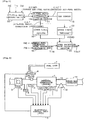
- Fig. 2 is a system block diagram of an engine including an air-fuel ratio feedback control apparatus according to an embodiment of the invention.
- an air-intake pipe 2 is connected to a motorcycle engine 1 and communicates with a combustion chamber thereof.
- a throttle valve 3 is disposed at a midsection of the air-intake pipe 2, and a throttle valve opening sensor 4 is connected to the throttle valve 3.
- Electric signals corresponding to an opening TH of the throttle valve detected by the throttle valve opening sensor 4 are supplied to an electronic control unit (ECU) 5.
- ECU electronice control unit
- a fuel injection valve 6 is provided on each cylinder. Fuel from a fuel tank 7 is supplied to the fuel injection valve 6 by a fuel pump (not shown), and the fuel injection valve 6 injects fuel to the air-intake pipe 2 according to valve-open instructions from the ECU 5. The amount of fuel injection is controlled by the valve-open time of the fuel injection valve 6. Fuel injected into the air-intake pipe 2 is mixed with air flowing through the throttle valve 3 into the air-intake pipe 2 to form an air-fuel mixture, which is supplied to the combustion chamber of the engine 1.
- a negative pressure sensor 8 for detecting a pressure PB of the air-intake pipe 2 and an intake-air temperature sensor 9 for detecting an intake-air temperature TA are mounted to the air-intake pipe 2.
- a water temperature sensor 10 for detecting a temperature of engine cooling water TW is provided on the main body of the engine 1. Detection signals from the respective sensors are supplied to the ECU 5.
- a revolution number sensor 11 for detecting a revolution number of the engine NE
- a cylinder discrimination sensor 12 for detecting a revolution number of the engine NE
- the revolution number sensor 11 outputs top dead centre (TDC) signal pulses for each TDC at the starting of the intake stroke in each cylinder of the engine 1
- the cylinder discrimination sensor 12 outputs signal pulses at predetermined crank angle positions predetermined for each cylinder. These pulses are supplied to the ECU 5.
- An exhaust pipe 13 connected to the engine 1 is provided with a three-way catalyst 14.
- the three-way catalyst 14 has a function to accumulate O 2 in exhaust gas when exhaust air is in a lean state (in which the air-fuel ratio of the air-fuel mixture supplied to the engine 1 is set to the lean side with respect to a theoretical air-fuel ratio (14.7:1), and the O 2 concentration in the exhaust air is relatively high) and, on the other hand, to oxidize HC or CO in exhaust gas by accumulated O 2 when the exhaust air is in a rich state (in which the air-fuel ratio of the air-fuel mixture supplied to the engine 1 is set to the rich side with respect to the theoretical air-furl ratio, and the O 2 concentration in the exhaust gas is low, while HC or CO components are high).
- a proportional oxygen concentration sensor (hereinafter, referred to as "LAF sensor”) 15 is disposed upstream of the three-way catalyst 14.
- the LAF sensor 15 outputs electric signals substantially proportional to the oxygen concentration in the exhaust air, which represents the air-fuel ratio, and supplies the same to the ECU 5.
- the ECU 5 is composed of a computer, and includes a ROM for storing programs and data, a RAM for storing a required program and data and offering an operation working space at the time of execution of the program, a CPU for executing the program, an input interface for processing input signals from the respective sensors, and a drive circuit for sending control signals to the fuel injection valve 6 and so on.
- the signal supplied from the respective sensors by the input interface is processed according to the program stored in the ROM.
- Fig. 1 is a block diagram showing functions of principal portions of the ECU 5.
- An air-fuel ratio setting section 50 sets various parameters according to the state of the engine, that is, it sets a target air-fuel ratio KCMD for optimizing drivability based on the revolution number of the engine NE, the throttle opening TH, the temperature of engine cooling water TW, and so on.
- An air-fuel ratio correction coefficient calculating section 51 calculates an air-fuel ratio correction coefficient KAF for controlling the air-fuel ratio so that a detected air-fuel ratio KACT calculated from the output of the LAF sensor 15 is converged to the target air-fuel ratio KCMD when air-fuel ratio feedback control execution conditions are met.
- a lower limit section 52 constrains the air-fuel ratio correction coefficient KAF calculated by the air-fuel ratio correction coefficient calculating section 51 so as not to underrun a predetermined lower limit value.
- An upper limit section 53 constrains the air-fuel ratio correction coefficient KAF calculated by the air-fuel ratio correction coefficient calculating section 51 so as not to exceed a predetermined upper limit value.
- the lower limit value and the upper limit value may be fixed values, or may be values varying according to the temperature of engine cooling water TW.
- a basic fuel injection time determining section 54 calculates a basic fuel injection time TIM which represents a basic fuel amount.
- the basic fuel injection time TIM can be determined by searching a TI map set according to the revolution number of the engine NE and the internal pressure PB of the air-intake pipe.
- the TI map is set so that the air-fuel ratio of the air-fuel mixture supplied to the engine 1 becomes substantially the theoretical air-fuel ratio in the operating state corresponding to the revolution number of the engine NE and the internal pressure PB of the air-intake pipe.
- the amount of fuel injection represented by the basic fuel injection time TIM is substantially proportional to the amount of intake air of the engine per unit time.
- a fuel injection time calculating section 55 calculates a fuel injection time TOUT based on the target air-fuel ratio KCMD, the air-fuel ratio correction coefficient KAF, the basic fuel injection time TIM, and detected various engine parameters with the following expression (1).
- TOUT KTOTAL x KAF x KCMD x TIM (1), where KTOTAL is a coefficient representing a correction coefficient in total calculated from the temperature of engine cooling water TW, the intake-air temperature TA, and the ambient pressure and the like.
- the ECU 5 controls so that the fuel injection valve 6 is opened for the fuel injection time TOUT synchronously with the TDC signal pulse.
- Fig. 3 is a flowchart of the processing of the air-fuel ratio correction coefficient of air-fuel ratio feedback control.
- the air-fuel ratio correction coefficient KAF is calculated based on the output of the LAF sensor 15 or the like, and the feedback control is executed.
- Step S301 a flag F-FC which indicates the fuel-cut condition is determined.
- the air-fuel ratio correction coefficient KAF is calculated by a predetermined expression so that the detected air-fuel ratio KACT becomes an optimal air-fuel ratio according to the engine conditions determined by various parameters in Step S302.
- Step S303 it is determined whether or not the air-fuel ratio correction coefficient KAF does not exceed a fuel correction upper limit value AFLMH.
- the procedure goes to Step S304, where the air-fuel ratio correction coefficient KAF is replaced by the fuel correction upper limit value AFLMH.
- Step S303 determines whether or not the air-fuel ratio correction coefficient KAF is smaller than a fuel correction lower limit value AFLML.
- Step S306 the procedure goes to the Step S306, where the air-fuel ratio correction coefficient KAF is replaced by the fuel correction lower limit value AFLML.
- Step S305 When the air-fuel ratio correction coefficient KAF is equal to or larger than the fuel correction lower limit value AFLML, the determination in Step S305 is negative, and the value calculated in Step S302 is employed as the air-fuel ratio correction coefficient KAF, and is supplied to the fuel injection time calculating section 55.
- the calculated air-fuel ratio correction coefficient KAF when the calculated air-fuel ratio correction coefficient KAF is larger than the predetermined upper limit value or smaller than the lower limit value, the calculated air-fuel ratio correction coefficient KAF is limited by the upper limit value and the lower limit value, respectively.
- the upper limit value and the lower limit value of the target air-fuel ratio KCMD are set by the air-fuel ratio setting section 50 across (that is, over and below) the theoretical air-fuel ratio "14.7:1", respectively.
- the upper limit value and the lower limit value are preferably set in the range of ⁇ 20% of the theoretical air-fuel ratio. For example, the upper limit value is set to approximately 12:1, and the lower limit value is set to approximately 18:1.
- the upper limit value and the lower limit value of the air-fuel ratio correction coefficient KAF or the target air-fuel ratio KCMD may be fixed values, or may be the function of the temperature of engine cooling water TW or the time from engine start.
Landscapes
- Engineering & Computer Science (AREA)
- Chemical & Material Sciences (AREA)
- Combustion & Propulsion (AREA)
- Mechanical Engineering (AREA)
- General Engineering & Computer Science (AREA)
- Electrical Control Of Air Or Fuel Supplied To Internal-Combustion Engine (AREA)
- Combined Controls Of Internal Combustion Engines (AREA)
Abstract
Description
- The present invention relates to an air-fuel ratio feedback control apparatus for an internal combustion engine and, more specifically, to an air-fuel ratio feedback control apparatus suitable for preventing over-rich and over-lean air-fuel ratio.
- In an internal combustion engine (hereinafter, referred to as "engine"), air-fuel ratio feedback control is carried out. In the feedback control, an air-fuel ratio correction coefficient is determined so as to converge a detected air-fuel ratio, based on a concentration of oxygen in exhaust gas, to a target air-fuel ratio, and a basic fuel injection time of a fuel injection valve is corrected by this air-fuel ratio correction coefficient. In the feedback control, the air-fuel ratio is controlled to a value adequately corresponding to the operating state of the engine, and learning control for improving accuracy of the air-fuel ratio is simultaneously carried out.
- However, in particular, when the engine is started from a cold state, oil or fuel which could not burn may attach to an air-fuel ratio sensor. In this case, the sensor may recognize it as a rich state irrespective of the actual air-fuel ratio. Therefore, the present applicant previously proposed a control apparatus for preventing over-lean by controlling a lower limit value of the air-fuel ratio correction coefficient according to the temperature at the time of engine start (see JP-A-2003-83133).
- In the control apparatus of JP-A-2003-83133, the lower limit value is provided to the air-fuel ratio correction coefficient according to the temperature at the time of engine start (that is, the temperature of cooling water). However, since the limit of the air-fuel ratio correction coefficient is not determined in the operating area other than the starting area, the air-fuel ratio may become unstable.
- It is an object of at least the preferred embodiments of the present invention to provide an air-fuel ratio feedback control apparatus for engines which can prevent over-rich or over-lean in operating areas other than the starting area.
- In order to achieve the above-described object, an air-fuel ratio feedback control apparatus for engines, which detects an air-fuel ratio of an air-fuel mixture supplied to a combustion chamber and controls a fuel supply amount so that the detected air-fuel ratio is converged to a target air-fuel ratio, includes an air-fuel ratio correcting means for correcting the target air-fuel ratio according to the operating state of the engine, and is characterized in that the air-fuel ratio correcting means is configured to correct the target air-fuel ratio within a predetermined range between an upper limit value and a lower limit value.
- Accordingly, even when a sensor for detecting the air-fuel ratio outputs an abnormal value, the air-fuel ratio is controlled within the range between the upper limit value and the lower limit value, so that over-lean and over-rich are prevented.
- A preferred embodiment of the invention will now be described by way of example only, and with reference to the accompanying drawings, in which:
- Fig. 1 is a block diagram showing functions of principal portions of an air-fuel ratio feedback control apparatus according to an embodiment of the invention;
- Fig. 2 is a system block diagram of an engine including the air-fuel ratio feedback control apparatus according to the embodiment of the invention; and
- Fig. 3 is a flowchart of processing of an air-fuel ratio correction coefficient.
- Referring now to the drawings, an embodiment of the invention will be described.
- Fig. 2 is a system block diagram of an engine including an air-fuel ratio feedback control apparatus according to an embodiment of the invention. In this drawing, for example, an air-
intake pipe 2 is connected to amotorcycle engine 1 and communicates with a combustion chamber thereof. Athrottle valve 3 is disposed at a midsection of the air-intake pipe 2, and a throttlevalve opening sensor 4 is connected to thethrottle valve 3. Electric signals corresponding to an opening TH of the throttle valve detected by the throttlevalve opening sensor 4 are supplied to an electronic control unit (ECU) 5. - Provided between an air-intake valve (not shown) on the air-
intake pipe 2, and thethrottle valve 3 is afuel injection valve 6. In the case of a multi-cylinder engine, afuel injection valve 6 is provided on each cylinder. Fuel from afuel tank 7 is supplied to thefuel injection valve 6 by a fuel pump (not shown), and thefuel injection valve 6 injects fuel to the air-intake pipe 2 according to valve-open instructions from theECU 5. The amount of fuel injection is controlled by the valve-open time of thefuel injection valve 6. Fuel injected into the air-intake pipe 2 is mixed with air flowing through thethrottle valve 3 into the air-intake pipe 2 to form an air-fuel mixture, which is supplied to the combustion chamber of theengine 1. - A
negative pressure sensor 8 for detecting a pressure PB of the air-intake pipe 2 and an intake-air temperature sensor 9 for detecting an intake-air temperature TA are mounted to the air-intake pipe 2. Awater temperature sensor 10 for detecting a temperature of engine cooling water TW is provided on the main body of theengine 1. Detection signals from the respective sensors are supplied to theECU 5. - Mounted on the periphery of a camshaft or a crankshaft (not shown) of the
engine 1 are arevolution number sensor 11 for detecting a revolution number of the engine NE, and acylinder discrimination sensor 12. Therevolution number sensor 11 outputs top dead centre (TDC) signal pulses for each TDC at the starting of the intake stroke in each cylinder of theengine 1, and thecylinder discrimination sensor 12 outputs signal pulses at predetermined crank angle positions predetermined for each cylinder. These pulses are supplied to theECU 5. - An
exhaust pipe 13 connected to theengine 1 is provided with a three-way catalyst 14. The three-way catalyst 14 has a function to accumulate O2 in exhaust gas when exhaust air is in a lean state (in which the air-fuel ratio of the air-fuel mixture supplied to theengine 1 is set to the lean side with respect to a theoretical air-fuel ratio (14.7:1), and the O2 concentration in the exhaust air is relatively high) and, on the other hand, to oxidize HC or CO in exhaust gas by accumulated O2 when the exhaust air is in a rich state (in which the air-fuel ratio of the air-fuel mixture supplied to theengine 1 is set to the rich side with respect to the theoretical air-furl ratio, and the O2 concentration in the exhaust gas is low, while HC or CO components are high). - A proportional oxygen concentration sensor (hereinafter, referred to as "LAF sensor") 15 is disposed upstream of the three-
way catalyst 14. TheLAF sensor 15 outputs electric signals substantially proportional to the oxygen concentration in the exhaust air, which represents the air-fuel ratio, and supplies the same to theECU 5. - The
ECU 5 is composed of a computer, and includes a ROM for storing programs and data, a RAM for storing a required program and data and offering an operation working space at the time of execution of the program, a CPU for executing the program, an input interface for processing input signals from the respective sensors, and a drive circuit for sending control signals to thefuel injection valve 6 and so on. The signal supplied from the respective sensors by the input interface is processed according to the program stored in the ROM. - Fig. 1 is a block diagram showing functions of principal portions of the
ECU 5. An air-fuelratio setting section 50 sets various parameters according to the state of the engine, that is, it sets a target air-fuel ratio KCMD for optimizing drivability based on the revolution number of the engine NE, the throttle opening TH, the temperature of engine cooling water TW, and so on. - An air-fuel ratio correction
coefficient calculating section 51 calculates an air-fuel ratio correction coefficient KAF for controlling the air-fuel ratio so that a detected air-fuel ratio KACT calculated from the output of theLAF sensor 15 is converged to the target air-fuel ratio KCMD when air-fuel ratio feedback control execution conditions are met. - A
lower limit section 52 constrains the air-fuel ratio correction coefficient KAF calculated by the air-fuel ratio correctioncoefficient calculating section 51 so as not to underrun a predetermined lower limit value. Anupper limit section 53 constrains the air-fuel ratio correction coefficient KAF calculated by the air-fuel ratio correctioncoefficient calculating section 51 so as not to exceed a predetermined upper limit value. The lower limit value and the upper limit value may be fixed values, or may be values varying according to the temperature of engine cooling water TW. - A basic fuel injection
time determining section 54 calculates a basic fuel injection time TIM which represents a basic fuel amount. The basic fuel injection time TIM can be determined by searching a TI map set according to the revolution number of the engine NE and the internal pressure PB of the air-intake pipe. The TI map is set so that the air-fuel ratio of the air-fuel mixture supplied to theengine 1 becomes substantially the theoretical air-fuel ratio in the operating state corresponding to the revolution number of the engine NE and the internal pressure PB of the air-intake pipe. In other words, the amount of fuel injection represented by the basic fuel injection time TIM is substantially proportional to the amount of intake air of the engine per unit time. - A fuel injection
time calculating section 55 calculates a fuel injection time TOUT based on the target air-fuel ratio KCMD, the air-fuel ratio correction coefficient KAF, the basic fuel injection time TIM, and detected various engine parameters with the following expression (1). TOUT = KTOTAL x KAF x KCMD x TIM (1), where KTOTAL is a coefficient representing a correction coefficient in total calculated from the temperature of engine cooling water TW, the intake-air temperature TA, and the ambient pressure and the like. - The
ECU 5 controls so that thefuel injection valve 6 is opened for the fuel injection time TOUT synchronously with the TDC signal pulse. - Fig. 3 is a flowchart of the processing of the air-fuel ratio correction coefficient of air-fuel ratio feedback control. In this processing, after having determined execution conditions of the feedback control, the air-fuel ratio correction coefficient KAF is calculated based on the output of the
LAF sensor 15 or the like, and the feedback control is executed. - In Step S301, a flag F-FC which indicates the fuel-cut condition is determined. When the flag F-FC=0, that is, when it is not in the fuel-cut condition, the air-fuel ratio correction coefficient KAF is calculated by a predetermined expression so that the detected air-fuel ratio KACT becomes an optimal air-fuel ratio according to the engine conditions determined by various parameters in Step S302.
- In Step S303, it is determined whether or not the air-fuel ratio correction coefficient KAF does not exceed a fuel correction upper limit value AFLMH. When the air-fuel ratio correction coefficient KAF is larger than the fuel correction upper limit value AFLMH, the procedure goes to Step S304, where the air-fuel ratio correction coefficient KAF is replaced by the fuel correction upper limit value AFLMH.
- On the other hand, if the result of determination is affirmative in Step S303, that is, when the air-fuel ratio correction coefficient KAF is equal to or smaller than the fuel correction upper limit value AFLMH, the procedure goes to Step S305. In Step S305, it is determined whether or not the air-fuel ratio correction coefficient KAF is smaller than a fuel correction lower limit value AFLML. When the air-fuel ratio correction coefficient KAF is smaller than the fuel correction lower limit value AFLML, the procedure goes to the Step S306, where the air-fuel ratio correction coefficient KAF is replaced by the fuel correction lower limit value AFLML. When the air-fuel ratio correction coefficient KAF is equal to or larger than the fuel correction lower limit value AFLML, the determination in Step S305 is negative, and the value calculated in Step S302 is employed as the air-fuel ratio correction coefficient KAF, and is supplied to the fuel injection
time calculating section 55. - As described above, in this embodiment, when the calculated air-fuel ratio correction coefficient KAF is larger than the predetermined upper limit value or smaller than the lower limit value, the calculated air-fuel ratio correction coefficient KAF is limited by the upper limit value and the lower limit value, respectively.
- Instead of setting the upper limit value AFLMH and the lower limit value AFLML with respect to the air-fuel ratio correction coefficient KAF, it is also possible to set the upper limit value and the lower limit value of the target air-fuel ratio KCMD set by the air-fuel
ratio setting section 50 across (that is, over and below) the theoretical air-fuel ratio "14.7:1", respectively. The upper limit value and the lower limit value are preferably set in the range of ±20% of the theoretical air-fuel ratio. For example, the upper limit value is set to approximately 12:1, and the lower limit value is set to approximately 18:1. - By employing the above described upper limit value and the lower limit value of the air-fuel ratio correction coefficient KAF or the target air-fuel ratio KCMD, both over-rich and over-lean can be prevented. The upper limit value and the lower limit value of the air-fuel ratio correction coefficient KAF or the target air-fuel ratio KCMD may be fixed values, or may be the function of the temperature of engine cooling water TW or the time from engine start. For example, the variable which has a tendency such that the fuel correction lower limit value AFLML decreases with increase in temperature of engine cooling water TW or increase in elapsed time from starting of engine.
Claims (5)
- An air-fuel ratio feedback control apparatus for engines which detects an air-fuel ratio of an air-fuel mixture supplied to a combustion chamber and controls a fuel supply amount so that the detected air-fuel ratio is converged to a target air-fuel ratio comprising:an air-fuel ratio correcting means for correcting the target air-fuel ratio according to the operating state of the engine,characterized in that the air-fuel ratio correcting means is configured to correct the target air-fuel ratio within a predetermined range between an upper limit value and a lower limit value.
- The air-fuel ratio feedback control apparatus according to Claim 1, wherein the upper limit value and the lower limit value of the target air-fuel ratio is provided above and below a theoretical air-fuel ratio respectively.
- The air-fuel ratio feedback control apparatus according to Claim 1, wherein the upper limit value and the lower limit value of the target air-fuel ratio is provided within plus or minus 20% of the theoretical air-fuel ratio.
- An engine (1) incorporating a control apparatus as claimed in any preceding claim.
- A vehicle with an engine (1) as claimed in claim 4.
Applications Claiming Priority (1)
| Application Number | Priority Date | Filing Date | Title |
|---|---|---|---|
| JP2004373362A JP2006177297A (en) | 2004-12-24 | 2004-12-24 | Engine air-fuel ratio feedback control device |
Publications (2)
| Publication Number | Publication Date |
|---|---|
| EP1674701A2 true EP1674701A2 (en) | 2006-06-28 |
| EP1674701A3 EP1674701A3 (en) | 2007-06-06 |
Family
ID=36120252
Family Applications (1)
| Application Number | Title | Priority Date | Filing Date |
|---|---|---|---|
| EP05256898A Withdrawn EP1674701A3 (en) | 2004-12-24 | 2005-11-08 | Air-fuel ratio feedback control apparatus for engines |
Country Status (3)
| Country | Link |
|---|---|
| US (1) | US20060150962A1 (en) |
| EP (1) | EP1674701A3 (en) |
| JP (1) | JP2006177297A (en) |
Families Citing this family (4)
| Publication number | Priority date | Publication date | Assignee | Title |
|---|---|---|---|---|
| US8055438B2 (en) * | 2009-02-20 | 2011-11-08 | Honda Motor Co., Ltd. | Air-fuel ratio sensor early activation feedback system and method |
| SE538206C2 (en) * | 2012-07-05 | 2016-04-05 | Scania Cv Ab | Procedure and system for driving a vehicle, where the air / fuel ratio is controlled |
| CN118896031B (en) * | 2024-07-30 | 2025-09-30 | 东风汽车集团股份有限公司 | An engine exhaust temperature protection method based on dynamic air volume limitation |
| CN118934310B (en) * | 2024-08-30 | 2025-09-30 | 东风汽车集团股份有限公司 | A method for self-learning and updating the minimum injection duration |
Citations (1)
| Publication number | Priority date | Publication date | Assignee | Title |
|---|---|---|---|---|
| JP2003083133A (en) | 2001-09-14 | 2003-03-19 | Honda Motor Co Ltd | Air-fuel ratio feedback control device for internal combustion engine |
Family Cites Families (15)
| Publication number | Priority date | Publication date | Assignee | Title |
|---|---|---|---|---|
| JPS58206848A (en) * | 1982-05-28 | 1983-12-02 | Honda Motor Co Ltd | Control method of air-fuel ratio at the time of trouble of exhaust gas density detecting system for internal- combustion engine |
| JPS593137A (en) * | 1982-06-29 | 1984-01-09 | Honda Motor Co Ltd | Air-fuel ratio feedback-control when exhaust concentration detection system is damaged in internal-combustion engine |
| JPS6181541A (en) * | 1984-09-19 | 1986-04-25 | Honda Motor Co Ltd | Abnormality detection method for exhaust gas concentration detection system of internal combustion engine |
| CA1256569A (en) * | 1985-09-12 | 1989-06-27 | Toshinari Nagai | Double air-fuel ratio sensor system carrying out learning control operation |
| JPS62111143A (en) * | 1985-11-09 | 1987-05-22 | Toyota Motor Corp | Air-fuel ratio controller |
| US4926825A (en) * | 1987-12-07 | 1990-05-22 | Honda Giken Kogyo K.K. (Honda Motor Co., Ltd. In English) | Air-fuel ratio feedback control method for internal combustion engines |
| JP3498817B2 (en) * | 1995-06-14 | 2004-02-23 | 株式会社デンソー | Exhaust system failure diagnosis device for internal combustion engine |
| JP3269751B2 (en) * | 1995-06-22 | 2002-04-02 | 株式会社日立製作所 | Internal combustion engine control device |
| JPH0961397A (en) * | 1995-08-30 | 1997-03-07 | Denso Corp | Air-fuel ratio detector |
| JP3285493B2 (en) * | 1996-07-05 | 2002-05-27 | 株式会社日立製作所 | Lean-burn engine control apparatus and method and engine system |
| JP3680445B2 (en) * | 1996-10-08 | 2005-08-10 | 株式会社デンソー | Oxygen concentration detector |
| JP3487159B2 (en) * | 1997-05-21 | 2004-01-13 | 株式会社デンソー | Gas concentration detection device and method of manufacturing the same |
| JP4159656B2 (en) * | 1998-06-24 | 2008-10-01 | 本田技研工業株式会社 | Air-fuel ratio control device for internal combustion engine |
| US6453229B1 (en) * | 1999-10-19 | 2002-09-17 | Unisia Jecs Corporation | Air-fuel ratio control device for internal combustion engine and method thereof |
| US6975933B2 (en) * | 2003-02-13 | 2005-12-13 | Nissan Motor Co., Ltd. | Fuel properties estimation for internal combustion engine |
-
2004
- 2004-12-24 JP JP2004373362A patent/JP2006177297A/en not_active Withdrawn
-
2005
- 2005-11-08 EP EP05256898A patent/EP1674701A3/en not_active Withdrawn
- 2005-12-23 US US11/315,256 patent/US20060150962A1/en not_active Abandoned
Patent Citations (1)
| Publication number | Priority date | Publication date | Assignee | Title |
|---|---|---|---|---|
| JP2003083133A (en) | 2001-09-14 | 2003-03-19 | Honda Motor Co Ltd | Air-fuel ratio feedback control device for internal combustion engine |
Also Published As
| Publication number | Publication date |
|---|---|
| JP2006177297A (en) | 2006-07-06 |
| US20060150962A1 (en) | 2006-07-13 |
| EP1674701A3 (en) | 2007-06-06 |
Similar Documents
| Publication | Publication Date | Title |
|---|---|---|
| US7225800B2 (en) | Engine controller | |
| JP5209454B2 (en) | Device for controlling when ignition is stopped when the internal combustion engine is stopped | |
| US6397830B1 (en) | Air-fuel ratio control system and method using control model of engine | |
| JP2012167646A (en) | Inter-cylinder air-fuel ratio variation abnormality detection device | |
| JP2009250058A (en) | Deterioration determining device and deterioration determining system for oxygen concentration sensor | |
| US6662782B2 (en) | Controller for internal combustion engine | |
| EP1781921B1 (en) | Internal combustion engine | |
| US5899192A (en) | Fuel supply control system for internal combustion engines | |
| EP1674701A2 (en) | Air-fuel ratio feedback control apparatus for engines | |
| JP2927074B2 (en) | Air-fuel ratio control device for internal combustion engine | |
| JP4778401B2 (en) | Control device for internal combustion engine | |
| JP3622273B2 (en) | Control device for internal combustion engine | |
| US20130110378A1 (en) | Control Device of Engine | |
| JP5398994B2 (en) | Operation control method for internal combustion engine | |
| JP3789336B2 (en) | Air-fuel ratio feedback control device for internal combustion engine | |
| JP2009180098A (en) | Engine fuel control device | |
| US6273063B1 (en) | Apparatus and method for controlling idle rotation speed of an internal combustion engine | |
| JP2696444B2 (en) | Fuel supply control device for internal combustion engine | |
| JP7713599B2 (en) | Control device for internal combustion engine | |
| JP2006233828A (en) | Fuel injection control device | |
| JP7493885B2 (en) | Control device for internal combustion engine | |
| JP4357388B2 (en) | Control method for internal combustion engine | |
| JP4446873B2 (en) | Air-fuel ratio control device for internal combustion engine | |
| JP2004293351A (en) | Engine fuel cut control method | |
| JP4016235B2 (en) | Air-fuel ratio control method for internal combustion engine and air-fuel ratio control apparatus for internal combustion engine |
Legal Events
| Date | Code | Title | Description |
|---|---|---|---|
| PUAI | Public reference made under article 153(3) epc to a published international application that has entered the european phase |
Free format text: ORIGINAL CODE: 0009012 |
|
| AK | Designated contracting states |
Kind code of ref document: A2 Designated state(s): AT BE BG CH CY CZ DE DK EE ES FI FR GB GR HU IE IS IT LI LT LU LV MC NL PL PT RO SE SI SK TR |
|
| AX | Request for extension of the european patent |
Extension state: AL BA HR MK YU |
|
| PUAL | Search report despatched |
Free format text: ORIGINAL CODE: 0009013 |
|
| AK | Designated contracting states |
Kind code of ref document: A3 Designated state(s): AT BE BG CH CY CZ DE DK EE ES FI FR GB GR HU IE IS IT LI LT LU LV MC NL PL PT RO SE SI SK TR |
|
| AX | Request for extension of the european patent |
Extension state: AL BA HR MK YU |
|
| AKX | Designation fees paid | ||
| REG | Reference to a national code |
Ref country code: DE Ref legal event code: 8566 |
|
| STAA | Information on the status of an ep patent application or granted ep patent |
Free format text: STATUS: THE APPLICATION IS DEEMED TO BE WITHDRAWN |
|
| 18D | Application deemed to be withdrawn |
Effective date: 20071203 |