EP1674455A1 - Process for the preparation of a 2-ethylaminopyridine derivative - Google Patents
Process for the preparation of a 2-ethylaminopyridine derivative Download PDFInfo
- Publication number
- EP1674455A1 EP1674455A1 EP04356202A EP04356202A EP1674455A1 EP 1674455 A1 EP1674455 A1 EP 1674455A1 EP 04356202 A EP04356202 A EP 04356202A EP 04356202 A EP04356202 A EP 04356202A EP 1674455 A1 EP1674455 A1 EP 1674455A1
- Authority
- EP
- European Patent Office
- Prior art keywords
- alkyl
- halogen atoms
- group
- derivative
- process according
- Prior art date
- Legal status (The legal status is an assumption and is not a legal conclusion. Google has not performed a legal analysis and makes no representation as to the accuracy of the status listed.)
- Withdrawn
Links
- 238000000034 method Methods 0.000 title claims abstract description 42
- 238000002360 preparation method Methods 0.000 title claims abstract description 24
- CXGFWBPQQXZELI-UHFFFAOYSA-N n-ethylpyridin-2-amine Chemical class CCNC1=CC=CC=N1 CXGFWBPQQXZELI-UHFFFAOYSA-N 0.000 title claims abstract description 19
- BSAQKHKYJMRZFK-UHFFFAOYSA-N n-(2-pyridin-2-ylethyl)formamide Chemical class O=CNCCC1=CC=CC=N1 BSAQKHKYJMRZFK-UHFFFAOYSA-N 0.000 claims abstract description 4
- 150000003839 salts Chemical class 0.000 claims abstract description 4
- 125000005843 halogen group Chemical group 0.000 claims description 188
- 125000000623 heterocyclic group Chemical group 0.000 claims description 38
- 125000004435 hydrogen atom Chemical group [H]* 0.000 claims description 37
- -1 formyloxy group Chemical group 0.000 claims description 29
- 150000001875 compounds Chemical class 0.000 claims description 24
- 125000004093 cyano group Chemical group *C#N 0.000 claims description 23
- 239000002253 acid Substances 0.000 claims description 19
- 125000004169 (C1-C6) alkyl group Chemical group 0.000 claims description 16
- 238000006243 chemical reaction Methods 0.000 claims description 15
- 125000001997 phenyl group Chemical group [H]C1=C([H])C([H])=C(*)C([H])=C1[H] 0.000 claims description 14
- UBKKNWJGYLSDSJ-UHFFFAOYSA-N 2-methylpyridine-3-carbonitrile Chemical class CC1=NC=CC=C1C#N UBKKNWJGYLSDSJ-UHFFFAOYSA-N 0.000 claims description 13
- 239000002904 solvent Substances 0.000 claims description 13
- 125000000449 nitro group Chemical group [O-][N+](*)=O 0.000 claims description 11
- 238000010992 reflux Methods 0.000 claims description 9
- 125000004209 (C1-C8) alkyl group Chemical group 0.000 claims description 8
- UFHFLCQGNIYNRP-UHFFFAOYSA-N Hydrogen Chemical compound [H][H] UFHFLCQGNIYNRP-UHFFFAOYSA-N 0.000 claims description 8
- 125000003277 amino group Chemical group 0.000 claims description 8
- 239000003054 catalyst Substances 0.000 claims description 8
- 229910052739 hydrogen Inorganic materials 0.000 claims description 8
- 239000001257 hydrogen Substances 0.000 claims description 8
- 125000002887 hydroxy group Chemical group [H]O* 0.000 claims description 8
- 125000001424 substituent group Chemical group 0.000 claims description 8
- 238000005859 coupling reaction Methods 0.000 claims description 7
- 125000003917 carbamoyl group Chemical group [H]N([H])C(*)=O 0.000 claims description 6
- 229910052801 chlorine Inorganic materials 0.000 claims description 6
- XLYOFNOQVPJJNP-UHFFFAOYSA-N water Substances O XLYOFNOQVPJJNP-UHFFFAOYSA-N 0.000 claims description 6
- 125000004105 2-pyridyl group Chemical group N1=C([*])C([H])=C([H])C([H])=C1[H] 0.000 claims description 5
- 125000003178 carboxy group Chemical group [H]OC(*)=O 0.000 claims description 5
- 239000003795 chemical substances by application Substances 0.000 claims description 5
- 125000004648 C2-C8 alkenyl group Chemical group 0.000 claims description 4
- 125000004649 C2-C8 alkynyl group Chemical group 0.000 claims description 4
- ZAMOUSCENKQFHK-UHFFFAOYSA-N Chlorine atom Chemical compound [Cl] ZAMOUSCENKQFHK-UHFFFAOYSA-N 0.000 claims description 4
- 239000000460 chlorine Substances 0.000 claims description 4
- 125000002485 formyl group Chemical group [H]C(*)=O 0.000 claims description 4
- 239000002798 polar solvent Substances 0.000 claims description 4
- 239000011541 reaction mixture Substances 0.000 claims description 4
- 125000003396 thiol group Chemical group [H]S* 0.000 claims description 4
- 238000010531 catalytic reduction reaction Methods 0.000 claims description 3
- 230000007062 hydrolysis Effects 0.000 claims description 3
- 238000006460 hydrolysis reaction Methods 0.000 claims description 3
- 125000003356 phenylsulfanyl group Chemical group [*]SC1=C([H])C([H])=C([H])C([H])=C1[H] 0.000 claims description 3
- 125000004844 (C1-C6) alkoxyimino group Chemical group 0.000 claims description 2
- 125000006552 (C3-C8) cycloalkyl group Chemical group 0.000 claims description 2
- KXDHJXZQYSOELW-UHFFFAOYSA-N Carbamic acid Chemical group NC(O)=O KXDHJXZQYSOELW-UHFFFAOYSA-N 0.000 claims description 2
- 150000001204 N-oxides Chemical class 0.000 claims description 2
- JUJWROOIHBZHMG-UHFFFAOYSA-N Pyridine Chemical compound C1=CC=NC=C1 JUJWROOIHBZHMG-UHFFFAOYSA-N 0.000 claims description 2
- 125000002490 anilino group Chemical group [H]N(*)C1=C([H])C([H])=C([H])C([H])=C1[H] 0.000 claims description 2
- 125000000440 benzylamino group Chemical group [H]N(*)C([H])([H])C1=C([H])C([H])=C([H])C([H])=C1[H] 0.000 claims description 2
- 125000000051 benzyloxy group Chemical group [H]C1=C([H])C([H])=C(C([H])=C1[H])C([H])([H])O* 0.000 claims description 2
- 229910052799 carbon Inorganic materials 0.000 claims description 2
- 125000004432 carbon atom Chemical group C* 0.000 claims description 2
- 125000005842 heteroatom Chemical group 0.000 claims description 2
- 239000003960 organic solvent Substances 0.000 claims description 2
- 125000000951 phenoxy group Chemical group [H]C1=C([H])C([H])=C(O*)C([H])=C1[H] 0.000 claims description 2
- 125000004178 (C1-C4) alkyl group Chemical group 0.000 description 69
- 239000002585 base Substances 0.000 description 19
- 125000000229 (C1-C4)alkoxy group Chemical group 0.000 description 12
- IAZDPXIOMUYVGZ-UHFFFAOYSA-N Dimethylsulphoxide Chemical compound CS(C)=O IAZDPXIOMUYVGZ-UHFFFAOYSA-N 0.000 description 12
- HEMHJVSKTPXQMS-UHFFFAOYSA-M Sodium hydroxide Chemical compound [OH-].[Na+] HEMHJVSKTPXQMS-UHFFFAOYSA-M 0.000 description 12
- WYURNTSHIVDZCO-UHFFFAOYSA-N Tetrahydrofuran Chemical compound C1CCOC1 WYURNTSHIVDZCO-UHFFFAOYSA-N 0.000 description 12
- KDLHZDBZIXYQEI-UHFFFAOYSA-N Palladium Chemical compound [Pd] KDLHZDBZIXYQEI-UHFFFAOYSA-N 0.000 description 10
- QTBSBXVTEAMEQO-UHFFFAOYSA-N Acetic acid Chemical compound CC(O)=O QTBSBXVTEAMEQO-UHFFFAOYSA-N 0.000 description 9
- KWYUFKZDYYNOTN-UHFFFAOYSA-M Potassium hydroxide Chemical compound [OH-].[K+] KWYUFKZDYYNOTN-UHFFFAOYSA-M 0.000 description 9
- WFDIJRYMOXRFFG-UHFFFAOYSA-N Acetic anhydride Chemical compound CC(=O)OC(C)=O WFDIJRYMOXRFFG-UHFFFAOYSA-N 0.000 description 8
- 125000005913 (C3-C6) cycloalkyl group Chemical group 0.000 description 6
- 239000000243 solution Substances 0.000 description 6
- YLQBMQCUIZJEEH-UHFFFAOYSA-N tetrahydrofuran Natural products C=1C=COC=1 YLQBMQCUIZJEEH-UHFFFAOYSA-N 0.000 description 6
- RTZKZFJDLAIYFH-UHFFFAOYSA-N Diethyl ether Chemical compound CCOCC RTZKZFJDLAIYFH-UHFFFAOYSA-N 0.000 description 5
- SECXISVLQFMRJM-UHFFFAOYSA-N N-Methylpyrrolidone Chemical compound CN1CCCC1=O SECXISVLQFMRJM-UHFFFAOYSA-N 0.000 description 5
- HJSNOXNOCKEIIC-UHFFFAOYSA-N 3-chloro-2-methyl-5-(trifluoromethyl)pyridine-4-carbonitrile Chemical compound CC1=NC=C(C(F)(F)F)C(C#N)=C1Cl HJSNOXNOCKEIIC-UHFFFAOYSA-N 0.000 description 4
- YMWUJEATGCHHMB-UHFFFAOYSA-N Dichloromethane Chemical compound ClCCl YMWUJEATGCHHMB-UHFFFAOYSA-N 0.000 description 4
- BZLVMXJERCGZMT-UHFFFAOYSA-N Methyl tert-butyl ether Chemical compound COC(C)(C)C BZLVMXJERCGZMT-UHFFFAOYSA-N 0.000 description 4
- IMNFDUFMRHMDMM-UHFFFAOYSA-N N-Heptane Chemical compound CCCCCCC IMNFDUFMRHMDMM-UHFFFAOYSA-N 0.000 description 4
- 239000008346 aqueous phase Substances 0.000 description 4
- 238000004128 high performance liquid chromatography Methods 0.000 description 4
- 229910052500 inorganic mineral Inorganic materials 0.000 description 4
- 239000000543 intermediate Substances 0.000 description 4
- 235000010755 mineral Nutrition 0.000 description 4
- 239000011707 mineral Substances 0.000 description 4
- 235000011121 sodium hydroxide Nutrition 0.000 description 4
- 125000000882 C2-C6 alkenyl group Chemical group 0.000 description 3
- ZAFNJMIOTHYJRJ-UHFFFAOYSA-N Diisopropyl ether Chemical compound CC(C)OC(C)C ZAFNJMIOTHYJRJ-UHFFFAOYSA-N 0.000 description 3
- FXHOOIRPVKKKFG-UHFFFAOYSA-N N,N-Dimethylacetamide Chemical compound CN(C)C(C)=O FXHOOIRPVKKKFG-UHFFFAOYSA-N 0.000 description 3
- ZMXDDKWLCZADIW-UHFFFAOYSA-N N,N-Dimethylformamide Chemical compound CN(C)C=O ZMXDDKWLCZADIW-UHFFFAOYSA-N 0.000 description 3
- SJRJJKPEHAURKC-UHFFFAOYSA-N N-Methylmorpholine Chemical compound CN1CCOCC1 SJRJJKPEHAURKC-UHFFFAOYSA-N 0.000 description 3
- QAOWNCQODCNURD-UHFFFAOYSA-N Sulfuric acid Chemical compound OS(O)(=O)=O QAOWNCQODCNURD-UHFFFAOYSA-N 0.000 description 3
- ZMANZCXQSJIPKH-UHFFFAOYSA-N Triethylamine Chemical compound CCN(CC)CC ZMANZCXQSJIPKH-UHFFFAOYSA-N 0.000 description 3
- 125000001797 benzyl group Chemical group [H]C1=C([H])C([H])=C(C([H])=C1[H])C([H])([H])* 0.000 description 3
- 238000001819 mass spectrum Methods 0.000 description 3
- 239000012074 organic phase Substances 0.000 description 3
- 239000000575 pesticide Substances 0.000 description 3
- 235000011118 potassium hydroxide Nutrition 0.000 description 3
- 238000006722 reduction reaction Methods 0.000 description 3
- 125000004916 (C1-C6) alkylcarbonyl group Chemical group 0.000 description 2
- NFDXQGNDWIPXQL-UHFFFAOYSA-N 1-cyclooctyldiazocane Chemical compound C1CCCCCCC1N1NCCCCCC1 NFDXQGNDWIPXQL-UHFFFAOYSA-N 0.000 description 2
- PAMIQIKDUOTOBW-UHFFFAOYSA-N 1-methylpiperidine Chemical compound CN1CCCCC1 PAMIQIKDUOTOBW-UHFFFAOYSA-N 0.000 description 2
- QDFXRVAOBHEBGJ-UHFFFAOYSA-N 3-(cyclononen-1-yl)-4,5,6,7,8,9-hexahydro-1h-diazonine Chemical compound C1CCCCCCC=C1C1=NNCCCCCC1 QDFXRVAOBHEBGJ-UHFFFAOYSA-N 0.000 description 2
- WADSJYLPJPTMLN-UHFFFAOYSA-N 3-(cycloundecen-1-yl)-1,2-diazacycloundec-2-ene Chemical compound C1CCCCCCCCC=C1C1=NNCCCCCCCC1 WADSJYLPJPTMLN-UHFFFAOYSA-N 0.000 description 2
- BVKZGUZCCUSVTD-UHFFFAOYSA-M Bicarbonate Chemical compound OC([O-])=O BVKZGUZCCUSVTD-UHFFFAOYSA-M 0.000 description 2
- FERIUCNNQQJTOY-UHFFFAOYSA-N Butyric acid Chemical compound CCCC(O)=O FERIUCNNQQJTOY-UHFFFAOYSA-N 0.000 description 2
- CSNNHWWHGAXBCP-UHFFFAOYSA-L Magnesium sulfate Chemical compound [Mg+2].[O-][S+2]([O-])([O-])[O-] CSNNHWWHGAXBCP-UHFFFAOYSA-L 0.000 description 2
- JLTDJTHDQAWBAV-UHFFFAOYSA-N N,N-dimethylaniline Chemical compound CN(C)C1=CC=CC=C1 JLTDJTHDQAWBAV-UHFFFAOYSA-N 0.000 description 2
- PXHVJJICTQNCMI-UHFFFAOYSA-N Nickel Chemical compound [Ni] PXHVJJICTQNCMI-UHFFFAOYSA-N 0.000 description 2
- KEAYESYHFKHZAL-UHFFFAOYSA-N Sodium Chemical compound [Na] KEAYESYHFKHZAL-UHFFFAOYSA-N 0.000 description 2
- CDBYLPFSWZWCQE-UHFFFAOYSA-L Sodium Carbonate Chemical compound [Na+].[Na+].[O-]C([O-])=O CDBYLPFSWZWCQE-UHFFFAOYSA-L 0.000 description 2
- UIIMBOGNXHQVGW-UHFFFAOYSA-M Sodium bicarbonate Chemical compound [Na+].OC([O-])=O UIIMBOGNXHQVGW-UHFFFAOYSA-M 0.000 description 2
- HEDRZPFGACZZDS-MICDWDOJSA-N Trichloro(2H)methane Chemical compound [2H]C(Cl)(Cl)Cl HEDRZPFGACZZDS-MICDWDOJSA-N 0.000 description 2
- 150000008065 acid anhydrides Chemical class 0.000 description 2
- 150000001408 amides Chemical class 0.000 description 2
- RDOXTESZEPMUJZ-UHFFFAOYSA-N anisole Chemical compound COC1=CC=CC=C1 RDOXTESZEPMUJZ-UHFFFAOYSA-N 0.000 description 2
- 125000003236 benzoyl group Chemical group [H]C1=C([H])C([H])=C(C([H])=C1[H])C(*)=O 0.000 description 2
- 125000001309 chloro group Chemical group Cl* 0.000 description 2
- 230000008878 coupling Effects 0.000 description 2
- 238000010168 coupling process Methods 0.000 description 2
- 239000012973 diazabicyclooctane Substances 0.000 description 2
- ZIUSEGSNTOUIPT-UHFFFAOYSA-N ethyl 2-cyanoacetate Chemical compound CCOC(=O)CC#N ZIUSEGSNTOUIPT-UHFFFAOYSA-N 0.000 description 2
- KVDJTXBXMWJJEF-UHFFFAOYSA-N fluopyram Chemical compound ClC1=CC(C(F)(F)F)=CN=C1CCNC(=O)C1=CC=CC=C1C(F)(F)F KVDJTXBXMWJJEF-UHFFFAOYSA-N 0.000 description 2
- 238000005984 hydrogenation reaction Methods 0.000 description 2
- 239000003863 metallic catalyst Substances 0.000 description 2
- BDAGIHXWWSANSR-UHFFFAOYSA-N methanoic acid Natural products OC=O BDAGIHXWWSANSR-UHFFFAOYSA-N 0.000 description 2
- BASFCYQUMIYNBI-UHFFFAOYSA-N platinum Chemical compound [Pt] BASFCYQUMIYNBI-UHFFFAOYSA-N 0.000 description 2
- SCVFZCLFOSHCOH-UHFFFAOYSA-M potassium acetate Chemical compound [K+].CC([O-])=O SCVFZCLFOSHCOH-UHFFFAOYSA-M 0.000 description 2
- 239000011736 potassium bicarbonate Substances 0.000 description 2
- 235000015497 potassium bicarbonate Nutrition 0.000 description 2
- 229910000028 potassium bicarbonate Inorganic materials 0.000 description 2
- BWHMMNNQKKPAPP-UHFFFAOYSA-L potassium carbonate Chemical compound [K+].[K+].[O-]C([O-])=O BWHMMNNQKKPAPP-UHFFFAOYSA-L 0.000 description 2
- TYJJADVDDVDEDZ-UHFFFAOYSA-M potassium hydrogencarbonate Chemical compound [K+].OC([O-])=O TYJJADVDDVDEDZ-UHFFFAOYSA-M 0.000 description 2
- 125000002924 primary amino group Chemical group [H]N([H])* 0.000 description 2
- 239000012312 sodium hydride Substances 0.000 description 2
- 229910000104 sodium hydride Inorganic materials 0.000 description 2
- 125000002023 trifluoromethyl group Chemical group FC(F)(F)* 0.000 description 2
- GETQZCLCWQTVFV-UHFFFAOYSA-N trimethylamine Chemical compound CN(C)C GETQZCLCWQTVFV-UHFFFAOYSA-N 0.000 description 2
- NQPDZGIKBAWPEJ-UHFFFAOYSA-N valeric acid Chemical compound CCCCC(O)=O NQPDZGIKBAWPEJ-UHFFFAOYSA-N 0.000 description 2
- 125000004454 (C1-C6) alkoxycarbonyl group Chemical group 0.000 description 1
- LZDKZFUFMNSQCJ-UHFFFAOYSA-N 1,2-diethoxyethane Chemical compound CCOCCOCC LZDKZFUFMNSQCJ-UHFFFAOYSA-N 0.000 description 1
- RYHBNJHYFVUHQT-UHFFFAOYSA-N 1,4-Dioxane Chemical compound C1COCCO1 RYHBNJHYFVUHQT-UHFFFAOYSA-N 0.000 description 1
- ABNQGNFVSFKJGI-UHFFFAOYSA-N 2,3-dichloro-5-(trifluoromethyl)pyridine Chemical compound FC(F)(F)C1=CN=C(Cl)C(Cl)=C1 ABNQGNFVSFKJGI-UHFFFAOYSA-N 0.000 description 1
- MXIUWSYTQJLIKE-UHFFFAOYSA-N 2-(trifluoromethyl)benzoyl chloride Chemical compound FC(F)(F)C1=CC=CC=C1C(Cl)=O MXIUWSYTQJLIKE-UHFFFAOYSA-N 0.000 description 1
- OSWFIVFLDKOXQC-UHFFFAOYSA-N 4-(3-methoxyphenyl)aniline Chemical compound COC1=CC=CC(C=2C=CC(N)=CC=2)=C1 OSWFIVFLDKOXQC-UHFFFAOYSA-N 0.000 description 1
- 125000004070 6 membered heterocyclic group Chemical group 0.000 description 1
- ZCYVEMRRCGMTRW-UHFFFAOYSA-N 7553-56-2 Chemical group [I] ZCYVEMRRCGMTRW-UHFFFAOYSA-N 0.000 description 1
- QTBSBXVTEAMEQO-UHFFFAOYSA-M Acetate Chemical compound CC([O-])=O QTBSBXVTEAMEQO-UHFFFAOYSA-M 0.000 description 1
- ATRRKUHOCOJYRX-UHFFFAOYSA-N Ammonium bicarbonate Chemical compound [NH4+].OC([O-])=O ATRRKUHOCOJYRX-UHFFFAOYSA-N 0.000 description 1
- WKBOTKDWSSQWDR-UHFFFAOYSA-N Bromine atom Chemical group [Br] WKBOTKDWSSQWDR-UHFFFAOYSA-N 0.000 description 1
- WWZKQHOCKIZLMA-UHFFFAOYSA-N Caprylic acid Natural products CCCCCCCC(O)=O WWZKQHOCKIZLMA-UHFFFAOYSA-N 0.000 description 1
- BVKZGUZCCUSVTD-UHFFFAOYSA-L Carbonate Chemical compound [O-]C([O-])=O BVKZGUZCCUSVTD-UHFFFAOYSA-L 0.000 description 1
- XTHFKEDIFFGKHM-UHFFFAOYSA-N Dimethoxyethane Chemical compound COCCOC XTHFKEDIFFGKHM-UHFFFAOYSA-N 0.000 description 1
- VEXZGXHMUGYJMC-UHFFFAOYSA-N Hydrochloric acid Chemical compound Cl VEXZGXHMUGYJMC-UHFFFAOYSA-N 0.000 description 1
- CPELXLSAUQHCOX-UHFFFAOYSA-N Hydrogen bromide Chemical compound Br CPELXLSAUQHCOX-UHFFFAOYSA-N 0.000 description 1
- WHXSMMKQMYFTQS-UHFFFAOYSA-N Lithium Chemical compound [Li] WHXSMMKQMYFTQS-UHFFFAOYSA-N 0.000 description 1
- NBIIXXVUZAFLBC-UHFFFAOYSA-N Phosphoric acid Chemical compound OP(O)(O)=O NBIIXXVUZAFLBC-UHFFFAOYSA-N 0.000 description 1
- 239000007868 Raney catalyst Substances 0.000 description 1
- 229910000564 Raney nickel Inorganic materials 0.000 description 1
- 238000003436 Schotten-Baumann reaction Methods 0.000 description 1
- VMHLLURERBWHNL-UHFFFAOYSA-M Sodium acetate Chemical compound [Na+].CC([O-])=O VMHLLURERBWHNL-UHFFFAOYSA-M 0.000 description 1
- UIIMBOGNXHQVGW-DEQYMQKBSA-M Sodium bicarbonate-14C Chemical compound [Na+].O[14C]([O-])=O UIIMBOGNXHQVGW-DEQYMQKBSA-M 0.000 description 1
- WQDUMFSSJAZKTM-UHFFFAOYSA-N Sodium methoxide Chemical compound [Na+].[O-]C WQDUMFSSJAZKTM-UHFFFAOYSA-N 0.000 description 1
- NINIDFKCEFEMDL-UHFFFAOYSA-N Sulfur Chemical group [S] NINIDFKCEFEMDL-UHFFFAOYSA-N 0.000 description 1
- XSQUKJJJFZCRTK-UHFFFAOYSA-N Urea Chemical compound NC(N)=O XSQUKJJJFZCRTK-UHFFFAOYSA-N 0.000 description 1
- 125000000218 acetic acid group Chemical group C(C)(=O)* 0.000 description 1
- 229910000102 alkali metal hydride Inorganic materials 0.000 description 1
- 150000008046 alkali metal hydrides Chemical class 0.000 description 1
- 229910052784 alkaline earth metal Inorganic materials 0.000 description 1
- 150000001342 alkaline earth metals Chemical class 0.000 description 1
- 125000003342 alkenyl group Chemical group 0.000 description 1
- 125000000217 alkyl group Chemical group 0.000 description 1
- 125000000304 alkynyl group Chemical group 0.000 description 1
- 239000001099 ammonium carbonate Substances 0.000 description 1
- 235000012501 ammonium carbonate Nutrition 0.000 description 1
- 239000007864 aqueous solution Substances 0.000 description 1
- GONOPSZTUGRENK-UHFFFAOYSA-N benzyl(trichloro)silane Chemical compound Cl[Si](Cl)(Cl)CC1=CC=CC=C1 GONOPSZTUGRENK-UHFFFAOYSA-N 0.000 description 1
- 125000001584 benzyloxycarbonyl group Chemical group C(=O)(OCC1=CC=CC=C1)* 0.000 description 1
- YHASWHZGWUONAO-UHFFFAOYSA-N butanoyl butanoate Chemical compound CCCC(=O)OC(=O)CCC YHASWHZGWUONAO-UHFFFAOYSA-N 0.000 description 1
- VSGNNIFQASZAOI-UHFFFAOYSA-L calcium acetate Chemical compound [Ca+2].CC([O-])=O.CC([O-])=O VSGNNIFQASZAOI-UHFFFAOYSA-L 0.000 description 1
- 239000001639 calcium acetate Substances 0.000 description 1
- 235000011092 calcium acetate Nutrition 0.000 description 1
- 229960005147 calcium acetate Drugs 0.000 description 1
- 239000004202 carbamide Substances 0.000 description 1
- 125000002915 carbonyl group Chemical group [*:2]C([*:1])=O 0.000 description 1
- 230000000052 comparative effect Effects 0.000 description 1
- 229960004132 diethyl ether Drugs 0.000 description 1
- XBDQKXXYIPTUBI-UHFFFAOYSA-N dimethylselenoniopropionate Natural products CCC(O)=O XBDQKXXYIPTUBI-UHFFFAOYSA-N 0.000 description 1
- 238000002474 experimental method Methods 0.000 description 1
- 238000001914 filtration Methods 0.000 description 1
- 229910052731 fluorine Inorganic materials 0.000 description 1
- 125000001153 fluoro group Chemical group F* 0.000 description 1
- 235000019253 formic acid Nutrition 0.000 description 1
- VGGRCVDNFAQIKO-UHFFFAOYSA-N formic anhydride Chemical compound O=COC=O VGGRCVDNFAQIKO-UHFFFAOYSA-N 0.000 description 1
- 230000000855 fungicidal effect Effects 0.000 description 1
- 239000000417 fungicide Substances 0.000 description 1
- GNOIPBMMFNIUFM-UHFFFAOYSA-N hexamethylphosphoric triamide Chemical compound CN(C)P(=O)(N(C)C)N(C)C GNOIPBMMFNIUFM-UHFFFAOYSA-N 0.000 description 1
- PKHMTIRCAFTBDS-UHFFFAOYSA-N hexanoyl hexanoate Chemical compound CCCCCC(=O)OC(=O)CCCCC PKHMTIRCAFTBDS-UHFFFAOYSA-N 0.000 description 1
- XLYOFNOQVPJJNP-UHFFFAOYSA-M hydroxide Chemical compound [OH-] XLYOFNOQVPJJNP-UHFFFAOYSA-M 0.000 description 1
- 229910052740 iodine Inorganic materials 0.000 description 1
- 229910052744 lithium Inorganic materials 0.000 description 1
- 229910052943 magnesium sulfate Inorganic materials 0.000 description 1
- 229910052751 metal Inorganic materials 0.000 description 1
- 239000002184 metal Substances 0.000 description 1
- UZKWTJUDCOPSNM-UHFFFAOYSA-N methoxybenzene Substances CCCCOC=C UZKWTJUDCOPSNM-UHFFFAOYSA-N 0.000 description 1
- ANGDWNBGPBMQHW-UHFFFAOYSA-N methyl cyanoacetate Chemical compound COC(=O)CC#N ANGDWNBGPBMQHW-UHFFFAOYSA-N 0.000 description 1
- 239000000203 mixture Substances 0.000 description 1
- ZCAKTXBGIROUFM-UHFFFAOYSA-N n,n-dimethyl-1-phenylmethanamine;pyridine Chemical compound C1=CC=NC=C1.CN(C)CC1=CC=CC=C1 ZCAKTXBGIROUFM-UHFFFAOYSA-N 0.000 description 1
- PSHKMPUSSFXUIA-UHFFFAOYSA-N n,n-dimethylpyridin-2-amine Chemical compound CN(C)C1=CC=CC=N1 PSHKMPUSSFXUIA-UHFFFAOYSA-N 0.000 description 1
- POIFKAIWAMHITC-UHFFFAOYSA-N n-(2-pyridin-2-ylethyl)benzamide Chemical class C=1C=CC=CC=1C(=O)NCCC1=CC=CC=N1 POIFKAIWAMHITC-UHFFFAOYSA-N 0.000 description 1
- DUWWHGPELOTTOE-UHFFFAOYSA-N n-(5-chloro-2,4-dimethoxyphenyl)-3-oxobutanamide Chemical compound COC1=CC(OC)=C(NC(=O)CC(C)=O)C=C1Cl DUWWHGPELOTTOE-UHFFFAOYSA-N 0.000 description 1
- FUZZWVXGSFPDMH-UHFFFAOYSA-N n-hexanoic acid Natural products CCCCCC(O)=O FUZZWVXGSFPDMH-UHFFFAOYSA-N 0.000 description 1
- JIKUXBYRTXDNIY-UHFFFAOYSA-N n-methyl-n-phenylformamide Chemical compound O=CN(C)C1=CC=CC=C1 JIKUXBYRTXDNIY-UHFFFAOYSA-N 0.000 description 1
- 150000007524 organic acids Chemical group 0.000 description 1
- 229910052763 palladium Inorganic materials 0.000 description 1
- NXJCBFBQEVOTOW-UHFFFAOYSA-L palladium(2+);dihydroxide Chemical compound O[Pd]O NXJCBFBQEVOTOW-UHFFFAOYSA-L 0.000 description 1
- DUCKXCGALKOSJF-UHFFFAOYSA-N pentanoyl pentanoate Chemical compound CCCCC(=O)OC(=O)CCCC DUCKXCGALKOSJF-UHFFFAOYSA-N 0.000 description 1
- UYWQUFXKFGHYNT-UHFFFAOYSA-N phenylmethyl ester of formic acid Natural products O=COCC1=CC=CC=C1 UYWQUFXKFGHYNT-UHFFFAOYSA-N 0.000 description 1
- 235000011056 potassium acetate Nutrition 0.000 description 1
- 229910000027 potassium carbonate Inorganic materials 0.000 description 1
- 235000011181 potassium carbonates Nutrition 0.000 description 1
- LPNYRYFBWFDTMA-UHFFFAOYSA-N potassium tert-butoxide Chemical compound [K+].CC(C)(C)[O-] LPNYRYFBWFDTMA-UHFFFAOYSA-N 0.000 description 1
- 238000001556 precipitation Methods 0.000 description 1
- 235000019260 propionic acid Nutrition 0.000 description 1
- WYVAMUWZEOHJOQ-UHFFFAOYSA-N propionic anhydride Chemical compound CCC(=O)OC(=O)CC WYVAMUWZEOHJOQ-UHFFFAOYSA-N 0.000 description 1
- 239000003586 protic polar solvent Substances 0.000 description 1
- 125000004076 pyridyl group Chemical group 0.000 description 1
- 239000012429 reaction media Substances 0.000 description 1
- MHOVAHRLVXNVSD-UHFFFAOYSA-N rhodium atom Chemical compound [Rh] MHOVAHRLVXNVSD-UHFFFAOYSA-N 0.000 description 1
- 239000001632 sodium acetate Substances 0.000 description 1
- 235000017281 sodium acetate Nutrition 0.000 description 1
- ODZPKZBBUMBTMG-UHFFFAOYSA-N sodium amide Chemical compound [NH2-].[Na+] ODZPKZBBUMBTMG-UHFFFAOYSA-N 0.000 description 1
- 229910000030 sodium bicarbonate Inorganic materials 0.000 description 1
- 235000017557 sodium bicarbonate Nutrition 0.000 description 1
- 229910000029 sodium carbonate Inorganic materials 0.000 description 1
- 235000017550 sodium carbonate Nutrition 0.000 description 1
- QDRKDTQENPPHOJ-UHFFFAOYSA-N sodium ethoxide Chemical compound [Na+].CC[O-] QDRKDTQENPPHOJ-UHFFFAOYSA-N 0.000 description 1
- HVZJRWJGKQPSFL-UHFFFAOYSA-N tert-Amyl methyl ether Chemical compound CCC(C)(C)OC HVZJRWJGKQPSFL-UHFFFAOYSA-N 0.000 description 1
- 150000003512 tertiary amines Chemical class 0.000 description 1
- 125000001544 thienyl group Chemical group 0.000 description 1
- IMFACGCPASFAPR-UHFFFAOYSA-N tributylamine Chemical compound CCCCN(CCCC)CCCC IMFACGCPASFAPR-UHFFFAOYSA-N 0.000 description 1
Classifications
-
- C—CHEMISTRY; METALLURGY
- C07—ORGANIC CHEMISTRY
- C07D—HETEROCYCLIC COMPOUNDS
- C07D213/00—Heterocyclic compounds containing six-membered rings, not condensed with other rings, with one nitrogen atom as the only ring hetero atom and three or more double bonds between ring members or between ring members and non-ring members
- C07D213/02—Heterocyclic compounds containing six-membered rings, not condensed with other rings, with one nitrogen atom as the only ring hetero atom and three or more double bonds between ring members or between ring members and non-ring members having three double bonds between ring members or between ring members and non-ring members
- C07D213/04—Heterocyclic compounds containing six-membered rings, not condensed with other rings, with one nitrogen atom as the only ring hetero atom and three or more double bonds between ring members or between ring members and non-ring members having three double bonds between ring members or between ring members and non-ring members having no bond between the ring nitrogen atom and a non-ring member or having only hydrogen or carbon atoms directly attached to the ring nitrogen atom
- C07D213/24—Heterocyclic compounds containing six-membered rings, not condensed with other rings, with one nitrogen atom as the only ring hetero atom and three or more double bonds between ring members or between ring members and non-ring members having three double bonds between ring members or between ring members and non-ring members having no bond between the ring nitrogen atom and a non-ring member or having only hydrogen or carbon atoms directly attached to the ring nitrogen atom with substituted hydrocarbon radicals attached to ring carbon atoms
- C07D213/36—Radicals substituted by singly-bound nitrogen atoms
- C07D213/40—Acylated substituent nitrogen atom
-
- C—CHEMISTRY; METALLURGY
- C07—ORGANIC CHEMISTRY
- C07D—HETEROCYCLIC COMPOUNDS
- C07D213/00—Heterocyclic compounds containing six-membered rings, not condensed with other rings, with one nitrogen atom as the only ring hetero atom and three or more double bonds between ring members or between ring members and non-ring members
- C07D213/02—Heterocyclic compounds containing six-membered rings, not condensed with other rings, with one nitrogen atom as the only ring hetero atom and three or more double bonds between ring members or between ring members and non-ring members having three double bonds between ring members or between ring members and non-ring members
- C07D213/04—Heterocyclic compounds containing six-membered rings, not condensed with other rings, with one nitrogen atom as the only ring hetero atom and three or more double bonds between ring members or between ring members and non-ring members having three double bonds between ring members or between ring members and non-ring members having no bond between the ring nitrogen atom and a non-ring member or having only hydrogen or carbon atoms directly attached to the ring nitrogen atom
- C07D213/60—Heterocyclic compounds containing six-membered rings, not condensed with other rings, with one nitrogen atom as the only ring hetero atom and three or more double bonds between ring members or between ring members and non-ring members having three double bonds between ring members or between ring members and non-ring members having no bond between the ring nitrogen atom and a non-ring member or having only hydrogen or carbon atoms directly attached to the ring nitrogen atom with hetero atoms or with carbon atoms having three bonds to hetero atoms with at the most one bond to halogen, e.g. ester or nitrile radicals, directly attached to ring carbon atoms
- C07D213/61—Halogen atoms or nitro radicals
Definitions
- the present invention relates to a novel process for the preparation of 2-ethylaminopyridine derivative which is useful as an intermediate compound for the preparation of pesticides, starting with 2-halogenopyridine derivative.
- Patent application WO 2004/016088 discloses the preparation of N-[2-(2-pyridinyl)ethyl]benzamide derivatives starting from 2-halogenopyridine derivatives to produce 2-ethylaminopyridine derivatives and then coupling these 2-ethylaminopyridine derivatives with a halogenobenzoyl derivative.
- a step of this process consists in the reduction of a 2-methylcyanopyridine derivative into a 2-ethylaminopyridine in the presence of a metal catalyst in a protic solvent.
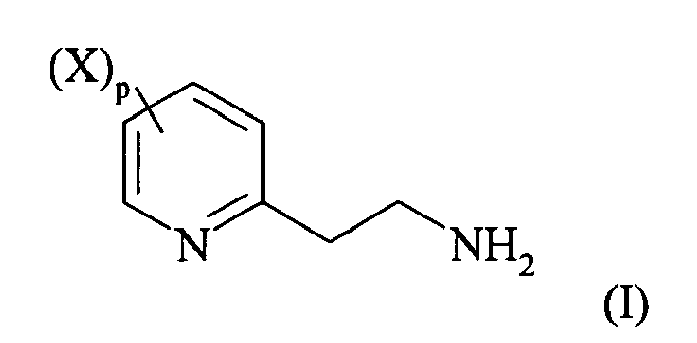
- the present invention relates to a process for the preparation of a 2-ethylaminopyridine derivative of general formula (I) or a salt thereof in which :
- the preparation of the 2-methylcyanopyridine derivative starting from the 2-halogenopyridine derivative is made in only one step. Furthermore, the yield of the reduction step of a 2-methylcyanopyridine derivative into a 2-ethylaminopyridine derivative is of 65% to 95%. Such a process can thus be used at an industrial scale.
- the 2-pyridyl moiety may be substituted in any position by (X) p , in which X and n are as defined above.
- the present invention relates to the preparation of 2-ethylaminopyridine derivative of general formula (I) in which the different characteristics may be chosen alone or in combination as being :
- the process of the present invention is particularly suitable for the preparation of :
- the first step (step A) of the process according to the present invention comprises the reaction of a 2-halogenopyridine derivative with an alkyl cyanoacetate, in a 2-halogenopyridine derivative / alkyl cyanoacetate molar ratio of from 1 to 10, in a polar solvent, in the presence of a base, the base / 2-halogenopyridine derivative molar ratio being of from 1 to 4; followed by an addition of acid until a pH value of the reaction mixture of from 1 to 5 to provide a 2-methylcyanopyridine derivative.
- step A may be conducted in the following conditions, chosen alone or in combination :
- Step A does not necessarily require specific temperature conditions.
- step A is conducted at a temperature of from 0°C to reflux. More preferably, step A is conducted at a temperature of from 0°C to 100°C.
- the second step (step B) of the process according to the present invention comprises the catalytic reduction of reaction of a 2-methylcyanopyridine derivative obtained in step one in the presence of an acylating agent of formula R 1 COR 2 and of a catalyst, in a solvent, under a hydrogen pressure of from 4 to 40 bar, to provide a 2-ethylaminopyridyl derivative.
- step B may be conducted in the following conditions, chosen alone or in combination :
- Step B does not necessarily require specific temperature conditions.
- step B is conducted at a temperature of from 16°C to 70°C. More preferably, step B is conducted at a temperature of from 20°C to 40°C.
- step C comprises the hydrolysis in water of a 2-ethylaminopyridine derivative obtained in step two by adding to it from 1 to 20 molar equivalent of an acid, at a temperature of from 20°C to reflux, to provide a compound of general formula (I).
- step C may be conducted in the following conditions, chosen alone or in combination :
- Compound of general formula (I) as defined above is a useful intermediate for the preparation of known pesticide compounds.
- These known pesticide compounds can be prepared by coupling a compound of general formula (I) as defined above with a halide benzoyl derivative.
- the present invention also relates to a process as defined above comprising a further step (D) according to the reaction scheme 4 : in which :
- A may represent a five membered ring non-fused heterocycle.
- Specific examples of compounds prepared according to the process of the present invention where A is a five membered heterocycle include compound of general formula (II) wherein :
- A may also represent a six membered ring non-fused heterocycle.
- Specific examples of compounds prepared according to the process of the present invention where A is a six membered heterocycle include :
- A may also represent an optionally substituted phenyl group.
- the present invention relates to the preparation of N-[2-(2-pyridinyl)ethyl]carboxamide derivative of general formula (II) in which A is a phenyl group and in which the different characteristics may be chosen alone or in combination as being :
- the fourth step (step D) of the process according to the present invention comprises the coupling reaction the 2-ethylaminopyridine obtained in step C with a halide benzoyl derivative to provide a compound of general formula (II) as defined above.
- a coupling reaction may be performed by known methods.
- Such a coupling reaction may for example be conducted according to the Schotten-Baumann reaction described in Schotten Ber . 1884, 17 , 2544 and Baumann Ber . 1886, 19 , 3218, herein incorporated by reference.
- Step 1 Preparation of a 3-chloro-5-(trifluoromethyl)-2-methylcyanopyridine
- Step 2 Preparation of a 3-chloro-5-(trifluoromethyl)-2-ethylacetamide-pyridinyl
- Step 3 Preparation of a 3-chloro-5-(trifluoromethyl)-2-ethylamine-pyridinyl
- the global yield to prepare the 2-ethylaminopyridyl derivative starting from 2-methylcyanopyridine derivative is 65%, which is acceptable at an industrial scale.
- step 3 may be completed by a further step for preparing N- ⁇ 2-[3-chloro-5-(trifluoromethyl)-2-pyridinyl]ethyl ⁇ -2-trifluoromethylbenzamide which is known as fungicide :
- Step 4 Preparation of a N- ⁇ 2-[3-chloro-5-(trifluoromethyl)-2-pyridinyl]ethyl ⁇ -2-trifluoromethylbenzamide
Landscapes
- Chemical & Material Sciences (AREA)
- Organic Chemistry (AREA)
- Pyridine Compounds (AREA)
- Plural Heterocyclic Compounds (AREA)
- Low-Molecular Organic Synthesis Reactions Using Catalysts (AREA)
Abstract

Description
- The present invention relates to a novel process for the preparation of 2-ethylaminopyridine derivative which is useful as an intermediate compound for the preparation of pesticides, starting with 2-halogenopyridine derivative.
- Patent application WO 2004/016088 discloses the preparation of N-[2-(2-pyridinyl)ethyl]benzamide derivatives starting from 2-halogenopyridine derivatives to produce 2-ethylaminopyridine derivatives and then coupling these 2-ethylaminopyridine derivatives with a halogenobenzoyl derivative. A step of this process consists in the reduction of a 2-methylcyanopyridine derivative into a 2-ethylaminopyridine in the presence of a metal catalyst in a protic solvent.
- The process disclosed in this patent application presents the drawback in that the yield of the step of reduction of the 2-methylcyanopyridine derivative to produce a 2-ethylaminopyridine derivative is low and not acceptable at an industrial scale.
- The process disclosed in this patent application also presents the drawback in that two separate steps are necessary for the preparation of the 2-methylcyanopyridine derivative starting from the 2-halogenopyridine derivative. This consequently increase the costs of the process and decrease its global yield, which is not acceptable at an industrial scale.
- We have now found an alternative method to prepare 2-ethylaminopyridine derivative which overcomes these problems and which is applicable to industrial scale operation.
- Accordingly, the present invention relates to a process for the preparation of a 2-ethylaminopyridine derivative of general formula (I) or a salt thereof

- p is an integer equal to 1, 2, 3 or 4;
- X is the same or different and is a hydrogen atom, a halogen atom, a nitro group, a cyano group, a hydroxy group, an amino group, a sulfanyl group, a pentafluoro-λ6-sulfanyl group, a formyl group, a formyloxy group, a formylamino group, a carboxy group, a carbamoyl group, a N-hydroxycarbamoyl group, a carbamate group, a (hydroxyimino)-C1-C6-alkyl group, a C1-C8-alkyl, a C1-C8-halogenoalkyl having 1 to 5 halogen atoms, a C2-C8-alkenyl, a C2-C8-alkynyl, a C1-C8-alkylamino, a di-C1-C8-alkylamino, a C1-C8-alkoxy, a C1-C8-halogenoalkoxy having 1 to 5 halogen atoms, a C1-C8-alkylsulfanyl, a C1-C8-halogenoalkylsulfanyl having 1 to 5 halogen atoms, a C2-C8-alkenyloxy, a C2-C8-halogenoalkenyloxy having 1 to 5 halogen atoms, a C3-C8-alkynyloxy, a C3-C8-halogenoalkynyloxy having 1 to 5 halogen atoms, a C3-C8-cycloalkyl, a C3-C8-halogenocycloalkyl having 1 to 5 halogen atoms, a C1-C8-alkylcarbonyl, a C1-C8-halogenoalkylcarbonyl having 1 to 5 halogen atoms, a C1-C8-alkylcarbamoyl, a di-C1-C8-alkylcarbamoyl, a (N-C1-C8-alkyl)oxycarbamoyl, a C1-C8-alkoxycarbamoyl, a (N-C1-C8-alkyl)-C1-C8-alkoxycarbamoyl, a C1-C8-alkoxycarbonyl, a C1-C8-halogenoalkoxycarbonyl having 1 to 5 halogen atoms, a C1-C8-alkylcarbonyloxy, a C1-C8-halogenoalkylcarbonyloxy having 1 to 5 halogen atoms, a C1-C8-alkylcarbonylamino, a C1-C8-halogenoalkylcarbonylamino having 1 to 5 halogen atoms, a C1-C8-alkylaminocarbonyloxy, a di-C1-C8-alkylaminocarbonyloxy, a C1-C8-alkyloxycarbonyloxy, a C1-C8-alkylsulphenyl, a C1-C8-halogenoalkylsulphenyl having 1 to 5 halogen atoms, a C1-C8-alkylsulphinyl, a C1-C8-halogenoalkylsulphinyl having 1 to 5 halogen atoms, a C1-C8-alkylsulphonyl, a C1-C8-halogenoalkylsulphonyl having 1 to 5 halogen atoms, a (C1-C6-alkoxyimino)-C1-C6-alkyl, a (C1-C6-alkenyloxyimino)-C1-C6-alkyl, a (C1-C6-alkynyloxyimino)-C1-C6-alkyl, a (benzyloxyimino)-C1-C6-alkyl, a benzyloxy, a benzylsulfanyl, a benzylamino, a phenoxy, a phenylsulfanyl or a phenylamino; and
- (A)- a first step according to reaction scheme 1 :

- X and p are as defined above;
- R is a C1-C8-alkyl; and
- Hal represents a halogen atom;
comprising :- a) the reaction of a 2-halogenopyridine derivative with an alkyl cyanoacetate , in a 2-halogenopyridine derivative / alkyl cyanoacetate molar ratio of from 1 to 10, in a polar solvent, in the presence of a base, the base / 2-halogenopyridine derivative molar ratio being of from 1 to 4;
- b) followed by an addition of acid until a pH value of the reaction mixture of from 1 to 5;
- (B)- a second step according to reaction scheme 2 :

- X, p are as defined above;
- R1 represents a C1-C6-alkyl;
- R2 represents a halogen atom or a -OCOAlk group; and
- Alk represents a C1-C6-alkyl;
- (C)- a third step according to reaction scheme 3 :

- X and p are as defined above; and
- R1 represents a C1-C6-alkyl;
- For the purposes of the present invention :
- a halogen atom may be a bromine atom, a chlorine atom, a iodine atom or a fluorine atom. Preferably, halogen atom means chlorine atom;
- carboxy means -C(=O)OH ;
- carbonyl means -C(=O)- ;
- carbamoyl means -C(=O)NH2 ;
- N-hydroxycarbamoyl means -C(=O)NHOH ; and
- an alkyl group, an alkenyl group, and an alkynyl group as well as moieties containing these terms, can be linear or branched.
- During the preparation of compound of general formula (I) according to the present invention, the preparation of the 2-methylcyanopyridine derivative starting from the 2-halogenopyridine derivative is made in only one step. Furthermore, the yield of the reduction step of a 2-methylcyanopyridine derivative into a 2-ethylaminopyridine derivative is of 65% to 95%. Such a process can thus be used at an industrial scale.
- According to the present invention, the 2-pyridyl moiety may be substituted in any position by (X)p, in which X and n are as defined above. Preferably, the present invention relates to the preparation of 2-ethylaminopyridine derivative of general formula (I) in which the different characteristics may be chosen alone or in combination as being :
- as regards p, p is 1, 2 or 3. Preferably, p is 2.
- as regards X, X is chosen, independently of the others, as being a halogen atom, a C1-C8-alkyl or a C1-C8-halogenoalkyl having 1 to 5 halogen atoms. More preferably, X is chosen, independently of the others, as being chlorine or CF3;
- as regards the positions in which the 2-pyridyl moiety is substituted by X, the 2-pyridyl moiety is substituted by X in 3- and/or in 5-position. Preferably, the 2-pyridyl moiety is substituted by X in 3- and 5-position
- The process of the present invention is particularly suitable for the preparation of :
- - N-2-[3-chloro-5-(trifluoromethyl)-2-pyridinyl]ethylamine, or
- - N-2-[3,5-dichloro-2-pyridinyl]ethylamine.
- The first step (step A) of the process according to the present invention comprises the reaction of a 2-halogenopyridine derivative with an alkyl cyanoacetate, in a 2-halogenopyridine derivative / alkyl cyanoacetate molar ratio of from 1 to 10, in a polar solvent, in the presence of a base, the base / 2-halogenopyridine derivative molar ratio being of from 1 to 4; followed by an addition of acid until a pH value of the reaction mixture of from 1 to 5 to provide a 2-methylcyanopyridine derivative. Preferably, step A may be conducted in the following conditions, chosen alone or in combination :
- the polar solvent is chosen as being dimethylsulfoxide (DMSO), an ether solvent, an amide solvent or an urea solvent. More preferably, the solvent is chosen as being dimethylsulfoxide (DMSO), diethyl ether, diisopropyl ether, methyl tert-butyl-ether, methyl tert-amyl-ether, dioxane, tetrahydrofuran (THF), 1,2-di-methoxyethane, 1,2-di-ethoxy-ethane, anisole, N,N-dimethyl-formamide, N,N-dimethyl-acetamide, N-methyl-formanilide, N-methyl-pyrrolidone (NMP), hexamethyl-phosphoric-triamide or 1,3-dimethyl-2-2imidazolinone (DMA). Even more preferably, the solvent is chosen as being tetrahydrofuran (THF), N-methyl-pyrrolidone (NMP), 1,3-dimethyl-2-2imidazolinone (DMA) or dimethylsulfoxide (DMSO);
- the 2-halogenopyridine derivative / alkyl cyanoacetate molar ratio of from 1 to 5;
- the alkyl cyanoacetate is chosen as being methylcyanoacetate, ethylcyanoacetate or terbutylcyanoacetate;
- the base is chosen as being a alkaline earth metal base, a alkali metal hydride base, a hydroxide base, an amide base, an alcoholate base, an acetate base, a carbonate base, a hydrogen carbonate base or a tertiary amine base. More preferably, the base is chosen as being hydrogen carbonate base includes sodium hydride, sodium amide, lithium diisoproylamide, sodium methanolate, sodium ethanolate, potassium tert-butanolate, sodium acetate, potassium acetate, calcium acetate, sodium hydroxide, potassium hydroxide, sodium carbonate, potassium carbonate, potassium bicarbonate, sodium bicarbonate, ammonium carbonate, trimethylamine, triethylamine, tributyl-amine, N,N-dimethyl-aniline, N,N-di-methyl-benzylamine pyridine, N-methylpiperidine, N-methyl-morpholine, N,N-dimethylaminopyridine, diazabicyclooctane (DABCO), diazabicyclononene (DBN) or diazabicycloundecene (DBU). Even more preferably, the base is chosen as being potassium hydroxide, sodium hydroxide, potassium bicarbonate, sodium bicarbonate or sodium hydride;
- the base / 2-halogenopyridine derivative molar ratio is of from 1 to 2.5;
- the acid added is a mineral acid. Suitable mineral acid includes HCl and H2SO4. More preferably, HCl is added;
- the acid is added until a pH value of the reaction mixture of from 2 to 4, more preferably of 2.
- Step A does not necessarily require specific temperature conditions. Preferably, step A is conducted at a temperature of from 0°C to reflux. More preferably, step A is conducted at a temperature of from 0°C to 100°C.
- The second step (step B) of the process according to the present invention comprises the catalytic reduction of reaction of a 2-methylcyanopyridine derivative obtained in step one in the presence of an acylating agent of formula R1COR2 and of a catalyst, in a solvent, under a hydrogen pressure of from 4 to 40 bar, to provide a 2-ethylaminopyridyl derivative. Preferably, step B may be conducted in the following conditions, chosen alone or in combination :
- the catalyst is a metallic catalyst. Suitable metallic catalyst includes nickel-, platinum- or palladium-based catalyst such as Raney nickel, rhodium on alumina, palladium on charcoal, palladium on calcium carbonate, palladium on silica, palladium hydroxide, platinum on charcoal or platinum on alumina. More preferably, palladium on charcoal is used;
- the solvent is an organic acid. More preferably, the solvent is a C1-C6-alkanoic acid or formic acid. Suitable C1-C6-alkanoic acid includes acetic acid, propanoic acid, butanoic acid, pentanoic acid or hexanoic acid. Even more preferably, the solvent is acetic acid;
- the acylating agent is a C1-C6-alkanoic acid anhydride or formic anhydride. Suitable C1-C6-alkanoic acid anhydride includes acetic anhydride, propanoic anhydride, butanoic anhydride, pentanoic anhydride or hexanoic anhydride. Even more preferably, the acylating agent is acetic anhydride;
- the hydrogen pressure is of from 4 to 35 bars.
- Step B does not necessarily require specific temperature conditions. Preferably, step B is conducted at a temperature of from 16°C to 70°C. More preferably, step B is conducted at a temperature of from 20°C to 40°C.
- The third step (step C) of the process according to the present invention comprises the hydrolysis in water of a 2-ethylaminopyridine derivative obtained in step two by adding to it from 1 to 20 molar equivalent of an acid, at a temperature of from 20°C to reflux, to provide a compound of general formula (I). Preferably, step C may be conducted in the following conditions, chosen alone or in combination :
- the added acid is a mineral acid. Suitable mineral acid includes HCl, H3PO4, H2SO4, HBr, HI or HF. More preferably, the acid is HCl or H2SO4. Even more preferably, the acid is HCl;
- 2 to 10 molar equivalents of acid are added the 2-ethylaminopyridinederivative obtained in step two (step B). More preferably, 5 molar equivalents of acid are added the 2-ethylaminopyridine derivative obtained in step two (step B);
- the reaction is conducted at reflux.
- Compound of general formula (I) as defined above is a useful intermediate for the preparation of known pesticide compounds. These known pesticide compounds can be prepared by coupling a compound of general formula (I) as defined above with a halide benzoyl derivative. Thus, the present invention also relates to a process as defined above comprising a further step (D) according to the reaction scheme 4 :

- X and p are as defined above;
- A represents a phenyl group or a 5-, 6- or 7-membered non-fused heterocycle with one, two or three heteroatoms which may be the same or different, the heterocycle being linked by a carbon atom; each of this group being optionally substituted by one or more substituents chosen independently of each other as being a halogen atom, a nitro group, a cyano group, a hydroxy group, an amino group, a sulfanyl group, a pentafluoro-λ6-sulfanyl group, a formyl group, a formyloxy group, a formylamino group, a carboxy group, a C1-C8-alkyl, a C1-C8-halogenoalkyl having 1 to 5 halogen atoms, a C2-C8-alkenyl, a C2-C8-alkynyl, a C1-C8-alkylamino, a di-C1-C8-alkylamino, a C1-C8-alkoxy, a C1-C8-halogenoalkoxy having 1 to 5 halogen atoms, a C1-C8-alkoxy-C2-C8-alkenyl, a C1-C8-alkylsulfanyl, a C1-C8-halogenoalkylsulfanyl having 1 to 5 halogen atoms, a C1-C8-alkoxycarbonyl, a C1-C8-halogenoalkoxycarbonyl having 1 to 5 halogen atoms, a C1-C8-alkylcarbonyloxy, a C1-C8-halogenoalkylcarbonyloxy having 1 to 5 halogen atoms, a C1-C8-alkylsulphenyl, a C1-C8-halogenoalkylsulphenyl having 1 to 5 halogen atoms, a C1-C8-alkylsulphinyl, a C1-C8-halogenoalkylsulphinyl having 1 to 5 halogen atoms, a C1-C8-alkylsulphonyl, a C1-C8-halogenoalkylsulphonyl having 1 to 5 halogen atoms or a C1-C8-alkylsulfonamide;
- According to the present invention, A may represent a five membered ring non-fused heterocycle. Specific examples of compounds prepared according to the process of the present invention where A is a five membered heterocycle include compound of general formula (II) wherein :
- * A represents a heterocycle of the general formula (A-1)

- R3 and R4 may be the same or different and may be a hydrogen atom, a halogen atom, an amino group, a nitro group, a C1-C4-alkyl or a C1-C4-halogenoalkyl having 1 to 5 halogen atoms; and
- R5 may be a halogen atom, a nitro group, a C1-C4-alkyl or a C1-C4-halogenoalkyl having 1 to 5 halogen atoms.
- * A represents a heterocycle of the general formula (A-2)

- R6 may be a hydrogen atom, a halogen atom , a C1-C4-alkyl or a C1-C4-halogenoalkyl having 1 to 5 halogen atoms; and
- R7 and R8 may be the same or different and may be a hydrogen atom, a halogen atom, an amino group, a C1-C4-alkyl or a C1-C4-halogenoalkyl having 1 to 5 halogen atoms.
- * A represents a heterocycle of the general formula (A-3)

- R9 may be a halogen atom, a C1-C4-alkyl or a C1-C4-halogenoalkyl having 1 to 5 halogen atoms; and
- R10 may be a hydrogen atom, a C1-C4-alkyl or a C1-C4-halogenoalkyl having 1 to 5 halogen atoms.
- * A represents a heterocycle of the general formula (A-4)

- R11 and R12 may be the same or different and may be a hydrogen atom, a halogen atom, a C1-C4-alkyl, a C1-C4-halogenoalkyl having 1 to 5 halogen atoms, a C1-C4-alkylthio, a C1-C4-alkylsulphonyl, a phenyl optionally substituted by a halogen atom or a C1-C4-alkyl or a pyridyl otpionally substituted by a halogen atom or a C1-C4-alkyl; and
- R13 may be a halogen atom, a cyano group, a C1-C4-alkyl, a C1-C4-halogenoalkyl having 1 to 5 halogen atoms or a C1-C4-halogenoalkoxy having 1 to 5 halogen atoms.
- * A represents a heterocycle of the general formula (A-5)
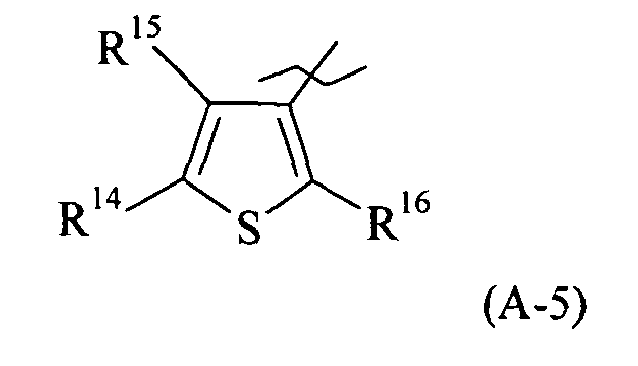
- R14 and R15 may be the same or different and may be a hydrogen atom, a halogen atom, a C1-C4-alkyl, a C1-C4-alkyloxy or a C1-C4-halogenoalkyl having 1 to 5 halogen atoms; and
- R16 may be a hydrogen atom, a halogen atom, a C1-C4-alkyl or a C1-C4-halogenoalkyl having 1 to 5 halogen atoms.
- * A represents a heterocycle of the general formula (A-6)

- R17 may be a hydrogen atom, a halogen atom, a cyano group, a C1-C4-alkyl or a C1-C4-halogenoalkyl having 1 to 5 halogen atoms;
- R18 and R20 may be the same or different and may be a hydrogen atom, a halogen atom, a C1-C4-alkyl or a C1-C4-halogenoalkyl having 1 to 5 halogen atoms; and
- R19 may be a hydrogen atom, a cyano group, a C1-C4-alkyl, a C1-C4-halogenoalkyl having 1 to 5 halogen atoms, a C1-C4-alkoxy-C1-C4-alkyl, a hydroxy-C1-C4-alkyl, a C1-C4-alkylsulphonyl, a di(C1-C4-alkyl)aminosulphonyl, a C1-C6-alkylcarbonyl, a phenylsulphonyl optionally substituted by a halogen atom or a C1-C4-alkyl, or a benzoyl optionally substituted by a halogen atom or a C1-C4-alkyl.
- * A represents a heterocycle of the general formula (A-7)

- R21 may be a hydrogen atom, a cyano group, a C1-C4-alkyl, a C1-C4-halogenoalkyl having 1 to 5 halogen atoms, a C1-C4-alkoxy-C1-C4-alkyl, a hydroxy-C1-C4-alkyl, a C1-C4-alkylsulphonyl, a di(C1-C4-alkyl)aminosulphonyl, a C1-C6-alkylcarbonyl, a phenylsulphonyl optionally substituted by a halogen atom or a C1-C4-alkyl, or a benzoyl optionally substituted by a halogen atom or a C1-C4-alkyl; and
- R22, R23 and R24 may be the same or different and may be a hydrogen atom, a halogen atom, a cyano group, a C1-C4-alkyl, a C1-C4-halogenoalkyl having 1 to 5 halogen atoms or a C1-C4-alkylcarbonyl.
- * A represents a heterocycle of the general formula (A-8)
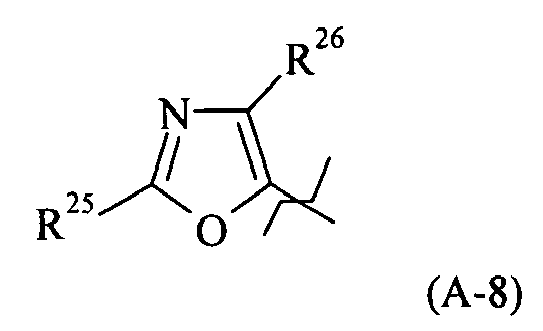
- R25 may be a hydrogen atom or a C1-C4-alkyl; and
- R26 may be a halogen atom, a C1-C4-alkyl or a C1-C4-halogenoalkyl having 1 to 5 halogen atoms.
- * A represents a heterocycle of the general formula (A-9)

- R27 may be a hydrogen atom or a C1-C4-alkyl; and
- R28 may be a halogen atom, a C1-C4-alkyl, a C1-C4-halogenoalkyl having 1 to 5 halogen atoms or a phenyl optionally substituted by a halogen atom or a C1-C4-alkyl.
- * A represents a heterocycle of the general formula (A-10)

- R29 may be a hydrogen atom, a halogen atom, an amino group, a cyano group, a C1-C4-alkylamino, a di-(C1-C4-alkyl)amino, a C1-C4-alkyl, a C1-C4-halogenoalkyl having 1 to 5 halogen atoms or a phenyl optionally substituted by a halogen atom or a C1-C4-alkyl; and
- R30 may be a halogen atom, a C1-C4-alkyl or a C1-C4-halogenoalkyl having 1 to 5 halogen atoms.
- * A represents a heterocycle of the general formula (A-11)

- R31 may be a hydrogen atom, a halogen atom, an amino group, a cyano group, a C1-C4-alkylamino, a di-(C1-C4-alkyl)amino, a C1-C4-alkyl or a C1-C4-halogenoalkyl having 1 to 5 halogen atoms; and
- R32 may be a halogen atom, a C1-C4-alkyl or a C1-C4-halogenoalkyl having 1 to 5 halogen atoms.
- * A represents a heterocycle of the general formula (A-12)

- R33 may be a halogen atom, a cyano group, a nitro group, a C1-C4-alkyl, a C1-C4-halogenoalkyl having 1 to 5 halogen atoms, a C3-C6-cycloalkyl, a C1-C4-alkoxy, a C1-C4-halogenoalkoxy having 1 to 5 halogen atoms, a C1-C4-alkylthio, a C1-C4-halogenoalkylthio having 1 to 5 halogen atoms, an aminocarbonyl group or an aminocarbonyl-C1-C4-alkyl;
- R34 may be a hydrogen atom, a halogen atom, a cyano group, a nitro group, a C1-C4-alkyl, a C1-C4-alkoxy or a C1-C4-alkylthio; and
- R35 may be a hydrogen atom, a phenyl, a C1-C4-alkyl, a C1-C4-halogenoalkyl having 1 to 5 halogen atoms, a hydroxy-C1-C4-alkyl, a C2-C6-alkenyl, a C3-C6-cycloalkyl, a C1-C4-alkylthio-C1-C4-alkyl, a C1-C4-halogenoalkylthio-C1-C4-alkyl having 1 to 5 halogen atoms, a C1-C4-alkoxy-C1-C4-alkyl or a C1-C4-halogenoalkoxy-C1-C4-alkyl having 1 to 5 halogen atoms.
- * A represents a heterocycle of the general formula (A-13)

- R36 may be a hydrogen atom, a halogen atom, a cyano group, a nitro group, a C1-C4-alkyl, a C1-C4-halogenoalkyl having 1 to 5 halogen atoms, a C3-C6-cycloalkyl, a C1-C4-alkoxy, a C1-C4-halogenoalkoxy having 1 to 5 halogen atoms, a C1-C4-alkylthio, a C1-C4-halogenoalkylthio having 1 to 5 halogen atoms, an aminocarbonyl or an aminocarbonyl-C1-C4-alkyl;
- R37 may be a hydrogen atom, a halogen atom, a cyano group, a C1-C4-alkyl, a C1-C4-alkoxy, a C1-C4-halogenoalkoxy having 1 to 5 halogen atoms or a C1-C4-alkylthio; and
- R38 may be a hydrogen atom, a C1-C4-alkyl, a C1-C4-halogenoalkyl having 1 to 5 halogen atoms, a hydroxy-C1-C4-alkyl, a C2-C6-alkenyl, a C3-C6-cycloalkyl, a C1-C4-alkylthio-C1-C4-alkyl, a C1-C4-halogenoalkylthio-C1-C4-alkyl having 1 to 5 halogen atoms, a C1-C4-alkoxy-C1-C4-alkyl, a C1-C4-halogenoalkoxy-C1-C4-alkyl having 1 to 5 halogen atoms or a phenyl optionally substituted by a halogen atom, a C1-C4-alkyl, a C1-C4-alkoxyalkyl or a nitro group.
- * A represents a heterocycle of the general formula (A-14)

- R39 may be a hydrogen atom, a halogen atom, a cyano group, a nitro group, a C1-C4-alkyl, a C1-C4-halogenoalkyl having 1 to 5 halogen atoms, a C3-C6-cycloalkyl, a C1-C4-alkoxy, a C1-C4-halogenoalkoxy having 1 to 5 halogen atoms, a C1-C4-alkylthio, a C1-C4-halogenoalkylthio having 1 to 5 halogen atoms, an aminocarbonyl, or an aminocarbonyl-C1-C4-alkyl;
- R40 may be a hydrogen atom, a halogen atom, a cyano group, a C1-C4-alkyl, a C1-C4-alkoxy, a C1-C4-alkylthio or a C1-C4-halogenoalky having 1 to 5 halogen atoms;
- R41 may be a hydrogen atom, a phenyl, a benzyl, a C1-C4-alkyl, a C1-C4-halogenoalkyl having 1 to 5 halogen atoms, a hydroxy-C1-C4-alkyl, a C2-C6-alkenyl, a C3-C6-cycloalkyl, a C1-C4-alkylthio-C1-C4-alkyl, a C1-C4-halogenoalkylthio-C1-C4-alkyl having 1 to 5 halogen atoms, a C1-C4-alkoxy-C1-C4-alkyl, a C1-C4-halogenoalkoxy-C1-C4-alkyl having 1 to 5 halogen atoms.
- * A represents a heterocycle of the general formula (A-15)

- R42 may be a hydrogen atom, a halogen atom, a C-C4-alkyl or a C1-C4-halogenoalkyl having 1 to 5 halogen atoms; and
- R43 may be a halogen atom, a C-C4-alkyl or a C1-C4-halogenoalkyl having 1 to 5 halogen atoms.
- * A represents a heterocycle of the general formula (A-16)

- * A represents a heterocycle of the general formula (A-17)

- R46 may be a halogen atom, a C1-C4-alkyl or a C1-C4-halogenoalkyl having 1 to 5 halogen atoms. and
- R47 may be a halogen atom, a C1-C4-alkyl or a C1-C4-halogenoalkyl having 1 to 5 halogen atoms.
- * A represents a heterocycle of the general formula (A-18)

- * A represents a heterocycle of the general formula (A-19)

- R49 may be a halogen atom, a C1-C4-alkyl or a C1-C4-halogenoalkyl having 1 to 5 halogen atoms; and
- R50 may be a hydrogen atom, a C1-C4-alkyl, a C1-C4-halogenoalkyl having 1 to 5 halogen atoms, or a phenyl optionally substituted by a halogen atom or a C1-C4-alkyl.
- * A represents a heterocycle of the general formula (A-20)

- According to the present invention, A may also represent a six membered ring non-fused heterocycle. Specific examples of compounds prepared according to the process of the present invention where A is a six membered heterocycle include :
- * A represents a heterocycle of the general formula (A-21)

- R52 may be a halogen atom, a hydroxy group, a cyano group, a C1-C4-alkyl, a C1-C4-halogenoalkyl having 1 to 5 halogen atoms, a C1-C4-alkoxy, a C1-C4-alkylthio, a C1-C4-halogenoalkylthio having 1 to 5 halogen atoms or a C1-C4-halogenoalkoxy having 1 to 5 halogen atoms;
- R53, R54 and R55, which may be the same or different, may be a hydrogen atom, a halogen atom, a cyano group, a C1-C4-alkyl, a C1-C4-halogenoalkyl having 1 to 5 halogen atoms, a C1-C4-alkoxy, a C1-C4-alkylthio, a C1-C4-halogenoalkoxy having 1 to 5 halogen atoms, a C1-C4-alkylsulphinyl or a C1-C4-alkylsulphonyl.
- * A represents a heterocycle of the general formula (A-22)

- R56 may be a hydrogen atom, a halogen atom, a hydroxy group, a cyano group, a C1-C4-alkyl, a C1-C4-halogenoalkyl having 1 to 5 halogen atoms, a C1-C4-alkoxy, a C1-C5-alkylthio, a C2-C5-alkenylthio a C1-C4-halogenoalkylthio having 1 to 5 halogen atoms, a C1-C4-halogenoalkoxy having 1 to 5 halogen atoms, a phenyloxy optionally substituted by a halogen atom or a C1-C4-alkyl, or a phenylthio optionally substituted by a halogen atom or a C1-C4-alkyl;
- R57, R58 and R59, which may the same or different, may be a hydrogen atom, a halogen atom, a cyano group, a C1-C4-alkyl, a C1-C4-halogenoalkyl having 1 to 5 halogen atoms, a C1-C4-alkoxy, a C1-C4-alkylthio, a C1-C4-halogenoalkoxy having 1 to 5 halogen atoms, a C1-C4-alkylsulphinyl, a C1-C4-alkylsulphonyl or a N-morpholine optionally substituted by a halogen atom or a C1-C4-alkyl, or a thienyl optionally substituted by a halogen atom or a C1-C4-alkyl.
- * A represents a heterocycle of the general formula (A-23)

- * A represents a heterocycle of the general formula (A-24)

- R64 may be a halogen atom, a C1-C4-alkyl or a C1-C4-halogenoalkyl having 1 to 5 halogen atoms;
- R65 may be a hydrogen atom, a C1-C4-alkyl, a C1-C4-halogenoalkyl having 1 to 5 halogen atoms, a C1-C6-alkoxycarbonyl, a benzyl optionally substituted by 1 to 3 halogen atoms, a benzyloxycarbonyl optionally substituted by 1 to 3 halogen atoms or a heterocyclyl.
- * A represents a heterocycle of the general formula (A-25)

- R66 may be a halogen atom, a hydroxy group, a cyano group, a C1-C4-alkyl, a C1-C4-halogenoalkyl having 1 to 5 halogen atoms, a C1-C4-alkoxy, a C1-C4-alkylthio, a C1-C4-halogenoalkylthio having 1 to 5 halogen atoms or a C1-C4-halogenoalkoxy having 1 to 5 halogen atoms;
- R67 may be a hydrogen atom, a C1-C4-alkyl, a C1-C4-halogenoalkyl having 1 to 5 halogen atoms or a benzyl.
- * A represents a heterocycle of the general formula (A-26)

- X1 may be a sulphur atom, -SO-, -SO2- or -CH2-;
- R68 may be a C1-C4-alkyl or a C1-C4-halogenoalkyl having 1 to 5 halogen atoms; and
- R69 and R70 may be the same or different and may be a hydrogen atom or a C1-C4-alkyl.
- * A represents a heterocycle of the general formula (A-27)
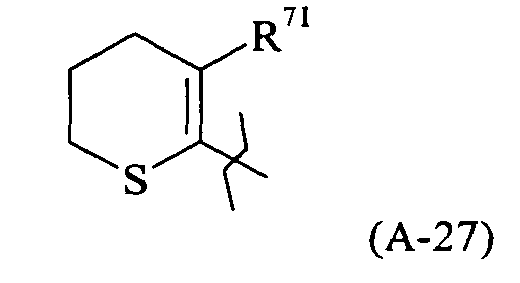
- R71 may be a C1-C4-alkyl or a C1-C4-halogenoalkyl having 1 to 5 halogen atoms;
- * A represents a heterocycle of the general formula (A-28)

- R72 may be a C1-C4-alkyl or a C1-C4-halogenoalkyl having 1 to 5 halogen atoms.
- * A represents a heterocycle of the general formula (A-29)
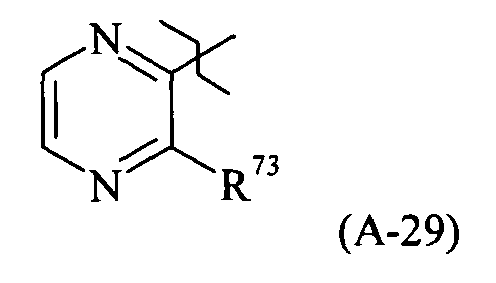
- According to the present invention, A may also represent an optionally substituted phenyl group. Preferably, the present invention relates to the preparation of N-[2-(2-pyridinyl)ethyl]carboxamide derivative of general formula (II) in which A is a phenyl group and in which the different characteristics may be chosen alone or in combination as being :
- A is substituted by 1 or 2 substituents. More preferably, A is substituted by 1 substituent.
- each substituent is chosen, independently of the others, as being a hydrogen atom, a halogen atom, a C1-C8-alkyl or a C1-C8-halogenoalkyl having 1 to 5 halogen atoms. More preferably each substituent is chosen, independently of the others, as being chlorine or CF3;
- the phenyl moiety is substituted in ortho position.
- Such a process is particularly suitable for the preparation of a compound of formula (II) which is :
- - N-{2-[3-chloro-5-(trifluoromethyl)-2-pyridinyl]ethyl}-2-trifluoromethylbenzamide;
- - N-{2-[3-chloro-5-(trifluoromethyl)-2-pyridinyl]ethyl}-2-iodobenzamide; or
- - N-{2-[3,5-dichloro-2-pyridinyl]ethyl}-2-trifluoromethylbenzamide.
- The fourth step (step D) of the process according to the present invention comprises the coupling reaction the 2-ethylaminopyridine obtained in step C with a halide benzoyl derivative to provide a compound of general formula (II) as defined above. Such a coupling reaction may be performed by known methods. Such a coupling reaction may for example be conducted according to the Schotten-Baumann reaction described in Schotten Ber. 1884, 17, 2544 and Baumann Ber. 1886, 19, 3218, herein incorporated by reference.
- The compounds of general formula (I) and of formula (II) according to the present invention can be prepared according to the above described process. It will nevertheless be understood that, on the basis of his general knowledge and of available publications, the skilled worker will be able to adapt this method according to the specifics of each of the compounds, which it is desired to synthesise.
- Certain of the intermediates used for the preparation of compound of general formula (I) are novel. Therefore, the present invention also relates to novel intermediate compounds useful for the preparation of compound of general formula (I). Thus, according to the present invention, there is provided a compound of general formula (III)

- X and p are as defined above; and
- R1 represents a C1-C6-alkyl group.
- The present invention will now be illustrated with reference to the following examples.
- A two-necked round bottom flask equipped with a magnetic bar, a thermometer and a reflux condenser was charged with the 2,3-dichloro-5-(trifluoromethyl)-pyridine in NMP (14.6% w/v), KOH (2.2 equiv.). The solution was heated to 70°C and the ethyl cyanoacetate (1.2 equiv.) was added slowly. After the addition the reaction medium was heated 3h. HCl aq. 36% was added to obtained pH 2 and the mixture was heated to 130°C for 2h. At 20°C, NaOH aq. 1N was added and the aqueous phase was extracted 3 times with methyl terbutyl ether (MTBE). The organic phases were combined, washed with water, dried over MgSO4 and concentrated to the dryness. The isolated yield was 94%.
NMR1H (300 Mz, CDCl3) : 4.15 (s, 2H, CH 2), 8.0 (s, 1H, Hpyr.), 8.79 (s, 1H, Hpyr.). - A hydrogenation reactor was charged with 3-chloro-5-trifluoromethyl -2-methylcyano pyridine (7g, 31.4 mMol), Pd/C 5% (1.05g), Ac2O (12.8g, 125.8 mMol, 4 equiv.), AcOH (60ml). The reactor was stirred under 30 bars of hydrogen at 20°C for 5 hours. The hydrogen was removed, the catalyst filtrated out and the solvent was evaporated. 8.4 g of crude desired product was obtained. HPLC titrated yield = 71 %. Mass spectrum : 266 DA, MH+ : 267
- A two-necked round bottom flask equipped with a magnetic bar, a thermometer and a reflux condenser was charged with the above crude 3-chloro-5-(trifluoromethyl)-2-ethylacetamide-pyridinyl (22.2 mMol), water (50 ml), HCl 37% (4.3 g, 5 equiv.). The solution was refluxed 5 hours. The aqueous phase was washed 3 times with CH2Cl2 (3 X 20 ml) at room temperature. The aqueous phase was titrated by HPLC. The titrated yield in solution is 92%.
Mass spectrum analysis : 224 DA, MH+ 225. - Under these conditions, the global yield to prepare the 2-ethylaminopyridyl derivative starting from 2-methylcyanopyridine derivative (step 2 and step 3) is 65%, which is acceptable at an industrial scale..
- Comparative experiments by using the process disclosed in patent application WO 2004/016088 have been conducted :
- A hydrogenation reactor was charged with 3-chloro-5-trifluoromethyl-2-methylcyano pyridine (1.5g, 6.72 mMol), Pd/C 5%, AcOH (7ml). The reactor was stirred under 6 bars of hydrogen at 20°C for 15 hours. The hydrogen was removed, the catalyst filtrated out and the solvent was evaporated. 1.4 g of crude desired product was obtained. Titrated yield by HPLC is 19%.
Mass spectrum analysis : 224 DA, MH+ 225. - Under these conditions, the global yield to prepare the 2-ethylaminopyridyl derivative starting from 2-methylcyanopyridine derivative is only 19%, which is not acceptable at an industrial scale.
- Above described step 3 may be completed by a further step for preparing N-{2-[3-chloro-5-(trifluoromethyl)-2-pyridinyl]ethyl}-2-trifluoromethylbenzamide which is known as fungicide :
- A two-necked round bottom flask equipped with a magnetic bar, a thermometer and a reflux condenser was charged with the above aqueous solution, the 2-trifluoromethyl benzoic acid chloride (1.2 eq.) solution in THF (80 ml) was added followed by NaOH aqueous 2N until pH is 8. After 1 hour, the aqueous phase was extracted with iPr2O (40 ml), the organic phases were mixed, washed with HCl aqueous 1N (2X 40 ml) and water (40 ml). The organic phase was titrated by HPLC. The titrated yield in solution was 90%.
- Heptane (70 ml) was added to the organic solution and the THF and iPr2O were distilled to obtain precipitation of the desired compound. After filtration, the cake was washed with heptane/CH2Cl2 (90/10) and dried. The isolated yield was 80%.
said process comprising :
Claims (14)
- A process for the preparation of a 2-ethylaminopyridine derivative of general formula (I) or a salt thereof
 - p is an integer equal to 1, 2, 3 or 4;- X is the same or different and is a hydrogen atom, a halogen atom, a nitro group, a cyano group, a hydroxy group, an amino group, a sulfanyl group, a pentafluoro-λ6-sulfanyl group, a formyl group, a formyloxy group, a formylamino group, a carboxy group, a carbamoyl group, a N-hydroxycarbamoyl group, a carbamate group, a (hydroxyimino)-C1-C6-alkyl group, a C1-C8-alkyl, a C1-C8-halogenoalkyl having 1 to 5 halogen atoms, a C2-C8-alkenyl, a C2-C8-alkynyl, a C1-C8-alkylamino, a di-C1-C8-alkylamino, a C1-C8-alkoxy, a C1-C8-halogenoalkoxy having 1 to 5 halogen atoms, a C1-C8-alkylsulfanyl, a C1-C8-halogenoalkylsulfanyl having 1 to 5 halogen atoms, a C2-C8-alkenyloxy, a C2-C8-halogenoalkenyloxy having 1 to 5 halogen atoms, a C3-C8-alkynyloxy, a C3-C8-halogenoalkynyloxy having 1 to 5 halogen atoms, a C3-C8-cycloalkyl, a C3-C8-halogenocycloalkyl having 1 to 5 halogen atoms, a C1-C8-alkylcarbonyl, a C1-C8-halogenoalkylcarbonyl having 1 to 5 halogen atoms, a C1-C8-alkylcarbamoyl, a di-C1-C8-alkylcarbamoyl, a (N-C1-C8-alkyl)oxycarbamoyl, a C1-C8-alkoxycarbamoyl, a (N-C1-C8-alkyl)-C1-C8-alkoxycarbamoyl, a C1-C8-alkoxycarbonyl, a C1-C8-halogenoalkoxycarbonyl having 1 to 5 halogen atoms, a C1-C8-alkylcarbonyloxy, a C1-C8-halogenoalkylcarbonyloxy having 1 to 5 halogen atoms, a C1-C8-alkylcarbonylamino, a C1-C8-halogenoalkylcarbonylamino having 1 to 5 halogen atoms, a C1-C8-alkylaminocarbonyloxy, a di-C1-C8-alkylaminocarbonyloxy, a C1-C8-alkyloxycarbonyloxy, a C1-C8-alkylsulphenyl, a C1-C8-halogenoalkylsulphenyl having 1 to 5 halogen atoms, a C1-C8-alkylsulphinyl, a C1-C8-halogenoalkylsulphinyl having 1 to 5 halogen atoms, a C1-C8-alkylsulphonyl, a C1-C8-halogenoalkylsulphonyl having 1 to 5 halogen atoms, a (C1-C6-alkoxyimino)-C1-C6-alkyl, a (C1-C6-alkenyloxyimino)-C1-C6-alkyl, a (C1-C6-alkynyloxyimino)-C1-C6-alkyl, a (benzyloxyimino)-C1-C6-alkyl, a benzyloxy, a benzylsulfanyl, a benzylamino, a phenoxy, a phenylsulfanyl or a phenylamino; and as to the N-oxides of 2-pyridine thereof;said process comprising :(A)- a first step according to reaction scheme 1 :
 - X and p are as defined above;- R is a C1-C8-alkyl; and- Hal represents a halogen atom;comprising :a) the reaction of a 2-halogenopyridine derivative with an alkyl cyanoacetate , in a 2-halogenopyridine derivative / alkyl cyanoacetate molar ratio of from 1 to 10, in a polar solvent, in the presence of a base, the base / 2-halogenopyridine derivative molar ratio being of from 1 to 4;b) followed by an addition of acid until a pH value of the reaction mixture of from 1 to 5;to provide a 2-methylcyanopyridine derivative;(B)- a second step according to reaction scheme 2 :
 - X, p are as defined above;- R1 represents a C1-C6-alkyl;- R2 represents a halogen atom or a -OCOAlk group; and- Alk represents a C1-C6-alkyl;comprising the catalytic reduction of reaction of a 2-methylcyanopyridine derivative obtained in step one in the presence of an acylating agent of formula R1COR2 and of a catalyst, in a solvent, under a hydrogen pressure of from 4 to 40 bar, to provide a 2-ethylaminopyridyl derivative;(C)- a third step according to reaction scheme 3 :in which :
 - X and p are as defined above; and- R1 represents a C1-C6-alkyl group;comprising the hydrolysis in water of a 2-ethylaminopyridine derivative obtained in step two by adding to it from 1 to 20 molar equivalent of an acid, at a temperature of from 20°C to reflux, to provide a compound of general formula (I).
 - A process according to claim 1, characterised in that p is 2.
- A process according to claim 1 or 2, characterised in that X is chosen, independently of the others, as being chlorine or CF3;
- A process according to any of the claim 1 to 3, characterised in that the 2-pyridyl moiety is substituted by X in 3- and/or in 5-position.
- A process according to claim 1, characterised in that the compound of formula (I) is :- N-2-[3-chloro-5-(trifluoromethyl)-2-pyridinyl]ethylamine, or- N-2-[3,5-dichloro-2-pyridinyl]ethylamine.
- A process according to any of the claims 1 to 5, characterised in that step A is conducted at a temperature of from 0°C to reflux.
- A process according to any of the claims 1 to 6, characterised in that step B is conducted at a temperature of from 16°C to 70°C.
- A process according to any of the claims 1 to 7, characterised in that it comprises a further step (D) according to the reaction scheme 4 :
 - X and p are as defined above;- A represents a phenyl group or a 5-, 6- or 7-membered non-fused heterocycle with one, two or three heteroatoms which may be the same or different, the heterocycle being linked by a carbon atom; each of this group being optionally substituted by one or more substituents chosen independently of each other as being a halogen atom, a nitro group, a cyano group, a hydroxy group, an amino group, a sulfanyl group, a pentafluoro-λ6-sulfanyl group, a formyl group, a formyloxy group, a formylamino group, a carboxy group, a C1-C8-alkyl, a C1-C8-halogenoalkyl having 1 to 5 halogen atoms, a C2-C8-alkenyl, a C2-C8-alkynyl, a C1-C8-alkylamino, a di-C1-C8-alkylamino, a C1-C8-alkoxy, a C1-C8-halogenoalkoxy having 1 to 5 halogen atoms, a C1-C8-alkoxy-C2-C8-alkenyl, a C1-C8-alkylsulfanyl, a C1-C8-halogenoalkylsulfanyl having 1 to 5 halogen atoms, a C1-C8-alkoxycarbonyl, a C1-C8-halogenoalkoxycarbonyl having 1 to 5 halogen atoms, a C1-C8-alkylcarbonyloxy, a C1-C8-halogenoalkylcarbonyloxy having 1 to 5 halogen atoms, a C1-C8-alkylsulphenyl, a C1-C8-halogenoalkylsulphenyl having 1 to 5 halogen atoms, a C1-C8-alkylsulphinyl, a C1-C8-halogenoalkylsulphinyl having 1 to 5 halogen atoms, a C1-C8-alkylsulphonyl, a C1-C8-halogenoalkylsulphonyl having 1 to 5 halogen atoms or a C1-C8-alkylsulfonamide;comprising the coupling reaction of the 2-ethylaminopyridine obtained in step three of the above described process with a halide carboxyl derivative contained in an organic solvent in the presence of a base to produce a N-[2-(2-pyridinyl)ethyl]carboxamide derivative of general formula (II).
 - A process according to claim 8, characterised in that A is a phenyl group.
- A process according to claim 9, characterised in that A is substituted by one or two substituents.
- A process according to claim 9 or 10, characterised in that each substituent of A is chosen, independently of each other, as being chlorine or CF3.
- A process according to any of the claim 9 to 11, characterised in that the A is substituted in ortho position.
- A process according to claim 8, characterised in that the compound of formula (II) is :- N-{2-[3-chloro-5-(trifluoromethyl)-2-pyridinyl]ethyl}-2-trifluoromethylbenzamide;- N-{2-[3-chloro-5-(trifluoromethyl)-2-pyridinyl]ethyl}-2-iodobenzamide; or- N-{2-[3,5-dichloro-2-pyridinyl]ethyl}-2-trifluoromethylbenzamide.
- A compound of general formula (III)
 - X and p are as defined in claim 1, 2, 3 or 4; and- R1 represents a C1-C6-alkyl group.
Priority Applications (13)
| Application Number | Priority Date | Filing Date | Title |
|---|---|---|---|
| EP04356202A EP1674455A1 (en) | 2004-12-21 | 2004-12-21 | Process for the preparation of a 2-ethylaminopyridine derivative |
| US11/793,501 US7777045B2 (en) | 2004-12-21 | 2005-12-19 | Process for the preparation of a 2-ethylaminopyridine derivative |
| BRPI0516904-6A BRPI0516904B1 (en) | 2004-12-21 | 2005-12-19 | PROCESS FOR PREPARING A 2-ETHYLAMINOPYRIDINE AND COMPOUND DERIVATIVE |
| AT05825265T ATE490956T1 (en) | 2004-12-21 | 2005-12-19 | METHOD FOR PRODUCING A 2-ETHYLAMINOPYRIDINE DERIVATIVE |
| CN2005800435587A CN101080390B (en) | 2004-12-21 | 2005-12-19 | The preparation method of 2-ethylaminopyridine derivative |
| JP2007547474A JP4794570B2 (en) | 2004-12-21 | 2005-12-19 | Method for preparing 2-ethylaminopyridine derivative |
| PCT/EP2005/056900 WO2006067106A1 (en) | 2004-12-21 | 2005-12-19 | Process for the preparation of a 2-ethylaminopyridine derivative |
| DE602005025251T DE602005025251D1 (en) | 2004-12-21 | 2005-12-19 | PROCESS FOR THE PREPARATION OF A 2-ETHYLAMINOPYRIDINE DERIVATIVE |
| EP05825265A EP1833793B1 (en) | 2004-12-21 | 2005-12-19 | Process for the preparation of a 2-ethylaminopyridine derivative |
| CN201110165787.3A CN102276520B (en) | 2004-12-21 | 2005-12-19 | Process for the preparation of a 2-ethylaminopyridine derivative |
| TW094145189A TWI318624B (en) | 2004-12-21 | 2005-12-20 | Process for the preparation of a 2-ethylaminopyridine derivative |
| IL183663A IL183663A (en) | 2004-12-21 | 2007-06-04 | Process for the preparation of 2-ethylaminopyridine derivative |
| JP2011113886A JP5526078B2 (en) | 2004-12-21 | 2011-05-20 | Method for preparing 2-ethylaminopyridine derivative |
Applications Claiming Priority (1)
| Application Number | Priority Date | Filing Date | Title |
|---|---|---|---|
| EP04356202A EP1674455A1 (en) | 2004-12-21 | 2004-12-21 | Process for the preparation of a 2-ethylaminopyridine derivative |
Publications (1)
| Publication Number | Publication Date |
|---|---|
| EP1674455A1 true EP1674455A1 (en) | 2006-06-28 |
Family
ID=34931761
Family Applications (2)
| Application Number | Title | Priority Date | Filing Date |
|---|---|---|---|
| EP04356202A Withdrawn EP1674455A1 (en) | 2004-12-21 | 2004-12-21 | Process for the preparation of a 2-ethylaminopyridine derivative |
| EP05825265A Expired - Lifetime EP1833793B1 (en) | 2004-12-21 | 2005-12-19 | Process for the preparation of a 2-ethylaminopyridine derivative |
Family Applications After (1)
| Application Number | Title | Priority Date | Filing Date |
|---|---|---|---|
| EP05825265A Expired - Lifetime EP1833793B1 (en) | 2004-12-21 | 2005-12-19 | Process for the preparation of a 2-ethylaminopyridine derivative |
Country Status (10)
| Country | Link |
|---|---|
| US (1) | US7777045B2 (en) |
| EP (2) | EP1674455A1 (en) |
| JP (2) | JP4794570B2 (en) |
| CN (2) | CN101080390B (en) |
| AT (1) | ATE490956T1 (en) |
| BR (1) | BRPI0516904B1 (en) |
| DE (1) | DE602005025251D1 (en) |
| IL (1) | IL183663A (en) |
| TW (1) | TWI318624B (en) |
| WO (1) | WO2006067106A1 (en) |
Cited By (8)
| Publication number | Priority date | Publication date | Assignee | Title |
|---|---|---|---|---|
| WO2015071230A1 (en) * | 2013-11-15 | 2015-05-21 | Bayer Cropscience Ag | Catalytic hydrogenation of nitriles |
| US9776967B2 (en) | 2013-10-14 | 2017-10-03 | Bayer Animal Health Gmbh | Carboxamide derivatives as pesticidal compounds |
| WO2018114810A1 (en) | 2016-12-21 | 2018-06-28 | Bayer Cropscience Aktiengesellschaft | Catalytic hydrogenation of nitriles |
| CN110437139A (en) * | 2019-08-12 | 2019-11-12 | 大连九信精细化工有限公司 | A kind of synthetic method of fluopyram |
| US11236070B2 (en) | 2019-05-16 | 2022-02-01 | Novartis Ag | Chemical process |
| WO2022208370A1 (en) | 2021-03-31 | 2022-10-06 | Pi Industries Ltd. | Fused heterocyclic compounds and their use as pest control agents |
| US11470602B2 (en) | 2008-08-08 | 2022-10-11 | Sun Patent Trust | Wireless communication apparatus and channel allocation method |
| CN115215793A (en) * | 2022-08-11 | 2022-10-21 | 南开大学 | Synthesis method of fluopyram |
Families Citing this family (12)
| Publication number | Priority date | Publication date | Assignee | Title |
|---|---|---|---|---|
| CN103535362A (en) * | 2012-07-13 | 2014-01-29 | 陕西美邦农药有限公司 | Efficient bactericidal composition |
| CN103535353A (en) * | 2012-07-13 | 2014-01-29 | 陕西美邦农药有限公司 | Efficient bactericidal composition |
| CN103535354A (en) * | 2012-07-13 | 2014-01-29 | 陕西美邦农药有限公司 | Efficient bactericidal composition |
| CN103535355A (en) * | 2012-07-13 | 2014-01-29 | 陕西美邦农药有限公司 | Efficient bactericidal composition |
| CN105237435B (en) * | 2015-09-21 | 2018-03-09 | 苏州大学 | A kind of preparation method of α cyano group amine |
| KR102522231B1 (en) * | 2016-12-21 | 2023-04-14 | 바이엘 크롭사이언스 악티엔게젤샤프트 | Method for producing 2-pyridylethylcarboxamide derivatives |
| WO2020020897A1 (en) * | 2018-07-26 | 2020-01-30 | Bayer Aktiengesellschaft | Crystalline form of fluopyram |
| CN109293565B (en) * | 2018-10-26 | 2021-08-06 | 江苏七洲绿色化工股份有限公司 | Preparation method of fluopyram |
| CN111004170A (en) * | 2019-12-09 | 2020-04-14 | 西安近代化学研究所 | Continuous synthesis method of 3-chloro-5- (trifluoromethyl) -2-ethylamino pyridine hydrochloride |
| CN111484448A (en) * | 2020-05-11 | 2020-08-04 | 中国农业科学院农业质量标准与检测技术研究所 | Fluopyram hapten, preparation method and application thereof, and antibody and method for detecting fluopyram |
| CN112552231B (en) * | 2020-12-11 | 2022-03-11 | 南京正荣医药化学有限公司 | Synthetic method of 2- (3-chloro-5- (trifluoromethyl) pyridine-2-yl) ethylamine |
| CN116874415A (en) * | 2023-07-14 | 2023-10-13 | 利民化学有限责任公司 | A new crystal form of fluopyram and its preparation method |
Citations (4)
| Publication number | Priority date | Publication date | Assignee | Title |
|---|---|---|---|---|
| US6215024B1 (en) * | 1999-09-16 | 2001-04-10 | Council Of Scientific And Industrial Research | Process for the production of amides from amines |
| WO2004016088A2 (en) * | 2002-08-12 | 2004-02-26 | Bayer Cropscience S.A. | Novel 2-pyridylethylbenzamide derivative |
| WO2004074280A1 (en) * | 2003-02-19 | 2004-09-02 | Bayer Cropscience Sa | Pyridine derivatives as fungicidal compounds |
| EP1500651A1 (en) * | 2003-07-25 | 2005-01-26 | Bayer CropScience S.A. | N-[2-(2-Pyridinyl)ethyl]benzamide compounds and their use as fungicides |
Family Cites Families (3)
| Publication number | Priority date | Publication date | Assignee | Title |
|---|---|---|---|---|
| US5364871A (en) * | 1989-09-15 | 1994-11-15 | Fujisawa Pharmaceutical Co., Ltd. | New thiazole derivatives, and pharmaceutical composition comprising the same |
| US5208247A (en) * | 1991-08-01 | 1993-05-04 | American Cyanamid Company | Pyridinium compounds which are useful as antagonists of platelet activating factor |
| WO2002079142A1 (en) * | 2001-03-30 | 2002-10-10 | Council Of Scientific And Industrial Research | A process for the production of amides from amines |
-
2004
- 2004-12-21 EP EP04356202A patent/EP1674455A1/en not_active Withdrawn
-
2005
- 2005-12-19 DE DE602005025251T patent/DE602005025251D1/en not_active Expired - Lifetime
- 2005-12-19 CN CN2005800435587A patent/CN101080390B/en not_active Expired - Lifetime
- 2005-12-19 WO PCT/EP2005/056900 patent/WO2006067106A1/en not_active Ceased
- 2005-12-19 JP JP2007547474A patent/JP4794570B2/en not_active Expired - Lifetime
- 2005-12-19 BR BRPI0516904-6A patent/BRPI0516904B1/en active IP Right Grant
- 2005-12-19 EP EP05825265A patent/EP1833793B1/en not_active Expired - Lifetime
- 2005-12-19 CN CN201110165787.3A patent/CN102276520B/en not_active Expired - Lifetime
- 2005-12-19 AT AT05825265T patent/ATE490956T1/en active
- 2005-12-19 US US11/793,501 patent/US7777045B2/en not_active Expired - Lifetime
- 2005-12-20 TW TW094145189A patent/TWI318624B/en not_active IP Right Cessation
-
2007
- 2007-06-04 IL IL183663A patent/IL183663A/en active IP Right Grant
-
2011
- 2011-05-20 JP JP2011113886A patent/JP5526078B2/en not_active Expired - Lifetime
Patent Citations (4)
| Publication number | Priority date | Publication date | Assignee | Title |
|---|---|---|---|---|
| US6215024B1 (en) * | 1999-09-16 | 2001-04-10 | Council Of Scientific And Industrial Research | Process for the production of amides from amines |
| WO2004016088A2 (en) * | 2002-08-12 | 2004-02-26 | Bayer Cropscience S.A. | Novel 2-pyridylethylbenzamide derivative |
| WO2004074280A1 (en) * | 2003-02-19 | 2004-09-02 | Bayer Cropscience Sa | Pyridine derivatives as fungicidal compounds |
| EP1500651A1 (en) * | 2003-07-25 | 2005-01-26 | Bayer CropScience S.A. | N-[2-(2-Pyridinyl)ethyl]benzamide compounds and their use as fungicides |
Non-Patent Citations (6)
| Title |
|---|
| CHAU-DER LI ET AL: "pyridine derivatives as potent inducers of erythroid differentiation", J. MED. CHEM., vol. 21, no. 9, 1978, pages 874 - 877, XP002327632 * |
| G. MAGNUS, R.LEVINE: "the pyridylethylation of active hydrogen compounds.", J.AM.CHEM.SOC., vol. 78, 1956, pages 4127 - 4129, XP002327633 * |
| HUANG, CHARLES Q. ET AL: "Design and synthesis of 3-(2-pyridyl)pyrazolo[1,5-a]pyrimidines as potent CRF1 receptor antagonists", BIOORGANIC & MEDICINAL CHEMISTRY LETTERS , 14(15), 3943-3947 CODEN: BMCLE8; ISSN: 0960-894X, 2004, XP002327635 * |
| KATSURA YOUSUKE, INOUE YOSHIKAZU, TOMISHI TETSUO: "studies on antiulcer drugs", J.MED. CHEM., vol. 37, no. 1, 1994, pages 57 - 66, XP002327634 * |
| KOKARS, V. ET AL: "Synthesis of 2-azastilbene derivatives with intramolecular charge transfer", CHEMISTRY OF HETEROCYCLIC COMPOUNDS (NEW YORK, NY, UNITED STATES)(TRANSLATION OF KHIMIYA GETEROTSIKLICHESKIKH SOEDINENII) , 38(7), 805-809 CODEN: CHCCAL; ISSN: 0009-3122, 2002, XP002327636 * |
| ZAKHS, E. R. ET AL: "Synthesis and photochromic properties of 2-(3-nitro-2- pyridylmethyl)benzazoles", RUSSIAN JOURNAL OF GENERAL CHEMISTRY (TRANSLATION OF ZHURNAL OBSHCHEI KHIMII) , 71(7), 1076-1087 CODEN: RJGCEK; ISSN: 1070-3632, 2001, XP001094317 * |
Cited By (12)
| Publication number | Priority date | Publication date | Assignee | Title |
|---|---|---|---|---|
| US11470602B2 (en) | 2008-08-08 | 2022-10-11 | Sun Patent Trust | Wireless communication apparatus and channel allocation method |
| US9776967B2 (en) | 2013-10-14 | 2017-10-03 | Bayer Animal Health Gmbh | Carboxamide derivatives as pesticidal compounds |
| WO2015071230A1 (en) * | 2013-11-15 | 2015-05-21 | Bayer Cropscience Ag | Catalytic hydrogenation of nitriles |
| US9988353B2 (en) | 2013-11-15 | 2018-06-05 | Bayer Cropscience Aktiengesellschaft | Catalytic hydrogenation of nitriles |
| TWI650305B (en) * | 2013-11-15 | 2019-02-11 | 德商拜耳作物科學股份有限公司 | Catalytic hydrogenation of nitrile |
| US10414730B2 (en) | 2013-11-15 | 2019-09-17 | Bayer Cropscience Aktiengesellschaft | Catalytic hydrogenation of nitriles |
| WO2018114810A1 (en) | 2016-12-21 | 2018-06-28 | Bayer Cropscience Aktiengesellschaft | Catalytic hydrogenation of nitriles |
| US10766859B2 (en) | 2016-12-21 | 2020-09-08 | Bayer Cropscience Aktiengesellschaft | Catalytic hydrogenation of nitriles |
| US11236070B2 (en) | 2019-05-16 | 2022-02-01 | Novartis Ag | Chemical process |
| CN110437139A (en) * | 2019-08-12 | 2019-11-12 | 大连九信精细化工有限公司 | A kind of synthetic method of fluopyram |
| WO2022208370A1 (en) | 2021-03-31 | 2022-10-06 | Pi Industries Ltd. | Fused heterocyclic compounds and their use as pest control agents |
| CN115215793A (en) * | 2022-08-11 | 2022-10-21 | 南开大学 | Synthesis method of fluopyram |
Also Published As
| Publication number | Publication date |
|---|---|
| US7777045B2 (en) | 2010-08-17 |
| IL183663A0 (en) | 2007-09-20 |
| CN101080390B (en) | 2011-07-27 |
| JP5526078B2 (en) | 2014-06-18 |
| JP2008524308A (en) | 2008-07-10 |
| BRPI0516904A (en) | 2008-09-23 |
| US20080114176A1 (en) | 2008-05-15 |
| TWI318624B (en) | 2009-12-21 |
| ATE490956T1 (en) | 2010-12-15 |
| IL183663A (en) | 2013-02-28 |
| CN102276520B (en) | 2014-07-09 |
| EP1833793B1 (en) | 2010-12-08 |
| JP2011207896A (en) | 2011-10-20 |
| TW200633981A (en) | 2006-10-01 |
| CN101080390A (en) | 2007-11-28 |
| DE602005025251D1 (en) | 2011-01-20 |
| WO2006067106A1 (en) | 2006-06-29 |
| BRPI0516904B1 (en) | 2014-12-30 |
| CN102276520A (en) | 2011-12-14 |
| EP1833793A1 (en) | 2007-09-19 |
| JP4794570B2 (en) | 2011-10-19 |
Similar Documents
| Publication | Publication Date | Title |
|---|---|---|
| EP1833793B1 (en) | Process for the preparation of a 2-ethylaminopyridine derivative | |
| US8865908B2 (en) | Process for the preparation of a 2-pyridylethylcarboxamide derivative | |
| EP3558945B1 (en) | Process for the preparation of a n-[2-(2-pyridinyl)ethyl]carboxamide derivative | |
| JP5292405B2 (en) | Process for the preparation of 2-dihaloacyl-3-aminoacrylic acid derivatives | |
| CA2306004C (en) | Process for preparing an aromatic compound substituted by a tertiary nitrile | |
| EP1274684B1 (en) | Process for the preparation of aryl-pyridinyl compounds | |
| EP1202949B1 (en) | Process for the preparation of acylated 1,3-dicarbonyl compounds | |
| EP1873145B1 (en) | Method for producing nicotinic acid derivative or salt thereof | |
| HK1164881A (en) | Process for the preparation of a 2-ethylaminopyridine derivative | |
| JP2001081071A (en) | Production of phenoxyamines | |
| KR100818566B1 (en) | Method for preparing 2-aminoethylpyridine | |
| JP3387723B2 (en) | Method for producing 2-nitroiminohexahydro-1,3,5-triazines | |
| JP2861157B2 (en) | Nicotinic acid derivative having substituent and method for producing the same | |
| JPH0148257B2 (en) |
Legal Events
| Date | Code | Title | Description |
|---|---|---|---|
| PUAI | Public reference made under article 153(3) epc to a published international application that has entered the european phase |
Free format text: ORIGINAL CODE: 0009012 |
|
| AK | Designated contracting states |
Kind code of ref document: A1 Designated state(s): AT BE BG CH CY CZ DE DK EE ES FI FR GB GR HU IE IS IT LI LT LU MC NL PL PT RO SE SI SK TR |
|
| AX | Request for extension of the european patent |
Extension state: AL BA HR LV MK YU |
|
| 17P | Request for examination filed |
Effective date: 20061228 |
|
| AKX | Designation fees paid |
Designated state(s): FR |
|
| 17Q | First examination report despatched |
Effective date: 20070207 |
|
| REG | Reference to a national code |
Ref country code: DE Ref legal event code: 8566 |
|
| STAA | Information on the status of an ep patent application or granted ep patent |
Free format text: STATUS: THE APPLICATION IS DEEMED TO BE WITHDRAWN |
|
| 18D | Application deemed to be withdrawn |
Effective date: 20070619 |