EP1674104A1 - Uridine derivatives as antiviral drugs against a flaviviridae, especially HCV - Google Patents
Uridine derivatives as antiviral drugs against a flaviviridae, especially HCV Download PDFInfo
- Publication number
- EP1674104A1 EP1674104A1 EP04356207A EP04356207A EP1674104A1 EP 1674104 A1 EP1674104 A1 EP 1674104A1 EP 04356207 A EP04356207 A EP 04356207A EP 04356207 A EP04356207 A EP 04356207A EP 1674104 A1 EP1674104 A1 EP 1674104A1
- Authority
- EP
- European Patent Office
- Prior art keywords
- alkyl
- chosen
- hydroxyl
- hydrogen
- uridine
- Prior art date
- Legal status (The legal status is an assumption and is not a legal conclusion. Google has not performed a legal analysis and makes no representation as to the accuracy of the status listed.)
- Withdrawn
Links
- DRTQHJPVMGBUCF-XVFCMESISA-N Uridine Chemical class O[C@@H]1[C@H](O)[C@@H](CO)O[C@H]1N1C(=O)NC(=O)C=C1 DRTQHJPVMGBUCF-XVFCMESISA-N 0.000 title claims abstract description 25
- 241000710781 Flaviviridae Species 0.000 title claims abstract description 18
- 239000003443 antiviral agent Substances 0.000 title description 4
- 125000002887 hydroxy group Chemical group [H]O* 0.000 claims abstract description 41
- 229910052739 hydrogen Inorganic materials 0.000 claims abstract description 40
- 239000003814 drug Substances 0.000 claims abstract description 34
- 229940079593 drug Drugs 0.000 claims abstract description 30
- 239000001257 hydrogen Substances 0.000 claims abstract description 30
- 150000003839 salts Chemical class 0.000 claims abstract description 29
- 230000000840 anti-viral effect Effects 0.000 claims abstract description 26
- 229910052736 halogen Inorganic materials 0.000 claims abstract description 26
- 150000002367 halogens Chemical class 0.000 claims abstract description 26
- 239000002253 acid Substances 0.000 claims abstract description 24
- 238000002360 preparation method Methods 0.000 claims abstract description 24
- 125000000815 N-oxide group Chemical group 0.000 claims abstract description 21
- 239000001177 diphosphate Substances 0.000 claims abstract description 14
- 239000001226 triphosphate Substances 0.000 claims abstract description 14
- 125000003342 alkenyl group Chemical group 0.000 claims abstract description 11
- 125000000304 alkynyl group Chemical group 0.000 claims abstract description 6
- 150000002431 hydrogen Chemical class 0.000 claims abstract 14
- 150000001875 compounds Chemical class 0.000 claims description 82
- 241000711549 Hepacivirus C Species 0.000 claims description 39
- 108010050904 Interferons Proteins 0.000 claims description 28
- 102000014150 Interferons Human genes 0.000 claims description 28
- 229940079322 interferon Drugs 0.000 claims description 28
- -1 chloroethynyl Chemical group 0.000 claims description 27
- GDTBXPJZTBHREO-UHFFFAOYSA-N bromine Substances BrBr GDTBXPJZTBHREO-UHFFFAOYSA-N 0.000 claims description 21
- 229910052794 bromium Inorganic materials 0.000 claims description 18
- 239000004480 active ingredient Substances 0.000 claims description 17
- 229910052740 iodine Chemical group 0.000 claims description 12
- 239000000460 chlorine Substances 0.000 claims description 11
- ZCYVEMRRCGMTRW-UHFFFAOYSA-N 7553-56-2 Chemical group [I] ZCYVEMRRCGMTRW-UHFFFAOYSA-N 0.000 claims description 10
- WKBOTKDWSSQWDR-UHFFFAOYSA-N Bromine atom Chemical compound [Br] WKBOTKDWSSQWDR-UHFFFAOYSA-N 0.000 claims description 10
- ZAMOUSCENKQFHK-UHFFFAOYSA-N Chlorine atom Chemical compound [Cl] ZAMOUSCENKQFHK-UHFFFAOYSA-N 0.000 claims description 10
- 229910052801 chlorine Inorganic materials 0.000 claims description 10
- 239000013583 drug formulation Substances 0.000 claims description 10
- PNDPGZBMCMUPRI-UHFFFAOYSA-N iodine Chemical compound II PNDPGZBMCMUPRI-UHFFFAOYSA-N 0.000 claims description 10
- 239000011630 iodine Chemical group 0.000 claims description 10
- 125000001246 bromo group Chemical group Br* 0.000 claims description 8
- 239000000546 pharmaceutical excipient Substances 0.000 claims description 6
- UKOANMHEMZJGHQ-DJLDLDEBSA-N 5-(2-bromoethynyl)-1-[(2r,4s,5r)-4-hydroxy-5-(hydroxymethyl)oxolan-2-yl]pyrimidine-2,4-dione Chemical compound C1[C@H](O)[C@@H](CO)O[C@H]1N1C(=O)NC(=O)C(C#CBr)=C1 UKOANMHEMZJGHQ-DJLDLDEBSA-N 0.000 claims description 5
- JBWMBFYLXQNOEF-VUEMSXQMSA-N 1-[(2r,3r,4s,5r)-3,4-dihydroxy-5-(hydroxymethyl)oxolan-2-yl]-5-[(e)-1,2-diiodoethenyl]pyrimidine-2,4-dione Chemical compound O[C@@H]1[C@H](O)[C@@H](CO)O[C@H]1N1C(=O)NC(=O)C(\C(I)=C/I)=C1 JBWMBFYLXQNOEF-VUEMSXQMSA-N 0.000 claims description 4
- BFOOKWZKPMKUNZ-FDDDBJFASA-N 5-(2-bromoethynyl)-1-[(2r,3r,4s,5r)-3,4-dihydroxy-5-(hydroxymethyl)oxolan-2-yl]pyrimidine-2,4-dione Chemical compound O[C@@H]1[C@H](O)[C@@H](CO)O[C@H]1N1C(=O)NC(=O)C(C#CBr)=C1 BFOOKWZKPMKUNZ-FDDDBJFASA-N 0.000 claims description 4
- IAGYHBQPNFGKRP-VUEMSXQMSA-N 5-[(e)-1,2-dibromoethenyl]-1-[(2r,3r,4s,5r)-3,4-dihydroxy-5-(hydroxymethyl)oxolan-2-yl]pyrimidine-2,4-dione Chemical compound O[C@@H]1[C@H](O)[C@@H](CO)O[C@H]1N1C(=O)NC(=O)C(\C(Br)=C/Br)=C1 IAGYHBQPNFGKRP-VUEMSXQMSA-N 0.000 claims description 4
- NJLMEJBLWCPROC-GTAGYDBXSA-N 5-[(e)-1,2-dibromoethenyl]-1-[(2r,4s,5r)-4-hydroxy-5-(hydroxymethyl)oxolan-2-yl]pyrimidine-2,4-dione Chemical compound C1[C@H](O)[C@@H](CO)O[C@H]1N1C(=O)NC(=O)C(\C(Br)=C/Br)=C1 NJLMEJBLWCPROC-GTAGYDBXSA-N 0.000 claims description 4
- NXRLCZUQFBLBGQ-GTAGYDBXSA-N 5-[(e)-1,2-diiodoethenyl]-1-[(2r,4s,5r)-4-hydroxy-5-(hydroxymethyl)oxolan-2-yl]pyrimidine-2,4-dione Chemical compound C1[C@H](O)[C@@H](CO)O[C@H]1N1C(=O)NC(=O)C(\C(I)=C/I)=C1 NXRLCZUQFBLBGQ-GTAGYDBXSA-N 0.000 claims description 4
- YUERSXHBZCFEKJ-VUEMSXQMSA-N 5-[(e)-1-bromo-2-iodoethenyl]-1-[(2r,3r,4s,5r)-3,4-dihydroxy-5-(hydroxymethyl)oxolan-2-yl]pyrimidine-2,4-dione Chemical compound O[C@@H]1[C@H](O)[C@@H](CO)O[C@H]1N1C(=O)NC(=O)C(\C(Br)=C/I)=C1 YUERSXHBZCFEKJ-VUEMSXQMSA-N 0.000 claims description 4
- AWJIHOTYOWTAAC-GTAGYDBXSA-N 5-[(e)-1-bromo-2-iodoethenyl]-1-[(2r,4s,5r)-4-hydroxy-5-(hydroxymethyl)oxolan-2-yl]pyrimidine-2,4-dione Chemical compound C1[C@H](O)[C@@H](CO)O[C@H]1N1C(=O)NC(=O)C(\C(Br)=C/I)=C1 AWJIHOTYOWTAAC-GTAGYDBXSA-N 0.000 claims description 4
- BDVGBBMGBPZTJX-VUEMSXQMSA-N 5-[(e)-1-chloro-2-iodoethenyl]-1-[(2r,3r,4s,5r)-3,4-dihydroxy-5-(hydroxymethyl)oxolan-2-yl]pyrimidine-2,4-dione Chemical compound O[C@@H]1[C@H](O)[C@@H](CO)O[C@H]1N1C(=O)NC(=O)C(\C(Cl)=C/I)=C1 BDVGBBMGBPZTJX-VUEMSXQMSA-N 0.000 claims description 4
- WTFMCUBNUGDIAH-GTAGYDBXSA-N 5-[(e)-1-chloro-2-iodoethenyl]-1-[(2r,4s,5r)-4-hydroxy-5-(hydroxymethyl)oxolan-2-yl]pyrimidine-2,4-dione Chemical compound C1[C@H](O)[C@@H](CO)O[C@H]1N1C(=O)NC(=O)C(\C(Cl)=C/I)=C1 WTFMCUBNUGDIAH-GTAGYDBXSA-N 0.000 claims description 4
- UFHFLCQGNIYNRP-UHFFFAOYSA-N Hydrogen Chemical compound [H][H] UFHFLCQGNIYNRP-UHFFFAOYSA-N 0.000 claims description 4
- 239000002955 immunomodulating agent Substances 0.000 claims description 4
- 229940121354 immunomodulator Drugs 0.000 claims description 4
- YYXUZVNJUYZAEI-FDDDBJFASA-N 1-[(2r,3r,4s,5r)-3,4-dihydroxy-5-(hydroxymethyl)oxolan-2-yl]-5-(2-iodoethynyl)pyrimidine-2,4-dione Chemical compound O[C@@H]1[C@H](O)[C@@H](CO)O[C@H]1N1C(=O)NC(=O)C(C#CI)=C1 YYXUZVNJUYZAEI-FDDDBJFASA-N 0.000 claims description 3
- VYTNCNUXXROEBU-DJLDLDEBSA-N 1-[(2r,4s,5r)-4-hydroxy-5-(hydroxymethyl)oxolan-2-yl]-5-(2-iodoethynyl)pyrimidine-2,4-dione Chemical compound C1[C@H](O)[C@@H](CO)O[C@H]1N1C(=O)NC(=O)C(C#CI)=C1 VYTNCNUXXROEBU-DJLDLDEBSA-N 0.000 claims description 3
- 230000002584 immunomodulator Effects 0.000 claims description 3
- 239000004615 ingredient Substances 0.000 claims description 2
- OKKJLVBELUTLKV-UHFFFAOYSA-N methanol Substances OC OKKJLVBELUTLKV-UHFFFAOYSA-N 0.000 description 101
- HEDRZPFGACZZDS-MICDWDOJSA-N Trichloro(2H)methane Chemical compound [2H]C(Cl)(Cl)Cl HEDRZPFGACZZDS-MICDWDOJSA-N 0.000 description 74
- XEKOWRVHYACXOJ-UHFFFAOYSA-N Ethyl acetate Chemical compound CCOC(C)=O XEKOWRVHYACXOJ-UHFFFAOYSA-N 0.000 description 56
- 238000005160 1H NMR spectroscopy Methods 0.000 description 55
- HEDRZPFGACZZDS-UHFFFAOYSA-N chloroform Substances ClC(Cl)Cl HEDRZPFGACZZDS-UHFFFAOYSA-N 0.000 description 51
- 239000011734 sodium Substances 0.000 description 40
- 238000000034 method Methods 0.000 description 38
- VLKZOEOYAKHREP-UHFFFAOYSA-N n-Hexane Chemical class CCCCCC VLKZOEOYAKHREP-UHFFFAOYSA-N 0.000 description 32
- 239000000203 mixture Substances 0.000 description 30
- OKKJLVBELUTLKV-MZCSYVLQSA-N Deuterated methanol Chemical compound [2H]OC([2H])([2H])[2H] OKKJLVBELUTLKV-MZCSYVLQSA-N 0.000 description 28
- ZMXDDKWLCZADIW-UHFFFAOYSA-N N,N-Dimethylformamide Chemical compound CN(C)C=O ZMXDDKWLCZADIW-UHFFFAOYSA-N 0.000 description 27
- 239000002777 nucleoside Substances 0.000 description 27
- 239000000243 solution Substances 0.000 description 26
- CSNNHWWHGAXBCP-UHFFFAOYSA-L Magnesium sulfate Chemical compound [Mg+2].[O-][S+2]([O-])([O-])[O-] CSNNHWWHGAXBCP-UHFFFAOYSA-L 0.000 description 22
- XLYOFNOQVPJJNP-UHFFFAOYSA-N water Chemical compound O XLYOFNOQVPJJNP-UHFFFAOYSA-N 0.000 description 22
- 210000004027 cell Anatomy 0.000 description 21
- 235000019439 ethyl acetate Nutrition 0.000 description 21
- WEVYAHXRMPXWCK-UHFFFAOYSA-N Acetonitrile Chemical compound CC#N WEVYAHXRMPXWCK-UHFFFAOYSA-N 0.000 description 19
- 239000003921 oil Substances 0.000 description 19
- YMWUJEATGCHHMB-UHFFFAOYSA-N Dichloromethane Chemical compound ClCCl YMWUJEATGCHHMB-UHFFFAOYSA-N 0.000 description 18
- JUJWROOIHBZHMG-UHFFFAOYSA-N Pyridine Chemical compound C1=CC=NC=C1 JUJWROOIHBZHMG-UHFFFAOYSA-N 0.000 description 18
- ZMANZCXQSJIPKH-UHFFFAOYSA-N Triethylamine Chemical compound CCN(CC)CC ZMANZCXQSJIPKH-UHFFFAOYSA-N 0.000 description 18
- 239000007787 solid Substances 0.000 description 18
- 238000001644 13C nuclear magnetic resonance spectroscopy Methods 0.000 description 17
- LFQSCWFLJHTTHZ-UHFFFAOYSA-N Ethanol Chemical compound CCO LFQSCWFLJHTTHZ-UHFFFAOYSA-N 0.000 description 17
- 239000002585 base Substances 0.000 description 17
- 239000003480 eluent Substances 0.000 description 17
- 238000011282 treatment Methods 0.000 description 17
- 125000004435 hydrogen atom Chemical class [H]* 0.000 description 16
- HEMHJVSKTPXQMS-UHFFFAOYSA-M Sodium hydroxide Chemical compound [OH-].[Na+] HEMHJVSKTPXQMS-UHFFFAOYSA-M 0.000 description 15
- 150000001336 alkenes Chemical class 0.000 description 15
- 150000001345 alkine derivatives Chemical group 0.000 description 15
- 238000009472 formulation Methods 0.000 description 15
- 238000007792 addition Methods 0.000 description 14
- 239000011541 reaction mixture Substances 0.000 description 13
- XMPZTFVPEKAKFH-UHFFFAOYSA-P ceric ammonium nitrate Chemical compound [NH4+].[NH4+].[Ce+4].[O-][N+]([O-])=O.[O-][N+]([O-])=O.[O-][N+]([O-])=O.[O-][N+]([O-])=O.[O-][N+]([O-])=O.[O-][N+]([O-])=O XMPZTFVPEKAKFH-UHFFFAOYSA-P 0.000 description 12
- 150000003833 nucleoside derivatives Chemical class 0.000 description 12
- 238000004809 thin layer chromatography Methods 0.000 description 12
- 125000002221 trityl group Chemical group [H]C1=C([H])C([H])=C([H])C([H])=C1C([*])(C1=C(C(=C(C(=C1[H])[H])[H])[H])[H])C1=C([H])C([H])=C([H])C([H])=C1[H] 0.000 description 12
- 239000012043 crude product Substances 0.000 description 11
- 229910052943 magnesium sulfate Inorganic materials 0.000 description 11
- 125000000956 methoxy group Chemical group [H]C([H])([H])O* 0.000 description 11
- 238000010898 silica gel chromatography Methods 0.000 description 11
- 239000002904 solvent Substances 0.000 description 10
- FPGGTKZVZWFYPV-UHFFFAOYSA-M tetrabutylammonium fluoride Chemical compound [F-].CCCC[N+](CCCC)(CCCC)CCCC FPGGTKZVZWFYPV-UHFFFAOYSA-M 0.000 description 10
- UNEAJADJVOMROR-UHFFFAOYSA-N 5-ethynyl-1-[4-hydroxy-5-(trityloxymethyl)oxolan-2-yl]pyrimidine-2,4-dione Chemical compound OC1CC(N2C(NC(=O)C(C#C)=C2)=O)OC1COC(C=1C=CC=CC=1)(C=1C=CC=CC=1)C1=CC=CC=C1 UNEAJADJVOMROR-UHFFFAOYSA-N 0.000 description 9
- 238000006243 chemical reaction Methods 0.000 description 9
- 239000003112 inhibitor Substances 0.000 description 9
- 239000012044 organic layer Substances 0.000 description 9
- UMJSCPRVCHMLSP-UHFFFAOYSA-N pyridine Natural products COC1=CC=CN=C1 UMJSCPRVCHMLSP-UHFFFAOYSA-N 0.000 description 9
- IWUCXVSUMQZMFG-AFCXAGJDSA-N Ribavirin Chemical compound N1=C(C(=O)N)N=CN1[C@H]1[C@H](O)[C@H](O)[C@@H](CO)O1 IWUCXVSUMQZMFG-AFCXAGJDSA-N 0.000 description 8
- 239000003153 chemical reaction reagent Substances 0.000 description 8
- 208000015181 infectious disease Diseases 0.000 description 8
- 125000006239 protecting group Chemical group 0.000 description 8
- 108091032973 (ribonucleotides)n+m Proteins 0.000 description 7
- SRBLJNPDVVCUOL-UHFFFAOYSA-N 1-[4-fluoro-5-(hydroxymethyl)oxolan-2-yl]-5-(2-iodoethynyl)pyrimidine-2,4-dione Chemical compound C1C(F)C(CO)OC1N1C(=O)NC(=O)C(C#CI)=C1 SRBLJNPDVVCUOL-UHFFFAOYSA-N 0.000 description 7
- 241000710780 Bovine viral diarrhea virus 1 Species 0.000 description 7
- OLSVTWDKMKDDNJ-UHFFFAOYSA-N [5-(5-ethynyl-2,4-dioxopyrimidin-1-yl)-2-methyl-2-trityloxyoxolan-3-yl] methanesulfonate Chemical compound O1C(N2C(NC(=O)C(C#C)=C2)=O)CC(OS(C)(=O)=O)C1(C)OC(C=1C=CC=CC=1)(C=1C=CC=CC=1)C1=CC=CC=C1 OLSVTWDKMKDDNJ-UHFFFAOYSA-N 0.000 description 7
- BRZYSWJRSDMWLG-CAXSIQPQSA-N geneticin Chemical compound O1C[C@@](O)(C)[C@H](NC)[C@@H](O)[C@H]1O[C@@H]1[C@@H](O)[C@H](O[C@@H]2[C@@H]([C@@H](O)[C@H](O)[C@@H](C(C)O)O2)N)[C@@H](N)C[C@H]1N BRZYSWJRSDMWLG-CAXSIQPQSA-N 0.000 description 7
- 239000011521 glass Substances 0.000 description 7
- 230000002140 halogenating effect Effects 0.000 description 7
- 230000008569 process Effects 0.000 description 7
- 230000010076 replication Effects 0.000 description 7
- CKHHKRARVZHEGK-UHFFFAOYSA-N 1-[4-fluoro-5-(trityloxymethyl)oxolan-2-yl]-5-(2-iodoethynyl)pyrimidine-2,4-dione Chemical compound FC1CC(N2C(NC(=O)C(C#CI)=C2)=O)OC1COC(C=1C=CC=CC=1)(C=1C=CC=CC=1)C1=CC=CC=C1 CKHHKRARVZHEGK-UHFFFAOYSA-N 0.000 description 6
- YFKCDQVDQOHIDM-UHFFFAOYSA-N 5-(1,2-diiodoethenyl)-1-[4-fluoro-5-(trityloxymethyl)oxolan-2-yl]pyrimidine-2,4-dione Chemical compound FC1CC(N2C(NC(=O)C(C(I)=CI)=C2)=O)OC1COC(C=1C=CC=CC=1)(C=1C=CC=CC=1)C1=CC=CC=C1 YFKCDQVDQOHIDM-UHFFFAOYSA-N 0.000 description 6
- QTBSBXVTEAMEQO-UHFFFAOYSA-N Acetic acid Chemical compound CC(O)=O QTBSBXVTEAMEQO-UHFFFAOYSA-N 0.000 description 6
- IAZDPXIOMUYVGZ-WFGJKAKNSA-N Dimethyl sulfoxide Chemical compound [2H]C([2H])([2H])S(=O)C([2H])([2H])[2H] IAZDPXIOMUYVGZ-WFGJKAKNSA-N 0.000 description 6
- 239000012267 brine Substances 0.000 description 6
- 238000003818 flash chromatography Methods 0.000 description 6
- 238000005658 halogenation reaction Methods 0.000 description 6
- PGSADBUBUOPOJS-UHFFFAOYSA-N neutral red Chemical compound Cl.C1=C(C)C(N)=CC2=NC3=CC(N(C)C)=CC=C3N=C21 PGSADBUBUOPOJS-UHFFFAOYSA-N 0.000 description 6
- 125000003835 nucleoside group Chemical group 0.000 description 6
- HPALAKNZSZLMCH-UHFFFAOYSA-M sodium;chloride;hydrate Chemical compound O.[Na+].[Cl-] HPALAKNZSZLMCH-UHFFFAOYSA-M 0.000 description 6
- JJJNFNLUKYZAKI-BFLUCZKCSA-N 1-[(2r,4s,5r)-4-hydroxy-5-(trityloxymethyl)oxolan-2-yl]pyrimidine-2,4-dione Chemical compound C([C@H]1O[C@H](C[C@@H]1O)N1C(NC(=O)C=C1)=O)OC(C=1C=CC=CC=1)(C=1C=CC=CC=1)C1=CC=CC=C1 JJJNFNLUKYZAKI-BFLUCZKCSA-N 0.000 description 5
- MJIREPKIGCAYFP-UHFFFAOYSA-N 1-[4-hydroxy-5-(trityloxymethyl)oxolan-2-yl]-5-(2-trimethylsilylethynyl)pyrimidine-2,4-dione Chemical compound O=C1NC(=O)C(C#C[Si](C)(C)C)=CN1C1OC(COC(C=2C=CC=CC=2)(C=2C=CC=CC=2)C=2C=CC=CC=2)C(O)C1 MJIREPKIGCAYFP-UHFFFAOYSA-N 0.000 description 5
- GPWRPEGFRAOCKW-UHFFFAOYSA-N 1-[4-hydroxy-5-(trityloxymethyl)oxolan-2-yl]-5-iodopyrimidine-2,4-dione Chemical compound OC1CC(N2C(NC(=O)C(I)=C2)=O)OC1COC(C=1C=CC=CC=1)(C=1C=CC=CC=1)C1=CC=CC=C1 GPWRPEGFRAOCKW-UHFFFAOYSA-N 0.000 description 5
- JSMDYBKXGQSQFR-UHFFFAOYSA-N 5-(1,2-diiodoethenyl)-1-[4-fluoro-5-(hydroxymethyl)oxolan-2-yl]pyrimidine-2,4-dione Chemical compound C1C(F)C(CO)OC1N1C(=O)NC(=O)C(C(I)=CI)=C1 JSMDYBKXGQSQFR-UHFFFAOYSA-N 0.000 description 5
- XXYOCXWGWAXLTE-UHFFFAOYSA-N 5-ethynyl-1-[4-fluoro-5-(trityloxymethyl)oxolan-2-yl]pyrimidine-2,4-dione Chemical compound FC1CC(N2C(NC(=O)C(C#C)=C2)=O)OC1COC(C=1C=CC=CC=1)(C=1C=CC=CC=1)C1=CC=CC=C1 XXYOCXWGWAXLTE-UHFFFAOYSA-N 0.000 description 5
- KSNXJLQDQOIRIP-UHFFFAOYSA-N 5-iodouracil Chemical compound IC1=CNC(=O)NC1=O KSNXJLQDQOIRIP-UHFFFAOYSA-N 0.000 description 5
- 108010047761 Interferon-alpha Proteins 0.000 description 5
- 102000006992 Interferon-alpha Human genes 0.000 description 5
- PPBOKXIGFIBOGK-BDTUAEFFSA-N bvdv Chemical compound C([C@@H](C(=O)N[C@@H](CCCCN)C(=O)N[C@@H](CCC(N)=O)C(=O)N[C@@H]([C@@H](C)CC)C(=O)N[C@@H](CC(N)=O)C(=O)N[C@@H](CCCNC(N)=N)C(=O)NCC(=O)N[C@@H](CC(C)C)C(=O)N[C@@H](CCCCN)C(=O)N[C@@H](CCCCN)C(O)=O)NC(=O)[C@H](CC(C)C)NC(=O)[C@H](CO)NC(=O)[C@H](CC=1C=CC(O)=CC=1)NC(=O)[C@@H](NC(=O)[C@H](CC(C)C)NC(=O)[C@H](CC(O)=O)NC(=O)[C@H](CC(C)C)NC(=O)[C@@H](N)C(C)C)[C@@H](C)CC)C1=CN=CN1 PPBOKXIGFIBOGK-BDTUAEFFSA-N 0.000 description 5
- 238000001816 cooling Methods 0.000 description 5
- 125000004170 methylsulfonyl group Chemical group [H]C([H])([H])S(*)(=O)=O 0.000 description 5
- OHDXDNUPVVYWOV-UHFFFAOYSA-N n-methyl-1-(2-naphthalen-1-ylsulfanylphenyl)methanamine Chemical compound CNCC1=CC=CC=C1SC1=CC=CC2=CC=CC=C12 OHDXDNUPVVYWOV-UHFFFAOYSA-N 0.000 description 5
- 229960000329 ribavirin Drugs 0.000 description 5
- HZCAHMRRMINHDJ-DBRKOABJSA-N ribavirin Natural products O[C@@H]1[C@H](O)[C@@H](CO)O[C@H]1N1N=CN=C1 HZCAHMRRMINHDJ-DBRKOABJSA-N 0.000 description 5
- 239000000126 substance Substances 0.000 description 5
- 239000003981 vehicle Substances 0.000 description 5
- ZRCVUEJACDWVMW-UHFFFAOYSA-N 1-[4-azido-5-(trityloxymethyl)oxolan-2-yl]-5-ethynylpyrimidine-2,4-dione Chemical compound [N-]=[N+]=NC1CC(N2C(NC(=O)C(C#C)=C2)=O)OC1COC(C=1C=CC=CC=1)(C=1C=CC=CC=1)C1=CC=CC=C1 ZRCVUEJACDWVMW-UHFFFAOYSA-N 0.000 description 4
- CSDQQAQKBAQLLE-UHFFFAOYSA-N 4-(4-chlorophenyl)-4,5,6,7-tetrahydrothieno[3,2-c]pyridine Chemical compound C1=CC(Cl)=CC=C1C1C(C=CS2)=C2CCN1 CSDQQAQKBAQLLE-UHFFFAOYSA-N 0.000 description 4
- 108010085238 Actins Proteins 0.000 description 4
- 102000007469 Actins Human genes 0.000 description 4
- 235000004694 Eucalyptus leucoxylon Nutrition 0.000 description 4
- 244000166102 Eucalyptus leucoxylon Species 0.000 description 4
- VEXZGXHMUGYJMC-UHFFFAOYSA-N Hydrochloric acid Chemical compound Cl VEXZGXHMUGYJMC-UHFFFAOYSA-N 0.000 description 4
- 241001465754 Metazoa Species 0.000 description 4
- 108060004795 Methyltransferase Proteins 0.000 description 4
- PXIPVTKHYLBLMZ-UHFFFAOYSA-N Sodium azide Chemical compound [Na+].[N-]=[N+]=[N-] PXIPVTKHYLBLMZ-UHFFFAOYSA-N 0.000 description 4
- IPHNGFUJSAUYRQ-OUCADQQQSA-N [(2s,4r,5r)-4-acetyloxy-5-[5-(2-iodoethynyl)-2,4-dioxopyrimidin-1-yl]oxolan-2-yl]methyl acetate Chemical compound O1[C@H](COC(=O)C)C[C@@H](OC(C)=O)[C@@H]1N1C(=O)NC(=O)C(C#CI)=C1 IPHNGFUJSAUYRQ-OUCADQQQSA-N 0.000 description 4
- 125000000217 alkyl group Chemical group 0.000 description 4
- 238000002832 anti-viral assay Methods 0.000 description 4
- 230000015572 biosynthetic process Effects 0.000 description 4
- 229910001914 chlorine tetroxide Inorganic materials 0.000 description 4
- 238000007796 conventional method Methods 0.000 description 4
- 238000010511 deprotection reaction Methods 0.000 description 4
- RUAQRVLRMKKPHY-UHFFFAOYSA-N diazonio-[5-[5-(1,2-diiodoethenyl)-2,4-dioxopyrimidin-1-yl]-2-(trityloxymethyl)oxolan-3-yl]azanide Chemical compound O=C1NC(=O)C(C(I)=CI)=CN1C1OC(COC(C=2C=CC=CC=2)(C=2C=CC=CC=2)C=2C=CC=CC=2)C([N-][N+]#N)C1 RUAQRVLRMKKPHY-UHFFFAOYSA-N 0.000 description 4
- CSJLBAMHHLJAAS-UHFFFAOYSA-N diethylaminosulfur trifluoride Chemical compound CCN(CC)S(F)(F)F CSJLBAMHHLJAAS-UHFFFAOYSA-N 0.000 description 4
- 230000000694 effects Effects 0.000 description 4
- 125000005843 halogen group Chemical group 0.000 description 4
- 238000000338 in vitro Methods 0.000 description 4
- 230000001404 mediated effect Effects 0.000 description 4
- 239000012528 membrane Substances 0.000 description 4
- 229940127073 nucleoside analogue Drugs 0.000 description 4
- 230000003389 potentiating effect Effects 0.000 description 4
- 229940002612 prodrug Drugs 0.000 description 4
- 239000000651 prodrug Substances 0.000 description 4
- GEHJYWRUCIMESM-UHFFFAOYSA-L sodium sulfite Chemical class [Na+].[Na+].[O-]S([O-])=O GEHJYWRUCIMESM-UHFFFAOYSA-L 0.000 description 4
- UCSJYZPVAKXKNQ-HZYVHMACSA-N streptomycin Chemical compound CN[C@H]1[C@H](O)[C@@H](O)[C@H](CO)O[C@H]1O[C@@H]1[C@](C=O)(O)[C@H](C)O[C@H]1O[C@@H]1[C@@H](NC(N)=N)[C@H](O)[C@@H](NC(N)=N)[C@H](O)[C@H]1O UCSJYZPVAKXKNQ-HZYVHMACSA-N 0.000 description 4
- 229940086542 triethylamine Drugs 0.000 description 4
- 229940045145 uridine Drugs 0.000 description 4
- SNNYYJDWCIXHSO-UHFFFAOYSA-N 1-[4-azido-5-(hydroxymethyl)oxolan-2-yl]-5-(2-iodoethynyl)pyrimidine-2,4-dione Chemical compound C1C(N=[N+]=[N-])C(CO)OC1N1C(=O)NC(=O)C(C#CI)=C1 SNNYYJDWCIXHSO-UHFFFAOYSA-N 0.000 description 3
- 239000006144 Dulbecco’s modified Eagle's medium Substances 0.000 description 3
- NTYJJOPFIAHURM-UHFFFAOYSA-N Histamine Chemical compound NCCC1=CN=CN1 NTYJJOPFIAHURM-UHFFFAOYSA-N 0.000 description 3
- 102100037850 Interferon gamma Human genes 0.000 description 3
- 108010074328 Interferon-gamma Proteins 0.000 description 3
- YNHIGQDRGKUECZ-UHFFFAOYSA-L PdCl2(PPh3)2 Substances [Cl-].[Cl-].[Pd+2].C1=CC=CC=C1P(C=1C=CC=CC=1)C1=CC=CC=C1.C1=CC=CC=C1P(C=1C=CC=CC=1)C1=CC=CC=C1 YNHIGQDRGKUECZ-UHFFFAOYSA-L 0.000 description 3
- 101800001554 RNA-directed RNA polymerase Proteins 0.000 description 3
- UIIMBOGNXHQVGW-UHFFFAOYSA-M Sodium bicarbonate Chemical compound [Na+].OC([O-])=O UIIMBOGNXHQVGW-UHFFFAOYSA-M 0.000 description 3
- QAOWNCQODCNURD-UHFFFAOYSA-N Sulfuric acid Chemical class OS(O)(=O)=O QAOWNCQODCNURD-UHFFFAOYSA-N 0.000 description 3
- CALNWEMUIRKLCO-UHFFFAOYSA-N [5-[5-(1-chloro-2-iodoethenyl)-2,4-dioxopyrimidin-1-yl]-2-(hydroxymethyl)oxolan-3-yl]-diazonioazanide Chemical compound C1C(N=[N+]=[N-])C(CO)OC1N1C(=O)NC(=O)C(C(Cl)=CI)=C1 CALNWEMUIRKLCO-UHFFFAOYSA-N 0.000 description 3
- 150000007513 acids Chemical class 0.000 description 3
- DRTQHJPVMGBUCF-PSQAKQOGSA-N beta-L-uridine Natural products O[C@H]1[C@@H](O)[C@H](CO)O[C@@H]1N1C(=O)NC(=O)C=C1 DRTQHJPVMGBUCF-PSQAKQOGSA-N 0.000 description 3
- 239000006227 byproduct Substances 0.000 description 3
- 229940125810 compound 20 Drugs 0.000 description 3
- 239000006071 cream Substances 0.000 description 3
- 230000000120 cytopathologic effect Effects 0.000 description 3
- KAOOSNOQQJKMPK-UHFFFAOYSA-N diazonio-[5-[5-(1,2-diiodoethenyl)-2,4-dioxopyrimidin-1-yl]-2-(hydroxymethyl)oxolan-3-yl]azanide Chemical compound C1C(N=[N+]=[N-])C(CO)OC1N1C(=O)NC(=O)C(C(I)=CI)=C1 KAOOSNOQQJKMPK-UHFFFAOYSA-N 0.000 description 3
- 239000002552 dosage form Substances 0.000 description 3
- JAXFJECJQZDFJS-XHEPKHHKSA-N gtpl8555 Chemical compound OC(=O)C[C@H](N)C(=O)N[C@@H](CCC(O)=O)C(=O)N[C@@H](C(C)C)C(=O)N[C@@H](C(C)C)C(=O)N1CCC[C@@H]1C(=O)N[C@H](B1O[C@@]2(C)[C@H]3C[C@H](C3(C)C)C[C@H]2O1)CCC1=CC=C(F)C=C1 JAXFJECJQZDFJS-XHEPKHHKSA-N 0.000 description 3
- 230000026030 halogenation Effects 0.000 description 3
- 238000006192 iodination reaction Methods 0.000 description 3
- MGFYSGNNHQQTJW-UHFFFAOYSA-N iodonium Chemical compound [IH2+] MGFYSGNNHQQTJW-UHFFFAOYSA-N 0.000 description 3
- 239000010410 layer Substances 0.000 description 3
- 239000007788 liquid Substances 0.000 description 3
- 108020004999 messenger RNA Proteins 0.000 description 3
- HPNSFSBZBAHARI-UHFFFAOYSA-N micophenolic acid Natural products OC1=C(CC=C(C)CCC(O)=O)C(OC)=C(C)C2=C1C(=O)OC2 HPNSFSBZBAHARI-UHFFFAOYSA-N 0.000 description 3
- VLTRZXGMWDSKGL-UHFFFAOYSA-M perchlorate Inorganic materials [O-]Cl(=O)(=O)=O VLTRZXGMWDSKGL-UHFFFAOYSA-M 0.000 description 3
- VLTRZXGMWDSKGL-UHFFFAOYSA-N perchloric acid Chemical compound OCl(=O)(=O)=O VLTRZXGMWDSKGL-UHFFFAOYSA-N 0.000 description 3
- AKHNMLFCWUSKQB-UHFFFAOYSA-L sodium thiosulfate Chemical class [Na+].[Na+].[O-]S([O-])(=O)=S AKHNMLFCWUSKQB-UHFFFAOYSA-L 0.000 description 3
- 238000003786 synthesis reaction Methods 0.000 description 3
- 230000000699 topical effect Effects 0.000 description 3
- 238000013518 transcription Methods 0.000 description 3
- 230000035897 transcription Effects 0.000 description 3
- CWMFRHBXRUITQE-UHFFFAOYSA-N trimethylsilylacetylene Chemical group C[Si](C)(C)C#C CWMFRHBXRUITQE-UHFFFAOYSA-N 0.000 description 3
- DRTQHJPVMGBUCF-UHFFFAOYSA-N uracil arabinoside Natural products OC1C(O)C(CO)OC1N1C(=O)NC(=O)C=C1 DRTQHJPVMGBUCF-UHFFFAOYSA-N 0.000 description 3
- IJXJGQCXFSSHNL-MRVPVSSYSA-N (2s)-2-amino-2-phenylethanol Chemical compound OC[C@@H](N)C1=CC=CC=C1 IJXJGQCXFSSHNL-MRVPVSSYSA-N 0.000 description 2
- OTFAJNHMHDKAKM-UHFFFAOYSA-N 1-(2-chloro-2,2-diphenylethyl)-4-methoxybenzene Chemical compound C1=CC(OC)=CC=C1CC(Cl)(C=1C=CC=CC=1)C1=CC=CC=C1 OTFAJNHMHDKAKM-UHFFFAOYSA-N 0.000 description 2
- WJZWWQFTRRPYIK-QXFUBDJGSA-N 1-[(2r,3r,5s)-3-hydroxy-5-(hydroxymethyl)oxolan-2-yl]-5-(2-iodoethynyl)pyrimidine-2,4-dione Chemical compound O1[C@H](CO)C[C@@H](O)[C@@H]1N1C(=O)NC(=O)C(C#CI)=C1 WJZWWQFTRRPYIK-QXFUBDJGSA-N 0.000 description 2
- MXHRCPNRJAMMIM-SHYZEUOFSA-N 2'-deoxyuridine Chemical class C1[C@H](O)[C@@H](CO)O[C@H]1N1C(=O)NC(=O)C=C1 MXHRCPNRJAMMIM-SHYZEUOFSA-N 0.000 description 2
- YSUIQYOGTINQIN-UZFYAQMZSA-N 2-amino-9-[(1S,6R,8R,9S,10R,15R,17R,18R)-8-(6-aminopurin-9-yl)-9,18-difluoro-3,12-dihydroxy-3,12-bis(sulfanylidene)-2,4,7,11,13,16-hexaoxa-3lambda5,12lambda5-diphosphatricyclo[13.2.1.06,10]octadecan-17-yl]-1H-purin-6-one Chemical compound NC1=NC2=C(N=CN2[C@@H]2O[C@@H]3COP(S)(=O)O[C@@H]4[C@@H](COP(S)(=O)O[C@@H]2[C@@H]3F)O[C@H]([C@H]4F)N2C=NC3=C2N=CN=C3N)C(=O)N1 YSUIQYOGTINQIN-UZFYAQMZSA-N 0.000 description 2
- QKKFRCPYNFMKAQ-UHFFFAOYSA-N 5-(1-chloro-2-iodoethenyl)-1-[4-fluoro-5-(hydroxymethyl)oxolan-2-yl]pyrimidine-2,4-dione Chemical compound C1C(F)C(CO)OC1N1C(=O)NC(=O)C(C(Cl)=CI)=C1 QKKFRCPYNFMKAQ-UHFFFAOYSA-N 0.000 description 2
- PEDTXLRROMIOJZ-QXFUBDJGSA-N 5-(2-bromoethynyl)-1-[(2r,3r,5s)-3-hydroxy-5-(hydroxymethyl)oxolan-2-yl]pyrimidine-2,4-dione Chemical compound O1[C@H](CO)C[C@@H](O)[C@@H]1N1C(=O)NC(=O)C(C#CBr)=C1 PEDTXLRROMIOJZ-QXFUBDJGSA-N 0.000 description 2
- RYUROHNEMLDNKU-JNWZDGFQSA-N 5-[(e)-1,2-dibromoethenyl]-1-[(2r,3r,5s)-3-hydroxy-5-(hydroxymethyl)oxolan-2-yl]pyrimidine-2,4-dione Chemical compound O1[C@H](CO)C[C@@H](O)[C@@H]1N1C(=O)NC(=O)C(\C(Br)=C/Br)=C1 RYUROHNEMLDNKU-JNWZDGFQSA-N 0.000 description 2
- USWQALKDEVCUNS-JNWZDGFQSA-N 5-[(e)-1,2-diiodoethenyl]-1-[(2r,3r,5s)-3-hydroxy-5-(hydroxymethyl)oxolan-2-yl]pyrimidine-2,4-dione Chemical compound O1[C@H](CO)C[C@@H](O)[C@@H]1N1C(=O)NC(=O)C(\C(I)=C/I)=C1 USWQALKDEVCUNS-JNWZDGFQSA-N 0.000 description 2
- SADMDACUCYBEDG-JNWZDGFQSA-N 5-[(e)-1-chloro-2-iodoethenyl]-1-[(2r,3r,5s)-3-hydroxy-5-(hydroxymethyl)oxolan-2-yl]pyrimidine-2,4-dione Chemical compound O1[C@H](CO)C[C@@H](O)[C@@H]1N1C(=O)NC(=O)C(\C(Cl)=C/I)=C1 SADMDACUCYBEDG-JNWZDGFQSA-N 0.000 description 2
- HBAQYPYDRFILMT-UHFFFAOYSA-N 8-[3-(1-cyclopropylpyrazol-4-yl)-1H-pyrazolo[4,3-d]pyrimidin-5-yl]-3-methyl-3,8-diazabicyclo[3.2.1]octan-2-one Chemical class C1(CC1)N1N=CC(=C1)C1=NNC2=C1N=C(N=C2)N1C2C(N(CC1CC2)C)=O HBAQYPYDRFILMT-UHFFFAOYSA-N 0.000 description 2
- XKRFYHLGVUSROY-UHFFFAOYSA-N Argon Chemical compound [Ar] XKRFYHLGVUSROY-UHFFFAOYSA-N 0.000 description 2
- OYPRJOBELJOOCE-UHFFFAOYSA-N Calcium Chemical compound [Ca] OYPRJOBELJOOCE-UHFFFAOYSA-N 0.000 description 2
- 229910021595 Copper(I) iodide Inorganic materials 0.000 description 2
- DGAQECJNVWCQMB-PUAWFVPOSA-M Ilexoside XXIX Chemical compound C[C@@H]1CC[C@@]2(CC[C@@]3(C(=CC[C@H]4[C@]3(CC[C@@H]5[C@@]4(CC[C@@H](C5(C)C)OS(=O)(=O)[O-])C)C)[C@@H]2[C@]1(C)O)C)C(=O)O[C@H]6[C@@H]([C@H]([C@@H]([C@H](O6)CO)O)O)O.[Na+] DGAQECJNVWCQMB-PUAWFVPOSA-M 0.000 description 2
- QZRGKCOWNLSUDK-UHFFFAOYSA-N Iodochlorine Chemical compound ICl QZRGKCOWNLSUDK-UHFFFAOYSA-N 0.000 description 2
- ZDXPYRJPNDTMRX-VKHMYHEASA-N L-glutamine Chemical compound OC(=O)[C@@H](N)CCC(N)=O ZDXPYRJPNDTMRX-VKHMYHEASA-N 0.000 description 2
- 229930182816 L-glutamine Natural products 0.000 description 2
- YNAVUWVOSKDBBP-UHFFFAOYSA-N Morpholine Chemical compound C1COCCN1 YNAVUWVOSKDBBP-UHFFFAOYSA-N 0.000 description 2
- 229910019142 PO4 Inorganic materials 0.000 description 2
- 229930182555 Penicillin Natural products 0.000 description 2
- JGSARLDLIJGVTE-MBNYWOFBSA-N Penicillin G Chemical compound N([C@H]1[C@H]2SC([C@@H](N2C1=O)C(O)=O)(C)C)C(=O)CC1=CC=CC=C1 JGSARLDLIJGVTE-MBNYWOFBSA-N 0.000 description 2
- OFBQJSOFQDEBGM-UHFFFAOYSA-N Pentane Chemical compound CCCCC OFBQJSOFQDEBGM-UHFFFAOYSA-N 0.000 description 2
- ISWSIDIOOBJBQZ-UHFFFAOYSA-N Phenol Chemical compound OC1=CC=CC=C1 ISWSIDIOOBJBQZ-UHFFFAOYSA-N 0.000 description 2
- GLUUGHFHXGJENI-UHFFFAOYSA-N Piperazine Chemical compound C1CNCCN1 GLUUGHFHXGJENI-UHFFFAOYSA-N 0.000 description 2
- NQRYJNQNLNOLGT-UHFFFAOYSA-N Piperidine Chemical compound C1CCNCC1 NQRYJNQNLNOLGT-UHFFFAOYSA-N 0.000 description 2
- LOUPRKONTZGTKE-WZBLMQSHSA-N Quinine Chemical compound C([C@H]([C@H](C1)C=C)C2)C[N@@]1[C@@H]2[C@H](O)C1=CC=NC2=CC=C(OC)C=C21 LOUPRKONTZGTKE-WZBLMQSHSA-N 0.000 description 2
- VYPSYNLAJGMNEJ-UHFFFAOYSA-N Silicium dioxide Chemical compound O=[Si]=O VYPSYNLAJGMNEJ-UHFFFAOYSA-N 0.000 description 2
- FAPWRFPIFSIZLT-UHFFFAOYSA-M Sodium chloride Chemical compound [Na+].[Cl-] FAPWRFPIFSIZLT-UHFFFAOYSA-M 0.000 description 2
- WYURNTSHIVDZCO-UHFFFAOYSA-N Tetrahydrofuran Chemical compound C1CCOC1 WYURNTSHIVDZCO-UHFFFAOYSA-N 0.000 description 2
- ISAKRJDGNUQOIC-UHFFFAOYSA-N Uracil Chemical class O=C1C=CNC(=O)N1 ISAKRJDGNUQOIC-UHFFFAOYSA-N 0.000 description 2
- VYABCYLUDWLYSX-IXYNUQLISA-N [(2r,3r,4r,5r)-3,4-diacetyloxy-5-[5-(2-bromoethynyl)-2,4-dioxopyrimidin-1-yl]oxolan-2-yl]methyl acetate Chemical compound CC(=O)O[C@@H]1[C@H](OC(C)=O)[C@@H](COC(=O)C)O[C@H]1N1C(=O)NC(=O)C(C#CBr)=C1 VYABCYLUDWLYSX-IXYNUQLISA-N 0.000 description 2
- RQNIOBNMJIKSAQ-IXYNUQLISA-N [(2r,3r,4r,5r)-3,4-diacetyloxy-5-[5-(2-iodoethynyl)-2,4-dioxopyrimidin-1-yl]oxolan-2-yl]methyl acetate Chemical compound CC(=O)O[C@@H]1[C@H](OC(C)=O)[C@@H](COC(=O)C)O[C@H]1N1C(=O)NC(=O)C(C#CI)=C1 RQNIOBNMJIKSAQ-IXYNUQLISA-N 0.000 description 2
- LAYMYWQTYHHOEG-IYVCRFMMSA-N [(2r,3r,4r,5r)-3,4-diacetyloxy-5-[5-[(e)-1,2-dibromoethenyl]-2,4-dioxopyrimidin-1-yl]oxolan-2-yl]methyl acetate Chemical compound CC(=O)O[C@@H]1[C@H](OC(C)=O)[C@@H](COC(=O)C)O[C@H]1N1C(=O)NC(=O)C(\C(Br)=C/Br)=C1 LAYMYWQTYHHOEG-IYVCRFMMSA-N 0.000 description 2
- JCGOUUYXYZRNQC-IYVCRFMMSA-N [(2r,3r,4r,5r)-3,4-diacetyloxy-5-[5-[(e)-1,2-diiodoethenyl]-2,4-dioxopyrimidin-1-yl]oxolan-2-yl]methyl acetate Chemical compound CC(=O)O[C@@H]1[C@H](OC(C)=O)[C@@H](COC(=O)C)O[C@H]1N1C(=O)NC(=O)C(\C(I)=C/I)=C1 JCGOUUYXYZRNQC-IYVCRFMMSA-N 0.000 description 2
- MKERPJAPVHDAHC-IYVCRFMMSA-N [(2r,3r,4r,5r)-3,4-diacetyloxy-5-[5-[(e)-1-bromo-2-iodoethenyl]-2,4-dioxopyrimidin-1-yl]oxolan-2-yl]methyl acetate Chemical compound CC(=O)O[C@@H]1[C@H](OC(C)=O)[C@@H](COC(=O)C)O[C@H]1N1C(=O)NC(=O)C(\C(Br)=C/I)=C1 MKERPJAPVHDAHC-IYVCRFMMSA-N 0.000 description 2
- HNZSXUVWHVHANZ-IYVCRFMMSA-N [(2r,3r,4r,5r)-3,4-diacetyloxy-5-[5-[(e)-1-chloro-2-iodoethenyl]-2,4-dioxopyrimidin-1-yl]oxolan-2-yl]methyl acetate Chemical compound CC(=O)O[C@@H]1[C@H](OC(C)=O)[C@@H](COC(=O)C)O[C@H]1N1C(=O)NC(=O)C(\C(Cl)=C/I)=C1 HNZSXUVWHVHANZ-IYVCRFMMSA-N 0.000 description 2
- LNUFLCYMSVYYNW-ZPJMAFJPSA-N [(2r,3r,4s,5r,6r)-2-[(2r,3r,4s,5r,6r)-6-[(2r,3r,4s,5r,6r)-6-[(2r,3r,4s,5r,6r)-6-[[(3s,5s,8r,9s,10s,13r,14s,17r)-10,13-dimethyl-17-[(2r)-6-methylheptan-2-yl]-2,3,4,5,6,7,8,9,11,12,14,15,16,17-tetradecahydro-1h-cyclopenta[a]phenanthren-3-yl]oxy]-4,5-disulfo Chemical compound O([C@@H]1[C@@H](COS(O)(=O)=O)O[C@@H]([C@@H]([C@H]1OS(O)(=O)=O)OS(O)(=O)=O)O[C@@H]1[C@@H](COS(O)(=O)=O)O[C@@H]([C@@H]([C@H]1OS(O)(=O)=O)OS(O)(=O)=O)O[C@@H]1[C@@H](COS(O)(=O)=O)O[C@H]([C@@H]([C@H]1OS(O)(=O)=O)OS(O)(=O)=O)O[C@@H]1C[C@@H]2CC[C@H]3[C@@H]4CC[C@@H]([C@]4(CC[C@@H]3[C@@]2(C)CC1)C)[C@H](C)CCCC(C)C)[C@H]1O[C@H](COS(O)(=O)=O)[C@@H](OS(O)(=O)=O)[C@H](OS(O)(=O)=O)[C@H]1OS(O)(=O)=O LNUFLCYMSVYYNW-ZPJMAFJPSA-N 0.000 description 2
- IUUWFEJKFNPIRI-YNEHKIRRSA-N [(2r,3s,5r)-3-acetyloxy-5-(5-ethynyl-2,4-dioxopyrimidin-1-yl)oxolan-2-yl]methyl acetate Chemical compound C1[C@H](OC(C)=O)[C@@H](COC(=O)C)O[C@H]1N1C(=O)NC(=O)C(C#C)=C1 IUUWFEJKFNPIRI-YNEHKIRRSA-N 0.000 description 2
- LVDYIZDWXVFTQG-HBNTYKKESA-N [(2r,3s,5r)-3-acetyloxy-5-(5-iodo-2,4-dioxopyrimidin-1-yl)oxolan-2-yl]methyl acetate Chemical compound C1[C@H](OC(C)=O)[C@@H](COC(=O)C)O[C@H]1N1C(=O)NC(=O)C(I)=C1 LVDYIZDWXVFTQG-HBNTYKKESA-N 0.000 description 2
- UDZHDKZAGIGFMC-YNEHKIRRSA-N [(2r,3s,5r)-3-acetyloxy-5-[5-(1,2-dibromoethenyl)-2,4-dioxopyrimidin-1-yl]oxolan-2-yl]methyl acetate Chemical compound C1[C@H](OC(C)=O)[C@@H](COC(=O)C)O[C@H]1N1C(=O)NC(=O)C(C(Br)=CBr)=C1 UDZHDKZAGIGFMC-YNEHKIRRSA-N 0.000 description 2
- OGMBTYBVTXPBGH-YNEHKIRRSA-N [(2r,3s,5r)-3-acetyloxy-5-[5-(2-bromoethynyl)-2,4-dioxopyrimidin-1-yl]oxolan-2-yl]methyl acetate Chemical compound C1[C@H](OC(C)=O)[C@@H](COC(=O)C)O[C@H]1N1C(=O)NC(=O)C(C#CBr)=C1 OGMBTYBVTXPBGH-YNEHKIRRSA-N 0.000 description 2
- ZOLHYXREOVTWSW-YNEHKIRRSA-N [(2r,3s,5r)-3-acetyloxy-5-[5-(2-iodoethynyl)-2,4-dioxopyrimidin-1-yl]oxolan-2-yl]methyl acetate Chemical compound C1[C@H](OC(C)=O)[C@@H](COC(=O)C)O[C@H]1N1C(=O)NC(=O)C(C#CI)=C1 ZOLHYXREOVTWSW-YNEHKIRRSA-N 0.000 description 2
- OWXPJZYCXAXZHA-JLAYVEJCSA-N [(2r,3s,5r)-3-acetyloxy-5-[5-[(e)-1,2-diiodoethenyl]-2,4-dioxopyrimidin-1-yl]oxolan-2-yl]methyl acetate Chemical compound C1[C@H](OC(C)=O)[C@@H](COC(=O)C)O[C@H]1N1C(=O)NC(=O)C(\C(I)=C/I)=C1 OWXPJZYCXAXZHA-JLAYVEJCSA-N 0.000 description 2
- CIQQRUSWLBYAMT-JLAYVEJCSA-N [(2r,3s,5r)-3-acetyloxy-5-[5-[(e)-1-bromo-2-iodoethenyl]-2,4-dioxopyrimidin-1-yl]oxolan-2-yl]methyl acetate Chemical compound C1[C@H](OC(C)=O)[C@@H](COC(=O)C)O[C@H]1N1C(=O)NC(=O)C(\C(Br)=C/I)=C1 CIQQRUSWLBYAMT-JLAYVEJCSA-N 0.000 description 2
- PFXBKZLVGRWGFE-JLAYVEJCSA-N [(2r,3s,5r)-3-acetyloxy-5-[5-[(e)-1-chloro-2-iodoethenyl]-2,4-dioxopyrimidin-1-yl]oxolan-2-yl]methyl acetate Chemical compound C1[C@H](OC(C)=O)[C@@H](COC(=O)C)O[C@H]1N1C(=O)NC(=O)C(\C(Cl)=C/I)=C1 PFXBKZLVGRWGFE-JLAYVEJCSA-N 0.000 description 2
- LYDLWAHWPJXGIA-OUCADQQQSA-N [(2s,4r,5r)-4-acetyloxy-5-(5-ethynyl-2,4-dioxopyrimidin-1-yl)oxolan-2-yl]methyl acetate Chemical compound O1[C@H](COC(=O)C)C[C@@H](OC(C)=O)[C@@H]1N1C(=O)NC(=O)C(C#C)=C1 LYDLWAHWPJXGIA-OUCADQQQSA-N 0.000 description 2
- VRZJBVVUDNNUDO-MKPLZMMCSA-N [(2s,4r,5r)-4-acetyloxy-5-(5-iodo-2,4-dioxopyrimidin-1-yl)oxolan-2-yl]methyl acetate Chemical compound O1[C@H](COC(=O)C)C[C@@H](OC(C)=O)[C@@H]1N1C(=O)NC(=O)C(I)=C1 VRZJBVVUDNNUDO-MKPLZMMCSA-N 0.000 description 2
- SPEKCAIJRTWNJH-MRCXROJRSA-N [(2s,4r,5r)-4-acetyloxy-5-[5-(1,2-dibromoethenyl)-2,4-dioxopyrimidin-1-yl]oxolan-2-yl]methyl acetate Chemical compound O1[C@H](COC(=O)C)C[C@@H](OC(C)=O)[C@@H]1N1C(=O)NC(=O)C(C(Br)=CBr)=C1 SPEKCAIJRTWNJH-MRCXROJRSA-N 0.000 description 2
- JKZGAJIBVXLZJW-OUCADQQQSA-N [(2s,4r,5r)-4-acetyloxy-5-[5-(2-bromoethynyl)-2,4-dioxopyrimidin-1-yl]oxolan-2-yl]methyl acetate Chemical compound O1[C@H](COC(=O)C)C[C@@H](OC(C)=O)[C@@H]1N1C(=O)NC(=O)C(C#CBr)=C1 JKZGAJIBVXLZJW-OUCADQQQSA-N 0.000 description 2
- TUUMQSXQGYKYAX-ISPQKIHQSA-N [(2s,4r,5r)-4-acetyloxy-5-[5-[(e)-1,2-diiodoethenyl]-2,4-dioxopyrimidin-1-yl]oxolan-2-yl]methyl acetate Chemical compound O1[C@H](COC(=O)C)C[C@@H](OC(C)=O)[C@@H]1N1C(=O)NC(=O)C(\C(I)=C/I)=C1 TUUMQSXQGYKYAX-ISPQKIHQSA-N 0.000 description 2
- UPPYRKCXVVGRGP-ISPQKIHQSA-N [(2s,4r,5r)-4-acetyloxy-5-[5-[(e)-1-bromo-2-iodoethenyl]-2,4-dioxopyrimidin-1-yl]oxolan-2-yl]methyl acetate Chemical compound O1[C@H](COC(=O)C)C[C@@H](OC(C)=O)[C@@H]1N1C(=O)NC(=O)C(\C(Br)=C/I)=C1 UPPYRKCXVVGRGP-ISPQKIHQSA-N 0.000 description 2
- WXWLPADCFHLGOC-ISPQKIHQSA-N [(2s,4r,5r)-4-acetyloxy-5-[5-[(e)-1-chloro-2-iodoethenyl]-2,4-dioxopyrimidin-1-yl]oxolan-2-yl]methyl acetate Chemical compound O1[C@H](COC(=O)C)C[C@@H](OC(C)=O)[C@@H]1N1C(=O)NC(=O)C(\C(Cl)=C/I)=C1 WXWLPADCFHLGOC-ISPQKIHQSA-N 0.000 description 2
- GNLHJYWXMDFXSN-UHFFFAOYSA-N [5-[5-(1-bromo-2-iodoethenyl)-2,4-dioxopyrimidin-1-yl]-2-(hydroxymethyl)oxolan-3-yl]-diazonioazanide Chemical compound C1C(N=[N+]=[N-])C(CO)OC1N1C(=O)NC(=O)C(C(Br)=CI)=C1 GNLHJYWXMDFXSN-UHFFFAOYSA-N 0.000 description 2
- 125000002252 acyl group Chemical group 0.000 description 2
- YPGCWEMNNLXISK-UHFFFAOYSA-N alpha-phenylpropionic acid Natural products OC(=O)C(C)C1=CC=CC=C1 YPGCWEMNNLXISK-UHFFFAOYSA-N 0.000 description 2
- 150000001412 amines Chemical class 0.000 description 2
- 235000001014 amino acid Nutrition 0.000 description 2
- 238000004458 analytical method Methods 0.000 description 2
- 230000008901 benefit Effects 0.000 description 2
- 230000037396 body weight Effects 0.000 description 2
- 229910052791 calcium Inorganic materials 0.000 description 2
- 239000011575 calcium Substances 0.000 description 2
- 239000000969 carrier Substances 0.000 description 2
- 238000004113 cell culture Methods 0.000 description 2
- 230000001413 cellular effect Effects 0.000 description 2
- 230000000295 complement effect Effects 0.000 description 2
- 229940125898 compound 5 Drugs 0.000 description 2
- LSXDOTMGLUJQCM-UHFFFAOYSA-M copper(i) iodide Chemical compound I[Cu] LSXDOTMGLUJQCM-UHFFFAOYSA-M 0.000 description 2
- 230000008878 coupling Effects 0.000 description 2
- 238000010168 coupling process Methods 0.000 description 2
- 238000005859 coupling reaction Methods 0.000 description 2
- 238000002784 cytotoxicity assay Methods 0.000 description 2
- 231100000263 cytotoxicity test Toxicity 0.000 description 2
- RCJVRSBWZCNNQT-UHFFFAOYSA-N dichloridooxygen Chemical compound ClOCl RCJVRSBWZCNNQT-UHFFFAOYSA-N 0.000 description 2
- 239000000839 emulsion Substances 0.000 description 2
- 238000001704 evaporation Methods 0.000 description 2
- 230000008020 evaporation Effects 0.000 description 2
- 238000010265 fast atom bombardment Methods 0.000 description 2
- 239000006260 foam Substances 0.000 description 2
- LEQAOMBKQFMDFZ-UHFFFAOYSA-N glyoxal Chemical compound O=CC=O LEQAOMBKQFMDFZ-UHFFFAOYSA-N 0.000 description 2
- 125000000623 heterocyclic group Chemical group 0.000 description 2
- 229960001340 histamine Drugs 0.000 description 2
- 238000009396 hybridization Methods 0.000 description 2
- LELOWRISYMNNSU-UHFFFAOYSA-N hydrogen cyanide Chemical compound N#C LELOWRISYMNNSU-UHFFFAOYSA-N 0.000 description 2
- 238000007918 intramuscular administration Methods 0.000 description 2
- 238000007913 intrathecal administration Methods 0.000 description 2
- 238000001990 intravenous administration Methods 0.000 description 2
- 230000026045 iodination Effects 0.000 description 2
- 238000001819 mass spectrum Methods 0.000 description 2
- 229960000951 mycophenolic acid Drugs 0.000 description 2
- HPNSFSBZBAHARI-RUDMXATFSA-N mycophenolic acid Chemical compound OC1=C(C\C=C(/C)CCC(O)=O)C(OC)=C(C)C2=C1C(=O)OC2 HPNSFSBZBAHARI-RUDMXATFSA-N 0.000 description 2
- 239000002674 ointment Substances 0.000 description 2
- 238000007911 parenteral administration Methods 0.000 description 2
- 229940049954 penicillin Drugs 0.000 description 2
- 238000012809 post-inoculation Methods 0.000 description 2
- 239000000047 product Substances 0.000 description 2
- 238000010992 reflux Methods 0.000 description 2
- 239000000523 sample Substances 0.000 description 2
- 238000000926 separation method Methods 0.000 description 2
- 229910052708 sodium Inorganic materials 0.000 description 2
- 229960005322 streptomycin Drugs 0.000 description 2
- 238000007920 subcutaneous administration Methods 0.000 description 2
- 239000000725 suspension Substances 0.000 description 2
- VZGDMQKNWNREIO-UHFFFAOYSA-N tetrachloromethane Chemical compound ClC(Cl)(Cl)Cl VZGDMQKNWNREIO-UHFFFAOYSA-N 0.000 description 2
- 229910052727 yttrium Inorganic materials 0.000 description 2
- KPWKPGFLZGMMFX-VHSXEESVSA-N (-)-camphanic acid Chemical compound C1C[C@]2(C(O)=O)OC(=O)[C@@]1(C)C2(C)C KPWKPGFLZGMMFX-VHSXEESVSA-N 0.000 description 1
- KWGRBVOPPLSCSI-WPRPVWTQSA-N (-)-ephedrine Chemical compound CN[C@@H](C)[C@H](O)C1=CC=CC=C1 KWGRBVOPPLSCSI-WPRPVWTQSA-N 0.000 description 1
- FMCGSUUBYTWNDP-ONGXEEELSA-N (1R,2S)-2-(dimethylamino)-1-phenyl-1-propanol Chemical compound CN(C)[C@@H](C)[C@H](O)C1=CC=CC=C1 FMCGSUUBYTWNDP-ONGXEEELSA-N 0.000 description 1
- RQEUFEKYXDPUSK-ZETCQYMHSA-N (1S)-1-phenylethanamine Chemical compound C[C@H](N)C1=CC=CC=C1 RQEUFEKYXDPUSK-ZETCQYMHSA-N 0.000 description 1
- ZICDZTXDTPZBKH-OAHLLOKOSA-N (1r)-2-(4-methylphenyl)-1-phenylethanamine Chemical compound C1=CC(C)=CC=C1C[C@@H](N)C1=CC=CC=C1 ZICDZTXDTPZBKH-OAHLLOKOSA-N 0.000 description 1
- KPWKPGFLZGMMFX-ZJUUUORDSA-N (1s,4r)-1,7,7-trimethyl-2-oxo-3-oxabicyclo[2.2.1]heptane-4-carboxylic acid Chemical compound C1C[C@@]2(C(O)=O)OC(=O)[C@]1(C)C2(C)C KPWKPGFLZGMMFX-ZJUUUORDSA-N 0.000 description 1
- GHPYJLCQYMAXGG-WCCKRBBISA-N (2R)-2-amino-3-(2-boronoethylsulfanyl)propanoic acid hydrochloride Chemical compound Cl.N[C@@H](CSCCB(O)O)C(O)=O GHPYJLCQYMAXGG-WCCKRBBISA-N 0.000 description 1
- DFQWOAPAERBEID-NSHDSACASA-N (2s)-1-phenylmethoxybutan-2-amine Chemical compound CC[C@H](N)COCC1=CC=CC=C1 DFQWOAPAERBEID-NSHDSACASA-N 0.000 description 1
- CMIBUZBMZCBCAT-HOTGVXAUSA-N (2s,3s)-2,3-bis[(4-methylbenzoyl)oxy]butanedioic acid Chemical compound C1=CC(C)=CC=C1C(=O)O[C@H](C(O)=O)[C@@H](C(O)=O)OC(=O)C1=CC=C(C)C=C1 CMIBUZBMZCBCAT-HOTGVXAUSA-N 0.000 description 1
- IWZSHWBGHQBIML-ZGGLMWTQSA-N (3S,8S,10R,13S,14S,17S)-17-isoquinolin-7-yl-N,N,10,13-tetramethyl-2,3,4,7,8,9,11,12,14,15,16,17-dodecahydro-1H-cyclopenta[a]phenanthren-3-amine Chemical compound CN(C)[C@H]1CC[C@]2(C)C3CC[C@@]4(C)[C@@H](CC[C@@H]4c4ccc5ccncc5c4)[C@@H]3CC=C2C1 IWZSHWBGHQBIML-ZGGLMWTQSA-N 0.000 description 1
- YPGCWEMNNLXISK-SSDOTTSWSA-N (R)-hydratropic acid Chemical compound OC(=O)[C@H](C)C1=CC=CC=C1 YPGCWEMNNLXISK-SSDOTTSWSA-N 0.000 description 1
- BJEPYKJPYRNKOW-UWTATZPHSA-N (R)-malic acid Chemical compound OC(=O)[C@H](O)CC(O)=O BJEPYKJPYRNKOW-UWTATZPHSA-N 0.000 description 1
- IWYDHOAUDWTVEP-SSDOTTSWSA-N (R)-mandelic acid Chemical compound OC(=O)[C@H](O)C1=CC=CC=C1 IWYDHOAUDWTVEP-SSDOTTSWSA-N 0.000 description 1
- YPGCWEMNNLXISK-ZETCQYMHSA-N (S)-hydratropic acid Chemical compound OC(=O)[C@@H](C)C1=CC=CC=C1 YPGCWEMNNLXISK-ZETCQYMHSA-N 0.000 description 1
- BJEPYKJPYRNKOW-REOHCLBHSA-N (S)-malic acid Chemical compound OC(=O)[C@@H](O)CC(O)=O BJEPYKJPYRNKOW-REOHCLBHSA-N 0.000 description 1
- RYHBNJHYFVUHQT-UHFFFAOYSA-N 1,4-Dioxane Chemical compound C1COCCO1 RYHBNJHYFVUHQT-UHFFFAOYSA-N 0.000 description 1
- GOFIUEUUROFVMA-UHFFFAOYSA-N 1-(1h-indol-5-yl)ethanone Chemical compound CC(=O)C1=CC=C2NC=CC2=C1 GOFIUEUUROFVMA-UHFFFAOYSA-N 0.000 description 1
- IPVFGAYTKQKGBM-BYPJNBLXSA-N 1-[(2r,3s,4r,5r)-3-fluoro-4-hydroxy-5-(hydroxymethyl)oxolan-2-yl]-5-iodopyrimidine-2,4-dione Chemical compound F[C@H]1[C@H](O)[C@@H](CO)O[C@H]1N1C(=O)NC(=O)C(I)=C1 IPVFGAYTKQKGBM-BYPJNBLXSA-N 0.000 description 1
- SXPWYSNMKUDXOU-UHFFFAOYSA-N 2,2,3,4-tetramethyl-5-phenyl-1,3-oxazolidine Chemical compound O1C(C)(C)N(C)C(C)C1C1=CC=CC=C1 SXPWYSNMKUDXOU-UHFFFAOYSA-N 0.000 description 1
- HZAXFHJVJLSVMW-UHFFFAOYSA-N 2-Aminoethan-1-ol Chemical compound NCCO HZAXFHJVJLSVMW-UHFFFAOYSA-N 0.000 description 1
- 229940080296 2-naphthalenesulfonate Drugs 0.000 description 1
- GICKXGZWALFYHZ-UHFFFAOYSA-N 3,N(4)-ethenocytosine Chemical compound O=C1NC=CC2=NC=CN12 GICKXGZWALFYHZ-UHFFFAOYSA-N 0.000 description 1
- AGMZSYQMSHMXLT-UHFFFAOYSA-N 3-aminobutan-1-ol Chemical compound CC(N)CCO AGMZSYQMSHMXLT-UHFFFAOYSA-N 0.000 description 1
- INTCGJHAECYOBW-UHFFFAOYSA-N 4-(dimethylamino)-3-methyl-1,2-diphenylbutan-2-ol Chemical compound C=1C=CC=CC=1C(O)(C(CN(C)C)C)CC1=CC=CC=C1 INTCGJHAECYOBW-UHFFFAOYSA-N 0.000 description 1
- ZTBYVYTTWRVWFS-UHFFFAOYSA-N 5-(1-bromo-2-iodoethenyl)-1-[4-fluoro-5-(hydroxymethyl)oxolan-2-yl]pyrimidine-2,4-dione Chemical compound C1C(F)C(CO)OC1N1C(=O)NC(=O)C(C(Br)=CI)=C1 ZTBYVYTTWRVWFS-UHFFFAOYSA-N 0.000 description 1
- XRVDMVYRMLJECE-JNWZDGFQSA-N 5-[(e)-1-bromo-2-iodoethenyl]-1-[(2r,3r,5s)-3-hydroxy-5-(hydroxymethyl)oxolan-2-yl]pyrimidine-2,4-dione Chemical compound O1[C@H](CO)C[C@@H](O)[C@@H]1N1C(=O)NC(=O)C(\C(Br)=C/I)=C1 XRVDMVYRMLJECE-JNWZDGFQSA-N 0.000 description 1
- BLXGZIDBSXVMLU-OWOJBTEDSA-N 5-[(e)-2-bromoethenyl]-1h-pyrimidine-2,4-dione Chemical compound Br\C=C\C1=CNC(=O)NC1=O BLXGZIDBSXVMLU-OWOJBTEDSA-N 0.000 description 1
- 241001118702 Border disease virus Species 0.000 description 1
- 108091003079 Bovine Serum Albumin Proteins 0.000 description 1
- 241000530623 Bovine viral diarrhea virus 2 Species 0.000 description 1
- ODZBBRURCPAEIQ-DJLDLDEBSA-N Brivudine Chemical compound C1[C@H](O)[C@@H](CO)O[C@H]1N1C(=O)NC(=O)C(C=CBr)=C1 ODZBBRURCPAEIQ-DJLDLDEBSA-N 0.000 description 1
- KZBUYRJDOAKODT-UHFFFAOYSA-N Chlorine Chemical compound ClCl KZBUYRJDOAKODT-UHFFFAOYSA-N 0.000 description 1
- 235000001258 Cinchona calisaya Nutrition 0.000 description 1
- 241000710777 Classical swine fever virus Species 0.000 description 1
- IAZDPXIOMUYVGZ-UHFFFAOYSA-N DMSO Substances CS(C)=O IAZDPXIOMUYVGZ-UHFFFAOYSA-N 0.000 description 1
- 102000016928 DNA-directed DNA polymerase Human genes 0.000 description 1
- 102000004163 DNA-directed RNA polymerases Human genes 0.000 description 1
- FEWJPZIEWOKRBE-JCYAYHJZSA-N Dextrotartaric acid Chemical compound OC(=O)[C@H](O)[C@@H](O)C(O)=O FEWJPZIEWOKRBE-JCYAYHJZSA-N 0.000 description 1
- 102000004190 Enzymes Human genes 0.000 description 1
- 108090000790 Enzymes Proteins 0.000 description 1
- 208000004576 Flaviviridae Infections Diseases 0.000 description 1
- PXGOKWXKJXAPGV-UHFFFAOYSA-N Fluorine Chemical compound FF PXGOKWXKJXAPGV-UHFFFAOYSA-N 0.000 description 1
- WSFSSNUMVMOOMR-UHFFFAOYSA-N Formaldehyde Chemical compound O=C WSFSSNUMVMOOMR-UHFFFAOYSA-N 0.000 description 1
- WQZGKKKJIJFFOK-GASJEMHNSA-N Glucose Natural products OC[C@H]1OC(O)[C@H](O)[C@@H](O)[C@@H]1O WQZGKKKJIJFFOK-GASJEMHNSA-N 0.000 description 1
- NYHBQMYGNKIUIF-UUOKFMHZSA-N Guanosine Chemical class C1=NC=2C(=O)NC(N)=NC=2N1[C@@H]1O[C@H](CO)[C@@H](O)[C@H]1O NYHBQMYGNKIUIF-UUOKFMHZSA-N 0.000 description 1
- 241000700721 Hepatitis B virus Species 0.000 description 1
- 101000600434 Homo sapiens Putative uncharacterized protein encoded by MIR7-3HG Proteins 0.000 description 1
- 241000700588 Human alphaherpesvirus 1 Species 0.000 description 1
- 241000701074 Human alphaherpesvirus 2 Species 0.000 description 1
- CPELXLSAUQHCOX-UHFFFAOYSA-N Hydrogen bromide Chemical class Br CPELXLSAUQHCOX-UHFFFAOYSA-N 0.000 description 1
- XQFRJNBWHJMXHO-RRKCRQDMSA-N IDUR Chemical compound C1[C@H](O)[C@@H](CO)O[C@H]1N1C(=O)NC(=O)C(I)=C1 XQFRJNBWHJMXHO-RRKCRQDMSA-N 0.000 description 1
- 102100040018 Interferon alpha-2 Human genes 0.000 description 1
- 102100026720 Interferon beta Human genes 0.000 description 1
- 108010005716 Interferon beta-1a Proteins 0.000 description 1
- 108010079944 Interferon-alpha2b Proteins 0.000 description 1
- 108090000467 Interferon-beta Proteins 0.000 description 1
- 241000710842 Japanese encephalitis virus Species 0.000 description 1
- 241000710843 Japanese encephalitis virus group Species 0.000 description 1
- FYYHWMGAXLPEAU-UHFFFAOYSA-N Magnesium Chemical compound [Mg] FYYHWMGAXLPEAU-UHFFFAOYSA-N 0.000 description 1
- FEWJPZIEWOKRBE-XIXRPRMCSA-N Mesotartaric acid Chemical compound OC(=O)[C@@H](O)[C@@H](O)C(O)=O FEWJPZIEWOKRBE-XIXRPRMCSA-N 0.000 description 1
- 239000012359 Methanesulfonyl chloride Substances 0.000 description 1
- LVDRREOUMKACNJ-BKMJKUGQSA-N N-[(2R,3S)-2-(4-chlorophenyl)-1-(1,4-dimethyl-2-oxoquinolin-7-yl)-6-oxopiperidin-3-yl]-2-methylpropane-1-sulfonamide Chemical compound CC(C)CS(=O)(=O)N[C@H]1CCC(=O)N([C@@H]1c1ccc(Cl)cc1)c1ccc2c(C)cc(=O)n(C)c2c1 LVDRREOUMKACNJ-BKMJKUGQSA-N 0.000 description 1
- LQZMLBORDGWNPD-UHFFFAOYSA-N N-iodosuccinimide Chemical compound IN1C(=O)CCC1=O LQZMLBORDGWNPD-UHFFFAOYSA-N 0.000 description 1
- MBBZMMPHUWSWHV-BDVNFPICSA-N N-methylglucamine Chemical compound CNC[C@H](O)[C@@H](O)[C@H](O)[C@H](O)CO MBBZMMPHUWSWHV-BDVNFPICSA-N 0.000 description 1
- OPFJDXRVMFKJJO-ZHHKINOHSA-N N-{[3-(2-benzamido-4-methyl-1,3-thiazol-5-yl)-pyrazol-5-yl]carbonyl}-G-dR-G-dD-dD-dD-NH2 Chemical compound S1C(C=2NN=C(C=2)C(=O)NCC(=O)N[C@H](CCCN=C(N)N)C(=O)NCC(=O)N[C@H](CC(O)=O)C(=O)N[C@H](CC(O)=O)C(=O)N[C@H](CC(O)=O)C(N)=O)=C(C)N=C1NC(=O)C1=CC=CC=C1 OPFJDXRVMFKJJO-ZHHKINOHSA-N 0.000 description 1
- 101710194648 NTPase/helicase Proteins 0.000 description 1
- 101800001014 Non-structural protein 5A Proteins 0.000 description 1
- 238000000636 Northern blotting Methods 0.000 description 1
- 239000004677 Nylon Substances 0.000 description 1
- 241000710778 Pestivirus Species 0.000 description 1
- OAICVXFJPJFONN-UHFFFAOYSA-N Phosphorus Chemical compound [P] OAICVXFJPJFONN-UHFFFAOYSA-N 0.000 description 1
- ZLMJMSJWJFRBEC-UHFFFAOYSA-N Potassium Chemical compound [K] ZLMJMSJWJFRBEC-UHFFFAOYSA-N 0.000 description 1
- KWYUFKZDYYNOTN-UHFFFAOYSA-M Potassium hydroxide Chemical compound [OH-].[K+] KWYUFKZDYYNOTN-UHFFFAOYSA-M 0.000 description 1
- 241000288906 Primates Species 0.000 description 1
- 101710185720 Putative ethidium bromide resistance protein Proteins 0.000 description 1
- 102100037401 Putative uncharacterized protein encoded by MIR7-3HG Human genes 0.000 description 1
- 101710118046 RNA-directed RNA polymerase Proteins 0.000 description 1
- 108091028664 Ribonucleotide Proteins 0.000 description 1
- 229940124639 Selective inhibitor Drugs 0.000 description 1
- 102000012479 Serine Proteases Human genes 0.000 description 1
- 108010022999 Serine Proteases Proteins 0.000 description 1
- 238000003477 Sonogashira cross-coupling reaction Methods 0.000 description 1
- 108091027544 Subgenomic mRNA Proteins 0.000 description 1
- KZVWEOXAPZXAFB-BQFCYCMXSA-N Temocaprilat Chemical compound C([C@H](N[C@H]1CS[C@@H](CN(C1=O)CC(=O)O)C=1SC=CC=1)C(O)=O)CC1=CC=CC=C1 KZVWEOXAPZXAFB-BQFCYCMXSA-N 0.000 description 1
- DTQVDTLACAAQTR-UHFFFAOYSA-N Trifluoroacetic acid Chemical class OC(=O)C(F)(F)F DTQVDTLACAAQTR-UHFFFAOYSA-N 0.000 description 1
- 108020005202 Viral DNA Proteins 0.000 description 1
- 108020000999 Viral RNA Proteins 0.000 description 1
- 241000700605 Viruses Species 0.000 description 1
- 241000710886 West Nile virus Species 0.000 description 1
- 241000120645 Yellow fever virus group Species 0.000 description 1
- 238000002835 absorbance Methods 0.000 description 1
- 238000009825 accumulation Methods 0.000 description 1
- 230000006978 adaptation Effects 0.000 description 1
- 230000002411 adverse Effects 0.000 description 1
- 238000000246 agarose gel electrophoresis Methods 0.000 description 1
- 150000001294 alanine derivatives Chemical class 0.000 description 1
- 229910052783 alkali metal Inorganic materials 0.000 description 1
- 150000001340 alkali metals Chemical class 0.000 description 1
- 229910052784 alkaline earth metal Inorganic materials 0.000 description 1
- 150000001342 alkaline earth metals Chemical class 0.000 description 1
- BJEPYKJPYRNKOW-UHFFFAOYSA-N alpha-hydroxysuccinic acid Natural products OC(=O)C(O)CC(O)=O BJEPYKJPYRNKOW-UHFFFAOYSA-N 0.000 description 1
- 229910052782 aluminium Inorganic materials 0.000 description 1
- XAGFODPZIPBFFR-UHFFFAOYSA-N aluminium Chemical compound [Al] XAGFODPZIPBFFR-UHFFFAOYSA-N 0.000 description 1
- 150000001413 amino acids Chemical class 0.000 description 1
- 150000001414 amino alcohols Chemical class 0.000 description 1
- 229940095054 ammoniac Drugs 0.000 description 1
- 239000000538 analytical sample Substances 0.000 description 1
- 210000004102 animal cell Anatomy 0.000 description 1
- 239000002246 antineoplastic agent Substances 0.000 description 1
- 238000013459 approach Methods 0.000 description 1
- 239000007864 aqueous solution Substances 0.000 description 1
- 239000003125 aqueous solvent Substances 0.000 description 1
- 229910052786 argon Inorganic materials 0.000 description 1
- QVQLCTNNEUAWMS-UHFFFAOYSA-N barium oxide Chemical compound [Ba]=O QVQLCTNNEUAWMS-UHFFFAOYSA-N 0.000 description 1
- KGNDCEVUMONOKF-UGPLYTSKSA-N benzyl n-[(2r)-1-[(2s,4r)-2-[[(2s)-6-amino-1-(1,3-benzoxazol-2-yl)-1,1-dihydroxyhexan-2-yl]carbamoyl]-4-[(4-methylphenyl)methoxy]pyrrolidin-1-yl]-1-oxo-4-phenylbutan-2-yl]carbamate Chemical compound C1=CC(C)=CC=C1CO[C@H]1CN(C(=O)[C@@H](CCC=2C=CC=CC=2)NC(=O)OCC=2C=CC=CC=2)[C@H](C(=O)N[C@@H](CCCCN)C(O)(O)C=2OC3=CC=CC=C3N=2)C1 KGNDCEVUMONOKF-UGPLYTSKSA-N 0.000 description 1
- 238000003339 best practice Methods 0.000 description 1
- 230000004071 biological effect Effects 0.000 description 1
- 238000012925 biological evaluation Methods 0.000 description 1
- 239000012455 biphasic mixture Substances 0.000 description 1
- 230000031709 bromination Effects 0.000 description 1
- 238000005893 bromination reaction Methods 0.000 description 1
- IWNNBBVLEFUBNE-UHFFFAOYSA-N bromonium Chemical compound [BrH2+] IWNNBBVLEFUBNE-UHFFFAOYSA-N 0.000 description 1
- RRKTZKIUPZVBMF-IBTVXLQLSA-N brucine Chemical compound O([C@@H]1[C@H]([C@H]2C3)[C@@H]4N(C(C1)=O)C=1C=C(C(=CC=11)OC)OC)CC=C2CN2[C@@H]3[C@]41CC2 RRKTZKIUPZVBMF-IBTVXLQLSA-N 0.000 description 1
- RRKTZKIUPZVBMF-UHFFFAOYSA-N brucine Natural products C1=2C=C(OC)C(OC)=CC=2N(C(C2)=O)C3C(C4C5)C2OCC=C4CN2C5C31CC2 RRKTZKIUPZVBMF-UHFFFAOYSA-N 0.000 description 1
- 239000000872 buffer Substances 0.000 description 1
- LSPHULWDVZXLIL-QUBYGPBYSA-N camphoric acid Chemical compound CC1(C)[C@H](C(O)=O)CC[C@]1(C)C(O)=O LSPHULWDVZXLIL-QUBYGPBYSA-N 0.000 description 1
- 239000002775 capsule Substances 0.000 description 1
- 238000001460 carbon-13 nuclear magnetic resonance spectrum Methods 0.000 description 1
- 239000003054 catalyst Substances 0.000 description 1
- 230000003833 cell viability Effects 0.000 description 1
- 238000003570 cell viability assay Methods 0.000 description 1
- ITZXULOAYIAYNU-UHFFFAOYSA-N cerium(4+) Chemical compound [Ce+4] ITZXULOAYIAYNU-UHFFFAOYSA-N 0.000 description 1
- 239000003795 chemical substances by application Substances 0.000 description 1
- 238000005660 chlorination reaction Methods 0.000 description 1
- 230000001684 chronic effect Effects 0.000 description 1
- LOUPRKONTZGTKE-UHFFFAOYSA-N cinchonine Natural products C1C(C(C2)C=C)CCN2C1C(O)C1=CC=NC2=CC=C(OC)C=C21 LOUPRKONTZGTKE-UHFFFAOYSA-N 0.000 description 1
- 150000001860 citric acid derivatives Chemical class 0.000 description 1
- 239000003426 co-catalyst Substances 0.000 description 1
- 238000002288 cocrystallisation Methods 0.000 description 1
- 239000003086 colorant Substances 0.000 description 1
- 239000012230 colorless oil Substances 0.000 description 1
- 238000004440 column chromatography Methods 0.000 description 1
- 229940126086 compound 21 Drugs 0.000 description 1
- 229940125833 compound 23 Drugs 0.000 description 1
- 238000013270 controlled release Methods 0.000 description 1
- 238000002425 crystallisation Methods 0.000 description 1
- 230000008025 crystallization Effects 0.000 description 1
- 125000004122 cyclic group Chemical class 0.000 description 1
- 229960001270 d- tartaric acid Drugs 0.000 description 1
- KWGRBVOPPLSCSI-UHFFFAOYSA-N d-ephedrine Natural products CNC(C)C(O)C1=CC=CC=C1 KWGRBVOPPLSCSI-UHFFFAOYSA-N 0.000 description 1
- 230000006196 deacetylation Effects 0.000 description 1
- 238000003381 deacetylation reaction Methods 0.000 description 1
- 230000002939 deleterious effect Effects 0.000 description 1
- 238000013461 design Methods 0.000 description 1
- 238000005828 desilylation reaction Methods 0.000 description 1
- MXHRCPNRJAMMIM-UHFFFAOYSA-N desoxyuridine Natural products C1C(O)C(CO)OC1N1C(=O)NC(=O)C=C1 MXHRCPNRJAMMIM-UHFFFAOYSA-N 0.000 description 1
- 238000011161 development Methods 0.000 description 1
- HPNMFZURTQLUMO-UHFFFAOYSA-N diethylamine Chemical compound CCNCC HPNMFZURTQLUMO-UHFFFAOYSA-N 0.000 description 1
- 238000006251 dihalogenation reaction Methods 0.000 description 1
- IJKVHSBPTUYDLN-UHFFFAOYSA-N dihydroxy(oxo)silane Chemical compound O[Si](O)=O IJKVHSBPTUYDLN-UHFFFAOYSA-N 0.000 description 1
- 238000010790 dilution Methods 0.000 description 1
- 239000012895 dilution Substances 0.000 description 1
- 229940042399 direct acting antivirals protease inhibitors Drugs 0.000 description 1
- 238000004821 distillation Methods 0.000 description 1
- 239000012039 electrophile Substances 0.000 description 1
- 238000005516 engineering process Methods 0.000 description 1
- 150000002148 esters Chemical class 0.000 description 1
- 230000003203 everyday effect Effects 0.000 description 1
- 239000003889 eye drop Substances 0.000 description 1
- 229940012356 eye drops Drugs 0.000 description 1
- 239000012091 fetal bovine serum Substances 0.000 description 1
- 239000011737 fluorine Substances 0.000 description 1
- 229910052731 fluorine Inorganic materials 0.000 description 1
- 229960004279 formaldehyde Drugs 0.000 description 1
- 235000019256 formaldehyde Nutrition 0.000 description 1
- VZCYOOQTPOCHFL-OWOJBTEDSA-L fumarate(2-) Chemical class [O-]C(=O)\C=C\C([O-])=O VZCYOOQTPOCHFL-OWOJBTEDSA-L 0.000 description 1
- YRTCKZIKGWZNCU-UHFFFAOYSA-N furo[3,2-b]pyridine Chemical compound C1=CC=C2OC=CC2=N1 YRTCKZIKGWZNCU-UHFFFAOYSA-N 0.000 description 1
- JUQAECQBUNODQP-UHFFFAOYSA-N furo[3,2-d]pyrimidine Chemical class C1=NC=C2OC=CC2=N1 JUQAECQBUNODQP-UHFFFAOYSA-N 0.000 description 1
- 239000000499 gel Substances 0.000 description 1
- 239000008103 glucose Substances 0.000 description 1
- 150000002332 glycine derivatives Chemical class 0.000 description 1
- 229940015043 glyoxal Drugs 0.000 description 1
- 239000008187 granular material Substances 0.000 description 1
- 239000001963 growth medium Substances 0.000 description 1
- ZJYYHGLJYGJLLN-UHFFFAOYSA-N guanidinium thiocyanate Chemical compound SC#N.NC(N)=N ZJYYHGLJYGJLLN-UHFFFAOYSA-N 0.000 description 1
- 108700008776 hepatitis C virus NS-5 Proteins 0.000 description 1
- 150000003840 hydrochlorides Chemical class 0.000 description 1
- 230000036039 immunity Effects 0.000 description 1
- 238000011534 incubation Methods 0.000 description 1
- 230000001939 inductive effect Effects 0.000 description 1
- 230000002458 infectious effect Effects 0.000 description 1
- 230000005764 inhibitory process Effects 0.000 description 1
- 239000007924 injection Substances 0.000 description 1
- 238000002347 injection Methods 0.000 description 1
- 150000007529 inorganic bases Chemical class 0.000 description 1
- 239000002348 inosinate dehydrogenase inhibitor Substances 0.000 description 1
- 238000011068 loading method Methods 0.000 description 1
- 210000003712 lysosome Anatomy 0.000 description 1
- 230000001868 lysosomic effect Effects 0.000 description 1
- 229910052749 magnesium Inorganic materials 0.000 description 1
- 239000011777 magnesium Substances 0.000 description 1
- 235000019341 magnesium sulphate Nutrition 0.000 description 1
- 150000002688 maleic acid derivatives Chemical class 0.000 description 1
- 230000007246 mechanism Effects 0.000 description 1
- 239000002609 medium Substances 0.000 description 1
- 229960003194 meglumine Drugs 0.000 description 1
- 238000002844 melting Methods 0.000 description 1
- 230000008018 melting Effects 0.000 description 1
- QARBMVPHQWIHKH-UHFFFAOYSA-N methanesulfonyl chloride Chemical compound CS(Cl)(=O)=O QARBMVPHQWIHKH-UHFFFAOYSA-N 0.000 description 1
- 150000007522 mineralic acids Chemical class 0.000 description 1
- 230000004048 modification Effects 0.000 description 1
- 238000012986 modification Methods 0.000 description 1
- 150000004682 monohydrates Chemical class 0.000 description 1
- KVBGVZZKJNLNJU-UHFFFAOYSA-M naphthalene-2-sulfonate Chemical compound C1=CC=CC2=CC(S(=O)(=O)[O-])=CC=C21 KVBGVZZKJNLNJU-UHFFFAOYSA-M 0.000 description 1
- 231100000587 neutral red assay Toxicity 0.000 description 1
- 239000002547 new drug Substances 0.000 description 1
- 108020004707 nucleic acids Proteins 0.000 description 1
- 150000007523 nucleic acids Chemical class 0.000 description 1
- 102000039446 nucleic acids Human genes 0.000 description 1
- 125000003729 nucleotide group Chemical group 0.000 description 1
- 229920001778 nylon Polymers 0.000 description 1
- 239000007764 o/w emulsion Substances 0.000 description 1
- 150000007524 organic acids Chemical class 0.000 description 1
- 150000007530 organic bases Chemical class 0.000 description 1
- 239000006072 paste Substances 0.000 description 1
- 108010092851 peginterferon alfa-2b Proteins 0.000 description 1
- 229940106366 pegintron Drugs 0.000 description 1
- 239000000137 peptide hydrolase inhibitor Substances 0.000 description 1
- NBIIXXVUZAFLBC-UHFFFAOYSA-K phosphate Chemical class [O-]P([O-])([O-])=O NBIIXXVUZAFLBC-UHFFFAOYSA-K 0.000 description 1
- 239000010452 phosphate Substances 0.000 description 1
- 239000008363 phosphate buffer Substances 0.000 description 1
- UHZYTMXLRWXGPK-UHFFFAOYSA-N phosphorus pentachloride Chemical compound ClP(Cl)(Cl)(Cl)Cl UHZYTMXLRWXGPK-UHFFFAOYSA-N 0.000 description 1
- 239000013612 plasmid Substances 0.000 description 1
- 239000003880 polar aprotic solvent Substances 0.000 description 1
- 239000002798 polar solvent Substances 0.000 description 1
- 229920001467 poly(styrenesulfonates) Polymers 0.000 description 1
- 239000013641 positive control Substances 0.000 description 1
- 229910052700 potassium Inorganic materials 0.000 description 1
- 239000011591 potassium Substances 0.000 description 1
- 239000000843 powder Substances 0.000 description 1
- 238000004321 preservation Methods 0.000 description 1
- 230000000644 propagated effect Effects 0.000 description 1
- 238000000425 proton nuclear magnetic resonance spectrum Methods 0.000 description 1
- 230000005180 public health Effects 0.000 description 1
- 238000000746 purification Methods 0.000 description 1
- 150000003230 pyrimidines Chemical class 0.000 description 1
- 238000004445 quantitative analysis Methods 0.000 description 1
- 229960000948 quinine Drugs 0.000 description 1
- 230000035484 reaction time Effects 0.000 description 1
- 229940038850 rebif Drugs 0.000 description 1
- 239000002336 ribonucleotide Substances 0.000 description 1
- 125000002652 ribonucleotide group Chemical group 0.000 description 1
- 150000003290 ribose derivatives Chemical class 0.000 description 1
- 238000007363 ring formation reaction Methods 0.000 description 1
- 150000003335 secondary amines Chemical class 0.000 description 1
- 210000002966 serum Anatomy 0.000 description 1
- 239000000741 silica gel Substances 0.000 description 1
- 229910002027 silica gel Inorganic materials 0.000 description 1
- 229910000030 sodium bicarbonate Inorganic materials 0.000 description 1
- 239000007921 spray Substances 0.000 description 1
- 238000005507 spraying Methods 0.000 description 1
- 239000007858 starting material Substances 0.000 description 1
- 238000005556 structure-activity relationship Methods 0.000 description 1
- 150000003467 sulfuric acid derivatives Chemical class 0.000 description 1
- YBBRCQOCSYXUOC-UHFFFAOYSA-N sulfuryl dichloride Chemical compound ClS(Cl)(=O)=O YBBRCQOCSYXUOC-UHFFFAOYSA-N 0.000 description 1
- 239000001117 sulphuric acid Substances 0.000 description 1
- 235000011149 sulphuric acid Nutrition 0.000 description 1
- 239000000829 suppository Substances 0.000 description 1
- 208000024891 symptom Diseases 0.000 description 1
- 150000003512 tertiary amines Chemical class 0.000 description 1
- 238000012360 testing method Methods 0.000 description 1
- YLQBMQCUIZJEEH-UHFFFAOYSA-N tetrahydrofuran Natural products C=1C=COC=1 YLQBMQCUIZJEEH-UHFFFAOYSA-N 0.000 description 1
- CZDYPVPMEAXLPK-UHFFFAOYSA-N tetramethylsilane Chemical compound C[Si](C)(C)C CZDYPVPMEAXLPK-UHFFFAOYSA-N 0.000 description 1
- 230000001225 therapeutic effect Effects 0.000 description 1
- 210000001519 tissue Anatomy 0.000 description 1
- JOXIMZWYDAKGHI-UHFFFAOYSA-M toluene-4-sulfonate Chemical compound CC1=CC=C(S([O-])(=O)=O)C=C1 JOXIMZWYDAKGHI-UHFFFAOYSA-M 0.000 description 1
- 231100000419 toxicity Toxicity 0.000 description 1
- 230000001988 toxicity Effects 0.000 description 1
- 238000012546 transfer Methods 0.000 description 1
- 229910052723 transition metal Inorganic materials 0.000 description 1
- 150000003624 transition metals Chemical class 0.000 description 1
- 238000011269 treatment regimen Methods 0.000 description 1
- 238000009281 ultraviolet germicidal irradiation Methods 0.000 description 1
- 238000002211 ultraviolet spectrum Methods 0.000 description 1
- 241001529453 unidentified herpesvirus Species 0.000 description 1
- 229940035893 uracil Drugs 0.000 description 1
- 229960005486 vaccine Drugs 0.000 description 1
- 230000029812 viral genome replication Effects 0.000 description 1
- 239000003039 volatile agent Substances 0.000 description 1
Classifications
-
- A—HUMAN NECESSITIES
- A61—MEDICAL OR VETERINARY SCIENCE; HYGIENE
- A61K—PREPARATIONS FOR MEDICAL, DENTAL OR TOILETRY PURPOSES
- A61K31/00—Medicinal preparations containing organic active ingredients
- A61K31/70—Carbohydrates; Sugars; Derivatives thereof
-
- A—HUMAN NECESSITIES
- A61—MEDICAL OR VETERINARY SCIENCE; HYGIENE
- A61P—SPECIFIC THERAPEUTIC ACTIVITY OF CHEMICAL COMPOUNDS OR MEDICINAL PREPARATIONS
- A61P31/00—Antiinfectives, i.e. antibiotics, antiseptics, chemotherapeutics
- A61P31/12—Antivirals
-
- A—HUMAN NECESSITIES
- A61—MEDICAL OR VETERINARY SCIENCE; HYGIENE
- A61P—SPECIFIC THERAPEUTIC ACTIVITY OF CHEMICAL COMPOUNDS OR MEDICINAL PREPARATIONS
- A61P31/00—Antiinfectives, i.e. antibiotics, antiseptics, chemotherapeutics
- A61P31/12—Antivirals
- A61P31/14—Antivirals for RNA viruses
Definitions
- the present invention relates to the use of uridine derivative(s) for the preparation of a drug having antiviral activity against a Flaviviridae, e.g. against hepatitis C virus (HCV). It also relates to new compounds having such antiviral activity, to drugs incorporating them and to a method of treating a subject (a human or an animal) with such a drug.
- a Flaviviridae e.g. against hepatitis C virus (HCV).
- HCV hepatitis C virus
- HCV infection remains a main public health problem with 175 million people infected in the world.
- the best treatment available consists in the association of pegylated interferon (IFN) alpha 2b and ribavirin (1- ⁇ -D-ribofuranosyl-1,2,4-triazole-3-carboxamide). 20% of patients infected with HCV genotype 2 or 3 and 50% of patients infected with HCV genotype 1 are non responders to this treatment. Moreover IFN and ribavirin are responsible for numerous adverse effects. Therefore new treatment regimens based on more potent and specific inhibitors of HCV replication are required to improve the current antiviral strategies against chronic HCV infection.
- IFN pegylated interferon
- ribavirin 1- ⁇ -D-ribofuranosyl-1,2,4-triazole-3-carboxamide
- NS3 serine protease and NTPase/helicase and the RNA-dependent RNA polymerase NS5B are key enzymes for the replication of HCV.
- NS5B has also been studied because of its central role in viral replication (Behrens, S.E. et al. EMBO J ., 1996, 15, 12; Ferrari, E. et al. J. Virol ., 1999, 73, 1649; Ishii, K. et al. Hepatology 1999, 29, 1227; Lohmann, V. et al. J.
- nucleoside analogues against viral DNA polymerases such as HIV-RT, HBV and HSV polymerases
- NS5B-mediated HCV RNA replication While numerous of non-nucleoside inhibitors of NS5B-mediated HCV RNA replication have been reported (Chan, L. et al. J. Med. Chem. 2003, 46, 1283-1285; Wang, M. et al. J. Biol. Chem. 2003, 278, 9489-9495; Dhanak, D. et al. J. Biol. Chem ., 2002, 277, 38322-38327), only a few nucleoside inhibitors have been identified so far (Carroll, S. S.
- nucleoside inhibitor is the 2'-C-methylarabinoguanosine (2'-C-methylaraG), recently reported in WO 01/190121, which is phosphorylated in cultured, uninfected cells and orally bioavailable in primates.
- nucleoside analogues substituted at the 5-position of the heterocycle and especially in the 2'-deoxyuridine series (e.g. BVDU, IDU, FIAU), are known to have potent biological properties and have been developed as antiviral and anticancer agents.
- the 5-(2-substitutedvinyl)-2'-deoxyuridines have emerged as potent and selective inhibitors of herpes viruses (HSV-1 & HSV-2) (De Clercq, E., Exp. Clin. Pharmacol. 1980 , 2, 253; De Clercq, E., Biochem. Pharmacol. 1984 , 33, 2159).
- 5-alkynyl-2'-deoxyuridines has been also evaluated as potential antiviral agents (De Clercq, E. et al Proc. Natl. Acad. Sci. U.S.A. 1979, 76, 2947; De Clercq, E.et al. J . Infect. Dis ., 1980, 141 , 563; Kundu, N. G.; Dasgupta, S. K., J. Chem. Soc., Perkin Trans. 1, 1993 , 2657).
- the structure activity relationship studies seem to indicate that the type of C-5 substituents likely to confer activity are those which are electron withdrawing and conjugated to the heterocycle (Goodchild, J. et al. J. Med. Chem .
- An objective of the invention is to provide the art with new treatments effective against a Flaviviridae infection, e.g. against HCV, say new treatments having a strong antiviral activity with no or acceptable side effects.
- Another objective of the invention is to provide a treatment that is efficient against the major HCV genotypes, including genotypes 1, 2 and 3.
- Another objective of the invention is to provide a treatment that is efficient against any HCV genotype.
- a first object of the invention is the use of a uridine derivative of formula (I): wherein
- the dihalogenated alkenyl may present a Z or E configuration, the E configuration being preferred, i.e. the two halogen atoms X and Y are not on the same side of the planar double bond.
- a preferred uridine derivative of formula (I) useful for the preparation of a drug having antiviral activity against a Flaviviridae presents the following characteristics:
- Preferred compounds of formula (I) are those where
- a most preferred uridine derivative of formula (I) is chosen from among the following compounds:
- Acids that may be used to form pharmaceutically acceptable addition salts of the compound of formula (I) are organic or inorganic acids.
- Such salts include for example hydrochlorides, hydrobromides, sulfates, hydrogensulfates, dihydrogene-phosphates, citrates, maleates, fumarates, trifluoroacetates, 2-naphthalenesulfonate and para-toluenesulfonate.
- bases that may be used to form pharmaceutically acceptable addition salts of the compound of formula (I) are organic or inorganic bases.
- Such salts include for example metallic salts from alkali metals, alkaline-earth metals or transition metals, such as sodium, potassium, calcium, magnesium, aluminum.
- Other suitable bases include ammoniac or secondary or tertiary amines (diethylamine, triethylamine, piperidine, piperazine, morpholine) or basic amino-acids, or alternatively osamines (such as meglumine), or aminoalcohols (such as 3-aminobutanol and 2-aminoéthanol).
- the present invention also encompasses salts that are useful for suitable separation or crystallization of the compounds of formula (I), such as salts obtained from chiral amines or acids.
- Example of chiral amines include for example quinine, brucine, (S)-1-(benzyloxymethyl)propylamine, (-)-ephedrine, (4 S ,5 R )-(+)-1,2,2,3,4-tetramethyl-5-phenyl-1,3-oxazolidine, ( R )-1-phenyl-2- p -tolylethylamine, ( S )-phenylglycinol, (-)-N-methylephedrine, (+)-(2 S ,3 R )-4-dimethylamino-3-methyl-1,2-diphenyl-2-butanol, ( S )-phenylglycinol, ( S )- ⁇ -methylbenzylamine, alone or in mixtures.
- Example of chiral acids include for example (+)-d-di-O-benzoyltartaric acid, (-)-I-di-O-benzoyltartaric acid, (-)-di-O,O'-p-toluyl-I-tartaric acid, (+)-di-O,O'-p-toluyl-d-tartaric acid, (R)-(+)-malic acid, (S)-(-)-malic acid, (+)-camphanic acid, (-)-camphanic acid, (+)-camphoric acid, (-)-camphoric acid, ( S )-(+)-2-phenylpropionic acid, ( R )-(-)-2-phenylpropionic acid, d-(-)-mandelic acid, I-(+)-mandelic acid, d-tartaric acid, I-tartaric acid, alone or mixtures.
- the invention more specifically relates to the use of such an uridine derivative and an efficient amount of an interferon (IFN), for the preparation of a drug having antiviral activity against a Flaviviridae. It also relates to the use of such an uridine derivative for the preparation of a drug having antiviral activity against a Flaviviridae, that is intended to be used in a recipient that is treated with an efficient amount of IFN.
- the recipient may have been treated recently with the IFN (for instance less than 30 days before), or he receives IFN at approximately the same time or later, for instance less than 30 days.
- the IFN may be chosen among those that are described infra.
- the IFN is replaced or accompanied (concomitant or successive administration) by the use of another drug such as one of those described infra.
- the Flaviridae is HCV and the use of a uridine derivative of formula (I) is for the preparation of a drug having antiviral activity against HCV.
- HCV genotypes classified 1-6 There exists up to 6 HCV genotypes classified 1-6. Any of them is included in the present invention.
- the major genotypes are genotypes 1, 2 and 3, and a "use" according to the invention may be, for example, directed against HCV genotype 1, HCV genotype 2, HCV genotype 3, HCV genotypes 1 and 2, HCV genotypes 2 and 3, HCV genotypes 1 and 3, HCV genotypes 1, 2 and 3.
- the use may also be against any and all HCV genotypes, including quasispecies.
- the Flaviviridae member may be a member of the Japanese encephalitis virus group, including Japanese encephalitis virus and West Nile Virus.
- it may be a member of the Yellow fever virus group.
- BVDV-1 and/or BVDV-2 Bovine viral diarrhea virus
- Classical swine fever virus Border disease virus.
- the recipient may be a human or an animal, depending on the Flaviviridae concerned.
- a further object of the present invention is a compound of formula (I'): wherein
- Preferred compounds of formula (I') are those where:
- the present invention is further related to the process for the preparation of compounds of formula (I) and formula (I').
- Halogenated pyrimidine 4a-c in Scheme 1 below are prepared by direct reaction with halogens following the procedure reported by Asakura et al. ( J. Org. Chem ., 1990, 55 , 4928-4933) via a cerium(IV)-mediated halogenation at the C-5 of uracil derivatives.
- treatment of the known acetylated nucleosides 3a-c according to a process well known by the one skilled in the art, with elemental iodine and ceric ammonium nitrate (CAN) at 80°C gives the corresponding protected 5-iodouracil nucleosides 4a-c in excellent yields.
- This CAN-mediated halogenation has advantages over other available methods as mild reaction conditions are employed with short reaction times.
- protective groups P and P' which may be identical or different, stand for protective groups of hydroxyl groups, and are well-known to the person skilled in the art.
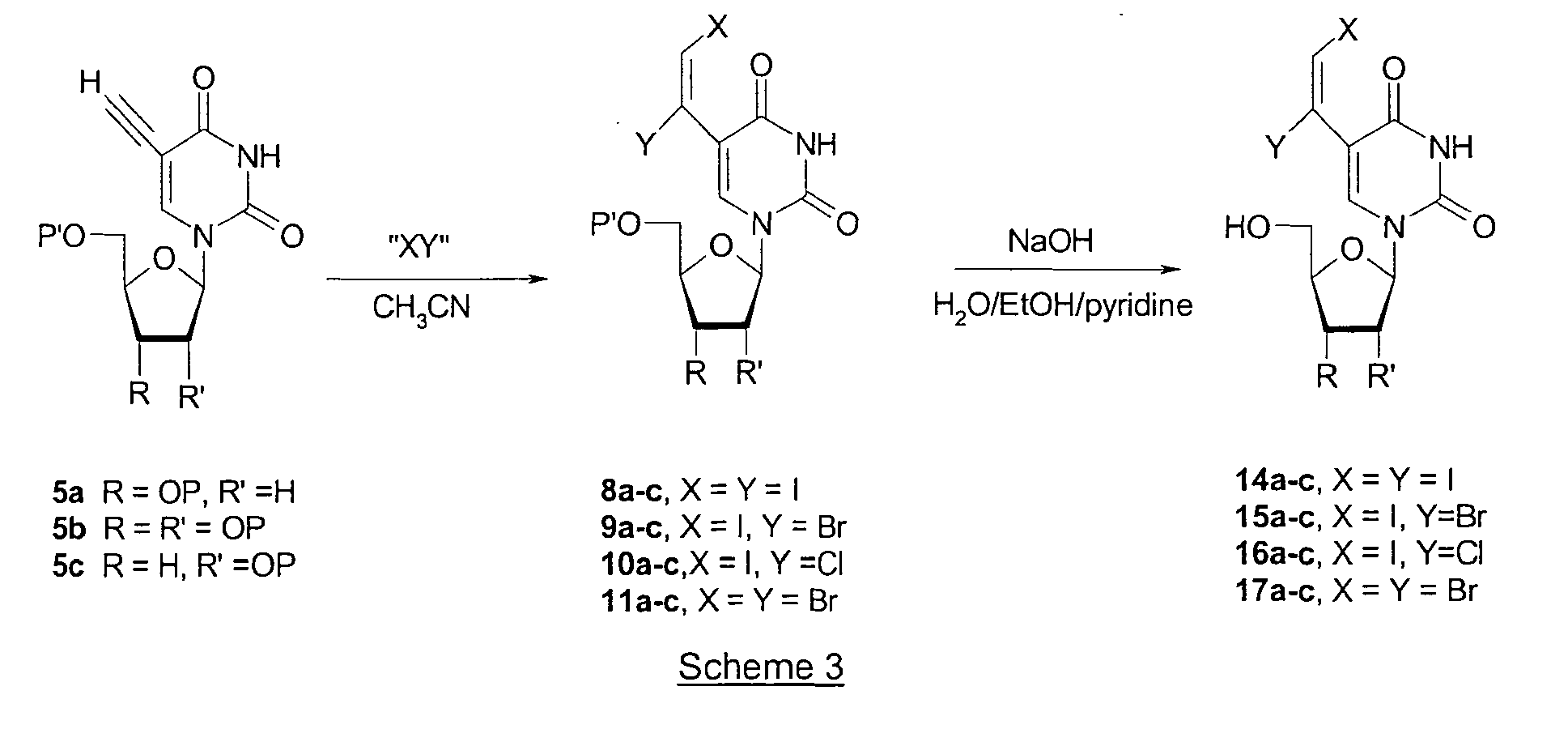
- halogenating agents such as iodonium di-syn-collidine perchlorate (IDCP), N-iodosuccinimide (NIS) or chloroiodine (ICL) for iodination, bromonium di-syn-collidine perchlorate (Br(coll) 2 ClO 4 ) for bromination, or, for chlorination, sulfuryl chloride, Cl 2 , CCl 4 , N-chlorophtalimide, dichlorine monoxide or PCl 5 , in anhydrous polar solvent, for example methane nitrile (CH 3 CN) according to reaction Scheme 2, where P and P' are as defined above for Scheme 1.
- halogenating reagents are known to act as very reactive electrophiles (such as I + and Br + , respectively).
- Compound 23 results from the deprotection of the P' protecting group of compound 20.
- P and P' each denote protective groups as defined above and advantageously P represents mesyl and P' represents monomethoxytrityl.
- Azidation of compound 18 may be carried out using conventional techniques of azidation and for example using sodium azide in polar aprotic solvent, such as for example dimethylformamide under reflux, resulting in compound 26.
- compound of formula 18 may advantageously be obtained according to the preparation process of scheme 6 below:
- P and P' are preferably different, each representing a protective group as defined above. Particularly preferred are compounds wherein P' represents monomethoxytrityl and P represents mesyl.
- P' protective group is carried out using conventional techniques, and for example, where P' represents monomethoxytrityl using para-anisylchlorodiphenylmethane in mild basic conditions, such as dry pyridine at reflux.
- protective group P is also achieved using conventional techniques, and, for example, when P represents mesyl, using methanelsulfonylchloride in mild basic conditions, such as for example dry pyridine at 0 °C.
- methanelsulfonylchloride in mild basic conditions, such as for example dry pyridine at 0 °C.
- scheme 6 the introduction of a C-5-alkynyl group is performed as stated above in scheme 1 for the preparation of compound 5.
- the above compounds are also optionally converted into pharmaceutically acceptable addition salts with an acid or a base, and optionally into their N-oxide form, using appropriate and suitable methods as known by the one skilled in the art.
- Another object of the invention is a drug or drug formulation having an antiviral activity against a Flaviviridae, in particular HCV, comprising at least one compound of formula (I) (the active ingredient) with a pharmaceutically acceptable vehicle, carrier or excipient.
- a pharmaceutically acceptable vehicle, carrier or excipient are well known to the one skilled in the art. For example, for parenteral administration, it can be a 0.9% NaCl saline solution or a phosphate buffer.
- the pharmaceutically acceptable vehicles, carriers or excipients also cover any compound or combination of compounds facilitating the administration of the active ingredient and/or improving preservation.
- the formulations include those suitable for oral, rectal, nasal, topical (including buccal or sublingual), vaginal or parenteral (including subcutaneous, intramuscular, intravenous, intradermal, intrathecal and epidural) administration. These various formulations are well known, as well as their methods of preparation. The choice of the formulation may vary depending upon the identity of the recipient, and will generally be chosen according to the best practice for a human or for the animal considered. The formulations may conveniently be presented in unit dosage form and may be prepared by any of the methods well known in the art of pharmacy.
- Formulations for oral administration may be presented as discrete units such as, for example: capsules, cachets or tablets each containing a predetermined amount of active ingredient; a powder or granules; a solution or a suspension in an aqueous liquid or a non-aqueous liquid; or an emulsion, e.g. a water-in-oil or an oil-in-water emulsion.
- the active ingredient may also be presented as a bolus, electuary or paste.
- the solid forms may optionally be coated and may be formulated so as to provide slow or controlled release of the active ingredient.
- infections of the eye or other external tissues e.g.
- the formulations are preferably presented as ointment or cream for topical application, containing an efficient amount of active ingredient.
- Formulations suitable for administration to the eye also include eye drops where the active ingredient is dissolved or suspended in a suitable carrier, such as an aqueous solvent.
- Formulations for rectal administration may be presented as a suppository with a suitable base.
- Liquid or solid carriers may be used for nasal administration.
- Pessaries, tampons, creams, gels, pastes, foams or spray formulations may be used for vaginal administration.
- Formulations for parenteral administration include aqueous and non-aqueous sterile injection solutions, suspensions or emulsions.
- the amount of active ingredient in a single dosage form will depend upon a number of factors including the identity of the recipient and the condition to be treated. In general, however, for a human, the amount of active ingredient in a single dose form will be in the range, for example, of 1 mg to 10 g, preferably in the range of 100 mg to 5 g, most preferably in the range of 500 to 2000 mg.
- the concentration of active ingredient will depend upon a number of factors including the identity of the recipient and the condition to be treated. In general, however, for a human, the concentration of active ingredient in a multiple dose form will be in the range, for example, of 0.01 to 200 mg of active ingredient per g of formulation, preferably in the range of 0.1 to 100 mg/g, most preferably in the range of 1 to 50 mg/g.
- the drug formulation according to the invention further comprises an additional compound having an antiviral activity against a Flaviviridae or that is useful in the treatment of the infection or its symptoms.
- the use according to the invention thus encompasses the use of at least two different active ingredients, at least one of them being an uridine derivative as described herein.
- this additional compound is at least one formula (I) compound.
- the invention formulation does comprise at least two formula (I) compounds or derivatives.
- the drug formulation having an antiviral activity against a Flaviviridae comprises an, additional compound which is not an uridine derivative according to the invention.
- the drug formulation may be then represented as comprising:
- the additional compound is advantageously an immunomodulator, especially an interferon (IFN) or a derivative of an interferon such as the so-called pegylated forms of interferon (pegylated interferon), such as any of those currently used in the medical field.
- IFN- ⁇ e.g. IFN- ⁇ 2b, such as pegylated IFN- ⁇ 2b Peg-Intron® (Schering Plough), IFN- ⁇ 2a, such as pegylated IFN- ⁇ 2a Pegasis® (Roche), Albuferon-a® (Human Genome Sciences), Multiferon® (Viragen);
- IFN- ⁇ e.g.
- IFN ⁇ 1a such as Rebif® IFN- ⁇ 1a (Serono); IFN- ⁇ , e.g. IFN- ⁇ 1b, such as IFN- ⁇ 1b ( from Interimmune Pharmaceuticals; IFN- ⁇ , e.g IFN- ⁇ from Biomedines.
- immunomodulators may be associated to the invention compounds, such as histamine dihydroch.loride (e.g. Ceplene®, Maxim Pharmaceuticals), Thymosine-a (SciClone Pharmaceuticals), Interleukines such as IL-12 and IL-10, therapeutical vaccines (e.g. based on the E1 protein), preparation for passive immunity transfer (e.g. Cicavir®, NABI).
- histamine dihydroch.loride e.g. Ceplene®, Maxim Pharmaceuticals
- Thymosine-a Stem Pharmaceuticals
- Interleukines such as IL-12 and IL-10
- therapeutical vaccines e.g. based on the E1 protein
- preparation for passive immunity transfer e.g. Cicavir®, NABI.
- the invention compounds may find an interest in the association to any available drug used in the treatment of the infection by a Flaviridae, especially HCV.
- the drug formulation may include in addition an active principle chosen among antisens molecules, protease inhibitors, helicase inhibitors, polymerase inhibitors, nucleoside or nucleotide analogs (chain terminators, ribonucleoside analogs, sugar modified nucleoside analogs), ribavirine or ribavirine pro-drug, inosine monophosphate dehydrogenase inhibitors.
- the invention encompasses of course combinations of at least two different additional compounds with an uridine derivative according to the invention.
- the drug or drug formulation according to the invention comprises at least two formula (I) compounds and at least one additional compound as described above, in particular an IFN or derivative thereof.
- Another object of the invention is thus a drug formulation comprising at least one formula (I) compound, at least one additional compound as described supra, in particular an IFN or derivative thereof, and a pharmaceutically acceptable vehicle, carrier or excipient, as described supra.
- Another object of the invention is a method for antiviral treatment of a recipient (a human or an animal), wherein the recipient is administered with an efficient amount of a drug or drug formulation according to the invention.
- the method includes the administration of an efficient amount of uridine derivative(s) and an efficient amount of interferon(s) (IFN).
- the uridine derivative and the IFN may be in admixture, or may be separately formulated and are either co-injected after extemporaneous mixture, or administered separately to the recipient.
- the method provides for the administration of an efficient amount of uridine derivative(s), where this administration is intended to be made in a recipient that is treated with an efficient amount of IFN(s).
- the recipient may have been treated recently with the IFN(s) (for instance less than 30 days before), or he receives IFN(s) at approximately the same time or later, for instance less than 30 days.
- the IFN is replaced or accompanied (concomitant or successive administration) by the administration of another drug such as one of those described supra. Any and all characteristics recited with respect to the use according to the invention apply to the method.
- the compounds or derivatives, and the formulations or compositions comprising them may be administered by any route appropriate to the condition to be treated. Suitable routes include oral, rectal, nasal, topical (including buccal or sublingual), vaginal or parenteral (including subcutaneous, intramuscular, intravenous, intradermal, intrathecal and epidural). It will be appreciated that the preferred route may vary with, for example, the condition of the recipient. Various suitable formulation types have been described earlier and may be used in the method or use.
- a suitable, effective dose will be in the range 0.01 to 200 mg per kilogram body weight of recipient per day, preferably in the range of 2 to 100 mg, most preferably 10 to 40 mg per kilogram body weight of recipient per day.
- the dose may if desired be presented as two, three, four or more sub-doses administered at appropriate intervals throughout the day.
- Dry tetrahydrofuran, pyridine and dichloromethane are obtained from distillation over calcium hydride (CaH 2 ) or sodium (Na), N,N -dimethylformamide and ethanol over barium oxide (BaO) or over calcium hydride (CaH 2 ).
- Triethylamine is dried over potassium hydroxide (KOH). The reactions are monitored by thin-layer chromatography (TLC) analysis using silica gel plates (Kieselgel 60 F 254 , E. Merck).
- Mass spectra are recorded on a Perkin-Elmer SCIEX API-300 (heated nebullizer) spectrometer.
- HRMS High Resolution Mass spectra
- HRMS were performed by the Centre Regional de Mesures Physiques de l'rium, University of Rennes 1 (France) using the FAB (Fast Atom Bombardment) or ESI (Electron Spray Ionization) mode.
- FAB Fluorescence Atom Bombardment
- ESI Electro Spray Ionization
- Iodinated nucleoside 4a-c (5 mmol) was dissolved in a mixture of dry dimethyl formamide (DMF; 15 mL), dry triethyl amine (Et 3 N; 2.06 mL, 3 eq.) and trimethyl silyl acetylene (2.06 mL, 3 eq.). Cuprous iodide (Cul; 190 mg, 0.2 eq.) and PdCl 2 (PPh 3 ) 2 (350 mg, 0.1 eq.) were then added and the reaction mixture was stirred at room temperature until completion (typically 5-20 h, checked by TLC). Solvents were evaporated under reduced pressure.
- Tetrabutyl ammonium fluoride (TBAF) monohydrate (583 mg, 1.05 eq.) was added and the resulting solution was stirred at room temperature until completion (typically 30 min. to 2 h, checked by TLC). Solvents were evaporated under reduced pressure at room temperature and the oily residue was submitted to a flash column chromatography (eluent: hexanes/AcOEt 1/1 then AcOEt then MeOH/AcOEt 2% then 5%) to afford pure 5-ethynyl nucleosides 5a-c, respectively.
- 5-Ethynyl nucleoside 5a-c (0.5 mmol) is dissolved in 5 mL dry CH 3 CN and the mixture is cooled in an ice bath.
- 0.7 mmol (1.4 eq.) of the halogenating reagent i.e. IDCP (iodonium di-syn-collidine perchlorate) or Br(coll) 2 ClO 4 ) and 11 mg Ag(coll) 2 ClO 4 (0.05 eq.) are added and the mixture is stirred in the dark at rt (typically 2 h-20 h, checked by TLC).
- the reaction mixture is cooled to 0°C then quenched by a saturated Na 2 S 2 O 3 solution (2 mL) and extracted with AcOEt (4 x 10 mL).
- the organic layer is washed with water (10 mL), a 1 M HCl (hydrochloric acid) solution (3 x 5 mL), water (2 x 5 mL) and brine (10 mL) then dried over MgSO 4 and concentrated in vacuo .
- the solid residue is purified by flash chromatography (eluent: hexanes/AcOEt, 1/1, v/v) to yield the desired mono-halogenated compound 6-7a-c.
- 5-ethynyl nucleoside 5a-c (0.5 mmol) is dissolved in 5 mL dry CH 3 CN and the mixture is cooled in an ice bath.
- 0.6 mmol (1.2 eq.) of a solution of the halogenating reagent (i.e. I 2 , IBr, ICI or Br 2 ) in 1 mL dry CH 3 CN is added dropwise and the mixture is stirred at 0°C until completion (typically 15 min.-2 h, checked by TLC).
- the reaction mixture is quenched at 0°C by a saturated Na 2 S 2 O 3 solution (2 mL) then extracted with AcOEt (3 x 10 mL).
- Acetylated nucleoside analogue 6-11a-c (1 mmol) is dissolved in 10 mL pyridine and 5 mL EtOH. The reaction mixture is cooled to -10°C and 5 mL of a 1M NaOH (sodium hydroxide) aqueous solution is added. The resulting solution is stirred at this temperature until completion (typically 1-4 h, checked by TLC). The reaction mixture is neutralized with Dowex then filtered through a fritted glass funnel.
- Example 38 5-(1-Bromo-2-iodovinyl)-1-(4-fluoro-5-hydroxymethyltetrahydrofuran-2-yl)-1 H -pyrimidine-2,4-dione (25b).
- Example 41 1-(4-Azido-5-hydroxymethyltetrahydrofuran-2-yl)-5-(1,2-diiodovinyl)-1 H- pyrimidine-2,4-dione (31 a)
- Example 42 1-(4-Azido-5-hydroxymethyltetrahydrofuran-2-yl)-5-(1-bromo-2-iodo-vinyl)-1 H -pyrimidine-2,4-dione (31 b)
- Huh7 cells harbouring the subgenomic HCV replicon BM4-5 (J.T. Guo et al., J. Virol. 2001, 75: 8516-8523) were used in this study.
- RNA Five micrograms of total RNA were denaturated in glyoxal buffer at 50°C for 30 minutes, separated by 1.1% agarose gel electrophoresis, and then transferred for 12 hours onto a charged nylon membrane (HybondN+, Amersham). Hybridization was carried out with three different [ 32 P]CTP-labelled riboprobes obtained by in vitro transcription (Riboprobe in vitro transcription system, Promega). Two probes were complementary to the NS5A region of the HCV genome of negative polarity and positive polarity. A third probe was complementary to the beta-actin mRNA and obtained by in vitro transcription from a specific plasmid (pTRI beta actin human, reference 7424, Ambion).
- the blot was hybridized with the riboprobes directed against the negative strand of HCV RNA and beta-actin mRNA, respectively.
- the membrane was washed, then exposed to X-ray film and a phosphor screen (phosphorimager). This screen was then scanned and quantitative analysis was achieved using ImageQuant software.
- the amount of beta-actin mRNA was used as an internal loading control to standardize the amount of HCV RNA detected.
- the same membrane was subsequently hybridized with the negative sense riboprobe to determine the level of positive strand HCV RNA, using the same approach.
- cells were seeded in 96-well plates at a density of 12,500 cells per well. They were treated by the different molecules with the same concentrations and conditions than those used for the antiviral assays. Then, cell viability was measured by neutral red assay. Neutral red specifically colors lysosomes and its accumulation depends on cellular membrane integrity. The yield of neutral red incorporated in cells is proportional to the number of living cells.
- culture medium was removed; cells were washed by PBS, then coloured with neutral red at 0.005% for 3 hours at 37°C. Cells were then fixed 1 minute by formol calcium and lysed by atreatment with a vol/vol mixture of acetic acid and ethanol. After 15 minutes incubation, absorbance was read at 490nm.
- Noncytopathic-BVDV-free MDBK cells European Collection of Animal Cell Cultures, Porton Down, U.K. were kindly provided by Dr N. Zitzmann (Oxford University). Cells were propagated in DMEM F12 (Eurobio) supplemented with 10% horse serum (Life Technologies), 1% L-glutamin (Gibco), 1% penicillin and streptomycin (Gibco). The NADL cytopathic (CP) BVDV strain was obtained from ATCC: VR-504.
- MDBK cells were seeded in microwell plates (96 wells) at a density of 1.10 5 cells per well, then infected with BVDV (strain NADL) (at a dilution inducing 100% cytopathic effect three days post inoculation, i.e. approximately 10 plaque forming units (pfu) per well at three days post infection) for one hour, at 37°C. After a wash with DMEM, infected cells were incubated for three days in the presence or absence of drug; each concentration of drug was added in 12 consecutive wells. The appearance of CPE was visually checked the third day post inoculation to evaluate the IC50 on BVDV (strain NADL), according to the different conditions of treatment.
- the IC50 is the concentration of drug that inhibits 50% of the CPE in comparison to cells inoculated but untreated presenting 100% of CPE.
Landscapes
- Health & Medical Sciences (AREA)
- Life Sciences & Earth Sciences (AREA)
- General Health & Medical Sciences (AREA)
- Public Health (AREA)
- Medicinal Chemistry (AREA)
- Pharmacology & Pharmacy (AREA)
- Chemical & Material Sciences (AREA)
- Animal Behavior & Ethology (AREA)
- Veterinary Medicine (AREA)
- Virology (AREA)
- Molecular Biology (AREA)
- Epidemiology (AREA)
- Communicable Diseases (AREA)
- Oncology (AREA)
- Chemical Kinetics & Catalysis (AREA)
- General Chemical & Material Sciences (AREA)
- Nuclear Medicine, Radiotherapy & Molecular Imaging (AREA)
- Organic Chemistry (AREA)
- Pharmaceuticals Containing Other Organic And Inorganic Compounds (AREA)
Abstract
- R1 represents monohalogenated alkynyl or dihalogenated alkenyl;
- R2 is chosen from among hydrogen, hydroxyl, -O-alkyl, -O-CO-alkyl and halogen;
- R3 is chosen from among hydrogen, hydroxyl, -O-alkyl, -O-CO-alkyl, halogen, -SH, -S-alkyl and N3; and
- R4 is chosen from among hydroxyl, -O-alkyl, -O-CO-alkyl, -O-phosphate, -O-diphosphate, -O-triphosphate and -O-phosphonate,
for the preparation of a drug having antiviral activity against a Flaviviridae.
Description
- The present invention relates to the use of uridine derivative(s) for the preparation of a drug having antiviral activity against a Flaviviridae, e.g. against hepatitis C virus (HCV). It also relates to new compounds having such antiviral activity, to drugs incorporating them and to a method of treating a subject (a human or an animal) with such a drug.
- Hepatitis C Virus (HCV) infection remains a main public health problem with 175 million people infected in the world. Currently, the best treatment available consists in the association of pegylated interferon (IFN) alpha 2b and ribavirin (1-β-D-ribofuranosyl-1,2,4-triazole-3-carboxamide). 20% of patients infected with HCV genotype 2 or 3 and 50% of patients infected with HCV genotype 1 are non responders to this treatment. Moreover IFN and ribavirin are responsible for numerous adverse effects. Therefore new treatment regimens based on more potent and specific inhibitors of HCV replication are required to improve the current antiviral strategies against chronic HCV infection.
- The absence of a cellular system able to allow a complete multiplication cycle of HCV in vitro is a limiting factor for the search of new drugs. Recently, major knowledge has been gained about the mechanism of HCV replication. Study models have been developed such as the replicon system described in Ju-Tao Guo et al. (J. Virol. 2001, 75, 18: 8516-8523), allowing replication of HCV subgenome in cell culture.
- The recent development of the replicon system has promoted the study of new inhibitors of HCV replication. The NS3 serine protease and NTPase/helicase and the RNA-dependent RNA polymerase NS5B are key enzymes for the replication of HCV. To date, several inhibitors of NS3 were discovered. The NS5B has also been studied because of its central role in viral replication (Behrens, S.E. et al. EMBO J., 1996, 15, 12; Ferrari, E. et al. J. Virol., 1999, 73, 1649; Ishii, K. et al. Hepatology 1999, 29, 1227; Lohmann, V. et al. J. Virol., 1997, 71, 8416; Oh, J.W. et al. J. Virol.,; 1999, 73, 7694; Yamashita, T. et al. J. Biol. Chem., 1998, 273, 15479; Walker, M.P.; Hong, Z., Curr. Opinion Pharmacol. 2002, 2, 1). Recently Bressanelli et al. reported a first co-crystallization of HCV NS5B with ribonucleotides, which lead to the identification of a specific and unique GTP-binding pocket outside the active site (Bressanelli, S. et al. J. Virol., 2002, 76, 3482). Specific inhibitors of this virus-encoded RNA-dependent RNA polymerase (RdRP) may represent potent antiviral agents (De Francesco, R. et al. Antiviral Res. 2003, 58, 1-16.
- The pharmaceutical importance of nucleoside analogues against viral DNA polymerases such as HIV-RT, HBV and HSV polymerases, has prompted the design and synthesis of analogous viral RNA polymerase. While numerous of non-nucleoside inhibitors of NS5B-mediated HCV RNA replication have been reported (Chan, L. et al. J. Med. Chem. 2003, 46, 1283-1285; Wang, M. et al. J. Biol. Chem. 2003, 278, 9489-9495; Dhanak, D. et al. J. Biol. Chem., 2002, 277, 38322-38327), only a few nucleoside inhibitors have been identified so far (Carroll, S. S. et al J. Biol. Chem., 2003, 278, 11979-11984; Shim, J. et al. Antiviral Res. 2003, 243-251; Eldrup, A. B. et al. J. Med. Chem., 2004, 47- 2283-2295). An example of nucleoside inhibitor is the 2'-C-methylarabinoguanosine (2'-C-methylaraG), recently reported in WO 01/190121, which is phosphorylated in cultured, uninfected cells and orally bioavailable in primates.
- Many nucleoside analogues substituted at the 5-position of the heterocycle, and especially in the 2'-deoxyuridine series (e.g. BVDU, IDU, FIAU), are known to have potent biological properties and have been developed as antiviral and anticancer agents. The 5-(2-substitutedvinyl)-2'-deoxyuridines have emerged as potent and selective inhibitors of herpes viruses (HSV-1 & HSV-2) (De Clercq, E., Exp. Clin. Pharmacol. 1980, 2, 253; De Clercq, E., Biochem. Pharmacol. 1984, 33, 2159). In general, 5-alkynyl-2'-deoxyuridines has been also evaluated as potential antiviral agents (De Clercq, E. et al Proc. Natl. Acad. Sci. U.S.A. 1979, 76, 2947; De Clercq, E.et al. J. Infect. Dis., 1980, 141, 563; Kundu, N. G.; Dasgupta, S. K., J. Chem. Soc., Perkin Trans. 1, 1993, 2657). The structure activity relationship studies seem to indicate that the type of C-5 substituents likely to confer activity are those which are electron withdrawing and conjugated to the heterocycle (Goodchild, J. et al. J. Med. Chem. 1983, 26, 1252). Recently, McGuigan et al. reported that analogous furanopyridine by-product in the preparation of the parent 5-alkynyl-2'-deoxyuridine displayed important potency and exclusive selectivity for varicella zooster virus (VZV) (McGuigan C. et al. J. Med. Chem., 1999, 42, 4479; McGuigan, C. et al. J. Med. Chem. 2000, 43, 4993; Srinivasan, S. et al. Bioorg. Med. Chem. Lett. 2001, 11, 391; McGuigan, C.et al. Drugs Future, 2000, 25, 1151; Carangio, A. et al. Antivir. Chem. Chemother. 2001, 12, 187), meanwhile imidazo[1,2-c]pyrimidin-5(6H)-one heterosubstituted nucleoside analogues were discovered by Mansour et al. (Bioorg. Med. Chem. Lett. 1997, 7, 303) to have anti-HBV (hepatitis B virus) activity. The chemistry involves the Pd-catalyzed coupling of arylacetylenes or terminal alkynes with 5-iodonucleosides.
- Providing the art with new efficient and acceptable anti-Flaviridae, in particular anti-HCV, drugs or treatments would be of great benefit.
- An objective of the invention is to provide the art with new treatments effective against a Flaviviridae infection, e.g. against HCV, say new treatments having a strong antiviral activity with no or acceptable side effects.
- Another objective of the invention is to provide a treatment that is efficient against the major HCV genotypes, including genotypes 1, 2 and 3.
- Another objective of the invention is to provide a treatment that is efficient against any HCV genotype.
- These objectives are attained by the use of some uridine derivatives that will be described in details below.
-
- R1 represents monohalogenated alkynyl or dihalogenated alkenyl;
- R2 is chosen from among hydrogen, hydroxyl, -O-alkyl, -O-CO-alkyl and halogen;
- R3 is chosen from among hydrogen, hydroxyl, -O-alkyl, -O-CO-alkyl, halogen, -SH, -S-alkyl and N3; and
- R4 is chosen from among hydroxyl, -O-alkyl, -O-CO-alkyl, -O-phosphate, -O-diphosphate, -O-triphosphate and -O-phosphonate,
- In the above formula (I):
- "monohalogenated alkynyl" is -C ≡C-X or -C ≡C-Ak(X), where Ak(X) denotes a linear or branched C1-C10 alkyl radical, one hydrogen atom of which being substituted by one halogen atom X;
- "dihalogenated alkenyl" is -C(Y)=CH(X), -C(Y)=C(X)alkyl or -C(Y)=C-Ak(X), where Y is halogen and Ak(X) denotes a linear or branched C1-C10 alkyl radical, one hydrogen atom of which being substituted by one halogen atom X;
- "alkyl", unless otherwise indicated, represents a linear or branched C1-C10 alkyl radical;
- "halogen" is fluorine, chlorine, bromine or iodine, preferably chlorine, bromine or iodine.
- The dihalogenated alkenyl may present a Z or E configuration, the E configuration being preferred, i.e. the two halogen atoms X and Y are not on the same side of the planar double bond.
-
- According to a first embodiment, a preferred uridine derivative of formula (I) useful for the preparation of a drug having antiviral activity against a Flaviviridae, presents the following characteristics:
- R1 represents -C ≡C-X or -C(Y)=CH(X);
- X and Y each independently represents halogen;
- R2 is chosen from among hydrogen, hydroxyl, -O-alkyl, -O-CO-alkyl and halogen;
- R3 is chosen from among hydrogen, hydroxyl, -O-alkyl, -O-CO-alkyl, halogen, -SH, -S-alkyl and N3; and
- R4 is chosen from among hydroxyl, -O-alkyl, -O-CO-alkyl, -O-phosphate, -O-diphosphate, -O-triphosphate and -O-phosphonate,
- Preferred compounds of formula (I) are those where
- R1 represents chloroethynyl, bromoethynyl, iodoethynyl or -C(Y)=CH(X), where Y is chosen from among chlorine, bromine and iodine, and X is bromine or iodine,
- R2, R3 and R4 being as defined above,
- Compounds where R2 and R3 do not simultaneously represent hydrogen form another subgroup of even more preferred compounds.
- Particularly preferred compounds for the intended above-mentioned use are those wherein
- R1 represents chloroethynyl, bromoethynyl, iodoethynyl or -C(Y)=CH(X), where Y is chosen from among chlorine, bromine and iodine, and X is bromine or iodine;
- R2 is chosen from among hydrogen, hydroxyl, and -O-alkyl;
- R3 is chosen from among hydrogen, hydroxyl, -O-alkyl, -SH, and -S-alkyl;
- R2 and R3 not simultaneously being each hydrogen; and
- R4 is chosen from among hydroxyl, -O-alkyl, -O-CO-alkyl, -O-phosphate,
- O-diphosphate, -O-triphosphate and -O-phosphonate, as well as their possible tautomers, their possible pharmaceutically acceptable additions salts with an acid or a base, and their N-oxide forms.
- A most preferred uridine derivative of formula (I) is chosen from among the following compounds:
- (E)-5-(1-Chloro-2-iodovinyl)-2'-deoxyuridine,
- (E)-5-(1,2-Diiodovinyl)-2'-deoxyuridine,
- 5-(2-lodoethynyl)-2'-deoxyuridine,
- (E)-5-(1-Bromo-2-iodovinyl)-2'-deoxyuridine,
- (E)-5-(1,2-Dibromovinyl)-2'-deoxyuridine,
- 5-(2-Bromoethynyl)-2'-deoxyuridine,
- (E)-5-(1-Chloro-2-iodovinyl)-uridine,
- (E)-5-(1,2-Diiodovinyl)-uridine,
- 5-(2-lodoethynyl)-uridine,
- (E)-5-(1-Bromo-2-iodovinyl)-uridine,
- (E)-5-(1,2-Dibromovinyl)-uridine, and
- 5-(2-bromoethynyl)-uridine,
- Compounds of formula (I) wherein R4 represents -O-phosphate, -O-diphosphate, -O-triphosphate and -O-phosphonate are deemed to represent pro-drugs of the corresponding compounds wherein R4 represents -OH. Other pro-drugs leading to compounds wherein R4 is -OH are also encompassed within the present invention. Such other pro-drugs include for example esters, such as aminoacid esters, e.g. alanine esters and glycine esters, quaternary salts of phosphate, and the like.
- Acids that may be used to form pharmaceutically acceptable addition salts of the compound of formula (I) are organic or inorganic acids. Such salts include for example hydrochlorides, hydrobromides, sulfates, hydrogensulfates, dihydrogene-phosphates, citrates, maleates, fumarates, trifluoroacetates, 2-naphthalenesulfonate and para-toluenesulfonate.
- Similarly, bases that may be used to form pharmaceutically acceptable addition salts of the compound of formula (I) are organic or inorganic bases. Such salts include for example metallic salts from alkali metals, alkaline-earth metals or transition metals, such as sodium, potassium, calcium, magnesium, aluminum. Other suitable bases include ammoniac or secondary or tertiary amines (diethylamine, triethylamine, piperidine, piperazine, morpholine) or basic amino-acids, or alternatively osamines (such as meglumine), or aminoalcohols (such as 3-aminobutanol and 2-aminoéthanol).
- The present invention also encompasses salts that are useful for suitable separation or crystallization of the compounds of formula (I), such as salts obtained from chiral amines or acids.
- Example of chiral amines include for example quinine, brucine, (S)-1-(benzyloxymethyl)propylamine, (-)-ephedrine, (4S,5R)-(+)-1,2,2,3,4-tetramethyl-5-phenyl-1,3-oxazolidine, (R)-1-phenyl-2-p-tolylethylamine, (S)-phenylglycinol, (-)-N-methylephedrine, (+)-(2S,3R)-4-dimethylamino-3-methyl-1,2-diphenyl-2-butanol, (S)-phenylglycinol, (S)-α-methylbenzylamine, alone or in mixtures.
- Example of chiral acids include for example (+)-d-di-O-benzoyltartaric acid, (-)-I-di-O-benzoyltartaric acid, (-)-di-O,O'-p-toluyl-I-tartaric acid, (+)-di-O,O'-p-toluyl-d-tartaric acid, (R)-(+)-malic acid, (S)-(-)-malic acid, (+)-camphanic acid, (-)-camphanic acid, (+)-camphoric acid, (-)-camphoric acid, (S)-(+)-2-phenylpropionic acid, (R)-(-)-2-phenylpropionic acid, d-(-)-mandelic acid, I-(+)-mandelic acid, d-tartaric acid, I-tartaric acid, alone or mixtures.
- In an embodiment, the invention more specifically relates to the use of such an uridine derivative and an efficient amount of an interferon (IFN), for the preparation of a drug having antiviral activity against a Flaviviridae. It also relates to the use of such an uridine derivative for the preparation of a drug having antiviral activity against a Flaviviridae, that is intended to be used in a recipient that is treated with an efficient amount of IFN. The recipient may have been treated recently with the IFN (for instance less than 30 days before), or he receives IFN at approximately the same time or later, for instance less than 30 days. The IFN may be chosen among those that are described infra.
- In another embodiment, the IFN is replaced or accompanied (concomitant or successive administration) by the use of another drug such as one of those described infra.
- According to a preferred aspect, the Flaviridae is HCV and the use of a uridine derivative of formula (I) is for the preparation of a drug having antiviral activity against HCV. There exists up to 6 HCV genotypes classified 1-6. Any of them is included in the present invention. The major genotypes are genotypes 1, 2 and 3, and a "use" according to the invention may be, for example, directed against HCV genotype 1, HCV genotype 2, HCV genotype 3, HCV genotypes 1 and 2, HCV genotypes 2 and 3, HCV genotypes 1 and 3, HCV genotypes 1, 2 and 3. The use may also be against any and all HCV genotypes, including quasispecies.
- In another aspect of the invention, the Flaviviridae member may be a member of the Japanese encephalitis virus group, including Japanese encephalitis virus and West Nile Virus.
- Alternatively it may be a member of the Yellow fever virus group.
- Alternatively it may be a member of the Pestivirus group, such as Bovine viral diarrhea virus (BVDV-1 and/or BVDV-2), Classical swine fever virus, Border disease virus.
- It may be appreciated that the recipient may be a human or an animal, depending on the Flaviviridae concerned.
- Among the compounds of formula (I), 5-bromoethynyl-2'-deoxyuridine is known and reported by Eger K. et al. (Tetrahedron, 1994, 50, 8371-8380), whereas compounds of formula (I), wherein R1 represents dihalogenated alkenyl are new.
-
- R'1 represents dihalogenated alkenyl;
- R'2, R'3 and R'4 have the same definitions as R2, R3 and R4, respectively, in the above formula (I);
- In the above formula (I'), "dihalogenated alkenyl" has the same meaning as defined above, i.e. -C(Y)=CH(X), -C(Y)=C(X)alkyl or -C(Y)=C-Ak(X), where Y is halogen and Ak(X) denotes a linear or branched C1-C10 alkyl radical, one hydrogen atom of which being substituted by one halogen atom X;
- All definitions and preferred embodiments described hereinbefore for compounds of formula (I) also apply to compounds of formula (I'), R'1 not possibly representing however a monohalogenated alkynyl radical.
- Accordingly, a preferred compound of formula (I') presents the following characteristics:
- R'1 represents -C(Y)=CH(X);
- X and Y each independently represents halogen;
- R'2 is chosen from among hydrogen, hydroxyl, -O-alkyl, -O-CO-alkyl and halogen;
- R'3 is chosen from among hydrogen, hydroxyl, -O-alkyl, -O-CO-alkyl, halogen, -SH, -S-alkyl and N3; and
- R'4 is chosen from among hydroxyl, -O-alkyl, -O-CO-alkyl, -O-phosphate, -O-diphosphate, -O-triphosphate and -O-phosphonate,
- Preferred compounds of formula (I') are those where:
- R'1 represents -C(Y)=CH(X), where Y is chosen from among chlorine, bromine and iodine, and X is bromine or iodine.
- R'2, R'3 and R'4 being as defined above,
- Particularly preferred compounds for the intended above-mentioned use are those wherein
- R'1 represents -C(Y)=CH(X), where Y is chosen from among chlorine, bromine and iodine, and X is bromine or iodine.
- R'2 is chosen from among hydrogen, hydroxyl, and -O-alkyl;
- R'3 is chosen from among hydrogen, hydroxyl, -O-alkyl, -SH, and -S-alkyl; and
- R'2 and R'3 not simultaneously being each hydrogen; and
- R'4 is chosen from among hydroxyl, -O-alkyl, -O-CO-alkyl, -O-phosphate, -O-diphosphate, -O-triphosphate and -O-phosphonate,
- The present invention is further related to the process for the preparation of compounds of formula (I) and formula (I').
- Halogenated pyrimidine 4a-c in Scheme 1 below are prepared by direct reaction with halogens following the procedure reported by Asakura et al. (J. Org. Chem., 1990, 55, 4928-4933) via a cerium(IV)-mediated halogenation at the C-5 of uracil derivatives. Thus, treatment of the known acetylated nucleosides 3a-c according to a process well known by the one skilled in the art, with elemental iodine and ceric ammonium nitrate (CAN) at 80°C, gives the corresponding protected 5-iodouracil nucleosides 4a-c in excellent yields. This CAN-mediated halogenation has advantages over other available methods as mild reaction conditions are employed with short reaction times.
- In the above scheme 1, P and P', which may be identical or different, stand for protective groups of hydroxyl groups, and are well-known to the person skilled in the art.
Preferably, protective groups P and P' are chosen from among acyl groups such as CH3C=O, trityl, monomethoxytrityl, mesyl, and the like.
In scheme 1 above, protective groups P and P' each preferably an acyl group, specifically CH3C=O. - The introduction of a C-5-alkynyl group is performed by a Pd(0)-mediated reaction, using the Sonogashira conditions (Sonogashira K., Comprehensive Organic Synthesis, Trost/Fleming (Eds), Pergamon Press, New York, 1991, vol 3, p. 521;. Sonogashira K. et al.; Tetrahedron Lett., 1975, 16, 4467; Takahashi S. et al., Synthesis, 1980, 627; Ratovelomana V. et al., Synth. Commun., 1981, 11, 917). Thus, reaction of the resulting pure acetylated 5-iodouracil 4a-c with trimethylsilylacetylene in the presence of triethylamine (Et3N, base), cuprous iodide (Cul, co-catalyst) and PdCl2(PPh3)2 (catalyst) in anhydrous dimethyl formamide (DMF) at room temperature, followed by a removal of the trimethylsilyl (TMS) group with TBAF (tetrabutyl ammonium fluoride) affords the corresponding 5-ethynyluracil nucleosides 5a-c. In most cases, it is observed that slight elevations in the reaction temperature lead to increase in the rate of coupling. In all cases, a by-product, furanopyrimidine derivatives, is either isolated with a < 7% yield, or just detected by TLC; nevertheless, the using of DMF reduces the amount of this cyclic by-product; this base-catalyzed cyclization was previously reported by Bleackley et al. (Tetrahedron, 1976, 32, 2795) by base treatment of (E)-5-(2-bromovinyl)uracil.
- The halogenation of alkynes 5a-c is realized using halogenating agents (such as iodonium di-syn-collidine perchlorate (IDCP), N-iodosuccinimide (NIS) or chloroiodine (ICL) for iodination, bromonium di-syn-collidine perchlorate (Br(coll)2ClO4) for bromination, or, for chlorination, sulfuryl chloride, Cl2, CCl4, N-chlorophtalimide, dichlorine monoxide or PCl5, in anhydrous polar solvent, for example methane nitrile (CH3CN) according to reaction Scheme 2, where P and P' are as defined above for Scheme 1. These halogenating reagents are known to act as very reactive electrophiles (such as I+ and Br+, respectively).
- The final deprotection of protected nucleosides 6a-c and 7a-c is realized under smooth basic conditions (for example 1M sodium hydroxide in a mixture of H2O/EtOH/pyridine when P = P' = Ac) to afford final 5-haloethynyluracil nucleosides 12a-c and 13a-c, respectively, in good to moderate yield.
- Dihalogenation of the above 5-ethynyl nucleosides (Scheme 3) leads to hitherto unknown 5-(1,2-dihalogenated)ethenyluracil nucleosides 14a-c to 17a-c. Several halogenating reagents (i.e. I2, IBr, ICI or Br2) are used to reach the corresponding 1,2-dihaloderivatives. In all cases of halo-iodination, the formation of vicinal halo-iodoalkenes (8a-c to 10a-c) occurs with high anti-stereospecificity, implicating the intermediary of an iodonium ion in the reaction sequence, and a high and unique regioselectivity, implicating a predominantly Markovnikov addition. The formation of 11a-c using Br2 occurs also with a E-stereochemistry.
- The final deprotection of protected nucleosides 8a-c to 11a-c is realized as previously reported (for example 1M NaOH in a mixture of H2O/EtOH/pyridine when P=P'=Ac) and final 5-(1,2-dihaloethenyl)uracil nucleosides 14a-c (for X = Y = I), 15a-c (for X = I, Y = Br), 16a-c (for X = I, Y = Cl), 17a-c (for X = Y = Br) are obtained, respectively.
- All other compounds encompassed by formulae (I) and (I') are easily prepared from the above described synthetic route with easily conceivable modifications and/or adaptations well known by the one skilled in the art.
For illustrative purposes only, compounds of formula (I) or of formula (I') may be obtained according to scheme 4 below, wherein P preferably represents mesyl and P' preferably represents monomethoxytrityl. - In scheme 4 above, compound 19 is obtained after specific deprotection, in mild basic conditions, the free resulting hydroxyl group being substituted by methods well known in the art, for example using diethylaminosulfur trifluoride, affording compound 21.
- Compounds 21 and 22 are obtained from compound 20 under conditions similar as those described above for the preparation of compounds 12 and 13.
- Compound 23 results from the deprotection of the P' protecting group of compound 20.
- Compounds 24a-c and 25a-c are respectively obtained using a similar process as the one disclosed above for the preparation of compounds 8-11a-c and 14-17a-c.
As further illustrative purpose only, compounds of formula (I) and of formula (I') wherein R3 (and R13 respectively) represents N3 may be obtained according the following scheme 5. - In the above scheme 5, P and P' each denote protective groups as defined above and advantageously P represents mesyl and P' represents monomethoxytrityl.
- Azidation of compound 18 may be carried out using conventional techniques of azidation and for example using sodium azide in polar aprotic solvent, such as for example dimethylformamide under reflux, resulting in compound 26.
- Compounds 27-31 are obtained through similar methods as those disclosed above for the preparation of compounds 21-25 respectively.
- Compound 18 in scheme 4 and scheme 5 above may be obtained according to a process similar to the process for the preparation of compound 5 in the above scheme 1.
-
- In scheme 6 above, P and P' are preferably different, each representing a protective group as defined above. Particularly preferred are compounds wherein P' represents monomethoxytrityl and P represents mesyl.
- The introduction of the P' protective group is carried out using conventional techniques, and for example, where P' represents monomethoxytrityl using para-anisylchlorodiphenylmethane in mild basic conditions, such as dry pyridine at reflux.
- The selective introduction of protective group P is also achieved using conventional techniques, and, for example, when P represents mesyl, using methanelsulfonylchloride in mild basic conditions, such as for example dry pyridine at 0 °C.
In scheme 6 above, the introduction of a C-5-alkynyl group is performed as stated above in scheme 1 for the preparation of compound 5. - Compounds 14-31 a-c are purified, when necessary, using conventional methods known in the art.
- Compounds of formulae (I) and (I') may be obtained in pure enantiomeric form and/or isomeric form, or in mixture, in all proportions, of enantiomers and/or isomers. Separations of such enantiomers and/or isomers is run according to techniques well known in the art.
- The above compounds are also optionally converted into pharmaceutically acceptable addition salts with an acid or a base, and optionally into their N-oxide form, using appropriate and suitable methods as known by the one skilled in the art.
- All starting materials are known and either commercially available or prepared, directly or with slight variations easily conceivable by the one skilled in the art, from one or more processes disclosed in the scientific literature, patents and patent applications, the "Chemical Abstracts", on-line data bases and the Internet.
- Another object of the invention is a drug or drug formulation having an antiviral activity against a Flaviviridae, in particular HCV, comprising at least one compound of formula (I) (the active ingredient) with a pharmaceutically acceptable vehicle, carrier or excipient. "Acceptable" means that this further ingredient is compatible with the active ingredient included in the formulation and is not deleterious to the recipient thereof. The pharmaceutically acceptable vehicle, carrier or excipient are well known to the one skilled in the art. For example, for parenteral administration, it can be a 0.9% NaCl saline solution or a phosphate buffer. The pharmaceutically acceptable vehicles, carriers or excipients also cover any compound or combination of compounds facilitating the administration of the active ingredient and/or improving preservation.
- It is noted that in this disclosure and particularly in the claims, terms such as "comprises", "comprised", "comprising" and the like can have the meaning attributed to it in U.S. Patent law; e.g., they can mean "includes", "included", "including", and the like.
- The formulations include those suitable for oral, rectal, nasal, topical (including buccal or sublingual), vaginal or parenteral (including subcutaneous, intramuscular, intravenous, intradermal, intrathecal and epidural) administration. These various formulations are well known, as well as their methods of preparation. The choice of the formulation may vary depending upon the identity of the recipient, and will generally be chosen according to the best practice for a human or for the animal considered. The formulations may conveniently be presented in unit dosage form and may be prepared by any of the methods well known in the art of pharmacy. Formulations for oral administration may be presented as discrete units such as, for example: capsules, cachets or tablets each containing a predetermined amount of active ingredient; a powder or granules; a solution or a suspension in an aqueous liquid or a non-aqueous liquid; or an emulsion, e.g. a water-in-oil or an oil-in-water emulsion. The active ingredient may also be presented as a bolus, electuary or paste. The solid forms may optionally be coated and may be formulated so as to provide slow or controlled release of the active ingredient. For infections of the eye or other external tissues (e.g. skin or mouth), the formulations are preferably presented as ointment or cream for topical application, containing an efficient amount of active ingredient. Formulations suitable for administration to the eye also include eye drops where the active ingredient is dissolved or suspended in a suitable carrier, such as an aqueous solvent. Formulations for rectal administration may be presented as a suppository with a suitable base. Liquid or solid carriers may be used for nasal administration. Pessaries, tampons, creams, gels, pastes, foams or spray formulations may be used for vaginal administration. Formulations for parenteral administration include aqueous and non-aqueous sterile injection solutions, suspensions or emulsions.
- The amount of active ingredient in a single dosage form will depend upon a number of factors including the identity of the recipient and the condition to be treated. In general, however, for a human, the amount of active ingredient in a single dose form will be in the range, for example, of 1 mg to 10 g, preferably in the range of 100 mg to 5 g, most preferably in the range of 500 to 2000 mg.
- For multiple dosage form, for example a cream or ointment, the concentration of active ingredient will depend upon a number of factors including the identity of the recipient and the condition to be treated. In general, however, for a human, the concentration of active ingredient in a multiple dose form will be in the range, for example, of 0.01 to 200 mg of active ingredient per g of formulation, preferably in the range of 0.1 to 100 mg/g, most preferably in the range of 1 to 50 mg/g.
- In one embodiment, the drug formulation according to the invention further comprises an additional compound having an antiviral activity against a Flaviviridae or that is useful in the treatment of the infection or its symptoms. The use according to the invention thus encompasses the use of at least two different active ingredients, at least one of them being an uridine derivative as described herein.
- In a first aspect, this additional compound is at least one formula (I) compound. Thus the invention formulation does comprise at least two formula (I) compounds or derivatives.
- In a second aspect, the drug formulation having an antiviral activity against a Flaviviridae comprises an, additional compound which is not an uridine derivative according to the invention. The drug formulation may be then represented as comprising:
- (1) an uridine derivative of formula (I):
wherein- R1 represents monohalogenated alkynyl or dihalogenated alkenyl;
- R2 is chosen from among hydrogen, hydroxyl, -O-alkyl, -O-CO-alkyl and halogen;
- R3 is chosen from among hydrogen, hydroxyl, -O-alkyl, -O-CO-alkyl, halogen, -SH, -S-alkyl and N3; and
- R4 is chosen from among hydroxyl, -O-alkyl, -O-CO-alkyl, -O-phosphate, -O-diphosphate, -O-triphosphate and -O-phosphonate,
- (2) an immunomodulator or another active ingredient having an antiviral activity against a Flaviviridae or being useful in treating the infection by a Flaviridae, and
- (3) a pharmaceutically acceptable vehicle, carrier or excipient.
- The additional compound is advantageously an immunomodulator, especially an interferon (IFN) or a derivative of an interferon such as the so-called pegylated forms of interferon (pegylated interferon), such as any of those currently used in the medical field. It may be in particular IFN-α, e.g. IFN-α 2b, such as pegylated IFN-α 2b Peg-Intron® (Schering Plough), IFN-α 2a, such as pegylated IFN-α 2a Pegasis® (Roche), Albuferon-a® (Human Genome Sciences), Multiferon® (Viragen); IFN-β, e.g. IFN β 1a, such as Rebif® IFN-β1a (Serono); IFN-γ, e.g. IFN-γ 1b, such as IFN-γ 1b (from Interimmune Pharmaceuticals; IFN-ω, e.g IFN-ω from Biomedines.
- Other immunomodulators may be associated to the invention compounds, such as histamine dihydroch.loride (e.g. Ceplene®, Maxim Pharmaceuticals), Thymosine-a (SciClone Pharmaceuticals), Interleukines such as IL-12 and IL-10, therapeutical vaccines (e.g. based on the E1 protein), preparation for passive immunity transfer (e.g. Cicavir®, NABI).
- More generally, the invention compounds may find an interest in the association to any available drug used in the treatment of the infection by a Flaviridae, especially HCV. Thus, the drug formulation may include in addition an active principle chosen among antisens molecules, protease inhibitors, helicase inhibitors, polymerase inhibitors, nucleoside or nucleotide analogs (chain terminators, ribonucleoside analogs, sugar modified nucleoside analogs), ribavirine or ribavirine pro-drug, inosine monophosphate dehydrogenase inhibitors.
- The invention encompasses of course combinations of at least two different additional compounds with an uridine derivative according to the invention.
- In a third aspect, the drug or drug formulation according to the invention comprises at least two formula (I) compounds and at least one additional compound as described above, in particular an IFN or derivative thereof.
- Another object of the invention is thus a drug formulation comprising at least one formula (I) compound, at least one additional compound as described supra, in particular an IFN or derivative thereof, and a pharmaceutically acceptable vehicle, carrier or excipient, as described supra.
- Another object of the invention is a method for antiviral treatment of a recipient (a human or an animal), wherein the recipient is administered with an efficient amount of a drug or drug formulation according to the invention.
- In an embodiment, the method includes the administration of an efficient amount of uridine derivative(s) and an efficient amount of interferon(s) (IFN). The uridine derivative and the IFN may be in admixture, or may be separately formulated and are either co-injected after extemporaneous mixture, or administered separately to the recipient. As an alternative, the method provides for the administration of an efficient amount of uridine derivative(s), where this administration is intended to be made in a recipient that is treated with an efficient amount of IFN(s). The recipient may have been treated recently with the IFN(s) (for instance less than 30 days before), or he receives IFN(s) at approximately the same time or later, for instance less than 30 days. In another embodiment, the IFN is replaced or accompanied (concomitant or successive administration) by the administration of another drug such as one of those described supra. Any and all characteristics recited with respect to the use according to the invention apply to the method.
- As mentioned above, the compounds or derivatives, and the formulations or compositions comprising them may be administered by any route appropriate to the condition to be treated. Suitable routes include oral, rectal, nasal, topical (including buccal or sublingual), vaginal or parenteral (including subcutaneous, intramuscular, intravenous, intradermal, intrathecal and epidural). It will be appreciated that the preferred route may vary with, for example, the condition of the recipient. Various suitable formulation types have been described earlier and may be used in the method or use.
- For each of the above-indicated infectious events or indications the amount required of the active ingredient will depend upon a number of factors including the severity of the condition to be treated and the identity of the recipient and will ultimately be at the discretion of the attendant physician. In general, however, for each of these indications, a suitable, effective dose will be in the range 0.01 to 200 mg per kilogram body weight of recipient per day, preferably in the range of 2 to 100 mg, most preferably 10 to 40 mg per kilogram body weight of recipient per day. The dose may if desired be presented as two, three, four or more sub-doses administered at appropriate intervals throughout the day.
- The invention is described further in details with the following description of non-limitative examples.
- Commercially available chemicals and solvents are reagent grade and used as received. Dry tetrahydrofuran, pyridine and dichloromethane are obtained from distillation over calcium hydride (CaH2) or sodium (Na), N,N-dimethylformamide and ethanol over barium oxide (BaO) or over calcium hydride (CaH2). Triethylamine is dried over potassium hydroxide (KOH). The reactions are monitored by thin-layer chromatography (TLC) analysis using silica gel plates (Kieselgel 60 F254, E. Merck). Compounds are visualized by UV irradiation and/or spraying with 20% sulphuric acid (H2SO4) in ethanol (EtOH), followed by charring at 150 °C. Column chromatography is performed on Silica Gel 60 M (0.040-0.063 mm, E. Merck). Melting points (mp) are recorded on a Büchi (Dr. Tottoli) and are uncorrected. 1H and 13C NMR spectra are recorded on a Bruker AVANCE DPX 250 Fourier Transform spectrometer at 250 MHz for 1H and 62.9 MHz for 13C respectively, in (D)-chloroform, (D4)-methanol and (D6)-DMSO, shift values in ppm relative to SiMe4 as internal reference, unless otherwise stated ; signals are reported as s (singlet), d (doublet), t (triplet), q (quartet), m (multiplet), J in Hz. [α]D were performed with a Perkin-Elmer (model 41) polarimeter. UV spectra were recorded on a Beckman DU-640 spectrophotometer. Mass spectra are recorded on a Perkin-Elmer SCIEX API-300 (heated nebullizer) spectrometer. High Resolution Mass spectra (HRMS) were performed by the Centre Regional de Mesures Physiques de l'Ouest, University of Rennes 1 (France) using the FAB (Fast Atom Bombardment) or ESI (Electron Spray Ionization) mode. The nomenclature of the obtained compounds is in accordance with the IUPAC rules. The numbering and assignment of the chemical shifts for all described compounds are related to the corresponding ribose derivatives.
- A solution of acetylated nucleoside 3a-c (synthetic route described by L. B. Townsend and R. S. Tipson in "Nucleic acid chemistry", Wiley Eds., 1978) (15 mmol) in dry methane nitrile (CH3CN, 150 mL), ceric ammonium nitrate (CAN, 4.94 g, 0.6 eq.) and iodine (I2, 2.28 g; 0.6 eq.) is refluxed until completion (typically 1 h, checked by TLC). After cooling to room temperature (rt), solvents are evaporated under reduced pressure and the dark oily residue is dissolved in ethyl acetate (AcOEt, 300 mL) and water (H2O, 50 mL). The biphasic mixture is cooled in an ice bath and a saturated Na2S2O3 solution is smoothly added until complete decolouration. The organic layer is washed with water (2 x 50 mL) and brine (50 mL), dried over magnesium sulfate (MgSO4) and concentrated under reduced pressure. The white foam is triturated with pentane (50 mL), filtrated and dried under reduced pressure to afford pure iodinated compounds 4a-c, respectively.
- Iodinated nucleoside 4a-c (5 mmol) was dissolved in a mixture of dry dimethyl formamide (DMF; 15 mL), dry triethyl amine (Et3N; 2.06 mL, 3 eq.) and trimethyl silyl acetylene (2.06 mL, 3 eq.). Cuprous iodide (Cul; 190 mg, 0.2 eq.) and PdCl2(PPh3)2 (350 mg, 0.1 eq.) were then added and the reaction mixture was stirred at room temperature until completion (typically 5-20 h, checked by TLC). Solvents were evaporated under reduced pressure. The oily residue was dissolved in AcOEt (250 mL) then washed with water (5 x 40 mL) and brine (40 mL). The organic layer was dried over MgSO4 and the solvents were evaporated under reduced pressure to a dark oil. A first purification using a short path flash chromatography (eluent: methylene chloride (CH2Cl2) then MeOH/CH2Cl2 5 %) afforded the desired compound contaminated with coloured reaction co-products. Pure silylated alkynes (2 mmol), obtained after a second flash chromatography (eluent: hexanes/AcOEt 7/3 then 1/1), were dissolved in dry CH3CN (20 mL). Tetrabutyl ammonium fluoride (TBAF) monohydrate (583 mg, 1.05 eq.) was added and the resulting solution was stirred at room temperature until completion (typically 30 min. to 2 h, checked by TLC). Solvents were evaporated under reduced pressure at room temperature and the oily residue was submitted to a flash column chromatography (eluent: hexanes/AcOEt 1/1 then AcOEt then MeOH/AcOEt 2% then 5%) to afford pure 5-ethynyl nucleosides 5a-c, respectively.
- 5-Ethynyl nucleoside 5a-c (0.5 mmol) is dissolved in 5 mL dry CH3CN and the mixture is cooled in an ice bath. 0.7 mmol (1.4 eq.) of the halogenating reagent (i.e. IDCP (iodonium di-syn-collidine perchlorate) or Br(coll)2ClO4) and 11 mg Ag(coll)2ClO4 (0.05 eq.) are added and the mixture is stirred in the dark at rt (typically 2 h-20 h, checked by TLC). The reaction mixture is cooled to 0°C then quenched by a saturated Na2S2O3 solution (2 mL) and extracted with AcOEt (4 x 10 mL). The organic layer is washed with water (10 mL), a 1 M HCl (hydrochloric acid) solution (3 x 5 mL), water (2 x 5 mL) and brine (10 mL) then dried over MgSO4 and concentrated in vacuo. The solid residue is purified by flash chromatography (eluent: hexanes/AcOEt, 1/1, v/v) to yield the desired mono-halogenated compound 6-7a-c.
- The title compound is obtained according to the above described general procedures from 3',5'-Di-O-acetyl-2'-deoxy-5-iodouridine (4a) (see Asakura, J. et al., J. Org. Chem., 1990, 55, 4928-4933; and Asakura, J. et al., Tetrahedron Lett., 1988, 29, 2855-2858) or from 3',5'-di-O-acetyl-2'-deoxy-5-ethynyluridine (5a) (see US 5,028,596).
Yield: 93%.
mp: 175-177 (dec) °C
[α]D 20-32 (c 0.5, CHCl3)
1H NMR (CDCl3) δ 11.68 (br s, 1H, NH), 8.02 (s, 1H, H-6), 6.12 (t, J = 7.1 Hz, 1H, H-1'), 5.20 (m, 1H, H-3'), 4.33-4.15 (m, 3H, H-4',5'), 2.55 (m, 1H, H-2'a), 2.31 (m, 1H, H-2'b), 2.07 (s, 3H, OAc), 2.05 (s, 3H, OAc).
HRMS m/z 486.1982 calculated for C15H15IN2O7Na, found m/z 486.1986. - According to a procedure similar to that of Example 1, the title compound is obtained as an oil.
Yield: 21%
[α]D 20 -68 (c 1.0, CHCl3)
1H NMR (CDCl3) δ 8.88 (br s, 1H, NH), 7.95 (s, 1H, H-6), 6.31 (dd, J = 7.3, 6.4 Hz, 1H, H-1'), 5.25 (m, 1H, H-3'), 4.38-4.30 (m, 3H, H-4',5'), 2.55 (m, 1H, H-2'a), 2.31 (m, 1H, H-2'b), 2.18 (s, 3H, OAc), 2.12 (s, 3H, OAc).
HRMS m/z 439.1978 calculated for C15H15BrN2O7Na, found m/z 439.1981. - Examples 3 to 6 below are obtained according to similar processes.
- Yield: 68%
mp: 100-102 °C
[α]D 20-71 (c 1.0, CHCl3)
1H NMR (CDCl3) δ 9.41 (br s, 1H, NH), 7.91 (s, 1H, H-6), 6.07 (d, J = 4.6 Hz, 1H, H-1'), 5.35 (m, 2H, H-2',3'), 4.38 (m, 3H, H-4',5'), 2.25 (s, 3H, OAc), 2.12 (s, 2 x 3H, 2 x OAc).
HRMS m/z 544.2352 calculated for C17H17IN2O9Na, found m/z 544.2349. - Yield: 58% as a colorless oil
[α]D 20 -59 (c 0.4, CHCl3)
1H NMR (CDCl3) δ 9.75 (br s, 1H, NH), 7.92 (s, 1H, H-6), 6.07 (d, J = 4.4 Hz, 1H, H-1'), 5.35 (m, 2H, H-2',3'), 4.37 (m, 3H, H-4',5'), 2.22 (s, 3H, OAc), 2.12 (s, 2 x 3H, 2 x OAc).
HRMS m/z 497.2348 calculated for C17H17BrN2O9Na, found m/z 497.2351. -
- Step a): 2',5'-Di-O-acetyl-3'-deoxy-5-iodouridine (4c)
1H NMR (CDCl3) δ 9.53 (br s, 1H, NH), 7.93 (s, 1H, H-6), 5.82 (d, J = 1.6 Hz, 1H, H-1'), 5.30 (m, 1H, H-2'), 4.55 (m, 1H, H-4'), 4.41 (dd, J = 12.8, 2.8 Hz, 1H, H-5'a), 4.33 (dd, J = 12.8, 3.8 Hz, 1H, H-5'b), 2.31-1.95 (m, 2H, H-3'), 2.23 (s, 3H, OAc), 2.13 (s, 3H, OAc). - Step b): 2',5'-Di-O-acetyl-3'-deoxy-5-ethynyluridine (5c)
1H NMR (CDCl3) δ 9.8 (br s, 1H, NH), 7.88 (s, 1 H, H-6), 5.78 (s, 1 H, H-1'), 5.31 (d, J = 7.5 Hz, 1H, H-2'), 4.48 (m, 1H, H-4'), 4.35 (dd, J = 12.5, 1.8 Hz, 1H, H-5'a), 4.25 (dd, J = 12.5, 3.4 Hz, 1 H, H-5'b), 3.1 (s, 1 H, H-Csp), 2.31-1.95 (m, 2H, H-3'), 2.12 (s, 3H, OAc), 2.05 (s, 3H, OAc)
HRMS m/z 360.2968 calculated for C15H16N2O7Na, found m/z 360.2971. - Step c): 2',5'-Di-O-acetyl-5-(2-iodoethynyl)-3'-deoxyuridine (6c)
Yield: 76% as an oil
[α]D 20-49 (c 0.8, CHCl3)
1H NMR (CDCl3) δ 11.68 (br s, 1H, NH), 7.98 (s, 1H, H-6), 5.74 (s, 1H, H-1'), 5.30 (d, J = 7.5 Hz, 1H, H-2'), 4.43 (m, 1H, H-4'), 4.28 (br s, 2H, H-5'), 2.31-1.95 (m, 2H, H-3'), 2.09 (s, 3H, OAc), 2.05 (s, 3H, OAc).
HRMS m/z 486.1982 calculated for C15H15IN2O7Na, found m/z 486.1986. - Yield: 25% as an oil
[α]D 20 -52 (c 0.4, CHCl3)
1H NMR (DMSO-d 6 ) δ 11.75 (br s, 1H, NH), 8.07 (s, 1H, H-6), 5.85 (s, 1H, H-1'), 5.31 (d, J = 7.5 Hz, 1H, H-2'), 4.43 (m, 1H, H-4'), 4.28 (br s, 2H, H-5'), 2.31-1.95 (m, 2H, H-3'), 2.08 (s, 3H, OAc), 2.06 (s, 3H, OAc).
HRMS m/z 439.1978 calculated for C15H15BrN2O7Na, found m/z 439.1975. - 5-ethynyl nucleoside 5a-c (0.5 mmol) is dissolved in 5 mL dry CH3CN and the mixture is cooled in an ice bath. 0.6 mmol (1.2 eq.) of a solution of the halogenating reagent (i.e. I2, IBr, ICI or Br2) in 1 mL dry CH3CN is added dropwise and the mixture is stirred at 0°C until completion (typically 15 min.-2 h, checked by TLC). The reaction mixture is quenched at 0°C by a saturated Na2S2O3 solution (2 mL) then extracted with AcOEt (3 x 10 mL). The organic layer is washed with water (2 x 5 mL) and brine (10 mL) then dried over MgSO4 and concentrated in vacuo to yield the desired di-halogenated compounds of examples 7-18 (8-11a-c) in a reasonably pure form. Pure analytical samples were obtained using flash chromatography (eluent: hexanes/AcOEt, 1/1, v/v).
- 94% yield; mp 76-78 °C; [α]D 20 -19 (c 0.3, CHCl3); 1H NMR (CDCl3) δ 9.72 (br s, 1H, NH), 7.67 (s, 1H, H-6), 7.45 (s, 1H, =CHI), 6.36 (dd, J = 8.1, 5.6 Hz, 1H, H-1'), 5.25 (m, 1H, H-3'), 4.50-4.28 (m, 3H, H-4',5'), 2.60 (m, 1H, H-2'a), 2.30 (m, 1H, H-2'b), 2.17 (s, 3H, OAc), 2.08 (s, 3H, OAc). HRMS m/z 614.1106 calculated for C15H16I2N2O7Na, found m/z 614.1110.
- 98% yield; mp 83-85 °C; [α]D 20 -41 (c 1.0, CHCl3); 1H NMR (CDCl3) δ 9.56 (br s, 1 H, NH), 7.58 (s, 1H, H-6), 7.40 (s, 1H, =CHI), 6.15 (d, J = 4.6 Hz, 1H, H-1'), 5.36 (m, 2H, H-2',3'), 4.38 (br s, 3H, H-4',5'), 2.19 (s, 3H, OAc), 2.14 (s, 3H, OAc), 2.11 (s, 3H, OAc). HRMS m/z 672.1476 calculated for C17H18I2N2O9Na, found m/z 672.1480.
- 87% yield; mp 75-77 °C; [α]D 20 -23 (c 0.3, CHCl3); 1H NMR (CDCl3) δ 9.38 (br s, 1H, NH), 7.64 (s, 1H, H-6), 7.39 (s, 1H, =CHI), 5.92 (d, J = 1.6 Hz, 1H, H-1'), 5.38 (m, 1H, H-4'), 4.58 (m, 1H, H-2'), 4.44 (dd, J = 12.5, 4.4 Hz, 1H, H-5'a), 4.33 (dd, 1H, H-5'b), 2.31-1.95 (m, 2H, H-3'), 2.14 (s, 3H, OAc), 2.12 (s, 3H, OAc). HRMS m/z 614.1106 calculated for C15H16I2N2O7Na, found m/z 614.1101.
- 96% yield; mp 82-84 °C; [α]D 20 -14 (c 4.0, CHCl3); 1H NMR (CDCl3) δ 9.78 (br s, 1H, NH), 7.71 (s, 1H, H-6), 7.08 (s, 1H, =CHI), 6.25 (dd, J = 8.1, 5.6 Hz, 1H, H-1'), 5.28 (m, 1H, H-3'), 4.50-4.05 (m, 3H, H4', 5'), 2.58 (m, 1H, H-2'a), 2.20 (m, 1H, H-2'b), 2.12 (s, 3H, OAc), 1.96 (s, 3H, OAc). HRMS m/z 567.1102 calculated for C15H16BrIN2O7Na, found m/z 567.1107.
- 92% yield; mp 86-88 °C; [α]D 20 -39 (c 2.0, CHCl3); 1H NMR (CDCl3) δ 9.57 (br s, 1 H, NH), 7.66 (s, 1H, H-6), 7.15 (s, 1H, =CHI), 6.15 (d, J = 4.7 Hz, 1H, H-1'), 5.38 (m, 2H, H-2',3'), 4.38 (m, 3H, H-4',5'), 2.18 (s, 3H, OAc), 2.15 (s, 3H, OAc), 2.13 (s, 3H, OAc). HRMS m/z 625.1469 calculated for C17H18BrIN2O9Na, found m/z 625.1473.
- 89% yield as an oil; [α]D 20 -19 (c 0.5, CHCl3); 1H NMR (CDCl3) δ 9.63 (br s, 1H, NH), 7.61 (s, 1 H, H-6), 7.13 (s, 1H, =CHI), 5.92 (s, 1 H, H-1'), 5.38 (m, 1H, H-4'), 4.58 (m, 1H, H-2'), 4.44 (dd, J = 12.4, 2.6 Hz, 1H, H-5'a), 4.33 (dd, J = 12.4, 4.4 Hz, 1H, H-5'b), 2.31-1.95 (m, 2H, H-3'), 2.16 (s, 3H, OAc), 2.14 (s, 3H, OAc). HRMS m/z 567.1102 calculated for C15H16BrIN2O7Na, found m/z 567.1105.
- 91% yield; mp 81-83 °C; [α]D 20 -14 (c 0.7, CHCl3); 1H NMR (CDCl3) δ 9.28 (br s, 1H, NH), 7.75 (s, 1H, H-6), 6.91 (s, 1H, =CHI), 6.32 (m, 1H, H-1'), 5.24 (m, 1H, H-3'), 4.50-4.30 (m, 3H, H-4',5'), 2.75 (m, 1H, H-2'a), 2.18 (m, 1 H, H-2'b), 2.13 (s, 2 x 3H, 2 x OAc). HRMS m/z 522.6592 calculated for C15H16ClIN2O7Na, found m/z 522.6597.
- 97% yield; mp 85-87 °C; [α]D 20 -27 (c 0.8, CHCl3); 1H NMR (CDCl3) δ 9.43 (br s, 1H, NH), 7.68 (s, 1H, H-6), 6.92 (s, 1H, =CHI), 6.15 (br s, 1H, H-1'), 5.36 (m, 2H, H-2',3'), 4.38 (m, 3H, H-4',5'), 2.17 (s, 3H, OAc), 2.14 (s, 3H, OAc), 2.12 (s, 3H, OAc). HRMS m/z 580.6962 calculated for C17H18CllN2O9Na, found m/z 580.6958.
- 83% yield; mp 87-89 °C; [α]D 20 -13 (c 1.0, CHCl3); 1H NMR (CDCl3) δ 9.75 (br s, 1H, NH), 7.74 (s, 1H, H-6), 6.90 (s, 1H, =CHI), 5.91 (d, J = 1.7 Hz, 1H, H-1'), 5.38 (m, 1H, H-4'), 4.58 (m, 1H, H-2'), 4.43 (dd, J = 12.5, 2.8 Hz, 1H, H-5'a), 4.33 (dd, J = 12.5, 4.1 Hz, 1H, H-5'b), 2.35-1.95 (m, 2H, H-3'), 2.14 (s, 2 x 3H, 2 x OAc). HRMS m/z 522.6592 calculated for C15H16CIIN2O7Na, found m/z 522.6593.
- 97% yield; mp 79-81 °C; [α]D 20 -15 (c 1.0, CHCl3); 1H NMR (CDCl3) δ 9.85 (br s, 1H, NH), 7.75 (s, 1H, H-6), 6.89 (s, 1H, =CHBr), 6.33 (dd, J = 8.1, 5.6 Hz, 1 , H-1'), 5.24 (m, 1H, H-3'), 4.45-4.25 (m, 3H, H-4',5'), 2.65 (m, 1H, H-2'a), 2.18 (m, 1H, H-2'b), 2.14 (s, 2 x 3H, 2 x OAc). HRMS m/z 520.1098 calculated for C15H16Br2N2O7Na, found m/z 520.1099.
- 92% yield; mp 83-85 °C; [α]D 20 -43 (c 0.5, CHCl3); 1H NMR (CDCl3) δ 9.38 (br s, 1H, NH), 7.66 (s, 1H, H-6), 6.90 (s, 1H, =CHBr), 6.12 (d, J = 4.8 Hz, 1H, H-1'), 5.36 (m, 2H, H-2',3'), 4.38 (m, 3H, H-4',5'), 2.17 (s, 3H, OAc), 2.14 (s, 3H, OAc), 2.12 (s, 3H, OAc). HRMS m/z 578.1468 calculated for C17H18Br2N2O9Na, found m/z 578.1473.
- 82% yield; mp 78-80 °C; [α]D 20 -16 (c 0.8, CHCl3); 1H NMR (CDCl3) δ 9.61 (br s, 1H, NH), 7.72 (s, 1H, H-6), 6.88 (s, 1H, =CHI), 5.88 (d, J = 1.5 Hz, 1H, H-1'), 5.38 (m, 1H, H-4'), 4.58 (m, 1H, H-2'), 4.43 (dd, J = 12.5, 2.8 Hz, 1H, H-5'a), 4.33 (dd, J = 12.5, 4.1 Hz, 1H, H-5'b), 2.35-1.95 (m, 2H, H-3'), 2.15 (s, 3H, OAc), 2.14 (s, 3H, OAc). HRMS m/z 520.1098 calculated for C15H16Br2N2O7Na, found m/z 520.1103.
- Acetylated nucleoside analogue 6-11a-c (1 mmol) is dissolved in 10 mL pyridine and 5 mL EtOH. The reaction mixture is cooled to -10°C and 5 mL of a 1M NaOH (sodium hydroxide) aqueous solution is added. The resulting solution is stirred at this temperature until completion (typically 1-4 h, checked by TLC). The reaction mixture is neutralized with Dowex then filtered through a fritted glass funnel. Solvents are evaporated in vacuo and the oily residue is submitted to a flash column chromatography using an appropriate eluent (typically hexanes/AcOEt 25/75 then AcOEt then MeOH/AcOEt 1 %) to yield pure compounds 12-17a-c (Examples 19-36).
- 68% yield; mp 135-137 °C; [α]D 20 +14 (c 0.8, MeOH); 1H NMR (CD3OD) δ 8.32 (s, 1H, H-6), 6.22 (t, J = 6.6 Hz, 1H, H-1'), 4.41 (m, 1H, H-3'), 3.95 (m, 1H, H-4'), 3.83 (dd, J = 12.1, 3.0 Hz, 1H, H-5'a), 3.73 (dd, J = 12.1, 3.4 Hz, 1H, H-5'b), 2.40-2.12 (m, 2H, H-2'). HRMS m/z 402.1229 calculated for C11H11IN2O5Na, found m/z 402.1231.
- 70% yield as an oil; [α]D 20 -12 (c 0.2, MeOH); 1H NMR (DMSO-d6) δ 11.65 (br s, 1H, NH), 8.29 (s, 1H, H-6), 5.72 (m, 1H, H-1'), 5.05-5.12 (3 x br s, 3 x OH), 4.05-3.95 (m, 2H, H-2',3'), 3.85 (m, 1H, H-4'), 3.70-355 (m, 2H, H-5'). HRMS m/z 418.1223 calculated for C11H11IN2O6Na, found m/z 418.1219.
- 66% yield as an oil; [α]D 20 +6 (c 1.0, MeOH); 1H NMR (DMSO-d 6 ) δ 11.65 (s, 1H, NH), 8.48 (s, 1H, H-6), 5.59 (s, 1H, H-1'), 5.54 (d, J = 4.1 Hz, 1H, OH), 5.23 (t, J = 5.1 Hz, 1H, OH), 4.32 (m, 1H, H-4'), 4.21 (m, 1H, H-2'), 3.75 (m, 1H, H-5'a), 3.52 (m, 1H, H-5'b), 1.98 (m, 1H, H-3'a), 1.76 (m, 1H, H-3'b). HRMS m/z 402.1229 calculated for C11H11IN2O5Na, found m/z 402.1233.
- 80% yield as an oil; [α]D 20 +3 (c 0.3, MeOH); 1H NMR (CD3OD) δ 8.30 (s, 1H, H-6), 6.05 (t, J = 6.3 Hz, 1H, H-1'), 4.21 (m, 1H, H-3'), 3.78 (m, 1H, H-4'), 3.65-3.50 (m, 2H, H-5'), 2.15 (dd, J = 5.6, 5.0 Hz, 2H, H-2'). HRMS m/z 355.1225 calculated for C11H11BrN2O5Na, found m/z 355.1227.
- 74% yield as an oil; [α]D 20 -23 (c 0.5, MeOH); 1H NMR (DMSO-d6) δ 11.69 (br s, 1H, NH), 8.39 (s, 1H, H-6), 5.73 (d, J = 4.7 Hz, 1H, H-1'), 5.41 (d, J = 5.3 Hz, OH), 5.24 (t, J = 4.7 Hz, OH), 5.08 (d, J = 5.3 Hz, OH), 4.10-3.91 (m, 2H, H-2',3'), 3.85 (m, 1H, H-4'), 3.75-350 (m, 2H, H-5'). HRMS m/z 371.1219 calculated for C11H11BrN2O6Na, found m/z 371.1224.
- 72% yield as an oil; [α]D 20 -29 (c 1.0, MeOH); 1H NMR (DMSO-d 6 ) δ 11.63 (s, 1H, NH), 8.53 (s, 1H, H-6), 5.59 (s, 1H, H-1'), 5.56 (d, J = 4.1 Hz, 1H, OH), 5.26 (t, J = 5.1 Hz, 1 H, OH), 4.32 (m, 1H, H-4'), 4.25 (m, 1H, H-2'), 3.81 (m, 1H, H-5'a), 3.61 (m, 1H, H-5'b), 1.95 (m, 1H, H-3'a), 1.72 (m, 1H, H-3'b). HRMS m/z 355.1225 calculated for C11H11BrN2O5Na, found m/z 355.1223.
- 72% yield; mp 103-105 °C; [α]D 20 +28 (c 0.3, MeOH); 1H NMR (CD3OD) δ 8.27 (s, 1H, H-6), 7.52 (s, 1H, =CHI), 6.28 (t, J = 6.3 Hz, 1H, H-1'), 4.43 (m, 1H, H-3'), 3.97 (m, 1H, H-4'), 3.83 (dd, J = 11.9, 3.2 Hz, 1H, H-5'a), 3.73 (m, J = 11.9, 3.4 Hz, 1H, H-5'b), 2.43-2.12 (m, 2H, H-2'). HRMS m/z 530.0353 calculated for C11H12I2N2O5Na, found m/z 530.0558.
- 82% yield; mp 107-109 °C; [α]D 20 +5 (c 1.0, MeOH); 1H NMR (DMSO-d6) δ 11.65 (br s, 1H, NH), 8.05 (s, 1H, H-6), 7.05 (s, IH, =CHI), 5.80 (d, J =4.7 Hz, 1H, H-1'), 5.50-5.10 (3 x br s, 3 x OH), 4.12-3.95 (m, 2H, H-2',3'), 3.87 (m, 1H, H-4'), 3.75-355 (m, 2H, H-5'). HRMS m/z 546.0347 calculated for C11H12I2N2O6Na, found m/z 546.0351.
- 76% yield as an oil; [α]D 20 + 1.0 (c 0.8, MeOH); 1H NMR (DMSO-d 6 + D2O) δ 8.21 (s, 1H, H-6), 7.55 (s, 1H, =CHI), 5.61 (s, 1H, H-1'), 4.32 (m, 1H, H-4'), 4.25 (m, 1H, H-2'), 3.81 (m, 1H, H-5'a), 3.52 (m, 1H, H-5'b), 1.97 (m, 1H, H-3'a), 1.74 (m, 1H, H-3'b). HRMS m/z 530.0553 calculated for C11H12I2N2O5Na, found m/z 530.0554.
- 78% yield as an oil; [α]D 20 +26 (c 2.0, MeOH); 1H NMR (CD3OD) δ 8.35 (s, 1H, H-6), 7.39 (s, 1H, =CHI), 6.25 (t, J = 6.5 Hz, 1H, H-1'), 4.45 (m, 1H, H-3'), 3.94 (m, 1H, H-4'), 3.86 (dd, J = 11.9, 3.2 Hz, 1H, H-5'a), 3.72 (dd, J = 11.9, 3.4 Hz, 1H, H-5'b), 2.45-2.15 (m, 2H, H-2'). HRMS m/z 483.0349 calculated for C11H12BrIN2O5Na, found m/z 483.0352.
- 76% yield as an oil; [α]D 20 -1 (c 0.3, MeOH); 1H NMR (D2O) δ 8.27 (s, 1H, H-6), 7.45 (s, 1H, =CHI), 5.79 (d, J = 4.7 Hz, 1H, H-1'), 4.15-3.92 (m, 2H, H-2',3'), 3.88 (m, 1H, H-4'), 3.67 (dd, J = 11.8, 2.5 Hz, 1H, H-5'a), 3.56 (dd, 1H, H-5'b). HRMS m/z 499.0343 calculated for C11H12BrIN2O6Na, found m/z 499.0348.
- 68% yield as an oil; [α]D 20 +3 (c 1.0, MeOH); 1H NMR (DMSO-d 6 + D2O) δ 8.35 (s, 1H, H-6), 7.39 (s, 1H, =CHI), 5.61 (d, J = 1.3 Hz, 1H, H-1'), 4.32 (m, 1H, H-4'), 4.25 (m, 1H, H-2'), 3.76 (dd, J = 12.2, 2.4 Hz, 1H, H-5'a), 3.52 (dd, J = 12.2, 2.8 Hz, 1H, H-5'b), 1.97 (m, 1H, H-3'a), 1.75 (m, 1H, H-3'b). HRMS m/z 483.0349 calculated for C11H12BrIN2O5Na, found m/z 483.0344.
- 71% yield; mp 109-111 °C; [α]D 20 +34 (c 0.5, MeOH); 1H NMR (CD3OD) δ 8.38 (s, 1H, H-6), 7.06 (s, 1H, =CHI), 6.30 (t, J = 6.5 Hz, 1H, H-1'), 4.43 (ddd, J = 6.5, 3.8, 3.6 Hz, 1H, H-3'), 3.96 (ddd, J = 3.6, 3.4, 3.0 Hz, 1H, H-4'), 3.83 (dd, J = 11.9, 3.1 Hz, 1H, H-5'a), 3.73 (dd, J = 11.9, 3.4 Hz, 1H, H-5'b), 2.45-2.10 (m, 2H, H-2'). HRMS m/z 438.5839 calculated for C11H12CIIN2O5Na, found m/z 438.5843.
- 78% yield; mp 109-111 °C; [α]D 20 +5 (c 0.4, MeOH); 1H NMR (D2O) δ 8.45 (s, 1H, H-6), 7.05 (s, IH, =CHI), 5.89 (br s, 1H, H-1'), 4.30 (br s, 2H, H-2',3'), 4.10 (m, 1H, H-4'), 3.85 (dd, J = 11.5, 2.2 Hz, 1H, H-5'a), 3.75 (dd, 1H, H-5'b). HRMS m/z 454.5833 calculated for C11H12ICIN2O6Na, found m/z 545.5835.
- 70% yield as an oil; [α]D 20 +2 (c 2.0, MeOH); 1H NMR (DMSO-d 6 + D2O) δ 8.38 (s, 1H, H-6), 7.18 (s, 1H, =CHI), 5.65 (d, J = 1.2 Hz, 1H, H-1'), 4.32 (m, 1H, H-4'), 4.25 (m, 1H, H-2'), 3.76 (dd, J = 12.3, 2.6 Hz, 1H, H-5'a), 3.52 (dd, J = 12.3, 2.8 Hz, 1H, H-5'b), 2.01 (m, 1H, H-3'a), 1.75 (m, 1H, H-3'b). HRMS m/z 438.5839 calculated for C11H12CIIN2O5Na, found m/z 438.5837.
- 85% yield as an oil; [α]D 20 +26 (c 0.5, MeOH); 1H NMR (CD3OD) δ 8.39 (s, 1H, H-6), 7.06 (s, 1H, =CHBr), 6.28 (t, J = 6.5 Hz, 1H, H-1'), 4.41 (m, 1H, H-3'), 3.95 (m, 1H, H-4'), 3.82 (dd, J = 11.9, 2.9 Hz, 1H, H-5'a), 3.73 (dd, J = 11.9, 3.4 Hz, 1H, H-5'b), 2.45-2.10 (m, 2H, H-2'). HRMS m/z 436.0345 calculated for C11H12Br2N2O5Na, found m/z 436.0348.
- 72% yield as an oil; [α]D 20 -14 (c 0.5, MeOH); 1H NMR (D2O) δ 8.45 (s, 1H, H-6), 7.07 (s, 1H, =CHBr), 5.93 (d, J = 5.2 Hz, 1H, H-1'), 4.18 (m, 2H, H-2',3'), 4.05 (m, 1H, H-4'), 3.88 (dd, J = 12.5, 2.5 Hz, 1H, H-5'a), 3.74 (dd, J = 12.5, 2.8 Hz, 1H, H-5'b). HRMS m/z 452.0339 calculated for C11H12Br2N2O6Na, found m/z 452.0342.
- 74% yield as an oil; [α]D 20 +5 (c 1.0, MeOH); 1H NMR (DMSO-d 6 + D2O) δ 8.42 (s, 1H, H-6), 7.25 (s, 1H, =CHI), 5.64 (br s, 1H, H-1'), 4.35 (m, 1H, H-4'), 4.25 (m, 1H, H-2'), 3.78 (m, H-5'a), 3.54 (m, H-5'b), 1.95 (m, 1H, H-3'a), 1.75 (m, 1H, H-3'b). HRMS m/z 436.0345 calculated for C11H12Br2N2O5Na, found m/z 436.0340.
- A solution of 2'-deoxyuridine (10.0 g, 43.9 mmol) and para-anisylchlorodiphenylmethane (16.3 g, 52.6 mmol) in dry pyridine (235 mL) is refluxed for 2 hours. After cooling at room temperature (rt), pyridine is evaporated under reduced pressure, then dichloromethane (400 mL) is added and the solution is washed with water (50 mL x 3), dried over MgSO4, filtered through a fritted glass funnel and concentrated under reduced pressure to afford the crude product, which is submitted to a flash silica gel column chromatography (eluent: hexanes/EtOAc: 5/5 to EtOAc/MeOH: 9/1) to give the pure protected nucleoside 32 (21.9 g, 99 %) as a white solid. The physico-chemical data of the compound are fully related with those previously published.
- A solution of 32 (21.9 g, 43.8 mmol), I2 (17.0 g, 66.9 mmol), CAN (17.7 g, 32.3 mmol), NaHCO3 (1.0 g) in dry acetonitrile (480 mL) is refluxed for 4 days. After cooling at rt, a solution of saturated Na2SO3 (800 mL) and EtOAc (200 mL) are added: aqueous layer is extracted with EtOAc (300 mL x2), then organic layer is washed with saturated Na2SO3 (300 mL), dried over MgSO4, filtered through a fritted glass funnel and concentrated under reduced pressure to afford the crude product, which is submitted to a flash silica gel column chromatography (eluent: hexanes/EtOAc: 6/4 to EtOAc) to give the pure iodinated nucleoside 33 (12.8 g, 57 %) as a white solid. The physico-chemical data of the compound are fully related with those previously published.
- 33 (5.00 g, 8.0mmol) is dissolved in a mixture of dry DMF (62.5 mL), dry Et3N (3.3 mL, 24.0 mmol), and trimethylsilylacetylene (3.4 mL, 24.0 mmol). Cul (300.0 mg, 1.6 mmol) and PdCl2(PPh3)2 (563 mg) are then added and the reaction mixture is stirred at rt under argon for 16 hours. Solvents are evaporated under reduced pressure. The crude product is submitted to a flash silica gel column chromatography (eluent: hexanes/EtOAc: 5/5 to 2/8) to give 34 (4.10 g, 86 %) as a pale yellow solid. [α]D 20 +27.5 (c 0.5, CHCl3); mp 104 °C; 1H NMR (CDCl3) δ: 2.08-2.33 (m, 1H, H-2'a), 2.42-2.64 (m, 1H, H-2'b), 3.20-3.52 (m, 2H, H-5'), 3.78 (s, 3H, OCH3), 4.05-4.25 (m, 1H, H-4'), 4.40-4.53 (m, 1H, H-3'), 6.31 (dd, J = 5.6 Hz, 8.1 Hz, 1H, H-1'), 6.78-7.55 (m, 14H, trityl), 8.05 (s, 1H, H-6); 13C NMR (CDCl3) δ: 41.5 (C-2'), 55.3 (OCH3), 63.7 (C-5'), 72.5 (C-3'), 85.9 (C-1'), 86.6 (C-4'), 87.3 (C), 94.9 (C), 99.9 (C), 100.7 (C), 113.5 (CH), 127.2 (CH), 128.2 (CH), 128.3 (C), 130.5 (CH), 135.1 (C), 142.8 (C-6), 144.0 (C), 144.1 (C), 149.5 (C=O), 158.8 (C), 161.5 (C);
- A solution of 34 (616.3 mg, 1.03mmol), TBAF (303.4 mg, 1.16 mmol) in dry acetonitrile (24.0 mL) is stirred at rt for 2 hours. Solvent is removed under reduced pressure, the crude product is submitted to a flash silica gel column chromatography (eluent: hexanes/EtOAc: 5/5 to 2/8) to give 35 (516.8 mg, 95 %) as a pale yellow solid. [α]D 20 +14.5 (c 1.0, CHCl3); mp 110°C; 1H NMR (CDCl3) δ: 2.22-2.40 (m, 1H, H-2'a), 2.45-2.60 (m, 1H, H-2'b), 2.90 (s, 1H, CH alkyne), 3.41 (t, J = 3.6 Hz, 2H, H-5'), 3.81 (s, 3H, OCH3), 4.15-4.20 (m, 1H, H-4'), 4.51-4.62 (m, 1H, H-3'), 6.30 (t, J = 8.2 Hz, 1H, H-1'), 6.70-7.50 (m, 14H, trityl), 8.10 (s, 1H, H-6); 13C NMR (CDCl3) δ: 41.6 (C-2'), 55.4 (OCH3), 63.7 (C-5'), 72.4 (C-3'), 74.2 (C), 82.2 (C), 85.9 (C-1'), 86.6 (C-4'), 87.5 (C), 99.4 (C), 113.5 (CH), 127.3 (CH), 128.2 (CH), 128.3 (C), 128.4 (C), 130.5 (CH), 135.1 (C), 143.8 (C-6), 143.9 (C), 144.1 (C), 149.4 (C=O), 158.9 (C), 161.7 (C).
- A solution of 35 (500.0 mg, 0.95 mmol) and methanesulfonylchloride (0.73 mL, 9.50 mmol) in dry pyridine at 0°C is allowed to warm to rt and is stirred for 16 hours. After cooling at 0°C, ice, water (100 mL) and EtOAc (100 mL) are added, the aqueous layer is extracted with EtOAc (50 mL x3), the organic layers are washed with water (50 mL x3), dried over MgSO4, filtered through a fritted glass funnel and concentrated under reduced pressure to afford the crude product, which is submitted to a flash silica gel column chromatography (eluent: hexanes/EtOAc: 5/5) to give 18 (587.0 mg, 99 %) as an orange solid. [α]D 20 +28.5 (c 1.0, CHCl3); mp 99 °C; 1H NMR (CDCl3) δ: 2.30-2.50 (m, 1H, H-2'a), 2.70-2.82 (m, 1H, H-2'b), 2.91 (s, 1H, CH alkyne), 3.02 (s, 3H, SCH 3 ), 3.33-3.57 (m, 2H, H-5'), 3.80 (s, 3H, OCH 3 ), 4.35 (se, 1H, H-4'), 5.31 (se, 1H, H-3'), 6.29 (t, J = 8.2 Hz, 1H, H-1'), 6.75-7.50 (m, 14H, trityl), 8.07 (s, 1H, H-6), 8.58 (brs, 1H, NH); 13C NMR (CDCl3) δ: 38.8 (SCH3), 39.3 (C-2'), 55.4 (OCH3), 63.0 (C-5'), 74.0 (C-3'), 79.8 (C), 82.4 (C), 84.5 (C-1'), 85.4 (C-4'), 88.0 (C), 99.9 (C), 113.6 (CH), 127.5 (CH), 128.3 (CH), 128.3 (CH), 129.2 (C), 130.5 (CH), 134.6 (C), 143.2 (C-6), 143.6 (C), 143.7 (C), 149.2 (C=O), 159.0 (C), 161.2 (C);
-
- Step a): 5-Ethynyl-1-(4-hydroxy-5-trityloxymethyltetrahydrofuran-2-yl)-1H-pyrimidine-2,4-dione (19)
A solution of 18 (50.0 mg, 0.08 mmol) in dioxanne (2.0 mL) and aqueous 1M NaOH (168 µL, 0.16 mmol) is refluxed for 2 hours. After cooling at rt, solvents are removed in vaccuo and the crude product is submitted to a flash silica gel column chromatography (eluent: hexanes/EtOAc: 5/5 to EtOAc) to give 19 (41.0 mg, 93 %) as a pale yellow solid. [α]D 20 -13.0 (c 1.0, CHCl3); mp 124 °C; 1H NMR (CDCl3) δ: 2.08-2.25 (m, 1H, H-2'a), 2.47-2.66 (m, 1H, H-2'b), 3.07 (s, 1H, CH alkyne), 3.43-3.72 (m, 2H, H-5'), 3.79 (s, 3H, OCH 3 ), 4.00-4.12 (m, 1H, H-4'), 4.38-4.50 (m, 1H, H-3'), 6.15 (t, J = 6.1 Hz, 1H, H-1'), 6.80-7.55 (m, 14H, trityl), 8.15 (s, 1H, H-6); 13C NMR (CDCl3) δ: 41.1 (C-2'), 55.4 (OCH3), 61.9 (C-5'), 70.9 (C-3'), 75.0 (C), 81.7 (CH alkyne), 83.4 (C-1'), 85.9 (C-4'), 87.5 (C), 98.5 (C), 113.6 (CH), 127.4 (CH), 128.2 (CH), 130.4 (CH), 134.9 (C), 143.8 (C), 143.8 (C), 145.3 (C-6), 149.5 (C=O), 159.0 (C), 161.8 (C). - Step b): 5-Ethynyl-1-(4-fluoro-5-trityloxymethyltetrahydrofuran-2-yl)-1H-pyrimidine-2,4-dione (20)
To a solution of the product of Step a) (1.26 g, 2.4 mmol) in dry dichloromethane (77.0 mL) at 0°C is added dropwise diethylaminosulfur trifluoride (0.6mL, 4.8mmol), and the reaction mixture is stirred for 15 minutes. Then a saturated NaHCO3 solution (50.0 mL) is added, the aqueous layer is extracted with CH2Cl2 (50 mL x3), the organic layers are washed with water (50 mL), dried over MgSO4, filtered through a fritted glass funnel and concentrated under reduced pressure to afford the crude product, which is submitted to a flash silica gel column chromatography (eluent: hexanes/EtOAc: 5/5) to give 20 (805.0 mg, 64 %) as a pale yellow solid. [α]D 20 +12.0 (c 1.0, CHCl3); mp 54 °C; 1H NMR (CDCl3) δ: 2.12-2.46 (m, 1H, H-2'a), 2.68-2.90 (m, 1H, H-2'b), 2.88 (s, 1H, CH alkyne), 3.35-3.48 (m, 2H, H-5'), 3.80 (s, 3H, OCH 3 ), 4.37 (d, J = 27.4 Hz, 1H, H-4'), 5.28 (dd, J = 4.6 Hz, 53.6 Hz, 1H, H-3'), 6.34 (dd, J = 5.3 Hz, 9.0 Hz, 1H, H-1'), 6.80-7.50 (m, 14H, trityl), 8.10 (s, 1H, H-6); 13C NMR (CDCl3) δ: 39.7 (d, J = 84.2 Hz, C-2'), 55.4 (OCH3), 63.4 (d, J = 40.9 Hz, C-5'), 82.2 (CH alkyne), 84.8 (d, J = 101.1 Hz, C-4'), 85.7 (C-1'), 87.8 (C), 94.5 (d, J = 710.0 Hz, C-3'), 99.7 (C), 113.6 (CH), 127.4 (CH), 128.3 (CH), 128.4 (CH), 130.5 (CH), 134.6 (C), 143.4 (C-6), 143.6 (C), 143.7 (C), 149.2 (C=O), 159.0 (C x2);
General procedure for di-halogenation of 5-ethynyl compound
5-Ethynyl nucleoside of example 37, Step b) (0.5 mmol) is dissolved in dry acetonitrile (5.0 mL) and the reaction mixture is cooled to an ice bath. A solution of the halogenating reagent (i.e. I2, Ibr or ICI; 0.6 mmol) in dry CH3CN (1.0 mL) is added dropwise at 0°C and the reaction mixture is stirred until completion (typically 15 min.-2 hours, checked by TLC). The reaction mixture is quenched at 0°C by a saturated Na2SO3 solution (2 mL) then extracted with EtOAc (10 mL x 3). The organic layer is washed with water (5 mL x2) and brine (10 mL), then dried over MgSO4, filtered through a fritted glass funnel and concentrated under reduced pressure to afford the crude product, which is submitted to a flash silica gel column chromatography (eluent: hexanes/EtOAc: 8/2 to 3/7) to give the desired di-halogenated compound. - Step c): 5-(1,2-Diiodovinyl)-1-(4-fluoro-5-trityloxymethyltetrahydrofuran-2-yl)-1H-pyrimidine-2,4-dione (24a)
Prepared from compound 20 of step b) using I2 with the typical procedure described before to give 24a (32 %) as an orange solid. [α]D 20 +4.5 (c 1.0, CHCl3); mp 58 °C; 1H NMR (CDCl3) δ: 2.05-2.35 (m, 1H, H-2'a), 2.67-2.86 (m, 1H, H-2'b), 3.43 (d, J = 3.8 Hz, 2H, H-5'), 3.81 (s, 3H, OCH 3 ), 4.34 (td, J = 3.5 Hz, 27.0 Hz, 1H, H-4'), 5.23 (dd, J = 4.7 Hz, 53.7 Hz, 1H, H-3'), 6.33 (dd, J = 5.0 Hz, 9.1 Hz, 1 H, H-1'), 6.75-7.50 (m, 15H, CH alkene, trityl), 7.63 (s, 1H, H-6), 9.00 (se, 1H, NH); 13C NMR (CDCl3) δ: 39.4 (d, J = 84.2 Hz, C-2'), 55.5 (OCH3), 63.1 (d, J = 38.5 Hz, C-5'), 84.5 (d, J = 101.0 Hz, C-4'), 85.3 (C), 85.5 (CH alkene), 87.5 (C), 87.7 (C-1'), 94.1 (d, J = 710.0 Hz, C-3'), 113.6 (CH), 118.1 (C), 127.4 (CH), 128.3 (CH), 128.4 (CH), 130.5 (CH), 134.8 (C), 139.2 (C-6), 143.7 (C), 143.8 (C), 149.5 (C=O), 158.9 (C), 159.0 (C). - Step d): 5-(1,2-Diiodovinyl)-1-(4-fluoro-5-hydroxymethyltetrahydrofuran-2-yl)-1H-pyrimidine-2,4-dione (25a)
Prepared from compound 24a, using the typical procedure described before to give 25a (51%) as a yellow solid. [α]D 20 +16.0 (c 1.0, CH3OH); mp 112 °C; UV (MeOH) λmax 232 nm, 274 nm; 1H NMR (CD3OD) δ: 2.13-2.47 (m, 1H, H-2'a), 2.50-2.77 (m, 1H, H-2'b), 3.80 (d, J = 2.8 Hz, 2H, H-5'), 4.32 (td, J = 2.9 Hz, 27.0 Hz, 1H, H-4'), 5.30 (dd, J = 4.6 Hz, 53.7 Hz, 1H, H-3'), 6.36 (dd, J = 5.6 Hz, 9.0 Hz, 1H, H-1'), 7.53 (s, 1H, CH alkene), 8.28 (s, 1H, H-6); 13C NMR (CD3OD) δ: 40.3 (d, J = 81.9 Hz, C-2'), 62.7 (d, J = 43.3 Hz, C-5'), 87.0 (C-1'), 87.3 (d, J = 96.3 Hz, C-4'), 87.3 (C), 88.1 (CH alkene), 96.0 (d, J = 698.0 Hz, C-3'), 119.2 (C), 142.2 (C-6), 151.5 (C=O), 161.8 (C=O). - Compounds of examples 38 and 39 are obtained in a similar way starting from compounds 24b and 24c respectively.
- Prepared from compound 24b, using the typical procedure described before to give the title compound (52 %) as a pale yellow solid. [α]D 20 +13.0 (c 0.6, CH3OH); mp 107 °C; UV (MeOH) λmax 296 nm; 1H NMR (CD3OD) δ: 2.14-2.47 (m, 1H, H-2'a), 2.52-2.78 (m, 1H, H-2'b), 3.80 (d, J = 3.0 Hz, 2H, H-5'), 4.31 (td, J = 2.9 Hz, 27.0 Hz, 1H, H-4'), 5.30 (dd, J = 4.7 Hz, 53.7 Hz, 1H, H-3'), 6.36 (dd, J = 5.6 Hz, 9.0 Hz, 1H, H-1'), 7.30 (s, 1H, CH alkene), 8.36 (s, 1H, H-6); 13C NMR (CD3OD) δ: 40.3 (d,C-2'), 62.7 (d, C-5'), 83.2 (CH alkene), 87.0 (C-1'), 87.3 (d, C-4'), 87.3 (C), 96.0 (d, C-3'), 115.5 (C), 116.0 (C), 143.9 (C-6), 151.5 (C=O), 161.8 (C=O).
- Prepared from compound 24c, using the typical procedure described before to give the title compound (76 %) as an orange solid. [α]D 20 +17.0 (c 0.7, CH3OH); mp 87 °C; UV (MeOH) λmax 274 nm; 1H NMR (CD3OD) δ: 2.13-2.48 (m, 1H, H-2'a), 2.52-2.75 (m, 1H, H-2'b), 3.80 (d, J = 2.8 Hz, 2H, H-5'), 4.30 (td, J = 2.8 Hz, 26.8 Hz, 1H, H-4'), 5.30 (dd, J = 4.6 Hz, 53.5 Hz, 1H, H-3'), 6.37 (dd, J = 5.7 Hz, 8.8 Hz, 1H, H-1'), 7.06 (s, 1H, CH alkene), 8.38 (s, 1H, H-6); 13C NMR (CD3OD) δ: 40.2 (d, J = 84.2 Hz, C-2'), 62.7 (d, J = 43.3 Hz, C-5'), 81.1 (CH alkene), 87.0 (C-1'), 87.4 (d, J = 93.9 Hz, C-4'), 96.2 (d, J = 698.0 Hz, C-3'), 114.5 (C), 128.9 (C), 146.0 (C-6), 151.2 (C=O), 164.2 (C=O);
-
- Step a): 1-(4-Fluoro-5-trityloxymethyl-tetrahydro-furan-2-yl)-5-iodoethynyl-1H-pyrimidine-2,4-dione (21)
5-Ethynyl nucleoside 20 (0.5 mmol) was dissolved in dry acetonitrile (5.0 mL) and the reaction mixture is cooled to an ice bath. A solution of the halogenating reagent (i.e. IDCP; 0.7 mmol) and Ag(coll)2ClO4 (11.0mg) are added and the reaction mixture is stirred in the dark at rt (typically 2 h-20 h, checked by TLC). The reaction mixture is quenched at 0°C by a saturated Na2SO3 solution (2 mL) then extracted with EtOAc (10 mL x4). The organic layer is washed with water (10 mL), a 1 M HCl solution (5 mL x3), water (5 mL x2), and brine (10 mL), then dried over MgSO4, filtered through a fritted glass funnel and concentrated under reduced pressure to afford the crude product, which is submitted to a flash silica gel column chromatography (eluent: hexanes/EtOAc: 8/2 to 3/7) to give 21 (26 %) as yellow solid. [α]D 20 +122.0 (c 1.0, CHCl3); mp 73 °C; 1H NMR (CDCl3) δ: 2.15-2.48 (m, 1H, H-2'a), 2.68-2.93 (m, 1H, H-2'b), 3.30-3.56 (m, 2H, H-5'), 3.81 (s, 3H, OCH 3 ), 4.38 (d, J = 27.0 Hz, 1H, H-4'), 5.32 (dd, J = 4.4 Hz, 53.4 Hz, 1H, H-3'), 6.33 (dd, J = 5.3 Hz, 9.1 Hz, 1H, H-1'), 6.75-7.50 (m, 14H, trityl), 8.01 (s, 1H, H-6), 9.20 (se, 1H, NH); 13C NMR (CDCl3) δ: 12.1 (CCI), 39.8 (d, J = 86.6 Hz, C-2'), 55.4 (OCH3), 63.4 (d, J = 40.9 Hz, C-5'), 84.2 (C), 84.9 (d, J = 101.1 Hz, C-4'), 86.0 (C-1'), 87.8 (C), 94.5 (d, J = 707.6 Hz, C-3'), 101.0 (C), 113.6 (CH), 127.5 (CH), 127.9 (C), 128.1 (CH), 128.2 (CH), 130.4 (CH), 134.6 (C), 143.5 (C), 143.7 (C-6), 143.8 (C), 149.2 (C=O), 159.0 (C), 161.6 (C). - Step b): 1-(4-Fluoro-5-hydroxymethyltetrahydrofuran-2-yl)-5-iodoethynyl-1H-pyrimidine-2,4-dione (22)
A solution of the protected nucleoside 21 (0.3 mmol) in acetic acid 80 % (30 mL) is stirred until completion (checked by TLC, typically 18 hours). After evaporation of the solvent, the crude product was submitted to a flash silica gel column chromatography (eluent: hexanes/EtOAc: 2/8) to give 22 (47 %) as a yellow solid. [α]D 20 -1.5 (c 1.0, CH3OH); mp 140°C; UV (MeOH) λmax 233 nm, 298 nm; 1H NMR (CD3OD) δ: 2.11-2.45 (m, 1H, H-2'a), 2.46-2.75 (m, 1H, H-2'b), 3.79 (d, J = 3.2 Hz, 2H, H-5'), 4.29 (td, J = 2.9 Hz, 27.0 Hz, 1H, H-4'), 5.27 (dd, J = 4.9 Hz, 53.9 Hz, 1H, H-3'), 6.28 (dd, J = 5.5 Hz, 8.9 Hz, 1H, H-1'), 8.30 (s, 1H, H-6); 13C NMR (CD3OD) δ: 15.8 (CCI), 39.8 (d, J = 81.8 Hz, C-2'), 62.5 (d, J = 43.3 Hz, C-5'), 85.2 (C), 87.0 (C-1'), 87.3 (d, J = 96.3 Hz, C-4'), 96.0 (d, J = 700.4 Hz, C-3'), 101.5 (C), 146.0 (C-6), 151.1 (C=O), 164.4 (C=O). -
- Step a): 1-(4-Azido-5-trityloxymethyltetrahydrofuran-2-yl)-5-ethynyl-1H-pyrimidine-2,4-dione (26)
A solution of 18 (100 mg, 0.16 mmol) and NaN3 (35 mg, 0.54 mmol) in DMF (5 mL) is refluxed overnight. After evaporation of volatiles, the crude product is submitted to a flash silica gel column chromatography (eluent: hexanes/EtOAc: 2/8) to give 26 (61.0 mg, 70%) as a pale yellow solid. [α]D 20 +13 (c 0.8, CH3OH); mp 110°C; 1H NMR (CDCl3) δ: 2.35-2.46 (m, 1H, H-2'a), 2.52-2.62 (m, 1H, H-2'b), 2.89 (s, 1H, CH alkyne), 3.37-3.52 (m, 2H, H-5'), 3.82 (s, 3H, OCH 3 ), 4.00-4.04 (m, 1H, H-4'), 4.28-4.34 (m, 1H, H-3'), 6.15 (t, J = 6.1 Hz, 1H, H-1'), 6.88 (d, J = 8.9 Hz, 2H, trityl), 7.21-7.51 (m, 14H, trityl), 8.08 (s, 1H, H-6); 13C NMR (CDCl3) δ: 38.6 (C-2'), 55.3 (OCH3), 60.4 (C-3'), 62.7 (C-5'), 82.3 (CH alkyne), 84.0 (C-4'), 85.5 (C-1'), 87.6 (C), 99.4 (C), 113.6 (CH x2), 127 .3 (CH), 128.1 (CH), 128.2 (CH), 130.4 (CH), 134.7 (C), 143.7 (C), 149.2 (C), 158.9 (C), 161.6 (C); - Step b): 1-(4-Azido-5-trityloxymethyl-tetrahydro-furan-2-yl)-5-(1,2-diiodovinyl)-1H-pyrimidine-2,4-dione (30a)
Prepared from compound of Step a), using I2 with the typical procedure described before for the preparation of 24a to give 30a (52 %) as a pale yellow solid. [α]D 20 +16 (c 1.0, CH3OH); mp 139°C; 1H NMR (CDCl3) δ: 2.23-2.34 (m, 1H, H-2'a), 2.51-2.61 (m, 1H, H-2'b); 3.36-3.49 (m, 2H, H-5'), 3.81 (s, 3H, OCH 3 ), 3.98-4.05 (m, 1H, H-4'), 4.16-4.26 (m, 1H, H-3'), 6.16 (t, J = 6.6 Hz, 1H, H-1'), 6.87 (d, J = 8.8 Hz, 2H, trityl), 7.21-7.43 (m, 13H, trityl, CH alkene), 7.58 (s, 1H, H-6); 13C NMR (CDCl3) δ: 38.1 (C-2'), 55.2 (OCH3), 60.4 (C-3'), 62.8 (C-5'), 83.5 (C-4'), 85.1 (C-1'), 87.1 (C), 87.2 (CH alkene), 113.3 (CH), 117.6 (C), 127.1 (CH), 128.0 (CH), 128.1 (CH), 130.2 (CH), 135.6 (C), 139.0 (C-6), 143.5 (C), 143.6 (C), 149.1 (C=O), 158.6 (C), 158.7 (C). - Step c): 1-(4-Azido-5-hydroxymethyltetrahydrofuran-2-yl)-5-(1,2-diiodovinyl)-1H-pyrimidine-2,4-dione(31a)
Prepared from compound 30a using the typical procedure described before for the preparation of 24a to give 31a (78%) as a pale yellow gum. [α]D 20 +17 (c 1.0, CH3OH); UV (MeOH) λmax 225 nm, 284 nm; 1H NMR (DMSO-d 6 ) δ: 2.34-2.43 (m, 2H, H-2'), 3.56-3.71 (m, 2H, H-5'), 3.85-3.90 (m, 1H, H-4'), 4.35-4.41 (m, 1H, H-3'), 5.26 (t, J = 4.9 Hz, 1H, OH), 6.09 (t, J = 6.3 Hz, 1H, H-1'), 7.61 (s, 1H, CH alkene), 8.06 (s, 1H, H-6'), 11.68 (s, 1H, NH); 13C NMR (DMSO-d 6 ) δ: 37.5 (C-2'), 60.4 (C-3'), 61.4 (C-5'), 85.0 (C-1', C-4'), 88.9 (C-I), 90.2 (CH alkene), 117.7 (C-5), 140.5 (C-6), 150.1 (C=O), 159.9 (C=O). - Compounds of examples 42 and 43 are obtained in a similar way, starting from compounds 30b and 30c respectively.
- Prepared from compound 30b using the typical procedure described before to give 31b (53%) as a pale yellow gum. [α]D 20 +11 (c 1.0, CH3OH); UV (MeOH) λmax 229 nm, 276 nm; 1H NMR (DMSO-d 6 ) δ: 2.36-2.43 (m, 2H, H-2'), 3.57-3.69 (m, 2H, H-5'); 3.86-3.91 (m, 1H, H-4'), 4.35-4.42 (m, H-3'), 5.28 (brs, 1H, OH), 6.09 (t, J = 5.9 Hz, 1H, H-1'), 7.45 (s, 1H, CH alkene), 8.18 (s, 1H, H-6'), 11.7 (s, 1H, NH); 13C NMR (DMSO-d 6 ) δ: 37.0 (C-2'), 60.0 (C-3'), 60.7 (C-5'), 84.6 (C-1', C-4'), 85.6 (CH alkene), 113.9 (C), 114.2 (C), 141.9 (C-6), 149.6 (C=O), 159.4 (C=O);
- Prepared from compound 30c using the typical procedure described before to give 31c (57%) as a pale yellow gum. [α]D 20 +28 (c 1.0, CH3OH); UV (MeOH) λmax 214 nm, 273 nm; 1H NMR (DMSO-d 6 ) δ: 2.33-2.44 (m, 2H, H-2'), 3.33-3.71 (m, 1H, H-5'), 3.86-3.91 (m, 1H, H-4'), 4.35-4.42 (m, 1H, H-3'), 5.28 (t, J = 4.9 Hz, 1H, OH), 6.09 (t, J = 6.2 Hz, 1H, H-1'), 7.23 (s, 1H, CH alkene), 8.22 (s, 1H, H-6), 11.73 (s, 1H, NH); 13C NMR (DMSO-d 6 ) δ: 37.7 (C-2'), 60.7 (C-3'), 61.3 (C-5'), 84.5 (CH), 85.2 (CH x2), 113.0 (C), 127.4 (C), 143.1 (C-6), 150.3 (C=O), 160.1 (C=O).
- Prepared from compound 26 using a similar procedure as the one disclosed above for Example 40, to give the title compound 60 % as a pole yellow gum, [α]D 20 +15 (c 1.0, CH3OH); UV (MeOH) λmax 236 nm, 295 nm; 1H NMR (DMSO-d 6 ) δ: 2.24-2.34 (m, 1H, H-2'a), 2.39-2.46 (m, 1H, H-2'b), 3.54-3.72 (m, 2H, H-5'), 3.79-3.84 (m, 1H, H-4'), 4.34-4.41 (m, 1H, H-3'), 5.30 (t, J = 5.3 Hz, 1H, OH), 6.01 (t, J = 6.0 Hz, 1H, H-1'), 8.22 (s, 1H, H-6), 11.66 (s, 1H, NH); 13C NMR (DMSO-d 6 ) δ: 19.8 (C), 36.8 (C-2'), 59.2 (C-3'), 60.2 (C-5'), 84.3 (C-1', C-4'), 84.8 (C), 99.0 (C), 144.6 (C-6), 149.3 (C=O), 161.7 (C=O).
- Antiviral and Cytotoxicity assays for HCV. Huh7 cells harbouring the subgenomic HCV replicon BM4-5 (J.T. Guo et al., J. Virol. 2001, 75: 8516-8523) were used in this study. Cells were maintained in Dulbecco's modified Eagle's medium high glucose 4.5 g/I (LifeTechnologies) supplemented with 10% fetal bovine serum, 1% L-glutamine, 1% penicillin and streptomycin, 1% L-Pyruvate and 500 µg/ml of geneticin (G418, Invitrogen). Geneticin was used to select cells permitting the HCV RNA replication. Cells were passaged every four days with a 1:4 ratio.
- Cells were seeded in 6-well plates at a density of 2.5 x 10⁵ cells per well, sixteen hours before the beginning of treatment. Cells were treated with the molecules administered at different concentrations in complete medium that did not contain geneticin. The administration of each drug was renewed every day for three consecutive days. Ribavirin (ICN Pharmaceuticals), mycophenolic acid (MPA, Sigma), and interferon alpha-2b (IntronA® ) were used in the same conditions as positive controls. The concentrations used for these drugs were respectively: 0; 0.5; 1; 2; 4; 8; 16; 32; 64; 128; 256, and 512 µM for ribavirin, 0; 2.5; 5; 10; 20; 40 µM for mycophenolic acid, and 0; 0.1; 1; 10; 100 and 1000 UI /mL for IFN alpha-2b. Total RNA was extracted at the end of treatment (24 hours after the last day of treatment) with the "Extract all" reagent (Eurobio), which is a mix of phenol and guanidinium thiocyanate. Northern blot analysis was then performed using the NorthernMax™-Gly kit (Ambion), following manufacturer's instructions. Five micrograms of total RNA were denaturated in glyoxal buffer at 50°C for 30 minutes, separated by 1.1% agarose gel electrophoresis, and then transferred for 12 hours onto a charged nylon membrane (HybondN+, Amersham). Hybridization was carried out with three different [32P]CTP-labelled riboprobes obtained by in vitro transcription (Riboprobe in vitro transcription system, Promega). Two probes were complementary to the NS5A region of the HCV genome of negative polarity and positive polarity. A third probe was complementary to the beta-actin mRNA and obtained by in vitro transcription from a specific plasmid (pTRI beta actin human, reference 7424, Ambion). First, the blot was hybridized with the riboprobes directed against the negative strand of HCV RNA and beta-actin mRNA, respectively. After one night of hybridization at 68°C, the membrane was washed, then exposed to X-ray film and a phosphor screen (phosphorimager). This screen was then scanned and quantitative analysis was achieved using ImageQuant software. The amount of beta-actin mRNA was used as an internal loading control to standardize the amount of HCV RNA detected. The same membrane was subsequently hybridized with the negative sense riboprobe to determine the level of positive strand HCV RNA, using the same approach.
- For cell viability assays, cells were seeded in 96-well plates at a density of 12,500 cells per well. They were treated by the different molecules with the same concentrations and conditions than those used for the antiviral assays. Then, cell viability was measured by neutral red assay. Neutral red specifically colors lysosomes and its accumulation depends on cellular membrane integrity. The yield of neutral red incorporated in cells is proportional to the number of living cells. At the end of treatment, culture medium was removed; cells were washed by PBS, then coloured with neutral red at 0.005% for 3 hours at 37°C. Cells were then fixed 1 minute by formol calcium and lysed by atreatment with a vol/vol mixture of acetic acid and ethanol. After 15 minutes incubation, absorbance was read at 490nm.
- Antiviral and cytotoxicity assays for BVDV. Noncytopathic-BVDV-free MDBK cells (European Collection of Animal Cell Cultures, Porton Down, U.K.) were kindly provided by Dr N. Zitzmann (Oxford University). Cells were propagated in DMEM F12 (Eurobio) supplemented with 10% horse serum (Life Technologies), 1% L-glutamin (Gibco), 1% penicillin and streptomycin (Gibco). The NADL cytopathic (CP) BVDV strain was obtained from ATCC: VR-504.
MDBK cells were seeded in microwell plates (96 wells) at a density of 1.105 cells per well, then infected with BVDV (strain NADL) (at a dilution inducing 100% cytopathic effect three days post inoculation, i.e. approximately 10 plaque forming units (pfu) per well at three days post infection) for one hour, at 37°C. After a wash with DMEM, infected cells were incubated for three days in the presence or absence of drug; each concentration of drug was added in 12 consecutive wells. The appearance of CPE was visually checked the third day post inoculation to evaluate the IC50 on BVDV (strain NADL), according to the different conditions of treatment. By definition, the IC50 is the concentration of drug that inhibits 50% of the CPE in comparison to cells inoculated but untreated presenting 100% of CPE. - Uninfected MDBK cells were grown in the absence or presence of varying concentrations of drug tested. After 3 days, toxicity was evaluated by neutral red coloration as described above.
Table 2: Neutral red testing and antiviral assay on BVDV strain NADL expressed in µM Compound # CC 50 (Neutral Red) EC 50 ECP inhibition (3 rd day p.i.) SI Ribavirin > 100 36 µM > 2.77 12a-c, 13b,14a-c, 15c, 16a-c > 100 > 100 < 1 - It should be clearly understood that the invention defined by the attached claims is not limited to the particular embodiments indicated in the above description, but encompasses the variants which depart neither from the context nor from the spirit of the present invention.
for the preparation of a drug having antiviral activity against a Flaviviridae.
Claims (13)
- Use of an uridine derivative of formula (I):
wherein- R1 represents monohalogenated alkynyl or dihalogenated alkenyl;- R2 is chosen from among hydrogen, hydroxyl, -O-alkyl, -O-CO-alkyl and halogen;- R3 is chosen from among hydrogen, hydroxyl, -O-alkyl, -O-CO-alkyl, halogen, -SH, -S-alkyl and N3; and- R4 is chosen from among hydroxyl, -O-alkyl, -O-CO-alkyl, -O-phosphate, -O-diphosphate, -O-triphosphate and -O-phosphonate,as well as its possible tautomers, its possible pharmaceutically acceptable addition salts with an acid or a base, and its N-oxide forms,
for the preparation of a drug having antiviral activity against a Flaviviridae. - The use according to claim 1, wherein the uridine derivative of formula (I) presents the following characteristics:- R1 represents -C ≡C-X or -C(Y)=CH(X);- X and Y each independently represents halogen;- R2 is chosen from among hydrogen, hydroxyl, -O-alkyl, -O-CO-alkyl and halogen;- R3 is chosen from among hydrogen, hydroxyl, -O-alkyl, -O-CO-alkyl, halogen, -SH, -S-alkyl and N3; and- R4 is chosen from among hydroxyl, -O-alkyl, -O-CO-alkyl, -O-phosphate, -O-diphosphate, -O-triphosphate and -O-phosphonate,as well as its possible tautomers, its possible pharmaceutically acceptable addition salts with an acid or a base, and its N-oxide forms.
- The use according to claim 2, wherein R1 represents chloroethynyl, bromoethynyl, iodoethynyl or -C(Y)=CH(X), where Y is chosen from among chlorine, bromine and iodine, and X is bromine or iodine.
- The use according to claim 2, wherein- R1 represents chloroethynyl, bromoethynyl, iodoethynyl or -C(Y)=CH(X), where Y is chosen from among chlorine, bromine and iodine, and X is bromine or iodine;- R2 is chosen from among hydrogen, hydroxyl, and -O-alkyl;- R3 is chosen from among hydrogen, hydroxyl, -O-alkyl, -SH, and -S-alkyl;- R2 and R3 not simultaneously being each hydrogen; and- R4 is chosen from among hydroxyl, -O-alkyl, -O-CO-alkyl, -O-phosphate, -O-diphosphate, -O-triphosphate and -O-phosphonateas well as their possible tautomers, their possible pharmaceutically acceptable addition salts with an acid or a base, and their N-oxide forms.
- The use according to claim 1, wherein the uridine derivative is chosen from among the following compounds:• (E)-5-(1-Chloro-2-iodovinyl)-2'-deoxyuridine,• (E)-5-(1,2-Diiodovinyl)-2'-deoxyuridine,• 5-(2-Iodoethynyl)-2'-deoxyuridine,• (E)-5-(1-Bromo-2-iodovinyl)-2'-deoxyuridine,• (E)-5-(1,2-Dibromovinyl)-2'-deoxyuridine,• 5-(2-Bromoethynyl)-2'-deoxyuridine,• (E)-5-(1-Chloro-2-iodovinyl)-uridine,• (E)-5-(1,2-Diiodovinyl)-uridine,• 5-(2-Iodoethynyl)-uridine,• (E)-5-(1-Bromo-2-iodovinyl)-uridine,• (E)-5-(1,2-Dibromovinyl)-uridine, and• 5-(2-bromoethynyl)-uridine,as well as its possible tautomers, its possible pharmaceutically acceptable addition salts with an acid or a base, and its N-oxide forms.
- The use according to any one of claims 1 to 5, wherein an uridine derivative of formula (I) as well as its possible tautomers, its possible pharmaceutically acceptable addition salts with an acid or a base, and its N-oxide forms, and an interferon are used for the preparation of a drug having antiviral activity against a Flaviviridae.
- The use according to any one of claims 1 to 6, for the preparation of a drug having antiviral activity against hepatitis C virus (HCV).
- A drug having an antiviral activity against a Flaviviridae, comprising a compound of formula (I'):
wherein- R'1 represents dihalogenated alkenyl;- R'2, R'3 and R'4 have the same definitions as R2, R3 and R4, respectively, in the above formula (I);as well as its possible tautomers, its possible pharmaceutically acceptable addition salts with an acid or a base, and its N-oxide forms. - The drug according to claim 8, wherein the compound of formula (I') presents the following characteristics:- R'1 represents -C(Y)=CH(X);- X and Y each independently represents halogen;- R'2 is chosen from among hydrogen, hydroxyl, -O-alkyl, -O-CO-alkyl and halogen;- R'3 is chosen from among hydrogen, hydroxyl, -O-alkyl, -O-CO-alkyl, halogen, -SH, -S-alkyl and N3; and- R'4 is chosen from among hydroxyl, -O-alkyl, -O-CO-alkyl, -O-phosphate, -O-diphosphate, -O-triphosphate and -O-phosphonateas well as their possible tautomers, their possible pharmaceutically acceptable addition salts with an acid or a base, and their N-oxide forms.
- The drug according to claim 9, wherein R'1 represents -C(Y)=CH(X), where Y is chosen from among chlorine, bromine and iodine, and X is bromine or iodine.
- The drug according to claim 9, wherein- R'1 represents -C(Y)=CH(X), where Y is chosen from among chlorine, bromine and iodine, and X is bromine or iodine.- R'2 is chosen from among hydrogen, hydroxyl, and -O-alkyl;- R'3 is chosen from among hydrogen, hydroxyl, -O-alkyl, -SH, and -S-alkyl; and- R'2 and R'3 not simultaneously being each hydrogen; and- R'4 is chosen from among hydroxyl, -O-alkyl, -O-CO-alkyl, -O-phosphate, -O-diphosphate, -O-triphosphate and -O-phosphonate,as well as their possible tautomers, their possible pharmaceutically acceptable addition salts with an acid or a base, and their N-oxide forms.
- A drug formulation having an antiviral activity against a Flaviviridae comprising(1) an uridine derivative of formula (I):
wherein- R1 represents monohalogenated alkynyl or dihalogenated alkenyl;- R2 is chosen from among hydrogen, hydroxyl, -O-alkyl, -O-CO-alkyl and halogen;- R3 is chosen from among hydrogen, hydroxyl, -O-alkyl, -O-CO-alkyl, halogen, -SH, -S-alkyl and N3; and- R4 is chosen from among hydroxyl, -O-alkyl, -O-CO-alkyl, -O-phosphate, -O-diphosphate, -O-triphosphate and -O-phosphonate,as well as its possible tautomers, its possible pharmaceutically acceptable addition salts with an acid or a base, and its N-oxide forms,(2) an immunomodulator or another active ingredient having an antiviral activity against a Flaviviridae, and(3) a pharmaceutically acceptable vehicle, carrier or excipient. - The drug formulation according to claim 12, wherein ingredient (2) comprises an interferon.
Priority Applications (4)
| Application Number | Priority Date | Filing Date | Title |
|---|---|---|---|
| EP04356207A EP1674104A1 (en) | 2004-12-24 | 2004-12-24 | Uridine derivatives as antiviral drugs against a flaviviridae, especially HCV |
| US11/794,032 US20090004137A1 (en) | 2004-12-24 | 2005-12-22 | Uridine Derivatives as Antiviral Drugs Against a Flaviviridae, Especially Hcv |
| EP05824567A EP1827457A1 (en) | 2004-12-24 | 2005-12-22 | Uridine derivatives as antiviral drugs against a flaviviridae, especially hcv |
| PCT/IB2005/003882 WO2006067606A1 (en) | 2004-12-24 | 2005-12-22 | Uridine derivatives as antiviral drugs against a flaviviridae, especially hcv |
Applications Claiming Priority (1)
| Application Number | Priority Date | Filing Date | Title |
|---|---|---|---|
| EP04356207A EP1674104A1 (en) | 2004-12-24 | 2004-12-24 | Uridine derivatives as antiviral drugs against a flaviviridae, especially HCV |
Publications (1)
| Publication Number | Publication Date |
|---|---|
| EP1674104A1 true EP1674104A1 (en) | 2006-06-28 |
Family
ID=34931763
Family Applications (2)
| Application Number | Title | Priority Date | Filing Date |
|---|---|---|---|
| EP04356207A Withdrawn EP1674104A1 (en) | 2004-12-24 | 2004-12-24 | Uridine derivatives as antiviral drugs against a flaviviridae, especially HCV |
| EP05824567A Withdrawn EP1827457A1 (en) | 2004-12-24 | 2005-12-22 | Uridine derivatives as antiviral drugs against a flaviviridae, especially hcv |
Family Applications After (1)
| Application Number | Title | Priority Date | Filing Date |
|---|---|---|---|
| EP05824567A Withdrawn EP1827457A1 (en) | 2004-12-24 | 2005-12-22 | Uridine derivatives as antiviral drugs against a flaviviridae, especially hcv |
Country Status (3)
| Country | Link |
|---|---|
| US (1) | US20090004137A1 (en) |
| EP (2) | EP1674104A1 (en) |
| WO (1) | WO2006067606A1 (en) |
Cited By (2)
| Publication number | Priority date | Publication date | Assignee | Title |
|---|---|---|---|---|
| EP2308514A2 (en) | 2007-03-23 | 2011-04-13 | to-BBB Holding B.V. | Conjugates for targeted drug delivery across the blood-brain barrier |
| CN101531639B (en) * | 2009-04-16 | 2011-10-26 | 药源药物化学(上海)有限公司 | Method for iodinating 5th position of ferric inorganic salt catalyzed 2-pyrimidone and derivatives thereof |
Families Citing this family (20)
| Publication number | Priority date | Publication date | Assignee | Title |
|---|---|---|---|---|
| DE102006037786A1 (en) * | 2006-08-11 | 2008-03-20 | Resprotect Gmbh | Nucleosides, pharmaceuticals containing them and their use |
| EP1886685A1 (en) | 2006-08-11 | 2008-02-13 | INSERM (Institut National de la Santé et de la Recherche Médicale) | Methods, uses and compositions for modulating replication of hcv through the farnesoid x receptor (fxr) activation or inhibition |
| WO2008104893A2 (en) * | 2007-02-28 | 2008-09-04 | The Governors Of The University Of Alberta | Compounds for preventing or treating viral infections and methods of use thereof |
| US7964580B2 (en) | 2007-03-30 | 2011-06-21 | Pharmasset, Inc. | Nucleoside phosphoramidate prodrugs |
| US8618076B2 (en) | 2009-05-20 | 2013-12-31 | Gilead Pharmasset Llc | Nucleoside phosphoramidates |
| TWI583692B (en) | 2009-05-20 | 2017-05-21 | 基利法瑪席特有限責任公司 | Nucleoside phosphoramidates |
| CA2776750C (en) | 2009-10-06 | 2018-05-15 | Kbi Biopharma, Inc. | Methods, systems and apparatus for manipulating particles |
| WO2011076923A1 (en) | 2009-12-23 | 2011-06-30 | Institut National De La Sante Et De La Recherche Medicale | Inhibitor for inosine monophosphate (imp) dehydrogenase and/or viral rna polymerase for treatment of hepatitis e |
| WO2012107589A1 (en) | 2011-02-11 | 2012-08-16 | INSERM (Institut National de la Santé et de la Recherche Médicale) | Methods and pharmaceutical compositions for the treatment and prevention of hcv infections |
| US9408797B2 (en) | 2011-06-03 | 2016-08-09 | Allergan, Inc. | Dermal filler compositions for fine line treatment |
| EP2709613B2 (en) | 2011-09-16 | 2020-08-12 | Gilead Pharmasset LLC | Methods for treating hcv |
| US8492386B2 (en) | 2011-10-21 | 2013-07-23 | Abbvie Inc. | Methods for treating HCV |
| DE202012012955U1 (en) | 2011-10-21 | 2014-07-14 | Abbvie Inc. | A combination of at least two direct-acting antiviral agents (DAAs) for use in the treatment of HCV |
| US8466159B2 (en) | 2011-10-21 | 2013-06-18 | Abbvie Inc. | Methods for treating HCV |
| EP2583677A3 (en) | 2011-10-21 | 2013-07-03 | Abbvie Inc. | Methods for treating HCV comprising at least two direct acting antiviral agent, ribavirin but not interferon. |
| US8889159B2 (en) | 2011-11-29 | 2014-11-18 | Gilead Pharmasset Llc | Compositions and methods for treating hepatitis C virus |
| EP2950786B1 (en) | 2013-01-31 | 2019-11-27 | Gilead Pharmasset LLC | Combination formulation of two antiviral compounds |
| PT3038601T (en) | 2013-08-27 | 2020-06-30 | Gilead Pharmasset Llc | Combination formulation of two antiviral compounds |
| EA201892448A1 (en) | 2016-04-28 | 2019-06-28 | Эмори Юниверсити | ALKYN-CONTAINING NUCLEOTIDE AND NUCLEOSIDE THERAPEUTIC COMPOSITIONS AND RELATED APPLICATION METHODS |
| CN118477090A (en) * | 2019-10-08 | 2024-08-13 | 埃默里大学 | 4' -Halogen-containing nucleotide and nucleoside therapeutic compositions and related uses |
Family Cites Families (2)
| Publication number | Priority date | Publication date | Assignee | Title |
|---|---|---|---|---|
| US4462986A (en) * | 1982-11-04 | 1984-07-31 | Ens Bio Logicals, Inc. | Synergistic anti-herpes compositions |
| CA2470938A1 (en) * | 2001-12-20 | 2003-07-03 | Beth Israel Deaconess Medical Center | Treatment of ebv and khsv infection and associated abnormal cellular proliferation |
-
2004
- 2004-12-24 EP EP04356207A patent/EP1674104A1/en not_active Withdrawn
-
2005
- 2005-12-22 WO PCT/IB2005/003882 patent/WO2006067606A1/en not_active Ceased
- 2005-12-22 EP EP05824567A patent/EP1827457A1/en not_active Withdrawn
- 2005-12-22 US US11/794,032 patent/US20090004137A1/en not_active Abandoned
Non-Patent Citations (2)
| Title |
|---|
| CLERCQ: "HAMAO UMEZAWA MEMORILA AWARD LECTURE", INTERN.J.ANTIMICROB AGENTS, vol. 18, 2001 - 2001, pages 309 - 328, XP002329925 * |
| GOODCHILD ET AL: "Structural requirements of olefinic 5 substituted deoyuridines for antiherpes activity", J.MED.CHEM, vol. 26, 1983, pages 1252 - 1257, XP002329924 * |
Cited By (2)
| Publication number | Priority date | Publication date | Assignee | Title |
|---|---|---|---|---|
| EP2308514A2 (en) | 2007-03-23 | 2011-04-13 | to-BBB Holding B.V. | Conjugates for targeted drug delivery across the blood-brain barrier |
| CN101531639B (en) * | 2009-04-16 | 2011-10-26 | 药源药物化学(上海)有限公司 | Method for iodinating 5th position of ferric inorganic salt catalyzed 2-pyrimidone and derivatives thereof |
Also Published As
| Publication number | Publication date |
|---|---|
| WO2006067606A1 (en) | 2006-06-29 |
| US20090004137A1 (en) | 2009-01-01 |
| EP1827457A1 (en) | 2007-09-05 |
Similar Documents
| Publication | Publication Date | Title |
|---|---|---|
| US20090004137A1 (en) | Uridine Derivatives as Antiviral Drugs Against a Flaviviridae, Especially Hcv | |
| EP0515144B1 (en) | 1,3-Oxathiolanes useful in the treatment of hepatitis | |
| AU2008326569B2 (en) | 2',4'-substituted nucleosides as antiviral agents | |
| US6566365B1 (en) | Method for the treatment of Flaviviridea viral infection using nucleoside analogues | |
| AU693079B2 (en) | Enantiomerically pure beta -D-dioxolane nucleosides with selective anti-hepatitis B virus activity | |
| US20030087873A1 (en) | Modified nucleosides for the treatment of viral infections and abnormal cellular proliferation | |
| KR100828453B1 (en) | Nucleoside Derivatives as Inhibitors of RNA-dependent RNA Virus Polymerase | |
| EP2940031B1 (en) | Nucleoside phosphoramidate compounds for use in the treatment of hcv | |
| US20080021047A1 (en) | C-Purine Nucleoside Analogs As Inhibitors Of Rna-Dependent Rna Viral Polymerase | |
| JP2008517912A (en) | Fluorinated pyrrolo [2,3-d] pyrimidine nucleosides for the treatment of RNA-dependent RNA viral infections | |
| CN111542531A (en) | Substituted nucleosides, nucleotides and their analogs | |
| CA2818853A1 (en) | 2'-spirocyclo-nucleosides for use in therapy of hcv or dengue virus | |
| CZ301169B6 (en) | The use of a nucleoside derivative for the manufacture of a medicament for the treatment of hepatitis C | |
| JP2003532643A (en) | 3'- or 2'-hydroxymethyl-substituted nucleoside derivatives for treating hepatitis virus infection | |
| JP2005533108A (en) | Nucleoside derivatives as inhibitors of RNA-dependent RNA viral polymerase | |
| ZA200509521B (en) | Modified fluorinated nucleoside analogues | |
| JP2006507235A (en) | Compounds having bicyclo [4.2.1] nonane system for the treatment of Flaviviridae virus infection | |
| MXPA05010419A (en) | Compounds for the treatment of flaviviridae infections. | |
| JPWO2018110591A1 (en) | 2'-deoxy-7-deazapurine nucleoside derivatives having antiviral activity | |
| HK1005542B (en) | 1,3-oxathiolanes useful in the treatment of hepatitis | |
| HK1149017B (en) | 2',4'-substituted nucleosides as antiviral agents | |
| IE85820B1 (en) | Use of 5 - fluoro -2'deoxy-3' thiacytidine for the treatment of hepatitis B | |
| HK1078482B (en) | Modified nucleosides for treatment of viral infections and abnormal cellular proliferation | |
| HK1148470B (en) | Modified nucleosides for treatment of viral infections and abnormal cellular proliferation | |
| HK1014663B (en) | Enantiomerically pure beta-d-dioxolane nucleosides with selective anti-hepatitis b virus activity |
Legal Events
| Date | Code | Title | Description |
|---|---|---|---|
| PUAI | Public reference made under article 153(3) epc to a published international application that has entered the european phase |
Free format text: ORIGINAL CODE: 0009012 |
|
| AK | Designated contracting states |
Kind code of ref document: A1 Designated state(s): AT BE BG CH CY CZ DE DK EE ES FI FR GB GR HU IE IS IT LI LT LU MC NL PL PT RO SE SI SK TR |
|
| AX | Request for extension of the european patent |
Extension state: AL BA HR LV MK YU |
|
| AKX | Designation fees paid | ||
| REG | Reference to a national code |
Ref country code: DE Ref legal event code: 8566 |
|
| STAA | Information on the status of an ep patent application or granted ep patent |
Free format text: STATUS: THE APPLICATION IS DEEMED TO BE WITHDRAWN |
|
| 18D | Application deemed to be withdrawn |
Effective date: 20061229 |