EP1672887A1 - Method and device for retrieving address book information upon user input of a number or a letter in a keypad - Google Patents
Method and device for retrieving address book information upon user input of a number or a letter in a keypad Download PDFInfo
- Publication number
- EP1672887A1 EP1672887A1 EP05111475A EP05111475A EP1672887A1 EP 1672887 A1 EP1672887 A1 EP 1672887A1 EP 05111475 A EP05111475 A EP 05111475A EP 05111475 A EP05111475 A EP 05111475A EP 1672887 A1 EP1672887 A1 EP 1672887A1
- Authority
- EP
- European Patent Office
- Prior art keywords
- numerical
- letter
- input
- mode
- input definition
- Prior art date
- Legal status (The legal status is an assumption and is not a legal conclusion. Google has not performed a legal analysis and makes no representation as to the accuracy of the status listed.)
- Granted
Links
Images





Classifications
-
- G—PHYSICS
- G06—COMPUTING OR CALCULATING; COUNTING
- G06F—ELECTRIC DIGITAL DATA PROCESSING
- G06F3/00—Input arrangements for transferring data to be processed into a form capable of being handled by the computer; Output arrangements for transferring data from processing unit to output unit, e.g. interface arrangements
- G06F3/01—Input arrangements or combined input and output arrangements for interaction between user and computer
- G06F3/02—Input arrangements using manually operated switches, e.g. using keyboards or dials
- G06F3/023—Arrangements for converting discrete items of information into a coded form, e.g. arrangements for interpreting keyboard generated codes as alphanumeric codes, operand codes or instruction codes
- G06F3/0233—Character input methods
- G06F3/0237—Character input methods using prediction or retrieval techniques
-
- H—ELECTRICITY
- H04—ELECTRIC COMMUNICATION TECHNIQUE
- H04M—TELEPHONIC COMMUNICATION
- H04M1/00—Substation equipment, e.g. for use by subscribers
- H04M1/26—Devices for calling a subscriber
- H04M1/27—Devices whereby a plurality of signals may be stored simultaneously
- H04M1/274—Devices whereby a plurality of signals may be stored simultaneously with provision for storing more than one subscriber number at a time, e.g. using toothed disc
- H04M1/2745—Devices whereby a plurality of signals may be stored simultaneously with provision for storing more than one subscriber number at a time, e.g. using toothed disc using static electronic memories, e.g. chips
- H04M1/27467—Methods of retrieving data
- H04M1/2748—Methods of retrieving data by matching character strings
-
- H—ELECTRICITY
- H04—ELECTRIC COMMUNICATION TECHNIQUE
- H04M—TELEPHONIC COMMUNICATION
- H04M1/00—Substation equipment, e.g. for use by subscribers
- H04M1/26—Devices for calling a subscriber
- H04M1/27—Devices whereby a plurality of signals may be stored simultaneously
- H04M1/274—Devices whereby a plurality of signals may be stored simultaneously with provision for storing more than one subscriber number at a time, e.g. using toothed disc
- H04M1/2745—Devices whereby a plurality of signals may be stored simultaneously with provision for storing more than one subscriber number at a time, e.g. using toothed disc using static electronic memories, e.g. chips
- H04M1/27453—Directories allowing storage of additional subscriber data, e.g. metadata
Definitions
- the present disclosure relates to dialing methods, and more particularly, to dialing methods that enable dialing by name and dialing by number, and related devices.
- Portable devices such as mobile phones, PDA phones, and smart phones are convenient. More and more users carry and use the portable devices for related applications.
- a user can input phone numbers for dialing via a keypad.
- the portable device often provides an address book function for address recording and management. A user can also input specific personal data, and retrieve corresponding address records from the address book for dialing accordingly.
- the portable device provides an option to dial by name or dial by number. In dialing by name, the portable device can retrieve and display address records conforming to part or all of a complete name input by a user, and use the retrieved address record for dialing. In dialing by number, the portable device can retrieve and display address records confirming to part or all of a complete number input by a user, and use the retrieved address record for dialing.
- the portable device is limited in size, and provides respective keys with multiple input definitions.
- the keypad can be used to enter letters or numbers by switching between a letter mode and a number mode.
- a user has the option to either dial by name or dial by number, or requires inputting letters or numbers for retrieving address records from the address book, letter/number mode switching is an inconvenient and extra step.
- dialing by name a user has to first switch the keypad to letter mode, or open the address book, which requires switching to the letter mode. After switching to the letter mode, the user is allowed to input data and dial by name.
- a typical user does not desire to be forced to purposefully think ahead of time and perform the switch procedure. For example, a user may want to just dial by name when thinking about a name or dial by number when thinking about a number.
- the switch between the letter and number modes violates the nature of thinking and behavior model of a person, and the time and difficulty for dialing operation is therefore increased.
- Dialing methods and related devices are provided.
- a dialing method for use in a device comprising a keypad
- at least one keystrokes are received, and an input sequence corresponding to the keystrokes is generated.
- the keypad comprises a plurality of dual-purpose keys and non-numerical-purpose keys.
- the dual-purpose key has different input definitions in a letter mode and a number mode, and the non-numerical-purpose key does not have a numerical input definition. If any one of the keystrokes corresponds to one of the non-numerical-purpose keys, at least one address record conforming to a letter input definition of the input sequence in the letter mode is retrieved from an address book for dialing accordingly.
- At least one address record conforming to a letter input definition of the input sequence in the letter mode or a numerical input definition of the input sequence in the number mode is retrieved from the address book for dialing accordingly.
- the numerical input definition of the input sequence in the number mode can be used for dialing directly.
- An exemplary embodiment of a device comprises a keypad, an address book and a processing unit.
- the keypad comprises a plurality of dual-purpose keys and non-numerical-purpose keys.
- the dual-purpose key has different input definitions in a letter mode and a number mode, and the non-numerical-purpose key does not have a numerical input definition.
- the address book comprises a plurality of address records.
- the processing unit receives at least one keystrokes, and generates an input sequence corresponding thereto. If any keystroke corresponds to one of the non-numerical-purpose keys, at least one address record conforming to a letter input definition of the input sequence in the letter mode is retrieved from the address book for dialing accordingly.
- the processing unit further retrieves at least one address record conforming to a letter input definition of the input sequence in the letter mode or a numerical input definition of the input sequence in the number mode from the address book for dialing accordingly.
- the processing unit determines whether the address record conforms to the letter input definition by checking whether the letter input definition exists in the beginning or any position of at least one letter data field of the address record.
- the processing unit determines whether the address record conforms to the numerical input definition by checking whether the numerical input definition exists in the beginning of at least one number data field of the address record.
- the processing unit further provides the use of the numerical input definiti on of the input sequence in the number mode for dialing directly.
- Dialing methods may take the form of program code embodied in a tangible media.
- the program code When the program code is loaded into and executed by a machine, the machine becomes an apparatus for practicing the disclosed method
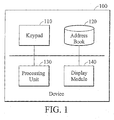
- Fig. 1 is a schematic diagram illustrating an embodiment of a device performing a dialing method.
- the device 100 may be a processor-based device, such as computer system, or a portable device, such as mobile phone, PDP phone, and smart phone.
- the device 100 comprises a keypad 110, an address book 120, a processing unit 130, and a display module 140.
- the keypad 110 comprises a plurality of dual-purpose keys and non-numerical-purpose keys.
- the dual-purpose key has different input definitions in a letter mode and a number mode, and the non-numerical-purpose key does not have a numerical input definition.
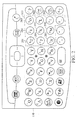
- Fig. 2 shows an example of a keypad, but the disclosure is not limited thereto.
- the keypad 110 includes several dual-purpose keys 201 ⁇ 210 in the block 111, and non-numerical-purpose keys outside of the block 111.
- the input definitions of the dual-purpose key 201 in the letter mode and number mode can be "U" and "1", respectively. It is understood that, in the embodiments, the non-numerical-purpose keys are keys without input definitions in the number mode.
- the non-numerical-purpose keys may have different input definitions in other modes.
- the non-numerical-purpose key may have upper- and lower-case letter input definitions.
- the address book 120 has a plurality of address records comprising several data fields in various formats. For example, a letter data field stores first and second names of a person, a number data field stores the office, home, and mobile phone numbers of the person, and others.
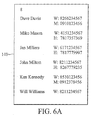
- Fig. 3 shows an example of an address book. In this example, the address book 120 includes 9 address records 121 ⁇ 129.
- the processing unit 130 provides calculating power for device 100, and performs the dialing method.
- the display module 140 displays related information based on instructions from the processing unit 130.
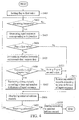
- Fig. 4 is a flowchart of an embodiment of a dialing method.
- the dialing method is used for a device comprising a keypad.
- the keypad comprises a plurality of dual-purpose keys and non-numerical-purpose keys.
- the dual-purpose key has different input definitions in a letter mode and a number mode, and the non-numerical-purpose key does not have a numerical input definition.
- step S401 the processing unit 130 sets a flag to a first value, such as false.
- the flag determines whether the device accepts input definitions in both letter and number modes, or only in letter mode. If the flag is the first value, the device accepts input definitions in both letter and number modes. If the flag is a second value, such as true, the device accepts input definitions in letter mode.
- step S402 the processing unit 130 determines whether a keystroke is received. If not, the procedure remains at step S402. If so, in step S403, the processing unit 130 generates an input sequence corresponding to the keystroke. It is understood that the respective keystrokes are combined to generate and store an input sequence according to the corresponding input order before an input procedure completes.
- step S404 the processing unit 130 determines whether the flag is the first value. If not, the procedure goes to step S412. If so, in step S405, it is determined whether the keystroke is one of the dual-purpose keys.
- step S407 the processing unit 130 retrieves address records conforming to a letter input definition of the input sequence in the letter mode and a numerical input definition of the input sequence in the number mode from the address book 120, and in step S408, displays the retrieved address records via the display module 140.
- the keystroke is not a dual-purpose key, that is the keystroke corresponds to one of the non-numerical-purpose keys (No in step S406), in step S411, the processing unit 130 sets the flag to the second value, and in step S412 retrieves address records conforming to a letter input definition of the input sequence in the letter mode from the address book 120, and in step S408, displays the retrieved address records via the display module 140.
- the processing unit 130 determines whether an address record conforms to the letter input definition by checking whether the letter input definition exists in the beginning or any position of at least one letter data field of the address record.
- the processing unit 130 determines whether an address record conforms to the numerical input definition by checking whether the numerical input definition exists in the beginning of at least one number data field of the address record.
- the processing unit 130 also displays the numerical input definition of the input sequence in the number mode via the display module 140.
- the user can select an address record displayed in the display module 140 via the keypad 110 for dialing, accordingly. Further, the user can directly press a confirmation key or a dialing key to dial according to the numerical input definition of the input sequence in the number mode.
- step S409 If no selection is received by the processing unit 130 (No in step S409), the procedure returns to step S402 to await another keystroke. If a selection is received by the processing unit 130 (Yes in step S409), in step S410, a call is placed according to the phone number of the selected address record.
- a dialing example is shown.
- the display module 140 displays the numerical input definition "8" of [8/N1] 208 in the number mode, and the address records retrieved from the address book 120 as shown in Fig. 5A. Since key [8/M] 208 is a dual-purpose key, the retrieved address records conform to the letter input definition "M" of [8/N] 208 in the letter mode and the numerical input definition "8" of [8/M] 208 in the number mode. It is noted that, in this example, the matched letter or numerical input definition is from the beginning of the data field.
- the user inputs keys [2/I] 202, [6/L] 206, and [6/L] 206 in order, as respectively shown in Figs. 5B ⁇ 5D.
- the address book 120 includes only an address record conforming to the numerical input definition, and no address record conforming to the letter input definition. Since, at this time, the user may be searching the address book by number, or dialing an entirely new number. It is understood that the user can select any of the retrieved address records for dialing in the procedure from Figs. 5A to 5E.
- key [6/L] 206 is further pressed, and no matched address record is in the address book 120, as shown in Fig. 5F, the user wants to dial with an entirely new number. After the complete number is input, the user can press confirmation key or dialing key for dialing.
- a dialing example is shown.
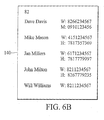
- the user inputs keys [8/M] 208, [2/I] 202, [6/L] 206, and [6/L] 206 in order, as respectively shown in Figs. 6A ⁇ 6D.
- key [E] is a non-numerical-purpose key
- the processing unit 130 enables the device 100 to accept only the input definition in the letter mode.
- the retrieved address record conforms to the letter input definition "MILLE" of [8/M] 208, [2/1] 202, [6/L] 206, [6/L] 206, and [E], as shown in Fig. 6E.
- a dialing example is shown.
- Key [D] of the keypad 110 is pressed. Since key [D] is a non-numerical-purpose key, the processing unit 130 enables the device 100 to accept only the input definition in the letter mode, and retrieve address records according to the letter input definition "D" of key [D] in the letter mode, as shown in Fig. 7A.
- Key [Y] of the keypad 110 is further pressed. The processing unit 130 then retrieves address records according to the letter input definition "DY" of keys [D] and [Y] in the letter mode, as shown in Fig. 7B.
- Fig. 8 is a schematic diagram illustrating an embodiment of a storage medium storing a computer program for execution of a dialing method.
- the computer program product comprises a storage medium 810 storing computer readable program code for use in a device 800, such as computer system and mobile device.
- the device 800 comprises a keypad comprising a plurality of dual-purpose keys and non-numerical-purpose keys.
- the dual-purpose key has different input definitions in a letter mode and a number mode, and the non-numerical-purpose key does not have a numerical input definition.
- the computer readable program code comprises at least computer readable program code 811 receiving at least one keystrokes, and generating an input sequence corresponding to the keystrokes, and computer readable program code 812 retrieving at least one address record conforming to a letter input definition of the input sequence in the letter mode for dialing accordingly if any of the keystrokes corresponds to one of the non-numerical-purpose keys.
- Dialing methods may take the form of program code (i. e. , executable instructions) embodied in tangible media, such as products, floppy diskettes, CD-ROMS, hard drives, or any other machine-readable storage medium, wherein, when the program code is loaded into and executed by a machine, such as a computer or a device comprising a mobile phone, the machine thereby becomes an apparatus for practicing the methods.
- program code i. e. , executable instructions
- tangible media such as products, floppy diskettes, CD-ROMS, hard drives, or any other machine-readable storage medium
- the methods may also be embodied in the form of program code transmitted over some transmission medium, such as electrical wiring or cabling, through fiber optics, or via any other form of transmission, wherein, when the program code is received and loaded into and executed by a machine, such as a computer or a device comprising a mobile phone, the machine becomes an apparatus for practicing the disclosed methods.
- a machine such as a computer or a device comprising a mobile phone
- the program code When implemented on a general-purpose processor, the program code combines with the processor to provide a unique apparatus that operates analogously to application specific logic circuits.
Landscapes
- Engineering & Computer Science (AREA)
- General Engineering & Computer Science (AREA)
- Theoretical Computer Science (AREA)
- Human Computer Interaction (AREA)
- Physics & Mathematics (AREA)
- General Physics & Mathematics (AREA)
- Signal Processing (AREA)
- Input From Keyboards Or The Like (AREA)
- Telephone Function (AREA)
Abstract
Description
- The present disclosure relates to dialing methods, and more particularly, to dialing methods that enable dialing by name and dialing by number, and related devices.
- Portable devices, such as mobile phones, PDA phones, and smart phones are convenient. More and more users carry and use the portable devices for related applications. Generally, a user can input phone numbers for dialing via a keypad. Additionally, the portable device often provides an address book function for address recording and management. A user can also input specific personal data, and retrieve corresponding address records from the address book for dialing accordingly. Further, the portable device provides an option to dial by name or dial by number. In dialing by name, the portable device can retrieve and display address records conforming to part or all of a complete name input by a user, and use the retrieved address record for dialing. In dialing by number, the portable device can retrieve and display address records confirming to part or all of a complete number input by a user, and use the retrieved address record for dialing.
- The portable device is limited in size, and provides respective keys with multiple input definitions. For example, on a typical mobile phone containing a QWERTY keypad, the keypad can be used to enter letters or numbers by switching between a letter mode and a number mode. While a user has the option to either dial by name or dial by number, or requires inputting letters or numbers for retrieving address records from the address book, letter/number mode switching is an inconvenient and extra step. For example, when dialing by name, a user has to first switch the keypad to letter mode, or open the address book, which requires switching to the letter mode. After switching to the letter mode, the user is allowed to input data and dial by name.
- A typical user does not desire to be forced to purposefully think ahead of time and perform the switch procedure. For example, a user may want to just dial by name when thinking about a name or dial by number when thinking about a number. The switch between the letter and number modes violates the nature of thinking and behavior model of a person, and the time and difficulty for dialing operation is therefore increased.
- Dialing methods and related devices are provided. In an exemplary embodiment of a dialing method for use in a device comprising a keypad, at least one keystrokes are received, and an input sequence corresponding to the keystrokes is generated. The keypad comprises a plurality of dual-purpose keys and non-numerical-purpose keys. The dual-purpose key has different input definitions in a letter mode and a number mode, and the non-numerical-purpose key does not have a numerical input definition. If any one of the keystrokes corresponds to one of the non-numerical-purpose keys, at least one address record conforming to a letter input definition of the input sequence in the letter mode is retrieved from an address book for dialing accordingly.
- If all of the keystrokes correspond to the dual-purpose keys, at least one address record conforming to a letter input definition of the input sequence in the letter mode or a numerical input definition of the input sequence in the number mode is retrieved from the address book for dialing accordingly.
- It is determined whether the address record conforms to the letter input definition by checking whether the letter input definition exists in the beginning or any position of at least one letter data field of the address record. It is determined whether the address record conforms to the numerical input definition by checking whether the numerical input definition exists in the beginning of at least one number data field of the address record.
- The numerical input definition of the input sequence in the number mode can be used for dialing directly.
- An exemplary embodiment of a device comprises a keypad, an address book and a processing unit. The keypad comprises a plurality of dual-purpose keys and non-numerical-purpose keys. The dual-purpose key has different input definitions in a letter mode and a number mode, and the non-numerical-purpose key does not have a numerical input definition. The address book comprises a plurality of address records. The processing unit receives at least one keystrokes, and generates an input sequence corresponding thereto. If any keystroke corresponds to one of the non-numerical-purpose keys, at least one address record conforming to a letter input definition of the input sequence in the letter mode is retrieved from the address book for dialing accordingly.
- If all of the keystrokes correspond to the dual-purpose keys, the processing unit further retrieves at least one address record conforming to a letter input definition of the input sequence in the letter mode or a numerical input definition of the input sequence in the number mode from the address book for dialing accordingly.
- The processing unit determines whether the address record conforms to the letter input definition by checking whether the letter input definition exists in the beginning or any position of at least one letter data field of the address record. The processing unit determines whether the address record conforms to the numerical input definition by checking whether the numerical input definition exists in the beginning of at least one number data field of the address record.
- The processing unit further provides the use of the numerical input definiti on of the input sequence in the number mode for dialing directly.
- Dialing methods may take the form of program code embodied in a tangible media. When the program code is loaded into and executed by a machine, the machine becomes an apparatus for practicing the disclosed method
- The invention will become more fully understood by referring to the following detailed description with reference to the accompanying drawings, wherein:
- Fig. 1 is a schematic diagram illustrating an embodiment of a device performing a dialing method;
- Fig. 2 shows an example of a keypad;
- Fig. 3 shows an example of an address book;
- Fig. 4 is a flowchart of an embodiment of a dialing method;
- Figs. 5A to 5F show a dialing example;
- Figs. 6A to 6E show a dialing example;
- Figs. 7A and 7B show a dialing example; and
- Fig. 8 is a schematic diagram illustrating an embodiment of a storage medium storing a computer program for execution of a dialing method.
- Dialing methods and related devices are provided.
- Fig. 1 is a schematic diagram illustrating an embodiment of a device performing a dialing method.
- The
device 100 may be a processor-based device, such as computer system, or a portable device, such as mobile phone, PDP phone, and smart phone. Thedevice 100 comprises akeypad 110, anaddress book 120, aprocessing unit 130, and adisplay module 140. - The
keypad 110 comprises a plurality of dual-purpose keys and non-numerical-purpose keys. The dual-purpose key has different input definitions in a letter mode and a number mode, and the non-numerical-purpose key does not have a numerical input definition. Fig. 2 shows an example of a keypad, but the disclosure is not limited thereto. In this example, thekeypad 110 includes several dual-purpose keys 201~210 in theblock 111, and non-numerical-purpose keys outside of theblock 111. For example, the input definitions of the dual-purpose key 201 in the letter mode and number mode can be "U" and "1", respectively. It is understood that, in the embodiments, the non-numerical-purpose keys are keys without input definitions in the number mode. The non-numerical-purpose keys, however, may have different input definitions in other modes. For example, the non-numerical-purpose key may have upper- and lower-case letter input definitions. Theaddress book 120 has a plurality of address records comprising several data fields in various formats. For example, a letter data field stores first and second names of a person, a number data field stores the office, home, and mobile phone numbers of the person, and others. Fig. 3 shows an example of an address book. In this example, theaddress book 120 includes 9address records 121~129. Theprocessing unit 130 provides calculating power fordevice 100, and performs the dialing method. Thedisplay module 140 displays related information based on instructions from theprocessing unit 130. - Fig. 4 is a flowchart of an embodiment of a dialing method. The dialing method is used for a device comprising a keypad. The keypad comprises a plurality of dual-purpose keys and non-numerical-purpose keys. The dual-purpose key has different input definitions in a letter mode and a number mode, and the non-numerical-purpose key does not have a numerical input definition.
- In step S401, the
processing unit 130 sets a flag to a first value, such as false. The flag determines whether the device accepts input definitions in both letter and number modes, or only in letter mode. If the flag is the first value, the device accepts input definitions in both letter and number modes. If the flag is a second value, such as true, the device accepts input definitions in letter mode. - In step S402, the
processing unit 130 determines whether a keystroke is received. If not, the procedure remains at step S402. If so, in step S403, theprocessing unit 130 generates an input sequence corresponding to the keystroke. It is understood that the respective keystrokes are combined to generate and store an input sequence according to the corresponding input order before an input procedure completes. In step S404, theprocessing unit 130 determines whether the flag is the first value. If not, the procedure goes to step S412. If so, in step S405, it is determined whether the keystroke is one of the dual-purpose keys. If so (Yes in step S406), in step S407, theprocessing unit 130 retrieves address records conforming to a letter input definition of the input sequence in the letter mode and a numerical input definition of the input sequence in the number mode from theaddress book 120, and in step S408, displays the retrieved address records via thedisplay module 140. If the keystroke is not a dual-purpose key, that is the keystroke corresponds to one of the non-numerical-purpose keys (No in step S406), in step S411, theprocessing unit 130 sets the flag to the second value, and in step S412 retrieves address records conforming to a letter input definition of the input sequence in the letter mode from theaddress book 120, and in step S408, displays the retrieved address records via thedisplay module 140. - It is understood that the
processing unit 130 determines whether an address record conforms to the letter input definition by checking whether the letter input definition exists in the beginning or any position of at least one letter data field of the address record. Theprocessing unit 130 determines whether an address record conforms to the numerical input definition by checking whether the numerical input definition exists in the beginning of at least one number data field of the address record. Additionally, theprocessing unit 130 also displays the numerical input definition of the input sequence in the number mode via thedisplay module 140. The user can select an address record displayed in thedisplay module 140 via thekeypad 110 for dialing, accordingly. Further, the user can directly press a confirmation key or a dialing key to dial according to the numerical input definition of the input sequence in the number mode. If no selection is received by the processing unit 130 (No in step S409), the procedure returns to step S402 to await another keystroke. If a selection is received by the processing unit 130 (Yes in step S409), in step S410, a call is placed according to the phone number of the selected address record. - In Figs. 2, 3 and 5A-5F, a dialing example is shown. When key [8/M] 208 is pressed, the
display module 140 displays the numerical input definition "8" of [8/N1] 208 in the number mode, and the address records retrieved from theaddress book 120 as shown in Fig. 5A. Since key [8/M] 208 is a dual-purpose key, the retrieved address records conform to the letter input definition "M" of [8/N] 208 in the letter mode and the numerical input definition "8" of [8/M] 208 in the number mode. It is noted that, in this example, the matched letter or numerical input definition is from the beginning of the data field. The user inputs keys [2/I] 202, [6/L] 206, and [6/L] 206 in order, as respectively shown in Figs. 5B~5D. - The user presses key [2/I] 202. As shown in Fig. 5E, the
address book 120 includes only an address record conforming to the numerical input definition, and no address record conforming to the letter input definition. Since, at this time, the user may be searching the address book by number, or dialing an entirely new number. It is understood that the user can select any of the retrieved address records for dialing in the procedure from Figs. 5A to 5E. When key [6/L] 206 is further pressed, and no matched address record is in theaddress book 120, as shown in Fig. 5F, the user wants to dial with an entirely new number. After the complete number is input, the user can press confirmation key or dialing key for dialing. - In Figs. 2, 3 and 6A-6E, a dialing example is shown. The user inputs keys [8/M] 208, [2/I] 202, [6/L] 206, and [6/L] 206 in order, as respectively shown in Figs. 6A∼6D. If the user continues to input key [E] of the
keypad 110, since key [E] is a non-numerical-purpose key, theprocessing unit 130 enables thedevice 100 to accept only the input definition in the letter mode. At this time, the retrieved address record conforms to the letter input definition "MILLE" of [8/M] 208, [2/1] 202, [6/L] 206, [6/L] 206, and [E], as shown in Fig. 6E. - In Figs. 2, 3, 7A, and 7B, a dialing example is shown. Key [D] of the
keypad 110 is pressed. Since key [D] is a non-numerical-purpose key, theprocessing unit 130 enables thedevice 100 to accept only the input definition in the letter mode, and retrieve address records according to the letter input definition "D" of key [D] in the letter mode, as shown in Fig. 7A. Key [Y] of thekeypad 110 is further pressed. Theprocessing unit 130 then retrieves address records according to the letter input definition "DY" of keys [D] and [Y] in the letter mode, as shown in Fig. 7B. - Fig. 8 is a schematic diagram illustrating an embodiment of a storage medium storing a computer program for execution of a dialing method. The computer program product comprises a
storage medium 810 storing computer readable program code for use in adevice 800, such as computer system and mobile device. Thedevice 800 comprises a keypad comprising a plurality of dual-purpose keys and non-numerical-purpose keys. The dual-purpose key has different input definitions in a letter mode and a number mode, and the non-numerical-purpose key does not have a numerical input definition. The computer readable program code comprises at least computerreadable program code 811 receiving at least one keystrokes, and generating an input sequence corresponding to the keystrokes, and computerreadable program code 812 retrieving at least one address record conforming to a letter input definition of the input sequence in the letter mode for dialing accordingly if any of the keystrokes corresponds to one of the non-numerical-purpose keys. - Dialing methods, or certain aspects or portions thereof, may take the form of program code (i. e. , executable instructions) embodied in tangible media, such as products, floppy diskettes, CD-ROMS, hard drives, or any other machine-readable storage medium, wherein, when the program code is loaded into and executed by a machine, such as a computer or a device comprising a mobile phone, the machine thereby becomes an apparatus for practicing the methods. The methods may also be embodied in the form of program code transmitted over some transmission medium, such as electrical wiring or cabling, through fiber optics, or via any other form of transmission, wherein, when the program code is received and loaded into and executed by a machine, such as a computer or a device comprising a mobile phone, the machine becomes an apparatus for practicing the disclosed methods. When implemented on a general-purpose processor, the program code combines with the processor to provide a unique apparatus that operates analogously to application specific logic circuits.
- While the invention has been described by way of example and in terms of preferred embodiment, it is to be understood that the invention is not limited thereto. Those who are skilled in this technology can still make various alterations and modifications without departing from the scope and spirit of this invention. Therefore, the scope of the present invention shall be defined and protected by the following claims and their equivalents.
Claims (18)
- A dialing method used in a device comprising a keypad, the keypad comprising a plurality of dual-purpose keys and non-numerical-purpose keys, the dual-purpose key having different input definitions in a letter mode and a number mode, and the non-numerical-purpose key without numerical input definition, comprising:receiving at least one keystrokes, and generating an input sequence corresponding thereto; andif any keystroke corresponds to one of the non-numerical-purpose keys, retrieving at least one address record conforming to a letter input definition of the input sequence in the letter mode from an address book for dialing accordingly.
- The method of claim 1 further comprising if the keystrokes correspond to the dual-purpose keys, retrieving at least one address record conforming to the letter input definition and a numerical input definition of the input sequence in the letter and number modes from the address book for dialing accordingly.
- The method of claim 2 further comprising dialing using the numerical input definition of the input sequence in the number mode.
- The method of claim 1 further comprising determining whether the address record conforms to the letter input definition by checking whether the letter input definition exists in the beginning or any position of at least one letter data field of the address record.
- The method of claim 2 further comprising determining whether the address record conforms to the numerical input definition by checking whether the numerical input definition exists in the beginning of at least one number data field of the address record.
- The method of claim 1 further comprising receiving a selection of the retrieved address record, and dialing according to at least one phone number corresponding to the selected address record.
- The method of claim 1 further comprising displaying the retrieved address record.
- A dialing method used in a device comprising a keypad, the keypad comprising a plurality of dual-purpose keys and non-numerical-purpose keys, the dual-purpose key having different input definitions in a letter mode and a number mode, and the non-numerica7-purpose key without numerical input definition, comprising:receiving one keystroke;if the keystroke corresponds to one of the non-numerical-purpose keys, enabling the device to accept only the input definition in the letter mode; andretrieving at least one address record conforming to a letter input definition of the keystroke in the letter mode from an address book for dialing accordingly.
- A device, comprising:a keypad comprising a plurality of dual-purpose keys and non-numerical-purpose keys, the dual-purpose key having different input definitions in a letter mode and a number mode, and the non-numerical-purpose key without numerical input definition;an address book comprising a plurality of address records; anda processing unit receiving at least one keystrokes, generating an input sequence corresponding thereto, and retrieving at least one address record conforming to a letter input definition of the input sequence in the letter mode from the address book for dialing accordingly if any keystroke corresponds to one of the non-numerical-purpose keys.
- The device of claim 9 wherein the processing unit further retrieves at least one address record conforming to the letter input definition and a numerical input definition of the input sequence in the letter and number modes from the address book for dialing accordingly if the keystrokes correspond to the dual-purpose keys.
- The device of claim 10 wherein the processing unit further dials using the numerical input definition of the input sequence in the number mode.
- The device of claim 9 wherein the processing unit further determines whether the address record conforms to the letter input definition by checking whether the letter input definition exists in the beginning or any position of at least one letter data field of the address record.
- The device of claim 10 wherein the processing unit further determines whether the address record conforms to the numerical input definition by checking whether the numerical input definition exists in the beginning of at least one number data field of the address record.
- The device of claim 9 wherein the processing unit further receives a selection of the retrieved address record, and dials according to at least one phone number corresponding to the selected address record.
- The device of claim 9 further comprising a display module displaying the retrieved address record.
- A device, comprising:a keypad comprising a plurality of dual-purpose keys and non-numerical-purpose keys, the dual-purpose key having different input definitions in a letter mode and a number mode, and the non-numerical-purpose key without numerical input definition;an address book comprising a plurality of address records; anda processing unit receiving one keystroke, enabling the device to only accept the input definition in the letter mode if the keystroke corresponds to one of the non-numerical-purpose keys, and retrieving at least one address record conforming to a letter input definition of the keystroke in the letter mode from the address book for dialing accordingly.
- A machine-readable storage medium comprising a computer program, which, when executed, causes a device to perform a dialing method, the device comprising a keypad comprising a plurality of dual-purpose keys and non-numerical-purpose keys, the dual-purpose key having different input definitions in a letter mode and a number mode, and the non-numerical-purpose key without numerical input definition, the method comprising:receiving at least one keystrokes, and generating an input sequence corresponding thereto; andif any keystroke corresponds to one of the non-numerical-purpose keys, retrieving at least one address record conforming to a letter input definition of the input sequence in the letter mode from an address book for dialing accordingly.
- A machine-readable storage medium comprising a computer program, which, when executed, causes a device to perform a dialing method, the device comprising a keypad comprising a plurality of dual-purpose keys and non-numerical-purpose keys, the dual-purpose key having different input definitions in a letter mode and a number mode, and the non-numerical-purpose key without numerical input definition, the method comprising:receiving one keystroke;if the keystroke corresponds to one of the non-numerical-purpose keys, enabling the device to accept only the input definition in the letter mode; andretrieving at least one address record conforming to a letter input definition of the keystroke in the letter mode from an address book for dialing accordingly.
Applications Claiming Priority (1)
| Application Number | Priority Date | Filing Date | Title |
|---|---|---|---|
| CNB2004101021092A CN100431326C (en) | 2004-12-14 | 2004-12-14 | Dialing method and device |
Publications (2)
| Publication Number | Publication Date |
|---|---|
| EP1672887A1 true EP1672887A1 (en) | 2006-06-21 |
| EP1672887B1 EP1672887B1 (en) | 2013-01-09 |
Family
ID=35966005
Family Applications (1)
| Application Number | Title | Priority Date | Filing Date |
|---|---|---|---|
| EP05111475A Ceased EP1672887B1 (en) | 2004-12-14 | 2005-11-29 | Method and device for retrieving address book information upon user input of a number or a letter in a keypad |
Country Status (2)
| Country | Link |
|---|---|
| EP (1) | EP1672887B1 (en) |
| CN (1) | CN100431326C (en) |
Cited By (1)
| Publication number | Priority date | Publication date | Assignee | Title |
|---|---|---|---|---|
| EP1718046A1 (en) * | 2005-04-27 | 2006-11-02 | LG Electronics Inc. | Method and apparatus for searching for a directory entry in a mobile communication terminal phone book |
Families Citing this family (1)
| Publication number | Priority date | Publication date | Assignee | Title |
|---|---|---|---|---|
| CN101958951A (en) * | 2009-07-16 | 2011-01-26 | 中华电信股份有限公司 | Generalized code communication system |
Citations (4)
| Publication number | Priority date | Publication date | Assignee | Title |
|---|---|---|---|---|
| EP1193956A2 (en) | 2000-10-02 | 2002-04-03 | Microsoft Corporation | Merging various request methods into a single unified user interface |
| US6504925B1 (en) | 1994-03-15 | 2003-01-07 | David Schlachman | Apparatus for enabling a telephone user to obtain telephone directory information |
| WO2004049150A2 (en) | 2002-11-21 | 2004-06-10 | Danger, Inc. | Data processing device with adjuntable display and input devices with multiple orientations |
| US20040165924A1 (en) | 2001-12-21 | 2004-08-26 | Griffin Jason T. | Keyboard arrangement |
Family Cites Families (5)
| Publication number | Priority date | Publication date | Assignee | Title |
|---|---|---|---|---|
| CN1252665A (en) * | 1998-10-22 | 2000-05-10 | 北京金恒智科技发展有限公司 | Electronic intelligent communicator and its keyboard |
| JP2002207558A (en) * | 2001-01-11 | 2002-07-26 | Takuo Kitamura | Electronic equipment provided with keyboard |
| JP2003087389A (en) * | 2001-08-31 | 2003-03-20 | Nokia Corp | Mobile phone equipment |
| JP4477353B2 (en) * | 2001-12-21 | 2010-06-09 | リサーチ イン モーション リミテッド | Handheld electronic device with keyboard |
| US20060061556A1 (en) * | 2002-06-14 | 2006-03-23 | Mitoku Yamane | Electronic apparatus |
-
2004
- 2004-12-14 CN CNB2004101021092A patent/CN100431326C/en not_active Expired - Lifetime
-
2005
- 2005-11-29 EP EP05111475A patent/EP1672887B1/en not_active Ceased
Patent Citations (4)
| Publication number | Priority date | Publication date | Assignee | Title |
|---|---|---|---|---|
| US6504925B1 (en) | 1994-03-15 | 2003-01-07 | David Schlachman | Apparatus for enabling a telephone user to obtain telephone directory information |
| EP1193956A2 (en) | 2000-10-02 | 2002-04-03 | Microsoft Corporation | Merging various request methods into a single unified user interface |
| US20040165924A1 (en) | 2001-12-21 | 2004-08-26 | Griffin Jason T. | Keyboard arrangement |
| WO2004049150A2 (en) | 2002-11-21 | 2004-06-10 | Danger, Inc. | Data processing device with adjuntable display and input devices with multiple orientations |
Cited By (2)
| Publication number | Priority date | Publication date | Assignee | Title |
|---|---|---|---|---|
| EP1718046A1 (en) * | 2005-04-27 | 2006-11-02 | LG Electronics Inc. | Method and apparatus for searching for a directory entry in a mobile communication terminal phone book |
| US8095190B2 (en) | 2005-04-27 | 2012-01-10 | Lg Electronics Inc. | Method and apparatus for searching for a directory entry in a mobile communication terminal phone book |
Also Published As
| Publication number | Publication date |
|---|---|
| CN100431326C (en) | 2008-11-05 |
| EP1672887B1 (en) | 2013-01-09 |
| CN1791139A (en) | 2006-06-21 |
Similar Documents
| Publication | Publication Date | Title |
|---|---|---|
| US8150017B2 (en) | Phone dialer with advanced search feature and associated method of searching a directory | |
| EP2282252A1 (en) | Method of and apparatus for converting a character sequence input | |
| US8060839B2 (en) | Character input method and mobile communication terminal using the same | |
| KR20060112470A (en) | Phone book search method and device in mobile communication terminal | |
| WO1999009729A1 (en) | Communication apparatus and method for locating stored entries in an electronic telephone directory | |
| JP4146461B2 (en) | Key input method and apparatus for portable terminal | |
| JP3318927B2 (en) | Operating method of mobile phone and operating device thereof | |
| US7636082B2 (en) | Dialing methods and related devices | |
| US20040242279A1 (en) | Implementing direct telephone access on a multi-purpose wireless mobile electronic device | |
| US20070282834A1 (en) | Database search method and apparatus utilizing variable number of search boxes | |
| EP1672887B1 (en) | Method and device for retrieving address book information upon user input of a number or a letter in a keypad | |
| US20080003984A1 (en) | Method and system for improved handling of message templates | |
| US8069189B2 (en) | Portable terminal | |
| KR20140080214A (en) | Terminal and method for transmission of user information | |
| KR20010106904A (en) | Method for searching a phone-number in a mobile terminal | |
| JP2933058B2 (en) | Mobile phone equipment | |
| KR100581827B1 (en) | How to retrieve phone number of mobile terminal | |
| KR100673448B1 (en) | Mobile communication terminal with memo search function and its operation method | |
| KR100810331B1 (en) | How to search phone number on mobile terminal | |
| KR100881219B1 (en) | Phone number information retrieval method using function number and user terminal using the method | |
| CN100481853C (en) | Information terminal, authentication condition check method thereof, and authentication condition check program | |
| KR100631693B1 (en) | Information retrieval method of mobile communication terminal | |
| KR20040041862A (en) | Method for searching phone number using priority | |
| CA2430178C (en) | Implementing direct telephone access on a multi-purpose wireless mobile electronic device | |
| JPH01277044A (en) | Portable automatic dialing device |
Legal Events
| Date | Code | Title | Description |
|---|---|---|---|
| PUAI | Public reference made under article 153(3) epc to a published international application that has entered the european phase |
Free format text: ORIGINAL CODE: 0009012 |
|
| AK | Designated contracting states |
Kind code of ref document: A1 Designated state(s): AT BE BG CH CY CZ DE DK EE ES FI FR GB GR HU IE IS IT LI LT LU LV MC NL PL PT RO SE SI SK TR |
|
| AX | Request for extension of the european patent |
Extension state: AL BA HR MK YU |
|
| 17P | Request for examination filed |
Effective date: 20061212 |
|
| AKX | Designation fees paid |
Designated state(s): DE FR GB |
|
| 17Q | First examination report despatched |
Effective date: 20080318 |
|
| RAP1 | Party data changed (applicant data changed or rights of an application transferred) |
Owner name: HTC CORPORATION |
|
| REG | Reference to a national code |
Ref country code: DE Ref legal event code: R079 Ref document number: 602005037789 Country of ref document: DE Free format text: PREVIOUS MAIN CLASS: H04M0001274500 Ipc: G06F0003023000 |
|
| GRAP | Despatch of communication of intention to grant a patent |
Free format text: ORIGINAL CODE: EPIDOSNIGR1 |
|
| RIC1 | Information provided on ipc code assigned before grant |
Ipc: H04M 1/2745 20060101ALI20120427BHEP Ipc: G06F 3/023 20060101AFI20120427BHEP |
|
| GRAS | Grant fee paid |
Free format text: ORIGINAL CODE: EPIDOSNIGR3 |
|
| GRAA | (expected) grant |
Free format text: ORIGINAL CODE: 0009210 |
|
| AK | Designated contracting states |
Kind code of ref document: B1 Designated state(s): DE FR GB |
|
| REG | Reference to a national code |
Ref country code: GB Ref legal event code: FG4D |
|
| REG | Reference to a national code |
Ref country code: DE Ref legal event code: R096 Ref document number: 602005037789 Country of ref document: DE Effective date: 20130314 |
|
| PLBE | No opposition filed within time limit |
Free format text: ORIGINAL CODE: 0009261 |
|
| STAA | Information on the status of an ep patent application or granted ep patent |
Free format text: STATUS: NO OPPOSITION FILED WITHIN TIME LIMIT |
|
| 26N | No opposition filed |
Effective date: 20131010 |
|
| REG | Reference to a national code |
Ref country code: DE Ref legal event code: R097 Ref document number: 602005037789 Country of ref document: DE Effective date: 20131010 |
|
| REG | Reference to a national code |
Ref country code: FR Ref legal event code: PLFP Year of fee payment: 11 |
|
| REG | Reference to a national code |
Ref country code: FR Ref legal event code: PLFP Year of fee payment: 12 |
|
| REG | Reference to a national code |
Ref country code: FR Ref legal event code: PLFP Year of fee payment: 13 |
|
| REG | Reference to a national code |
Ref country code: FR Ref legal event code: PLFP Year of fee payment: 14 |
|
| P01 | Opt-out of the competence of the unified patent court (upc) registered |
Effective date: 20230602 |
|
| PGFP | Annual fee paid to national office [announced via postgrant information from national office to epo] |
Ref country code: FR Payment date: 20230929 Year of fee payment: 19 |
|
| PGFP | Annual fee paid to national office [announced via postgrant information from national office to epo] |
Ref country code: GB Payment date: 20231006 Year of fee payment: 19 |
|
| PGFP | Annual fee paid to national office [announced via postgrant information from national office to epo] |
Ref country code: DE Payment date: 20231003 Year of fee payment: 19 |
|
| REG | Reference to a national code |
Ref country code: DE Ref legal event code: R119 Ref document number: 602005037789 Country of ref document: DE |
|
| GBPC | Gb: european patent ceased through non-payment of renewal fee |
Effective date: 20241129 |
|
| PG25 | Lapsed in a contracting state [announced via postgrant information from national office to epo] |
Ref country code: DE Free format text: LAPSE BECAUSE OF NON-PAYMENT OF DUE FEES Effective date: 20250603 |
|
| PG25 | Lapsed in a contracting state [announced via postgrant information from national office to epo] |
Ref country code: GB Free format text: LAPSE BECAUSE OF NON-PAYMENT OF DUE FEES Effective date: 20241129 |
|
| PG25 | Lapsed in a contracting state [announced via postgrant information from national office to epo] |
Ref country code: FR Free format text: LAPSE BECAUSE OF NON-PAYMENT OF DUE FEES Effective date: 20241130 |