EP1672082A2 - A method for detecting a target substance using a nucleic acid probe - Google Patents
A method for detecting a target substance using a nucleic acid probe Download PDFInfo
- Publication number
- EP1672082A2 EP1672082A2 EP05021784A EP05021784A EP1672082A2 EP 1672082 A2 EP1672082 A2 EP 1672082A2 EP 05021784 A EP05021784 A EP 05021784A EP 05021784 A EP05021784 A EP 05021784A EP 1672082 A2 EP1672082 A2 EP 1672082A2
- Authority
- EP
- European Patent Office
- Prior art keywords
- nucleic acid
- substance
- binding
- complex
- target substance
- Prior art date
- Legal status (The legal status is an assumption and is not a legal conclusion. Google has not performed a legal analysis and makes no representation as to the accuracy of the status listed.)
- Granted
Links
- 239000013076 target substance Substances 0.000 title claims abstract description 140
- 108020004711 Nucleic Acid Probes Proteins 0.000 title claims abstract description 120
- 239000002853 nucleic acid probe Substances 0.000 title claims abstract description 120
- 238000000034 method Methods 0.000 title claims abstract description 57
- 108020004707 nucleic acids Proteins 0.000 claims abstract description 115
- 102000039446 nucleic acids Human genes 0.000 claims abstract description 115
- 150000007523 nucleic acids Chemical class 0.000 claims abstract description 115
- 239000003446 ligand Substances 0.000 claims abstract description 97
- 239000000126 substance Substances 0.000 claims abstract description 94
- 239000007790 solid phase Substances 0.000 claims abstract description 56
- 238000002372 labelling Methods 0.000 claims abstract description 34
- 108020004414 DNA Proteins 0.000 claims description 26
- 238000001514 detection method Methods 0.000 claims description 18
- 230000002860 competitive effect Effects 0.000 claims description 12
- 230000015572 biosynthetic process Effects 0.000 claims description 11
- 239000003153 chemical reaction reagent Substances 0.000 claims description 11
- 238000006073 displacement reaction Methods 0.000 claims description 10
- 108091023037 Aptamer Proteins 0.000 claims description 9
- 238000005406 washing Methods 0.000 claims description 9
- 230000000694 effects Effects 0.000 claims description 7
- 108090000623 proteins and genes Proteins 0.000 claims description 7
- 102000016928 DNA-directed DNA polymerase Human genes 0.000 claims description 6
- 108010014303 DNA-directed DNA polymerase Proteins 0.000 claims description 6
- 108090000790 Enzymes Proteins 0.000 claims description 5
- 102000004190 Enzymes Human genes 0.000 claims description 5
- SUYVUBYJARFZHO-RRKCRQDMSA-N dATP Chemical compound C1=NC=2C(N)=NC=NC=2N1[C@H]1C[C@H](O)[C@@H](COP(O)(=O)OP(O)(=O)OP(O)(O)=O)O1 SUYVUBYJARFZHO-RRKCRQDMSA-N 0.000 claims description 4
- SUYVUBYJARFZHO-UHFFFAOYSA-N dATP Natural products C1=NC=2C(N)=NC=NC=2N1C1CC(O)C(COP(O)(=O)OP(O)(=O)OP(O)(O)=O)O1 SUYVUBYJARFZHO-UHFFFAOYSA-N 0.000 claims description 4
- RGWHQCVHVJXOKC-SHYZEUOFSA-J dCTP(4-) Chemical compound O=C1N=C(N)C=CN1[C@@H]1O[C@H](COP([O-])(=O)OP([O-])(=O)OP([O-])([O-])=O)[C@@H](O)C1 RGWHQCVHVJXOKC-SHYZEUOFSA-J 0.000 claims description 4
- HAAZLUGHYHWQIW-KVQBGUIXSA-N dGTP Chemical compound C1=NC=2C(=O)NC(N)=NC=2N1[C@H]1C[C@H](O)[C@@H](COP(O)(=O)OP(O)(=O)OP(O)(O)=O)O1 HAAZLUGHYHWQIW-KVQBGUIXSA-N 0.000 claims description 4
- NHVNXKFIZYSCEB-XLPZGREQSA-N dTTP Chemical compound O=C1NC(=O)C(C)=CN1[C@@H]1O[C@H](COP(O)(=O)OP(O)(=O)OP(O)(O)=O)[C@@H](O)C1 NHVNXKFIZYSCEB-XLPZGREQSA-N 0.000 claims description 4
- 239000002773 nucleotide Substances 0.000 claims description 4
- 125000003729 nucleotide group Chemical group 0.000 claims description 4
- ZGEGCLOFRBLKSE-UHFFFAOYSA-N methylene hexane Natural products CCCCCC=C ZGEGCLOFRBLKSE-UHFFFAOYSA-N 0.000 claims description 3
- 244000005700 microbiome Species 0.000 claims description 3
- 241000700605 Viruses Species 0.000 claims description 2
- 239000005556 hormone Substances 0.000 claims description 2
- 229940088597 hormone Drugs 0.000 claims description 2
- 150000002632 lipids Chemical class 0.000 claims description 2
- 102000004169 proteins and genes Human genes 0.000 claims description 2
- 235000000346 sugar Nutrition 0.000 claims description 2
- 239000003053 toxin Substances 0.000 claims description 2
- 231100000765 toxin Toxicity 0.000 claims description 2
- 108700012359 toxins Proteins 0.000 claims description 2
- 238000004040 coloring Methods 0.000 claims 2
- 238000010438 heat treatment Methods 0.000 claims 2
- 238000002844 melting Methods 0.000 claims 2
- 230000008018 melting Effects 0.000 claims 2
- 238000006243 chemical reaction Methods 0.000 description 43
- 239000000523 sample Substances 0.000 description 32
- 239000000243 solution Substances 0.000 description 30
- 239000002585 base Substances 0.000 description 28
- YBJHBAHKTGYVGT-ZKWXMUAHSA-N (+)-Biotin Chemical compound N1C(=O)N[C@@H]2[C@H](CCCCC(=O)O)SC[C@@H]21 YBJHBAHKTGYVGT-ZKWXMUAHSA-N 0.000 description 18
- 238000002474 experimental method Methods 0.000 description 17
- 108010090804 Streptavidin Proteins 0.000 description 13
- 238000005259 measurement Methods 0.000 description 12
- 230000000052 comparative effect Effects 0.000 description 10
- 108010001336 Horseradish Peroxidase Proteins 0.000 description 9
- 229960002685 biotin Drugs 0.000 description 9
- 235000020958 biotin Nutrition 0.000 description 9
- 239000011616 biotin Substances 0.000 description 9
- 238000010494 dissociation reaction Methods 0.000 description 9
- 238000012546 transfer Methods 0.000 description 7
- 238000002835 absorbance Methods 0.000 description 6
- 230000000903 blocking effect Effects 0.000 description 6
- 239000000872 buffer Substances 0.000 description 6
- 238000010586 diagram Methods 0.000 description 6
- 230000005593 dissociations Effects 0.000 description 6
- KCXVZYZYPLLWCC-UHFFFAOYSA-N EDTA Chemical compound OC(=O)CN(CC(O)=O)CCN(CC(O)=O)CC(O)=O KCXVZYZYPLLWCC-UHFFFAOYSA-N 0.000 description 5
- 238000000835 electrochemical detection Methods 0.000 description 5
- 230000003100 immobilizing effect Effects 0.000 description 5
- 239000000758 substrate Substances 0.000 description 5
- 230000000295 complement effect Effects 0.000 description 4
- 238000002848 electrochemical method Methods 0.000 description 4
- 239000003480 eluent Substances 0.000 description 4
- QAPSNMNOIOSXSQ-YNEHKIRRSA-N 1-[(2r,4s,5r)-4-[tert-butyl(dimethyl)silyl]oxy-5-(hydroxymethyl)oxolan-2-yl]-5-methylpyrimidine-2,4-dione Chemical compound O=C1NC(=O)C(C)=CN1[C@@H]1O[C@H](CO)[C@@H](O[Si](C)(C)C(C)(C)C)C1 QAPSNMNOIOSXSQ-YNEHKIRRSA-N 0.000 description 3
- 241000972773 Aulopiformes Species 0.000 description 3
- OKKJLVBELUTLKV-UHFFFAOYSA-N Methanol Chemical compound OC OKKJLVBELUTLKV-UHFFFAOYSA-N 0.000 description 3
- 229910019142 PO4 Inorganic materials 0.000 description 3
- 125000003277 amino group Chemical group 0.000 description 3
- 239000000427 antigen Substances 0.000 description 3
- 108091007433 antigens Proteins 0.000 description 3
- 102000036639 antigens Human genes 0.000 description 3
- 238000010790 dilution Methods 0.000 description 3
- 239000012895 dilution Substances 0.000 description 3
- 208000018459 dissociative disease Diseases 0.000 description 3
- 238000009396 hybridization Methods 0.000 description 3
- NWVVVBRKAWDGAB-UHFFFAOYSA-N p-methoxyphenol Chemical compound COC1=CC=C(O)C=C1 NWVVVBRKAWDGAB-UHFFFAOYSA-N 0.000 description 3
- 235000019515 salmon Nutrition 0.000 description 3
- 238000001179 sorption measurement Methods 0.000 description 3
- GFFGJBXGBJISGV-UHFFFAOYSA-N Adenine Chemical compound NC1=NC=NC2=C1N=CN2 GFFGJBXGBJISGV-UHFFFAOYSA-N 0.000 description 2
- 229930024421 Adenine Natural products 0.000 description 2
- 102000053602 DNA Human genes 0.000 description 2
- 238000002965 ELISA Methods 0.000 description 2
- 108010021625 Immunoglobulin Fragments Proteins 0.000 description 2
- 102000008394 Immunoglobulin Fragments Human genes 0.000 description 2
- TWRXJAOTZQYOKJ-UHFFFAOYSA-L Magnesium chloride Chemical compound [Mg+2].[Cl-].[Cl-] TWRXJAOTZQYOKJ-UHFFFAOYSA-L 0.000 description 2
- 108091093037 Peptide nucleic acid Proteins 0.000 description 2
- 229910021607 Silver chloride Inorganic materials 0.000 description 2
- 239000002253 acid Substances 0.000 description 2
- 229960000643 adenine Drugs 0.000 description 2
- 238000003556 assay Methods 0.000 description 2
- 230000002596 correlated effect Effects 0.000 description 2
- 238000007865 diluting Methods 0.000 description 2
- 239000007850 fluorescent dye Substances 0.000 description 2
- 239000011521 glass Substances 0.000 description 2
- 238000003018 immunoassay Methods 0.000 description 2
- 125000005439 maleimidyl group Chemical group C1(C=CC(N1*)=O)=O 0.000 description 2
- 238000000691 measurement method Methods 0.000 description 2
- 239000012528 membrane Substances 0.000 description 2
- 239000000203 mixture Substances 0.000 description 2
- 230000003647 oxidation Effects 0.000 description 2
- 238000007254 oxidation reaction Methods 0.000 description 2
- 239000002245 particle Substances 0.000 description 2
- HKZLPVFGJNLROG-UHFFFAOYSA-M silver monochloride Chemical compound [Cl-].[Ag+] HKZLPVFGJNLROG-UHFFFAOYSA-M 0.000 description 2
- QKNYBSVHEMOAJP-UHFFFAOYSA-N 2-amino-2-(hydroxymethyl)propane-1,3-diol;hydron;chloride Chemical compound Cl.OCC(N)(CO)CO QKNYBSVHEMOAJP-UHFFFAOYSA-N 0.000 description 1
- FWMNVWWHGCHHJJ-SKKKGAJSSA-N 4-amino-1-[(2r)-6-amino-2-[[(2r)-2-[[(2r)-2-[[(2r)-2-amino-3-phenylpropanoyl]amino]-3-phenylpropanoyl]amino]-4-methylpentanoyl]amino]hexanoyl]piperidine-4-carboxylic acid Chemical compound C([C@H](C(=O)N[C@H](CC(C)C)C(=O)N[C@H](CCCCN)C(=O)N1CCC(N)(CC1)C(O)=O)NC(=O)[C@H](N)CC=1C=CC=CC=1)C1=CC=CC=C1 FWMNVWWHGCHHJJ-SKKKGAJSSA-N 0.000 description 1
- YBJHBAHKTGYVGT-ZXFLCMHBSA-N 5-[(3ar,4r,6as)-2-oxo-1,3,3a,4,6,6a-hexahydrothieno[3,4-d]imidazol-4-yl]pentanoic acid Chemical compound N1C(=O)N[C@H]2[C@@H](CCCCC(=O)O)SC[C@H]21 YBJHBAHKTGYVGT-ZXFLCMHBSA-N 0.000 description 1
- 241000894006 Bacteria Species 0.000 description 1
- BVKZGUZCCUSVTD-UHFFFAOYSA-L Carbonate Chemical compound [O-]C([O-])=O BVKZGUZCCUSVTD-UHFFFAOYSA-L 0.000 description 1
- 229910052693 Europium Inorganic materials 0.000 description 1
- SXRSQZLOMIGNAQ-UHFFFAOYSA-N Glutaraldehyde Chemical group O=CCCCC=O SXRSQZLOMIGNAQ-UHFFFAOYSA-N 0.000 description 1
- 102000003960 Ligases Human genes 0.000 description 1
- 108090000364 Ligases Proteins 0.000 description 1
- 239000000020 Nitrocellulose Substances 0.000 description 1
- 102000004160 Phosphoric Monoester Hydrolases Human genes 0.000 description 1
- 108090000608 Phosphoric Monoester Hydrolases Proteins 0.000 description 1
- 239000004743 Polypropylene Substances 0.000 description 1
- 239000004793 Polystyrene Substances 0.000 description 1
- KJTLSVCANCCWHF-UHFFFAOYSA-N Ruthenium Chemical compound [Ru] KJTLSVCANCCWHF-UHFFFAOYSA-N 0.000 description 1
- 108020004682 Single-Stranded DNA Proteins 0.000 description 1
- 239000007984 Tris EDTA buffer Substances 0.000 description 1
- 239000007983 Tris buffer Substances 0.000 description 1
- OMOVVBIIQSXZSZ-UHFFFAOYSA-N [6-(4-acetyloxy-5,9a-dimethyl-2,7-dioxo-4,5a,6,9-tetrahydro-3h-pyrano[3,4-b]oxepin-5-yl)-5-formyloxy-3-(furan-3-yl)-3a-methyl-7-methylidene-1a,2,3,4,5,6-hexahydroindeno[1,7a-b]oxiren-4-yl] 2-hydroxy-3-methylpentanoate Chemical compound CC12C(OC(=O)C(O)C(C)CC)C(OC=O)C(C3(C)C(CC(=O)OC4(C)COC(=O)CC43)OC(C)=O)C(=C)C32OC3CC1C=1C=COC=1 OMOVVBIIQSXZSZ-UHFFFAOYSA-N 0.000 description 1
- 125000003172 aldehyde group Chemical class 0.000 description 1
- 239000003513 alkali Substances 0.000 description 1
- 239000000356 contaminant Substances 0.000 description 1
- 238000011161 development Methods 0.000 description 1
- 239000003085 diluting agent Substances 0.000 description 1
- 238000001962 electrophoresis Methods 0.000 description 1
- 238000006911 enzymatic reaction Methods 0.000 description 1
- OGPBJKLSAFTDLK-UHFFFAOYSA-N europium atom Chemical compound [Eu] OGPBJKLSAFTDLK-UHFFFAOYSA-N 0.000 description 1
- KTWOOEGAPBSYNW-UHFFFAOYSA-N ferrocene Chemical compound [Fe+2].C=1C=C[CH-]C=1.C=1C=C[CH-]C=1 KTWOOEGAPBSYNW-UHFFFAOYSA-N 0.000 description 1
- 238000004401 flow injection analysis Methods 0.000 description 1
- GNBHRKFJIUUOQI-UHFFFAOYSA-N fluorescein Chemical compound O1C(=O)C2=CC=CC=C2C21C1=CC=C(O)C=C1OC1=CC(O)=CC=C21 GNBHRKFJIUUOQI-UHFFFAOYSA-N 0.000 description 1
- 239000012634 fragment Substances 0.000 description 1
- 229910021397 glassy carbon Inorganic materials 0.000 description 1
- 230000008863 intramolecular interaction Effects 0.000 description 1
- 230000001678 irradiating effect Effects 0.000 description 1
- 239000004816 latex Substances 0.000 description 1
- 229920000126 latex Polymers 0.000 description 1
- 239000007788 liquid Substances 0.000 description 1
- 229910001629 magnesium chloride Inorganic materials 0.000 description 1
- 239000006249 magnetic particle Substances 0.000 description 1
- 230000014759 maintenance of location Effects 0.000 description 1
- 238000004949 mass spectrometry Methods 0.000 description 1
- 229940054192 micro-guard Drugs 0.000 description 1
- 239000002105 nanoparticle Substances 0.000 description 1
- 229920001220 nitrocellulos Polymers 0.000 description 1
- 239000008363 phosphate buffer Substances 0.000 description 1
- 229920003217 poly(methylsilsesquioxane) Polymers 0.000 description 1
- -1 polypropylene Polymers 0.000 description 1
- 229920001155 polypropylene Polymers 0.000 description 1
- 229920002223 polystyrene Polymers 0.000 description 1
- 235000004252 protein component Nutrition 0.000 description 1
- 235000018102 proteins Nutrition 0.000 description 1
- 238000011002 quantification Methods 0.000 description 1
- 239000002096 quantum dot Substances 0.000 description 1
- 229910052707 ruthenium Inorganic materials 0.000 description 1
- 238000011896 sensitive detection Methods 0.000 description 1
- 238000000926 separation method Methods 0.000 description 1
- 150000008163 sugars Chemical class 0.000 description 1
- 229920003002 synthetic resin Polymers 0.000 description 1
- 239000000057 synthetic resin Substances 0.000 description 1
- 125000003396 thiol group Chemical group [H]S* 0.000 description 1
- LENZDBCJOHFCAS-UHFFFAOYSA-N tris Chemical compound OCC(N)(CO)CO LENZDBCJOHFCAS-UHFFFAOYSA-N 0.000 description 1
- 229910021642 ultra pure water Inorganic materials 0.000 description 1
- 239000012498 ultrapure water Substances 0.000 description 1
- 239000011534 wash buffer Substances 0.000 description 1
Images



Classifications
-
- C—CHEMISTRY; METALLURGY
- C12—BIOCHEMISTRY; BEER; SPIRITS; WINE; VINEGAR; MICROBIOLOGY; ENZYMOLOGY; MUTATION OR GENETIC ENGINEERING
- C12Q—MEASURING OR TESTING PROCESSES INVOLVING ENZYMES, NUCLEIC ACIDS OR MICROORGANISMS; COMPOSITIONS OR TEST PAPERS THEREFOR; PROCESSES OF PREPARING SUCH COMPOSITIONS; CONDITION-RESPONSIVE CONTROL IN MICROBIOLOGICAL OR ENZYMOLOGICAL PROCESSES
- C12Q1/00—Measuring or testing processes involving enzymes, nucleic acids or microorganisms; Compositions therefor; Processes of preparing such compositions
- C12Q1/68—Measuring or testing processes involving enzymes, nucleic acids or microorganisms; Compositions therefor; Processes of preparing such compositions involving nucleic acids
- C12Q1/6813—Hybridisation assays
- C12Q1/6834—Enzymatic or biochemical coupling of nucleic acids to a solid phase
Definitions
- the present invention relates to a method for detecting a target substance in a sample by using a nucleic acid probe, a method of separating a target substance from a sample, and a reagent kit which can be used in these methods.
- a method for detecting and quantifying a specific target substance a method of using a highly specific antigen-antibody reaction (immunoassay) is known (JP 2003-107089).
- immunoassay a complex of a target substance and an antibody capable of binding to the target substance is bound to an antibody immobilized on a first solidphase and capable of binding to the complex.
- a substance capable of binding to the antibody immobilized on the first solid phase and different from the complex is competitively reacted therewith, to separate the complex from the first solid phase.
- the complex is transferred to, and reacted with, a second solid phase wherein an antibody capable of binding to the separated complex is immobilized, whereby the two are bound to each other to detect the target substance in the complex.
- the target substance immobilized on the first solid phase is separated therefrom and transferred to the second solid phase, thus enabling reduction in the background upon detection of the target substance.
- the competitive reaction for dissociating the complex from the first solid phase is an equilibrated reaction
- not every complex bound to the antibody on the first solid phase is replaced by the counterpart substance in the competitive reaction, so not every target substance can be transferred to the second solid phase. Accordingly, a target substance in a sample containing a large amount of contaminants may not be detected with sufficient accuracy, and there is a need for development of techniques by which a target substance can be detected with higher accuracy.
- the present invention provides a method of measuring a target substance highly accurately with low background.
- the present invention provides a method for detecting a target substance, a method for collecting a target substance and a reagent kit for detection of a target substance.
- a first aspect of the present invention relates to a method for detecting a target substance.
- the method for detecting a target substance comprises the steps of:
- a second aspect of the present invention relates to a method for collecting a target substance.
- the method for collecting a target substance comprises the steps of:
- the third aspect of the present invention relates to a reagent kit for detection of a target substance.
- the reagent kit comprises:
- the method for detecting a target substance according to the present invention comprises:
- nucleic acid in the present specification includes not only DNA and RNA but also artificially systhesized nucleic acid (referred to hereinafter as artificial nucleic acid) such as PNA (peptide nucleic acid), BNA (bridged nucleic acid), and analogues thereof.
- base sequence in the present specification includes not only base sequences of DNA and RNA but also base sequence of artificial nucleic acids.
- the first and second solid phases may be those capable of stably immobilizing the first or second nucleic acid probes respectively thereon, and can make use of containers such as a plate, a tube, etc. , a membrane, particles, etc., and specific examples include microplates made of glass or synthetic resin such as polypropylene, polystyrene, etc, a nitrocellulose membrane, latex particles, and magnetic particles.
- target substance examples includeproteins, nucleic acids, sugars, lipids, hormones, heptenes, toxins, viruses, microorganisms, etc.
- microorganisms refer to microscopic organisms that cannot be observed with the naked eyes, such as bacteria, protista and chromista.
- the nucleic acid ligand includes both a target-binding substance specifically recognizing a target substance and a binding section.
- the target-binding substance is selected depending on the type of the target substance, and is not particularly limited insofar as it can specifically bind to a target substance.
- a base sequence, an antibody, a receptor, and an aptamer can be used as the target-binding substance.
- the antibody may be either a polyclonal or monoclonal antibody.
- the "antibody” in the present invention also includes an antibody fragment and its derivative. Specific examples of the antibody fragment and its derivative include Fab, Fab', F (ab) 2 and sFv fragments (Blazar et al., 1997, J. Immunol., 159: 5821-5833 and Bird et al., 1988, Science, 242: 423-426). Subclasses of the antibody are not limited to IgG and may be IgM, etc.
- the binding section may be not only a base sequence of DNA or RNA but also a base sequence of an artificial nucleic acid, but is preferably a base sequence of DNA.
- the sequence of the binding section is determined depending on the sequence of the first nucleic acid probe. Specifically, this sequence may a sequence having such complementarity as to form a hybrid with the single-strand portion of the first nucleic acid probe, and is not limited to a sequence having complete complementarity to the single-strand portion of the first nucleic acid probe.
- the complementarity of the binding section to the single-strand portion of the first nucleic acid probe may be 50% or more because the two are preferably not completely complementary to each other,particularly in order to execute a later dissociation step.
- the length of the binding section is preferably a length enough for it to hybridize with the first nucleic acid probe.
- the binding section may bind to the aptamer, or a part of the aptamer may be the binding section.
- the target-binding substance is preferably bound to the end of the binding section.
- the binding section is DNA or RNA
- the target-binding substance is boundpreferably to the 3' end of the binding section.
- the target-binding substance is composed of an aptamer
- it is preferable that the binding section is formed at the side of the 5' end of the nucleic acid ligand, while the sequence constituting the aptamer is formed at the side of the 3' end of the nucleic acid ligand.
- the antibody can be bound to the nucleic acid ligand, for example by modifying the 3'-end of the nucleic acid ligand, with a thiol group, then binding it to a linker molecule having a maleimide group and modified with a glutaraldehyde group at the opposite side to the maleimide group, and binding this aldehyde group covalently to an amino group present in the antibody.
- the labeling substance is a substance having a label and capable of binding to a target substance.
- the labeling substance preferably has a substance capable of binding to a target substance (hereinafter, referred to as the second target-binding substance).
- a target substance hereinafter, referred to as the second target-binding substance.
- a base sequence, an antibody, a receptor, an aptamer, etc. can be used as the second target-binding substance.
- the region of a target substance which is recognized by the second target-binding substance is preferably different from the region recognized by the target-binding substance in the nucleic acid ligand.
- the type of the label is not particularly limited insofar as the label is a substance capable of detecting the second complex upon binding of the label thereto.
- Examples of the label include substances emitting a detectable signal and substances catalyzing a reaction generating a product emitting a detectable signal.
- radioisotopes such as 32 P and 125 I
- fluorescent dyes such as fluorescein
- enzymes such as alkali phosphatase (ALP) and horseradish peroxidase (HRP)
- fluorescent/luminescent substances such as quantum dots and nano particles
- substances having electrochemical activity such as ferrocene
- electrochemical luminescent substances such as ruthenium and an europium complex.
- the labeling substance maybe composed of both a primary substance capable of binding to the second complex and a secondary substance capable of binding to the primary substance and having the label described above.
- the primary substance binds to the second complex
- the secondary substance binds to the primary substance thereby indirectly binding the label to the second complex.
- a fluorescent dye When a fluorescent dye is used as the label, its fluorescence density can be measured by irradiating the reaction solution including the second complex with UV light or the like.
- a radioisotope When a radioisotope is used as the label, its radioactivity may be measured by using a scintillation counter or the like.
- an enzyme When an enzyme is used as the label, a substance formed by enzyme reaction after addition of a substance serving as a substrate of the enzyme may be quantified.
- the first and second nucleic acid probes may be those having a base sequence hybridizable with the binding section of the nucleic acid ligand. Each of these probes may be a singe strand or may have a sequence having a single-strand portion and a double-strand portion having 2 base sequences different in length and hybridized with each other, wherein the single-strand portion has a sequence hybridizable with the binding section of the nucleic acid ligand.
- the sequence of the first nucleic acid probe may be the same as, or different from, the sequence of the second nucleic acid probe.
- These probes may be those which have a stem loop formed from a single strand and have a single-strand portion having a sequence hybridizable with the nucleic acid ligand.
- the first nucleic acid probe preferably has a stem loop structure.
- the stem part of the probe which has formed a double strand is a 5- to 10-mer, and the single-strand portion is a 15- to 20-mer.
- probes may be immobilized directly or indirectly on a solid phase.
- the method of indirectly immobilizing the probe includes, for example, a method wherein a specific substance A bound to a solid phase, and a first probe having a substance B capable of binding the substance A to the probe can be used, whereby the probe is immobilized indirectly on the solid phase.
- a combination of A and B a combination of streptavidin and biotin or the like can be used.
- An amino group may be combined with any of bases constituting the probe in order to immobilize the amino group.
- the loop region is preferably immobilized on a solid phase.
- sequence X and sequence XcY may be used as the probe.
- sequence X is a single strand base sequence and the sequence XcY has a base sequence Xc complementary to the sequence X and a base sequence Y hybridizable with the binding section of the nucleic acid ligand.
- a target substance, a first nucleic acid probe, a nucleic acid ligand and a labeling substance are bound to a first solid phase (reaction container, etc.) to form a first complex (step 1).
- Binding of the target substance, the first nucleic acid probe and the nucleic acid ligand can be carried out firstly by binding the first nucleic acid probe and the nucleic acid ligand on the first solid phase and then by adding a sample containing the target substance thereto, thereby binding the target substance to the nucleic acid ligand. Binding of the target substance, the first nucleic acid probe and the nucleic acid ligand can be carried out by binding, to the first nucleic acid probe immobilized on the first solid phase, a "nucleic acid ligand/target substance complex previously formed by binding the nucleic acid ligand" to the target substance.
- Binding of the labeling substance to the target substance may be conducted before or after a complex of the target substance, the first nucleic acid probe and the nucleic acid ligand is formed.
- the first solid phase is washed.
- the labeling substance, the nucleic acid ligand, the target substance, the target substance, etc. which have failed to form the first complex, can be removed from the first solid phase.
- a washing solution is preferably used.
- a buffer such as TBS and PBS can be used.
- the labeled nucleic acid ligand/target substance complex is dissociated from the first complex (step 2).
- the dissociation method includes (1) amethodofusinganincrease in temperature, (2) a method of using a competitive reaction, and (3) a method of using a strand displacement reaction.
- the method (1) is a method which involves increasing the temperature of the first solid phase having the first complex formed thereon, thereby separating the first nucleic acid probe from the binding section of the nucleic acid ligand in the complex.
- the Tm value of the first nucleic acid probe and the binding section should be equal to or higher than the room temperature.
- This Tm value is preferably a temperature in such a range that the probe and the target substance are not denatured.
- the base constituting the binding section is A or T
- the Tm value of the binding section of 12- to 16-mer in length for example is about 24 to 33°C, and thus the binding section can be dissociated at about 40°C.
- the binding section is preferably free of bases C and G and composed of A and T.
- a competitive base sequence having a sequence complementary to the single-strand portion of the first nucleic acid probe and having a longer chain than the binding section of the nucleic acid ligand is used.
- a long-chain competitive nucleic acid capable of forming a more stable hybrid with the first nucleic acid probe is coexistent at a temperature where a hybrid of the nucleic acid ligand and the first nucleic acid probe is unstable, the nucleic acid ligand is dissociated to allow the competitive nucleic acid and the first nucleic acid probe to form a hybrid.
- the competitive reaction is carried out preferably at a temperature where the binding of the first nucleic acid probe to the binding section is unstable and simultaneously the binding of the competitive nucleic acid to the first nucleic acid probe can stably occur. That is, the competitive reaction temperature Tc is preferably higher than the Tm value (Tm 1 ) of the first nucleic acid probe and the binding section but lower than the Tm value (Tm 2 ) of the hybrid of the first nucleic acid probe and the competitive nucleic acid (Tm 1 ⁇ Tc ⁇ Tm 2 ).
- the method (3) is a method wherein the nucleic acid ligand is separated by extension reaction with the first nucleic acid probe as a template in the presence of a DNA polymerase with strand displacement activity (hereinafter, referred to as polymerase) and dNTPs (nucleiotide(s) selected from dATP, dGTP, dTTP and dCTP).
- polymerase DNA polymerase with strand displacement activity
- dNTPs nucleiotide(s) selected from dATP, dGTP, dTTP and dCTP.
- At least the first nucleic acid probe is preferably DNA.
- a primer capable of binding to that part of the first nucleic acid probe which does not hybridize with the binding section is preferably used to serve as a starting point of extension reaction with the polymerase.
- the single-strandportion of the first nucleic acid probe is preferably at the side of the 5' end.
- a 3' end of the first nucleic acid probe is double-stranded and thus capable of serving as a starting point of extension reaction, thus eliminating necessity for use of a primer.
- the temperature of the first complex can be kept at 37 to 50°C, whereby the polymerase binds to the double-stranded part, followed by linking nucleotides one after another with the 3' end of the first nucleic acid probe (or when a primer is used, the 3' end of the primer) as a starting point. That is, the extension reaction occurs with the single-strand portion of the first nucleotide as a template, while hybridization of the first nucleic acid probe with the nucleic acid ligand is cancelled to separate the nucleic acid ligand.
- one or two bases at the 5' end of the binding section of the nucleic acid ligand do not have complementarity to the first nucleic acid probe. Thereby, strand displacement by the extension reaction with the polymerase can easily occur.
- the labeled nucleic acid ligand/target substance complex is separated from the first complex by any of the methods (1) to (3) described above.
- the labeled nucleic acid ligand/target substance complex is collected.
- the collected labeled nucleic acid ligand/target substance complex is transferred to a second solid phase having a second nucleic acid probe immobilized thereon, and the binding section of the labeled nucleic acid ligand/target substance complex is hybridized with the second nucleic acid probe to form a second complex (step 3).
- the target substance is detected (step 4).
- the detection in this specification includes not only determination of the presence or absence of the target substance but also quantification of the target substance.
- the end of the stem portion may be linked with the end of the binding section prior to the detection of the target substance.
- the first nucleic acid probe and the binding section are DNAs
- the two can be linked at the end with each other by using a ligase.
- the first nucleic acid probe and the binding section are artificial nucleic acids
- the two can be linked at the end with each other by photo-linkage or the like.
- a method of linking artificial nucleic acids by photo-linkage a method described in, for example, U.S. No. 6,593,088 B1 can be used.
- the end of the first nucleic acid probe is linked with the end of the binding section, whereby the second complex can be stabilized to prevent the labeled nucleic acid ligand/target substance complex from being separated from the second complex upon washing, etc.
- a solution containing the labeled nucleic acid ligand/target substance complex separated from the first complex may be transferred to a container different from the first solid phase, followed by detecting the target substance contained in this solution.
- a reagent kit comprising reagents containing a first solid phase having a first nucleic acid probe immobilized thereon, a reagent containing a nucleic acid ligand, a second solid phase having a second nucleic acid probe immobilized thereon, and a reagent containing labeling substance can be used for carrying out the above-described method for detecting a target substance.
- a first nucleic acid probe 21 used in Fig. 1 is a single-stranded DNA and forms a stem loop.
- a single-strand portion 21a of the first nucleic acid probe has, at the 5' -end thereof, a sequence capable of hybridizing with the binding section of a nucleic acid ligand. Biotin is added to one of bases forming the loop.
- the first nucleic acid probe includes a probe having a sequence, for example, "AGAACAGCGTATAATCATTAGCCCGCCCGGCCAA*AAAGGCCGGGCGGGCTAA" (SEQ ID NO: 1) .
- the base "A*" at position 34 is adenine that biotin is added to.
- the probe of such sequence can be obtained for example by making a request to Takara Bio Co., Ltd.
- Streptavidin is immobilized at the bottom of a glass container first (solid phase), and biotin of the first nucleic acid probe binds to this streptavidin thereby immobilizing the first nucleic acid probe on the first solid phase (Fig. 1 (a)).
- a target substance 22 is a protein (antigen), and a nucleic acid ligand 24 has an antibody which can, as a target-binding substance 24a, bind specifically to this antigen.
- the nucleic acid ligand 24 has both a binding section 24b ("ATACGCTGTTCT", etc.) as DNA capable of hybridizing with the 5'-end of a single-strand portion 21a of a first nucleic acid probe 21 and the antibody as the target-binding substance 24a bound via a linker molecule to the 3' -end of the binding section 24b.
- the target substance 22 has an ALP-labeled secondary antibody 23 bound thereto.
- a labeled nucleic acid ligand/target substance complex 25 wherein the target substance having the secondary antibody 23 bound thereto is bound to the target-binding substance 24a is added to the container having the nucleic acid probe 21 immobilized thereon, the binding section 24b of the nucleic acid ligand 24 hybridizes with the single-strand portion 21a of the first nucleic acid probe 21, to form a first complex (Fig. 1 (b)).
- the polymerase 26 When a DNA polymerase 26 with strand displacement activity and dNTPs are added after the first solid phase is washed, the polymerase 26 binds to the 3' end of the first nucleic acid probe 21 (Fig. 1 (c)), and the first nucleic acid probe is extended at the 3' end as a starting point with the sequence, as a template, of the single-strand portion 21a of the first nucleic acid probe 21 (Fig. 1 (d)).
- the binding section 24b of the nucleic acid ligand 24 is peeled off to displace the strand.
- the labeled nucleic acid ligand/target substance complex 25 is completely separated (Fig. 1 (e)).
- the labeled nucleic acid ligand/target substance complex 25 obtained by separation is transferred to another container (second solid phase).
- a second nucleic acid probe 31 is immobilized on the second solid phase (Fig. 2 (a)).
- the second nucleic acid probe 31 has double-stranded DNA bound to the solid phase, wherein one strand of the DNA is longer to form a single-strand portion 31a (Fig. 2 (a)). Like the first nucleic acid probe, the second nucleic acid probe 31 may also be a stem loop type having a single-strand portion. The single-strand portion of the second nucleic acid probe is located at the side of the 5' end thereof.
- the nucleic acid ligand/target substance complex 25 When the nucleic acid ligand/target substance complex 25 is added to the second solid phase having the second nucleic acid probe 31 immobilized thereon, the single-strand portion 31a of the second nucleic acid probe hybridizes with the binding section 24b of the nucleic acid ligand 24, to form a second complex (Fig. 2 (b)). After the second complex is formed, the label of the second complex is measured thereby detecting the target substance 22.
- ALP is used as the label.
- a substrate of ALP for example paramethoxyphenylphosphoric acid (pMPP)
- pMPP paramethoxyphenylphosphoric acid
- Fig. 2 (c) p-methoxyphenol
- detectable coloration emitted by pMP can be measured to detect the target substance.
- the background noise generated by adsorption of the labeling substance onto the solid phase without binding thereof to the target substance can be reduced, and thus the target substance can be accurately detected.
- Dissociation of the target substance from, and capture thereof by, the nucleic acid probe, which occur via the nucleic acid ligand, are based on complementarity to bases and are more reproducible and efficient than those by antigen/antibody reaction, thus enabling highly accurate and highly sensitive detection and measurement.
- the nucleic acid can be used to determine a base sequence at will to facilitate establishment of the Tm value of the nucleic acid ligand and the nucleic acid probe, thus simplifying the experiment.
- the nucleic acid ligand in the present invention is not limited in use to the measurement method of the present invention.
- the process of from formation of the first complex to dissociation of the nucleic acid ligand/target substance complex from the first complex or to collection of the dissociated nucleic acid ligand/target substance complex is carried out by the measurement method described above, whereby the objective target substance can be separated and collected from a measurement sample containing the target substance. That is, a highly purified and highly concentrated measurement sample can be obtained.
- the process from the step of forming the nucleic acid ligand/target substance complex to the step of separating and collecting the target substance can be utilized as pretreatment for obtaining a highly purified measurement sample to be subjected to electrophoresis, mass spectrometric analysis, LC, and an intramolecular interaction measurement instrument (SPR-ROM).
- SPR-ROM intramolecular interaction measurement instrument
- TBS TBS-T
- BSA standard sperm DNA
- 300 ⁇ l solution prepared by diluting salmon-DNA (salmon sperm DNA) at a concentration of 0.1 mg/ml with the TBS-T was added to each well and left at 37°C for 3 hours to block unspecific adsorption.
- DNA for bio-Transfer DNA forming a stem loop wherein an adenine molecule in the stem region was modified with biotin: 5' AGAACAGCGTATAATCATTAGCCCGCCCGGCCAA*AAAGGCCGGGCGGGCTAA3'(SEQ ID NO: 1) was used as the first nucleic acid probe.
- 50 ⁇ l of 1 pmol/ ⁇ l DNA for bio-Transfer was added to each well having streptavidin immobilized thereon, and then left at 37°C for 5 hours. Biotin in the first nucleic acid probe was bound to streptavidin thereby immobilizing the first nucleic acid probe onto the solid phase on each well (Fig. 3 (b)).
- a base sequence having a sequence hybridizable with a single strand of the first nucleic acid probe and containing biotin as the target-binding substance bound to the 3' end thereof (5' ATAGCGCGCTGTTCTTACTCAGGGCACTGCAATTGTGGTCCCAATGGGCTGAGTA 3'-biotin (SEQ ID NO: 2)) was used as the nucleic acid ligand.
- Bases in positions 1 to 9 in the first nucleic acid probe (SEQ ID NO: 1) and bases in positions 7 to 15 in the nucleic acid ligand are complementary to each other.
- the nucleic acid ligand was added to each well and left at room temperature for 1.7 hours thereby hybridizing the nucleic acid ligand with the first nucleic acid probe (Fig. 3 (c)).
- the amount of the nucleic acid ligand added per 50 ⁇ l well was 0 mol, 0.1 ⁇ 10 -14 mol, 1 ⁇ 10 -13 mol, 1 ⁇ 10 -12 mol, 1 ⁇ 10 -11 mol, or 3.3 ⁇ 10 -10 mol.
- streptavidin target substance
- ALP labeling substance
- Capture of the target substance was carried out by reacting a 2000-fold dilution of ALP-labeled streptavidin (SAv-AP manufactured by NORDIC) with the nucleic acid ligand for 1 hour. Thereby, biotin of the nucleic acid ligand was bound to streptavidin as the target substance, resulting in formation of the first complex.
- the amount of the target substance added was such an amount that regardless of the concentration of the nucleic acid ligand in each well, the target substance could bind to every nucleic acid ligand.
- Reverse Transcriotaqse XL (AMV) manufactured by Takara was used as DNA polymerase with strand displacement activity.
- Tris buffer 50 mM Tris-HCl, 40 mM KCl, pH 8.2
- magnesium chloride 6 mM dNT P 250 ⁇ l DTT 2 mM
- AMV was bound to the 3' end of the nucleic acid probe forming the first complex, and the single-strand portion of the first nucleic acid probe was used as a template to carry out extension reaction.
- the labeled nucleic acid ligand/target substance complex was dissociated from the first nucleic acid probe (Fig. 3 (d)).
- a plate B (GENE PLATE 21GP 02-3 RNAture, Beritus [phonetic]) having oligo-dT20 immobilized thereon was used as the second solid phase.
- Single-strand nucleic acid having dA20 and containing a base sequence hybridizable with the nucleic acid ligand was hybridized at room temperature for 1 hour with the plate B to immobilize the second nucleic acid probe (Fig. 3 (e)).
- the labeled nucleic acid ligand/target substance complex obtained in (3) was transferred to the plate B having the second nucleic acid probe immobilized thereon. By reaction at room temperature for 1 hour, the single strand of the second nucleic acid probe was hybridized with the binding section in the complex, to form the second complex (Fig. 3 (f)).
- the amount of p-MP was changed depending on the number of ALP molecules, the amount of p-MP was measured to determine the amount of the target substance in the second complex.
- the amount of p-MP was measured by using a flow electrochemical measurement system shown in Fig. 4. The measurement results are shown in a solid-line graph in Fig. 5.
- reaction solution after the ALP reaction was introduced into an injector.
- an inject valve (77251 manufactured by Reodine) By opening an inject valve (77251 manufactured by Reodine), the reaction solution was passed through an ODS column (YMC-Pack-ODS-AM, AM3C7AM12S05-L502WT No. 0270458 (W)) and then through a short column (YMC semi-micro guard cartridge column 2 ⁇ 10, AM12S05-0102CC) and sent to an electrochemical detection part.
- the eluent used was 0.1 M phosphate buffer containing 45 v/v% or 50 v/v% methanol.
- the short column arranged between the inject valve and the electrode detection part, prevented the surface of the electrode from being contaminated with protein components in the measurement sample reaching the electrode detection part. Byusing the short column, the noise electric current derived from the buffer and the electric current of the detected component were separated by the time for reaching the detector [literal trans.].
- a degasser (Vacuum Degasser LC-27A) accommodating the eluent removed bubbles from the eluent, and the eluent was sent at a rate of 250 ⁇ l/min. via a pump (MICRO LC Pump LC-100) to the electrochemical detection part thereby sending the reaction solution accommodated in the injector to the electrochemical detection part.
- a pump MICRO LC Pump LC-100
- the amount of the reaction solution in an FIA-EC-DT (Flow Injection Analysis-Electrochemical-Detection) flow path was predetermined to be 20 ⁇ l.
- a 3-electrode system was used in the electrode detection part in FIA-EC-DT, wherein Ag/AgCl (BAS RE3V) was used as the reference electrode, a flow path-integrated electrode as the counter electrode, and a glassy carbon electrode (BAS003456) as the work electrode.
- ALS832a manufactured by BAS was used as the electrochemical measuring instrument.
- Each sample was injected into the flow electrochemical measurement system and electrochemically detected by determining a peak of oxidation current.
- the detection conditions were that the work electrode potential (oxidation potential) was 0.55 V vs Ag/AgCl, and the retention time from the injector to the electrode detection part was 90 seconds.
- ALP measurement was conducted by using a flow electrochemical detection method shown in Fig. 4. The results are shown in a dotted-line graph in Fig. 5.
- Fig. 6 shows signal levels obtained by subtracting the background noise from the results in Fig. 5.
- Fig. 5 revealed that in the Comparative Example 1 wherein the dissociation reaction and the transfer of the labeled nucleic acid ligand/target substance complex to the second solid phase were not carried out, the concentration of the target substance was almost correlated with the determined electric current when the concentration of the target substance was 10 -12 mol or more, but when the concentration was less than 10 -12 mol, the determined electric current was hardly changed. This means that since the background noise is high, samples in a very small amount of less than 10 -12 mol cannot be distinguishably measured.
- Example 1 wherein the dissociation reaction and the transfer of the labeled nucleic acid ligand/target substance complex to the second solid phase were carried out, on the other hand, the concentration of the target substance was almost correlated with the determined electric current. Accordingly, in the assay wherein the dissociation reaction is conducted, a sample can be measured at a concentration of 10 -14 mol or at least 10 -13 mol. This means that the detection level was improved by at least one digit as compared with that of conventional assays.
- first nucleic acid probe 5' AGAACAGCGTATAATCATTAGCCCGCCCGGCCAA(NH 2 -A)AAGGCCGGGCGGGCTAA 3', SEQ ID NO: 3, Bex Co., Ltd.
- first nucleic acid probe 5' AGAACAGCGTATAATCATTAGCCCGCCCGGCCAA(NH 2 -A)AAGGCCGGGCGGGCTAA 3', SEQ ID NO: 3, Bex Co., Ltd.
- Each well of the plate C was washed 3 times with 200 ⁇ l PBS, and 200 ⁇ l blocking solution containing 50 mM Na 2 PO 4 , 1 mM EDTA and 3% BSA was added to each well and left at 37°C for 30 minutes to block unspecific adsorption.
- a solution prepared by dissolving 5 ⁇ SSC prepared by dilution of 20 ⁇ SSC (Nippon Gene)
- 0.05% SDS prepared by dilution of 10% SDS (Nippon Gene)
- BSA bovine serum
- M13mp18 single-strandDNA (hereinafter, referred to as M13 DNA, manufactured by Takara Bio). This was added to TE buffer (Nippon Gene) containing salmon sperm DNA (Nacalai Tesque) at a concentration of 10 ⁇ g/ml, and the prepared solution was used as a measurement sample.
- DNA (5' TGACCATACGCTGCTCTTTTTGTAAAACGACGGCCAGT 3', SEQ ID NO: 4, SIGMA Genosys) phosphorylated at the 3' end and having a sequence hybridizable with both the first nucleic acid probe and M13 DNA was used as the nucleic acid ligand.
- DNA (5' TTTTTGTCGACTCTAGAGGATC 3' , SEQ ID NO: 5, SIGMA Genosys) biotinated at the 5' end, phosphorylated at the 3' end, and hybridizable with the nucleic acid ligand was used as a first substance for labeling.
- HRP-labeled streptavidin 1000 U/ml, Roche was used as a second substance for labeling.
- 200 ⁇ l blocking solution PBS (Nippon Gene) containing 3% BSA was added to each well of the plate C and left at 37°C for 30 minutes for blocking. After the blocking solution was removed from the well, 100 ⁇ l of HRP-labeled streptavidin (1000 U/ml, Roche) diluted 1000-fold with the blocking solution was added to each well and left at 37°C for 1 hour. Thereby, the first complex was formed on the first solid phase (Fig. 9).
- reaction solution 100 ⁇ l reaction solution containing the following composition was added to each well and reacted at 37°C for 1 hour.
- BstDNA polymerase is a DNA polymerase with strand displacement activity.
- the HRP-labeled nucleic acid ligand/target substance complex was dissociated from the first complex and released into the reaction solution.
- the whole amount of the reaction solution in the plate C obtained in (3) was transferred to each well on the plate D. After transfer, the plate was left at 37°C for 1 hour, whereby the HRP-labeled nucleic acid ligand/target substance complex in the reaction solution was hybridized with the second nucleic acid probe to form the second complex (Fig. 10). After formation of the second complex, each well was washed 3 times with 200 ⁇ l PBS.
- step (5) PBS for washing each well was removed. Then, 100 ⁇ l TMB solution (3,3',5,5'-Tetramethylbensidine Liquid Substrate System Super Sensitive Form for ELISA, SIGMA) was added to each well and reacted at 37°C, and by the action of HRP, the substrate TMB was decomposed and colored. After 1 hour, the reaction was terminated by adding 100 ⁇ l of 1 NHCl (Wako Pure Chemical Industries, Ltd.) to each well. The absorbance of each well at 450 nm was measured by a plate reader (Safire 2, TECAN).
- TMB solution 3,3',5,5'-Tetramethylbensidine Liquid Substrate System Super Sensitive Form for ELISA, SIGMA
Landscapes
- Chemical & Material Sciences (AREA)
- Organic Chemistry (AREA)
- Life Sciences & Earth Sciences (AREA)
- Zoology (AREA)
- Wood Science & Technology (AREA)
- Proteomics, Peptides & Aminoacids (AREA)
- Health & Medical Sciences (AREA)
- Engineering & Computer Science (AREA)
- Microbiology (AREA)
- Immunology (AREA)
- Physics & Mathematics (AREA)
- Molecular Biology (AREA)
- Biotechnology (AREA)
- Biophysics (AREA)
- Analytical Chemistry (AREA)
- Biochemistry (AREA)
- Bioinformatics & Cheminformatics (AREA)
- General Engineering & Computer Science (AREA)
- General Health & Medical Sciences (AREA)
- Genetics & Genomics (AREA)
- Measuring Or Testing Involving Enzymes Or Micro-Organisms (AREA)
Abstract
- (a) a first nucleic acid probe immobilized on a first solid phase and having a single-strand portion,
- (b) a nucleic acid ligand which has a binding section as a base sequence hybridizable with the single-strand portion of the first nucleic acid probe and which has a target-binding substance capable of binding to the target substance,
- (c) the target substance, and
- (d) a labeling substance capable of binding to the target substance; separating, from the first complex, a second complex comprising the nucleic acid ligand, the target substance and the labeling substance; and detecting the target substance on the basis of the labeling substance in the second complex.
Description
- The present invention relates to a method for detecting a target substance in a sample by using a nucleic acid probe, a method of separating a target substance from a sample, and a reagent kit which can be used in these methods.
- As a method for detecting and quantifying a specific target substance, a method of using a highly specific antigen-antibody reaction (immunoassay) is known (JP 2003-107089). According to this immunoassay, a complex of a target substance and an antibody capable of binding to the target substance is bound to an antibody immobilized on a first solidphase and capable of binding to the complex. A substance capable of binding to the antibody immobilized on the first solid phase and different from the complex is competitively reacted therewith, to separate the complex from the first solid phase. The complex is transferred to, and reacted with, a second solid phase wherein an antibody capable of binding to the separated complex is immobilized, whereby the two are bound to each other to detect the target substance in the complex. According to this method, the target substance immobilized on the first solid phase is separated therefrom and transferred to the second solid phase, thus enabling reduction in the background upon detection of the target substance.
- However, because the competitive reaction for dissociating the complex from the first solid phase is an equilibrated reaction, not every complex bound to the antibody on the first solid phase is replaced by the counterpart substance in the competitive reaction, so not every target substance can be transferred to the second solid phase. Accordingly, a target substance in a sample containing a large amount of contaminants may not be detected with sufficient accuracy, and there is a need for development of techniques by which a target substance can be detected with higher accuracy.
- Under these circumstances, the present invention provides a method of measuring a target substance highly accurately with low background.
- The present invention provides a method for detecting a target substance, a method for collecting a target substance and a reagent kit for detection of a target substance.
- The scope of the present invention is defined solely by the appended claims, and is not affected to any degree by the statements within this summary.
- A first aspect of the present invention relates to a method for detecting a target substance. The method for detecting a target substance comprises the steps of:
- forming a first complex comprising
- (a) a first nucleic acid probe immobilized on a first solid phase and having a single-strand portion,
- (b) a nucleic acid ligand which has a binding section as a base sequence hybridizable with the single-strand portion of the first nucleic acid probe and which has a target-binding substance capable of binding to the target substance,
- (c) the target substance, and
- (d) a labeling substance capable of binding to the target substance;
- separating, from the first complex, a second complex comprising the nucleic acid ligand, the target substance and the labeling substance; and
- detecting the target substance on the basis of the labeling substance in the second complex.
- A second aspect of the present invention relates to a method for collecting a target substance. The method for collecting a target substance comprises the steps of:
- forming a first complex comprising
- (a) a first nucleic acid probe immobilized on a first solid phase and having a single-strand portion,
- (b) a nucleic acid ligand which has a binding section hybridizable with the single-strand portion of the first nucleic acid probe and which has a target-binding substance capable of binding to the target substance,
- (c) the target substance, and
- (d) a labeling substance capable of binding to the target substance;
- separating, from the first complex, a second complex comprising the nucleic acid ligand, the target substance and the labeling substance; and
- collecting the separated second complex.
- The third aspect of the present invention relates to a reagent kit for detection of a target substance. The reagent kit comprises:
- a first solid phase on which a first nucleic acid probe having a single-strand portion is immobilized;
- a nucleic acid ligand having both a binding section hybridizable with the single-strand portion of the first nucleic acid probe and a target-binding substance capable of binding to the target substance;
- a second solid phase on which a second nucleic acid probe having a single-strand portion hybridizable with the binding section of the nucleic acid ligand is immobilized; and
- a labeling substance capable of binding to the target substance.
-
- Figs 1 and 2 show schematic diagrams of one embodiment of the present invention.
- Fig 3 shows a schematic diagram of the reaction of Experiment 1.
- Fig 4 shows a flow electrochemical measurement system.
- Fig 5 shows a graph of the results of Experiment 1.
- Fig 6 shows signal levels obtained by subtracting the background noise from the results in Fig. 5.
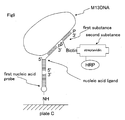
- Fig 7 shows a schematic diagram of the first nucleic acid probe immobilized on the plate C.
- Fig 8 shows a schematic diagram of the complex consisting of the first nucleic acid probe, the nucleic acid ligand, M13DNA, and the first substance on the plate C.
- Fig 9 shows a schematic diagram of the first complex on the plate C.
- Fig 10 shows a schematic diagram of the second complex on the plate D.
- The method for detecting a target substance according to the present invention comprises:
- a step 1 of forming a first complex comprising the following (a) to (d) bound to one another:
- (a) a first nucleic acid probe immobilized on a first solid phase and having a single-strand portion,
- (b) a nucleic acid ligand which has a base sequence (hereinafter, referred to as binding section) hybridizable with the single-strand portion of the first nucleic acid probe and which has a target-binding substance capable of binding to the target substance,
- (c) the target substance, and
- (d) a labeling substance capable of binding to the target substance,
- a step 2 of separating, from the first complex, a labeled nucleic acid ligand/target substance complex comprising the nucleic acid ligand, the target substance and the labeling substance,
- a
step 3 of forming a second complex comprising the separated labeled nucleic acid ligand/target substance complex and a second nucleic acid probe immobilized on a second solid phase, and - a step 4 of detecting the target substance on the basis of the labeling substance in the second complex.
- The term "nucleic acid" in the present specification includes not only DNA and RNA but also artificially systhesized nucleic acid (referred to hereinafter as artificial nucleic acid) such as PNA (peptide nucleic acid), BNA (bridged nucleic acid), and analogues thereof. The term "base sequence" in the present specification includes not only base sequences of DNA and RNA but also base sequence of artificial nucleic acids.
- The first and second solid phases may be those capable of stably immobilizing the first or second nucleic acid probes respectively thereon, and can make use of containers such as a plate, a tube, etc. , a membrane, particles, etc., and specific examples include microplates made of glass or synthetic resin such as polypropylene, polystyrene, etc, a nitrocellulose membrane, latex particles, and magnetic particles.
- Examples of the target substance includeproteins, nucleic acids, sugars, lipids, hormones, heptenes, toxins, viruses, microorganisms, etc. The "microorganisms" refer to microscopic organisms that cannot be observed with the naked eyes, such as bacteria, protista and chromista.
- The nucleic acid ligand includes both a target-binding substance specifically recognizing a target substance and a binding section.
- The target-binding substance is selected depending on the type of the target substance, and is not particularly limited insofar as it can specifically bind to a target substance. A base sequence, an antibody, a receptor, and an aptamer can be used as the target-binding substance.
- The antibody may be either a polyclonal or monoclonal antibody. The "antibody" in the present invention also includes an antibody fragment and its derivative. Specific examples of the antibody fragment and its derivative include Fab, Fab', F (ab)2 and sFv fragments (Blazar et al., 1997, J. Immunol., 159: 5821-5833 and Bird et al., 1988, Science, 242: 423-426). Subclasses of the antibody are not limited to IgG and may be IgM, etc.
- The binding section may be not only a base sequence of DNA or RNA but also a base sequence of an artificial nucleic acid, but is preferably a base sequence of DNA.
- The sequence of the binding section is determined depending on the sequence of the first nucleic acid probe. Specifically, this sequence may a sequence having such complementarity as to form a hybrid with the single-strand portion of the first nucleic acid probe, and is not limited to a sequence having complete complementarity to the single-strand portion of the first nucleic acid probe. The complementarity of the binding section to the single-strand portion of the first nucleic acid probe may be 50% or more because the two are preferably not completely complementary to each other,particularly in order to execute a later dissociation step.
- The length of the binding section is preferably a length enough for it to hybridize with the first nucleic acid probe.
- When the target-binding substance is an aptamer, the binding section may bind to the aptamer, or a part of the aptamer may be the binding section.
- The target-binding substance is preferably bound to the end of the binding section. When the binding section is DNA or RNA, the target-binding substance is boundpreferably to the 3' end of the binding section. When the target-binding substance is composed of an aptamer, it is preferable that the binding section is formed at the side of the 5' end of the nucleic acid ligand, while the sequence constituting the aptamer is formed at the side of the 3' end of the nucleic acid ligand. When the target-binding substance is an antibody, the antibody can be bound to the nucleic acid ligand, for example by modifying the 3'-end of the nucleic acid ligand, with a thiol group, then binding it to a linker molecule having a maleimide group and modified with a glutaraldehyde group at the opposite side to the maleimide group, and binding this aldehyde group covalently to an amino group present in the antibody.
- The labeling substance is a substance having a label and capable of binding to a target substance.
- The labeling substance preferably has a substance capable of binding to a target substance (hereinafter, referred to as the second target-binding substance). As the second target-binding substance, a base sequence, an antibody, a receptor, an aptamer, etc. can be used. The region of a target substance which is recognized by the second target-binding substance is preferably different from the region recognized by the target-binding substance in the nucleic acid ligand.
- The type of the label is not particularly limited insofar as the label is a substance capable of detecting the second complex upon binding of the label thereto. Examples of the label include substances emitting a detectable signal and substances catalyzing a reaction generating a product emitting a detectable signal.
- Specific examples include radioisotopes such as 32P and 125I, fluorescent dyes such as fluorescein, enzymes such as alkali phosphatase (ALP) and horseradish peroxidase (HRP), fluorescent/luminescent substances such as quantum dots and nano particles, substances having electrochemical activity, such as ferrocene, and electrochemical luminescent substances such as ruthenium and an europium complex.
- The labeling substance maybe composed of both a primary substance capable of binding to the second complex and a secondary substance capable of binding to the primary substance and having the label described above. In this case, the primary substance binds to the second complex, and further the secondary substance binds to the primary substance thereby indirectly binding the label to the second complex.
- When a fluorescent dye is used as the label, its fluorescence density can be measured by irradiating the reaction solution including the second complex with UV light or the like. When a radioisotope is used as the label, its radioactivity may be measured by using a scintillation counter or the like. When an enzyme is used as the label, a substance formed by enzyme reaction after addition of a substance serving as a substrate of the enzyme may be quantified.
- The first and second nucleic acid probes may be those having a base sequence hybridizable with the binding section of the nucleic acid ligand. Each of these probes may be a singe strand or may have a sequence having a single-strand portion and a double-strand portion having 2 base sequences different in length and hybridized with each other, wherein the single-strand portion has a sequence hybridizable with the binding section of the nucleic acid ligand. The sequence of the first nucleic acid probe may be the same as, or different from, the sequence of the second nucleic acid probe. These probes may be those which have a stem loop formed from a single strand and have a single-strand portion having a sequence hybridizable with the nucleic acid ligand. The first nucleic acid probe preferably has a stem loop structure. When the probe has a stem loop structure, it is preferable that the stem part of the probe which has formed a double strand is a 5- to 10-mer, and the single-strand portion is a 15- to 20-mer.
- These probes may be immobilized directly or indirectly on a solid phase. The method of indirectly immobilizing the probe includes, for example, a method wherein a specific substance A bound to a solid phase, and a first probe having a substance B capable of binding the substance A to the probe can be used, whereby the probe is immobilized indirectly on the solid phase. As a combination of A and B, a combination of streptavidin and biotin or the like can be used. An amino group may be combined with any of bases constituting the probe in order to immobilize the amino group. When the probe has a stem loop structure, the loop region is preferably immobilized on a solid phase. Alternatively, sequence X and sequence XcY may be used as the probe. The sequence X is a single strand base sequence and the sequence XcY has a base sequence Xc complementary to the sequence X and a base sequence Y hybridizable with the binding section of the nucleic acid ligand. By immobilizing sequence X on a solid phase and hybridizing sequence XcY with sequence X, sequence X and sequence XcY can be used as the first probe immobilized on a solid phase.
- Hereinafter, the respective steps for carrying out the method of the present invention will be described.
- First, a target substance, a first nucleic acid probe, a nucleic acid ligand and a labeling substance are bound to a first solid phase (reaction container, etc.) to form a first complex (step 1).
- Binding of the target substance, the first nucleic acid probe and the nucleic acid ligand can be carried out firstly by binding the first nucleic acid probe and the nucleic acid ligand on the first solid phase and then by adding a sample containing the target substance thereto, thereby binding the target substance to the nucleic acid ligand. Binding of the target substance, the first nucleic acid probe and the nucleic acid ligand can be carried out by binding, to the first nucleic acid probe immobilized on the first solid phase, a "nucleic acid ligand/target substance complex previously formed by binding the nucleic acid ligand" to the target substance.
- Binding of the labeling substance to the target substance may be conducted before or after a complex of the target substance, the first nucleic acid probe and the nucleic acid ligand is formed.
- It is preferable that after the first complex is formed on the first solid phase, the first solid phase is washed. By doing so, the labeling substance, the nucleic acid ligand, the target substance, the target substance, etc. , which have failed to form the first complex, can be removed from the first solid phase. For washing, a washing solution is preferably used. As the washing solution, a buffer such as TBS and PBS can be used.
- Then, the labeled nucleic acid ligand/target substance complex is dissociated from the first complex (step 2).
- The dissociation method includes (1) amethodofusinganincrease in temperature, (2) a method of using a competitive reaction, and (3) a method of using a strand displacement reaction.
- The method (1) is a method which involves increasing the temperature of the first solid phase having the first complex formed thereon, thereby separating the first nucleic acid probe from the binding section of the nucleic acid ligand in the complex.
- When the present invention is carried out at room temperature (20°C), the Tm value of the first nucleic acid probe and the binding section should be equal to or higher than the room temperature. This Tm value is preferably a temperature in such a range that the probe and the target substance are not denatured. When the base constituting the binding section is A or T, the Tm value of the binding section of 12- to 16-mer in length for example is about 24 to 33°C, and thus the binding section can be dissociated at about 40°C. The binding section is preferably free of bases C and G and composed of A and T.
- In the method (2), a competitive base sequence having a sequence complementary to the single-strand portion of the first nucleic acid probe and having a longer chain than the binding section of the nucleic acid ligand is used. When a long-chain competitive nucleic acid capable of forming a more stable hybrid with the first nucleic acid probe is coexistent at a temperature where a hybrid of the nucleic acid ligand and the first nucleic acid probe is unstable, the nucleic acid ligand is dissociated to allow the competitive nucleic acid and the first nucleic acid probe to form a hybrid. Accordingly, the competitive reaction is carried out preferably at a temperature where the binding of the first nucleic acid probe to the binding section is unstable and simultaneously the binding of the competitive nucleic acid to the first nucleic acid probe can stably occur. That is, the competitive reaction temperature Tc is preferably higher than the Tm value (Tm1) of the first nucleic acid probe and the binding section but lower than the Tm value (Tm2) of the hybrid of the first nucleic acid probe and the competitive nucleic acid (Tm1 < Tc < Tm2).
- The method (3) is a method wherein the nucleic acid ligand is separated by extension reaction with the first nucleic acid probe as a template in the presence of a DNA polymerase with strand displacement activity (hereinafter, referred to as polymerase) and dNTPs (nucleiotide(s) selected from dATP, dGTP, dTTP and dCTP).
- To use this method, at least the first nucleic acid probe is preferably DNA. When the first nucleic acid probe is a single strand, a primer capable of binding to that part of the first nucleic acid probe which does not hybridize with the binding section is preferably used to serve as a starting point of extension reaction with the polymerase.
- When the first nucleic acid probe has a stem loop structure, the single-strandportion of the first nucleic acid probe is preferably at the side of the 5' end. In this case, a 3' end of the first nucleic acid probe is double-stranded and thus capable of serving as a starting point of extension reaction, thus eliminating necessity for use of a primer.
- In the extension reaction, the temperature of the first complex can be kept at 37 to 50°C, whereby the polymerase binds to the double-stranded part, followed by linking nucleotides one after another with the 3' end of the first nucleic acid probe (or when a primer is used, the 3' end of the primer) as a starting point. That is, the extension reaction occurs with the single-strand portion of the first nucleotide as a template, while hybridization of the first nucleic acid probe with the nucleic acid ligand is cancelled to separate the nucleic acid ligand.
- After this method is used, it is preferable that one or two bases at the 5' end of the binding section of the nucleic acid ligand do not have complementarity to the first nucleic acid probe. Thereby, strand displacement by the extension reaction with the polymerase can easily occur.
- When the labeled nucleic acid ligand/target substance complex is separated from the first complex by any of the methods (1) to (3) described above, the labeled nucleic acid ligand/target substance complex is collected. Then, the collected labeled nucleic acid ligand/target substance complex is transferred to a second solid phase having a second nucleic acid probe immobilized thereon, and the binding section of the labeled nucleic acid ligand/target substance complex is hybridized with the second nucleic acid probe to form a second complex (step 3).
- After formation of the second complex, the target substance is detected (step 4). The detection in this specification includes not only determination of the presence or absence of the target substance but also quantification of the target substance. When the first nucleic acid probe has a stem loop structure, the end of the stem portion may be linked with the end of the binding section prior to the detection of the target substance. When the first nucleic acid probe and the binding section are DNAs, the two can be linked at the end with each other by using a ligase. When the first nucleic acid probe and the binding section are artificial nucleic acids, the two can be linked at the end with each other by photo-linkage or the like. As a method of linking artificial nucleic acids by photo-linkage, a method described in, for example, U.S. No. 6,593,088 B1 can be used.
- The end of the first nucleic acid probe is linked with the end of the binding section, whereby the second complex can be stabilized to prevent the labeled nucleic acid ligand/target substance complex from being separated from the second complex upon washing, etc.
- Without conducting the formation of the second complex (step 3), a solution containing the labeled nucleic acid ligand/target substance complex separated from the first complex may be transferred to a container different from the first solid phase, followed by detecting the target substance contained in this solution.
- A reagent kit comprising reagents containing a first solid phase having a first nucleic acid probe immobilized thereon, a reagent containing a nucleic acid ligand, a second solid phase having a second nucleic acid probe immobilized thereon, and a reagent containing labeling substance can be used for carrying out the above-described method for detecting a target substance.
- Hereinafter, the method for detecting a target substance according to the present invention will be described in detail by reference to Figs. 1 and 2.
- A first
nucleic acid probe 21 used in Fig. 1 is a single-stranded DNA and forms a stem loop. A single-strand portion 21a of the first nucleic acid probe has, at the 5' -end thereof, a sequence capable of hybridizing with the binding section of a nucleic acid ligand. Biotin is added to one of bases forming the loop. The first nucleic acid probe includes a probe having a sequence, for example, "AGAACAGCGTATAATCATTAGCCCGCCCGGCCAA*AAAGGCCGGGCGGGCTAA" (SEQ ID NO: 1) . The base "A*" at position 34 is adenine that biotin is added to. The probe of such sequence can be obtained for example by making a request to Takara Bio Co., Ltd.
Streptavidin is immobilized at the bottom of a glass container first (solid phase), and biotin of the first nucleic acid probe binds to this streptavidin thereby immobilizing the first nucleic acid probe on the first solid phase (Fig. 1 (a)). - A
target substance 22 is a protein (antigen), and anucleic acid ligand 24 has an antibody which can, as a target-bindingsubstance 24a, bind specifically to this antigen. Thenucleic acid ligand 24 has both abinding section 24b ("ATACGCTGTTCT", etc.) as DNA capable of hybridizing with the 5'-end of a single-strand portion 21a of a firstnucleic acid probe 21 and the antibody as the target-bindingsubstance 24a bound via a linker molecule to the 3' -end of thebinding section 24b. - The
target substance 22 has an ALP-labeledsecondary antibody 23 bound thereto. When a labeled nucleic acid ligand/target substance complex 25 wherein the target substance having thesecondary antibody 23 bound thereto is bound to the target-bindingsubstance 24a is added to the container having thenucleic acid probe 21 immobilized thereon, the bindingsection 24b of thenucleic acid ligand 24 hybridizes with the single-strand portion 21a of the firstnucleic acid probe 21, to form a first complex (Fig. 1 (b)). - When a
DNA polymerase 26 with strand displacement activity and dNTPs are added after the first solid phase is washed, thepolymerase 26 binds to the 3' end of the first nucleic acid probe 21 (Fig. 1 (c)), and the first nucleic acid probe is extended at the 3' end as a starting point with the sequence, as a template, of the single-strand portion 21a of the first nucleic acid probe 21 (Fig. 1 (d)). - As the extension reaction proceeds, the binding
section 24b of thenucleic acid ligand 24 is peeled off to displace the strand. When the single-strand portion 21a of the firstnucleic acidprobe 21 becomes double-stranded by the extension reaction, the labeled nucleic acid ligand/target substance complex 25 is completely separated (Fig. 1 (e)). - Then, the labeled nucleic acid ligand/
target substance complex 25 obtained by separation is transferred to another container (second solid phase). A secondnucleic acid probe 31 is immobilized on the second solid phase (Fig. 2 (a)). - The second
nucleic acid probe 31 has double-stranded DNA bound to the solid phase, wherein one strand of the DNA is longer to form a single-strand portion 31a (Fig. 2 (a)). Like the first nucleic acid probe, the secondnucleic acid probe 31 may also be a stem loop type having a single-strand portion. The single-strand portion of the second nucleic acid probe is located at the side of the 5' end thereof. - When the nucleic acid ligand/
target substance complex 25 is added to the second solid phase having the secondnucleic acid probe 31 immobilized thereon, the single-strand portion 31a of the second nucleic acid probe hybridizes with thebinding section 24b of thenucleic acid ligand 24, to form a second complex (Fig. 2 (b)). After the second complex is formed, the label of the second complex is measured thereby detecting thetarget substance 22. - In this example, ALP is used as the label. For example, when a substrate of ALP, for example paramethoxyphenylphosphoric acid (pMPP), is reacted for a predetermined time with ALP in the second complex (Fig. 2 (c)), pMPP is changed into p-methoxyphenol (pMP). After the reaction with ALP is terminated by adding EDTA (Fig. 2 (d)), detectable coloration emitted by pMP can be measured to detect the target substance.
- When the above method is used, the background noise generated by adsorption of the labeling substance onto the solid phase without binding thereof to the target substance can be reduced, and thus the target substance can be accurately detected. Dissociation of the target substance from, and capture thereof by, the nucleic acid probe, which occur via the nucleic acid ligand, are based on complementarity to bases and are more reproducible and efficient than those by antigen/antibody reaction, thus enabling highly accurate and highly sensitive detection and measurement. Unlike the antibody, the nucleic acid can be used to determine a base sequence at will to facilitate establishment of the Tm value of the nucleic acid ligand and the nucleic acid probe, thus simplifying the experiment.
- The nucleic acid ligand in the present invention is not limited in use to the measurement method of the present invention. For example, the process of from formation of the first complex to dissociation of the nucleic acid ligand/target substance complex from the first complex or to collection of the dissociated nucleic acid ligand/target substance complex is carried out by the measurement method described above, whereby the objective target substance can be separated and collected from a measurement sample containing the target substance. That is, a highly purified and highly concentrated measurement sample can be obtained. Accordingly, the process from the step of forming the nucleic acid ligand/target substance complex to the step of separating and collecting the target substance can be utilized as pretreatment for obtaining a highly purified measurement sample to be subjected to electrophoresis, mass spectrometric analysis, LC, and an intramolecular interaction measurement instrument (SPR-ROM).
- 50 µl of 0.2 pmol/µl streptavidin (Chemicon SA101 Lot No. 21080929) was added to each well of a 96-well plate A (ELISA plate manufactured by IWAKI) and left at 37°C for 1.7 hours to bind streptavidin to the well (Fig. 3 (a)).
- After each well of the plate A was washed with TBS (TBS-T) containing 0.1% BSA (manufactured by SIGMA), 300 µl solution prepared by diluting salmon-DNA (salmon sperm DNA) at a concentration of 0.1 mg/ml with the TBS-T was added to each well and left at 37°C for 3 hours to block unspecific adsorption.
- DNA for bio-Transfer (DNA forming a stem loop wherein an adenine molecule in the stem region was modified with biotin: 5' AGAACAGCGTATAATCATTAGCCCGCCCGGCCAA*AAAGGCCGGGCGGGCTAA3'(SEQ ID NO: 1)) was used as the first nucleic acid probe. 50 µl of 1 pmol/µl DNA for bio-Transfer was added to each well having streptavidin immobilized thereon, and then left at 37°C for 5 hours. Biotin in the first nucleic acid probe was bound to streptavidin thereby immobilizing the first nucleic acid probe onto the solid phase on each well (Fig. 3 (b)).
- A base sequence having a sequence hybridizable with a single strand of the first nucleic acid probe and containing biotin as the target-binding substance bound to the 3' end thereof (5' ATAGCGCGCTGTTCTTACTCAGGGCACTGCAATTGTGGTCCCAATGGGCTGAGTA 3'-biotin (SEQ ID NO: 2)) was used as the nucleic acid ligand. Bases in positions 1 to 9 in the first nucleic acid probe (SEQ ID NO: 1) and bases in positions 7 to 15 in the nucleic acid ligand are complementary to each other.
- The nucleic acid ligand was added to each well and left at room temperature for 1.7 hours thereby hybridizing the nucleic acid ligand with the first nucleic acid probe (Fig. 3 (c)). The amount of the nucleic acid ligand added per 50 µl well was 0 mol, 0.1 × 10⁻¹⁴ mol, 1 × 10-13 mol, 1 × 10-12 mol, 1 × 10-11 mol, or 3.3 × 10⁻¹⁰ mol.
- Then, streptavidin (target substance) to which ALP (labeling substance) had been bound was added to each well and captured by biotin of the nucleic acid ligand. Capture of the target substance was carried out by reacting a 2000-fold dilution of ALP-labeled streptavidin (SAv-AP manufactured by NORDIC) with the nucleic acid ligand for 1 hour. Thereby, biotin of the nucleic acid ligand was bound to streptavidin as the target substance, resulting in formation of the first complex.
- The amount of the target substance added was such an amount that regardless of the concentration of the nucleic acid ligand in each well, the target substance could bind to every nucleic acid ligand.
- Reverse Transcriotaqse XL (AMV) manufactured by Takara was used as DNA polymerase with strand displacement activity.
- 50 µl reaction solution containing the following composition, and 1 µl AMV (5 U/µl), were added to each well and reacted at 37°C for 15 hours.
Tris buffer (50 mM Tris-HCl, 40 mM KCl, pH 8.2) magnesium chloride 6 mM dNT P 250 µl DTT 2 mM - AMV was bound to the 3' end of the nucleic acid probe forming the first complex, and the single-strand portion of the first nucleic acid probe was used as a template to carry out extension reaction. By this strand displacement reaction, the labeled nucleic acid ligand/target substance complex was dissociated from the first nucleic acid probe (Fig. 3 (d)).
- A plate B (GENE PLATE 21GP 02-3 RNAture, Beritus [phonetic]) having oligo-dT20 immobilized thereon was used as the second solid phase.
- Single-strand nucleic acid having dA20 and containing a base sequence hybridizable with the nucleic acid ligand was hybridized at room temperature for 1 hour with the plate B to immobilize the second nucleic acid probe (Fig. 3 (e)).
- After the plate B was washed, a solution prepared by diluting salmon speruma DNA (containing 3% BSA) at a concentration of 0.01% with TBS-T was added to each well and left at room temperature for 1.5 hours or more for blocking.
- The labeled nucleic acid ligand/target substance complex obtained in (3) was transferred to the plate B having the second nucleic acid probe immobilized thereon. By reaction at room temperature for 1 hour, the single strand of the second nucleic acid probe was hybridized with the binding section in the complex, to form the second complex (Fig. 3 (f)).
- 10 µl solution containing 10 mM p-MPP (diluent: 0.5 M carbonate buffer) as a substrate of ALP was added to each well of the plate B having the second complex formed thereon, followed by ALP reaction at 37°C for 30 minutes. After the ALP reaction, 10 µl terminating solution (EDTA solution, pH 9) was added to each well.
- In the reaction solution, p-MPP was decomposed into p-MP by the ALP reaction.
- Because the amount of p-MP was changed depending on the number of ALP molecules, the amount of p-MP was measured to determine the amount of the target substance in the second complex.
- The amount of p-MP was measured by using a flow electrochemical measurement system shown in Fig. 4. The measurement results are shown in a solid-line graph in Fig. 5.
- The above reaction solution (reaction solution after the ALP reaction) was introduced into an injector. By opening an inject valve (77251 manufactured by Reodine), the reaction solution was passed through an ODS column (YMC-Pack-ODS-AM, AM3C7AM12S05-L502WT No. 0270458 (W)) and then through a short column (YMC semi-micro guard cartridge column 2×10, AM12S05-0102CC) and sent to an electrochemical detection part. The eluent used was 0.1 M phosphate buffer containing 45 v/v% or 50 v/v% methanol. The short column, arranged between the inject valve and the electrode detection part, prevented the surface of the electrode from being contaminated with protein components in the measurement sample reaching the electrode detection part. Byusing the short column, the noise electric current derived from the buffer and the electric current of the detected component were separated by the time for reaching the detector [literal trans.].
- A degasser (Vacuum Degasser LC-27A) accommodating the eluent removed bubbles from the eluent, and the eluent was sent at a rate of 250 µl/min. via a pump (MICRO LC Pump LC-100) to the electrochemical detection part thereby sending the reaction solution accommodated in the injector to the electrochemical detection part.
- The amount of the reaction solution in an FIA-EC-DT (Flow Injection Analysis-Electrochemical-Detection) flow path was predetermined to be 20 µl.
- A 3-electrode system was used in the electrode detection part in FIA-EC-DT, wherein Ag/AgCl (BAS RE3V) was used as the reference electrode, a flow path-integrated electrode as the counter electrode, and a glassy carbon electrode (BAS003456) as the work electrode. ALS832a manufactured by BAS was used as the electrochemical measuring instrument.
- Each sample was injected into the flow electrochemical measurement system and electrochemically detected by determining a peak of oxidation current. The detection conditions were that the work electrode potential (oxidation potential) was 0.55 V vs Ag/AgCl, and the retention time from the injector to the electrode detection part was 90 seconds.
- The procedures (1) to (3) in Experiment 1 were carried out in an the same manner to form a first complex on a 96-well plate. In this state, the ALP reaction was utilized in the same manner as in (6) in Experiment 1, to detect the first complex.
- ALP measurement was conducted by using a flow electrochemical detection method shown in Fig. 4. The results are shown in a dotted-line graph in Fig. 5.
- Fig. 6 shows signal levels obtained by subtracting the background noise from the results in Fig. 5.
- In Figs. 5 and 6, "■" shows the results of Example 1, while "□" shows the results of Comparative Example 1. The amount (mol) of the nucleic acid ligand used (nucleic acid ligand/streptavidin complex) is shown on the abscissa, and the electric current (A) measured in the detection system is shown on the ordinate.
- Fig. 5 revealed that in the Comparative Example 1 wherein the dissociation reaction and the transfer of the labeled nucleic acid ligand/target substance complex to the second solid phase were not carried out, the concentration of the target substance was almost correlated with the determined electric current when the concentration of the target substance was 10-12 mol or more, but when the concentration was less than 10-12 mol, the determined electric current was hardly changed. This means that since the background noise is high, samples in a very small amount of less than 10-12 mol cannot be distinguishably measured.
- In the Example 1 wherein the dissociation reaction and the transfer of the labeled nucleic acid ligand/target substance complex to the second solid phase were carried out, on the other hand, the concentration of the target substance was almost correlated with the determined electric current. Accordingly, in the assay wherein the dissociation reaction is conduced, a sample can be measured at a concentration of 10-14 mol or at least 10-13 mol. This means that the detection level was improved by at least one digit as compared with that of conventional assays.
- 100 µl solution (pH 8.5) containing 50 mM Na2PO4, 1 mM EDTA, and 100 pmol aminated oligo DNA (first nucleic acid probe: 5' AGAACAGCGTATAATCATTAGCCCGCCCGGCCAA(NH2-A)AAGGCCGGGCGGGCTAA 3', SEQ ID NO: 3, Bex Co., Ltd.) was added to each well of a 96-well plate C (DNA-BIND plate, CORNING) and left at 37°C for 1 hour to bind the first nucleic acid probe to the well (Fig. 7).
- Each well of the plate C was washed 3 times with 200 µl PBS, and 200 µl blocking solution containing 50 mM Na2PO4, 1 mM EDTA and 3% BSA was added to each well and left at 37°C for 30 minutes to block unspecific adsorption.
- As a hybridization buffer for formation of the first complex, a solution prepared by dissolving 5 × SSC (prepared by dilution of 20 × SSC (Nippon Gene)), 0.05% SDS (prepared by dilution of 10% SDS (Nippon Gene)) and 0.005% BSA in ultra-pure water was used.
- As the target substance, M13mp18 single-strandDNA (hereinafter, referred to as M13 DNA, manufactured by Takara Bio). This was added to TE buffer (Nippon Gene) containing salmon sperm DNA (Nacalai Tesque) at a concentration of 10 µg/ml, and the prepared solution was used as a measurement sample.
- DNA (5' TGACCATACGCTGCTCTTTTTGTAAAACGACGGCCAGT 3', SEQ ID NO: 4, SIGMA Genosys) phosphorylated at the 3' end and having a sequence hybridizable with both the first nucleic acid probe and M13 DNA was used as the nucleic acid ligand.
- DNA (5' TTTTTGTCGACTCTAGAGGATC 3' , SEQ ID NO: 5, SIGMA Genosys) biotinated at the 5' end, phosphorylated at the 3' end, and hybridizable with the nucleic acid ligand was used as a first substance for labeling.
- First, 100 µl of the above hybridization buffer was added to each well of the plate C having the first nucleic acid probe immobilized thereon. Then, the measurement sample, 10 pmol nucleic acid ligand and 10 pmol first substance were added to each well of the plate C and left at 37°C for 1 hour, to bind the first probe, the nucleic acid ligand, M13 DNA and the first substance to one another (Fig. 8). Then, each well of the plate C was washed 3 times with 200 µl washing buffer (2 × SSC containing 0.1% SDS).
- HRP-labeled streptavidin (1000 U/ml, Roche) was used as a second substance for labeling. 200 µl blocking solution (PBS (Nippon Gene) containing 3% BSA) was added to each well of the plate C and left at 37°C for 30 minutes for blocking. After the blocking solution was removed from the well, 100 µl of HRP-labeled streptavidin (1000 U/ml, Roche) diluted 1000-fold with the blocking solution was added to each well and left at 37°C for 1 hour. Thereby, the first complex was formed on the first solid phase (Fig. 9).
- 100 µl reaction solution containing the following composition was added to each well and reacted at 37°C for 1 hour.
- 1 × Thermopol buffer (New England Labs)
- 1 mM dATP (Invitrogen)
- 1 mM dGTP (Invitrogen)
- 1 mM dTTP (Invitrogen)
- 1 mM dCTP (Invitrogen)
- 2.4 U/ml BstDNA polymerase (New England Labs)
- BstDNA polymerase is a DNA polymerase with strand displacement activity.
- By this reaction, the HRP-labeled nucleic acid ligand/target substance complex was dissociated from the first complex and released into the reaction solution.
- 100 µl solution (pH 8.5) containing 50 mM Na2PO4, 1 mM EDTA, and 100 pmol oligo DNA aminated at the 3' end thereof (second nucleic acidprobe: 5' AGAGCAGCGTATGGTCATTTTTT 3', SEQ ID NO:6, SIGMA Genosys) was added to each well of a 96-well plate D (DNA-BIND plate, CORNING) and left at 37°C for 1 hour to bind the second nucleic acid probe to the well. Thereafter, the second nucleic acid probe not immobilized on the plate D was removed by washing 3 times with 200 µl PBS.
- The whole amount of the reaction solution in the plate C obtained in (3) was transferred to each well on the plate D. After transfer, the plate was left at 37°C for 1 hour, whereby the HRP-labeled nucleic acid ligand/target substance complex in the reaction solution was hybridized with the second nucleic acid probe to form the second complex (Fig. 10). After formation of the second complex, each well was washed 3 times with 200 µl PBS.
- After the step (5) was finished, PBS for washing each well was removed. Then, 100 µl TMB solution (3,3',5,5'-Tetramethylbensidine Liquid Substrate System Super Sensitive Form for ELISA, SIGMA) was added to each well and reacted at 37°C, and by the action of HRP, the substrate TMB was decomposed and colored. After 1 hour, the reaction was terminated by adding 100 µl of 1 NHCl (Wako Pure Chemical Industries, Ltd.) to each well. The absorbance of each well at 450 nm was measured by a plate reader (Safire 2, TECAN).
- For determining the background level in this measurement, (1) to (6) in Experiment 2 were carried out using a target substance-free sample (0 fmol), and the absorbance was determined.
- The steps (1) and (2) were carried out in the same manner as in Experiment 2. Without conducting the steps (3) to (5), the coloration reaction with HRP was then conducted in the same manner as in (6), and the absorbance was determined.
- For determining the background level in this measurement, the steps (1) and (2) in Experiment 2 were carried out using a target substance-free sample (0 fmol), then the coloration reaction with HRP was conducted in the same manner as in (7), and the absorbance was determined.
- The results in Experiment 2 and Comparative Example 2 are shown in Table 1 below.
amount of target substance experiment 2 comparative example 2 0 fmol 0.013 0.1405 10 fmol 0.1674 0.347 S/N ratio 12.4 2.47 - From Experiment 2 and Comparative Example 2, it was confirmed that the background level in detection of the target substance was significantly reduced by separating the labeled nucleic acid ligand/target substance complex from the first solid phase and then transferring it to the second solid phase. The S/N ratio was also improved to enable detection of the target substance with high accuracy.
- From the foregoing, a very small amount of the target substance can be measured with high accuracy with low background level according to the detection method of the present invention.


Claims (19)
- A method for detecting a target substance, characterized by comprising the steps of:forming a first complex comprising(a) a first nucleic acid probe immobilized on a first solid phase and having a single-strand portion,(b) a nucleic acid ligand which has a binding section as a base sequence hybridizable with the single-strand portion of the first nucleic acid probe and which has a target-binding substance capable of binding to the target substance,(c) the target substance, and(d) a labeling substance capable of binding to the target substance;separating, from the first complex, a second complex comprising the nucleic acid ligand, the target substance and the labeling substance; anddetecting the target substance on the basis of the labeling substance in the second complex.
- The method according to claim 1, comprising the step of forming a third complex comprising the separated second complex and a second nucleic acid probe which is immobilized on a second solid phase and has a single-strand portion hybridizable with the binding section of the nucleic acid ligand,
and wherein the detecting step is carried out by detecting the target substance on the basis of the labeling substance in the second complex included in the third complex. - The method according to claim 1 or 2, wherein said target substance is selected from the group consisting of protein, nucleic acid, sugar, lipid, hormone, heptene, toxin, viruse and a microorganism.
- The method according to any one of claims 1 to 3, wherein said first nucleic acid probe, said binding section and said second nucleic acid probe are DNAs.
- The method according to any one of claims 1 to 4, wherein the binding section is DNA or RNA, and the target-binding substance is bound to the 3' end of the binding section.
- The method according to any one of claims 1 to 5, wherein said target-binding substance is selected form the group consisting of a base sequence, an antibody, a receptor, and an aptamer.
- The method according to any one of claims 1 to 6, comprising a step of washing the first solid phase after formation of the first complex.
- The method according to any one of claims 1 to 7, wherein the formation of the first complex is carried out by binding the target substance and the labeling substance to a complex comprising the first nucleic acid probe and the nucleic acid ligand.
- The method according to any one of claims 1 to 7, wherein the formation of the first complex is carried out by binding the first nucleic acid probe to a complex comprising the target substance, the target substance bound and the nucleic acid ligand.
- The method according to any one of claims 1 to 9, wherein said labeling substance is selected from the group consisting of a radioisotope, a fluorescent substance, an enzyme, a coloring substance and a luminescent substance.
- The method according to claim 10, wherein said labeling substance has a base sequence, an antibody, a receptor, and an aptamer.
- The method according to any one of claims 1 to 11, wherein the labeling substance comprises a first substance containing a second target-binding substance capable of binding to the target substance, and a second substance capable of binding to the first substance and having a label selected from the group consisting of an enzyme, a fluorescent substance, a luminescent substance, a coloring substance and a radioisotope.
- The method according to any one of claims 1 to 12, wherein the separating step is carried out by heating the first complex.
- The method according to any one of claims 1 to 12, wherein the separating step is carried out by heating the first complex until reaching a temperature in the presence of a single-strand competitive nucleic acid hybridizable with the first nucleic acid probe and longer than the binding section, the temperature being higher than a melting temperature (Tm) value of a hybrid of the first nucleic acid probe and the binding section, and lower than a melting temperature (Tm) value of a hybrid of the first nucleic acid probe and the competitive nucleic acid.
- The method according to any one of claims 1 to 12, wherein the separating step is carried out by strand displacement reaction as a template of the single-strand portion of the first nucleic acid probe with a DNA polymerase with strand displacement activity and nucleotide (s) selected from the group consisting of dATP, dGTP, dTTP and dCTP.
- A method for collecting a target substance, characterized by comprising the steps of:forming a first complex comprising(a) a first nucleic acid probe immobilized on a first solid phase and having a single-strand portion,(b) a nucleic acid ligand which has a binding section hybridizable with the single-strand portion of the first nucleic acid probe and which has a target-binding substance capable of binding to the target substance,(c) the target substance, and(d) a labeling substance capable of binding to the target substance;separating, from the first complex, a second complex comprising the nucleic acid ligand, the target substance and the labeling substance; andcollecting the separated second complex.
- A reagent kit for detection of a target substance, characterized by comprising:a first solid phase on which a first nucleic acid probe having a single-strand portion is immobilized;a nucleic acid ligand having both a binding section hybridizable with the single-strand portion of the first nucleic acid probe and a target-binding substance capable of binding to the target substance;a second solid phase on which a second nucleic acid probe having a single-strand portion hybridizable with the binding section of the nucleic acid ligand is immobilized; anda labeling substance capable of binding to the target substance.
- The reagent kit according to claim 17, further comprising a washing solution for washing the first solid phase.
- The reagent kit according to claim 17 or 18, further comprising DNA polymerase with strand displacement activity and nucleotide(s) selected from the group consisting of dATP, dGTP, dTTP and dCTP.
Applications Claiming Priority (1)
| Application Number | Priority Date | Filing Date | Title |
|---|---|---|---|
| JP2004296329 | 2004-10-08 |
Publications (3)
| Publication Number | Publication Date |
|---|---|
| EP1672082A2 true EP1672082A2 (en) | 2006-06-21 |
| EP1672082A3 EP1672082A3 (en) | 2006-09-06 |
| EP1672082B1 EP1672082B1 (en) | 2009-12-16 |
Family
ID=36159281
Family Applications (1)
| Application Number | Title | Priority Date | Filing Date |
|---|---|---|---|
| EP05021784A Expired - Lifetime EP1672082B1 (en) | 2004-10-08 | 2005-10-06 | A method for detecting a target substance using a nucleic acid probe |
Country Status (4)
| Country | Link |
|---|---|
| US (1) | US20060234253A1 (en) |
| EP (1) | EP1672082B1 (en) |
| AT (1) | ATE452208T1 (en) |
| DE (1) | DE602005018316D1 (en) |
Cited By (5)
| Publication number | Priority date | Publication date | Assignee | Title |
|---|---|---|---|---|
| EP2069534A4 (en) * | 2006-08-02 | 2010-08-11 | California Inst Of Techn | METHODS AND SYSTEMS FOR DETECTING AND / OR SORTING TARGETS |
| WO2011090445A1 (en) * | 2010-01-22 | 2011-07-28 | Huseyin Avni Oktem | Method for detection of non-labeled pcr products on sandwich hybridization based array platforms |
| US11279969B2 (en) | 2016-11-21 | 2022-03-22 | Nanostring Technologies, Inc. | Chemical compositions and methods of using same |
| US11549139B2 (en) | 2018-05-14 | 2023-01-10 | Nanostring Technologies, Inc. | Chemical compositions and methods of using same |
| US12630869B2 (en) | 2023-06-07 | 2026-05-19 | Board Of Regents, The University Of Texas System | Simultaneous quantification of gene expression in a user-defined region of a cross-sectioned tissue |
Families Citing this family (8)
| Publication number | Priority date | Publication date | Assignee | Title |
|---|---|---|---|---|
| US20070166741A1 (en) * | 1998-12-14 | 2007-07-19 | Somalogic, Incorporated | Multiplexed analyses of test samples |
| WO2008019448A1 (en) * | 2006-08-18 | 2008-02-21 | Macquarie University | Time gated fluorescent flow cytometer |
| EP4300100A3 (en) | 2010-10-14 | 2024-09-04 | Meso Scale Technologies, LLC | Reagent storage in an assay device |
| US9335292B2 (en) | 2011-10-13 | 2016-05-10 | Auburn University | Electrochemical proximity assay |
| WO2018165566A1 (en) | 2017-03-09 | 2018-09-13 | Auburn University | Differential circuit for background correction in electrochemical measurements |
| WO2019010341A1 (en) | 2017-07-07 | 2019-01-10 | Innamed, Inc. | Aptamers for measuring lipoprotein levels |
| US11560565B2 (en) | 2018-06-13 | 2023-01-24 | Auburn University | Electrochemical detection nanostructure, systems, and uses thereof |
| CN113237928B (en) * | 2021-04-25 | 2023-02-17 | 重庆医科大学 | Electrochemical luminescence sensor for detecting hepatitis B virus DNA and preparation and application thereof |
Citations (1)
| Publication number | Priority date | Publication date | Assignee | Title |
|---|---|---|---|---|
| JP2003107089A (en) | 2001-05-10 | 2003-04-09 | Internatl Reagents Corp | Ultra-fast ultra-sensitive measurement method |
Family Cites Families (10)
| Publication number | Priority date | Publication date | Assignee | Title |
|---|---|---|---|---|
| US5118605A (en) * | 1984-10-16 | 1992-06-02 | Chiron Corporation | Polynucleotide determination with selectable cleavage sites |
| FR2737502B1 (en) * | 1995-07-31 | 1997-10-24 | Genset Sa | NUCLEIC ACID DETECTION METHOD USING NUCLEOTIDE PROBES ALLOWING BOTH SPECIFIC CAPTURE AND DETECTION |
| US7256020B2 (en) * | 1996-11-29 | 2007-08-14 | Third Wave Technologies, Inc. | Methods and compositions for detecting target sequences |
| US6309824B1 (en) * | 1997-01-16 | 2001-10-30 | Hyseq, Inc. | Methods for analyzing a target nucleic acid using immobilized heterogeneous mixtures of oligonucleotide probes |
| US6458533B1 (en) * | 1997-12-19 | 2002-10-01 | High Throughput Genomics, Inc. | High throughput assay system for monitoring ESTs |
| JP2003505036A (en) * | 1999-07-16 | 2003-02-12 | アクララ バイオサイエンシーズ, インコーポレイテッド | Multiple strand displacement for nucleic acid determination |
| US7955794B2 (en) * | 2000-09-21 | 2011-06-07 | Illumina, Inc. | Multiplex nucleic acid reactions |
| US20040058373A1 (en) * | 2001-01-31 | 2004-03-25 | Winkler Matthew M. | Competitive amplification of fractionated targets from multiple nucleic acid samples |
| WO2002080647A2 (en) * | 2001-04-03 | 2002-10-17 | Surromed, Inc. | Methods and reagents for multiplexed analyte capture, surface array self-assembly, and analysis of complex biological samples |
| US20040180369A1 (en) * | 2003-01-16 | 2004-09-16 | North Carolina State University | Photothermal detection of nucleic acid hybridization |
-
2005
- 2005-10-06 US US11/244,045 patent/US20060234253A1/en not_active Abandoned
- 2005-10-06 AT AT05021784T patent/ATE452208T1/en not_active IP Right Cessation
- 2005-10-06 EP EP05021784A patent/EP1672082B1/en not_active Expired - Lifetime
- 2005-10-06 DE DE602005018316T patent/DE602005018316D1/en not_active Expired - Lifetime
Patent Citations (1)
| Publication number | Priority date | Publication date | Assignee | Title |
|---|---|---|---|---|
| JP2003107089A (en) | 2001-05-10 | 2003-04-09 | Internatl Reagents Corp | Ultra-fast ultra-sensitive measurement method |
Cited By (10)
| Publication number | Priority date | Publication date | Assignee | Title |
|---|---|---|---|---|
| EP2069534A4 (en) * | 2006-08-02 | 2010-08-11 | California Inst Of Techn | METHODS AND SYSTEMS FOR DETECTING AND / OR SORTING TARGETS |
| US8354231B2 (en) | 2006-08-02 | 2013-01-15 | Cal. Inst. Tech. | Methods and systems for detecting and/or sorting targets |
| WO2011090445A1 (en) * | 2010-01-22 | 2011-07-28 | Huseyin Avni Oktem | Method for detection of non-labeled pcr products on sandwich hybridization based array platforms |
| US11279969B2 (en) | 2016-11-21 | 2022-03-22 | Nanostring Technologies, Inc. | Chemical compositions and methods of using same |
| US11821026B2 (en) | 2016-11-21 | 2023-11-21 | Nanostring Technologies, Inc. | Chemical compositions and methods of using same |
| US12049666B2 (en) | 2016-11-21 | 2024-07-30 | Bruker Spatial Biology, Inc. | Chemical compositions and methods of using same |
| US12209275B2 (en) | 2016-11-21 | 2025-01-28 | Bruker Spatial Biology, Inc. | Chemical compositions and methods of using same |
| US11549139B2 (en) | 2018-05-14 | 2023-01-10 | Nanostring Technologies, Inc. | Chemical compositions and methods of using same |
| US12281356B2 (en) | 2018-05-14 | 2025-04-22 | Bruker Spatial Biology, Inc. | Chemical compositions and methods of using same |
| US12630869B2 (en) | 2023-06-07 | 2026-05-19 | Board Of Regents, The University Of Texas System | Simultaneous quantification of gene expression in a user-defined region of a cross-sectioned tissue |
Also Published As
| Publication number | Publication date |
|---|---|
| EP1672082A3 (en) | 2006-09-06 |
| EP1672082B1 (en) | 2009-12-16 |
| ATE452208T1 (en) | 2010-01-15 |
| DE602005018316D1 (en) | 2010-01-28 |
| US20060234253A1 (en) | 2006-10-19 |
Similar Documents
| Publication | Publication Date | Title |
|---|---|---|
| US11377689B2 (en) | Chemical compositions and uses thereof | |
| KR102925377B1 (en) | Electrochemiluminescently labeled probe for use in immunoassay methods, method of use thereof, and kit comprising same | |
| US6207381B1 (en) | Method for nucleic acid analysis | |
| US6515120B1 (en) | Method for sequencing and characterizing polymeric biomolecules using aptamers and a method for producing aptamers | |
| US7022479B2 (en) | Sensitive, multiplexed diagnostic assays for protein analysis | |
| EP3754028A1 (en) | Method of signal encoding of analytes in a sample | |
| EP0638807B1 (en) | Protection assay | |
| AU783689B2 (en) | Sensitive, multiplexed diagnostic assays for protein analysis | |
| EP4114965A1 (en) | Methods and compositions for detecting targets | |
| US8785132B2 (en) | Aptamer sandwich assays | |
| CA2400384A1 (en) | Methods and kits for proximity probing | |
| EP1672082B1 (en) | A method for detecting a target substance using a nucleic acid probe | |
| JP2022501005A (en) | Compounds, compositions, and methods for improving the assay | |
| US20220162589A1 (en) | Analyte Detection Method Employing Concatemers | |
| JP4839051B2 (en) | Method for detecting a test substance using a nucleic acid probe | |
| WO2017127556A1 (en) | Methods and compositions to identify, quantify, and characterize target analytes and binding moieties | |
| Wu et al. | Development of the bioluminescent immunoassay for the detection of 5-hydroxymethylcytosine in dinoflagellate | |
| US20020137060A1 (en) | Combined hybridization-detection assays for determining nucleic acid concentrations in biological fluids | |
| KR102957813B1 (en) | Method and kit for whole genome amplification and analysis of target molecules in biological samples | |
| US20100105058A1 (en) | Method for Measuring DNA Methylation | |
| US20260055439A1 (en) | Marker and method for analysing a biological sample | |
| EP0421469A2 (en) | Method for separating nucleic acid | |
| US20050239078A1 (en) | Sequence tag microarray and method for detection of multiple proteins through DNA methods | |
| KR20250154509A (en) | Complex formation for parallel detection of multiple analytes in various applications. | |
| RU2497128C2 (en) | Method for simultaneous determination of two analytes via bioluminescent molecular microanalysis |
Legal Events
| Date | Code | Title | Description |
|---|---|---|---|
| PUAI | Public reference made under article 153(3) epc to a published international application that has entered the european phase |
Free format text: ORIGINAL CODE: 0009012 |
|
| AK | Designated contracting states |
Kind code of ref document: A2 Designated state(s): AT BE BG CH CY CZ DE DK EE ES FI FR GB GR HU IE IS IT LI LT LU LV MC NL PL PT RO SE SI SK TR |
|
| AX | Request for extension of the european patent |
Extension state: AL BA HR MK YU |
|
| PUAL | Search report despatched |
Free format text: ORIGINAL CODE: 0009013 |
|
| AK | Designated contracting states |
Kind code of ref document: A3 Designated state(s): AT BE BG CH CY CZ DE DK EE ES FI FR GB GR HU IE IS IT LI LT LU LV MC NL PL PT RO SE SI SK TR |
|
| AX | Request for extension of the european patent |
Extension state: AL BA HR MK YU |
|
| RIC1 | Information provided on ipc code assigned before grant |
Ipc: C12Q 1/68 20060101AFI20060425BHEP Ipc: G01N 33/538 20060101ALI20060728BHEP |
|
| 17P | Request for examination filed |
Effective date: 20070306 |
|
| AKX | Designation fees paid |
Designated state(s): AT BE BG CH CY CZ DE DK EE ES FI FR GB GR HU IE IS IT LI LT LU LV MC NL PL PT RO SE SI SK TR |
|
| 17Q | First examination report despatched |
Effective date: 20090331 |
|
| GRAJ | Information related to disapproval of communication of intention to grant by the applicant or resumption of examination proceedings by the epo deleted |
Free format text: ORIGINAL CODE: EPIDOSDIGR1 |
|
| GRAP | Despatch of communication of intention to grant a patent |
Free format text: ORIGINAL CODE: EPIDOSNIGR1 |
|
| GRAP | Despatch of communication of intention to grant a patent |
Free format text: ORIGINAL CODE: EPIDOSNIGR1 |
|
| GRAS | Grant fee paid |
Free format text: ORIGINAL CODE: EPIDOSNIGR3 |
|
| GRAA | (expected) grant |
Free format text: ORIGINAL CODE: 0009210 |
|
| AK | Designated contracting states |
Kind code of ref document: B1 Designated state(s): AT BE BG CH CY CZ DE DK EE ES FI FR GB GR HU IE IS IT LI LT LU LV MC NL PL PT RO SE SI SK TR |
|
| REG | Reference to a national code |
Ref country code: GB Ref legal event code: FG4D |
|
| REG | Reference to a national code |
Ref country code: CH Ref legal event code: EP |
|
| REG | Reference to a national code |
Ref country code: IE Ref legal event code: FG4D |
|
| REF | Corresponds to: |
Ref document number: 602005018316 Country of ref document: DE Date of ref document: 20100128 Kind code of ref document: P |
|
| REG | Reference to a national code |
Ref country code: NL Ref legal event code: VDEP Effective date: 20091216 |
|
| PG25 | Lapsed in a contracting state [announced via postgrant information from national office to epo] |
Ref country code: FI Free format text: LAPSE BECAUSE OF FAILURE TO SUBMIT A TRANSLATION OF THE DESCRIPTION OR TO PAY THE FEE WITHIN THE PRESCRIBED TIME-LIMIT Effective date: 20091216 Ref country code: LT Free format text: LAPSE BECAUSE OF FAILURE TO SUBMIT A TRANSLATION OF THE DESCRIPTION OR TO PAY THE FEE WITHIN THE PRESCRIBED TIME-LIMIT Effective date: 20091216 Ref country code: SE Free format text: LAPSE BECAUSE OF FAILURE TO SUBMIT A TRANSLATION OF THE DESCRIPTION OR TO PAY THE FEE WITHIN THE PRESCRIBED TIME-LIMIT Effective date: 20091216 |
|
| LTIE | Lt: invalidation of european patent or patent extension |
Effective date: 20091216 |
|
| PG25 | Lapsed in a contracting state [announced via postgrant information from national office to epo] |
Ref country code: SI Free format text: LAPSE BECAUSE OF FAILURE TO SUBMIT A TRANSLATION OF THE DESCRIPTION OR TO PAY THE FEE WITHIN THE PRESCRIBED TIME-LIMIT Effective date: 20091216 Ref country code: PL Free format text: LAPSE BECAUSE OF FAILURE TO SUBMIT A TRANSLATION OF THE DESCRIPTION OR TO PAY THE FEE WITHIN THE PRESCRIBED TIME-LIMIT Effective date: 20091216 Ref country code: LV Free format text: LAPSE BECAUSE OF FAILURE TO SUBMIT A TRANSLATION OF THE DESCRIPTION OR TO PAY THE FEE WITHIN THE PRESCRIBED TIME-LIMIT Effective date: 20091216 |
|
| PG25 | Lapsed in a contracting state [announced via postgrant information from national office to epo] |
Ref country code: AT Free format text: LAPSE BECAUSE OF FAILURE TO SUBMIT A TRANSLATION OF THE DESCRIPTION OR TO PAY THE FEE WITHIN THE PRESCRIBED TIME-LIMIT Effective date: 20091216 |
|
| PG25 | Lapsed in a contracting state [announced via postgrant information from national office to epo] |
Ref country code: NL Free format text: LAPSE BECAUSE OF FAILURE TO SUBMIT A TRANSLATION OF THE DESCRIPTION OR TO PAY THE FEE WITHIN THE PRESCRIBED TIME-LIMIT Effective date: 20091216 Ref country code: ES Free format text: LAPSE BECAUSE OF FAILURE TO SUBMIT A TRANSLATION OF THE DESCRIPTION OR TO PAY THE FEE WITHIN THE PRESCRIBED TIME-LIMIT Effective date: 20100327 Ref country code: EE Free format text: LAPSE BECAUSE OF FAILURE TO SUBMIT A TRANSLATION OF THE DESCRIPTION OR TO PAY THE FEE WITHIN THE PRESCRIBED TIME-LIMIT Effective date: 20091216 Ref country code: IS Free format text: LAPSE BECAUSE OF FAILURE TO SUBMIT A TRANSLATION OF THE DESCRIPTION OR TO PAY THE FEE WITHIN THE PRESCRIBED TIME-LIMIT Effective date: 20100416 Ref country code: PT Free format text: LAPSE BECAUSE OF FAILURE TO SUBMIT A TRANSLATION OF THE DESCRIPTION OR TO PAY THE FEE WITHIN THE PRESCRIBED TIME-LIMIT Effective date: 20100416 Ref country code: RO Free format text: LAPSE BECAUSE OF FAILURE TO SUBMIT A TRANSLATION OF THE DESCRIPTION OR TO PAY THE FEE WITHIN THE PRESCRIBED TIME-LIMIT Effective date: 20091216 Ref country code: BG Free format text: LAPSE BECAUSE OF FAILURE TO SUBMIT A TRANSLATION OF THE DESCRIPTION OR TO PAY THE FEE WITHIN THE PRESCRIBED TIME-LIMIT Effective date: 20100316 |
|
| PG25 | Lapsed in a contracting state [announced via postgrant information from national office to epo] |
Ref country code: SK Free format text: LAPSE BECAUSE OF FAILURE TO SUBMIT A TRANSLATION OF THE DESCRIPTION OR TO PAY THE FEE WITHIN THE PRESCRIBED TIME-LIMIT Effective date: 20091216 Ref country code: CZ Free format text: LAPSE BECAUSE OF FAILURE TO SUBMIT A TRANSLATION OF THE DESCRIPTION OR TO PAY THE FEE WITHIN THE PRESCRIBED TIME-LIMIT Effective date: 20091216 Ref country code: BE Free format text: LAPSE BECAUSE OF FAILURE TO SUBMIT A TRANSLATION OF THE DESCRIPTION OR TO PAY THE FEE WITHIN THE PRESCRIBED TIME-LIMIT Effective date: 20091216 |
|
| PLBE | No opposition filed within time limit |
Free format text: ORIGINAL CODE: 0009261 |
|
| STAA | Information on the status of an ep patent application or granted ep patent |
Free format text: STATUS: NO OPPOSITION FILED WITHIN TIME LIMIT |
|
| PG25 | Lapsed in a contracting state [announced via postgrant information from national office to epo] |
Ref country code: GR Free format text: LAPSE BECAUSE OF FAILURE TO SUBMIT A TRANSLATION OF THE DESCRIPTION OR TO PAY THE FEE WITHIN THE PRESCRIBED TIME-LIMIT Effective date: 20100317 Ref country code: CY Free format text: LAPSE BECAUSE OF FAILURE TO SUBMIT A TRANSLATION OF THE DESCRIPTION OR TO PAY THE FEE WITHIN THE PRESCRIBED TIME-LIMIT Effective date: 20091216 |
|
| 26N | No opposition filed |
Effective date: 20100917 |
|
| PG25 | Lapsed in a contracting state [announced via postgrant information from national office to epo] |
Ref country code: DK Free format text: LAPSE BECAUSE OF FAILURE TO SUBMIT A TRANSLATION OF THE DESCRIPTION OR TO PAY THE FEE WITHIN THE PRESCRIBED TIME-LIMIT Effective date: 20091216 |
|
| PG25 | Lapsed in a contracting state [announced via postgrant information from national office to epo] |
Ref country code: IT Free format text: LAPSE BECAUSE OF FAILURE TO SUBMIT A TRANSLATION OF THE DESCRIPTION OR TO PAY THE FEE WITHIN THE PRESCRIBED TIME-LIMIT Effective date: 20091216 |
|
| PG25 | Lapsed in a contracting state [announced via postgrant information from national office to epo] |
Ref country code: MC Free format text: LAPSE BECAUSE OF NON-PAYMENT OF DUE FEES Effective date: 20101031 |
|
| REG | Reference to a national code |
Ref country code: CH Ref legal event code: PL |
|
| GBPC | Gb: european patent ceased through non-payment of renewal fee |
Effective date: 20101006 |
|
| PG25 | Lapsed in a contracting state [announced via postgrant information from national office to epo] |
Ref country code: CH Free format text: LAPSE BECAUSE OF NON-PAYMENT OF DUE FEES Effective date: 20101031 Ref country code: LI Free format text: LAPSE BECAUSE OF NON-PAYMENT OF DUE FEES Effective date: 20101031 |
|
| PG25 | Lapsed in a contracting state [announced via postgrant information from national office to epo] |
Ref country code: GB Free format text: LAPSE BECAUSE OF NON-PAYMENT OF DUE FEES Effective date: 20101006 |
|
| PG25 | Lapsed in a contracting state [announced via postgrant information from national office to epo] |
Ref country code: IE Free format text: LAPSE BECAUSE OF NON-PAYMENT OF DUE FEES Effective date: 20101006 |
|
| PG25 | Lapsed in a contracting state [announced via postgrant information from national office to epo] |
Ref country code: LU Free format text: LAPSE BECAUSE OF NON-PAYMENT OF DUE FEES Effective date: 20101006 Ref country code: HU Free format text: LAPSE BECAUSE OF FAILURE TO SUBMIT A TRANSLATION OF THE DESCRIPTION OR TO PAY THE FEE WITHIN THE PRESCRIBED TIME-LIMIT Effective date: 20100617 |
|
| PG25 | Lapsed in a contracting state [announced via postgrant information from national office to epo] |
Ref country code: TR Free format text: LAPSE BECAUSE OF FAILURE TO SUBMIT A TRANSLATION OF THE DESCRIPTION OR TO PAY THE FEE WITHIN THE PRESCRIBED TIME-LIMIT Effective date: 20091216 |
|
| PGFP | Annual fee paid to national office [announced via postgrant information from national office to epo] |
Ref country code: DE Payment date: 20131002 Year of fee payment: 9 Ref country code: FR Payment date: 20131009 Year of fee payment: 9 |
|
| REG | Reference to a national code |
Ref country code: DE Ref legal event code: R119 Ref document number: 602005018316 Country of ref document: DE |
|
| PG25 | Lapsed in a contracting state [announced via postgrant information from national office to epo] |
Ref country code: DE Free format text: LAPSE BECAUSE OF NON-PAYMENT OF DUE FEES Effective date: 20150501 |
|
| REG | Reference to a national code |
Ref country code: FR Ref legal event code: ST Effective date: 20150630 |
|
| PG25 | Lapsed in a contracting state [announced via postgrant information from national office to epo] |
Ref country code: FR Free format text: LAPSE BECAUSE OF NON-PAYMENT OF DUE FEES Effective date: 20141031 |