EP1670269A1 - Wireless communication terminal comprising means for detecting HSDPA service areas - Google Patents
Wireless communication terminal comprising means for detecting HSDPA service areas Download PDFInfo
- Publication number
- EP1670269A1 EP1670269A1 EP20050027224 EP05027224A EP1670269A1 EP 1670269 A1 EP1670269 A1 EP 1670269A1 EP 20050027224 EP20050027224 EP 20050027224 EP 05027224 A EP05027224 A EP 05027224A EP 1670269 A1 EP1670269 A1 EP 1670269A1
- Authority
- EP
- European Patent Office
- Prior art keywords
- communication terminal
- communication
- section
- information
- request
- Prior art date
- Legal status (The legal status is an assumption and is not a legal conclusion. Google has not performed a legal analysis and makes no representation as to the accuracy of the status listed.)
- Granted
Links
Images



Classifications
-
- H—ELECTRICITY
- H04—ELECTRIC COMMUNICATION TECHNIQUE
- H04W—WIRELESS COMMUNICATION NETWORKS
- H04W48/00—Access restriction; Network selection; Access point selection
- H04W48/08—Access restriction or access information delivery, e.g. discovery data delivery
- H04W48/14—Access restriction or access information delivery, e.g. discovery data delivery using user query or user detection
-
- H—ELECTRICITY
- H04—ELECTRIC COMMUNICATION TECHNIQUE
- H04W—WIRELESS COMMUNICATION NETWORKS
- H04W8/00—Network data management
- H04W8/18—Processing of user or subscriber data, e.g. subscribed services, user preferences or user profiles; Transfer of user or subscriber data
- H04W8/183—Processing at user equipment or user record carrier
Definitions
- the present invention relates to a communication terminal capable of adapting to an environment in which plural kinds of communication having characteristics different from those of the communication in the normal mode coexist.
- a communication terminal which performs packet communication by utilizing high speed data communication.
- an area in which packet communication is possible consists of an area in which high speed data communication is possible (hereinafter, referred to as a high speed data communication area) and an area in which high speed data communication is not possible (hereinafter, referred to as a non-high speed data communication area).
- a communication terminal capable of both communication, that is, the high speed data communication and data communication other than the high speed data communication, is used as a result.
- a communication terminal performs download of a file with a large quantity of data in a non-high speed data communication area. Therefore, there arises a problem that it is not possible to efficiently perform download of a file.
- an object of the present invention is to provide a communication terminal capable of efficiently performing download of a file.
- a communication terminal of the present invention is a communication terminal capable of communication having specific characteristics, including (1) a request means for making a request to a network to transmit a service-availability information indicating whether or not the communication having the specific characteristics is possible in a serving cell where the present communication terminal is located, (2) a reception means for receiving the service-availability information from the network that has received the request from the request means, and (3) a recognition means for, when the service-availability information received through the reception means is one indicating that the communication having the specific characteristic is possible, making a user recognize the information.
- the service-availability information is transmitted in response to the request from the communication terminal, if a request is transmitted from the communication terminal before starting download of a file, for example, it is possible to acquire the service-availability information at the present position.
- the recognition means makes the user recognize this information, therefore, it is possible for the user to know for example by the display that the communication having the specific characteristics is possible on site. Due to this, it is possible for the user to determine how large a file to download should be while watching the display. Therefore, it is possible to efficiently perform download of a file.
- the request means it is preferable for the request means to request the service-availability information after a predetermined operation by a user is detected. Due to this, it is made possible to acquire the service-availability information in accordance with, for example, a number inputted by the user.
- the request means it is also preferable for the request means to request the service-availability information after a predetermined change in environment is detected. Due to this, it is made possible to, for example, acquire the service-availability information in accordance with the movement of the terminal from a serving cell to another.
- the communication terminal of the present invention further includes a storage means for, when the communication having the specific characteristics is possible in a serving cell where the present communication terminal is located, storing a serving cell identification information for identifying the serving cell, a detection means for detecting that the serving cell of the present communication terminal has changed, and a judgment means for judging whether or not the cell identification information of the serving cell after the change is stored in the storage means in accordance with detection by the detection means, wherein, when the cell identification information of the serving cell after the change is judged to be stored in the storage means by the judgment means, the recognition means makes a user recognize the information that the communication having the specific characteristics is possible in the serving cell.
- the cell identification information of the serving cell is stored when the communication having the specific characteristics is possible in the serving cell, it is possible to reserve information about the cell in which the communication having the specific characteristics is possible.
- the storage means is searched and when the cell identification information of the new serving cell is stored in the storage means, a user is made to recognize the information that the communication having the specific characteristics is possible in this serving cell, therefore, it is possible for the user to judge that the communication having the specific characteristics is possible without connection to the network.
- the recognition means it is preferable for the recognition means to have a display means for displaying the information that the communication having the specific characteristics is possible. Due to this, it is possible for a user to know whether or not the communication having the specific characteristics is possible at present only by watching the display means.
- the communication terminal of the present invention that the communication having the specific characteristics be high speed data communication. By using the communication with a high data transmission rate, it is possible to smoothly perform download of a file.
- the high speed data communication be communication by an HSDPA.
- the communication by the HSDPA it is possible to further smoothly perform download of a file because the communication by the HSDPA is effective on packet communication.
- the communication terminal of the present invention it is possible to efficiently perform download of a file.
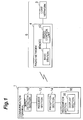
- Fig. 1 is a diagram showing a configuration of a communication terminal according to a first embodiment.
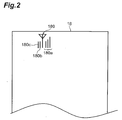
- Fig. 2 is a diagram showing an example of a display on a display section.
- Fig. 3 is a sequence diagram showing processing of the communication terminal according to the first embodiment.
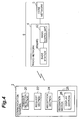
- Fig. 4 is a diagram showing a configuration of a communication terminal according to a second embodiment.
- Fig. 5 is a diagram showing a configuration of a communication terminal according to a third embodiment.
- Fig. 6 is a sequence diagram showing processing of the communication terminal according to the third embodiment.
- Fig. 1 is a diagram showing a configuration of a communication terminal 1 according to a first embodiment of the present invention.
- the communication terminal 1 is a mobile communication terminal capable of the communication having the specific characteristics.
- the communication having the specific characteristics is a communication having characteristics different from the normal mode.
- the high speed data communication is a communication that has increased data transmission rate compared to the normal mode by, for example, changing the modulation scheme and/or increasing the number of channels to be used.
- the communication having characteristics different from the normal mode there is a packet communication where the normal mode is used for voice communication in multimode communication (a communication environment capable of plural communication systems).
- the communication terminal 1 of the present embodiment is a mobile communication terminal capable of the communication using the HSDPA (High Speed Downlink Packet Access), which is one of high speed data communications.
- the communication terminal 1 of the present embodiment is capable of the communication using the HSDPA, however, it may be one capable of high speed network communication by use of the EV-DO and other communication systems.
- Such a communication terminal 1 is connected to a network 6.
- the network 6 includes a radio network 4 and a core network 5 which is connected to the radio network 4 and is operated by a mobile communication carrier.
- the radio network 4 has plural base stations 40 including a base station 40a in a serving cell of the communication terminal 1 and a radio control unit 42.
- the base stations 40 are divided into two types; an HSDPA-capable base station and an HSDPA-incapable base station.
- the HSDPA-capable base station is a base station provided with facilities for enabling packet communication by use of the HSDPA.
- the HSDPA-incapable base station is a base station provided with facilities for enabling packet communication by use of the conventional W-CDMA but not provided with facilities for enabling the packet communication by use of the HSDPA.
- the radio control unit 42 has in advance information about whether the respective base stations 40 are the HSDPA-capable base station or the HSDPA-incapable base station.
- a request to transmit the service-availability information transmitted from the communication terminal 1 is received by the core network 5 via the base station 40a and the radio control unit 42 of the radio network 4.
- the core network 5 generates the service-availability information and transmits the service-availability information to the communication terminal 1 via the base station 40a and the radio control unit 42 of the radio network 4.
- the communication terminal 1 is a communication terminal capable of the communication by the HSDPA.
- the communication terminal 1 includes a CPU (Central Processing Unit), a communication device, an input device such as a push button, a storage device such as a memory, and a display device such as a display, etc., as physical components.
- the communication terminal 1 includes an input detection section 10, a request section 12 (a request means), a reception section 14 (a reception means), and a recognition section 16 (a recognition means) as functional components.
- the input detection section 10 is a section for detecting predetermined operations by a user.
- the predetermined operations are those using the USSD (Unstructured Supplementary Services Data) procedure performed during communication or during waiting, and as one example, there is an input operation of an information request number.
- the information request number is, for example, a four-digit number.
- the predetermined operations there is an operation for opening a communication terminal 1 when the communication terminal 1 is a mobile telephone set of folding-type. Since such an operation is detected by the input detection section 10, a notification is output to the request section 12 each time a user opens the communication terminal 1 to watch the display, therefore, a troublesome operation such as inputting of an information request number is no longer necessary.
- there is an operation such as pressing down of a button for packet communication, which is one of the push buttons of the communication terminal 1. Since such an operation is detected by the input detection section 10, a notification is output to the request section 12 each time packet communication is performed, therefore, a troublesome operation such as inputting of an information request number is no longer necessary.
- the communication terminal 1 is a card-type communication terminal to be connected to a personal computer, such an operation of inserting the communication terminal 1 into the personal computer may be included in the predetermined operations.
- the request section 12 is a section for making a request to the network 6 to transmit the service-availability information, which will be described later. More specifically, upon receipt from the input detection section 10 of a notification that an operation by a user is detected, the request section 12 transmits a request to the network 6 to transmit the service-availability information.
- the reception section 14 is a section for receiving the service-availability information from the network 6.
- the reception section 14 outputs the received service-availability information to the recognition section 16.
- the service-availability information is an information indicating whether or not the communication by the HSDPA is possible in a serving cell of the communication terminal 1.
- the service-availability information is composed of an area information and a resource information.
- the area information is an information indicating whether or not the serving cell of the communication terminal 1 is included in an HSDPA service area.
- the HSDPA service area is an area composed of cells which the HSDPA-capable base stations form, and when the serving cell of the communication terminal 1 is included in the HSDPA service area, the area information will be one indicating "within the HSDPA service area zone". On the other hand, when the serving cell of the communication terminal 1 is not included in the HSDPA service area, the area information will be one indicating "outside the HSDPA service area zone".
- the resource information is an information indicating whether or not an unused resource required for performing communication is available in the radio resource for the HSDPA (hereinafter, referred to as an HDSPA resource), that is, whether or not allocation of the HSDPA resource to the communication terminal 1 is possible, when the serving cell of the communication terminal 1 is included in the HSDPA service area.
- an HDSPA resource an information indicating whether or not an unused resource required for performing communication is available in the radio resource for the HSDPA
- the resource information will be one indicating "resource allocation is possible”.
- the resource information will be one indicating "resource allocation is not possible”.
- the recognition section 16 is a section for making a user recognize the contents of the service-availability information received from the reception section 14.
- the recognition section 16 has a display section 18, which is a display (not shown) of the communication terminal 1. More specifically, the recognition section 16 receives the service-availability information from the reception section 14 and extracts the area information and the resource information from the service-availability information. Then, the recognition section 16 displays an antenna mark on the display section 18 based on the extracted information.
- Fig. 2 is a diagram showing an example of a display of an antenna mark 180 on the display section 18.
- three vertical bars 180a on the right-hand side of the antenna mark 180 show a state of radio waves as in a general communication terminal.
- vertical bars 180b and 180c on the left-hand side of the antenna mark 180 show the area information and the resource information, respectively.
- the area information is one indicating "within the HSDPA service area zone”
- the vertical bar 180b is displayed.
- the resource information is one indicating "resource allocation is possible”
- the vertical bar 180c is displayed on the left-hand side of the vertical bar 180b. Therefore, when the HSDPA can be used, both the vertical bars 180b and 180c are displayed.
- the vertical bars 180b and 180c may be displayed in different colors for easy discrimination from each other.
- FIG. 3 is a sequence diagram showing processing of the communication terminal 1.
- step S1 when an information request number is inputted by a user, this is detected by the input detection section 10 of the communication terminal 1 (step S1).
- the input detection section 10 outputs a notification that the operation by the user was detected to the request section 12.
- the request section 12 that has received the notification transmits a request to the network 6 to transmit the service-availability information (step S2).
- the radio control unit 42 of the radio network 4 receives the transmission request via the base station 40a. Based on the communication channel of the transmission request, the radio control unit 42 recognizes that the serving base station of the communication terminal 1 is the base station 40a (step S3). Then, the radio control unit 42 transmits the transmission request to the core network 5 (step S4).
- the core network 5 Upon receipt of the transmission request from the radio network 4, the core network 5 requests the area information to the radio control unit 42 (step S5).
- the radio control unit 42 that has received the request for the area information judges whether the base station 40a which the radio control unit 42 has recognized upon receipt of the transmission request is the HSDPA-capable base station type or the HSDPA-incapable base station type (step S6).
- the area information indicating "within the HSDPA service area zone" is returned to the core network 5
- the base station 40a is the HSDPA-incapable base station
- the area information indicating "outside the HSDPA service area zone" is returned to the core network 5 (step S7).
- the core network 5 receives the area information from the radio control unit 42.
- the core network 5 When the area information is one indicating "outside the HSDPA service area zone", the core network 5 generates the service-availability information including the area information and the resource information indicating "resource allocation is not possible” (step S11) and transmits these information to the communication terminal 1 (step S12).
- the core network 5 requests the resource information to the radio control unit 42 (step S8).
- the radio control unit 42 requests the resource information to the base station 40a.
- the base station 40a that has received the request for the resource information judges whether or not allocation of the HSDPA resource to the communication terminal 1 is possible (step S9). When the judgment result is that it is possible, the base station 40a transmits the resource information indicating "resource allocation is possible", or the resource information indicating "resource allocation is not possible” when it is not possible, to the core network 5 via the radio control unit 42 (step S10).
- the core network 5 generates the service-availability information including the already received area information indicating "within the HSDPA service area zone" and the resource information received from the radio control unit 42 (step S11) and transmits the generated service-availability information to the communication terminal 1 via the radio network 4 (step S12).
- the reception section 14 of the communication terminal 1 receives the service-availability information transmitted from the core network 5 via the radio network 4. Then, the reception section 14 outputs the received service-availability information to the recognition section 16.
- the recognition section 16 displays the antenna mark 180 on the display section 18 based on the area information and the resource information included in the service-availability information (step S 13). When the area information is one indicating "within the HSDPA service area zone”, the recognition section 16 displays the vertical bar 180b of the antenna mark 180. When the resource information is one indicating "resource allocation is possible", the recognition section 16 displays the vertical bar 180c of the antenna mark 180.
- the request section 12 transmits a request to the network 6 to transmit the service-availability information. Due to this, it is possible for the user to acquire the service-availability information at the present position when necessary.
- the reception section 14 receives the service-availability information transmitted from the network 6 and the recognition section 16 displays the antenna mark 180 based on the area information and the resource information included in the service-availability information. Due to this, it is possible for the user to know whether or not the communication by the HSDPA is possible by watching the vertical bars 180b and 180c of the antenna mark 180.
- the communication by the HSDPA If whether or not the communication by the HSDPA is possible can be known, it is possible for the user to perform download of a file or Web access while taking into consideration the communication rate etc. Further, when the charging system of the communication by the HSDPA is different from that of communication by other systems, it is possible to perform download of a file etc. while taking into consideration not only the communication rate but also the charge.
- Fig. 4 is a diagram showing a configuration of a communication terminal 2 according to a second embodiment of the present invention.
- the communication terminal 2 includes a trigger detection section 20 instead of the input detection section 10 of the communication terminal 1 of the first embodiment.
- the communication terminal 2 includes a reception section 24, a recognition section 26, and a display section 28 and these have the same functions as those of the reception section 14, the recognition section 16, and the display section 18 of the communication terminal 1, respectively.
- the trigger detection section 20 is a section for detecting a predetermined change in environment.
- the predetermined change in environment is a change of a serving cell caused by the movement of the communication terminal 2 of the present embodiment.
- the trigger detection section 20 notifies a request section 22 of the information.
- the request section 22 is a section for receiving a notification that a change in environment is detected from the trigger detection section 20. When receiving such a notification, the request section 22 transmits a request to the network 6 to transmit the service-availability information. Processing in the network 6 that has received the request to transmit the service-availability information is the same as that described in the first embodiment.
- the trigger detection section 20 detects a change of a serving cell.
- the trigger detection section 20 notifies the request section 22 that a change of the serving cell is detected, and the request section 22 that has received the notification transmits a request to the network 6 to transmit the service-availability information.
- the operation after the transmission request is transmitted to the network 6 is the same as that shown in steps S3 to S13 in Fig. 3.
- the trigger detection section 20 when detecting the change of the serving cell, notifies the request section 22 of the information.
- the service-availability information is transmitted from the network 6. Due to this, it is possible for the user to know whether or not the communication by the HSDPA is possible at each position after movement without performing specific operations.
- Fig. 5 is a diagram showing a configuration of a communication terminal 3 according to a third embodiment of the present invention.
- the communication terminal 3 differs from the communication terminal 1 of the first embodiment in including a communication detection section 34, a storage section 35 (a storage means), a movement detection section 36 (a detection means), and a judgment section 37 (a judgment means).
- the communication terminal 3 includes an input detection section 30, a request section 31, and a reception section 32 and these have the same functions as those of the input detection section 10, the request section 12, and the reception section 14 of the communication terminal 1.
- the communication detection section 34 is a section for detecting termination of communication when the communication by the HSDPA is performed at the communication terminal 3. More specifically, when detecting termination of the communication by the HSDPA, the communication detection section 34 identifies the cell ID (cell identification information) of the serving cell of the communication terminal 3 based on a broadcast information received from the network 6. Then, the identified cell ID is stored in the storage section 35.
- the movement detection section 36 is a section for detecting that the serving cell of the communication terminal 3 has changed. More specifically, the movement detection section 36 extracts the cell ID included in the broadcast information each time the broadcast information is transmitted from the network 6 to the communication terminal 3. The movement detection section 36 judges that the serving cell has changed when the extracted cell ID differs from the previously extracted cell ID. When it is judged that the serving cell has changed, the movement detection section 36 outputs notification that the serving cell has changed along with the cell ID after the change to the judgment section 37.
- the judgment section 37 is a section for judging whether or not the cell ID after the change is stored in the storage section 35. More specifically, the judgment section 37 receives notification that the serving cell has changed from the movement detection section 36. Then, the cell ID received along with the notification is searched for from among the cell IDs stored in the storage section 35. When the cell ID received from the movement detection section 36 is stored in the storage section 35, the judgment section 37 outputs the area information indicating "within the HSDPA service area zone" to a recognition section 38.
- the recognition section 38 includes a display section 39 that is a display (not shown) of the communication terminal 3.
- the recognition section 38 and the display section 39 have the same functions as those of the recognition section 16 and the display section 18 of the communication terminal 1.
- the recognition section 38 displays the antenna mark with the vertical bar indicating "within the HSDPA service area zone” on the display section 39.
- Fig. 6 is a sequence diagram showing processing of the communication terminal 3.
- the communication detection section 34 detects this (step S61).
- the communication detection section 34 that has detected termination of the communication by the HSDPA acquires the cell ID of the serving cell of the communication terminal 3 from the broadcast information received from the network 6 (step S62). Then, the communication detection section 34 outputs the acquired cell ID to the storage section 35 (step S63).
- the storage section 35 stores the cell ID output from the communication detection section 34 (step S64).
- the movement detection section 36 extracts the cell ID from the broadcast information transmitted from the network 6.
- the movement detection section 36 detects that the serving cell has changed based on the change of the extracted cell ID (step S65).
- the movement detection section 36 outputs the notification that the serving cell has changed along with the cell ID after the change to the judgment section 37 (step S66).
- the judgment section 37 searches the storage section 35 based on the cell ID received along with the notification (step S67).
- the judgment section 37 generates the area information indicating "within the HSDPA service area zone" (step S68) and outputs the area information to the recognition section 38 (step S69).
- the recognition section 38 displays the antenna mark 180 with the vertical bar indicating "within the HSDPA service area zone” on the display section 39 (step S70).
- the cell ID when the communication by the HSDPA was performed is stored in the storage section 35. Due to this, it is possible to reserve an information about the cell located within the HSDPA service area inside the communication terminal 3.
- the recognition section 38 displays the antenna mark 180 indicating "within the HSDPA service area zone" on the display section 39. Due to this, it is possible to judge without connecting to the network that the communication by the HSDPA is possible in the cell of the base station where the communication by the HSDPA has once been performed.
- the service-availability information is assumed to include the area information and the resource information, however, it may be assumed to include either the area information or the resource information.
- the communication detection section is assumed to detect termination of the communication by the HSDPA, however, it may be assumed to detect that the communication by the HSDPA is being performed.
- the antenna mark is used to display the area information and the resource information, however, symbols other than the antenna mark may be used.
- voices in accordance with the area information and the resource information may be output.
Landscapes
- Engineering & Computer Science (AREA)
- Computer Security & Cryptography (AREA)
- Computer Networks & Wireless Communication (AREA)
- Signal Processing (AREA)
- Mobile Radio Communication Systems (AREA)
- Telephonic Communication Services (AREA)
Abstract
Description
- The present invention relates to a communication terminal capable of adapting to an environment in which plural kinds of communication having characteristics different from those of the communication in the normal mode coexist.
- Conventionally, as disclosed in, for example, Japanese Patent Application Laid-open No. 2004-147049, a communication terminal is known, which performs packet communication by utilizing high speed data communication.
- By the way, a case is considered, where an area in which packet communication is possible consists of an area in which high speed data communication is possible (hereinafter, referred to as a high speed data communication area) and an area in which high speed data communication is not possible (hereinafter, referred to as a non-high speed data communication area).
- In this case, a communication terminal capable of both communication, that is, the high speed data communication and data communication other than the high speed data communication, is used as a result. However, for example, there is a possibility that such a communication terminal performs download of a file with a large quantity of data in a non-high speed data communication area. Therefore, there arises a problem that it is not possible to efficiently perform download of a file.
- Therefore, an object of the present invention is to provide a communication terminal capable of efficiently performing download of a file.
- A communication terminal of the present invention is a communication terminal capable of communication having specific characteristics, including (1) a request means for making a request to a network to transmit a service-availability information indicating whether or not the communication having the specific characteristics is possible in a serving cell where the present communication terminal is located, (2) a reception means for receiving the service-availability information from the network that has received the request from the request means, and (3) a recognition means for, when the service-availability information received through the reception means is one indicating that the communication having the specific characteristic is possible, making a user recognize the information.
- As described above, since the service-availability information is transmitted in response to the request from the communication terminal, if a request is transmitted from the communication terminal before starting download of a file, for example, it is possible to acquire the service-availability information at the present position. When the received service-availability information is one indicating that the communication having the specific characteristics is possible, the recognition means makes the user recognize this information, therefore, it is possible for the user to know for example by the display that the communication having the specific characteristics is possible on site. Due to this, it is possible for the user to determine how large a file to download should be while watching the display. Therefore, it is possible to efficiently perform download of a file.
- In the communication terminal of the present invention, it is preferable for the request means to request the service-availability information after a predetermined operation by a user is detected. Due to this, it is made possible to acquire the service-availability information in accordance with, for example, a number inputted by the user.
- As for the communication terminal of the present invention, it is also preferable for the request means to request the service-availability information after a predetermined change in environment is detected. Due to this, it is made possible to, for example, acquire the service-availability information in accordance with the movement of the terminal from a serving cell to another.
- Preferably the communication terminal of the present invention further includes a storage means for, when the communication having the specific characteristics is possible in a serving cell where the present communication terminal is located, storing a serving cell identification information for identifying the serving cell, a detection means for detecting that the serving cell of the present communication terminal has changed, and a judgment means for judging whether or not the cell identification information of the serving cell after the change is stored in the storage means in accordance with detection by the detection means, wherein, when the cell identification information of the serving cell after the change is judged to be stored in the storage means by the judgment means, the recognition means makes a user recognize the information that the communication having the specific characteristics is possible in the serving cell.
- As described above, since the cell identification information of the serving cell is stored when the communication having the specific characteristics is possible in the serving cell, it is possible to reserve information about the cell in which the communication having the specific characteristics is possible. When the serving cell changes, the storage means is searched and when the cell identification information of the new serving cell is stored in the storage means, a user is made to recognize the information that the communication having the specific characteristics is possible in this serving cell, therefore, it is possible for the user to judge that the communication having the specific characteristics is possible without connection to the network.
- As for the communication terminal of the present invention, it is preferable for the recognition means to have a display means for displaying the information that the communication having the specific characteristics is possible. Due to this, it is possible for a user to know whether or not the communication having the specific characteristics is possible at present only by watching the display means.
- It is also preferable for the communication terminal of the present invention that the communication having the specific characteristics be high speed data communication. By using the communication with a high data transmission rate, it is possible to smoothly perform download of a file.
- It is also preferable for the communication terminal of the present invention that the high speed data communication be communication by an HSDPA. When the communication by the HSDPA is used, it is possible to further smoothly perform download of a file because the communication by the HSDPA is effective on packet communication.
- According to the communication terminal of the present invention, it is possible to efficiently perform download of a file.
- Fig. 1 is a diagram showing a configuration of a communication terminal according to a first embodiment.
- Fig. 2 is a diagram showing an example of a display on a display section.
- Fig. 3 is a sequence diagram showing processing of the communication terminal according to the first embodiment.
- Fig. 4 is a diagram showing a configuration of a communication terminal according to a second embodiment.
- Fig. 5 is a diagram showing a configuration of a communication terminal according to a third embodiment.
- Fig. 6 is a sequence diagram showing processing of the communication terminal according to the third embodiment.
- The concept of the present invention will be easily understood by considering the following detailed description with reference to attached drawings shown only for illustrations. Subsequently, embodiments of the present invention will be described with reference to the attached drawings. When possible, the same symbols will be attached to the same portions and duplicated description will be omitted.
- Fig. 1 is a diagram showing a configuration of a
communication terminal 1 according to a first embodiment of the present invention. Thecommunication terminal 1 is a mobile communication terminal capable of the communication having the specific characteristics. Here, the communication having the specific characteristics is a communication having characteristics different from the normal mode. As an example of such communication, there is a high speed data communication. The high speed data communication is a communication that has increased data transmission rate compared to the normal mode by, for example, changing the modulation scheme and/or increasing the number of channels to be used. As another example of the communication having characteristics different from the normal mode, there is a packet communication where the normal mode is used for voice communication in multimode communication (a communication environment capable of plural communication systems). Thecommunication terminal 1 of the present embodiment is a mobile communication terminal capable of the communication using the HSDPA (High Speed Downlink Packet Access), which is one of high speed data communications. Incidentally, thecommunication terminal 1 of the present embodiment is capable of the communication using the HSDPA, however, it may be one capable of high speed network communication by use of the EV-DO and other communication systems. Such acommunication terminal 1 is connected to anetwork 6. - The
network 6 includes aradio network 4 and acore network 5 which is connected to theradio network 4 and is operated by a mobile communication carrier. - The
radio network 4 hasplural base stations 40 including abase station 40a in a serving cell of thecommunication terminal 1 and aradio control unit 42. Thebase stations 40 are divided into two types; an HSDPA-capable base station and an HSDPA-incapable base station. The HSDPA-capable base station is a base station provided with facilities for enabling packet communication by use of the HSDPA. On the other hand, the HSDPA-incapable base station is a base station provided with facilities for enabling packet communication by use of the conventional W-CDMA but not provided with facilities for enabling the packet communication by use of the HSDPA. - These
plural base stations 40 are connected to theradio control unit 42. Theradio control unit 42 has in advance information about whether therespective base stations 40 are the HSDPA-capable base station or the HSDPA-incapable base station. - In such a
network 6, a request to transmit the service-availability information transmitted from thecommunication terminal 1 is received by thecore network 5 via thebase station 40a and theradio control unit 42 of theradio network 4. Thecore network 5 generates the service-availability information and transmits the service-availability information to thecommunication terminal 1 via thebase station 40a and theradio control unit 42 of theradio network 4. - The
communication terminal 1 is a communication terminal capable of the communication by the HSDPA. Thecommunication terminal 1 includes a CPU (Central Processing Unit), a communication device, an input device such as a push button, a storage device such as a memory, and a display device such as a display, etc., as physical components. Thecommunication terminal 1 includes aninput detection section 10, a request section 12 (a request means), a reception section 14 (a reception means), and a recognition section 16 (a recognition means) as functional components. - The
input detection section 10 is a section for detecting predetermined operations by a user. Here, the predetermined operations are those using the USSD (Unstructured Supplementary Services Data) procedure performed during communication or during waiting, and as one example, there is an input operation of an information request number. The information request number is, for example, a four-digit number. When an input of the information request number by a user is detected, theinput detection section 10 outputs a notification that the operation by a user is detected to therequest section 12. - In addition, as another example of the predetermined operations, there is an operation for opening a
communication terminal 1 when thecommunication terminal 1 is a mobile telephone set of folding-type. Since such an operation is detected by theinput detection section 10, a notification is output to therequest section 12 each time a user opens thecommunication terminal 1 to watch the display, therefore, a troublesome operation such as inputting of an information request number is no longer necessary. Moreover, as another example of the predetermined operations, there is an operation such as pressing down of a button for packet communication, which is one of the push buttons of thecommunication terminal 1. Since such an operation is detected by theinput detection section 10, a notification is output to therequest section 12 each time packet communication is performed, therefore, a troublesome operation such as inputting of an information request number is no longer necessary. Furthermore, when thecommunication terminal 1 is a card-type communication terminal to be connected to a personal computer, such an operation of inserting thecommunication terminal 1 into the personal computer may be included in the predetermined operations. - The
request section 12 is a section for making a request to thenetwork 6 to transmit the service-availability information, which will be described later. More specifically, upon receipt from theinput detection section 10 of a notification that an operation by a user is detected, therequest section 12 transmits a request to thenetwork 6 to transmit the service-availability information. - The
reception section 14 is a section for receiving the service-availability information from thenetwork 6. Thereception section 14 outputs the received service-availability information to therecognition section 16. - Here, the service-availability information will be described. The service-availability information is an information indicating whether or not the communication by the HSDPA is possible in a serving cell of the
communication terminal 1. The service-availability information is composed of an area information and a resource information. - The area information is an information indicating whether or not the serving cell of the
communication terminal 1 is included in an HSDPA service area. The HSDPA service area is an area composed of cells which the HSDPA-capable base stations form, and when the serving cell of thecommunication terminal 1 is included in the HSDPA service area, the area information will be one indicating "within the HSDPA service area zone". On the other hand, when the serving cell of thecommunication terminal 1 is not included in the HSDPA service area, the area information will be one indicating "outside the HSDPA service area zone". - The resource information is an information indicating whether or not an unused resource required for performing communication is available in the radio resource for the HSDPA (hereinafter, referred to as an HDSPA resource), that is, whether or not allocation of the HSDPA resource to the
communication terminal 1 is possible, when the serving cell of thecommunication terminal 1 is included in the HSDPA service area. When allocation of the HSDPA resource to thecommunication terminal 1 is possible, the resource information will be one indicating "resource allocation is possible". On the other hand, when allocation of the HSDPA resource to thecommunication terminal 1 is not possible, the resource information will be one indicating "resource allocation is not possible". - The
recognition section 16 is a section for making a user recognize the contents of the service-availability information received from thereception section 14. Therecognition section 16 has adisplay section 18, which is a display (not shown) of thecommunication terminal 1. More specifically, therecognition section 16 receives the service-availability information from thereception section 14 and extracts the area information and the resource information from the service-availability information. Then, therecognition section 16 displays an antenna mark on thedisplay section 18 based on the extracted information. - Fig. 2 is a diagram showing an example of a display of an
antenna mark 180 on thedisplay section 18. According to the example shown in Fig. 2, threevertical bars 180a on the right-hand side of theantenna mark 180 show a state of radio waves as in a general communication terminal. Then,vertical bars antenna mark 180 show the area information and the resource information, respectively. When the area information is one indicating "within the HSDPA service area zone", thevertical bar 180b is displayed. In addition, when the resource information is one indicating "resource allocation is possible", thevertical bar 180c is displayed on the left-hand side of thevertical bar 180b. Therefore, when the HSDPA can be used, both thevertical bars vertical bars - Next, the operation of the
communication terminal 1 in the present embodiment will be described. Fig. 3 is a sequence diagram showing processing of thecommunication terminal 1. - First, when an information request number is inputted by a user, this is detected by the
input detection section 10 of the communication terminal 1 (step S1). Theinput detection section 10 outputs a notification that the operation by the user was detected to therequest section 12. Therequest section 12 that has received the notification transmits a request to thenetwork 6 to transmit the service-availability information (step S2). - The
radio control unit 42 of theradio network 4 receives the transmission request via thebase station 40a. Based on the communication channel of the transmission request, theradio control unit 42 recognizes that the serving base station of thecommunication terminal 1 is thebase station 40a (step S3). Then, theradio control unit 42 transmits the transmission request to the core network 5 (step S4). - Upon receipt of the transmission request from the
radio network 4, thecore network 5 requests the area information to the radio control unit 42 (step S5). Theradio control unit 42 that has received the request for the area information judges whether thebase station 40a which theradio control unit 42 has recognized upon receipt of the transmission request is the HSDPA-capable base station type or the HSDPA-incapable base station type (step S6). When the judgment result is that thebase station 40a is the HSDPA-capable base station, the area information indicating "within the HSDPA service area zone" is returned to thecore network 5, and when thebase station 40a is the HSDPA-incapable base station, the area information indicating "outside the HSDPA service area zone" is returned to the core network 5 (step S7). - The
core network 5 receives the area information from theradio control unit 42. When the area information is one indicating "outside the HSDPA service area zone", thecore network 5 generates the service-availability information including the area information and the resource information indicating "resource allocation is not possible" (step S11) and transmits these information to the communication terminal 1 (step S12). On the other hand, when the received area information is one indicating "within the HSDPA service area zone", thecore network 5 requests the resource information to the radio control unit 42 (step S8). - The
radio control unit 42 requests the resource information to thebase station 40a. Thebase station 40a that has received the request for the resource information judges whether or not allocation of the HSDPA resource to thecommunication terminal 1 is possible (step S9). When the judgment result is that it is possible, thebase station 40a transmits the resource information indicating "resource allocation is possible", or the resource information indicating "resource allocation is not possible" when it is not possible, to thecore network 5 via the radio control unit 42 (step S10). - The
core network 5 generates the service-availability information including the already received area information indicating "within the HSDPA service area zone" and the resource information received from the radio control unit 42 (step S11) and transmits the generated service-availability information to thecommunication terminal 1 via the radio network 4 (step S12). - The
reception section 14 of thecommunication terminal 1 receives the service-availability information transmitted from thecore network 5 via theradio network 4. Then, thereception section 14 outputs the received service-availability information to therecognition section 16. Therecognition section 16 displays theantenna mark 180 on thedisplay section 18 based on the area information and the resource information included in the service-availability information (step S 13). When the area information is one indicating "within the HSDPA service area zone", therecognition section 16 displays thevertical bar 180b of theantenna mark 180. When the resource information is one indicating "resource allocation is possible", therecognition section 16 displays thevertical bar 180c of theantenna mark 180. - The function and the effect of the present embodiment will be described. As described above, when the
input detection section 10 of thecommunication terminal 1 detects an input of an information request number by a user, therequest section 12 transmits a request to thenetwork 6 to transmit the service-availability information. Due to this, it is possible for the user to acquire the service-availability information at the present position when necessary. Thereception section 14 receives the service-availability information transmitted from thenetwork 6 and therecognition section 16 displays theantenna mark 180 based on the area information and the resource information included in the service-availability information. Due to this, it is possible for the user to know whether or not the communication by the HSDPA is possible by watching thevertical bars antenna mark 180. If whether or not the communication by the HSDPA is possible can be known, it is possible for the user to perform download of a file or Web access while taking into consideration the communication rate etc. Further, when the charging system of the communication by the HSDPA is different from that of communication by other systems, it is possible to perform download of a file etc. while taking into consideration not only the communication rate but also the charge. - Fig. 4 is a diagram showing a configuration of a communication terminal 2 according to a second embodiment of the present invention. The communication terminal 2 includes a trigger detection section 20 instead of the
input detection section 10 of thecommunication terminal 1 of the first embodiment. Incidentally, the communication terminal 2 includes areception section 24, arecognition section 26, and adisplay section 28 and these have the same functions as those of thereception section 14, therecognition section 16, and thedisplay section 18 of thecommunication terminal 1, respectively. - The trigger detection section 20 is a section for detecting a predetermined change in environment. The predetermined change in environment is a change of a serving cell caused by the movement of the communication terminal 2 of the present embodiment. In addition, as another change in environment, there is the case where restrictions on calls placed in order to avoid congestion on the
network 6 side are removed etc. When detecting a change of a serving cell, the trigger detection section 20 notifies arequest section 22 of the information. - The
request section 22 is a section for receiving a notification that a change in environment is detected from the trigger detection section 20. When receiving such a notification, therequest section 22 transmits a request to thenetwork 6 to transmit the service-availability information. Processing in thenetwork 6 that has received the request to transmit the service-availability information is the same as that described in the first embodiment. - The operation of the communication terminal 2 of the present embodiment will be described. In the communication terminal 2, the trigger detection section 20 detects a change of a serving cell. The trigger detection section 20 notifies the
request section 22 that a change of the serving cell is detected, and therequest section 22 that has received the notification transmits a request to thenetwork 6 to transmit the service-availability information. The operation after the transmission request is transmitted to thenetwork 6 is the same as that shown in steps S3 to S13 in Fig. 3. - The function and the effect of the present embodiment will be described. As described above, when detecting the change of the serving cell, the trigger detection section 20 notifies the
request section 22 of the information. In response to the request from therequest section 22 that has received the notification, the service-availability information is transmitted from thenetwork 6. Due to this, it is possible for the user to know whether or not the communication by the HSDPA is possible at each position after movement without performing specific operations. - Fig. 5 is a diagram showing a configuration of a
communication terminal 3 according to a third embodiment of the present invention. Thecommunication terminal 3 differs from thecommunication terminal 1 of the first embodiment in including acommunication detection section 34, a storage section 35 (a storage means), a movement detection section 36 (a detection means), and a judgment section 37 (a judgment means). In addition, thecommunication terminal 3 includes aninput detection section 30, arequest section 31, and areception section 32 and these have the same functions as those of theinput detection section 10, therequest section 12, and thereception section 14 of thecommunication terminal 1. - The
communication detection section 34 is a section for detecting termination of communication when the communication by the HSDPA is performed at thecommunication terminal 3. More specifically, when detecting termination of the communication by the HSDPA, thecommunication detection section 34 identifies the cell ID (cell identification information) of the serving cell of thecommunication terminal 3 based on a broadcast information received from thenetwork 6. Then, the identified cell ID is stored in thestorage section 35. - The
movement detection section 36 is a section for detecting that the serving cell of thecommunication terminal 3 has changed. More specifically, themovement detection section 36 extracts the cell ID included in the broadcast information each time the broadcast information is transmitted from thenetwork 6 to thecommunication terminal 3. Themovement detection section 36 judges that the serving cell has changed when the extracted cell ID differs from the previously extracted cell ID. When it is judged that the serving cell has changed, themovement detection section 36 outputs notification that the serving cell has changed along with the cell ID after the change to thejudgment section 37. - The
judgment section 37 is a section for judging whether or not the cell ID after the change is stored in thestorage section 35. More specifically, thejudgment section 37 receives notification that the serving cell has changed from themovement detection section 36. Then, the cell ID received along with the notification is searched for from among the cell IDs stored in thestorage section 35. When the cell ID received from themovement detection section 36 is stored in thestorage section 35, thejudgment section 37 outputs the area information indicating "within the HSDPA service area zone" to arecognition section 38. - The
recognition section 38 includes adisplay section 39 that is a display (not shown) of thecommunication terminal 3. Therecognition section 38 and thedisplay section 39 have the same functions as those of therecognition section 16 and thedisplay section 18 of thecommunication terminal 1. When receiving the area information indicating "within the HSDPA service area zone" from thejudgment section 37, therecognition section 38 displays the antenna mark with the vertical bar indicating "within the HSDPA service area zone" on thedisplay section 39. - The operation of the
communication terminal 3 of the present embodiment will be described. Fig. 6 is a sequence diagram showing processing of thecommunication terminal 3. - When the communication by the HSDPA is performed at the
communication terminal 3 and the communication is terminated, thecommunication detection section 34 detects this (step S61). Thecommunication detection section 34 that has detected termination of the communication by the HSDPA acquires the cell ID of the serving cell of thecommunication terminal 3 from the broadcast information received from the network 6 (step S62). Then, thecommunication detection section 34 outputs the acquired cell ID to the storage section 35 (step S63). Thestorage section 35 stores the cell ID output from the communication detection section 34 (step S64). - The
movement detection section 36 extracts the cell ID from the broadcast information transmitted from thenetwork 6. Themovement detection section 36 detects that the serving cell has changed based on the change of the extracted cell ID (step S65). Themovement detection section 36 outputs the notification that the serving cell has changed along with the cell ID after the change to the judgment section 37 (step S66). - When receiving the notification that the serving cell has changed from the
movement detection section 36, thejudgment section 37 searches thestorage section 35 based on the cell ID received along with the notification (step S67). When the cell ID received from themovement detection section 36 is stored in thestorage section 35, thejudgment section 37 generates the area information indicating "within the HSDPA service area zone" (step S68) and outputs the area information to the recognition section 38 (step S69). When receiving the area information from thejudgment section 37, therecognition section 38 displays theantenna mark 180 with the vertical bar indicating "within the HSDPA service area zone" on the display section 39 (step S70). - The function and the effect of the present embodiment will be described. As described above, the cell ID when the communication by the HSDPA was performed is stored in the
storage section 35. Due to this, it is possible to reserve an information about the cell located within the HSDPA service area inside thecommunication terminal 3. When the serving cell changes and the cell ID of the serving cell after the change is stored in thestorage section 35, therecognition section 38 displays theantenna mark 180 indicating "within the HSDPA service area zone" on thedisplay section 39. Due to this, it is possible to judge without connecting to the network that the communication by the HSDPA is possible in the cell of the base station where the communication by the HSDPA has once been performed. - Incidentally, the present invention is not limited to the embodiments described above and various modifications are possible.
- For example, the service-availability information is assumed to include the area information and the resource information, however, it may be assumed to include either the area information or the resource information.
- Further, the communication detection section is assumed to detect termination of the communication by the HSDPA, however, it may be assumed to detect that the communication by the HSDPA is being performed.
- Furthermore, the antenna mark is used to display the area information and the resource information, however, symbols other than the antenna mark may be used. Alternatively, instead of displaying the antenna mark, voices in accordance with the area information and the resource information may be output.
Claims (7)
- A communication terminal capable of communication having specific characteristics, comprising:a request means for making a request to a network to transmit a service-availability information indicating whether or not said communication having the specific characteristics is possible in a serving cell of the present communication terminal;a reception means for receiving said service-availability information from said network that has received the request from said request means; anda recognition means for, when the service-availability information received by said reception means is one indicating that said communication having the specific characteristics is possible, making a user recognize the information.
- The communication terminal according to claim 1, wherein said request means makes a request for said service-availability information when predetermined operations by the user are detected.
- The communication terminal according to claim 1 or 2, wherein said request means makes a request for said service-availability information when predetermined changes in environment are detected.
- The communication terminal according to claim 1 or 2, further comprising:a storage means for, when said communication having the specific characteristics is possible in a serving cell of the present communication terminal, storing a cell identification information for identifying said cell;a detection means for detecting that the serving cell of the present communication terminal has changed; anda judgment means for judging whether or not a cell identification information of the cell after the change is stored in said storage means in accordance with the detection by said detection means, whereinsaid recognition means, when the cell identification information of the cell after the change is judged to be stored in said storage means by said judgment means, makes a user recognize that said communication having the specific characteristics is possible in said cell.
- The communication terminal according to any one of claims 1 to 4, wherein said recognition means includes a display means for displaying that said communication having the specific characteristics is possible.
- The communication terminal according to any one of claims 1 to 5, wherein said communication having the specific characteristics is high speed data communication.
- The communication terminal according to claim 6, wherein said high speed data communication is the communication by HSDPA.
Applications Claiming Priority (1)
| Application Number | Priority Date | Filing Date | Title |
|---|---|---|---|
| JP2004360256A JP3986524B2 (en) | 2004-12-13 | 2004-12-13 | Communication terminal |
Publications (2)
| Publication Number | Publication Date |
|---|---|
| EP1670269A1 true EP1670269A1 (en) | 2006-06-14 |
| EP1670269B1 EP1670269B1 (en) | 2009-04-08 |
Family
ID=35999542
Family Applications (1)
| Application Number | Title | Priority Date | Filing Date |
|---|---|---|---|
| EP20050027224 Expired - Lifetime EP1670269B1 (en) | 2004-12-13 | 2005-12-13 | Wireless communication terminal comprising means for detecting HSDPA service areas |
Country Status (5)
| Country | Link |
|---|---|
| US (1) | US7831261B2 (en) |
| EP (1) | EP1670269B1 (en) |
| JP (1) | JP3986524B2 (en) |
| CN (1) | CN1791253B (en) |
| DE (1) | DE602005013738D1 (en) |
Cited By (3)
| Publication number | Priority date | Publication date | Assignee | Title |
|---|---|---|---|---|
| WO2008023723A1 (en) | 2006-08-23 | 2008-02-28 | Nec Corporation | Mobile communication system, radio network control device, mobile telephone, and cell display method |
| WO2008098980A1 (en) * | 2007-02-14 | 2008-08-21 | Telefonaktiebolaget Lm Ericsson (Publ) | Multi transmit antenna synchronization channel transmission cell id detection |
| EP1890516B1 (en) * | 2006-08-18 | 2019-10-02 | Samsung Electronics Co., Ltd. | Apparatus and method for providing service status information based on access class restriction list in mobile communication system |
Families Citing this family (15)
| Publication number | Priority date | Publication date | Assignee | Title |
|---|---|---|---|---|
| US7912613B2 (en) * | 2004-07-01 | 2011-03-22 | Yamaha Hatsudoki Kabushiki Kaisha | Riding type vehicle |
| EP1991023A4 (en) * | 2006-03-01 | 2013-01-02 | Nec Corp | Mobile communication system, base station, mobile device, notifying method, program, and recording medium |
| CN101502085A (en) * | 2006-08-11 | 2009-08-05 | 日本电气株式会社 | Wireless communication terminal, processor thereof, and wireless communication terminal power management method |
| JP2008085513A (en) * | 2006-09-27 | 2008-04-10 | Nec Corp | Wireless communication terminal and antenna bar display method and program for use therein |
| JP4722028B2 (en) * | 2006-12-26 | 2011-07-13 | 富士通株式会社 | Data transfer system, approach notification system, and data transfer method |
| JP4855985B2 (en) * | 2007-03-20 | 2012-01-18 | 株式会社エヌ・ティ・ティ・ドコモ | Cell information transmission method and user equipment in mobile communication system |
| JP4489095B2 (en) | 2007-05-29 | 2010-06-23 | 株式会社エヌ・ティ・ティ・ドコモ | Mobile device and communication method selection method |
| JP2009027452A (en) * | 2007-07-19 | 2009-02-05 | Nec Corp | Mobile terminal mail system, mobile terminal mail control method, and mobile terminal mail control program |
| JP5354642B2 (en) | 2008-04-09 | 2013-11-27 | 日本電気株式会社 | Wireless communication system and communication method thereof |
| JP5364644B2 (en) * | 2010-05-28 | 2013-12-11 | パナソニック株式会社 | Base station, mobile communication system, and interference suppression method |
| US8385893B2 (en) * | 2011-01-04 | 2013-02-26 | Qualcomm Incorporated | Multi-SIM status update system |
| US8611967B2 (en) * | 2011-01-17 | 2013-12-17 | Qualcomm Incorporated | Methods and apparatuses for determining and displaying service capabilities |
| US9141169B2 (en) * | 2012-01-20 | 2015-09-22 | Cisco Technology, Inc. | System and method to conserve power in an access network without loss of service quality |
| JP2014216949A (en) * | 2013-04-26 | 2014-11-17 | エヌ・ティ・ティ・コムウェア株式会社 | Radio communication apparatus, radio communication control method, and program |
| US9958924B2 (en) | 2013-08-28 | 2018-05-01 | Cisco Technology, Inc. | Configuration of energy savings |
Citations (7)
| Publication number | Priority date | Publication date | Assignee | Title |
|---|---|---|---|---|
| EP0858237A2 (en) * | 1997-02-05 | 1998-08-12 | Nokia Mobile Phones Ltd. | Intelligent network searching for a multi mode phone |
| GB2363288A (en) * | 2000-06-06 | 2001-12-12 | Motorola Inc | A mobile communications device |
| US6377804B1 (en) * | 1997-06-24 | 2002-04-23 | Nokia Mobile Phones Ltd. | Mobile communication systems |
| US20030036379A1 (en) * | 2001-08-20 | 2003-02-20 | Alcatel | Mobile radio network and mobile terminal for location-based services |
| WO2003032598A1 (en) * | 2001-10-08 | 2003-04-17 | Nokia Corporation | Service and capability negotiation in a network using single numbering scheme |
| US6567667B1 (en) * | 1999-08-23 | 2003-05-20 | Motorola, Inc. | Domain selecting system and method |
| JP2004147049A (en) | 2002-10-24 | 2004-05-20 | Nec Corp | Mobile communication system, mobile station, base station and packet communication method used for them |
Family Cites Families (7)
| Publication number | Priority date | Publication date | Assignee | Title |
|---|---|---|---|---|
| US6944452B2 (en) * | 2000-12-26 | 2005-09-13 | Nortel Networks Limited | Apparatus and method for hard handoff of data packet transmissions |
| DE60205014T2 (en) | 2002-02-14 | 2005-12-29 | Matsushita Electric Industrial Co., Ltd., Kadoma | Method for controlling the data rate in a wireless packet data communication system, transmitter and receiver for its use |
| JP3919654B2 (en) * | 2002-11-29 | 2007-05-30 | 株式会社東芝 | Mobile device |
| JP4220230B2 (en) | 2002-12-18 | 2009-02-04 | 株式会社東芝 | Service area estimation device |
| JP2004207822A (en) | 2002-12-24 | 2004-07-22 | Samsung Electronics Co Ltd | Wireless communication system and wireless terminal device |
| US7313163B2 (en) * | 2003-06-17 | 2007-12-25 | Motorola, Inc. | Fast synchronization for half duplex digital communications |
| FI20040244A0 (en) * | 2004-02-16 | 2004-02-16 | Nokia Corp | A method and computer program for controlling radio resources, a user equipment, a radio network controller, and a base station |
-
2004
- 2004-12-13 JP JP2004360256A patent/JP3986524B2/en not_active Expired - Fee Related
-
2005
- 2005-12-13 US US11/299,824 patent/US7831261B2/en not_active Expired - Fee Related
- 2005-12-13 EP EP20050027224 patent/EP1670269B1/en not_active Expired - Lifetime
- 2005-12-13 CN CN2005101296403A patent/CN1791253B/en not_active Expired - Fee Related
- 2005-12-13 DE DE200560013738 patent/DE602005013738D1/en not_active Expired - Lifetime
Patent Citations (7)
| Publication number | Priority date | Publication date | Assignee | Title |
|---|---|---|---|---|
| EP0858237A2 (en) * | 1997-02-05 | 1998-08-12 | Nokia Mobile Phones Ltd. | Intelligent network searching for a multi mode phone |
| US6377804B1 (en) * | 1997-06-24 | 2002-04-23 | Nokia Mobile Phones Ltd. | Mobile communication systems |
| US6567667B1 (en) * | 1999-08-23 | 2003-05-20 | Motorola, Inc. | Domain selecting system and method |
| GB2363288A (en) * | 2000-06-06 | 2001-12-12 | Motorola Inc | A mobile communications device |
| US20030036379A1 (en) * | 2001-08-20 | 2003-02-20 | Alcatel | Mobile radio network and mobile terminal for location-based services |
| WO2003032598A1 (en) * | 2001-10-08 | 2003-04-17 | Nokia Corporation | Service and capability negotiation in a network using single numbering scheme |
| JP2004147049A (en) | 2002-10-24 | 2004-05-20 | Nec Corp | Mobile communication system, mobile station, base station and packet communication method used for them |
Cited By (4)
| Publication number | Priority date | Publication date | Assignee | Title |
|---|---|---|---|---|
| EP1890516B1 (en) * | 2006-08-18 | 2019-10-02 | Samsung Electronics Co., Ltd. | Apparatus and method for providing service status information based on access class restriction list in mobile communication system |
| WO2008023723A1 (en) | 2006-08-23 | 2008-02-28 | Nec Corporation | Mobile communication system, radio network control device, mobile telephone, and cell display method |
| EP2059061A4 (en) * | 2006-08-23 | 2013-04-03 | Nec Corp | Mobile communication system, radio network control device, mobile telephone, and cell display method |
| WO2008098980A1 (en) * | 2007-02-14 | 2008-08-21 | Telefonaktiebolaget Lm Ericsson (Publ) | Multi transmit antenna synchronization channel transmission cell id detection |
Also Published As
| Publication number | Publication date |
|---|---|
| US7831261B2 (en) | 2010-11-09 |
| EP1670269B1 (en) | 2009-04-08 |
| JP2006173778A (en) | 2006-06-29 |
| JP3986524B2 (en) | 2007-10-03 |
| DE602005013738D1 (en) | 2009-05-20 |
| US20060160561A1 (en) | 2006-07-20 |
| CN1791253B (en) | 2010-05-05 |
| CN1791253A (en) | 2006-06-21 |
Similar Documents
| Publication | Publication Date | Title |
|---|---|---|
| EP1670269B1 (en) | Wireless communication terminal comprising means for detecting HSDPA service areas | |
| US7536451B2 (en) | Method for increasing standby time using access history to 1x ev-do network with access terminal and device thereof | |
| EP2636167B1 (en) | Method and apparatus for connecting wireless network in a digital device | |
| US7941177B2 (en) | Wireless terminal apparatus for automatically changing WLAN standard and method thereof | |
| KR101730357B1 (en) | Apparatus and method for connecting access point in portable terminal | |
| RU2427101C2 (en) | Communication device | |
| KR100480050B1 (en) | Short message store method for mobile communication device | |
| KR101405554B1 (en) | Bluetooth automatic pairing system | |
| US5867790A (en) | Radio communication system with enhanced connection processing | |
| US20030104790A1 (en) | Mobile station and method for performing software functions | |
| US7107076B2 (en) | Method for accessing telephone number in mobile communication terminal | |
| KR100408049B1 (en) | Mutual phone state recognition method for mobile communication device | |
| KR100950662B1 (en) | Smart card authentication method using network | |
| JP2011199342A (en) | Communication apparatus | |
| KR20050056451A (en) | Apparatus for reporting fee discount zone in the mobile communication terminal | |
| CN106027736B (en) | Address book marking method and device | |
| CN115334465B (en) | Communication method and device in shutdown state, mobile terminal and storage medium | |
| CN113795018B (en) | SIM card switching method and device | |
| KR20050080333A (en) | Apparatus and method for recognizing the sort of inserted smart card | |
| KR100501271B1 (en) | Method of processing SMS fee in a mobile phone | |
| KR100424467B1 (en) | Roaming service indication method in mobile phone and mobile phone thereof | |
| KR20060100621A (en) | Mobile communication terminal and roaming method equipped with a high speed roaming function | |
| KR20060007283A (en) | How to prevent miscalls on mobile devices | |
| JP3483031B2 (en) | Mobile terminal roaming method and mobile terminal | |
| KR100682688B1 (en) | How to provide file transfer service through mobile communication network |
Legal Events
| Date | Code | Title | Description |
|---|---|---|---|
| PUAI | Public reference made under article 153(3) epc to a published international application that has entered the european phase |
Free format text: ORIGINAL CODE: 0009012 |
|
| 17P | Request for examination filed |
Effective date: 20051213 |
|
| AK | Designated contracting states |
Kind code of ref document: A1 Designated state(s): AT BE BG CH CY CZ DE DK EE ES FI FR GB GR HU IE IS IT LI LT LU LV MC NL PL PT RO SE SI SK TR |
|
| AX | Request for extension of the european patent |
Extension state: AL BA HR MK YU |
|
| 17Q | First examination report despatched |
Effective date: 20060720 |
|
| AKX | Designation fees paid |
Designated state(s): DE GB |
|
| GRAP | Despatch of communication of intention to grant a patent |
Free format text: ORIGINAL CODE: EPIDOSNIGR1 |
|
| GRAS | Grant fee paid |
Free format text: ORIGINAL CODE: EPIDOSNIGR3 |
|
| GRAA | (expected) grant |
Free format text: ORIGINAL CODE: 0009210 |
|
| RIN1 | Information on inventor provided before grant (corrected) |
Inventor name: UNO, NOBUKAZU, Inventor name: HIMENO, HIROMI, |
|
| RIN1 | Information on inventor provided before grant (corrected) |
Inventor name: HIMENO, HIROMI, Inventor name: UNO, NOBUKAZU, |
|
| AK | Designated contracting states |
Kind code of ref document: B1 Designated state(s): DE GB |
|
| REG | Reference to a national code |
Ref country code: GB Ref legal event code: FG4D |
|
| REF | Corresponds to: |
Ref document number: 602005013738 Country of ref document: DE Date of ref document: 20090520 Kind code of ref document: P |
|
| PLBE | No opposition filed within time limit |
Free format text: ORIGINAL CODE: 0009261 |
|
| STAA | Information on the status of an ep patent application or granted ep patent |
Free format text: STATUS: NO OPPOSITION FILED WITHIN TIME LIMIT |
|
| 26N | No opposition filed |
Effective date: 20100111 |
|
| PGFP | Annual fee paid to national office [announced via postgrant information from national office to epo] |
Ref country code: DE Payment date: 20181127 Year of fee payment: 14 |
|
| PGFP | Annual fee paid to national office [announced via postgrant information from national office to epo] |
Ref country code: GB Payment date: 20181212 Year of fee payment: 14 |
|
| REG | Reference to a national code |
Ref country code: DE Ref legal event code: R119 Ref document number: 602005013738 Country of ref document: DE |
|
| GBPC | Gb: european patent ceased through non-payment of renewal fee |
Effective date: 20191213 |
|
| PG25 | Lapsed in a contracting state [announced via postgrant information from national office to epo] |
Ref country code: GB Free format text: LAPSE BECAUSE OF NON-PAYMENT OF DUE FEES Effective date: 20191213 Ref country code: DE Free format text: LAPSE BECAUSE OF NON-PAYMENT OF DUE FEES Effective date: 20200701 |