EP1670088A2 - Fuel cell - Google Patents
Fuel cell Download PDFInfo
- Publication number
- EP1670088A2 EP1670088A2 EP05027079A EP05027079A EP1670088A2 EP 1670088 A2 EP1670088 A2 EP 1670088A2 EP 05027079 A EP05027079 A EP 05027079A EP 05027079 A EP05027079 A EP 05027079A EP 1670088 A2 EP1670088 A2 EP 1670088A2
- Authority
- EP
- European Patent Office
- Prior art keywords
- fuel
- sheet
- liquid holding
- electromotive
- holding sheet
- Prior art date
- Legal status (The legal status is an assumption and is not a legal conclusion. Google has not performed a legal analysis and makes no representation as to the accuracy of the status listed.)
- Withdrawn
Links
Images



Classifications
-
- H—ELECTRICITY
- H01—ELECTRIC ELEMENTS
- H01M—PROCESSES OR MEANS, e.g. BATTERIES, FOR THE DIRECT CONVERSION OF CHEMICAL ENERGY INTO ELECTRICAL ENERGY
- H01M8/00—Fuel cells; Manufacture thereof
- H01M8/10—Fuel cells with solid electrolytes
- H01M8/1009—Fuel cells with solid electrolytes with one of the reactants being liquid, solid or liquid-charged
- H01M8/1011—Direct alcohol fuel cells [DAFC], e.g. direct methanol fuel cells [DMFC]
-
- H—ELECTRICITY
- H01—ELECTRIC ELEMENTS
- H01M—PROCESSES OR MEANS, e.g. BATTERIES, FOR THE DIRECT CONVERSION OF CHEMICAL ENERGY INTO ELECTRICAL ENERGY
- H01M4/00—Electrodes
- H01M4/86—Inert electrodes with catalytic activity, e.g. for fuel cells
- H01M4/8605—Porous electrodes
-
- H—ELECTRICITY
- H01—ELECTRIC ELEMENTS
- H01M—PROCESSES OR MEANS, e.g. BATTERIES, FOR THE DIRECT CONVERSION OF CHEMICAL ENERGY INTO ELECTRICAL ENERGY
- H01M8/00—Fuel cells; Manufacture thereof
- H01M8/02—Details
- H01M8/0202—Collectors; Separators, e.g. bipolar separators; Interconnectors
- H01M8/023—Porous and characterised by the material
-
- H—ELECTRICITY
- H01—ELECTRIC ELEMENTS
- H01M—PROCESSES OR MEANS, e.g. BATTERIES, FOR THE DIRECT CONVERSION OF CHEMICAL ENERGY INTO ELECTRICAL ENERGY
- H01M4/00—Electrodes
- H01M4/86—Inert electrodes with catalytic activity, e.g. for fuel cells
- H01M4/8605—Porous electrodes
- H01M4/861—Porous electrodes with a gradient in the porosity
-
- H—ELECTRICITY
- H01—ELECTRIC ELEMENTS
- H01M—PROCESSES OR MEANS, e.g. BATTERIES, FOR THE DIRECT CONVERSION OF CHEMICAL ENERGY INTO ELECTRICAL ENERGY
- H01M8/00—Fuel cells; Manufacture thereof
- H01M8/04—Auxiliary arrangements, e.g. for control of pressure or for circulation of fluids
- H01M8/04082—Arrangements for control of reactant parameters, e.g. pressure or concentration
- H01M8/04186—Arrangements for control of reactant parameters, e.g. pressure or concentration of liquid-charged or electrolyte-charged reactants
-
- H—ELECTRICITY
- H01—ELECTRIC ELEMENTS
- H01M—PROCESSES OR MEANS, e.g. BATTERIES, FOR THE DIRECT CONVERSION OF CHEMICAL ENERGY INTO ELECTRICAL ENERGY
- H01M8/00—Fuel cells; Manufacture thereof
- H01M8/24—Grouping of fuel cells, e.g. stacking of fuel cells
- H01M8/2455—Grouping of fuel cells, e.g. stacking of fuel cells with liquid, solid or electrolyte-charged reactants
-
- Y—GENERAL TAGGING OF NEW TECHNOLOGICAL DEVELOPMENTS; GENERAL TAGGING OF CROSS-SECTIONAL TECHNOLOGIES SPANNING OVER SEVERAL SECTIONS OF THE IPC; TECHNICAL SUBJECTS COVERED BY FORMER USPC CROSS-REFERENCE ART COLLECTIONS [XRACs] AND DIGESTS
- Y02—TECHNOLOGIES OR APPLICATIONS FOR MITIGATION OR ADAPTATION AGAINST CLIMATE CHANGE
- Y02E—REDUCTION OF GREENHOUSE GAS [GHG] EMISSIONS, RELATED TO ENERGY GENERATION, TRANSMISSION OR DISTRIBUTION
- Y02E60/00—Enabling technologies; Technologies with a potential or indirect contribution to GHG emissions mitigation
- Y02E60/30—Hydrogen technology
- Y02E60/50—Fuel cells
Definitions
- the present invention relates to a direct type fuel cell in which fuel and air are made to react chemically with each other to produce electrical energy.
- fuel cells in which fuel and air are made to react chemically with each other to produce electrical energy.
- a direct type fuel cell can be made smaller, and is expected to serve as an energy source for a portable electronic device such as a cellular phone or a notebook computer.
- FIG. 13 is a vertical sectional view of a conventional fuel cell B.
- the conventional fuel cell B comprises an electromotive layer 100, a fuel supplying layer 200 and an air supplying layer 300.
- the electromotive layer 100 is provided to produce electrical energy.
- the fuel supplying layer 200 is provided on a surface of the electromotive layer 100 to supply fuel to the electromotive layer 100.
- the air supplying layer 300 is provided on another surface of the electromotive layer 100, which is located opposite to the above surface, to supply air (oxygen) to the electromotive layer 100.
- the electromotive layer 100 comprises an electrolyte membrane 100a, a plurality of fuel poles 100b, and a plurality of oxidizer poles 100c.
- fuel and air are made to react chemically with each other.
- the fuel poles 100b are arranged in a matrix on a surface of the electrolyte membrane 100a, which is close to the fuel supplying layer 200, and supply fuel from the fuel supplying layer 200 to the electrolyte membrane 100a.
- the oxidizer poles 100c are arranged in a matrix on another surface of the electrolyte membrane 100a, which is located opposite to the above surface and close to the air supplying layer 300 of the electrolyte membrane 100a, and supply air from the air supplying layer 300 to the electrolyte membrane 100a.
- the fuel poles 100b and the oxidizer poles 100c are located opposite to each other, with the electrolyte membrane 100a interposed between them.
- the fuel poles 100b, the oxidizer poles 100c and the electrolyte membrane 100a form respective electromotive portions 110 for generating voltages. That is, the electromotive layer 100 comprises the electromotive portions 110 the number of which is equal to each of that of the fuel poles 110b and that of the oxidizer poles 100c.
- the electromotive portions 110 are all connected in series to each other. The sum of the voltages produced by the electromotive portions 110 is the final output voltage of the fuel cell B.
- the fuel supplying layer 200 comprises a felted liquid holding sheet 200a for supplying fuel to the fuel poles 100b, a replenishing portion 200b connected to the liquid holding sheet 200a, for replenishing the liquid holding sheet 200a with fuel, and a fuel diffusion film 200d which permits the fuel in the liquid holding sheet 200a to pass through the fuel diffusion film 200d, and which is provided on a surface of the liquid holding sheet 200a, which is close to the electromotive portions 110.
- the air supplying layer 300 comprises a felted from the vicinity of the fuel cell B, and then supplies it to the oxidizer poles 100c, and which prevents releasing moisture which is produced in the electrolyte membrane 100a due to chemical reaction of fuel and air, i.e., prevents drying of the electrolyte membrane 100a.
- fuel with which the liquid holding sheet 200a is replenished from the replenishing portion 200b is advanced within the liquid holding sheet 200a toward the fuel diffusion layer 200d, while diffusing in a direction away from the replenishing portion 200b. It then reaches the fuel poles 100b on the fuel diffusion film 200d.
- the fuel reaching the fuel poles 100b and the air reaching the oxidizer poles 100c react chemically with each other at the electrolyte membrane 100a, causing voltages to be produced between the fuel poles 100b and the oxidizer poles 100c.
- the sum of voltages produced at the electromotive portions 110 is the final output voltage of the fuel cell B.
- the replenishing portion is provided at an end of the liquid holding sheet since the replenishing portion is restricted by the structure of the cell.
- the concentration of the fuel in the liquid holding sheet is not uniform, i.e., the concentration varies from one part of the liquid holding sheet to another.
- the concentrations of fuel reaching the electromotive portions are also different, thus worsening the efficiency of production of electrical energy by the electromotive portions.
- the object of the present invention is to provide a fuel cell having satisfactory electrical characteristics.
- a fuel cell comprises: a plurality of electromotive portions which cause fuel and oxygen to react chemically with each other to produce electrical energy; a first sheet which supplies the fuel to the plurality of electromotive portions a second sheet which supplies the oxygen to the plurality of electromotive portions; a replenishing portion which is provided at a predetermined portion of the first sheet, and replenishes the first sheet with the fuel; and a fuel adjusting film which is inserted in the first sheet, and adjusts amounts of the fuel to be supplied from the first sheet to the plurality of electromotive portions.
- a fuel cell comprises: a plurality of electromotive portions which cause fuel and oxygen to react chemically with each other to produce electrical energy; a first sheet which supplies the fuel to the plurality of electromotive portions; a second sheet which supplies the oxygen to the plurality of electromotive portions; a replenishing portion which is provided at a predetermined portion of the first sheet, and replenishes the first sheet with the fuel; and a fuel diffusion film which is provided between the plurality of electromotive portions and the first sheet, and permits the fuel from the first sheet to pass through the fuel diffusion film, the fuel diffusion film adjusting amounts of the fuel to be supplied from the first sheet to the plurality of electromotive portions.
- a fuel cell comprises: a plurality of electromotive portions which are arranged in a direction crossing a horizontal direction, and cause fuel and oxygen to react chemically with each other to produce electrical energy; a first sheet which supplies the fuel to the electromotive portions; a second sheet which supplies the oxygen to the electromotive portions; a replenishing portion which is provided at a predetermined portion of the first sheet, and replenishes the first sheet with the fuel; and a fuel adjusting film which is provided to extend along the direction in which the electromotive portions are arranged, and adjusts amounts of the fuel to be supplied from the first sheet to the electromotive portions.
- a fuel cell comprises: a plurality of electromotive portions which are arranged in a direction crossing a horizontal direction, and cause fuel and oxygen to react chemically with each other to produce electrical energy; a first sheet which supplies the fuel to the electromotive portions; a second sheet which supplies the oxygen to the electromotive portions; a replenishing portion which is provided at a predetermined portion of the first sheet, and replenishes the first sheet with the fuel; and a fuel diffusion film which is provided between the electromotive portions and the first sheet to extend along the direction in which the electromotive portions are arranged, and permits the fuel supplied from the first sheet to pass through the fuel diffusion film, the fuel diffusion film adjusting amounts of the fuel to be supplied from the first sheet to the electromotive portions.
- the electrical characteristics of the fuel cell are improved.
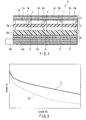
- FIG. 1 is a schematic view of a fuel cell A according to a first embodiment of the present invention.
- the fuel cell A comprises an electromotive layer 10, a fuel supplying layer 20 and an air supplying layer 30.
- the electromotive layer 10 is provided to produce electrical energy.
- the fuel supplying layer 20 is provided on a surface of the electromotive layer 10 to supply fuel to the electromotive layer 10.
- the air supplying layer 30 is provided on another surface of the electromotive layer 10, which is located opposite to the above surface, to supply air (oxygen) to the electromotive layer 10.
- a liquid fuel having volatility such as methanol is used.
- the electromotive layer 10 comprises an electrolyte membrane 10a, a plurality of fuel poles 10b and a plurality of oxidizer poles 10c.
- fuel and air are made to react chemically with each other.
- the fuel poles 10b are arranged on a surface of the electrolyte membrane 10a, which is close to the fuel supplying layer 20, for supplying fuel from the fuel supplying layer 20 to the electrolyte membrane 10a.
- the oxidizer poles 10c are arranged on the other side of the electrolyte membrane 10a, which is closer to the air supplying layer 30, for supplying air from the air supplying layer 30 to the electrolyte membrane 10a.
- the fuel poles 10b and the oxidizer poles 10c are located opposite to each other, with the electrolyte membrane 10a interposed between them.
- the fuel poles 10b, the oxidizer poles 10c and the electrolyte membrane 10a form respective electromotive portions 11 for generating voltages. That is, the electromotive layer 10 comprises the electromotive portions 11 the number of which is equal to each of that of the fuel poles 10b and that of the oxidizer poles 10c. It should be noted that the electromotive portions 11 are all connected in series to each other, and the sum of voltages produced by the electromotive portions 11 is the final output voltage of the fuel cell A.
- the fuel supplying layer 20 comprises a felted liquid holding sheet (first sheet) 20a, a replenishing portion 20b, a fuel adjusting film 20c (which will be described later in detail), and a fuel diffusion film 20d.
- the felted liquid holding sheet 20a is provided to supply fuel to the fuel poles 10b.
- the replenishing portion 20b is connected to a side end portion of the liquid holding sheet 20a to replenish the liquid holding sheet 20a with fuel.
- the fuel adjusting film 20c is provided in the liquid holding sheet 20a to isolate the replenishing portion 20b and the electromotive portions 11 from each other, and to uniformize the amounts of fuel supplied from the liquid holding sheet 20a to the electromotive portions 11.
- the fuel diffusion film 20d is provided on a surface of the liquid holding sheet 20a, which is close to the electromotive portions 11, and permits fuel in the liquid holding sheet 20a to pass through the fuel diffusion film 20d.
- the air supplying layer 30 comprises a felted moisture-retentive sheet (second sheet) 31 which takes therein air from its vicinity, and then supplies it to the oxidizer poles 10c, and which prevents releasing of moisture which is produced in the electrolyte membrane 10a due to chemical reaction of fuel and air, i.e., prevents drying of the electrolyte membrane 10a.
- second sheet felted moisture-retentive sheet
- the fuel adjusting film 20c is formed of a so-called impervious film which does not permit fuel to pass therethrough.
- the impervious film for example, a PET film is used.
- the fuel adjusting film 20c includes a plurality of openings 21 for enabling fuel, with which the liquid holding sheet 20a is replenished, to advance toward the electromotive portions 11.
- the openings 21 have different sizes, and are arranged in ascending order of size from the ones closest the replenishing portion 20b. Thereby, the further the fuel in the liquid holding sheet 20a is located from the replenishing portion 20b, the more easily it advances toward the electromotive portions 11.
- the openings 21 are rectangular. However, their shape is not limited to a rectangle. For example, they may be circular. Furthermore, the openings 21 may be formed in the following manner: the openings 21 are formed to have the same size, and the distances between the openings 21 are adjusted such that the further the fuel is located from the replenishing portion 20b, the more easily it advances toward the electromotive portion side.
- fuel with which the liquid holding sheet 20a is replenished from the replenishing portion 20b is diffused within the liquid holding sheet 20a in a direction away from the replenishing portion 20b, and advances toward the electromotive layer 10 through the openings 21 of the fuel adjusting film 20c. Then, after entering the fuel diffusion film 20d, the fuel passes through the fuel diffusion film 20d, and reaches the fuel poles 10b of the electromotive portions 11.
- the fuel reaching the fuel poles 10b and the air reaching the oxidizer poles 10c react chemically with each other at the electrolyte membrane 10a, thereby generating voltages between the fuel poles 10b and the oxidizer poles 10c.
- the sum of the voltages produced at the electromotive portions 11 is the final output voltage of the fuel cell A.
- FIG. 2A is a perspective view of the liquid holding sheet 20a in the first embodiment as viewed from the electromotive layer side, for showing the distribution of the fuel concentration of the liquid holding sheet 20a, which is obtained one minute after replenishing the liquid holding sheet 20a with fuel.
- FIG. 2B is a perspective view of the liquid holding sheet 20a as viewed from the electromotive layer side, for showing the distribution of the fuel concentration of the liquid holding sheet 20a, which is obtained three minutes after replenishing the liquid holding sheet 20a with fuel.
- FIG. 2C is a perspective view of the liquid holding sheet 20a as viewed from the electromotive layer side, for showing the distribution of the fuel concentration of the liquid holding sheet 20a, which is obtained six minutes after replenishing the liquid holding sheet 20a with fuel.
- FIG. 2D is a perspective view of the liquid holding sheet 20a as viewed from the electromotive layer side, for showing the distribution of the fuel concentration of the liquid holding sheet 20a, which is obtained ten minutes after replenishing the liquid holding sheet 20a with fuel.
- the fuel concentration of a surface of the liquid holding sheet 20a which is located on the electromotive layer 10 is approximately 35 to 45% of that of part of the liquid holding sheet 20a which is close to the replenishing portion 20b, and the fuel concentration of part of the surface of the liquid holding sheet 20a, which has the highest fuel concentration, is approximately 1.3 times higher than that of another part of the surface of the liquid holding sheet 20a, which has the lowest fuel concentration.
- the fuel concentration of the above surface of the liquid holding sheet 20a which is located on the electromotive layer 10 is approximately 72 to 74% of that of the above part of the liquid holding sheet 20a which is close to the replenishing portion 20b
- the fuel concentration of part of the surface of the liquid holding sheet 20a, which has the highest fuel concentration is approximately 1.03 times higher than that of another part of the surface of the liquid holding sheet 20a, which has the lowest fuel concentration. That is, the difference between the highest fuel concentration and the lowest fuel concentration is decreased.
- FIG. 12A is a perspective view of the conventional liquid holding sheet 20a as viewed from the electromotive layer side, for showing the concentration distribution of the fuel in the liquid holding sheet 200a, which is obtained one minute after replenishing the liquid holding sheet 200a with fuel.
- FIG. 12B is a perspective view of the liquid holding sheet 200a as viewed from the electromotive layer side, for showing the concentration distribution of the fuel in the liquid holding sheet 200a, which is obtained three minutes after replenishing the liquid holding sheet 200a with fuel.
- FIG. 12C is a perspective view of the liquid holding sheet 200a as viewed from the electromotive layer side, for showing the concentration distribution of the fuel in liquid holding sheet 200a, which is obtained six minutes after replenishing the liquid holding sheet 200a with fuel.
- FIG. 12D is a perspective view of the liquid holding sheet 200a as viewed from the electromotive layer side, for showing the concentration distribution of the fuel in the liquid holding sheet 200a, which is obtained ten minutes after replenishing the liquid holding sheet 200a with fuel.
- the fuel concentration of a surface of the liquid holding sheet 200a which is located on the electromotive layer 100 is approximately 45 to 85% of that of part of the liquid holding sheet 20a which is close to the replenishing portion 200b, and the fuel concentration of part of the surface of the liquid holding sheet 200a, which has the highest fuel concentration, is approximately 1.8 times higher than that of another part of the surface of the liquid holding sheet 20a, which has the lowest fuel concentration.
- the fuel concentration of the above surface of the liquid holding sheet 200a which is located on the electromotive layer 100 is approximately 80 to 95% of that of the above part of the liquid holding sheet 200a which is close to the replenishing portion 200b, and the fuel concentration of part of the surface of the liquid holding sheet 200a, which has the highest fuel concentration, is approximately 1.2 times higher than that of another part of the surface of the liquid holding sheet 200a, which has the lowest fuel concentration. That is, the difference between the highest fuel concentration and the lowest fuel concentration is still great.
- the fuel concentration of the above part of the surface of the liquid holding sheet 200a, which is located on the electromotive layer 100, i.e., the highest fuel concentration is approximately 1.2 times higher than that of the above other part of the surface of the liquid holding sheet 200a, i.e., the lowest fuel concentration, even when ten minutes lapse after replenishing the liquid holding sheet 200a with fuel, that is, the difference between the highest fuel concentration and the lowest fuel concentration is still great, even when ten minutes lapse after replenishing the liquid holding sheet 200a with fuel.
- liquid holding sheet 20a according to the present invention when the liquid holding sheet 20a according to the present invention is applied, substantially the same amount of fuel, which enables electrical energy to be produced at the highest efficiency, can be supplied to the electromotive portions 11 by adjusting the sizes or arrangement of the openings 21.
- FIG. 3 is a graph for showing current-voltage characteristics of the fuel cell A according to the first embodiment and those of the conventional fuel cell B, which are indicated by "[1]” and “[2]", respectively in FIG. 3.
- the fuel cell A according to the first embodiment can obtain a voltage higher than that in the conventional fuel cell B. This is because as described above, in the first embodiment, the voltage is produced by using fuel the amount of which is set to enable electrical energy to be produced at the highest efficiency by the electromotive portions 11.
- the fuel adjusting film 20c is provided as an impervious film which isolates the electromotive layer 10 and the replenishing portion 20b from each other.
- the openings 21 are formed to have different sizes, and are arranged in ascending order of size from the ones closest to the replenishing portion 20b.
- the fuel concentration of the surface of the liquid holding sheet 20a, which is close to the electromotive layer 10 is made uniform over the surface, thus improving the efficiency of production of electrical energy by the fuel cell A. Accordingly, the number of electromotive portions 11 and the amount of fuel, which are necessary for generating desired electrical energy, can be reduced. Thus, the fuel cell A can be made smaller.
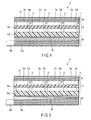
- FIG. 4 is a vertical sectional view of a fuel cell A according to the second embodiment.
- the fuel cell A according to the second embodiment comprises a fuel adjusting film 50 formed of porous material, instead of the fuel adjusting film 20c (impervious film) according to the first embodiment.
- the fuel adjusting film 50 is provided in the liquid holding sheet 20a in substantially parallel with the electromotive layer 10, and the porosity of the fuel adjusting film 50 gradually increases in a direction away from the replenishing portion 20b.
- the fuel concentration of the surface of the liquid holding sheet 20a, which is close to the electromotive layer 10 is made uniform over the surface.
- substantially the same amount of fuel is supplied to the fuel poles 10b, thus improving the efficiency of production of electrical energy by the fuel cell A.
- FIG. 5 is a vertical sectional view of a fuel cell A according to the third embodiment.
- the fuel cell A according to the third embodiment comprises a fuel adjusting film 60 formed of porous material as in the second embodiment.
- the porosity of the fuel adjusting film 60 is uniform from one end thereof to the other end, i.e., it does not vary, and the thickness of the fuel adjusting film 60 gradually decreases in a direction away from the replenishing portion 20b.
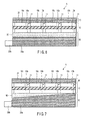
- FIG. 6 is a vertical sectional view of a fuel cell A according to the fourth embodiment.
- the fuel cell A according to the fourth embodiment includes a fuel diffusion film 70 formed of porous material, in place of the fuel adjusting films 20c, 50 and 60 respectively according to the first to third embodiments.
- the porosity of the fuel diffusion film 70 gradually increases in a direction away from the replenishing portion 20b.
- the fuel cell A according to the fourth embodiment includes the fuel diffusion layer 70 in place of the fuel adjusting films 20c, 50 and 60 respectively according to the first to third embodiments; however, it may include both the fuel diffusion layer 70 and any of the fuel adjusting films 20c, 50 and 60.
- FIG. 7 is a vertical sectional view of a fuel cell A according to the fifth embodiment.
- the fuel cell A according to the fifth embodiment includes a fuel diffusion film 80 formed of porous material, in place of the fuel adjusting films 20c, 50 and 60 respectively according to the first to third embodiments, as in the fourth embodiment.
- the porosity of the fuel diffusion film 80 according to the fifth embodiment is uniform throughout the fuel diffusion film 80, and the thickness of the fuel diffusion film 80 decreases in a direction away from the replenishing portion 20b.
- the fuel cell A according to the fifth embodiment includes the fuel diffusion film 80 in place of the fuel adjusting films 20c, 50 and 60 respectively according to the first to third embodiments; however, it may include both the fuel diffusion film 80 and any of the fuel adjusting films 20c, 50 and 60.
- FIGS. 8 and 9 a sixth embodiment of the present invention will be explained with reference to FIGS. 8 and 9. With respect to the sixth embodiment, explanations of the same structural features and operations as in the first to fifth embodiments will be omitted.
- FIG. 8 is a vertical sectional view of a notebook computer incorporating a fuel cell A according to the sixth embodiment of the present invention
- FIG. 9 is a vertical sectional view of the fuel cell A according to the sixth embodiment.
- the fuel cell A according to the sixth embodiment is provided in a housing of the notebook computer, and the notebook computer is used, with the housing inclined relative to the horizontal, as a result of which the fuel cell A is inclined, and the electromotive portions 11 are also inclined, relative to the horizontal. If the fuel cell A is inclined, fuel in the liquid holding sheet 20a easily advances downwards and stays in a lower side portion of the liquid holding sheet 20a due to gravity. As a result, the fuel concentration of the lower side portion of the liquid holding sheet 20a is high, and that of an upper side portion of the liquid holding sheet 20a is low.
- the liquid holding sheet 20a includes a fuel adjusting film 90 formed of an impervious film which does not permit fuel to pass therethrough, as in the first embodiment.
- the fuel adjusting film 90 includes a plurality of openings 91 which have different sizes, and which are arranged in ascending order of size toward the upper side portion of the liquid holding portion 20a.
- the fuel cell A is provided in a rear surface portion, etc. of the above housing of the notebook computer, which is located opposite to a display screen G of the notebook computer, and even when the housing of the notebook computer is inclined, and the fuel cell A is also inclined, the fuel concentration of the surface of liquid holding portion 20a, which is close to the electromotive portions 11, is made uniform. As a result, substantially the same amount of fuel is supplied to the fuel poles 10b, thereby improving the efficiency of production of electrical energy by the fuel cell A.
- the fuel adjusting film 90 is formed of an impervious film including the openings 91 having different sizes.
- the fuel adjusting film of the sixth embodiment is not limited to the above fuel adjusting film 90. That is, an adjusting film may be used which is formed of porous material whose porosity gradually increases toward the upper side portion of the liquid holding sheet 20a, or an adjusting film may be used which is formed of porous material whose thickness gradually decreases toward the upper side portion of the liquid holding sheet 20a.
- any of the following fuel diffusion films may be provided: a fuel diffusion film which is formed of porous material whose porosity gradually increases toward the upper side portion of the liquid holding sheet 20a; and a fuel diffusion film which is formed of porous material whose thickness gradually decreases toward the upper side portion of the liquid holding sheet 20a.
- FIGS. 10 and 11 a seventh embodiment of the present invention will be explained with reference to FIGS. 10 and 11. With respect to the seventh embodiment, explanations of the same structural features and operations as in the first to sixth embodiments will be omitted.
- FIG. 10 is a vertical sectional view of the liquid holding sheet 20a in the seventh embodiment
- FIG. 11 is a schematic view showing the aperture ratios of parts of the fuel adjusting film 40 in the seventh embodiment.
- the replenishing portion 20b is connected to an intermediate portion of a surface of the liquid holding sheet 20a, not the side end portion thereof.
- fuel from the replenishing portion 20b is supplied from a region 42, which is hatched in FIG. 11, to the liquid holding sheet 20a.
- the region 42 functions as a fuel supplying area.
- the fuel adjusting film 40 includes a plurality of openings 43 for allowing fuel with which the liquid holding sheet 20a is replenished to advance toward the electromotive portions 11.
- the openings 43 are arranged in ascending order of size from the ones closest to the fuel supplying area 42, i.e., they are arranged in descending order in size from openings 43 located furthest from the fuel supplying area 42. That is, the aperture ratio is set in such a way as to gradually increase in a direction away from the fuel supplying area side.
- the numerals indicated in FIG. 11 denote the aperture ratios of regions each of which is located between imaginary lines extending from two associated lines. For example, “28%” denotes the aperture ration of a region located between imaginary lines extending from two associated lines. To be more specific, of the above regions, a region located closest to the fuel supplying region 42 has an aperture ratio of approximately 10%, and a region located furthest from the fuel supplying region 42 has an aperture ratio of approximately 80%.
- the fuel concentration of a surface portion of the liquid holding sheet 20a, which is close to the electromotive portions 11, is made uniform over the surface portion, thus enabling substantially the same amount of fuel to advance to the electromotive portions 11.
- the present invention is not limited to the above embodiments only.
- a desired one or ones of the structural elements disclosed with respect to the above embodiments may be modified without departing from the subject matter of the present invention.
- various inventions can be achieved by appropriately combining desired ones of the structural elements of the embodiments. For example, some of the structural elements in a desired one or ones of the embodiments may be deleted, or structural elements in a desired one or ones of the embodiments may be appropriately combined.
Landscapes
- Chemical & Material Sciences (AREA)
- Chemical Kinetics & Catalysis (AREA)
- Electrochemistry (AREA)
- General Chemical & Material Sciences (AREA)
- Life Sciences & Earth Sciences (AREA)
- Engineering & Computer Science (AREA)
- Manufacturing & Machinery (AREA)
- Sustainable Development (AREA)
- Sustainable Energy (AREA)
- Fuel Cell (AREA)
Abstract
Description
- The present invention relates to a direct type fuel cell in which fuel and air are made to react chemically with each other to produce electrical energy.
- It is well known that there are provided fuel cells in which fuel and air are made to react chemically with each other to produce electrical energy. Of those fuel cells, a direct type fuel cell can be made smaller, and is expected to serve as an energy source for a portable electronic device such as a cellular phone or a notebook computer.
- FIG. 13 is a vertical sectional view of a conventional fuel cell B.
- As shown in FIG. 13, the conventional fuel cell B comprises an
electromotive layer 100, afuel supplying layer 200 and an air supplying layer 300. Theelectromotive layer 100 is provided to produce electrical energy. Thefuel supplying layer 200 is provided on a surface of theelectromotive layer 100 to supply fuel to theelectromotive layer 100. The air supplying layer 300 is provided on another surface of theelectromotive layer 100, which is located opposite to the above surface, to supply air (oxygen) to theelectromotive layer 100. - The
electromotive layer 100 comprises anelectrolyte membrane 100a, a plurality offuel poles 100b, and a plurality ofoxidizer poles 100c. In theelectrolyte membrane 100a, fuel and air are made to react chemically with each other. Thefuel poles 100b are arranged in a matrix on a surface of theelectrolyte membrane 100a, which is close to thefuel supplying layer 200, and supply fuel from thefuel supplying layer 200 to theelectrolyte membrane 100a. Theoxidizer poles 100c are arranged in a matrix on another surface of theelectrolyte membrane 100a, which is located opposite to the above surface and close to the air supplying layer 300 of theelectrolyte membrane 100a, and supply air from the air supplying layer 300 to theelectrolyte membrane 100a. - The
fuel poles 100b and theoxidizer poles 100c are located opposite to each other, with theelectrolyte membrane 100a interposed between them. Thefuel poles 100b, theoxidizer poles 100c and theelectrolyte membrane 100a form respectiveelectromotive portions 110 for generating voltages. That is, theelectromotive layer 100 comprises theelectromotive portions 110 the number of which is equal to each of that of the fuel poles 110b and that of theoxidizer poles 100c. Theelectromotive portions 110 are all connected in series to each other. The sum of the voltages produced by theelectromotive portions 110 is the final output voltage of the fuel cell B. - The
fuel supplying layer 200 comprises a feltedliquid holding sheet 200a for supplying fuel to thefuel poles 100b, a replenishingportion 200b connected to theliquid holding sheet 200a, for replenishing theliquid holding sheet 200a with fuel, and afuel diffusion film 200d which permits the fuel in theliquid holding sheet 200a to pass through thefuel diffusion film 200d, and which is provided on a surface of theliquid holding sheet 200a, which is close to theelectromotive portions 110. - The air supplying layer 300 comprises a felted from the vicinity of the fuel cell B, and then supplies it to the
oxidizer poles 100c, and which prevents releasing moisture which is produced in theelectrolyte membrane 100a due to chemical reaction of fuel and air, i.e., prevents drying of theelectrolyte membrane 100a. - In the fuel cell B having the above structure, fuel with which the
liquid holding sheet 200a is replenished from the replenishingportion 200b is advanced within theliquid holding sheet 200a toward thefuel diffusion layer 200d, while diffusing in a direction away from the replenishingportion 200b. It then reaches thefuel poles 100b on thefuel diffusion film 200d. - On the other hand, air taken in the moisture-
retentive sheet 310 from the vicinity of the fuel cell B passes through the moisture-retentive sheet 310, and reaches theoxidizer poles 100c on the moisture-retentive sheet 310. - Then, the fuel reaching the
fuel poles 100b and the air reaching theoxidizer poles 100c react chemically with each other at theelectrolyte membrane 100a, causing voltages to be produced between thefuel poles 100b and theoxidizer poles 100c. The sum of voltages produced at theelectromotive portions 110 is the final output voltage of the fuel cell B. - Furthermore, in a direct type fuel cell disclosed in, e.g., Jpn. Pat. Appln. KOKAI Publication No. 2000-106201, a plurality of electromotive layers are stacked together, and liquid fuel is supplied to the electromotive layers by capillary action.
- In most conventional fuel cells, the replenishing portion is provided at an end of the liquid holding sheet since the replenishing portion is restricted by the structure of the cell. In such a structure, there is a case where the concentration of the fuel in the liquid holding sheet is not uniform, i.e., the concentration varies from one part of the liquid holding sheet to another. In this case, the concentrations of fuel reaching the electromotive portions are also different, thus worsening the efficiency of production of electrical energy by the electromotive portions.
- For example, if a large amount of fuel is supplied to the electromotive portions, surplus fuel which has not reacted in the electrolyte membrane reaches the oxidizer poles. Thus, it is wasteful, and in addition the voltage loss may increase due to reduction of the surface areas of catalysts included in the oxidizer poles. On the other hand, if an excessively small amount of fuel is supplied to the electromotive portions, the reaction energy becomes too large, as a result of which the voltage loss may also increase.
- Thus, in order to improve the electrical characteristics of the fuel cell, it is important to make the concentration of fuel in the entire liquid holding sheet uniform, and supply a proper amount of fuel to the electromotive portions. However, in a portable electronic device required to operate for a long time, a fuel cell including a large liquid holding sheet is provided, and the concentration of fuel therein greatly varies from one part to another. Therefore, as is often the case, the amount of fuel supplied to each electromotive portion is too large or small, thus remarkably worsening the electrical characteristics.
- The object of the present invention is to provide a fuel cell having satisfactory electrical characteristics.
- A fuel cell according to one aspect of the present invention comprises: a plurality of electromotive portions which cause fuel and oxygen to react chemically with each other to produce electrical energy; a first sheet which supplies the fuel to the plurality of electromotive portions a second sheet which supplies the oxygen to the plurality of electromotive portions; a replenishing portion which is provided at a predetermined portion of the first sheet, and replenishes the first sheet with the fuel; and a fuel adjusting film which is inserted in the first sheet, and adjusts amounts of the fuel to be supplied from the first sheet to the plurality of electromotive portions.
- A fuel cell according to another aspect of the present invention comprises: a plurality of electromotive portions which cause fuel and oxygen to react chemically with each other to produce electrical energy; a first sheet which supplies the fuel to the plurality of electromotive portions; a second sheet which supplies the oxygen to the plurality of electromotive portions; a replenishing portion which is provided at a predetermined portion of the first sheet, and replenishes the first sheet with the fuel; and a fuel diffusion film which is provided between the plurality of electromotive portions and the first sheet, and permits the fuel from the first sheet to pass through the fuel diffusion film, the fuel diffusion film adjusting amounts of the fuel to be supplied from the first sheet to the plurality of electromotive portions.
- A fuel cell according to a further aspect of the present invention comprises: a plurality of electromotive portions which are arranged in a direction crossing a horizontal direction, and cause fuel and oxygen to react chemically with each other to produce electrical energy; a first sheet which supplies the fuel to the electromotive portions; a second sheet which supplies the oxygen to the electromotive portions; a replenishing portion which is provided at a predetermined portion of the first sheet, and replenishes the first sheet with the fuel; and a fuel adjusting film which is provided to extend along the direction in which the electromotive portions are arranged, and adjusts amounts of the fuel to be supplied from the first sheet to the electromotive portions.
- A fuel cell according to still another aspect of the present invention comprises: a plurality of electromotive portions which are arranged in a direction crossing a horizontal direction, and cause fuel and oxygen to react chemically with each other to produce electrical energy; a first sheet which supplies the fuel to the electromotive portions; a second sheet which supplies the oxygen to the electromotive portions; a replenishing portion which is provided at a predetermined portion of the first sheet, and replenishes the first sheet with the fuel; and a fuel diffusion film which is provided between the electromotive portions and the first sheet to extend along the direction in which the electromotive portions are arranged, and permits the fuel supplied from the first sheet to pass through the fuel diffusion film, the fuel diffusion film adjusting amounts of the fuel to be supplied from the first sheet to the electromotive portions.
- According to the present invention, the electrical characteristics of the fuel cell are improved.
- This summary of the invention does not necessarily describe all necessary features so that the invention may also be a sub-combination of these described features.
- The invention can be more fully understood from the following detailed description when taken in conjunction with the accompanying drawings, in which:
- FIG. 1 is a schematic view of a fuel cell according to a first embodiment of the present invention.
- FIG. 2A is a perspective view of a liquid holding sheet in the first embodiment as viewed from an electromotive layer side, for showing the concentration distribution of fuel in the liquid holding sheet, which is obtained one minute after replenishing the liquid holding sheet with fuel.
- FIG. 2B is a perspective view of the liquid holding sheet in the first embodiment as viewed from the electromotive layer side, for showing the concentration distribution of fuel in the liquid holding sheet, which is obtained three minutes after replenishing the liquid holding sheet with fuel.
- FIG. 2C is a perspective view of the liquid holding sheet in the first embodiment as viewed from the electromotive layer side, for showing the concentration distribution of fuel in the liquid holding sheet, which is obtained six minutes after replenishing the liquid holding sheet with fuel.
- FIG. 2D is a perspective view of the liquid holding sheet in the first embodiment as viewed from the electromotive layer side, for showing the concentration distribution of fuel in the liquid holding sheet, which is obtained ten minutes after replenishing the liquid holding sheet with fuel.
- FIG. 3 is a graph for showing current-voltage characteristics of the fuel cell according to the first embodiment and those of a conventional fuel cell.
- FIG. 4 is a vertical sectional view of a fuel cell according to a second embodiment of the present invention.
- FIG. 5 is a vertical sectional view of a fuel cell according to a third embodiment of the present invention.
- FIG. 6 is a vertical sectional view of a fuel cell according to a fourth embodiment of the present invention.
- FIG. 7 is a vertical sectional view of a fuel cell according to a fifth embodiment of the present invention.
- FIG. 8 is a vertical sectional view of a notebook computer incorporating a fuel cell according to a sixth embodiment of the present invention.
- FIG. 9 is a vertical sectional view of the fuel cell according to the sixth embodiment of the present invention.
- FIG. 10 is a vertical sectional view of a liquid holding sheet in a seventh embodiment of the present invention.
- FIG. 11 is a schematic view showing the aperture ratios of parts of a fuel adjusting film in the seventh embodiment of the present invention.
- FIG. 12A is a perspective view of a conventional liquid holding sheet as viewed from an electromotive layer side, for showing the concentration distribution of fuel in the liquid holding sheet, which is obtained one minute after replenishing the liquid holding sheet with fuel.
- FIG. 12B is a perspective view of the conventional liquid holding sheet as viewed from the electromotive layer side, for showing the concentration distribution of fuel in the liquid holding sheet, which is obtained three minutes after replenishing the liquid holding sheet with fuel.
- FIG. 12C is a perspective view of the conventional liquid holding sheet as viewed from the electromotive layer side, for showing the concentration distribution of fuel in the liquid holding sheet, which is obtained six minutes after replenishing the liquid holding sheet with fuel.
- FIG. 12D is a perspective view of the conventional liquid holding sheet as viewed from the electromotive layer side, for showing the concentration distribution of fuel in the liquid holding sheet, which is obtained ten minutes after replenishing the liquid holding sheet with fuel.
- FIG. 13 is a vertical sectional view of a conventional fuel cell.
- The first embodiment of the present invention will be explained with reference to FIGS. 1 to 3 and 12A to 12D.
- FIG. 1 is a schematic view of a fuel cell A according to a first embodiment of the present invention.
- As shown in FIG. 1, the fuel cell A comprises an
electromotive layer 10, afuel supplying layer 20 and anair supplying layer 30. Theelectromotive layer 10 is provided to produce electrical energy. Thefuel supplying layer 20 is provided on a surface of theelectromotive layer 10 to supply fuel to theelectromotive layer 10. Theair supplying layer 30 is provided on another surface of theelectromotive layer 10, which is located opposite to the above surface, to supply air (oxygen) to theelectromotive layer 10. As the above fuel, a liquid fuel having volatility such as methanol is used. - The
electromotive layer 10 comprises anelectrolyte membrane 10a, a plurality offuel poles 10b and a plurality ofoxidizer poles 10c. In theelectrolyte membrane 10a, fuel and air are made to react chemically with each other. Thefuel poles 10b are arranged on a surface of theelectrolyte membrane 10a, which is close to thefuel supplying layer 20, for supplying fuel from thefuel supplying layer 20 to theelectrolyte membrane 10a. Theoxidizer poles 10c are arranged on the other side of theelectrolyte membrane 10a, which is closer to theair supplying layer 30, for supplying air from theair supplying layer 30 to theelectrolyte membrane 10a. - The
fuel poles 10b and theoxidizer poles 10c are located opposite to each other, with theelectrolyte membrane 10a interposed between them. Thefuel poles 10b, theoxidizer poles 10c and theelectrolyte membrane 10a form respectiveelectromotive portions 11 for generating voltages. That is, theelectromotive layer 10 comprises theelectromotive portions 11 the number of which is equal to each of that of thefuel poles 10b and that of theoxidizer poles 10c. It should be noted that theelectromotive portions 11 are all connected in series to each other, and the sum of voltages produced by theelectromotive portions 11 is the final output voltage of the fuel cell A. - The
fuel supplying layer 20 comprises a felted liquid holding sheet (first sheet) 20a, a replenishingportion 20b, afuel adjusting film 20c (which will be described later in detail), and afuel diffusion film 20d. The feltedliquid holding sheet 20a is provided to supply fuel to thefuel poles 10b. The replenishingportion 20b is connected to a side end portion of theliquid holding sheet 20a to replenish theliquid holding sheet 20a with fuel. Thefuel adjusting film 20c is provided in theliquid holding sheet 20a to isolate the replenishingportion 20b and theelectromotive portions 11 from each other, and to uniformize the amounts of fuel supplied from theliquid holding sheet 20a to theelectromotive portions 11.
Thefuel diffusion film 20d is provided on a surface of theliquid holding sheet 20a, which is close to theelectromotive portions 11, and permits fuel in theliquid holding sheet 20a to pass through thefuel diffusion film 20d. - The
air supplying layer 30 comprises a felted moisture-retentive sheet (second sheet) 31 which takes therein air from its vicinity, and then supplies it to theoxidizer poles 10c, and which prevents releasing of moisture which is produced in theelectrolyte membrane 10a due to chemical reaction of fuel and air, i.e., prevents drying of theelectrolyte membrane 10a. - Next, the
fuel adjusting film 20c will be explained. - In the first embodiment, the
fuel adjusting film 20c is formed of a so-called impervious film which does not permit fuel to pass therethrough. As the impervious film, for example, a PET film is used. Thefuel adjusting film 20c includes a plurality ofopenings 21 for enabling fuel, with which theliquid holding sheet 20a is replenished, to advance toward theelectromotive portions 11. - The
openings 21 have different sizes, and are arranged in ascending order of size from the ones closest the replenishingportion 20b. Thereby, the further the fuel in theliquid holding sheet 20a is located from the replenishingportion 20b, the more easily it advances toward theelectromotive portions 11. - Therefore, fuel with which the
liquid holding sheet 20a is replenished from the replenishingportion 20b is supplied to theelectromotive portions 11 such that the amounts of the fuel at theelectromotive portions 11 are made uniform, regardless of the distances between theelectromotive portions 11 and the replenishingportion 20. - In the first embodiment, the
openings 21 are rectangular. However, their shape is not limited to a rectangle. For example, they may be circular. Furthermore, theopenings 21 may be formed in the following manner: theopenings 21 are formed to have the same size, and the distances between theopenings 21 are adjusted such that the further the fuel is located from the replenishingportion 20b, the more easily it advances toward the electromotive portion side. - In the fuel cell A having the above structure, fuel with which the
liquid holding sheet 20a is replenished from the replenishingportion 20b is diffused within theliquid holding sheet 20a in a direction away from the replenishingportion 20b, and advances toward theelectromotive layer 10 through theopenings 21 of thefuel adjusting film 20c. Then, after entering thefuel diffusion film 20d, the fuel passes through thefuel diffusion film 20d, and reaches thefuel poles 10b of theelectromotive portions 11. - On the other hand, air taken in the moisture-
retentive sheet 31 from the vicinity of the fuel cell A diffuses in the moisture-retentive sheet 31, and reaches theoxidizer poles 10c of theelectromotive portions 11. - Thereafter, the fuel reaching the
fuel poles 10b and the air reaching theoxidizer poles 10c react chemically with each other at theelectrolyte membrane 10a, thereby generating voltages between thefuel poles 10b and theoxidizer poles 10c. The sum of the voltages produced at theelectromotive portions 11 is the final output voltage of the fuel cell A. - Next, it will be explained how the concentration distribution of fuel in the conventional
liquid holding sheet 200a and that of fuel in theliquid holding sheet 20a in the first embodiment vary with the passage of time, with reference to FIGS. 2A to 2D and 12A to 12D. - First, the
liquid holding sheet 20a in the first embodiment will be explained. - FIG. 2A is a perspective view of the
liquid holding sheet 20a in the first embodiment as viewed from the electromotive layer side, for showing the distribution of the fuel concentration of theliquid holding sheet 20a, which is obtained one minute after replenishing theliquid holding sheet 20a with fuel. FIG. 2B is a perspective view of theliquid holding sheet 20a as viewed from the electromotive layer side, for showing the distribution of the fuel concentration of theliquid holding sheet 20a, which is obtained three minutes after replenishing theliquid holding sheet 20a with fuel. FIG. 2C is a perspective view of theliquid holding sheet 20a as viewed from the electromotive layer side, for showing the distribution of the fuel concentration of theliquid holding sheet 20a, which is obtained six minutes after replenishing theliquid holding sheet 20a with fuel. FIG. 2D is a perspective view of theliquid holding sheet 20a as viewed from the electromotive layer side, for showing the distribution of the fuel concentration of theliquid holding sheet 20a, which is obtained ten minutes after replenishing theliquid holding sheet 20a with fuel. - It can be seen from FIG. 2A that one minute after the
liquid holding sheet 20a is replenished with fuel, the fuel concentration of a surface of theliquid holding sheet 20a which is located on the electromotive layer 10 (i.e., that of an upper surface of theliquid holding sheet 20a in FIG. 2A) is approximately 35 to 45% of that of part of theliquid holding sheet 20a which is close to the replenishingportion 20b, and the fuel concentration of part of the surface of theliquid holding sheet 20a, which has the highest fuel concentration, is approximately 1.3 times higher than that of another part of the surface of theliquid holding sheet 20a, which has the lowest fuel concentration. - It can be seen from FIG. 2D that ten minutes after the
liquid holding sheet 20a is replenished with fuel, the fuel concentration of the above surface of theliquid holding sheet 20a which is located on the electromotive layer 10 (i.e., that of the upper surface of theliquid holding sheet 20a in FIG. 2D) is approximately 72 to 74% of that of the above part of theliquid holding sheet 20a which is close to the replenishingportion 20b, and the fuel concentration of part of the surface of theliquid holding sheet 20a, which has the highest fuel concentration, is approximately 1.03 times higher than that of another part of the surface of theliquid holding sheet 20a, which has the lowest fuel concentration. That is, the difference between the highest fuel concentration and the lowest fuel concentration is decreased. - In such a manner, it can be seen that in the first embodiment, ten minutes after the
liquid holding sheet 20a is replenished with fuel, the concentration of the fuel in the surface of theliquid holding sheet 20a which is located on theelectromotive layer 10 is substantially uniform. - Next, the conventional
liquid holding sheet 200a will be explained. - FIG. 12A is a perspective view of the conventional
liquid holding sheet 20a as viewed from the electromotive layer side, for showing the concentration distribution of the fuel in theliquid holding sheet 200a, which is obtained one minute after replenishing theliquid holding sheet 200a with fuel. FIG. 12B is a perspective view of theliquid holding sheet 200a as viewed from the electromotive layer side, for showing the concentration distribution of the fuel in theliquid holding sheet 200a, which is obtained three minutes after replenishing theliquid holding sheet 200a with fuel. FIG. 12C is a perspective view of theliquid holding sheet 200a as viewed from the electromotive layer side, for showing the concentration distribution of the fuel inliquid holding sheet 200a, which is obtained six minutes after replenishing theliquid holding sheet 200a with fuel. FIG. 12D is a perspective view of theliquid holding sheet 200a as viewed from the electromotive layer side, for showing the concentration distribution of the fuel in theliquid holding sheet 200a, which is obtained ten minutes after replenishing theliquid holding sheet 200a with fuel. - It can be seen from FIG. 12A that one minute after the
liquid holding sheet 200a is replenished with fuel, the fuel concentration of a surface of theliquid holding sheet 200a which is located on the electromotive layer 100 (i.e., that of an upper surface of theliquid holding sheet 200a in FIG. 12A) is approximately 45 to 85% of that of part of theliquid holding sheet 20a which is close to the replenishingportion 200b, and the fuel concentration of part of the surface of theliquid holding sheet 200a, which has the highest fuel concentration, is approximately 1.8 times higher than that of another part of the surface of theliquid holding sheet 20a, which has the lowest fuel concentration. - It can be seen from FIG. 12D that ten minutes after the
liquid holding sheet 200a is replenished with fuel, the fuel concentration of the above surface of theliquid holding sheet 200a which is located on the electromotive layer 100 (i.e., that of the upper surface of theliquid holding sheet 200a in FIG. 12D) is approximately 80 to 95% of that of the above part of theliquid holding sheet 200a which is close to the replenishingportion 200b, and the fuel concentration of part of the surface of theliquid holding sheet 200a, which has the highest fuel concentration, is approximately 1.2 times higher than that of another part of the surface of theliquid holding sheet 200a, which has the lowest fuel concentration. That is, the difference between the highest fuel concentration and the lowest fuel concentration is still great. - In such a manner, it can be seen that in the conventional
liquid holding sheet 200a, the fuel concentration of the above part of the surface of theliquid holding sheet 200a, which is located on theelectromotive layer 100, i.e., the highest fuel concentration, is approximately 1.2 times higher than that of the above other part of the surface of theliquid holding sheet 200a, i.e., the lowest fuel concentration, even when ten minutes lapse after replenishing theliquid holding sheet 200a with fuel, that is, the difference between the highest fuel concentration and the lowest fuel concentration is still great, even when ten minutes lapse after replenishing theliquid holding sheet 200a with fuel. - It is demonstrated from the above that the fuel concentration of the surface of the
liquid holding sheet 20a which is located on theelectromotive layer 10 is more easily made uniform than that of the conventionalliquid holding sheet 200a. - Therefore, when the
liquid holding sheet 20a according to the present invention is applied, substantially the same amount of fuel, which enables electrical energy to be produced at the highest efficiency, can be supplied to theelectromotive portions 11 by adjusting the sizes or arrangement of theopenings 21. - FIG. 3 is a graph for showing current-voltage characteristics of the fuel cell A according to the first embodiment and those of the conventional fuel cell B, which are indicated by "[1]" and "[2]", respectively in FIG. 3.
- As can be seen from FIG. 3, the fuel cell A according to the first embodiment can obtain a voltage higher than that in the conventional fuel cell B. This is because as described above, in the first embodiment, the voltage is produced by using fuel the amount of which is set to enable electrical energy to be produced at the highest efficiency by the
electromotive portions 11. - In the fuel cell A having the above structure, the
fuel adjusting film 20c is provided as an impervious film which isolates theelectromotive layer 10 and the replenishingportion 20b from each other. Theopenings 21 are formed to have different sizes, and are arranged in ascending order of size from the ones closest to the replenishingportion 20b. - By virtue of the above structure, when fuel with which the
liquid holding sheet 20a is replenished passes through theopenings 21, the fuel concentration of the surface of theliquid holding sheet 20a, which is close to theelectromotive layer 10, is made uniform over the surface, thus improving the efficiency of production of electrical energy by the fuel cell A. Accordingly, the number ofelectromotive portions 11 and the amount of fuel, which are necessary for generating desired electrical energy, can be reduced. Thus, the fuel cell A can be made smaller. - Next, a second embodiment of the present invention will be explained with reference to FIG. 4. In the second embodiment, explanations of the same structural features and operations as in the first embodiment will be omitted.
- FIG. 4 is a vertical sectional view of a fuel cell A according to the second embodiment.
- As shown in FIG. 4, the fuel cell A according to the second embodiment comprises a
fuel adjusting film 50 formed of porous material, instead of thefuel adjusting film 20c (impervious film) according to the first embodiment. Thefuel adjusting film 50 is provided in theliquid holding sheet 20a in substantially parallel with theelectromotive layer 10, and the porosity of thefuel adjusting film 50 gradually increases in a direction away from the replenishingportion 20b. - In the above structure also, the further the fuel with which the
replenishing sheet 20a is replenished is from the replenishingportion 20b, the more easily it advances toward theelectromotive layer 10. Thus, the fuel concentration of the surface of theliquid holding sheet 20a, which is close to theelectromotive layer 10, is made uniform over the surface. As a result, substantially the same amount of fuel is supplied to thefuel poles 10b, thus improving the efficiency of production of electrical energy by the fuel cell A. - Next, a third embodiment of the present invention will be explained with reference to FIG. 5. With respect to the third embodiment, explanations of the same structural features and operations as in the first and second embodiments will be omitted.
- FIG. 5 is a vertical sectional view of a fuel cell A according to the third embodiment.
- As shown in FIG. 5, the fuel cell A according to the third embodiment comprises a
fuel adjusting film 60 formed of porous material as in the second embodiment. However, unlike the second embodiment, the porosity of thefuel adjusting film 60 is uniform from one end thereof to the other end, i.e., it does not vary, and the thickness of thefuel adjusting film 60 gradually decreases in a direction away from the replenishingportion 20b. - In this structure also, the further the fuel with which the
replenishing sheet 20a is replenished is from the replenishingportion 20b, the more easily it advances toward theelectromotive layer 10. Thus, the fuel concentration of the surface of theliquid holding sheet 20a, which is close to theelectromotive layer 10, is made uniform over the surface. As a result, substantially the same amount of fuel is supplied to thefuel poles 10b, thus improving the efficiency of production of electrical energy by the fuel cell A. - Next, a fourth embodiment of the present invention will be explained with reference to FIG. 6. With respect to the fourth embodiment, explanations of the same structural features and operations as in the first to third embodiments will be omitted.
- FIG. 6 is a vertical sectional view of a fuel cell A according to the fourth embodiment.
- As shown in FIG. 6, the fuel cell A according to the fourth embodiment includes a fuel diffusion film 70 formed of porous material, in place of the
fuel adjusting films portion 20b. - In this structure also, substantially the same amount of fuel is supplied to the
fuel poles 10b, thus improving the efficiency of production of electrical energy by the fuel cell A. In addition, if the fuel diffusion film of the conventional fuel cell is replaced by the fuel diffusion film 70 of the fourth embodiment, the conventional fuel cell can be efficiently used, and the manufacturing cost is not increased. - It should be noted that the fuel cell A according to the fourth embodiment, as described above, includes the fuel diffusion layer 70 in place of the
fuel adjusting films fuel adjusting films - Next, a fifth embodiment of the present invention will be explained with reference to FIG. 7. With respect to the fifth embodiment, explanations of the same structural features and operations as in the first to fourth embodiments will be omitted.
- FIG. 7 is a vertical sectional view of a fuel cell A according to the fifth embodiment.
- As shown in FIG. 7, the fuel cell A according to the fifth embodiment includes a
fuel diffusion film 80 formed of porous material, in place of thefuel adjusting films fuel diffusion film 80 according to the fifth embodiment is uniform throughout thefuel diffusion film 80, and the thickness of thefuel diffusion film 80 decreases in a direction away from the replenishingportion 20b. - In this structure also, the same amount of fuel is supplies to the
fuel poles 10b, thus improving the efficiency of production of electrical energy by the fuel cell A. - Furthermore, the fuel cell A according to the fifth embodiment includes the
fuel diffusion film 80 in place of thefuel adjusting films fuel diffusion film 80 and any of thefuel adjusting films - Next, a sixth embodiment of the present invention will be explained with reference to FIGS. 8 and 9.
With respect to the sixth embodiment, explanations of the same structural features and operations as in the first to fifth embodiments will be omitted. - FIG. 8 is a vertical sectional view of a notebook computer incorporating a fuel cell A according to the sixth embodiment of the present invention, and FIG. 9 is a vertical sectional view of the fuel cell A according to the sixth embodiment.
- As shown in FIGS. 8 and 9, it is assumed that the fuel cell A according to the sixth embodiment is provided in a housing of the notebook computer, and the notebook computer is used, with the housing inclined relative to the horizontal, as a result of which the fuel cell A is inclined, and the
electromotive portions 11 are also inclined, relative to the horizontal. If the fuel cell A is inclined, fuel in theliquid holding sheet 20a easily advances downwards and stays in a lower side portion of theliquid holding sheet 20a due to gravity. As a result, the fuel concentration of the lower side portion of theliquid holding sheet 20a is high, and that of an upper side portion of theliquid holding sheet 20a is low. - In the fuel cell A according to the sixth embodiment, the
liquid holding sheet 20a includes afuel adjusting film 90 formed of an impervious film which does not permit fuel to pass therethrough, as in the first embodiment. However, unlike the first embodiment, thefuel adjusting film 90 includes a plurality ofopenings 91 which have different sizes, and which are arranged in ascending order of size toward the upper side portion of theliquid holding portion 20a. - By virtue of the above structural feature, the closer the fuel in the
liquid holding sheet 20a to the upper side portion of theliquid holding portion 20a, the more easily it advances toward the electromotive portion side. Thus, the fuel cell A is provided in a rear surface portion, etc. of the above housing of the notebook computer, which is located opposite to a display screen G of the notebook computer, and even when the housing of the notebook computer is inclined, and the fuel cell A is also inclined, the fuel concentration of the surface ofliquid holding portion 20a, which is close to theelectromotive portions 11, is made uniform. As a result, substantially the same amount of fuel is supplied to thefuel poles 10b, thereby improving the efficiency of production of electrical energy by the fuel cell A. - In the sixth embodiment, the
fuel adjusting film 90, as described above, is formed of an impervious film including theopenings 91 having different sizes. However, the fuel adjusting film of the sixth embodiment is not limited to the abovefuel adjusting film 90. That is, an adjusting film may be used which is formed of porous material whose porosity gradually increases toward the upper side portion of theliquid holding sheet 20a, or an adjusting film may be used which is formed of porous material whose thickness gradually decreases toward the upper side portion of theliquid holding sheet 20a. - Furthermore, between the
liquid holding sheet 20a and theelectromotive layer 10, instead of the fuel adjusting film, any of the following fuel diffusion films may be provided: a fuel diffusion film which is formed of porous material whose porosity gradually increases toward the upper side portion of theliquid holding sheet 20a; and a fuel diffusion film which is formed of porous material whose thickness gradually decreases toward the upper side portion of theliquid holding sheet 20a. - Next, a seventh embodiment of the present invention will be explained with reference to FIGS. 10 and 11. With respect to the seventh embodiment, explanations of the same structural features and operations as in the first to sixth embodiments will be omitted.
- FIG. 10 is a vertical sectional view of the
liquid holding sheet 20a in the seventh embodiment, and FIG. 11 is a schematic view showing the aperture ratios of parts of thefuel adjusting film 40 in the seventh embodiment. - As shown in FIG. 10, in the seventh embodiment, the replenishing
portion 20b is connected to an intermediate portion of a surface of theliquid holding sheet 20a, not the side end portion thereof. Thus, fuel from the replenishingportion 20b is supplied from aregion 42, which is hatched in FIG. 11, to theliquid holding sheet 20a. Theregion 42 functions as a fuel supplying area. - The
fuel adjusting film 40 includes a plurality ofopenings 43 for allowing fuel with which theliquid holding sheet 20a is replenished to advance toward theelectromotive portions 11. - The
openings 43 are arranged in ascending order of size from the ones closest to thefuel supplying area 42, i.e., they are arranged in descending order in size fromopenings 43 located furthest from thefuel supplying area 42. That is, the aperture ratio is set in such a way as to gradually increase in a direction away from the fuel supplying area side. - It should be noted that the numerals indicated in FIG. 11 denote the aperture ratios of regions each of which is located between imaginary lines extending from two associated lines. For example, "28%" denotes the aperture ration of a region located between imaginary lines extending from two associated lines. To be more specific, of the above regions, a region located closest to the
fuel supplying region 42 has an aperture ratio of approximately 10%, and a region located furthest from thefuel supplying region 42 has an aperture ratio of approximately 80%. - When the
fuel adjusting film 40 having the above structure is used, the fuel concentration of a surface portion of theliquid holding sheet 20a, which is close to theelectromotive portions 11, is made uniform over the surface portion, thus enabling substantially the same amount of fuel to advance to theelectromotive portions 11. - The present invention is not limited to the above embodiments only. When it is put to practical use, a desired one or ones of the structural elements disclosed with respect to the above embodiments may be modified without departing from the subject matter of the present invention. Further, various inventions can be achieved by appropriately combining desired ones of the structural elements of the embodiments. For example, some of the structural elements in a desired one or ones of the embodiments may be deleted, or structural elements in a desired one or ones of the embodiments may be appropriately combined.
Claims (14)
- A fuel cell (A) characterized by comprising:a plurality of electromotive portions (11) which cause fuel and oxygen to react chemically with each other to produce electrical energy;a first sheet (20a) which supplies the fuel to the plurality of electromotive portions (11);a second sheet (31) which supplies the oxygen to the plurality of electromotive portions (11);a replenishing portion (20b) which is provided at a predetermined portion of the first sheet (20a), and replenishes the first sheet (20a) with the fuel; anda fuel adjusting film (20c,50,60) which is inserted in the first sheet (20a), and adjusts amounts of the fuel to be supplied from the first sheet (20a) to the plurality of electromotive portions (11).
- The fuel cell (A) according to claim 1, characterized in that the fuel adjusting film (20c) is an impervious film having openings (21) which are arranged in ascending order of size from ones of the openings (21), which are located closest to the replenishing portion (20b).
- The fuel cell (A) according to claim 1, characterized in that the fuel adjusting film (60) is formed of porous material whose thickness gradually decreases in a direction away from the replenishing portion (20b).
- The fuel cell (A) according to claim 1, characterized in that the fuel adjusting film (50) is formed of porous material whose porosity gradually increases in a direction away from the replenishing portion (20b).
- A fuel cell (A) characterized by comprising:a plurality of electromotive portions (11) which cause fuel and oxygen to react chemically with each other to produce electrical energy;a first sheet (20a) which supplies the fuel to the plurality of electromotive portions (11);a second sheet (31) which supplies the oxygen to the plurality of electromotive portions (11);a replenishing portion (20b) which is provided at a predetermined portion of the first sheet (20a), and replenishes the first sheet (20a) with the fuel; anda fuel diffusion film (70,80) which is provided between the plurality of electromotive portions (11) and the first sheet (20a), and permits the fuel from the first sheet (20a) to pass through the fuel diffusion film (70,80), the fuel diffusion film (70,80) adjusting amounts of the fuel to be supplied from the first sheet (20a) to the plurality of electromotive portions (11).
- The fuel cell (A) according to claim 5, characterized in that the fuel diffusion film (80) is formed of porous material whose thickness gradually decreases in a direction away from the replenishing portion (20b).
- The fuel cell (A) according to claim 5, characterized in that the fuel diffusion film (70) is formed of porous material whose porosity gradually increases in a direction away from the replenishing portion (20b).
- A fuel cell (A) characterized by comprising:a plurality of electromotive portions (11) which are arranged in a direction crossing a horizontal direction, and cause fuel and oxygen to react chemically with each other to produce electrical energy;a first sheet (20a) which supplies the fuel to the electromotive portions (11);a second sheet (31) which supplies the oxygen to the electromotive portions (11);a replenishing portion (20b) which is provided at a predetermined portion of the first sheet (20a), and replenishes the first sheet (20a) with the fuel; anda fuel adjusting film (50,60,90) which is provided to extend along the direction in which the electromotive portions (11) are arranged, and adjusts amounts of the fuel to be supplied from the first sheet (20a) to the electromotive portions (11).
- The fuel cell (A) according to claim 8, characterized in that the fuel adjusting film (90) is an impervious film which includes a plurality of openings (91) which are arranged in ascending order of size in a direction opposite to the direction of gravity.
- The fuel cell (A) according to claim 8, characterized in that the fuel adjusting film (60) is formed of porous material whose thickness gradually decreases in a direction opposite to the direction of gravity.
- The fuel cell (A) according to claim 8, characterized in that the fuel adjusting film (50) is formed of porous material whose porosity gradually increases in a direction opposite to the direction of gravity.
- A fuel cell (A) characterized by comprising:a plurality of electromotive portions (11) which are arranged in a direction crossing a horizontal direction, and cause fuel and oxygen to react chemically with each other to produce electrical energy;a first sheet (20a) which supplies the fuel to the electromotive portions (11);a second sheet (31) which supplies the oxygen to the electromotive portions (11);a replenishing portion (20b) which is provided at a predetermined portion of the first sheet (20a), and replenishes the first sheet (20a) with the fuel; anda fuel diffusion film (70,80) which is provided between the electromotive portions (11) and the first sheet (20a) to extend along the direction in which the electromotive portions (11) are arranged, and permits the fuel supplied from the first sheet (20a) to pass through the fuel diffusion film (70,80), the fuel diffusion film (70,80) adjusting amounts of the fuel to be supplied from the first sheet (20a) to the electromotive portions (11).
- The fuel cell (A) according to claim 12, characterized in that the fuel diffusion film (80) is formed of porous material whose thickness gradually decreases in a direction opposite to the direction of gravity.
- The fuel cell (A) according to claim 12, characterized in that the fuel diffusion film (70) is formed of porous material whose porosity gradually increases in a direction opposite to the direction of gravity.
Applications Claiming Priority (2)
| Application Number | Priority Date | Filing Date | Title |
|---|---|---|---|
| JP2004360206 | 2004-12-13 | ||
| JP2005185092A JP4271166B2 (en) | 2004-12-13 | 2005-06-24 | Fuel cell |
Publications (2)
| Publication Number | Publication Date |
|---|---|
| EP1670088A2 true EP1670088A2 (en) | 2006-06-14 |
| EP1670088A3 EP1670088A3 (en) | 2006-09-06 |
Family
ID=36097207
Family Applications (1)
| Application Number | Title | Priority Date | Filing Date |
|---|---|---|---|
| EP05027079A Withdrawn EP1670088A3 (en) | 2004-12-13 | 2005-12-12 | Fuel cell |
Country Status (3)
| Country | Link |
|---|---|
| US (1) | US8057956B2 (en) |
| EP (1) | EP1670088A3 (en) |
| JP (1) | JP4271166B2 (en) |
Cited By (1)
| Publication number | Priority date | Publication date | Assignee | Title |
|---|---|---|---|---|
| EP1885012A4 (en) * | 2005-05-27 | 2009-12-30 | Toshiba Kk | FUEL CELL |
Families Citing this family (4)
| Publication number | Priority date | Publication date | Assignee | Title |
|---|---|---|---|---|
| JP2007095558A (en) * | 2005-09-29 | 2007-04-12 | Toshiba Corp | Fuel cell |
| JP2008235026A (en) | 2007-03-20 | 2008-10-02 | Toshiba Corp | Fuel distribution adjustment method, fuel distribution adjustment film, fuel distribution adjustment film manufacturing method, fuel cell, and fuel cell manufacturing method |
| JP5354982B2 (en) * | 2008-07-14 | 2013-11-27 | パナソニック株式会社 | Direct oxidation fuel cell |
| US9123962B2 (en) * | 2011-02-07 | 2015-09-01 | United Technologies Corporation | Flow battery having electrodes with a plurality of different pore sizes and or different layers |
Family Cites Families (12)
| Publication number | Priority date | Publication date | Assignee | Title |
|---|---|---|---|---|
| JPH01258365A (en) | 1988-04-06 | 1989-10-16 | Hitachi Ltd | Fuel cell |
| EP0440968A1 (en) | 1990-02-08 | 1991-08-14 | Asea Brown Boveri Ag | Element for obtaining a possible uniform temperature distribution on the surface of a plate-like ceramic high temperature fuel cell |
| JPH0752652A (en) | 1993-08-11 | 1995-02-28 | Asahi Chem Ind Co Ltd | Outside door handle made of resin for use in automobile painted |
| US6447941B1 (en) * | 1998-09-30 | 2002-09-10 | Kabushiki Kaisha Toshiba | Fuel cell |
| JP3413111B2 (en) | 1998-09-30 | 2003-06-03 | 株式会社東芝 | Fuel cell |
| DE19853911A1 (en) | 1998-11-23 | 2000-05-25 | Forschungszentrum Juelich Gmbh | Fuel cell with operating medium feed via perforated plate has electrolyte with electrodes on both sides; at least one electrode is separated from bounding channel or vol. by perforated plate |
| US6680139B2 (en) | 2000-06-13 | 2004-01-20 | California Institute Of Technology | Reduced size fuel cell for portable applications |
| JP2002110191A (en) | 2000-09-27 | 2002-04-12 | Toyota Central Res & Dev Lab Inc | Direct methanol fuel cell |
| JP2003068325A (en) | 2001-08-28 | 2003-03-07 | Sharp Corp | Fuel cell |
| US6756149B2 (en) | 2001-10-23 | 2004-06-29 | Ballard Power Systems Inc. | Electrochemical fuel cell with non-uniform fluid flow design |
| US7046507B2 (en) | 2002-12-26 | 2006-05-16 | Hitachi Maxell, Ltd. | Information processing apparatus |
| JP4489419B2 (en) | 2002-12-26 | 2010-06-23 | 日立マクセル株式会社 | Information processing device |
-
2005
- 2005-06-24 JP JP2005185092A patent/JP4271166B2/en not_active Expired - Fee Related
- 2005-12-09 US US11/297,378 patent/US8057956B2/en not_active Expired - Fee Related
- 2005-12-12 EP EP05027079A patent/EP1670088A3/en not_active Withdrawn
Cited By (1)
| Publication number | Priority date | Publication date | Assignee | Title |
|---|---|---|---|---|
| EP1885012A4 (en) * | 2005-05-27 | 2009-12-30 | Toshiba Kk | FUEL CELL |
Also Published As
| Publication number | Publication date |
|---|---|
| JP4271166B2 (en) | 2009-06-03 |
| US20060127707A1 (en) | 2006-06-15 |
| US8057956B2 (en) | 2011-11-15 |
| EP1670088A3 (en) | 2006-09-06 |
| JP2006196430A (en) | 2006-07-27 |
Similar Documents
| Publication | Publication Date | Title |
|---|---|---|
| US6365293B1 (en) | Fuel cell having water permeability adjustment capability | |
| US20040209136A1 (en) | Direct oxidation fuel cell operating with direct feed of concentrated fuel under passive water management | |
| US6794071B2 (en) | Apparatus and method for rapidly increasing power output from a direct oxidation fuel cell | |
| EP2131425A1 (en) | Electrode catalyst layer for fuel cell and method for producing the same | |
| CN101065870B (en) | Fuel cell | |
| US8057956B2 (en) | Fuel cell with fuel adjusting film | |
| CN103000928A (en) | Fuel cell stack, fuel cell stack complex and fuel cell system | |
| US20070072048A1 (en) | Fuel cell | |
| JP2003346867A (en) | Fuel cell and method of manufacturing the same | |
| US20080020263A1 (en) | Fuel cell | |
| CN100448078C (en) | Fuel cell | |
| TWI303116B (en) | ||
| US20100104924A1 (en) | Electrode structure | |
| US7781121B2 (en) | Fuel cell | |
| US20090081486A1 (en) | Fuel cell | |
| US20100209817A1 (en) | Fuel cell system and electronic device | |
| JP5370750B2 (en) | Fuel cells and electronics | |
| US7749640B2 (en) | Fuel Cell | |
| JP2005174764A (en) | FUEL CELL SYSTEM, MANUFACTURING METHOD THEREOF, AND USE METHOD THEREOF | |
| JP2008210679A (en) | Fuel cell | |
| DE102007035995B4 (en) | Fuel cell system and device with this | |
| JP2009164009A (en) | Fuel cell | |
| CN101103482A (en) | The fuel cell | |
| CN101689674A (en) | Fuel cell | |
| JP2009123619A (en) | Fuel cell |
Legal Events
| Date | Code | Title | Description |
|---|---|---|---|
| PUAI | Public reference made under article 153(3) epc to a published international application that has entered the european phase |
Free format text: ORIGINAL CODE: 0009012 |
|
| 17P | Request for examination filed |
Effective date: 20051212 |
|
| AK | Designated contracting states |
Kind code of ref document: A2 Designated state(s): AT BE BG CH CY CZ DE DK EE ES FI FR GB GR HU IE IS IT LI LT LU LV MC NL PL PT RO SE SI SK TR |
|
| AX | Request for extension of the european patent |
Extension state: AL BA HR MK YU |
|
| PUAL | Search report despatched |
Free format text: ORIGINAL CODE: 0009013 |
|
| AK | Designated contracting states |
Kind code of ref document: A3 Designated state(s): AT BE BG CH CY CZ DE DK EE ES FI FR GB GR HU IE IS IT LI LT LU LV MC NL PL PT RO SE SI SK TR |
|
| AX | Request for extension of the european patent |
Extension state: AL BA HR MK YU |
|
| RIC1 | Information provided on ipc code assigned before grant |
Ipc: H01M 8/10 20060101ALI20060802BHEP Ipc: H01M 4/88 20060101ALI20060802BHEP Ipc: H01M 4/86 20060101ALI20060802BHEP Ipc: H01M 8/02 20060101AFI20060406BHEP |
|
| RIN1 | Information on inventor provided before grant (corrected) |
Inventor name: YOSHIDA, YUUICHIC/O TOSHIBA CORPORATION Inventor name: NAKATA, SHINJIC/O TOSHIBA CORPORATION Inventor name: NAKAGAWA, YASUTADAC/O TOSHIBA CORPORATION Inventor name: TERADA, TAKAHIROC/O TOSHIBA CORPORATION |
|
| AKX | Designation fees paid |
Designated state(s): DE FR GB |
|
| 17Q | First examination report despatched |
Effective date: 20090212 |
|
| GRAP | Despatch of communication of intention to grant a patent |
Free format text: ORIGINAL CODE: EPIDOSNIGR1 |
|
| RIN1 | Information on inventor provided before grant (corrected) |
Inventor name: YOSHIDA, YUUICHIC/O INTELLECTUAL PROPERTY DIVISION Inventor name: NAKATA, SHINJIC/O INTELLECTUAL PROPERTY DIVISION Inventor name: NAKAGAWA, YASUTADAC/O INTELLECTUAL PROPERTY DIVISI Inventor name: TERADA, TAKAHIROC/O INTELLECTUAL PROPERTY DIVISION |
|
| STAA | Information on the status of an ep patent application or granted ep patent |
Free format text: STATUS: THE APPLICATION IS DEEMED TO BE WITHDRAWN |
|
| 18D | Application deemed to be withdrawn |
Effective date: 20100218 |