EP1669484A1 - Knitting method of forming drape around collar and knitwear having drape around collar - Google Patents
Knitting method of forming drape around collar and knitwear having drape around collar Download PDFInfo
- Publication number
- EP1669484A1 EP1669484A1 EP04788178A EP04788178A EP1669484A1 EP 1669484 A1 EP1669484 A1 EP 1669484A1 EP 04788178 A EP04788178 A EP 04788178A EP 04788178 A EP04788178 A EP 04788178A EP 1669484 A1 EP1669484 A1 EP 1669484A1
- Authority
- EP
- European Patent Office
- Prior art keywords
- knitting
- knitwear
- bodies
- shoulder
- necklines
- Prior art date
- Legal status (The legal status is an assumption and is not a legal conclusion. Google has not performed a legal analysis and makes no representation as to the accuracy of the status listed.)
- Granted
Links
- 238000009940 knitting Methods 0.000 title claims abstract description 156
- 238000000034 method Methods 0.000 title claims description 34
- 239000004744 fabric Substances 0.000 description 5
- 238000009958 sewing Methods 0.000 description 5
- 230000003247 decreasing effect Effects 0.000 description 3
- 238000010586 diagram Methods 0.000 description 3
- 230000000694 effects Effects 0.000 description 1
Images

Classifications
-
- D—TEXTILES; PAPER
- D04—BRAIDING; LACE-MAKING; KNITTING; TRIMMINGS; NON-WOVEN FABRICS
- D04B—KNITTING
- D04B1/00—Weft knitting processes for the production of fabrics or articles not dependent on the use of particular machines; Fabrics or articles defined by such processes
- D04B1/22—Weft knitting processes for the production of fabrics or articles not dependent on the use of particular machines; Fabrics or articles defined by such processes specially adapted for knitting goods of particular configuration
- D04B1/24—Weft knitting processes for the production of fabrics or articles not dependent on the use of particular machines; Fabrics or articles defined by such processes specially adapted for knitting goods of particular configuration wearing apparel
- D04B1/246—Upper torso garments, e.g. sweaters, shirts, leotards
-
- D—TEXTILES; PAPER
- D04—BRAIDING; LACE-MAKING; KNITTING; TRIMMINGS; NON-WOVEN FABRICS
- D04B—KNITTING
- D04B1/00—Weft knitting processes for the production of fabrics or articles not dependent on the use of particular machines; Fabrics or articles defined by such processes
- D04B1/22—Weft knitting processes for the production of fabrics or articles not dependent on the use of particular machines; Fabrics or articles defined by such processes specially adapted for knitting goods of particular configuration
- D04B1/24—Weft knitting processes for the production of fabrics or articles not dependent on the use of particular machines; Fabrics or articles defined by such processes specially adapted for knitting goods of particular configuration wearing apparel
-
- D—TEXTILES; PAPER
- D04—BRAIDING; LACE-MAKING; KNITTING; TRIMMINGS; NON-WOVEN FABRICS
- D04B—KNITTING
- D04B1/00—Weft knitting processes for the production of fabrics or articles not dependent on the use of particular machines; Fabrics or articles defined by such processes
- D04B1/22—Weft knitting processes for the production of fabrics or articles not dependent on the use of particular machines; Fabrics or articles defined by such processes specially adapted for knitting goods of particular configuration
Definitions
- the present invention relates to a knitting method for forming drape around the neck of knitwear, such as, for example, a sweater, a one-piece suit, and a dress, knitted by using a flat knitting machine, and to knitwear knitted by the same knitting method.
- Patent Document 1 describes a knitting method for providing a rib knitting in tubular form and providing an increased or decreased knitting width, using a two-bed flat knitting machine, which is characterized in knitting with knitting needles on front and back needle beds on a half gauge basis.
- Patent Documents 2 and 3 describe a knitting method for forming a sufficiently large front drop at, for example, a round neckline of a sweater knitted seamlessly.
- Patent Document 4 discloses a knitting method for forming a V neckline in a sweater knitted seamlessly, using a two-bed or four-bed flat knitting machine.
- Patent Document 1 JP Patent Publication No. Hei 7-37698
- Patent Document 2 International Publication No. WO01/55491
- Patent Document 3 International Publication No. WO01/94672
- Patent Document 4 JP Patent Laid-open (Unexamined) Publication No. Hei 4-153346.
- the present invention aims to provide a knitting method for seamless knitwear with drape formed around the neck when worn by knitting substantially seamlessly with an increased number of courses around the neck, and provide such knitwear.
- the present invention provides a knitting method for knitting knitwear in tubular form whose front body part and back body part are joined together at both ends of knitting widths thereof, with the front body part and the back body part assigned to a first needle bed and a second needle bed, respectively, and which has a drape around a neck, by using a flat knitting machine having at least a pair of front and back needle beds extending in a transverse direction and disposed opposite to each other in a cross direction, at least either of which is capable of being racked in the transverse direction so that loops can be transferred between the front and back needle beds, the method comprising:
- the front body is knitted to be longer in a lengthwise direction thereof than the back body.
- the loop transference in the step e) is carried out using empty needles provided by a process of binding off the necklines.
- the number of wales to form the necklines is increased by widening stitches so that the neckline of the front body can be increased in size by a degree of 1.4-2.0 times the neckline of the back body.
- the present invention provides knitwear with a drape neck which is knitted in tubular form in a substantially seamless manner, with the front and back bodies joined together at both ends of knitting widths thereof and at shoulder parts thereof, using a flat knitting machine, wherein knitting widths of the front and back bodies are increased in knitting zones extending from underarms to before shoulder parts, with the front and back bodies split from each other at both ends thereof, so that a drape can be formed around a neckline, wherein the number of widening stitches formed in the front body to be made larger in knitting width than the back body is more than the number of widening stitches formed in the back body, and wherein a shoulder drop is formed in shoulder parts by knitting the front and back bodies by a flechage knitting, and the front and back necklines are bound off, respectively.
- the knitwear knitting method of the present invention since respective parts of knitwear knitted on the flat knitting machine can be joined together or bound off by a process using a knitting technology, without requiring any sewing process after knitted as conventional, the use of the sewing process after knitting can be eliminated or the work can be saved. Specifically, in the knitting zones extending from underarms to shoulders, the front body and the back body split at both ends thereof are increased in number of stitches so that the front body can be increased in knitting width beyond the back body. Further, in the knitting zones for shoulder parts, the front and back bodies are knitted by the flechage knitting so that their center parts can become longer in a lengthwise direction than lateral end parts thereof, whereby shoulder drops are formed in the shoulder parts.
- the number of wales to form the neckline of the front body is increased beyond the number of wales to form the neckline of the back body and further the number of courses formed around the neck is increased beyond the number of courses formed in the rest.
- the front and back necklines are prevented from being loosened by a bind-off process.
- shoulder parts of the front and back bodies are shifted to confront each other across their necklines so that the front and back bodies can be joined together and bound off at their shoulder parts, and then bound off thereat.
- the entire wales forming the neckline of the front body is gathered to the center and thereby the drape is formed at that neckline of the front body.
- a larger drape can be formed by a process of the flechage knitting that the front body can be made longer in the lengthwise direction than the back body.
- the knitted fabric parts can be shifted so that the right and left shoulder parts of the front and back bodies can confront each other. Hence, smooth and effective knitting can be provided.
- a large drape can be formed in well-looking silhouette by widening stitches so that the neckline of the front body can be increased in size by a degree of 1.4-2.0 times the neckline of the back body.
- FIG. 1 shows a sweater 1 as knitwear knitted by the knitting method of the illustrated embodiment.
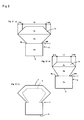
- FIG. 2 shows pattern papers used for knitting the sweater 1, FIG. 2-a showing a pattern paper of a front body 3 of the same, FIG. 2-b showing a back body 5 of the same, and FIG. 2-c showing the overlapped state of those pattern papers.
- the front body 3 and the back body 5 correspond in shape to each other in their parts extending from hems 6 to underarms 7, they are different in shape in their parts from after the underarms 7.
- FIG. 2-c shows the different part of the back body which is indicated by a dashed line.
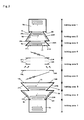
- Reference numeral 3 is a diagram schematically showing the knitting of the bodies on the flat knitting machine, with the front body 3 arranged on the downside and the back body 5 arranged on the top side.
- Reference numeral 3a indicates a part of the front body 3 extending from hem 6 to before underarms 7
- reference numeral 3b indicates a part of the same extending from before underarms 7 to shoulder 13
- reference numeral 3c indicates a shoulder part 13 of the same.
- Reference numerals 5a, 5b, and 5c indicate corresponding parts of the back body, respectively.
- the front body 3 and the back body 5 are knitted from their hems 6 toward their shoulder parts 13, 14.
- the sweater 1 knitted in this embodiment has a size of 12 gauge corresponding to a medium size and the like.
- it is presented in the form of a plain sleeveless knit with no pattern whose front body 3 is knitted with knitting needles of a front needle bed and whose back body 5 is knitted with knitting needles of a back needle bed.
- the sweater 1 may have a structure pattern, such as jacquard or rib, and may have sleeves.
- the flat knitting machines that can be used for this knitting include a two-bed or four-bed flat knitting machine, and a flat knitting machine including a transfer jack bed.
- a two-bed or four-bed flat knitting machine and a flat knitting machine including a transfer jack bed.
- the sweater 1 is knitted by a process of sequentially knitting first a knitting zone 1 extending from hems 6 to underarms 7 (3a of the front body and 5a of the back body), then a knitting zone 2 extending from underarms 7 to before shoulder parts 13, 14 (3b of the front body and 5b of the back body), then a knitting zone 3 of the shoulders 13, 14 (3c of the front body and 5c of the back body), then a knitting zone 4 for necklines 15, 17 to be bound off, and then a knitting zone 5 for front and back shoulder parts 19, 20 to be joined and bound off.
- the front body part 3a and the back body part 5a are knitted in tubular form by a known method, with the front body part 3a held with the needles of the front needle bed and the back body part 5a held with the needles of the back needle bed.
- This knitting is performed, for example, by the process of sequentially knitting first a course of the front body part 3a, using a common yarn feeder (not shown) to feed a yarn to needles of the front needle bed, followed by a course of the back body part 5a while feeding the yarn to needles of the back needle bed, being repeated from the hems 6 to the underarms 7.
- the front body and the back body are separately knitted using different yarn feeders so that the front body parts (3b, 3c) and the back body parts (5b, 5c) can be put in the state of being split at both ends thereof.
- the knitting proceeds from underarms 7 to before shoulder parts 13, 14.
- the knitting of the front body part 3b is started with a decreased width between underarms 8R, 8L from the front body part 3a
- the knitting of the back body part 5b is started with a decreased width between 9R, 9L from the back body part 5a.
- the width between the underarms 8R, 8L of the front body part is made larger than the width between the underarms 9R, 9L of the back body part. Then, the underarms 8R-9R and 8L-9L are bound off.
- the front body and the back body are increased in knitting width in such a manner that the front body part 3b can be increased in knitting width beyond the back body part 5b so that when the knitting of the knitting zones is completed, a front neckline 15 formed in the front body can be increased in size by a degree of 1.4-2.0 times a back neckline 17 formed in the back body, as mentioned later.
- the increased knitting width is provided by a process of, for example, forming a widening stitch at lateral ends of each body on the inside of the knitting width thereof by a widening knitting, which is called an inside widening knitting, for each of a predetermined number of courses.
- reference numerals 23R, 23L indicate widening lines formed in the front body by the so-called inside widening knitting and reference numerals 25R, 25L indicate widening lines formed in the back body.
- a shoulder drop is formed so that a shoulder top can be located below the neckline by such a flechage knitting that the number of courses in a center part of the knitting width of the shoulder part is made larger than the number of courses in lateral end portions of the knitted fabric, and also a drape is formed by increasing the number of courses knitted in the center part.
- a larger drape can be formed by the knitting of increasing the number of courses of the front body beyond the number of courses of the back body so that the front body can have a larger length in the lengthwise direction to provide a length ratio of the front body to the back body of e.g. about 5:4 (about 100 courses in the front body and about 80 courses in the back body), as shown in FIG. 2-c.
- the knitted fabrics are shifted so that the front and back bodies to be joined can confront each other across the neckline, in order to join their shoulder parts together and bind them off.
- the shoulder part of the front body is in the state of being held with the knitting needles of the front needle bed at the outside of the shoulder part of the back body.
- the knitted loops in the neckline are released from the occupied knitting needles when bound off, the occupied knitting needles become empty needles used for transference of loops.
- the knitted fabrics are shifted so that the shoulder parts 19R, 19L of the front body and the shoulder parts 21R, 21L of the back body can confront each other.
- the respective shoulder parts are joined to each other and then bound off, to form openings 10 of lower sleeve edges and an opening 11 of the neck.
- the knitting is ended in the manner described above.
- the front and back shoulder parts are joined together, with result that the neckline of the front body is put in the state of being loosened therebetween, as shown in FIG. 1.
- the center part of the knitted fabric around the neckline is knitted by the flechage knitting in such a manner that the center part can be increased in number of courses beyond the parts lateral thereto, the drape is formed around the neckline.
- This can allow the knitting of knitwear having a drape neckline including for example an off-turtle neck sweater by forming the drape around the neck of the knitwear.
- the present invention can produce seamless knitwear having drape formed around the neckline using the flat knitting machine.
- Sweater 3 Front body 5: Back body 6: Hem 7: Underarm 8R, 8L: Front underarm 9R, 9L: Back underarm 10: Openings of lower sleeve edges 11: Opening of the neck 13, 14: Shoulder 15: Front neckline 17: Back neckline 19, 19R, 19L: Front shoulder line 21, 21R, 21L: Back shoulder line 23, 23R, 23L: Front widening lines 25, 25R, 25L: Back widening lines 27R, 27L: Front flechage-knit lines 29R, 29L: Back flechage-knit lines
Landscapes
- Engineering & Computer Science (AREA)
- Textile Engineering (AREA)
- Outer Garments And Coats (AREA)
- Knitting Of Fabric (AREA)
- Knitting Machines (AREA)
Abstract
Description
- The present invention relates to a knitting method for forming drape around the neck of knitwear, such as, for example, a sweater, a one-piece suit, and a dress, knitted by using a flat knitting machine, and to knitwear knitted by the same knitting method.
- The applicant has proposed various knitting methods of knitting knitwear in a seamless manner using a flat knitting machine to eliminate or simplify a later sewing process.
Patent Document 1 describes a knitting method for providing a rib knitting in tubular form and providing an increased or decreased knitting width, using a two-bed flat knitting machine, which is characterized in knitting with knitting needles on front and back needle beds on a half gauge basis.Patent Documents Patent Document 4 discloses a knitting method for forming a V neckline in a sweater knitted seamlessly, using a two-bed or four-bed flat knitting machine. - However, since the knitting methods of the Patent Documents cited above are intended for a common neckline, such as a round-neck and a V-neck, they cannot be used as-proposed to knit a sweater having a drape neckline, such as, an off turtleneck, formed around the neckline. Under the circumstances, a knitting method including a sewing process is used almost exclusively for producing knitwear having such a drape·neckline.
- Patent Document 1: JP Patent Publication No. Hei 7-37698,
Patent Document 2: International Publication No. WO01/55491,
Patent Document 3: International Publication No. WO01/94672, and
Patent Document 4: JP Patent Laid-open (Unexamined) Publication No. Hei 4-153346. - The present invention aims to provide a knitting method for seamless knitwear with drape formed around the neck when worn by knitting substantially seamlessly with an increased number of courses around the neck, and provide such knitwear.
- The present invention provides a knitting method for knitting knitwear in tubular form whose front body part and back body part are joined together at both ends of knitting widths thereof, with the front body part and the back body part assigned to a first needle bed and a second needle bed, respectively, and which has a drape around a neck, by using a flat knitting machine having at least a pair of front and back needle beds extending in a transverse direction and disposed opposite to each other in a cross direction, at least either of which is capable of being racked in the transverse direction so that loops can be transferred between the front and back needle beds,
the method comprising: - a) the step of knitting the front and back bodies in tubular form in knitting zones extending from hems to underarms, with front and back bodies joined at both ends thereof (Knitting zone 1),
- b) the step of increasing knitting widths of the front and back bodies, while widening stitches in knitting zones extending from underarms to before shoulder parts, so that the front body can be made larger in knitting width than the back body, with the front and back bodies split from each other at both ends thereof (Knitting zone 2),
- c) the step of knitting the front and back bodies to necklines by a flechage knitting, while forming shoulder drops in knitting zones of the shoulder parts (Knitting zone 3),
- d) the step of binding off the necklines of the front and back bodies respectively (Knitting zone 4), and
- e) the step of shifting the front and back bodies by loop transference so that their shoulder parts extending rightward and leftward across the necklines can confront each other, and joining together the shifted shoulder parts of the front and back bodies and binding them off (Knitting zone 5).
- In the step c), the front body is knitted to be longer in a lengthwise direction thereof than the back body.
- The loop transference in the step e) is carried out using empty needles provided by a process of binding off the necklines.
- In the step b), the number of wales to form the necklines is increased by widening stitches so that the neckline of the front body can be increased in size by a degree of 1.4-2.0 times the neckline of the back body.
- Also, the present invention provides knitwear with a drape neck which is knitted in tubular form in a substantially seamless manner, with the front and back bodies joined together at both ends of knitting widths thereof and at shoulder parts thereof, using a flat knitting machine, wherein knitting widths of the front and back bodies are increased in knitting zones extending from underarms to before shoulder parts, with the front and back bodies split from each other at both ends thereof, so that a drape can be formed around a neckline, wherein the number of widening stitches formed in the front body to be made larger in knitting width than the back body is more than the number of widening stitches formed in the back body, and wherein a shoulder drop is formed in shoulder parts by knitting the front and back bodies by a flechage knitting, and the front and back necklines are bound off, respectively.
- According to the knitwear knitting method of the present invention, since respective parts of knitwear knitted on the flat knitting machine can be joined together or bound off by a process using a knitting technology, without requiring any sewing process after knitted as conventional, the use of the sewing process after knitting can be eliminated or the work can be saved. Specifically, in the knitting zones extending from underarms to shoulders, the front body and the back body split at both ends thereof are increased in number of stitches so that the front body can be increased in knitting width beyond the back body. Further, in the knitting zones for shoulder parts, the front and back bodies are knitted by the flechage knitting so that their center parts can become longer in a lengthwise direction than lateral end parts thereof, whereby shoulder drops are formed in the shoulder parts. Accordingly, the number of wales to form the neckline of the front body is increased beyond the number of wales to form the neckline of the back body and further the number of courses formed around the neck is increased beyond the number of courses formed in the rest. Thereafter, the front and back necklines are prevented from being loosened by a bind-off process. Then, shoulder parts of the front and back bodies are shifted to confront each other across their necklines so that the front and back bodies can be joined together and bound off at their shoulder parts, and then bound off thereat. As a result of this, the entire wales forming the neckline of the front body is gathered to the center and thereby the drape is formed at that neckline of the front body. Thus, since the knitwear thus knitted is formed substantially seamlessly, light and fashionable knitwear can be produced without its stretch being spoiled by sewing stitches.
- Further, in the knitting zone for the shoulder parts, a larger drape can be formed by a process of the flechage knitting that the front body can be made longer in the lengthwise direction than the back body.
- Further, through the use of empty needles provided when the knitted loops are released in the bind-off process of the necklines, the knitted fabric parts can be shifted so that the right and left shoulder parts of the front and back bodies can confront each other. Hence, smooth and effective knitting can be provided.
- Further, a large drape can be formed in well-looking silhouette by widening stitches so that the neckline of the front body can be increased in size by a degree of 1.4-2.0 times the neckline of the back body.
- In the following, a certain preferred embodiment of the present invention will be described with reference to the accompanying drawings. First, one of the preferred embodiments of the present invention will be described by way of illustration with reference to FIGS. 1 to 3.
- FIG. 1 shows a
sweater 1 as knitwear knitted by the knitting method of the illustrated embodiment. FIG. 2 shows pattern papers used for knitting thesweater 1, FIG. 2-a showing a pattern paper of afront body 3 of the same, FIG. 2-b showing aback body 5 of the same, and FIG. 2-c showing the overlapped state of those pattern papers. Though thefront body 3 and theback body 5 correspond in shape to each other in their parts extending fromhems 6 tounderarms 7, they are different in shape in their parts from after theunderarms 7. FIG. 2-c shows the different part of the back body which is indicated by a dashed line. FIG. 3 is a diagram schematically showing the knitting of the bodies on the flat knitting machine, with thefront body 3 arranged on the downside and theback body 5 arranged on the top side.Reference numeral 3a indicates a part of thefront body 3 extending fromhem 6 to beforeunderarms 7,reference numeral 3b indicates a part of the same extending from beforeunderarms 7 toshoulder 13, andreference numeral 3c indicates ashoulder part 13 of the same.Reference numerals front body 3 and theback body 5 are knitted from theirhems 6 toward theirshoulder parts - The
sweater 1 knitted in this embodiment has a size of 12 gauge corresponding to a medium size and the like. For convenience of explanation, it is presented in the form of a plain sleeveless knit with no pattern whosefront body 3 is knitted with knitting needles of a front needle bed and whoseback body 5 is knitted with knitting needles of a back needle bed. It is needless to say that thesweater 1 may have a structure pattern, such as jacquard or rib, and may have sleeves. - The flat knitting machines that can be used for this knitting include a two-bed or four-bed flat knitting machine, and a flat knitting machine including a transfer jack bed. As the basic idea of the way of knitting tubular knitwear in a seamless manner will be understood from the Patent Documents cited above, the explanation thereof is omitted here.
- The
sweater 1 is knitted by a process of sequentially knitting first aknitting zone 1 extending fromhems 6 to underarms 7 (3a of the front body and 5a of the back body), then aknitting zone 2 extending fromunderarms 7 to beforeshoulder parts 13, 14 (3b of the front body and 5b of the back body), then a knittingzone 3 of theshoulders 13, 14 (3c of the front body and 5c of the back body), then aknitting zone 4 fornecklines knitting zone 5 for front and back shoulder parts 19, 20 to be joined and bound off. - In the
knitting zone 1, thefront body part 3a and theback body part 5a are knitted in tubular form by a known method, with thefront body part 3a held with the needles of the front needle bed and theback body part 5a held with the needles of the back needle bed. This knitting is performed, for example, by the process of sequentially knitting first a course of thefront body part 3a, using a common yarn feeder (not shown) to feed a yarn to needles of the front needle bed, followed by a course of theback body part 5a while feeding the yarn to needles of the back needle bed, being repeated from thehems 6 to theunderarms 7. - In the
knitting zone 2 or subsequent knitting zones, the front body and the back body are separately knitted using different yarn feeders so that the front body parts (3b, 3c) and the back body parts (5b, 5c) can be put in the state of being split at both ends thereof. - In the
knitting zone 2, the knitting proceeds fromunderarms 7 to beforeshoulder parts front body part 3b is started with a decreased width betweenunderarms front body part 3a, and the knitting of theback body part 5b is started with a decreased width between 9R, 9L from theback body part 5a. The width between theunderarms underarms underarms 8R-9R and 8L-9L are bound off. It should be noted that the front body and the back body are increased in knitting width in such a manner that thefront body part 3b can be increased in knitting width beyond theback body part 5b so that when the knitting of the knitting zones is completed, afront neckline 15 formed in the front body can be increased in size by a degree of 1.4-2.0 times aback neckline 17 formed in the back body, as mentioned later. In this embodiment, the increased knitting width is provided by a process of, for example, forming a widening stitch at lateral ends of each body on the inside of the knitting width thereof by a widening knitting, which is called an inside widening knitting, for each of a predetermined number of courses. For example, in the front body part, three widening stitches are formed twenty-six times for each of four courses, while in the back body part, two widening stitches are formed fourteen times for each of eight courses, so that thefront neckline 15 can be increased in width by about 1.7 times theback neckline 17. In FIG. 3,reference numerals reference numerals - Then, in the
knitting zone 3, a shoulder drop is formed so that a shoulder top can be located below the neckline by such a flechage knitting that the number of courses in a center part of the knitting width of the shoulder part is made larger than the number of courses in lateral end portions of the knitted fabric, and also a drape is formed by increasing the number of courses knitted in the center part. A larger drape can be formed by the knitting of increasing the number of courses of the front body beyond the number of courses of the back body so that the front body can have a larger length in the lengthwise direction to provide a length ratio of the front body to the back body of e.g. about 5:4 (about 100 courses in the front body and about 80 courses in the back body), as shown in FIG. 2-c. In FIG. 3, after the knitting needles located on the outer sides of the center part of the knitting width are put in the rest state, the knitting starts from the center part of the knitting width, adopting the flechage knitting that the knitting needles used for the knitting are gradually introduced toward the lateral ends of the knitting width on the outside thereof. In FIG. 3,reference numerals knitting zone 3 is made inoperative by being precluded from the knitting in sequence from the knitting needles located on the outer sides of the knitting width may be used for knitting to the necklines. - In the
knitting zone 4, after the necklines in the front and back bodies are bound off, the knitted loops in the necklines are released from the knitting needles. - In the
sequent knitting zone 5, the knitted fabrics are shifted so that the front and back bodies to be joined can confront each other across the neckline, in order to join their shoulder parts together and bind them off. As a result of the front body being increased in knitting width beyond the back body by the knitting in theknitting zone 2, the shoulder part of the front body is in the state of being held with the knitting needles of the front needle bed at the outside of the shoulder part of the back body. However, since the knitted loops in the neckline are released from the occupied knitting needles when bound off, the occupied knitting needles become empty needles used for transference of loops. Through the use of those empty needles for the transference and of the racking, the knitted fabrics are shifted so that theshoulder parts shoulder parts openings 10 of lower sleeve edges and anopening 11 of the neck. The knitting is ended in the manner described above. - In the knitwear thus knitted, the front and back shoulder parts are joined together, with result that the neckline of the front body is put in the state of being loosened therebetween, as shown in FIG. 1. Also, since the center part of the knitted fabric around the neckline is knitted by the flechage knitting in such a manner that the center part can be increased in number of courses beyond the parts lateral thereto, the drape is formed around the neckline. This can allow the knitting of knitwear having a drape neckline including for example an off-turtle neck sweater by forming the drape around the neck of the knitwear.
- The present invention can produce seamless knitwear having drape formed around the neckline using the flat knitting machine.
-
- FIG. 1 is a sketch showing knitwear knitted by a preferred embodiment of the invention,
- FIG. 2 is a diagram showing pattern papers of bodies used for knitting a sweater, FIG. 2-a showing a pattern paper of a front body of the same, FIG. 2-b showing a pattern paper of a back body of the same, and FIG. 2-c showing the overlapped state of the pattern papers of the front and back bodies. FIG. 3 is a diagram showing the steps of the knitting on the flat knitting machine.
-
1: Sweater 3: Front body 5: Back body 6: Hem 7: Underarm 8R, 8L: Front underarm 9R, 9L: Back underarm 10: Openings of lower sleeve edges 11: Opening of the neck 13, 14: Shoulder 15: Front neckline 17: Back neckline 19, 19R, 19L: Front shoulder line 21, 21R, 21L: Back shoulder line 23, 23R, 23L: Front widening lines 25, 25R, 25L: Back widening lines 27R, 27L: Front flechage- knit lines 29R, 29L: Back flechage-knit lines
Claims (5)
the method comprising:
Applications Claiming Priority (2)
| Application Number | Priority Date | Filing Date | Title |
|---|---|---|---|
| JP2003337506A JP4291099B2 (en) | 2003-09-29 | 2003-09-29 | A knitting method for forming a drape around a collar and a knitwear having a drape around the collar. |
| PCT/JP2004/014082 WO2005031055A1 (en) | 2003-09-29 | 2004-09-27 | Knitting method of forming drape around collar and knitwear having drape around collar |
Publications (3)
| Publication Number | Publication Date |
|---|---|
| EP1669484A1 true EP1669484A1 (en) | 2006-06-14 |
| EP1669484A4 EP1669484A4 (en) | 2006-11-15 |
| EP1669484B1 EP1669484B1 (en) | 2011-07-20 |
Family
ID=34386126
Family Applications (1)
| Application Number | Title | Priority Date | Filing Date |
|---|---|---|---|
| EP04788178A Expired - Lifetime EP1669484B1 (en) | 2003-09-29 | 2004-09-27 | Knitting method for forming a drape around the neck |
Country Status (6)
| Country | Link |
|---|---|
| US (1) | US7181932B2 (en) |
| EP (1) | EP1669484B1 (en) |
| JP (1) | JP4291099B2 (en) |
| KR (1) | KR101014193B1 (en) |
| CN (1) | CN100469961C (en) |
| WO (1) | WO2005031055A1 (en) |
Families Citing this family (7)
| Publication number | Priority date | Publication date | Assignee | Title |
|---|---|---|---|---|
| US20070197474A1 (en) * | 2004-03-30 | 2007-08-23 | Clinton William P | Methods for controlling plants pathogens using N-phosphonomethylglycine |
| CN100558262C (en) * | 2008-05-23 | 2009-11-11 | 云蝠服饰股份有限公司 | The weaving method of multi-fold sweater |
| CN101999761A (en) * | 2010-10-28 | 2011-04-06 | 江苏法诗菲服饰有限公司 | Jacket |
| CN103668737B (en) * | 2012-08-30 | 2016-01-27 | 江苏景盟针织企业有限公司 | A kind of fabric with fold and the braiding machine and the braid method that weave this fabric |
| KR101444697B1 (en) * | 2013-04-22 | 2014-09-26 | (주)프리앤메지스 | Method for manufacturing neck collar of clothing |
| US9863070B2 (en) | 2014-12-08 | 2018-01-09 | Federal-Mogul Powertrain Llc | Tubular protective sleeve with curl resistant knit ends and method of construction thereof |
| CN110670219B (en) * | 2019-10-25 | 2021-01-29 | 惠州学院 | Weaving method of Z-shaped pleat jacquard |
Family Cites Families (9)
| Publication number | Priority date | Publication date | Assignee | Title |
|---|---|---|---|---|
| JPS5546724Y2 (en) * | 1977-11-28 | 1980-11-01 | ||
| JP2568135B2 (en) * | 1990-10-12 | 1996-12-25 | 株式会社島精機製作所 | Knitting method for the cut portion of tubular knitted fabric |
| JP2538421B2 (en) * | 1990-12-13 | 1996-09-25 | 株式会社島精機製作所 | Knitting method of knitted fabric for neck in Nitto products |
| JP3164528B2 (en) * | 1997-02-17 | 2001-05-08 | 株式会社島精機製作所 | Joint knitting method of knitted fabric by flat knitting machine |
| DE19924503A1 (en) * | 1999-05-28 | 2000-11-30 | Stoll & Co H | Process for the production of tubular knitted fabrics on a flat knitting machine |
| TW491917B (en) * | 2000-01-26 | 2002-06-21 | Shima Seiki Mfg | Method of knitting neck of knit wear by weft knitting machine and knit designing device for producing the method of knitting the neck |
| TW480299B (en) * | 2000-01-26 | 2002-03-21 | Shima Seiki Mfg | Method of knitting neck portion of knit wear by weft knitting machine and the knit wear |
| TW490521B (en) * | 2000-06-02 | 2002-06-11 | Shima Seiki Mfg | Method of knitting neck portion of knit wear by flat knitting machine and the knit wear |
| KR100833521B1 (en) * | 2001-10-05 | 2008-05-29 | 가부시키가이샤 시마세이키 세이사쿠쇼 | Forming method of side bar and knitwear formed by side bar |
-
2003
- 2003-09-29 JP JP2003337506A patent/JP4291099B2/en not_active Expired - Fee Related
-
2004
- 2004-09-27 US US10/569,939 patent/US7181932B2/en not_active Expired - Fee Related
- 2004-09-27 KR KR20067005628A patent/KR101014193B1/en not_active Expired - Fee Related
- 2004-09-27 CN CNB2004800281404A patent/CN100469961C/en not_active Expired - Fee Related
- 2004-09-27 EP EP04788178A patent/EP1669484B1/en not_active Expired - Lifetime
- 2004-09-27 WO PCT/JP2004/014082 patent/WO2005031055A1/en not_active Ceased
Non-Patent Citations (2)
| Title |
|---|
| No further relevant documents disclosed * |
| See also references of WO2005031055A1 * |
Also Published As
| Publication number | Publication date |
|---|---|
| KR20060132562A (en) | 2006-12-21 |
| JP4291099B2 (en) | 2009-07-08 |
| CN1860267A (en) | 2006-11-08 |
| KR101014193B1 (en) | 2011-02-14 |
| WO2005031055A1 (en) | 2005-04-07 |
| JP2005105432A (en) | 2005-04-21 |
| EP1669484A4 (en) | 2006-11-15 |
| EP1669484B1 (en) | 2011-07-20 |
| CN100469961C (en) | 2009-03-18 |
| US20070017256A1 (en) | 2007-01-25 |
| US7181932B2 (en) | 2007-02-27 |
Similar Documents
| Publication | Publication Date | Title |
|---|---|---|
| KR100554233B1 (en) | How to knit clothes | |
| US6889530B2 (en) | Method of forming gusset and knitwear comprising gusset formed | |
| JP3071147B2 (en) | How to knit a garment with a collar | |
| EP1371767A1 (en) | Method for knitting fabric | |
| US6786066B2 (en) | Knit wear with collar knit by flat knitting machine and method of knitting it | |
| US6935140B2 (en) | Method of knitting tubular knitted fabric | |
| JP4344210B2 (en) | Method for knitting knitwear having raglan sleeves and knitwear having raglan sleeves | |
| US20040112094A1 (en) | Method of knitting neck portion of knit wear by flat knitting machine and the knit wear | |
| EP2385160A2 (en) | Knitting method of tubular knitted fabric, and tubular knitted fabric | |
| JPWO2011004694A1 (en) | Knitwear having sleeves and body and knitting method thereof | |
| EP1669484B1 (en) | Knitting method for forming a drape around the neck | |
| US7481078B2 (en) | Knitwear knitted by flat knitting machine and method for knitting the same | |
| US7739886B2 (en) | Knitwear having open part in body tubular part, and method of knitting the same | |
| US7051555B2 (en) | Method of knitting knit-wear | |
| KR100610750B1 (en) | Neckline knitting method of knitwear by flat knitting machine and the knitwear | |
| JPWO2007013450A1 (en) | Knitwear knitting method having an asymmetrical shape |
Legal Events
| Date | Code | Title | Description |
|---|---|---|---|
| PUAI | Public reference made under article 153(3) epc to a published international application that has entered the european phase |
Free format text: ORIGINAL CODE: 0009012 |
|
| 17P | Request for examination filed |
Effective date: 20060302 |
|
| AK | Designated contracting states |
Kind code of ref document: A1 Designated state(s): DE ES FR GB IT |
|
| A4 | Supplementary search report drawn up and despatched |
Effective date: 20061018 |
|
| DAX | Request for extension of the european patent (deleted) | ||
| RBV | Designated contracting states (corrected) |
Designated state(s): DE ES FR GB IT |
|
| 17Q | First examination report despatched |
Effective date: 20071109 |
|
| RTI1 | Title (correction) |
Free format text: KNITTING METHOD FOR FORMING A DRAPE AROUND THE NECK |
|
| GRAP | Despatch of communication of intention to grant a patent |
Free format text: ORIGINAL CODE: EPIDOSNIGR1 |
|
| GRAS | Grant fee paid |
Free format text: ORIGINAL CODE: EPIDOSNIGR3 |
|
| GRAA | (expected) grant |
Free format text: ORIGINAL CODE: 0009210 |
|
| AK | Designated contracting states |
Kind code of ref document: B1 Designated state(s): DE ES FR GB IT |
|
| REG | Reference to a national code |
Ref country code: GB Ref legal event code: FG4D |
|
| REG | Reference to a national code |
Ref country code: DE Ref legal event code: R096 Ref document number: 602004033567 Country of ref document: DE Effective date: 20110915 |
|
| PLBE | No opposition filed within time limit |
Free format text: ORIGINAL CODE: 0009261 |
|
| STAA | Information on the status of an ep patent application or granted ep patent |
Free format text: STATUS: NO OPPOSITION FILED WITHIN TIME LIMIT |
|
| REG | Reference to a national code |
Ref country code: FR Ref legal event code: ST Effective date: 20120531 |
|
| 26N | No opposition filed |
Effective date: 20120423 |
|
| GBPC | Gb: european patent ceased through non-payment of renewal fee |
Effective date: 20111020 |
|
| REG | Reference to a national code |
Ref country code: DE Ref legal event code: R097 Ref document number: 602004033567 Country of ref document: DE Effective date: 20120423 |
|
| PG25 | Lapsed in a contracting state [announced via postgrant information from national office to epo] |
Ref country code: GB Free format text: LAPSE BECAUSE OF NON-PAYMENT OF DUE FEES Effective date: 20111020 Ref country code: FR Free format text: LAPSE BECAUSE OF NON-PAYMENT OF DUE FEES Effective date: 20110930 |
|
| PG25 | Lapsed in a contracting state [announced via postgrant information from national office to epo] |
Ref country code: ES Free format text: LAPSE BECAUSE OF FAILURE TO SUBMIT A TRANSLATION OF THE DESCRIPTION OR TO PAY THE FEE WITHIN THE PRESCRIBED TIME-LIMIT Effective date: 20111031 |
|
| PGFP | Annual fee paid to national office [announced via postgrant information from national office to epo] |
Ref country code: DE Payment date: 20140923 Year of fee payment: 11 |
|
| PGFP | Annual fee paid to national office [announced via postgrant information from national office to epo] |
Ref country code: IT Payment date: 20140919 Year of fee payment: 11 |
|
| REG | Reference to a national code |
Ref country code: DE Ref legal event code: R119 Ref document number: 602004033567 Country of ref document: DE |
|
| PG25 | Lapsed in a contracting state [announced via postgrant information from national office to epo] |
Ref country code: IT Free format text: LAPSE BECAUSE OF NON-PAYMENT OF DUE FEES Effective date: 20150927 |
|
| PG25 | Lapsed in a contracting state [announced via postgrant information from national office to epo] |
Ref country code: DE Free format text: LAPSE BECAUSE OF NON-PAYMENT OF DUE FEES Effective date: 20160401 |