EP1668655B1 - Low temperature susceptibility compensation - Google Patents
Low temperature susceptibility compensation Download PDFInfo
- Publication number
- EP1668655B1 EP1668655B1 EP04782801A EP04782801A EP1668655B1 EP 1668655 B1 EP1668655 B1 EP 1668655B1 EP 04782801 A EP04782801 A EP 04782801A EP 04782801 A EP04782801 A EP 04782801A EP 1668655 B1 EP1668655 B1 EP 1668655B1
- Authority
- EP
- European Patent Office
- Prior art keywords
- composition
- magnetic
- susceptibility
- metal ion
- amorphous
- Prior art date
- Legal status (The legal status is an assumption and is not a legal conclusion. Google has not performed a legal analysis and makes no representation as to the accuracy of the status listed.)
- Expired - Lifetime
Links
- 230000005291 magnetic effect Effects 0.000 claims description 158
- 239000000203 mixture Substances 0.000 claims description 74
- 239000000463 material Substances 0.000 claims description 67
- 229910021645 metal ion Inorganic materials 0.000 claims description 44
- 239000003446 ligand Substances 0.000 claims description 24
- 229920000647 polyepoxide Polymers 0.000 claims description 21
- 239000003822 epoxy resin Substances 0.000 claims description 19
- 229910052688 Gadolinium Inorganic materials 0.000 claims description 17
- 238000000034 method Methods 0.000 claims description 13
- 230000005415 magnetization Effects 0.000 claims description 12
- 230000000694 effects Effects 0.000 claims description 10
- 239000011159 matrix material Substances 0.000 claims description 10
- 230000001747 exhibiting effect Effects 0.000 claims description 4
- 239000011521 glass Substances 0.000 claims description 4
- 239000004033 plastic Substances 0.000 claims description 4
- 229920003023 plastic Polymers 0.000 claims description 4
- POILWHVDKZOXJZ-ARJAWSKDSA-M (z)-4-oxopent-2-en-2-olate Chemical compound C\C([O-])=C\C(C)=O POILWHVDKZOXJZ-ARJAWSKDSA-M 0.000 claims description 3
- CUJRVFIICFDLGR-UHFFFAOYSA-N acetylacetonate Chemical compound CC(=O)[CH-]C(C)=O CUJRVFIICFDLGR-UHFFFAOYSA-N 0.000 claims 2
- 239000004593 Epoxy Substances 0.000 description 39
- 238000005481 NMR spectroscopy Methods 0.000 description 25
- 239000002738 chelating agent Substances 0.000 description 13
- 150000002500 ions Chemical class 0.000 description 12
- 239000000523 sample Substances 0.000 description 11
- 239000000696 magnetic material Substances 0.000 description 7
- 230000005298 paramagnetic effect Effects 0.000 description 7
- 230000005292 diamagnetic effect Effects 0.000 description 5
- 239000000126 substance Substances 0.000 description 5
- XEEYBQQBJWHFJM-UHFFFAOYSA-N Iron Chemical compound [Fe] XEEYBQQBJWHFJM-UHFFFAOYSA-N 0.000 description 4
- 239000003795 chemical substances by application Substances 0.000 description 4
- 150000001875 compounds Chemical class 0.000 description 3
- UIWYJDYFSGRHKR-UHFFFAOYSA-N gadolinium atom Chemical compound [Gd] UIWYJDYFSGRHKR-UHFFFAOYSA-N 0.000 description 3
- 239000002907 paramagnetic material Substances 0.000 description 3
- 229920005989 resin Polymers 0.000 description 3
- 239000011347 resin Substances 0.000 description 3
- 239000007787 solid Substances 0.000 description 3
- PWHULOQIROXLJO-UHFFFAOYSA-N Manganese Chemical compound [Mn] PWHULOQIROXLJO-UHFFFAOYSA-N 0.000 description 2
- 239000002131 composite material Substances 0.000 description 2
- 125000003700 epoxy group Chemical group 0.000 description 2
- 239000012530 fluid Substances 0.000 description 2
- 238000009472 formulation Methods 0.000 description 2
- -1 gaseous combinations Substances 0.000 description 2
- 230000005283 ground state Effects 0.000 description 2
- 229910052742 iron Inorganic materials 0.000 description 2
- 238000012886 linear function Methods 0.000 description 2
- 239000007788 liquid Substances 0.000 description 2
- 229910052748 manganese Inorganic materials 0.000 description 2
- 239000011572 manganese Substances 0.000 description 2
- NUJOXMJBOLGQSY-UHFFFAOYSA-N manganese dioxide Chemical compound O=[Mn]=O NUJOXMJBOLGQSY-UHFFFAOYSA-N 0.000 description 2
- 238000004519 manufacturing process Methods 0.000 description 2
- 230000008569 process Effects 0.000 description 2
- 230000009467 reduction Effects 0.000 description 2
- 230000004044 response Effects 0.000 description 2
- 229920006395 saturated elastomer Polymers 0.000 description 2
- 230000003381 solubilizing effect Effects 0.000 description 2
- 239000004215 Carbon black (E152) Substances 0.000 description 1
- 229910052689 Holmium Inorganic materials 0.000 description 1
- 239000007983 Tris buffer Substances 0.000 description 1
- YRKCREAYFQTBPV-UHFFFAOYSA-N acetylacetone Chemical compound CC(=O)CC(C)=O YRKCREAYFQTBPV-UHFFFAOYSA-N 0.000 description 1
- 230000002411 adverse Effects 0.000 description 1
- 238000013459 approach Methods 0.000 description 1
- 230000008901 benefit Effects 0.000 description 1
- 239000007767 bonding agent Substances 0.000 description 1
- 239000005388 borosilicate glass Substances 0.000 description 1
- 239000004568 cement Substances 0.000 description 1
- 238000012512 characterization method Methods 0.000 description 1
- 238000000576 coating method Methods 0.000 description 1
- 239000000470 constituent Substances 0.000 description 1
- 150000004696 coordination complex Chemical class 0.000 description 1
- 230000001419 dependent effect Effects 0.000 description 1
- 238000013461 design Methods 0.000 description 1
- 239000002889 diamagnetic material Substances 0.000 description 1
- 238000002474 experimental method Methods 0.000 description 1
- 238000013213 extrapolation Methods 0.000 description 1
- 230000005294 ferromagnetic effect Effects 0.000 description 1
- CMIHHWBVHJVIGI-UHFFFAOYSA-N gadolinium(III) oxide Inorganic materials [O-2].[O-2].[O-2].[Gd+3].[Gd+3] CMIHHWBVHJVIGI-UHFFFAOYSA-N 0.000 description 1
- LNEPOXFFQSENCJ-UHFFFAOYSA-N haloperidol Chemical compound C1CC(O)(C=2C=CC(Cl)=CC=2)CCN1CCCC(=O)C1=CC=C(F)C=C1 LNEPOXFFQSENCJ-UHFFFAOYSA-N 0.000 description 1
- KJZYNXUDTRRSPN-UHFFFAOYSA-N holmium atom Chemical compound [Ho] KJZYNXUDTRRSPN-UHFFFAOYSA-N 0.000 description 1
- 229930195733 hydrocarbon Natural products 0.000 description 1
- 150000002430 hydrocarbons Chemical class 0.000 description 1
- 238000010348 incorporation Methods 0.000 description 1
- 230000005389 magnetism Effects 0.000 description 1
- 238000005259 measurement Methods 0.000 description 1
- 239000000320 mechanical mixture Substances 0.000 description 1
- 229910052751 metal Inorganic materials 0.000 description 1
- 239000002184 metal Substances 0.000 description 1
- 229910044991 metal oxide Inorganic materials 0.000 description 1
- 150000004706 metal oxides Chemical class 0.000 description 1
- 238000012986 modification Methods 0.000 description 1
- 230000004048 modification Effects 0.000 description 1
- 239000012454 non-polar solvent Substances 0.000 description 1
- 230000009022 nonlinear effect Effects 0.000 description 1
- 150000002894 organic compounds Chemical class 0.000 description 1
- 230000003071 parasitic effect Effects 0.000 description 1
- 230000000704 physical effect Effects 0.000 description 1
- 239000002798 polar solvent Substances 0.000 description 1
- 238000004382 potting Methods 0.000 description 1
- 238000002360 preparation method Methods 0.000 description 1
- 238000009738 saturating Methods 0.000 description 1
- 230000035945 sensitivity Effects 0.000 description 1
- 239000000243 solution Substances 0.000 description 1
- 239000002904 solvent Substances 0.000 description 1
Images

Classifications
-
- H—ELECTRICITY
- H01—ELECTRIC ELEMENTS
- H01F—MAGNETS; INDUCTANCES; TRANSFORMERS; SELECTION OF MATERIALS FOR THEIR MAGNETIC PROPERTIES
- H01F1/00—Magnets or magnetic bodies characterised by the magnetic materials therefor; Selection of materials for their magnetic properties
- H01F1/42—Magnets or magnetic bodies characterised by the magnetic materials therefor; Selection of materials for their magnetic properties of organic or organo-metallic materials, e.g. graphene
-
- G—PHYSICS
- G01—MEASURING; TESTING
- G01R—MEASURING ELECTRIC VARIABLES; MEASURING MAGNETIC VARIABLES
- G01R33/00—Arrangements or instruments for measuring magnetic variables
- G01R33/20—Arrangements or instruments for measuring magnetic variables involving magnetic resonance
- G01R33/28—Details of apparatus provided for in groups G01R33/44 - G01R33/64
- G01R33/38—Systems for generation, homogenisation or stabilisation of the main or gradient magnetic field
- G01R33/387—Compensation of inhomogeneities
-
- H—ELECTRICITY
- H01—ELECTRIC ELEMENTS
- H01F—MAGNETS; INDUCTANCES; TRANSFORMERS; SELECTION OF MATERIALS FOR THEIR MAGNETIC PROPERTIES
- H01F1/00—Magnets or magnetic bodies characterised by the magnetic materials therefor; Selection of materials for their magnetic properties
- H01F1/0018—Diamagnetic or paramagnetic materials, i.e. materials with low susceptibility and no hysteresis
Definitions
- the invention is in the general area of magnetic susceptibility compensation and more specifically relates to the problem of reduction of magnetic inhomogeneities in nuclear magnetic resonance apparatus.
- This invention relates to an amorphous composition, which has improved low temperature magnetic compensation, method of producing same, and use thereof.
- epoxy as an exemplar material, this work is not so specifically limited.
- H 0 is the magnetic environment or applied field
- M is the magnetization
- ⁇ is the coefficient of magnetic susceptibility
- S is a constant for applied field values well above the saturation field, that is, H 0 >>Hs.
- H 0 Hs.
- the saturation field is a property of materials generally because magnetization induced by an external field does not increase without limit in response to an increased value of said field. Rather, the magentization M, or magnetic moment, saturates at an external field intensity characteristic of the material for a temperature T.
- ⁇ > 0 are said to be paramagnetic and values less than 0 are diamagnetic.
- the vector character of the quantities M and H 0 need not be considered for the purposes of this work. It is readily appreciated that a non-zero value for ⁇ means that in proximity to the material, the actual field will include the applied field and a contribution from the magnetic moment (M) of the material. This local effect can contribute inhomogeneities (gradients) to the field and therefore disturb magnetic resonance measurements for which the magnetic environment must be extremely uniform and any gradients are precisely controlled in time direction and magnitude.
- the term "susceptibility" will be understood in the context to refer to the coefficient of susceptibilty ⁇ , or the physical effect, M, as the context may indicate.
- magnet shim coils are commonly used to provide a controlled incremental magnetic field to compensate for magnetic inhomogeneities.
- the successful practice of shim coil compensation requires the perturbations be weak and slowly varying near the active sample volume of the NMR probe.
- USP 3,091,732 is directed to eliminating undesired magnetic field gradients across a sample space caused by paramagnetic or diamagnetic discontinuities of members located in the vicinity of the sample space. This is accomplished by combining selected proportions of paramagnetic and diamagnetic materials to match the magnetic susceptibilities.
- EP 0,632, 284 discloses a NMR sample tube made of an amorphous composotion comprising an amorphous maxtrix and a paramagnetic substance incorporated in the matrix. The magnetic susceptibility of the tube is matched to that of a liquid sample to be tested
- USP 5,545,994 discloses adding a mixture of two fluids of different specific magnetic susceptibilities and at respective partial pressures to a sample space to achieve a desired volume magnetic susceptibility which matches the volume magnetic susceptibility of the solid component.
- USP 5,684,401 which describes compensation of magnetic susceptibility variation using a perfluorinated hydrocarbon as a matching medium enveloping a microcoil to minimize magnetic susceptibility induced variations in the Bo magnetic field.
- epoxy is often used as a bonding agent for cementing substances because of its properties unrelated to magnetic susceptibility.
- the magnetic susceptibility of epoxy in combination with its use in small, localized areas near the NMR sample space require that this material be compensated.
- Typical epoxies in common commercial use are characterized by diamagnetic coefficient ⁇ in a range -1 to -0.5 x 10 -6 cgs units.
- the usual practice for susceptibility compensation is to follow the art mentioned above, and combine or mix a paramagnetic material into the epoxy such that the susceptibilities appreciably cancel. This practice becomes difficult at cryogenic temperatures due to the non-linear and poorly characterized magnetic behavior of many paramagnetic materials at low temperatures.
- a material or composition that exhibits a desired value of magnetic susceptibility. It is particularly useful to achieve a nearly zero magnetic suceptibility at low (“cryogenic") temperatures. It is appropriate to identify an upper limit for a cryogenic temperature by the condition where the alignment energy of the molecular magnetic moment in an applied field H 0 for the composition approaches a value comparable to the thermal energy, i.e., ⁇ g ⁇ H 0 / kT ⁇ 1 where ⁇ g is the elemental (molecular, or atomic) magnetic moment, k is the Boltzman constant and T is the absolute temperature.
- composition of the invention is intended for use at a cryogenic temperature as a structural material itself, or as a bonding or cementing substance.
- low temperature is identified with cryogenic temperatures generally. Practical applications commonly occur at or below about 77°K and this is often cited herein as an exemplary cryogenic temperature.
- Magnetic resonance instrumentation functions in an environment of a homogeneous magnetic field and/or precisely controlled field gradients. Field homogeneity is disturbed by any object within the field characterized by a value of magnetic susceptibility differing from the corresponding value for the environment of the object. Therefore, the control of the magnetic homogeneity of a material allows structures of such material to be essentially indistinguishable by magnetic means.
- the present invention is directed to providing an amorphous material, such as an epoxy that is matched to a selected value (ordinarily a null) of susceptibility, and moreover, to maintain this value while subject to a selected magnetic field intensity at range of cryogenic temperatures, and in another embodiment, to achieve this value at a particular cryogenic temperature.
- an amorphous material such as an epoxy that is matched to a selected value (ordinarily a null) of susceptibility, and moreover, to maintain this value while subject to a selected magnetic field intensity at range of cryogenic temperatures, and in another embodiment, to achieve this value at a particular cryogenic temperature.
- One object of the invention is to modify the magnetic susceptibility property of an epoxy, or similar amorphous composition which is usable as a structural material itself and/or as a bonding material, and which has nearly zero magnetic moment at cryogenic temperatures and at the magnitude of the magnetic fields characteristic of the NMR apparatus.
- a further object is to modify the magnetic susceptibility property of epoxy or similar amorphous material by mixing a metal ion selected from the group consisting of gadolinium (Gd 3+ ), tri-valent iron (Fe +3 ) and di-valent manganese (Mn +2 ) together with a ligand or chelating agent, into the epoxy (or similar amorphous material), whereby to achieve a desired value for the magnetic susceptibility at a cryogenic temperature.
- a metal ion selected from the group consisting of gadolinium (Gd 3+ ), tri-valent iron (Fe +3 ) and di-valent manganese (Mn +2 ) together with a ligand or chelating agent
- Another object is to provide an NMR apparatus which uses an epoxy composition, such as for cementing magnetic materials, which composition has nearly zero magnetic moment at low temperatures.
- a still further object is to provide an epoxy (or similar amorphous) composition
- a metal ion selected from the group consisting of Gd 3+ , Fe +3 , and Mn +2 which is solubilized in the epoxy using a chelating agent or ligand so that the magnetic susceptibility of the resulting composition has nearly zero magnetic moment at temperatures of 77° K and lower.
- the invention encompasses an epoxy (or similar amorphous) composition which includes a metal ion selected from the group consisting of Gd 3+ , Fe +3 and Mn +2 dissolved in the epoxy using a chelating agent or ligand, wherein the magnetic susceptibility, or magnetic moment at desired applied field strength, of the resulting epoxy composition is nearly zero at low temperatures of 77°K or less.
- the invention can be used to bond or cement together magnetic materials or be used as a structural material itself, without requiring any further additional compensating material to compensate for undesired magnetic susceptibility.
- the inventive composition comprises a metal ion selected from the group consisting of Gd 3+ ,, Fe +3 and Mn +2 solubilized in the epoxy (or similar amorphous) using a chelating agent or ligand, such as Lg, as described below.
- the epoxy may be epoxy resin and its curing agent, and the composition includes other elements as described below.
- inventive composition is especially advantageous in the design formulation of magnetic materials that have nearly zero magnetic susceptibility at low temperatures.
- magnetic materials used in NMR apparatus are desired to have low or nearly zero magnetic susceptibility, especially at low temperatures, for greater sensitivity, reliability and reduced noise.
- the epoxy composition of the invention can be used, advantageously, to fabricate for example by bonding, magnetic material parts, with the additional advantage that the invention epoxy composition does not add further magnetic susceptibility at low temperatures.
- structural components for use in an NMR magnetic field, fabricated using the inventive composition would have total magnetic moment of nearly zero at low temperatures.
- these parts are fabricated to exhibit a vanishing induced magnetic moment at a specific (relatively high) applied magnetic field. In that manner, adverse effects due to unwanted magnetic susceptibility or induced magnetic moment would be further reduced.
- the invention comprehends a composition as described herein for exhibiting desired susceptibility at cryogenic temperatures, the method of preparing such composition and an NMR apparatus employing such composition.
- the modified amorphous composition of the invention is accomplished by tailoring the magnetic properties of a selected amorphous material, principally an epoxy or a plastic or glass through an appropriate admixture of a selected metal ion selected from the group consisting of Gd 3+ , Fe 3+ , and Mn 2+ .
- the preparation of the composition entails achieving solubility of the selected metal ion into the selected amorphous matrix. This is accomplished by incorporation of the selected ion into a chelating agent or ligand that exhibits solubility with the amorphous matrix.
- the tailoring of the magnetic susceptibility property is directed to achieving a fixed value of the induced magnetization of the composition at cryogenic temperature in respect of another material, where that other material ordinarily comprises the environment for the amorphous composition of the invention.
- the composition is employed in proximity to the sensitive volume of an NMR apparatus.
- An especially useful composition is an epoxy where the bonding properties of the epoxy are required for structural purposes.
- One aspect of the invention is an amorphous composition for magnetic susceptibility compensation at cryogenic temperatures to which there is added a metal ion selected from the group consisting of Gd +3 , Fe +3 and Mn +2 and a ligand or chelating agent whereby the resulting composition is characterized by having nearly zero magnetic susceptibility at cryogenic temperatures.
- a second aspect of the invention is a method of preparing a susceptibility compensated amorphous composition for use at low temperatures, comprising the steps of mixing a metal ion selected from the group consisting of Gd +3 ,Fe +3 and Mn +2 with such amorphous material and a chelating agent or ligand so that the resulting composition has a selected magnetic susceptibility at low temperatures.
- a third aspect of the invention is an NMR device utilizing a magnetic material fabricated to produce an amorphous composition to which there has been added a metal ion selected from the group consisting of Gd 3+ , Fe +3 and Mn +2 , and a ligand or chelating agent and having the property of a selected value of magnetic susceptibility at cryogenic temperatures.
- an NMR apparatus for example, use is made of a magnet, and most often, a superconducting magnet having a bore.
- the magnet bore may support properties producing certain disadvantageous effects, such as magnetic residual fields, electrical noise, inhomogeneity, etc, due to magnetic susceptibility discontinuity of materials comprising, or supported within the bore.
- the magnetic susceptibility discontinuity effect can be reduced.
- epoxy resin is often used as a bonding or cementing agent to join together components of the magnet and/or of the NMR probe supported within the bore. Even though used in small quantities, epoxy resin has a non-zero value of magnetic susceptibility.
- the invention encompasses an epoxy composition which has nearly zero magnetic susceptibility and/or induced magnetic moment, especially at cryogenic temperatures and high applied field intensity, such as at or below 77° K and of the order of tens of tesla.
- Figure 1 shows the general methodology of susceptibility matching, that is matching the value of the induced magnetic moment of one material to another (the latter usually being the environment of the former).
- the two substances, A and B exhibit respective (induced) magnetic moments as a function of applied field.
- An appropriate combination of the substances produces a resultant selected value of ⁇ M/ ⁇ H 0 ⁇ 0 over a wide range of field beyond a low field region.
- M the induced moment
- a value of zero for M is appropriate to the case where the magnetic environment of the subject material is zero. This is the usual situation where the bore of an NMR magnet is vacuum or air and the subject material is disposed within that bore.
- an NMR magnet bore or field region generally may be enveloped by some other material, a fluid perhaps, exhibiting some non-zero applied moment M or susceptibility coefficient ⁇ .
- the present discussion is directed to matching the induced moment to a selected value at cryogenic temperatures.
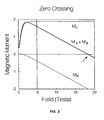
- Figure 2 represents a different application of material property tailoring of effective magnetic moment of a material to exhibit a linear dependence and to vanish at a particular value of applied magnetic field.
- a first material symbolically M A is saturated above some field strength, here shown as about 5 Tesla.
- a second material, M B exhibits a diamagnetic susceptibility above the same field value.
- An appropriate admixture, M A +M B of the two materials will provide a null for the magnetization of the composite material, at a narrow field value. Where the constituent materials closely follow the B-L equation, that critical field value can be calculated and the composite can be so designed to yield this result. Note that the susceptibility ⁇ is neither nulled nor matched to any other susceptibility coefficent for this embodiment of the invention
- prior art epoxy compositions have some undesired magnetic properties at various temperatures including low temperatures.
- common epoxies in combination with their curing agents have bulk coefficients of susceptibility characteristic of organic compounds. That is, these materials, in general are diamagnetic with a coefficient of susceptibility of the order -1 x 10 -6 cgs units.
- a null in the magnetic susceptibility of the inventive epoxy composition can be produced at temperatures at or below 77° K in the presence of a saturating magnetic field H 0 when a metal ion selected from the group consisting of Gd 3+ , Fe +3 and Mn +2 is chelated or solubilized with epoxy, using a ligand or chelating agent to form the desired molecular structure.
- a metal ion selected from the group consisting of Gd 3+ , Fe +3 and Mn +2 is chelated or solubilized with epoxy, using a ligand or chelating agent to form the desired molecular structure.
- other amorphous matrices may be employed in place of epoxy, where desired.
- the magnetic susceptibility coefficient of the metal ion depends on the temperature, i.e. ⁇ ⁇ (T). Thus, compensation is achieved only at one temperature for a given volume of the metal ion V ⁇ . This holds for a wide range of magnetic fields.
- the value of zero for the combination of the two materials is selected to match a surrounding medium such as vacuum or air, which has zero (or nearly zero) magnetic moment.
- a value for M other than zero, e.g., M' would be appropriate to a surrounding medium for which M' is the magnetization value under the same conditions.
- paramagnetic ions are non-linear in their magnetic properties and the saturation point is temperature dependent.
- the metal ions which meet the foregoing criteria were determined to be gadolinium (Gd 3+ ), iron (Fe +3) , and manganese (Mn +2 ). These metal ions of the invention are simple in electrical configuration and follow the Langevin behaviour so that at low temperatures magnetic behaviour is predictable.
- the metal ions of this invention when integrated into, dissolved into, or mixed with other elements and/or compounds can readily be matched in magnetic susceptibilities with air or vacuum.
- a preferred embodiment is the case where the metal ion is selected from the group consisting of Gd 3+ , Fe +3 and Mn +2 and is chelated or solubilized into epoxy resin or other material so that the resulting composition has nearly zero magnetic moment, M.
- the epoxy resin when chelated with the metal ion of the invention can be used as a bonding material for other magnetic materials so that the resulting structure is almost totally free of undesired magnetic susceptibility.
- the inventive composition can be used also for structural purposes.
- a metal ion and epoxy resin formed a mechanical mixture.
- a metal oxide (MnO 2 ) was used in a finely powdered state and dispersed finely and uniformly in the epoxy resin.
- MnO 2 metal oxide
- such mixture does not provide a nearly zero magnetic susceptibility at low temperatures, and hence was not satisfactory.
- the present invention prescribes that a metal ion selected from the group consisting of Gd 3+ , Fe +3 and Mn +2 is chelated with a coordination donor ligand (called "Lg") so as to render the metal ion soluble in the epoxy.
- Lg coordination donor ligand
- the ligand, Lg, or chelating agent, has sufficient polar or non-polar characteristics to be soluble in the epoxy.
- Gd(ACAC) 3' that is Gd(III)acetylacetonate
- Gd(mthd) 3 that is, Gadolinium tris 2,2,6,6-tetramethyl-3,5-heptanedionate
- These compounds preferably include the Gd metal ion.
- the Fe +3 and Mn +2 metal ion are advantageous in a greater range of magnetic fields and at temperatures of 77°K and lower, although their solubility in epoxy resin may not be perfect.
- B-L equation Brillouinn-Langevin equation
- the metal ion follows the B-L equation
- formulations can be used in which the magnetic moments cancel at specified magnetic fields and temperatures. For example, for magnetic fields above a particular value at a given temperature, it can be arranged that M ion saturated + ⁇ R ⁇ H 0 ⁇ 0 where M is the magnetization (or magnetic moment per unit volume, or simply "induced magnetic moment") and H 0 is an applied external magnetic field and ⁇ R is the magnetic susceptibility of a selected epoxy resin.
- the epoxy composition of the invention has other advantageous applications, such as for structural uses.
- the inventive composition can be used to provide complete support of inserts (probe components), as supporting structures, as potting for structures, etc, as used in NMR apparatus.
- inserts probe components
- NMR signal background levels characteristic of room temperature epoxy resin compositions. At cryogenic temperatures, such parasitic limitations are reduced in effect.
- the NMR background noise is reduced because the NMR relaxation time becomes long. Further, the dielectric loss is reduced due to slowing of the electric dipole reorientation.
- the principles of the invention are applicable with compositions other than epoxy resins, such as plastics, glass, resins of other matrices, etc.
- An example is the addition of Gd 2 O 3 in borosilicate glass.
- the usage of the inventive composition is advantageous where cryogenic temperatures, such as 77°K or lower, are used, since it is at these lower temperatures that the inventive composition may be easily manipulated to exhibit nearly zero magnetic susceptibility. Accordingly, the invention is applicable for bonding or cementing materials in a magnetic environment, as well as for the structures themselves.
- Lg is used herein for any ligand or chelating agent, and all such terms may be used interchangeably herein and are to be understood as such.
- Gd 2,2,6,6-tetramethyl-3,5-heptanedionate
- a solubilizing ligand for use herein should more or less conform to the rules of solubility, namely, that likes dissolve likes, such as polar solvents dissolve polar solutes, and non-polar solvents dissolve non-polar solutes.
- epoxy and/or epoxy resin it is to be understood that the invention is not limited thereto and can be readily extended to various amorphous materials such as resins of various types, and other materials, such as glass, plastics, etc.
- the above materials are limited to a class capable of maintaining the chelated modifiying ion in solution at the low temperatures contemplated.
- the ligand is bound to the metal ion and is connected to the host material. In a sense, the ligand surrounds the metal ion and is solubilized in the host material, such as the example of the epoxy.
- any ligand or chelating agent or solubilizing agent that binds the metal ion and effects solubility in the host material, such as the epoxy resin, is within the scope of the invention. That is, the ligand binds the metal ion, which forms a coordination complex with the host material.
- Another way to consider this invention is as a chelating process wherein the metal ion is attached to neighboring host material atoms by at least two coordination bonds in such a manner as to form a closed chain.
Landscapes
- Physics & Mathematics (AREA)
- Engineering & Computer Science (AREA)
- Power Engineering (AREA)
- Condensed Matter Physics & Semiconductors (AREA)
- General Physics & Mathematics (AREA)
- Epoxy Resins (AREA)
- Compositions Of Macromolecular Compounds (AREA)
- Soft Magnetic Materials (AREA)
- Hard Magnetic Materials (AREA)
- Glass Compositions (AREA)
Description
- The invention is in the general area of magnetic susceptibility compensation and more specifically relates to the problem of reduction of magnetic inhomogeneities in nuclear magnetic resonance apparatus.
- This invention relates to an amorphous composition, which has improved low temperature magnetic compensation, method of producing same, and use thereof. Although reference will be made to epoxy as an exemplar material, this work is not so specifically limited.
- A property of any material is its magnetic susceptibility, that is, the coefficient relating an applied magnetic field to the induced magnetic response of the material, as defined by the magnetization (induced magnetic moment or susceptibility)


- Values of χ > 0 are said to be paramagnetic and values less than 0 are diamagnetic. The vector character of the quantities M and H0 need not be considered for the purposes of this work. It is readily appreciated that a non-zero value for χ means that in proximity to the material, the actual field will include the applied field and a contribution from the magnetic moment (M) of the material. This local effect can contribute inhomogeneities (gradients) to the field and therefore disturb magnetic resonance measurements for which the magnetic environment must be extremely uniform and any gradients are precisely controlled in time direction and magnitude. In what follows, the term "susceptibility" will be understood in the context to refer to the coefficient of susceptibilty χ, or the physical effect, M, as the context may indicate. This distinction is critical to understanding the distinction of the invention over the prior art. It is clear that in a magnetic field H0, where the value of M for a given structure is equal to the value of M for the surrounding medium, there is no magnetic gradient and the structure is indistinguishable (magnetically). At ordinary temperatures and field magnitude well above saturation,
equation 1 is a simple linear relationship for (non-ferromagnetic) materials. By matching the coefficient of susceptibility χ, for two materials, for example a structure and the surrounding medium, the prior art achieved the desired result over a range of values for the magnitude of the field H0, The present invention matches the value of M for a given field H0 without regard to the coeffiecients of susceptibility for the respective materials. Although the generic term "susceptibility compensation" is commonly employed, it is important to recognize this distinction - In the art, such as encountered in high resolution applications of Nuclear Magnetic Resonance (NMR), materials having a very low, or nearly zero magnetic susceptibility are desired for structures proximate the sample space where magnetic inhomogeneities distort the magnetic field environment. Undesired magnetic susceptibility of materials forming structures subject to a magnetic environment has been compensated using a variety of methods, including use of different materials intimately related (as with coatings), combined metal mixtures, gaseous combinations, and liquids, and generally as compensating agents. It should be recognized that these techniques often take the form of reduction of magnetic susceptibility discontinuities between different materials, or the achievement of a desired value for the magnetic susceptibility M, of some object.
- In instances where the perturbations due to nonzero susceptibility persist, magnet shim coils are commonly used to provide a controlled incremental magnetic field to compensate for magnetic inhomogeneities. The successful practice of shim coil compensation requires the perturbations be weak and slowly varying near the active sample volume of the NMR probe. For example,
USP 3,091,732 is directed to eliminating undesired magnetic field gradients across a sample space caused by paramagnetic or diamagnetic discontinuities of members located in the vicinity of the sample space. This is accomplished by combining selected proportions of paramagnetic and diamagnetic materials to match the magnetic susceptibilities. -
EP 0,632, 284 discloses a NMR sample tube made of an amorphous composotion comprising an amorphous maxtrix and a paramagnetic substance incorporated in the matrix. The magnetic susceptibility of the tube is matched to that of a liquid sample to be tested - Another example of prior art is
USP 5,545,994 , which discloses adding a mixture of two fluids of different specific magnetic susceptibilities and at respective partial pressures to a sample space to achieve a desired volume magnetic susceptibility which matches the volume magnetic susceptibility of the solid component. - A further example is
USP 5,684,401 which describes compensation of magnetic susceptibility variation using a perfluorinated hydrocarbon as a matching medium enveloping a microcoil to minimize magnetic susceptibility induced variations in the Bo magnetic field. - In all of these examples, the practice required little or no knowledge of the nonlinear properties of magnetism. This is a result of the application of the art to situations of small susceptibility and environments at or above room temperature.
- In most practical situations structural members of a magnetically sensitive apparatus exhibit "invisibility" in the magnetic sense from the environment of such structural members. Accordingly, matching the magnetic properties of such structural members to their environment contributes to the magnetic homogeniety of the region occupied by those structural members and their environment. If the environment is vacuum, (or air), the magnetic susceptibility thereof is zero, (or nearly zero). It is therefore desired to so modify the structural member that its magnetic susceptibility is likewise zero. If the environment is not vacuum or air, but some other material exhibiting magnetic susceptibility M0, it is desired to modify the structural member to similarly have susceptibility M0. In this work, it should be understood from the context that a null value for M is merely a particular value selected for the above purpose.
- In the fabrication of magnetic components, epoxy is often used as a bonding agent for cementing substances because of its properties unrelated to magnetic susceptibility. The magnetic susceptibility of epoxy in combination with its use in small, localized areas near the NMR sample space require that this material be compensated. Typical epoxies in common commercial use are characterized by diamagnetic coefficient χ in a range -1 to -0.5 x 10⁻⁶ cgs units. The usual practice for susceptibility compensation is to follow the art mentioned above, and combine or mix a paramagnetic material into the epoxy such that the susceptibilities appreciably cancel. This practice becomes difficult at cryogenic temperatures due to the non-linear and poorly characterized magnetic behavior of many paramagnetic materials at low temperatures.
- In the present work, reference to an epoxy is understood as a particularly useful example of the invention and does not exclude other amorphous materials from the scope of the invention.
- Accordingly, in the art, there exists a need for a material or composition that exhibits a desired value of magnetic susceptibility. It is particularly useful to achieve a nearly zero magnetic suceptibility at low ("cryogenic") temperatures. It is appropriate to identify an upper limit for a cryogenic temperature by the condition where the alignment energy of the molecular magnetic moment in an applied field H0 for the composition approaches a value comparable to the thermal energy, i.e.,

where µg is the elemental (molecular, or atomic) magnetic moment, k is the Boltzman constant and T is the absolute temperature. - The composition of the invention is intended for use at a cryogenic temperature as a structural material itself, or as a bonding or cementing substance. In this work, "low temperature" is identified with cryogenic temperatures generally. Practical applications commonly occur at or below about 77°K and this is often cited herein as an exemplary cryogenic temperature.
- Magnetic resonance instrumentation functions in an environment of a homogeneous magnetic field and/or precisely controlled field gradients. Field homogeneity is disturbed by any object within the field characterized by a value of magnetic susceptibility differing from the corresponding value for the environment of the object. Therefore, the control of the magnetic homogeneity of a material allows structures of such material to be essentially indistinguishable by magnetic means. In most contexts the relevant environment is vacuum or air, e.g., magnetic susceptibility, M = 0 and χ = 0 (very nearly so for air). The present invention is directed to providing an amorphous material, such as an epoxy that is matched to a selected value (ordinarily a null) of susceptibility, and moreover, to maintain this value while subject to a selected magnetic field intensity at range of cryogenic temperatures, and in another embodiment, to achieve this value at a particular cryogenic temperature.
- One object of the invention is to modify the magnetic susceptibility property of an epoxy, or similar amorphous composition which is usable as a structural material itself and/or as a bonding material, and which has nearly zero magnetic moment at cryogenic temperatures and at the magnitude of the magnetic fields characteristic of the NMR apparatus.
- A further object is to modify the magnetic susceptibility property of epoxy or similar amorphous material by mixing a metal ion selected from the group consisting of gadolinium (Gd3+), tri-valent iron (Fe+3) and di-valent manganese (Mn+2) together with a ligand or chelating agent, into the epoxy (or similar amorphous material), whereby to achieve a desired value for the magnetic susceptibility at a cryogenic temperature.
- Another object is to provide an NMR apparatus which uses an epoxy composition, such as for cementing magnetic materials, which composition has nearly zero magnetic moment at low temperatures.
- A still further object is to provide an epoxy (or similar amorphous) composition comprising a metal ion selected from the group consisting of Gd3+, Fe+3, and Mn+2 which is solubilized in the epoxy using a chelating agent or ligand so that the magnetic susceptibility of the resulting composition has nearly zero magnetic moment at temperatures of 77° K and lower.
- The foregoing and other objects are attained by the invention which encompasses an epoxy (or similar amorphous) composition which includes a metal ion selected from the group consisting of Gd3+, Fe+3 and Mn+2 dissolved in the epoxy using a chelating agent or ligand, wherein the magnetic susceptibility, or magnetic moment at desired applied field strength, of the resulting epoxy composition is nearly zero at low temperatures of 77°K or less. Thus, the invention can be used to bond or cement together magnetic materials or be used as a structural material itself, without requiring any further additional compensating material to compensate for undesired magnetic susceptibility.
- The inventive composition comprises a metal ion selected from the group consisting of Gd3+,, Fe+3 and Mn+2 solubilized in the epoxy (or similar amorphous) using a chelating agent or ligand, such as Lg, as described below. The epoxy may be epoxy resin and its curing agent, and the composition includes other elements as described below. The metal ions used in the invention exhibit advantageous magnetic susceptibility properties at low temperatures because of their nearly symmetrical ground states for orbital angular momentum, i.e. L = 0, and simplicity in electrical configuration so as to fit the Brillouin-Langevin equation over a wide range of field strength and temperature.
- Thus, use of the inventive composition is especially advantageous in the design formulation of magnetic materials that have nearly zero magnetic susceptibility at low temperatures. For example, magnetic materials used in NMR apparatus are desired to have low or nearly zero magnetic susceptibility, especially at low temperatures, for greater sensitivity, reliability and reduced noise. The epoxy composition of the invention can be used, advantageously, to fabricate for example by bonding, magnetic material parts, with the additional advantage that the invention epoxy composition does not add further magnetic susceptibility at low temperatures. Thus, structural components for use in an NMR magnetic field, fabricated using the inventive composition would have total magnetic moment of nearly zero at low temperatures. Alternatively, these parts are fabricated to exhibit a vanishing induced magnetic moment at a specific (relatively high) applied magnetic field. In that manner, adverse effects due to unwanted magnetic susceptibility or induced magnetic moment would be further reduced.
- The invention comprehends a composition as described herein for exhibiting desired susceptibility at cryogenic temperatures, the method of preparing such composition and an NMR apparatus employing such composition. The modified amorphous composition of the invention is accomplished by tailoring the magnetic properties of a selected amorphous material, principally an epoxy or a plastic or glass through an appropriate admixture of a selected metal ion selected from the group consisting of Gd3+, Fe3+, and Mn2+. The preparation of the composition entails achieving solubility of the selected metal ion into the selected amorphous matrix. This is accomplished by incorporation of the selected ion into a chelating agent or ligand that exhibits solubility with the amorphous matrix. The tailoring of the magnetic susceptibility property is directed to achieving a fixed value of the induced magnetization of the composition at cryogenic temperature in respect of another material, where that other material ordinarily comprises the environment for the amorphous composition of the invention. The composition is employed in proximity to the sensitive volume of an NMR apparatus. An especially useful composition is an epoxy where the bonding properties of the epoxy are required for structural purposes.
- One aspect of the invention is an amorphous composition for magnetic susceptibility compensation at cryogenic temperatures to which there is added a metal ion selected from the group consisting of Gd+3, Fe+3 and Mn+2 and a ligand or chelating agent whereby the resulting composition is characterized by having nearly zero magnetic susceptibility at cryogenic temperatures.
- A second aspect of the invention is a method of preparing a susceptibility compensated amorphous composition for use at low temperatures, comprising the steps of mixing a metal ion selected from the group consisting of Gd+3,Fe+3 and Mn+2 with such amorphous material and a chelating agent or ligand so that the resulting composition has a selected magnetic susceptibility at low temperatures.
- A third aspect of the invention is an NMR device utilizing a magnetic material fabricated to produce an amorphous composition to which there has been added a metal ion selected from the group consisting of Gd3+, Fe+3 and Mn+2, and a ligand or chelating agent and having the property of a selected value of magnetic susceptibility at cryogenic temperatures.
- The invention is further described below for illustrative purposes and such description is not to be considered to be limiting in any way.
-
-
Figure 1 is a schematic graphical explanation for the process of susceptibility matching to a desired value. -
Figure 2 is a schematic graphical explanation of field specific magnetic moment nulling. - In an NMR apparatus, for example, use is made of a magnet, and most often, a superconducting magnet having a bore. The magnet bore may support properties producing certain disadvantageous effects, such as magnetic residual fields, electrical noise, inhomogeneity, etc, due to magnetic susceptibility discontinuity of materials comprising, or supported within the bore. By using selected materials having selected values of magnetic susceptibility, the magnetic susceptibility discontinuity effect can be reduced.
- In fabricating the NMR apparatus, epoxy resin is often used as a bonding or cementing agent to join together components of the magnet and/or of the NMR probe supported within the bore. Even though used in small quantities, epoxy resin has a non-zero value of magnetic susceptibility.
- The invention encompasses an epoxy composition which has nearly zero magnetic susceptibility and/or induced magnetic moment, especially at cryogenic temperatures and high applied field intensity, such as at or below 77° K and of the order of tens of tesla.
-
Figure 1 shows the general methodology of susceptibility matching, that is matching the value of the induced magnetic moment of one material to another (the latter usually being the environment of the former). The two substances, A and B, exhibit respective (induced) magnetic moments as a function of applied field. An appropriate combination of the substances produces a resultant selected value of ∂M/∂H0 ≈0 over a wide range of field beyond a low field region. It should be apparent that the value of M, the induced moment, may be independently selected. A value of zero for M is appropriate to the case where the magnetic environment of the subject material is zero. This is the usual situation where the bore of an NMR magnet is vacuum or air and the subject material is disposed within that bore. (It should be recognized that an NMR magnet bore or field region generally may be enveloped by some other material, a fluid perhaps, exhibiting some non-zero applied moment M or susceptibility coefficient χ. The present discussion is directed to matching the induced moment to a selected value at cryogenic temperatures. -
Figure 2 represents a different application of material property tailoring of effective magnetic moment of a material to exhibit a linear dependence and to vanish at a particular value of applied magnetic field. A first material, symbolically MA is saturated above some field strength, here shown as about 5 Tesla. A second material, MB exhibits a diamagnetic susceptibility above the same field value. An appropriate admixture, MA +MB of the two materials will provide a null for the magnetization of the composite material, at a narrow field value. Where the constituent materials closely follow the B-L equation, that critical field value can be calculated and the composite can be so designed to yield this result. Note that the susceptibility χ is neither nulled nor matched to any other susceptibility coefficent for this embodiment of the invention - Returning now to
figure 1 , under normal conditions, prior art epoxy compositions have some undesired magnetic properties at various temperatures including low temperatures. For the sake of example, it may be noted that common epoxies in combination with their curing agents have bulk coefficients of susceptibility characteristic of organic compounds. That is, these materials, in general are diamagnetic with a coefficient of susceptibility of the order -1x 10⁻⁶ cgs units. A null in the magnetic susceptibility of the inventive epoxy composition can be produced at temperatures at or below 77° K in the presence of a saturating magnetic field H0 when a metal ion selected from the group consisting of Gd3+, Fe+3 and Mn+2 is chelated or solubilized with epoxy, using a ligand or chelating agent to form the desired molecular structure. As further discussed below, other amorphous matrices may be employed in place of epoxy, where desired. - Other metal ions, e.g., holmium, have been investigated in the course of this work. When appropriately chelated and introduced with an epoxy resin, these have produced low magnetic susceptibility at higher temperatures where the temperature dependence of magnetic susceptibility follows Curie's Law. Thus, for cryogenic temperatures, such as below or at 77°K., these other metal ions have proven unsatisfactory for producing the desired magnetic susceptibility properties. The epoxy composition could be used advantageously with those other selected ions which, when subjected to such low temperatures produced the total effect of nearly zero magnetic susceptibility, M, for the epoxy composition of the invention. Thus, further compensation is not needed to obtain the desired uniform magnetic environment within the bore of the NMR apparatus.
- This novel discovery of the null in magnetic susceptibility of the epoxy composition of the invention, as chelated with a metal ion selected from the group consisting of Gd3+, Fe+3 and Mn+2 using a chelating agent or ligand, enables use of such inventive composition to produce an unexpected and outstanding result. The operation of shimming the magnetic field, (modifying the prevailing magnetic field with locally applied field components) is substantially reduced where the present invention is employed because magnetic irregularities of the structure have been substantially reduced or eliminated.
- It is known that certain metal ions (Σ+n) are paramagnetic, i.e. magnetic susceptibility χ is greater than zero, and can be mixed with epoxy resin produce a null in magnetic susceptibility. That is:

wherein XΣ is the magnetic susceptibility of the metal ion, VΣ is the volume of the metal ion, XR is the magnetic susceptibility of the epoxy resin, and VR is the volume of the epoxy resin. This is the essence of the manner of susceptibility matching practiced in the prior art - Generally, the magnetic susceptibility coefficient of the metal ion depends on the temperature, i.e. χΣ (T). Thus, compensation is achieved only at one temperature for a given volume of the metal ion VΣ. This holds for a wide range of magnetic fields.
- For most materials at or near room temperature subject to a magnetic field above the saturation point of such material, the magnetic moment per unit volume can be quantitatively expressed as M = χ (T)H0 + S, wherein H0 is the applied magnetic field, χ (T) is the magnetic susceptibility coefficient which is a function of temperature T and S is a constant.
- To obtain cancellation of induced magnetic moments of two materials, A and B, these materials are selected so that MA = VA χA(T)H0 + SA and MB=VB χB(T)Ho + SB, that is VAMA + VBMB = 0, and the magnetic moments of the two materials cancel each other at a particular temperature T. The value of zero for the combination of the two materials is selected to match a surrounding medium such as vacuum or air, which has zero (or nearly zero) magnetic moment. A value for M other than zero, e.g., M', would be appropriate to a surrounding medium for which M' is the magnetization value under the same conditions.
- At ambient temperatures, SA and SB are both very small as compared to χA(T)Ho and χBT)Ho, and then VA χA(T) = -VB χ B(T). In that case, as shown in
FIG. 1 , there is cancellation of the magnetic susceptibilities, which are independent of magnetic field. - At cryogenic temperatures, when SA and SB are large, or when the magnetic moments MA and/or MB is a non-linear function of magnetic field, the magnetic susceptibility M effective of the combination cannot be matched to the desired value for all field strengths. For an instrument operating at a fixed field strength, this presents no practical limitation.
- At low temperatures, paramagnetic ions are non-linear in their magnetic properties and the saturation point is temperature dependent. At high temperatures, paramagnetic ions have a susceptibility coefficient that varies inversely with temperature, that is χ(T)=C/T wherein C is a constant. Thus, prior art susceptibility matching is easily adapted to a range of temperatures in those temperature regions where Curie's law holds.
- The situation is more complex for cryogenic temperatures, that is at 77° K or less where the magnetic moment for atomic systems of simple symmetry follow the Brillouin-Langevin equation, rather than a simple linear dependence on H0 through a simple susceptibility coefficient χ At low temperature and high fields the magneticmoment, M, of an ion will be a non-linear function of magnetic field and temperature. In the art of susceptibility matching for applications to high resolution NMR, the actual operational magnetic field can be high, e.g., 20 Tesla. The behaviour of magnetic ions at this field strength is often impractical and expensive to directly measure. However, it was found that for certain classes of ions having a symmetric ground state orbital angular momentum L=0, the magnetic behaviour closely follows the Brillouin-Langevin equation. Using this quantitative behaviour allows characterization at low magnetic fields with confident extrapolation to the very high magnetic fields used during NMR measurements, at cryogenic temperatures, such as at or below 77°K.
- The metal ions which meet the foregoing criteria were determined to be gadolinium (Gd3+), iron (Fe+3), and manganese (Mn+2). These metal ions of the invention are simple in electrical configuration and follow the Langevin behaviour so that at low temperatures magnetic behaviour is predictable.
- A discussion of the characteristics of the metal ions of Gd3+, Fe+3 and Mn+2 is disclosed, for example, in Ashcroft and Mermin, "Solid State Physics", 1975, Rinehart, Holt and Winston, Tables 31.3 and 31.4, made a part hereof.
- The metal ions of this invention, when integrated into, dissolved into, or mixed with other elements and/or compounds can readily be matched in magnetic susceptibilities with air or vacuum. A preferred embodiment is the case where the metal ion is selected from the group consisting of Gd3+, Fe+3 and Mn+2 and is chelated or solubilized into epoxy resin or other material so that the resulting composition has nearly zero magnetic moment, M. The epoxy resin when chelated with the metal ion of the invention can be used as a bonding material for other magnetic materials so that the resulting structure is almost totally free of undesired magnetic susceptibility. The inventive composition can be used also for structural purposes.
- In the prior art described in 3,091,732, a metal ion and epoxy resin formed a mechanical mixture. For example, a metal oxide (MnO2) was used in a finely powdered state and dispersed finely and uniformly in the epoxy resin. However, such mixture does not provide a nearly zero magnetic susceptibility at low temperatures, and hence was not satisfactory.
- In contrast, the present invention prescribes that a metal ion selected from the group consisting of Gd3+, Fe+3 and Mn+2 is chelated with a coordination donor ligand (called "Lg") so as to render the metal ion soluble in the epoxy. The ligand, Lg, or chelating agent, has sufficient polar or non-polar characteristics to be soluble in the epoxy.
- Gd(ACAC)3', that is Gd(III)acetylacetonate, and Gd(mthd)3, that is,
Gadolinium tris - For simple ions, the magnetic moment obeys the Brillouinn-Langevin equation ("B-L equation") which is discussed in detail in the above recited Ashcroft and Mermin reference "Solid State Physics" and which is made a part hereof by reference. This non-linear behaviour of the magnetic susceptibility of the above mentioned ions originate in the fixed magnitude of the atomic magnetic moment, and as well in the saturability of the susceptibility. A balancing of magnetic moments from the ion and resin at all temperatures and magnetic fields is difficult in the prior art.
- However, if the metal ion follows the B-L equation, formulations can be used in which the magnetic moments cancel at specified magnetic fields and temperatures. For example, for magnetic fields above a particular value at a given temperature, it can be arranged that

where M is the magnetization (or magnetic moment per unit volume, or simply "induced magnetic moment") and H0 is an applied external magnetic field and χR is the magnetic susceptibility of a selected epoxy resin. - In addition to the use of the inventive epoxy composition as a bonding or cementing material for fabrication of components in a magnetic environment, the epoxy composition of the invention has other advantageous applications, such as for structural uses. For example, the inventive composition can be used to provide complete support of inserts (probe components), as supporting structures, as potting for structures, etc, as used in NMR apparatus. In such applications, there are limitations resulting from dielectric loss and NMR signal background levels, characteristic of room temperature epoxy resin compositions. At cryogenic temperatures, such parasitic limitations are reduced in effect. Also, the NMR background noise is reduced because the NMR relaxation time becomes long. Further, the dielectric loss is reduced due to slowing of the electric dipole reorientation.
- Moreover, the principles of the invention are applicable with compositions other than epoxy resins, such as plastics, glass, resins of other matrices, etc. An example is the addition of Gd2O3 in borosilicate glass. The usage of the inventive composition is advantageous where cryogenic temperatures, such as 77°K or lower, are used, since it is at these lower temperatures that the inventive composition may be easily manipulated to exhibit nearly zero magnetic susceptibility. Accordingly, the invention is applicable for bonding or cementing materials in a magnetic environment, as well as for the structures themselves.
- The symbol "Lg" is used herein for any ligand or chelating agent, and all such terms may be used interchangeably herein and are to be understood as such. In one experiment using Gd for modifying an epoxy, 2,2,6,6-tetramethyl-3,5-heptanedionate was selected for the solubilizing ligand. A solubilizing ligand for use herein should more or less conform to the rules of solubility, namely, that likes dissolve likes, such as polar solvents dissolve polar solutes, and non-polar solvents dissolve non-polar solutes. Also, although it is preferred herein to use epoxy and/or epoxy resin, it is to be understood that the invention is not limited thereto and can be readily extended to various amorphous materials such as resins of various types, and other materials, such as glass, plastics, etc. The above materials are limited to a class capable of maintaining the chelated modifiying ion in solution at the low temperatures contemplated. The ligand is bound to the metal ion and is connected to the host material. In a sense, the ligand surrounds the metal ion and is solubilized in the host material, such as the example of the epoxy. It is to be understood that any ligand or chelating agent or solubilizing agent that binds the metal ion and effects solubility in the host material, such as the epoxy resin, is within the scope of the invention. That is, the ligand binds the metal ion, which forms a coordination complex with the host material. Another way to consider this invention is as a chelating process wherein the metal ion is attached to neighboring host material atoms by at least two coordination bonds in such a manner as to form a closed chain.
- The foregoing is descriptive of the invention. Numerous extensions and modifications thereof would be apparent to the worker skilled in the art which are defined in the appended claims.
Claims (19)
- An amorphous composition comprising an amorphous matrix, a metal ion selected from the group consisting of Gd3+, Fe+3 and Mn+2, and a ligand, said composition having a selected induced magnetization at cryogenic temperatures.
- The composition of claim 1, wherein said ligand binds said metal ion and effects solubility thereof in said amorphous matrix.
- The composition of claim 2, wherein said metal ion is Gd3+ and is in the form of Gd(Lg)3 or, in the alternative, in the form of Gd(ACAc)3' wherein Ac is acetylacetonate, and Lg is 2,2,6,6-tetramethyl-3, 5-heptanedionate.
- The composition of claim 1, wherein said amorphous matrix comprises epoxy resin.
- The composition of claim 1, wherein said amorphous matrix comprises a glass.
- The composition of claim 1, wherein said amorphous matrix comprises a plastic.
- The composition of claim 1, wherein said composition is characterized by magnetization equal to that of another selected material for exposure of both said materials by an applied magnetic field.
- The composition of claim 1, wherein said selected magnetic susceptibility is zero.
- The composition of claim 1, wherein said selected magnetic susceptibility is reached at a selected temperature below substantially 77°K.
- The composition of claim 1, wherein said metal ion is Gd+3.
- A method of preparing an amorphous composition to exhibit a desired susceptibility at cryogenic temperatures, comprising the steps of:mixing a metal ion selected from the group consisting of Gd3+, Fe+3 and Mn+2, with an amorphous matrix and a ligand so that the resulting composition has a nearly zero magnetic susceptibility at said cryogenic temperatures.
- The method of claim 11, wherein said ligand binds said metal ion and effects solubility thereof in said composition.
- The method of claim 11, wherein said metal ion is Gd3+ and is in the form selected from the group consisting of Gd(Lg)3 and Gd(AcAc)3. wherein Ac is acetylacetonate, and Lg is 2,2,6,6-tetramethyl-3, 5-heptanedionate.
- The method of claim 11, wherein said amorphous matrix is epoxy resin.
- The method of claim 11, wherein said composition has a magnetization equal to the magnetization of another material in the presence of the same magnetic field.
- An NMR apparatus comprising a magnet for producing a polarizing field and utilizing a composition subject to said polarizing field, said composition being an amorphous composition according to claim 1.
- The NMR apparatus of claim 16, wherein said ligand binds said metal ion and effects solubility thereof in said composition.
- The NMR apparatus of claim 16, wherein said cryogenic temperatures are at or below 77° K.
- The NMR apparatus of claim 16, wherein said composition is surrounded by a material exhibiting a magnetization of zero and said selected value is zero.
Applications Claiming Priority (2)
| Application Number | Priority Date | Filing Date | Title |
|---|---|---|---|
| US10/669,772 US7476330B2 (en) | 2003-09-24 | 2003-09-24 | Low temperature susceptibility compensation |
| PCT/US2004/028383 WO2005034150A2 (en) | 2003-09-24 | 2004-08-31 | Low temperature susceptibility compensation |
Publications (2)
| Publication Number | Publication Date |
|---|---|
| EP1668655A2 EP1668655A2 (en) | 2006-06-14 |
| EP1668655B1 true EP1668655B1 (en) | 2010-03-10 |
Family
ID=34313752
Family Applications (1)
| Application Number | Title | Priority Date | Filing Date |
|---|---|---|---|
| EP04782801A Expired - Lifetime EP1668655B1 (en) | 2003-09-24 | 2004-08-31 | Low temperature susceptibility compensation |
Country Status (5)
| Country | Link |
|---|---|
| US (2) | US7476330B2 (en) |
| EP (1) | EP1668655B1 (en) |
| JP (1) | JP2007506839A (en) |
| DE (1) | DE602004025953D1 (en) |
| WO (1) | WO2005034150A2 (en) |
Cited By (1)
| Publication number | Priority date | Publication date | Assignee | Title |
|---|---|---|---|---|
| US9810751B2 (en) | 2014-02-24 | 2017-11-07 | Northrop Grumman Systems Corporation | Customized magnetic susceptibility materials |
Families Citing this family (3)
| Publication number | Priority date | Publication date | Assignee | Title |
|---|---|---|---|---|
| US7476330B2 (en) * | 2003-09-24 | 2009-01-13 | Varian, Inc. | Low temperature susceptibility compensation |
| EP1847845A1 (en) * | 2006-04-19 | 2007-10-24 | Eidgenössische Technische Hochschule (ETH) | Susceptibility-matched magnetic field probe and method for manufacturing the same |
| DE102016203253A1 (en) * | 2016-02-29 | 2017-08-31 | Siemens Healthcare Gmbh | Method and magnetic resonance apparatus for recording a magnetic resonance data record and data carrier |
Family Cites Families (18)
| Publication number | Priority date | Publication date | Assignee | Title |
|---|---|---|---|---|
| NL127050C (en) * | 1958-06-05 | 1968-05-15 | ||
| US3377292A (en) * | 1965-10-22 | 1968-04-09 | American Cyanamid Co | Synergized lanthanide chelate photoluminescent composition |
| JPS6050940A (en) * | 1983-08-31 | 1985-03-22 | Toshiba Corp | Semiconductor integrated circuit |
| US4615879A (en) * | 1983-11-14 | 1986-10-07 | Vanderbilt University | Particulate NMR contrast agents for gastrointestinal application |
| DE3344525A1 (en) * | 1983-12-09 | 1985-06-20 | Kernforschungsanlage Jülich GmbH, 5170 Jülich | METHOD FOR STORING BURNED FUEL ELEMENTS |
| WO1986007489A1 (en) * | 1985-06-10 | 1986-12-18 | Takeuchi Press Industries Co., Ltd. | Resin-bonded magnetic composition and process for producing magnetic molding therefrom |
| US5023072A (en) * | 1988-08-10 | 1991-06-11 | University Of New Mexico | Paramagnetic/superparamagnetic/ferromagnetic sucrose sulfate compositions for magnetic resonance imaging of the gastrointestinal tract |
| CA2058993A1 (en) * | 1990-04-20 | 1991-10-21 | Shozo Tanioku | Molded body of water-absorbing resin, process for producing molded body, use thereof, and process for preparing water-absorbing resin |
| US5358936A (en) * | 1990-08-03 | 1994-10-25 | Paul Gordon | Anionic furanose derivatives, methods of making and using the same |
| JPH0784023A (en) | 1993-06-30 | 1995-03-31 | Shigemi:Kk | Sample tube for nuclear magnetic resonance apparatus |
| JP2725737B2 (en) * | 1994-04-08 | 1998-03-11 | 工業技術院長 | Manufacturing method of ferromagnetic material |
| US5545994A (en) * | 1995-05-02 | 1996-08-13 | Varian Associates, Inc. | Reduction of ambient susceptibility perturbations of an NMR spectrometer |
| US5684401A (en) * | 1996-02-01 | 1997-11-04 | Board Of Trustees Of The University Of Illinois | Apparatus and method for compensation of magnetic susceptibility variation in NMR microspectroscopy detection microcoils |
| US5705014A (en) * | 1996-03-22 | 1998-01-06 | General Electric Company | Carbon fiber magnetic resonance compatible instruments |
| US6471993B1 (en) * | 1997-08-01 | 2002-10-29 | Massachusetts Institute Of Technology | Three-dimensional polymer matrices |
| DE10156896A1 (en) * | 2001-11-20 | 2003-05-28 | Bayer Ag | Use of catalysts for the production of aliphatic oligocarbonate polyols |
| US6791327B2 (en) * | 2002-12-19 | 2004-09-14 | Ge Medical Systems Global Technology Company, Llc | Method for reducing spin-lattice relaxation time of silicone fluids used in magnetic resonance imaging |
| US7476330B2 (en) * | 2003-09-24 | 2009-01-13 | Varian, Inc. | Low temperature susceptibility compensation |
-
2003
- 2003-09-24 US US10/669,772 patent/US7476330B2/en not_active Expired - Fee Related
-
2004
- 2004-08-31 WO PCT/US2004/028383 patent/WO2005034150A2/en not_active Ceased
- 2004-08-31 DE DE602004025953T patent/DE602004025953D1/en not_active Expired - Lifetime
- 2004-08-31 JP JP2006528013A patent/JP2007506839A/en not_active Ceased
- 2004-08-31 EP EP04782801A patent/EP1668655B1/en not_active Expired - Lifetime
-
2008
- 2008-09-29 US US12/240,591 patent/US7560922B2/en not_active Expired - Fee Related
Cited By (2)
| Publication number | Priority date | Publication date | Assignee | Title |
|---|---|---|---|---|
| US9810751B2 (en) | 2014-02-24 | 2017-11-07 | Northrop Grumman Systems Corporation | Customized magnetic susceptibility materials |
| US10451690B2 (en) | 2014-02-24 | 2019-10-22 | Northrop Grumman Systems Corporation | Customized magnetic susceptibility materials |
Also Published As
| Publication number | Publication date |
|---|---|
| WO2005034150A2 (en) | 2005-04-14 |
| WO2005034150A3 (en) | 2005-06-23 |
| DE602004025953D1 (en) | 2010-04-22 |
| US7560922B2 (en) | 2009-07-14 |
| JP2007506839A (en) | 2007-03-22 |
| US20090021259A1 (en) | 2009-01-22 |
| US7476330B2 (en) | 2009-01-13 |
| EP1668655A2 (en) | 2006-06-14 |
| US20050062022A1 (en) | 2005-03-24 |
Similar Documents
| Publication | Publication Date | Title |
|---|---|---|
| Ripka | Magnetic sensors and magnetometers | |
| Schenck | The role of magnetic susceptibility in magnetic resonance imaging: MRI magnetic compatibility of the first and second kinds | |
| Foner | Review of magnetometry | |
| Jensen et al. | Reduction of pulsed gradient settling time in the superconducting magnet of a magnetic resonance instrument | |
| US7560922B2 (en) | Low temperature susceptibility compensation | |
| Lu et al. | Effects of AC magnetic field on spin-exchange relaxation of atomic magnetometer | |
| Perlo et al. | Single-sided sensor for high-resolution NMR spectroscopy | |
| Pirota et al. | Angular dependence of giant magnetoimpedance in an amorphous Co-Fe-Si-B ribbon | |
| Tayler et al. | Ultralow-field nuclear magnetic resonance of liquids confined in ferromagnetic and paramagnetic materials | |
| Elsayed et al. | An experimental study on the effect of magnetic field strength and internal gradient on NMR-Derived petrophysical properties of sandstones | |
| Leask | Status of Magneto‐optical Experiments on Ordered Rare Earth Compounds | |
| Skalla et al. | Optical magnetic resonance imaging of Rb vapor in low magnetic fields | |
| Joseph et al. | A comparison of selective saturation and selective echo chemical shift imaging techniques | |
| He et al. | A versatile rotary-stage high frequency probe station for studying magnetic films and devices | |
| Sanford et al. | Basic magnetic quantities and the measurement of the magnetic properties of materials | |
| Wolf et al. | Susceptibility of gadolinium iron garnet below the neel point | |
| KR20010095775A (en) | Coil for high RF-field homogeneity in NMR or MRI | |
| Raikher et al. | Dynamic birefringence in magnetic fluids. The effect of mechanical and magnetic degrees of freedom of the particles | |
| Prieto et al. | Current effects in magnetostrictive piezoelectric sensors | |
| Stepišnik | Magnetic resonance with nonuniform radiofrequency field | |
| Mulay et al. | Magnetic Susceptibility. Instrumentation and Applications Including Lunar Biotype | |
| Ardelean et al. | The diversity of B0 and B1 gradient NMR diffusometry techniques | |
| Rovedo | 1H and 15N hyperpolarization using SABRE:: experimental approaches and hardware designs for continuous and batch hyperpolarization | |
| Setiadi | Fluxgate Impedance Analyzer for Sensitivity and Noise Properties | |
| Hubert et al. | Material parameters for domain analysis |
Legal Events
| Date | Code | Title | Description |
|---|---|---|---|
| PUAI | Public reference made under article 153(3) epc to a published international application that has entered the european phase |
Free format text: ORIGINAL CODE: 0009012 |
|
| 17P | Request for examination filed |
Effective date: 20060424 |
|
| AK | Designated contracting states |
Kind code of ref document: A2 Designated state(s): DE FR GB |
|
| DAX | Request for extension of the european patent (deleted) | ||
| RBV | Designated contracting states (corrected) |
Designated state(s): DE FR GB |
|
| GRAP | Despatch of communication of intention to grant a patent |
Free format text: ORIGINAL CODE: EPIDOSNIGR1 |
|
| GRAS | Grant fee paid |
Free format text: ORIGINAL CODE: EPIDOSNIGR3 |
|
| GRAA | (expected) grant |
Free format text: ORIGINAL CODE: 0009210 |
|
| AK | Designated contracting states |
Kind code of ref document: B1 Designated state(s): DE FR GB |
|
| REG | Reference to a national code |
Ref country code: GB Ref legal event code: FG4D |
|
| REF | Corresponds to: |
Ref document number: 602004025953 Country of ref document: DE Date of ref document: 20100422 Kind code of ref document: P |
|
| PGFP | Annual fee paid to national office [announced via postgrant information from national office to epo] |
Ref country code: FR Payment date: 20100831 Year of fee payment: 7 |
|
| PGFP | Annual fee paid to national office [announced via postgrant information from national office to epo] |
Ref country code: GB Payment date: 20100825 Year of fee payment: 7 |
|
| PLBE | No opposition filed within time limit |
Free format text: ORIGINAL CODE: 0009261 |
|
| STAA | Information on the status of an ep patent application or granted ep patent |
Free format text: STATUS: NO OPPOSITION FILED WITHIN TIME LIMIT |
|
| 26N | No opposition filed |
Effective date: 20101213 |
|
| REG | Reference to a national code |
Ref country code: GB Ref legal event code: 732E Free format text: REGISTERED BETWEEN 20110324 AND 20110330 |
|
| REG | Reference to a national code |
Ref country code: FR Ref legal event code: TP |
|
| REG | Reference to a national code |
Ref country code: DE Ref legal event code: R081 Ref document number: 602004025953 Country of ref document: DE Owner name: AGILENT TECHNOLOGIES, INC., SANTA CLARA, US Free format text: FORMER OWNER: VARIAN, INC., PALO ALTO, CALIF., US Effective date: 20110418 |
|
| GBPC | Gb: european patent ceased through non-payment of renewal fee |
Effective date: 20110831 |
|
| REG | Reference to a national code |
Ref country code: FR Ref legal event code: ST Effective date: 20120430 |
|
| PG25 | Lapsed in a contracting state [announced via postgrant information from national office to epo] |
Ref country code: FR Free format text: LAPSE BECAUSE OF NON-PAYMENT OF DUE FEES Effective date: 20110831 Ref country code: GB Free format text: LAPSE BECAUSE OF NON-PAYMENT OF DUE FEES Effective date: 20110831 |
|
| REG | Reference to a national code |
Ref country code: DE Ref legal event code: R082 Ref document number: 602004025953 Country of ref document: DE Representative=s name: BARTH, DANIEL, DIPL.-ING., DE |
|
| PGFP | Annual fee paid to national office [announced via postgrant information from national office to epo] |
Ref country code: DE Payment date: 20150902 Year of fee payment: 12 |
|
| REG | Reference to a national code |
Ref country code: DE Ref legal event code: R119 Ref document number: 602004025953 Country of ref document: DE |
|
| PG25 | Lapsed in a contracting state [announced via postgrant information from national office to epo] |
Ref country code: DE Free format text: LAPSE BECAUSE OF NON-PAYMENT OF DUE FEES Effective date: 20170301 |