EP1666974A1 - Toner, developer, developing device, and image forming device - Google Patents
Toner, developer, developing device, and image forming device Download PDFInfo
- Publication number
- EP1666974A1 EP1666974A1 EP04747485A EP04747485A EP1666974A1 EP 1666974 A1 EP1666974 A1 EP 1666974A1 EP 04747485 A EP04747485 A EP 04747485A EP 04747485 A EP04747485 A EP 04747485A EP 1666974 A1 EP1666974 A1 EP 1666974A1
- Authority
- EP
- European Patent Office
- Prior art keywords
- toner
- total
- area
- developing
- image
- Prior art date
- Legal status (The legal status is an assumption and is not a legal conclusion. Google has not performed a legal analysis and makes no representation as to the accuracy of the status listed.)
- Granted
Links
Images


Classifications
-
- G—PHYSICS
- G03—PHOTOGRAPHY; CINEMATOGRAPHY; ANALOGOUS TECHNIQUES USING WAVES OTHER THAN OPTICAL WAVES; ELECTROGRAPHY; HOLOGRAPHY
- G03G—ELECTROGRAPHY; ELECTROPHOTOGRAPHY; MAGNETOGRAPHY
- G03G9/00—Developers
- G03G9/08—Developers with toner particles
-
- G—PHYSICS
- G03—PHOTOGRAPHY; CINEMATOGRAPHY; ANALOGOUS TECHNIQUES USING WAVES OTHER THAN OPTICAL WAVES; ELECTROGRAPHY; HOLOGRAPHY
- G03G—ELECTROGRAPHY; ELECTROPHOTOGRAPHY; MAGNETOGRAPHY
- G03G9/00—Developers
- G03G9/08—Developers with toner particles
- G03G9/0802—Preparation methods
- G03G9/0804—Preparation methods whereby the components are brought together in a liquid dispersing medium
- G03G9/0806—Preparation methods whereby the components are brought together in a liquid dispersing medium whereby chemical synthesis of at least one of the toner components takes place
-
- G—PHYSICS
- G03—PHOTOGRAPHY; CINEMATOGRAPHY; ANALOGOUS TECHNIQUES USING WAVES OTHER THAN OPTICAL WAVES; ELECTROGRAPHY; HOLOGRAPHY
- G03G—ELECTROGRAPHY; ELECTROPHOTOGRAPHY; MAGNETOGRAPHY
- G03G9/00—Developers
- G03G9/08—Developers with toner particles
- G03G9/0821—Developers with toner particles characterised by physical parameters
-
- G—PHYSICS
- G03—PHOTOGRAPHY; CINEMATOGRAPHY; ANALOGOUS TECHNIQUES USING WAVES OTHER THAN OPTICAL WAVES; ELECTROGRAPHY; HOLOGRAPHY
- G03G—ELECTROGRAPHY; ELECTROPHOTOGRAPHY; MAGNETOGRAPHY
- G03G9/00—Developers
- G03G9/08—Developers with toner particles
- G03G9/0825—Developers with toner particles characterised by their structure; characterised by non-homogenuous distribution of components
-
- G—PHYSICS
- G03—PHOTOGRAPHY; CINEMATOGRAPHY; ANALOGOUS TECHNIQUES USING WAVES OTHER THAN OPTICAL WAVES; ELECTROGRAPHY; HOLOGRAPHY
- G03G—ELECTROGRAPHY; ELECTROPHOTOGRAPHY; MAGNETOGRAPHY
- G03G9/00—Developers
- G03G9/08—Developers with toner particles
- G03G9/0827—Developers with toner particles characterised by their shape, e.g. degree of sphericity
-
- G—PHYSICS
- G03—PHOTOGRAPHY; CINEMATOGRAPHY; ANALOGOUS TECHNIQUES USING WAVES OTHER THAN OPTICAL WAVES; ELECTROGRAPHY; HOLOGRAPHY
- G03G—ELECTROGRAPHY; ELECTROPHOTOGRAPHY; MAGNETOGRAPHY
- G03G9/00—Developers
- G03G9/08—Developers with toner particles
- G03G9/087—Binders for toner particles
- G03G9/08742—Binders for toner particles comprising macromolecular compounds obtained otherwise than by reactions only involving carbon-to-carbon unsaturated bonds
- G03G9/08755—Polyesters
Definitions
- the present invention relates to a toner and a developer used for forming an image in an electrostatic copying process such as for copiers, facsimiles, and printers.
- the present invention further relates to an image developing apparatus and an image forming apparatus in which the developer is used.
- An image forming process comprises a charging step for giving an electric charge to the surface of an photoconductor, which is a latent image carrier, by means of an electric discharge; an exposing step for exposing the charged surface of the photoconductor to form a latent electrostatic image; a developing step for supplying a toner to the latent electrostatic image formed on the surface of the photoconductor to develop a toner image; a transferring step for transferring the toner image on the surface of the photoconductor onto the surface of a transfer material; a fixing step for fixing the toner image on the surface of the transfer material; and a cleaning step for eliminating the residual toner remaining on the surface of the image carrier after the transfer.
- a toner which is formed in a spherical shape and in a shape close to a perfect sphere has a lower adherence with photoconductors or the like than that of a toner in indefinite (undetermined) forms obtained by a kneading and grinding method, a higher transfer rate can be obtained because the conglobated toner has excellent releasing property.
- the toner formed in a spherical shape makes an image transfer true to a latent image along the line of electric force, because the toner particles also have a low adherence each other and therefore the toner is susceptible to the line of electric force.
- a toner formed in a shape close to a perfect sphere has a problem that it is hard to be cleaned by blade cleaning which has been used so far. This is because a conglobated toner is liable to roll on the surface of a photoconductor and the toner slips through a gap between the photoconductor and a cleaning blade.
- SF-1 shape factor-1
- SF-2 shape factor-2
- improvements in cleaningability are performed by defining one shape factor of SF-1 or SF-2 or both shape factors to control the toner shape (for example, see Patent Literature 1 to 6).
- Patent Literature 1 Japanese Patent Application Laid-Open (JP-A) No. 2000-122347
- Patent Literature 2 Japanese Patent Application Laid-Open (JP-A) No. 2000-267331
- Patent Literature 3 Japanese Patent Application Laid-Open (JP-A) No. 2001-312191
- Patent Literature 4 Japanese Patent Application Laid-Open (JP-A) No. 2002-23408
- Patent Literature 5 Japanese Patent Application Laid-Open (JP-A) No. 2002-311775
- Patent Literature 6 Japanese Patent Application Laid-Open (JP-A) No.09-179411
- the present invention is a toner used for forming images through the use of an electrophotographic process, the toner comprises a binder resin and a colorant, and the average circularity of the toner is 0.95 or more.
- the average circularity of the toner is a value obtained by optically detecting toner particles, and the circumferential length of a circle which has an area equivalent to the projection area of the toner is divided by a circumferential length of an actual toner particle. Specifically, the average circularity of the toner is measured using a flow particle image analyzer (FPIA-2000; manufactured by Sysmex Corp.). To a given vessel, 100ml to 150ml of water with impure solid matters preliminarily removed is poured, 0.1ml to 0.5ml of a surfactant is added as a dispersant, and about 0.1g to 9.5g of a measurement sample of a toner is further added.
- FPIA-2000 flow particle image analyzer
- a suspension with the sample dispersed therein was subjected to a dispersion for about 1 minute to 3 minutes using an ultrasonic dispersing apparatus to make a concentration of the dispersant 3,000 No. of pcs./ ⁇ L to 10,000 No. of pcs./ ⁇ L and measure the shape and particle size distribution of the toner.
- the toner of the present invention has an average circularity of 0.95 or more, the shape of the projected toner is close to a circle, the toner excels in dot reproductivity and enables obtaining a high transferring rate.
- a toner having an average circularity less than 0.95 the toner will be formed in a non-spherical shape, and dot reproductivity of the toner degrades, and since the number of contact points between the toner and a photoconductor as a latent image carrier are increased, releasing property of the toner degrades, resulting in a lowered transferring rate.
- the toner of the present invention has moderate concaves and convexes on the surface.
- a spherically shaped toner having a low adherence between the toner and a latent image carrier or a low adherence between the toner particles each to each can make it possible to obtain a high transferring rate, however, at the same time such a toner causes problems with occurrences of transferring dust and degradation of cleaningability.
- FIG. 1 is an electron photomicrograph showing an example of the shape of the toner of the present invention.
- the toner of the present invention is a toner in which a ratio (D/S) of the total contact area of the toner (D) to the total projection area of the toner (S) is ranging from 15% to 40%.
- the contact area (D) represents a contact surface area between the toner and an object surface.
- the contact area (D) represents the total contact area of the contact surface portions.
- the toner of the present invention is a toner in which a ratio (A/S) of the total contact area between the toner and a latent image carrier (A) to the total projection area of the toner (S) is ranging from 15% to 40% as a percentage.
- the toner of the present invention is a toner in which a ratio (B/S) of the total contact area between the toner and an intermediate transferring member (B) to the total projection area of the toner (S) is ranging from 15% to 40% as a percentage.
- the toner of the present invention is a toner in which a ratio (C/S) of the total contact area between the toner and a fixing member (C) to the total projection area of the toner (S) is ranging from 15% to 40% as a percentage.
- a glass plane plate is used as a pseudo latent image carrier, a pseudo intermediate transferring member, and a pseudo fixing member that when comparing a radius of a toner particle, a curvature radius of an actually used photoconductor, a curvature radius of an intermediate transferring member, and a curvature radius of a fixing member, a surface of these individual members with which a toner have contact can be made closely resemble a plane surface, even if these members are formed in any one of shapes of a drum, a belt, and a roller.
- the value of D/S, A/S, B/S, and C/S being 15% to 40% means that the toner has such a shape that the toner can contact a latent image carrier, an intermediate transferring member, and a fixing member with a proper contact area, respectively.
- the toner of the present invention has line-contact with individual members of a latent image carrier, an intermediate transferring member, and a fixing member.
- the condition of line-contact implies that a ratio (L/M) of a long axis (L) to a minor axis (M) satisfies the relation of (L/M) > 3 in at least one contact surface portion of the contact areas between the toner of the present invention and a glass plane plate which is used to resemble a latent image carrier, an intermediate transferring member, and a fixing member.
- the shape of the toner varies in some degree depending on individual toner particles, however, it is preferable that at least over half the toner particles satisfy the relation of (L/M) > 3 at least in one contact surface portion of the contact areas between the toner particles and a glass plane plate, and it is more preferably that 70% or more of the toner particles satisfy the relation of (L/M) > 3 at least in one contact surface portion of the contact areas between the toner particles and a glass plane plate.
- FIG. 2 is a view schematically showing a long axis (L) and a minor axis (M) of the contact area between the toner particles and a glass plane plate.
- the value of L/M is calculated from the long axis (L) and the minor axis (M) of the contact area between the toner particles and the glass plane plate.
- FIG. 3A to FIG. 3C are views schematically showing the ways each toner differently contacts a glass plane plate depending on the shape of toner. In these views, each contact area of the toners put on a glass plane plate is blacked out.
- FIG. 3A shows a toner being nearly spherical in shape, and since the toner has a shape with less concaves and convexes formed on the surface, it is in a condition close to point-contact with the glass plane plate.
- FIG. 3C shows an indefinite (undetermined) toner obtained by the kneading and grinding method and the indefinite (undetermined) toner has area-contact with a glass plane plate. When a toner and a glass plane plate are in close to point-contact condition, as seen in FIG.
- the contact area between the toner and the other part of member is small.
- the other part of member is a latent image carrier or an intermediate transferring member
- a high transferring rate can be obtained because the toner has excellent releasing property.
- the adherence between the toner and the other part of member is small, and then it may cause transferring dust and degradation of cleaningability.
- unfixed toner may roll on a transferring paper, and this may cause an image defect, because the contact between the unfixed toner on a transferring paper and a fixing member is in an insufficient condition.
- the contact area between the toner and the other part of member is large.
- the transferring rate lowers, because releasing property of the toner to the latent image carrier is poor.
- transferring dust and scattered toner may be easily cleaned by a cleaning blade, because adherence of the toner to the latent image carrier is large.
- the contact area between the toner and a glass plane plate is in line-contact condition where a number of continuous point-contact points continue into a line (such continuous point-contact points look like a line), and the toner is in a state where at least one contact area satisfying a relation between the long axis L and the minor axis M of (L/M) > 3 is included.
- the contact between a toner and a latent image carrier is in line-contact condition so that at least one contact surface portion thereof satisfies a relation of (L/M) > 3, a high transferring rate can be obtained, because the adherence between the toner and a latent image carrier does not become so strong, and the toner shows proper releasing property to a latent image carrier. Besides, it is possible to prevent transferring dust and improve cleaningability, since rolling of the toner can be restrained on a latent image carrier, and proper contact among toner particles can be obtained. With an intermediate transferring member, it is possible that the toner has proper releasing property and shows a high secondary transferring rate and prevents transferring dust with a proper adherence.
- a fixing member such as a fixing roller
- a fixing member such as a fixing roller
- the toner of the present invention preferably has a value of shape factor SF-2 ranging from 120 to 150.
- the shape factor SF-2 indicates a degree of concaves and convexes of toner shape.
- a toner picture is taken by a scanning electron microscope (S-800: manufactured by HITACHI, Ltd.) and the picture is analyzed by an image analyzer (LUSEX3: manufactured by NIRECO Corp.) to calculate the shape factor SF-2.
- a value of the shape factor SF-2 is the one that a squared-value of a peripheral length (PERI) of the figure which can be formed by projecting a toner onto a two-dimensional plane is divided by the figure area (AREA) and then multiplied by 100 ⁇ /4.
- SF-2 ⁇ (PERI) 2 /AREA ⁇ x (100 ⁇ /4)
- SF-2 When the value of SF-2 is less than 120, there are not many concaves and convexes on the surface of a toner, and a sufficient contact area between the toner and a latent image carrier cannot be obtained.
- the toner of the present invention preferably has a volume average particle diameter (Dv) of 3.0 ⁇ m to 8.0 ⁇ m and a ratio (Dv/Dn) of a volume average particle diameter (Dv) to a number average particle diameter (Dn) is 1.00 to 1.30.
- Dv volume average particle diameter
- Dn number average particle diameter
- a volume average particle diameter is smaller than the minimum diameter of the toner of the present invention and when used as a two-component developer, the toner fuses on the surface of magnetic carriers in a long hours of agitation in an image developing apparatus, and it makes charge property of the magnetic carriers lowered, and when used as a one-component developer, toner-filming to a developing roller and toner fusion onto a member, such as a blade for making a toner have a thin layer, are liable to occur.
- the volume average particle diameter of a toner is greater than the maximum diameter of the toner of the present invention, it is hard to obtain a high quality image at high-resolution, and it is often the case that the toner particle diameter largely varies when toner inflow/outflow is being performed in a developer.
- Dv/Dn is more than 1.30, it is not preferable because distribution of an amount of charge is broader, and the resolution also degrades.
- the average particle diameter and the particle size distribution of a toner can be measured using Coulter Counter TA-II, and Coulter Multi-sizer II (both manufactured by Beckman Coulter, Inc.).
- the average particle diameter and the particle size distribution were measured by using Coulter Counter TA-II model and by connecting it to an interface (manufactured by The Institute of Japanese Union of Engineers) and a personal computer (PC9801: manufactured by NEC) which outputs a number distribution and a volume distribution of toner.
- the toner has a 20% content of the toner particles having a particle diameter corresponding to a circle being 2.0 ⁇ m or less, so called, fine particle content of the toner, on a number basis.
- fine particle content of the toner is more than 20%, when used in a two-component developer, such a toner may adhere to magnetic carriers and is impossible to keep charging stability at a high level. It is not preferred because such a toner causes toner scattering and background smears, which are numerous number of black points printed on a white medium.
- the measurements of a toner particle diameter corresponding to a circle and the toner particle content having a toner particle diameter corresponding to a circle being 2.0 ⁇ m or less on a number basis can be performed using a flow particle image analyzer (FPIA-1000; manufactured by SYSMEX Corp.).
- FPIA-1000 flow particle image analyzer
- the apparatus and the outline of the measurements are described in Japanese Patent Application Laid-Open (JP-A) No. 08-136439.
- An aqueous solution containing 1% NaCl was prepared using primary sodium chloride, and the aqueous solution was strained through a filter (0.45 ⁇ m).
- a surfactant preferably 0.1ml to 5ml of an alkylbenzene sulphonate was added as a dispersant, followed by addition of 1mg to 10mg of a toner sample.
- the liquid was subjected to a dispersion process for one minute through the use of an ultrasonic dispersing apparatus.
- the measurement of the number of toner particles was performed by using the dispersion liquid in which the particle density was controlled to 5,000 No. of pcs./ ⁇ m to 15,000 No. of pcs./ ⁇ m.
- the measurement of the number of toner particles was performed based on the following calculation.
- a diameter of a circle which had the same area as that of a two-dimensional toner particle image taken by a CCD camera was defined as the particle diameter corresponding to a circle. Based on the precise CCD pixel, a diameter corresponding to a circle of 0.6 ⁇ m or more was determined as effective, and then the measurement data of toner particles was obtained.
- Examples of the toner of the present invention include the ones prepared by using the following components.
- the toner of the present invention comprises a modified polyester (i) as a binder resin.
- a modified polyester indicates a state of a polyester in which a combined group other than ester bonds may reside in a polyester resin, and different resin components are combined into a polyester resin through a covalent bond, an ionic bond or the like.
- a modified polyester is the one that a functional group such as an isocyanate group or the like which reacts to a carboxylic acid group and a hydrogen group is introduced to a polyester end and further reacted to an active hydrogen-containing compound to modify the polyester end.
- Examples of the modified polyester (i) include a urea modified polyester which is obtained by a reaction between polyester prepolymer (A) having an isocyanate group and amines (B).
- Examples of the polyester prepolymer (A) having an isocyanate group include a polyester prepolymer which is a polycondensation product between a polyvalent alcohol (PO) and a polyvalent carboxylic acid (PC) and having an active hydrogen group is further reacted to a polyvalent isocyanate compound (PIC).
- Examples of the active hydrogen group included into the above-noted polyester include a hydroxyl group (an alcoholic hydroxyl group and a phenolic hydroxyl group), an amino group, a carboxyl group, and a mercapto group. Among these groups, an alcoholic hydroxyl group is preferable.
- a urea polyester is formed in the following manner.
- polyvalent alcohol compound (PO) examples include divalent alcohols (DIO), and trivalent or more polyvalent alcohols (TO), and any of a divalent alcohol (DIO) alone and a mixture of a divalent alcohol (DIO) with a small amount of a polyvalent alcohol (TO) are preferable.
- Examples of the divalent alcohols (DIO) include alkylene glycols such as ethylene glycol, 1, 2-propylene glycol, 1, 3-propylene glycol, 1, 4-butanediol, and 1, 6-hexanediol; alkylene ether glycols such as diethylene glycol, triethylene glycol, dipropylene glycol, polyethylene glycol, polypropylene glycol, and polytetramethylene ether glycol; alicyclic diols such as 1, 4-cyclohexane dimethanol, and hydrogenated bisphenol A; bisphenols such as bispheonol A, bisphenol F, and bisphenol S; alkylene oxide adducts of the above-noted alicyclic diols such as ethylene oxides, propylene oxides, and butylene oxides; and alkylene oxide adducts of the above-noted bisphenols such as ethylene oxides, propylene oxides, and butylene oxides.
- alkylene glycols having 2 to 12 carbon atoms and an alkylene oxide adduct of bisphenols are preferable, and an alkylene oxide adduct of bisphenols and a combination of the adduct with an alkylene glycol having 2 to 12 carbon atoms are particularly preferable.
- trivalent or more polyvalent alcohols examples include a polyaliphatic alcohol of trivalent to octavalent or more such as, glycerine, trimethylol ethane, trimethylol propane, pentaerythritol, and sorbitol; and trivalent or more phenols such as trisphenol PA, phenol novolac, and cresol novolac; and alkylene oxide adducts of the trivalent or more polyphenols.
- PC polyvalent carboxylic acid
- examples of the polyvalent carboxylic acid include divalent carboxylic acids (DIC) and trivalent or more polyvalent carboxylic acids (TC), and any of a divalent carboxylic acid (DIC) alone and a mixture of a divalent carboxylic acid (DIC) with a small amount of a polyvalent carboxylic acid (TC) are preferable.
- divalent carboxylic acids examples include an alkylene dicarboxylic acid such as succinic acid, adipic acid, and sebacic acid; alkenylen dicarboxylic acids such as maleic acid, and fumaric acid; aromatic dicarboxylic acids such as phthalic acid, isophthalic acid, terephthalic acid, and naphthalene dicarboxylic acid.
- alkenylen dicarboxylic acid having 4 to 20 carbon atoms and an aromatic dicarboxylic acid having 8 to 20 carbon atoms are preferable.
- Examples of the trivalent or more polyvalent carboxylic acid (TC) include an aromatic polyvalent carboxylic acid having 9 to 20 carbon atoms such as trimellitic acid, and pyromellitic acid. It is noted that as a polyvalent carboxylic acid (PC), an acid anhydride from among the polyvalent carboxylic acids or a lower alkyl ester such as methyl ester, ethyl ester, and isopropyl ester may be used to react to a polyvalent alcohol (PO).
- PC polyvalent carboxylic acid
- PO polyvalent alcohol
- a ratio of a polyvalent alcohol (PO) to a polyvalent carboxylic acid (PC), defined as an equivalent ratio [OH]/[COOH] of a hydroxyl group [OH] to a carboxyl group [COOH], is typically 2/1 to 1/1, preferably 1.5/1 to 1/1, and more preferably 1.3/1 to 1.02/1.
- polyvalent isocyanate compound examples include aliphatic polyvalent isocyanates such as tetramethylen diisocyanate, hexamethylen diisocyanate, and 2, 6-diisocyanate methyl caproate; alicyclic polyisocyanates such as isophorone diisocyanate, and cyclohexyl methane diisocyanate; aromatic diisocyanates such as tolylene diisocyanate, and diphenylmethane diisocyanate; aromatic aliphatic diisocyanates such as ⁇ , ⁇ , ⁇ ', ⁇ '-tetramethyl xylylene diisocyanate; isocyanates; compounds in which the above noted polyisocyanate is blocked with a phenol derivative, oximes, caprolactams, and the like; and combinations of two or more elements thereof.
- aliphatic polyvalent isocyanates such as tetramethylen diisocyanate, hexamethylen diisocyan
- a ratio of a polyvalent isocyanate compound (PIC), defined as an equivalent ratio [NCO]/[OH] of an isocyanate group [NCO] to a hydroxyl group [OH] of a polyester having a hydroxyl group, is typically 5/1 to 1/1, preferably 4/1 to 1.2/1, and more preferably 2.5/1 to 1.5/1.
- PIC polyvalent isocyanate compound
- the ratio [NCO]/[OH] is more than 5
- low-temperature image fixing properties degrade.
- the molar ratio of [NCO] is less than 1 and a urea modified polyester is used, the urea content in ester is reduced, resulting in degraded hot-offset resistivity of the toner.
- the component content of the polyvalent isocyanate compound (PIC) in a polyester prepolymer having an isocyanate group (A) is typically 0.5% by weight to 40% by weight, preferably 1% by weight to 30% by weight, and more preferably 2% by weight to 20% by weight.
- PIC polyvalent isocyanate compound
- A is typically 0.5% by weight to 40% by weight, preferably 1% by weight to 30% by weight, and more preferably 2% by weight to 20% by weight.
- hot-offset resistivity of the toner degrades and brings about disadvantages in the compatibility between heat resistant storage properties and low-temperature image fixing properties.
- low-temperature image fixing properties degrade.
- the number of isocyanate groups contained in per molecule of the polyester prepolymer having isocyanate group (A) is typically 1 or more, preferably 1.5 to 3 on an average, and more preferably 1.8 to 2.5 on an average.
- the number of isocyanate groups is less than one per molecule of polyester prepolymer, the molecular weight of the urea modified polyester lowers, resulting in degraded hot-offset resistivity.
- examples of amines (B) to be reacted to a polyester prepolymer (A) include a divalent amine compound (B1), a trivalent or more polyvalent amine compound (B2), an aminoalcohol (B3), an amino mercaptan (B4), an amino acid (B5), and a compound in which the amino group of B1 to B5 is blocked (B6).
- Examples of the divalent amine compound (B1) include an aromatic diamine (such as, phenylene diamine, diethyl toluene diamine, 4, 4'-diamino diphenyl methane); an alicyclic diamine (4, 4'-diamino-3, 3'-dimethyl dicyclohexyl methane, diamine cyclohexane, and isophorone diamine); and an aliphatic diamine (such as, ethylene diamine, tetramethylene diamine, and hexamethylene diamine).
- Examples of the trivalent or more polyvalent amine compound (B2) include diethylene triamine, and triethylene tetramine.
- Examples of the aminoalcohol (B3) include ethanol amine, and hydroxyethylaniline.
- Examples of the amino mercaptan (B4) include aminoethyl mercaptan, and aminopropyl mercaptan.
- Examples of the amino acid (B5) include aminopropionic acid, aminocaproic acid, and the like.
- Examples of the compound in which the amino group of B1 to B5 is blocked (B6) include a ketimine compound obtained from the above-noted amines of B1 to B5 and ketones (such as, acetone, methyl ethyl ketone, and mehyl isobuthyl ketone) and oxazolidine compound, and the like.
- these amines (B) a divalent amine compound B1 and a mixture of B1 with a small amount of a trivalent or more polyvalent amine compound (B2) are preferable.
- a ratio of amines (B), defined as an equivalent ratio [NCO]/[NHx] of isocyanate group [NCO] in a polyester prepolymer having isocyanate group (A) to amine group [NHx] in amines (B), is typically 1/2 to 2/1, preferably 1.5/1 to 1/1.5, and more preferably 1.2/1 to 1/1.2.
- [NCO]/[NHx] is more than 2 or less than 1/2, the molecular weight of urea modified polyester lowers, which makes hot-offset resistivity degraded.
- the urea modified polyester may include a urethane bond as well as a urea bond.
- the molar ratio of the urea bond content to the urethane bond content is typically 100/0 to 10/90, preferably 80/20 to 20/80, and more preferably 60/40 to 30/70. When the molar ratio of the urea bond is less than 10%, hot-offset resistivity degrades.
- a modified polyester (i) used in the present invention is manufactured by one-shot method or prepolymer method.
- the weight average molecular weight of the modified polyester (i) is typically 10,000 or more, preferably 20,000 to 10,000,000 and more preferably 30,000 to 1,000,000.
- the molecular weight peak at the time is preferably 1,000 to 10,000, and when the molecular weight peak is less than 1,000, it is hard to be subjected to elongation reactions, and the elasticity of the toner is low, which makes hot-offset resistivity of the toner degraded.
- the molecular weight peak is more than 10,000, it may cause degradation of fixability and may bring hard challenges in manufacturing a toner such as in yielding fine particles and in toner crushing.
- the number average molecular weight of the modified polyester (i) is not particularly limited, when used together with an unmodified polyester (ii), which will be hereafter described, and it may be a number average molecular weight which is easily obtained to be used with the above-noted weight average molecular weight.
- the number average molecular weight is typically 20,000 or less, preferably 1,000 to 10,000, and more preferably 2,000 to 8,000.
- the number average molecular weight is more than 20,000, low-temperature image fixing properties and gross properties degrade when used in a full-color device.
- a reaction stopper may be used as required to control the molecular weight of a urea modified polyester to be obtained.
- the reaction stopper include a monoamine (such as, diethyl amine, dibutyl amine, butyl amine, and lauryl amine), and a compound in which the above-noted elements are blocked.
- the molecular weight of a polymer to be formed can be measured by means of gel permeation chromatography (GPC), using a tetrahydrofuran (THF) solvent.
- GPC gel permeation chromatography
- THF tetrahydrofuran
- the modified polyester (i) may be used alone but also an unmodified polyester (ii) may be included together with the modified polyester (i) as a binder resin component.
- an unmodified polyester (ii) in combination with a modified polyester (i) is more preferable than using the modified polyester (i) alone, because low-temperature image fixing properties and gloss properties are improved when used in a full-color device.
- the unmodified polyester (ii) include polycondensation polyesters of a polyvalent alcohol (PO) and a polyvalent carboxylic acid (PC) having same components as in the modified polyester (i). Preferred compounds thereof are also the same as in the modified polyester (i).
- the unmodified polyester (ii) in addition to an unmodified polyester, it may be a polymer which is modified by a chemical bond other than urea bonds, for example, it may be modified by a urethane bond. It is preferable that at least a part of a modified polyester (i) be compatible with a part of an unmodified polyester (ii), from the aspect of low-temperature image fixing properties and hot-offset resistivity. Thus, it is preferable that the composition of the modified polyester (i) be similar to that of the unmodified polyester (ii).
- a weight ratio of a modified polyester (i) to an unmodified polyester (ii) when an unmodified polyester (ii) being included is typically 5/95 to 80/20, preferably 5/95 to 30/70, more preferably 5/95 to 25/75, and still more preferably 7/93 to 20/80.
- the weight ratio of a modified polyester (i) is less than 5%, it makes hot-offset resistivity degraded and brings about disadvantages in compatibility between heat resistant storage properties and low-temperature image fixing properties.
- the molecular weight peak of the unmodified polyester (ii) is typically 1,000 to 10,000, preferably 2,000 to 8,000, and more preferably 2,000 to 5,000. When the molecular weigh peak of the unmodified polyester (ii) is less than 1,000, heat resistant storage properties degrade, and when the molecular weight peak is more than 10,000, low-temperature image fixing properties degrade.
- the hydroxyl value of the unmodified polyester (ii) is preferably 5 or more, more preferably 10 to 120, and still more preferably 20 to 80. When the value is less than 5, it brings about disadvantages in the compatibility between heat resistant storage properties and low-temperature image fixing properties.
- the acid number of the unmodified polyester (ii) is preferably 1 to 5, and more preferably 2 to 4.
- a wax having a high acid value is used in the toner.
- a binder having a low acid value is easily matched with a toner used in a two-component developer, because such a binder leads to charging and a high volume resistivity.
- the glass transition temperature (Tg) of the binder resin is typically 35°C to 70°C, and preferably 55°C to 65°C.
- the toner of the present invention shows a proper heat resistant storage property tendency even with a low glass transition temperature, compared to those made from a polyester known in the art, because a urea modified polyester easily exists on surfaces of particles of the toner base to be obtained.
- the glass transition temperature (Tg) can be measured using a differential scanning calorimeter (DSC).
- the usage of the charge controlling agent is determined depending on the type of a binder resin, presence or absence of an additive to be used as required, and the method for manufacturing a toner including a dispersion process and is not limited uniformly, however, relative to 100 parts by weight of binder resin, 0.1 parts by weight to 10 parts by weight of the charge controlling agent is preferably used and more preferably with 0.2 parts by weight to 5 parts by weight of the charge controlling agent.
- the charge controlling agent is more than 10 parts by weight, charge properties of the toner are exceedingly large, which lessens the effect of the charge controlling agent itself and increases in electrostatic attraction force with a developing roller, and causes degradation of the developer flowability and image density.
- hydrocarbon synthetic waxes such as Fischer-Tropsch wax, polyethylene wax
- synthetic waxes such as ester wax, ketone wax, and ether wax
- fatty acid amides such as 12-hydroxy stearic acid amide, stearic acid amide, phthalic anhydride imide, and chlorinated hydrocarbon
- polyacrylate homopolymers such as poly-n-stearyl methacrylate, and poly-n-lauril methacrylate being a low-molecular-weight crystalline polymer resin or copolymers thereof such as n-stearyl acrylate-ethylmethacrylate copolymer
- crystalline polymers having a long alkyl group in its side chain such as Fischer-Tropsch wax, polyethylene wax
- synthetic waxes such as ester wax, ketone wax, and ether wax
- fatty acid amides such as 12-hydroxy stearic acid amide, stearic acid amide, phthalic anhydride imide, and chlorinated
- inorganic particles are preferably used as external additives for assisting in flowability of toner particles, developing properties, and charge properties.
- the primary particle diameter of the inorganic particles is preferably 5x10 -3 ⁇ m to 2 ⁇ m and more preferably 5x10 -3 ⁇ m to 0.5 ⁇ m.
- a specific surface according to BET equation is preferably 20m 2 /g to 500m 2 /g.
- the usage proportion of the organic particles is preferably 0.01weight% to 5weight% of the toner amount and more preferably 0.01weight% to 2.0weight% of the toner amount.
- examples of the inorganic particles include silica, alumina, titanium oxides, barium titanate, magnesium titanate, calcium titanate, strontium titanate, zinc oxides, tin oxides, silica sand, clay, mica, wallastonite, silious earth, a chromium oxide, a ceric oxide, colcothar, an antimony trioxide, magnesium oxides, zirconium oxides, barium sulfate, barium carbonate, calcium carbonate, silicon carbide, and silicon nitride.
- polymer particles such as polymer particles made from a polystyrene copolymer, a methacrylic acid ester copolymer, and an acrylic acid ester copolymer obtained by a soap-free emulsion polymerization, a suspension polymerization, and a dispersion polymerization; and condensation polymers such as silicon, benzoguanamine, and nylon, and a thermosetting resin.
- the external additives stated above enable preventing deterioration of flowability and charge properties of the toner even under high-humidity environment by subjecting them to a surface treatment to improve hydrophobic properties.
- Preferred examples of surface finishing agents include silane coupling agents, sililation reagents, silane coupling agents each having a fluorinated alkyl group, organic titanate coupling agents, aluminum coupling agents, silicon oils, and modified silicon oils.
- a toner binder may be manufactured by the following method, and the like.
- a polyvalent alcohol (PO) and a polyvalent carboxylic acid (PC) are heated to a temperature of 150°C to 280°C in the presence of an esterification catalyst known in the art such as tetrabutoxy titanate, and dibutyltin oxide, and yielded water was removed while depressurizing as needed to obtain a polyester having a hydroxyl group.
- an esterification catalyst known in the art such as tetrabutoxy titanate, and dibutyltin oxide
- yielded water was removed while depressurizing as needed to obtain a polyester having a hydroxyl group.
- the obtained polyester is reacted to a polyisocyanate compound (PIC) at a temperature of 40°C to 140°C to obtain a prepolymer having an isocyanate group (A).
- the prepolymer (A) is reacted to amines (B) at a temperature of 0°C to
- a solvent may be used as needed.
- usable solvents include solvents which are inactive to a polyisocyanate compound (PIC), for example, aromatic solvents such as toluene, and xylene; ketones such as acetone, methyl ethyl ketone, and methyl isobutyl ketone; esters such as ethyl acetate; amides such as dimethylformamide, and dimethylacetamide; and ethers such as, tetrahydrofuran.
- aromatic solvents such as toluene, and xylene
- ketones such as acetone, methyl ethyl ketone, and methyl isobutyl ketone
- esters such as ethyl acetate
- amides such as dimethylformamide, and dimethylacetamide
- ethers such as, tetrahydrofuran.
- the unmodified polyester (ii) When an unmodified polyester (ii) is used in combination with the modified polyester, the unmodified polyester (ii) is manufactured in a similar manner as that of the polyester having a hydroxyl group, and the obtained polyester is melted into a solvent which has been subjected to the reactions as in the modified polyester and then mixed.
- a toner was obtained in the same manner as Example 1 except that MEK-ST-UP (solid content 20%; manufactured by NISSAN CHEMICAL INDUSTRIES, LTD.) was not added in the process for preparation of oil phase.
- MEK-ST-UP solid content 20%; manufactured by NISSAN CHEMICAL INDUSTRIES, LTD.
- Toner initial materials which include 100 parts of styrene-n-butyl- acrylate copolymer resin, 10 parts of carbon black, and 4 parts of polypropylene were preliminarily mixed by HENSCHEL MIXER, fused and kneaded by a tandem extruder and crushed by a hammer mill and then reduced into a powder by a jet mill to obtain a powder.
- the obtained powder was dispersed in thermal current of a spray dryer to obtain particles being controlled in shape. The particles were repeatedly classified by a wind force classifier until an intended particle size distribution was obtained.
- To 100 parts of the obtained and colored particles 1 part of silica particles was added and mixed in HENSCHEL MIXER to obtain a toner.
- a fixing roll temperature at which the residual ratio of image density after an obtained fixing image rubbed with a pad being 70% or more was taken as the lower limit fixing temperature.
- a toner that satisfied the upper limit fixing temperature of 190°C or more and the lower limit fixing temperature of 140°C or less was evaluated as "good.”
- a toner that did not satisfy the above-noted condition was evaluated as "poor.”
- Each value of L/M (long axis/minor axis) shown in Table 1 is the average value of 10 pieces of toner particles after selecting and measuring the largest toner contact areas from these given toner particles, when there were a plurality of contact areas between the toner and the glass plane plate.
- the values of long axis and minor axis were measured and obtained by means of image processing by blacking out only contact areas between the toner and a glass plane plate in an image taken by the digital camera using an image processor (LuzexAP, NIRECO Corporation).
- Tables 1 and 2 show that toners of Examples 1 to 3 which had an average circularity of 0.95 or more and a value of A/S ratio of the total contact area between the toner and a latent image carrier (A) to the total projection area of the toner (S) being from 15% to 40% respectively exemplified excellent results of a high transferring rate, no occurrence of transferring dust, and excellent cleaningability because the toners individually contacted with a latent image carrier, an intermediate transferring member, and a fixing member with a proper contact area. As to fixability of the toners, no image defect occurred. The toners also showed excellent results in hot offset resistivity and low-temperature image fixing properties. In addition, the toners of Examples 1 to 3 satisfied a relation of ratio (L/M) of the long axis L and the minor axis M being L/M>3 in the contact surface portion where the toner contacted with a glass plane plate.
Landscapes
- Physics & Mathematics (AREA)
- General Physics & Mathematics (AREA)
- Chemical & Material Sciences (AREA)
- Chemical Kinetics & Catalysis (AREA)
- Spectroscopy & Molecular Physics (AREA)
- Developing Agents For Electrophotography (AREA)
Abstract
Description
- The present invention relates to a toner and a developer used for forming an image in an electrostatic copying process such as for copiers, facsimiles, and printers. The present invention further relates to an image developing apparatus and an image forming apparatus in which the developer is used.
- An image forming process according to an electrophotographic process comprises a charging step for giving an electric charge to the surface of an photoconductor, which is a latent image carrier, by means of an electric discharge; an exposing step for exposing the charged surface of the photoconductor to form a latent electrostatic image; a developing step for supplying a toner to the latent electrostatic image formed on the surface of the photoconductor to develop a toner image; a transferring step for transferring the toner image on the surface of the photoconductor onto the surface of a transfer material; a fixing step for fixing the toner image on the surface of the transfer material; and a cleaning step for eliminating the residual toner remaining on the surface of the image carrier after the transfer. In recent years, there have been increasingly demands for higher quality images, and in particular, to realize forming a high-precision color image, smaller sizing of toner (namely smaller diameter of toner particle) and conglobation of toner particles (rounded spherical shape) are under way. The smaller sizing of toner enables excellent dot-reproductivity, and toner particles formed in a spherical shape makes it possible to improve developing properties and transferring properties. Since it is very difficult to manufacture such a toner formed in smaller-particle-size and spherical shape by a conventional kneading and grinding method, there is a growing adoption of a polymerized toner manufactured by a suspension polymerization method, an emulsion polymerization method, and a dispersion polymerization method.
- However, if a toner particle diameter is sized down to a few micrometers or less, non-electrostatic adherence, such as, van der Waals force or the like which works on between the toner and a photoconductor increases in proportion to its weight empty, and therefore, releasing property degrades, which affects transferring properties and cleaningability, and the like.
- On the other hand, since a toner which is formed in a spherical shape and in a shape close to a perfect sphere has a lower adherence with photoconductors or the like than that of a toner in indefinite (undetermined) forms obtained by a kneading and grinding method, a higher transfer rate can be obtained because the conglobated toner has excellent releasing property. Besides, the toner formed in a spherical shape makes an image transfer true to a latent image along the line of electric force, because the toner particles also have a low adherence each other and therefore the toner is susceptible to the line of electric force. However, when a transfer material is released from a photoconductor, a high electric field is induced between the photoconductor and the transfer material (burst phenomenon), which causes a problem that the toner on the transfer material and the photoconductor is scattered and toner dust occurs on the transfer material.
- If a toner formed in a shape close to a perfect sphere is in a condition where the toner just has been transferred onto a transferring paper but not yet fixed, there is a problem that the toner is liable to roll when making contact with a fixing member in a fixing step, which causes a distorted image, since such toner particles have a low adherence each to each, as stated above.
- Further, a toner formed in a shape close to a perfect sphere has a problem that it is hard to be cleaned by blade cleaning which has been used so far. This is because a conglobated toner is liable to roll on the surface of a photoconductor and the toner slips through a gap between the photoconductor and a cleaning blade.
- For the reasons mentioned above, it becomes a new challenge to control a surface shape of a toner so as to be able to properly give an adherence between the toner and a photoconductor or an adherence among toner particles while providing a toner design in consideration of smaller sizing and conglobation. There have been various proposals presented so far for controlling a toner surface shape of its smaller sizing and conglobation particularly with a view to improving cleaningability. For example, there is a proposal in which through the use of SF-1 (shape factor-1) which is an indicator representing the level of roundness or sphericity of a toner particle and SF-2 (shape factor-2) which is an indicator representing the level of concave and convex of a toner particle to represent a toner shape, improvements in cleaningability are performed by defining one shape factor of SF-1 or SF-2 or both shape factors to control the toner shape (for example, see Patent Literature 1 to 6).
- However, there may be cases where with improved cleaningability, it is difficult to make a toner have such a shape that favorable transferring properties and fixability can both be satisfied. There is no toner presented in which the toner surface shape is studied and examined from the perspective of improvements in not only cleaningability but also transferring properties and fixability.
- Patent Literature 1: Japanese Patent Application Laid-Open (JP-A) No. 2000-122347
- Patent Literature 2: Japanese Patent Application Laid-Open (JP-A) No. 2000-267331
- Patent Literature 3: Japanese Patent Application Laid-Open (JP-A) No. 2001-312191
- Patent Literature 4: Japanese Patent Application Laid-Open (JP-A) No. 2002-23408
- Patent Literature 5: Japanese Patent Application Laid-Open (JP-A) No. 2002-311775
- Patent Literature 6: Japanese Patent Application Laid-Open (JP-A) No.09-179411
- In the light of the above mentioned problems, it is an object of the present invention to provide a toner which enables satisfying transferring properties, fixability, and cleaningability and enables forming a high-precision image.
- To solve the above mentioned problems, as a result of keen examinations provided by the inventors of the present invention, it is found that it is possible to form a high-quality image by controlling the surface shape of a toner so as to set an adherence between the toner and individual members in each step of an image forming process in an appropriate range and by using the toner which properly makes contact with the individual members.
- The units to solve the above mentioned problems are as follows.
- <1> A toner for developing an electrostatic image which comprises a binder resin and a colorant, wherein the toner has an average circularity of 0.95 or more and a ratio of the total contact area of the toner "D" to the total projection area of the toner "S" being 15% to 40%, and the total contact area of the toner "D" is the total area of contact surface portions between the toner and an object surface.
- <2> The toner for developing an electrostatic image according to the item <1>, wherein the total contact area of the toner "D" is defined as the total area of contact surface areas between the toner and a glass plane plate when the toner being dropped and placed on the horizontally kept glass plane plate from above a height of 10cm of the glass plane plate while sieving the toner through a sieve of 22µm mesh for 10 seconds.
- <3> The toner for developing an electrostatic image according to the item <2>, wherein the toner has a ratio "L/M," a long axis to a minor axis of a contact surface portion between the toner and the glass plane plate, satisfying a relation of "L/M > 3" in at least one contact surface portion.
- <4> The toner for developing an electrostatic image according to the item <1>, wherein the total contact area of the toner "D" is the total area of the contact surface portions between the toner and a latent image carrier "A", and the toner has a ratio "D/S", the total contact area of the toner "D" to the total projection area of the toner "S", being a ratio "A/S", the total area of the contact surface portions between the toner and the latent image carrier "A" to the total projection area of the toner "S".
- <5> The toner for developing an electrostatic image according to the item <4>, wherein the toner has a ratio "L/M", a long axis to a minor axis of a contact surface portion between the toner and a latent image carrier, satisfying a relation of "L/M > 3" in at least one contact surface portion.
- <6> The toner for developing an electrostatic image according to the item <1>, wherein the total contact area of the toner "D" is the total area of the contact surface portions between the toner and an intermediate transferring member "B", and the toner has a ratio "D/S", the total contact area of the toner "D" to the total projection area of the toner "S", being a ratio "B/S", the total area of the contact surface portions between the toner and the intermediate transferring member "B" to the total projection area of the toner "S".
- <7> The toner for developing an electrostatic image according to the item <6>, wherein the toner has a ratio "L/M," a long axis to a minor axis of a contact surface portion between the toner and the intermediate transferring member, satisfying a relation of "L/M > 3" in at least one contact surface portion.
- <8> The toner for developing an electrostatic image according to the item <1>, wherein the total contact area of the toner "D" is the total area of the contact surface portions between the toner and a fixing member "C", and the toner has a ratio "D/S", the total contact area of the toner "D" to the total projection area of the toner "S", being a ratio "C/S", the total area of the contact surface portions between the toner and the fixing member "C" to the total projection area of the toner "S".
- <9> The toner for developing an electrostatic image according to the item <8>, wherein the toner has a ratio "L/M," a long axis to a minor axis of a contact surface portion between the toner and the fixing member, satisfying a relation of "L/M > 3" in at least one contact surface portion.
- <10> The toner for developing an electrostatic image according to the item <1>, wherein the toner has a shape factor value of SF-2 of 120 to 150.
- <11> The toner for developing an electrostatic image according to the item <1>, wherein the toner has a volume average particle diameter "Dv" of 3.0µm to 8.0µm and a ratio "Dv/Dn" of the volume average particle diameter "Dv" to a number average particle diameter "Dn" of 1.00 to 1.30.
- <12> The toner for developing an electrostatic image according to the item <1>, wherein the toner has a 20% or less toner particle content with a particle diameter corresponding to a circle being 2.0µm or less on a number basis.
- <13> The toner for developing an electrostatic image according to the item <1>, wherein the binder resin comprises a modified polyester "i".
- <14> The toner for developing an electrostatic image according to the item <13>, wherein the binder resin further comprises an unmodified polyester "ii" and has a weight-to-weight ratio of the modified polyester "i" to the unmodified polyester "ii" of 5:95 to 80:20.
- <15> The toner for developing an electrostatic image according to the item <13>, wherein the toner can be obtained by carrying out a cross-linking reaction and/or an elongation reaction of a dispersion liquid of toner materials in which a polyester prepolymer having at least a nitrogen functional group, a polyester, a colorant, a releasing agent, an inorganic filler are dispersed in an organic solvent, in an aqueous medium.
- <16> A two-component developer which comprises a toner for developing an electrostatic image, and a carrier which comprises magnetic particles, wherein the toner for developing an electrostatic image is a toner which comprises a binder resin and a colorant, wherein the toner has an average circularity of 0.95 or more and a ratio "D/S", of the total contact area of the toner "D" to the total projection area of the toner "S" being 15% to 40%, and the total contact area of the toner "D" is the total area of contact surface portions between the toner and an object surface.
- <17> A one-component developer which comprises a toner for developing an electrostatic image, wherein the toner for developing an electrostatic image is a toner which comprises a binder resin and a colorant, wherein the toner has an average circularity of 0.95 or more and a ratio "D/S", of the total contact area of the toner "D" to the total projection area of the toner "S" being 15% to 40%, and the total contact area of the toner "D" is the total area of contact surface portions between the toner and an object surface.
- <18> An image developing apparatus which comprises a developer, a developer carrier, and a latent image carrier, wherein the developer is carried and transported by the developer carrier to a position opposed to the latent image carrier to form an electric field and to develop a latent electrostatic image on the latent image carrier, wherein the developer is a toner which comprises a binder resin and a colorant, and the toner has an average circularity of 0.95 or more and a ratio "D/S", of the total contact area of the toner "D" to the total projection area of the toner "S" being 15% to 40%, and the total contact area of the toner "D" is the total area of contact surface portions between the toner and an object surface.
- <19> A process cartridge which comprises a latent image carrier, and a developing unit, wherein the developing unit comprises a developer and is configured to supply the developer to a latent image formed on a surface of the latent image carrier to develop the image into a visible image, the latent image carrier and the developing unit are to be integrally formed and mounted to the main body of an image forming apparatus in an attachable and detachable fashion, the developing unit is an image developing apparatus in which a developer is carried and transported by a developer carrier to form a magnetic field in a position opposed to the latent image carrier and to develop a latent electrostatic image on the latent image carrier, and wherein the developer is a toner which comprises a binder resin and a colorant, and the toner has an average circularity of 0.95 or more and a ratio "D/S", of the total contact area of the toner "D" to the total projection area of the toner "S" being 15% to 40%, and the total contact area of the toner "D" is the total area of contact surface portions between the toner and an object surface.
- <20> An image forming apparatus which comprises a latent image carrier which carries a latent image, a charging unit configured to uniformly charge a surface of the latent image carrier, an exposing unit configured to expose the charged surface of the latent image carrier based on image data to write a latent electrostatic image on the latent image carrier, a developing unit configured to supply a toner to the latent electrostatic image formed on the surface of the latent image carrier to develop the image into a visible image, a transferring unit configured to transfer the visible image on the surface of the latent image carrier to a transfer material, and a fixing unit configured to fix the visible image on the transfer material, wherein the developing unit is an image developing apparatus in which a developer is carried and transported by a developer carrier to form a magnetic field in a position opposed to the latent image carrier and to develop a latent electrostatic image on the latent image carrier, the developer is a toner which comprises a binder resin and a colorant, and the toner has an average circularity of 0.95 or more and a ratio "D/S", of the total contact area of the toner "D" to the total projection area of the toner "S" being 15% to 40%, and the total contact area of the toner "D" is the total area of contact surface portions between the toner and an object surface.
- <21> A process for forming an image which comprises charging a surface of a latent image carrier uniformly, exposing the charged surface of the latent image carrier based on image data to write a latent electrostatic image on the latent image carrier, supplying a toner to the latent electrostatic image formed on the surface of the latent image carrier to develop the image into a visible image, transferring the visible image on the surface of the latent image carrier to a transfer material, and fixing the visible image on the transfer material, wherein the toner is a toner which comprises a binder resin and a colorant, and the toner has an average circularity of 0.95 or more and a ratio "D/S", of the total contact area of the toner "D" to the total projection area of the toner "S" being 15% to 40%, and the total contact area of the toner "D" is the total area of contact surface portions between the toner and an object surface.
-
- FIG. 1 is an electron photomicrograph showing an example of a shape of the toner according to the present invention.
- FIG. 2 is a view schematically showing a long axis L and a minor axis M of the contact surface between the toner and a glass plane plate.
- FIG. 3A is a view schematically showing the way a generally spherical toner particle contacts a glass plane plate.
- FIG. 3B is a view schematically showing the way a toner particle according to the present invention contacts a glass plane plate.
- FIG. 3C is a view schematically showing the way an indefinite (undetermined) toner particle obtained by a kneading and grinding method contacts a glass plane plate.
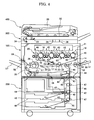
- FIG. 4 is a schematic block diagram showing an example of an image forming apparatus relating to the present invention.
- Hereinafter, aspects of the present invention will be explained.
- The present invention is a toner used for forming images through the use of an electrophotographic process, the toner comprises a binder resin and a colorant, and the average circularity of the toner is 0.95 or more.
- The average circularity of the toner is a value obtained by optically detecting toner particles, and the circumferential length of a circle which has an area equivalent to the projection area of the toner is divided by a circumferential length of an actual toner particle. Specifically, the average circularity of the toner is measured using a flow particle image analyzer (FPIA-2000; manufactured by Sysmex Corp.). To a given vessel, 100ml to 150ml of water with impure solid matters preliminarily removed is poured, 0.1ml to 0.5ml of a surfactant is added as a dispersant, and about 0.1g to 9.5g of a measurement sample of a toner is further added. A suspension with the sample dispersed therein was subjected to a dispersion for about 1 minute to 3 minutes using an ultrasonic dispersing apparatus to make a concentration of the dispersant 3,000 No. of pcs./µL to 10,000 No. of pcs./µL and measure the shape and particle size distribution of the toner.
- The toner of the present invention has an average circularity of 0.95 or more, the shape of the projected toner is close to a circle, the toner excels in dot reproductivity and enables obtaining a high transferring rate. With a toner having an average circularity less than 0.95, the toner will be formed in a non-spherical shape, and dot reproductivity of the toner degrades, and since the number of contact points between the toner and a photoconductor as a latent image carrier are increased, releasing property of the toner degrades, resulting in a lowered transferring rate.
- In addition, the toner of the present invention has moderate concaves and convexes on the surface. As mentioned above, a spherically shaped toner having a low adherence between the toner and a latent image carrier or a low adherence between the toner particles each to each can make it possible to obtain a high transferring rate, however, at the same time such a toner causes problems with occurrences of transferring dust and degradation of cleaningability. Accordingly, it is preferred that the surface of a toner be not smoothly formed and have concaves and convexes so as to properly contact a latent image carrier. FIG. 1 is an electron photomicrograph showing an example of the shape of the toner of the present invention.
- The toner of the present invention is a toner in which a ratio (D/S) of the total contact area of the toner (D) to the total projection area of the toner (S) is ranging from 15% to 40%. Here, the contact area (D) represents a contact surface area between the toner and an object surface. When there are two or more contact surfaces or contact surface portions, the contact area (D) represents the total contact area of the contact surface portions.
- The toner of the present invention is a toner in which a ratio (A/S) of the total contact area between the toner and a latent image carrier (A) to the total projection area of the toner (S) is ranging from 15% to 40% as a percentage.
- The toner of the present invention is a toner in which a ratio (B/S) of the total contact area between the toner and an intermediate transferring member (B) to the total projection area of the toner (S) is ranging from 15% to 40% as a percentage.
- In addition, the toner of the present invention is a toner in which a ratio (C/S) of the total contact area between the toner and a fixing member (C) to the total projection area of the toner (S) is ranging from 15% to 40% as a percentage.
- The method of measuring these values of A/S, B/S, and C/S is as follows:
- First, a glass plane plate (for example, a standard transparent slide glass (thickness: 2mm)) which is used to resemble a pseudo latent image carrier, a pseudo intermediate transferring member, a pseudo fixing member, is prepared, and a sieve of 22µm mesh is set on the glass plate. The toner is placed on the sieve and sieved from above a height of 10 cm while vibrating the sieve for 10 seconds to uniformly put a little amount of the toner on the glass plate through the mesh. A photo of the glass plane plate held in this state is taken from the bottom of the glass plate using a high-definition digital camera (COOL PIX 5000 4,920,000 pixels: manufactured by NICON Corp.). The image taken at that time is an image that makes it possible to discern between the portion that the toner contacts the glass plate surface and the portion that the toner does not contact the glass plate surface. The image picture is scanned into a personal computer to perform an image analysis using an image analyzer (Image-Pro Plus: manufactured by Planetron, Inc.). The area in which the toner contacts the glass plate surface is blacked out, and the area is defined as "D" (as the pseudo area of A, B or C) to obtain the area. The outline of the whole toner is drawn with black, and the entire area surrounded with the black line is defined as "S" to obtain the area. Finally, a value of D/S (as a pseudo, A/S, B/S or C/S) can be obtained using the above mentioned values. The above noted image processing is performed as to 100 or more sampling toners.
- The reason a glass plane plate is used as a pseudo latent image carrier, a pseudo intermediate transferring member, and a pseudo fixing member that when comparing a radius of a toner particle, a curvature radius of an actually used photoconductor, a curvature radius of an intermediate transferring member, and a curvature radius of a fixing member, a surface of these individual members with which a toner have contact can be made closely resemble a plane surface, even if these members are formed in any one of shapes of a drum, a belt, and a roller.
- The value of D/S, A/S, B/S, and C/S being 15% to 40% means that the toner has such a shape that the toner can contact a latent image carrier, an intermediate transferring member, and a fixing member with a proper contact area, respectively.
- When the value of A/S is less than 15%, it is impossible to prevent transferring dust and to improve cleaningability, because the contact between the toner and a latent image carrier is in an insufficient condition. When the value of A/S is more than 40%, releasing property degrades, and this may cause degradation of its transferring rate, because an adherence between the toner and a latent image carrier is increased.
- When the value of B/S is less than 15%, transferring dust is liable to occur at the time of secondary transferring onto a transferring paper, because the contact between the toner and an intermediate transferring member is in an insufficient condition. When the value of B/S is more than 40%, releasing property degrades, and this may cause degradation of a secondary transferring rate, because an adherence between the toner and an intermediate transferring member is increased.
- When the value of C/S is less than 15% and when starting a fixing step, unfixed toner may roll on the transferring paper, and this may cause an image defect, because the contact between the unfixed toner on the transferring paper and a fixing member, such as a fixing roller, is in an insufficient condition. On the other hand, when the value of C/S is more than 40%, the fixed toner image becomes an image with the reproductivity of a thin line being insufficient, because the contact area between the toner and a fixing member is increased, and the toner is liable to spread over a transferring paper.
- It is preferable that the toner of the present invention has line-contact with individual members of a latent image carrier, an intermediate transferring member, and a fixing member. Namely, this means a condition where the value of A/S, B/S, and C/S is respectively 15% to 40%, as described above, and such a state lies midway between point-contact (the value being less than 15%) and area-contact (the value being more than 40%), and it indicates a condition of contact in which a number of continuous point-contact points continue into a line (a condition that a number of continuous point-contact points appear to be a line).
- Specifically, the condition of line-contact implies that a ratio (L/M) of a long axis (L) to a minor axis (M) satisfies the relation of (L/M) > 3 in at least one contact surface portion of the contact areas between the toner of the present invention and a glass plane plate which is used to resemble a latent image carrier, an intermediate transferring member, and a fixing member. The shape of the toner varies in some degree depending on individual toner particles, however, it is preferable that at least over half the toner particles satisfy the relation of (L/M) > 3 at least in one contact surface portion of the contact areas between the toner particles and a glass plane plate, and it is more preferably that 70% or more of the toner particles satisfy the relation of (L/M) > 3 at least in one contact surface portion of the contact areas between the toner particles and a glass plane plate.
- FIG. 2 is a view schematically showing a long axis (L) and a minor axis (M) of the contact area between the toner particles and a glass plane plate. The value of L/M is calculated from the long axis (L) and the minor axis (M) of the contact area between the toner particles and the glass plane plate.
- FIG. 3A to FIG. 3C are views schematically showing the ways each toner differently contacts a glass plane plate depending on the shape of toner. In these views, each contact area of the toners put on a glass plane plate is blacked out. FIG. 3A shows a toner being nearly spherical in shape, and since the toner has a shape with less concaves and convexes formed on the surface, it is in a condition close to point-contact with the glass plane plate. FIG. 3C shows an indefinite (undetermined) toner obtained by the kneading and grinding method and the indefinite (undetermined) toner has area-contact with a glass plane plate. When a toner and a glass plane plate are in close to point-contact condition, as seen in FIG. 3A, the contact area between the toner and the other part of member is small. For instance, when the other part of member is a latent image carrier or an intermediate transferring member, a high transferring rate can be obtained because the toner has excellent releasing property. However, on the other hand, the adherence between the toner and the other part of member is small, and then it may cause transferring dust and degradation of cleaningability. When starting a fixing step, unfixed toner may roll on a transferring paper, and this may cause an image defect, because the contact between the unfixed toner on a transferring paper and a fixing member is in an insufficient condition.
- When a toner has area-contact with a glass plane plate, as seen in FIG. 3C, the contact area between the toner and the other part of member is large. For instance, when the other part of member is a latent image carrier, the transferring rate lowers, because releasing property of the toner to the latent image carrier is poor. At the same time, transferring dust and scattered toner may be easily cleaned by a cleaning blade, because adherence of the toner to the latent image carrier is large.
- On the other hand, according to the toner of the present invention, as shown in FIG. 3B, the contact area between the toner and a glass plane plate is in line-contact condition where a number of continuous point-contact points continue into a line (such continuous point-contact points look like a line), and the toner is in a state where at least one contact area satisfying a relation between the long axis L and the minor axis M of (L/M) > 3 is included. If the contact between a toner and a latent image carrier is in line-contact condition so that at least one contact surface portion thereof satisfies a relation of (L/M) > 3, a high transferring rate can be obtained, because the adherence between the toner and a latent image carrier does not become so strong, and the toner shows proper releasing property to a latent image carrier. Besides, it is possible to prevent transferring dust and improve cleaningability, since rolling of the toner can be restrained on a latent image carrier, and proper contact among toner particles can be obtained. With an intermediate transferring member, it is possible that the toner has proper releasing property and shows a high secondary transferring rate and prevents transferring dust with a proper adherence. In addition, in a fixing step, proper contact condition with a fixing member such as a fixing roller enables stopping any image defects caused by toner rolling, and it is possible to obtain a high-quality fixed image in which a toner densely aggregated, because toner particles having an average circularity of 0.95 or more have proper adherences each other.
- In addition, the toner of the present invention preferably has a value of shape factor SF-2 ranging from 120 to 150. The shape factor SF-2 indicates a degree of concaves and convexes of toner shape. A toner picture is taken by a scanning electron microscope (S-800: manufactured by HITACHI, Ltd.) and the picture is analyzed by an image analyzer (LUSEX3: manufactured by NIRECO Corp.) to calculate the shape factor SF-2. Specifically, as shown in the following expression I, a value of the shape factor SF-2 is the one that a squared-value of a peripheral length (PERI) of the figure which can be formed by projecting a toner onto a two-dimensional plane is divided by the figure area (AREA) and then multiplied by 100π/4.
SF-2 = {(PERI)2/AREA}x (100π/4) Expression I
- When the value of SF-2 is less than 120, there are not many concaves and convexes on the surface of a toner, and a sufficient contact area between the toner and a latent image carrier cannot be obtained. The greater the value of SF-2 is, the more conspicuous concaves and convexes of the toner shape are, and when the SF-2 value is more than 150, it is not preferable because it leads to degradation of image quality due to concaves and convexes on the surface of the toner, such as a toner transfer true to a latent image is not performed in a transferring step.
- Further, the toner of the present invention preferably has a volume average particle diameter (Dv) of 3.0µm to 8.0µm and a ratio (Dv/Dn) of a volume average particle diameter (Dv) to a number average particle diameter (Dn) is 1.00 to 1.30. By forming a toner having such a particle diameter and particle diameter distribution, it is possible that the toner excels in any of heat resistant storage properties, low-temperature image fixing properties, and particularly when used in a full-color copier, excellent gloss properties can be obtained in an image.
- Generally, it is said that the smaller a toner particle is, it becomes more advantageous in obtaining a high-resolution and high-quality image, however at the same time, it is disadvantageous in terms of a transferring rate and cleaningability. When a volume average particle diameter is smaller than the minimum diameter of the toner of the present invention and when used as a two-component developer, the toner fuses on the surface of magnetic carriers in a long hours of agitation in an image developing apparatus, and it makes charge property of the magnetic carriers lowered, and when used as a one-component developer, toner-filming to a developing roller and toner fusion onto a member, such as a blade for making a toner have a thin layer, are liable to occur.
- On the other, when the volume average particle diameter of a toner is greater than the maximum diameter of the toner of the present invention, it is hard to obtain a high quality image at high-resolution, and it is often the case that the toner particle diameter largely varies when toner inflow/outflow is being performed in a developer.
- When Dv/Dn is more than 1.30, it is not preferable because distribution of an amount of charge is broader, and the resolution also degrades.
- The average particle diameter and the particle size distribution of a toner can be measured using Coulter Counter TA-II, and Coulter Multi-sizer II (both manufactured by Beckman Coulter, Inc.). In the present invention, the average particle diameter and the particle size distribution were measured by using Coulter Counter TA-II model and by connecting it to an interface (manufactured by The Institute of Japanese Union of Scientists & Engineers) and a personal computer (PC9801: manufactured by NEC) which outputs a number distribution and a volume distribution of toner.
- It is preferable that the toner has a 20% content of the toner particles having a particle diameter corresponding to a circle being 2.0µm or less, so called, fine particle content of the toner, on a number basis. When the fine particle content of the toner is more than 20%, when used in a two-component developer, such a toner may adhere to magnetic carriers and is impossible to keep charging stability at a high level. It is not preferred because such a toner causes toner scattering and background smears, which are numerous number of black points printed on a white medium.
- Here, the measurements of a toner particle diameter corresponding to a circle and the toner particle content having a toner particle diameter corresponding to a circle being 2.0µm or less on a number basis can be performed using a flow particle image analyzer (FPIA-1000; manufactured by SYSMEX Corp.). The apparatus and the outline of the measurements are described in Japanese Patent Application Laid-Open (JP-A) No. 08-136439. An aqueous solution containing 1% NaCl was prepared using primary sodium chloride, and the aqueous solution was strained through a filter (0.45µm). To 50ml to 100ml of the strained liquid, a surfactant, preferably 0.1ml to 5ml of an alkylbenzene sulphonate was added as a dispersant, followed by addition of 1mg to 10mg of a toner sample. The liquid was subjected to a dispersion process for one minute through the use of an ultrasonic dispersing apparatus. The measurement of the number of toner particles was performed by using the dispersion liquid in which the particle density was controlled to 5,000 No. of pcs./µm to 15,000 No. of pcs./µm. The measurement of the number of toner particles was performed based on the following calculation. A diameter of a circle which had the same area as that of a two-dimensional toner particle image taken by a CCD camera was defined as the particle diameter corresponding to a circle. Based on the precise CCD pixel, a diameter corresponding to a circle of 0.6µm or more was determined as effective, and then the measurement data of toner particles was obtained.
- Examples of the toner of the present invention include the ones prepared by using the following components.
- The toner of the present invention comprises a modified polyester (i) as a binder resin. For the modified polyester (i), it indicates a state of a polyester in which a combined group other than ester bonds may reside in a polyester resin, and different resin components are combined into a polyester resin through a covalent bond, an ionic bond or the like. Specifically, a modified polyester is the one that a functional group such as an isocyanate group or the like which reacts to a carboxylic acid group and a hydrogen group is introduced to a polyester end and further reacted to an active hydrogen-containing compound to modify the polyester end. Examples of the modified polyester (i) include a urea modified polyester which is obtained by a reaction between polyester prepolymer (A) having an isocyanate group and amines (B). Examples of the polyester prepolymer (A) having an isocyanate group include a polyester prepolymer which is a polycondensation product between a polyvalent alcohol (PO) and a polyvalent carboxylic acid (PC) and having an active hydrogen group is further reacted to a polyvalent isocyanate compound (PIC). Examples of the active hydrogen group included into the above-noted polyester include a hydroxyl group (an alcoholic hydroxyl group and a phenolic hydroxyl group), an amino group, a carboxyl group, and a mercapto group. Among these groups, an alcoholic hydroxyl group is preferable.
- A urea polyester is formed in the following manner.
- Examples of the polyvalent alcohol compound (PO) include divalent alcohols (DIO), and trivalent or more polyvalent alcohols (TO), and any of a divalent alcohol (DIO) alone and a mixture of a divalent alcohol (DIO) with a small amount of a polyvalent alcohol (TO) are preferable. Examples of the divalent alcohols (DIO) include alkylene glycols such as ethylene glycol, 1, 2-propylene glycol, 1, 3-propylene glycol, 1, 4-butanediol, and 1, 6-hexanediol; alkylene ether glycols such as diethylene glycol, triethylene glycol, dipropylene glycol, polyethylene glycol, polypropylene glycol, and polytetramethylene ether glycol; alicyclic diols such as 1, 4-cyclohexane dimethanol, and hydrogenated bisphenol A; bisphenols such as bispheonol A, bisphenol F, and bisphenol S; alkylene oxide adducts of the above-noted alicyclic diols such as ethylene oxides, propylene oxides, and butylene oxides; and alkylene oxide adducts of the above-noted bisphenols such as ethylene oxides, propylene oxides, and butylene oxides. Among the above mentioned, alkylene glycols having 2 to 12 carbon atoms and an alkylene oxide adduct of bisphenols are preferable, and an alkylene oxide adduct of bisphenols and a combination of the adduct with an alkylene glycol having 2 to 12 carbon atoms are particularly preferable. Examples of the trivalent or more polyvalent alcohols (TO) include a polyaliphatic alcohol of trivalent to octavalent or more such as, glycerine, trimethylol ethane, trimethylol propane, pentaerythritol, and sorbitol; and trivalent or more phenols such as trisphenol PA, phenol novolac, and cresol novolac; and alkylene oxide adducts of the trivalent or more polyphenols.
- Examples of the polyvalent carboxylic acid (PC) include divalent carboxylic acids (DIC) and trivalent or more polyvalent carboxylic acids (TC), and any of a divalent carboxylic acid (DIC) alone and a mixture of a divalent carboxylic acid (DIC) with a small amount of a polyvalent carboxylic acid (TC) are preferable. Examples of the divalent carboxylic acids (DIC) include an alkylene dicarboxylic acid such as succinic acid, adipic acid, and sebacic acid; alkenylen dicarboxylic acids such as maleic acid, and fumaric acid; aromatic dicarboxylic acids such as phthalic acid, isophthalic acid, terephthalic acid, and naphthalene dicarboxylic acid. Among these divalent carboxylic acids, an alkenylen dicarboxylic acid having 4 to 20 carbon atoms and an aromatic dicarboxylic acid having 8 to 20 carbon atoms are preferable. Examples of the trivalent or more polyvalent carboxylic acid (TC) include an aromatic polyvalent carboxylic acid having 9 to 20 carbon atoms such as trimellitic acid, and pyromellitic acid. It is noted that as a polyvalent carboxylic acid (PC), an acid anhydride from among the polyvalent carboxylic acids or a lower alkyl ester such as methyl ester, ethyl ester, and isopropyl ester may be used to react to a polyvalent alcohol (PO).
- A ratio of a polyvalent alcohol (PO) to a polyvalent carboxylic acid (PC), defined as an equivalent ratio [OH]/[COOH] of a hydroxyl group [OH] to a carboxyl group [COOH], is typically 2/1 to 1/1, preferably 1.5/1 to 1/1, and more preferably 1.3/1 to 1.02/1.
- Examples of the polyvalent isocyanate compound (PIC) include aliphatic polyvalent isocyanates such as tetramethylen diisocyanate, hexamethylen diisocyanate, and 2, 6-diisocyanate methyl caproate; alicyclic polyisocyanates such as isophorone diisocyanate, and cyclohexyl methane diisocyanate; aromatic diisocyanates such as tolylene diisocyanate, and diphenylmethane diisocyanate; aromatic aliphatic diisocyanates such as α, α, α', α'-tetramethyl xylylene diisocyanate; isocyanates; compounds in which the above noted polyisocyanate is blocked with a phenol derivative, oximes, caprolactams, and the like; and combinations of two or more elements thereof.
- A ratio of a polyvalent isocyanate compound (PIC), defined as an equivalent ratio [NCO]/[OH] of an isocyanate group [NCO] to a hydroxyl group [OH] of a polyester having a hydroxyl group, is typically 5/1 to 1/1, preferably 4/1 to 1.2/1, and more preferably 2.5/1 to 1.5/1. When the ratio [NCO]/[OH] is more than 5, low-temperature image fixing properties degrade. When the molar ratio of [NCO] is less than 1 and a urea modified polyester is used, the urea content in ester is reduced, resulting in degraded hot-offset resistivity of the toner.
- The component content of the polyvalent isocyanate compound (PIC) in a polyester prepolymer having an isocyanate group (A) is typically 0.5% by weight to 40% by weight, preferably 1% by weight to 30% by weight, and more preferably 2% by weight to 20% by weight. When the component content is less than 0.5wt%, hot-offset resistivity of the toner degrades and brings about disadvantages in the compatibility between heat resistant storage properties and low-temperature image fixing properties. On the other hand, when it is more than 40% by weight, low-temperature image fixing properties degrade. The number of isocyanate groups contained in per molecule of the polyester prepolymer having isocyanate group (A) is typically 1 or more, preferably 1.5 to 3 on an average, and more preferably 1.8 to 2.5 on an average. When the number of isocyanate groups is less than one per molecule of polyester prepolymer, the molecular weight of the urea modified polyester lowers, resulting in degraded hot-offset resistivity.
- Next, examples of amines (B) to be reacted to a polyester prepolymer (A) include a divalent amine compound (B1), a trivalent or more polyvalent amine compound (B2), an aminoalcohol (B3), an amino mercaptan (B4), an amino acid (B5), and a compound in which the amino group of B1 to B5 is blocked (B6).
- Examples of the divalent amine compound (B1) include an aromatic diamine (such as, phenylene diamine, diethyl toluene diamine, 4, 4'-diamino diphenyl methane); an alicyclic diamine (4, 4'-diamino-3, 3'-dimethyl dicyclohexyl methane, diamine cyclohexane, and isophorone diamine); and an aliphatic diamine (such as, ethylene diamine, tetramethylene diamine, and hexamethylene diamine). Examples of the trivalent or more polyvalent amine compound (B2) include diethylene triamine, and triethylene tetramine. Examples of the aminoalcohol (B3) include ethanol amine, and hydroxyethylaniline. Examples of the amino mercaptan (B4) include aminoethyl mercaptan, and aminopropyl mercaptan. Examples of the amino acid (B5) include aminopropionic acid, aminocaproic acid, and the like. Examples of the compound in which the amino group of B1 to B5 is blocked (B6) include a ketimine compound obtained from the above-noted amines of B1 to B5 and ketones (such as, acetone, methyl ethyl ketone, and mehyl isobuthyl ketone) and oxazolidine compound, and the like. Among these amines (B), a divalent amine compound B1 and a mixture of B1 with a small amount of a trivalent or more polyvalent amine compound (B2) are preferable.
- A ratio of amines (B), defined as an equivalent ratio [NCO]/[NHx] of isocyanate group [NCO] in a polyester prepolymer having isocyanate group (A) to amine group [NHx] in amines (B), is typically 1/2 to 2/1, preferably 1.5/1 to 1/1.5, and more preferably 1.2/1 to 1/1.2. When [NCO]/[NHx] is more than 2 or less than 1/2, the molecular weight of urea modified polyester lowers, which makes hot-offset resistivity degraded.
- In addition, the urea modified polyester may include a urethane bond as well as a urea bond. The molar ratio of the urea bond content to the urethane bond content is typically 100/0 to 10/90, preferably 80/20 to 20/80, and more preferably 60/40 to 30/70. When the molar ratio of the urea bond is less than 10%, hot-offset resistivity degrades.
- A modified polyester (i) used in the present invention is manufactured by one-shot method or prepolymer method. The weight average molecular weight of the modified polyester (i) is typically 10,000 or more, preferably 20,000 to 10,000,000 and more preferably 30,000 to 1,000,000. The molecular weight peak at the time is preferably 1,000 to 10,000, and when the molecular weight peak is less than 1,000, it is hard to be subjected to elongation reactions, and the elasticity of the toner is low, which makes hot-offset resistivity of the toner degraded. When the molecular weight peak is more than 10,000, it may cause degradation of fixability and may bring hard challenges in manufacturing a toner such as in yielding fine particles and in toner crushing. The number average molecular weight of the modified polyester (i) is not particularly limited, when used together with an unmodified polyester (ii), which will be hereafter described, and it may be a number average molecular weight which is easily obtained to be used with the above-noted weight average molecular weight. When a modified polyester (i) is used alone, the number average molecular weight is typically 20,000 or less, preferably 1,000 to 10,000, and more preferably 2,000 to 8,000. When the number average molecular weight is more than 20,000, low-temperature image fixing properties and gross properties degrade when used in a full-color device.
- In cross-linking and/or elongation reactions of a polyester prepolymer (A) and amines (B) in order to obtain a modified polyester (i), a reaction stopper may be used as required to control the molecular weight of a urea modified polyester to be obtained. Examples of the reaction stopper include a monoamine (such as, diethyl amine, dibutyl amine, butyl amine, and lauryl amine), and a compound in which the above-noted elements are blocked.
- It is noted that the molecular weight of a polymer to be formed can be measured by means of gel permeation chromatography (GPC), using a tetrahydrofuran (THF) solvent.
- In the present invention, not only the modified polyester (i) may be used alone but also an unmodified polyester (ii) may be included together with the modified polyester (i) as a binder resin component. Using an unmodified polyester (ii) in combination with a modified polyester (i) is more preferable than using the modified polyester (i) alone, because low-temperature image fixing properties and gloss properties are improved when used in a full-color device. Examples of the unmodified polyester (ii) include polycondensation polyesters of a polyvalent alcohol (PO) and a polyvalent carboxylic acid (PC) having same components as in the modified polyester (i). Preferred compounds thereof are also the same as in the modified polyester (i). As for the unmodified polyester (ii), in addition to an unmodified polyester, it may be a polymer which is modified by a chemical bond other than urea bonds, for example, it may be modified by a urethane bond. It is preferable that at least a part of a modified polyester (i) be compatible with a part of an unmodified polyester (ii), from the aspect of low-temperature image fixing properties and hot-offset resistivity. Thus, it is preferable that the composition of the modified polyester (i) be similar to that of the unmodified polyester (ii). A weight ratio of a modified polyester (i) to an unmodified polyester (ii) when an unmodified polyester (ii) being included, is typically 5/95 to 80/20, preferably 5/95 to 30/70, more preferably 5/95 to 25/75, and still more preferably 7/93 to 20/80. When the weight ratio of a modified polyester (i) is less than 5%, it makes hot-offset resistivity degraded and brings about disadvantages in compatibility between heat resistant storage properties and low-temperature image fixing properties.
- The molecular weight peak of the unmodified polyester (ii) is typically 1,000 to 10,000, preferably 2,000 to 8,000, and more preferably 2,000 to 5,000. When the molecular weigh peak of the unmodified polyester (ii) is less than 1,000, heat resistant storage properties degrade, and when the molecular weight peak is more than 10,000, low-temperature image fixing properties degrade. The hydroxyl value of the unmodified polyester (ii) is preferably 5 or more, more preferably 10 to 120, and still more preferably 20 to 80. When the value is less than 5, it brings about disadvantages in the compatibility between heat resistant storage properties and low-temperature image fixing properties. The acid number of the unmodified polyester (ii) is preferably 1 to 5, and more preferably 2 to 4. A wax having a high acid value is used in the toner. As for the binder, a binder having a low acid value is easily matched with a toner used in a two-component developer, because such a binder leads to charging and a high volume resistivity.
- The glass transition temperature (Tg) of the binder resin is typically 35°C to 70°C, and preferably 55°C to 65°C. When the galss transition temperature (Tg) of the binder resin is less than 35°C, heat resistant storage properties of the toner degrade, and when the glass transition temperature is more than 70°C, low-temperature image fixing properties are insufficient. The toner of the present invention shows a proper heat resistant storage property tendency even with a low glass transition temperature, compared to those made from a polyester known in the art, because a urea modified polyester easily exists on surfaces of particles of the toner base to be obtained. It is noted that the glass transition temperature (Tg) can be measured using a differential scanning calorimeter (DSC).
- With respect to the colorant to be used, all the dyes and pigments known in the art may be used. For example, it is possible to use carbon black, nigrosine dye, iron black, naphthol yellow S, Hansa yellow (10G, 5G, and G), cadmium yellow, yellow iron oxide, yellow ocher, yellow lead, titanium yellow, polyazo yellow, oil yellow, Hansa yellow (GR, A, RN, R), pigment yellow L, benzidine yellow (G, GR), permanent yellow (NCG), vulcan fast yellow (5G, R), tartrazinelake yellow, quinoline yellow lake, anthraene yellow BGL, isoindolinon yellow, colcothar, red lead, lead vermilion, cadmium red, cadmium mercury red, antimony vermilion, permanent red 4R, parared, fiser red, parachloroorthonitro anilin red, lithol fast scarlet G, brilliant fast scarlet, brilliant carmine BS, permanent red (F2R, F4R, FRL, FRLL, F4RH), fast scarlet VD, vulcan fast rubin B, brilliant scarlet G, lithol rubin GX, permanent red F5R, brilliant carmin 6B, pigment scarlet 3B, bordeaux 5B, toluidine Maroon, permanent bordeaux F2K, Helio bordeaux BL, bordeaux 10B, BON maroon light, BON maroon medium, eosin lake, rhodamine lake B, rhodamine lake Y, alizarin lake, thioindigo red B, thioindigo maroon, oil red, quinacridon red, pyrazolone red, polyazo red, chrome vermilion, benzidine orange, perinone orange, oil orange, cobalt blue, cerulean blue, alkali blue lake, peacock blue lake, victoria blue lake, metal-free phthalocyanin blue, phthalocyanin blue, fast sky blue, indanthrene blue (RS, BC), indigo, ultramarine, iron blue, anthraquinon blue, fast violet B, methylviolet lake, cobalt purple, manganese Violet, dioxane violet, anthraquinon violet, chrome green, zinc green, chromium oxide, viridian green, emerald green, pigment green B, naphthol green B, green gold, acid green lake, malachite green lake, phthalocyanine green, anthraquinon green, titanium oxide, zinc flower, lithopone, and mixtures thereof. The colorant content of the toner is typically 1 weight% to 15 weight%, and preferably 3 weight% to 10 weight%.
- The colorant may be used as a masterbatch compounded with a resin. Examples of the binder resin to be used in manufacturing of a masterbatch, or to be kneaded with a masterbatch include styrenes such as polystyrene, poly-p-chlorostyrene, polyvinyl toluene, and derivative substitution polymers thereof, or copolymers of the above-noted styrenes and vinyl compounds, polymethyl methacrylate, polybutyl methacrylate, polyvinylchloride, polyvinyl acetate, polyethylene, polypropylene, polyester, epoxy resins, epoxy polyol resins, polyurethane, polyamide, polyvinyl butyral, polyacrylic acid resins, rosin, modified-rosin, terpene resins, aliphatic hydrocarbon resins, alicyclic hydrocarbon resins, aromatic petroleum resins, chlorinated paraffins, and paraffin waxes. Each of these binder resins may be used alone or in combination of two or more.
- The masterbatch may be obtained by applying a high shearing force to resins and colorants for masterbatch and by mixing and kneading the components. Here, to improve the interaction between the resins and the colorants, an organic solvent can be used. Besides, a so-called flashing process is preferably used in manufacturing a mater batch, because in the flashing process, a wet cake of a colorant can be directly used without the necessity of drying. In the flashing process, a colorant's water paste containing water is mixed and kneaded with a resin and an organic solvent to transfer the colorant to the resin and then to remove the moisture and the organic solvent component. For mixing or kneading as above, a high shearing dispersion device such as a triple roll mill is preferably used.
- As a charge controlling agent, those known in the art can be used. Examples of the charge controlling agent include nigrosine dye, triphenylmethane dye, chrome-contained metal-complex dye, molybdic acid chelate pigment, rhodamine dye, alkoxy amine, quaternary ammonium salt (including a fluoride-modified quaternary ammonium salt), alkylamide, a phosphoric simple substance or compounds thereof, a tungsten simple substance or compounds thereof, fluoride activators, salicylic acid metallic salts, and salicylic acid derivative metallic salts. Specifically, Bontron 03 being a nigrosine dye, Bontron P-51 being a quaternary ammonium salt, Bontron S-34 being a metal containing azo dye, Bontron E-82 being an oxynaphthoic acid metal complex, Bontron E-84 being a salicylic acid metal complrex, and Bontron E-89 being a phenol condensate (manufactured by Orient Chemical Industries, Ltd.); TP-302 and TP-415 being a quaternary ammonium salt molybdenum metal complex (manufactured by HODOGAYA CHEMICAL CO., LTD.); Copy Charge PSY VP2038 being a quaternary ammonium salt, Copy Blue PR being a triphenylmethane derivative, and Copy Charge NEG VP2036 and Copy Charge NX VP434 being a quaternary ammonium salt (manufactured by Hoechst Ltd.); LRA-901, and LR-147 being a boron metal complex (manufactured by Japan Carlit Co., Ltd.), copper phtalocyamine, perylene, quinacridone, an azo pigment, and other high-molecular weight compounds having a functional group, such as a sulfonic acid group, a carboxyl group, and a quaternary ammonium salt. Among the charge controlling agents, a substance capable of controlling a toner to a negative polarity is preferably used.
- The usage of the charge controlling agent is determined depending on the type of a binder resin, presence or absence of an additive to be used as required, and the method for manufacturing a toner including a dispersion process and is not limited uniformly, however, relative to 100 parts by weight of binder resin, 0.1 parts by weight to 10 parts by weight of the charge controlling agent is preferably used and more preferably with 0.2 parts by weight to 5 parts by weight of the charge controlling agent. When the charge controlling agent is more than 10 parts by weight, charge properties of the toner are exceedingly large, which lessens the effect of the charge controlling agent itself and increases in electrostatic attraction force with a developing roller, and causes degradation of the developer flowability and image density.
- When a wax having a low melting point of 50°C to 120°C and the wax is dispersed in a binder resin, it effectively works on the phase boundary between a fixing roller and a toner as a releasing agent, which exerts effect on high temperature offsets without any applications of a releasing agent like an oil to a fixing roller. Examples of the wax components include waxes of vegetable origin such as carnauba wax, cotton wax, Japanese wax, and rice wax; waxes of animal origin such as beeswax, and lanoline, and waxes of mineral origin such as ozokerite, and ceresin, and petroleum waxes, such as paraffin, micro crystalline, and petrolatum. Besides the above-noted permanent waxes, there are hydrocarbon synthetic waxes such as Fischer-Tropsch wax, polyethylene wax; and synthetic waxes such as ester wax, ketone wax, and ether wax. Further, it is also possible to use fatty acid amides such as 12-hydroxy stearic acid amide, stearic acid amide, phthalic anhydride imide, and chlorinated hydrocarbon; polyacrylate homopolymers such as poly-n-stearyl methacrylate, and poly-n-lauril methacrylate being a low-molecular-weight crystalline polymer resin or copolymers thereof such as n-stearyl acrylate-ethylmethacrylate copolymer; and crystalline polymers having a long alkyl group in its side chain.
- The above-noted charge controlling agents and the releasing agents may be fused and kneaded with a masterbatch and a binder resin and may be added when dissolved and dispersed into an organic solvent.
- As external additives for assisting in flowability of toner particles, developing properties, and charge properties, inorganic particles are preferably used. The primary particle diameter of the inorganic particles is preferably 5x10⁻³µm to 2µm and more preferably 5x10⁻³µm to 0.5µm. A specific surface according to BET equation is preferably 20m2/g to 500m2/g. The usage proportion of the organic particles is preferably 0.01weight% to 5weight% of the toner amount and more preferably 0.01weight% to 2.0weight% of the toner amount. Specifically, examples of the inorganic particles include silica, alumina, titanium oxides, barium titanate, magnesium titanate, calcium titanate, strontium titanate, zinc oxides, tin oxides, silica sand, clay, mica, wallastonite, silious earth, a chromium oxide, a ceric oxide, colcothar, an antimony trioxide, magnesium oxides, zirconium oxides, barium sulfate, barium carbonate, calcium carbonate, silicon carbide, and silicon nitride.
- Besides the above-mentioned, there are polymer particles such as polymer particles made from a polystyrene copolymer, a methacrylic acid ester copolymer, and an acrylic acid ester copolymer obtained by a soap-free emulsion polymerization, a suspension polymerization, and a dispersion polymerization; and condensation polymers such as silicon, benzoguanamine, and nylon, and a thermosetting resin.
- The external additives stated above enable preventing deterioration of flowability and charge properties of the toner even under high-humidity environment by subjecting them to a surface treatment to improve hydrophobic properties. Preferred examples of surface finishing agents include silane coupling agents, sililation reagents, silane coupling agents each having a fluorinated alkyl group, organic titanate coupling agents, aluminum coupling agents, silicon oils, and modified silicon oils. Particularly, it is preferable to use a hydrophobic silica and a hydrophobic titanium oxide obtained by subjecting to the above-noted surface treatment on a silica or a titanium oxide.
- Next, the method for manufacturing a toner will be described. Here, a preferred example of the method will be explained; however, it is not limited to the disclosed one.
- A toner binder may be manufactured by the following method, and the like. A polyvalent alcohol (PO) and a polyvalent carboxylic acid (PC) are heated to a temperature of 150°C to 280°C in the presence of an esterification catalyst known in the art such as tetrabutoxy titanate, and dibutyltin oxide, and yielded water was removed while depressurizing as needed to obtain a polyester having a hydroxyl group. Next, the obtained polyester is reacted to a polyisocyanate compound (PIC) at a temperature of 40°C to 140°C to obtain a prepolymer having an isocyanate group (A). Further, the prepolymer (A) is reacted to amines (B) at a temperature of 0°C to 140°C to obtain a modified polyester with urea bond.
- On the occasion of reacting a polyisocyanate compound (PIC) and the occasion of reacting the prepolymer (A) to amines (B), a solvent may be used as needed. Examples of usable solvents include solvents which are inactive to a polyisocyanate compound (PIC), for example, aromatic solvents such as toluene, and xylene; ketones such as acetone, methyl ethyl ketone, and methyl isobutyl ketone; esters such as ethyl acetate; amides such as dimethylformamide, and dimethylacetamide; and ethers such as, tetrahydrofuran.
- When an unmodified polyester (ii) is used in combination with the modified polyester, the unmodified polyester (ii) is manufactured in a similar manner as that of the polyester having a hydroxyl group, and the obtained polyester is melted into a solvent which has been subjected to the reactions as in the modified polyester and then mixed.
-
- 1) A colorant, an unmodified polyester (i), a polyester prepolymer having an isocyanate group (A), a releasing agent, and inorganic filler are dispersed into an organic solvent to prepare a toner material-contained solution.
As to the organic solvent, an organic solvent being volatile and having a boiling point of 100°C or less is preferable in terms of ease of removability after toner base particles being formed. Specifically, toluene, xylene, benzene, carbon tetrachloride, methylene chloride, 1, 2-dichloroethane, 1, 1, 2-trichloroethane, trichloroethylene, chloroform, monochlorobenzene, dichloroethylidene, methyl acetate, ethyl acetate, methyl ethyl ketone, methyl isobutyl ketone and the like may be used alone or in combination with two or more. Particularly, aromatic solvents such as toluene, xylene, and halogenated hydrocarbons such as 1, 2-dichloroethane, chloroform, carbon tetrachloride are preferable. The usage of the organic solvent relative to 100 parts by weight of the polyester prepolymer is typically 1 part by weight to 300 parts by weight, preferably 1 part by weight to 100 parts by weight, and more preferably 25 parts by weight to 70 parts by weight.
The inorganic filler exists near the surface of the toner base particles to assume a roll of controlling the shape of the toner base particles in the course of manufacturing.
Preferred examples of the inorganic filler include metal oxides such as silica, diatom earth, alumina, zinc oxide, titania, zirconia, calcium oxide, magnesium oxide, iron oxide, copper oxide, tin oxide, chromium oxide, antimony oxide, yttrium oxide, cerium oxide, samarium oxide, lanthanum oxide, tantalum oxide, terbium oxide, europium oxide, neodymium oxide, and ferrites; metal hydroxides, such as calcium hydroxide, magnesium hydroxide, aluminum hydroxide, and basic magnesium carbonates; metal carbonates such as heavy calcium carbonate, light calcium carbonate, zinc carbonate, barium carbonate, dawsonite, and hydrotalcite; metal sulfates such as calcium sulfate, barium sulfate, and plaster fiber; metal silicates such as calcium silicate (wollastonite, xonotlite), kaolin, clay, talc, mica, montmorillonite, bentonite, active terra alba, sepiolite, imogorite, sericite, glass fiber, glass beads, glass flake; metal nitrides such as aluminum nitride, borate nitride, and silicon nitride; metal titanates such as potassium titanate, calcium titanate, magnesium titanate, barium titanate, and lead zirconate titanium aluminum borate; metal borates such as zinc borate, and aluminum borate; metal phosphates such as tricalcium phosphate; metal sulfides such as molybdenum sulfide; metal carbides such as silicon carbide; carbons such as carbon black, graphite, and carbon fiber; and other fillers. Among the above inorganic fillers, silica, alumina, and titania are preferable.
To disperse an inorganic filler into an organic solvent, it is proper that the inorganic filler is used in an organosol form as stated below. To obtain an organosol of the inorganic filler, for example, there is a process in which a dispersion liquid of the inorganic filler synthesized by a wet process, such as the hydrothermal synthesis method, and the sol-gel process, is hydrophobized using a surface finishing agent to substitute the water with an organic solvent such as a methyl ethyl ketone, and an ethyl acetate.
Examples of the surface finishing agent include silicon oils; coupling agents such as silane coupling agent, titanate coupling agent, and aluminate coupling agent; amine compounds; and various commercially available pigment dispersants. Among these surface finishing agents, silicone oils, silane coupling agent, and amine compound are preferably used.
Examples of the silicon oil include straight silicon oils such as dimethyl silicon oil, methyl phenyl silicon oil, and methyl hydrogen silicon oil; and modified silicon oils such as methacrylic acid modified silicon oil, epoxy modified silicon oil, fluoride modified silicon oil, polyether modified silicon oil, and amino modified silicon oil. Examples of the silane coupling agent include organoalkoxy silane, organochlor silane, organosilazane, organodisilazane, organosiloxane, organo disiloxane, and organosilane.
As for the amine compound, it is possible to use a compound which is compatible with an organic solvent and has any one or more of a primary amine group, a secondary amine group, and a tertiary group, however, it is preferable to use a compound having a tertiary group in which no active hydrogen is contained, because there is a possibility that an amine compound reacts with a polyester prepolymer. Examples of such a tertiary compound include triethyl amine, N, N'-dimethylamino diethyl ether, tetramethyl hexamethylene diamine, tetramethylethylene diamine, dimethylethanol amine, N-methyl-N'-(2-dimethylamino) ethylpiperazine, 1, 2-dimethylimidazole, triethylene diamine, N, N, N', N", N"-pentamethyl diethylene triamine, N, N, N', N", N"-pentamethyl dipropylene triamine, tetramethyl guanidine, 1, 8-diazabicyclo[5,4,0] undecen-7, and bis(2-morpholino ethyl) ether. These tertiary compounds may be used in combination with two or more. Among these compounds, triethylamine, 1, 8-diazabicyclo[5,4,0] undecen-7, and bis(2-morpholino ethyl) ether are particularly preferable.
With respect to a method for manufacturing an organosol of an inorganic filler, for instance, the method described in Japanese Paten Application Laid-Open (JP-A) No. 11-43319 may be used. Examples of the commercially available organosol include Organo Silica Sol MEK-ST, and a MEK-ST-UP (manufactured by NISSAN CHEMICAL INDUSTRIES, LTD.).
The particle diameter of the inorganic filler is preferably 5nm to 100nm, and more preferably 10nm to 30nm. The added amount of the inorganic filler relative to 100parts by weight of resin components of the toner (including binder components, and wax components as a releasing agent) is 1 part by weight to 10 parts by weight, and more preferably 2 parts by weight to 7 parts by weight. When an inorganic filler is added in form of organosol, the amount of addition is controlled such that the solid content of the organosol be in the above-noted range.
The toner of the present invention, namely, a toner having a A/S value within the above-noted specified range and having a surface shape in which a toner surface has line-contact with individual members can be obtained by controlling the type of the inorganic filler and the amount of addition in manufacturing thereof. - 2) The toner material-contained solution is emulsified in an aqueous medium in the presence of a surfactant and resin fine particles. The aqueous medium may be water alone or may comprise an organic solvent made from, for example, alcohols such as methanol, isopropyl alcohol, ethylene glycol; dimethylformamide; tetrahydrofuran; and Cellosolves such as methyl cellosolve; and lower ketones such as acetone, methyl ethyl ketone.
The amount of the aqueous medium is generally 50 parts by weight to 2,000 parts by weight, and preferably 100 parts by weight to 1,000 parts by weight relative to 100 parts by weight of the toner material-contained solution. When the amount of aqueous medium is less than 50 parts by weight, the toner material-contained solution may not be dispersed sufficiently, and the resulting toner particles may not have a predetermined average particle diameter. When it is more than 20,000 parts by weight, it is unfavorable in terms of cost reduction.
Where necessary, a dispersant such as surfactants and resin fine particles can be used for better particle size distribution and more stable dispersion in the aqueous medium.
Examples of the surfactants include anionic surfactants such as alkyl benzene sulphonates, α-olefin sulphonates, and phosphoric ester; amine salt cationic surfactants such as alkylamine salts, amino alcohol fatty acid derivatives, polyamine fatty acid derivatives, and imidazoline; quaternary ammonium salt cationic surfactants such as alkyltrimethylammonium salts, dialkyldimethylammonium salts, alkyldimethylbenzylammonium salts, pyridinium salts, alkylisoquinolium salts, and benzethonium chloride; nonionic surfactants such as fatty acid amide derivatives, and polyhydric alcohol derivatives; and amphoteric surfactants such as alanine, dedecyldi(aminoethyl) glycine, di(octylaminoethyl) glycine, N-alkyl-N, N-dimethylammonium betaine.
The effect of the surfactants can be obtained in a small amount by using a surfactant having a fluoroalkyl group. Preferred examples of the anionic surfactant having a fluoroalkyl group are fluoroalkyl carboxylic acids each containing 2 to 10 carbon atoms, and metallic salts thereof, disodium perfluorooctanesulfonyl glutaminate, sodium 3-[ω-fluoroalkyl (C6 to C11) oxy]-1-alkyl (C3 to C4) sulfonate, sodium 3-[ω-fluoroalkanoyl (C6 to C8)-N-ethylamino]-1-propanesulfonate, fluoroalkyl (C11 to C20) carboxylic acids and metallic salts thereof, perfluoroalkyl carboxylic acids (C7 to C13), and metallic salts thereof, perfluoroalkyl (C4 to C12) sulfonic acids and metallic salts thereof, perfluorooctanesulfonic acid diethanolamide, N-propyl-N- (2-hydroxyethyl) perfluorooctanesulfonamide, perfluoroalkyl (C6 to C10) sulfonamide propyl trimethyl ammonium salts, perfluoroalkyl (C6 to C10)-N-ethylsulfonyl glycine salts, and monoperfluoroalkyl (C6 to C16) ethyl phosphoric esters.
Such fluoroalkyl-containing anionic surfactants are commercially available under the trade names of, for example, Surflon S-111, S-112, and S-113 (manufactured by ASAHI GLASS CO., LTD.); Fluorad FC-93, FC-95, FC-98, and FC-129 (manufactured by Sumitomo 3M Ltd.); Unidyne DS-101, and DS-102 (manufactured by DAIKIN INDUSTRIES, LTD.); Megafac F-110, F-120, F-113, F-191, F-812, and F-833 (manufactured by Dainippon Ink & Chemicals, Inc.); ECTOP EF-102, 103, 104, 105, 112, 123A, 123B, 306A, 501, 201, and 204 (manufactured by Tohchem Products.); and FTERGENT F-100 and F150 (manufactured by NEOS Co., Ltd).
Examples of fluoroalkyl-containing cationic surfactants for use in the present invention include aliphatic primary, secondary and secondary amine acids each having a fluoroalkyl group; aliphatic quaternary ammonium salts such as perfluoroalkyl (C6 to C10) sulfonamide propyltrimethyl ammonium salts; benzalkonium salts, benzethonium chloride, pyridinium salts, and imidazolium salts. Such fluoroalkyl-containing cationic surfactants are commercially available, for example, under the trade names of Surflon S-121 (manufactured by ASAHI GLASS CO.,LTD.); FLUORAD FC-135 (manufactured by Sumitomo 3M Ltd.); Unidyne DS-202 (manufactured by DAIKIN INDUSTRIES, LTD.); Megafac F-150, and F-824 (manufactured by Dainippon Ink & Chemicals, Inc.); ECTOP EF-132 (manufactured by Tohchem Products.); and FTERGENT F-300 (manufactured by NEOS Co., Ltd).
The resin fine particles are used for stabilizing the toner base particles to be formed in the aqueous medium. To this end, it is preferable to add resin fine particles so that each toner base particle has a surface coverage of the resin fine particles being 10% to 90%. Examples of the resin fine particles include poly(methyl methacrylate) fine particles having a diameter of 1µm and 3µm, polystyrene fine particles having a diameter of 0.5µm and 2µm, and poly(styrene-acrylonitrile) fine particles having a diameter of 1µm. These resin fine particles are commercially available, for example, under the trade names of PB-200H (manufactured by KAO CORPORATION); SGP (manufactured by Soken Chemical & Engineering Co., Ltd.); Techno Polymer SB (manufactured by SEKISUI CHEMICAL CO., LTD.); SGP-3G (manufactured by Soken Chemical & Engineering Co., Ltd.); and Micro Pearl (manufactured by SEKISUI CHEMICAL CO., LTD.).
In addition, inorganic compounds such as tricalcium phosphate, calcium carbonate, titanium oxide, colloidal silica, and hydroxyl apatite can also be used as a dispersant.
For further stabilizing the primary particles in the dispersion, a polymeric protective colloid can be used as a dispersant in combination with any of the resin fine particles and inorganic compound dispersants. Examples of the polymeric protective colloid include homopolymers and copolymers of acids such as acrylic acid, methacrylic acid, α-cyanoacrylic acid, α-cyanomethacrylic acid, itaconic acid, crotonic acid, fumaric acid, maleic acid, and maleic anhydride; hydroxyl-group-containing (meth)acrylic monomers such as β-hydroxyethyl acrylate, β-hydroxyethyl methacrylate, β-hydroxypropyl acrylate, β-hydroxypropyl methacrylate, γ-hydroxypropyl acrylate, γ-hydroxypropyl methacrylate, 3-chloro-2-hydroxypropyl acrylate, 3-chloro-2-hydroxypropyl methacrylate, diethylene glycol monoacrylic ester, diethylene glycol monomethacrylic ester, glycerol monoacrylic ester, glycerol monomethacrylic ester, N-methylolacrylamide, and N-methylolmethacrylamide; vinyl alcohol and esters thereof such as vinyl methyl ether, vinyl ethyl ether, and vinyl propyl ether; esters of vinyl alcohol and a carboxyl-group-containing compound such as vinyl acetate, vinyl propionate, and vinyl butyrate; acrylamide, methacrylamide, diacetone acrylamide, and methylol compounds thereof; acid chlorides such as acryloyl chloride, and methacryloyl chloride; nitrogen-containing or heterocyclic compounds such as vinylpyridine, vinylpyrrolidone, vinylimidazole, and ethyleneimine; polyoxyethylene compounds such as polyoxyethylene, polyoxypropylene, polyoxyethylene alkyl amines, polyoxypropylene alkyl amines, polyoxyethylene alkyl amides, polyoxypropylene alkyl amides, polyoxyethylene nonyl phenyl ether, polyoxyethylene lauryl phenyl ether, polyoxyethylene stearyl phenyl ester, and polyoxyethylene nonyl phenyl ester; and cellulose derivatives such as methyl cellulose, hydroxymethyl cellulose, and hydroxypropyl cellulose.
The dispersing method is not particularly limited, and machines known in the art are available, such as low-speed shearing, high-speed shearing, dispersing by friction, high-pressure jetting, ultrasonic dispersion. To allow the dispersed particles to have an average particle diameter of 2µm to 20µm, the high-speed shearing procedure is preferred. When a high-speed shearing dispersing machine is used, the number of rotation is not particularly limited, and it is typically from 1,000rpm to 30,000rpm, and preferably from 5,000rpm to 20,000rpm. The dispersion time is not particularly limited, and it is typically from 0.1 minutes to 5 minutes in a batch system. The dispersing temperature is typically from 0°C to 150°C under a pressure (under a load), and preferably from 40°C to 98°C. - 3) In parallel with preparation of the emulsified liquid, amines (B) are added to the emulsified liquid to be reacted to a polyester prepolymer having an isocyanate group (A). The reaction is involved in cross-linking and/or elongation of molecular chains. The reaction time for cross-linking and/or elongation is appropriately set depending on the reactivity derived from the combination of the isocyanate structure of the polyester prepolymer (A) and the amines (B), and the reaction time is typically from 10minutes to 40 hours, and preferably 2 hours to 24 hours. The reaction temperature is typically 0°C to 150°C, and preferably 40°C to 98°C. When necessary, a catalyst known in the art may be used as required. Specifically, examples of the catalyst include a dibutyltin laurate, and a diocryltin laurate.
- 4) Upon completion of the reaction, the organic solvent is removed from the emulsified dispersion (reaction mixture) and the residue is washed and dried to obtain toner base particles.
The entire system is gradually raised in temperature while stirring it in a laminar flow, vigorously stirred at a certain range of temperature, and then the organic solvent is removed to thereby yield toner base particles. When calcium phosphate salts or another dispersion stabilizer that is soluble in acid or base is used, the dispersion stabilizer is removed from the fine particles by dissolving the dispersion stabilizer by action of an acid such as hydrochloric acid and washing the fine particles. Alternatively, the component can be removed, for example, by enzymatic decomposition. - 5) A charge-controlling agent is implanted into the obtained toner base particles, and then inorganic fine particles such as silica fine particles, and titanium oxide fine particles are added to the toner base particles as external additives to thereby yield a toner for electrophotography.
The implantation of a charge-controlling agent and the external addition of inorganic particles are performed according to conventional methods, for example, using a mixer.
Thus, a toner having a small particle diameter with a sharp particle size distribution can be easily obtained. In addition, the surface of the toner base particles can be morphologically controlled within ranges from smooth surface to shriveled surface.
The toner of the present invention can be used as a tow-component developer by mixing it with a magnetic carrier. In this case, the rate of content of the carrier to the toner in the developer is preferably 100 parts by weight of carrier to 1 part by weight to 10 parts by weight of toner. For the magnetic carrier, magnetic carrier having a particle diameter of 20µm to 200µm, known in the art, such as iron powders, ferrite powders, magnetite powders, and magnetic resin carriers may be used. Examples of coating materials of the toner include amino resins such as urea-formaldehyde resin, melamine resin, benzoguanamine resin, urea resin, polyamide resin, and epoxy resin. For the coating materials, it is also possible to use polyvinyl resins and polyvinylidene resins such as acrylic resin, polymethyl methacrylate resin, polyacrylonitrile resin, polyvinyl acetate resin, polyvinyl alcohol resin, and polyvinyl butyral resin; polystyrene resins such as polystyrene resin, and styrene-acryl copolymer resin; halogenated olefin resin such as polyvinyl chloride; polyester resins such as polyethylene terephthalate resin, and polybutylene terephthalate resin; polycarbonate resins, polyethylene resins, polyvinyl fluoride resins, polyvinylidene fluoride resins, polytrifluoro ethylene resins, polyhexafluoro propylene resins, copolymers of vinylidene fluoride and acryl monomer, copolymers of vinylidene fluoride and vinyl fluoride; fluorotarpolymers such as tarpolymer of tetrafluoro ethylene and vinylidene fluoride and non-fluoride monomer; and silicon resins. In addition, a conductive powder may be included in the coating resin material where necessary. As for the conductive powder, metal powders, carbon black, titanium oxides, tin oxides, zinc oxides or the like can be used. The average particle diameter of these conductive powders is preferably 1µm or less. When the average particle diameter is more than 1µm, it is difficult to control electric resistivity of the toner.
In addition, the toner of the present invention can be used as a one-component magnetic toner or a non-magnetic toner in which no carrier is used.
On the occasion of preparing the developer, to improve flowability and storage stability, developing properties, and transferring properties of the developer, the above-noted inorganic particles such as hydrophobic silica fine particle powder may be further added to and mixed with the developer manufactured as stated above. A typically used mixer for powder is used in mixing the external additives, however, a mixer equipped with a jacket or the like and capable of controlling the inside temperature thereof is preferable. To change history of load to be applied to the external additives, the external additives may be added in the course of mixing or by degrees. Of course, rotation speed of a mixer, rolling speed, mixing time, temperature, or the like may be altered. A heavy load may be given first, and then a relatively light load may be given in the mixer or may be conversely.
Examples of the usable mixer include a V-shaped mixer, a rocking mixer, a Ledige mixer, a Nauter mixer, and HENSCHEL MIXER.
Hereafter, the image forming apparatus in which the toner of the present invention is used as a developer will be described. FIG. 4 is a block diagram schematically showing an example of the image forming apparatus relating to the present invention. In FIG. 4, the image forming apparatus comprises a copiermain body 100, a sheet-feeder table 200 configured to carry the main body thereon, ascanner 300 configured to be mounted on the copiermain body 100, an automatic document feeder (ADF) 400 configured to be further mounted on thescanner 300.
The copiermain body 100 comprises a tandemimage forming apparatus 20 havingimage forming units 18 in which individual units for performing electrophotographic processes such as a charging unit, a developing unit, and a cleaning unit, are included and arranged in four parallel lines around aphotoconductor 40 as a latent electrostatic image carrier. On the upper side of the tandem image forming apparatus, an exposer configured to expose thephotoconductor 40 based on image information by a laser beam to form a latent image is mounted. Anintermediate transfer belt 10 comprising an endless belt member is arranged such that the transferringbelt 10 faces each photoconductor 40 in the tandemimage forming apparatus 20. At the positions opposed to each photoconductor 40 through theintermediate transfer belt 10,primary transferring units 62 each configured to transfer a toner image formed in each color on the photoconductor onto theintermediate transfer belt 10 are located.
Asecondary transfer unit 22 configured to transfer the toner image superimposed on theintermediate transfer belt 10 to a transferring paper transported from the sheet-feeder table 200 in block is located beneath theintermediate transfer belt 10. Thesecondary transfer unit 22 is configured to have asecondary transferring belt 24 being an endless belt which is spanned over tworollers 23 and is located to be pressed against a supportingroller 16 through theintermediate transfer belt 10 to transfer the toner image on theintermediate transfer belt 10 onto a transferring paper.
Animage fixing apparatus 25 configured to fix the image on the transferring paper is located beside thesecondary transfer unit 22. Theimage fixing apparatus 25 is configured such that apressure roller 27 is pressed against the fixingbelt 26 being an endless belt.
The above-notedsecondary transfer unit 22 also comprises a sheet-transportation function in which a transferring paper with an image transferred thereon is transported to theimage fixing apparatus 25. Of course, a transferring roller and a noncontact charger may be located in thesecondary transfer unit 22. In such a case, it becomes difficult to provide with the sheet-transportation function.
In the example as shown in the figure, asheet reversing apparatus 28 that flips a sheet upside down in order to record images on both sides of the sheet is located below thesecondary transfer unit 22 and theimage fixing apparatus 25 and parallel to the tandemimage forming device 20.
A developer with the above-noted toner included therein is used for animage developing apparatus 4 in theimage forming unit 18. In theimage developing apparatus 4, a developer carrier carries and transports a developer to the position where theimage developing apparatus 4 faces thephotoconductor 40 and applies an alternating electric field to thephotoconductor 40 then to develop a latent image on thephotoconductor 40. Applying an alternating electric field makes it possible to activate a developer and to narrow down distribution of toner charge volume and to improve developing properties.
Theimage developing apparatus 4 may be a process cartridge configured to be integrally supported together with thephotoconductor 40 and detachably mounted to the main body of the image forming apparatus. In addition, the process cartridge may comprise a charging unit and a cleaning unit.
Actions of the image forming apparatus are as follows.
First, an original document is set on a document table 30 of theautomatic document feeder 400. Or, alternatively, theautomatic document feeder 400 may be opened to set the document on acontact glass 32 of thescanner 300 and closed thereafter to hold down the document inside thereof.
Then, by pressing a start switch (not shown), thescanner 300 is driven, and a first movingbody 33 and a second movingbody 34 start to move after the document is carried onto thecontact glass 32 when it is set in theautomatic document feeder 400, or, immediately after the start switch is pressed when the document is placed on thecontact glass 32. Thereafter, a laser beam is irradiated from a light source in the first movingbody 33, and a reflected laser beam from the document is once again reflected to the first movingbody 33 toward the second movingbody 34. Mirrors in the second movingbody 34 reflect the laser beam toward a readingsensor 36 through animaging lens 35 and thus the content of the document is read.
By pressing the start switch (not shown), a drive motor (not shown) rotationally drives one of the supportingrollers intermediate transfer belt 10 is rotationally moved. At the same time, at eachimage forming units 18, each of thesephotoconductors 40 rotate, and monochrome images of black, yellow, magenta, and cyan are individually formed on eachphotoconductor 40. Then, as theintermediate transfer belt 10 moves, these monochrome images are successively transferred to form a composite color image on theintermediate transfer belt 10.
Also, by pressing the start switch (not shown), one ofsheet feeder rollers 42 of the sheet feeder table 200 is selected and driven so as to advance a sheet from one ofsheet feeder cassettes 44 that is stacked vertically in apaper bank 43. The sheet is separated from another by a separatingroller 45 and advanced to asheet feeder path 46. Then, carryingroller 47 carries the sheet to guide the sheet to asheet feeder path 48 in themain body 100 to be bumped against a resistroller 49 and stop the sheet.
Alternatively,sheet feeder roller 50 is rotated to advance a sheet from amanual bypass tray 51. Then, a separatingroller 52 separates the sheet from other sheets and guides the sheet to a manual bypasssheet feeder path 53 to be bumped against the resistroller 49 and stop the sheet.
Then, the resistroller 49 rotates in time with the composite color image on theintermediate transfer belt 10 and advances the sheet between theintermediate transfer belt 10 and thesecondary transfer unit 22 where thesecondary transfer unit 22 transfers the composite color image on the sheet to record the color image.
After the image transfer, thesecondary transfer unit 22 carries the sheet to theimage fixing apparatus 25 where theimage fixing apparatus 25 applies heat and pressure to the sheet to fix the transferred image. Thereafter, a switchingflap 55 switches so that the sheet is ejected by an ejectingroller 56 and stacked on apaper output tray 57.
After the image transfer, the intermediate transferbelt cleaning unit 17 removes residual toner remaining on theintermediate transfer belt 10 so that theintermediate transfer belt 10 is ready for the next image forming by the tandemimage forming apparatus 20. - Hereinafter, the present invention will be described in detail referring to specific examples.
-
- Synthesis of Organic Fine Particle Emulsion -
To a reaction vessel provided with a stirrer and a thermometer, 683 parts of water, 11 parts of sodium salt of the sulfuric acid ester of methacrylic acid ethylene oxide adduct (ELEMINOL RS-30, manufactured by Sanyo Chemical Industries, Ltd.), 80 parts of styrene, 83 parts of methacrylic acid, 110 parts of butyl acrylate, 12 parts of butyl thioglycollate, and 1 part of ammonium persulphate were poured and stirred at 400rpm for 15 minutes to obtain a white emulsion. The white emulsion was heated, the temperature in the system was raised to 75°C and the reaction was performed for 5 hours. Next, 30 parts of an aqueous solution of 1% ammonium persulphate was added, and the reaction mixture was matured at 75°C for 5 hours to obtain an aqueous dispersion liquid of a vinyl resin (a copolymer of styrene-methacrylic acid-butyl acrylate-sodium salt of the sulfuric acid ester of methacrylic acid ethylene oxide adduct). This aqueous solution was taken as "particulate emulsion 1". The volume average particle diameter of the "particulate emulsion 1" measured by a laser diffraction particle size distribution analyzer (LA-920, manufactured by SHIMADZU Corp.) was 120nm. After drying part of "particulate emulsion 1" and isolating the resin, the glass transition temperature (Tg) of the resin was 42°C and the weight average molecular weight was 30,000. - Preparation of Aqueous Phase -
To 990 parts of water, 83 parts of "particulate emulsion 1", 37 parts of a 48.5% aqueous solution of sodium dodecyl diphenylether disulfonic acid (ELEMINOL MON-7, manufactured by Sanyo Chemical Industries, Ltd.) and 90 parts of ethyl acetate were mixed and stirred together to obtain a milky liquid. This was taken as "aqueous phase 1". - Synthesis of Low molecular Weight Polyester -
In a reaction vessel equipped with a condenser tube, a stirrer, and a nitrogen inlet tube, 229 parts of bisphenol A ethylene oxide dimolar adduct, 529 parts of bisphenol A propylene oxide trimolar adduct, 208 parts of terephthalic acid, 46 parts of adipic acid and 2 parts of dibutyl tin oxide were placed, and the reaction was performed under normal pressure at 230°C for 8 hours, and the reaction was further performed under a reduced pressure of 10mmHg to 15mmHg for 5 hours, then 44 parts of anhydrous trimellitic acid was introduced into the reaction vessel, and the reaction was performed at 180°C under normal pressure for 2 hours to obtain a polyester. This polyester was taken as "low molecular weight polyester 1." "Low molecular weight polyester 1" had a number average molecular weight of 2,500, a weight average molecular weight of 6,700, a glass transition temperature (Tg) of 43°C and an acid value of 25. - Synthesis of Intermediate Polyester -
In a reaction vessel equipped with a condenser tube, a stirrer, and a nitrogen inlet tube, 682 parts of bisphenol A ethylene oxide dimolar adduct, 81 parts of bisphenol A propylene oxide dimolar adduct, 283 parts of terephthalic acid, 22 parts of anhydrous trimellitic acid and 2 parts of dibutyl tin oxide were placed, and the reaction was performed under normal pressure at 230°C for 8 hours, and then the reaction was further performed under a reduced pressure of 10mmHg to 15mmHg for 5 hours to obtain a polyester. This polyester was taken as "intermediate polyester 1." "Intermediate polyester 1" had a number average molecular weight of 2,100, a weight average molecular weight of 9,500, a glass transition temperature (Tg) of 55°C, an acid value of 0.5 and a hydroxyl value of 51.
Next., 410 parts of "intermediate polyester 1", 89 parts of isophorone diisocyanate and 500 parts of ethyl acetate were placed in a reaction vessel equipped with a condenser tube, a stirrer, and a nitrogen inlet tube, and the reaction was performed at 100°C for 5 hours to obtain a reactant. This reactant was taken as "prepolymer 1." The free isocyanate % by weight of "prepolymer 1" was 1.53%. - Synthesis of Ketimine -
Into a reaction vessel equipped with a stirrer and a thermometer, 170 parts of isophorone diamine and 150 parts of methyl ethyl ketone were poured, and the reaction was performed at 50°C for 5 hours to obtain "ketimine compound 1." The amine value of "ketimine compound 1" was 418. - Synthesis of Masterbatch -
To 1,200 parts of water, 540 parts of carbon black (Printex 35, manufactured by Degussa AG) [DBP oil absorption amount= 42ml/100mg, pH=9.5] and 1,200 parts of polyester resin (RS801, manufactured by Sanyo Chemical Industries, Ltd.) were added and mixed in HENSCHEL MIXER (manufactured by MITSUI MINING CO., LTD.) then the mixture was kneaded at 150°C for 30minutes using two rollers, extrusion cooled and crushed with a pulverizer to obtain "masterbatch 1." - Preparation of Oil Phase -
Into a vessel equipped with a stirrer and thermometer, 378 parts of "low molecular weight polyester 1," 110 parts of carnauba wax, and 947 parts of ethyl acetate were poured, and the temperature was raised to 80°C with stirring, maintained at 80°C for 5 hours, and cooled to 30°C in 1 hour. Next, 500 parts of "masterbatch 1" and 500 parts of ethyl acetate were introduced into the vessel, and mixed for 1 hour to obtain "initial material solution 1."
To a vessel, 1,324 parts of "initial material solution 1" were transferred, and carbon black and wax were dispersed using a bead mill (Ultra Visco Mill, manufactured by AIMEX CO., LTD.) under the conditions of liquid feed rate 1kg/hr, disk circumferential speed of 6m/sec, 0.5mm zirconia beads packed to 80% by volume and the above-mentioned processes were performed three times. Next, 1,324 parts of 65% ethyl acetate solution of "low molecular weight polyester 1" were added and dispersed once by the bead mill under the above-noted conditions to obtain a dispersion liquid. This was taken as "pigment and wax dispersion liquid 1." The solids concentration of "pigment and wax dispersion liquid 1" (130°C) was 50%. - Emulsification and Solvent Removal -
In a vessel, 749 parts of "pigment and wax dispersion liquid 1", 115 parts of "prepolymer 1", 2.9 parts of "ketimine compound 1" and 76 parts of MEK-ST-UP (solid content 20%; manufactured by NISSAN CHEMICAL INDUSTRIES, LTD.) were poured and mixed at 5,000rpm for 1 minute by a TK homomixer (manufactured by TOKUSHU KIKA KOGYO CO., LTD.), then 1,200 parts of "aqueous phase 1" were added to the vessel and mixed in the TK homomixer at a rotation speed of 13,000rpm for 20 minutes to obtain an emulsion. This was taken as "emulsion slurry 1."
"Emulsion slurry 1" was poured in a vessel equipped with a stirrer and a thermometer, then the solvent was removed at 30°C for 8 hours and the product was matured at 45°C for 4 hours to obtain "dispersion slurry 1." "Dispersion slurry 1" had a volume average particle diameter of 5.99µm and a number average particle diameter of 5.70µm (measured by Multisizer II). - Rinsing, Drying, and Fluorination -
After filtering 100 parts of "dispersion slurry 1" under reduced pressure,
(1): 100 parts of ion exchange water were added to the filter cake, mixed in a TK homomixer (rotation speed 12,000rpm for 10 minutes) and filtered.
(2): 100 parts of 10% hydrochloric acid were added to the filter cake of (1), mixed in the TK homomixer (rotation speed 12,000rpm for 10 minutes) and filtered.
(3): 300 parts of ion exchange water were added to the filter cake of (2), mixed in the TK homomixer (rotation speed 12,000rpm for 10 minutes), and filtered twice to obtain "filter cake 1."
"Filter cake 1" was dried in a circulating air dryer at 45°C for 48 hours, thereafter 15 parts of "filter cake 1" was added relative to 90 parts of water and dried in the circulating air dryer at 45°C for 48 hours, and then sieved through a sieve of 75µm mesh to obtain "toner base particles 1." - External Addition -
To 100 parts of the obtained "toner base particles 1", 0.7 parts of hydrophobic silica and 0.3 parts of hydrophobized titanium oxide were mixed in HENSCHEL MIXER to obtain a toner. - A toner was obtained in the same manner as Example 1 except that the conditions for emulsification to solvent removal were changed to the conditions as described below.
- In a vessel, 749 parts of "pigment and wax dispersion liquid 1," 115 parts of "prepolymer 1" and 2.9 parts of "ketimine compound 1" were poured and mixed at 5,000rpm for 2 minutes by a TK homomixer (manufactured by TOKUSHU KIKA KOGYO CO. LTD.), then 1,200 parts of "aqueous phase 1" were added to the vessel and mixed in the TK homomixer at a rotation speed of 13,000rpm for 10 minutes to obtain "emulsion slurry 2."
- "Emulsion slurry 2" was poured in a vessel equipped with a stirrer and a thermometer, then the solvent was removed at 30°C for 6 hours and the product was matured at 45°C for 5 hours to obtain "dispersion slurry 2."
- A toner is obtained in the same manner as Example 1 except that the conditions for emulsification to solvent removal were changed to the conditions as described below.
- In a vessel, 749 parts of "pigment and wax dispersion liquid 1," 115 parts of "prepolymer 1" and 2.9 parts of "ketimine compound 1" were poured and mixed at 5,000rpm for 2 minutes by a TK homomixer (manufactured by TOKUSHU KIKA KOGYO CO. LTD.), then 1,200 parts of "aqueous phase 1" were added to the vessel and mixed in the TK homomixer at rotation speed of 13,000rpm for 40 minutes to obtain "emulsion slurry 3."
- "Emulsion slurry 3" was poured in a vessel equipped with a stirrer and a thermometer, then the solvent was removed at 30°C for 8 hours and the product was matured at 45°C for 5 hours to obtain "dispersion slurry 3."
- A toner was obtained in the same manner as Example 1 except that MEK-ST-UP (
solid content 20%; manufactured by NISSAN CHEMICAL INDUSTRIES, LTD.) was not added in the process for preparation of oil phase. - Toner initial materials which include 100 parts of styrene-n-butyl- acrylate copolymer resin, 10 parts of carbon black, and 4 parts of polypropylene were preliminarily mixed by HENSCHEL MIXER, fused and kneaded by a tandem extruder and crushed by a hammer mill and then reduced into a powder by a jet mill to obtain a powder. The obtained powder was dispersed in thermal current of a spray dryer to obtain particles being controlled in shape. The particles were repeatedly classified by a wind force classifier until an intended particle size distribution was obtained. To 100 parts of the obtained and colored particles, 1 part of silica particles was added and mixed in HENSCHEL MIXER to obtain a toner.
- Images were formed using the toners obtained in Examples 1 to 3 and Comparative Examples 1 and 2 to evaluate the results as to the items described below.
- After transferring a 20% image-area ratio chart to a sheet of paper from a photoconductor, transfer residual toner remaining on the photoconductor immediately before a cleaning step was transferred to a sheet of white paper using a scotch tape (manufactured by Sumitomo 3M Limited) to measure the reflection density by a reflection densitometer (Macbeth reflection densitometer RD514). A toner which had a difference in reflection density from that of the blank portion of the paper being less than 0.005 was evaluated as "excellent", a toner which had a difference thereof being 0.005 to 0.010 was evaluated as "good", a toner which had a difference thereof being 0.011 to 0.02 was evaluated as "passable," and a toner which had a difference thereof being 0.02 or more was evaluated as "poor."
- After checking dust at the time of developing, a toner image on the photoconductor was transferred onto a sheet of paper under the same conditions, and presence or absence of toner on a white line in thin lines of an unfixed image before fixing step was judged by visual check. A toner which had no problem with its practical use was evaluated as "good," a toner which had no problem with its practical use but the quality being somewhat inferior was evaluated as "passable," and a toner which had some problems with its practical use was evaluated as "poor."
- After outputting 1,000 sheets of a 95% image-area ratio chart, transfer residual toner remaining on the photoconductor which had gone through a cleaning step was transferred to a sheet of white paper using a scotch tape (manufactured by Sumitomo 3M Limited) to measure the reflection density by a reflection densitometer (Macbeth reflection densitometer RD514). A toner which had a difference in reflection density from that of the blank portion of the paper being less than 0.005 was evaluated as "excellent", a toner which had a difference thereof being 0.005 to 0.010 was evaluated as "good", a toner which had a difference thereof being 0.011 to 0.02 was evaluated as "passable," and a toner which had a difference thereof being 0.02 or more was evaluated as "poor."
- An imagio NEO 450 copier (manufactured by Ricoh Co., Ltd.) was modified and tuned to a system taking a belt fixing approach. Using the modified copier, solid images with an adhesion toner amount of 1.0 mg/cm2±0.1 mg/cm2 were printed on transferring sheets of plain paper and heavy paper (duplicator printing paper 6200 and NBS, respectively manufactured by Ricoh co., Ltd.) and evaluated as to its fixability. The fixing test was performed while changing the temperature of the fixing belt, and an upper limit fixing temperature at which no hot offset occurred on plain paper was taken as the upper limit temperature of fixing. The lower limit fixing temperature was also measured using heavy paper. A fixing roll temperature at which the residual ratio of image density after an obtained fixing image rubbed with a pad being 70% or more was taken as the lower limit fixing temperature. A toner that satisfied the upper limit fixing temperature of 190°C or more and the lower limit fixing temperature of 140°C or less was evaluated as "good." A toner that did not satisfy the above-noted condition was evaluated as "poor."
- Tables 1 and 2 show the characteristic values (properties) and evaluation results of the above-mentioned individual toners. With respect to a value of ratio (D/S) of the total contact area between a toner and a latent image carrier, or an intermediate transferring member, or a fixing member (A, or B, or C) to the total projection area of the toner (S), as an alternative value thereof, a value measured as the total contact area between a toner and a glass plane plate when the toner is dropped and placed on the horizontally kept glass plane plate from above a height of 10cm of the glass plane plate while sieving the toner through a sieve of 2µm mesh for 10 seconds is defined as the ratio (D/S). It is noted that a value of D was calculated as follows. A photograph of the glass plane plate was taken from the opposite direction side of the toner through the glass plane plate using a high-resolution digital camera, only contact parts of a toner image were blacked out using an image processor (LuzexAP, manufactured by NIRECO Corporation), and the contacts parts were added up and defined as a contact area (D). Values of A, or B, or C were respectively calculated as follows. Transparent pseudo resin members were prepared for places corresponding to a latent image carrier, an intermediate transferring member, or a fixing member, a CCD camera was located inside of the pseudo latent image carrier, intermediate transferring member, or fixing member respectively, thereby taken images were measured and obtained in the same manner as stated above (measurement of a D value).
- Each value of L/M (long axis/minor axis) shown in Table 1 is the average value of 10 pieces of toner particles after selecting and measuring the largest toner contact areas from these given toner particles, when there were a plurality of contact areas between the toner and the glass plane plate. The values of long axis and minor axis were measured and obtained by means of image processing by blacking out only contact areas between the toner and a glass plane plate in an image taken by the digital camera using an image processor (LuzexAP, NIRECO Corporation).
Table 1 Properties of Toner Average circularity D/S (%) L/M SF-2 (Shape Factor) Dv (µm) Dv/Dn Content (%) of particle diameter corresponding to a circle being 2.0µm or less based on number Ex.1 0.97 17.5 4 120 5.8 1.28 5.9 Ex. 2 0.95 21.6 18 138 5.1 1.17 12.6 Ex. 3 0.97 20.2 8 124 4.3 1.16 17.6 Compara. Ex. 1 0.98 7.1 3 118 5.2 1.23 7.8 Compara. Ex. 2 0.90 47.10 37 115 8.6 1.21 6.0 Table 2 Evaluation Results Transferring Rate Transferring Dust (Abnormal Image) Cleaningability Fixability Ex.1 Good Good Good Good Ex. 2 Good Good Good Good Ex. 3 Good Good Good Good Compara. Ex. 1 Excellent Poor Poor Good Compara. Ex. 2 Poor Good Excellent Poor - The results shown in Tables 1 and 2 show that toners of Examples 1 to 3 which had an average circularity of 0.95 or more and a value of A/S ratio of the total contact area between the toner and a latent image carrier (A) to the total projection area of the toner (S) being from 15% to 40% respectively exemplified excellent results of a high transferring rate, no occurrence of transferring dust, and excellent cleaningability because the toners individually contacted with a latent image carrier, an intermediate transferring member, and a fixing member with a proper contact area. As to fixability of the toners, no image defect occurred. The toners also showed excellent results in hot offset resistivity and low-temperature image fixing properties. In addition, the toners of Examples 1 to 3 satisfied a relation of ratio (L/M) of the long axis L and the minor axis M being L/M>3 in the contact surface portion where the toner contacted with a glass plane plate.
- On the other hand, the toner of Comparative Example 1 having a high average circularity and showing a low A/S value of 7.1% and an almost sphere shape showed a considerably high transferring rate, but brought about transferring dust, which caused defective images. In addition, the toner showed poor cleaningability. The toner of Comparative Example 2 having a low average circularity and showing a high A/S value of 47.1% and an indefinite (undetermined) shape did not show transferring dust but showed a low transferring rate and poor image quality level. The toner of Comparative Example 3 showed excellent cleaningability but showed poor fixability, particularly low-temperature image fixing properties was poor. The toners of Comparative Examples 1 and 2 respectively had a relation of ratio (L/M) of the long axis L and the minor axis M being L/M≥3 in the contact surface portion where the toner had contact with a glass plane plate.
- As described in the above sections, it is possible to provide a toner which can satisfy transferring properties, fixability, as well as cleaningability and can also form a high-precision image by controlling the toner surface shape so that the adherence between the toner and each member stays in a proper range.
- It is also possible to provide a high quality and high-precision image through an image developing apparatus and an image forming apparatus in which the toner of the present invention is used.
Claims (21)
- A toner for developing an electrostatic image comprising:a binder resin, anda colorant,wherein the toner has an average circularity of 0.95 or more and a ratio of the total contact area of the toner "D" to the total projection area of the toner "S" being 15% to 40%, and the total contact area of the toner "D" is the total area of contact surface portions between the toner and an object surface.
- The toner for developing an electrostatic image according to claim 1, wherein the total contact area of the toner "D" is defined as the total area of contact surface portions between the toner and a glass plane plate when the toner being dropped and placed on the horizontally kept glass plane plate from above a height of 10cm of the glass plane plate while sieving the toner through a sieve of 22µm mesh for 10 seconds.
- The toner for developing an electrostatic image according to claim 2, wherein the toner has a ratio "L/M," a long axis to a minor axis of a contact surface portion between the toner and the glass plane plate, satisfying a relation of "L/M > 3" in at least one contact surface portion.
- The toner for developing an electrostatic image according to claim 1, wherein the total contact area of the toner "D" is the total area of the contact surface portions between the toner and a latent image carrier "A", and the toner has a ratio "D/S", the total contact area of the toner "D" to the total projection area of the toner "S", being a ratio "A/S", the total area of the contact surface portions between the toner and the latent image carrier "A" to the total projection area of the toner "S".
- The toner for developing an electrostatic image according to claim 4, wherein the toner has a ratio "L/M", a long axis to a minor axis of a contact surface portion between the toner and a latent image carrier, satisfying a relation of "L/M > 3" in at least one contact surface portion.
- The toner for developing an electrostatic image according to claim 1, wherein the total contact area of the toner "D" is the total area of the contact surface portions between the toner and an intermediate transferring member "B", and the toner has a ratio "D/S", the total contact area of the toner "D" to the total projection area of the toner "S", being a ratio "B/S", the total area of the contact surface portions between the toner and the intermediate transferring member "B" to the total projection area of the toner "S".
- The toner for developing an electrostatic image according to claim 6, wherein the toner has a ratio "L/M," a long axis to a minor axis of a contact surface portion between the toner and the intermediate transferring member, satisfying a relation of "L/M > 3" in at least one contact surface portion.
- The toner for developing an electrostatic image according to claim 1, wherein the total contact area of the toner "D" is the total area of the contact surface portions between the toner and a fixing member "C", and the toner has a ratio "D/S", the total contact area of the toner "D" to the total projection area of the toner "S", being a ratio "C/S", the total area of the contact surface portions between the toner and the fixing member "C" to the total projection area of the toner "S".
- The toner for developing an electrostatic image according to claim 8, wherein the toner has a ratio "L/M," a long axis to a minor axis of a contact surface portion between the toner and the fixing member, satisfying a relation of "L/M > 3" in at least one contact surface portion.
- The toner for developing an electrostatic image according to claim 1, wherein the toner has a shape factor value of SF-2 of 120 to 150.
- The toner for developing an electrostatic image according to claim 1, wherein the toner has a volume average particle diameter "Dv" of 3.0µm to 8.0µm and a ratio "Dv/Dn" of the volume average particle diameter "Dv" to a number average particle diameter "Dn" of 1.00 to 1.30.
- The toner for developing an electrostatic image according to claim 1, wherein the toner has a 20% or less toner particle content of a particle diameter corresponding to a circle being 2.0µm or less on a number basis.
- The toner for developing an electrostatic image according to claim 1, wherein the binder resin comprises a modified polyester "i".
- The toner for developing an electrostatic image according to claim 13, wherein the binder resin further comprises an unmodified polyester "ii" and has a weight-to-weight ratio of the modified polyester "i" to the unmodified polyester "ii" of 5:95 to 80:20.
- The toner for developing an electrostatic image according to claim 13, wherein the toner is obtained by carrying out a cross-linking reaction and/or an elongation reaction of a dispersion liquid of toner materials in which a polyester prepolymer having at least a nitrogen functional group, a polyester, a colorant, a releasing agent, and an inorganic filler are dispersed in an organic solvent, in an aqueous medium.
- A two-component developer comprising:a toner for developing an electrostatic image, andcarrier particles which comprises magnetic particles,wherein the toner for developing an electrostatic image is a toner which comprises a binder resin and a colorant, and
wherein the toner has an average circularity of 0.95 or more and a ratio "D/S", the total contact area of the toner "D" to the total projection area of the toner "S" being 15% to 40%, and the total contact area of the toner "D" is the total area of contact surface portions between the toner and an object surface. - A one-component developer comprising:a toner for developing an electrostatic image,wherein the toner for developing an electrostatic image is a toner which comprises a binder resin and a colorant, and
wherein the toner has an average circularity of 0.95 or more and a ratio "D/S", of the total contact area of the toner "D" to the total projection area of the toner "S" being 15% to 40%, and the total contact area of the toner "D" is the total area of contact surface portions between the toner and an object surface. - An image developing apparatus comprising:a developer,a developer carrier, anda latent image carrier,wherein the developer is carried and transported by the developer carrier to a position opposed to the latent image carrier to form an electric field and develop a latent electrostatic image on the latent image carrier,
wherein the developer is a toner which comprises a binder resin and a colorant, and
wherein the toner has an average circularity of 0.95 or more and a ratio "D/S", of the total contact area of the toner "D" to the total projection area of the toner "S" being 15% to 40%, and the total contact area of the toner "D" is the total area of contact surface portions between the toner and an object surface. - A process cartridge comprising:a latent image carrier, anda developing unit,wherein the developing unit comprises a developer and is configured to supply the developer to a latent electrostatic image formed on a surface of the latent image carrier to develop the image into a visible image,
wherein the latent image carrier and the developing unit are integrally formed and mounted to the main body of an image forming apparatus in an attachable and detachable fashion,
wherein the developing unit is an image developing apparatus in which a developer is carried and transported by a developer carrier to form a magnetic field in a position opposed to the latent image carrier and to develop a latent electrostatic image on the latent image carrier,
wherein the developer is a toner which comprises a binder resin and a colorant, and
wherein the toner has an average circularity of 0.95 or more and a ratio "D/S", of the total contact area of the toner "D" to the total projection area of the toner "S" being 15% to 40%, and the total contact area of the toner "D" is the total area of contact surface portions between the toner and an object surface. - An image forming apparatus comprising:a latent image carrier which carries a latent image,a charging unit configured to uniformly charge a surface of the latent image carrier,an exposing unit configured to expose the charged surface of the latent image carrier based on image data to write a latent electrostatic image on the latent image carrier,a developing unit configured to supply a toner to the latent electrostatic image formed on the surface of the latent image carrier to develop the image into a visible image,a transferring unit configured to transfer the visible image on the surface of the latent image carrier to a transfer material, anda fixing unit configured to fix the visible image on the transfer material,wherein the developing unit is an image developing apparatus in which a developer is carried and transported by a developer carrier to form a magnetic field in a position opposed to the latent image carrier and to develop a latent electrostatic image on the latent image carrier,
wherein the developer is a toner which comprises a binder resin and a colorant, and
wherein the toner has an average circularity of 0.95 or more and a ratio "D/S", of the total contact area of the toner "D" to the total projection area of the toner "S" being 15% to 40%, and the total contact area of the toner "D" is the total area of contact surface portions between the toner and an object surface. - A process for forming an image comprising:charging a surface of a latent image carrier uniformly,exposing the charged surface of the latent image carrier based on image data to write a latent electrostatic image on the latent image carrier,supplying a toner to the latent electrostatic image formed on the surface of the latent image carrier to develop the image into a visible image,transferring the visible image on the surface of the latent image carrier to a transfer material, andfixing the visible image on the transfer material,wherein the toner comprises a binder resin, and a colorant,
wherein the toner has an average circularity of 0.95 or more and a ratio "D/S", of the total contact area of the toner "D" to the total projection area of the toner "S" being 15% to 40%, and the total contact area of the toner "D" is the total area of contact surface portions between the toner and an object surface.
Applications Claiming Priority (2)
| Application Number | Priority Date | Filing Date | Title |
|---|---|---|---|
| JP2003196315 | 2003-07-14 | ||
| PCT/JP2004/010019 WO2005006084A1 (en) | 2003-07-14 | 2004-07-14 | Toner, developer, developing device, and image forming device |
Publications (4)
| Publication Number | Publication Date |
|---|---|
| EP1666974A1 true EP1666974A1 (en) | 2006-06-07 |
| EP1666974A4 EP1666974A4 (en) | 2008-05-21 |
| EP1666974B1 EP1666974B1 (en) | 2012-02-29 |
| EP1666974B2 EP1666974B2 (en) | 2018-08-29 |
Family
ID=34055787
Family Applications (1)
| Application Number | Title | Priority Date | Filing Date |
|---|---|---|---|
| EP04747485.3A Expired - Lifetime EP1666974B2 (en) | 2003-07-14 | 2004-07-14 | Toner, developer, developing device, and image forming device |
Country Status (6)
| Country | Link |
|---|---|
| US (1) | US7166403B2 (en) |
| EP (1) | EP1666974B2 (en) |
| JP (2) | JP2005049853A (en) |
| KR (1) | KR100758891B1 (en) |
| CN (1) | CN100474129C (en) |
| WO (1) | WO2005006084A1 (en) |
Cited By (2)
| Publication number | Priority date | Publication date | Assignee | Title |
|---|---|---|---|---|
| EP1903402A3 (en) * | 2006-09-19 | 2008-05-21 | Ricoh Company, Ltd. | Toner and developer |
| EP1973004A1 (en) * | 2007-03-19 | 2008-09-24 | Ricoh Company, Ltd. | Toner and process cartridge using the toner |
Families Citing this family (37)
| Publication number | Priority date | Publication date | Assignee | Title |
|---|---|---|---|---|
| KR100758891B1 (en) * | 2003-07-14 | 2007-09-19 | 가부시키가이샤 리코 | Toner, developer, developing device, and image forming device |
| JP4628269B2 (en) | 2005-09-05 | 2011-02-09 | 株式会社リコー | Yellow toner for image formation and developer for developing electrostatic latent image using the same |
| JP4990577B2 (en) | 2005-09-13 | 2012-08-01 | 株式会社リコー | Image forming method and image forming apparatus |
| JP4647465B2 (en) * | 2005-11-11 | 2011-03-09 | 株式会社リコー | Toner base particle manufacturing method, toner particle and toner manufacturing method, toner |
| AU2007225771B2 (en) * | 2006-03-06 | 2011-02-03 | Ricoh Company, Ltd. | Toner, vessel with the toner, developer, image forming apparatus and process cartridge and image forming method |
| EP1847883B1 (en) | 2006-04-21 | 2012-12-26 | Ricoh Company, Ltd. | Image forming method |
| JP4749937B2 (en) * | 2006-06-02 | 2011-08-17 | 株式会社リコー | Image forming apparatus, image forming method, and process cartridge |
| JP4749939B2 (en) * | 2006-06-02 | 2011-08-17 | 株式会社リコー | Image forming apparatus, image forming method, and process cartridge |
| JP4075949B2 (en) * | 2006-07-28 | 2008-04-16 | 富士ゼロックス株式会社 | Toner for electrostatic charge development, developer for electrostatic charge development, cartridge, and image forming apparatus |
| US8034526B2 (en) * | 2006-09-07 | 2011-10-11 | Ricoh Company Limited | Method for manufacturing toner and toner |
| JP4668887B2 (en) * | 2006-11-22 | 2011-04-13 | 株式会社リコー | Toner, image forming apparatus using the same, image forming method, and process cartridge |
| EP1925983B1 (en) * | 2006-11-22 | 2014-11-12 | Ricoh Company, Ltd. | Toner and developer |
| JP4796478B2 (en) * | 2006-11-30 | 2011-10-19 | 株式会社リコー | Toner for developing electrostatic latent image, two-component developer, image forming method and image forming apparatus |
| JP4866278B2 (en) | 2007-03-19 | 2012-02-01 | 株式会社リコー | Toner, developer, toner container, process cartridge, image forming method, and image forming apparatus |
| US8435709B2 (en) | 2007-03-19 | 2013-05-07 | Ricoh Company, Ltd. | Toner for developing latent electrostatic image, process cartridge and image forming method |
| JP4793351B2 (en) * | 2007-08-22 | 2011-10-12 | 富士ゼロックス株式会社 | Electrostatic image developing toner, electrostatic image developer, toner cartridge, process cartridge, and image forming apparatus |
| US7901861B2 (en) * | 2007-12-04 | 2011-03-08 | Ricoh Company Limited | Electrophotographic image forming method |
| US8012659B2 (en) * | 2007-12-14 | 2011-09-06 | Ricoh Company Limited | Image forming apparatus, toner, and process cartridge |
| JP5365766B2 (en) * | 2008-02-01 | 2013-12-11 | 株式会社リコー | Toner, developer, image forming method and image forming apparatus |
| JP2010231182A (en) * | 2009-03-06 | 2010-10-14 | Ricoh Co Ltd | Image forming apparatus and method for producing electrophotographic toner |
| JP5494957B2 (en) * | 2009-06-11 | 2014-05-21 | 株式会社リコー | Toner for developing electrostatic image, developer, image forming method and image forming apparatus |
| JP2011013441A (en) * | 2009-07-01 | 2011-01-20 | Ricoh Co Ltd | Toner and method for preparing the same |
| US8889330B2 (en) * | 2009-10-27 | 2014-11-18 | Ricoh Company, Ltd. | Toner, development agent, and image formation method |
| JP5114532B2 (en) * | 2010-06-11 | 2013-01-09 | シャープ株式会社 | Toner and toner production method |
| EP2439592B1 (en) * | 2010-10-05 | 2018-08-15 | Toshiba TEC Kabushiki Kaisha | electrophotographic toner and method for producing the same |
| WO2012056910A1 (en) | 2010-10-28 | 2012-05-03 | Ricoh Company, Ltd. | Toner, developer, and image forming method |
| JP2012128404A (en) | 2010-11-22 | 2012-07-05 | Ricoh Co Ltd | Toner, developer, image forming apparatus and method for forming image |
| JP2012128405A (en) | 2010-11-22 | 2012-07-05 | Ricoh Co Ltd | Toner, developer, image forming apparatus and image forming method |
| JP6243592B2 (en) | 2012-03-30 | 2017-12-06 | 株式会社リコー | Toner and manufacturing method thereof, process cartridge, developer |
| JP5884754B2 (en) | 2013-03-15 | 2016-03-15 | 株式会社リコー | Toner, image forming apparatus, process cartridge, and developer |
| CN105467787A (en) * | 2015-12-04 | 2016-04-06 | 北海创思电子科技产业有限公司 | Toner for printer |
| JP2017167365A (en) * | 2016-03-16 | 2017-09-21 | 富士ゼロックス株式会社 | Image forming method and image forming apparatus |
| JP7483544B2 (en) * | 2020-08-04 | 2024-05-15 | キヤノン株式会社 | Image forming device |
| CN113125521B (en) * | 2021-04-26 | 2022-05-27 | 中国石油大学(华东) | Preparation method of molybdenum disulfide/cerium oxide composite gas-sensitive structure and application of molybdenum disulfide/cerium oxide composite gas-sensitive structure in gas-sensitive coating, element and sensor |
| JP7665467B2 (en) | 2021-07-28 | 2025-04-21 | キヤノン株式会社 | Toner and method for producing the same |
| JP2023020943A (en) | 2021-07-28 | 2023-02-09 | キヤノン株式会社 | Toner and toner manufacturing method |
| JP2023020961A (en) | 2021-07-28 | 2023-02-09 | キヤノン株式会社 | Toner and toner manufacturing method |
Family Cites Families (16)
| Publication number | Priority date | Publication date | Assignee | Title |
|---|---|---|---|---|
| JP3008838B2 (en) | 1995-12-25 | 2000-02-14 | 富士ゼロックス株式会社 | Image forming method and image forming apparatus |
| JP4109760B2 (en) * | 1998-08-27 | 2008-07-02 | キヤノン株式会社 | Image forming method |
| JP2000122347A (en) | 1998-10-16 | 2000-04-28 | Canon Inc | Image forming method |
| JP2000267331A (en) | 1999-03-12 | 2000-09-29 | Fuji Xerox Co Ltd | Electrostatic charge image developing toner, its production, electrostatic charge image developer and method for formation of image |
| JP2001312191A (en) | 2000-02-23 | 2001-11-09 | Canon Inc | Image forming apparatus and image forming method |
| JP2001296694A (en) * | 2000-04-13 | 2001-10-26 | Konica Corp | Method for forming image, and image-forming device |
| JP4000756B2 (en) | 2000-07-10 | 2007-10-31 | コニカミノルタホールディングス株式会社 | Electrostatic latent image developing toner, image forming method, and image forming apparatus |
| JP3893258B2 (en) * | 2000-07-28 | 2007-03-14 | キヤノン株式会社 | Toner, toner manufacturing method and image forming method |
| JP2002287400A (en) * | 2001-03-27 | 2002-10-03 | Ricoh Co Ltd | Dry toner, method of manufacturing the toner, and image forming apparatus using the toner |
| JP2002311775A (en) * | 2001-04-16 | 2002-10-25 | Fuji Xerox Co Ltd | Image forming device and image forming method |
| US6887636B2 (en) * | 2001-05-31 | 2005-05-03 | Ricoh Company, Ltd. | Toner for two-component developer, image forming method and device for developing electrostatic latent image |
| EP1273977B1 (en) * | 2001-07-03 | 2008-03-26 | Ricoh Company, Ltd. | Dry toner and method of preparing same |
| JP3714411B2 (en) * | 2001-09-28 | 2005-11-09 | セイコーエプソン株式会社 | Negatively charged dry toner |
| JP2003091100A (en) * | 2001-09-19 | 2003-03-28 | Ricoh Co Ltd | Dry toner and image forming apparatus using the toner |
| EP1308790B2 (en) * | 2001-11-02 | 2015-05-27 | Ricoh Company, Ltd. | Toner for developing electrostatic image, developer including the toner, container containing the toner, and developing method using the toner |
| KR100758891B1 (en) * | 2003-07-14 | 2007-09-19 | 가부시키가이샤 리코 | Toner, developer, developing device, and image forming device |
-
2004
- 2004-07-14 KR KR1020067000864A patent/KR100758891B1/en not_active Expired - Lifetime
- 2004-07-14 JP JP2004206785A patent/JP2005049853A/en active Pending
- 2004-07-14 CN CNB2004800202510A patent/CN100474129C/en not_active Expired - Lifetime
- 2004-07-14 WO PCT/JP2004/010019 patent/WO2005006084A1/en not_active Ceased
- 2004-07-14 EP EP04747485.3A patent/EP1666974B2/en not_active Expired - Lifetime
-
2005
- 2005-06-24 US US11/165,361 patent/US7166403B2/en not_active Expired - Lifetime
-
2007
- 2007-05-09 JP JP2007124894A patent/JP2007241310A/en active Pending
Cited By (2)
| Publication number | Priority date | Publication date | Assignee | Title |
|---|---|---|---|---|
| EP1903402A3 (en) * | 2006-09-19 | 2008-05-21 | Ricoh Company, Ltd. | Toner and developer |
| EP1973004A1 (en) * | 2007-03-19 | 2008-09-24 | Ricoh Company, Ltd. | Toner and process cartridge using the toner |
Also Published As
| Publication number | Publication date |
|---|---|
| CN1823305A (en) | 2006-08-23 |
| KR100758891B1 (en) | 2007-09-19 |
| WO2005006084A1 (en) | 2005-01-20 |
| EP1666974B1 (en) | 2012-02-29 |
| EP1666974B2 (en) | 2018-08-29 |
| EP1666974A4 (en) | 2008-05-21 |
| US20050255399A1 (en) | 2005-11-17 |
| JP2005049853A (en) | 2005-02-24 |
| CN100474129C (en) | 2009-04-01 |
| US7166403B2 (en) | 2007-01-23 |
| JP2007241310A (en) | 2007-09-20 |
| KR20060038443A (en) | 2006-05-03 |
Similar Documents
| Publication | Publication Date | Title |
|---|---|---|
| EP1666974B1 (en) | Toner, developer, developing device, and image forming device | |
| US7759036B2 (en) | Toner and production method thereof, image forming apparatus and image forming method, and process cartridge | |
| EP1640813B1 (en) | Use of a toner, image forming apparatus using the same and image forming method | |
| US20070218385A1 (en) | Toner, and image forming apparatus and process cartridge using the toner | |
| JP2005234274A (en) | Toner, two-component developer and image forming apparatus | |
| JP5152646B2 (en) | Toner for electrostatic image development and production method, and image forming method using the toner | |
| JP5196120B2 (en) | Toner for developing electrostatic image and image forming method and apparatus using the toner | |
| JP4049710B2 (en) | Toner for developing electrostatic image, developer, developing device, image forming apparatus, and image forming method | |
| JP4799002B2 (en) | Toner, developer, developing device, process cartridge, image forming apparatus | |
| JP2010097201A (en) | Toner and image forming method | |
| JP4623627B2 (en) | Toner, developer, developing device, image forming apparatus | |
| JP2005266557A (en) | Image forming toner and method for producing the same | |
| JP4627233B2 (en) | Toner manufacturing method and toner base particle manufacturing method | |
| JP4368708B2 (en) | Developer, developing device, image forming apparatus, process cartridge | |
| JP4393952B2 (en) | Toner production method | |
| JP2006201533A (en) | Toner, toner manufacturing method, developer, developing device, and image forming apparatus | |
| JP4142605B2 (en) | Toner, developer, developing device, image forming apparatus | |
| JP2006184746A (en) | Electrophotographic toner, developer, developing device and image forming apparatus | |
| JP2006259169A (en) | Toner for electrostatic latent image, method for producing toner for electrostatic latent image, and image forming method | |
| JP2008233326A (en) | Toner for developing electrostatic image, method for producing the same, and image forming method using the toner | |
| JP2011022596A (en) | Toner, developer, developing device and image forming apparatus |
Legal Events
| Date | Code | Title | Description |
|---|---|---|---|
| PUAI | Public reference made under article 153(3) epc to a published international application that has entered the european phase |
Free format text: ORIGINAL CODE: 0009012 |
|
| 17P | Request for examination filed |
Effective date: 20060214 |
|
| AK | Designated contracting states |
Kind code of ref document: A1 Designated state(s): DE ES FR GB IT NL |
|
| DAX | Request for extension of the european patent (deleted) | ||
| RBV | Designated contracting states (corrected) |
Designated state(s): DE ES FR GB IT NL |
|
| A4 | Supplementary search report drawn up and despatched |
Effective date: 20080418 |
|
| 17Q | First examination report despatched |
Effective date: 20080813 |
|
| GRAP | Despatch of communication of intention to grant a patent |
Free format text: ORIGINAL CODE: EPIDOSNIGR1 |
|
| GRAS | Grant fee paid |
Free format text: ORIGINAL CODE: EPIDOSNIGR3 |
|
| GRAA | (expected) grant |
Free format text: ORIGINAL CODE: 0009210 |
|
| AK | Designated contracting states |
Kind code of ref document: B1 Designated state(s): DE ES FR GB IT NL |
|
| REG | Reference to a national code |
Ref country code: GB Ref legal event code: FG4D |
|
| REG | Reference to a national code |
Ref country code: DE Ref legal event code: R096 Ref document number: 602004036714 Country of ref document: DE Effective date: 20120426 |
|
| REG | Reference to a national code |
Ref country code: NL Ref legal event code: VDEP Effective date: 20120229 |
|
| PG25 | Lapsed in a contracting state [announced via postgrant information from national office to epo] |
Ref country code: NL Free format text: LAPSE BECAUSE OF FAILURE TO SUBMIT A TRANSLATION OF THE DESCRIPTION OR TO PAY THE FEE WITHIN THE PRESCRIBED TIME-LIMIT Effective date: 20120229 |
|
| PG25 | Lapsed in a contracting state [announced via postgrant information from national office to epo] |
Ref country code: IT Free format text: LAPSE BECAUSE OF FAILURE TO SUBMIT A TRANSLATION OF THE DESCRIPTION OR TO PAY THE FEE WITHIN THE PRESCRIBED TIME-LIMIT Effective date: 20120229 |
|
| PLBI | Opposition filed |
Free format text: ORIGINAL CODE: 0009260 |
|
| 26 | Opposition filed |
Opponent name: CANON KABUSHIKI KAISHA Effective date: 20121129 |
|
| PLAX | Notice of opposition and request to file observation + time limit sent |
Free format text: ORIGINAL CODE: EPIDOSNOBS2 |
|
| REG | Reference to a national code |
Ref country code: DE Ref legal event code: R026 Ref document number: 602004036714 Country of ref document: DE Effective date: 20121129 |
|
| PG25 | Lapsed in a contracting state [announced via postgrant information from national office to epo] |
Ref country code: ES Free format text: LAPSE BECAUSE OF FAILURE TO SUBMIT A TRANSLATION OF THE DESCRIPTION OR TO PAY THE FEE WITHIN THE PRESCRIBED TIME-LIMIT Effective date: 20120609 |
|
| PLBB | Reply of patent proprietor to notice(s) of opposition received |
Free format text: ORIGINAL CODE: EPIDOSNOBS3 |
|
| APBM | Appeal reference recorded |
Free format text: ORIGINAL CODE: EPIDOSNREFNO |
|
| APBP | Date of receipt of notice of appeal recorded |
Free format text: ORIGINAL CODE: EPIDOSNNOA2O |
|
| APAH | Appeal reference modified |
Free format text: ORIGINAL CODE: EPIDOSCREFNO |
|
| APBQ | Date of receipt of statement of grounds of appeal recorded |
Free format text: ORIGINAL CODE: EPIDOSNNOA3O |
|
| REG | Reference to a national code |
Ref country code: FR Ref legal event code: PLFP Year of fee payment: 13 |
|
| REG | Reference to a national code |
Ref country code: FR Ref legal event code: PLFP Year of fee payment: 14 |
|
| APBU | Appeal procedure closed |
Free format text: ORIGINAL CODE: EPIDOSNNOA9O |
|
| REG | Reference to a national code |
Ref country code: FR Ref legal event code: PLFP Year of fee payment: 15 |
|
| PUAH | Patent maintained in amended form |
Free format text: ORIGINAL CODE: 0009272 |
|
| STAA | Information on the status of an ep patent application or granted ep patent |
Free format text: STATUS: PATENT MAINTAINED AS AMENDED |
|
| 27A | Patent maintained in amended form |
Effective date: 20180829 |
|
| AK | Designated contracting states |
Kind code of ref document: B2 Designated state(s): DE ES FR GB IT NL |
|
| REG | Reference to a national code |
Ref country code: DE Ref legal event code: R102 Ref document number: 602004036714 Country of ref document: DE |
|
| P01 | Opt-out of the competence of the unified patent court (upc) registered |
Effective date: 20230522 |
|
| PGFP | Annual fee paid to national office [announced via postgrant information from national office to epo] |
Ref country code: GB Payment date: 20230719 Year of fee payment: 20 |
|
| PGFP | Annual fee paid to national office [announced via postgrant information from national office to epo] |
Ref country code: FR Payment date: 20230725 Year of fee payment: 20 Ref country code: DE Payment date: 20230719 Year of fee payment: 20 |
|
| REG | Reference to a national code |
Ref country code: DE Ref legal event code: R071 Ref document number: 602004036714 Country of ref document: DE |
|
| REG | Reference to a national code |
Ref country code: GB Ref legal event code: PE20 Expiry date: 20240713 |
|
| PG25 | Lapsed in a contracting state [announced via postgrant information from national office to epo] |
Ref country code: GB Free format text: LAPSE BECAUSE OF EXPIRATION OF PROTECTION Effective date: 20240713 |
|
| PG25 | Lapsed in a contracting state [announced via postgrant information from national office to epo] |
Ref country code: GB Free format text: LAPSE BECAUSE OF EXPIRATION OF PROTECTION Effective date: 20240713 |