EP1666962A1 - Multi-color cholesteric liquid crystal display - Google Patents
Multi-color cholesteric liquid crystal display Download PDFInfo
- Publication number
- EP1666962A1 EP1666962A1 EP05257436A EP05257436A EP1666962A1 EP 1666962 A1 EP1666962 A1 EP 1666962A1 EP 05257436 A EP05257436 A EP 05257436A EP 05257436 A EP05257436 A EP 05257436A EP 1666962 A1 EP1666962 A1 EP 1666962A1
- Authority
- EP
- European Patent Office
- Prior art keywords
- liquid crystal
- cholesteric
- cholesteric liquid
- composition
- dipolar
- Prior art date
- Legal status (The legal status is an assumption and is not a legal conclusion. Google has not performed a legal analysis and makes no representation as to the accuracy of the status listed.)
- Withdrawn
Links
Images

Classifications
-
- G—PHYSICS
- G02—OPTICS
- G02F—OPTICAL DEVICES OR ARRANGEMENTS FOR THE CONTROL OF LIGHT BY MODIFICATION OF THE OPTICAL PROPERTIES OF THE MEDIA OF THE ELEMENTS INVOLVED THEREIN; NON-LINEAR OPTICS; FREQUENCY-CHANGING OF LIGHT; OPTICAL LOGIC ELEMENTS; OPTICAL ANALOGUE/DIGITAL CONVERTERS
- G02F1/00—Devices or arrangements for the control of the intensity, colour, phase, polarisation or direction of light arriving from an independent light source, e.g. switching, gating or modulating; Non-linear optics
- G02F1/01—Devices or arrangements for the control of the intensity, colour, phase, polarisation or direction of light arriving from an independent light source, e.g. switching, gating or modulating; Non-linear optics for the control of the intensity, phase, polarisation or colour
- G02F1/13—Devices or arrangements for the control of the intensity, colour, phase, polarisation or direction of light arriving from an independent light source, e.g. switching, gating or modulating; Non-linear optics for the control of the intensity, phase, polarisation or colour based on liquid crystals, e.g. single liquid crystal display cells
- G02F1/137—Devices or arrangements for the control of the intensity, colour, phase, polarisation or direction of light arriving from an independent light source, e.g. switching, gating or modulating; Non-linear optics for the control of the intensity, phase, polarisation or colour based on liquid crystals, e.g. single liquid crystal display cells characterised by the electro-optical or magneto-optical effect, e.g. field-induced phase transition, orientation effect, guest-host interaction or dynamic scattering
- G02F1/13718—Devices or arrangements for the control of the intensity, colour, phase, polarisation or direction of light arriving from an independent light source, e.g. switching, gating or modulating; Non-linear optics for the control of the intensity, phase, polarisation or colour based on liquid crystals, e.g. single liquid crystal display cells characterised by the electro-optical or magneto-optical effect, e.g. field-induced phase transition, orientation effect, guest-host interaction or dynamic scattering based on a change of the texture state of a cholesteric liquid crystal
-
- C—CHEMISTRY; METALLURGY
- C09—DYES; PAINTS; POLISHES; NATURAL RESINS; ADHESIVES; COMPOSITIONS NOT OTHERWISE PROVIDED FOR; APPLICATIONS OF MATERIALS NOT OTHERWISE PROVIDED FOR
- C09K—MATERIALS FOR MISCELLANEOUS APPLICATIONS, NOT PROVIDED FOR ELSEWHERE
- C09K2323/00—Functional layers of liquid crystal optical display excluding electroactive liquid crystal layer characterised by chemical composition
-
- C—CHEMISTRY; METALLURGY
- C09—DYES; PAINTS; POLISHES; NATURAL RESINS; ADHESIVES; COMPOSITIONS NOT OTHERWISE PROVIDED FOR; APPLICATIONS OF MATERIALS NOT OTHERWISE PROVIDED FOR
- C09K—MATERIALS FOR MISCELLANEOUS APPLICATIONS, NOT PROVIDED FOR ELSEWHERE
- C09K2323/00—Functional layers of liquid crystal optical display excluding electroactive liquid crystal layer characterised by chemical composition
- C09K2323/03—Viewing layer characterised by chemical composition
-
- G—PHYSICS
- G02—OPTICS
- G02F—OPTICAL DEVICES OR ARRANGEMENTS FOR THE CONTROL OF LIGHT BY MODIFICATION OF THE OPTICAL PROPERTIES OF THE MEDIA OF THE ELEMENTS INVOLVED THEREIN; NON-LINEAR OPTICS; FREQUENCY-CHANGING OF LIGHT; OPTICAL LOGIC ELEMENTS; OPTICAL ANALOGUE/DIGITAL CONVERTERS
- G02F2202/00—Materials and properties
- G02F2202/06—Materials and properties dopant
-
- G—PHYSICS
- G02—OPTICS
- G02F—OPTICAL DEVICES OR ARRANGEMENTS FOR THE CONTROL OF LIGHT BY MODIFICATION OF THE OPTICAL PROPERTIES OF THE MEDIA OF THE ELEMENTS INVOLVED THEREIN; NON-LINEAR OPTICS; FREQUENCY-CHANGING OF LIGHT; OPTICAL LOGIC ELEMENTS; OPTICAL ANALOGUE/DIGITAL CONVERTERS
- G02F2203/00—Function characteristic
- G02F2203/34—Colour display without the use of colour mosaic filters
Definitions
- LCDs liquid crystal displays
- cholesteric multi-color liquid crystal displays are Illustrated herein in embodiments.
- Cholesteric liquid crystal displays have attracted attention in recent years as an electronic paper (e-paper) type of display device. It would be particularly advantageous to develop an effective and inexpensive multi-color e-paper.
- e-paper electronic paper
- successful demonstrations of cholesteric multi-color displays have so far involved a three-layer stack of cholesteric displays, with each layer reflecting a primary color, e.g. red, green or blue.
- red, green or blue e.g. red, green or blue.
- a single-layer cholesteric color display would be less expensive to manufacture and more suitable as a multicolor electronic paper, requiring less power to operate than a three-layer design while, at the same time, being more flexible and durable than a three-layer design.
- Color change of a single-layer cholesteric display has been previously demonstrated by switching with an electric field with voltages in the 300V range.
- high voltage requirements are not suitable or practical for battery operated portable displays.
- Another known method involves a photochemical color change. Unfortunately, this involves an hours-long process to generate a display image, and the image is subject to later pollution and degradation from ambient light.
- Still another method produces a color change when polymeric cholesteric flakes suspended in an inert fluid are rotated by an applied electric field.
- a cholesteric display including a cholesteric liquid crystal and a dipolar dopant having limited solubility dissolved therein.
- a process for forming a cholesteric liquid crystal composition comprising dissolving a dipolar dopant having limited miscibility with the cholesteric liquid crystal material.
- a device having a liquid crystal composition including a cholesteric liquid and a dipolar dopant having limited solubility dissolved therein. Liquid crystal domains in the liquid crystal composition rotate away from a planar state in the presence of an applied electric field and the degree of rotation is a function of the applied electric field strength.
- the present disclosure describes introducing a dipolar dopant into a cholesteric mixture which is selected to reflect visible light.
- a dipolar molecule with only limited solubility in the liquid crystal is dispersed into the liquid crystal mixture.
- the reflected wavelength (color) changes, as a function of an applied electric field which rotates the dipolar molecules.
- the reflected wavelength changes due to a rotation of the cholesteric liquid crystal domains which are coerced into rotation by the rotation of the dipolar molecules.
- cholesteric liquid crystals 10 reflect color when they are arranged in the planar texture as shown in the figure, i.e. when the axis of the helix lies normal to the substrates 12,14.
- the reflected color is controlled by the helical pitch of the cholesteric mixture, the helical pitch being the distance it takes for the director of the cholesteric liquid crystal 10 to go through one complete rotation of 360 degrees.
- the director is defined as the molecular direction of preferred orientation in liquid crystalline mesophases.
- the change in reflected color is based on a coerced rotation of small planar domains of the cholesteric liquid crystals 10 by the rotation of nearby domains 16 containing the dipolar molecule 18.
- the liquid crystal cell reflects red light.
- the helix is rotated through an angle ⁇ (22), and the reflected wavelength is decreased.
- the cell takes on a green appearance.
- the reflected color in a planar cholesteric display is a function of the viewing angle.
- the dipolar molecule (see FIG. 1) consists of an electron donor group and an electron acceptor group connected at the ends of a conjugated path. This results in the general structure: Donor - Conjugated Path - Acceptor.
- the electron donor is an atom or a group of atoms that have a negative Hammett parameter.
- the electron acceptor is a group of atoms having a positive Hammett parameter.
- Donor group is selected from an atom selected from the group consisting of N, O, S, and P, where the valence of the atom is satisfied by bonding to at least one other moiety to satisfy the valence of the atom; the other moiety or moieties to satisfy the valence of the atom selected as the electron donor moiety may be for instance a hydrogen atom, or short hydrocarbon group such as a straight alkyl chain having for example 1 to about 3 carbon atoms.
- the conjugated bridging moiety may be any suitable group through which electrons can pass from the electron donor moiety (D) to the electron acceptor moiety (A).
- the conjugated bridging moiety (C) is a selected from the following:
- Electron acceptor group is selected from:
- Examples of some dipolar molecules which are suitable for the described color switching method are shown in FIG. 4.
- the molecules shown are small molecules having dipole moments preferably as high as possible, but which are not colored.
- the dipolar molecules are selected such that they melt at a temperature not higher than the temperature at which the liquid crystal starts boiling, because this results in change of the composition of liquid crystal due to evaporation.
- the dipolar dopant is completely soluble or miscible in the liquid crystal at a temperature at which the liquid crystal becomes isotropic, i.e. displays no liquid crystalline behavior. Additionally, upon cooling to room temperature, the dipolar dopant becomes phase separated from the liquid crystal material.
- a liquid crystal is an organic compound in an intermediate or mesomorphic state between solid and liquid. These compounds are a crystalline solid until heated to become a turbid liquid, or liquid crystals. On further heating, the liquid becomes isotropic. This sequence is reversed when the substance is cooled. Many of the commercially available liquid crystals are liquid crystals at the ambient conditions. Many organic compounds exhibiting this behavior are known and used extensively in electric and electronic displays, thermometers, LCD TV sets, electronic clocks and calculators, and similar devices dependent on temperature determination. Liquid crystals have several varieties of molecular order: nematic, smectic, and cholesteric.
- cholesteric is a molecular structure found in some liquid crystals, so called because it was first noted in cholesteryl alcohol. It occurs in some optically active compounds and in mixtures of chiral compounds and nematic liquid crystals.
- Suitable cholesteric liquid crystal materials for use herein include for example BL mixtures available from EM Industries, Inc., Hawthorne, N.Y. (BL088, BL 90, BL94 and BL108 as a few examples).
- the helical pitch is tuned to the desired range by mixing this cholesteric liquid crystal mixture with a nematic liquid crystal.
- nematic liquid crystal BL mixtures available at EM Industries, Inc. BL001 (E7), BL002 (E8), BL033 (version of BL002) and BL087, and 5CB (commercially available at Sigma-Aldrich).
- the cholesteric liquid crystal composition is adjusted in such a way as to reflect light in the visible range (from about 400 nm to about 730 nm) when is aligned in its planar state.
- a display is fabricated by melting a mixture of cholesteric liquid crystal BL088 (available from Merck Ltd.) and 17 % (w/w) N,N-dimethylbenzonitrile (24, in FIG. 4) between two indium-tin-oxide (ITO) coated glass slides, which act as a liquid crystal cell. When cool, e.g. room temperature, the sample embodiment reflects a red color.
- cholesteric liquid crystal BL088 available from Merck Ltd.
- ITO indium-tin-oxide
- a graph is provided showing percentage of reflectance 30 as a function of wavelength 32 at three different applied voltages when utilizing the above-described N,N-dimethyl-benzonitrile dopant (24).
- the shift of the peak of the reflected wavelength curve from 630 nm at 0 V (34), to 610 nm at 30 V (36), and to 580 nm at 60 V (38) is shown.
- Planar alignment layers may be optionally be coated on the surface of the electrodes. This results in improved planar alignment of the helices in the color reflecting state which provides more saturated reflected color.
- Surface alignment layers for planar alignment are known and they include for example thermally crosslinkable polyimides as for example those produced by Nissan Chemical Ind., Ltd. Improved planar alignment is provided by rubbing the polyimide coated substrates.
- Important factors for the fabrication of a good quality multi-color display include relatively poor miscibility of the dipolar dopant with the cholesteric liquid crystal, and the formation of essentially transparent domains containing the dipolar molecules. Formation of large crystals of dopant should be avoided so that the display does not scatter light and, as a consequence, have a white appearance.
- selective areas of a display and surrounding areas can be switched independently so that an image can be generated on the display.
- Each of selective display areas can be switched as necessary, to a selective colored state, or to a transparent (black) state.
Landscapes
- Physics & Mathematics (AREA)
- Nonlinear Science (AREA)
- Chemical & Material Sciences (AREA)
- Crystallography & Structural Chemistry (AREA)
- General Physics & Mathematics (AREA)
- Optics & Photonics (AREA)
- Liquid Crystal (AREA)
- Liquid Crystal Substances (AREA)
Abstract
Description
- Illustrated herein in embodiments are liquid crystal displays (LCDs) and, more particularly, cholesteric multi-color liquid crystal displays.
- Cholesteric liquid crystal displays have attracted attention in recent years as an electronic paper (e-paper) type of display device. It would be particularly advantageous to develop an effective and inexpensive multi-color e-paper. However, successful demonstrations of cholesteric multi-color displays have so far involved a three-layer stack of cholesteric displays, with each layer reflecting a primary color, e.g. red, green or blue. Unfortunately, this type of a display is comparatively expensive and consumes a great deal of power, rendering it unsuitable for inexpensive portable displays utilizing battery power. A single-layer cholesteric color display would be less expensive to manufacture and more suitable as a multicolor electronic paper, requiring less power to operate than a three-layer design while, at the same time, being more flexible and durable than a three-layer design.
- Color change of a single-layer cholesteric display has been previously demonstrated by switching with an electric field with voltages in the 300V range. However, such high voltage requirements are not suitable or practical for battery operated portable displays. Another known method involves a photochemical color change. Unfortunately, this involves an hours-long process to generate a display image, and the image is subject to later pollution and degradation from ambient light. Still another method produces a color change when polymeric cholesteric flakes suspended in an inert fluid are rotated by an applied electric field. However, it is very difficult to prepare the polymeric cholesteric flakes in the very narrow size distribution required, and different size flakes rotate at different voltage levels, making the display difficult to control.
- Therefore, there is a need for a single-layer cholesteric multi-color display with a lower operating voltage than presently required, thereby also providing a more practical embodiment of multi-color electronic paper which consumes less power than present designs.
- In accordance with one embodiment of the disclosure, there is provided a cholesteric display including a cholesteric liquid crystal and a dipolar dopant having limited solubility dissolved therein.
- In accordance with another embodiment of the disclosure, there is provided a process for forming a cholesteric liquid crystal composition comprising dissolving a dipolar dopant having limited miscibility with the cholesteric liquid crystal material.
- In accordance with still another embodiment of the disclosure, there is provided a device having a liquid crystal composition including a cholesteric liquid and a dipolar dopant having limited solubility dissolved therein. Liquid crystal domains in the liquid crystal composition rotate away from a planar state in the presence of an applied electric field and the degree of rotation is a function of the applied electric field strength.
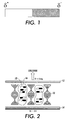
- FIGURE 1 is a schematic representation of a dipolar molecule.
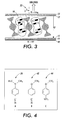
- FIGURE 2 is a simplified elevational view of a liquid crystal display embodiment having liquid crystals in a planar state;
- FIGURE 3 is a simplified elevational view of a liquid crystal display embodiment having liquid crystals in a rotated state;
- FIGURE 4 depicts dipolar dopants suitable for practicing embodiments of the present disclosure; and
- FIGURE 5 is a graph of reflectance versus wavelength for different applied voltages in one embodiment of a liquid crystal device.
- The present disclosure describes introducing a dipolar dopant into a cholesteric mixture which is selected to reflect visible light. A dipolar molecule with only limited solubility in the liquid crystal is dispersed into the liquid crystal mixture. The reflected wavelength (color) changes, as a function of an applied electric field which rotates the dipolar molecules. The reflected wavelength changes due to a rotation of the cholesteric liquid crystal domains which are coerced into rotation by the rotation of the dipolar molecules.
- A more complete understanding of the processes and apparatuses disclosed herein can be obtained by reference to the accompanying drawings. These figures are merely schematic representations based on convenience and the ease of demonstrating the present development, and are, therefore, not intended to indicate relative size and dimensions of the display devices or components thereof and/or to define or limit the scope of the exemplary embodiments.
- With reference to FIG. 2, cholesteric
liquid crystals 10 reflect color when they are arranged in the planar texture as shown in the figure, i.e. when the axis of the helix lies normal to thesubstrates liquid crystal 10 to go through one complete rotation of 360 degrees. The director is defined as the molecular direction of preferred orientation in liquid crystalline mesophases. - The change in reflected color is based on a coerced rotation of small planar domains of the cholesteric
liquid crystals 10 by the rotation ofnearby domains 16 containing thedipolar molecule 18. Initially, for example, the liquid crystal cell reflects red light. As shown in FIG. 2, for a given voltage applied totransparent electrodes electric field 20, the helix is rotated through an angle θ (22), and the reflected wavelength is decreased. In this example, the cell takes on a green appearance. - The reflected color in a planar cholesteric display is a function of the viewing angle. In the case described above, the reflected color is a function of the angle θ (22) between the direction of the helix axis and the direction perpendicular to the
display substrates 
where λ0 is the reflected wavelength at θ = 0. - The dipolar molecule (see FIG. 1) consists of an electron donor group and an electron acceptor group connected at the ends of a conjugated path. This results in the general structure: Donor - Conjugated Path - Acceptor. The electron donor is an atom or a group of atoms that have a negative Hammett parameter. The electron acceptor is a group of atoms having a positive Hammett parameter. Donor group is selected from an atom selected from the group consisting of N, O, S, and P, where the valence of the atom is satisfied by bonding to at least one other moiety to satisfy the valence of the atom; the other moiety or moieties to satisfy the valence of the atom selected as the electron donor moiety may be for instance a hydrogen atom, or short hydrocarbon group such as a straight alkyl chain having for example 1 to about 3 carbon atoms.
- The conjugated bridging moiety may be any suitable group through which electrons can pass from the electron donor moiety (D) to the electron acceptor moiety (A). In embodiments, the conjugated bridging moiety (C) is a selected from the following:
- (a) phenyl ring.
- (b) fused aromatic rings having for instance from about 10 to about 50 carbon atoms such as 1,4-C10H6 and 1,5-C10H6.
- Electron acceptor group is selected from:
- The electron acceptor moiety (A) may be any suitable atom or group capable of accepting electrons. In embodiments, the electron acceptor moiety (A1,A2) is an electron withdrawing functional moiety which according to Hammett equation possesses a positive Hammett constant. The electron acceptor moiety may be for example the following:
- (a) an aldehyde (-CO-H);
- (b) a ketone (-CO-R) where R may be for example a straight chain alkyl group having for example 1 to about 3 carbon atoms, such as methyl, ethyl, propyl and isopropyl.
- (c) an ester (-COOR) where R may be for example a straight chain alkyl group having for example 1 to about 3 carbon atoms, such as methyl, ethyl, propyl and isopropyl.
- (d) a carboxylic acid (-COOH);
- (e) cyano (CN);
- (f) nitro (N02);
- (g) nitroso (N=O);
- (h) a sulfur-based group (e.g., -S02-CH3; and -S02-CF3);
- (i) a fluorine atom;
- (k) a boron atom.
- Examples of some dipolar molecules which are suitable for the described color switching method are shown in FIG. 4. The molecules shown are small molecules having dipole moments preferably as high as possible, but which are not colored.
- The dipolar molecules are selected such that they melt at a temperature not higher than the temperature at which the liquid crystal starts boiling, because this results in change of the composition of liquid crystal due to evaporation. In a preferred embodiment, the dipolar dopant is completely soluble or miscible in the liquid crystal at a temperature at which the liquid crystal becomes isotropic, i.e. displays no liquid crystalline behavior. Additionally, upon cooling to room temperature, the dipolar dopant becomes phase separated from the liquid crystal material.
- A liquid crystal is an organic compound in an intermediate or mesomorphic state between solid and liquid. These compounds are a crystalline solid until heated to become a turbid liquid, or liquid crystals. On further heating, the liquid becomes isotropic. This sequence is reversed when the substance is cooled. Many of the commercially available liquid crystals are liquid crystals at the ambient conditions. Many organic compounds exhibiting this behavior are known and used extensively in electric and electronic displays, thermometers, LCD TV sets, electronic clocks and calculators, and similar devices dependent on temperature determination. Liquid crystals have several varieties of molecular order: nematic, smectic, and cholesteric.
- In this regard, cholesteric is a molecular structure found in some liquid crystals, so called because it was first noted in cholesteryl alcohol. It occurs in some optically active compounds and in mixtures of chiral compounds and nematic liquid crystals.
- Suitable cholesteric liquid crystal materials for use herein include for example BL mixtures available from EM Industries, Inc., Hawthorne, N.Y. (BL088, BL 90, BL94 and BL108 as a few examples). The helical pitch is tuned to the desired range by mixing this cholesteric liquid crystal mixture with a nematic liquid crystal. Examples of nematic liquid crystal BL mixtures available at EM Industries, Inc., BL001 (E7), BL002 (E8), BL033 (version of BL002) and BL087, and 5CB (commercially available at Sigma-Aldrich). The cholesteric liquid crystal composition is adjusted in such a way as to reflect light in the visible range (from about 400 nm to about 730 nm) when is aligned in its planar state.
- In one embodiment, a display is fabricated by melting a mixture of cholesteric liquid crystal BL088 (available from Merck Ltd.) and 17 % (w/w) N,N-dimethylbenzonitrile (24, in FIG. 4) between two indium-tin-oxide (ITO) coated glass slides, which act as a liquid crystal cell. When cool, e.g. room temperature, the sample embodiment reflects a red color.
- When a DC voltage is applied, generating an electric field between the substrates, a shift of the reflected wavelength is observed. The shift becomes larger as the voltage is increased, and the shift is consistent with rotation of the helices of the cholesteric domains. With reference now to FIG. 5, a graph is provided showing percentage of
reflectance 30 as a function of wavelength 32 at three different applied voltages when utilizing the above-described N,N-dimethyl-benzonitrile dopant (24). The shift of the peak of the reflected wavelength curve from 630 nm at 0 V (34), to 610 nm at 30 V (36), and to 580 nm at 60 V (38) is shown. - At higher voltages, a transparent state is obtained as the liquid crystal helices (10) rotate toward a focal-conic state, or break up in a homeotropic state at even higher voltages. Because the back of the display is coated with a black absorptive layer (40 in FIG. 3), an observer sees black in the transparent state. Without the dipolar dopant (24), no shift is observed. Rather, only a sudden change to the homeotropic or focal-conic states is observed, both of which are transparent.
- As it can be observed from FIG. 5, a relatively strong reflection is also observed in the region of 400-500 nm for each of the three reflectance curves. Because the dipolar dopant (24) is not colored, this reflection can not be attributed to the dopant. Rather, the reflection is believed to be due to the rotation of the domains (16 in FIG. 3) containing the inserted
dipolar molecule 24. It is probable that they rotate more when compared with dopant free domains. This side effect is probably due to the fact that a small amount of thedipolar molecule 24 is miscible with theliquid crystal 10. Use of dopants containing fewer methyl groups (for example, 42, 44 in FIG. 4) is expected to decrease this side effect. - Planar alignment layers may be optionally be coated on the surface of the electrodes. This results in improved planar alignment of the helices in the color reflecting state which provides more saturated reflected color. Surface alignment layers for planar alignment are known and they include for example thermally crosslinkable polyimides as for example those produced by Nissan Chemical Ind., Ltd. Improved planar alignment is provided by rubbing the polyimide coated substrates.
- Important factors for the fabrication of a good quality multi-color display include relatively poor miscibility of the dipolar dopant with the cholesteric liquid crystal, and the formation of essentially transparent domains containing the dipolar molecules. Formation of large crystals of dopant should be avoided so that the display does not scatter light and, as a consequence, have a white appearance.
- It is to be appreciated that selective areas of a display and surrounding areas can be switched independently so that an image can be generated on the display. Each of selective display areas can be switched as necessary, to a selective colored state, or to a transparent (black) state.
Claims (12)
- A cholesteric display composition comprising:(a) a cholesteric liquid crystal reflecting light in the visible region of the spectrum; and(b) a dipolar dopant having limited miscibility mixed with the cholesteric liquid crystal.
- The composition of claim 1, wherein the dipolar dopant is selected from N, N - dimethyl benzonitrile,4 - methoxybenzonitrile and 4 - methoxynitrobenzene
- The composition of claim 1, wherein the dipolar dopant is phase separated from the liquid crystal at room temperature.
- The composition of claim 1, wherein the dipolar dopant is present in an amount from 0.1 % to 30% by weight with respect to the amount of the cholesteric liquid crystal.
- A process for forming a cholesteric display comprising:(a) providing a cholesteric liquid crystal;(b) dissolving a dipolar dopant having limited miscibility into the cholesteric liquid crystal to form a cholesteric liquid crystal composition; and,(c) adding the cholesteric liquid crystal composition to a liquid crystal display well.
- The process of claim 5, wherein dipolar dopant is dissolved into the liquid crystal in an amount from 0.1 % to 30% by weight with respect to the amount of the liquid crystal composition.
- The process of claim 5, wherein at room temperature, the dipolar dopant is phase separated from the liquid crystal.
- A device comprising a liquid crystal composition including a cholesteric liquid and a dipolar dopant having limited solubility therein, wherein liquid crystal domains in the liquid crystal composition rotate away from a planar state in the presence of an applied electric field and the degree of rotation is a function of the applied electric field strength.
- The device according to claim 8, which further comprises two substrates between which the liquid crystal composition is located, and a means for applying an electric field.
- The device of claim 8, further comprising:an electric field generator that electrically induces the rotation of the liquid crystal domains.
- The device according to any of claims 8 to 10, further including a colored surface positioned to absorb a portion of a predetermined light that passes through the cholesteric liquid when in a focul conic or in homeotropic state such that an observer sees a predetermined color.
- The device according to any of claims 8 to 11, wherein the dipolar dopant is present in an amount of 1 % to 30% by weight with respect to the amount of the cholesteric liquid.
Applications Claiming Priority (1)
| Application Number | Priority Date | Filing Date | Title |
|---|---|---|---|
| US11/003,169 US7195802B2 (en) | 2004-12-03 | 2004-12-03 | Multi-color cholesteric liquid crystal display |
Publications (1)
| Publication Number | Publication Date |
|---|---|
| EP1666962A1 true EP1666962A1 (en) | 2006-06-07 |
Family
ID=35911205
Family Applications (1)
| Application Number | Title | Priority Date | Filing Date |
|---|---|---|---|
| EP05257436A Withdrawn EP1666962A1 (en) | 2004-12-03 | 2005-12-02 | Multi-color cholesteric liquid crystal display |
Country Status (3)
| Country | Link |
|---|---|
| US (1) | US7195802B2 (en) |
| EP (1) | EP1666962A1 (en) |
| JP (1) | JP2006161044A (en) |
Cited By (1)
| Publication number | Priority date | Publication date | Assignee | Title |
|---|---|---|---|---|
| CN109031738A (en) * | 2017-06-12 | 2018-12-18 | 江苏和成显示科技有限公司 | A kind of liquid crystal display device and its application |
Families Citing this family (7)
| Publication number | Priority date | Publication date | Assignee | Title |
|---|---|---|---|---|
| US7238397B2 (en) * | 2004-12-03 | 2007-07-03 | Xerox Corporation | Black/white cholesteric bistable display with increased white reflectivity |
| JP2008039885A (en) * | 2006-08-02 | 2008-02-21 | Toppan Printing Co Ltd | Method for manufacturing flexible electronic display panel |
| JPWO2008038358A1 (en) * | 2006-09-28 | 2010-01-28 | 富士通株式会社 | Display element, display element image rewriting method, and electronic paper and electronic terminal using display element |
| US7867672B2 (en) * | 2007-06-13 | 2011-01-11 | Xerox Corporation | Reimageable paper protected against UV light |
| US7852366B2 (en) * | 2007-06-13 | 2010-12-14 | Xerox Corporation | System and method for printing reimageable transient documents |
| TWI407191B (en) | 2010-12-24 | 2013-09-01 | Ind Tech Res Inst | Display method of cholesterol liquid crystal display and cholesterol liquid crystal display |
| CN107407841B (en) * | 2015-03-18 | 2021-01-15 | 夏普株式会社 | Liquid crystal display device having a plurality of pixel electrodes |
Citations (5)
| Publication number | Priority date | Publication date | Assignee | Title |
|---|---|---|---|---|
| US3680950A (en) * | 1971-03-15 | 1972-08-01 | Xerox Corp | Grandjean state liquid crystalline imaging system |
| US3697150A (en) * | 1971-01-06 | 1972-10-10 | Xerox Corp | Electro-optic systems in which an electrophoretic-like or dipolar material is dispersed throughout a liquid crystal to reduce the turn-off time |
| WO2002025364A1 (en) * | 2000-09-23 | 2002-03-28 | Motorola, Inc. | Liquid crystal device having variable reflected wavelength |
| US6665042B1 (en) | 2000-05-16 | 2003-12-16 | The University Of Rochester | Electrically switchable polymer liquid crystal and polymer birefringent flake in fluid host systems and optical devices utilizing same |
| EP1439215A1 (en) | 2002-12-13 | 2004-07-21 | Xerox Corporation | Domain size controlled liquid crystals |
Family Cites Families (4)
| Publication number | Priority date | Publication date | Assignee | Title |
|---|---|---|---|---|
| US5691798A (en) * | 1995-07-27 | 1997-11-25 | Teijin Chemicals Ltd. | Progressive power ophthalmic lens |
| US6767480B2 (en) * | 2002-12-13 | 2004-07-27 | Xerox Corporation | Compounds of formula (1) to stabilize liquid crystal domains |
| US6824708B2 (en) * | 2002-12-13 | 2004-11-30 | Xerox Corporation | Liquid crystal compositions including dispersant |
| US6858266B2 (en) * | 2002-12-13 | 2005-02-22 | Xerox Corporation | Domain size controlled liquid crystals |
-
2004
- 2004-12-03 US US11/003,169 patent/US7195802B2/en not_active Expired - Fee Related
-
2005
- 2005-12-01 JP JP2005347431A patent/JP2006161044A/en not_active Withdrawn
- 2005-12-02 EP EP05257436A patent/EP1666962A1/en not_active Withdrawn
Patent Citations (5)
| Publication number | Priority date | Publication date | Assignee | Title |
|---|---|---|---|---|
| US3697150A (en) * | 1971-01-06 | 1972-10-10 | Xerox Corp | Electro-optic systems in which an electrophoretic-like or dipolar material is dispersed throughout a liquid crystal to reduce the turn-off time |
| US3680950A (en) * | 1971-03-15 | 1972-08-01 | Xerox Corp | Grandjean state liquid crystalline imaging system |
| US6665042B1 (en) | 2000-05-16 | 2003-12-16 | The University Of Rochester | Electrically switchable polymer liquid crystal and polymer birefringent flake in fluid host systems and optical devices utilizing same |
| WO2002025364A1 (en) * | 2000-09-23 | 2002-03-28 | Motorola, Inc. | Liquid crystal device having variable reflected wavelength |
| EP1439215A1 (en) | 2002-12-13 | 2004-07-21 | Xerox Corporation | Domain size controlled liquid crystals |
Non-Patent Citations (1)
| Title |
|---|
| LI Z ET AL: "ELECTRICALLY TUNABLE COLOR (ETC) FOR FULL-COLOR REFLECTIVE DISPLAYS", CONFERENCE RECORD OF THE 20TH INTERNATIONAL DISPLAY RESEARCH CONFERENCE. PALM BEACH, FL, SEPT. 25 - 28, 2000, INTERNATIONAL DISPLAY RESEARCH CONFERENCE (IDRC), SAN JOSE, CA : SID, US, vol. CONF. 20, 25 September 2000 (2000-09-25), pages 265 - 268, XP000993747 * |
Cited By (2)
| Publication number | Priority date | Publication date | Assignee | Title |
|---|---|---|---|---|
| CN109031738A (en) * | 2017-06-12 | 2018-12-18 | 江苏和成显示科技有限公司 | A kind of liquid crystal display device and its application |
| WO2018228324A1 (en) * | 2017-06-12 | 2018-12-20 | 江苏和成显示科技有限公司 | Liquid crystal display device and application thereof |
Also Published As
| Publication number | Publication date |
|---|---|
| JP2006161044A (en) | 2006-06-22 |
| US20060118762A1 (en) | 2006-06-08 |
| US7195802B2 (en) | 2007-03-27 |
Similar Documents
| Publication | Publication Date | Title |
|---|---|---|
| Rahman et al. | Blue phase liquid crystal: strategies for phase stabilization and device development | |
| US8264639B2 (en) | Polymer enhanced cholesteric electro-optical devices | |
| Chen et al. | Hysteresis effects in blue-phase liquid crystals | |
| KR101905448B1 (en) | Smectic a compositions for use in optical devices | |
| JP5710110B2 (en) | ELECTRO-OPTICAL LIGHT CONTROL ELEMENT, DISPLAY AND MEDIUM | |
| Lu et al. | A polymer-stabilized single-layer color cholesteric liquid crystal display with anisotropic reflection | |
| US7283196B2 (en) | Liquid crystal device, a method for producing a liquid crystal device and a method for controlling a liquid crystal device | |
| Gahrotra et al. | Performance augmentation of bistable cholesteric liquid crystal light shutter-effect of dichroic dye on morphological and electro-optical characteristics | |
| US7812919B2 (en) | Cholesteric liquid crystal light modulators | |
| Ahmad et al. | Reverse mode polymer stabilized cholesteric texture (PSCT) light shutter display–A short review | |
| Yeh et al. | Color tuning in thermo-sensitive chiral photonic liquid crystals based on the pseudo-dielectric heating effect | |
| US7195802B2 (en) | Multi-color cholesteric liquid crystal display | |
| Itoh et al. | Development of electroresponsive functional soft materials by electroresponsive dopants | |
| Wu et al. | All-electrical switching and electrothermo-optical response of a tristable smectic-A liquid crystal | |
| CA2527997C (en) | Low voltage e-paper | |
| Chen et al. | Diluter effects on polymer-stabilized blue phase liquid crystals | |
| Sala-Tefelska et al. | Influence of cylindrical geometry and alignment layers on the growth process and selective reflection of blue phase domains | |
| WO2021116843A1 (en) | Elecro-optical modulator comprising a cholesteric liquid crystal mesomorphic composition | |
| Lin et al. | Effects of chiral dopant on electro-optical properties of nematic liquid crystal cells under in-plane switching and non-uniform vertical electric fields | |
| Nishi et al. | Electrostriction-based orientation control of blue phase I liquid crystal | |
| WO2018169783A1 (en) | Fast flexoelectro-optic switching based on bimesogen-doped and polymer-stabilized vertical standing helix mode | |
| Kemiklioglu et al. | Effect of achiral halogen-substituted bent-core molecules on the blue phases | |
| Gollapelli et al. | Electric field-driven structural changes in cholesteric shells for optical applications | |
| Baral et al. | Enhanced photoluminescence in a chiral nematic liquid crystal through polymer stabilization and an erasable 3-state memory device | |
| Baral et al. | Giant enhancement of photoluminescence and tertiary emission in a chiral nematic by matching photonic band gap and excitation wavelength |
Legal Events
| Date | Code | Title | Description |
|---|---|---|---|
| PUAI | Public reference made under article 153(3) epc to a published international application that has entered the european phase |
Free format text: ORIGINAL CODE: 0009012 |
|
| AK | Designated contracting states |
Kind code of ref document: A1 Designated state(s): AT BE BG CH CY CZ DE DK EE ES FI FR GB GR HU IE IS IT LI LT LU LV MC NL PL PT RO SE SI SK TR |
|
| AX | Request for extension of the european patent |
Extension state: AL BA HR MK YU |
|
| 17P | Request for examination filed |
Effective date: 20061207 |
|
| 17Q | First examination report despatched |
Effective date: 20070112 |
|
| AKX | Designation fees paid |
Designated state(s): DE FR GB |
|
| GRAP | Despatch of communication of intention to grant a patent |
Free format text: ORIGINAL CODE: EPIDOSNIGR1 |
|
| STAA | Information on the status of an ep patent application or granted ep patent |
Free format text: STATUS: THE APPLICATION IS DEEMED TO BE WITHDRAWN |
|
| 18D | Application deemed to be withdrawn |
Effective date: 20101216 |