EP1666844A2 - Improvements to multifunction aircraft probes - Google Patents
Improvements to multifunction aircraft probes Download PDFInfo
- Publication number
- EP1666844A2 EP1666844A2 EP06101230A EP06101230A EP1666844A2 EP 1666844 A2 EP1666844 A2 EP 1666844A2 EP 06101230 A EP06101230 A EP 06101230A EP 06101230 A EP06101230 A EP 06101230A EP 1666844 A2 EP1666844 A2 EP 1666844A2
- Authority
- EP
- European Patent Office
- Prior art keywords
- aircraft
- assembly according
- probe
- probe assembly
- pneumatic ports
- Prior art date
- Legal status (The legal status is an assumption and is not a legal conclusion. Google has not performed a legal analysis and makes no representation as to the accuracy of the status listed.)
- Granted
Links
Images


Classifications
-
- B—PERFORMING OPERATIONS; TRANSPORTING
- B64—AIRCRAFT; AVIATION; COSMONAUTICS
- B64D—EQUIPMENT FOR FITTING IN OR TO AIRCRAFT; FLIGHT SUITS; PARACHUTES; ARRANGEMENT OR MOUNTING OF POWER PLANTS OR PROPULSION TRANSMISSIONS IN AIRCRAFT
- B64D45/00—Aircraft indicators or protectors not otherwise provided for
-
- G—PHYSICS
- G01—MEASURING; TESTING
- G01C—MEASURING DISTANCES, LEVELS OR BEARINGS; SURVEYING; NAVIGATION; GYROSCOPIC INSTRUMENTS; PHOTOGRAMMETRY OR VIDEOGRAMMETRY
- G01C23/00—Combined instruments indicating more than one navigational value, e.g. for aircraft; Combined measuring devices for measuring two or more variables of movement, e.g. distance, speed or acceleration
- G01C23/005—Flight directors
-
- G—PHYSICS
- G01—MEASURING; TESTING
- G01P—MEASURING LINEAR OR ANGULAR SPEED, ACCELERATION, DECELERATION, OR SHOCK; INDICATING PRESENCE, ABSENCE, OR DIRECTION, OF MOVEMENT
- G01P13/00—Indicating or recording presence, absence, or direction, of movement
- G01P13/02—Indicating direction only, e.g. by weather vane
- G01P13/025—Indicating direction only, e.g. by weather vane indicating air data, i.e. flight variables of an aircraft, e.g. angle of attack, side slip, shear, yaw
-
- G—PHYSICS
- G01—MEASURING; TESTING
- G01P—MEASURING LINEAR OR ANGULAR SPEED, ACCELERATION, DECELERATION, OR SHOCK; INDICATING PRESENCE, ABSENCE, OR DIRECTION, OF MOVEMENT
- G01P5/00—Measuring speed of fluids, e.g. of air stream; Measuring speed of bodies relative to fluids, e.g. of ship, of aircraft
- G01P5/14—Measuring speed of fluids, e.g. of air stream; Measuring speed of bodies relative to fluids, e.g. of ship, of aircraft by measuring differences of pressure in the fluid
- G01P5/16—Measuring speed of fluids, e.g. of air stream; Measuring speed of bodies relative to fluids, e.g. of ship, of aircraft by measuring differences of pressure in the fluid using Pitot tubes, e.g. Machmeter
- G01P5/165—Arrangements or constructions of Pitot tubes
Definitions
- the present invention relates generally to multifunctional aircraft sensor probes which derive flight data and/or information (e.g., angle of attack, side slip, airspeed, altitude and/or vertical speed) from airstream pressure conditions of the aircraft's flight profile.
- flight data and/or information e.g., angle of attack, side slip, airspeed, altitude and/or vertical speed
- Multifunction aircraft sensor probes are known, such as the multifunction aircraft probe assemblies disclosed in the above-cited Baltins et al '526 patent.
- the probe assemblies of the Baltins et al '526 patent are generally embodied in a rotatable airstream direction probe which is additionally provided with a dynamic pressure sensing port positioned substantially midway between a pair of pneumatic sensing ports which are symmetrically positioned with respect to the probe's stagnation line.
- a set of pneumatic output ports may thus be provided, each of which communicates with a respective one of the pneumatic sensing ports in the probe.
- the pneumatic pressure at the output port(s) in communication with the sensing ports will be essentially at a pressure P 1 which is a monotonic function of static (atmospheric) pressure over a wide range of airspeeds (e.g., from 0.1 Mach to supersonic speeds).
- the dynamic pressure sensing port will be presented directly to the airstream when the pressures within the pneumatic sensing ports are balanced.
- a dynamic pressure output port which communicates with the dynamic pressure sensing port will exhibit a maximum airstream pressure P 0 which is a monotonic function of pitot (ram) pressure over a wide range of airspeeds.
- pressures P 1 and P 0 can thus be converted mathematically into actual pitot (ram) and static (atmospheric) pressures undiluted by any error dependent upon the aircraft's angle of attack and/or side slip.
- the probe can thus be employed to derive angle of attack and/or side slip flight data information, in addition to primary flight data, such as airspeed, altitude and/or vertical speed.
- the multifunction probe design embodied in the Baltins et al '526 patent may be improved by providing circumferentially separated pairs of sensing ports which are respectively dedicated to angle of attack functionality and air data pressure sensing functionality.
- the probe design in accordance with the present invention is especially well suited to reduce the impact of the complex shock system that develops about the probe during supersonic flight. Thus, improved airstream pressure sensing capabilities ensue.
- a multifunction aircraft probe is provided with a distal probe element which is adapted to project outwardly from an aircraft with which it is operatively mated and being mounted for rotational movement about its projection axis.
- the probe element is provided with a centrally located (i.e., in substantial alignment with the probe's stagnation line) dynamic pressure sensing port, and outer and inner pairs of pneumatic sensing ports which are symmetrically circumferentially separated from one another and from the dynamic pressure sensing port.
- each of the outer pneumatic sensing ports is circumferentially spaced from the central dynamic pressure sensing port by substantially 90° (i.e., circumferentially separated from one another by about 180° so as to be substantially latitudinally opposed to one another) while each of the inner pneumatic sensing ports is circumferentially spaced from the central dynamic pressure sensing port by substantially 45° (i.e., circumferentially separated from one another by about 90°.
- the angle of attack functionality may be maintained completely independent of the air data pressure sensing functionality of the probe assembly.
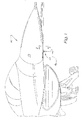
- FIGURE 1 shows in perspective view a portion of an aircraft AC having an sensor probe assembly 10 in accordance with the present invention mated to a forward fuselage section FS.
- the probe assembly projects outwardly from the aircraft fuselage FS along a projection axis A p so as to be exposed perpendicularly to the in-flight airstream.
- the aircraft sensor probe assembly 10 is depicted in FIGURE 1 as projecting downwardly from the aircraft AC, it will of course be understood that it may project laterally from the aircraft AC if desired.
- the probe assembly 10 of this invention may project from the aircraft at virtually any desired orientation so as to decouple the effects of multiple axis aircraft rotations.
- a laterally projecting orientation of the probe assembly 10 may be desired if the angle of attack is intended to be measured with as little influence as possible from the aircraft's angle of sideslip.
- a downwardly projecting orientation as shown in the accompanying drawing FIGURES may be desired if the aircraft's angle of sideslip is intended to be measured with as little influence as possible from the aircraft's angle of attack.
- the airstream direction/pressure data obtained by the probe assembly 10 of this invention may be transferred to the aircraft's on-board flight instrumentation and/or flight director systems via conventional electrical/pneumatic lines connected to the sensor housing 14 (see FIGURE 2).
- the internal structures and functions of the housing 14 may be in accordance with the Baltins et al '526 patent, and thus a detailed description thereof may be omitted here.
- the probe assembly 10 is generally comprised of the housing 14, a generally conical hollow probe element 16, a mounting collar 14-1 and a separator vane 18.
- the mounting collar 14-1 is provided so that the probe assembly 10 may be mounted to support structures S associated with the aircraft's fuselage FS such that the housing 14 is within the fuselage FS and the probe element 16 extends outwardly therefrom along projection axis A p .
- the separator vane 18 is positioned entirely within the hollow of the probe element 16 and is fixed thereto in such a manner that it rotates as a unit with the probe element 16 around the projection axis A p .
- the conically-shaped hollow probe element 10 is mounted to the housing 14 for pivotal movements the probe projection axis A p .
- the probe element 16 is provided a central dynamic pressure sensing port 20 which is aligned with the probe element's stagnation line (or the line of highest airstream pressure impinging on the probe element's surface) coincident with the probe element's projection axis A p .
- the sensing port 20 is most preferably in the form of an elongate slot, the axis of elongation being disposed generally in the direction of the projection axis A p .
- Proximal and distal pairs of pneumatic sensing ports 22 and 24, respectively, are provided in the probe element 16 with each being symmetrically circumferentially spaced from the central dynamic pressure port 20.
- each of the sensing ports 22, 24 is preferably symmetrically circumferentially spaced from the port 20 by substantially 45° (i.e., so that the pairs of proximal and distal inner pressure ports 22 and 24, respectively, are circumferentially spaced from each other by substantially 90°).
- Each of the ports 22, 24 is most preferably in the form of elongate slots whose longitudinal extent is disposed generally in the direction of the projection axis A p .
- the proximal and distal ports 22 and 24, respectively are longitudinally aligned with one another.
- a pair of outer pneumatic pressure ports 26 is also provided in the probe element 16.
- each of the outer pressure ports 26 is symmetrically circumferentially spaced from the central pressure port 20 by about 90° (i.e., so that the pressure ports 26 are substantially latitudinally opposed to one another in the outer surface of the probe element 16).
- the outer pair of pressure ports 26 are proximally positioned in the outer surface of the probe element 16 relative to the more distally located pairs of ports 22 and 24.
- the ports 26 are most preferably in the form of elongate slots whose longitudinal extent is disposed generally in the direction of the projection axis A p .
- each of the ports 20, 22 and 24 is most preferably tapered toward the apical end of the conical probe element 16. That is, the ports 20, 22 and 24 are tapered to an extent so as to have a substantially constant included angle - that is, so as to taper to the same extent as the probe element 16.
- the separator vane 18 is perhaps more clearly depicted in accompanying FIGURES 4-7.
- the separator vane 18 is most preferably in the form of a one-piece triangularly shaped structure which is sized and dimensioned between its converging leading and trailing edges 32, 34, respectively, so as to fit closely within the conical interior of the probe element 16.
- the apical end of the separator vane 18 is therefore provided with a conical section 30 which is seated against the interior surface of the probe element 16 at its respective apical end.
- the leading edge 32 of the separator vane 18 is provided with a recessed elongate leading edge channel 36 which is in aligned, fluid communication with the central pressure port 20 when the separator vane 18 is operatively mated to the probe element 16.
- Pressure conditions within the leading edge channel 36 communicate with the pressure sensing components (e.g., either contained within the housing 14 and/or part of the aircraft's on-board flight systems) via channel 36-1.
- a tubular conduit 36-2 is preferably inserted into a portion of the channel 36-1 to facilitate connection with the not shown operative pressure sensing components.
- a pair of opposed side bosses 38 extend outwardly from each lateral side of the vane separator 18 between its leading and trailing edges 32, 34.
- the side bosses 38 terminate in a convexly curved surface 38-1 whose generatrices correspond to that of the interior surface of the conically shaped probe element 16.
- the surfaces 38-1 of the bosses 38 are in contact with the interior of the probe element 16 when the separator vane 18 is mated therewith. This contact between the terminal convexly curved edges 38-1 and the probe element 16 allows electrical resistance-generated heat to be transferred to the probe element 16 and thereby serve to prevent in-flight ice accretion near the ports 26.
- the side bosses 38 collectively define a generally triangularly shaped through-bore 38-2 which extends transversely relative to the plane of the separator vane 18 (i.e., as defined between its leading and trailing edges 32, 34, respectively) between the surfaces 38-1.
- the outer pressure ports 26 are in aligned, fluid communication with the through-bore 38-2.
- the pressure conditions sensed by the outer pressure ports 26, and hence present in the through-bore 38-2 in fluid communication therewith, may be transferred to the on-board operative pressure sensors/instrumentation via a tubular conduit 38-3 (see FIGURE 7).
- a pair of planar lateral vanes 40 extend substantially perpendicularly from respective sides of the separator vane 18.
- the terminal edges 40-1 are convexly curved so as to closely correspond to the generatrices of the cylindrical interior surface of the probe element 16. in this regard, these convexly curved terminal edges 40-1 are in contact with the interior surface of the hollow probe element 16 when the separator vane 18 is nested therewithin. This contact between the terminal edges 40-1 and the probe element 16 allows electrical resistance-generated heat to be transferred to the probe element 16 and thereby serve to prevent in-flight ice accretion near the ports 22 and/or 24. Furthermore, it will be observed that the lateral vanes 40 are disposed so as to be subjacent to the proximal pneumatic sensing ports 22 defined in the probe element 16.
- the leading edge channel 36 is provided near the triangular base of the separator vane 18 with a recessed sump 42.
- a symmetrical pair of laterally extending wedge-shaped sections 44 near the trailing edge of the separator vane 18 include respective drain channels 46.
- Each of the drain channels have a distal end 46-1 (see FIGURE 7) which opens into the sump 42 and a proximal end 46-2 (see FIGURE 6) which is aligned with drain apertures 48 formed in the trailing side of the probe element 16 (see FIGURE 2A).
- the base of the separator vane 18 is provided with an elongate key 50 which extends between the leading and trailing edges 32, 34.
- the key 50 is sized and configured to mate with a corresponding slot (not shown) associated with the internal operative components housed within the base 14.
- a respective pressure chamber is defined between the separator vane 18 and the interior surface of the hollow conically shaped probe element 16 which is in fluid-communication with the inner pneumatic ports 22, 24.
- This chamber may thus be connected operatively through the housing 14 to the aircraft's on board pressure sensors/instrumentation by means not shown.
- the chambers defined by the leading edge channel 36 and the through-bore 38-2 may be connected operatively through the housing 14 to the aircraft's on-board pressure sensors/instrumentation.
- Electrical signals indicative of rotation of the probe element may likewise be operatively connected via conventional cabling in a manner similar to that described in the above-cited Baltins et al '526 patent.
- the sensor probe assembly 10 of the present invention has been shown and described as a generally conical geometric configuration, it will be understood that such a form represents a presently preferred embodiment of the invention and is non-limiting with respect thereto.
- the sensor probe assembly 10 of the present invention may be provided in other non-conical geometric configurations, such as in the form of a general cylinder, a three-dimensional curvilinear structure, and the like. Suffice it to say here that the precise geometric form of the probe assembly 10 may be selected by those skilled in this art based on the probe's desired end-use environment and/or functions.
Landscapes
- Engineering & Computer Science (AREA)
- Aviation & Aerospace Engineering (AREA)
- Physics & Mathematics (AREA)
- General Physics & Mathematics (AREA)
- Radar, Positioning & Navigation (AREA)
- Remote Sensing (AREA)
- Measuring Fluid Pressure (AREA)
- Navigation (AREA)
- Arrangements For Transmission Of Measured Signals (AREA)
- Measurement Of Velocity Or Position Using Acoustic Or Ultrasonic Waves (AREA)
- Investigating Or Analyzing Materials By The Use Of Ultrasonic Waves (AREA)
- Treating Waste Gases (AREA)
- Air Conditioning Control Device (AREA)
Abstract
Description
- The present invention relates generally to multifunctional aircraft sensor probes which derive flight data and/or information (e.g., angle of attack, side slip, airspeed, altitude and/or vertical speed) from airstream pressure conditions of the aircraft's flight profile.
- Multifunction aircraft sensor probes are known, such as the multifunction aircraft probe assemblies disclosed in the above-cited Baltins et al '526 patent. In this regard, the probe assemblies of the Baltins et al '526 patent are generally embodied in a rotatable airstream direction probe which is additionally provided with a dynamic pressure sensing port positioned substantially midway between a pair of pneumatic sensing ports which are symmetrically positioned with respect to the probe's stagnation line. A set of pneumatic output ports may thus be provided, each of which communicates with a respective one of the pneumatic sensing ports in the probe.
- Thus, when the pneumatic pressures within the paired sensing ports are balanced, the pneumatic pressure at the output port(s) in communication with the sensing ports will be essentially at a pressure P1 which is a monotonic function of static (atmospheric) pressure over a wide range of airspeeds (e.g., from 0.1 Mach to supersonic speeds). The dynamic pressure sensing port, on the other hand, will be presented directly to the airstream when the pressures within the pneumatic sensing ports are balanced. As a result, a dynamic pressure output port which communicates with the dynamic pressure sensing port will exhibit a maximum airstream pressure P0 which is a monotonic function of pitot (ram) pressure over a wide range of airspeeds. These pressures P1 and P0 can thus be converted mathematically into actual pitot (ram) and static (atmospheric) pressures undiluted by any error dependent upon the aircraft's angle of attack and/or side slip. The probe can thus be employed to derive angle of attack and/or side slip flight data information, in addition to primary flight data, such as airspeed, altitude and/or vertical speed.
- It has now been discovered that the multifunction probe design embodied in the Baltins et al '526 patent may be improved by providing circumferentially separated pairs of sensing ports which are respectively dedicated to angle of attack functionality and air data pressure sensing functionality. The probe design in accordance with the present invention is especially well suited to reduce the impact of the complex shock system that develops about the probe during supersonic flight. Thus, improved airstream pressure sensing capabilities ensue.
- In one aspect of the present invention, therefore, a multifunction aircraft probe is provided with a distal probe element which is adapted to project outwardly from an aircraft with which it is operatively mated and being mounted for rotational movement about its projection axis. The probe element is provided with a centrally located (i.e., in substantial alignment with the probe's stagnation line) dynamic pressure sensing port, and outer and inner pairs of pneumatic sensing ports which are symmetrically circumferentially separated from one another and from the dynamic pressure sensing port. Most preferably, each of the outer pneumatic sensing ports is circumferentially spaced from the central dynamic pressure sensing port by substantially 90° (i.e., circumferentially separated from one another by about 180° so as to be substantially latitudinally opposed to one another) while each of the inner pneumatic sensing ports is circumferentially spaced from the central dynamic pressure sensing port by substantially 45° (i.e., circumferentially separated from one another by about 90°. In such a manner, the angle of attack functionality may be maintained completely independent of the air data pressure sensing functionality of the probe assembly.
- These and other aspects and advantages of the present invention will become more clear after careful consideration is given to the detailed description of the presently preferred exemplary embodiment thereof which follows.
- Reference will hereinafter be made to the accompanying drawings, wherein like reference numerals throughout the various FIGURES denote like structural elements, and wherein,
- FIGURE 1 is a partial perspective view of a forward section of an aircraft showing a preferred sensor assembly in accordance with the present invention;
- FIGURE 2 is a partial cross-sectional view taken through the aircraft fuselage along lines 2-2 in FIGURE 1 as viewed from the oncoming airstream flow showing in an enlarged manner a preferred sensor assembly of the present invention;
- FIGURE 2A is a partial rear perspective view of the sensor assembly depicted in FIGURE 2;
- FIGURE 3 is a partially exploded perspective view of the preferred sensor assembly of the present invention depicted in FIGURE 2;
- FIGURE 4 is an enlarged lateral perspective view of the rotatable pneumatic sensing vane which is employed in the preferred sensor assembly of the present invention;
- FIGURE 5 is an enlarged front perspective view of the rotatable pneumatic sensing vane depicted in FIGURE 4;
- FIGURE 6 is a bottom plan view of the rotatable pneumatic sensing vane depicted in FIGURE 4; and
- FIGURE 7 is a split perspective view of the rotatable pneumatic sensing vane depicted in FIGURE 4.
- Accompanying FIGURE 1 shows in perspective view a portion of an aircraft AC having an
sensor probe assembly 10 in accordance with the present invention mated to a forward fuselage section FS. The probe assembly projects outwardly from the aircraft fuselage FS along a projection axis Ap so as to be exposed perpendicularly to the in-flight airstream. In this regard, although the aircraftsensor probe assembly 10 is depicted in FIGURE 1 as projecting downwardly from the aircraft AC, it will of course be understood that it may project laterally from the aircraft AC if desired. Thus, like the sensor assembly disclosed and claimed in the related Baltins et al '526 patent, theprobe assembly 10 of this invention may project from the aircraft at virtually any desired orientation so as to decouple the effects of multiple axis aircraft rotations. Thus, a laterally projecting orientation of theprobe assembly 10 may be desired if the angle of attack is intended to be measured with as little influence as possible from the aircraft's angle of sideslip. Alternatively, a downwardly projecting orientation as shown in the accompanying drawing FIGURES may be desired if the aircraft's angle of sideslip is intended to be measured with as little influence as possible from the aircraft's angle of attack. - The airstream direction/pressure data obtained by the
probe assembly 10 of this invention may be transferred to the aircraft's on-board flight instrumentation and/or flight director systems via conventional electrical/pneumatic lines connected to the sensor housing 14 (see FIGURE 2). In this regard, the internal structures and functions of thehousing 14 may be in accordance with the Baltins et al '526 patent, and thus a detailed description thereof may be omitted here. - As is perhaps more clearly seen in accompanying FIGURES 2 and 3, the
probe assembly 10 is generally comprised of thehousing 14, a generally conicalhollow probe element 16, a mounting collar 14-1 and aseparator vane 18. The mounting collar 14-1 is provided so that theprobe assembly 10 may be mounted to support structures S associated with the aircraft's fuselage FS such that thehousing 14 is within the fuselage FS and theprobe element 16 extends outwardly therefrom along projection axis Ap. Theseparator vane 18 is positioned entirely within the hollow of theprobe element 16 and is fixed thereto in such a manner that it rotates as a unit with theprobe element 16 around the projection axis Ap. - The conically-shaped
hollow probe element 10 is mounted to thehousing 14 for pivotal movements the probe projection axis Ap. Theprobe element 16 is provided a central dynamicpressure sensing port 20 which is aligned with the probe element's stagnation line (or the line of highest airstream pressure impinging on the probe element's surface) coincident with the probe element's projection axis Ap. Thesensing port 20 is most preferably in the form of an elongate slot, the axis of elongation being disposed generally in the direction of the projection axis Ap. - Proximal and distal pairs of
pneumatic sensing ports probe element 16 with each being symmetrically circumferentially spaced from the centraldynamic pressure port 20. In this regard, each of thesensing ports port 20 by substantially 45° (i.e., so that the pairs of proximal and distalinner pressure ports ports distal ports - A pair of outer
pneumatic pressure ports 26 is also provided in theprobe element 16. Most preferably, each of theouter pressure ports 26 is symmetrically circumferentially spaced from thecentral pressure port 20 by about 90° (i.e., so that thepressure ports 26 are substantially latitudinally opposed to one another in the outer surface of the probe element 16). As shown in FIGURE 2, the outer pair ofpressure ports 26 are proximally positioned in the outer surface of theprobe element 16 relative to the more distally located pairs ofports ports ports 26 are most preferably in the form of elongate slots whose longitudinal extent is disposed generally in the direction of the projection axis Ap. In this regard, each of theports conical probe element 16. That is, theports probe element 16. - The
separator vane 18 is perhaps more clearly depicted in accompanying FIGURES 4-7. In this regard, theseparator vane 18 is most preferably in the form of a one-piece triangularly shaped structure which is sized and dimensioned between its converging leading andtrailing edges probe element 16. The apical end of theseparator vane 18 is therefore provided with aconical section 30 which is seated against the interior surface of theprobe element 16 at its respective apical end. - The leading
edge 32 of theseparator vane 18 is provided with a recessed elongate leadingedge channel 36 which is in aligned, fluid communication with thecentral pressure port 20 when theseparator vane 18 is operatively mated to theprobe element 16. Pressure conditions within the leadingedge channel 36 communicate with the pressure sensing components (e.g., either contained within thehousing 14 and/or part of the aircraft's on-board flight systems) via channel 36-1. In this regard, a tubular conduit 36-2 is preferably inserted into a portion of the channel 36-1 to facilitate connection with the not shown operative pressure sensing components. - A pair of
opposed side bosses 38 extend outwardly from each lateral side of thevane separator 18 between its leading andtrailing edges side bosses 38 terminate in a convexly curved surface 38-1 whose generatrices correspond to that of the interior surface of the conicallyshaped probe element 16. Specifically, the surfaces 38-1 of thebosses 38 are in contact with the interior of theprobe element 16 when theseparator vane 18 is mated therewith. This contact between the terminal convexly curved edges 38-1 and theprobe element 16 allows electrical resistance-generated heat to be transferred to theprobe element 16 and thereby serve to prevent in-flight ice accretion near theports 26. - The
side bosses 38 collectively define a generally triangularly shaped through-bore 38-2 which extends transversely relative to the plane of the separator vane 18 (i.e., as defined between its leading andtrailing edges separator vane 18 is positioned within thehollow probe element 16, theouter pressure ports 26 are in aligned, fluid communication with the through-bore 38-2. The pressure conditions sensed by theouter pressure ports 26, and hence present in the through-bore 38-2 in fluid communication therewith, may be transferred to the on-board operative pressure sensors/instrumentation via a tubular conduit 38-3 (see FIGURE 7). - A pair of planar
lateral vanes 40 extend substantially perpendicularly from respective sides of theseparator vane 18. The terminal edges 40-1 are convexly curved so as to closely correspond to the generatrices of the cylindrical interior surface of theprobe element 16. in this regard, these convexly curved terminal edges 40-1 are in contact with the interior surface of thehollow probe element 16 when theseparator vane 18 is nested therewithin. This contact between the terminal edges 40-1 and theprobe element 16 allows electrical resistance-generated heat to be transferred to theprobe element 16 and thereby serve to prevent in-flight ice accretion near theports 22 and/or 24. Furthermore, it will be observed that thelateral vanes 40 are disposed so as to be subjacent to the proximalpneumatic sensing ports 22 defined in theprobe element 16. - The
leading edge channel 36 is provided near the triangular base of theseparator vane 18 with a recessedsump 42. A symmetrical pair of laterally extending wedge-shapedsections 44 near the trailing edge of theseparator vane 18 includerespective drain channels 46. Each of the drain channels have a distal end 46-1 (see FIGURE 7) which opens into thesump 42 and a proximal end 46-2 (see FIGURE 6) which is aligned withdrain apertures 48 formed in the trailing side of the probe element 16 (see FIGURE 2A). - The base of the
separator vane 18 is provided with an elongate key 50 which extends between the leading and trailingedges base 14. - It will be appreciated that a respective pressure chamber is defined between the
separator vane 18 and the interior surface of the hollow conically shapedprobe element 16 which is in fluid-communication with the innerpneumatic ports housing 14 to the aircraft's on board pressure sensors/instrumentation by means not shown. In a similar manner, the chambers defined by theleading edge channel 36 and the through-bore 38-2 may be connected operatively through thehousing 14 to the aircraft's on-board pressure sensors/instrumentation. Electrical signals indicative of rotation of the probe element may likewise be operatively connected via conventional cabling in a manner similar to that described in the above-cited Baltins et al '526 patent. - While the
sensor probe assembly 10 of the present invention has been shown and described as a generally conical geometric configuration, it will be understood that such a form represents a presently preferred embodiment of the invention and is non-limiting with respect thereto. Thus, thesensor probe assembly 10 of the present invention may be provided in other non-conical geometric configurations, such as in the form of a general cylinder, a three-dimensional curvilinear structure, and the like. Suffice it to say here that the precise geometric form of theprobe assembly 10 may be selected by those skilled in this art based on the probe's desired end-use environment and/or functions. - Therefore, while the present invention has been described in connection with what is presently considered to be the most practical and preferred embodiment, it is to be understood that the invention is not to be limited to the disclosed embodiment, but on the contrary, is intended to cover various modifications and equivalent arrangements included within the spirit and scope of the appended claims.
Claims (14)
- An aircraft probe assembly comprising:an elongate probe element (16) adapted to project outwardly from an aircraft (AC) along a projection axis (Ap) and being rotatable about said projection axis (Ap);a central pressure port (20) formed in said probe element (16),at least one pair of inner pneumatic ports (22, 24) formed in said probe element (16) and being symmetrically circumferentially separated from said cental pressure port (20) by a first angle; andat least one pair of outer pneumatic ports (26) formed in said probe element (16) and being symmetrically circumferentially separated from said central pressure port (20) by a second angle greater than the said first angle.
- An aircraft probe assembly according to Claim 1, wherein the central pressure port (20), inner pneumatic ports (22, 24) and outer pneumatic ports (26) are slots disposed generally in the direction of the said projection axis.
- An aircraft probe assembly according to Claim 2, wherein the probe element (16) is conically shaped and establishes a distal apical end.
- An aircraft probe assembly according to Claim 3, wherein said slots forming said central pressure port (20), inner pneumatic ports (22, 24) and outer pneumatic ports (26) are tapered toward said apical end of said probe element.
- An aircraft probe assembly according to any one of Claims 1 to 4, wherein said first angle is about 45 °, and wherein said second angle is about 90°.
- An aircraft probe assembly according to any one of Claims 1 to 5, which comprises distal (24) and proximal (22) pairs of said inner pneumatic ports.
- An aircraft probe assembly according to Claim 6, wherein said inner pneumatic ports of said proximal pair (22) are aligned with a respective one of said inner pneumatic ports of said distal pair (24) generally along said projection axis (Ap).
- An aircraft probe assembly according to any one of Claims 1 to 7, wherein said elongate probe element (16) is generally conically shaped.
- An aircraft probe according to any one of Claims 1 to 8 wherein said probe element (16) is a hollow conically shaped structure, and wherein said probe assembly further comprises a separator vane (18) mated within said probe element (16) so as to rotate as a unit therewith about said projection axis (Ap), said separator vane (18) and said probe element (16) collectively defining individual chambers which fluid-communicate respectively with said central port (20), said inner pneumatic ports (22, 24) and said outer pneumatic ports (26).
- An aircraft probe assembly according to Claim 9, wherein said separator vane (18) includes leading (32) and trailing (34) edges, and wherein said leading edge (32) includes a recessed edgewise channel (36) in communication with said central pressure port.
- An aircraft probe assembly according to Claim 9 or 10, wherein said probe element (16) includes a drain aperture (48), and wherein said separator vane (18) includes a recessed sump (22) which is open to said edgewise channel, and a drain channel (46) having one end (46-1) in communication with said recessed sump (42) and an opposite end in communication with said drain aperture (48).
- An aircraft probe assembly according to any one of Claims 9 to 11, wherein said separator vane (18) includes a pair of laterally extending bosses (38) which define a through-bore (38-2) in communication with said outer pneumatic ports (26).
- The aircraft probe assembly according to Claim 12, wherein said through-bore (38-2) is generally triangularly shaped.
- The aircraft probe assembly according to Claim 13 wherein said separator vane (18) is generally a triangular planar structure having a base and converging leading (32) and trailing (34) edges, and wherein said bosses (38) extend laterally outwardly from respective sides of the said separator vane (18).
Applications Claiming Priority (2)
| Application Number | Priority Date | Filing Date | Title |
|---|---|---|---|
| US09/109,072 US6012331A (en) | 1998-07-02 | 1998-07-02 | Multifunction aircraft probes |
| EP99930674A EP1092126B1 (en) | 1998-07-02 | 1999-06-24 | Improvements to multifunction aircraft probes |
Related Parent Applications (1)
| Application Number | Title | Priority Date | Filing Date |
|---|---|---|---|
| EP99930674A Division EP1092126B1 (en) | 1998-07-02 | 1999-06-24 | Improvements to multifunction aircraft probes |
Publications (3)
| Publication Number | Publication Date |
|---|---|
| EP1666844A2 true EP1666844A2 (en) | 2006-06-07 |
| EP1666844A3 EP1666844A3 (en) | 2006-06-21 |
| EP1666844B1 EP1666844B1 (en) | 2009-04-22 |
Family
ID=22325632
Family Applications (2)
| Application Number | Title | Priority Date | Filing Date |
|---|---|---|---|
| EP06101230A Expired - Lifetime EP1666844B1 (en) | 1998-07-02 | 1999-06-24 | Improvements to multifunction aircraft probes |
| EP99930674A Expired - Lifetime EP1092126B1 (en) | 1998-07-02 | 1999-06-24 | Improvements to multifunction aircraft probes |
Family Applications After (1)
| Application Number | Title | Priority Date | Filing Date |
|---|---|---|---|
| EP99930674A Expired - Lifetime EP1092126B1 (en) | 1998-07-02 | 1999-06-24 | Improvements to multifunction aircraft probes |
Country Status (9)
| Country | Link |
|---|---|
| US (1) | US6012331A (en) |
| EP (2) | EP1666844B1 (en) |
| JP (1) | JP4191387B2 (en) |
| KR (1) | KR100550882B1 (en) |
| CN (2) | CN100397042C (en) |
| AT (2) | ATE429630T1 (en) |
| DE (2) | DE69940795D1 (en) |
| ES (2) | ES2327865T3 (en) |
| WO (1) | WO2000002008A1 (en) |
Cited By (1)
| Publication number | Priority date | Publication date | Assignee | Title |
|---|---|---|---|---|
| US11629975B2 (en) | 2017-04-18 | 2023-04-18 | Ruben Leon | Independently operable low-visibility aid device |
Families Citing this family (22)
| Publication number | Priority date | Publication date | Assignee | Title |
|---|---|---|---|---|
| US6076963A (en) * | 1998-10-20 | 2000-06-20 | Avionics Specialties, Inc. | Aircraft probe with integral air temperature sensor |
| DE10001813C2 (en) * | 2000-01-18 | 2003-10-30 | Eads Deutschland Gmbh | Measuring system for determining air data of an aircraft and a method for determining the air data |
| US6668640B1 (en) | 2002-08-12 | 2003-12-30 | Rosemount Aerospace Inc. | Dual-channel electronic multi-function probes and methods for realizing dissimilar and independent air data outputs |
| DE102005001249A1 (en) | 2005-01-11 | 2006-07-20 | Carl Zeiss Meditec Ag | Safety mechanism for a laser treatment device |
| US7357572B2 (en) * | 2005-09-20 | 2008-04-15 | Rosemount Aerospace Inc. | Total air temperature probe having improved deicing heater error performance |
| US8620495B2 (en) | 2006-12-19 | 2013-12-31 | Rosemount Aerospace Inc. | Air data stall protection system |
| US7597018B2 (en) | 2007-04-11 | 2009-10-06 | Rosemount Aerospace Inc. | Pneumatic line isolation and heating for air data probes |
| US8857255B2 (en) * | 2012-08-22 | 2014-10-14 | Rosemount Aerospace Inc. | Moisture resistant air data probes |
| CN103090860B (en) * | 2013-01-11 | 2015-07-22 | 北京邮电大学 | Method and device for obtaining movement direction |
| GB2513592A (en) | 2013-04-30 | 2014-11-05 | Ibm | Read-detection in multi-level cell memory |
| FR3011082B1 (en) * | 2013-09-20 | 2015-10-16 | Thales Sa | AERODYNAMIC MEASUREMENT PROBE WITH GRAVITY INFILTRATION LIQUID EXHAUST |
| US9606137B2 (en) | 2015-06-17 | 2017-03-28 | Rosemount Aerospace Inc. | Enhancements for differential-pressure-driven fluid flows |
| US9869570B1 (en) * | 2016-08-02 | 2018-01-16 | Northrop Grumman Systems Corporation | Directional dynamic absolute pressure sensor shroud and arrangement |
| WO2019157185A1 (en) | 2018-02-07 | 2019-08-15 | Aerosonic Corporation | Aircraft airflow sensor probe and process of implementing an aircraft sensor probe |
| US10913545B2 (en) | 2018-06-15 | 2021-02-09 | Rosemount Aerospace Inc. | Architecture for providing enhanced altitude functionality to aircraft air data system |
| US11015955B2 (en) | 2018-06-15 | 2021-05-25 | Rosemount Aerospace Inc. | Dual channel air data system with inertially compensated backup channel |
| US10852316B2 (en) | 2018-06-15 | 2020-12-01 | Rosemount Aerospace Inc. | Advanced air data system architecture with air data computer incorporating enhanced compensation functionality |
| US11733715B2 (en) * | 2019-10-08 | 2023-08-22 | California Institute Of Technology | Airflow sensing based adaptive nonlinear flight control of a flying car or fixed-wing VTOL |
| US11215631B2 (en) | 2019-10-16 | 2022-01-04 | Honeywell International Inc. | Multi-function air data probe having multi-hole ports used for determining angle of attack, total and static pressure values |
| KR102266137B1 (en) * | 2019-11-11 | 2021-06-17 | (주) 에어로매스터 | Integrated Airborne Data System for Aircraft having spacing structure |
| CN111856074B (en) * | 2020-06-04 | 2023-03-28 | 中国人民解放军国防科技大学 | Combined type atmospheric data measurement experiment cabin section and flight data measurement method thereof |
| CN113378298B (en) * | 2021-06-16 | 2022-07-08 | 浙江大学 | Hypersonic-velocity double-cone wave-rider gliding aircraft and aerodynamic shape design method |
Family Cites Families (11)
| Publication number | Priority date | Publication date | Assignee | Title |
|---|---|---|---|---|
| US3244001A (en) * | 1960-10-05 | 1966-04-05 | Douglas Aircraft Co Inc | Aerodynamic variables sensing device |
| FR2105080B1 (en) * | 1970-09-23 | 1974-02-01 | Thomson Csf | |
| DE2163045C3 (en) * | 1971-12-18 | 1974-05-30 | Daimler-Benz Ag, 7000 Stuttgart | Combination probe |
| GB2039676A (en) * | 1979-01-17 | 1980-08-13 | Ferranti Ltd | Flow direction indicators |
| US4841844A (en) * | 1982-07-29 | 1989-06-27 | Pneumo Corporation | Fluid actuators with LVDT feedback mechanisms |
| DE3527425A1 (en) * | 1985-07-31 | 1987-02-12 | Kessler & Luch Gmbh | Measuring probe for flowing fluids |
| US4833917A (en) * | 1988-08-08 | 1989-05-30 | Southern Company Services, Inc. | Three-component velocity probe for large scale application |
| US5046360A (en) * | 1989-12-15 | 1991-09-10 | Rosemount Inc. | Aerodynamic probe internal constructions |
| US5083279A (en) * | 1990-05-09 | 1992-01-21 | Honeywell, Inc. | Canard based high angle of attack air data sensor |
| US5544526A (en) * | 1994-06-30 | 1996-08-13 | Avionics Specialties, Inc. | Combined aircraft angle of attack and dynamic/static pressure sensor assembly |
| US5811691A (en) * | 1997-12-26 | 1998-09-22 | Sikorsky Aircraft Corporation | Blade-mounted total pressure probe for a rotating blade |
-
1998
- 1998-07-02 US US09/109,072 patent/US6012331A/en not_active Expired - Lifetime
-
1999
- 1999-06-24 ES ES06101230T patent/ES2327865T3/en not_active Expired - Lifetime
- 1999-06-24 KR KR1020007015077A patent/KR100550882B1/en not_active Expired - Fee Related
- 1999-06-24 EP EP06101230A patent/EP1666844B1/en not_active Expired - Lifetime
- 1999-06-24 CN CNB998077062A patent/CN100397042C/en not_active Expired - Fee Related
- 1999-06-24 ES ES99930674T patent/ES2257057T3/en not_active Expired - Lifetime
- 1999-06-24 EP EP99930674A patent/EP1092126B1/en not_active Expired - Lifetime
- 1999-06-24 AT AT06101230T patent/ATE429630T1/en not_active IP Right Cessation
- 1999-06-24 WO PCT/US1999/014331 patent/WO2000002008A1/en not_active Ceased
- 1999-06-24 CN CNB2004100974819A patent/CN1300591C/en not_active Expired - Fee Related
- 1999-06-24 DE DE69940795T patent/DE69940795D1/en not_active Expired - Lifetime
- 1999-06-24 DE DE69930516T patent/DE69930516T2/en not_active Expired - Lifetime
- 1999-06-24 AT AT99930674T patent/ATE321255T1/en not_active IP Right Cessation
- 1999-06-24 JP JP2000558356A patent/JP4191387B2/en not_active Expired - Fee Related
Cited By (1)
| Publication number | Priority date | Publication date | Assignee | Title |
|---|---|---|---|---|
| US11629975B2 (en) | 2017-04-18 | 2023-04-18 | Ruben Leon | Independently operable low-visibility aid device |
Also Published As
| Publication number | Publication date |
|---|---|
| HK1035772A1 (en) | 2001-12-07 |
| KR100550882B1 (en) | 2006-02-10 |
| ATE429630T1 (en) | 2009-05-15 |
| JP4191387B2 (en) | 2008-12-03 |
| EP1666844A3 (en) | 2006-06-21 |
| EP1092126A4 (en) | 2002-11-27 |
| CN1618699A (en) | 2005-05-25 |
| DE69930516T2 (en) | 2006-08-17 |
| WO2000002008A1 (en) | 2000-01-13 |
| DE69940795D1 (en) | 2009-06-04 |
| CN1300591C (en) | 2007-02-14 |
| ES2257057T3 (en) | 2006-07-16 |
| KR20010053330A (en) | 2001-06-25 |
| ES2327865T3 (en) | 2009-11-04 |
| EP1092126B1 (en) | 2006-03-22 |
| HK1077790A1 (en) | 2006-02-24 |
| JP2002519682A (en) | 2002-07-02 |
| EP1666844B1 (en) | 2009-04-22 |
| US6012331A (en) | 2000-01-11 |
| EP1092126A1 (en) | 2001-04-18 |
| DE69930516D1 (en) | 2006-05-11 |
| CN100397042C (en) | 2008-06-25 |
| CN1306615A (en) | 2001-08-01 |
| ATE321255T1 (en) | 2006-04-15 |
Similar Documents
| Publication | Publication Date | Title |
|---|---|---|
| US6012331A (en) | Multifunction aircraft probes | |
| US5544526A (en) | Combined aircraft angle of attack and dynamic/static pressure sensor assembly | |
| EP1129325B1 (en) | Aircraft probe with integral air temperature sensor | |
| EP3104179B1 (en) | Moving-vane angle of attack probe | |
| US4672846A (en) | Multi-function pressure probe for aircraft | |
| EP0287223B1 (en) | Air data measurement apparatus | |
| US20030015032A1 (en) | Method to calculate sideslip angle and correct static pressure for sideslip effects using inertial information | |
| US5811691A (en) | Blade-mounted total pressure probe for a rotating blade | |
| CN215893640U (en) | Follow-up probe system with rotor wing downwash influence correction function | |
| JPH09127144A (en) | Method and device for measuring airspeed of rotary-wing aircraft | |
| HK1091536A (en) | Improvements to multifunction aircraft probes | |
| HK1035772B (en) | Improvements to multifunction aircraft probes | |
| CN113624393A (en) | Atmospheric data system and method with rotor downwash effect correction | |
| HK1077790B (en) | Aircraft probe assembly | |
| EP0061864A1 (en) | Airspeed sensing systems | |
| CN218545669U (en) | Zero-pressure side slip angle sensor | |
| SG182019A1 (en) | Apparatus and method for measuring static pressure in an aircraft |
Legal Events
| Date | Code | Title | Description |
|---|---|---|---|
| PUAI | Public reference made under article 153(3) epc to a published international application that has entered the european phase |
Free format text: ORIGINAL CODE: 0009012 |
|
| PUAL | Search report despatched |
Free format text: ORIGINAL CODE: 0009013 |
|
| AC | Divisional application: reference to earlier application |
Ref document number: 1092126 Country of ref document: EP Kind code of ref document: P |
|
| AK | Designated contracting states |
Kind code of ref document: A2 Designated state(s): AT BE BG CH CY CZ DE DK EE ES FI FR GB GR HU IE IS IT LI LT LU LV MC NL PL PT RO SE SI SK TR |
|
| AK | Designated contracting states |
Kind code of ref document: A3 Designated state(s): AT BE BG CH CY CZ DE DK EE ES FI FR GB GR HU IE IS IT LI LT LU LV MC NL PL PT RO SE SI SK TR |
|
| 17P | Request for examination filed |
Effective date: 20061107 |
|
| REG | Reference to a national code |
Ref country code: HK Ref legal event code: DE Ref document number: 1091536 Country of ref document: HK |
|
| AKX | Designation fees paid |
Designated state(s): AT BE CH CY DE DK ES FI FR GB GR IE IT LI LU MC NL PT SE |
|
| 17Q | First examination report despatched |
Effective date: 20070207 |
|
| RAP1 | Party data changed (applicant data changed or rights of an application transferred) |
Owner name: AEROSONIC CORPORATION |
|
| GRAP | Despatch of communication of intention to grant a patent |
Free format text: ORIGINAL CODE: EPIDOSNIGR1 |
|
| GRAS | Grant fee paid |
Free format text: ORIGINAL CODE: EPIDOSNIGR3 |
|
| GRAA | (expected) grant |
Free format text: ORIGINAL CODE: 0009210 |
|
| AC | Divisional application: reference to earlier application |
Ref document number: 1092126 Country of ref document: EP Kind code of ref document: P |
|
| AK | Designated contracting states |
Kind code of ref document: B1 Designated state(s): AT BE CH CY DE DK ES FI FR GB GR IE IT LI LU MC NL PT SE |
|
| REG | Reference to a national code |
Ref country code: GB Ref legal event code: FG4D |
|
| REG | Reference to a national code |
Ref country code: CH Ref legal event code: EP |
|
| REG | Reference to a national code |
Ref country code: IE Ref legal event code: FG4D |
|
| REF | Corresponds to: |
Ref document number: 69940795 Country of ref document: DE Date of ref document: 20090604 Kind code of ref document: P |
|
| REG | Reference to a national code |
Ref country code: SE Ref legal event code: TRGR |
|
| NLV1 | Nl: lapsed or annulled due to failure to fulfill the requirements of art. 29p and 29m of the patents act | ||
| PG25 | Lapsed in a contracting state [announced via postgrant information from national office to epo] |
Ref country code: PT Free format text: LAPSE BECAUSE OF FAILURE TO SUBMIT A TRANSLATION OF THE DESCRIPTION OR TO PAY THE FEE WITHIN THE PRESCRIBED TIME-LIMIT Effective date: 20090822 Ref country code: FI Free format text: LAPSE BECAUSE OF FAILURE TO SUBMIT A TRANSLATION OF THE DESCRIPTION OR TO PAY THE FEE WITHIN THE PRESCRIBED TIME-LIMIT Effective date: 20090422 Ref country code: AT Free format text: LAPSE BECAUSE OF FAILURE TO SUBMIT A TRANSLATION OF THE DESCRIPTION OR TO PAY THE FEE WITHIN THE PRESCRIBED TIME-LIMIT Effective date: 20090422 |
|
| REG | Reference to a national code |
Ref country code: ES Ref legal event code: FG2A Ref document number: 2327865 Country of ref document: ES Kind code of ref document: T3 |
|
| PG25 | Lapsed in a contracting state [announced via postgrant information from national office to epo] |
Ref country code: NL Free format text: LAPSE BECAUSE OF FAILURE TO SUBMIT A TRANSLATION OF THE DESCRIPTION OR TO PAY THE FEE WITHIN THE PRESCRIBED TIME-LIMIT Effective date: 20090422 |
|
| PG25 | Lapsed in a contracting state [announced via postgrant information from national office to epo] |
Ref country code: DK Free format text: LAPSE BECAUSE OF FAILURE TO SUBMIT A TRANSLATION OF THE DESCRIPTION OR TO PAY THE FEE WITHIN THE PRESCRIBED TIME-LIMIT Effective date: 20090422 Ref country code: MC Free format text: LAPSE BECAUSE OF NON-PAYMENT OF DUE FEES Effective date: 20090630 |
|
| REG | Reference to a national code |
Ref country code: CH Ref legal event code: PL |
|
| PG25 | Lapsed in a contracting state [announced via postgrant information from national office to epo] |
Ref country code: BE Free format text: LAPSE BECAUSE OF FAILURE TO SUBMIT A TRANSLATION OF THE DESCRIPTION OR TO PAY THE FEE WITHIN THE PRESCRIBED TIME-LIMIT Effective date: 20090422 |
|
| PLBE | No opposition filed within time limit |
Free format text: ORIGINAL CODE: 0009261 |
|
| STAA | Information on the status of an ep patent application or granted ep patent |
Free format text: STATUS: NO OPPOSITION FILED WITHIN TIME LIMIT |
|
| 26N | No opposition filed |
Effective date: 20100125 |
|
| REG | Reference to a national code |
Ref country code: IE Ref legal event code: MM4A |
|
| PG25 | Lapsed in a contracting state [announced via postgrant information from national office to epo] |
Ref country code: CH Free format text: LAPSE BECAUSE OF NON-PAYMENT OF DUE FEES Effective date: 20090630 Ref country code: LI Free format text: LAPSE BECAUSE OF NON-PAYMENT OF DUE FEES Effective date: 20090630 Ref country code: IE Free format text: LAPSE BECAUSE OF NON-PAYMENT OF DUE FEES Effective date: 20090624 |
|
| PG25 | Lapsed in a contracting state [announced via postgrant information from national office to epo] |
Ref country code: GR Free format text: LAPSE BECAUSE OF FAILURE TO SUBMIT A TRANSLATION OF THE DESCRIPTION OR TO PAY THE FEE WITHIN THE PRESCRIBED TIME-LIMIT Effective date: 20090723 |
|
| PG25 | Lapsed in a contracting state [announced via postgrant information from national office to epo] |
Ref country code: LU Free format text: LAPSE BECAUSE OF NON-PAYMENT OF DUE FEES Effective date: 20090624 |
|
| PG25 | Lapsed in a contracting state [announced via postgrant information from national office to epo] |
Ref country code: CY Free format text: LAPSE BECAUSE OF FAILURE TO SUBMIT A TRANSLATION OF THE DESCRIPTION OR TO PAY THE FEE WITHIN THE PRESCRIBED TIME-LIMIT Effective date: 20090422 |
|
| REG | Reference to a national code |
Ref country code: HK Ref legal event code: WD Ref document number: 1091536 Country of ref document: HK |
|
| REG | Reference to a national code |
Ref country code: FR Ref legal event code: PLFP Year of fee payment: 17 |
|
| REG | Reference to a national code |
Ref country code: FR Ref legal event code: PLFP Year of fee payment: 18 |
|
| REG | Reference to a national code |
Ref country code: FR Ref legal event code: PLFP Year of fee payment: 19 |
|
| PGFP | Annual fee paid to national office [announced via postgrant information from national office to epo] |
Ref country code: GB Payment date: 20170627 Year of fee payment: 19 Ref country code: FR Payment date: 20170627 Year of fee payment: 19 |
|
| PGFP | Annual fee paid to national office [announced via postgrant information from national office to epo] |
Ref country code: SE Payment date: 20170628 Year of fee payment: 19 Ref country code: IT Payment date: 20170622 Year of fee payment: 19 |
|
| PGFP | Annual fee paid to national office [announced via postgrant information from national office to epo] |
Ref country code: DE Payment date: 20170628 Year of fee payment: 19 Ref country code: ES Payment date: 20170705 Year of fee payment: 19 |
|
| REG | Reference to a national code |
Ref country code: DE Ref legal event code: R119 Ref document number: 69940795 Country of ref document: DE |
|
| REG | Reference to a national code |
Ref country code: SE Ref legal event code: EUG |
|
| PG25 | Lapsed in a contracting state [announced via postgrant information from national office to epo] |
Ref country code: SE Free format text: LAPSE BECAUSE OF NON-PAYMENT OF DUE FEES Effective date: 20180625 |
|
| GBPC | Gb: european patent ceased through non-payment of renewal fee |
Effective date: 20180624 |
|
| PG25 | Lapsed in a contracting state [announced via postgrant information from national office to epo] |
Ref country code: FR Free format text: LAPSE BECAUSE OF NON-PAYMENT OF DUE FEES Effective date: 20180630 Ref country code: GB Free format text: LAPSE BECAUSE OF NON-PAYMENT OF DUE FEES Effective date: 20180624 Ref country code: IT Free format text: LAPSE BECAUSE OF NON-PAYMENT OF DUE FEES Effective date: 20180624 Ref country code: DE Free format text: LAPSE BECAUSE OF NON-PAYMENT OF DUE FEES Effective date: 20190101 |
|
| REG | Reference to a national code |
Ref country code: ES Ref legal event code: FD2A Effective date: 20190916 |
|
| PG25 | Lapsed in a contracting state [announced via postgrant information from national office to epo] |
Ref country code: ES Free format text: LAPSE BECAUSE OF NON-PAYMENT OF DUE FEES Effective date: 20180625 |