EP1666482A1 - Process for producing penicillanic acid compound - Google Patents
Process for producing penicillanic acid compound Download PDFInfo
- Publication number
- EP1666482A1 EP1666482A1 EP04772911A EP04772911A EP1666482A1 EP 1666482 A1 EP1666482 A1 EP 1666482A1 EP 04772911 A EP04772911 A EP 04772911A EP 04772911 A EP04772911 A EP 04772911A EP 1666482 A1 EP1666482 A1 EP 1666482A1
- Authority
- EP
- European Patent Office
- Prior art keywords
- bismuth
- compound
- metal
- formula
- penicillanic acid
- Prior art date
- Legal status (The legal status is an assumption and is not a legal conclusion. Google has not performed a legal analysis and makes no representation as to the accuracy of the status listed.)
- Granted
Links
Classifications
-
- C—CHEMISTRY; METALLURGY
- C07—ORGANIC CHEMISTRY
- C07D—HETEROCYCLIC COMPOUNDS
- C07D499/00—Heterocyclic compounds containing 4-thia-1-azabicyclo [3.2.0] heptane ring systems, i.e. compounds containing a ring system of the formula:, e.g. penicillins, penems; Such ring systems being further condensed, e.g. 2,3-condensed with an oxygen-, nitrogen- or sulfur-containing hetero ring
- C07D499/04—Preparation
-
- C—CHEMISTRY; METALLURGY
- C07—ORGANIC CHEMISTRY
- C07D—HETEROCYCLIC COMPOUNDS
- C07D499/00—Heterocyclic compounds containing 4-thia-1-azabicyclo [3.2.0] heptane ring systems, i.e. compounds containing a ring system of the formula:, e.g. penicillins, penems; Such ring systems being further condensed, e.g. 2,3-condensed with an oxygen-, nitrogen- or sulfur-containing hetero ring
- C07D499/86—Heterocyclic compounds containing 4-thia-1-azabicyclo [3.2.0] heptane ring systems, i.e. compounds containing a ring system of the formula:, e.g. penicillins, penems; Such ring systems being further condensed, e.g. 2,3-condensed with an oxygen-, nitrogen- or sulfur-containing hetero ring with only atoms other than nitrogen atoms directly attached in position 6 and a carbon atom having three bonds to hetero atoms with at the most one bond to halogen, e.g. an ester or nitrile radical, directly attached in position 2
-
- Y—GENERAL TAGGING OF NEW TECHNOLOGICAL DEVELOPMENTS; GENERAL TAGGING OF CROSS-SECTIONAL TECHNOLOGIES SPANNING OVER SEVERAL SECTIONS OF THE IPC; TECHNICAL SUBJECTS COVERED BY FORMER USPC CROSS-REFERENCE ART COLLECTIONS [XRACs] AND DIGESTS
- Y02—TECHNOLOGIES OR APPLICATIONS FOR MITIGATION OR ADAPTATION AGAINST CLIMATE CHANGE
- Y02P—CLIMATE CHANGE MITIGATION TECHNOLOGIES IN THE PRODUCTION OR PROCESSING OF GOODS
- Y02P20/00—Technologies relating to chemical industry
- Y02P20/50—Improvements relating to the production of bulk chemicals
- Y02P20/55—Design of synthesis routes, e.g. reducing the use of auxiliary or protecting groups
Definitions
- the present invention relates to a novel process for preparing a penicillanic acid compound.
- the penicillanic acid compound obtained by the present process is useful, for example, as an intermediate for ⁇ -lactamase inhibitor.
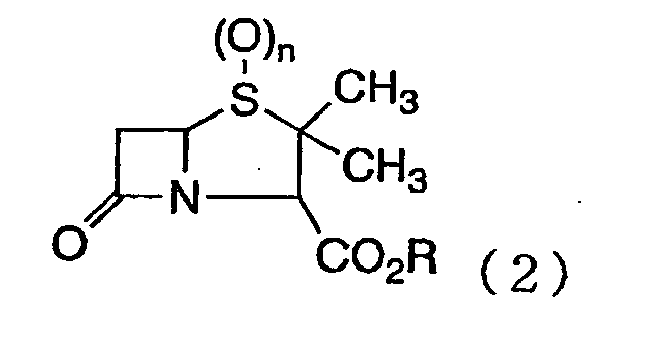
- Processes are known for preparing a penicillanic acid compound of the formula (2) from a halogenated penicillanic acid compound of the formula (1), by catalytic reduction with use of a noble metal catalyst, by reaction with organic tin hydride compound, by reaction with zinc, by electrolytic reduction method, by reaction with aluminum and a catalytic amount of metal lead or lead compound (for example, patent literatures 1 to 4, non-patent literatures 1 to 2).
- X and Y are a hydrogen atom or halogen atom, provided that X and Y are not hydrogen atoms at the same time, n is an integer of 0 to 2, R is carboxyl protecting group) (n and R are same as above).
- the catalytic reduction with use of a noble metal catalyst requires a large amount of an expensive noble metal catalyst and demands application of dangerous hydrogen pressure, therefore the method is not practical.
- the organic tin hydride compound is a reagent which is difficult to be used industrially and the organic tin compound is harmful.
- the process using zinc affords the desired product which is low in yield and purity.
- the electrolytic reduction requires special apparatus and has problems for industrial operation. Further, it is considered that the use of lead is preferably restricted from the viewpoint of environmental care.
- An object of the invention is to provide a process for preparing a penicillanic acid compound of the formula (2) which is free of industrial problems, safe, simple in procedures and industrially advantageous.
- the present invention provides the following processes for preparing a penicillanic acid compound.
- a dehalogenated penicillanic acid compound can be obtained, (a) in the presence of a metal bismuth or bismuth compound which is relatively less harmful and less environmental problems, (b) using a metal having a lower standard oxidation-reduction potential than bismuth, and thus the present invention has been accomplished.
- halogen atom examples are fluorine, chlorine, bromine or iodine atom.
- carboxylic acid protecting groups are usable.
- the groups disclosed in Theodora W. Greene, "Protective Groups in Organic Synthesis", Chap. 5 are widely usable.
- Preferred examples thereof are benzyl, p-methoxybenzyl, p-nitrobenzyl, diphenylmethyl, trimethoxybenzyl, tert-butyl, methoxyethoxymethyl, piperonyl, ditolylmethyl, trimethoxy-dichlorobenzyl, trichloromethyl and bis(p-methoxyphenyl)methyl.
- a dehalogenated penicillanic acid compound by reacting a halogenated penicillanic acid compound of the formula (1), in the presence of a metal bismuth or bismuth compound, with a metal having a lower standard oxidation-reduction potential than bismuth.
- reaction is considered to proceed as the following reaction scheme-1.
- Xa and Ya are a halogen atom, R is carboxylic acid protecting group, n is an integer of 0 to 2,
- the penicillanic acid compound of the formula (2) can be prepared from the dihalogenated penicillanic acid compound of the formula (1a) via the monohalogenated penicillanic acid compound of the formula (1b).
- the penicillanic acid compound of the formula (2) it is usually possible to lead to the penicillanic acid compound of the formula (2) without isolating the monohalogenated penicillanic acid compound of the formula (1b). However, it is possible to prepare and isolate the monohalogenated penicillanic acid compound of the formula (1b) from the dihalogenated penicillanic acid compound of the formula (1a).
- the penicillanic acid compound of the formula (2) can be prepared from the isolated monohalogenated penicillanic acid compound of the formula (1b) by the present process.
- reaction conditions in the step of preparing the monohalogenated penicillanic acid compound of the formula (1b) from the dihalogenated penicillanic acid compound of the formula (1a) may be the same as the reaction conditions in the step of preparing the penicillanic acid compound of the formula (2) from the monohalogenated penicillanic acid compound of the formula (1b).
- the shape of the metal bismuth can be any of lump, plate, foil, powder or the like but preferably is in the form of a powder which is great in surface area.
- any known bismuth compounds can widely be used.
- bismuth halides such as bismuth fluoride, bismuth chloride, bismuth bromide, and bismuth iodied; bismuth salts of mineral acid such as bismuth nitrate and bismuth sulfate; bismuth oxyhalides such as bismuth oxychloride; bismuth salts of aliphatic acid such as bismuth acetate; and bismuth oxide.
- the bismuth compound may be in the form of hydrate.
- the metal bismuth and the bismuth compound can be used singly or a mixture of at least one of them, respectively.
- these metal bismuth and bismuth compounds preferable are a bismuth halide and a bismuth salt of mineral acid, particularly preferable are bismuth chloride, bismuth nitrate and bismuth sulfate.
- metal bismuth or bismuth compounds can be used usually in an amount of about 0.00001 to about 0.5 mole, preferably 0.0001 to 0.2 mole, per mole of the halogen atom of the halogenated penicillanic acid compound of the formula (1), (1a) or (1b) [hereinafter referred to simply as the compound of the formula (1)].
- metals having a lower standard oxidation-reduction potential than that of bismuth are aluminum, iron, magnesium, etc., among which aluminum and iron are desirable and aluminum is particularly desirable to use.
- the shape of these metals is not limited particularly but can be any of a wide variety of forms such as powder, plate, lump, foil and wire.
- the metal to be used is in the form of a powder in view of proceeding the reaction fluently.
- the particle size of the powdery metal is preferably about 10 to about 3000 ⁇ m although variable over a wide range.
- These metals are used usually in an amount of about 0.5 to about 50 moles, preferably about 1 to about 5 moles, per mole of the halogenated penicillanic acid compound of the formula (1).
- solvents useful in the reaction are organic solvents, for example, lower alkyl alcohols having 1 to 4 carbon atoms such as methanol, ethanol, propanol, 2-propanol, butanol and tert-butanol; lower alkyl esters of lower carboxylic acids such as methyl formate, ethyl formate, propyl formate, butyl formate, methyl acetate, ethyl acetate, propyl acetate, butyl acetate, methyl propionate and ethyl propionate; ketones such as acetone, methyl ethyl ketone, methyl propyl ketone, methyl butyl ketone, methyl isobutyl ketone and diethyl ketone; ethers such as diethyl ether, ethyl propyl ether, ethyl butyl ether, dipropyl ether,
- organic solvents are used singly or in admixture of at least two of them. These organic solvents are used in an amount of about 1 to about 500 liters, preferably about 2.5 to about 50 liters, per kilogram of the compound of the formula (1), although not limited particularly. Water may be added to the organic solvent as required. Water may be added in an amount of about 0.01 to about 50 liters, preferably about 0.05 to about 30 liters, more preferably about 0.1 to about 10 liters, per kilogram of the compound of the formula (1).
- organic solvents preferable is a solvent mixture of a lower aklyl alcohol and an organic solvent other than the alcohol. More preferable is a solvent mixture of a lower aklyl alcohol and a hydrocarbon halide.
- lower aklyl alcohol are methanol, ethanol and 2-propanol, and particularly preferable is methanol.
- Particularly preferable hydrocarbon halide is dichloromethane.
- the organic solvent other than the lower aklyl alcohol is used in an amount of 0.3 to 30 volume parts, preferably 0.5 to 20 volume parts, per volume part of the alcohol.
- a reaction promoter or reaction auxiliary agent is preferably usable.
- the promoters or auxiliary agents are alkali metal halides such as lithium fluoride, lithium chloride, lithium bromide, lithium iodide, sodium fluoride, sodium chloride, sodium bromide, sodium iodide, potassium fluoride, potassium chloride, potassium bromide and potassium iodide; alkaline earth metal halides such as magnesium chloride, magnesium bromide and calcium chloride; ammonium halides such as ammonium fluoride, ammonium chloride, ammonium bromide and ammonium iodide; alkyl ammonium salts such as trimethylammonium hydrochloride; mineral acids such as hydrochloric acid, sulfuric acid, nitric acid, hydrobromic acid and phosphoric acid; carboxylic acids such as formic acid, acetic acid, monochloroacetic acid, dichloroacetic acid and trichloroacetic acid; s
- alkali metal halide alkaline earth metal halide, ammonium halide and mineral acid
- alkali metal halide and ammonium halide particularly preferable are sodium chloride and ammonium chloride.
- the reaction promoter or reaction auxiliary agent is usable for example, in an amount of 0.01 to 10 weight parts, preferably 0.1 to 1 weight part, per weight part of the compound of the formula (1).
- the reaction promoter or reaction auxiliary agent is used preferably in the form of an aqueous solution having a concentration of more than 0.1 %.
- the reaction proceeds smoothly by use of the reaction promoter or reaction auxiliary agent.
- the promoter or agent can render an active species derived from aluminum, iron, magnesium or like metal and/or bismuth stable electrochemically.
- the reaction is conducted usually at about 0 °C to 100 °C, preferably about 10 °C to 50 °C, although suitably selected depending on the starting material or solvent, etc.
- the reaction is conducted usually for about 1 to 24 hours, preferably 3 to 12 hours.
- the desired penicillanic acid compound of the formula (2) can be isolated in almost pure state by a usual extraction procedure.
- recrystallization, column chromatography or like widely used purification means can be applied.
- the reaction can be terminated after watching the reaction situation by HPLC, thin layer chromatography, NMR, etc., and confirming the amount of monohalogenated product.
- a mixture of the monohalogenated penicillanic acid compound of the formula (1b) and the penicillanic acid compound of the formula (2) is obtained.
- Example bismuth compound salt or acid yield 3 BiCl 3 NaCl 91% 4 BiCl 3 NaBr 80% 5 BiCl 3 CaCl 2 73% 6 BiCl 3 mgCl 2 70% 7 BiCl 3 (CH 3 ) 3 NHCl 72% 8 BiCl 3 H 2 SO 4 79% 9 Bi 2 (SO 4 ) 3 NH 4 Cl 91% 10 Bi 2 (SO 4 ) 3 NaCl 90% 11 Bi (NO 3 ) 3 ⁇ 5H 2 O NH 4 Cl 87% 12 Bi (NO 3 ) 3 ⁇ 5H 2 O NaCl 87%
- a 42 g quantity of Compound 1 was dissolved in 300 mL of dichloromethane. To the solution was added 0.9 g of bismuth sulfate and 57 mL of 20 % aqueous solution of sodium chloride with stirring. To the mixture were added 10 g of iron powder and 17 mL of methanol with stirring at room temperature for 9 hours. Further, the mixture was stirred for 10 hours with adding 0.8 g of bismuth sulfate, and stirred at 35 °C for 2 hours. After completion of reaction, 100 mL of water was added and an orgaic layer was separated. The organic layer was washed with 100 mL of 5 % aqueous solution of sodium chloride. The organic layer was concentrated to give Compound 2. Amount: 26.7 g Yield: 89.9 %
- a 20 g quantity of Compound 1 was dissolved in 75 mL of dichloromethane. To the solution was added 0.9 g of bismuth sulfate and 30 mL of 20 % aqueous solution of sodium chloride with stirring. To the mixture were added each of 0.5 to 0.6 g of magnesium ribbon at intervals of 30 minutes in total amount of 4 g. The mixture was stirred at room temperature for 10 hours. Water (100 mL) was added and an orgaic layer was separated. The organic layer was washed with 5 % aqueous solution of sodium chloride.
- the penicillanic acid compound obtained by the present process is useful, for example, as an intermediate for ⁇ -lactamase inhibitor.
Landscapes
- Chemical & Material Sciences (AREA)
- Organic Chemistry (AREA)
- Catalysts (AREA)
- Pharmaceuticals Containing Other Organic And Inorganic Compounds (AREA)
- Organic Low-Molecular-Weight Compounds And Preparation Thereof (AREA)
- Low-Molecular Organic Synthesis Reactions Using Catalysts (AREA)
Abstract

Description
- The present invention relates to a novel process for preparing a penicillanic acid compound. The penicillanic acid compound obtained by the present process is useful, for example, as an intermediate for β-lactamase inhibitor.
- Processes are known for preparing a penicillanic acid compound of the formula (2) from a halogenated penicillanic acid compound of the formula (1), by catalytic reduction with use of a noble metal catalyst, by reaction with organic tin hydride compound, by reaction with zinc, by electrolytic reduction method, by reaction with aluminum and a catalytic amount of metal lead or lead compound (for example, patent literatures 1 to 4, non-patent literatures 1 to 2).


[patent literature 1] JP 1980-120588 A
[patent literature 2] JP 1982-169486 A
[patent literature 3] JP 1986-63683 A
[patent literature 4] JP 1989-66189 A
[non-patent literature 1] Nature, 201, 1124 (1964)
[non-patent literature 2] J. Chem. Soc., (C), 2123 (1968) - The catalytic reduction with use of a noble metal catalyst requires a large amount of an expensive noble metal catalyst and demands application of dangerous hydrogen pressure, therefore the method is not practical. The organic tin hydride compound is a reagent which is difficult to be used industrially and the organic tin compound is harmful. The process using zinc affords the desired product which is low in yield and purity. The electrolytic reduction requires special apparatus and has problems for industrial operation. Further, it is considered that the use of lead is preferably restricted from the viewpoint of environmental care.
- An object of the invention is to provide a process for preparing a penicillanic acid compound of the formula (2) which is free of industrial problems, safe, simple in procedures and industrially advantageous.
- The present invention provides the following processes for preparing a penicillanic acid compound.
- 1. A process for preparing a penicillanic acid compound of the formula (2) comprising reacting a halogenated penicillanic acid compound of the formula (1), (a) in the presence of a metal bismuth or bismuth compound, (b) with a metal having a lower standard oxidation-reduction potential than bismuth to obtain the compound (2)


- 2. A process for preparing a penicillanic acid compound of the formula (2) comprising reacting a dihalogenated penicillanic acid compound of the formula (1a), (a) in the presence of a metal bismuth or bismuth compound, (b) with a metal having a lower standard oxidation-reduction potential than bismuth to obtain a monohalogenated penicillanic acid compound of the formula (1b), and reacting the compound (1b) with a metal having a lower standard oxidation-reduction potential than bismuth in the presence of a metal bismuth or bismuth compound to obtain the compound (2)


- 3. A process for preparing a monohalogenated penicillanic acid compound of the formula (1b) comprising reacting a dihalogenated penicillanic acid compound of the formula (1a), (a) in the presence of a metal bismuth or bismuth compound, (b) with a metal having a lower standard oxidation-reduction potential than bismuth to obtain the compound (1b).
- 4. A process for preparing a penicillanic acid compound of the formula (2) comprising reacting a monohalogenated penicillanic acid compound of the formula (1b), (a) in the presence of a metal bismuth or bismuth compound, (b) with a metal having a lower standard oxidation-reduction potential than bismuth to obtain the compound (2).
- In the present invention, it is found that a dehalogenated penicillanic acid compound can be obtained, (a) in the presence of a metal bismuth or bismuth compound which is relatively less harmful and less environmental problems, (b) using a metal having a lower standard oxidation-reduction potential than bismuth, and thus the present invention has been accomplished.
- In the present invention, it is possible to obtain a dehalogenated penicillanic acid compound in high purity and high yield from 6-halogenated penicillanic acid compound, (a) in the presence of a metal bismuth or bismuth compound, (b) using a metal having a lower standard oxidation-reduction potential than bismuth.
- In the present specification, examples of halogen atom are fluorine, chlorine, bromine or iodine atom.
- Any known carboxylic acid protecting groups are usable. The groups disclosed in Theodora W. Greene, "Protective Groups in Organic Synthesis", Chap. 5 are widely usable. Preferred examples thereof are benzyl, p-methoxybenzyl, p-nitrobenzyl, diphenylmethyl, trimethoxybenzyl, tert-butyl, methoxyethoxymethyl, piperonyl, ditolylmethyl, trimethoxy-dichlorobenzyl, trichloromethyl and bis(p-methoxyphenyl)methyl.
- In the present invention, it is possible to prepare a dehalogenated penicillanic acid compound by reacting a halogenated penicillanic acid compound of the formula (1), in the presence of a metal bismuth or bismuth compound, with a metal having a lower standard oxidation-reduction potential than bismuth.
- The reaction is considered to proceed as the following reaction scheme-1.


- Namely, the penicillanic acid compound of the formula (2) can be prepared from the dihalogenated penicillanic acid compound of the formula (1a) via the monohalogenated penicillanic acid compound of the formula (1b).
- In the present process, it is usually possible to lead to the penicillanic acid compound of the formula (2) without isolating the monohalogenated penicillanic acid compound of the formula (1b). However, it is possible to prepare and isolate the monohalogenated penicillanic acid compound of the formula (1b) from the dihalogenated penicillanic acid compound of the formula (1a). The penicillanic acid compound of the formula (2) can be prepared from the isolated monohalogenated penicillanic acid compound of the formula (1b) by the present process.
- The reaction conditions in the step of preparing the monohalogenated penicillanic acid compound of the formula (1b) from the dihalogenated penicillanic acid compound of the formula (1a) may be the same as the reaction conditions in the step of preparing the penicillanic acid compound of the formula (2) from the monohalogenated penicillanic acid compound of the formula (1b).
- The shape of the metal bismuth can be any of lump, plate, foil, powder or the like but preferably is in the form of a powder which is great in surface area.
- Any known bismuth compounds can widely be used. Examples thereof are bismuth halides such as bismuth fluoride, bismuth chloride, bismuth bromide, and bismuth iodied; bismuth salts of mineral acid such as bismuth nitrate and bismuth sulfate; bismuth oxyhalides such as bismuth oxychloride; bismuth salts of aliphatic acid such as bismuth acetate; and bismuth oxide. The bismuth compound may be in the form of hydrate. The metal bismuth and the bismuth compound can be used singly or a mixture of at least one of them, respectively. Among these metal bismuth and bismuth compounds preferable are a bismuth halide and a bismuth salt of mineral acid, particularly preferable are bismuth chloride, bismuth nitrate and bismuth sulfate.
- These metal bismuth or bismuth compounds can be used usually in an amount of about 0.00001 to about 0.5 mole, preferably 0.0001 to 0.2 mole, per mole of the halogen atom of the halogenated penicillanic acid compound of the formula (1), (1a) or (1b) [hereinafter referred to simply as the compound of the formula (1)].
- Examples of metals having a lower standard oxidation-reduction potential than that of bismuth are aluminum, iron, magnesium, etc., among which aluminum and iron are desirable and aluminum is particularly desirable to use. The shape of these metals is not limited particularly but can be any of a wide variety of forms such as powder, plate, lump, foil and wire. Preferably, the metal to be used is in the form of a powder in view of proceeding the reaction fluently. The particle size of the powdery metal is preferably about 10 to about 3000 µm although variable over a wide range. These metals are used usually in an amount of about 0.5 to about 50 moles, preferably about 1 to about 5 moles, per mole of the halogenated penicillanic acid compound of the formula (1).
- The present reaction is conducted in a suitable solvent. Examples of solvents useful in the reaction are organic solvents, for example, lower alkyl alcohols having 1 to 4 carbon atoms such as methanol, ethanol, propanol, 2-propanol, butanol and tert-butanol; lower alkyl esters of lower carboxylic acids such as methyl formate, ethyl formate, propyl formate, butyl formate, methyl acetate, ethyl acetate, propyl acetate, butyl acetate, methyl propionate and ethyl propionate; ketones such as acetone, methyl ethyl ketone, methyl propyl ketone, methyl butyl ketone, methyl isobutyl ketone and diethyl ketone; ethers such as diethyl ether, ethyl propyl ether, ethyl butyl ether, dipropyl ether, diisopropyl ether, dibutyl ether and dimethoxyethane; cyclic ethers such as tetrahydrofuran and dioxane; nitriles such as acetonitrile, propionitrile, butyronitrile and valeronitrile; substituted or unsubstituted aromatic hydrocarbons such as benzene, toluene, xylene, chlorobenzene and anisole, hydrocarbon halides such as dichloromethane, chloroform, dichloroethane, trichloroethane, dibromoethane, propylene dichloride and carbon tetrachloride; aliphatic hydrocarbons such as pentane, hexane, heptane and octane, cycloalkanes such as cyclopentane, cyclohexane, cycloheptane and cyclooctane, amides such as dimethylformamide and dimethylacetamide, sulfoxides such as dimethylsulfoxide, etc. These organic solvents are used singly or in admixture of at least two of them. These organic solvents are used in an amount of about 1 to about 500 liters, preferably about 2.5 to about 50 liters, per kilogram of the compound of the formula (1), although not limited particularly. Water may be added to the organic solvent as required. Water may be added in an amount of about 0.01 to about 50 liters, preferably about 0.05 to about 30 liters, more preferably about 0.1 to about 10 liters, per kilogram of the compound of the formula (1).
- Among these organic solvents preferable is a solvent mixture of a lower aklyl alcohol and an organic solvent other than the alcohol. More preferable is a solvent mixture of a lower aklyl alcohol and a hydrocarbon halide. In the solvent mixture preferable lower aklyl alcohol are methanol, ethanol and 2-propanol, and particularly preferable is methanol. Particularly preferable hydrocarbon halide is dichloromethane. In the solvent mixture, the organic solvent other than the lower aklyl alcohol is used in an amount of 0.3 to 30 volume parts, preferably 0.5 to 20 volume parts, per volume part of the alcohol.
- In the present process, a reaction promoter or reaction auxiliary agent is preferably usable. Examples of the promoters or auxiliary agents are alkali metal halides such as lithium fluoride, lithium chloride, lithium bromide, lithium iodide, sodium fluoride, sodium chloride, sodium bromide, sodium iodide, potassium fluoride, potassium chloride, potassium bromide and potassium iodide; alkaline earth metal halides such as magnesium chloride, magnesium bromide and calcium chloride; ammonium halides such as ammonium fluoride, ammonium chloride, ammonium bromide and ammonium iodide; alkyl ammonium salts such as trimethylammonium hydrochloride; mineral acids such as hydrochloric acid, sulfuric acid, nitric acid, hydrobromic acid and phosphoric acid; carboxylic acids such as formic acid, acetic acid, monochloroacetic acid, dichloroacetic acid and trichloroacetic acid; sulfonic acids such as benzenesulfonic acid, toluenesulfonic acid and methanesulfonic acid.
- Among these promoters or auxiliary agents, preferable are alkali metal halide, alkaline earth metal halide, ammonium halide and mineral acid, more preferable are alkali metal halide and ammonium halide, particularly preferable are sodium chloride and ammonium chloride.
- The reaction promoter or reaction auxiliary agent is usable for example, in an amount of 0.01 to 10 weight parts, preferably 0.1 to 1 weight part, per weight part of the compound of the formula (1). The reaction promoter or reaction auxiliary agent is used preferably in the form of an aqueous solution having a concentration of more than 0.1 %. The reaction proceeds smoothly by use of the reaction promoter or reaction auxiliary agent. Although the reason why the reaction is promoted is not clearly explained, it is considered that the promoter or agent can render an active species derived from aluminum, iron, magnesium or like metal and/or bismuth stable electrochemically.
- The reaction is conducted usually at about 0 °C to 100 °C, preferably about 10 °C to 50 °C, although suitably selected depending on the starting material or solvent, etc. The reaction is conducted usually for about 1 to 24 hours, preferably 3 to 12 hours.
- After completion of the reaction, for example, the desired penicillanic acid compound of the formula (2) can be isolated in almost pure state by a usual extraction procedure. When required, recrystallization, column chromatography or like widely used purification means can be applied.
- Further, in case of preparing and isolating the monohalogenated penicillanic acid compound of the formula (1b) from the dihalogenated penicillanic acid compound of the formula (1a), the reaction can be terminated after watching the reaction situation by HPLC, thin layer chromatography, NMR, etc., and confirming the amount of monohalogenated product. Usually, a mixture of the monohalogenated penicillanic acid compound of the formula (1b) and the penicillanic acid compound of the formula (2) is obtained. These compounds can be isolated by liquid chromatography or like separating means.
- The present invention will be described below in detail with reference to examples to which, however, the invention is not limited.
- A 86.6 g quantity of 6,6-dibromo-2,2-dimethylpenam-3-carboxylic acid 1-oxide diphenylmethyl ester (Compound 1) [compound of the formula (1) wherein X=Y=Br, R=diphenylmethyl, n=1] was dissolved in 300 mL of dichloromethane. To the solution was added 36 mL of methanol with stirring and then added a suspension of 1.05 g of metal bismuth in 112 mL of 20 % aqueous solution of sodium chloride. While maintaining at 20 to 25°C, to the mixture was added 10 g of aluminum powder, each 1 g, at intervals of 10 minutes, thereafter the mixture was refluxed with heating. After 23.5 hours, the reaction mixture was cooled to room temperature, an organic layer was separated and washed with diluted hydrochloric acid and 5 % aqueous solution of sodium chloride. The organic layer was concentrated to give 2,2-dimethylpenam-3-carboxylic acid 1-oxide diphenylmethyl ester (Compound 2) [compound of the formula (2) wherein R=diphenylmethyl, n=1]
Amount: 50.2 g
Yield: 83.3 % - A 82.6 g quantity of Compound 1 was dissolved in 300 mL of dichloromethane. To the solution was added 115 mL of 20 % aqueous solution of ammonium chloride and 36 mL of methanol with stirring. After adding 1.6 g of bismuth chloride, 10 g of aluminum powder was gradually added to the mixture while maintaining at 20 to 30 °C. The mixture was reacted for 5 hours while maintaining at 20 to 30 °C. After adding 120 mL of water, insoluble metalresidue was filtered and an orgaic layer was separated. The organic layer was washed with 120 mL of 5 % aqueous solution of sodium chloride. The organic layer was concentrated to give Compound 2.
Amount: 52.0 g
Yield: 89 % - The same reaction as in Example 2 were conducted except that ammonium chloride was replaced by a salt or acid listed in Table 1, and bismuth chloride was replaced by a bismuth compound listed in Table 1.
Table 1 Example bismuth compound salt or acid yield 3 BiCl3 NaCl 91% 4 BiCl3 NaBr 80% 5 BiCl3 CaCl2 73% 6 BiCl3 mgCl2 70% 7 BiCl3 (CH3)3NHCl 72% 8 BiCl3 H2SO4 79% 9 Bi2(SO4)3 NH4Cl 91% 10 Bi2(SO4)3 NaCl 90% 11 Bi (NO3)3·5H2O NH4Cl 87% 12 Bi (NO3)3 · 5H2O NaCl 87% - The same reaction as in Example 2 were conducted except that, as a solvent, dichloromethane was replaced by ethyl acetate to obtain Compound 2 in a yield of 83 %.
- The same reaction as in Example 2 were conducted except that, as a solvent, dichloromethane was replaced by a mixture of dichloromethane and dimethylformamide (volume ratio=100:150) to obtain Compound 2 in a yield of 83.7 %.
- The same reaction as in Example 2 were conducted except that methanol was not added to obtain Compound 2 in a yield of 68.4 %.
- The same reaction as in Example 2 were conducted except that 6-bromo-2,2-dimethylpenam-3-carboxylic acid 1-oxide diphenylmethyl ester (Compound 3) [compound of the formula (1) wherein X=Br, Y=H, R=diphenylmethyl, n=1] was used in place of Compound 1 to obtain Compound 2 in a yield of 90 %.
- A 82.6 g quantity of 6,6-dibromo-2,2-dimethylpenam-3-carboxylic acid 1-oxide p-nitrobenzyl ester (Compound 4) [compound of the formula (1) wherein X=Y=Br, R= p-nitrobenzyl, n=1] was dissolved in 300 mL of dichloromethane. To the solution was added 115 mL of 20 % aqueous solution of ammonium chloride and 36 mL of methanol with stirring. After adding 1.6 g of bismuth chloride and 10 g of aluminum powder at one time, the mixture was reacted at 40 °C for 8 hours. An organic layer was separated and concentrated by an evaporator to give 6-bromo-2,2-dimethylpenam-3-carboxylic acid 1-oxide p-nitrobenzyl ester (Compound 5) [compound of the formula (1b) wherein X=Br, Y=H, R= p-nitrobenzyl, n=1] in a yield of 65 %.
- The obtained Compound 5 (45.4 g) was subjected to the same reaction to give 2,2-dimethylpenam-3-carboxylic acid 1-oxide p-nitrobenzyl ester (Compound 6) [compound of the formula (2) wherein R= p-nitrobenzyl, n=1] in a yield of 85 % (from Compound 5).
- A 42 g quantity of Compound 1 was dissolved in 300 mL of dichloromethane. To the solution was added 0.9 g of bismuth sulfate and 57 mL of 20 % aqueous solution of sodium chloride with stirring. To the mixture were added 10 g of iron powder and 17 mL of methanol with stirring at room temperature for 9 hours. Further, the mixture was stirred for 10 hours with adding 0.8 g of bismuth sulfate, and stirred at 35 °C for 2 hours. After completion of reaction, 100 mL of water was added and an orgaic layer was separated. The organic layer was washed with 100 mL of 5 % aqueous solution of sodium chloride. The organic layer was concentrated to give Compound 2.
Amount: 26.7 g
Yield: 89.9 % - A 20 g quantity of Compound 1 was dissolved in 75 mL of dichloromethane. To the solution was added 0.9 g of bismuth sulfate and 30 mL of 20 % aqueous solution of sodium chloride with stirring. To the mixture were added each of 0.5 to 0.6 g of magnesium ribbon at intervals of 30 minutes in total amount of 4 g. The mixture was stirred at room temperature for 10 hours. Water (100 mL) was added and an orgaic layer was separated. The organic layer was washed with 5 % aqueous solution of sodium chloride. The organic layer was concentrated and the residue was subjected to column chromatography (toluene : ethyl acetate=5:1) to give Compound 2 and Compound 3, respectively.
Compound 2 Amount: 8.6 g, Yield: 61 %
Compound 3 Amount: 2.8 g, Yield: 17 % - The penicillanic acid compound obtained by the present process is useful, for example, as an intermediate for β-lactamase inhibitor.
Claims (12)
- A process for preparing a penicillanic acid compound of the formula (2) comprising reacting a halogenated penicillanic acid compound of the formula (1), (a) in the presence of a metal bismuth or bismuth compound, (b) with a metal having a lower standard oxidation-reduction potential than bismuth to obtain the compound (2)

- A process for preparing a penicillanic acid compound of the formula (2) comprising reacting a dihalogenated penicillanic acid compound of the formula (1a), (a) in the presence of a metal bismuth or bismuth compound, (b) with a metal having a lower standard oxidation-reduction potential than bismuth to obtain a monohalogenated penicillanic acid compound of the formula (1b), and reacting the compound (1b) with a metal having a lower standard oxidation-reduction potential than bismuth in the presence of a metal bismuth or bismuth compound to obtain the compound (2)


- A process for preparing a monohalogenated penicillanic acid compound of the formula (1b) comprising reacting a dihalogenated penicillanic acid compound of the formula (1a), (a) in the presence of a metal bismuth or bismuth compound, (b) with a metal having a lower standard oxidation-reduction potential than bismuth to obtain the compound (1b).
- A process for preparing a penicillanic acid compound of the formula (2) comprising reacting a monohalogenated penicillanic acid compound of the formula (1b), (a) in the presence of a metal bismuth or bismuth compound, (b) with a metal having a lower standard oxidation-reduction potential than bismuth to obtain the compound (2).
- A process as defined in any of claims 1 to 4 wherein the bismuth compound is bismuth halide, bismuth salt of mineral acid, bismuth oxyhalide, bismuth salt of aliphatic acid or bismuth oxide.
- A process as defined in any of claims 1 to 4 wherein the metal having a lower standard oxidation-reduction potential than bismuth is one selected from aluminum, iron and magnesium.
- A process as defined in any of claims 1 to 4 wherein at least one selected from alkali metal halide, alkaline earth metal halide, ammonium halide, alkyl ammonium salt, mineral acid, organic carboxylic acid and organic sulfonic acid is conjointly used.
- A process as defined in any of claims 1 to 4 wherein at least one selected from alkali metal halide, alkaline earth metal halide, ammonium halide and mineral acid is conjointly used.
- A process as defined in any of claims 1 to 4 wherein the reaction is conducted in the presence of a solvent.
- A process as defined in claim 9 wherein the solvent is a hydrocarbon halide.
- A process as defined in claim 9 wherein the solvent is a mixture of a lower aklyl alcohol and hydrocarbon halide.
- A process as defined in any of claims 1 to 4 wherein the reaction is conducted in the presence of water.
Applications Claiming Priority (2)
| Application Number | Priority Date | Filing Date | Title |
|---|---|---|---|
| JP2003311709 | 2003-09-03 | ||
| PCT/JP2004/013097 WO2005023821A1 (en) | 2003-09-03 | 2004-09-02 | Process for producing penicillanic acid compound |
Publications (3)
| Publication Number | Publication Date |
|---|---|
| EP1666482A1 true EP1666482A1 (en) | 2006-06-07 |
| EP1666482A4 EP1666482A4 (en) | 2009-04-01 |
| EP1666482B1 EP1666482B1 (en) | 2009-12-23 |
Family
ID=34269709
Family Applications (1)
| Application Number | Title | Priority Date | Filing Date |
|---|---|---|---|
| EP04772911A Expired - Lifetime EP1666482B1 (en) | 2003-09-03 | 2004-09-02 | Process for producing penicillanic acid compound |
Country Status (12)
| Country | Link |
|---|---|
| US (1) | US7514553B2 (en) |
| EP (1) | EP1666482B1 (en) |
| JP (1) | JP4346528B2 (en) |
| KR (1) | KR100759640B1 (en) |
| CN (1) | CN100410260C (en) |
| AR (1) | AR045553A1 (en) |
| AT (1) | ATE452897T1 (en) |
| CA (1) | CA2537406C (en) |
| DE (1) | DE602004024802D1 (en) |
| ES (1) | ES2336677T3 (en) |
| TW (1) | TWI280963B (en) |
| WO (1) | WO2005023821A1 (en) |
Families Citing this family (2)
| Publication number | Priority date | Publication date | Assignee | Title |
|---|---|---|---|---|
| CN103044447B (en) * | 2013-01-16 | 2014-12-17 | 江西富祥药业股份有限公司 | Preparation method of benzhydryl s-oxopenicillanate |
| CN103819489B (en) * | 2014-03-18 | 2015-10-28 | 齐鲁天和惠世制药有限公司 | A kind of preparation method of benzhydryl s-oxopenicillanate |
Family Cites Families (9)
| Publication number | Priority date | Publication date | Assignee | Title |
|---|---|---|---|---|
| US4468351A (en) * | 1983-06-06 | 1984-08-28 | Pfizer Inc. | Process for debromination of dibromopenicillanic acid and derivatives |
| US4588527A (en) * | 1983-06-06 | 1986-05-13 | Pfizer Inc. | Process for preparing penicillanic acid 1,1-dioxide derivatives |
| EP0139048A1 (en) * | 1983-10-18 | 1985-05-02 | Gist-Brocades N.V. | Process for the dehalogenation of 6,6-dibromopenicillanic acid 1,1-dioxide |
| US4596677A (en) * | 1984-04-06 | 1986-06-24 | Bristol-Myers Company | Anhydropenicillin intermediates |
| JPS6163683A (en) * | 1984-09-05 | 1986-04-01 | Kanebo Ltd | Method for producing penicillanic acid and its derivatives |
| EP0262202B1 (en) | 1986-04-10 | 1992-07-01 | Leo Pharmaceutical Products Ltd. A/S (Lovens Kemiske Fabrik Produktionsaktieselskab) | Method for preparing penicillanic acid derivatives |
| JPH10245386A (en) * | 1997-03-05 | 1998-09-14 | Otsuka Chem Co Ltd | Method for producing exomethylene penum compound |
| GB2343676A (en) * | 1998-11-12 | 2000-05-17 | Merck & Co Inc | Selective mono-debromination of polybromoalkyl aryl ketones |
| ATE288438T1 (en) | 1999-03-03 | 2005-02-15 | Astur Pharma Sa | METHOD FOR PRODUCING DIOXOPENICILLANIC ACID DERIVATIVES |
-
2004
- 2004-09-02 ES ES04772911T patent/ES2336677T3/en not_active Expired - Lifetime
- 2004-09-02 CA CA2537406A patent/CA2537406C/en not_active Expired - Fee Related
- 2004-09-02 DE DE602004024802T patent/DE602004024802D1/en not_active Expired - Lifetime
- 2004-09-02 AR ARP040103134A patent/AR045553A1/en not_active Application Discontinuation
- 2004-09-02 AT AT04772911T patent/ATE452897T1/en active
- 2004-09-02 TW TW093126469A patent/TWI280963B/en not_active IP Right Cessation
- 2004-09-02 EP EP04772911A patent/EP1666482B1/en not_active Expired - Lifetime
- 2004-09-02 CN CNB2004800253122A patent/CN100410260C/en not_active Expired - Fee Related
- 2004-09-02 KR KR1020067003697A patent/KR100759640B1/en not_active Expired - Fee Related
- 2004-09-02 US US10/569,692 patent/US7514553B2/en not_active Expired - Lifetime
- 2004-09-02 WO PCT/JP2004/013097 patent/WO2005023821A1/en not_active Ceased
- 2004-09-03 JP JP2004256516A patent/JP4346528B2/en not_active Expired - Fee Related
Non-Patent Citations (2)
| Title |
|---|
| No further relevant documents disclosed * |
| See also references of WO2005023821A1 * |
Also Published As
| Publication number | Publication date |
|---|---|
| HK1096957A1 (en) | 2007-06-15 |
| WO2005023821A1 (en) | 2005-03-17 |
| EP1666482B1 (en) | 2009-12-23 |
| EP1666482A4 (en) | 2009-04-01 |
| JP4346528B2 (en) | 2009-10-21 |
| US20060281917A1 (en) | 2006-12-14 |
| ES2336677T3 (en) | 2010-04-15 |
| CA2537406A1 (en) | 2005-03-17 |
| JP2005097297A (en) | 2005-04-14 |
| AR045553A1 (en) | 2005-11-02 |
| CN100410260C (en) | 2008-08-13 |
| TWI280963B (en) | 2007-05-11 |
| DE602004024802D1 (en) | 2010-02-04 |
| TW200510432A (en) | 2005-03-16 |
| CA2537406C (en) | 2010-09-14 |
| ATE452897T1 (en) | 2010-01-15 |
| KR100759640B1 (en) | 2007-09-17 |
| US7514553B2 (en) | 2009-04-07 |
| CN1845929A (en) | 2006-10-11 |
| KR20060058121A (en) | 2006-05-29 |
Similar Documents
| Publication | Publication Date | Title |
|---|---|---|
| US7547777B2 (en) | Penam crystals and process for producing the same | |
| US10988438B2 (en) | Process for the preparation of a nitric oxide donating prostaglandin analogue | |
| EP1666482B1 (en) | Process for producing penicillanic acid compound | |
| KR20020068517A (en) | Crystals of penicillin and process for the production thereof | |
| JP2003513983A (en) | Method for producing high-purity cefpodoxime proxetil | |
| EP0922698A1 (en) | Process for producing N-alkylimidazole | |
| EP0503603B1 (en) | Process for preparing 2-exo-methylenepenam derivatives | |
| JP4658806B2 (en) | Method for producing 3-chloromethyl-3-cephem derivative | |
| EP1813619B1 (en) | Process for producing penam compound | |
| JP2003511455A (en) | Method for producing 7-amino-3-methoxymethyl-3-cephem-4-carboxylic acid | |
| HK1096957B (en) | Process for producing penicillanic acid compound | |
| WO2000020424A1 (en) | PROCESS FOR THE PREPARATION OF β-HYDROXY ESTERS | |
| JP2003104951A (en) | Method for producing perfluoroalkylsulfonyl halide | |
| CN113816955B (en) | RET kinase inhibitor intermediate and preparation method thereof | |
| JPH04283584A (en) | Production of 3-hydroxycephem derivative | |
| JP2005047827A (en) | Method for producing 3-chloromethyl-3-cephem derivative crystal | |
| WO1992014735A1 (en) | A PROCESS FOR THE PREPARATION OF 1,3a,8-TRIMETHYL-1,2,3,3a,8,8a-HEXAHYDRO-PYRROLE[2,3-b]INDOL-5(3aS,8aR)-HEPTYLCARBAMATE | |
| JP2003064060A (en) | Method for producing 1-methyl-3-phenylpiperazine |
Legal Events
| Date | Code | Title | Description |
|---|---|---|---|
| PUAI | Public reference made under article 153(3) epc to a published international application that has entered the european phase |
Free format text: ORIGINAL CODE: 0009012 |
|
| 17P | Request for examination filed |
Effective date: 20060330 |
|
| AK | Designated contracting states |
Kind code of ref document: A1 Designated state(s): AT BE BG CH CY CZ DE DK EE ES FI FR GB GR HU IE IT LI LU MC NL PL PT RO SE SI SK TR |
|
| DAX | Request for extension of the european patent (deleted) | ||
| A4 | Supplementary search report drawn up and despatched |
Effective date: 20090227 |
|
| RIC1 | Information provided on ipc code assigned before grant |
Ipc: C07D 499/04 20060101AFI20090223BHEP |
|
| GRAP | Despatch of communication of intention to grant a patent |
Free format text: ORIGINAL CODE: EPIDOSNIGR1 |
|
| GRAS | Grant fee paid |
Free format text: ORIGINAL CODE: EPIDOSNIGR3 |
|
| GRAA | (expected) grant |
Free format text: ORIGINAL CODE: 0009210 |
|
| AK | Designated contracting states |
Kind code of ref document: B1 Designated state(s): AT BE BG CH CY CZ DE DK EE ES FI FR GB GR HU IE IT LI LU MC NL PL PT RO SE SI SK TR |
|
| REG | Reference to a national code |
Ref country code: GB Ref legal event code: FG4D |
|
| REG | Reference to a national code |
Ref country code: CH Ref legal event code: EP |
|
| REG | Reference to a national code |
Ref country code: CH Ref legal event code: NV Representative=s name: FREI PATENTANWALTSBUERO AG |
|
| REG | Reference to a national code |
Ref country code: IE Ref legal event code: FG4D |
|
| REF | Corresponds to: |
Ref document number: 602004024802 Country of ref document: DE Date of ref document: 20100204 Kind code of ref document: P |
|
| REG | Reference to a national code |
Ref country code: SE Ref legal event code: TRGR |
|
| REG | Reference to a national code |
Ref country code: NL Ref legal event code: T3 |
|
| REG | Reference to a national code |
Ref country code: ES Ref legal event code: FG2A Ref document number: 2336677 Country of ref document: ES Kind code of ref document: T3 |
|
| PG25 | Lapsed in a contracting state [announced via postgrant information from national office to epo] |
Ref country code: PL Free format text: LAPSE BECAUSE OF FAILURE TO SUBMIT A TRANSLATION OF THE DESCRIPTION OR TO PAY THE FEE WITHIN THE PRESCRIBED TIME-LIMIT Effective date: 20091223 Ref country code: SI Free format text: LAPSE BECAUSE OF FAILURE TO SUBMIT A TRANSLATION OF THE DESCRIPTION OR TO PAY THE FEE WITHIN THE PRESCRIBED TIME-LIMIT Effective date: 20091223 |
|
| PG25 | Lapsed in a contracting state [announced via postgrant information from national office to epo] |
Ref country code: BG Free format text: LAPSE BECAUSE OF FAILURE TO SUBMIT A TRANSLATION OF THE DESCRIPTION OR TO PAY THE FEE WITHIN THE PRESCRIBED TIME-LIMIT Effective date: 20100323 Ref country code: EE Free format text: LAPSE BECAUSE OF FAILURE TO SUBMIT A TRANSLATION OF THE DESCRIPTION OR TO PAY THE FEE WITHIN THE PRESCRIBED TIME-LIMIT Effective date: 20091223 Ref country code: PT Free format text: LAPSE BECAUSE OF FAILURE TO SUBMIT A TRANSLATION OF THE DESCRIPTION OR TO PAY THE FEE WITHIN THE PRESCRIBED TIME-LIMIT Effective date: 20100423 Ref country code: RO Free format text: LAPSE BECAUSE OF FAILURE TO SUBMIT A TRANSLATION OF THE DESCRIPTION OR TO PAY THE FEE WITHIN THE PRESCRIBED TIME-LIMIT Effective date: 20091223 |
|
| PG25 | Lapsed in a contracting state [announced via postgrant information from national office to epo] |
Ref country code: CZ Free format text: LAPSE BECAUSE OF FAILURE TO SUBMIT A TRANSLATION OF THE DESCRIPTION OR TO PAY THE FEE WITHIN THE PRESCRIBED TIME-LIMIT Effective date: 20091223 Ref country code: SK Free format text: LAPSE BECAUSE OF FAILURE TO SUBMIT A TRANSLATION OF THE DESCRIPTION OR TO PAY THE FEE WITHIN THE PRESCRIBED TIME-LIMIT Effective date: 20091223 |
|
| PG25 | Lapsed in a contracting state [announced via postgrant information from national office to epo] |
Ref country code: GR Free format text: LAPSE BECAUSE OF FAILURE TO SUBMIT A TRANSLATION OF THE DESCRIPTION OR TO PAY THE FEE WITHIN THE PRESCRIBED TIME-LIMIT Effective date: 20100324 Ref country code: CY Free format text: LAPSE BECAUSE OF FAILURE TO SUBMIT A TRANSLATION OF THE DESCRIPTION OR TO PAY THE FEE WITHIN THE PRESCRIBED TIME-LIMIT Effective date: 20091223 |
|
| PLBE | No opposition filed within time limit |
Free format text: ORIGINAL CODE: 0009261 |
|
| STAA | Information on the status of an ep patent application or granted ep patent |
Free format text: STATUS: NO OPPOSITION FILED WITHIN TIME LIMIT |
|
| 26N | No opposition filed |
Effective date: 20100924 |
|
| PG25 | Lapsed in a contracting state [announced via postgrant information from national office to epo] |
Ref country code: DK Free format text: LAPSE BECAUSE OF FAILURE TO SUBMIT A TRANSLATION OF THE DESCRIPTION OR TO PAY THE FEE WITHIN THE PRESCRIBED TIME-LIMIT Effective date: 20091223 |
|
| PG25 | Lapsed in a contracting state [announced via postgrant information from national office to epo] |
Ref country code: MC Free format text: LAPSE BECAUSE OF NON-PAYMENT OF DUE FEES Effective date: 20100930 |
|
| PG25 | Lapsed in a contracting state [announced via postgrant information from national office to epo] |
Ref country code: HU Free format text: LAPSE BECAUSE OF FAILURE TO SUBMIT A TRANSLATION OF THE DESCRIPTION OR TO PAY THE FEE WITHIN THE PRESCRIBED TIME-LIMIT Effective date: 20100624 Ref country code: LU Free format text: LAPSE BECAUSE OF NON-PAYMENT OF DUE FEES Effective date: 20100902 |
|
| PG25 | Lapsed in a contracting state [announced via postgrant information from national office to epo] |
Ref country code: TR Free format text: LAPSE BECAUSE OF FAILURE TO SUBMIT A TRANSLATION OF THE DESCRIPTION OR TO PAY THE FEE WITHIN THE PRESCRIBED TIME-LIMIT Effective date: 20091223 |
|
| REG | Reference to a national code |
Ref country code: DE Ref legal event code: R082 Ref document number: 602004024802 Country of ref document: DE Representative=s name: MEISSNER, BOLTE & PARTNER GBR, DE Ref country code: DE Ref legal event code: R082 Ref document number: 602004024802 Country of ref document: DE Representative=s name: MEISSNER BOLTE PATENTANWAELTE RECHTSANWAELTE P, DE |
|
| REG | Reference to a national code |
Ref country code: DE Ref legal event code: R082 Ref document number: 602004024802 Country of ref document: DE Representative=s name: MEISSNER, BOLTE & PARTNER GBR, DE |
|
| REG | Reference to a national code |
Ref country code: FR Ref legal event code: PLFP Year of fee payment: 12 |
|
| REG | Reference to a national code |
Ref country code: FR Ref legal event code: PLFP Year of fee payment: 13 |
|
| REG | Reference to a national code |
Ref country code: DE Ref legal event code: R082 Ref document number: 602004024802 Country of ref document: DE Representative=s name: MEISSNER BOLTE PATENTANWAELTE RECHTSANWAELTE P, DE Ref country code: DE Ref legal event code: R081 Ref document number: 602004024802 Country of ref document: DE Owner name: OTSUKA CHEMICAL CO., LTD., JP Free format text: FORMER OWNERS: OTSUKA CHEMICAL CO., LTD., OSAKA, JP; TAIHO PHARMACEUTICAL CO., LTD., TOKIO/TOKYO, JP |
|
| PGFP | Annual fee paid to national office [announced via postgrant information from national office to epo] |
Ref country code: CH Payment date: 20160926 Year of fee payment: 13 Ref country code: FI Payment date: 20160921 Year of fee payment: 13 Ref country code: NL Payment date: 20160926 Year of fee payment: 13 Ref country code: IE Payment date: 20160926 Year of fee payment: 13 |
|
| REG | Reference to a national code |
Ref country code: CH Ref legal event code: PUEA Owner name: OTSUKA CHEMICAL CO., LTD., JP Free format text: FORMER OWNER: OTSUKA CHEMICAL CO., LTD., JP |
|
| PGFP | Annual fee paid to national office [announced via postgrant information from national office to epo] |
Ref country code: FR Payment date: 20160927 Year of fee payment: 13 Ref country code: AT Payment date: 20160928 Year of fee payment: 13 Ref country code: SE Payment date: 20160923 Year of fee payment: 13 |
|
| PGFP | Annual fee paid to national office [announced via postgrant information from national office to epo] |
Ref country code: BE Payment date: 20160926 Year of fee payment: 13 |
|
| REG | Reference to a national code |
Ref country code: NL Ref legal event code: PD Owner name: OTSUKA CHEMICAL CO., LTD.; JP Free format text: DETAILS ASSIGNMENT: CHANGE OF OWNER(S), ASSIGNMENT; FORMER OWNER NAME: TAIHO PHARMACEUTICAL CO., LTD. Effective date: 20161213 |
|
| PGFP | Annual fee paid to national office [announced via postgrant information from national office to epo] |
Ref country code: GB Payment date: 20161004 Year of fee payment: 13 Ref country code: DE Payment date: 20160929 Year of fee payment: 13 |
|
| REG | Reference to a national code |
Ref country code: GB Ref legal event code: 732E Free format text: REGISTERED BETWEEN 20170119 AND 20170125 |
|
| REG | Reference to a national code |
Ref country code: ES Ref legal event code: PC2A Owner name: OTSUKA CHEMICAL CO., LTD. Effective date: 20170222 |
|
| REG | Reference to a national code |
Ref country code: FR Ref legal event code: TP Owner name: OTSUKA CHEMICAL CO., LTD., JP Effective date: 20170608 |
|
| PGFP | Annual fee paid to national office [announced via postgrant information from national office to epo] |
Ref country code: IT Payment date: 20170922 Year of fee payment: 14 |
|
| PGFP | Annual fee paid to national office [announced via postgrant information from national office to epo] |
Ref country code: ES Payment date: 20171025 Year of fee payment: 14 |
|
| REG | Reference to a national code |
Ref country code: DE Ref legal event code: R119 Ref document number: 602004024802 Country of ref document: DE |
|
| PG25 | Lapsed in a contracting state [announced via postgrant information from national office to epo] |
Ref country code: FI Free format text: LAPSE BECAUSE OF NON-PAYMENT OF DUE FEES Effective date: 20170902 |
|
| REG | Reference to a national code |
Ref country code: CH Ref legal event code: PL |
|
| REG | Reference to a national code |
Ref country code: SE Ref legal event code: EUG |
|
| REG | Reference to a national code |
Ref country code: NL Ref legal event code: MM Effective date: 20171001 |
|
| REG | Reference to a national code |
Ref country code: AT Ref legal event code: MM01 Ref document number: 452897 Country of ref document: AT Kind code of ref document: T Effective date: 20170902 |
|
| GBPC | Gb: european patent ceased through non-payment of renewal fee |
Effective date: 20170902 |
|
| REG | Reference to a national code |
Ref country code: IE Ref legal event code: MM4A |
|
| REG | Reference to a national code |
Ref country code: BE Ref legal event code: MM Effective date: 20170930 Ref country code: BE Ref legal event code: PD Owner name: OTSUKA CHEMICAL CO., LTD.; JP Free format text: DETAILS ASSIGNMENT: CHANGE OF OWNER(S), AFFECTATION / CESSION; FORMER OWNER NAME: TAIHO PHARMACEUTICAL CO., LTD. Effective date: 20170302 |
|
| PG25 | Lapsed in a contracting state [announced via postgrant information from national office to epo] |
Ref country code: NL Free format text: LAPSE BECAUSE OF NON-PAYMENT OF DUE FEES Effective date: 20171001 |
|
| REG | Reference to a national code |
Ref country code: FR Ref legal event code: ST Effective date: 20180531 |
|
| PG25 | Lapsed in a contracting state [announced via postgrant information from national office to epo] |
Ref country code: DE Free format text: LAPSE BECAUSE OF NON-PAYMENT OF DUE FEES Effective date: 20180404 Ref country code: CH Free format text: LAPSE BECAUSE OF NON-PAYMENT OF DUE FEES Effective date: 20170930 Ref country code: GB Free format text: LAPSE BECAUSE OF NON-PAYMENT OF DUE FEES Effective date: 20170902 Ref country code: IE Free format text: LAPSE BECAUSE OF NON-PAYMENT OF DUE FEES Effective date: 20170902 Ref country code: LI Free format text: LAPSE BECAUSE OF NON-PAYMENT OF DUE FEES Effective date: 20170930 |
|
| PG25 | Lapsed in a contracting state [announced via postgrant information from national office to epo] |
Ref country code: BE Free format text: LAPSE BECAUSE OF NON-PAYMENT OF DUE FEES Effective date: 20170930 Ref country code: AT Free format text: LAPSE BECAUSE OF NON-PAYMENT OF DUE FEES Effective date: 20170902 Ref country code: FR Free format text: LAPSE BECAUSE OF NON-PAYMENT OF DUE FEES Effective date: 20171002 |
|
| PG25 | Lapsed in a contracting state [announced via postgrant information from national office to epo] |
Ref country code: IT Free format text: LAPSE BECAUSE OF NON-PAYMENT OF DUE FEES Effective date: 20180902 Ref country code: SE Free format text: LAPSE BECAUSE OF NON-PAYMENT OF DUE FEES Effective date: 20170903 |
|
| REG | Reference to a national code |
Ref country code: ES Ref legal event code: FD2A Effective date: 20191030 |
|
| PG25 | Lapsed in a contracting state [announced via postgrant information from national office to epo] |
Ref country code: ES Free format text: LAPSE BECAUSE OF NON-PAYMENT OF DUE FEES Effective date: 20180903 |