EP1662229A1 - Portable unit for determining the position with respect to a reference, particularly for substantially shielded environments - Google Patents
Portable unit for determining the position with respect to a reference, particularly for substantially shielded environments Download PDFInfo
- Publication number
- EP1662229A1 EP1662229A1 EP05110937A EP05110937A EP1662229A1 EP 1662229 A1 EP1662229 A1 EP 1662229A1 EP 05110937 A EP05110937 A EP 05110937A EP 05110937 A EP05110937 A EP 05110937A EP 1662229 A1 EP1662229 A1 EP 1662229A1
- Authority
- EP
- European Patent Office
- Prior art keywords
- data
- accelerometer
- respect
- unit according
- processor
- Prior art date
- Legal status (The legal status is an assumption and is not a legal conclusion. Google has not performed a legal analysis and makes no representation as to the accuracy of the status listed.)
- Withdrawn
Links
- 238000000034 method Methods 0.000 claims abstract description 20
- 238000012545 processing Methods 0.000 claims abstract description 13
- 230000008569 process Effects 0.000 claims abstract description 8
- 230000001133 acceleration Effects 0.000 claims description 10
- 238000002592 echocardiography Methods 0.000 claims description 2
- XLYOFNOQVPJJNP-UHFFFAOYSA-N water Substances O XLYOFNOQVPJJNP-UHFFFAOYSA-N 0.000 description 6
- 238000010586 diagram Methods 0.000 description 5
- 230000006870 function Effects 0.000 description 4
- 238000012937 correction Methods 0.000 description 2
- 230000009189 diving Effects 0.000 description 2
- 230000000694 effects Effects 0.000 description 2
- 230000000670 limiting effect Effects 0.000 description 2
- 210000000707 wrist Anatomy 0.000 description 2
- 238000001514 detection method Methods 0.000 description 1
- 230000007613 environmental effect Effects 0.000 description 1
- 238000001914 filtration Methods 0.000 description 1
- 239000012530 fluid Substances 0.000 description 1
- 230000005484 gravity Effects 0.000 description 1
- 230000006872 improvement Effects 0.000 description 1
- 230000010354 integration Effects 0.000 description 1
- 239000000463 material Substances 0.000 description 1
- 230000003340 mental effect Effects 0.000 description 1
- 238000012986 modification Methods 0.000 description 1
- 230000004048 modification Effects 0.000 description 1
- 238000011017 operating method Methods 0.000 description 1
- 230000000737 periodic effect Effects 0.000 description 1
- 238000003672 processing method Methods 0.000 description 1
- 239000011435 rock Substances 0.000 description 1
- 230000035945 sensitivity Effects 0.000 description 1
- 230000035939 shock Effects 0.000 description 1
- 238000012546 transfer Methods 0.000 description 1
Images


Classifications
-
- B—PERFORMING OPERATIONS; TRANSPORTING
- B63—SHIPS OR OTHER WATERBORNE VESSELS; RELATED EQUIPMENT
- B63C—LAUNCHING, HAULING-OUT, OR DRY-DOCKING OF VESSELS; LIFE-SAVING IN WATER; EQUIPMENT FOR DWELLING OR WORKING UNDER WATER; MEANS FOR SALVAGING OR SEARCHING FOR UNDERWATER OBJECTS
- B63C11/00—Equipment for dwelling or working underwater; Means for searching for underwater objects
- B63C11/02—Divers' equipment
- B63C11/26—Communication means, e.g. means for signalling the presence of divers
-
- G—PHYSICS
- G01—MEASURING; TESTING
- G01C—MEASURING DISTANCES, LEVELS OR BEARINGS; SURVEYING; NAVIGATION; GYROSCOPIC INSTRUMENTS; PHOTOGRAMMETRY OR VIDEOGRAMMETRY
- G01C21/00—Navigation; Navigational instruments not provided for in groups G01C1/00 - G01C19/00
- G01C21/10—Navigation; Navigational instruments not provided for in groups G01C1/00 - G01C19/00 by using measurements of speed or acceleration
- G01C21/12—Navigation; Navigational instruments not provided for in groups G01C1/00 - G01C19/00 by using measurements of speed or acceleration executed aboard the object being navigated; Dead reckoning
Definitions
- the present invention relates to a portable unit for determining the position with respect to a reference, particularly for substantially shielded environments, i.e., where the high-frequency GPS signal cannot reach.
- Environments of this type certainly include the submarine environment, but other environments, such as subterranean cavities, also have the same problem related to determining geographical location.
- Position coordinates are currently derived, substantially by mental approximation, by a submerged scuba diver by relying on a compass; however, only very simple navigations are possible in this way.
- One simple but not always accurate method for calculating distances is the use of fin stroke cycles.
- One cycle is equal to two fin stroke movements for each leg, i.e., a cycle is completed when the legs return to the initial position.
- Knowing in advance the average distance covered with a fin stroke cycle allows to determine, by counting the cycles, the distance covered during the dive; in order to determine this average distance, it is sufficient to divide the length of a preset determined path by the cycles required to complete it by using fin strokes at the same rate and in a constant manner.
- the aim of the present invention is to obviate the cited drawbacks and meet the mentioned requirements, by providing a portable unit for determining the position with respect to a reference, particularly for substantially shielded environments, which is suitable to provide the coordinates of the point where it is located despite not being connected to the satellite of the Global Positioning System (GPS).
- GPS Global Positioning System
- an object of the present invention is to become independent of the subjective component, which invalidates with severe errors the determination of the target to be reached, thus allowing the user to define the course to be followed before entering the substantially shielded environment.
- Another object of the present invention is to provide a structure which is simple, relatively easy to use, safe in use and effective in operation.
- the present portable unit for detecting the position with respect to a reference, particularly for substantially shielded environments which comprises a power supply element, characterized in that it comprises a control and processing processor, a device for three-dimensional orientation with respect to geographical references, at least one accelerometer, a screen, a memory component and respective data input and output interfaces, said processor being adapted to be preset by the user by way of said input interface and being adapted to process instantaneously the data supplied during use by said orientation device and by said at least one accelerometer, displaying said processing on the screen and storing said processing in the memory component.
- a control and processing processor characterized in that it comprises a control and processing processor, a device for three-dimensional orientation with respect to geographical references, at least one accelerometer, a screen, a memory component and respective data input and output interfaces, said processor being adapted to be preset by the user by way of said input interface and being adapted to process instantaneously the data supplied during use by said orientation device and by said at least one accelerometer, displaying said processing on the
- the reference numeral 1 generally designates a portable unit for detecting the position with respect to a reference, particularly for substantially shielded environments.
- the portable unit 1 has the smallest possible dimensions, so that it can be worn (for example for underwater activity) on the wrist.
- Each unit 1 is provided with a respective power supply element, which is generally a backup battery, possibly of the rechargeable type: in this case, the unit must comprise an input for the connector leading to the electric power supply required for recharging, which can be conveniently sealed during the dive, or the rechargeable battery must be removable in order to perform recharging externally.
- a respective power supply element which is generally a backup battery, possibly of the rechargeable type: in this case, the unit must comprise an input for the connector leading to the electric power supply required for recharging, which can be conveniently sealed during the dive, or the rechargeable battery must be removable in order to perform recharging externally.
- the unit 1 further comprises a control and processing processor 2 (generally a microprocessor), a device 3 for three-dimensional orientation with respect to geographical references, at least one accelerometer 4, a screen 5, a memory component 6 and respective interfaces 7 for data input 7a and data output 7b.
- a control and processing processor 2 generally a microprocessor
- a device 3 for three-dimensional orientation with respect to geographical references at least one accelerometer 4, a screen 5, a memory component 6 and respective interfaces 7 for data input 7a and data output 7b.
- the device 3 and the accelerometer 4 constitute an inertial position sensor, which is connected directly to the moving body and provides in output a signal which is a function of the movement performed with respect to an initial reference.
- the movement can be of the translational type, detected by way of the accelerometer 4, or rotational, detected by way of the device 3.
- the processor 2 must be preset by the user by means of the input interface 7a: the input interface 7a is a keypad, by means of which the user can enter the coordinates of the starting point (in order to always have the exact indication of his position) and optionally of the target to be reached in order to follow the shortest route.
- the input interface 7a can also comprise a port for wireless connection with a GPS device provided at the reference point, in order to download directly from such device the coordinates of the starting point.
- the processor 2 processes instantaneously the data supplied by the orientation device 3 and by the at least one accelerometer 4, displaying such processing on the screen 5 and storing it in the memory component 6.
- the memory component 6 can also be integrated in the processor 2 (which normally comprises a memory, generally of the volatile type, required for processing the information).
- the memory component 6 can also comprise an additional memory (of the type with a removable or permanently inserted card), which is intended to record the path covered, in order to be able to reconstruct it subsequently in order to acquire interesting points that have been identified en route.
- the unit 1 can also comprise a temperature sensor 8 and a depth gauge 9.
- the sensor 9 supplies the processor 2 with data useful for thermal compensation, in order to eliminate the thermal drift of the signals supplied by the device 3 and by the accelerometer 4, while the depth gauge 9 supplies the processor 2 with data useful for instantaneous comparison of the data related to the vertical coordinate, which are provided by the accelerometer 4 and by the device 3.
- the accelerometer 4 is of the type for three-dimensional sensing: substantially, said apparatus is capable of recording accelerations that have occurred along the three directions identified by a perpendicular spatial reference system; said reference system of the accelerometer 4 (which can move in space with six degrees of freedom) can be referred instantly to the geographical reference system (which is fixed) by way of the presence of the device 3 and of the processor 2 which processes the corresponding data.
- An accelerometer 4 with three-dimensional sensing can also be constituted by three accelerometers with one-dimensional sensing (or by a one-dimensional accelerometer and a two-dimensional accelerometer), arranged with mutually perpendicular sensing directions.
- FIG. 1 For a further improvement of sensing, it is optionally possible to insert at least one additional accelerometer for comparing the data related to the common sensing directions.
- Figure 2 considers the inclusion of three accelerometers 10, 11 and 12.
- the accelerometer 4 which acts as a sensor and transducer for the acceleration of the scuba diver can be chosen so that it senses accelerations of no more than 2 g, although it must be able to absorb much larger sudden shocks.
- Temperature is another value that has to be taken into account, since the efficiency of an accelerometer 4 is affected by the degrees of the environment that surrounds the sensor.
- the common noise of accelerometers 4 is directly proportional to the bandwidth that is used and inversely proportional to the square root of the natural frequency of the phenomenon, and therefore it is essential to use the smallest possible bandwidth, stopping it at the highest frequency of the phenomenon being considered. In this way, it is possible to maximize the resolution and dynamic range of the accelerometer.
- An accelerometer 4 suitable for this use can utilize an MEMS (Micro Electro Mechanical System) logic.
- MEMS Micro Electro Mechanical System
- the device 3 for three-dimensional orientation with respect to geographical references can be constituted by (or can also merely comprise) a gyroscope, a compass or both devices.
- a device 3 for orientation with three-dimensional sensing can also be constituted by three devices with one-dimensional sensing (or by a one-dimensional device and a two-dimensional device) arranged with mutually perpendicular sensing directions.
- the unit 1 may further comprise a transceiver 13 for sound pulses and echoes, known as sonar, for connection to the support vessel, if any, when it is used underwater.
- a transceiver 13 for sound pulses and echoes, known as sonar, for connection to the support vessel, if any, when it is used underwater.
- the unit 1 in order to acquire and process data, applies a method which consists in entering the coordinates of the starting point 14 by way of the data input interface 7a; the periodic updating cycle 15 occurs after input.
- the depth gauge 9 if provided, the at least one accelerometer 4, the device 3 for three-dimensional orientation with respect to geographical references, the sonar receiver 13b, if any, and the optional temperature sensor 8.
- the processor 2 must perform a thermal compensation 18 (by utilizing the data of the temperature sensor 9) of the data supplied by the accelerometer 4 and by the device 3, at the end of which the stream of information is subjected to digital filtering 19 in order to eliminate any noise.
- the result of the processing 20 (compensated along the vertical axis 21) is subjected to error correction 22 by calculating the distance from the initial reference point by using the sonar transceiver 13. If the speed of the sound wave in water is known, it is possible to calculate the distance from the initial reference point on the basis of the propagation time of a round trip of an acoustic signal transmitted by the transmitter 13a, transmitted back by the reference point and received by the receiver 13b. The same acoustic signal used for error compensation can be used for transmitting to the reference point data which comprise the geographical coordinates of the user. This information can be used by personnel located at the reference point in order to monitor and, if necessary, rescue the submerged scuba divers.
- the stored data 23 are displayed 24 on the screen 5 and are optionally transmitted 25 via the sonar transmitter 13a, completing 26 the cycle.
- the method is then applied sequentially in order to determine instantaneously the position with respect to the reference set in step 14.
- V x ( t n ) V 0 x + a x ( n ) ⁇ t n
- V y ( t n ) V 0 y + a y ( n ) ⁇ t n
- V z ( t n ) V 0 z + a z ( n ) ⁇ t n
- V 0x , V 0y and V 0z are the speeds detected at the instant t n-1
- a x(n) , a y (n) and a z(n) are the instantaneous accelerations of the instant t n .
- speed and position can also be obtained by instantaneous integration of the sensed acceleration.
- the data related to the instantaneous position are also sent by means of the acoustic signal transmitter 13a to the support vessel B for correct location of the underwater user S with respect to the satellite signals A and the signals of an optional beacon C, in order to facilitate search and rescue operations.
- the operation of the invention is as follows: by way of the input interface 7a, the user performs manual synchronization 14.
- the sensing of the environmental conditions by the accelerometer 4 and the device 3 entails that the signal in output from these devices passes through a respective filter 27 and 28 in order to attenuate noise before it is input 29 to the processor 2.
- the processor 2 receives from the temperature sensor 8 the corresponding data 31 for performing thermal compensation of the data 29 and receives from the depth gauge 9 the data 32 for performing compensation of the vertical coordinate of the data 29.
- an acoustic wave receiver 13b (connected for example to a transmitter provided on the vessel) provides the processor 2 with a data stream 33 useful for error compensation based on the distance from the reference point.
- the kinematic data 30 related to the instantaneous position can be supplied not only to the screen 5 but also by the component 6 to the sound wave transmitter 13a (which is connected to the vessel, in this case optionally also with a deferred link) to the data output interface 7b for the transfer of all the stored information on an external device (e.g., a personal computer).
- an external device e.g., a personal computer
- the present unit 1 supplies the global positioning coordinates to a user who is in environments in which it is not possible to connect to a satellite.
- the primary recipients of this product are scuba divers, who use very simple navigation instruments below the surface of the sea.
- the reasons why this is an important addition to the equipment of a scuba diver are the following: the diving time of a scuba diver is extremely constrained by his air supply and by the limited time for which he can stay at considerable depths. Any device which improves the quantity or quality of the time spent in marine depths is very interesting.
- the present unit 1 It is possible to add the functions provided by the present unit 1 to the normal functions of an underwater computer. With such unit, scuba divers can locate destinations more rapidly in the case of the wreck of a ship, of search points and of their own vessel. Scuba divers can record, recommend and locate specific GPS coordinates instead of following the conventional procedures, which use only the compass and the sense of direction of the user.
- a GPS apparatus has been provided in which the functions are based on the relative movement of the scuba diver with respect to the vessel.
- the scuba diver synchronizes his unit 1 with the GPS coordinate of the vessel; this can occur manually, by acting directly on the buttons of his wrist set, after reading the GPS position on the display of the onboard device.
- the unit 1 tracks the movements of the scuba diver with respect to the initial synchronization point, i.e., it is aware in each instant of the underwater movement of its user and deducts his position with respect to the initial coordinate and accordingly provides the instantaneous GPS position of the scuba diver. Further, if the GPS coordinates of a possible underwater destination to be reached are known and set beforehand, the scuba diver can swim so as to be guided toward it. His movement is tracked, by way of the unit 1, on the screen 5 and the destination point and the current location of the scuba diver are displayed simultaneously. Another operating method is the use of free diving without devices on the vessel. The scuba diver sets his initial coordinates as (0, 0, 0) and starts the dive by tracking his own movement with respect to the initial point, allowing easier return to the vessel.
Landscapes
- Engineering & Computer Science (AREA)
- Radar, Positioning & Navigation (AREA)
- Remote Sensing (AREA)
- Automation & Control Theory (AREA)
- Physics & Mathematics (AREA)
- General Physics & Mathematics (AREA)
- Mechanical Engineering (AREA)
- Ocean & Marine Engineering (AREA)
- Position Fixing By Use Of Radio Waves (AREA)
Abstract
Description
- The present invention relates to a portable unit for determining the position with respect to a reference, particularly for substantially shielded environments, i.e., where the high-frequency GPS signal cannot reach.
- Environments of this type certainly include the submarine environment, but other environments, such as subterranean cavities, also have the same problem related to determining geographical location.
- Position coordinates are currently derived, substantially by mental approximation, by a submerged scuba diver by relying on a compass; however, only very simple navigations are possible in this way.
- Without references in water, such as rocks or vegetation, what can be done with a compass is only follow a certain direction until the destination is reached and then reverse the direction of travel in order to follow the path back toward the starting point. Along straight paths, once the end of the outgoing path has been reached, it is necessary to set the reverse route on the compass in order to trace the return path. If these paths are followed at a depth that is greater than the depth of visibility in water, it is not possible to identify the contour of the vessel which stands out against the surface at the arrival point: it is therefore impossible to identify uniquely the arrival point at the end of the return path (any contrasting currents may affect timings, accelerating the rate of travel during the outgoing trip and slowing it during return, or vice versa).
- One simple but not always accurate method for calculating distances is the use of fin stroke cycles. One cycle is equal to two fin stroke movements for each leg, i.e., a cycle is completed when the legs return to the initial position.
- Knowing in advance the average distance covered with a fin stroke cycle allows to determine, by counting the cycles, the distance covered during the dive; in order to determine this average distance, it is sufficient to divide the length of a preset determined path by the cycles required to complete it by using fin strokes at the same rate and in a constant manner.
- At sea, one must consider the direction and intensity of the current, which can affect the distance covered, reducing it if the current is directed against the fin stroke direction or increasing it if the current is directed in the same direction. Moreover, the rate of travel of the pair must be adjusted to the slowest scuba diver.
- The aim of the present invention is to obviate the cited drawbacks and meet the mentioned requirements, by providing a portable unit for determining the position with respect to a reference, particularly for substantially shielded environments, which is suitable to provide the coordinates of the point where it is located despite not being connected to the satellite of the Global Positioning System (GPS).
- Within this aim, an object of the present invention is to become independent of the subjective component, which invalidates with severe errors the determination of the target to be reached, thus allowing the user to define the course to be followed before entering the substantially shielded environment.
- Another object of the present invention is to provide a structure which is simple, relatively easy to use, safe in use and effective in operation.
- This aim and these objects are achieved by the present portable unit for detecting the position with respect to a reference, particularly for substantially shielded environments, which comprises a power supply element, characterized in that it comprises a control and processing processor, a device for three-dimensional orientation with respect to geographical references, at least one accelerometer, a screen, a memory component and respective data input and output interfaces, said processor being adapted to be preset by the user by way of said input interface and being adapted to process instantaneously the data supplied during use by said orientation device and by said at least one accelerometer, displaying said processing on the screen and storing said processing in the memory component.
- Further characteristics and advantages of the invention will become better apparent from the following detailed description of a preferred but not exclusive embodiment of a portable unit for detecting the position with respect to a reference, particularly for substantially shielded environments, illustrated by way of non-limiting example in the accompanying drawings, wherein:
- Figure 1 is a block diagram of a portable unit according to the invention;
- Figure 2 is a block diagram of the connections among the various components, including some accessory components, of a unit according to the invention;
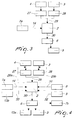
- Figure 3 is a functional block diagram of the flow of data among the various components of a unit according to the invention;
- Figure 4 is a functional block diagram of the flow of data among the various components, including some accessory components, of a unit according to the invention;
- Figure 5 is a flowchart of the detection and data processing method of a unit according to the invention;
- Figure 6 is a functional diagram of the connection between a
unit 1 according to the invention, the support vessel, and the fixed references constituted by the GPS satellites and by the harbor. - With reference to the figures, the
reference numeral 1 generally designates a portable unit for detecting the position with respect to a reference, particularly for substantially shielded environments. - The
portable unit 1 has the smallest possible dimensions, so that it can be worn (for example for underwater activity) on the wrist. - Each
unit 1 is provided with a respective power supply element, which is generally a backup battery, possibly of the rechargeable type: in this case, the unit must comprise an input for the connector leading to the electric power supply required for recharging, which can be conveniently sealed during the dive, or the rechargeable battery must be removable in order to perform recharging externally. - The
unit 1 further comprises a control and processing processor 2 (generally a microprocessor), adevice 3 for three-dimensional orientation with respect to geographical references, at least oneaccelerometer 4, ascreen 5, amemory component 6 and respective interfaces 7 fordata input 7a anddata output 7b. - The
device 3 and theaccelerometer 4 constitute an inertial position sensor, which is connected directly to the moving body and provides in output a signal which is a function of the movement performed with respect to an initial reference. The movement can be of the translational type, detected by way of theaccelerometer 4, or rotational, detected by way of thedevice 3. In order to assess completely the movement of a body, i.e., of its six degrees of freedom, it is possible to use two methods: one is to combine the use of the accelerometers for determining the three degrees of translational motion with the use ofdevices 3 of the type for determining the three degrees of rotation; another method is the one which uses the differential accelerations measured by means of two or more accelerometers subjected to the same rotary motion but located at different distances from the center of rotation. - The
processor 2 must be preset by the user by means of theinput interface 7a: theinput interface 7a is a keypad, by means of which the user can enter the coordinates of the starting point (in order to always have the exact indication of his position) and optionally of the target to be reached in order to follow the shortest route. Optionally, theinput interface 7a can also comprise a port for wireless connection with a GPS device provided at the reference point, in order to download directly from such device the coordinates of the starting point. - During the use of the
unit 1, theprocessor 2 processes instantaneously the data supplied by theorientation device 3 and by the at least oneaccelerometer 4, displaying such processing on thescreen 5 and storing it in thememory component 6. - The
memory component 6 can also be integrated in the processor 2 (which normally comprises a memory, generally of the volatile type, required for processing the information). Optionally, thememory component 6 can also comprise an additional memory (of the type with a removable or permanently inserted card), which is intended to record the path covered, in order to be able to reconstruct it subsequently in order to acquire interesting points that have been identified en route. - The
unit 1 can also comprise atemperature sensor 8 and adepth gauge 9. - The
sensor 9 supplies theprocessor 2 with data useful for thermal compensation, in order to eliminate the thermal drift of the signals supplied by thedevice 3 and by theaccelerometer 4, while thedepth gauge 9 supplies theprocessor 2 with data useful for instantaneous comparison of the data related to the vertical coordinate, which are provided by theaccelerometer 4 and by thedevice 3. - The
accelerometer 4 is of the type for three-dimensional sensing: substantially, said apparatus is capable of recording accelerations that have occurred along the three directions identified by a perpendicular spatial reference system; said reference system of the accelerometer 4 (which can move in space with six degrees of freedom) can be referred instantly to the geographical reference system (which is fixed) by way of the presence of thedevice 3 and of theprocessor 2 which processes the corresponding data. - An
accelerometer 4 with three-dimensional sensing can also be constituted by three accelerometers with one-dimensional sensing (or by a one-dimensional accelerometer and a two-dimensional accelerometer), arranged with mutually perpendicular sensing directions. - For a further improvement of sensing, it is optionally possible to insert at least one additional accelerometer for comparing the data related to the common sensing directions. For example, Figure 2 considers the inclusion of three
accelerometers - Underwater, the effect of Earth gravity on the human body is weaker than on land. Further, the movement of the scuba diver in the water is contrasted by the fluid in which he is immersed and is characterized by a speed on the order of 25 meters per minute. The phenomenon being studied therefore has an acceleration which is generally less than 1 g.
- Accordingly, the
accelerometer 4 which acts as a sensor and transducer for the acceleration of the scuba diver can be chosen so that it senses accelerations of no more than 2 g, although it must be able to absorb much larger sudden shocks. - In addition to good resolution, it would of course be convenient to have good sensitivity, so that small variations of the value to be measured are matched by larger variations of the output value. In this manner, the instrument becomes sensitive even to small intervals of variation of the input signal.
- Subsequently, it is necessary to evaluate the natural frequency of the phenomenon, since on the basis of this frequency it is necessary to choose the speed of the reference pulse of the
processor 2 and the bandwidth of theaccelerometer 4; both of these parameters affect the resolution of the apparatus, i.e., the smallest acceleration that it is capable of sensing. Human movement can be measured on average at 15 Hz or less. In any case, in the water the frequency involved in movement is 3-4 times lower than the frequency in air, and therefore the unit does not have to detect such rapid movement variations. - Temperature is another value that has to be taken into account, since the efficiency of an
accelerometer 4 is affected by the degrees of the environment that surrounds the sensor. - For example, the common noise of
accelerometers 4 is directly proportional to the bandwidth that is used and inversely proportional to the square root of the natural frequency of the phenomenon, and therefore it is essential to use the smallest possible bandwidth, stopping it at the highest frequency of the phenomenon being considered. In this way, it is possible to maximize the resolution and dynamic range of the accelerometer. - An
accelerometer 4 suitable for this use can utilize an MEMS (Micro Electro Mechanical System) logic. - The
device 3 for three-dimensional orientation with respect to geographical references can be constituted by (or can also merely comprise) a gyroscope, a compass or both devices. - A
device 3 for orientation with three-dimensional sensing can also be constituted by three devices with one-dimensional sensing (or by a one-dimensional device and a two-dimensional device) arranged with mutually perpendicular sensing directions. - The
unit 1 may further comprise a transceiver 13 for sound pulses and echoes, known as sonar, for connection to the support vessel, if any, when it is used underwater. - The
unit 1, in order to acquire and process data, applies a method which consists in entering the coordinates of thestarting point 14 by way of thedata input interface 7a; theperiodic updating cycle 15 occurs after input. - First of all, it is necessary to acquire instantaneously the
data depth gauge 9, if provided, the at least oneaccelerometer 4, thedevice 3 for three-dimensional orientation with respect to geographical references, thesonar receiver 13b, if any, and theoptional temperature sensor 8. - Once these data have been acquired, the
processor 2 must perform a thermal compensation 18 (by utilizing the data of the temperature sensor 9) of the data supplied by theaccelerometer 4 and by thedevice 3, at the end of which the stream of information is subjected todigital filtering 19 in order to eliminate any noise. - Only at this point it is possible to process 20 the data supplied by the
accelerometer 4, performing anoptional compensation 21 of the data related to the vertical axis by way of the data supplied by thedepth gauge 9. - The result of the processing 20 (compensated along the vertical axis 21) is subjected to
error correction 22 by calculating the distance from the initial reference point by using the sonar transceiver 13. If the speed of the sound wave in water is known, it is possible to calculate the distance from the initial reference point on the basis of the propagation time of a round trip of an acoustic signal transmitted by thetransmitter 13a, transmitted back by the reference point and received by thereceiver 13b. The same acoustic signal used for error compensation can be used for transmitting to the reference point data which comprise the geographical coordinates of the user. This information can be used by personnel located at the reference point in order to monitor and, if necessary, rescue the submerged scuba divers. - The
correction 22, generally termed dynamic synchronization, is performed before the position sensor is stored 23 in thememory component 6. - The stored
data 23 are displayed 24 on thescreen 5 and are optionally transmitted 25 via thesonar transmitter 13a, completing 26 the cycle. - The method is then applied sequentially in order to determine instantaneously the position with respect to the reference set in
step 14. - The instantaneous position is calculated by means of the
processor 2 by applying the following formulas to the acquired data:


where x0, y0 and z0 are the initial coordinates input by the user instep 14 of the method, V0x, V0y and V0z are the initial speeds, and ax, ay and az are the sensed accelerations. - It should be noted that when the initial coordinates are input, said coordinates are zero and are updated at each cycle according to the following formulas:


where V0x, V0y and V0z are the speeds detected at the instant tn-1, while ax(n), ay (n) and az(n) are the instantaneous accelerations of the instant tn. - Actually, speed and position can also be obtained by instantaneous integration of the sensed acceleration.
- The data related to the instantaneous position are also sent by means of the
acoustic signal transmitter 13a to the support vessel B for correct location of the underwater user S with respect to the satellite signals A and the signals of an optional beacon C, in order to facilitate search and rescue operations. - The operation of the invention is as follows: by way of the
input interface 7a, the user performsmanual synchronization 14. - The sensing of the environmental conditions by the
accelerometer 4 and thedevice 3 entails that the signal in output from these devices passes through arespective filter input 29 to theprocessor 2. - These
data 29, by applying the previously cited formulas, allow to obtain thekinematic data 30 at the output of theprocessor 2, said data being stored 23 in thecomponent 6 and displayed 24 on thescreen 5. - If a unit which also has all the auxiliary devices mentioned earlier is considered, the
processor 2 receives from thetemperature sensor 8 the correspondingdata 31 for performing thermal compensation of thedata 29 and receives from thedepth gauge 9 thedata 32 for performing compensation of the vertical coordinate of thedata 29. - These compensations provide respective signals, which replace the signals in output from the accelerometer 4 (
stream 29a) and the signals in output from the device 3 (stream 29b). - The presence of an
acoustic wave receiver 13b (connected for example to a transmitter provided on the vessel) provides theprocessor 2 with adata stream 33 useful for error compensation based on the distance from the reference point. - The
kinematic data 30 related to the instantaneous position can be supplied not only to thescreen 5 but also by thecomponent 6 to thesound wave transmitter 13a (which is connected to the vessel, in this case optionally also with a deferred link) to thedata output interface 7b for the transfer of all the stored information on an external device (e.g., a personal computer). - The
present unit 1 supplies the global positioning coordinates to a user who is in environments in which it is not possible to connect to a satellite. The primary recipients of this product are scuba divers, who use very simple navigation instruments below the surface of the sea. The reasons why this is an important addition to the equipment of a scuba diver are the following: the diving time of a scuba diver is extremely constrained by his air supply and by the limited time for which he can stay at considerable depths. Any device which improves the quantity or quality of the time spent in marine depths is very interesting. - It is possible to add the functions provided by the
present unit 1 to the normal functions of an underwater computer. With such unit, scuba divers can locate destinations more rapidly in the case of the wreck of a ship, of search points and of their own vessel. Scuba divers can record, recommend and locate specific GPS coordinates instead of following the conventional procedures, which use only the compass and the sense of direction of the user. - A GPS apparatus has been provided in which the functions are based on the relative movement of the scuba diver with respect to the vessel. First of all, the scuba diver synchronizes his
unit 1 with the GPS coordinate of the vessel; this can occur manually, by acting directly on the buttons of his wrist set, after reading the GPS position on the display of the onboard device. - Once in the water, the
unit 1 tracks the movements of the scuba diver with respect to the initial synchronization point, i.e., it is aware in each instant of the underwater movement of its user and deducts his position with respect to the initial coordinate and accordingly provides the instantaneous GPS position of the scuba diver. Further, if the GPS coordinates of a possible underwater destination to be reached are known and set beforehand, the scuba diver can swim so as to be guided toward it. His movement is tracked, by way of theunit 1, on thescreen 5 and the destination point and the current location of the scuba diver are displayed simultaneously. Another operating method is the use of free diving without devices on the vessel. The scuba diver sets his initial coordinates as (0, 0, 0) and starts the dive by tracking his own movement with respect to the initial point, allowing easier return to the vessel. - It has thus been shown that the invention achieves the proposed aim and objects.
- The invention thus conceived is susceptible of numerous modifications and variations, all of which are within the scope of the appended claims.
- All the details may further be replaced with other technically equivalent ones.
- In the examples of embodiment that have been shown, individual characteristics, given in relation to specific examples, may actually be interchanged with other different characteristics which exist in other examples of embodiment.
- Moreover, it is noted that anything found to be already known during the patenting process is understood not to be claimed and to be the subject of a disclaimer.
- In practice, the materials used, as well as the shapes and the dimensions, may be any according to requirements without thereby abandoning the scope of the protection of the appended claims.
- The disclosures in Italian Patent Application No. BO2004A000740 from which this application claims priority are incorporated herein by reference.
- Where technical features mentioned in any claim are followed by reference signs, those reference signs have been included for the sole purpose of increasing the intelligibility of the claims and accordingly such reference signs do not have any limiting effect on the interpretation of each element identified by way of example by such reference signs.
Claims (15)
- A portable unit for detecting a position with respect to a reference, particularly for substantially shielded environments, comprising a power supply element, characterized in that it comprises a control and processing processor (2), a device (3) for three-dimensional orientation with respect to geographical references, at least one accelerometer (4), a screen (5), a memory component (6) and respective data input (7a) and output (7b) interfaces (7), said processor (2) being adapted to be preset by the user by means of said input interface (7a) and being adapted to process instantaneously data supplied during use by said orientation device (3) and by said at least one accelerometer (4), displaying said processing on the screen (5) and storing said processing in the memory component (6).
- The unit according to claim 1, characterized in that it also comprises a temperature sensor (8), which is connected to said processor (2) for thermal compensation of the data.
- The unit according to claim 1, characterized in that it also comprises a depth gauge (9), which is connected to said processor (2) for instantaneous comparison of data related to a vertical coordinate, which are supplied by the at least one accelerometer (4) and by the orientation device (3).
- The unit according to claim 1, characterized in that said at least one accelerometer (4) is of the type for three-dimensional sensing.
- The unit according to claim 4, characterized in that said accelerometer with three-dimensional sensing is constituted by at least two accelerometers which are at least one-dimensional and are arranged with mutually perpendicular sensing directions.
- The unit according to claim 4, characterized in that in addition to said accelerometer (4) with three-dimensional sensing there is also at least one additional accelerometer (10, 11, 12) for comparing data related to common sensing directions.
- The unit according to claim 1, characterized in that said device (3) for three-dimensional orientation with respect to geographical references comprises a gyroscope.
- The unit according to claim 1, characterized in that said device (3) for three-dimensional orientation with respect to geographical references comprises a compass.
- The unit according to claim 1, characterized in that said data input interface (7a) is a keypad suitable for entering the coordinates of the starting point.
- The unit according to claim 1, characterized in that it comprises a transceiver (13) for acoustic pulses and echoes, known as sonar, for connection to a support vessel when used underwater.
- A method for sensing and processing data in a portable unit for detecting a position with respect to a reference, particularly for substantially shielded environments, according to claim 1, which comprises the steps of:- entering (14) coordinates of an initial point by means of said data input interface (7a),- acquiring (16, 17) instantaneously data, by means of the at least one accelerometer (4) and device (3) for three-dimensional orientation with respect to geographical references,- calculating (7) an instantaneous position, by means of the processor (2), by applying the formulas


where x0, y0 and z0 are initial coordinates, V0x, V0y and V0z are initial speeds, and ax, aY and az are sensed accelerations,- showing on the screen the coordinates x(t), y(t) and z(t) calculated instantaneously. - The method according to claim 11, characterized in that the data are acquired also by a depth gauge (9), the data supplied by the depth gauge (9) being adapted for comparing the coordinate along a vertical axis.
- The method according to claim 11, characterized in that the data are acquired also by a temperature sensor (8), the data supplied by the temperature sensor (8) being adapted for thermal compensation.
- The method according to claim 11, characterized in that the data are also acquired by an acoustic signal receiver (13b), the data acquired by the receiver (13b) being adapted for error compensation based on the distance from the reference point.
- The method according to claim 11, characterized in that the data are also sent by means of an acoustic signal transmitter (13a) to a support vessel (B) for correctly locating an underwater user (S) with respect to satellite signals (A) and signals of a beacon (C), in order to facilitate search and rescue operations.
Applications Claiming Priority (1)
| Application Number | Priority Date | Filing Date | Title |
|---|---|---|---|
| IT000740A ITBO20040740A1 (en) | 2004-11-29 | 2004-11-29 | TRANSPORTABLE UNIT FOR THE SURVEY OF THE POSITION IN RESPECT OF A REFERENCE, PARTICULARLY FOR SUBSTANTIALLY SHIELDED ENVIRONMENTS |
Publications (1)
| Publication Number | Publication Date |
|---|---|
| EP1662229A1 true EP1662229A1 (en) | 2006-05-31 |
Family
ID=35874752
Family Applications (1)
| Application Number | Title | Priority Date | Filing Date |
|---|---|---|---|
| EP05110937A Withdrawn EP1662229A1 (en) | 2004-11-29 | 2005-11-18 | Portable unit for determining the position with respect to a reference, particularly for substantially shielded environments |
Country Status (3)
| Country | Link |
|---|---|
| US (1) | US20060224352A1 (en) |
| EP (1) | EP1662229A1 (en) |
| IT (1) | ITBO20040740A1 (en) |
Families Citing this family (9)
| Publication number | Priority date | Publication date | Assignee | Title |
|---|---|---|---|---|
| US20090085865A1 (en) * | 2007-09-27 | 2009-04-02 | Liquivision Products, Inc. | Device for underwater use and method of controlling same |
| DE102008019444A1 (en) * | 2008-04-17 | 2009-10-22 | Fachhochschule Aachen | Inertia navigation underwater |
| DE102009000239A1 (en) * | 2009-01-15 | 2010-07-29 | Deutsche Telekom Ag | Location method for determining positioning coordinates of a creature's abode, especially for a human or animal, provides positioning coordinates for a reference point |
| GB2469632A (en) * | 2009-04-20 | 2010-10-27 | J & M Inertial Navigation Ltd | Portable rescue apparatus for guiding a person back to a reached waypoint position |
| WO2011084483A2 (en) * | 2009-12-16 | 2011-07-14 | Shb Instruments, Inc. | Underwater acoustic navigation systems and methods |
| WO2012078140A1 (en) * | 2010-12-07 | 2012-06-14 | John Souza | Underwater navigation system |
| US8952820B2 (en) * | 2012-03-30 | 2015-02-10 | Kevin William Juergensen | Enhanced dive computer functionality and associated features |
| RU2599902C1 (en) * | 2015-09-08 | 2016-10-20 | Общество с ограниченной ответственностью "Лаборатория подводной связи и навигации" | Method of navigating underwater objects and system for its implementation |
| US9329273B1 (en) * | 2015-10-16 | 2016-05-03 | Swim View, LLC | Systems and methods for guiding swimmers |
Citations (8)
| Publication number | Priority date | Publication date | Assignee | Title |
|---|---|---|---|---|
| EP0508819A2 (en) * | 1991-04-10 | 1992-10-14 | Abbotsbury Software Limited | Apparatus for tracking and communicating with objects under water |
| DE10064419A1 (en) * | 2000-12-21 | 2002-07-04 | I For T Gmbh | Arrangement for continuous movement and inclination monitoring for a ship's anchor has a number of measurement elements linked together to detect undesired movement of the anchor |
| EP1253404A2 (en) * | 2001-04-23 | 2002-10-30 | Quentin Ladetto | Pedestrian navigation method and apparatus operative in a dead reckoning mode |
| US6546336B1 (en) * | 1998-09-26 | 2003-04-08 | Jatco Corporation | Portable position detector and position management system |
| DE20313948U1 (en) * | 2003-09-05 | 2003-11-06 | Goedeking, Philipp, Dr., 60320 Frankfurt | Diver course tracking unit has compass, timer and speed sensors |
| US20040022129A1 (en) * | 2001-11-19 | 2004-02-05 | Mcgeever John F. | Navigational device for an underwater diver |
| WO2004020951A1 (en) * | 2002-08-27 | 2004-03-11 | Vitec Co., Ltd. | Mobile terminal device |
| US20040133346A1 (en) * | 2003-01-08 | 2004-07-08 | Bye Charles T. | Attitude change kalman filter measurement apparatus and method |
-
2004
- 2004-11-29 IT IT000740A patent/ITBO20040740A1/en unknown
-
2005
- 2005-11-18 EP EP05110937A patent/EP1662229A1/en not_active Withdrawn
- 2005-11-21 US US11/282,832 patent/US20060224352A1/en not_active Abandoned
Patent Citations (9)
| Publication number | Priority date | Publication date | Assignee | Title |
|---|---|---|---|---|
| EP0508819A2 (en) * | 1991-04-10 | 1992-10-14 | Abbotsbury Software Limited | Apparatus for tracking and communicating with objects under water |
| US6546336B1 (en) * | 1998-09-26 | 2003-04-08 | Jatco Corporation | Portable position detector and position management system |
| DE10064419A1 (en) * | 2000-12-21 | 2002-07-04 | I For T Gmbh | Arrangement for continuous movement and inclination monitoring for a ship's anchor has a number of measurement elements linked together to detect undesired movement of the anchor |
| EP1253404A2 (en) * | 2001-04-23 | 2002-10-30 | Quentin Ladetto | Pedestrian navigation method and apparatus operative in a dead reckoning mode |
| US20040022129A1 (en) * | 2001-11-19 | 2004-02-05 | Mcgeever John F. | Navigational device for an underwater diver |
| WO2004020951A1 (en) * | 2002-08-27 | 2004-03-11 | Vitec Co., Ltd. | Mobile terminal device |
| EP1536207A1 (en) * | 2002-08-27 | 2005-06-01 | Vitec Co., Ltd. | Mobile terminal device |
| US20040133346A1 (en) * | 2003-01-08 | 2004-07-08 | Bye Charles T. | Attitude change kalman filter measurement apparatus and method |
| DE20313948U1 (en) * | 2003-09-05 | 2003-11-06 | Goedeking, Philipp, Dr., 60320 Frankfurt | Diver course tracking unit has compass, timer and speed sensors |
Also Published As
| Publication number | Publication date |
|---|---|
| US20060224352A1 (en) | 2006-10-05 |
| ITBO20040740A1 (en) | 2005-02-28 |
Similar Documents
| Publication | Publication Date | Title |
|---|---|---|
| CN103744098B (en) | AUV integrated navigation systems based on SINS/DVL/GPS | |
| Kepper et al. | A navigation solution using a MEMS IMU, model-based dead-reckoning, and one-way-travel-time acoustic range measurements for autonomous underwater vehicles | |
| AU2010201494B2 (en) | Personal Navigation Apparatus | |
| EP3058388B1 (en) | Underwater tracking system | |
| US20120022820A1 (en) | Method for inertial navigation under water | |
| US20070006472A1 (en) | Independent personal underwater navigation system for scuba divers | |
| Eustice et al. | Recent advances in synchronous-clock one-way-travel-time acoustic navigation | |
| NO334597B1 (en) | Underwater navigation method and system | |
| US10261192B2 (en) | Radionavigation for swimmers | |
| CN110274591B (en) | ADCP-assisted SINS navigation method for deep-dive manned submersibles | |
| US20110188349A1 (en) | System and Method of Determining an Underwater Location | |
| CN107748352B (en) | Ultra-short baseline device and positioning method suitable for shallow water positioning | |
| EP1662229A1 (en) | Portable unit for determining the position with respect to a reference, particularly for substantially shielded environments | |
| CN112684207B (en) | A deep-dive manned submersible ADCP velocity estimation and correction algorithm | |
| EP3161418B1 (en) | Generation of underwater navigational information | |
| CN202928583U (en) | Offshore drilling platform attitude monitor and location device | |
| US20140100775A1 (en) | Underwater navigation system | |
| Jyothi et al. | Assessment of the technological maturity of manned submersible navigation positioning systems | |
| RU110503U1 (en) | HYDROACOUSTIC SYSTEM OF UNDERWATER NAVIGATION FOR DIVERS AND THE UNDERWATER DIVER UNIT | |
| Allotta et al. | Localization algorithm for a fleet of three AUVs by INS, DVL and range measurements | |
| JPH08136650A (en) | Acoustic position measuring instrument | |
| Harke et al. | Gyroscope drift estimation of a GPS/MEMSINS smartphone sensor integration navigation system for kayaking | |
| RU172196U1 (en) | AUTONOMOUS DIVER NAVIGATION INSTRUMENT | |
| Gelin | A High-Rate Virtual Instrument of Marine Vehicle Motions for Underwater Navigation and Ocean Remote Sensing | |
| Johnson | Measuring the orientation and movement of marine animals using inertial and magnetic sensors-a tutorial |
Legal Events
| Date | Code | Title | Description |
|---|---|---|---|
| PUAI | Public reference made under article 153(3) epc to a published international application that has entered the european phase |
Free format text: ORIGINAL CODE: 0009012 |
|
| AK | Designated contracting states |
Kind code of ref document: A1 Designated state(s): AT BE BG CH CY CZ DE DK EE ES FI FR GB GR HU IE IS IT LI LT LU LV MC NL PL PT RO SE SI SK TR |
|
| AX | Request for extension of the european patent |
Extension state: AL BA HR MK YU |
|
| 17P | Request for examination filed |
Effective date: 20061130 |
|
| 17Q | First examination report despatched |
Effective date: 20070103 |
|
| AKX | Designation fees paid |
Designated state(s): AT BE BG CH CY CZ DE DK EE ES FI FR GB GR HU IE IS IT LI LT LU LV MC NL PL PT RO SE SI SK TR |
|
| STAA | Information on the status of an ep patent application or granted ep patent |
Free format text: STATUS: THE APPLICATION IS DEEMED TO BE WITHDRAWN |
|
| 18D | Application deemed to be withdrawn |
Effective date: 20110601 |