EP1657568A1 - System and method for monitoring the external environment of a motor vehicle - Google Patents
System and method for monitoring the external environment of a motor vehicle Download PDFInfo
- Publication number
- EP1657568A1 EP1657568A1 EP03818087A EP03818087A EP1657568A1 EP 1657568 A1 EP1657568 A1 EP 1657568A1 EP 03818087 A EP03818087 A EP 03818087A EP 03818087 A EP03818087 A EP 03818087A EP 1657568 A1 EP1657568 A1 EP 1657568A1
- Authority
- EP
- European Patent Office
- Prior art keywords
- capturing device
- vehicle
- detecting
- supervisory area
- signals
- Prior art date
- Legal status (The legal status is an assumption and is not a legal conclusion. Google has not performed a legal analysis and makes no representation as to the accuracy of the status listed.)
- Granted
Links
Images

Classifications
-
- G—PHYSICS
- G08—SIGNALLING
- G08G—TRAFFIC CONTROL SYSTEMS
- G08G1/00—Traffic control systems for road vehicles
- G08G1/16—Anti-collision systems
- G08G1/161—Decentralised systems, e.g. inter-vehicle communication
-
- G—PHYSICS
- G01—MEASURING; TESTING
- G01S—RADIO DIRECTION-FINDING; RADIO NAVIGATION; DETERMINING DISTANCE OR VELOCITY BY USE OF RADIO WAVES; LOCATING OR PRESENCE-DETECTING BY USE OF THE REFLECTION OR RERADIATION OF RADIO WAVES; ANALOGOUS ARRANGEMENTS USING OTHER WAVES
- G01S13/00—Systems using the reflection or reradiation of radio waves, e.g. radar systems; Analogous systems using reflection or reradiation of waves whose nature or wavelength is irrelevant or unspecified
- G01S13/88—Radar or analogous systems specially adapted for specific applications
- G01S13/93—Radar or analogous systems specially adapted for specific applications for anti-collision purposes
- G01S13/931—Radar or analogous systems specially adapted for specific applications for anti-collision purposes of land vehicles
-
- G—PHYSICS
- G08—SIGNALLING
- G08G—TRAFFIC CONTROL SYSTEMS
- G08G1/00—Traffic control systems for road vehicles
- G08G1/16—Anti-collision systems
- G08G1/161—Decentralised systems, e.g. inter-vehicle communication
- G08G1/163—Decentralised systems, e.g. inter-vehicle communication involving continuous checking
-
- B—PERFORMING OPERATIONS; TRANSPORTING
- B60—VEHICLES IN GENERAL
- B60R—VEHICLES, VEHICLE FITTINGS, OR VEHICLE PARTS, NOT OTHERWISE PROVIDED FOR
- B60R2300/00—Details of viewing arrangements using cameras and displays, specially adapted for use in a vehicle
- B60R2300/10—Details of viewing arrangements using cameras and displays, specially adapted for use in a vehicle characterised by the type of camera system used
- B60R2300/106—Details of viewing arrangements using cameras and displays, specially adapted for use in a vehicle characterised by the type of camera system used using night vision cameras
-
- B—PERFORMING OPERATIONS; TRANSPORTING
- B60—VEHICLES IN GENERAL
- B60R—VEHICLES, VEHICLE FITTINGS, OR VEHICLE PARTS, NOT OTHERWISE PROVIDED FOR
- B60R2300/00—Details of viewing arrangements using cameras and displays, specially adapted for use in a vehicle
- B60R2300/30—Details of viewing arrangements using cameras and displays, specially adapted for use in a vehicle characterised by the type of image processing
-
- B—PERFORMING OPERATIONS; TRANSPORTING
- B60—VEHICLES IN GENERAL
- B60R—VEHICLES, VEHICLE FITTINGS, OR VEHICLE PARTS, NOT OTHERWISE PROVIDED FOR
- B60R2300/00—Details of viewing arrangements using cameras and displays, specially adapted for use in a vehicle
- B60R2300/30—Details of viewing arrangements using cameras and displays, specially adapted for use in a vehicle characterised by the type of image processing
- B60R2300/301—Details of viewing arrangements using cameras and displays, specially adapted for use in a vehicle characterised by the type of image processing combining image information with other obstacle sensor information, e.g. using RADAR/LIDAR/SONAR sensors for estimating risk of collision
-
- B—PERFORMING OPERATIONS; TRANSPORTING
- B60—VEHICLES IN GENERAL
- B60R—VEHICLES, VEHICLE FITTINGS, OR VEHICLE PARTS, NOT OTHERWISE PROVIDED FOR
- B60R2300/00—Details of viewing arrangements using cameras and displays, specially adapted for use in a vehicle
- B60R2300/30—Details of viewing arrangements using cameras and displays, specially adapted for use in a vehicle characterised by the type of image processing
- B60R2300/304—Details of viewing arrangements using cameras and displays, specially adapted for use in a vehicle characterised by the type of image processing using merged images, e.g. merging camera image with stored images
- B60R2300/305—Details of viewing arrangements using cameras and displays, specially adapted for use in a vehicle characterised by the type of image processing using merged images, e.g. merging camera image with stored images merging camera image with lines or icons
-
- B—PERFORMING OPERATIONS; TRANSPORTING
- B60—VEHICLES IN GENERAL
- B60R—VEHICLES, VEHICLE FITTINGS, OR VEHICLE PARTS, NOT OTHERWISE PROVIDED FOR
- B60R2300/00—Details of viewing arrangements using cameras and displays, specially adapted for use in a vehicle
- B60R2300/80—Details of viewing arrangements using cameras and displays, specially adapted for use in a vehicle characterised by the intended use of the viewing arrangement
- B60R2300/802—Details of viewing arrangements using cameras and displays, specially adapted for use in a vehicle characterised by the intended use of the viewing arrangement for monitoring and displaying vehicle exterior blind spot views
-
- B—PERFORMING OPERATIONS; TRANSPORTING
- B60—VEHICLES IN GENERAL
- B60R—VEHICLES, VEHICLE FITTINGS, OR VEHICLE PARTS, NOT OTHERWISE PROVIDED FOR
- B60R2300/00—Details of viewing arrangements using cameras and displays, specially adapted for use in a vehicle
- B60R2300/80—Details of viewing arrangements using cameras and displays, specially adapted for use in a vehicle characterised by the intended use of the viewing arrangement
- B60R2300/8053—Details of viewing arrangements using cameras and displays, specially adapted for use in a vehicle characterised by the intended use of the viewing arrangement for bad weather conditions or night vision
-
- B—PERFORMING OPERATIONS; TRANSPORTING
- B60—VEHICLES IN GENERAL
- B60R—VEHICLES, VEHICLE FITTINGS, OR VEHICLE PARTS, NOT OTHERWISE PROVIDED FOR
- B60R2300/00—Details of viewing arrangements using cameras and displays, specially adapted for use in a vehicle
- B60R2300/80—Details of viewing arrangements using cameras and displays, specially adapted for use in a vehicle characterised by the intended use of the viewing arrangement
- B60R2300/8086—Details of viewing arrangements using cameras and displays, specially adapted for use in a vehicle characterised by the intended use of the viewing arrangement for vehicle path indication
-
- B—PERFORMING OPERATIONS; TRANSPORTING
- B60—VEHICLES IN GENERAL
- B60W—CONJOINT CONTROL OF VEHICLE SUB-UNITS OF DIFFERENT TYPE OR DIFFERENT FUNCTION; CONTROL SYSTEMS SPECIALLY ADAPTED FOR HYBRID VEHICLES; ROAD VEHICLE DRIVE CONTROL SYSTEMS FOR PURPOSES NOT RELATED TO THE CONTROL OF A PARTICULAR SUB-UNIT
- B60W2554/00—Input parameters relating to objects
-
- G—PHYSICS
- G01—MEASURING; TESTING
- G01S—RADIO DIRECTION-FINDING; RADIO NAVIGATION; DETERMINING DISTANCE OR VELOCITY BY USE OF RADIO WAVES; LOCATING OR PRESENCE-DETECTING BY USE OF THE REFLECTION OR RERADIATION OF RADIO WAVES; ANALOGOUS ARRANGEMENTS USING OTHER WAVES
- G01S13/00—Systems using the reflection or reradiation of radio waves, e.g. radar systems; Analogous systems using reflection or reradiation of waves whose nature or wavelength is irrelevant or unspecified
- G01S13/88—Radar or analogous systems specially adapted for specific applications
- G01S13/93—Radar or analogous systems specially adapted for specific applications for anti-collision purposes
- G01S13/931—Radar or analogous systems specially adapted for specific applications for anti-collision purposes of land vehicles
- G01S2013/9315—Monitoring blind spots
-
- G—PHYSICS
- G01—MEASURING; TESTING
- G01S—RADIO DIRECTION-FINDING; RADIO NAVIGATION; DETERMINING DISTANCE OR VELOCITY BY USE OF RADIO WAVES; LOCATING OR PRESENCE-DETECTING BY USE OF THE REFLECTION OR RERADIATION OF RADIO WAVES; ANALOGOUS ARRANGEMENTS USING OTHER WAVES
- G01S13/00—Systems using the reflection or reradiation of radio waves, e.g. radar systems; Analogous systems using reflection or reradiation of waves whose nature or wavelength is irrelevant or unspecified
- G01S13/88—Radar or analogous systems specially adapted for specific applications
- G01S13/93—Radar or analogous systems specially adapted for specific applications for anti-collision purposes
- G01S13/931—Radar or analogous systems specially adapted for specific applications for anti-collision purposes of land vehicles
- G01S2013/932—Radar or analogous systems specially adapted for specific applications for anti-collision purposes of land vehicles using own vehicle data, e.g. ground speed, steering wheel direction
-
- G—PHYSICS
- G01—MEASURING; TESTING
- G01S—RADIO DIRECTION-FINDING; RADIO NAVIGATION; DETERMINING DISTANCE OR VELOCITY BY USE OF RADIO WAVES; LOCATING OR PRESENCE-DETECTING BY USE OF THE REFLECTION OR RERADIATION OF RADIO WAVES; ANALOGOUS ARRANGEMENTS USING OTHER WAVES
- G01S13/00—Systems using the reflection or reradiation of radio waves, e.g. radar systems; Analogous systems using reflection or reradiation of waves whose nature or wavelength is irrelevant or unspecified
- G01S13/88—Radar or analogous systems specially adapted for specific applications
- G01S13/93—Radar or analogous systems specially adapted for specific applications for anti-collision purposes
- G01S13/931—Radar or analogous systems specially adapted for specific applications for anti-collision purposes of land vehicles
- G01S2013/9323—Alternative operation using light waves
-
- G—PHYSICS
- G01—MEASURING; TESTING
- G01S—RADIO DIRECTION-FINDING; RADIO NAVIGATION; DETERMINING DISTANCE OR VELOCITY BY USE OF RADIO WAVES; LOCATING OR PRESENCE-DETECTING BY USE OF THE REFLECTION OR RERADIATION OF RADIO WAVES; ANALOGOUS ARRANGEMENTS USING OTHER WAVES
- G01S13/00—Systems using the reflection or reradiation of radio waves, e.g. radar systems; Analogous systems using reflection or reradiation of waves whose nature or wavelength is irrelevant or unspecified
- G01S13/88—Radar or analogous systems specially adapted for specific applications
- G01S13/93—Radar or analogous systems specially adapted for specific applications for anti-collision purposes
- G01S13/931—Radar or analogous systems specially adapted for specific applications for anti-collision purposes of land vehicles
- G01S2013/9324—Alternative operation using ultrasonic waves
-
- G—PHYSICS
- G01—MEASURING; TESTING
- G01S—RADIO DIRECTION-FINDING; RADIO NAVIGATION; DETERMINING DISTANCE OR VELOCITY BY USE OF RADIO WAVES; LOCATING OR PRESENCE-DETECTING BY USE OF THE REFLECTION OR RERADIATION OF RADIO WAVES; ANALOGOUS ARRANGEMENTS USING OTHER WAVES
- G01S13/00—Systems using the reflection or reradiation of radio waves, e.g. radar systems; Analogous systems using reflection or reradiation of waves whose nature or wavelength is irrelevant or unspecified
- G01S13/88—Radar or analogous systems specially adapted for specific applications
- G01S13/93—Radar or analogous systems specially adapted for specific applications for anti-collision purposes
- G01S13/931—Radar or analogous systems specially adapted for specific applications for anti-collision purposes of land vehicles
- G01S2013/9327—Sensor installation details
- G01S2013/93274—Sensor installation details on the side of the vehicles
Definitions
- the present invention relates to a system and method for the supervision of an exterior environment of a motor vehicle, in particular applicable to a rear view mirror.
- the system comprises a device for capturing information regarding presence from the exterior, representative of an object included within a supervisory area, which operates in combination with at least means for detecting trajectories, to vary said supervisory area depending on the trajectory of the vehicle.
- the patent application EP-A-0591743 describes a device for detecting relative positions between vehicles, by means of an electro-optical sensor, preferably based on CCD technology, associated with a casing of a rear view mirror, and being said electro-optical sensor associated with an electronic processing unit connected to a central information system of the vehicle, to which it sends processed signals, providing finally warning signals.
- the aim of this device is to warn the driver of the vehicle where this device is installed, through various signals (acoustic, luminous, etc.), of the possible collision risk with an approaching vehicle.
- it is stated the possibility of using said device for warning the driver of the approaching vehicle of the possible collision risk by means of the activation of the emergency lights of the vehicle, or of its direction indicators.
- the patent application WO-A-01/61371 of the same applicant describes, furthermore, a device for detecting the presence of objects similar to the previous one, however, in said case the detection device consists of a receiver of electromagnetic waves and a photo sensor, which transforms the received electromagnetic waves into electric signals.
- the detection device consists of a receiver of electromagnetic waves and a photo sensor, which transforms the received electromagnetic waves into electric signals.
- special reference is made to the followed methodology when acquiring and processing the images, once digitized and previously amplified, as well as to the different calculation algorithms susceptible to be used for generating warning signals similar to the ones generated by the aforementioned device.
- Patent US6226571 proposes a device for monitoring the environment of a vehicle, being able to predict a road's geography, as for example its curvature radius, only through the route information of a vehicle and a relative position.
- the proposed device includes a radar system for detecting the presence of objects around the vehicle and for supplying information about the position of the objects in a predetermined system of coordinates of detection, a vehicle identifying device to, starting from the detected objects, classify the objects that are vehicles and are driving on the road, distinguishing them from other types of objects.
- the device also includes a predictive device of the road's geography to predict it on the base of the position of the circulating vehicles and the route information according to an exit signal of the radar system and an exit signal of the vehicles identifying device.
- the present invention proposes a system and a method for the supervision of an exterior environment of a motor vehicle, in particular applicable to an exterior rear view mirror of said vehicle.
- Said system is adapted for the detection of the presence of objects susceptible to collide with the mentioned vehicle, in a determined supervisory area, covering at least one dead angle, and comprises, therefore, a capturing device, whether a passive one, as an electro-optical device, as for example a camera, or an active one, as for example a radar system, an infra-red rays system or an ultrasounds system.
- Said capturing device is suitable to acquire images or information samples regarding presence captured from the exterior, representative of an object included within said supervisory area, and an electronic system to treat and analyze signals obtained through the capturing device, and to generate exit signals as a function of the result of said analysis.
- the proposed system also comprises means for detecting trajectories and means for detecting inclinations associated and cooperating with said electronic system to vary the effective supervisory area by the capturing device as a function of the signals, processed and analyzed, obtained through said detection devices, without being it necessary for the driver to worry about the fact, that a normal driving situation in relation to another vehicle, as for example when driving through a curve, could turn out to be considered as potentially dangerous by the system, increasing, therefore, the confidence given by the system.
- the present invention also proposes a method through which, and using the above mentioned system, the variation of the supervisory area to be covered by the capturing device is carried out.
- Said method comprises performing the detection of an object entering in said supervisory area, the obtaining of signals representative of said detection, the treatment, processing and analysis of said signals and the generation of exit signals as a result of said analysis. It further comprises performing, through said electronic system, in combination with means for detecting trajectories and means for detecting inclinations of the vehicle, the detection of possible variations in the trajectory and/or inclination of the vehicle and the treatment, processing and analysis of signals representative of said possible variations in the trajectory and/or inclination, the storage of values representative of said variations, forming with them a chart that relates the trajectory and/or inclination with a corresponding supervisory area to be covered by the capturing device, being said chart accessible by the electronic system and used by it, in order to, once known the exact circumstances the vehicle is going through in a determined moment, thanks to said detection means, carry out the necessary actions to vary the supervisory area to be covered by the capturing device, actions which will be different depending on the type of capturing device used.
- the system proposed by the present invention is used for the supervision of an exterior environment of a vehicle, in particular applicable on a rear view mirror, being said system adapted for detecting the presence of objects susceptible to collide with said vehicle, within a determined supervisory area, covering at least one dead angle, and being the system of the type which comprises a capturing device 1 suitable to acquire images or information samples regarding presence captured from the exterior, representative of an object included within said supervisory area, and an electronic system 4 (see Fig.
- the system comprises, furthermore, means for detecting trajectories 2 and, advantageously and in combination with it, means for detecting inclinations 3 of the vehicle, associated and in cooperation with said electronic system 4 to vary or adjust the supervisory area to be covered by the capturing device 1 as a function of second and third signals, processed and analyzed, obtained through said means for detecting trajectories 2 and/or said means for detecting inclinations 3.
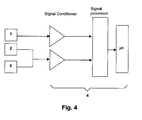
- Fig. 4 a scheme of all the parts pertaining to the system and detailed above may be observed.
- the figure shows capturing device 1 as well as the means for detecting trajectories 2 and the means for detecting inclinations 3.
- the electronic system 4 which in the figure consists basically of a signal conditioner, a signal processor and a microcontroller, even though, as it is obvious, this is just an example to be taken as indication and not as representation.
- Fig. 3 shows how a vehicle, in a straight trajectory, when trying to overtake the vehicle in which the system proposed by the present invention is installed, enters in the area covered by the capturing device 1, being, therefore, detected by the system.
- Fig. 3 the situation shown in Fig. 3 is not the one occurring in 100% of the cases of real driving situations, as the trajectory normally is variable, including curves, irregularities of the road, etc.
- the means for detecting trajectories 2 comprise at least one accelerometer or centripetal acceleration sensor, by means of which its centripetal acceleration is measured, providing the sensor an electrical signal to the electronic system 4, proportional to said centripetal acceleration, what allows that the electronic system 4, which could be part of a central control system of the vehicle, as for example a board computer, and which also has access to the information indicating the lineal speed of the vehicle, can obtain, at any moment and by means of both parameters, the angular speed of the vehicle and the curvature radius, as when making a turn a centripetal acceleration inversely proportional to the curvature radius and proportional to the square of the lineal speed is generated.
- Said turning radius could also be obtained in another way, as according to the proposal in another embodiment, in which the accelerometer mentioned in the previous embodiment is here substituted by means for the acquisition of data from a pulsating system for turn sensing, consisting of two sensors located each one in one of both rear wheels of the vehicle. Said sensors provide electrical signals in form of impulses to the electronic system 4, proportional to the turn of each wheel, being different in case one wheel turns more than the other, i.e., in case the vehicle is turning.
- the difference between the impulse number between one wheel and the other is considered by the electronic system 4 in order to, as it happened in the case where an accelerometer was used as a sensor, obtain a series of values of curvature radius corresponding to the different trajectories adopted by the vehicle, as a function of the different curve types, apart from knowing when the vehicle is really turning.
- the information about the turn radius of the vehicle is obtained by at least one device for turn detection located in the steering wheel of the vehicle, being part of the means for detecting trajectories 2. This information is treated in the same way as the already explained for the both above mentioned embodiments.
- the means for detecting inclinations 3 which are responsible for detecting the inclination and/or vibrations that the vehicle may suffer, which may be important, specially, on mountain roads or in zones where the roads are deteriorated or deformed, they comprise in a preferred embodiment at least a two axis accelerometer, which may be used not only for measuring the inclination of the vehicle, but also its trajectory, i.e., that, in fact, said two axis accelerometer would substitute the one used by the means for detecting trajectories 2 and would be part of both detection means 2 and 3.
- the same function carried out by the two axis accelerometer could be executed, for another embodiment, by using at least one gyroscope.
- the capturing device 1 in a very general way, without specifying what it consists of. This has been this way, because it could be any, for different embodiments, of the ones included in a group comprising, for example, a camera, an infra-red rays system, a radar system and an ultrasound system, or a combination of them.
- the capturing device 1 is a camera, it could be part of the means for detecting trajectories 2, providing the electronic system 4 with signals representative of the images captured by itself and analyzing the electronic system the difference between consecutive images to calculate, for example, the turn radius of a curve, taking as a reference a part of the image which would also vary its position in case of a curve, such as a limiting line of the traffic lane, along which the vehicle is circulating.
- the camera is mobile, what would extend the visual area to be covered by it.
- said capturing device 1 is a radar system which comprises at least two antennas with different inclinations or one antenna which comprises at least two combined antennas with different inclinations, or fractal antenna.
- the emission may be executed by all or only some of the antennas included in the system.
- the number of antennas through which it will be emitted, as well as its election and the emission power, is selected by the electronic system 4.
- Another embodiment incorporates, as capturing device 1, an infra-red rays system, which comprises at least one emitter and at least one receiver, the election and/or emission power of which will be selected by the electronic system 4.
- an infra-red rays system which comprises at least one emitter and at least one receiver, the election and/or emission power of which will be selected by the electronic system 4.
- the capturing device 1 is an ultrasound system, which covers at least one emitter and at least one receiver, being the selection of them and/or their emission power carried out by the electronic system 4.
- a combination of the mentioned systems is possible, as it has already been mentioned before, covering in this way a bigger zone or supervisory area by the capturing device 1.
- An example for said combination could be the use of a camera to cover a zone belonging to the dead angle of the vehicle and relatively close to it (15 meters approximately), together with a radar system, whose detection distance could be of up to 100 or 200 meters, complementing both systems each other, to make easier and make more reliable the detection of vehicles trying to overtake.
- the present invention also proposes a method for the supervision of an exterior environment of a vehicle, destined to the detection of the presence of objects susceptible to collide with said vehicle, within a determined supervisory area, covering at least one dead angle, which uses the proposed system for performing said detection in a reliable and realistic way, adapted to the circumstances the vehicle goes through.
- the method comprises performing, through a system that integrates the already explained capturing device 1 and electronic system 4, the detection of the entry of an object in said supervisory area, the obtaining of signals representative of said detection, the treatment, processing and analysis of said signals and the generation of exit signals as a result of said analysis.
- the method further comprises performing, through said, already explained, electronic system 4 and the means for detecting trajectories 2 and the means for detecting inclinations 3 of the vehicle, the detection of possible variations in the trajectory and/or inclination of the vehicle, and the treatment, processing, and analysis of signals representative of said possible variations, in order to vary the supervisory area to be covered by the capturing device 1.
- the method comprises the storage, by means of the electronic system 4, of values representative of said variations, forming said values as a whole a chart that relates the trajectory and/or inclination with a corresponding supervisory area to be covered by the capturing device 1, being said chart accessible by the electronic system 4 and used by it in order to vary the supervisory area to be covered by the capturing device 1.
- the electronic system 4 will consult the chart and select the corresponding value of the supervisory area to be covered by the capturing device 1. With the obtained value from said consultation the electronic system 4 will carry out the necessary actions to warrant that the capturing device 1 really covers the supervisory area obtained through the chart.
- Said actions will depend on the system used as capturing device 1.
- the method is valid independently from the type of capturing device 1 used, which will consist at least of one member of a group including a camera, an infra-red rays system, a radar system and an ultrasound system, or a combination of them.
- a series of different actions are considered to be carried out by the electronic system 4, which, if more than one system of the previous ones are combined, will also be combinable.
- the method comprises using a camera as capturing device 1, and varying the supervisory area of the capturing device 1, through the electronic system 4, varying horizontal and vertical coordinates of a series of points, which as a whole will delimit said area or window.
- a camera as capturing device 1
- the supervisory area of the capturing device 1 through the electronic system 4, varying horizontal and vertical coordinates of a series of points, which as a whole will delimit said area or window.
- two samples of said windows may be observed regarding two different driving situations, in particular, two curves with a different curvature radius.
- Said camera could be mobile, in which case the variation of the supervisory area of the capturing device 1, through the electronic system 4, would be executed, whether by varying said horizontal and vertical coordinates of a series of points, which as a whole will delimit said area, or by moving said mobile camera, or both things at a time, being this way a much larger variation possible.
- the method also considers the possibility of using at least part of the information acquired by the camera to detect the changes along the trajectory of the vehicle, through the analysis of said information by the electronic system 4, as it has been mentioned previously when explaining the system object of the present invention.
- the method comprises using a radar system as capturing device 1, with at least two antennas with different inclinations or a radar system with one antenna which comprises at least two antennas with different inclinations, of fractal antennas, and varying the supervisory area of the capturing device 1, through the electronic system 4, choosing the antenna through which to emit and/or varying its emission power.
- Another alternative considered by the method is the use of an infra-red rays system or an ultrasound system, with at least one emitter and one receiver as capturing device 1, and the variation of the supervisory area of the capturing device 1, through the electronic system 4, choosing the emitter through which to emit and/or varying its emission power.
Landscapes
- Physics & Mathematics (AREA)
- General Physics & Mathematics (AREA)
- Engineering & Computer Science (AREA)
- Radar, Positioning & Navigation (AREA)
- Remote Sensing (AREA)
- Electromagnetism (AREA)
- Computer Networks & Wireless Communication (AREA)
- Radar Systems Or Details Thereof (AREA)
- Traffic Control Systems (AREA)
- Gyroscopes (AREA)
Abstract
Description
- The present invention relates to a system and method for the supervision of an exterior environment of a motor vehicle, in particular applicable to a rear view mirror. The system comprises a device for capturing information regarding presence from the exterior, representative of an object included within a supervisory area, which operates in combination with at least means for detecting trajectories, to vary said supervisory area depending on the trajectory of the vehicle.
- The existence of dead angles of vision for the driver of a motor vehicle represents a potential collision risk with other vehicles entering in said dead angles, which has not yet been solved in a satisfactory way by the vision offered by the rear view mirrors mounted in the vehicle. Therefore, different alternatives have arisen regarding the viewing to cover said dead angles, based on different technologies, some of which are used to cover zones very close to the vehicle and generally lateral zones, as the ones based on the detection of the distortion of the earth's magnetic field, and others are used for the detection of vehicles approaching said driver's vehicle, normally from behind, and from rather long distances, using in those cases different types of devices are needed, as for example electro-optical devices or radars. The operation of this type of devices, used for detecting vehicles approaching from rather long distances, is what is intended to be enhanced with the present invention.
- The patent application EP-A-0591743 describes a device for detecting relative positions between vehicles, by means of an electro-optical sensor, preferably based on CCD technology, associated with a casing of a rear view mirror, and being said electro-optical sensor associated with an electronic processing unit connected to a central information system of the vehicle, to which it sends processed signals, providing finally warning signals. The aim of this device is to warn the driver of the vehicle where this device is installed, through various signals (acoustic, luminous, etc.), of the possible collision risk with an approaching vehicle. Furthermore, it is stated the possibility of using said device for warning the driver of the approaching vehicle of the possible collision risk, by means of the activation of the emergency lights of the vehicle, or of its direction indicators.
- The patent application WO-A-01/61371 of the same applicant describes, furthermore, a device for detecting the presence of objects similar to the previous one, however, in said case the detection device consists of a receiver of electromagnetic waves and a photo sensor, which transforms the received electromagnetic waves into electric signals. In this document, special reference is made to the followed methodology when acquiring and processing the images, once digitized and previously amplified, as well as to the different calculation algorithms susceptible to be used for generating warning signals similar to the ones generated by the aforementioned device.
- Even though the offered proposals represent a great step forward regarding conduction security, avoiding therewith a great number of risk situations for the occupants of a vehicle in which these devices are installed, however, it is also true that in many cases these devices turn out to be disturbing for said occupants, as the devices generate a large number of false alarms, provoked by normal driving situations without being dangerous, but which situations are interpreted wrongly and confounded with dangerous approaching of other vehicles. This happens due to the fact that, when designing said devices there has not been borne in mind the irregular circumstances through which the vehicle may go through in real driving situations, and the complexity of adapting said device to such circumstances.
- Patent US6226571 proposes a device for monitoring the environment of a vehicle, being able to predict a road's geography, as for example its curvature radius, only through the route information of a vehicle and a relative position. The proposed device includes a radar system for detecting the presence of objects around the vehicle and for supplying information about the position of the objects in a predetermined system of coordinates of detection, a vehicle identifying device to, starting from the detected objects, classify the objects that are vehicles and are driving on the road, distinguishing them from other types of objects. The device also includes a predictive device of the road's geography to predict it on the base of the position of the circulating vehicles and the route information according to an exit signal of the radar system and an exit signal of the vehicles identifying device. Even though the device proposed by said document, to the contrary of the previous ones, considers more closely a real driving situation, and combines a detection system similar to the previous ones, in this case a radar, with another type of sensors, such as speed sensors, driving angle sensors, etc., the stated applications are different to the ones proposed by the present invention, as in said patent one of the final targets is to predict as fast and realistic as possible the road or way's geography on which the vehicle is circulating, especially regarding its curvature radius. Therefore, even though it is possible to control the accelerator and the brake of the vehicle automatically, in order to maintain an appropriate distance to the preceding vehicle, on the base of the obtained information through the radar and said sensors, and, furthermore, to generate a warning signal if the situation is dangerous, in said antecedent no reference is made at any moment to the use of the information regarding the road's geography in order to modify or adjust the detection area of the radar system, or even to enhance said detection in any way.
- Therefore, it is necessary to cover the existing lacks in the state of the art regarding the operation of these kind of devices, bearing in mind the different circumstances a vehicle may go through in a real driving situation, adding to the system for detecting the presence of objects in a dead angle, another series of detecting devices of said circumstances, in order to enhance said detection of the presence of objects, and therefore avoid the undesired false alarms.
- The present invention proposes a system and a method for the supervision of an exterior environment of a motor vehicle, in particular applicable to an exterior rear view mirror of said vehicle. Said system is adapted for the detection of the presence of objects susceptible to collide with the mentioned vehicle, in a determined supervisory area, covering at least one dead angle, and comprises, therefore, a capturing device, whether a passive one, as an electro-optical device, as for example a camera, or an active one, as for example a radar system, an infra-red rays system or an ultrasounds system. Said capturing device is suitable to acquire images or information samples regarding presence captured from the exterior, representative of an object included within said supervisory area, and an electronic system to treat and analyze signals obtained through the capturing device, and to generate exit signals as a function of the result of said analysis.
- In order to avoid false detections and adapt the detection of presence of objects in the dead angle of the vehicle in a more realistic way, the proposed system also comprises means for detecting trajectories and means for detecting inclinations associated and cooperating with said electronic system to vary the effective supervisory area by the capturing device as a function of the signals, processed and analyzed, obtained through said detection devices, without being it necessary for the driver to worry about the fact, that a normal driving situation in relation to another vehicle, as for example when driving through a curve, could turn out to be considered as potentially dangerous by the system, increasing, therefore, the confidence given by the system.
- The present invention also proposes a method through which, and using the above mentioned system, the variation of the supervisory area to be covered by the capturing device is carried out.
- Said method comprises performing the detection of an object entering in said supervisory area, the obtaining of signals representative of said detection, the treatment, processing and analysis of said signals and the generation of exit signals as a result of said analysis. It further comprises performing, through said electronic system, in combination with means for detecting trajectories and means for detecting inclinations of the vehicle, the detection of possible variations in the trajectory and/or inclination of the vehicle and the treatment, processing and analysis of signals representative of said possible variations in the trajectory and/or inclination, the storage of values representative of said variations, forming with them a chart that relates the trajectory and/or inclination with a corresponding supervisory area to be covered by the capturing device, being said chart accessible by the electronic system and used by it, in order to, once known the exact circumstances the vehicle is going through in a determined moment, thanks to said detection means, carry out the necessary actions to vary the supervisory area to be covered by the capturing device, actions which will be different depending on the type of capturing device used.
- The previous characteristics and advantages of the invention will be shown more clearly starting from the following description of a series of embodiments, some of which are illustrated in the enclosed figures and have to be taken in an illustrative, however, not limiting way.
- In said figures:
- Fig. 1 shows a real driving situation showing the area to be covered by the capturing device for a trajectory to be followed by both vehicles, the one with the system object of the present invention installed, and the one which is intended to be detected, with a relatively large curvature radius.
- Fig. 2 shows another real driving situation with a very inferior curvature radius to the one shown in Fig. 1 and a consequently very different detection area,
- Fig. 3 shows a driving situation where a vehicle, which tries to overtake the vehicle with the system object of the present invention installed, enters an area covered by the capturing device, for a straight trajectory.
- Fig. 4 shows a possible implementation of the system proposed by the present invention, as a scheme for an embodiment.
- According to the enclosed figures, the system proposed by the present invention is used for the supervision of an exterior environment of a vehicle, in particular applicable on a rear view mirror, being said system adapted for detecting the presence of objects susceptible to collide with said vehicle, within a determined supervisory area, covering at least one dead angle, and being the system of the type which comprises a capturing
device 1 suitable to acquire images or information samples regarding presence captured from the exterior, representative of an object included within said supervisory area, and an electronic system 4 (see Fig. 4) comprising at least one system for processing and analyzing first signals obtained by the mentionedcapturing device 1, and which generates exit signals as a function of the result of said analysis, which may be used to warn the driver of the presence of an object within the supervisory area, through luminous, acoustic, etc. signals, or even, in a more active way to avoid an abrupt maneuver by the driver, making the steering wheel vibrate (or increasing its resistance torque) during this situation, as an example, or making it more difficult for the occupant to exit the vehicle by a partial blocking of the vehicle's doors or indicating him which door is better to use for exiting the vehicle to avoid a dangerous situation and, therefore, a possible drive over. - The present inventors have stated that in a real driving situation, there will arise false detections if the supervisory area is maintained straight and detections of real situations of risk will be missed. To avoid such defects and increase the systems' effectiveness, adapting the detection of the presence of objects in a more realistic way in the dead angle of the vehicle, the system comprises, furthermore, means for detecting
trajectories 2 and, advantageously and in combination with it, means for detectinginclinations 3 of the vehicle, associated and in cooperation with saidelectronic system 4 to vary or adjust the supervisory area to be covered by the capturingdevice 1 as a function of second and third signals, processed and analyzed, obtained through said means for detectingtrajectories 2 and/or said means for detectinginclinations 3. - All this may be better observed when having a look at Figs. 1 and 2, where two of said real driving situations may be seen, both representative of the trajectory of the vehicle in a left curve, however, in Fig. 2 with a much lower curvature radius than in Fig. 1. In both figures the area which has to be covered by the capturing
device 1 is shown, which, as is may be seen, is very different in one case compared to the other, what gives the idea of, if for example one would try to detect the vehicle trying to overtake in Fig. 2 covering the area shown in Fig.1, it could easily escape from said detection, however, this problem is solved by adapting the area to any particular case. - In Fig. 4 a scheme of all the parts pertaining to the system and detailed above may be observed. The figure shows capturing
device 1 as well as the means for detectingtrajectories 2 and the means for detectinginclinations 3. One may also observe, at a very schematic level, theelectronic system 4, which in the figure consists basically of a signal conditioner, a signal processor and a microcontroller, even though, as it is obvious, this is just an example to be taken as indication and not as representation. - Fig. 3 shows how a vehicle, in a straight trajectory, when trying to overtake the vehicle in which the system proposed by the present invention is installed, enters in the area covered by the capturing
device 1, being, therefore, detected by the system. - Obviously, the situation shown in Fig. 3 is not the one occurring in 100% of the cases of real driving situations, as the trajectory normally is variable, including curves, irregularities of the road, etc.
- The invention provides different embodiments to find out the trajectory of the vehicle, depending on how the information regarding said trajectory is obtained. In a first embodiment the means for detecting
trajectories 2 comprise at least one accelerometer or centripetal acceleration sensor, by means of which its centripetal acceleration is measured, providing the sensor an electrical signal to theelectronic system 4, proportional to said centripetal acceleration, what allows that theelectronic system 4, which could be part of a central control system of the vehicle, as for example a board computer, and which also has access to the information indicating the lineal speed of the vehicle, can obtain, at any moment and by means of both parameters, the angular speed of the vehicle and the curvature radius, as when making a turn a centripetal acceleration inversely proportional to the curvature radius and proportional to the square of the lineal speed is generated. - Said turning radius could also be obtained in another way, as according to the proposal in another embodiment, in which the accelerometer mentioned in the previous embodiment is here substituted by means for the acquisition of data from a pulsating system for turn sensing, consisting of two sensors located each one in one of both rear wheels of the vehicle. Said sensors provide electrical signals in form of impulses to the
electronic system 4, proportional to the turn of each wheel, being different in case one wheel turns more than the other, i.e., in case the vehicle is turning. The difference between the impulse number between one wheel and the other is considered by theelectronic system 4 in order to, as it happened in the case where an accelerometer was used as a sensor, obtain a series of values of curvature radius corresponding to the different trajectories adopted by the vehicle, as a function of the different curve types, apart from knowing when the vehicle is really turning. - In another embodiment the information about the turn radius of the vehicle is obtained by at least one device for turn detection located in the steering wheel of the vehicle, being part of the means for detecting
trajectories 2. This information is treated in the same way as the already explained for the both above mentioned embodiments. - As for the means for detecting
inclinations 3 is concerned, which are responsible for detecting the inclination and/or vibrations that the vehicle may suffer, which may be important, specially, on mountain roads or in zones where the roads are deteriorated or deformed, they comprise in a preferred embodiment at least a two axis accelerometer, which may be used not only for measuring the inclination of the vehicle, but also its trajectory, i.e., that, in fact, said two axis accelerometer would substitute the one used by the means for detectingtrajectories 2 and would be part of both detection means 2 and 3. - The same function carried out by the two axis accelerometer could be executed, for another embodiment, by using at least one gyroscope.
- Until now, there has been talked about the capturing
device 1 in a very general way, without specifying what it consists of. This has been this way, because it could be any, for different embodiments, of the ones included in a group comprising, for example, a camera, an infra-red rays system, a radar system and an ultrasound system, or a combination of them. - In case the capturing
device 1 is a camera, it could be part of the means for detectingtrajectories 2, providing theelectronic system 4 with signals representative of the images captured by itself and analyzing the electronic system the difference between consecutive images to calculate, for example, the turn radius of a curve, taking as a reference a part of the image which would also vary its position in case of a curve, such as a limiting line of the traffic lane, along which the vehicle is circulating. In a preferred embodiment the camera is mobile, what would extend the visual area to be covered by it. - In another embodiment said capturing
device 1 is a radar system which comprises at least two antennas with different inclinations or one antenna which comprises at least two combined antennas with different inclinations, or fractal antenna. The emission may be executed by all or only some of the antennas included in the system. The number of antennas through which it will be emitted, as well as its election and the emission power, is selected by theelectronic system 4. - Another embodiment incorporates, as capturing
device 1, an infra-red rays system, which comprises at least one emitter and at least one receiver, the election and/or emission power of which will be selected by theelectronic system 4. - In another embodiment the capturing
device 1 is an ultrasound system, which covers at least one emitter and at least one receiver, being the selection of them and/or their emission power carried out by theelectronic system 4. - A combination of the mentioned systems is possible, as it has already been mentioned before, covering in this way a bigger zone or supervisory area by the capturing
device 1. An example for said combination could be the use of a camera to cover a zone belonging to the dead angle of the vehicle and relatively close to it (15 meters approximately), together with a radar system, whose detection distance could be of up to 100 or 200 meters, complementing both systems each other, to make easier and make more reliable the detection of vehicles trying to overtake. - The present invention also proposes a method for the supervision of an exterior environment of a vehicle, destined to the detection of the presence of objects susceptible to collide with said vehicle, within a determined supervisory area, covering at least one dead angle, which uses the proposed system for performing said detection in a reliable and realistic way, adapted to the circumstances the vehicle goes through.
- The method comprises performing, through a system that integrates the already explained capturing
device 1 andelectronic system 4, the detection of the entry of an object in said supervisory area, the obtaining of signals representative of said detection, the treatment, processing and analysis of said signals and the generation of exit signals as a result of said analysis. The method further comprises performing, through said, already explained,electronic system 4 and the means for detectingtrajectories 2 and the means for detectinginclinations 3 of the vehicle, the detection of possible variations in the trajectory and/or inclination of the vehicle, and the treatment, processing, and analysis of signals representative of said possible variations, in order to vary the supervisory area to be covered by thecapturing device 1. - For each of the possible trajectories and/or inclination positions adopted by the vehicle, after said treatment, processing and analysis of said signals representative of the possible variations in the trajectory and/or inclination of the vehicle, the method comprises the storage, by means of the
electronic system 4, of values representative of said variations, forming said values as a whole a chart that relates the trajectory and/or inclination with a corresponding supervisory area to be covered by thecapturing device 1, being said chart accessible by theelectronic system 4 and used by it in order to vary the supervisory area to be covered by thecapturing device 1. - Once generated said chart, what could be done in a previous calibration step carrying out all type of test with the vehicle regarding all possible circumstances, it is recorded in a memory accessible for and/or belonging to the
electronic system 4. With said chart as a reference, when in a real driving situation the vehicle goes through any of the contemplated circumstances, for example, when the vehicle is driving along a curve of a determined radius, theelectronic system 4 will notice it thanks to the fact that the devices belonging to the means for detectingtrajectories 2 and/or the means for detectinginclinations 3 of the vehicle, which were already explained when the system used by the present method was detailed, will inform theelectronic system 4 that said circumstance is being produced and the system itself will be the one responsible for calculating a value of a variable characteristic of said circumstance, such as the curvature radius in case we are talking about a curve, or the inclination degree when the road along which the vehicle is circulating has a slope. Once known said value of, for example, the curvature radius, theelectronic system 4 will consult the chart and select the corresponding value of the supervisory area to be covered by thecapturing device 1. With the obtained value from said consultation theelectronic system 4 will carry out the necessary actions to warrant that thecapturing device 1 really covers the supervisory area obtained through the chart. - Said actions will depend on the system used as capturing
device 1. The method is valid independently from the type of capturingdevice 1 used, which will consist at least of one member of a group including a camera, an infra-red rays system, a radar system and an ultrasound system, or a combination of them. For any of them a series of different actions are considered to be carried out by theelectronic system 4, which, if more than one system of the previous ones are combined, will also be combinable. - In a preferred embodiment the method comprises using a camera as capturing
device 1, and varying the supervisory area of thecapturing device 1, through theelectronic system 4, varying horizontal and vertical coordinates of a series of points, which as a whole will delimit said area or window. In Figs. 1 and 2 two samples of said windows may be observed regarding two different driving situations, in particular, two curves with a different curvature radius. - Said camera could be mobile, in which case the variation of the supervisory area of the
capturing device 1, through theelectronic system 4, would be executed, whether by varying said horizontal and vertical coordinates of a series of points, which as a whole will delimit said area, or by moving said mobile camera, or both things at a time, being this way a much larger variation possible. - The method also considers the possibility of using at least part of the information acquired by the camera to detect the changes along the trajectory of the vehicle, through the analysis of said information by the
electronic system 4, as it has been mentioned previously when explaining the system object of the present invention. - In another embodiment, the method comprises using a radar system as capturing
device 1, with at least two antennas with different inclinations or a radar system with one antenna which comprises at least two antennas with different inclinations, of fractal antennas, and varying the supervisory area of thecapturing device 1, through theelectronic system 4, choosing the antenna through which to emit and/or varying its emission power. - Another alternative considered by the method is the use of an infra-red rays system or an ultrasound system, with at least one emitter and one receiver as capturing
device 1, and the variation of the supervisory area of thecapturing device 1, through theelectronic system 4, choosing the emitter through which to emit and/or varying its emission power. - A person skilled in the art could introduce changes and modifications in the described embodiments, without departing from the scope of the invention as defined in the attached claims.
Claims (28)
- System for the supervision of an exterior environment of a motor vehicle, in particular, installable in an exterior rear view mirror, being said system adapted for detecting the presence of objects susceptible to collide with said vehicle, within a determined supervisory area, covering at least one dead angle, and the system being of the type comprising a capturing device (1) suitable to acquire images or information samples regarding presence captured from the exterior, representative of an object included in said supervisory area, and one electronic system (4) which comprises at least a system for processing and analyzing first input signals obtained through said capturing device (1), and which generates exit signals as a function of the result of said analysis, characterized in that it further comprises at least means for detecting trajectories (2), associated and in cooperation with said electronic system (4) to vary said supervisory area to be covered by the capturing device (1) as a function of second signals, processed and analyzed, obtained by said means for detecting trajectories (2).
- System according to claim 1, wherein it further comprises means for detecting inclinations (3) of said vehicle, associated and in cooperation with said electronic system (4) to vary the supervisory area to be covered by the capturing device (1) as a function of said second signals and of third signals, processed and analyzed, obtained by said means for detecting inclinations (3).
- System according to claim 1, wherein said means for detecting trajectories (2) comprise at least one accelerometer.
- System according to claim 1, wherein said means for detecting trajectories (2) comprise at least means for the acquisition of data from a pulsating system for turn sensing, located in at least one wheel of the vehicle.
- System according to claim 1, wherein said means for detecting trajectories (2) comprise at least one device for turn detection, located in the steering wheel of the vehicle.
- System according to claim 2, wherein said means for detecting trajectories (2) and said means for detecting inclinations (3) comprise at least one two axis accelerometer.
- System according to claim 2, wherein said means for detecting trajectories (2) and said means for detecting inclinations (3) comprise at least one gyroscope.
- System according to claim 1, wherein said capturing device (1) comprise at least a member of a group including a camera, an infra-red rays system, a radar system and an ultrasound system, or a combination of them.
- System according to claim 8, wherein said capturing device (1) is a camera.
- System according to claim 9, wherein said camera is mobile.
- System according to claim 9, wherein said camera is part of said means for detecting trajectories (2).
- System according to claim 8, wherein said capturing device (1) is a radar system.
- System according to claim 12, wherein said radar system comprises at least two antennas with different inclination.
- System according to claim 12, wherein said radar system comprises an antenna that covers at least two combined antennas with different inclinations, or fractal antennas.
- System according to claim 8, wherein said capturing device (1) is an infra-red rays system.
- System according to claim 15, wherein said infra-red rays system comprise at least one emitter and at least one receiver.
- System according to claim 8, wherein said capturing device (1) is an ultrasound system.
- System according to claim 17, wherein said ultrasound system comprises at least one emitter and at least one receiver.
- Method for the supervision of an exterior environment of a motor vehicle, for detecting the presence of objects susceptible to collide with said vehicle, within a determined supervisory area, covering at least one dead angle, of the type which, through a system which comprises a capturing device (1) suitable to acquire images or information samples regarding presence captured from the exterior, representative of an object included within said supervisory area, and an electronic system (4), comprise the detection of the entry of an object in said supervisory area, the obtaining of first signals representative of said detection, the treatment, processing and analysis of said first signals and the generation of exit signals as a result of said analysis, characterized in that it further comprises performing, by means of said electronic system (4) and by at least means for detecting trajectories (2), the detection of possible variations in the trajectory of the vehicle and the treatment, processing and analysis of second signals representative of said possible variations in the trajectory, to vary the supervisory area to be covered by the capturing device (1).
- Method according to claim 19, wherein it further comprises performing, by means of said electronic system (4) and by at least means for detecting inclinations (3) of the vehicle, the detection of possible variations in the inclination of the vehicle and the treatment, processing and analysis of third signals representative of said possible variations in the inclination of the vehicle, to vary the supervisory area to be covered by the capturing device (1), as a function of said second and third signals, treated and processed.
- Method according to claim 20, wherein for each of the possible trajectories and/or each of the possible inclination positions adopted by the vehicle, after said treatment, processing and analysis of said signals representative of the possible variations in the trajectory and/or inclination of the vehicle, it comprises the storage, by means of the electronic system (4), of representative values, forming the whole of said representative values a chart that relates the trajectory and/or inclination with a corresponding supervisory area to be covered by the capturing device (1), being said chart accessible for the electronic system (4) and used by it to vary the supervisory area to be covered by the capturing device (1).
- Method according to claim 21, wherein it comprises using as capturing device (1) at least one member of a group including a camera, an infra-red rays system, a radar system and an ultrasound system, or a combination of them.
- Method according to claim 22, wherein it comprises using a camera is used as capturing device (1), and varying the supervisory area of the capturing device (1), by means of the electronic system (4), varying vertical and horizontal coordinates of a series of points, which as a whole will delimit said area.
- Method according to claim 22, wherein it comprises using a mobile camera as capturing device (1), and varying the supervisory area of the capturing device (1), by means of the electronic system (4), by varying vertical and horizontal coordinates of a series of points, which as a whole will delimit said area and/or by moving said mobile camera.
- Method according to claim 23 or 24, wherein it comprises using, by means of the electronic system (4), at least part of the information acquired by said camera for detecting changes in the trajectory of the vehicle.
- Method according to claim 22, wherein it comprises using a radar system as capturing device (1), with at least two antennas with different inclination or a radar system with one antenna which comprises at least two antennas with different inclination, or fractal antennas, and varying the supervisory area of the capturing device (1), by means of the electronic system (4), choosing the antenna through which to emit and/or varying its emission power.
- Method according to claim 22, wherein it comprises using an infra-red rays system with at least one emitter and at least one receiver as capturing device (1), and varying the supervisory area of the capturing device (1), by means of the electronic system (4), choosing the emitter through which to emit and/or varying its emission power.
- Method according to claim 22, wherein it comprises using an ultrasound system with at least one emitter and at least one receiver as capturing device (1), and varying the supervisory area of the capturing device (1), by means of the electronic system (4), choosing the emitter through which to emit and/or varying its emission power.
Applications Claiming Priority (1)
| Application Number | Priority Date | Filing Date | Title |
|---|---|---|---|
| PCT/ES2003/000429 WO2005017554A1 (en) | 2003-08-18 | 2003-08-18 | System and method for monitoring the external environment of a motor vehicle |
Publications (2)
| Publication Number | Publication Date |
|---|---|
| EP1657568A1 true EP1657568A1 (en) | 2006-05-17 |
| EP1657568B1 EP1657568B1 (en) | 2018-10-10 |
Family
ID=34178756
Family Applications (1)
| Application Number | Title | Priority Date | Filing Date |
|---|---|---|---|
| EP03818087.3A Expired - Lifetime EP1657568B1 (en) | 2003-08-18 | 2003-08-18 | System and method for monitoring the external environment of a motor vehicle |
Country Status (5)
| Country | Link |
|---|---|
| US (1) | US7392118B2 (en) |
| EP (1) | EP1657568B1 (en) |
| JP (1) | JP2006514382A (en) |
| AU (1) | AU2003260520A1 (en) |
| WO (1) | WO2005017554A1 (en) |
Cited By (2)
| Publication number | Priority date | Publication date | Assignee | Title |
|---|---|---|---|---|
| FR2908902A1 (en) * | 2006-11-22 | 2008-05-23 | Renault Sas | METHOD FOR LOCATING A VEHICLE WITH RESPECT TO CIRCULATION PATHWAYS AND ADAPTED VEHICLE |
| CN111212456A (en) * | 2020-01-16 | 2020-05-29 | 中国电建集团成都勘测设计研究院有限公司 | Multi-path routing algorithm for low-power-consumption long-distance Internet of things based on geographic position |
Families Citing this family (14)
| Publication number | Priority date | Publication date | Assignee | Title |
|---|---|---|---|---|
| US7451046B2 (en) * | 2004-04-29 | 2008-11-11 | Sanjeev Nath | Imminent collision warning system and method |
| US7639841B2 (en) * | 2004-12-20 | 2009-12-29 | Siemens Corporation | System and method for on-road detection of a vehicle using knowledge fusion |
| ES2258399B1 (en) | 2005-02-04 | 2007-11-16 | Fico Mirrors, S.A. | METHOD AND SYSTEM TO IMPROVE THE SUPERVISION OF AN OUTSIDE ENVIRONMENT OF A MOTOR VEHICLE. |
| JPWO2012147187A1 (en) * | 2011-04-27 | 2014-07-28 | トヨタ自動車株式会社 | Surrounding vehicle detection device |
| JP2013242679A (en) * | 2012-05-21 | 2013-12-05 | Panasonic Corp | Obstacle detection device |
| US9228836B2 (en) * | 2013-03-15 | 2016-01-05 | Cambridge Mobile Telematics | Inference of vehicular trajectory characteristics with personal mobile devices |
| DE102013009252A1 (en) * | 2013-06-03 | 2014-12-04 | Trw Automotive Gmbh | Control unit and method for an emergency steering assist function |
| US10817065B1 (en) | 2015-10-06 | 2020-10-27 | Google Llc | Gesture recognition using multiple antenna |
| JP6822303B2 (en) * | 2017-04-28 | 2021-01-27 | トヨタ自動車株式会社 | Image display device |
| KR102371616B1 (en) * | 2017-11-07 | 2022-03-07 | 현대자동차주식회사 | Apparatus and method for associating sensor data of vehicle |
| US11378956B2 (en) * | 2018-04-03 | 2022-07-05 | Baidu Usa Llc | Perception and planning collaboration framework for autonomous driving |
| JP2019217924A (en) * | 2018-06-20 | 2019-12-26 | 本田技研工業株式会社 | Vehicle and control method |
| JP2022017612A (en) * | 2018-10-31 | 2022-01-26 | ソニーセミコンダクタソリューションズ株式会社 | Information processing device, information processing method, and information processing program |
| US11798295B2 (en) * | 2021-04-27 | 2023-10-24 | GM Global Technology Operations LLC | Model free lane tracking system |
Family Cites Families (32)
| Publication number | Priority date | Publication date | Assignee | Title |
|---|---|---|---|---|
| JP2601003B2 (en) * | 1990-09-25 | 1997-04-16 | 日産自動車株式会社 | Vehicle running condition recognition device |
| JP2765314B2 (en) * | 1991-11-14 | 1998-06-11 | トヨタ自動車株式会社 | Automotive radar equipment |
| JPH064800A (en) * | 1992-06-18 | 1994-01-14 | Mitsubishi Electric Corp | Safety traveling controller for vehicle |
| JPH0632175A (en) * | 1992-07-18 | 1994-02-08 | Nissan Motor Co Ltd | Rearward image pick-up device for vehicle |
| IT1256956B (en) | 1992-10-05 | 1995-12-27 | Gilardini Spa | DEVICE TO DETECT RELATIVE POSITIONS BETWEEN VEHICLES, MAINLY IN ANTI-COLLISION FUNCTION. |
| JP3164439B2 (en) * | 1992-10-21 | 2001-05-08 | マツダ株式会社 | Obstacle detection device for vehicles |
| JPH06206506A (en) * | 1993-01-08 | 1994-07-26 | Mazda Motor Corp | Travel safety device of vehicle |
| JP3263699B2 (en) * | 1992-12-22 | 2002-03-04 | 三菱電機株式会社 | Driving environment monitoring device |
| DE4407757A1 (en) | 1993-03-08 | 1994-09-15 | Mazda Motor | Device for detecting obstacles for a vehicle |
| JP3588814B2 (en) * | 1993-03-08 | 2004-11-17 | マツダ株式会社 | Vehicle obstacle detection device |
| JPH06321011A (en) * | 1993-05-17 | 1994-11-22 | Mitsubishi Electric Corp | Peripheral visual field display |
| JP2862199B2 (en) * | 1993-05-25 | 1999-02-24 | 松下電器産業株式会社 | Vehicle recognition device |
| JP3400092B2 (en) * | 1994-05-17 | 2003-04-28 | マツダ株式会社 | Vehicle travel path estimation device |
| JPH0858503A (en) * | 1994-08-18 | 1996-03-05 | Mitsubishi Electric Corp | Rear-side danger alarm device and rear-side risk determination method |
| US5745870A (en) * | 1994-09-14 | 1998-04-28 | Mazda Motor Corporation | Traveling-path prediction apparatus and method for vehicles |
| JPH08132997A (en) * | 1994-09-14 | 1996-05-28 | Mazda Motor Corp | Vehicle path estimating device and method thereof |
| JP3465384B2 (en) * | 1994-12-06 | 2003-11-10 | 日産自動車株式会社 | Vehicle obstacle detection device and approach warning / avoidance device |
| JPH08172620A (en) * | 1994-12-16 | 1996-07-02 | Nissan Motor Co Ltd | Vehicle image input means |
| JP3085158B2 (en) * | 1995-09-20 | 2000-09-04 | トヨタ自動車株式会社 | Frequency analysis type radar device |
| JPH09179989A (en) * | 1995-12-26 | 1997-07-11 | Nissan Motor Co Ltd | Road recognition device for vehicles |
| JPH11180330A (en) * | 1997-12-22 | 1999-07-06 | Mitsubishi Electric Corp | Steering angle calculation device |
| JP3525733B2 (en) * | 1998-04-15 | 2004-05-10 | 日産自動車株式会社 | Road white line detector |
| JPH11345394A (en) | 1998-06-03 | 1999-12-14 | Mitsubishi Electric Corp | Vehicle periphery monitoring device |
| JP2000137068A (en) * | 1998-10-30 | 2000-05-16 | Furukawa Electric Co Ltd:The | Antenna device |
| JP2000146547A (en) * | 1998-11-17 | 2000-05-26 | Toyota Central Res & Dev Lab Inc | Vehicle obstacle shape detection device |
| JP2000214256A (en) * | 1999-01-28 | 2000-08-04 | Mazda Motor Corp | Vehicle display device |
| EP1223637B1 (en) * | 1999-09-20 | 2005-03-30 | Fractus, S.A. | Multilevel antennae |
| ES2158827B1 (en) | 2000-02-18 | 2002-03-16 | Fico Mirrors Sa | DEVICE FOR DETECTION OF PRESENCE OF OBJECTS. |
| JP2002114117A (en) * | 2000-10-06 | 2002-04-16 | Nissan Motor Co Ltd | Inter-vehicle distance estimation device |
| JP2002114097A (en) * | 2000-10-10 | 2002-04-16 | Showa Electric Wire & Cable Co Ltd | In-vehicle infrared imaging device |
| JP4793521B2 (en) * | 2001-02-19 | 2011-10-12 | 大日本印刷株式会社 | Radio wave absorber |
| JP2003066139A (en) * | 2001-08-27 | 2003-03-05 | Hitachi Ltd | Radar equipment |
-
2003
- 2003-08-18 US US10/534,444 patent/US7392118B2/en not_active Expired - Lifetime
- 2003-08-18 EP EP03818087.3A patent/EP1657568B1/en not_active Expired - Lifetime
- 2003-08-18 JP JP2005507726A patent/JP2006514382A/en active Pending
- 2003-08-18 AU AU2003260520A patent/AU2003260520A1/en not_active Abandoned
- 2003-08-18 WO PCT/ES2003/000429 patent/WO2005017554A1/en not_active Ceased
Non-Patent Citations (1)
| Title |
|---|
| See references of WO2005017554A1 * |
Cited By (4)
| Publication number | Priority date | Publication date | Assignee | Title |
|---|---|---|---|---|
| FR2908902A1 (en) * | 2006-11-22 | 2008-05-23 | Renault Sas | METHOD FOR LOCATING A VEHICLE WITH RESPECT TO CIRCULATION PATHWAYS AND ADAPTED VEHICLE |
| WO2008062124A3 (en) * | 2006-11-22 | 2008-07-17 | Renault Sa | Method for localising a vehicle on the road, and suitable vehicle |
| CN111212456A (en) * | 2020-01-16 | 2020-05-29 | 中国电建集团成都勘测设计研究院有限公司 | Multi-path routing algorithm for low-power-consumption long-distance Internet of things based on geographic position |
| CN111212456B (en) * | 2020-01-16 | 2022-07-08 | 中国电建集团成都勘测设计研究院有限公司 | Multi-path routing method for low-power-consumption long-distance Internet of things based on geographic position |
Also Published As
| Publication number | Publication date |
|---|---|
| US7392118B2 (en) | 2008-06-24 |
| US20060111819A1 (en) | 2006-05-25 |
| JP2006514382A (en) | 2006-04-27 |
| EP1657568B1 (en) | 2018-10-10 |
| WO2005017554A1 (en) | 2005-02-24 |
| AU2003260520A1 (en) | 2005-03-07 |
Similar Documents
| Publication | Publication Date | Title |
|---|---|---|
| US7392118B2 (en) | System and method for monitoring the external environment of a motor vehicle | |
| EP1892149B1 (en) | Method for imaging the surrounding of a vehicle and system therefor | |
| RU2678909C2 (en) | Boundary detection system | |
| US6859148B2 (en) | Blind spot warning system for an automotive vehicle | |
| CN112885144A (en) | Early warning method and system for vehicle crash event in construction operation area | |
| US8615109B2 (en) | Moving object trajectory estimating device | |
| US7049945B2 (en) | Vehicular blind spot identification and monitoring system | |
| EP2511121B1 (en) | Device and method for generating an indication signal to the driver of a vehicle | |
| US9165454B2 (en) | Security system, program product therefor, and surveillance method | |
| CN106740476A (en) | A kind of car steering environment control method, device and automobile | |
| US7158051B2 (en) | Lane changing assist system for an automotive vehicle | |
| US20180204462A1 (en) | Device and method for start assistance for a motor vehicle | |
| JP3847738B2 (en) | Vehicle perimeter monitoring system | |
| US20130107049A1 (en) | Accident avoiding system and method | |
| JP2009083743A (en) | Warning device for vehicle | |
| CN115862383B (en) | An Uncertainty-Based Quantification Method for the Potential Risk of Vehicle Blind Spots | |
| JP2022056153A (en) | Temporary stop detection device, temporary stop detection system, and temporary stop detection program | |
| CN110203293B (en) | Collision accident detection method, device and system and vehicle | |
| JP2011090513A (en) | System and method of detecting fallen object | |
| CN210617998U (en) | Blind area detection equipment for freight transport and passenger transport vehicles | |
| CN115376363B (en) | System and method for controlling a vehicle | |
| EP1854666B1 (en) | System for the detection of objects located in an external front-end zone of a vehicle, which is suitable for industrial vehicles | |
| KR102884806B1 (en) | Method of operation of a turning assistance system, a turning assistance system, and a vehicle equipped with such a turning assistance system | |
| US7489234B2 (en) | System and method for the magnetic detection of the presence of objects in a blind angle of an automobile vehicle | |
| KR20230136830A (en) | Driver assistance system and driver assistance method |
Legal Events
| Date | Code | Title | Description |
|---|---|---|---|
| PUAI | Public reference made under article 153(3) epc to a published international application that has entered the european phase |
Free format text: ORIGINAL CODE: 0009012 |
|
| 17P | Request for examination filed |
Effective date: 20050502 |
|
| AK | Designated contracting states |
Kind code of ref document: A1 Designated state(s): AT BE BG CH CY CZ DE DK EE ES FI FR GB GR HU IE IT LI LU MC NL PT RO SE SI SK TR |
|
| DAX | Request for extension of the european patent (deleted) | ||
| RIN1 | Information on inventor provided before grant (corrected) |
Inventor name: DAURA LUNA, FRANCESC Inventor name: SERVERA SERAPIO, LLORENC Inventor name: BANDE MARTINEZ, DANIEL |
|
| 17Q | First examination report despatched |
Effective date: 20100923 |
|
| APBK | Appeal reference recorded |
Free format text: ORIGINAL CODE: EPIDOSNREFNE |
|
| APBN | Date of receipt of notice of appeal recorded |
Free format text: ORIGINAL CODE: EPIDOSNNOA2E |
|
| APBR | Date of receipt of statement of grounds of appeal recorded |
Free format text: ORIGINAL CODE: EPIDOSNNOA3E |
|
| APAF | Appeal reference modified |
Free format text: ORIGINAL CODE: EPIDOSCREFNE |
|
| RAP1 | Party data changed (applicant data changed or rights of an application transferred) |
Owner name: ADASENS AUTOMOTIVE GMBH |
|
| APBT | Appeal procedure closed |
Free format text: ORIGINAL CODE: EPIDOSNNOA9E |
|
| GRAP | Despatch of communication of intention to grant a patent |
Free format text: ORIGINAL CODE: EPIDOSNIGR1 |
|
| STAA | Information on the status of an ep patent application or granted ep patent |
Free format text: STATUS: GRANT OF PATENT IS INTENDED |
|
| INTG | Intention to grant announced |
Effective date: 20180522 |
|
| RIN1 | Information on inventor provided before grant (corrected) |
Inventor name: SERVERA SERAPIO, LLORENC Inventor name: DAURA LUNA, FRANCESC Inventor name: BANDE MARTINEZ, DANIEL |
|
| GRAS | Grant fee paid |
Free format text: ORIGINAL CODE: EPIDOSNIGR3 |
|
| GRAA | (expected) grant |
Free format text: ORIGINAL CODE: 0009210 |
|
| STAA | Information on the status of an ep patent application or granted ep patent |
Free format text: STATUS: THE PATENT HAS BEEN GRANTED |
|
| AK | Designated contracting states |
Kind code of ref document: B1 Designated state(s): AT BE BG CH CY CZ DE DK EE ES FI FR GB GR HU IE IT LI LU MC NL PT RO SE SI SK TR |
|
| REG | Reference to a national code |
Ref country code: GB Ref legal event code: FG4D |
|
| REG | Reference to a national code |
Ref country code: CH Ref legal event code: EP Ref country code: AT Ref legal event code: REF Ref document number: 1051896 Country of ref document: AT Kind code of ref document: T Effective date: 20181015 |
|
| REG | Reference to a national code |
Ref country code: IE Ref legal event code: FG4D |
|
| REG | Reference to a national code |
Ref country code: DE Ref legal event code: R096 Ref document number: 60351554 Country of ref document: DE |
|
| REG | Reference to a national code |
Ref country code: NL Ref legal event code: MP Effective date: 20181010 |
|
| REG | Reference to a national code |
Ref country code: AT Ref legal event code: MK05 Ref document number: 1051896 Country of ref document: AT Kind code of ref document: T Effective date: 20181010 |
|
| PG25 | Lapsed in a contracting state [announced via postgrant information from national office to epo] |
Ref country code: NL Free format text: LAPSE BECAUSE OF FAILURE TO SUBMIT A TRANSLATION OF THE DESCRIPTION OR TO PAY THE FEE WITHIN THE PRESCRIBED TIME-LIMIT Effective date: 20181010 |
|
| PG25 | Lapsed in a contracting state [announced via postgrant information from national office to epo] |
Ref country code: BG Free format text: LAPSE BECAUSE OF FAILURE TO SUBMIT A TRANSLATION OF THE DESCRIPTION OR TO PAY THE FEE WITHIN THE PRESCRIBED TIME-LIMIT Effective date: 20190110 Ref country code: ES Free format text: LAPSE BECAUSE OF FAILURE TO SUBMIT A TRANSLATION OF THE DESCRIPTION OR TO PAY THE FEE WITHIN THE PRESCRIBED TIME-LIMIT Effective date: 20181010 Ref country code: AT Free format text: LAPSE BECAUSE OF FAILURE TO SUBMIT A TRANSLATION OF THE DESCRIPTION OR TO PAY THE FEE WITHIN THE PRESCRIBED TIME-LIMIT Effective date: 20181010 Ref country code: FI Free format text: LAPSE BECAUSE OF FAILURE TO SUBMIT A TRANSLATION OF THE DESCRIPTION OR TO PAY THE FEE WITHIN THE PRESCRIBED TIME-LIMIT Effective date: 20181010 |
|
| PG25 | Lapsed in a contracting state [announced via postgrant information from national office to epo] |
Ref country code: PT Free format text: LAPSE BECAUSE OF FAILURE TO SUBMIT A TRANSLATION OF THE DESCRIPTION OR TO PAY THE FEE WITHIN THE PRESCRIBED TIME-LIMIT Effective date: 20190210 Ref country code: SE Free format text: LAPSE BECAUSE OF FAILURE TO SUBMIT A TRANSLATION OF THE DESCRIPTION OR TO PAY THE FEE WITHIN THE PRESCRIBED TIME-LIMIT Effective date: 20181010 Ref country code: GR Free format text: LAPSE BECAUSE OF FAILURE TO SUBMIT A TRANSLATION OF THE DESCRIPTION OR TO PAY THE FEE WITHIN THE PRESCRIBED TIME-LIMIT Effective date: 20190111 |
|
| REG | Reference to a national code |
Ref country code: DE Ref legal event code: R097 Ref document number: 60351554 Country of ref document: DE |
|
| PG25 | Lapsed in a contracting state [announced via postgrant information from national office to epo] |
Ref country code: IT Free format text: LAPSE BECAUSE OF FAILURE TO SUBMIT A TRANSLATION OF THE DESCRIPTION OR TO PAY THE FEE WITHIN THE PRESCRIBED TIME-LIMIT Effective date: 20181010 Ref country code: DK Free format text: LAPSE BECAUSE OF FAILURE TO SUBMIT A TRANSLATION OF THE DESCRIPTION OR TO PAY THE FEE WITHIN THE PRESCRIBED TIME-LIMIT Effective date: 20181010 Ref country code: CZ Free format text: LAPSE BECAUSE OF FAILURE TO SUBMIT A TRANSLATION OF THE DESCRIPTION OR TO PAY THE FEE WITHIN THE PRESCRIBED TIME-LIMIT Effective date: 20181010 |
|
| PLBE | No opposition filed within time limit |
Free format text: ORIGINAL CODE: 0009261 |
|
| STAA | Information on the status of an ep patent application or granted ep patent |
Free format text: STATUS: NO OPPOSITION FILED WITHIN TIME LIMIT |
|
| PG25 | Lapsed in a contracting state [announced via postgrant information from national office to epo] |
Ref country code: EE Free format text: LAPSE BECAUSE OF FAILURE TO SUBMIT A TRANSLATION OF THE DESCRIPTION OR TO PAY THE FEE WITHIN THE PRESCRIBED TIME-LIMIT Effective date: 20181010 Ref country code: RO Free format text: LAPSE BECAUSE OF FAILURE TO SUBMIT A TRANSLATION OF THE DESCRIPTION OR TO PAY THE FEE WITHIN THE PRESCRIBED TIME-LIMIT Effective date: 20181010 Ref country code: SK Free format text: LAPSE BECAUSE OF FAILURE TO SUBMIT A TRANSLATION OF THE DESCRIPTION OR TO PAY THE FEE WITHIN THE PRESCRIBED TIME-LIMIT Effective date: 20181010 |
|
| 26N | No opposition filed |
Effective date: 20190711 |
|
| PG25 | Lapsed in a contracting state [announced via postgrant information from national office to epo] |
Ref country code: SI Free format text: LAPSE BECAUSE OF FAILURE TO SUBMIT A TRANSLATION OF THE DESCRIPTION OR TO PAY THE FEE WITHIN THE PRESCRIBED TIME-LIMIT Effective date: 20181010 |
|
| PG25 | Lapsed in a contracting state [announced via postgrant information from national office to epo] |
Ref country code: TR Free format text: LAPSE BECAUSE OF FAILURE TO SUBMIT A TRANSLATION OF THE DESCRIPTION OR TO PAY THE FEE WITHIN THE PRESCRIBED TIME-LIMIT Effective date: 20181010 |
|
| GBPC | Gb: european patent ceased through non-payment of renewal fee |
Effective date: 20190818 |
|
| PG25 | Lapsed in a contracting state [announced via postgrant information from national office to epo] |
Ref country code: MC Free format text: LAPSE BECAUSE OF FAILURE TO SUBMIT A TRANSLATION OF THE DESCRIPTION OR TO PAY THE FEE WITHIN THE PRESCRIBED TIME-LIMIT Effective date: 20181010 Ref country code: LI Free format text: LAPSE BECAUSE OF NON-PAYMENT OF DUE FEES Effective date: 20190831 Ref country code: LU Free format text: LAPSE BECAUSE OF NON-PAYMENT OF DUE FEES Effective date: 20190818 Ref country code: CH Free format text: LAPSE BECAUSE OF NON-PAYMENT OF DUE FEES Effective date: 20190831 |
|
| REG | Reference to a national code |
Ref country code: BE Ref legal event code: MM Effective date: 20190831 |
|
| PG25 | Lapsed in a contracting state [announced via postgrant information from national office to epo] |
Ref country code: FR Free format text: LAPSE BECAUSE OF NON-PAYMENT OF DUE FEES Effective date: 20190831 Ref country code: IE Free format text: LAPSE BECAUSE OF NON-PAYMENT OF DUE FEES Effective date: 20190818 |
|
| PG25 | Lapsed in a contracting state [announced via postgrant information from national office to epo] |
Ref country code: BE Free format text: LAPSE BECAUSE OF NON-PAYMENT OF DUE FEES Effective date: 20190831 Ref country code: GB Free format text: LAPSE BECAUSE OF NON-PAYMENT OF DUE FEES Effective date: 20190818 |
|
| PG25 | Lapsed in a contracting state [announced via postgrant information from national office to epo] |
Ref country code: CY Free format text: LAPSE BECAUSE OF FAILURE TO SUBMIT A TRANSLATION OF THE DESCRIPTION OR TO PAY THE FEE WITHIN THE PRESCRIBED TIME-LIMIT Effective date: 20181010 |
|
| PG25 | Lapsed in a contracting state [announced via postgrant information from national office to epo] |
Ref country code: HU Free format text: LAPSE BECAUSE OF FAILURE TO SUBMIT A TRANSLATION OF THE DESCRIPTION OR TO PAY THE FEE WITHIN THE PRESCRIBED TIME-LIMIT; INVALID AB INITIO Effective date: 20030818 |
|
| PGFP | Annual fee paid to national office [announced via postgrant information from national office to epo] |
Ref country code: DE Payment date: 20220808 Year of fee payment: 20 |
|
| REG | Reference to a national code |
Ref country code: DE Ref legal event code: R071 Ref document number: 60351554 Country of ref document: DE |