EP1655976A1 - Handover process free of short-break and packet loss in CDMA mobile communication system on IP network - Google Patents
Handover process free of short-break and packet loss in CDMA mobile communication system on IP network Download PDFInfo
- Publication number
- EP1655976A1 EP1655976A1 EP20050109281 EP05109281A EP1655976A1 EP 1655976 A1 EP1655976 A1 EP 1655976A1 EP 20050109281 EP20050109281 EP 20050109281 EP 05109281 A EP05109281 A EP 05109281A EP 1655976 A1 EP1655976 A1 EP 1655976A1
- Authority
- EP
- European Patent Office
- Prior art keywords
- handover
- base transceiver
- data
- update message
- mobile node
- Prior art date
- Legal status (The legal status is an assumption and is not a legal conclusion. Google has not performed a legal analysis and makes no representation as to the accuracy of the status listed.)
- Withdrawn
Links
- 238000000034 method Methods 0.000 title claims description 25
- 238000010295 mobile communication Methods 0.000 title claims description 23
- 238000004891 communication Methods 0.000 abstract description 24
- 230000005540 biological transmission Effects 0.000 description 2
- 238000005516 engineering process Methods 0.000 description 2
- 235000008694 Humulus lupulus Nutrition 0.000 description 1
- 239000000872 buffer Substances 0.000 description 1
- 239000003795 chemical substances by application Substances 0.000 description 1
- 230000004927 fusion Effects 0.000 description 1
Images



Classifications
-
- H—ELECTRICITY
- H04—ELECTRIC COMMUNICATION TECHNIQUE
- H04W—WIRELESS COMMUNICATION NETWORKS
- H04W36/00—Hand-off or reselection arrangements
- H04W36/0005—Control or signalling for completing the hand-off
- H04W36/0011—Control or signalling for completing the hand-off for data sessions of end-to-end connection
- H04W36/0019—Control or signalling for completing the hand-off for data sessions of end-to-end connection adapted for mobile IP [MIP]
-
- H—ELECTRICITY
- H04—ELECTRIC COMMUNICATION TECHNIQUE
- H04W—WIRELESS COMMUNICATION NETWORKS
- H04W36/00—Hand-off or reselection arrangements
- H04W36/16—Performing reselection for specific purposes
- H04W36/18—Performing reselection for specific purposes for allowing seamless reselection, e.g. soft reselection
-
- H—ELECTRICITY
- H04—ELECTRIC COMMUNICATION TECHNIQUE
- H04W—WIRELESS COMMUNICATION NETWORKS
- H04W8/00—Network data management
- H04W8/02—Processing of mobility data, e.g. registration information at HLR [Home Location Register] or VLR [Visitor Location Register]; Transfer of mobility data, e.g. between HLR, VLR or external networks
- H04W8/08—Mobility data transfer
- H04W8/085—Mobility data transfer involving hierarchical organized mobility servers, e.g. hierarchical mobile IP [HMIP]
-
- H—ELECTRICITY
- H04—ELECTRIC COMMUNICATION TECHNIQUE
- H04W—WIRELESS COMMUNICATION NETWORKS
- H04W80/00—Wireless network protocols or protocol adaptations to wireless operation
- H04W80/04—Network layer protocols, e.g. mobile IP [Internet Protocol]
-
- H—ELECTRICITY
- H04—ELECTRIC COMMUNICATION TECHNIQUE
- H04W—WIRELESS COMMUNICATION NETWORKS
- H04W92/00—Interfaces specially adapted for wireless communication networks
- H04W92/02—Inter-networking arrangements
Definitions
- the present invention relates to a handover process for use in a CDMA (Code Division Multiple Access) mobile communication system implemented on an ALL-IP (Internet Protocol) network.
- CDMA Code Division Multiple Access
- ALL-IP Internet Protocol
- CDMA mobile communication systems which are employed as the main stream of third-generation mobile communication systems are capable of providing stable short-break (temporary blackout, intermittent discontinuity) free communication quality by allowing a mobile terminal to communicate simultaneously with a plurality of base stations by way of soft handover when the mobile terminal moves between cells.
- IPv6 Internet Protocol Version 6
- the number of assignable IP addresses will drastically be increased, and an ALL-IP mobile communication network may be realized in the IPv6 environment with fixed IP addresses assigned to respective mobile terminals.
- sufficient efforts have not yet been made to study an IP technology for realizing soft handover between base stations on different IP networks.
- CN correspondent node
- MN mobile node
- BTS base transceiver stations
- the MN excessively issues binding update messages at a boundary between cells, and a large amount of transfer data is present between IP networks if the metric (an indicator of the number of hops and a bandwidth) from a home agent (hereinafter referred to as HA) to a link as a transfer destination is large, the overall network performance is possibly lowered.
- HA home agent
- Fig. 1 is a view showing a system arrangement of a conventional CDMA mobile communication system.
- a mobile communication system is connected to IP network 1, and CN 3 on link 2 connected to IP network 1 is communicating with MN 61 having a fixed IP address in cell 31 covered by BTS 21 on link 11.
- Communications between CN 3 and MN 61, including communications between BTS 21 and MN 61, are carried out according to the IP.
- MN 61 moves toward cell 32, MN 61 attempts to make handover to BTS 22 covering cell 32.
- MN 61 After handover, since MN 61 communicates with BTS 22, MN 61 needs to communicate with CN 3 via link 12. However, since CN 3 does not recognize that MN 61 has moved to cell 32, CN 3 tries to communicate with MN 61 via link 11. Consequently, CN 3 loses communications with MN 61,
- MN 61 sends a binding update message indicative of handover to HA 41 on link 11.
- HA 41 transfers data that is transmitted from CN 3 to link 11 to MN 61 which is now located in cell 32 covered by BTS 22 that is connected to link 12. Therefore, CN 3 and MN 61 keep communicating with each other without causing CN 3 to recognize that MN has moved to cell 32.
- a procedure for MN 61 which has moved to cell 38 to make handover to cell 39 will be described below with reference to Figs. 1 and 3.
- the handover operation is the same as when MN 61 makes handover from cell 31 to cell 32 as described above.
- the procedure will be described below in order to clarify that the data is necessarily transferred from HA 1 to a BTS in the cell to which MN 61 has moved.
- the conventional CDMA mobile communication system allows CN 3 to continue communications with MN 61 without regard to the present position of MN 61 even when MN 61 moves through cells 31 - 39.
- the conventional handover process suffers the following drawbacks:
- the first drawback is that when MN 61 moves to another link, a packet loss (loss of data) tends to occur. This is because CN 3 and MN 61 are unable to communicate with each other for a period of time after MN 61 cannot receive data from the former BTS when MN 61 moves to another link until MN 61 detects the CoA of the link to which MN 61 has moved, and also for a period of time until MN 61 tells HA 41 that MN 61 has moved and HA 41 starts to transfer the data.
- Japanese laid-open patent publication No. 2004-135178 discloses a process of transferring data in advance from HA 41 to a cell (cell 32 in Fig.
- HA 41 buffers data from CN 3, and when MN 61 completes the handover to BTS 22 in cell 32, HA 41 starts to transfer the buffered data to MN 61 on link 21.
- This process does not produce a packet loss upon handover.
- the communications between MN 61 and CN 3 suffer a short-break until the handover from MN 61 is finished.
- HA 41 is liable to transmit a large amount of buffered data at one time, which flows into IP network 1, tending to lower the performance of the entire network.
- the second drawback is that when MN 61 moves from link 11 to a link with a large metric, a delay may be caused during the transfer of data from HA 41 to MN 61 and the transfer of a large amount of data may cause a reduction in the performance of the entire network. This is indicated by the route 52 in Fig. 1.
- a handover process according to the present invention is applied to a CDMA mobile communication system having a plurality of base transceiver stations for sending received radio data as IP packet data to an IP network and sending 1P packet data received from the IP network as radio data, and a mobile node for sending radio data to and receiving ratio data from the base transceiver stations and being connected to the IP network through the base transceiver stations to communicate with a correspondent node using a fixed IP address.
- the mobile node when the mobile node moves to a location near a boundary between a cell in which the mobile node is positioned and another cell adjacent thereto, and makes handover, the mobile node acquires address information of a link to which one of the base transceiver stations in the adjacent cell, includes the acquired address information in a binding update message indicative of the handover, and sends the binding update message to one of the base transceiver stations from which the handover is made.
- the base transceiver station from which the handover is made When the base transceiver station from which the handover is made receives the binding update message from the mobile node, the base transceiver station from which the handover is made continues to send radio data to the mobile node, encapsulates IP packet data for the mobile node, and transfers the encapsulated IP packet data to the base transceiver station to which the handover is made that is indicated by the address information contained in the received binding update message.
- the base transceiver station to which the handover is made receives transferred data from the base transceiver station from which the handover is made, the base transceiver station to which the handover is made decapsulates the IP packet data and sends the decapsulated data as radio data to the mobile node.
- Soft handover is performed when the mobile node receives the radio data from the base transceiver stations from which the handover is made and the base transceiver station to which the handover is made.
- a binding update message including address information is sent to the correspondent node via a link connected to the base transceiver station to which the handover is made when the handover is finished.
- the correspondent node when the correspondent node receives the binding update message from the mobile node, the correspondent node changes routes based on the address information acquired from the received binding update message thereby to select a route for directly sending data to the base transceiver station to which the handover is made.
- the mobile node when the mobile node makes handover, issues a binding update message and sends the binding update message to the base transceiver station from which handover is made.
- the base transceiver station from which handover is made sends radio data to the mobile node, it simultaneously transfers the same data to the base transceiver station to which handover is made, so that the base transceiver station to which handover is made also sends the radio data to the mobile node.
- the mobile node receives the radio data via the IP network from both the base transceiver station from which handover is made and the base transceiver station to which handover is made.
- the handover can be made without causing a communication short-break and a packet loss. Since radio waves can be received from a plurality of BTSs for rake combination in situations where the power received from a BTS is weak in a cell boundary, the communication quality can be increased.
- the mobile node When the handover is finished, the mobile node sends a binding update message to the correspondent node.
- the correspondent node uses a route through the base transceiver station to which handover is made. Therefore, the transmission of the radio data from the base transceiver station from which handover is made is put to an end, making it possible to reduce unwanted interference.
- Fig. 4 shows a system arrangement of a CDMA mobile communication system according to an embodiment of the present invention.
- the CDMA mobile communication system according to the embodiment of the present invention is connected to IP network 101 according to the IPv6, and comprises a plurality of cells 131 through 139.
- IP network 101 is an IP network that operates according to the IPvB. As IP network 101 is well known to those skilled in the art and had no direct bearing on the present invention, details of IP network 101 are omitted from illustration.
- Link 102 is an inherent network and is connected to IP network 101 through a router, etc.
- CN 103 is connected to link 102.
- Link 111 is an inherent network and is connected to IP network 101 through a router, etc.
- BTS 121 is connected to link 111.
- Link 112 is an inherent network and is connected to IP network 101 through a router, etc.
- BTS 122 is connected to link 112.
- Link 118 is an inherent network and is connected to IP network 101 through a router, etc.
- BTS 128 is connected to link 118.
- Link 119 is an inherent network and is connected to IP network 101 through a router, etc.
- BTS 129 is connected to link 119.
- CN 103 connected to link 102 communicates with MN 161 at a fixed IP address.
- Cell 131 is covered by BTS 121 that is connected to IP network 101 by link 111, and is positioned adjacent to cell 132.
- Cell 132 is covered by BTS 122 that is connected to IP network 101 by link 112, and is positioned adjacent to cell 131.
- Cell 138 is covered by BTS 128 that is connected to IP network 101 by link 118, and is positioned adjacent to cell 139.
- Cell 139 is covered by BTS 129 that is connected to IP network 101 by link 118, and is positioned adjacent to cell 138.
- BTSs 121 through 129 have a function to send radio data received from MN 161 as IP packet data to IP network 101, and send IP packet data received from IP network 101 as radio data MN 161.
- BTSs 121 through 129 receive a binding update message from MN 161, BTSs 121 through 129 continue transmitting radio data to MN 161, encapsulate IP packet data for MN 161, and transfer the encapsulated IP packet data to a BTS that is indicated by the CoA contained in the binding update message, Furthermore, when BTSs 121 through 129 receive transferred data from another BTS, BTSs 121 through 129 decapsulate IP packet data, and send the data as radio data to MN 161.
- MN 161 has a function to send radio data to and receive radio data from BTSs 121 through 129. MN 161 communicates with CN 103 connected to IP network 101 via BTS using a fixed IP address.
- MN 161 When MN 161 moves to a location near a boundary between a cell in which MN 161 is positioned and another cell adjacent thereto, MN 161 attempts to make handover to an adjacent BTS which covers the adjacent cell. Upon handover, MN 161 acquires the CoA of a link to which the BTS which covers the adjacent cell is connected, includes the acquired CoA in a binding update message, and sends the binding update message to the BTS from which MN 161 has made handover. After having sent the binding update message, MN 161 receive data from both the BTS from which MN 161 has made handover and the adjacent BTS, resulting in soft handover. In soft handover, MN 161 does not send the binding update message to CN 103. When MN 161 completes handover, MN 161 sends the binding update message with the CoA to CN 101 via a link to which the adjacent BTS is connected.
- CN 103 to link 102 communicates with MN 161 at a fixed IP address.
- CN 103 receives the binding update message from MN 161
- CN 103 changes routes based on the CoA acquired from the binding update message thereby to select a route for directly sending data to a BTS to which MN 162 has made handover.
- Such a route selecting function is a standard function of the IPv6, and will not be described below.
- a procedure for MN 161 which has moved to cell 138 to make handover to cell 139 will be described below with reference to Fig. 6.
- the handover operation is the same as when MN 161 makes handover from cell 131 to cell 132 as described above.
- the procedure will be described below in order to clarify that the data is necessarily transferred a BTS from which handover is made to a BTS to which handover is made.
- the MN when the MN makes handover, it can receive data from both the BTS from which the MN makes handover and the BTS to which the MN makes handover, resulting in soft handover. Therefore, the MN can make handover without causing a communication short-break and a packet loss. Since radio waves can be received from a plurality of BTSs for rake combination in situations where the power received from a BTS is weak in a cell boundary, the communication quality can be increased. According to an ancillary advantage, a CDMA communication system with a transmission power control capability can reduce the power transmitted from a BTS because of increased communication quality for thereby reducing interference, making it possible to effectively utilize radio resources.
- the mobile node when a mobile node makes handover, issues a binding update message and sends the binding update message to a base transceiver station from which handover is made.
- the base transceiver station from which handover is made sends radio data to the mobile node, it also transfers the same data to a base transceiver station to which handover is made, so that the base transceiver station to which handover is made also sends the radio data to the mobile node.
- the mobile node receives the radio data via an IP network from both the base transceiver station from which handover is made and the base transceiver station to which handover is made. Since the mobile node makes soft handover, the handover can be made without causing a communication short-break and a packet loss.
Landscapes
- Engineering & Computer Science (AREA)
- Computer Networks & Wireless Communication (AREA)
- Signal Processing (AREA)
- Mobile Radio Communication Systems (AREA)
- Data Exchanges In Wide-Area Networks (AREA)
Abstract
When a mobile node makes handover, the mobile node issues a binding update message and sends the binding update message to a base transceiver station from which handover is made. When the base transceiver station from which handover is made sends radio data to the mobile node, it also transfers the same data to a base transceiver station to which handover is made, so that the base transceiver station to which handover is made also sends the radio data to the mobile node. As a result, the mobile node receives the radio data via an IP network from both the base transceiver station from which handover is made and the base transceiver station to which handover is made. Since the mobile node makes soft handover, the handover can be made without causing a communication short-break and a packet loss.
Description
- The present invention relates to a handover process for use in a CDMA (Code Division Multiple Access) mobile communication system implemented on an ALL-IP (Internet Protocol) network.
- In recent years, the popularity of mobile communication systems has been prompting communication service providers to reduce excessive burdens such as high frequency charges and communication facility expenses. In addition, as communication computerization advances, growing attention is directed to the fusion of mobile communication networks and IP networks, and may communication service providers are thinking about converting mobile communication networks into ALL-IP networks especially for the purpose of lowering facility costs.
- At present, CDMA mobile communication systems which are employed as the main stream of third-generation mobile communication systems are capable of providing stable short-break (temporary blackout, intermittent discontinuity) free communication quality by allowing a mobile terminal to communicate simultaneously with a plurality of base stations by way of soft handover when the mobile terminal moves between cells. With the introduction of the IPv6 (Internet Protocol Version 6), the number of assignable IP addresses will drastically be increased, and an ALL-IP mobile communication network may be realized in the IPv6 environment with fixed IP addresses assigned to respective mobile terminals. However, sufficient efforts have not yet been made to study an IP technology for realizing soft handover between base stations on different IP networks.
- For example, if a CDMA mobile communication system and an IP network are connected to each other, and IP communications are performed between a correspondent node (hereinafter referred to as CN) and a mobile node (hereinafter referred to as MN) using a fixed IP address without regard to movement of the MN, then a short-break or a packet loss tends to occur upon handover because it has heretofore been unable to connect the CN and the MN to each other via a plurality of base transceiver stations (hereinafter referred to as BTS) at the same time. As a result, the advantages of CDMA cannot fully be utilized, and communication failures are liable to occur. Therefore, the CDMA mobile communication system cannot enjoy the advantages of CDMA even if combined with the IP network technology.
- Furthermore, inasmuch as the MN excessively issues binding update messages at a boundary between cells, and a large amount of transfer data is present between IP networks if the metric (an indicator of the number of hops and a bandwidth) from a home agent (hereinafter referred to as HA) to a link as a transfer destination is large, the overall network performance is possibly lowered.
- The conventional problems will be described in specific detail below with reference to Figs. 1, 2, and 3 of the accompanying drawings.
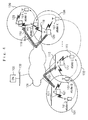
- Fig. 1 is a view showing a system arrangement of a conventional CDMA mobile communication system. As shown in Fig. 1, a mobile communication system is connected to IP network 1, and
CN 3 onlink 2 connected to IP network 1 is communicating withMN 61 having a fixed IP address incell 31 covered by BTS 21 onlink 11. Communications betweenCN 3 and MN 61, including communications between BTS 21 and MN 61, are carried out according to the IP. When MN 61 moves towardcell 32, MN 61 attempts to make handover to BTS 22 coveringcell 32. - After handover, since MN 61 communicates with BTS 22, MN 61 needs to communicate with
CN 3 vialink 12. However, since CN 3 does not recognize that MN 61 has moved tocell 32, CN 3 tries to communicate with MN 61 vialink 11. Consequently, CN 3 loses communications with MN 61, - According to the mobile IP optimized for the mobile communication environment, MN 61 sends a binding update message indicative of handover to HA 41 on
link 11. AfterMN 61 has made handover,HA 41 transfers data that is transmitted fromCN 3 tolink 11 toMN 61 which is now located incell 32 covered by BTS 22 that is connected tolink 12. Therefore,CN 3 and MN 61 keep communicating with each other without causingCN 3 to recognize that MN has moved tocell 32. - A handover process in the conventional CDMA mobile communication system will be described in specific detail below with reference to Figs. 1, 2, and 3.
- First, a procedure for
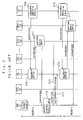
MN 61 to make handover fromcell 31 tocell 32 will be described below with reference to a sequence chart shown in Fig. 2. - (1) MN 61 performs IP communications with
CN 3 via BTS 21 incell 31 from which MN 61 is to make handover instep 201. BTS 21 converts between radio data and IP packets instep 202. This is indicated as state A in Figs. 1 and 2. - (2) When
MN 61 moves to a boundary betweencell 31 andcell 32 instep 203, MN 61 makes handover fromcell 31 tocell 32 as follows: - (3) MN 61 acquires a care-of address (hereinafter referred to as CoA) representing address information of
link 12 incell 32 to whichMN 61 attempts to be connected, via BTS 22 instep 204. - (4) MN 61 includes the acquired CoA in a binding update message and sends the binding update message to HA 41 in
step 205, and receives data fromcell 12, - (5) When HA 41 receives the binding update message from MN 61, HA 41 encapsulates IP packet data for MN 61, and sends the encapsulated IP packet data via IP network 1 and a
route 51 to BTS 22 which is indicated by the CoA contained in the binding update message instep 207. - (6) When BTS 22 receives the encapsulated IP packet data for
MN 61 from HA 41, BTS 22 decapsulates the data, and sends the data as radio data toMN 61 instep 208. This is indicated as state B in Figs. 1 and 2. - A procedure for
MN 61 which has moved tocell 38 to make handover tocell 39 will be described below with reference to Figs. 1 and 3. The handover operation is the same as when MN 61 makes handover fromcell 31 tocell 32 as described above. The procedure will be described below in order to clarify that the data is necessarily transferred from HA 1 to a BTS in the cell to whichMN 61 has moved. - (1) MN 61 performs IP communications with
CN 3 via HA41 and BTS 28 incell 38 from which MN 61 is to make handover insteps step 211. This is indicated as state X in Figs. 1 and 3. - (2) When
MN 61 moves to a boundary betweencell 38 andcell 39 instep 212, MN 61 makes handover fromcell 38 tocell 39 as follows: - (3) MN 61 acquires a CoA of
link 19 incell 32 to which MN 61 attempts to be connected, via BTS 29 instep 213. - (4) MN 61 includes the acquired CoA in a binding update message and sends the binding update message to HA 41 in
step 214, and receives data fromcell 39. - (5) When HA 41 receives the binding update message from MN 61, HA 41 encapsulates IP packet data for MN 61, and sends the encapsulated IP packet data via IP network 1 and a
route 52 to BTS 29 which is indicated by the CoA contained in the binding update message instep 216. - (6) When BTS 29 receives the encapsulated IP packet data for
MN 61 from HA 41, BTS 29 decapsulates the data, and sends the data as radio data toMN 61 instep 217. This is indicated as state Y in Figs. 1 and 3. - As described above, the conventional CDMA mobile communication system allows
CN 3 to continue communications withMN 61 without regard to the present position ofMN 61 even when MN 61 moves through cells 31 - 39. However, the conventional handover process suffers the following drawbacks: - The first drawback is that when
MN 61 moves to another link, a packet loss (loss of data) tends to occur. This is becauseCN 3 and MN 61 are unable to communicate with each other for a period of time after MN 61 cannot receive data from the former BTS when MN 61 moves to another link until MN 61 detects the CoA of the link to whichMN 61 has moved, and also for a period of time until MN 61 tellsHA 41 that MN 61 has moved andHA 41 starts to transfer the data. Japanese laid-open patent publication No. 2004-135178, for example, discloses a process of transferring data in advance fromHA 41 to a cell (cell 32 in Fig. 1) nearcell 31 from whichMA 61 moves, and sending radio data to a nearby cell. Though the disclosed process can prevent a packet loss from occurring, it is disadvantageous in that radio resources cannot effectively be utilized because the radio data is transmitted to an unnecessary cell. Furthermore, if there are many nearby cells, the amount of data transferred byHA 41 is increased, tending to cause a reduction in the performance of nearby networks. - According to another process under study, before MN 61 makes handover,
HA 41 buffers data fromCN 3, and when MN 61 completes the handover to BTS 22 incell 32, HA 41 starts to transfer the buffered data toMN 61 onlink 21. This process does not produce a packet loss upon handover. However, the communications between MN 61 and CN 3 suffer a short-break until the handover from MN 61 is finished. In addition, it is assumed thatHA 41 is liable to transmit a large amount of buffered data at one time, which flows into IP network 1, tending to lower the performance of the entire network. - The second drawback is that when
MN 61 moves fromlink 11 to a link with a large metric, a delay may be caused during the transfer of data fromHA 41 toMN 61 and the transfer of a large amount of data may cause a reduction in the performance of the entire network. This is indicated by theroute 52 in Fig. 1. - It is therefore an object of the present invention to provide a handover process for use in a CDMA mobile communication system on an ALL-IP network, which is capable of performing seamless handover operation without causing a short-break and a packet loss, and a reduction in the performance of the entire network, without regard to movement of a mobile node.
- To achieve the above object, a handover process according to the present invention is applied to a CDMA mobile communication system having a plurality of base transceiver stations for sending received radio data as IP packet data to an IP network and sending 1P packet data received from the IP network as radio data, and a mobile node for sending radio data to and receiving ratio data from the base transceiver stations and being connected to the IP network through the base transceiver stations to communicate with a correspondent node using a fixed IP address.
- According to the present invention, when the mobile node moves to a location near a boundary between a cell in which the mobile node is positioned and another cell adjacent thereto, and makes handover, the mobile node acquires address information of a link to which one of the base transceiver stations in the adjacent cell, includes the acquired address information in a binding update message indicative of the handover, and sends the binding update message to one of the base transceiver stations from which the handover is made.
- When the base transceiver station from which the handover is made receives the binding update message from the mobile node, the base transceiver station from which the handover is made continues to send radio data to the mobile node, encapsulates IP packet data for the mobile node, and transfers the encapsulated IP packet data to the base transceiver station to which the handover is made that is indicated by the address information contained in the received binding update message.
- When the base transceiver station to which the handover is made receives transferred data from the base transceiver station from which the handover is made, the base transceiver station to which the handover is made decapsulates the IP packet data and sends the decapsulated data as radio data to the mobile node.
- Soft handover is performed when the mobile node receives the radio data from the base transceiver stations from which the handover is made and the base transceiver station to which the handover is made. A binding update message including address information is sent to the correspondent node via a link connected to the base transceiver station to which the handover is made when the handover is finished.
- Finally, when the correspondent node receives the binding update message from the mobile node, the correspondent node changes routes based on the address information acquired from the received binding update message thereby to select a route for directly sending data to the base transceiver station to which the handover is made.
- According to the present invention, when the mobile node makes handover, the mobile node issues a binding update message and sends the binding update message to the base transceiver station from which handover is made. When the base transceiver station from which handover is made sends radio data to the mobile node, it simultaneously transfers the same data to the base transceiver station to which handover is made, so that the base transceiver station to which handover is made also sends the radio data to the mobile node. As a result, the mobile node receives the radio data via the IP network from both the base transceiver station from which handover is made and the base transceiver station to which handover is made. Since the mobile node makes soft handover, the handover can be made without causing a communication short-break and a packet loss. Since radio waves can be received from a plurality of BTSs for rake combination in situations where the power received from a BTS is weak in a cell boundary, the communication quality can be increased.
- When the handover is finished, the mobile node sends a binding update message to the correspondent node. The correspondent node uses a route through the base transceiver station to which handover is made. Therefore, the transmission of the radio data from the base transceiver station from which handover is made is put to an end, making it possible to reduce unwanted interference.
- Between adjacent base transceiver stations, there may highly possibly be provided an arrangement with a small metric even on the IP network, so that any delay can be reduced in the transfer of data between the base transceiver stations upon handover. Accordingly, the possibility of a reduction in the performance of the overall system can be eliminated though local burdens on the network may be increased.
- The above and other objects, features, and advantages of the present invention will become apparent from the following description with reference to the accompanying drawings which illustrate an example of the present invention.
-
- Fig. 1 is a view showing a system arrangement of a conventional CDMA mobile communication system;
- Fig. 2 is a sequence chart illustrative of a procedure for
MN 61 to make handover fromcell 31 tocell 32; - Fig. 3 is a sequence chart illustrative of a procedure for
MN 61 to make handover fromcell 38 tocell 39; - Fig. 4 is a view showing a system arrangement of a CDMA mobile communication system according to an embodiment of the present invention;
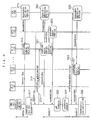
- Fig. 5 is a sequence chart illustrative of a procedure for
MN 161 to make handover fromcell 131 tocell 132; and - Fig. 6 is a sequence chart illustrative of a procedure for
MN 161 to make handover fromcell 138 tocell 139, - An embodiment of the present invention will be described in detail below with reference to the drawings.
- Fig. 4 shows a system arrangement of a CDMA mobile communication system according to an embodiment of the present invention. As shown in Fig. 4, the CDMA mobile communication system according to the embodiment of the present invention is connected to
IP network 101 according to the IPv6, and comprises a plurality ofcells 131 through 139. -
IP network 101 is an IP network that operates according to the IPvB. AsIP network 101 is well known to those skilled in the art and had no direct bearing on the present invention, details ofIP network 101 are omitted from illustration. -
Link 102 is an inherent network and is connected toIP network 101 through a router, etc.CN 103 is connected to link 102.Link 111 is an inherent network and is connected toIP network 101 through a router, etc.BTS 121 is connected to link 111.Link 112 is an inherent network and is connected toIP network 101 through a router, etc.BTS 122 is connected to link 112.Link 118 is an inherent network and is connected toIP network 101 through a router, etc.BTS 128 is connected to link 118.Link 119 is an inherent network and is connected toIP network 101 through a router, etc.BTS 129 is connected to link 119. -
CN 103 connected to link 102 communicates withMN 161 at a fixed IP address. -
Cell 131 is covered byBTS 121 that is connected toIP network 101 bylink 111, and is positioned adjacent tocell 132.Cell 132 is covered byBTS 122 that is connected toIP network 101 bylink 112, and is positioned adjacent tocell 131.Cell 138 is covered byBTS 128 that is connected toIP network 101 bylink 118, and is positioned adjacent tocell 139.Cell 139 is covered byBTS 129 that is connected toIP network 101 bylink 118, and is positioned adjacent tocell 138. -
BTSs 121 through 129 have a function to send radio data received fromMN 161 as IP packet data toIP network 101, and send IP packet data received fromIP network 101 asradio data MN 161. WhenBTSs 121 through 129 receive a binding update message fromMN 161,BTSs 121 through 129 continue transmitting radio data toMN 161, encapsulate IP packet data forMN 161, and transfer the encapsulated IP packet data to a BTS that is indicated by the CoA contained in the binding update message, Furthermore, whenBTSs 121 through 129 receive transferred data from another BTS,BTSs 121 through 129 decapsulate IP packet data, and send the data as radio data toMN 161. -
MN 161 has a function to send radio data to and receive radio data fromBTSs 121 through 129.MN 161 communicates withCN 103 connected toIP network 101 via BTS using a fixed IP address. - When
MN 161 moves to a location near a boundary between a cell in whichMN 161 is positioned and another cell adjacent thereto,MN 161 attempts to make handover to an adjacent BTS which covers the adjacent cell. Upon handover,MN 161 acquires the CoA of a link to which the BTS which covers the adjacent cell is connected, includes the acquired CoA in a binding update message, and sends the binding update message to the BTS from whichMN 161 has made handover. After having sent the binding update message,MN 161 receive data from both the BTS from whichMN 161 has made handover and the adjacent BTS, resulting in soft handover. In soft handover,MN 161 does not send the binding update message toCN 103. WhenMN 161 completes handover,MN 161 sends the binding update message with the CoA toCN 101 via a link to which the adjacent BTS is connected. - As described above,
CN 103 to link 102 communicates withMN 161 at a fixed IP address. WhenCN 103 receives the binding update message fromMN 161,CN 103 changes routes based on the CoA acquired from the binding update message thereby to select a route for directly sending data to a BTS to which MN 162 has made handover. Such a route selecting function is a standard function of the IPv6, and will not be described below. - A handover process according to the present invention in the CDMA mobile communication system according to the embodiment shown in Fig. 4 will be described below with reference to sequence charts shown in Figs. 5 and 6.
- First, a procedure for
MN 161 to make handover fromcell 131 tocell 132 will be described below with reference to Fig. 5. - (1)
MN 161 performs IP communications withCN 103 viaBTS 121 incell 131 from whichMN 161 is to make handover instep 301.BTS 121 converts between radio data and IP packets instep 302.CN 103 selects link 111 to whichBTS 121 belongs as a route for sending IP packets. This is indicated as state A in Figs. 4 and 5. - (2) When
MN 161 moves to a boundary betweencell 131 andcell 132 instep 303,MN 161 makes handover fromcell 131 tocell 132 as follows: - (3)
MN 161 acquires a CoA oflink 112 incell 132 viaBTS 122 instep 304. - (4)
MN 161 includes the acquired CoA in a binding update message and sends the binding update message toBTS 121 instep 305. - (5) When
BTS 121 receives the binding update message fromMN 161,BTS 121 sends radio data toMN 161, and at the same time encapulates IP packet data forMN 161 and transfers the encapulated IP packet data viaroute 151 andIP network 101 toBTS 122 which is indicated by the CoA contained in the binding update message instep 307. - (6) When
BTS 122 receives the transferred data forMN 161 fromBTS 121,BTS 122 decapsulates the data and sends the decapsulated data as radio data toMN 161 instep 308. - (7) Since
MN 161 receives the same data fromBTS 121 andBTS 122, soft handover is performed instep 309. This is indicated as state B in Figs. 4 and 5, - (8) When the handover from
MN 161 is finished instep 310,MN 161 sends a binding update message viaBTS 122 and link 112 toCN 103 instep 311. - (9) When
CN 103 receives the binding update message fromMN 161,CN 103 changes the route for sending IP packets toMN 161 fromlink 111 to whichBTS 121 belongs to link 112 to whichBTS 122 belongs instep 312. - (10)
MN 161 receives data only fromBTS 122 instep 314, whereupon handover is put to an end. This is indicated as state C in Figs. 4 and 5. - A procedure for
MN 161 which has moved tocell 138 to make handover tocell 139 will be described below with reference to Fig. 6. The handover operation is the same as whenMN 161 makes handover fromcell 131 tocell 132 as described above. The procedure will be described below in order to clarify that the data is necessarily transferred a BTS from which handover is made to a BTS to which handover is made. - (1)
MN 161 performs IP communications withCN 103 viaBTS 128 incell 138 from whichMN 161 is to make handover instep 315.BTS 128 converts between radio data and IP packets instep 316.CN 103 selects link 118 to whichBTS 128 belongs as a route for sending IP packets. This is indicated as state X in Figs. 4 and 6. - (2) When
MN 161 moves to a boundary betweencell 138 andcell 139 instep 317,MN 161 makes handover fromcell 138 tocell 139 as follows: - (3)
MN 161 acquires a CoA oflink 119 incell 139 viaBTS 129 instep 318. - (4)
MN 161 includes the acquired CoA in a binding update message and sends the binding update message toBTS 128 instep 319. - (5) When
BTS 128 receives the binding update message fromMN 161,BTS 128 sends radio data toMN 161, and at the same time encapulates IP packet data forMN 161 and transfers the encapulated IP packet data viaIP network 101 androute 152 toBTS 129 which is indicated by the CoA contained in the binding update message instep 321. - (6) When
BTS 129 receives the transferred data forMN 161 fromBTS 128,BTS 129 decapsulates the data and sends the decapsulated data as radio data toMN 161 instep 322. - (7) Since
MN 161 receives the same data fromBTS 128 andBTS 129, soft handover is performed instep 323. This is indicated as state Y in Figs. 4 and 6. - (8) When the handover from
MN 161 is finished instep 324,MN 161 sends a binding update message viaBTS 129 and link 119 toCN 103 instep 325. - (9) When
CN 103 receives the binding update message fromMN 161,CN 103 changes the route for sending IP packets toMN 161 fromlink 118 to whichBTS 128 belongs to link 119 to whichBTS 129 belongs instep 326. - (10)
MN 161 receives data only fromBTS 129 instep 328, whereupon handover is put to an end. This is indicated as state Z in Figs. 4 and 5. - With the handover process according to the present embodiment, when the MN makes handover, it can receive data from both the BTS from which the MN makes handover and the BTS to which the MN makes handover, resulting in soft handover. Therefore, the MN can make handover without causing a communication short-break and a packet loss. Since radio waves can be received from a plurality of BTSs for rake combination in situations where the power received from a BTS is weak in a cell boundary, the communication quality can be increased. According to an ancillary advantage, a CDMA communication system with a transmission power control capability can reduce the power transmitted from a BTS because of increased communication quality for thereby reducing interference, making it possible to effectively utilize radio resources.
- Between BTSs in adjacent cells, there may highly possibly be provided an arrangement with a small metric even on an IP network, so that any delay can be reduced in the transfer of data upon handover. Accordingly, the possibility of a reduction in the performance of the overall system can be eliminated though local burdens on the network may be increased.
- While a preferred embodiment of the present invention has been described using specific terms, such description is for illustrative purposes only, and it is to be understood that changes and variations may be made without departing from the spirit or scope of the following claims.
- In summary, according to an embodiment, when a mobile node makes handover, the mobile node issues a binding update message and sends the binding update message to a base transceiver station from which handover is made. When the base transceiver station from which handover is made sends radio data to the mobile node, it also transfers the same data to a base transceiver station to which handover is made, so that the base transceiver station to which handover is made also sends the radio data to the mobile node. As a result, the mobile node receives the radio data via an IP network from both the base transceiver station from which handover is made and the base transceiver station to which handover is made. Since the mobile node makes soft handover, the handover can be made without causing a communication short-break and a packet loss.
Claims (2)
- A handover process for use in a CDMA mobile communication system having a plurality of base transceiver stations for sending received radio data as IP packet data to an IP network and sending IP packet data received from the IP network as radio data, and a mobile node for sending radio data to and receiving ratio data from the base transceiver stations and being connected to the IP network through said base transceiver stations to communicate with a correspondent node using a fixed IP address, said handover process comprising the steps of:when said mobile node moves to a location near a boundary between a cell in which said mobile node is positioned and another cell adjacent thereto, and makes handover, acquiring address information of a link to which one of the base transceiver stations in the adjacent cell, including the acquired address information in a binding update message indicative of the handover, and sending the binding update message to one of the base transceiver stations from which the handover is made;when the base transceiver station from which the handover is made receives the binding update message from said mobile node, continuing to send radio data to said mobile node, encapsulating IP packet data for the mobile node, and transferring the encapsulated IP packet data to the base transceiver station to which the handover is made that is indicated by the address information contained in the received binding update message;when the base transceiver station to which the handover is made receives transferred data from the base transceiver station from which the handover is made, decapsulating the IP packet data and sending the decapsulated data as radio data to said mobile node;performing soft handover when said mobile node receives the radio data from the base transceiver stations from which the handover is made and the base transceiver station to which the handover is made, and sending a binding update message including address information to the correspondent node via a link connected to the base transceiver station to which the handover is made when the handover is finished; andwhen the correspondent node receives the binding update message from the mobile node, changing routes based on the address information acquired from the received binding update message thereby to select a route for directly sending data to the base transceiver station to which the handover is made.
- A handover process according to claim 1, wherein said address information contained in the received binding update message comprises care-of-address information.
Applications Claiming Priority (1)
| Application Number | Priority Date | Filing Date | Title |
|---|---|---|---|
| JP2004299220A JP2006115119A (en) | 2004-10-13 | 2004-10-13 | Handover method in CDMA mobile communication system |
Publications (1)
| Publication Number | Publication Date |
|---|---|
| EP1655976A1 true EP1655976A1 (en) | 2006-05-10 |
Family
ID=35453481
Family Applications (1)
| Application Number | Title | Priority Date | Filing Date |
|---|---|---|---|
| EP20050109281 Withdrawn EP1655976A1 (en) | 2004-10-13 | 2005-10-06 | Handover process free of short-break and packet loss in CDMA mobile communication system on IP network |
Country Status (4)
| Country | Link |
|---|---|
| US (1) | US7263081B2 (en) |
| EP (1) | EP1655976A1 (en) |
| JP (1) | JP2006115119A (en) |
| CN (1) | CN1761362A (en) |
Cited By (1)
| Publication number | Priority date | Publication date | Assignee | Title |
|---|---|---|---|---|
| EP1858285A3 (en) * | 2006-05-17 | 2011-02-23 | NEC Corporation | Interruption free IP connection during handover |
Families Citing this family (17)
| Publication number | Priority date | Publication date | Assignee | Title |
|---|---|---|---|---|
| KR100414921B1 (en) * | 2001-12-29 | 2004-01-13 | 삼성전자주식회사 | Method of handoff in all ip network |
| KR100772526B1 (en) | 2005-12-08 | 2007-11-01 | 한국전자통신연구원 | Fast handover method for proxy mobile IP |
| US7899495B2 (en) | 2006-07-14 | 2011-03-01 | Qualcomm Incorporated | Methods and apparatus for supporting multiple connections |
| CN101111055B (en) * | 2006-07-21 | 2010-09-29 | 华为技术有限公司 | Method and terminal to control switching execution |
| US20100098022A1 (en) * | 2006-08-09 | 2010-04-22 | Csaba Keszei | Method and apparatus for routing a packet in mobile ip system |
| WO2008076626A1 (en) * | 2006-12-14 | 2008-06-26 | Adaptix, Inc. | Systems and methods for allowing ip address handoff for mobile devices |
| CN101202768A (en) * | 2006-12-14 | 2008-06-18 | 昂达博思公司 | System and method for allowing skip zone switch of mobile equipment IP address |
| CN101247317B (en) * | 2007-02-15 | 2011-07-20 | 华为技术有限公司 | Routing switching method and system |
| EP2009866A1 (en) * | 2007-06-26 | 2008-12-31 | France Télécom | Apparatuses and method for communicating a request for an internet protocol address to the visited serving gateway |
| US20100208706A1 (en) * | 2007-09-19 | 2010-08-19 | Jun Hirano | Network node and mobile terminal |
| US8942165B2 (en) * | 2008-08-01 | 2015-01-27 | Qualcomm Incorporated | System and method for distributed multiple-input multiple-output (MIMO) in a wireless communication system |
| US8155023B2 (en) * | 2008-09-26 | 2012-04-10 | Texas Instruments Incorporated | MIMO with reserved subframes in primary and secondary base stations |
| CN101656993A (en) * | 2009-09-16 | 2010-02-24 | 华为技术有限公司 | Access point switching method and device |
| US8833633B2 (en) * | 2010-12-22 | 2014-09-16 | Sumitomo Electric Industries, Ltd. | Rotary tool |
| JP2012016055A (en) * | 2011-09-02 | 2012-01-19 | Hitachi Ltd | Wireless communication system and method |
| US10341693B2 (en) | 2011-10-04 | 2019-07-02 | International Business Machines Corporation | Pre-emptive content caching in mobile networks |
| US8892053B2 (en) * | 2012-03-14 | 2014-11-18 | International Business Machines Corporation | Cache hits via a users speed, direction of movement, location, and band within a cellular network |
Citations (4)
| Publication number | Priority date | Publication date | Assignee | Title |
|---|---|---|---|---|
| US20020141360A1 (en) * | 2001-04-02 | 2002-10-03 | Shinichi Baba | Soft handoff in IP-based CDMA networks by IP encapsulation |
| US20020167921A1 (en) * | 2001-03-22 | 2002-11-14 | Faramak Vakil | Method and apparatus for providing soft hand-off in IP-centric wireless CDMA networks |
| US20030176187A1 (en) * | 2000-08-10 | 2003-09-18 | Christian Menzel | Method and installation for executing a handover in mobile data transmission systems using data duplication |
| WO2004077870A1 (en) * | 2003-02-26 | 2004-09-10 | Fujitsu Limited | Diversity handover method in mobile communication, control station, and mobile terminal device |
Family Cites Families (7)
| Publication number | Priority date | Publication date | Assignee | Title |
|---|---|---|---|---|
| US20040125795A1 (en) * | 2000-02-18 | 2004-07-01 | Corson Mathew S | Telecommunications routing |
| KR100520141B1 (en) | 2000-10-26 | 2005-10-10 | 삼성전자주식회사 | Hanover method of mobile terminal having mobile ip in mobile communication system |
| JP3836318B2 (en) | 2000-12-01 | 2006-10-25 | 株式会社東芝 | Mobile communication system |
| US7539164B2 (en) * | 2002-06-14 | 2009-05-26 | Nokia Corporation | Method and system for local mobility management |
| JP2004135178A (en) | 2002-10-11 | 2004-04-30 | Matsushita Electric Ind Co Ltd | Handover program |
| JP2004193786A (en) | 2002-12-09 | 2004-07-08 | Matsushita Electric Ind Co Ltd | Wireless network control method and wireless network control system |
| JP2004228754A (en) | 2003-01-21 | 2004-08-12 | Matsushita Electric Ind Co Ltd | Mobility management method and mobile communication system |
-
2004
- 2004-10-13 JP JP2004299220A patent/JP2006115119A/en active Pending
-
2005
- 2005-10-06 EP EP20050109281 patent/EP1655976A1/en not_active Withdrawn
- 2005-10-11 US US11/246,130 patent/US7263081B2/en not_active Expired - Fee Related
- 2005-10-12 CN CNA2005101128037A patent/CN1761362A/en active Pending
Patent Citations (5)
| Publication number | Priority date | Publication date | Assignee | Title |
|---|---|---|---|---|
| US20030176187A1 (en) * | 2000-08-10 | 2003-09-18 | Christian Menzel | Method and installation for executing a handover in mobile data transmission systems using data duplication |
| US20020167921A1 (en) * | 2001-03-22 | 2002-11-14 | Faramak Vakil | Method and apparatus for providing soft hand-off in IP-centric wireless CDMA networks |
| US20020141360A1 (en) * | 2001-04-02 | 2002-10-03 | Shinichi Baba | Soft handoff in IP-based CDMA networks by IP encapsulation |
| WO2004077870A1 (en) * | 2003-02-26 | 2004-09-10 | Fujitsu Limited | Diversity handover method in mobile communication, control station, and mobile terminal device |
| EP1558047A1 (en) * | 2003-02-26 | 2005-07-27 | Fujitsu Limited | Diversity handover method in mobile communication, control station, and mobile terminal device |
Non-Patent Citations (1)
| Title |
|---|
| ZHANG TAO ET AL: "Ip-Based Base Stations and Soft Handoff in All-IP Wireless Networks", IEEE PERSONAL COMMUNICATIONS, IEEE COMMUNICATIONS SOCIETY, US, October 2001 (2001-10-01), pages 24 - 30, XP000864164, ISSN: 1070-9916 * |
Cited By (1)
| Publication number | Priority date | Publication date | Assignee | Title |
|---|---|---|---|---|
| EP1858285A3 (en) * | 2006-05-17 | 2011-02-23 | NEC Corporation | Interruption free IP connection during handover |
Also Published As
| Publication number | Publication date |
|---|---|
| US7263081B2 (en) | 2007-08-28 |
| JP2006115119A (en) | 2006-04-27 |
| CN1761362A (en) | 2006-04-19 |
| US20060079234A1 (en) | 2006-04-13 |
Similar Documents
| Publication | Publication Date | Title |
|---|---|---|
| US7263081B2 (en) | Handover process free of short-break and packet loss in CDMA mobile communication system on IP network | |
| EP1224753B1 (en) | Packet transmission method for mobile internet | |
| JP3684387B2 (en) | Packet radio system and method for routing data packets independently of protocol in a packet radio network | |
| KR100367385B1 (en) | Method for transferring a data signal in a wireless communication system | |
| US20050025164A1 (en) | Seamless hand-off of mobile node to a wireless local area network (WLAN) | |
| EP1909525B1 (en) | Wireless communication system, wireless base station and wireless communication control method for the exchange of packet data between base stations during a handover process | |
| US6937589B2 (en) | Mobile communication system with packet effectively transmitted and control method for the same | |
| US20020007414A1 (en) | Network system using dedicated downlink network and bidirectional network | |
| JP5133564B2 (en) | Method and system for seamless handover between WLAN and WWAN | |
| AU2010201314A1 (en) | Early determination of a network support for mobile IP | |
| JP2002534029A (en) | Method and system for soft handoff between systems | |
| WO2011044164A1 (en) | System and protocols for inter-mobility access gateway tunneling for fast handoff transition | |
| US7782819B2 (en) | Mobile communication system, radio base station, operation control method and program thereof | |
| US7606189B1 (en) | Architecture of internet protocol-based cellular networks | |
| GB2377862A (en) | Readdressing a packet transmitted by a roaming mobile subscriber unit in order to reduce required signalling | |
| US7720484B2 (en) | Proxy translator for extending the coverage area of a wireless network | |
| EP1983791A1 (en) | Inter-terminal session handover method, network system, and program | |
| JP4415094B2 (en) | Roaming system, roaming method and mobile terminal | |
| KR100734907B1 (en) | Handover Method of Mobile Terminal | |
| US20050238031A1 (en) | Method and system for supporting simultaneous data sessions of dissimilar access networks | |
| HK1090785A (en) | Handover process free of short-break and packet loss in cdma mobile communication system on ip network | |
| Bultmann et al. | Media independent handover enabled advanced mobility management and its functional mapping | |
| Goswami | IP and Mobility |
Legal Events
| Date | Code | Title | Description |
|---|---|---|---|
| PUAI | Public reference made under article 153(3) epc to a published international application that has entered the european phase |
Free format text: ORIGINAL CODE: 0009012 |
|
| AK | Designated contracting states |
Kind code of ref document: A1 Designated state(s): AT BE BG CH CY CZ DE DK EE ES FI FR GB GR HU IE IS IT LI LT LU LV MC NL PL PT RO SE SI SK TR |
|
| AX | Request for extension of the european patent |
Extension state: AL BA HR MK YU |
|
| AKX | Designation fees paid | ||
| STAA | Information on the status of an ep patent application or granted ep patent |
Free format text: STATUS: THE APPLICATION IS DEEMED TO BE WITHDRAWN |
|
| 18D | Application deemed to be withdrawn |
Effective date: 20061111 |
|
| REG | Reference to a national code |
Ref country code: DE Ref legal event code: 8566 |