EP1655903A2 - Method and device for dynamically scheduling radio resources of streaming media service - Google Patents
Method and device for dynamically scheduling radio resources of streaming media service Download PDFInfo
- Publication number
- EP1655903A2 EP1655903A2 EP05022769A EP05022769A EP1655903A2 EP 1655903 A2 EP1655903 A2 EP 1655903A2 EP 05022769 A EP05022769 A EP 05022769A EP 05022769 A EP05022769 A EP 05022769A EP 1655903 A2 EP1655903 A2 EP 1655903A2
- Authority
- EP
- European Patent Office
- Prior art keywords
- sub
- user
- radio resources
- carrier
- carriers
- Prior art date
- Legal status (The legal status is an assumption and is not a legal conclusion. Google has not performed a legal analysis and makes no representation as to the accuracy of the status listed.)
- Granted
Links
- 238000000034 method Methods 0.000 title claims abstract description 29
- 239000000969 carrier Substances 0.000 claims abstract description 31
- 238000004891 communication Methods 0.000 claims abstract description 12
- 230000005540 biological transmission Effects 0.000 claims description 5
- 230000003044 adaptive effect Effects 0.000 claims description 2
- 108091006146 Channels Proteins 0.000 description 26
- 238000011156 evaluation Methods 0.000 description 7
- 238000012545 processing Methods 0.000 description 6
- 238000005516 engineering process Methods 0.000 description 2
- 238000010295 mobile communication Methods 0.000 description 1
- 238000012986 modification Methods 0.000 description 1
- 230000004048 modification Effects 0.000 description 1
- 238000005457 optimization Methods 0.000 description 1
Images


Classifications
-
- H—ELECTRICITY
- H04—ELECTRIC COMMUNICATION TECHNIQUE
- H04W—WIRELESS COMMUNICATION NETWORKS
- H04W72/00—Local resource management
- H04W72/50—Allocation or scheduling criteria for wireless resources
- H04W72/54—Allocation or scheduling criteria for wireless resources based on quality criteria
- H04W72/542—Allocation or scheduling criteria for wireless resources based on quality criteria using measured or perceived quality
-
- H—ELECTRICITY
- H04—ELECTRIC COMMUNICATION TECHNIQUE
- H04L—TRANSMISSION OF DIGITAL INFORMATION, e.g. TELEGRAPHIC COMMUNICATION
- H04L1/00—Arrangements for detecting or preventing errors in the information received
- H04L1/0001—Systems modifying transmission characteristics according to link quality, e.g. power backoff
- H04L1/0002—Systems modifying transmission characteristics according to link quality, e.g. power backoff by adapting the transmission rate
- H04L1/0003—Systems modifying transmission characteristics according to link quality, e.g. power backoff by adapting the transmission rate by switching between different modulation schemes
-
- H—ELECTRICITY
- H04—ELECTRIC COMMUNICATION TECHNIQUE
- H04W—WIRELESS COMMUNICATION NETWORKS
- H04W72/00—Local resource management
- H04W72/50—Allocation or scheduling criteria for wireless resources
- H04W72/52—Allocation or scheduling criteria for wireless resources based on load
Definitions
- the present invention relates to radio communication, and more particularly, to a method and device for dynamically scheduling radio resources of streaming media services in a multi-carrier system.
- the maximum throughput criterion algorithm which dynamically schedules radio resources based on real-time channel quality. It always allocates each sub-carrier to users with the best channel quality. Hence, this algorithm can acquire the highest throughput at the air interface theoretically. However, this method is weak in fairness. Some users with relatively bad channel quality might not get service for a long time or even for ever. Meanwhile, this dynamic resources scheduling method also fails to take into full consideration the respective characteristics of different services. In particular, for streaming media services, at some moment, perhaps the buffer of a certain user with bad channel quality will run out while data in the buffer of another user with good channel quality can still keep streaming media services uninterrupted for a considerable long time. In this case, streaming media services of users with bad channel quality will probably be interrupted if sub-carriers are still allocated to users with good channel quality in accordance with the maximum throughput criterion.
- the proportional fair criterion algorithm makes improvements upon the above-described maximum throughput criterion algorithm. Admittedly, this algorithm ensures that users with bad channel quality can also get some services, but it fails to consider the characteristics of different services either.
- the present invention fully considers the characteristics of streaming media services and provides a radio resources scheduling method for dynamically scheduling the radio resources of streaming media services in a multi-carrier radio communication system including multiple sub-carriers.
- the method comprises steps of: obtaining from a physical layer the information of the quality of radio channel on each sub-carrier for each user.
- the method further comprises: obtaining from a cache layer the play time information which indicates how long the data remained in the cache of receiving terminal of each user will be played continuously; and selecting in turn the users and sub-carriers corresponding to the maximums of an evaluating function based on the evaluating function obtained by a linear combination of the information of the quality of radio channel and the reciprocal of the play time information of the residual data and allocating the users to the corresponding sub-carriers.
- the present invention further provides a radio resources scheduling device for dynamically scheduling the radio resource of streaming media services in a multi-carrier radio communication system including multiple sub-carriers.
- the device comprises input information collecting means for obtaining from a physical layer the information of the quality of radio channel and obtaining from a cache layer the play time information which indicates how long the data remained in the cache of receiving terminal will be played continuously; radio resources scheduling means for acquiring an evaluating function constructed by a linear combination of the information of the quality of radio channel and the reciprocal of the play time information of the residual data based on the information obtained by the input information collecting means, then selecting in turn the users and sub-carriers corresponding to the maximums of the evaluating function and for allocating the users to the corresponding sub-carriers; and scheduling result distributing means for respectively delivering the allocation result obtained from the radio resources scheduling means to a RLC layer processor in a RLC layer, an hybrid automatic repeat request device in a MAC layer and a physical layer processor in a physical layer to finish the transmission of the streaming media services.
- the present invention performs joint optimization on a radio layer and a cache layer, i.e., the present invention fully considers the current state and demand of the cache layer when the radio layer, which includes a radio resource control (RRC) layer, a radio link control (RLC) layer and a medium access control (MAC) layer, performs dynamic resources scheduling.
- RRC radio resource control
- RLC radio link control
- MAC medium access control
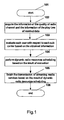
- the flow chart of the radio resources scheduling method according to the present invention is as shown in Fig. 1.
- the flow starts at step 101.
- the dynamic radio resources scheduling device acquires the information of the quality of radio channel and the information of the play time of residual data.
- the dynamic radio resources scheduling device acquires from a physical layer the information of the quality of radio channel on each sub-carrier for each user.
- the quality of radio channel is expressed as: q ( n , k ) , 0 ⁇ n ⁇ N ⁇ 1 , 0 ⁇ k ⁇ K ⁇ 1 wherein q ( n , k ) represents the quality of radio channel on the k th sub-carrier for the n th user, n represents the serial number of a user, N represents the total number of online users using streaming media services in a radio communication system, k represents the serial number of a sub-carrier, and K represents the total number of sub-carriers in a multi-carrier radio communication system.
- the information of the play time of residual data obtained by the dynamic radio resources scheduling device from a cache layer indicates how long the data remained in the cache of each user's receiving terminal will be played continuously (hereinafter referred to as the play time of residual data).
- the play time of residual data is expressed as: t ( n ) , 0 ⁇ n ⁇ N ⁇ 1 wherein t(n) indicates how long the data remained in the cache of the n th user's receiving terminal will be played continuously.
- step 103 evaluation is made on each user with respect to each sub-carrier based on the information obtained in step 102.
- the evaluation synthetically considers the aforesaid quality of radio channel and the remaining play time.
- the evaluating function is a linear combination of the quality of radio channel and the reciprocal of the remaining play time.
- e(n, k) w ⁇ q ( n , k ) / q max + ( 1 ⁇ w ) / t ( n ) , 0 ⁇ n ⁇ N ⁇ 1 , 0 ⁇ k ⁇ K ⁇ 1 , 0 ⁇ w ⁇ 1
- e(n, k) represents the evaluation result on the k th sub-carrier for the n th user.
- step 104 the flow shown in Fig. 1 enters step 104.
- dynamic radio resources scheduling is implemented in accordance with the foregoing evaluation result.
- step 105 the dynamic radio resources scheduling device reports the result of dynamic radio resources scheduling obtained in step 104 to an RLC layer, the physical layer, an HARQ means etc. for corresponding processing, respectively, to finish the transmission of streaming media data of the air interface based on the multi-carrier technology.
- step 106 the flow shown in Fig. 1 ends at step 106.
- step 104 in Fig. 1 is as shown in Fig. 2.
- Illustrated in Fig. 2 are detailed steps of performing dynamic radio resources scheduling in a scheduling cycle based on the result of evaluation on each user with respect to each sub-carrier.
- step 202 the dynamic radio resources scheduling device acquires from the RLC layer the length of the data to be transmitted in the RLC cache of transmitting terminal of each user. Measured by the bit, the length of the data to be transmitted is expressed as: s ( n ) , 0 ⁇ n ⁇ N ⁇ 1 wherein s(n) represents the length of the data to be transmitted in the RLC cache of transmitting terminal of the n th user.
- the length of transmittable data is in a unit of bit.
- step 203 a pair of the users and sub-carriers corresponding to the maximum of the evaluating function is selected.
- Equation (9) means the selected n * and k * corresponding to the maximum of e(n,k).
- step 204 it is decided whether the length d ( n *)of transmittable data that has been allocated to the selected user n * is greater than or equal to the length s ( n *) of data to be transmitted in the RLC cache of this user.
- the length d ( n *)of transmittable data that has been allocated to the selected user n * is greater than or equal to the length s ( n* ) of data to be transmitted in the RLC cache of this user, this means that the resources allocation at this very moment satisfies the user's needs, and then the flow shown in Fig. 2 enters step 208.
- step 208 the selected user n * and the sub-carrier k * are deleted from the evaluated pairs of user and sub-carrier. Then, the flow returns to step 203 to select a next pair of user and sub-carrier corresponding to the maximum of the evaluating function and to perform subsequent allocation and scheduling.
- step 204 When it is decided in step 204 that the length d ( n *)of transmittable data that has been allocated to the selected user n * is smaller than the length s ( n *) of data to be transmitted in the RLC cache of this user, the flow shown in Fig. 2 enters step 205.
- step 204 the decision result from step 204 is "no" so long as this user has data to be transmitted in the RLC cache. Then, the flow enters step 205.
- step 205 it is decided whether the selected sub-carrier k * has been allocated to other user.
- the flow shown in Fig. 2 enters step 208.
- step 208 the selected user n * and sub-carrier k * are deleted from the pairs of evaluated user and sub-carrier. After that, the flow returns to step 203 to select a next pair of user and sub-carrier corresponding to the maximum of the evaluating function and to perform subsequent allocation and scheduling.
- step 205 When it is decided in step 205 that the sub-carrier k * has not been allocated to other user, the flow shown in Fig. 2 enters step 206. In this step, the selected sub-carrier k * is allocated to the selected user n * and the allocation information is recorded. The detailed flow of step 206 will be explained with reference to Fig. 3. Following step 206 as shown in Fig. 2, the flow enters step 207. In step 207, it is decided whether all the data to be transmitted in the RLC cache has been transmitted or all the sub-carriers have been allocated. When all the data to be transmitted in the RLC cache has been transmitted or all the sub-carriers have been allocated, the flow shown in Fig. 2 ends at step 209 to finish a scheduling cycle.
- step 208 the flow shown in Fig. 2 enters step 208.
- the selected n* and sub-carrier k * are deleted from the pairs of evaluated user and sub-carrier.
- the flow returns to step 203 to select a next pair of user and sub-carrier corresponding to the maximum of the evaluating function and to perform subsequent allocation and scheduling.
- Fig. 3 illustrates in detail the flow of step 206 in Fig. 2.
- Step 206 in Fig. 2 includes steps 2061 and 2062.
- step 2061 the selected sub-carrier k* is allocated to the selected user n *. Then, the corresponding allocation information is recorded in step 2062.
- the step of recording the corresponding allocation information includes steps 2062-1 and 2062-2.
- step 2062-1 the length of transmittable data of the selected user n * is updated.
- the updated length d '( n *)of transmittable data of the selected user n * which equals to the sum of the original length d ( n* ) of transmittable data of this user and the length d' of transmittable data on the current selected sub-carrier k *, will serve as the new length d ( n *) of transmittable data corresponding to this user.
- the length d' of transmittable data on the sub-carrier k * for the user n * can be determined according to the adaptive modulation and coding (AMC) algorithm.
- AMC adaptive modulation and coding
- step 2062-2 the serial number n * of the user occupying the sub-carrier k * is recorded in step 2062-2. Finally, the flow shown in Fig. 2 ends at step 206.
- step 202 (the step of acquiring from the RLC layer data to be transmitted in the RLC cache of each user) in Fig. 2 can be arranged after any step prior to step 204 (the step of deciding whether the length of transmittable data of the user is greater than the length of data to be transmitted in the RLC cache of this user) in Fig. 2.
- step 204 the step of deciding whether the length of transmittable data of the user is greater than the length of data to be transmitted in the RLC cache of this user
- the order of the steps 2062-1 and 2062-2 can be exchanged. Different arrangements of order for the above steps are not intended to limit the present invention.
- Fig. 4 is a schematic view of the inner structure of a radio resources scheduling device according to the present invention and a related hierarchical structure.
- a radio communication system of the present invention comprises K sub-carriers with the serial number of k, the respective serial numbers of the sub-carriers being 0, 1, ... K-1.
- the access point coverage area of the radio communication system there are N online users, with the serial number of n, using streaming media services, the respective serial numbers of the users being 0, 1, ... N-1.
- layers related to the present invention include a physical layer 401, a radio layer 402 and a cache layer 403.
- the radio layer 402 includes a radio link control (RLC) layer 4021 and a medium access control (MAC) layer 4022.
- RLC radio link control
- MAC medium access control
- a dynamic radio resources scheduling device 400 is carried out in the MAC layer 4022.
- the dynamic radio resources scheduling device 400 comprises: input information collecting means 4001, radio resources scheduling means 4002 and scheduling result distributing means 4003.
- the input information collecting means 4001 obtains the following information:
- the radio resources scheduling means 4002 After reception of the aforesaid information sent by the input information collecting means 4001, the radio resources scheduling means 4002 obtains an evaluating function using a linear combination of the information of the quality q(n,k) of radio channel and the reciprocal of the information of the play time of residual data in the cache of receiving terminal.
- the radio resources scheduling means 4002 selects in turn the users and sub-carriers corresponding to the maximum of the evaluating function and allocates said users to the corresponding sub-carriers as a result of dynamic radio resources scheduling.
- the scheduling result distributing means 4003 respectively delivers the result of dynamic radio resources scheduling to the RLC layer processing means 4021-1 in the RLC layer 4021, hybrid automatic repeat request means 4022-1 in the MAC layer 4022 and the physical layer processing means 401-1 in the physical layer 401 to perform the transmission of streaming media services.
- the dynamic radio resources scheduling method and device full consider the characteristics of streaming media services and make rational use of information provided by the cache layer to optimize radio resources scheduling. Therefore, the interruption probability and re-buffer probability of streaming media services are reduced effectively, and the degree of satisfaction of terminal users is enhanced.
Landscapes
- Engineering & Computer Science (AREA)
- Quality & Reliability (AREA)
- Computer Networks & Wireless Communication (AREA)
- Signal Processing (AREA)
- Mobile Radio Communication Systems (AREA)
- Two-Way Televisions, Distribution Of Moving Picture Or The Like (AREA)
Abstract
Description
- The present invention relates to radio communication, and more particularly, to a method and device for dynamically scheduling radio resources of streaming media services in a multi-carrier system.
- At present, there are a good many mature dynamic radio resources scheduling methods.
- For instance, the maximum throughput criterion algorithm, which dynamically schedules radio resources based on real-time channel quality. It always allocates each sub-carrier to users with the best channel quality. Apparently, this algorithm can acquire the highest throughput at the air interface theoretically. However, this method is weak in fairness. Some users with relatively bad channel quality might not get service for a long time or even for ever. Meanwhile, this dynamic resources scheduling method also fails to take into full consideration the respective characteristics of different services. In particular, for streaming media services, at some moment, perhaps the buffer of a certain user with bad channel quality will run out while data in the buffer of another user with good channel quality can still keep streaming media services uninterrupted for a considerable long time. In this case, streaming media services of users with bad channel quality will probably be interrupted if sub-carriers are still allocated to users with good channel quality in accordance with the maximum throughput criterion.
- The proportional fair criterion algorithm, another example of the dynamic radio resources scheduling method, makes improvements upon the above-described maximum throughput criterion algorithm. Admittedly, this algorithm ensures that users with bad channel quality can also get some services, but it fails to consider the characteristics of different services either.
- In summary, none of the existing radio resources scheduling technologies takes into full account or makes full use of the characteristics of streaming media services. Therefore, it is extremely crucial to streaming media services, which are very likely to be widely applied in a future mobile communication system, to find a method suitable for dynamically scheduling. resources.
- In order to transmit streaming media services better, the present invention fully considers the characteristics of streaming media services and provides a radio resources scheduling method for dynamically scheduling the radio resources of streaming media services in a multi-carrier radio communication system including multiple sub-carriers. The method comprises steps of: obtaining from a physical layer the information of the quality of radio channel on each sub-carrier for each user. The method further comprises: obtaining from a cache layer the play time information which indicates how long the data remained in the cache of receiving terminal of each user will be played continuously; and selecting in turn the users and sub-carriers corresponding to the maximums of an evaluating function based on the evaluating function obtained by a linear combination of the information of the quality of radio channel and the reciprocal of the play time information of the residual data and allocating the users to the corresponding sub-carriers.
- The present invention further provides a radio resources scheduling device for dynamically scheduling the radio resource of streaming media services in a multi-carrier radio communication system including multiple sub-carriers. The device comprises input information collecting means for obtaining from a physical layer the information of the quality of radio channel and obtaining from a cache layer the play time information which indicates how long the data remained in the cache of receiving terminal will be played continuously; radio resources scheduling means for acquiring an evaluating function constructed by a linear combination of the information of the quality of radio channel and the reciprocal of the play time information of the residual data based on the information obtained by the input information collecting means, then selecting in turn the users and sub-carriers corresponding to the maximums of the evaluating function and for allocating the users to the corresponding sub-carriers; and scheduling result distributing means for respectively delivering the allocation result obtained from the radio resources scheduling means to a RLC layer processor in a RLC layer, an hybrid automatic repeat request device in a MAC layer and a physical layer processor in a physical layer to finish the transmission of the streaming media services. The present invention performs joint optimization on a radio layer and a cache layer, i.e., the present invention fully considers the current state and demand of the cache layer when the radio layer, which includes a radio resource control (RRC) layer, a radio link control (RLC) layer and a medium access control (MAC) layer, performs dynamic resources scheduling.
-
- Fig. 1 is a flow chart of a radio resources scheduling method of the present invention;
- Fig 2 illustrates the detailed steps of radio resources scheduling in the flow chart of Fig. 1;
- Fig. 3 is a detailed flow of the step of allocating the selected sub-carriers to the selected users and recording allocation information in Fig. 2; and
- Fig. 4 is a schematic view of the inner structure of a radio resources scheduling device according to the present invention and a related hierarchical structure.
- Referring to the accompanying drawings, a radio resources scheduling method and device of the present invention will be described in detail.
- The flow chart of the radio resources scheduling method according to the present invention is as shown in Fig. 1. The flow starts at
step 101. Instep 102, the dynamic radio resources scheduling device according to the present invention acquires the information of the quality of radio channel and the information of the play time of residual data. - The dynamic radio resources scheduling device acquires from a physical layer the information of the quality of radio channel on each sub-carrier for each user. The quality of radio channel is expressed as:

wherein q(n,k) represents the quality of radio channel on the kth sub-carrier for the nth user, n represents the serial number of a user, N represents the total number of online users using streaming media services in a radio communication system, k represents the serial number of a sub-carrier, and K represents the total number of sub-carriers in a multi-carrier radio communication system. - The information of the play time of residual data obtained by the dynamic radio resources scheduling device from a cache layer indicates how long the data remained in the cache of each user's receiving terminal will be played continuously (hereinafter referred to as the play time of residual data). Measured by the second, the play time of residual data is expressed as:

wherein t(n) indicates how long the data remained in the cache of the nth user's receiving terminal will be played continuously. - Afterwards, the flow shown in Fig. 1 enters
step 103. In this step, evaluation is made on each user with respect to each sub-carrier based on the information obtained instep 102. The evaluation synthetically considers the aforesaid quality of radio channel and the remaining play time. In view of this, an evaluating function is structured as□
wherein e(n, k) represents the evaluation result on the kth sub-carrier for the nth user, and w is a weight. - As is clear from equation (3), the evaluating function is a linear combination of the quality of radio channel and the reciprocal of the remaining play time. By adjusting the weight w, either of the two characteristics, the quality of radio channel and the remaining play time, can be chosen to be focally evaluated in accordance with needs.
- Preferably, a relative value of the quality of radio channel can be used to express the quality of the radio channel. That is, firstly, the scheduling device determines a user and sub-carrier with the best channel quality:

wherein q max represents a value of the best channel quality. - Then, a relative value of the quality of radio channel is expressed as:


wherein e(n, k) represents the evaluation result on the kth sub-carrier for the nth user. - Next, the flow shown in Fig. 1 enters
step 104. In this step, dynamic radio resources scheduling is implemented in accordance with the foregoing evaluation result. After that, the flow entersstep 105. In this step, the dynamic radio resources scheduling device reports the result of dynamic radio resources scheduling obtained instep 104 to an RLC layer, the physical layer, an HARQ means etc. for corresponding processing, respectively, to finish the transmission of streaming media data of the air interface based on the multi-carrier technology. Finally, the flow shown in Fig. 1 ends atstep 106. - The detailed flow of
step 104 in Fig. 1 is as shown in Fig. 2. Illustrated in Fig. 2 are detailed steps of performing dynamic radio resources scheduling in a scheduling cycle based on the result of evaluation on each user with respect to each sub-carrier. - The flow shown in Fig. 2 starts with
step 201. Instep 202, the dynamic radio resources scheduling device acquires from the RLC layer the length of the data to be transmitted in the RLC cache of transmitting terminal of each user. Measured by the bit, the length of the data to be transmitted is expressed as:
wherein s(n) represents the length of the data to be transmitted in the RLC cache of transmitting terminal of the nth user. - It should be noted that, after each scheduling cycle for dynamically allocating resources starts, the radio communication system will re-allocate the length of transmittable data to each user and re-allocate respective sub-carrier to each user based on the foregoing evaluation result. That is to say, at the beginning of each scheduling cycle, none of sub-carriers is allocated to a corresponding user, and the length d(n) of transmittable data corresponding to each user is zero, which is expressed as:

wherein d(n) is the length of transmittable data corresponding to the nth user. The length of transmittable data is in a unit of bit. - Following
step 202, the flow shown in Fig. 2 entersstep 203. In this step, a pair of the users and sub-carriers corresponding to the maximum of the evaluating function is selected. In the present embodiment, this selection is made according to expression (6):
- Equation (9) means the selected n* and k* corresponding to the maximum of e(n,k).
- Next, the flow enters
step 204. In this step, it is decided whether the length d (n*)of transmittable data that has been allocated to the selected user n* is greater than or equal to the length s(n*) of data to be transmitted in the RLC cache of this user. When it is decided that the length d (n*)of transmittable data that has been allocated to the selected user n* is greater than or equal to the length s(n*) of data to be transmitted in the RLC cache of this user, this means that the resources allocation at this very moment satisfies the user's needs, and then the flow shown in Fig. 2 entersstep 208. Instep 208, the selected user n* and the sub-carrier k* are deleted from the evaluated pairs of user and sub-carrier. Then, the flow returns to step 203 to select a next pair of user and sub-carrier corresponding to the maximum of the evaluating function and to perform subsequent allocation and scheduling. - When it is decided in
step 204 that the length d (n*)of transmittable data that has been allocated to the selected user n* is smaller than the length s(n*) of data to be transmitted in the RLC cache of this user, the flow shown in Fig. 2 entersstep 205. - It should be noted that, at the beginning of each scheduling cycle, since the length d(n) of transmittable data corresponding to each user is zero, the decision result from
step 204 is "no" so long as this user has data to be transmitted in the RLC cache. Then, the flow entersstep 205. - In
step 205, it is decided whether the selected sub-carrier k* has been allocated to other user. When the sub-carrier k* has been allocated to other user, then the flow shown in Fig. 2 entersstep 208. Instep 208, the selected user n* and sub-carrier k* are deleted from the pairs of evaluated user and sub-carrier. After that, the flow returns to step 203 to select a next pair of user and sub-carrier corresponding to the maximum of the evaluating function and to perform subsequent allocation and scheduling. - When it is decided in
step 205 that the sub-carrier k* has not been allocated to other user, the flow shown in Fig. 2 entersstep 206. In this step, the selected sub-carrier k* is allocated to the selected user n* and the allocation information is recorded. The detailed flow ofstep 206 will be explained with reference to Fig. 3. Followingstep 206 as shown in Fig. 2, the flow entersstep 207. Instep 207, it is decided whether all the data to be transmitted in the RLC cache has been transmitted or all the sub-carriers have been allocated. When all the data to be transmitted in the RLC cache has been transmitted or all the sub-carriers have been allocated, the flow shown in Fig. 2 ends atstep 209 to finish a scheduling cycle. Otherwise, the flow shown in Fig. 2 entersstep 208. In this step, the selected n* and sub-carrier k* are deleted from the pairs of evaluated user and sub-carrier. After that, the flow returns to step 203 to select a next pair of user and sub-carrier corresponding to the maximum of the evaluating function and to perform subsequent allocation and scheduling. - Fig. 3 illustrates in detail the flow of
step 206 in Fig. 2. Step 206 in Fig. 2 includessteps - In
step 2061, the selected sub-carrier k* is allocated to the selected user n*. Then, the corresponding allocation information is recorded instep 2062. The step of recording the corresponding allocation information includes steps 2062-1 and 2062-2. - In step 2062-1, the length of transmittable data of the selected user n* is updated. The updated length d'(n*)of transmittable data of the selected user n*, which equals to the sum of the original length d(n*) of transmittable data of this user and the length d' of transmittable data on the current selected sub-carrier k*, will serve as the new length d (n*) of transmittable data corresponding to this user.
- Preferably, the length d' of transmittable data on the sub-carrier k* for the user n* can be determined according to the adaptive modulation and coding (AMC) algorithm. However, it is to be understood that the present invention is not limited to the AMC algorithm.
- Then, the serial number n* of the user occupying the sub-carrier k* is recorded in step 2062-2. Finally, the flow shown in Fig. 2 ends at
step 206. - Those skilled in the art should appreciate that in the dynamic radio resources scheduling method according to the present invention, step 202 (the step of acquiring from the RLC layer data to be transmitted in the RLC cache of each user) in Fig. 2 can be arranged after any step prior to step 204 (the step of deciding whether the length of transmittable data of the user is greater than the length of data to be transmitted in the RLC cache of this user) in Fig. 2. In addition, the order of the steps 2062-1 and 2062-2 can be exchanged. Different arrangements of order for the above steps are not intended to limit the present invention.
- Fig. 4 is a schematic view of the inner structure of a radio resources scheduling device according to the present invention and a related hierarchical structure.
- A radio communication system of the present invention comprises K sub-carriers with the serial number of k, the respective serial numbers of the sub-carriers being 0, 1, ... K-1. In the access point coverage area of the radio communication system, there are N online users, with the serial number of n, using streaming media services, the respective serial numbers of the users being 0, 1, ... N-1.
- In the aforesaid radio communication system, layers related to the present invention include a
physical layer 401, aradio layer 402 and acache layer 403. Among them, theradio layer 402 includes a radio link control (RLC)layer 4021 and a medium access control (MAC)layer 4022. A dynamic radioresources scheduling device 400 is carried out in theMAC layer 4022. - The dynamic radio
resources scheduling device 400 comprises: input information collecting means 4001, radio resources scheduling means 4002 and schedulingresult distributing means 4003. The input information collecting means 4001 obtains the following information: - 1) obtaining from physical layer processing means 401-1 in the
physical layer 401 physical layer information, which is the information of the quality q(n, k) of radio channel in the present embodiment; - 2) obtaining from RLC layer processing means 4021-1 in the
RLC layer 4021 the information of RLC layer, which is the length information s(n) of data to be transmitted in the present embodiment; and - 3) obtaining from cache layer processing means 403-1 in the
cache layer 403 cache layer information, which is the information of the play time of residual data in the cache of receiving terminal in the present embodiment. - After reception of the aforesaid information sent by the input information collecting means 4001, the radio resources scheduling means 4002 obtains an evaluating function using a linear combination of the information of the quality q(n,k) of radio channel and the reciprocal of the information of the play time of residual data in the cache of receiving terminal. The radio resources scheduling means 4002 selects in turn the users and sub-carriers corresponding to the maximum of the evaluating function and allocates said users to the corresponding sub-carriers as a result of dynamic radio resources scheduling. The scheduling
result distributing means 4003 respectively delivers the result of dynamic radio resources scheduling to the RLC layer processing means 4021-1 in theRLC layer 4021, hybrid automatic repeat request means 4022-1 in theMAC layer 4022 and the physical layer processing means 401-1 in thephysical layer 401 to perform the transmission of streaming media services. - During radio resources scheduling, the dynamic radio resources scheduling method and device according to the present invention full consider the characteristics of streaming media services and make rational use of information provided by the cache layer to optimize radio resources scheduling. Therefore, the interruption probability and re-buffer probability of streaming media services are reduced effectively, and the degree of satisfaction of terminal users is enhanced.
- Various variations and modifications can be made without departing from the concept and scope of the present invention. It is to be understood that the present invention is not limited to the foregoing concrete embodiments thereof except as defined in the appended claims.
Claims (11)
- A radio resources scheduling method for dynamically scheduling the radio resources of streaming media services in a multi-carrier radio communication system including multiple sub-carriers, the method comprising the steps of:obtaining from a physical layer the information of the quality of radio channel on each sub-carrier for each user;characterized in that the method further comprises:obtaining from a cache layer the play time information which indicates how long the data remained in the cache of receiving terminal of each user will be played continuously; andselecting in turn the users and sub-carriers corresponding to the maximums of an evaluating function based on the evaluating function obtained by a linear combination of said information of the quality of radio channel and the reciprocal of the play time information of the residual data and allocating said users to the corresponding sub-carriers.
- The radio resources scheduling method as claimed in claim 1, characterized in further comprising a step of finishing the transmission of streaming media services in accordance with said allocation result.
- The radio resources scheduling method as claimed in claim 1 or 2, wherein said information of the quality of radio channel is a relative value of the quality of radio channel on each sub-carrier for each user.
- The radio resources scheduling method as claimed in claim 1 or 2, characterized in further comprising a step of obtaining from a radio link control (RLC) layer the length (s(n)) of data to be transmitted in the RLC cache of transmitting terminal of each user.
- The radio resources scheduling method as claimed in claim 4, wherein said step of allocating said users to the corresponding sub-carriers comprising the steps of:recording the serial number (n*) of said selected user occupying said sub-carrier (k*); andupdating the length (d(n*)) of transmittable data of said selected user (n*).
- The radio resources scheduling method as claimed in claim 5, wherein in said updating step, the sum of the original length d(n*) of transmittable data of said selected user (n*) and the length (d') of transmittable data on the current selected sub-carrier (k*) of the user (n*) is used as the new length of transmittable data corresponding to the user (n*).
- The radio resources scheduling method as claimed in claim 6, wherein the original length d(n*)of transmittable data of each user equals zero at the beginning of each scheduling cycle.
- The radio resources scheduling method as claimed in claim 6, wherein the length (d') of transmittable data on the sub-carrier (k*) of said selected user (n*) is determined by adaptive modulation and coding (AMC) algorithm.
- The radio resources scheduling method as claimed in claim 4, characterized in that said step of evaluating and scheduling further comprises the steps of:deciding whether all of data to be transmitted in said RLC cache has been transmitted or whether all of said sub-carriers have been allocated;when all of the data to be transmitted in said RLC cache has been transmitted or all of said sub-carriers have been allocated, finishing the allocation of said sub-carriers; andwhen not all of the data to be transmitted in said RLC cache has been transmitted and not all of said sub-carriers have been allocated, deleting said selected user (n*) andsub-carrier (k*) from the pairs of user and sub-carrier to be selected, selecting a new pair of user and sub-carrier corresponding to the maximum of said evaluating function and performing said subsequent allocation.
- A radio resources scheduling device for dynamically scheduling the radio resource of streaming media services in a multi-carrier radio communication system including multiple sub-carriers, characterized in comprising:input information collecting means (4001) for obtaining from a physical layer (401) the information of the quality of radio channel and obtaining from a cache layer (403) the play time information which indicates how long the data remained in the cache of receiving terminal will be played continuously;radio resources scheduling means (4002) for acquiring an evaluating function constructed by a linear combination of said information of the quality of radio channel and the reciprocal of the play time information of the residual data based on the information obtained by the input information collecting means (4001), then selecting in turn the users and sub-carriers corresponding to the maximums of the evaluating function and for allocating said users to the corresponding sub-carriers; andscheduling result distributing means (4003) for respectively delivering the allocation result obtained from said radio resources scheduling means (4002) to a RLC layer processor (4021-1) in a RLC layer (4021), an hybrid automatic repeat request (HARQ) device (4022-1) in a MAC layer (4022) and a physical layer processor (401-1) in a physical layer (401) to finish the transmission of said streaming media services.
- The radio resources scheduling device as claimed in claim 10, wherein the input information collecting means (4001) obtains from the RLC layer (4021) the information of the length of data to be transmitted.
Applications Claiming Priority (1)
| Application Number | Priority Date | Filing Date | Title |
|---|---|---|---|
| CNB2004100679447A CN100373862C (en) | 2004-11-08 | 2004-11-08 | Dynamic radio resource scheduling method and device for streaming media service |
Publications (3)
| Publication Number | Publication Date |
|---|---|
| EP1655903A2 true EP1655903A2 (en) | 2006-05-10 |
| EP1655903A3 EP1655903A3 (en) | 2007-06-27 |
| EP1655903B1 EP1655903B1 (en) | 2010-09-15 |
Family
ID=35600447
Family Applications (1)
| Application Number | Title | Priority Date | Filing Date |
|---|---|---|---|
| EP05022769A Ceased EP1655903B1 (en) | 2004-11-08 | 2005-10-19 | Method and device for dynamically scheduling radio resources of streaming media service |
Country Status (5)
| Country | Link |
|---|---|
| US (1) | US7606195B2 (en) |
| EP (1) | EP1655903B1 (en) |
| CN (1) | CN100373862C (en) |
| AT (1) | ATE481848T1 (en) |
| DE (1) | DE602005023567D1 (en) |
Families Citing this family (8)
| Publication number | Priority date | Publication date | Assignee | Title |
|---|---|---|---|---|
| CN100461766C (en) * | 2006-08-02 | 2009-02-11 | 华为技术有限公司 | A method and device for allocating resources for real-time streaming media services |
| US8654690B2 (en) * | 2008-04-02 | 2014-02-18 | Qualcomm Incorporated | Switching carriers to join a multicast session within a wireless communications network |
| US8374263B2 (en) | 2009-11-12 | 2013-02-12 | Siklu Communication ltd. | OFDM communication with multi-dimensional rate adaptation |
| WO2011082539A1 (en) * | 2010-01-08 | 2011-07-14 | Nokia Corporation | Search space interleaving for cross-scheduling in carrier aggregation |
| CN102264111A (en) * | 2010-05-24 | 2011-11-30 | 华为技术有限公司 | Inter-cell switching method under carrier aggregation and base station |
| CN102271356B (en) * | 2010-06-02 | 2015-07-01 | 中国移动通信集团公司 | Carrier scheduling method, communication method, base station and terminal in carrier aggregation system |
| CN102137160B (en) * | 2011-03-14 | 2016-09-28 | 上海聚力传媒技术有限公司 | A kind of method and apparatus of the downloading rate for adjusting P2P downloading task |
| CN114727131A (en) * | 2022-03-28 | 2022-07-08 | 慧之安信息技术股份有限公司 | Streaming media stream pushing performance improving method and device based on machine learning |
Family Cites Families (12)
| Publication number | Priority date | Publication date | Assignee | Title |
|---|---|---|---|---|
| US5935267A (en) * | 1996-04-12 | 1999-08-10 | Fuji Photo Film Co., Ltd. | Data communication method and a data communication system for use with a digital network |
| DE19800953C1 (en) * | 1998-01-13 | 1999-07-29 | Siemens Ag | Resource allocation in radio interface of radio communications system |
| US6999432B2 (en) * | 2000-07-13 | 2006-02-14 | Microsoft Corporation | Channel and quality of service adaptation for multimedia over wireless networks |
| EP1209936A1 (en) * | 2000-11-22 | 2002-05-29 | Lucent Technologies Inc. | Method and system for UMTS packet transmission scheduling on shared downlink channels |
| US7260077B2 (en) * | 2001-06-18 | 2007-08-21 | Nortel Networks Limited | Adaptive scheduling for multi-carrier systems |
| US6904016B2 (en) * | 2001-11-16 | 2005-06-07 | Asustek Computer Inc. | Processing unexpected transmission interruptions in a wireless communications system |
| CN1347253A (en) * | 2001-11-23 | 2002-05-01 | 杨大成 | Algorithm for scheduling and distributing packet data service resources in mobile environment |
| EP1318632B1 (en) * | 2001-11-24 | 2007-01-03 | Lg Electronics Inc. | Packet data transmission scheduling technique |
| JP4168633B2 (en) * | 2002-01-17 | 2008-10-22 | 日本電気株式会社 | Packet scheduling method, packet transfer apparatus and packet scheduling program in radio base station |
| US7606928B2 (en) * | 2003-03-21 | 2009-10-20 | Nokia Corporation | Method and device for controlling receiver buffer fullness level in multimedia streaming |
| CN1299454C (en) * | 2003-06-18 | 2007-02-07 | 清华大学 | Scheduling method for ensuring service quality of real time operation in OFDM |
| EP1528722A1 (en) * | 2003-10-31 | 2005-05-04 | Siemens Mobile Communications S.p.A. | Fast signalling procedure for streaming services quality of service management in wireless networks |
-
2004
- 2004-11-08 CN CNB2004100679447A patent/CN100373862C/en not_active Expired - Lifetime
-
2005
- 2005-10-19 AT AT05022769T patent/ATE481848T1/en not_active IP Right Cessation
- 2005-10-19 DE DE602005023567T patent/DE602005023567D1/en not_active Expired - Lifetime
- 2005-10-19 EP EP05022769A patent/EP1655903B1/en not_active Ceased
- 2005-11-01 US US11/262,602 patent/US7606195B2/en not_active Expired - Fee Related
Also Published As
| Publication number | Publication date |
|---|---|
| CN100373862C (en) | 2008-03-05 |
| DE602005023567D1 (en) | 2010-10-28 |
| EP1655903A3 (en) | 2007-06-27 |
| ATE481848T1 (en) | 2010-10-15 |
| US20060109830A1 (en) | 2006-05-25 |
| US7606195B2 (en) | 2009-10-20 |
| EP1655903B1 (en) | 2010-09-15 |
| CN1773927A (en) | 2006-05-17 |
Similar Documents
| Publication | Publication Date | Title |
|---|---|---|
| KR100505969B1 (en) | A packet scheduling system and a method of mobile telecommunication system | |
| US9565123B2 (en) | Methods and systems for scheduling OFDM frames | |
| JP4304372B2 (en) | Mobile communication system, radio base station, scheduling apparatus, and scheduling method used therefor | |
| US20070121636A1 (en) | Apparatus and method for downlink packet scheduling in base station of a portable internet system | |
| US7804805B2 (en) | Apparatus and method for scheduling transmission of data packets in a multichannel wireless communication system | |
| JP5097214B2 (en) | Method and apparatus for ad hoc multicasting using coding scheduling in wireless networks | |
| JP4242858B2 (en) | Scheduling method and apparatus for soft handover terminal in uplink packet transmission | |
| EP1720318A1 (en) | Apparatus and method for transmitting a multimedia data stream | |
| WO2020048378A1 (en) | Method and apparatus for use in wireless communication node | |
| EP1760966A2 (en) | Apparatus and method for allocating resources in a mobile communication system | |
| US7606195B2 (en) | Method and device for dynamically scheduling radio resources of streaming media services | |
| US8059531B2 (en) | Packet scheduling method for real-time traffic transmission in mobile telecommunication system | |
| Chehri et al. | Real‐time multiuser scheduling based on end‐user requirement using big data analytics | |
| CN110139242B (en) | Data transmission method, device, equipment and computer readable storage medium | |
| Kallel et al. | A flexible numerology configuration for efficient resource allocation in 3GPP V2X 5G new radio | |
| CN107612871B (en) | Data transmission processing method, user terminal, network equipment and system | |
| CN112866947A (en) | Distributed resource scheduling method in Internet of vehicles | |
| CN101553032B (en) | Channel allocation method, device and base station subsystem | |
| CN113615291A (en) | System and method for rate selection and resource unit allocation in a wireless local area network (WLAN) | |
| CN100581291C (en) | A method and device for scheduling downlink resources in a wireless access system | |
| CN101552649B (en) | Resource scheduling method and device based on orthogonal frequency division multiplexing multiuser multiple antennae | |
| Zheng et al. | A Novel Hybrid ARQ Enabled Network Slicing Scheme for Service Level Agreement Guarantee | |
| CN114980214B (en) | Communication resource scheduling method and device based on information timeliness measurement | |
| KR101958069B1 (en) | Method, apparatus and system for transmitting svc video data in radio communication environment | |
| Cariappa et al. | Overselling Spectrum Slices in Radio Access Networks (RANs): An Optimal Auction Design Perspective |
Legal Events
| Date | Code | Title | Description |
|---|---|---|---|
| PUAI | Public reference made under article 153(3) epc to a published international application that has entered the european phase |
Free format text: ORIGINAL CODE: 0009012 |
|
| AK | Designated contracting states |
Kind code of ref document: A2 Designated state(s): AT BE BG CH CY CZ DE DK EE ES FI FR GB GR HU IE IS IT LI LT LU LV MC NL PL PT RO SE SI SK TR |
|
| AX | Request for extension of the european patent |
Extension state: AL BA HR MK YU |
|
| RAP1 | Party data changed (applicant data changed or rights of an application transferred) |
Owner name: ALCATEL LUCENT |
|
| PUAL | Search report despatched |
Free format text: ORIGINAL CODE: 0009013 |
|
| AK | Designated contracting states |
Kind code of ref document: A3 Designated state(s): AT BE BG CH CY CZ DE DK EE ES FI FR GB GR HU IE IS IT LI LT LU LV MC NL PL PT RO SE SI SK TR |
|
| AX | Request for extension of the european patent |
Extension state: AL BA HR MK YU |
|
| AKX | Designation fees paid | ||
| 17P | Request for examination filed |
Effective date: 20080104 |
|
| RBV | Designated contracting states (corrected) |
Designated state(s): AT BE BG CH CY CZ DE DK EE ES FI FR GB GR HU IE IS IT LI LT LU LV MC NL PL PT RO SE SI SK TR |
|
| 17Q | First examination report despatched |
Effective date: 20080327 |
|
| GRAP | Despatch of communication of intention to grant a patent |
Free format text: ORIGINAL CODE: EPIDOSNIGR1 |
|
| GRAC | Information related to communication of intention to grant a patent modified |
Free format text: ORIGINAL CODE: EPIDOSCIGR1 |
|
| RIC1 | Information provided on ipc code assigned before grant |
Ipc: H04W 72/12 20090101AFI20100401BHEP |
|
| GRAS | Grant fee paid |
Free format text: ORIGINAL CODE: EPIDOSNIGR3 |
|
| GRAA | (expected) grant |
Free format text: ORIGINAL CODE: 0009210 |
|
| AK | Designated contracting states |
Kind code of ref document: B1 Designated state(s): AT BE BG CH CY CZ DE DK EE ES FI FR GB GR HU IE IS IT LI LT LU LV MC NL PL PT RO SE SI SK TR |
|
| REG | Reference to a national code |
Ref country code: CH Ref legal event code: EP Ref country code: GB Ref legal event code: FG4D |
|
| REG | Reference to a national code |
Ref country code: IE Ref legal event code: FG4D |
|
| REF | Corresponds to: |
Ref document number: 602005023567 Country of ref document: DE Date of ref document: 20101028 Kind code of ref document: P |
|
| REG | Reference to a national code |
Ref country code: NL Ref legal event code: VDEP Effective date: 20100915 |
|
| PG25 | Lapsed in a contracting state [announced via postgrant information from national office to epo] |
Ref country code: AT Free format text: LAPSE BECAUSE OF FAILURE TO SUBMIT A TRANSLATION OF THE DESCRIPTION OR TO PAY THE FEE WITHIN THE PRESCRIBED TIME-LIMIT Effective date: 20100915 Ref country code: FI Free format text: LAPSE BECAUSE OF FAILURE TO SUBMIT A TRANSLATION OF THE DESCRIPTION OR TO PAY THE FEE WITHIN THE PRESCRIBED TIME-LIMIT Effective date: 20100915 Ref country code: LT Free format text: LAPSE BECAUSE OF FAILURE TO SUBMIT A TRANSLATION OF THE DESCRIPTION OR TO PAY THE FEE WITHIN THE PRESCRIBED TIME-LIMIT Effective date: 20100915 |
|
| LTIE | Lt: invalidation of european patent or patent extension |
Effective date: 20100915 |
|
| PG25 | Lapsed in a contracting state [announced via postgrant information from national office to epo] |
Ref country code: PL Free format text: LAPSE BECAUSE OF FAILURE TO SUBMIT A TRANSLATION OF THE DESCRIPTION OR TO PAY THE FEE WITHIN THE PRESCRIBED TIME-LIMIT Effective date: 20100915 Ref country code: SI Free format text: LAPSE BECAUSE OF FAILURE TO SUBMIT A TRANSLATION OF THE DESCRIPTION OR TO PAY THE FEE WITHIN THE PRESCRIBED TIME-LIMIT Effective date: 20100915 Ref country code: CY Free format text: LAPSE BECAUSE OF FAILURE TO SUBMIT A TRANSLATION OF THE DESCRIPTION OR TO PAY THE FEE WITHIN THE PRESCRIBED TIME-LIMIT Effective date: 20100915 |
|
| PG25 | Lapsed in a contracting state [announced via postgrant information from national office to epo] |
Ref country code: GR Free format text: LAPSE BECAUSE OF FAILURE TO SUBMIT A TRANSLATION OF THE DESCRIPTION OR TO PAY THE FEE WITHIN THE PRESCRIBED TIME-LIMIT Effective date: 20101216 Ref country code: LV Free format text: LAPSE BECAUSE OF FAILURE TO SUBMIT A TRANSLATION OF THE DESCRIPTION OR TO PAY THE FEE WITHIN THE PRESCRIBED TIME-LIMIT Effective date: 20100915 Ref country code: SE Free format text: LAPSE BECAUSE OF FAILURE TO SUBMIT A TRANSLATION OF THE DESCRIPTION OR TO PAY THE FEE WITHIN THE PRESCRIBED TIME-LIMIT Effective date: 20100915 |
|
| PG25 | Lapsed in a contracting state [announced via postgrant information from national office to epo] |
Ref country code: IT Free format text: LAPSE BECAUSE OF FAILURE TO SUBMIT A TRANSLATION OF THE DESCRIPTION OR TO PAY THE FEE WITHIN THE PRESCRIBED TIME-LIMIT Effective date: 20100915 Ref country code: PT Free format text: LAPSE BECAUSE OF FAILURE TO SUBMIT A TRANSLATION OF THE DESCRIPTION OR TO PAY THE FEE WITHIN THE PRESCRIBED TIME-LIMIT Effective date: 20110117 Ref country code: NL Free format text: LAPSE BECAUSE OF FAILURE TO SUBMIT A TRANSLATION OF THE DESCRIPTION OR TO PAY THE FEE WITHIN THE PRESCRIBED TIME-LIMIT Effective date: 20100915 Ref country code: CZ Free format text: LAPSE BECAUSE OF FAILURE TO SUBMIT A TRANSLATION OF THE DESCRIPTION OR TO PAY THE FEE WITHIN THE PRESCRIBED TIME-LIMIT Effective date: 20100915 Ref country code: EE Free format text: LAPSE BECAUSE OF FAILURE TO SUBMIT A TRANSLATION OF THE DESCRIPTION OR TO PAY THE FEE WITHIN THE PRESCRIBED TIME-LIMIT Effective date: 20100915 Ref country code: SK Free format text: LAPSE BECAUSE OF FAILURE TO SUBMIT A TRANSLATION OF THE DESCRIPTION OR TO PAY THE FEE WITHIN THE PRESCRIBED TIME-LIMIT Effective date: 20100915 Ref country code: RO Free format text: LAPSE BECAUSE OF FAILURE TO SUBMIT A TRANSLATION OF THE DESCRIPTION OR TO PAY THE FEE WITHIN THE PRESCRIBED TIME-LIMIT Effective date: 20100915 Ref country code: IS Free format text: LAPSE BECAUSE OF FAILURE TO SUBMIT A TRANSLATION OF THE DESCRIPTION OR TO PAY THE FEE WITHIN THE PRESCRIBED TIME-LIMIT Effective date: 20110115 Ref country code: MC Free format text: LAPSE BECAUSE OF NON-PAYMENT OF DUE FEES Effective date: 20101031 |
|
| REG | Reference to a national code |
Ref country code: CH Ref legal event code: PL |
|
| PG25 | Lapsed in a contracting state [announced via postgrant information from national office to epo] |
Ref country code: ES Free format text: LAPSE BECAUSE OF FAILURE TO SUBMIT A TRANSLATION OF THE DESCRIPTION OR TO PAY THE FEE WITHIN THE PRESCRIBED TIME-LIMIT Effective date: 20101226 Ref country code: BE Free format text: LAPSE BECAUSE OF FAILURE TO SUBMIT A TRANSLATION OF THE DESCRIPTION OR TO PAY THE FEE WITHIN THE PRESCRIBED TIME-LIMIT Effective date: 20100915 |
|
| PLBE | No opposition filed within time limit |
Free format text: ORIGINAL CODE: 0009261 |
|
| STAA | Information on the status of an ep patent application or granted ep patent |
Free format text: STATUS: NO OPPOSITION FILED WITHIN TIME LIMIT |
|
| PG25 | Lapsed in a contracting state [announced via postgrant information from national office to epo] |
Ref country code: CH Free format text: LAPSE BECAUSE OF NON-PAYMENT OF DUE FEES Effective date: 20101031 Ref country code: LI Free format text: LAPSE BECAUSE OF NON-PAYMENT OF DUE FEES Effective date: 20101031 |
|
| 26N | No opposition filed |
Effective date: 20110616 |
|
| PG25 | Lapsed in a contracting state [announced via postgrant information from national office to epo] |
Ref country code: DK Free format text: LAPSE BECAUSE OF FAILURE TO SUBMIT A TRANSLATION OF THE DESCRIPTION OR TO PAY THE FEE WITHIN THE PRESCRIBED TIME-LIMIT Effective date: 20100915 |
|
| REG | Reference to a national code |
Ref country code: DE Ref legal event code: R097 Ref document number: 602005023567 Country of ref document: DE Effective date: 20110616 |
|
| PG25 | Lapsed in a contracting state [announced via postgrant information from national office to epo] |
Ref country code: IE Free format text: LAPSE BECAUSE OF NON-PAYMENT OF DUE FEES Effective date: 20101019 |
|
| PG25 | Lapsed in a contracting state [announced via postgrant information from national office to epo] |
Ref country code: HU Free format text: LAPSE BECAUSE OF FAILURE TO SUBMIT A TRANSLATION OF THE DESCRIPTION OR TO PAY THE FEE WITHIN THE PRESCRIBED TIME-LIMIT Effective date: 20110316 Ref country code: BG Free format text: LAPSE BECAUSE OF FAILURE TO SUBMIT A TRANSLATION OF THE DESCRIPTION OR TO PAY THE FEE WITHIN THE PRESCRIBED TIME-LIMIT Effective date: 20100915 Ref country code: LU Free format text: LAPSE BECAUSE OF NON-PAYMENT OF DUE FEES Effective date: 20101019 |
|
| PG25 | Lapsed in a contracting state [announced via postgrant information from national office to epo] |
Ref country code: TR Free format text: LAPSE BECAUSE OF FAILURE TO SUBMIT A TRANSLATION OF THE DESCRIPTION OR TO PAY THE FEE WITHIN THE PRESCRIBED TIME-LIMIT Effective date: 20100915 |
|
| PG25 | Lapsed in a contracting state [announced via postgrant information from national office to epo] |
Ref country code: BG Free format text: LAPSE BECAUSE OF FAILURE TO SUBMIT A TRANSLATION OF THE DESCRIPTION OR TO PAY THE FEE WITHIN THE PRESCRIBED TIME-LIMIT Effective date: 20101215 |
|
| REG | Reference to a national code |
Ref country code: GB Ref legal event code: 732E Free format text: REGISTERED BETWEEN 20130926 AND 20131002 |
|
| REG | Reference to a national code |
Ref country code: FR Ref legal event code: GC Effective date: 20131018 |
|
| REG | Reference to a national code |
Ref country code: FR Ref legal event code: RG Effective date: 20141016 |
|
| REG | Reference to a national code |
Ref country code: FR Ref legal event code: CA Effective date: 20150521 |
|
| REG | Reference to a national code |
Ref country code: FR Ref legal event code: CA Effective date: 20150521 |
|
| REG | Reference to a national code |
Ref country code: FR Ref legal event code: PLFP Year of fee payment: 11 |
|
| REG | Reference to a national code |
Ref country code: FR Ref legal event code: PLFP Year of fee payment: 12 |
|
| REG | Reference to a national code |
Ref country code: FR Ref legal event code: PLFP Year of fee payment: 13 |
|
| REG | Reference to a national code |
Ref country code: FR Ref legal event code: PLFP Year of fee payment: 14 |
|
| PGFP | Annual fee paid to national office [announced via postgrant information from national office to epo] |
Ref country code: DE Payment date: 20181009 Year of fee payment: 14 |
|
| PGFP | Annual fee paid to national office [announced via postgrant information from national office to epo] |
Ref country code: GB Payment date: 20181017 Year of fee payment: 14 |
|
| PGFP | Annual fee paid to national office [announced via postgrant information from national office to epo] |
Ref country code: FR Payment date: 20190913 Year of fee payment: 15 |
|
| REG | Reference to a national code |
Ref country code: DE Ref legal event code: R119 Ref document number: 602005023567 Country of ref document: DE |
|
| PG25 | Lapsed in a contracting state [announced via postgrant information from national office to epo] |
Ref country code: DE Free format text: LAPSE BECAUSE OF NON-PAYMENT OF DUE FEES Effective date: 20200501 |
|
| GBPC | Gb: european patent ceased through non-payment of renewal fee |
Effective date: 20191019 |
|
| PG25 | Lapsed in a contracting state [announced via postgrant information from national office to epo] |
Ref country code: GB Free format text: LAPSE BECAUSE OF NON-PAYMENT OF DUE FEES Effective date: 20191019 |
|
| PG25 | Lapsed in a contracting state [announced via postgrant information from national office to epo] |
Ref country code: FR Free format text: LAPSE BECAUSE OF NON-PAYMENT OF DUE FEES Effective date: 20201031 |