EP1655314A1 - Process for the preparation of 1-butene/propylene copolymers - Google Patents
Process for the preparation of 1-butene/propylene copolymers Download PDFInfo
- Publication number
- EP1655314A1 EP1655314A1 EP04105625A EP04105625A EP1655314A1 EP 1655314 A1 EP1655314 A1 EP 1655314A1 EP 04105625 A EP04105625 A EP 04105625A EP 04105625 A EP04105625 A EP 04105625A EP 1655314 A1 EP1655314 A1 EP 1655314A1
- Authority
- EP
- European Patent Office
- Prior art keywords
- groups
- periodic table
- elements
- propylene
- optionally containing
- Prior art date
- Legal status (The legal status is an assumption and is not a legal conclusion. Google has not performed a legal analysis and makes no representation as to the accuracy of the status listed.)
- Withdrawn
Links
- VXNZUUAINFGPBY-UHFFFAOYSA-N 1-Butene Chemical compound CCC=C VXNZUUAINFGPBY-UHFFFAOYSA-N 0.000 title claims abstract description 51
- QQONPFPTGQHPMA-UHFFFAOYSA-N propylene Natural products CC=C QQONPFPTGQHPMA-UHFFFAOYSA-N 0.000 title claims abstract description 37
- 238000000034 method Methods 0.000 title claims abstract description 34
- 230000008569 process Effects 0.000 title claims abstract description 30
- 229920001577 copolymer Polymers 0.000 title claims description 40
- 238000002360 preparation method Methods 0.000 title description 5
- 150000001875 compounds Chemical class 0.000 claims abstract description 54
- -1 organo aluminum compound Chemical class 0.000 claims abstract description 48
- 125000004805 propylene group Chemical group [H]C([H])([H])C([H])([*:1])C([H])([H])[*:2] 0.000 claims abstract description 35
- 238000006116 polymerization reaction Methods 0.000 claims abstract description 34
- 239000003054 catalyst Substances 0.000 claims abstract description 31
- 239000000203 mixture Substances 0.000 claims abstract description 21
- 239000007791 liquid phase Substances 0.000 claims abstract description 8
- 125000000217 alkyl group Chemical group 0.000 claims abstract description 7
- 150000001768 cations Chemical class 0.000 claims abstract description 6
- 229920001155 polypropylene Polymers 0.000 claims abstract description 6
- 229910052782 aluminium Inorganic materials 0.000 claims abstract description 4
- 238000010528 free radical solution polymerization reaction Methods 0.000 claims abstract description 4
- 125000004435 hydrogen atom Chemical class [H]* 0.000 claims description 47
- 230000000737 periodic effect Effects 0.000 claims description 35
- 125000005842 heteroatom Chemical group 0.000 claims description 32
- 239000004215 Carbon black (E152) Substances 0.000 claims description 15
- 125000004122 cyclic group Chemical group 0.000 claims description 15
- 229930195733 hydrocarbon Natural products 0.000 claims description 15
- 229920006395 saturated elastomer Polymers 0.000 claims description 15
- 125000001424 substituent group Chemical group 0.000 claims description 13
- 125000004429 atom Chemical group 0.000 claims description 9
- 125000003837 (C1-C20) alkyl group Chemical group 0.000 claims description 7
- 125000006736 (C6-C20) aryl group Chemical group 0.000 claims description 7
- 229910052710 silicon Inorganic materials 0.000 claims description 6
- 229910052736 halogen Inorganic materials 0.000 claims description 5
- 150000002367 halogens Chemical class 0.000 claims description 5
- 229910052739 hydrogen Inorganic materials 0.000 claims description 5
- 239000001257 hydrogen Substances 0.000 claims description 5
- 229910052751 metal Inorganic materials 0.000 claims description 5
- 239000002184 metal Substances 0.000 claims description 5
- XUIMIQQOPSSXEZ-UHFFFAOYSA-N Silicon Chemical group [Si] XUIMIQQOPSSXEZ-UHFFFAOYSA-N 0.000 claims description 4
- 229910052732 germanium Inorganic materials 0.000 claims description 4
- 150000001255 actinides Chemical group 0.000 claims description 2
- 229910052747 lanthanoid Inorganic materials 0.000 claims description 2
- 150000002602 lanthanoids Chemical class 0.000 claims description 2
- 239000003446 ligand Substances 0.000 claims description 2
- 230000003647 oxidation Effects 0.000 claims description 2
- 238000007254 oxidation reaction Methods 0.000 claims description 2
- 229910052723 transition metal Inorganic materials 0.000 claims description 2
- 150000003624 transition metals Chemical class 0.000 claims description 2
- 239000000243 solution Substances 0.000 description 30
- YXFVVABEGXRONW-UHFFFAOYSA-N Toluene Chemical compound CC1=CC=CC=C1 YXFVVABEGXRONW-UHFFFAOYSA-N 0.000 description 24
- VPGLGRNSAYHXPY-UHFFFAOYSA-L zirconium(2+);dichloride Chemical compound Cl[Zr]Cl VPGLGRNSAYHXPY-UHFFFAOYSA-L 0.000 description 21
- 229920000642 polymer Polymers 0.000 description 17
- 239000002904 solvent Substances 0.000 description 15
- AQZWEFBJYQSQEH-UHFFFAOYSA-N 2-methyloxaluminane Chemical compound C[Al]1CCCCO1 AQZWEFBJYQSQEH-UHFFFAOYSA-N 0.000 description 14
- 125000002015 acyclic group Chemical group 0.000 description 10
- 125000002496 methyl group Chemical group [H]C([H])([H])* 0.000 description 10
- BTBUEUYNUDRHOZ-UHFFFAOYSA-N Borate Chemical compound [O-]B([O-])[O-] BTBUEUYNUDRHOZ-UHFFFAOYSA-N 0.000 description 9
- VLKZOEOYAKHREP-UHFFFAOYSA-N n-Hexane Chemical compound CCCCCC VLKZOEOYAKHREP-UHFFFAOYSA-N 0.000 description 9
- IJGRMHOSHXDMSA-UHFFFAOYSA-N Atomic nitrogen Chemical compound N#N IJGRMHOSHXDMSA-UHFFFAOYSA-N 0.000 description 8
- 238000002844 melting Methods 0.000 description 8
- 230000008018 melting Effects 0.000 description 8
- MCULRUJILOGHCJ-UHFFFAOYSA-N triisobutylaluminium Chemical compound CC(C)C[Al](CC(C)C)CC(C)C MCULRUJILOGHCJ-UHFFFAOYSA-N 0.000 description 8
- GTJOHISYCKPIMT-UHFFFAOYSA-N 2-methylundecane Chemical compound CCCCCCCCCC(C)C GTJOHISYCKPIMT-UHFFFAOYSA-N 0.000 description 7
- SGVYKUFIHHTIFL-UHFFFAOYSA-N Isobutylhexyl Natural products CCCCCCCC(C)C SGVYKUFIHHTIFL-UHFFFAOYSA-N 0.000 description 7
- VKPSKYDESGTTFR-UHFFFAOYSA-N isododecane Natural products CC(C)(C)CC(C)CC(C)(C)C VKPSKYDESGTTFR-UHFFFAOYSA-N 0.000 description 7
- 239000000178 monomer Substances 0.000 description 7
- 125000003342 alkenyl group Chemical group 0.000 description 6
- 125000000304 alkynyl group Chemical group 0.000 description 6
- 238000009826 distribution Methods 0.000 description 6
- 230000000694 effects Effects 0.000 description 6
- 239000003849 aromatic solvent Substances 0.000 description 5
- 230000003197 catalytic effect Effects 0.000 description 5
- 229910052757 nitrogen Inorganic materials 0.000 description 5
- XLYOFNOQVPJJNP-UHFFFAOYSA-N water Substances O XLYOFNOQVPJJNP-UHFFFAOYSA-N 0.000 description 5
- 229910052726 zirconium Inorganic materials 0.000 description 5
- ZOXJGFHDIHLPTG-UHFFFAOYSA-N Boron Chemical group [B] ZOXJGFHDIHLPTG-UHFFFAOYSA-N 0.000 description 4
- 239000004793 Polystyrene Substances 0.000 description 4
- QCWXUUIWCKQGHC-UHFFFAOYSA-N Zirconium Chemical group [Zr] QCWXUUIWCKQGHC-UHFFFAOYSA-N 0.000 description 4
- 150000004645 aluminates Chemical class 0.000 description 4
- 150000001450 anions Chemical class 0.000 description 4
- 125000000058 cyclopentadienyl group Chemical group C1(=CC=CC1)* 0.000 description 4
- 238000000113 differential scanning calorimetry Methods 0.000 description 4
- QUPDWYMUPZLYJZ-UHFFFAOYSA-N ethyl Chemical compound C[CH2] QUPDWYMUPZLYJZ-UHFFFAOYSA-N 0.000 description 4
- 239000012299 nitrogen atmosphere Substances 0.000 description 4
- 230000009257 reactivity Effects 0.000 description 4
- 125000000999 tert-butyl group Chemical group [H]C([H])([H])C(*)(C([H])([H])[H])C([H])([H])[H] 0.000 description 4
- PBKONEOXTCPAFI-UHFFFAOYSA-N 1,2,4-trichlorobenzene Chemical compound ClC1=CC=C(Cl)C(Cl)=C1 PBKONEOXTCPAFI-UHFFFAOYSA-N 0.000 description 3
- YBYIRNPNPLQARY-UHFFFAOYSA-N 1H-indene Natural products C1=CC=C2CC=CC2=C1 YBYIRNPNPLQARY-UHFFFAOYSA-N 0.000 description 3
- HNUALPPJLMYHDK-UHFFFAOYSA-N C[CH]C Chemical group C[CH]C HNUALPPJLMYHDK-UHFFFAOYSA-N 0.000 description 3
- 239000004743 Polypropylene Substances 0.000 description 3
- 125000003118 aryl group Chemical group 0.000 description 3
- IAQRGUVFOMOMEM-UHFFFAOYSA-N butene Natural products CC=CC IAQRGUVFOMOMEM-UHFFFAOYSA-N 0.000 description 3
- 125000001495 ethyl group Chemical group [H]C([H])([H])C([H])([H])* 0.000 description 3
- 238000010438 heat treatment Methods 0.000 description 3
- 150000002899 organoaluminium compounds Chemical class 0.000 description 3
- 229920002223 polystyrene Polymers 0.000 description 3
- 239000012429 reaction media Substances 0.000 description 3
- 229910001220 stainless steel Inorganic materials 0.000 description 3
- 239000010935 stainless steel Substances 0.000 description 3
- 238000003756 stirring Methods 0.000 description 3
- RELMFMZEBKVZJC-UHFFFAOYSA-N 1,2,3-trichlorobenzene Chemical compound ClC1=CC=CC(Cl)=C1Cl RELMFMZEBKVZJC-UHFFFAOYSA-N 0.000 description 2
- NLZUEZXRPGMBCV-UHFFFAOYSA-N Butylhydroxytoluene Chemical compound CC1=CC(C(C)(C)C)=C(O)C(C(C)(C)C)=C1 NLZUEZXRPGMBCV-UHFFFAOYSA-N 0.000 description 2
- 125000003358 C2-C20 alkenyl group Chemical group 0.000 description 2
- IMNFDUFMRHMDMM-UHFFFAOYSA-N N-Heptane Chemical compound CCCCCCC IMNFDUFMRHMDMM-UHFFFAOYSA-N 0.000 description 2
- VYPSYNLAJGMNEJ-UHFFFAOYSA-N Silicium dioxide Chemical compound O=[Si]=O VYPSYNLAJGMNEJ-UHFFFAOYSA-N 0.000 description 2
- 229910000831 Steel Inorganic materials 0.000 description 2
- RTAQQCXQSZGOHL-UHFFFAOYSA-N Titanium Chemical compound [Ti] RTAQQCXQSZGOHL-UHFFFAOYSA-N 0.000 description 2
- 150000001399 aluminium compounds Chemical class 0.000 description 2
- PNEYBMLMFCGWSK-UHFFFAOYSA-N aluminium oxide Inorganic materials [O-2].[O-2].[O-2].[Al+3].[Al+3] PNEYBMLMFCGWSK-UHFFFAOYSA-N 0.000 description 2
- 229940077746 antacid containing aluminium compound Drugs 0.000 description 2
- 238000009835 boiling Methods 0.000 description 2
- 229910052796 boron Inorganic materials 0.000 description 2
- 229910052799 carbon Inorganic materials 0.000 description 2
- 238000006243 chemical reaction Methods 0.000 description 2
- 239000007795 chemical reaction product Substances 0.000 description 2
- 230000000052 comparative effect Effects 0.000 description 2
- 150000001923 cyclic compounds Chemical class 0.000 description 2
- GNPVGFCGXDBREM-UHFFFAOYSA-N germanium atom Chemical group [Ge] GNPVGFCGXDBREM-UHFFFAOYSA-N 0.000 description 2
- 229910052735 hafnium Inorganic materials 0.000 description 2
- VBJZVLUMGGDVMO-UHFFFAOYSA-N hafnium atom Chemical compound [Hf] VBJZVLUMGGDVMO-UHFFFAOYSA-N 0.000 description 2
- 125000005843 halogen group Chemical group 0.000 description 2
- 125000001183 hydrocarbyl group Chemical group 0.000 description 2
- 238000005259 measurement Methods 0.000 description 2
- 239000003960 organic solvent Substances 0.000 description 2
- 229910052698 phosphorus Inorganic materials 0.000 description 2
- 239000000047 product Substances 0.000 description 2
- 150000003254 radicals Chemical class 0.000 description 2
- 239000010703 silicon Substances 0.000 description 2
- 239000007787 solid Substances 0.000 description 2
- 230000003381 solubilizing effect Effects 0.000 description 2
- 238000001228 spectrum Methods 0.000 description 2
- 239000010959 steel Substances 0.000 description 2
- 238000012360 testing method Methods 0.000 description 2
- 229910052719 titanium Inorganic materials 0.000 description 2
- 239000010936 titanium Substances 0.000 description 2
- JLTRXTDYQLMHGR-UHFFFAOYSA-N trimethylaluminium Chemical compound C[Al](C)C JLTRXTDYQLMHGR-UHFFFAOYSA-N 0.000 description 2
- HKVFGFGPRISDFM-UHFFFAOYSA-N tris(2,3,3-trimethylbutyl)alumane Chemical compound CC(C)(C)C(C)C[Al](CC(C)C(C)(C)C)CC(C)C(C)(C)C HKVFGFGPRISDFM-UHFFFAOYSA-N 0.000 description 2
- SSEXLBWMXFFGTD-UHFFFAOYSA-N tris(2,3-dimethylbutyl)alumane Chemical compound CC(C)C(C)C[Al](CC(C)C(C)C)CC(C)C(C)C SSEXLBWMXFFGTD-UHFFFAOYSA-N 0.000 description 2
- 239000003643 water by type Substances 0.000 description 2
- 125000006701 (C1-C7) alkyl group Chemical group 0.000 description 1
- QPFMBZIOSGYJDE-QDNHWIQGSA-N 1,1,2,2-tetrachlorethane-d2 Chemical compound [2H]C(Cl)(Cl)C([2H])(Cl)Cl QPFMBZIOSGYJDE-QDNHWIQGSA-N 0.000 description 1
- UHWUPRFSWYYSEB-UHFFFAOYSA-N 1-[bis(2-trimethylsilylpropyl)alumanyl]propan-2-yl-trimethylsilane Chemical compound C[Si](C)(C)C(C)C[Al](CC(C)[Si](C)(C)C)CC(C)[Si](C)(C)C UHWUPRFSWYYSEB-UHFFFAOYSA-N 0.000 description 1
- 238000001644 13C nuclear magnetic resonance spectroscopy Methods 0.000 description 1
- KAESVJOAVNADME-UHFFFAOYSA-N 1H-pyrrole Natural products C=1C=CNC=1 KAESVJOAVNADME-UHFFFAOYSA-N 0.000 description 1
- 229910018134 Al-Mg Inorganic materials 0.000 description 1
- 229910018125 Al-Si Inorganic materials 0.000 description 1
- 229910018467 Al—Mg Inorganic materials 0.000 description 1
- 229910018520 Al—Si Inorganic materials 0.000 description 1
- 239000007848 Bronsted acid Substances 0.000 description 1
- VCFVRHAQERGNFA-UHFFFAOYSA-L C1=CC2=CC=CC=C2C1[Zr](Cl)(Cl)(=[Si](C)C)C1C2=CC=CC=C2C=C1 Chemical compound C1=CC2=CC=CC=C2C1[Zr](Cl)(Cl)(=[Si](C)C)C1C2=CC=CC=C2C=C1 VCFVRHAQERGNFA-UHFFFAOYSA-L 0.000 description 1
- OJVWBQRZCJLURF-UHFFFAOYSA-L C1=CC=C2C(C3=CC=CC4=C3C=C(C)C4[Zr](Cl)(Cl)(C3C4=C(C(=CC=C4)C=4C5=CC=CC=C5C=CC=4)C=C3C)=[Si](C)C)=CC=CC2=C1 Chemical compound C1=CC=C2C(C3=CC=CC4=C3C=C(C)C4[Zr](Cl)(Cl)(C3C4=C(C(=CC=C4)C=4C5=CC=CC=C5C=CC=4)C=C3C)=[Si](C)C)=CC=CC2=C1 OJVWBQRZCJLURF-UHFFFAOYSA-L 0.000 description 1
- 125000005915 C6-C14 aryl group Chemical group 0.000 description 1
- AZYYDZIDULUTSU-UHFFFAOYSA-N CC(C)C(C(C1=CC=C2)[Zr](C3C4=CC=CC(C5=CC=CC=C5)=C4C=C3C)(C3C4=CC=CC(C5=CC=CC=C5)=C4C=C3C(C)C)=[Si](C)C)=CC1=C2C1=CC=CC=C1.Cl.Cl Chemical compound CC(C)C(C(C1=CC=C2)[Zr](C3C4=CC=CC(C5=CC=CC=C5)=C4C=C3C)(C3C4=CC=CC(C5=CC=CC=C5)=C4C=C3C(C)C)=[Si](C)C)=CC1=C2C1=CC=CC=C1.Cl.Cl AZYYDZIDULUTSU-UHFFFAOYSA-N 0.000 description 1
- GQIHHZDGFJJOKJ-UHFFFAOYSA-L CC(C)c1cc2C(C(C)=Cc2c(c1)C(C)C)[Zr](Cl)(Cl)(C1C(C)=Cc2c1cc(cc2C(C)C)C(C)C)=[Si](C)c1ccccc1 Chemical compound CC(C)c1cc2C(C(C)=Cc2c(c1)C(C)C)[Zr](Cl)(Cl)(C1C(C)=Cc2c1cc(cc2C(C)C)C(C)C)=[Si](C)c1ccccc1 GQIHHZDGFJJOKJ-UHFFFAOYSA-L 0.000 description 1
- VWTVXOSCPQSDLG-UHFFFAOYSA-L CC(C)c1cccc2C(C(C)=Cc12)[Zr](Cl)(Cl)(C1C(C)=Cc2c1cccc2C(C)C)=[Si](C)c1ccccc1 Chemical compound CC(C)c1cccc2C(C(C)=Cc12)[Zr](Cl)(Cl)(C1C(C)=Cc2c1cccc2C(C)C)=[Si](C)c1ccccc1 VWTVXOSCPQSDLG-UHFFFAOYSA-L 0.000 description 1
- FLFNHHSXSLXYQB-UHFFFAOYSA-L CC1=CC(C(=CC=C2)C=3C=CC=CC=3)=C2C1[Zr](Cl)(Cl)(=[Si](C)C)C1C(C)=CC2=C1C=CC=C2C1=CC=CC=C1 Chemical compound CC1=CC(C(=CC=C2)C=3C=CC=CC=3)=C2C1[Zr](Cl)(Cl)(=[Si](C)C)C1C(C)=CC2=C1C=CC=C2C1=CC=CC=C1 FLFNHHSXSLXYQB-UHFFFAOYSA-L 0.000 description 1
- QFKNJQCLGWXWQF-UHFFFAOYSA-L C[Si](C)=[Zr](Cl)(Cl)(C1c2ccccc2-c2ccccc12)C1(C=CC=C1)C(C)(C)C Chemical compound C[Si](C)=[Zr](Cl)(Cl)(C1c2ccccc2-c2ccccc12)C1(C=CC=C1)C(C)(C)C QFKNJQCLGWXWQF-UHFFFAOYSA-L 0.000 description 1
- OKTJSMMVPCPJKN-UHFFFAOYSA-N Carbon Chemical compound [C] OKTJSMMVPCPJKN-UHFFFAOYSA-N 0.000 description 1
- XDTMQSROBMDMFD-UHFFFAOYSA-N Cyclohexane Chemical compound C1CCCCC1 XDTMQSROBMDMFD-UHFFFAOYSA-N 0.000 description 1
- UFHFLCQGNIYNRP-UHFFFAOYSA-N Hydrogen Chemical compound [H][H] UFHFLCQGNIYNRP-UHFFFAOYSA-N 0.000 description 1
- 238000005481 NMR spectroscopy Methods 0.000 description 1
- 239000004698 Polyethylene Substances 0.000 description 1
- 238000004639 Schlenk technique Methods 0.000 description 1
- HCHKCACWOHOZIP-UHFFFAOYSA-N Zinc Chemical compound [Zn] HCHKCACWOHOZIP-UHFFFAOYSA-N 0.000 description 1
- KBOAIUOMHXNSGH-UHFFFAOYSA-L [Cl-].[Cl-].CC(C)c1cccc2[C@H](C(C)=Cc12)[Zr++]([C@@H]1C(C)=Cc2c1cccc2C(C)C)=[Si](C)C Chemical compound [Cl-].[Cl-].CC(C)c1cccc2[C@H](C(C)=Cc12)[Zr++]([C@@H]1C(C)=Cc2c1cccc2C(C)C)=[Si](C)C KBOAIUOMHXNSGH-UHFFFAOYSA-L 0.000 description 1
- UVVHOKMKYKTWHC-UHFFFAOYSA-L [Cl-].[Cl-].CC1=Cc2c([C@H]1[Zr++]([C@@H]1C(C)=Cc3c1c(C)ccc3C)=[Si](C)C)c(C)ccc2C Chemical compound [Cl-].[Cl-].CC1=Cc2c([C@H]1[Zr++]([C@@H]1C(C)=Cc3c1c(C)ccc3C)=[Si](C)C)c(C)ccc2C UVVHOKMKYKTWHC-UHFFFAOYSA-L 0.000 description 1
- YVQPUXMWIMJFBY-UHFFFAOYSA-L [Cl-].[Cl-].CC1=Cc2c(cc(C)cc2C)C1[Zr++](C1C(C)=Cc2c1cc(C)cc2C)=[Si](C)C Chemical compound [Cl-].[Cl-].CC1=Cc2c(cc(C)cc2C)C1[Zr++](C1C(C)=Cc2c1cc(C)cc2C)=[Si](C)C YVQPUXMWIMJFBY-UHFFFAOYSA-L 0.000 description 1
- IOEZEGGCMNVLHK-UHFFFAOYSA-L [Cl-].[Cl-].CC1=Cc2cc(C)c(C)cc2C1[Zr++](C1C(C)=Cc2cc(C)c(C)cc12)=[Si](C)C Chemical compound [Cl-].[Cl-].CC1=Cc2cc(C)c(C)cc2C1[Zr++](C1C(C)=Cc2cc(C)c(C)cc12)=[Si](C)C IOEZEGGCMNVLHK-UHFFFAOYSA-L 0.000 description 1
- PNRJUCXJBYLCRR-UHFFFAOYSA-L [Cl-].[Cl-].CC1=Cc2cccc(C)c2C1[Zr++](C1C(C)=Cc2cccc(C)c12)=[Si](C)C Chemical compound [Cl-].[Cl-].CC1=Cc2cccc(C)c2C1[Zr++](C1C(C)=Cc2cccc(C)c12)=[Si](C)C PNRJUCXJBYLCRR-UHFFFAOYSA-L 0.000 description 1
- CGELJBSWQTYCIY-UHFFFAOYSA-L [Cl-].[Cl-].CC1=Cc2ccccc2[C@H]1[Zr++]([C@@H]1C(C)=Cc2ccccc12)=[Si](C)C Chemical compound [Cl-].[Cl-].CC1=Cc2ccccc2[C@H]1[Zr++]([C@@H]1C(C)=Cc2ccccc12)=[Si](C)C CGELJBSWQTYCIY-UHFFFAOYSA-L 0.000 description 1
- 230000003213 activating effect Effects 0.000 description 1
- 125000001931 aliphatic group Chemical group 0.000 description 1
- AZDRQVAHHNSJOQ-UHFFFAOYSA-N alumane Chemical class [AlH3] AZDRQVAHHNSJOQ-UHFFFAOYSA-N 0.000 description 1
- XAGFODPZIPBFFR-UHFFFAOYSA-N aluminium Chemical compound [Al] XAGFODPZIPBFFR-UHFFFAOYSA-N 0.000 description 1
- 238000004458 analytical method Methods 0.000 description 1
- 238000000137 annealing Methods 0.000 description 1
- 238000013459 approach Methods 0.000 description 1
- 125000003710 aryl alkyl group Chemical group 0.000 description 1
- 150000005840 aryl radicals Chemical class 0.000 description 1
- 230000008901 benefit Effects 0.000 description 1
- 238000011088 calibration curve Methods 0.000 description 1
- 125000004432 carbon atom Chemical group C* 0.000 description 1
- 238000001460 carbon-13 nuclear magnetic resonance spectrum Methods 0.000 description 1
- 230000015556 catabolic process Effects 0.000 description 1
- 238000012512 characterization method Methods 0.000 description 1
- 125000004218 chloromethyl group Chemical group [H]C([H])(Cl)* 0.000 description 1
- 230000006835 compression Effects 0.000 description 1
- 238000007906 compression Methods 0.000 description 1
- 238000000748 compression moulding Methods 0.000 description 1
- 238000001816 cooling Methods 0.000 description 1
- 230000008878 coupling Effects 0.000 description 1
- 238000010168 coupling process Methods 0.000 description 1
- 238000005859 coupling reaction Methods 0.000 description 1
- 238000006731 degradation reaction Methods 0.000 description 1
- 125000000118 dimethyl group Chemical group [H]C([H])([H])* 0.000 description 1
- IPZJQDSFZGZEOY-UHFFFAOYSA-N dimethylmethylene Chemical compound C[C]C IPZJQDSFZGZEOY-UHFFFAOYSA-N 0.000 description 1
- 238000011156 evaluation Methods 0.000 description 1
- 125000003983 fluorenyl group Chemical group C1(=CC=CC=2C3=CC=CC=C3CC12)* 0.000 description 1
- 230000014509 gene expression Effects 0.000 description 1
- 150000002430 hydrocarbons Chemical group 0.000 description 1
- 125000003454 indenyl group Chemical group C1(C=CC2=CC=CC=C12)* 0.000 description 1
- 229910052738 indium Inorganic materials 0.000 description 1
- APFVFJFRJDLVQX-UHFFFAOYSA-N indium atom Chemical compound [In] APFVFJFRJDLVQX-UHFFFAOYSA-N 0.000 description 1
- 238000002347 injection Methods 0.000 description 1
- 239000007924 injection Substances 0.000 description 1
- 238000011835 investigation Methods 0.000 description 1
- 125000000959 isobutyl group Chemical group [H]C([H])([H])C([H])(C([H])([H])[H])C([H])([H])* 0.000 description 1
- 239000007788 liquid Substances 0.000 description 1
- 229920002521 macromolecule Polymers 0.000 description 1
- 229910052749 magnesium Inorganic materials 0.000 description 1
- 239000011777 magnesium Substances 0.000 description 1
- 238000002156 mixing Methods 0.000 description 1
- 238000000465 moulding Methods 0.000 description 1
- 229920000620 organic polymer Polymers 0.000 description 1
- 125000000538 pentafluorophenyl group Chemical group FC1=C(F)C(F)=C(*)C(F)=C1F 0.000 description 1
- 125000001997 phenyl group Chemical group [H]C1=C([H])C([H])=C(*)C([H])=C1[H] 0.000 description 1
- DOIRQSBPFJWKBE-UHFFFAOYSA-N phthalic acid di-n-butyl ester Natural products CCCCOC(=O)C1=CC=CC=C1C(=O)OCCCC DOIRQSBPFJWKBE-UHFFFAOYSA-N 0.000 description 1
- 229920000573 polyethylene Polymers 0.000 description 1
- 239000000376 reactant Substances 0.000 description 1
- 239000011541 reaction mixture Substances 0.000 description 1
- 238000004064 recycling Methods 0.000 description 1
- 239000012925 reference material Substances 0.000 description 1
- 239000000377 silicon dioxide Substances 0.000 description 1
- 239000002002 slurry Substances 0.000 description 1
- 230000003595 spectral effect Effects 0.000 description 1
- 239000000126 substance Substances 0.000 description 1
- INNUJJCMHIUXQQ-UHFFFAOYSA-N tris(2,2-diphenylethyl)alumane Chemical compound C=1C=CC=CC=1C(C=1C=CC=CC=1)C[Al](CC(C=1C=CC=CC=1)C=1C=CC=CC=1)CC(C=1C=CC=CC=1)C1=CC=CC=C1 INNUJJCMHIUXQQ-UHFFFAOYSA-N 0.000 description 1
- PUGPVAUOXDRYSP-UHFFFAOYSA-N tris(2,3,3-trimethylhexyl)alumane Chemical compound CCCC(C)(C)C(C)C[Al](CC(C)C(C)(C)CCC)CC(C)C(C)(C)CCC PUGPVAUOXDRYSP-UHFFFAOYSA-N 0.000 description 1
- RXTYCDSTJDDMRJ-UHFFFAOYSA-N tris(2,3,3-trimethylpentyl)alumane Chemical compound CCC(C)(C)C(C)C[Al](CC(C)C(C)(C)CC)CC(C)C(C)(C)CC RXTYCDSTJDDMRJ-UHFFFAOYSA-N 0.000 description 1
- WRZKUDJYHWOMSC-UHFFFAOYSA-N tris(2,3-diethylpentyl)alumane Chemical compound CCC(CC)C(CC)C[Al](CC(CC)C(CC)CC)CC(CC)C(CC)CC WRZKUDJYHWOMSC-UHFFFAOYSA-N 0.000 description 1
- IBAAQZWRANCYLH-UHFFFAOYSA-N tris(2,3-dimethyl-3-phenylbutyl)alumane Chemical compound C=1C=CC=CC=1C(C)(C)C(C)C[Al](CC(C)C(C)(C)C=1C=CC=CC=1)CC(C)C(C)(C)C1=CC=CC=C1 IBAAQZWRANCYLH-UHFFFAOYSA-N 0.000 description 1
- WUGMXCQCNQHHDC-UHFFFAOYSA-N tris(2,3-dimethylheptyl)alumane Chemical compound CCCCC(C)C(C)C[Al](CC(C)C(C)CCCC)CC(C)C(C)CCCC WUGMXCQCNQHHDC-UHFFFAOYSA-N 0.000 description 1
- VGONMIOMLRCRSS-UHFFFAOYSA-N tris(2,3-dimethylhexyl)alumane Chemical compound CCCC(C)C(C)C[Al](CC(C)C(C)CCC)CC(C)C(C)CCC VGONMIOMLRCRSS-UHFFFAOYSA-N 0.000 description 1
- BENYMJNPVWYYES-UHFFFAOYSA-N tris(2,3-dimethylpentyl)alumane Chemical compound CCC(C)C(C)C[Al](CC(C)C(C)CC)CC(C)C(C)CC BENYMJNPVWYYES-UHFFFAOYSA-N 0.000 description 1
- XZIKSWMNFLIAQP-UHFFFAOYSA-N tris(2,4,4-trimethylpentyl)alumane Chemical compound CC(C)(C)CC(C)C[Al](CC(C)CC(C)(C)C)CC(C)CC(C)(C)C XZIKSWMNFLIAQP-UHFFFAOYSA-N 0.000 description 1
- WXUZTGFTOYFKIR-UHFFFAOYSA-N tris(2-ethyl-3,3-dimethylbutyl)alumane Chemical compound CCC(C(C)(C)C)C[Al](CC(CC)C(C)(C)C)CC(CC)C(C)(C)C WXUZTGFTOYFKIR-UHFFFAOYSA-N 0.000 description 1
- IDEILWZYRDEEGQ-UHFFFAOYSA-N tris(2-ethyl-3,3-dimethylpentyl)alumane Chemical compound CCC(C)(C)C(CC)C[Al](CC(CC)C(C)(C)CC)CC(CC)C(C)(C)CC IDEILWZYRDEEGQ-UHFFFAOYSA-N 0.000 description 1
- FEJNOSHLGDRZDX-UHFFFAOYSA-N tris(2-ethyl-3-methylbutyl)alumane Chemical compound CCC(C(C)C)C[Al](CC(CC)C(C)C)CC(CC)C(C)C FEJNOSHLGDRZDX-UHFFFAOYSA-N 0.000 description 1
- JAFSWBPCWFKGBY-UHFFFAOYSA-N tris(2-ethyl-3-methylpentyl)alumane Chemical compound CCC(C)C(CC)C[Al](CC(CC)C(C)CC)CC(CC)C(C)CC JAFSWBPCWFKGBY-UHFFFAOYSA-N 0.000 description 1
- SHYOGCVYLVUSDK-UHFFFAOYSA-N tris(2-ethyl-3-phenylbutyl)alumane Chemical compound C=1C=CC=CC=1C(C)C(CC)C[Al](CC(CC)C(C)C=1C=CC=CC=1)CC(CC)C(C)C1=CC=CC=C1 SHYOGCVYLVUSDK-UHFFFAOYSA-N 0.000 description 1
- FVXNGHQGBIRVOB-UHFFFAOYSA-N tris(2-methyl-2-phenylpropyl)alumane Chemical compound C=1C=CC=CC=1C(C)(C)C[Al](CC(C)(C)C=1C=CC=CC=1)CC(C)(C)C1=CC=CC=C1 FVXNGHQGBIRVOB-UHFFFAOYSA-N 0.000 description 1
- ZMFQGYOUXPHLOA-UHFFFAOYSA-N tris(2-methyl-3-phenylbutyl)alumane Chemical compound C=1C=CC=CC=1C(C)C(C)C[Al](CC(C)C(C)C=1C=CC=CC=1)CC(C)C(C)C1=CC=CC=C1 ZMFQGYOUXPHLOA-UHFFFAOYSA-N 0.000 description 1
- JHKHTIUZAWUYBF-UHFFFAOYSA-N tris(2-methyl-3-propylhexyl)alumane Chemical compound CCCC(CCC)C(C)C[Al](CC(C)C(CCC)CCC)CC(C)C(CCC)CCC JHKHTIUZAWUYBF-UHFFFAOYSA-N 0.000 description 1
- ZOELJNRKNGBGAH-UHFFFAOYSA-N tris(2-phenylbutyl)alumane Chemical compound C=1C=CC=CC=1C(CC)C[Al](CC(CC)C=1C=CC=CC=1)CC(CC)C1=CC=CC=C1 ZOELJNRKNGBGAH-UHFFFAOYSA-N 0.000 description 1
- VFPYUYMFBROVAS-UHFFFAOYSA-N tris(2-phenylpentyl)alumane Chemical compound C=1C=CC=CC=1C(CCC)C[Al](CC(CCC)C=1C=CC=CC=1)CC(CCC)C1=CC=CC=C1 VFPYUYMFBROVAS-UHFFFAOYSA-N 0.000 description 1
- VJEKKLDXDUTOAK-UHFFFAOYSA-N tris(2-phenylpropyl)alumane Chemical compound C=1C=CC=CC=1C(C)C[Al](CC(C)C=1C=CC=CC=1)CC(C)C1=CC=CC=C1 VJEKKLDXDUTOAK-UHFFFAOYSA-N 0.000 description 1
- NEKKHOCWHFUARF-UHFFFAOYSA-N tris(2-propan-2-ylpentyl)alumane Chemical compound CCCC(C(C)C)C[Al](CC(CCC)C(C)C)CC(CCC)C(C)C NEKKHOCWHFUARF-UHFFFAOYSA-N 0.000 description 1
- YEGQCMGIQOIQNF-UHFFFAOYSA-N tris(3,3-dimethyl-2-propan-2-ylbutyl)alumane Chemical compound CC(C)C(C(C)(C)C)C[Al](CC(C(C)C)C(C)(C)C)CC(C(C)C)C(C)(C)C YEGQCMGIQOIQNF-UHFFFAOYSA-N 0.000 description 1
- NWZXKGHKCZTEHC-UHFFFAOYSA-N tris(3-ethyl-2-methylheptyl)alumane Chemical compound CCCCC(CC)C(C)C[Al](CC(C)C(CC)CCCC)CC(C)C(CC)CCCC NWZXKGHKCZTEHC-UHFFFAOYSA-N 0.000 description 1
- PZHDFOMROGHRBA-UHFFFAOYSA-N tris(3-ethyl-2-methylhexyl)alumane Chemical compound CCCC(CC)C(C)C[Al](CC(C)C(CC)CCC)CC(C)C(CC)CCC PZHDFOMROGHRBA-UHFFFAOYSA-N 0.000 description 1
- AMPVHNIRJXJXEN-UHFFFAOYSA-N tris(3-ethyl-2-methylpentyl)alumane Chemical compound CCC(CC)C(C)C[Al](CC(C)C(CC)CC)CC(C)C(CC)CC AMPVHNIRJXJXEN-UHFFFAOYSA-N 0.000 description 1
- QQRJKBIMCFKYOT-UHFFFAOYSA-N tris(3-methyl-2-phenylbutyl)alumane Chemical compound C=1C=CC=CC=1C(C(C)C)C[Al](CC(C(C)C)C=1C=CC=CC=1)CC(C(C)C)C1=CC=CC=C1 QQRJKBIMCFKYOT-UHFFFAOYSA-N 0.000 description 1
- VIDMRZMJMLMHSP-UHFFFAOYSA-N tris(3-methyl-2-propan-2-ylbutyl)alumane Chemical compound CC(C)C(C(C)C)C[Al](CC(C(C)C)C(C)C)CC(C(C)C)C(C)C VIDMRZMJMLMHSP-UHFFFAOYSA-N 0.000 description 1
- KFXLMHSDDUANFS-UHFFFAOYSA-N tris[2-(2,3,4,5,6-pentafluorophenyl)propyl]alumane Chemical compound FC=1C(F)=C(F)C(F)=C(F)C=1C(C)C[Al](CC(C)C=1C(=C(F)C(F)=C(F)C=1F)F)CC(C)C1=C(F)C(F)=C(F)C(F)=C1F KFXLMHSDDUANFS-UHFFFAOYSA-N 0.000 description 1
- JFJVQNAKPNAYCQ-UHFFFAOYSA-N tris[2-(3-propan-2-ylphenyl)propyl]alumane Chemical compound CC(C)C1=CC=CC(C(C)C[Al](CC(C)C=2C=C(C=CC=2)C(C)C)CC(C)C=2C=C(C=CC=2)C(C)C)=C1 JFJVQNAKPNAYCQ-UHFFFAOYSA-N 0.000 description 1
- ASSHEQWDGOTJRP-UHFFFAOYSA-N tris[2-(4-chlorophenyl)propyl]alumane Chemical compound C=1C=C(Cl)C=CC=1C(C)C[Al](CC(C)C=1C=CC(Cl)=CC=1)CC(C)C1=CC=C(Cl)C=C1 ASSHEQWDGOTJRP-UHFFFAOYSA-N 0.000 description 1
- ZCLZBCAKWSHDJL-UHFFFAOYSA-N tris[2-(4-fluorophenyl)propyl]alumane Chemical compound C=1C=C(F)C=CC=1C(C)C[Al](CC(C)C=1C=CC(F)=CC=1)CC(C)C1=CC=C(F)C=C1 ZCLZBCAKWSHDJL-UHFFFAOYSA-N 0.000 description 1
- AETKXSGBGBBCGA-UHFFFAOYSA-N tris[3-methyl-2-(2-methylpropyl)pentyl]alumane Chemical compound CCC(C)C(CC(C)C)C[Al](CC(CC(C)C)C(C)CC)CC(CC(C)C)C(C)CC AETKXSGBGBBCGA-UHFFFAOYSA-N 0.000 description 1
- 238000005406 washing Methods 0.000 description 1
- 229910052725 zinc Inorganic materials 0.000 description 1
- 239000011701 zinc Substances 0.000 description 1
Classifications
-
- C—CHEMISTRY; METALLURGY
- C08—ORGANIC MACROMOLECULAR COMPOUNDS; THEIR PREPARATION OR CHEMICAL WORKING-UP; COMPOSITIONS BASED THEREON
- C08F—MACROMOLECULAR COMPOUNDS OBTAINED BY REACTIONS ONLY INVOLVING CARBON-TO-CARBON UNSATURATED BONDS
- C08F10/00—Homopolymers and copolymers of unsaturated aliphatic hydrocarbons having only one carbon-to-carbon double bond
-
- C—CHEMISTRY; METALLURGY
- C08—ORGANIC MACROMOLECULAR COMPOUNDS; THEIR PREPARATION OR CHEMICAL WORKING-UP; COMPOSITIONS BASED THEREON
- C08F—MACROMOLECULAR COMPOUNDS OBTAINED BY REACTIONS ONLY INVOLVING CARBON-TO-CARBON UNSATURATED BONDS
- C08F210/00—Copolymers of unsaturated aliphatic hydrocarbons having only one carbon-to-carbon double bond
- C08F210/04—Monomers containing three or four carbon atoms
- C08F210/08—Butenes
-
- C—CHEMISTRY; METALLURGY
- C08—ORGANIC MACROMOLECULAR COMPOUNDS; THEIR PREPARATION OR CHEMICAL WORKING-UP; COMPOSITIONS BASED THEREON
- C08F—MACROMOLECULAR COMPOUNDS OBTAINED BY REACTIONS ONLY INVOLVING CARBON-TO-CARBON UNSATURATED BONDS
- C08F4/00—Polymerisation catalysts
- C08F4/42—Metals; Metal hydrides; Metallo-organic compounds; Use thereof as catalyst precursors
- C08F4/44—Metals; Metal hydrides; Metallo-organic compounds; Use thereof as catalyst precursors selected from light metals, zinc, cadmium, mercury, copper, silver, gold, boron, gallium, indium, thallium, rare earths or actinides
- C08F4/60—Metals; Metal hydrides; Metallo-organic compounds; Use thereof as catalyst precursors selected from light metals, zinc, cadmium, mercury, copper, silver, gold, boron, gallium, indium, thallium, rare earths or actinides together with refractory metals, iron group metals, platinum group metals, manganese, rhenium technetium or compounds thereof
- C08F4/62—Refractory metals or compounds thereof
- C08F4/64—Titanium, zirconium, hafnium or compounds thereof
- C08F4/642—Component covered by group C08F4/64 with an organo-aluminium compound
-
- C—CHEMISTRY; METALLURGY
- C08—ORGANIC MACROMOLECULAR COMPOUNDS; THEIR PREPARATION OR CHEMICAL WORKING-UP; COMPOSITIONS BASED THEREON
- C08F—MACROMOLECULAR COMPOUNDS OBTAINED BY REACTIONS ONLY INVOLVING CARBON-TO-CARBON UNSATURATED BONDS
- C08F210/00—Copolymers of unsaturated aliphatic hydrocarbons having only one carbon-to-carbon double bond
- C08F210/04—Monomers containing three or four carbon atoms
- C08F210/06—Propene
-
- C—CHEMISTRY; METALLURGY
- C08—ORGANIC MACROMOLECULAR COMPOUNDS; THEIR PREPARATION OR CHEMICAL WORKING-UP; COMPOSITIONS BASED THEREON
- C08F—MACROMOLECULAR COMPOUNDS OBTAINED BY REACTIONS ONLY INVOLVING CARBON-TO-CARBON UNSATURATED BONDS
- C08F210/00—Copolymers of unsaturated aliphatic hydrocarbons having only one carbon-to-carbon double bond
- C08F210/04—Monomers containing three or four carbon atoms
- C08F210/08—Butenes
- C08F210/10—Isobutene
-
- C—CHEMISTRY; METALLURGY
- C08—ORGANIC MACROMOLECULAR COMPOUNDS; THEIR PREPARATION OR CHEMICAL WORKING-UP; COMPOSITIONS BASED THEREON
- C08F—MACROMOLECULAR COMPOUNDS OBTAINED BY REACTIONS ONLY INVOLVING CARBON-TO-CARBON UNSATURATED BONDS
- C08F4/00—Polymerisation catalysts
- C08F4/42—Metals; Metal hydrides; Metallo-organic compounds; Use thereof as catalyst precursors
- C08F4/44—Metals; Metal hydrides; Metallo-organic compounds; Use thereof as catalyst precursors selected from light metals, zinc, cadmium, mercury, copper, silver, gold, boron, gallium, indium, thallium, rare earths or actinides
- C08F4/60—Metals; Metal hydrides; Metallo-organic compounds; Use thereof as catalyst precursors selected from light metals, zinc, cadmium, mercury, copper, silver, gold, boron, gallium, indium, thallium, rare earths or actinides together with refractory metals, iron group metals, platinum group metals, manganese, rhenium technetium or compounds thereof
- C08F4/62—Refractory metals or compounds thereof
- C08F4/64—Titanium, zirconium, hafnium or compounds thereof
- C08F4/659—Component covered by group C08F4/64 containing a transition metal-carbon bond
- C08F4/65912—Component covered by group C08F4/64 containing a transition metal-carbon bond in combination with an organoaluminium compound
-
- C—CHEMISTRY; METALLURGY
- C08—ORGANIC MACROMOLECULAR COMPOUNDS; THEIR PREPARATION OR CHEMICAL WORKING-UP; COMPOSITIONS BASED THEREON
- C08F—MACROMOLECULAR COMPOUNDS OBTAINED BY REACTIONS ONLY INVOLVING CARBON-TO-CARBON UNSATURATED BONDS
- C08F4/00—Polymerisation catalysts
- C08F4/42—Metals; Metal hydrides; Metallo-organic compounds; Use thereof as catalyst precursors
- C08F4/44—Metals; Metal hydrides; Metallo-organic compounds; Use thereof as catalyst precursors selected from light metals, zinc, cadmium, mercury, copper, silver, gold, boron, gallium, indium, thallium, rare earths or actinides
- C08F4/60—Metals; Metal hydrides; Metallo-organic compounds; Use thereof as catalyst precursors selected from light metals, zinc, cadmium, mercury, copper, silver, gold, boron, gallium, indium, thallium, rare earths or actinides together with refractory metals, iron group metals, platinum group metals, manganese, rhenium technetium or compounds thereof
- C08F4/62—Refractory metals or compounds thereof
- C08F4/64—Titanium, zirconium, hafnium or compounds thereof
- C08F4/659—Component covered by group C08F4/64 containing a transition metal-carbon bond
- C08F4/6592—Component covered by group C08F4/64 containing a transition metal-carbon bond containing at least one cyclopentadienyl ring, condensed or not, e.g. an indenyl or a fluorenyl ring
- C08F4/65922—Component covered by group C08F4/64 containing a transition metal-carbon bond containing at least one cyclopentadienyl ring, condensed or not, e.g. an indenyl or a fluorenyl ring containing at least two cyclopentadienyl rings, fused or not
- C08F4/65927—Component covered by group C08F4/64 containing a transition metal-carbon bond containing at least one cyclopentadienyl ring, condensed or not, e.g. an indenyl or a fluorenyl ring containing at least two cyclopentadienyl rings, fused or not two cyclopentadienyl rings being mutually bridged
Definitions
- the present invention relates to a process for the preparation of isotactic copolymers of 1-butene and propylene carried out in solution wherein the reaction medium is a mixtures of monomers in which the content of propylene is between 1 and 60 % by weight. Said process being carried out by using a metallocene-based catalyst system.
- 1-butene propylene copolymers are known in the art, they are prepared both by using titanium-based catalyst systems (Ziegler-Natta) or metallocene-based catalyst systems.
- JP 2001-172334-A relates to a 1-butene propylene copolymer containing from 25 to 60% by mol of propylene and from 40 to 75 mol % of 1-butene polymer units.
- This copolymer is obtained by using a metallocene compound supported on an inert carrier and the examples are carried out at 40°C.
- a 1-butene propylene copolymer having a propylene content of 3.3 mol % is obtained by using a double bridge metallocene compound and a mixture of 20 ml of heptane and 200 ml of 1-butene as polymerization medium.
- the obtained copolymer shows a low isotacticity.
- US 5,169,924 relates to a copolymer comprising from 20 to 63 wt % of propylene and from 37 to 80 weight % of 1-butene.
- a syndiotactic copolymer having a 1-butene content of 39.4 % wt is obtained.
- the polymerization is not carried out in solution but in slurry, since in order to recover the obtained polymer the content of the reactor was filtered.
- US 6,084,048 describes a propylene 1-butene copolymer having certain features and being obtained by using a monocyclopentadienyl metallocene compound. In the examples the polymerization is carried out by using toluene as polymerization medium.
- Isotactic 1-butene propylene copolymers obtained by using metallocene-based catalyst system are quite different from the copolymers obtained by using a titanium based catalyst system.
- the copolymers obtained by using metallocene based catalyst system are generally endowed with a narrower distribution of molecular weight and a more homogeneous distribution of the comonomer in the copolymer chain.
- an object of the present invention is a solution polymerization process for obtaining isotactic, crystalline or crystallisable 1-butene/propylene polymers comprising contacting under polymerization conditions at a temperature ranging from 50°C to 90°C 1-butene and propylene in the presence of a catalyst system obtainable by contacting:
- an inert carrier is a solid compound able to adsorb chemically or physically one or more components a), b) or optionally c) or the reaction product thereof of the catalyst system on the surface.
- an inert carrier are silica, alumina, Al-Si, Al-Mg mixed oxides, magnesium halides, organic polymer such as styrene/divinylbenzene copolymers, polyethylene or polypropylene.
- an inert carrier is considered also a prepolymer prepared by means of a preliminary prepolymerization of the catalyst system containing components a), b) and optionally c).
- solution polymerization means that the polymer is completely soluble in the polymerization medium at the polymerization temperature used, and in a concentration range of 5 to 30 % by weight.
- the polymerization temperature ranges from 50°C to 90°C; more preferably it ranges from 60°C to 80°C. This polymerization temperature range allows an optimum balance between the activity of the metallocene-based catalyst and the solubility of the polymer.
- the polymerization medium consists of a mixture of 1-butene and propylene.
- the propylene content in the mixture can be varied according to the final comonomer content wished in the copolymer and the relative reactivity ratio of the comonomers (1-butene and propylene) that depends on the metallocene used.
- the propylene content in the liquid phase of the polymerization medium preferably ranges from 5% to 60% by weight; more preferably from 10% to 45% by weight.
- the metallocene based catalyst system is not supported on an inert carrier, this allows to increase the activity of the catalyst system, since supported metallocene-based catalyst systems have lower activity that unsupported ones.
- the catalyst system is in the form of catalytic solution
- the catalytic solution can be obtained, for example by solubilizing the reaction product of the metallocene compound a) and an alumoxane or a compound capable of forming an alkyl metallocene cation; b) in an aliphatic or aromatic solvent such as toluene, hexane, cyclohexane or isododecane.
- An advantageous catalytic solution can be obtained according to a process comprising the following steps:
- 1-butene propylene copolymers containing up to 60 % by mol of propylene derived units can be obtained.
- the content of propylene derived units ranges from 0.5% by mol to 60 % by mol. More preferably the content of propylene derived units ranges from 5% by mol to 55 % by mol; even more preferably it ranges from 30% by mol to 50% by mol; still more preferably the content of propylene derived units ranges from 33% by mol to 43 % by mol.
- metallocene compounds are compounds containing at least a cyclopentadienyl skeleton bound through a ⁇ -bond to a central metal atom belonging to group 4, 5 or to the lanthanide or actinide groups of the Periodic Table of the Elements; preferably the central metal atom is zirconium, or hafnium.
- a preferred class of metallocene compounds have the following formula (I). wherein:
- Non limiting examples of compounds belonging to formula (I) are the following compounds:
- Suitable metallocene complexes belonging to formulas (I), or (II) are described in WO 98/22486, WO 99/58539 WO 99/24446, USP 5,556,928, WO 96/22995, EP-485822, EP-485820, USP 5,324,800, EP-A-0 129 368, USP 5,145,819, EP-A-0 485 823, WO 01/47939, WO 01/44318 and PCT/EP02/13552.
- C 1 and C 2 symmetry are described in Chem. Rev. 2000, 100 , 1253-1345.
- C 2 -like means that the bulkier substituents of the two cyclopentadienyl moieties on the metallocene compound are on the opposite side with respect to the plane containing the zirconium and the centre of the said cyclopentadienyl moieties as shown in the following compound:
- Preferred metallocene compounds to be used in the process according to the present invention have formula (II) and (III) wherein M, X, p, and L are described above; in the compound of formula (II):
- T' has the same meaning described above.
- metallocene compounds of formula (II) and (III) when metallocene compounds of formula (II) and (III) are used in the process of the present invention, it is possible to obtain a 1-butene propylene copolymer having a rlxr2 reactivity ratio of about 1. In fact, it ranges from 0.85 to 1.20, preferably from 0.90 to 1.10, more preferably from 0.95 to 1.05. This fact permits to easily tune the comonomer content in the copolymer, since the composition of the reaction medium, i.e. the content of liquid propylene in the 1-butene/propylene mixture is very close to the comonomer content of the final copolymer.
- isotactic, crystalline or crystallisable 1-butene/propylene polymers having an intrinsic viscosity (I.V.) measured in tetrahydronaphtalene THN at 135°C higher than 1 dl/g; preferably higher than 1.2 dl/g are obtained.
- Alumoxanes used as component b) can be obtained by reacting water with an organo-aluminium compound of formula H j AlU 3-j or H j Al 2 U 6-j , where the U substituents, same or different, are hydrogen atoms, halogen atoms, C 1 -C 20 -alkyl, C 3 -C 20 -cyclalkyl, C 6 -C 20- aryl, C 7 -C 20 -alkylaryl or C 7 -C 20 -arylalkyl radicals, optionally containing silicon or germanium atoms, with the proviso that at least one U is different from halogen, and j ranges from 0 to 1, being also a non-integer number.
- the molar ratio of Al/water is preferably comprised between 1:1 and 100:1.
- alumoxanes used in the process according to the invention are considered to be linear, branched or cyclic compounds containing at least one group of the type: wherein the substituents U, same or different, are defined above.
- alumoxanes of the formula can be used in the case of linear compounds, wherein n 1 is 0 or an integer of from 1 to 40 and the substituents U are defined as above; or alumoxanes of the formula: can be used in the case of cyclic compounds, wherein n 2 is an integer from 2 to 40 and the U substituents are defined as above.
- alumoxanes suitable for use according to the present invention are methylalumoxane (MAO), tetra-(isobutyl)alumoxane (TIBAO), tetra-(2,4,4-trimethyl-pentyl)alumoxane (TIOAO), tetra-(2,3-dimethylbutyl)alumoxane (TDMBAO) and tetra-(2,3,3-trimethylbutyl)alumoxane (TTMBAO).
- MAO methylalumoxane
- TIBAO tetra-(isobutyl)alumoxane
- TIOAO tetra-(2,4,4-trimethyl-pentyl)alumoxane
- TDMBAO tetra-(2,3-dimethylbutyl)alumoxane
- TTMBAO tetra-(2,3,3-trimethylbutyl)alumox
- Non-limiting examples of aluminium compounds that can be reacted with water to give suitable alumoxanes (b), described in WO 99/21899 and WO01/21674, are: tris(2,3,3-trimethyl-butyl)aluminium, tris(2,3-dimethyl-hexyl)aluminium, tris(2,3-dimethyl-butyl)aluminium, tris(2,3-dimethyl-pentyl)aluminium, tris(2,3-dimethyl-heptyl)aluminium, tris(2-methyl-3-ethyl-pentyl)aluminium, tris(2-methyl-3-ethyl-hexyl)aluminium, tris(2-methyl-3-ethyl-heptyl)aluminium, tris(2-methyl-3-propyl-hexyl)aluminium, tris(2-ethyl-3-methyl-butyl)aluminium, tri
- TMA trimethylaluminium
- TIBA triisobutylaluminium
- TIOA tris(2,4,4-trimethyl-pentyl)aluminium
- TDMBA tris(2,3-dimethylbutyl)aluminium
- TTMBA tris(2,3,3-trimethylbutyl)aluminium
- Non-limiting examples of compounds able to form an alkylmetallocene cation are compounds of formula D + E - , wherein D + is a Br ⁇ nsted acid, able to donate a proton and to react irreversibly with a substituent X of the metallocene of formula (I) and E - is a compatible anion, which is able to stabilize the active catalytic species originating from the reaction of the two compounds, and which is sufficiently labile to be removed by an olefinic monomer.
- the anion E- comprises one or more boron atoms.
- the anion E- is an anion of the formula BAr 4 (-) , wherein the substituents Ar which can be identical or different are aryl radicals such as phenyl, pentafluorophenyl or bis(trifluoromethyl)phenyl. Tetrakis-pentafluorophenyl borate is particularly preferred compound, as described in WO 91/02012.
- compounds of formula BAr 3 can be conveniently used. Compounds of this type are described, for example, in the International patent application WO 92/00333.
- Other examples of compounds able to form an alkylmetallocene cation are compounds of formula BAr 3 P wherein P is a substituted or unsubstituted pyrrol radical.
- Non limiting examples of compounds of formula D + E- are:
- Organic aluminum compounds used as compound iii) are those of formula H j AlU 3-j or H j Al 2 U 6-j as described above.
- the molecular weight distribution can be varied by using mixtures of different metallocene compounds or by carrying out the polymerization in several stages which differ as to the polymerization temperature and/or the concentrations of the molecular weight regulators and/or the monomers concentration. Moreover by carrying out the polymerization process by using a combination of two different metallocene compounds a polymer endowed with a broad melting is produced.
- a further advantage of the process of the present invention is that by using a mixtures of comonomers as reaction medium in the given percentages, it is possible to increase the activity of the catalyst system, i.e. there is a strong activating effect due to the high concentration of propylene. As shown in the examples this effect has a maximum when the propylene content in the liquid phase ranges from 25 % from 40% by weight.
- the content of the propylene comonomer in the 1-butene propylene copolymer obtained with the process of the present invention depends on the metallocene compound used in the catalyst system and from the composition of the polymerization medium.
- the copolymers obtained with the process of the present invention are isotactic, and crystalline or crystallisable.
- isotactic means that the isotactic triads (mm) measured as reported below are higher than 50%; preferably isotactic triads (mm) are higher than 70%; more preferably isotactic triads (mm) are higher than 90%.
- crystalline means that the copolymers have a melting point measurable by using differential scanning calorimetry (DSC) according to the method described below.
- crystallizable means that the polymers show a melting point as described below after being subjected to a thermal or mechanical stress such as annealing or moulding.
- the obtained copolymers show also plastomeric properties and have an optimum balance of properties.
- Methylalumoxane (MAO) was received from Albemarle as a 30% wt/wt. toluene solution and used as such.
- TIBA triisobutylaluminum
- Isododecane was purified over alumina to reach a water content below 10 ppm.
- a 110 g/L TIBA/isododecane solution was obtained by mixing the above components.
- Intrinsic viscosities were measured in tetrahydronaphtalene THN at 135°C.
- GPC Average molecular weights and molecular weight distributions for all the samples were measured using a Waters 150C ALC/GPC instrument (Waters, Milford, Massachusetts, USA) equipped with four mixed-gel columns PLgel 20 ⁇ m Mixed-A LS (Polymer Laboratories, Church Stretton, United Kingdom). The dimensions of the columns were 300 ⁇ 7.8 mm.
- the solvent used was TCB and the flow rate was kept at 1.0 mL/min. Solution concentrations were 0.1 g/dL in 1,2,4 trichlorobenzene (TCB). 0.1 g/L of 2,6- di-t-butyl-4-methyl phenol (BHT) was added to prevent degradation and the injection volume was 300 ⁇ L.
- the melting points of the polymers were measured by Differential Scanning Calorimetry (DSC) on a Perkin Elmer DSC-7 calorimeter equipped with Pyris 1 software, in the Solid State Properties (FE-PPC) laboratory, previously calibrated at indium and zinc melting points with particular attention in determining the baseline with required accuracy.
- DSC Differential Scanning Calorimetry
- FE-PPC Solid State Properties
- the weighted sample was sealed into aluminum pans and heated to 180°C at 10°C/minute the temperature peak was token as Tm(I).
- the sample was kept at 180°C for 5 minutes to allow a complete melting of all the crystallites, then cooled to 20°C at 10°C/minute. After standing 2 minutes at 20°C, the sample was heated for the second time to 180°C at 10°C/min. In this second heating run, the peak temperature was taken as the melting temperature (Tm(II)) and the area of the peak as its melting enthalpy ( ⁇ H f ).
- Compression set have been measured according to ASTM D395B type 1.
- Shore Hardness D was measured according to ISO 868.
- composition was calculated as follow using the S ⁇ carbons.
- PP S ⁇ ⁇ ( 47.35 ⁇ 46.35 ppm ) / ⁇
- BP S ⁇ ⁇ ( 44.00 ⁇ 43.00 ppm ) / ⁇
- BB S ⁇ ⁇ ( 40.55 ⁇ 39 ⁇ 95 ppm ) / ⁇
- ⁇ ⁇ S ⁇ ⁇
- the product of reactivity ratios are obtained from 13 C NMR triad distribution according to C.J. Carman, R.A. Harrington and C.E. Wilkes, Macromolecules, 10, 536 (1977) using the following expressions.
- Dimethylsilyl ⁇ (2,4,7-trimethyl-1-indenyl)-7-(2,5-dimethyl-cyclopenta[1,2-b:4,3-b']-dithiophene) ⁇ zirconium dimethyl (A-1) was prepared according to the procedure described in EP 04101020.8.
- rac dimethylsilandiylbis-6-[2,5-dimethyl-3-(2',5'-dimethyl-phenyl)cyclopentadienyl-[1,2-b]-thiophene]zirconium dichloride (A-2) was prepared according to the procedure described in WO O1/44318.
- the reaction mixture was diluted with 0.52 Lt. (702 g) of isododecane to reach a concentration of total catalyst (A-1 plus MAO plus TIBA) of 100 g each Lt. of solution.
- the resulting catalyst solution was discharged from the reactor and used as such.
- the concentration of the metallocene resulted to be 1.28 mg of A-1 for each mL of solution.
- the autoclave was then thermostated at the polymerization temperature (70°C), and then 1 mL (for catalyst system C-1) or 0.5 mL (for catalyst system C-2) of the solution containing the catalyst/cocatalyst mixture was injected in the autoclave by means of nitrogen pressure through the stainless-steel vial, and the polymerization carried out at constant temperature for 1 h. Then stirring is interrupted; the pressure into the autoclave is increased with nitrogen. The bottom discharge valve is opened and the monomers/copolymer mixture is discharged into a heated steel tank containing water at 70°C. The tank heating is switched off and a flow of nitrogen at 0.5 bar-g is fed. After cooling at room temperature, the steel tank is opened and the wet polymer collected.
Landscapes
- Chemical & Material Sciences (AREA)
- Health & Medical Sciences (AREA)
- Chemical Kinetics & Catalysis (AREA)
- Medicinal Chemistry (AREA)
- Polymers & Plastics (AREA)
- Organic Chemistry (AREA)
- Engineering & Computer Science (AREA)
- Materials Engineering (AREA)
- Transition And Organic Metals Composition Catalysts For Addition Polymerization (AREA)
- Addition Polymer Or Copolymer, Post-Treatments, Or Chemical Modifications (AREA)
Abstract
A solution polymerization process for obtaining isotactic, crystalline or crystallisable 1-butene/propylene polymers comprising contacting under polymerization conditions at a temperature ranging from 50°C to 90°C 1-butene and propylene in the presence of a catalyst system obtainable by contacting:
- a) at least one metallocene compound;
- b) an alumoxane or a compound capable of forming an alkyl metallocene cation; and optionally
- c) an organo aluminum compound;
Description
- The present invention relates to a process for the preparation of isotactic copolymers of 1-butene and propylene carried out in solution wherein the reaction medium is a mixtures of monomers in which the content of propylene is between 1 and 60 % by weight. Said process being carried out by using a metallocene-based catalyst system. 1-butene propylene copolymers are known in the art, they are prepared both by using titanium-based catalyst systems (Ziegler-Natta) or metallocene-based catalyst systems.
- Focusing on copolymer obtained by using metallocene-based catalyst systems, JP 2001-172334-A relates to a 1-butene propylene copolymer containing from 25 to 60% by mol of propylene and from 40 to 75 mol % of 1-butene polymer units. This copolymer is obtained by using a metallocene compound supported on an inert carrier and the examples are carried out at 40°C. In example 8 of EP 1 260 525 a 1-butene propylene copolymer having a propylene content of 3.3 mol % is obtained by using a double bridge metallocene compound and a mixture of 20 ml of heptane and 200 ml of 1-butene as polymerization medium. The obtained copolymer shows a low isotacticity. US 5,169,924 relates to a copolymer comprising from 20 to 63 wt % of propylene and from 37 to 80 weight % of 1-butene. In example 2 a syndiotactic copolymer having a 1-butene content of 39.4 % wt is obtained. However the polymerization is not carried out in solution but in slurry, since in order to recover the obtained polymer the content of the reactor was filtered. US 6,084,048 describes a propylene 1-butene copolymer having certain features and being obtained by using a monocyclopentadienyl metallocene compound. In the examples the polymerization is carried out by using toluene as polymerization medium.
- Isotactic 1-butene propylene copolymers obtained by using metallocene-based catalyst system are quite different from the copolymers obtained by using a titanium based catalyst system. In fact, the copolymers obtained by using metallocene based catalyst system are generally endowed with a narrower distribution of molecular weight and a more homogeneous distribution of the comonomer in the copolymer chain.
- There is still the need to find a process able to give isotactic, crystalline or crystallisable 1-butene propylene copolymers in an easy way and in high yields.
- This problem has been solved according to the present invention by carrying out the polymerization in solution by using the monomers mixture as polymerization medium under specific conditions of temperature and composition of polymerization medium. In this way, since the copolymers are dissolved in the polymerization medium, problems regarding the fouling in the reactor are avoided. This is an important aspect because copolymers, especially those ones having high comonomer content, are very sticky. Moreover by using the monomers mixture as polymerization medium, the yield of process is strongly increased, due to the higher concentration of the reactants. Furthermore when the polymerization is carried out according to the claimed conditions the presence of propylene strongly increases the yield of the process. The fact that organic solvents are not used allows to avoid , in industrial plants, the use of expensive solvent recycling tools, with consequently energy savings. Finally by avoiding the use of huge amounts of organic solvents, especially aromatic ones, the polymers result compatible with food contact applications.
- Therefore an object of the present invention is a solution polymerization process for obtaining isotactic, crystalline or crystallisable 1-butene/propylene polymers comprising contacting under polymerization conditions at a temperature ranging from 50°C to 90°C 1-butene and propylene in the presence of a catalyst system obtainable by contacting:
- a) at least one metallocene compound;
- b) an alumoxane or a compound capable of forming an alkyl metallocene cation; and optionally
- c) an organo aluminum compound;
wherein the polymerization medium consists of a mixture of 1-butene and propylene
wherein the content of propylene in the liquid phase ranges from 1% to 60% by weight; and wherein the catalyst system obtainable by contacting the above a), b) and optionally c) is not supported on an inert carrier. - For the purpose of the present invention an inert carrier is a solid compound able to adsorb chemically or physically one or more components a), b) or optionally c) or the reaction product thereof of the catalyst system on the surface. Examples of an inert carrier are silica, alumina, Al-Si, Al-Mg mixed oxides, magnesium halides, organic polymer such as styrene/divinylbenzene copolymers, polyethylene or polypropylene. For the purpose of the present invention an inert carrier is considered also a prepolymer prepared by means of a preliminary prepolymerization of the catalyst system containing components a), b) and optionally c).
- For the purpose of the present invention the term solution polymerization means that the polymer is completely soluble in the polymerization medium at the polymerization temperature used, and in a concentration range of 5 to 30 % by weight.
- In the process of the present invention the polymerization temperature ranges from 50°C to 90°C; more preferably it ranges from 60°C to 80°C. This polymerization temperature range allows an optimum balance between the activity of the metallocene-based catalyst and the solubility of the polymer.
- The polymerization medium consists of a mixture of 1-butene and propylene. The propylene content in the mixture can be varied according to the final comonomer content wished in the copolymer and the relative reactivity ratio of the comonomers (1-butene and propylene) that depends on the metallocene used. The propylene content in the liquid phase of the polymerization medium preferably ranges from 5% to 60% by weight; more preferably from 10% to 45% by weight.
- According to the process of the present invention the metallocene based catalyst system is not supported on an inert carrier, this allows to increase the activity of the catalyst system, since supported metallocene-based catalyst systems have lower activity that unsupported ones. Preferably the catalyst system is in the form of catalytic solution, the catalytic solution can be obtained, for example by solubilizing the reaction product of the metallocene compound a) and an alumoxane or a compound capable of forming an alkyl metallocene cation; b) in an aliphatic or aromatic solvent such as toluene, hexane, cyclohexane or isododecane. An advantageous catalytic solution can be obtained according to a process comprising the following steps:
- a) contacting a solution of methylalumoxane (MAO) in an aromatic solvent (solvent a) with a solution in a solvent (solvent b) of one or more alumoxanes different from methylalumoxane or one or more organo-aluminium compound of formula HjA1U'3-j or HjAl2U'6-j, where the U' substituents, same or different, are hydrogen atoms, halogen atoms, or hydrocarbon group containing from 2 to 20 carbon atoms, optionally containing silicon or germanium atoms, with the proviso that at least one U' is different from halogen and from hydrogen, and j ranges from 0 to 1, being also a non-integer number;
- (b) when solvent b) is an aromatic solvent or solvent b) has a boiling point lower than solvent a) adding to the solution formed in step a) an alifatic solvent (solvent c) having a boiling point higher than solvent a) and solvent b);
- (c) solubilizing a metallocene compound in the solution obtained in step a) or in step b); and
- (d) substantially removing the aromatic solvent(s) (solvent a) or solvent a) and solvent b). if step b) has been carried out) from the solution.
- Processes of this type are described in EP 04101020.8.
- With the process of the present invention 1-butene propylene copolymers containing up to 60 % by mol of propylene derived units can be obtained. Preferably the content of propylene derived units ranges from 0.5% by mol to 60 % by mol. More preferably the content of propylene derived units ranges from 5% by mol to 55 % by mol; even more preferably it ranges from 30% by mol to 50% by mol; still more preferably the content of propylene derived units ranges from 33% by mol to 43 % by mol.
- For the purpose of the present invention metallocene compounds are compounds containing at least a cyclopentadienyl skeleton bound through a Π-bond to a central metal atom belonging to group 4, 5 or to the lanthanide or actinide groups of the Periodic Table of the Elements; preferably the central metal atom is zirconium, or hafnium.
- A preferred class of metallocene compounds have the following formula (I).

- the compounds of formula (I) have C1 or C2 or C2-like symmetry;
- M is a transition metal belonging to group 4of the Periodic Table of the Elements; preferably M is zirconium, or hafnium;
- the substituents X, equal to or different from each other, are monoanionic sigma ligands selected from the group consisting of hydrogen, halogen, R6, OR6, OCOR6, SR6, NR6 2 and PR6 2, wherein R6 is a linear or branched, saturated or unsaturated C1-C20 alkyl, C3-C20 cycloalkyl, C6-C20 aryl, C7-C20 alkylaryl or C7-C20 arylalkyl group, optionally containing one or more Si or Ge atoms; the substituents X are preferably the same and are preferably hydrogen, halogen, R6 or OR6; wherein R6 is preferably a C1-C7 alkyl, C6-C14 aryl or C7-C14 arylalkyl group, optionally containing one or more Si or Ge atoms; more preferably, the substituents X are Cl or Me.
- p is an integer equal to the oxidation state of the metal M minus 2; preferably p is 2;
- L is a divalent bridging group selected from C1-C20 alkylidene, C3-C20 cycloalkylidene, C6-C20 arylidene, C7-C20 alkylarylidene, or C7-C20 arylalkylidene radicals optionally containing heteroatoms belonging to groups 13-17 of the Periodic Table of the Elements, and silylidene radical containing up to 5 silicon atoms such as SiMe2, SiPh2; preferably L is a divalent group (ZR7 m)n; Z being C, Si, Ge, N or P, and the R7 groups, equal to or different from each other, being hydrogen or linear or branched, saturated or unsaturated C1-C20 alkyl, C3-C20 cycloalkyl, C6-C20 aryl, C7-C20 alkylaryl or C7-C20 arylalkyl groups or two R7 can form a alifatic or aromatic C4-C7 ring;
- more preferably L is selected from Si(CH3)2, SiPh2, SiPhMe, SiMe(SiMe3), CH2, (CH2)2, (CH2)3 or C(CH3)2;
- R1, R2, R3, and R4, equal to or different from each other, are hydrogen atoms, or linear or branched, saturated or unsaturated C1-C20-alkyl, C3-C20-cycloalkyl, C6-C20-aryl, C7-C20-alkylaryl, or C7-C20-arylalkyl radicals, optionally containing one or more heteroatoms belonging to groups 13-17 of the Periodic Table of the Elements; or two adjacent R1, R2, R3 and R4 form one or more 3-7 membered ring optional containing heteroatoms belonging to groups 13-17 of the periodic table; such as to form with the cyclopentadienyl moiety the following radicals: indenyl; mono-, di-, tri- and tetramethyl indenyl; 2-methyl indenyl, 3-tbutyl-indenyl, 2-isopropyli-4-phenyl indenyl, 2-methyl-4-phenyl indenyl, 2-methyl-4,5 benzo indenyl; 3-trimethylsilyl-indenyl; 4,5,6,7-tetrahydroindenyl; fluorenyl; 5,10-dihydroindeno[1,2-b]indol-10-yl; N-methyl- or N-phenyl-5,10-dihydroindeno [1,2-b]indol-10-yl; 5,6-dihydroindeno[2,1-b]indol-6-yl; N-methyl-or N-phenyl-5,6-dihydroindeno[2,1 1-b]indol-6-yl; azapentalene-4-yl; thiapentalene-4-yl; azapentalene-6-yl; thiapentalene-6-yl; mono-, di- and tri-methyl-azapentalene-4-yl, 2,5-dimethyl-cyclopenta[1,2-b:4,3-b']-dithiophene.
- Non limiting examples of compounds belonging to formula (I) are the following compounds:
- dimethylsilanediylbis(indenyl)zirconium dichloride,
- dimethylsilanediylbis(2-methyl-4-phenylindenyl)zirconium dichloride,
- dimethylsilanediylbis(2-methyl-4-naphthylindenyl)zirconium dichloride,
- dimethylsilanediylbis(2-methylindenyl)zirconium dichloride,
- dimethylsilanediylbis(2-methyl-4-isopropylindenyl)zirconium dichloride,
- dimethylsilanediylbis(2,4-dimethylindenyl)zirconium dichloride,
- dimethylsilanediylbis(2-methyl-4,5-benzoindenyl)zirconium dichloride,
- dimethylsilanediylbis(2,4,7-trimethylindenyl)zirconium dichloride,
- dimethylsilanediylbis(2,4,6-trimethylindenyl)zirconium dichloride,
- dimethylsilanediylbis(2,5,6-trimethylindenyl)zirconium dichloride,
- dimethylsilanediylbis (2-isopropyl-4-(4'-tert-butyl)-pheny-Indenyl)(2,7-Methyl-4-(4'-tert-butyl)-Phenyl-Indenyl)-zirconium dichloride,
- dimethylsilanediylbis (2-isopropyl-4-(4'-tert-butyl)-pheny-Indenyl)(2-Methyl-4-(4'-tert-butyl)-Phenyl-Indenyl)-zirconium dichloride,
- dimethylsilanediylbis (2-isopropyl-4-phenyl-Indenyl)(2-Methyl-4-Phenyl-Indenyl)-zirconium dichloride,
- methyl(phenyl)silanediylbis(2-methyl-4,6-diisopropylindenyl)-zirconium dichloride,
- methyl(phenyl)silanediylbis(2-methyl-4-isopropylindenyl)-zirconium dichloride, 1,2-ethylenebis(indenyl)zirconium dichloride,
- 1,2-ethylenebis(4,7-dimethylindenyl)zirconium dichloride,
- 1,2-ethylenebis(2-methyl-4-phenylindenyl)zirconium dichloride,
- 1,2- ethylenebis(2-methyl-4,6-diisopropylindenyl)zirconium dichloride,
- 1,2- ethylenebis (2-methyl-4,5-benzoindenyl)zirconium dichloride,
- dimethylsilanediyl(3-tert-butyl-cyclopentadienyl)(9-fluorenyl)zirconium dichloride,
- dimethylsilandiylbis-6-(3-methylcyclopentadienyl-[1,2-b]-thiophene) dichloride;
- dimethylsilandiylbis-6-(4-methylcyclopentadienyl-[1,2-b]-thiophene)zirconium dichloride;
- dimethylsilandiylbis-6-(4-isopropylcyclopentadienyl-[1,2-b]-thiophene)zirconium dichloride;
- dimethylsilandiylbis-6-(4-ter-butylcyclopentadienyl-[1,2-b]-thiophene)zirconium dichloride;
- dimethylsilandiylbis-6-(3-isopropylcyclopentadienyl-[1,2-b]-thiophene)zirconium dichloride;
- dimethylsilandiylbis-6-(3-phenylcyclopentadienyl-[1,2-b]-thiophene)zirconium dichloride;
- dimethylsilandiylbis-6-(2,5-dichloride-3-phenylcyclopentadienyl-[1,2-b]-thiophene)zirconium di methyl;
- dimethylsilandiylbis-6-[2,5-dichloride-3-(2-methylphenyl)cyclopentadienyl-[1,2-b]-thiophene]zirconium dichloride;
- dimethylsilandiylbis-6-[2,5-dichloride-3-(2,4,6-trimethylphenyl)cyclopentadienyl-[1,2-b] -thiophene]zirconium dichloride;
- dimethylsilandiylbis-6-[2,5-dichloride-3-mesitylenecyclopentadienyl-[1,2-b]-thiophene]zirconium dichloride;
- dimethylsilandiylbis-6-(2,4,5-trimethyl-3-phenylcyclopentadienyl-[1,2-b]-thiophene)zirconium dichloride;
- dimethylsilandiylbis-6-(2,5-diethyl-3-phenylcyclopentadienyl-[1,2-b]-thiophene)zirconium dichloride;
- dimethylsilandiylbis-6-(2,5-diisopropyl-3-phenylcyclopentadienyl-[1,2-b]-thiophene)zirconium dichloride;
- dimethylsilandiylbis-6-(2,5-diter-butyl-3-phenylcyclopentadienyl-[1,2-b]-thiophene)zirconium dichloride;
- dimethylsilandiylbis-6-(2,5-ditrimethylsilyl-3-phenylcyclopentadienyl-[1,2-b]-thiophene)zirconium dichloride;
- dimethylsilyl{(2-methyl-1-indenyl)-7-(2,5-dimethyl-cyclopenta[1,2-b:4,3-b']-dithiophene)} zirconium dichloride
- dimethylsilyl{(2,4,7-trimethyl-1-indenyl)-7-(2,5-dimethylcyclopenta[1,2-b:4,3-b']-dithiophene)}zirconium dichloride
- dimethylsilyl{(2,4,6-trimethyl-1-indenyl)-7-(2,5-dimethylcyclopenta[1,2-b:4,3-b']-dithiophene)}zirconium dichloride
- as well as the corresponding dimethyl, chloromethyl, dihydro and η4-butadiene compounds.
- Suitable metallocene complexes belonging to formulas (I), or (II) are described in WO 98/22486, WO 99/58539 WO 99/24446, USP 5,556,928, WO 96/22995, EP-485822, EP-485820, USP 5,324,800, EP-A-0 129 368, USP 5,145,819, EP-A-0 485 823, WO 01/47939, WO 01/44318 and PCT/EP02/13552.
- The terms C1 and C2 symmetry are described in Chem. Rev. 2000, 100, 1253-1345. For the purpose of the present invention the term C2-like means that the bulkier substituents of the two cyclopentadienyl moieties on the metallocene compound are on the opposite side with respect to the plane containing the zirconium and the centre of the said cyclopentadienyl moieties as shown in the following compound:

- Preferred metallocene compounds to be used in the process according to the present invention have formula (II) and (III)

in the compound of formula (II): - R10 is a hydrogen atom, or a C1-C40 hydrocarbon radicals optionally containing heteroatoms belonging to groups 13-17 of the Periodic Table of the Elements; Preferably R10 is a hydrogen atom or a linear or branched, cyclic or acyclic, C1-C40-alkyl, C2-C40 alkenyl, C2-C40 alkynyl, C6-C40-aryl, C7-C40-alkylaryl or C7-C40-arylalkyl radicals; optionally containing heteroatoms belonging to groups 13-17 of the Periodic Table of the Elements; more preferably R10 is linear or branched, saturated or unsaturated C1-C20-alkyl radicals, optionally containing heteroatoms belonging to groups 13-17 of the Periodic Table of the Elements; even more preferably R10 is a C1-C10-alkyl radical such as a methyl, or ethyl radical;
- R11 and R12, equal to or different from each other, are hydrogen atoms or C1-C40 hydrocarbon radicals optionally containing heteroatoms belonging to groups 13-17 of the Periodic Table of the Elements; preferably R11 and R12 are linear or branched, cyclic or acyclic, C1-C40-alkyl, C2-C40 alkenyl, C2-C40 alkynyl, C6-C40-aryl, C7-C40-alkylaryl or C7-C40-arylalkyl radicals; optionally containing heteroatoms belonging to groups 13-17 of the Periodic Table of the Elements; more preferably R11 and R12 are linear or branched, C1-C20-alkyl radicals, such as methyl or ethyl radicals;
- T' is a moiety of formula (IIa) or (IIb):

- R17 , R18 R19 and R20, equal to or different from each other, are hydrogen atoms, or C1-C40 hydrocarbon radicals optionally containing heteroatoms belonging to groups 13-17 of the Periodic Table of the Elements; or two adjacent R17, R18 R19 and R20can optionally form a saturated or unsaturated, 5 or 6 membered rings, said ring can bear C1-C20 alkyl radicals as substituents; Preferably R17, R18 R19 and R20 are hydrogen atoms or linear or branched, cyclic or acyclic, C1-C40-alkyl, C2-C40 alkenyl, C2-C40 alkynyl, C6-C40-aryl, C7-C40-alkylaryl or C7-C40-arylalkyl radicals; optionally containing heteroatoms belonging to groups 13-17 of the Periodic Table of the Elements;
- R17 is preferably a linear or branched, saturated or unsaturated C1-C20-alkyl radical, optionally containing heteroatoms belonging to groups 13-17 of the Periodic Table of the Elements; more preferably R17 is a C1-C10-alkyl radical; even preferably R17 is a methyl, ethyl or isopropyl radical;
- R18 is preferably a hydrogen atom
- R19 is preferably a hydrogen atom or a C1-C10-alkyl radical such as a methyl, ethyl or isopropyl radical;
- R20 is preferably a hydrogen atom or linear or branched, saturated or unsaturated C1-C20-alkyl radical, optionally containing heteroatoms belonging to groups 13-17 of the Periodic Table of the Elements; preferably a C1-C10-alkyl radical; even preferably R20 is a methyl or ethyl radical;
- R21 and R22, equal to or different from each other, are hydrogen atoms or C1-C40 hydrocarbon radicals optionally containing heteroatoms belonging to groups 13-17 of the Periodic Table of the Elements; preferably R21 and R22 are hydrogen atoms or linear or branched, cyclic or acyclic, C1-C40-alkyl, C2-C40 alkenyl, C2-C40 alkynyl, C6-C40-aryl, C7-C40-alkylaryl or C7-C40-arylalkyl radicals; optionally containing heteroatoms belonging to groups 13-17 of the Periodic Table of the Elements; more preferably R21 is a hydrogen atom or a linear or branched, cyclic or acyclic C1-C20-alkyl radical; even more preferably R21 is a methyl or ethyl radical; preferably R22 is a C1-C40-alkyl, C6-C40-aryl or a C7-C40-arylalkyl radical; more preferably R22 is a moiety of formula (IV)

in the compound of formula (III): - R13 and R14, equal to or different from each other, are a hydrogen atoms, or C1-C40 hydrocarbon radicals optionally containing heteroatoms belonging to groups 13-17 of the Periodic Table of the Elements; preferably R13 and R14 are hydrogen atoms or linear or branched, cyclic or acyclic, C1-C40-alkyl, C2-C40 alkenyl, C2-C40 alkynyl, C6-C40-aryl, C7-C40-alkylaryl or C7-C40-arylalkyl radicals; optionally containing heteroatoms belonging to groups 13-17 of the Periodic Table of the Elements; more preferably R13 and R14 are linear or branched, saturated or unsaturated C1-C20-alkyl radicals, optionally containing heteroatoms belonging to groups 13-17 of the Periodic Table of the Elements; such as a methyl, an ethyl or an isopropyl radical;
- R15 and R16, equal to or different from each other, are hydrogen atoms or C1-C40 hydrocarbon radicals optionally containing heteroatoms belonging to groups 13-17 of the Periodic Table of the Elements; preferably R15 and R16 are hydrogen atoms or linear or branched, cyclic or acyclic, C1-C40-alkyl, C2-C40 alkenyl, C2-C40 alkynyl, C6-C40-aryl, C7-C40-alkylaryl or C7-C40-arylalkyl radicals; optionally containing heteroatoms belonging to groups 13-17 of the Periodic Table of the Elements;
- preferably R15 is a hydrogen atom or a linear or branched, cyclic or acyclic C1-C20-alkyl radical; more preferably R15 is a methyl or ethyl radical; preferably R16 is a C1-C40-alkyl, C6-C40-aryl or a C7-C4o-arylalkyl; more preferably R16 is a moiety of formula (IV)

- T' has the same meaning described above.
- In particular, when metallocene compounds of formula (II) and (III) are used in the process of the present invention, it is possible to obtain a 1-butene propylene copolymer having a rlxr2 reactivity ratio of about 1. In fact, it ranges from 0.85 to 1.20, preferably from 0.90 to 1.10, more preferably from 0.95 to 1.05. This fact permits to easily tune the comonomer content in the copolymer, since the composition of the reaction medium, i.e. the content of liquid propylene in the 1-butene/propylene mixture is very close to the comonomer content of the final copolymer.
- When metallocene compounds of formula (II) and (III) are used in the process of the present invention, isotactic, crystalline or crystallisable 1-butene/propylene polymers having an intrinsic viscosity (I.V.) measured in tetrahydronaphtalene THN at 135°C higher than 1 dl/g; preferably higher than 1.2 dl/g are obtained.
- Alumoxanes used as component b) can be obtained by reacting water with an organo-aluminium compound of formula HjAlU3-j or HjAl2U6-j, where the U substituents, same or different, are hydrogen atoms, halogen atoms, C1-C20-alkyl, C3-C20-cyclalkyl, C6-C20-aryl, C7-C20-alkylaryl or C7-C20-arylalkyl radicals, optionally containing silicon or germanium atoms, with the proviso that at least one U is different from halogen, and j ranges from 0 to 1, being also a non-integer number. In this reaction the molar ratio of Al/water is preferably comprised between 1:1 and 100:1.
- The alumoxanes used in the process according to the invention are considered to be linear, branched or cyclic compounds containing at least one group of the type:

- In particular, alumoxanes of the formula:


- Examples of alumoxanes suitable for use according to the present invention are methylalumoxane (MAO), tetra-(isobutyl)alumoxane (TIBAO), tetra-(2,4,4-trimethyl-pentyl)alumoxane (TIOAO), tetra-(2,3-dimethylbutyl)alumoxane (TDMBAO) and tetra-(2,3,3-trimethylbutyl)alumoxane (TTMBAO).
- Particularly interesting cocatalysts are those described in WO 99/21899 and in WO01/21674 in which the alkyl and aryl groups have specific branched patterns.
- Non-limiting examples of aluminium compounds that can be reacted with water to give suitable alumoxanes (b), described in WO 99/21899 and WO01/21674, are:
tris(2,3,3-trimethyl-butyl)aluminium, tris(2,3-dimethyl-hexyl)aluminium, tris(2,3-dimethyl-butyl)aluminium, tris(2,3-dimethyl-pentyl)aluminium, tris(2,3-dimethyl-heptyl)aluminium, tris(2-methyl-3-ethyl-pentyl)aluminium, tris(2-methyl-3-ethyl-hexyl)aluminium, tris(2-methyl-3-ethyl-heptyl)aluminium, tris(2-methyl-3-propyl-hexyl)aluminium, tris(2-ethyl-3-methyl-butyl)aluminium, tris(2-ethyl-3-methyl-pentyl)aluminium, tris(2,3-diethyl-pentyl)aluminium, tris(2-propyl-3-methyl-butyl)aluminium, tris(2-isopropyl-3-methyl-butyl)aluminium, tris(2-isobutyl-3-methyl-pentyl)aluminium, tris(2,3,3-trimethyl-pentyl)aluminium, tris(2,3,3-trimethyl-hexyl)aluminium, tris(2-ethyl-3,3-dimethyl-butyl)aluminium, tris(2-ethyl-3,3-dimethylpentyl)aluminium, tris(2-isopropyl-3,3-dimethyl-butyl)aluminium, tris(2-trimethylsilyl-propyl)aluminium, tris(2-methyl-3-phenyl-butyl)aluminium, tris(2-ethyl-3-phenylbutyl)aluminium, tris(2,3-dimethyl-3-phenyl-butyl)aluminium, tris(2-phenylpropyl)aluminium, tris[2-(4-fluoro-phenyl)-propyl]aluminium, tris[2-(4-chloro-phenyl)-propyl]aluminium, tris[2-(3-isopropyl-phenyl)-propyl]aluminium, tris(2-phenylbutyl)aluminium, tris(3-methyl-2-phenyl-butyl)aluminium, tris(2-phenylpentyl)aluminium, tris[2-(pentafluorophenyl)-propyl]aluminium, tris[2,2-diphenylethyl]aluminium and tris[2-phenyl-2-methyl-propyl]aluminium, as well as the corresponding compounds wherein one of the hydrocarbyl groups is replaced with a hydrogen atom, and those wherein one or two of the hydrocarbyl groups are replaced with an isobutyl group. - Amongst the above aluminium compounds, trimethylaluminium (TMA), triisobutylaluminium (TIBA), tris(2,4,4-trimethyl-pentyl)aluminium (TIOA), tris(2,3-dimethylbutyl)aluminium (TDMBA) and tris(2,3,3-trimethylbutyl)aluminium (TTMBA) are preferred.
- Non-limiting examples of compounds able to form an alkylmetallocene cation are compounds of formula D+E-, wherein D+ is a Brønsted acid, able to donate a proton and to react irreversibly with a substituent X of the metallocene of formula (I) and E- is a compatible anion, which is able to stabilize the active catalytic species originating from the reaction of the two compounds, and which is sufficiently labile to be removed by an olefinic monomer. Preferably, the anion E- comprises one or more boron atoms. More preferably, the anion E- is an anion of the formula BAr4 (-), wherein the substituents Ar which can be identical or different are aryl radicals such as phenyl, pentafluorophenyl or bis(trifluoromethyl)phenyl. Tetrakis-pentafluorophenyl borate is particularly preferred compound, as described in WO 91/02012. Moreover, compounds of formula BAr3 can be conveniently used. Compounds of this type are described, for example, in the International patent application WO 92/00333. Other examples of compounds able to form an alkylmetallocene cation are compounds of formula BAr3P wherein P is a substituted or unsubstituted pyrrol radical. These compounds are described in WO01/62764. Compounds containing boron atoms can be conveniently supported according to the description of DE-A-19962814 and DE-A-19962910. All these compounds containing boron atoms can be used in a molar ratio between boron and the metal of the metallocene comprised between about 1:1 and about 10:1; preferably 1:1 and 2.1; more preferably about 1:1.
- Non limiting examples of compounds of formula D+E- are:
- Tributylammoniumtetra(pentafluorophenyl)aluminate,
- Tributylammoniumtetra(trifluoromethylphenyl)borate,
- Tributylammoniumtetra(4-fluorophenyl)borate,
- N,N-Dimethylbenzylammonium-tetrakispentafluorophenylborate,
- N,N-Dimethylhexylamonium-tetrakispentafluorophenylborate,
- N,N-Dimethylaniliniumtetrakis(pentafluorophenyl)borate,
- N,N-Dimethylaniliniumtetrakis(pentafluorophenyl)aluminate,
- N,N-Dimethylbenzylammonium-tetrakispentafluorophenylborate,
- N,N-Dimethylhexylamonium-tetrakispentafluorophenylborate,
- Di(propyl)ammoniumtetrakis(pentafluorophenyl)borate,
- Di(cyclohexyl)ammoniumtetrakis(pentafluorophenyl)borate,
- Triphenylcarbeniumtetrakis(pentafluorophenyl)borate,
- Triphenylcarbeniumtetrakis(pentafluorophenyl)aluminate,
- Ferroceniumtetrakis(pentafluorophenyl)borate,
- Ferroceniumtetrakis(pentafluorophenyl)aluminate.
- Triphenylcarbeniumtetrakis(pentafluorophenyl)borate, and
- N,N-Dimethylaniliniumtetrakis(pentafluorophenyl)borate.
- Additional examples of compounds of formula D+E- that can be used according to the present invention are described in WO 04/005360, WO 02/102811 and WO O1/62764.
- Organic aluminum compounds used as compound iii) are those of formula HjAlU3-j or HjAl2U6-j as described above.
- The molecular weight distribution can be varied by using mixtures of different metallocene compounds or by carrying out the polymerization in several stages which differ as to the polymerization temperature and/or the concentrations of the molecular weight regulators and/or the monomers concentration. Moreover by carrying out the polymerization process by using a combination of two different metallocene compounds a polymer endowed with a broad melting is produced.
- A further advantage of the process of the present invention is that by using a mixtures of comonomers as reaction medium in the given percentages, it is possible to increase the activity of the catalyst system, i.e. there is a strong activating effect due to the high concentration of propylene. As shown in the examples this effect has a maximum when the propylene content in the liquid phase ranges from 25 % from 40% by weight.
- The content of the propylene comonomer in the 1-butene propylene copolymer obtained with the process of the present invention depends on the metallocene compound used in the catalyst system and from the composition of the polymerization medium.
- The copolymers obtained with the process of the present invention are isotactic, and crystalline or crystallisable. For the purpose of the present invention the term isotactic means that the isotactic triads (mm) measured as reported below are higher than 50%; preferably isotactic triads (mm) are higher than 70%; more preferably isotactic triads (mm) are higher than 90%.
- For the purpose of the present invention the term crystalline means that the copolymers have a melting point measurable by using differential scanning calorimetry (DSC) according to the method described below.
- For the purpose of the present invention the term crystallizable means that the polymers show a melting point as described below after being subjected to a thermal or mechanical stress such as annealing or moulding.
- The obtained copolymers show also plastomeric properties and have an optimum balance of properties.
- All chemicals must be handled using standard Schlenk techniques.
- Methylalumoxane (MAO) was received from Albemarle as a 30% wt/wt. toluene solution and used as such.
- Pure triisobutylaluminum (TIBA) was used as such.
- Isododecane was purified over alumina to reach a water content below 10 ppm.
- A 110 g/L TIBA/isododecane solution was obtained by mixing the above components.
- I.V. Intrinsic viscosities were measured in tetrahydronaphtalene THN at 135°C.
- GPC. Average molecular weights and molecular weight distributions for all the samples were measured using a Waters 150C ALC/GPC instrument (Waters, Milford, Massachusetts, USA) equipped with four mixed-gel columns PLgel 20 µm Mixed-A LS (Polymer Laboratories, Church Stretton, United Kingdom). The dimensions of the columns were 300 × 7.8 mm. The solvent used was TCB and the flow rate was kept at 1.0 mL/min. Solution concentrations were 0.1 g/dL in 1,2,4 trichlorobenzene (TCB). 0.1 g/L of 2,6- di-t-butyl-4-methyl phenol (BHT) was added to prevent degradation and the injection volume was 300 µL. All the measurements were carried out at 135°C. GPC calibration is complex, as no well-characterized narrow molecular weight distribution standard reference materials are available for 1-butene polymers. Thus, a universal calibration curve was obtained using 12 polystyrene standard samples with molecular weights ranging from 580 to 13,200,000. It was assumed that the K values of the Mark-Houwink relationship were: K PS = 1.21 × 10⁻⁴, dL/g and K PB = 1.78 × 10⁻⁴ dL/g for polystyrene and poly-1-butene respectively. The Mark-Houwink exponents α were assumed to be 0.706 for polystyrene and 0.725 for poly-1-butene. Even though, in this approach, the molecular parameters obtained were only an estimate of the hydrodynamic volume of each chain, they allowed a relative comparison to be made.
- DSC. The melting points of the polymers (T m) were measured by Differential Scanning Calorimetry (DSC) on a Perkin Elmer DSC-7 calorimeter equipped with Pyris 1 software, in the Solid State Properties (FE-PPC) laboratory, previously calibrated at indium and zinc melting points with particular attention in determining the baseline with required accuracy. The preparation of the samples, for calorimetric investigations, has been performed by cutting them into small pieces by using a cutter. The weight of the samples in every DSC crucible was kept at 6.0 ± 0.5 mg.
- The weighted sample was sealed into aluminum pans and heated to 180°C at 10°C/minute the temperature peak was token as Tm(I). The sample was kept at 180°C for 5 minutes to allow a complete melting of all the crystallites, then cooled to 20°C at 10°C/minute. After standing 2 minutes at 20°C, the sample was heated for the second time to 180°C at 10°C/min. In this second heating run, the peak temperature was taken as the melting temperature (Tm(II)) and the area of the peak as its melting enthalpy (ΔHf).
- All specimens for mechanical testing were cut from compression moulding plaques. The tensile modulus was measured accordingly to ISO527-1 on a 2mm thick plate, tensile properties and Tg (tan δ) are obtained via DMTA measurements accordingly to ASTM 5026, 4092 and 4065. The specimen size for DMTA test is approx. 40 mm long overall, 20 mm inter-clamp length, 6 mm width and thickness was 1 mm. Specimen is clamped in the SEIKO DMS 6100 tensile DMTA. The applied frequency is 1 Hz. Specimens are heated from -80°C to +140°C with 2°C/min as heating rate; specimens are re-clamped at the low temperature.
- Compression set have been measured according to ASTM D395B type 1.
- Shore Hardness D was measured according to ISO 868.
- NMR analysis. 13C-NMR spectra were acquired on a DPX-400 spectrometer operating at 100.61 MHz in the Fourier transform mode at 120 °C. The peak of the isotactic PPPPP methyl was used as internal reference at 21.8. The samples were dissolved in 1,1,2,2-tetrachloroethane-d 2 at 120 °C with a 8% wt/v concentration. Each spectrum was acquired with a 90° pulse, 15 seconds of delay between pulses and
- CPD (waltz16) to remove 1H-13C coupling. About 1000-1500 transients were stored in 32K data points using a spectral window of 6000 Hz.
- The peak of the 2B2 carbon (nomenclature according to J. C. Randall, JMS-REV. Macromol. Chem. Phys. C29 (2 & 3), 201-317- 1989) of the mmmm BBBBB pentad of the isotactic copolymers was used as internal reference at 27.73, while the spectra of the atactic and syndiotactic copolymers were calibrated using an instrumental parameter determined from the previous calibration, which gives the sequence Sαα of BB in syndiotactic C3C4 copolymers in the range 40.90 - 40.40 ppm, and the sequence Sαα of BB in atactic C3C4 copolymers in the range 40.74 - 39.86 ppm,
- The assignments of the C4C3 copolymers and the evaluation of composition were made according to H.N. Cheng, Journal of Polymer Science, Polymer Physics Edition, 21, 573 (1983)
- The composition was calculated as follow using the Sαα carbons.


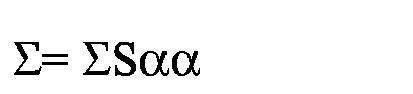
- The total amount of 1 butene and propylene as molar percent is calculated from diads using the following relations:


- Owing to the overlap between sequences due to stereoerrors and to comonomer (clearly visible in the atactic copolymers of figure 1) in copolymers with C3 up to 50 mol%, the stereoregularity of the B centered triads (PBP BBP and BBB), as mm content, can be evaluated dividing the CH2 branch region in 2 areas A and B where:
- A is the area from 28.4 to 27.45 ppm and represents the XBX mm triads
- B is the area from 27.45 to 26.0 ppm and represents the XBX mr+rr triads
- Therefore the content of isotactic triads XBX mm is given by XBX mm = 100*A/(A+B) The composition and isotacticity of the C3C4 copolymers is given in the following table a.
Table a Ex C4 %wt C3 %wt C4 %mol C3 %mol XBXmm %mol 2 86.8 13.2 83.2 16.8 92.9 3 74.9 25.1 69.1 30.9 94.6 4 65.2 34.8 58.4 41.6 93.6 5 53.4 46.6 46.2 53.8 98.7 7 84.8 15.2 80.8 19.2 96.3 8 76.3 23.7 70.7 29.3 98 9 62.4 37.6 55.5 44.5 97.6 10 53.1 46.9 45.9 54.1 98.2 - The product of reactivity ratios are obtained from 13C NMR triad distribution according to C.J. Carman, R.A. Harrington and C.E. Wilkes, Macromolecules, 10, 536 (1977) using the following expressions.
-

- Dimethylsilyl{(2,4,7-trimethyl-1-indenyl)-7-(2,5-dimethyl-cyclopenta[1,2-b:4,3-b']-dithiophene)} zirconium dimethyl (A-1) was prepared according to the procedure described in EP 04101020.8.
rac dimethylsilandiylbis-6-[2,5-dimethyl-3-(2',5'-dimethyl-phenyl)cyclopentadienyl-[1,2-b]-thiophene]zirconium dichloride (A-2) was prepared according to the procedure described in WO O1/44318. - in a 20 Lt. jacketed reactor were charged at room temperature under nitrogen atmosphere 2390 g of a 110 g/Lt. TIBA solution in isododecane (3.11 L) and 800 mL of a 30% wt./wt. MAO solution in toluene The resulting alkyl mixture was stirred at 50°C for 1 h. Then 7.09 g of A-1 (13.1 mmol) were suspended at room temperature in 500 g of isododecane and charged under nitrogen atmosphere into the reactor. After 1
- h stirring at 50°C, the reaction mixture was diluted with 0.52 Lt. (702 g) of isododecane to reach a concentration of total catalyst (A-1 plus MAO plus TIBA) of 100 g each Lt. of solution. The resulting catalyst solution was discharged from the reactor and used as such. This catalyst solution was analysed and it resulted: A1TOT/Zr = 429 (theoretical value 396), Al = 3.35 %wt. (theoretical value 3.32), Zr = 264 ppm (theoretical value 283). The concentration of the metallocene resulted to be 1.28 mg of A-1 for each mL of solution. The catalyst solution resulted composed of toluene = 10.90%wt., isododecane = 76.14%wt., MAO = 4.67%wt., TIBA = 8.11%wt. and metallocene A-1 = 0.17%wt.
- 50.2 mg of A-2 were charged at room temperature under nitrogen atmosphere into a 50 mL Schlenk flask, equipped with a magnetic stirrer. At the same time 30 mL of MAO 30% wt./wt. in toluene were charged at room temperature under nitrogen atmosphere into a 100 mL Schlenk flask and slowly diluted with 60 mL of toluene to obtain 90 mL of a MAO 9.1% wt./vol. solution in toluene. 17.7 mL of this alkyl solution (27.70 mmol, AlMAO/Zr = 400) were then added at room temperature to the metallocene A-2 obtaining an orange-red catalytic solution (after 10 min stirring), which was tested as such in polymerization. The concentration of A-2 resulted to be 2.84 mg of metallocene for each mL of solution.
- 6 mmol of Al(i-Bu)3 (as a 1M solution in hexane) and the amounts of 1-butene and propylene listed in Table 1 were charged at room temperature in a 4 L jacketed stainless-steel autoclave, equipped with magnetically driven stirrer and a 35-mL stainless-steel vial, connected to a thermostat for temperature control, previously purified by washing with an Al(i-Bu)3 solution in hexane and dried at 50°C in a stream of nitrogen. No further monomers were fed during the polymerization. The autoclave was then thermostated at the polymerization temperature (70°C), and then 1 mL (for catalyst system C-1) or 0.5 mL (for catalyst system C-2) of the solution containing the catalyst/cocatalyst mixture was injected in the autoclave by means of nitrogen pressure through the stainless-steel vial, and the polymerization carried out at constant temperature for 1 h. Then stirring is interrupted; the pressure into the autoclave is increased with nitrogen. The bottom discharge valve is opened and the monomers/copolymer mixture is discharged into a heated steel tank containing water at 70°C. The tank heating is switched off and a flow of nitrogen at 0.5 bar-g is fed. After cooling at room temperature, the steel tank is opened and the wet polymer collected. The wet polymer is dried in an oven under reduced pressure at 70°C. The polymerization conditions and the characterizations of the polymer obtained are reported in tables 1 and 2. Some polymer samples have been analyzed in order to determine their mechanical properties, the results are reported in table 3.
Table 1 Ex catalyst system mg of metalloc ene %wt butene liquid phase %wt propylene liquid phase butene, total fed propylene g total fed P bar (final) 1* C-1 1.28 100 0 1350 0 10.2 2 C-1 1.28 90 10 1203 139 12.5 3 C-1 1.28 80 20 1051 273 15 4 C-1 1.28 70 30 904 403 17 5 C-1 1.28 60 40 760 530 18.5 6* C-2 1.42 100 0 1350 0 10.1 7 C-2 1.42 90 10 1203 139 13.5 8 C-2 1.42 80 20 1051 273 15.4 9 C-2 1.42 70 30 904 403 17.8 10 C-2 1.42 60 40 760 530 19.1 * comparative table 2 Ex Yield (g) Activity kg/ g MC /h I.V. (dL/g) THN M w /M n C 3 %mol r 1 xr 2 T m (II) °C mm % 1 * 42 33 2.2 2.1 0 - 104 n.a. 2 78 61 2.0 2.1 16.8 1.03 72+98 92.9 3 137 107 1.8 2.1 30.9 0.99 56§ 94.6 4 187 146 1.7 2.1 41.6 1.12 56§ 93.6 5 177 138 1.6 3.0 53.8 1.08 59§ 98.7 6* 191 135 1.6 2.0 0 - 108.3 n.a. 7 215 152 1.3 2.0 19.2 1.05 83.2 96.3 8 267 188 1.3 2.0 29.3 1.02 63.1 98 9 299 211 1.3 1.9 44.5 0.93 63.5 97.6 10 387 273 1.3 2.0 54.1 1.12 66.6 98.2 * comparative § Tm(I) n.a. not available 

Claims (10)
- A solution polymerization process for obtaining isotactic, crystalline or crystallisable 1-butene/propylene polymers comprising contacting under polymerization conditions at a temperature ranging from 50°C to 90°C 1-butene and propylene in the presence of a catalyst system obtainable by contacting:a) at least one metallocene compound;b) an alumoxane or a compound capable of forming an alkyl metallocene cation; and optionallyc) an organo aluminum compound;
wherein the polymerization medium consists of a mixture of 1-butene and propylene wherein the content of propylene in the liquid phase ranges from 1% to 60% by weight; and wherein the catalyst system obtainable by contacting the above a), b) and optionally c) is not supported on an inert carrier. - The process according to claim 1 wherein the polymerization temperature ranges from 60°C to 80°C.
- The process according to anyone of claims 1-2 wherein the propylene content in the liquid phase of the polymerization medium preferably ranges from 5% to 60% by weight.
- The process according to anyone of claims 1-3 wherein a 1-butene propylene copolymers containing up to 60% by mol of propylene derived units is obtained.
- The process according to claim 4 wherein a 1-butene propylene copolymers containing from 5% by mol to 55 % by mol of propylene derived units is obtained.
- The process according to anyone of claims 1-5 wherein the metallocene compound has formula (II) or (III)

M is a transition metal belonging to group 4, 5 or to the lanthanide or actinide groups of the Periodic Table of the Elements;
the substituents X, equal to or different from each other, are monoanionic sigma ligands selected from the group consisting of hydrogen, halogen, R6, OR6, OCOR6, SR6, NR6 2 and PR6 2, wherein R6 is a linear or branched, saturated or unsaturated C1-C20 alkyl, C3-C20 cycloalkyl, C6-C20 aryl, C7-C20 alkylaryl or C7-C20 arylalkyl group, optionally containing one or more Si or Ge atoms;
p is an integer equal to the oxidation state of the metal M minus 2
L is a divalent bridging group selected from C1-C20 alkylidene, C3-C20 cycloalkylidene, C6-C20 arylidene, C7-C20 alkylarylidene, or C7-C20 arylalkylidene radicals optionally containing heteroatoms belonging to groups 13-17 of the Periodic Table of the Elements, and silylidene radical containing up to 5 silicon atoms
wherein in the compound of formula (II):R10 is a hydrogen atom, or a C1-C40 hydrocarbon radicals optionally containing heteroatoms belonging to groups 13-17 of the Periodic Table of the Elements;R11 and R12, equal to or different from each other, are hydrogen atoms or C1-C40 hydrocarbon radicals optionally containing heteroatoms belonging to groups 13-17 of the Periodic Table of the Elements;T' is a moiety of formula (IIa) or (IIb): R17, R18 R19 and R20, equal to or different from each other, are hydrogen atoms, or C1-C40 hydrocarbon radicals optionally containing heteroatoms belonging to groups 13-17 of the Periodic Table of the Elements;R21 and R22, equal to or different from each other, are hydrogen atoms or C1-C40 hydrocarbon radicals optionally containing heteroatoms belonging to groups 13-17 of the Periodic Table of the Elements;
wherein in the compound of formula (III):R13 and R14, equal to or different from each other, are a hydrogen atoms, or C1-C40 hydrocarbon radicals optionally containing heteroatoms belonging to groups 13-17 of the Periodic Table of the Elements;R15 and R16, equal to or different from each other, are hydrogen atoms or C1-C40 hydrocarbon radicals optionally containing heteroatoms belonging to groups 13-17 of the Periodic Table of the Elements;T' has the same meaning described above. - The process according to claim 6 wherein in the compound of formula (II):R10 is linear or branched, saturated or unsaturated C1-C20-alkyl radicals, optionally containing heteroatoms belonging to groups 13-17 of the Periodic Table of the Elements;R11 and R12 are linear or branched, C1-C20-alkyl radicals;R17 is a linear or branched, saturated or unsaturated C1-C20-alkyl radical, optionally containing heteroatoms belonging to groups 13-17 of the Periodic Table of the Elements;R18 is a hydrogen atomR19 is a hydrogen atom or a C1-C10-alkyl radical;R20 is a hydrogen atom or linear or branched, saturated or unsaturated C1-C20-alkyl radical, optionally containing heteroatoms belonging to groups 13-17 of the Periodic Table of the Elements;R21 is a hydrogen atom or a linear or branched, cyclic or acyclic C1-C20-alkyl radical;R22 is a C1-C40-alkyl, C6-C40-aryl or a C7-C40-arylalkyl radical;
- The process according to claim 6 wherein in the compound of formula (III):R13 and R14 are linear or branched, saturated or unsaturated C1-C20-alkyl radicals, optionally containing heteroatoms belonging to groups 13-17 of the Periodic Table of the Elements;R16 is a C1-C40-alkyl, C6-C40-aryl or a C7-C40-arylalkyl;R15 is a hydrogen atom or a linear or branched, cyclic or acyclic C1-C20-alkyl radical;R17 is a linear or branched, saturated or unsaturated C1-C20-alkyl radical, optionally containing heteroatoms belonging to groups 13-17 of the Periodic Table of the Elements;R19 is a hydrogen atom or a C1-C10-alkyl radical;R20 is a hydrogen atom or linear or branched, saturated or unsaturated C1-C20-alkyl radical, optionally containing heteroatoms belonging to groups 13-17 of the Periodic Table of the Elements;R21 is a hydrogen atom or a linear or branched, cyclic or acyclic C1-C20-alkyl radical;R22 is a C1-C40-alkyl, C6-C40-aryl or a C7-C40-arylalkyl radical;
- The process according to claims 7 or 8 wherein R22 is a moiety of formula (IV):

- The process according to anyone of claims 5-9 wherein isotactic, crystalline or crystallisable 1-butene/propylene polymers having an intrinsic viscosity (I.V.) measured in tetrahydronaphtalene THN at 135°C higher than 1 dl/g are obtained.
Priority Applications (8)
| Application Number | Priority Date | Filing Date | Title |
|---|---|---|---|
| EP04105625A EP1655314A1 (en) | 2004-11-09 | 2004-11-09 | Process for the preparation of 1-butene/propylene copolymers |
| US11/667,350 US7531609B2 (en) | 2004-11-09 | 2005-10-20 | Process for the preparation of 1-butene/propylene copolymers |
| JP2007540625A JP2008519151A (en) | 2004-11-09 | 2005-10-20 | Process for producing 1-butene / propylene copolymer |
| DE602005015479T DE602005015479D1 (en) | 2004-11-09 | 2005-10-20 | PROCESS FOR PREPARING 1-BUTENE / PROPYLENE COPOLYMERS |
| EP05801562A EP1819743B1 (en) | 2004-11-09 | 2005-10-20 | Process for the preparation of 1-butene/propylene copolymers |
| KR1020077010560A KR20070084131A (en) | 2004-11-09 | 2005-10-20 | Process for preparing 1-butene / propylene copolymer |
| CN2005800383648A CN101056901B (en) | 2004-11-09 | 2005-10-20 | Process for preparing 1-butene/propylene copolymer |
| PCT/EP2005/055434 WO2006051035A1 (en) | 2004-11-09 | 2005-10-20 | Process for the preparation of 1-butene/propylene copolymers |
Applications Claiming Priority (1)
| Application Number | Priority Date | Filing Date | Title |
|---|---|---|---|
| EP04105625A EP1655314A1 (en) | 2004-11-09 | 2004-11-09 | Process for the preparation of 1-butene/propylene copolymers |
Publications (1)
| Publication Number | Publication Date |
|---|---|
| EP1655314A1 true EP1655314A1 (en) | 2006-05-10 |
Family
ID=34929826
Family Applications (2)
| Application Number | Title | Priority Date | Filing Date |
|---|---|---|---|
| EP04105625A Withdrawn EP1655314A1 (en) | 2004-11-09 | 2004-11-09 | Process for the preparation of 1-butene/propylene copolymers |
| EP05801562A Expired - Lifetime EP1819743B1 (en) | 2004-11-09 | 2005-10-20 | Process for the preparation of 1-butene/propylene copolymers |
Family Applications After (1)
| Application Number | Title | Priority Date | Filing Date |
|---|---|---|---|
| EP05801562A Expired - Lifetime EP1819743B1 (en) | 2004-11-09 | 2005-10-20 | Process for the preparation of 1-butene/propylene copolymers |
Country Status (5)
| Country | Link |
|---|---|
| US (1) | US7531609B2 (en) |
| EP (2) | EP1655314A1 (en) |
| KR (1) | KR20070084131A (en) |
| CN (1) | CN101056901B (en) |
| WO (1) | WO2006051035A1 (en) |
Families Citing this family (6)
| Publication number | Priority date | Publication date | Assignee | Title |
|---|---|---|---|---|
| US8178636B2 (en) * | 2004-05-04 | 2012-05-15 | Basell Polyolefine Gmbh | Process for the preparation of atactic 1-butene polymers |
| EP2057226B1 (en) * | 2006-08-30 | 2009-12-09 | Basell Polyolefine GmbH | 1-butene propylene copolymer compositions |
| JP5580589B2 (en) * | 2006-08-30 | 2014-08-27 | バーゼル・ポリオレフィン・ゲーエムベーハー | 1-butene propylene copolymer composition |
| DE102008005949A1 (en) * | 2008-01-24 | 2009-07-30 | Evonik Degussa Gmbh | Polyolefins with isotactic structural elements, process for their preparation and their use |
| US20110003939A1 (en) * | 2008-03-13 | 2011-01-06 | Basell Poliolefine Italia S.R.L. | 1-butene terpolymers |
| KR101924121B1 (en) | 2016-11-28 | 2019-02-22 | 주식회사 일렘테크놀러지 | 1-butene based copolymer having excellent low temperature-high elongation property and processing method of them |
Citations (4)
| Publication number | Priority date | Publication date | Assignee | Title |
|---|---|---|---|---|
| WO2001047939A1 (en) * | 1999-12-28 | 2001-07-05 | Basell Technology Company B.V. | Heterocyclic metallocene compounds and use thereof in catalyst systems for producing olefin polymers |
| WO2002100908A1 (en) * | 2001-06-12 | 2002-12-19 | Basell Polyolefine Gmbh | Process for the polymerization of 1-butene |
| WO2003042258A1 (en) * | 2001-11-12 | 2003-05-22 | Basell Polyolefine Gmbh | Process for polymerizing 1-butene and 1-butene polymers |
| WO2004050713A2 (en) * | 2002-12-04 | 2004-06-17 | Basell Polyolefine Gmbh | 1-buten copolymers and process for preparing them |
Family Cites Families (29)
| Publication number | Priority date | Publication date | Assignee | Title |
|---|---|---|---|---|
| ZA844157B (en) | 1983-06-06 | 1986-01-29 | Exxon Research Engineering Co | Process and catalyst for polyolefin density and molecular weight control |
| US5324800A (en) * | 1983-06-06 | 1994-06-28 | Exxon Chemical Patents Inc. | Process and catalyst for polyolefin density and molecular weight control |
| PL286365A1 (en) | 1989-08-03 | 1991-04-22 | Exxon Chemical Patents Inc | Method of polymerizing especially ethylene any polymerization catalyst and method of obtaining same |
| JP2854886B2 (en) * | 1989-08-10 | 1999-02-10 | 三井化学株式会社 | Propylene and butene copolymer |
| EP0672689A1 (en) | 1990-06-22 | 1995-09-20 | Exxon Chemical Patents Inc. | Aluminum-free monocyclopentadienyl metallocene catalysts for olefin polymerization |
| ES2093058T3 (en) | 1990-11-12 | 1996-12-16 | Hoechst Ag | PROCEDURE FOR THE PREPARATION OF AN OLEPHINIC POLYMER. |
| US5239022A (en) * | 1990-11-12 | 1993-08-24 | Hoechst Aktiengesellschaft | Process for the preparation of a syndiotactic polyolefin |
| DE59107973D1 (en) | 1990-11-12 | 1996-08-08 | Hoechst Ag | Process for producing a high molecular weight olefin polymer |
| DE59104869D1 (en) | 1990-11-12 | 1995-04-13 | Hoechst Ag | 2-Substituted bisindenyl metallocenes, process for their preparation and their use as catalysts in olefin polymerization. |
| US5243001A (en) * | 1990-11-12 | 1993-09-07 | Hoechst Aktiengesellschaft | Process for the preparation of a high molecular weight olefin polymer |
| JP2736938B2 (en) * | 1993-06-24 | 1998-04-08 | ザ ダウ ケミカル カンパニー | Titanium (II) or zirconium (II) complex and addition polymerization catalyst comprising the same |
| IT1272923B (en) * | 1995-01-23 | 1997-07-01 | Spherilene Srl | METALLOCENIC COMPOUNDS, PROCEDURE FOR THEIR PREPARATION, AND THEIR USE IN CATALYSTS FOR THE POLYMERIZATION OF OLEFINS |
| SG60151A1 (en) * | 1996-11-15 | 1999-02-22 | Sumitomo Chemical Co | Propylene-1-butene copolymer |
| IL129600A0 (en) * | 1996-11-15 | 2000-02-29 | Montell Technology Company Bv | Heterocyclic metallocenes and polymerization catalysts |
| US6559252B1 (en) | 1997-10-29 | 2003-05-06 | Basell Technology Company Bv | Catalysts and processes for the polymerization of olefins |
| PL334470A1 (en) | 1997-11-12 | 2000-02-28 | Montell Technology Company Bv | Metalocenes and olefins polymerisation catalysts |
| KR20010021604A (en) | 1998-05-08 | 2001-03-15 | 간디 지오프레이 에이치. | Metallocenes, ligands and olefin polymerization |
| EP1214364B1 (en) | 1999-09-22 | 2003-07-16 | Basell Polyolefine GmbH | Catalyst system and process for the polymerization of olefins |
| US6444833B1 (en) * | 1999-12-15 | 2002-09-03 | Basell Technology Company Bv | Metallocene compounds, process for their preparation and their use in catalytic systems for the polymerization of olefins |
| JP2001172334A (en) | 1999-12-17 | 2001-06-26 | Chisso Corp | Propylene / 1-butene copolymer |
| DE19962910A1 (en) * | 1999-12-23 | 2001-07-05 | Targor Gmbh | Chemical compound, process for its preparation and its use in catalyst systems for the production of polyolefins |
| DE19962814A1 (en) * | 1999-12-23 | 2001-06-28 | Targor Gmbh | Catalyst system, useful for the production of polyolefins, comprises a metallocene, a Lewis base, a support and a compound containing at least one Group 3 element |
| ES2220725T3 (en) * | 2000-02-24 | 2004-12-16 | Basell Polyolefine Gmbh | ORGANOMETAL COMPOSITE USED AS C-CATALYST TO POLYMERIZE OLEFINS. |
| WO2002016450A1 (en) | 2000-08-22 | 2002-02-28 | Idemitsu Petrochemical Co., Ltd. | 1-butene polymer and molded product consisting of the polymer |
| EP1392705B1 (en) * | 2001-05-21 | 2005-01-05 | Basell Polyolefine GmbH | Catalyst system for the polymerization of olefins |
| EP1448578B1 (en) | 2001-11-30 | 2006-07-26 | Basell Polyolefine GmbH | Metallocene compounds and process for the preparation of propylene polymers |
| BR0305627A (en) * | 2002-07-09 | 2004-09-08 | Basell Polyolefine Gmbh | Catalyst system for olefin polymerization |
| DE60329523D1 (en) * | 2002-12-04 | 2009-11-12 | Basell Polyolefine Gmbh | 1-butene copolymers and production process therefor |
| KR20070004712A (en) | 2004-03-12 | 2007-01-09 | 바젤 폴리올레핀 게엠베하 | Catalyst System for Olefin Polymerization |
-
2004
- 2004-11-09 EP EP04105625A patent/EP1655314A1/en not_active Withdrawn
-
2005
- 2005-10-20 EP EP05801562A patent/EP1819743B1/en not_active Expired - Lifetime
- 2005-10-20 KR KR1020077010560A patent/KR20070084131A/en not_active Withdrawn
- 2005-10-20 US US11/667,350 patent/US7531609B2/en not_active Expired - Lifetime
- 2005-10-20 CN CN2005800383648A patent/CN101056901B/en not_active Expired - Fee Related
- 2005-10-20 WO PCT/EP2005/055434 patent/WO2006051035A1/en not_active Ceased
Patent Citations (4)
| Publication number | Priority date | Publication date | Assignee | Title |
|---|---|---|---|---|
| WO2001047939A1 (en) * | 1999-12-28 | 2001-07-05 | Basell Technology Company B.V. | Heterocyclic metallocene compounds and use thereof in catalyst systems for producing olefin polymers |
| WO2002100908A1 (en) * | 2001-06-12 | 2002-12-19 | Basell Polyolefine Gmbh | Process for the polymerization of 1-butene |
| WO2003042258A1 (en) * | 2001-11-12 | 2003-05-22 | Basell Polyolefine Gmbh | Process for polymerizing 1-butene and 1-butene polymers |
| WO2004050713A2 (en) * | 2002-12-04 | 2004-06-17 | Basell Polyolefine Gmbh | 1-buten copolymers and process for preparing them |
Non-Patent Citations (1)
| Title |
|---|
| RESCONL L ET AL: "NEW CATALYSTS DESIGN FOR THE SIMULTANEOUS CONTROL OVER POLYPROPYLENE MOLECULAR MASS AND STEREOREGULARITY", POLYMERIC MATERIALS SCIENCE AND ENGINEERING, WASHINGTON, DC, US, vol. 87, 2002, pages 76 - 77, XP008018078, ISSN: 0743-0515 * |
Also Published As
| Publication number | Publication date |
|---|---|
| CN101056901B (en) | 2010-12-08 |
| US20070299223A1 (en) | 2007-12-27 |
| EP1819743A1 (en) | 2007-08-22 |
| US7531609B2 (en) | 2009-05-12 |
| KR20070084131A (en) | 2007-08-24 |
| WO2006051035A1 (en) | 2006-05-18 |
| CN101056901A (en) | 2007-10-17 |
| EP1819743B1 (en) | 2009-07-15 |
Similar Documents
| Publication | Publication Date | Title |
|---|---|---|
| EP1622948B1 (en) | Process for polymerizing 1-butene | |
| US7943716B2 (en) | Process for polymerizing 1-hexene or higher alpha-olefins | |
| EP1446430B1 (en) | Process for polymerizing 1-butene and 1-butene polymers | |
| US7476717B2 (en) | Butene-1 homopolymer | |
| US7538174B2 (en) | Isotactic 1-butene copolymers | |
| EP1802669B1 (en) | 1-butene polymer and process for the preparation thereof | |
| EP1735355B1 (en) | Process for polymerizing 1-hexene or higher alpha-olefins | |
| EP1567568B1 (en) | 1-Buten copolymers and process for preparing them | |
| US8097679B2 (en) | Compositions of 1-butene based polymers | |
| US20090286946A1 (en) | Process for the Copolymerization of Propylene | |
| US7531609B2 (en) | Process for the preparation of 1-butene/propylene copolymers | |
| EP1753792B1 (en) | Process for the preparation of atactic 1-butene polymers | |
| US20110003951A1 (en) | 1-butene copolymers | |
| US20100324238A1 (en) | 1-butene terpolymers | |
| US8101695B2 (en) | Propylene based terpolymers | |
| JP2008519151A (en) | Process for producing 1-butene / propylene copolymer | |
| US20100324244A1 (en) | 1-butene copolymers |
Legal Events
| Date | Code | Title | Description |
|---|---|---|---|
| PUAI | Public reference made under article 153(3) epc to a published international application that has entered the european phase |
Free format text: ORIGINAL CODE: 0009012 |
|
| AK | Designated contracting states |
Kind code of ref document: A1 Designated state(s): AT BE BG CH CY CZ DE DK EE ES FI FR GB GR HU IE IS IT LI LU MC NL PL PT RO SE SI SK TR |
|
| AX | Request for extension of the european patent |
Extension state: AL HR LT LV MK YU |
|
| AKX | Designation fees paid | ||
| REG | Reference to a national code |
Ref country code: DE Ref legal event code: 8566 |
|
| STAA | Information on the status of an ep patent application or granted ep patent |
Free format text: STATUS: THE APPLICATION IS DEEMED TO BE WITHDRAWN |
|
| 18D | Application deemed to be withdrawn |
Effective date: 20061111 |