EP1652849A1 - Novel hydrophilic analogs of 4,8-dihydrobenzodithiophene-4,8-diones as anticancer agents - Google Patents
Novel hydrophilic analogs of 4,8-dihydrobenzodithiophene-4,8-diones as anticancer agents Download PDFInfo
- Publication number
- EP1652849A1 EP1652849A1 EP05021154A EP05021154A EP1652849A1 EP 1652849 A1 EP1652849 A1 EP 1652849A1 EP 05021154 A EP05021154 A EP 05021154A EP 05021154 A EP05021154 A EP 05021154A EP 1652849 A1 EP1652849 A1 EP 1652849A1
- Authority
- EP
- European Patent Office
- Prior art keywords
- dioxo
- derivative
- cooh
- dithiophen
- dihydrobenzo
- Prior art date
- Legal status (The legal status is an assumption and is not a legal conclusion. Google has not performed a legal analysis and makes no representation as to the accuracy of the status listed.)
- Withdrawn
Links
- 0 *C=CSC(C(C1=C(C2=O)SCC1)=O)=C2N Chemical compound *C=CSC(C(C1=C(C2=O)SCC1)=O)=C2N 0.000 description 7
- XEHIFSCUIFGCRS-UHFFFAOYSA-N CC(c1cc(C(c2c(C3=O)[s]cc2)=O)c3[s]1)OC(CCC(O)=O)=O Chemical compound CC(c1cc(C(c2c(C3=O)[s]cc2)=O)c3[s]1)OC(CCC(O)=O)=O XEHIFSCUIFGCRS-UHFFFAOYSA-N 0.000 description 1
- CPVFRJNRDGSUBA-UHFFFAOYSA-O CC(c1cc(C(c2c(C3=O)[s]cc2)=O)c3[s]1)OC(CCCC([OH2+])=O)=O Chemical compound CC(c1cc(C(c2c(C3=O)[s]cc2)=O)c3[s]1)OC(CCCC([OH2+])=O)=O CPVFRJNRDGSUBA-UHFFFAOYSA-O 0.000 description 1
- HLOWGGGDQPXQLC-UHFFFAOYSA-N CN(C)CCNC(c1cc(C(c([s]cc2)c2C2=O)=O)c2[s]1)=O Chemical compound CN(C)CCNC(c1cc(C(c([s]cc2)c2C2=O)=O)c2[s]1)=O HLOWGGGDQPXQLC-UHFFFAOYSA-N 0.000 description 1
- DZRGFOIVLRFCQO-UHFFFAOYSA-N OC(CCC(OCc1cc(C(c2c(C3=O)[s]cc2)=O)c3[s]1)=O)=O Chemical compound OC(CCC(OCc1cc(C(c2c(C3=O)[s]cc2)=O)c3[s]1)=O)=O DZRGFOIVLRFCQO-UHFFFAOYSA-N 0.000 description 1
- SHIWKLCXHJFAMY-UHFFFAOYSA-N OC(c1cc(C(c([s]cc2)c2C2=O)=O)c2[s]1)=O Chemical compound OC(c1cc(C(c([s]cc2)c2C2=O)=O)c2[s]1)=O SHIWKLCXHJFAMY-UHFFFAOYSA-N 0.000 description 1
Classifications
-
- C—CHEMISTRY; METALLURGY
- C07—ORGANIC CHEMISTRY
- C07D—HETEROCYCLIC COMPOUNDS
- C07D495/00—Heterocyclic compounds containing in the condensed system at least one hetero ring having sulfur atoms as the only ring hetero atoms
- C07D495/02—Heterocyclic compounds containing in the condensed system at least one hetero ring having sulfur atoms as the only ring hetero atoms in which the condensed system contains two hetero rings
- C07D495/04—Ortho-condensed systems
-
- A—HUMAN NECESSITIES
- A61—MEDICAL OR VETERINARY SCIENCE; HYGIENE
- A61P—SPECIFIC THERAPEUTIC ACTIVITY OF CHEMICAL COMPOUNDS OR MEDICINAL PREPARATIONS
- A61P35/00—Antineoplastic agents
Definitions
- the present invention concerns hydrophilic analogs of 4,8-dihydrobenzodithiophene-4,8-diones, which are active as anticancer agents, along with pharmaceutical formulations containing the same.
- the present invention was undertaken to synthesize novel hydrophilic analogs of dihydrobenzodithiophenediones and to evaluate their anticancer activity.
- a first aspect of the present invention is a compound selected from the group consisting of compounds of formula (D) and compounds of formula (E): wherein Y and Z independently are O, S, -NH-, or Se, and preferably Y and Z are S;
- R 2 , R 3 and R 4 are H, and R 1 is -CR 5 R 6 -X-C(O)-(CH 2 ) n COOH, -CR 5 R 6 -X-(CH 2 ) n COOH, -CR 5 R 6 -X-(CH 2 ) n NR 5 R 6 , -C(O)-NR 6 -(CR 5 R 6 ) n COOH, or -C(O)-NR 6 -(CR 5 R 6 ) n NR 5 R 6 , wherein X, R 5 , R 6 and n are defined as above.
- a 1 and A 2 are O.
- X is O.
- R 5 and R 6 independently are H or methyl.
- R 2 , R 3 and R 4 are H, and R 1 is -CR 5 R 6 -X-C(O)-(CH 2 ) n COOH, wherein X, R 5 , R 6 and n are defined as above.
- R 2 , R 3 and R 4 are H, and R 1 is -CR 5 R 6 -X-(CH 2 ) n COOH, wherein X, R 5 , R 6 and n are defined as above.
- R 2 , R 3 and R 4 are H, and R 1 is -CR 5 R 6 -X-(CH 2 ) n NR 5 R 6 , wherein X, R 5 , R 6 and n are defined as above.
- R 2 , R 3 and R 4 are H, and R 1 is -C(O)-NR 6 -(CR 5 R 6 ) n COOH, wherein X, R 5 , R 6 and n are defined as above.
- R 2 , R 3 and R 4 are H, and R 1 is -C(O)-NR 6 -(CR 5 R 6 ) n NR 5 R 6 , wherein X, R 5 , R 6 and n are defined as above.
- the compound of the present invention has the formula (D).
- the compound of the present invention has the formula (E).
- the compound of the present invention has the formula (D) is mono-[1-(4,8-dioxo-4,8-dihydrobenzo[1,2- b :5,4- b '] dithiophen-2-yl)-methyl]succinate (IIa-1), mono-[1-(4,8-dioxo-4,8-dihydrobenzo[1,2- b :5,4- b '] dithiophen-2-yl)-ethyl]succinate (IIb-1), or mono-[1-(4,8-dioxo-4,8-dihydrobenzo[1,2- b :5,4- b ']dithiophen-2-yl)-ethyl] pentanedioate (IIb-2); and the compound of the present invention has the formula (E) is mono-[1-(4,8-dioxo-4,8-dihydroxybenzo[1,2- b ;4,5
- a second aspect of the present invention is a composition comprising an effective anticancer amount of a compound of the formula (D) or (E) above, or a pharmaceutically acceptable salt thereof, in a pharmaceutically acceptable carrier.
- a further aspect of the present invention is a method for treating a tumor, the method comprising administering to a subject in need of treatment a compound of the formula (D) or (E) above, or a pharmaceutically acceptable salt thereof, in an amount effective to treat said tumor.
- a still further aspect of the present invention is the use of a compound of the formula (D) or (E) above, or a pharmaceutically acceptable salt thereof, for the preparation of a medicament for carrying out the method described above.
- said tumor is selected from the group consisting of non-small cell lung cancer, breast cancer, nasopharynx carcinoma, prostate cancer, colon cancer, hepatoma, ileocecal carcinoma, leukemia and central nervous system cancers, and more preferably said tumor is non-small cell lung cancer, breast cancer, nasopharynx carcinoma and prostate cancer.
- alkyl as used herein, inidividually or as a portion of another substituent term such as “alkoxy”, refers to C1 to C4 alkyl, which may be linear or branched, and saturated or unsaturated. Preferably, the alkyl is saturated, and preferably the alkyl is linear.
- halogen or "halo” as used herein refers to fluorine, chlorine, bromine, iodine, etc., or fluoro, chloro, bromo, iodo, etc., respectively.
- Cytotoxicity Assays Method A (HUVEC, MCF-7, HT-29, Hep 3B and NCI-H460) [S. A. Ahmed, R. M. Gogal Jr., and J. E. Walsh, Journal of Immunological Methods 170: 211-224, (1994); M. R. Boyd, Status of the NCI preclinical antitumor drug discovery screen. (Published by J. B. Lippincott Company, Philadelphia, PA 19105, USA) Principles & Practices of Oncology Updates 3 # 10: 1-12, (1989); M. R. Boyd, et al. Data display and analysis strategies for the NCl disease-oriented in vitro antitumor drug screen. In: Cytotoxic anti-cancer drugs: models and concepts for drug discovery and development. Boston: KluwerAcademic, Pages: 11-34, (1992)]
- test compounds were dissolved in 100% DMSO and then diluted with sterile distilled water to obtain initial working solutions of 20000, 2000, 200, 20 and 2 ⁇ M in 80% DMSO. A 200 fold dilution was further made in culture media to generate final assay concentrations of 100, 10, 1, 0.1 and 0.01 ⁇ M in 0.4% DMSO.
- HUVEC Endothelial Cell Growth Medium 90%; Fetal Bovine Serum, 10% MCF-7 Minimum Essential Medium, 90%; Fetal Bovine Serum, 10% HT-29 McCoy's 5A medium, 90%; Fetal Bovine Serum, 10% Hep 3B Minimum Essential Medium, 90%; Fetal Bovine Serum, 10% NCl-H460 RPMI 1640, 90%; Fetal Bovine Serum, 10% All of media were supplemented with 1% Antibiotic-Antimycotic.
- HUVEC ATCC CRL-1730 Human umbilical vein endothelial cells MCF-7 ATCC HTB-22 Breast adenocarcinoma, pleural effusion, human HT-29 ATCC HTB-38 Adenocarcinoma, colon, moderately well-differentiated grade II, human Hep 3B ATCC HB-8064 Hepatocellular carcinoma, liver, human NCI-H460 ATCC HTB-177 Large cell carcinoma, lung, human All of the human tumor cell lines and HUVEC were obtained from American Type Culture Collection (ATCC). The cells were all incubated at 37°C with 5 % CO 2 in air atmosphere.
- ATCC American Type Culture Collection
- a decrease of 50% or more ( ⁇ 50%) in fluorescent intensity relative to the vehicle-treated control indicates significant cytostatic or cytotoxic activity, and semi-quantitative values for IC 50 , TGI and LC 50 were then determined by nonlinear regression using GraphPad Prism (GraphPad Software, USA).
- IC 50 50% Inhibition Concentration: Test compound concentration where the increase from time 0 in the number or mass of treated cells was only 50% as much as the corresponding increase in the vehicle-control at the end of experiment.
- TGI Total Growth Inhibition
- LC 50 50% Lethal Concentration: Test compound concentration where the number or mass of treated cells at the end of experiment was half that at time.
- MTT 3-(4,5-dimethylthiazol- 2- yl)-2,5-diphenyltetrazolium bromide
- 10 mL of MTT 5 mg/mL was added to each well of 96-well plates containing 1 x 10 5 cells after treatment with different concentrations of samples for 4 days.
- the reaction was stopped after 2 h by adding 100 mL of 0.04 N HCl in isopropanol and the OD570 nm was determined by a minicolorimetric reader. Each concentration treatment was performed in triplicate.
- Cytotoxicity Assays Method C (KB, KB-VIN, AS49, HCT-8, PC-3) [K. H. Lee et. al. Planta Med. 54, 308-312 (1998), Monk A et. al. J. Natl. Cancer Inst. 83, 757-766 (1991).]
- the cell lines included epidermoid caninoma of the nasopharynx (KB), p-gp-expressing epidermoid caninoma of the nasopharynx (KB-VIN), lung carcinoma (A-549), ileocecal carinoma (HCT-8) and prostate cancer (PC-3) cell lines.
- the cytotoxic effects of each compounds were obtained as IC 50 in microgram per ml, the concentration that give 50% inhibition of cell growth after 72hrs of continuous exposure-variation was less than 5% between replicates.
- the assays were used to detect changes in cell proliferation based on the ability of viable cells to cause alamarBlue to change from its oxidized to a reduced form. With the results obtained from the alamarBlue reaction, cell proliferation can be quantified and metabolic activity of viable cell can be examined.
- the succinate derivatives of compounds IIa-1 , IIb-1 and VII-1 were tested for possible effect on the proliferation of four human tumor cell lines ⁇ MCF-7 (breast), HT-29 (colon), Hep3B (liver), and NCl-H 460 (lung) as well as one human umbilical vein endothelial cell (HUVEC) at assay concentration from 0.01 to 100 ⁇ M, through serial 10-fold dilution.
- IC 50 50% inhibition concentration
- TGI total growth inhibition
- LC 50 50% lethal concentration
- the three tested compounds showed potent cytotoxicity in vitro against NCI-H 460 cell line.
- Compounds IIa-1 and IIb-1 also had significant activity against MCF-7 and Hep3B cell lines. These two compounds displayed moderate and little activity against HT-29 cell line.
- Compound VII-1 showed significant cytotoxicity against MCF-7 and Hep3B and moderate activity against HT-29 cell line.
- all the three tested compounds were essentially inactive or showed little activity in HUVEC assay.
- Compound IIa-1, IIa-2, IIb-1, IIb-2, VII-1, VII-2, IX and XV-2-H 3 PO 4 were evaluated for their cytotoxicity in vitro against human promyelocytic leukemia (HL-60) cell line. As shown in Table 2. All of these tested compounds showed significant cytotoxicity. Among them, XV-2-H 3 PO 4 was the most potent one. There fore this compound was selected for further evaluation.
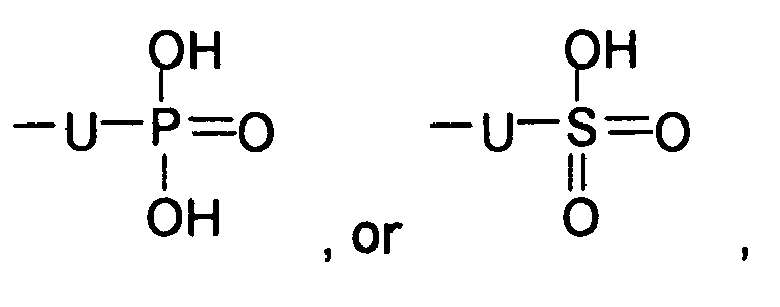
- the present invention also discloses a hydrophilic compound having the following structures (F) or (G), or a pharmaceutically acceptable salt thereof: wherein A 3 and A 4 independently are -U-C(O)-(CH 2 ) n COOH, -U-(CH 2 ) n -COOH, -U(CH 2 )n-NR 5 R 6 , wherein U is O, S, or NH, R 5 is H or alkyl; R 6 is H or alkyl; and n is 1-5; and Y, Z, R 1 , R 2 , R 3 and R 4 are defined as above.
- the present invention also discloses a method for treating a tumor, said method comprising administering to a subject in need of treatment a compound having the formulas ( F ) or ( G ) as defined above, or a pharmaceutically acceptable salt thereof, in an amount effective to treat said tumor.
Landscapes
- Organic Chemistry (AREA)
- Chemical & Material Sciences (AREA)
- Health & Medical Sciences (AREA)
- Life Sciences & Earth Sciences (AREA)
- Medicinal Chemistry (AREA)
- Nuclear Medicine, Radiotherapy & Molecular Imaging (AREA)
- General Chemical & Material Sciences (AREA)
- Pharmacology & Pharmacy (AREA)
- Chemical Kinetics & Catalysis (AREA)
- Animal Behavior & Ethology (AREA)
- General Health & Medical Sciences (AREA)
- Public Health (AREA)
- Veterinary Medicine (AREA)
- Pharmaceuticals Containing Other Organic And Inorganic Compounds (AREA)
- Heterocyclic Carbon Compounds Containing A Hetero Ring Having Oxygen Or Sulfur (AREA)
- Organic Low-Molecular-Weight Compounds And Preparation Thereof (AREA)
Abstract
The present invention discloses hydrophilic derivatives of 4,8-dihydrobenzodithiophene-4,8-diones of formula (D) or (E) which are active as anticancer agents, along with pharmaceutical formulations containing the same.
Description
- The present invention concerns hydrophilic analogs of 4,8-dihydrobenzodithiophene-4,8-diones, which are active as anticancer agents, along with pharmaceutical formulations containing the same.
- In our prior studies, naphtho[2,3-b]thiophene-4,9-diones (A), 4,8-dihydrobenzo[1,2-b : 5,4-b']dithiophene-4,8-diones(B) and, 4,8-dihydrobenzo[1,2-b: 4,5-b'] dithiophene-4,8-diones(C) were identified as potential anticancer agents [US patent Nos. 6,174,913 B1; 6,337,346B1, details of which are incorporated herein by reference]. Among these benzothiophene analogs, many compounds possessed very potent cytotoxic activity against human tumor cell lines. However, most of these compounds were quite lipophilic, and therefore, not optimal for in vivo and clinical studies.

- The present invention was undertaken to synthesize novel hydrophilic analogs of dihydrobenzodithiophenediones and to evaluate their anticancer activity.
- A first aspect of the present invention is a compound selected from the group consisting of compounds of formula (D) and compounds of formula (E):

- A1 and A2 independently are O, S, or NR5, wherein R5 is H or alkyl;
- R1, R2, R3 and R4 independently are H, alkyl,
- Preferably, R2, R3 and R4 are H, and R1 is -CR5R6-X-C(O)-(CH2)nCOOH, -CR5R6-X-(CH2)nCOOH, -CR5R6-X-(CH2)nNR5R6, -C(O)-NR6-(CR5R6)nCOOH, or -C(O)-NR6-(CR5R6)nNR5R6, wherein X, R5, R6 and n are defined as above.
- Preferably, A1 and A2 are O.
- Preferably, X is O.
- Preferably, R5 and R6 independently are H or methyl.
- Preferably, R2, R3 and R4 are H, and R1 is -CR5R6-X-C(O)-(CH2)nCOOH, wherein X, R5, R6 and n are defined as above.
- Preferably, R2, R3 and R4 are H, and R1 is -CR5R6-X-(CH2)nCOOH, wherein X, R5, R6 and n are defined as above.
- Preferably, R2, R3 and R4 are H, and R1 is -CR5R6-X-(CH2)nNR5R6, wherein X, R5, R6 and n are defined as above.
- Preferably, R2, R3 and R4 are H, and R1 is -C(O)-NR6-(CR5R6)nCOOH, wherein X, R5, R6 and n are defined as above.
- Preferably, R2, R3 and R4 are H, and R1 is -C(O)-NR6-(CR5R6)nNR5R6, wherein X, R5, R6 and n are defined as above.
- Preferably, the compound of the present invention has the formula (D).
- Preferably, the compound of the present invention has the formula (E).
- Preferably, the compound of the present invention has the formula (D) is mono-[1-(4,8-dioxo-4,8-dihydrobenzo[1,2-b:5,4-b'] dithiophen-2-yl)-methyl]succinate (IIa-1), mono-[1-(4,8-dioxo-4,8-dihydrobenzo[1,2-b:5,4-b'] dithiophen-2-yl)-ethyl]succinate (IIb-1), or mono-[1-(4,8-dioxo-4,8-dihydrobenzo[1,2-b:5,4-b']dithiophen-2-yl)-ethyl] pentanedioate (IIb-2); and the compound of the present invention has the formula (E) is mono-[1-(4,8-dioxo-4,8-dihydroxybenzo[1,2-b;4,5-b]dithiophen-2-yl)-ethyl] succinate (VII-1), mono-[1-(4,8-dioxo-4,8-dihydroxybenzo[1,2-b;4,5-b]dithiophen-2-yl)-ethyl] pentanedioate (VII-2), or 4,8-dioxo-4,8-dihydrobenzo[1,2-b;4,5-b]dithiophene-2-carboxylate-(2-dimethylamino-ethyl)-amide (XV-2).
- A second aspect of the present invention is a composition comprising an effective anticancer amount of a compound of the formula (D) or (E) above, or a pharmaceutically acceptable salt thereof, in a pharmaceutically acceptable carrier.
- A further aspect of the present invention is a method for treating a tumor, the method comprising administering to a subject in need of treatment a compound of the formula (D) or (E) above, or a pharmaceutically acceptable salt thereof, in an amount effective to treat said tumor.
- A still further aspect of the present invention is the use of a compound of the formula (D) or (E) above, or a pharmaceutically acceptable salt thereof, for the preparation of a medicament for carrying out the method described above.
- Preferably, said tumor is selected from the group consisting of non-small cell lung cancer, breast cancer, nasopharynx carcinoma, prostate cancer, colon cancer, hepatoma, ileocecal carcinoma, leukemia and central nervous system cancers, and more preferably said tumor is non-small cell lung cancer, breast cancer, nasopharynx carcinoma and prostate cancer.
- As part of a continuing search for potential anticancer drug candidates in the benzodithiophenedione series, novel hydrophilic analogs were synthesized and evaluated. A series of succinates (D, E) and amides (XV) derived from hydroxyalkyl-4,8-dihydrobenzo[1,2-b: 5,4-b']dithiophene-4,8-dione (I) and hydroxyalkyl-4,8-dihydrobenzo[1,2-b: 4,5-b'] dithiophene-4,8-dione (VI) are worthy of further exploration for their anticancer activities.
- The term "alkyl" as used herein, inidividually or as a portion of another substituent term such as "alkoxy", refers to C1 to C4 alkyl, which may be linear or branched, and saturated or unsaturated. Preferably, the alkyl is saturated, and preferably the alkyl is linear.
- The term "halogen" or "halo" as used herein refers to fluorine, chlorine, bromine, iodine, etc., or fluoro, chloro, bromo, iodo, etc., respectively.
- Suitable methods for synthesizing the compounds of the present invention will be described in the following, and variations thereof will be apparent to those skilled in the art in given the Examples set forth below.
- The key intermediates (I,VI) needed for the synthesis of target compounds were prepared according to our previously reported procedures [L. J. Huang, S. C. Kuo, C. Y. Perng, Y. H. Chao, T. S. Wu, A. T. Mcphail, A. Manger, H. Y. Cheng and K. H. Lee. Bioorg. Med. Chem. Lett 8, 2763-2768 (1998); Y H. Chao, S. C. Kuo, C. H. Wu, C. Y. Lee, A. Manger, I. C. Sun, S. L. Morris-Natschke and K. H. Lee. J. Med. Chem. 41, 4658-4661 (1998); Y. H. Chao, S. C. Kuo, K. Ku, I. P. Chiu, C. H. Wu, A. Manger, H. K. Wang, and K. H. Lee. Bioorg. Med. Chem. 7,1025-1031 (1999)].
- As shown in Scheme 1. the mono-(4,8-dioxo-4,8-dihydrobenzo[1,2-b : 5,4-b'] dithiophenyl-alkyl)alkanedioates (II) were obtained by treating the key intermediate I, hydroxyalkyl-4,8-dihydrobenzo[1,2-b : 5,4-b']dithiophene-4,8-diones, with anhydride in the presence of organic or inorganic base.

- When the key intermediate I was reacted with a variety of haloalkanoates [X(CH2)nCOOEt] in the presence of alkali, the corresponding alkoxyalkanoates (III) were obtained. Hydrolysis of compounding III with TFA or NaOH affords the corresponding acids (IV), which could be led to water soluble salts. Reaction of key intermediates I with a variety of haloalkylamines gave the corresponding alkoxyalkylamines (V), which could be treated with HCl, respectively, to afford their water soluble salts.
- On the other hand, using the key intermediates VI, hydroxyalkyl-4,8-dihydrobenzo[1,2-b : 4,5-b']dithiophene-4,8-diones, as starting materials, following the similar procedures (Scheme 2) described above for the preparation of compounds II, IV, V, we successfully converted the key intermediates VI into hydrophilic target compounds VII, IX, X.

- As shown in Scheme 3, the 4,8-dihydrobenzo[1,2-b: 5,4-b']dithio-phene-4,8-dione-2-carboxylic acid XI was treated with amino acids in the presence of coupling agent to form the amides XII, which were then converted to the corresponding acids XIII. When XI was treated with NH3, the corresponding ammonium salts (XI-NH4) was obtained. On the other hand, compounds XI was allowed to react with SOCl2 to afford the corresponding acid chloride, which was treated with a variety of aminoalkylamines to give corresponding amides (XVII) which could be treated with H3PO4 respectively to afford their water soluble salts (XVII-H 3 PO 4 ).

- When the 4.8-dihydrobenzo[1.2-b: 4.5-b']dithiophene-4.8-dione-2-carboxylic acids (XIV) were used as starting material following the similar procedures (Scheme 4) described above for the preparation of compounds XIII-Na ,XI-NH 4 and XVII-H 3 PO 4 , we successfully converted the starting material XIV into target compounds XVI-Na and XIV-NH 4 and XVII-H 3 PO 4 .

- The following Examples are provided to further illustrate the present invention, and should not be construed as limiting thereof. All melting points were determined on a Büchi MP-540 apparatus and are uncorrected. NMR spectra were obtained on a Varian Unity Inova-500 spectrometer in DMSO-d6, CD3OD or CDCl3. The chemical shift values are expressed in δ values (parts per million). The following abbreviations are used: s =singlet, d = doublet, t = triplet, q = quartet, m = multiplet, and br = broad. Mass spectra (MS) were measured with JEOL SX102A GC-MS instrument.
- Mono-[1-(4,8-dioxo-4,8-dihydrobenzo[1,2-b:5,4-b'] dithiophen-2-yl)-methyl]succinate IIa-1

- To a stirred solution of la (30mg, 0.12mmole) in CH2Cl2 (10ml) were added succinic anhydride (120mg, 1.2 mmole), Et3N (25mg, 1.23mmole) and catalytic amount of DMAP (dimethyl aminopyridine). The reaction mixture was stirred at R.T. for 3 hr under N2 and then washed with H2O. The organic layer was extracted with aqueous NaHCO3. To the aqueous layer was added CH2Cl2 and the pH was adjusted to 1 by 6N HCl. The organic layer was washed with H2O and the volume was reduced. The solid precipitate was purified by reslurry with diethyl ether to yield yellow solid IIa-1 (13.2mg, 30%). 1H NMR (500MHz, CDCl3) δ 7.67 (d, J = 5.0Hz, 1 H), 7.60 (dd, J = 6.0, 5.0Hz, 1 H), 7.55 (d, J = 6.0Hz, 1 H), 5.32 (s, 2H), 2.70 (s, 4H).
HRMS Calcd for C15H10O6S2: 349.9919, Found: 350.9995 (MH+, FAB). mp= 156°C (decomp.) - Sodium mono-[1-(4,8-dioxo-4,8-dihydrobenzo[1,2-b:5,4-b'] dithiophen-2-yl)-methyl]succinate IIa-1-Na

- To a stirred solution of IIa-1 (100.7mg, 0.29mmole) in EA was added sodium 2-ethylhexanoate (1.2~1.5 eq.) in EA and stirred for overnight. The precipitate was filtered and washed with EA and then dried in vacuum. Yellow solid IIa-1-Na (100.6mg, 93%) was obtained.
1H NMR (500MHz, CD3OD) δ 7.96-7.93 (m, 1 H), 7.63-7.60 (m, 2H), 5.36 (s, 2H), 2.63 (t, J = 7.0Hz, 2H), 2.48 (t, J = 7.0Hz, 2H). mp= 213°C (decomp.) - Mono-[1-(4,8-dioxo-4,8-dihydrobenzo[1,2-b:5,4-b'] dithiophen-2-yl)-ethyl]succinate IIb-1

- To a stirred solution of Ib (45mg, 0.18mmole) and CH2Cl2 (10ml) were added succinic anhydride (150mg, 1.5 mmole), Et3N (150mg, 1.54mmole) and catalytic amount of DMAP (dimethyl aminopyridine). The reaction mixture was stirred at R.T. for 3 hr under N2 and then washed with H2O. The organic layer was extracted with aqueous NaHCO3. To the aqueous layer was added CH2Cl2, and the pH was adjusted to 1 by 6N HCl. The separated CH2Cl2 layer was washed with H2O and the volume was reduced. The solid precipitate was purified by reslurry with diethyl ether to yield yellow solid IIb-1 (11.7mg, 17%). 1H NMR (500MHz, CDCl3) δ 7.66 (d, J = 5.0Hz, 1 H), 7.59 (d, J = 5.0Hz, 1 H), 7.50 (s, 1 H), 6.15 (q, J = 6.0Hz, 1 H), 2.71-2.65 (m, 4H), 1.67 (d, J = 6.0Hz, 3H).
HRMS Calcd for C16H12O6S2: 364.0075, Found: 364.0074.
mp= 132~132.5°C. - Sodium mono-[1-(4,8-dioxo-4,8-dihydroxybenzo-[1,2-b;5,4-b']dithiophen-2-yl)-ethyl] succinate IIb-1-Na

- To a stirred solution of IIb-1 (100.8mg, 0.28mmole) in EA was added sodium 2-ethylhexanoate (1.2~1.5 eq.) in EA and stirred for overnight. The precipitate was filtered and washed with EA and then dried in vacuum. Yellow solid IIb-1-Na (96.5mg, 89%) was obtained.
1H NMR (500MHz, CD3OD) δ7.94 (d, J = 5.0Hz, 1 H), 7.61 (d, J = 5.0Hz, 1 H), 7.57 (s, 1 H), 6.17 (q, J = 6.5Hz, 1 H), 2.68-2.56 (m, 2H), 2.50-2.45 (m, 2H), 1.68 (d, J = 6.5Hz, 3H).
mp= 219°C (decomp.) - Mono-[1-(4,8-dioxo-4,8-dihydroxybenzo[1,2-b;4,5-b']dithiophen-2-yl)-ethyl] succinate VII-1

- To a stirred solution of VI (50.0mg, 0.19mmole) and CH2Cl2 (3ml) were added succinic anhydride (44.8mg, 0.45mmole), Et3N (0.10ml, 0.43mmole) and DMAP (3.0mg, 0.02mmole). The reaction mixture was stirred at R.T. for 1.5 hr under N2. After the addition of H2O (1ml) and 6N HCl (1ml), the reaction mixture was extracted with CH2Cl2 (15ml x 3). The organic layer was dried over Na2SO4, filtered and concentrated to yield yellow-green solid VII-1 (62.0mg, 90%).
1H NMR (500MHz, d6-DMSO) δ 8.15 (d, J = 4.5Hz, 1 H), 7.63 (s, 2H), 6.14 (q, J = 6.5Hz, 1 H), 2.59-2.56 (m, 4H), 1.61 (d, J = 6.5Hz, 3H).
HRMS Calcd for C16H12O6S2: 364.0075, Found: 365.0156 (MH+, FAB).
mp= 163.5~164.6 °C - Sodium mono-[1-(4,8-dioxo-4,8-dihydroxybenzo-[1,2-b;4,5-b']dithiophen-2-yl)-ethyl] succinate VII-1-Na
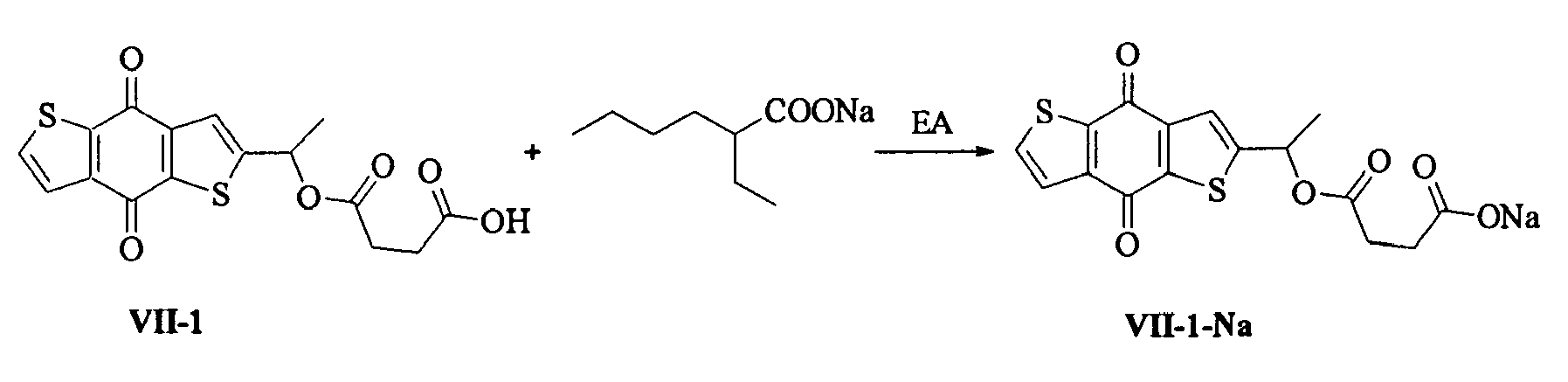
- To a stirred solution of VII-1 (200.0mg, 0.55mmole) in EA was added sodium 2-ethylhexanoate (1.2~1.5 eq.) in EA and stirred for overnight. The precipitate was filtered and washed with EA and then dried in vacuum.
Yellow-green solid VII-1-Na (191.0mg, 90%) was obtained.
1H NMR (500MHz, CD3OD) δ 7.93 (d, J = 5.0Hz, 1 H), 7.62 (d, J = 5.0Hz, 1 H), 7.57 (s, 1H). 6.17 (q, J = 6.5Hz, 1 H), 2.68-2.56 (m, 2H), 2.49-2.45 (m, 2H), 1.67 (d, J = 6.5Hz, 3H).
mp= 240°C (decomp.) - Mono-[1-(4,8-dioxo-4,8-dihydrobenzo[1,2-b:5,4-b'] dithiophen-2-yl)-methyl] pentanedioate IIa-2

- To a stirred solution of la (54.0mg, 0.22mmole) and CH2Cl2 (3ml) were added glutaric anhydride (49.7mg, 0.44mmole), DMAP (3.0mg, 0.02mmole) and Et3N (0.06ml, 0.40mmole). The reaction mixture was stirred at R.T. for 3.5 hr under N2. After the addition of H2O (1 ml) and 2N HCl (3ml), the reaction mixture was extracted with CH2Cl2 (15mlx 3). The organic layer was dried over Na2SO4, filtered and concentrated to get crude product. It was purified by column chromatography on silica gel eluting with CH3OH: CH2Cl2 (1:40) to obtain compound IIa-2 (45.9mg, 58%).
1H NMR (500MHz, CDCl3) δ7.67 (d, J = 5.0Hz, 1 H), 7.61 (dd, J = 5.5, 5.0Hz, 1 H), 7.55 (d, J = 5.5Hz, 1 H), 5.29 (s, 2H), 2.48 (t, J = 7.5Hz, 2H), 2.44 (t, J = 7.5Hz, 2H), 2.02-1.95 (m, 2H).
HRMS Calcd for C16H12O6S2: 364.0075, Found: 364.0086.
mp= 220°C (decomp.) - Sodium mono-[1-(4,8-dioxo-4,8-dihydrobenzo[1,2-b:5,4-b'] dithiophen-2-yl)-methyl]pentanedioate IIa-2-Na

- To a stirred solution of IIa-2 (67.1 mg, 0.18mmole) in EA was added sodium 2-ethylhexanoate (1.2~1.5 eq.) in EA and stirred for overnight. The precipitate was filtered and washed with EA and then dried in vacuum. Yellowish brown solid IIa-2-Na (65.0mg, 94%) was obtained.
1H NMR (500MHz, CD3OD) δ 7.97-7.92 (m, 1H), 7.65-7.58 (m, 2H), 5.36 (s, 2H), 2.45 (t, J = 7.8Hz, 2H), 2.21 (t, J = 7.8Hz, 2H), 1.94-1.88 (m, 2H).
mp= 203°C (decomp.) - Mono-[1-(4,8-dioxo-4,8-dihydrobenzo[1,2-b:5,4-b'] dithiophen-2-yl)-ethyl] pentanedioate IIb-2
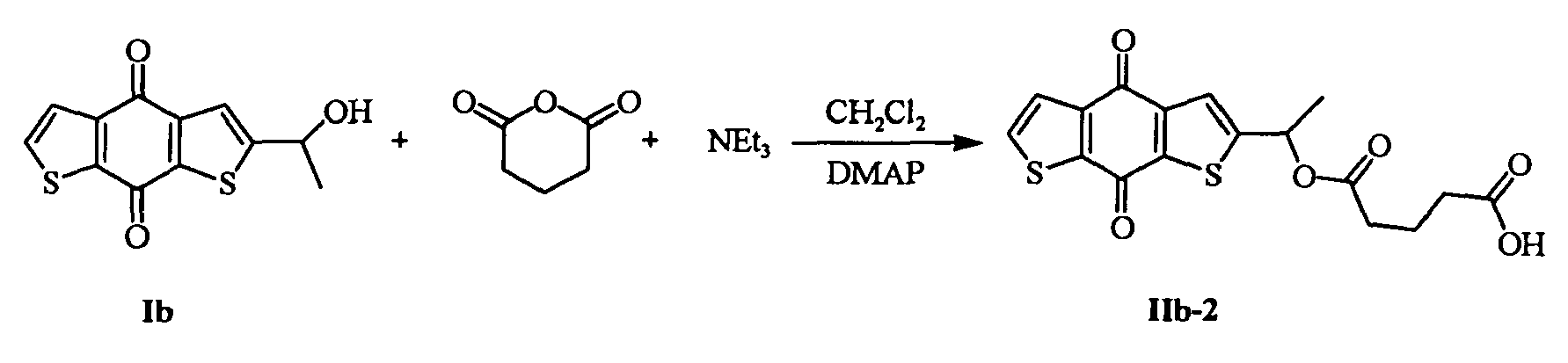
- To a stirred solution of Ib (100.0mg, 0.4mmole) in CH2Cl2 (3ml) were added glutaric anhydride (136.9mg, 1.2mmole), DMAP (5.0mg, 0.04mmole) and Et3N (121mg, 1.19mmole). The reaction mixture was stirred at R.T. for overnight under N2. After the addition of H2O (1ml) and 2N HCl (3ml), the reaction mixture was extracted with CH2Cl2 (15ml x 3). The CH2Cl2 layer was dried over Na2SO4, filtered and concentrated to get crude product. It was purified by column chromatography on silica gel eluting with CH3OH: CH2Cl2 (1:40) to obtain compound IIb-2 (128.0mg, 88%).
1H NMR (500MHz, CDCl3) δ7.65 (d, J = 5.0Hz, 1 H), 7.59 (d, J = 5.0Hz, 1 H), 7.49 (s, 1 H), 6.13 (q, J = 6.5Hz, 1 H), 2.47-2.40 (m, 4H), 2.00-1.93 (m, 2H), 1.66 (d, J = 6.5Hz, 3H).
HRMS Calcd for C17H14O6S2: 378.0232, Found: 378.0229.
mp= 100.5~101.0°C. - Sodium mono-[1-(4,8-dioxo-4,8-dihydroxybenzo[1,2-b;5,4-b]dithiophen-2-yl)-ethyl] pentanedioate IIb-2-Na

- To a stirred solution of IIb-2 (83.0mg, 0.22mmole) in EA was added sodium 2-ethylhexanoate (1.2~1.5 eq.) in EA and stirred for overnight. The precipitate was filtered and washed with EA and then dried in vacuum. Yellowish brown solid IIb-2-Na (83.1 mg, 94%) was obtained.
1H NMR (500MHz, CD3OD δ 7.94 (d, J = 5.0Hz, 1 H), 7.62 (d, J = 5.0Hz, 1 H), 7.57 (d, J = 1.0Hz, 1 H), 6.18 (dd, J = 6.5, 1.0Hz, 1 H), 2.43 (td, J = 7.5, 2.5Hz, 2H), 2.21 (t, J = 7.5Hz, 2H), 1.94-1.88 (m, 2H), 1.67 (d, J = 6.5Hz, 3H).
mp= 228°C (decomp.) - Mono-[1-(4,8-dioxo-4,8-dihydroxybenzo[1,2-b;4,5-b']dithiophen-2-yl)-ethyl] pentanedioate VII-2

- To a stirred solution of VI (50.0mg, 0.19mmole) in CH2Cl2 (3ml) were added glutaric anhydride (45.2mg, 0.4mmole), DMAP (3.0mg, 0.02mmole) and Et3N (0.05ml, 0.4mmole). The reaction mixture was stirred at R.T. for 15 hr under N2. After the addition of H2O (1ml) and 2N HCl (3ml), the reaction mixture was extracted with CH2Cl2 (15ml×3). The CH2Cl2 layer was dried over Na2SO4, filtered and concentrated to get crude product. It was purified by column chromatography on silica gel eluting with CH3OH: CH2Cl2 (1:50) to obtain compound VII-2 (32.7mg, 46%).
1H NMR (500MHz, CDCl3) δ 7.65 (d, J = 5.0Hz, 1 H), 7.61 (d, J = 5.0Hz, 1 H), 7.51 (s, 1 H), 6.13 (q, J = 6.5Hz, 1 H), 2.47-2.41 (m, 4H), 2.00-1.94 (m, 2H), 1.66 (d, J = 6.5Hz, 3H).
HRMS Calcd for C17H14O6S2: 378.0232, Found: 379.0313 (MH+, FAB).
mp= 141.6~142.4°C - Sodium mono-[1-(4,8-dioxo-4,8-dihydroxybenzo[1,2-b;4,5-b']dithiophen-2-yl)-ethyl] pentanedioate VII-2-Na

- To a stirred solution of VII-2 (109.4mg, 0.29mmole) in EA was added sodium 2-ethylhexanoate (1.2~1.5 eq.) in EA and stirred for overnight. The precipitate was filtered and washed with EA and then dried in vacuum.
Yellow-green solid VII-2-Na (79.0mg, 68%) was obtained.
1H NMR (500MHz, CD3OD) δ 7.93 (d, J = 5.0Hz, 1 H), 7.62 (d, J = 5.0Hz, 1 H), 7.57 (s, 1 H), 6.17 (q, J = 6.5Hz, 1 H), 2.44 (td, J = 7.5, 2.5Hz, 2H), 2.22 (t, J = 7.5Hz, 2H), 1.95-1.88 (m, 2H), 1.68 (d, J = 6.5Hz, 3H).
mp= 230°C (decomp.) - t-Butyl 4,8-dioxo-4,8-dihydroxybenzo[1,2-b:5,4-b']-dithiophen-2-yl-methoxy acetate IIIa-1
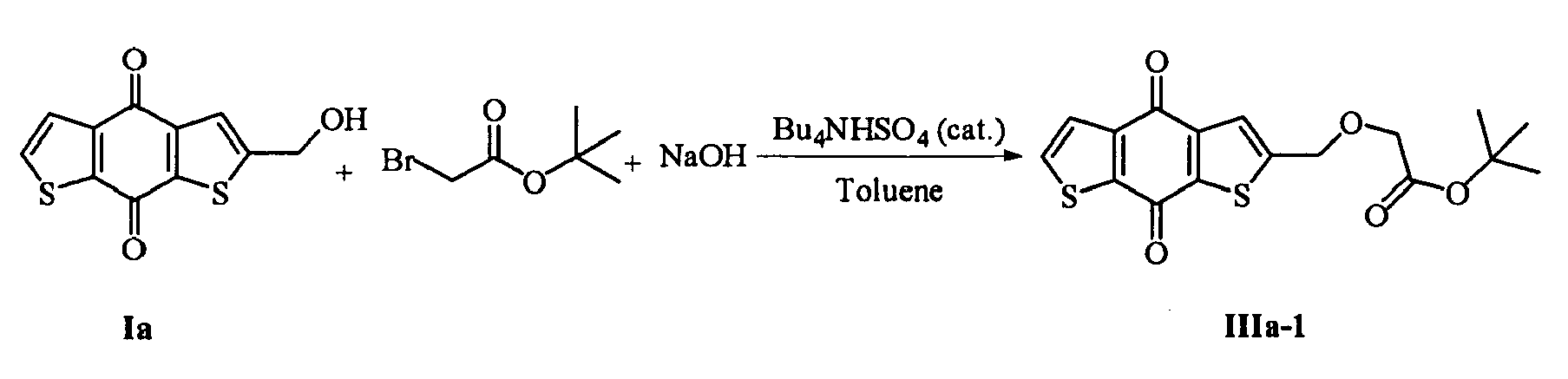
- To a stirred solution of compound la (9.4mg, 0.04mmole) in toluene (2ml) were added tetrabutylammonium hydrogen sulfate (4.0mg, 0.01 mmole), 50% NaOH(aq.) (1ml) and t-butyl bromoacetate (0.02ml, 0.1mmole). The mixture was stirred at R.T. for 2 hr. After the addition of H2O, the reaction mixture was extracted with CH2Cl2 (15mlx 3). The CH2Cl2 layer was dried over Na2SO4, filtered and concentrated to get crude product. It was purified by plate liquid chromatography eluting with Ethyl acetate : Hexane (1:8) to obtain yellow solid IIIa-1 (2.7mg, 20 %).
1H NMR (500MHz, CDCl3) δ 7.65 (d, J = 5.0Hz, 1 H), 7.60 (dd, J = 5.5, 5.0Hz, 1 H), 7.49 (d, J = 5.5Hz, 1 H), 4.83 (s, 2H), 4.05 (s, 2H), 1.48 (s, 9H).
HRMS Calcd for C17H16O5S2: 364.0439, Found: 364.0425
mp= 97.2~97.8°C - Ethyl 4,8-dioxo-4,8-dihydroxybenzo[1,2-b:5,4-b]-dithiophen-2-yl-methoxy acetate IIIa
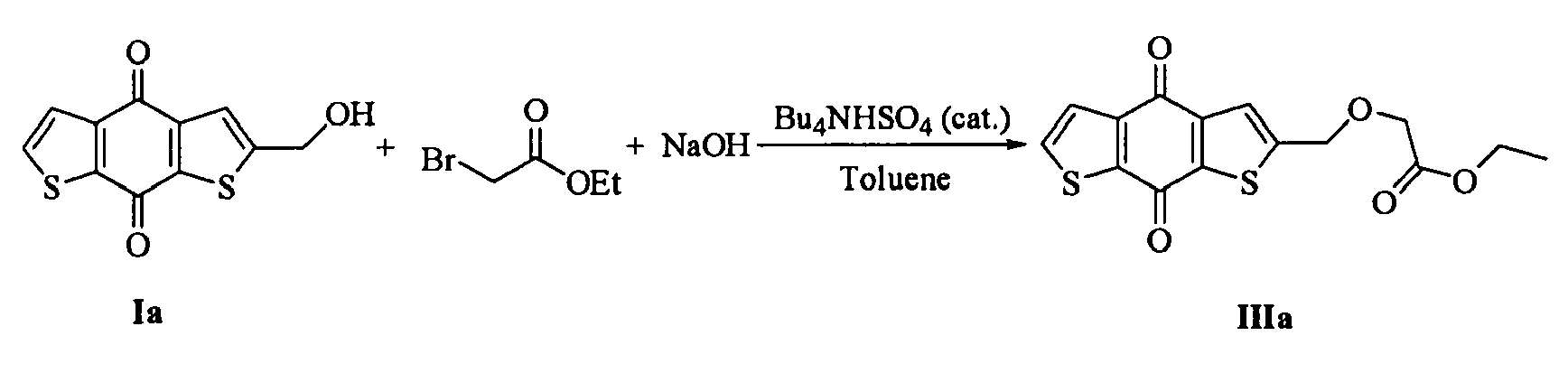
- To a stirred solution of compound la (40mg, 0.17mmole) and toluene (10ml) were added tetrabutylammonium hydrogen sulfate (20mg, 0.06mmole), 50% NaOH(aq.) (1 ml) and ethyl bromoacetate (0.1 ml, 0.9mmole). The mixture was stirred at R.T. for 2 hr. After the addition of H2O, the reaction mixture was extracted with CH2Cl2 (25mlx 3). The CH2Cl2 layer was dried over Na2SO4, filtered and concentrated to get crude product. It was purified by plate liquid chromatography eluting with CH2Cl2 to obtain yellow solid IIIa (18mg, 33 %).
1H NMR (500MHz, CDCl3) δ7.65 (d, J = 5.0Hz, 1 H), 7.62-7.59 (m, 1H), 7.51-7.49 (m, 1 H), 4.85 (s, 2H), 4.24 (q, J = 7.0Hz, 2H), 4.16 (s, 2H), 1.29 (t, J = 7.0Hz, 3H).
HRMS Calcd for C15H12O5S2: 336.0126, Found: 336.0125.
mp= 113.3 ~ 113.5°C - 4,8-dioxo-4,8-dihydroxybenzo[1,2-b:5,4-b']-dithiophen-2-yl-methoxy acetic acid IVa
-

-

- In a 25mL flask were placed compound IIIa (15mg, 0.05mmole) and MeOH (10ml). LiOH (10mg) in H2O (8ml) was then added and reaction mixture stirred at R. T. until hydrolysis completed. HOAc (~0.4ml) was added drop-wise to neutralize. MeOH was removed under vacuum and the residue was treated with aq. Na2CO3 and then extracted with CH2Cl2. The aqueous layer was acidified with dilute HCl solution until pH~4 and the extracted with CH2Cl2. The CH2Cl2 layer was dried with Na2SO4, filtered and concentrated to obtain yellow solid IVa (12.5mg, 91 %).
1H NMR (500MHz, d6-DMSO) δ 8.15 (d, J = 5.0Hz, 1 H), 7.62 (dd, J = 5.0, 4.5Hz, 1 H), 7.57 (d, J = 4.5Hz, 1 H), 6.47 (s, 1 H), 4.85 (s, 2H), 4.16 (s, 2H). HRMS Calcd for C13H8O5S2: 307.9813, Found: 307.9847.
mp= 218.0 ~ 218.2°C - Sodium 4,8-dioxo-4,8-dihydroxybenzo[1,2-b:5,4-b']-dithiophen-2-yl-methoxy acetate IVa-Na

- To a stirred solution of IVa (47.8mg, 0.16mmole) in EA was added sodium 2-ethylhexanoate (1.2~1.5 eq.) in EA and stirred for overnight. The precipitate was filtered and washed with EA and then dried in vacuum.
Yellow-green solid IVa -Na (35.4mg, 70%) was obtained.
1H NMR (500MHz, CD3OD) δ7.93 (br, 1H), 7.62 (br, 1 H), 7.54 (s, 1 H), 4.88 (s, 2H), 3.97 (s, 2H).
mp= 232.7°C (decomp.) - t-Butyl 1-(4,8-dioxo-4,8-dihydroxybenzo[1,2-b:5,4-b']-dithiophen-2-yl-ethoxy)-acetate IIIb-1

- To a stirred solution of compound Ib (9.4mg, 0.04mmole) in toluene (2ml) were added tetrabutylammonium hydrogen sulfate (4.0mg, 0.01mmole), 50% NaOH(aq.) (1ml) and t-butyl bromoacetate (0.02ml, 0.1mmole). The mixture was stirred at R.T. for 2 hr. After the addition of H2O, the reaction mixture was extracted with CH2Cl2 (15ml x 3), and the organic layer was dried over Na2SO4, filtered and concentrated to get crude product. It was purified by plate liquid chromatography eluting with ethyl acetate: Hexane (1:15) to obtain yellow solid IIIb-1 (6.9mg, 51 %).
1H NMR (500MHz, CDCl3) δ7.60 (d, J = 5.0Hz, 1 H), 7.595 (d, J = 5.0Hz, 1 H), 7.45 (s, 1H), 4.88 (q, J = 6.5Hz, 1 H), 4.02, 3.91 (ABq, J = 16.5Hz, 2H), 1.62 (d, J = 6.5Hz, 3H), 1.46 (s, 9H).
HRMS Calcd for C18H18O5S2: 378.0596, Found: 378.0587
mp= 108.0~108.7°C - Ethyl 1-(4,8-dioxo-4,8-dihydroxybenzo[1,2-b:5,4-b']-dithiophen-2-yl-ethoxy)-acetate lllb

- To a stirred solution of compound Ib (100mg, 0.4mmole) in toluene (20ml) were added tetrabutylammonium hydrogen sulfate (40mg, 0.11 mmole), 50% NaOH(aq.) (1ml) and ethyl bromoacetate (0.2ml, 1.8mmole). The mixture was stirred at R.T. for 2 hr. After the addition of H2O, the reaction mixture was extracted with CH2Cl2 (20mlx 3). The CH2Cl2 layer was dried over Na2SO4, filtered and concentrated to get crude product. It was purified by plate liquid chromatography eluting with CH2Cl2 to obtain yellow solid IIIb (65mg, 48 %).
1H NMR (500MHz, CDCl3) δ7.65 (d, J = 5.0Hz, 1 H), 7.60 (d, J = 5.0Hz, 1 H), 7.46 (s, 1 H), 4.89 (q, J = 6.5Hz, 1 H), 4.21 (q, J = 7.0Hz, 2H), 4.12, 4.02 (ABq, J = 16.5Hz, 2H), 1.63 (d, J = 6.5Hz, 3H), 1.27 (t, J = 7.OHz, 3H).
HRMS Calcd for C16H14O5S2: 350.0283, Found: 350.0271.
mp= 122.7~122.9°C - Example 19 1-(4,8-Dioxo-4,8-dihydroxybenzo[1,2-b:5,4-b]-dithiophen-2-yl-ethoxy)-acetic acid IVb

- In a 100mL flask were placed compound lllb (65mg, 0.19mmole) and MeOH (15ml). LiOH (25.0mg) in H2O (12ml) was then added and reaction mixture stirred at R.T. until hydrolysis completed. HOAc (~1.4ml) was added drop-wise to neutralize. MeOH was removed under vacuum and the residue was treated with aq. Na2CO3 and then extracted with CH2Cl2. The aqueous layer was acidified with dilute HCl solution until pH~4 and the extracted with CH2Cl2. The CH2Cl2 layer was dried with Na2SO4, filtered and concentrated to obtain yellow solid IVb (54mg, 90 %).
1H NMR (500MHz, CD3 OD) δ7.95 (d, J = 5.0Hz, 1 H), 7.62 (d, J = 5.0Hz, 1 H), 7.53 (s, 1 H), 4.98 (q, J = 6.5Hz, 1 H), 4.15, 4.09 (ABq, J = 16.5Hz, 2H), 1.61 (d, J = 6.5Hz, 3H).
HRMS Calcd for C14H10O5S2: 321.9970, Found: 321.9994.
mp= 172.6~173.0°C - Sodium 1-(4,8-dioxo-4,8-dihydroxybenzo[1,2-b:5,4-b']-dithiophen-2-yl-ethoxy)-acetate IVb-Na

- To a stirred solution of IVb (53.0mg, 0.16mmole) in EA was added sodium 2-ethylhexanoate (1.2~1.5 eq.) in EA and stirred for overnight. The precipitate was filtered and washed with EA and then dried in vacuum.
Yellow-green solid IVb -Na (33.1 mg, 58%) was obtained.
1H NMR (500MHz, D2O) δ 7.87 (d, J = 5.0Hz, 1 H), 7.32 (d, J = 5.0Hz, 1 H), 7.27 (s, 1 H), 4.98 (q, J = 6.5Hz, 1 H), 4.02, 3.94 (ABq, J = 16.0Hz, 2H), 1.64 (d, J = 6.5Hz, 3H).
mp= 243.8~244.2°C. - t-Butyl 1-(4,8-dioxo-4,8-dihydroxybenzo[1,2-b:4,5-b']-dithiophen-2-yl-ethoxy)-acetateVIII-1

- To a stirred solution of compound VI (9.0mg, 0.03mmole) in toluene (2ml) were added tetrabutylammonium hydrogen sulfate (4.0mg, 0.01 mmole), 50% NaOH(aq.) (1 ml) and t-butyl bromoacetate (0.02ml, 0.1mmole). The mixture was stirred at R.T. for 2 hr. After the addition of H2O, the reaction mixture was extracted with CH2Cl2 (15ml× 3), and the organic layer was dried over Na2SO4, filtered and concentrated to get crude product. It was purified by plate liquid chromatography eluting with ethyl acetate: Hexane (1:15) to obtain yellow oil VIII-1 (5.0mg, 39 %).
1H NMR (500MHz, CDCl3) δ7.65 (d, J = 5.0Hz, 1 H), 7.61 (d, J = 5.0Hz, 1 H), 7.46 (s, 1 H), 4.87 (q, J = 6.5Hz, 1 H), 4.01, 3.90 (ABq, J = 16.5Hz, 2H), 1.62 (d, J = 6.5Hz, 3H), 1.46 (s, 9H).
HRMS Calcd for C18H18O5S2: 378.0596, Found: 378.0573 - Ethyl 1-(4,8-dioxo-4,8-dihydroxybenzo[1,2-b:4,5-b']-dithiophen-2-yl-ethoxy)-acetate VIII

- To a stirred solution of compound VI (9.7mg, 0.04mmole) and toluene (2ml) were added tetrabutylammonium hydrogen sulfate (4.0mg, 0.01 mmole), 50% NaOH(aq.) (1ml) and ethyl bromoacetate (0.1mmole). The mixture was stirred at R.T. for 2 hr. After the addition of H2O, the reaction mixture was extracted with CH2Cl2(15ml× 3). The CH2Cl2 layer was dried over Na2SO4, filtered and concentrated to get crude product. It was purified by plate liquid chromatography eluting with CH2Cl2 to obtain yellow solid VIII (2.5mg, 19 %).
1H NMR (500MHz, CDCl3)δ7.65 (d, J = 5.0Hz, 1H), 7.61 (d, J = 5.0Hz, 1 H), 7.47 (s, 1 H), 4.89 (q, J = 6.5Hz, 1 H), 4.21 (q, J = 7.0Hz, 2H), 4.12, 4.02 (ABq, J = 16.5Hz, 2H), 1.63 (d, J = 6.5Hz, 3H), 1.27 (t, J = 7.0Hz, 3H).
HRMS Calcd for C16H14O5S2: 350.0283, Found: 350.0284.
mp= 106.2~107.1°C - 1-(4,8-Dioxo-4,8-dihydroxybenzo[1,2-b:4,5-b']-dithiophen-2-yl-ethoxy)-acetic acid IX
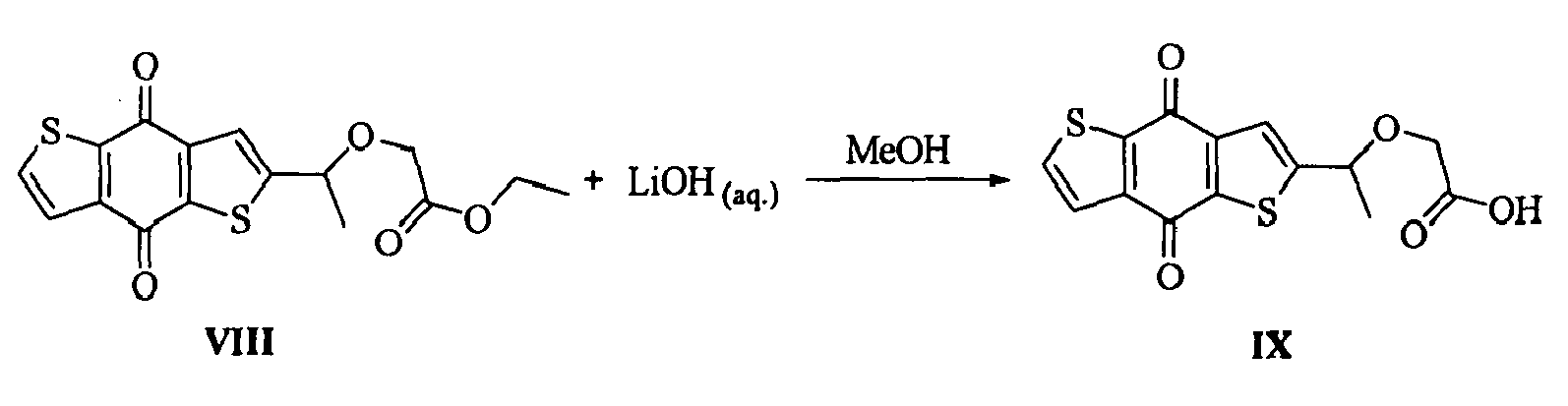
- In a 25mL flask were placed compound VIII (192.7mg, 0.55mmole) and MeOH (30ml). LiOH (0.36g) in H2O (30ml) was then added and reaction mixture stirred at R. T. until hydrolysis completed. HOAc (~1.1 ml) was added drop-wise to neutralize. MeOH was removed under vacuum and the residue was treated with aq. Na2CO3 and then extracted with EA. The aqueous layer was acidified with dilute HCl solution until pH~4 and the extracted with EA. The EA layer was dried with Na2SO4, filtered and concentrated to obtain yellow solid IX (160.0mg, 90 %).
1H NMR (500MHz, CD3 OD) δ7.90 (d, J = 5.0Hz, 1 H), 7.60 (d, J = 5.0Hz, 1H), 7.51 (s, 1 H), 4.96 (q, J = 6.5Hz, 1H), 4.15, 4.09 (ABq, J = 16.5Hz, 2H), 1.61 (d, J = 6.5Hz, 3H).
HRMS Calcd for C14H10O5S2: 321.9970, Found: 323.0054 (MH+, FAB).
mp= 172.1~172.8 °C - Sodium 1-(4,8-dioxo-4,8-dihydroxybenzo[1,2-b:4,5-b']-dithiophen-2-yl-ethoxy)-acetate IX-Na
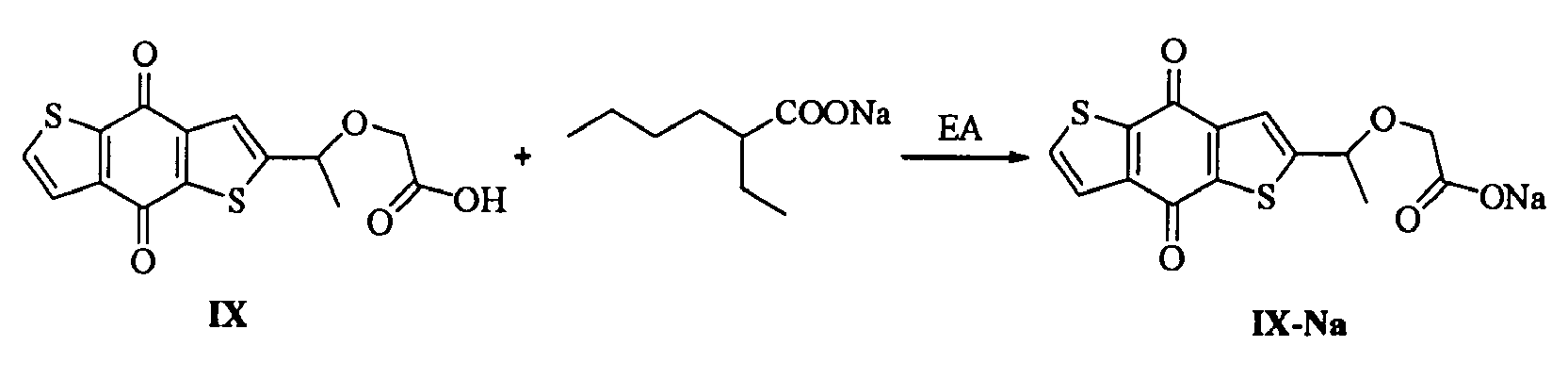
- To a stirred solution of IX (85.0mg, 0.28mmole) in EA was added sodium 2-ethylhexanoate (1.2~1.5 eq.) in EA and stirred for overnight. The precipitate was filtered and washed with EA and then dried in vacuum. Yellow solid
IX-Na (83.0mg, 92%) was obtained.
1H NMR (500MHz, CD3 OD) δ7.92 (d, J = 5.0Hz, 1 H), 7.62 (d, J = 5.0Hz, 1 H), 7.52 (s, 1 H), 4.96 (q, J = 6.5Hz, 1 H), 3.92, 3.83 (ABq, J = 15.5Hz, 2H), 1.60
(d, J = 6.5Hz, 3H).
mp= 223°C (decomp.) - 2-[1-(2-Pyrrol-1-yl-propoxy)-ethylbenzo[1,2-b:4,5-b']dithiophen-4,8-dione X

- To a stirred solution of compound VI (10.5mg, 0.04mmole) in toluene (2ml) were added tetrabutylammonium hydrogen sulfate (4.0mg, 0.01 mmole), 50% NaOH(aq.) (2ml) and 1-(3-bromopropyl)pyrrole (0.1mmole). The mixture was stirred at R.T. for 3 hr. After the addition of H2O, the reaction mixture was extracted with CH2Cl2 (15ml× 3). The CH2Cl2 layer was dried over Na2SO4, filtered and concentrated to get crude product. It was purified by plate liquid chromatography eluting with CH2Cl2 to obtain yellow oil X (5.0mg, 34 %).
1H NMR (500MHz, CDCl3) δ7.65 (d, J = 5.0Hz, 1 H), 7.61 (d, J = 5.0Hz, 1 H), 7.41 (s, 1 H), 6.61 (s, 2H), 6.10 (s, 2H), 4.64 (q, J = 6.5Hz, 1 H), 4.06-3.94 (m, 2H), 3.38 (t, J = 5.5Hz, 2H), 2.04-1.99 (m, 2H), 1.56 (d, J = 6.5Hz, 3H). HRMS Calcd for C19H17NO3S2: 371.0650, Found: 371.0663 - 4,8-dioxo-4,8-dihydrobenzo [1,2-b;5,4-b]dithiophene-2-carboxylate-(2-dimethylamino-ethyl)-amide XVII

- Compound XI (60mg, 0.23mmole) in SOCl2 (5ml) was heated to reflux for 2 hrs. The excess SOCl2 was removed to yield crude acid chloride. The acid chloride obtained was used directly without purification. It was diluted with CH2Cl2 (4ml) and added to the N,N-dimethylethylenediamine (1.5ml), Et3N (2ml) and CH2Cl2 (4ml) mixture and stirred at R.T. for 1.5~2 hrs. Water was added and the reaction mixture extracted with CH2Cl2. The CH2Cl2 layer was concentrated and crude product was purified through column using MeOH: CH2Cl2 =1:8 as the eluent. Yellow solid XVII (50.0mg, 67 %) was obtained.
1H NMR (500MHz, CD3OD) δ 8.14 (d, J = 2.0Hz, 1 H), 7.97~8.00 (m, 1 H), 7.65 (d, J = 5.0Hz, 1 H), 3.54 (t, J = 6.5Hz, 2H), 2.59 (t, J = 6.5Hz, 2H), 2.33 (s, 6H).
HRMS Calcd for C15H14N2O3S2: 334.0446, Found: 334.0435
mp= 197.5~198.0°C - 4,8-dioxo-4,8-dihydrobenzo [1,2-b;5,4-b']dithiophene-2-carboxylate-(2-dimethyl-aminoethyl)-amide phosphoric acid salt XVII-H 3 PO 4

- To a stirred solution of XVII (31 mg, 0.093mmole) in THF was added 85% H3PO4 (1.2~1.5 eq.) and stirred for overnight. The precipitate was filtered and washed with THF and then dried in vacuum. Yellow solid XVII-H 3 PO 4 (39mg, 97%) was obtained.
1H NMR (500MHz, D2O) δ 8.16 (s, 1 H), 8.02 (d, J = 5.0Hz, 1 H), 7.66 (d, J = 5.0Hz, 1 H), 3.78 (t, J = 6.0Hz, 2H), 3.37 (t, J = 6.0Hz, 2H), 2.97 (s, 6H).
mp= 222.5°C (decomp.) -
- (a) Ammonium 4,8-dioxo-4,8-dihydrobenzo-[1,2-b:5,4-b']dithiophene-2-carboxylate XI-NH 4

XI-NH 4 (200mg, 82%)
1H NMR (500MHz, CD3OD) δ 7.94 (d, J = 5.0Hz, 1 H), 7.91 (s, 1 H), 7.62 (d, J
= 5.0Hz, 1 H).
mp= 257~259°C. - (b) Sodium 4,8-dioxo-4,8-dihydrobenzo-[1,2-b:5,4-b']dithiophene-2-carboxylate XI-Na

- To a stirred solution of XI (206.7mg, 0.83mmole) in EA was added sodium 2-ethylhexanoate (1.2~1.5 eq.) in EA and stirred for overnight. The precipitate was filtered and washed with EA and then dried in vacuum. Yellowish brown solid XI-Na (202.5mg, 90%) was obtained.
1H NMR (500MHz, CD3OD) δ 7.93 (dd, J = 5.0, 2.0Hz, 1 H), 7.90 (d, J = 2.0Hz, 1 H), 7.62 (d, J = 5.0Hz, 1 H).
mp= > 275°C (decomp.) - (2S)-[(4,8-Dioxo-4,8-dihydroxybenzo[1,2-b;5,4-b']dithiophen-2-carbonyl)-amino]-phenyl-acetic acid methyl ester XII-1

- To a stirred solution of XI (40.0mg, 0.15mmole) and THF (2ml) were added (S)-phenyl glycine methyl ester HCl salt (31 mg, 0.15mmole), EDC (30.5mg, 0.16mmole), HOBt (21 mg, 0.15mmole) and 4-ethylmorpholine (0.02ml, 0.15mmole). After stirring at R.T for overnight under N2, the solvent was removed under reduced pressure. CH2Cl2 (3ml) was added to the residue and the insoluble solid was removed. The CH2Cl2 layer was then washed with saturated NaHCO3 solution, 1 M KHSO4, saturated NaHCO3 solution and H2O. The organic layer was dried over Na2SO4, filtered and concentrated to get crude product. It was purified by column chromatography on silica gel eluting with EA: Hexanes (1:3) to obtain yellow solid XII-1 (21.1mg , 34 %).
1H NMR (500MHz, CDCl3) δ 7.95 (s, 1 H), 7.71 (d, J = 4.3Hz, 1 H), 7.64 (d, J = 4.3Hz, 1H), 7.41-7.30 (m, 5H), 7.16 (d, J = 6.5Hz, 1 H), 5.71 (d, J = 6.5Hz, 1H), 3.78 (s, 3H).
HRMS Calcd for C20H13NO5S2: 411.0235, Found: 411.0229
mp= 211.1~211.9°C - [(4,8-Dioxo-4,8-dihydroxybenzo[1,2-b;5,4-b']dithiophen-2-carbonyl)-amino]-acetic acid isopropyl ester XII-2

- To a stirred solution of XI (52.6mg, 0.20mmole) and THF (2ml) were added isopropyl glycinate HCl salt (30.4mg, 0.21 mmole), EDC (40.1 mg, 0.21mmole), HOBt (27.0mg, 0.21mmole) and 4-ethylmorpholine (0.03ml, 0.21 mmole). After stirring at R.T. for overnight under N2, the solvent was removed under reduced pressure. CH2Cl2 (3ml) was added to the residue and the insoluble solid was removed. The CH2Cl2 layer was then washed with saturated NaHCO3 solution, 1 M KHSO4, saturated NaHCO3 solution and H2O. The organic layer was dried over Na2SO4, filtered and concentrated to get crude product. It was purified by column chromatography on silica gel eluting with EA: CH2Cl2 (1:20) to obtain yellow solid XII-2 (31.7mg , 44 %).
1H NMR (500MHz, CDCl3) δ 7.94 (s, 1 H), 7.71 (d, J = 4.5Hz, 1 H), 7.63 (d, J = 4.5Hz, 1 H), 6.73 (s, 1 H), 5.12 (septet, J = 6.5Hz, 1 H), 4.18 (d, J = 4.5Hz, 2H), 1.29 (d, J = 6.5Hz, 6H).
HRMS Calcd for C16Hl3NO5S2: 363.0235, Found: 363.0226
mp= 240.2~240.5°C - (2S)-[(4,8-Dioxo-4,8-dihydroxybenzo[1,2-b;4,5-b']dithiophen-2-carbonyl)-amin o]-propionic acid methyl ester XII

- To a stirred solution of XI (40.0mg, 0.15mmole) and THF (2ml) were added (S)-alanine methyl ester HCl salt (21 mg, 0.15mmole), EDC (30.5mg, 0.16mmole), HOBt (21 mg, 0.15mmole) and 4-ethylmorpholine (0.02ml, 0.15mmole). After stirring at R.T. for overnight under N2, the solvent was removed under reduced pressure. CH2Cl2 (3ml) was added to the residue and the insoluble solid was removed. The CH2Cl2 layer was then washed with saturated NaHCO3 solution, 1 M KHSO4, saturated NaHCO3 solution and H2O. The organic layer was dried over Na2SO4, filtered and concentrated to get crude product. It was purified by column chromatography on silica gel eluting with EA: Hexanes (1:2) to obtain yellow solid XII (27.5mg, 52 %).
1H NMR (500MHz, CDCl3) δ 7.92 (s, 1H), 7.72 (d, J = 5.0Hz, 1 H), 7.64 (d, J = 5.0Hz, 1 H), 6.75 (d, J = 6.5Hz, 1 H), 4.78-4.72 (m, 1 H), 3.80 (s, 3H), 1.54 (d, J = 7.0Hz, 3H).
HRMS Calcd for C15H11NO5S2: 349.0079, Found: 349.0061.
mp= 188.1~188.6°C. - (L)-2-{(4,8-Dioxo-4,8-dihydrobenzo-[1,2-b;5,4-b']dithiophene-2-carbonyl)-amino)-propionic acid XIII

- In a 25mL flask were placed compound XII (130mg, 0.37mmole) and MeOH (37ml). LiOH (322.5mg) in H2O (30ml) was then added and reaction mixture stirred at R. T. until hydrolysis completed. HOAc (~1.0ml) was added drop-wise to neutralize. MeOH was removed under vacuum and the residue was treated with aq. Na2CO3 and then extracted with EA. The aqueous layer was acidified with dilute HCl solution until pH~4 and the extracted with EA. The EA layer was dried with Na2SO4, filtered and concentrated to obtain yellow solid XIII (120mg, 96 %).
1H NMR (500MHz, CD3OD) δ 8.25 (s, 1 H), 8.00 (d, J = 5.0Hz, 1 H), 7.66 (d, J = 5.0Hz, 1 H), 4.58 (q, J = 7.5Hz, 1 H), 1.53 (d, J = 7.5Hz, 3H).
HRMS Calcd for C14H9NO5S2: 334.9922, Found: 334.9931
mp= 239°C (decomp.) - Sodium (L)-2-{(4,8-dioxo-4,8-dihydrobenzo-[1,2-b;5,4-b']dithiophene-2-carbonyl)-amino}-propionate XIII-Na

- To a stirred solution of XIII (50.5mg, 0.15mmole) in EA was added sodium 2-ethylhexanoate (1.2~1.5 eq.) in EA and stirred for overnight. The precipitate was filtered and washed with EA and then dried in vacuum. Yellow solid XIII-Na (27.8mg, 52%) was obtained.
1H NMR (500MHz, D2O) δ7.93 (br, 1 H), 7.80 (d, J = 5.0Hz, 1 H), 7.44 (d, J = 5.0Hz, 1 H), 4.31 (q, J = 6.5Hz, 1 H), 1.50 (d, J = 6.5Hz, 3H).
mp= 200.5°C (decomp.) - Ammonium 4,8-dioxo-4,8-dihydrobenzo-[1,2-b;4,5-b']dithiophene-2-carboxylate XIV-NH 4

- Compound XIV (140mg, 0.53mmole) was added in IPA (20mL) and stirred at 60°C for 30 min. The solid that was not soluble in IPA was filtered. Aqueous ammonium hydroxide (29.5%) was added to the filtrate until basic. After stirring for a while, the solvent was evaporated to yield green-yellow solid XIV-NH 4 (68.5mg, 46%)
1H NMR (500MHz, CD3OD) δ7.97 (s, 1 H), 7.94 (d, J = 5.0Hz, 1 H), 7.64 (d, J =5.0Hz, 1 H).
mp> 300 °C - [(4,8-Dioxo-4,8-dihydroxybenzo[1,2-b;4,5-b']dithiophen-2-carbonyl)-amino]-ac etic acid isopropyl ester XV

- To a stirred solution of XIV (244.6mg, 0.90mmole) and THF (8ml) were added isopropyl glycinate HCl salt (140.0mg, 0.92mmole), EDC (190.0mg, 0.99mmole), HOBt (125.0mg, 0.93mmole) and 4-ethylmorpholine (0.12ml, 0.80mmole). After stirring at R.T. for overnight under N2, the solvent was removed under reduced pressure. CH2Cl2 (12ml) was added to the residue and the insoluble solid was removed. The CH2Cl2 layer was then washed with saturated NaHCO3 solution, 1M KHSO4, saturated NaHCO3 solution and H2O. The organic layer was dried over Na2SO4, filtered and concentrated to get crude product. It was purified by column chromatography on silica gel eluting with EA: CH2Cl2 (1:30) to obtain yellow solid XV (75.1 mg , 21 %).
1H NMR (500MHz, CDCl3) δ 7.95 (s, 1 H), 7.70 (d, J = 5.0Hz, 1 H), 7.65 (d, J = 5.0Hz, 1 H), 6.73 (t, J = 4.5Hz, 1 H), 5.12 (septet, J = 6.5Hz, 1 H), 4.18 (d, J = 4.5Hz, 2H), 1.29 (d, J = 6.5Hz, 6H).
HRMS Calcd for C16H13NO5S2: 363.0235, Found: 363.0228
mp= 231.8~233.0°C - Methyl (L)-2-{(4,8-Dioxo-4,8-dihydrobenzo-[1,2-b;4,5-b]dithiophene-2-carbonyl)-amino}-propionate XV-1

- To a stirred solution of XIV (79.8mg, 0.30mmole) in THF (10ml) were added (S)-alanine methyl ester HCl salt (42.0mg, 0.30mmole), EDC (61.0mg, 0.32mmole), HOBt (42mg, 0.30mmole) and 4-ethylmorpholine (0.04ml, 0.30mmole). After stirring at R.T. for overnight under N2, the solvent was removed under reduced pressure. CH2Cl2 (3ml) was added to the residue and the insoluble solid was removed. The CH2Cl2 layer was then washed with saturated NaHCO3 solution, 1 M KHSO4, saturated NaHCO3 solution and H2O. The organic layer was dried over Na2SO4, filtered and concentrated to get crude product. It was purified by column chromatography on silica gel eluting with EA: Hexanes (1:2) to obtain yellow solid XV-1 (38.1mg, 36 %).
1H NMR (500MHz, CDCl3) δ 7.94 (s, 1 H), 7.71 (d, J = 5.0Hz, 1 H), 7.65 (d, J = 5.0Hz, 1 H), 6.80 (d, J = 6.5Hz, 1 H), 4.75 (qd, J = 7.5, 6.5Hz, 1 H), 3.80 (s, 3H), 1.53 (d, J = 7.5Hz, 3H).
HRMS Calcd for C15H11NO5S2: 349.0079, Found: 350.0159 (MH+, FAB).
mp= 216.8~217.7 °C - (L)-2-{(4,8-Dioxo-4,8-dihydrobenzo-[1,2-b;4,5-b]dithiophene-2-carbonyl)-amino}-propionic acid XVI

- In a 25mL flask were placed compound XV-1 (17.6mg, 0.05mmole) and MeOH (5ml). LiOH (45.0mg) in H2O (4ml) was then added and reaction mixture stirred at R.T. until hydrolysis completed. HOAc (~0.14ml) was added drop-wise to neutralize. MeOH was removed under vacuum and the residue was treated with aq. Na2CO3 and then extracted with EA. The aqueous layer was acidified with dilute HCl solution until pH~4 and the extracted with EA. The EA layer was dried with Na2SO4, filtered and concentrated to obtain yellow solid XVI (16.8mg, 99 %).
1H NMR (500MHz, CDCl3) δ 7.96 (s, 1 H), 7.62 (d, J = 5.0Hz, 1 H), 7.47 (d, J = 5.0Hz, 1 H), 4.47 (q, J = 7.5Hz, 1 H), 1.36 (d, J = 7.5Hz, 3H).
mp= 227.4~228.3 °C - Sodium (L)-2-{(4,8-dioxo-4,8-dihydrobenzo-[1,2-b;4,5-b]1dithiophene-2-carbonyl)-amino}-propionate XVI-Na

- To a stirred solution of XVI (73.8mg, 0.22mmole) in EA was added sodium 2-ethylhexanoate (1.2~1.5 eq.) in EA and stirred for overnight. The precipitate was filtered and washed with EA and then dried in vacuum.
Yellow-green solid XVI-Na (47.5mg, 60%) was obtained.
1H NMR (500MHz, CD3OD δ8.25 (s, 1 H), 7.96 (d, J = 5.0Hz, 1 H), 7.65 (d, J = 5.0Hz, 1 H), 4.43 (q, J = 7.0Hz, 1 H), 1.48 (d, J = 7.0Hz, 3H).
mp> 275 °C. - 4,8-dioxo-4,8-dihydrobenzo [1,2-b;4,5-b']dithiophene-2-carboxylate-(2-dimethylamino-ethyl)-amide XV-2

- Compound XIV (0.6086g, 2.0mmole), SOCl2 (50ml) along with a small amount of NaCl was heated to reflux for 2 hrs. The excess SOCl2 was removed and CH2 Cl2was added to the residue. NaCl was filtered and the filtrate was concentrated to yield crude acid chloride (0.5453g). The acid chloride obtained was used directly without purification. It was diluted with CH2Cl2 (40ml) and added to the N,N-dimethylethylenediamine (16ml), Et3N (20ml) and CH2Cl2 (40ml) mixture and stirred at R.T. for 12 hrs. Water was added and the reaction mixture extracted with CH2Cl2. The CH2Cl2 layer was concentrated and crude product was purified through column using MeOH: CH2Cl2 =1:10 as the eluent. Yellow solid XV-2 (255.2mg, 33 %) was obtained. 1H NMR (500MHz, CD3OD) δ 8.13 (s, 1 H), 7.97 (d, J = 5.0Hz, 1H), 7.65 (d, J = 5.0Hz, 1 H), 3.55 (t, J = 6.5Hz, 2H), 2.65 (t, J = 6.5Hz, 2H), 2.37 (s, 6H). HRMS Calcd for C15H14N2O3S2: 334.0446, Found: 334.0641.
mp= 235.5~236.2°C - 4,8-dioxo-4,8-dihydrobenzo [1,2-b;4,5-b']dithiophene-2-carboxylate-(2-dimethyl-aminoethyl)-amide phosphoric acid salt XV-2-H 3 PO 4

- To a stirred solution of XV-2 (100mg, 0.30mmole) in THF was added 85% H3PO4 (1.2~1.5 eq.) and stirred for overnight. The precipitate was filtered and washed with THF and then dried in vacuum. Yellow solid XV-2-H 3 PO 4 (120mg, 93%) was obtained.
1H NMR (500MHz, D2O) δ8.02 (br, 1 H), 7.82 (br, 1 H), 7.54 (br, 1 H), 3.88 (br, 2H), 3.52 (br, 2H), 3.08 (br, 6H).
mp= 233°C (decomp.) - Cytotoxicity Assays Method A (HUVEC, MCF-7, HT-29, Hep 3B and NCI-H460) [S. A. Ahmed, R. M. Gogal Jr., and J. E. Walsh, Journal of Immunological Methods 170: 211-224, (1994); M. R. Boyd, Status of the NCI preclinical antitumor drug discovery screen. (Published by J. B. Lippincott Company, Philadelphia, PA 19105, USA) Principles & Practices of Oncology Updates 3 # 10: 1-12, (1989); M. R. Boyd, et al. Data display and analysis strategies for the NCl disease-oriented in vitro antitumor drug screen. In: Cytotoxic anti-cancer drugs: models and concepts for drug discovery and development. Boston: KluwerAcademic, Pages: 11-34, (1992)]
- The test compounds were dissolved in 100% DMSO and then diluted with sterile distilled water to obtain initial working solutions of 20000, 2000, 200, 20 and 2 µM in 80% DMSO. A 200 fold dilution was further made in culture media to generate final assay concentrations of 100, 10, 1, 0.1 and 0.01 µM in 0.4% DMSO.
-
Cell Lines Culture Medium HUVEC Endothelial Cell Growth Medium, 90%; Fetal Bovine Serum, 10% MCF-7 Minimum Essential Medium, 90%; Fetal Bovine Serum, 10% HT-29 McCoy's 5A medium, 90%; Fetal Bovine Serum, 10% Hep 3B Minimum Essential Medium, 90%; Fetal Bovine Serum, 10% NCl-H460 RPMI 1640, 90%; Fetal Bovine Serum, 10% All of media were supplemented with 1% Antibiotic-Antimycotic. -
Cell Name Source Type of Cell Line HUVEC ATCC CRL-1730 Human umbilical vein endothelial cells MCF-7 ATCC HTB-22 Breast adenocarcinoma, pleural effusion, human HT-29 ATCC HTB-38 Adenocarcinoma, colon, moderately well-differentiated grade II, human Hep 3B ATCC HB-8064 Hepatocellular carcinoma, liver, human NCI-H460 ATCC HTB-177 Large cell carcinoma, lung, human All of the human tumor cell lines and HUVEC were obtained from American Type Culture Collection (ATCC). The cells were all incubated at 37°C with 5 % CO2 in air atmosphere. - AlamarBlue (Biosource, USA), Antibiotics-Antimycotic (GIBCO BRL, USA), Dimethylsulfoxide (Merck, Germany), Endothelial Cell Growth Medium (CELL APPLICATIONS, INC., USA), Fetal Bovine Serum (HyClone, USA), McCoy's 5A Medium (GIBCO BRL, USA), Minimum Essential medium (GIBCO BRL, USA), Mitomycin (Kyowa, Japan) and RPMI 1640 (HyClone, USA).
- CO2 Incubator (Forma Scientific Inc., USA), Centrifuge 5810R (Eppendorf, Germany), Hemacytometer (Hausser Scientific Horsham, USA), Inverted Microscope CK-40 (Olympus, Japan), System Microscope E-400 (Nikon, Japan), Spectrafluor Plus (Tecan, Austria) and Vertical Laminar Flow (Tsao Hsin, R. O. C.).
- Aliquots of 100 µl of cell suspension (about 1.5 - 3.0 x 10³/well) were placed in 96-well microtiter plates in an atmosphere of 5% CO2 at 37°C. After 24 hours, 100 µl of growth medium and 1 µl of test solution or vehicle (80% DMSO) were added respectively per well in duplicate for an additional 72-hour incubation. Thus, the final concentration of DMSO was 0.4%. The test compounds, IIa-1, IIb-1 and VII-1 were evaluated at concentrations of 100, 10, 1, 0.1 and 0.01 µM. At the end of incubation, 20 µl of alamarBlue 90% reagent was added to each well for another 6-hour incubation before detection of cell viability by fluorescent intensity. Fluorescent intensity was measured using a Spectraflour Plus plate reader with excitation at 530 nm and emission at 590 nm.
- The measured results was calculated by the following formula:

If (Mean Ftest - Mean Ftime0) < 0, then
wherein PG represents percent growth; - Mean Ftime0 = The average of 2 measured fluorescent intensities of reduced alamarBlue at the time just before exposure of cells to the test substance;
- Mean Ftest = The average of 2 measured fluorescent intensities of alamarBlue after 72-hour exposure of cells to the test substance;
- Mean Fctrl = The average of 2 measured fluorescent intensities of alamarBlue after 72- hour incubation without the test substance;
- Mean Fblank = The average of 2 measured fluorescent intensities of alamarBlue in medium without cells after 72-hour incubation.
- A decrease of 50% or more (≥50%) in fluorescent intensity relative to the vehicle-treated control indicates significant cytostatic or cytotoxic activity, and semi-quantitative values for IC50, TGI and LC50 were then determined by nonlinear regression using GraphPad Prism (GraphPad Software, USA).
- IC50 (50% Inhibition Concentration): Test compound concentration where the increase from time0 in the number or mass of treated cells was only 50% as much as the corresponding increase in the vehicle-control at the end of experiment.
- TGI (Total Growth Inhibition): Test compound concentration where the number or mass of treated cells at the end of experiment was equal to that at time0.
- LC50 (50% Lethal Concentration): Test compound concentration where the number or mass of treated cells at the end of experiment was half that at time.
- Cytotoxicity Assays Method B (HL-60) [H. M. Chen et al. Chin. Pharm. J. 53, 157-167 (2001)]
- Human promyeloid leukemia HL-60 cells were obtained from the American Type
- Culture Collection (Manassas, VA, USA) and the Culture Collection and Research Center(CCRC) (Tai wan, ROC). Human promyeloid leukemia HL-60 cells were cultured in suspension in RPMI-1640 medium (GIBCO, Grand Is land, USA), containing 10 % fetal bovine se rum (GIBCO; Grand Is land, USA), 100 unit/mL penicillin, 100 mUmL streptomycin and 1 % L-glutamine at 37 °C in a humidified at mo sphere of 5 % CO2 in air. Cells were split every day to maintain the cell numbers between 2-5 x 10⁵/mL. Cell numbers were assessed by the standard procedure of leukocyte counting using a hemocytometer and cell viability was checked by the ability of cells to exclude Trypan blue.
- Cellular proliferation was determined by the MTT [3-(4,5-dimethylthiazol- 2- yl)-2,5-diphenyltetrazolium bromide] as say. Briefly, 10 mL of MTT (5 mg/mL) was added to each well of 96-well plates containing 1 x 10⁵ cells after treatment with different concentrations of samples for 4 days. The reaction was stopped after 2 h by adding 100 mL of 0.04 N HCl in isopropanol and the OD570 nm was determined by a minicolorimetric reader. Each concentration treatment was performed in triplicate.
- Cytotoxicity Assays Method C (KB, KB-VIN, AS49, HCT-8, PC-3) [K. H. Lee et. al. Planta Med. 54, 308-312 (1998), Monk A et. al. J. Natl. Cancer Inst. 83, 757-766 (1991).] The cell lines included epidermoid caninoma of the nasopharynx (KB), p-gp-expressing epidermoid caninoma of the nasopharynx (KB-VIN), lung carcinoma (A-549), ileocecal carinoma (HCT-8) and prostate cancer (PC-3) cell lines. The cytotoxic effects of each compounds were obtained as IC50 in microgram per ml, the concentration that give 50% inhibition of cell growth after 72hrs of continuous exposure-variation was less than 5% between replicates.
- The assays were used to detect changes in cell proliferation based on the ability of viable cells to cause alamarBlue to change from its oxidized to a reduced form. With the results obtained from the alamarBlue reaction, cell proliferation can be quantified and metabolic activity of viable cell can be examined.
- The succinate derivatives of compounds IIa-1, IIb-1 and VII-1 were tested for possible effect on the proliferation of four human tumor cell lines ~MCF-7 (breast), HT-29 (colon), Hep3B (liver), and NCl-H 460 (lung) as well as one human umbilical vein endothelial cell (HUVEC) at assay concentration from 0.01 to 100 µM, through serial 10-fold dilution.
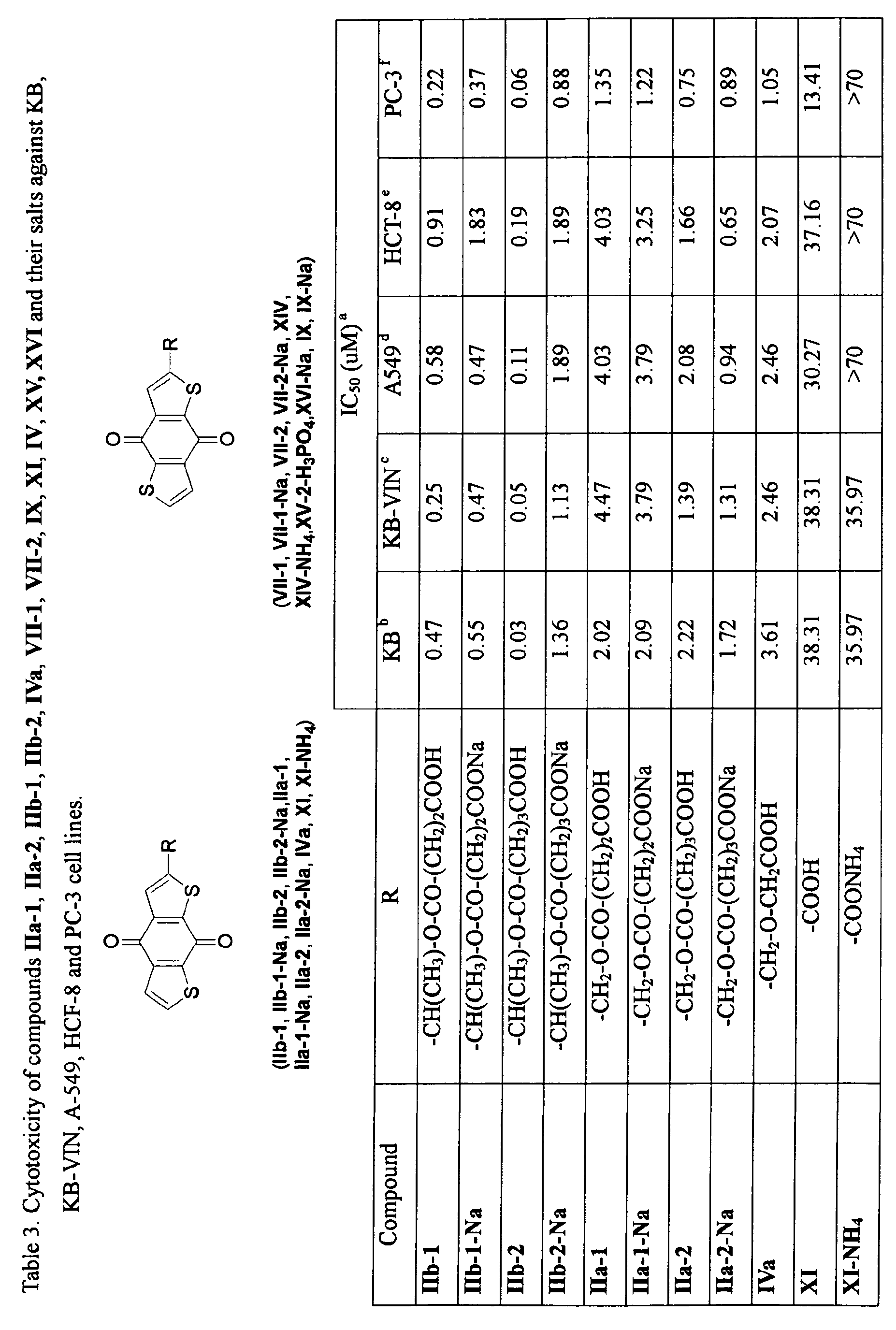
- The IC50(50% inhibition concentration), TGI (total growth inhibition) and LC50 (50% lethal concentration) of the three tested compounds were summary in Table 1.
- As shown in Table 1, the three tested compounds showed potent cytotoxicity in vitro against NCI-H 460 cell line. Compounds IIa-1 and IIb-1 also had significant activity against MCF-7 and Hep3B cell lines. These two compounds displayed moderate and little activity against HT-29 cell line. Compound VII-1 showed significant cytotoxicity against MCF-7 and Hep3B and moderate activity against HT-29 cell line. On the other hand, all the three tested compounds were essentially inactive or showed little activity in HUVEC assay.
- Compound IIa-1, IIa-2, IIb-1, IIb-2, VII-1, VII-2, IX and XV-2-H 3 PO 4 were evaluated for their cytotoxicity in vitro against human promyelocytic leukemia (HL-60) cell line. As shown in Table 2. All of these tested compounds showed significant cytotoxicity. Among them, XV-2-H 3 PO 4 was the most potent one. There fore this compound was selected for further evaluation.
- Mono-[1-(4,8-dioxo-4,8-dihydrobenzo[1,2-b:5,4-b'] dithiophen-2-yl)-methyl]succinate (IIa-1), mono-[1 -(4,8-dioxo-4,8-dihydrobenzo[1,2-b:5,4-b'] dithiophen-2-yl)-methyl] pentanedioate (IIa-2), mono-[1-(4,8-dioxo-4,8-dihydrobenzo[1,2-b:5,4-b'] dithiophen-2-yl)-ethyl]succinate (IIb-1), mono-[1 -(4,8-dioxo-4,8-dihydrobenzo[1,2-b:5,4-b'] dithiophen-2-yl)-ethyl] pentanedioate (IIb-2), ethyl 4,8-dioxo-4,8-dihydroxybenzo[1,2-b:5,4-b']-dithiophen-2-yl-methoxy acetate (IVa), mono-[1-(4,8-dioxo-4,8-dihydroxybenzo[1,2-b;4,5-b']dithiophen-2-yl)-ethyl] succinate (VII-1), mono-[1-(4,8-dioxo-4,8-dihydroxybenzo[1,2-b;4,5-b']dithiophen-2-yl)-ethyl] pentanedioate (VII-2), 1-(4,8-Dioxo-4,8-dihydroxybenzo[1,2-b:4,5-b']-dithiophen-2-yl-ethoxy)-acetate (IX), 4,8-dioxo-4,8-dihydrobenzo-[1,2-b;5,4-b']dithiophene-2-carboxylic acid (XI), 4,8-dioxo-4,8-dihydrobenzo-[1,2-b;4,5-b']dithiophene-2-carboxylic acid (XIV), 4,8-dioxo-4,8-dihydrobenzo-[1,2-b;4,5-b']dithiophene-2-carboxylate-(2-dimethylamino-ethyl)-amide phosphate (XV-2-H 3 PO 4 ), (L)-2-{(4,8-Dioxo-4,8-dihydrobenzo-[1,2-b;4,5-b']dithiophene-2-carbonyl)-ami no}-propionic acid (XVI), and their salts were evaluated for their cytotoxicity in vitro against epidermal carcinoma of the nasopharynx (KB), p-gp-expressing epidermoid carcinoma of the nasopharynx (KB-VIN), lung carcinoma (A-549), ileocecal carcinoma (HCT-8) and prostate cancer (PC-3). As shown in Table 2, Most of these tested compounds showed significant cytotxicity. Among them, XV-2-H 3 PO 4 was the most promising agent. In addition, compounds IIb-1, IIb-2, VII-1 and VII-2 displayed potent activity against the MDR cell line (KB-VIN) and the androgen-insensitive prostate cancer cell line (PC-3). Therefore, compounds XV-2-H 3 PO 4 , IIb-1, IIb-2 VII-1and VII-2 were selected for further pharmacological studies. In summary, the present invention demonstrated remarkable therapeutical potential for benzodithiophenone analogs in the treatment of cancers.
- The present invention also discloses a hydrophilic compound having the following structures (F) or (G), or a pharmaceutically acceptable salt thereof:

- The present invention also discloses a method for treating a tumor, said method comprising administering to a subject in need of treatment a compound having the formulas (F) or (G) as defined above, or a pharmaceutically acceptable salt thereof, in an amount effective to treat said tumor.



- The water solubility of some of the synthesized compounds were tested and summarized as below.


-CR5R6-X-(CH2)nNR5R6, -C(O)-NR6-(CR5R6)nCOOH,
-C(O)-NR6-(CR5R6)nNR5R6, -CR5R6-C(O)-(CH2)nCOOH,
-CR5R6-X-C(O)-(CH2)nNR5R6, -C(O)-(CR5R6)nCOOH, -C(O)-(CR5R6)nNR5R6,
-CR5=N-(CH2)nCOOH, -CR5=N-(CH2)nNR5R6, -CR5=NOH, or

Claims (17)
- A derivative of 4,8-dihydrobenzodithiophene-4,8-dione having the formulas (D) or (E):
 A1 and A2 independently are O, S, or NR5, wherein R5 is H or alkyl;R1' R2, R3 and R4 independently are H, alkyl,-CR5R6-X-C(O)-(CH2)nCOOH, -CR5R6-X-(CH2)nCOOH,
-CR5R6-X-(CH2)nNR5R6, -C(O)-NR6-(CR5R6)nCOOH,
-C(O)-NR6-(CR5R6)nNR5R6, -CR5R6-C(O)-(CH2)nCOOH,
-CR5R6-X-C(O)-(CH2)nNR5R6, -C(O)-(CR5R6)nCOOH, -C(O)-(CR5R6)nNR5R6,
-CR5=N-(CH2)nCOOH, -CR5=N-(CH2)nNR5R6, -CR5=NOH, or
- The derivative as defined in claim 1, wherein R2, R3 and R4 are H, and R1 is -CR5R6-X-C(O)-(CH2)nCOOH, -CR5R6-X-(CH2)nCOOH,
-CR5R6-X-(CH2)nNR5R6, -C(O)-NR6-(CR5R6)nCOOH, or
-C(O)-NR6-(CR5R6)nNR5R6, wherein X, R5, R6 and n are defined as in claim 1. - The derivative as defined in claims 1 or 2, wherein Y and Z are S.
- The derivative as defined in claims 1, 2 or 3, wherein A1 and A2 are O.
- The derivative as defined in claim 4, wherein X is O.
- The derivative as defined in claim 5, wherein R5 and R6 independently are H or methyl.
- The derivative as defined in claim 6, wherein R1 is
-CR5R6-X-C(O)-(CH2)nCOOH. - The derivative as defined in claim 6, wherein R1 is
-CR5R6-X-(CH2)nCOOH. - The derivative as defined in claim 6, wherein R1 is
-CR5R6-X-(CH2)nNR5R6. - The derivative as defined in claim 6, wherein R1 is
-C(O)-NR6-(CR5R6)nCOOH. - The derivative as defined in claim 6, wherein R1 is
-C(O)-NR6-(CR5R6)nNR5R6. - The derivative as defined in claim 6 having the formula (D).
- The derivative as defined in claim 6 having the formula (E).
- The derivative as defined in claim 6, which is mono-[1-(4,8-dioxo-4,8-dihydrobenzo[1,2-b:5,4-b] dithiophen-2-yl)-methyl]succinate (IIa-1), mono-[1-(4,8-dioxo-4,8-dihydrobenzo[1,2-b:5,4-b] dithiophen-2-yl)-ethyl]succinate (IIb-1), or mono-[1-(4,8-dioxo-4,8-dihydrobenzo[1,2-b:5,4-b']dithiophen-2-yl)-ethyl] pentanedioate (IIb-2); mono-[1-(4,8-dioxo-4,8-dihydroxybenzo[1,2-b;4,5-b']dithiophen-2-yl)-ethyl] succinate (VII-1), mono-[1-(4,8-dioxo-4,8-dihydroxybenzo[1,2-b;4,5-b']dithiophen-2-yl)-ethyl] pentanedioate (VII-2), or 4,8-dioxo-4,8-dihydrobenzo[1,2-b;4,5-b]dithiophene-2-carboxylate-(2-dimethylamino-ethyl)-amide (XV-2).
- Use of a derivative of 4,8-dihydrobenzodithiophene-4,8-dione having the formulas (D) or (E) as defined in any one of claims 1 to 14, or a pharmaceutically acceptable salt thereof, in the preparation of a medicament for treating a tumor.
- The use as defined in claim 15, wherein said tumor is selected from the group consisting of non-small cell lung cancer, breast cancer, nasopharynx carcinoma, prostate cancer, colon cancer, hepatoma, ileocecal carcinoma, leukemia and central nervous system cancers.
- The use as defined in claim 16, wherein said tumor is selected from the group consisting of non-small cell lung cancer, breast cancer, nasopharynx carcinoma and prostate cancer.
Applications Claiming Priority (1)
| Application Number | Priority Date | Filing Date | Title |
|---|---|---|---|
| US61322504P | 2004-09-28 | 2004-09-28 |
Publications (1)
| Publication Number | Publication Date |
|---|---|
| EP1652849A1 true EP1652849A1 (en) | 2006-05-03 |
Family
ID=35355894
Family Applications (1)
| Application Number | Title | Priority Date | Filing Date |
|---|---|---|---|
| EP05021154A Withdrawn EP1652849A1 (en) | 2004-09-28 | 2005-09-28 | Novel hydrophilic analogs of 4,8-dihydrobenzodithiophene-4,8-diones as anticancer agents |
Country Status (5)
| Country | Link |
|---|---|
| US (1) | US7332615B2 (en) |
| EP (1) | EP1652849A1 (en) |
| JP (1) | JP4370291B2 (en) |
| CN (1) | CN1325487C (en) |
| TW (1) | TWI366459B (en) |
Families Citing this family (3)
| Publication number | Priority date | Publication date | Assignee | Title |
|---|---|---|---|---|
| US7956199B2 (en) * | 2009-10-08 | 2011-06-07 | Xerox Corporation | Methods for preparing benzodithiophenes |
| JP6069787B2 (en) * | 2012-03-08 | 2017-02-01 | 学校法人早稲田大学 | Benzodithiophenequinone polymer, charge storage material, electrode active material, electrode, and battery |
| CN106099057A (en) * | 2016-06-23 | 2016-11-09 | 华南师范大学 | A kind of C10H402S2-graphene composite material and its preparation and application |
Citations (1)
| Publication number | Priority date | Publication date | Assignee | Title |
|---|---|---|---|---|
| US6174913B1 (en) * | 1998-06-05 | 2001-01-16 | The University Of North Carolina At Chapel Hill | Naphtho- and dihydrobenzo-thiophene derivatives as cytotoxic antitumor agents |
Family Cites Families (2)
| Publication number | Priority date | Publication date | Assignee | Title |
|---|---|---|---|---|
| US5919816A (en) * | 1994-11-14 | 1999-07-06 | Bionumerik Pharmaceuticals, Inc. | Formulations and methods of reducing toxicity of antineoplastic agents |
| US5994309A (en) * | 1997-07-25 | 1999-11-30 | Angstrom Pharmaceuticals, Inc. | Anti-invasive and anti-angiogenic compositions and methods |
-
2005
- 2005-09-27 TW TW094133475A patent/TWI366459B/en not_active IP Right Cessation
- 2005-09-28 JP JP2005282475A patent/JP4370291B2/en not_active Expired - Fee Related
- 2005-09-28 CN CNB2005101052517A patent/CN1325487C/en not_active Expired - Fee Related
- 2005-09-28 EP EP05021154A patent/EP1652849A1/en not_active Withdrawn
- 2005-09-28 US US11/236,730 patent/US7332615B2/en not_active Expired - Fee Related
Patent Citations (2)
| Publication number | Priority date | Publication date | Assignee | Title |
|---|---|---|---|---|
| US6174913B1 (en) * | 1998-06-05 | 2001-01-16 | The University Of North Carolina At Chapel Hill | Naphtho- and dihydrobenzo-thiophene derivatives as cytotoxic antitumor agents |
| US6337346B1 (en) * | 1998-06-05 | 2002-01-08 | University Of North Carolina At Chapel Hill | Naphtho- and dihydrobenzo-thiophene derivatives as cytotoxic antitumor agents |
Non-Patent Citations (2)
| Title |
|---|
| HUA D H ET AL: "Synthesis and in vitro antitumor activity of substituted anthracene-1,4-diones", TETRAHEDRON, ELSEVIER SCIENCE PUBLISHERS, AMSTERDAM, NL, vol. 60, no. 45, 1 November 2004 (2004-11-01), pages 10155 - 10163, XP004608787, ISSN: 0040-4020 * |
| ROBERT K.-Y. ZEE-CHENG, EUGENE G. PODREBARAC, C. S. MENON, C. C. CHENG: "Structural Modification Study of Bis(substituted aminoalkylamino)anthraquinones. An Evaluation of the Relationship of the [2-[(2-Hydroxyethyl)amino]ethyl]amino Side Chain with Antineoplastic Activity", JOURNAL OF MEDICINAL CHEMISTRY, vol. 22, no. 5, 1979, pages 501 - 505, XP002356405 * |
Also Published As
| Publication number | Publication date |
|---|---|
| TWI366459B (en) | 2012-06-21 |
| US7332615B2 (en) | 2008-02-19 |
| US20060069041A1 (en) | 2006-03-30 |
| JP2006096756A (en) | 2006-04-13 |
| TW200610526A (en) | 2006-04-01 |
| JP4370291B2 (en) | 2009-11-25 |
| CN1769281A (en) | 2006-05-10 |
| CN1325487C (en) | 2007-07-11 |
Similar Documents
| Publication | Publication Date | Title |
|---|---|---|
| CN104768946B (en) | Fused pyrimidines as inhibitors of the p97 complex | |
| Beck et al. | Synthesis and biological evaluation of new fluorinated and chlorinated indenoisoquinoline topoisomerase I poisons | |
| CN115197167B (en) | 1,2,4-thiadiazolidine-3,5-dione compound and its preparation method and application | |
| AU610739B2 (en) | Thiazolo (5,4-b)azepine compounds | |
| KR20110086848A (en) | Acenaphtho heterocyclic compounds, compounds and complexes including cyclodextrins, and their BH3 protein analogues, for the preparation of VIIc family protein inhibitors | |
| CN110680823A (en) | Application of Biphenyl Phosphate Compounds as GPR84 Antagonists | |
| CN101235046B (en) | Vinblastine derivative, its preparation method and use, and pharmaceutical composition containing the derivative | |
| Kamal et al. | Dithiocarbamate/piperazine bridged pyrrolobenzodiazepines as DNA-minor groove binders: Synthesis, DNA-binding affinity and cytotoxic activity | |
| JP3111321B2 (en) | Condensed thiazole compound | |
| JP2002511457A (en) | 7-Hexanoyltaxol (registered trademark) and method for preparing the same | |
| Ji et al. | Antitumor agents. 1771. Design, syntheses, and biological evaluation of novel etoposide analogs bearing pyrrolecarboxamidino group as DNA topoisomerase II inhibitors | |
| CA2844783C (en) | Substituted 2-imidazolidinones and 2-imidazolones and their use in the treatment of cancer | |
| CN115385875A (en) | Taxol derivative and preparation method and application thereof | |
| WO2013132262A1 (en) | Picropodophyllin derivatives | |
| US7332615B2 (en) | Hydrophilic analogs of 4,8-dihydrobenzodithiophene-4,8-diones as anticancer agents | |
| Threadgill et al. | Synthesis of a series of nitrothiophenes with basic or electrophilic substituents and evaluation as radiosensitizers and as bioreductively activated cytotoxins | |
| Badolato et al. | Synthesis and experimental validation of new PDI inhibitors with antiproliferative activity | |
| US4814445A (en) | Process for preparing mitomycin analogs | |
| KR101734868B1 (en) | Benzofuranone compound and pharmaceutical composition containing same | |
| CN106995449A (en) | Podophyllotoxin vitamin A acid heterocomplex synthetic method and applied to prevention, treatment tumour medicine | |
| Wang et al. | Sealed tube promoted coupling of camptothecin and norcantharidin acid ester and their preliminary biological activity evaluation in vitro | |
| Kamal et al. | Design, synthesis, and evaluation of mixed imine–amine pyrrolobenzodiazepine dimers with efficient DNA binding affinity and potent cytotoxicity | |
| Salykina et al. | Bispidine moiety-driven simplified eleutherobin analogues: Synthesis and biological evaluation | |
| AU605717B2 (en) | 5-methoxy alkyl ammonium tetrahydrofurans and tetrahydrothiophenes as anti-paf agents | |
| US9499552B2 (en) | Pyrazolo[1,5-A]pyrimidine derivative and use of anti-tumor thereof |
Legal Events
| Date | Code | Title | Description |
|---|---|---|---|
| PUAI | Public reference made under article 153(3) epc to a published international application that has entered the european phase |
Free format text: ORIGINAL CODE: 0009012 |
|
| AK | Designated contracting states |
Kind code of ref document: A1 Designated state(s): AT BE BG CH CY CZ DE DK EE ES FI FR GB GR HU IE IS IT LI LT LU LV MC NL PL PT RO SE SI SK TR |
|
| AX | Request for extension of the european patent |
Extension state: AL BA HR MK YU |
|
| AKX | Designation fees paid | ||
| STAA | Information on the status of an ep patent application or granted ep patent |
Free format text: STATUS: THE APPLICATION IS DEEMED TO BE WITHDRAWN |
|
| 18D | Application deemed to be withdrawn |
Effective date: 20061104 |
|
| REG | Reference to a national code |
Ref country code: DE Ref legal event code: 8566 |