EP1650945A1 - Apparatus and method for automatically analysing a filled in questonnaire - Google Patents
Apparatus and method for automatically analysing a filled in questonnaire Download PDFInfo
- Publication number
- EP1650945A1 EP1650945A1 EP04105201A EP04105201A EP1650945A1 EP 1650945 A1 EP1650945 A1 EP 1650945A1 EP 04105201 A EP04105201 A EP 04105201A EP 04105201 A EP04105201 A EP 04105201A EP 1650945 A1 EP1650945 A1 EP 1650945A1
- Authority
- EP
- European Patent Office
- Prior art keywords
- answer
- scan
- filled
- questionnaire
- answers
- Prior art date
- Legal status (The legal status is an assumption and is not a legal conclusion. Google has not performed a legal analysis and makes no representation as to the accuracy of the status listed.)
- Withdrawn
Links
Images






Classifications
-
- G—PHYSICS
- G06—COMPUTING OR CALCULATING; COUNTING
- G06K—GRAPHICAL DATA READING; PRESENTATION OF DATA; RECORD CARRIERS; HANDLING RECORD CARRIERS
- G06K17/00—Methods or arrangements for effecting co-operative working between equipments covered by two or more of main groups G06K1/00 - G06K15/00, e.g. automatic card files incorporating conveying and reading operations
- G06K17/0032—Apparatus for automatic testing and analysing marked record carriers, used for examinations of the multiple choice answer type
Definitions
- the invention relates to an apparatus and a method for automatically analysing a filled in questionnaire.
- the invention also relates to a digital copier incorporating such an apparatus.
- the invention is applicable to a questionnaire that could be for example a test or an inquiry.
- a questionnaire that could be for example a test or an inquiry.
- the use of a questionnaire is common in environments such as training students during education, measuring consumer needs for a marketing study and measuring the preferences of a group of people.
- a questionnaire workflow comprises the steps of preparing the questionnaire, distributing the questionnaire, filling in the questionnaire, collecting the filled-in questionnaire and analysing the questionnaire.
- This workflow can be partly on paper or digitally.
- a paper questionnaire provides an easy user interface and a digital questionnaire provides the possibility of automation and fast distribution.
- U.S. Pat. No. 6,175,841 to Loiacono, discloses a questionnaire workflow. This method and apparatus is for transforming educational materials composed of questions and answers into an on-line computer. By scanning of paper of textual and/or graphical material sometimes containing pencil lines are computer readable images created. The captured images are modified by the application of answer formats, examples of that include underlining, highlighting, and circling a correct answer. The modified captured images are stored for distribution to users. Answer formats are automatically applied to the questions thus allowing them to be answered in a computer interactive form.
- a major drawback of the prior art for automatically analysing a filled in paper questionnaire is that it requires a difficult and time consuming configuration process in the preparation of the automatic analysing process for filled in paper questionnaires.
- an operator for example a teacher - configures the automatic analysing process for filled in paper questionnaires such as a multiple-choice test.
- the teacher copies not filled in questionnaire to test students and include two additional copies.
- the two additional copies are for the first master and the second master.
- the teacher uses the first master to indicate all correct answers and uses the second master to indicate all wrong answers.
- the teacher scans the first master and second master on an apparatus incorporating the invention such as a digital copier or a scanner connected to a personal computer.
- the method comprises the steps of: automatically determining answer locations by comparing a first scan and a second scan, where one of the scans is made from the questionnaire with all correct answers filled in and the other scan is made from the questionnaire with all wrong answers filled in and automatically labelling every answer location as a correct answer or a wrong answer.
- the method comprises the steps of: finding all answers on the third scan by using the answer locations, deciding per answer whether the answer is a wrong answer or a correct answer based upon the label of the answer location and creating a corrected questionnaire.
- the operator starts the analysing process of the filled in paper questionnaires by scanning in all filled in paper questionnaires.
- the method finds all filled in answers on the third scan by using the answer locations. All questions are found by grouping together answer locations based upon spatial information such as distance between answer locations or a typical spatial positioning of the answer locations.
- the labels indicate the wrong and correct answer positions. For example, when the answer location on the third scan contains an answer and the answer location label indicates 'wrong', then this filled in answer is wrong. This way the correct and wrong answers per question are known and a corrected questionnaire is automatically created.
- an operator for example a marketer, can configure the automatic analysing process for the filled in paper questionnaire such as an inquiry.
- the marketer makes a number of copies from the original questionnaire needed to inquire a group of people and includes two additional copies.
- the two additional copies are for the first master and the second master.
- the marketer uses the first master to indicate all possible answers and the marketer provides the second master, which is a not filled in paper questionnaire.
- the marketer scans the first master and second master on an apparatus incorporating the invention such as a digital copier or a scanner connected to a personal computer.
- the method comprises the step of automatically determining answer locations by comparing a first scan and a second scan, where one of the scans is made from the questionnaire with all answers filled in and the other scan is made from the questionnaire with no answers filled in.
- the method comprises the steps of: finding all answers on the third scan by using the answer locations and creating an overview of a plurality of third scans comprising a distribution of answers.
- the inquiry is automatically processed resulting in an overview.
- FIG. 1 illustrates an embodiment of an apparatus for automatically analysing a filled in paper questionnaire, according to the present invention.
- Such an apparatus comprises a scanner (101), a processing unit (102) and possibly with means (104) to interact with the processing unit, to give response to an operator and a printer (103).
- the basic apparatus has a scanner connected with the processing unit (102) such as a computerised system.
- the more advanced apparatus comprises an operator console (104) that provides the user interface to the system according to the invention.
- the operator console contains a display and data entry means, such as available for a personal computer or laptop.
- the scanner (101) scans in the first master, the second master and a filled in questionnaire to the processing unit (102), wherein the first master, the second master and the filled in questionnaire have the same questionnaire as original.
- a method executed with the processing unit (102) determines the answer locations automatically by comparing the first scan, derived from the first master, and the second scan, derived from the second master, and automatically judges the third scan, derived from the filled in questionnaire, based upon answer locations.
- the processing unit (102) determines the answer locations automatically by comparing the first scan, derived from the first master, and the second scan, derived from the second master, and automatically judges the third scan, derived from the filled in questionnaire, based upon answer locations.
- All components of figure 1 are incorporated into a digital copier.
- the scanner (101'), method (102) and possibly a printer (103) are remotely connected.
- FIG. 2 illustrates a block diagram of an embodiment of a digital copier (201) according to the present invention.
- a digital copier comprises a scanner (101), a processing unit (102) such as a controller and possibly with means (104) to interact with the computerised system and possibly a printer (103).
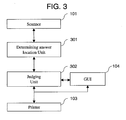
- Figure 3 illustrates a block diagram according to the present invention.
- the scanner (101) converts the first and second master to respectively the first scan and second scan and converts the filled in questionnaire to the third scan.
- the first, second and third scan are transported to the determining answer locations unit (301) comprising the image pre processing which aligns the first, second scan and third scan, removes equal information between the first scan and the second scan from both the first and second scan, identifies on the first and the second scan the answer locations and labels the answer locations differently based upon being part of a first set or a second set.
- the answer locations with their labels and the third scan are transported to the judging unit (302) which derives questions, finds questions with problems such as that no answer is filled in for this question.
- the judging unit (302) communicates the found problems to the operator via a human interface such as an operator panel or graphical user interface (104).
- the judging unit (302) gives a test result and/or test mark to the third scan based upon the answer locations with their labels and makes a summary of the results.
- the printer (103) and/or another human interface (104) will convert the judged questionnaire and the summary of the results to a readable form.
- Figure 4 illustrates a flow diagram of an embodiment of the method for automatically analysing a filled in paper questionnaire.
- the first master is scanned on scanner (101) to a first scan.
- the second master is scanned on scanner (101).
- the answer locations are automatically determined by comparing the first scan and the second scan. By comparing the scans it is determined which answer locations are filled in on the first master and are not filled in on the second master and vice versa.
- the scanner document feeder is not perfect, the first scan is aligned with the second scan before the scans are compared. The alignment of the scans can be done on several ways as described in the art.
- One way of alignment is creating a projection profile of the first scan and second scan, by adding all black pixels in each row for the vertical profile and all back pixels in each column for the horizontal profile, from the long and the short side of the scans.
- the algorithm determines the answer locations on the questionnaire by removing all equal information between the first and the second scan from the first and second scan using for example an area-by-area comparison.
- a connected component analysis is performed on both the scans to find the boundary of the answer locations and finally all small components are removed from both the scans as they are considered to be noise. Now all answer locations are found on both scans. Finally, all answer locations are labelled.
- An example for labelling in case of an inquiry is a questionnaire for measuring information derived from a certain group of people.
- the first master is the questionnaire with all answers filled in and the second master is the questionnaire with no answers filled in.
- the method will understand that in case one of the masters has no answer locations at all, that all found answer locations on the other master must be labelled as correct.
- An example for labelling in case of a test is a multiple-choice test. The scan with the higher number of answer locations contains all wrong answer locations and so these answer locations are labelled as wrong answers and the scan with the lower number of answer locations contains all correct answers and so these answer locations are labelled as correct answers.
- the label selection is based upon a selection means for an operator indicating whether the first master or the second master is scanned or the label selection is predetermined such that the first master is always scanned before the second master or visa versa.
- a questionnaire is scanned to a third scan.
- the third scan is automatically judged based upon the answer location.
- the method stops in step 407.
- an embodiment of the invention is capable in handling both: a questionnaire for inquiring a distribution of answers made for each of the answers for measuring information derived from a certain group of people and a questionnaire for testing a certain group of people.
- Figure 5A illustrates a flow diagram of first embodiment of the invention for automatically judging the third scan based upon the answer location, which is part of step 406 of figure 4.
- This flow diagram illustrates a part of automatically judging a test.
- the filled in paper questionnaire is scanned on scanner (101) to find all answers on the third scan by using the answer locations. This can be done, for example, by determining the coverage.
- the coverage is the percentage of black pixels of all pixels in an answer location of the third scan.
- To determine if a person has selected the answer on the third scan the coverage is calculated per answer location on the third scan. When the coverage for an answer location exceeds a certain threshold such as a certain percentage, then is automatically determined that this answer is filled in.
- step 503 Thereafter in step 503 is decided per answer location, whether the filled in answer or not filled in answer is a wrong or correct answer based upon the label of the answer location.
- step 504 all questions are determined by grouping together answer locations based upon spatial information.
- a problem for this question is detected such as 'no answer is given' or 'too many answers are filled in' then this problem is presented to the operator. In such a case, the operator will select by means: the intended answer, 'no answer is filled in' or 'too many answers are filled in'.
- Step 505 creates a corrected questionnaire by overlaying the third scan with a correction symbol and a test result and/or test mark. Possibly, an extra step 506 can be available. In this step, a test summary is automatically created which comprises the test results and/or test marks of all third scans. Thereafter the flow diagram stops in step 507.
- Figure 5B illustrates a flow diagram of second embodiment of the invention for automatically judging the third scan based upon the answer location, which is part of step 406 of figure 4.
- This flow diagram illustrates a part of automatically judging an inquiry.
- step 510 the filled in paper inquiry is scanned on scanner (101) to find all answers on the third scan by using the answer locations. All filled in answers are labelled as correct answers.
- all questions are determined by grouping together answer locations based upon spatial information.
- a problem can appear such as 'no answer is given' for this question. This problem is presented to the operator. In such a case, the operator will select, by means of an operator panel, the intended answer.
- step 511 the third scan is overlaying with a distribution of answers made for each of the answers. Overlaid on the answer location is the selection percentage of an answer with respect to all filled in inquiries. It will be clear that step 510 is an enhancement so step 510 is not necessary to be able to create the overview of step 511
- Figure 6A is an example of a multiple-choice test in which correct answers (601) are filled in on paper, the so-called first master.
- the second master - wrong answers (602) are filled in on paper - is shown. Both masters are scanned (101) and handled by image processing in the determining answer location Unit (301) resulting in finding all answer locations.
- Figure 7A is an example of a filled in multiple choice test - filled in questionnaire -.
- the filled in questionnaire is scanned (step 405) and automatically judged (step 406) resulting in a corrected questionnaire (step 505).
- FIG 7B an example of a corrected questionnaire is shown. Examples of correction symbols that could be used on the corrected questionnaire are 'this should be the answer'-symbol (701), 'this is not the correct answer'-symbol (702), and 'the correct answer is filled in'-symbol (703).
- the test result (704) is overlaying on the third scan.
- FIG 8 and 9 embodiments are depicted of hand-written form-free questionnaires. These are examples of embodiments of the invention illustrating that any form of questionnaire can be judged by the invention, so without the need that an operator digitally configures the configuration process.
- the questionnaire of figure 8 is filled in on paper by John (801). John has a test result of 6.7 due to 2 answers correct out of 3 (802). Incorporated in the embodiment of the invention is the possibility to have two correct answers for one question. For example, the first question in figure 8 has two correct answers: a ripe tomato is red and a growing tomato is green. Depending on the scoring model score points are given for example per correct answer, per correct answers, per not wrong answers or per correct question.
- the questionnaire of figure 9 is filled in on paper by George (901).
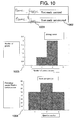
- FIG 10 is an embodiment of a test summary shown. Scan parts containing the names of George and John are shown (1001), which is combined with an example of test marks (1002).
- the statistics overview could comprise for example the number of correct answers related with the number of people (1003), or the percentage of people that filled in the correct answer related with the question number (1004).
- FIG 11A is an example of an inquiry in which no answers are filled in.
- figure 11 B all answers for this inquiry are filled in on paper.
- figure 12A until figure 12F six inquiries filled in are shown on paper, each filled in by a different person.
- These six questionnaires are scanned in (step 405) and are automatically judged (step 406 described more in detail with figure 5B).
- An embodiment of the result of this step is depicted in figure 13: an example of a distribution of answers made for each of the answers overlaying the scanned in questionnaire (1301). It should be possible in an apparatus incorporating the invention that per inquiry question sometimes more than one answer could be filled in and so more than one answer per question is contributing to the distribution of answers.
Landscapes
- Physics & Mathematics (AREA)
- General Physics & Mathematics (AREA)
- Engineering & Computer Science (AREA)
- Theoretical Computer Science (AREA)
- Management, Administration, Business Operations System, And Electronic Commerce (AREA)
Abstract
A method for automatically analysing a filled in questionnaire comprising the steps of:
- a) providing a questionnaire having answer locations,
- b) scanning at least two copies of the questionnaire with the answer locations filled in differently in a predetermined way,
- c) automatically determining answer locations by comparing the scans,
- d) providing a filled in questionnaire having answers,
- e) scanning the filled in questionnaire to a third scan and
- f) automatically judging the answers with the answer locations.
Description
- The invention relates to an apparatus and a method for automatically analysing a filled in questionnaire. The invention also relates to a digital copier incorporating such an apparatus.
- The invention is applicable to a questionnaire that could be for example a test or an inquiry. The use of a questionnaire is common in environments such as training students during education, measuring consumer needs for a marketing study and measuring the preferences of a group of people.
- A questionnaire workflow comprises the steps of preparing the questionnaire, distributing the questionnaire, filling in the questionnaire, collecting the filled-in questionnaire and analysing the questionnaire. This workflow can be partly on paper or digitally. A paper questionnaire provides an easy user interface and a digital questionnaire provides the possibility of automation and fast distribution.
- To date, the approach in producing educational materials for computers has been highly inefficient and expensive. Often people read, fill in and analyse questionnaires on paper, such as in education for presenting questions and filling in of answers. A teacher revises the multiple-choice tests on paper with pencil. This is a tedious process for the teacher: it takes a lot of his time and it costs a lot of his concentration and so can cause feelings of frustration.
- U.S. Pat. No. 6,175,841, to Loiacono, discloses a questionnaire workflow. This method and apparatus is for transforming educational materials composed of questions and answers into an on-line computer. By scanning of paper of textual and/or graphical material sometimes containing pencil lines are computer readable images created. The captured images are modified by the application of answer formats, examples of that include underlining, highlighting, and circling a correct answer. The modified captured images are stored for distribution to users. Answer formats are automatically applied to the questions thus allowing them to be answered in a computer interactive form.
- Disadvantage of such a system is that it requires a difficult and time consuming configuration process in preparing an on-line interactive questionnaire.
- Another example of such a method and system is known from U.S. Pat. No. 5,555,101 to Larson and Faul. This method and system is for interactively creating forms, including displaying the forms during creation and interpreting completed forms received via a facsimile device. The system includes the following features: automated reminder, automated data export, suspense processing and automated confirmation. A disadvantage of such a system is that it requires a difficult and time consuming configuration process in preparing an on-line interactive form.
- A major drawback of the prior art for automatically analysing a filled in paper questionnaire is that it requires a difficult and time consuming configuration process in the preparation of the automatic analysing process for filled in paper questionnaires.
- To overcome drawbacks of the prior art it is an object of the present invention to reduce the time needed to configure the automatic analysing process for filled in questionnaires. This is achieved by a method in which the method comprises the following steps:
- a) providing a questionnaire having answer locations,
- b) scanning at least two copies of the questionnaire with the answer locations filled in differently in a predetermined way,
- c) automatically determining answer locations by comparing the scans,
- d) providing a filled in questionnaire having answers,
- e) scanning the filled in questionnaire to a third scan and
- f) automatically judging the answers with the answer locations.
- With a first embodiment, an operator - for example a teacher - configures the automatic analysing process for filled in paper questionnaires such as a multiple-choice test. The teacher copies not filled in questionnaire to test students and include two additional copies. The two additional copies are for the first master and the second master. The teacher uses the first master to indicate all correct answers and uses the second master to indicate all wrong answers. The teacher scans the first master and second master on an apparatus incorporating the invention such as a digital copier or a scanner connected to a personal computer.
In this first embodiment, according to the invention, the method comprises the steps of: automatically determining answer locations by comparing a first scan and a second scan, where one of the scans is made from the questionnaire with all correct answers filled in and the other scan is made from the questionnaire with all wrong answers filled in and automatically labelling every answer location as a correct answer or a wrong answer. - In a further embodiment, according to the invention, the method comprises the steps of: finding all answers on the third scan by using the answer locations, deciding per answer whether the answer is a wrong answer or a correct answer based upon the label of the answer location and creating a corrected questionnaire.
With this embodiment, the operator starts the analysing process of the filled in paper questionnaires by scanning in all filled in paper questionnaires. Thereafter the method finds all filled in answers on the third scan by using the answer locations. All questions are found by grouping together answer locations based upon spatial information such as distance between answer locations or a typical spatial positioning of the answer locations. The labels indicate the wrong and correct answer positions. For example, when the answer location on the third scan contains an answer and the answer location label indicates 'wrong', then this filled in answer is wrong. This way the correct and wrong answers per question are known and a corrected questionnaire is automatically created. - With a second embodiment, an operator, for example a marketer, can configure the automatic analysing process for the filled in paper questionnaire such as an inquiry. The marketer makes a number of copies from the original questionnaire needed to inquire a group of people and includes two additional copies. The two additional copies are for the first master and the second master. The marketer uses the first master to indicate all possible answers and the marketer provides the second master, which is a not filled in paper questionnaire. The marketer scans the first master and second master on an apparatus incorporating the invention such as a digital copier or a scanner connected to a personal computer.
In this second embodiment, according to the invention, the method comprises the step of automatically determining answer locations by comparing a first scan and a second scan, where one of the scans is made from the questionnaire with all answers filled in and the other scan is made from the questionnaire with no answers filled in. - In a further embodiment, according to the invention, the method comprises the steps of: finding all answers on the third scan by using the answer locations and creating an overview of a plurality of third scans comprising a distribution of answers.
The inquiry is automatically processed resulting in an overview. - The dependent claims indicate useful details and further developments of the invention.
- The invention is explained with reference to the following exemplified embodiments of the present invention and is illustrated by reference to the drawings.
These embodiments serve to illustrate the invention and should not be regarded as a limitation thereof. - The invention is explained in detail with reference to embodiment accompanying drawings wherein:
- figure 1 shows an apparatus according to the present invention;
- figure 2 shows a digital copier according to the present invention;
- figure 3 shows functional blocks according to the present invention;
- figure 4 shows a flow diagram of the method for automatically analysing a filled in paper questionnaire;
- figure 5A shows a flow diagram of the method for automatically judging the third scan based upon the answer location of a filled in test;
- figure 5B shows a flow diagram of the method for automatically judging the third scan based upon the answer location of a filled in inquiry;
- figure 6A shows a multiple choice test in which all correct answers are filled in, the so called first master;
- figure 6B shows a multiple-choice test in which all wrong answers are filled in, the so-called second master;
- figure 7A shows a questionnaire in which the student's answers are filled in;
- figure 7B shows a corrected questionnaire;
- figure 8 and 9 presents hand-written form-free corrected questionnaires;
- figure 10 shows a test summary.
- figure 11 A shows a questionnaire;
- figure 11 B shows an example of a questionnaire in which all answers are filled in on paper, the so-called second master;
- figures 12A until 12F show filled in paper questionnaires of a group of people;
- figure 13 shows a distribution of answers made for each of the questions that is overlaying the third scan;
- Figure 1 illustrates an embodiment of an apparatus for automatically analysing a filled in paper questionnaire, according to the present invention.
Such an apparatus comprises a scanner (101), a processing unit (102) and possibly with means (104) to interact with the processing unit, to give response to an operator and a printer (103). The basic apparatus has a scanner connected with the processing unit (102) such as a computerised system. The more advanced apparatus comprises an operator console (104) that provides the user interface to the system according to the invention. The operator console contains a display and data entry means, such as available for a personal computer or laptop. The scanner (101) scans in the first master, the second master and a filled in questionnaire to the processing unit (102), wherein the first master, the second master and the filled in questionnaire have the same questionnaire as original. A method executed with the processing unit (102) determines the answer locations automatically by comparing the first scan, derived from the first master, and the second scan, derived from the second master, and automatically judges the third scan, derived from the filled in questionnaire, based upon answer locations. Many variations of the system are possible. In a first variant, all components of figure 1 are incorporated into a digital copier. In a next variant, the scanner (101'), method (102) and possibly a printer (103) are remotely connected. - Figure 2 illustrates a block diagram of an embodiment of a digital copier (201) according to the present invention. Such a digital copier comprises a scanner (101), a processing unit (102) such as a controller and possibly with means (104) to interact with the computerised system and possibly a printer (103).
- Figure 3 illustrates a block diagram according to the present invention. The scanner (101) converts the first and second master to respectively the first scan and second scan and converts the filled in questionnaire to the third scan. The first, second and third scan are transported to the determining answer locations unit (301) comprising the image pre processing which aligns the first, second scan and third scan, removes equal information between the first scan and the second scan from both the first and second scan, identifies on the first and the second scan the answer locations and labels the answer locations differently based upon being part of a first set or a second set. The answer locations with their labels and the third scan are transported to the judging unit (302) which derives questions, finds questions with problems such as that no answer is filled in for this question. The judging unit (302) communicates the found problems to the operator via a human interface such as an operator panel or graphical user interface (104). The judging unit (302) gives a test result and/or test mark to the third scan based upon the answer locations with their labels and makes a summary of the results. Possibly, the printer (103) and/or another human interface (104) will convert the judged questionnaire and the summary of the results to a readable form.
- Figure 4 illustrates a flow diagram of an embodiment of the method for automatically analysing a filled in paper questionnaire. Starting from the starting
position 401, instep 402 the first master is scanned on scanner (101) to a first scan. Atstep 403 the second master is scanned on scanner (101). Atstep 404 the answer locations are automatically determined by comparing the first scan and the second scan. By comparing the scans it is determined which answer locations are filled in on the first master and are not filled in on the second master and vice versa.
However, because the scanner document feeder is not perfect, the first scan is aligned with the second scan before the scans are compared. The alignment of the scans can be done on several ways as described in the art. One way of alignment is creating a projection profile of the first scan and second scan, by adding all black pixels in each row for the vertical profile and all back pixels in each column for the horizontal profile, from the long and the short side of the scans. By comparing the vertical and horizontal profile the misalignment in number of pixels can be determined and corrected by shifting one of the scans so that both profiles are matching closely. Thereafter the algorithm determines the answer locations on the questionnaire by removing all equal information between the first and the second scan from the first and second scan using for example an area-by-area comparison. Thereafter a connected component analysis is performed on both the scans to find the boundary of the answer locations and finally all small components are removed from both the scans as they are considered to be noise. Now all answer locations are found on both scans. Finally, all answer locations are labelled. - An example for labelling in case of an inquiry: is a questionnaire for measuring information derived from a certain group of people. For such a questionnaire, the first master is the questionnaire with all answers filled in and the second master is the questionnaire with no answers filled in. The method will understand that in case one of the masters has no answer locations at all, that all found answer locations on the other master must be labelled as correct.
An example for labelling in case of a test: is a multiple-choice test. The scan with the higher number of answer locations contains all wrong answer locations and so these answer locations are labelled as wrong answers and the scan with the lower number of answer locations contains all correct answers and so these answer locations are labelled as correct answers.
An alternative approach is that the label selection is based upon a selection means for an operator indicating whether the first master or the second master is scanned or the label selection is predetermined such that the first master is always scanned before the second master or visa versa.
In the next step 405 a questionnaire is scanned to a third scan. Instep 406, the third scan is automatically judged based upon the answer location. Finally, the method stops instep 407. - The person trained in the art will understand that an embodiment of the invention is capable in handling both: a questionnaire for inquiring a distribution of answers made for each of the answers for measuring information derived from a certain group of people and a questionnaire for testing a certain group of people.
- Figure 5A illustrates a flow diagram of first embodiment of the invention for automatically judging the third scan based upon the answer location, which is part of
step 406 of figure 4. This flow diagram illustrates a part of automatically judging a test. Starting from the startingposition 501, instep 502 the filled in paper questionnaire is scanned on scanner (101) to find all answers on the third scan by using the answer locations. This can be done, for example, by determining the coverage. The coverage is the percentage of black pixels of all pixels in an answer location of the third scan. To determine if a person has selected the answer on the third scan the coverage is calculated per answer location on the third scan. When the coverage for an answer location exceeds a certain threshold such as a certain percentage, then is automatically determined that this answer is filled in. Thereafter instep 503 is decided per answer location, whether the filled in answer or not filled in answer is a wrong or correct answer based upon the label of the answer location.
After done so, instep 504, all questions are determined by grouping together answer locations based upon spatial information. Before this step only the notion of answers exists without knowing to which question the answers belong. Without this step, it is not possible to judge the questionnaire. When, after determination of a question, a problem for this question is detected such as 'no answer is given' or 'too many answers are filled in' then this problem is presented to the operator. In such a case, the operator will select by means: the intended answer, 'no answer is filled in' or 'too many answers are filled in'. Thereafter the embodiment of the invention decides per answer whether it is correct or wrong and/or determines per question whether the question is answered correctly or wrongly. From this, the test result can be derived. Step 505 creates a corrected questionnaire by overlaying the third scan with a correction symbol and a test result and/or test mark. Possibly, anextra step 506 can be available. In this step, a test summary is automatically created which comprises the test results and/or test marks of all third scans. Thereafter the flow diagram stops instep 507. - Figure 5B illustrates a flow diagram of second embodiment of the invention for automatically judging the third scan based upon the answer location, which is part of
step 406 of figure 4. This flow diagram illustrates a part of automatically judging an inquiry. Starting from the startingposition 509, instep 510 the filled in paper inquiry is scanned on scanner (101) to find all answers on the third scan by using the answer locations. All filled in answers are labelled as correct answers. Possibly, in anextra step 510, all questions are determined by grouping together answer locations based upon spatial information. After determination of a question, a problem can appear such as 'no answer is given' for this question. This problem is presented to the operator. In such a case, the operator will select, by means of an operator panel, the intended answer. Instep 511 the third scan is overlaying with a distribution of answers made for each of the answers. Overlaid on the answer location is the selection percentage of an answer with respect to all filled in inquiries. It will be clear thatstep 510 is an enhancement sostep 510 is not necessary to be able to create the overview ofstep 511 - To illustrate the working of the method some examples are given.
- Figure 6A is an example of a multiple-choice test in which correct answers (601) are filled in on paper, the so-called first master. In figure 6B the second master - wrong answers (602) are filled in on paper - is shown. Both masters are scanned (101) and handled by image processing in the determining answer location Unit (301) resulting in finding all answer locations.
- Figure 7A is an example of a filled in multiple choice test - filled in questionnaire -. The filled in questionnaire is scanned (step 405) and automatically judged (step 406) resulting in a corrected questionnaire (step 505). In figure 7B, an example of a corrected questionnaire is shown. Examples of correction symbols that could be used on the corrected questionnaire are 'this should be the answer'-symbol (701), 'this is not the correct answer'-symbol (702), and 'the correct answer is filled in'-symbol (703). Furthermore, the test result (704) is overlaying on the third scan.
- In figure 8 and 9 embodiments are depicted of hand-written form-free questionnaires. These are examples of embodiments of the invention illustrating that any form of questionnaire can be judged by the invention, so without the need that an operator digitally configures the configuration process. The questionnaire of figure 8 is filled in on paper by John (801). John has a test result of 6.7 due to 2 answers correct out of 3 (802).
Incorporated in the embodiment of the invention is the possibility to have two correct answers for one question. For example, the first question in figure 8 has two correct answers: a ripe tomato is red and a growing tomato is green. Depending on the scoring model score points are given for example per correct answer, per correct answers, per not wrong answers or per correct question.
The questionnaire of figure 9 is filled in on paper by George (901). George has a test result of 3.3 due to 1 answer correct out of 3 (902). Several such questionnaires are filled in and processed resulting in a test summary.
In figure 10 is an embodiment of a test summary shown. Scan parts containing the names of George and John are shown (1001), which is combined with an example of test marks (1002). The statistics overview could comprise for example the number of correct answers related with the number of people (1003), or the percentage of people that filled in the correct answer related with the question number (1004). - The configuration process is done partly on paper by using the inquiries of figures 11 A and 11 B. Figure 11A is an example of an inquiry in which no answers are filled in. In figure 11 B all answers for this inquiry are filled in on paper. In figure 12A until figure 12F six inquiries filled in are shown on paper, each filled in by a different person. These six questionnaires are scanned in (step 405) and are automatically judged (step 406 described more in detail with figure 5B). An embodiment of the result of this step is depicted in figure 13: an example of a distribution of answers made for each of the answers overlaying the scanned in questionnaire (1301). It should be possible in an apparatus incorporating the invention that per inquiry question sometimes more than one answer could be filled in and so more than one answer per question is contributing to the distribution of answers. This is done by adding up the number of answers given for an answer location and relating the total of number of answers given for an answer location with the total number of inquiries. An example of such a question is the third question (1302) where a person could have two or more favourite colours such as yellow and blue.
- For the present invention thus described, it will be obvious that the same may vary in many ways. Such variations are not a departure from scope of the invention, and all such modifications would be obvious to one skilled in the art intended to be included within the scope of the following claims.
Claims (17)
- A method for automatically analysing a filled in questionnaire comprising the steps of:a) providing a questionnaire having answer locations,b) scanning at least two copies of the questionnaire with the answer locations filled in differently in a predetermined way,c) automatically determining answer locations by comparing the scans,d) providing a filled in questionnaire having answers,e) scanning the filled in questionnaire to a third scan andf) automatically judging the answers with the answer locations.
- A method according to claim 1, wherein step c) comprises automatically determining answer locations by comparing a first scan and a second scan, where one of the scans is made from the questionnaire with all correct answers filled in and the other scan is made from the questionnaire with all wrong answers filled in and automatically labelling every answer location as a correct answer or a wrong answer.
- A method according to claim 2, wherein step c) further comprises the steps of selecting a label based upon the number of answer locations on the first scan and the number of answer locations on the second scan.
- A method according to claim 2 or 3, wherein step f) comprises the steps of:finding all answers on the third scan by using the answer locations,deciding per answer whether the answer is a wrong answer or a correct answer based upon the label of the answer location, andcreating a corrected questionnaire.
- A method according to claim 4, wherein step f) further comprises the step of presenting an improper filled in question to an operator for corrective actions.
- A method according to claim 4 or 5, wherein step f) further comprises the step of displaying the third scan with a correction symbol.
- A method according to one of claims 4-6, wherein step f) further comprises the step of displaying the third scan with a test result.
- A method according to one of claims 4-7, wherein step f) further comprises the steps of: providing a relation between a test result and a test mark,
determining the test mark based upon the relation and
displaying the third scan with the test mark. - A method according to one of claims 4-8, wherein step f) further comprises the step of automatically creating a test summary, wherein the test summary comprises the test results and/or test marks of a plurality of third scans.
- A method according to claim 9, wherein step f) further comprises the step of displaying the test summary with a part of the third scan.
- A method according to claim 1, wherein step c) comprises
automatically determining answer locations by comparing a first scan and a second scan, where one of the scans is made from the questionnaire with all answers filled in and the other scan is made from the questionnaire with no answers filled in. - A method according to claim 11, wherein step f) comprises the steps of:finding all answers on the third scan by using the answer locationsandcreating an overview of a plurality of third scans comprising a distribution of answers.
- A method according to claim 12, wherein step f) further comprises displaying the third scan with the distribution of answers.
- A method according to one of claims 11-13, wherein step f) further comprises the step of:presenting an improper filled in question to an operator for corrective actions.
- A computer program comprising code means that when executed on a computer carry out all steps of one of claims 1-14.
- An apparatus characterised by a processing unit for implementing the steps of one of claims 1-14
- A digital copier characterised by a processing unit for implementing the steps of one of claims 1-14.
Priority Applications (7)
| Application Number | Priority Date | Filing Date | Title |
|---|---|---|---|
| EP04105201A EP1650945A1 (en) | 2004-10-21 | 2004-10-21 | Apparatus and method for automatically analysing a filled in questonnaire |
| DE602005013467T DE602005013467D1 (en) | 2004-10-21 | 2005-10-13 | Apparatus and method for automatically analyzing a completed questionnaire |
| AT05109536T ATE426864T1 (en) | 2004-10-21 | 2005-10-13 | APPARATUS AND METHOD FOR AUTOMATICALLY ANALYZING A COMPLETED QUESTIONNAIRE |
| EP20050109536 EP1650947B1 (en) | 2004-10-21 | 2005-10-13 | Apparatus and method for automatically analysing a filled in questionnaire |
| JP2005304592A JP4939031B2 (en) | 2004-10-21 | 2005-10-19 | Apparatus and method for automatically analyzing completed questionnaire |
| US11/253,671 US8280300B2 (en) | 2004-10-21 | 2005-10-20 | Apparatus and method for automatically analysing a filled in questionnaire |
| CN200510116486.6A CN1783164B (en) | 2004-10-21 | 2005-10-21 | Apparatus and method for automatically analyzing a filled in questionnaire |
Applications Claiming Priority (1)
| Application Number | Priority Date | Filing Date | Title |
|---|---|---|---|
| EP04105201A EP1650945A1 (en) | 2004-10-21 | 2004-10-21 | Apparatus and method for automatically analysing a filled in questonnaire |
Publications (1)
| Publication Number | Publication Date |
|---|---|
| EP1650945A1 true EP1650945A1 (en) | 2006-04-26 |
Family
ID=34929738
Family Applications (1)
| Application Number | Title | Priority Date | Filing Date |
|---|---|---|---|
| EP04105201A Withdrawn EP1650945A1 (en) | 2004-10-21 | 2004-10-21 | Apparatus and method for automatically analysing a filled in questonnaire |
Country Status (6)
| Country | Link |
|---|---|
| US (1) | US8280300B2 (en) |
| EP (1) | EP1650945A1 (en) |
| JP (1) | JP4939031B2 (en) |
| CN (1) | CN1783164B (en) |
| AT (1) | ATE426864T1 (en) |
| DE (1) | DE602005013467D1 (en) |
Families Citing this family (9)
| Publication number | Priority date | Publication date | Assignee | Title |
|---|---|---|---|---|
| JP2007004523A (en) * | 2005-06-24 | 2007-01-11 | Fuji Xerox Co Ltd | Apparatus and method for preparing question sheet |
| US20070288246A1 (en) * | 2006-06-08 | 2007-12-13 | Peter Ebert | In-line report generator |
| US20080280280A1 (en) * | 2007-05-11 | 2008-11-13 | Aplia, Inc. | Method of capturing workflow |
| US20100047757A1 (en) * | 2008-08-22 | 2010-02-25 | Mccurry Douglas | System and method for using interim-assessment data for instructional decision-making |
| JP2016212284A (en) * | 2015-05-11 | 2016-12-15 | 富士通株式会社 | Scoring rule application target designation program, correctness determination rule setting program, scoring rule application target specification method, correctness determination rule setting method, application target specification device, and correctness determination rule setting device |
| JP6634993B2 (en) * | 2016-09-30 | 2020-01-22 | 京セラドキュメントソリューションズ株式会社 | Image forming device |
| CN108389145A (en) * | 2018-02-08 | 2018-08-10 | 四川元高分网络科技有限公司 | School work Personality evaluation based on big data and culture systems |
| CN112989125A (en) * | 2019-12-13 | 2021-06-18 | 庞韶云 | Color analysis decision thinking analysis method |
| US20210241644A1 (en) * | 2020-02-03 | 2021-08-05 | St Unitas Co., Ltd. | Apparatus, method and recording medium storing command for supporting learning |
Citations (3)
| Publication number | Priority date | Publication date | Assignee | Title |
|---|---|---|---|---|
| US5452379A (en) * | 1991-09-13 | 1995-09-19 | Meadowbrook Industries, Ltd. | Image capture and storage techniques in association with optical mark reading |
| US5943137A (en) * | 1991-07-22 | 1999-08-24 | Cardiff Software, Inc. | Unified method of creating and processing fax forms |
| US20030086116A1 (en) * | 2001-11-05 | 2003-05-08 | Hall John M. | Method to automatically evaluate a hard copy response and immediately generate commentary based thereon |
Family Cites Families (32)
| Publication number | Priority date | Publication date | Assignee | Title |
|---|---|---|---|---|
| US2894063A (en) * | 1955-06-13 | 1959-07-07 | Western Union Telegraph Co | Facsimile ticket and message system |
| US3487561A (en) * | 1967-03-07 | 1970-01-06 | Automata Corp | Test grading and marking method and apparatus |
| US3601906A (en) * | 1969-02-10 | 1971-08-31 | Minnesota Mining & Mfg | Test grading device |
| US3599349A (en) * | 1969-06-02 | 1971-08-17 | Minnesota Mining & Mfg | Test analyzer |
| US3643348A (en) * | 1969-08-18 | 1972-02-22 | Automata Corp | System and method for individually programmed automatic test grading and scoring |
| US3721807A (en) * | 1971-10-20 | 1973-03-20 | Miller Scient Corp | Card grading machine |
| JPS5744698B2 (en) | 1973-08-04 | 1982-09-22 | ||
| US4089124A (en) * | 1975-03-10 | 1978-05-16 | Eric F. Burtis | Arithmetic training apparatus |
| US4259788A (en) * | 1979-05-16 | 1981-04-07 | Wilson Robert F | Testing apparatus |
| US4522599A (en) * | 1983-10-11 | 1985-06-11 | Harte J Richard | Computer assisted instructional and testing apparatus with switch closure at two different depths |
| US5102341A (en) * | 1989-05-05 | 1992-04-07 | Touchstone Applied Science Associates, Inc. | Test answer and score sheet device |
| US5011413A (en) * | 1989-07-19 | 1991-04-30 | Educational Testing Service | Machine-interpretable figural response testing |
| US5555101A (en) | 1991-07-22 | 1996-09-10 | Cardiff Software, Inc. | Forms creation and interpretation system |
| JPH05145735A (en) * | 1991-10-16 | 1993-06-11 | Fuji Xerox Co Ltd | Image processor provided with insert synthesizing function |
| US5229589A (en) * | 1991-11-21 | 1993-07-20 | Optimum Solutions Corp., Inc. | Questionnaire scanning system employing expandable answer mark areas for efficient scanning and mark detection |
| JP3693691B2 (en) * | 1993-12-30 | 2005-09-07 | 株式会社リコー | Image processing device |
| JP3547025B2 (en) * | 1994-08-23 | 2004-07-28 | 株式会社リコー | Information extraction method |
| US5936225A (en) * | 1996-04-02 | 1999-08-10 | Strategic Quantitative Solutions, Inc. | Method and apparatus for tabulating data from a plurality of response forms |
| JPH09311621A (en) * | 1996-05-23 | 1997-12-02 | Adobuansu Ee:Kk | Automatic grading method for examination paper and its system |
| US6175841B1 (en) | 1997-07-17 | 2001-01-16 | Bookette Software Company | Computerized systems for producing on-line instructional materials |
| US6173154B1 (en) * | 1997-07-31 | 2001-01-09 | The Psychological Corporation | System and method for imaging test answer sheets having open-ended questions |
| US6079624A (en) * | 1997-12-08 | 2000-06-27 | William C. Apperson | Data processing form using a scanning apparatus |
| JP3771371B2 (en) * | 1998-03-18 | 2006-04-26 | 株式会社リコー | Mark recognition method and apparatus, and recording medium |
| JP3895473B2 (en) * | 1998-08-10 | 2007-03-22 | 株式会社リコー | Entry information extraction method and machine-readable recording medium recording a program for causing a computer to execute the entry information extraction method |
| US6600482B1 (en) * | 2000-01-11 | 2003-07-29 | Workonce Wireless Corporation | Method and system for form recognition and digitized image processing |
| US6741738B2 (en) * | 2000-03-13 | 2004-05-25 | Tms, Inc. | Method of optical mark recognition |
| JP2002008028A (en) * | 2000-06-27 | 2002-01-11 | Matsushita Electric Ind Co Ltd | Pattern matching method and apparatus |
| US6927872B2 (en) * | 2001-07-25 | 2005-08-09 | Hewlett-Packard Development Company, L.P. | Data acquisition system and method using answer forms |
| WO2003102739A2 (en) * | 2002-05-31 | 2003-12-11 | Vsc Technologies, Llc | System for scoring scanned test answer sheets |
| JP2004272607A (en) * | 2003-03-10 | 2004-09-30 | Konica Minolta Holdings Inc | Copier |
| US7298901B2 (en) * | 2004-04-07 | 2007-11-20 | Scantron Corporation | Scannable form and system |
| US20060003306A1 (en) * | 2004-07-02 | 2006-01-05 | Mcginley Michael P | Unified web-based system for the delivery, scoring, and reporting of on-line and paper-based assessments |
-
2004
- 2004-10-21 EP EP04105201A patent/EP1650945A1/en not_active Withdrawn
-
2005
- 2005-10-13 DE DE602005013467T patent/DE602005013467D1/en not_active Expired - Lifetime
- 2005-10-13 AT AT05109536T patent/ATE426864T1/en not_active IP Right Cessation
- 2005-10-19 JP JP2005304592A patent/JP4939031B2/en not_active Expired - Fee Related
- 2005-10-20 US US11/253,671 patent/US8280300B2/en not_active Expired - Fee Related
- 2005-10-21 CN CN200510116486.6A patent/CN1783164B/en not_active Expired - Fee Related
Patent Citations (3)
| Publication number | Priority date | Publication date | Assignee | Title |
|---|---|---|---|---|
| US5943137A (en) * | 1991-07-22 | 1999-08-24 | Cardiff Software, Inc. | Unified method of creating and processing fax forms |
| US5452379A (en) * | 1991-09-13 | 1995-09-19 | Meadowbrook Industries, Ltd. | Image capture and storage techniques in association with optical mark reading |
| US20030086116A1 (en) * | 2001-11-05 | 2003-05-08 | Hall John M. | Method to automatically evaluate a hard copy response and immediately generate commentary based thereon |
Also Published As
| Publication number | Publication date |
|---|---|
| CN1783164B (en) | 2013-03-13 |
| DE602005013467D1 (en) | 2009-05-07 |
| JP4939031B2 (en) | 2012-05-23 |
| ATE426864T1 (en) | 2009-04-15 |
| US20060088812A1 (en) | 2006-04-27 |
| JP2006120156A (en) | 2006-05-11 |
| CN1783164A (en) | 2006-06-07 |
| US8280300B2 (en) | 2012-10-02 |
Similar Documents
| Publication | Publication Date | Title |
|---|---|---|
| US8794978B2 (en) | Educational material processing apparatus, educational material processing method, educational material processing program and computer-readable recording medium | |
| US8280300B2 (en) | Apparatus and method for automatically analysing a filled in questionnaire | |
| JP4873138B2 (en) | Information processing apparatus and program | |
| US7764923B2 (en) | Material processing apparatus and method for grading material | |
| JP2008309961A (en) | Marking system and marking program | |
| EP1650947B1 (en) | Apparatus and method for automatically analysing a filled in questionnaire | |
| US7227997B2 (en) | Image recognition apparatus, image recognition method, and image recognition program | |
| CN113095312A (en) | Method for acquiring handwritten answer area in test paper based on identification code | |
| US8526055B1 (en) | Standardized test and survey imaging system | |
| US20060194187A1 (en) | Material processing apparatus, material processing method, and program product | |
| JP4894184B2 (en) | Teaching material processing apparatus, teaching material processing method, and teaching material processing program | |
| JP4807487B2 (en) | Teaching material processing apparatus, teaching material processing method, and teaching material processing program | |
| US7865130B2 (en) | Material processing apparatus, material processing method, and material processing program product | |
| JP4756456B2 (en) | Teaching material processing apparatus, teaching material processing method, and teaching material processing program | |
| JP4894195B2 (en) | Teaching material processing apparatus, teaching material processing method, and teaching material processing program | |
| JP2007233888A (en) | Image processor and image processing program | |
| JP4710707B2 (en) | Additional recording information processing method, additional recording information processing apparatus, and program | |
| JP5054284B2 (en) | Teaching material processing apparatus, teaching material processing method, and teaching material processing program | |
| CN120047284A (en) | Creation method and system for multifunctional AI teaching platform | |
| JP2007233887A (en) | Image processor and image processing program | |
| JP2007004319A (en) | Teaching material processing apparatus, teaching material processing method and teaching material processing program | |
| JP2007033725A (en) | Device, method and program for processing educational material | |
| JP2007017467A (en) | Educational material processing device, educational material processing method, and educational material processing program | |
| JP2006235430A (en) | Device, method, and program for processing educational material |
Legal Events
| Date | Code | Title | Description |
|---|---|---|---|
| PUAI | Public reference made under article 153(3) epc to a published international application that has entered the european phase |
Free format text: ORIGINAL CODE: 0009012 |
|
| AK | Designated contracting states |
Kind code of ref document: A1 Designated state(s): AT BE BG CH CY CZ DE DK EE ES FI FR GB GR HU IE IT LI LU MC NL PL PT RO SE SI SK TR |
|
| AX | Request for extension of the european patent |
Extension state: AL HR LT LV MK |
|
| STAA | Information on the status of an ep patent application or granted ep patent |
Free format text: STATUS: THE APPLICATION IS DEEMED TO BE WITHDRAWN |
|
| 18D | Application deemed to be withdrawn |
Effective date: 20060222 |