EP1650264A1 - Resin composition containing ultrafine particles - Google Patents
Resin composition containing ultrafine particles Download PDFInfo
- Publication number
- EP1650264A1 EP1650264A1 EP04747554A EP04747554A EP1650264A1 EP 1650264 A1 EP1650264 A1 EP 1650264A1 EP 04747554 A EP04747554 A EP 04747554A EP 04747554 A EP04747554 A EP 04747554A EP 1650264 A1 EP1650264 A1 EP 1650264A1
- Authority
- EP
- European Patent Office
- Prior art keywords
- ultrafine particles
- group
- polymer
- particles
- resin
- Prior art date
- Legal status (The legal status is an assumption and is not a legal conclusion. Google has not performed a legal analysis and makes no representation as to the accuracy of the status listed.)
- Withdrawn
Links
- 239000011882 ultra-fine particle Substances 0.000 title claims abstract description 225
- 239000011342 resin composition Substances 0.000 title claims abstract description 57
- 229920005989 resin Polymers 0.000 claims abstract description 136
- 239000011347 resin Substances 0.000 claims abstract description 136
- 229920000642 polymer Polymers 0.000 claims abstract description 134
- 150000001875 compounds Chemical class 0.000 claims abstract description 96
- 125000003396 thiol group Chemical group [H]S* 0.000 claims abstract description 69
- -1 thiocarbonylthio group Chemical group 0.000 claims abstract description 59
- 239000000178 monomer Substances 0.000 claims abstract description 42
- 229910052751 metal Inorganic materials 0.000 claims abstract description 30
- 239000002184 metal Substances 0.000 claims abstract description 30
- 239000004065 semiconductor Substances 0.000 claims abstract description 20
- 239000003795 chemical substances by application Substances 0.000 claims abstract description 16
- 238000010526 radical polymerization reaction Methods 0.000 claims abstract description 7
- 239000002245 particle Substances 0.000 claims description 111
- 230000000737 periodic effect Effects 0.000 claims description 45
- PCHJSUWPFVWCPO-UHFFFAOYSA-N gold Chemical compound [Au] PCHJSUWPFVWCPO-UHFFFAOYSA-N 0.000 claims description 40
- 229910052737 gold Inorganic materials 0.000 claims description 40
- 239000010931 gold Substances 0.000 claims description 40
- 229910052798 chalcogen Inorganic materials 0.000 claims description 35
- 229910052757 nitrogen Inorganic materials 0.000 claims description 27
- 125000004432 carbon atom Chemical group C* 0.000 claims description 25
- BASFCYQUMIYNBI-UHFFFAOYSA-N platinum Chemical compound [Pt] BASFCYQUMIYNBI-UHFFFAOYSA-N 0.000 claims description 17
- 239000011164 primary particle Substances 0.000 claims description 15
- 229910052709 silver Inorganic materials 0.000 claims description 12
- BQCADISMDOOEFD-UHFFFAOYSA-N Silver Chemical compound [Ag] BQCADISMDOOEFD-UHFFFAOYSA-N 0.000 claims description 11
- 239000004332 silver Substances 0.000 claims description 11
- 229910052795 boron group element Inorganic materials 0.000 claims description 10
- 229910052696 pnictogen Inorganic materials 0.000 claims description 10
- 238000002156 mixing Methods 0.000 claims description 9
- KDLHZDBZIXYQEI-UHFFFAOYSA-N Palladium Chemical compound [Pd] KDLHZDBZIXYQEI-UHFFFAOYSA-N 0.000 claims description 8
- 125000000962 organic group Chemical group 0.000 claims description 8
- 229910052697 platinum Inorganic materials 0.000 claims description 8
- 229910052717 sulfur Inorganic materials 0.000 claims description 8
- 229910052800 carbon group element Inorganic materials 0.000 claims description 6
- 229910001849 group 12 element Inorganic materials 0.000 claims description 6
- 125000004433 nitrogen atom Chemical group N* 0.000 claims description 6
- 125000004430 oxygen atom Chemical group O* 0.000 claims description 5
- 125000004434 sulfur atom Chemical group 0.000 claims description 5
- KJTLSVCANCCWHF-UHFFFAOYSA-N Ruthenium Chemical compound [Ru] KJTLSVCANCCWHF-UHFFFAOYSA-N 0.000 claims description 4
- 229910017052 cobalt Inorganic materials 0.000 claims description 4
- 239000010941 cobalt Substances 0.000 claims description 4
- GUTLYIVDDKVIGB-UHFFFAOYSA-N cobalt atom Chemical compound [Co] GUTLYIVDDKVIGB-UHFFFAOYSA-N 0.000 claims description 4
- 229910021480 group 4 element Inorganic materials 0.000 claims description 4
- 229910052763 palladium Inorganic materials 0.000 claims description 4
- 229910052703 rhodium Inorganic materials 0.000 claims description 4
- 239000010948 rhodium Substances 0.000 claims description 4
- MHOVAHRLVXNVSD-UHFFFAOYSA-N rhodium atom Chemical compound [Rh] MHOVAHRLVXNVSD-UHFFFAOYSA-N 0.000 claims description 4
- 229910052707 ruthenium Inorganic materials 0.000 claims description 4
- 239000000463 material Substances 0.000 abstract description 5
- 230000001747 exhibiting effect Effects 0.000 abstract description 3
- HEDRZPFGACZZDS-UHFFFAOYSA-N Chloroform Chemical compound ClC(Cl)Cl HEDRZPFGACZZDS-UHFFFAOYSA-N 0.000 description 82
- 238000000034 method Methods 0.000 description 80
- 239000000243 solution Substances 0.000 description 70
- 239000002105 nanoparticle Substances 0.000 description 48
- 238000003756 stirring Methods 0.000 description 48
- OKKJLVBELUTLKV-UHFFFAOYSA-N Methanol Chemical compound OC OKKJLVBELUTLKV-UHFFFAOYSA-N 0.000 description 45
- 238000003917 TEM image Methods 0.000 description 42
- PPBRXRYQALVLMV-UHFFFAOYSA-N Styrene Chemical group C=CC1=CC=CC=C1 PPBRXRYQALVLMV-UHFFFAOYSA-N 0.000 description 40
- 239000002904 solvent Substances 0.000 description 40
- 238000004519 manufacturing process Methods 0.000 description 39
- IJGRMHOSHXDMSA-UHFFFAOYSA-N nitrogen Substances N#N IJGRMHOSHXDMSA-UHFFFAOYSA-N 0.000 description 39
- XLYOFNOQVPJJNP-UHFFFAOYSA-N water Substances O XLYOFNOQVPJJNP-UHFFFAOYSA-N 0.000 description 38
- YXFVVABEGXRONW-UHFFFAOYSA-N Toluene Chemical compound CC1=CC=CC=C1 YXFVVABEGXRONW-UHFFFAOYSA-N 0.000 description 33
- 238000010521 absorption reaction Methods 0.000 description 33
- 239000000203 mixture Substances 0.000 description 31
- 239000006185 dispersion Substances 0.000 description 28
- 229920003229 poly(methyl methacrylate) Polymers 0.000 description 28
- 239000004926 polymethyl methacrylate Substances 0.000 description 28
- 238000005259 measurement Methods 0.000 description 27
- UHYPYGJEEGLRJD-UHFFFAOYSA-N cadmium(2+);selenium(2-) Chemical compound [Se-2].[Cd+2] UHYPYGJEEGLRJD-UHFFFAOYSA-N 0.000 description 25
- 230000008569 process Effects 0.000 description 19
- 238000006243 chemical reaction Methods 0.000 description 18
- 238000004364 calculation method Methods 0.000 description 16
- 230000002776 aggregation Effects 0.000 description 15
- 238000004220 aggregation Methods 0.000 description 15
- 230000000052 comparative effect Effects 0.000 description 15
- OZAIFHULBGXAKX-UHFFFAOYSA-N 2-(2-cyanopropan-2-yldiazenyl)-2-methylpropanenitrile Chemical compound N#CC(C)(C)N=NC(C)(C)C#N OZAIFHULBGXAKX-UHFFFAOYSA-N 0.000 description 14
- NLHHRLWOUZZQLW-UHFFFAOYSA-N Acrylonitrile Chemical compound C=CC#N NLHHRLWOUZZQLW-UHFFFAOYSA-N 0.000 description 14
- 239000003505 polymerization initiator Substances 0.000 description 14
- 229920001577 copolymer Polymers 0.000 description 13
- 239000011572 manganese Substances 0.000 description 13
- 230000003287 optical effect Effects 0.000 description 13
- 239000003960 organic solvent Substances 0.000 description 13
- 238000002834 transmittance Methods 0.000 description 13
- HEMHJVSKTPXQMS-UHFFFAOYSA-M Sodium hydroxide Chemical compound [OH-].[Na+] HEMHJVSKTPXQMS-UHFFFAOYSA-M 0.000 description 12
- 229910001873 dinitrogen Inorganic materials 0.000 description 11
- PWBYYTXZCUZPRD-UHFFFAOYSA-N iron platinum Chemical compound [Fe][Pt][Pt] PWBYYTXZCUZPRD-UHFFFAOYSA-N 0.000 description 11
- 238000001704 evaporation Methods 0.000 description 10
- 230000008020 evaporation Effects 0.000 description 10
- 229920002451 polyvinyl alcohol Polymers 0.000 description 10
- 239000011369 resultant mixture Substances 0.000 description 10
- LYCAIKOWRPUZTN-UHFFFAOYSA-N Ethylene glycol Chemical compound OCCO LYCAIKOWRPUZTN-UHFFFAOYSA-N 0.000 description 9
- CERQOIWHTDAKMF-UHFFFAOYSA-N Methacrylic acid Chemical compound CC(=C)C(O)=O CERQOIWHTDAKMF-UHFFFAOYSA-N 0.000 description 9
- NIXOWILDQLNWCW-UHFFFAOYSA-N acrylic acid group Chemical group C(C=C)(=O)O NIXOWILDQLNWCW-UHFFFAOYSA-N 0.000 description 9
- 238000004020 luminiscence type Methods 0.000 description 9
- 238000006116 polymerization reaction Methods 0.000 description 9
- 230000002269 spontaneous effect Effects 0.000 description 9
- SMZOUWXMTYCWNB-UHFFFAOYSA-N 2-(2-methoxy-5-methylphenyl)ethanamine Chemical compound COC1=CC=C(C)C=C1CCN SMZOUWXMTYCWNB-UHFFFAOYSA-N 0.000 description 8
- 239000004372 Polyvinyl alcohol Substances 0.000 description 8
- MCMNRKCIXSYSNV-UHFFFAOYSA-N Zirconium dioxide Chemical compound O=[Zr]=O MCMNRKCIXSYSNV-UHFFFAOYSA-N 0.000 description 8
- 239000007864 aqueous solution Substances 0.000 description 8
- 230000015572 biosynthetic process Effects 0.000 description 8
- VLKZOEOYAKHREP-UHFFFAOYSA-N n-Hexane Chemical compound CCCCCC VLKZOEOYAKHREP-UHFFFAOYSA-N 0.000 description 8
- 230000037048 polymerization activity Effects 0.000 description 8
- 239000000126 substance Substances 0.000 description 8
- 229920002554 vinyl polymer Polymers 0.000 description 8
- XEEYBQQBJWHFJM-UHFFFAOYSA-N Iron Chemical compound [Fe] XEEYBQQBJWHFJM-UHFFFAOYSA-N 0.000 description 7
- CERQOIWHTDAKMF-UHFFFAOYSA-M Methacrylate Chemical compound CC(=C)C([O-])=O CERQOIWHTDAKMF-UHFFFAOYSA-M 0.000 description 7
- GWEVSGVZZGPLCZ-UHFFFAOYSA-N Titan oxide Chemical compound O=[Ti]=O GWEVSGVZZGPLCZ-UHFFFAOYSA-N 0.000 description 7
- XLOMVQKBTHCTTD-UHFFFAOYSA-N Zinc monoxide Chemical compound [Zn]=O XLOMVQKBTHCTTD-UHFFFAOYSA-N 0.000 description 7
- 239000013078 crystal Substances 0.000 description 7
- 125000001997 phenyl group Chemical group [H]C1=C([H])C([H])=C(*)C([H])=C1[H] 0.000 description 7
- 239000000843 powder Substances 0.000 description 7
- 150000003839 salts Chemical class 0.000 description 7
- 239000007787 solid Substances 0.000 description 7
- XKRFYHLGVUSROY-UHFFFAOYSA-N Argon Chemical compound [Ar] XKRFYHLGVUSROY-UHFFFAOYSA-N 0.000 description 6
- LFQSCWFLJHTTHZ-UHFFFAOYSA-N Ethanol Chemical compound CCO LFQSCWFLJHTTHZ-UHFFFAOYSA-N 0.000 description 6
- XEKOWRVHYACXOJ-UHFFFAOYSA-N Ethyl acetate Chemical compound CCOC(C)=O XEKOWRVHYACXOJ-UHFFFAOYSA-N 0.000 description 6
- 229920002845 Poly(methacrylic acid) Polymers 0.000 description 6
- 125000000217 alkyl group Chemical group 0.000 description 6
- 150000001412 amines Chemical class 0.000 description 6
- 125000003118 aryl group Chemical group 0.000 description 6
- 238000006392 deoxygenation reaction Methods 0.000 description 6
- 238000009826 distribution Methods 0.000 description 6
- WNAHIZMDSQCWRP-UHFFFAOYSA-N dodecane-1-thiol Chemical compound CCCCCCCCCCCCS WNAHIZMDSQCWRP-UHFFFAOYSA-N 0.000 description 6
- 230000000694 effects Effects 0.000 description 6
- 125000004435 hydrogen atom Chemical group [H]* 0.000 description 6
- 239000003446 ligand Substances 0.000 description 6
- 239000000155 melt Substances 0.000 description 6
- 125000002496 methyl group Chemical group [H]C([H])([H])* 0.000 description 6
- 238000000926 separation method Methods 0.000 description 6
- XOLBLPGZBRYERU-UHFFFAOYSA-N tin dioxide Chemical compound O=[Sn]=O XOLBLPGZBRYERU-UHFFFAOYSA-N 0.000 description 6
- VZCYOOQTPOCHFL-UHFFFAOYSA-N trans-butenedioic acid Natural products OC(=O)C=CC(O)=O VZCYOOQTPOCHFL-UHFFFAOYSA-N 0.000 description 6
- 125000000391 vinyl group Chemical group [H]C([*])=C([H])[H] 0.000 description 6
- HRPVXLWXLXDGHG-UHFFFAOYSA-N Acrylamide Chemical compound NC(=O)C=C HRPVXLWXLXDGHG-UHFFFAOYSA-N 0.000 description 5
- VZCYOOQTPOCHFL-OWOJBTEDSA-N Fumaric acid Chemical compound OC(=O)\C=C\C(O)=O VZCYOOQTPOCHFL-OWOJBTEDSA-N 0.000 description 5
- VVQNEPGJFQJSBK-UHFFFAOYSA-N Methyl methacrylate Chemical compound COC(=O)C(C)=C VVQNEPGJFQJSBK-UHFFFAOYSA-N 0.000 description 5
- 239000002253 acid Substances 0.000 description 5
- 239000002585 base Substances 0.000 description 5
- 230000005587 bubbling Effects 0.000 description 5
- 239000003638 chemical reducing agent Substances 0.000 description 5
- 238000001246 colloidal dispersion Methods 0.000 description 5
- 239000011258 core-shell material Substances 0.000 description 5
- 125000001495 ethyl group Chemical group [H]C([H])([H])C([H])([H])* 0.000 description 5
- PJXISJQVUVHSOJ-UHFFFAOYSA-N indium(III) oxide Inorganic materials [O-2].[O-2].[O-2].[In+3].[In+3] PJXISJQVUVHSOJ-UHFFFAOYSA-N 0.000 description 5
- 239000007791 liquid phase Substances 0.000 description 5
- FQPSGWSUVKBHSU-UHFFFAOYSA-N methacrylamide Chemical compound CC(=C)C(N)=O FQPSGWSUVKBHSU-UHFFFAOYSA-N 0.000 description 5
- 230000004048 modification Effects 0.000 description 5
- 238000012986 modification Methods 0.000 description 5
- 238000000465 moulding Methods 0.000 description 5
- 150000003254 radicals Chemical class 0.000 description 5
- 238000010992 reflux Methods 0.000 description 5
- 229910052710 silicon Inorganic materials 0.000 description 5
- ROSDSFDQCJNGOL-UHFFFAOYSA-N Dimethylamine Chemical compound CNC ROSDSFDQCJNGOL-UHFFFAOYSA-N 0.000 description 4
- QUSNBJAOOMFDIB-UHFFFAOYSA-N Ethylamine Chemical compound CCN QUSNBJAOOMFDIB-UHFFFAOYSA-N 0.000 description 4
- BAVYZALUXZFZLV-UHFFFAOYSA-N Methylamine Chemical compound NC BAVYZALUXZFZLV-UHFFFAOYSA-N 0.000 description 4
- ATUOYWHBWRKTHZ-UHFFFAOYSA-N Propane Chemical compound CCC ATUOYWHBWRKTHZ-UHFFFAOYSA-N 0.000 description 4
- XUIMIQQOPSSXEZ-UHFFFAOYSA-N Silicon Chemical group [Si] XUIMIQQOPSSXEZ-UHFFFAOYSA-N 0.000 description 4
- WQDUMFSSJAZKTM-UHFFFAOYSA-N Sodium methoxide Chemical compound [Na+].[O-]C WQDUMFSSJAZKTM-UHFFFAOYSA-N 0.000 description 4
- WYURNTSHIVDZCO-UHFFFAOYSA-N Tetrahydrofuran Chemical compound C1CCOC1 WYURNTSHIVDZCO-UHFFFAOYSA-N 0.000 description 4
- XTXRWKRVRITETP-UHFFFAOYSA-N Vinyl acetate Chemical compound CC(=O)OC=C XTXRWKRVRITETP-UHFFFAOYSA-N 0.000 description 4
- 238000004458 analytical method Methods 0.000 description 4
- 125000003710 aryl alkyl group Chemical group 0.000 description 4
- 230000005540 biological transmission Effects 0.000 description 4
- PAFZNILMFXTMIY-UHFFFAOYSA-N cyclohexylamine Chemical compound NC1CCCCC1 PAFZNILMFXTMIY-UHFFFAOYSA-N 0.000 description 4
- JQVDAXLFBXTEQA-UHFFFAOYSA-N dibutylamine Chemical compound CCCCNCCCC JQVDAXLFBXTEQA-UHFFFAOYSA-N 0.000 description 4
- HPNMFZURTQLUMO-UHFFFAOYSA-N diethylamine Chemical compound CCNCC HPNMFZURTQLUMO-UHFFFAOYSA-N 0.000 description 4
- 229910052736 halogen Inorganic materials 0.000 description 4
- SOQBVABWOPYFQZ-UHFFFAOYSA-N oxygen(2-);titanium(4+) Chemical class [O-2].[O-2].[Ti+4] SOQBVABWOPYFQZ-UHFFFAOYSA-N 0.000 description 4
- 150000002978 peroxides Chemical class 0.000 description 4
- 229920000098 polyolefin Polymers 0.000 description 4
- 229920005990 polystyrene resin Polymers 0.000 description 4
- 239000002994 raw material Substances 0.000 description 4
- 238000012712 reversible addition−fragmentation chain-transfer polymerization Methods 0.000 description 4
- SBIBMFFZSBJNJF-UHFFFAOYSA-N selenium;zinc Chemical compound [Se]=[Zn] SBIBMFFZSBJNJF-UHFFFAOYSA-N 0.000 description 4
- CIHOLLKRGTVIJN-UHFFFAOYSA-N tert‐butyl hydroperoxide Chemical compound CC(C)(C)OO CIHOLLKRGTVIJN-UHFFFAOYSA-N 0.000 description 4
- 239000011135 tin Substances 0.000 description 4
- OGIDPMRJRNCKJF-UHFFFAOYSA-N titanium oxide Inorganic materials [Ti]=O OGIDPMRJRNCKJF-UHFFFAOYSA-N 0.000 description 4
- 229920001567 vinyl ester resin Polymers 0.000 description 4
- ZWEHNKRNPOVVGH-UHFFFAOYSA-N 2-Butanone Chemical compound CCC(C)=O ZWEHNKRNPOVVGH-UHFFFAOYSA-N 0.000 description 3
- QTBSBXVTEAMEQO-UHFFFAOYSA-N Acetic acid Chemical compound CC(O)=O QTBSBXVTEAMEQO-UHFFFAOYSA-N 0.000 description 3
- WFDIJRYMOXRFFG-UHFFFAOYSA-N Acetic anhydride Chemical compound CC(=O)OC(C)=O WFDIJRYMOXRFFG-UHFFFAOYSA-N 0.000 description 3
- CSCPPACGZOOCGX-UHFFFAOYSA-N Acetone Chemical compound CC(C)=O CSCPPACGZOOCGX-UHFFFAOYSA-N 0.000 description 3
- NIXOWILDQLNWCW-UHFFFAOYSA-M Acrylate Chemical compound [O-]C(=O)C=C NIXOWILDQLNWCW-UHFFFAOYSA-M 0.000 description 3
- 229910002601 GaN Inorganic materials 0.000 description 3
- 229910005540 GaP Inorganic materials 0.000 description 3
- MHAJPDPJQMAIIY-UHFFFAOYSA-N Hydrogen peroxide Chemical compound OO MHAJPDPJQMAIIY-UHFFFAOYSA-N 0.000 description 3
- GYCMBHHDWRMZGG-UHFFFAOYSA-N Methylacrylonitrile Chemical compound CC(=C)C#N GYCMBHHDWRMZGG-UHFFFAOYSA-N 0.000 description 3
- ZMXDDKWLCZADIW-UHFFFAOYSA-N N,N-Dimethylformamide Chemical compound CN(C)C=O ZMXDDKWLCZADIW-UHFFFAOYSA-N 0.000 description 3
- 239000004793 Polystyrene Substances 0.000 description 3
- KWYUFKZDYYNOTN-UHFFFAOYSA-M Potassium hydroxide Chemical compound [OH-].[K+] KWYUFKZDYYNOTN-UHFFFAOYSA-M 0.000 description 3
- OFOBLEOULBTSOW-UHFFFAOYSA-N Propanedioic acid Natural products OC(=O)CC(O)=O OFOBLEOULBTSOW-UHFFFAOYSA-N 0.000 description 3
- RWRDLPDLKQPQOW-UHFFFAOYSA-N Pyrrolidine Chemical compound C1CCNC1 RWRDLPDLKQPQOW-UHFFFAOYSA-N 0.000 description 3
- NINIDFKCEFEMDL-UHFFFAOYSA-N Sulfur Chemical compound [S] NINIDFKCEFEMDL-UHFFFAOYSA-N 0.000 description 3
- ZMANZCXQSJIPKH-UHFFFAOYSA-N Triethylamine Chemical compound CCN(CC)CC ZMANZCXQSJIPKH-UHFFFAOYSA-N 0.000 description 3
- 229910007709 ZnTe Inorganic materials 0.000 description 3
- 229940048053 acrylate Drugs 0.000 description 3
- 150000001252 acrylic acid derivatives Chemical class 0.000 description 3
- 229910052786 argon Inorganic materials 0.000 description 3
- 125000004429 atom Chemical group 0.000 description 3
- HQABUPZFAYXKJW-UHFFFAOYSA-N butan-1-amine Chemical compound CCCCN HQABUPZFAYXKJW-UHFFFAOYSA-N 0.000 description 3
- CQEYYJKEWSMYFG-UHFFFAOYSA-N butyl acrylate Chemical compound CCCCOC(=O)C=C CQEYYJKEWSMYFG-UHFFFAOYSA-N 0.000 description 3
- 229910052799 carbon Inorganic materials 0.000 description 3
- KRKNYBCHXYNGOX-UHFFFAOYSA-N citric acid Chemical compound OC(=O)CC(O)(C(O)=O)CC(O)=O KRKNYBCHXYNGOX-UHFFFAOYSA-N 0.000 description 3
- 239000010949 copper Substances 0.000 description 3
- 125000004093 cyano group Chemical group *C#N 0.000 description 3
- UAOMVDZJSHZZME-UHFFFAOYSA-N diisopropylamine Chemical compound CC(C)NC(C)C UAOMVDZJSHZZME-UHFFFAOYSA-N 0.000 description 3
- 238000013467 fragmentation Methods 0.000 description 3
- 238000006062 fragmentation reaction Methods 0.000 description 3
- 239000001530 fumaric acid Substances 0.000 description 3
- 239000007789 gas Substances 0.000 description 3
- RAXXELZNTBOGNW-UHFFFAOYSA-N imidazole Natural products C1=CNC=N1 RAXXELZNTBOGNW-UHFFFAOYSA-N 0.000 description 3
- 229910052742 iron Inorganic materials 0.000 description 3
- 239000011976 maleic acid Substances 0.000 description 3
- 238000006011 modification reaction Methods 0.000 description 3
- 239000003607 modifier Substances 0.000 description 3
- 239000002798 polar solvent Substances 0.000 description 3
- 229920002223 polystyrene Polymers 0.000 description 3
- 229920002689 polyvinyl acetate Polymers 0.000 description 3
- 239000011118 polyvinyl acetate Substances 0.000 description 3
- 230000002441 reversible effect Effects 0.000 description 3
- 239000011593 sulfur Substances 0.000 description 3
- 238000003786 synthesis reaction Methods 0.000 description 3
- 238000012546 transfer Methods 0.000 description 3
- UAJRSHJHFRVGMG-UHFFFAOYSA-N 1-ethenyl-4-methoxybenzene Chemical compound COC1=CC=C(C=C)C=C1 UAJRSHJHFRVGMG-UHFFFAOYSA-N 0.000 description 2
- 238000005160 1H NMR spectroscopy Methods 0.000 description 2
- YBYIRNPNPLQARY-UHFFFAOYSA-N 1H-indene Chemical compound C1=CC=C2CC=CC2=C1 YBYIRNPNPLQARY-UHFFFAOYSA-N 0.000 description 2
- 150000003923 2,5-pyrrolediones Chemical class 0.000 description 2
- HZAXFHJVJLSVMW-UHFFFAOYSA-N 2-Aminoethan-1-ol Chemical compound NCCO HZAXFHJVJLSVMW-UHFFFAOYSA-N 0.000 description 2
- OMIGHNLMNHATMP-UHFFFAOYSA-N 2-hydroxyethyl prop-2-enoate Chemical compound OCCOC(=O)C=C OMIGHNLMNHATMP-UHFFFAOYSA-N 0.000 description 2
- DLFVBJFMPXGRIB-UHFFFAOYSA-N Acetamide Chemical compound CC(N)=O DLFVBJFMPXGRIB-UHFFFAOYSA-N 0.000 description 2
- VVJKKWFAADXIJK-UHFFFAOYSA-N Allylamine Chemical compound NCC=C VVJKKWFAADXIJK-UHFFFAOYSA-N 0.000 description 2
- QGZKDVFQNNGYKY-UHFFFAOYSA-N Ammonia Chemical compound N QGZKDVFQNNGYKY-UHFFFAOYSA-N 0.000 description 2
- PAYRUJLWNCNPSJ-UHFFFAOYSA-N Aniline Chemical compound NC1=CC=CC=C1 PAYRUJLWNCNPSJ-UHFFFAOYSA-N 0.000 description 2
- GOLCXWYRSKYTSP-UHFFFAOYSA-N Arsenious Acid Chemical compound O1[As]2O[As]1O2 GOLCXWYRSKYTSP-UHFFFAOYSA-N 0.000 description 2
- CIWBSHSKHKDKBQ-JLAZNSOCSA-N Ascorbic acid Chemical compound OC[C@H](O)[C@H]1OC(=O)C(O)=C1O CIWBSHSKHKDKBQ-JLAZNSOCSA-N 0.000 description 2
- KXDAEFPNCMNJSK-UHFFFAOYSA-N Benzamide Chemical compound NC(=O)C1=CC=CC=C1 KXDAEFPNCMNJSK-UHFFFAOYSA-N 0.000 description 2
- KAKZBPTYRLMSJV-UHFFFAOYSA-N Butadiene Chemical compound C=CC=C KAKZBPTYRLMSJV-UHFFFAOYSA-N 0.000 description 2
- SOGAXMICEFXMKE-UHFFFAOYSA-N Butylmethacrylate Chemical compound CCCCOC(=O)C(C)=C SOGAXMICEFXMKE-UHFFFAOYSA-N 0.000 description 2
- OYPRJOBELJOOCE-UHFFFAOYSA-N Calcium Chemical compound [Ca] OYPRJOBELJOOCE-UHFFFAOYSA-N 0.000 description 2
- 229910004613 CdTe Inorganic materials 0.000 description 2
- KRHYYFGTRYWZRS-UHFFFAOYSA-N Fluorane Chemical compound F KRHYYFGTRYWZRS-UHFFFAOYSA-N 0.000 description 2
- ZHNUHDYFZUAESO-UHFFFAOYSA-N Formamide Chemical compound NC=O ZHNUHDYFZUAESO-UHFFFAOYSA-N 0.000 description 2
- 229910005228 Ga2S3 Inorganic materials 0.000 description 2
- 229910001218 Gallium arsenide Inorganic materials 0.000 description 2
- OAKJQQAXSVQMHS-UHFFFAOYSA-N Hydrazine Chemical compound NN OAKJQQAXSVQMHS-UHFFFAOYSA-N 0.000 description 2
- VEXZGXHMUGYJMC-UHFFFAOYSA-N Hydrochloric acid Chemical compound Cl VEXZGXHMUGYJMC-UHFFFAOYSA-N 0.000 description 2
- RRHGJUQNOFWUDK-UHFFFAOYSA-N Isoprene Chemical compound CC(=C)C=C RRHGJUQNOFWUDK-UHFFFAOYSA-N 0.000 description 2
- WHXSMMKQMYFTQS-UHFFFAOYSA-N Lithium Chemical compound [Li] WHXSMMKQMYFTQS-UHFFFAOYSA-N 0.000 description 2
- BAPJBEWLBFYGME-UHFFFAOYSA-N Methyl acrylate Chemical compound COC(=O)C=C BAPJBEWLBFYGME-UHFFFAOYSA-N 0.000 description 2
- YNAVUWVOSKDBBP-UHFFFAOYSA-N Morpholine Chemical compound C1COCCN1 YNAVUWVOSKDBBP-UHFFFAOYSA-N 0.000 description 2
- LRHPLDYGYMQRHN-UHFFFAOYSA-N N-Butanol Chemical compound CCCCO LRHPLDYGYMQRHN-UHFFFAOYSA-N 0.000 description 2
- MZRVEZGGRBJDDB-UHFFFAOYSA-N N-Butyllithium Chemical compound [Li]CCCC MZRVEZGGRBJDDB-UHFFFAOYSA-N 0.000 description 2
- OJGMBLNIHDZDGS-UHFFFAOYSA-N N-Ethylaniline Chemical compound CCNC1=CC=CC=C1 OJGMBLNIHDZDGS-UHFFFAOYSA-N 0.000 description 2
- AFBPFSWMIHJQDM-UHFFFAOYSA-N N-methylaniline Chemical compound CNC1=CC=CC=C1 AFBPFSWMIHJQDM-UHFFFAOYSA-N 0.000 description 2
- FZERHIULMFGESH-UHFFFAOYSA-N N-phenylacetamide Chemical compound CC(=O)NC1=CC=CC=C1 FZERHIULMFGESH-UHFFFAOYSA-N 0.000 description 2
- PXHVJJICTQNCMI-UHFFFAOYSA-N Nickel Chemical compound [Ni] PXHVJJICTQNCMI-UHFFFAOYSA-N 0.000 description 2
- NBIIXXVUZAFLBC-UHFFFAOYSA-N Phosphoric acid Chemical compound OP(O)(O)=O NBIIXXVUZAFLBC-UHFFFAOYSA-N 0.000 description 2
- GLUUGHFHXGJENI-UHFFFAOYSA-N Piperazine Chemical compound C1CNCCN1 GLUUGHFHXGJENI-UHFFFAOYSA-N 0.000 description 2
- NQRYJNQNLNOLGT-UHFFFAOYSA-N Piperidine Chemical compound C1CCNCC1 NQRYJNQNLNOLGT-UHFFFAOYSA-N 0.000 description 2
- 239000004695 Polyether sulfone Substances 0.000 description 2
- JUJWROOIHBZHMG-UHFFFAOYSA-N Pyridine Chemical compound C1=CC=NC=C1 JUJWROOIHBZHMG-UHFFFAOYSA-N 0.000 description 2
- FOIXSVOLVBLSDH-UHFFFAOYSA-N Silver ion Chemical compound [Ag+] FOIXSVOLVBLSDH-UHFFFAOYSA-N 0.000 description 2
- CDBYLPFSWZWCQE-UHFFFAOYSA-L Sodium Carbonate Chemical compound [Na+].[Na+].[O-]C([O-])=O CDBYLPFSWZWCQE-UHFFFAOYSA-L 0.000 description 2
- QAOWNCQODCNURD-UHFFFAOYSA-N Sulfuric acid Chemical compound OS(O)(=O)=O QAOWNCQODCNURD-UHFFFAOYSA-N 0.000 description 2
- UCKMPCXJQFINFW-UHFFFAOYSA-N Sulphide Chemical compound [S-2] UCKMPCXJQFINFW-UHFFFAOYSA-N 0.000 description 2
- DTQVDTLACAAQTR-UHFFFAOYSA-N Trifluoroacetic acid Chemical compound OC(=O)C(F)(F)F DTQVDTLACAAQTR-UHFFFAOYSA-N 0.000 description 2
- BZHJMEDXRYGGRV-UHFFFAOYSA-N Vinyl chloride Chemical compound ClC=C BZHJMEDXRYGGRV-UHFFFAOYSA-N 0.000 description 2
- IBVAQQYNSHJXBV-UHFFFAOYSA-N adipic acid dihydrazide Chemical compound NNC(=O)CCCCC(=O)NN IBVAQQYNSHJXBV-UHFFFAOYSA-N 0.000 description 2
- 125000002723 alicyclic group Chemical group 0.000 description 2
- 150000001336 alkenes Chemical class 0.000 description 2
- 125000003545 alkoxy group Chemical group 0.000 description 2
- 239000000956 alloy Substances 0.000 description 2
- 229910045601 alloy Inorganic materials 0.000 description 2
- XYLMUPLGERFSHI-UHFFFAOYSA-N alpha-Methylstyrene Chemical compound CC(=C)C1=CC=CC=C1 XYLMUPLGERFSHI-UHFFFAOYSA-N 0.000 description 2
- VSCWAEJMTAWNJL-UHFFFAOYSA-K aluminium trichloride Chemical compound Cl[Al](Cl)Cl VSCWAEJMTAWNJL-UHFFFAOYSA-K 0.000 description 2
- 230000003078 antioxidant effect Effects 0.000 description 2
- 239000007869 azo polymerization initiator Substances 0.000 description 2
- WGQKYBSKWIADBV-UHFFFAOYSA-N benzylamine Chemical compound NCC1=CC=CC=C1 WGQKYBSKWIADBV-UHFFFAOYSA-N 0.000 description 2
- WMWLMWRWZQELOS-UHFFFAOYSA-N bismuth(iii) oxide Chemical compound O=[Bi]O[Bi]=O WMWLMWRWZQELOS-UHFFFAOYSA-N 0.000 description 2
- 238000012662 bulk polymerization Methods 0.000 description 2
- 229910052791 calcium Inorganic materials 0.000 description 2
- 239000011575 calcium Substances 0.000 description 2
- 239000012461 cellulose resin Substances 0.000 description 2
- 230000015271 coagulation Effects 0.000 description 2
- 238000005345 coagulation Methods 0.000 description 2
- 239000002131 composite material Substances 0.000 description 2
- 239000000470 constituent Substances 0.000 description 2
- 229910052802 copper Inorganic materials 0.000 description 2
- OIWOHHBRDFKZNC-UHFFFAOYSA-N cyclohexyl 2-methylprop-2-enoate Chemical compound CC(=C)C(=O)OC1CCCCC1 OIWOHHBRDFKZNC-UHFFFAOYSA-N 0.000 description 2
- ZSWFCLXCOIISFI-UHFFFAOYSA-N cyclopentadiene Chemical compound C1C=CC=C1 ZSWFCLXCOIISFI-UHFFFAOYSA-N 0.000 description 2
- 238000010908 decantation Methods 0.000 description 2
- 230000007547 defect Effects 0.000 description 2
- LSXWFXONGKSEMY-UHFFFAOYSA-N di-tert-butyl peroxide Chemical group CC(C)(C)OOC(C)(C)C LSXWFXONGKSEMY-UHFFFAOYSA-N 0.000 description 2
- 150000001990 dicarboxylic acid derivatives Chemical class 0.000 description 2
- 150000001993 dienes Chemical class 0.000 description 2
- DMBHHRLKUKUOEG-UHFFFAOYSA-N diphenylamine Chemical compound C=1C=CC=CC=1NC1=CC=CC=C1 DMBHHRLKUKUOEG-UHFFFAOYSA-N 0.000 description 2
- JRBPAEWTRLWTQC-UHFFFAOYSA-N dodecylamine Chemical group CCCCCCCCCCCCN JRBPAEWTRLWTQC-UHFFFAOYSA-N 0.000 description 2
- UIWXSTHGICQLQT-UHFFFAOYSA-N ethenyl propanoate Chemical compound CCC(=O)OC=C UIWXSTHGICQLQT-UHFFFAOYSA-N 0.000 description 2
- SZVJSHCCFOBDDC-UHFFFAOYSA-N ferrosoferric oxide Chemical compound O=[Fe]O[Fe]O[Fe]=O SZVJSHCCFOBDDC-UHFFFAOYSA-N 0.000 description 2
- QZQVBEXLDFYHSR-UHFFFAOYSA-N gallium(III) oxide Inorganic materials O=[Ga]O[Ga]=O QZQVBEXLDFYHSR-UHFFFAOYSA-N 0.000 description 2
- 229910052732 germanium Inorganic materials 0.000 description 2
- 239000011521 glass Substances 0.000 description 2
- YMAWOPBAYDPSLA-UHFFFAOYSA-N glycylglycine Chemical compound [NH3+]CC(=O)NCC([O-])=O YMAWOPBAYDPSLA-UHFFFAOYSA-N 0.000 description 2
- 150000002343 gold Chemical class 0.000 description 2
- 125000005843 halogen group Chemical group 0.000 description 2
- 150000002367 halogens Chemical class 0.000 description 2
- NAQMVNRVTILPCV-UHFFFAOYSA-N hexane-1,6-diamine Chemical compound NCCCCCCN NAQMVNRVTILPCV-UHFFFAOYSA-N 0.000 description 2
- 231100000086 high toxicity Toxicity 0.000 description 2
- 125000002887 hydroxy group Chemical group [H]O* 0.000 description 2
- 238000001746 injection moulding Methods 0.000 description 2
- UQSXHKLRYXJYBZ-UHFFFAOYSA-N iron oxide Inorganic materials [Fe]=O UQSXHKLRYXJYBZ-UHFFFAOYSA-N 0.000 description 2
- 235000013980 iron oxide Nutrition 0.000 description 2
- VBMVTYDPPZVILR-UHFFFAOYSA-N iron(2+);oxygen(2-) Chemical class [O-2].[Fe+2] VBMVTYDPPZVILR-UHFFFAOYSA-N 0.000 description 2
- ZFSLODLOARCGLH-UHFFFAOYSA-N isocyanuric acid Chemical compound OC1=NC(O)=NC(O)=N1 ZFSLODLOARCGLH-UHFFFAOYSA-N 0.000 description 2
- 239000004611 light stabiliser Substances 0.000 description 2
- VZCYOOQTPOCHFL-UPHRSURJSA-N maleic acid Chemical compound OC(=O)\C=C/C(O)=O VZCYOOQTPOCHFL-UPHRSURJSA-N 0.000 description 2
- 239000002923 metal particle Substances 0.000 description 2
- 239000000693 micelle Substances 0.000 description 2
- 238000002715 modification method Methods 0.000 description 2
- JRZJOMJEPLMPRA-UHFFFAOYSA-N olefin Natural products CCCCCCCC=C JRZJOMJEPLMPRA-UHFFFAOYSA-N 0.000 description 2
- 125000004437 phosphorous atom Chemical group 0.000 description 2
- 229910052698 phosphorus Inorganic materials 0.000 description 2
- KNCYXPMJDCCGSJ-UHFFFAOYSA-N piperidine-2,6-dione Chemical compound O=C1CCCC(=O)N1 KNCYXPMJDCCGSJ-UHFFFAOYSA-N 0.000 description 2
- 229920002492 poly(sulfone) Polymers 0.000 description 2
- 229920006393 polyether sulfone Polymers 0.000 description 2
- SCVFZCLFOSHCOH-UHFFFAOYSA-M potassium acetate Chemical compound [K+].CC([O-])=O SCVFZCLFOSHCOH-UHFFFAOYSA-M 0.000 description 2
- BWHMMNNQKKPAPP-UHFFFAOYSA-L potassium carbonate Chemical compound [K+].[K+].[O-]C([O-])=O BWHMMNNQKKPAPP-UHFFFAOYSA-L 0.000 description 2
- USHAGKDGDHPEEY-UHFFFAOYSA-L potassium persulfate Chemical compound [K+].[K+].[O-]S(=O)(=O)OOS([O-])(=O)=O USHAGKDGDHPEEY-UHFFFAOYSA-L 0.000 description 2
- 239000002244 precipitate Substances 0.000 description 2
- 238000001556 precipitation Methods 0.000 description 2
- 239000001294 propane Substances 0.000 description 2
- WGYKZJWCGVVSQN-UHFFFAOYSA-N propylamine Chemical compound CCCN WGYKZJWCGVVSQN-UHFFFAOYSA-N 0.000 description 2
- KIDHWZJUCRJVML-UHFFFAOYSA-N putrescine Chemical compound NCCCCN KIDHWZJUCRJVML-UHFFFAOYSA-N 0.000 description 2
- 239000010453 quartz Substances 0.000 description 2
- 230000009257 reactivity Effects 0.000 description 2
- 238000007717 redox polymerization reaction Methods 0.000 description 2
- 238000010008 shearing Methods 0.000 description 2
- 239000010703 silicon Substances 0.000 description 2
- VYPSYNLAJGMNEJ-UHFFFAOYSA-N silicon dioxide Inorganic materials O=[Si]=O VYPSYNLAJGMNEJ-UHFFFAOYSA-N 0.000 description 2
- GEHJYWRUCIMESM-UHFFFAOYSA-L sodium sulfite Chemical compound [Na+].[Na+].[O-]S([O-])=O GEHJYWRUCIMESM-UHFFFAOYSA-L 0.000 description 2
- 238000010557 suspension polymerization reaction Methods 0.000 description 2
- 238000012360 testing method Methods 0.000 description 2
- YLQBMQCUIZJEEH-UHFFFAOYSA-N tetrahydrofuran Natural products C=1C=COC=1 YLQBMQCUIZJEEH-UHFFFAOYSA-N 0.000 description 2
- 125000005000 thioaryl group Chemical group 0.000 description 2
- FYSNRJHAOHDILO-UHFFFAOYSA-N thionyl chloride Chemical compound ClS(Cl)=O FYSNRJHAOHDILO-UHFFFAOYSA-N 0.000 description 2
- 229910052718 tin Inorganic materials 0.000 description 2
- JOXIMZWYDAKGHI-UHFFFAOYSA-N toluene-4-sulfonic acid Chemical compound CC1=CC=C(S(O)(=O)=O)C=C1 JOXIMZWYDAKGHI-UHFFFAOYSA-N 0.000 description 2
- 229910052723 transition metal Inorganic materials 0.000 description 2
- 229910001428 transition metal ion Inorganic materials 0.000 description 2
- QAEDZJGFFMLHHQ-UHFFFAOYSA-N trifluoroacetic anhydride Chemical compound FC(F)(F)C(=O)OC(=O)C(F)(F)F QAEDZJGFFMLHHQ-UHFFFAOYSA-N 0.000 description 2
- XFNJVJPLKCPIBV-UHFFFAOYSA-N trimethylenediamine Chemical compound NCCCN XFNJVJPLKCPIBV-UHFFFAOYSA-N 0.000 description 2
- RMZAYIKUYWXQPB-UHFFFAOYSA-N trioctylphosphane Chemical compound CCCCCCCCP(CCCCCCCC)CCCCCCCC RMZAYIKUYWXQPB-UHFFFAOYSA-N 0.000 description 2
- ZMBHCYHQLYEYDV-UHFFFAOYSA-N trioctylphosphine oxide Chemical compound CCCCCCCCP(=O)(CCCCCCCC)CCCCCCCC ZMBHCYHQLYEYDV-UHFFFAOYSA-N 0.000 description 2
- 229910052725 zinc Inorganic materials 0.000 description 2
- 239000011701 zinc Substances 0.000 description 2
- YBNMDCCMCLUHBL-UHFFFAOYSA-N (2,5-dioxopyrrolidin-1-yl) 4-pyren-1-ylbutanoate Chemical compound C=1C=C(C2=C34)C=CC3=CC=CC4=CC=C2C=1CCCC(=O)ON1C(=O)CCC1=O YBNMDCCMCLUHBL-UHFFFAOYSA-N 0.000 description 1
- HGXJDMCMYLEZMJ-UHFFFAOYSA-N (2-methylpropan-2-yl)oxy 2,2-dimethylpropaneperoxoate Chemical compound CC(C)(C)OOOC(=O)C(C)(C)C HGXJDMCMYLEZMJ-UHFFFAOYSA-N 0.000 description 1
- NMHPKVDFYDXHHV-UHFFFAOYSA-N (2-methylpropan-2-yl)oxy 7,7-dimethyloctaneperoxoate Chemical compound CC(C)(C)CCCCCC(=O)OOOC(C)(C)C NMHPKVDFYDXHHV-UHFFFAOYSA-N 0.000 description 1
- FGWLXBPNONTBPX-UHFFFAOYSA-N (2-methylpropan-2-yl)oxy dodecaneperoxoate Chemical compound CCCCCCCCCCCC(=O)OOOC(C)(C)C FGWLXBPNONTBPX-UHFFFAOYSA-N 0.000 description 1
- AGKBXKFWMQLFGZ-UHFFFAOYSA-N (4-methylbenzoyl) 4-methylbenzenecarboperoxoate Chemical compound C1=CC(C)=CC=C1C(=O)OOC(=O)C1=CC=C(C)C=C1 AGKBXKFWMQLFGZ-UHFFFAOYSA-N 0.000 description 1
- NOBYOEQUFMGXBP-UHFFFAOYSA-N (4-tert-butylcyclohexyl) (4-tert-butylcyclohexyl)oxycarbonyloxy carbonate Chemical compound C1CC(C(C)(C)C)CCC1OC(=O)OOC(=O)OC1CCC(C(C)(C)C)CC1 NOBYOEQUFMGXBP-UHFFFAOYSA-N 0.000 description 1
- RIPYNJLMMFGZSX-UHFFFAOYSA-N (5-benzoylperoxy-2,5-dimethylhexan-2-yl) benzenecarboperoxoate Chemical compound C=1C=CC=CC=1C(=O)OOC(C)(C)CCC(C)(C)OOC(=O)C1=CC=CC=C1 RIPYNJLMMFGZSX-UHFFFAOYSA-N 0.000 description 1
- MGAXYKDBRBNWKT-UHFFFAOYSA-N (5-oxooxolan-2-yl)methyl 4-methylbenzenesulfonate Chemical compound C1=CC(C)=CC=C1S(=O)(=O)OCC1OC(=O)CC1 MGAXYKDBRBNWKT-UHFFFAOYSA-N 0.000 description 1
- DPZSNGJNFHWQDC-ARJAWSKDSA-N (z)-2,3-diaminobut-2-enedinitrile Chemical compound N#CC(/N)=C(/N)C#N DPZSNGJNFHWQDC-ARJAWSKDSA-N 0.000 description 1
- BLKRGXCGFRXRNQ-SNAWJCMRSA-N (z)-3-carbonoperoxoyl-4,4-dimethylpent-2-enoic acid Chemical compound OC(=O)/C=C(C(C)(C)C)\C(=O)OO BLKRGXCGFRXRNQ-SNAWJCMRSA-N 0.000 description 1
- FYRCDEARNUVZRG-UHFFFAOYSA-N 1,1,5-trimethyl-3,3-bis(2-methylpentan-2-ylperoxy)cyclohexane Chemical compound CCCC(C)(C)OOC1(OOC(C)(C)CCC)CC(C)CC(C)(C)C1 FYRCDEARNUVZRG-UHFFFAOYSA-N 0.000 description 1
- BQCIDUSAKPWEOX-UHFFFAOYSA-N 1,1-Difluoroethene Chemical compound FC(F)=C BQCIDUSAKPWEOX-UHFFFAOYSA-N 0.000 description 1
- VBQCFYPTKHCPGI-UHFFFAOYSA-N 1,1-bis(2-methylpentan-2-ylperoxy)cyclohexane Chemical compound CCCC(C)(C)OOC1(OOC(C)(C)CCC)CCCCC1 VBQCFYPTKHCPGI-UHFFFAOYSA-N 0.000 description 1
- VTEYUPDBOLSXCD-UHFFFAOYSA-N 1,1-bis(tert-butylperoxy)-2-methylcyclohexane Chemical compound CC1CCCCC1(OOC(C)(C)C)OOC(C)(C)C VTEYUPDBOLSXCD-UHFFFAOYSA-N 0.000 description 1
- NALFRYPTRXKZPN-UHFFFAOYSA-N 1,1-bis(tert-butylperoxy)-3,3,5-trimethylcyclohexane Chemical compound CC1CC(C)(C)CC(OOC(C)(C)C)(OOC(C)(C)C)C1 NALFRYPTRXKZPN-UHFFFAOYSA-N 0.000 description 1
- HSLFISVKRDQEBY-UHFFFAOYSA-N 1,1-bis(tert-butylperoxy)cyclohexane Chemical compound CC(C)(C)OOC1(OOC(C)(C)C)CCCCC1 HSLFISVKRDQEBY-UHFFFAOYSA-N 0.000 description 1
- OKIRBHVFJGXOIS-UHFFFAOYSA-N 1,2-di(propan-2-yl)benzene Chemical compound CC(C)C1=CC=CC=C1C(C)C OKIRBHVFJGXOIS-UHFFFAOYSA-N 0.000 description 1
- GEYOCULIXLDCMW-UHFFFAOYSA-N 1,2-phenylenediamine Chemical compound NC1=CC=CC=C1N GEYOCULIXLDCMW-UHFFFAOYSA-N 0.000 description 1
- KEQGZUUPPQEDPF-UHFFFAOYSA-N 1,3-dichloro-5,5-dimethylimidazolidine-2,4-dione Chemical compound CC1(C)N(Cl)C(=O)N(Cl)C1=O KEQGZUUPPQEDPF-UHFFFAOYSA-N 0.000 description 1
- PQUXFUBNSYCQAL-UHFFFAOYSA-N 1-(2,3-difluorophenyl)ethanone Chemical compound CC(=O)C1=CC=CC(F)=C1F PQUXFUBNSYCQAL-UHFFFAOYSA-N 0.000 description 1
- JVKSNHNUJFBBCS-UHFFFAOYSA-N 1-(2-methylpentan-2-ylperoxy)ethyl hexanoate Chemical compound CCCCCC(=O)OC(C)OOC(C)(C)CCC JVKSNHNUJFBBCS-UHFFFAOYSA-N 0.000 description 1
- TUSDEZXZIZRFGC-UHFFFAOYSA-N 1-O-galloyl-3,6-(R)-HHDP-beta-D-glucose Natural products OC1C(O2)COC(=O)C3=CC(O)=C(O)C(O)=C3C3=C(O)C(O)=C(O)C=C3C(=O)OC1C(O)C2OC(=O)C1=CC(O)=C(O)C(O)=C1 TUSDEZXZIZRFGC-UHFFFAOYSA-N 0.000 description 1
- BMVXCPBXGZKUPN-UHFFFAOYSA-N 1-hexanamine Chemical compound CCCCCCN BMVXCPBXGZKUPN-UHFFFAOYSA-N 0.000 description 1
- HECLRDQVFMWTQS-RGOKHQFPSA-N 1755-01-7 Chemical compound C1[C@H]2[C@@H]3CC=C[C@@H]3[C@@H]1C=C2 HECLRDQVFMWTQS-RGOKHQFPSA-N 0.000 description 1
- VILCJCGEZXAXTO-UHFFFAOYSA-N 2,2,2-tetramine Chemical compound NCCNCCNCCN VILCJCGEZXAXTO-UHFFFAOYSA-N 0.000 description 1
- NRKYWOKHZRQRJR-UHFFFAOYSA-N 2,2,2-trifluoroacetamide Chemical compound NC(=O)C(F)(F)F NRKYWOKHZRQRJR-UHFFFAOYSA-N 0.000 description 1
- QTKPMCIBUROOGY-UHFFFAOYSA-N 2,2,2-trifluoroethyl 2-methylprop-2-enoate Chemical compound CC(=C)C(=O)OCC(F)(F)F QTKPMCIBUROOGY-UHFFFAOYSA-N 0.000 description 1
- VBHXIMACZBQHPX-UHFFFAOYSA-N 2,2,2-trifluoroethyl prop-2-enoate Chemical compound FC(F)(F)COC(=O)C=C VBHXIMACZBQHPX-UHFFFAOYSA-N 0.000 description 1
- RNFJDJUURJAICM-UHFFFAOYSA-N 2,2,4,4,6,6-hexaphenoxy-1,3,5-triaza-2$l^{5},4$l^{5},6$l^{5}-triphosphacyclohexa-1,3,5-triene Chemical compound N=1P(OC=2C=CC=CC=2)(OC=2C=CC=CC=2)=NP(OC=2C=CC=CC=2)(OC=2C=CC=CC=2)=NP=1(OC=1C=CC=CC=1)OC1=CC=CC=C1 RNFJDJUURJAICM-UHFFFAOYSA-N 0.000 description 1
- HQOVXPHOJANJBR-UHFFFAOYSA-N 2,2-bis(tert-butylperoxy)butane Chemical compound CC(C)(C)OOC(C)(CC)OOC(C)(C)C HQOVXPHOJANJBR-UHFFFAOYSA-N 0.000 description 1
- CRJIYMRJTJWVLU-UHFFFAOYSA-N 2,4,4-trimethylpentan-2-yl 3-(5,5-dimethylhexyl)dioxirane-3-carboxylate Chemical compound CC(C)(C)CCCCC1(C(=O)OC(C)(C)CC(C)(C)C)OO1 CRJIYMRJTJWVLU-UHFFFAOYSA-N 0.000 description 1
- DPGYCJUCJYUHTM-UHFFFAOYSA-N 2,4,4-trimethylpentan-2-yloxy 2-ethylhexaneperoxoate Chemical compound CCCCC(CC)C(=O)OOOC(C)(C)CC(C)(C)C DPGYCJUCJYUHTM-UHFFFAOYSA-N 0.000 description 1
- KWVPRPSXBZNOHS-UHFFFAOYSA-N 2,4,6-Trimethylaniline Chemical compound CC1=CC(C)=C(N)C(C)=C1 KWVPRPSXBZNOHS-UHFFFAOYSA-N 0.000 description 1
- ODBCKCWTWALFKM-UHFFFAOYSA-N 2,5-bis(tert-butylperoxy)-2,5-dimethylhex-3-yne Chemical compound CC(C)(C)OOC(C)(C)C#CC(C)(C)OOC(C)(C)C ODBCKCWTWALFKM-UHFFFAOYSA-N 0.000 description 1
- DMWVYCCGCQPJEA-UHFFFAOYSA-N 2,5-bis(tert-butylperoxy)-2,5-dimethylhexane Chemical compound CC(C)(C)OOC(C)(C)CCC(C)(C)OOC(C)(C)C DMWVYCCGCQPJEA-UHFFFAOYSA-N 0.000 description 1
- NSMWYRLQHIXVAP-UHFFFAOYSA-N 2,5-dimethylpiperazine Chemical compound CC1CNC(C)CN1 NSMWYRLQHIXVAP-UHFFFAOYSA-N 0.000 description 1
- YKTNISGZEGZHIS-UHFFFAOYSA-N 2-$l^{1}-oxidanyloxy-2-methylpropane Chemical group CC(C)(C)O[O] YKTNISGZEGZHIS-UHFFFAOYSA-N 0.000 description 1
- LCPVQAHEFVXVKT-UHFFFAOYSA-N 2-(2,4-difluorophenoxy)pyridin-3-amine Chemical compound NC1=CC=CN=C1OC1=CC=C(F)C=C1F LCPVQAHEFVXVKT-UHFFFAOYSA-N 0.000 description 1
- AVTLBBWTUPQRAY-UHFFFAOYSA-N 2-(2-cyanobutan-2-yldiazenyl)-2-methylbutanenitrile Chemical compound CCC(C)(C#N)N=NC(C)(CC)C#N AVTLBBWTUPQRAY-UHFFFAOYSA-N 0.000 description 1
- IEMBFTKNPXENSE-UHFFFAOYSA-N 2-(2-methylpentan-2-ylperoxy)propan-2-yl hydrogen carbonate Chemical compound CCCC(C)(C)OOC(C)(C)OC(O)=O IEMBFTKNPXENSE-UHFFFAOYSA-N 0.000 description 1
- XMNIXWIUMCBBBL-UHFFFAOYSA-N 2-(2-phenylpropan-2-ylperoxy)propan-2-ylbenzene Chemical compound C=1C=CC=CC=1C(C)(C)OOC(C)(C)C1=CC=CC=C1 XMNIXWIUMCBBBL-UHFFFAOYSA-N 0.000 description 1
- OEPOKWHJYJXUGD-UHFFFAOYSA-N 2-(3-phenylmethoxyphenyl)-1,3-thiazole-4-carbaldehyde Chemical compound O=CC1=CSC(C=2C=C(OCC=3C=CC=CC=3)C=CC=2)=N1 OEPOKWHJYJXUGD-UHFFFAOYSA-N 0.000 description 1
- FALRKNHUBBKYCC-UHFFFAOYSA-N 2-(chloromethyl)pyridine-3-carbonitrile Chemical compound ClCC1=NC=CC=C1C#N FALRKNHUBBKYCC-UHFFFAOYSA-N 0.000 description 1
- GOXQRTZXKQZDDN-UHFFFAOYSA-N 2-Ethylhexyl acrylate Chemical compound CCCCC(CC)COC(=O)C=C GOXQRTZXKQZDDN-UHFFFAOYSA-N 0.000 description 1
- XMJBDTDLTXVBRA-UHFFFAOYSA-N 2-[(1-amino-1-benzylimino-2-methylpropan-2-yl)diazenyl]-n'-benzyl-2-methylpropanimidamide;dihydrochloride Chemical compound Cl.Cl.C=1C=CC=CC=1CNC(=N)C(C)(C)N=NC(C)(C)C(=N)NCC1=CC=CC=C1 XMJBDTDLTXVBRA-UHFFFAOYSA-N 0.000 description 1
- MYECVPCGFLCGQX-UHFFFAOYSA-N 2-[(1-amino-2-methyl-1-phenyliminopropan-2-yl)diazenyl]-2-methyl-n'-phenylpropanimidamide;dihydrochloride Chemical compound Cl.Cl.C=1C=CC=CC=1NC(=N)C(C)(C)N=NC(C)(C)C(=N)NC1=CC=CC=C1 MYECVPCGFLCGQX-UHFFFAOYSA-N 0.000 description 1
- PFHOSZAOXCYAGJ-UHFFFAOYSA-N 2-[(2-cyano-4-methoxy-4-methylpentan-2-yl)diazenyl]-4-methoxy-2,4-dimethylpentanenitrile Chemical compound COC(C)(C)CC(C)(C#N)N=NC(C)(C#N)CC(C)(C)OC PFHOSZAOXCYAGJ-UHFFFAOYSA-N 0.000 description 1
- WYGWHHGCAGTUCH-UHFFFAOYSA-N 2-[(2-cyano-4-methylpentan-2-yl)diazenyl]-2,4-dimethylpentanenitrile Chemical compound CC(C)CC(C)(C#N)N=NC(C)(C#N)CC(C)C WYGWHHGCAGTUCH-UHFFFAOYSA-N 0.000 description 1
- BMROYLZOZRHCAI-UHFFFAOYSA-N 2-[[1-amino-1-(4-chlorophenyl)imino-2-methylpropan-2-yl]diazenyl]-n'-(4-chlorophenyl)-2-methylpropanimidamide;dihydrochloride Chemical compound Cl.Cl.C=1C=C(Cl)C=CC=1NC(=N)C(C)(C)N=NC(C)(C)C(=N)NC1=CC=C(Cl)C=C1 BMROYLZOZRHCAI-UHFFFAOYSA-N 0.000 description 1
- QRYPVXBEPZJBRR-UHFFFAOYSA-N 2-[[1-amino-1-(4-hydroxyphenyl)imino-2-methylpropan-2-yl]diazenyl]-n'-(4-hydroxyphenyl)-2-methylpropanimidamide;dihydrochloride Chemical compound Cl.Cl.C=1C=C(O)C=CC=1NC(=N)C(C)(C)N=NC(C)(C)C(=N)NC1=CC=C(O)C=C1 QRYPVXBEPZJBRR-UHFFFAOYSA-N 0.000 description 1
- OGMADIBCHLQMIP-UHFFFAOYSA-N 2-aminoethanethiol;hydron;chloride Chemical compound Cl.NCCS OGMADIBCHLQMIP-UHFFFAOYSA-N 0.000 description 1
- CDAWCLOXVUBKRW-UHFFFAOYSA-N 2-aminophenol Chemical compound NC1=CC=CC=C1O CDAWCLOXVUBKRW-UHFFFAOYSA-N 0.000 description 1
- CKSAKVMRQYOFBC-UHFFFAOYSA-N 2-cyanopropan-2-yliminourea Chemical compound N#CC(C)(C)N=NC(N)=O CKSAKVMRQYOFBC-UHFFFAOYSA-N 0.000 description 1
- OYRKBWPQSSSTAG-UHFFFAOYSA-N 2-cyclohexylpropan-2-yloxy 7,7-dimethyloctaneperoxoate Chemical compound CC(C)(C)CCCCCC(=O)OOOC(C)(C)C1CCCCC1 OYRKBWPQSSSTAG-UHFFFAOYSA-N 0.000 description 1
- KRDXTHSSNCTAGY-UHFFFAOYSA-N 2-cyclohexylpyrrolidine Chemical compound C1CCNC1C1CCCCC1 KRDXTHSSNCTAGY-UHFFFAOYSA-N 0.000 description 1
- VGZZAZYCLRYTNQ-UHFFFAOYSA-N 2-ethoxyethoxycarbonyloxy 2-ethoxyethyl carbonate Chemical compound CCOCCOC(=O)OOC(=O)OCCOCC VGZZAZYCLRYTNQ-UHFFFAOYSA-N 0.000 description 1
- LTHNHFOGQMKPOV-UHFFFAOYSA-N 2-ethylhexan-1-amine Chemical compound CCCCC(CC)CN LTHNHFOGQMKPOV-UHFFFAOYSA-N 0.000 description 1
- MNOVHWSHIUHSAZ-UHFFFAOYSA-N 2-ethylhexoxyperoxycarbonyl 2-ethylhexylperoxy carbonate Chemical compound CCCCC(CC)COOOC(=O)OC(=O)OOOCC(CC)CCCC MNOVHWSHIUHSAZ-UHFFFAOYSA-N 0.000 description 1
- BRQMAAFGEXNUOL-UHFFFAOYSA-N 2-ethylhexyl (2-methylpropan-2-yl)oxy carbonate Chemical compound CCCCC(CC)COC(=O)OOC(C)(C)C BRQMAAFGEXNUOL-UHFFFAOYSA-N 0.000 description 1
- WDQMWEYDKDCEHT-UHFFFAOYSA-N 2-ethylhexyl 2-methylprop-2-enoate Chemical compound CCCCC(CC)COC(=O)C(C)=C WDQMWEYDKDCEHT-UHFFFAOYSA-N 0.000 description 1
- MIRQGKQPLPBZQM-UHFFFAOYSA-N 2-hydroperoxy-2,4,4-trimethylpentane Chemical compound CC(C)(C)CC(C)(C)OO MIRQGKQPLPBZQM-UHFFFAOYSA-N 0.000 description 1
- VHSHLMUCYSAUQU-UHFFFAOYSA-N 2-hydroxypropyl methacrylate Chemical compound CC(O)COC(=O)C(C)=C VHSHLMUCYSAUQU-UHFFFAOYSA-N 0.000 description 1
- GWZMWHWAWHPNHN-UHFFFAOYSA-N 2-hydroxypropyl prop-2-enoate Chemical compound CC(O)COC(=O)C=C GWZMWHWAWHPNHN-UHFFFAOYSA-N 0.000 description 1
- YXYJVFYWCLAXHO-UHFFFAOYSA-N 2-methoxyethyl 2-methylprop-2-enoate Chemical compound COCCOC(=O)C(C)=C YXYJVFYWCLAXHO-UHFFFAOYSA-N 0.000 description 1
- HFCUBKYHMMPGBY-UHFFFAOYSA-N 2-methoxyethyl prop-2-enoate Chemical compound COCCOC(=O)C=C HFCUBKYHMMPGBY-UHFFFAOYSA-N 0.000 description 1
- TVWBTVJBDFTVOW-UHFFFAOYSA-N 2-methyl-1-(2-methylpropylperoxy)propane Chemical compound CC(C)COOCC(C)C TVWBTVJBDFTVOW-UHFFFAOYSA-N 0.000 description 1
- NJBCRXCAPCODGX-UHFFFAOYSA-N 2-methyl-n-(2-methylpropyl)propan-1-amine Chemical compound CC(C)CNCC(C)C NJBCRXCAPCODGX-UHFFFAOYSA-N 0.000 description 1
- YCMLQMDWSXFTIF-UHFFFAOYSA-N 2-methylbenzenesulfonimidic acid Chemical compound CC1=CC=CC=C1S(N)(=O)=O YCMLQMDWSXFTIF-UHFFFAOYSA-N 0.000 description 1
- VQWSJYZWCBRZII-UHFFFAOYSA-N 2-methylpentan-2-yloxy 2,2-dimethylpropaneperoxoate Chemical compound CCCC(C)(C)OOOC(=O)C(C)(C)C VQWSJYZWCBRZII-UHFFFAOYSA-N 0.000 description 1
- JPHJRWUYXNIYEP-UHFFFAOYSA-N 2-methylpentan-2-yloxy 7,7-dimethyloctaneperoxoate Chemical compound CCCC(C)(C)OOOC(=O)CCCCCC(C)(C)C JPHJRWUYXNIYEP-UHFFFAOYSA-N 0.000 description 1
- IGWJYZPOUDOTIK-UHFFFAOYSA-N 2-methylpentan-2-yloxy benzenecarboperoxoate Chemical compound CCCC(C)(C)OOOC(=O)C1=CC=CC=C1 IGWJYZPOUDOTIK-UHFFFAOYSA-N 0.000 description 1
- MBNVSWHUJDDZRH-UHFFFAOYSA-N 2-methylthiirane Chemical group CC1CS1 MBNVSWHUJDDZRH-UHFFFAOYSA-N 0.000 description 1
- VAPQAGMSICPBKJ-UHFFFAOYSA-N 2-nitroacridine Chemical compound C1=CC=CC2=CC3=CC([N+](=O)[O-])=CC=C3N=C21 VAPQAGMSICPBKJ-UHFFFAOYSA-N 0.000 description 1
- BQARUDWASOOSRH-UHFFFAOYSA-N 2-tert-butylperoxypropan-2-yl hydrogen carbonate Chemical compound CC(C)(C)OOC(C)(C)OC(O)=O BQARUDWASOOSRH-UHFFFAOYSA-N 0.000 description 1
- GUCMKIKYKIHUTM-UHFFFAOYSA-N 3,3,5,5-tetramethyl-1-[2-(3,3,5,5-tetramethyl-2-oxopiperazin-1-yl)ethyl]piperazin-2-one Chemical compound O=C1C(C)(C)NC(C)(C)CN1CCN1C(=O)C(C)(C)NC(C)(C)C1 GUCMKIKYKIHUTM-UHFFFAOYSA-N 0.000 description 1
- WPIYAXQPRQYXCN-UHFFFAOYSA-N 3,3,5-trimethylhexanoyl 3,3,5-trimethylhexaneperoxoate Chemical compound CC(C)CC(C)(C)CC(=O)OOC(=O)CC(C)(C)CC(C)C WPIYAXQPRQYXCN-UHFFFAOYSA-N 0.000 description 1
- WGTASENVNYJZBK-UHFFFAOYSA-N 3,4,5-trimethoxyamphetamine Chemical compound COC1=CC(CC(C)N)=CC(OC)=C1OC WGTASENVNYJZBK-UHFFFAOYSA-N 0.000 description 1
- FRIBMENBGGCKPD-UHFFFAOYSA-N 3-(2,3-dimethoxyphenyl)prop-2-enal Chemical compound COC1=CC=CC(C=CC=O)=C1OC FRIBMENBGGCKPD-UHFFFAOYSA-N 0.000 description 1
- XYFRHHAYSXIKGH-UHFFFAOYSA-N 3-(5-methoxy-2-methoxycarbonyl-1h-indol-3-yl)prop-2-enoic acid Chemical compound C1=C(OC)C=C2C(C=CC(O)=O)=C(C(=O)OC)NC2=C1 XYFRHHAYSXIKGH-UHFFFAOYSA-N 0.000 description 1
- VLZDYNDUVLBNLD-UHFFFAOYSA-N 3-(dimethoxymethylsilyl)propyl 2-methylprop-2-enoate Chemical compound COC(OC)[SiH2]CCCOC(=O)C(C)=C VLZDYNDUVLBNLD-UHFFFAOYSA-N 0.000 description 1
- HHHPYRGQUSPESB-UHFFFAOYSA-N 3-(dimethoxymethylsilyl)propyl prop-2-enoate Chemical compound COC(OC)[SiH2]CCCOC(=O)C=C HHHPYRGQUSPESB-UHFFFAOYSA-N 0.000 description 1
- CARSMBZECAABMO-UHFFFAOYSA-N 3-chloro-2,6-dimethylbenzoic acid Chemical compound CC1=CC=C(Cl)C(C)=C1C(O)=O CARSMBZECAABMO-UHFFFAOYSA-N 0.000 description 1
- UJTRCPVECIHPBG-UHFFFAOYSA-N 3-cyclohexylpyrrole-2,5-dione Chemical compound O=C1NC(=O)C(C2CCCCC2)=C1 UJTRCPVECIHPBG-UHFFFAOYSA-N 0.000 description 1
- NWKKCUWIMOZYOO-UHFFFAOYSA-N 3-methoxybutyl 2-methylprop-2-enoate Chemical compound COC(C)CCOC(=O)C(C)=C NWKKCUWIMOZYOO-UHFFFAOYSA-N 0.000 description 1
- NPYMXLXNEYZTMQ-UHFFFAOYSA-N 3-methoxybutyl prop-2-enoate Chemical compound COC(C)CCOC(=O)C=C NPYMXLXNEYZTMQ-UHFFFAOYSA-N 0.000 description 1
- FAXDZWQIWUSWJH-UHFFFAOYSA-N 3-methoxypropan-1-amine Chemical compound COCCCN FAXDZWQIWUSWJH-UHFFFAOYSA-N 0.000 description 1
- ZLPORNPZJNRGCO-UHFFFAOYSA-N 3-methylpyrrole-2,5-dione Chemical compound CC1=CC(=O)NC1=O ZLPORNPZJNRGCO-UHFFFAOYSA-N 0.000 description 1
- IYMZEPRSPLASMS-UHFFFAOYSA-N 3-phenylpyrrole-2,5-dione Chemical compound O=C1NC(=O)C(C=2C=CC=CC=2)=C1 IYMZEPRSPLASMS-UHFFFAOYSA-N 0.000 description 1
- CAMBAGZYTIDFBK-UHFFFAOYSA-N 3-tert-butylperoxy-2-methylpropan-1-ol Chemical compound CC(CO)COOC(C)(C)C CAMBAGZYTIDFBK-UHFFFAOYSA-N 0.000 description 1
- XDLMVUHYZWKMMD-UHFFFAOYSA-N 3-trimethoxysilylpropyl 2-methylprop-2-enoate Chemical compound CO[Si](OC)(OC)CCCOC(=O)C(C)=C XDLMVUHYZWKMMD-UHFFFAOYSA-N 0.000 description 1
- KBQVDAIIQCXKPI-UHFFFAOYSA-N 3-trimethoxysilylpropyl prop-2-enoate Chemical compound CO[Si](OC)(OC)CCCOC(=O)C=C KBQVDAIIQCXKPI-UHFFFAOYSA-N 0.000 description 1
- VFXXTYGQYWRHJP-UHFFFAOYSA-N 4,4'-azobis(4-cyanopentanoic acid) Chemical compound OC(=O)CCC(C)(C#N)N=NC(C)(CCC(O)=O)C#N VFXXTYGQYWRHJP-UHFFFAOYSA-N 0.000 description 1
- MKTOIPPVFPJEQO-UHFFFAOYSA-N 4-(3-carboxypropanoylperoxy)-4-oxobutanoic acid Chemical compound OC(=O)CCC(=O)OOC(=O)CCC(O)=O MKTOIPPVFPJEQO-UHFFFAOYSA-N 0.000 description 1
- CSDQQAQKBAQLLE-UHFFFAOYSA-N 4-(4-chlorophenyl)-4,5,6,7-tetrahydrothieno[3,2-c]pyridine Chemical compound C1=CC(Cl)=CC=C1C1C(C=CS2)=C2CCN1 CSDQQAQKBAQLLE-UHFFFAOYSA-N 0.000 description 1
- JLBJTVDPSNHSKJ-UHFFFAOYSA-N 4-Methylstyrene Chemical compound CC1=CC=C(C=C)C=C1 JLBJTVDPSNHSKJ-UHFFFAOYSA-N 0.000 description 1
- JTHZUSWLNCPZLX-UHFFFAOYSA-N 6-fluoro-3-methyl-2h-indazole Chemical compound FC1=CC=C2C(C)=NNC2=C1 JTHZUSWLNCPZLX-UHFFFAOYSA-N 0.000 description 1
- YPIFGDQKSSMYHQ-UHFFFAOYSA-M 7,7-dimethyloctanoate Chemical compound CC(C)(C)CCCCCC([O-])=O YPIFGDQKSSMYHQ-UHFFFAOYSA-M 0.000 description 1
- UJTTUOLQLCQZEA-UHFFFAOYSA-N 9h-fluoren-9-ylmethyl n-(4-hydroxybutyl)carbamate Chemical compound C1=CC=C2C(COC(=O)NCCCCO)C3=CC=CC=C3C2=C1 UJTTUOLQLCQZEA-UHFFFAOYSA-N 0.000 description 1
- WDJHALXBUFZDSR-UHFFFAOYSA-N Acetoacetic acid Natural products CC(=O)CC(O)=O WDJHALXBUFZDSR-UHFFFAOYSA-N 0.000 description 1
- 229910017115 AlSb Inorganic materials 0.000 description 1
- 229910017000 As2Se3 Inorganic materials 0.000 description 1
- NOWKCMXCCJGMRR-UHFFFAOYSA-N Aziridine Chemical compound C1CN1 NOWKCMXCCJGMRR-UHFFFAOYSA-N 0.000 description 1
- 239000004342 Benzoyl peroxide Substances 0.000 description 1
- OMPJBNCRMGITSC-UHFFFAOYSA-N Benzoylperoxide Chemical compound C=1C=CC=CC=1C(=O)OOC(=O)C1=CC=CC=C1 OMPJBNCRMGITSC-UHFFFAOYSA-N 0.000 description 1
- 229910002899 Bi2Te3 Inorganic materials 0.000 description 1
- SAIKULLUBZKPDA-UHFFFAOYSA-N Bis(2-ethylhexyl) amine Chemical compound CCCCC(CC)CNCC(CC)CCCC SAIKULLUBZKPDA-UHFFFAOYSA-N 0.000 description 1
- DKPFZGUDAPQIHT-UHFFFAOYSA-N Butyl acetate Natural products CCCCOC(C)=O DKPFZGUDAPQIHT-UHFFFAOYSA-N 0.000 description 1
- 229920002284 Cellulose triacetate Polymers 0.000 description 1
- 229910052684 Cerium Inorganic materials 0.000 description 1
- VYZAMTAEIAYCRO-UHFFFAOYSA-N Chromium Chemical compound [Cr] VYZAMTAEIAYCRO-UHFFFAOYSA-N 0.000 description 1
- RYGMFSIKBFXOCR-UHFFFAOYSA-N Copper Chemical compound [Cu] RYGMFSIKBFXOCR-UHFFFAOYSA-N 0.000 description 1
- 229910021589 Copper(I) bromide Inorganic materials 0.000 description 1
- 229910021591 Copper(I) chloride Inorganic materials 0.000 description 1
- 229910021595 Copper(I) iodide Inorganic materials 0.000 description 1
- VMQMZMRVKUZKQL-UHFFFAOYSA-N Cu+ Chemical compound [Cu+] VMQMZMRVKUZKQL-UHFFFAOYSA-N 0.000 description 1
- 229910016511 CuCr2S4 Inorganic materials 0.000 description 1
- BWLUMTFWVZZZND-UHFFFAOYSA-N Dibenzylamine Chemical compound C=1C=CC=CC=1CNCC1=CC=CC=C1 BWLUMTFWVZZZND-UHFFFAOYSA-N 0.000 description 1
- XBPCUCUWBYBCDP-UHFFFAOYSA-N Dicyclohexylamine Chemical compound C1CCCCC1NC1CCCCC1 XBPCUCUWBYBCDP-UHFFFAOYSA-N 0.000 description 1
- RPNUMPOLZDHAAY-UHFFFAOYSA-N Diethylenetriamine Chemical compound NCCNCCN RPNUMPOLZDHAAY-UHFFFAOYSA-N 0.000 description 1
- CZGGKXNYNPJFAX-UHFFFAOYSA-N Dimethyldithiophosphate Chemical compound COP(S)(=S)OC CZGGKXNYNPJFAX-UHFFFAOYSA-N 0.000 description 1
- JIGUQPWFLRLWPJ-UHFFFAOYSA-N Ethyl acrylate Chemical compound CCOC(=O)C=C JIGUQPWFLRLWPJ-UHFFFAOYSA-N 0.000 description 1
- PIICEJLVQHRZGT-UHFFFAOYSA-N Ethylenediamine Chemical compound NCCN PIICEJLVQHRZGT-UHFFFAOYSA-N 0.000 description 1
- 229910052693 Europium Inorganic materials 0.000 description 1
- 239000001263 FEMA 3042 Substances 0.000 description 1
- 229910005542 GaSb Inorganic materials 0.000 description 1
- GYHNNYVSQQEPJS-UHFFFAOYSA-N Gallium Chemical compound [Ga] GYHNNYVSQQEPJS-UHFFFAOYSA-N 0.000 description 1
- 108010008488 Glycylglycine Proteins 0.000 description 1
- 229920000028 Gradient copolymer Polymers 0.000 description 1
- 229910004042 HAuCl4 Inorganic materials 0.000 description 1
- 229910004262 HgTe Inorganic materials 0.000 description 1
- WOBHKFSMXKNTIM-UHFFFAOYSA-N Hydroxyethyl methacrylate Chemical compound CC(=C)C(=O)OCCO WOBHKFSMXKNTIM-UHFFFAOYSA-N 0.000 description 1
- DGAQECJNVWCQMB-PUAWFVPOSA-M Ilexoside XXIX Chemical compound C[C@@H]1CC[C@@]2(CC[C@@]3(C(=CC[C@H]4[C@]3(CC[C@@H]5[C@@]4(CC[C@@H](C5(C)C)OS(=O)(=O)[O-])C)C)[C@@H]2[C@]1(C)O)C)C(=O)O[C@H]6[C@@H]([C@H]([C@@H]([C@H](O6)CO)O)O)O.[Na+] DGAQECJNVWCQMB-PUAWFVPOSA-M 0.000 description 1
- 229910000673 Indium arsenide Inorganic materials 0.000 description 1
- GPXJNWSHGFTCBW-UHFFFAOYSA-N Indium phosphide Chemical compound [In]#P GPXJNWSHGFTCBW-UHFFFAOYSA-N 0.000 description 1
- JHWNWJKBPDFINM-UHFFFAOYSA-N Laurolactam Chemical compound O=C1CCCCCCCCCCCN1 JHWNWJKBPDFINM-UHFFFAOYSA-N 0.000 description 1
- YIVJZNGAASQVEM-UHFFFAOYSA-N Lauroyl peroxide Chemical compound CCCCCCCCCCCC(=O)OOC(=O)CCCCCCCCCCC YIVJZNGAASQVEM-UHFFFAOYSA-N 0.000 description 1
- FYYHWMGAXLPEAU-UHFFFAOYSA-N Magnesium Chemical compound [Mg] FYYHWMGAXLPEAU-UHFFFAOYSA-N 0.000 description 1
- PEEHTFAAVSWFBL-UHFFFAOYSA-N Maleimide Chemical compound O=C1NC(=O)C=C1 PEEHTFAAVSWFBL-UHFFFAOYSA-N 0.000 description 1
- 229920000877 Melamine resin Polymers 0.000 description 1
- ZOKXTWBITQBERF-UHFFFAOYSA-N Molybdenum Chemical compound [Mo] ZOKXTWBITQBERF-UHFFFAOYSA-N 0.000 description 1
- HDFGOPSGAURCEO-UHFFFAOYSA-N N-ethylmaleimide Chemical compound CCN1C(=O)C=CC1=O HDFGOPSGAURCEO-UHFFFAOYSA-N 0.000 description 1
- GRYLNZFGIOXLOG-UHFFFAOYSA-N Nitric acid Chemical compound O[N+]([O-])=O GRYLNZFGIOXLOG-UHFFFAOYSA-N 0.000 description 1
- 229920000571 Nylon 11 Polymers 0.000 description 1
- 229920000299 Nylon 12 Polymers 0.000 description 1
- 229920003189 Nylon 4,6 Polymers 0.000 description 1
- 229920002292 Nylon 6 Polymers 0.000 description 1
- 229920000305 Nylon 6,10 Polymers 0.000 description 1
- 229920002302 Nylon 6,6 Polymers 0.000 description 1
- 229920000572 Nylon 6/12 Polymers 0.000 description 1
- 229920000007 Nylon MXD6 Polymers 0.000 description 1
- ZBSJOFWFHVEYTG-UHFFFAOYSA-N O.O.N(=NC(CN)(C)C)C(CN)(C)C Chemical compound O.O.N(=NC(CN)(C)C)C(CN)(C)C ZBSJOFWFHVEYTG-UHFFFAOYSA-N 0.000 description 1
- 229910002665 PbTe Inorganic materials 0.000 description 1
- LRBQNJMCXXYXIU-PPKXGCFTSA-N Penta-digallate-beta-D-glucose Natural products OC1=C(O)C(O)=CC(C(=O)OC=2C(=C(O)C=C(C=2)C(=O)OC[C@@H]2[C@H]([C@H](OC(=O)C=3C=C(OC(=O)C=4C=C(O)C(O)=C(O)C=4)C(O)=C(O)C=3)[C@@H](OC(=O)C=3C=C(OC(=O)C=4C=C(O)C(O)=C(O)C=4)C(O)=C(O)C=3)[C@H](OC(=O)C=3C=C(OC(=O)C=4C=C(O)C(O)=C(O)C=4)C(O)=C(O)C=3)O2)OC(=O)C=2C=C(OC(=O)C=3C=C(O)C(O)=C(O)C=3)C(O)=C(O)C=2)O)=C1 LRBQNJMCXXYXIU-PPKXGCFTSA-N 0.000 description 1
- QLZHNIAADXEJJP-UHFFFAOYSA-N Phenylphosphonic acid Chemical compound OP(O)(=O)C1=CC=CC=C1 QLZHNIAADXEJJP-UHFFFAOYSA-N 0.000 description 1
- OAICVXFJPJFONN-UHFFFAOYSA-N Phosphorus Chemical compound [P] OAICVXFJPJFONN-UHFFFAOYSA-N 0.000 description 1
- LGRFSURHDFAFJT-UHFFFAOYSA-N Phthalic anhydride Natural products C1=CC=C2C(=O)OC(=O)C2=C1 LGRFSURHDFAFJT-UHFFFAOYSA-N 0.000 description 1
- 229920002319 Poly(methyl acrylate) Polymers 0.000 description 1
- 239000004962 Polyamide-imide Substances 0.000 description 1
- 239000004697 Polyetherimide Substances 0.000 description 1
- 239000004698 Polyethylene Substances 0.000 description 1
- 229920002873 Polyethylenimine Polymers 0.000 description 1
- 239000004721 Polyphenylene oxide Substances 0.000 description 1
- 239000004743 Polypropylene Substances 0.000 description 1
- ZLMJMSJWJFRBEC-UHFFFAOYSA-N Potassium Chemical compound [K] ZLMJMSJWJFRBEC-UHFFFAOYSA-N 0.000 description 1
- WUGQZFFCHPXWKQ-UHFFFAOYSA-N Propanolamine Chemical compound NCCCO WUGQZFFCHPXWKQ-UHFFFAOYSA-N 0.000 description 1
- 239000005700 Putrescine Substances 0.000 description 1
- 229910017629 Sb2Te3 Inorganic materials 0.000 description 1
- 229910021607 Silver chloride Inorganic materials 0.000 description 1
- 229910005642 SnTe Inorganic materials 0.000 description 1
- KEAYESYHFKHZAL-UHFFFAOYSA-N Sodium Chemical compound [Na] KEAYESYHFKHZAL-UHFFFAOYSA-N 0.000 description 1
- VMHLLURERBWHNL-UHFFFAOYSA-M Sodium acetate Chemical compound [Na+].CC([O-])=O VMHLLURERBWHNL-UHFFFAOYSA-M 0.000 description 1
- 229910052771 Terbium Inorganic materials 0.000 description 1
- 229910009973 Ti2O3 Inorganic materials 0.000 description 1
- 229910009870 Ti5O9 Inorganic materials 0.000 description 1
- ATJFFYVFTNAWJD-UHFFFAOYSA-N Tin Chemical compound [Sn] ATJFFYVFTNAWJD-UHFFFAOYSA-N 0.000 description 1
- HCHKCACWOHOZIP-UHFFFAOYSA-N Zinc Chemical compound [Zn] HCHKCACWOHOZIP-UHFFFAOYSA-N 0.000 description 1
- QCWXUUIWCKQGHC-UHFFFAOYSA-N Zirconium Chemical compound [Zr] QCWXUUIWCKQGHC-UHFFFAOYSA-N 0.000 description 1
- NNLVGZFZQQXQNW-ADJNRHBOSA-N [(2r,3r,4s,5r,6s)-4,5-diacetyloxy-3-[(2s,3r,4s,5r,6r)-3,4,5-triacetyloxy-6-(acetyloxymethyl)oxan-2-yl]oxy-6-[(2r,3r,4s,5r,6s)-4,5,6-triacetyloxy-2-(acetyloxymethyl)oxan-3-yl]oxyoxan-2-yl]methyl acetate Chemical compound O([C@@H]1O[C@@H]([C@H]([C@H](OC(C)=O)[C@H]1OC(C)=O)O[C@H]1[C@@H]([C@@H](OC(C)=O)[C@H](OC(C)=O)[C@@H](COC(C)=O)O1)OC(C)=O)COC(=O)C)[C@@H]1[C@@H](COC(C)=O)O[C@@H](OC(C)=O)[C@H](OC(C)=O)[C@H]1OC(C)=O NNLVGZFZQQXQNW-ADJNRHBOSA-N 0.000 description 1
- UNKQAWPNGDCPTE-UHFFFAOYSA-N [2,5-dimethyl-5-(3-methylbenzoyl)peroxyhexan-2-yl] 3-methylbenzenecarboperoxoate Chemical compound CC1=CC=CC(C(=O)OOC(C)(C)CCC(C)(C)OOC(=O)C=2C=C(C)C=CC=2)=C1 UNKQAWPNGDCPTE-UHFFFAOYSA-N 0.000 description 1
- JUIBLDFFVYKUAC-UHFFFAOYSA-N [5-(2-ethylhexanoylperoxy)-2,5-dimethylhexan-2-yl] 2-ethylhexaneperoxoate Chemical compound CCCCC(CC)C(=O)OOC(C)(C)CCC(C)(C)OOC(=O)C(CC)CCCC JUIBLDFFVYKUAC-UHFFFAOYSA-N 0.000 description 1
- KYIKRXIYLAGAKQ-UHFFFAOYSA-N abcn Chemical compound C1CCCCC1(C#N)N=NC1(C#N)CCCCC1 KYIKRXIYLAGAKQ-UHFFFAOYSA-N 0.000 description 1
- 229960001413 acetanilide Drugs 0.000 description 1
- DYRDKSSFIWVSNM-UHFFFAOYSA-N acetoacetanilide Chemical compound CC(=O)CC(=O)NC1=CC=CC=C1 DYRDKSSFIWVSNM-UHFFFAOYSA-N 0.000 description 1
- WETWJCDKMRHUPV-UHFFFAOYSA-N acetyl chloride Chemical compound CC(Cl)=O WETWJCDKMRHUPV-UHFFFAOYSA-N 0.000 description 1
- 239000012346 acetyl chloride Substances 0.000 description 1
- 125000002777 acetyl group Chemical group [H]C([H])([H])C(*)=O 0.000 description 1
- 150000008065 acid anhydrides Chemical class 0.000 description 1
- 150000007513 acids Chemical class 0.000 description 1
- 150000001266 acyl halides Chemical class 0.000 description 1
- 239000000654 additive Substances 0.000 description 1
- 229910052783 alkali metal Inorganic materials 0.000 description 1
- 150000001340 alkali metals Chemical class 0.000 description 1
- 229910052784 alkaline earth metal Inorganic materials 0.000 description 1
- 150000001342 alkaline earth metals Chemical class 0.000 description 1
- 150000004703 alkoxides Chemical class 0.000 description 1
- 229910052782 aluminium Inorganic materials 0.000 description 1
- WNROFYMDJYEPJX-UHFFFAOYSA-K aluminium hydroxide Chemical compound [OH-].[OH-].[OH-].[Al+3] WNROFYMDJYEPJX-UHFFFAOYSA-K 0.000 description 1
- 229910000147 aluminium phosphate Inorganic materials 0.000 description 1
- 150000001408 amides Chemical class 0.000 description 1
- 125000003277 amino group Chemical group 0.000 description 1
- 150000003927 aminopyridines Chemical class 0.000 description 1
- 229910021529 ammonia Inorganic materials 0.000 description 1
- 229920006020 amorphous polyamide Polymers 0.000 description 1
- 238000010539 anionic addition polymerization reaction Methods 0.000 description 1
- 229910052787 antimony Inorganic materials 0.000 description 1
- WATWJIUSRGPENY-UHFFFAOYSA-N antimony atom Chemical compound [Sb] WATWJIUSRGPENY-UHFFFAOYSA-N 0.000 description 1
- GHPGOEFPKIHBNM-UHFFFAOYSA-N antimony(3+);oxygen(2-) Chemical compound [O-2].[O-2].[O-2].[Sb+3].[Sb+3] GHPGOEFPKIHBNM-UHFFFAOYSA-N 0.000 description 1
- 239000003963 antioxidant agent Substances 0.000 description 1
- 235000006708 antioxidants Nutrition 0.000 description 1
- 239000002216 antistatic agent Substances 0.000 description 1
- 235000010323 ascorbic acid Nutrition 0.000 description 1
- 239000011668 ascorbic acid Substances 0.000 description 1
- 229960005070 ascorbic acid Drugs 0.000 description 1
- 239000012298 atmosphere Substances 0.000 description 1
- QVGXLLKOCUKJST-UHFFFAOYSA-N atomic oxygen Chemical compound [O] QVGXLLKOCUKJST-UHFFFAOYSA-N 0.000 description 1
- 229910052788 barium Inorganic materials 0.000 description 1
- DSAJWYNOEDNPEQ-UHFFFAOYSA-N barium atom Chemical compound [Ba] DSAJWYNOEDNPEQ-UHFFFAOYSA-N 0.000 description 1
- 229910002113 barium titanate Inorganic materials 0.000 description 1
- 239000011324 bead Substances 0.000 description 1
- BLFLLBZGZJTVJG-UHFFFAOYSA-N benzocaine Chemical compound CCOC(=O)C1=CC=C(N)C=C1 BLFLLBZGZJTVJG-UHFFFAOYSA-N 0.000 description 1
- ISAOCJYIOMOJEB-UHFFFAOYSA-N benzoin Chemical class C=1C=CC=CC=1C(O)C(=O)C1=CC=CC=C1 ISAOCJYIOMOJEB-UHFFFAOYSA-N 0.000 description 1
- RWCCWEUUXYIKHB-UHFFFAOYSA-N benzophenone Chemical compound C=1C=CC=CC=1C(=O)C1=CC=CC=C1 RWCCWEUUXYIKHB-UHFFFAOYSA-N 0.000 description 1
- 239000012965 benzophenone Substances 0.000 description 1
- PASDCCFISLVPSO-UHFFFAOYSA-N benzoyl chloride Chemical compound ClC(=O)C1=CC=CC=C1 PASDCCFISLVPSO-UHFFFAOYSA-N 0.000 description 1
- 235000019400 benzoyl peroxide Nutrition 0.000 description 1
- AOJOEFVRHOZDFN-UHFFFAOYSA-N benzyl 2-methylprop-2-enoate Chemical compound CC(=C)C(=O)OCC1=CC=CC=C1 AOJOEFVRHOZDFN-UHFFFAOYSA-N 0.000 description 1
- GCTPMLUUWLLESL-UHFFFAOYSA-N benzyl prop-2-enoate Chemical compound C=CC(=O)OCC1=CC=CC=C1 GCTPMLUUWLLESL-UHFFFAOYSA-N 0.000 description 1
- FLPKSBDJMLUTEX-UHFFFAOYSA-N bis(1,2,2,6,6-pentamethylpiperidin-4-yl) 2-butyl-2-[(3,5-ditert-butyl-4-hydroxyphenyl)methyl]propanedioate Chemical compound C1C(C)(C)N(C)C(C)(C)CC1OC(=O)C(C(=O)OC1CC(C)(C)N(C)C(C)(C)C1)(CCCC)CC1=CC(C(C)(C)C)=C(O)C(C(C)(C)C)=C1 FLPKSBDJMLUTEX-UHFFFAOYSA-N 0.000 description 1
- WPKWPKDNOPEODE-UHFFFAOYSA-N bis(2,4,4-trimethylpentan-2-yl)diazene Chemical compound CC(C)(C)CC(C)(C)N=NC(C)(C)CC(C)(C)C WPKWPKDNOPEODE-UHFFFAOYSA-N 0.000 description 1
- GSZJXKXRHCJVCI-UHFFFAOYSA-N bis[2-(4,5,6,7-tetrahydro-1h-1,3-diazepin-2-yl)propan-2-yl]diazene;dihydrochloride Chemical compound Cl.Cl.N=1CCCCNC=1C(C)(C)N=NC(C)(C)C1=NCCCCN1 GSZJXKXRHCJVCI-UHFFFAOYSA-N 0.000 description 1
- LBSPZZSGTIBOFG-UHFFFAOYSA-N bis[2-(4,5-dihydro-1h-imidazol-2-yl)propan-2-yl]diazene;dihydrochloride Chemical compound Cl.Cl.N=1CCNC=1C(C)(C)N=NC(C)(C)C1=NCCN1 LBSPZZSGTIBOFG-UHFFFAOYSA-N 0.000 description 1
- PZXSLFQJOZPCJG-UHFFFAOYSA-N bis[2-(5-methyl-4,5-dihydro-1h-imidazol-2-yl)propan-2-yl]diazene;dihydrochloride Chemical compound Cl.Cl.N1C(C)CN=C1C(C)(C)N=NC(C)(C)C1=NCC(C)N1 PZXSLFQJOZPCJG-UHFFFAOYSA-N 0.000 description 1
- 229910052797 bismuth Inorganic materials 0.000 description 1
- JCXGWMGPZLAOME-UHFFFAOYSA-N bismuth atom Chemical compound [Bi] JCXGWMGPZLAOME-UHFFFAOYSA-N 0.000 description 1
- 229920001400 block copolymer Polymers 0.000 description 1
- 238000000071 blow moulding Methods 0.000 description 1
- NSGQRLUGQNBHLD-UHFFFAOYSA-N butan-2-yl butan-2-yloxycarbonyloxy carbonate Chemical compound CCC(C)OC(=O)OOC(=O)OC(C)CC NSGQRLUGQNBHLD-UHFFFAOYSA-N 0.000 description 1
- JHIWVOJDXOSYLW-UHFFFAOYSA-N butyl 2,2-difluorocyclopropane-1-carboxylate Chemical compound CCCCOC(=O)C1CC1(F)F JHIWVOJDXOSYLW-UHFFFAOYSA-N 0.000 description 1
- 229910052793 cadmium Inorganic materials 0.000 description 1
- BDOSMKKIYDKNTQ-UHFFFAOYSA-N cadmium atom Chemical compound [Cd] BDOSMKKIYDKNTQ-UHFFFAOYSA-N 0.000 description 1
- AXCZMVOFGPJBDE-UHFFFAOYSA-L calcium dihydroxide Chemical compound [OH-].[OH-].[Ca+2] AXCZMVOFGPJBDE-UHFFFAOYSA-L 0.000 description 1
- 239000000920 calcium hydroxide Substances 0.000 description 1
- 229910001861 calcium hydroxide Inorganic materials 0.000 description 1
- XEVRDFDBXJMZFG-UHFFFAOYSA-N carbonyl dihydrazine Chemical compound NNC(=O)NN XEVRDFDBXJMZFG-UHFFFAOYSA-N 0.000 description 1
- GKDODYGLQCCMRV-UHFFFAOYSA-N carboxy 4,4-dimethoxybutylperoxy carbonate Chemical compound COC(CCCOOOC(=O)OC(=O)O)OC GKDODYGLQCCMRV-UHFFFAOYSA-N 0.000 description 1
- 150000001787 chalcogens Chemical class 0.000 description 1
- 230000008859 change Effects 0.000 description 1
- 239000012295 chemical reaction liquid Substances 0.000 description 1
- 239000003153 chemical reaction reagent Substances 0.000 description 1
- 229910052801 chlorine Inorganic materials 0.000 description 1
- 239000000460 chlorine Substances 0.000 description 1
- YACLQRRMGMJLJV-UHFFFAOYSA-N chloroprene Chemical compound ClC(=C)C=C YACLQRRMGMJLJV-UHFFFAOYSA-N 0.000 description 1
- XTHPWXDJESJLNJ-UHFFFAOYSA-N chlorosulfonic acid Substances OS(Cl)(=O)=O XTHPWXDJESJLNJ-UHFFFAOYSA-N 0.000 description 1
- 229910052804 chromium Inorganic materials 0.000 description 1
- 239000011651 chromium Substances 0.000 description 1
- 229920006026 co-polymeric resin Polymers 0.000 description 1
- 239000011248 coating agent Substances 0.000 description 1
- 238000000576 coating method Methods 0.000 description 1
- 238000011109 contamination Methods 0.000 description 1
- 238000001816 cooling Methods 0.000 description 1
- OXBLHERUFWYNTN-UHFFFAOYSA-M copper(I) chloride Chemical compound [Cu]Cl OXBLHERUFWYNTN-UHFFFAOYSA-M 0.000 description 1
- BERDEBHAJNAUOM-UHFFFAOYSA-N copper(I) oxide Inorganic materials [Cu]O[Cu] BERDEBHAJNAUOM-UHFFFAOYSA-N 0.000 description 1
- SPTHWAJJMLCAQF-UHFFFAOYSA-M ctk4f8481 Chemical compound [O-]O.CC(C)C1=CC=CC=C1C(C)C SPTHWAJJMLCAQF-UHFFFAOYSA-M 0.000 description 1
- KRFJLUBVMFXRPN-UHFFFAOYSA-N cuprous oxide Chemical compound [O-2].[Cu+].[Cu+] KRFJLUBVMFXRPN-UHFFFAOYSA-N 0.000 description 1
- 150000001925 cycloalkenes Chemical class 0.000 description 1
- KBLWLMPSVYBVDK-UHFFFAOYSA-N cyclohexyl prop-2-enoate Chemical compound C=CC(=O)OC1CCCCC1 KBLWLMPSVYBVDK-UHFFFAOYSA-N 0.000 description 1
- 229940097265 cysteamine hydrochloride Drugs 0.000 description 1
- 230000003247 decreasing effect Effects 0.000 description 1
- GTBGXKPAKVYEKJ-UHFFFAOYSA-N decyl 2-methylprop-2-enoate Chemical compound CCCCCCCCCCOC(=O)C(C)=C GTBGXKPAKVYEKJ-UHFFFAOYSA-N 0.000 description 1
- FWLDHHJLVGRRHD-UHFFFAOYSA-N decyl prop-2-enoate Chemical compound CCCCCCCCCCOC(=O)C=C FWLDHHJLVGRRHD-UHFFFAOYSA-N 0.000 description 1
- WOWBFOBYOAGEEA-UHFFFAOYSA-N diafenthiuron Chemical compound CC(C)C1=C(NC(=S)NC(C)(C)C)C(C(C)C)=CC(OC=2C=CC=CC=2)=C1 WOWBFOBYOAGEEA-UHFFFAOYSA-N 0.000 description 1
- OKGXJRGLYVRVNE-UHFFFAOYSA-N diaminomethylidenethiourea Chemical compound NC(N)=NC(N)=S OKGXJRGLYVRVNE-UHFFFAOYSA-N 0.000 description 1
- ZBCBWPMODOFKDW-UHFFFAOYSA-N diethanolamine Chemical compound OCCNCCO ZBCBWPMODOFKDW-UHFFFAOYSA-N 0.000 description 1
- IRDLUHRVLVEUHA-UHFFFAOYSA-N diethyl dithiophosphate Chemical compound CCOP(S)(=S)OCC IRDLUHRVLVEUHA-UHFFFAOYSA-N 0.000 description 1
- HQWPLXHWEZZGKY-UHFFFAOYSA-N diethylzinc Chemical compound CC[Zn]CC HQWPLXHWEZZGKY-UHFFFAOYSA-N 0.000 description 1
- 229940043279 diisopropylamine Drugs 0.000 description 1
- 125000000118 dimethyl group Chemical group [H]C([H])([H])* 0.000 description 1
- XHFGWHUWQXTGAT-UHFFFAOYSA-N dimethylamine hydrochloride Natural products CNC(C)C XHFGWHUWQXTGAT-UHFFFAOYSA-N 0.000 description 1
- IQDGSYLLQPDQDV-UHFFFAOYSA-N dimethylazanium;chloride Chemical compound Cl.CNC IQDGSYLLQPDQDV-UHFFFAOYSA-N 0.000 description 1
- GKHRLTCUMXVTAV-UHFFFAOYSA-N dimoracin Chemical compound C1=C(O)C=C2OC(C3=CC(O)=C(C(=C3)O)C3C4C(C5=C(O)C=C(C=C5O3)C=3OC5=CC(O)=CC=C5C=3)C=C(CC4(C)C)C)=CC2=C1 GKHRLTCUMXVTAV-UHFFFAOYSA-N 0.000 description 1
- 239000012153 distilled water Substances 0.000 description 1
- 239000012990 dithiocarbamate Substances 0.000 description 1
- GRWZHXKQBITJKP-UHFFFAOYSA-L dithionite(2-) Chemical compound [O-]S(=O)S([O-])=O GRWZHXKQBITJKP-UHFFFAOYSA-L 0.000 description 1
- GMSCBRSQMRDRCD-UHFFFAOYSA-N dodecyl 2-methylprop-2-enoate Chemical compound CCCCCCCCCCCCOC(=O)C(C)=C GMSCBRSQMRDRCD-UHFFFAOYSA-N 0.000 description 1
- 238000010894 electron beam technology Methods 0.000 description 1
- 238000000635 electron micrograph Methods 0.000 description 1
- 238000007720 emulsion polymerization reaction Methods 0.000 description 1
- 238000005516 engineering process Methods 0.000 description 1
- 230000007613 environmental effect Effects 0.000 description 1
- XWBDWHCCBGMXKG-UHFFFAOYSA-N ethanamine;hydron;chloride Chemical compound Cl.CCN XWBDWHCCBGMXKG-UHFFFAOYSA-N 0.000 description 1
- WCQOBLXWLRDEQA-UHFFFAOYSA-N ethanimidamide;hydrochloride Chemical compound Cl.CC(N)=N WCQOBLXWLRDEQA-UHFFFAOYSA-N 0.000 description 1
- WGXGKXTZIQFQFO-CMDGGOBGSA-N ethenyl (e)-3-phenylprop-2-enoate Chemical compound C=COC(=O)\C=C\C1=CC=CC=C1 WGXGKXTZIQFQFO-CMDGGOBGSA-N 0.000 description 1
- YCUBDDIKWLELPD-UHFFFAOYSA-N ethenyl 2,2-dimethylpropanoate Chemical compound CC(C)(C)C(=O)OC=C YCUBDDIKWLELPD-UHFFFAOYSA-N 0.000 description 1
- SUPCQIBBMFXVTL-UHFFFAOYSA-N ethyl 2-methylprop-2-enoate Chemical compound CCOC(=O)C(C)=C SUPCQIBBMFXVTL-UHFFFAOYSA-N 0.000 description 1
- 230000003631 expected effect Effects 0.000 description 1
- 238000001125 extrusion Methods 0.000 description 1
- 229960001781 ferrous sulfate Drugs 0.000 description 1
- 239000011790 ferrous sulphate Substances 0.000 description 1
- 235000003891 ferrous sulphate Nutrition 0.000 description 1
- 239000003063 flame retardant Substances 0.000 description 1
- 238000010097 foam moulding Methods 0.000 description 1
- 239000004088 foaming agent Substances 0.000 description 1
- 238000010528 free radical solution polymerization reaction Methods 0.000 description 1
- 238000007306 functionalization reaction Methods 0.000 description 1
- 229910052733 gallium Inorganic materials 0.000 description 1
- 238000007429 general method Methods 0.000 description 1
- 230000008570 general process Effects 0.000 description 1
- GNPVGFCGXDBREM-UHFFFAOYSA-N germanium atom Chemical compound [Ge] GNPVGFCGXDBREM-UHFFFAOYSA-N 0.000 description 1
- VOZRXNHHFUQHIL-UHFFFAOYSA-N glycidyl methacrylate Chemical compound CC(=C)C(=O)OCC1CO1 VOZRXNHHFUQHIL-UHFFFAOYSA-N 0.000 description 1
- 229940043257 glycylglycine Drugs 0.000 description 1
- 229920000578 graft copolymer Polymers 0.000 description 1
- 230000005484 gravity Effects 0.000 description 1
- 238000000227 grinding Methods 0.000 description 1
- 229910021478 group 5 element Inorganic materials 0.000 description 1
- 229910021476 group 6 element Inorganic materials 0.000 description 1
- 229910021474 group 7 element Inorganic materials 0.000 description 1
- 229910021472 group 8 element Inorganic materials 0.000 description 1
- 229960000789 guanidine hydrochloride Drugs 0.000 description 1
- PJJJBBJSCAKJQF-UHFFFAOYSA-N guanidinium chloride Chemical compound [Cl-].NC(N)=[NH2+] PJJJBBJSCAKJQF-UHFFFAOYSA-N 0.000 description 1
- 229940093915 gynecological organic acid Drugs 0.000 description 1
- 239000012760 heat stabilizer Substances 0.000 description 1
- 238000010438 heat treatment Methods 0.000 description 1
- 125000000623 heterocyclic group Chemical group 0.000 description 1
- HCDGVLDPFQMKDK-UHFFFAOYSA-N hexafluoropropylene Chemical group FC(F)=C(F)C(F)(F)F HCDGVLDPFQMKDK-UHFFFAOYSA-N 0.000 description 1
- FUZZWVXGSFPDMH-UHFFFAOYSA-M hexanoate Chemical compound CCCCCC([O-])=O FUZZWVXGSFPDMH-UHFFFAOYSA-M 0.000 description 1
- LNCPIMCVTKXXOY-UHFFFAOYSA-N hexyl 2-methylprop-2-enoate Chemical compound CCCCCCOC(=O)C(C)=C LNCPIMCVTKXXOY-UHFFFAOYSA-N 0.000 description 1
- LNMQRPPRQDGUDR-UHFFFAOYSA-N hexyl prop-2-enoate Chemical compound CCCCCCOC(=O)C=C LNMQRPPRQDGUDR-UHFFFAOYSA-N 0.000 description 1
- WJRBRSLFGCUECM-UHFFFAOYSA-N hydantoin Chemical compound O=C1CNC(=O)N1 WJRBRSLFGCUECM-UHFFFAOYSA-N 0.000 description 1
- 229940091173 hydantoin Drugs 0.000 description 1
- 239000001257 hydrogen Substances 0.000 description 1
- 229910052739 hydrogen Inorganic materials 0.000 description 1
- 230000001771 impaired effect Effects 0.000 description 1
- 230000006872 improvement Effects 0.000 description 1
- 229910052738 indium Inorganic materials 0.000 description 1
- WPYVAWXEWQSOGY-UHFFFAOYSA-N indium antimonide Chemical compound [Sb]#[In] WPYVAWXEWQSOGY-UHFFFAOYSA-N 0.000 description 1
- RPQDHPTXJYYUPQ-UHFFFAOYSA-N indium arsenide Chemical compound [In]#[As] RPQDHPTXJYYUPQ-UHFFFAOYSA-N 0.000 description 1
- APFVFJFRJDLVQX-UHFFFAOYSA-N indium atom Chemical compound [In] APFVFJFRJDLVQX-UHFFFAOYSA-N 0.000 description 1
- 239000012770 industrial material Substances 0.000 description 1
- 239000011261 inert gas Substances 0.000 description 1
- 230000000977 initiatory effect Effects 0.000 description 1
- 238000002347 injection Methods 0.000 description 1
- 239000007924 injection Substances 0.000 description 1
- 239000003456 ion exchange resin Substances 0.000 description 1
- 229920003303 ion-exchange polymer Polymers 0.000 description 1
- 229910052741 iridium Inorganic materials 0.000 description 1
- GKOZUEZYRPOHIO-UHFFFAOYSA-N iridium atom Chemical compound [Ir] GKOZUEZYRPOHIO-UHFFFAOYSA-N 0.000 description 1
- BAUYGSIQEAFULO-UHFFFAOYSA-L iron(2+) sulfate (anhydrous) Chemical compound [Fe+2].[O-]S([O-])(=O)=O BAUYGSIQEAFULO-UHFFFAOYSA-L 0.000 description 1
- 229910000359 iron(II) sulfate Inorganic materials 0.000 description 1
- 230000001678 irradiating effect Effects 0.000 description 1
- 230000001788 irregular Effects 0.000 description 1
- JJWLVOIRVHMVIS-UHFFFAOYSA-N isopropylamine Chemical compound CC(C)N JJWLVOIRVHMVIS-UHFFFAOYSA-N 0.000 description 1
- PBOSTUDLECTMNL-UHFFFAOYSA-N lauryl acrylate Chemical compound CCCCCCCCCCCCOC(=O)C=C PBOSTUDLECTMNL-UHFFFAOYSA-N 0.000 description 1
- 239000007788 liquid Substances 0.000 description 1
- 229910052744 lithium Inorganic materials 0.000 description 1
- 239000012280 lithium aluminium hydride Substances 0.000 description 1
- 229910000103 lithium hydride Inorganic materials 0.000 description 1
- UBJFKNSINUCEAL-UHFFFAOYSA-N lithium;2-methylpropane Chemical compound [Li+].C[C-](C)C UBJFKNSINUCEAL-UHFFFAOYSA-N 0.000 description 1
- 239000000314 lubricant Substances 0.000 description 1
- 229910052749 magnesium Inorganic materials 0.000 description 1
- 239000011777 magnesium Substances 0.000 description 1
- VTHJTEIRLNZDEV-UHFFFAOYSA-L magnesium dihydroxide Chemical compound [OH-].[OH-].[Mg+2] VTHJTEIRLNZDEV-UHFFFAOYSA-L 0.000 description 1
- 239000000347 magnesium hydroxide Substances 0.000 description 1
- 229910001862 magnesium hydroxide Inorganic materials 0.000 description 1
- FRIJBUGBVQZNTB-UHFFFAOYSA-M magnesium;ethane;bromide Chemical compound [Mg+2].[Br-].[CH2-]C FRIJBUGBVQZNTB-UHFFFAOYSA-M 0.000 description 1
- CRGZYKWWYNQGEC-UHFFFAOYSA-N magnesium;methanolate Chemical compound [Mg+2].[O-]C.[O-]C CRGZYKWWYNQGEC-UHFFFAOYSA-N 0.000 description 1
- 239000000696 magnetic material Substances 0.000 description 1
- FPYJFEHAWHCUMM-UHFFFAOYSA-N maleic anhydride Chemical compound O=C1OC(=O)C=C1 FPYJFEHAWHCUMM-UHFFFAOYSA-N 0.000 description 1
- 229910052748 manganese Inorganic materials 0.000 description 1
- WPBNNNQJVZRUHP-UHFFFAOYSA-L manganese(2+);methyl n-[[2-(methoxycarbonylcarbamothioylamino)phenyl]carbamothioyl]carbamate;n-[2-(sulfidocarbothioylamino)ethyl]carbamodithioate Chemical compound [Mn+2].[S-]C(=S)NCCNC([S-])=S.COC(=O)NC(=S)NC1=CC=CC=C1NC(=S)NC(=O)OC WPBNNNQJVZRUHP-UHFFFAOYSA-L 0.000 description 1
- 239000008204 material by function Substances 0.000 description 1
- JDSHMPZPIAZGSV-UHFFFAOYSA-N melamine Chemical compound NC1=NC(N)=NC(N)=N1 JDSHMPZPIAZGSV-UHFFFAOYSA-N 0.000 description 1
- 239000012528 membrane Substances 0.000 description 1
- 150000002734 metacrylic acid derivatives Chemical class 0.000 description 1
- 229910001507 metal halide Inorganic materials 0.000 description 1
- 150000005309 metal halides Chemical class 0.000 description 1
- 229910052987 metal hydride Inorganic materials 0.000 description 1
- 150000004681 metal hydrides Chemical class 0.000 description 1
- 229910000000 metal hydroxide Inorganic materials 0.000 description 1
- 150000004692 metal hydroxides Chemical class 0.000 description 1
- 229910044991 metal oxide Inorganic materials 0.000 description 1
- 150000004706 metal oxides Chemical class 0.000 description 1
- 150000002739 metals Chemical class 0.000 description 1
- 150000004702 methyl esters Chemical class 0.000 description 1
- CAAULPUQFIIOTL-UHFFFAOYSA-L methyl phosphate(2-) Chemical compound COP([O-])([O-])=O CAAULPUQFIIOTL-UHFFFAOYSA-L 0.000 description 1
- NQMRYBIKMRVZLB-UHFFFAOYSA-N methylamine hydrochloride Chemical compound [Cl-].[NH3+]C NQMRYBIKMRVZLB-UHFFFAOYSA-N 0.000 description 1
- 150000007522 mineralic acids Chemical class 0.000 description 1
- 229910052961 molybdenite Inorganic materials 0.000 description 1
- 229910052750 molybdenum Inorganic materials 0.000 description 1
- 239000011733 molybdenum Substances 0.000 description 1
- CWQXQMHSOZUFJS-UHFFFAOYSA-N molybdenum disulfide Chemical compound S=[Mo]=S CWQXQMHSOZUFJS-UHFFFAOYSA-N 0.000 description 1
- 229910052982 molybdenum disulfide Inorganic materials 0.000 description 1
- HDZGCSFEDULWCS-UHFFFAOYSA-N monomethylhydrazine Chemical compound CNN HDZGCSFEDULWCS-UHFFFAOYSA-N 0.000 description 1
- SCZVXVGZMZRGRU-UHFFFAOYSA-N n'-ethylethane-1,2-diamine Chemical compound CCNCCN SCZVXVGZMZRGRU-UHFFFAOYSA-N 0.000 description 1
- VXRNYQMFDGOGSI-UHFFFAOYSA-N n-(1,3-dihydroxy-2-methylpropan-2-yl)-2-[[1-[(1,3-dihydroxy-2-methylpropan-2-yl)amino]-2-methyl-1-oxopropan-2-yl]diazenyl]-2-methylpropanamide Chemical compound OCC(C)(CO)NC(=O)C(C)(C)N=NC(C)(C)C(=O)NC(C)(CO)CO VXRNYQMFDGOGSI-UHFFFAOYSA-N 0.000 description 1
- BUGISVZCMXHOHO-UHFFFAOYSA-N n-[1,3-dihydroxy-2-(hydroxymethyl)propan-2-yl]-2-[[1-[[1,3-dihydroxy-2-(hydroxymethyl)propan-2-yl]amino]-2-methyl-1-oxopropan-2-yl]diazenyl]-2-methylpropanamide Chemical compound OCC(CO)(CO)NC(=O)C(C)(C)N=NC(C)(C)C(=O)NC(CO)(CO)CO BUGISVZCMXHOHO-UHFFFAOYSA-N 0.000 description 1
- QYZFTMMPKCOTAN-UHFFFAOYSA-N n-[2-(2-hydroxyethylamino)ethyl]-2-[[1-[2-(2-hydroxyethylamino)ethylamino]-2-methyl-1-oxopropan-2-yl]diazenyl]-2-methylpropanamide Chemical compound OCCNCCNC(=O)C(C)(C)N=NC(C)(C)C(=O)NCCNCCO QYZFTMMPKCOTAN-UHFFFAOYSA-N 0.000 description 1
- DYUWTXWIYMHBQS-UHFFFAOYSA-N n-prop-2-enylprop-2-en-1-amine Chemical compound C=CCNCC=C DYUWTXWIYMHBQS-UHFFFAOYSA-N 0.000 description 1
- QNILTEGFHQSKFF-UHFFFAOYSA-N n-propan-2-ylprop-2-enamide Chemical compound CC(C)NC(=O)C=C QNILTEGFHQSKFF-UHFFFAOYSA-N 0.000 description 1
- GAZIBGHLWYHBDT-UHFFFAOYSA-N n-propylpropan-1-amine;hydrochloride Chemical compound Cl.CCCNCCC GAZIBGHLWYHBDT-UHFFFAOYSA-N 0.000 description 1
- CATWEXRJGNBIJD-UHFFFAOYSA-N n-tert-butyl-2-methylpropan-2-amine Chemical compound CC(C)(C)NC(C)(C)C CATWEXRJGNBIJD-UHFFFAOYSA-N 0.000 description 1
- 229910052759 nickel Inorganic materials 0.000 description 1
- 229910052758 niobium Inorganic materials 0.000 description 1
- 239000010955 niobium Substances 0.000 description 1
- GUCVJGMIXFAOAE-UHFFFAOYSA-N niobium atom Chemical compound [Nb] GUCVJGMIXFAOAE-UHFFFAOYSA-N 0.000 description 1
- 229910017604 nitric acid Inorganic materials 0.000 description 1
- 239000012299 nitrogen atmosphere Substances 0.000 description 1
- QJGQUHMNIGDVPM-UHFFFAOYSA-N nitrogen group Chemical group [N] QJGQUHMNIGDVPM-UHFFFAOYSA-N 0.000 description 1
- JFNLZVQOOSMTJK-KNVOCYPGSA-N norbornene Chemical compound C1[C@@H]2CC[C@H]1C=C2 JFNLZVQOOSMTJK-KNVOCYPGSA-N 0.000 description 1
- LYRFLYHAGKPMFH-UHFFFAOYSA-N octadecanamide Chemical compound CCCCCCCCCCCCCCCCCC(N)=O LYRFLYHAGKPMFH-UHFFFAOYSA-N 0.000 description 1
- XNTUJOTWIMFEQS-UHFFFAOYSA-N octadecanoyl octadecaneperoxoate Chemical compound CCCCCCCCCCCCCCCCCC(=O)OOC(=O)CCCCCCCCCCCCCCCCC XNTUJOTWIMFEQS-UHFFFAOYSA-N 0.000 description 1
- HMZGPNHSPWNGEP-UHFFFAOYSA-N octadecyl 2-methylprop-2-enoate Chemical compound CCCCCCCCCCCCCCCCCCOC(=O)C(C)=C HMZGPNHSPWNGEP-UHFFFAOYSA-N 0.000 description 1
- UHGIMQLJWRAPLT-UHFFFAOYSA-N octadecyl dihydrogen phosphate Chemical compound CCCCCCCCCCCCCCCCCCOP(O)(O)=O UHGIMQLJWRAPLT-UHFFFAOYSA-N 0.000 description 1
- SRSFOMHQIATOFV-UHFFFAOYSA-N octanoyl octaneperoxoate Chemical compound CCCCCCCC(=O)OOC(=O)CCCCCCC SRSFOMHQIATOFV-UHFFFAOYSA-N 0.000 description 1
- NZIDBRBFGPQCRY-UHFFFAOYSA-N octyl 2-methylprop-2-enoate Chemical compound CCCCCCCCOC(=O)C(C)=C NZIDBRBFGPQCRY-UHFFFAOYSA-N 0.000 description 1
- ANISOHQJBAQUQP-UHFFFAOYSA-N octyl prop-2-enoate Chemical compound CCCCCCCCOC(=O)C=C ANISOHQJBAQUQP-UHFFFAOYSA-N 0.000 description 1
- FATBGEAMYMYZAF-KTKRTIGZSA-N oleamide Chemical compound CCCCCCCC\C=C/CCCCCCCC(N)=O FATBGEAMYMYZAF-KTKRTIGZSA-N 0.000 description 1
- 150000007524 organic acids Chemical class 0.000 description 1
- 235000005985 organic acids Nutrition 0.000 description 1
- 229910052958 orpiment Inorganic materials 0.000 description 1
- 229910052762 osmium Inorganic materials 0.000 description 1
- SYQBFIAQOQZEGI-UHFFFAOYSA-N osmium atom Chemical compound [Os] SYQBFIAQOQZEGI-UHFFFAOYSA-N 0.000 description 1
- 239000007800 oxidant agent Substances 0.000 description 1
- MPQXHAGKBWFSNV-UHFFFAOYSA-N oxidophosphanium Chemical group [PH3]=O MPQXHAGKBWFSNV-UHFFFAOYSA-N 0.000 description 1
- RPQRDASANLAFCM-UHFFFAOYSA-N oxiran-2-ylmethyl prop-2-enoate Chemical compound C=CC(=O)OCC1CO1 RPQRDASANLAFCM-UHFFFAOYSA-N 0.000 description 1
- 229910052760 oxygen Inorganic materials 0.000 description 1
- 239000001301 oxygen Substances 0.000 description 1
- BHAAPTBBJKJZER-UHFFFAOYSA-N p-anisidine Chemical compound COC1=CC=C(N)C=C1 BHAAPTBBJKJZER-UHFFFAOYSA-N 0.000 description 1
- 239000005022 packaging material Substances 0.000 description 1
- PNJWIWWMYCMZRO-UHFFFAOYSA-N pent‐4‐en‐2‐one Natural products CC(=O)CC=C PNJWIWWMYCMZRO-UHFFFAOYSA-N 0.000 description 1
- 239000012071 phase Substances 0.000 description 1
- 239000003444 phase transfer catalyst Substances 0.000 description 1
- CMCWWLVWPDLCRM-UHFFFAOYSA-N phenidone Chemical compound N1C(=O)CCN1C1=CC=CC=C1 CMCWWLVWPDLCRM-UHFFFAOYSA-N 0.000 description 1
- QIWKUEJZZCOPFV-UHFFFAOYSA-N phenyl 2-methylprop-2-enoate Chemical compound CC(=C)C(=O)OC1=CC=CC=C1 QIWKUEJZZCOPFV-UHFFFAOYSA-N 0.000 description 1
- WRAQQYDMVSCOTE-UHFFFAOYSA-N phenyl prop-2-enoate Chemical compound C=CC(=O)OC1=CC=CC=C1 WRAQQYDMVSCOTE-UHFFFAOYSA-N 0.000 description 1
- HKOOXMFOFWEVGF-UHFFFAOYSA-N phenylhydrazine Chemical compound NNC1=CC=CC=C1 HKOOXMFOFWEVGF-UHFFFAOYSA-N 0.000 description 1
- 229940067157 phenylhydrazine Drugs 0.000 description 1
- ANRQGKOBLBYXFM-UHFFFAOYSA-M phenylmagnesium bromide Chemical compound Br[Mg]C1=CC=CC=C1 ANRQGKOBLBYXFM-UHFFFAOYSA-M 0.000 description 1
- XYFCBTPGUUZFHI-UHFFFAOYSA-N phosphine group Chemical group P XYFCBTPGUUZFHI-UHFFFAOYSA-N 0.000 description 1
- XKJCHHZQLQNZHY-UHFFFAOYSA-N phthalimide Chemical compound C1=CC=C2C(=O)NC(=O)C2=C1 XKJCHHZQLQNZHY-UHFFFAOYSA-N 0.000 description 1
- 230000000704 physical effect Effects 0.000 description 1
- 239000000049 pigment Substances 0.000 description 1
- 229920003023 plastic Polymers 0.000 description 1
- 239000004033 plastic Substances 0.000 description 1
- 239000004014 plasticizer Substances 0.000 description 1
- 229920000083 poly(allylamine) Polymers 0.000 description 1
- 229920003207 poly(ethylene-2,6-naphthalate) Polymers 0.000 description 1
- 229920000058 polyacrylate Polymers 0.000 description 1
- 229920002312 polyamide-imide Polymers 0.000 description 1
- 229920001230 polyarylate Polymers 0.000 description 1
- 239000004417 polycarbonate Substances 0.000 description 1
- 229920000515 polycarbonate Polymers 0.000 description 1
- 229920005668 polycarbonate resin Polymers 0.000 description 1
- 239000004431 polycarbonate resin Substances 0.000 description 1
- 229920001601 polyetherimide Polymers 0.000 description 1
- 229920000573 polyethylene Polymers 0.000 description 1
- 239000011112 polyethylene naphthalate Substances 0.000 description 1
- 229920000139 polyethylene terephthalate Polymers 0.000 description 1
- 239000005020 polyethylene terephthalate Substances 0.000 description 1
- 229920000193 polymethacrylate Polymers 0.000 description 1
- 229920005672 polyolefin resin Polymers 0.000 description 1
- 229920001155 polypropylene Polymers 0.000 description 1
- 229920002635 polyurethane Polymers 0.000 description 1
- 239000004814 polyurethane Substances 0.000 description 1
- 239000004800 polyvinyl chloride Substances 0.000 description 1
- 229920000915 polyvinyl chloride Polymers 0.000 description 1
- 239000011148 porous material Substances 0.000 description 1
- 229910052700 potassium Inorganic materials 0.000 description 1
- 239000011591 potassium Substances 0.000 description 1
- 235000011056 potassium acetate Nutrition 0.000 description 1
- 229910000027 potassium carbonate Inorganic materials 0.000 description 1
- 235000011181 potassium carbonates Nutrition 0.000 description 1
- LLLCSBYSPJHDJX-UHFFFAOYSA-M potassium;2-methylprop-2-enoate Chemical compound [K+].CC(=C)C([O-])=O LLLCSBYSPJHDJX-UHFFFAOYSA-M 0.000 description 1
- CBPYOHALYYGNOE-UHFFFAOYSA-M potassium;3,5-dinitrobenzoate Chemical compound [K+].[O-]C(=O)C1=CC([N+]([O-])=O)=CC([N+]([O-])=O)=C1 CBPYOHALYYGNOE-UHFFFAOYSA-M 0.000 description 1
- 239000002243 precursor Substances 0.000 description 1
- 238000002360 preparation method Methods 0.000 description 1
- 238000003825 pressing Methods 0.000 description 1
- 230000002265 prevention Effects 0.000 description 1
- 125000002924 primary amino group Chemical group [H]N([H])* 0.000 description 1
- 239000000047 product Substances 0.000 description 1
- FBCQUCJYYPMKRO-UHFFFAOYSA-N prop-2-enyl 2-methylprop-2-enoate Chemical compound CC(=C)C(=O)OCC=C FBCQUCJYYPMKRO-UHFFFAOYSA-N 0.000 description 1
- QTECDUFMBMSHKR-UHFFFAOYSA-N prop-2-enyl prop-2-enoate Chemical compound C=CCOC(=O)C=C QTECDUFMBMSHKR-UHFFFAOYSA-N 0.000 description 1
- BOQSSGDQNWEFSX-UHFFFAOYSA-N propan-2-yl 2-methylprop-2-enoate Chemical compound CC(C)OC(=O)C(C)=C BOQSSGDQNWEFSX-UHFFFAOYSA-N 0.000 description 1
- LYBIZMNPXTXVMV-UHFFFAOYSA-N propan-2-yl prop-2-enoate Chemical compound CC(C)OC(=O)C=C LYBIZMNPXTXVMV-UHFFFAOYSA-N 0.000 description 1
- BWJUFXUULUEGMA-UHFFFAOYSA-N propan-2-yl propan-2-yloxycarbonyloxy carbonate Chemical compound CC(C)OC(=O)OOC(=O)OC(C)C BWJUFXUULUEGMA-UHFFFAOYSA-N 0.000 description 1
- QLNJFJADRCOGBJ-UHFFFAOYSA-N propionamide Chemical compound CCC(N)=O QLNJFJADRCOGBJ-UHFFFAOYSA-N 0.000 description 1
- WYVAMUWZEOHJOQ-UHFFFAOYSA-N propionic anhydride Chemical compound CCC(=O)OC(=O)CC WYVAMUWZEOHJOQ-UHFFFAOYSA-N 0.000 description 1
- YPVDWEHVCUBACK-UHFFFAOYSA-N propoxycarbonyloxy propyl carbonate Chemical compound CCCOC(=O)OOC(=O)OCCC YPVDWEHVCUBACK-UHFFFAOYSA-N 0.000 description 1
- NHARPDSAXCBDDR-UHFFFAOYSA-N propyl 2-methylprop-2-enoate Chemical compound CCCOC(=O)C(C)=C NHARPDSAXCBDDR-UHFFFAOYSA-N 0.000 description 1
- PNXMTCDJUBJHQJ-UHFFFAOYSA-N propyl prop-2-enoate Chemical compound CCCOC(=O)C=C PNXMTCDJUBJHQJ-UHFFFAOYSA-N 0.000 description 1
- PYNUOAIJIQGACY-UHFFFAOYSA-N propylazanium;chloride Chemical compound Cl.CCCN PYNUOAIJIQGACY-UHFFFAOYSA-N 0.000 description 1
- AOHJOMMDDJHIJH-UHFFFAOYSA-N propylenediamine Chemical compound CC(N)CN AOHJOMMDDJHIJH-UHFFFAOYSA-N 0.000 description 1
- 238000011403 purification operation Methods 0.000 description 1
- UMJSCPRVCHMLSP-UHFFFAOYSA-N pyridine Natural products COC1=CC=CN=C1 UMJSCPRVCHMLSP-UHFFFAOYSA-N 0.000 description 1
- 230000005855 radiation Effects 0.000 description 1
- 229920005604 random copolymer Polymers 0.000 description 1
- 230000006798 recombination Effects 0.000 description 1
- 238000005215 recombination Methods 0.000 description 1
- 238000011084 recovery Methods 0.000 description 1
- 230000009467 reduction Effects 0.000 description 1
- 238000001226 reprecipitation Methods 0.000 description 1
- 238000011160 research Methods 0.000 description 1
- XWGJFPHUCFXLBL-UHFFFAOYSA-M rongalite Chemical compound [Na+].OCS([O-])=O XWGJFPHUCFXLBL-UHFFFAOYSA-M 0.000 description 1
- 229920006395 saturated elastomer Polymers 0.000 description 1
- 238000001878 scanning electron micrograph Methods 0.000 description 1
- DCKVNWZUADLDEH-UHFFFAOYSA-N sec-butyl acetate Chemical compound CCC(C)OC(C)=O DCKVNWZUADLDEH-UHFFFAOYSA-N 0.000 description 1
- 229910052711 selenium Inorganic materials 0.000 description 1
- FDNAPBUWERUEDA-UHFFFAOYSA-N silicon tetrachloride Chemical compound Cl[Si](Cl)(Cl)Cl FDNAPBUWERUEDA-UHFFFAOYSA-N 0.000 description 1
- 239000010944 silver (metal) Substances 0.000 description 1
- ADZWSOLPGZMUMY-UHFFFAOYSA-M silver bromide Chemical compound [Ag]Br ADZWSOLPGZMUMY-UHFFFAOYSA-M 0.000 description 1
- HKZLPVFGJNLROG-UHFFFAOYSA-M silver monochloride Chemical compound [Cl-].[Ag+] HKZLPVFGJNLROG-UHFFFAOYSA-M 0.000 description 1
- 239000000344 soap Substances 0.000 description 1
- 239000011734 sodium Substances 0.000 description 1
- 229910052708 sodium Inorganic materials 0.000 description 1
- 239000001632 sodium acetate Substances 0.000 description 1
- 235000017281 sodium acetate Nutrition 0.000 description 1
- 229940047670 sodium acrylate Drugs 0.000 description 1
- 239000012279 sodium borohydride Substances 0.000 description 1
- 229910000033 sodium borohydride Inorganic materials 0.000 description 1
- 229910000029 sodium carbonate Inorganic materials 0.000 description 1
- 235000017550 sodium carbonate Nutrition 0.000 description 1
- QDRKDTQENPPHOJ-UHFFFAOYSA-N sodium ethoxide Chemical compound [Na+].CC[O-] QDRKDTQENPPHOJ-UHFFFAOYSA-N 0.000 description 1
- 239000012312 sodium hydride Substances 0.000 description 1
- 229910000104 sodium hydride Inorganic materials 0.000 description 1
- CHQMHPLRPQMAMX-UHFFFAOYSA-L sodium persulfate Substances [Na+].[Na+].[O-]S(=O)(=O)OOS([O-])(=O)=O CHQMHPLRPQMAMX-UHFFFAOYSA-L 0.000 description 1
- 235000010265 sodium sulphite Nutrition 0.000 description 1
- AKHNMLFCWUSKQB-UHFFFAOYSA-L sodium thiosulfate Chemical compound [Na+].[Na+].[O-]S([O-])(=O)=S AKHNMLFCWUSKQB-UHFFFAOYSA-L 0.000 description 1
- 235000019345 sodium thiosulphate Nutrition 0.000 description 1
- SONHXMAHPHADTF-UHFFFAOYSA-M sodium;2-methylprop-2-enoate Chemical compound [Na+].CC(=C)C([O-])=O SONHXMAHPHADTF-UHFFFAOYSA-M 0.000 description 1
- 229910052950 sphalerite Inorganic materials 0.000 description 1
- 229910052566 spinel group Inorganic materials 0.000 description 1
- 229910052959 stibnite Inorganic materials 0.000 description 1
- 229910052712 strontium Inorganic materials 0.000 description 1
- CIOAGBVUUVVLOB-UHFFFAOYSA-N strontium atom Chemical compound [Sr] CIOAGBVUUVVLOB-UHFFFAOYSA-N 0.000 description 1
- 125000000547 substituted alkyl group Chemical group 0.000 description 1
- 125000003107 substituted aryl group Chemical group 0.000 description 1
- 238000006467 substitution reaction Methods 0.000 description 1
- 229940014800 succinic anhydride Drugs 0.000 description 1
- KZNICNPSHKQLFF-UHFFFAOYSA-N succinimide Chemical compound O=C1CCC(=O)N1 KZNICNPSHKQLFF-UHFFFAOYSA-N 0.000 description 1
- 229960002317 succinimide Drugs 0.000 description 1
- 239000006228 supernatant Substances 0.000 description 1
- 238000001308 synthesis method Methods 0.000 description 1
- 230000002194 synthesizing effect Effects 0.000 description 1
- 235000015523 tannic acid Nutrition 0.000 description 1
- LRBQNJMCXXYXIU-NRMVVENXSA-N tannic acid Chemical compound OC1=C(O)C(O)=CC(C(=O)OC=2C(=C(O)C=C(C=2)C(=O)OC[C@@H]2[C@H]([C@H](OC(=O)C=3C=C(OC(=O)C=4C=C(O)C(O)=C(O)C=4)C(O)=C(O)C=3)[C@@H](OC(=O)C=3C=C(OC(=O)C=4C=C(O)C(O)=C(O)C=4)C(O)=C(O)C=3)[C@@H](OC(=O)C=3C=C(OC(=O)C=4C=C(O)C(O)=C(O)C=4)C(O)=C(O)C=3)O2)OC(=O)C=2C=C(OC(=O)C=3C=C(O)C(O)=C(O)C=3)C(O)=C(O)C=2)O)=C1 LRBQNJMCXXYXIU-NRMVVENXSA-N 0.000 description 1
- 229940033123 tannic acid Drugs 0.000 description 1
- 229920002258 tannic acid Polymers 0.000 description 1
- PBCFLUZVCVVTBY-UHFFFAOYSA-N tantalum pentoxide Inorganic materials O=[Ta](=O)O[Ta](=O)=O PBCFLUZVCVVTBY-UHFFFAOYSA-N 0.000 description 1
- OCGWQDWYSQAFTO-UHFFFAOYSA-N tellanylidenelead Chemical compound [Pb]=[Te] OCGWQDWYSQAFTO-UHFFFAOYSA-N 0.000 description 1
- 229910052714 tellurium Inorganic materials 0.000 description 1
- WYKYCHHWIJXDAO-UHFFFAOYSA-N tert-butyl 2-ethylhexaneperoxoate Chemical compound CCCCC(CC)C(=O)OOC(C)(C)C WYKYCHHWIJXDAO-UHFFFAOYSA-N 0.000 description 1
- SJMYWORNLPSJQO-UHFFFAOYSA-N tert-butyl 2-methylprop-2-enoate Chemical compound CC(=C)C(=O)OC(C)(C)C SJMYWORNLPSJQO-UHFFFAOYSA-N 0.000 description 1
- GJBRNHKUVLOCEB-UHFFFAOYSA-N tert-butyl benzenecarboperoxoate Chemical compound CC(C)(C)OOC(=O)C1=CC=CC=C1 GJBRNHKUVLOCEB-UHFFFAOYSA-N 0.000 description 1
- ISXSCDLOGDJUNJ-UHFFFAOYSA-N tert-butyl prop-2-enoate Chemical compound CC(C)(C)OC(=O)C=C ISXSCDLOGDJUNJ-UHFFFAOYSA-N 0.000 description 1
- YBRBMKDOPFTVDT-UHFFFAOYSA-N tert-butylamine Chemical compound CC(C)(C)N YBRBMKDOPFTVDT-UHFFFAOYSA-N 0.000 description 1
- XTXFUQOLBKQKJU-UHFFFAOYSA-N tert-butylperoxy(trimethyl)silane Chemical compound CC(C)(C)OO[Si](C)(C)C XTXFUQOLBKQKJU-UHFFFAOYSA-N 0.000 description 1
- 150000005621 tetraalkylammonium salts Chemical class 0.000 description 1
- 125000005497 tetraalkylphosphonium group Chemical group 0.000 description 1
- 229940071240 tetrachloroaurate Drugs 0.000 description 1
- BFKJFAAPBSQJPD-UHFFFAOYSA-N tetrafluoroethene Chemical group FC(F)=C(F)F BFKJFAAPBSQJPD-UHFFFAOYSA-N 0.000 description 1
- GBECUEIQVRDUKB-UHFFFAOYSA-M thallium monochloride Chemical compound [Tl]Cl GBECUEIQVRDUKB-UHFFFAOYSA-M 0.000 description 1
- 229920005992 thermoplastic resin Polymers 0.000 description 1
- 229920001187 thermosetting polymer Polymers 0.000 description 1
- 150000003564 thiocarbonyl compounds Chemical class 0.000 description 1
- 239000010936 titanium Substances 0.000 description 1
- XJDNKRIXUMDJCW-UHFFFAOYSA-J titanium tetrachloride Chemical compound Cl[Ti](Cl)(Cl)Cl XJDNKRIXUMDJCW-UHFFFAOYSA-J 0.000 description 1
- GQUJEMVIKWQAEH-UHFFFAOYSA-N titanium(III) oxide Chemical compound O=[Ti]O[Ti]=O GQUJEMVIKWQAEH-UHFFFAOYSA-N 0.000 description 1
- 150000004992 toluidines Chemical class 0.000 description 1
- IMFACGCPASFAPR-UHFFFAOYSA-N tributylamine Chemical compound CCCCN(CCCC)CCCC IMFACGCPASFAPR-UHFFFAOYSA-N 0.000 description 1
- KEROTHRUZYBWCY-UHFFFAOYSA-N tridecyl 2-methylprop-2-enoate Chemical compound CCCCCCCCCCCCCOC(=O)C(C)=C KEROTHRUZYBWCY-UHFFFAOYSA-N 0.000 description 1
- XOALFFJGWSCQEO-UHFFFAOYSA-N tridecyl prop-2-enoate Chemical compound CCCCCCCCCCCCCOC(=O)C=C XOALFFJGWSCQEO-UHFFFAOYSA-N 0.000 description 1
- ITMCEJHCFYSIIV-UHFFFAOYSA-N triflic acid Chemical compound OS(=O)(=O)C(F)(F)F ITMCEJHCFYSIIV-UHFFFAOYSA-N 0.000 description 1
- 239000006097 ultraviolet radiation absorber Substances 0.000 description 1
- 229940070710 valerate Drugs 0.000 description 1
- NQPDZGIKBAWPEJ-UHFFFAOYSA-N valeric acid Chemical compound CCCCC(O)=O NQPDZGIKBAWPEJ-UHFFFAOYSA-N 0.000 description 1
- 229910052720 vanadium Inorganic materials 0.000 description 1
- GPPXJZIENCGNKB-UHFFFAOYSA-N vanadium Chemical compound [V]#[V] GPPXJZIENCGNKB-UHFFFAOYSA-N 0.000 description 1
- 239000012808 vapor phase Substances 0.000 description 1
- KOZCZZVUFDCZGG-UHFFFAOYSA-N vinyl benzoate Chemical compound C=COC(=O)C1=CC=CC=C1 KOZCZZVUFDCZGG-UHFFFAOYSA-N 0.000 description 1
- 238000004876 x-ray fluorescence Methods 0.000 description 1
- 239000012991 xanthate Substances 0.000 description 1
- 229910052727 yttrium Inorganic materials 0.000 description 1
- VWQVUPCCIRVNHF-UHFFFAOYSA-N yttrium atom Chemical compound [Y] VWQVUPCCIRVNHF-UHFFFAOYSA-N 0.000 description 1
- UGZADUVQMDAIAO-UHFFFAOYSA-L zinc hydroxide Chemical compound [OH-].[OH-].[Zn+2] UGZADUVQMDAIAO-UHFFFAOYSA-L 0.000 description 1
- 229910021511 zinc hydroxide Inorganic materials 0.000 description 1
- 229940007718 zinc hydroxide Drugs 0.000 description 1
- 229910052984 zinc sulfide Inorganic materials 0.000 description 1
- 229910052726 zirconium Inorganic materials 0.000 description 1
Images


Classifications
-
- C—CHEMISTRY; METALLURGY
- C09—DYES; PAINTS; POLISHES; NATURAL RESINS; ADHESIVES; COMPOSITIONS NOT OTHERWISE PROVIDED FOR; APPLICATIONS OF MATERIALS NOT OTHERWISE PROVIDED FOR
- C09C—TREATMENT OF INORGANIC MATERIALS, OTHER THAN FIBROUS FILLERS, TO ENHANCE THEIR PIGMENTING OR FILLING PROPERTIES ; PREPARATION OF CARBON BLACK ; PREPARATION OF INORGANIC MATERIALS WHICH ARE NO SINGLE CHEMICAL COMPOUNDS AND WHICH ARE MAINLY USED AS PIGMENTS OR FILLERS
- C09C3/00—Treatment in general of inorganic materials, other than fibrous fillers, to enhance their pigmenting or filling properties
- C09C3/10—Treatment with macromolecular organic compounds
-
- B—PERFORMING OPERATIONS; TRANSPORTING
- B82—NANOTECHNOLOGY
- B82Y—SPECIFIC USES OR APPLICATIONS OF NANOSTRUCTURES; MEASUREMENT OR ANALYSIS OF NANOSTRUCTURES; MANUFACTURE OR TREATMENT OF NANOSTRUCTURES
- B82Y30/00—Nanotechnology for materials or surface science, e.g. nanocomposites
-
- C—CHEMISTRY; METALLURGY
- C09—DYES; PAINTS; POLISHES; NATURAL RESINS; ADHESIVES; COMPOSITIONS NOT OTHERWISE PROVIDED FOR; APPLICATIONS OF MATERIALS NOT OTHERWISE PROVIDED FOR
- C09C—TREATMENT OF INORGANIC MATERIALS, OTHER THAN FIBROUS FILLERS, TO ENHANCE THEIR PIGMENTING OR FILLING PROPERTIES ; PREPARATION OF CARBON BLACK ; PREPARATION OF INORGANIC MATERIALS WHICH ARE NO SINGLE CHEMICAL COMPOUNDS AND WHICH ARE MAINLY USED AS PIGMENTS OR FILLERS
- C09C1/00—Treatment of specific inorganic materials other than fibrous fillers; Preparation of carbon black
- C09C1/62—Metallic pigments or fillers
-
- C—CHEMISTRY; METALLURGY
- C01—INORGANIC CHEMISTRY
- C01P—INDEXING SCHEME RELATING TO STRUCTURAL AND PHYSICAL ASPECTS OF SOLID INORGANIC COMPOUNDS
- C01P2006/00—Physical properties of inorganic compounds
- C01P2006/40—Electric properties
Definitions
- the present invention relates to a resin composition containing metal or semiconductor ultrafine particles which are uniformly dispersed therein, and a process for producing the resin composition.
- the present invention relates to a resin composition containing ultrafine particles smaller than conventional metal or semiconductor particles dispersed in resin compositions so that the resin composition containing ultrafine particles exhibits the properties such as optical properties, thermal and mechanical properties, electric properties, magnetic properties, which are inherent in ultrafine particles.
- the present invention also relates to a process for producing the resin composition.
- Ultrafine particles with a particle size of 1 to 100 nm attract attention because they have various mechanical, optical, and magnetic properties in comparison with particles produced by ordinary mechanical grinding or the like and having a particle size of micrometer or more, and have significant difference in chemical reactivity from the ordinary particles.
- Examples of phenomena which occur with decrease in particle size, but not occur in bulk materials include an increase in carrier kinetic energy due to a confinement effect, an external dielectric effect, an increase in band gap, a decrease in electron affinity energy, an increase in ionization potential, improvement in carrier recombination efficiency, and the like.
- Such peculiar physical properties can be applied to functional materials for EL elements, photoconductive elements, piezo elements, and the like.
- ultrafine particles In order to make use of the characteristics of ultrafine particles, it is generally desired to uniformly disperse the ultrafine particles in a medium without aggregation and coagulation.
- the ultrafine particles since the ultrafine particles have extremely high surface energy, the ultrafine particles easily aggregate, and aggregated particles easily bond together to produce larger particles.
- aggregation and coagulation occur to increase the particle size, re-dispersion becomes very difficult.
- inorganic ultrafine particles have high surface polarity and are thus difficult to use as dispersion in an organic medium such as an organic solvent with low polarity, a polymer, or the like.
- a special method such as a method of synthesizing particles in the presence of a polymer (for example, S. Ogawa et al., Jpn. J. Appl. Phys., 33 , L331 (1994), Q. Song et al., J. Nanoparticle. Res., 2 , 381 (2000), etc.), a method of polymerzing to produce a polymer from particle surfaces in the presence of particles (for example, T. K. Mandal et al., Nano Lett., 2 , 3 (2002), S. Hirano et al., J. Eur. Ceram.
- a method of synthesizing particles in the presence of a polymer for example, S. Ogawa et al., Jpn. J. Appl. Phys., 33 , L331 (1994), Q. Song et al., J. Nanoparticle. Res., 2 , 381 (2000), etc.
- a polymer having a controlled molecular weight and a controlled terminal group is first produced by anionic polymerization, the terminal group is substituted by propylene sulfide, and then a polymer having a terminal mercapto group is produced and used for modifying the surfaces of metal ultrafine particles, thereby realizing uniform dispersion of the metal ultrafine particles in a polymer.
- This method is highly interesting from the viewpoint that a composition containing uniformly dispersed ultrafine particles can be obtained by simply mixing a previously prepared polymer and previously synthesized ultrafine particles.
- the present invention is aimed at providing a resin composition containing uniformly dispersed ultrafine particles of a metal or a semiconductor.
- the inventors of the present invention could obtain a resin composition containing uniformly dispersed ultrafine particles by a method including producing a polymer having a mercapto group at one end by reaction using reversible addition-fragmentation chain transfer (RAFT) polymerization, modifying the surfaces of ultrafine particles of a metal or a semiconductor with the resultant polymer, and then mixing a resin compatible with the polymer and the modified ultrafine particles.
- RAFT reversible addition-fragmentation chain transfer
- the present invention relates to a resin composition containing ultrafine particles prepared by mixing polymer-modified ultrafine particles in a resin, the polymer-modified ultrafine particles being produced by modifying the surfaces of the ultrafine particles with a polymer having a mercapto group at one end.
- the polymer having a mercapto group at one end is produced by treating a polymer with a treating agent, the polymer being produced by radical polymerization of a radically polymerizable unsaturated monomer in the presence of a thiocarbonylthio group-containing compound.
- the above-described resin composition containing ultrafine particles is characterized in that:
- the resin composition containing ultrafine particles obtained in the present invention nano-size ultrafine particles can be easily uniformly dispersed in the resin.
- the ultrafine particles can be uniformly dispersed in the resin without aggregation, thereby producing the resin composition maintaining the optical properties inherently possessed by ultrafine particles. Therefore, by using the process of the present invention, a resin composition can be obtained while maintaining the various excellent properties which should be possessed by ultrafine particles, such as thermal and mechanical properties, electric properties, magnetic properties, and others.
- Fig. 1 is a low-magnification TEM micrograph of a resin film produced in Example 1.
- Fig. 2 is a high-magnification TEM micrograph of a resin film produced in Example 1.
- Fig. 3 is a low-magnification TEM micrograph of a resin film produced in Example 2.
- Fig. 4 is a high-magnification TEM micrograph of a resin film produced in Example 2.
- Fig. 5 is a low-magnification TEM micrograph of a resin film produced in Comparative Example 1.
- Fig. 6 is a high-magnification TEM micrograph of a resin film produced in Comparative Example 1.
- Fig. 7 is a low-magnification TEM micrograph of a resin film produced in Comparative Example 2.
- Fig. 1 is a low-magnification TEM micrograph of a resin film produced in Example 1.
- Fig. 2 is a high-magnification TEM micrograph of a resin film produced in Example 1.
- Fig. 3 is
- Fig. 8 is a high-magnification TEM micrograph of a resin film produced in Comparative Example 2.
- Fig. 9 is a low-magnification TEM micrograph of a resin film produced in Example 4.
- Fig. 10 is a high-magnification TEM micrograph of a resin film produced in Example 4.
- a polymer containing a mercapto group at one end and used in the present invention is synthesized by reaction using reversible addition-fragmentation chain transfer (RAFT) polymerization. Namely, a radically polymerizable unsaturated monomer is radically polymerized in the presence of a compound having a thiocarbonylthio group to synthesize a polymer having a thiocarbonylthio group, and then a thiocarbonylthio group bond is cut with a treating agent to produce a mercapto group, thereby producing a polymer having a mercapto group at one end.
- RAFT reversible addition-fragmentation chain transfer
- R represents a monovalent organic group having 1 or more carbon atoms
- p represents an integer of 1 or more; and when p is 2 or more, Rs may be the same or different
- the monovalent organic group R having 1 or more carbon atoms is not particularly limited and may contain at least one of a hydrogen atom, a nitrogen atom, an oxygen atom, a sulfur atom, a halogen atom, a silicon atom, a phosphorus atom, and a metal atom in addition to a carbon atom.
- R may be a polymer. Examples of R include alkyl, aralkyl and substituted groups thereof.
- R preferably has any one of structures represented by formulae (2) and (3): (wherein Me denotes a methyl group, Et denotes an ethyl group, Ph denotes a phenyl group, and Ac denotes an acetyl group); and (wherein n represents an integer of 1 or more, and r represents an integer of 0 or more).
- n and r are each preferably 500 or less, more preferably 200 or less, and further preferably 100 or less.
- R is preferably a group having 2 to 30 carbon atoms.
- Z in the thiocarbonylthio group-containing compound is a p-valent organic group having 1 or more carbon atoms
- the structure of Z is not particularly limited, and Z may contain at least one of a hydrogen atom, a nitrogen atom, an oxygen atom, a sulfur atom, a halogen atom, a silicon atom, and a phosphorus atom in addition to a carbon atom.
- Z may be a polymer.
- examples of Z include alkyl, aralkyl, aryl, amino, thioaryl, alkoxy, and sulfide, and substituted groups thereof.
- alkyl having 1 to 20 carbon atoms substituted alkyl having 1 to 20 carbon atoms, aryl having 6 to 30 carbon atoms, substituted aryl having 6 to 30 carbon atoms, aralkyl having 7 to 30 carbon atoms, substituted aralkyl having 7 to 30 carbon atoms, N-alkyl-N-arylamino having 7 to 30 carbon atoms, N,N-diarylamino having 12 to 30 carbon atoms, thioaryl having 6 to 30 carbon atoms, and alkoxy having 1 to 20 carbon atoms are preferred.
- n and r are each preferably 500 or less, more preferably 200 or less, and further preferably 100 or less; and s is preferably in a range of 1 to 30 and more preferably a range of 1 to 10.
- Z particularly preferably has an aromatic ring structure having 6 to 20 carbon atoms.
- p is preferably 1 or 2 and more preferably 1 from the viewpoint of availability.
- Examples of the thiocarbonyl compound include, but are not limited to, compounds represented by formulae (7) to (10): (wherein Me denotes a methyl group, Et denotes an ethyl group, and Ph denotes a phenyl group); (wherein Me denotes a methyl group, Ph denotes a phenyl group, and r is an integer of 0 or more); (wherein Me denotes a methyl group, Et denotes an ethyl group, and Ph denotes a phenyl group); and (wherein Me denotes a methyl group, Et denotes an ethyl group, and Ph denotes a phenyl group).
- the optimum structure can be selected according to the type of the unsaturated monomer to be polymerized.
- an acrylic monomer such as acrylate, methacrylate, acrylic acid, methacrylic acid, acrylamide, methacrylamide, acrylonitrile, or methacrylonitrile, or a styrene monomer such as styrene or ⁇ -methylstyrene
- compounds represented by formula (11) are preferred: (wherein Ar represents a monovalent aromatic group; R 1 represents a hydrogen atom, a cyano group, or a monovalent alkyl group; Ars may be the same or different; and R 1 s may be the same or different).
- Ar is more preferably a phenyl group, and R 1 is more preferably a hydrogen atom, a cyano group, or an alkyl group having 6 or less carbon atoms.
- a xanthate compound or a dithiocarbamate compound is preferred, and a compound represented by formula (12) is more preferred.
- R 2 represents N,N-dialkylamino, N,N-diarylamino, N-alkyl-N-arylamino, or a nitrogen-containing heterocyclic ring bonded through a nitrogen atom
- R 3 represents a hydrogen atom, cyano, alkyl having 10 or less carbon atoms, or aryl having 20 or less carbon atoms; and R 3 s may be the same or different).
- examples of the monomer to be polymerized include, but are not limited to, acrylate monomers, methacrylate monomers, acrylic acid and methacrylic acid and metal salts thereof, styrene monomers, vinyl cyanide monomers, conjugated diene monomers, halogen-containing vinyl monomers, vinyl ester monomers, unsaturated dicarboxylic acid compounds and derivatives thereof, and maleimide compounds.
- acrylate monomers include methyl acrylate, ethyl acrylate, n-propyl acrylate, isopropyl acrylate, n-butyl acrylate, tert-butyl acrylate, n-hexyl acrylate, 2-ethylhexyl acrylate, n-octyl acrylate, n-decyl acrylate, n-dodecyl acrylate, tridecyl acrylate, stearyl acrylate, cyclohexyl acrylate, phenyl acrylate, benzyl acrylate, 2-methoxyethyl acrylate, 3-methoxybutyl acrylate, 2-hydroxyethyl acrylate, 2-hydroxypropyl acrylate, glycidyl acrylate, 3-acryloyloxypropyl dimethoxymethylsilane, 3-acryloyloxypropyl trimethoxysilane, 2,
- methacrylate monomers include methyl methacrylate, ethyl methacrylate, n-propyl methacrylate, isopropyl methacrylate, n-butyl methacrylate, tert-butyl methacrylate, n-hexyl methacrylate, 2-ethylhexyl methacrylate, n-octyl methacrylate, n-decyl methacrylate, n-dodecyl methacrylate, tridecyl methacrylate, stearyl methacrylate, cyclohexyl methacrylate, phenyl methacrylate, benzyl methacrylate, 2-methoxyethyl methacrylate, 3-methoxybutyl methacrylate, 2-hydroxyethyl methacrylate, 2-hydroxypropyl methacrylate, glycidyl methacrylate, 3-methacryloyloxypropyl dimeth
- acrylic acid, methacrylic acid and metal salts thereof include acrylic acid, methacrylic acid, sodium acrylate, potassium acrylate, sodium methacrylate, potassium methacrylate, and the like.
- styrene monomers include styrene, ⁇ -methylstyrene, p-methylstyrene, p-methoxystyrene, indene, and the like.
- vinyl cyanide monomers examples include acrylonitrile, methacrylonitrile, and the like.
- amide monomers examples include acrylamide, methacrylamide, and the like.
- conjugated diene monomers examples include butadiene, isoprene, chloroprene, and the like.
- halogen-containing vinyl monomers examples include vinyl chloride, vinylidene chloride, tetrafluoroethylene, hexafluoropropylene, vinylidene fluoride, and the like.
- vinyl ester monomers examples include vinyl acetate, vinyl propionate, vinyl pivalate, vinyl benzoate, vinyl cinnamate, and the like.
- unsaturated dicarboxylic acid compounds and derivatives thereof include maleic anhydride, maleic acid, maleic acid monoesters, maleic acid diesters, fumaric acid, fumaric acid monoesters, fumaric acid diesters, and the like.
- maleimide compounds include maleimide, methylmaleimide, ethylmaleimide, phenylmaleimide, cyclohexylmaleimide, and the like.
- the monomers may be used alone or in combination of two or more.
- the type of the copolymer produced is not particularly limited.
- the copolymer include random copolymers, block copolymers, graft copolymers, gradient copolymers, and the like.
- the monomer used may be selected according to the required characteristics of the resin composition and the polymer-modified ultrafine particles produced by finally coating ultrafine particles. For example, when the polymer-modified ultrafine particles are dispersed in a nonpolar resin, preferred are acrylonitrile, methacrylonitrile, acrylates, methacrylate, styrene, and the like.
- acrylic acid, methacrylic acid, acrylamide, methacrylamide, 2-hydroxyethyl acrylate, 2-hdyroxyethyl methacrylate, and vinyl acetate are more preferred from the viewpoint of availability.
- the type of the RAFT polymerization method used in the present invention is not particularly limited.
- bulk polymerization, solution polymerization, emulsion polymerization, suspension polymerization, fine suspension polymerization, and the like can be used.
- the medium (solvent) used is not particularly limited, and any of solvents generally used for radical polymerization can be used.
- water, toluene, ethyl acetate, butyl acetate, dimethylformamide, methyl ethyl ketone, and ethanol are preferred.
- the RAFT polymerization may be performed by a general known method, but a typical usable method is as follows: The thiocarbonylthio group-containing compound, a polymerization initiator, a radically polymerizable unsaturated monomer, and, if required, a medium (solvent) are charged in a reactor, and oxygen in the system is removed by an ordinary method, followed by heating and stirring in an inert gas atmosphere.
- the RAFT polymerization is characterized in that a polymer having a desired molecular weight can be obtained because the molecular weight of the resultant polymer depends on the charge ratio of the monomer to the thiocarbonylthio group-containing compound and the reaction rate of the monomer.
- the polymerization initiator used is not particularly limited, and any compound or method generally used for radical polymerization can be used.
- examples of compounds generally used in radical polymerization include peroxide polymerization initiators, azo polymerization initiators, inorganic peroxides, vinyl monomers capable of thermally generating radicals, compounds capable of optically generating radicals, redox polymerization initiators, and the like.
- peroxide polymerization initiators include isobutyl peroxide, ⁇ , ⁇ '-bis(neodecanoylperoxy) diisopropylbenzene, cumylperoxy neodecanoate, di-n-propylperoxy dicarbonate, diisopropylperoxy dicarbonate, di-sec-butylperoxy dicarbonate, 1,1,3,3-tetramethylbutylperoxy neodecanoate, bis(4-tert-butylcyclohexyl)peroxy dicarbonate, 1-cyclohexyl-1-methylethylperoxy neodecanoate, di-2-ethoxyethylperoxy dicarbonate, di(2-ethylhexylperoxy) dicarbonate, tert-hexylperoxy neodecanoate, dimethoxybutylperoxy dicarbonate, tert-butylperoxy neodecan
- azo polymerization initiators examples include 2,2'-azobis(4-methoxy-2,4-dimethylvaleronitrile), 2,2'-azobis(2,4-dimethylvaleronitrile), 2,2'-azobisisobutyronitrile, 2,2'-azobis(2-methylbutyronitrile), 1,1'-azobis(cyclohexane-1-carbonitrile), 2-(carbamoylazo)isobutyronitrile, 2,2'-azobis(2-methyl-N-phenylpropionamidine) dihydrochloride, 2,2'-azobis[N-(4-chlorophenyl)-2-methylpropionamidine] dihydrochloride, 2,2'-azobis[N-(4-hydroxyphenyl)-2-methylpropionamidine] dihydrochloride, 2,2'-azobis[2-methyl-N-(phenylmethyl)propionamidine] dihydrochloride, 2,2'-azobis[2-(N-allylamidin
- Examples of the inorganic peroxides include potassium persulfate and sodium persulfate.
- Examples of the vinyl monomers capable of thermally generating radicals include styrene.
- Examples of the compounds capable of optically generating radicals include benzoin derivatives, benzophenone, acylphosphine oxides, and photoredox compounds.
- redox polymerization initiators examples include reducing agents such as sodium sulfite, sodium thiosulfate, sodium formaldehyde sulfoxylate, ascorbic acid, and ferrous sulfate; and oxidizing agents such as potassium peroxodisulfate, hydrogen peroxide, and tert-butyl hydroperoxide. These polymerization initiators may be used alone or in combination of two or more.
- a general method used for radical polymerization may use a polymerization initiation system using electron beam irradiation, X-ray irradiation, radiation irradiation, or the like.
- the amount of the polymerization initiator used in the present invention is not particularly limited, the amount of radical species produced in polymerization is preferably 1 mol or less, more preferably 0.5 mol or less, and further preferably 0.3 mol or less per mol of the thiocarbonylthio group of the thiocarbonylthio group-containing compound from the viewpoint of a higher rate of terminal functionalization of a mercapto group.
- the thiocarbonylthio group-containing polymer produced by the RAFT polymerization is treated with a treating agent to produce a polymer having a mercapto group at one end.
- the treating agent is not particularly limited, but a base, an acid, or a hydrogen-nitrogen bond-containing compound is preferred from the viewpoint of high reaction efficiency.
- the base among the above-described treating agents include, but are not limited to, metal hydroxides, such as sodium hydroxide, potassium hydroxide, calcium hydroxide, magnesium hydroxide, aluminum hydroxide, and zinc hydroxide; metal alkoxides, such as sodium methoxide, sodium ethoxide, sodium phenoxide, and magnesium methoxide; metal hydrides, such as sodium hydride, lithium hydride, calcium hydride, lithium aluminum hydride, and sodium borohydride; salts of strong bases with weak acids, such as sodium carbonate, potassium carbonate, sodium acetate, and potassium acetate; organic metal reagents, such as hydrosulfite, n-butyllithium, tert-butyllithium, ethylmagnesium bromide, and phenylmagnesium bromide; and tertiary amine compounds, such as triethylamine and tri-n-butylamine.
- metal hydroxides such as sodium hydroxide
- the acid among the treating agents include, but are not limited to, inorganic acids, such as hydrochloric acid, nitric acid, sulfuric acid, phosphoric acid, hydrofluoric acid, hydroborofluoric acid, and chlorosulfonic acid; organic acids, such as p-toluenesulfonic acid, trifluoromethanesulfonic acid, acetic acid, trifluoroacetic acid, methylphosphoric acid, stearylphosphoric acid, dimethyldithiophosphoric acid, diethyldithiophosphoric acid, and phenylphosphonic acid; and ion-exchange resins.
- inorganic acids such as hydrochloric acid, nitric acid, sulfuric acid, phosphoric acid, hydrofluoric acid, hydroborofluoric acid, and chlorosulfonic acid
- organic acids such as p-toluenesulfonic acid, trifluoromethanesulfonic acid, acetic acid, trifluoro
- acid anhydrides such as acetic anhydride, propionic anhydride, trifluoroacetic anhydride, phthalic anhydride, and succinic anhydride
- acyl halides such as acetyl chloride and benzoyl chloride
- metal halides such as titanium tetrachloride, aluminum chloride, and silicon chloride
- compounds exhibiting acidity by reaction with moisture such as thionyl chloride.
- hydrogen-nitrogen bond-containing compound among the treating agents include, but are not limited to, ammonia, hydrazine, primary amine compounds, secondary amine compounds, amide compounds, amine hydrochloride compounds, hydrogen-nitrogen bond-containing polymers, and hindered amine light stabilizers (HALS).
- HALS hindered amine light stabilizers
- the primary amine compounds among the hydrogen-nitrogen bond-containing compounds include 3-amino-1-propanol, allylamine, isopropylamine, monoethylamine, 2-ethylhexylamine, n-butylamine, tert-butylamine, n-propylamine, 3-methoxypropylamine, 2-aminoethanol, ethylenediamine, diethylenetriamine, triethylenetetramine, 1,4-diaminobutane, 1,2-diaminopropane, 1,3-diaminopropane, diaminomaleonitrile, cyclohexylamine, hexamethylenediamine, n-hexylamine, monomethylamine, monomethylhydrazine, anisidine, aniline, ethyl p-aminobenzoate, aminophenol, toluidine, phenylhydrazine, phenylenediamine, phenethylamine,
- secondary amine compounds among the hydrogen-nitrogen bond-containing compounds include diallylamine, diisopropylamine, diethylamine, diisobutylamine, di-2-ethylhexylamine, bis(hydroxyethyl)amine, N-ethylethylenediamine, ethyleneimine, dicyclohexylamine, di-n-butylamine, di-tert-butylamine, dimethylamine, N-ethylaniline, diphenylamine, dibenzylamine, N-methylaniline, imidazole, 2,5-dimethylpiperazine, piperazine, piperidine, pyrrolidine, and morpholine.
- amide compounds among the hydrogen-nitrogen bond-containing compounds include adipic acid dihydrazide, N-isopropylacrylamide, carbohydrazide, guanylthiourea, glycylglycine, oleic acid amide, stearic acid amide, adipic acid dihydrazide, formamide, methacrylamide, acetanilide, acetoacetic acid anilide, acetoacetic acid toluidide, toluenesulfonamide, phthalimide, isocyanuric acid, succinic acid imide, hydantoin, phenylpyrazolidone, benzamide, acetamide, acrylamide, propionic acid amide, and 2,2,2-trifluoroacetamide.
- amine hydrochloride compounds among the hydrogen-nitrogen bond-containing compounds include acetamidine hydrochloride, monomethylamine hydrochloride, dimethylamine hydrochloride, monoethylamine hydrochloride, diethylamine hydrochloride, monopropylamine hydrochloride, dipropylamine hydrochloride, semicarbazide hydrochloride, guanidine hydrochloride, and cysteamine hydrochloride.
- hydrogen-nitrogen bond-containing polymers among the hydrogen-nitrogen bond-containing compounds include Polyment (trade name) (manufactured by Nippon Shokubai Co., Ltd.), polyethyleneimine, aminopolyacrylamide, nylon 6, nylon 66, nylon 610, nylon 612, nylon 11, nylon 12, nylon MXD6, nylon 46, polyamide-imide, polyallylamine, and polyurethane.
- HALS hindered amine light stabilizes
- HALS hindered amine light stabilizes
- Adecastab LA-77 manufactured by Asahi Denka Kogyo Co., Ltd.
- Chimassorb 944LD manufactured by Ciba Specialty Chemicals Inc.
- Tinuvin 144 manufactured by Ciba Specialty Chemicals Inc.
- Adecastab LA-57 manufactured by Asahi Denka Kogyo Co., Ltd.
- Adecastab LA-67 manufactured by Asahi Denka Kogyo Co., Ltd.
- Adecastab LA-68 manufactured by Asahi Denka Kogyo Co., Ltd.
- Adecastab LA-87 manufactured by Asahi Denka Kogyo Co., Ltd.
- trade name Adecastab LA-87 (manufactured by Asahi Denka Kogyo Co., Ltd.)
- trade name Adecastab LA-87 (manufactured by Asahi Denka Kogyo Co
- the bases and the hydrogen-nitrogen bond-containing compounds are preferred from the viewpoint of high reaction efficiency, the hydrogen-nitrogen bond-containing compounds are more preferred from the viewpoint of ease of handling, and monomethylamine, monoethylamine, dimethylamine, diethylamine, monobutylamine, dibutylamine, and cyclohexylamine are further preferred from the viewpoint of availability and ease of recovery and removal.
- the reducing agent When ultrafine particles are produced using the reducing agent, as described below, the reducing agent also functions as the treating agent for converting a thiocarbonylthio group to a mercapto group. Therefore, the production of the ultrafine particles, preparation of a mercapto group-containing polymer, and modification of the ultrafine particles with the mercapto group-containing polymer can be simultaneously performed.
- the amount of the treating agent used is not particularly limited.
- the treating agent used is preferably 0.01 to 100 parts by weight, more preferably 0.05 to 50 parts by weight, and particularly preferably 0.1 to 30 parts by weight relative to 100 parts by weight of the thiocarbonylthio group-containing polymer.
- the amount of the hydrogen-nitrogen bond-containing compound used is preferably 0.5 to 1000 mol and more preferably 1 to 500 mol per mol of the thiocarbonylthio groups of the polymer.
- the molecular weight of the polymer having a mercapto group at one end cannot be specified because a preferred range varies depending on the type of the ultrafine particles used, the particle size, the type of the resin used, the amount of the particles added, etc.
- the number-average molecular weight is preferably in a range of about 100 to 1,000,000, more preferably in a range of 500 to 400,000, and most preferably in a range of 2,000 to 200,000.
- the molecular weight distribution (weight-average molecular weight/number-average molecular weight) is generally very narrow, and, for example, about 2.0 or less and generally about 1.3 or less.
- the molecular weight distribution of the polymer having a mercapto group at one end is preferably 2 or less and more preferably 1.5 or less.
- Examples of metal ultrafine particles among the ultrafine particles used in the present invention include particles of elemental metals, such as gold, silver, copper, zinc, cadmium, gallium, indium, silicon, germanium, tin, palladium, iron, cobalt, nickel, ruthenium, rhodium, osmium, iridium, platinum, vanadium, chromium, manganese, yttrium, zirconium, niobium, molybdenum, calcium, strontium, barium, antimony, and bismuth; and alloys thereof, such as iron-platinum.
- the ultrafine particles may be composite ultrafine particles including other various types of ultrafine particles having metal-coated surfaces.
- ultrafine particles containing 10% by weight or more of at least one selected from the group consisting of gold, platinum, silver, palladium, rhodium, ruthenium, and cobalt are preferred because the low oxidizability of the surfaces can facilitate the formation of bonds between the ultrafine particle surfaces and the polymer having a mercapto group at one end.
- a form including the above-described metal may be an alloy or other ultrafine particles coated with a metal.
- ultrafine particles containing 10% by weight or more of gold or platinum are preferred, and ultrafine particles of gold, platinum, or iron-platinum are most preferred.
- the iron/platinum ratio by weight is preferably 20/80 to 80/20 and more preferably 30/70 to 70/30. Within this range, the ultrafine particles having a high antioxidative force at the particle surfaces and excellent magnetic properties can be preferably obtained.
- Examples of the semiconductor ultrafine particles among the ultrafine particles used in the present invention include particles of group 14 elements in the periodic table, such as C, Si, Ge, and Sn; group 15 elements in the periodic table, such as P (black phosphorus); group 16 elements in the periodic table, such as Se and Te; compounds each including a plurality of group 14 elements in the periodic table, such as SiC; compounds each including a group 14 element and group 16 element in the periodic table, such as SnO 2 , Sn(II)Sn(IV)S 3 , SnS 2 , SnS, SnSe, SnTe, PbS, PbSe, and PbTe; compounds each including a group 13 element and group 15 element in the periodic table, such as BN, BP, BAs, AlN, AlP, AlAs, AlSb, GaN, GaP, GaAs, GaSb, InN, InP, InAs, and InSb; compounds each including a group 13 element and group 16 element in the periodic table
- particles of compounds each including a group 14 element and group 16 element in the periodic table preferred are particles of compounds each including a group 14 element and group 16 element in the periodic table, compounds each including a group 13 element and group 15 element in the periodic table, compounds each including a group 13 element and group 16 element in the periodic table, compounds each including a group 12 element and group 16 element in the periodic table, compounds each including a group 15 element and group 16 element in the periodic table, compounds each including a group 4 element and group 16 element in the periodic table, and compounds each including a group 2 element and group 16 element in the periodic table.
- SnO 2 , GaN, GaP, In 2 O 3 , InN, InP, Ga 2 O 3 , Ga 2 S 3 , In 2 O 3 , In 2 S 3 , ZnO, ZnS, CdO, CdS, titanium oxides, ZrO 2 , and MgS are preferred from the viewpoint of high refractive indexes and environmental contamination resistance and safety of organisms due to the absence of high-toxicity negative elements.
- SnO 2 , In 2 O 3 , ZnO, ZnS, iron oxides, titanium oxides, and ZrO 2 are more preferred because of their compositions not containing high-toxicity positive elements.
- oxide semiconductor crystals such as ZnO, titanium oxides (preferably a rutile crystal for a high refractive index), and ZrO 2 are most preferred.
- ultrafine particles having a luminescent band in the visible region and the vicinity thereof are industrially important.
- ultrafine particles examples include ultrafine particles of compounds each including a group 13 element and a group 15 element in the periodic table, such as GaN, GaP, GaAs, InN, and InP; compounds each including a group 12 element and a group 16 element in the periodic table, such as ZnO, ZnS, ZnSe, ZnTe, CdO, CdS, CdSe, CdTe, HgO, and HgS; In 2 O 3 ; and In 2 S 3 .
- compounds each including a group 13 element and a group 15 element in the periodic table such as GaN, GaP, GaAs, InN, and InP
- compounds each including a group 12 element and a group 16 element in the periodic table such as ZnO, ZnS, ZnSe, ZnTe, CdO, CdS, CdSe, CdTe, HgO, and HgS
- In 2 O 3 ; and In 2 S 3 .
- compound semiconductors each including a group 12 element and a group 16 element in the periodic table such as ZnO, ZnS, ZnSe, ZnTe, CdO, CdS, and CdSe, are preferred from the viewpoint of controllability of the grain size of semiconductor crystals and luminescent ability, and ZnSe, CdS, and CdSe are more preferably used for this purpose.
- These examples of the semiconductor crystals may have a composition containing a trace of an element, such as Al, Mn, Cu, Zn, Ag, Cl, Ce, Eu, Tb, or Er, according to demand.
- metal ultrafine particles containing a transition metal element of any one of the groups 8 to 13 in the periodic table are preferred because of the high force of forming a coordinate bond between the mercapto group of the polymer having the mercapto group at one end and the transition metal element and the rapid progress of surface modification reaction of the ultrafine particles.
- the ultrafine particles used in the present invention are generally produced by synthesis from a precursor of a metal or a semiconductor using a general process for producing ultrafine particles, such as a vapor phase process, a liquid phase process, or the like.
- a general process for producing ultrafine particles such as a vapor phase process, a liquid phase process, or the like.
- the process for producing the ultrafine particles is not limited to these, and any known process can be used. An example of known processes will be described below.
- a liquid phase process can be used, in which a transition metal ion compound or its salt or an organic complex thereof is reduced by uniform contact with a reducing agent in water or a polar solvent.
- An example of a process for producing composite ultrafine particles having metal-coated surfaces is a process in which previously prepared ultrafine particles (metal ultrafine particles, semiconductor ultrafine particles, metal oxide ultrafine particles, or the like) are uniformly dispersed in water or a polar solvent, and a transition metal ion compound or its salt or an organic complex thereof is reduced by uniform contact with a reducing agent in water or a polar solvent in coexistence of the ultrafine particles.
- Examples usable as a process for producing semiconductor ultrafine particles include a process (reversed micelle process) in which an aqueous raw material solution is placed in a reversed micelle of a nonpolar organic solvent to growth a crystal, a process (hot soap process) in which a pyrolytic raw material is subjected to crystal growth in a liquid organic solvent at a high temperature, and the like. These processes can be preferably used from the viewpoint of easy control of the particle size of the ultrafine particles.
- the ultrafine particles used in the present invention preferably have, in an unaggregated state, a number-average primary particle size of 100 nm or less, more preferably 50 nm or less, further preferably 30 nm or less, and most preferably 15 nm or less.
- a number-average primary particle size in an unaggregated state is larger than 100 nm, excellent optical properties, thermal and mechanical properties, electric properties, magnetic properties, and the like may not be obtained by the special effect of addition of the ultrafine particles.
- the lower limit of the number-average primary particle size in an unaggregated state is 0.2 nm and more preferably 1 nm.
- the coefficient of variation (particle size distribution) of the number-average primary particle size of the ultrafine particles in an unaggregated state is preferably 50% or less and more preferably 30% or less.
- the coefficient of variation of the particle size exceeds 50%, excellent optical properties, thermal and mechanical properties, electric properties, magnetic properties, and the like may not be obtained by the special effect of addition of the ultrafine particles.
- the number-average primary particle size in an unaggregated state means the number-average particle size calculated from ruler measurements of the particles sizes of at least 100 particles in a transmission electron micrograph or scanning electron micrograph.
- particles micrographed by an electron microscope are not circular, the area of each particle is calculated, and the diameter of a circle having the same area can be used.
- the surfaces of the ultrafine particles used in the present invention are modified by the polymer having a mercapto group at one end to significantly improve the dispersibility in a resin composition, and thereby a resin composition containing the ultrafine particles and having excellent characteristics can be easily obtained.
- a method for modifying the surfaces of the ultrafine particles with the polymer having a mercapto group at one end is not particularly limited, and any method can be used.
- the surfaces of the ultrafine particles can be modified by a method in which the ultrafine particles are dispersed in the solvent, and the polymer having a mercapto group at one end is dissolved in the same solvent, followed by stirring to bond mercapto groups at the ends of the polymer to the surfaces of the ultrafine particles.
- the surfaces of the ultrafine particles can be modified by any one of the following various operations:
- a modifier which has a ligand with relatively weak coordination force in its molecule such as an amino group, a phosphine oxide group, a phosphine group, or the like, and which can be dissolved in a solvent for dispersing the ultrafine particles, is selected, and the ligand having weak coordination force is previously bonded to the surfaces of the ultrafine particles. Then, the ultrafine particles are isolated by centrifugal separation or the like, and then dispersed in a solvent in which the polymer having a mercapto group at one end can be dissolved.
- the polymer having a mercapto group at one end is dissolved in the solvent and brought into contact with the ultrafine particles in the liquid phase containing the ultrafine particles to produce ligand exchange reaction, thereby substituting the ligand having weak coordination force by a mercapto group.
- two-step ligand exchange may be preferably used, the ligand exchange including a first step of dispersing the ultrafine particles in a liquid phase containing an excessive amount of a compound with weak coordination force (generally used as a solvent), such as pyridine, and a second step of adding the polymer having a mercapto group at one end.
- the surfaces of the ultrafine particles may be modified by a method in which the ultrafine particles are dispersed in a solvent which can disperse them, and the resultant dispersion is mixed with a solution separately prepared by dissolving the polymer having a mercapto group at one end in a solvent which can dissolve it.
- the solvent dispersing the ultrafine particles is not miscible with the solvent dissolving the polymer, the ultrafine particles are extracted with the solvent dissolving the polymer as modification of the surfaces of the ultrafine particles proceeds. This is preferred because the completion of modification can be easily confirmed.
- a phase-transfer catalyst such as a tetraalkylammonium salt, a tetraalkylphosphonium salt, or the like, may be preferably combined.
- Another effective method is to add the polymer having a mercapto group at one end to a reaction liquid phase during the production of the ultrafine particles in the liquid phase.
- This method is capable of completing the modification of the surfaces of the ultrafine particles at the same time as synthesis of the ultrafine particles, and also the effect of preventing aggregation of the ultrafine particles during synthesis of the ultrafine particles can be expected. Therefore, this method is preferred as a modification method.
- the modification reaction can be more effectively completed by uniform stirring.
- the surfaces can be uniformly modified with prevention of aggregation.
- microwaves energy can be locally applied to the particles, and thus the efficiency of surface modification may be significantly improved.
- Other usable methods for modifying the surfaces of the ultrafine particles with the polymer having a mercapto group at one end include a method in which the ultrafine particles are powdered by centrifugal separation or the like and then mixed with a melt of the polymer having a mercapto group at one end, a method in which a dispersion of the ultrafine particles in a solvent is added to a melt of the polymer having a mercapto group at one end and mixed therewith under shear force, and then the solvent is removed under reduced pressure or evaporated to modify the ultrafine particles, and the like.
- a single-screw extruder, a multi-screw kneader such as a double-screw extruder or a quadruple-screw extruder, a roller, a Banbury mixer, a kneader, or the like can be used.
- a kneader having high shearing efficiency is preferred, and a multi-screw kneader such as a double-screw extruder or a quadruple-screw extruder, is particularly preferred because of the high efficiency of modification reaction and ease of industrialization.
- the ratio by weight between the polymer having a mercapto group at one end and the ultrafine particles greatly varies depending on the purpose of use, the composition and molecular weight of the polymer, the specific gravity of the ultrafine particles, the particle size and surface area of the ultrafine particles, the surface state of the ultrafine particles, etc.
- the polymer has a relatively high molecular weight, a relatively large amount of the polymer must be used for modifying the entire surfaces of the particles because of the number of mercapto groups in the polymer is decreased.
- the amount of the polymer added may be small because the number of the mercapto groups in the polymer is increased.
- the ultrafine particles When the ultrafine particles have a relatively small particle size, a relatively large amount of the polymer must be used for modifying the entire surfaces of the particles because the number of the ultrafine particles is increased to increase the surface area. On the other hand, when the ultrafine particles have a relatively large particle size, the amount of the polymer added may be small.
- the ratio by weight may be determined on the basis of such calculation that the number of the constituent atoms present at the surfaces of the ultrafine particles is substantially close to the number of the mercapto groups of the polymer. Namely, when the ultrafine particles have a small particle size, many surface irregularities, or porosity, the amount of the polymer having a mercapto group at one end and used for improving dispersibility tends to increase as the ratio of the constituent atoms present in the surfaces of the ultrafine particles increases.
- a method for mixing the resultant polymer-modified ultrafine particles in a resin having compatibility with the polymer-modified ultrafine particles is not particularly limited, and any known mixing method can be used.
- the polymer-modified ultrafine particles are dispersed in a solvent which can dissolve the resin, and the resin is dissolved in the solvent, followed by stirring to prepare a uniform solution. Then, the solvent is removed by evaporation or the like to easily produce a resin composition in which the ultrafine particles are uniformly dispersed in the resin.
- the solution is preferably stirred with any one of various known apparatuses, for obtaining the resin composition containing the ultrafine particles uniformly dispersed therein.
- Examples of a stirring method include, but are not limited to, a method of rotating a rotating device such as a stir bar, a stir rod, or the like in the solvent, a method of stirring with a medium such as beads, a method of stirring by irradiation with ultrasonic waves or the like, a method of stirring by applying high shear force of high-speed rotation or the like, and the like.
- Further usable methods for producing the resin composition include a method in which the polymer-modified ultrafine particles are isolated from a solvent by centrifugal separation or the like and then mixed in a melt of the resin to disperse the polymer-modified ultrafine particles in the resin, a method in which a dispersion of the polymer-modified ultrafine particles in a solvent is added to a melt of the resin and mixed therewith under shear force, and then the solvent is removed under reduced pressure or evaporated to disperse the polymer-modified ultrafine particles, and the like.
- a single-screw extruder a multi-screw kneader such as a double-screw extruder or a quadruple-screw extruder, a roller, a Banbury mixer, a kneader, or the like can be used.
- a kneader having high shearing efficiency is preferred.
- the resin composition containing the ultrafine particles produced in the present invention 80% or more, more preferably 85% or more, and most preferably 90% or more of the total ultrafine particles are independently present without contact with each other. Since such ultrafine particles are uniformly dispersed in the resin composition, the resultant resin composition has no defect in the excellent optical properties, thermal and mechanical properties, electric properties, magnetic properties, and the like which are inherently possessed by ultrafine particles.
- the resin composition exhibits properties like those of particles dispersed in a resin and having a particle size equivalent to that of aggregates of ultrafine particles, not the properties inherently possessed by ultrafine particles. Therefore, the optical properties, thermal and mechanical properties, electric properties, magnetic properties, and the like tend to be impaired.
- the shape of the ultrafine particles usable in the present invention is not particularly limited, and any desired shape can be used.
- the shape include a spherical shape; three-dimensional shapes close to a sphere, such as a rugby ball-like shape, a soccer ball-like shape, and an icosahedral shape; a hexahedral shape; a rod-like shape; a needle-like shape; a plate-like shape; a scale-like shape; a crushed shape; and irregular shapes.
- the particles may have hollows or defects in the surfaces or inside the particles or may be porous particles having many pores in the surfaces and inside the particles.
- a spherical shape or a three-dimensional shape close to a sphere is preferred.
- the term "a three-dimensional shape close to sphere” means a shape preferably having a (surface area of particle)/(surface area of sphere having the same volume as particle) ratio of 3 or less, more preferably 2 or less, and particularly preferably 1.5 or less.
- the ultrafine particles used in the present invention may be of a single type, a combination of two or more types of particles, or a combination of particles having two or more shapes.
- the ultrafine particles may be a combination of two or more types of particles having different particle size distributions.
- the lower limit of the content of the ultrafine particles in the resin composition of the present invention is preferably 0.0001 part by weight, more preferably 0.001 part by weight, further preferably 0.01 part by weight, and most preferably 0.1 part by weight relative to 100 parts by weight of the resin.
- the upper limit of the content is preferably 200 parts by weight, more preferably 150 parts by weight, further preferably 100 parts by weight, and most preferably 50 parts by weight.
- the content of the ultrafine particles is less than 0.0001 part by weight, the electronic, optical, electric, magnetic, chemical, and mechanical properties characteristics of the addition of the ultrafine particles may not be sufficiently obtained.
- the content exceeds 200 parts by weight the ultrafine particles tend to become difficult to disperse.
- the ratio between the polymer having the mercapto group at one end and the resin is determined by the ratio between the ultrafine particles and the polymer having the mercapto group at one end and the ratio between the resin and the ultrafine particles.
- a preferred range varies depending on the types of the resin and the particles and the purpose of use, and the like.
- the polymer having a mercapto group at one end can also be used as the resin.
- the resin in the resin composition entirely has a mercapto group at one end, and thus the modified ultrafine particles and the resin need not be mixed, thereby greatly facilitating uniform dispersion of the ultrafine particles in the resin.
- the resin used in the resin composition of the present invention is not particularly limited, and a wide range of various known thermoplastic resins and thermosetting resins can be used alone or in combination of two or more selected therefrom according to demand.
- the ultrafine particles can be dispersed in the resin with high dispersibility.
- the resin used in the resin composition and the polymer having a mercapto group at one end are preferably compatible with each other.
- the term "compatible" means that a mixture of a resin and a polymer is seen with the eyes as a combination of uniformly miscible resin and polymer.
- the combination when an ultrathin section of a mixture of the resin and the polymer is observed through a transmission electron microscope or the like, the combination preferably has such a degree of excellent compatibility that both are ultrafinely dispersed at the nanometer-order level or such a degree of compatibility that the boundaries between both are not observed. This is because the dispersibility of the ultrafine particles in a dispersion is significantly excellent, and the resin composition containing the ultrafine particles uniformly dispersed in the polymer can be easily obtained.
- the effect of improving the dispersibility of the ultrafine particles can be slightly expected.
- the expected effect of improving the dispersibility may be only equivalent to that obtained by an ordinary well-known modifier for ultrafine particles. In this case, therefore, a proper dispersion method or the like is preferably selected.
- the particularly preferred combination of the resin used in the resin composition and the polymer having a mercapto group at one end has the chemically same composition.
- the combination more preferably has similar molecular weight distributions or similar main-chain and branch structures in addition to the same composition because the compatibility is further improved.
- the resin used in the present invention is preferably a resin transmitting visible light.
- the term "resin transmitting visible light” means a resin exhibiting a total light transmittance of 50% or more in measurement with a thickness of 2 mm on the basis of ASTM D1003.
- the total light transmittance is suitably as high as possible, and preferably 60% or more, more preferably 70% or more, and most preferably 80% or more.
- a resin transmitting visible light preferably has a as small haze as possible in measurement with a thickness of 2 mm on the basis of ASTM D1003.
- the haze is 10% or less, preferably 7% or less, more preferably 5% or less, and most preferably 3% or less.
- the resin transmitting visible light include polyolefins, such as polyethylene and polypropylene; olefin/vinyl monomer copolymers, such as olefin/maleimide copolymers; aromatic vinyl polymers, such as polystyrene; aromatic vinyl/vinyl monomer copolymers, such as styrene/acrylonitrile copolymers, styrene/methyl methacrylate copolymers, and styrene/maleimide copolymers; polymethacrylates, such as polymethyl methacrylate; polyacrylates, such as polymethyl acrylate; polyphenylenether; polycarbonates; polyvinyl chloride; polyethylene terephthalate; polyarylate; polyethersulfone; polyethylene naphthalate; polymethylpentene-1; alicycl
- polymethyl methacrylate resins polycarbonate resins, polystyrene resins, cycloolefin resins, cellulose resins, vinyl chloride resins, polysulfone resins, polyethersulfone resins, maleimide-olefin resins, and glutarimide resins have preferred optical properties.
- These resins may be used as a mixture of two or more.
- simple mixing may decrease light transmittance. Therefore, it is necessary to increase the compatibility between the resins mixed to achieve a substantially uniform composition.
- a method for increasing the compatibility between the resins mixed a method of adding a small amount of a copolymer of both resins as a compatibilizer, or the like can be used.
- the resin composition produced in the present invention may contain additives such as a pigment or a dye, a heat stabilizer, an antioxidant, an ultraviolet absorber, a light stabilizer, a lubricant, a plasticizer, a flame retardant, and an antistatic agent according to purposes.
- additives such as a pigment or a dye, a heat stabilizer, an antioxidant, an ultraviolet absorber, a light stabilizer, a lubricant, a plasticizer, a flame retardant, and an antistatic agent according to purposes.
- the resin composition produced in the present invention can be molded by any one of various molding methods, such as injection molding, blow molding, extrusion molding, heat pressing, vacuum molding, cast film formation, roll film formation, T-die film formation, and inflation film formation.
- a foaming agent can be used for foam molding.
- the resultant molding can be suitably used for general industrial materials, such as electric and electronic parts, optical materials and optical parts, magnetic materials and magnetic parts, other automobile parts, electric home appliance parts, daily home articles, and packaging materials, and the like.
- Measurement of number-average primary particle size of ultrafine particles in unaggregated state An appropriate amount of ultrafine particles was ultrasonically dispersed in a dispersing solvent. Then, a small amount of the resultant dispersion was applied on a silicon wafer and observed through a scanning electron microscope (SEM), or the particles were fixed on a mesh with a collodion membrane attached thereto and observed through a transmission electron microscope (TEM). The particle sizes of at least 100 ultrafine particles in the electron micrograph were manually measured using a graduated ruler to measure the number-average primary particle size.
- SEM scanning electron microscope
- TEM transmission electron microscope
- UV-VIS absorption wavelength The light transmittance of a dispersion of particles in a solvent was measured within a quartz cell (12.5 x 12.5 x 45 mm) using UV-visible spectrophotometer UV-3150 manufactured by Shimadzu Corporation, while the light transmittance of a resin film was measured in a film form.
- Measurement of luminescent wavelength The luminescent wavelength of a dispersion of particles in a solvent was measured by irradiating exciting light within a quartz cell (12.5 x 12.5 x 45 mm) using a luminescence spectrometer LS55 manufactured by PERKIN-ELMER, while the luminescent wavelength of a resin film was measured in a film form.
- a test piece of a size of 50 mm x 50 mm x 2 mm was formed using a 80-t injection molding machine manufactured by Nissei Plastic Industrial Co., Ltd.
- the test piece was measured with respect to total light transmittance using turbidimeter 300A manufactured by Nippon Denshoku Industries Co., Ltd. at a temperature of 23°C ⁇ 2°C and a humidity of 50% ⁇ 5% on the basis of ASTM D1003.
- the metal ultrafine particles used were as follows:
- a dispersion of gold ultrafine particles in an organic solvent metal particles were extracted from Perfect Gold manufactured by Shinku Yakin Co., Ltd., and the surfaces of the particles were partially modified with dodecylamine. Then, the particles were diluted with chloroform to prepare a chloroform solution at a gold concentration of 0.93 mg/ml.
- the number-average primary particle size of the gold particles measured by SEM observation was about 4 nm, and the shape of the gold particles was spherical.
- the organic solvent dispersion assumed a red-purple color and showed an absorption peak wavelength of 519 nm in measurement of the UV-VIS absorption wavelength.
- an aqueous colloidal dispersion of gold nano-particles (manufactured by Nanolabo Co., Ltd.) at a concentration of 3 mmol/L synthesized by reduction of hydrogen tetrachloroaurate(HAuCl 4 ) with citric acid and tannic acid was used.
- the number-average primary particle size of the gold particles measured by SEM observation was about 8.7 nm, and the shape of the gold particles was spherical.
- the aqueous solution assumed a purple color and showed an absorption peak wavelength of 527 nm in measurement of the UV-VIS absorption wavelength.
- a dispersion of silver ultrafine particles in an organic solvent metal particles were extracted from Perfect Silver manufactured by Shinku Yakin Co., Ltd., and the surfaces of the particles were partially modified with dodecylamine. Then, the particles were diluted with chloroform to prepare a chloroform solution at a silver concentration of 1.00 mg/ml.
- the number-average primary particle size of the silver particles measured by SEM observation was about 4 nm, and the shape of the silver particles was spherical.
- the organic solvent dispersion assumed a yellow color and showed an absorption peak wavelength of 420 nm in measurement of the UV-VIS absorption wavelength.
- Iron-platinum ultrafine particles were synthesized according to T. Iwaki et al., J. Appl. Phys., 94, 6807 (2003).
- the number-average primary particle size of the iron-platinum particles measured by TEM observation was about 4.0 nm, and the shape of the particles was spherical.
- the Fe/Pt element ratio measured by a X-ray fluorescence spectrometer was 52:48.
- the iron/platinum ultrafine particles were used as an ethylene glycol dispersion of iron-platinum nano-particles at a particle concentration of 1 g/L.
- CdSe ultrafine particles were synthesized according to M. Kawa et al., J. Nanoparticle Res., 5 , 81 (2003).
- the number-average primary particle size of the CdSe particles measured by TEM observation was about 3 nm, and the shape of the CdSe particles was spherical.
- green light was emitted at a peak wavelength of 519 nm with a half-value width of 48 nm.
- Core-shell CdSe nano-particles having ZnS shells were produced in Production Example 1 below using the above-described CdSe ultrafine particles.
- trioctylphosphine oxide 15 g was charged and stirred for about 2 hours in a melt state at 130°C to 150°C during repeated operations each including evacuation and injection of dry argon gas to dry the trioctylphosphine oxide.
- a solution of 0.094 g of CdSe nano-particle solid powder in 1.5 g of trioctylphosphine was added to prepare a solution of CdSe nano-particles.
- the resultant solution was stirred for 60 minutes at 100°C under reduced pressure, and then the temperature was set to 180°C and the pressure was returned to atmospheric pressure using dry argon gas.
- a raw material solution was separately prepared by dissolving 1.34 mL of a 1N n-hexane solution of diethylzinc and 0.239 g of bis(trimethylsily)sulfide in 9 mL of trioctylphosphine in a light-shielding glass bottle.
- the raw material solution was added dropwise to the CdSe solution over 20 minutes using a syringe, and the temperature was dropped to 90°C, followed by continuous stirring for 60 minutes.
- the resultant mixture was allowed to stand at room temperature for about 24 hours and then again stirred at 90°C for 3 hours.
- a polymer having a mercapto group at one end was produced as in Production Examples 2 to 6.
- the resultant polymer was dissolved in 220 mL of toluene, and 45.5 g of n-butylamine was added to the resultant solution, followed by stirring at room temperature for 30 hours. Then, the solution was poured into 2 L of methanol to precipitate a polymer, and the precipitated polymer was washed with methanol and dried to obtain 74.1 g of polymethyl methacrylate having a mercapto group at one end. Analysis of the sulfur content showed 0.25% by weight before the addition of the amine and 0.14% by weight after the treatment with the amine.
- the resultant polymer was dissolved in 220 mL of acetone, and 45.1 g of diethylamine was added to the solution, followed by stirring at room temperature for 30 hours. Next, the resultant mixture was poured into 2.5 L of methanol to precipitate a polymer. The polymer was washed with methanol and then dried to obtain 88.3 g of poly(acrylonitrile/styrene) having a mercapto group at one end. Analysis of the sulfur content showed 0.28% by weight before the addition of the amine and 0.14% by weight after the treatment with the amine.
- a compound represented by formula (14) as a thiocarbonylthio group-containing compound 50.0 g of vinyl acetate as a monomer, 40.0 g of ethyl acetate as a solvent, and 0.059 g of 2,2'-azobisisobutyronitrile as a polymerization initiator were charged. Then, deoxygenation and nitrogen replacement were performed by a method of evacuating the system while bubbling with a nitrogen gas.
- the PMMA chloroform solution and the gold nano-particle chloroform solution were uniformly mixed, and the resulting mixture was uniformly applied in a sealed vessel.
- the solvent was removed by spontaneous evaporation over about one day to produce a PMMA resin film containing gold nano-particles.
- the appearance of the resulting resin film was uniformly transparent and tinged with red-purple, and the average thickness was 60 ⁇ m.
- Figs. 1 and 2 show a TEM micrograph (low magnification) and a TEM micrograph (high magnification), respectively, of the resin film.
- the ratio of the independent particles not in contact with each other was calculated from the TEM micrographs. As a result, the ratio was 100% which indicated the absence of aggregated particles. Also, in measurement of the UV-VIS absorption wavelength of the film, the absorption peak wavelength was 516 nm.
- Figs. 3 and 4 show a TEM micrograph (low magnification) and a TEM micrograph (high magnification), respectively, of the resin film.
- the ratio of the independent particles not in contact with each other was calculated from the TEM micrographs. As a result, the ratio was 99% which indicated substantially no presence of aggregated particles. Also, in measurement of the UV-VIS absorption wavelength of the film, the absorption peak wavelength was 517 nm.
- a PMMA resin film containing gold nano-particles was produced by the same method as in Example 1 except that 240 mg of a commercial PMMA resin was used in place of 240 g of the polymer obtained in Production Example 2.
- the appearance of the resulting resin film was nonuniform due to such a degree of particle aggregation that aggregated particles could be observed with the eyes.
- the resin film was tinged with blue and had an average thickness of 60 ⁇ m.
- Figs. 5 and 6 show a TEM micrograph (low magnification) and a TEM micrograph (high magnification), respectively, of the resin film.
- the ratio was 0%. Also, in measurement of the UV-VIS absorption wavelength of the film, a clear absorption peak was not observed.
- a PMMA resin film containing gold nano-particles was produced by the same method as in Example 1 except that 24 mg of dodecanethiol was used in place of 240 g of the polymer obtained in Production Example 2.
- the appearance of the resulting resin film was nonuniform due to such a degree of particle aggregation that aggregated particles could be observed with the eyes.
- the resin film was tinged with blue and had an average thickness of 60 ⁇ m.
- Figs. 7 and 8 show a TEM micrograph (low magnification) and a TEM micrograph (high magnification), respectively, of the resin film.
- the ratio was 5%. Also, in measurement of the UV-VIS absorption wavelength of the film, the absorption peak wavelength was 571 nm.
- the separately prepared chloroform solution and the gold nano-particle chloroform solution were uniformly mixed, and the resulting mixture was uniformly applied in a sealed vessel.
- the solvent was removed by spontaneous evaporation over about one day to produce an acrylonitrile/styrene resin film containing gold nano-particles.
- the appearance of the resulting resin film was uniformly transparent and tinged with purple, and the average thickness was 60 ⁇ m.
- the ratio was 99%.
- the absorption peak wavelength was 512 nm.
- An acrylonitrile/styrene resin film containing gold nano-particles was produced by the same method as in Example 3 except that 40 mg of dodecanethiol was used in place of 240 mg of the polymer obtained in Production Example 3.
- the appearance of the resulting resin film was nonuniform due to such a degree of particle aggregation that aggregated particles could be observed with the eyes.
- the resin film was tinged with blue and had an average thickness of 60 ⁇ m.
- the ratio was 5%.
- the absorption peak wavelength was 571 nm.
- the PMMA chloroform solution and the silver nano-particle chloroform solution were uniformly mixed, and the resulting mixture was uniformly applied in a sealed vessel.
- the solvent was removed by spontaneous evaporation over about one day to produce a PMMA resin film containing silver nano-particles.
- the appearance of the resulting resin film was uniformly transparent and tinged with yellow, and the average thickness was 60 ⁇ m.
- Figs. 9 and 10 show a TEM micrograph (low magnification) and a TEM micrograph (high magnification), respectively, of the resin film.
- the ratio of the independent particles not in contact with each other was calculated from the TEM micrographs. As a result, the ratio was 100%. Also, in measurement of the UV-VIS absorption wavelength of the film, the absorption peak wavelength was 419 nm.
- the solvent was removed by spontaneous evaporation over about one day to produce a polystyrene resin film containing gold nano-particles.
- the appearance of the resulting resin film was uniformly transparent and tinged with purple, and the average thickness was 60 ⁇ m.
- the ratio of the independent particles not in contact with each other was calculated from a TEM micrograph. As a result, the ratio was 99%.
- the absorption peak wavelength was 531 nm.
- a polystyrene resin film containing gold nano-particles was produced by the same method as in Example 5 except that 50 mg of dodecanethiol was used in place of 50 mg of the polymer obtained in Production Example 4.
- the appearance of the resulting resin film was nonuniform due to such a degree of particle aggregation that aggregated particles could be observed with the eyes.
- the resin film had an average thickness of 60 ⁇ m.
- Fig. 2 shows a TEM micrograph of the resin film. As a result of calculation of the ratio of the independent particles not in contact with each other from the TEM micrograph, the ratio was 2%. Also, in measurement of the UV-VIS absorption wavelength of the film, the absorption peak wavelength was 580 nm.
- a PMMA resin film containing iron-platinum nano-particles was produced by the same method as in Example 6 except that 100 mg of dodecanethiol was used in place of 100 mg of the polymer obtained in Production Example 2.
- the appearance of the resulting resin film was substantially uniform as observed with the eyes, and the average thickness was 60 ⁇ m.
- precise measurement was difficult because the particles were aggregated in many layers to form large aggregates.
- the roughly calculated ratio was about 12%.
- the resultant surface-modified ultrafine particles were dispersed in 5.5 mL of chloroform, and 400 mg of the polymer prepared in Production Example 3 was further added to the dispersion. Then, in a water bath at a temperature controlled to 20°C, the resultant mixture was irradiated with ultrasonic waves of 80 W and 38 kHz under stirring through the temperature control water of the water bath. After the stirring and ultrasonic irradiation were continued for 24 hours, the mixture was allowed to stand to obtain a chloroform solution of CdSe nano-particles.
- the ratio was 95%. Furthermore, in irradiation of the resin film with exciting light at a wavelength of 299 nm using a luminescence spectrometer, the emitted light had a peak wavelength of 515 nm and a half-value width of 55 nm.
- a PMMA resin film containing core-shell CdSe ultrafine particles having ZnS shells was produced by the same method as in Example 2 except that 2 mg of the core-shell CdSe nano-particle solid powder having ZnS shells obtained in Production Example 1 was used in place of 2 mg of CdSe solid powder.
- the appearance of the resulting film was uniformly transparent, and the average thickness was 60 ⁇ m.
- the ratio was 94%.
- the emitted light had a peak wavelength of 603 nm and higher luminescence intensity than that in Example 2.
- the appearance of the resulting resin film was apparently uniform, and the average thickness was 60 ⁇ m.
- the ratio was 2%.
- the emitted light had a peak wavelength of 532 nm and a half-value width of 70 nm. It was thus found that the peak was shifted to the long wavelength side by aggregation of nano-particles.
- a PMMA resin film containing CdSe nano-particles was produced by the same method as in Example 7 except that 50 mg of dodecanethiol was used in place of 500 mg of the polymer obtained in Production Example 2.
- the appearance of the resulting resin film was nonuniform due to such a degree of particle aggregation that aggregated particles could be observed with the eyes, and the average thickness was 60 ⁇ m.
- the ratio was 2%. Furthermore, in irradiation of the resin film with exciting light at a wavelength of 365 nm using a luminescence spectrometer, a clear luminescence peak was not observed.
- the water was removed by spontaneous evaporation over about one week to produce a polyvinyl alcohol resin film containing gold nano-particles.
- the appearance of the resulting film was uniformly transparent and tinged with purple, and the average thickness was 60 ⁇ m.
- the ratio was 95%.
- the absorption peak wavelength was 545 nm.
- the appearance of the resulting film was nonuniform due to such a degree of particle aggregation that aggregated particles could be observed with the eyes, and the average thickness was 60 ⁇ m.
- the ratio was 0%.
- measurement of the UV-VIS absorption wavelength of the film measurement of the absorption peak wavelength was difficult because of the low transparency of the film.
- the appearance of the resulting resin film was nonuniform due to such a degree of particle aggregation that aggregated particles could be observed with the eyes, and the average thickness was 60 ⁇ m.
- the ratio was 0%.
- measurement of the UV-VIS absorption wavelength of the film measurement of the absorption peak wavelength was difficult because of the low transparency of the film.
- ultrafine particles can be uniformly dispersed in a resin without aggregation of the particles, thereby holding the ultrafine particles in a resin composition while maintaining the various excellent properties inherently possessed by the ultrafine particles. Therefore, the present invention is useful for the purpose of protecting ultrafine particles, and a molding, a film, and the like can be molded from the resin composition to permit free mass-production of resin moldings maintaining the dispersibility of the ultrafine particles. Consequently, ultrafine particles which have been difficult to handle so far can be actively utilized in various fields. It is thus expected to greatly contribute to practical applications of products in the field of nano-technology, thereby causing great industrial usefulness.
Landscapes
- Chemical & Material Sciences (AREA)
- Engineering & Computer Science (AREA)
- Nanotechnology (AREA)
- Organic Chemistry (AREA)
- Physics & Mathematics (AREA)
- Composite Materials (AREA)
- Condensed Matter Physics & Semiconductors (AREA)
- General Physics & Mathematics (AREA)
- Materials Engineering (AREA)
- Crystallography & Structural Chemistry (AREA)
- Polymerisation Methods In General (AREA)
- Compositions Of Macromolecular Compounds (AREA)
- Pigments, Carbon Blacks, Or Wood Stains (AREA)
Abstract
The present invention provides a resin composition containing ultrafine particles exhibiting excellent properties absent from conventional materials. The resin composition is produced by uniformly dispersing, in a resin, metal or semiconductor ultrafine particles with the surfaces modified with a polymer. Specifically, a polymer having a mercapto group at one end is produced by radical polymerization of an unsaturated monomer in the presence of a specified thiocarbonylthio group-containing compound and then treating the resultant polymer with a treating agent, and the surfaces of the ultrafine particles are modified with the polymer having a mercapto group at one end to prepare the polymer-modified ultrafine particles. The polymer-modified ultrafine particles are mixed with a resin to achieve the resin composition containing the ultrafine particles uniformly dispersed in the resin.
Description
- The present invention relates to a resin composition containing metal or semiconductor ultrafine particles which are uniformly dispersed therein, and a process for producing the resin composition. In detail, the present invention relates to a resin composition containing ultrafine particles smaller than conventional metal or semiconductor particles dispersed in resin compositions so that the resin composition containing ultrafine particles exhibits the properties such as optical properties, thermal and mechanical properties, electric properties, magnetic properties, which are inherent in ultrafine particles. The present invention also relates to a process for producing the resin composition.
- Ultrafine particles with a particle size of 1 to 100 nm attract attention because they have various mechanical, optical, and magnetic properties in comparison with particles produced by ordinary mechanical grinding or the like and having a particle size of micrometer or more, and have significant difference in chemical reactivity from the ordinary particles. Examples of phenomena which occur with decrease in particle size, but not occur in bulk materials, include an increase in carrier kinetic energy due to a confinement effect, an external dielectric effect, an increase in band gap, a decrease in electron affinity energy, an increase in ionization potential, improvement in carrier recombination efficiency, and the like. Such peculiar physical properties can be applied to functional materials for EL elements, photoconductive elements, piezo elements, and the like. In order to make use of the characteristics of ultrafine particles, it is generally desired to uniformly disperse the ultrafine particles in a medium without aggregation and coagulation. However, since the ultrafine particles have extremely high surface energy, the ultrafine particles easily aggregate, and aggregated particles easily bond together to produce larger particles. In addition, once aggregation and coagulation occur to increase the particle size, re-dispersion becomes very difficult. Furthermore, inorganic ultrafine particles have high surface polarity and are thus difficult to use as dispersion in an organic medium such as an organic solvent with low polarity, a polymer, or the like. In particular, it is generally very difficult to uniformly disperse ultrafine particles in a polymeric material, such as a polymer or the like because a polymer and ultrafine particles generally have significantly different polarities, a polymer solution or melt has high viscosity and thus has difficulty in applying a mechanical dispersion force thereto, and the like.
- In order to uniformly disperse ultrafine particles in a polymer, it is generally required to use a special method, such as a method of synthesizing particles in the presence of a polymer (for example, S. Ogawa et al., Jpn. J. Appl. Phys., 33, L331 (1994), Q. Song et al., J. Nanoparticle. Res., 2, 381 (2000), etc.), a method of polymerzing to produce a polymer from particle surfaces in the presence of particles (for example, T. K. Mandal et al., Nano Lett., 2, 3 (2002), S. Hirano et al., J. Eur. Ceram. Soc., 21, 1479 (2001), etc.), or the like. Therefore, a resin composition containing ultrafine particles is expensive in spite of its many excellent characteristics, and the range of applications is limited. Under present conditions, therefore, such a resin composition has not yet been industrially polularized.
- On the other hand, by using the characteristic that an organic thiol compound easily bonds to a metal surface or a semiconductor surface, organic modification methods for ultrafine particle surfaces using a compound having a thiol group in its molecule have been variously studied. For example, as disclosed in Japanese Unexamined Patent Application Publication No. 11-60581 and S. Huang et al., J. Vac. Sci. Technol., B19, 2045 (2001), ultrafine particles capable of uniform dispersion in an organic solvent can be obtained. By using this method, ultrafine particles capable of stable dispersion in an organic solvent can be obtained. However, even by using the same method, it is difficult to uniformly disperse ultrafine particles in a polymeric material such as a polymer or the like because a surface modifier and a polymer have different polarities and viscosities.
- In order to resolve these problems, for example, in M. K. Corbierr et al., J. Am. Chem. Soc., 123, 10411 (2001), a polymer having a controlled molecular weight and a controlled terminal group is first produced by anionic polymerization, the terminal group is substituted by propylene sulfide, and then a polymer having a terminal mercapto group is produced and used for modifying the surfaces of metal ultrafine particles, thereby realizing uniform dispersion of the metal ultrafine particles in a polymer. This method is highly interesting from the viewpoint that a composition containing uniformly dispersed ultrafine particles can be obtained by simply mixing a previously prepared polymer and previously synthesized ultrafine particles. However, in this method, the types of polymers produced by the polymerization are limited, and many steps of terminal substitution reaction are required for obtaining a polymer for modifying ultrafine particles. Therefore, this method cannot be said as a general-purpose technique applicable on the scale of industrialization.
- Considering the above-mentioned situation, the present invention is aimed at providing a resin composition containing uniformly dispersed ultrafine particles of a metal or a semiconductor.
- As a result of intensive research for resolving the above-described problems, the inventors of the present invention could obtain a resin composition containing uniformly dispersed ultrafine particles by a method including producing a polymer having a mercapto group at one end by reaction using reversible addition-fragmentation chain transfer (RAFT) polymerization, modifying the surfaces of ultrafine particles of a metal or a semiconductor with the resultant polymer, and then mixing a resin compatible with the polymer and the modified ultrafine particles. The inventors also found that such a resin composition containing ultrafine particles can be easily applied to a large variety of combinations of polymers and ultrafine particles, and resin compositions containing respective various types of ultrafine particles in respective various resins can be industrially, very easily produced. This resulted in the achievement of the present invention.
- In other words, in a first aspect of the present invention, the present invention relates to a resin composition containing ultrafine particles prepared by mixing polymer-modified ultrafine particles in a resin, the polymer-modified ultrafine particles being produced by modifying the surfaces of the ultrafine particles with a polymer having a mercapto group at one end. The polymer having a mercapto group at one end is produced by treating a polymer with a treating agent, the polymer being produced by radical polymerization of a radically polymerizable unsaturated monomer in the presence of a thiocarbonylthio group-containing compound.
- In a preferred embodiment, the above-described resin composition containing ultrafine particles is characterized in that:
- (1) the thiocarbonylthio group-containing compound is represented by general formula (1):

- (2) the number-average primary particle size of the ultrafine particles in an unaggregated state is 100 nm or less;
- (3) 80% or more of the total ultrafine particles in the resin are independently present;
- (4) the ultrafine particles are metal ultrafine particles and/or semiconductor ultrafine particles;
- (5) the ultrafine particles contain 10% by weight or more of at least one metal selected from the group consisting of gold, platinum, silver, palladium, rhodium, ruthenium, and cobalt;
- (6) the semiconductor ultrafine particles are particles of at least one compound selected from the group consisting of compounds each including a group 14 element and a group 16 element in the periodic table, compounds each including a group 13 element and a group 15 element in the periodic table, compounds each including a group 13 element and a group 16 element in the periodic table, compounds each including a group 12 element and a group 16 element in the periodic table, compounds each including a group 15 element and a group 16 element in the periodic table, compounds each including a group 4 element and a group 16 element in the periodic table, and compounds each including a group 2 element and a group 16 element in the periodic table; and
- (7) the resin transmits visible light.
- In the resin composition containing ultrafine particles obtained in the present invention, nano-size ultrafine particles can be easily uniformly dispersed in the resin. In the present invention, the ultrafine particles can be uniformly dispersed in the resin without aggregation, thereby producing the resin composition maintaining the optical properties inherently possessed by ultrafine particles. Therefore, by using the process of the present invention, a resin composition can be obtained while maintaining the various excellent properties which should be possessed by ultrafine particles, such as thermal and mechanical properties, electric properties, magnetic properties, and others.
- Fig. 1 is a low-magnification TEM micrograph of a resin film produced in Example 1. Fig. 2 is a high-magnification TEM micrograph of a resin film produced in Example 1. Fig. 3 is a low-magnification TEM micrograph of a resin film produced in Example 2. Fig. 4 is a high-magnification TEM micrograph of a resin film produced in Example 2. Fig. 5 is a low-magnification TEM micrograph of a resin film produced in Comparative Example 1. Fig. 6 is a high-magnification TEM micrograph of a resin film produced in Comparative Example 1. Fig. 7 is a low-magnification TEM micrograph of a resin film produced in Comparative Example 2. Fig. 8 is a high-magnification TEM micrograph of a resin film produced in Comparative Example 2. Fig. 9 is a low-magnification TEM micrograph of a resin film produced in Example 4. Fig. 10 is a high-magnification TEM micrograph of a resin film produced in Example 4.
- A polymer containing a mercapto group at one end and used in the present invention is synthesized by reaction using reversible addition-fragmentation chain transfer (RAFT) polymerization. Namely, a radically polymerizable unsaturated monomer is radically polymerized in the presence of a compound having a thiocarbonylthio group to synthesize a polymer having a thiocarbonylthio group, and then a thiocarbonylthio group bond is cut with a treating agent to produce a mercapto group, thereby producing a polymer having a mercapto group at one end. The synthesis method will be described below.
- In the present invention, the thiocarbonylthio group-containing compound is not particularly limited, but is preferably a compound represented by formula (1):

- In the thiocarbonylthio group-containing compound, the monovalent organic group R having 1 or more carbon atoms is not particularly limited and may contain at least one of a hydrogen atom, a nitrogen atom, an oxygen atom, a sulfur atom, a halogen atom, a silicon atom, a phosphorus atom, and a metal atom in addition to a carbon atom. Alternatively, R may be a polymer. Examples of R include alkyl, aralkyl and substituted groups thereof. From the viewpoint of availability and polymerization activity, R preferably has any one of structures represented by formulae (2) and (3):


- In these formulae, in view of availability, n and r are each preferably 500 or less, more preferably 200 or less, and further preferably 100 or less. In particular, from the viewpoint of availability and polymerization activity, R is preferably a group having 2 to 30 carbon atoms.
- When Z in the thiocarbonylthio group-containing compound is a p-valent organic group having 1 or more carbon atoms, the structure of Z is not particularly limited, and Z may contain at least one of a hydrogen atom, a nitrogen atom, an oxygen atom, a sulfur atom, a halogen atom, a silicon atom, and a phosphorus atom in addition to a carbon atom. Alternatively, Z may be a polymer. When p = 1, examples of Z include alkyl, aralkyl, aryl, amino, thioaryl, alkoxy, and sulfide, and substituted groups thereof. In view of availability and polymerization activity, alkyl having 1 to 20 carbon atoms, substituted alkyl having 1 to 20 carbon atoms, aryl having 6 to 30 carbon atoms, substituted aryl having 6 to 30 carbon atoms, aralkyl having 7 to 30 carbon atoms, substituted aralkyl having 7 to 30 carbon atoms, N-alkyl-N-arylamino having 7 to 30 carbon atoms, N,N-diarylamino having 12 to 30 carbon atoms, thioaryl having 6 to 30 carbon atoms, and alkoxy having 1 to 20 carbon atoms are preferred. In view of availability and polymerization activity, groups having structures represented by formulae (4) and (5) are more preferred:


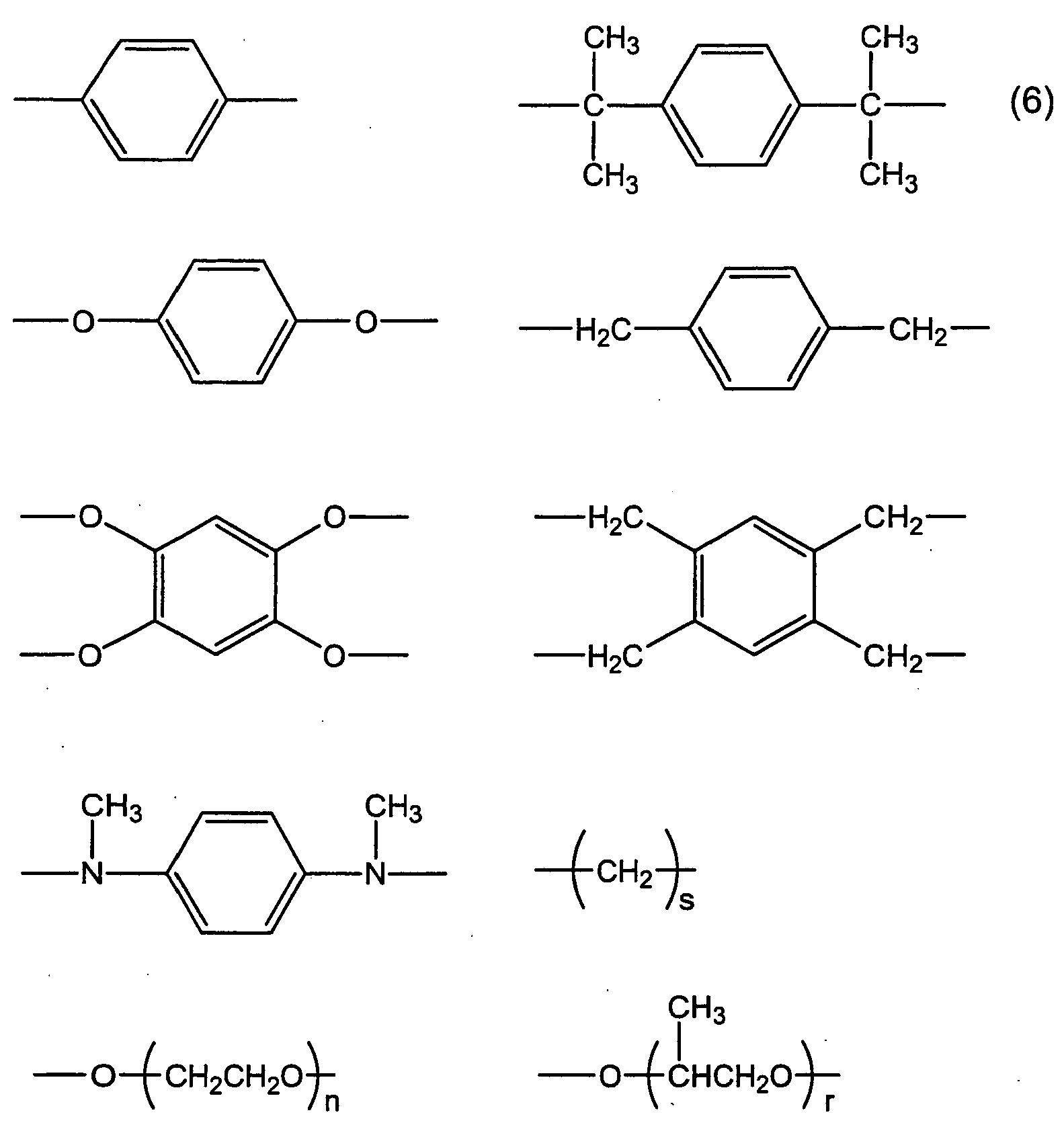
- In the thiocarbonylthio group-containing compound, p is preferably 1 or 2 and more preferably 1 from the viewpoint of availability.
- Examples of the thiocarbonyl compound include, but are not limited to, compounds represented by formulae (7) to (10):


- For the thiocarbonylthio group-containing compound, the optimum structure can be selected according to the type of the unsaturated monomer to be polymerized. For example, in polymerization of an acrylic monomer such as acrylate, methacrylate, acrylic acid, methacrylic acid, acrylamide, methacrylamide, acrylonitrile, or methacrylonitrile, or a styrene monomer such as styrene or α-methylstyrene, from the viewpoint of availability and polymerization activity, compounds represented by formula (11) are preferred:

- When the monomer polymerized is a vinyl ester monomer such as vinyl acetate or vinyl propionate, from the viewpoint of availability and polymerization activity, a xanthate compound or a dithiocarbamate compound is preferred, and a compound represented by formula (12) is more preferred.

- In the present invention, examples of the monomer to be polymerized include, but are not limited to, acrylate monomers, methacrylate monomers, acrylic acid and methacrylic acid and metal salts thereof, styrene monomers, vinyl cyanide monomers, conjugated diene monomers, halogen-containing vinyl monomers, vinyl ester monomers, unsaturated dicarboxylic acid compounds and derivatives thereof, and maleimide compounds.
- Examples of acrylate monomers include methyl acrylate, ethyl acrylate, n-propyl acrylate, isopropyl acrylate, n-butyl acrylate, tert-butyl acrylate, n-hexyl acrylate, 2-ethylhexyl acrylate, n-octyl acrylate, n-decyl acrylate, n-dodecyl acrylate, tridecyl acrylate, stearyl acrylate, cyclohexyl acrylate, phenyl acrylate, benzyl acrylate, 2-methoxyethyl acrylate, 3-methoxybutyl acrylate, 2-hydroxyethyl acrylate, 2-hydroxypropyl acrylate, glycidyl acrylate, 3-acryloyloxypropyl dimethoxymethylsilane, 3-acryloyloxypropyl trimethoxysilane, 2,2,2-trifluoroethyl acrylate, and allyl acrylate.
- Examples of methacrylate monomers include methyl methacrylate, ethyl methacrylate, n-propyl methacrylate, isopropyl methacrylate, n-butyl methacrylate, tert-butyl methacrylate, n-hexyl methacrylate, 2-ethylhexyl methacrylate, n-octyl methacrylate, n-decyl methacrylate, n-dodecyl methacrylate, tridecyl methacrylate, stearyl methacrylate, cyclohexyl methacrylate, phenyl methacrylate, benzyl methacrylate, 2-methoxyethyl methacrylate, 3-methoxybutyl methacrylate, 2-hydroxyethyl methacrylate, 2-hydroxypropyl methacrylate, glycidyl methacrylate, 3-methacryloyloxypropyl dimethoxymethylsilane, 3-methacryloyloxypropyl trimethoxysilane, 2,2,2-trifluoroethyl methacrylate, allyl methacrylate, and the like.
- Examples of acrylic acid, methacrylic acid and metal salts thereof include acrylic acid, methacrylic acid, sodium acrylate, potassium acrylate, sodium methacrylate, potassium methacrylate, and the like.
- Examples of styrene monomers include styrene, α-methylstyrene, p-methylstyrene, p-methoxystyrene, indene, and the like.
- Examples of vinyl cyanide monomers include acrylonitrile, methacrylonitrile, and the like.
- Examples of amide monomers include acrylamide, methacrylamide, and the like.
- Examples of conjugated diene monomers include butadiene, isoprene, chloroprene, and the like.
- Examples of halogen-containing vinyl monomers include vinyl chloride, vinylidene chloride, tetrafluoroethylene, hexafluoropropylene, vinylidene fluoride, and the like.
- Examples of vinyl ester monomers include vinyl acetate, vinyl propionate, vinyl pivalate, vinyl benzoate, vinyl cinnamate, and the like.
- Examples of unsaturated dicarboxylic acid compounds and derivatives thereof include maleic anhydride, maleic acid, maleic acid monoesters, maleic acid diesters, fumaric acid, fumaric acid monoesters, fumaric acid diesters, and the like.
- Examples of maleimide compounds include maleimide, methylmaleimide, ethylmaleimide, phenylmaleimide, cyclohexylmaleimide, and the like.
- These monomers may be used alone or in combination of two or more. When a combination of a plurality of monomers is copolymerized, the type of the copolymer produced is not particularly limited. Examples of the copolymer include random copolymers, block copolymers, graft copolymers, gradient copolymers, and the like. The monomer used may be selected according to the required characteristics of the resin composition and the polymer-modified ultrafine particles produced by finally coating ultrafine particles. For example, when the polymer-modified ultrafine particles are dispersed in a nonpolar resin, preferred are acrylonitrile, methacrylonitrile, acrylates, methacrylate, styrene, and the like. For the purpose of dispersing in a watersoluble resin, preferred are acrylic acid, methacrylic acid, acrylic acid metal salts, methacrylic acid metal salts, acrylamide, methacrylamide, hydroxyl group-containing acrylic acid, hydroxyl group-containing methacrylic acid, vinyl ester monomers, and the like. In this case, acrylic acid, methacrylic acid, acrylamide, methacrylamide, 2-hydroxyethyl acrylate, 2-hdyroxyethyl methacrylate, and vinyl acetate are more preferred from the viewpoint of availability.
- The type of the RAFT polymerization method used in the present invention is not particularly limited. For example, bulk polymerization, solution polymerization, emulsion polymerization, suspension polymerization, fine suspension polymerization, and the like can be used. Except in the bulk polymerization, the medium (solvent) used is not particularly limited, and any of solvents generally used for radical polymerization can be used. In view of availability and easy polymerization, water, toluene, ethyl acetate, butyl acetate, dimethylformamide, methyl ethyl ketone, and ethanol are preferred.
- The RAFT polymerization may be performed by a general known method, but a typical usable method is as follows: The thiocarbonylthio group-containing compound, a polymerization initiator, a radically polymerizable unsaturated monomer, and, if required, a medium (solvent) are charged in a reactor, and oxygen in the system is removed by an ordinary method, followed by heating and stirring in an inert gas atmosphere. The RAFT polymerization is characterized in that a polymer having a desired molecular weight can be obtained because the molecular weight of the resultant polymer depends on the charge ratio of the monomer to the thiocarbonylthio group-containing compound and the reaction rate of the monomer.
- The polymerization initiator used is not particularly limited, and any compound or method generally used for radical polymerization can be used. Examples of compounds generally used in radical polymerization include peroxide polymerization initiators, azo polymerization initiators, inorganic peroxides, vinyl monomers capable of thermally generating radicals, compounds capable of optically generating radicals, redox polymerization initiators, and the like. Specific examples of the peroxide polymerization initiators include isobutyl peroxide, α,α'-bis(neodecanoylperoxy) diisopropylbenzene, cumylperoxy neodecanoate, di-n-propylperoxy dicarbonate, diisopropylperoxy dicarbonate, di-sec-butylperoxy dicarbonate, 1,1,3,3-tetramethylbutylperoxy neodecanoate, bis(4-tert-butylcyclohexyl)peroxy dicarbonate, 1-cyclohexyl-1-methylethylperoxy neodecanoate, di-2-ethoxyethylperoxy dicarbonate, di(2-ethylhexylperoxy) dicarbonate, tert-hexylperoxy neodecanoate, dimethoxybutylperoxy dicarbonate, tert-butylperoxy neodecanoate, tert-hexylperoxy pivalate, tert-butylperoxy pivalate, 3,3,5-trimethylhexanoyl peroxide, octanoyl peroxide, lauroyl peroxide, stearoyl peroxide, 1, 1, 3, 3-tetramethylbutylperoxy-2-ethyl hexanoate, succinic peroxide, 2,5-dimethyl-2,5-di(2-ethylhexanoylperoxy)hexane, tert-hexylperoxy-2-ethyl hexanoate, 4-methylbenzoyl peroxide, tert-butylperoxy-2-ethyl hexanoate, benzoyl peroxide, tert-butylperoxy isobutylate, 1,1-bis(tert-butylperoxy) 2-methyl cyclohexane, 1,1-bis(tert-hexylperoxy)-3,3,5-trimethylcyclohexane, 1,1-bis(tert-hexylperoxy)cyclohexane, 1,1-bis(tert-butylperoxy)-3,3,5-trimethylcyclohexane, 1,1-bis(tert-butylperoxy)cyclohexane, 2,2-bis(4,4-di-butylperoxycyclohexyl)propane, tert-hexylperoxyisopropyl monocarbonate, tert-butylperoxy maleic acid, tert-butylperoxy-3,5,5-trimethyl hexanoate, tert-butylperoxy laurate, 2,5-dimethyl-2,5-di(m-toluoylperoxy)hexane, tert-butylperoxyisopropyl monocarbonate, tert-butylperoxy 2-ethylhexyl monocarbonate, tert-hexylperoxy benzoate, 2,5-dimethyl-2,5-di(benzoylperoxy)hexane, tert-butylperoxy acetate, 2,2-bis(tert-butylperoxy)butane, tert-butylperoxy benzoate, n-butyl-4,4-bis(tert-butylperoxy) valerate, di-tert-butylperoxy isophthalate, α,α'-bis(tert-butylperoxy)diisopropylbenzene, dicumyl peroxide, 2,5-dimethyl-2,5-di(tert-butylperoxy)hexane, tert-butylcumyl peroxide, di-tert-butyl peroxide, p-methane hydroperoxide, 2,5-dimethyl-2,5-di(tert-butylperoxy)hexyne-3, diisopropylbenzene hydroperoxide, tert-butyltrimethylsilyl peroxide, 1,1,3,3-tetramethylbutyl hydroperoxide, cumene hydroperoxide, and tert-butyl hydroperoxide.
- Examples of the azo polymerization initiators include 2,2'-azobis(4-methoxy-2,4-dimethylvaleronitrile), 2,2'-azobis(2,4-dimethylvaleronitrile), 2,2'-azobisisobutyronitrile, 2,2'-azobis(2-methylbutyronitrile), 1,1'-azobis(cyclohexane-1-carbonitrile), 2-(carbamoylazo)isobutyronitrile, 2,2'-azobis(2-methyl-N-phenylpropionamidine) dihydrochloride, 2,2'-azobis[N-(4-chlorophenyl)-2-methylpropionamidine] dihydrochloride, 2,2'-azobis[N-(4-hydroxyphenyl)-2-methylpropionamidine] dihydrochloride, 2,2'-azobis[2-methyl-N-(phenylmethyl)propionamidine] dihydrochloride, 2,2'-azobis[2-(N-allylamidino)propane] dihydrochloride, 2,2'-azobis[2-(5-methyl-2-imidazolin-2-yl)propane] dihydrochloride, 2,2'-azobis[2-(2-imidazolin-2-yl)propane] dihydrochloride, 2,2'-azobis[2-(4,5,6,7-tetrahydro-1H-1,3-diazepin-2-yl)propane] dihydrochloride, 2,2'-azobis{2-methyl -N-[1,1-bis(hydroxymethyl)-2-hydroxyethyl] propionamide}, 2,2'-azobis{2-methyl-N-[1,1-bis(hydroxymethyl)ethyl]propionamide}, 2,2'-azobis(isobutylamide) dihydrate, 2,2'-azobis (2,4,4-trimethylpentane), dimethyl 2,2'-azobisisobutylate, and 4,4'-azobis(4-cyanovaleric acid).
- Examples of the inorganic peroxides include potassium persulfate and sodium persulfate.
- Examples of the vinyl monomers capable of thermally generating radicals include styrene.
- Examples of the compounds capable of optically generating radicals include benzoin derivatives, benzophenone, acylphosphine oxides, and photoredox compounds.
- Examples of the redox polymerization initiators include reducing agents such as sodium sulfite, sodium thiosulfate, sodium formaldehyde sulfoxylate, ascorbic acid, and ferrous sulfate; and oxidizing agents such as potassium peroxodisulfate, hydrogen peroxide, and tert-butyl hydroperoxide. These polymerization initiators may be used alone or in combination of two or more. A general method used for radical polymerization may use a polymerization initiation system using electron beam irradiation, X-ray irradiation, radiation irradiation, or the like.
- Although the amount of the polymerization initiator used in the present invention is not particularly limited, the amount of radical species produced in polymerization is preferably 1 mol or less, more preferably 0.5 mol or less, and further preferably 0.3 mol or less per mol of the thiocarbonylthio group of the thiocarbonylthio group-containing compound from the viewpoint of a higher rate of terminal functionalization of a mercapto group.
- In the present invention, the thiocarbonylthio group-containing polymer produced by the RAFT polymerization is treated with a treating agent to produce a polymer having a mercapto group at one end. The treating agent is not particularly limited, but a base, an acid, or a hydrogen-nitrogen bond-containing compound is preferred from the viewpoint of high reaction efficiency.
- Specific examples of the base among the above-described treating agents include, but are not limited to, metal hydroxides, such as sodium hydroxide, potassium hydroxide, calcium hydroxide, magnesium hydroxide, aluminum hydroxide, and zinc hydroxide; metal alkoxides, such as sodium methoxide, sodium ethoxide, sodium phenoxide, and magnesium methoxide; metal hydrides, such as sodium hydride, lithium hydride, calcium hydride, lithium aluminum hydride, and sodium borohydride; salts of strong bases with weak acids, such as sodium carbonate, potassium carbonate, sodium acetate, and potassium acetate; organic metal reagents, such as hydrosulfite, n-butyllithium, tert-butyllithium, ethylmagnesium bromide, and phenylmagnesium bromide; and tertiary amine compounds, such as triethylamine and tri-n-butylamine. Other usable examples include alkali metals, such as metallic lithium, metallic sodium, and metallic potassium; and alkaline earth metals, such as metallic magnesium and metallic calcium. These compounds may be used alone or in combination of two or more.
- Specific examples of the acid among the treating agents include, but are not limited to, inorganic acids, such as hydrochloric acid, nitric acid, sulfuric acid, phosphoric acid, hydrofluoric acid, hydroborofluoric acid, and chlorosulfonic acid; organic acids, such as p-toluenesulfonic acid, trifluoromethanesulfonic acid, acetic acid, trifluoroacetic acid, methylphosphoric acid, stearylphosphoric acid, dimethyldithiophosphoric acid, diethyldithiophosphoric acid, and phenylphosphonic acid; and ion-exchange resins. Other usable examples include acid anhydrides, such as acetic anhydride, propionic anhydride, trifluoroacetic anhydride, phthalic anhydride, and succinic anhydride; acyl halides, such as acetyl chloride and benzoyl chloride; metal halides, such as titanium tetrachloride, aluminum chloride, and silicon chloride; and compounds exhibiting acidity by reaction with moisture, such as thionyl chloride. These compounds may be used alone or in combination of two or more.
- Specific examples of the hydrogen-nitrogen bond-containing compound among the treating agents include, but are not limited to, ammonia, hydrazine, primary amine compounds, secondary amine compounds, amide compounds, amine hydrochloride compounds, hydrogen-nitrogen bond-containing polymers, and hindered amine light stabilizers (HALS).
- Specific examples of the primary amine compounds among the hydrogen-nitrogen bond-containing compounds include 3-amino-1-propanol, allylamine, isopropylamine, monoethylamine, 2-ethylhexylamine, n-butylamine, tert-butylamine, n-propylamine, 3-methoxypropylamine, 2-aminoethanol, ethylenediamine, diethylenetriamine, triethylenetetramine, 1,4-diaminobutane, 1,2-diaminopropane, 1,3-diaminopropane, diaminomaleonitrile, cyclohexylamine, hexamethylenediamine, n-hexylamine, monomethylamine, monomethylhydrazine, anisidine, aniline, ethyl p-aminobenzoate, aminophenol, toluidine, phenylhydrazine, phenylenediamine, phenethylamine, benzylamine, mesidine, aminopyridine, and melamine.
- Specific examples of the secondary amine compounds among the hydrogen-nitrogen bond-containing compounds include diallylamine, diisopropylamine, diethylamine, diisobutylamine, di-2-ethylhexylamine, bis(hydroxyethyl)amine, N-ethylethylenediamine, ethyleneimine, dicyclohexylamine, di-n-butylamine, di-tert-butylamine, dimethylamine, N-ethylaniline, diphenylamine, dibenzylamine, N-methylaniline, imidazole, 2,5-dimethylpiperazine, piperazine, piperidine, pyrrolidine, and morpholine.
- Specific examples of the amide compounds among the hydrogen-nitrogen bond-containing compounds include adipic acid dihydrazide, N-isopropylacrylamide, carbohydrazide, guanylthiourea, glycylglycine, oleic acid amide, stearic acid amide, adipic acid dihydrazide, formamide, methacrylamide, acetanilide, acetoacetic acid anilide, acetoacetic acid toluidide, toluenesulfonamide, phthalimide, isocyanuric acid, succinic acid imide, hydantoin, phenylpyrazolidone, benzamide, acetamide, acrylamide, propionic acid amide, and 2,2,2-trifluoroacetamide.
- Specific examples of amine hydrochloride compounds among the hydrogen-nitrogen bond-containing compounds include acetamidine hydrochloride, monomethylamine hydrochloride, dimethylamine hydrochloride, monoethylamine hydrochloride, diethylamine hydrochloride, monopropylamine hydrochloride, dipropylamine hydrochloride, semicarbazide hydrochloride, guanidine hydrochloride, and cysteamine hydrochloride.
- Specific examples of the hydrogen-nitrogen bond-containing polymers among the hydrogen-nitrogen bond-containing compounds include Polyment (trade name) (manufactured by Nippon Shokubai Co., Ltd.), polyethyleneimine, aminopolyacrylamide, nylon 6, nylon 66, nylon 610, nylon 612, nylon 11, nylon 12, nylon MXD6, nylon 46, polyamide-imide, polyallylamine, and polyurethane.
- Specific examples of the hindered amine light stabilizes (HALS) among the hydrogen-nitrogen bond-containing compounds include, but are not limited to, trade name, Adecastab LA-77 (manufactured by Asahi Denka Kogyo Co., Ltd.), trade name, Chimassorb 944LD (manufactured by Ciba Specialty Chemicals Inc.), trade name, Tinuvin 144 (manufactured by Ciba Specialty Chemicals Inc.), trade name, Adecastab LA-57 (manufactured by Asahi Denka Kogyo Co., Ltd.), trade name, Adecastab LA-67 (manufactured by Asahi Denka Kogyo Co., Ltd.), trade name, Adecastab LA-68 (manufactured by Asahi Denka Kogyo Co., Ltd.), trade name, Adecastab LA-87 (manufactured by Asahi Denka Kogyo Co., Ltd.), and trade name, Goodrite UV-3034 (manufactured by Goodrich Chemical Co.).
- Among these treating agents, the bases and the hydrogen-nitrogen bond-containing compounds are preferred from the viewpoint of high reaction efficiency, the hydrogen-nitrogen bond-containing compounds are more preferred from the viewpoint of ease of handling, and monomethylamine, monoethylamine, dimethylamine, diethylamine, monobutylamine, dibutylamine, and cyclohexylamine are further preferred from the viewpoint of availability and ease of recovery and removal.
- When ultrafine particles are produced using the reducing agent, as described below, the reducing agent also functions as the treating agent for converting a thiocarbonylthio group to a mercapto group. Therefore, the production of the ultrafine particles, preparation of a mercapto group-containing polymer, and modification of the ultrafine particles with the mercapto group-containing polymer can be simultaneously performed.
- The amount of the treating agent used is not particularly limited. When a base or acid is used as the treating agent, from the viewpoint of ease of handling and reactivity, the treating agent used is preferably 0.01 to 100 parts by weight, more preferably 0.05 to 50 parts by weight, and particularly preferably 0.1 to 30 parts by weight relative to 100 parts by weight of the thiocarbonylthio group-containing polymer. When a hydrogen-nitrogen bond-containing compound is used as the treating agent, the amount of the hydrogen-nitrogen bond-containing compound used is preferably 0.5 to 1000 mol and more preferably 1 to 500 mol per mol of the thiocarbonylthio groups of the polymer.
- The molecular weight of the polymer having a mercapto group at one end cannot be specified because a preferred range varies depending on the type of the ultrafine particles used, the particle size, the type of the resin used, the amount of the particles added, etc. However, from the viewpoint of easy progress of polymerization reaction, the ability to securely leave a mercapto group at one end, and the like, the number-average molecular weight is preferably in a range of about 100 to 1,000,000, more preferably in a range of 500 to 400,000, and most preferably in a range of 2,000 to 200,000.
- Since the polymer having a mercapto group at one end is produced by reversible addition-fragmentation chain transfer (RAFT) polymerization, the molecular weight distribution (weight-average molecular weight/number-average molecular weight) is generally very narrow, and, for example, about 2.0 or less and generally about 1.3 or less. In the present invention, in view of uniform dispersibility and ease of handling, the molecular weight distribution of the polymer having a mercapto group at one end is preferably 2 or less and more preferably 1.5 or less.
- Examples of metal ultrafine particles among the ultrafine particles used in the present invention include particles of elemental metals, such as gold, silver, copper, zinc, cadmium, gallium, indium, silicon, germanium, tin, palladium, iron, cobalt, nickel, ruthenium, rhodium, osmium, iridium, platinum, vanadium, chromium, manganese, yttrium, zirconium, niobium, molybdenum, calcium, strontium, barium, antimony, and bismuth; and alloys thereof, such as iron-platinum. The ultrafine particles may be composite ultrafine particles including other various types of ultrafine particles having metal-coated surfaces. Among these ultrafine particles, ultrafine particles containing 10% by weight or more of at least one selected from the group consisting of gold, platinum, silver, palladium, rhodium, ruthenium, and cobalt are preferred because the low oxidizability of the surfaces can facilitate the formation of bonds between the ultrafine particle surfaces and the polymer having a mercapto group at one end. A form including the above-described metal may be an alloy or other ultrafine particles coated with a metal. In particular, ultrafine particles containing 10% by weight or more of gold or platinum are preferred, and ultrafine particles of gold, platinum, or iron-platinum are most preferred. When iron-platinum ultrafine particles are used, the iron/platinum ratio by weight is preferably 20/80 to 80/20 and more preferably 30/70 to 70/30. Within this range, the ultrafine particles having a high antioxidative force at the particle surfaces and excellent magnetic properties can be preferably obtained.
- Examples of the semiconductor ultrafine particles among the ultrafine particles used in the present invention include particles of group 14 elements in the periodic table, such as C, Si, Ge, and Sn; group 15 elements in the periodic table, such as P (black phosphorus); group 16 elements in the periodic table, such as Se and Te; compounds each including a plurality of group 14 elements in the periodic table, such as SiC; compounds each including a group 14 element and group 16 element in the periodic table, such as SnO2, Sn(II)Sn(IV)S3, SnS2, SnS, SnSe, SnTe, PbS, PbSe, and PbTe; compounds each including a group 13 element and group 15 element in the periodic table, such as BN, BP, BAs, AlN, AlP, AlAs, AlSb, GaN, GaP, GaAs, GaSb, InN, InP, InAs, and InSb; compounds each including a group 13 element and group 16 element in the periodic table, such as Al2S3, Al2Se3, Ga2O3, Ga2S3, Ga2Se3, Ga2Te3, In2O3, In2S3, In2Se3, and In2Te3; compounds each including a group 13 element and group 17 element in the periodic table, such as TlCl, TlBr, and TlI; compounds each including a group 12 element and group 16 element in the periodic table, such as ZnO, ZnS, ZnSe, ZnTe, CdO, CdS, CdSe, CdTe, HgO, HgS, HgSe, and HgTe; compounds each including a group 15 element and group 16 element in the periodic table, such as As2O3, As2S3, As2Se3, As2Te3, Sb2O3, Sb2S3, Sb2Se3, Sb2Te3, Bi2O3, Bi2S3, Bi2Se3, and Bi2Te3; compounds each including a group 11 element and group 16 element in the periodic table, such as Cu2O and Cu2Se; compounds each including a group 11 element and group 17 element in the periodic table, such as CuCl, CuBr, CuI, AgCl, and AgBr; compounds each including a group 10 element and group 16 element in the periodic table, NiO; compounds each including a group 9 element and group 16 element in the periodic table, such as CoO and CoS; compounds each including a group 8 element and group 16 element in the periodic table, such as iron oxides, e.g., Fe3O4, and FeS; compounds each including a group 7 element and group 16 element in the periodic table, such as MnO; compounds each including a group 6 element and group 16 element in the periodic table, such as MoS2 and WO2; compounds each including a group 5 element and group 16 element in the periodic table, such as VO, VO2, and Ta2O5; compounds each including a group 4 element and group 16 element in the periodic table, such as titanium oxides, e.g., TiO2, Ti2O5, Ti2O3, and Ti5O9 (crystal type may be any of a rutile type, a rutile/anatase mixed type, and an anatase type), and ZrO2; compounds each including a group 2 element and group 16 element in the periodic table, such as MgS and MgSe; chalcogen spinels, such as CdCr2O4, CdCr2Se4, CuCr2S4, and HgCr2Se4; and BaTiO3.
- Among these semiconductor ultrafine particles, preferred are particles of compounds each including a group 14 element and group 16 element in the periodic table, compounds each including a group 13 element and group 15 element in the periodic table, compounds each including a group 13 element and group 16 element in the periodic table, compounds each including a group 12 element and group 16 element in the periodic table, compounds each including a group 15 element and group 16 element in the periodic table, compounds each including a group 4 element and group 16 element in the periodic table, and compounds each including a group 2 element and group 16 element in the periodic table. In particular, SnO2, GaN, GaP, In2O3, InN, InP, Ga2O3, Ga2S3, In2O3, In2S3, ZnO, ZnS, CdO, CdS, titanium oxides, ZrO2, and MgS are preferred from the viewpoint of high refractive indexes and environmental contamination resistance and safety of organisms due to the absence of high-toxicity negative elements. Furthermore, SnO2, In2O3, ZnO, ZnS, iron oxides, titanium oxides, and ZrO2 are more preferred because of their compositions not containing high-toxicity positive elements. In particular, oxide semiconductor crystals, such as ZnO, titanium oxides (preferably a rutile crystal for a high refractive index), and ZrO2 are most preferred. Furthermore, ultrafine particles having a luminescent band in the visible region and the vicinity thereof are industrially important. Examples of such ultrafine particles include ultrafine particles of compounds each including a group 13 element and a group 15 element in the periodic table, such as GaN, GaP, GaAs, InN, and InP; compounds each including a group 12 element and a group 16 element in the periodic table, such as ZnO, ZnS, ZnSe, ZnTe, CdO, CdS, CdSe, CdTe, HgO, and HgS; In2O3; and In2S3. In particular, compound semiconductors each including a group 12 element and a group 16 element in the periodic table, such as ZnO, ZnS, ZnSe, ZnTe, CdO, CdS, and CdSe, are preferred from the viewpoint of controllability of the grain size of semiconductor crystals and luminescent ability, and ZnSe, CdS, and CdSe are more preferably used for this purpose. These examples of the semiconductor crystals may have a composition containing a trace of an element, such as Al, Mn, Cu, Zn, Ag, Cl, Ce, Eu, Tb, or Er, according to demand.
- Among these ultrafine particles, metal ultrafine particles containing a transition metal element of any one of the groups 8 to 13 in the periodic table are preferred because of the high force of forming a coordinate bond between the mercapto group of the polymer having the mercapto group at one end and the transition metal element and the rapid progress of surface modification reaction of the ultrafine particles.
- The ultrafine particles used in the present invention are generally produced by synthesis from a precursor of a metal or a semiconductor using a general process for producing ultrafine particles, such as a vapor phase process, a liquid phase process, or the like. However, the process for producing the ultrafine particles is not limited to these, and any known process can be used. An example of known processes will be described below.
- As a process for producing metal ultrafine particles, a liquid phase process can be used, in which a transition metal ion compound or its salt or an organic complex thereof is reduced by uniform contact with a reducing agent in water or a polar solvent. An example of a process for producing composite ultrafine particles having metal-coated surfaces is a process in which previously prepared ultrafine particles (metal ultrafine particles, semiconductor ultrafine particles, metal oxide ultrafine particles, or the like) are uniformly dispersed in water or a polar solvent, and a transition metal ion compound or its salt or an organic complex thereof is reduced by uniform contact with a reducing agent in water or a polar solvent in coexistence of the ultrafine particles.
- Examples usable as a process for producing semiconductor ultrafine particles include a process (reversed micelle process) in which an aqueous raw material solution is placed in a reversed micelle of a nonpolar organic solvent to growth a crystal, a process (hot soap process) in which a pyrolytic raw material is subjected to crystal growth in a liquid organic solvent at a high temperature, and the like. These processes can be preferably used from the viewpoint of easy control of the particle size of the ultrafine particles.
- The ultrafine particles used in the present invention preferably have, in an unaggregated state, a number-average primary particle size of 100 nm or less, more preferably 50 nm or less, further preferably 30 nm or less, and most preferably 15 nm or less. When the number-average primary particle size in an unaggregated state is larger than 100 nm, excellent optical properties, thermal and mechanical properties, electric properties, magnetic properties, and the like may not be obtained by the special effect of addition of the ultrafine particles. In view of higher dispersibility, the lower limit of the number-average primary particle size in an unaggregated state is 0.2 nm and more preferably 1 nm. Furthermore, the coefficient of variation (particle size distribution) of the number-average primary particle size of the ultrafine particles in an unaggregated state is preferably 50% or less and more preferably 30% or less. When the particle size distribution of the ultrafine particles is too wide, i.e., the coefficient of variation of the particle size exceeds 50%, excellent optical properties, thermal and mechanical properties, electric properties, magnetic properties, and the like may not be obtained by the special effect of addition of the ultrafine particles.
- In the present invention, the number-average primary particle size in an unaggregated state means the number-average particle size calculated from ruler measurements of the particles sizes of at least 100 particles in a transmission electron micrograph or scanning electron micrograph. When particles micrographed by an electron microscope are not circular, the area of each particle is calculated, and the diameter of a circle having the same area can be used.
- The surfaces of the ultrafine particles used in the present invention are modified by the polymer having a mercapto group at one end to significantly improve the dispersibility in a resin composition, and thereby a resin composition containing the ultrafine particles and having excellent characteristics can be easily obtained.
- A method for modifying the surfaces of the ultrafine particles with the polymer having a mercapto group at one end is not particularly limited, and any method can be used. For example, when the polymer having a mercapto group at one end can be dissolved in a solvent in which the ultrafine particles can be dispersed, the surfaces of the ultrafine particles can be modified by a method in which the ultrafine particles are dispersed in the solvent, and the polymer having a mercapto group at one end is dissolved in the same solvent, followed by stirring to bond mercapto groups at the ends of the polymer to the surfaces of the ultrafine particles.
- When the polymer having the mercapto group at one end cannot be or is hardly dissolved in a solvent in which the ultrafine particles can be dispersed, the surfaces of the ultrafine particles can be modified by any one of the following various operations:
- For example, a modifier which has a ligand with relatively weak coordination force in its molecule, such as an amino group, a phosphine oxide group, a phosphine group, or the like, and which can be dissolved in a solvent for dispersing the ultrafine particles, is selected, and the ligand having weak coordination force is previously bonded to the surfaces of the ultrafine particles. Then, the ultrafine particles are isolated by centrifugal separation or the like, and then dispersed in a solvent in which the polymer having a mercapto group at one end can be dissolved. The polymer having a mercapto group at one end is dissolved in the solvent and brought into contact with the ultrafine particles in the liquid phase containing the ultrafine particles to produce ligand exchange reaction, thereby substituting the ligand having weak coordination force by a mercapto group. Alternatively, two-step ligand exchange may be preferably used, the ligand exchange including a first step of dispersing the ultrafine particles in a liquid phase containing an excessive amount of a compound with weak coordination force (generally used as a solvent), such as pyridine, and a second step of adding the polymer having a mercapto group at one end.
- The surfaces of the ultrafine particles may be modified by a method in which the ultrafine particles are dispersed in a solvent which can disperse them, and the resultant dispersion is mixed with a solution separately prepared by dissolving the polymer having a mercapto group at one end in a solvent which can dissolve it. In this method, when the solvent dispersing the ultrafine particles is not miscible with the solvent dissolving the polymer, the ultrafine particles are extracted with the solvent dissolving the polymer as modification of the surfaces of the ultrafine particles proceeds. This is preferred because the completion of modification can be easily confirmed. In this case, a phase-transfer catalyst, such as a tetraalkylammonium salt, a tetraalkylphosphonium salt, or the like, may be preferably combined.
- Another effective method is to add the polymer having a mercapto group at one end to a reaction liquid phase during the production of the ultrafine particles in the liquid phase. This method is capable of completing the modification of the surfaces of the ultrafine particles at the same time as synthesis of the ultrafine particles, and also the effect of preventing aggregation of the ultrafine particles during synthesis of the ultrafine particles can be expected. Therefore, this method is preferred as a modification method.
- In modifying the ultrafine particles with the polymer having a mercapto group at one end, the modification reaction can be more effectively completed by uniform stirring. When ultrasonic waves are applied during stirring, the surfaces can be uniformly modified with prevention of aggregation. When microwaves are applied, energy can be locally applied to the particles, and thus the efficiency of surface modification may be significantly improved.
- Other usable methods for modifying the surfaces of the ultrafine particles with the polymer having a mercapto group at one end include a method in which the ultrafine particles are powdered by centrifugal separation or the like and then mixed with a melt of the polymer having a mercapto group at one end, a method in which a dispersion of the ultrafine particles in a solvent is added to a melt of the polymer having a mercapto group at one end and mixed therewith under shear force, and then the solvent is removed under reduced pressure or evaporated to modify the ultrafine particles, and the like. As an apparatus for mixing the ultrafine particles with a melt of the polymer having a mercapto group at one end in these methods, a single-screw extruder, a multi-screw kneader such as a double-screw extruder or a quadruple-screw extruder, a roller, a Banbury mixer, a kneader, or the like can be used. Among these apparatuses, a kneader having high shearing efficiency is preferred, and a multi-screw kneader such as a double-screw extruder or a quadruple-screw extruder, is particularly preferred because of the high efficiency of modification reaction and ease of industrialization.
- The ratio by weight between the polymer having a mercapto group at one end and the ultrafine particles greatly varies depending on the purpose of use, the composition and molecular weight of the polymer, the specific gravity of the ultrafine particles, the particle size and surface area of the ultrafine particles, the surface state of the ultrafine particles, etc. In other words, when the polymer has a relatively high molecular weight, a relatively large amount of the polymer must be used for modifying the entire surfaces of the particles because of the number of mercapto groups in the polymer is decreased. On the other hand, when the polymer has a relatively low molecular weight, the amount of the polymer added may be small because the number of the mercapto groups in the polymer is increased. When the ultrafine particles have a relatively small particle size, a relatively large amount of the polymer must be used for modifying the entire surfaces of the particles because the number of the ultrafine particles is increased to increase the surface area. On the other hand, when the ultrafine particles have a relatively large particle size, the amount of the polymer added may be small.
- As a general standard for the ratio by weight between the polymer having a mercapto group at one end and the ultrafine particles, the ratio by weight may be determined on the basis of such calculation that the number of the constituent atoms present at the surfaces of the ultrafine particles is substantially close to the number of the mercapto groups of the polymer. Namely, when the ultrafine particles have a small particle size, many surface irregularities, or porosity, the amount of the polymer having a mercapto group at one end and used for improving dispersibility tends to increase as the ratio of the constituent atoms present in the surfaces of the ultrafine particles increases.
- A method for mixing the resultant polymer-modified ultrafine particles in a resin having compatibility with the polymer-modified ultrafine particles is not particularly limited, and any known mixing method can be used.
- For example, the polymer-modified ultrafine particles are dispersed in a solvent which can dissolve the resin, and the resin is dissolved in the solvent, followed by stirring to prepare a uniform solution. Then, the solvent is removed by evaporation or the like to easily produce a resin composition in which the ultrafine particles are uniformly dispersed in the resin. In this method, in order to improve the dispersibility of the ultrafine particles and prevent aggregation of the ultrafine particles, the solution is preferably stirred with any one of various known apparatuses, for obtaining the resin composition containing the ultrafine particles uniformly dispersed therein. Examples of a stirring method include, but are not limited to, a method of rotating a rotating device such as a stir bar, a stir rod, or the like in the solvent, a method of stirring with a medium such as beads, a method of stirring by irradiation with ultrasonic waves or the like, a method of stirring by applying high shear force of high-speed rotation or the like, and the like.
- Further usable methods for producing the resin composition include a method in which the polymer-modified ultrafine particles are isolated from a solvent by centrifugal separation or the like and then mixed in a melt of the resin to disperse the polymer-modified ultrafine particles in the resin, a method in which a dispersion of the polymer-modified ultrafine particles in a solvent is added to a melt of the resin and mixed therewith under shear force, and then the solvent is removed under reduced pressure or evaporated to disperse the polymer-modified ultrafine particles, and the like. As an apparatus for producing the resin composition by these methods, a single-screw extruder, a multi-screw kneader such as a double-screw extruder or a quadruple-screw extruder, a roller, a Banbury mixer, a kneader, or the like can be used. In particular, a kneader having high shearing efficiency is preferred.
- In the resin composition containing the ultrafine particles produced in the present invention, 80% or more, more preferably 85% or more, and most preferably 90% or more of the total ultrafine particles are independently present without contact with each other. Since such ultrafine particles are uniformly dispersed in the resin composition, the resultant resin composition has no defect in the excellent optical properties, thermal and mechanical properties, electric properties, magnetic properties, and the like which are inherently possessed by ultrafine particles. When over 20% of the total ultrafine particles are present in contact with each other, i.e., when over 20% of the ultrafine particles are aggregated, the resin composition exhibits properties like those of particles dispersed in a resin and having a particle size equivalent to that of aggregates of ultrafine particles, not the properties inherently possessed by ultrafine particles. Therefore, the optical properties, thermal and mechanical properties, electric properties, magnetic properties, and the like tend to be impaired.
- The shape of the ultrafine particles usable in the present invention is not particularly limited, and any desired shape can be used. Examples of the shape include a spherical shape; three-dimensional shapes close to a sphere, such as a rugby ball-like shape, a soccer ball-like shape, and an icosahedral shape; a hexahedral shape; a rod-like shape; a needle-like shape; a plate-like shape; a scale-like shape; a crushed shape; and irregular shapes. Furthermore, the particles may have hollows or defects in the surfaces or inside the particles or may be porous particles having many pores in the surfaces and inside the particles. However, from the viewpoint of ease of production of the ultrafine particles, ease of uniform dispersion in the resin, ease of treatment of the particle surfaces, and the like, a spherical shape or a three-dimensional shape close to a sphere is preferred. The term "a three-dimensional shape close to sphere" means a shape preferably having a (surface area of particle)/(surface area of sphere having the same volume as particle) ratio of 3 or less, more preferably 2 or less, and particularly preferably 1.5 or less. The ultrafine particles used in the present invention may be of a single type, a combination of two or more types of particles, or a combination of particles having two or more shapes. The ultrafine particles may be a combination of two or more types of particles having different particle size distributions.
- The lower limit of the content of the ultrafine particles in the resin composition of the present invention is preferably 0.0001 part by weight, more preferably 0.001 part by weight, further preferably 0.01 part by weight, and most preferably 0.1 part by weight relative to 100 parts by weight of the resin. The upper limit of the content is preferably 200 parts by weight, more preferably 150 parts by weight, further preferably 100 parts by weight, and most preferably 50 parts by weight. When the content of the ultrafine particles is less than 0.0001 part by weight, the electronic, optical, electric, magnetic, chemical, and mechanical properties characteristics of the addition of the ultrafine particles may not be sufficiently obtained. When the content exceeds 200 parts by weight, the ultrafine particles tend to become difficult to disperse.
- In the resin composition of the present invention, the ratio between the polymer having the mercapto group at one end and the resin is determined by the ratio between the ultrafine particles and the polymer having the mercapto group at one end and the ratio between the resin and the ultrafine particles. However, a preferred range varies depending on the types of the resin and the particles and the purpose of use, and the like. In particular, when a dispersion of a large amount of the ultrafine particles in the resin is desired, most of the ultrafine particles being modified with the polymer having a mercapto group at one end, the polymer having a mercapto group at one end can also be used as the resin. In this case, the resin in the resin composition entirely has a mercapto group at one end, and thus the modified ultrafine particles and the resin need not be mixed, thereby greatly facilitating uniform dispersion of the ultrafine particles in the resin.
- The resin used in the resin composition of the present invention is not particularly limited, and a wide range of various known thermoplastic resins and thermosetting resins can be used alone or in combination of two or more selected therefrom according to demand.
- However, when the resin used in the resin composition and the polymer having a mercapto group at one end have compositions miscible with each other, the ultrafine particles can be dispersed in the resin with high dispersibility. In other words, the resin used in the resin composition and the polymer having a mercapto group at one end are preferably compatible with each other.
- As a method for determining whether or not the resin used in the resin composition and the polymer having a mercapto group at one end are miscible with each other, determination is made as to whether or not a uniform composition can be obtained by mixing the resin used in the resin composition and the polymer having a mercapto group at one end in the absence of the ultrafine particles. In the present invention, the term "compatible" means that a mixture of a resin and a polymer is seen with the eyes as a combination of uniformly miscible resin and polymer. In particular, when an ultrathin section of a mixture of the resin and the polymer is observed through a transmission electron microscope or the like, the combination preferably has such a degree of excellent compatibility that both are ultrafinely dispersed at the nanometer-order level or such a degree of compatibility that the boundaries between both are not observed. This is because the dispersibility of the ultrafine particles in a dispersion is significantly excellent, and the resin composition containing the ultrafine particles uniformly dispersed in the polymer can be easily obtained.
- In observation of an ultrathin section of the mixture through a transmission electron microscope, when a micro-size layered structure is observed while the mixture is seen with the eyes as a uniformly mixed composition, the effect of improving the dispersibility of the ultrafine particles can be slightly expected. However, the expected effect of improving the dispersibility may be only equivalent to that obtained by an ordinary well-known modifier for ultrafine particles. In this case, therefore, a proper dispersion method or the like is preferably selected.
- The particularly preferred combination of the resin used in the resin composition and the polymer having a mercapto group at one end has the chemically same composition. The combination more preferably has similar molecular weight distributions or similar main-chain and branch structures in addition to the same composition because the compatibility is further improved.
- When the excellent optical properties are expected from the resultant resin composition, the resin used in the present invention is preferably a resin transmitting visible light. Specifically, the term "resin transmitting visible light" means a resin exhibiting a total light transmittance of 50% or more in measurement with a thickness of 2 mm on the basis of ASTM D1003. However, in order to use the composition of the present invention for optical applications, the total light transmittance is suitably as high as possible, and preferably 60% or more, more preferably 70% or more, and most preferably 80% or more. Also, a resin transmitting visible light preferably has a as small haze as possible in measurement with a thickness of 2 mm on the basis of ASTM D1003. Specifically, the haze is 10% or less, preferably 7% or less, more preferably 5% or less, and most preferably 3% or less. Specific examples of the resin transmitting visible light include polyolefins, such as polyethylene and polypropylene; olefin/vinyl monomer copolymers, such as olefin/maleimide copolymers; aromatic vinyl polymers, such as polystyrene; aromatic vinyl/vinyl monomer copolymers, such as styrene/acrylonitrile copolymers, styrene/methyl methacrylate copolymers, and styrene/maleimide copolymers; polymethacrylates, such as polymethyl methacrylate; polyacrylates, such as polymethyl acrylate; polyphenylenether; polycarbonates; polyvinyl chloride; polyethylene terephthalate; polyarylate; polyethersulfone; polyethylene naphthalate; polymethylpentene-1; alicyclic polyolefins (e.g., ring-opened polymers(copolymers)of cyclic olefins, such as dicyclopentadiene-based polyolefins and norbornene-based polyolefins, and hydrogenated polymers (copolymers) thereof, and saturated copolymers of cyclic olefins and unsaturated double bond-containing compounds); copolymers of alicyclic methacrylate or alicyclic acrylates, e.g., tricyclodecanyl methacrylate, cyclohexyl methacrylate, or the like, and acrylates or methacrylates, e.g., methyl methacrylate; polysulfone; polyether-imide, amorphous polyamides; cellulose resins, such as triacetyl cellulose; glutarimide resins; hydrogenated polymers obtained by hydrogenating polymers (copolymers) of cyclic olefins, cyclopentadiene, and aromatic vinyl compounds; and the like. Among these resins, polymethyl methacrylate resins, polycarbonate resins, polystyrene resins, cycloolefin resins, cellulose resins, vinyl chloride resins, polysulfone resins, polyethersulfone resins, maleimide-olefin resins, and glutarimide resins have preferred optical properties. These resins may be used as a mixture of two or more. However, when a mixture of two or more of the light-transmitting resins is used, simple mixing may decrease light transmittance. Therefore, it is necessary to increase the compatibility between the resins mixed to achieve a substantially uniform composition. As a method for increasing the compatibility between the resins mixed, a method of adding a small amount of a copolymer of both resins as a compatibilizer, or the like can be used.
- The resin composition produced in the present invention may contain additives such as a pigment or a dye, a heat stabilizer, an antioxidant, an ultraviolet absorber, a light stabilizer, a lubricant, a plasticizer, a flame retardant, and an antistatic agent according to purposes.
- The resin composition produced in the present invention can be molded by any one of various molding methods, such as injection molding, blow molding, extrusion molding, heat pressing, vacuum molding, cast film formation, roll film formation, T-die film formation, and inflation film formation. In addition, a foaming agent can be used for foam molding. The resultant molding can be suitably used for general industrial materials, such as electric and electronic parts, optical materials and optical parts, magnetic materials and magnetic parts, other automobile parts, electric home appliance parts, daily home articles, and packaging materials, and the like.
- The present invention will be described below with reference to examples, but the present invention is not limited to these examples.
Measurement of number-average primary particle size of ultrafine particles in unaggregated state: An appropriate amount of ultrafine particles was ultrasonically dispersed in a dispersing solvent. Then, a small amount of the resultant dispersion was applied on a silicon wafer and observed through a scanning electron microscope (SEM), or the particles were fixed on a mesh with a collodion membrane attached thereto and observed through a transmission electron microscope (TEM). The particle sizes of at least 100 ultrafine particles in the electron micrograph were manually measured using a graduated ruler to measure the number-average primary particle size.
Measurement of disperse state of ultrafine particles in resin composition: An ultrathin section for TEM observation was prepared using an ultramicrotome (Leica ultracut UCT) from the resin composition produced by the process described in each example, and the disperse state of the ultrafine particles was micrographed at a plurality of positions with a transmission electron microscope (TEM) (JEM-1200EX, JEOL Ltd.) with a magnification of 100,000 to 400,000. The number of the confirmable independent particles within the field of view was counted in a range of 100 µm2 or more using a plurality of the obtained TEM micrographs, and a ratio of the independent particles to the total number of the particles was calculated.
Measurement of UV-VIS absorption wavelength: The light transmittance of a dispersion of particles in a solvent was measured within a quartz cell (12.5 x 12.5 x 45 mm) using UV-visible spectrophotometer UV-3150 manufactured by Shimadzu Corporation, while the light transmittance of a resin film was measured in a film form.
Measurement of luminescent wavelength: The luminescent wavelength of a dispersion of particles in a solvent was measured by irradiating exciting light within a quartz cell (12.5 x 12.5 x 45 mm) using a luminescence spectrometer LS55 manufactured by PERKIN-ELMER, while the luminescent wavelength of a resin film was measured in a film form. Measurement of visible light transmittance: A test piece of a size of 50 mm x 50 mm x 2 mm was formed using a 80-t injection molding machine manufactured by Nissei Plastic Industrial Co., Ltd. The test piece was measured with respect to total light transmittance using turbidimeter 300A manufactured by Nippon Denshoku Industries Co., Ltd. at a temperature of 23°C±2°C and a humidity of 50%±5% on the basis of ASTM D1003. - The metal ultrafine particles used were as follows:
- As a dispersion of gold ultrafine particles in an organic solvent, metal particles were extracted from Perfect Gold manufactured by Shinku Yakin Co., Ltd., and the surfaces of the particles were partially modified with dodecylamine. Then, the particles were diluted with chloroform to prepare a chloroform solution at a gold concentration of 0.93 mg/ml. The number-average primary particle size of the gold particles measured by SEM observation was about 4 nm, and the shape of the gold particles was spherical. The organic solvent dispersion assumed a red-purple color and showed an absorption peak wavelength of 519 nm in measurement of the UV-VIS absorption wavelength.
- As an aqueous dispersion of gold ultrafine particles, an aqueous colloidal dispersion of gold nano-particles (manufactured by Nanolabo Co., Ltd.) at a concentration of 3 mmol/L synthesized by reduction of hydrogen tetrachloroaurate(HAuCl4) with citric acid and tannic acid was used. The number-average primary particle size of the gold particles measured by SEM observation was about 8.7 nm, and the shape of the gold particles was spherical. The aqueous solution assumed a purple color and showed an absorption peak wavelength of 527 nm in measurement of the UV-VIS absorption wavelength.
- As a dispersion of silver ultrafine particles in an organic solvent, metal particles were extracted from Perfect Silver manufactured by Shinku Yakin Co., Ltd., and the surfaces of the particles were partially modified with dodecylamine. Then, the particles were diluted with chloroform to prepare a chloroform solution at a silver concentration of 1.00 mg/ml. The number-average primary particle size of the silver particles measured by SEM observation was about 4 nm, and the shape of the silver particles was spherical. The organic solvent dispersion assumed a yellow color and showed an absorption peak wavelength of 420 nm in measurement of the UV-VIS absorption wavelength.
- Iron-platinum ultrafine particles were synthesized according to T. Iwaki et al., J. Appl. Phys., 94, 6807 (2003). The number-average primary particle size of the iron-platinum particles measured by TEM observation was about 4.0 nm, and the shape of the particles was spherical. The Fe/Pt element ratio measured by a X-ray fluorescence spectrometer was 52:48. The iron/platinum ultrafine particles were used as an ethylene glycol dispersion of iron-platinum nano-particles at a particle concentration of 1 g/L.
- CdSe ultrafine particles were synthesized according to M. Kawa et al., J. Nanoparticle Res., 5, 81 (2003). The number-average primary particle size of the CdSe particles measured by TEM observation was about 3 nm, and the shape of the CdSe particles was spherical. As a result of irradiation of a toluene solution with exciting light at a wavelength of 299 nm using a luminescence spectrometer, green light was emitted at a peak wavelength of 519 nm with a half-value width of 48 nm.
- Core-shell CdSe nano-particles having ZnS shells were produced in Production Example 1 below using the above-described CdSe ultrafine particles.
- In a brown glass flask filled with dry argon gas, 15 g of trioctylphosphine oxide was charged and stirred for about 2 hours in a melt state at 130°C to 150°C during repeated operations each including evacuation and injection of dry argon gas to dry the trioctylphosphine oxide. After cooling to 100°C, a solution of 0.094 g of CdSe nano-particle solid powder in 1.5 g of trioctylphosphine was added to prepare a solution of CdSe nano-particles. The resultant solution was stirred for 60 minutes at 100°C under reduced pressure, and then the temperature was set to 180°C and the pressure was returned to atmospheric pressure using dry argon gas. On the other hand, in a dry nitrogen atmosphere in a glove box, a raw material solution was separately prepared by dissolving 1.34 mL of a 1N n-hexane solution of diethylzinc and 0.239 g of bis(trimethylsily)sulfide in 9 mL of trioctylphosphine in a light-shielding glass bottle. The raw material solution was added dropwise to the CdSe solution over 20 minutes using a syringe, and the temperature was dropped to 90°C, followed by continuous stirring for 60 minutes. The resultant mixture was allowed to stand at room temperature for about 24 hours and then again stirred at 90°C for 3 hours. Then, 8 mL of n-butanol was added to the mixture, and the mixture was cooled to room temperature to obtain a transparent red solution. A portion (8 mL) of the red solution was added dropwise to 16 mL of absolute methanol at room temperature in a dry nitrogen stream, and a precipitation operation of continuing stirring for 20 minutes was performed to obtain a red insoluble substance. The red insoluble substance was isolated by centrifugal separation and decantation and then again dissolved in 14 mL of purified toluene. Similarly, a series of purification operations including precipitation from the toluene solution prepared by redissolution, centrifugal separation, and decantation was further repeated two times to produce core-shell CdSe nano-particle solid powder having ZnS shells. The number-average primary particle size of the particles measured by TEM observation was about 5 nm, and the shape of the particles was spherical. The solid powder was dispersed in toluene to produce a transparent uniform red solution. When the solution was irradiated with exciting light at a wavelength of 468 nm, an orange luminescent band (peak wavelength 597 nm, half-value width 41 nm) was produced, and the intensity of the luminescence was higher than that of a CdSe nano-particle solution at the same concentration.
- A polymer having a mercapto group at one end was produced as in Production Examples 2 to 6.
- First, 1.21 g of a compound represented by formula (13) as a thiocarbonylthio group-containing compound and 0.27 g of 2,2'-azobisisobutyronitrile as a polymerization initiator were weighed and charged in a reactor provided with a reflux condenser, a nitrogen gas inlet tube, a thermometer, and a magnetic stir bar.

- The resultant polymer was dissolved in 220 mL of toluene, and 45.5 g of n-butylamine was added to the resultant solution, followed by stirring at room temperature for 30 hours. Then, the solution was poured into 2 L of methanol to precipitate a polymer, and the precipitated polymer was washed with methanol and dried to obtain 74.1 g of polymethyl methacrylate having a mercapto group at one end. Analysis of the sulfur content showed 0.25% by weight before the addition of the amine and 0.14% by weight after the treatment with the amine.
- In a reactor provided with a reflux condenser, a nitrogen gas inlet tube, a thermometer, and a magnetic stir bar, 1.35 g of a compound represented by formula (13) as a thiocarbonylthio group-containing compound, 100.3 g of acrylonitrile and 100.4 g of styrene as monomers, 200.1 g of toluene as a solvent, and 0.30 g of 2,2'-azobisisobutyronitrile as a polymerization initiator were charged.

- The resultant polymer was dissolved in 220 mL of acetone, and 45.1 g of diethylamine was added to the solution, followed by stirring at room temperature for 30 hours. Next, the resultant mixture was poured into 2.5 L of methanol to precipitate a polymer. The polymer was washed with methanol and then dried to obtain 88.3 g of poly(acrylonitrile/styrene) having a mercapto group at one end. Analysis of the sulfur content showed 0.28% by weight before the addition of the amine and 0.14% by weight after the treatment with the amine.
- In a reactor provided with a reflux condenser, a nitrogen gas inlet tube, a thermometer, and a magnetic stir bar, 3.22 g of a compound represented by formula (13) as a thiocarbonylthio group-containing compound, 100.3 g of styrene as a monomer, 98.1 g of toluene as a solvent, and 0.61 g of 2,2'-azobisisobutyronitrile as a polymerization initiator were charged.

- Next, 25.0 g of diethylamine was added as a treating agent, followed by stirring at 50°C for 8 hours. The resultant solution was poured into 500 mL of methanol to precipitate a polymer. The resulting polymer was dried (34.5 g) and then analyzed by 1H-NMR to confirm the conversion to a mercapto group at one end.
- In a reactor provided with a reflux condenser, a nitrogen gas inlet tube, a thermometer, and a magnetic stir bar, 0.399 g of a compound represented by formula (14) as a thiocarbonylthio group-containing compound, 50.0 g of vinyl acetate as a monomer, 40.0 g of ethyl acetate as a solvent, and 0.059 g of 2,2'-azobisisobutyronitrile as a polymerization initiator were charged.

- The total resultant polyvinyl acetate was dissolved in 100 mL of ethanol, and 1.8 g of n-butyl acrylate as a monomer and 0.04 g of 2,2'-azobisisobutyronitrile as a polymerization initiator were added to the resultant solution. Then, deoxygenation and nitrogen replacement were performed by a method of evacuating the system while bubbling with a nitrogen gas. After stirring at 70°C for 8 hours, the reaction solution was sampled to confirm the production of polyvinyl acetate having a thiocarbonylthio group at one end through a chain of n-butyl acrylate (Mw = 28,200, Mn = 21,100, Mw/Mn = 1.34). Next, 44 g of a methanol solution (28% by weight) of sodium methoxide was slowly added to the solution. The color of the solution was changed from light yellow to brown with the addition of the methanol solution, and a large amount of white precipitate was finally produced. Ten hours after, the solution was filtered, and the obtained white precipitate was repeatedly washed with methanol to obtain 11.8 g of polyvinyl alcohol having a mercapto group at one end through a chain of acrylates (mixture of butyl ester and methyl ester). The conversion to a mercapto group at one end was confirmed by 1H-NMR analysis.
- In a reactor provided with a reflux condenser, a nitrogen gas inlet tube, a thermometer, and a magnetic stir bar, 0.53 g of a compound represented by formula (13) as a thiocarbonylthio group-containing compound, 48.3 g of methacrylic acid as a monomer, 30 g of methanol and 20 g of distilled water as solvents, and 0.062 g of 2,2'-azobisisobutyronitrile as a polymerization initiator were charged:
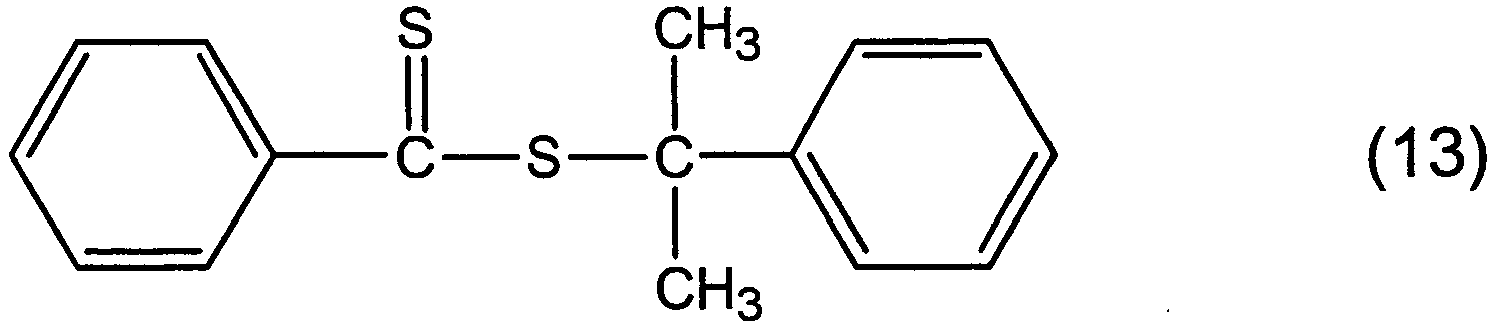
- First, 2.59 mL of a dispersion of gold ultrafine particles in an organic solvent, 4.61 mL of chloroform, and 240 mg of the polymer obtained in Production Example 2 were mixed. Then, in a water bath at a temperature controlled to 20°C, the resultant mixture was irradiated with ultrasonic waves of 80 W and 38 kHz under stirring through the temperature control water of the water bath. The stirring and ultrasonic irradiation were continued for 24 hours to prepare a chloroform solution of gold nano-particles. Separately, 960 mg of a commercial PMMA resin (manufactured by Aldrich, Mw = 120,000, total light transmittance 93%) was dissolved in 4.8 ml of chloroform to prepare a PMMA chloroform solution. The PMMA chloroform solution and the gold nano-particle chloroform solution were uniformly mixed, and the resulting mixture was uniformly applied in a sealed vessel. The solvent was removed by spontaneous evaporation over about one day to produce a PMMA resin film containing gold nano-particles. The appearance of the resulting resin film was uniformly transparent and tinged with red-purple, and the average thickness was 60 µm. Figs. 1 and 2 show a TEM micrograph (low magnification) and a TEM micrograph (high magnification), respectively, of the resin film.
- The ratio of the independent particles not in contact with each other was calculated from the TEM micrographs. As a result, the ratio was 100% which indicated the absence of aggregated particles. Also, in measurement of the UV-VIS absorption wavelength of the film, the absorption peak wavelength was 516 nm.
- First, 10.36 mL of a dispersion of gold ultrafine particles in an organic solvent and 12,000 mg of the polymer obtained in Production Example 2 were mixed. Then, in a water bath at a temperature controlled to 20°C, the resultant mixture was irradiated with ultrasonic waves of 80 W and 38 kHz under stirring through the temperature control water of the water bath. The stirring and ultrasonic irradiation were continued for 24 hours to prepare a chloroform solution of gold nano-particles. The resulting solution was uniformly applied in a sealed vessel. The solvent was removed by spontaneous evaporation over about one day to produce a PMMA resin film containing gold nano-particles. The appearance of the resulting resin film was uniformly transparent and tinged with red-purple, and the average thickness was 60 µm. Figs. 3 and 4 show a TEM micrograph (low magnification) and a TEM micrograph (high magnification), respectively, of the resin film.
- The ratio of the independent particles not in contact with each other was calculated from the TEM micrographs. As a result, the ratio was 99% which indicated substantially no presence of aggregated particles. Also, in measurement of the UV-VIS absorption wavelength of the film, the absorption peak wavelength was 517 nm.
- A PMMA resin film containing gold nano-particles was produced by the same method as in Example 1 except that 240 mg of a commercial PMMA resin was used in place of 240 g of the polymer obtained in Production Example 2. The appearance of the resulting resin film was nonuniform due to such a degree of particle aggregation that aggregated particles could be observed with the eyes. Furthermore, the resin film was tinged with blue and had an average thickness of 60 µm. Figs. 5 and 6 show a TEM micrograph (low magnification) and a TEM micrograph (high magnification), respectively, of the resin film.
- As a result of calculation of the ratio of the independent particles not in contact with each other from the TEM micrographs, the ratio was 0%. Also, in measurement of the UV-VIS absorption wavelength of the film, a clear absorption peak was not observed.
- A PMMA resin film containing gold nano-particles was produced by the same method as in Example 1 except that 24 mg of dodecanethiol was used in place of 240 g of the polymer obtained in Production Example 2. The appearance of the resulting resin film was nonuniform due to such a degree of particle aggregation that aggregated particles could be observed with the eyes. Furthermore, the resin film was tinged with blue and had an average thickness of 60 µm. Figs. 7 and 8 show a TEM micrograph (low magnification) and a TEM micrograph (high magnification), respectively, of the resin film.
- As a result of calculation of the ratio of the independent particles not in contact with each other from the TEM micrographs, the ratio was 5%. Also, in measurement of the UV-VIS absorption wavelength of the film, the absorption peak wavelength was 571 nm.
- Furthermore, the same procedures as described above in Comparative Example 2 were carried out except that the amount of the dodecanethiol added was increased to 240 mg. However, substantially no change was observed in a disperse state by TEM.
- First, 2.59 mL of a dispersion of gold ultrafine particles in an organic solvent, 4.61 mL of chloroform, and 240 mg of the polymer obtained in Production Example 3 were mixed. Then, in a water bath at a temperature controlled to 20°C, the resultant mixture was irradiated with ultrasonic waves of 80 W and 38 kHz under stirring through the temperature control water of the water bath. The stirring and ultrasonic irradiation were continued for 24 hours to prepare a chloroform solution of gold nano-particles. Separately, 960 mg of an acrylonitrile/styrene copolymer resin (manufactured by Polyscience Inc., acrylonitrile/styrene molar ratio = 25:75, total light transmittance 89%) was dissolved in 4.8 ml of chloroform to prepare a chloroform solution. The separately prepared chloroform solution and the gold nano-particle chloroform solution were uniformly mixed, and the resulting mixture was uniformly applied in a sealed vessel. The solvent was removed by spontaneous evaporation over about one day to produce an acrylonitrile/styrene resin film containing gold nano-particles. The appearance of the resulting resin film was uniformly transparent and tinged with purple, and the average thickness was 60 µm. As a result of calculation of the ratio of the independent particles not in contact with each other from a TEM micrograph, the ratio was 99%. Also, in measurement of the UV-VIS absorption wavelength of the film, the absorption peak wavelength was 512 nm.
- An acrylonitrile/styrene resin film containing gold nano-particles was produced by the same method as in Example 3 except that 40 mg of dodecanethiol was used in place of 240 mg of the polymer obtained in Production Example 3. The appearance of the resulting resin film was nonuniform due to such a degree of particle aggregation that aggregated particles could be observed with the eyes. Furthermore, the resin film was tinged with blue and had an average thickness of 60 µm. As a result of calculation of the ratio of the independent particles not in contact with each other from a TEM micrograph, the ratio was 5%. Also, in measurement of the UV-VIS absorption wavelength of the film, the absorption peak wavelength was 571 nm.
- First, 2.39 mL of a dispersion of silver ultrafine particles in an organic solvent, 4.81 mL of chloroform, and 240 mg of the polymer obtained in Production Example 2 were mixed. Then, in a water bath at a temperature controlled to 20°C, the resultant mixture was irradiated with ultrasonic waves of 80 W and 38 kHz under stirring through the temperature control water of the water bath. The stirring and ultrasonic irradiation were continued for 24 hours to prepare a chloroform solution of silver nano-particles. Separately, 960 mg of a commercial PMMA resin (manufactured by Aldrich, Mw = 120,000, total light transmittance 93%) was dissolved in 4.8 ml of chloroform to prepare a PMMA chloroform solution. The PMMA chloroform solution and the silver nano-particle chloroform solution were uniformly mixed, and the resulting mixture was uniformly applied in a sealed vessel. The solvent was removed by spontaneous evaporation over about one day to produce a PMMA resin film containing silver nano-particles. The appearance of the resulting resin film was uniformly transparent and tinged with yellow, and the average thickness was 60 µm. Figs. 9 and 10 show a TEM micrograph (low magnification) and a TEM micrograph (high magnification), respectively, of the resin film.
- The ratio of the independent particles not in contact with each other was calculated from the TEM micrographs. As a result, the ratio was 100%. Also, in measurement of the UV-VIS absorption wavelength of the film, the absorption peak wavelength was 419 nm.
- First, 5 mL of an aqueous colloidal dispersion of gold nano-particles, 10 mL of chloroform, and 50 mg of the polymer obtained in Production Example 4 were mixed. Then, in a water bath at a temperature controlled to 25°C, the resultant mixture was irradiated with ultrasonic waves of 80 W and 38 kHz under stirring through temperature the control water of the water bath. After the stirring and ultrasonic irradiation were continued for 24 hours, the mixture was allowed to stand to separate between an aqueous layer and a chloroform layer, thereby obtaining a chloroform solution of gold nano-particles. A separately prepared 20 wt% chloroform solution of a general-purpose polystyrene resin (G9305 manufactured by A & M Styrene Co., Ltd., Mw = 180,000, total light transmittance 91%) and the gold nano-particle chloroform solution were uniformly mixed at a ratio of 1:1, and the resulting solution was uniformly applied in a sealed vessel. The solvent was removed by spontaneous evaporation over about one day to produce a polystyrene resin film containing gold nano-particles. The appearance of the resulting resin film was uniformly transparent and tinged with purple, and the average thickness was 60 µm. The ratio of the independent particles not in contact with each other was calculated from a TEM micrograph. As a result, the ratio was 99%. Also, in measurement of the UV-VIS absorption wavelength of the film, the absorption peak wavelength was 531 nm.
- A polystyrene resin film containing gold nano-particles was produced by the same method as in Example 5 except that 50 mg of dodecanethiol was used in place of 50 mg of the polymer obtained in Production Example 4. The appearance of the resulting resin film was nonuniform due to such a degree of particle aggregation that aggregated particles could be observed with the eyes. Furthermore, the resin film had an average thickness of 60 µm. Fig. 2 shows a TEM micrograph of the resin film. As a result of calculation of the ratio of the independent particles not in contact with each other from the TEM micrograph, the ratio was 2%. Also, in measurement of the UV-VIS absorption wavelength of the film, the absorption peak wavelength was 580 nm.
- First, 5 mL of a colloidal dispersion of iron-platinum nano-particles in ethylene glycol, 10 mL of chloroform, and 100 mg of the polymer obtained in Production Example 2 were mixed. Then, in a water bath at a temperature controlled to 20°C, the resultant mixture was irradiated with ultrasonic waves of 80 W and 38 kHz under stirring through the temperature control water of the water bath. After the stirring and ultrasonic irradiation were continued for 24 hours, the mixture was allowed to stand to separate between an ethylene glycol layer and a chloroform layer. An operation of adding 10 mL of pure water to the chloroform layer, stirring the mixture for 1 hour, and then separating off an aqueous layer was repeated three times to obtain a chloroform solution of iron-platinum nano-particles. The same 20 wt% PMMA resin chloroform solution as that used in Example 1 and the chloroform solution of iron-platinum nano-particles were uniformly mixed at a ratio of 1:1, and the resulting solution was uniformly applied in a sealed vessel. The solvent was removed by spontaneous evaporation over about one day to produce a PMMA resin film containing iron-platinum nano-particles. The appearance of the resulting resin film was uniformly transparent and tinged with brown, and the average thickness was 60 µm. As a result of calculation of the ratio of the independent particles not in contact with each other from a TEM micrograph, the ratio was 98%.
- A PMMA resin film containing iron-platinum nano-particles was produced by the same method as in Example 6 except that 100 mg of dodecanethiol was used in place of 100 mg of the polymer obtained in Production Example 2. The appearance of the resulting resin film was substantially uniform as observed with the eyes, and the average thickness was 60 µm. As a result of calculation of the ratio of the independent particles not in contact with each other from a TEM micrograph, precise measurement was difficult because the particles were aggregated in many layers to form large aggregates. However, the roughly calculated ratio was about 12%.
- First, 2 mg of a CdSe solid powder and 100 mg of the polymer obtained in Production Example 2 were dissolved in 5.5 mL of chloroform. Then, in a water bath at a temperature controlled to 23°C, the resultant solution was irradiated with ultrasonic waves of 80 W and 38 kHz under stirring through the temperature control water of the water bath. After the stirring and ultrasonic irradiation were continued for 24 hours, 20 mL of absolute methanol was added to the solution to produce an insoluble substance. The insoluble substance was separated from the supernatant by centrifugal separation and then dried in vacuum at room temperature for about one day to obtain a surface-modified CdSe nano-particle solid powder. The resultant surface-modified ultrafine particles were dispersed in 5.5 mL of chloroform, and 400 mg of the polymer prepared in Production Example 3 was further added to the dispersion. Then, in a water bath at a temperature controlled to 20°C, the resultant mixture was irradiated with ultrasonic waves of 80 W and 38 kHz under stirring through the temperature control water of the water bath. After the stirring and ultrasonic irradiation were continued for 24 hours, the mixture was allowed to stand to obtain a chloroform solution of CdSe nano-particles. Separately, 500 mg of a commercial PMMA resin (manufactured by Aldrich, Mw = 120,000, total light transmittance 93%) was dissolved in 2.5 ml of chloroform to prepare a PMMA chloroform solution. The PMMA chloroform solution and the CdSe nano-particle chloroform solution were uniformly mixed, and the resulting mixture was uniformly applied in a sealed vessel. The solvent was removed by spontaneous evaporation over about one day to produce a PMMA resin film containing CdSe nano-particles dispersed therein. The appearance of the resulting film was uniformly transparent, and the average thickness was 60 µm. As a result of calculation of the ratio of the independent particles not in contact with each other from a TEM micrograph, the ratio was 95%. Furthermore, in irradiation of the resin film with exciting light at a wavelength of 299 nm using a luminescence spectrometer, the emitted light had a peak wavelength of 515 nm and a half-value width of 55 nm.
- A PMMA resin film containing core-shell CdSe ultrafine particles having ZnS shells was produced by the same method as in Example 2 except that 2 mg of the core-shell CdSe nano-particle solid powder having ZnS shells obtained in Production Example 1 was used in place of 2 mg of CdSe solid powder. The appearance of the resulting film was uniformly transparent, and the average thickness was 60 µm. As a result of calculation of the ratio of the independent particles not in contact with each other from a TEM micrograph, the ratio was 94%. Furthermore, in irradiation of the resin film with exciting light at a wavelength of 468 nm using a luminescence spectrometer, the emitted light had a peak wavelength of 603 nm and higher luminescence intensity than that in Example 2.
- A PMMA resin film containing CdSe nano-particles was produced by the same method as in Example 7 except that 500 mg of a commercial PMMA resin (manufactured by Aldrich, Mw = 120,000, total light transmittance 93%) was used in place of 100 mg + 400 mg of the polymer produced in Production Example 2. The appearance of the resulting resin film was apparently uniform, and the average thickness was 60 µm. As a result of calculation of the ratio of the independent particles not in contact with each other from a TEM micrograph, the ratio was 2%. Furthermore, in irradiation of the resin film with exciting light at a wavelength of 299 nm using a luminescence spectrometer, the emitted light had a peak wavelength of 532 nm and a half-value width of 70 nm. It was thus found that the peak was shifted to the long wavelength side by aggregation of nano-particles.
- A PMMA resin film containing CdSe nano-particles was produced by the same method as in Example 7 except that 50 mg of dodecanethiol was used in place of 500 mg of the polymer obtained in Production Example 2. The appearance of the resulting resin film was nonuniform due to such a degree of particle aggregation that aggregated particles could be observed with the eyes, and the average thickness was 60 µm. As a result of calculation of the ratio of the independent particles not in contact with each other from a TEM micrograph, the ratio was 2%. Furthermore, in irradiation of the resin film with exciting light at a wavelength of 365 nm using a luminescence spectrometer, a clear luminescence peak was not observed.
- First, 5 mL of an aqueous colloidal dispersion of gold nano-particles, 40 mg of the polymer obtained in Production Example 5, and 5 mL of pure water were mixed. Then,' in a water bath at a temperature controlled to 25°C, the resultant mixture was irradiated with ultrasonic waves of 80 W and 38 kHz under stirring through the temperature control water of the water bath. After the stirring and ultrasonic irradiation were continued for 24 hours, the mixture was allowed to stand to produce surface-modified gold nano-particles. Then, a separately prepared 20 wt% aqueous solution of polyvinyl alcohol resin (Poly(vinyl Alcohol) manufactured by Aldrich, 87 to 89% hydrolyzed, Mw = 85,000 to 146,000) and the aqueous solution of the surface-modified gold nano-particles were uniformly mixed at a ratio of 1:1, and the resulting mixture was uniformly applied in a sealed vessel. The water was removed by spontaneous evaporation over about one week to produce a polyvinyl alcohol resin film containing gold nano-particles. The appearance of the resulting film was uniformly transparent and tinged with purple, and the average thickness was 60 µm. As a result of calculation of the ratio of the independent particles not in contact with each other from a TEM micrograph, the ratio was 95%. Furthermore, in measurement of the UV-VIS absorption wavelength of the film, the absorption peak wavelength was 545 nm.
- First, 5 mL of an aqueous colloidal dispersion of gold nano-particles, 5 mL of pure water, and 10 mL of a 20 wt% aqueous solution of polyvinyl alcohol resin (Poly(vinyl Alcohol) manufactured by Aldrich, 87 to 89% hydrolyzed, Mw = 85,000 to 146,000) were uniformly mixed, followed by stirring for 24 hours. Then, the resulting mixture was uniformly applied in a sealed vessel. The water was removed by spontaneous evaporation over about one week to produce a polyvinyl alcohol resin film containing gold nano-particles. The appearance of the resulting film was nonuniform due to such a degree of particle aggregation that aggregated particles could be observed with the eyes, and the average thickness was 60 µm. As a result of calculation of the ratio of the independent particles not in contact with each other from a TEM micrograph, the ratio was 0%. Furthermore, in measurement of the UV-VIS absorption wavelength of the film, measurement of the absorption peak wavelength was difficult because of the low transparency of the film.
- In order to produce a polymethacrylic acid resin film containing gold nano-particles, 40 mg of the polymer produced in Production Example 6 was used instead of 40 mg of the polymer produced in Production Example 5, and a 20 wt% aqueous solution of polymethacrylic acid resin (manufactured by Polyscience Inc., Mw = about 100,000) was used instead of a 20 wt% aqueous solution of polyvinyl alcohol resin. The other procedures were the same as in Example 9. The appearance of the resulting resin film was uniformly transparent and tinged with purple, and the average thickness was 60 µm. As a result of calculation of the ratio of the independent particles not in contact with each other from a TEM micrograph, the ratio was 96%. Furthermore, in measurement of the UV-VIS absorption wavelength of the film, the absorption peak wavelength was 543 nm.
- A polymethacrylic acid resin film containing gold nano-particles was produced by the same method as in Comparative Example 8 except that a 20 wt% aqueous solution of polymethacrylic acid resin (manufactured by Polyscience Inc., Mw = about 100,000) was used in place of a 20 wt% aqueous solution of polyvinyl alcohol resin. The appearance of the resulting resin film was nonuniform due to such a degree of particle aggregation that aggregated particles could be observed with the eyes, and the average thickness was 60 µm. As a result of calculation of the ratio of the independent particles not in contact with each other from a TEM micrograph, the ratio was 0%. Furthermore, in measurement of the UV-VIS absorption wavelength of the film, measurement of the absorption peak wavelength was difficult because of the low transparency of the film.
- According to the present invention, ultrafine particles can be uniformly dispersed in a resin without aggregation of the particles, thereby holding the ultrafine particles in a resin composition while maintaining the various excellent properties inherently possessed by the ultrafine particles. Therefore, the present invention is useful for the purpose of protecting ultrafine particles, and a molding, a film, and the like can be molded from the resin composition to permit free mass-production of resin moldings maintaining the dispersibility of the ultrafine particles. Consequently, ultrafine particles which have been difficult to handle so far can be actively utilized in various fields. It is thus expected to greatly contribute to practical applications of products in the field of nano-technology, thereby causing great industrial usefulness.
Claims (8)
- A resin composition containing ultrafine particles produced by mixing polymer-modified ultrafine particles in a resin, wherein the polymer-modified ultrafine particles are produced by modifying the surfaces of ultrafine particles with a polymer having a mercapto group at one end, and the polymer having a mercapto group at one end is produced by treating a polymer with a treating agent, the polymer being prepared by radical polymerization of a radically polymerizable unsaturated monomer in the presence of a thiocarbonylthio group-containing compound.
- The resin composition containing ultrafine particles according to claim 1, wherein the thiocarbonylthio group-containing compound is represented by general formula (1):

- The resin composition containing ultrafine particles according to claim 1 or 2, wherein the number-average primary particle size of the ultrafine particles in an unaggregated state is 100 nm or less.
- The resin composition containing ultrafine particles according to any one of claims 1 to 3, wherein 80% or more of the total of the ultrafine particles in the resin are independently present.
- The resin composition containing ultrafine particles according to any one of claims 1 to 4, wherein the ultrafine particles are metal ultrafine particles and/or semiconductor ultrafine particles.
- The resin composition containing ultrafine particles according to claim 5, wherein the ultrafine particles contain 10% by weight or more of at least one metal selected from the group consisting of gold, platinum, silver, palladium, rhodium, ruthenium, and cobalt.
- The resin composition containing ultrafine particles according to claim 5, wherein the semiconductor ultrafine particles are particles of at least one compound selected from the group consisting of compounds each including a group 14 element and a group 16 element in the periodic table, compounds each including a group 13 element and a group 15 element in the periodic table, compounds each including a group 13 element and a group 16 element in the periodic table, compounds each including a group 12 element and a group 16 element in the periodic table, compounds each including a group 15 element and a group 16 element in the periodic table, compounds each including a group 4 element and a group 16 element in the periodic table, and compounds each including a group 2 element and a group 16 element in the periodic table.
- The resin composition containing ultrafine particles according to any one of claims 1 to 7, wherein the resin transmits visible light.
Applications Claiming Priority (2)
| Application Number | Priority Date | Filing Date | Title |
|---|---|---|---|
| JP2003279684 | 2003-07-25 | ||
| PCT/JP2004/010088 WO2005010100A1 (en) | 2003-07-25 | 2004-07-08 | Resin composition containing ultrafine particles |
Publications (1)
| Publication Number | Publication Date |
|---|---|
| EP1650264A1 true EP1650264A1 (en) | 2006-04-26 |
Family
ID=34100825
Family Applications (1)
| Application Number | Title | Priority Date | Filing Date |
|---|---|---|---|
| EP04747554A Withdrawn EP1650264A1 (en) | 2003-07-25 | 2004-07-08 | Resin composition containing ultrafine particles |
Country Status (4)
| Country | Link |
|---|---|
| US (1) | US20060199900A1 (en) |
| EP (1) | EP1650264A1 (en) |
| JP (1) | JPWO2005010100A1 (en) |
| WO (1) | WO2005010100A1 (en) |
Cited By (1)
| Publication number | Priority date | Publication date | Assignee | Title |
|---|---|---|---|---|
| WO2015116960A1 (en) * | 2014-02-03 | 2015-08-06 | E. I. Du Pont De Nemours And Company | Compositions for high speed printing of conductive materials for electronic circuitry type applications, and methods relating |
Families Citing this family (16)
| Publication number | Priority date | Publication date | Assignee | Title |
|---|---|---|---|---|
| JPWO2006006349A1 (en) * | 2004-07-07 | 2008-04-24 | 株式会社カネカ | Method for producing polymer-modified nanoparticles |
| CA2790003C (en) * | 2004-10-04 | 2014-03-11 | The University Of Sydney | Surface polymerisation process and polymer product using raft agent |
| US7658870B2 (en) * | 2005-12-20 | 2010-02-09 | University Of Hawaii | Polymer matrix composites with nano-scale reinforcements |
| EP1981939A4 (en) * | 2006-02-10 | 2009-11-18 | Fujifilm Corp | Organic-inorganic hybrid composition, method for producing the same, molding and optical component |
| JP5170963B2 (en) * | 2006-02-15 | 2013-03-27 | 株式会社トクヤマ | Polymer-coated inorganic particles |
| BRPI0709848B1 (en) * | 2006-04-03 | 2018-03-27 | The University Of Sydney | METHODS FOR POLYMERIZING MONOMER FOR FORMING POLYMER ON THE SURFACE OF SOLID PRIVATE MATERIAL, FOR PREPARING A DISPOSAL OF POLYMER SOLID PARTICULATE IN A HYDROPHYLIC LIQUID, TO PREPARE A TONES, BALID TYPES, PREPARATIONS COATING, SEALANT, DIAGNOSTIC PRODUCT OR THERAPEUTIC PRODUCT, INK, LOAD, ADHESIVE, TONER, LIQUID INK, SEALANT, DIAGNOSTIC PRODUCT OR POLYMULOSAL DIMENSIONS, COMPULSORY MATERIALS, POLYMEROSAL PRODUCTS |
| JP5057443B2 (en) * | 2007-05-02 | 2012-10-24 | 独立行政法人産業技術総合研究所 | Lipopolymer |
| JP2010150332A (en) * | 2008-12-24 | 2010-07-08 | Teijin Ltd | Polymerizable compound-metal nanoparticle dispersion, and method for producing the same |
| JP2010150348A (en) * | 2008-12-24 | 2010-07-08 | Teijin Ltd | Polymer-metal nanoparticle complex and method for producing the same |
| KR101588314B1 (en) * | 2009-09-25 | 2016-01-25 | 삼성전자주식회사 | Phosphor white light emitting device including phosphor and method for preparing phosphor |
| US9428649B2 (en) * | 2010-11-05 | 2016-08-30 | E Ink California, Llc | Electrophoretic dispersion |
| FR2969311B1 (en) * | 2010-12-20 | 2013-01-18 | Rhodia Acetow Gmbh | LED LIGHT SOURCE MODULE (LIGHT EMITTING DIODE) |
| US20160032180A1 (en) * | 2012-11-26 | 2016-02-04 | Agienic, Inc. | Antimicrobial Resin Coated Proppants |
| US10316171B2 (en) * | 2013-09-23 | 2019-06-11 | Agienic, Inc. | Thermal stabilization of polymers using functionalized particles of transition metal compounds |
| US20150240103A1 (en) * | 2014-02-25 | 2015-08-27 | E I Du Pont De Nemours And Company | Compositions for high speed printing of conductive materials for electronic circuitry type applications and methods relating thereto |
| CN111171356B (en) | 2018-10-24 | 2021-06-22 | 电子科技大学 | A kind of method for preparing composite conductive polymer |
Family Cites Families (6)
| Publication number | Priority date | Publication date | Assignee | Title |
|---|---|---|---|---|
| JPS62265301A (en) * | 1986-05-12 | 1987-11-18 | Nippon Soda Co Ltd | Silane-modified butadiene polymer and surface treating agent containing same |
| JPS63191864A (en) * | 1987-02-04 | 1988-08-09 | Fuji Xerox Co Ltd | Production of pigment having treated surface |
| DE68904665T2 (en) * | 1988-03-17 | 1993-09-02 | Kuraray Co | HARDENABLE RESIN COMPOSITION. |
| JP2925155B2 (en) * | 1988-03-17 | 1999-07-28 | 株式会社クラレ | Curable resin composition |
| JP2002265508A (en) * | 2001-03-07 | 2002-09-18 | Kanegafuchi Chem Ind Co Ltd | Method of producing mercapto group-terminated polymer |
| US7138468B2 (en) * | 2002-03-27 | 2006-11-21 | University Of Southern Mississippi | Preparation of transition metal nanoparticles and surfaces modified with (CO)polymers synthesized by RAFT |
-
2004
- 2004-07-08 WO PCT/JP2004/010088 patent/WO2005010100A1/en not_active Ceased
- 2004-07-08 US US10/565,996 patent/US20060199900A1/en not_active Abandoned
- 2004-07-08 JP JP2005512003A patent/JPWO2005010100A1/en not_active Withdrawn
- 2004-07-08 EP EP04747554A patent/EP1650264A1/en not_active Withdrawn
Non-Patent Citations (1)
| Title |
|---|
| See references of WO2005010100A1 * |
Cited By (1)
| Publication number | Priority date | Publication date | Assignee | Title |
|---|---|---|---|---|
| WO2015116960A1 (en) * | 2014-02-03 | 2015-08-06 | E. I. Du Pont De Nemours And Company | Compositions for high speed printing of conductive materials for electronic circuitry type applications, and methods relating |
Also Published As
| Publication number | Publication date |
|---|---|
| US20060199900A1 (en) | 2006-09-07 |
| JPWO2005010100A1 (en) | 2006-09-07 |
| WO2005010100A1 (en) | 2005-02-03 |
Similar Documents
| Publication | Publication Date | Title |
|---|---|---|
| EP1650264A1 (en) | Resin composition containing ultrafine particles | |
| US20070249747A1 (en) | Process for Producing Polymer-Modified Nanoparticle | |
| Li et al. | Synthesis and characterization of CdS quantum dots in polystyrene microbeads | |
| Radhakrishnan et al. | Surface initiated polymerizations from silica nanoparticles | |
| TWI579242B (en) | Silver nanoparticles, method of producing the same, silver nanoparticle dispersion, and substrate having silver element formed thereon | |
| US20060088713A1 (en) | Surface modification of nanocrystals using multidentate polymer ligands | |
| US20070154709A1 (en) | Nanoparticles | |
| Kogej et al. | Polyol mediated nano size zinc oxide and nanocomposites with poly (methyl methacrylate). | |
| Monteiro et al. | Stabilization of nano-TiO2 aqueous dispersions with poly (ethylene glycol)-b-poly (4-vinyl pyridine) block copolymer and their incorporation in photocatalytic acrylic varnishes | |
| JP3829634B2 (en) | Manufacturing method of planar resin molding | |
| Haldorai et al. | Fabrication of metal oxide–polymer hybrid nanocomposites | |
| CA2554335A1 (en) | Use of statistical copolymers | |
| JPWO2006027956A1 (en) | Resin composition for optical materials | |
| US20070282075A1 (en) | Use Of Statistical Copolymers | |
| JP5227587B2 (en) | Ultrafine metal particle-containing resin composition and method for producing the composition | |
| KR20130013234A (en) | Manufacuring method of metal nano particle coated with copoloymer, and metal nano particle coated with copoloymer made by the same | |
| Fateixa et al. | Effect of colloidal silver and gold nanoparticles on the thermal behavior of poly (t-butyl acrylate) composites | |
| Anžlovar et al. | Nanocomposites with nano-to-sub-micrometer size zinc oxide as an effective UV absorber | |
| Althues et al. | Structure and mechanical properties of transparent ZnO/PBDMA nanocomposites | |
| WO2006019008A1 (en) | Polymer-modified nanoparticle | |
| JP6205917B2 (en) | Silver-containing composition and silver element-forming substrate | |
| Bambo et al. | Fabrication Methods of Quantum Dots–Polymer Composites | |
| WO2007023919A1 (en) | Stabilizer composition for synthetic resin | |
| KR101545629B1 (en) | Monodispersed PMMA polymer nanobead and method of manufacturing the same | |
| JPWO2006080318A1 (en) | Metal sulfide nanoparticle-containing resin composition and method for producing the composition |
Legal Events
| Date | Code | Title | Description |
|---|---|---|---|
| PUAI | Public reference made under article 153(3) epc to a published international application that has entered the european phase |
Free format text: ORIGINAL CODE: 0009012 |
|
| 17P | Request for examination filed |
Effective date: 20060209 |
|
| AK | Designated contracting states |
Kind code of ref document: A1 Designated state(s): AT BE BG CH CY CZ DE DK EE ES FI FR GB GR HU IE IT LI LU MC NL PL PT RO SE SI SK TR |
|
| DAX | Request for extension of the european patent (deleted) | ||
| STAA | Information on the status of an ep patent application or granted ep patent |
Free format text: STATUS: THE APPLICATION HAS BEEN WITHDRAWN |
|
| 18W | Application withdrawn |
Effective date: 20090512 |