EP1650255A1 - Polyether block amide foam - Google Patents
Polyether block amide foam Download PDFInfo
- Publication number
- EP1650255A1 EP1650255A1 EP04024833A EP04024833A EP1650255A1 EP 1650255 A1 EP1650255 A1 EP 1650255A1 EP 04024833 A EP04024833 A EP 04024833A EP 04024833 A EP04024833 A EP 04024833A EP 1650255 A1 EP1650255 A1 EP 1650255A1
- Authority
- EP
- European Patent Office
- Prior art keywords
- anyone
- foam according
- make
- foam
- blocks
- Prior art date
- Legal status (The legal status is an assumption and is not a legal conclusion. Google has not performed a legal analysis and makes no representation as to the accuracy of the status listed.)
- Withdrawn
Links
- 239000006260 foam Substances 0.000 title claims abstract description 73
- 229920002614 Polyether block amide Polymers 0.000 title description 6
- 239000004952 Polyamide Substances 0.000 claims abstract description 52
- 229920002647 polyamide Polymers 0.000 claims abstract description 52
- 239000004721 Polyphenylene oxide Substances 0.000 claims abstract description 39
- 229920000570 polyether Polymers 0.000 claims abstract description 39
- 229920001577 copolymer Polymers 0.000 claims abstract description 30
- XLYOFNOQVPJJNP-UHFFFAOYSA-N water Substances O XLYOFNOQVPJJNP-UHFFFAOYSA-N 0.000 claims abstract description 18
- 230000005540 biological transmission Effects 0.000 claims abstract description 11
- 238000007669 thermal treatment Methods 0.000 claims abstract description 3
- BJZYYSAMLOBSDY-QMMMGPOBSA-N (2s)-2-butoxybutan-1-ol Chemical compound CCCCO[C@@H](CC)CO BJZYYSAMLOBSDY-QMMMGPOBSA-N 0.000 claims description 11
- 229920000299 Nylon 12 Polymers 0.000 claims description 8
- 229920002292 Nylon 6 Polymers 0.000 claims description 5
- 239000000853 adhesive Substances 0.000 claims description 3
- 230000001070 adhesive effect Effects 0.000 claims description 3
- 238000007639 printing Methods 0.000 claims description 3
- 238000007654 immersion Methods 0.000 claims description 2
- 238000000034 method Methods 0.000 abstract description 27
- 229920001223 polyethylene glycol Polymers 0.000 description 11
- 239000003054 catalyst Substances 0.000 description 9
- 150000003951 lactams Chemical class 0.000 description 9
- 229920000642 polymer Polymers 0.000 description 8
- OFOBLEOULBTSOW-UHFFFAOYSA-N Malonic acid Chemical compound OC(=O)CC(O)=O OFOBLEOULBTSOW-UHFFFAOYSA-N 0.000 description 7
- 239000000463 material Substances 0.000 description 7
- -1 polyethylene Polymers 0.000 description 7
- WNLRTRBMVRJNCN-UHFFFAOYSA-N adipic acid Chemical compound OC(=O)CCCCC(O)=O WNLRTRBMVRJNCN-UHFFFAOYSA-N 0.000 description 6
- 238000009833 condensation Methods 0.000 description 6
- 230000005494 condensation Effects 0.000 description 6
- 238000001125 extrusion Methods 0.000 description 6
- 239000002253 acid Substances 0.000 description 5
- 238000004132 cross linking Methods 0.000 description 5
- 150000004985 diamines Chemical class 0.000 description 5
- 239000002243 precursor Substances 0.000 description 5
- 150000007513 acids Chemical class 0.000 description 4
- 239000003153 chemical reaction reagent Substances 0.000 description 4
- 230000006835 compression Effects 0.000 description 4
- 238000007906 compression Methods 0.000 description 4
- 150000001991 dicarboxylic acids Chemical class 0.000 description 4
- TVIDDXQYHWJXFK-UHFFFAOYSA-N dodecanedioic acid Chemical compound OC(=O)CCCCCCCCCCC(O)=O TVIDDXQYHWJXFK-UHFFFAOYSA-N 0.000 description 4
- JBKVHLHDHHXQEQ-UHFFFAOYSA-N epsilon-caprolactam Chemical compound O=C1CCCCCN1 JBKVHLHDHHXQEQ-UHFFFAOYSA-N 0.000 description 4
- NAQMVNRVTILPCV-UHFFFAOYSA-N hexane-1,6-diamine Chemical compound NCCCCCCN NAQMVNRVTILPCV-UHFFFAOYSA-N 0.000 description 4
- 238000009413 insulation Methods 0.000 description 4
- 238000011084 recovery Methods 0.000 description 4
- 229920005989 resin Polymers 0.000 description 4
- 239000011347 resin Substances 0.000 description 4
- CXMXRPHRNRROMY-UHFFFAOYSA-N sebacic acid Chemical compound OC(=O)CCCCCCCCC(O)=O CXMXRPHRNRROMY-UHFFFAOYSA-N 0.000 description 4
- 229920001169 thermoplastic Polymers 0.000 description 4
- 229920005992 thermoplastic resin Polymers 0.000 description 4
- 239000004416 thermosoftening plastic Substances 0.000 description 4
- JHWNWJKBPDFINM-UHFFFAOYSA-N Laurolactam Chemical compound O=C1CCCCCCCCCCCN1 JHWNWJKBPDFINM-UHFFFAOYSA-N 0.000 description 3
- 235000011037 adipic acid Nutrition 0.000 description 3
- 239000001361 adipic acid Substances 0.000 description 3
- 210000004027 cell Anatomy 0.000 description 3
- 238000005187 foaming Methods 0.000 description 3
- 239000004088 foaming agent Substances 0.000 description 3
- 235000019589 hardness Nutrition 0.000 description 3
- 238000004898 kneading Methods 0.000 description 3
- 238000002844 melting Methods 0.000 description 3
- 230000008018 melting Effects 0.000 description 3
- 239000000203 mixture Substances 0.000 description 3
- 238000000465 moulding Methods 0.000 description 3
- 239000000126 substance Substances 0.000 description 3
- HASUJDLTAYUWCO-UHFFFAOYSA-N 2-aminoundecanoic acid Chemical compound CCCCCCCCCC(N)C(O)=O HASUJDLTAYUWCO-UHFFFAOYSA-N 0.000 description 2
- JZUHIOJYCPIVLQ-UHFFFAOYSA-N 2-methylpentane-1,5-diamine Chemical compound NCC(C)CCCN JZUHIOJYCPIVLQ-UHFFFAOYSA-N 0.000 description 2
- RNLHGQLZWXBQNY-UHFFFAOYSA-N 3-(aminomethyl)-3,5,5-trimethylcyclohexan-1-amine Chemical compound CC1(C)CC(N)CC(C)(CN)C1 RNLHGQLZWXBQNY-UHFFFAOYSA-N 0.000 description 2
- VGGSQFUCUMXWEO-UHFFFAOYSA-N Ethene Chemical compound C=C VGGSQFUCUMXWEO-UHFFFAOYSA-N 0.000 description 2
- 239000005977 Ethylene Substances 0.000 description 2
- LYCAIKOWRPUZTN-UHFFFAOYSA-N Ethylene glycol Chemical compound OCCO LYCAIKOWRPUZTN-UHFFFAOYSA-N 0.000 description 2
- IAYPIBMASNFSPL-UHFFFAOYSA-N Ethylene oxide Chemical group C1CO1 IAYPIBMASNFSPL-UHFFFAOYSA-N 0.000 description 2
- GLUUGHFHXGJENI-UHFFFAOYSA-N Piperazine Chemical compound C1CNCCN1 GLUUGHFHXGJENI-UHFFFAOYSA-N 0.000 description 2
- 239000004698 Polyethylene Substances 0.000 description 2
- GOOHAUXETOMSMM-UHFFFAOYSA-N Propylene oxide Chemical compound CC1CO1 GOOHAUXETOMSMM-UHFFFAOYSA-N 0.000 description 2
- KKEYFWRCBNTPAC-UHFFFAOYSA-N Terephthalic acid Chemical compound OC(=O)C1=CC=C(C(O)=O)C=C1 KKEYFWRCBNTPAC-UHFFFAOYSA-N 0.000 description 2
- 230000006750 UV protection Effects 0.000 description 2
- 238000005299 abrasion Methods 0.000 description 2
- NIXOWILDQLNWCW-UHFFFAOYSA-M acrylate group Chemical group C(C=C)(=O)[O-] NIXOWILDQLNWCW-UHFFFAOYSA-M 0.000 description 2
- 238000003490 calendering Methods 0.000 description 2
- 125000004432 carbon atom Chemical group C* 0.000 description 2
- 239000003795 chemical substances by application Substances 0.000 description 2
- 239000000470 constituent Substances 0.000 description 2
- 125000004427 diamine group Chemical group 0.000 description 2
- 235000014113 dietary fatty acids Nutrition 0.000 description 2
- 150000002009 diols Chemical class 0.000 description 2
- 239000004744 fabric Substances 0.000 description 2
- 229930195729 fatty acid Natural products 0.000 description 2
- 239000000194 fatty acid Substances 0.000 description 2
- 150000004665 fatty acids Chemical class 0.000 description 2
- 238000010438 heat treatment Methods 0.000 description 2
- QQVIHTHCMHWDBS-UHFFFAOYSA-N isophthalic acid Chemical compound OC(=O)C1=CC=CC(C(O)=O)=C1 QQVIHTHCMHWDBS-UHFFFAOYSA-N 0.000 description 2
- 238000002156 mixing Methods 0.000 description 2
- 229920003023 plastic Polymers 0.000 description 2
- 239000004033 plastic Substances 0.000 description 2
- 229920000573 polyethylene Polymers 0.000 description 2
- 229920001451 polypropylene glycol Polymers 0.000 description 2
- 229920000909 polytetrahydrofuran Polymers 0.000 description 2
- 229920002635 polyurethane Polymers 0.000 description 2
- 239000004814 polyurethane Substances 0.000 description 2
- KIDHWZJUCRJVML-UHFFFAOYSA-N putrescine Chemical compound NCCCCN KIDHWZJUCRJVML-UHFFFAOYSA-N 0.000 description 2
- 239000011342 resin composition Substances 0.000 description 2
- 229910000077 silane Inorganic materials 0.000 description 2
- KDYFGRWQOYBRFD-UHFFFAOYSA-N succinic acid Chemical compound OC(=O)CCC(O)=O KDYFGRWQOYBRFD-UHFFFAOYSA-N 0.000 description 2
- PWGJDPKCLMLPJW-UHFFFAOYSA-N 1,8-diaminooctane Chemical compound NCCCCCCCCN PWGJDPKCLMLPJW-UHFFFAOYSA-N 0.000 description 1
- SPJXZYLLLWOSLQ-UHFFFAOYSA-N 1-[(1-aminocyclohexyl)methyl]cyclohexan-1-amine Chemical compound C1CCCCC1(N)CC1(N)CCCCC1 SPJXZYLLLWOSLQ-UHFFFAOYSA-N 0.000 description 1
- QFGCFKJIPBRJGM-UHFFFAOYSA-N 12-[(2-methylpropan-2-yl)oxy]-12-oxododecanoic acid Chemical compound CC(C)(C)OC(=O)CCCCCCCCCCC(O)=O QFGCFKJIPBRJGM-UHFFFAOYSA-N 0.000 description 1
- JCUZDQXWVYNXHD-UHFFFAOYSA-N 2,2,4-trimethylhexane-1,6-diamine Chemical compound NCCC(C)CC(C)(C)CN JCUZDQXWVYNXHD-UHFFFAOYSA-N 0.000 description 1
- QUBNFZFTFXTLKH-UHFFFAOYSA-N 2-aminododecanoic acid Chemical compound CCCCCCCCCCC(N)C(O)=O QUBNFZFTFXTLKH-UHFFFAOYSA-N 0.000 description 1
- YZTJKOLMWJNVFH-UHFFFAOYSA-N 2-sulfobenzene-1,3-dicarboxylic acid Chemical compound OC(=O)C1=CC=CC(C(O)=O)=C1S(O)(=O)=O YZTJKOLMWJNVFH-UHFFFAOYSA-N 0.000 description 1
- IGSBHTZEJMPDSZ-UHFFFAOYSA-N 4-[(4-amino-3-methylcyclohexyl)methyl]-2-methylcyclohexan-1-amine Chemical compound C1CC(N)C(C)CC1CC1CC(C)C(N)CC1 IGSBHTZEJMPDSZ-UHFFFAOYSA-N 0.000 description 1
- QTBSBXVTEAMEQO-UHFFFAOYSA-M Acetate Chemical compound CC([O-])=O QTBSBXVTEAMEQO-UHFFFAOYSA-M 0.000 description 1
- 239000004156 Azodicarbonamide Substances 0.000 description 1
- 239000004604 Blowing Agent Substances 0.000 description 1
- DGAQECJNVWCQMB-PUAWFVPOSA-M Ilexoside XXIX Chemical compound C[C@@H]1CC[C@@]2(CC[C@@]3(C(=CC[C@H]4[C@]3(CC[C@@H]5[C@@]4(CC[C@@H](C5(C)C)OS(=O)(=O)[O-])C)C)[C@@H]2[C@]1(C)O)C)C(=O)O[C@H]6[C@@H]([C@H]([C@@H]([C@H](O6)CO)O)O)O.[Na+] DGAQECJNVWCQMB-PUAWFVPOSA-M 0.000 description 1
- 229920000305 Nylon 6,10 Polymers 0.000 description 1
- 239000004743 Polypropylene Substances 0.000 description 1
- 239000004793 Polystyrene Substances 0.000 description 1
- BLRPTPMANUNPDV-UHFFFAOYSA-N Silane Chemical compound [SiH4] BLRPTPMANUNPDV-UHFFFAOYSA-N 0.000 description 1
- 239000004433 Thermoplastic polyurethane Substances 0.000 description 1
- RTAQQCXQSZGOHL-UHFFFAOYSA-N Titanium Chemical compound [Ti] RTAQQCXQSZGOHL-UHFFFAOYSA-N 0.000 description 1
- QCWXUUIWCKQGHC-UHFFFAOYSA-N Zirconium Chemical compound [Zr] QCWXUUIWCKQGHC-UHFFFAOYSA-N 0.000 description 1
- 125000001931 aliphatic group Chemical group 0.000 description 1
- 125000000217 alkyl group Chemical group 0.000 description 1
- IMUDHTPIFIBORV-UHFFFAOYSA-N aminoethylpiperazine Chemical compound NCCN1CCNCC1 IMUDHTPIFIBORV-UHFFFAOYSA-N 0.000 description 1
- 210000003423 ankle Anatomy 0.000 description 1
- 125000004429 atom Chemical group 0.000 description 1
- XOZUGNYVDXMRKW-AATRIKPKSA-N azodicarbonamide Chemical compound NC(=O)\N=N\C(N)=O XOZUGNYVDXMRKW-AATRIKPKSA-N 0.000 description 1
- 235000019399 azodicarbonamide Nutrition 0.000 description 1
- 230000009286 beneficial effect Effects 0.000 description 1
- 230000005587 bubbling Effects 0.000 description 1
- WERYXYBDKMZEQL-UHFFFAOYSA-N butane-1,4-diol Chemical group OCCCCO WERYXYBDKMZEQL-UHFFFAOYSA-N 0.000 description 1
- 125000003178 carboxy group Chemical group [H]OC(*)=O 0.000 description 1
- 150000001732 carboxylic acid derivatives Chemical class 0.000 description 1
- 210000003850 cellular structure Anatomy 0.000 description 1
- 238000010382 chemical cross-linking Methods 0.000 description 1
- 238000006243 chemical reaction Methods 0.000 description 1
- 238000010276 construction Methods 0.000 description 1
- 229920003020 cross-linked polyethylene Polymers 0.000 description 1
- 239000004703 cross-linked polyethylene Substances 0.000 description 1
- 238000005520 cutting process Methods 0.000 description 1
- 238000007278 cyanoethylation reaction Methods 0.000 description 1
- 125000004122 cyclic group Chemical group 0.000 description 1
- YQLZOAVZWJBZSY-UHFFFAOYSA-N decane-1,10-diamine Chemical compound NCCCCCCCCCCN YQLZOAVZWJBZSY-UHFFFAOYSA-N 0.000 description 1
- 238000000354 decomposition reaction Methods 0.000 description 1
- 239000000539 dimer Substances 0.000 description 1
- QFTYSVGGYOXFRQ-UHFFFAOYSA-N dodecane-1,12-diamine Chemical compound NCCCCCCCCCCCCN QFTYSVGGYOXFRQ-UHFFFAOYSA-N 0.000 description 1
- 238000001035 drying Methods 0.000 description 1
- 229920001971 elastomer Polymers 0.000 description 1
- 238000010894 electron beam technology Methods 0.000 description 1
- 230000032050 esterification Effects 0.000 description 1
- 238000005886 esterification reaction Methods 0.000 description 1
- 150000002148 esters Chemical class 0.000 description 1
- 239000006261 foam material Substances 0.000 description 1
- 229910052735 hafnium Inorganic materials 0.000 description 1
- VBJZVLUMGGDVMO-UHFFFAOYSA-N hafnium atom Chemical compound [Hf] VBJZVLUMGGDVMO-UHFFFAOYSA-N 0.000 description 1
- XTBMQKZEIICCCS-UHFFFAOYSA-N hexane-1,5-diamine Chemical compound CC(N)CCCCN XTBMQKZEIICCCS-UHFFFAOYSA-N 0.000 description 1
- 238000005984 hydrogenation reaction Methods 0.000 description 1
- WGCNASOHLSPBMP-UHFFFAOYSA-N hydroxyacetaldehyde Natural products OCC=O WGCNASOHLSPBMP-UHFFFAOYSA-N 0.000 description 1
- 238000002347 injection Methods 0.000 description 1
- 239000007924 injection Substances 0.000 description 1
- 238000001746 injection moulding Methods 0.000 description 1
- 229910003002 lithium salt Inorganic materials 0.000 description 1
- 159000000002 lithium salts Chemical class 0.000 description 1
- RLSSMJSEOOYNOY-UHFFFAOYSA-N m-cresol Chemical compound CC1=CC=CC(O)=C1 RLSSMJSEOOYNOY-UHFFFAOYSA-N 0.000 description 1
- 238000004519 manufacturing process Methods 0.000 description 1
- 239000012528 membrane Substances 0.000 description 1
- 229940100630 metacresol Drugs 0.000 description 1
- 229910052751 metal Inorganic materials 0.000 description 1
- 239000002184 metal Substances 0.000 description 1
- 230000004048 modification Effects 0.000 description 1
- 238000012986 modification Methods 0.000 description 1
- PBLZLIFKVPJDCO-UHFFFAOYSA-N omega-Aminododecanoic acid Natural products NCCCCCCCCCCCC(O)=O PBLZLIFKVPJDCO-UHFFFAOYSA-N 0.000 description 1
- 238000005580 one pot reaction Methods 0.000 description 1
- 150000002978 peroxides Chemical class 0.000 description 1
- 239000002984 plastic foam Substances 0.000 description 1
- 229920006146 polyetheresteramide block copolymer Polymers 0.000 description 1
- 229920005862 polyol Polymers 0.000 description 1
- 229920001155 polypropylene Polymers 0.000 description 1
- 229920002223 polystyrene Polymers 0.000 description 1
- 238000002360 preparation method Methods 0.000 description 1
- 230000005855 radiation Effects 0.000 description 1
- 239000002994 raw material Substances 0.000 description 1
- 239000005060 rubber Substances 0.000 description 1
- 229910052708 sodium Inorganic materials 0.000 description 1
- 239000011734 sodium Substances 0.000 description 1
- 239000007787 solid Substances 0.000 description 1
- 125000006850 spacer group Chemical group 0.000 description 1
- 229960005137 succinic acid Drugs 0.000 description 1
- 230000003319 supportive effect Effects 0.000 description 1
- 238000004381 surface treatment Methods 0.000 description 1
- 229920003051 synthetic elastomer Polymers 0.000 description 1
- 239000005061 synthetic rubber Substances 0.000 description 1
- 229920002725 thermoplastic elastomer Polymers 0.000 description 1
- 229920002803 thermoplastic polyurethane Polymers 0.000 description 1
- 229910052719 titanium Inorganic materials 0.000 description 1
- 239000010936 titanium Substances 0.000 description 1
- 238000003466 welding Methods 0.000 description 1
- 229910052726 zirconium Inorganic materials 0.000 description 1
Classifications
-
- C—CHEMISTRY; METALLURGY
- C08—ORGANIC MACROMOLECULAR COMPOUNDS; THEIR PREPARATION OR CHEMICAL WORKING-UP; COMPOSITIONS BASED THEREON
- C08J—WORKING-UP; GENERAL PROCESSES OF COMPOUNDING; AFTER-TREATMENT NOT COVERED BY SUBCLASSES C08B, C08C, C08F, C08G or C08H
- C08J9/00—Working-up of macromolecular substances to porous or cellular articles or materials; After-treatment thereof
- C08J9/0061—Working-up of macromolecular substances to porous or cellular articles or materials; After-treatment thereof characterized by the use of several polymeric components
-
- C—CHEMISTRY; METALLURGY
- C08—ORGANIC MACROMOLECULAR COMPOUNDS; THEIR PREPARATION OR CHEMICAL WORKING-UP; COMPOSITIONS BASED THEREON
- C08J—WORKING-UP; GENERAL PROCESSES OF COMPOUNDING; AFTER-TREATMENT NOT COVERED BY SUBCLASSES C08B, C08C, C08F, C08G or C08H
- C08J9/00—Working-up of macromolecular substances to porous or cellular articles or materials; After-treatment thereof
- C08J9/04—Working-up of macromolecular substances to porous or cellular articles or materials; After-treatment thereof using blowing gases generated by a previously added blowing agent
-
- C—CHEMISTRY; METALLURGY
- C08—ORGANIC MACROMOLECULAR COMPOUNDS; THEIR PREPARATION OR CHEMICAL WORKING-UP; COMPOSITIONS BASED THEREON
- C08J—WORKING-UP; GENERAL PROCESSES OF COMPOUNDING; AFTER-TREATMENT NOT COVERED BY SUBCLASSES C08B, C08C, C08F, C08G or C08H
- C08J9/00—Working-up of macromolecular substances to porous or cellular articles or materials; After-treatment thereof
- C08J9/22—After-treatment of expandable particles; Forming foamed products
- C08J9/228—Forming foamed products
-
- C—CHEMISTRY; METALLURGY
- C08—ORGANIC MACROMOLECULAR COMPOUNDS; THEIR PREPARATION OR CHEMICAL WORKING-UP; COMPOSITIONS BASED THEREON
- C08L—COMPOSITIONS OF MACROMOLECULAR COMPOUNDS
- C08L87/00—Compositions of unspecified macromolecular compounds, obtained otherwise than by polymerisation reactions only involving unsaturated carbon-to-carbon bonds
- C08L87/005—Block or graft polymers not provided for in groups C08L1/00 - C08L85/04
-
- C—CHEMISTRY; METALLURGY
- C08—ORGANIC MACROMOLECULAR COMPOUNDS; THEIR PREPARATION OR CHEMICAL WORKING-UP; COMPOSITIONS BASED THEREON
- C08J—WORKING-UP; GENERAL PROCESSES OF COMPOUNDING; AFTER-TREATMENT NOT COVERED BY SUBCLASSES C08B, C08C, C08F, C08G or C08H
- C08J2201/00—Foams characterised by the foaming process
- C08J2201/02—Foams characterised by the foaming process characterised by mechanical pre- or post-treatments
- C08J2201/024—Preparation or use of a blowing agent concentrate, i.e. masterbatch in a foamable composition
-
- C—CHEMISTRY; METALLURGY
- C08—ORGANIC MACROMOLECULAR COMPOUNDS; THEIR PREPARATION OR CHEMICAL WORKING-UP; COMPOSITIONS BASED THEREON
- C08J—WORKING-UP; GENERAL PROCESSES OF COMPOUNDING; AFTER-TREATMENT NOT COVERED BY SUBCLASSES C08B, C08C, C08F, C08G or C08H
- C08J2201/00—Foams characterised by the foaming process
- C08J2201/02—Foams characterised by the foaming process characterised by mechanical pre- or post-treatments
- C08J2201/03—Extrusion of the foamable blend
-
- C—CHEMISTRY; METALLURGY
- C08—ORGANIC MACROMOLECULAR COMPOUNDS; THEIR PREPARATION OR CHEMICAL WORKING-UP; COMPOSITIONS BASED THEREON
- C08J—WORKING-UP; GENERAL PROCESSES OF COMPOUNDING; AFTER-TREATMENT NOT COVERED BY SUBCLASSES C08B, C08C, C08F, C08G or C08H
- C08J2205/00—Foams characterised by their properties
- C08J2205/04—Foams characterised by their properties characterised by the foam pores
- C08J2205/052—Closed cells, i.e. more than 50% of the pores are closed
-
- C—CHEMISTRY; METALLURGY
- C08—ORGANIC MACROMOLECULAR COMPOUNDS; THEIR PREPARATION OR CHEMICAL WORKING-UP; COMPOSITIONS BASED THEREON
- C08J—WORKING-UP; GENERAL PROCESSES OF COMPOUNDING; AFTER-TREATMENT NOT COVERED BY SUBCLASSES C08B, C08C, C08F, C08G or C08H
- C08J2377/00—Characterised by the use of polyamides obtained by reactions forming a carboxylic amide link in the main chain; Derivatives of such polymers
-
- C—CHEMISTRY; METALLURGY
- C08—ORGANIC MACROMOLECULAR COMPOUNDS; THEIR PREPARATION OR CHEMICAL WORKING-UP; COMPOSITIONS BASED THEREON
- C08J—WORKING-UP; GENERAL PROCESSES OF COMPOUNDING; AFTER-TREATMENT NOT COVERED BY SUBCLASSES C08B, C08C, C08F, C08G or C08H
- C08J2387/00—Characterised by the use of unspecified macromolecular compounds, obtained otherwise than by polymerisation reactions only involving unsaturated carbon-to-carbon bonds
-
- C—CHEMISTRY; METALLURGY
- C08—ORGANIC MACROMOLECULAR COMPOUNDS; THEIR PREPARATION OR CHEMICAL WORKING-UP; COMPOSITIONS BASED THEREON
- C08J—WORKING-UP; GENERAL PROCESSES OF COMPOUNDING; AFTER-TREATMENT NOT COVERED BY SUBCLASSES C08B, C08C, C08F, C08G or C08H
- C08J2423/00—Characterised by the use of homopolymers or copolymers of unsaturated aliphatic hydrocarbons having only one carbon-to-carbon double bond; Derivatives of such polymers
Definitions
- the present invention concerns a polyether block amide foam and more precisely a foam made from a copolymer having polyamide blocks and polyether blocks.
- the properties of said foam are, among others, low compression strength, low dynamic shear modulus, and high water vapour transmission. Such properties are unique to a closed-cell foam.
- the patent US 3711584 describes a process and apparatus for producing a wrinkle-free, highly foamed sheet of an ethylenic resin having a uniform and fine cellular structure by causing a long strip of a sheet-like molded article of a cross-linked ethylenic resin containing a normally solid organic blowing agent to fall downwardly and continuously transferring it in the falling direction, heating the sheet-like molded article in transit to a foaming temperature, the heating being controlled so that a starting position of foaming along the widthwise direction of the sheet-like article will not appreciably fluctuate upwards or downwards and extending the foamed sheet-like article in the widthwise direction.
- Japanese patent application JP 56111658 is obtain a foamy body having an excellent cushion quality and a rebounding elasticity with a small quantity of raw material by a method wherein a rubber sheet containing synthetic rubber and a bubbling agent in a specific ratio is filled in a molding mold, it is blocked with a covering mold to be heated and pressed and then, it is cooled and thereafter, a metallic mold is released.
- Patent EP 81069 describes a web of a cross-linked plastic material foamed in a closed-cell structure or configuration, having substantially parallel upper and lower surfaces, wherein canals penetrate the foamed material and extend and open to at least one of said upper and lower surfaces, and wherein substances can be introduced into the canals to impart beneficial properties to the web of foamed material.
- the plastic material is polyethylene.
- the patent US 4559190 describes a process for the preparation of bodies of expanded cross-linked polyethylene, with closed cells.
- the patent EP 0646622 describes a plastic foam material composed of a blended resin composition which includes at least two thermoplastic resins and a silane-modified based resin.
- the blended resin composition consists essentially of 100 parts by weight of at least two thermoplastic resins, from about 1 to about 50 parts by weight of a silane-modified, cross-linked, thermoplastic resin; from about 0.001 to about 2.5 parts by weight of a crosslinking catalyst for use in a silane compound and from about 1 to about 20 parts by weight of a foaming agent.
- the thermoplastic resins are polyethylene, polypropylene or polystyrene.
- Patent application WO 9512481 describes a bilayer object comprising a lightened thermoplastic elastomer of the polyether amide type adhering by itself on a non lightened thermoplastic selected from polyether amides, polyether esters, polyurethanes.
- the bilayer product obtained by molding the lightened thermoplastic over the compact thermoplastic may be used in the fabrication of shoe soles.
- the density of the foam is 0.6 and is not crosslinked.
- Patent application WO200402729 describes waterproof/breathable moisture transfer liner for alpine, snowboard and hiking. It includes an inner liner selected from technically advanced fabrics which are carefully selected. A series of layers are provided outside the inner liner including foam material and insulated nonwoven layers, breathable membranes, a supportive mesh included in a moldable foam, or moldable a spacer material and an outer shell fabric.
- the foam is an open-cell foam.
- the present invention concerns a crosslinked foam of a copolymer having polyamide blocks and polyether blocks and a density from 20 to 700 kg/m3.
- Density is measured according to Method ISO 845.
- the density is from 70 kg/m3 to 400 kg/m3.
- the cell size is from 0.05 to 2.0 mm, preferably from 0.1 mm to 1.0 mm.
- the cells are closed.
- the foam does not undergo any further mechanical or thermal treatment (except to be thermoformed).
- copolymer having polyamide blocks and polyether blocks these result from the copolycondensation of polyamide blocks containing reactive ends with polyether blocks containing reactive ends, such as, inter alia:
- the polyamide blocks containing dicarboxylic chain ends are derived, for example, from the condensation of ⁇ , ⁇ -aminocarboxylic acids, lactams or dicarboxylic acids and diamines in the presence of a chain-limiting dicarboxylic acid.
- the number-average molar mass of the polyamide blocks is between 300 and 15 000 and preferably between 600 and 5 000.
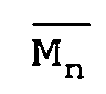
- the mass M n of the polyether blocks is between 100 and 6 000 and preferably between 200 and 3000.
- the polymers containing polyamide blocks and polyether blocks may also comprise randomly distributed units. These polymers may be prepared by the simultaneous reaction of the polyether and the polyamide-block precursors. For example, polyetherdiol, a lactam (or an ⁇ , ⁇ -amino acid) and a chain-limiting diacid may be reacted in the presence of a small amount of water. A polymer is obtained essentially containing polyether blocks, polyamide blocks of very variable length, and also the various reagents which have reacted randomly and which are distributed randomly in the polymer chain.
- polymers containing polyamide blocks and polyether blocks are derived from the copolycondensation of polyamide and polyether blocks prepared beforehand or from a one-pot reaction, they have, for example, Shore D hardnesses which may be between 20 and 75 and advantageously between 30 and 70 and an intrinsic viscosity of between 0.8 and 2.5 measured in meta-cresol at 250°C for an initial concentration of 0.8 g/100 ml.
- the MFIs may be between 5 and 50 (235°C for a 1 kg load).
- the polyetherdiol blocks are either used without modification and are copolycondensed with polyamide blocks containing carboxylic ends, or they are aminated in order to be converted into polyetherdiamines and condensed with polyamide blocks containing carboxylic ends. They may also be blended with polyamide precursors and a chain limiter to make polymers containing polyamide blocks and polyether blocks with randomly distributed units.
- Polymers containing polyamide blocks and polyether blocks are disclosed in patents US 4 331 786, US 4 115 475, US 4 195 015, US 4 839 441, US 4 864 014, US 4 230 838 and US 4 332 920.
- the polyamide blocks containing dicarboxylic chain ends are derived, for example, from the condensation of ⁇ , ⁇ -aminocarboxylic acids, of lactams or of dicarboxylic acids and diamines in the presence of a chain-limiting dicarboxylic acid.
- the polyamide blocks are made of polyamide 12 or of polyamide 6.
- the polyamide blocks result from the condensation of one or more ⁇ , ⁇ -aminocarboxylic acids and/or of one or more lactams containing from 6 to 12 carbon atoms in the presence of a dicarboxylic acid containing from 4 to 12 carbon atoms, and are of low mass, i.e. they have an M n ⁇ from 400 to 1 000.
- ⁇ , ⁇ -aminocarboxylic acids mention may be made of aminoundecanoic acid and aminododecanoic acid.
- dicarboxylic acids examples include adipic acid, sebacic acid, isophthalic acid, butanedioic acid, 1,4-cyclohexyldicarboxylic acid, terephthalic acid, the sodium or lithium salt of sulphoisophthalic acid, dimerized fatty acids (these dimerized fatty acids have a dimer content of at least 98% and are preferably hydrogenated) and dodecanedioic acid HOOC-(CH 2 ) 10 -COOH.
- lactams which may be mentioned are caprolactam and lauryllactam.
- Polyamide blocks obtained by condensation of lauryllactam in the presence of adipic acid or dodecanedioic acid and with an M n ⁇ of 750 have a melting point of 127-130°C.
- the polyamide blocks result from the condensation of at least one ⁇ , ⁇ -aminocarboxylic acid (or a lactam), at least one diamine and at least one dicarboxylic acid.
- the ⁇ , ⁇ -aminocarboxylic acid, the lactam and the dicarboxylic acid may be chosen from those mentioned above.
- the diamine may be an aliphatic diamine containing from 6 to 12 atoms and may be arylic and/or saturated cyclic.
- Examples which may be mentioned are hexamethylenediamine, piperazine, 1-aminoethylpiperazine, bisaminopropylpiperazine, tetramethylenediamine, octamethylenediamine, decamethylenediamine, dodecamethylenediamine, 1,5-diaminohexane, 2,2,4-trimethyl-1,6-diaminohexane, diamine polyols, isophoronediamine (IPD), methylpentamethylenediamine (MPDM), bis(aminocyclohexyl)methane (BACM) and bis(3-methyl-4-aminocyclohexyl)methane (BMACM).
- IPD isophoronediamine
- MPDM methylpentamethylenediamine
- BMACM bis(aminocyclohexyl)methane
- the various constituents of the polyamide block and their proportion may be chosen in order to obtain a melting point of less than 150°C and advantageously between 90°C and 135°C.
- Copolyamides with a low melting point are disclosed in patents US 4 483 975, DE 3 730 504 and US 5 459 230, and the same proportions of the constituents are adopted for the polyamide blocks.
- copolymers having polyamide blocks and polyether blocks are made of: PA 12 and PEG, PA 12 and PTMG, PA 6 and PTMG, PA 6 and PEG, copolyamide blocks and PEG, copolyamide blocks and PTMG.
- the polyether blocks may represent 5% to 85% by weight of the copolymer containing polyamide and polyether blocks.
- the polyether blocks may contain units other than ethylene oxide units, such as, for example, propylene oxide or polytetrahydrofuran (which leads to polytetramethylene glycol sequences). It is also possible to use simultaneously PEG blocks, i.e. those consisting of ethylene oxide units, PPG blocks, i.e. those consisting of propylene oxide units, and PTMG blocks, i.e. those consisting of tetramethylene glycol units, also known as polytetrahydrofuran. PPG or PTMG blocks are advantageously used.
- the amount of polyether blocks in these copolymers containing polyamide and polyether blocks is advantageously from10% to 50% by weight of the copolymer and preferably from 35% to 50%.
- copolymers containing polyamide blocks and polyether blocks may be prepared by any means for attaching the polyamide blocks and the polyether blocks.
- two processes are essentially used, one being a 2-step process, the other a one-step process.
- the 2-step process consists firstly in preparing polyamide blocks containing carboxylic ends by condensation of the polyamide precursors in the presence of a chain-limiting dicarboxylic acid and then, in a second step, in adding the polyether and a catalyst.
- the polyether and a catalyst are then added.
- the polyether may be added in one or more portions, as may the catalyst.
- the catalyst is defined as being any product which facilitates the bonding of the polyamide blocks and the polyether blocks by esterification.
- the catalyst is advantageously a derivative of a metal (M) chosen from the group formed by titanium, zirconium and hafnium.
- all the reagents used in the two-step process i.e. the polyamide precursors, the chain-limiting dicarboxylic acid, the polyether and the catalyst, are blended. These are the same reagents and the same catalyst as in the two-step process disclosed above. If the polyamide precursors are only lactams, it is advantageous to add a small amount of water.
- the copolymer essentially has the same polyether blocks and the same polyamide blocks, but also a small portion of different reagents which have reacted randomly and which are distributed randomly in the polymer chain.
- a blend of (i) a copolymer having polyamide blocks and polyether blocks and (ii) a polyamide. or a copolyamide.
- the polyamide is of the same type as the polyamide of the polyamide block.
- the level of water vapour transmission can vary between 500 and 10000 g/m2/day.
Landscapes
- Chemical & Material Sciences (AREA)
- Health & Medical Sciences (AREA)
- Chemical Kinetics & Catalysis (AREA)
- Medicinal Chemistry (AREA)
- Polymers & Plastics (AREA)
- Organic Chemistry (AREA)
- Engineering & Computer Science (AREA)
- Materials Engineering (AREA)
- Manufacture Of Porous Articles, And Recovery And Treatment Of Waste Products (AREA)
- Footwear And Its Accessory, Manufacturing Method And Apparatuses (AREA)
- Golf Clubs (AREA)
- Adhesive Tapes (AREA)
Abstract
- The compressive strength is from 90 to 170 kPa, preferably from 110 to 150 kPa (measured on foam of 240 kg/m3, at 25% deflection, method according to ISO 844).
- The shore hardness O is from 20 to 34, preferably from 23 to 32 (measured on foam of 240 kg/m3, internal method).
- The thermal conductivity is from 0.038 to 0.058 W/m°K, preferably from 0.043 to 0.053 W/m°K (measured on foam of 240 kg/m3, method according to ISO 2581)
- The energy return is 28 to 40 cm, preferably 31 to 37 cm (measured on foam of 240 kg/m3, method according to ISO 8307).
- The water vapour transmission is 500 to 10000 g/m2/day, preferably 1000 to 3500 g/m2/day (measured on foam of 240 kg/m3, 2.5 mm thickness, method according to ASTM E96 BW) provided there are enough hydrophilic polyether blocks.
Description
- The present invention concerns a polyether block amide foam and more precisely a foam made from a copolymer having polyamide blocks and polyether blocks. The properties of said foam are, among others, low compression strength, low dynamic shear modulus, and high water vapour transmission. Such properties are unique to a closed-cell foam.
- The patent US 3711584 describes a process and apparatus for producing a wrinkle-free, highly foamed sheet of an ethylenic resin having a uniform and fine cellular structure by causing a long strip of a sheet-like molded article of a cross-linked ethylenic resin containing a normally solid organic blowing agent to fall downwardly and continuously transferring it in the falling direction, heating the sheet-like molded article in transit to a foaming temperature, the heating being controlled so that a starting position of foaming along the widthwise direction of the sheet-like article will not appreciably fluctuate upwards or downwards and extending the foamed sheet-like article in the widthwise direction.
- The purpose of Japanese patent application JP 56111658 is obtain a foamy body having an excellent cushion quality and a rebounding elasticity with a small quantity of raw material by a method wherein a rubber sheet containing synthetic rubber and a bubbling agent in a specific ratio is filled in a molding mold, it is blocked with a covering mold to be heated and pressed and then, it is cooled and thereafter, a metallic mold is released.
- Patent EP 81069 describes a web of a cross-linked plastic material foamed in a closed-cell structure or configuration, having substantially parallel upper and lower surfaces, wherein canals penetrate the foamed material and extend and open to at least one of said upper and lower surfaces, and wherein substances can be introduced into the canals to impart beneficial properties to the web of foamed material. The plastic material is polyethylene.
- The patent US 4559190 describes a process for the preparation of bodies of expanded cross-linked polyethylene, with closed cells.
- The patent EP 0646622 describes a plastic foam material composed of a blended resin composition which includes at least two thermoplastic resins and a silane-modified based resin. The blended resin composition consists essentially of 100 parts by weight of at least two thermoplastic resins, from about 1 to about 50 parts by weight of a silane-modified, cross-linked, thermoplastic resin; from about 0.001 to about 2.5 parts by weight of a crosslinking catalyst for use in a silane compound and from about 1 to about 20 parts by weight of a foaming agent. The thermoplastic resins are polyethylene, polypropylene or polystyrene.
Patent application WO 9512481 describes a bilayer object comprising a lightened thermoplastic elastomer of the polyether amide type adhering by itself on a non lightened thermoplastic selected from polyether amides, polyether esters, polyurethanes. The bilayer product obtained by molding the lightened thermoplastic over the compact thermoplastic may be used in the fabrication of shoe soles. The density of the foam is 0.6 and is not crosslinked. - Patent application WO200402729 describes waterproof/breathable moisture transfer liner for alpine, snowboard and hiking. It includes an inner liner selected from technically advanced fabrics which are carefully selected. A series of layers are provided outside the inner liner including foam material and insulated nonwoven layers, breathable membranes, a supportive mesh included in a moldable foam, or moldable a spacer material and an outer shell fabric. The foam is an open-cell foam.
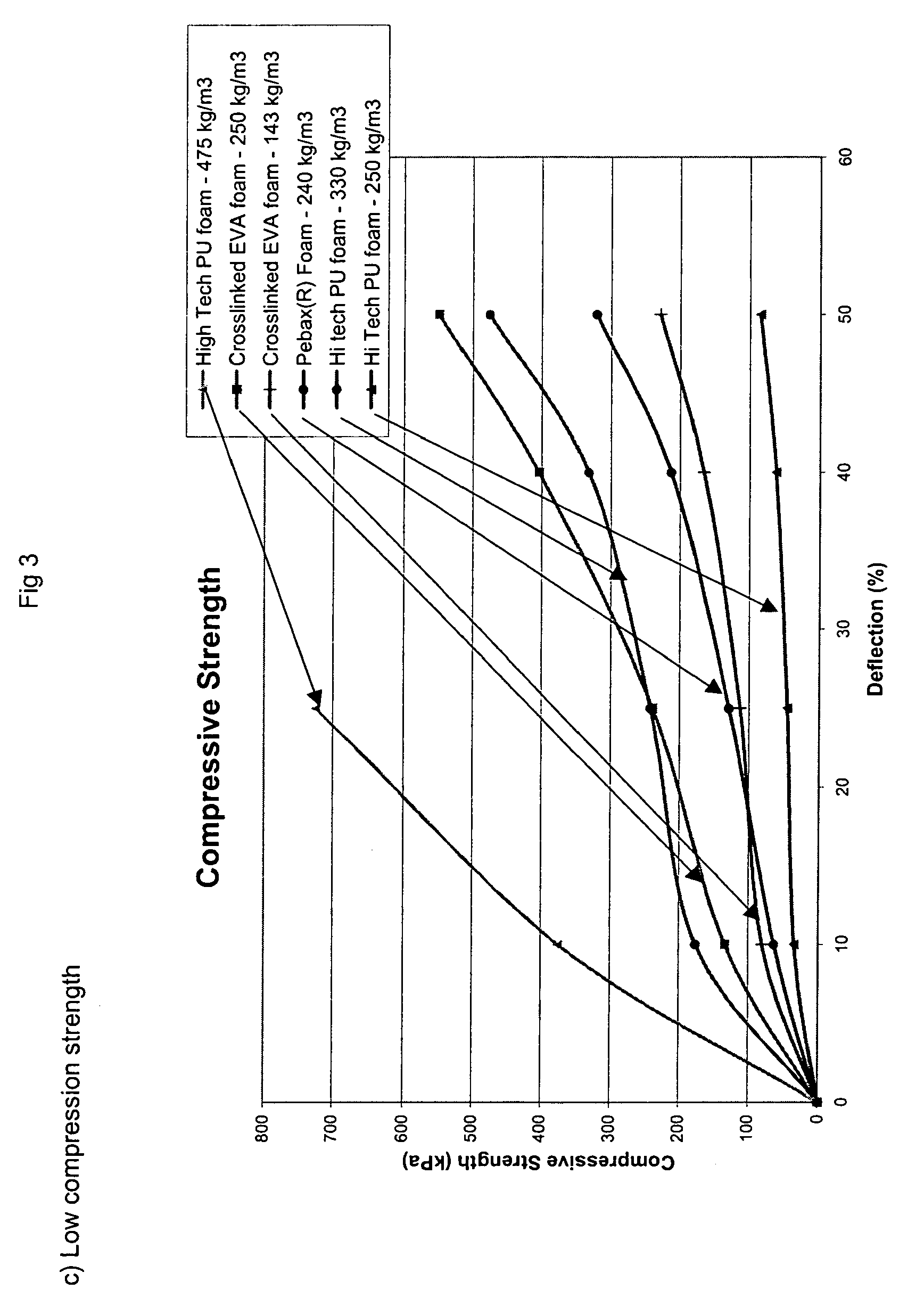
- None of the currently existing closed-cell foams have so low compressive strength, at given density, or such a low dynamic shear modulus. And none have so high water vapour transmission whilst having a closed-cell structure.
- Inventors have now discovered a crosslinked foam made from a copolymer having polyamide blocks and polyether blocks. This foam has unexpected properties.
- The present invention concerns a crosslinked foam of a copolymer having polyamide blocks and polyether blocks and a density from 20 to 700 kg/m3.
- Density is measured according to Method ISO 845. Advantageously the density is from 70 kg/m3 to 400 kg/m3.
- Advantageously the cell size is from 0.05 to 2.0 mm, preferably from 0.1 mm to 1.0 mm. Advantageously the cells are closed. Preferably the foam does not undergo any further mechanical or thermal treatment (except to be thermoformed).
- This foam has many advantages :
- The compressive strength is from 90 to 170 kPa, preferably from 110 to 150 kPa (measured on foam of 240 kg/m3, at 25% deflection, method according to ISO 844).
- The shore hardness 0 is from 20 to 34, preferably from 23 to 32 (measured on foam of 240 kg/m3, internal method)
- The thermal conductivity is from 0.038 to 0.058 W/m°K, preferably from 0.043 to 0.053 W/m°K (measured on foam of 240 kg/m3, method according to ISO 2581) The energy return is 28 to 40 cm, preferably 31 to 37 cm (measured on foam of 240 kg/m3, method according to ISO 8307).
- The water vapour transmission is 500 to 10000 g/m2/day, preferably 1000 to 3500 g/m2/day (measured on foam of 240 kg/m3, 2.5 mm thickness, method according to ASTM E96 BW) provided there are enough hydrophilic polyether blocks.
- As regards the copolymer having polyamide blocks and polyether blocks, these result from the copolycondensation of polyamide blocks containing reactive ends with polyether blocks containing reactive ends, such as, inter alia:
- 1) Polyamide blocks containing diamine chain ends with polyoxyalkylene blocks containing carboxylic chain ends.
- 2) Polyamide blocks containing dicarboxylic chain ends with polyoxyalkylene blocks containing diamine chain ends obtained by cyanoethylation and hydrogenation of aliphatic dihydroxylated alpha-omega polyoxyalkylenes known as polyether diols.
- 3) Polyamide blocks containing dicarboxylic chain ends with polyether diols, the products obtained in this particular case being polyetheresteramides. The copolymers used in the present invention are advantageously of this type.
- The polyamide blocks containing dicarboxylic chain ends are derived, for example, from the condensation of α, ω-aminocarboxylic acids, lactams or dicarboxylic acids and diamines in the presence of a chain-limiting dicarboxylic acid.
- The number-average molar mass of the polyamide blocks is between 300 and 15 000 and preferably between 600 and 5 000. The mass Mn of the polyether blocks is between 100 and 6 000 and preferably between 200 and 3000.
- The polymers containing polyamide blocks and polyether blocks may also comprise randomly distributed units. These polymers may be prepared by the simultaneous reaction of the polyether and the polyamide-block precursors. For example, polyetherdiol, a lactam (or an α, ω-amino acid) and a chain-limiting diacid may be reacted in the presence of a small amount of water. A polymer is obtained essentially containing polyether blocks, polyamide blocks of very variable length, and also the various reagents which have reacted randomly and which are distributed randomly in the polymer chain.
- Whether these polymers containing polyamide blocks and polyether blocks are derived from the copolycondensation of polyamide and polyether blocks prepared beforehand or from a one-pot reaction, they have, for example, Shore D hardnesses which may be between 20 and 75 and advantageously between 30 and 70 and an intrinsic viscosity of between 0.8 and 2.5 measured in meta-cresol at 250°C for an initial concentration of 0.8 g/100 ml. The MFIs may be between 5 and 50 (235°C for a 1 kg load).
- The polyetherdiol blocks are either used without modification and are copolycondensed with polyamide blocks containing carboxylic ends, or they are aminated in order to be converted into polyetherdiamines and condensed with polyamide blocks containing carboxylic ends. They may also be blended with polyamide precursors and a chain limiter to make polymers containing polyamide blocks and polyether blocks with randomly distributed units.
- Polymers containing polyamide blocks and polyether blocks are disclosed in patents US 4 331 786, US 4 115 475, US 4 195 015, US 4 839 441, US 4 864 014, US 4 230 838 and US 4 332 920.
- Three types of copolymer containing polyamide blocks and polyether blocks may be distinguished. According to a first type, the polyamide blocks containing dicarboxylic chain ends are derived, for example, from the condensation of α, ω-aminocarboxylic acids, of lactams or of dicarboxylic acids and diamines in the presence of a chain-limiting dicarboxylic acid. As an example of an α, ω-aminocarboxylic acid, mention may be made of aminoundecanoic acid, as examples of lactams, mention may be made of caprolactam and lauryllactam, as examples of dicarboxylic acids, mention may be made of adipic acid, decanedioic acid and dodecanedioic acid, and as an example of a diamine, mention may be made of hexamethylenediamine. Advantageously, the polyamide blocks are made of polyamide 12 or of polyamide 6.
- According to a second type, the polyamide blocks result from the condensation of one or more α, ω-aminocarboxylic acids and/or of one or more lactams containing from 6 to 12 carbon atoms in the presence of a dicarboxylic acid containing from 4 to 12 carbon atoms, and are of low mass, i.e. they have an


- According to a third type, the polyamide blocks result from the condensation of at least one α, ω-aminocarboxylic acid (or a lactam), at least one diamine and at least one dicarboxylic acid. The α, ω-aminocarboxylic acid, the lactam and the dicarboxylic acid may be chosen from those mentioned above. The diamine may be an aliphatic diamine containing from 6 to 12 atoms and may be arylic and/or saturated cyclic. Examples which may be mentioned are hexamethylenediamine, piperazine, 1-aminoethylpiperazine, bisaminopropylpiperazine, tetramethylenediamine, octamethylenediamine, decamethylenediamine, dodecamethylenediamine, 1,5-diaminohexane, 2,2,4-trimethyl-1,6-diaminohexane, diamine polyols, isophoronediamine (IPD), methylpentamethylenediamine (MPDM), bis(aminocyclohexyl)methane (BACM) and bis(3-methyl-4-aminocyclohexyl)methane (BMACM).
- In the second and third types, the various constituents of the polyamide block and their proportion may be chosen in order to obtain a melting point of less than 150°C and advantageously between 90°C and 135°C.
- Copolyamides with a low melting point are disclosed in patents US 4 483 975, DE 3 730 504 and US 5 459 230, and the same proportions of the constituents are adopted for the polyamide blocks.
- Advantageously the copolymers having polyamide blocks and polyether blocks are made of: PA 12 and PEG, PA 12 and PTMG, PA 6 and PTMG, PA 6 and PEG, copolyamide blocks and PEG, copolyamide blocks and PTMG.
- The polyether blocks may represent 5% to 85% by weight of the copolymer containing polyamide and polyether blocks. The polyether blocks may contain units other than ethylene oxide units, such as, for example, propylene oxide or polytetrahydrofuran (which leads to polytetramethylene glycol sequences). It is also possible to use simultaneously PEG blocks, i.e. those consisting of ethylene oxide units, PPG blocks, i.e. those consisting of propylene oxide units, and PTMG blocks, i.e. those consisting of tetramethylene glycol units, also known as polytetrahydrofuran. PPG or PTMG blocks are advantageously used. The amount of polyether blocks in these copolymers containing polyamide and polyether blocks is advantageously from10% to 50% by weight of the copolymer and preferably from 35% to 50%.
- The copolymers containing polyamide blocks and polyether blocks may be prepared by any means for attaching the polyamide blocks and the polyether blocks. In practice, two processes are essentially used, one being a 2-step process, the other a one-step process.
- The 2-step process consists firstly in preparing polyamide blocks containing carboxylic ends by condensation of the polyamide precursors in the presence of a chain-limiting dicarboxylic acid and then, in a second step, in adding the polyether and a catalyst.
- Once the polyamide containing carboxylic acid ends has been prepared, the polyether and a catalyst are then added. The polyether may be added in one or more portions, as may the catalyst.
- The catalyst is defined as being any product which facilitates the bonding of the polyamide blocks and the polyether blocks by esterification. The catalyst is advantageously a derivative of a metal (M) chosen from the group formed by titanium, zirconium and hafnium.
- This process and these catalysts are disclosed in patents US 4 332 920, US 4 230 838, US 4 331 786 US 4 252 920 JP 07145368A, JP 06287547A and EP 613919.
- As regards the one-step process, all the reagents used in the two-step process, i.e. the polyamide precursors, the chain-limiting dicarboxylic acid, the polyether and the catalyst, are blended. These are the same reagents and the same catalyst as in the two-step process disclosed above. If the polyamide precursors are only lactams, it is advantageous to add a small amount of water.
- The copolymer essentially has the same polyether blocks and the same polyamide blocks, but also a small portion of different reagents which have reacted randomly and which are distributed randomly in the polymer chain.
- The higher the proportion of PEG blocks the higher the water vapor transmission rate.
- It would not depart of the scope of the invention to use a blend of (i) a copolymer having polyamide blocks and PEG blocks and (ii) a copolymer having polyamide blocks and PTMG blocks.
- It would not depart of the scope of the invention to use a blend of (i) a copolymer having polyamide blocks and polyether blocks and (ii) a polyamide. or a copolyamide. Advantageously the polyamide is of the same type as the polyamide of the polyamide block.
- It would not depart of the scope of the invention to use a blend of (i) a copolymer having polyamide blocks and polyether blocks and (ii) a copolymer of ethylene with acetate or acrylate groups, preferably a copolymer of ethylene and alkyl (meth)acrylate. Eventually (ii) is functionalized. It could be a copolymer of ethylene-alkyl(meth)acrylate-maleic anhydride. This is described in EP 688 826.
- As regards the process to make the foam, the following steps are advantageous :
- 1) Extrusion/kneading:
- a) Extrusion and/or calendering as a film or a sheet, with or without cutting of the sheet.
- b) Mixing/kneading amd possibly calendering to a sheet or a felt.
- 2) Crosslinking:
- a) Chemical crosslinking: through addition of peroxide and/or silane during the extrusion/kneading phase.
- b) Physical crosslinking: by electron beam or gamma radiation.
Both a) and b) alternatives can contain crosslinking co-agents or promoters as described in the literature to control the crosslinking network and density.
- 3 Foaming:
- a) Through decomposition of an organic foaming agent added during the mixing phase, preferably azodicarbonamide.
- b) Through release of supersaturated gas, preferably CO2 or N2, added in a high pressure autoclave, after extrusion but before expansion.
- c) Through expansion of gas added directly during extrusion (usually as aid together with organic foaming agent as under a).
- 4) Expansion process:
- a) In a horizontal oven. Free expansion.
- b) In a vertical oven. Free expansion.
- c) In a low pressure autoclave. Free expansion.
- d) In a heated press. Constrained expansion.
- 5) Shape:
- a) Roll foams
- b) Batch foams
- As regards the uses, they are connected to the following specific properties and advantages of the foam:
- Softness, low hardness, low compressive modulus
- High friction coefficient
- Low compression set
- High thermal insulation (low thermal conductivity)
- Good UV resistance
- Good chemical resistance against a great number of substances
- Prominent shape recovery
- Good printing results, even without surface treatment
- Excellent behaviour in ultrasonic and HF welding processes
- High water vapour transmission
- Can be flame laminated, pressformed, vacuumformed
- Can be adhesive coated
- Can be cut or die-cut
- Can be skived; not easy but possible
- Good wash resistance (at least to 60°C, incl. tumbler drying)
- High energy return (rebound height)
- High abrasion resistance
- Can be over-injected (with non-expanded copolymer having polyamide block and polyether block, or polyamide, or polyurethane or thermoplastic polyurethane) in usual injection moulding process, or in low pressure moulding process (whereby the molten mass is injected in the open mould, and the mould is closed after injection of the partially distributed resin).
- Can be extrusion coated to achieve a stiff/flexible thermoplastic complex.
- -> very easy to get high elongation and "conformability". Following apparatus have been used:
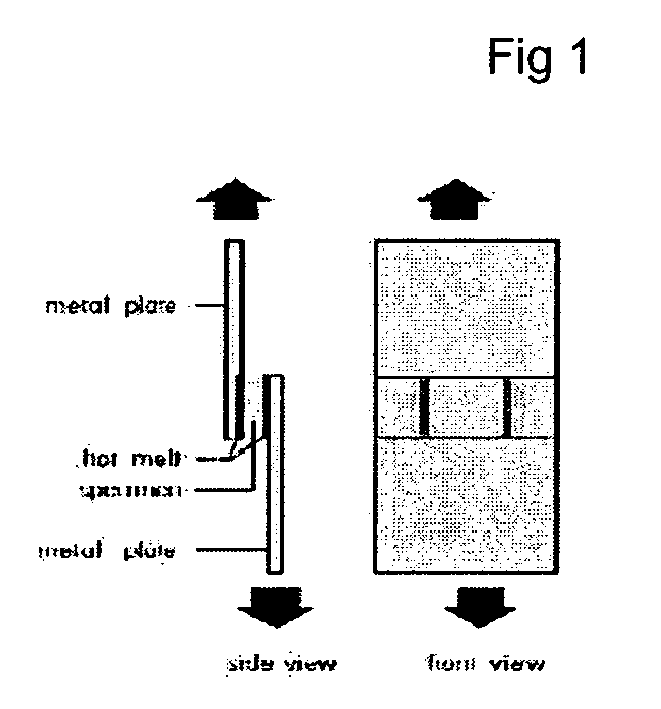


- With the invented foam a material with high water vapour transmission can be obtained. Depending on the number of hydrophilic polyether blocks, the level of water vapour transmission (WVT) can vary between 500 and 10000 g/m2/day.
- Examples of results obtained (measured according to ASTM E96E 38°C /90% RH):
- A foam of a copolymer having PA 12 blocks of


- A foam of a copolymer having PA 12 blocks of


- A foam of a copolymer having PA 12 blocks of

- A foam of a copolymer having 6.10 /11 copolyamide blocks and PEG blocks (PEG is 40% by weight of the copolymer) with an area weight of 155 g/m2 has a WVT value of 2207 g/m2/d;
- A foam of (i) a copolymer having 6.10 /11 copolyamide blocks and PEG blocks (PEG is 40% by weight of the copolymer) blended with (ii) EVA in a weight ratio 70/30 with an area weight of 185 g/m2 has a WVT value of 1730 g/m2/d.
| Uses | Relevant properties |
| Soccer balls | Energy return/Rebound |
| Sports gloves (goalkeepers, etc) | Antislip, energy return, roll product, easier |
| Immersion suits | Shape recovery, elasticity, thermal insulation, tear resistance |
| Golf clubs (grip) | Nice touch, abrasion resistance |
| Ski poles | As golf clubs |
| Sports bat grips | As golf clubs |
| Snowboard and windsurf pads | Antislip, surface resistance, easy to stick |
| Antislip coated tape (construction or automotive) | Antislip property, high surface tension, good touch |
| Lingerie articles (bra cup) | Elasticity, wash resistance, no crease, breathable |
| Parts of ski boots (ankle padding, tongue) | Low temperature resistance, flexibility |
| Mouse mats | Antislip feature, printability (no need of printed film) |
| Trays for objects in cars | Antislip, easy to stick |
| Gaskets | Conformability, temp. resistance, vibration |
| Flexographic printing rolls | Elasticity, energy return, fatigue resistance |
| Single and double side adhesive coated tapes | Conformability, elasticity, shape recovery Conformability, elasticity, shape recovery |
| Orthopaedic insoles/inlays | Mechanical properties, touch, fatigue resistance |
| Footwear insoles/insocks | Light weight, compression set |
| Footwear midsoles | Light weight, compression set |
| Footwear lining | Waterproof but water vapour breathable, thermoformable, thermal insulation |
| Heel inserts | |
| Transdermal pads | Water vapour breathable, skin friendly, elastic |
| Woundcare plasters | Water vapour breathable, skin friendly, elastic |
| Sportswear and garment lining garment lining | Waterproof but water vapour breathable, thermoformable, thermal insulation, light weight |
| Cushioning of seats of ski-lifts | Energy return, UV resistance (if not covered), |
Claims (36)
Priority Applications (7)
| Application Number | Priority Date | Filing Date | Title |
|---|---|---|---|
| EP04024833A EP1650255A1 (en) | 2004-10-19 | 2004-10-19 | Polyether block amide foam |
| PCT/EP2005/011253 WO2006045513A1 (en) | 2004-10-19 | 2005-10-19 | Polyether block amide foam |
| TW094136455A TW200621847A (en) | 2004-10-19 | 2005-10-19 | Polyether block amide foam |
| KR1020077010556A KR20070092204A (en) | 2004-10-19 | 2005-10-19 | Polyether block amide foam |
| EP05798154A EP1828290A1 (en) | 2004-10-19 | 2005-10-19 | Polyether block amide foam |
| CNA2005800357516A CN101044196A (en) | 2004-10-19 | 2005-10-19 | Polyether block amide foam |
| JP2007537204A JP2008517122A (en) | 2004-10-19 | 2005-10-19 | Polyether block amide foam |
Applications Claiming Priority (1)
| Application Number | Priority Date | Filing Date | Title |
|---|---|---|---|
| EP04024833A EP1650255A1 (en) | 2004-10-19 | 2004-10-19 | Polyether block amide foam |
Publications (1)
| Publication Number | Publication Date |
|---|---|
| EP1650255A1 true EP1650255A1 (en) | 2006-04-26 |
Family
ID=34927028
Family Applications (2)
| Application Number | Title | Priority Date | Filing Date |
|---|---|---|---|
| EP04024833A Withdrawn EP1650255A1 (en) | 2004-10-19 | 2004-10-19 | Polyether block amide foam |
| EP05798154A Withdrawn EP1828290A1 (en) | 2004-10-19 | 2005-10-19 | Polyether block amide foam |
Family Applications After (1)
| Application Number | Title | Priority Date | Filing Date |
|---|---|---|---|
| EP05798154A Withdrawn EP1828290A1 (en) | 2004-10-19 | 2005-10-19 | Polyether block amide foam |
Country Status (6)
| Country | Link |
|---|---|
| EP (2) | EP1650255A1 (en) |
| JP (1) | JP2008517122A (en) |
| KR (1) | KR20070092204A (en) |
| CN (1) | CN101044196A (en) |
| TW (1) | TW200621847A (en) |
| WO (1) | WO2006045513A1 (en) |
Cited By (13)
| Publication number | Priority date | Publication date | Assignee | Title |
|---|---|---|---|---|
| FR2970876A1 (en) * | 2011-02-02 | 2012-08-03 | Cornilleau Sas | Coating for table tennis racket, has striking layer whose front face is in contact with ball and rear face is in contact with deformation layer, where striking layer and deformation layer are made of thermoplastic elastomer material |
| CN101466772B (en) * | 2006-06-14 | 2012-10-03 | 阿肯马法国公司 | Copolymers having amide units and ether units with improved optical properties |
| DE102014216992A1 (en) | 2014-08-26 | 2016-03-03 | Adidas Ag | Expanded polymer pellets |
| EP3202835A4 (en) * | 2014-09-30 | 2018-03-28 | Sekisui Plastics Co., Ltd. | Amide elastomer foam particles, method for producing same, foam molded body and method for producing foam molded body |
| WO2018146426A1 (en) | 2017-02-08 | 2018-08-16 | Arkema France | Non-crosslinked copolymer foam with polyamide blocks and polyether blocks |
| WO2019097178A1 (en) | 2017-11-17 | 2019-05-23 | Arkema France | Block copolymer foam |
| FR3093726A1 (en) | 2019-03-15 | 2020-09-18 | Arkema France | Process for manufacturing a polyamide block and polyether block copolymer foam |
| US11008464B2 (en) | 2016-01-29 | 2021-05-18 | Arkema France | Copolymer foam with polyamide blocks and polyether blocks |
| CN113121864A (en) * | 2019-12-31 | 2021-07-16 | 中国科学院宁波材料技术与工程研究所 | Polyamide elastomer foam material and preparation method thereof |
| FR3114097A1 (en) * | 2020-09-15 | 2022-03-18 | Arkema France | Foamable composition of polymers comprising a copolymer with polyamide blocks and with branched polyether blocks |
| EP4245802A2 (en) | 2014-08-26 | 2023-09-20 | adidas AG | Method for manufacturing molded components |
| WO2026104301A1 (en) | 2024-11-12 | 2026-05-21 | Benecke-Kaliko GmbH | Crosslinked tpu foams with excellent haptics, flexibility and recovery behavior |
| TWI930115B (en) | 2020-09-15 | 2026-07-01 | 法商阿科瑪法國公司 | Foamable composition of polymers comprising a branched copolymer containing polyamide blocks and polyether blocks |
Families Citing this family (17)
| Publication number | Priority date | Publication date | Assignee | Title |
|---|---|---|---|---|
| FR2922478B1 (en) * | 2007-10-22 | 2014-12-12 | Arkema France | PROCESS FOR PRODUCING POLYMERIC LAMINATE COMPRISING AN ACTIVATION STEP BY PLASMA TREATMENT |
| WO2010089902A1 (en) * | 2009-02-06 | 2010-08-12 | Arkema France | Use of a peba copolymer, composition, process and skin |
| WO2010097250A1 (en) | 2009-02-27 | 2010-09-02 | Evonik Degussa Gmbh | Shoe insoles having an improved antibacterial effect |
| US11292163B2 (en) | 2012-03-30 | 2022-04-05 | Mucell Extrusion, Llc | Method of forming polymeric foam and related foam articles |
| FR3001637B1 (en) * | 2013-02-05 | 2015-02-20 | Rossignol Sa | METHOD OF MANUFACTURING A SLIDING BOARD, AND SLIDING BOARD OBTAINED BY THIS METHOD |
| US11123616B2 (en) | 2015-03-02 | 2021-09-21 | Karsten Manufacturing Corporation | Snap fit golf bag assembly |
| GB2587729B (en) * | 2015-03-02 | 2021-08-18 | Karsten Mfg Corp | Sub-assembly for a golf bag and a golf bag system for recipient self-assembly |
| JP6422806B2 (en) * | 2015-03-30 | 2018-11-14 | 積水化成品工業株式会社 | Amide-based foamed resin particles and foamed molded article |
| JP6366535B2 (en) * | 2015-03-31 | 2018-08-01 | 積水化成品工業株式会社 | Amide-based elastomer expanded particles, method for producing the same, and expanded molded article |
| JP6539612B2 (en) * | 2016-03-30 | 2019-07-03 | 積水化成品工業株式会社 | Polyamide-based resin foam sheet, laminated sheet, foam-molded article, and method for producing polyamide-based resin foam sheet |
| EP3475352B1 (en) | 2016-06-23 | 2026-04-29 | Basf Se | Method for the preparation of foam particles out of thermoplastic elastomers with polyamide segments |
| CN108047702B (en) * | 2018-01-26 | 2020-12-15 | 青岛科技大学 | A thermoplastic elastomer and its foaming material |
| US11845845B2 (en) | 2018-07-18 | 2023-12-19 | Basf Se | Foam material particles based on long-chain polyamides |
| EP3640287A1 (en) * | 2018-10-16 | 2020-04-22 | Röhm GmbH | Polyether blockamide poly(meth)acrylate foams |
| CN111040420A (en) * | 2019-09-04 | 2020-04-21 | 晋江兴迅新材料科技有限公司 | Method for preparing TPV (thermoplastic vulcanizate) foam material from PEBAX (polyethylene-ethylene-butylene-styrene copolymer) and TPV foam material |
| FR3114096B1 (en) * | 2020-09-15 | 2023-08-25 | Arkema France | Polymer foam comprising a copolymer with polyamide blocks and polyether blocks |
| CN118440493A (en) * | 2024-05-14 | 2024-08-06 | 诚达Vi科技责任有限公司 | Composition based on block polyether amide and method for producing soles from the composition |
Citations (4)
| Publication number | Priority date | Publication date | Assignee | Title |
|---|---|---|---|---|
| JPS6026029A (en) * | 1983-07-21 | 1985-02-08 | Japan Styrene Paper Co Ltd | Thermoplastic elastomer resin |
| JPS6042432A (en) * | 1983-08-18 | 1985-03-06 | Japan Styrene Paper Co Ltd | Foamed particle |
| WO1995012481A1 (en) * | 1993-11-05 | 1995-05-11 | Elf Atochem S.A. | Over molding of lightened amide block polyether on thermoplastic elastomer |
| FR2823699A1 (en) * | 2001-04-24 | 2002-10-25 | C F Gomma Barre Thomas | Vehicle suspension stop, has tubular shape and sections made from cellular and compact thermoplastic materials |
-
2004
- 2004-10-19 EP EP04024833A patent/EP1650255A1/en not_active Withdrawn
-
2005
- 2005-10-19 TW TW094136455A patent/TW200621847A/en unknown
- 2005-10-19 WO PCT/EP2005/011253 patent/WO2006045513A1/en not_active Ceased
- 2005-10-19 JP JP2007537204A patent/JP2008517122A/en not_active Withdrawn
- 2005-10-19 CN CNA2005800357516A patent/CN101044196A/en active Pending
- 2005-10-19 EP EP05798154A patent/EP1828290A1/en not_active Withdrawn
- 2005-10-19 KR KR1020077010556A patent/KR20070092204A/en not_active Withdrawn
Patent Citations (4)
| Publication number | Priority date | Publication date | Assignee | Title |
|---|---|---|---|---|
| JPS6026029A (en) * | 1983-07-21 | 1985-02-08 | Japan Styrene Paper Co Ltd | Thermoplastic elastomer resin |
| JPS6042432A (en) * | 1983-08-18 | 1985-03-06 | Japan Styrene Paper Co Ltd | Foamed particle |
| WO1995012481A1 (en) * | 1993-11-05 | 1995-05-11 | Elf Atochem S.A. | Over molding of lightened amide block polyether on thermoplastic elastomer |
| FR2823699A1 (en) * | 2001-04-24 | 2002-10-25 | C F Gomma Barre Thomas | Vehicle suspension stop, has tubular shape and sections made from cellular and compact thermoplastic materials |
Non-Patent Citations (2)
| Title |
|---|
| PATENT ABSTRACTS OF JAPAN vol. 009, no. 138 (C - 286) 13 June 1985 (1985-06-13) * |
| PATENT ABSTRACTS OF JAPAN vol. 009, no. 171 (C - 291) 16 July 1985 (1985-07-16) * |
Cited By (21)
| Publication number | Priority date | Publication date | Assignee | Title |
|---|---|---|---|---|
| CN101466772B (en) * | 2006-06-14 | 2012-10-03 | 阿肯马法国公司 | Copolymers having amide units and ether units with improved optical properties |
| FR2970876A1 (en) * | 2011-02-02 | 2012-08-03 | Cornilleau Sas | Coating for table tennis racket, has striking layer whose front face is in contact with ball and rear face is in contact with deformation layer, where striking layer and deformation layer are made of thermoplastic elastomer material |
| DE102014216992A1 (en) | 2014-08-26 | 2016-03-03 | Adidas Ag | Expanded polymer pellets |
| DE202015008971U1 (en) | 2014-08-26 | 2016-05-30 | Adidas Ag | Expanded polymer pellets |
| EP4245802A2 (en) | 2014-08-26 | 2023-09-20 | adidas AG | Method for manufacturing molded components |
| EP4112679A1 (en) | 2014-08-26 | 2023-01-04 | adidas AG | Expanded polymer pellets |
| EP3202835A4 (en) * | 2014-09-30 | 2018-03-28 | Sekisui Plastics Co., Ltd. | Amide elastomer foam particles, method for producing same, foam molded body and method for producing foam molded body |
| US11008464B2 (en) | 2016-01-29 | 2021-05-18 | Arkema France | Copolymer foam with polyamide blocks and polyether blocks |
| EP4397696A2 (en) | 2016-01-29 | 2024-07-10 | Arkema France | Foam of a copolymer of polyamide blocks and polyether blocks |
| WO2018146426A1 (en) | 2017-02-08 | 2018-08-16 | Arkema France | Non-crosslinked copolymer foam with polyamide blocks and polyether blocks |
| US11760856B2 (en) | 2017-02-08 | 2023-09-19 | Arkema France | Non-crosslinked copolymer foam composition with polyamide blocks and polyether blocks |
| US11384214B2 (en) | 2017-11-17 | 2022-07-12 | Arkema France | Block copolymer foam |
| WO2019097178A1 (en) | 2017-11-17 | 2019-05-23 | Arkema France | Block copolymer foam |
| WO2020188211A1 (en) | 2019-03-15 | 2020-09-24 | Arkema France | Method for producing a copolymer foam with polyamide blocks and polyether blocks |
| FR3093726A1 (en) | 2019-03-15 | 2020-09-18 | Arkema France | Process for manufacturing a polyamide block and polyether block copolymer foam |
| CN113121864A (en) * | 2019-12-31 | 2021-07-16 | 中国科学院宁波材料技术与工程研究所 | Polyamide elastomer foam material and preparation method thereof |
| CN113121864B (en) * | 2019-12-31 | 2023-01-03 | 中国科学院宁波材料技术与工程研究所 | Polyamide elastomer foam material and preparation method thereof |
| FR3114097A1 (en) * | 2020-09-15 | 2022-03-18 | Arkema France | Foamable composition of polymers comprising a copolymer with polyamide blocks and with branched polyether blocks |
| WO2022058679A1 (en) * | 2020-09-15 | 2022-03-24 | Arkema France | Foamable polymer composition comprising a branched copolymer containing polyamide blocks and polyether blocks |
| TWI930115B (en) | 2020-09-15 | 2026-07-01 | 法商阿科瑪法國公司 | Foamable composition of polymers comprising a branched copolymer containing polyamide blocks and polyether blocks |
| WO2026104301A1 (en) | 2024-11-12 | 2026-05-21 | Benecke-Kaliko GmbH | Crosslinked tpu foams with excellent haptics, flexibility and recovery behavior |
Also Published As
| Publication number | Publication date |
|---|---|
| KR20070092204A (en) | 2007-09-12 |
| WO2006045513A8 (en) | 2007-05-31 |
| TW200621847A (en) | 2006-07-01 |
| EP1828290A1 (en) | 2007-09-05 |
| CN101044196A (en) | 2007-09-26 |
| JP2008517122A (en) | 2008-05-22 |
| WO2006045513A1 (en) | 2006-05-04 |
Similar Documents
| Publication | Publication Date | Title |
|---|---|---|
| EP1828290A1 (en) | Polyether block amide foam | |
| CN111225796B (en) | Composite materials, methods of manufacture, methods of use, and articles incorporating the composite materials | |
| JP7144548B2 (en) | Foams, polyolefin foam sheets and composites | |
| EP4132762B1 (en) | Foamed articles and methods of making the same | |
| US12286733B2 (en) | Foamed articles and methods of making the same | |
| US12083717B2 (en) | Foamed articles and methods of making the same | |
| US12036706B2 (en) | Foamed articles and methods of making the same | |
| US11384214B2 (en) | Block copolymer foam | |
| US20110071448A1 (en) | Liquid impermeable material | |
| JP3608893B2 (en) | Abrasion-resistant elastic sheet, foamable sheet and elastic foam made therefrom | |
| WO2006000044A1 (en) | Liquid impermeable material | |
| KR20230141730A (en) | Copolymers with polyamide blocks and polyether blocks for making foamed articles |
Legal Events
| Date | Code | Title | Description |
|---|---|---|---|
| PUAI | Public reference made under article 153(3) epc to a published international application that has entered the european phase |
Free format text: ORIGINAL CODE: 0009012 |
|
| AK | Designated contracting states |
Kind code of ref document: A1 Designated state(s): AT BE BG CH CY CZ DE DK EE ES FI FR GB GR HU IE IT LI LU MC NL PL PT RO SE SI SK TR |
|
| AX | Request for extension of the european patent |
Extension state: AL HR LT LV MK |
|
| RIN1 | Information on inventor provided before grant (corrected) |
Inventor name: MAUGER, MURIEL Inventor name: LACROIX, CHRISTOPHE Inventor name: FASOLA, ARMIN Inventor name: DABBOUS, RAPHAEL Inventor name: WILLEMSE, REMCO |
|
| RAP1 | Party data changed (applicant data changed or rights of an application transferred) |
Owner name: ALVEO AG Owner name: ARKEMA FRANCE |
|
| AKX | Designation fees paid |
Designated state(s): CH FR LI |
|
| REG | Reference to a national code |
Ref country code: DE Ref legal event code: 8566 |
|
| STAA | Information on the status of an ep patent application or granted ep patent |
Free format text: STATUS: THE APPLICATION IS DEEMED TO BE WITHDRAWN |
|
| 18D | Application deemed to be withdrawn |
Effective date: 20061027 |