EP1650236A1 - Activating agents for hafnium based metallocene components - Google Patents
Activating agents for hafnium based metallocene components Download PDFInfo
- Publication number
- EP1650236A1 EP1650236A1 EP04105219A EP04105219A EP1650236A1 EP 1650236 A1 EP1650236 A1 EP 1650236A1 EP 04105219 A EP04105219 A EP 04105219A EP 04105219 A EP04105219 A EP 04105219A EP 1650236 A1 EP1650236 A1 EP 1650236A1
- Authority
- EP
- European Patent Office
- Prior art keywords
- catalyst system
- metallocene catalyst
- hafnium
- formula
- group
- Prior art date
- Legal status (The legal status is an assumption and is not a legal conclusion. Google has not performed a legal analysis and makes no representation as to the accuracy of the status listed.)
- Withdrawn
Links
- 229910052735 hafnium Inorganic materials 0.000 title claims abstract description 27
- VBJZVLUMGGDVMO-UHFFFAOYSA-N hafnium atom Chemical compound [Hf] VBJZVLUMGGDVMO-UHFFFAOYSA-N 0.000 title claims abstract description 25
- 230000003213 activating effect Effects 0.000 title claims abstract description 21
- 239000012968 metallocene catalyst Substances 0.000 claims abstract description 21
- 239000003795 chemical substances by application Substances 0.000 claims abstract description 20
- 239000002879 Lewis base Substances 0.000 claims abstract description 14
- 150000007527 lewis bases Chemical class 0.000 claims abstract description 14
- 239000003054 catalyst Substances 0.000 claims description 34
- CPOFMOWDMVWCLF-UHFFFAOYSA-N methyl(oxo)alumane Chemical group C[Al]=O CPOFMOWDMVWCLF-UHFFFAOYSA-N 0.000 claims description 21
- 125000001424 substituent group Chemical group 0.000 claims description 17
- ISWSIDIOOBJBQZ-UHFFFAOYSA-N Phenol Chemical compound OC1=CC=CC=C1 ISWSIDIOOBJBQZ-UHFFFAOYSA-N 0.000 claims description 16
- 125000004432 carbon atom Chemical group C* 0.000 claims description 13
- 125000000058 cyclopentadienyl group Chemical group C1(=CC=CC1)* 0.000 claims description 11
- 229920000098 polyolefin Polymers 0.000 claims description 11
- 238000000034 method Methods 0.000 claims description 10
- 239000000178 monomer Substances 0.000 claims description 10
- 125000004805 propylene group Chemical group [H]C([H])([H])C([H])([*:1])C([H])([H])[*:2] 0.000 claims description 10
- 125000003983 fluorenyl group Chemical group C1(=CC=CC=2C3=CC=CC=C3CC12)* 0.000 claims description 9
- QQONPFPTGQHPMA-UHFFFAOYSA-N propylene Natural products CC=C QQONPFPTGQHPMA-UHFFFAOYSA-N 0.000 claims description 9
- UFHFLCQGNIYNRP-UHFFFAOYSA-N Hydrogen Chemical compound [H][H] UFHFLCQGNIYNRP-UHFFFAOYSA-N 0.000 claims description 8
- 125000000217 alkyl group Chemical group 0.000 claims description 8
- 229910052739 hydrogen Inorganic materials 0.000 claims description 8
- 239000001257 hydrogen Substances 0.000 claims description 8
- 125000003342 alkenyl group Chemical group 0.000 claims description 6
- 125000002877 alkyl aryl group Chemical group 0.000 claims description 6
- 125000003118 aryl group Chemical group 0.000 claims description 6
- 150000001875 compounds Chemical class 0.000 claims description 6
- 239000003446 ligand Substances 0.000 claims description 6
- 125000002496 methyl group Chemical group [H]C([H])([H])* 0.000 claims description 5
- 230000000737 periodic effect Effects 0.000 claims description 4
- 229910052736 halogen Inorganic materials 0.000 claims description 3
- 125000001183 hydrocarbyl group Chemical group 0.000 claims description 3
- 125000000999 tert-butyl group Chemical group [H]C([H])([H])C(*)(C([H])([H])[H])C([H])([H])[H] 0.000 claims description 3
- 239000004711 α-olefin Substances 0.000 claims description 3
- NINIDFKCEFEMDL-UHFFFAOYSA-N Sulfur Chemical group [S] NINIDFKCEFEMDL-UHFFFAOYSA-N 0.000 claims description 2
- 239000005864 Sulphur Chemical group 0.000 claims description 2
- 150000002367 halogens Chemical class 0.000 claims description 2
- 125000005842 heteroatom Chemical group 0.000 claims description 2
- 229910052757 nitrogen Inorganic materials 0.000 claims description 2
- IJGRMHOSHXDMSA-UHFFFAOYSA-N nitrogen Substances N#N IJGRMHOSHXDMSA-UHFFFAOYSA-N 0.000 claims description 2
- QJGQUHMNIGDVPM-UHFFFAOYSA-N nitrogen group Chemical group [N] QJGQUHMNIGDVPM-UHFFFAOYSA-N 0.000 claims description 2
- OAICVXFJPJFONN-UHFFFAOYSA-N Phosphorus Chemical group [P] OAICVXFJPJFONN-UHFFFAOYSA-N 0.000 claims 1
- QVGXLLKOCUKJST-UHFFFAOYSA-N atomic oxygen Chemical group [O] QVGXLLKOCUKJST-UHFFFAOYSA-N 0.000 claims 1
- 229910052760 oxygen Inorganic materials 0.000 claims 1
- 239000001301 oxygen Chemical group 0.000 claims 1
- 229910052698 phosphorus Inorganic materials 0.000 claims 1
- 239000011574 phosphorus Chemical group 0.000 claims 1
- YXFVVABEGXRONW-UHFFFAOYSA-N Toluene Chemical compound CC1=CC=CC=C1 YXFVVABEGXRONW-UHFFFAOYSA-N 0.000 description 21
- -1 polyethylenes Polymers 0.000 description 15
- 230000000694 effects Effects 0.000 description 8
- 239000000463 material Substances 0.000 description 8
- 239000004411 aluminium Substances 0.000 description 7
- 229910052782 aluminium Inorganic materials 0.000 description 7
- 239000004743 Polypropylene Substances 0.000 description 6
- VYPSYNLAJGMNEJ-UHFFFAOYSA-N Silicium dioxide Chemical compound O=[Si]=O VYPSYNLAJGMNEJ-UHFFFAOYSA-N 0.000 description 6
- 239000000203 mixture Substances 0.000 description 6
- 229920000642 polymer Polymers 0.000 description 6
- 229910052751 metal Inorganic materials 0.000 description 5
- 239000002184 metal Substances 0.000 description 5
- 239000002904 solvent Substances 0.000 description 5
- IMNFDUFMRHMDMM-UHFFFAOYSA-N N-Heptane Chemical compound CCCCCCC IMNFDUFMRHMDMM-UHFFFAOYSA-N 0.000 description 4
- ZMMRKRFMSDTOLV-UHFFFAOYSA-N cyclopenta-1,3-diene zirconium Chemical compound [Zr].C1C=CC=C1.C1C=CC=C1 ZMMRKRFMSDTOLV-UHFFFAOYSA-N 0.000 description 4
- ZSWFCLXCOIISFI-UHFFFAOYSA-N endo-cyclopentadiene Natural products C1C=CC=C1 ZSWFCLXCOIISFI-UHFFFAOYSA-N 0.000 description 4
- 229930195733 hydrocarbon Natural products 0.000 description 4
- 150000002430 hydrocarbons Chemical class 0.000 description 4
- 229910052809 inorganic oxide Inorganic materials 0.000 description 4
- 229910052726 zirconium Inorganic materials 0.000 description 4
- UHOVQNZJYSORNB-UHFFFAOYSA-N Benzene Chemical compound C1=CC=CC=C1 UHOVQNZJYSORNB-UHFFFAOYSA-N 0.000 description 3
- RTZKZFJDLAIYFH-UHFFFAOYSA-N Diethyl ether Chemical compound CCOCC RTZKZFJDLAIYFH-UHFFFAOYSA-N 0.000 description 3
- LFQSCWFLJHTTHZ-UHFFFAOYSA-N Ethanol Chemical compound CCO LFQSCWFLJHTTHZ-UHFFFAOYSA-N 0.000 description 3
- ZMANZCXQSJIPKH-UHFFFAOYSA-N Triethylamine Chemical compound CCN(CC)CC ZMANZCXQSJIPKH-UHFFFAOYSA-N 0.000 description 3
- 150000001336 alkenes Chemical class 0.000 description 3
- 238000003780 insertion Methods 0.000 description 3
- 230000037431 insertion Effects 0.000 description 3
- VLKZOEOYAKHREP-UHFFFAOYSA-N n-Hexane Chemical compound CCCCCC VLKZOEOYAKHREP-UHFFFAOYSA-N 0.000 description 3
- 238000006116 polymerization reaction Methods 0.000 description 3
- 229920001155 polypropylene Polymers 0.000 description 3
- 239000000377 silicon dioxide Substances 0.000 description 3
- 239000002002 slurry Substances 0.000 description 3
- 238000006467 substitution reaction Methods 0.000 description 3
- CXWXQJXEFPUFDZ-UHFFFAOYSA-N tetralin Chemical compound C1=CC=C2CCCCC2=C1 CXWXQJXEFPUFDZ-UHFFFAOYSA-N 0.000 description 3
- RMVRSNDYEFQCLF-UHFFFAOYSA-N thiophenol Chemical compound SC1=CC=CC=C1 RMVRSNDYEFQCLF-UHFFFAOYSA-N 0.000 description 3
- KVNYFPKFSJIPBJ-UHFFFAOYSA-N 1,2-diethylbenzene Chemical compound CCC1=CC=CC=C1CC KVNYFPKFSJIPBJ-UHFFFAOYSA-N 0.000 description 2
- VXNZUUAINFGPBY-UHFFFAOYSA-N 1-Butene Chemical compound CCC=C VXNZUUAINFGPBY-UHFFFAOYSA-N 0.000 description 2
- LIKMAJRDDDTEIG-UHFFFAOYSA-N 1-hexene Chemical compound CCCCC=C LIKMAJRDDDTEIG-UHFFFAOYSA-N 0.000 description 2
- 239000004215 Carbon black (E152) Substances 0.000 description 2
- XDTMQSROBMDMFD-UHFFFAOYSA-N Cyclohexane Chemical compound C1CCCCC1 XDTMQSROBMDMFD-UHFFFAOYSA-N 0.000 description 2
- RGSFGYAAUTVSQA-UHFFFAOYSA-N Cyclopentane Chemical compound C1CCCC1 RGSFGYAAUTVSQA-UHFFFAOYSA-N 0.000 description 2
- QUSNBJAOOMFDIB-UHFFFAOYSA-N Ethylamine Chemical compound CCN QUSNBJAOOMFDIB-UHFFFAOYSA-N 0.000 description 2
- YNQLUTRBYVCPMQ-UHFFFAOYSA-N Ethylbenzene Chemical compound CCC1=CC=CC=C1 YNQLUTRBYVCPMQ-UHFFFAOYSA-N 0.000 description 2
- 229910018965 MCl2 Inorganic materials 0.000 description 2
- CPLXHLVBOLITMK-UHFFFAOYSA-N Magnesium oxide Chemical compound [Mg]=O CPLXHLVBOLITMK-UHFFFAOYSA-N 0.000 description 2
- JLTDJTHDQAWBAV-UHFFFAOYSA-N N,N-dimethylaniline Chemical compound CN(C)C1=CC=CC=C1 JLTDJTHDQAWBAV-UHFFFAOYSA-N 0.000 description 2
- OFBQJSOFQDEBGM-UHFFFAOYSA-N Pentane Chemical compound CCCCC OFBQJSOFQDEBGM-UHFFFAOYSA-N 0.000 description 2
- 239000004698 Polyethylene Substances 0.000 description 2
- XUIMIQQOPSSXEZ-UHFFFAOYSA-N Silicon Chemical group [Si] XUIMIQQOPSSXEZ-UHFFFAOYSA-N 0.000 description 2
- GWEVSGVZZGPLCZ-UHFFFAOYSA-N Titan oxide Chemical compound O=[Ti]=O GWEVSGVZZGPLCZ-UHFFFAOYSA-N 0.000 description 2
- QCWXUUIWCKQGHC-UHFFFAOYSA-N Zirconium Chemical compound [Zr] QCWXUUIWCKQGHC-UHFFFAOYSA-N 0.000 description 2
- MCMNRKCIXSYSNV-UHFFFAOYSA-N Zirconium dioxide Chemical compound O=[Zr]=O MCMNRKCIXSYSNV-UHFFFAOYSA-N 0.000 description 2
- 230000004913 activation Effects 0.000 description 2
- XAGFODPZIPBFFR-UHFFFAOYSA-N aluminium Chemical compound [Al] XAGFODPZIPBFFR-UHFFFAOYSA-N 0.000 description 2
- PNEYBMLMFCGWSK-UHFFFAOYSA-N aluminium oxide Inorganic materials [O-2].[O-2].[O-2].[Al+3].[Al+3] PNEYBMLMFCGWSK-UHFFFAOYSA-N 0.000 description 2
- 238000006243 chemical reaction Methods 0.000 description 2
- 230000003247 decreasing effect Effects 0.000 description 2
- 125000002573 ethenylidene group Chemical group [*]=C=C([H])[H] 0.000 description 2
- GNPVGFCGXDBREM-UHFFFAOYSA-N germanium atom Chemical group [Ge] GNPVGFCGXDBREM-UHFFFAOYSA-N 0.000 description 2
- QWTDNUCVQCZILF-UHFFFAOYSA-N isopentane Chemical compound CCC(C)C QWTDNUCVQCZILF-UHFFFAOYSA-N 0.000 description 2
- 239000007788 liquid Substances 0.000 description 2
- 229920000573 polyethylene Polymers 0.000 description 2
- 238000000425 proton nuclear magnetic resonance spectrum Methods 0.000 description 2
- 125000005373 siloxane group Chemical group [SiH2](O*)* 0.000 description 2
- RIOQSEWOXXDEQQ-UHFFFAOYSA-N triphenylphosphine Chemical compound C1=CC=CC=C1P(C=1C=CC=CC=1)C1=CC=CC=C1 RIOQSEWOXXDEQQ-UHFFFAOYSA-N 0.000 description 2
- 125000004209 (C1-C8) alkyl group Chemical group 0.000 description 1
- NLZUEZXRPGMBCV-UHFFFAOYSA-N Butylhydroxytoluene Chemical compound CC1=CC(C(C)(C)C)=C(O)C(C(C)(C)C)=C1 NLZUEZXRPGMBCV-UHFFFAOYSA-N 0.000 description 1
- OKTJSMMVPCPJKN-UHFFFAOYSA-N Carbon Chemical compound [C] OKTJSMMVPCPJKN-UHFFFAOYSA-N 0.000 description 1
- 239000002841 Lewis acid Substances 0.000 description 1
- BOTDANWDWHJENH-UHFFFAOYSA-N Tetraethyl orthosilicate Chemical compound CCO[Si](OCC)(OCC)OCC BOTDANWDWHJENH-UHFFFAOYSA-N 0.000 description 1
- 229910007928 ZrCl2 Inorganic materials 0.000 description 1
- AFCIMSXHQSIHQW-UHFFFAOYSA-N [O].[P] Chemical group [O].[P] AFCIMSXHQSIHQW-UHFFFAOYSA-N 0.000 description 1
- 150000001335 aliphatic alkanes Chemical class 0.000 description 1
- 125000001118 alkylidene group Chemical group 0.000 description 1
- 125000000746 allylic group Chemical group 0.000 description 1
- 125000003277 amino group Chemical group 0.000 description 1
- 230000015572 biosynthetic process Effects 0.000 description 1
- 150000001642 boronic acid derivatives Chemical class 0.000 description 1
- 229910052799 carbon Inorganic materials 0.000 description 1
- 125000002091 cationic group Chemical group 0.000 description 1
- 239000013043 chemical agent Substances 0.000 description 1
- 229920001577 copolymer Polymers 0.000 description 1
- 125000004122 cyclic group Chemical group 0.000 description 1
- 150000001924 cycloalkanes Chemical class 0.000 description 1
- 230000001419 dependent effect Effects 0.000 description 1
- 230000001627 detrimental effect Effects 0.000 description 1
- ZMAPKOCENOWQRE-UHFFFAOYSA-N diethoxy(diethyl)silane Chemical compound CCO[Si](CC)(CC)OCC ZMAPKOCENOWQRE-UHFFFAOYSA-N 0.000 description 1
- ZZNQQQWFKKTOSD-UHFFFAOYSA-N diethoxy(diphenyl)silane Chemical compound C=1C=CC=CC=1[Si](OCC)(OCC)C1=CC=CC=C1 ZZNQQQWFKKTOSD-UHFFFAOYSA-N 0.000 description 1
- 229960004132 diethyl ether Drugs 0.000 description 1
- HPNMFZURTQLUMO-UHFFFAOYSA-N diethylamine Chemical compound CCNCC HPNMFZURTQLUMO-UHFFFAOYSA-N 0.000 description 1
- 238000007865 diluting Methods 0.000 description 1
- AFABGHUZZDYHJO-UHFFFAOYSA-N dimethyl butane Natural products CCCC(C)C AFABGHUZZDYHJO-UHFFFAOYSA-N 0.000 description 1
- 230000008030 elimination Effects 0.000 description 1
- 238000003379 elimination reaction Methods 0.000 description 1
- ZVJXKUWNRVOUTI-UHFFFAOYSA-N ethoxy(triphenyl)silane Chemical compound C=1C=CC=CC=1[Si](C=1C=CC=CC=1)(OCC)C1=CC=CC=C1 ZVJXKUWNRVOUTI-UHFFFAOYSA-N 0.000 description 1
- 229910052732 germanium Inorganic materials 0.000 description 1
- 125000005843 halogen group Chemical group 0.000 description 1
- DMEGYFMYUHOHGS-UHFFFAOYSA-N heptamethylene Natural products C1CCCCCC1 DMEGYFMYUHOHGS-UHFFFAOYSA-N 0.000 description 1
- 125000004435 hydrogen atom Chemical group [H]* 0.000 description 1
- 239000004615 ingredient Substances 0.000 description 1
- 150000007517 lewis acids Chemical class 0.000 description 1
- 229920002521 macromolecule Polymers 0.000 description 1
- 239000000395 magnesium oxide Substances 0.000 description 1
- 229910044991 metal oxide Inorganic materials 0.000 description 1
- 150000004706 metal oxides Chemical class 0.000 description 1
- 239000002480 mineral oil Substances 0.000 description 1
- XVDBWWRIXBMVJV-UHFFFAOYSA-N n-[bis(dimethylamino)phosphanyl]-n-methylmethanamine Chemical compound CN(C)P(N(C)C)N(C)C XVDBWWRIXBMVJV-UHFFFAOYSA-N 0.000 description 1
- ZCYXXKJEDCHMGH-UHFFFAOYSA-N nonane Chemical compound CCCC[CH]CCCC ZCYXXKJEDCHMGH-UHFFFAOYSA-N 0.000 description 1
- BKIMMITUMNQMOS-UHFFFAOYSA-N normal nonane Natural products CCCCCCCCC BKIMMITUMNQMOS-UHFFFAOYSA-N 0.000 description 1
- 238000000655 nuclear magnetic resonance spectrum Methods 0.000 description 1
- TVMXDCGIABBOFY-UHFFFAOYSA-N octane Chemical compound CCCCCCCC TVMXDCGIABBOFY-UHFFFAOYSA-N 0.000 description 1
- JRZJOMJEPLMPRA-UHFFFAOYSA-N olefin Natural products CCCCCCCC=C JRZJOMJEPLMPRA-UHFFFAOYSA-N 0.000 description 1
- XYFCBTPGUUZFHI-UHFFFAOYSA-N phosphine group Chemical group P XYFCBTPGUUZFHI-UHFFFAOYSA-N 0.000 description 1
- DOIRQSBPFJWKBE-UHFFFAOYSA-N phthalic acid di-n-butyl ester Natural products CCCCOC(=O)C1=CC=CC=C1C(=O)OCCCC DOIRQSBPFJWKBE-UHFFFAOYSA-N 0.000 description 1
- 239000002574 poison Substances 0.000 description 1
- 231100000614 poison Toxicity 0.000 description 1
- 239000011148 porous material Substances 0.000 description 1
- 150000003254 radicals Chemical class 0.000 description 1
- 229910052710 silicon Inorganic materials 0.000 description 1
- 239000010703 silicon Substances 0.000 description 1
- 239000007787 solid Substances 0.000 description 1
- 238000001228 spectrum Methods 0.000 description 1
- 239000007858 starting material Substances 0.000 description 1
- 239000000454 talc Substances 0.000 description 1
- 229910052623 talc Inorganic materials 0.000 description 1
- JCVQKRGIASEUKR-UHFFFAOYSA-N triethoxy(phenyl)silane Chemical compound CCO[Si](OCC)(OCC)C1=CC=CC=C1 JCVQKRGIASEUKR-UHFFFAOYSA-N 0.000 description 1
- ODHXBMXNKOYIBV-UHFFFAOYSA-N triphenylamine Chemical compound C1=CC=CC=C1N(C=1C=CC=CC=1)C1=CC=CC=C1 ODHXBMXNKOYIBV-UHFFFAOYSA-N 0.000 description 1
- 125000000391 vinyl group Chemical group [H]C([*])=C([H])[H] 0.000 description 1
- 229920002554 vinyl polymer Polymers 0.000 description 1
Images
Classifications
-
- C—CHEMISTRY; METALLURGY
- C08—ORGANIC MACROMOLECULAR COMPOUNDS; THEIR PREPARATION OR CHEMICAL WORKING-UP; COMPOSITIONS BASED THEREON
- C08F—MACROMOLECULAR COMPOUNDS OBTAINED BY REACTIONS ONLY INVOLVING CARBON-TO-CARBON UNSATURATED BONDS
- C08F4/00—Polymerisation catalysts
- C08F4/42—Metals; Metal hydrides; Metallo-organic compounds; Use thereof as catalyst precursors
- C08F4/44—Metals; Metal hydrides; Metallo-organic compounds; Use thereof as catalyst precursors selected from light metals, zinc, cadmium, mercury, copper, silver, gold, boron, gallium, indium, thallium, rare earths or actinides
- C08F4/60—Metals; Metal hydrides; Metallo-organic compounds; Use thereof as catalyst precursors selected from light metals, zinc, cadmium, mercury, copper, silver, gold, boron, gallium, indium, thallium, rare earths or actinides together with refractory metals, iron group metals, platinum group metals, manganese, rhenium technetium or compounds thereof
- C08F4/62—Refractory metals or compounds thereof
- C08F4/64—Titanium, zirconium, hafnium or compounds thereof
- C08F4/642—Component covered by group C08F4/64 with an organo-aluminium compound
-
- C—CHEMISTRY; METALLURGY
- C08—ORGANIC MACROMOLECULAR COMPOUNDS; THEIR PREPARATION OR CHEMICAL WORKING-UP; COMPOSITIONS BASED THEREON
- C08F—MACROMOLECULAR COMPOUNDS OBTAINED BY REACTIONS ONLY INVOLVING CARBON-TO-CARBON UNSATURATED BONDS
- C08F4/00—Polymerisation catalysts
- C08F4/42—Metals; Metal hydrides; Metallo-organic compounds; Use thereof as catalyst precursors
- C08F4/72—Metals; Metal hydrides; Metallo-organic compounds; Use thereof as catalyst precursors selected from metals not provided for in group C08F4/44
- C08F4/74—Metals; Metal hydrides; Metallo-organic compounds; Use thereof as catalyst precursors selected from metals not provided for in group C08F4/44 selected from refractory metals
- C08F4/76—Metals; Metal hydrides; Metallo-organic compounds; Use thereof as catalyst precursors selected from metals not provided for in group C08F4/44 selected from refractory metals selected from titanium, zirconium, hafnium, vanadium, niobium or tantalum
-
- C—CHEMISTRY; METALLURGY
- C08—ORGANIC MACROMOLECULAR COMPOUNDS; THEIR PREPARATION OR CHEMICAL WORKING-UP; COMPOSITIONS BASED THEREON
- C08F—MACROMOLECULAR COMPOUNDS OBTAINED BY REACTIONS ONLY INVOLVING CARBON-TO-CARBON UNSATURATED BONDS
- C08F110/00—Homopolymers of unsaturated aliphatic hydrocarbons having only one carbon-to-carbon double bond
- C08F110/04—Monomers containing three or four carbon atoms
- C08F110/06—Propene
-
- C—CHEMISTRY; METALLURGY
- C07—ORGANIC CHEMISTRY
- C07F—ACYCLIC, CARBOCYCLIC OR HETEROCYCLIC COMPOUNDS CONTAINING ELEMENTS OTHER THAN CARBON, HYDROGEN, HALOGEN, OXYGEN, NITROGEN, SULFUR, SELENIUM OR TELLURIUM
- C07F17/00—Metallocenes
-
- C—CHEMISTRY; METALLURGY
- C08—ORGANIC MACROMOLECULAR COMPOUNDS; THEIR PREPARATION OR CHEMICAL WORKING-UP; COMPOSITIONS BASED THEREON
- C08F—MACROMOLECULAR COMPOUNDS OBTAINED BY REACTIONS ONLY INVOLVING CARBON-TO-CARBON UNSATURATED BONDS
- C08F10/00—Homopolymers and copolymers of unsaturated aliphatic hydrocarbons having only one carbon-to-carbon double bond
-
- C—CHEMISTRY; METALLURGY
- C08—ORGANIC MACROMOLECULAR COMPOUNDS; THEIR PREPARATION OR CHEMICAL WORKING-UP; COMPOSITIONS BASED THEREON
- C08F—MACROMOLECULAR COMPOUNDS OBTAINED BY REACTIONS ONLY INVOLVING CARBON-TO-CARBON UNSATURATED BONDS
- C08F4/00—Polymerisation catalysts
- C08F4/42—Metals; Metal hydrides; Metallo-organic compounds; Use thereof as catalyst precursors
- C08F4/44—Metals; Metal hydrides; Metallo-organic compounds; Use thereof as catalyst precursors selected from light metals, zinc, cadmium, mercury, copper, silver, gold, boron, gallium, indium, thallium, rare earths or actinides
- C08F4/60—Metals; Metal hydrides; Metallo-organic compounds; Use thereof as catalyst precursors selected from light metals, zinc, cadmium, mercury, copper, silver, gold, boron, gallium, indium, thallium, rare earths or actinides together with refractory metals, iron group metals, platinum group metals, manganese, rhenium technetium or compounds thereof
- C08F4/62—Refractory metals or compounds thereof
- C08F4/64—Titanium, zirconium, hafnium or compounds thereof
-
- C—CHEMISTRY; METALLURGY
- C08—ORGANIC MACROMOLECULAR COMPOUNDS; THEIR PREPARATION OR CHEMICAL WORKING-UP; COMPOSITIONS BASED THEREON
- C08F—MACROMOLECULAR COMPOUNDS OBTAINED BY REACTIONS ONLY INVOLVING CARBON-TO-CARBON UNSATURATED BONDS
- C08F4/00—Polymerisation catalysts
- C08F4/42—Metals; Metal hydrides; Metallo-organic compounds; Use thereof as catalyst precursors
- C08F4/44—Metals; Metal hydrides; Metallo-organic compounds; Use thereof as catalyst precursors selected from light metals, zinc, cadmium, mercury, copper, silver, gold, boron, gallium, indium, thallium, rare earths or actinides
- C08F4/60—Metals; Metal hydrides; Metallo-organic compounds; Use thereof as catalyst precursors selected from light metals, zinc, cadmium, mercury, copper, silver, gold, boron, gallium, indium, thallium, rare earths or actinides together with refractory metals, iron group metals, platinum group metals, manganese, rhenium technetium or compounds thereof
- C08F4/62—Refractory metals or compounds thereof
- C08F4/64—Titanium, zirconium, hafnium or compounds thereof
- C08F4/647—Catalysts containing a specific non-metal or metal-free compound
- C08F4/649—Catalysts containing a specific non-metal or metal-free compound organic
-
- C—CHEMISTRY; METALLURGY
- C08—ORGANIC MACROMOLECULAR COMPOUNDS; THEIR PREPARATION OR CHEMICAL WORKING-UP; COMPOSITIONS BASED THEREON
- C08F—MACROMOLECULAR COMPOUNDS OBTAINED BY REACTIONS ONLY INVOLVING CARBON-TO-CARBON UNSATURATED BONDS
- C08F4/00—Polymerisation catalysts
- C08F4/42—Metals; Metal hydrides; Metallo-organic compounds; Use thereof as catalyst precursors
- C08F4/44—Metals; Metal hydrides; Metallo-organic compounds; Use thereof as catalyst precursors selected from light metals, zinc, cadmium, mercury, copper, silver, gold, boron, gallium, indium, thallium, rare earths or actinides
- C08F4/60—Metals; Metal hydrides; Metallo-organic compounds; Use thereof as catalyst precursors selected from light metals, zinc, cadmium, mercury, copper, silver, gold, boron, gallium, indium, thallium, rare earths or actinides together with refractory metals, iron group metals, platinum group metals, manganese, rhenium technetium or compounds thereof
- C08F4/62—Refractory metals or compounds thereof
- C08F4/64—Titanium, zirconium, hafnium or compounds thereof
- C08F4/659—Component covered by group C08F4/64 containing a transition metal-carbon bond
- C08F4/65912—Component covered by group C08F4/64 containing a transition metal-carbon bond in combination with an organoaluminium compound
-
- C—CHEMISTRY; METALLURGY
- C08—ORGANIC MACROMOLECULAR COMPOUNDS; THEIR PREPARATION OR CHEMICAL WORKING-UP; COMPOSITIONS BASED THEREON
- C08F—MACROMOLECULAR COMPOUNDS OBTAINED BY REACTIONS ONLY INVOLVING CARBON-TO-CARBON UNSATURATED BONDS
- C08F4/00—Polymerisation catalysts
- C08F4/42—Metals; Metal hydrides; Metallo-organic compounds; Use thereof as catalyst precursors
- C08F4/44—Metals; Metal hydrides; Metallo-organic compounds; Use thereof as catalyst precursors selected from light metals, zinc, cadmium, mercury, copper, silver, gold, boron, gallium, indium, thallium, rare earths or actinides
- C08F4/60—Metals; Metal hydrides; Metallo-organic compounds; Use thereof as catalyst precursors selected from light metals, zinc, cadmium, mercury, copper, silver, gold, boron, gallium, indium, thallium, rare earths or actinides together with refractory metals, iron group metals, platinum group metals, manganese, rhenium technetium or compounds thereof
- C08F4/62—Refractory metals or compounds thereof
- C08F4/64—Titanium, zirconium, hafnium or compounds thereof
- C08F4/659—Component covered by group C08F4/64 containing a transition metal-carbon bond
- C08F4/6592—Component covered by group C08F4/64 containing a transition metal-carbon bond containing at least one cyclopentadienyl ring, condensed or not, e.g. an indenyl or a fluorenyl ring
-
- C—CHEMISTRY; METALLURGY
- C08—ORGANIC MACROMOLECULAR COMPOUNDS; THEIR PREPARATION OR CHEMICAL WORKING-UP; COMPOSITIONS BASED THEREON
- C08F—MACROMOLECULAR COMPOUNDS OBTAINED BY REACTIONS ONLY INVOLVING CARBON-TO-CARBON UNSATURATED BONDS
- C08F4/00—Polymerisation catalysts
- C08F4/42—Metals; Metal hydrides; Metallo-organic compounds; Use thereof as catalyst precursors
- C08F4/44—Metals; Metal hydrides; Metallo-organic compounds; Use thereof as catalyst precursors selected from light metals, zinc, cadmium, mercury, copper, silver, gold, boron, gallium, indium, thallium, rare earths or actinides
- C08F4/60—Metals; Metal hydrides; Metallo-organic compounds; Use thereof as catalyst precursors selected from light metals, zinc, cadmium, mercury, copper, silver, gold, boron, gallium, indium, thallium, rare earths or actinides together with refractory metals, iron group metals, platinum group metals, manganese, rhenium technetium or compounds thereof
- C08F4/62—Refractory metals or compounds thereof
- C08F4/64—Titanium, zirconium, hafnium or compounds thereof
- C08F4/659—Component covered by group C08F4/64 containing a transition metal-carbon bond
- C08F4/6592—Component covered by group C08F4/64 containing a transition metal-carbon bond containing at least one cyclopentadienyl ring, condensed or not, e.g. an indenyl or a fluorenyl ring
- C08F4/65922—Component covered by group C08F4/64 containing a transition metal-carbon bond containing at least one cyclopentadienyl ring, condensed or not, e.g. an indenyl or a fluorenyl ring containing at least two cyclopentadienyl rings, fused or not
- C08F4/65927—Component covered by group C08F4/64 containing a transition metal-carbon bond containing at least one cyclopentadienyl ring, condensed or not, e.g. an indenyl or a fluorenyl ring containing at least two cyclopentadienyl rings, fused or not two cyclopentadienyl rings being mutually bridged
-
- Y—GENERAL TAGGING OF NEW TECHNOLOGICAL DEVELOPMENTS; GENERAL TAGGING OF CROSS-SECTIONAL TECHNOLOGIES SPANNING OVER SEVERAL SECTIONS OF THE IPC; TECHNICAL SUBJECTS COVERED BY FORMER USPC CROSS-REFERENCE ART COLLECTIONS [XRACs] AND DIGESTS
- Y10—TECHNICAL SUBJECTS COVERED BY FORMER USPC
- Y10S—TECHNICAL SUBJECTS COVERED BY FORMER USPC CROSS-REFERENCE ART COLLECTIONS [XRACs] AND DIGESTS
- Y10S526/00—Synthetic resins or natural rubbers -- part of the class 520 series
- Y10S526/943—Polymerization with metallocene catalysts
Definitions
- This invention relates to the activation of hafnium-based metallocene catalyst components.
- Polyolefins such as polyethylenes having a high molecular weight generally have improved mechanical properties over their low molecular weight counterparts.
- hafnium-based metallocene catalyst components can be used in catalyst systems that produce homo- and co-polymers of alpha-olefins having very high molecular weight. They also have an excellent response to hydrogen. Their activity is however prohibitively low.
- an active catalyst system comprising:
- aluminiuml alkyl When an aluminoxane is used as activating agent, some amount of aluminiuml alkyl is always simultaneously and inevitably present. Surprisingly, the present inventors have identified that this aluminium alkyl is responsible for the low activity of the hafnium-based metallocene catalyst systems. It is therefore an object of the present invention to provide a method to trap the aluminium alkyl by a chemical agent that is not detrimental to the active cationic species. Such agent is a sterically hindered Lewis base.
- hafnium-based metallocene components of the present invention have a structure according to formula (I): R" (CpR n )(FluR' m ) Hf Q 2 (I) wherein
- any of the positions on the cyclopentadienyl or on the fluorenyl derivative may comprise a substituent in place of a hydrogen atom.
- R comprises an alkylidene group having from 1 to 20 carbon atoms, a germanium group (e.g. a dialkyl germanium group), a silicon group (e.g. a dialkyl silicon group), a siloxane group (e.g. a dialkyl siloxane group), an alkyl phosphine group or an amine group.
- the substituent on the bridge comprises a hydrocarbyl radical having at least one carbon, such as a substituted or unsubstituted ethylenyl radical, for example -CH 2 -CH 2 - (Et).
- R" is Ph 2 C, Et or Me 2 Si.
- Q is preferably a halogen and most preferably it is Cl.
- the substituent or substituents present on the ligands are not particularly limited. If there is more than one substiutent, they can be the same or different. Typically, they are independently selected from a hydrocarbyl group having from 1 to 20 carbon atoms.
- the position of the substituent or substituents on the ligands is not particularly limited.
- the ligands may thus have any substitution pattern including unsubstituted or fully substituted.
- the cyclopentadienyl group is preferably substituted in the 3- and/or 5- positions or in the 2- and/or 4- positions.
- the fluorenyl group is preferably unsubstituted. If substituted, the substituents are preferably in the 3- and/or 6- positions or in the 2- and/or 7- positions.
- the type and position of the substituents is determined by the properties sought in the resulting polymer. If a syndiotactic polyolefin is desired, the substituents are selected to confer Cs symmetry to the catalyst component, whereas a C1 or a C2 substitution pattern is selected when isotactic polyolefins are desired.
- the hafnium catalyst component may be described by the formula II R"(FluR' m )X Hf Q 2 (II) wherein R", Cp, R' and Q have already been defined and wherein X is an hetero atom ligand with one or two lone pair electrons and selected from the group 15 or 16.
- X is nitrogen, phosphorus oxygen or sulphur and it can be substituted or unsubstituted.
- the metallocene component is a bridged cyclopentadienyl-fluorenyl complex, more preferably it has Cs or C1 symmetry substitution pattern.
- both the cyclopentadienyl and the fluorenyl groups are preferably unsubstituted.
- the preferred substituent on the cyclopentadienyl is a in a position distal to the bridgehead position, most preferably it is a methyl or tert-butyl in position 3.
- the fluorenyl is preferably unsubstituted.
- the activating agent comprises an aluminoxane and a sterically hindered Lewis base or a compound comprising one or more Lewis basic functionalities.
- the aluminium alkyl that is inevitably associated with the aluminoxane is an electron captor (Lewis acid) and it is neutralised by the addition of an electron donor.
- the electron donor must be sufficiently bulky not to interfere with the hafnium.
- aluminoxanes are well known and preferably comprise oligomeric linear and/or cyclic alkyl aluminoxanes represented by the formula: for oligomeric, linear aluminoxanes and for oligomeric, cyclic aluminoxane, wherein n is 1-40, preferably 10-20, m is 3-40, preferably 3-20 and R is a C 1 -C 8 alkyl group and preferably methyl.
- the sterically hindered Lewis base or the compound comprising one or more Lewis basic functionalities can be selected from compounds of formula R* a-c E (G-R* b-1 ) c or of formula R* (G-R* b-1 ) c wherein G is a group 15 or 16 element of the periodic Table, b is equal to the coordination number of G, E is a group 14 or 15 element of the periodic Table, a is the coordination number of E, c is an integer from 1 to 4, at most equal to a and each R* is independently a hydrogen or an unsubstituted or substituted hydrocarbyl.
- Dimeric, trimeric, tetrameric or oligomeric versions of these compounds may also be used.
- Suitable compounds that can be used in the present invention are N,N-dimethylaniline, ethylamine, diethylamine, triethylamine, triphenylamine, triphenylphosphine, hexamethylphosphorus triamide, diethylether, ethanol, phenol, thiophenol, 2,6-di-t-butyl-4-methylphenol, tetraethoxysilane, phenyltriethoxysilane, diphenyldiethoxysilane, triphenylethoxysilane, diethyldiethoxysilane.
- the Lewis base added to the aluminoxane in order to trap the aluminium alkyl is a sterically hindered phenol.
- the aluminoxane and Lewis base are mixed together and left to react for a period of time of from 30 minutes to 2 hours, preferably about one hour in order to reach equilibrium.
- the amount of aluminoxane added provides a ratio AI/Hf of from 100 to 5000, preferably of from 500 to 2000.
- the productivity of the catalyst system is critically dependent upon the mole ratio R of Lewis base over total aluminium (aluminoxane + aluminium alkyl).
- R ranges from 0.5 to 0.9, more preferably from 0.55 to 0.75. If the amount of Lewis base is too large it may act as a poison.
- the productivity of the hafnocene-based catalyst system according to the present invention is improved by a factor of at least 20.
- the invention also provides a method for homo- or co-polymerising olefins that comprises the steps of:
- the catalyst system may be employed in a solution polymerisation process, which is homogeneous, or a slurry process, which is heterogeneous.
- typical solvents include hydrocarbons having from 4 to 7 carbon atoms such as heptane, toluene or cyclohexane.
- a slurry process it is necessary to immobilise the catalyst system on an inert support, particularly a porous solid support such as talc, inorganic oxides and resinous support materials such as polyolefins.
- the support material is an inorganic oxide in its finely divided form.
- Suitable inorganic oxide materials that may be employed in accordance with this invention include group IIA, IIIA, IVA, or IVB metal oxides such as silica, alumina and mixtures thereof.
- Other inorganic oxides that may be employed either alone or in combination with the silica, or alumina are for example magnesia, titania or zirconia.
- Other suitable support materials comprise for example finely divided functionalised polyolefins such as finely divided polyethylene.
- the support is a silica support having a specific surface area of from 200 to 700 m 2 /g and a pore volume of from 0.5 to 3 ml/g.
- a fluorinated activating support may be used.
- the order of addition of the catalyst components and activating agent to the support material can vary.
- the activating agent dissolved in a suitable inert hydrocarbon solvent is added to the support material slurried in the same or another suitable hydrocarbon liquid and thereafter the catalyst components are added to the slurry.
- Preferred solvents include mineral oils and the various hydrocarbons which are liquid at reaction temperature and which do not react with the individual ingredients.
- Illustrative examples of the useful solvents include the alkanes such as pentane, isopentane, hexane, heptane, octane and nonane, cycloalkanes such as cyclopentane, cyclohexane, and aromatics such as benzene, toluene, ethylbenzene and diethylbenzene.
- the support material is slurried in toluene and the catalyst components and activating agent are dissolved in toluene prior to addition to the support material.
- the conditions employed for polymerisation are not particularly limited, provided they are sufficient to effectively polymerise the particular monomer used as a starting material.
- Polymerisation may take place in the presence of hydrogen and of an alkene co-monomer such as 1-butene or 1-hexene.
- pre-polymerisation can be carried out.
- the alpha-olefin is propylene.
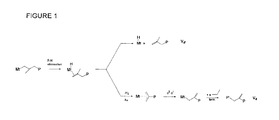
- Figure 1 represents schemes describing the formation of internal and terminal vinilydene unsaturations in a growing polymer chain.
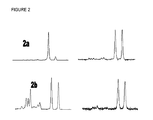
- Figure 2 represents the 1 H NMR spectra of polypropylene samples prepared with Me 2 C(3- t Bu-Cp)(Flu)MCl 2 wherein M is Zr (2a) or Hf (2b)
- Metal M was selected as Zr and Hf respectively. All polymerisation reactions were carried out at a temperature of 50 °C and with a 0.4M solution of C 3 H 6 in toluene.
- the activating agents were respectively methylaluminoxane (MAO) or a mixture MAO/phenol. When MAO was used as activating agent, the ratio [AI]/[M] was of 1.10 3 and when the mixture MAO/phenol was used as activating agent, the ratio [AI]/[M] was of (1.0 to 1.5).10 3 and the ratio [phenol]/[AI] was of 0.6, wherein [AI] represents the total amount of aluminium.
- a first set of polymerisations was carried out with metal M selected as hafnium and with substituent R on the cyclopentadienyl selected as methyl and tert-butyl respectively. All polymerisation reactions were carried out at a temperature of 50 °C and with a 0.4 M solution of propene in toluene.
- MAO MAO was used as activating agent
- the ratio [AI]/[M] was of 7.10 2
- the ratio [AI]/[M] was of 6.10 2 and the ratio [phenol]/[AI] was of 0.6.
- Table II TABLE II.
- the polymers obtained At a polymerisation temperature of 25 °C, the polymers obtained all had a hemiisotactic-like structure and they all exhibited a weak tendency of the growing chain to back skip to the less hindered coordination site upon diluting the monomer.
- the enantioselectivity of the more open coordination site was lower for the hafnocene (95 %) than for the zirconocene (98 %) and it was not sensitive to monomer concentration.
- the enantioselectivity of the more open coordination site decreased with decreasing monomer concentration for the hafnocene, whereas it remained unaltered for the zirconocene.
- this behaviour might be the result of growing chain epimerisation.
- the hafnocenes of the present invention did not exhibit the tendency to produce internal unsaturations. Their NMR spectrum indicated on the contrary a majority of terminal unsaturations.
- the 1 H NMR spectra in the olefinic region of 400 MHz were recorded for the polymer samples prepared in toluene with Me 2 C(3- t Bu-Cp)(Flu)MCl 2 wherein M is Zr or Hf. They are represented in Figures 2a and 2b respectively.
Landscapes
- Chemical & Material Sciences (AREA)
- Organic Chemistry (AREA)
- Health & Medical Sciences (AREA)
- Chemical Kinetics & Catalysis (AREA)
- Medicinal Chemistry (AREA)
- Polymers & Plastics (AREA)
- Engineering & Computer Science (AREA)
- Materials Engineering (AREA)
- Crystallography & Structural Chemistry (AREA)
- Transition And Organic Metals Composition Catalysts For Addition Polymerization (AREA)
Abstract
The present invention discloses an active metallocene catalyst system prepared with a hafnium-based metallocene catalyst system and an activating agent comprising an aluminoxane and a sterically hindered Lewis base.
Description
- This invention relates to the activation of hafnium-based metallocene catalyst components.
- Polyolefins such as polyethylenes having a high molecular weight generally have improved mechanical properties over their low molecular weight counterparts.
- It has been observed that hafnium-based metallocene catalyst components can be used in catalyst systems that produce homo- and co-polymers of alpha-olefins having very high molecular weight. They also have an excellent response to hydrogen. Their activity is however prohibitively low.
- Until recently the low activity of the hafnium-based metallocene catalyst systems was believed to be inherent to the metal property. Recently, Rieger et al (Rieger B., Troll C., and Preuschen J., in Macromolecules 2002, 35, 5742-5743) or Preuschen et al. in US-A-2003/0187158 have shown that the activity of some "dual-site" hafnium-based metallocene catalyst systems may be improved when borates are used as activating agents and when the solvent is propene. These same catalyst systems, when used with methylaluminoxane (MAO) show a very low activity. It was thus concluded from these studies that MAO is an inefficient activating agent for hafnium-based catalyst systems.
- There is thus a need to improve the activity of the metallocene catalyst systems comprising hafnium-based catalyst components.
- It is an object of the present invention to improve the activity of the metallocene catalyst systems comprising hafnium-based catalyst components.
- It is also an aim of the present invention to provide polyolefins having an improved high molecular weight fraction.
- It is a further aim of the present invention to provide the use of a hafnium-based metallocene catalyst component to prepare polyolefins with improved mechanical properties
- Accordingly, the present invention discloses an active catalyst system comprising:
- a hafnium-based catalyst component;
- an activating agent having a low or no co-ordinating capability comprising an aluminoxane and a sterically hindered Lewis base.
- When an aluminoxane is used as activating agent, some amount of aluminiuml alkyl is always simultaneously and inevitably present. Surprisingly, the present inventors have identified that this aluminium alkyl is responsible for the low activity of the hafnium-based metallocene catalyst systems. It is therefore an object of the present invention to provide a method to trap the aluminium alkyl by a chemical agent that is not detrimental to the active cationic species. Such agent is a sterically hindered Lewis base.
- The hafnium-based metallocene components of the present invention have a structure according to formula (I):
R" (CpRn)(FluR'm) Hf Q2 (I)
wherein - Cp is a cyclopentadienyl ring;
- Flu is a fluorenyl ring;
- each R is the same or different and is hydrogen or a hydrocarbyl radical such as alkyl, alkenyl, aryl, alkylaryl or arylalkyl radical containing from 1 to 20 carbon atoms or two carbon atoms are joined together to form a C4-C6 ring;
- each R' is the same or different and is hydrogen or a hydrocarbyl radical such as alkyl, alkenyl, aryl, alkylaryl or arylalkyl radical containing from 1 to 20 carbon atoms
- R" is a structural bridge between two Cp rings;
- Q is a hydrocarbyl radical such as aryl, alkyl, alkenyl, alkylaryl or arylalkyl radical having from 1 to 20 carbon atoms, a hydrocarboxy radical having from 1 to 20 carbon atoms or a halogen and can be the same or different from each other;
- n is an integer from 0 to 4 and m is an integer from 0 to 8 .
- By substituted, it is meant that any of the positions on the cyclopentadienyl or on the fluorenyl derivative may comprise a substituent in place of a hydrogen atom.
- The type of bridge present between the ligands in the present catalyst component is not particularly limited. Typically R" comprises an alkylidene group having from 1 to 20 carbon atoms, a germanium group (e.g. a dialkyl germanium group), a silicon group (e.g. a dialkyl silicon group), a siloxane group (e.g. a dialkyl siloxane group), an alkyl phosphine group or an amine group. Preferably, the substituent on the bridge comprises a hydrocarbyl radical having at least one carbon, such as a substituted or unsubstituted ethylenyl radical, for example -CH2-CH2- (Et). Most preferably R" is Ph2C, Et or Me2Si.
- Q is preferably a halogen and most preferably it is Cl.
- The substituent or substituents present on the ligands are not particularly limited. If there is more than one substiutent, they can be the same or different. Typically, they are independently selected from a hydrocarbyl group having from 1 to 20 carbon atoms.
- The position of the substituent or substituents on the ligands is not particularly limited. The ligands may thus have any substitution pattern including unsubstituted or fully substituted. However, the cyclopentadienyl group is preferably substituted in the 3- and/or 5- positions or in the 2- and/or 4- positions. The fluorenyl group is preferably unsubstituted. If substituted, the substituents are preferably in the 3- and/or 6- positions or in the 2- and/or 7- positions.
- The type and position of the substituents is determined by the properties sought in the resulting polymer. If a syndiotactic polyolefin is desired, the substituents are selected to confer Cs symmetry to the catalyst component, whereas a C1 or a C2 substitution pattern is selected when isotactic polyolefins are desired.
- In another embodiment according to the present invention, the hafnium catalyst component may be described by the formula II
R"(FluR'm)X Hf Q2 (II)
wherein R", Cp, R' and Q have already been defined and wherein X is an hetero atom ligand with one or two lone pair electrons and selected from the group 15 or 16. Preferably, X is nitrogen, phosphorus oxygen or sulphur and it can be substituted or unsubstituted. - Preferably the metallocene component is a bridged cyclopentadienyl-fluorenyl complex, more preferably it has Cs or C1 symmetry substitution pattern.
- When Cs symmetry is desired, both the cyclopentadienyl and the fluorenyl groups are preferably unsubstituted.
- When a C1 symmetry is desired, the preferred substituent on the cyclopentadienyl is a in a position distal to the bridgehead position, most preferably it is a methyl or tert-butyl in position 3. The fluorenyl is preferably unsubstituted.
- The activating agent comprises an aluminoxane and a sterically hindered Lewis base or a compound comprising one or more Lewis basic functionalities. The aluminium alkyl that is inevitably associated with the aluminoxane is an electron captor (Lewis acid) and it is neutralised by the addition of an electron donor. The electron donor must be sufficiently bulky not to interfere with the hafnium.
- The aluminoxanes are well known and preferably comprise oligomeric linear and/or cyclic alkyl aluminoxanes represented by the formula:


wherein n is 1-40, preferably 10-20, m is 3-40, preferably 3-20 and R is a C1-C8 alkyl group and preferably methyl. - The sterically hindered Lewis base or the compound comprising one or more Lewis basic functionalities can be selected from compounds of formula
R*a-c E (G-R*b-1)c
or of formula
R* (G-R*b-1)c
wherein G is a group 15 or 16 element of the periodic Table, b is equal to the coordination number of G, E is a group 14 or 15 element of the periodic Table, a is the coordination number of E, c is an integer from 1 to 4, at most equal to a and each R* is independently a hydrogen or an unsubstituted or substituted hydrocarbyl. - Dimeric, trimeric, tetrameric or oligomeric versions of these compounds may also be used.
- Suitable compounds that can be used in the present invention are N,N-dimethylaniline, ethylamine, diethylamine, triethylamine, triphenylamine, triphenylphosphine, hexamethylphosphorus triamide, diethylether, ethanol, phenol, thiophenol, 2,6-di-t-butyl-4-methylphenol, tetraethoxysilane, phenyltriethoxysilane, diphenyldiethoxysilane, triphenylethoxysilane, diethyldiethoxysilane.
- Preferably, the Lewis base added to the aluminoxane in order to trap the aluminium alkyl is a sterically hindered phenol.
- The aluminoxane and Lewis base are mixed together and left to react for a period of time of from 30 minutes to 2 hours, preferably about one hour in order to reach equilibrium.
- The amount of aluminoxane added provides a ratio AI/Hf of from 100 to 5000, preferably of from 500 to 2000.
- The productivity of the catalyst system is critically dependent upon the mole ratio R of Lewis base over total aluminium (aluminoxane + aluminium alkyl). Preferably R ranges from 0.5 to 0.9, more preferably from 0.55 to 0.75. If the amount of Lewis base is too large it may act as a poison.
- The productivity of the hafnocene-based catalyst system according to the present invention is improved by a factor of at least 20.
- The invention also provides a method for homo- or co-polymerising olefins that comprises the steps of:
- A. providing a catalyst system comprising a hafnium-based catalyst component, an activating agent comprising an aluminoxane and a sterically hindered Lewis base, and an optional support;
- B. introducing the catalyst system in a polymerisation zone containing an olefin monomer and an optional co-monomer;
- C. maintaining the reaction zone under polymerisation conditions;
- D. extracting the desired polyolefin.
- The catalyst system may be employed in a solution polymerisation process, which is homogeneous, or a slurry process, which is heterogeneous. In a solution process, typical solvents include hydrocarbons having from 4 to 7 carbon atoms such as heptane, toluene or cyclohexane. In a slurry process it is necessary to immobilise the catalyst system on an inert support, particularly a porous solid support such as talc, inorganic oxides and resinous support materials such as polyolefins. Preferably, the support material is an inorganic oxide in its finely divided form.
- Suitable inorganic oxide materials that may be employed in accordance with this invention include group IIA, IIIA, IVA, or IVB metal oxides such as silica, alumina and mixtures thereof. Other inorganic oxides that may be employed either alone or in combination with the silica, or alumina are for example magnesia, titania or zirconia. Other suitable support materials comprise for example finely divided functionalised polyolefins such as finely divided polyethylene.
- Preferably, the support is a silica support having a specific surface area of from 200 to 700 m2/g and a pore volume of from 0.5 to 3 ml/g.
- Alternatively, a fluorinated activating support may be used.
- The order of addition of the catalyst components and activating agent to the support material can vary. In accordance with a preferred embodiment of the present invention, the activating agent dissolved in a suitable inert hydrocarbon solvent is added to the support material slurried in the same or another suitable hydrocarbon liquid and thereafter the catalyst components are added to the slurry.
- Preferred solvents include mineral oils and the various hydrocarbons which are liquid at reaction temperature and which do not react with the individual ingredients. Illustrative examples of the useful solvents include the alkanes such as pentane, isopentane, hexane, heptane, octane and nonane, cycloalkanes such as cyclopentane, cyclohexane, and aromatics such as benzene, toluene, ethylbenzene and diethylbenzene.
- Preferably, the support material is slurried in toluene and the catalyst components and activating agent are dissolved in toluene prior to addition to the support material.
- The conditions employed for polymerisation are not particularly limited, provided they are sufficient to effectively polymerise the particular monomer used as a starting material. Polymerisation may take place in the presence of hydrogen and of an alkene co-monomer such as 1-butene or 1-hexene.
- Optionally, pre-polymerisation can be carried out.
- Preferably the alpha-olefin is propylene.
- Figure 1 represents schemes describing the formation of internal and terminal vinilydene unsaturations in a growing polymer chain.
- Figure 2 represents the 1H NMR spectra of polypropylene samples prepared with Me2C(3-tBu-Cp)(Flu)MCl2 wherein M is Zr (2a) or Hf (2b)
- Metal M was selected as Zr and Hf respectively. All polymerisation reactions were carried out at a temperature of 50 °C and with a 0.4M solution of C3H6 in toluene. The activating agents were respectively methylaluminoxane (MAO) or a mixture MAO/phenol. When MAO was used as activating agent, the ratio [AI]/[M] was of 1.103 and when the mixture MAO/phenol was used as activating agent, the ratio [AI]/[M] was of (1.0 to 1.5).103 and the ratio [phenol]/[AI] was of 0.6, wherein [AI] represents the total amount of aluminium. The results are displayed in Table I, they include the productivities expressed in kgPP/{[C3H6]*molHf*h} and polymer properties of active site enantioselectivity σ, fractional abundance of skipped insertions Psk and viscosity-average molecular mass Mv determined in tetralin at 135 °C.
TABLE I. Metal Activating agent Productivity *10-3 kgPP/{[C3H6]*molHf*h} σ Psk Mv * Zr MAO 1.1 0.978 0.072 81000 Zr MAO/phenol 2.4 0.983 0.054 410000 Hf MAO 0.06 0.948 0.119 16000 Hf MAO/phenol 2.1 0.941 0.082 610000 - It can be seen that the addition of phenol to MAO increases the productivity of both catalyst systems, but the effect was dramatically larger for Hf-based catalyst system than for Zr- based catalyst system. The molecular weight of polypropylene prepared with the hafnium-based catalyst system activated with the mixture MAO/phenol was also considerably larger than that prepared with the zirconium-based catalyst system, all other polymerisation parameters being the same.
- A first set of polymerisations was carried out with metal M selected as hafnium and with substituent R on the cyclopentadienyl selected as methyl and tert-butyl respectively. All polymerisation reactions were carried out at a temperature of 50 °C and with a 0.4 M solution of propene in toluene. When MAO was used as activating agent, the ratio [AI]/[M] was of 7.102 and when the mixture MAO/phenol was used as activating agent the ratio [AI]/[M] was of 6.102 and the ratio [phenol]/[AI] was of 0.6. The results are reported in Table II.
TABLE II. Metal Activating agent R Productivity *10-3 kgPP/{[C3H6]*MolHf*h} Hf MAO Me 14 Hf MAO/phenol Me 90 Hf MAO t-Bu - Hf MAO/phenol t-Bu 33 - Additional polymerisations were carried out with metal M selected as hafnium or zirconium and with substituent R on the cyclopentadienyl ring selected as methyl. The polymerisation temperature and propene partial pressure were selected as indicated in Table III. The polymer properties of enantioselectivity at site i, σi (i = 1 or 2), of conditional probability Pij of monomer insertion at site j after a previous insertion at site i (i = 1 or 2 and j = 1 or 2) are also displayed in Table III. In all polymerisation reactions, the catalyst system was activated with a mixture MAO/phenol having a ratio [phenol]/[Al] of 0.6.
TABLE III. Metal Temp. °C Pressure C3H6 bars σ1 P12 σ2 P21 Zr 25 1 0.98 0.9 0.44 1 Zr 25 8 0.99 0.97 0.44 1 Hf 25 1 0.95 0.82 0.5 1 Hf 25 8 0.95 0.98 0.52 1 Zr 50 1 0.97 0.66 0.43 1 Zr 50 8 0.98 0.9 0.45 1 Hf 50 1 0.91 0.66 0.56 1 Hf 50 4 0.956 0.82 0.51 1 - At a polymerisation temperature of 25 °C, the polymers obtained all had a hemiisotactic-like structure and they all exhibited a weak tendency of the growing chain to back skip to the less hindered coordination site upon diluting the monomer. The enantioselectivity of the more open coordination site was lower for the hafnocene (95 %) than for the zirconocene (98 %) and it was not sensitive to monomer concentration.
- At a polymerisation temperature of 50 °C, the enantioselectivity of the more open coordination site decreased with decreasing monomer concentration for the hafnocene, whereas it remained unaltered for the zirconocene.
- Without wishing to be bound by a theory, this behaviour might be the result of growing chain epimerisation.
- The present inventors have reported in European patent application EP-03102060 that the catalyst systems based on catalyst component Me2C(3-tBu-Cp)(Flu)ZrCl2 generated polypropylene with an unprecedently high level of internal chain unsaturations. These internal chain unsaturations were attributed to β-H elimination followed by allylic chain activation as summarised in Figure 1.
- The hafnocenes of the present invention did not exhibit the tendency to produce internal unsaturations. Their NMR spectrum indicated on the contrary a majority of terminal unsaturations. The 1H NMR spectra in the olefinic region of 400 MHz were recorded for the polymer samples prepared in toluene with Me2C(3-tBu-Cp)(Flu)MCl2 wherein M is Zr or Hf. They are represented in Figures 2a and 2b respectively. It can be seen from these spectra that the samples prepared with the zirconocene (2a) have truly internal vinylidene unsaturations, whereas those prepared with the hafnocene (2b) show the two peaks characteristic of terminal vinylidene unsaturations and additionally a complex pattern at 5.0-5.1 ppm that could represent a terminal vinyl.
Claims (14)
- A metallocene catalyst system comprising:- a hafnium-based metallocene catalyst component;- an activating agent having a low or no co-ordinating capability comprising an aluminoxane and a sterically hindered lewis base;- optionally a support.
- The metallocene catalyst system of claim 1 wherein the hafnium-based catalyst component is described by formula I
R" (CpRn)(FluR'm)Hf Q2 (I)
wherein Cp is a cyclopentadienyl ring ; Flu is a fluorenyl ring; each R is the same or different and is hydrogen or a hydrocarbyl radical such as alkyl, alkenyl, aryl, alkylaryl or arylalkyl radical containing from 1 to 20 carbon atoms or two carbon atoms are joined together to form a C4-C6 ring; each R' is the same or different and is hydrogen or a hydrocarbyl radical such as alkyl, alkenyl, aryl, alkylaryl or arylalkyl radical containing from 1 to 20 carbon atoms; R" is a structural bridge between two Cp rings; Q is a hydrocarbyl radical such as aryl, alkyl, alkenyl, alkylaryl or arylalkyl radical having from 1 to 20 carbon atoms, a hydrocarboxy radical having from 1 to 20 carbon atoms or a halogen and can be the same or different from each other; n is an integer from 0 to 4 and m is an integer from 0 to 8;
or by the formula II
R"(FluR'm)X Hf Q2 (II)
wherein R", Flu, R' and Q have already been defined and wherein X is an hetero atom ligand with one or two lone pair electrons and selected from the group 15 or 16, substituted or unsubstituted. - The metallocene catalyst system of claim 2 wherein in formula II, X is nitrogen, phosphorus, oxygen or sulphur.
- The metallocene catalyst system of claim 2 or claim 3 wherein the hafnium-based catalyst component of formula I has no substituents on the cyclopentadienyl group and on the fluorenyl group and the hafnium-based catalyst component of formula II has no substituents on the fluorenyl group.
- The metallocene catalyst system of claim 2 wherein the hafnium-based catalyst component of formula I has a substituent in position 3 on the cyclopentadienyl group and no substituents on the fluorenyl group.
- The metallocene catalyst system of claim 5 wherein the substituent on the cyclopentadienyl group is methyl or tert-butyl.
- The metallocene catalyst system of any one of the preceding claims wherein the aluminoxane is methylaluminoxane.
- The metallocene catalyst system of any one of the preceding claims wherein the sterically hindered Lewis base is a compound of formula R*a-c E (G-R*b-1)c or of formula R* (G-R*b-1)c wherein G is a group 15 or 16 element of the periodic Table, b is equal to the coordination number of G, E is a group 14 or 15 element of the periodic Table, a is the coordination number of E, c is an integer from 1 to 4, at most equal to a and each R* is independently a hydrogen or an unsubstituted or substituted hydrocarbyl.
- The metallocene catalyst system of claim 8 wherein the sterically hindered Lewis base is a sterically hindered bulky phenol.
- A method for preparing the catalyst system of any one of claims 1 to 9 comprising the steps of:A. providing a hafnium-based metallocene catalyst component;B. providing an activating agent comprising an aluminoxane and a sterically hindered Lewis base;C. optionally providing a support.
- A method for polymerising alpha-olefins that comprises the steps of:A. injecting into a reactor the catalyst system of any one of claims 1 to 9;B. injecting into the reactor a monomer and an optional comonomer;C. maintaining under polymerising conditions;D. retrieving a polyolefin.
- The method of claim 11 wherein the monomer is propylene.
- A polyolefin obtainable by the method of claim 11 or claim 12.
- An article prepared from the polyolefin of claim 13.
Priority Applications (13)
| Application Number | Priority Date | Filing Date | Title |
|---|---|---|---|
| EP04105219A EP1650236A1 (en) | 2004-10-21 | 2004-10-21 | Activating agents for hafnium based metallocene components |
| JP2007537276A JP5579367B2 (en) | 2004-10-21 | 2005-10-20 | Activators for hafnium-based metallocene components |
| CN2005800358294A CN101044174B (en) | 2004-10-21 | 2005-10-20 | Activator for hafnium-based metallocene components |
| EA200700681A EA015396B1 (en) | 2004-10-21 | 2005-10-20 | Activating agents for hafnium based metallocene components |
| DK05801764.1T DK1805234T3 (en) | 2004-10-21 | 2005-10-20 | ACTIVATION MEANS FOR hafnium-BASED metallocene |
| EP05801764.1A EP1805234B1 (en) | 2004-10-21 | 2005-10-20 | Activating agents for hafnium based metallocene components |
| KR1020077008741A KR101239442B1 (en) | 2004-10-21 | 2005-10-20 | Activating agents for hafnium based metallocene components |
| PCT/EP2005/055399 WO2006045739A1 (en) | 2004-10-21 | 2005-10-20 | Activating agents for hafnium based metallocene components |
| ES05801764.1T ES2532500T3 (en) | 2004-10-21 | 2005-10-20 | Activating agents for hafnium-based metallocene components |
| US11/665,706 US20080108765A1 (en) | 2004-10-21 | 2005-10-20 | Activating Agents for Hafnium-Based Metallocene Components |
| US13/902,309 US8895466B2 (en) | 2004-10-21 | 2013-05-24 | Activating agents for hafnium-based metallocene components |
| US14/498,212 US9206274B2 (en) | 2004-10-21 | 2014-09-26 | Activating agents for hafnium-based metallocene components |
| US14/882,059 US9683056B2 (en) | 2004-10-21 | 2015-10-13 | Activating agents for hafnium-based metallocene components |
Applications Claiming Priority (1)
| Application Number | Priority Date | Filing Date | Title |
|---|---|---|---|
| EP04105219A EP1650236A1 (en) | 2004-10-21 | 2004-10-21 | Activating agents for hafnium based metallocene components |
Publications (1)
| Publication Number | Publication Date |
|---|---|
| EP1650236A1 true EP1650236A1 (en) | 2006-04-26 |
Family
ID=34929743
Family Applications (2)
| Application Number | Title | Priority Date | Filing Date |
|---|---|---|---|
| EP04105219A Withdrawn EP1650236A1 (en) | 2004-10-21 | 2004-10-21 | Activating agents for hafnium based metallocene components |
| EP05801764.1A Expired - Lifetime EP1805234B1 (en) | 2004-10-21 | 2005-10-20 | Activating agents for hafnium based metallocene components |
Family Applications After (1)
| Application Number | Title | Priority Date | Filing Date |
|---|---|---|---|
| EP05801764.1A Expired - Lifetime EP1805234B1 (en) | 2004-10-21 | 2005-10-20 | Activating agents for hafnium based metallocene components |
Country Status (9)
| Country | Link |
|---|---|
| US (4) | US20080108765A1 (en) |
| EP (2) | EP1650236A1 (en) |
| JP (1) | JP5579367B2 (en) |
| KR (1) | KR101239442B1 (en) |
| CN (1) | CN101044174B (en) |
| DK (1) | DK1805234T3 (en) |
| EA (1) | EA015396B1 (en) |
| ES (1) | ES2532500T3 (en) |
| WO (1) | WO2006045739A1 (en) |
Cited By (4)
| Publication number | Priority date | Publication date | Assignee | Title |
|---|---|---|---|---|
| US20080108766A1 (en) * | 2004-10-21 | 2008-05-08 | Total Petrochemicals Research Feluy | Polyolefins Prepared From A Metallocene And A New Single Site Catalyst Component In A Single Reactor |
| US7799879B2 (en) | 2008-08-01 | 2010-09-21 | Exxonmobil Chemical Patents Inc. | Catalyst system and process for olefin polymerization |
| US8580902B2 (en) | 2008-08-01 | 2013-11-12 | Exxonmobil Chemical Patents Inc. | Catalyst system, process for olefin polymerization, and polymer compositions produced therefrom |
| KR20150023510A (en) * | 2012-06-01 | 2015-03-05 | 다우 글로벌 테크놀로지스 엘엘씨 | Free-radical processes to make ethylene-based polymers using alklyated phenols |
Families Citing this family (5)
| Publication number | Priority date | Publication date | Assignee | Title |
|---|---|---|---|---|
| US8119553B2 (en) | 2007-09-28 | 2012-02-21 | Chevron Phillips Chemical Company Lp | Polymerization catalysts for producing polymers with low melt elasticity |
| KR101725351B1 (en) * | 2014-12-04 | 2017-04-10 | 주식회사 엘지화학 | Method for preparing supported hybrid metallocene catalyst, and supported hybrid metallocene catalyst using the same |
| US10442920B2 (en) | 2017-04-19 | 2019-10-15 | Nova Chemicals (International) S.A. | Means for increasing the molecular weight and decreasing the density of ethylene interpolymers employing homogeneous and heterogeneous catalyst formulations |
| US10882987B2 (en) | 2019-01-09 | 2021-01-05 | Nova Chemicals (International) S.A. | Ethylene interpolymer products having intermediate branching |
| US11046843B2 (en) | 2019-07-29 | 2021-06-29 | Nova Chemicals (International) S.A. | Ethylene copolymers and films with excellent sealing properties |
Citations (5)
| Publication number | Priority date | Publication date | Assignee | Title |
|---|---|---|---|---|
| EP0387691A1 (en) * | 1989-03-11 | 1990-09-19 | Hoechst Aktiengesellschaft | Process for preparing a syndiotactic polyolefin |
| EP0399347A2 (en) * | 1989-05-20 | 1990-11-28 | Hoechst Aktiengesellschaft | Process for preparing a Syndio-isoblockpolymer |
| EP0985673A2 (en) * | 1998-09-09 | 2000-03-15 | Sumitomo Chemical Company, Limited | Modified aluminium oxy compound, polymerization catalyst and process for producing olefin polymer and alkenyl aromatic hydrocarbon polymer |
| WO2001090205A1 (en) * | 2000-05-24 | 2001-11-29 | Basell Technology Company B.V. | Propylene polymers and process for the preparation thereof |
| EP1496070A1 (en) * | 2003-07-09 | 2005-01-12 | Total Petrochemicals Research Feluy | A polyolefin having internal double bonds and a method for making the same |
Family Cites Families (11)
| Publication number | Priority date | Publication date | Assignee | Title |
|---|---|---|---|---|
| US5547675A (en) * | 1989-09-13 | 1996-08-20 | Exxon Chemical Patents Inc. | Modified monocyclopentadienyl transition metal/alumoxane catalyst system for polymerization of olefins |
| US5026798A (en) * | 1989-09-13 | 1991-06-25 | Exxon Chemical Patents Inc. | Process for producing crystalline poly-α-olefins with a monocyclopentadienyl transition metal catalyst system |
| DE3932181A1 (en) * | 1989-09-27 | 1991-04-04 | Hoechst Ag | METHOD FOR PRODUCING A POLYOLEFIN |
| JP2002322209A (en) * | 1995-06-28 | 2002-11-08 | Idemitsu Kosan Co Ltd | Method for producing ethylene copolymer |
| EP0786466B1 (en) * | 1996-01-25 | 2003-04-16 | Tosoh Corporation | Olefin polymerisation process which comprises a transition metal catalyst. |
| JP4414028B2 (en) * | 1998-09-09 | 2010-02-10 | 住友化学株式会社 | Modified aluminum oxy compound, catalyst component for addition polymerization, catalyst for addition polymerization, method for producing olefin polymer, method for producing alkenyl aromatic hydrocarbon polymer, and copolymer |
| JP4439686B2 (en) * | 2000-06-09 | 2010-03-24 | 三井化学株式会社 | Syndiotactic propylene-based copolymer and thermoplastic resin composition containing the copolymer |
| US6878790B2 (en) | 2000-11-30 | 2005-04-12 | The Procter & Gamble Company | High molecular weight polyolefin and catalyst and process for polymerizing said polyolefin |
| GB0220681D0 (en) * | 2002-09-05 | 2002-10-16 | Borealis Tech Oy | Process |
| KR101087179B1 (en) * | 2003-03-28 | 2011-11-25 | 미쓰이 가가쿠 가부시키가이샤 | Polyolefin resin composition |
| EP1650231A1 (en) * | 2004-10-21 | 2006-04-26 | Total Petrochemicals Research Feluy | Polyolefins prepared from a metallocene and a new single site catalyst components in a single reactor |
-
2004
- 2004-10-21 EP EP04105219A patent/EP1650236A1/en not_active Withdrawn
-
2005
- 2005-10-20 ES ES05801764.1T patent/ES2532500T3/en not_active Expired - Lifetime
- 2005-10-20 CN CN2005800358294A patent/CN101044174B/en not_active Expired - Fee Related
- 2005-10-20 JP JP2007537276A patent/JP5579367B2/en not_active Expired - Fee Related
- 2005-10-20 EA EA200700681A patent/EA015396B1/en not_active IP Right Cessation
- 2005-10-20 EP EP05801764.1A patent/EP1805234B1/en not_active Expired - Lifetime
- 2005-10-20 US US11/665,706 patent/US20080108765A1/en not_active Abandoned
- 2005-10-20 WO PCT/EP2005/055399 patent/WO2006045739A1/en not_active Ceased
- 2005-10-20 KR KR1020077008741A patent/KR101239442B1/en not_active Expired - Fee Related
- 2005-10-20 DK DK05801764.1T patent/DK1805234T3/en active
-
2013
- 2013-05-24 US US13/902,309 patent/US8895466B2/en not_active Expired - Lifetime
-
2014
- 2014-09-26 US US14/498,212 patent/US9206274B2/en not_active Expired - Lifetime
-
2015
- 2015-10-13 US US14/882,059 patent/US9683056B2/en not_active Expired - Fee Related
Patent Citations (5)
| Publication number | Priority date | Publication date | Assignee | Title |
|---|---|---|---|---|
| EP0387691A1 (en) * | 1989-03-11 | 1990-09-19 | Hoechst Aktiengesellschaft | Process for preparing a syndiotactic polyolefin |
| EP0399347A2 (en) * | 1989-05-20 | 1990-11-28 | Hoechst Aktiengesellschaft | Process for preparing a Syndio-isoblockpolymer |
| EP0985673A2 (en) * | 1998-09-09 | 2000-03-15 | Sumitomo Chemical Company, Limited | Modified aluminium oxy compound, polymerization catalyst and process for producing olefin polymer and alkenyl aromatic hydrocarbon polymer |
| WO2001090205A1 (en) * | 2000-05-24 | 2001-11-29 | Basell Technology Company B.V. | Propylene polymers and process for the preparation thereof |
| EP1496070A1 (en) * | 2003-07-09 | 2005-01-12 | Total Petrochemicals Research Feluy | A polyolefin having internal double bonds and a method for making the same |
Non-Patent Citations (4)
Cited By (12)
| Publication number | Priority date | Publication date | Assignee | Title |
|---|---|---|---|---|
| US20080108766A1 (en) * | 2004-10-21 | 2008-05-08 | Total Petrochemicals Research Feluy | Polyolefins Prepared From A Metallocene And A New Single Site Catalyst Component In A Single Reactor |
| US8178634B2 (en) * | 2004-10-21 | 2012-05-15 | Total Petrochemicals Research Feluy | Polyolefins prepared from a metallocene and a new single site catalyst component in a single reactor |
| US20120245021A1 (en) * | 2004-10-21 | 2012-09-27 | Total Petrochemicals Research Feluy | Polyolefins Prepared from a Metallocene and a New Single Site Catalyst Components in a Single Reactor |
| US8455386B2 (en) * | 2004-10-21 | 2013-06-04 | Total Research & Technology Feluy | Polyolefins prepared from a metallocene and a new single site catalyst components in a single reactor |
| US20130237405A1 (en) * | 2004-10-21 | 2013-09-12 | Total Research & Technology Feluy | Metallocene and a New Single Site Catalyst Component |
| US8637421B2 (en) * | 2004-10-21 | 2014-01-28 | Total Petrochemicals Research Feluy | Metallocene and a new single site catalyst component |
| US7799879B2 (en) | 2008-08-01 | 2010-09-21 | Exxonmobil Chemical Patents Inc. | Catalyst system and process for olefin polymerization |
| US7985816B2 (en) | 2008-08-01 | 2011-07-26 | Exxonmobil Chemical Patents Inc. | Catalyst system and process for olefin polymerization |
| US8580902B2 (en) | 2008-08-01 | 2013-11-12 | Exxonmobil Chemical Patents Inc. | Catalyst system, process for olefin polymerization, and polymer compositions produced therefrom |
| US8835587B2 (en) | 2009-08-14 | 2014-09-16 | Exxonmobil Chemical Patents Inc. | Catalyst system, process for olefin polymerization, and polymer compositions produced therefrom |
| KR20150023510A (en) * | 2012-06-01 | 2015-03-05 | 다우 글로벌 테크놀로지스 엘엘씨 | Free-radical processes to make ethylene-based polymers using alklyated phenols |
| US9328180B2 (en) | 2012-06-01 | 2016-05-03 | Dow Global Technologies Llc | Free-radical processes to make ethylene-based polymers using alklyated phenols |
Also Published As
| Publication number | Publication date |
|---|---|
| US9683056B2 (en) | 2017-06-20 |
| ES2532500T3 (en) | 2015-03-27 |
| EA200700681A1 (en) | 2007-10-26 |
| JP2008517132A (en) | 2008-05-22 |
| WO2006045739A1 (en) | 2006-05-04 |
| EP1805234B1 (en) | 2014-12-17 |
| US20160032024A1 (en) | 2016-02-04 |
| KR20070083709A (en) | 2007-08-24 |
| KR101239442B1 (en) | 2013-03-06 |
| CN101044174B (en) | 2012-05-30 |
| EP1805234A1 (en) | 2007-07-11 |
| US8895466B2 (en) | 2014-11-25 |
| CN101044174A (en) | 2007-09-26 |
| JP5579367B2 (en) | 2014-08-27 |
| DK1805234T3 (en) | 2015-03-23 |
| US20080108765A1 (en) | 2008-05-08 |
| US20150018504A1 (en) | 2015-01-15 |
| EA015396B1 (en) | 2011-08-30 |
| US20130338322A1 (en) | 2013-12-19 |
| US9206274B2 (en) | 2015-12-08 |
Similar Documents
| Publication | Publication Date | Title |
|---|---|---|
| US8895466B2 (en) | Activating agents for hafnium-based metallocene components | |
| FI105193B (en) | Catalyst useful in polymerization of olefins | |
| EP1283223B1 (en) | Use of a mixture of two metallocene regioisomers as catalyst component for preparing bimodal isotactic polyolefins | |
| EP0729984B1 (en) | Processfor the preparation of atactic copolymers of propylene with ethylene | |
| EP1401880B1 (en) | Metallocene catalysts containing an indenyl moiety substituted at the 4-, 5-, 6- or 7-position by a siloxy or germyloxy group | |
| WO2001070395A2 (en) | Polymerization catalysts comprising an open eta-5 ligand | |
| KR101618460B1 (en) | Supported catalyst for olefin polymerization and process for preparing polyolefin using the same | |
| EP3546490B1 (en) | Polyolefin catalyst and method for preparing polyolefin by using same | |
| KR20050033542A (en) | Method of making mixed ziegler-natta/metallocene catalysts | |
| KR20040037136A (en) | Catalyst component comprising a metallocene with two tetrahydroindenyl ligands for producing a polyolefin | |
| US6383968B1 (en) | Process for the polymerization of olefins | |
| KR100209859B1 (en) | Method for preparation of polyethylene copolymer | |
| EP4053175A1 (en) | Metallocene compound, and preparation method therefor and application thereof | |
| WO2001053361A1 (en) | Siloxy-substituted monocyclopentadienyl ligated constrained geometry olefin polymerisation catalysts | |
| US9932423B2 (en) | Hydrogenation of annulated cyclopentadienyl metal complexes and metallocene catalysts comprising such | |
| KR101496383B1 (en) | Catalyst compositon for preparing alpha-olefin copolymer and preparation method of alpha-olefin copolymer | |
| EP1403293A1 (en) | Silicon containing cyclopentadienyl ring for metallocene catalyst component | |
| KR20210037576A (en) | Supported hybrid catalyst and method for preparing polyolefin using the same |
Legal Events
| Date | Code | Title | Description |
|---|---|---|---|
| PUAI | Public reference made under article 153(3) epc to a published international application that has entered the european phase |
Free format text: ORIGINAL CODE: 0009012 |
|
| AK | Designated contracting states |
Kind code of ref document: A1 Designated state(s): AT BE BG CH CY CZ DE DK EE ES FI FR GB GR HU IE IT LI LU MC NL PL PT RO SE SI SK TR |
|
| AX | Request for extension of the european patent |
Extension state: AL HR LT LV MK |
|
| AKX | Designation fees paid | ||
| REG | Reference to a national code |
Ref country code: DE Ref legal event code: 8566 |
|
| STAA | Information on the status of an ep patent application or granted ep patent |
Free format text: STATUS: THE APPLICATION IS DEEMED TO BE WITHDRAWN |
|
| 18D | Application deemed to be withdrawn |
Effective date: 20061028 |